
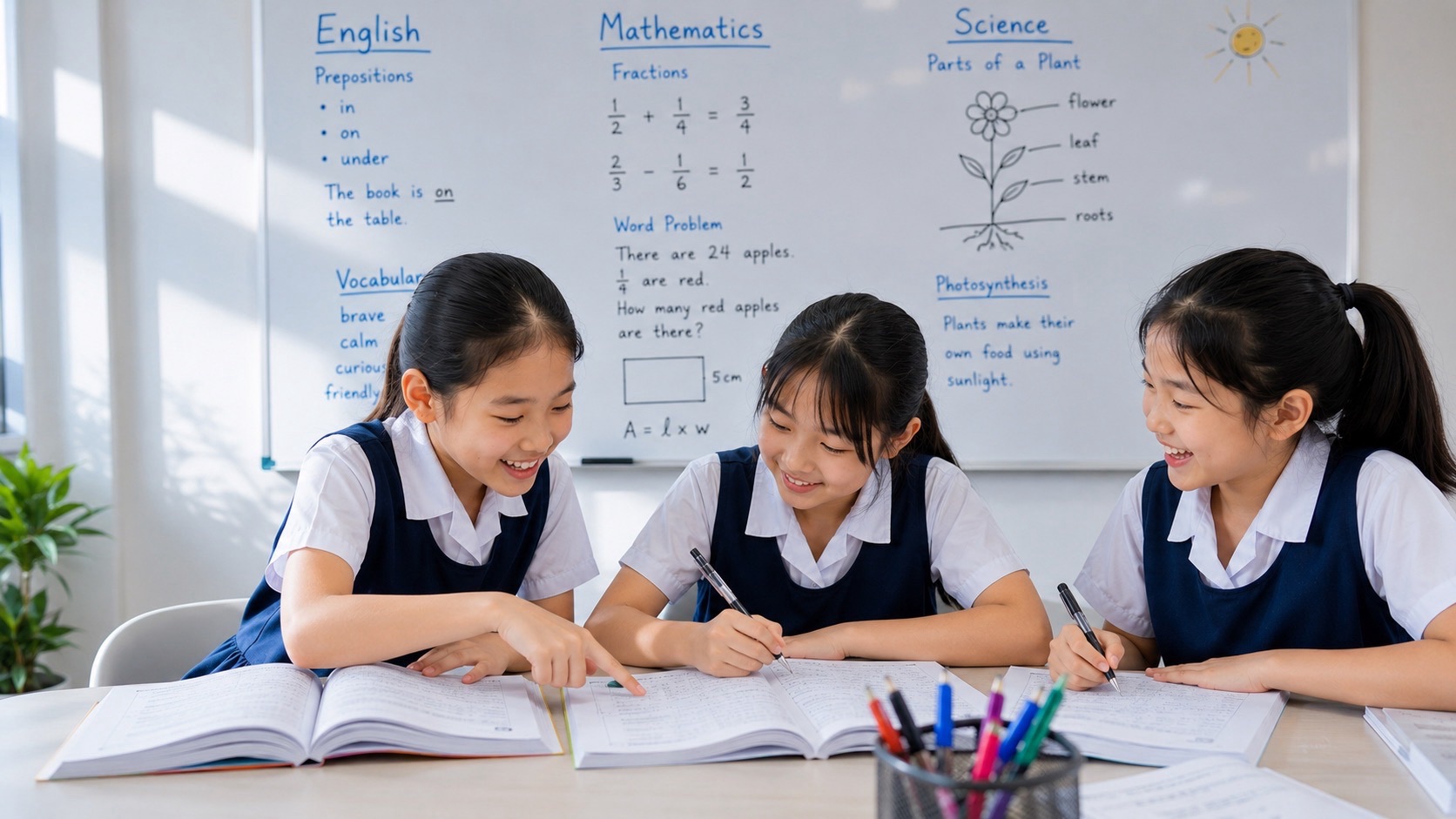
Primary 6 Science tuition for Compassvale students. Focused three-student tutorials that integrate earlier concepts, current school learning, scientific inquiry and independent PSLE readiness.
Primary 6 is the year to bring the learning together.
At eduKateSG, regular Science lessons are human-led in groups of three and last about 1.5 hours. Each lesson combines explanation, guided practice, independent work, error review and carefully selected continuation work.
The purpose is not simply to complete more papers. It is to help the learner recognise the Science inside an unfamiliar question, use the evidence provided and explain the relevant relationship accurately.
Families around Compassvale can use our current contact page to discuss class fit, timetable and venue. This local guide does not imply that eduKateSG operates a classroom in Compassvale.
Primary 6 Is the Year to Bring the Learning Together
A Primary 6 student does not begin with an empty notebook. Several years of Science have already been taught. The challenge is to make that learning usable as a connected body of knowledge while the remaining school topics are introduced.
A question can require a concept learned earlier, a process taught recently and a representation the child has never seen before. The student must select the relevant relationship without being told which chapter to use.
This explains why a thick revision file is not necessarily a secure foundation. The notes may contain correct definitions while the learner still depends on familiar wording or a tutor’s first prompt.
Our teaching therefore connects learning and performance. We continue teaching what needs to be understood, then remove enough support to see what the student can do independently.
When an independent attempt fails, we inspect the cause. A concept gap, a reading error, an incomplete mechanism and a timing problem require different responses.
The Hidden Science Problem: Choosing the Right Topic but Using the Wrong Explanation
Some Primary 6 errors are difficult to notice because the answer contains several correct words. The student identifies the right chapter yet describes a different condition from the one in the question.
For example, a learner may write that an insulating layer prevents heat from escaping when the task is about keeping a cold drink cool in warmer surroundings. The property is relevant, but the direction of heat transfer has not been checked.
In a plant question, the child may confuse photosynthesis with respiration. In an investigation, the child may remember that a fair test changes one factor yet accept a conclusion from two setups where several relevant conditions differ.
We use close contrasts. Two questions look similar but require different decisions. The learner identifies the condition that changes the explanation and states why it matters.
Clarity comes first. Speed is built afterwards.
Why Compassvale Parents Consider Three-Student Science Tutorials
A class of three gives the tutor room to distinguish different causes of the same result. One child may lack the concept. Another may misread the data. A third may understand both but write an incomplete explanation.
Students first make an individual attempt. Discussion follows. The group can compare explanations, identify the decisive evidence and challenge an assumption. Every student then returns to a fresh question independently.
- frequent opportunities to explain reasoning aloud;
- close inspection of diagrams, tables, graphs and written answers;
- faster identification of recurring misconceptions;
- guided practice followed by independent transfer;
- pacing that can respond to the actual learners;
- focused corrections before errors become habits;
- more precise preparation around school assessments; and
- a calm peer environment without large-class noise.
Small numbers help only when placement is suitable. We consider current school content, earlier gaps, pace and the amount of support required before recommending a class.
Primary 6 Science and the Current Primary Framework
The MOE Primary Science Teaching and Learning Syllabus organises learning around scientific knowledge, practices and values across the themes of Diversity, Cycles, Systems, Energy and Interactions.
The 2026 SEAB PSLE Science syllabus assesses knowledge with understanding and application through scientific inquiry. Preparation therefore needs to include interpretation, analysis, evaluation and communicated reasoning.
The child’s school programme remains the starting point for lesson planning. Parents can bring the current topic list, textbook and recent marked work.
Earlier learning is repaired when it affects current work. This is not repeating the entire syllabus. It is restoring the specific relationship that the present topic needs.
What We Teach and Revisit in Primary 6 Science
Photosynthesis and respiration
Students distinguish food production from the release of energy from food. We use changed conditions so the learner does not apply one memorised plant sentence to every question.
The child should understand the relevant role of light, water and carbon dioxide in photosynthesis at the required primary-school depth, and avoid treating respiration as the same process.
Forces and changes in motion
Students identify what acts on what and what effect the interaction has. When data are supplied, the learner uses the stated conditions rather than relying on a vague rule about roughness, smoothness or strength.
Where spring data are involved, we distinguish total length from extension and read the baseline carefully before making a prediction.
Energy changes
Students identify the starting form, process or device and observable outcome. A list of energy forms is replaced by a clear explanation of the particular change required by the question.
Food chains, food webs and adaptations
Students read arrows and relationships accurately, distinguish direct from indirect effects and limit predictions to the simplified conditions supplied.
Adaptation answers connect a feature to its function and the environmental challenge. Naming a feature alone is not enough.
Cumulative physical Science
Heat, water, materials, light, circuits, measurement and earlier inquiry skills continue to appear inside mixed work. We retrieve them when current understanding depends on them.
Our First-Principles Teaching Method
1. Diagnose the exact weakness
We inspect recent schoolwork and selected independent questions. A label such as ‘weak in energy’ is too broad. The student may actually be uncertain about the direction of heat transfer, the object being considered or the interpretation of a diagram.
2. Rebuild from the first unstable point
We return only to the prerequisite affecting current work. The child experiences a successful independent step before greater complexity is added.
3. Use the Fencing Method
One scientific relationship is made clear inside a manageable boundary. We then add one deliberate difficulty: a changed material, an unfamiliar representation, another variable or a less obvious command.
4. Move from evidence to representation to explanation
A situation is translated into a diagram, table or short model, then into words. Each representation should clarify the relationship rather than become another picture to memorise.
5. Think aloud
Students explain what the question asks, what evidence matters and why the selected concept applies. Explanation reveals hidden confusion.
6. Retrieve and interleave
Earlier and newer concepts return after the original lesson. Mixed work requires the learner to identify the relevant idea without a chapter heading.
7. Build checking discipline
Checking targets known risks: units, graph scales, changed conditions, incomplete mechanisms, ambiguous pronouns and answers that go beyond the evidence.
Experiments and Data: Read Before Explaining
By Primary 6, students should have a dependable routine for interpreting an investigation. We begin with the purpose, identify what changes, identify what is measured and inspect the conditions that make the comparison meaningful.
The order matters. A familiar apparatus can tempt a learner to write the expected story before noticing what the data actually show.
Controlled variables are taught through competing explanations. If two plants begin at different heights, comparing final heights may not isolate the effect being investigated. If two containers begin with different volumes, the final amount alone may not answer a question about amount lost.
Repeated trials and fair design solve different problems. Repeating an unfair comparison does not remove the uncontrolled difference.
The conclusion should remain proportional to the evidence collected. A limited test does not justify an unlimited claim.
Tables, Graphs and Diagrams
Students identify headings, axes, units, scale, baseline and pattern before writing a scientific explanation.
A final value is not always the quantity the question asks for. A plant can finish taller but increase less. A graph can show a trend without establishing the cause.
We also change the representation. The same relationship may appear as a paragraph, table, graph or diagram. Understanding should survive that surface change.
How We Improve Open-Ended Answers
The first decision is the command. A comparison, explanation, prediction and evaluation require different outputs.
The learner then selects the essential evidence and states the mechanism connecting that evidence to the outcome.
We replace vague language such as ‘it’, ‘more’ and ‘better’ when it makes the relationship unclear. Naming the object and quantity often improves the answer without making it much longer.
Students also learn to stop once the scientific job is complete. Extra facts can introduce contradictions.
Three Primary 6 Student Pathways
The repair pathway
Important earlier misconceptions still affect current work. We rebuild the smallest meaningful gap and reconnect it to the current school topic before adding time pressure.
The stabilisation pathway
The knowledge is present but inconsistent. We use mixed retrieval, changed contexts and a checking routine tied to the student’s recurring risks.
The extension pathway
The learner can handle the main concepts and needs stronger scientific judgment. We ask for improved investigations, limits of evidence and concise explanations under unfamiliar conditions.
What Happens During a 90-Minute Lesson
A typical lesson begins with short retrieval from earlier learning. The tutor then teaches or repairs the main relationship for the day.
Guided practice follows, with prompts reduced as control improves. Students then complete independent mixed work so that the tutor can see what remains available without support.
The lesson reviews the most useful errors, tests a repaired point in a changed question and ends with focused continuation work.
Timing can be introduced when the relevant knowledge is sufficiently secure. Pressure is not used to conceal an unlearned skill.
Preparing for PSLE Without Turning Every Lesson into a Mock Paper
Primary 6 support includes learning remaining content, repairing earlier gaps and integrating the full Primary Science system. Complete papers can be useful, but they should serve a clear purpose.
A paper may test pacing, endurance, mixed retrieval or consistency. When it reveals a specific recurring error, focused teaching can be more valuable than immediately completing another full paper.
The number of papers is not the main measure of readiness. More useful evidence is that important misconceptions are reducing, explanations remain accurate when the context changes and the student needs fewer prompts to begin and recover.
A Sustainable Home Routine for Compassvale Families
A useful routine should fit the child’s wider school commitments. We prefer a clear, manageable task whose purpose the learner understands.
One suggested pattern is to revisit the lesson briefly on the following day, attempt a changed question later in the week and complete a short mixed review before the next tutorial.
Parents can ask which evidence supports the answer, what changed between the setups or why a close alternative is wrong. There is no need to rewrite every response.
Record where help was needed and leave the original reasoning visible. This gives the tutor more useful evidence.
What Progress Should Look Like
Progress should show in specific decisions. The child identifies the measured quantity more accurately, reads the data before explaining and completes the mechanism without relying on model wording.
We look for these changes across different questions and different days. A single successful attempt immediately after teaching is not enough to show that learning is secure.
Marks remain part of the review, but they are interpreted alongside the content, difficulty and amount of assistance involved.
No responsible tuition programme guarantees AL1 or a fixed grade gain. We can make teaching purposeful, feedback specific and evidence of learning more visible.
When Should a Compassvale Family Seek Primary 6 Science Support?
Support may be useful when earlier concepts remain uncertain, school homework needs constant prompting, the child performs well only by chapter or open-ended answers repeatedly miss the required mechanism.
It may also help when a capable student needs closer feedback on complex investigations and precise explanations.
Tuition is not automatically necessary when the child is learning confidently and using school feedback independently. The decision should begin with the actual help required.
Planning the Journey from Compassvale
Compassvale is part of Sengkang’s residential area and is served by the Sengkang LRT network. Families should plan from the child’s actual home or school rather than assume that a station name represents the complete journey.
The Land Transport Authority’s Sengkang–Punggol LRT guide explains the connection to Sengkang MRT and the North East Line.
For a confirmed Punggol appointment, families may connect through Sengkang and continue towards Punggol, checking current services before travelling.
Our current contact page lists 83 Punggol Central, Singapore 828761, with visits by appointment. Confirm the actual teaching venue, meeting instructions and available placement directly.
Class Details
Format: human-led three-student small-group tutorials.
Level: Primary 6 Science.
Duration: about 1.5 hours weekly for a regular lesson.
Teaching approach: first-principles explanation, retrieval, guided and independent practice, error analysis, school alignment and carefully paced extension.
Materials may include concise notes, diagrams, tables, investigation questions, mixed practice, assessment-style items and focused continuation work.
Bring recent school test papers, marked assignments, the current topic schedule or textbook and examples of questions the student finds difficult.
Frequently Asked Questions
Is Primary 6 Science tuition the same as a PSLE revision class?
There is overlap, but the emphasis can differ. Primary 6 support includes learning remaining content, repairing gaps and integrating concepts. Examination rehearsal adds timing and whole-paper execution.
My child remembers definitions but cannot answer unfamiliar questions. What is missing?
The learner may need help selecting the relevant concept and connecting it to evidence. More definitions are not always the solution.
Will you restart Primary 3 and Primary 4 content?
Only where an earlier idea is affecting present work. We locate the relevant prerequisite and reconnect it to the current task.
How do you help with open-ended answers?
We check the command, evidence selected and mechanism expressed. The child’s original response shows whether the gap is conceptual or mainly in answer construction.
How many papers should a Primary 6 student complete?
There is no universally useful number. Papers reveal integration and pacing, while focused teaching repairs specific problems.
Can a strong student benefit?
Possibly, when the learner needs deeper investigation questions, better judgment about evidence or more precise explanations.
How can parents help?
Support a manageable routine, encourage an honest attempt and record where a prompt was needed. There is no need to rewrite every answer.
Is there an eduKateSG classroom at Compassvale?
This page serves Compassvale families and does not announce a classroom in the neighbourhood. Confirm venue and placement directly before travelling.
Helpful Reading for Compassvale Parents
- Primary 4 Science Tuition | Compassvale
- Primary 5 Science Tuition | Compassvale
- PSLE Science Tuition | Compassvale
- eduKateSG Science Learning Hub
- Primary Science Tuition Singapore
- Primary 6 Science Tuition | Ranggung
- Primary 6 Science Tuition | Buangkok
Primary 6 Science Tuition for Compassvale Families
The final primary year should bring learning together rather than replace curiosity with anxiety.
For students who are behind, we rebuild. For students who are coping but inconsistent, we stabilise. For students who are ready, we extend.
The objective is a learner who can approach PSLE Science with stronger foundations, clearer scientific language and greater independence when a question no longer looks exactly like the notes.
Arrange a Parent–Student Consultation
Speak with us about the child’s school level, current topic, recent work and the specific Science difficulty you would like to address.
eduKate Singapore · Three-student small-group tuition · Visits by appointment.