
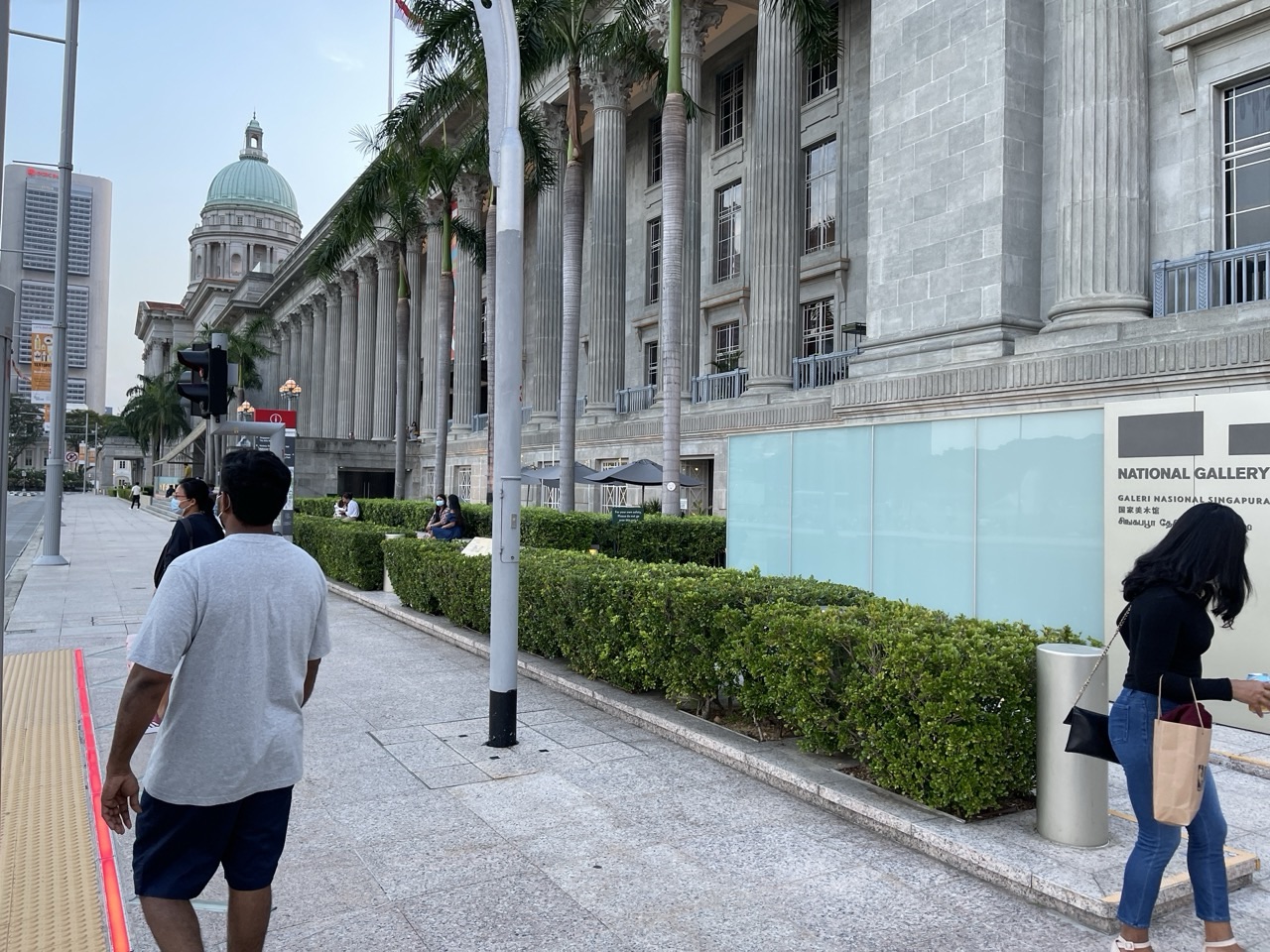
Things to do for kids in City Hall can become a learning day about art, government, architecture and public space because the Civic District places major national institutions within a compact walking area.
National Gallery Singapore is the strongest anchor. It occupies the former City Hall and former Supreme Court buildings, allowing children to encounter visual art inside two national monuments whose architecture is itself part of the lesson.
Outside, the Padang, St Andrew’s Road and the wider Civic District extend the learning into geography and history.
The aim is not to teach every milestone attached to the district.
Choose one art question and one city question.
Let the child use evidence from an artwork, a building or a public space to support an explanation.
- visit National Gallery Singapore with a family-friendly focus;
- study the former City Hall and former Supreme Court as architecture;
- use the Padang to think about scale and public space;
- follow a short section of the Civic District Heritage Trail;
- practise observation before interpretation;
- use maps, proportions and walking time for Mathematics;
- finish with one claim supported by visible evidence.
National Gallery Singapore family guide
National Gallery Singapore building highlights
Begin with the Buildings before the Paintings
National Gallery Singapore occupies two former civic buildings.
Before entering a gallery, ask the child to look at the exterior.
What makes the buildings look official?
Large columns?
Symmetry?
Wide steps?
A dome?
Scale?
The child does not need the architectural vocabulary first.
Observation comes first.
Then add terms that help describe what is visible.
Use the Former Supreme Court to Teach Form and Authority
The former Supreme Court is recognisable by its large dome and monumental façade.
Ask what a courthouse needs to communicate.
Order?
Seriousness?
Public authority?
Then ask how architecture might contribute to that impression.
The child is not being asked to prove the architect’s intention from appearance alone.
The task is to identify which visible features create a particular response and then check historical information for the building’s documented function.
Use Columns for Mathematics
Columns provide an easy counting and proportion task.
Count a visible set.
Estimate spacing.
Compare column height with the height of a person in the same view.
Do not turn an estimate into an exact measurement.
The child can say, “The column appears many times taller than an adult standing near it.”
For older learners, discuss why photographs distort scale when distance and camera angle change.
Enter the Gallery with One Looking Question
A large art museum can overwhelm children if the plan is to see everything.
Choose one looking question.
- Where does your eye go first?
- What detail would disappear if the artwork were viewed from far away?
- What colours repeat?
- What appears to be moving?
- What can you describe without guessing the story?
One question is enough to slow looking down.
The purpose is not to guess the curator’s preferred answer.
It is to make the child’s observation more precise.
Separate Description from Interpretation
Suppose a child says, “The person in the painting is lonely.”
Ask what visible detail supports that idea.
Is the figure alone?
Is the posture closed?
Are the colours muted?
Could another interpretation fit the same evidence?
Art becomes a useful place to practise an important academic habit.
Description identifies what is visible.
Interpretation proposes meaning.
A strong interpretation should be able to point back to evidence.
Use the Artwork Label after the Child Has Looked
Read the label after the child has formed an initial description.
What does the title add?
What does the date add?
What does the artist’s name or context add?
Did the first interpretation change?
This creates a simple evidence loop.
Look.
Interpret.
Read.
Revise.
The child learns that changing an answer after receiving better information is a strength.
Use the Keppel Centre for Art Education for Making
National Gallery Singapore’s family resources include the Keppel Centre for Art Education.
The learning value is the move from looking to producing.
After observing an artwork, ask the child what visual decision they might borrow.
A repeated shape?
A limited colour range?
A strong foreground?
An unusual viewpoint?
The child should not copy the complete artwork.
The stronger task is to identify one technique and use it for a different subject.
Teach Museum Behaviour as Part of Learning
Museum etiquette is not an obstacle to learning.
It protects shared collections.
Children should keep an appropriate distance from artworks, avoid touching, walk rather than run in galleries and follow photography restrictions.
Ask why these rules exist.
Oils and dirt from hands can damage surfaces.
Running creates collision risks.
Flash or equipment restrictions may protect works and visitors.
Rules become easier to respect when the child understands the system they protect.
Step Outside to the Padang: Learn through Scale
The Padang creates a dramatic contrast with the enclosed galleries.
It is a large open civic field surrounded by major buildings.
Ask the child to stand at one edge and estimate the distance to a selected visible point.
How long might it take to walk?
How many school halls might fit across a comparable area?
Do not present the estimate as a surveyed measurement.
The point is to practise reasoning about large scale using a familiar reference.
Use the Padang to Teach Public Space
A public field can host different activities across time.
Sport.
National ceremonies.
Public gatherings.
Everyday views across the Civic District.
Ask how an open space can support more than one function.
Then ask what has to be managed.
Access.
Maintenance.
Events.
Safety.
Public space is part of city infrastructure.
Use the Civic District Trail to Build a Short Timeline
The Civic District contains sites associated with different periods of Singapore’s history.
Do not try to memorise every event.
Choose three anchor points.
- an earlier settlement or colonial civic function;
- a twentieth-century event;
- a present cultural or civic use.
Ask what stayed physically present and what changed in function.
A building may remain while its use changes.
A field may remain while the events around it change.
Continuity and change can exist at the same time.
Teach Historical Sources through the District
A child can encounter several source types in one walk.
- a heritage marker;
- a conserved building;
- an artwork;
- an old photograph in a gallery;
- a modern map.
Ask what each source can answer.
A building shows physical form.
A photograph may show an earlier appearance.
A marker provides curated historical information.
A map shows spatial relationships.
No single source does every job.
Use a Walking Route for Mathematics
Give the child one route-planning responsibility.
Where is the next stop?
Which crossing is suitable?
How long might it take?
Then compare the estimate with the actual journey.
The difference is useful.
Crowds, signals, route choice and pauses all affect time.
Mathematics becomes planning rather than a detached calculation.
Use Building Symmetry Carefully
Civic architecture often contains repeated columns, windows and balanced façades.
Ask whether the visible section appears symmetrical.
Where might a line of symmetry be drawn?
Does every feature match exactly?
A photograph may hide one side or distort perspective.
Therefore the child should describe the visible evidence rather than claim perfect symmetry without checking the complete façade.
Build English from Art and Civic Vocabulary
City Hall gives children a useful vocabulary set.
- monument;
- façade;
- column;
- civic;
- interpret;
- composition;
- evidence;
- conserve.
Ask for one sentence per useful word.
The sentence should point to something observed.
“The façade has repeated columns” is stronger than using “façade” simply because it sounds sophisticated.
Write One Artwork Response
Use four parts.
- I noticed…
- I think…
- The detail that supports my idea is…
- After reading the label, I changed or kept my idea because…
This structure teaches the child that interpretation should remain connected to evidence.
The final answer can remain uncertain.
Art does not always require one closed conclusion.
Write One Civic-District Scene
Choose one moment rather than the whole day.
- The Dome across the Padang
- The Artwork I Changed My Mind About
- The Building that Became a Gallery
- The Field in the Middle of the City
- One Column, One Question
Ask for one visual detail, one fact, one interpretation and one change in thought.
A Simple City Hall Learning Route
Stage 1: Exterior observation
Study the former City Hall or former Supreme Court from an appropriate public position.
Stage 2: Gallery
Choose two or three artworks rather than attempting every room.
Stage 3: Make or discuss
Use the family resources or Keppel Centre for Art Education as appropriate.
Stage 4: Padang
Use scale, public-space questions or a short historical comparison.
Stage 5: Reflection
Ask: “What did the building, artwork or field tell you that the others could not?”
How to Adjust the Day by Age
Ages 5 to 7
- find three shapes on a building;
- choose one favourite artwork;
- name three colours;
- draw one detail from memory.
Ages 8 to 10
- compare two façades;
- estimate one walking time;
- describe before interpreting an artwork;
- use five art or architecture words.
Ages 11 to 12
- support an interpretation with visual evidence;
- compare two historical source types;
- explain one change of building use;
- write one evidence-based paragraph.
Secondary students
- analyse architecture and civic symbolism;
- evaluate source limitations;
- compare cultural and governmental uses of civic buildings;
- discuss adaptive reuse and conservation.
Accessibility and Sensory Needs
National Gallery Singapore provides family and accessibility information, including lifts and accessible routes.
The Gallery also identifies a Calm Room for visitors who feel over-stimulated.
Families should check current visitor information before travelling.
A museum outing can be shortened without losing its learning value.
One artwork and one building detail may be enough for a child who is tired or overwhelmed.
Outside, heat, rain, road crossings and events around the Civic District can change a route.
Plan the actual walking path rather than relying only on the apparent closeness of landmarks on a map.
Frequently Asked Questions
Is National Gallery Singapore suitable for young children?
Yes. The Gallery publishes a family guide and provides the Keppel Centre for Art Education. A young child does not need to cover large exhibition areas; a short visit can be more effective.
How can City Hall support Mathematics?
Use symmetry, repeated columns, proportions, map reading, distance and walking-time estimation.
How can it support English?
Use description, interpretation, evidence vocabulary and short reflective writing.
How can it support Humanities?
Use civic buildings, the Padang, heritage markers and the history of building reuse to discuss continuity, change and evidence.
Do we need a guided building tour?
No. Families can observe independently. The Gallery also publishes current Building Highlights tour information for visitors who want a structured architectural introduction.
What is a useful final question?
Ask: “Which piece of evidence changed how you understood this place?”
Helpful Links for a City Hall Learning Day
- National Gallery Singapore family guide
- National Gallery Singapore Building Highlights
- Civic District Heritage Trail
- Former Supreme Court
- Things to do for Kids | Learning River Valley
- Things to do for Kids | Learning Bugis
Things to do for Kids | Learning City Hall
City Hall gives children several ways to learn from evidence.
An artwork provides visual evidence.
A national monument provides architectural evidence.
A heritage marker provides historical context.
A map provides spatial evidence.
The child’s task is not to memorise everything attached to the Civic District.
It is to learn how different sources answer different questions.
That is a powerful habit to carry back into school, reading and everyday life.
Properly taught kids shine a bright light into the future.