
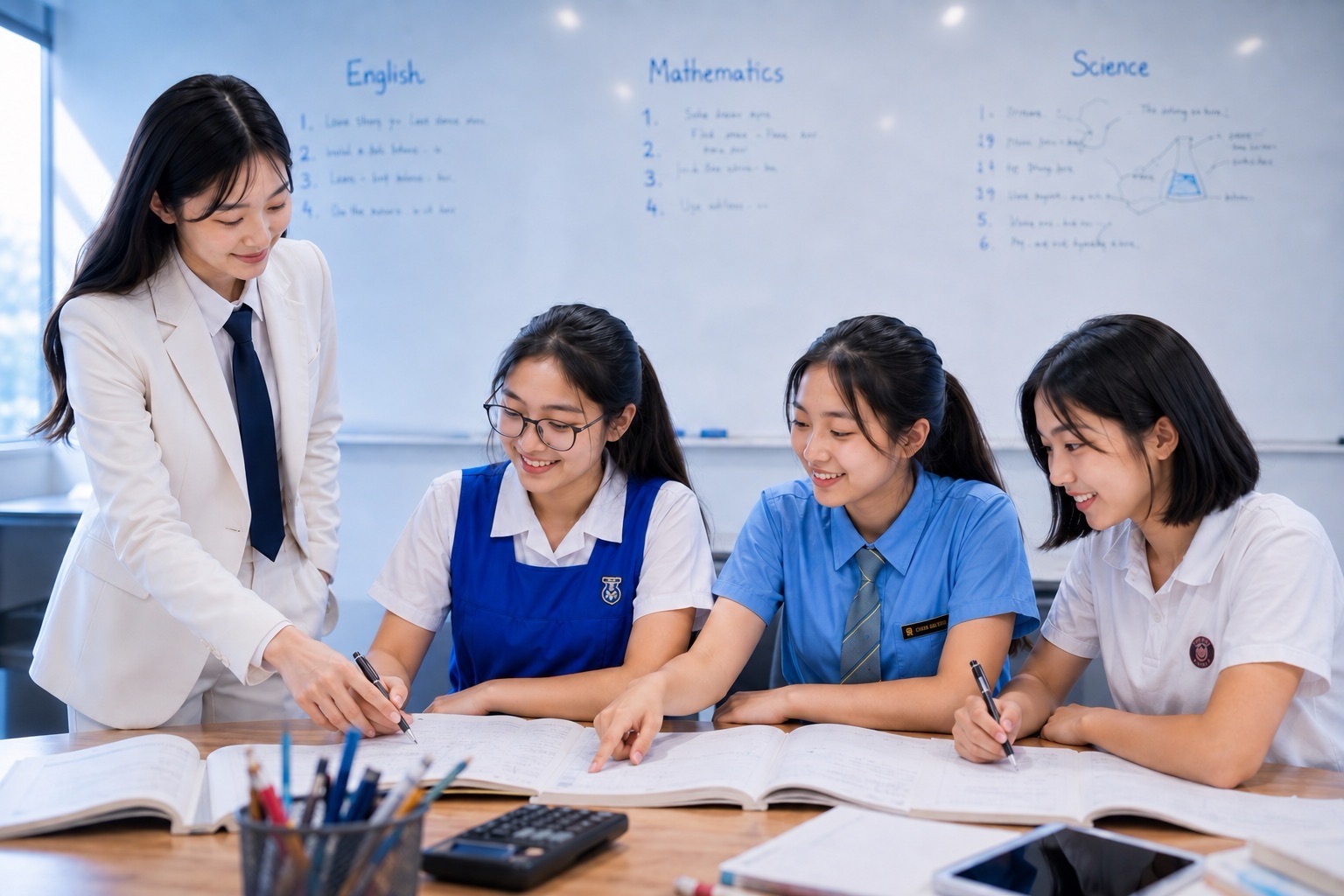
Secondary Mathematics Tuition Clementi | 3-Pax Classes near Sixth Avenue MRT
Secondary Mathematics tuition for Clementi students in premium 3-pax classes near Sixth Avenue MRT. Build algebra, E-Math, A-Math, accuracy, transfer and exam confidence through clear diagnosis and structured teaching.
Secondary Mathematics Tuition Clementi
Premium 3-Pax Mathematics Classes near Sixth Avenue MRT
Stronger foundations. Clearer mathematical thinking. More dependable performance under examination conditions.
At eduKateSG, we teach Secondary 1 to Secondary 4 Mathematics in focused classes of no more than three students. Lessons are held at our Bukit Timah location near Sixth Avenue MRT, making the programme accessible to families travelling from Clementi.
Our Mathematics tuition is designed for students who need to:
- repair earlier gaps before they become larger;
- strengthen algebra, graphs, geometry and problem-solving;
- keep pace with their school curriculum;
- prepare for E-Mathematics and Additional Mathematics;
- improve accuracy, written presentation and time control;
- move from guided work towards independent performance.
The aim is not simply to give students more worksheets.
The aim is to understand the student’s present mathematical state, identify what is breaking, repair the correct layer and then build enough fluency for the improvement to hold.
Book a parent–student consultation with eduKateSG
Chat with eduKateSG on WhatsApp
The Short Answer for Clementi Parents
Secondary Mathematics becomes difficult when the student’s earlier knowledge is no longer connected strongly enough to support the next level of abstraction.
A student may appear to be struggling with a new chapter, but the real problem may sit several layers underneath it:
- weak number operations affecting algebra;
- incomplete fraction control affecting equations;
- poor symbol reading affecting functions;
- weak diagram interpretation affecting geometry;
- memorised methods failing on unfamiliar questions;
- careless working that becomes unstable under time pressure.
A strong Mathematics tuition programme should therefore do more than reteach the latest school chapter.
It should read the whole working system.
One-Sentence Definition
Secondary Mathematics tuition works best when it diagnoses the student’s present mathematical state, repairs the weakest load-bearing layer and then trains understanding, fluency, transfer and examination execution as one connected system.
Why Secondary Mathematics Is Not Simply “More Difficult Primary Mathematics”
The movement from Primary to Secondary Mathematics is a structural transition.
At Primary level, much of the work is still tied to numerical quantities, familiar operations and concrete problem situations. At Secondary level, students must increasingly operate with:
- variables;
- negative quantities;
- algebraic expressions;
- equations and inequalities;
- functions;
- coordinate systems;
- formal geometric properties;
- symbolic transformations;
- multi-stage reasoning;
- unfamiliar question structures.
The student is no longer working only with known numbers.
The student must now reason about relationships.
This creates a common transition problem: a child who was reasonably comfortable with calculation may suddenly become uncertain when numbers are replaced by letters, when several concepts appear inside one question or when the correct method is no longer obvious from the surface wording.
That does not necessarily mean the child lacks mathematical ability.
It may mean the child has reached a new learning threshold without a sufficiently stable bridge into it.
Mathematics Pathways in 2026 and 2027
Singapore’s secondary-school structure is changing.
Students from the 2024 Secondary 1 cohort entered secondary school under Full Subject-Based Banding. Posting Groups 1, 2 and 3 are used for admission, while individual subjects may be studied at G1, G2 or G3 according to the student’s pathway and school arrangements.
From the 2027 graduating cohort, the existing GCE N(T), N(A) and O-Level certificates will be combined into the Singapore-Cambridge Secondary Education Certificate, or SEC. Students will receive a certificate showing the subjects and subject levels they sat for. SEAB states that the overall examination standards are not being lowered through this change.
For the 2027 SEC:
- Mathematics is available at G1, G2 and G3;
- Additional Mathematics is available at G2 and G3;
- the exact preparation route must follow the student’s subject level, school coverage and examination year.
At eduKateSG, we continue to use familiar terms such as E-Math and A-Math where they help parents understand the programme. At the same time, teaching materials and examination preparation are aligned to the student’s actual G1, G2, G3, O-Level or SEC pathway.
The label matters.
The student’s real mathematical state matters more.
Who We Teach
Secondary 1 Mathematics: Stabilising the Transition
Secondary 1 is where mathematical drift often first becomes visible.
Students must adapt to:
- greater algebraic abstraction;
- negative numbers and directed quantities;
- more formal notation;
- equations and inequalities;
- graphs and coordinates;
- geometric reasoning;
- longer working sequences;
- reduced teacher prompting.
The first task is not to rush into difficult questions.
It is to make sure the student can move from arithmetic into algebra without losing control of signs, equality, operations or meaning.
A strong Secondary 1 programme should help the student:
- read symbols accurately;
- understand what a variable represents;
- translate words into mathematical relations;
- preserve equality when transforming equations;
- draw and interpret graphs;
- begin questions without waiting for a template;
- check whether an answer is mathematically reasonable.
The goal is a stable transition corridor into the rest of Secondary Mathematics.
Secondary 2 Mathematics: Connecting the System
Secondary 2 is frequently underestimated.
Students may still be passing school tests, but their knowledge can remain divided into separate chapter routines. They know what to do when the chapter is named, yet struggle when several topics are mixed together.
This is where students need to connect:
- number and algebra;
- equations and graphs;
- ratio and rate;
- geometry and algebraic reasoning;
- statistics and interpretation;
- formulas and real conditions.
Secondary 2 is also an important preparation year for later Mathematics subject choices and the greater demands of Upper Secondary work.
The priority is to strengthen transfer: the ability to recognise and use the correct structure when the question does not look exactly like the practice example.
Secondary 3 Mathematics: Managing Expansion
Secondary 3 introduces a larger academic load.
For students taking Additional Mathematics, the expansion is especially noticeable. New topics arrive quickly, but they depend heavily on earlier algebra.
Common areas include:
Mathematics or E-Math
- equations and inequalities;
- functions and graphs;
- coordinate geometry;
- geometry and mensuration;
- trigonometry;
- vectors;
- statistics and probability;
- mathematical modelling and interpretation.
Additional Mathematics
- indices and surds;
- polynomials;
- logarithms and exponentials;
- functions;
- coordinate geometry;
- trigonometric identities and equations;
- sequences and series;
- differentiation;
- integration;
- introductory kinematics and applications.
A student may think the difficulty lies in calculus or trigonometry when the real limitation is still algebraic fluency.
That is why we diagnose beneath the visible chapter.
Secondary 4 Mathematics: Converting Knowledge into Marks
By Secondary 4, content knowledge alone is not enough.
Students must manage:
- topic recognition;
- method selection;
- written precision;
- sustained concentration;
- time allocation;
- calculator use;
- checking routines;
- recovery after a difficult question;
- performance across an entire paper.
At this stage, tuition must balance two needs:
- repair any remaining concept or algebra weakness;
- train the student to execute accurately under realistic examination conditions.
The objective is not frantic last-minute repetition.
It is calm, deliberate control.
Why Mathematics Breaks
Mathematics is cumulative. A weak layer does not remain politely inside its original chapter.
It travels forward.
1. Arithmetic Noise Enters Algebra
A student may understand the algebraic idea but repeatedly lose marks through:
- sign errors;
- weak fraction manipulation;
- incorrect order of operations;
- careless substitution;
- inaccurate expansion;
- incomplete simplification.
The visible issue is algebra.
The deeper issue may still be numerical control.
2. Procedures Are Memorised Without Meaning
Students can sometimes reproduce a familiar sequence without understanding why it works.
This creates fragile performance.
The method appears stable when:
- the question resembles the worked example;
- the numbers are friendly;
- the topic is clearly signposted;
- the teacher provides the first step.
It breaks when:
- the question is rearranged;
- two topics are combined;
- an unfamiliar representation is used;
- the student must decide which method applies.
3. Chapters Remain as Separate Islands
A student may know algebra during an algebra lesson and graphs during a graph lesson, but fail to see that an equation, table and graph can express the same relationship.
This is a transfer failure.
The student has accumulated content but has not yet formed a connected mathematical structure.
4. Prompt Dependency Develops
Some students can continue once a tutor gives the first step.
The difficulty appears when they must begin alone.
Prompt dependency can remain hidden in large classes because the student follows the board, copies the method and looks productive. The real test is whether the student can:
- classify the question;
- identify what is known;
- decide what must be found;
- select a valid route;
- begin without external rescue.
5. “Carelessness” Is Treated as One Problem
Not every careless mistake has the same cause.
A wrong answer may come from:
- conceptual misunderstanding;
- inaccurate reading;
- skipped conditions;
- arithmetic error;
- notation drift;
- calculator entry;
- diagram misinterpretation;
- incomplete checking;
- rushing caused by poor time allocation.
Telling a student to “be more careful” does not identify the broken mechanism.
The error must first be classified.
6. Speed Is Added Before Stability
Timed work is important, but premature speed can automate the wrong habits.
A student who repeatedly practises an unstable method under time pressure may simply become faster at making the same error.
We establish a correct route first.
Speed is added after the route is sufficiently reliable.
How eduKateSG Repairs the Mathematics System
Our working sequence is:
Read → Diagnose → Prioritise → Repair → Practise → Connect → Perform → Review
This prevents tuition from becoming an endless collection of disconnected exercises.
Step 1: Read the Student’s Present State
We begin by examining more than the latest school mark.
We look at:
- the student’s current level and subject pathway;
- school topics already covered;
- recurring error patterns;
- confidence and working habits;
- ability to explain a method;
- independence when beginning questions;
- accuracy across connected topics;
- behaviour under moderate time pressure.
A test score is useful evidence.
It is a dashboard, not the whole driver.
Two students with the same mark may require very different intervention.
Step 2: Find the Load-Bearing Weakness
We distinguish between a surface problem and an underlying problem.
For example:
| Visible difficulty | Possible underlying break | Initial repair |
|---|---|---|
| Cannot solve equations | Weak negative numbers or equality concept | Rebuild operations and balance |
| Weak graphs | Poor connection between equation, table and coordinates | Reconnect representations |
| Struggles with trigonometry | Diagram reading or ratio weakness | Repair visual and ratio foundations |
| Cannot start word problems | Translation and classification difficulty | Train known–unknown–relation mapping |
| Many careless errors | Several unclassified error types | Build an error ledger and checking route |
| A-Math feels impossible | Algebraic manipulation lacks fluency | Return to the algebra base floor |
The repair must match the cause.
More practice is useful only when it is practice on the correct layer.
Step 3: Teach from First Principles
Students should know more than which formula to use.
They should understand:
- what the symbols mean;
- what relation is being represented;
- why a transformation is allowed;
- what condition must remain true;
- how the result can be checked.
This creates a more transferable form of learning.
When a student understands the structure beneath the method, a changed question is less likely to feel like an entirely new problem.
For a deeper explanation, see How Mathematics Works and Our Approach to Learning Mathematics.
Step 4: Use the Fencing Method to Control Complexity
The eduKateSG Fencing Method builds a secure boundary around the simplest valid version of an idea before expanding it.
The student first learns:
- what belongs to the concept;
- what does not;
- which rule governs it;
- what common error crosses the boundary.
Complexity is then introduced gradually.
For example, equations may progress through:
- one operation;
- two operations;
- negative values;
- brackets;
- fractions;
- variables on both sides;
- contextual word problems;
- mixed and unfamiliar forms.
This reduces cognitive overload without reducing intellectual demand.
Step 5: Move from Representation to Abstraction
Where useful, we apply a Concrete–Representational–Abstract progression.
A student may first meet a relationship through:
- quantities or movement;
- a visual model;
- a number line;
- a table;
- a diagram;
- a graph;
- symbolic notation.
The aim is not to keep older students dependent on manipulatives.
The aim is to make sure the abstract symbol has a stable meaning underneath it.
Step 6: Practise Through Retrieval and Variation
Students must be able to retrieve knowledge without always seeing the method immediately beforehand.
We use:
- short recall work;
- delayed review;
- cumulative practice;
- mixed-topic questions;
- controlled variations of the same structure;
- comparison between similar-looking methods;
- repeated return to earlier weak areas.
This helps the student distinguish between remembering a worked example and genuinely owning the method.
Step 7: Make Thinking Visible
In a 3-pax class, students can be asked to explain:
- why a step is valid;
- what the question is testing;
- which method they selected;
- what alternative route may exist;
- where an error entered;
- how they know the answer is reasonable.
Think-aloud coaching reveals gaps that a final answer alone may hide.
It also trains mathematical communication.
Step 8: Build Examination Discipline Early
Examination skill is not added only before the final paper.
Students are trained progressively to manage:
- clean working;
- correct mathematical notation;
- diagrams;
- units;
- calculator entries;
- method marks;
- question sequencing;
- time checks;
- answer verification;
- recovery after being stuck.
The aim is to convert knowledge into dependable performance.
Why Three Students Can Be the Right Class Size
The value of a 3-pax class is not merely that it is smaller.
It changes what the tutor can see.
The Student’s Working Remains Visible
The tutor can inspect how each student:
- starts;
- organises information;
- selects a method;
- writes each step;
- responds to correction;
- checks the result.
This makes it easier to intervene before a weak habit becomes normal.
Feedback Can Be Immediate
A misconception can be corrected while the student is still inside the reasoning process.
The correction is not delayed until a worksheet is returned days later.
Independent Thinking Is Preserved
One-to-one teaching can sometimes become overly assisted when every pause is immediately filled by the tutor.
A small group gives students enough space to think, attempt and compare, while remaining close enough for careful guidance.
Students Benefit from Comparison Without Disappearing
Hearing another student explain a different route can strengthen understanding.
At the same time, a class of three is small enough that no student should remain invisible throughout the lesson.
This is the balance we are looking for:
close enough to diagnose, structured enough to progress, and open enough for independent reasoning.
The 90-Minute Lesson Structure
Each 1.5-hour lesson is adjusted to the students’ level and current priorities, but usually moves through five connected stages.
1. Retrieval and Readiness
Students begin with a short recall or connection task.
This allows the tutor to see whether earlier learning remains available without immediate prompting.
2. Concept Teaching or Repair
The tutor introduces the next concept or returns to a weak prerequisite.
Definitions, representations, conditions and common misconceptions are made explicit.
3. Guided Practice
Students apply the idea with support.
Prompts are gradually reduced as the route becomes clearer.
4. Independent and Examination-Style Work
Students complete questions with less assistance.
As readiness improves, timed conditions and mixed topics are introduced.
5. Error Analysis and Next-Step Practice
Errors are classified rather than simply marked wrong.
The lesson ends with a small, purposeful practice route instead of a large undifferentiated workload.
Three Main Student Positions
Students do not all need the same form of tuition.
Catch Up: Repair and Stabilise
This route is suitable when earlier gaps are actively disrupting present learning.
The priority is to:
- identify the earliest important break;
- rebuild essential foundations;
- reduce repeated error;
- restore a workable pace;
- help the student re-enter current school topics.
Keep Up: Align and Consolidate
This route is suitable when the student generally follows school lessons but remains inconsistent.
The priority is to:
- consolidate each topic;
- connect it to earlier knowledge;
- maintain retrieval;
- prevent quiet gaps from accumulating;
- prepare steadily for school assessments.
Move Ahead: Extend and Perform
This route is suitable when the student is secure and ready for greater demand.
The priority is to:
- pre-teach important structures;
- deepen reasoning;
- increase question variation;
- strengthen transfer;
- improve examination precision;
- prepare for distinction-level performance without sacrificing understanding.
These are teaching positions, not permanent labels.
A student may begin in repair, move into alignment and later enter extension as the evidence changes.
What Genuine Progress Looks Like
Progress is not measured only by one improved test.
A stronger mathematical system becomes visible through changes such as:
- the student starts questions with less prompting;
- algebraic working becomes cleaner;
- sign and fraction errors recur less often;
- the student can explain why a method works;
- earlier topics remain retrievable;
- mixed-topic work becomes less disruptive;
- diagrams and graphs are read more accurately;
- checking becomes purposeful;
- timed work remains organised;
- unfamiliar questions produce analysis rather than immediate panic.
Marks should improve as these systems become stronger.
However, we do not promise an automatic grade jump within a fixed number of weeks. Progress depends on the starting point, attendance, practice, school demands, subject level and the seriousness with which corrections are used.
The aim is durable improvement rather than a temporary result created by question prediction.
Clementi to Sixth Avenue MRT
eduKateSG’s Bukit Timah classes are held at 8 Fourth Avenue, near Sixth Avenue MRT.
One practical rail route from Clementi is:
Clementi MRT on the East-West Line → Buona Vista → transfer to the Circle Line → Botanic Gardens → transfer to the Downtown Line → Tan Kah Kee → Sixth Avenue.
Sixth Avenue is two Downtown Line stops from Botanic Gardens, with Tan Kah Kee between them.
The route involves two transfers, so it is not a direct one-seat journey. However, it remains a structured rail connection for Clementi families who prefer a specialist 3-pax programme over a larger class chosen only for proximity. LTA’s current network information identifies the East-West, Circle and Downtown Lines as part of Singapore’s operating rail network; families should use the official journey planner for live timings and temporary service adjustments.
The question for parents is therefore not only:
“Which tuition centre is nearest?”
It is also:
“Which learning environment can identify what my child actually needs and provide enough attention to repair it?”
Convenience matters.
Teaching fit matters too.
Class Details
Programme: Secondary Mathematics tuition
Levels: Secondary 1 to Secondary 4
Pathways: G1, G2, G3, E-Math, A-Math, current O-Level and 2027 SEC preparation according to student requirements
Class size: Maximum three students
Duration: 1.5 hours weekly
Location: eduKateSG Bukit Timah, 8 Fourth Avenue, near Sixth Avenue MRT
Materials: Curated notes, structured practice, cumulative review, school-aligned preparation and examination-style questions
Additional support: Pre-assessment or examination clinics may be arranged where the class schedule permits
Admission: By consultation and suitable class placement
eduKateSG’s current contact information lists its Bukit Timah location at 8 Fourth Avenue and consultations by appointment.
Contact eduKateSG
WhatsApp +65 8823 1234
What Happens During the Consultation?
The consultation is used to understand the student before recommending a class.
Parents may share:
- the student’s level and school;
- current Mathematics subject level;
- recent results;
- topics causing difficulty;
- recurring teacher feedback;
- confidence and learning habits;
- upcoming assessments;
- preferred schedule.
Where useful, the student’s working may be reviewed upcoming assessments;
- preferred schedule.
Where useful, the student’s working to distinguish between:
- concept gaps;
- weak prerequisites;
- fluency problems;
- question-reading problems;
- examination execution problems.
Class placement also considers whether the pace and needs of the existing students are compatible.
Because each class is capped at three students, availability is limited by genuine class fit rather than room capacity alone.
A trial lesson may occasionally be possible when an appropriate 3-pax place is available, but the normal first step is a parent–student consultation.
Parent Frequently Asked Questions
My Child Is Weak in Algebra. Where Do You Begin?
We first determine where the algebra difficulty begins.
The sequence may include:
- arithmetic laws and order of operations;
- negative numbers;
- fractions;
- the meaning of variables;
- the distributive law;
- expansion and factorisation;
- equality and equation balance;
- linear equations and inequalities;
- word-to-algebra translation;
- graph and function connections.
Starting with harder algebra questions before repairing the missing prerequisite usually creates more confusion.
Do You Teach Both Mathematics and Additional Mathematics?
Yes.
Upper Secondary students may receive support for Mathematics or E-Math, Additional Mathematics, or both, depending on their school subjects and class placement.
For students entering the 2027 SEC route, materials are matched to the relevant G2 or G3 Mathematics and Additional Mathematics requirements.
Do You Support G1, G2 and G3 Mathematics?
Yes, where a suitable class is available.
The consultation identifies the student’s current subject level, school coverage and intended examination route before placement.
How Do You Reduce Careless Mistakes?
We do not classify every wrong answer as ordinary carelessness.
Errors are separated into types such as:
- concept;
- reading;
- sign;
- arithmetic;
- notation;
- calculator;
- diagram;
- condition;
- time management;
- checking.
Students then learn a correction routine for the error they actually make.
How Quickly Will We See Improvement?
Some changes, such as better organisation or clearer algebraic steps, may appear relatively early.
Stable academic improvement usually requires repeated cycles of:
diagnosis → teaching → practice → correction → retrieval → transfer → review
A fixed timeline cannot be guaranteed because students begin from different states.
Can You Align Lessons with School Tests?
Yes.
Parents can provide the school’s topic sequence and assessment dates. We can then balance current school preparation with the deeper repair work the student still needs.
We avoid preparing for one test in a way that leaves the underlying weakness untouched.
Can My Child Join During the School Term?
Yes, subject to class compatibility and availability.
A student joining mid-term may require a short alignment route so that the student can enter the class without either being lost or slowing the existing group excessively.
Do You Support Integrated Programme Students?
Yes, where the student’s needs and the class level are compatible.
IP support often requires stronger attention to non-routine questions, mathematical communication, accelerated topic sequences and the school’s particular assessment style.
Is Travelling from Clementi Worth It?
That depends on what the student needs.
A nearby large class may be sufficient for a student who is already secure and only needs routine reinforcement.
A student with hidden algebra gaps, unstable methods, repeated errors or prompt dependency may benefit more from a smaller class where working can be observed and corrected closely.
The decision should be based on learning fit, not prestige or distance alone.
Helpful Reading for Parents
- [Mathematics by eduKateSG](https://edukatesg or distance alone.
Helpful Reading for Parents
- [Mathematics by.com/project-type/mathematics/)
- How Mathematics Works
- Learn How Mathematics Works
- Our Approach to Learning Mathematics
- MOE Secondary-School Curriculum and Mathematics Syllabuses
- SEAB Secondary Education Certificate
- LTA Rail Network
Final Answer for Clementi Families
Good Secondary Mathematics tuition should not begin by assuming that every student needs more drilling.
It should begin by reading the student correctly.
Where is the mathematical structure holding?
Where is it fragile?
Which earlier weakness is disturbing the present chapter?
Can the student retrieve the method independently?
Can the student transfer it when the question changes?
Can the student still work accurately when time pressure is introduced?
At eduKateSG, the 3-pax format allows these questions to remain visible.
We teach Mathematics from its foundations, connect topics into a usable structure and progressively prepare students to perform with greater independence, accuracy and calm.
For Clementi families, the journey to Sixth Avenue is not the nearest possible tuition route.
It may, however, be the right route when the student needs close diagnosis, careful repair and a class small enough for the tutor to see how the Mathematics is actually working.
Arrange a parent–student consultation
Chat with eduKateSG on WhatsApp
Almost-Code Version
ARTICLE.ID:EDUKATESG.MATH.CLEMENTI.SECONDARY.3PAX.SIXTH-AVENUE.v4.0TITLE:Secondary Mathematics Tuition Clementi |3-Pax Classes near Sixth Avenue MRTAUDIENCE:Clementi parentsSecondary 1–4 studentsG1 / G2 / G3 MathematicsE-Math / A-Math2026 O-Level and 2027 SEC pathwaysONE-SENTENCE-DEFINITION:Secondary Mathematics tuition works best when itdiagnoses the student’s present mathematical state,repairs the weakest load-bearing layer,and trains understanding, fluency, transferand examination execution as one connected system.CLASSICAL-BASELINE:Secondary Mathematics develops:number controlalgebrageometrygraphsfunctionsstatisticsprobabilitytrigonometrycalculusmathematical reasoningexam executionCORE-PROBLEM:Visible chapter difficulty may be caused byan earlier hidden weakness.COMMON-FAILURE-SIGNALS:arithmetic noisesign errorsweak fractionsalgebra shockgraph-equation disconnectchapter isolationmemorised proceduresprompt dependencypoor transferunclassified careless errorstime-pressure collapseEDUKATESG-TEACHING-LOOP:readdiagnoseprioritiserepairpractiseconnectperformreviewMETHODS:first principlesFencing MethodConcrete → Representational → Abstractretrievalspaced returninterleavingcontrolled variationthink-aloud explanationerror classificationtimed performancereflective correctionCLASS-MECHANISM:maximum 3 studentsvisible workingimmediate correctioncustomised pacingpeer comparisonindependent reasoninglow hiding capacitySUCCESS-CONDITIONS:student begins independentlymethods remain available after delayworking is coherenterrors reduce by categorytopics connecttransfer improvestimed performance remains organisedstudent can explain and verifyDASHBOARD:school marksmicro-testshome practicetimed setserror recurrenceprompt leveltransfer qualityBOUNDARY:marks are evidencemarks are not the whole learning systemno fixed grade jump is guaranteedtrial lessons depend on genuine 3-pax capacityLOCATION:eduKateSG Bukit Timah8 Fourth Avenuenear Sixth Avenue MRT DT7CLEMENTI-RAIL-ROUTE:Clementi EWL→ Buona Vista→ Circle Line→ Botanic Gardens→ Downtown Line→ Tan Kah Kee→ Sixth AvenueCORRECTION:Sixth Avenue is two DTL stops from Botanic Gardens,not one.NEXT-ACTION:parent–student consultationdiagnostic readingsuitable 3-pax placementtargeted learning roadmapFINAL-POSITION:Do not only add more work.Read the student.Find the break.Repair the correct layer.Build connection.Verify independence.Then increase examination loa.