
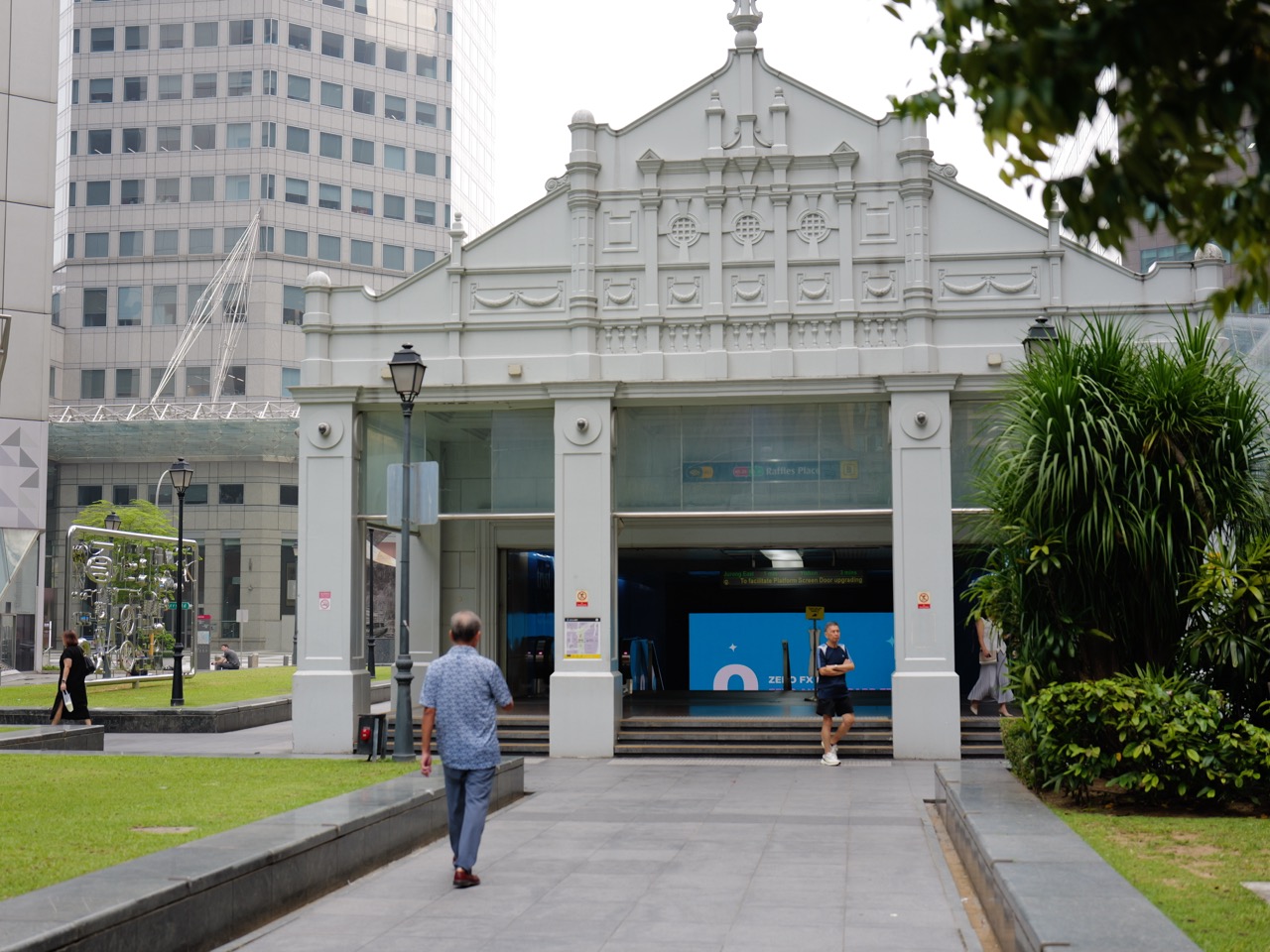
Education and tuition for Raffles Place families. Primary and Secondary learning, numeracy, evidence and premium 3-pax tutorials at eduKateSG near Sixth Avenue MRT.
A number is not meaningful until the learner knows what it measures.
That is an important educational principle in Raffles Place, a district associated with business, offices and financial activity. Students encounter numbers everywhere: prices, percentages, charts, rates, scores and comparisons. The challenge is not simply performing calculations. It is understanding the reference quantity, the unit, the condition and the conclusion that the numbers support.
At eduKateSG, we teach students to make those relationships explicit. Our tutorials are limited to three students, with an established weekly duration of 1.5 hours, teaching materials, guided corrections and focused continuation work.
Families travelling from Raffles Place attend our Bukit Timah location near Sixth Avenue MRT. This article does not describe a Raffles Place branch.
Arrange a parent–student consultation with eduKate Singapore.
A More Important Skill Than Getting the Number
Students can calculate correctly and still misunderstand what the number means.
A percentage change, an average and a ratio can all be numerically correct while answering the wrong question. In Science, a graph can be read accurately while the conclusion drawn from it is too broad. In English, a statistic can be copied into an essay without explaining why it supports the claim.
Good education therefore separates calculation from interpretation.
The student should be able to say what the quantity represents, what it is being compared with and what conclusion is justified.
This habit becomes increasingly important as schoolwork moves beyond routine arithmetic.
The Hidden Learning Problem: The Reference Quantity
Consider an invented example. A score rises from 50 to 60. The increase is 10 marks. Relative to the original score, the increase is 10 ÷ 50 × 100% = 20%.
If a student instead divides by 60, a different percentage appears. The arithmetic operation may be performed accurately, but the reference quantity is wrong.
Now consider a price reduced from $80 to $60. The reduction is 25% of the original price. Returning from $60 to $80 requires an increase of 20 ÷ 60 × 100% = 33⅓%.
The same $20 difference produces different percentage changes because the bases are different.
This is not a finance lesson. It is a Mathematics lesson about relationships.
The same discipline applies when reading graphs, Science results and claims in English. The learner must know what the comparison is anchored to.
Why Raffles Place Families May Consider a 3-Pax Tutorial
A small group allows the tutor to ask what each number, phrase or symbol represents before accepting the final answer.
- Students can explain the reference quantity before calculating.
- The tutor can separate conceptual errors from arithmetic errors.
- Graphs and tables can be discussed line by line rather than only marked right or wrong.
- Each learner can attempt a changed question independently.
- Support can be reduced once interpretation becomes reliable.
This close inspection is particularly useful for errors that look careless but are actually caused by a misunderstanding of the relationship.
Primary English: Claims Need Reasons
Primary students often make a strong claim before they have learned how to support it. A composition character is described as brave, kind or worried, but the paragraph contains no action or detail that lets the reader see why.
We teach the connection between claim and support. If the student writes that a character is worried, what action, thought or piece of dialogue makes the worry visible?
In comprehension, the same structure applies. If the answer states that a character was disappointed, which phrase or event supports that interpretation?
The goal is not to make every sentence formal. It is to give the learner a habit of connecting statements with evidence.
Primary Mathematics: Make Ratios and Percentages Concrete
Ratios and percentages become easier when the student can identify the whole and the part.
Suppose an invented class has 30 pupils and 12 bring a particular book. The fraction is 12/30 = 2/5 and the percentage is 40%.
If the question instead asks for the ratio of pupils with the book to those without it, the comparison is 12:18, simplified to 2:3.
The same numbers appear, but the relationship being described has changed.
Students should therefore say what is being compared before simplifying or converting.
This discipline reduces the tendency to search for a familiar formula before understanding the question.
Primary Science: Read Tables Before Explaining Them
Science tables can look simple while hiding several reading decisions.
The student should identify the headings, units, conditions and measured values before explaining a pattern.
Suppose a hypothetical table compares the time taken for ice to melt at several temperatures. A learner should first describe the observed relationship. Only then should the student connect the pattern to an appropriate concept, using the conditions provided.
If another variable changed at the same time, the conclusion should be more cautious.
Science reasoning improves when the student knows the difference between a measured result and the explanation of that result.
Primary 5, Primary 6 and PSLE: Accuracy Is More Than Carefulness
Upper-Primary students often lose marks in ways described broadly as careless. That label is not precise enough to teach from.
- Wrong reference quantity.
- Correct method with arithmetic error.
- Correct calculation but wrong unit.
- Relevant evidence with incomplete explanation.
- Misread comparison word.
- Correct intermediate result used as the final answer.
Each error needs a different correction.
During PSLE preparation, we keep an error pattern rather than treating every wrong answer as an isolated event. The student learns which personal checks are actually useful.
A full paper can then test whether those checks survive under mixed and timed conditions.
Secondary School: The Meaning of the Number Matters More
Secondary students meet increasingly formal representations: algebraic expressions, graphs, statistics, experimental data and structured written arguments.
The exact subject level matters under Full Subject-Based Banding. SEAB states that the Singapore-Cambridge Secondary Education Certificate begins in 2027, with subjects examined at G1, G2 or G3 and the certificate reflecting the subjects and levels taken.
Tuition should therefore use the student’s current school materials and assessment requirements.
Students in Integrated Programme or other curricula should identify the programme clearly so that examples and preparation remain appropriate.
Secondary English: Use Data Without Letting the Data Do the Thinking
A statistic can strengthen an argument only when it is relevant and interpreted correctly.
Consider a fictional survey in which 70% of 100 respondents prefer Option A. A student may write that everyone prefers Option A. That conclusion is broader than the data.
A more careful statement is that 70 of the 100 respondents surveyed preferred Option A.
The next question is whether that group is suitable evidence for the claim being made. The student should not turn a classroom statistic into a universal conclusion.
This kind of reading also strengthens comprehension. Numbers in a passage should be interpreted in context rather than treated as automatically persuasive.
Secondary Mathematics: Ratios, Rates and Functions
Secondary Mathematics formalises relationships that Primary students first meet numerically.
A rate connects two quantities with units. A ratio compares quantities. A function describes a relationship between an input and an output.
Suppose a fictional service charges a fixed $5 fee plus $3 per unit. The total cost can be represented by C = 5 + 3n, where n is the number of units.
A student who understands the equation can identify the fixed part, the variable part and how the total changes when n changes.
The equation is not just a string of symbols. It is a compact description of a relationship.
That habit prepares the learner for graphs, algebra and later Additional Mathematics.
Additional Mathematics: Preserve Meaning Through Symbolic Work
Additional Mathematics can become symbolically dense. Students may manipulate an expression correctly for several lines and then lose the meaning of the variable or condition.
We therefore emphasise definition and verification.
What does x represent? What is the domain or condition where relevant? Does the transformed expression remain equivalent? Can the result be checked against the original relationship?
Strong algebraic fluency matters, but fluency should sit on understanding.
Subject availability and suitable placement should be confirmed directly during consultation.
Our First-Principles Teaching Method
1. Define the quantities or claims
Before calculating or arguing, identify what each number, variable or statement represents.
2. Locate the first mismatch
If the answer is wrong, find whether the mismatch began in interpretation, setup, calculation or final expression.
3. Rebuild with a clean example
Use simple values to expose the relationship before increasing complexity.
4. Use the Fencing Method
Change one variable at a time. Keep the structure stable while changing the reference quantity, the unknown or the condition.
5. Connect words, tables, graphs and equations
Different representations should describe the same relationship. When they disagree, the mismatch becomes a teaching clue.
6. Alternate worked examples and attempts
The What Works Clearinghouse study guide recommends worked examples, retrieval and explanatory questioning. We model clearly, then require the learner to make the interpretation and calculation independently.
7. Retrieve after spacing
The concept returns later so memory is tested without the original example beside it.
8. Test transfer
A later problem changes the surface details or reference quantity. The student must recognise whether the same relationship still applies.
What Happens During a 90-Minute Tutorial
The lesson begins with short retrieval from earlier work. This checks whether important ideas remain available.
A recent school question then helps identify the central priority. The tutor explains the relationship and demonstrates one clean example.
Students attempt related questions while explaining what each quantity or claim represents. Support is gradually reduced.
A changed problem checks whether the student can transfer the method. A short timed component may be added when the issue is execution rather than understanding.
The lesson ends with error review and a focused continuation task.
Three Student Pathways
Repair
The student does not understand the relationship or reference quantity. Rebuild meaning before increasing volume.
Stabilisation
The learner understands but performs inconsistently. Strengthen retrieval, units, checking and accurate execution.
Extension
The student is ready to compare representations, question assumptions and interpret less familiar data.
These pathways can differ by topic and change over time.
A Practical Home Routine for Raffles Place Families
- One short retrieval task from an older topic.
- One current school correction explained in the student’s own words.
- One graph, table or word problem where the reference quantity is identified before solving.
- One changed question later in the week.
- Enough time for ordinary schoolwork, meals and rest.
The purpose is continuity. Large amounts of unreviewed work can hide the exact skill that still needs attention.
What Progress Should Look Like
Progress becomes visible when students explain what their numbers mean.
The learner checks units, identifies the correct base in a percentage, reads graph scales more carefully and uses evidence more precisely in writing.
The student also begins to notice when a conclusion is too broad for the information provided.
School marks remain important, but they should be interpreted alongside task difficulty, subject coverage and the level of support used during preparation.
When a Raffles Place Student May Benefit From Tuition
Support may be useful when the learner repeatedly calculates without understanding the reference quantity, misreads graphs or tables, or writes claims that are not adequately supported.
It may also benefit a strong student who needs deeper quantitative reasoning and transfer.
A student who is already progressing independently may not need another weekly class.
Access From Raffles Place to Sixth Avenue
Raffles Place is a major MRT interchange in central Singapore. Families can connect through the rail network to the Downtown Line and continue to Sixth Avenue MRT.
The practical route should be planned from the student’s actual school or home starting point, including interchange and walking time.
eduKateSG’s Bukit Timah location is at 8 Fourth Avenue, Singapore 268674, near Sixth Avenue MRT. Attendance is by appointment.
Class Details
- Premium 3-pax small-group tutorials.
- Established weekly duration: 1.5 hours.
- Primary English, Mathematics and Science support according to suitable placement.
- Secondary English and Mathematics support according to the student’s programme.
- Additional Mathematics support for suitable upper-secondary students.
- Teaching materials, guided corrections and focused continuation work.
What Parents Can Bring to the Consultation
- Recent marked test papers.
- One normal homework sample.
- The original question, graph, table or passage attached to a difficult answer.
- The current topic sequence where available.
- Teacher comments where available.
- A realistic outline of the student’s existing weekly commitments.
The consultation should identify what the student is misinterpreting, not simply count how many marks were lost.
Frequently Asked Questions
Is there an eduKateSG centre at Raffles Place?
No. This guide is for families living near or travelling through Raffles Place. The tuition location described is near Sixth Avenue MRT.
My child gets the arithmetic right but still loses marks. Why?
The issue may be interpretation, units, setup or the reference quantity. The working should be inspected before adding more calculation practice.
Should we practise more graphs and tables?
Yes when that is the identified difficulty, but the student should first know how to read headings, units and scales. More volume without a reading routine may repeat the same mistake.
Can English tuition help with data-based arguments?
Yes, where the issue is interpreting and expressing evidence. The student should still use age-appropriate material and the relevant school requirements.
Does a strong student need tuition?
Not automatically. Extension should have a clear purpose such as deeper reasoning or stronger transfer.
How quickly should progress appear?
Some interpretation and checking habits can improve within several lesson cycles. Deeper conceptual gaps take longer and depend on the student’s starting point and practice.
Helpful Reading for Raffles Place Families
Read Education and Tuition | Tanjong Pagar for prioritisation and Education and Tuition | Outram Park for method selection.
Our Secondary 1 Mathematics Tutor Clementi | Small Groups Tutorials article explains the small-group teaching direction in detail. Use SEAB for current SEC information.
Education and Tuition for Raffles Place Families
A strong learner does not stop at getting a number. The student knows what the number represents, what it is being compared with and how strongly the evidence supports the conclusion.
That is a useful purpose for tuition: make relationships visible, correct the interpretation and then test whether the student can carry that reasoning independently.
For Raffles Place families, begin with the current school evidence. Find where the meaning is lost and repair that point before increasing speed.
Arrange a Parent–Student Consultation
Contact eduKate Singapore with the student’s school level, subject, recent work and current difficulty.
eduKateSG
8 Fourth Avenue
Singapore 268674
Near Sixth Avenue MRT
Premium 3-pax small-group tuition
By appointment