
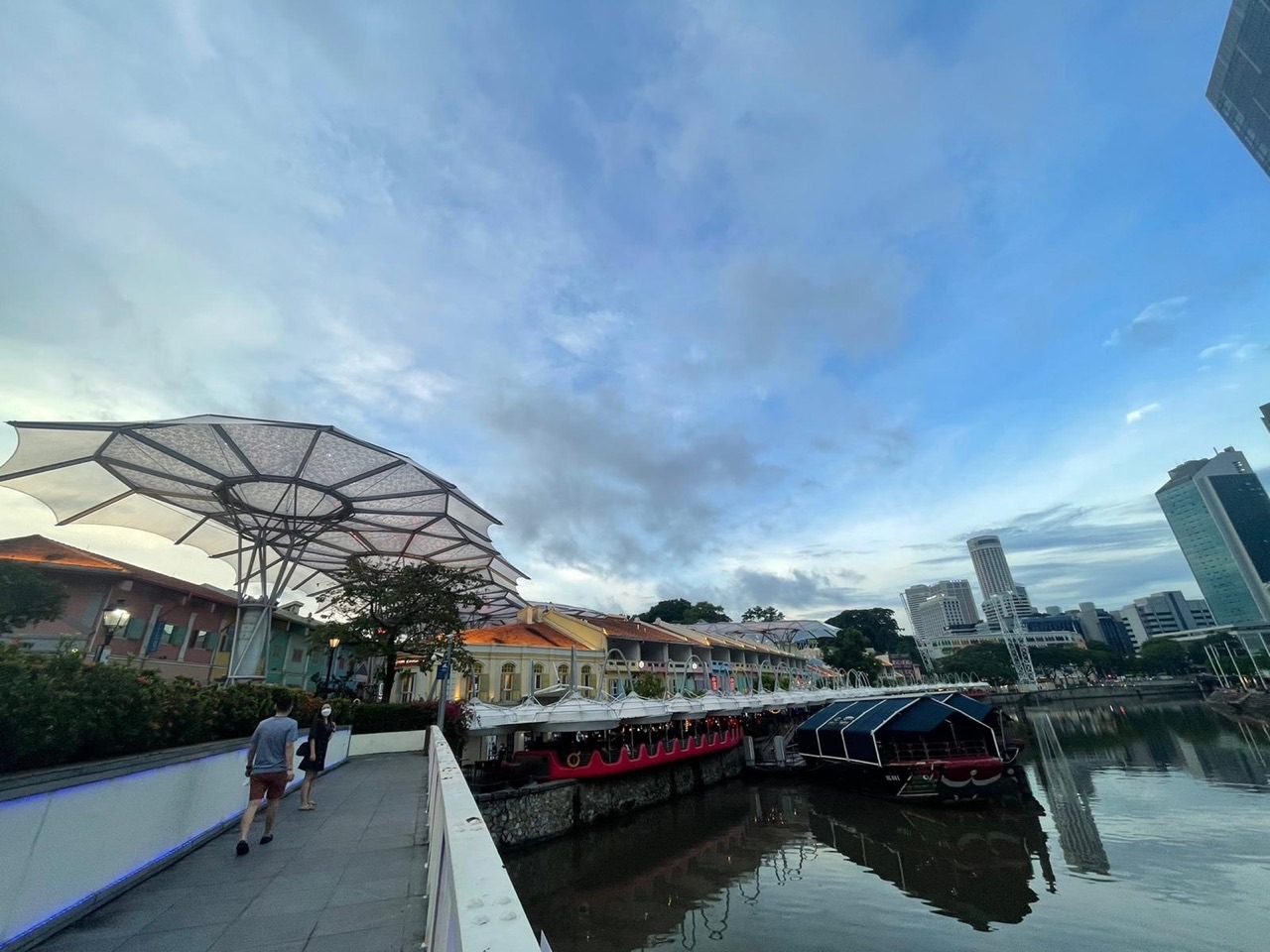
Things to do for kids in Clarke Quay can become a learning day about rivers, bridges, trade, transport, urban clean-up and how infrastructure changes the way people move through a city.
The Singapore River is the strongest learning anchor.
Related Singapore touring vocabulary: For deeper Clarke Quay learning, see Touring Singapore: Days 1–52 Vocabulary and Visitor Hub and Day 35: Singapore River Cruise, Clarke Quay and Boat Quay Heritage. The family guide and vocabulary day are related readings, not a requirement to combine several sites in one outing.
National Heritage Board’s Singapore River Walk traces the river from Collyer Quay to Robertson Quay and explains how it served as an artery of commerce, how communities lived and worked along its banks, and how historic bridges connected people and goods.
For families, Clarke Quay provides a compact section where several of those ideas can be made visible.
Read Bridge, Coleman Bridge, the riverbank and the conserved warehouse landscape give children enough material for one afternoon.
The best outing is not the longest river walk.
Choose a short section, one bridge and one question.
- observe the Singapore River from a safe public viewpoint;
- study one historic bridge as infrastructure;
- learn how river trade shaped the district;
- compare former warehouses with present uses;
- use bridge spans, route choices and walking time for Mathematics;
- learn about the long Singapore River clean-up;
- finish with one explanation about how the river’s function changed.
Explore the Singapore River Walk
Explore the historic bridges over the Singapore River
Read the Singapore River story
Begin with the River: Ask What Made This Waterway Important
A river becomes historically important because of what people can do with it.
Ships and smaller boats can move goods.
Warehouses can be built nearby.
Workers can load and unload cargo.
Businesses can develop close to transport.
Settlements grow around movement.
Ask the child why a commercial district might form beside a river rather than far inland.
The answer does not need to be perfect.
The child is beginning to connect geography with economic activity.
Use the River as a Network
Draw the river as a line.
Add one bridge.
Add two banks.
Ask what changes when the bridge exists.
People can cross more directly.
Businesses on opposite sides become easier to reach.
Routes shorten.
The bridge becomes a link in a larger network.
The same reasoning can later be applied to roads, MRT lines and computer networks.
Study Read Bridge: Infrastructure Can Outlive Its Original Context
Read Bridge links Clarke Quay and Merchant Road.
National Heritage Board materials record that the original bridge was completed in the nineteenth century, later rebuilt, repaired and converted for pedestrian use.
That makes it a useful example of continuity and adaptation.
Ask the child what stayed the same.
The need to cross the river.
What changed?
Construction, surrounding land use, traffic and the bridge’s present role.
Infrastructure can continue to serve a city even when its context changes.
Use the Bridge for Measurement and Estimation
From a safe pedestrian position, estimate the time required to cross.
Then measure the actual walking time.
Ask what affected the result.
Crowds.
Stopping to look at the river.
Walking pace.
The chosen start and end points.
For older children, estimate average speed using a measured or mapped distance.
State clearly which quantities are measured and which are assumed.
Use Coleman Bridge to Compare Design
Coleman Bridge provides another historical crossing along the Singapore River.
Ask the child to compare it with Read Bridge.
Road bridge or pedestrian bridge?
Decorative details?
Width?
Traffic?
How do users move across each?
The comparison teaches that bridges solve the same broad problem in different ways.
The design responds to traffic, era, materials and intended users.
Teach the Difference Between Function and Appearance
A bridge can be attractive and functional.
But appearance alone does not tell the child why it was built.
Ask the functional question first.
What movement does it enable?
Then ask the historical question.
Who built or rebuilt it, and why?
Then ask the design question.
What visible details make it recognisable?
Separating these questions makes the explanation clearer.
Use Former Warehouses to Explain Trade
Clarke Quay’s historic riverside buildings are connected to the district’s earlier commercial life.
Warehouses matter because trade requires storage.
Goods do not move instantly from ship to buyer.
They wait.
They are counted.
Sorted.
Protected.
Moved again.
Ask the child what a warehouse needs.
- space;
- access for loading;
- organisation;
- security;
- proximity to transport.
The building becomes part of a supply chain rather than merely an old façade.
Compare Former Use with Present Use
Many conserved riverside buildings now serve very different functions from their commercial past.
Ask what has been preserved physically and what has changed in use.
Walls may remain.
Rooflines may remain.
Street relationships may remain.
Interior functions can change dramatically.
This is adaptive reuse.
Older students can ask what is gained and what may be lost when a working commercial district becomes a leisure and tourism district.
Use the River Clean-Up to Teach System Repair
National Heritage Board’s Singapore River story explains that the river became severely polluted during Singapore’s industrial and urban growth and that a major clean-up effort unfolded over many years.
This is an excellent systems lesson.
A polluted river is not repaired by removing one piece of litter.
Sources of pollution have to be addressed.
Activities may have to move.
Sewage and waste systems must improve.
Rules and infrastructure have to work together.
Large environmental problems usually have multiple causes and require coordinated repair.
Teach Cause, Evidence and Scale
A child may look at today’s river and say it appears clean.
That observation is valid.
But it does not prove that every water-quality measure is safe or that the river has no environmental problems.
Appearance is one kind of evidence.
Water testing provides another.
Historical photographs provide evidence of earlier conditions.
Government records explain policies and infrastructure.
Different questions require different evidence.
Use Old Photographs for Before-and-After Analysis
The Singapore River Walk includes historical images of bumboats, bridges and riverside activity.
Choose one image.
Identify three features.
Then compare the modern viewpoint if possible.
What changed?
What remained?
What cannot be compared because the viewpoint is different?
A before-and-after exercise becomes stronger when the child names the limits of the comparison.
Teach Trade through a Simple Cargo Chain
Choose one hypothetical cargo item.
For example, sacks of rice.
Draw a general chain.
Ship → lighter or river craft → riverbank → warehouse → trader → shop → household.
Explain that actual historical supply chains varied.
The diagram is a model.
Its purpose is to show why transport, storage and trade locations clustered together.
Turn the Cargo Chain into Mathematics
Use invented quantities.
Suppose a warehouse receives 12 crates, each containing 24 identical units.
That is 288 units.
If 75 units are sent to one shop, 213 remain.
If another 96 are dispatched, 117 remain.
The numbers are hypothetical.
The learning point is that commerce depends on counting, inventory and movement as well as buying and selling.
Use Bridge Arches and Rails for Geometry
Historic bridges contain repeated geometric features.
Ask the child to find curves, vertical supports, parallel rails or repeated decorative motifs.
Which elements appear symmetrical?
Which repeat at regular intervals?
Does perspective make equal spacings look smaller in the distance?
The bridge becomes a geometry object without requiring the child to calculate structural loads.
Use Reflections to Discuss Symmetry Carefully
When the water is calm enough, bridge or building reflections may appear on the river.
Ask how the reflection differs from a perfect mirror image.
Ripples distort lines.
Moving water changes the image.
The reflected scene may be interrupted.
A real reflection is a useful reminder that mathematical symmetry is an ideal relationship that physical conditions may disturb.
Build English from Movement and Trade
- load;
- unload;
- transport;
- store;
- cross;
- span;
- conserve;
- repurpose;
- pollute;
- restore.
Ask the child to choose five words and connect each with a specific observation or historical fact.
“Span” fits a bridge.
“Store” fits a warehouse.
“Restore” should be used only when the source supports a process of repair or return.
Accurate language makes the historical explanation more useful.
Use the River to Teach Sequence
Ask the child to explain one process in order.
A cargo journey.
A river clean-up.
Crossing from one bank to another.
The sequence must contain a beginning, change and result.
Then ask what happens if one step is missing.
A process is more than a list because later stages depend on earlier ones.
A Simple Clarke Quay Learning Route
Stage 1: River viewpoint
Observe the water and identify bridges, banks and movement.
Stage 2: Read Bridge
Ask what problem the bridge solves and how its role changed.
Stage 3: Warehouse landscape
Identify why trade needed buildings beside the river.
Stage 4: Second bridge
Compare Read Bridge with Coleman Bridge or another nearby crossing.
Stage 5: Historical image
Use one old river photograph for a before-and-after comparison.
Stage 6: Reflection
Ask: “How did the river’s role change even though the river itself remained?”
How to Adjust the Day by Age
Ages 5 to 7
- count bridges;
- find three kinds of movement;
- draw one bridge;
- compare near and far objects.
Ages 8 to 10
- estimate bridge-crossing time;
- identify one warehouse function;
- use five river or trade verbs;
- compare an old photograph with today.
Ages 11 to 12
- explain one part of a cargo chain;
- separate appearance from water-quality evidence;
- compare two bridge designs;
- write a paragraph about change of use.
Secondary students
- analyse the river as trade infrastructure;
- discuss urban environmental repair;
- evaluate adaptive reuse;
- compare source types and their limitations.
Write One Clarke Quay Scene
- The Bridge that Changed the Route
- The River before the Clean-Up
- The Warehouse beside the Water
- The Reflection under Read Bridge
- When the River Stopped Being a Working Port
Ask for one visible detail, one historical fact, one explanation and one sentence stating what the evidence does not prove.
What Parents Should Avoid
- Do not allow children to climb railings or approach unsafe river edges.
- Do not treat visible water clarity as a laboratory measurement.
- Do not block pedestrian bridges while doing an activity.
- Do not turn nightlife businesses into the focus of a child’s learning day.
- Do not assume every old-looking riverside building kept its original use.
- Do not force the full Singapore River Walk into one outing.
A short river section is enough to reveal a complex city system.
Frequently Asked Questions
Is Clarke Quay suitable for young children?
Yes, especially during a daytime visit with a short riverside route. Adults should manage river edges, crossings and crowded periods carefully.
How can Clarke Quay support Mathematics?
Use bridge-crossing time, distance, inventory examples, repeated geometry, route planning and estimation.
How can it support Science?
Use water movement, pollution, clean-up systems, reflection and evidence quality.
How can it support Humanities?
Use river trade, bridges, warehouses, migration, commercial geography and adaptive reuse.
Do we need a river cruise?
No. The learning activities in this guide can be completed from public pedestrian areas. A cruise is optional and should be planned separately if the family wants one.
What is a useful final question?
Ask: “What did the river make possible in the past, and what is the same place used for now?”
Helpful Links for a Clarke Quay Learning Day
- Singapore River Walk
- Historic Bridges over Singapore River
- The Singapore River
- Things to do for Kids | Learning River Valley
- Things to do for Kids | Learning City Hall
Things to do for Kids | Learning Clarke Quay
Clarke Quay teaches children that infrastructure can change the possibilities of a place.
A bridge changes movement.
A warehouse changes storage.
A river changes trade.
A clean-up changes how the city can use the waterway.
Conservation and adaptive reuse change what older buildings can become.
The child does not need to memorise every bridge date.
The stronger outcome is an understanding that cities work through connected systems, and those systems can be repaired and repurposed.
Properly taught kids shine a bright light into the future.