
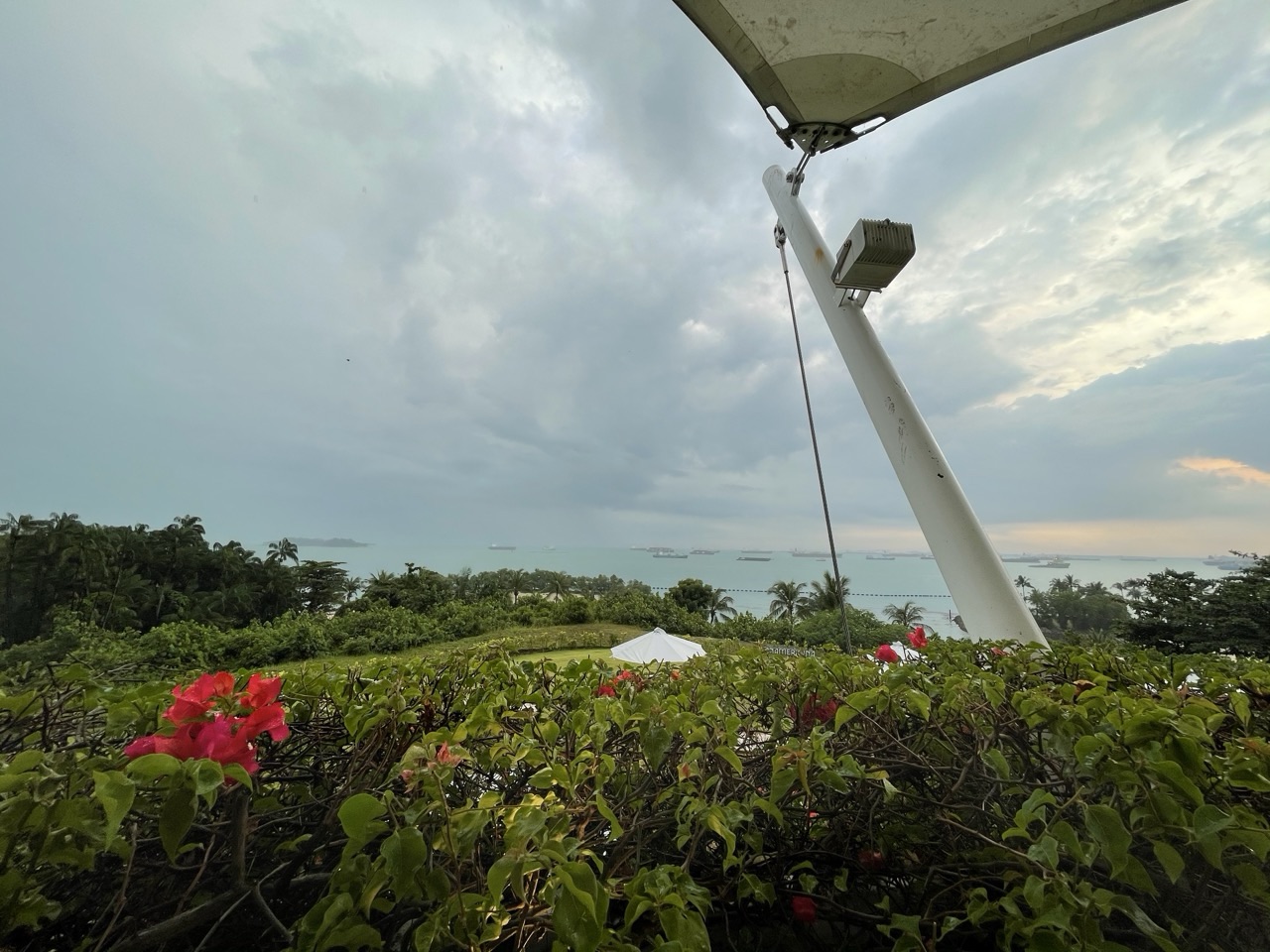
Things to do for kids in Sentosa can become a learning day about coastal defence, island history, habitats, viewpoint, maps and the way one place can be redesigned many times without losing all traces of its earlier uses.
Sentosa works especially well for families because several strong learning experiences are free.
Touring Singapore reading: Open the Touring Singapore master hub to browse all published Day 1–17 field guides, Top 10 visitor articles and family-learning places. Compare island heritage and beach vocabulary with the wider visitor guides before deciding which separate outing to enjoy. The day numbers are independent topics rather than a required schedule.
Related vocabulary field guide: Top 100 Singapore Vocabulary Words | Day 4: Sentosa, Beaches and Island Adventures helps children and families practise useful words while exploring Sentosa’s coastal setting, heritage, nature and safe visitor choices. The guide is a companion to this family learning article.
Related Sentosa attractions vocabulary: For a theme-park day, read Day 30: Universal Studios Singapore and Minion Land. For marine-life learning, read Day 38: Singapore Oceanarium and Conservation. Both have their own admission and activity conditions; this general Sentosa family route does not require either.
Fort Siloso preserves military history.
Sentosa Nature Discovery introduces the island’s habitats.
The Imbiah forest trail reuses part of the former monorail alignment.
The coastal trail links military, shoreline and nature questions.
The strongest day chooses one history theme and one nature theme rather than trying to combine every attraction on the island.
- explore Fort Siloso as a preserved coastal fort;
- use the Fort Siloso Skywalk for perspective and scale;
- visit Sentosa Nature Discovery for habitat learning;
- walk a suitable nature trail through Imbiah;
- compare built defence structures with natural coastal features;
- use maps and travel time for Mathematics;
- finish with one explanation about how Sentosa changed function over time.
Explore Sentosa learning ideas
Explore the Sentosa Coastal Trail
Check current Sentosa visitor information
Begin with the Island Question: What Was Sentosa for before It Became a Leisure Destination?
Children may know Sentosa mainly through attractions and beaches.
Fort Siloso creates a different entry point.
The island once had a major military role in protecting approaches to Singapore’s harbour.
Ask why a coastal fort would be placed on high ground near shipping routes.
Visibility matters.
Range matters.
Harbour geography matters.
The child begins with function before memorising historical dates.
Use Fort Siloso as a Place-Based History Lesson
Sentosa identifies Fort Siloso as Singapore’s preserved coastal fort and a free heritage site.
Children can see defensive structures, tunnels, gun positions, exhibits and the Surrender Chambers.
The important learning move is to connect each structure with a problem it was designed to address.
Where would people observe approaching vessels?
Where would ammunition be stored?
How would information move?
Architecture becomes part of the military system.
Teach War History without Turning It into Spectacle
Fort Siloso is connected with the Battle of Singapore and the Japanese Occupation.
Teach this carefully.
The purpose is not to make weapons exciting.
It is to understand defence, decisions, consequences and lived experience.
Young children may focus on the fort’s function and geography.
Older children can work with timelines and sources.
Avoid graphic details that are not needed for the learning objective.
Use the Skywalk to Teach Height and Perspective
Sentosa describes the Fort Siloso Skywalk as an 11-storey-high structure leading to a 181-metre elevated walkway.
A high viewpoint changes information.
The child can see harbour relationships, vegetation and surrounding land more clearly.
Ask what becomes easier to understand from above.
Then ask what detail is lost.
Perspective gives some information and hides other information.
Use 181 Metres for Mathematics
Suppose a child walks the 181-metre Skywalk at an average speed of 1 metre per second.
Moving time would be 181 seconds, or 3 minutes and 1 second.
This is an illustrative calculation.
The actual visit will take longer because people stop, look and move at different speeds.
Ask why the calculated time and experienced time differ.
The formula answers a narrower question than the complete visit.
Use the Harbour View to Teach Apparent Size
Ships and islands can appear small from high ground.
Ask whether they are actually small.
Distance changes apparent size.
A photograph can compress scale further.
For older children, ask what reference would help estimate a real size.
Known distance.
Map scale.
Published dimensions.
Do not convert appearance into measurement without a method.
Use the Coastal Trail to Connect Fort and Shore
Sentosa’s Coastal Trail guide links Fort Siloso with natural shoreline and coastal features around Siloso Point.
Ask how the coast affects defence.
Cliffs, rocky shore and harbour approaches influence where people can move and where military structures make sense.
Geography and history become connected.
The fort was not built in an arbitrary location.
Move to Sentosa Nature Discovery
Sentosa Nature Discovery is housed in a former monorail station and presents information about wildlife, heritage trees and the island’s habitats.
This creates an immediate adaptive-reuse question.
What was the building designed for before?
What does it do now?
Which parts of the old function remain visible?
A transport structure becomes a learning space.
Teach Eight Habitats without Memorising Eight Labels
Sentosa’s learning materials describe several habitat types across the island, including coastal forest, rocky shore, secondary forest and parkland.
Do not ask the child to memorise the full list before going outside.
Choose two habitats.
Compare light.
Ground.
Water.
Plant structure.
Animal visibility.
The concept of habitat becomes meaningful through contrast.
Use the Former Monorail Route to Teach Adaptive Reuse
Part of the nature trail uses a linked walkway associated with Sentosa’s former monorail alignment.
Ask what a transport route provides even after the transport system stops.
A line through the landscape.
A grade or elevation.
Connections between places.
Structures that may be repurposed.
Infrastructure can have more than one life.
Observe Nature through Movement
Sentosa’s nature guidance encourages visitors to look for animal movement, colour, tracks and behaviour.
Ask the child to search for movement rather than a specific species.
A squirrel jumps.
A bird crosses the canopy.
A monitor lizard moves along a path edge.
A butterfly changes direction.
The observation remains useful even when the name is unknown.
Teach Camouflage
An animal can be present without being easy to see.
Ask the child to look for shape and movement rather than only colour.
Camouflage works partly because the animal does not stand out clearly from its background.
A brief sighting can still support a question.
What feature made the animal hard to detect?
Do not disturb vegetation to reveal it.
Use Sound as Evidence
A child may hear an animal before seeing it.
Record the sound carefully.
Repeated?
High or low?
Near or far?
Do not identify the species from one unfamiliar sound unless a reliable guide supports it.
Sound is evidence, but incomplete evidence.
The child can write, “We heard a repeated call from the trees but did not identify it.”
Use the Beach for Coastal Science
Sentosa’s beaches create opportunities to observe waves, sand and shoreline engineering from safe public areas.
Ask what changes between dry and wet sand.
How does water affect shape?
Where do waves reach?
What structures appear designed to protect or manage the coast?
Do not enter unsafe water or restricted shore areas for the activity.
Teach Sand as a Material
Dry sand flows between fingers.
Damp sand holds shapes better.
Saturated sand behaves differently again.
At an appropriate public sand area, children can compare how small model walls behave with different moisture levels.
The activity should remain simple and respectful of other visitors.
The child is learning that material properties change with conditions.
Use the Coastal Fort and Beach as a Comparison
Fort Siloso and the beach answer different human needs.
The fort was built for defence.
The beach today supports recreation and coastal experience.
Ask what remains the same.
Sea.
Harbour position.
Topography.
What changed?
Human use.
Infrastructure.
Access.
The island’s geography remains while its functions change.
Use Sentosa’s Name Change as a History Question
Older sources refer to the island by its earlier name, Pulau Blakang Mati or variants of that name.
The island was renamed Sentosa in the twentieth century.
Ask why governments or communities rename places.
Identity.
Tourism.
Public memory.
Changing function.
The name becomes part of the island’s transformation.
Use a Timeline with Only Four Anchors
- earlier island communities and coastal geography;
- British military development;
- Second World War and Occupation history;
- post-war transformation into a leisure and nature destination.
Ask what physical evidence remains from each period.
Not every period leaves the same amount.
A fort remains clearly.
A former monorail alignment is reused.
Other activities may survive mainly through records and place names.
History is unevenly visible.
Use Maps to Compare Transport Systems
Sentosa can be reached and crossed through several transport modes.
Ask the child to compare walking, bus, monorail and cable-car routes where relevant to the family’s actual plan.
Which one is direct?
Which one requires waiting?
Which one provides a viewpoint?
Which one is suitable for the family’s mobility needs?
Transport choice involves more than speed.
Turn Travel Time into Mathematics
Suppose one route requires 8 minutes waiting and 12 minutes travelling.
Another requires 5 minutes walking, 4 minutes waiting and 10 minutes travelling.
The first totals 20 minutes.
The second totals 19 minutes.
The difference is small.
Ask what other factors could matter.
Heat.
Stairs.
Crowds.
Cost.
The fastest numerical route may not be the best family route.
Build English from History and Nature Words
- fortification;
- coastal;
- habitat;
- camouflage;
- interpret;
- repurpose;
- occupation;
- viewpoint.
Ask the child to use words only when the place made them useful.
“Repurpose” fits a former monorail station used as a nature-learning space.
“Viewpoint” describes a place selected for looking.
“Occupation” should be used historically and sensitively in relation to the wartime period.
Write One Sentosa Scene
- The Skywalk above the Trees
- The Fort beside the Harbour
- The Monorail Station that Became a Nature Centre
- The Animal I Heard but Could Not See
- The Beach and the Battery
Ask for one physical detail, one historical or scientific fact, one interpretation and one sentence showing what remains uncertain.
A Simple Sentosa Learning Route
Stage 1: Fort Siloso
Begin with one geography-and-defence question.
Stage 2: Skywalk
Use height, scale and viewpoint.
Stage 3: History
Choose one fort structure or one timeline section.
Stage 4: Sentosa Nature Discovery
Shift from military history to habitat learning.
Stage 5: Short nature trail
Observe movement, sound or one habitat contrast.
Stage 6: Reflection
Ask: “What did Sentosa reuse instead of removing completely?”
How to Adjust the Day by Age
Ages 5 to 7
- find three different shapes at the fort;
- compare near and far from the Skywalk;
- listen for one animal sound;
- draw one coastal feature.
Ages 8 to 10
- calculate one simple travel-time total;
- use five nature or history words;
- compare two habitats;
- explain one adaptive-reuse example.
Ages 11 to 12
- connect fort location to harbour geography;
- distinguish observation from identification;
- compare old and new transport systems;
- write a paragraph using evidence.
Secondary students
- analyse military geography;
- evaluate heritage interpretation;
- discuss adaptive reuse;
- compare coastal ecology with recreational development.
What Parents Should Avoid
- Do not turn military history into a weapons spectacle.
- Do not promise a particular wildlife sighting.
- Do not assume every paid attraction is necessary for learning.
- Do not combine too many attractions in one day.
- Do not enter restricted coastal areas.
- Do not rely on old transport or access information without checking current Sentosa guidance.
The island contains enough history and nature for several separate learning days.
Frequently Asked Questions
Is Fort Siloso free?
Sentosa currently lists Fort Siloso as a free heritage attraction. Families should still check current operating information before visiting.
What can children learn at Sentosa Nature Discovery?
They can explore information about local wildlife, heritage trees and several habitat types, then extend the learning onto nearby nature trails.
How can Sentosa support Mathematics?
Use the Skywalk length, travel-time comparisons, map reading, apparent size and route planning.
How can it support Science?
Use habitats, camouflage, animal behaviour, coastal materials and observation.
How can it support Humanities?
Use Fort Siloso, wartime history, place-name change and adaptive reuse.
What is a useful final question?
Ask: “Which part of Sentosa’s older history is still visible because it was preserved or repurposed?”
Helpful Links for a Sentosa Learning Day
- Learn, discover and play in Sentosa
- Sentosa Coastal Trail
- Sentosa nature discovery skills
- Sentosa visitor FAQs
- Things to do for Kids | Learning Bukit Merah
- Things to do for Kids | Learning Pasir Panjang
Things to do for Kids | Learning Sentosa
Sentosa teaches children that a place can change its public identity without losing every trace of its past.
A fort remains after the military role ends.
A monorail structure becomes part of a nature-learning route.
Coastal geography continues to shape what people can see and do.
Habitats remain beside major visitor infrastructure.
A child who learns to connect those layers begins to see Sentosa as more than a collection of attractions.
It becomes an island whose geography, history and design can be read together.
Properly taught kids shine a bright light into the future.