
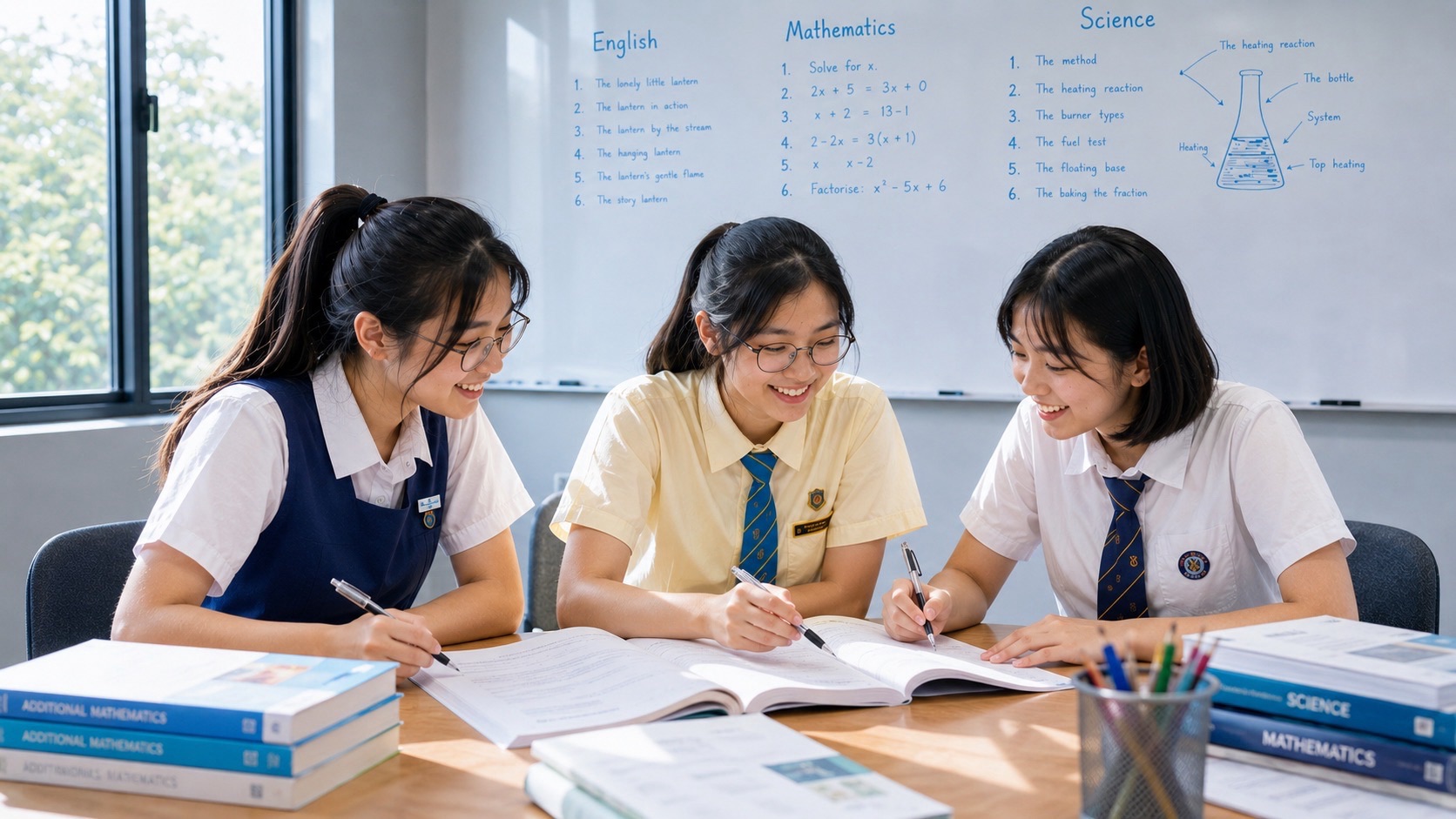
How to Improve With Tuition | Changi Village
Changi Village students can improve when tuition strengthens evidence selection. Many weak answers do not come from a complete lack of knowledge; they come from choosing the wrong detail, the wrong clue, the wrong formula or the wrong piece of information for the task.
The aim is to teach students to slow the first decision down, identify what the question actually needs and select evidence that can carry the answer.
At eduKateSG, we teach in premium 3-pax small-group tutorials near Sixth Avenue MRT. Lessons are typically 1.5 hours weekly, with clear explanation, closely observed practice, retrieval, error analysis, independent application and focused continuation work.
The purpose is not simply to add another academic session. It is to make the student more capable outside the lesson: better at identifying what a question requires, retrieving the right knowledge, choosing a method, checking the result and recovering when the first attempt goes wrong.
- read for the exact demand of the question
- distinguish useful evidence from nearby detail
- improve method selection
- support explanations more precisely
- reduce answers built on the wrong starting point
Arrange a parent–student consultation with eduKate Singapore.
The Important Transition Is From Seeing Information to Selecting Evidence
Students often notice many details in a passage, diagram, graph or word problem.
Improvement begins when they can decide which of those details matter for the current question.
For Changi Village students, tuition should therefore train selection before expansion.
The learner first identifies the demand, then gathers only the evidence that can answer it.
The Hidden Problem: Relevant-Looking Information Can Still Be the Wrong Evidence
A comprehension passage may contain an interesting sentence that does not answer the question.
A Mathematics problem may include several numbers, but only some are needed for the first step.
A Science graph may show a visible pattern, yet the conclusion must still refer to the variables named in the task.
Students improve when they learn that proximity is not proof. The nearest detail is not automatically the useful detail.
Why a 3-Pax Tutorial Can Help Changi Village Students Improve
In a 3-pax tutorial, the tutor can observe how each Changi Village student chooses evidence.
One learner may select by keyword matching. Another may know the concept but overlook a condition. A third may choose correct evidence but fail to explain how it supports the answer.
- close inspection of individual working
- frequent opportunities to answer and explain
- pacing that can change when a hidden gap appears
- independent application after guided teaching
- comparison of different valid approaches
- clearer tracking of recurring error patterns
- more precise adjustment before school assessments
Those require different repairs.
The class is small by design. Its value comes from better information about how each student is thinking, not merely from reducing the number of seats in the room.
Three Improvement Pathways
1. Repair
Repair is needed when the learner cannot yet identify the information that makes an answer possible.
- command-word confusion
- keyword matching without meaning
- missing conditions in word problems
- weak graph and table reading
- unsupported claims in written responses
2. Stabilise
Stabilisation makes evidence selection a repeatable routine.
- name the task
- identify the relevant concept
- mark the evidence
- explain the link
- check whether the answer stays within the evidence
3. Extend
Extension develops selection when several pieces of information compete for attention.
- multi-source comprehension
- multi-step Mathematics
- experimental data
- unfamiliar application questions
- timed mixed papers
A First-Principles Improvement Method
1. Diagnose the first wrong selection
We identify where the student first chose information that could not support the intended answer.
Once that point is visible, the repair becomes more precise.
2. Rebuild only what is actually missing
If the issue is reading, we repair interpretation. If it is concept recognition, we repair the concept. If it is evidence linkage, we teach the student to explain why a detail is relevant.
More practice is useful only when it targets the right weakness.
3. Use the Fencing Method
We begin inside a clear practice boundary so the student can learn one selection rule at a time. Once the method is secure, one new difficulty is introduced deliberately: changed wording, a different representation, mixed topics, an additional reasoning step or controlled time pressure.
This keeps errors informative. If several new demands arrive at once, the tutor may know that the answer is wrong without knowing which part of the thinking failed first.
4. Make the student justify the evidence
The learner explains why a sentence, value, observation or method belongs in the answer.
This shifts the student from collecting information to using information purposefully.
5. Retrieve after a delay
A later cold-start task checks whether the student can repeat the selection process without the tutor’s earlier prompts.
Transfer is more convincing when the learner can make the decision independently.
6. Interleave and transfer
Evidence selection is practised across English, Mathematics and Science.
The source changes, but the reasoning remains: identify the demand, choose what matters and connect it explicitly.
7. Add speed only after control
Timed work comes after the student can select evidence accurately enough that speed will not simply accelerate the wrong choice.
What Happens During a 90-Minute Improvement Lesson
Warm-up retrieval
A short task asks the student to identify the question demand and select one piece of supporting evidence without help.
Current-school diagnosis
Recent schoolwork is checked for patterns. One or two high-value weaknesses are selected rather than trying to repair every marked error in the same lesson.
Concept instruction
The tutor teaches the difference between available information and relevant evidence.
Guided practice
The student attempts carefully selected questions while the tutor monitors the decision points. Prompts are reduced as control improves. A useful prompt directs attention; it does not replace the student’s reasoning.
Independent application
A fresh question tests whether the student can identify, select and explain evidence without a cue.
Mixed or timed application
Different evidence types are interleaved so the student must decide what kind of information matters in each task.
Error review
Mistakes are classified rather than simply crossed out. Reading, recall, concept, arithmetic, notation, language, organisation, timing and checking errors require different repairs.
Focused continuation work
Home practice includes one or two tasks where the student marks the evidence before writing the answer.
How Tuition Should Improve English
English depends heavily on evidence selection.
Comprehension answers improve when students choose the exact sentence or idea that supports the inference instead of copying a nearby phrase.
In composition, details should be selected because they develop the event, character, mood or consequence.
The learner becomes more precise when every detail has a job.
How Tuition Should Improve Mathematics
Mathematics requires students to distinguish given information, derived information and irrelevant detail.
A good setup begins by identifying what the quantities represent and which relationships connect them.
Students learn not to use every number simply because it appears in the problem.
Method choice becomes stronger when it is justified by the structure of the problem rather than by surface keywords.
How Tuition Should Improve Science
Science answers should be anchored to observations and data.
Students identify the variables, read the table or graph carefully and choose evidence that supports the exact conclusion.
They learn to avoid adding unsupported explanations simply because those explanations sound scientifically sophisticated.
Evidence controls the answer.
Why Evidence Selection Improves Clarity
Weak answers often contain too much information and too little connection.
When students select evidence first, the response becomes easier to organise because the supporting material is already purposeful.
The learner can then spend effort on explanation instead of searching through every available detail.
Precision grows from disciplined selection.
How We Reduce Careless-Looking Mistakes
Some mistakes described as careless are actually selection errors.
- using the first matching keyword
- choosing a formula before understanding the relationship
- copying a detail that does not answer the question
- reading the wrong row, column or axis
- adding an unsupported explanation
- ignoring a condition under time pressure
The tutor traces the mistake back to the selection decision instead of treating the final wrong answer as the whole problem.
Teaching Ahead Without Rushing
Pre-teaching can introduce a new topic by showing students what evidence will later matter most.
This gives the learner a framework for noticing important information when the school lesson arrives.
Pre-teaching should reduce surprise, not create a second syllabus that races ahead while current foundations remain unstable.
What Progress Should Look Like
Parents may notice that answers become shorter in the right places and fuller where explanation is needed.
- fewer irrelevant comprehension details
- better identification of problem conditions
- cleaner use of graphs and tables
- better-supported conclusions
- less keyword-driven method choice
- stronger explanation of why evidence matters
The student begins to ask, “What proves this?” before writing the answer.
Marks remain important, but responsible tuition does not promise a fixed grade after a fixed number of lessons. The size of the gap, attendance, school demands, practice quality and assessment timing all matter.
A Changi Village Evidence Routine
A useful weekly routine can be brief.
- name what the question wants
- mark the strongest relevant evidence
- exclude attractive but irrelevant detail
- explain the link between evidence and answer
- check that no unsupported claim has been added
The routine trains students to make selection deliberate.
The goal is not to collect more information. It is to use the right information well.
Travelling From Changi Village to Sixth Avenue
Changi Village families can plan travel toward Sixth Avenue using current east-side bus and rail connections from the student’s actual starting point.
The complete weekly arrangement should include school dismissal, transfers, meals, the lesson and the return home.
This guide serves Changi Village families considering the Fourth Avenue programme. It does not describe a Changi Village branch.
Location: eduKateSG, 8 Fourth Avenue, Singapore 268674
Nearest MRT: Sixth Avenue MRT, Downtown Line
Attendance: By appointment
Class Details
Format: Premium 3-pax small-group tutorials
Duration: Approximately 1.5 hours weekly
Teaching approach:
- first-principles explanation
- diagnosis before volume
- guided and independent practice
- retrieval and interleaving
- error analysis
- school-assessment alignment
- carefully paced pre-teaching
Materials may include:
- curated lesson notes
- topic practice
- mixed revision
- assessment-style questions
- micro-tests
- focused continuation work
What Parents Can Bring to the Consultation
- recent school test papers
- marked assignments
- the school’s current topic sequence
- teacher comments
- work completed only with heavy help
- questions the student repeatedly avoids
- examples of mistakes that returned after correction
Bring answers where the student wrote a lot but used the wrong detail, value, clue or evidence. These reveal selection habits clearly.
Frequently Asked Questions
How quickly should a Changi Village student improve with tuition?
Evidence selection can improve within several lesson cycles when the underlying knowledge is secure. If the learner cannot recognise the concept being tested, that foundation must be repaired first.
Should tuition begin with full examination papers?
Not always. Full papers are useful for integration, timing and diagnosis, but a missing foundation may need a smaller teaching task first. The practice format should answer the current learning question.
Is more homework always better?
No. Practice volume should match the purpose. Fluency may need repetition. Concept repair may need fewer questions with slower reasoning and better correction.
What if my child understands during tuition but cannot work alone?
Then independent transfer has not yet been built. Prompts should be reduced, cold-start work added and the student required to select evidence and explain the link without the model answer beside it.
Can a strong student still benefit from tuition?
Yes. Strong students benefit from more demanding selection tasks where several plausible details compete and the learner must justify the strongest one.
How do you reduce repeated careless mistakes?
We identify whether the mistake came from reading, selection, recall, calculation, notation or time pressure, then teach a check that targets that cause.
Do you teach ahead of school?
Yes, when the foundation is stable. A calm first encounter can make the later school lesson easier to follow. We do not rush ahead when earlier concepts remain insecure.
Is tuition necessary for every student?
No. A student who is learning confidently, completing work independently and progressing well may not need additional tuition. Tuition should solve an identifiable learning problem or provide meaningful extension.
Helpful Reading
Read How Independent Learning Works, How Error Correction Works and How Interleaving Works for the wider learning system.
How to Improve With Tuition | Changi Village
For Changi Village students, improvement begins by choosing the information that can actually carry the answer.
Identify the demand, select the evidence and make every detail earn its place.
eduKateSG
8 Fourth Avenue
Singapore 268674
Near Sixth Avenue MRT
Premium 3-pax small-group tuition
By appointment
Properly taught kids shine a bright light into the future.