
How to Improve With Tuition | Changi Airport
Changi Airport students can improve when tuition builds a reliable checking system. A strong learner does not simply finish a question and move on; the learner knows where to pause, what to verify and how to detect a mistake before it becomes a repeated habit.
The aim is to turn checking from a vague instruction into a sequence of visible academic checkpoints that can be used in English, Mathematics and Science.
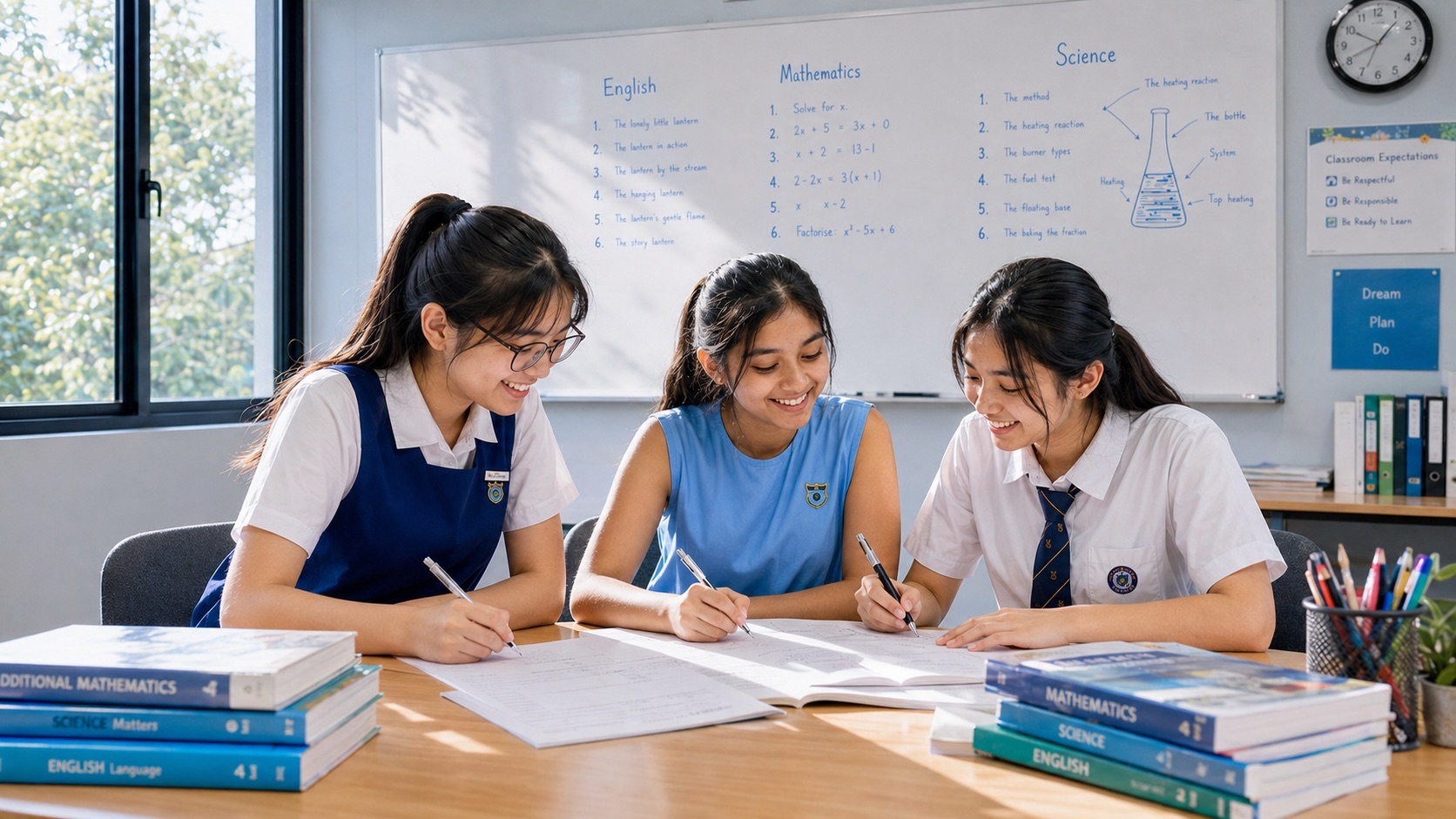
At eduKateSG, we teach in premium 3-pax small-group tutorials near Sixth Avenue MRT. Lessons are typically 1.5 hours weekly, with clear explanation, closely observed practice, retrieval, error analysis, independent application and focused continuation work.
The purpose is not simply to add another academic session. It is to make the student more capable outside the lesson: better at identifying what a question requires, retrieving the right knowledge, choosing a method, checking the result and recovering when the first attempt goes wrong.
- build purposeful checking routines
- reduce repeated avoidable errors
- separate answer production from answer verification
- improve confidence through evidence rather than guesswork
- transfer checking habits across subjects
Arrange a parent–student consultation with eduKate Singapore.
The Important Transition Is From Finishing Work to Verifying Work
Many students believe a question is complete when an answer has been written.
That is only the production stage.
Reliable academic work also needs verification: checking the command word, the method, the evidence, the calculation, the unit, the grammar, the final expression or the logic of the conclusion.
For Changi Airport students, improvement means learning exactly what should be checked at each point instead of relying on a final hurried glance.
The Hidden Problem: A Fast Final Check Often Happens Too Late
When checking happens only in the last minute, students often scan the page without a clear target.
The eyes move, but the reasoning is not tested.
A better system places small checkpoints inside the work itself.
After reading, the student confirms the task. After choosing a method, the student checks whether it fits. After calculating, the student tests reasonableness. Before submitting, the student checks the final answer against the original question.
This makes checking active rather than ceremonial.
Why a 3-Pax Tutorial Can Help Changi Airport Students Improve
In a 3-pax tutorial, the tutor can see where each student stops checking.
One learner may read too quickly. Another may choose the correct method but never test whether the final answer is plausible. A third may understand the content but lose marks through incomplete explanation.
- close inspection of individual working
- frequent opportunities to answer and explain
- pacing that can change when a hidden gap appears
- independent application after guided teaching
- comparison of different valid approaches
- clearer tracking of recurring error patterns
- more precise adjustment before school assessments
Those require different repairs.
The class is small by design. Its value comes from better information about how each student is thinking, not merely from reducing the number of seats in the room.
Three Improvement Pathways
1. Repair
Repair is needed when students do not yet know what makes an answer valid.
- misread command words
- unsupported comprehension answers
- incorrect mathematical method choice
- missing units or labels
- scientific conclusions that do not match the evidence
2. Stabilise
Stabilisation turns checking into a normal part of solving rather than an emergency action at the end.
- task check before starting
- method check after setup
- evidence check before explanation
- reasonableness check after calculation
- final response check before submission
3. Extend
Extension develops self-checking under mixed topics, unfamiliar questions and controlled time pressure.
- multi-step problem solving
- longer writing tasks
- data interpretation
- cross-topic application
- timed examination work
A First-Principles Improvement Method
1. Diagnose the first unchecked decision
We identify the earliest point where the student stops testing the work.
That may be the reading stage, method selection, evidence selection, calculation, notation or final answer.
2. Rebuild only what is actually missing
The tutor teaches a matching verification rule instead of adding a generic instruction to “be more careful.”
Care improves when the student knows what evidence to look for.
3. Use the Fencing Method
We begin inside a clear practice boundary so the student can see one checking routine at a time. Once the routine is secure, one new difficulty is introduced deliberately: changed wording, a different representation, mixed topics, an additional reasoning step or controlled time pressure.
This keeps errors informative. If several new demands arrive at once, the tutor may know that the answer is wrong without knowing which part of the thinking failed first.
4. Make the student explain the check
Students state what they are checking and why that check matters.
This prevents checking from becoming a mechanical ritual.
5. Retrieve after a delay
Immediate success is useful but incomplete evidence. A later cold-start question shows whether the student can remember both the method and the relevant check without prompting.
6. Interleave and transfer
Checking routines are used across subjects so the student learns a general habit of verification.
The exact checkpoint changes, but the principle remains: do not trust a result simply because it arrived smoothly.
7. Add speed only after control
Timed practice is added after checking can be done quickly enough to support fluent work rather than interrupt it.
What Happens During a 90-Minute Improvement Lesson
Warm-up retrieval
A short set asks the student to recall one checking routine from a previous lesson without notes.
Current-school diagnosis
Recent schoolwork is checked for patterns. One or two high-value weaknesses are selected rather than trying to repair every marked error in the same lesson.
Concept instruction
The tutor explains what makes a response valid and which checkpoint can test that validity.
Guided practice
The student attempts carefully selected questions while the tutor monitors the decision points. Prompts are reduced as control improves. A useful prompt directs attention; it does not replace the student’s reasoning.
Independent application
A fresh task tests whether the student uses the checking sequence without reminders.
Mixed or timed application
The student works through varied questions and learns which check matters in each context.
Error review
Mistakes are classified rather than simply crossed out. Reading, recall, concept, arithmetic, notation, language, organisation, timing and checking errors require different repairs.
Focused continuation work
Home practice includes a small number of questions where the student must record the check used, not merely the final answer.
How Tuition Should Improve English
English checking begins with the task itself.
Students confirm the command word, identify the required evidence and test whether the written response actually answers the question asked.
In writing, a final check should examine meaning first, then structure, sentence control, grammar and spelling.
Proofreading becomes more effective when the student knows what category of error is being searched for.
How Tuition Should Improve Mathematics
Mathematics checking can use estimation, inverse operations, substitution, unit checks and comparison with the question’s conditions.
A student should learn that different problems require different verification tools.
The strongest check is often independent from the original method because it gives a second route to confidence.
When a result is unreasonable, the student traces backwards to the earliest unstable step.
How Tuition Should Improve Science
Science checking asks whether claims match observations, tables, graphs and known relationships.
Students confirm variables, units, trends and the scope of the evidence before writing a conclusion.
A scientifically plausible sentence is not enough if it is not supported by the data in front of the student.
The tutor trains the learner to verify the link between evidence and explanation.
Why Checkpoints Reduce Cognitive Load
A vague instruction to check everything places too much demand on working memory.
A small sequence of checkpoints narrows attention.
The student does not need to wonder what “careful” means; the next check is already known.
With repetition, the sequence becomes faster and increasingly automatic.
How We Reduce Careless-Looking Mistakes
Repeated mistakes that look careless often come from missing verification habits.
- reading the wrong quantity or command word
- remembering the right idea but choosing it in the wrong situation
- making a correct setup and then calculating inaccurately
- copying a sign, exponent, unit or value incorrectly
- writing an answer that is true but insufficiently supported
- rushing because an earlier question consumed too much time
The tutor identifies the first checkpoint that would have caught the error and trains that checkpoint directly.
Teaching Ahead Without Rushing
Pre-teaching can introduce a future topic together with the checks that will later make the topic safer to use.
The student then enters the school lesson with both familiarity and a method for testing understanding.
Pre-teaching should reduce surprise, not create a second syllabus that races ahead while current foundations remain unstable.
What Progress Should Look Like
Parents may notice that the student becomes less dependent on external correction.
- fewer answers to the wrong question
- fewer missing units and labels
- better-supported explanations
- more realistic mathematical results
- cleaner proofreading
- more independent correction after mistakes
The student begins to trust evidence rather than the feeling that an answer “looks right.”
Marks remain important, but responsible tuition does not promise a fixed grade after a fixed number of lessons. The size of the gap, attendance, school demands, practice quality and assessment timing all matter.
A Changi Airport Checking Routine
A useful weekly routine can be brief.
- check what the question is asking
- check whether the chosen method fits
- check evidence or working before committing
- check whether the result is reasonable
- check that the final response answers the original task
The routine should become faster with practice.
The goal is not slower work. The goal is controlled work that catches errors early enough to protect both accuracy and time.
Travelling From Changi Airport to Sixth Avenue
Changi Airport families can plan travel toward Sixth Avenue using current east-side rail and bus connections from the student’s actual starting point.
The complete weekly arrangement should include school dismissal, transfers, meals, the lesson and the return home.
This guide serves Changi Airport families considering the Fourth Avenue programme. It does not describe a Changi Airport branch.
Location: eduKateSG, 8 Fourth Avenue, Singapore 268674
Nearest MRT: Sixth Avenue MRT, Downtown Line
Attendance: By appointment
Class Details
Format: Premium 3-pax small-group tutorials
Duration: Approximately 1.5 hours weekly
Teaching approach:
- first-principles explanation
- diagnosis before volume
- guided and independent practice
- retrieval and interleaving
- error analysis
- school-assessment alignment
- carefully paced pre-teaching
Materials may include:
- curated lesson notes
- topic practice
- mixed revision
- assessment-style questions
- micro-tests
- focused continuation work
What Parents Can Bring to the Consultation
- recent school test papers
- marked assignments
- the school’s current topic sequence
- teacher comments
- work completed only with heavy help
- questions the student repeatedly avoids
- examples of mistakes that returned after correction
Bring examples where the student knew the content but failed to notice an error. These are especially useful for identifying which checkpoint is missing.
Frequently Asked Questions
How quickly should a Changi Airport student improve with tuition?
Checking routines can improve within several lesson cycles when the underlying concepts are already secure. If the student cannot recognise what makes an answer valid, the foundation must be repaired first.
Should tuition begin with full examination papers?
Not always. Full papers are useful for integration, timing and diagnosis, but a missing foundation may need a smaller teaching task first. The practice format should answer the current learning question.
Is more homework always better?
No. Practice volume should match the purpose. Fluency may need repetition. Concept repair may need fewer questions with slower reasoning and better correction.
What if my child understands during tuition but cannot work alone?
Then independent transfer has not yet been built. Prompts should be reduced, cold-start work added and the student required to choose, solve and verify without the model answer beside it.
Can a strong student still benefit from tuition?
Yes. Strong students often benefit from more sophisticated checking because advanced work contains longer chains of reasoning where one unnoticed error can affect the entire response.
How do you reduce repeated careless mistakes?
We identify the error type and teach a matching checkpoint. Reading, sign, copying, recall, layout and time-pressure errors require different responses.
Do you teach ahead of school?
Yes, when the foundation is stable. A calm first encounter can make the later school lesson easier to follow. We do not rush ahead when earlier concepts remain insecure.
Is tuition necessary for every student?
No. A student who is learning confidently, completing work independently and progressing well may not need additional tuition. Tuition should solve an identifiable learning problem or provide meaningful extension.
Helpful Reading
Read How Independent Learning Works, How Error Correction Works and How Interleaving Works for the wider learning system.
How to Improve With Tuition | Changi Airport
For Changi Airport students, checking should be built into the work rather than saved for the final minute.
Use clear checkpoints, verify with evidence and make accuracy a repeatable process.
eduKateSG
8 Fourth Avenue
Singapore 268674
Near Sixth Avenue MRT
Premium 3-pax small-group tuition
By appointment
Properly taught kids shine a bright light into the future.