
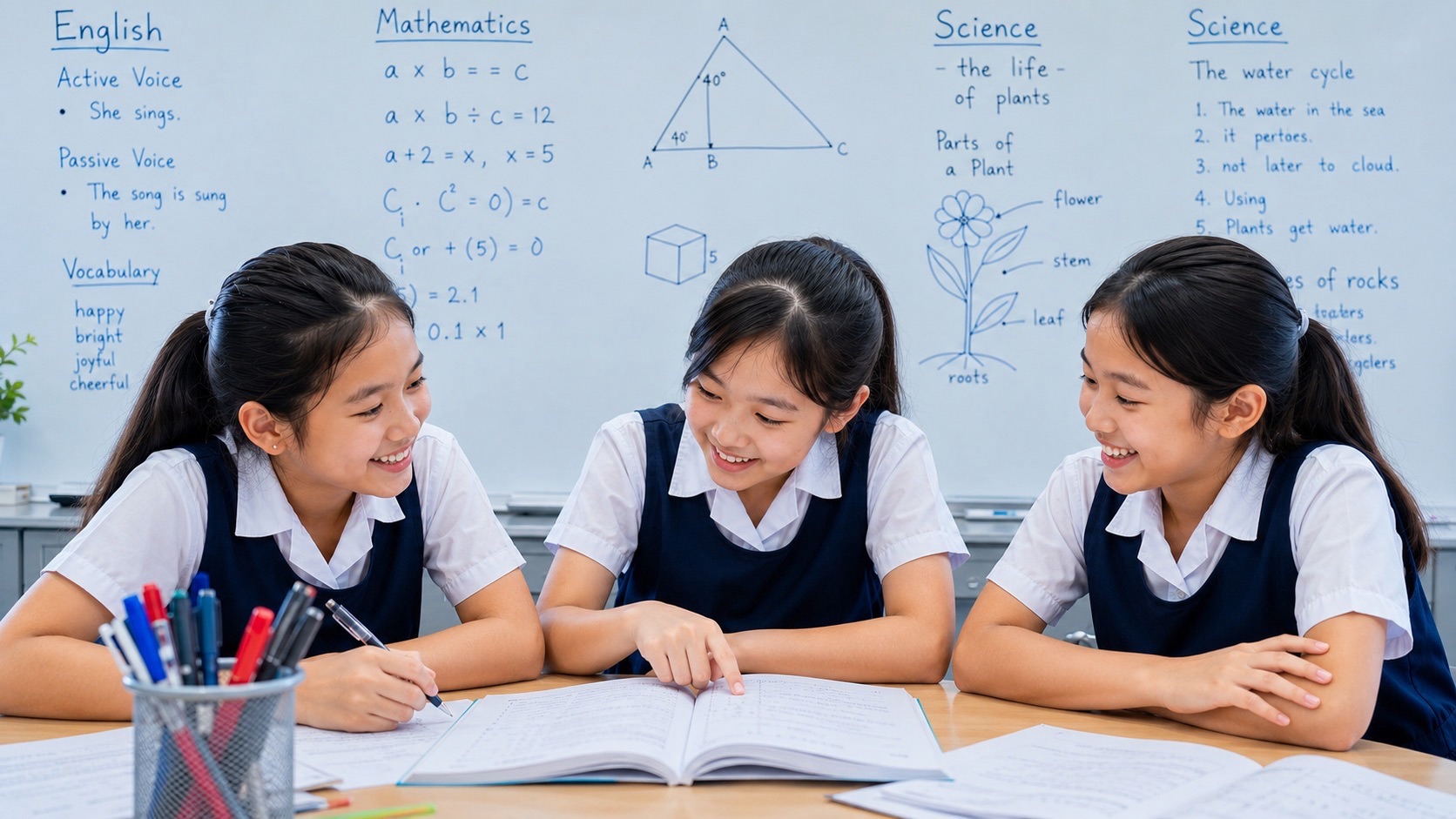
Primary 1 Mathematics Tuition | Compassvale for Compassvale families seeking premium 3-pax small-group Mathematics tuition at eduKateSG, 8 Fourth Avenue, Singapore 268674, near Sixth Avenue MRT.
Primary 1 Mathematics is where a child begins learning the grammar of numbers. The syllabus may appear simple because the quantities are small, yet this is the stage where number sense, place value, addition, subtraction, mathematical language, representation, checking and independent working habits are formed.
At eduKateSG, we do not treat Primary 1 as a race to finish worksheets. We teach the child to understand what a number represents, notice how quantities relate, choose a sensible operation, organise working and check whether an answer makes sense.
This page is written for families travelling from Compassvale to our Sixth Avenue centre. eduKateSG does not operate a Compassvale branch.
- build number sense before speed
- understand tens and ones clearly
- connect addition and subtraction as inverse relationships
- develop strong number bonds
- read simple word problems accurately
- use number lines, drawings and bar models appropriately
- reduce repeated error patterns
- become progressively more independent
Arrange a parent–student consultation with eduKate Singapore
Why Primary 1 Mathematics Needs More Than Repetition
A child can produce many correct answers on a familiar page and still have a fragile mathematical foundation. Repetition can create recognition. Mathematics requires transfer.
If the wording changes, the objects in the picture change or the same quantities are represented differently, the child must still recognise the relationship. This is why we pay attention to explanation, not only completion speed.
The goal is a child who can say why 8 + 5 can be decomposed into 8 + 2 + 3, why subtraction can undo addition, and why an answer should be checked against the size of the quantities in the problem.
What Primary 1 Mathematics Covers in Singapore
The current MOE Primary Mathematics syllabus develops Primary 1 students across number, measurement, geometry, data and mathematical processes. Schools may sequence topics differently, so tuition should coordinate with the student’s actual school programme.
Numbers and place value
Students learn to count, read, write, compare and order numbers and to understand tens and ones. In 42, the digit 4 represents four tens, not merely a symbol written before 2. This place-value structure later supports regrouping and larger-number reasoning.
Addition and subtraction
Students build operation meaning, number bonds, mental strategies and written calculation. We connect 7 + 5 = 12 with 12 − 5 = 7 so facts become relationships rather than isolated statements.
Early multiplication and division
Equal groups, repeated addition, sharing and grouping prepare the student for the formal operations that become more prominent in Primary 2.
Money, time, measurement, shapes and data
These topics connect symbols to the physical world and train careful observation, units, comparison and interpretation.
Number Sense: The Hidden Foundation
Number sense is the ability to see how numbers relate. A child with growing number sense recognises that 9 is one less than 10, that 14 contains one ten and four ones, and that 8 can be decomposed into several useful pairs.
Weak number sense often appears as constant counting from one, dependence on fingers for every simple fact, confusion with teen numbers, difficulty comparing quantities or uncertainty when a familiar question is reworded.
These behaviours are diagnostic information. We use concrete objects, drawings, number bonds, number lines and symbols to help the child move from physical quantity to abstraction.
Making ten
The structure of ten is especially powerful. A student solving 8 + 7 can split 7 into 2 and 5, make 10, then add the remaining 5. This trains decomposition and prepares the child for later regrouping.
Fact families
If 6 + 4 = 10, the child can connect 4 + 6 = 10, 10 − 6 = 4 and 10 − 4 = 6. One relationship then supports several facts.
Why Compassvale Families Choose 3-Pax Mathematics Tutorials
A class of three gives the tutor enough visibility to see how each child is thinking. One wrong answer may come from miscounting, another from a reading error, another from choosing the wrong operation. The final number alone cannot reveal the cause.
- Immediate correction while reasoning is fresh
- Frequent opportunities to explain answers
- Close observation of counting and calculation strategies
- Responsive lesson pacing
- Targeted questions for exact error patterns
- Gradual removal of prompts
- Calm peer learning
- Enough time to revisit prerequisites
The small-group advantage is precision. The tutor can see more, ask more and correct earlier.
Our First-Principles Teaching Method
Diagnose the first unstable dependency
If subtraction is weak, we check number bonds, counting backwards, teen numbers and operation meaning before deciding what to repair.
Repair before adding load
If current work rests on a weak earlier idea, we rebuild that bridge and reconnect it to the school topic.
Fence one difficulty at a time
New ideas begin with clear language, manageable numbers and a simple representation. Complexity is added only after the relationship becomes visible.
Connect representations
Objects, drawings, number lines, number bonds, tables and symbols are linked deliberately.
Retrieve after time has passed
Earlier learning returns after days and weeks so knowledge becomes available without the original example.
Transfer to unfamiliar questions
We vary wording, number size and visual presentation while preserving the underlying mathematical relationship.
Word Problems: Relationships Before Keywords
Keywords can provide clues, but they are not a complete problem-solving strategy. The student must identify what is known, what is unknown and how the quantities relate.
- Read the whole question
- Identify quantities and units
- State what must be found
- Describe the relationship
- Choose a representation if helpful
- Select the operation
- Calculate
- Check whether the answer fits the story
Bar models and drawings are used when they clarify the relationship rather than as compulsory decoration.
How We Reduce Repeated Careless Mistakes
- Reading errors
- Counting errors
- Number-bond recall errors
- Operation-choice errors
- Arithmetic errors
- Copying errors
- Notation errors
- Unit errors
- Checking errors
Different causes require different repairs. A specific correction routine is more useful than simply telling a child to be more careful.
What Happens During a 90-Minute Lesson
- Retrieval warm-up
- Short diagnostic questions
- Concept teaching or repair
- Guided practice
- Independent application
- Mixed problem solving
- Error review
- Focused continuation work
The lesson is not ninety minutes of uninterrupted worksheet completion. The balance changes according to the student’s needs.
Three Primary 1 Student Pathways
Repair
Rebuild counting, place value, number bonds or operation meaning.
Stabilise
Strengthen retrieval, organisation, checking and independent application.
Extend
Deepen reasoning with missing-number problems, alternative methods, patterns and unfamiliar applications without unnecessary acceleration.
What Progress Should Look Like
- Less prompting at the start of questions
- More efficient counting
- Faster number-bond retrieval
- Clearer explanation of operation choice
- Better written organisation
- More frequent checking
- Less anxiety when wording changes
- Greater independence
Marks matter, but progress often appears first in the way a child approaches work.
When Extra Support May Be Useful
- Counting remains slow or inaccurate
- Place value is frequently confused
- Simple number facts are not becoming retrievable
- Addition and subtraction feel unrelated
- Word problems trigger guessing
- Homework needs constant adult rescue
- Methods are forgotten quickly
- Mathematics confidence is falling
Early repair is often quieter and more efficient because fewer later topics have accumulated above the weak point.
Travelling from Compassvale to Sixth Avenue
eduKateSG is located at 8 Fourth Avenue, Singapore 268674, near Sixth Avenue MRT. Families from Compassvale can use Singapore’s rail, bus or road network towards Sixth Avenue. Check current LTA or MyTransport information before the first lesson.
This is a Compassvale-facing service page for classes conducted at Sixth Avenue; it does not represent an eduKateSG centre in Compassvale.
Class Details
Format: Premium 3-pax small-group tutorials
Level: Primary 1 Mathematics
Duration: 1.5 hours weekly
Location: 8 Fourth Avenue, Singapore 268674
Nearest MRT: Sixth Avenue MRT
Attendance: By appointment
Teaching approach: first-principles explanation, diagnostic repair, retrieval, guided and independent practice, word-problem reasoning, error analysis and carefully paced pre-teaching.
Frequently Asked Questions
Do you follow the school’s topic order?
We coordinate with school work while repairing prerequisites when needed.
Do you teach ahead?
Yes, when the foundation is ready. Pre-teaching should improve classroom understanding rather than simply create faster chapter completion.
Do you use bar models?
Yes, when they clarify the relationship. Students also learn to use other representations or direct calculation where appropriate.
My child uses fingers. Is that a problem?
Finger counting can be useful early on, but persistent dependence may show that number relationships are not yet retrievable. We build bridges from counting to mental strategies rather than simply banning fingers.
What if my child is already doing well?
Extension focuses on deeper reasoning and transfer rather than racing unnecessarily into later-year content.
Helpful Mathematics Reading
- Primary 1 Mathematics Tuition at eduKateSG
- Mathematics Learning Hub
- MOE Primary Mathematics Syllabus
Primary 1 Mathematics Tuition for Compassvale Families
Primary 1 is small-number Mathematics with large consequences. The child is learning the habits later Mathematics assumes.
For students who are behind, we repair. For students who are inconsistent, we stabilise. For students who are ready, we deepen.
The objective is a child who can carry understanding into an unfamiliar question rather than depend on today’s worksheet pattern.
Arrange a Parent–Student Consultation
Chat with eduKateSG on WhatsApp
eduKateSG
8 Fourth Avenue
Singapore 268674
Near Sixth Avenue MRT
Premium 3-pax small-group tuition
By appointment
Properly taught kids shine a bright light into the future.