
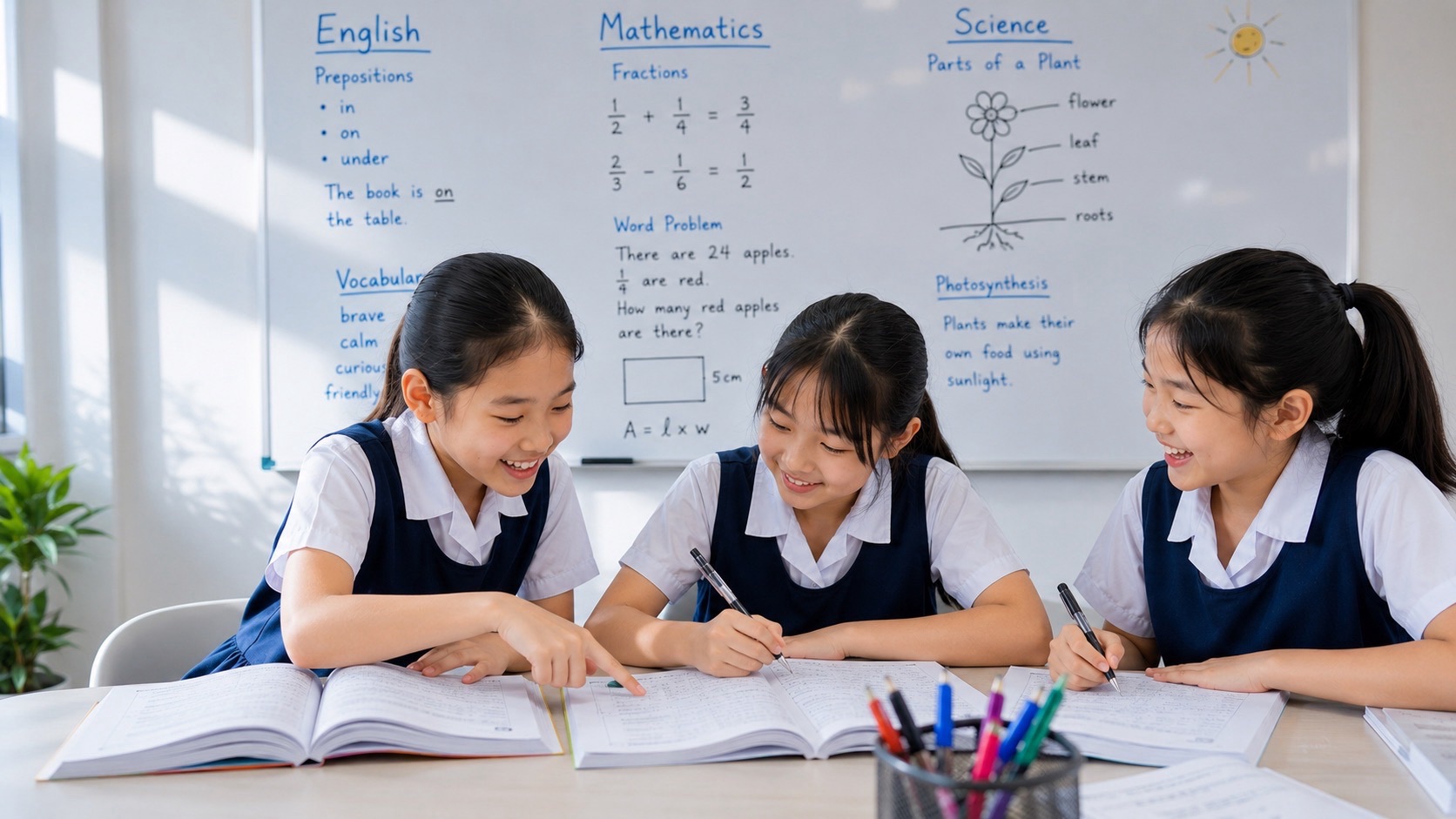
Primary 2 Mathematics Tuition | Amber Road for families seeking premium 3-pax small-group Mathematics tuition at eduKateSG, 8 Fourth Avenue, Singapore 268674, near Sixth Avenue MRT.
Primary 2 is the year when early number ideas must begin operating as a connected system. Students move beyond very small calculations into numbers up to 1000, three-digit addition and subtraction, multiplication tables, division, fractions and more demanding applications involving money, measurement, time, shapes and data.
The important change is not simply that the numbers are larger. Primary 2 asks the child to retain more facts, coordinate more steps and recognise which earlier idea should be used without being told. A weak Primary 1 foundation can therefore become visible very quickly.
At eduKateSG, we use a premium 3-pax class so the tutor can see how each student is thinking. The goal is to make the child’s methods reliable: understand, choose, execute, check and explain.
This Amber Road page is for families from the Amber Road and East Coast–Katong corridor considering tuition at our Sixth Avenue location. eduKateSG does not operate an Amber Road branch.
- strengthen place value to 1000
- repair regrouping in addition and subtraction
- build multiplication-table understanding and recall
- connect multiplication and division
- develop a secure early fraction model
- improve money and measurement calculations
- read word problems as relationships rather than keyword puzzles
- reduce repeated error patterns and dependence on adult prompting
Arrange a parent–student consultation with eduKate Singapore
Why Primary 2 Is a Consolidation Year With Hidden Complexity
Primary 2 can look like a gentle continuation of Primary 1. In reality, it is where several strands begin to converge. A child may need to read a question, hold three quantities in mind, decide whether the situation is additive or multiplicative, carry out a calculation correctly and then interpret the answer in dollars, centimetres or another unit.
Each individual step may be manageable. The difficulty comes from coordinating them.
This is why some students appear comfortable during topical practice but become uncertain in mixed work. A worksheet headed “Addition” tells the child what operation to use. A mixed paper removes that clue. The student must recognise the mathematical structure independently.
Primary 2 tuition should therefore do more than increase worksheet volume. It should improve the student’s ability to retrieve the right knowledge at the right moment.
What Primary 2 Mathematics Covers in Singapore
Under the current MOE Primary Mathematics syllabus, Primary 2 develops whole numbers to 1000, addition and subtraction, multiplication and division, fractions, money and other measurement, geometry and data ideas. Schools may arrange topics in different orders, so our lessons are coordinated with the student’s actual classroom programme.
Numbers up to 1000
Students work with hundreds, tens and ones, compare and order three-digit numbers, recognise patterns and distinguish odd and even numbers. We teach place value structurally. In 407, the zero is not an empty space to ignore; it preserves the tens place so four hundreds and seven ones remain correctly represented.
Three-digit addition and subtraction
Students use addition and subtraction algorithms with larger numbers and develop mental calculation involving hundreds, tens and ones. Regrouping is often where fragile place value is exposed. If a child performs “borrowing” as a memorised movement of digits, errors multiply when zeros or multiple regroupings appear.
Multiplication tables and division
Primary 2 includes the multiplication tables of 2, 3, 4, 5 and 10, the division symbol and the relationship between multiplication and division. We build equal groups, arrays, repeated addition, sharing and grouping before demanding fast recall. Meaning gives the table a structure; retrieval then makes it usable.
Fractions
Students learn fractions as parts of a whole, compare and order simple fractions and add or subtract like fractions within one whole. We make the denominator and numerator visible through diagrams before using symbolic procedures. A fraction is a number relationship, not merely “top number over bottom number”.
Money, measurement, time, geometry and data
Primary 2 extends practical Mathematics. Students work with dollars and cents, measurement, time, shapes and simple data. These topics create good opportunities to teach units, estimation and the habit of checking whether an answer is sensible in context.
Place Value Before Procedure
A large proportion of Primary 2 arithmetic depends on place value. Consider 342 + 186. A student who understands hundreds, tens and ones can explain why ten ones become one ten and why ten tens become one hundred. A student who has only memorised “carry the one” may reproduce the steps until a slightly different arrangement breaks the routine.
We use number discs, expanded notation, place-value charts and symbolic algorithms as connected representations. The purpose is not to keep using visual aids indefinitely. It is to ensure the written method grows out of an understood system.
Regrouping in addition
Students learn that 12 ones can be renamed as 1 ten and 2 ones. The algorithm is a compressed record of that exchange. When the child understands the exchange, the written notation becomes meaningful rather than mysterious.
Regrouping in subtraction
Subtraction is often more difficult because the child must rename a larger place value before removing a quantity. We slow down the language: one hundred can be renamed as ten tens; one ten can be renamed as ten ones. The student learns to track what changed and why.
Multiplication Tables: From Meaning to Automaticity
Multiplication facts become working-memory infrastructure. A child who must repeatedly calculate 4 × 6 from scratch uses mental capacity that could have been spent understanding the word problem around it. That does not mean tables should be memorised without meaning. We build meaning first, then retrieval.
For example, 4 × 6 can be represented as four groups of six, six groups of four, an array, repeated addition or a number-line pattern. These representations help the child see commutativity and related division facts.
Fact families
If 4 × 6 = 24, the student should eventually connect 6 × 4 = 24, 24 ÷ 6 = 4 and 24 ÷ 4 = 6. This reduces the number of isolated facts and strengthens the relationship between operations.
Retrieval practice
We use short, spaced retrieval rather than endless chanting. Facts return after time has passed and are mixed with other tables. The aim is rapid access that remains available when the child is solving a larger problem.
Fractions: The First Test of Part–Whole Reasoning
Fractions can be deceptively simple when every picture is already divided neatly. The student needs to understand that equal parts matter, that the denominator tells how many equal parts make a whole, and that the numerator tells how many of those parts are being considered.
Comparing one-half and one-third reveals an important idea: a larger denominator does not automatically mean a larger fraction. When the whole is fixed, dividing it into more equal parts makes each part smaller. We use diagrams, folding, fraction strips and number-line reasoning before compressing the idea into symbols.
This early fraction understanding becomes increasingly important in Primary 3, Primary 4 and later PSLE Mathematics. Repairing it early is easier than trying to memorise procedures over a weak model.
Why Amber Road Families Choose 3-Pax Mathematics Tutorials
In a class of three, the tutor can observe the small behaviours that reveal how Mathematics is being processed. Does the child line up place values? Does the student read the unit? Does multiplication table recall interrupt the flow? Does the child draw a model but fail to connect it to the operation? Does the student immediately ask for help rather than attempting a first step?
These details matter because two students with the same wrong answer may need different teaching.
- Immediate feedback during calculation
- Close inspection of written working
- Frequent oral explanation
- Targeted retrieval practice
- Responsive pacing for regrouping and fractions
- Mixed questions to test independent method selection
- Calm peer comparison without large-class anonymity
- Gradual removal of scaffolds as confidence increases
The small group is therefore not a marketing feature by itself. Its value comes from the tutor being able to see, diagnose and respond.
Our First-Principles Teaching Method
Diagnose the earliest unstable dependency
A child who struggles with three-digit subtraction may not need “more subtraction”. The real difficulty may be place value, number bonds, subtraction facts or a misunderstanding of regrouping. We identify the first weak dependency rather than treating the visible error as the whole problem.
Repair and reconnect
Once the prerequisite is repaired, it is immediately connected back to current school work. This keeps tuition relevant while preventing new procedures from resting on a fragile base.
Separate concept load from calculation load
When a student first learns a new idea, we keep the arithmetic manageable so the concept can be seen. Later, we increase number size and combine ideas. This helps us discover whether the child understands the relationship or merely fails under calculation pressure.
Use representations deliberately
Place-value charts, arrays, bar models, number lines, tables and diagrams are used when they reveal structure. Students also learn to move away from a representation once it is no longer necessary.
Retrieve and interleave
Earlier topics return regularly. Addition appears beside multiplication; fractions appear after money; word problems mix operations. Interleaving removes the worksheet heading as a clue and forces the child to identify the mathematics independently.
Transfer to unfamiliar surfaces
We vary wording, order, context and representation while keeping the underlying relationship. This is how a student learns that a method belongs to a structure, not to a familiar-looking page.
Word Problems: Stop Guessing the Operation
A Primary 2 child may know how to calculate but still fail to decide what calculation is required. This is a reading-and-structure problem rather than an arithmetic problem.
We teach a stable routine: identify the quantities, identify the unknown, describe the relationship, represent it if necessary, choose an operation, calculate and check the answer against the story.
Keywords are treated as clues rather than commands. “More” can appear in comparison, addition or missing-part situations. The relationship between quantities determines the method.
Bar models as compressed reasoning
A bar model is useful when it makes the known and unknown quantities visible. We teach students to label the bars and connect each part of the drawing to the question. A model that is copied without understanding does not solve the reading problem.
How We Reduce Repeated Careless Mistakes
“Careless” is a description of the outcome, not the cause. We classify errors so the repair can be specific.
- Place-value alignment errors
- Regrouping errors
- Multiplication-table recall errors
- Division interpretation errors
- Fraction representation errors
- Reading and keyword errors
- Unit errors
- Copying errors
- Incomplete working
- Failure to check reasonableness
A student who repeatedly misaligns digits may use grid paper or a place-value column routine. A student who loses facts under pressure needs retrieval. A student who chooses the wrong operation needs relationship analysis. Precision improves when the correction matches the cause.
What Happens During a 90-Minute Lesson
- Retrieval warm-up from previous topics
- Short diagnostic probe
- Current school topic or foundational repair
- Guided examples with questioning
- Independent practice
- Mixed word problems
- Error analysis and correction
- Focused home continuation
The proportions change from week to week. Near a school assessment, more time may be spent on mixed retrieval and test-style organisation. During a repair phase, more time may be spent on the prerequisite that is preventing current work from stabilising.
Three Primary 2 Student Pathways
Repair
Rebuild place value, number bonds, regrouping, operation meaning or early multiplication and division.
Stabilise
Make correct work more consistent through retrieval, checking, mixed practice and clearer written organisation.
Extend
Deepen reasoning through missing-number problems, multiple methods, richer fraction comparisons, multi-step applications and explanation tasks.
A student may occupy different pathways for different topics. The class plan should follow the actual learning profile rather than a single label.
A 12-Week Primary 2 Build-and-Repair Cycle
- Weeks 1–2: diagnostic sampling, place value to 1000 and fact retrieval
- Weeks 3–4: addition/subtraction algorithms and regrouping
- Weeks 5–6: multiplication tables, arrays, grouping and division
- Weeks 7–8: fractions and money relationships
- Weeks 9–10: measurement, time, geometry and data aligned with school
- Weeks 11–12: mixed word problems, retrieval and progress review
The cycle is adapted around the school sequence. Its purpose is to ensure current coverage does not erase foundational repair.
Home Practice: Short, Accurate and Repeated
Primary 2 benefits from regular short practice. Multiplication tables, place-value reading and mental arithmetic are best revisited frequently rather than crammed into one long session.
Parents can ask the child to explain one worked example rather than complete ten more identical questions. Explanation reveals whether the method is understood. A child who can only say “because teacher said so” may need the idea unpacked.
When the same error repeats, reduce volume and repair the pattern. Incorrect repetition can make the wrong method more automatic.
What Progress Should Look Like
- Three-digit numbers are read and written with greater control
- Regrouping becomes explainable rather than mechanical
- Multiplication facts are retrieved more quickly
- Division is connected to multiplication
- Simple fractions are compared through meaning
- Word problems begin with a relationship rather than a guess
- Units are written and checked
- The student can complete more work independently
- Mixed questions cause less hesitation
- Earlier learning remains accessible after time has passed
Progress should become visible in both performance and behaviour. A more stable student starts work more readily, asks more precise questions and is less dependent on immediate reassurance.
When Might a Primary 2 Student Need Extra Support?
- Place value beyond 100 remains confusing
- Regrouping is performed by rote and frequently breaks
- Multiplication tables are not becoming retrievable
- Division is treated as an unrelated new topic
- Fractions are understood only from one familiar picture
- Money or measurement questions produce unit confusion
- The child can do topical worksheets but freezes on mixed work
- Word problems are solved by keyword guessing
- Homework requires continuous adult direction
- Confidence is dropping despite significant practice
Support is often more efficient before the child reaches Primary 3, when multiplication, division and fractions become more demanding.
Travelling from Amber Road to Sixth Avenue
eduKateSG is at 8 Fourth Avenue, Singapore 268674, near Sixth Avenue MRT. Families from Amber Road can connect through Singapore’s public-transport or road network towards Sixth Avenue. Because routes and journey times can change, check current LTA or MyTransport information before travelling.
This page describes tuition for Amber Road families attending our Sixth Avenue centre; it does not represent an eduKateSG branch on Amber Road.
Class Details
Format: Premium 3-pax small-group tutorials
Level: Primary 2 Mathematics
Duration: 1.5 hours weekly
Location: 8 Fourth Avenue, Singapore 268674
Nearest MRT: Sixth Avenue MRT
Attendance: By appointment
Teaching approach: first-principles explanation, prerequisite repair, guided and independent practice, retrieval, interleaving, problem-solving, error analysis and carefully paced pre-teaching.
What Parents Can Bring to the Consultation
- Recent school worksheets and marked work
- Examples of regrouping or multiplication errors
- The school’s topic schedule
- Teacher comments
- Homework that took unusually long
- Questions the child can do with help but not alone
- A short description of current practice habits
We look for repeated patterns. A score alone cannot tell us whether the main issue is concept, retrieval, reading, accuracy, organisation or confidence.
Frequently Asked Questions
Do you follow the school’s topic order?
We coordinate with school work while repairing prerequisites when necessary. Current chapters cannot become stable if the earlier dependency is still weak.
Do you teach ahead?
Yes, when the student is ready. Pre-teaching is used to improve classroom readiness, not to rush through chapters for its own sake.
How do you teach multiplication tables?
We begin with equal groups, arrays and related facts so the tables have meaning. Then we use spaced retrieval to build speed and automaticity.
Should my child memorise before understanding?
No. Understanding and retrieval support each other. A fact that is understood but never retrieved may remain too slow; a fact that is memorised without meaning may be difficult to use flexibly.
Do you use bar models?
Yes, when the model helps expose the relationship. Students also learn when a table, number line, diagram or direct calculation is more appropriate.
What if my child is already strong?
Extension focuses on reasoning, transfer, alternative methods and unfamiliar applications rather than merely moving into later-year content as fast as possible.
How quickly should we expect results?
Some improvements in organisation and confidence can appear within several lesson cycles. Deeper gaps take longer. We look for stable change rather than one unusually good test.
Can students join mid-term?
Yes, subject to a suitable 3-pax placement and an initial review of the student’s current level.
Helpful Mathematics Reading
- Primary 2 Mathematics Tuition at eduKateSG
- Mathematics Learning Hub
- MOE Primary Mathematics Syllabus
Primary 2 Mathematics Tuition for Amber Road Families
Primary 2 is where small-number intuition begins growing into a durable mathematical system. Place value must support regrouping. Multiplication must connect to division. Fractions must represent genuine part–whole relationships. Word problems must be read structurally.
For students who are behind, we repair. For students who are inconsistent, we stabilise. For students who are ready, we deepen.
The objective is a student who enters Primary 3 with stronger retrieval, clearer reasoning and enough independence to handle the next increase in mathematical load.
Arrange a Parent–Student Consultation
Chat with eduKateSG on WhatsApp
eduKateSG
8 Fourth Avenue
Singapore 268674
Near Sixth Avenue MRT
Premium 3-pax small-group tuition
By appointment
Properly taught kids shine a bright light into the future.