
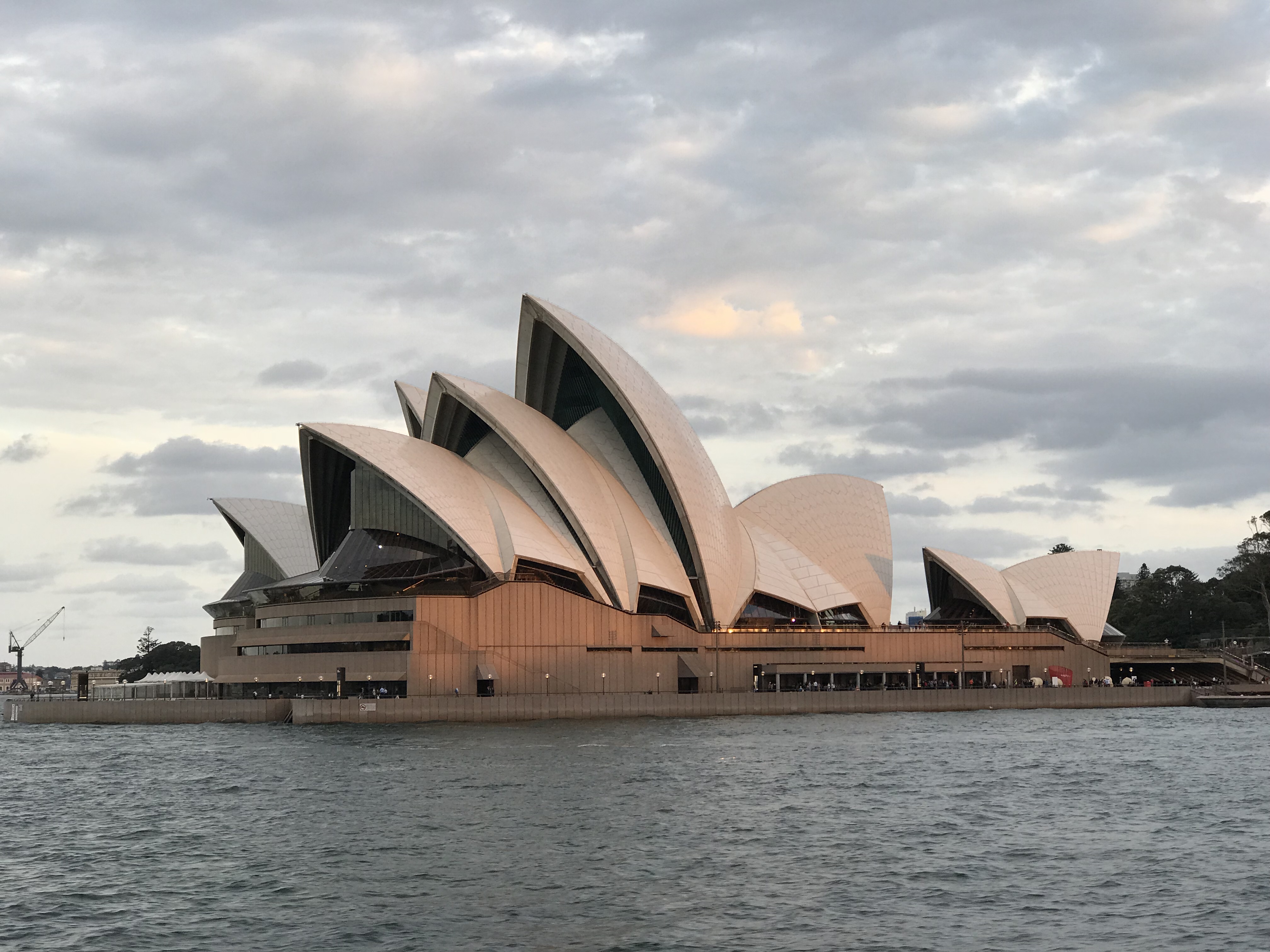
Sydney is a wonderful place to learn how a coast works. A sheltered harbour crossing feels different from an exposed clifftop walk, and the words you choose can make that difference beautifully clear. This Top 100 Vocabulary for Visiting and Touring Australia guide gives Sydney a fresh set of English words and expressions for water, sandstone, ferries, performance spaces and close observation.
Did you know that a rip current and a breaking wave describe different movements of water? Learning the distinction gives a beach scene more meaning. Start with a word you can point to, connect it to a real feature, and try one sentence that explains what it does.
This guide extends eduKate’s earlier Sydney vocabulary article. Its numbered entries introduce a different selection rather than repeat that older list. The focus is useful English for noticing and discussing a city; these are not all Sydney slang or single-word dictionary headwords.
This is a learning selection, not a ranking by search volume. Meanings describe the context used here. English is the working language of this list; Aboriginal place names included as proper names should be learned through their local cultural sources.
Continue your Australia learning: Australia Vocabulary Learning Hub · More New South Wales guides. To read a coastal scene, compare Central Coast (choose a town or headland before describing the region) with Esperance (read sand sources, beach change, granite, islands, saline lakes and coastal planning). Use the hub’s connected reading path to explain one similarity and one difference.
Choose your reading route
Explore the 100 entries · Understand the city scenes · Practise five questions · Build a travel paragraph · Check and remember
Your vocabulary map
Open the ten vocabulary groups
- 1–10: Harbour geography and moving water
- 11–20: Beach conditions and shoreline detail
- 21–30: Coastal walking and sandstone
- 31–40: Eastern beaches and harbour destinations
- 41–50: Understanding a ferry
- 51–60: Reading Sydney transport information
- 61–70: The language of a performance visit
- 71–80: Historic buildings and material evidence
- 81–90: Seafood and market observation
- 91–100: Describing light, texture and movement
1–10: Harbour geography and moving water
An inlet, a headland and a rock platform name different shapes. Sketch the outline first, then choose the noun that fits. Use the coastal vocabulary to make a map easier to read.
| No. | Word, expression or name | Meaning in this context |
|---|---|---|
| 1 | Harbour inlet | A narrow opening of sheltered sea water into the coast |
| 2 | Headland | Land projecting into the sea |
| 3 | Sandstone ledge | A projecting shelf of sandstone |
| 4 | Ocean pool | A swimming enclosure beside or within the ocean |
| 5 | Rock platform | A relatively flat exposed coastal rock surface |
| 6 | Tidal range | Difference between high and low water levels |
| 7 | Sea spray | Small drops thrown into the air by waves |
| 8 | Breakwater | A structure that reduces incoming wave force |
| 9 | Surf break | A place where waves regularly break |
| 10 | Rip current | A concentrated flow of water moving away from shore |
11–20: Beach conditions and shoreline detail
A swell describes travelling waves; backwash is water returning down a beach. These words help explain a photograph, but the swimming area must be identified from current flags and instructions.
| No. | Word, expression or name | Meaning in this context |
|---|---|---|
| 11 | Red-and-yellow flags | Markers indicating the supervised swimming area when displayed |
| 12 | Patrolled beach | A beach with lifeguards or lifesavers on duty at stated times |
| 13 | Shore break | Waves breaking close to the water’s edge |
| 14 | Swell | Waves travelling beyond the area where wind generated them |
| 15 | Spindrift | Spray blown from wave crests |
| 16 | Backwash | Water flowing back down the beach after a wave |
| 17 | Foam line | A visible band of bubbles on water |
| 18 | Beach berm | A raised shelf of sand formed by wave action |
| 19 | Dune vegetation | Plants growing on coastal sand dunes |
| 20 | Salt-tolerant shrub | A shrub able to grow in salty coastal conditions |
Contents · Previous group · Next group
21–30: Coastal walking and sandstone
A coastal route contains more than a beautiful view. Steps, exposed sections and diversions influence how a walk feels. Read route notices before describing a section as accessible or open.
| No. | Word, expression or name | Meaning in this context |
|---|---|---|
| 21 | Coastal stairway | Steps connecting different levels of a coastal route |
| 22 | Clifftop path | A walking route along the upper edge of cliffs |
| 23 | Wayfinding post | An upright marker showing route directions |
| 24 | Track diversion | An alternative route around a closed section |
| 25 | Lookout railing | A protective barrier around a viewing area |
| 26 | Exposed section | A part of a route with little shelter from weather |
| 27 | Uneven footing | Ground that makes steady walking more difficult |
| 28 | Coastal erosion | Loss of shoreline material through natural processes |
| 29 | Weathered sandstone | Sandstone changed by exposure to the environment |
| 30 | Wave-cut notch | An indentation eroded into rock by wave action |
Contents · Previous group · Next group
31–40: Eastern beaches and harbour destinations
Use a full place name when looking at a map. Coogee, Clovelly and Watsons Bay belong to different coastal settings. A harbour beach and an ocean beach can require different journeys.
| No. | Word, expression or name | Meaning in this context |
|---|---|---|
| 31 | Coogee | A Sydney coastal suburb south of Bondi |
| 32 | Tamarama | A coastal suburb between Bondi and Bronte |
| 33 | Clovelly | A Sydney suburb with a narrow coastal swimming inlet |
| 34 | Gordons Bay | A small bay between Clovelly and Coogee |
| 35 | Watsons Bay | A harbour-side suburb near South Head |
| 36 | South Head | The southern headland at the entrance to Sydney Harbour |
| 37 | North Head | The northern headland at the harbour entrance |
| 38 | Balmoral | A harbour beach area in Mosman |
| 39 | Shelly Beach | A sheltered beach near Manly |
| 40 | Nielsen Park | A harbour-side park in the Vaucluse area |
Contents · Previous group · Next group
41–50: Understanding a ferry
Face towards the bow to distinguish port from starboard. A boarding ramp and a passenger deck have different jobs. Observe vessel details from permitted passenger areas.
| No. | Word, expression or name | Meaning in this context |
|---|---|---|
| 41 | Ferry berth | The assigned place where a ferry stops alongside a wharf |
| 42 | Boarding ramp | A sloping access surface used to enter a vessel |
| 43 | Mooring bollard | A strong post around which a mooring line is secured |
| 44 | Bow | The forward end of a vessel |
| 45 | Stern | The rear end of a vessel |
| 46 | Port side | The left side of a vessel when facing forward |
| 47 | Starboard side | The right side of a vessel when facing forward |
| 48 | Wheelhouse | The enclosed area from which a vessel is steered |
| 49 | Passenger deck | A level of a vessel used by travellers |
| 50 | Navigation light | A light showing a vessel’s presence and orientation |
Contents · Previous group · Next group
51–60: Reading Sydney transport information
Read the destination and stopping pattern together. A vehicle’s type does not tell you whether it stops where you want to go. Opal is a ticketing name, not a synonym for every travel booking.
| No. | Word, expression or name | Meaning in this context |
|---|---|---|
| 51 | Opal | The ticketing system used on Sydney public transport |
| 52 | Contactless fare payment | Payment using a supported bank card or digital device |
| 53 | Wharf reader | A ticketing device positioned at a ferry access point |
| 54 | Tap-on confirmation | A signal that the start of a trip has been recorded |
| 55 | Service destination | The place a particular transport service is heading |
| 56 | Stopping pattern | The sequence of stops served by a vehicle |
| 57 | Replacement bus | A bus operating instead of a usual rail service |
| 58 | Light rail stop | A designated boarding point for light rail |
| 59 | Metro platform | The boarding area for a metro service |
| 60 | Trip-planner result | A proposed journey produced by a transport planning tool |
Contents · Previous group · Next group
61–70: The language of a performance visit
A matinee tells you when a performance happens; a foyer tells you where you wait. Separate a building visit, a guided tour and a performance booking when planning your day.
| No. | Word, expression or name | Meaning in this context |
|---|---|---|
| 61 | Performance foyer | The public entrance space outside an auditorium |
| 62 | Auditorium | The room where an audience watches a performance |
| 63 | Matinee | A performance held during the daytime |
| 64 | Interval | A planned break within a performance |
| 65 | Curtain call | The performers’ return to acknowledge applause |
| 66 | Acoustic panel | A surface designed to influence sound within a room |
| 67 | Stage lighting | Lighting arranged to illuminate a performance |
| 68 | Sightline | The line of view between a spectator and the stage |
| 69 | Seating tier | One level of seats above or below another |
| 70 | Ticketed tour | A guided visit requiring an admission ticket |
Contents · Previous group · Next group
71–80: Historic buildings and material evidence
An old-looking wall is a starting point for questions. Mortar joints are visible material details; provenance and dates come from records. Use an interpretation panel to connect the two.
| No. | Word, expression or name | Meaning in this context |
|---|---|---|
| 71 | Convict-era record | A document relating to the period of transported prisoners |
| 72 | Sandstone masonry | Building work made with sandstone blocks |
| 73 | Mortar joint | The material-filled space between masonry units |
| 74 | Terraced dwelling | A home joined to neighbouring homes in a row |
| 75 | Verandah ironwork | Decorative metal elements along a covered outdoor frontage |
| 76 | Archaeological layer | A level of material containing evidence of earlier activity |
| 77 | Excavation trench | A carefully dug channel used to investigate buried remains |
| 78 | Site interpretation | An explanation helping visitors understand a historic place |
| 79 | Conservation work | Work intended to protect significant material |
| 80 | Documented provenance | Recorded evidence of an object’s origin and ownership |
Contents · Previous group · Next group
81–90: Seafood and market observation
Describe the cut and preparation before making claims about a dish. A fillet identifies a portion; battered and grilled identify methods. Ask the seller about the actual serving.
| No. | Word, expression or name | Meaning in this context |
|---|---|---|
| 81 | Fish fillet | A portion of fish flesh removed from the bones |
| 82 | Oyster shell | The hard covering of an oyster |
| 83 | Shucked oyster | An oyster whose shell has been opened for serving |
| 84 | Battered fish | Fish coated in batter before cooking |
| 85 | Grilled catch | Fish cooked over or under direct heat |
| 86 | Seasonal catch | Seafood available during a particular fishing period |
| 87 | Market auction | A sale in which buyers make competing bids |
| 88 | Cold display | A chilled area used to present food |
| 89 | Species identification | Determining which kind of organism is being described |
| 90 | Menu description | Wording explaining a dish on a menu |
Contents · Previous group · Next group
91–100: Describing light, texture and movement
Choose one movement and one lighting detail. A cresting wave, a glint and a salt-streaked surface can make an account precise without filling it with extra adjectives.
| No. | Word, expression or name | Meaning in this context |
|---|---|---|
| 91 | Backlit sail | A sail seen with light coming from behind it |
| 92 | Dappled shade | Shade interrupted by small patches of sunlight |
| 93 | Glint | A brief bright reflection |
| 94 | Cresting wave | A wave reaching its highest curved form before breaking |
| 95 | Wind-ruffled water | Water whose surface has small wind-made disturbances |
| 96 | Sheltered cove | A small coastal inlet protected from some wind or waves |
| 97 | Distant horizon | The far line where sea and sky appear to meet |
| 98 | Salt-streaked surface | A surface marked by dried salty water |
| 99 | Layered cliff face | An exposed cliff showing distinct bands of material |
| 100 | Harbour crossing | A journey from one side of the harbour to another |
Contents · Previous group · Continue into the city scenes
Begin with the harbour, then widen the view
Tourism Australia’s Sydney guide connects ferry journeys, coastal places and First Nations experiences. That gives you several ways into the city. Choose one scene rather than trying to turn a single day into a complete survey of Sydney.
Try a simple observation exercise beside the water. Identify the nearest landform, the direction a vessel moves and one change in the surface. A harbour inlet tells you about shape. A navigation light tells you about the vessel. A distant horizon belongs to the view. Each noun does a different piece of work.
Tourism Australia: Sydney guide
Give a coastal walk its own vocabulary
Sydney’s official tourism guide describes the Bondi to Coogee Coastal Walk as a route linking coastal places including Tamarama and Coogee. The vocabulary here expands the scene beyond the destination names already taught in the earlier Sydney list.
Look for a change in surface, a stairway and a point where shelter disappears. Record only what you actually encounter. You might write: ‘The coastal stairway brought us above the sheltered cove.’ If the route is diverted, describe the diversion rather than relying on an old photograph.
At a swimming beach, use the current patrol information and instructions. Red-and-yellow flags mark a supervised swimming area when they are displayed. A pretty bay is not evidence that the water is suitable for swimming on that day.
Sydney tourism: coastal and city walks
Read a ferry journey as a sequence
A ferry visit makes transport language wonderfully concrete. First identify the service destination. Next find the correct berth. Then follow the boarding instruction. Finally check where you will leave the vessel. The sequence links the word to a decision.
Transport for NSW explains where ticket readers are located and how ferry payments work. Check the instructions for your exact service: its tapping guidance includes an exception for the F1 Manly Ferry. Use the same supported card or device as required, and let the operator’s current instructions settle the details.
For an imagined journal, write: ‘From the passenger deck, I watched the headland move slowly across our view.’ The headland did not move geographically; the changing viewpoint created the apparent movement. Explaining that is excellent English practice.
Transport for NSW: tapping instructions
Enjoy the performance before describing the building
A famous venue may contain several spaces and offer several experiences. Auditorium, seating tier, foyer and stage lighting help you describe the performance environment. They do not tell you which admission your booking covers.
Before a visit, ask which entrance and which room you need. Afterwards, separate your response to the performance from the architecture. ‘The acoustic panel stood above the stage’ is an observation. ‘The room was designed to improve speech clarity’ needs a reliable account of the design.
Make history visible without guessing
Sandstone masonry can open a conversation about materials, labour and preservation. Start with a visible block, a joint or a repaired section. Then ask which source explains its age and earlier use. A conservation intervention may be recent even when the surrounding building is old.
Use the same method when comparing a Sydney wall with a Singapore heritage building. Compare materials you can identify, not entire histories you have not investigated. One carefully sourced similarity is more useful than an unsupported claim that two cities are alike.
Let the market teach a precise question
A seafood display provides colour, texture and preparation vocabulary. A fish fillet is a cut. A seasonal catch refers to availability. An oyster shell belongs to an animal. Learning these boundaries stops a menu description from becoming a muddle.
Ask what the dish contains and how it is prepared. Then write about what was actually served: the coating, the cooking method or the arrangement on the plate. Your question supplies information; your observation supplies the scene.
Five friendly questions to try
Say the whole question at a comfortable pace. Listen to the answer before deciding what to do next. If a name is unfamiliar, show the complete written destination and ask the speaker to point to it on your map.
- Does this service stop at the wharf shown on my map?
- Where is the current coastal-walk diversion?
- Which entrance should we use for this auditorium?
- Is this fish grilled or cooked in batter?
- Which source explains this sandstone building’s history?
A short follow-up often helps: ‘Could you show me which one you mean?’ That question checks the reference rather than merely asking the person to repeat the same words. Afterwards, explain the answer in your own English. The explanation shows whether the new term has become useful.
Turn a small moment into a clear travel paragraph
A good travel paragraph gives the reader a scene, an action and a reason to keep reading. Start with something you can picture. Add the location or cause that makes the sentence clearer. Leave out information you cannot support.
Step 1: The light changed.
Step 2: A glint appeared on the water.
Step 3: A glint appeared on the wind-ruffled water as the vessel crossed the harbour.
These sentences are invented writing examples. For a real journal, use your own observations. For an imagined composition, make the imagined setting clear. Then add one response: what surprised you, what question you asked or what you understood afterwards.
Use the eduKate Fencing Method to examine each addition. Does the word identify a more precise object? Does the phrase clarify an action? Does the new detail belong to the scene? An extra adjective earns its place when it helps the reader understand.
For a Singapore comparison, choose one equivalent task: reading a transport map, observing a waterfront, describing a plant or interpreting a museum label. Compare that task with your Australian scene. Keep the comparison at the scale your evidence supports.
Before, during and after your visit
Before: choose ten useful entries
Select five from one vocabulary group and five from another. Cover the meanings and explain each entry aloud. Find one proper name on a map. Make a question using one of the terms. If you can only repeat the definition, look for a photograph or situation that makes the meaning concrete.
During: collect a small piece of evidence
Write one observed detail, one answer someone gave you and one question still open. Keep source information beside historical notes. A museum label, an official map and a personal observation support different kinds of claims. You can take useful notes without trying to record every moment.
After: retrieve, compare and write
Close the list and recall five entries. Put two related terms into a sentence that explains their difference. Return to the list to repair an uncertain meaning. Later, use the same terms in a new situation or compare them with a local Singapore example. That second use gives the vocabulary a new job.
A short meaning check
Choose harbour inlet, headland, ocean pool, rip current and boarding ramp. Sort them into landform, swimming place, water movement and vessel access. Then explain why an ocean pool and an inlet are not interchangeable.
Check your reasoning
Harbour inlet and headland describe coastal geography; ocean pool names a swimming enclosure; rip current describes water movement; boarding ramp describes access. An inlet is a coastal opening, while an ocean pool is an enclosure.
For parents and teachers
Ask what the learner noticed before offering a word. Give the new term only when it helps explain that observation. A younger child can identify and label; an older learner can explain a process, contrast meanings and support a historical statement. Use an adult-selected image and an official source when working from home. The learning does not depend on an overseas holiday.
Frequently asked questions
Are these all Australian slang?
No. The list combines ordinary English terms, specialist vocabulary, descriptive expressions and proper names. Their usefulness comes from the city scenes in which you apply them. A word can be useful in Australia without being unique to Australia.
Should I memorise all 100 entries?
Begin with ten that fit your interests. Use a few accurately in questions and sentences, then add another group. A usable distinction is more valuable than a long list you can only recite.
Can I use this for a school composition?
Yes. Choose a small incident and build a connected account. Use precise nouns and verbs, distinguish observed details from researched facts, and label an imagined journey when that is what you are writing.
Does the list replace current visitor information?
Use the operator or venue for the visit date, entry arrangements, transport payment instructions and access conditions. The vocabulary helps you read and ask about that information.
How do I make the words stay useful?
Recall them without looking, correct uncertain meanings and reuse them in a different setting. Explain a difference between two related terms. That makes recall part of understanding rather than an isolated memory exercise.
Continue your Australia vocabulary journey
Choose another city for a different set of scenes. Return to the learning hub when you want to strengthen word meaning, recall or writing.
- Australia travel vocabulary: Melbourne
- Australia travel vocabulary: Brisbane
- Australia travel vocabulary: Perth
- Australia travel vocabulary: Parramatta
- Australia travel vocabulary: Central Coast
Continue through the eduKate learning ecosystem
Vocabulary Learning Hub: organise learning by stage and skill. Vocabulary Articles & Knowledge Hub: explore meaning, language and vocabulary learning. Fencing Method: turn a useful word into a clearer sentence.
Start with one scene that makes you curious. Find the words that explain it, ask a friendly question and give the next sentence something real to say.
Where shall we explore next? Visit the World City Vocabulary Directory to choose another country or city. Keep a few favourite words from Sydney and try them in a new sentence as you go.