
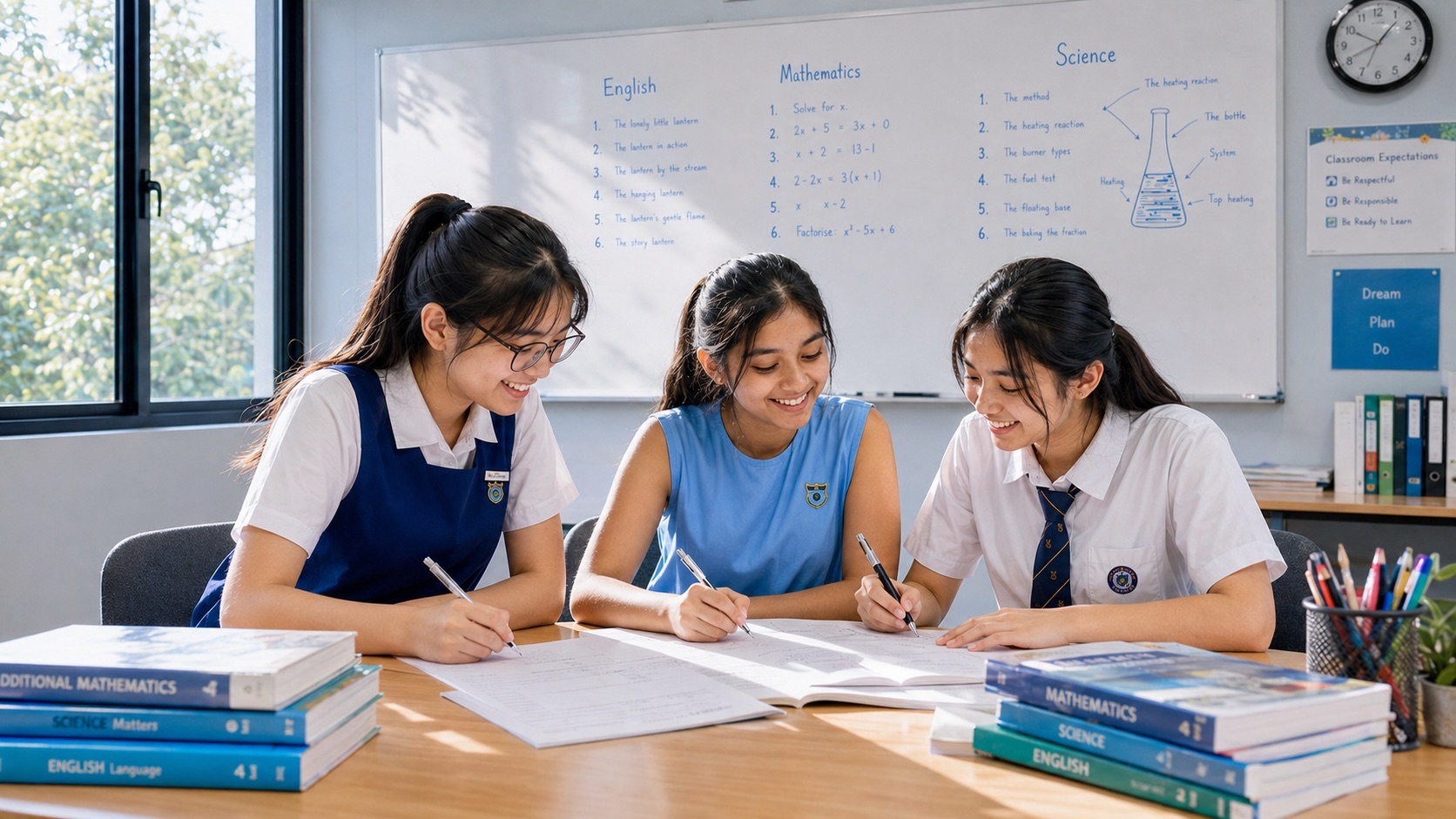
Your child leaves a Mathematics lesson saying everything made sense, then freezes when the same type of question appears a few days later. If you are considering Secondary 4 Mathematics tuition, the immediate concern is whether your child can retrieve and choose a method independently when the worked example has disappeared.
A Secondary 4 Mathematics tutor can investigate the gap between following a solution and producing one. Useful Mathematics tutorials include a fresh attempt during the lesson, a short delayed check, and specific feedback about the first step the student could not recover. Repeated explanations alone may leave that gap hidden.
Start with one recent question and ask your child to work without the completed solution beside them. Notice whether they recognise the topic, choose a sensible first move, carry out the procedure, and check the answer. Then plan practice around the point that fails. A student who forgets a formula needs different help from one who remembers several methods but cannot decide which applies.
EDUKATE SINGAPORE · SECONDARY 4 MATHEMATICS
Find your next learning step
Choose the question closest to your child’s current working, or read the chapters in order.
Find the difficulty
Identify the earliest decision that needs teaching. ROUTE 2 · CHAPTERS 4–7
See the method
Follow the relationships in worked examples. ROUTE 3 · CHAPTERS 8–10
Apply and compare
Compare approaches and make the decision visible. ROUTE 4 · CHAPTERS 11–14
Practise and review
Attempt first, review and plan a fresh check. ROUTE 5 · CHAPTERS 15–16
Check course and FAQs
Match support to the student’s course and questions.
Full chapter index · Short practice check and answers · Secondary 4 Mathematics tuition guide
Full chapter index
Open a reading route to choose a chapter. All teaching chapters remain visible below.
Find the difficulty · Chapters 1–3
See the method · Chapters 4–7
Apply and compare · Chapters 8–10
Practise and review · Chapters 11–14
Check course and FAQs · Chapters 15–16
CHAPTER 1 OF 16 · FIND THE DIFFICULTY
1. Work out what your child means by forgetting
Back to contents“I forgot everything” can describe several very different experiences. A student might forget a formula. They might remember a formula but not the conditions under which it applies. They might know the method and lose a sign halfway through the procedure. They might simply hesitate because the new question looks different from the example they copied.
Ask your child to explain what they recognise before giving a hint. If they identify a quadratic equation but do not know how to begin, inspect method selection. If they say “factorise” and then cannot find the factors, inspect the procedure. If they solve it correctly but ignore an impossible contextual answer, inspect interpretation.
Recognition is easier than retrieval. When the student reads a completed solution, each next line supplies a clue. They can feel that they understand because the reasoning is plausible. With a blank page, they must generate the clue themselves. A lesson needs to test that generation before assuming the method is secure.
Record the earliest point where help becomes necessary. It could be the topic, the formula, the first transformation, a later operation or the final check. A simple note such as “recognised simultaneous equations; needed a prompt to eliminate y” describes a much more teachable problem than “poor memory.”
Avoid using this observation as a character judgement. The question is what the learning process needs next. If the student repeatedly copies fluent solutions but rarely attempts an unprompted question, the practice may have provided insufficient retrieval. If they cannot explain the concept even immediately after teaching, more delay alone will not repair the gap.
For a parent, the useful first action is to preserve an independent attempt and a brief record of the help given. The tutor can then teach the missing decision and check whether the child can recover it later.
The goal is a method the student can access and use at an appropriate time. It is possible to make that goal concrete without asking the child to prove they remember an entire chapter at once. Begin with one relationship, one first step and one fresh question.
| What survives the gap | Next teaching target | Useful check |
|---|---|---|
| Recognises topic but needs method named | Independent selection | Mix a few already taught question types |
| Recalls formula but misidentifies quantities | Meaning and conditions | Use a differently oriented labelled diagram |
| Completes with prompts but stalls later | Retrieval and feedback | Fresh attempt after a manageable gap |
| Method available but execution unreliable | Specific procedural repair | Check the first incorrect line and try again |
CHAPTER 2 OF 16 · FIND THE DIFFICULTY
2. Separate understanding a solution from generating the first line
Back to contentsA student can agree with every line in a worked example while being unable to start a similar question independently. The lesson should include a deliberate transition from explanation to production. After discussing the example, cover it and ask for the first step on a fresh task.
Consider 3(x−2)=15. The student might divide both sides by three first, giving x−2=5, then add two to obtain x=7. Alternatively, they might expand to 3x−6=15 and continue. Both are valid. The tutor should ask the student to justify the first move rather than demand a memorised line.
Now compare 3x−2=15. Dividing by three before accounting for the subtraction is possible only if the whole equation is handled correctly; many students mistakenly write x−2=5. The visible similarity can trigger an inappropriate remembered pattern. The student needs to inspect the structure rather than retrieve a superficial sequence.
A first-line check can be very short. Present three questions and ask only for the next mathematically valid step. This reveals whether the child can distinguish brackets, factors, denominators and terms. Follow one of the questions through to the answer so that the first move remains connected to a complete solution.
When help is needed, use the smallest useful prompt. “Which operation is applied to the whole bracket?” leaves more thinking to the student than “Divide both sides by three.” If a specific instruction is required, record it. That question has become guided practice, and a later independent check is still needed.
Do not insist that the child struggle indefinitely with no support. An unproductive blank page gives limited information after the obstruction is clear. Teach the missing decision, let the student practise it, and then remove the scaffold on a fresh example.
A good result is not merely that the child completed the question after explanation. It is that they can start another suitable question without being told which operation to choose. That is the point at which “it made sense in class” begins to turn into usable learning.
CHAPTER 3 OF 16 · FIND THE DIFFICULTY
3. A lesson should end with a decision the student can use
Back to contentsBefore the lesson ends, ask the student to describe the one decision they are taking away. It might be choosing the reference quantity in a percentage question, identifying the scope of a minus sign or deciding which conditions produce an equation. This is more usable than a broad statement that a chapter has been covered.
The tutor can show a final question that requires that decision without repeating the whole demonstration. Let the student attempt it before discussing the answer. The result reveals what has become available and what still depends on a prompt.
A useful continuation task contains a clear target and a manageable amount of work. Tell the student what to notice and what evidence to bring back. A corrected attempt, a short explanation and one remaining question can make the next lesson more responsive.
The student also needs to know what to do if the task stalls. They can identify the last justified line, write what the unknown represents and mark the condition they cannot connect. Bringing that attempt back is worthwhile learning evidence, even when the answer is unfinished.
Avoid treating guided completion as the only success. A student may leave a lesson with fewer completed questions but a much clearer understanding of why a method applies. The later independent attempt will help establish whether that understanding is usable.
Parents can ask for the target in ordinary language. “I will check whether the negative sign belongs to the number or to the subtraction” is clear enough to guide practice. If the explanation is vague, ask the tutor to help the student make it more specific.
At the next lesson, return to the target before reopening the previous solution. A fresh attempt makes recall and method choice visible. If it remains uncertain, change the support rather than simply marking the same correction again.
This approach gives the lesson a practical endpoint. The student leaves knowing which decision to practise, how to ask for help and how the next attempt will be reviewed. It turns time spent in tuition into a learning action that can continue beyond the classroom.
CHAPTER 4 OF 16 · SEE THE METHOD
4. Retrieve a formula with its meaning and conditions
Back to contentsFormula recall is useful when the student knows what the symbols represent and when the relationship applies. A formula remembered as an isolated string can still be used in the wrong setting. Pair retrieval with a small application and a check of meaning.
For a triangle, area is one-half multiplied by a base and the perpendicular height. If the base is eight centimetres and the perpendicular height is five centimetres, the area is twenty square centimetres. A sloping side of five centimetres is not automatically the height. The student should be able to identify which segment the formula needs.
For a right-angled triangle, the Pythagorean relationship connects the squares of the two shorter sides with the square of the hypotenuse. If the shorter sides are six and eight centimetres, the hypotenuse is ten centimetres because 6²+8²=100. If the hypotenuse is ten and one shorter side is six, the other side comes from 10²−6², not from adding those squares.
These two tasks test more than recall. They ask whether the student identifies the role of the unknown. A formula card should therefore include a small labelled diagram or a brief condition, together with an example of a common misapplication.
Trigonometric relationships also need side identification relative to the chosen angle. Changing the reference angle can change which side is opposite and which is adjacent. A student who remembers a mnemonic but labels the sides incorrectly needs practice reading the triangle, not simply more repetitions of the mnemonic.
Keep retrieval tasks aligned with the student’s actual course and assessment guidance. Some examinations provide particular formula information; others expect specific knowledge. The available reference material does not remove the need to understand which relationship belongs to a question.
At home, ask the child to state the relationship, identify the quantities in a simple example, and explain one condition. Then let them solve. That sequence is brief and reveals more than asking them to chant a formula.
If the child cannot retrieve the relationship, teach it again with a concrete example. If they retrieve it but misuse it, contrast an applicable case with an inapplicable one. The error tells you which kind of support will be useful.
CHAPTER 5 OF 16 · SEE THE METHOD
5. Make spaced practice manageable within a busy week
Back to contentsSpaced practice means returning to a skill after some time has passed, so that the student must recover it again. It does not require a complicated calendar or a large daily workload. Begin with a small number of questions that fit around school, homework and rest.
For one newly taught method, an example plan might include an independent question near the end of the lesson, a fresh question the next day or at the next practical opportunity, and another later in the week. The exact gaps can change with the student’s schedule and the difficulty of the material. The purpose is to avoid treating immediate success as permanent learning.
Use genuinely fresh questions. Repeating a page whose answers the student remembers may measure familiarity with that page. Change numbers and presentation while preserving the intended decision. Later, use a slightly different context to see whether the student recognises the same relationship.
Keep the first delayed session short. One equation, one explanation of the first move and one substitution check may be enough for a narrow target. If the child struggles, that is information for feedback. It should not automatically turn a ten-minute review into an exhausting hour.
Build the schedule around a small set of priorities. A student cannot meaningfully retrieve every topic every evening. Choose methods that are important in the current school scope and have shown a specific weakness. Rotate other previously taught material into later sessions.
After a successful delayed check, extend the gap or increase the variation modestly. After an unsuccessful check, identify what failed, teach it, and use an easier fresh task before trying again later. Do not respond by repeating the same unsuccessful demand without changing the support.
Parents can help by making the next check easy to locate. A labelled question slip or a short list in the workbook is usually enough. The student should know what to do without waiting for the parent to reconstruct the plan.
Progress is visible when the child recovers the method after a gap with less prompting. That is a more useful outcome than completing a large stack immediately after the tutor demonstrates the same procedure.
A worksheet with a topic heading often supplies the method before the student reads the question. A page titled “factorisation” invites factorisation. A mixed review removes some of that support, so the student must decide which relationship or transformation fits.
Start mixing only after the individual methods have been taught and are reasonably manageable. A student who cannot execute either method needs instruction, not a larger collection of confusing questions. Once the procedures are accessible, a small mixed set can expose method selection.
Compare 3x+2=14 with x²+5x+6=0. The first can be solved through inverse operations, giving x=4. The second can be factorised as (x+2)(x+3)=0, giving x=−2 or x=−3. Ask what feature of each question guides the first move.
Now compare x²+5x+6=0 with x²+5x=6. The second needs rearrangement to x²+5x−6=0 before factorising as (x+6)(x−1)=0. Copying the factors from the first question produces an incorrect result. This contrast checks whether the child is reading the equation’s structure.
For geometry, mix a triangle-area question with a right-triangle side question. Ask whether the unknown is an area or a length, what information is available, and which relationship connects it. Those observations guide the method before calculation begins.
Do not make every mixed question a surprise with several new demands. Early mixed practice can use familiar forms with the topic labels removed. Later tasks can vary wording and diagram orientation. Increase the difficulty of choosing without simultaneously overwhelming the arithmetic.
Ask for a short reason before the calculation: “I will factorise because the quadratic is equal to zero and has suitable integer factors,” or “I need the perpendicular height for area.” The reason need not be a long written explanation.
A successful mixed set shows that the child can select as well as execute. If the student performs well on a named worksheet but poorly when methods are mixed, the next lesson should explicitly compare the cues that distinguish the question types.
CHAPTER 7 OF 16 · SEE THE METHOD
7. Give feedback that leaves a decision for the student
Back to contentsFeedback is most useful when it tells the student what to inspect and then gives them an opportunity to act. A fully rewritten solution can make the workbook look complete while leaving the original decision untouched. Preserve the attempt long enough to identify the first incorrect line.
Suppose a student solves 2x+3=11 by writing 2x=14. Instead of supplying x=4 immediately, ask which operation would undo the added three. Let the student repair the line and then check the answer in the original equation. The correction should involve the inverse-operation decision.
For a quadratic, a student may factorise x²+5x+6 correctly but set each factor equal to six because they have not understood the zero-product step. The feedback should point to the equation’s right-hand side and ask under what condition a product must have a zero factor. Merely correcting the roots leaves that condition unexamined.
Use a prompt ladder if needed. Begin by asking the student to check the relevant feature. If that fails, name the feature more precisely. Then demonstrate the missing reasoning. Once a demonstration is necessary, give a fresh question to find out whether the student can use it.
Avoid pretending that all prompted success is independent success. Prompting is a legitimate teaching tool. The important distinction is whether the child can later act without the prompt. A tutor can record “needed a structure cue” and plan another check rather than describe the method as fully secure.
Ask the student to explain the correction in one sentence. “I subtracted three from both sides because three had been added to 2x” is enough. The explanation links the repaired line to a reason that can be retrieved later.
Do not require a long error log for every minor slip. Select recurring or consequential errors that deserve a teaching response. Too much recording can displace the practice that the student needs.
The parent can support this process by asking what the child will look for next time. A useful answer names a feature of the problem, such as the sign outside a bracket or the unit of a time, rather than promising vaguely to be more careful.
CHAPTER 8 OF 16 · APPLY AND COMPARE
8. Use checking to strengthen the method instead of adding a ritual
Back to contentsChecking should test something meaningful about the answer. A student who simply rereads the same algebra may reproduce the same assumption. Teach checks that connect the result to the original question, an independent relationship or a sensible bound.
For an equation, substitute the proposed solution into the original statement. If x=4 is proposed for 2x+3=11, the left side becomes 2×4+3=11. This confirms that the value satisfies the equation. Substituting only into a later line may fail to expose an earlier transformation error.
For simultaneous equations, test both original equations. A pair that satisfies one relationship but not the other is not a solution to the system. This matters in word problems where one equation represents a count and the other a cost.
For a length, check positivity and the relevant geometry. For a right-triangle hypotenuse, the answer should exceed either shorter side. If a student obtains a hypotenuse of four centimetres from shorter sides of six and eight, the magnitude itself signals a problem before detailed recalculation.
For an average, connect the answer to the data. A mean of numbers between two and twelve should not be fifteen. A sensible bound does not prove an answer is correct, but it can quickly reveal an impossible result. Exact calculation or another appropriate check is still needed.
For units, ask whether the final quantity is an area, length, time or rate. A correct number with the wrong unit may show that the student has lost the meaning of the calculation. In a conversion, a rough estimate can help detect a factor-of-ten error.
Keep the check proportionate. A short substitution or a labelled unit may be enough for a simple question. A multi-stage problem may require several checks, especially when the final value depends on an earlier result.
Checking also creates another retrieval opportunity. The student must recall what the equation or relationship originally meant. Ask them to choose the check and explain why it fits. That turns checking into part of mathematical reasoning instead of an instruction to add a tick after every answer.
CHAPTER 9 OF 16 · APPLY AND COMPARE
9. Use timed practice after the method can be retrieved
Back to contentsTiming can reveal whether a method is accessible under assessment conditions, but it should not replace teaching. If the child cannot begin a question without help in an untimed setting, repeatedly shortening the time limit is unlikely to repair the missing first step.
Begin by confirming that the student can solve a fresh question independently. Then introduce a small, realistic timed segment containing methods already taught. Observe how time changes the decisions. Does the student read less carefully, skip a diagram label, choose a familiar method too quickly, or become stuck on a later calculation?
Keep the outcome specific. “Lost time deciding between area and perimeter” suggests a comparison lesson. “Knew the method but spent several minutes expanding incorrectly” suggests a procedural repair. “Left a familiar question blank after an earlier difficult item” suggests practising navigation through a small mixed set.
Avoid treating every pause as failure. Reading a question, forming a model and checking a sign can be productive uses of time. The aim is dependable decision-making at a workable pace. Speed should follow a method that the student can recover correctly.
A short timed set can include an instruction to move on after a reasonable attempt and return later. The exact approach should fit the assessment format and the school’s guidance. Practise it with a few questions before expecting the student to manage it across a whole paper.
After timing, review one or two consequential decisions. Do not turn the entire session into a line-by-line correction marathon. Select what would make the biggest difference in the next comparable task, then schedule a fresh check.
Parents can record whether the method remained available, not just the elapsed minutes. A faster incorrect attempt does not show secure learning. A correct attempt that becomes less dependent on hints and gradually more fluent does.
When an assessment is approaching, distinguish revision from new teaching. Some methods may need to be rebuilt; others may need only retrieval practice. A tutor who identifies those categories can use limited preparation time more sensibly than one who assigns the same amount of repetition to every topic.
CHAPTER 10 OF 16 · APPLY AND COMPARE
10. Keep a short record that shows what survives a gap
Back to contentsA useful progress record can fit on one page. Include the target skill, the date of teaching, the result of an independent attempt, the result of a later check and the next action. The record should guide learning rather than create paperwork for its own sake.
For example, a row might read: “Linear equations with brackets; fresh attempt correct; three days later expanded correctly but reversed subtraction; next action compare inverse operations and check by substitution.” That tells the student and tutor which part remained and which part needs repair.
Another might read: “Triangle area; recalled formula; used sloping side as height; next action identify perpendicular height across differently oriented diagrams.” This separates formula recall from diagram interpretation. Without that distinction, the child may be told to memorise a formula they already know.
Use a small vocabulary for the level of support: independent, general prompt, specific prompt or demonstrated. These labels need no numerical scale. They prevent a fully guided solution from being counted as independent recall.
Keep examples of the original working when possible. A brief photograph or a workbook reference can be enough. The point is to see the actual decision, including crossed-out attempts and corrections, rather than rely on a polished final solution.
Choose the next check from the record. If the student repeatedly forgets the condition for a method, contrast applicable and inapplicable examples. If the method is selected correctly but execution fails, practise the failing step with simpler arithmetic. If the method survives a gap, extend the interval or vary the presentation.
Parents should avoid reviewing this page as a list of faults. It is a map of what to teach next and what has become more independent. Include successful delayed attempts so the child can see that learning is becoming usable.
The record can also make tuition conversations shorter. Ask the tutor which skill was checked after a delay and what evidence changed the plan. That is more informative than asking whether the child completed enough pages.
When the record becomes too long, archive older secure targets and keep the active list small. The student needs a manageable set of next actions, not a permanent catalogue of every error they have made.
CHAPTER 11 OF 16 · PRACTISE AND REVIEW
11. Try a seven-question retrieval check with fresh working
Back to contentsThis teaching check samples several decisions that may appear in different secondary Mathematics courses. Use only the questions that match your child’s current school scope. Ask for independent working first. If a hint is given, mark where it was needed and arrange a fresh check later.
Question one: solve 3(x−2)=15. A valid route is x−2=5, then x=7. Another is 3x−6=15, then 3x=21 and x=7. Ask why the first move is valid. The purpose is to recover an operation from the structure rather than reproduce one preferred line.
Question two: solve 3x−2=15. Adding two gives 3x=17, so x=17/3. Contrast this with question one. If the child gives x=7 again, they may have retrieved the earlier answer or procedure without reading the changed structure.
Question three: solve x²+5x+6=0. Factorising gives (x+2)(x+3)=0, so x=−2 or x=−3. Ask why setting the factors equal to zero is appropriate. A student who recalls the factors but not the zero-product step needs that connection taught.
Question four: solve x²+5x=6. Rearrange to x²+5x−6=0, then factorise as (x+6)(x−1)=0. The roots are x=−6 or x=1. This tests whether the student adjusts the model before applying the remembered method.
Question five: a triangle has a base of eight centimetres and a perpendicular height of five centimetres. Find its area. The calculation is 1/2×8×5=20 square centimetres. Ask which word in the height description makes that measurement suitable. A correct formula with an inappropriate side length would not answer a different diagram correctly.
Question six: a right-angled triangle has hypotenuse ten centimetres and one shorter side six centimetres. Find the other shorter side. Its square is 10²−6²=64, so its length is eight centimetres. Ask why subtraction is used and why the final answer is a length rather than sixty-four square centimetres.
Question seven: solve x+y=9 and 2x−y=6. Adding the equations eliminates y and gives 3x=15, so x=5 and y=4. Check both equations: 5+4=9 and 2×5−4=6. Ask which coefficients made addition convenient.
Use the results to identify the earliest missing decision. If the child selects appropriate methods but makes isolated arithmetic errors, do not conclude that all methods have been forgotten. If they can execute a method only after you name it, method selection needs further practice. If they cannot explain why a recalled step is allowed, rebuild that reasoning.
Choose at most a few priority repairs from this check. Too many simultaneous targets can make the next practice session unfocused. Teach one decision, let the student attempt a fresh question, and return to it after a gap.
For a later check, change the numbers and remove the topic labels. For example, use 4(x−3)=20 and 4x−3=20 as a contrast, or change the right-triangle measurements to hypotenuse thirteen and shorter side five. Ensure the new question is appropriate to the student’s course and current teaching.
Keep the answer key separate during the first attempt. Looking at the answer before choosing the method changes the task from retrieval to recognition. After the attempt, the key is useful for feedback, but it should not supply the first decision.
The result you want is specific: your child can recover a method, apply it to the changed structure and check the result. That is a better sign of retention than recognising the seven original solutions a second time.
CHAPTER 12 OF 16 · PRACTISE AND REVIEW
12. Design a fresh check that tests the intended skill
Back to contentsA fresh check should be similar enough to test the repair and different enough to require an independent decision. Changing every feature of a question can make the result hard to interpret. Changing only a number may be too easy when the target is recognising a relationship.
If the repair concerns execution, keep the structure and alter the values. A student learning to preserve a minus sign can attempt a new expression with a comparable bracket. The tutor can then see whether the sign rule is being applied without relying on the original answer.
If the repair concerns representation, change the presentation. A relationship first taught with a diagram might be described in words. A given equation might become a short situation that the student must model. Keep the numerical work manageable so the intended decision remains visible.
If the repair concerns method selection, place the question among a few other taught topics. Ask the student to name the relationship before calculating. The point is to choose a suitable method when the chapter heading does not supply it.
Record the conditions of the attempt. Was the example open? Was a formula supplied? Did someone identify the topic? These supports can be useful while learning, but they change what the result establishes.
Use a later check as well as an immediate one. The exact timing should fit school demands and the student’s readiness. Returning after the explanation is no longer fresh helps reveal whether the method can be reconstructed.
A wrong answer is still informative when the working is visible. The student may have repaired the original error and encountered a new one. Recognise the successful step, then choose the next teaching action. Do not erase progress because the whole question is not yet perfect.
The fresh check is a tool for planning. It does not need to become another high-pressure test. Its purpose is to show which part of the method is independent, which needs support and what the next lesson should address.
CHAPTER 13 OF 16 · PRACTISE AND REVIEW
13. Make the parent conversation short and mathematically specific
Back to contentsParents do not need to reconstruct the whole lesson at home. A short conversation can focus on one current question: what is being asked, which relationship matters and where the student is uncertain. This keeps the discussion close to the actual work.
Ask the student to point to a line they can explain. Starting from a reliable step often makes the next difficulty easier to describe. If the child cannot explain the first line, the tutor may need to revisit the representation or method choice.
Use observations instead of general judgements. “This value changed from six to nine between lines” is specific. “You never concentrate” turns a repairable error into a statement about the student. The precise observation gives the child an action.
When the student identifies an error, allow time to correct it. Supplying the replacement immediately can remove the useful decision. If the relationship remains unclear, preserve the attempt and ask the teacher or tutor rather than turning the evening into an argument.
Keep successful checks visible too. A later question completed without help shows that the correction has become usable. Naming that change can make practice feel more purposeful than praise based only on finishing a large worksheet.
Discuss workload realistically. School assignments, travel, CCA and rest all affect the available attention. A plan that repeatedly requires late-night catch-up may need adjustment. This is a practical scheduling issue alongside the mathematical teaching need.
The parent can help organise evidence for the tutor: one successful attempt, one repeated error and one question the student wants answered. That small selection often provides a clearer agenda than a large folder with no explanation.
End the conversation with a next action. It may be a fresh attempt, a query for the school teacher or a short review of one rule. A bounded action leaves the student with a way forward and lets home remain supportive while the student continues to own the learning.
CHAPTER 14 OF 16 · PRACTISE AND REVIEW
14. Choose tuition through observed working and usable feedback
Back to contentsWhen comparing Mathematics support, ask how the tutor sees the student’s decisions. Final answers alone can hide both misunderstanding and partial progress. Written steps, labelled diagrams and short explanations make feedback more precise.
A consultation should connect the observed difficulty to the proposed teaching. If the student misreads a condition, ask how interpretation will be taught. If the method disappears later, ask how recall will be checked. If execution is unreliable, ask which checking habit will be practised.
The format can then be considered. Individual lessons may allow focused pacing. A suitable small group can provide useful comparisons. Online lessons may reduce travel. Each still needs independent attempts and feedback that the student can understand.
Ask what happens when the class or lesson reaches a different topic from school. A prerequisite or extension may be useful, but the tutor should explain its connection. Current schoolwork should remain visible in the plan.
Ask how home practice is selected. The amount should serve the target and fit the week. A large set without review may provide less useful information than a small set followed by a fresh check.
Confirm current service details directly, including subject level, class size, duration, location, fees, available slots and missed-lesson arrangements. These can change. This article does not establish availability or make a booking commitment.
Agree on a review point. Bring comparable work and ask what has become independent, what still needs prompts and what the tutor will change next. A responsible review should be able to recommend adjusting or reducing support where the evidence warrants it.
The useful comparison is what the arrangement enables the student to do after the lesson. A clear explanation is valuable, but it should lead towards a method the learner can select, recall and execute with increasing independence.
CHAPTER 15 OF 16 · CHECK COURSE AND FAQS
15. Keep course, subject level and examination year clear
Back to contentsSelect materials using the student’s actual Mathematics course, not only the year printed on the cover. The school’s topic sequence and current instructions help determine what is relevant and what would be premature or outside the course.
Secondary 1, 2, 3 and 4 describe school years. Under Full Subject-Based Banding, G1, G2 and G3 describe subject levels. Confirm the level with the school when discussing classes or buying materials. A year label alone does not establish the appropriate scope.
The examples in this guide illustrate relationships, errors and checks. They are not a complete syllabus or a compulsory sequence for every level. A task may be suitable practice for one student and extension for another.
Additional Mathematics remains a separate subject. Shared algebraic habits can support both, but their topics and assessment requirements should be organised clearly. A general Mathematics lesson is not automatically a substitute for separate Additional Mathematics teaching.
MOE states that the Singapore-Cambridge Secondary Education Certificate examination begins in 2027. Families preparing for a 2026 graduating examination should use their own examination documentation. For 2027 and later, confirm the relevant SEC syllabus and instructions for the student’s level.
Examination practice should use the appropriate paper structure, permitted tools and current instructions. This guide does not provide a universal paper duration, calculator arrangement or marking rule. Those details must match the actual assessment.
When a tutor includes a prerequisite, ask how it supports the present question. When a tutor includes extension, ask what the student is expected to learn from it. These explanations help keep the plan purposeful.
Accurate course labels make support easier to choose and progress easier to interpret. The student knows why the task is included, the family can bring the right materials and the teacher can judge the next attempt against suitable expectations.
CHAPTER 16 OF 16 · CHECK COURSE AND FAQS
16. Questions parents ask about forgetting Mathematics methods
Back to contentsDoes forgetting after a lesson mean tuition is ineffective?
It means the lesson outcome needs a delayed check. Immediate understanding is useful, but it does not establish independent retrieval later. Ask what was attempted without help and what will be revisited after a gap.
Should my child reread notes every day?
Notes can support a review, especially when understanding needs rebuilding. Include an attempt with the notes closed so the child has to recover the method. Then use the notes to inspect what was missing and try a fresh question.
How many questions are enough?
There is no useful universal number. A few carefully chosen questions can test a narrow decision, while a complex weakness may need several stages of teaching and practice. Ask whether the questions expose the target skill and whether a delayed independent attempt improves.
What if the child gets the question wrong during retrieval practice?
Use the error as information. Provide specific feedback, teach the missing point and give a manageable fresh attempt. Leaving repeated errors uncorrected is not the aim. The next delayed check should test whether the feedback became usable.
Should we mix every topic immediately?
Begin with methods that have already been taught. If the student cannot execute an individual procedure, rebuild it before demanding extensive mixed selection. Small contrasts can then help the child choose between methods without creating unnecessary overload.
Will memorising more formula cards solve the problem?
It can help with missing formula recall, but a card should include meaning and conditions. If the child remembers the formula and misidentifies the quantities, practise that interpretation. If they choose the wrong formula, compare the features that distinguish the tasks.
How should we prepare for the next Mathematics lesson?
Bring original working, the current school scope and a brief account of any hints used. A question that was correct immediately but failed several days later is particularly useful evidence. It allows the tutor to investigate what did not survive the gap.
How can a parent help without reteaching the entire subject?
Set up a short fresh check, ask the child to explain the first step and note where help was needed. Let the tutor address the mathematical difficulty. Keep the home task manageable and specific rather than turning every evening into a long correction session.
When should timed papers enter the plan?
Use them when the relevant methods have been taught and can be attempted independently. Timed work can reveal fluency and assessment decisions. It should sit alongside focused repair when a particular method still cannot be retrieved.
What would meaningful improvement look like?
Your child needs fewer prompts, chooses a suitable method on a fresh question, explains the key decision and still performs that decision after a gap. Scores and speed can be tracked too, but these observations show how the learning is becoming available.
Useful next reading
- Secondary 4 Mathematics tuition: course and learning support
- Mathematics Learning Hub
- How Mathematics Works
- MOE: Full Subject-Based Banding and the SEC transition
For a focused tuition discussion, bring one recent school question, your child’s original working and the current course scope. Use the Secondary 4 Mathematics tuition guide to continue, and confirm current arrangements directly.