
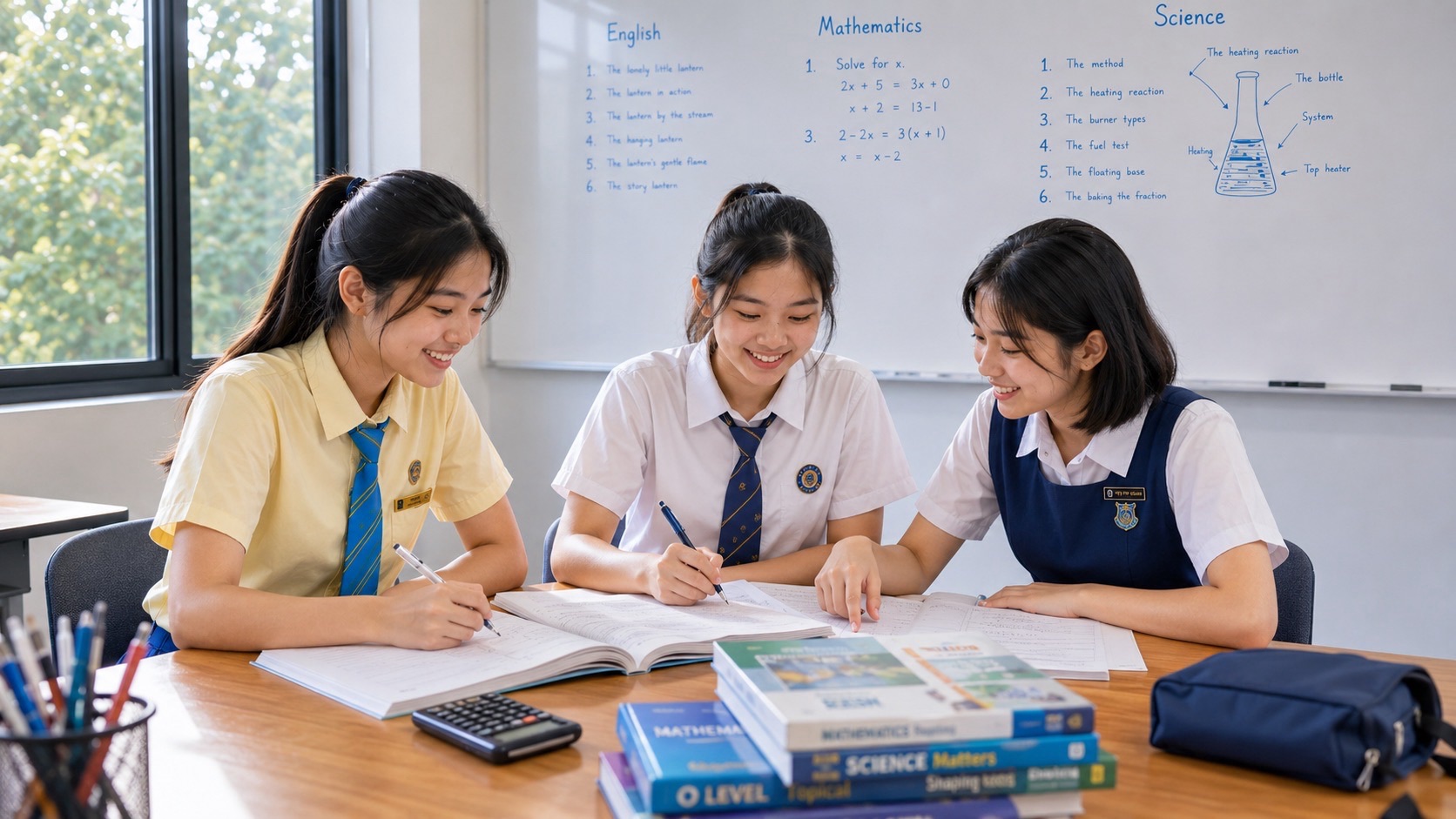
Preparing for an O-Level Chemistry practical exam or 2027 SEC G3 Chemistry practical in Hougang? Study four things together: planning a fair test, accurate measurement and observation, clear data presentation, and conclusions that the evidence can actually support. Theory revision alone is not enough. A student should be able to identify the variable being changed, record units and observations precisely, explain why the data support a conclusion, and suggest an improvement that addresses a real limitation.
For Hougang Secondary 3 and Secondary 4 students searching Chemistry practical exam preparation, qualitative analysis, titration skills, experiment planning, O-Level 6092, SEC K324 or Combined Science Chemistry practical, the first decision is which examination route they take. In the 2027 G3 system, standalone Chemistry K324 has a dedicated Paper 3 practical worth 20%, while Chemistry-containing Combined Science K326/K328 uses the combined Paper 5 practical worth 15% of the combined subject. Confirm your own syllabus in the official SEAB subject directory; this guide shows how to build useful experimental thinking without confusing a worksheet for hands-on laboratory training.
Practical Chemistry Exam Readiness: What a Correct Answer Has to Prove
The experiment’s aim determines the useful measurement
Suppose a school practical investigates the rate of gas formation when magnesium reacts with dilute acid. Recording only that “bubbles appeared” is not enough to compare rates quantitatively. The student should identify what quantity is measured, which variable is changed, which conditions are controlled and what would count as a fair comparison. A volume-of-gas-versus-time table permits rate calculations; an observation of bubbling alone supports a much more limited claim.
Describe what was seen before explaining the chemistry
In qualitative analysis, a white precipitate or an effervescent reaction is an observation. Identifying an ion or gas requires the relevant reagent, conditions and further evidence. Students lose marks when they jump from “bubbles” directly to “carbon dioxide” without support. Train the distinction: observation → test result → inference → conclusion. A tutor can teach this with a recorded school practical without handling chemicals outside a proper laboratory.
Data quality: calculate only from suitable measurements
For titration, the delivered volume is the final burette reading minus the initial reading. A trial beginning at 0.30 cm³ and finishing at 24.90 cm³ delivers 24.60 cm³. Appropriate repeated accurate titres should be selected according to the stated practical criteria before using a mean in chemical calculations. The next step uses that measured volume and a balanced equation; it should never silently assume that every titration reaction follows a 1:1 mole ratio.
Evaluate a particular error rather than writing “human error”
A practical evaluation should identify the specific procedural weakness, the measurement it affects and the likely consequence for a conclusion or calculated answer. For instance, reading a burette meniscus incorrectly introduces a volume error, but the sign of the error must be considered in the context of the actual reading, not guessed. Likewise, “repeat the experiment” is meaningful only if repeats improve reliability for the question being tested. Precision, accuracy and validity are related but not interchangeable terms.
How a tutor can support practical reasoning safely
Actual Chemistry experiments require properly equipped and supervised facilities; a three-pax tutorial should not claim to replace formal school laboratory experience. It can help learners design fair tests, interpret existing experimental data, write suitable equations, evaluate evidence and explain results. Confirm the actual syllabus and examination year before using a practice paper, and ask the student to answer a changed practical question without prompts.
Related reading: Qualitative analysis cases · Graph and anomaly questions · Secondary 4 Chemistry hero · Hougang Chemistry hub. Check the actual class syllabus, group, venue and availability directly before enrolling.
The practical exam is a test of scientific judgement
A student can memorise the formula of an acid, identify a blue precipitate from a revision sheet and still lose practical marks. Why? Because practical competence is about what the learner can do with equipment, observations, data and uncertainty in a real experiment.
The skill is easier to understand as a chain: question → plan → method → observation → data → inference → conclusion → evaluation. Each link should be visible. When the chain breaks, the final explanation is affected even if the student remembers the correct topic.
The Hougang G3 Chemistry route guide owns detailed examination pathway distinctions. This article focuses on how to practise the reasoning and habits that make practical work reliable.
Know your paper before building a revision timetable
| 2027 SEC G3 route | Chemistry’s position | Practical assessment |
|---|---|---|
| K324 Chemistry | Standalone Pure Chemistry | Paper 3; 20% of the Chemistry result |
| K326 Science (Physics, Chemistry) | Chemistry is part of Combined Science | Paper 5 shared with Physics; 15% of the combined Science result |
| K328 Science (Chemistry, Biology) | Chemistry is part of Combined Science | Paper 5 shared with Biology; 15% of the combined Science result |
The paper codes and weights above describe the 2027 G3 arrangements. For a 2026 O-Level candidate, use the actual 2026 SEAB syllabus and examination instructions rather than assuming a future paper label applies retrospectively.
Pure and Combined Science learners share many experimental habits but they do not share the same full paper architecture. Combined Science pupils must also manage the practical demands of their partner Science; Pure Chemistry pupils need deeper sustained Chemistry technique.
Skill 1: plan a fair investigation
The first planning question is usually not ‘Which apparatus should I draw?’ It is ‘What relationship am I investigating?’ A good plan describes the variable changed, the quantity measured, conditions kept comparable, the number and range of measurements needed, and what results would show the relationship.
Imagine a hypothetical school-supervised experiment testing how the concentration of a reactant affects the speed of a reaction. There may be various appropriate apparatus and reagents depending on the syllabus and laboratory risk assessment. The student’s planning must identify one factor deliberately varied, a consistent measurement of progress, and other conditions that could otherwise affect that measurement.
- Independent variable: the selected reactant concentration.
- Dependent variable: a defined measure of reaction progress or rate, such as time to an agreed observable endpoint.
- Controlled variables: relevant conditions, including temperature, reacting quantities other than the deliberate change, apparatus arrangement and observation criteria.
- Evidence: measurements that can be compared fairly across conditions.
- Precautions: appropriate safety controls and supervision under the school’s authorised procedure.
Avoid writing ‘keep everything constant’ as though it were a full plan. A useful plan states which factors matter and how consistency will be achieved.
Skill 2: distinguish observation from inference
Chemistry practical work happens in two languages. First comes what the senses or instrument actually register. Then comes what that evidence permits the student to infer.
| Observation | Interpretation that needs justification |
|---|---|
| A white precipitate forms after two solutions are mixed | An insoluble solid formed; more information is needed to identify it |
| A colourless gas is released | A gas is produced; identity requires suitable further evidence |
| The thermometer reading rises | The measured system warmed; explaining energy transfer requires the experimental context |
| A clear solution changes colour | A visible change occurred; the chemical cause must be supported, not guessed |
A common mistake is to write ‘copper(II) ions were present’ in the observations column before the required tests have supported that inference. Be precise about the evidence actually obtained. In qualitative analysis, additional observations and authorised confirmatory tests are used to narrow the conclusion.
This isn’t about sounding more academic. It is about making the logic trustworthy.
Skill 3: measure and record data so another person can read it
Write a clear heading, include quantities and units, and record readings at appropriate precision for the equipment. A table without units is unfinished. An excellent explanation cannot fully rescue poorly labelled evidence.
For example, a burette reading is not itself the titre. A titre is calculated by subtracting initial reading from final reading. If a hypothetical initial reading is 0.10 cm³ and final reading 23.40 cm³, the volume delivered is 23.30 cm³. This is a numerical illustration, not a report of an actual titration.
A learner who finds 23.50 cm³ has added rather than subtracted readings. A learner who reports 23.3 cm³ may have dropped an appropriate recording digit. These mistakes need different corrections. Accuracy and presentation are part of the skill, not cosmetic extras.
Skill 4: recognise what data can and cannot prove
Consider these invented example data, for practising interpretation only. They are not laboratory results and should not be treated as evidence about a specific reagent or a verified experimental law.
| Condition label | Measured time to a defined endpoint | Comment |
|---|---|---|
| Lower concentration | 86 s | Longest time in this illustration |
| Medium concentration | 45 s | Shorter time |
| Higher concentration | 31 s | Shortest time |
A defensible first statement is: ‘In this illustrative dataset, time to the chosen endpoint decreases as concentration increases.’ If the endpoint corresponds to the same extent of reaction each time and other relevant conditions are controlled, the pattern may be consistent with a faster reaction at greater concentration. Do not claim that the data alone prove a particular microscopic mechanism.
The stronger student also asks: How many trials were done? Were the endpoints judged consistently? Were the concentrations correctly prepared? Was temperature controlled? Which claims are direct observations, which are explanations, and which still need confirmation?
Skill 5: improve a method by naming the actual error
It is tempting to write ‘repeat the experiment for accuracy’ whenever a question asks for an improvement. Repetition can help quantify variability, but repetition by itself does not correct every bias.
| Specific problem | Why it matters | A relevant response |
|---|---|---|
| Reading the meniscus from above | Parallax can bias a volume reading | Read at the appropriate eye level |
| Equipment starts with an uncorrected offset | All readings may be systematically shifted | Check and correct or calibrate the instrument |
| Different operators judge a vague endpoint | Trial comparisons become inconsistent | Define a clear endpoint and standardise observation |
| Only one run was taken | Random variation cannot be assessed | Repeat valid trials and compare their spread |
| Temperature drifts between trials | Rate comparisons may be confounded | Monitor and hold temperature reasonably constant |
Notice the explanatory structure: identify the limitation, explain how it changes the result, and propose an improvement aimed at that limitation. A generic suggestion without a reason rarely shows complete experimental thinking.
An example of a useful practical notebook
A learner does not need a fancy notebook. One tidy page per school practical can contain the question, labelled variables, method summary, apparatus notes, actual measurements, observations, analysis, sources of uncertainty and what to practise next.
- Write the aim as a question that the method can answer.
- Name the independent, dependent and important controlled variables.
- Record real observations without replacing them with guessed chemical identities.
- Check units, significant figures and whether any calculation uses the proper difference or ratio.
- Explain the conclusion only as far as the observations and chemical knowledge allow.
- Identify one specific procedural limitation and one relevant improvement.
- Note any safety instructions given by the teacher and follow them exactly.
This practice protects the learner from repeating the same weak inference in every new practical topic.
What parents can help with—and what they should leave to school laboratories
Parents can ask excellent oral questions at home: “What did you actually observe?” “Which variable changed?” “Why did you choose that measurement?” “Could another explanation fit the result?” These questions develop reasoning without chemicals, heat or glassware.
Real chemistry practical skill, including safe chemical handling and specialised apparatus use, requires appropriate school or other properly supervised laboratory arrangements. This article is not a home experiment guide. Do not attempt acid, alkali, gas-identification or heated-substance procedures from exam summaries in an unsupervised home setting, and never mix cleaning chemicals to mimic a school practical.
Even an excellent workbook cannot substitute for authorised hands-on teaching when hands-on practical competence is assessed.
A six-week revision route before practical assessment
| Week | Preparation focus | Independent exit check |
|---|---|---|
| 1 | Variables and fair-test planning | Explain a valid experiment and its controls |
| 2 | Apparatus, units and measurement precision | Correct readings and justify recording precision |
| 3 | Observation versus chemical inference | Separate raw data from conclusions in a new case |
| 4 | Data tables, graphs and calculation checks | Present and interpret an unfamiliar dataset |
| 5 | Evaluation and specific improvements | Match each limitation to a targeted response |
| 6 | Mixed practical reasoning under time limits | Plan, record, interpret and evaluate coherently |
Adjust this route to school laboratory lessons, the student’s paper and current teacher feedback. A student with secure measurement skills may need more time on inference; another may have the opposite profile. The six weeks are a teaching example, not a recommended replacement for school practical sessions.
How to recognise progress
Progress is visible when the student can write a fair plan without a template; distinguish a true observation from an assumed substance identity; produce an easy-to-check table; question a suspicious reading; and name an improvement that actually addresses the error.
An exam score alone compresses these separate skills into one mark. Ask to inspect a marked school practical, sample data page or teacher feedback so that the next intervention targets the first unstable stage.
This same philosophy underpins eduKate’s Chemistry tutor evaluation guide and the Secondary 4 Hougang Chemistry route: diagnosis should precede more work.
Questions Hougang students and parents ask
Is memorising qualitative analysis tables enough?
No. The tables help, but practical questions also require correct observations, decisions, safe technique and warranted inference. Memorised identities are not substitutes for evidence gathered by the stated method.
Should my child revise theory or practical first?
Both are connected. The student needs chemical knowledge to explain observations and practical habits to generate trustworthy evidence. Use actual assessed weaknesses rather than assuming one side is always more urgent.
Can Combined Science Chemistry students use Pure Chemistry practical worksheets?
Some shared skills transfer, but the formal paper structure and syllabus requirements differ. Use materials aligned with the student’s actual Combined Science route, especially for paper timing and partner-subject practical work.
Does 3-pax tuition mean students can practise hazardous lab procedures there?
No such claim follows from group size. A small academic class can strengthen explanation, analysis and written planning. Parents must separately verify any provider’s actual supervised laboratory facilities and safety arrangements. Do not assume a tuition venue offers assessed hands-on practical training.
What if the student freezes when the results look unfamiliar?
Practise identifying exactly what is known, what was measured, what the pattern says and what remains uncertain. Confidence often improves when the learner has a repeatable way to handle an unexpected result instead of trying to recall an identical worksheet.
The linked Chemistry learning route
Return to Secondary 1–2 particle and separation foundations if the concepts behind the observations are insecure. Use balancing chemical equations when the symbolic representation is weak, and mole-concept worked examples when quantitative analysis is the problem. The Chemistry topic library provides the full national subject map.
For Hougang family decisions, explore Hougang Science learning hub and Hougang Chemistry tuition information. eduKate’s existing 3-pax tutorial reference describes a learning centre near Sixth Avenue MRT; this article does not assert that there is an eduKate Chemistry laboratory or a tuition outlet in Hougang. Check the real location, teaching arrangement and school support needs before enrolling.
The best practical preparation teaches one beautiful scientific habit: say what the evidence shows, say why it matters, and be clear about what is not yet known.