
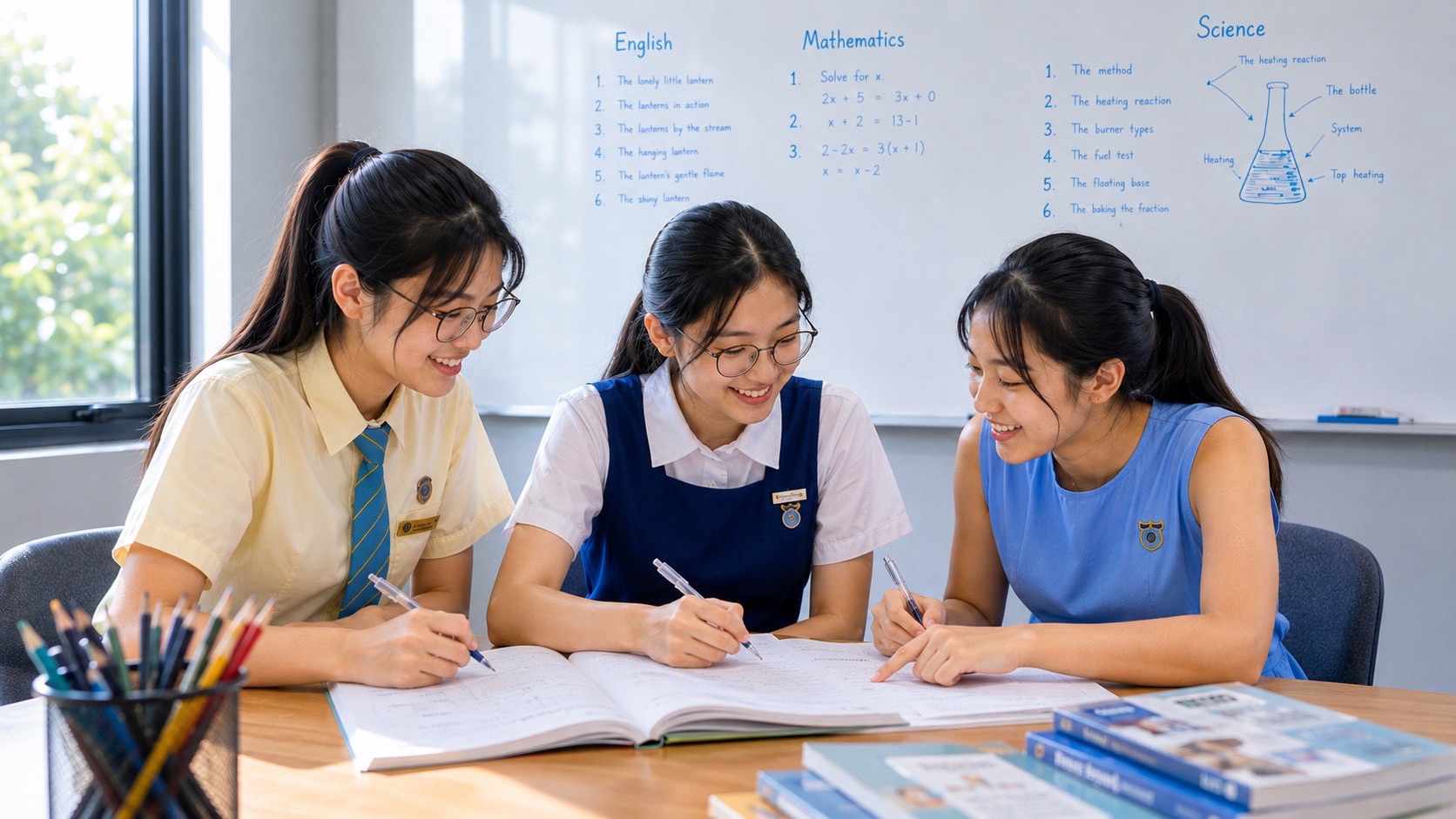
Chemistry tuition in Hougang should start with the student’s school level, syllabus and actual learning difficulty. Secondary 1 and 2 students need Chemistry foundations within lower-secondary Science; Secondary 3 and 4 students need the right Pure Chemistry or Combined Science support; JC students need help matched to H1, H2 or, where taken, H3 Chemistry. This eduKate guide brings those routes together with Chemistry topic explanations, syllabus references, school guides and practical advice for Hougang families choosing a tutor.
Everyday Chemistry: Crystals, Markers, Glass and Tyres
Four linked applications explain different mechanisms: glucose crystallisation, ink release, thermal fracture and carbon-black reinforcement. They complement syllabus learning without repeating the same answer.
For parents comparing a Chemistry tutor in Hougang, the useful question is not simply how much homework a class provides. It is whether the tutor can identify the first misunderstanding, explain it clearly and help the student answer independently. eduKate’s small-group model is three students, with diagnosis before additional practice. Bring a recent marked paper and the school’s current topics; confirm the actual teaching venue, fees, timetable and class availability directly. Choose your starting point below.
New Hougang Chemistry Worked Guides: Volume, Alkalinity, Crystal Yield and Iodine Titration
Four distinct topic explanations cover Lower Secondary Science, Secondary 3 and 4 Chemistry, and JC H2 Chemistry. Start with the learner’s actual year and identify the first conceptual error; each article includes a clear answer, worked question, science behind the observation and a next learning route.
- Secondary 1–2 Science: why water and ethanol can occupy less volume — Conservation of mass, liquid mixing, molecular packing and density; a data-based enrichment activity
- Secondary 3 Chemistry: why sodium carbonate solution is alkaline — Carbonate ion hydrolysis, pH indicators, acid reactions and chemical equations
- Secondary 4 Chemistry: why washing crystals can lower percentage yield — Purity versus yield, washing losses, external moisture and crystallisation practical reasoning
- JC H2 Chemistry: why thiosulfate removes iodine–starch colour — Redox half-equations, the iodine–thiosulfate 1:2 ratio, endpoint colours and titration calculations
See the Hougang Chemistry reference library for more explanations and the Hougang Chemistry tuition parent guide for curriculum and consultation pathways. Classroom venue and availability should be confirmed directly; these are reference articles, not a claim of a Hougang-based teaching centre.
New Hougang Chemistry Questions: Surface Forces, Product Layers, Electrolysis and Cell Potential
Four additional learning routes span lower-secondary Science, Secondary 3–4 Chemistry and JC H2. Each starts with the question a parent or student is likely to ask, then explains the particle or reaction model, works an example and provides a short way to check understanding.
- Secondary 1–2 Science: why a paper clip floats until soap is added — Surface tension, steel density, surfactants and a fair-test explanation.
- Secondary 3 Chemistry: why marble behaves differently with two acids — Carbonate reactions, calcium sulfate coating, gas evidence and stoichiometry.
- Secondary 4 Chemistry: why copper sulfate changes with electrode material — Graphite versus copper anodes, blue Cu²⁺ concentration and half-equations.
- JC H2 Chemistry: why positive E°cell does not guarantee speed — Thermodynamic feasibility, activation energy, kinetics and Zn–Cu calculations.
Use the Hougang Chemistry tutor and reference library for the fuller syllabus map, or the Hougang Chemistry tuition guide to compare the relevant parent decision routes.
New Chemistry Guides for Hougang: Separation, Surfaces, Light and Buffers
Four new worked explanations, from Lower Secondary Science to JC H2 Chemistry, tackle different mistakes that affect observations, equations and calculations. Choose a school level, read the immediate explanation and use the worked problems to check for independent understanding.
- Secondary 1–2 Science: why food colouring passes through filter paper — Filter residue versus dissolved dye, adsorption, separation methods and observation-based explanation.
- Secondary 3 Chemistry: why aluminium’s oxide layer hides its reactivity — Passivation, the reactivity series, acid–metal redox, and a worked hydrogen calculation.
- Secondary 4 Chemistry: why silver chloride darkens in sunlight — Qualitative analysis, AgCl precipitation, light-driven silver formation and experimental evidence.
- JC H2 Chemistry: why dilution reduces buffer capacity more than pH — Henderson–Hasselbalch calculations, equal-volume comparison and the total-moles distinction.
For enrolment questions and the full age-and-syllabus route, start at the Hougang Chemistry Tuition hub. These articles are a reference library and do not imply an available teaching venue in Hougang.
New Hougang Chemistry Worked Guides: From Bubbles to Equilibrium
Four distinct, level-matched explanations connect visible science to particles, balanced equations, thermochromic materials and JC gas equilibria. Choose the student’s stage and try the worked questions before more generic practice.
- Secondary 1–2 Science: why tiny bubbles appear before water boils — Dissolved gases, vapour, particle models and what early bubbles actually prove.
- Secondary 3 Chemistry: why limewater turns milky, then clear again — Calcium carbonate precipitation, excess CO₂ and soluble hydrogencarbonate.
- Secondary 4 Chemistry: why zinc oxide is yellow when hot — Distinguishing zinc carbonate decomposition from zinc oxide’s reversible colour change.
- JC H2 Chemistry: when adding an inert gas shifts equilibrium — Fixed volume versus fixed total pressure, Kp, Qp and reacting partial pressures.
Start with the course the student actually takes, then choose one misconception to repair, explain and retest in an unfamiliar question.
Start here: choose the student’s level
| Your starting point | What the guide helps you do |
|---|---|
| Secondary 1–2 Science and Chemistry foundations | Understand particles, mixtures and scientific explanations; turn familiar notes into independent test answers. |
| Secondary 3 Chemistry tuition | Connect atoms, ions, bonding, formulae, equations and chemical calculations. |
| Secondary 4 Chemistry tuition | Repair weak concepts, combine chapters and prepare for theory and the practical requirements of the student’s course. |
| JC Chemistry: H1, H2 and H3 | Choose the appropriate depth of help for lectures, tutorials, examinations and advanced Chemistry. |
Already know the course? Go directly to SEC G2 Combined Science, SEC G3 Chemistry, JC H1, JC H2 or H3 reference guidance.
Find what you need: Learning difficulties · Topic explanations · Syllabus check · School guides · Worked-example library · How teaching works · Classes and fees · Consultation
Which Chemistry problem needs attention?
| What is happening? | Start with this guide |
|---|---|
| Science notes make sense, but test questions do not. | Is the difficulty Chemistry or reading the question? |
| The student cannot decide between Pure and Combined Science. | Secondary 2 subject-choice guide |
| Bonding diagrams and explanations keep losing marks. | Make the structure–property explanation precise |
| Topical worksheets go well, but examination papers do not. | Past-year papers or concept repair first? |
| MCQ results are stronger than written answers. | Bridge the gap between recognition and explanation |
| JC lectures are understandable, but tutorials feel impossible. | Move from following a solution to choosing a method |
| The student knows the theory but worries about practical work. | Secondary practical preparation or JC H2 practical preparation |
| The family is unsure whether another tuition class will help. | How to judge a Chemistry tutor’s teaching quality |
These are starting questions, not diagnoses made from a single sentence. A tutor should test the likely cause against the student’s own answers before recommending a programme.
Find a Chemistry topic explanation
Open the topic that is blocking the next question. The explanations below sit at different school levels, so check the level stated in each article rather than treating this as one syllabus checklist.
| Topic | Useful starting explanations |
|---|---|
| Particles and mixtures | Elements, compounds and mixtures · Dissolving rate versus solubility |
| Atomic structure and bonding | Isotopes versus ions · Ionic charges and formulae |
| Moles and calculations | Relative atomic and formula mass · Limiting and excess reactants |
| Acids, bases and salts | Acids, bases, salts and neutralisation · Strong versus concentrated acids |
| Separation and chemical evidence | Choosing a separation method · Chromatography and Rf values |
| Energy changes and rates | Exothermic and endothermic reactions · Interpreting a reaction-rate investigation |
| Redox and electrolysis | Where ions and electrons move · JC H2 electrode potentials |
| Organic Chemistry | Secondary organic reactions · JC H2 mechanisms and curly arrows |
| JC H2 equilibrium and kinetics | Kc and equilibrium tables · Rate laws from initial-rate data |
| JC H2 practical reasoning | Planning, errors and uncertainty · Redox titration calculations |
Browse more widely: the Hougang Chemistry Tuition and Tutor Library brings together further explanations and parent questions. The eduKate Secondary Chemistry Topic Index provides another route through the subject.
Two complementary starting guides: fizzy-drink pressure and laboratory hazard symbols. The carbonated drinks and CO₂ guide develops lower-secondary particle, pressure and fair-test reasoning. The nine GHS laboratory hazard symbols guide explains how students should interpret chemical labels before supervised practical work. Both are supporting explanations, not replacement Chemistry tuition homepages.
Two Further Chemistry References: Singapore’s Water and Molecular Shape
These reference-library entries answer two different questions. One connects Chemistry to Singapore’s physical water infrastructure; the other belongs to advanced JC H2 molecular-structure learning.
- How Singapore removes salt from seawater — reverse osmosis, brine and mass conservation
- VSEPR shapes and bond angles — JC H2 Chemical Bonding
For the complete local study progression, use the Hougang Chemistry tuition and reference hub. Check the student’s exact school course before selecting learning support.
Check the syllabus before choosing notes or tuition
The student’s examination year matters. A resource can explain Chemistry well and still be the wrong preparation for that student’s paper. Check the year, subject level and syllabus code against the school documents and the original MOE or SEAB listing.
| Course | What to check |
|---|---|
| Secondary 1–2 | Chemistry is studied within lower-secondary Science. Match G1, G2 or G3 Science and the school’s actual sequence; do not assume every school teaches each topic in the same term. |
| 2026 O-Level Chemistry | Standalone Chemistry is 6092. Chemistry-containing Combined Science routes include 5086 and 5088. Use the student’s registered 2026 course. |
| 2027 SEC G2 | K223 is Science (Physics, Chemistry); K225 is Science (Chemistry, Biology). Chemistry is part of the combined subject. |
| 2027 SEC G3 | K324 is standalone Chemistry; K326 is Science (Physics, Chemistry); K328 is Science (Chemistry, Biology). |
| JC H1 and H2 | H1 Chemistry is 8873; revised H2 Chemistry is 9476. The 9476 syllabus was first examined in 2026. |
| JC H3 | H3 Chemistry is 9813. Treat it as a distinct advanced course, not a default next step for every Chemistry student. |
Official references: MOE secondary syllabuses; SEAB 2027 G2 subjects; SEAB 2027 G3 subjects and earlier reference codes; SEAB 2026 A-Level subjects; SEAB 2027 A-Level subjects.
Two distinctions worth keeping: G1 Science should not be advertised as a standalone G1 Pure Chemistry course. Also, H2 9476 did not begin only in 2027: SEAB identifies 2026 as its first examination year, while the older 9729 course is marked for its last examination in 2026. Check the learner’s registration rather than relying on an old notes cover.
Two Specialised Hougang Chemistry Decisions: JC Understanding and Future Pathways
Students already studying H2 Chemistry can work through Group 2 Carbonates: Thermal Stability and Cation Polarisation, then return to the JC Chemistry level guide. Students nearing the end of Secondary 4 can explore Chemistry after Secondary 4: JC, Polytechnic, ITE and Careers before selecting a study route.
For the parent decision about fees and teaching quality, use the H2 Chemistry tuition fees and value checklist and confirm any real prices, teaching venue and available class directly.
Practical preparation must also match the course. The 2027 G3 Chemistry K324 syllabus includes a practical paper. The G2 Combined Science syllabus uses a different assessment structure. A label such as “Paper 3 tuition” is therefore not enough to identify the right class.
For explanations of the course differences, use SEC Science Pathways Singapore, the Secondary Chemistry syllabus library and the JC H1/H2 syllabus library. National course guides are available for G2 Chemistry within Science and G3 Chemistry.
Chemistry guides for Hougang-area and nearby schools
Begin with the student’s own school programme. These independent guides help families ask about subject choice, Science learning and tutor fit. They do not imply a school partnership, endorsement or identical subject options across schools.
- Hougang Secondary School · Bowen Secondary School · Xinmin Secondary School
- Holy Innocents’ High School · Montfort Secondary School · Yuying Secondary School
- Serangoon Secondary School · Paya Lebar Methodist Girls’ School (Secondary) · Peicai Secondary School
JC reading: Anderson Serangoon Junior College and Nanyang Junior College. Confirm current subject combinations and eligibility with the school itself.
Additional Sengkang-area school Chemistry guides: Nan Chiau High School — Olympiad curiosity and Chemistry readiness · CHIJ St Joseph’s Convent — precise Science explanations · Seng Kang Secondary — food Science and tutor fit. Compare the student’s assigned Pure or Combined Science level, school evidence, and the tutor’s actual learning support. These are independent guides, not school partnerships.
More worked explanations, organised by stage
Open one shelf at a time. These companion explanations include both syllabus learning and clearly identified extensions; the student’s course determines which depth is needed.
Secondary 1–2 Science: particles, materials and familiar observations
- Density: why equal masses can occupy different volumes
- Why air compresses more easily than water
- Diffusion versus convection
- Why a heating curve can stay flat during melting
- Why wet clothes can dry without sunshine
- Why ice floats on water
- Why a cold glass becomes wet on the outside
- Why oil and water do not mix
Secondary 3 Chemistry: structure, reactions and evidence
- Group 1 and Group 17 reactivity trends
- Acids, carbonates and the evidence from limewater
- Transition metals and coloured compounds
- Why metals bend but ionic crystals shatter
- Reading a meniscus and choosing measuring apparatus
- Rusting, galvanising and sacrificial protection
- Why candle wax melts more readily than sand
- Ammonium ions, ammonia and chemical testing
- Manganese dioxide and catalysis
Secondary 4 Chemistry: calculations, connections and examination reasoning
- Percentage yield versus percentage purity
- The Haber process and industrial compromises
- Solubility curves and crystallisation calculations
- Incomplete combustion and carbon monoxide
- An open flask and conservation of mass
- Heat losses in calorimetry
- Electroplating and the cathode
- Hydrated and anhydrous copper sulfate
- Why breaking bonds absorbs energy
JC H2 Chemistry: equilibrium, energetics and organic mechanisms
- How buffer solutions resist pH changes
- Entropy, Gibbs free energy and feasibility
- Why equivalence-point pH is not always 7
- Qc versus Kc and reaction direction
- Kp, partial pressures and mole fractions
- Reflux versus distillation in alcohol oxidation
- Carbonyl compounds and nucleophilic addition
- Substitution versus elimination
- Acid versus alkaline ester hydrolysis
Continue reading: Chemistry questions already answered in the eduKate library
Need a more specific explanation? The routes above introduce the subject; these published companion guides take individual errors further. Open one stage at a time, choose a question that resembles the student’s actual difficulty, and check understanding with a changed example. For a broader map, use the Hougang Chemistry Tuition and Tutor Library.
Secondary 1–2: particles, Science readiness and explaining answers
Start with the lower-secondary Science route and repair the link between observations, particles and explanations.
- Secondary 2 Science Tutor Hougang: My Child Memorises Chemistry Notes but Cannot Answer Explain Questions
- Secondary 1 Science Tuition Hougang: Should You Start After the First Weighted Assessment?
- Secondary 2 Science Tuition Hougang: Why Do Test Marks Swing Even When My Child Studies?
- Secondary 1 Science Tutor Hougang: My Child Is Too Shy to Ask Chemistry Questions—What Helps?
- Secondary 1 Science Tuition Hougang: My Child Loved PSLE Science—Why Are Chemical Particles Suddenly So Hard?
- Secondary 1 and 2 Chemistry in Hougang: What to Know Before Secondary 3
- What Are Chemistry Classes in Secondary 1 and 2? | Hougang MOE Science Library
- Physical or Chemical Change? | Hougang Secondary 2 Science Guide with Everyday Examples
- Does Salt Disappear in Water? | Hougang Secondary 1 Science Guide to Dissolving and Mixtures
Secondary 3: atomic structure, bonding and first chemical calculations
Build the meaning of symbols and relationships before working faster.
- Secondary 3 Chemistry Tutor Hougang: Should Parents Change Tutors When Marks Stop Improving?
- Isotopes and Relative Atomic Mass | Hougang Secondary 3 Chemistry Worked Guide
- How to Draw Dot-and-Cross Diagrams | Hougang Secondary 3 Chemistry
- Ionic vs Covalent Bonding | Hougang Secondary 3 Chemistry
- Secondary 3 Combined Science Chemistry Tutor Hougang: Why Is It So Hard to Find a Class for the Right Pair?
- How to Read the Periodic Table | Hougang Secondary 3 Chemistry
- How to Balance Chemical Equations: Hougang Secondary 3 Chemistry Guide
Secondary 4: chemical reactions, calculations and examination integration
Choose the failed reasoning step, practise a changed question, then move into mixed-paper work.
- Alcohols, Carboxylic Acids and Esters | Hougang Secondary 4 Chemistry Reactions Guide
- Crude Oil and Fractional Distillation | Hougang Secondary 4 Chemistry Fuels Guide
- Addition vs Condensation Polymerisation | Hougang Secondary 4 Chemistry and Plastic Recycling
- Air Pollution, Acid Rain and Catalytic Converters | Hougang Secondary 4 Chemistry Guide
- Oxidation Numbers and Redox Reactions | Hougang Secondary 4 Chemistry Worked Guide
- How to Write Ionic Equations | Hougang Chemistry Spectator Ions Guide
- Gas Volume Calculations at RTP | Hougang Secondary 4 Chemistry 24 dm³ Mole Guide
- How to Calculate Percentage Yield and Purity | Hougang Chemistry Worked Examples
- How to Calculate Empirical Formulae | Hougang Secondary 4 Chemistry
- Secondary 4 Chemistry Tuition Hougang: What If My Child Refuses Another Tutor Before Exams?
- Percentage Yield vs Percentage Purity | Hougang Chemistry Calculations with Worked Examples
- How to Use the Reactivity Series of Metals | Hougang Secondary 4 Chemistry
- Rates of Reaction and Collision Theory | Hougang Secondary 4 Chemistry
- Salt Preparation Worked Examples | Hougang Secondary 4 Chemistry
- How to Choose Salt Preparation Methods | Hougang Secondary 4 Chemistry
- Secondary 4 Chemistry Tuition Hougang: Why Does My Child Repeat the Same Mistakes in Every Past Paper?
- How to Predict Electrolysis Products | Hougang Secondary 4 Chemistry Worked Examples
- Atom Economy vs Percentage Yield | Hougang Chemistry Green Chemistry Worked Guide
- How to Use Solubility Rules to Predict Precipitates | Hougang Secondary 4 Chemistry
JC Chemistry: H2 theory, organic mechanisms, equilibrium and practical reasoning
Match the article to the student’s H1 or H2 syllabus and current tutorial. H2 detail is not interchangeable with H1 content.
- Acyl Chlorides vs Halogenoalkanes | Hougang JC H2 Chemistry Hydrolysis and Esters Guide
- Aldehydes vs Ketones | Hougang JC H2 Chemistry Tollens, Fehling and 2,4-DNPH Guide
- Benzene vs Alkenes | Hougang JC H2 Chemistry Electrophilic Substitution Guide
- SN1 vs SN2 Nucleophilic Substitution | Hougang JC H2 Chemistry Mechanisms Guide
- How to Read Acid–Base Titration Curves | Hougang JC H2 Chemistry Indicator Guide
- How Do Amino Acids Form Peptide Bonds? | Hougang JC H2 Chemistry Proteins Guide
- Why Do Successive Ionisation Energies Jump? | Hougang JC H2 Chemistry Worked Guide
- Transition Metal Complexes and Ligand Exchange | Hougang JC H2 Chemistry Colour Guide
- Entropy and Gibbs Free Energy ΔG | Hougang JC H2 Chemistry Worked Guide
- JC H2 Chemistry Tuition Hougang: Should My Child Switch to H1 or Find an H2 Tutor?
- Solubility Product Ksp and Common Ion Effect | Hougang JC H2 Chemistry Worked Guide
- H2 Chemistry Initial Rates and Rate Equations | Hougang JC Reaction Kinetics Guide
- Buffer Solutions, pH and Ka | Hougang JC H2 Chemistry Worked Guide
- Standard Electrode Potentials and E°cell | Hougang JC H2 Chemistry Worked Guide
- Hess’s Law and Born–Haber Cycles | Hougang JC H2 Chemistry Enthalpy Worked Guide
- JC H2 Organic Chemistry Reaction Map | Hougang Guide to Reagents, Conditions and Pathways
- JC Chemistry Tuition Hougang: Online, Home Tutor or Three-Student Class for H1 and H2?
- JC H2 Organic Isomerism Worked Structures | Hougang Chemistry
- Burette Readings and Concordant Titres | Hougang JC H2 Chemistry
- How to Identify Organic Isomers | Hougang JC H2 Chemistry
- H2 Titration Calculations Hougang | Worked Mole-Ratio Steps
- JC2 Chemistry Tutor Hougang: Crash Course, Weekly Tuition or Independent Revision Before A-Levels?
- JC1 H2 Chemistry Tuition Hougang: My Child Did Well at O-Level, So Why Is Chemistry Suddenly Difficult?
- Why Does Chemical Equilibrium Shift? | Hougang JC H2 Chemistry Le Châtelier Guide
Across levels: experiment planning, chemical language and revision
Use these guides when the problem is not a single chapter but the way evidence, language or practice is handled.
- How to Plan a Fair Chemistry Experiment | Hougang SEC G3 Practical Guide
- Pure or Impure? Melting Point and Boiling Point | Hougang Chemistry Guide
- Chemistry Dilution and Mixing Solutions | Hougang Secondary 4
- Chemistry Concentration Units | Hougang mol/dm³ and g/dm³ Guide
- Empirical vs Molecular Formula | Hougang Secondary Chemistry
- Why Does Salt Water Conduct Electricity but Sugar Water Does Not? | Hougang Chemistry
- Why Do Students Forget Chemistry After Tests? A Hougang 30-Day Revision Plan
- Secondary 3 Chemistry Failed a Test in Hougang? A 14-Day Recovery Plan That Fixes the Cause
- How to Solve Mole Concept Questions: Hougang O-Level Chemistry Guide
- Chemistry Data-Based Questions in Hougang | Reading Graphs, Rates, Tables and Anomalies
- Chemistry Qualitative Analysis for Hougang Students | Six Worked Ion and Gas Test Cases
- How to Answer Chemistry Explain Questions in Hougang | Describe, State, Compare and Calculate
- How to Prepare for Chemistry Practical Exams: Hougang Student Guide
- Chemistry Vocabulary for Hougang Students: 25 Words That Change the Answer
- North Vista Secondary School Chemistry Tuition | From Farm-to-Table Science to Confident Chemistry Answers
More nearby school-specific Chemistry guides
These independent school-context guides help families think about pathways and tutor fit; they do not assert a particular class runs at each school’s location.
- Anderson Secondary School Chemistry Tuition | Science Research, Pure Chemistry and Tutor Fit Near Hougang
- Maris Stella High School Chemistry Tuition | Periodic Table, Pure Science and Tutor Fit Near Bartley and Hougang
- St Gabriel’s Secondary School Chemistry Tuition | From Aviation Science to Stronger Chemistry Answers
- Presbyterian High School Chemistry Tuition | Soap Science, Surfactants and Tutor Choices Near Hougang
- Mayflower Secondary School Chemistry Tuition | The 5E Method for Fixing Exam Mistakes Near Hougang
Once the first gap is clear, return to the Secondary 3, Secondary 4 or JC Chemistry route for tuition choices. Confirm the examination year, subject level and current syllabus before applying an example.
Parent decisions: starting, changing or reviewing tuition
Secondary 1–2: choosing help without adding unnecessary workload
Secondary 3–4: finding the right class and making revision useful
- Finding the right Secondary 3 Chemistry class
- Starting support when examinations are approaching
- Chemistry is pulling down the Combined Science grade
- Repeated errors in dot-and-cross diagrams
- Too many tuition classes, too little improvement
- Memorising the Periodic Table without predicting reactions
- Why a correct-sounding answer still loses marks
JC: deciding what support is worth the time and cost
Why Chemistry becomes difficult even for hardworking students
Imagine a student who can describe a colour change but cannot explain the particles involved. Another student knows the particle explanation but writes the wrong formula. A third writes a correct equation, then uses the wrong reacting ratio. All three may end with a wrong answer, but giving them the same correction would miss the point.
A useful way to organise Chemistry learning is to connect what is observed, what the particles are doing, how that is represented, and what can be calculated or predicted. An answer needs the relevant links, not merely a collection of familiar words. SEAB’s G3 Chemistry syllabus explicitly includes translating information between forms, applying concepts to unfamiliar situations and interpreting experimental evidence.
This gives the tutor a more precise task than “cover the chapter again”. Where does the learner’s explanation stop being reliable? Is the missing piece a fact, a model, a mathematical step, a word in the question or a decision about which approach to use?
The same distinction applies across levels. A lower-secondary student may need a particle drawing before formal notation. A Secondary 3 student may need to connect ion charges to a formula. A Secondary 4 student may need practice selecting a method without a chapter heading. A JC student may need to identify which assumptions make an equation or mechanism appropriate. The starting point should change with the evidence.
How first-principles Chemistry teaching works
The aim is not to make every explanation more complicated. It is to make the necessary idea clear enough that the student can use it without borrowing the tutor’s thinking. Here is the teaching sequence to look for in a Chemistry lesson.
1. Find the first incorrect decision
Begin with genuine schoolwork. Cover the correction and ask the student to explain how they would start. Compare a recent paper with an earlier one where possible. The score shows the outcome; the working helps reveal the cause.
A wrong calculation does not automatically mean weak arithmetic. The student may have chosen the wrong substance, built an incorrect formula or read the equation ratio incorrectly before touching the calculator.
2. Rebuild the smallest missing idea
Suppose a student writes MgCl instead of MgCl₂. Start with electrical neutrality: one Mg²⁺ ion needs two Cl⁻ ions to produce zero total charge. Then ask the student to construct aluminium oxide from Al³⁺ and O²⁻. Two aluminium ions give +6, and three oxide ions give −6, so the formula is Al₂O₃.
The second example matters. It checks whether the learner can apply the principle, rather than repeat a formula they have just been shown. If that step remains uncertain, another page of equations is not yet the most useful next task.
3. Connect the model to symbols and quantities
Consider the equation Mg + 2HCl → MgCl₂ + H₂. For a calculation in which Mg = 24 is supplied, 2.4 g of magnesium is 0.100 mol. With sufficient hydrochloric acid and complete reaction, the equation gives 0.100 mol of hydrogen. The coefficient 2 belongs to HCl; it does not double every quantity in the equation.
Now change the question: what amount of HCl is required? The answer is 0.200 mol. Ask the learner to identify the two substances being compared before calculating. The lesson is about reading a relationship accurately, not memorising “multiply by two”.
4. Reduce the help and change the question
A worked example is a starting point. Follow it with a question using changed values or a different substance, then a question where the student must choose the relevant method. Avoid supplying every first step. A useful check is whether the student can explain why their chosen approach fits.
5. Return later and mix the topics
Revisit the idea in a later lesson without the original example beside it. Combine it with another topic only when the foundation is secure. This makes the review a test of what the student can reconstruct, rather than what remains familiar immediately after teaching.
6. Add examination conditions when the reasoning is ready
Use short timed sets to distinguish a knowledge difficulty from a timing difficulty. Check units, significant figures where required, the particles named in explanations and whether the answer addresses the command word. A faster wrong method is not the goal; the goal is a sound method that becomes usable within the available time.
What three-student Chemistry tutorials should make possible
In a three-student group, each learner should have time to speak, write, ask and try. A tutor can ask one student to explain a particle model, another to write the corresponding equation and a third to check whether the explanation fits the evidence. The roles can then change.
The important point is individual visibility. Three students may produce the same wrong answer for three different reasons. One needs a fact recalled, another needs a representation repaired, and another needs to read the question more carefully. A shared lesson should not erase those differences.
Small groups are not a grade guarantee. Ask how the class is matched, how much independent work occurs and how the tutor responds when one learner falls behind. A calm room is useful only when the teaching makes productive use of it.
An appropriate lesson can include a short review of earlier learning, one focused explanation, guided practice, an independent check and a clear correction task. The exact duration and balance should be confirmed for the Chemistry class offered; a timetable from another subject should not be assumed to apply.
Repair, stabilise or extend: choose the right learning plan
Repair: when the student cannot begin, find the missing prerequisite and reconnect it to the school topic. For example, an equations problem may require work on formula construction first. Set a limited, observable goal instead of trying to fix the whole subject at once.
Stabilise: when the student sometimes succeeds and sometimes does not, compare conditions. Can the question be answered without notes, after a delay and in a mixed set? Track recurring errors rather than treating every mistake as new.
Extend: when the foundation is secure, introduce unfamiliar information, finer distinctions and more demanding explanations within the appropriate syllabus. Extension should deepen the student’s control, not simply expose them to higher-level words earlier.
Review the plan against actual work. Can the student explain a corrected idea independently? Has the same error become less frequent? Can they solve a changed question without a hint? Use these checks alongside school results. Neither a single good worksheet nor an isolated test score tells the whole story.
Classes, fees and travel: what Hougang families should confirm
This page is written for Hougang families; it is not confirmation that a Chemistry classroom operates at a particular Hougang address. Before enrolling, ask for the actual teaching venue, the level and syllabus supported, current availability, lesson duration, timetable and full fee arrangement. Confirm separately whether any supervised laboratory work is available.
A practical timetable includes more than the lesson. Allow for school dismissal, CCA, travel, meals and the independent follow-up work. Test the journey from the student’s real starting point, not only from home. A lesson that leaves no time to use the feedback may be a poor fit even when the teaching sounds promising.
Compare fees on the same basis: lesson length, actual group size, materials, marking and feedback, make-up arrangements, deposits and notice requirements. Current fees and vacancies are not assumed here. Ask for the details directly before making a commitment.
Weekday or weekend? Read the guide for Secondary 1 Science, Secondary 2 Science, Secondary 3 Chemistry or Secondary 4 Chemistry. The right choice is the one the student can sustain and use.
New, non-overlapping applied Science guides for curious students: the Chemistry of UVA filters and sunscreen · why aircon condensate appears · why banana ripening changes in warm conditions · how smoke alarms sense particles through light and ions. These four examples intentionally cover different questions—photochemistry and protection, thermal systems, plant biochemistry and particle sensors. Their purpose is to make the curriculum’s existing principles easier to understand, not to add four new examination requirements or pressure parents into tuition.
Additional applied Chemistry reading routes, without repeating the tuition programmes: silica gel and adsorption · adhesion and the chemistry of glue · Portland cement hydration and concrete curing · lithium-ion swelling and battery safety. These explain surface materials, moisture control, cement chemistry and battery degradation; each article provides a mechanism and practical safety or evidence limits before returning to the student’s actual syllabus and learning needs.
Everyday Chemistry: receipts, laundry and pressure-cooked food
For families interested in how a Chemistry principle works outside school, these new explainers cover genuinely different mechanisms. They supplement syllabus notes rather than duplicate local tuition service pages.
- Why Thermal Paper Receipts Turn Black and Fade — Heat-triggered colour changes, leuco dyes, BPA/BPS alternatives and reliable record storage
- How Laundry Detergent Enzymes Remove Stains — Protease, amylase and lipase, with fabric safety and substrate specificity
- Why Beans Cook Faster in a Pressure Cooker — Boiling temperature, starch, protein and cell-wall changes; pressure cooking versus safe canning
Use the eduKateSingapore Chemistry topic library for concepts and the SEAB syllabus directory to confirm what is examinable. The separate glue-and-polymers guide is already available in this site’s navigation.
New cross-topic Chemistry and Science applications
Parents looking for useful Chemistry explanations can begin with these questions rather than another overlapping tutor service page. These guides supplement relevant particle, bonding, change-of-state and materials concepts without claiming a new examinable chapter.
- Why old book pages turn yellow — Lignin, cellulose, sunlight, hydrolysis and archival care
- Why bread goes stale — Starch retrogradation, temperature, moisture and food safety
- Why dry ice makes fog — CO₂ sublimation, water condensation and cryogenic safety
- Why chocolate turns white — Cocoa butter polymorphs, sugar crystallisation and humidity
To return to school-level outcomes, use SEAB’s SEC G3 syllabus directory and the eduKateSingapore Chemistry Topic Index. The applications above are distinct reading routes, not extra compulsory exam chapters.
New everyday Chemistry routes: crystals, fog and proteins
Three new subject-distinct explanations connect Singapore household questions to actual molecular mechanisms. They complement the existing bread-staling lesson: fat and sugar crystals in chocolate, changing gas/liquid phases in dry ice fog, and acid-driven protein aggregation in milk. Each opens with the answer and separates what can be inferred from what requires further evidence.
- Why chocolate turns white: fat bloom vs sugar bloom — Cocoa butter crystallisation versus moisture-driven sugar recrystallisation, with sensible storage limits
- Why dry ice makes fog — Sublimation of CO₂, condensation of water vapour and safe interpretation of visible fog
- Why milk curdles with lemon juice — Casein micelles, pH, protein aggregation and curds versus whey
The bread-staling and starch retrogradation guide is already in this library. Use SEAB 2027 subject syllabuses to distinguish required topics from real-world enrichment, and the eduKateSingapore Chemistry index for deeper topic connections.
Four new Hougang Chemistry applications: lenses, eggs, plastics and pencil marks
For parents and students wanting to see Chemistry work outside school: these four answered questions are distinctly about lens surfaces, heated food, polymer ageing and paper/graphite. They reinforce existing Science and Chemistry concepts but do not add four separate mandatory examination chapters.
- How anti-fog spray keeps glasses clear — Surface wetting and light scattering; a treatment may spread water rather than eliminate condensation
- Why hard-boiled yolks form a green ring — Iron–sulfur chemistry at a food interface; the colour is not a complete food-safety test
- Why transparent phone cases turn yellow — Photo-oxidation and chromophores in polymers; surface cleaning cannot always reverse ageing
- Why rubber erasers lift pencil marks — Graphite transfer, polymer grip and friction; erasing differs from a chemical reaction
Use SEAB’s official 2027 syllabus directory to distinguish examinable outcomes from supplementary examples, and the eduKateSingapore Chemistry Topic Index for deeper subject references.
Four new learning questions: dye, fibres, afterglow and solvents
These non-colliding explanations support Chemistry curiosity but are not themselves four additional compulsory SEC examination units. Use them to identify a child’s actual missing idea, then choose the syllabus-aligned topic or tutoring route.
- Why clothes bleed colour in the wash — Dye–fibre bonds, mobile colourants and colourfastness in laundry
- Why cotton shrinks and wool felts — Cellulose-fibre relaxation versus keratin-fibre scales and entanglement
- Why glow-in-the-dark stars have an afterglow — Strontium-aluminate phosphorescence, trapped charge and delayed light emission
- Why acetone dissolves nail polish — Solvent–polymer compatibility, nail-lacquer film and gel curing
For examinable outcomes check SEAB’s 2027 SEC G3 syllabus directory; for further concept reference use eduKateSingapore’s Chemistry Topic Index. These examples support the existing Hougang Chemistry education and tuition hierarchy.
Explore four new practical Chemistry questions: Glucose biosensors — enzymes, electrodes and medical-device measurement · Electronic-waste Chemistry — circuit boards, copper recovery and NEA recycling · Rubber vulcanisation — sulfur crosslinks, tyre compounds and recycled polymers · Phase-change materials — latent heat and Singapore district cooling. Each topic starts with the answer, explains the evidence or mechanism, offers an original worked example and returns readers to the relevant MOE/SEAB learning stage. Confirm actual tuition availability separately.
Four new subject-distinct Chemistry applications: Honey crystallisation and glucose · Dry-erase versus permanent marker ink · Why glass suffers thermal shock · Carbon black and rubber in road tyres. These readers’ questions connect dissolved sugars, surface-coating release, thermal stress and polymer reinforcement. They are supplementary to the child’s syllabus and are not four new compulsory SEC examination chapters.
New Hougang explainers: household power, glass and thermal systems
Parents choosing Chemistry support can use each observation as a short diagnostic. These are four different routes through electrochemistry, heat transfer, materials and enthalpy. Their purpose is to strengthen understanding, not claim that every real-world system is separately prescribed in the examination.
- Alkaline battery leakage: why white crust forms
- Heat transfer in double-walled vacuum flasks
- Cloudy dishwasher glass: deposit or etching?
- Exothermic self-heating food packages
Start with the Science Learning Hub, then refer to the 2027 SEAB syllabus directory for the student’s registered course.
New everyday Chemistry explanations and worked examples: Air purifiers — HEPA, activated carbon, PM2.5 and VOCs · Ion-exchange resins — calcium, magnesium and Singapore’s tap-water facts · Electroplating versus anodising — SEC K324 electrochemistry and metal surfaces · Photochromic lenses and thermochromic inks — molecular colour and light. Choose a topic by the reader’s actual question; each guide distinguishes compulsory MOE/SEAB learning from wider applications, shows a worked example, links to authoritative sources and explains what a tutor can diagnose. Confirm any actual class programme and availability directly.
Explore the Chemistry of ordinary Singapore materials and scientific evidence: Singapore polymer banknotes, UV inks and MAS security materials · Plastic food packaging, migration and SFA microwave safety · TiO₂ self-cleaning glass, photocatalysis and surface wetting · Microplastic identification, FTIR spectra and NEA coastal research. Each guide answers its immediate search question, includes original worked reasoning, cites MAS/SFA/A*STAR/NEA as relevant, and links to the appropriate Chemistry shelf. The official MOE or SEAB syllabus controls assessed topics; confirm class availability independently.
Chemistry beyond the worksheet: four new topic routes
New learning routes connect school Chemistry concepts to household and material decisions; they complement, rather than replace, the established parent tuition selection content.
- Non-stick pans: PTFE and ceramic coatings — Surfaces, polymer chemistry and approved safe cookware use
- Water softener resin: calcium and sodium exchange — A distinct mechanistic guide to charged resin and regeneration
- Tea-stained mugs: polyphenol and calcium film — Oxidation, mineral interactions and the difference between scum and ring
- Inkjet ink: evaporating solvents and humectants — Liquid droplet engineering, printer capping and model-specific safe care
Curriculum reference: SEAB subject syllabuses. Connected topic reference: eduKateSingapore Chemistry Topic Index.
Four new applied Chemistry and parent-question guides: Modified atmosphere food packaging — N₂, CO₂, oxygen and food safety · Rare-earth magnets — NdFeB, neodymium recovery and e-waste · NDIR CO₂ monitors — infrared absorption, ppm and NEA ventilation · HDB cool coatings — solar-reflective pigments and thermal emittance. Each guide answers a distinct reader question immediately, uses primary official sources and original worked problems, and links back to the correct MOE/SEAB stage. Verify course offerings, venues and availability directly.
Four new distinct applied Chemistry guides: why instant noodles cook quickly (gelatinised starch and rehydration), how touchscreens detect fingers (ITO and capacitive sensing), why wet tiles are slippery (rubber friction and water), and why paint peels in humidity (coating adhesion and moisture). These are useful connected science examples rather than new mandatory examination topics or claims of local tutor availability.
Four new Chemistry explanations and worked examples: Sodium-ion batteries and NUS solid-state research · Paper recycling, cellulose and ink separation · Immersion cooling, dielectric fluids and IMDA · Iodine titration for vitamin C and fruit-juice redox. These independent guides answer useful reader questions directly, preserve official source distinctions and connect applied Science to the correct subject level and eduKate curriculum library. Confirm any Chemistry tutor location and availability separately.
New Chemistry beyond the worksheet: why black car tyres contain carbon black. The guide links reinforcing filler to elastomer polymers, silica, vulcanisation and tyre wear. The material’s colour is a clue, but strength and road safety must be assessed separately; this is a distinct applied-materials case study rather than another Hougang tutor service page.
Four fresh applications of Chemistry in everyday life: Paper recycling — cellulose, ink separation and flotation · Carbon monoxide alarms — CO sensing versus CO₂ monitoring · Electronic paper — charged pigments and microcapsules · Supercapacitors — activated carbon, ions and electric double layers. All four pages begin with the reader’s question, use primary official sources, show original worked examples and connect back to MOE/SEAB study levels. Parent and student enquiries should verify any real classroom availability independently.
Explore modern Chemistry applications for Secondary and JC students: Supercapacitor Chemistry — EDLC, carbon electrodes and energy calculations · Quartz Microbalance Chemistry — piezoelectric sensing and thin-film measurement · Enzymatic PET Recycling — PETase, cutinase and A*STAR research · Blue LED Chemistry — GaN semiconductors, phosphors and NTU lighting research. These reader-first guides include original worked problems, explicit material and syllabus distinctions, and references to NIST, DOE, NTU, NUS and A*STAR. Use the relevant MOE/SEAB syllabus for exact assessment coverage and confirm any real class availability separately.
New Chemistry learning routes for Hougang families: PET enzyme recycling — cutinases, polymer hydrolysis and A*STAR research · Blue-to-white LEDs — GaN, YAG:Ce and photon energy · Superabsorbent hydrogels — sodium polyacrylate, ions and swelling · Nanofibre filters — electrospinning, NUS materials and PM2.5. Each guide leads with an accurate answer, connects materials and molecular reasoning to an original worked example, cites research or official references, and links back to this library. These are educational routes rather than confirmation of available local class places.
More real-world Chemistry applications for Hougang families
These four educational reference articles help students apply core concepts without turning applied enrichment into new compulsory examination demands. They supplement diagnostic subject support, giving parents a clearer way to ask what the child understands about minerals, ions, protective coatings and non-Newtonian materials.
- Why soft clay becomes hard pottery — Minerals, drying, dehydroxylation, sintering and kiln-fired ceramic structure
- Why salt water damages charging ports — Mobile ions, connector metal corrosion and manufacturer-safe wet-port decisions
- Why aluminium cans have a polymer lining — Acidic drinks, passivation, polymer barriers and Singapore recycling
- Why toothpaste stripes stay separate — Viscosity, yield stress, non-Newtonian flow and controlled coloured streams
Curriculum route: official 2027 SEAB SEC syllabuses. Reference library: eduKateSingapore Chemistry Topic Index. These are educational applications; the complete industrial systems are not four separate examinable syllabus chapters.
New everyday Chemistry: wood, microwaves, colour and odours
Useful Chemistry teaching should connect school models to what students notice around them. These four distinct applications are a study library, not new mandatory Chemistry examination chapters. Choose the child’s actual conceptual gap, then check the relevant syllabus before selecting tuition.
- Why wooden cutting boards warp — Moisture-responsive cellulose and grain-direction swelling in kitchen wood
- Why microwave food heats unevenly — Polar molecules, electromagnetic absorption, hot/cold spots and safe reheating
- Why bleach removes clothing colour — Oxidation of dye chromophores, redox and safe laundry decisions
- Why school shoes develop odour — Sweat, skin microorganisms, volatile organic acids and moisture control
Use the eduKateSingapore Chemistry Topic Index for subject-level concept links, and SEAB’s 2027 SEC G3 syllabuses for the official examination boundary.
New Chemistry and Science reading routes: Four new reference routes give parents distinctly different ways to test a student’s explanation: colloids in cooled tea, plant chemical defence in green potatoes, polymer microabrasion during cleaning, and ginger-protease milk gelation. These reinforce underlying Chemistry and Science thinking; they are not four additional compulsory exam chapters or evidence of a physical eduKate teaching venue in Hougang. Explore tea cream and caffeine-polyphenol colloids · green-potato chlorophyll versus glycoalkaloids · melamine-foam microabrasion and surface safety · ginger-protease and casein gel formation. Use SEAB’s current syllabus directory for examinable requirements.
New Chemistry applications: sugars, ink, glass and rubber
Four distinct mechanisms connect everyday questions to Chemistry: glucose crystallisation, controlled marker adhesion, glass thermal stress and carbon-black reinforcement of tyres.
New Hougang Chemistry questions: crystals, ink, glass and tyres
Four complementary guides explain sugar crystallisation, marker adhesion, thermal stress in glass and carbon-black-reinforced rubber. Each has a different material mechanism and connects to the existing Chemistry learning library.
New applied Chemistry references: Supercapacitors and electric double layers · Quartz microbalance and piezoelectric sensors · Enzyme PET recycling and ester bonds · Blue LEDs and white-light phosphors. These are supplementary Science and Chemistry explanations with original worked examples and learning pathways; check the exact MOE/SEAB syllabus for examinable scope.
New Hougang Chemistry: tyres, oxygen absorbers, bubbles and stainless steel
Four distinct mechanisms extend the everyday Chemistry reference library: polymer reinforcement, oxidation in food packaging, light interference and protective alloy passivation.
Chemistry beyond the worksheet
A question from everyday life can be a helpful doorway into the subject. Why does a gate rust? Why can two clear solutions produce a solid? Why do materials behave differently when heated? Use an observation to begin a discussion, then distinguish what has been observed from the explanation being proposed.
Explore How Chemistry Works in Hougang for water, materials, energy and food. For broader learning, continue to the Science Learning Hub and How Science Works. Curiosity-led reading is not a substitute for checking the student’s assessed syllabus, but it gives families another way into a conversation.
For local context, read How Hougang Works, How Hougang’s Schools Shaped the Town and How Hougang Central Works.
Explore Chemistry beyond the standard topic list: Singapore NEWater, membranes and desalination · Chemistry versus Chemical Engineering pathways and careers · Chemical safety, GHS labels and Safety Data Sheets · JC H3 Chemistry 9813 spectroscopy, stereochemistry and mechanisms. These four guides connect classroom ideas to Singapore’s water infrastructure, real study and career choices, safe chemical handling, and the highest-depth JC Chemistry syllabus. Choose by the question the student actually wants answered.
Four applied Chemistry guides for everyday decisions and future careers: Read a Safety Data Sheet (SDS) to understand 16 sections and laboratory hazard communication; Decode E Numbers and food additives on Singapore labels; Understand why semiconductor fabs need ultra-pure water and what that reveals about chemical purity and Singapore jobs; and check “chemical-free”, “natural” and “99.9%” product claims against actual scientific evidence. These four topics broaden the reference library without repeating the Pure/Combined Science syllabus, school guides or tutor comparison articles. For the complete hierarchy, visit the Hougang Chemistry Tuition and Tutor Library.
Four more useful Chemistry explorations: Semiconductor wafers, silicon and doping · Green Chemistry and the 12 principles · Forensic Chemistry and evidence · Soap, detergent and micelle Chemistry. Parents can choose a route by the student’s curiosity and age, then return to the appropriate MOE/SEAB topic or a learning-gap diagnostic.
Applied Chemistry for curious Secondary and JC students: Medicines: ingredients, stability and HSA quality · Carbon capture: CO₂, mineralisation and Jurong Island · Mosquito repellents: NEA active ingredients and safety · Air-conditioning: refrigerants, heat transfer and energy labels. Each guide gives an immediate answer, explains the underlying chemistry and distinguishes examinable concepts from wider everyday application. Follow the registered MOE or SEAB syllabus and verify any tuition availability separately.
New Hougang Chemistry routes: air, buildings, battery materials and analytical evidence. Readers can now use PSI vs PM2.5 in Hougang: regional air-quality data, units and haze science · Why HDB ceiling concrete spalls: carbonation, steel corrosion and materials · What happens after battery recycling: black mass and professional metals recovery · How to read Chemistry lab reports: mg/L, not detected, limits and SAC-SINGLAS. These distinct guides extend the existing safety, food-label, semiconductor-purity and product-claims shelves, rather than repeating a school syllabus or tutor comparison. Begin with the reader’s real question, follow official Singapore sources in each article, and connect the concept to current Secondary Science or JC Chemistry.
Applied Chemistry: new learning corridors. Fertiliser NPK and hydroponic chemistry · Solar-cell materials and perovskite–silicon research · Singapore’s 2026 paint rules and indoor-air chemistry · Fermented foods, SFA and precision fermentation. Move from the student’s current Science or Chemistry level to a real Singapore application, then use the worked questions and official references to check understanding. The guides are educational crosswalks, not claims that all applications are examinable or that any specific tuition class is currently available.
Four new applied Chemistry learning routes: Hydrogen and ammonia energy: electrolysis and fuel cells · Sustainable aviation fuel: HEFA and Singapore’s 2027 SAF timeline · Ocean acidification: carbonate buffers and coral reefs · 3D printing: photopolymers and thermoplastics. These guides extend the age-appropriate MOE and SEAB Chemistry curriculum into sustainable fuels, ocean chemistry and modern polymer materials. Use the published syllabus for assessed topics and confirm any real tutor offering independently.
Four more everyday Chemistry routes: waste oil, plastic codes, indoor paint and fabric dyes. Read how used cooking oil becomes biodiesel to understand triglycerides, esters and why biodiesel differs from SAF; what plastic identification codes 1–7 mean and why recycling symbols do not replace food-container heating instructions; why new paint smells and what low-VOC labels mean for indoor-air source control; and why school uniforms fade in sunlight to understand dye photochemistry, washing and colourfastness. Each answers a distinct parent or student question and links official references to the relevant Chemistry learning level. These articles do not imply that specific Chemistry tutor vacancies are available in Hougang.
New practical Chemistry shelf: four everyday questions with different scientific explanations. Read Why cooking oil smells rancid: lipid oxidation, hydrolysis, food storage and safer frying · Biodegradable vs compostable vs recyclable: what Singapore actually accepts · Why anti-fog coatings work: water films, droplets and surface Chemistry · Why hand sanitisers contain 60% or more alcohol: ethanol, water, label reading and safe use. These independent educational articles extend the Hougang Chemistry library into lipid chemistry, polymer end-of-life conditions, water–surface interactions and alcohol-based hand hygiene. They link to official food, environmental, research and Singapore product-safety sources while keeping subject difficulty appropriate to Secondary Science and JC Chemistry. They do not imply school endorsement, medical advice, unsafe home experiments or confirmed Chemistry class vacancies.
Four new Chemistry reference routes: materials, home maintenance, water measurements and sensor safety. Explore Why diapers absorb water — superabsorbent sodium polyacrylate, crosslinks and hydrogels · Why white crystals appear on HDB tiles and walls — efflorescence, moisture transport and salts · What a TDS meter really measures — conductivity, ions and Singapore tap-water quality · How carbon monoxide alarms detect an invisible gas — electrochemical oxidation and safety. These answer four different questions without duplicating existing polymerisation, concrete spalling, water treatment or smoke-alarm guides. The learning focus is diagnosis-first: connect a real observation to its chemical model, check what the evidence supports and test a changed example at the student’s Secondary or JC level. The building and safety articles are educational, not inspection, product certification or emergency-response services.
Four fresh Hougang Chemistry questions: fizzing, mosquito protection, gas diffusion and sugar texture. Continue with Effervescent tablets: citric acid, sodium bicarbonate, carbon dioxide and reaction speed · Mosquito repellents: DEET, picaridin, IR3535 and NEA protection guidance · Helium balloons: latex permeability, gas diffusion and why balloons lose lift · Brown sugar: molasses, moisture loss, crystal adhesion and why sugar hardens. Each guide gives a different answer in its opening paragraphs and develops it into syllabus-appropriate models, worked examples, safe reader choices, FAQs and official sources. They complement—not duplicate—the site’s existing rates-of-reaction, dengue prevention, polymers and food-storage material. The reference hub remains the starting point for a child’s actual Secondary 1–4 or JC Chemistry course and tutor-fit decision.
Four new Chemistry guides for everyday materials and evidence. Why fabric softener can change towel absorbency — cationic surfactants, cellulose and wetting · Why bathroom mirrors develop black edges — moisture and reflective-coating corrosion · What pH 5.5 shampoo means — acids, hair-surface charge and HSA cosmetic labels · Whether blue-light glasses help — spectroscopy, transmission and clinical evidence. These independent articles address different search questions, include practical worked reasoning and official or peer-reviewed references, and extend the Hougang Science and Chemistry library without duplicating school guides or standard syllabus explanations.
Four new Hougang Chemistry guides: oxygen through medical polymers, food-metal contact, coffee extraction and fragrance molecules. Read Contact lenses and silicone hydrogels — oxygen permeability, Dk/t, water content and professional fitting · Acidic food and aluminium foil — protective oxide, metal migration and safer food-contact choices · Cold brew versus hot coffee — extraction, pH, titratable acidity and caffeine · Perfume’s top, heart and base notes — vapour pressure, evaporation, sensory perception and HSA labels. These reader-first guides complement existing polymer, food packaging, water measurement and cosmetics resources without duplicating earlier school Chemistry articles. Each includes a direct scientific explanation, worked concepts, practical questions, official references and level-appropriate study links. Medical-device and product-safety decisions remain subject to qualified professional guidance.
Four new Hougang Chemistry reference routes: earth after rain, tofu, seaweed jelly and refrigerator odours. Read Petrichor after rain — microbial geosmin, soil aromas and raindrop aerosols · Why soy milk becomes tofu — calcium, magnesium, protein coagulation and water-retaining gels · Why agar-agar jelly sets — seaweed polymers, gelatin differences and thermal hysteresis · Does baking soda remove fridge smells? — volatile acids, bicarbonate and the limits of neutralisation. Each article answers its specific question immediately, then develops a different concept: environmental organic molecules and aerosols, ionic and acid-induced protein gelation, seaweed-polysaccharide networks, or acid–base reactions with volatile odorants. The guides include original worked Science examples, safe family interpretations, official or peer-reviewed research and links back to Secondary 1–4 and JC Chemistry learning. These are independent educational references, not announcements of Chemistry class vacancies or food-safety certification.
Four new applied Chemistry guides: responsive dyes, clear ice, air filtration and milk foams. Why colour-changing mugs change colour — reversible leuco dyes and thermochromic capsules · Why some ice cubes are cloudy — dissolved gases, trapped bubbles and directional freezing · How N95 respirators capture PM2.5 — charged fibres, diffusion, interception and fit · Why milk makes fine latte foam — casein, whey, air–liquid interfaces and stability. These independent explanations answer different everyday questions. Students can explore temperature-sensitive dye equilibria, gas partitioning as ice freezes, electrostatic collection of air particles and protein films stabilising milk bubbles, each with a worked example and an age-appropriate learning route. Official healthcare and food-safety guidance takes priority wherever real-world safety decisions are involved.
New practical Chemistry routes: durian aroma, coconut emulsions, wardrobe humidity and dishwasher enzymes. Why durian smells strong — sulfur thiols, fruity esters and ripening pathways · Why coconut milk splits — oil droplets, heat-sensitive proteins and emulsion stability · Why wardrobe moisture absorbers turn to liquid — calcium chloride and deliquescence · How dishwasher tablets remove dried food — enzymes, low-foam surfactants and builders. These four independent references broaden the Hougang Chemistry collection into locally recognisable food science, colloids, atmospheric moisture control and enzyme catalysis. Each opens with the direct answer, explains a different molecular mechanism, includes worked reasoning and links official or peer-reviewed sources. Parents should follow appropriate food, product and chemical-safety instructions; examples do not imply school partnerships, verified Chemistry class vacancies or guaranteed grades.
Four new Hougang Chemistry routes: yoghurt fermentation, induction cooking, reflective road lines and laser printing. Why yoghurt thickens — lactic acid, casein and fermented milk gels · Why induction cookers need magnetic pans — eddy currents, alloys and efficiency · Why road lines shine at night — glass beads, retroreflection and rainy weather · Why laser-printer toner sticks — static charge, polymer powder and heat fusing. Four different questions connect everyday observations to scientific models, worked examples, parent decisions and the correct Secondary or JC Chemistry learning route; they do not imply school affiliations or available specialised workshops.
Four further applied Chemistry guides: fluorescence, freezer storage, enzyme hydrolysis and elastomers. Why white clothes glow — optical brighteners, fluorescence and UV-to-blue emission · Why freezer burn dries food — ice sublimation, moisture barriers and quality · Why lactose-free milk tastes sweeter — lactase hydrolysis, glucose and galactose · Why chewing gum stretches — polymer elastomers, viscoelasticity and adhesion. These four parent-first, science-led explanations introduce distinct concepts without colliding with the existing school Chemistry, polymerisation, food safety or light-transmission articles. Each explains the core question immediately, develops age-appropriate worked models, addresses the limits of evidence, and links to applicable scientific and Singapore guidance. The articles are educational resources rather than confirmation of tuition availability, individual medical suitability or permitted sales of regulated products.
Four new Hougang Chemistry reference guides: strengthened phone glass, shoe-sole ageing, machine-washing enzymes and pectin gels. How smartphone cover glass gains strength — sodium–potassium ion exchange and surface compression · Why shoe soles crumble in humidity — susceptible polyurethane bonds, hydrolysis and material ageing · How dishwasher tablets clean — enzymes, surfactants, water softeners and dissolving PVOH films · Why fruit jam sets — pectin, acid, sugar and calcium-dependent gel networks. These reader-first explainers answer four different questions, each with worked reasoning, safety limits, scientific sources and links to the relevant Secondary or JC learning stage. They are educational reference pages rather than additional compulsory syllabus topics or claims of specialist tuition availability.
Four new Hougang Chemistry routes: peanut-butter structure, baking-paper coatings, sealant cure and inkjet paper. Why peanut butter oil separates — dispersed solids, gravity and stabilizing fats · Baking parchment versus wax paper — cellulose, silicone release surfaces and oven limits · Why silicone sealant smells like vinegar — moisture curing and acetic acid · Why inkjet ink smudges — dye and pigment inks, photo-paper coatings and absorption. Each guide answers a different everyday question in its opening paragraphs, distinguishes physical change from chemical reaction where relevant, offers a worked secondary or JC Science example, and uses reliable scientific or manufacturer sources. They extend—not repeat—the existing emulsions, polymer, food-packaging, indoor-air and printing guides. Private tuition class availability and product-specific safety must be confirmed separately.
New glass, polymer and galvanising Chemistry reading routes. Purple or green anti-reflective lens glints — thin-film interference and MgF₂ coatings · Optical-fibre glass — silica, germania dopants, core and cladding in Singapore broadband · Slow-return memory foam — polyurethane, cells, viscoelasticity and temperature · Galvanised steel and rust — zinc barrier protection and sacrificial electrochemistry. These four distinct guides connect everyday materials to core concepts in refractive index, controlled glass composition, polymer viscoelasticity and oxidation–reduction. Each answers the reader’s question in the opening paragraphs, then develops worked examples, safety context, official sources and Secondary/JC learning routes. They extend, rather than duplicate, the established anti-fog, broadband, hydrogel and steel-corrosion articles in the eduKate reference library.
New Chemistry reference routes: fermentation, induction cookware, road reflectors and laser printing. Yoghurt thickening: lactic fermentation, casein networks and food safety · Induction cooking: magnetic alloys, induced currents and pan heating · Reflective road markings: glass beads, thermoplastic binders and night visibility · Laser printing: electrostatic toner, pigments and heat fusing. These guides add distinct applied explanations spanning biochemical acidity, alloys and electromagnetism, optical materials and polymer toner. Each develops a reader’s immediate question into an accurate scientific model, worked reasoning, safe everyday interpretation and links back to the wider Hougang Chemistry library. The articles are independent educational content, not endorsements by schools, public agencies or product suppliers.
New Chemistry learning routes: NPK labels, gel nail coatings, breathalysers and helmet foam. NPK fertiliser labels — nitrogen, phosphorus, potassium and garden-safe percentages · UV nail gel — photoinitiators, acrylate polymerisation and responsible product claims · Breathalysers — ethanol oxidation, fuel-cell current, calibration and Singapore road safety · Cycling helmets — expanded polystyrene, impact-energy absorption and proper fit. These four non-overlapping guides broaden the Hougang reference library across plant nutrients and label mathematics, light-cured organic polymers, electrochemical analytical sensors, and protective foam materials. Every article begins with a direct practical answer, includes original worked learning examples, and links official or peer-reviewed sources to age-appropriate Secondary and JC Chemistry. Consumer, health, traffic and gardening guidance remains subject to current official rules and the actual product instructions.
Frequently asked questions about Chemistry tuition in Hougang
Does Secondary 1 or 2 Chemistry tuition mean a separate Chemistry subject?
In the lower-secondary MOE curriculum, Chemistry learning sits within Science. A useful enquiry should therefore specify the student’s Science level and school topics, rather than assume an upper-secondary Pure Chemistry course. Refer to the MOE syllabus listing and the school’s programme.
Should a Pure Chemistry student and a Combined Science student use the same materials?
Some explanations may be useful to both, but the full syllabus and assessment preparation must be matched separately. Check the SEAB course listing and the student’s registered subject. A common topic name does not make every question equally relevant.
What should parents do when the student understands in class but cannot work alone?
Ask for an independent attempt before another explanation is supplied. Identify which step required a prompt, teach that step if needed, and try a changed question. Repeat the check later. This makes the difficulty visible instead of assuming that following the tutor means the student is ready to work alone.
Can a written Chemistry tutorial replace practical laboratory experience?
A written lesson can address planning, observations, data and explanations. It does not itself provide experience handling apparatus and chemicals. Check the practical requirements in the student’s syllabus and ask explicitly what supervised laboratory provision is available. Do not infer laboratory access from a general tuition description.
Is it too late to start before an examination?
Make the decision from the remaining time and the gaps shown in current work. A short preparation period calls for specific priorities and realistic goals, not a promise to rebuild everything instantly. Bring marked papers so the first discussion can distinguish missing concepts from timing or answer-writing problems.
Are all the levels listed here currently available as classes?
The hub contains learning and course guidance across these levels. A reference guide is not a live vacancy listing. Confirm the specific Chemistry course, tutor availability, venue and schedule with eduKate before enrolling, especially for specialist or advanced support.
Begin with a clear starting position
Send the student’s level, examination year and Chemistry or Science course, together with a recent marked paper and the school’s current topics. Add one question the student finds difficult and the family’s available times. An earlier paper is useful when the same difficulty has appeared repeatedly.
The first task is to decide what help is needed: a foundation repaired, a method explained, independent practice strengthened or examination execution improved. Then confirm whether an appropriate three-student tutorial is available and whether its location and schedule fit.
Contact eduKate to discuss Chemistry support
For parents who want tuition to be clear, structured, and worth the time. Sign up after the starting position is clear.
Syllabus references checked on 12 October 2026. Official MOE and SEAB documents govern course requirements; schools confirm their own subject offerings. This is an independent eduKate guide, not an MOE, SEAB or school-endorsed programme. Return to the level selector.
New Hougang Chemistry Guides: Gases, Materials, Water and Energetics
Four independently useful, non-duplicating explanations connect syllabus chemistry to everyday gases, material surfaces, water treatment and H2 thermodynamics. Read the immediate answer first, then use the worked reasoning at the right school level.
- Secondary 1–2 Science | Why Balloons Shrink in Cold Air — Temperature, flexible gas volume, kelvin and particle motion; a lower-secondary model with a labelled extension.
- Secondary 3 Chemistry | Why Copper Turns Green but Iron Rusts Brown — Copper patina, material identity, atmospheric corrosion and protective surface layers.
- Secondary 4 Chemistry | Why Activated Carbon Removes Smells but Not Salt — Adsorption compared with dissolved ions, reverse osmosis and distillation; grounded in PUB drinking-water guidance.
- JC H2 Chemistry | Why Dissolving Salts Can Heat or Cool Water — Worked enthalpy-of-solution cycles, negative lattice-formation convention, hydration and calorimetry.
Return to the Hougang Chemistry Tuition Hub and Hougang Chemistry Reference Library for the complete stage-by-stage progression.
Four More Hougang Chemistry Answers: Teeth, Tests, pH and Organic Identification
Use the guide that matches the student’s real starting misconception. Each article provides an immediate answer, detailed worked reasoning, a syllabus boundary and questions that test independent understanding.
- Secondary 1–2 Science: Why Fluoride Toothpaste Protects Teeth from Acid — A mineral and acid-base explanation, with fluoride, early remineralisation and limits of the model.
- Secondary 3 Chemistry: Why Chloride Tests Use Nitric Acid Before Silver Nitrate — What a white AgCl precipitate means, why carbonate interferes and why HCl would spoil the test.
- Secondary 4 Chemistry: Why pH Paper and pH Meters Give Different Readings — Indicator resolution, calibration, temperature and the difference between precision and accuracy.
- JC H2 Chemistry: Why Ethanol and Some Ketones Pass the Iodoform Test — The methyl-carbonyl and alcohol patterns behind the pale-yellow CHI₃ result.
Return to the Hougang Chemistry Tuition Hub or the eduKate Chemistry Topic Index for the wider reference library.
New Hougang Chemistry Questions: Surface Science, Redox, Acidity and Inductive Effects
These four stage-specific guides answer separate Chemistry questions before extending into practical examples, correct chemical models, syllabus requirements and independent learning checks.
- Secondary 1–2 Science: Why Water Beads on Waxy Leaves — Wetting, hydrophobic and hydrophilic surfaces, cohesion, adhesion and the lotus effect.
- Secondary 3 Chemistry: Why Black Copper Oxide Turns Into Copper — Reduction, oxygen transfer, oxidation states and a balanced mass-conservation example.
- Secondary 4 Chemistry: Why Hydrogen Chloride Gas Changes in Water — Polar HCl molecules, hydronium ions, aqueous acid behaviour and state symbols.
- JC H2 Chemistry: Why Chloroethanoic Acid Is Stronger Than Ethanoic Acid — Conjugate-base stability, inductive effects, pKₐ and the specifically prescribed 9476 outcome.
Explore the Hougang Chemistry Tuition Hub and eduKate Secondary Chemistry Topic Index for the full learning pathway.
More Hougang Chemistry Questions: Crystals, Redox, Acid Solutions and Aromatic Reactions
Read the answer to the student’s exact question first, then work through the particle model, school-level syllabus boundaries and independent changed examples.
- Secondary 1–2 Science: Why Table-Salt Crystals Look Like Cubes — Visible crystal shape, ionic-lattice structure, dissolving and recrystallising.
- Secondary 3 Chemistry: Why Black Copper Oxide Becomes Reddish Copper — Oxidation and reduction, oxygen transfer, CuO equations and conserved mass.
- Secondary 4 Chemistry: Why Dry HCl Gas Behaves Differently from Hydrochloric Acid — Water-mediated proton transfer, ions, conductivity, pH and litmus responses.
- JC H2 Chemistry: Why Chlorobenzene Resists Nucleophilic Substitution — Lone-pair delocalisation, aryl C–Cl bonds, attack geometry and benzyl chloride contrast.
Return to the Hougang Chemistry Tuition Hub or eduKate Chemistry Topic Index for the full progression.
Four More Hougang Chemistry Guides: Surfaces, Fire, Air and Industry
These new reference articles move from everyday science to materials, the chemistry of combustion, environmental air quality and industrial equilibrium. Each begins with a direct explanation, then develops a worked reasoning model and a syllabus-specific learning check.
- Secondary 1–2 Science: Why Soap Bubbles Pop — Water films, surface tension, surfactants, evaporation and thin-film colours.
- Secondary 3 Chemistry: How Carbon Dioxide Extinguishers Stop a Fire — Combustion conditions, oxygen availability and why real safety equipment has limits.
- Secondary 4 Chemistry: Why NO₂ Is Brown but NO Is Colourless — Oxidation in air, nitrogen oxide sources, acid rain and catalytic converters.
- JC H2 Chemistry: Why the Contact Process Needs an Equilibrium Compromise — Sulfur dioxide oxidation, V₂O₅ catalysis, Kp, industrial temperature and pressure trade-offs.
Explore the Hougang Chemistry Tuition Hub and the Hougang Chemistry Reference Library for the full progression.
Hougang Chemistry Learning: Four New Practical Questions
Begin with the learner’s precise question. Each guide offers a direct answer, a scientific explanation, independent checks, and an appropriate link to the current Singapore curriculum.
- Secondary 1–2 Science: Why Popping Candy Crackles — The difference between trapped CO₂ escaping and a chemical reaction producing new gas.
- Secondary 3 Chemistry: Why Copper Does Not Release Hydrogen from Dilute HCl — Metal reactivity, magnesium and zinc equations, and why copper metal is not copper oxide.
- Secondary 4 Chemistry: Why Water Spreads a Cooking-Oil Fire — Immiscibility, rapid steam expansion, combustion and SCDF-aligned kitchen safety.
- JC H2 Chemistry: Why Rate Constants Have Different Units — Derive units for zero-, first-, second- and higher-order rate laws from the measured rate.
Return to the Hougang Chemistry Tuition Hub and the eduKate Secondary Chemistry Topic Index for the full stage-by-stage progression.
More Hougang Chemistry Answers: Heat, Precipitates, Gas Tests and Galvanic Cells
Choose the exact learning question before adding more questions. These stage-specific guides begin with an answer, then explain the underlying Science or Chemistry, the syllabus boundary and an independent changed-example check.
- Secondary 1–2 Science: Why Metal Spoons Feel Colder Than Wood — Thermal conduction and the difference between material temperature and heat-transfer rate.
- Secondary 3 Chemistry: Why Aluminium Hydroxide Dissolves in Excess Alkali — White versus reddish-brown precipitates, amphoteric aluminium and the zinc-ion ambiguity.
- Secondary 4 Chemistry: Why Sulfur Dioxide Decolourises Purple Permanganate — SO₂ as reducing agent, Mn(VII) to Mn(II), balanced electron transfer and gas-test evidence.
- JC H2 Chemistry: Why a Galvanic Cell Needs a Salt Bridge — Separate electron and ion paths in a working Zn/Cu cell and the link to E°cell.
Return to the Hougang Chemistry Tuition Hub or the Hougang Chemistry Reference Library for the level-by-level learning route.
Four More Hougang Chemistry Learning Repairs: Matter, Precipitates, Extraction and Redox
Choose the exact learning problem, confirm the current Science or Chemistry syllabus and use each guide’s direct answer, worked examples and independent transfer questions.
- Secondary 1–2 Science: Why Popcorn Pops When Heated — Steam pressure, water in kernels, starch expansion, density and changes of physical state.
- Secondary 3 Chemistry: Why Green Iron(II) Hydroxide Turns Brown — The difference between a green Fe(II) precipitate and later oxidation towards Fe(III).
- Secondary 4 Chemistry: Why Aluminium Extraction Needs Electrolysis and Cryolite — Metal reactivity, stable alumina, molten electrolyte and the energy cost of extraction.
- JC H2 Chemistry: Why Chlorine Disproportionates in Alkali — Group 17 redox, oxidation numbers and balanced cold-versus-hot alkaline equations.
Return to the Hougang Chemistry Tuition Hub or the eduKate Chemistry Topic Index for the wider learning route.
New Hougang Chemistry Guides: Solutions, Bonding, Solvents and Amide Basicity
Four new stage-specific Chemistry explanations with immediate answers, original worked examples, a clear syllabus boundary and a practical way to test independent understanding.
- Secondary 1–2 Science: Why Cocoa Powder Settles but Sugar Dissolves — True solutions, suspended particles, colloids and why visible mixing is not always dissolving.
- Secondary 3 Chemistry: Why Oxygen Is O₂ but Helium Is He — Diatomic molecular bonding, noble-gas electron shells and the difference between subscripts and ionic charges.
- Secondary 4 Chemistry: Why Ethanol Mixes with Water but Hexane Does Not — Hydrogen bonding, organic functional groups, miscibility versus density, and appropriate separation methods.
- JC H2 Chemistry: Why Amides Are Much Less Basic Than Amines — Nitrogen lone-pair resonance, carbonyl effects, peptide bonds and syllabus 9476 amide-neutrality explanation.
Return to the Hougang Chemistry Tuition Hub, the Hougang Science Learning Hub and the eduKate Chemistry Topic Index for the complete learning route.
Four Fresh Hougang Chemistry Guides: Surfaces, Halogens, Sublimation and Ozone
These companion guides answer separate questions across lower-secondary Science, Secondary 3 and 4 Chemistry, and JC H2. Each explains the scientific model, syllabus scope, common mistakes, and a changed-question learning check.
- Secondary 1–2 Science: Why Water Climbs a Paper Towel — Capillary action, cellulose fibres, surface tension and a safe fair-test exercise.
- Secondary 3 Chemistry: Why Chlorine Bleaches Damp Litmus Paper — Acid response versus oxidative bleaching, water-dependent chlorine chemistry and halogen identity.
- Secondary 4 Chemistry: Why Iodine Forms Purple Vapour During Sublimation — Solid-to-gas state changes, deposition, molecular iodine and K324 mixture separation.
- JC H2 Chemistry: Why CFCs Damage the Ozone Layer — Refrigerant stability, ozone protection, chlorine-based atmospheric chemistry and replacement trade-offs.
Return to the Hougang Chemistry Tuition Hub and eduKate Chemistry Topic Index for the full learning hierarchy.
Four New Hougang Chemistry Guides: Fermentation, Fumes, Materials and Stereochemistry
These new guides have distinct learning questions across lower-secondary Science, G3 bonding and reaction chemistry, polymer materials and JC H2 stereochemistry. Each begins with an answer and then provides worked explanations, syllabus boundaries and independent learning checks.
- Secondary 1–2 Science: Why Yeast Makes Bread Dough Rise — Gas production through fermentation versus retention in the dough, with a baking-powder comparison.
- Secondary 3 Chemistry: Why Ammonia and Hydrogen Chloride Make White Fumes — Gas diffusion, proton transfer, ammonium chloride formation and clear safety boundaries.
- Secondary 4 Chemistry: Why Some Plastics Melt but Thermosets Do Not — Cross-linked polymer structure, physical remelting and the recycling implications.
- JC H2 Chemistry: Why Racemic Mixtures Do Not Rotate Polarised Light — Enantiomers, optical cancellation, chirality, symmetry and correct H2 stereochemical inference.
Return to the Hougang Chemistry Tuition Hub for the complete stage-by-stage hierarchy.
Four New Hougang Chemistry Learning Questions: Plants, Compounds, Packaging and Periodic Trends
These independent guides widen the reference shelf without repeating existing topic owners. Each article starts with an immediate answer, builds the chemical or scientific model, identifies syllabus boundaries, and offers a diagnosis-led learning check.
- Secondary 1 & 2 Science: Is It Dew or Guttation on Morning Leaves? — Atmospheric condensation versus water released from plant hydathodes, with a fair-test comparison.
- Secondary 3 Chemistry: Why Iron and Sulfur Become a New Compound — Magnetic physical mixtures versus FeS formation, formulas, mole ratios and conservation of mass.
- Secondary 4 Chemistry: Why Chip Packets Are Filled with Nitrogen — Oxygen-driven lipid oxidation, rancidity, moisture barriers and the role of food packaging.
- JC H2 Chemistry: Why Ionisation Energy Dips at Aluminium and Sulfur — The Mg–Al 3s/3p difference and the P–S electron-pair repulsion exception in Period 3.
Follow the full reference hierarchy at the Hougang Chemistry Tuition Hub and eduKate Chemistry Topic Index.
Four New Hougang Chemistry Learning Repairs: Floating, Ions, Ironmaking and Enthalpy
Each guide opens with the exact question and answer, then explains the Chemistry, worked examples, syllabus scope and independent practice. Choose the student’s actual stage rather than repeating a different article’s search intent.
- Secondary 1–2 Science: Why an Orange Can Float Whole but Sink When Peeled — Porous peel, whole-object density, buoyancy and changed measurements.
- Secondary 3 Chemistry: Zinc versus Aluminium in Excess Hydroxide — Why both white precipitates dissolve in NaOH and how aqueous ammonia distinguishes the ions.
- Secondary 4 Chemistry: Why CO Removes Oxygen from Iron Ore — Fe₂O₃ reduction, redox roles, iron stoichiometry and a scoped blast-furnace application.
- JC H2 Chemistry: Why Oxygen Formation Enthalpy Is Zero but O=O Bond Energy Is Not — Reference-state zero, gaseous atomisation, bond enthalpy and Hess’s Law.
Return to the Hougang Chemistry Tuition Hub or the eduKate Chemistry Topic Index.
Four Further Hougang Chemistry Explanations
A set of distinct reader questions links gas behaviour, molecular food tests, automotive catalysts and JC H2 electrochemical selectivity. Each lesson identifies its syllabus boundary and the first likely misunderstanding.
- Lower-secondary Science: Why Chip Packets Puff Up on Flights — Pressure differences, sealed gas, particle spacing and the limits of a flexible container
- Secondary 3 Science: Why Iodine Turns Starch Blue-Black — Amylose structure, iodine-associated colour, food-test inference and qualitative limitations
- Secondary 4 Chemistry: Why Catalytic Converters Need to Warm Up — A real-world rate, catalysis and air-quality example connecting CO oxidation to engine cold starts
- JC H2 Chemistry: Why Concentrated Brine Gives Chlorine but Dilute Salt Water Gives Oxygen — Selective anode discharge, electrode potentials, aqueous half-equations and Faraday calculations
Follow the Hougang Chemistry Tuition Hub and eduKate Chemistry Topic Index for the full stage-by-stage learning route.
New Hougang Chemistry Guides: Pressure, Galvanic Corrosion, Plaster and Selective Reduction
Choose the stage-specific question that matches the learner’s actual misconception. Each companion guide begins with an immediate answer, then connects its particle model, chemical equations, syllabus boundary and independent reasoning check.
- Secondary 1–2 Science: Why a Bottle Caves In After Cooling — Gas particles, condensation, atmospheric pressure and the role of the container boundary.
- Secondary 3 Chemistry: Why Iron Rusts Faster When It Touches Copper — Dissimilar-metal contact, wet electrolyte, preferential iron oxidation and zinc protection.
- Secondary 4 Chemistry: Why Plaster Sets When Water Is Added — Gypsum hydration, hemihydrate-to-dihydrate stoichiometry, crystallisation and strength.
- JC H2 Chemistry: Why LiAlH₄ Reduces Acids but NaBH₄ Usually Does Not — Reagent selectivity, carbonyl products, functional-group reasoning and exact 9476 boundaries.
Return to the Hougang Chemistry Tuition Hub or the eduKate Chemistry Topic Index for the wider reference library.
Four More Hougang Chemistry Questions: Frost, Redox, Carbonates and Hydrolysis
Choose the student’s actual learning stage and the precise question that needs a first-principles explanation. These new guides use worked examples, cautious syllabus alignment and independent changed questions rather than duplicating existing topic guides.
- Secondary 1–2 Science: Why Frost Forms Inside Freezers — Water vapour, deposition, condensation, freezing and a particle-model explanation.
- Secondary 3 Chemistry: Why Copper Reacts with Nitric Acid but Not Dilute HCl — The distinction between proton acidity and oxidising power, explained without hazardous experiments.
- Secondary 4 Chemistry: Why Sodium Hydroxide Absorbs Carbon Dioxide from Air — Acidic oxides, hydroxide consumption, carbonate formation and the limits of practical measurements.
- JC H2 Chemistry: Why Iodoalkanes Hydrolyse Faster Than Chloroalkanes — C–halogen bond strengths, leaving groups, hydrolysis rates and H2 9476 mechanism links.
For the larger progression, return to the Hougang Chemistry Tuition Hub or the eduKate Secondary Chemistry Topic Index.
New Hougang Chemistry Guides: Surfaces, Corrosion, Mole Ratios and Molecular Bonding
Four further learning-repair guides answer distinct questions at the level where the student meets them. Each separates the core syllabus from useful extensions and includes changed problems to check understanding.
- Secondary 1–2 Science: Why Water Drops Form a Dome on a Coin — Surface tension, cohesion and adhesion, plus fair-test reasoning.
- Secondary 3 Chemistry: Why Iron Can Rust Unevenly Near a Waterline — Uneven dissolved oxygen, differential aeration and corrosion evidence.
- Secondary 4 Chemistry: Why Fizzing Stops Even When Acid Remains — Limiting reactants, gas-volume graphs and worked mole calculations.
- JC H2 Chemistry: Why Aluminium Chloride Forms Al₂Cl₆ Dimers — Electron deficiency, bridging chlorine, coordinate bonds and Lewis acid–base reasoning.
Return to the Hougang Chemistry Tuition Hub or the eduKate Chemistry Topic Index.
Four New Chemistry Explanations
New Hougang Chemistry Articles: Food, Materials, Batteries and Life
New reference answers that connect the right school-level Chemistry to familiar experiences, modern materials and living systems. Each article distinguishes prescribed syllabus outcomes from explanatory extensions.
- Secondary 1–2 Science: Why Cutting Onions Makes Eyes Water — A safe everyday introduction to enzymes, chemical change, volatile substances and diffusion, distinct from apple browning.
- Secondary 3 Chemistry: Why Magnesium Gets Heavier When It Burns — Oxygen addition, conserved atoms, balanced equations and a worked oxide-mass calculation.
- Secondary 4 Chemistry: How Lithium-Ion Phone Batteries Really Work — Redox, external electrons, internal lithium-ion movement, charging and material-based energy storage.
- JC H2 Chemistry: Why Amino Acids Act as Both Acids and Bases — Glycine charge forms, amphoteric groups, zwitterions, pH and links to peptide-bond formation.
Continue through the Hougang Chemistry Tuition Hub or the eduKate Chemistry Topic Index.