
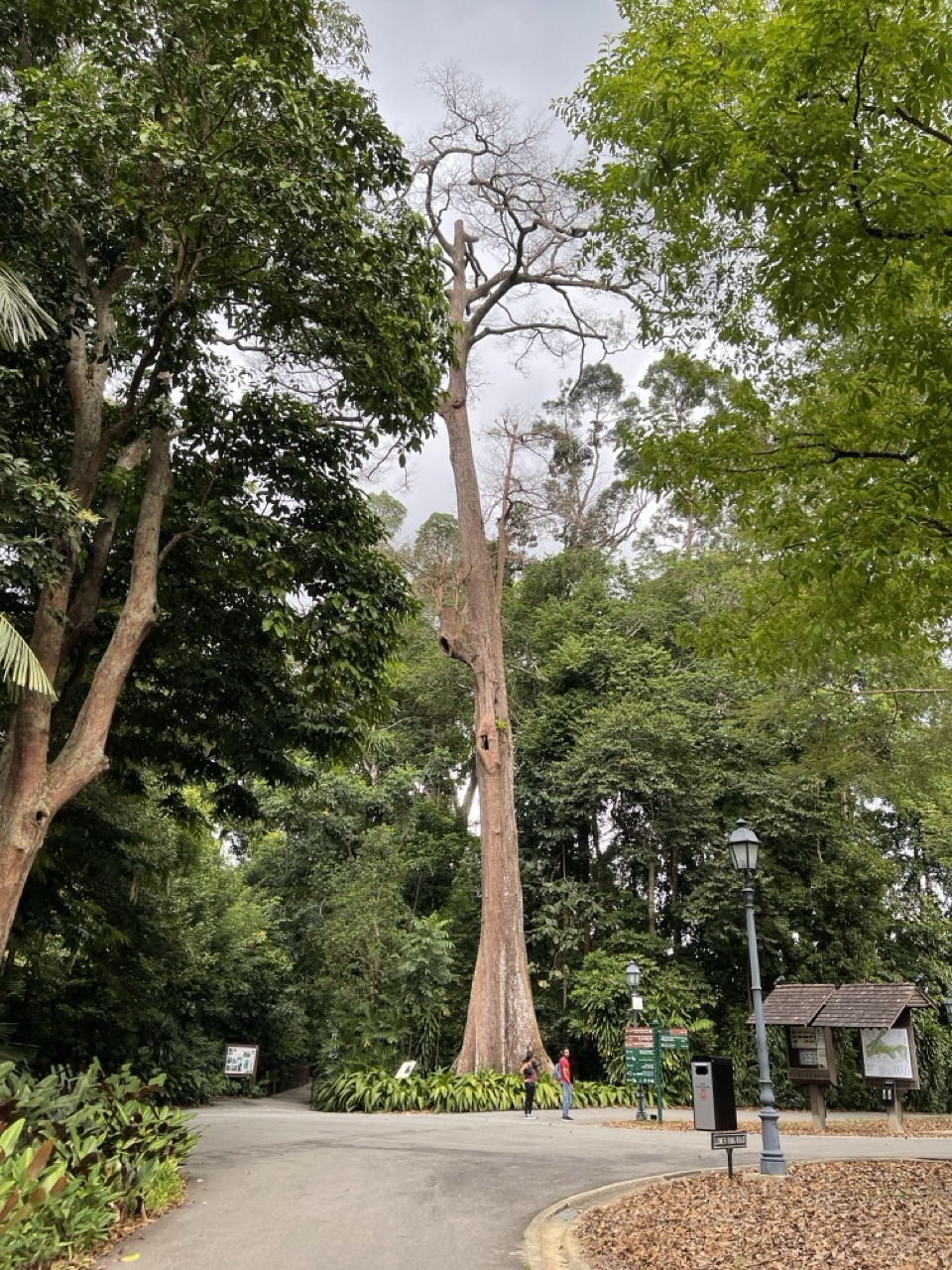
Singapore Botanic Gardens’ rubber history connects a pleasant place for a walk with experiments that helped reshape a regional industry. The story involves introduced plants, practical work on collecting latex and the effort to persuade growers to try something new. For Bukit Timah readers, it also reaches into the history of the Gardens’ northern land and the people living nearby.
Related Touring Singapore vocabulary: For the wider garden story that connects orchids, World Heritage, horticulture and plant science, explore Top 100 Singapore Vocabulary Words | Day 28: Singapore Botanic Gardens, UNESCO and Orchids. The Touring Singapore master hub connects this subject to the other numbered days. This is further reading, not a replacement for any current venue or access advice.
Choose your reading route
Rubber was a research question before a major industry · Ridley worked on the practical problem of latex · The Gardens’ northern land connects to Bukit Timah · A Gardens visit that notices more than scenery
1. Rubber was a research question before a major industry
NParks records Para Rubber seedlings being successfully planted at Singapore Botanic Gardens in 1877 under Henry James Murton. That was before Henry Nicholas Ridley arrived in 1888. Separating those stages matters: introducing a plant and developing its wider economic use were not one event. Read NParks’ historical note on Para Rubber and the Gardens’ institutional history.
A plant surviving in a garden is a beginning, not a complete production system. Someone still has to learn how it grows, what useful material it yields and whether the work can be repeated under different conditions.
You can compare this with a school experiment. A promising first result invites another question; it does not answer every question about scale, cost or reliability. The history becomes more convincing when we allow those intermediate steps to exist.
This also helps avoid a familiar storytelling shortcut: giving a single person credit for every stage of a long process. Dates and roles make room for the contributions that came before and alongside the best-known name.
2. Ridley worked on the practical problem of latex
The Gardens’ official history describes Ridley researching ways to tap latex without permanently harming the tree, preparing it for sale and persuading Malayan planters to cultivate rubber. It also identifies the Gardens as a major source of seed for new plantations. Read the section on Ridley and the rubber industry.
The practical question was not merely “can we obtain something?” It was “can we obtain it repeatedly while keeping the source productive?” That is a useful distinction in agriculture and in many other kinds of resource use.
Preparing a product and convincing others to adopt it are further tasks. A successful demonstration in one place does not automatically lead to use elsewhere. People need knowledge, planting material and reasons to change what they already do.
For young readers, try following the questions rather than memorising a hero story: can it grow, can it yield, can the method be repeated, and can another grower use it? Each question reveals a different part of the work.
3. The Gardens’ northern land connects to Bukit Timah
NParks’ history records an Economic Garden established to the north and says its land was later taken for the construction of Raffles College in the early 1920s. The relationship between botanical work and the neighbouring education landscape is therefore more than simple proximity. See the Economic Garden and Raffles College passage.
NHB’s Bukit Timah booklet identifies Haji Alias bin Ali, remembered in Jalan Haji Alias, as a Gardens gardener who worked with Ridley on rubber-tapping methods. This brings a local resident into a story often told mainly through institutional directors. Read the Kampong Tempe section of the heritage booklet.
The connection is worth holding onto without inventing conversations or scenes. We know the documented relationship; we do not need to imagine exactly what was said on a particular working day to make it meaningful.
Continue with our Kampong Tempe history and former Raffles College guide to see how the nearby stories meet.
4. A Gardens visit that notices more than scenery
Use the official Gardens history as a companion to your visit. It gives the landscape another dimension: a botanical institution can be a place of research and exchange as well as recreation.
Do not assume that any rubber tree you encounter is an original nineteenth-century specimen. Species identity, planting date and association with a historic experiment are separate claims. Nor does this article provide the location of an original surviving rubber tree.
For a learning activity, draw three boxes labelled plant, method and network. Put a question in each: what grows here, how is it used, and who passes the knowledge or material onward? That is a compact way to explain why a garden could matter far beyond its boundaries.
For practical access from the Bukit Timah side, see our Bukit Timah Gate walking guide. Choose your route using current information, and enjoy the Gardens as both a living landscape and a place where useful questions were pursued.