
Start with the primary Day 19 Singlish guide
This article is additional vocabulary and language-register reading, not a second numbered Day 19. The main published guide is Top 100 Singapore Vocabulary Words | Day 19: Singlish and Everyday Singapore Speech. Read it for the canonical hundred-term learning sequence and visitor examples. This companion preserves a deeper look at Singlish’s relationship with Standard Singapore English, code-switching, particles, cultural nuance and audience-appropriate language. Both articles are educational; no particular way of speaking is required to belong in Singapore.
Singlish is colloquial Singapore English, an informal variety shaped by contact among English, Malay and Chinese languages and other languages spoken here. Phrases such as can lah, shiok, paiseh and bo jio can signal agreement, pleasure, embarrassment or a playful complaint. They cannot always be translated word for word. Here are 100 Singlish expressions and closely related Singapore language-learning terms, each with meaning, a natural example and cultural context.
Why is Singlish part of Singapore culture? It helps some Singaporeans express humour, closeness, attitude and shared everyday experience in a recognisably local way. It is neither the only way to be Singaporean nor a substitute for clear Standard English where readers or listeners need it. SG101’s Singlish and National Identity describes both its cultural role and ongoing debate. Not every Singaporean uses the same expressions, and nobody has to speak Singlish to belong here.
For a quick answer, start with the particles guide or jump straight to the 100-word finder. The list includes established colloquial expressions, regional borrowings and ten interpretive terms. It is a guide to understanding people, not a claim that all 100 entries are uniquely Singaporean words, an official school syllabus or a script every resident follows.
Singlish in 30 seconds: how to understand it without a caricature
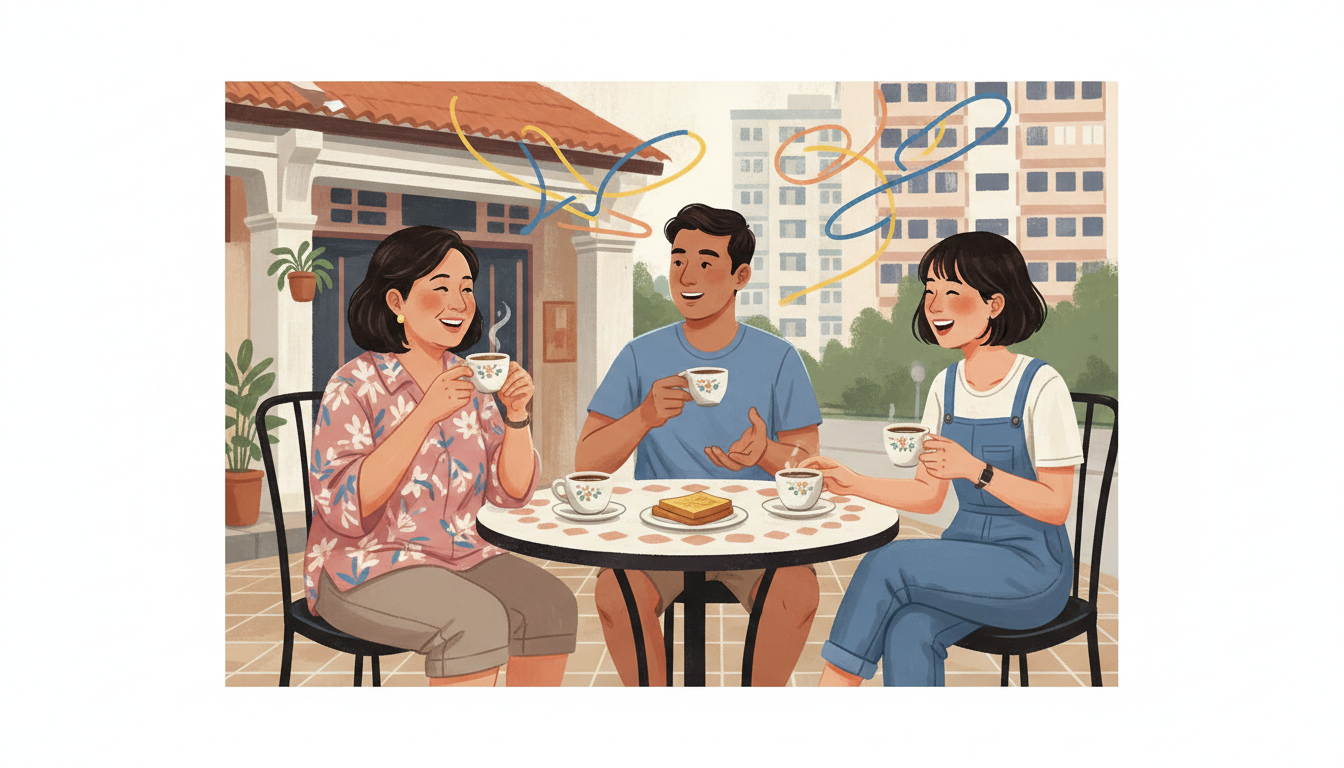
Two people may exchange “Tonight can?” and “Can lah” and understand an evening plan without full sentences. The phrase works because both know the plan; the particle and voice express an attitude as well as a decision. But “Can lah” should not replace a clear answer about a safety procedure, school examination, medical instruction or legal agreement.
Singlish is not simply adding lah to a Standard English sentence. Linguistic work on colloquial Singapore English studies its particles, grammar and histories of contact. A visitor can begin by listening for a speaker’s intention, then asking politely if a short reply is ambiguous.
The everyday distinction: local conversation versus formal English
- Among familiar friends: “Can lah, tomorrow we go makan.” This conveys an informal agreement and a relaxed shared plan.
- In a school composition: “We agreed to have lunch together the following day.” The same event is expressed in Standard English.
- In a customer message: “Yes, your booking for tomorrow is confirmed.” Here the date, certainty and action need to be explicit.
- In a sensitive situation: choose respectful, precise wording rather than a teasing term that could be misread or hurt someone.
This is about register and audience, not ranking one group of speakers as intelligent and another as ignorant. The Speak Good English Movement explicitly recognises Singlish as a cultural marker for many Singaporeans while encouraging proficiency in Standard English. Both cultural understanding and broad intelligibility can matter.
Why Singlish words cannot be given one permanent translation
Words such as lah, leh, lor, meh and hor are discourse particles: short forms that help shape stance, expectation and social contact. Scholarly accounts differ about some nuances; their functions can change with intonation and company. For example, “You sure meh?” sounds sceptical, while “We meet at six, hor?” can invite confirmation. Neither particle simply equals one ordinary English word.
Research by linguist Lisa Lim discusses how different contact languages influenced these particles over time. A later corpus-based study examines the historical use of ah, lah, leh, lor and meh. The historical account is richer than assigning all of Singlish to one ethnic group. Avoid inventing precise word origins when the source evidence or local variation does not support them.
The ten groups: what to learn first
- Group 1: What Singlish is: the language behind the words — terms 1–10
- Group 2: Particles: small sounds carrying big social meaning — terms 11–20
- Group 3: Can, cannot and quick answers — terms 21–30
- Group 4: Reactions: pleasure, tiredness and surprise — terms 31–40
- Group 5: Relationships, teasing and everyday social life — terms 41–50
- Group 6: At the kopitiam: food words mixed into English — terms 51–60
- Group 7: School, work and getting things done — terms 61–70
- Group 8: Time, urgency and informal requests — terms 71–80
- Group 9: Meaning larger than literal English — terms 81–90
- Group 10: Using local speech thoughtfully — terms 91–100
The 100-word finder: exact terms and quick links
1–10: 1. Singlish · 2. Colloquial Singapore English · 3. Standard Singapore English · 4. Register · 5. Code-switching · 6. Multilingualism · 7. Language contact · 8. Discourse particle · 9. Pragmatics · 10. Intonation
11–20: 11. Lah · 12. Leh · 13. Lor · 14. Meh · 15. Hor · 16. Ah · 17. Mah · 18. Sia · 19. Sentence-final what · 20. Bah
21–30: 21. Can · 22. Cannot · 23. Can or not? · 24. Can lah · 25. Can meh? · 26. Can already · 27. Can make it · 28. Got · 29. Got or not? · 30. Where got?
31–40: 31. Shiok · 32. Sian · 33. Paiseh · 34. Alamak · 35. Jialat · 36. Rabak · 37. Siao · 38. Power · 39. Solid · 40. Steady
41–50: 41. Kiasu · 42. Kiasi · 43. Kaypoh · 44. Sabo · 45. Wayang · 46. Kaki · 47. Jio · 48. Bo jio · 49. Lepak · 50. Chope
51–60: 51. Makan · 52. Tapao · 53. Kopitiam · 54. Kopi · 55. Teh · 56. Kopi-o · 57. Kopi-c · 58. Kosong · 59. Siew dai · 60. Gah dai
61–70: 61. Mug · 62. Chiong · 63. Kena · 64. Tahan · 65. Arrow · 66. Taichi · 67. Lobang · 68. Blur · 69. Blur like sotong · 70. Act blur
71–80: 71. Last time · 72. Later · 73. Now now · 74. Wait ah · 75. Chop chop · 76. OTOT · 77. On or not? · 78. Anyhow · 79. Already · 80. Just now
81–90: 81. Don’t play play · 82. Like that lor · 83. Like that also can? · 84. Ownself · 85. Ownself check ownself · 86. No need · 87. Never mind · 88. Orh · 89. Aiyo · 90. Walao
91–100: 91. Context clue · 92. Face-saving · 93. Politeness · 94. Familiarity · 95. Softening · 96. Challenge · 97. Shared knowledge · 98. Solidarity · 99. Translation · 100. Mutual intelligibility
How to learn: meaning, tone, audience and a Standard English alternative
Learn a colloquial expression in four moves: first, identify its likely meaning in a complete conversational situation; second, notice the speaker’s tone and relationship with the listener; third, decide whether using it yourself would be suitable; fourth, practise an accurate Standard English alternative. For example, bo jio may be a friendly complaint that someone was not invited. In a formal message, say plainly: “I would like to join next time, if possible.”
Some entries in the list are regional words shared across borders; others are local uses of familiar English words, and the last group consists of interpretive concepts rather than slang. Keep those distinctions. A list becomes genuinely useful when you can explain why a word was chosen, not just repeat it with an exaggerated accent.
Group 1 — What Singlish is: the language behind the words
Singlish is a variety of everyday speech, not merely a list of funny expressions. These first ten terms give readers tools to explain how language use shifts across home, work, school, neighbourhood and public communication.
1. Singlish
Meaning: An informal, recognisable variety of colloquial Singapore English shaped by multilingual contact. In context: “Two friends slipped into Singlish over kopi.” Cultural note and usage boundary: It carries social meanings that word-for-word Standard English may miss.
2. Colloquial Singapore English
Meaning: The everyday, informal Singapore English variety discussed by linguists. In context: “The researcher studied colloquial Singapore English conversations.” Cultural note and usage boundary: It provides a more precise label when discussing grammar and discourse particles.
3. Standard Singapore English
Meaning: The standard form of English used in Singaporean formal writing and communication. In context: “She switched to Standard Singapore English for the report.” Cultural note and usage boundary: Singapore English is not all informal; formal and informal varieties coexist.
4. Register
Meaning: A style of language suited to a particular setting, relationship or purpose. In context: “The email needed a more formal register than the group chat.” Cultural note and usage boundary: Choosing the audience matters more than copying local slang everywhere.
5. Code-switching
Meaning: Moving between language varieties or languages according to context. In context: “He used code-switching when speaking to a visiting colleague.” Cultural note and usage boundary: Many Singaporeans adjust speech without changing their identity.
6. Multilingualism
Meaning: Use or knowledge of more than one language within a society or person. In context: “Singapore’s multilingualism helps explain everyday borrowed expressions.” Cultural note and usage boundary: Do not assume every Singaporean knows the same home languages.
7. Language contact
Meaning: Interaction between languages that can influence vocabulary and grammar. In context: “Language contact shaped local English over time.” Cultural note and usage boundary: Singlish did not arise from just one source language.
8. Discourse particle
Meaning: A short expression that changes a speaker’s stance or conversational effect. In context: “The particle lah changed how the sentence sounded.” Cultural note and usage boundary: Particles often cannot be translated with one fixed English word.
9. Pragmatics
Meaning: The study of meaning as affected by speakers, listeners and context. In context: “Pragmatics explains why a short can may be a whole answer.” Cultural note and usage boundary: Literal grammar alone cannot capture the full social message.
10. Intonation
Meaning: The rise and fall of a speaker’s voice. In context: “Her intonation turned a short reply into a friendly question.” Cultural note and usage boundary: A written word may sound approving, doubtful or impatient in different voices.
Quick practice: Pick two expressions from Group 1. Write a short exchange between people who know each other. Then explain its meaning in Standard English and identify one setting where you would change the wording.
Group 2 — Particles: small sounds carrying big social meaning
These particles appear in studies of Colloquial Singapore English. Their meanings depend on position, intonation, conversational history and speaker community. The examples are illustrations, not one-word translations that work every time.
11. Lah
Meaning: A sentence-final particle with several uses, often colouring assurance, insistence or shared understanding. In context: “Can lah, we have time.” Cultural note and usage boundary: It does more than make an English sentence sound Singaporean.
12. Leh
Meaning: A particle that can mark contrast, surprise, a mild suggestion or other stance. In context: “This one quite nice leh.” Cultural note and usage boundary: The exact effect is contextual rather than one permanent meaning.
13. Lor
Meaning: A particle often associated with acceptance, resignation or drawing an obvious conclusion. In context: “If you prefer that route, like that lor.” Cultural note and usage boundary: Tone can make the same phrase relaxed or annoyed.
14. Meh
Meaning: A particle frequently used to question or express doubt about a claim. In context: “Tomorrow got lesson meh?” Cultural note and usage boundary: A raised challenge is not necessarily hostility.
15. Hor
Meaning: A particle that may seek confirmation or invite shared acknowledgement. In context: “We meet at six, hor?” Cultural note and usage boundary: It often attends to the listener’s response.
16. Ah
Meaning: A widely used particle whose function changes with position and tone. In context: “You going home ah?” Cultural note and usage boundary: Do not translate every ah as a question mark.
17. Mah
Meaning: A particle sometimes used when explaining something as obvious or already expected. In context: “Of course can mah.” Cultural note and usage boundary: Its meaning overlaps with other conversational cues, and speakers vary.
18. Sia
Meaning: An expressive particle associated with an emphatic informal reaction. In context: “That queue very long sia.” Cultural note and usage boundary: Use it cautiously; it is conspicuously casual and age or group patterns differ.
19. Sentence-final what
Meaning: The word what used as a conversational particle rather than a normal question word. In context: “He told you already what.” Cultural note and usage boundary: Here it may express that something was already known, not ask what happened.
20. Bah
Meaning: A less universal discourse particle heard in some colloquial contexts. In context: “Maybe try another day bah.” Cultural note and usage boundary: It is not a standard requirement for Singlish and its distribution varies.
Quick practice: Pick two expressions from Group 2. Write a short exchange between people who know each other. Then explain its meaning in Standard English and identify one setting where you would change the wording.
Group 3 — Can, cannot and quick answers
A small cluster around can shows why Singlish is not just a vocabulary swap. A single word can complete a whole negotiation when the situation is shared. Listen for what question the answer actually addresses.
21. Can
Meaning: An affirmative reply that may mean possible, acceptable or agreed. In context: “Can, I will bring it later.” Cultural note and usage boundary: The surrounding question decides whether it means ability, permission or consent.
22. Cannot
Meaning: A compact negative reply meaning not possible, not allowed or not acceptable in context. In context: “Cannot, the shop is closed.” Cultural note and usage boundary: Ask for clarification when the reason is important.
23. Can or not?
Meaning: An informal question about possibility, permission or acceptability. In context: “Tomorrow morning can or not?” Cultural note and usage boundary: In formal writing, use a complete question tailored to the intended meaning.
24. Can lah
Meaning: A reassuring or emphatic affirmative phrase. In context: “Don’t worry, can lah.” Cultural note and usage boundary: It can sound encouraging but is not a legal or technical guarantee.
25. Can meh?
Meaning: An expression of doubt about whether something is possible. In context: “That shortcut can meh?” Cultural note and usage boundary: The speaker is asking for evidence, not simply asking permission.
26. Can already
Meaning: A phrase indicating a sufficient result or that nothing more is needed. In context: “The seats are booked, can already.” Cultural note and usage boundary: Sufficiency is different from exceptional quality.
27. Can make it
Meaning: An informal expression meaning able to attend or succeed, depending on context. In context: “I cannot make it for lunch today.” Cultural note and usage boundary: Not making it to an event is different from failing an examination.
28. Got
Meaning: In colloquial use, an existence or possession marker in some questions and statements. In context: “Got seats at the back?” Cultural note and usage boundary: Use there are or do you have when clarity requires Standard English.
29. Got or not?
Meaning: A compact colloquial way to ask whether something exists or is available. In context: “Got vegetarian option or not?” Cultural note and usage boundary: The object and situation need to be understood by both speakers.
30. Where got?
Meaning: A colloquial challenge meaning roughly that a claim is not true. In context: “Where got so expensive?” Cultural note and usage boundary: It is not always a literal request to identify a location.
Quick practice: Pick two expressions from Group 3. Write a short exchange between people who know each other. Then explain its meaning in Standard English and identify one setting where you would change the wording.
Group 4 — Reactions: pleasure, tiredness and surprise
Emotion words are vivid but easy to overgeneralise. They are learned from conversation and media, and the same word may be warm among friends but rude with a stranger.
31. Shiok
Meaning: A word for intense enjoyment or satisfaction, often about food or comfort. In context: “The cold drink after the walk was shiok.” Cultural note and usage boundary: Enjoyment is subjective; it does not mean a dish has won an award.
32. Sian
Meaning: An informal expression of boredom, weariness or frustration. In context: “Sian, the bus has been delayed again.” Cultural note and usage boundary: Its force depends on tone and the speaker’s situation.
33. Paiseh
Meaning: An expression of embarrassment, self-consciousness or apologetic reluctance. In context: “Paiseh, I forgot to reply.” Cultural note and usage boundary: People use it to acknowledge social awkwardness without a long explanation.
34. Alamak
Meaning: An exclamation of surprise, alarm or dismay. In context: “Alamak, I left my umbrella behind.” Cultural note and usage boundary: It travels across language communities and is not exclusive to Singlish.
35. Jialat
Meaning: An informal description of a troublesome or bad situation. In context: “The traffic today is jialat.” Cultural note and usage boundary: It signals evaluation, not a measured severity scale.
36. Rabak
Meaning: A colloquial word for something in poor condition or seriously troublesome. In context: “The torn bag was rabak after the trip.” Cultural note and usage boundary: Usage varies and the word is too casual for formal safety reporting.
37. Siao
Meaning: An informal expression of disbelief or an insult implying craziness. In context: “Siao ah, why rush like that?” Cultural note and usage boundary: It can sound hurtful or stigmatising; avoid applying it to mental health or people.
38. Power
Meaning: Informal enthusiastic praise meaning very capable or impressive. In context: “Your presentation was power.” Cultural note and usage boundary: The English noun has acquired a local conversational use in some settings.
39. Solid
Meaning: Informal praise for a reliable or impressive effort. In context: “That was a solid idea.” Cultural note and usage boundary: Outside local talk, solid also has ordinary Standard English meanings.
40. Steady
Meaning: A local approving word for a dependable, skilful or agreeable action. In context: “Steady, thanks for helping us.” Cultural note and usage boundary: It is not always the dictionary meaning of physically stable.
Quick practice: Pick two expressions from Group 4. Write a short exchange between people who know each other. Then explain its meaning in Standard English and identify one setting where you would change the wording.
Group 5 — Relationships, teasing and everyday social life
Some expressions strengthen a sense of being part of a group; others criticise behaviour or tease someone. A language learner should understand them without feeling obliged to use every one.
41. Kiasu
Meaning: An informal term for excessive fear of losing out or intense competitive caution. In context: “He queued early because he was feeling kiasu.” Cultural note and usage boundary: It can be teasing or critical, not an unchangeable national personality trait.
42. Kiasi
Meaning: An informal term associated with fearfulness or excessive caution. In context: “My friend joked that I was kiasi about the ride.” Cultural note and usage boundary: Do not equate everyday caution with a character flaw.
43. Kaypoh
Meaning: A term for being nosy or overly curious about others’ affairs. In context: “Don’t be kaypoh about their private plans.” Cultural note and usage boundary: A gentle joke between friends can be rude when directed at a stranger.
44. Sabo
Meaning: To sabotage, trick or put someone in an awkward position, colloquially. In context: “Don’t sabo me by changing the plan secretly.” Cultural note and usage boundary: Friendly joking should not excuse genuine harm.
45. Wayang
Meaning: In colloquial speech, performative behaviour intended to impress or be seen. In context: “He called the dramatic display wayang.” Cultural note and usage boundary: This is not the only meaning of the word, which also refers to performance traditions.
46. Kaki
Meaning: A friend or regular companion for a particular activity. In context: “She is my badminton kaki.” Cultural note and usage boundary: The borrowed word captures the comfort of shared routines.
47. Jio
Meaning: To invite someone to join an outing or activity. In context: “Jio me if you go for supper.” Cultural note and usage boundary: It often belongs to casual friend-to-friend plans.
48. Bo jio
Meaning: An exclamation that someone was not invited. In context: “You went for chicken rice? Bo jio!” Cultural note and usage boundary: Usually playful, but exclusion can also be genuine.
49. Lepak
Meaning: To relax or hang out without a pressing task. In context: “We lepak at the void deck after the game.” Cultural note and usage boundary: A common regional borrowing that is not uniquely Singaporean.
50. Chope
Meaning: To reserve or claim a space in informal local usage. In context: “Someone used a tissue packet to chope a seat.” Cultural note and usage boundary: A local custom is context-specific; do not assume every venue accepts it.
Quick practice: Pick two expressions from Group 5. Write a short exchange between people who know each other. Then explain its meaning in Standard English and identify one setting where you would change the wording.
Group 6 — At the kopitiam: food words mixed into English
Local food talk crosses boundaries between languages. Some words are borrowed from Malay, Hokkien or other languages and remain widely understood around the region. This list is about their use in Singapore conversations, not claiming exclusive ownership.
51. Makan
Meaning: A Malay word meaning eat or food in a range of contexts. In context: “We makan after the movie.” Cultural note and usage boundary: It is common across Malay-speaking communities beyond Singapore.
52. Tapao
Meaning: A colloquial way to ask for food packed to take away, with spelling variations. In context: “Can tapao this rice, please?” Cultural note and usage boundary: Different stalls may use tapao, dabao or simply takeaway.
53. Kopitiam
Meaning: A local coffee shop, often serving drinks and food from several stalls. In context: “We met at the kopitiam downstairs.” Cultural note and usage boundary: The space is part of neighbourhood social life, not only coffee.
54. Kopi
Meaning: A local coffee drink with customary ordering variations. In context: “Two kopi, please.” Cultural note and usage boundary: The standard recipe depends on the local coffee-drink system and stall.
55. Teh
Meaning: Tea in everyday local drink-ordering vocabulary. In context: “She ordered teh with breakfast.” Cultural note and usage boundary: It comes from a wider regional language landscape.
56. Kopi-o
Meaning: A local order for black coffee, usually sweetened unless qualified. In context: “He asked for kopi-o.” Cultural note and usage boundary: The suffix changes how the drink is prepared; check preferences.
57. Kopi-c
Meaning: A coffee order typically made with evaporated milk. In context: “She prefers kopi-c in the morning.” Cultural note and usage boundary: Do not confuse it with the condensed milk used in a typical kopi.
58. Kosong
Meaning: In local drink orders, a word signalling no added sugar. In context: “Kopi-o kosong, please.” Cultural note and usage boundary: It matters when ordering for a person avoiding added sugar.
59. Siew dai
Meaning: A common local drink instruction for less sugar. In context: “Kopi siew dai for me.” Cultural note and usage boundary: Less sugar is not necessarily zero sugar.
60. Gah dai
Meaning: A local ordering instruction for extra sweetness. In context: “My uncle asked for kopi gah dai.” Cultural note and usage boundary: An unusual order is still worth clarifying if the stall uses different terminology.
Quick practice: Pick two expressions from Group 6. Write a short exchange between people who know each other. Then explain its meaning in Standard English and identify one setting where you would change the wording.
Group 7 — School, work and getting things done
Local English includes verbs for studying hard, rushing, being appointed and coping. These words can carry affection or criticism; formal contexts usually benefit from more explicit alternatives.
61. Mug
Meaning: To study intensively, especially before a test, in Singapore student talk. In context: “We mugged for the science quiz.” Cultural note and usage boundary: Here mug is not the same verb as robbing a person.
62. Chiong
Meaning: To rush forward or push hard to complete something. In context: “We had to chiong the project before Friday.” Cultural note and usage boundary: The word may suggest pressure rather than careful progress.
63. Kena
Meaning: To be affected by something, often unpleasant, in colloquial speech. In context: “I kena caught in the rain.” Cultural note and usage boundary: It comes from Malay and is used in many regional contexts.
64. Tahan
Meaning: To endure or withstand an unpleasant situation. In context: “I cannot tahan the noise tonight.” Cultural note and usage boundary: The word is commonly borrowed from Malay, not a precise medical term.
65. Arrow
Meaning: To assign an unwanted task to someone, often unexpectedly. In context: “I got arrowed to organise the meeting.” Cultural note and usage boundary: It can suggest a lack of choice, so use the accusation carefully.
66. Taichi
Meaning: In workplace slang, to deflect a responsibility to someone else. In context: “Please don’t taichi the problem to another team.” Cultural note and usage boundary: It is a metaphor and not the same as the martial art.
67. Lobang
Meaning: An opportunity, contact, tip or opening that may help someone. In context: “Got any lobang for a weekend job?” Cultural note and usage boundary: The informal sense differs from its other regional meanings.
68. Blur
Meaning: Confused or slow to understand something in colloquial talk. In context: “I was blur about the new timetable.” Cultural note and usage boundary: It is often temporary; don’t define a person by one confused moment.
69. Blur like sotong
Meaning: A playful expression for being very confused. In context: “I was blur like sotong on my first day.” Cultural note and usage boundary: The image refers to a squid; it can also embarrass someone.
70. Act blur
Meaning: To pretend not to know or notice something. In context: “He acted blur when asked to clean up.” Cultural note and usage boundary: Unlike simply being confused, this phrase implies deliberate avoidance.
Quick practice: Pick two expressions from Group 7. Write a short exchange between people who know each other. Then explain its meaning in Standard English and identify one setting where you would change the wording.
Group 8 — Time, urgency and informal requests
Time expressions are particularly risky for non-local readers because they may sound exact when the speaker intends something vague. If a deadline matters, ask for the actual time.
71. Last time
Meaning: In local conversation, a phrase often introducing how things used to be. In context: “Last time this market looked different.” Cultural note and usage boundary: It commonly refers to the past generally, not necessarily the previous occasion.
72. Later
Meaning: An informal promise or suggestion about a future moment. In context: “We talk later.” Cultural note and usage boundary: For appointments, replace later with a stated time.
73. Now now
Meaning: A colloquial expression suggesting a moment very close to the present. In context: “She was here just now now.” Cultural note and usage boundary: Use precise clock times when a schedule matters.
74. Wait ah
Meaning: A short request for the listener to pause. In context: “Wait ah, I need to check the map.” Cultural note and usage boundary: The particle changes the conversational feel, not the length of the wait.
75. Chop chop
Meaning: A brisk way of urging someone to hurry. In context: “Chop chop, the bus is coming.” Cultural note and usage boundary: It is informal and may sound bossy in the wrong relationship.
76. OTOT
Meaning: An initialism for own time, own target, used for flexible timing in some Singapore settings. In context: “The group said the reading was OTOT.” Cultural note and usage boundary: It does not necessarily mean there is no eventual deadline.
77. On or not?
Meaning: A casual question about whether someone is keen to join a plan. In context: “Movie tonight, on or not?” Cultural note and usage boundary: It asks about participation, not whether a device is switched on.
78. Anyhow
Meaning: Carelessly or without a sensible plan in local conversational use. In context: “Don’t anyhow cross the road.” Cultural note and usage boundary: It is a judgement about behaviour; avoid assuming someone’s intentions.
79. Already
Meaning: A marker often used for a completed state in colloquial speech. In context: “We ate already.” Cultural note and usage boundary: Formal writing may express the same idea with a full tense construction.
80. Just now
Meaning: A phrase meaning a short time earlier, though exact range varies. In context: “He called just now.” Cultural note and usage boundary: For an incident report, record the actual timestamp rather than relying on this phrase.
Quick practice: Pick two expressions from Group 8. Write a short exchange between people who know each other. Then explain its meaning in Standard English and identify one setting where you would change the wording.
Group 9 — Meaning larger than literal English
This cluster includes useful phrases that frequently depend on the preceding conversation. Read them as whole social moves, not as a list of translations to memorise and insert anywhere.
81. Don’t play play
Meaning: A warning not to underestimate someone or treat something lightly. In context: “Don’t play play, she trained for months.” Cultural note and usage boundary: The double verb supplies emphasis; it is not about a literal game.
82. Like that lor
Meaning: An acceptance or resigned response to how things are. In context: “If the shop is closed, like that lor.” Cultural note and usage boundary: Meaning can range from calm acceptance to mild exasperation.
83. Like that also can?
Meaning: A surprised or sceptical reaction to something being allowed or workable. In context: “No timetable at all? Like that also can?” Cultural note and usage boundary: Tone decides whether it sounds amused or disapproving.
84. Ownself
Meaning: A colloquial way of referring to oneself in certain familiar phrases. In context: “Ownself cook, ownself eat.” Cultural note and usage boundary: The phrase may sound odd in Standard English without adjustment.
85. Ownself check ownself
Meaning: An expression criticising a lack of independent scrutiny. In context: “He worried the group was ownself check ownself.” Cultural note and usage boundary: It often belongs to commentary about accountability rather than a literal inspection.
86. No need
Meaning: A compact reply that something is unnecessary. In context: “No need, I have brought water.” Cultural note and usage boundary: It can be polite, blunt or dismissive depending on delivery.
87. Never mind
Meaning: A familiar expression for reassurance, dismissal or moving on. In context: “Never mind, we can try tomorrow.” Cultural note and usage boundary: The surface English is standard, but the social intent still depends on tone.
88. Orh
Meaning: A written or spoken acknowledgement meaning something like I see or okay in context. In context: “Orh, now I understand the route.” Cultural note and usage boundary: Spelling and tone vary; it is usually unsuitable in formal writing.
89. Aiyo
Meaning: An exclamation of surprise, worry or mild frustration. In context: “Aiyo, my bag is still upstairs.” Cultural note and usage boundary: Its use extends beyond Singapore and is not a fixed emotion label.
90. Walao
Meaning: An emphatic, informal exclamation of frustration or astonishment. In context: “Walao, the queue is long today.” Cultural note and usage boundary: It can be impolite or offensive in some settings; understand it before using it.
Quick practice: Pick two expressions from Group 9. Write a short exchange between people who know each other. Then explain its meaning in Standard English and identify one setting where you would change the wording.
Group 10 — Using local speech thoughtfully
The final ten are analytical vocabulary: tools for interpreting a local exchange rather than extra Singlish slang. They help learners protect both cultural appreciation and clear communication.
91. Context clue
Meaning: Information in a situation or nearby words that helps explain meaning. In context: “The smiling reply gave a context clue about lah.” Cultural note and usage boundary: Never translate a particle without seeing the surrounding exchange.
92. Face-saving
Meaning: Communication that avoids unnecessary embarrassment to someone. In context: “The reply offered a face-saving way to decline.” Cultural note and usage boundary: It is a social concept rather than one language’s exclusive invention.
93. Politeness
Meaning: Speech or behaviour that shows appropriate consideration for others. In context: “She chose politeness over teasing the newcomer.” Cultural note and usage boundary: A word common among friends can still sound rude in an interview.
94. Familiarity
Meaning: The closeness or shared history between speakers. In context: “The joke worked because of their familiarity.” Cultural note and usage boundary: Do not assume the same phrase suits strangers.
95. Softening
Meaning: Making a request or statement feel less abrupt. In context: “The speaker used a friendly tone for softening.” Cultural note and usage boundary: A particle does not automatically make every command polite.
96. Challenge
Meaning: A response that questions or disagrees with what was said. In context: “Can meh sounded like a challenge to the claim.” Cultural note and usage boundary: Challenge may be playful, sceptical or serious.
97. Shared knowledge
Meaning: Background information assumed to be known by both speakers. In context: “Their shared knowledge made a short can clear.” Cultural note and usage boundary: Without the shared situation, outsiders may misread a reply.
98. Solidarity
Meaning: A sense of belonging or mutual support signalled through language. In context: “The friends’ joking speech expressed solidarity.” Cultural note and usage boundary: Not speaking Singlish does not make someone less Singaporean.
99. Translation
Meaning: Expressing meaning in another language or variety. In context: “Her translation explained the intended attitude, not just the words.” Cultural note and usage boundary: Pragmatic effects sometimes need a sentence of explanation.
100. Mutual intelligibility
Meaning: How well speakers can understand one another. In context: “She moved to Standard English to improve mutual intelligibility.” Cultural note and usage boundary: Clear communication and pride in local speech can coexist.
Quick practice: Pick two expressions from Group 10. Write a short exchange between people who know each other. Then explain its meaning in Standard English and identify one setting where you would change the wording.
Worked translation: three short exchanges, three different intentions
Exchange A: “Can or not?” — “Can lah.” Here the second person agrees or reassures. If the question concerns a booking, the clear Standard English response would be “Yes, I can make the booking for Saturday.” Notice how the full version states the action.
Exchange B: “That cheap meh?” This may express doubt about a price claim. A careful translation is “Are you sure it is that inexpensive?” It does not tell us the actual price. We should not add evidence that the speaker did not offer.
Exchange C: “Bo jio!” Said with a laugh to friends, it can mean “You went without inviting me!” Said angrily after repeated exclusions, it might be a serious complaint. The social circumstances change the interpretation.
A school paragraph written for a general audience
“At the neighbourhood coffee shop, my cousins traded short replies that made perfect sense to them. When one asked about the weekend plan, another said ‘Can lah’ without looking up from his drink. I knew the simple answer was agreement, but the easy warmth came from their shared history. Later, when speaking to a visitor who did not know those expressions, my cousin explained the plan in clear Standard English. Nothing about our friendship disappeared when the register changed; the words simply reached a different listener.”
In a reflective essay about language, a writer can quote a little Singlish as evidence, define it and explain the context. In a formal explanatory answer, the main grammar and argument should remain clear to readers beyond Singapore. This is audience awareness, not a ban on local identity.
Ten rapid questions: check understanding, not pronunciation
- 1. Is Singlish identical to all forms of Singapore English?
- 2. Why might one can mean yes and another can mean permission?
- 3. What can the particle meh signal?
- 4. Why is it unhelpful to translate every lah into the same word?
- 5. What is the difference between paiseh and a formal apology?
- 6. Does bo jio always communicate real anger?
- 7. Is makan a word used only in Singapore?
- 8. When is got or not? less useful than a full question?
- 9. Can not speaking Singlish make someone less Singaporean?
- 10. What would you change when writing a professional email?
Answers: 1 no; 2 context and the question change the interpretation; 3 doubt or challenge in many contexts; 4 stance and intonation vary; 5 paiseh can express awkwardness as well as regret; 6 no, playful teasing is possible; 7 no, it is a Malay word used regionally; 8 when the item or consequence must be precise; 9 no; 10 make the request, action, time and level of formality explicit.
Ten questions parents, students and visitors ask
1. What exactly is Singlish?
It is an informal variety of Singapore English shaped by local multilingual histories and social use. It has studied patterns of grammar and conversational particles; it is not merely random mistakes or English with lah sprinkled everywhere.
2. Do all Singaporeans speak the same Singlish?
No. Age, family language, neighbourhood, community, schooling, friendship circles and personal preferences affect usage. A person may know an expression but not choose to use it.
3. Is Singlish the same as Standard Singapore English?
No. Standard Singapore English is the formal variety used for broad clarity; Singlish usually refers to the colloquial variety. Speakers may move between them depending on audience.
4. Does lah always mean the same thing?
No. Tone, context and the kind of sentence change the effect. It can signal assurance, emphasis or another stance. A single English substitute is unreliable.
5. Is Singlish broken English?
Treat Singlish as a real colloquial language variety rather than assuming it is random error. At the same time, distinguish deliberate colloquial patterns from English errors that impede understanding; a speaker may need Standard English for particular tasks.
6. Is Singlish an officially recognised heritage language?
Singlish has significant cultural recognition and public debate, but avoid claiming it is an officially inscribed UNESCO language or Singapore intangible heritage element. SG101 describes the relationship as contested.
7. Where do Singlish words come from?
Different expressions show influences from Malay, Hokkien, Cantonese, Mandarin, English and other language contact. The history is not a single straight-line translation; scholarly accounts trace particular particles across different periods.
8. Can Singlish appear in school work?
A local expression may appear as dialogue, quotation or an object of analysis. When an assignment requires formal Standard English, use the expected register for your own explanation and follow your teacher’s instructions.
9. Should a visitor copy an accent to sound local?
No. Listen respectfully, ask what expressions mean and use words only when you understand the situation. Exaggerated imitation or stereotyping can make an otherwise friendly exchange uncomfortable.
10. What is a good way to practise these 100 terms?
Choose ten that you actually hear or read. Record context, intended meaning and tone; rewrite each in appropriate Standard English. Practise recognising more terms before trying to use them all.
Sources: culture, official language guidance and linguistic study
- SG101: Singlish and our National Identity — a Singapore public-education account of language history, cultural value and debate.
- Speak Good English Movement: About Us — official aims for Standard English and recognition that Singlish is a cultural marker for many.
- Lisa Lim: Mergers and acquisitions — origins of Singapore English particles — scholarly study of language contact and discourse particles.
- Cambridge University Press: variation in colloquial Singapore English particles — research noting that particle definitions and speaker patterns are not uniform.
- Li, Lorenz and Siemund: Ages of pragmatic particles in Colloquial Singapore English — historical corpus study based on oral-history interviews.
- SG101: Creating a shared identity as Singaporeans — a reminder that identity changes across generations and communities.
Continue into Singapore culture and the language-learning library
Return to the Top 100 Singapore Vocabulary Words | Touring and Visiting pillar for the broader Singapore series. Read Day 18: Chicken Rice and Hawker Culture to see how local food and shared phrases meet at a table, then explore How Singlish Works for a separate conceptual explanation. The eduKate vocabulary hub provides further reading about meaning and transfer.
The most useful word is the one that helps someone understand you
A local expression can be funny, warm, efficient or revealing, but not every exchange needs one. Listen to how a friend uses a particle; notice where the friendship makes a short answer understandable; and learn how to explain the same idea to somebody outside that conversation. The point of these hundred entries is not to pass a test of being Singaporean. It is to hear more accurately, speak with consideration and carry the best of a local voice into conversations with other people.