
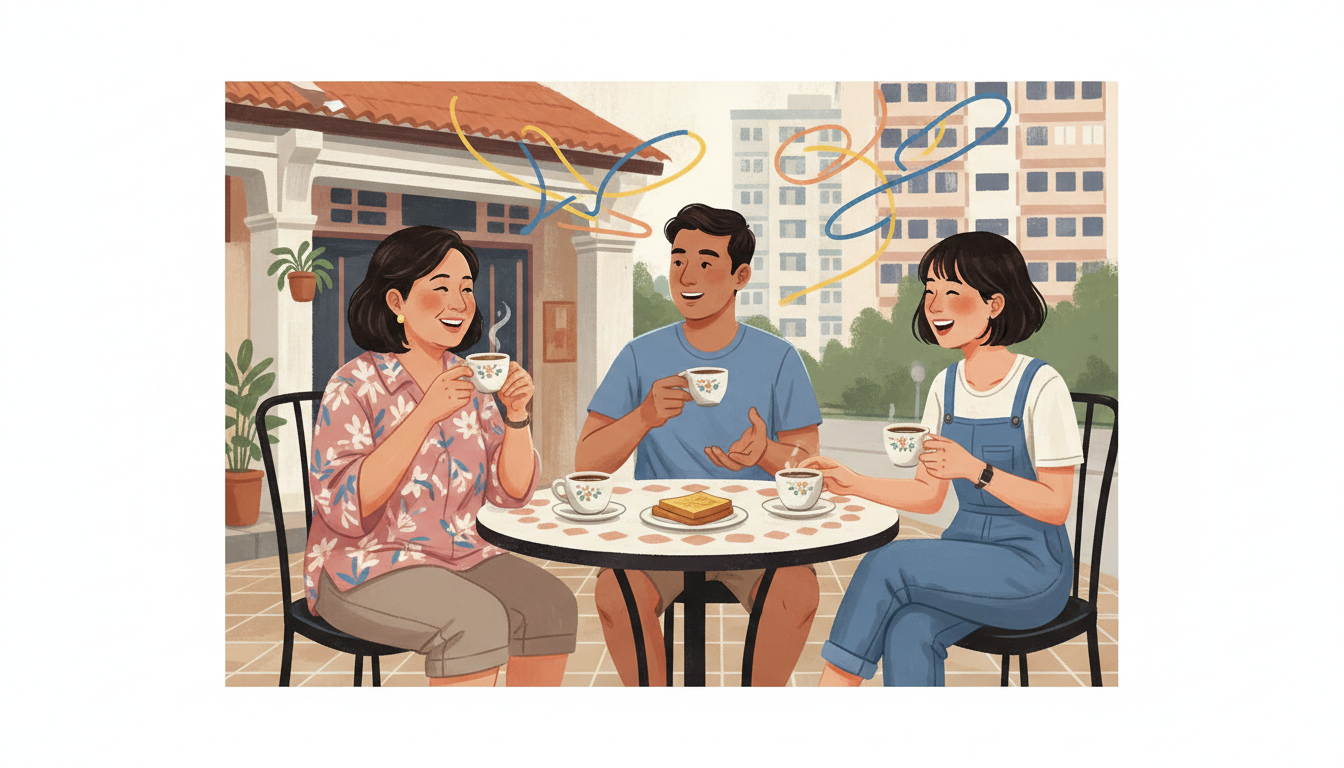
Singlish is Singapore’s familiar colloquial English: a way of speaking shaped by English alongside Malay, Hokkien, Cantonese and other languages in daily contact. Words such as shiok, paiseh, makan and chope, and particles such as lah, lor and meh, help people express feeling, shared knowledge and belonging. Here are 100 Singapore vocabulary terms with clear meanings, natural examples and the cultural context readers need.
Why is Singlish part of Singapore culture? In a multilingual country it grew as people adapted English for informal local communication. It is meaningful to many speakers without being compulsory, universal or suitable for every setting. Singapore’s Speak Good English Movement resource guide distinguishes colloquial Singlish from Standard Singapore English, and SG101’s Singlish and national identity account explains why both identity and clear formal communication matter.
Jump to the 100-term quick finder or go straight to the particles, coffee-shop language, or the questions families ask most often. The list combines commonly heard Singlish terms with language-study and Singapore place words needed to understand them; the distinction is explained throughout. No guide can make every Singaporean sound alike.
Singlish in one minute: what to know first
A local friend may say, “Can lah, we makan later.” In ordinary Standard English, the message is “Yes, we can eat later.” But the local sentence has an additional social feel: its concise agreement, the particle lah, and the borrowed word makan can signal warmth and familiarity. That does not mean every use of lah is friendly or every use of makan is unique to Singapore. Tone, setting and listeners matter.
A standardised school assignment, job application or letter to an international reader may need a more conventional register, while a relaxed conversation among familiar people may naturally use colloquial English. That is a difference of purpose, not a contest about which speaker is more Singaporean.
Why the language formed here: English, migration and contact
Singapore’s history brought speakers of different regional and community languages together in markets, homes, work and schools. English became a widespread language of education and cross-community communication, while Hokkien, Malay, Cantonese and other varieties continued to influence informal everyday speech. Today’s Singlish is the product of sustained language contact, not a fixed mixture that was invented at one moment.
The government-linked SG101 overview documents the debate over Singlish, identity and Standard English. The Speak Good English Movement’s Let’s Connect booklet describes Singapore English as a range from colloquial Singlish to formal Standard Singapore English. Both accounts encourage attention to the communication situation rather than lazy claims that everyone speaks exactly alike.
What is a local word, and what is a tool for understanding one?
- Distinctively local or locally characteristic expressions: shiok, paiseh, bo jio, chope, can or not, and familiar particles such as lah.
- Borrowed expressions widely shared across the region: makan, alamak, lepak and other expressions that Singaporeans may use but do not exclusively own.
- Singapore places and practices: kopitiam, void deck, hawker centre and MRT station—these describe the settings in which people talk.
- Language-study tools: code-switching, pragmatics, intonation and audience awareness—ordinary English academic terms that help explain how Singlish works.
This matters because a reader searching for “100 Singlish words” deserves to know which entries are actually colloquial expressions. A heritage story is more useful when it names multilingual sources and avoids presenting borrowed words as inventions owned by a single country.
Ten reading routes through 100 Singapore terms
- 1. The particles that make short sentences social — 1–10
- 2. Everyday feelings, judgements and personality — 11–20
- 3. Actions people use around friends and food — 21–30
- 4. Places where local conversation happens — 31–40
- 5. Coffee-shop language and ordering — 41–50
- 6. Short answers, compact grammar and implied meaning — 51–60
- 7. Exclamations and reactions in company — 61–70
- 8. Choosing a register that respects the listener — 71–80
- 9. How this vocabulary came together — 81–90
- 10. How to interpret and write local speech carefully — 91–100
Quick finder: jump straight to any of the hundred entries
Terms 1–10: 1. Lah · 2. Leh · 3. Lor · 4. Meh · 5. Hor · 6. Ah · 7. Mah · 8. Sia · 9. What (sentence-final) · 10. One (sentence-final)
Terms 11–20: 11. Shiok · 12. Sian · 13. Paiseh · 14. Kiasu · 15. Kiasi · 16. Kancheong · 17. Blur · 18. Steady · 19. Atas · 20. Chim
Terms 21–30: 21. Makan · 22. Dabao / tapao · 23. Chope · 24. Jio · 25. Bo jio · 26. Lepak · 27. Chiong · 28. Kaypoh · 29. Sabo · 30. Kena
Terms 31–40: 31. Kopitiam · 32. Hawker centre · 33. HDB flat · 34. Void deck · 35. Heartland · 36. Wet market · 37. Pasar malam · 38. Community club · 39. MRT station · 40. Lift lobby
Terms 41–50: 41. Kopi · 42. Teh · 43. Kopi O · 44. Kopi C · 45. Kosong · 46. Siew dai · 47. Gao · 48. Peng · 49. Lim kopi · 50. Auntie / uncle
Terms 51–60: 51. Can · 52. Cannot · 53. Can or not? · 54. Got or not? · 55. Where got? · 56. Like that · 57. Like this · 58. Already · 59. Ever · 60. Got
Terms 61–70: 61. Aiyoh / aiyo · 62. Alamak · 63. Wah · 64. Walao / wa lao · 65. Chey · 66. Ahem · 67. Heng · 68. Jialat · 69. Buay tahan · 70. Swee
Terms 71–80: 71. Informal register · 72. Formal register · 73. Standard Singapore English · 74. Colloquial Singapore English · 75. Code-switching · 76. Audience awareness · 77. Intelligibility · 78. Politeness strategy · 79. Shared context · 80. Register shift
Terms 81–90: 81. Multilingual society · 82. Bilingualism · 83. Hokkien · 84. Malay · 85. Cantonese · 86. Tamil · 87. Loanword · 88. Language contact · 89. Discourse particle · 90. Linguistic identity
Terms 91–100: 91. Intonation · 92. Tone of voice · 93. Pragmatics · 94. Implicit subject · 95. Copula omission · 96. Topic prominence · 97. Contextual meaning · 98. Spelling variation · 99. Nonstandard orthography · 100. Stereotype
The learning method: meaning, tone, setting, translation
Start with the plain meaning. Read the example out loud and picture an ordinary situation. Ask whether the term is friendly, neutral or potentially dismissive in that setting. Finally, paraphrase it clearly for someone who has never lived in Singapore. A student who can explain five phrases accurately is better equipped than someone who recites fifty without understanding the listener.
Try this sentence: “Wah, this café very atas leh.” A careful paraphrase is “Wow, this café seems rather upscale, doesn’t it?” The word atas carries social evaluation and the particle leh may signal a contrast or invite a response. Tone could make the sentence affectionate, admiring or slightly teasing.
Part 1 — The particles that make short sentences social
Singlish particles do not behave like mechanical English punctuation. Meaning depends on the whole sentence, pitch, relationship and situation. The descriptions below are common uses, not one-to-one translations; speakers may hear a line differently.
1. Lah
Meaning: A sentence-final particle often used to mark assurance, emphasis, familiarity or softening, depending on tone. Example: ““Okay lah, I understand.”” Cultural or language note: It is iconic because tiny changes of tone can make an ordinary reply sound warm, emphatic or impatient.
2. Leh
Meaning: A particle that may present an observation or gentle contrast, often inviting a listener to reconsider. Example: ““This one quite good leh.”” Cultural or language note: It helps show how Singlish speakers negotiate shared expectations.
3. Lor
Meaning: A particle that can signal an obvious conclusion, acceptance or resignation. Example: ““No tickets left lor.”” Cultural or language note: It conveys stance as well as the literal information.
4. Meh
Meaning: A particle often used to question something or express surprise or disbelief. Example: ““Really meh?”” Cultural or language note: Questions depend on shared knowledge, not only grammatical word order.
5. Hor
Meaning: A particle often seeking the listener’s confirmation or attention. Example: ““Tomorrow meet at six, hor?”” Cultural or language note: It gives a conversational check that a formal timetable would not supply.
6. Ah
Meaning: A versatile particle or exclamation whose effect depends on stress and placement. Example: ““That bag ah, I left it at home.”” Cultural or language note: It can help identify the topic before the comment.
7. Mah
Meaning: A particle sometimes suggesting that something is obvious or explaining a reason. Example: ““He’s still working mah.”” Cultural or language note: It asks a listener to see why a situation makes sense.
8. Sia
Meaning: An emphatic colloquial particle used in some younger or informal styles. Example: ““That queue long sia.”” Cultural or language note: It is more suitable for some peer settings than official communication.
9. What (sentence-final)
Meaning: A local sentence-final use that can imply a fact is evident or contradicts an assumption. Example: ““I already told you what.”” Cultural or language note: The English spelling hides a discourse function; do not read it as an ordinary question word.
10. One (sentence-final)
Meaning: A colloquial word that may reinforce a generalisation or characteristic. Example: ““She always very early one.”” Cultural or language note: It signals habitual characterisation rather than counting one item.
Try it for yourself: Choose three entries from Part 1. Explain each without repeating its definition, give one realistic example, and identify whether it belongs naturally in a friendly conversation, formal school work, both or neither. Do not imitate an unfamiliar accent for a laugh.
Part 2 — Everyday feelings, judgements and personality
These words are memorable partly because they describe situations with emotional precision. Context matters: a term applied jokingly among friends might sound dismissive in a workplace or toward a stranger.
11. Shiok
Meaning: An enthusiastic description of something very enjoyable or satisfying. Example: ““The breeze after the rain was shiok.”” Cultural or language note: It celebrates everyday pleasure, especially food and relief, without needing a long sentence.
12. Sian
Meaning: Bored, weary, fed up or disappointed, depending on context. Example: ““Another delay? Sian.”” Cultural or language note: It compresses the feeling of a disappointing or tiring situation.
13. Paiseh
Meaning: Embarrassed, shy or apologetic; often used to soften a request. Example: ““Paiseh, can I squeeze past?”” Cultural or language note: The expression helps manage social awkwardness courteously.
14. Kiasu
Meaning: Afraid of losing out; overly competitive or determined not to miss an advantage. Example: ““He arrived extra early because he was kiasu.”” Cultural or language note: The word can be teasing or critical; it is not a universal national personality.
15. Kiasi
Meaning: Very cautious or afraid of danger or loss, often jokingly. Example: ““I’m kiasi about cycling in heavy traffic.”” Cultural or language note: It reveals an attitude, not a medical diagnosis or an ethnic label.
16. Kancheong
Meaning: Anxious, tense or hurried under pressure. Example: ““Don’t kancheong; we have time.”” Cultural or language note: A familiar expression for nerves before an exam or deadline.
17. Blur
Meaning: Confused or not paying attention. Example: ““I was blur about the new meeting place.”” Cultural or language note: A local conversational use of an ordinary English word.
18. Steady
Meaning: Reliable, confident, capable or approving, depending on context. Example: ““You helped everyone finish—steady!”” Cultural or language note: The compliment is often short and socially supportive.
19. Atas
Meaning: High-class, fancy or upscale; sometimes slightly pretentious. Example: ““That café a bit atas for my budget.”” Cultural or language note: It captures attitudes toward status and everyday spending.
20. Chim
Meaning: Difficult to understand, complex or intellectually dense. Example: ““The explanation too chim for me.”” Cultural or language note: A learner can ask for clarity instead of pretending to follow.
Try it for yourself: Choose three entries from Part 2. Explain each without repeating its definition, give one realistic example, and identify whether it belongs naturally in a friendly conversation, formal school work, both or neither. Do not imitate an unfamiliar accent for a laugh.
Part 3 — Actions people use around friends and food
Singapore’s borrowed words often travel easily across communities. They are not all invented locally: some are Malay, Hokkien or other regional expressions that became familiar in colloquial Singapore English.
21. Makan
Meaning: Malay-derived expression meaning eat or have a meal. Example: ““Come, we go makan.”” Cultural or language note: Sharing meals connects language with everyday sociability.
22. Dabao / tapao
Meaning: To pack food for takeaway; spelling varies across speakers. Example: ““Can dabao the noodles?”” Cultural or language note: A useful stall-ordering word that illustrates contact with Chinese varieties.
23. Chope
Meaning: Reserve a place or claim something temporarily, especially a seat. Example: ““We should chope a table first.”” Cultural or language note: The practice is recognisable, but tables and establishments have different rules.
24. Jio
Meaning: Invite someone to join an activity. Example: ““Jio me when you go cycling.”” Cultural or language note: A friendship word about inclusion.
25. Bo jio
Meaning: A playful or genuine complaint that someone was not invited. Example: ““You all ate there without me—bo jio!”” Cultural or language note: The tone determines whether the speaker is teasing or hurt.
26. Lepak
Meaning: Relax, hang out or take it easy; from Malay usage. Example: ““We lepak downstairs after dinner.”” Cultural or language note: It connects neighbourhood gathering with informal speech.
27. Chiong
Meaning: Rush ahead, work or move with urgency; exact meaning depends on context. Example: ““Need to chiong this assignment tonight.”” Cultural or language note: Local speech often frames speed and energy in one compact verb.
28. Kaypoh
Meaning: Nosy, over-inquisitive or interfering in others’ affairs. Example: ““Don’t be so kaypoh about her results.”” Cultural or language note: A word about the boundary between concern and intrusion.
29. Sabo
Meaning: Deliberately put someone into trouble or embarrass them; informal. Example: ““Don’t sabo me by volunteering my name.”” Cultural or language note: Jokes with this word can still hurt; consent and context matter.
30. Kena
Meaning: To be subjected to or unexpectedly experience something unpleasant, though meanings vary. Example: ““We kena the heavy rain on the way back.”” Cultural or language note: It is a useful example of Malay-origin grammar woven into local English.
Try it for yourself: Choose three entries from Part 3. Explain each without repeating its definition, give one realistic example, and identify whether it belongs naturally in a friendly conversation, formal school work, both or neither. Do not imitate an unfamiliar accent for a laugh.
Part 4 — Places where local conversation happens
Not all of these are Singlish words. They are Singapore-specific or locally important vocabulary that helps readers understand where Singlish is heard and why it travels across neighbours and generations.
31. Kopitiam
Meaning: A local coffee shop; kopi comes from Malay for coffee and tiam from Hokkien for shop. Example: ““Meet me at the kopitiam.”” Cultural or language note: A familiar neighbourhood meeting place for many communities.
32. Hawker centre
Meaning: A shared food venue containing independent cooking stalls. Example: ““The hawker centre was busy at lunch.”” Cultural or language note: Communal eating helps local speech circulate across social groups.
33. HDB flat
Meaning: Public housing flat developed under Singapore’s Housing and Development Board framework. Example: ““She lives in an HDB flat.”” Cultural or language note: Public housing forms much of the everyday landscape behind local talk.
34. Void deck
Meaning: Open space on the ground floor of many public housing blocks. Example: ““The residents gathered at the void deck.”” Cultural or language note: Shared space helps explain neighbourly encounters.
35. Heartland
Meaning: A colloquial label for largely residential neighbourhoods outside the main tourist core. Example: ““We visited a heartland bakery.”” Cultural or language note: It shifts attention from landmarks to lived community life.
36. Wet market
Meaning: Market traditionally selling fresh produce, fish, meat and other goods. Example: ““The wet market opens early.”” Cultural or language note: Trade and multilingual conversation meet at neighbourhood stalls.
37. Pasar malam
Meaning: Malay expression meaning night market, usually a temporary market. Example: ““The pasar malam is near the station.”” Cultural or language note: A local term used by speakers of different backgrounds.
38. Community club
Meaning: Neighbourhood venue offering community services and activities, commonly called a CC. Example: ““The community club has a course this weekend.”” Cultural or language note: Shared activities require speech across age and language groups.
39. MRT station
Meaning: A stop on Singapore’s Mass Rapid Transit system. Example: ““Let’s meet outside the MRT station.”” Cultural or language note: Transport shorthand becomes part of everyday directions.
40. Lift lobby
Meaning: The area around the lifts in a building. Example: ““Wait at the lift lobby, not downstairs.”” Cultural or language note: Even ordinary place labels depend on shared neighbourhood experience.
Try it for yourself: Choose three entries from Part 4. Explain each without repeating its definition, give one realistic example, and identify whether it belongs naturally in a friendly conversation, formal school work, both or neither. Do not imitate an unfamiliar accent for a laugh.
Part 5 — Coffee-shop language and ordering
A local coffee-ordering phrase is not a secret code all Singaporeans must know. Many reflect established Malay, Hokkien and other linguistic influences; stall usage may differ, so say what you want clearly when in doubt.
41. Kopi
Meaning: Coffee in Malay and in local coffee-shop ordering. Example: ““One kopi, please.”” Cultural or language note: Local ordering keeps a multilingual vocabulary alive.
42. Teh
Meaning: Tea, widely used in local drink orders. Example: ““He chose teh instead of kopi.”” Cultural or language note: It connects coffee-shop culture to regional language contact.
43. Kopi O
Meaning: Common order for black coffee, usually sweetened unless modified. Example: ““Kopi O for me, please.”” Cultural or language note: A small letter changes ingredients; check what the stall understands.
44. Kopi C
Meaning: Coffee made with evaporated milk, typically sweetened unless specified otherwise. Example: ““She usually orders kopi C.”” Cultural or language note: It is not the same standard recipe as kopi with condensed milk.
45. Kosong
Meaning: Without sugar in a drink order; from Malay for empty. Example: ““Kopi O kosong, please.”” Cultural or language note: Shows how borrowed words express personal preference.
46. Siew dai
Meaning: Less sugar in a drink; commonly written in different romanisations. Example: ““Teh siew dai, please.”” Cultural or language note: The phrase is useful, but less sugar is not no sugar.
47. Gao
Meaning: Strong or concentrated when applied to coffee or tea orders. Example: ““Kopi gao after lunch.”” Cultural or language note: It changes strength, not automatically portion size.
48. Peng
Meaning: Iced or served with ice in local drink orders. Example: ““I want kopi peng.”” Cultural or language note: A temperature instruction makes the order different.
49. Lim kopi
Meaning: A colloquial phrase meaning to drink coffee, sometimes socially. Example: ““We go lim kopi and chat.”” Cultural or language note: A drink can be a reason to spend time together.
50. Auntie / uncle
Meaning: Polite or familiar address often used for older adults in everyday settings. Example: ““Auntie, one tea please.”” Cultural or language note: Address terms have relational meanings; use respectfully rather than assuming anyone’s age.
Try it for yourself: Choose three entries from Part 5. Explain each without repeating its definition, give one realistic example, and identify whether it belongs naturally in a friendly conversation, formal school work, both or neither. Do not imitate an unfamiliar accent for a laugh.
Part 6 — Short answers, compact grammar and implied meaning
Singlish has grammatical patterns; it is not just Standard English with random particles. These examples illustrate informal usage while giving readers a clear Standard English paraphrase when clarity matters.
51. Can
Meaning: A stand-alone affirmative meaning possible or acceptable in context. Example: ““Tomorrow can?” “Can.”” Cultural or language note: The exchange relies on shared context rather than a full clause.
52. Cannot
Meaning: A stand-alone negative response meaning not possible or not allowed. Example: ““Later cannot, got class.”” Cultural or language note: Useful locally, but formal writing should specify what cannot happen.
53. Can or not?
Meaning: An informal way to ask whether a plan or request is possible. Example: ““Meet at six, can or not?”” Cultural or language note: It can sound direct among friends; adjust register for unfamiliar audiences.
54. Got or not?
Meaning: An informal way to ask whether something exists or is available. Example: ““Got vegetarian option or not?”” Cultural or language note: A practical example of colloquial question formation.
55. Where got?
Meaning: A challenge to an assumption, roughly saying the claim is not true. Example: ““Where got? I wasn’t even there.”” Cultural or language note: It is not usually a literal request for a location.
56. Like that
Meaning: An informal expression describing the manner or condition discussed. Example: ““Do like that first.”” Cultural or language note: Speakers depend on the visible or shared situation.
57. Like this
Meaning: A reference to the way something is being shown or explained. Example: ““Hold it like this.”” Cultural or language note: Gesture may carry meaning that the words leave unstated.
58. Already
Meaning: A time or completion marker used flexibly in Singapore colloquial speech. Example: ““I eat already.”” Cultural or language note: In Standard English a writer may say “I have already eaten.”
59. Ever
Meaning: A marker that may mean at any time in experience or in a particular earlier event. Example: ““You ever try this stall?”” Cultural or language note: A Standard English rewrite is “Have you ever tried this stall?”
60. Got
Meaning: A colloquial marker used for existence, possession or occurrence in context. Example: ““Here got seats?”” Cultural or language note: It demonstrates how local sentence patterns convey practical meaning succinctly.
Try it for yourself: Choose three entries from Part 6. Explain each without repeating its definition, give one realistic example, and identify whether it belongs naturally in a friendly conversation, formal school work, both or neither. Do not imitate an unfamiliar accent for a laugh.
Part 7 — Exclamations and reactions in company
Emotional expressions are especially dependent on tone. A phrase that makes friends laugh can sound impolite, dismissive or mocking when directed at someone who is unfamiliar with it.
61. Aiyoh / aiyo
Meaning: Exclamation of dismay, surprise or sympathy. Example: ““Aiyo, you dropped your lunch!”” Cultural or language note: The same sound can reflect warmth or exasperation.
62. Alamak
Meaning: Exclamation of surprise, alarm or annoyance. Example: ““Alamak, I forgot the umbrella.”” Cultural or language note: Malay influence is audible in a common local reaction.
63. Wah
Meaning: An expression of amazement, admiration or surprise. Example: ““Wah, that view is beautiful.”” Cultural or language note: Short sound and intonation can convey strong emotion.
64. Walao / wa lao
Meaning: A stronger informal exclamation of shock or frustration, sometimes perceived as rude. Example: ““Wa lao, the bus just left!”” Cultural or language note: Best avoided in formal or sensitive conversations.
65. Chey
Meaning: A dismissive or deflated reaction after finding something less impressive than expected. Example: ““Chey, I thought it was a surprise.”” Cultural or language note: Its meaning is social, so be careful not to belittle people.
66. Ahem
Meaning: An attention-getting sound, sometimes humorous or corrective. Example: ““Ahem, your friend is waiting.”” Cultural or language note: This is general English too; the local delivery matters more than origin.
67. Heng
Meaning: Fortunately or luckily; commonly heard as a local interjection. Example: ““Heng, the rain stopped.”” Cultural or language note: A concise word for relief after a near miss.
68. Jialat
Meaning: Bad, troublesome or serious, depending on context. Example: ““Jialat, we missed the last bus.”” Cultural or language note: It signals that something went wrong rather than providing a factual severity scale.
69. Buay tahan
Meaning: Cannot stand or bear something any more. Example: ““This heat, buay tahan.”” Cultural or language note: Combines a Hokkien element with Malay tahan in a familiar local expression.
70. Swee
Meaning: Nice, excellent, well done or beautifully handled. Example: ““You fixed it already? Swee.”” Cultural or language note: A short appreciative word whose meaning depends on the speaker’s community.
Try it for yourself: Choose three entries from Part 7. Explain each without repeating its definition, give one realistic example, and identify whether it belongs naturally in a friendly conversation, formal school work, both or neither. Do not imitate an unfamiliar accent for a laugh.
Part 8 — Choosing a register that respects the listener
A conversation can be locally fluent and still need rephrasing for someone unfamiliar with Singapore. Standard Singapore English and Singlish are parts of the same broader linguistic landscape, not evidence of two different intelligence levels.
71. Informal register
Meaning: A relaxed speaking style suited to many friends or family settings. Example: ““I used an informal register at lunch.”” Cultural or language note: It helps explain why a familiar phrase may belong in chat, not official writing.
72. Formal register
Meaning: Language chosen for professional, academic or official contexts. Example: ““Her formal register made the notice clear.”” Cultural or language note: Switching is about audience and purpose, not rejecting identity.
73. Standard Singapore English
Meaning: The conventional standard form of English used in Singapore for formal purposes. Example: ““The presentation used Standard Singapore English.”” Cultural or language note: Local identity does not require abandoning internationally intelligible grammar.
74. Colloquial Singapore English
Meaning: A linguistic name for informal local English, commonly called Singlish. Example: ““The scene uses colloquial Singapore English.”” Cultural or language note: A recognised variety can be studied systematically.
75. Code-switching
Meaning: Changing language or variety according to context, audience or conversational purpose. Example: ““He code-switched during the meeting.”” Cultural or language note: It can show linguistic skill and attention to the listener.
76. Audience awareness
Meaning: Considering what a reader or listener already knows. Example: ““Her audience awareness kept the email concise.”” Cultural or language note: Insiders and visitors do not share every cultural assumption.
77. Intelligibility
Meaning: How easily a listener can understand what is said. Example: ““She expanded the shorthand for intelligibility.”” Cultural or language note: Speaking clearly across communities is a separate goal from sounding local.
78. Politeness strategy
Meaning: A way of adjusting language to show consideration and avoid unnecessary offence. Example: ““He used a politeness strategy when requesting help.”” Cultural or language note: Particles and indirect wording affect relationships.
79. Shared context
Meaning: Background knowledge both speakers can rely on. Example: ““Their shared context made the reply clear.”” Cultural or language note: One-word answers are easier to interpret between people who know the situation.
80. Register shift
Meaning: Changing style from casual to more formal or vice versa. Example: ““The register shift made the speech suitable for school.”” Cultural or language note: Flexible language use can be taught without ridiculing a home variety.
Try it for yourself: Choose three entries from Part 8. Explain each without repeating its definition, give one realistic example, and identify whether it belongs naturally in a friendly conversation, formal school work, both or neither. Do not imitate an unfamiliar accent for a laugh.
Part 9 — How this vocabulary came together
Singapore’s everyday English formed through multilingual contact over generations. Etymologies can be complicated and often have alternative explanations; these ten vocabulary tools explain the process without inventing exact histories for every slang expression.
81. Multilingual society
Meaning: A community in which people use many languages or varieties. Example: ““Singapore is a multilingual society.”” Cultural or language note: Contact among languages is central to understanding Singlish.
82. Bilingualism
Meaning: Ability or practice of using two languages, at different levels of fluency. Example: ““School bilingualism shapes many language journeys.”” Cultural or language note: Language education influences how Singaporeans use English alongside other languages.
83. Hokkien
Meaning: A Southern Min Chinese variety used by some Singaporean communities. Example: ““Some familiar expressions have Hokkien origins.”” Cultural or language note: One source of borrowed vocabulary and particles.
84. Malay
Meaning: A major regional language and one of Singapore’s official languages. Example: ““Makan entered local English through Malay use.”” Cultural or language note: Food and everyday expressions reflect the region’s linguistic history.
85. Cantonese
Meaning: A Yue Chinese variety associated with some Singaporean speech traditions. Example: ““Researchers study Cantonese influence on particles.”” Cultural or language note: Linguistic influence is more specific than saying all words are just Chinese.
86. Tamil
Meaning: A Dravidian language and one of Singapore’s official languages. Example: ““Tamil is part of Singapore’s language ecology.”” Cultural or language note: The multilingual setting is broader than only English, Malay and Chinese varieties.
87. Loanword
Meaning: A word adopted from one language into another. Example: ““Kopitiam includes borrowed elements.”” Cultural or language note: Borrowing is normal in languages around the world.
88. Language contact
Meaning: Interaction between speakers that influences vocabulary and grammar. Example: ““Language contact helped shape local English.”” Cultural or language note: Singlish reflects centuries of social and linguistic interaction.
89. Discourse particle
Meaning: A short item that affects a speaker’s attitude or conversational meaning. Example: ““Lah can function as a discourse particle.”” Cultural or language note: It explains why a tiny suffix is not just decoration.
90. Linguistic identity
Meaning: The sense of belonging connected to particular ways of speaking. Example: ““Singlish can express linguistic identity.”” Cultural or language note: Belonging is meaningful, though not everyone uses the variety in the same way.
Try it for yourself: Choose three entries from Part 9. Explain each without repeating its definition, give one realistic example, and identify whether it belongs naturally in a friendly conversation, formal school work, both or neither. Do not imitate an unfamiliar accent for a laugh.
Part 10 — How to interpret and write local speech carefully
Readers benefit from tools for analysis as much as from catchy words. These terms let a learner describe why a line sounds Singaporean while keeping the speaker’s intent and the listener’s needs in view.
91. Intonation
Meaning: The rise and fall of pitch across an utterance. Example: ““Her intonation turned the line into a question.”” Cultural or language note: Particles depend heavily on speech melody and not only spelling.
92. Tone of voice
Meaning: The audible attitude conveyed by how someone speaks. Example: ““His tone of voice showed that bo jio was a joke.”” Cultural or language note: The same phrase can help or hurt depending on delivery.
93. Pragmatics
Meaning: The study of meaning as used in real contexts. Example: ““Pragmatics explains why ‘can’ answers the request.”” Cultural or language note: It shows that social intent goes beyond dictionary definitions.
94. Implicit subject
Meaning: A subject understood from context but not spoken aloud. Example: ““In ‘Already ate’, the subject is implicit.”” Cultural or language note: Colloquial speech can omit known elements without losing meaning.
95. Copula omission
Meaning: Leaving out a linking verb such as is in some colloquial sentence patterns. Example: ““‘This one nice’ shows copula omission.”” Cultural or language note: It is a grammatical pattern, not random speech.
96. Topic prominence
Meaning: A pattern in which a topic is introduced before the comment about it. Example: ““‘That one ah, don’t touch’ has a clear topic.”” Cultural or language note: This helps readers follow phrases shaped by language contact.
97. Contextual meaning
Meaning: A word’s interpreted meaning in a specific situation. Example: ““Contextual meaning changes how ‘lah’ sounds.”” Cultural or language note: No phrasebook can replace attention to the scene.
98. Spelling variation
Meaning: Different written versions of a spoken expression. Example: ““Dabao and tapao show spelling variation.”” Cultural or language note: Casual messaging often lacks a single official spelling.
99. Nonstandard orthography
Meaning: Written conventions that differ from those used in formal Standard English. Example: ““The message used nonstandard orthography for speech effects.”” Cultural or language note: Writers should make sure readers can still follow the meaning.
100. Stereotype
Meaning: An oversimplified generalisation about a group. Example: ““The essay avoided a stereotype about Singaporeans.”” Cultural or language note: Singlish is culturally important but not a test of who belongs in Singapore.
Try it for yourself: Choose three entries from Part 10. Explain each without repeating its definition, give one realistic example, and identify whether it belongs naturally in a friendly conversation, formal school work, both or neither. Do not imitate an unfamiliar accent for a laugh.
A worked example: what does ‘Can lah’ actually tell us?
Message: “Tomorrow meet at the kopitiam, can or not?” Reply: “Can lah. But I finish work at seven.” A literal word-by-word translation does not capture everything. The first speaker asks whether the plan is possible; the response accepts it but adds a constraint. The lah may sound reassuring in a friendly tone, but no written transcript can fix its exact emotional meaning.
Clear Standard English version: “Can we meet at the coffee shop tomorrow?” “Yes, but I finish work at seven.” The translation retains the useful information without pretending the two versions carry exactly the same social flavour.
Reading skill: Separate what is explicit (meeting, tomorrow, coffee shop, seven) from what is inferred (friendly assurance, willingness, familiarity). If an event depends on precision, ask for the exact meeting time and place. A friendly “can” is not a completed appointment until people agree on the details.
A simple conversation: friends arranging lunch
Friend A: “You all want to makan at the kopitiam later?” Friend B: “Can. But don’t bo jio Mei.” Friend C: “Aiyo, of course we’ll jio her. She finishing class at one, hor?” Friend A: “Yes, one o’clock. We wait for her lah.”
This fictional dialogue is for reading practice. The speakers make a plan, remind each other to include someone, check the time and show familiarity. It is not a claim that every Singaporean speaks this way, or that each particle has a fixed translation.
A writing model: describing home without a cartoon accent
“At the coffee shop below our block, my uncle greeted the stallholder as if he were meeting an old friend. Someone exclaimed ‘Alamak!’ after leaving an umbrella behind. Another customer said the curry was ‘shiok’. Those small words gave the crowded room a rhythm I recognised. When I later explained the scene to a visitor, I used Standard English to describe the setting but kept the expressions in quotation marks. They belonged to the speakers, and their meanings were part of the story.”
Notice that the passage does not insert a particle after every English sentence. It credits an expression to a speaker, explains what matters, and avoids treating ethnicity or accent as a punchline.
Practice: can you tell local meaning from a literal guess?
- 1. Why might “Really meh?” express more than a neutral request for information?
- 2. What might change about a sentence ending in “lah” when the tone turns sharp?
- 3. Does “bo jio” always mean a serious accusation?
- 4. Which part of “kopitiam” refers to coffee?
- 5. Why is “siew dai” different from “kosong”?
- 6. Does “I eat already” normally mean the person is eating now?
- 7. Why should a speaker check that a newcomer understands “chope”?
- 8. Which is a linguistic tool rather than a colloquial expression: “shiok” or “pragmatics”?
- 9. Can a sentence sound Singaporean without containing a borrowed word?
- 10. When would rewriting an informal message in Standard English be helpful?
Answer guide: 1 it can carry surprise or disbelief; 2 the effect may become impatient; 3 no, often teasing; 4 kopi; 5 less sugar versus no sugar; 6 normally completion; 7 the practice is context-dependent; 8 pragmatics; 9 yes, syntax, intonation and shared context matter; 10 when clarity, formal purpose or a wider audience calls for it.
Frequently asked questions about Singlish and Singapore identity
1. Is Singlish broken English?
No. Singlish, also called colloquial Singapore English, has recognisable vocabulary, grammatical patterns and discourse functions. However, it differs from Standard Singapore English, so a student also benefits from learning the formal conventions used for academic and professional writing.
2. Is Singlish an official language of Singapore?
Singapore has four official languages: English, Malay, Mandarin Chinese and Tamil. Singlish is an informal variety associated with local English use, not a separate fifth official language.
3. Do all Singaporeans speak Singlish?
No. Usage varies by age, home languages, profession, situation and individual preference. Some speakers use it frequently; some understand it without using it; others prefer Standard English.
4. Are lah, lor and meh interchangeable?
No. They convey different attitudes and conversational functions. The same particle may also vary with intonation, so a fixed one-word English replacement is unreliable.
5. Did Malay and Chinese languages influence Singlish?
Yes. Historical language contact among English, Malay, Hokkien, Cantonese and other languages is central to its development. Linguists study both borrowings and distinctive sentence patterns.
6. Is it rude to use Singlish in public?
Not inherently. People use it affectionately and naturally in informal social settings. But any word can sound impolite in the wrong situation, especially if it mocks a speaker or assumes unwanted familiarity.
7. Should children write Singlish in an English examination?
Follow the school task and assessment instructions. Standard English is normally appropriate for formal responses. Carefully chosen colloquial dialogue may suit a creative writing context when it serves character and is clear to the reader.
8. Can Singlish help someone feel included?
For some people, familiar phrases create solidarity and humour. The same phrases can exclude someone who does not know them. A considerate speaker checks whether the listener understands.
9. What is the difference between borrowing and code-switching?
A borrowing is a word incorporated into another language’s use; code-switching is shifting between languages or varieties in discourse. Actual speech is complicated, and a single example may need context to classify well.
10. How can a newcomer learn respectfully?
Learn a few useful terms, ask what they mean, listen for tone and context, and avoid imitating accents or using expressions to stereotype people. Clear communication matters more than performing localness.
Primary sources and further reading
- SG101 — Singlish and Our National Identity: the background, public debate and relationship between language and belonging.
- Speak Good English Movement — Let’s Connect booklet: guidance on the range from Standard Singapore English to Singlish.
- SGEM — Let’s Connect resource booklet (PDF): the discussion of colloquial and formal Singapore English.
- Singapore Global Network — Insider’s Guide: examples such as makan, dabao, shiok and kopitiam used in everyday living.
- Lisa Lim — research on Singapore English discourse particles: a scholarly account of contact and the origins of several particles.
- Speak Good English Movement — Common English Mistakes: resources for the different demands of formal communication.
- eduKate — English Language in Singapore: broader study of education, work and language identity.
Find more Singapore words through the eduKate reading routes
Start with Top 100 Singapore Vocabulary Words | Touring and Visiting. The companion Day 18 Chicken Rice and Hawker Culture shows how makan and stall-ordering talk connect with food; Day 6 Heartland Towns and HDB Living explores the neighbourhood settings; Vocabulary Learning Hub develops independent reading and retrieval.
One shared language, many voices
When you hear a local expression, ask what the speaker was doing with it: agreeing, teasing, softening, noticing, doubting, inviting or describing. That’s more interesting than replacing every phrase with a fixed English equivalent. Singapore’s everyday speech is part of a living, changing culture, and listening carefully is a better tribute to it than reciting slang at strangers.
Continue the Singapore vocabulary series: After learning how Singaporeans speak, use Day 20: Marina Bay Sands (MBS), SkyPark and City Culture to practise 100 precise words about the skyline, architecture, tickets, museum and public waterfront. The Singlish, Lah and Language Register companion offers extra examples of the everyday speech covered here.
For more than these one hundred Singlish words: consult The Full Singapore Dictionary | Singlish as the extended reference. For other places and activities, return to the Touring Singapore master hub. Remember that local expressions have contexts and registers: reading a dictionary definition does not mean every phrase is appropriate in every social situation.

Extended Singlish learning and cultural interpretation workbook
This workbook extends the primary Day 19 hundred-term list with deeper conversations, language-history questions and realistic examples of how a person chooses words for a listener. It is not a second Day 19 article. Use a few words at a time; nobody needs to mimic an accent, perform slang or demonstrate that they belong in Singapore by using particular particles. The aim is to understand meanings in context and communicate clearly and respectfully.
Singapore’s SG101: Singlish and our National Identity explains how English developed alongside other languages in local social life and why Singlish has generated both pride and debate. The SG101 discussion of shared identity provides additional context for Singapore’s cultural mixture. For a reader learning to interpret conversation, these are better starting points than a meme that assigns every particle a rigid translation.
Choose the learning task that serves your purpose
- Ten contextual reading scenes — Varieties, particles, borrowing, register and identity
- Seven sessions for home or school — Build flexible understanding through practice
- Twenty-four interpretation questions — Clarify common misunderstandings
- Four original composition models — From dialogue to cultural reflection
Ten contextual reading scenes: Singlish as real communication
Scene 1: A local voice is more than a list of slang words
Singlish, or Colloquial Singapore English, is not merely a box of funny expressions to put into an otherwise formal paragraph. Its grammar, vocabulary, sentence particles, rhythm and shared assumptions can carry meaning in informal situations. Singapore’s SG101 account explains that colloquial English developed through contact with Malay and Chinese languages and other languages used in a multilingual community. A word may be associated with one source language and still acquire a different range of uses among Singapore speakers. That is a history of communication, not evidence that everybody in a country talks alike.
The most important first distinction is between a language variety and the register used in a particular situation. A Singaporean may use Standard Singapore English in an examination or formal presentation and use colloquial expressions with friends or family. Another may prefer Standard English in both settings. Not using lah does not make someone less Singaporean, and using lah does not establish birthplace or ethnic background. A visitor should learn to understand ordinary social meanings before trying to perform a highly stylised version of a local accent.
Imagine hearing “Can” after asking whether a meeting at noon is possible. That one-word answer is useful only in context: it may be simple agreement rather than a complete technical guarantee that all other arrangements are ready. Asking a clear follow-up question can be more helpful than adding another particle. Good language learning begins with the relationship between speaker, listener, purpose and occasion. It does not begin by checking whether a person has pronounced a particular word in the correct local style.
To practise, write two versions of a short confirmation. In a casual chat, a suitable speaker might say “Can lah” to reassure a friend. In a message to a colleague who needs a definite time, “Yes, I can meet at 12 noon in the lobby” gives more specific information. Neither version is automatically superior in every setting. The choice depends on the listener’s needs and the shared understanding.
Three words to retrieve: Colloquial variety · Register · Shared context. Explain them in context, then name one thing a single example cannot establish about the speaker.
Scene 2: Particles are small but their meanings are not permanently fixed
A listener may hear lah, lor, leh, meh, hor or ah at the end of short spoken sentences. These particles can influence how a statement is received, including attitude, expectation, reassurance, challenge or appeal for shared understanding. But giving each particle one rigid English equivalent would be misleading. Context, intonation, sentence structure, speaker relationships and differences among speakers matter. A glossary can give a starting point, not a complete translation algorithm.
For example, a casual “Can lah” may be heard as friendly reassurance in one conversation and impatience in another. A “Really meh?” may convey doubt, surprise or a request for confirmation depending on tone. “Like that lor” might mark acceptance of a situation without meaning that the speaker is pleased with it. If you are uncertain, do not pretend the particle alone proves someone’s mood. Ask how the whole utterance fits the earlier turns. The surrounding conversation is often the evidence a dictionary lacks.
Particles also matter for respectful quoting. An online caption that isolates one phrase from a longer exchange can distort the speaker’s meaning. A student doing comprehension practice should record who said it, what question had just been asked and whether the dialogue was friendly, tense or humorous. If the source is written rather than spoken, the writer’s intended tone may remain partly ambiguous. That is normal. One can paraphrase the likely intention while noting the uncertainty.
A useful exercise is to create two imaginary dialogues containing the same words. In the first, two close friends are deciding where to eat, and one responds “Can lah” with enthusiasm. In the second, a person repeats a request after several delays. The expression may feel different even if the words are the same. Ask the learner which details support their interpretation and which emotional claim would be too strong. This teaches pragmatics, the study of how meaning depends on use, rather than rote recitation of particles.
Three words to retrieve: Lah · Meh · Pragmatics. Explain them in context, then name one thing a single example cannot establish about the speaker.
Scene 3: Short answers require the question that came before
Singlish conversations can use compact responses such as can, cannot, can or not, got, don’t have, okay or wait first. They may be efficient because the participants already understand the subject of the question. But the same short response may leave too much unspecified for someone who did not hear the earlier conversation. This is an ideal setting for teaching reading comprehension and practical English communication together.
Suppose a parent asks, “Can you come home by seven?” and the answer is “Can.” That likely addresses the requested time, not whether the child has completed homework, bought dinner or checked a bus timetable. In another conversation, a customer asks whether a menu item is available and receives the same word. The content is completely different. A short yes becomes useful when we know exactly which question it answers. Students often miss this when a worksheet presents only one sentence and asks them to infer every intention.
English exam writing usually demands sufficient context, complete explanation and appropriate register. A pupil should not copy an informal dialogue fragment into a formal expository answer when the task requires clear Standard English. That is a question of audience and purpose, not a judgement that a home speech variety lacks meaning or structure. It is possible to value both a community’s local speech and the ability to make detailed international communication clear.
Practise a repair: one student asks two questions at once—“Are you meeting us at six, and have you bought the tickets?” The friend replies “Can.” Instead of pretending the reply addresses both questions, the student asks one follow-up: “Do you mean you can meet at six, or that the tickets are already booked?” This exercise illustrates why precision often matters more than local fluency, especially in time-critical travel, school or workplace tasks.
Three words to retrieve: Can · Cannot · Clarification. Explain them in context, then name one thing a single example cannot establish about the speaker.
Scene 4: Borrowing and language contact have real histories
Many words heard in Singapore’s casual English have connections with Malay, Hokkien, Cantonese, Mandarin, Tamil and other language traditions. Makan and shiok, for example, are widely associated with Malay sources, while paiseh is associated with Hokkien usage. Such descriptions are helpful, but language histories can involve multiple stages, changes in pronunciation and usage, and contact among communities. A modern speaker may use a word without knowing or claiming an ancestral connection to its source language. Words move through social networks as people use them for shared needs.
This matters for good cultural writing. Saying “Singaporeans borrowed useful expressions from languages used in the city” is more accurate than claiming that one ethnic group invented the whole of Singlish. Equally, a current expression might have more than one sense; dictionary etymology and today’s pragmatic meaning are different forms of information. A scholarly language source may explain the historical origin, while an actual conversation tells us how a person chose to use the word in a particular situation.
Code-switching also deserves its own definition. It refers broadly to shifts between linguistic varieties or languages within interaction, depending on the analytical framework used. That is not identical to inserting one borrowed word into English. A student may discuss borrowing, code-switching and local vocabulary together, while preserving the differences. Not every mixed-looking sentence can be confidently classified without context.
For a classroom challenge, choose three common terms and build a small provenance table. Column one contains the term, column two a source that identifies its history, and column three a natural modern example written by the learner. Add a fourth column named “Still uncertain,” since popular social-media lists sometimes assign confident origins without evidence. If a term’s history is contested, label it rather than inventing a single inventor. The goal is to respect multilingual contributors and learn what different kinds of linguistic research can establish.
Three words to retrieve: Language contact · Borrowing · Code-switching. Explain them in context, then name one thing a single example cannot establish about the speaker.
Scene 5: Food-court and kopitiam speech should make a real order easier
Coffee-shop vocabulary is a practical part of Singapore speech. A person may order kopi, kopi O, kopi C, teh or variants that specify sugar and milk preferences. The terms do different jobs, and it is easy for a tourist to memorise a chant without understanding what they are requesting. O commonly refers to a coffee or tea style without milk; C commonly refers to evaporated milk; kosong signals no added sugar; siew dai requests less sugar. Actual offerings and preparation can vary, so the staff and current menu should confirm the order when a specific diet matters.
Consider two requests. “Kopi O kosong” combines a black coffee style with a no-added-sugar preference in a familiar local ordering structure. “Kopi C siew dai” requests a different milk style and less sugar, not necessarily zero sugar. A person should not assume that an iced version is available at every outlet or that “less sweet” is a quantified number of grams. These are ordering conventions, not exact chemical formulas. The same practical caution applies to allergens and religious dietary requirements.
The visitor’s aim is clear communication, not imitation. You can ask in standard English: “Could I have coffee without milk or added sugar?” if that helps avoid confusion. A vendor may use local terms back to you; understanding them makes the exchange easier. When in doubt, repeat the requested preparation and listen to the confirmation. A sincere please and thank you often matter more than flawless slang.
For a student role-play, make fictional menu cards with four drinks. One learner acts as staff and another as customer. The customer chooses a drink, asks about any ambiguity and restates the order after confirmation. After the conversation, they classify which words specify the base drink, milk, sugar or temperature. This illustrates a small system of meaningful choices and develops vocabulary for real situations without reducing Singapore speech to a comic performance.
Three words to retrieve: Kopi O · Kopi C · Kosong. Explain them in context, then name one thing a single example cannot establish about the speaker.
Scene 6: Friendship expressions are relationship-specific
Words and phrases used in casual Singapore conversations can express teasing, affection, mild complaint, frustration or a desire to include someone. For example, bo jio is widely used as a playful complaint about not being invited, but its effect depends on the relationship and context. Sian may express tiredness or discouragement; paiseh can convey embarrassment or a sense of awkward obligation. A sentence that feels affectionate among close friends can sound discourteous to a stranger. That difference matters more than learning a word’s spelling.
A learner should not treat common speech as a guaranteed guide to someone’s emotional state. People use humour, exaggeration and irony in complex ways. A short text message containing “bo jio” might be a genuine complaint, a joke or friendly banter. Without the conversation and the relationship, a categorical translation would go beyond the evidence. This is why the best glossary includes context and a precision check rather than a simplistic one-to-one dictionary swap.
Register and personal boundaries are equally important. Some expressions can be perceived as rude, overly familiar or unsuitable for formal contexts. A tourist need not use a term to understand it. If a student wants to include local speech in a composition, it should help character and setting rather than turn a fictional Singaporean character into a caricature. Dialogues can be vivid without being packed with particles at the end of every sentence.
Practise two fictional friends arranging lunch. One says, “You went without me? Bo jio!” The other responds with a friendly apology or an invitation for next time. Then adapt the exchange to a formal workplace email. The message “I would have liked to be included in the invitation” conveys a related concern in a very different register. Discuss what is gained and lost in tone. Neither voice is mandatory for everyone; communication is about choosing words that serve the participants.
Three words to retrieve: Bo jio · Paiseh · Sian. Explain them in context, then name one thing a single example cannot establish about the speaker.
Scene 7: Texts, signs and school answers involve different audiences
An informal chat can be fast, elliptical and full of shared references. A public announcement, school essay or health and safety notice often needs more explicit meaning. Singapore’s multilingual setting makes that distinction particularly valuable because an audience may include people who do not know a local expression. Standard Singapore English provides a clear resource for wider formal communication without requiring speakers to abandon every informal practice at home.
Imagine a friend texting “Later can?” about meeting. Another friend may understand that as an invitation to reschedule, while a new visitor needs the actual time and place. A practical follow-up can make the arrangement clear: “Yes, I can meet at 4pm outside the library entrance.” In a school essay, a student may quote the original line when discussing dialogue, but should normally explain its significance in Standard English if the assessment requires formal exposition.
Digital communication can also hide intonation. A particle typed at the end of a sentence may reflect affectionate tone for one pair of speakers and a different attitude for another. Emojis and punctuation can change how the message appears, but they do not create perfect certainty about intention. Students should be encouraged to ask, not assume, especially when disagreement or a safety issue could result.
The writing activity is to transform one casual message into three forms: a close-friend message, a neutral school announcement and an email to a visitor who does not know Singlish. Keep the real information constant: date, time, place and action. Change only the amount of explanation and the interpersonal tone. At the end, ask the learner why the best language choice is not always the one with the most local words. The answer should involve audience, purpose, politeness and clarity.
Three words to retrieve: Audience · Informal register · Standard English. Explain them in context, then name one thing a single example cannot establish about the speaker.
Scene 8: Humour is not a translation rule
Some colloquial phrases make people smile because they are brief, unexpected or rich in shared cultural associations. Yet a joke cannot be understood by adding dictionary meanings word for word. Timing, shared experience, intonation and the speaker’s relationship with the audience can do much of the work. A meme caption using a familiar local term may travel widely while losing part of its original context. A tourist could understand the broad emotional tone but still miss the joke, and that is not a failure.
This is especially relevant to phrases that appear contradictory in Standard English. The effect may be playful, sarcastic or emphatic rather than a literal scientific claim. To interpret one, a learner should first state the immediate situation, then paraphrase the likely social meaning and finally note any uncertainty. One should not insist that a person meant a particular emotion because an online dictionary attached one fixed adjective to the expression.
Writing humorous dialogue responsibly requires moderation. If every line of a fictional Singaporean’s speech ends in lah or lor, the portrayal can become a stereotype. Real people vary enormously in how and when they use informal varieties. A well-written scene allows the characters to have distinct personalities, relationships and goals; local expressions may appear where they serve the story rather than becoming a performance of national identity.
For a learning task, read a short fictional exchange and identify the actual request being made. Then write a Standard English paraphrase that preserves the interpersonal tone where possible. Ask what cannot be recovered from the text alone, such as facial expression or vocal intonation. This method develops reading comprehension that is useful across languages and cultures. It also encourages humility: understanding a word is a beginning, not proof that we have mastered the social experience of every speaker.
Three words to retrieve: Humour · Tone · Contextual meaning. Explain them in context, then name one thing a single example cannot establish about the speaker.
Scene 9: Singlish and Singapore identity cannot be reduced to a test of belonging
Singapore’s SG101 article describes the complicated relationship between Singlish and national identity, including arguments about education and international communication, as well as the pride many speakers feel in their colloquial English. It notes that not every Singaporean identifies with or regularly uses Singlish in the same way. That matters whenever a tourist asks whether they must use particular expressions to fit in. They do not. Belonging is wider than performance of a few familiar particles.
One person may move easily between several language varieties; another may use Standard English most of the time; a third may speak a different mother tongue at home and colloquial English with friends. Each can participate in Singapore life without meeting a fictional pronunciation test. That recognition gives the words cultural meaning without encouraging language policing.
It is also useful to distinguish policy perspectives. Campaigns promoting clear Standard English often emphasise education, international communication and mutual understanding. Supporters of Singlish’s cultural role may emphasise local creativity, belonging and the validity of naturally developing colloquial speech. These concerns can coexist, though disagreements remain about appropriate use and its effects. An evidence-based discussion should name each argument fairly instead of presenting only a caricature of one side.
A classroom exercise can give students two fictional speakers with different preferences. One values local particles among friends; the other prefers clear Standard English in most settings. Ask each learner to describe the other speaker’s position respectfully and identify a shared goal: communication that fits the listener. The conclusion is not that every register is interchangeable. It is that a multilingual society benefits when its members understand different voices and can choose language thoughtfully without questioning one another’s right to belong.
Three words to retrieve: Identity · Multilingualism · Code choice. Explain them in context, then name one thing a single example cannot establish about the speaker.
Scene 10: A vocabulary notebook should build understanding, not mimicry
A hundred words can feel intimidating when presented as a challenge to speak like a local overnight. That is not the purpose of Day 19. The first objective is comprehension: recognising an expression, understanding its likely social function and knowing when you need to ask a follow-up. The second is accurate paraphrase: explaining meaning in clear English without flattening tone. Only then might a learner decide whether an expression suits their own natural speech in a particular relationship.
The notebook can work with a four-column method. Column one contains a heard or sourced expression. Column two records the exact conversational situation. Column three is a tentative Standard English paraphrase. Column four lists uncertainty or register advice, including whether the phrase is best reserved for informal settings. An optional fifth column credits a reliable linguistic or cultural source. This helps avoid popular word lists that give one rigid translation but no context.
For teachers, assessment should test understanding rather than pronunciation performance. Ask the student what question a short reply addresses, which attitude is suggested by a particle, or how the same information could be communicated to a visitor unfamiliar with local terms. For parents, it may be more rewarding to talk about words that appear naturally at home than to require a child to use an unfamiliar style. For travellers, listening and asking politely are often enough.
The most durable lesson is the ability to revise an interpretation when the speaker supplies more context. Perhaps a phrase that seemed annoyed was intended as a joke, or a casual “can” did not confirm every logistical detail. A learner who notices the mismatch and asks for clarification has succeeded. Language works because people cooperate to make meaning; a glossary is only one small tool in that larger conversation.
Three words to retrieve: Active listening · Paraphrase · Uncertainty. Explain them in context, then name one thing a single example cannot establish about the speaker.
Seven-session family and school practice programme
These short sessions work with imaginary dialogues, public cultural readings and ordinary writing tasks. They are not pronunciation tests and do not require a learner to change their personal speech. Choose a setting that is familiar, explain one word’s likely function and revise any interpretation when new conversational context appears.
Session 1: Particles and two different situations
Choose one particle—lah, lor, leh, meh or hor—from the main word list and write two fictional dialogues using it. One should be a relaxed conversation between familiar friends; the other should have a different mood or information need. Ask what features of the situation affect the intended meaning and what cannot be known from the particle alone. Then paraphrase both exchanges in Standard English while preserving the difference in tone. The goal is not a single perfect dictionary answer but a plausible interpretation justified by context. Finish by inventing one respectful clarifying question that a listener could ask if uncertain.
Active recall: Close the glossary. The learner should paraphrase the expression for a new listener, explain a different possible context and state one limitation. Compare meanings, not accents.
Session 2: A short reply after two questions
Give a student a message containing two questions: whether someone is coming and whether a booking is complete. The reply is the single word “Can.” Ask which question has actually been answered and why a reader should not treat both as confirmed. Rewrite the exchange so the participants clarify meeting time and reservation status. This practical exercise supports tourism communication and reading comprehension while showing how the same response can be useful or insufficient depending on the question. Close the guide and retrieve the terms ellipsis, context and clarification if they appear in the hundred-word list.
Active recall: Close the glossary. The learner should paraphrase the expression for a new listener, explain a different possible context and state one limitation. Compare meanings, not accents.
Session 3: Kopitiam menu practice
Create four invented drink orders using local terms such as kopi O, kopi C, kosong and siew dai. Label which word concerns the base drink, milk or sugar preference. Ask learners not to confuse less sugar with no added sugar. One fictional customer cannot tolerate a specific ingredient, so the task is to ask the vendor for current information rather than assuming an ordering term guarantees allergen suitability. Then translate each order into clear Standard English for a visitor unfamiliar with the system. The actual menu remains the authority for what can be ordered today.
Active recall: Close the glossary. The learner should paraphrase the expression for a new listener, explain a different possible context and state one limitation. Compare meanings, not accents.
Session 4: A word with a source and a living meaning
Choose makan, paiseh or another word from the guide and identify a reliable cultural or linguistic account of its background. Create two columns: the source-supported account and a contemporary example sentence that you have authored. Then add a third column with an uncertainty or limit: one historical association does not determine every speaker’s present identity or emotional intention. Students who want more depth can compare language borrowing with code-switching, explaining which label fits the example and why. Avoid guessing etymology from sound alone.
Active recall: Close the glossary. The learner should paraphrase the expression for a new listener, explain a different possible context and state one limitation. Compare meanings, not accents.
Session 5: Casual chat versus formal writing
Write a fictional casual exchange about rescheduling lunch. Rewrite it as a short email suitable for a teacher, employer or visiting guest. Keep the date, time, place and requested action unchanged, but adjust vocabulary, sentence completeness and tone. Ask whether the formal version is easier for a listener who has never heard Singlish, and whether the casual version communicates warmth between familiar friends. The key is audience adaptation, not insulting either variety. Students can underline expressions requiring context and mark which details needed to be made explicit.
Active recall: Close the glossary. The learner should paraphrase the expression for a new listener, explain a different possible context and state one limitation. Compare meanings, not accents.
Session 6: A humane cultural identity discussion
Read the SG101 discussion of Singlish and national identity. Prepare two statements: one describing how informal local speech can build community feeling, and another describing why clear Standard English can matter in education and international communication. Discuss how people may value both. Now give a fictional visitor who says “I must use lah in every sentence to sound Singaporean.” Ask the learner to correct that idea kindly, explaining that speakers vary and nobody has to perform a particular expression to belong. Finish with one practical suggestion: listen carefully, ask what unfamiliar words mean and follow the listener’s comfort.
Active recall: Close the glossary. The learner should paraphrase the expression for a new listener, explain a different possible context and state one limitation. Compare meanings, not accents.
Session 7: A final translation and reflection challenge
Create a page with four sections: an expression, the situation, a likely meaning and what remains uncertain. Fill it with five phrases from different categories of the hundred-word list. Ask the learner to explain each without copying the glossary, then choose one and write a short dialogue in which it naturally fits. Add a Standard English paraphrase and a note about audience. Review whether any character has been reduced to a cartoon accent or attributed motives without evidence. The final paragraph should explain what the learner can now understand more accurately, not claim perfect mastery of Singapore’s multilingual life.
Active recall: Close the glossary. The learner should paraphrase the expression for a new listener, explain a different possible context and state one limitation. Compare meanings, not accents.
Twenty-four questions and precise answers
A strong answer connects an expression with an actual situation, including audience, tone or the earlier question. Some questions concern policy or cultural history; those should be supported by an appropriate official or scholarly source rather than a confident online list.
Check 1: Is Singlish an official language of Singapore?
Explained answer: Singapore recognises four official languages; Singlish is a colloquial variety of English in the country, not a separate fifth official language.
Check 2: Does every Singaporean use exactly the same Singlish vocabulary?
Explained answer: No. Usage varies among individuals, age groups, social networks and contexts. One glossary cannot represent every speaker.
Check 3: Does lah have one fixed Standard English translation?
Explained answer: No. Its function and perceived tone depend on the broader utterance and conversational setting.
Check 4: Can meh express doubt in some situations?
Explained answer: Yes, but intonation and context matter. It should not be treated as proof of a single precise emotion.
Check 5: Is ‘can’ a complete answer to every part of a multi-question message?
Explained answer: Not necessarily. It may address only one question, so clarification is often appropriate.
Check 6: Is code-switching exactly the same as borrowing one word?
Explained answer: They are related topics, but shifts between varieties or languages and the use of borrowed vocabulary are analytically distinct.
Check 7: Does a source-language association prove the current speaker’s ethnicity?
Explained answer: No. Colloquial expressions can be used across communities regardless of individual ancestral background.
Check 8: Can a Singlish expression be valuable even if it is unsuitable for a formal essay?
Explained answer: Yes. Register appropriateness is different from cultural or social value.
Check 9: Is kopitiam language a guaranteed uniform national menu?
Explained answer: No. Ordering conventions are useful, but establishments vary, and current offerings should be checked.
Check 10: Does siew dai mean no sugar at all?
Explained answer: It commonly requests less sugar. Kosong is used for a no-added-sugar preference in relevant drink orders.
Check 11: Does a local expression guarantee the speaker is being friendly?
Explained answer: No. Relationship, context and tone influence interpretation.
Check 12: Should a visitor mimic an exaggerated accent to show respect?
Explained answer: No. Listening, learning meanings and speaking naturally and courteously are more respectful than caricature.
Check 13: What is a discourse particle?
Explained answer: A word or element that helps signal interactional meanings or attitudes rather than simply adding factual content.
Check 14: Why is a text-message translation sometimes uncertain?
Explained answer: Written messages often omit vocal tone and shared context needed to interpret pragmatic meaning.
Check 15: Is ‘bo jio’ always a serious accusation?
Explained answer: No. It may be playful teasing or a genuine complaint depending on context.
Check 16: Do cultural discussions of Singlish all reach the same policy conclusion?
Explained answer: No. Education, identity and wider communication lead to different arguments that should be represented fairly.
Check 17: Can Standard Singapore English and Singlish coexist in one speaker’s life?
Explained answer: Yes. People may choose different varieties according to audience and purpose.
Check 18: What does it mean to paraphrase colloquial speech responsibly?
Explained answer: Express its likely meaning in clear language while preserving context and noting uncertainty, rather than substituting one rigid dictionary phrase.
Check 19: Are some speakers uncomfortable with particular slang?
Explained answer: Yes. Social and individual preferences vary; ask or choose clear neutral wording when uncertain.
Check 20: What is the purpose of a register change?
Explained answer: To adapt the amount of context, tone and formality to the communication situation and audience.
Check 21: Should a student insert Singlish into every English examination response?
Explained answer: No. Follow the task’s expected register and assessment requirements; formal explanatory answers generally call for Standard English.
Check 22: Does Singlish alone determine whether someone belongs in Singapore?
Explained answer: No. Identity and belonging cannot be reduced to use of one speech style or small set of particles.
Check 23: Where can readers check the wider cultural context?
Explained answer: SG101’s Singlish and National Identity article discusses the development of local English and differing attitudes to its use.
Check 24: What is a strong final exercise?
Explained answer: Interpret a phrase in context, paraphrase it for a different audience and identify what the available evidence does not prove.
Four composition models that keep local voices human
These four passages are original fictional examples. They illustrate meaning and register, not real quotations from Singapore speakers. Students should adapt the structure and write from their own experiences where appropriate.
A learner realises context matters
“My cousin said ‘Can lah’ when I asked whether he wanted to join us for lunch. I wrote the phrase down because I thought lah simply meant yes. Later I discovered that the word does not carry one identical meaning in every conversation. What mattered was the question, the easy friendship between us and the reassuring tone of his reply. When I asked whether he had already booked the table, he laughed and said that was a different question. I understood something useful: the short answer had confirmed a general plan, not every detail of the outing. I could enjoy his local expression without turning it into a magic word that answered everything.”
Writing principle: The passage preserves a local conversation while explaining why an inference about a booking was too strong. It does not reduce the phrase to a single frozen translation.
An ordinary kopitiam conversation
“The drinks stall was busy, so I read the menu carefully before joining the line. My aunt explained that kopi O and kopi C describe different milk preferences, while siew dai and kosong concern the amount of sugar. I had heard these words before, but this was the first time I could explain why they mattered. We ordered politely and checked that the stall could prepare the drinks we wanted. Later I wrote that the words were part of a practical system of choices, not a test I needed to pass in order to sound local. Understanding the menu was enough to make the exchange easier.”
Writing principle: The model teaches semantic categories while respecting real ordering variations. No current vendor, price or guaranteed preparation is invented.
A school reflection on language and identity
“Singlish fascinates me because it shows how language changes when communities live and work together. Some expressions reflect contact among English, Malay and Chinese languages and other languages spoken in Singapore. But it would be wrong to imagine that every Singaporean uses identical vocabulary or that the ability to say lah determines belonging. I also understand why clear Standard English is valuable in formal education and international communication. The two concerns need not cancel each other: a person may value local conversational creativity while choosing a more explicit register when the audience requires it. My goal as a learner is to understand what speakers mean and to choose language that helps them understand me.”
Writing principle: This paragraph combines a sourced cultural framing with fair treatment of language-register differences and avoids gatekeeping.
A visitor’s honest final note
“I expected that learning ten Singlish expressions would let me sound exactly like a Singaporean. Instead, my favourite discovery was how much each expression depended on the people using it. A short question could be answered with one familiar word; a particle could make a sentence feel friendly, doubtful or resigned according to the moment. I still needed to ask when the context was unclear. My notebook became less like a list of phrases and more like a record of questions. I left with a better appreciation of local speech and less temptation to perform an accent I did not understand. The most useful word was not necessarily lah. It was the ordinary phrase ‘What do you mean?’”
Writing principle: The final reflection is warm without claiming mastery or treating people as a language performance. It models curiosity and restraint.
Official reading, the primary glossary and cultural connections
For history and context, consult Singlish and our National Identity and Creating a Shared Identity as Singaporeans before making broad claims about what Singlish means to every citizen. The companion Singlish and Language Register offers additional terminology about formal and informal varieties while the primary hundred-word list earlier in this article provides the direct expression finder. Cultural appreciation is strongest when it leaves room for variation among speakers.
The Day 18 Chicken Rice and Hawker Culture article provides a practical food-and-ordering setting for terms such as makan, kopi and everyday colloquial responses. The Touring Singapore master directory connects the published place guides, while formal and informal English can each serve different audiences within those settings. The reader’s job is to ask and listen rather than to collect proof that they can imitate someone else’s speech.
The lasting lesson is simple: a real expression belongs to a real interaction. Learn the surrounding question, recognise the intended audience and paraphrase with humility. A person who can ask for clarification respectfully often communicates more effectively than someone who memorised a hundred fashionable particles without understanding their context.
Use everyday speech in the right cultural setting
The colloquial English and register choices in this Singlish guide make more sense when readers connect them to real occasions. Continue to Day 23: National Day Parade, 9 August and Singapore Culture for the vocabulary of a national celebration. For a contrasting everyday ordering situation, see Day 24: Kaya Toast, Kopi and Nanyang Breakfast Culture. Neither occasion means every Singaporean speaks alike; choose words that suit the listener and situation.