
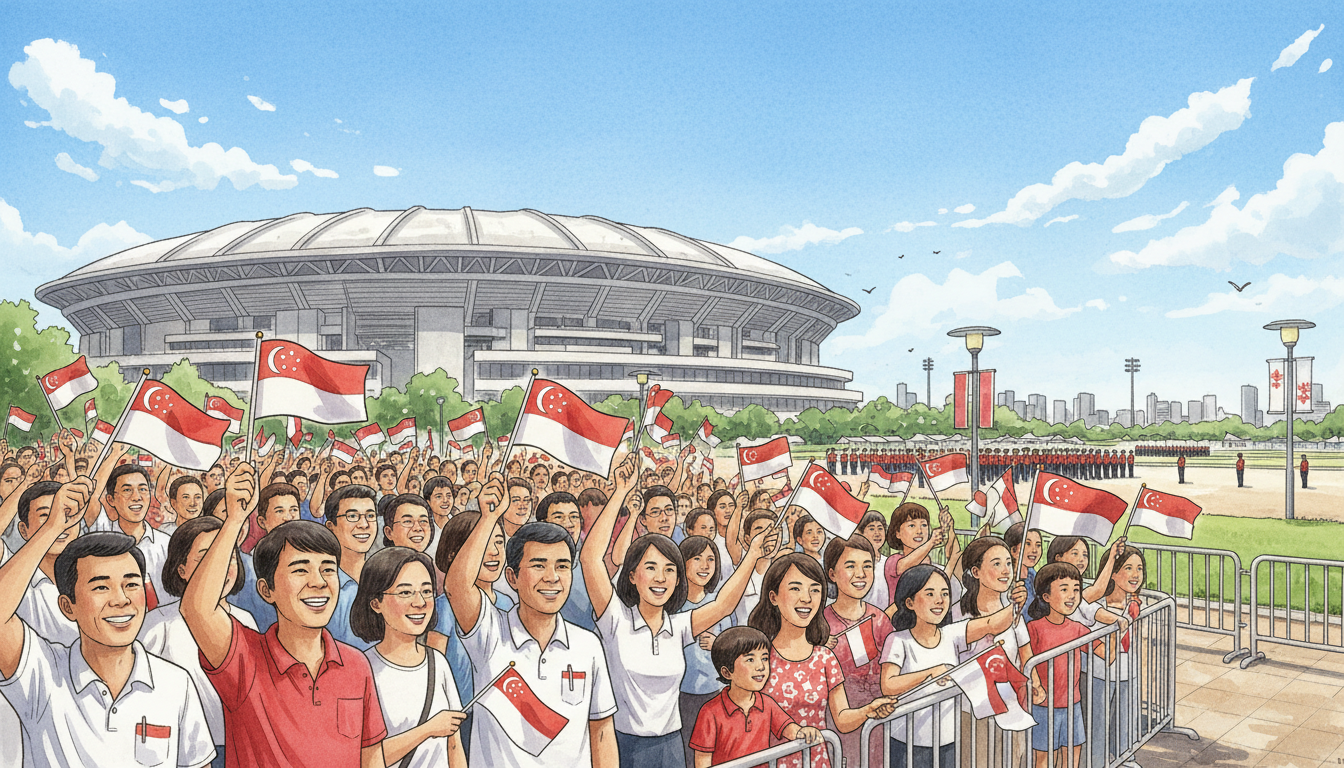
Singapore National Day is 9 August, marking independence on 9 August 1965. The National Day Parade (NDP) is the major ceremonial and performance celebration of that date. In 2026, Singapore celebrated 61 years of independence with NDP at the National Stadium in Kallang under the theme “Majulah Singapura, Go Beyond!” This article gives readers 100 useful National Day and NDP vocabulary words, each explained with meaning, a practical sentence and why it matters culturally.
Why are National Day and NDP important to Singapore’s culture? They connect the history of becoming independent to the shared ideals represented by Singapore’s flag, National Pledge and Anthem. Beyond the stadium, community gatherings, school observances, music, volunteers and people keeping the event safe also shape how the day is remembered. SG101’s 2026 National Day resource confirms the theme and stadium anniversary, while the Ministry of Defence’s post-parade account highlights people whose work happened out of sight.
For the answer you need, open the 100-word finder, check the 2026 facts or try the worked source-checking example. The descriptions below do not treat last year’s tickets, venue map or performance order as current instructions. National Day is an annual commemoration; each parade edition has its own operational facts.
NDP 2026 in one minute: dates, site and the difference between occasions
- National Day: 9 August, commemorating Singapore’s independence in 1965; the 2026 commemoration was its 61st anniversary.
- 2026 parade site: the National Stadium at Kallang. The Singapore Police Force post-event account confirms the venue and date.
- 2026 theme: “Majulah Singapura, Go Beyond!”—the second phrase points to doing better for one another and the wider community.
- Stadium history: the first NDP at the old National Stadium was in 1976; 2026 marked fifty years since that event. The current stadium is a replacement, not the same building.
- National symbols: the National Flag, Anthem, Pledge, Coat of Arms, Lion Head Symbol and National Flower have individual histories; the flag first appeared in 1959.
- Separate event: the National Day Rally is a political and policy speech delivered on another date; it is not the NDP parade programme.
1965, 1959 and 1966: why the order matters
Singapore’s red-and-white National Flag was unveiled on 3 December 1959 during the period of self-government, then adopted as the national flag when Singapore became independent in 1965. The National Pledge followed in 1966 and was recited in schools from that year. The 2026 parade’s theme and format are much later. Those milestones explain different parts of the national story, so a reader should never compress them into one undifferentiated ‘National Day moment’.
According to the National Heritage Board account of the Pledge, the new country faced the challenge of building solidarity among people with different languages, races and religions. A respectful classroom conversation can acknowledge that history without suggesting that every issue has been solved or that every person’s experience of nationhood is identical.
The flag, Anthem and Pledge: what students should understand
Singapore’s flag has a red upper field and white lower field, with a white crescent and five stars. Official guidelines explain the red and white sections, the moon and the five ideals represented by the stars: democracy, peace, progress, justice and equality. This is a stronger explanation than saying there are five stars for five communities or districts.
The National Anthem, Majulah Singapura, is a permanent national symbol. A National Day theme song, by contrast, can change from one year to the next. The National Pledge is a separate civic text; the NHB says the current recitation gesture is a clenched right fist at the left of the chest. When a school teaches these, it should explain the meanings rather than simply require pupils to reproduce labels.
Respect the flag without inventing strict rules
The official flag guidelines provide a special National Day celebrations period, ordinarily 1 July to 30 September, when some display rules are relaxed. During that window, flags can be displayed on buildings without needing a flagpole or night illumination, while other requirements for respectful handling still apply. Commercial designs and official use may have separate rules. A student should consult the current guidance instead of copying an old poster that might contain outdated dates.
Why the people off-camera belong in a National Day story
In remarks released on 25 August 2026, the Minister for Defence thanked people who handled logistics, food, crowd control and security. The official statement reported more than 10,000 people behind the Stadium event, including staff working on the outer security cordon who could not see the performance themselves. That is a cultural lesson: public events need care, quiet labour and professional systems, not only cheering audiences and fireworks.
The same remarks drew attention to a conscious decision to include people with different abilities in the 2026 performance. A fair account can discuss accessibility as a practical matter—routes, seating, assistance and inclusion—rather than treating a person with a disability as an inspiring decoration.
Choose a theme and go directly to the words
- Part 1: National Day: the dates and the meaning — words 1–10
- Part 2: NDP 2026: a precise place and theme — words 11–20
- Part 3: Flag and national symbols: read the meanings correctly — words 21–30
- Part 4: The parade: uniforms, music and ceremony — words 31–40
- Part 5: National Day music, performances and spectacle — words 41–50
- Part 6: Beyond the spotlight: people working on NDP — words 51–60
- Part 7: Heartland celebrations and everyday participation — words 61–70
- Part 8: Values and history behind the ceremony — words 71–80
- Part 9: Practical NDP information and checking claims — words 81–90
- Part 10: A reader’s vocabulary for responsible national storytelling — words 91–100
Quick finder: all 100 terms in one place
1–10: 1. National Day · 2. Independence · 3. 9 August 1965 · 4. Self-government · 5. Sovereignty · 6. Anniversary · 7. Commemoration · 8. Nationhood · 9. Civic identity · 10. National Day Parade (NDP)
11–20: 11. 2026 NDP theme · 12. Majulah Singapura · 13. Go Beyond! · 14. National Stadium · 15. Old National Stadium · 16. Stadium return · 17. Kallang · 18. Padang · 19. Theme logo · 20. Show segment
21–30: 21. National Flag · 22. Red field · 23. White field · 24. Crescent moon · 25. Five stars · 26. Flag proportion · 27. State Crest · 28. National Anthem · 29. National Pledge · 30. Lion Head Symbol
31–40: 31. Parade contingent · 32. Guard of Honour · 33. Marching formation · 34. Parade commander · 35. Ceremonial salute · 36. Feu de joie · 37. Military band · 38. Marching drill · 39. Flag flypast · 40. Ceremonial protocol
41–50: 41. National Day theme song · 42. Choreography · 43. Ensemble · 44. Live performance · 45. Stage design · 46. Projection mapping · 47. Lighting cue · 48. Drone display · 49. Fireworks display · 50. Production rehearsal
51–60: 51. Volunteer · 52. Stage crew · 53. Event logistics · 54. Crowd management · 55. Outer cordon · 56. Security screening · 57. Accessibility assistance · 58. Inclusive performance · 59. Medical support · 60. Operations team
61–70: 61. Heartland celebration · 62. HDB estate · 63. Community event · 64. National Day observance · 65. School assembly · 66. Flag display period · 67. Community bonding · 68. Home viewing · 69. Public broadcast · 70. Neighbourhood pride
71–80: 71. Multiculturalism · 72. Social cohesion · 73. Resilience · 74. Mutual care · 75. Democracy · 76. Justice · 77. Equality · 78. Peace · 79. Progress · 80. Collective responsibility
81–90: 81. Ticket ballot · 82. Unauthorised resale · 83. Event admission · 84. Venue map · 85. Transport advisory · 86. Rehearsal date · 87. Programme update · 88. Verified source · 89. Photo caption · 90. Date stamp
91–100: 91. Historical source · 92. Oral history · 93. Eyewitness account · 94. Documentary evidence · 95. Interpretation · 96. Fact versus opinion · 97. Commemorative narrative · 98. Representation · 99. Critical reading · 100. Civic participation
Use the vocabulary to check a claim, not just decorate an essay
Start by naming the term and stating its meaning. Put it into a sentence a reader could use. Then ask which official source supports the fact or where the judgement begins. For example, National Stadium is a place; the 2026 NDP was at the National Stadium is a verifiable dated statement; it was the most spectacular parade ever is an opinion. A learner who distinguishes those claims is prepared for both school comprehension and responsible digital reading.
For younger learners, select a few words about the flag, music, people and kindness. Secondary students can add chronology, national institutions, historical source types and the relationship between official values and everyday civic actions. The 100 entries are a reading and writing resource, not an official MOE vocabulary syllabus.
Part 1 — National Day: the dates and the meaning
Singapore’s National Day is 9 August, commemorating independence in 1965. That is different from the first unveiling of the flag in 1959, the drafting of the Pledge in 1966, and the date of a particular National Day Parade.
1. National Day
Meaning: Singapore’s annual commemoration on 9 August of independence in 1965. Natural example: ““Our family talked about National Day on 9 August.”” Why the word belongs in Singapore’s National Day story: The date connects personal celebrations with the nation’s history.
2. Independence
Meaning: The state of being sovereign rather than governed by another country. Natural example: ““Singapore’s independence began on 9 August 1965.”” Why the word belongs in Singapore’s National Day story: The year explains the 61st independence anniversary celebrated in 2026.
3. 9 August 1965
Meaning: The date Singapore separated from Malaysia and became independent. Natural example: ““The history worksheet identified 9 August 1965.”” Why the word belongs in Singapore’s National Day story: Do not confuse the independence date with the first National Flag ceremony.
4. Self-government
Meaning: Control of many internal affairs before full independence. Natural example: ““Singapore gained internal self-government in 1959.”” Why the word belongs in Singapore’s National Day story: Self-government in 1959 and independence in 1965 were different milestones.
5. Sovereignty
Meaning: A state’s authority to govern itself as an independent country. Natural example: ““National Day commemorates Singapore’s sovereignty.”” Why the word belongs in Singapore’s National Day story: This is a legal and political idea, not the same as a parade show.
6. Anniversary
Meaning: A date marking the passage of years since an event. Natural example: ““The 2026 celebrations marked the 61st anniversary of independence.”” Why the word belongs in Singapore’s National Day story: Anniversary numbers depend on the correct starting year.
7. Commemoration
Meaning: An act of remembering and recognising an important past event. Natural example: ““The ceremony was a commemoration of independence.”” Why the word belongs in Singapore’s National Day story: It allows discussion of history beyond entertainment.
8. Nationhood
Meaning: The condition and shared experience of existing as a nation. Natural example: ““The classroom considered what nationhood means.”” Why the word belongs in Singapore’s National Day story: Nationhood includes people and institutions, not only a spectacular show.
9. Civic identity
Meaning: A sense of membership and responsibility within a shared political community. Natural example: ““The flag ceremony prompted discussion of civic identity.”” Why the word belongs in Singapore’s National Day story: Citizenship and belonging deserve respectful, nuanced treatment.
10. National Day Parade (NDP)
Meaning: A major organised celebration involving ceremony and performances for National Day. Natural example: ““NDP 2026 was held at the National Stadium.”” Why the word belongs in Singapore’s National Day story: The parade is an event celebrating National Day; they are not interchangeable.
Recall activity for Part 1: Close the page, explain three terms in your own words, and use one in a short description of an NDP scene. Add one sentence separating a sourced fact from your interpretation. If you cannot support a year, venue or procedural claim, state the uncertainty rather than inventing it.
Part 2 — NDP 2026: a precise place and theme
The 2026 edition took place at the National Stadium, not the Padang. SG101 describes 2026 as 50 years since the first NDP at the old National Stadium in 1976. Venue and programme facts belong to the year specified.
11. 2026 NDP theme
Meaning: The annual slogan “Majulah Singapura, Go Beyond!” used for National Day 2026. Natural example: ““We checked the 2026 NDP theme in SG101’s official resource.”” Why the word belongs in Singapore’s National Day story: A theme is year-specific and should not be copied from 2025.
12. Majulah Singapura
Meaning: Malay for Onward Singapore, also the title of the National Anthem. Natural example: ““Majulah Singapura appears in the 2026 celebration theme.”” Why the word belongs in Singapore’s National Day story: The phrase expresses movement forward without becoming the name of every song.
13. Go Beyond!
Meaning: The 2026 theme’s call to improve and care for the wider community. Natural example: ““Our group explained the Go Beyond! part of the theme.”” Why the word belongs in Singapore’s National Day story: An official meaning is more precise than simply saying bigger fireworks.
14. National Stadium
Meaning: The large domed venue at Kallang used for NDP 2026. Natural example: ““The parade returned to the National Stadium in 2026.”” Why the word belongs in Singapore’s National Day story: It distinguishes the 2026 location from the 2025 Padang celebration.
15. Old National Stadium
Meaning: Singapore’s earlier stadium at Kallang, opened in 1973 and later replaced. Natural example: ““The first stadium-based NDP was in the old National Stadium in 1976.”” Why the word belongs in Singapore’s National Day story: The old and present stadium buildings are not physically the same structure.
16. Stadium return
Meaning: The use of the National Stadium again for the 2026 parade after other venues. Natural example: ““The stadium return shaped the 2026 audience experience.”” Why the word belongs in Singapore’s National Day story: It is a feature of a particular edition, not an annual rule.
17. Kallang
Meaning: The Singapore district closely associated with the National Stadium. Natural example: ““Our map showed Kallang rather than the Padang.”” Why the word belongs in Singapore’s National Day story: Place names anchor event descriptions to correct geography.
18. Padang
Meaning: The historic open field in the Civic District used for some earlier NDP editions. Natural example: ““The Padang was not the NDP 2026 main venue.”” Why the word belongs in Singapore’s National Day story: One familiar venue should not automatically be attached to every parade.
19. Theme logo
Meaning: The graphic identity used to express an edition’s theme and anniversary. Natural example: ““The 2026 theme logo included the number 61.”” Why the word belongs in Singapore’s National Day story: A design records a particular year’s message, not a timeless flag replacement.
20. Show segment
Meaning: One organised part of the NDP performance sequence. Natural example: ““The show segment had its own performers and staging.”” Why the word belongs in Singapore’s National Day story: Understanding segments helps readers follow a broadcast without guessing its running order.
Recall activity for Part 2: Close the page, explain three terms in your own words, and use one in a short description of an NDP scene. Add one sentence separating a sourced fact from your interpretation. If you cannot support a year, venue or procedural claim, state the uncertainty rather than inventing it.
Part 3 — Flag and national symbols: read the meanings correctly
The official National Flag was adopted in 1959 during the self-governing period and then became Singapore’s national flag at independence. The National Heritage Board explains each element and the regulations for respectful display.
21. National Flag
Meaning: Singapore’s red-and-white flag with a white crescent and five stars. Natural example: ““We studied the National Flag before National Day.”” Why the word belongs in Singapore’s National Day story: It is an official state symbol, not just a seasonal decoration.
22. Red field
Meaning: The flag’s upper red section representing universal brotherhood and equality. Natural example: ““The red field sits above the white field.”” Why the word belongs in Singapore’s National Day story: The colour has a stated civic meaning.
23. White field
Meaning: The lower white section representing purity and virtue. Natural example: ““The white field is below the red.”” Why the word belongs in Singapore’s National Day story: The arrangement is part of the flag’s recognised form.
24. Crescent moon
Meaning: The white crescent representing a young nation on the ascendant. Natural example: ““The crescent moon appears in the flag’s upper left.”” Why the word belongs in Singapore’s National Day story: It does not simply depict the phase of the moon on 9 August.
25. Five stars
Meaning: The five stars representing democracy, peace, progress, justice and equality. Natural example: ““We named all five ideals shown by the stars.”” Why the word belongs in Singapore’s National Day story: The stars encode specific ideals, not five districts or races.
26. Flag proportion
Meaning: The prescribed relationship between a flag’s width and length. Natural example: ““The official flag proportion is 2 to 3.”” Why the word belongs in Singapore’s National Day story: Respectful flag reproduction includes accurate geometry.
27. State Crest
Meaning: The National Coat of Arms with a shield and lion and tiger supporters. Natural example: ““The State Crest is different from the Merlion.”” Why the word belongs in Singapore’s National Day story: Not all familiar lion imagery is an official state emblem.
28. National Anthem
Meaning: Singapore’s official anthem, Majulah Singapura, written in Malay. Natural example: ““The National Anthem was sung during the ceremony.”” Why the word belongs in Singapore’s National Day story: It is different from an edition’s new National Day theme song.
29. National Pledge
Meaning: A civic pledge introduced in the 1960s about unity, justice and equality. Natural example: ““Students recited the National Pledge at assembly.”” Why the word belongs in Singapore’s National Day story: It articulates national ideals; recitation is distinct from watching a parade.
30. Lion Head Symbol
Meaning: A recognised national symbol with a stylised lion’s head. Natural example: ““The Lion Head Symbol is not the Merlion logo.”” Why the word belongs in Singapore’s National Day story: Accurate symbols matter more than assuming all lion images are equivalent.
Recall activity for Part 3: Close the page, explain three terms in your own words, and use one in a short description of an NDP scene. Add one sentence separating a sourced fact from your interpretation. If you cannot support a year, venue or procedural claim, state the uncertainty rather than inventing it.
Part 4 — The parade: uniforms, music and ceremony
A National Day Parade contains ceremonial elements with specific roles. Some performances vary by year, so this glossary explains the words without promising that every NDP must include identical sequences.
31. Parade contingent
Meaning: An organised group of participants marching or taking part in the parade. Natural example: ““The parade contingent kept in formation.”” Why the word belongs in Singapore’s National Day story: Participants represent organisations and services, not generic background performers.
32. Guard of Honour
Meaning: A formal ceremonial group providing honours at an occasion. Natural example: ““A Guard of Honour participated in the 2026 parade.”” Why the word belongs in Singapore’s National Day story: The term refers to ceremony, not a sports team.
33. Marching formation
Meaning: An arrangement of participants moving in coordinated lines or patterns. Natural example: ““The camera showed the marching formation.”” Why the word belongs in Singapore’s National Day story: It demonstrates collective timing and training.
34. Parade commander
Meaning: An officer directing formal parade procedures. Natural example: ““The parade commander issued a command.”” Why the word belongs in Singapore’s National Day story: Titles identify responsibilities rather than celebrity roles.
35. Ceremonial salute
Meaning: A gesture or action showing formal respect at a ceremony. Natural example: ““The unit performed a ceremonial salute.”” Why the word belongs in Singapore’s National Day story: A salute is governed by occasion and protocol.
36. Feu de joie
Meaning: A ceremonial rifle salute involving a timed sequence of shots. Natural example: ““The Guard of Honour performed a feu de joie.”” Why the word belongs in Singapore’s National Day story: It is a planned ceremonial action, not uncontrolled gunfire.
37. Military band
Meaning: A group of musicians performing for official or ceremonial occasions. Natural example: ““The military band supported the parade.”” Why the word belongs in Singapore’s National Day story: The music is coordinated with protocol and public performance.
38. Marching drill
Meaning: Practised movements enabling a group to move together with precision. Natural example: ““Marching drill required rehearsal.”” Why the word belongs in Singapore’s National Day story: It helps explain the years of military and civic pageantry.
39. Flag flypast
Meaning: A planned aerial display involving the National Flag. Natural example: ““The flag flypast drew attention above the venue.”” Why the word belongs in Singapore’s National Day story: It is an aviation operation, not a decoration fixed to the ground.
40. Ceremonial protocol
Meaning: An established order and set of behaviours for formal events. Natural example: ““The event followed ceremonial protocol.”” Why the word belongs in Singapore’s National Day story: Protocol gives meaning and consistency to public rituals.
Recall activity for Part 4: Close the page, explain three terms in your own words, and use one in a short description of an NDP scene. Add one sentence separating a sourced fact from your interpretation. If you cannot support a year, venue or procedural claim, state the uncertainty rather than inventing it.
Part 5 — National Day music, performances and spectacle
A National Day song created for a particular year is not necessarily the official National Anthem. A large public show also brings local music, visual art and stagecraft into the same celebration.
41. National Day theme song
Meaning: A song associated with a particular annual celebration. Natural example: ““We learned that the theme song was not the National Anthem.”” Why the word belongs in Singapore’s National Day story: These songs change, while Majulah Singapura remains the official anthem.
42. Choreography
Meaning: The design and organisation of dance or movement. Natural example: ““The choreography brought many performers onto the stage.”” Why the word belongs in Singapore’s National Day story: The crowd sees creative planning as well as movement.
43. Ensemble
Meaning: A group of artists performing together. Natural example: ““The ensemble moved in synchronised groups.”” Why the word belongs in Singapore’s National Day story: Many voices and abilities contribute to the show’s character.
44. Live performance
Meaning: An act presented to an audience as it occurs. Natural example: ““The live performance differed from the recorded preview.”” Why the word belongs in Singapore’s National Day story: Readers should distinguish live action from edited promotional video.
45. Stage design
Meaning: The planning of platforms, scenery and production space. Natural example: ““The stage design changed how the audience could see the dancers.”” Why the word belongs in Singapore’s National Day story: A stadium show’s scale depends on thoughtful engineering and sightlines.
46. Projection mapping
Meaning: Displaying images onto surfaces in ways matched to their shapes. Natural example: ““Projection mapping transformed the background.”” Why the word belongs in Singapore’s National Day story: A visual technique can communicate meaning beyond fireworks.
47. Lighting cue
Meaning: An instruction that triggers a programmed lighting change. Natural example: ““The lighting cue matched the music.”” Why the word belongs in Singapore’s National Day story: Technical crews make visible performances possible.
48. Drone display
Meaning: Coordinated illuminated drones creating patterns or visual effects. Natural example: ““The 2026 celebration included drone technology.”” Why the word belongs in Singapore’s National Day story: A flying light pattern is not the same technology as fireworks.
49. Fireworks display
Meaning: A designed sequence of bright pyrotechnic effects. Natural example: ““The official 2026 account described fireworks.”” Why the word belongs in Singapore’s National Day story: Fireworks are a show element, not a guarantee about every future location.
50. Production rehearsal
Meaning: A practice session joining performers, technical cues and timing. Natural example: ““The production rehearsal found a timing problem.”” Why the word belongs in Singapore’s National Day story: A successful public show relies on testing and correction.
Recall activity for Part 5: Close the page, explain three terms in your own words, and use one in a short description of an NDP scene. Add one sentence separating a sourced fact from your interpretation. If you cannot support a year, venue or procedural claim, state the uncertainty rather than inventing it.
Part 6 — Beyond the spotlight: people working on NDP
The Defence Minister’s August 2026 remarks recognised more than 10,000 people working behind the scenes around the Stadium, including people at outer cordons who could not even watch the show. These jobs make the event possible and deserve precise language.
51. Volunteer
Meaning: Someone who gives time to help an event or community without being employed for that particular role. Natural example: ““The volunteer helped direct visitors to the entrance.”” Why the word belongs in Singapore’s National Day story: Celebrations depend on contributions beyond headline performers.
52. Stage crew
Meaning: Workers who prepare and manage performance equipment and changes. Natural example: ““The stage crew reset the set during rehearsal.”” Why the word belongs in Singapore’s National Day story: Technical and physical labour supports the visible show.
53. Event logistics
Meaning: The coordination of people, equipment, food and supplies. Natural example: ““Event logistics included water and equipment delivery.”” Why the word belongs in Singapore’s National Day story: A national celebration is a large operational system.
54. Crowd management
Meaning: Planning and guiding how many people move and gather safely. Natural example: ““Crowd management kept passages open.”” Why the word belongs in Singapore’s National Day story: The wellbeing of spectators matters as much as entertainment.
55. Outer cordon
Meaning: A controlled security boundary beyond the main venue. Natural example: ““Staff were posted at the outer cordon.”” Why the word belongs in Singapore’s National Day story: Some security workers were so far from the stage they could not watch NDP.
56. Security screening
Meaning: Checking people and belongings under venue safety procedures. Natural example: ““Guests followed the security screening instructions.”” Why the word belongs in Singapore’s National Day story: An admission ticket may still require screening.
57. Accessibility assistance
Meaning: Help enabling participants with disabilities or access needs to participate. Natural example: ““Accessibility assistance helped families find appropriate seating.”” Why the word belongs in Singapore’s National Day story: Inclusion involves practical support, not just statements on a banner.
58. Inclusive performance
Meaning: A performance designed to include people with varied abilities and backgrounds. Natural example: ““The 2026 organisers highlighted inclusive performance.”” Why the word belongs in Singapore’s National Day story: The Ministry of Defence explicitly discussed differently enabled participants.
59. Medical support
Meaning: Personnel and facilities prepared to respond to health needs at a large event. Natural example: ““Medical support was available for the crowd.”” Why the word belongs in Singapore’s National Day story: Public events require care for real people.
60. Operations team
Meaning: The people organising and coordinating event processes. Natural example: ““The operations team updated safety instructions.”” Why the word belongs in Singapore’s National Day story: Public success depends on coordination that an audience may never see.
Recall activity for Part 6: Close the page, explain three terms in your own words, and use one in a short description of an NDP scene. Add one sentence separating a sourced fact from your interpretation. If you cannot support a year, venue or procedural claim, state the uncertainty rather than inventing it.
Part 7 — Heartland celebrations and everyday participation
Not everyone attends the main venue. National Day is also observed in schools, homes, community spaces and neighbourhoods. The appropriate activity varies with individual circumstances and the year’s programmes.
61. Heartland celebration
Meaning: A National Day-related gathering or programme within residential communities. Natural example: ““Our heartland celebration was different from the stadium parade.”” Why the word belongs in Singapore’s National Day story: Local participation extends beyond one central venue.
62. HDB estate
Meaning: A residential area containing public housing managed within the HDB system. Natural example: ““National Flags appeared across the HDB estate.”” Why the word belongs in Singapore’s National Day story: Homes rather than landmarks shape many residents’ celebration memories.
63. Community event
Meaning: An organised gathering supporting local participation. Natural example: ““The community event invited neighbouring families.”” Why the word belongs in Singapore’s National Day story: National identity can be experienced through familiar local relationships.
64. National Day observance
Meaning: A ceremony held by a school, organisation or workplace to mark National Day. Natural example: ““The school held a National Day observance.”” Why the word belongs in Singapore’s National Day story: This is not necessarily the main NDP show.
65. School assembly
Meaning: A gathering of students and staff for announcements or ceremonies. Natural example: ““The school assembly included the Pledge.”” Why the word belongs in Singapore’s National Day story: NDP vocabulary links public life with ordinary education.
66. Flag display period
Meaning: The time when National Flag display guidelines are relaxed, ordinarily 1 July to 30 September. Natural example: ““The household checked the flag display period.”” Why the word belongs in Singapore’s National Day story: Respectful-use conditions depend on official regulations and the season.
67. Community bonding
Meaning: Activities that create mutual trust and familiarity among people. Natural example: ““The picnic offered opportunities for community bonding.”” Why the word belongs in Singapore’s National Day story: A celebration can matter without tickets or celebrity performers.
68. Home viewing
Meaning: Watching an event broadcast from one’s own home. Natural example: ““The grandparents chose home viewing instead of a long journey.”” Why the word belongs in Singapore’s National Day story: Participation does not require an in-person stadium seat.
69. Public broadcast
Meaning: A television, radio or other widely distributed event programme. Natural example: ““The public broadcast let more people follow NDP.”” Why the word belongs in Singapore’s National Day story: Broadcast and on-site attendance are different experiences.
70. Neighbourhood pride
Meaning: Affection and sense of belonging connected to a local area. Natural example: ““The estate decorations expressed neighbourhood pride.”” Why the word belongs in Singapore’s National Day story: Local communities contribute to the national story in their own ways.
Recall activity for Part 7: Close the page, explain three terms in your own words, and use one in a short description of an NDP scene. Add one sentence separating a sourced fact from your interpretation. If you cannot support a year, venue or procedural claim, state the uncertainty rather than inventing it.
Part 8 — Values and history behind the ceremony
A factual article should neither pretend every citizen feels the same way nor reduce the celebration to military displays. Independence and community values can be explained through history and different personal experiences.
71. Multiculturalism
Meaning: The coexistence and interaction of multiple cultural communities. Natural example: ““Our essay explained multiculturalism with specific examples.”” Why the word belongs in Singapore’s National Day story: Singapore’s National Pledge recognises differences in race, language and religion.
72. Social cohesion
Meaning: The trust and connectedness that support a community. Natural example: ““Neighbours helped strengthen social cohesion.”” Why the word belongs in Singapore’s National Day story: Unity requires everyday work, not simply recitation.
73. Resilience
Meaning: The ability to respond and recover when conditions are difficult. Natural example: ““The family showed resilience after a disruption.”” Why the word belongs in Singapore’s National Day story: The word has civic meaning beyond a dramatic stage performance.
74. Mutual care
Meaning: Practical concern and help for other people. Natural example: ““Mutual care was one part of the 2026 theme.”” Why the word belongs in Singapore’s National Day story: The official Go Beyond! message included care for one another.
75. Democracy
Meaning: A form of government in which people have representation and political rights. Natural example: ““Democracy is one of the flag’s five stated ideals.”” Why the word belongs in Singapore’s National Day story: It is a specific civic ideal, not a slogan for every social programme.
76. Justice
Meaning: The fair administration and application of laws and rights. Natural example: ““Justice appears among Singapore’s National Flag ideals.”” Why the word belongs in Singapore’s National Day story: A named ideal should be explained rather than merely recited.
77. Equality
Meaning: The principle that people deserve equal standing and fair treatment. Natural example: ““The Pledge explicitly includes equality.”” Why the word belongs in Singapore’s National Day story: It links official language to real relationships and institutions.
78. Peace
Meaning: An absence of conflict combined with conditions for safety and cooperation. Natural example: ““Peace is one of the five flag ideals.”” Why the word belongs in Singapore’s National Day story: The idea is broader than the absence of noise at a ceremony.
79. Progress
Meaning: Improvement or movement toward desired goals over time. Natural example: ““The 2026 theme emphasised progress.”” Why the word belongs in Singapore’s National Day story: Good reflection also asks who benefits and how improvements are measured.
80. Collective responsibility
Meaning: A shared obligation to contribute to community wellbeing. Natural example: ““Collective responsibility included helping a neighbour.”” Why the word belongs in Singapore’s National Day story: The public ceremony can prompt small actions beyond spectacle.
Recall activity for Part 8: Close the page, explain three terms in your own words, and use one in a short description of an NDP scene. Add one sentence separating a sourced fact from your interpretation. If you cannot support a year, venue or procedural claim, state the uncertainty rather than inventing it.
Part 9 — Practical NDP information and checking claims
Parade tickets and timings vary by edition. The official NDP help centre warns against buying unauthorised tickets: balloting rather than private resale governs distribution. These terms help a family read actual notices instead of social rumours.
81. Ticket ballot
Meaning: A process that allocates scarce tickets by drawing among eligible applicants. Natural example: ““We checked the official ticket ballot notice.”” Why the word belongs in Singapore’s National Day story: Application rules, dates and eligibility must be read for the actual year.
82. Unauthorised resale
Meaning: A prohibited or unapproved attempt to sell an event ticket. Natural example: ““We avoided unauthorised resale links.”” Why the word belongs in Singapore’s National Day story: Official NDP guidance warns such tickets can be void and fraudulent.
83. Event admission
Meaning: Permission to enter a venue under defined conditions. Natural example: ““Event admission required the correct entry instructions.”” Why the word belongs in Singapore’s National Day story: A ticket may still have an identity and security check.
84. Venue map
Meaning: A diagram showing entrances, seats, exits and amenities. Natural example: ““We used the venue map before arriving.”” Why the word belongs in Singapore’s National Day story: The main venue changes by year, so old maps can mislead.
85. Transport advisory
Meaning: Official information on changes to travel, trains, roads or pedestrian access. Natural example: ““We checked the transport advisory on event day.”” Why the word belongs in Singapore’s National Day story: Large events can affect routes and crowd flow.
86. Rehearsal date
Meaning: A scheduled practice before the public event. Natural example: ““We did not mistake a rehearsal date for 9 August.”” Why the word belongs in Singapore’s National Day story: Previews and the main celebration are separate dates.
87. Programme update
Meaning: A newly issued change to an event’s planned activities. Natural example: ““The organiser posted a programme update.”” Why the word belongs in Singapore’s National Day story: Times or arrangements should not be copied blindly from last year.
88. Verified source
Meaning: An identifiable authoritative source relevant to a stated claim. Natural example: ““We used a verified source for the 2026 venue.”” Why the word belongs in Singapore’s National Day story: A social post without a source is not enough to establish safety rules.
89. Photo caption
Meaning: Text identifying what an image shows, where and when it was taken. Natural example: ““Our photo caption identified the 2026 National Stadium.”” Why the word belongs in Singapore’s National Day story: Wrongly labelling the 2025 Padang as NDP 2026 distorts history.
90. Date stamp
Meaning: A date showing when information was issued or updated. Natural example: ““The date stamp told us the notice was from last year.”” Why the word belongs in Singapore’s National Day story: Fast-changing event facts require time-specific verification.
Recall activity for Part 9: Close the page, explain three terms in your own words, and use one in a short description of an NDP scene. Add one sentence separating a sourced fact from your interpretation. If you cannot support a year, venue or procedural claim, state the uncertainty rather than inventing it.
Part 10 — A reader’s vocabulary for responsible national storytelling
The final ten terms connect the parade to skills students can use in History, English and everyday media. They help distinguish a celebration’s intended message from a claim that needs separate evidence.
91. Historical source
Meaning: A record or account used to investigate past events. Natural example: ““The timeline cited a historical source for 1965.”” Why the word belongs in Singapore’s National Day story: Original records provide a firmer basis than repeating a family rumour.
92. Oral history
Meaning: Recorded memories or accounts from people who experienced events. Natural example: ““We listened to an oral history about old stadium parades.”” Why the word belongs in Singapore’s National Day story: Personal memory adds lived perspective but still requires context.
93. Eyewitness account
Meaning: A description by someone who directly witnessed an event. Natural example: ““The eyewitness account described the crowd.”” Why the word belongs in Singapore’s National Day story: It cannot automatically establish every fact beyond the person’s view.
94. Documentary evidence
Meaning: Written, recorded or material information supporting a claim. Natural example: ““The source showed documentary evidence of the Pledge’s history.”” Why the word belongs in Singapore’s National Day story: Evidence allows readers to verify precise dates.
95. Interpretation
Meaning: An explanation of what facts or experiences may mean. Natural example: ““Our interpretation was that the theme emphasised care.”” Why the word belongs in Singapore’s National Day story: It should be labelled rather than presented as an official quotation.
96. Fact versus opinion
Meaning: The distinction between a checkable claim and personal judgement. Natural example: ““NDP was at the Stadium in 2026 is a fact; it was the best ever is an opinion.”” Why the word belongs in Singapore’s National Day story: Separating the two creates trustworthy writing.
97. Commemorative narrative
Meaning: A story framed to remember and give meaning to a significant event. Natural example: ““The commemorative narrative focused on resilience.”” Why the word belongs in Singapore’s National Day story: Public storytelling selects emphases; it is not a complete history textbook.
98. Representation
Meaning: How groups or ideas are portrayed in a story, image or performance. Natural example: ““The class discussed representation in the show.”” Why the word belongs in Singapore’s National Day story: Inclusion should be described specifically rather than assumed from a poster.
99. Critical reading
Meaning: Testing a statement’s sources, context and limitations. Natural example: ““Critical reading exposed an outdated parade venue guide.”” Why the word belongs in Singapore’s National Day story: It protects readers when familiar headlines become stale.
100. Civic participation
Meaning: Taking part in activities and decisions connected to community and public life. Natural example: ““Volunteering was one form of civic participation.”” Why the word belongs in Singapore’s National Day story: There are many meaningful ways to contribute besides attending the parade.
Recall activity for Part 10: Close the page, explain three terms in your own words, and use one in a short description of an NDP scene. Add one sentence separating a sourced fact from your interpretation. If you cannot support a year, venue or procedural claim, state the uncertainty rather than inventing it.
Worked example: a headline that mixes two different NDP years
Misleading draft: “NDP 2026 returned to the Padang for Singapore’s 60th birthday, with the 2025 theme.” This statement is attractive because the Padang, the number 60 and a familiar slogan appeared in earlier coverage—but it mixes incompatible dates and locations.
Corrected version: “Singapore’s National Day Parade on 9 August 2026 celebrated the country’s 61st anniversary of independence at the National Stadium. Its theme was ‘Majulah Singapura, Go Beyond!’ The location recalled fifty years since the first NDP at the old National Stadium in 1976.” Official SG101 and Singapore Police Force accounts support these specifics.
What changed: the annual anniversary number, the host venue, the year’s theme and the stadium-history point. None should be guessed from last year’s photograph. A good writer checks all four before publishing a title or writing a social caption.
A parent–child conversation that goes beyond naming the flag
Child: “Why are there five stars on the flag?” Adult: “They stand for democracy, peace, progress, justice and equality. Can you explain one in your own words?” Child: “Equality means we should treat other people fairly.” Adult: “That’s a useful start. Now what’s the difference between the National Anthem and a National Day theme song?” Child: “The Anthem is an official symbol; a theme song can be new for that year’s celebration.”
This fictional exchange asks for meaning rather than automatic recall. Families need not agree about every political question to discuss the official words accurately, hear different experiences and practise considerate conversation.
Creative writing: people and place, not a collection of slogans
“As the National Stadium filled with red and white, the voices of the crowd rose to meet the band. I could see a Guard of Honour contingent preparing below the lights, but I thought about the people outside too: volunteers explaining entrances, cleaners finishing their shifts and staff monitoring the busy walkways. Our teacher had told us that National Day remembers independence in 1965, yet the evening also depended on ordinary people doing their work carefully. When the Anthem began, I put away my phone. There would be time for photographs later.”
The paragraph is an invented scene for composition practice, not a verified eyewitness account of NDP 2026. It makes space for a person’s response while using words accurately.
Ten quick checks: did you read the event correctly?
- 1. On what date did Singapore become independent?
- 2. Was National Day Parade 2026 at the Padang or the National Stadium?
- 3. What was the official NDP 2026 theme?
- 4. Why is 1976 relevant to the National Stadium story?
- 5. Do the flag’s five stars represent five districts or five ideals?
- 6. Is a National Day theme song automatically the National Anthem?
- 7. Which happened earlier: the flag’s unveiling or Singapore’s independence?
- 8. Must a National Day venue worker be able to watch the show to contribute?
- 9. Why should a ticket applicant use the NDP official channel rather than a reseller?
- 10. What is the distinction between a fact and an enthusiastic evaluation of the parade?
Answer guide: 1 9 August 1965; 2 National Stadium; 3 Majulah Singapura, Go Beyond!; 4 the first NDP at the old stadium happened fifty years earlier; 5 five official ideals; 6 no; 7 flag unveiled in 1959; 8 no, backstage work matters; 9 fraud and invalid-ticket risks; 10 one is checkable, the other a judgement.
Reader FAQs: National Day and the NDP
1. When is Singapore National Day?
Singapore celebrates National Day every 9 August, commemorating independence on 9 August 1965. The National Day Parade is an annual event associated with the occasion but can have different venues and formats.
2. Where was NDP 2026 held?
At the National Stadium in Kallang on 9 August 2026. Official post-parade accounts from the Singapore Police Force and Ministry of Defence confirm the venue.
3. What was the NDP 2026 theme?
“Majulah Singapura, Go Beyond!” The official SG101 resource explains it as a forward-looking call to improve and care for the community.
4. Was 2026 Singapore’s 60th or 61st birthday?
2026 marked 61 years since independence in 1965. The sixtieth anniversary was in 2025. The number 60 also relates to a separate 2026 anniversary of the National Pledge in schools.
5. Is the National Flag’s five-star design a reference to five ethnic groups?
No. National Heritage Board lists five ideals: democracy, peace, progress, justice and equality. The crescent represents a young nation on the ascendant.
6. When was Singapore’s National Flag first unveiled?
3 December 1959, during Singapore’s period of internal self-government. It was adopted officially as Singapore’s National Flag at independence in 1965.
7. Is the National Day theme song the same as Majulah Singapura?
Not necessarily. Majulah Singapura is the official National Anthem. A separate National Day song or an annual NDP theme may change with each edition.
8. Can NDP tickets be bought from private resellers?
Official NDP FAQ guidance warns that parade tickets are allocated through balloting, not sold privately, and unauthorised tickets may be void. Check that year’s official procedures.
9. Did the 2026 show include people with disabilities?
The Ministry of Defence’s 2026 post-event statement explicitly highlighted a conscious effort to showcase members of differently enabled communities, reflecting an inclusion focus.
10. How can children participate in National Day without going to a stadium?
Students and families can learn the history and symbols, take part in suitable school or neighbourhood activities, watch authorised broadcasts, make accurate educational projects and practise community care. No stadium ticket is required to learn.
Sources and verification routes
- SG101 — National Day 2026 (27 July 2026): official theme and history of the stadium return.
- Singapore Police Force — NDP 2026 recap (August 2026): Stadium venue, national anniversary, parade elements and safety personnel.
- MINDEF — Minister Thanks NDP 2026 Organisers and Personnel (25 August 2026): behind-the-scenes work and inclusive celebrations.
- National Heritage Board — National Flag: origins, five ideals, colour meanings and current display guidelines.
- National Heritage Board — National Pledge: 1966 history and correct recitation information.
- National Heritage Board — National Anthem: history and distinction from theme songs.
- SG101 — National Stadium history: old venue and past parades.
- Ask.gov.sg — NDP ticket availability and unauthorised resale: public advice, with year-specific arrangements to be checked.
- Prime Minister’s Office — National Day Rally 2026: the separate political speech occasion.
Related Singapore vocabulary reading
Follow the Top 100 Singapore Vocabulary Words | Touring and Visiting series. Continue to Day 22: The Merlion and National Symbols for a comparison with the tourism emblem; Day 19: Singlish explores local conversational identity; the Vocabulary Learning Hub teaches retrieval and careful expression.
One useful word is an invitation to do something considerate
Try naming a specific value behind the flags and music. If you choose mutual care, tell a real story about helping a neighbour or making a busy place easier for someone else. If you choose historical evidence, check a date before making a statement. That makes National Day vocabulary worth knowing long after the parade has finished.

Continue learning about Singapore culture: Day 24: Kaya Toast, Kopi and Nanyang Breakfast Culture explores the morning meal, multilingual coffee orders and the family businesses that preserve familiar tastes. Find other themes in the Top 100 Singapore Vocabulary Words main hub.
Understand the stadium and Kallang beyond National Day
National Day Parade vocabulary and stadium vocabulary answer different questions. Read Day 15: The Kallang, National Stadium and Sports Culture for the National Stadium precinct, venue access, sports infrastructure and spectator language. For a different, child-friendly area perspective, see Things to Do for Kids | Learning Kallang. An NDP event ticket and access to other stadium facilities are separate arrangements that should always be checked at the appropriate time.
National Day and Total Defence: read the connected guide
To explore the wider civic ideas behind Singapore’s national story, see Day 50: Singapore Discovery Centre, Defence and the Singapore Story. This guide to the National Day Parade concentrates on a national celebration, ceremony and its history; the Discovery Centre guide considers Total Defence, exhibits and decision-making in a separate Joo Koon visit. These are complementary subjects, not the same event or location.