
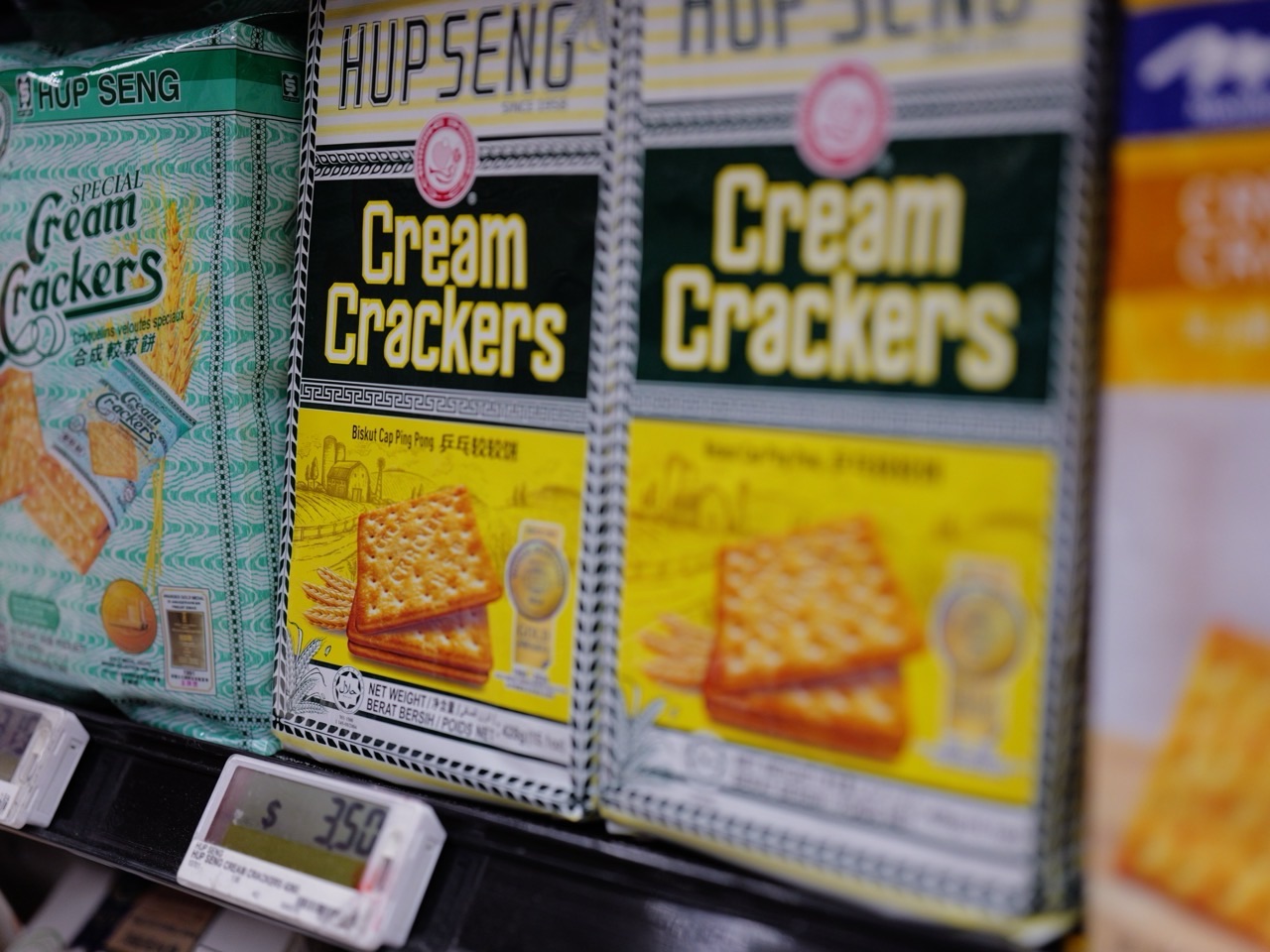
Why do crackers, biscuits and keropok go soft after being left open in Singapore’s humid weather? A crisp snack is normally a relatively dry, brittle structure made from starch, protein and other components. When it takes up water vapour from surrounding air, the water changes how the material moves internally. Instead of snapping sharply, the cracker may bend or fracture more quietly. One important process is plasticisation: water increases molecular mobility and makes the structure less glassy and more flexible. That change does not automatically mean a new chemical compound has formed or that the food is unsafe. For Hougang families, the strongest practical response is to keep suitable dry snacks in clean, properly closed storage away from unnecessary heat and moisture, following their original packaging instructions.
This Hougang Chemistry guide to why biscuits lose their crunch, fish crackers turn soft, water activity, starch glass transition and food storage explains an everyday materials problem in detail. A Food Research International study of crackerbread measured how increasing water activity affected fracture force and sound. A separate fish-cracker study describes moisture-related transitions from brittle to softer structures. For Secondary 1–2 students this builds understanding of matter, water vapour and observations; for Secondary 3–4 Chemistry it introduces molecular interactions and polymers; JC learners can explore phase behaviour and quantitative water activity. The scientific question is about moisture and physical structure—not about a magical ingredient that restores crispness to old food.
The biscuit that lost its crunch
Someone opens a packet of crackers for an afternoon snack in Hougang. The first piece snaps. Later, after the package has been sitting open, another piece feels softer and makes less noise when bitten. The student correctly suspects humidity, but wants to understand how invisible water vapour can change the behaviour of something that still looks dry.
The answer begins inside the food. A cracker is not an inert solid block. Its starch, proteins and pores form a microscopic structure that behaves differently depending on how much water it holds. The change becomes apparent when a bite applies a force and the structure responds.
Crispness is a mechanical property, not one ingredient
When a dry, brittle cracker is bitten, cracks can travel rapidly through it. Those quick fractures generate force changes and short audible sounds. We interpret many such events together as a crisp texture. A more flexible material deforms before breaking and often produces fewer acoustic peaks.
Scientists can measure this instead of relying only on words such as nice or stale. They use controlled mechanical probes and acoustic recordings. The 2010 crackerbread study compared specimens equilibrated at different water activities and found that several indicators of brittle, audible fracture decreased as water activity rose.
How humid air supplies water
Water is present in air as invisible vapour. A dry snack exposed to relatively humid surroundings can take up moisture until its state approaches an appropriate balance with the environment. Relative humidity describes the vapour pressure relative to saturation at a given temperature, so it is not simply a count of droplets hanging in the air.
For a cracker, the amount and rate of moisture uptake depend on its ingredients, pore structure, surface treatment, temperature, previous storage and packaging. A product kept in a well-sealed packet can behave very differently from the same product left on an open plate.
Water activity is not just percentage water
Water activity, represented as aw, is a measure related to the availability of water within the food system and the equilibrium relative humidity. It is not identical to the mass percentage of water in the product. Ingredients can bind or interact with water differently.
Two foods with similar total moisture can have different water activities. A student should identify which property a paper actually measured before making a broad claim about spoilage, quality or shelf life. The fish-cracker paper discusses the relationship between water activity and the behaviour of starch-based snacks.
Plasticisation: how a little water changes a large structure
Starch and some proteins form large molecular structures. When very dry, components of a cracker can behave as a rigid, relatively glassy solid. Water interacts with the network and may allow molecular segments to move more readily. This is plasticisation.
The material can become more flexible rather than fracture suddenly. This is a change in mechanical behaviour, not evidence that every polymer chain has been chemically cut into unrelated molecules.
A Journal of Food Science study of a baked cracker linked moisture with shifts in glass-transition behaviour. The scientific concept of a glass transition concerns a material becoming more or less mobile; it does not mean crackers are made from ordinary window glass.
Why the snack can feel leathery
A brittle structure can break through many short, sharp fractures. Once water makes the relevant material more flexible, it can absorb some biting force through bending. The result may feel leathery or chewy rather than crisp. The sound becomes quieter because the mode of fracture has changed.
Different layers of the snack can gain moisture at different rates. A coated biscuit, a plain cracker and a puffed keropok therefore should not be expected to soften identically.
A Singapore connection: fish crackers and keropok
Fish crackers and keropok commonly use puffed starch-rich structures. They are especially useful for learning about why porosity, processing and environmental moisture determine texture. The 2020 fish-cracker water-activity research explains that a brittle amorphous material can become softer as water enters it.
The same broad principle works for other crisp snacks, but the exact critical water activity depends on the recipe and test. It would be incorrect to tell parents that every keropok becomes soft at one universal humidity threshold.
Why packaging is part of the scientific system
Commercial packaging can be designed to slow the movement of water vapour into a low-moisture food. An intact seal, suitable packaging material and appropriate storage are important. A damaged seal changes the conditions even if the product inside is unchanged at first.
Managing moisture transport and managing oxygen transport are different packaging tasks, though they may be addressed together. The Hougang oxygen-barrier packaging guide explains the latter mechanism. Do not assume that a container which keeps crumbs in is automatically a strong water-vapour barrier.
The Singapore Food Agency’s food-storage guidance recommends keeping biscuits and similar pantry foods in clean airtight containers away from heat and moisture.
Is soft the same as spoiled?
Not automatically. Softening due to water uptake is a texture observation. Spoilage and foodborne hazards depend on other factors, including contamination, processing and storage. A crisp snack may still be contaminated; a softer snack may have changed mainly in texture.
Never treat sound, colour or a tiny home taste test as a complete food-safety diagnosis. Follow product dates, packaging directions and official food-safety advice. Discard food if there are concerning signs of contamination or misuse according to the product and authority guidance.
Can heating restore crispness?
Some recipes include recommended warming steps that change moisture or texture. That does not create a general permission to reheat any improperly stored snack. Heat can change flavour and composition, and it cannot be assumed to make contaminated food safe.
Prevention through appropriate dry storage is usually simpler and safer than improvising an experiment in an oven. For products intended for heating, use their specific directions.
A small worked data example
Suppose a classroom gives fictional results for two pieces from the same crackerbread batch. Sample A, held at lower water activity, produces 15 distinct sound peaks in a controlled break test. Sample B, at higher water activity, produces six. A justified conclusion is that A produced more discrete fracture sounds under those test conditions.
It would not be justified to conclude that Sample B is unsafe, that every cracker with six peaks is too wet, or that the difference was caused by a new toxic compound. We have measured a mechanical and acoustic property, not a full food-safety profile.
The fair comparison requires similar sample size, composition, temperature, apparatus and break conditions. A tutor can ask the learner to identify what evidence is missing before turning a small result into a universal rule.
A useful parent–student Science routine
- Observe: describe the difference between crisp, brittle, leathery and soft without calling it spoiled.
- Model: explain how water moves from humid air into a dry snack.
- Mechanism: connect water uptake with more mobile starch/protein-rich structures.
- Evidence: read published force–sound curves from cracker research instead of inventing a universal humidity limit.
- Safe practice: keep suitable dry foods sealed and do not deliberately leave food to deteriorate for an experiment.
- Independent return: apply the idea to a dry breakfast cereal or keropok rather than repeat the cracker example word for word.
How the explanation changes through school
Secondary 1–2 Science
Pupils distinguish liquid water from invisible water vapour, recognise that materials have different properties, and learn why an observation of softness cannot by itself establish microbial safety.
Secondary 3–4 Chemistry
Students can connect starch, large molecules and intermolecular interactions with physical properties and explain why a familiar material can change without necessarily forming a new chemical substance.
JC Chemistry
More advanced learners can discuss water activity, sorption, phase behaviour, plasticisation and the limitations of extrapolating one product’s measured transition point to another.
A three-student tutor discussion
One student identifies water vapour as the source of moisture, another explains plasticisation, and a third identifies why the sound becomes less crisp. The tutor then asks all three to explain an unfamiliar cereal example independently. Discussion helps only if each learner can reproduce the reasoning without being prompted.
The small-group approach is illustrated by eduKate’s three-pax Mathematics tutorial reference. That is a Mathematics programme at another location, not evidence of an available Hougang Chemistry class.
Questions Hougang readers ask
Why does a packet of crackers lose its crunch after opening?
Moisture from humid air can enter the snack and change its mechanical behaviour, making it less brittle and more flexible.
Does higher humidity always mean food is unsafe?
No. Food safety needs separate handling and storage evidence. Softening alone describes texture.
Is there one humidity where every biscuit becomes soft?
No. Composition, previous moisture history, temperature and the measurement method all matter.
Can a cracker still be crisp but unsafe?
Yes. Crispness does not rule out contamination or misuse.
Can I restore stale crackers with any household heating method?
Do not assume this is safe or effective. Follow the particular food’s instructions rather than improvising.
What is the most useful Chemistry term?
Plasticisation describes how water can make a dry polymer-rich structure more flexible; water activity describes an important moisture-related property of the food.
The quiet cracker contains a loud lesson
A small amount of invisible moisture can change the way an entire piece of food breaks. Chemical identity is only part of a material’s story; molecular mobility, pores, structure and environment determine how it behaves.
Continue into Why Table Salt Clumps in Humid Weather, Why Rice Hardens in the Fridge, the Hougang Science Learning Hub and the Hougang Chemistry Library. Evidence includes the crackerbread crispness research, fish-cracker research and SFA pantry guidance.
This explains food texture and materials science, not the safety of an individual snack packet or an unverified heating procedure. Follow product and SFA guidance. No eduKate Chemistry teaching venue in Hougang is claimed.