
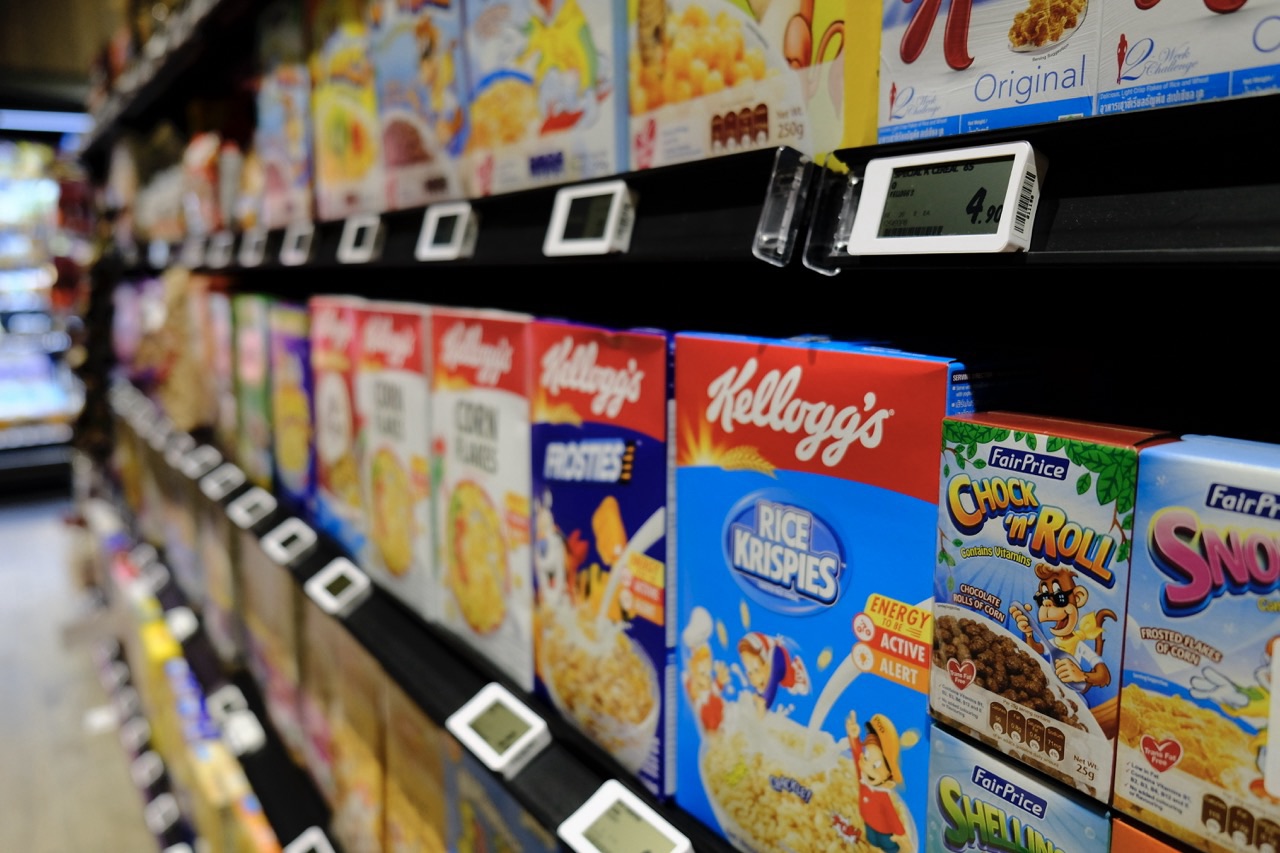
Why do crunchy breakfast cereals turn soft and soggy after sitting in milk? Many cornflakes and other ready-to-eat cereals have a dry, porous structure made largely from processed starch. This structure is brittle and produces a crisp sound when bitten. Once milk contacts the flakes, water moves into the small spaces and material of the cereal. Starch-rich regions absorb moisture and become more flexible, weakening the dry structure that made the cereal crunchy. The flakes may bend rather than snap, and the sound of crunching becomes less distinct. Sogginess is primarily a change in moisture and texture, not evidence that the cereal has chemically dissolved into sugar or become spoiled. The exact time depends on the recipe, cereal structure, milk composition, serving temperature and how deeply the flakes are submerged.
This Hougang Chemistry guide to why cornflakes become soggy, milk absorption, capillary action, starch polymers, crunchy food texture and cereal manufacturing explains the process using published food science. A peer-reviewed study of ready-to-eat breakfast cereal measured how moisture uptake depends on milk composition and temperature, while food-engineering literature explains why processing and starch structure determine how quickly flakes lose their crispness. For a family having breakfast in Hougang, the practical response is ordinary: pour milk when ready to eat, follow the product’s storage instructions and keep dry cereal sealed from humid air. A crunchy cereal is not necessarily more nutritious, and a softened cereal is not automatically unsafe; those are separate questions. Secondary learners can explore mixtures and capillarity, while JC students can examine water sorption, porous structures and the mechanics of brittle materials.
The Breakfast That Changed While Everyone Was Talking
A bowl of cereal is poured for breakfast. The first spoonful is crisp enough to make a little sound. Then a family conversation lasts longer than expected, and the next mouthful is soft. The same cereal, the same milk and the same bowl have produced a different eating experience after a few minutes.
The obvious answer is that the flakes got wet. True—but incomplete. We want to know what happens inside the food, why dry cereal is brittle, how liquid enters it, and why something can become less crunchy without being chemically transformed into an entirely new substance.
This small example is particularly useful to students because it is an engineering question as much as a cooking question. Manufacturers deliberately create structures that remain crisp in a package, yet consumers often eat them in milk. The product must balance those competing conditions.
What Makes Dry Cereal Crunchy?
A typical cornflake contains starch-rich material that has been cooked, shaped and dried or toasted during production. The final structure may have small pores, layers, cell-like spaces and a relatively low moisture content.
Low moisture and the resulting physical organisation can make such foods brittle. When bitten, parts of the structure fracture abruptly and release sound. The sensation we call crunch comes from a mechanical event rather than a special flavour molecule.
The food-science overview of breakfast cereal processing describes how flakes are formed and toasted, and explains that processing the starch too strongly can make flakes take up water quickly and lose their desirable brittle texture.
Not every cereal uses the same grain, starch composition or manufacturing process. A dense granola cluster, a cornflake and an extruded puff may have different porous structures, so their times to sogginess can differ.
Why Water Moves Into the Flake
Milk is mostly water, with dissolved and dispersed components such as lactose, proteins, minerals and, depending on the product, fat droplets. When it meets a dry porous flake, the water can contact exposed starch-rich regions and move into the internal structure.
There are several relevant mechanisms. Liquid can enter connected small spaces through capillary action. Water can also be absorbed into starch and other food solids, changing their physical properties.
Capillary action occurs when liquid and surface interactions, together with surface tension, promote movement through suitable narrow spaces. It is not a tiny motor inside the cereal. The resulting movement depends on pore sizes, geometry, contact angle and how the food was processed.
The cereal also contains ingredients that interact with moisture differently, so it would be too simple to say that every molecule in the flake absorbs the same amount of milk at the same rate.
What Is Starch Doing?
Starch consists mainly of two types of glucose-based polymer structures known as amylose and amylopectin. During cereal production, starch experiences cooking and other processing that influence how it behaves once dried.
When water returns to the product, its polymer-rich regions can become more flexible. Moisture can act as a plasticiser, allowing parts of the structure to deform more readily rather than fracture sharply.
The final mechanical response depends on the processing history and overall ingredients. It is not necessary for all the starch chains to be hydrolysed into glucose for the product to become soggy.
This distinction helps students avoid confusing hydration, dissolving, chemical hydrolysis and microbial spoilage. They are different scientific processes, even when the same food encounters water.
Why Do Flakes Bend Instead of Snap?
A dry brittle flake can crack under pressure because its structure resists deformation up to a point. As the flake takes up moisture, its mechanical properties shift. More movement may become possible within parts of the starch-rich material.
When the spoon or teeth apply a force, the softened region may bend, fold or compress instead of breaking with the familiar crisp sound. The product can therefore feel noticeably different long before its visible shape changes drastically.
This is an example of structure controlling texture. The chemistry of the starch matters, but the physical arrangement of the processed cereal is equally important.
What Does the Published Experiment Show?
Researchers M. Fátima Machado, Fernanda A. R. Oliveira and Luís M. Cunha studied moisture uptake by ready-to-eat corn cereal placed in milk mixtures. Their work, published in the International Journal of Food Science & Technology, measured how conditions influenced the rate of water entry.
They varied temperature and milk composition and examined the kinetics of moisture uptake. Under their experimental conditions, milk solids and fat influenced the process, with the fat fraction capable of hindering some moisture transfer after contact.
An important nuance is that this does not mean adding extra fat always keeps any cereal crunchy. Different products and experimental timescales can produce different results. The study demonstrates how a real measurement can refine a simple explanation based on water alone.
The university research record provides an accessible summary of the experiment and its measured variables.
Does Cereal Get Soggy Faster in Warm Milk?
Temperature can change liquid viscosity, diffusion behaviour, food-material properties and rates of moisture uptake. It is reasonable to consider a temperature effect, but the exact outcome depends on the cereal and the milk formulation.
The published cereal study compared conditions at different temperatures, showing why temperature must be specified before making a general quantitative prediction.
A student should not claim that all cereals become soggy twice as quickly whenever milk is twice as warm. Temperature in degrees Celsius cannot be treated as a simple multiplier for moisture sorption rate. Such a claim needs data.
Why Humid Air Can Soften Cereal Before Milk Is Added
An opened cereal package can take up moisture from its surroundings. Singapore’s often humid air is relevant because the food can lose some of its dry brittle character before breakfast even begins.
A previously crisp cereal that has been left in an unsealed package may taste stale or soft. That observation can be caused partly by moisture uptake without automatically proving biological spoilage.
This is why keeping cereal in suitable, well-closed packaging matters. Product labels and storage instructions remain the correct practical guidance.
Why Cornflakes and Puffed Cereals Behave Differently
Flakes and puffed cereals have different densities, pore structures and manufacturing histories. An expanded cereal can contain numerous thin-walled air spaces; a flake can have a more compact layered structure.
Water does not necessarily enter or soften these materials at the same rate. Surface coatings, sugar content, fibre and other ingredients add more variables.
A fair comparison must therefore identify the actual products and conditions. Using a general sentence such as “airier cereal stays crisp longer” without evidence may be wrong for some formulations.
A Cereal Is Not Simply a Grain
Manufacturing can involve cooking, extrusion, flaking, drying and toasting. These processes change the organisation of starch, proteins and water, creating the texture consumers expect.
When milk is added, the material moves away from the dry state created through processing. The softened result need not be a return to its original uncooked grain structure.
The food-science explanation is therefore more accurate than saying the cereal merely “melts back into corn”. The material’s history and polymer organisation matter.
A Thought Experiment With Two Bowls
Imagine two identical bowls of the same cereal at the same room conditions. In Bowl A, milk is poured immediately before the cereal is eaten. In Bowl B, milk is poured earlier and the cereal sits for a longer interval.
All else equal, Bowl B generally has more time for moisture uptake and structural softening. But to compare specific rates, a scientist would measure cereal mass changes, texture or other defined outcomes and control variables such as milk quantity, temperature and cereal batch.
A subjective judgement of “soggy” is useful for eating preference but less precise than a standardised mechanical measurement.
Why ‘Fresh and Crunchy’ Is Not a Nutrition Test
Crunch is a sensory and mechanical attribute. It does not directly measure vitamins, fibre, sugar content, energy or food safety.
Two cereals may have similar texture and very different ingredient lists or nutritional profiles. Similarly, a cereal that has softened appropriately in milk can still be ordinary food when safely handled.
For food decisions, check the product’s nutritional information and storage directions rather than using the loudness of a crunch as a proxy for healthfulness.
A Safe Parent–Student Science Exercise
- Observation: cereal becomes softer after contact with milk.
- Physical mechanism: moisture enters pores and starch-rich structures.
- Material response: the previously brittle structure becomes more flexible or loses strength.
- Possible variables: product type, temperature, milk composition and contact time.
- Measured outcome: a defined texture or moisture-uptake measurement is more precise than “feels soggy”.
- Limitation: the observation alone does not establish spoilage, nutrition or a chemical breakdown of all starch.
Students can use published graphs or teacher-supplied data. There is no need to leave milk-based food out unsafely for an extended classroom experiment.
Connections to Other Hougang Food Chemistry
Cereal becoming soggy differs from rice becoming hard in the refrigerator. Both involve starch, but rice retrogradation concerns starch chains reassociating after cooking and cooling, while breakfast-cereal softening concerns water uptake and loss of a brittle manufactured structure.
The ice-cream softness guide provides another comparison: a dessert’s physical structure and liquid fraction determine texture in a frozen system.
The shared lesson is that knowing one ingredient, such as starch or water, is not enough to predict a food’s texture without understanding its structure and history.
School and JC Learning Pathways
Secondary 1–2: mixtures and physical properties
Students can explain why water moves into dry materials and distinguish a change of texture from an unsupported claim about the creation of a new compound.
Secondary 3–4: polymers and material structure
Learners can connect starch polymer behaviour with moisture content and mechanical properties, recognising the roles of processing and surface interactions.
JC Chemistry and Physics: transport and mechanics
Advanced students can consider capillary movement, diffusion, water sorption, plasticisation and the relationship between porous microstructure and brittle fracture.
A Three-Student Learning Conversation
One learner explains where milk water moves, a second describes how starch-rich regions soften, and the third identifies why crunch is not a measure of nutrition. Each answers a changed question comparing two cereal structures.
The close-feedback approach echoes the teaching principles of eduKate’s three-pax Mathematics tutorial reference, which describes Mathematics elsewhere, not a Hougang Chemistry class.
Frequently Asked Questions
Does cereal become soggy because the milk dissolves it completely?
No. Moisture uptake and physical softening can occur without complete dissolution or chemical hydrolysis of all the starch.
Why is dry cereal so crunchy?
Its manufactured dry, brittle structure fractures under biting. Moisture alters that mechanical behaviour.
Does hot milk always make cereal soggy faster?
Temperature can influence moisture uptake, but the rate depends on the product and conditions. A precise claim needs measured data.
Do all cornflakes and puffed cereals soften at the same speed?
No. Structure, starch processing, coatings and other ingredients differ.
Is soft cereal spoiled?
Sogginess by itself is not proof of spoilage. Proper handling, storage conditions and food-safety guidance are separate considerations.
Can a sugary coating stop sogginess forever?
No. A coating may affect water entry but cannot guarantee indefinite crispness once cereal contacts milk.
The Soggy Spoonful Is a Materials-Science Moment
Breakfast cereal goes soft because the liquid changes its internal structure and mechanical behaviour. What looked like a simple food preference is a useful lesson in water transport, starch polymers and why processed materials respond differently after contact with moisture.
Continue through Why Refrigerated Rice Hardens, Why Ice Cream Stays Soft, How Chemistry Works in Hougang, and the Hougang Science Learning Hub. Supporting evidence comes from the peer-reviewed cereal moisture-uptake study and the food-engineering cereal overview. The Chemistry Tuition and Tutor Library provides the wider study route.
Food formulations and storage conditions vary. This article is an educational materials-science explanation and does not certify a food’s safety or nutrition from its texture. No eduKate Hougang Chemistry teaching venue is claimed.