
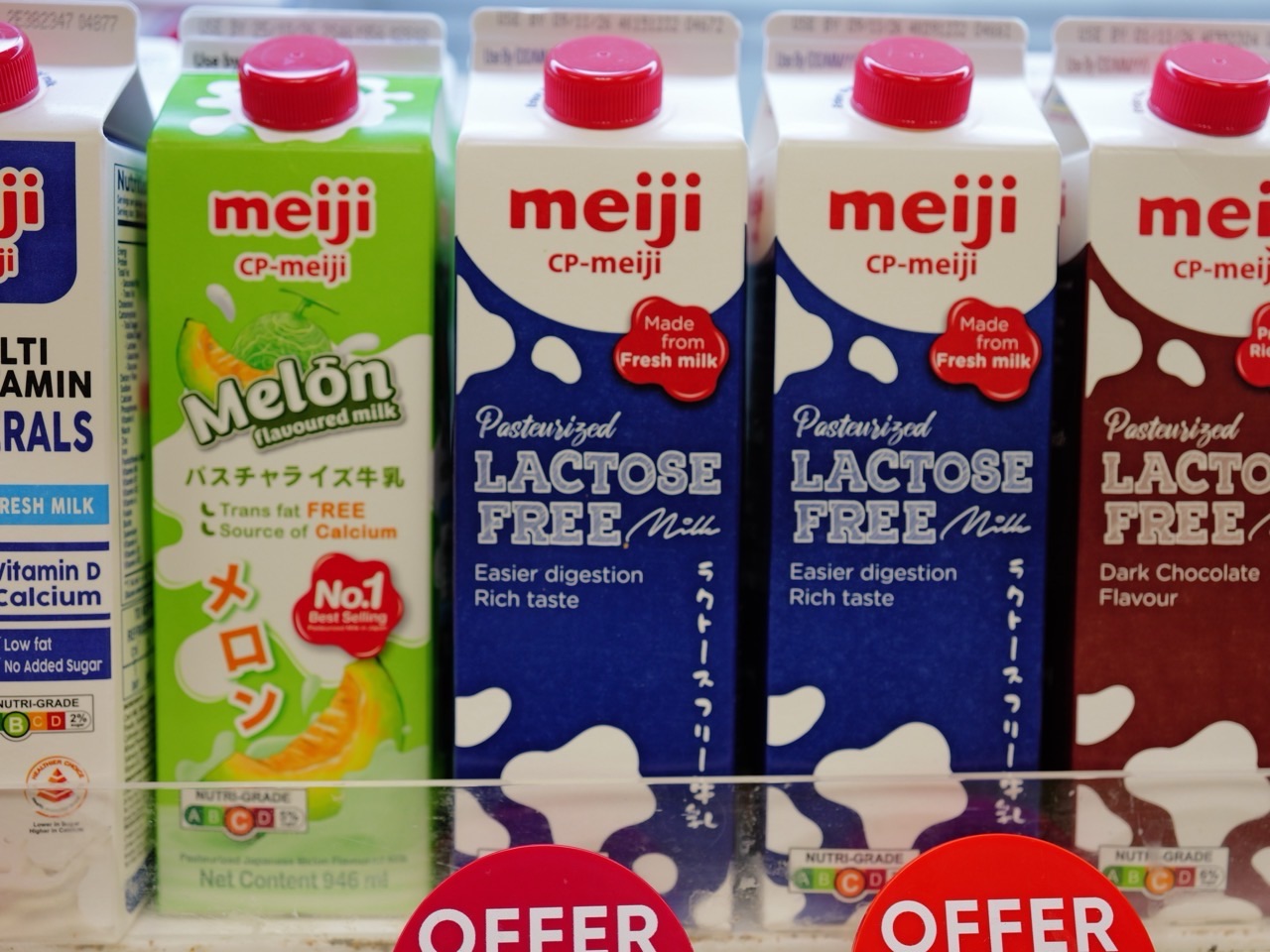
Lactose-free milk can taste sweeter than ordinary milk even when no table sugar has been added. The reason is an enzyme called lactase (β-galactosidase), which can hydrolyse lactose, the disaccharide naturally present in milk, into two smaller sugars: glucose and galactose. These sugars have different sweetness properties from lactose, so the resulting drink may taste sweeter even though the manufacturer did not add sucrose. Some commercial lactose-free milks also use filtration or other processing that changes the formulation, so the precise taste and sugar labelling depend on the product. Singapore’s HealthHub guide to dairy and lactose intolerance explains lactase treatment and the sweeter taste, while a 2023 scientific review of low-lactose and lactose-free dairy processing describes lactose hydrolysis and alternative processing routes.
For Hougang Secondary 1–4 Science students, SEC G1/G2/G3 Chemistry learners, JC pupils, parents and tutors searching why lactose-free milk tastes sweet, whether lactase adds sugar, what glucose and galactose are, the difference between lactose intolerance and milk allergy, or how a lactase enzyme works, follow this chain: lactose is present in ordinary milk → lactase helps break its glycosidic bond using water → glucose and galactose are produced → the sensory sweetness changes → the final product’s nutrition still depends on its full formulation. Lactose-free milk is not automatically sugar-free, carbohydrate-free or dairy-free. Singapore’s Food Agency (SFA) recommends reading the actual ingredient and nutrition labels, and HealthHub distinguishes lactose-related digestion from other individual dietary considerations. This is an enzyme hydrolysis explanation, not a duplicate of the Hougang yoghurt fermentation article: lactase-based milk treatment and fermentation-induced protein gelation answer different questions.
The Carton That Tastes Sweeter Without Added Sugar
A parent buys two cartons for a Hougang household. One is standard dairy milk; the other is labelled lactose-free. The child tastes the lactose-free one and says, “Someone must have put extra sugar in this.” Yet the label does not identify added table sugar. What happened?
This is one of the most satisfying Chemistry puzzles in a supermarket. The total carbohydrate story, molecular identity and taste response are not interchangeable. Changing a larger sugar molecule into two smaller sugars can change how sweet a drink tastes without following the same process as adding spoonfuls of sucrose.
A useful tutor listens to the student’s original explanation rather than dismissing it. It is sensible to expect sweetness to be related to sugar. The missing step is that different sugar molecules have different chemical structures and different sensory properties.
What Is Lactose?
Lactose is a disaccharide, meaning it contains two linked monosaccharide units. Specifically, its structure joins a glucose-derived unit and a galactose-derived unit through a glycosidic bond. Its molecular formula is C₁₂H₂₂O₁₁.
Glucose and galactose are each monosaccharides with molecular formula C₆H₁₂O₆, although their spatial structures differ. In a lactose molecule, the two units are chemically linked, and the properties of that disaccharide differ from those of the separate monosaccharides.
This is a wonderful early lesson about structure and properties. Students should not assume that molecules with the same overall formula have identical behaviour, or that splitting one molecule into smaller ones destroys matter.
What Does Lactase Do?
Lactase is an enzyme, meaning it facilitates a particular chemical transformation without being consumed as a stoichiometric ingredient in the same way as a reactant. In this case, the enzyme promotes hydrolysis of lactose’s glycosidic bond, allowing water to contribute to the formation of the two monosaccharides.
The simplified balanced transformation is:
C₁₂H₂₂O₁₁ + H₂O → C₆H₁₂O₆ + C₆H₁₂O₆
One of the product molecules is glucose and the other is galactose. Writing the same formula twice is not an error: glucose and galactose have the same molecular formula but different structures. That difference is why a purely formula-based description cannot tell the whole biological and taste story.
The McGill University Office for Science and Society explanation describes industrial lactase treatment and explains why lactose-free products can taste sweeter without necessarily having added sucrose.
Why Does Hydrolysis Affect Sweetness?
Sweetness is a sensory response to specific molecules interacting with taste receptors. Lactose, glucose and galactose do not have identical sweetness intensities under comparable conditions. Converting lactose into its constituent monosaccharides can therefore increase the perceived sweetness of the milk.
This should not be reduced to “all small sugars are always sweeter than all big sugars”. Sweetness depends on molecular structure, concentration, temperature, mixture effects and the comparison convention. A particular product’s overall taste also reflects fat, proteins, heat treatment and other constituents.
The scientifically sound statement is that hydrolysed lactose changes the mixture of sugar molecules, and this can produce a sweeter impression. It is not evidence of an undisclosed added-sugar ingredient.
Lactose-Free Does Not Mean That Every Product Has an Identical Process
Some manufacturers treat milk with lactase before further processing. Others can add sterile lactase within a controlled aseptic process, and some use membrane filtration to reduce lactose before or after enzyme treatment. These routes differ in how they alter the final mixture.
The 2023 review of lactose-free dairy technology discusses pre-hydrolysis, post-hydrolysis and filtration approaches. A label may therefore differ in total sugars or composition depending on the process, even if multiple products satisfy the same relevant lactose-related claim.
A parent should read the actual nutrition panel rather than infer that every lactose-free milk has exactly the same grams of sugars as a conventional comparator. The absence of added sucrose and the total naturally derived sugar measurement are different label questions.
Worked Equation: Where Does the Extra Water Molecule Go?
The molar mass of lactose is approximately 342 g/mol. One mole of water contributes approximately 18 g/mol. The hydrolysis products have molar masses about 180 g/mol each, so the mass balance is 342 + 18 = 180 + 180 = 360 g per mole of lactose reacting in the idealised model.
A student who says “342 g of lactose turns into 360 g of sugar, so sugar appeared from nowhere” has forgotten that water participates in hydrolysis. Matter is conserved across all reactants and products. The additional atoms came from the water molecule.
This is one of those school Chemistry ideas that becomes more memorable when it explains a real food label rather than a synthetic examination-only reaction.
A Worked Mole Problem With Lactose
Suppose a completely fictional classroom exercise starts with 0.020 mol of lactose that is hydrolysed completely with sufficient water and effective enzyme catalysis. The idealised reaction produces 0.020 mol glucose and 0.020 mol galactose, because the stoichiometric ratio is 1:1:1 for lactose to each product.
Using 180 g/mol for each product, that corresponds to 3.60 g glucose and 3.60 g galactose. The starting lactose mass was approximately 0.020 × 342 = 6.84 g; about 0.36 g of water participated in hydrolysis. The total product mass is 7.20 g in this model.
These are hypothetical chemical amounts, not the measured sugar content of a real brand or a dietary recommendation. The important skill is recognising the contribution of water and the fact that one lactose molecule produces two monosaccharide molecules.
Why “No Added Sugar” and “Sugar-Free” Are Not Synonyms
A product can contain naturally derived sugars while having no externally added sugar ingredient. In lactase-treated dairy milk, glucose and galactose can arise from breaking down lactose already in the milk. Whether a product qualifies for a particular regulated nutrition claim depends on the actual standard and finished formulation.
Singapore’s SFA nutrition-label guide advises comparing labelled nutrient amounts on a common basis, typically per 100 g or 100 mL where appropriate. For schoolchildren, this becomes a practical lesson in what a food label can establish and what requires additional chemical analysis.
A student must not say a product contains no sugars simply because the word lactose-free appears on its front. The label tells them something about one specific sugar, not necessarily all carbohydrates.
What Is Lactose Intolerance?
Lactose intolerance concerns difficulty digesting lactose because of insufficient lactase activity in the small intestine. When enough lactose remains undigested, it can reach the large intestine, where microbial activity and other processes can contribute to symptoms such as discomfort, bloating or diarrhoea in susceptible individuals.
Singapore’s HealthHub dairy guide explains lactase’s digestive role and describes lactose-free milk as one possible alternative for people who experience lactose-related symptoms. Individual tolerance and medical circumstances vary; the article is not a diagnosis.
The Chemistry connection is direct: the industrial enzyme can perform a bond-breaking transformation before consumption that the person might otherwise have difficulty performing efficiently in digestion.
Milk Protein Allergy Is a Different Question
A milk-protein allergy involves an immune response to one or more milk proteins and should not be confused with lactose intolerance. Removing or breaking down lactose does not automatically remove the proteins in ordinary lactose-free dairy milk. This distinction can matter greatly to product suitability.
Parents should not give lactose-free cow’s milk as a presumed safe substitute for a person with a diagnosed milk-protein allergy without appropriate professional guidance. A food ingredient and allergen label has a different role from the sweetness and carbohydrate explanation.
This is a general Chemistry lesson in specificity: changing one compound does not mean the other molecules in a mixture have disappeared.
How Is This Different From Making Yoghurt?
In conventional yoghurt production, starter microorganisms metabolise some lactose and produce acids that can change milk-protein behaviour, forming a gel. In enzyme-treated lactose-free milk, the central process is hydrolysing lactose to glucose and galactose. The overall mixture usually remains a milk drink unless the manufacturer uses additional processing.
The yoghurt gelation article therefore answers why the food thickens, while this page answers why a lactose-free drink may taste sweeter. They share the starting food but not the same main mechanism.
A useful tutor can ask the pupil to identify which process involves a microbial culture and which uses an enzyme targeted at a particular disaccharide. That contrast prevents the common error of using the word fermentation for every change to milk.
Can Lactase Hydrolysis Change Other Product Properties?
Hydrolysis changes the number and identity of sugar molecules in solution. Under a comparable idealised number of lactose molecules reacting, two monosaccharide particles are produced from each disaccharide molecule. This can influence properties associated with solute particles, although milk’s real behaviour also depends on proteins, salts and processing.
Manufacturers must consider additional quality factors. The 2023 review discusses potential changes to flavour and storage quality associated with some enzyme preparations and heat treatments. No one variable automatically predicts every product’s shelf life.
A careful educational article separates what the hydrolysis equation proves from what needs a finished-product performance test.
A Safe Supermarket Label-Reading Exercise
- Find the identity: compare ordinary cow’s milk and a properly labelled lactose-free dairy milk.
- Read the ingredients: look for information about lactase or other relevant processing, where stated.
- Read the sugar panel: compare the stated total sugars on a common 100 mL basis.
- Model: draw lactose splitting into glucose and galactose using one water molecule.
- Explain: state why a sweeter taste does not automatically establish added sucrose.
- Transfer: distinguish lactose-related digestive concerns from milk-protein allergy.
This needs only package images and a worksheet. No student needs to consume milk, test intolerance or handle commercial enzymes to establish the Chemistry.
How This Builds Secondary and JC Understanding
- Secondary 1–2 Science: mixtures, sugars as substances, observations and the difference between food taste and food composition.
- Secondary 3 Chemistry: molecular formulas, conservation of mass and the idea of different structures.
- Secondary 4 Chemistry: simple organic transformations, mole ratios, enzymes in context and quantitative data.
- JC Chemistry: hydrolysis, catalysis, molecular stereochemistry and reaction stoichiometry as appropriate extension.
- Parents: distinguish taste, no-added-sugar claims, lactose intolerance and other dietary needs.
A Three-Student Tutorial: Three Different Misconceptions
One pupil thinks all sweetness requires added table sugar. Another writes the hydrolysis equation without the water molecule. A third concludes that lactose-free milk is appropriate for every person with any dairy-related health condition. Each student needs a different correction.
A suitable tutor checks the earliest wrong assumption and then gives each learner a changed question after the explanation. The eduKate three-student small-group reference demonstrates diagnosis-first pedagogy in another subject and does not imply a specialised Hougang dairy-science class or health service.
Frequently Asked Questions
Why does lactose-free milk often taste sweeter?
Lactase hydrolyses lactose into glucose and galactose, which have different sweetness properties from the original lactose molecule.
Does lactose-free mean sugar-free?
No. Lactose-free milk can still contain glucose, galactose and other carbohydrates. The actual amount depends on the finished product and processing.
Does lactase add table sugar to milk?
No. Lactase catalyses a chemical transformation of existing lactose with water. Some finished products may contain other added ingredients, so check the product label separately.
Is lactose-free milk automatically safe for milk-protein allergy?
No. Ordinary lactose-free dairy milk may still contain cow’s-milk proteins. People with milk-protein allergy need appropriate medical and product-specific guidance.
Is yoghurt simply another kind of lactose-free milk?
Not automatically. Fermentation, protein gelation and lactose hydrolysis are different processes. Actual lactose content depends on the product.
Continue the Hougang Dairy Chemistry Learning Route
Read Singapore HealthHub’s dairy guidance, McGill University’s explanation of lactose-free milk, the peer-reviewed lactose-free dairy processing review and SFA’s nutrition-label guide. Then connect to yoghurt acidification and casein gelation, soy protein coagulation in tofu and the Hougang Chemistry Tuition and Tutor Library. These keep sweetness, fermentation, gelation and individual food suitability as separate questions.
Independent educational Chemistry and food-label reference checked against Singapore HealthHub, SFA and dairy-science research in October 2026. Numerical examples are fictional. This is not nutritional treatment or a diagnosis of lactose intolerance, dairy allergy or another medical condition.