
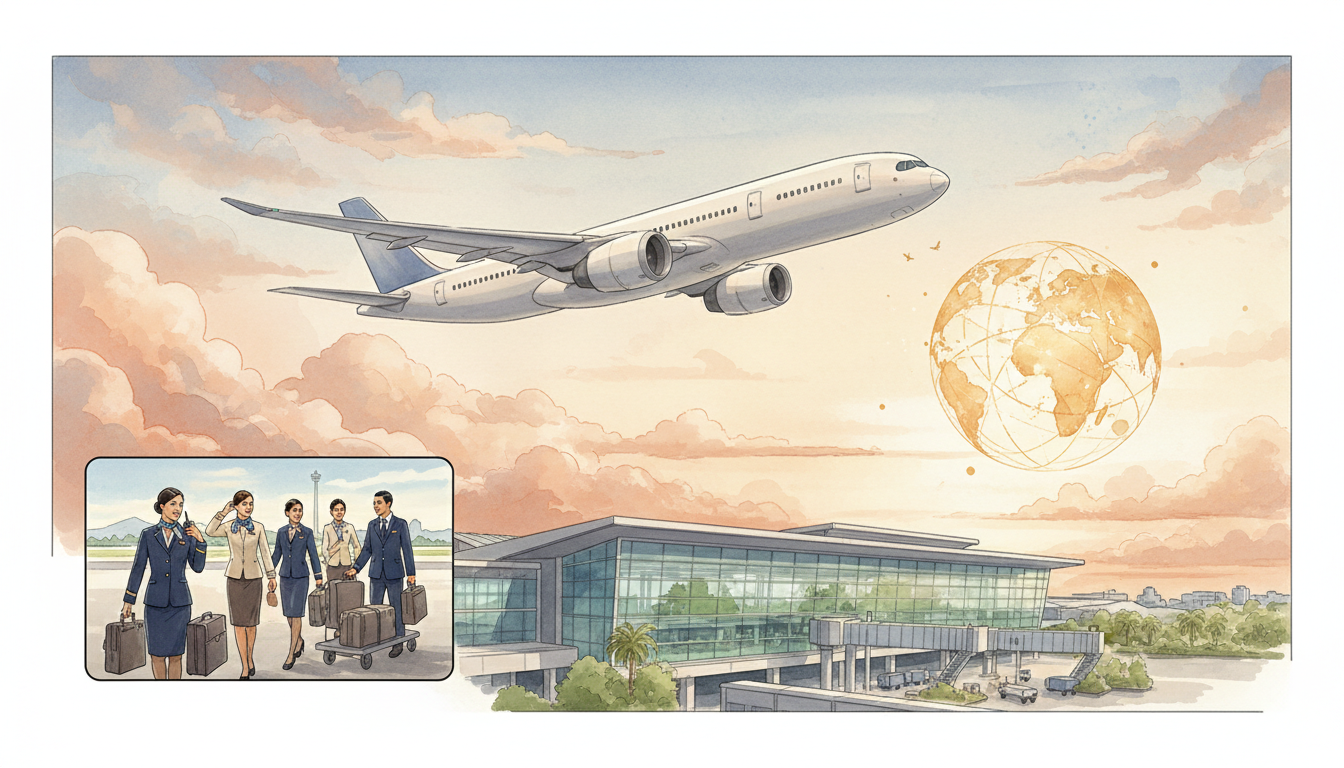
Singapore Airlines (SIA), known by the flight code SQ, is a global airline whose roots reach back to Malayan Airways’ first flight from Kallang Airport on 1 May 1947. Singapore Airlines took its modern independent identity after Malaysia-Singapore Airlines separated in 1972. Its Singapore Girl branding, batik sarong kebaya, Changi hub and KrisFlyer programme are widely recognised, but they mean different things. Here are 100 Singapore Airlines vocabulary words with plain-English meanings, natural examples and the cultural or practical reason behind each term.
Why is Singapore Airlines part of Singapore’s culture? The company’s history follows the region’s changing borders, the growth of Singapore as an international connection point and the work of cabin crew, engineers and airport teams. The airline’s official history records 1947 as its predecessor’s beginning and 1972 as the separation into the modern Singapore Airlines brand. Its cabin-crew history explains the signature kebaya and training behind service. A familiar commercial image is part of Singapore’s international reputation, not a definition of every Singaporean or a substitute for safety rules.
To find an answer immediately, open the 100-word finder, the five-minute company history, KrisFlyer and PPS distinctions or practical boarding and baggage vocabulary. The article is an educational guide, not a live ticket quotation or a claim that a benefit applies to every flight. Always check the actual aircraft, operator, ticket class and date before planning a journey.
Singapore Airlines in sixty seconds: answers without the myths
- What it is: Singapore Airlines, commonly SIA, with the SQ flight-code prefix, operates international passenger services from Singapore.
- Predecessor: Malayan Airways Limited began service from Kallang on 1 May 1947 aboard an Airspeed Consul.
- Modern company: Malaysia-Singapore Airlines separated in 1972 into the Malaysian airline and Singapore Airlines.
- Airport home: the airline transferred its operations from Paya Lebar to the new Changi Airport on 1 July 1981.
- Singapore Girl: a longstanding cabin-crew and marketing image linked to the sarong kebaya; crew are trained safety and service professionals, not merely models.
- KrisFlyer: redeemable KrisFlyer miles are different from qualifying Elite miles; PPS Club uses PPS Value for its own tier calculation.
- Before departure: verify the marketing and operating carrier, the booking’s rules, terminal, current flight status and applicable baggage conditions.
1947, 1966, 1972 and 1981: four stages of a longer story
1947: Malayan Airways Limited operated its first service from Kallang to destinations in the region. 1963: its name changed to Malaysian Airways as the Federation of Malaysia formed. 1966: it became Malaysia-Singapore Airlines. 1972: the company separated, producing the modern Singapore Airlines and Malaysian carrier. 1981: Singapore Airlines shifted services to Changi. These company events are recorded in SIA’s heritage timeline. They are related but not interchangeable: the first aircraft flight was not the founding of the brand under the same name.
The air connections grew with the region’s trade, movement of families and evolving infrastructure. When Singaporeans encounter Singapore Airlines advertisements overseas, the airline’s reputation can feel like a part of their home country’s image, but the timeline also reveals the role of predecessor companies and regional partnerships. A thoughtful school essay recognises those connections without saying the company single-handedly created Singapore’s economic success.
The Singapore Girl: a cultural symbol and an employment role
Singapore Airlines’ general heritage account describes a sarong kebaya introduced in 1968 and subsequently adapted by Pierre Balmain, while its cabin-crew account specifically dates the Parisian couturier’s adaptation to 1974. These statements should be read as a multi-stage design history rather than silently edited into a single claim that the complete modern uniform first appeared in one year. The outfit’s traditional Asian batik motif pays homage to Southeast Asian dress and textile traditions.
The term Singapore Girl is a commercial brand identity associated with female crew, not a biological or cultural description of women in Singapore. It is entirely possible to appreciate the brand’s recognisable look while questioning gender stereotypes. What matters most about a real flight attendant is training: Singapore Airlines highlights its cabin crews’ first-aid knowledge, emergency readiness, and communication with diverse travellers. Male crew, engineers, cleaners and ground personnel also contribute to the experience.
KrisFlyer miles, Elite miles and PPS Value are not the same
KrisFlyer miles are rewards that can be redeemed for eligible flights, upgrades or qualifying purchases. Elite miles primarily count towards KrisFlyer Elite Silver, Elite Gold and milestones; the operator states they cannot be spent like ordinary award miles. PPS Value is a different qualification measure for the PPS Club. The airline’s programme overview and Elite status guide make those distinctions explicit.
As published for 2026, KrisFlyer Elite Silver generally requires 25,000 Elite miles and Elite Gold 50,000 in the relevant twelve-month qualification window. PPS Club uses its own rules. In September 2025, the group added some eligible non-flight spending toward tier qualification through Kris+, KrisShop and Pelago. See the dated 2025 programme update rather than assuming rewards have always worked in exactly the same way. Special earning, redemption and expiry conditions still need checking for a real account.
SQ flight number, operating carrier and the actual ticket
Suppose a booking shows an SQ flight code but identifies a partner as the operating carrier. The airline selling a seat and the airline operating the aircraft need not be the same. This is why codeshare matters: check the actual operator when reading check-in procedures, included services, baggage and assistance arrangements. A connecting journey may also involve multiple operators.
Singapore Airlines’ baggage guidance distinguishes checked baggage from cabin baggage and recommends keeping travel documents, essential medicines and valuables with you rather than inside checked luggage. The published general cabin guide gives up to two pieces for Suites, First and Business on eligible services and one for Premium Economy or Economy, with a general 7 kg limit per piece and stated dimensions; local security rules and operating conditions may differ. Do not replace a real ticket’s checked-baggage allowance with those cabin limits.
A second important distinction is flight status versus itinerary. An itinerary says what was booked; flight status tells you what is currently expected or happening. A departure gate can change. Current airport displays, the airline’s booking system and the operator’s directions should take priority over an older article’s instructions.
Why an airline must be judged beyond an attractive cabin image
Airline marketing often focuses on cabin design, service imagery and international acclaim. Those are meaningful parts of branding, but an aircraft’s safety depends on crews, maintenance engineers, dispatchers, ground handlers, baggage workers, air traffic services and thousands of routine checks. The traveller’s consumer protections depend on ticket conditions and applicable rules, not only the company’s public reputation.
For a critical reading exercise, compare a promotional claim with a specific passenger obligation. “World-class service” is promotional evaluation. “One cabin bag up to 7 kg in Economy Class under the published general allowance” is a specific condition that can be checked. “This flight leaves on time today” is a live operational claim that a history article cannot verify. Learning to distinguish the three makes airline vocabulary useful.
Ten reading routes through all 100 words
- Part 1: The story from Malayan Airways to Singapore Airlines — words 1–10
- Part 2: The Singapore Girl, batik and the people wearing the uniform — words 11–20
- Part 3: Flight identity, routes and international connections — words 21–30
- Part 4: Seats, cabins and the limits of a fare name — words 31–40
- Part 5: Booking a flight and reaching the correct departure gate — words 41–50
- Part 6: Baggage, aircraft safety and practical rules — words 51–60
- Part 7: KrisFlyer: the meaning of miles, awards and Elite tiers — words 61–70
- Part 8: The PPS Club, airline partnerships and service roles — words 71–80
- Part 9: What happens on board: service, entertainment and safety — words 81–90
- Part 10: Read airline and national-identity claims responsibly — words 91–100
Quick finder: one click to each vocabulary term
1–10: 1. Singapore Airlines · 2. SIA · 3. SQ · 4. Malayan Airways Limited · 5. 1 May 1947 · 6. Kallang Airport · 7. Airspeed Consul · 8. Malaysia-Singapore Airlines (MSA) · 9. 1972 separation · 10. 1981 Changi move
11–20: 11. Singapore Girl · 12. Sarong kebaya · 13. Batik · 14. Pierre Balmain · 15. Uniform rank colour · 16. Cabin crew · 17. Cabin supervisor · 18. First-aid training · 19. Service training · 20. Gender stereotype
21–30: 21. Flight number · 22. Non-stop flight · 23. Direct flight · 24. Connecting flight · 25. Transfer passenger · 26. Layover · 27. Route network · 28. Codeshare · 29. Operating carrier · 30. Changi hub
31–40: 31. Economy Class · 32. Premium Economy Class · 33. Business Class · 34. First Class · 35. Suites · 36. Cabin configuration · 37. Seat map · 38. Seat selection · 39. Booking class · 40. Fare conditions
41–50: 41. E-ticket · 42. Booking reference · 43. Manage Booking · 44. Online check-in · 45. Boarding pass · 46. Departure terminal · 47. Boarding gate · 48. Boarding time · 49. Schedule change · 50. Flight status
51–60: 51. Cabin baggage · 52. Checked baggage · 53. Baggage allowance · 54. Overhead compartment · 55. Personal item · 56. Weight limit · 57. Restricted item · 58. Lithium battery · 59. Baggage claim · 60. Mishandled baggage
61–70: 61. KrisFlyer · 62. KrisFlyer miles · 63. Elite miles · 64. KrisFlyer Elite Silver · 65. KrisFlyer Elite Gold · 66. Award ticket · 67. Redemption · 68. Redemption nominee · 69. Star Alliance · 70. KrisFlyer milestone
71–80: 71. PPS Club · 72. PPS Value · 73. Solitaire PPS Club · 74. Scoot · 75. SilkAir · 76. KrisShop · 77. Kris+ · 78. Pelago · 79. Ground handler · 80. SATS heritage
81–90: 81. KrisWorld · 82. Inflight entertainment · 83. Inflight Wi-Fi · 84. Book the Cook · 85. Special meal · 86. Seat-belt sign · 87. Turbulence · 88. Safety demonstration · 89. Cabin pressure · 90. Jet lag
91–100: 91. Brand identity · 92. National association · 93. Service promise · 94. Conditions of carriage · 95. Marketing carrier · 96. Air travel emissions · 97. Sustainability reporting · 98. Worker dignity · 99. Source date · 100. Claim verification
Read, apply, compare and verify: a small vocabulary routine
Begin with one term that answers a real question: operating carrier identifies the airline running the plane; KrisFlyer miles means spendable rewards under programme rules; Elite miles refers to status progress. Read the meaning, say the example sentence, explain one likely misunderstanding and then find an official source or real document that confirms the answer. Do it again without looking.
For younger students, start with the history dates, uniforms, tickets and familiar airport words. Older learners can examine marketing, travel contracts, international networks, technical occupations and environmental claims. The guide’s hundred entries are an independent learning resource, not an official aviation qualification or school vocabulary syllabus.
Part 1 — The story from Malayan Airways to Singapore Airlines
The airline’s published heritage starts with Malayan Airways’ 1947 flight and distinguishes the independent Singapore Airlines company from the 1972 separation. A history of one business can illuminate regional travel and nationhood without claiming that an airline speaks for every Singaporean.
1. Singapore Airlines
Meaning: Singapore’s international full-service airline, commonly shortened to SIA. Use it naturally: “Singapore Airlines connects Singapore with destinations overseas.” Singapore culture and careful-reading note: Its internationally recognised identity has been built through decades of aviation and service work.
2. SIA
Meaning: A common abbreviation for Singapore Airlines. Use it naturally: “The newspaper article referred to SIA’s heritage.” Singapore culture and careful-reading note: This local shorthand appears often in Singapore business and travel reporting.
3. SQ
Meaning: The two-letter airline code used in Singapore Airlines flight numbers. Use it naturally: “Our itinerary showed an SQ flight number.” Singapore culture and careful-reading note: A passenger can use the code to identify a marketed flight, while still checking the operating airline.
4. Malayan Airways Limited
Meaning: The predecessor airline that began flying from Singapore in 1947. Use it naturally: “Malayan Airways Limited is part of the airline’s documented roots.” Singapore culture and careful-reading note: The historical predecessor does not mean today’s Singapore Airlines company existed under the same name then.
5. 1 May 1947
Meaning: The day the predecessor airline operated its first flight from Kallang Airport. Use it naturally: “The company timeline begins with 1 May 1947.” Singapore culture and careful-reading note: An exact first-flight date helps separate origins from the later independent brand.
6. Kallang Airport
Meaning: Singapore’s earlier airport from which the 1947 inaugural flight departed. Use it naturally: “Kallang Airport appears in old aviation photographs.” Singapore culture and careful-reading note: Early air connections were established before Changi Airport existed.
7. Airspeed Consul
Meaning: The small aircraft type used for the first Malayan Airways flight. Use it naturally: “An Airspeed Consul operated the early service.” Singapore culture and careful-reading note: The plane’s modest scale makes the later global network expansion easier to understand.
8. Malaysia-Singapore Airlines (MSA)
Meaning: The joint airline created under this name in 1966. Use it naturally: “MSA was the airline name before the 1972 separation.” Singapore culture and careful-reading note: The partnership forms an important stage in regional airline history.
9. 1972 separation
Meaning: The division of MSA into a Malaysian carrier and Singapore Airlines. Use it naturally: “Singapore Airlines took its modern name after the 1972 separation.” Singapore culture and careful-reading note: The brand’s distinct corporate beginnings are different from its 1947 predecessor heritage.
10. 1981 Changi move
Meaning: The relocation of SIA’s operations from Paya Lebar to Changi Airport. Use it naturally: “The airline moved to Changi in July 1981.” Singapore culture and careful-reading note: An airport hub and its airline evolved together, but they are different organisations.
Part 1 quick recall: Define three terms without reopening this list. Use one in a practical travel question and another in a short Singapore history explanation. Which of your statements requires a source, ticket or date before it could be published?
Part 2 — The Singapore Girl, batik and the people wearing the uniform
The Singapore Girl is a long-running airline service and advertising symbol; the people doing the work are trained professionals with safety duties. The airline’s heritage page records a sarong kebaya introduced in 1968, while its cabin-crew page dates Pierre Balmain’s adaptation to 1974. Both descriptions should be attributed without silently rewriting the chronology.
11. Singapore Girl
Meaning: The long-running Singapore Airlines brand image associated with its female cabin crew and hospitality. Use it naturally: “The Singapore Girl appears in decades of airline advertising.” Singapore culture and careful-reading note: It is a marketing identity, not a description of every Singaporean woman.
12. Sarong kebaya
Meaning: A blouse-and-skirt clothing ensemble linked with dress traditions in Southeast Asia. Use it naturally: “The airline uniform is a recognisable sarong kebaya.” Singapore culture and careful-reading note: Its style invokes regional textile heritage while serving a commercial brand.
13. Batik
Meaning: Textile design and dyeing traditions using patterned motifs, associated with several Southeast Asian cultures. Use it naturally: “The uniform features a distinctive batik motif.” Singapore culture and careful-reading note: The print has regional roots; it was not invented solely by an airline.
14. Pierre Balmain
Meaning: The French fashion designer associated with adapting the airline’s famous kebaya. Use it naturally: “The airline credits Pierre Balmain with the uniform design.” Singapore culture and careful-reading note: The designer’s role should be dated carefully because company pages describe multiple stages.
15. Uniform rank colour
Meaning: A colour variation used to identify the crew member’s role or seniority. Use it naturally: “Crew uniform colours indicate different ranks.” Singapore culture and careful-reading note: The colours are not a ranking of passengers’ worth or entitlement.
16. Cabin crew
Meaning: Trained airline employees working in the passenger cabin. Use it naturally: “The cabin crew checked safety procedures before departure.” Singapore culture and careful-reading note: Their first responsibility includes safety, beyond the familiar service image.
17. Cabin supervisor
Meaning: A senior crew member coordinating work in a passenger cabin. Use it naturally: “The cabin supervisor organised the team briefing.” Singapore culture and careful-reading note: Airline service depends on teamwork and responsibility rather than one celebrity image.
18. First-aid training
Meaning: Instruction enabling staff to respond to some medical emergencies. Use it naturally: “Crew members receive first-aid training.” Singapore culture and careful-reading note: Professional preparation is more substantial than a hospitality advertisement.
19. Service training
Meaning: Learning skills for serving and supporting passengers appropriately. Use it naturally: “The team practised service training with different passenger needs.” Singapore culture and careful-reading note: A celebrated service reputation is built through repeated work.
20. Gender stereotype
Meaning: An oversimplified expectation about how women or men should behave. Use it naturally: “The essay questioned a gender stereotype in old advertising.” Singapore culture and careful-reading note: Readers can appreciate a cultural icon while recognising that cabin professions include many genders.
Part 2 quick recall: Define three terms without reopening this list. Use one in a practical travel question and another in a short Singapore history explanation. Which of your statements requires a source, ticket or date before it could be published?
Part 3 — Flight identity, routes and international connections
A traveller should identify the airline, the plane’s actual operator and whether a journey involves a connection. The meaning of the terms prevents mistakes caused by assuming that a branded ticket always represents one direct flight.
21. Flight number
Meaning: The identifying letters and digits assigned to a particular scheduled service. Use it naturally: “The flight number began with SQ.” Singapore culture and careful-reading note: A flight number belongs to a service and date; it is not the passenger’s booking reference.
22. Non-stop flight
Meaning: A service travelling between two airports without an intermediate stop. Use it naturally: “We preferred a non-stop flight when available.” Singapore culture and careful-reading note: Non-stop is more precise than calling every international flight direct.
23. Direct flight
Meaning: A flight marketed with one flight number, which may sometimes have an intermediate stop. Use it naturally: “We checked whether the direct flight had a stop.” Singapore culture and careful-reading note: A single flight number does not always mean non-stop travel.
24. Connecting flight
Meaning: A subsequent flight used to complete a multi-leg journey. Use it naturally: “Our connecting flight departed after a transfer.” Singapore culture and careful-reading note: Connections involve timing, terminals and separate boarding procedures.
25. Transfer passenger
Meaning: A traveller changing aircraft or flights as part of one journey. Use it naturally: “The transfer passenger followed the airport signs.” Singapore culture and careful-reading note: Connecting travel is different from leaving the airport as a visitor.
26. Layover
Meaning: The time spent between travel legs before the next service. Use it naturally: “Our layover allowed time to reach the next gate.” Singapore culture and careful-reading note: A layover duration is not a guarantee that immigration or sightseeing is permitted.
27. Route network
Meaning: The set of airports or city pairs an airline serves. Use it naturally: “The airline expanded its route network over decades.” Singapore culture and careful-reading note: Network growth links Singapore’s businesses and people internationally.
28. Codeshare
Meaning: An arrangement in which one airline sells a flight operated by another airline. Use it naturally: “The ticket showed a codeshare flight.” Singapore culture and careful-reading note: The marketing airline and actual operator may have different baggage or service rules.
29. Operating carrier
Meaning: The airline physically performing the flight. Use it naturally: “We checked the operating carrier on the itinerary.” Singapore culture and careful-reading note: This detail is essential when interpreting check-in and onboard service.
30. Changi hub
Meaning: Changi Airport as a key base for connecting Singapore Airlines flights. Use it naturally: “Changi functions as the airline’s main hub.” Singapore culture and careful-reading note: The airport is an independent infrastructure ecosystem, not simply airline property.
Part 3 quick recall: Define three terms without reopening this list. Use one in a practical travel question and another in a short Singapore history explanation. Which of your statements requires a source, ticket or date before it could be published?
Part 4 — Seats, cabins and the limits of a fare name
Singapore Airlines offers different travel cabins, but available products vary by aircraft, flight and purchased ticket. A cabin name alone is not sufficient to infer a particular suite, seat, lounge or checked-baggage entitlement.
31. Economy Class
Meaning: The airline’s standard passenger cabin with services determined by the specific flight. Use it naturally: “Our itinerary listed Economy Class.” Singapore culture and careful-reading note: The term identifies one broad cabin, not a universal seat layout.
32. Premium Economy Class
Meaning: A separate cabin category offered on selected aircraft and routes. Use it naturally: “We compared Premium Economy Class with Economy.” Singapore culture and careful-reading note: The product should be verified on the specific departure.
33. Business Class
Meaning: A premium cabin with additional amenities depending on the aircraft and route. Use it naturally: “The traveller booked Business Class for the journey.” Singapore culture and careful-reading note: Cabin type does not mean every plane has the same seat model.
34. First Class
Meaning: A premium passenger cabin offered on eligible aircraft and services. Use it naturally: “First Class was not available on our selected flight.” Singapore culture and careful-reading note: It is incorrect to assume every SIA aircraft has a First cabin.
35. Suites
Meaning: A named top-tier Singapore Airlines accommodation product available on selected aircraft. Use it naturally: “The magazine described Singapore Airlines Suites.” Singapore culture and careful-reading note: A Suites photograph should not be assumed to represent every flight.
36. Cabin configuration
Meaning: The arrangement of seats and passenger facilities inside an aircraft. Use it naturally: “The cabin configuration varied between plane types.” Singapore culture and careful-reading note: A seat map must match the actual aircraft used.
37. Seat map
Meaning: A diagram showing locations of seats and cabin zones. Use it naturally: “We opened the seat map before choosing a place.” Singapore culture and careful-reading note: Seat availability can change and is not a guarantee against aircraft swaps.
38. Seat selection
Meaning: Choosing a specific seat according to the airline’s fare and booking rules. Use it naturally: “We checked whether seat selection involved a charge.” Singapore culture and careful-reading note: Charges depend on the fare and eligibility rather than one fixed rule.
39. Booking class
Meaning: A fare category encoded by a letter and used for ticket conditions or earning rates. Use it naturally: “The booking class affected how miles were earned.” Singapore culture and careful-reading note: Booking-class letters are different from broad cabin names.
40. Fare conditions
Meaning: Rules governing a purchased ticket’s changes, refunds or additional services. Use it naturally: “The fare conditions mattered more than the marketing title.” Singapore culture and careful-reading note: Comparing prices fairly requires reading the actual terms.
Part 4 quick recall: Define three terms without reopening this list. Use one in a practical travel question and another in a short Singapore history explanation. Which of your statements requires a source, ticket or date before it could be published?
Part 5 — Booking a flight and reaching the correct departure gate
Travel planning vocabulary should help someone locate evidence about a real booking. Departure terminals, gates, check-in cutoffs and airline schedules can change; a guide cannot promise live information about a specific flight.
41. E-ticket
Meaning: An electronic record of an issued airline ticket. Use it naturally: “We saved the e-ticket for reference.” Singapore culture and careful-reading note: A paid issued ticket is not the same as merely searching for a fare.
42. Booking reference
Meaning: A code used to look up a reservation in airline systems. Use it naturally: “The booking reference was on the confirmation email.” Singapore culture and careful-reading note: It identifies a reservation and should not be shared publicly.
43. Manage Booking
Meaning: An airline self-service tool for viewing or changing eligible reservation details. Use it naturally: “We checked Manage Booking for the seat assignment.” Singapore culture and careful-reading note: Whether a change is permitted depends on the purchased ticket.
44. Online check-in
Meaning: Confirming travel details through a digital process before reaching the airport. Use it naturally: “The traveller used online check-in when eligible.” Singapore culture and careful-reading note: Some document checks still need to occur at the airport.
45. Boarding pass
Meaning: A document or electronic pass used to identify travel and boarding details. Use it naturally: “The boarding pass displayed the latest gate information.” Singapore culture and careful-reading note: It is not an entry visa or permission to cross every border.
46. Departure terminal
Meaning: The part of an airport used for the passenger’s flight departure. Use it naturally: “We checked the departure terminal on the flight-status screen.” Singapore culture and careful-reading note: An airline may use different terminals for different flights.
47. Boarding gate
Meaning: The airport-controlled location where passengers assemble to board. Use it naturally: “We followed signs to the updated boarding gate.” Singapore culture and careful-reading note: A gate change can happen after check-in.
48. Boarding time
Meaning: The time passengers are expected to begin entering the aircraft. Use it naturally: “The boarding time was earlier than departure time.” Singapore culture and careful-reading note: Boarding and takeoff are separate moments.
49. Schedule change
Meaning: A revision to a planned flight’s timing or itinerary. Use it naturally: “The airline notified us of a schedule change.” Singapore culture and careful-reading note: Passengers should consult their specific booking terms and airline notices.
50. Flight status
Meaning: Current information about a service’s planned, delayed or completed operation. Use it naturally: “We checked flight status again at the airport.” Singapore culture and careful-reading note: A historical guide cannot guarantee a live flight is on time.
Part 5 quick recall: Define three terms without reopening this list. Use one in a practical travel question and another in a short Singapore history explanation. Which of your statements requires a source, ticket or date before it could be published?
Part 6 — Baggage, aircraft safety and practical rules
Baggage allowance is a specific product condition, sometimes affected by destination regulations and airline partners. Singapore Airlines’ own baggage page distinguishes cabin and checked items and advises keeping essential documents with you.
51. Cabin baggage
Meaning: Luggage permitted in the aircraft’s passenger cabin under stated limits. Use it naturally: “Our cabin baggage fitted the published size allowance.” Singapore culture and careful-reading note: The allowance differs by cabin type; an oversized bag may be checked.
52. Checked baggage
Meaning: Luggage handed over to the airline for transport in the aircraft hold. Use it naturally: “We collected checked baggage after arrival.” Singapore culture and careful-reading note: Passengers cannot normally access it during the flight.
53. Baggage allowance
Meaning: The permitted quantity, pieces or weight of luggage covered by a ticket. Use it naturally: “We reviewed the baggage allowance before packing.” Singapore culture and careful-reading note: It may depend on class, route and operating airline.
54. Overhead compartment
Meaning: Storage space above passenger seats for suitable cabin bags. Use it naturally: “We put the small case in the overhead compartment.” Singapore culture and careful-reading note: Items must be stowed safely rather than left in an aisle.
55. Personal item
Meaning: A smaller permitted possession such as a handbag or laptop bag under specific rules. Use it naturally: “The personal item stayed under the seat.” Singapore culture and careful-reading note: It is not automatically a second full-size cabin suitcase.
56. Weight limit
Meaning: The maximum permitted weight for a specified item or category. Use it naturally: “The published cabin weight limit mattered when packing.” Singapore culture and careful-reading note: Do not assume one universal weight applies to all cabins or itineraries.
57. Restricted item
Meaning: An object subject to prohibited or special transport conditions for safety or security. Use it naturally: “We checked if the item was restricted in baggage.” Singapore culture and careful-reading note: Safety rules can differ by jurisdiction and battery type.
58. Lithium battery
Meaning: A battery chemistry common in portable electronics and some smart luggage. Use it naturally: “The traveller reviewed lithium battery restrictions.” Singapore culture and careful-reading note: Battery hazards are a real safety concern, not a minor paperwork issue.
59. Baggage claim
Meaning: The airport area or process where arriving passengers receive checked luggage. Use it naturally: “We followed signs to baggage claim after immigration.” Singapore culture and careful-reading note: A baggage belt is part of the airport, not a service personally operated by every airline.
60. Mishandled baggage
Meaning: Checked luggage that is delayed, lost or damaged during a journey. Use it naturally: “We reported mishandled baggage to the responsible desk.” Singapore culture and careful-reading note: A timely documented report is better than assuming another traveller took the bag.
Part 6 quick recall: Define three terms without reopening this list. Use one in a practical travel question and another in a short Singapore history explanation. Which of your statements requires a source, ticket or date before it could be published?
Part 7 — KrisFlyer: the meaning of miles, awards and Elite tiers
KrisFlyer miles can pay for eligible rewards; Elite miles mainly track membership qualification and cannot simply be spent as award tickets. As of October 2026, programme changes introduced in September 2025 also allow certain non-flight spending to count toward status.
61. KrisFlyer
Meaning: Singapore Airlines’ customer loyalty and rewards programme. Use it naturally: “We joined KrisFlyer before booking an eligible flight.” Singapore culture and careful-reading note: The programme is more than a card and has several distinct measures of value.
62. KrisFlyer miles
Meaning: Redeemable rewards earned through qualifying travel and other eligible activity. Use it naturally: “We used KrisFlyer miles toward a flight reward.” Singapore culture and careful-reading note: Not every flight or purchase earns the same amount.
63. Elite miles
Meaning: Qualification credits used to work toward KrisFlyer Elite tiers and milestones. Use it naturally: “Our Elite miles counted toward membership status.” Singapore culture and careful-reading note: Elite miles are not a cash balance or interchangeable with redeemable KrisFlyer miles.
64. KrisFlyer Elite Silver
Meaning: A membership tier requiring 25,000 qualifying Elite miles in twelve consecutive months. Use it naturally: “The traveller reached KrisFlyer Elite Silver.” Singapore culture and careful-reading note: The membership threshold and privileges belong to the operator’s current programme.
65. KrisFlyer Elite Gold
Meaning: A higher tier generally requiring 50,000 Elite miles in twelve consecutive months. Use it naturally: “She qualified for KrisFlyer Elite Gold.” Singapore culture and careful-reading note: Its privileges are not simply the same as a paid Business Class ticket.
66. Award ticket
Meaning: A travel ticket obtained through an eligible miles redemption. Use it naturally: “The family searched for an award ticket.” Singapore culture and careful-reading note: Seats and taxes remain subject to availability and programme terms.
67. Redemption
Meaning: Exchanging eligible reward miles for a defined benefit. Use it naturally: “The redemption required a specific number of miles.” Singapore culture and careful-reading note: A promotional points figure does not guarantee available award seating.
68. Redemption nominee
Meaning: A person designated in a loyalty account to receive an eligible award. Use it naturally: “We checked nominee rules before booking for a relative.” Singapore culture and careful-reading note: The account holder’s ability to redeem for someone else has conditions.
69. Star Alliance
Meaning: A network of partner airlines that may offer linked travel and loyalty benefits. Use it naturally: “The traveller checked Star Alliance earning eligibility.” Singapore culture and careful-reading note: Partner rules and booking classes determine actual benefits.
70. KrisFlyer milestone
Meaning: A qualifying threshold at which the programme may provide a separate reward. Use it naturally: “We reviewed available KrisFlyer milestone rewards.” Singapore culture and careful-reading note: Status progress, redeemable miles and one-time rewards are different concepts.
Part 7 quick recall: Define three terms without reopening this list. Use one in a practical travel question and another in a short Singapore history explanation. Which of your statements requires a source, ticket or date before it could be published?
Part 8 — The PPS Club, airline partnerships and service roles
PPS is a separate premium loyalty-status system based on PPS Value, which is not simply the number of redeemable miles. Airline group entities, partner flights and status privileges need precise labels.
71. PPS Club
Meaning: A Singapore Airlines loyalty tier that recognises eligible premium-cabin spending and other qualifying activity. Use it naturally: “The PPS Club has different qualification criteria from KrisFlyer Elite.” Singapore culture and careful-reading note: Do not confuse spending-based PPS Value with Elite miles.
72. PPS Value
Meaning: A qualification measure associated with eligible PPS Club earning activity. Use it naturally: “The airline recorded PPS Value from an eligible purchase.” Singapore culture and careful-reading note: It is status credit, not the same amount of redeemable flight miles.
73. Solitaire PPS Club
Meaning: A higher level of PPS Club membership with additional privileges. Use it naturally: “Solitaire PPS Club had extra published benefits.” Singapore culture and careful-reading note: Its qualification rules and benefits should be checked for the relevant year.
74. Scoot
Meaning: A low-cost airline within the Singapore Airlines Group. Use it naturally: “The family compared Scoot and Singapore Airlines flight products.” Singapore culture and careful-reading note: Sharing a group does not imply identical baggage, cabin or food entitlements.
75. SilkAir
Meaning: A former Singapore Airlines subsidiary whose operations were integrated into the parent airline. Use it naturally: “The older travel article mentioned SilkAir.” Singapore culture and careful-reading note: A legacy airline name should not be mistaken for a separate currently operating SIA brand.
76. KrisShop
Meaning: A shopping channel connected with the Singapore Airlines Group loyalty ecosystem. Use it naturally: “The member checked KrisShop rewards terms.” Singapore culture and careful-reading note: Retail rewards have distinct prices, eligibility and redemption rates.
77. Kris+
Meaning: A rewards application associated with everyday spending at participating partners. Use it naturally: “Kris+ offers rewards at eligible merchants.” Singapore culture and careful-reading note: A mobile rewards platform is not an airplane boarding pass.
78. Pelago
Meaning: A travel-experience booking platform within the Singapore Airlines Group ecosystem. Use it naturally: “The traveller compared a Pelago experience booking.” Singapore culture and careful-reading note: Attraction eligibility and booking terms differ from flight tickets.
79. Ground handler
Meaning: A specialist provider performing airport services such as baggage and aircraft handling. Use it naturally: “A ground handler prepared equipment before boarding.” Singapore culture and careful-reading note: Airline travel involves multiple companies and teams, not solely flight attendants.
80. SATS heritage
Meaning: The aviation services business established in 1972 as an SIA subsidiary for ground services. Use it naturally: “The timeline described SATS heritage at Paya Lebar.” Singapore culture and careful-reading note: A company’s historical relationship does not mean every modern ground service is operated by that airline.
Part 8 quick recall: Define three terms without reopening this list. Use one in a practical travel question and another in a short Singapore history explanation. Which of your statements requires a source, ticket or date before it could be published?
Part 9 — What happens on board: service, entertainment and safety
The airline’s brand is strongly associated with hospitality, but what is available on a particular flight depends on aircraft, route, cabin, eligibility and conditions. Safety is a responsibility before any branding promise.
81. KrisWorld
Meaning: The named inflight entertainment system associated with Singapore Airlines. Use it naturally: “The traveller browsed KrisWorld during the flight.” Singapore culture and careful-reading note: A recognisable product name does not specify which films are on every aircraft.
82. Inflight entertainment
Meaning: Movies, audio or other media offered during travel on eligible systems. Use it naturally: “Our inflight entertainment helped pass the journey.” Singapore culture and careful-reading note: Available content and equipment vary by flight.
83. Inflight Wi-Fi
Meaning: Wireless internet service available on suitably equipped flights under published terms. Use it naturally: “We checked our inflight Wi-Fi eligibility.” Singapore culture and careful-reading note: A general service promise is not proof of uninterrupted connectivity in the air.
84. Book the Cook
Meaning: A pre-order dining option available for eligible premium-cabin passengers and flights. Use it naturally: “The passenger checked if Book the Cook was offered.” Singapore culture and careful-reading note: The feature is not included universally in every Economy booking.
85. Special meal
Meaning: A meal requested in advance for qualifying dietary or other needs. Use it naturally: “We requested a special meal before the stated cutoff.” Singapore culture and careful-reading note: A request does not guarantee allergy-free preparation or cross-contact avoidance.
86. Seat-belt sign
Meaning: An illuminated notice telling passengers to secure their seat belts. Use it naturally: “The crew asked everyone to follow the seat-belt sign.” Singapore culture and careful-reading note: Air travel requires following live safety instructions.
87. Turbulence
Meaning: Irregular air movement that can cause changes in an aircraft’s motion. Use it naturally: “Turbulence made the cabin shake briefly.” Singapore culture and careful-reading note: Motion can happen even on otherwise routine flights; crew guidance matters.
88. Safety demonstration
Meaning: A briefing or video explaining emergency equipment and passenger procedures. Use it naturally: “We paid attention to the safety demonstration.” Singapore culture and careful-reading note: It is more important than an advertisement or entertainment programme.
89. Cabin pressure
Meaning: The managed air pressure inside a flight cabin at altitude. Use it naturally: “The announcement explained cabin pressure changes.” Singapore culture and careful-reading note: Aircraft engineering keeps the passenger environment suitable for travel.
90. Jet lag
Meaning: Disruption to normal sleep patterns after rapid travel across time zones. Use it naturally: “Jet lag affected our first morning overseas.” Singapore culture and careful-reading note: The term connects aviation to circadian rhythms, not to poor travel planning.
Part 9 quick recall: Define three terms without reopening this list. Use one in a practical travel question and another in a short Singapore history explanation. Which of your statements requires a source, ticket or date before it could be published?
Part 10 — Read airline and national-identity claims responsibly
A successful brand can express one view of Singapore’s hospitality, but it does not define everyone who lives here. A fair article respects trained workers, consumers and the difference between an advertising claim and a verified right or historical fact.
91. Brand identity
Meaning: The imagery and associations a company uses to present itself to the public. Use it naturally: “The airline developed a recognisable brand identity.” Singapore culture and careful-reading note: A commercial symbol can become internationally familiar without representing every citizen.
92. National association
Meaning: The link people make between a company and its home country. Use it naturally: “The airline’s name creates a strong national association.” Singapore culture and careful-reading note: A private or public company is not identical to the government or entire nation.
93. Service promise
Meaning: A claim about the standard of assistance a business aims to provide. Use it naturally: “We compared the service promise with the booking conditions.” Singapore culture and careful-reading note: A promotional phrase should not override the ticket’s actual terms.
94. Conditions of carriage
Meaning: Contractual rules governing the airline’s transport of a passenger or their baggage. Use it naturally: “The passenger read the conditions of carriage before booking.” Singapore culture and careful-reading note: Rights, limits and responsibilities require actual terms and applicable law.
95. Marketing carrier
Meaning: An airline selling a service under its own flight code. Use it naturally: “Our ticket named the marketing carrier.” Singapore culture and careful-reading note: The company shown on a ticket may differ from the operating carrier.
96. Air travel emissions
Meaning: Climate-impacting emissions associated with operating aircraft and related activities. Use it naturally: “The class discussed air travel emissions with sourced data.” Singapore culture and careful-reading note: A cleaner-looking plane image alone cannot prove a flight is carbon neutral.
97. Sustainability reporting
Meaning: Published data and methods used to explain an organisation’s environmental performance. Use it naturally: “We checked the airline’s sustainability reporting year.” Singapore culture and careful-reading note: Comparisons need defined scopes and measurement periods.
98. Worker dignity
Meaning: Respect for people who provide service, care and technical work. Use it naturally: “The writing assignment emphasised worker dignity.” Singapore culture and careful-reading note: Brand imagery should not reduce trained cabin crew to stereotypes.
99. Source date
Meaning: The publication or effective date of a piece of information. Use it naturally: “We checked the source date before quoting a baggage allowance.” Singapore culture and careful-reading note: Airline policies and loyalty benefits can change.
100. Claim verification
Meaning: Checking a statement against relevant evidence and actual rules. Use it naturally: “Claim verification helped us distinguish 1947 from 1972.” Singapore culture and careful-reading note: An accurate Singapore aviation story separates historical origins, products, and advertising.
Part 10 quick recall: Define three terms without reopening this list. Use one in a practical travel question and another in a short Singapore history explanation. Which of your statements requires a source, ticket or date before it could be published?
Worked example: the 1947 airline and the 1972 Singapore Airlines brand
Wrong headline: “Singapore Airlines, founded under that exact name in 1947, launched from Changi Airport.” The first service took place under the Malayan Airways name at Kallang Airport, decades before Changi opened. The modern brand came from the 1972 airline separation.
Better description: “Singapore Airlines traces its roots to Malayan Airways’ first flight from Kallang Airport on 1 May 1947. The modern Singapore Airlines company emerged from the 1972 split of Malaysia-Singapore Airlines. Its operations moved to the newly opened Changi Airport in 1981.” The revised version is short, chronological and checkable.
Worked example: redeemable miles versus status credits
Misleading claim: “I have 30,000 Elite miles, so I can redeem them directly for a 30,000-mile flight.” Elite miles count toward status; they are not the same as the KrisFlyer miles used for flight redemption. A statement showing one balance cannot replace the other.
Correct response: “Check the separate KrisFlyer miles balance and available redemption rate to determine what award flights can be booked. Use the Elite miles figure to assess progress toward Elite Silver or Gold.” The operator also updates award tables and privileges; dates and conditions matter.
Worked example: a booking confirmation is not real-time flight status
Situation: a traveller has an email showing a Changi departure terminal and gate. On the day, the airport app lists a new gate. The email accurately recorded the earlier itinerary, but the newer operational notice governs where the traveller should go. The sensible action is to follow the airline’s and airport’s current directions, not to argue that the PDF must always be correct.
A reader can now distinguish an e-ticket, booking reference, boarding pass, operating carrier, departure terminal and flight status. Those six terms may be more useful on a travel day than any number of airline awards.
A sample family conversation before a Singapore Airlines flight
Parent: “Our flight begins with SQ. Is that enough to identify who operates it?” Student: “We still need to check the operating-carrier field, particularly if it is a codeshare.” Parent: “Where will we keep the passports and medication?” Student: “In our cabin bags, subject to security rules.” Parent: “What about the gate?” Student: “We’ll check the current departure information at the airport.”
This exchange is fictional language practice. It does not establish any particular booking’s ticket entitlement or live departure details.
A composition example: the faces behind an international airline
“At Changi Airport, passengers moved toward departure screens while an aircraft waited beyond the glass. My sister recognised the Singapore Airlines batik pattern and recalled the company photographs in our history book. We had learned that the airline’s story reached back to a small 1947 flight from Kallang, before the modern company emerged in 1972. A cleaner moved through the waiting area, a ground worker checked equipment and the cabin crew gathered for a briefing. I realised that a famous brand was made real by many ordinary people performing specialised work.”
The scene is invented for writing practice. It avoids implying that a passenger can identify the full operational safety of a flight from a cabin photograph or that a commercial symbol describes every citizen.
Ten self-check questions and short answers
- 1. What does SIA stand for? Singapore Airlines.
- 2. What code appears in Singapore Airlines flight numbers? SQ.
- 3. Where did the 1947 predecessor flight leave from? Kallang Airport.
- 4. What changed in 1972? Malaysia-Singapore Airlines separated into the modern airlines.
- 5. When did SIA shift to Changi? July 1981.
- 6. Is Singapore Girl the name of every Singaporean woman? No, it is airline branding.
- 7. Are KrisFlyer miles and Elite miles directly interchangeable? No.
- 8. What measures PPS Club qualification? PPS Value under its published terms.
- 9. Does a codeshare always use the marketing airline’s aircraft? No, check the operating carrier.
- 10. Can an old cabin product photograph guarantee the seat on a current ticket? No, check the flight’s actual aircraft and booking.
Ten frequent reader questions
1. What does Singapore Airlines’ SQ stand for?
SQ is the airline’s two-letter flight designator, used before digits in many Singapore Airlines marketed flight numbers. SIA is a common abbreviation for the company.
2. Was Singapore Airlines founded in 1947 or 1972?
The airline traces its business heritage to Malayan Airways’ 1947 first flight. The modern separate Singapore Airlines company name emerged after the 1972 split of Malaysia-Singapore Airlines.
3. When did Singapore Airlines move to Changi Airport?
The company’s published heritage says operations shifted from Paya Lebar Airport to Changi Airport on 1 July 1981.
4. Who designed the Singapore Girl uniform?
The airline credits French designer Pierre Balmain with adapting its signature sarong kebaya. Its broad heritage account mentions introduction in 1968 and its cabin-crew page specifies adaptation in 1974.
5. Is Singapore Girl another term for a cabin crew member?
It is a branding identity for the airline’s female cabin-crew image. Real cabin crew are trained professionals, including people of different genders, with safety and service responsibilities.
6. What is the difference between KrisFlyer miles and Elite miles?
KrisFlyer miles are redeemable rewards, while Elite miles track progress towards KrisFlyer membership tiers and are not directly spendable as award tickets.
7. How do KrisFlyer Elite Silver and Gold work?
As published in October 2026, the qualification thresholds are 25,000 and 50,000 Elite miles respectively in the relevant twelve-month period; check current conditions before relying on privileges.
8. Is PPS Club the same as KrisFlyer Elite Gold?
No. PPS uses different earning qualifications involving PPS Value and can have different benefits. The member may also retain KrisFlyer programme privileges.
9. Are Scoot and Singapore Airlines the same airline?
No. Scoot is part of the Singapore Airlines Group but has its own operating brand and conditions. Check which airline actually performs the flight.
10. Does my SQ ticket include two carry-on suitcases?
Not universally. The airline’s general cabin baggage guide distinguishes eligibility by cabin; Economy and Premium Economy normally allow one piece, while eligible Business, First and Suites travellers may carry two, subject to weight, dimensions and local restrictions.
Official sources that support the facts and keep them current
- Singapore Airlines — Our Heritage: dates, predecessor companies, Changi move and aircraft history.
- Singapore Airlines — Our Cabin Crew: kebaya heritage, design timeline, training and uniform variations.
- Singapore Airlines — PPS Club and KrisFlyer overview: different loyalty-credit systems and programme categories.
- Singapore Airlines — KrisFlyer: redeemable miles, Elite miles, status and eligible benefits.
- Singapore Airlines — KrisFlyer Elite qualification: current Silver and Gold thresholds.
- Singapore Airlines — PPS Club: PPS Value, PPS and Solitaire tiers.
- Singapore Airlines — September 2025 loyalty programme changes: eligible non-flight status earning.
- Singapore Airlines — Baggage allowance: checked versus cabin baggage and itinerary differences.
- Singapore Airlines — Cabin baggage: current size, count and weight limits by cabin.
- Singapore Airlines — Baggage restrictions: restricted items and battery safety.
Singapore vocabulary to read next
Use the Top 100 Singapore Vocabulary Words | Touring and Visiting directory. Day 11: Changi Airport, Jewel and Departure Day focuses on the airport and visitor process rather than the airline’s brand history. Day 26: Singapore’s Formula One Night Race offers another internationally recognised Singapore transport-related industry, and Day 1: Walking Around Singapore City builds a wider arrival vocabulary. Read the Vocabulary Learning Hub for recall methods and writing practice.
The bigger idea: a recognised brand can start a better question
A batik kebaya or SQ flight number may be the first thing a visitor recognises. The fuller story is built from early regional flights, changes in company identity, trained crew, safer travel choices and the complex airport ecosystem. Learn the difference between a commercial image and a real entitlement, and five vocabulary words can be useful for a lifetime of travel.
Next Singapore vocabulary chapter: Day 34: Haw Par Villa, Hell’s Museum and Chinese Folklore moves from international aviation to Singapore’s Haw Par Villa, cultural sculptures, Chinese folklore and careful interpretation of traditional stories. Both are linked in the Top 100 Singapore Vocabulary Words master guide.