
Day 1 in Singapore begins with a city walk you can actually understand. This guide takes you from City Hall through the historic Civic District, along the Singapore River and towards Marina Bay. Along the way, you will learn 100 useful English words and expressions for finding your way, asking courteous questions, reading buildings, noticing history, crossing bridges, describing a waterfront and deciding when to rest. It is a Singapore vocabulary walking tour built around a real geographical sequence, not a dictionary detached from the places you are seeing.
If you are visiting Singapore for the first time, the practical starting point is City Hall MRT. The suggested outdoor sequence continues towards St Andrew’s Cathedral, the Padang, National Gallery Singapore, Victoria Theatre and Concert Hall, the Asian Civilisations Museum area, Cavenagh Bridge, the Fullerton waterfront and Merlion Park, then across Jubilee Bridge to Esplanade and onwards, if everyone is comfortable, towards the Helix Bridge and the Bayfront area. You do not have to complete every section or enter any museum. Weather, walking ability, temporary closures and your interests always outrank an article’s route.
Welcome to Day 1. You are allowed to stop for a cold drink, admire a building without knowing its name, ask someone which entrance is easier, change your mind about crossing the next bridge, or finish early with a story worth telling. In fact, those ordinary moments are why the vocabulary is here. The best word is often the one that helps a small decision become clear. We can enjoy the city and improve our English at the same time without turning a lovely walk into an examination.
What makes this a sibling rather than a copy? The parent Top 100 Singapore Vocabulary Words | Touring and Visiting teaches a general visitor toolkit for airports, transport, food, neighbourhoods, weather and daily conversations anywhere in Singapore. This Day 1 companion follows one city walk in order. It adds place-specific vocabulary for architectural forms, civic memory, river trading, bridge engineering, public art, the planned bay and precise observation. You can open both, but they have different jobs: the parent answers what does this word help me do?; this guide answers what can I see and explain when I get here?
There is another important distinction. The phrase Singapore City in this article refers conversationally to the central-city walk, not to a separate municipal government, a single formally bounded tourist zone or every neighbourhood in the country. The Civic District, the Central Business District and Marina Bay are related but different urban settings. The walk touches their edges and transitions. It cannot stand in for all of Singapore’s languages, communities and daily life. To explore the wider country, follow eduKate’s Singapore master guide and its area directory.
How to enjoy Day 1 without memorising one hundred words
The hundred entries are a generous reference library, not a target that every visitor must achieve before lunch. A child might pick meeting point, spire, bridge deck, sculpture and shade. A keen architecture student might choose pediment, neoclassical, adaptive reuse and symmetry. A visitor using a mobility aid might care first about street level, detour, barrier-free and gradient. These are all good learning routes.
At each stop, first notice what is real. Then read one or two relevant entries. Test the word against the scene: Would I use this word to describe what is actually in front of me? Try a short useful sentence. Finally, check whether you are confusing the word with a neighbour. Looking up a term is allowed; pretending to remember everything is not required. The sample conversations are invented learning examples, not transcripts of particular visitors.
The guide mixes everyday route words, specialist architectural and historical terms, and observation words. Not all entries describe uniquely Singaporean vocabulary. A façade is a façade in many cities; its usefulness here comes from the Singapore building you are learning to read. Historic records and official site information are linked as sources for specific claims. Interpretations and practice scenes are editorial explanations, not official walking instructions.
The Day 1 route: one walk, ten learning scenes
Suggested direction: City Hall MRT → St Andrew’s Cathedral → Padang and National Gallery exterior → former Parliament House and Victoria Theatre → Asian Civilisations Museum riverfront → Cavenagh Bridge → former Fullerton Building and Merlion Park → Jubilee Bridge and Esplanade → optional Helix Bridge and Bayfront. The last learning scene is the decision to rest, exit and describe what you saw. Reverse sections, shorten the outing or visit museums on another day whenever that better fits your group.
- Scene 1 — City Hall MRT: Find your group and the right street (words 1–10)
- Scene 2 — St Andrew’s Cathedral: Read an old building respectfully (words 11–20)
- Scene 3 — The Padang and National Gallery: See the city’s civic heart (words 21–30)
- Scene 4 — Old Parliament and Victoria Theatre: Follow public institutions (words 31–40)
- Scene 5 — Asian Civilisations Museum and the river: Ask how goods and ideas moved (words 41–50)
- Scene 6 — Cavenagh Bridge: Cross the river and read the structure (words 51–60)
- Scene 7 — Fullerton and Merlion Park: Meet the symbols and the working waterfront (words 61–70)
- Scene 8 — Jubilee Bridge and Esplanade: Read access, art and public space (words 71–80)
- Scene 9 — Marina Bay and the Helix Bridge: Read the planned city (words 81–90)
- Scene 10 — Finishing well: Weather, comfort, memory and the journey home (words 91–100)
This is not a guarantee of uninterrupted access to every pavement, bridge, lawn, site, station exit or gallery. A public-facing building is not necessarily open for unscheduled entry. The precise accessible path can depend on temporary works, events and which side of the road you are on. Use the official National Heritage Board Civic District Heritage Trail for historic places and its route map, the Singapore Tourism Board Civic District guide for visitor context and URA’s Marina Bay overview for how the waterfront connects. Check a live map and current notices before leaving.
Before you set off: the kind route is the better route
Wear shoes suitable for a city walk and carry water. Singapore can be warm and humid even when the sky looks welcoming. A cloudy stretch is not a promise against a thunderstorm, and a sheltered entrance is not proof that the entire next route is covered. Make each stage optional. Photograph from public places without blocking a passage; do not step into the road to recreate someone else’s image. Choose official pedestrian crossings and observe the signals. For worship sites, museums and performance venues, check the applicable visitor rules rather than treating beautiful buildings as unrestricted public interiors.
If thunder sounds or lightning is possible, do not continue across an exposed waterfront or bridge simply to complete this article. Find a genuinely safe building, seek current official weather information and change the plan. Rain and lightning are different hazards. If anyone becomes overheated, dizzy, unwell or tired, stop promptly. The option to take an MRT train or taxi is part of successful travel, not evidence that the outing failed.
A comfortable half-day is a reasonable planning frame for the main outdoor sequence for many groups, but it is not a promise of a fixed duration. Photographs, meals, museum visits, heat, mobility needs, crowds and closures can change the time considerably. Skip the final extension when the first part has already given you a satisfying day. The purpose of Day 1 is to learn to observe Singapore’s city centre, not to collect steps or badges.
A simple vocabulary method for every stop
Carry this four-question routine: Where am I? Name the actual place, not just the nearest famous building. What am I looking at? Choose the visible object, action or relationship. What does the word rule out? A clock tower is not any tall building; a museum’s façade is not the exhibition inside. What sentence would help another person? For example, ‘We are waiting near the cathedral entrance at street level, not at the MRT gate.’ You have moved from recognition to useful communication.
Parents and teachers can ask learners to describe one observed detail before offering a new adjective. If a child says a bridge is ‘cool’, ask what makes it interesting: the curve, the material, the view or the way people cross? Then choose a precise word and let the child make a fresh sentence. Do not force a historical explanation from a photograph. Where the evidence is unknown, a good question is better than a made-up answer.
The numbered entries below are intentionally arranged by location. For a quick general glossary, go back to the parent 100-word visitor index; for the city walking lesson, continue with Scene 1.
Continue your vocabulary journey: After this Civic District and river walk, visit Day 2: Visiting the Attractions and Parks for a different learning route through Gardens by the Bay, wetland habitats, conservatories and optional Marina Barrage. The Botanical Gardens and Fort Canning alternatives are independent outings. Day 1 remains the guide to civic architecture, bridges and city observation.
Day 3 — food, culture and neighbourhoods: When you want a different Singapore experience, try Top 100 Singapore Vocabulary Words | Day 3: Food, Culture and Neighbourhoods. It follows Chinatown Complex, South Bridge Road, Telok Ayer and optional Maxwell, teaching a new set of words for wet markets, food orders, cooking, community dining, shophouses and living faiths. Kampong Gelam and Little India are alternative neighbourhood visits, not stops everyone must add to a long day.
Quick Day 1 finder: jump to a word or choose a shorter walk
You do not have to scroll through every definition. Open the stage you are at and choose one or two relevant terms. Every numbered item links to its own definition, useful sentence, observation and precision check. The route is sequential, but the learning can be selective; a visitor may read Scene 7 at Merlion Park without needing to complete Scenes 1–6 first.
These ten groups deliberately link English vocabulary to a place and a problem. The names concourse, admission, hawker centre, kopi, chope, skyline and promenade are treated in the broader Touring and Visiting Top 100. This Day 1 index contributes a different set of 100 terms, so readers can move between general survival language and a detailed city walk without memorising duplicated lists.
Words 1–10: City Hall: finding the way
1. Meeting point · 2. Wayfinding · 3. Street level · 4. Exit letter · 5. Walking pace · 6. Footpath · 7. Kerb · 8. Tactile paving · 9. Pedestrian signal · 10. Detour
Read the complete Stage 1 walking scene and example conversations.
Words 11–20: Cathedral: observing respectfully
11. Spire · 12. Façade · 13. Arch · 14. Porch · 15. Stained glass · 16. Threshold · 17. Congregation · 18. Consecrated · 19. Sanctuary · 20. Respectful distance
Read the complete Stage 2 walking scene and example conversations.
Words 21–30: Padang: civic architecture
21. Civic district · 22. Padang · 23. Public lawn · 24. Assembly · 25. Commemoration · 26. Colonnade · 27. Portico · 28. Pediment · 29. Dome · 30. Adaptive reuse
Read the complete Stage 3 walking scene and example conversations.
Words 31–40: Parliament: institutions and culture
31. Parliament · 32. Chamber · 33. Legislature · 34. Institution · 35. Clock tower · 36. Symmetry · 37. Neoclassical · 38. Restoration · 39. Performing arts · 40. Programme
Read the complete Stage 4 walking scene and example conversations.
Words 41–50: River: trade and changing water
41. Riverbank · 42. Embankment · 43. River mouth · 44. Estuary · 45. Entrepôt · 46. Cargo · 47. Lighter · 48. Warehouse · 49. Historical layer · 50. Interpretation panel
Read the complete Stage 5 walking scene and example conversations.
Words 51–60: Cavenagh Bridge: engineering
51. Crossing · 52. Span · 53. Cast iron · 54. Tension · 55. Bridge deck · 56. Load restriction · 57. Inscription · 58. Fastening · 59. Structural support · 60. Pedestrian-only
Read the complete Stage 6 walking scene and example conversations.
Words 61–70: Fullerton and Merlion: meanings
61. General Post Office · 62. Postal service · 63. Conversion · 64. Merlion · 65. Emblem · 66. Mythical creature · 67. Sculpture · 68. Vantage point · 69. Foreground · 70. Backdrop
Read the complete Stage 7 walking scene and example conversations.
Words 71–80: Jubilee Bridge and Esplanade: access
71. Barrier-free · 72. Gradient · 73. Handrail · 74. Viewpoint · 75. Pedestrian circulation · 76. Waterfront route · 77. Theatre · 78. Auditorium · 79. Acoustics · 80. Public performance
Read the complete Stage 8 walking scene and example conversations.
Words 81–90: Marina Bay: the planned city
81. Reclaimed land · 82. Master plan · 83. Mixed-use · 84. Public realm · 85. Density · 86. Mirror image · 87. Silhouette · 88. Curved form · 89. Helix · 90. Museum exhibition
Read the complete Stage 9 walking scene and example conversations.
Words 91–100: Ending the walk: safety and memory
91. Heat stress · 92. Hydration · 93. Shade · 94. Lightning alert · 95. Temporary closure · 96. Contingency · 97. Observation · 98. Inference · 99. Comparison · 100. Reflection
Read the complete Stage 10 walking scene and example conversations.
Three sensible ways to choose your route
The very short city introduction: Start around City Hall, study the exterior of St Andrew’s Cathedral and the Padang, and finish before the long riverside extension. You will have practised navigation, respectful building observation and the difference between a public lawn and the institutions facing it. Follow the safest current public paths and return to a suitable station. The historical depth is real even without reaching the Merlion.
The historic city and river: Continue from City Hall through the civic buildings to Empress Place and Cavenagh Bridge, then choose whether to return by a suitable city-centre station rather than committing to the entire Marina Bay route. This version is particularly useful for readers interested in how public buildings, trade and transport joined the old waterfront. Use the current pedestrian and station map rather than assuming the closest visible entrance has the route your group needs.
The extended bay walk: Add the former Fullerton Building, Merlion Park, Jubilee Bridge, Esplanade, the waterfront and the Helix Bridge area. This gives the most varied architectural comparisons, but also introduces more exposure to sun, open space, potentially crowded paths and changes in access during events. It is a choice, not an obligation. Entering museums and attending performances should be treated as separate plans.
There is no universal ‘best’ version. A family with small children, a traveller seeking an accessible path, an older adult, a photographer and a visitor eager to spend hours in a gallery may need different days. Choose a destination, confirm an appropriate exit route, check the weather, and give yourselves permission to stop. The learning remains complete when the group reaches a comfortable endpoint.
At any stage: 1) observe one real detail; 2) select a word; 3) say a sentence that would help a companion; 4) check the distinction; 5) decide whether to continue. Even five accurate words applied in context are stronger than one hundred words repeated without meaning.
Scene 1 — City Hall MRT: the city begins with one good meeting point
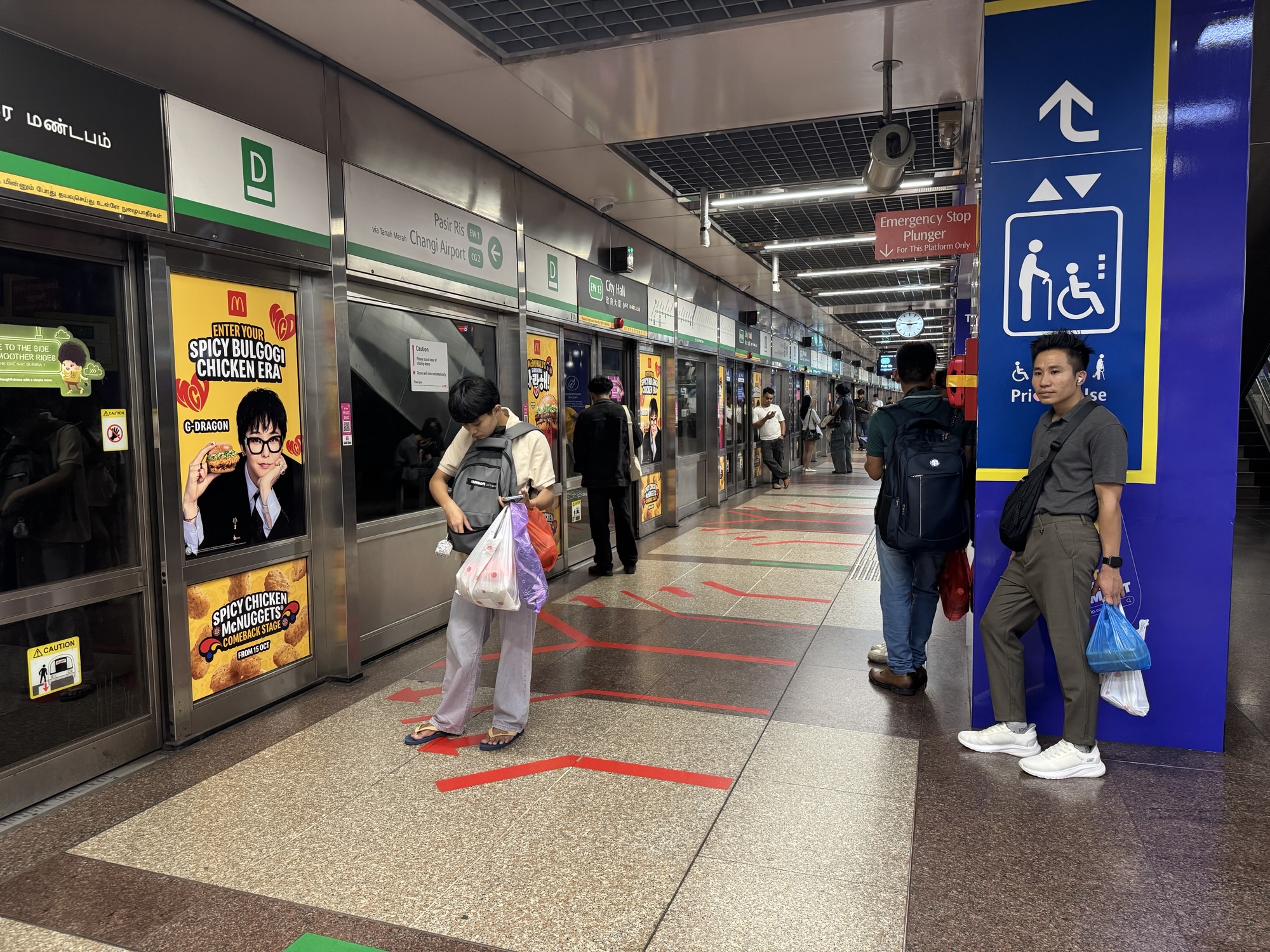
Start with the small mystery that catches many travellers: two people can be standing at City Hall and still have no idea where the other person is. One may be outside a station entrance. The other is still below ground. A third could be near the historic City Hall building that now forms part of National Gallery Singapore. Everybody has supplied a true place-name, yet the meeting has failed. On Day 1, words such as meeting point, street level and exit letter save more time than a list of impressive adjectives.
This is a particularly inviting place to begin because the city starts teaching before the first famous monument. Listen to the station announcement; read the exit information; ask whether everyone has enough water; step aside so commuters can pass. A friendly traveller does not need to look expert. A helpful sentence is enough: ‘I’m outside now, near the signed crossing. Where are you?’ There is no shame in being the person who says, ‘I need a moment to check the map.’ You are doing the real work of orientation.
Choose an agreed first observation point outside the station that is publicly accessible and safe. Do not invent a supposedly permanent ‘best’ exit or rely on a particular gate remaining open. Check the actual signs. Singapore’s Civic District visitor information identifies City Hall as a useful station for the area, but that is a starting reference rather than a guarantee about every exit. The beautiful first scene will still be there after you have sorted out which side of the road you are on.
Before walking onward, look at the pavement as if it has an invisible vocabulary written into it. Footpaths tell people where to walk. Kerbs show an edge. Tactile paving serves a crucial purpose for travellers who read surfaces by touch. Pedestrian signals regulate a crossing. Hoardings and signs can change the plan. A city feels effortless when all these things work together, and confusing when we ask one clue to do the whole job. Day 1 begins with learning how to read that collaboration.
Words 1–10 | Moving together safely
1. Meeting point
Meaning: The precise place where members of a group agree to gather, ideally described by a recognisable sign, entrance or clearly accessible public feature. It is a location for coordination, not merely a name of a district.
Useful Day 1 sentence: “Shall we meet at the station exit on street level, beside the sign, and confirm our location by message?”
What to notice here: At City Hall, notice how ‘we are at City Hall’ can refer to a station, a heritage building, a general neighbourhood or a part of the public city. Give your companions a smaller, verifiable place.
Precision check: A meeting point differs from a destination: it is where people assemble before moving on. A beautiful landmark can be a poor meeting point if several levels or entrances share the same name.
2. Wayfinding
Meaning: The practical process of using signs, maps, landmarks, directions and feedback to move from where you are to where you intend to go. It is both reading and decision-making.
Useful Day 1 sentence: “The signs are clear up to here; which wayfinding sign points us towards the cathedral?”
What to notice here: Look for how transport signs, street names and building directories serve different users. When two signs seem to disagree, they may refer to separate entrance levels or pedestrian routes.
Precision check: Wayfinding is broader than knowing north or south. A compass bearing does not tell you which accessible entrance, controlled crossing or sheltered passage is usable at that moment.
3. Street level
Meaning: The surface level of an outdoor street or adjacent public walkway, used to distinguish an above-ground meeting location from a basement, platform, tunnel or elevated connection.
Useful Day 1 sentence: “I’m on street level near the pedestrian crossing, not in the underground station.”
What to notice here: Singapore’s central area has several layers of movement. A station, mall and office tower can connect internally while another person stands outside near the same address.
Precision check: Do not equate street level with step-free access. The actual route between levels may require a lift, a ramp or another designated connection. Ask when you cannot tell.
4. Exit letter
Meaning: An identifying letter attached to a particular station exit. In a large interchange, the correct letter can make a meeting or the first walking direction much easier.
Useful Day 1 sentence: “Which exit letter leads to the pavement nearest our first stop? I’ll check the current station map.”
What to notice here: Observe that station exits can open in different directions, on different sides of a road or inside buildings. The exit letter is operational information, not decorative typography.
Precision check: An exit letter is not the same as a rail line code or a bus stop number. Never guess it from an old photograph; use the sign and current map in front of you.
5. Walking pace
Meaning: The speed at which a group moves comfortably enough to notice its surroundings and make safe decisions. For a mixed group, it should be set by the practical needs of its members.
Useful Day 1 sentence: “Let’s use an easy walking pace and stop at the next safe resting place.”
What to notice here: One person may enjoy fast walking, while another is concentrating on heat, navigation, a child or uneven ground. Coordination improves when the group discusses pace explicitly.
Precision check: A leisurely pace is not necessarily a fixed number of kilometres per hour. The same person can move differently on a shaded pavement, at a crossing or in a crowd.
6. Footpath
Meaning: A path provided or used for pedestrians. In a city centre, it may run beside roads, under cover, around buildings or through designated public spaces.
Useful Day 1 sentence: “Please stay on the footpath until we reach the marked crossing.”
What to notice here: Notice where the footpath narrows around trees, work sites, signs or people waiting. Leave the passage usable for others rather than stopping across its full width.
Precision check: A footpath is not an invitation to enter every landscaped patch beside it. A private driveway, vehicle route or fenced construction area has a different purpose even when it looks short and tempting.
7. Kerb
Meaning: The raised edge separating a pavement or footpath from the carriageway, often visible where pedestrians approach a road. ‘Kerb’ is the usual British-English spelling in this context.
Useful Day 1 sentence: “Wait behind the kerb until the crossing signal allows us to proceed.”
What to notice here: Watch how the kerb signals a change in the rules of movement. A dropped section may help wheeled users, but whether the onward route works requires checking the full crossing.
Precision check: Do not confuse ‘kerb’ with ‘curb’ as a verb meaning restrain. The American spelling ‘curb’ can also mean the street edge, but this guide uses the common Singapore/British form.
8. Tactile paving
Meaning: Textured ground surface used as part of guidance and warning systems for people with visual impairment, including at some crossing and transport locations.
Useful Day 1 sentence: “Could we keep the tactile paving clear while we wait?”
What to notice here: Look without blocking: the raised texture communicates information through feet or a mobility cane, not just through colour. Placement and pattern matter to the person using it.
Precision check: Tactile paving is not a general standing area for tourists or a decorative stripe. Nor does one visible strip prove that the entire route is accessible to every traveller.
9. Pedestrian signal
Meaning: A traffic signal that indicates when pedestrians may proceed at a controlled road crossing. It works together with the crossing layout and the behaviour of road users.
Useful Day 1 sentence: “The pedestrian signal is still red; we should wait here.”
What to notice here: Observe how a short delay changes the group’s position. A clear sentence often does more than waving someone across from the opposite side.
Precision check: The signal does not replace looking for approaching or turning vehicles. Never treat a brief green signal as permission to wander, take photographs in the carriageway or ignore immediate danger.
10. Detour
Meaning: A temporary or chosen route that goes around an obstruction or avoids a less suitable section of the original path.
Useful Day 1 sentence: “The pavement ahead is closed, so let’s take the signed detour instead of squeezing past the barrier.”
What to notice here: City routes can change because of events, construction, maintenance or weather. A detour is ordinary city operation, not a mistake in the traveller.
Precision check: A detour is not necessarily shorter, sheltered or step-free. The word tells you the route has changed; it does not establish that the alternate route fits your group.
A tiny conversation before the walk
Micro-scene: Maya has already arrived at street level. Her brother writes, ‘I’m near the exit.’ Maya replies, ‘Which exit letter? Can you see the name of the street?’ He sends the information, and they choose a safe, clear meeting point. Instead of both wandering around the same station, they become easy to find. Notice how the little word which turns a vague message into a useful question.
Try the distinction: Does a step-free-looking kerb prove that the entire next route is barrier-free? No. Does a tourist photograph tell you the current station exit? Not reliably. Does a signed detour mean the day is ruined? Certainly not. The evidence you have answers a smaller question, and good vocabulary keeps you from using it to answer a bigger one.
Two-minute practice: Each traveller chooses one route word and explains it without pointing. Then let the others check the explanation against what they actually see. For younger children, ‘footpath’ and ‘meeting point’ may be enough. For older students, add ‘tactile paving’ and explain whose information it carries. Use respectful curiosity rather than asking strangers to demonstrate their mobility needs.
Continue: Once your group has a clear shared location, follow current pedestrian signs toward the outside of St Andrew’s Cathedral. The next ten words are for reading a building without forgetting that it remains a living place of worship.
For official context, see the Civic District visitor guide. For a broader treatment of lifts, pedestrian crossings and access language, follow the parent visitor vocabulary guide.
Scene 2 — St Andrew’s Cathedral: an old building is still a living place
Walk towards the outside of St Andrew’s Cathedral and let the pace change. A few minutes earlier, your attention may have been on station signs and traffic signals. Now you can look up. The roofline does not resemble a glass office tower; the shape invites questions about a very different period and purpose. It is tempting to race into dates and architectural labels, but first give yourself permission to observe without pretending to know more than you can see.
Here is a helpful historical distinction. St Andrew’s Cathedral belongs to a longer sequence than the building that stands today. The National Heritage Board records an earlier church consecrated in 1838, later replaced by the present building, consecrated in 1862. The cathedral later acquired its cathedral status. These are different moments in the site’s life. Saying ‘the cathedral was built in 1862’ might compress a complex history into a misleading single event. Vocabulary such as consecration, construction and status helps you keep them apart.
The building is also not a frozen exhibit. It has a congregation, services and continuing responsibilities. Some visitors are looking at a façade; others are going to worship, work, meet or attend an event. Good city tourism makes space for all these purposes. If the exterior is accessible, examine it from public ground without blocking entrances. If the interior is open to visitors, follow the posted guidance; if not, continue happily. Your learning does not depend on crossing every door.
Look at the architecture in layers. First the outline: can you identify the spire and the main roof? Then the face: which entrance or window shapes catch your attention? Next the spaces around the building: what happens when the footpath approaches the porch, and how does a threshold change the expectations of someone entering? You are learning to move between visible detail, human activity and historical context. The three belong together, but none stands in for the other.
Words 11–20 | Forms, histories and respectful observation
11. Spire
Meaning: A tall, tapering architectural feature often rising above a tower or roofline, common in some church architecture. Its outline can make a place of worship recognisable from a distance.
Useful Day 1 sentence: “Look for the spire first; it helps us distinguish the cathedral from the surrounding offices.”
Look more carefully: Notice the building’s outline from a suitable public viewpoint. The spire gives height to a composition, but the building is made of more than the silhouette you saw from far away.
What it does not mean: Not every tower is a spire; a rectangular office tower, clock tower and slender church spire have different architectural forms and functions.
12. Façade
Meaning: The external face or elevation of a building, often the side intended to make a particular public impression. It may contain an entrance, windows, columns or detailed ornament.
Useful Day 1 sentence: “The cathedral façade looks different from the modern glass fronts across the road.”
Look more carefully: Study the arrangement of doorways, windows and walls. A façade can tell you what a designer wanted seen, but does not by itself tell you the entire story of the people using the building.
What it does not mean: A façade is not the whole building. Describing its exterior is not evidence that you know the sanctuary, everyday congregation or current work happening inside.
13. Arch
Meaning: A curved structural or decorative form spanning an opening or framing a space. Arches may appear in doorways, windows and interior supports.
Useful Day 1 sentence: “That arch frames the doorway; the tall spire is a separate feature.”
Look more carefully: Try distinguishing a pointed arch from a rounded one when the difference is clearly visible. A careful observation can be more valuable than confidently guessing an architectural movement.
What it does not mean: An arch is a shape, not a synonym for a window. A window can have an arched top, while an arch can frame a doorway with no glass at all.
14. Porch
Meaning: A covered entrance area, sometimes projecting from the building or forming a sheltered transition between outdoors and indoors.
Useful Day 1 sentence: “Shall we wait beside the porch without blocking the doorway?”
Look more carefully: A porch has an important social role: people pause, greet, prepare, shelter and enter. A visitor should leave that threshold usable by worshippers and staff.
What it does not mean: A porch is not automatically a public rest area. Whether you can enter or wait there depends on the building’s arrangements and activity at that time.
15. Stained glass
Meaning: Coloured or decorated glass arranged in a window, often using images or patterns that become vivid with transmitted light.
Useful Day 1 sentence: “I noticed stained glass, but I cannot tell what the image represents yet.”
Look more carefully: If windows are visible from a permitted viewing place, describe what you can genuinely see: colours, shapes, light and pattern. An image may invite a question about its story.
What it does not mean: Coloured glass is not automatically ancient, and a religious image should not be explained from a guess. Ask or consult a reliable interpretation.
16. Threshold
Meaning: The physical or symbolic point where someone enters a different space; literally a doorway’s lower boundary, but also the transition between public street and a place with its own rules.
Useful Day 1 sentence: “The threshold reminds us that this is not simply another tourist attraction.”
Look more carefully: Watch what people do before entering: slow down, check notices, remove hats where required, or lower their voices. Treat this as context rather than a universal checklist of rituals.
What it does not mean: Crossing a threshold does not grant access to private rooms or make photography acceptable everywhere. Rules belong to the particular venue and moment.
17. Congregation
Meaning: The people who gather as a religious community for worship and related activities; not simply everyone who happens to stand outside a religious building.
Useful Day 1 sentence: “We are visitors today; the congregation has reasons to be here beyond our photographs.”
Look more carefully: Remember that a cathedral is a living institution. Visitors may be interested in architecture, but the community may be preparing for services, ceremonies or everyday responsibilities.
What it does not mean: A congregation is not the same as a tourist group or the crowd on the street. One building can serve several groups for different purposes.
18. Consecrated
Meaning: Formally dedicated to a sacred or religious use according to a community’s traditions. In a historical description, the date of consecration is a particular event, not necessarily the date every part was built.
Useful Day 1 sentence: “This cathedral was consecrated in 1862; what came before the building we see today?”
Look more carefully: The National Heritage Board records that St Andrew’s earlier church building stood on the site before the present cathedral. Historic buildings often have a sequence of versions.
What it does not mean: Consecrated and constructed are different verbs. The initial laying of a foundation, completion of building work, consecration and later elevation in status may fall on different dates.
19. Sanctuary
Meaning: A sacred or protected area, often referring to part of a worship space; in ordinary English, it can also mean a place of refuge or safety.
Useful Day 1 sentence: “The sanctuary has a specific meaning inside a place of worship, so we should not use it as a label for every room.”
Look more carefully: If permitted inside, read any available guidance and observe without interrupting those using the space. If the doors are closed, the exterior alone still offers a useful lesson.
What it does not mean: In church architecture the sanctuary is not simply the lawn outside, and in everyday language ‘wildlife sanctuary’ uses the word in a related but distinct sense.
20. Respectful distance
Meaning: Enough physical and social space to observe without intruding, blocking access or making other people uncomfortable. The right distance varies with context, not with a universal measurement.
Useful Day 1 sentence: “We can admire the cathedral from a respectful distance and keep the entrance clear.”
Look more carefully: Look for quiet signs of living use: someone entering, a service notice, a closed door, or a private conversation nearby. You can learn without entering or photographing every space.
What it does not mean: Respectful distance is not the same as indifference. It means allowing people to be more than scenery for your lesson.
What one building can teach you about careful language
Conversation at the cathedral: ‘I like the tall pointed part.’ ‘That’s a useful observation. Shall we check whether it is called a spire?’ ‘Is the building as old as the city?’ ‘Let’s find out which building and which historical period we mean.’ The conversation stays curious without rushing towards a grand answer.
A visitor’s writing lesson: ‘It was a beautiful church’ is not wrong. It is simply incomplete as a description. Try this instead: ‘Beyond the busy road, the cathedral’s spire rose above a quieter entrance. We waited on the public path while another visitor went in for a service.’ The second sentence distinguishes scale, movement and respect. Write only what you have actually observed.
Three questions worth keeping: What could you describe if the building had no information plaque? What information would require a historian or official record? What would require asking someone who uses this building today? These are different kinds of knowledge. The ability to name their boundaries is a powerful language skill.
Next stop: Leave the cathedral area by a designated pedestrian route and look for the Padang and the buildings of National Gallery Singapore. We move from a religious institution to an open civic landscape. The language will shift from entrances, arches and worship to public assembly, national memory and architecture reused for art.
Historical basis: National Heritage Board, St Andrew’s Cathedral. For the larger city chronology, read How Singapore Works and Holds Together. Visitor access is controlled by the venue and may change.
Scene 3 — The Padang and National Gallery: the city remembers in public
At the Padang, the city becomes wider. Instead of concentrating on one doorway or a single pedestrian signal, you see an open green space held between substantial historic buildings and busy modern streets. This is a wonderful place to ask a question children often ask naturally: why hasn’t somebody filled that enormous gap with more buildings? A field can be useful precisely because it stays open. It makes room for public occasions, sightlines and memory, and it gives surrounding buildings a setting.
The word Padang itself is a good reminder that Singapore’s language landscape did not begin with the modern English signboard. The name comes through Malay usage for an open field. The field has acquired layers of meaning through recreation, ceremony and events in Singapore’s political and social history. Those layers do not make every patch of grass automatically available for informal use. A visitor can understand the history from a public path even if an event or maintenance operation has temporarily changed access.
Facing the Padang are buildings now occupied by National Gallery Singapore. This is a particularly beautiful lesson in time. The Gallery occupies the former City Hall and former Supreme Court, which were different institutions in different buildings. Official Gallery history dates City Hall’s completion to 1929 and the former Supreme Court to 1939. They now share an arts function, but their former duties do not disappear simply because the entrance sign has changed. That transition is adaptive reuse: a city makes an inherited building useful for another generation.
When you look at their fronts, the words become architectural tools. A row of columns is a colonnade. A formal covered approach can be a portico. The triangular classical form above some column arrangements is a pediment. The rounded crown of the former Supreme Court is a dome. The visible shapes are not trivia for a test. They let two people point to exactly the same feature and agree on what they mean. They also stop a writer from using ‘old-fashioned building’ when the scene deserves something precise.
Do not let the elegance of the civic ensemble flatten the history. The original institutions operated within colonial structures, and the Padang later witnessed events connected with Singapore’s wartime experience, self-government and national life. A meaningful reading includes transitions, disagreements, continuities and people whose experiences were not identical. You need not explain a century in one paragraph. Your first responsibility is to avoid attaching an event to the wrong date or a building to the wrong institution.
Words 21–30 | Civic life and architectural detail
21. Civic district
Meaning: A part of a city associated with public life, major institutions, government history and shared places. In Singapore this term commonly points to the historic area around the Padang and neighbouring civic buildings.
Useful sentence: “‘We have reached the Civic District, but that does not mean every nearby building has the same function.’”
Look and think: The term helps connect a field, a gallery, an old court building and a street. Ask what ties them together apart from the fact that they are close.
Distinction: A civic district is not identical to the Central Business District; political, judicial, cultural and commercial activities overlap geographically but should not be collapsed into one label.
22. Padang
Meaning: A Malay-derived word for an open field or ground. In central Singapore it is the established name of the historic broad field facing important civic buildings.
Useful sentence: “‘The Padang is an open field with a public history, not simply an empty gap between roads.’”
Look and think: Look at the relationship between the grassy open space, the formal buildings and the surrounding streets. The absence of tall buildings inside the field is part of what lets you see the ensemble.
Distinction: A named public field is not necessarily a place where visitors can walk at any time. Events, maintenance and restrictions can change which parts are accessible.
23. Public lawn
Meaning: A grassy open space that contributes to shared city life, views and sometimes recreation. The phrase describes its visible character but does not automatically establish entry rights.
Useful sentence: “‘Let’s enjoy the view across the public lawn from the permitted footpath.’”
Look and think: Consider who maintains the field, how it is protected during events, and why leaving a broad sightline can matter in a dense city.
Distinction: Public lawn is a descriptive phrase, not proof that picnics, games, photography sessions or access across the grass are always permitted.
24. Assembly
Meaning: The gathering of people in one place, often for a shared purpose such as a ceremony, public event or organised activity. The context determines the form and significance.
Useful sentence: “‘This large space has witnessed many kinds of assembly across different periods.’”
Look and think: Think about the scale a gathering might require: circulation, visibility, safety and a place from which speakers can be seen or heard.
Distinction: An assembly is not automatically a protest or a festival. Historical public occasions differ, and a lawful, safe gathering today depends on the applicable rules.
25. Commemoration
Meaning: An act, event or symbol that remembers people, achievements, losses or historical moments. It makes a deliberate relationship between present observers and something earlier.
Useful sentence: “‘The ceremony is a form of commemoration; the building beside it has a separate working history.’”
Look and think: Read what a plaque actually commemorates before writing about it. A memorial object and a commemorative event can mark related but different stories.
Distinction: Commemoration does not mean every participant shares one interpretation of an event. An official record, a personal memory and a visitor’s reaction are not interchangeable sources.
26. Colonnade
Meaning: A row of columns arranged in an architectural composition, sometimes supporting a roof or creating a sheltered frontage.
Useful sentence: “‘The long colonnade gives the old City Hall frontage a strong rhythm.’”
Look and think: The former City Hall façade features tall columns facing the Padang. Count carefully from a suitable viewpoint, or consult the official Gallery architecture account if you need an exact figure.
Distinction: A colonnade is a series of columns, not the same thing as a single arch, wall or statue. It can be decorative, structural or both depending on construction.
27. Portico
Meaning: A covered architectural entrance or porch supported by columns, often expressing the importance of a building’s entrance.
Useful sentence: “‘The portico makes the doorway feel formal, but we still need to find the permitted visitor entrance.’”
Look and think: Observe how steps, columns and roof form a clear arrival sequence. Architecture can signal importance while modern access arrangements take people another way.
Distinction: A grand portico is not a guarantee that tourists should use those very steps. Accessible entries, ticket checks and venue operations have their own current directions.
28. Pediment
Meaning: A triangular or sometimes curved architectural element above a doorway or colonnade, commonly associated with classical architectural vocabulary.
Useful sentence: “‘Look at the triangular pediment above the columns; it is not the same element as the dome.’”
Look and think: A pediment may contain sculptural decoration or symbols. Instead of guessing their meaning, make a note and seek a reliable account of the building’s design.
Distinction: A pediment is not any pitched roof. It refers to a specific architectural composition, usually part of an entrance or façade.
29. Dome
Meaning: A rounded or hemispherical roof or ceiling form that crowns a space. It can be a prominent landmark from the street while enclosing a very different kind of interior.
Useful sentence: “‘The dome belongs to the former Supreme Court wing, which is joined to the former City Hall wing inside the Gallery.’”
Look and think: Compare the two buildings that now form National Gallery Singapore. Their outlines and histories differ even though one arts institution occupies both.
Distinction: A dome is not a spire; one curves over a space, while the other rises to a taper. Do not give both buildings one date merely because they now share a museum name.
30. Adaptive reuse
Meaning: The process of giving an existing building a new compatible function while working with its inherited form, significance and physical limitations.
Useful sentence: “‘Turning former civic buildings into an art gallery is an example of adaptive reuse.’”
Look and think: Ask what the building was designed to do, what it now does and what had to change to support the new purpose. This is a richer question than simply saying it was renovated.
Distinction: Adaptive reuse is not equivalent to demolition or cosmetic repainting. It also does not mean every earlier feature remains untouched.
A field, two buildings and four kinds of evidence
Field conversation: ‘Why is the field in the middle of all these buildings?’ ‘That is a good question. It has served public purposes over a long period. Let’s read the official heritage account before we decide which purpose came first.’ ‘And that building with the dome—is it City Hall?’ ‘It belongs to the former Supreme Court, part of the National Gallery today.’ One correction turns a good photograph into a better understanding.
Writing exercise: Begin with the modest observation ‘Across the field, two grand buildings stood together.’ Then rewrite it: ‘Across the Padang, a colonnaded former civic building and a domed former court building now form one art museum.’ The second version uses names, forms and a change of function. Do not add a superlative or exact historical claim unless the source supports it.
Four evidence questions: Which elements can you see from the street? Which dates require checking the Gallery’s official account? Which public events are described in the heritage trail? Which parts of the building might be inaccessible without admission? These questions distinguish observation, record, memory and operating information.
If someone is tired: This can be a natural pause. Find a permitted place to rest, look across the field from a safe pedestrian position and choose only two or three new terms. A five-minute comparison of dome and colonnade often teaches more than twenty hurried dictionary glances.
Next stop: Continue towards the old Parliament House area and Victoria Theatre and Concert Hall, using the authorised pedestrian route. There the language shifts again, this time to institutions and performing arts. Remember that an impressive public façade does not promise unrestricted access behind it.
Sources for further reading: National Heritage Board Civic District Heritage Trail, National Gallery Singapore: Architecture & History and National Gallery: Our Story. The Gallery’s admission and exhibitions are separate from viewing the public exterior.
Scene 4 — Former Parliament and Victoria Theatre: what a building is for
Walk onward from the Padang and the old civic buildings towards the former Parliament House area and Victoria Theatre and Concert Hall. The vocabulary changes because the city is showing you a series of different jobs. One building once helped make laws; another housed performances and civic occasions; another nearby served administrative functions. It is easy to say they are all ‘important old buildings’. That description is true in a modest way but misses the real gift of being here: the chance to see how one neighbourhood can contain quite different forms of collective life.
The former Parliament House is associated with the country’s legislative history; today the site is known through its arts and cultural uses. Meanwhile the nearby Victoria Theatre and Victoria Concert Hall form a performing-arts complex linked by its distinctive clock tower. The National Heritage Board traces the theatre’s origins to a nineteenth-century town hall and the subsequent development of the memorial hall and tower. The visible ensemble is therefore not a single object built all at once. Its architecture carries phases.
This stop also helps unpack the word public. A parliamentary institution operates publicly in important senses, but that does not mean every workplace inside a parliamentary building is freely open. A theatre welcomes audiences, but a rehearsal room may be private. A civic square may feel open, but a temporary event can change access arrangements. The same city can be inviting and governed by boundaries. The skill is to recognise which boundary you are approaching and ask the right question.
Notice how the details change as you move. A clock can be an everyday device while a clock tower becomes a collective reference point. Symmetry and neoclassical forms can give a façade a formal appearance, yet the structure may have been extended or restored in later decades. The present performance programme gives the building a future as well as a past. Imagine the artists who prepare for an event, the workers who keep a hall functioning and the audience arriving in different circumstances. Heritage continues through people who use it.
You can enjoy this area completely from public paths without entering a venue. For families, that can be an excellent choice: one photograph of the clock tower, one discussion about what a legislature does, and one question about the next concert may be enough. A city walk is successful when it leaves curiosity awake. If someone wants a longer interior visit, treat it as a separate decision requiring venue rules and a schedule, rather than quietly adding a compulsory museum stop to everybody’s afternoon.
Words 31–40 | Institutions, performance and historical change
31. Parliament
Meaning: The institution in which representatives debate and make laws within a country’s constitutional arrangements. The word may also refer informally to the building where that work happens, but the institution and the physical premises are distinct.
Useful sentence: “The old Parliament building tells a story about government, even though its present use is different.”
Day 1 observation: Singapore’s former Parliament House is associated with public history; it is not the same as saying Parliament still meets there today.
Distinction: A building’s former function must not be confused with its current occupants or with the living institution itself.
32. Chamber
Meaning: A room used for a specialised purpose, such as debate, a legislative sitting or a formal meeting. A chamber is usually a part of a larger institution or building.
Useful sentence: “A parliamentary chamber had a role that a theatre auditorium does not have.”
Day 1 observation: When reading a historical floor plan or exhibition, notice what people did in different rooms rather than labelling all of them offices.
Distinction: A chamber is a room, not the entire legislature; a concert hall is not a debating chamber merely because both accommodate an audience.
33. Legislature
Meaning: The branch or institution of government involved in making laws. The term describes a public function, not an architectural style.
Useful sentence: “A legislature is different from a court, even if both occupied important civic buildings.”
Day 1 observation: Compare former Parliament House with the former Supreme Court. One concerns legislative processes; the other has a judicial history.
Distinction: Do not use legislature, judiciary and executive as three interchangeable fancy words for government. They refer to different institutional functions.
34. Institution
Meaning: An enduring organisation or system of rules that coordinates activity across time, such as a parliament, museum, religious community or concert organisation.
Useful sentence: “The building changed purpose, while the institutions associated with it developed in different ways.”
Day 1 observation: A city contains both physical infrastructure and institutions: walls and roofs support activities, but rules, people and responsibilities give those spaces continuing life.
Distinction: Institution does not simply mean a grand old building. A modern public service can be an institution, and an imposing building can be empty or repurposed.
35. Clock tower
Meaning: A tower bearing a clock visible to people nearby. It can provide a timekeeping signal, a recognisable silhouette and a focal point in the composition.
Useful sentence: “The clock tower links the Victoria Theatre and Victoria Concert Hall visually.”
Day 1 observation: Look for the relation between the two wings of the performance complex. The tower is a physical connection in the design, not a free-standing monument invented for photographs.
Distinction: A clock tower is not automatically the oldest part of a building. Construction phases need checking against historical records.
36. Symmetry
Meaning: A balanced relationship of form on opposite sides of an axis or within a design. In architecture, it often helps a composition feel ordered and formal.
Useful sentence: “The façade has a sense of symmetry, although we should look closely before calling both halves identical.”
Day 1 observation: Stand at a permitted position where you can compare window groupings and entrances. Ask whether the balance is exact, approximate or deliberately interrupted.
Distinction: Symmetry does not mean every building in an area was designed or built at the same time. Similar façades can result from later alterations.
37. Neoclassical
Meaning: An architectural approach that draws on forms associated with classical Greek and Roman traditions, such as columns, balanced façades and pediments.
Useful sentence: “The neoclassical elements are visible, but the history of the building also matters.”
Day 1 observation: The Victoria Theatre and Concert Hall complex and former civic buildings show how formal European architectural vocabularies appeared in colonial Singapore.
Distinction: Neoclassical is a design term, not a compliment implying morally superior civilisation. It identifies a visual tradition within a particular history.
38. Restoration
Meaning: Work intended to recover, reveal or conserve aspects of a building’s historical fabric or earlier condition, guided by a chosen conservation approach.
Useful sentence: “Restoration may preserve important details while making a place usable for people today.”
Day 1 observation: The theatre complex has been refurbished and restored across different periods. Ask which parts are original, repaired, reconstructed or newly introduced.
Distinction: Restoration is not automatically a complete return to one original year. Modern safety, access and performance requirements may also shape the work.
39. Performing arts
Meaning: Creative activities presented through live performance, such as theatre, music, dance and related forms. The meaning includes people practising, producing and attending.
Useful sentence: “Victoria Theatre and Victoria Concert Hall are active performing-arts venues, not only historical façades.”
Day 1 observation: Imagine the different people needed for a performance: artists, technical crews, administrators, audiences and maintenance staff. The city’s cultural life is an operating system, not just a photograph.
Distinction: A performance venue is not a museum with guaranteed free admission to every space. Rehearsals, ticketing and event schedules can determine access.
40. Programme
Meaning: A planned sequence of events or performances, or a printed or digital guide describing them. British-English programme is conventional for many non-computing contexts.
Useful sentence: “Shall we check the current programme before assuming there is a concert today?”
Day 1 observation: See how a notice transforms a beautiful building into an actual possible visit. Check date, venue, ticket and time rather than accepting a stale social-media post.
Distinction: A programme is not a universal promise of daily public entry. A performance being advertised does not imply every part of a venue is open.
One building, more than one lifetime
Imagine this conversation: ‘Is the old Parliament House still where Parliament meets?’ ‘Let’s distinguish its former use from its present purpose.’ ‘Then why do people enter the Victoria buildings?’ ‘For performance-related activities, among other authorised uses. We should check the programme.’ Children hear two versions of time: what happened before, and what is scheduled next.
A writing challenge: Describe a building without using the words grand, iconic or historic. You might write, ‘A clock tower joined two wings of a performance venue, while people checked the event notice nearby.’ Add one visual detail you actually saw. If you cannot verify a date from memory, omit it or link the official record.
A question for older learners: What does it take for an institution to endure when the building changes? Think of people, public duties, archives, procedures, funding and trust. This is not a test of party politics or a claim that everything worked perfectly. It is a way to notice that structures and social functions persist through different relationships.
Keep people in view: These streets contain workers, residents, worshippers, visitors and people going about normal business. Give way to anyone who needs to pass. Photograph architecture rather than turning strangers into unwitting subjects of your lesson.
Continue: Head towards Empress Place and the riverfront. As the water appears, we will ask a different question: how did an island city once coordinate trade, goods, people and public offices around a working river?
For reliable history, consult NHB’s Victoria Theatre and Concert Hall monument record and the Civic District Heritage Trail. Check individual venue information for events, interior access and tickets.
Scene 5 — Empress Place and the Singapore River: look past the postcard
Now the river enters the story. Near Empress Place stands the building that houses the Asian Civilisations Museum, itself an important historic former government-office building. Today its work concerns Asian cultures and art; its earlier life reminds us that river access, administration and trade were woven into the city’s development. The museum is an optional indoor branch of Day 1, not an obligation. If the group would rather stay outdoors, the public-facing riverside is already a classroom.
Start by asking the simplest geographic question: what is the difference between being beside the river and being at the sea? The Singapore River has a long trading history, yet the current waterfront has been shaped by reclamation, infrastructure and deliberate public planning. A historical map and a present map can place the same name into two different physical settings. That is not a contradiction. It is evidence that the place has changed. Learning river mouth, estuary and embankment prevents a young learner from using the word water to cover three different relationships.
Then shift from what you see to what once had to happen here. Goods did not unload themselves. Before the present waterfront became a favourite place for photography and evening walks, the river and nearby trading facilities supported work. Boats moved cargo; people loaded and checked goods; storage buildings held them; merchants coordinated transactions and onward transport. The word entrepôt becomes meaningful only when you imagine this sequence. Without that mechanism, it is another impressive word in a travel booklet.
You can still enjoy the visual side. See the line of the river and the buildings facing it. Notice the proportion of a bridge to the bank, how people move along the path and where the edges have been designed to provide safe public access. Do not treat a wall, step or ledge as permission to cross a barrier. The city should be observed from routes intended for pedestrians. If it begins raining heavily, find safe shelter and let the museum, a suitable indoor building or the MRT become the next decision, not an emergency you try to outrun.
The official Asian Civilisations Museum visitor page identifies Empress Place beside the Singapore River and gives current venue access information. Admission to exhibitions is a separate decision with changing terms. A family might enjoy an hour indoors; another group might want to save the museum for a different day. Both choices fit. The vocabulary guide works outdoors because the building and water still offer useful observation questions, and indoors when a visit is permitted because exhibits can add evidence that the view alone cannot supply.
Words 41–50 | Rivers, trade and memory
41. Riverbank
Meaning: The land immediately alongside a river, including paths, walls, vegetation or buildings beside the water. It is a relationship to the river, not just a scenic label.
Useful sentence: “The museum stands near the riverbank, where we can compare the water with the buildings beside it.”
Notice: Notice that you can see a river from a bridge without being on the bank. From the bank, different details become legible: levels, moorings, barriers and crossings.
Precision check: Riverbank is not the same as the sea coast, even when a river lies close to the shoreline. A city’s riverfront may also have been heavily modified over time.
42. Embankment
Meaning: An engineered raised bank or supporting structure that contains, protects or shapes a route or water edge. It may be made of earth, stone, concrete or a combination.
Useful sentence: “This stretch of embankment shows how the river edge has been deliberately shaped.”
Notice: Study the relationship between walking surface and water. A designed edge can allow pedestrians to gather safely in some places while excluding them from others.
Precision check: Embankment is a structural or landform term, not a promise of safe access to the water; a low edge does not invite swimming, climbing or leaning beyond barriers.
43. River mouth
Meaning: The place where a river opens into a larger body of water, such as the sea or a bay. Its location and appearance can change through natural processes and human engineering.
Useful sentence: “Where was the Singapore River’s mouth in an earlier period, and how has the waterfront changed since then?”
Notice: A historical map may show the old relationship between river and open coast differently from the modern Marina Bay landscape. Bring a source to the comparison.
Precision check: Do not assume a modern landmark marks an unchanged natural river mouth. Reclamation, bridges, barrages and other works alter the city-water relationship.
44. Estuary
Meaning: A coastal water body or river-mouth region in which river and sea influences meet, with characteristics dependent on local geography and human changes.
Useful sentence: “The word estuary helps us ask what kind of water environment existed before extensive urban changes.”
Notice: When using an old map, distinguish an original tidal river-mouth setting from modern managed waters. The word can be useful without declaring that the present conditions are identical.
Precision check: An estuary is not a synonym for any stretch of canal or every city waterfront. Salinity, tides, landform and management arrangements matter.
45. Entrepôt
Meaning: A trading centre where imported goods are received, stored and redistributed, often serving connections between several trading regions.
Useful sentence: “Singapore developed as an entrepôt; the riverfront helps us ask what the handling of goods once involved.”
Notice: Picture a practical sequence rather than a vague label: vessels arrive; cargo is handled; goods are stored, sold or forwarded; people provide transport, labour and records.
Precision check: An entrepôt is not simply a place where ships look beautiful against a skyline. Its importance comes from exchange, infrastructure and organised work.
46. Cargo
Meaning: Goods carried by ship, aircraft, train or another vehicle for transport or trade. The word refers to the goods, not the vehicle or passengers.
Useful sentence: “The cargo had to move between vessels, storage spaces and customers.”
Notice: Ask how a port city coped before every container followed a modern global standard. Labour, documentation and timing were critical even without today’s equipment.
Precision check: Cargo and luggage are related as things being transported, but a traveller’s personal suitcase is normally called baggage rather than commercial cargo.
47. Lighter
Meaning: In maritime trade, a smaller boat or barge historically used to move cargo between larger vessels and shore or along navigable waterways.
Useful sentence: “The historical lighterboats on the Singapore River were part of a trading process.”
Notice: In old photographs, look for low vessels carrying goods, not just charming sightseeing boats. River craft have practical origins in moving material across awkward transfer points.
Precision check: In this context lighter is a noun for a kind of vessel; it does not mean less heavy, and it is not every modern sightseeing riverboat.
48. Warehouse
Meaning: A building used to store, organise and sometimes prepare goods for movement or distribution. In a port city, it is one part of a larger trading system.
Useful sentence: “A riverside warehouse would have connected storage with waterborne transport.”
Notice: A warehouse has invisible work behind its door: inventory, security, sorting, records and onward movement. A restored or converted building may keep traces of that past.
Precision check: A warehouse is not simply a shop. Retail displays goods for customers; a warehouse mainly supports storage and logistics, though buildings can change uses.
49. Historical layer
Meaning: A trace of a different period retained in the same location, such as an old building, street alignment, name, photograph, material or recorded social memory.
Useful sentence: “The modern riverfront has historical layers that we can read beside contemporary uses.”
Notice: Choose two visible or documented periods: an older civic building and a recent waterfront landscape. Ask which changes are supported by evidence, and which are inferences.
Precision check: Historical layers are not always physically visible. Some lives and activities are preserved through archives or testimony rather than a picturesque façade.
50. Interpretation panel
Meaning: A sign, display or label that explains the meaning of a place, object or historical event to visitors, sometimes combining text, images and sources.
Useful sentence: “Let’s read the interpretation panel before deciding what happened here.”
Notice: Look at what the panel claims, who produced it, what dates it gives and whether it invites further research. A good panel is a starting point for enquiry.
Precision check: An interpretation panel is not the same as a street-direction sign. It teaches significance rather than simply telling you how to reach the next exit.
The city as a changing working waterfront
Story exercise: Write four short sentences beginning with: ‘A boat arrived.’ ‘The goods were…’ ‘A warehouse…’ ‘Another vessel…’. Revise them after studying the official history. The aim is to build a plausible logistics sequence, not to invent a specific event or claim that every item passed through exactly that route.
Compare two photographs: Find a well-documented historical photograph of the Singapore River and compare it with your own modern view. First list only visible differences, such as vessel types, waterside buildings and transport activity. Then write hypotheses about why they changed. Keep the observations and explanations in separate columns.
Child-friendly conversation: ‘Why did boats come here?’ ‘They helped carry goods for people buying and selling things.’ ‘Then why is the river so different now?’ ‘The city, its economy and its waterfront changed over time. Let’s check what happened instead of guessing from a single picture.’ Curiosity becomes a historical method.
Word boundary check: Is an interpretation panel the same as a tourist direction arrow? No. Is a warehouse the same as a shopfront? Not usually. Is the modern river mouth necessarily in the same configuration as an old map? No. These small distinctions protect a larger explanation from becoming misleading.
Next: Look for the designated pedestrian approach to Cavenagh Bridge. From this point you are not just learning what a river did. You are learning how people cross it, and how a piece of engineering can carry both physical load and historical meaning.
For the historic river and Empress Place, begin with the National Heritage Board’s trail and the Asian Civilisations Museum visitor information. For a wider explanation of port activity, see How Singapore Works | The Port.
Scene 6 — Cavenagh Bridge: walk across an idea made of metal
Arriving at Cavenagh Bridge, look for a moment before crossing. A bridge can become invisible because it makes a problem so easy to solve. Instead of walking down to the water, finding a boat and dealing with the opposite bank, you simply continue on a path. But the apparent simplicity hides material decisions, construction work, rules about loads and a relationship between the people who needed to cross and the city that grew around them.
The National Heritage Board describes Cavenagh Bridge as a nineteenth-century crossing formally opened in 1869, constructed using cast iron and a modified cable-stayed arrangement. Historical signs at its ends refer to restrictions on animals and heavy vehicles. Those signs are now part of its interest as heritage, but the present visitor should follow the current posted conditions. We are here to understand a structure, not to test its limits, and not to climb on a railing for a photograph.
Start with the deck underfoot and move your attention outward. The deck is the surface that lets pedestrians use the crossing. Members beside and above it help distribute forces. Fastenings connect components. The span reaches over the river. Structural supports transfer forces to the ground. At this stage, simple language is enough. A child can say ‘the bridge holds the walkway above the water’ and then learn that engineers have much more exact ways of describing how.
There is a beautiful learning moment in the historic weight notice. Imagine the city before the present skyline, when horses, carts and other animals were part of transport. A sign restricting traffic tells you something about the interaction between the bridge and its users. It does not by itself tell you the whole economic history or who experienced the benefits. For that, you need contemporary records and wider evidence. The sign makes a good question visible; the research answers it.
Cross when permitted and keep to an unhurried pace, leaving a clear line for people approaching from the other direction. This is not a place to stand in a row and occupy the entire width while taking photographs. If anyone is anxious about crowded or exposed bridges, discuss an appropriate route alternative rather than making the crossing into a test of courage. The comfortable route is the successful one.
Once across, pause only where it is safe and permitted, and look back. Notice how quickly one crossing changes your position within the same urban scene. A bridge is both structure and connection: it shapes everyday travel and how the city’s two banks relate. This is the point of Day 1 vocabulary. The noun does a job; then the job helps you understand a city.
Words 51–60 | Material, forces and safe passage
51. Crossing
Meaning: An act or designated place of moving from one side of a boundary, road, railway or body of water to another. Here it means a safe, authorised way of reaching the opposite riverbank.
Useful sentence: “This bridge gives us a pedestrian crossing of the river, but we must still follow its current access signs.”
What to look for: Look at what the crossing connects. On one side are museums and older civic buildings; on the other are spaces associated with former postal functions and modern waterfront activity.
Precision check: Crossing as a noun is not limited to road markings. A bridge crosses water; a zebra crossing serves a road; their design and safety considerations differ.
52. Span
Meaning: The distance or section between two supports of a structure, or the part of a bridge that stretches across the obstacle.
Useful sentence: “The span carries people across the Singapore River without a support in the middle of this crossing.”
What to look for: From a safe viewing position, see how the bridge reaches from one bank to the other. Try estimating relative proportions rather than inventing a measurement.
Precision check: Span can be a noun or verb. ‘The bridge spans the river’ is an action; ‘the central span’ refers to a specific structural part.
53. Cast iron
Meaning: Iron shaped by pouring molten metal into moulds. It was historically used in many structures and objects, though its properties differ from steel and wrought iron.
Useful sentence: “Cavenagh Bridge is associated with cast-iron construction, which tells us something about nineteenth-century engineering.”
What to look for: The National Heritage Board’s account identifies cast iron as part of the bridge’s structure. Look for details while remaining on permitted paths; you do not need to touch or climb any member.
Precision check: Cast iron is not a universal synonym for metal. A stainless-steel handrail, cast-iron element and concrete parapet may require different descriptions.
54. Tension
Meaning: A pulling force carried by a material or structural element, such as a cable. A bridge can use tension and compression through different parts to resist its loads.
Useful sentence: “Those slender members help transfer forces; tension is one of the ideas engineers use to explain them.”
What to look for: Consider a gentle thought experiment: what would a cable do if pushed instead of pulled? How does that differ from a rigid column? You can reason without claiming to have calculated this bridge.
Precision check: Tension is not the same as a danger level. ‘The cable is under tension’ describes a mechanical condition; it is not a prediction that the structure is unsafe.
55. Bridge deck
Meaning: The part of a bridge that supports the route travelled by pedestrians or vehicles, together with associated surface elements.
Useful sentence: “Let’s keep to the bridge deck and leave the sides clear for people coming the other way.”
What to look for: A bridge deck is where the journey happens, but it relies on a larger structural system below or beside it. Observe the relationship instead of photographing only the walkway.
Precision check: The deck is not the riverbank beneath it, and a decorative railing is not automatically designed to support climbing or sitting.
56. Load restriction
Meaning: A rule limiting the weight or types of users, vehicles or objects allowed on a structure, often to protect safety or a particular operating arrangement.
Useful sentence: “The historic bridge signs tell us that rules about loads can become part of a place’s heritage.”
What to look for: Read historical notices carefully. An old sign may tell you about nineteenth-century traffic conditions, while present rules should be checked from current instructions.
Precision check: Do not treat an old weight limit on a heritage sign as permission to bring a vehicle onto a pedestrian crossing. Historic regulations and current access are different.
57. Inscription
Meaning: Words, dates or symbols deliberately written, engraved or mounted on an object or building to identify, honour or communicate something.
Useful sentence: “The inscription gives us evidence we can read, rather than a history we have to invent.”
What to look for: Look for an identifying plaque or sign where visible without impeding movement. Record the exact wording if you want to quote it later, and check how it relates to external records.
Precision check: An inscription is a source, but it may omit context or reflect the viewpoint of its time. It is not a complete historical explanation by itself.
58. Fastening
Meaning: A device or method that joins materials together, such as a bolt, rivet, weld or fitted connection. The word names the joining function, not necessarily one particular material.
Useful sentence: “I can see several metal connections, but I should check before calling each one a rivet.”
What to look for: From a safe distance, identify where parts appear to meet and ask how a nineteenth-century metal bridge was assembled.
Precision check: A fastening is not identical to a support. Some connections join members while major elements carry loads; visible shape alone may not reveal the engineering specification.
59. Structural support
Meaning: A component or arrangement that helps carry forces and keep a built structure stable, potentially including columns, members, foundations and connections.
Useful sentence: “The supports make the crossing possible; the view from the deck is only one part of the design.”
What to look for: Imagine the path of forces: people stand on a surface; its structure transfers load through different elements to foundations. This is a conceptual exercise, not a safety inspection.
Precision check: Do not assume a visually slender structure is weak or a massive one is safe. Structural performance cannot be established from a traveller’s photograph.
60. Pedestrian-only
Meaning: Reserved for people moving on foot and, where designated, permitted mobility aids rather than general vehicular traffic.
Useful sentence: “Cavenagh Bridge is a pedestrian-only link in the route; we should keep movement comfortable for others.”
What to look for: Notice how an older bridge can continue serving people when its role changes. A crossing that once related to another transport era can be adapted to modern pedestrian movement.
Precision check: Pedestrian-only does not mean you can run, cycle, ride or bring a vehicle there regardless of posted rules. Check the actual signs and make room for all permitted users.
One crossing, three kinds of learning
Say it simply: ‘The bridge spans the river.’ ‘The bridge deck carries the walking route.’ ‘The metalwork contains structural connections.’ These sentences are deliberately modest. They do not claim to know unseen internal conditions or promise a specific load capacity.
Family conversation: ‘Why didn’t they put the bridge on the water?’ ‘A bridge needs a navigable clearance and a safe path. Let’s see what the historical account tells us about this crossing.’ ‘Was that sign for cars?’ ‘It concerned older traffic and weight limits. We should read its actual wording rather than guess.’
Use three kinds of evidence: First, a direct observation: ‘I saw a historic sign.’ Second, a supported source claim: ‘The National Heritage Board dates the bridge’s formal opening to 1869.’ Third, a question: ‘How did the route affect trade and public movement at different times?’ They belong together, but should not be written as though they are all the same thing.
A physical science link: Stretch a rubber band gently between two fingers at home, not on the bridge, to illustrate pulling force; support a book with both ends resting on blocks to suggest a span. These are teaching analogies, not structural replicas. They help a learner ask better questions without touching or testing an actual monument.
Continue: The southern-bank side brings you towards the former Fullerton Building and the waterfront around Merlion Park. We now move from a bridge that connects practical movement to a building and sculpture that help Singapore tell parts of its public story.
History and engineering context: National Heritage Board, Singapore River Bridges: Cavenagh, Anderson and Elgin. Current barriers and signposted access take priority over historical descriptions.
Scene 7 — Fullerton and Merlion Park: a public symbol with many viewpoints
The next stretch is full of things many visitors recognise before arriving: an elegant historic building now used as a hotel, a waterfront gathering place and a curious white sculpture spraying water into the bay. Familiarity is useful, but it can also make people stop asking questions. If a visitor calls the former Fullerton Building ‘the old hotel’, one little detail has already disappeared. Its present hotel identity is real; its earlier postal and public-office functions are equally real, though they belong to different periods.
The National Heritage Board records that the former Fullerton Building, completed in 1928, housed the General Post Office and other public offices. A post office is a lovely example of an institution that coordinates people across distance. Letters have to be accepted, sorted, transported, transferred and delivered. An address is a miniature navigation instruction; without it, a large postal system becomes difficult to operate. Today a visitor may chiefly see the building’s handsome frontage and its hospitality use. The historical vocabulary lets you hold more than one lifetime of the building in mind.
Continue safely towards Merlion Park using appropriate pedestrian routes and current signs. The statue is one of Singapore’s best-known public symbols. Singapore Tourism Board explains the lion’s head and fish body as references to the lion-city name and maritime origins. The symbol is not a substitute for the history of early settlement or the experiences of different communities. It is a starting image, a compressed invitation to ask a longer question. A child can enjoy the creature while an adult checks what the official explanation says.
This is also where tourists can inadvertently make life harder for one another. Everyone wants a photograph; nobody wants a blocked walkway. Pause, take turns and make room for people who simply need to get through. There is no need to climb a railing, stand in a vehicle route, lean into the water or elbow someone out of a vantage point. An unhurried person gets to notice the shape of the statue, the movement of water and how the city spreads beyond it.
Try a small writing trick. Think of the view as three layers. Name the foreground, name a middle-ground feature and name the backdrop. Then write one sentence explaining what connects them. For example: ‘In the foreground the Merlion faced the water; across the bay, modern buildings formed a very different urban line.’ This conveys a specific observation without claiming the photo somehow captures all of Singapore. It is also the kind of description a young learner can produce independently after a little practice.
Remember that conditions at the park and bridge approaches can change during events or works. While Singapore Tourism Board lists Merlion Park as a public attraction, access to a specific viewing edge or pedestrian connection still depends on the arrangements on your actual day. A comfortable memory is better than a perfect photograph. If the sun feels fierce or somebody is tired, enjoy a short stop and choose whether to continue across the bay.
Words 61–70 | Postal history, public art and photographic precision
61. General Post Office
Meaning: A central postal facility where mail and related services were organised. In the historic Fullerton Building, the General Post Office was one of the major earlier functions.
Useful sentence: “The building that now contains a hotel once housed the General Post Office.”
Look at this: The official Civic District Heritage Trail describes the former Fullerton Building’s postal and public-office history. The clue is not in every modern sign; it often comes from records.
Distinction: A General Post Office is not simply a letterbox. It coordinated important services and was part of a wider network of people, routes and administration.
62. Postal service
Meaning: A system for collecting, sorting, transporting and delivering letters and parcels, supported by infrastructure, addresses, workers and rules.
Useful sentence: “A working postal service linked households, businesses and people across distances.”
Look at this: Imagine the movement of one letter in an earlier period: accepted, marked, sorted, carried and delivered. Each verb reveals a step in a system.
Distinction: Postal service is not the same as the building that hosts it. The service can move, transform or digitise while an old postal building acquires a new role.
63. Conversion
Meaning: The change of a building, object or system from one use or condition to another, usually requiring decisions about what can remain and what must change.
Useful sentence: “The building’s conversion into a hotel changed how the public uses its spaces.”
Look at this: Notice what is visible today and what you know from the historical record. A building can retain its recognisable external form while undergoing substantial interior change.
Distinction: Conversion alone does not say whether a building’s heritage was conserved well. That judgement needs evidence about design, fabric, regulation and outcomes.
64. Merlion
Meaning: A symbol of Singapore represented as a creature with a lion’s head and a fish’s body. The familiar statue at Merlion Park has become a widely recognised visitor reference.
Useful sentence: “We have reached the Merlion; now let’s ask what the lion and fish are meant to represent.”
Look at this: Read Singapore Tourism Board’s description of the symbol. The fish body refers to the city’s maritime past and the lion head to Singapura’s lion-city name.
Distinction: The Merlion is not a real animal or the whole of Singapore’s identity. It is one designed emblem among many ways the country represents itself.
65. Emblem
Meaning: A visual sign or figure used to represent an idea, organisation or place, often through a recognisable form with an attached meaning.
Useful sentence: “The Merlion is an emblem, not a literal animal found in the river.”
Look at this: Think of how one image compresses a story into a form people can recognise. A good emblem creates a starting point for asking what it selects and what it leaves out.
Distinction: An emblem is not a complete historical account. A symbol’s explanation can be useful without becoming proof of every claim about a city’s origins.
66. Mythical creature
Meaning: An imagined being appearing in stories, cultural traditions or symbolic designs, often combining features that do not belong together in nature.
Useful sentence: “The lion-headed, fish-bodied Merlion is a mythical creature used as a civic symbol.”
Look at this: Identify the different animal features without reducing the meaning to a joke. Ask how a designed figure can connect geographic memory, stories and tourism.
Distinction: Mythical does not mean meaningless or stupid. It signals the kind of story or representation, not a judgement about the people who find it significant.
67. Sculpture
Meaning: A three-dimensional work of art made by shaping, carving, assembling or casting materials. It can occupy a public place and affect how people move around it.
Useful sentence: “The sculpture becomes a meeting reference, but we should not block the path while photographing it.”
Look at this: Notice the object’s material, scale, orientation and relation to the water. View it from a permitted place before deciding which side offers the clearest shape.
Distinction: A sculpture and a photograph of it are different works. A picture crops a viewpoint; the actual object can be seen from many directions.
68. Vantage point
Meaning: A position from which a person sees a scene in a useful or revealing way. It may be chosen for clarity, context, comfort or safety.
Useful sentence: “This vantage point lets us see the Merlion with the bay behind it.”
Look at this: Change position only within safe public walking areas. A modest move can reveal a relation between statue, steps, waterfront and buildings that the first photograph missed.
Distinction: A vantage point is not a right to step onto barriers, private land or roadways. The best viewing angle is worthless if reaching it creates danger or blocks others.
69. Foreground
Meaning: The part of a scene closest to the viewer or presented nearest in a photograph or description.
Useful sentence: “The sculpture is in the foreground, while the distant towers occupy the background.”
Look at this: Try describing the scene in layers: nearest object, middle ground and farther building line. This is a clear way to organise a visitor’s paragraph.
Distinction: Foreground does not mean the most important part. A distant building can be the main topic even when something else occupies the front of a photograph.
70. Backdrop
Meaning: The background setting against which a person, object or event is seen; in photography it can help establish the context or mood.
Useful sentence: “The financial district forms a backdrop to the Merlion in this particular view.”
Look at this: Look behind the immediate subject and ask what the buildings add to the story. Singapore’s mix of time periods becomes visible when a public symbol and modern towers share one scene.
Distinction: A backdrop is a relationship in one view, not the entire reality of the place. A tower appearing behind a monument in a photo may be physically far away.
Write one memorable waterfront sentence
Ask and answer: ‘Why is that hotel historically significant?’ ‘It once housed major postal and public functions.’ ‘Is the Merlion a real animal?’ ‘No, it is a designed symbolic creature. Let’s look at its official explanation.’ ‘Why is the skyline behind it?’ ‘Because of where we happen to be viewing from; try another angle and notice how the composition changes.’
Describe without overclaiming: Write three phrases: ‘a former postal building’, ‘a mythical public emblem’, ‘modern office towers in the background’. You can use them in a paragraph. Avoid declaring that these three objects prove a single simple national story. They are different kinds of evidence.
Photograph safely: Choose a place where stopping is permitted and does not obstruct others. Take a landscape shot, then a closer composition. Write what is excluded from each frame. A photograph cannot show what the air felt like, what a person beside you said, or why you decided to rest. Language fills those gaps.
Two levels of memory: A young learner may remember the fish body and lion head. An older learner may connect symbols to maritime history and names. Both can be accurate at the right level. Challenge the older learner to find a primary or official source; do not demand that the younger learner memorise a date to enjoy a first visit.
Next scene: Look for the designated route onto Jubilee Bridge towards Esplanade. You are about to see how modern pedestrian design gives more people a way to enjoy the public waterfront.
Read more: NHB Civic District Heritage Trail: Former Fullerton Building, Singapore Tourism Board: Merlion Park, and eduKate’s How Singapore Works | The Port.
Scene 8 — Jubilee Bridge and Esplanade: a city designed for moving and gathering
At Jubilee Bridge, Day 1 becomes a lesson in how a public view is made available to people. The bridge’s gentle geometry is not only a scenic way to approach the Esplanade; it is a deliberately designed connection. The National Heritage Board’s Jubilee Bridge account explains that the bridge opened in 2015 to connect Merlion Park with the waterfront promenade in front of Esplanade, providing a barrier-free pedestrian link. That is a meaningful design fact. It does not follow, however, that every further step of an individual traveller’s journey is guaranteed to be free of obstacles. A complete journey has many links.
Try observing the bridge with two different questions. First: what view does it give? You may see the water, the old and modern city and the silhouettes of different structures. Second: what movement does it enable? It offers a pedestrian link in a part of town where people come for leisure, work and cultural events. The same design element can be valuable both because it is pleasant and because it reduces the difficulty of reaching another place. Good vocabulary can carry both ideas at once.
Walk over only when the route is open and conditions are comfortable. Keep moving rather than creating a stationary queue across the entire walkway. A person with a stroller or mobility aid may need a clear path; a visitor taking pictures can step to a safe place where stopping does not obstruct circulation. If a crowd or an event has changed the route, do not treat that as a challenge to be solved by cutting over barriers. Ask for the designated alternative and keep everyone together.
As Esplanade – Theatres on the Bay comes closer, the language changes from structure to arts. Visitors often notice the building’s distinctive roof forms first. That is a good starting observation, but a venue has an active purpose. Its performance halls require space for audiences, technicians and artists; an event has a schedule; and the building may contain both public areas and areas with controlled access. A theatre is a practical cultural workplace, not simply a photograph shaped like a fruit.
The word acoustics may be new to a younger child. Explain it through experience: the same clap sounds different in a carpeted room and a spacious hall. Then be careful: a real performance hall has much more complex design than the analogy. We cannot diagnose a venue’s sound quality from its outside wall or claim to have measured acoustics after looking at a roof. We can learn a new question to ask if we later attend a permitted event.
This is another sensible place to stop. There are transport connections in the wider Civic District and Marina Bay area, and the day’s remaining route is optional. If the group has already enjoyed the river, bridge and arts setting, ending here is still a complete learning journey. If the weather holds and everybody wishes to continue, follow the public waterfront route towards the Helix Bridge and Bayfront.
Words 71–80 | Access, views and performance
71. Barrier-free
Meaning: Designed or arranged to reduce obstacles to access and movement for people with different mobility needs. The exact claim must refer to a particular part of a route.
Useful sentence: “URA describes Jubilee Bridge as providing a barrier-free connection from Merlion Park towards the Esplanade waterfront.”
Notice here: Look for how the bridge meets the surrounding promenade without requiring a flight of steps on the connecting line described. Check changes caused by nearby temporary works.
Distinction: A barrier-free bridge is not proof that every onward museum entrance, toilet, nearby pavement or train connection is fully accessible to every traveller.
72. Gradient
Meaning: The rate at which a surface rises or falls over a horizontal distance; in everyday route planning, the steepness of a slope.
Useful sentence: “This bridge uses a gentle gradient, but people with different needs may still prefer different routes.”
Notice here: Notice that a gradual slope can feel easier than a stair flight while still requiring effort or assistance for some travellers.
Distinction: Gradient is not the same as total distance. A short steep ramp and a long gentle ramp can produce very different user experiences.
73. Handrail
Meaning: A rail designed to be held for support or guidance, especially along a stair, ramp or walkway. Different barriers may have different intended functions.
Useful sentence: “The handrail is for support; let’s not sit on it for a photograph.”
Notice here: Look at the practical details that make public infrastructure usable. A small element can matter more to an individual than the biggest skyline landmark.
Distinction: A handrail is not an invitation to climb. Some waterfront guardrails protect an edge but should not be treated as benches or equipment for stunts.
74. Viewpoint
Meaning: A place where a scene can be observed, or an opinion from which an issue is considered. In the walking sense, the word identifies a position with a useful view.
Useful sentence: “The bridge offers a different viewpoint from Merlion Park across the water.”
Notice here: Notice how crossing the river or bay edge changes which building appears near, large or hidden. Photograph from designated pedestrian space.
Distinction: A viewpoint is not equivalent to the actual location of the object seen. Photographs can make distant buildings look attached to a bridge or sculpture.
75. Pedestrian circulation
Meaning: The planned movement of people through and between spaces, considering entries, paths, directions, crowding and connections.
Useful sentence: “The bridge improves pedestrian circulation between two busy parts of the waterfront.”
Notice here: See how people approaching from opposite directions share the walking space. Good public design considers movement, waiting and the places where crowds pause.
Distinction: Circulation does not simply mean that a surface exists. A route can be physically present but poor for movement if it is blocked, disconnected or confusing.
76. Waterfront route
Meaning: A walking or movement path that follows or approaches the edge of a river, bay or coastline. It may contain several different path segments and management zones.
Useful sentence: “Let’s stay on the public waterfront route rather than cutting across a restricted area.”
Notice here: Ask whether the next segment remains open, whether it offers shade and where the nearest suitable exit lies. The water is a guide to orientation, not a substitute for directions.
Distinction: A route beside water is not necessarily uninterrupted, flat or open at every hour. Events and site works can change the walking experience.
77. Theatre
Meaning: A place for dramatic or other staged performance, and also the art form practised within it. The same word names a building and a kind of creative activity.
Useful sentence: “The Esplanade is a performing-arts destination; a theatre there is not a retail shop.”
Notice here: Listen for the difference between a theatre building, its performance hall and the play or performance shown inside. Each supports a different question.
Distinction: A theatre is not automatically a museum. Interior access may depend on programmes, tickets and the venue’s own operating arrangements.
78. Auditorium
Meaning: A room or hall in which an audience gathers to watch or listen to a performance, lecture or presentation.
Useful sentence: “The auditorium is designed for an audience, but it is not necessarily open to visitors between performances.”
Notice here: Imagine the work involved in seating, visibility, acoustics, stage design and safe evacuation. A performance venue is more than its public-facing roofline.
Distinction: Auditorium and lobby are different spaces. A person allowed into a foyer may not have permission to enter a performance hall.
79. Acoustics
Meaning: The behaviour of sound in a space, including how it reflects, travels, is absorbed or is heard. Venue design can shape acoustic experience.
Useful sentence: “The acoustics of a performance hall affect how music is heard, but we cannot assess the hall from outside.”
Notice here: If you attend an authorised performance later, notice clarity, reverberation and the balance between sounds. These are observations rather than an engineer’s measurement.
Distinction: Acoustics is not another word for loudness. A quiet performance can have excellent acoustics, and a loud space can still be difficult to hear clearly.
80. Public performance
Meaning: An artistic event presented for an audience under the arrangements of a venue or public programme, possibly free or ticketed.
Useful sentence: “Let’s check the current event schedule before assuming a public performance is taking place now.”
Notice here: Notice how shared cultural infrastructure provides space for people to gather around music, drama or dance. It also depends on performers, technicians and audiences.
Distinction: Public does not mean free, unrestricted or available at all times. Conditions depend on the specific event.
Accessibility and culture are both practical
Mini-dialogue: ‘That bridge seems easier for some people to use.’ ‘Yes. The official description calls it a barrier-free connection. Let’s check whether our onward route is suitable as well.’ ‘Are we going inside Esplanade?’ ‘Only if there is something we want to attend and access is permitted. Today we can admire the building from outside.’
Try a thoughtful comparison: A scenic route helps you enjoy where you are. A connected route helps you reach where you need to go. Many good public spaces serve both purposes. Write a sentence about the bridge using viewpoint, and another using pedestrian circulation. Do the two sentences describe different functions?
For a child: Ask which path would be more comfortable if someone is tired, walking slowly or pushing a stroller. Do not pretend that every visitor has the same needs. The child can learn to ask ‘What would make this easier for that person?’ rather than assuming that a picture of a ramp answers all accessibility questions.
For a reader interested in culture: Search the venue’s actual event programme. Find one title, one date, one venue and one admission condition. Turn them into a sentence beginning, ‘This performance may be suitable because…’ Now vocabulary is guiding a real choice.
Continue: If the sky and energy levels are favourable, use the signed public route to the Helix Bridge area. You will move towards a waterfront landscape shaped by long-term planning rather than ancient shoreline alone.
Sources for the bridge and its setting: National Heritage Board: Jubilee Bridge and Urban Redevelopment Authority: Marina Bay. For the wider performing-arts destination, see Singapore Tourism Board: Marina Bay. Check venue notices for current programmes and access.
Scene 9 — Helix Bridge and Marina Bay: the shoreline is a human decision
If you choose to continue, the setting changes again. The public walkways around Marina Bay can make the city feel like a huge stage, framed by office towers, cultural buildings, hotels, transport links and water. It is wonderful to enjoy the view. It is even more interesting to discover that what seems inevitable was the outcome of generations of planning, engineering and changing public priorities.
The Urban Redevelopment Authority describes the Marina Bay district as a transformation from reclaimed land, with works beginning in the 1970s, into a modern waterfront for business, public activity and leisure. The idea of enlarging and shaping the city centre has a much longer timeline than any single hotel, bridge or museum building. Reclamation changes the coast and requires continuing decisions about land, infrastructure, water and environmental responsibility. A picture of the result does not show all that work. Vocabulary such as master plan and mixed-use allows a reader to ask how different parts of the city came to operate together.
Watch how the word public needs precision here. Some spaces are managed by public bodies, some are privately owned but publicly accessible under conditions, and some are private or ticketed. A waterfront route can be open while the interior of a nearby attraction is not. An architecture photograph cannot tell you where an event barrier will stand next month. Respect the actual signs and let a visitor-information source answer today’s operating questions.
The Helix Bridge is particularly suited to a science-and-language conversation. In the original planning and engineering announcement, URA describes a double-helix design associated visually with DNA, with symbolic ideas of life and renewal. The point is not to insist that every visitor must remember the name of its design firm or the engineering dimensions. The visible structural idea can prompt a question: how can a repeated shape become a working pedestrian bridge? For one child, ‘twisting metal’ is a fine first description; an older learner can move on to ‘double-helix structure’ and then research the forces involved.
The ArtScience Museum nearby offers a different kind of shape and purpose. From outside you can notice its distinctive form and relationship to the water, but you cannot claim to have seen an exhibition that you have not entered. An exterior view and a museum experience are separate choices. The official museum site supplies exhibition information and ticketing that can change with programming; an article written now should not present one price or display as permanent.
The day may also become a chance to learn about photography. A silhouette often makes a structure recognisable before you can see its windows or materials. A reflection in the water can double the visual interest but not the number of buildings. A photograph taken at one time of day might look nothing like an image taken from the same place during a downpour. Readers can learn to distinguish the stable physical object from changing conditions of light, water and viewpoint.
Ending near the Bayfront area is optional, and it is wise to check the current signposted path to an MRT entrance if you intend to travel onwards. Do not treat a route diagram as a promise that every underground link or escalator is operational. Find a comfortable transition from wandering to going home. The final scene is not a final landmark. It is the moment when your group decides what it has learned and how best to finish.
Words 81–90 | Urban planning, shapes and exhibitions
81. Reclaimed land
Meaning: Land created or extended through engineering works, often involving filling and preparing areas formerly occupied by water or other low-lying conditions.
Useful sentence: “Parts of modern Marina Bay are on reclaimed land, so the shore has changed from earlier maps.”
Day 1 observation: URA’s Marina Bay history describes reclamation beginning in the 1970s. Read this as a long urban process, not as a sudden trick that produced the whole district overnight.
Precision check: Reclaimed does not mean naturally grown or cost-free. New land requires planning, material, engineering, environmental consideration and continuing management.
82. Master plan
Meaning: An organised long-term framework used to guide the development, land use and infrastructure of an area. Singapore also has formal statutory planning instruments.
Useful sentence: “A master plan helps explain why transport, waterfront space and major developments need to fit together.”
Day 1 observation: Look for how a public path, rail connection, hotel, office district and museum relate. Their exact locations are not necessarily random responses to individual tourist demand.
Precision check: A master plan is not an ironclad prediction that every drawing will appear exactly as imagined. Plans evolve through policy, constraints and new information.
83. Mixed-use
Meaning: Containing or combining more than one land-use or building function, such as offices, residences, shops, cultural venues and hospitality.
Useful sentence: “This district is mixed-use: we are not walking through only an office park or only a shopping destination.”
Day 1 observation: Consider the different times at which people use the district: working hours, cultural events, leisure evenings and residential routines. A mixed-use landscape can support varied journeys.
Precision check: Mixed-use does not mean that every building welcomes every visitor into all its spaces. Functions can coexist with private boundaries and separate operating rules.
84. Public realm
Meaning: The streets, squares, paths and spaces that people experience as part of shared city life, with access and management conditions that vary.
Useful sentence: “The bay’s public realm includes places to walk, pause, meet and view the water.”
Day 1 observation: Pay attention to the small things that shape the experience: benches, signs, shade, transitions, crossing points and room for people with different needs.
Precision check: Public realm is not a synonym for unrestricted ownership by the public. Some publicly accessible spaces are on privately managed property and have rules.
85. Density
Meaning: The amount of people, buildings, activity or another quantity relative to a given area or unit. In urban discussions, different measures of density answer different questions.
Useful sentence: “The tall towers make the district feel dense, but height alone cannot tell us exactly how many people are present.”
Day 1 observation: Observe the difference between building height, crowding at a particular hour and the concentration of jobs or transport services in an area.
Precision check: Density does not always equal congestion. A dense district can operate well with strong transport and public-space design; a less dense path can still be crowded.
86. Mirror image
Meaning: A reflected likeness of an object, often reversed or distorted by the reflecting surface. On a waterfront, water can make a fleeting image of a building.
Useful sentence: “The museum’s shape appears as a shifting mirror image in the water.”
Day 1 observation: When conditions allow, compare the building with its reflection. Wind, ripples, angle and light can change the image even when the building itself has not moved.
Precision check: A mirror image is not another physical building. In writing, do not treat a reflection in a photograph as evidence of a second structure.
87. Silhouette
Meaning: The outline of a shape seen against a contrasting background, often without detailed internal features.
Useful sentence: “From here I can recognise the silhouette before I can see the surface details.”
Day 1 observation: Choose one structure and describe its outline using simple terms: curved, angular, broad, narrow, tapering or repeated. Avoid forcing a comparison if it does not look convincing.
Precision check: Silhouette tells you shape, not material, ownership, height or function. A striking outline can still belong to a very ordinary kind of space inside.
88. Curved form
Meaning: A shape that bends or follows an arc rather than remaining straight. Architecture and structures can use curves for appearance, movement, engineering or spatial effects.
Useful sentence: “The bridge and museum use curved forms for different reasons.”
Day 1 observation: Look for curves that shape a passage or silhouette. Then ask whether you are observing a structural component, roof, wall, handrail or decorative element.
Precision check: Curved does not automatically mean organically grown, structurally superior or environmentally sustainable. Those are separate claims requiring evidence.
89. Helix
Meaning: A three-dimensional spiral-like form, such as the geometry commonly associated with DNA. Singapore’s Helix Bridge uses a distinctive double-helix design.
Useful sentence: “The Helix Bridge uses a double-helix structure inspired by DNA imagery.”
Day 1 observation: URA’s description connects the bridge design with ideas of life and continuity. From a permitted path, observe the repeated twisting members without treating the structure as a laboratory model.
Precision check: A helix is not just any circular loop, and resemblance to DNA does not mean the bridge is made of biological material. It is an architectural and engineering design.
90. Museum exhibition
Meaning: A curated presentation of objects, artworks, information or experiences within a museum, often organised around a subject and subject to specific admission terms.
Useful sentence: “We can enjoy the exterior of ArtScience Museum without assuming an exhibition ticket is included.”
Day 1 observation: Check the actual programme, age guidance, ticket type, date and entry conditions before turning an optional interior visit into a promise to the family.
Precision check: A museum building and its exhibitions are not the same thing. Seeing the building from the waterfront does not mean you have visited or reviewed the exhibitions inside.
See the planned city without pretending to see everything
One little city-planning game: List five uses you can observe or verify: transport, office work, public walking, cultural exhibits and hospitality. Write a sentence beginning, ‘These uses coexist because…’ The answer should describe a relationship, not assume every function was designed by one organisation.
For an artistic learner: Take two photographs of the same subject from safe permitted positions. One should emphasise the outline; the other should include the public spaces around it. Write what each photograph leaves out. The resulting paragraph may use silhouette and public realm accurately.
For a science learner: Sketch a simple helix on a page. Then look at the bridge as a real engineered structure. What is similar about its outline? What are the important differences between a drawing of a DNA molecule and a large public bridge? Analogy helps learning only when we keep its limits visible.
For a younger visitor: Ask which part of the scene was there before the land was reclaimed. Do not expect the child to reconstruct an entire coastline from memory; show a verified historical map or official explanation at home and let the question guide further reading.
Before you leave: The most useful question now is not, ‘Have we completed every landmark?’ It is, ‘Can everybody continue comfortably?’ Someone who wants to rest has given you real information. The next scene helps express the decision and turn the walk into a memory.
Primary sources: URA Marina Bay place management and reclamation history; URA Helix Bridge design announcement; ArtScience Museum’s current information. For Singapore’s broader built environment, see the Singapore master guide.
Scene 10 — Finishing well: a safe route home and a good memory
The final scene does not take place at a landmark. It takes place whenever your group decides it has had enough for one day. Perhaps that is after the Padang. Perhaps it is in the shade near a museum. Perhaps you have reached Marina Bay and still have energy for one last look. All are legitimate endpoints. Good travel is not a competition with the longest itinerary. It is an experience managed well enough that people want to explore again.
In Singapore, heat and humidity should be treated as practical information rather than minor annoyances to be ignored. Singapore’s official Heat Stress Advisory, available through the Meteorological Service Singapore, uses wet-bulb globe temperature, which accounts for air temperature, humidity, wind and solar radiation. Consult current guidance and adapt activity to the needs of the people with you. Water, rest, a suitable indoor break and a shorter path are ordinary tools of travel. If a participant shows signs of serious heat illness, seek prompt medical help rather than trying to complete the route.
Thunderstorms deserve their own decision. The Meteorological Service Singapore explains that lightning can affect areas away from the immediate rain cloud. An umbrella or a tree cannot replace appropriate lightning shelter. When conditions become threatening, stop the exposed outdoor itinerary and seek a substantial safe building or vehicle according to the official safety guidance. It is better to miss a photograph than to turn an avoidable hazard into a story.
Temporary closures are another normal part of a working city. A bridge might be subject to management, a square used for a public event, a museum entrance changed for security or a pavement closed for maintenance. A field guide cannot predict each change. What it can teach is the language of adaptation. Ask, ‘Which part is closed?’ ‘Where is the signed alternative?’ ‘Does this route have steps?’ and ‘Shall we finish here?’ A short conversation can prevent a long confusion.
Now return to the purpose of Day 1. You learned to find a meeting point, read a cathedral respectfully, distinguish institutions around the Padang, imagine the labour of a trading river, notice the engineering behind a bridge and describe a public sculpture from a particular viewpoint. You saw how a planned bay connects architecture, transport and public space. These are not merely attractions added together; they are opportunities to ask increasingly precise questions about how a city works.
The final four words—observation, inference, comparison and reflection—are the most transferable. They turn a holiday walk into a form of learning you can carry to another city, museum, home neighbourhood or classroom. First say what was visible. Then ask what it may mean. Compare carefully. Finally decide what question you wish you had asked sooner. None requires a perfect answer on the spot.
If you are teaching a child, resist asking for a report on all one hundred words. Let the child choose three. Perhaps spire because of the cathedral, entrepôt because of the river, and vantage point because of a photograph. Invite the learner to give one correct sentence for each, and ask one further question. The smallest complete learning loop is often the strongest one.
Words 91–100 | Comfort, uncertainty and observation
91. Heat stress
Meaning: Physical strain arising when the body’s ability to manage heat is challenged, influenced by conditions such as temperature, humidity, radiation, exertion and the person’s circumstances.
Useful sentence: “If the heat stress advisory is elevated, let’s shorten the outdoor part and find a cooler place.”
Notice: Singapore’s official heat stress advisory considers more than a thermometer reading. A relaxed walker may still need rest, especially if the sun or exertion affects them.
Distinction: Heat stress is not a synonym for feeling a little warm. Actual symptoms and individual risks matter; seek appropriate help if someone becomes ill.
92. Hydration
Meaning: Maintaining adequate fluid balance, including drinking suitable fluids as conditions and individual needs require.
Useful sentence: “Let’s take a hydration break before we decide whether to continue across the next stretch.”
Notice: A water break can be part of the itinerary, not a disruption. Check whether everyone can comfortably access a drink without rushing or depending on an unverified water point.
Distinction: Hydration is not proof that heat illness is impossible. Rest, cooling, medical circumstances and actual conditions also matter.
93. Shade
Meaning: An area protected from direct sunlight by a roof, tree or other object; it can reduce some forms of heat exposure but does not guarantee a cool environment.
Useful sentence: “The shaded side of this path may be more comfortable for our short break.”
Notice: Notice where a tree casts shade and where the next stretch opens into sunlight. In a tropical city, the difference can alter how pleasant the same walking distance feels.
Distinction: Shade is not necessarily safe lightning shelter, especially beneath a tree or small outdoor structure during a thunderstorm. Seek an appropriate building or vehicle.
94. Lightning alert
Meaning: A warning or information signal concerning detected or expected lightning in an area, used to help people decide whether outdoor activity is appropriate.
Useful sentence: “A lightning alert means we should stop the exposed walk and find suitable shelter.”
Notice: The Meteorological Service Singapore provides lightning information and safety advice. Do not rely on whether it is currently raining above your head.
Distinction: An alert is not permission to resume the moment a cloud passes. Follow authoritative safety guidance and allow conditions to become suitable.
95. Temporary closure
Meaning: A short-term restriction on access to a path, venue or facility, often caused by works, safety, events or operational needs.
Useful sentence: “The bridge approach has a temporary closure; we will follow the signed alternative.”
Notice: Read the sign and find out what is closed: one door, one direction, a whole site or a particular operating period. Your response depends on scope.
Distinction: Temporary does not mean it will reopen before you arrive. Nor is a closed gate a puzzle to bypass through another restricted area.
96. Contingency
Meaning: An alternative arrangement prepared in case the original plan cannot be followed, such as a nearby transport exit, an indoor stop or a shorter walk.
Useful sentence: “Our contingency is to finish at a suitable station if weather changes.”
Notice: A good contingency has a clear trigger: fatigue, rain, event barriers or a participant feeling unwell. It preserves enjoyment by reducing the cost of changing plans.
Distinction: A contingency is not evidence that the main plan was poorly made. In a changing city, flexibility is part of good preparation.
97. Observation
Meaning: Something noticed and recorded through direct attention, using senses or a suitable instrument and stating its limits.
Useful sentence: “I observed that this route was shaded at the time of our visit.”
Notice: An observation becomes stronger when you name time, place and what you actually saw. It can be small and still useful.
Distinction: Observation is not the same as an explanation. Seeing someone wait beside a door does not prove why the person is waiting.
98. Inference
Meaning: A conclusion suggested by evidence and reasoning rather than directly seen. It should be stated with a level of confidence appropriate to the evidence.
Useful sentence: “I infer that the walkway was designed for heavy pedestrian use, but I would need planning records to know the exact reason.”
Notice: Ask which piece of evidence supports the inference. Is it a sign, the width of the path, a historical source or only a convenient guess?
Distinction: Inference is not a fact that becomes certain because it sounds clever. An unsupported story about builders or visitors should remain a question.
99. Comparison
Meaning: Considering two or more things to identify relevant similarities and differences, ideally using the same dimension for each.
Useful sentence: “Let’s compare the old civic buildings with the Marina Bay structures without assuming one is better.”
Notice: Choose a fair dimension: former function, current use, material, access, public meaning or architectural form. Be clear about what you are comparing.
Distinction: Comparison is not a contest with a compulsory winner. Two places can solve different problems and both deserve careful reading.
100. Reflection
Meaning: Thoughtful consideration of what happened, what was learned and how an idea or action might change next time. Here it is a learning process, not a mirror image in water.
Useful sentence: “Our reflection is that asking precise questions made the walk easier and more memorable.”
Notice: Write one sentence about a useful word, one about a surprising observation and one question to investigate. This creates a meaningful ending without a long homework task.
Distinction: Reflection is not a claim of perfection or a list of how many stops were completed. It is the honest movement from experience to understanding.
Make a shorter day count
A weather-change conversation: ‘I wanted to cross the next bridge.’ ‘I know. The weather has changed and we need proper shelter. We can return when conditions are suitable.’ ‘Does that mean Day 1 is unfinished?’ ‘No. The day taught us to notice, decide and stay safe. We already have a good story.’
A tired-child conversation: ‘My legs hurt.’ ‘Thank you for telling me. We will stop and choose a comfortable way home.’ ‘But the museum is still ahead.’ ‘It can wait. You have already noticed three new things.’ This is not merely comforting dialogue; it teaches the words contingency and walking pace through real decisions.
Three-sentence exit card: Sentence 1 — ‘I observed …’ Sentence 2 — ‘I wondered whether …’ Sentence 3 — ‘Next time I would like to find out …’. The first sentence records evidence, the second labels uncertainty, and the third gives curiosity somewhere to go.
Quick check: Can you separate a memory from an inference? Can you describe one old building without inventing a date? Can you explain why a public-space photograph does not guarantee current access? If yes, the day has taught more than an isolated word list.
Continue learning: Rest, save your photographs and choose one area guide from the 55-area Singapore directory. You may want to revisit the Civic District, explore another town or compare this urban waterfront with a green corridor. The next place should be chosen for your interests, not because this article demands Day 2.
Current advice and context: Meteorological Service Singapore: current Heat Stress Advisory, Meteorological Service Singapore: weather and lightning, and NParks weather precautions. These provide general guidance; check the latest advisory relevant to your actual day.
Twelve small decisions: the words you really use while walking Singapore
The following conversations are invented teaching scenes, not quotations from identified tourists, workers or residents. Their job is to show how an English expression changes a decision. Some scenes are ordinary; some ask you to correct a historical assumption; others show how to be considerate in shared space. You can read them before walking, talk through them over a meal or use them for classroom role-play. You do not have to act them out in front of strangers.
Keep three levels separate as you read. Practical language helps you meet, cross, ask, stop and return. Descriptive language helps you notice shapes, materials and relationships. Explanatory language helps you make a supported claim about history or design. A strong visitor learns when each is needed.
1. The friends who are both at City Hall
The situation: Two visitors exchange the message ‘I am at City Hall’. One is underground, one is outdoors, and each thinks the other is late.
What the travellers might say: ‘I’m at street level beside the signed crossing.’ ‘I’m still near the station gate. Which exit letter should I follow?’ ‘Check the current exit map and tell me the street name before moving.’
Why this matters: The words street level, exit letter and meeting point make the location testable. A better message is not necessarily longer; it is one that removes the relevant ambiguity.
Try it in another setting: Notice that impatience would not have solved the missing information. Try the same scene at an airport, shopping centre or school gate: name the level, public access point and clearly identifiable reference.
2. The child who wants to dash across
The situation: A fascinating building is visible on the other side of the road. The youngest visitor sees it first and assumes the group can go straight across.
What the travellers might say: ‘I can see the cathedral!’ ‘So can I, but let’s use the controlled pedestrian crossing.’ ‘The signal is red.’ ‘We will wait together behind the kerb.’
Why this matters: Pedestrian signal, kerb and footpath are not difficult words, but they carry more immediate value than memorising the name of every tower in the skyline.
Try it in another setting: The building can wait for a safe crossing. Use this as a discussion about how a city gives different movements their own spaces and instructions.
3. The cathedral visitor who feels awkward
The situation: A visitor admires the architecture but notices people entering for a religious activity. They are unsure whether they should follow.
What the travellers might say: ‘The spire is beautiful. Can we go inside?’ ‘Let’s check the visitor notice. It’s an active place of worship.’ ‘If a service is happening, perhaps we can admire the outside today.’
Why this matters: The distinction is between an inviting façade and an authorised threshold. Respect is more than obeying a prohibition; it is recognising that other people are here for reasons unrelated to sightseeing.
Try it in another setting: Try writing a polite sentence to ask staff about visiting arrangements. Avoid assuming that photography, clothing or access rules are identical at every religious site.
4. The photograph with the wrong building name
The situation: A family labels their Padang picture ‘Old City Hall and its great dome’ without checking what they actually photographed.
What the travellers might say: ‘Is that dome on City Hall?’ ‘The former Supreme Court has the prominent dome. Both buildings now form the National Gallery.’ ‘Let’s update our caption.’
Why this matters: The error is small, and correcting it can feel satisfying rather than embarrassing. Terms such as colonnade and dome help distinguish neighbours, while an official history source verifies the historical identity.
Try it in another setting: Write a caption that names both older functions and the current museum. Do not assign the same construction date to both buildings merely because they now have one institutional name.
5. The historic field during an event
The situation: A visitor sees the Padang on a route map but finds that a part of the open area is being used for an organised event or is inaccessible.
What the travellers might say: ‘The field is right there. Can’t we just walk across?’ ‘We need to follow current signs. The path round it still gives us a good view.’
Why this matters: The words Padang, public lawn and assembly are not an instruction to enter the turf at any time. A live event is evidence of how the place is being used today, not an inconvenience to be ignored.
Try it in another setting: Describe the relationship between a field and its surrounding buildings from a permitted vantage. Record the reason for restricted access only if a notice actually states it.
6. A gallery is not a free passageway
The situation: The group wants a shortcut through National Gallery Singapore but has not checked which entrances, areas or visitor conditions apply.
What the travellers might say: ‘Can we cut through that building?’ ‘We should not assume so. It’s a museum with its own entry arrangements.’ ‘Could we use the permitted outside route instead?’
Why this matters: The key distinction is between adaptive reuse as an architectural process and present-day operating access. A reused public building can still contain ticketed or restricted spaces.
Try it in another setting: If you want a real museum visit, check the official National Gallery website. A street walking route need not promise free interior entry to remain worthwhile.
7. An old legislature and a living arts venue
The situation: A visitor says, ‘The old Parliament building and that concert hall are both government offices now.’
What the travellers might say: ‘They have different former functions and different current uses.’ ‘So a legislature isn’t a court or a theatre?’ ‘Exactly. Let’s identify which building served which role.’
Why this matters: Parliament, legislature, chamber and performing arts are tools for separating institutional functions, not decorative labels for impressive architecture.
Try it in another setting: Write one sentence about what each institution did and one about its present building use. Verify the current owner and venue name instead of guessing from a historical sign.
8. The museum choice nobody has to make
The situation: At Empress Place, one adult wants to spend hours in the Asian Civilisations Museum, while the rest want to remain outdoors.
What the travellers might say: ‘I would love to see the collections.’ ‘That sounds lovely, but the children need a break and we have limited energy.’ ‘Could we visit the museum on another day?’
Why this matters: A good itinerary has contingency and walking pace built into it. The cultural value of a museum does not make every family group obligated to enter it at the same time.
Try it in another setting: Use the official museum visitor page to plan a later visit. Distinguish the building’s exterior history from exhibitions that may be ticketed or change over time.
9. The riverboat that looks charming but worked hard
The situation: A family sees an old river photograph and calls the boats ‘cute little tourist boats’ without considering their function.
What the travellers might say: ‘These boats carried goods as part of an older trading system.’ ‘Then the river was a workplace?’ ‘Yes. Let’s find out how cargo reached storage and other vessels.’
Why this matters: The words lighter, cargo, warehouse and entrepôt help explain actions and labour. A photograph can show a vessel’s shape but not the full routine of the people who worked on it.
Try it in another setting: Try three verbs: load, carry, unload. Add sorting, recording or storing when supported by historical explanation. Notice how one river scene becomes a process rather than mere scenery.
10. An old bridge notice in a new city
The situation: A child reads Cavenagh Bridge’s historical traffic restriction and assumes it provides modern permission for certain vehicles.
What the travellers might say: ‘The sign tells us how people regulated the crossing long ago.’ ‘Can a small vehicle use it today?’ ‘We need to obey the current pedestrian access rules, not guess from the historical notice.’
Why this matters: The distinction between a historical inscription and current load restriction is essential. The object teaches history; modern signs and venue management govern use today.
Try it in another setting: This is a transferable reading skill: a museum reproduction of an old rule is not a live instruction. Ask ‘What time period does this text belong to?’
11. The perfect Merlion photograph that nobody needs
The situation: A group has been waiting for a crowd-free image. One visitor suggests climbing a barrier or blocking the whole walkway.
What the travellers might say: ‘We already have a good photo from this safe viewpoint.’ ‘But there are people in the frame!’ ‘They are part of the place too. We can wait briefly or change the composition without blocking others.’
Why this matters: Vantage point, foreground and backdrop give alternatives to risky positioning. The image improves when the photographer chooses a clear purpose, not when safety rules are ignored.
Try it in another setting: Try taking one photo emphasising the sculpture and another showing the surrounding public life. Write how the two frames tell different stories.
12. The thunderstorm that changes the ending
The situation: The group plans to continue towards Helix Bridge when thunder is heard and the sky becomes threatening.
What the travellers might say: ‘We need safe indoor shelter, not a quick dash across the waterfront.’ ‘Could the last part wait?’ ‘Yes. We will check the official weather information and make a new plan.’
Why this matters: Lightning alert, temporary closure and contingency are decision words. The ability to change course is part of the day’s success, not a failure of enthusiasm.
Try it in another setting: After the day, ask each traveller for one observation and one question they still have. Those are the real souvenirs of the learning journey.
How to repair a sentence without making anyone feel foolish
A useful correction identifies the missing distinction rather than attacking the person who spoke. Instead of ‘That’s wrong, this is obvious,’ try ‘I think we may be naming two different buildings. Shall we check?’ Instead of ‘That person doesn’t know how to travel,’ ask ‘Do we mean the street exit or the station gate?’ English becomes a cooperative tool when it helps people act together.
If a sentence is almost right, locate the exact uncertain part. ‘The Gallery is in an old government building’ is broadly useful but incomplete because the institution occupies two former civic buildings. The improvement is to add the missing second building and distinguish their histories. A correction with evidence can feel like discovery. A correction delivered as a performance of superiority usually stops the conversation.
Try a five-minute role-play with two family members: one person names the visible object, another asks what is uncertain, and the first refines the sentence. Keep the scenario kind and short. Then write one genuinely useful sentence you could say next time you travel. That is the output worth keeping.
Test what you noticed: eighteen Day 1 questions with suggested answers
These questions use the vocabulary from the actual scenes rather than asking you to recite definitions. They are appropriate for curious visitors, parents working with children, secondary students practising explanation and adults who enjoy understanding a city. Try answering aloud before looking. More than one sentence can be sensible; the suggested response models what a careful, evidence-aware answer might contain.
1. You and a friend arrive on different levels of the same station. Which two pieces of information are most useful?
Suggested reasoning: Give the precise exit or street reference and state whether you are underground or at street level. A familiar district name is often too broad. The objective is to make your location easy to verify without moving unpredictably through a crowded interchange.
2. Why is a tactile-paving strip not a good place to stop and take a group photograph?
Suggested reasoning: Its surface can provide important information to people with visual impairment. Obstructing it may make navigation harder. Find a separate safe waiting position, and check that your group leaves sufficient width for other pedestrians.
3. How could you describe St Andrew’s Cathedral respectfully without entering it?
Suggested reasoning: Choose exterior evidence: its spire, façade, porch or the relation between the building and nearby streets. A sentence about its continuing religious purpose is appropriate when supported by the venue or official records. You need not inspect a sacred interior to produce a meaningful account.
4. Someone says the present St Andrew’s Cathedral is the same building consecrated in 1838. What is missing?
Suggested reasoning: The current cathedral belongs to a later building sequence. The earlier church existed on the site, while the current building was consecrated in 1862. Distinguish earlier site history, construction, consecration and later cathedral status rather than giving one date to every stage.
5. Does the fact that the Padang is an open space prove you can walk across it today?
Suggested reasoning: No. Open space, public significance and current physical access are different dimensions. Check posted instructions, especially during public events or maintenance. A safe path around the field can still provide a strong architectural and historical observation.
6. Which building gives the National Gallery precinct its prominent dome, and why is that useful to know?
Suggested reasoning: The former Supreme Court building has the prominent dome. The former City Hall and former Supreme Court now form National Gallery Singapore but have separate architectural details and former functions. Naming the right building prevents mistaken photo captions and misleading timelines.
7. What is the distinction between a legislature and a court?
Suggested reasoning: A legislature is associated with lawmaking; a court is part of the judicial system. They may both occupy imposing civic buildings and share words such as chamber, but they do different public work. The former Parliament House and former Supreme Court provide a concrete comparison.
8. A performance venue has a large entrance. Does that mean you may enter the auditorium at any time?
Suggested reasoning: No. The lobby, outdoor forecourt and performance hall can have different rules. Check the programme, ticket conditions and venue directions. The attractive exterior is one thing; admission to a scheduled activity is another.
9. Why is the word entrepôt a better explanation of old river trade than the sentence ‘There were boats’?
Suggested reasoning: Entrepôt describes a networked trading function—receiving, handling, storing and redistributing goods. Boats were part of that work, along with people, warehouses, paperwork and onward connections. The second sentence reports an object; the first opens a mechanism.
10. Can a modern tourist photograph prove exactly where the original shoreline lay?
Suggested reasoning: No. Reclamation and other engineering have changed the water-land relationship. A photograph records one modern view. Comparing trustworthy historic maps, archives and current official planning accounts is a better method than guessing from building positions.
11. Why would an old weight-limit notice on Cavenagh Bridge be interesting but not enough to guide current movement?
Suggested reasoning: It is historical evidence about the bridge and earlier traffic. Present pedestrian access should follow current posted rules. An old inscription has a historical time frame; it is not automatically the live operating instruction.
12. How would you explain the difference between a bridge deck and a structural support to a child?
Suggested reasoning: The deck is the part that carries the route people use; structural supports help transfer forces so that route can remain in place. A simple drawing with a walkway supported at each end can help, provided you clarify that it is an analogy rather than an engineering calculation.
13. What makes the Merlion both a sculpture and an emblem?
Suggested reasoning: It is a physical three-dimensional work that people can view, and it represents ideas through its lion-and-fish form. The terms answer different questions: ‘What kind of object is this?’ and ‘What does the figure symbolise?’ Neither is a substitute for a complete account of Singapore’s history.
14. If Jubilee Bridge is described as barrier-free, does that automatically make the route to your next destination accessible?
Suggested reasoning: No. It describes an important connection, but the full route includes approaches, onward paths, lifts, closures, transport and individual requirements. Ask about the entire journey instead of generalising from one good design feature.
15. Why is the Helix Bridge’s double-helix shape not just a decorative curiosity?
Suggested reasoning: Its form is part of a real bridge design and was linked to imagery of DNA in the official design account. The visual idea invites learning about architecture and engineering. However, visual resemblance does not by itself explain all the forces or technical details.
16. What is the difference between a waterfront silhouette and a reflected image?
Suggested reasoning: A silhouette is an outline seen against a contrasting background. A reflection is a light image produced by a surface such as water. Either can change with the observer’s position and conditions. Neither tells you by itself what material the building uses.
17. How should a group respond if thunder is heard while approaching an exposed bridge?
Suggested reasoning: Stop the outdoor crossing plan, seek suitable indoor shelter or another safe place as advised by official weather guidance, and do not rely on a tree or open-sided structure for lightning protection. Safety takes priority over completing the route.
18. What three sentences form a useful Day 1 learning reflection?
Suggested reasoning: Write one observation you can support, one inference or question you have not yet verified, and one thing you would choose to learn or do differently next time. That pattern respects both enjoyment and evidence.
Turn the walk into writing without turning it into a tourist advertisement
A good composition does not have to call every scene stunning, spectacular, famous or iconic. Those words tell the reader you were impressed, but they often hide what made the moment distinct. The writing task here is to move from reaction to observation, then connect the observation to a clear human experience. Start with a small sentence. Expand it only when you know what you want to say.
Example 1: from a vague statement to a precise observation
Before: ‘Singapore is beautiful and the buildings were very nice.’ This sentence could describe almost any city. The reader cannot picture where you stood, which buildings you noticed, or why the moment mattered. It is not wrong; it simply leaves the most interesting information outside the sentence.
After: ‘We came up from City Hall station and paused across from the old civic buildings. Beyond the Padang, a long row of columns led my eyes across the former City Hall façade. Farther along, the dome of the former Supreme Court rose above the street. The two buildings now share the work of an art museum, but they were not designed for the same original function. I liked the wide field most of all because it allowed us to stand still and see these different forms together.’
The revision uses Padang, façade, columns and dome for a purpose. It also names a historical distinction that can be checked. It does not fabricate a conversation or claim that the visitor went inside. If your actual route was different, change the observation rather than borrowing a scene you never saw.
Example 2: one bridge and an unexpected question
‘My favourite part was supposed to be Merlion Park. Instead, I kept thinking about the little bridge we crossed before reaching the waterfront. We had walked from a museum building towards an old postal building, and the river passed beneath us without interrupting the journey. I read a historical notice and began to wonder what crossing this stretch had required when carts, boats and cargo had a larger role. The bridge was not merely an attractive object; it had solved a practical problem for the city. I took one photograph and decided to read more about how the river once worked.’
Notice the structure: an expectation, an observation, a question and a decision to learn. It does not announce that every historic worker had a particular experience. It acknowledges the historical labour behind a modern pleasure without pretending that a casual visit provides full evidence.
Example 3: the family that stopped early
‘We had planned to reach Marina Bay, but by the time we stood near the Padang the heat was making the younger children uncomfortable. We looked at the buildings for a while and then decided to stop. On the way home, my daughter told me she had learned the word spire from the cathedral and could now explain how it differed from a dome. I had been worried that we had missed most of the route. Her sentence changed the way I remembered the afternoon: we had made a good decision and still taken home something new.’
This ending is deliberate. A meaningful narrative need not finish at the farthest landmark. A change of plan can be the centre of the story when the writer is honest about what happened and what it meant. The example is invented for teaching, not a reported family incident.
Your own six-sentence paragraph
Use the following scaffold and then remove it when the paragraph begins to sound like yours. 1. ‘We began at …’ 2. ‘The first detail I noticed was …’ 3. ‘I learned the word … because …’ 4. ‘At first I thought …, but …’ 5. ‘We changed our plan when …’ 6. ‘When I think of Day 1 now, I remember …’. You need not use every sentence if it does not match your experience. Accuracy is more valuable than completing a template.
For parents and teachers, evaluate the paragraph by asking whether the location is clear, whether at least one detail is genuinely observable, whether the new word is used in the right sense, whether a historical statement has appropriate support, and whether the ending belongs to the writer. Correct a wrong word, but keep the child’s chosen memory. Independent expression is the achievement.
Frequently asked questions about Day 1 walking around Singapore City
This final section separates the durable vocabulary lesson from the visitor details that can change. The answers aim to be welcoming and truthful: they offer a sensible way to plan, not a guarantee about current access at a particular hour. Names of organisations, venue conditions, weather alerts and route diversions should always be checked against their current primary sources.
Is this a real walking route or only a vocabulary list?
Both, with important limits. It follows a plausible sequence of public city locations from City Hall through the Civic District and river towards Marina Bay. The geographic order is intentional. It is a self-guided learning companion, not a live navigation service, not a booking, and not a promise that every path or entrance remains open on your particular day.
Where should a first-time visitor begin?
City Hall MRT is a useful starting station for the Civic District, as identified in Singapore Tourism Board visitor information. Agree on a precise meeting point and consult current station exit signs. Do not assume that the building called City Hall, the underground station and every nearby plaza have the same entrance or access arrangements.
Where does the Day 1 walk finish?
There is no compulsory endpoint. The shorter route can finish around the historic civic area; a river-focused outing can stop after the old waterfront; the extended route continues towards Esplanade, Helix Bridge and the Bayfront area. Choose a suitable transport connection based on your actual location and requirements, not an old screenshot.
How long does the complete walk take?
There is no honest universal duration. It depends on walking pace, weather, waiting at signals, route changes, accessibility needs, photographs, meals and whether you enter a museum. Treat it as a flexible half-day or longer outing if you choose the extended version, not a fixed timed promise. Divide it across separate visits if that feels better.
Do we need to buy tickets?
The article is written around public-facing outdoor places, but it must not be read as guaranteeing that every field, path, building or event is always accessible. Gallery exhibitions, museum interiors, performance halls and special experiences may have admission charges or operating conditions. Always check the actual institution’s current information.
Can I take children on this walk?
Yes, the vocabulary method works especially well when you choose only a few words and allow plenty of breaks. Children may enjoy the difference between a spire and a dome, or a real sculpture and a mythical creature. An adult should supervise road crossings and decide whether weather, crowds and the duration are appropriate for the child.
Is the entire walk wheelchair-accessible or stroller-friendly?
Do not assume the entire route is barrier-free simply because Jubilee Bridge is described that way. Access depends on each approach, crossing, station connection, lift, temporary work site and individual need. Verify a step-free route using current maps and official guidance. A suitable shorter route may be preferable, and adapting the route is entirely legitimate.
Can we reverse the walk and start at Marina Bay?
Yes, if the current route, weather and your group’s needs make it practical. Reverse the geographical order while retaining the distinction between places and vocabulary. If your interests are in planning and architecture, you could begin with the bay and later explore the older civic centre. The listed Day 1 sequence is a teaching device, not an enforced tour.
What should we do in a thunderstorm or an extreme heat advisory?
Stop or reduce exposed outdoor activity according to current official guidance and individual conditions. Seek suitable shelter for lightning rather than relying on a tree or small open structure. For heat, adjust exertion, hydration and rest and seek appropriate medical help if somebody is unwell. The official Heat Stress Advisory and Meteorological Service Singapore’s weather information are responsible current-information starting points.
Are the one hundred terms exclusively Singaporean English?
No. Many are ordinary English words used in a distinctive Singapore setting, while terms such as Padang and Merlion have particular local connections. The selection is editorial, not a frequency-ranking or dictionary of only local slang. Learning to use the right international English word in a real setting is part of the educational purpose.
Why does the guide include architecture and engineering terms?
Because walking through the city puts those forms in front of the visitor. Spire, colonnade, dome, span, gradient and double-helix are useful when they help someone make a precise observation. You do not need to memorise specialist details; choose the level that fits your purpose. The guide distinguishes what is visible from what needs historical or engineering evidence.
How is this different from the original Top 100 Touring and Visiting article?
The parent is a general visitor toolkit across the whole trip: airports, transport, food, local expressions, heritage, nature, practical services and descriptive language. Day 1 follows one central-city route, with a different set of one hundred terms anchored to its stops. The two guides should be linked, not merged into one giant undifferentiated glossary.
Can I use these words in PSLE English or composition writing?
Yes, when the word genuinely fits the story and the learner understands it. Precision matters more than impressive vocabulary. A correct description of a dome and a simple observation about a field are often better than a string of rare adjectives. Use the invented sample paragraphs as models of evidence and clarity, not as personal experiences to copy.
Do historical plaques and tourism websites always tell the same story?
They often serve different purposes. A heritage plaque may identify a particular event or structure. A visitor page focuses on how to explore a place. A planning authority explains urban development. None necessarily contains the complete life of a community. Use named sources for their appropriate claims, and do not turn a short promotional description into a total account.
What if we cannot visit the museum or cross the bridge?
Use the accessible public route that exists on the day, observe what you can from a safe position, or move to another scene. A closed venue does not invalidate learning its name and history; a bridge you cannot cross can still teach the difference between a structure and the connection it normally provides. Never bypass barriers just to complete a vocabulary task.
Are the Day 2 and Day 3 Singapore vocabulary companions available?
Yes. Day 2: Visiting the Attractions and Parks has its own 100 words for Gardens by the Bay, optional Marina Barrage and separate Botanic Gardens or Fort Canning alternatives. Day 3: Food, Culture and Neighbourhoods gives another 100 words for Chinatown’s markets, food and living heritage, with Kampong Gelam and Little India as separate alternatives. This Day 1 guide remains devoted to the Civic District and Singapore River; there is no requirement to complete the three outings on consecutive dates.
Sources and further reading: where this Day 1 guide gets its place facts
About the content: The selection and ordering of 100 terms, the explanations, practice scenarios, conversations, route advice and sample compositions are original educational editorial material. They are not official rankings, official guided-tour instructions, personal testimonies or reports of specific visitors. Primary sources are cited beside the stages that use them. The links below let a reader check important facts and changing arrangements.
Civic history and the early walk: National Heritage Board’s Civic District Heritage Trail provides the broader history and optional routes. Its pages for St Andrew’s Cathedral, Victoria Theatre and Concert Hall and Singapore River Bridges support particular dates and functions.
Art, buildings and the river: Use National Gallery Singapore’s official architecture and history to distinguish City Hall from the former Supreme Court; Asian Civilisations Museum’s visitor information for the museum in Empress Place; and Singapore Tourism Board’s Merlion Park explanation for the well-known civic symbol.
Planned Marina Bay: The Urban Redevelopment Authority’s Marina Bay story explains reclamation and public place management, its Marina Bay planning overview explains the Jubilee Bridge connection, and its original Helix Bridge project description documents the double-helix design. For optional museum interiors, check ArtScience Museum’s official site for the current programme.
Current movement and comfort: Use Singapore Tourism Board’s Civic District guide, current train-station signs and transport operator information to orient yourself. Consult the current Heat Stress Advisory, Meteorological Service Singapore weather and lightning guidance, and any warnings applying to the day. A historical route map is not a real-time closure map.
Where this Day 1 sibling belongs in eduKate’s Singapore reading ecosystem
Start with the Top 100 Singapore Vocabulary Words | Touring and Visiting for the all-purpose vocabulary that travels with you beyond the city centre. Use the Vocabulary Learning Hub for the broader education method: understanding, retrieval, transfer and composition. Use the Singapore Master Hub to understand the country across history, cities, infrastructure and people. These are related routes with different owners and functions.
For place-based learning after Day 1, look at the 55-area Singapore guide directory, the Top 10 Things to Learn Visiting and Touring Singapore, the Top 10 Things to Do When Visiting and Touring Singapore and the Singapore History Atlas. There is no need to make this one page carry every guide: the links let the reader deepen the question that matters to them.
One city walk, a hundred useful doors into meaning
Perhaps you will remember the cathedral’s spire, the broad Padang, a historic bridge notice, the Merlion’s improbable fish body, or the twisting structure of a modern bridge. Perhaps you will remember something less photogenic: the moment a careful meeting message finally got your family together, or the decision to stop early before the heat became too much. Those moments belong to the city walk just as surely as the famous views do.
Day 1 does not ask you to collect every stop. It invites you to do three things well: notice accurately, speak helpfully and allow the city to have more than one story. Choose a word from the quick finder, revisit a writing exercise or return to the parent Top 100 guide. Then look up from the page and enjoy the next part of your Singapore day.
Continue the Singapore vocabulary route: Sentosa
For an island experience different from this City Hall–Marina Bay city walk, read Day 4: Sentosa, Beaches and Island Adventures. The new words focus on island access, landforms, coastal history, beach safety and responsible visitor choices.
Another Singapore field guide: wildlife at Mandai
For a separate wildlife-learning outing beyond this Civic District and Marina Bay city walk, open Day 5: Mandai Wildlife and Conservation. Its hundred terms focus on animal behaviour, birds, river ecosystems and responsible observation rather than urban history and architecture.
Day 6: Beyond the Civic District to everyday heartland towns
For another Singapore vocabulary journey beyond civic monuments and Marina Bay, explore Day 6: Heartland Towns, HDB Living and Everyday Singapore. This independent 100-word guide follows ordinary public housing, shops, shared spaces and accessible routes using Toa Payoh and Punggol as separate learning examples.
Continue the Singapore vocabulary journey
Day 7: Museums, Art and Discovery teaches a different hundred words for historical evidence, collection objects, art interpretation and accessible museum learning. These are separate learning outings, not extra compulsory stops on the route described above.
From the city walk to a conserved railway
For a different Singapore walking story after Civic District bridges and buildings, visit Day 13: Rail Corridor, Bukit Timah Railway Heritage and Green Routes. Its separate hundred words focus on former train infrastructure, heritage conservation, walking surfaces, ecology and daylight access. This is not an extension of the City Hall–Marina Bay route; plan the Bukit Timah outing on another day.
Return to the Touring Singapore master hub
The Touring Singapore master hub connects the published Day 1–17 field guides, Top 10 visitor articles and family-learning destinations across the country. From the Civic District, Singapore River and Marina Bay, use the master directory to choose your next Singapore topic without assuming all destinations belong in one walking loop. Select a topic that suits your interests and check current venue or transport guidance before a real visit.
Continue the city walk with a detailed Marina Bay Sands vocabulary day
The landmarks and waterfront perspectives in this Day 1 city walk have an independent companion: Day 20: Marina Bay Sands, SkyPark and City Culture. Its 100 words explain the distinction between the public Observation Deck and hotel-guest-only Infinity Pool, separate ArtScience Museum admission, Spectra and the wider skyline. It is a different learning focus, not a compulsory additional stop on this Civic District route.
Learn the history behind the Merlion and Singapore’s public symbols
If the Merlion and Marina Bay skyline stood out on your Day 1 city walk, continue to Day 22: Merlion, Lion City and Singapore Symbols. Its dedicated hundred-word list separates the famous landmark’s design, historical dates and public meaning from unsupported origin myths. It is a source-led cultural companion, not another compulsory attraction on the original walk.
Singapore transport vocabulary companion: Day 32: Singapore MRT, SimplyGo, EZ-Link and Commuter Culture explains the six MRT lines, rail mapping, station exits and account-based payments in 100 accessible entries. Use the guide to plan a real trip rather than relying on outdated fare or route examples.
Singapore waterfront heritage field guide: Read Day 35: Singapore River Cruise, Clarke Quay and Boat Quay Heritage for 100 words about the old trading river, preserved bridges, river clean-up and cultural change. The city-walking chapter introduces general navigation; this chapter explains the history behind a specific riverside district.
A deeper historic hill visit: Fort Canning vocabulary
The city landmarks in Day 1 introduce Singapore’s civic history. For a different, focused history visit, read Day 41: Fort Canning Park, Battlebox and Singapore History. Its hundred new terms distinguish ancient Singapore, colonial Government Hill, archaeology, gardens and the Battlebox wartime story. It is a separate learning day, not an extra stop required on this Civic District walk.