
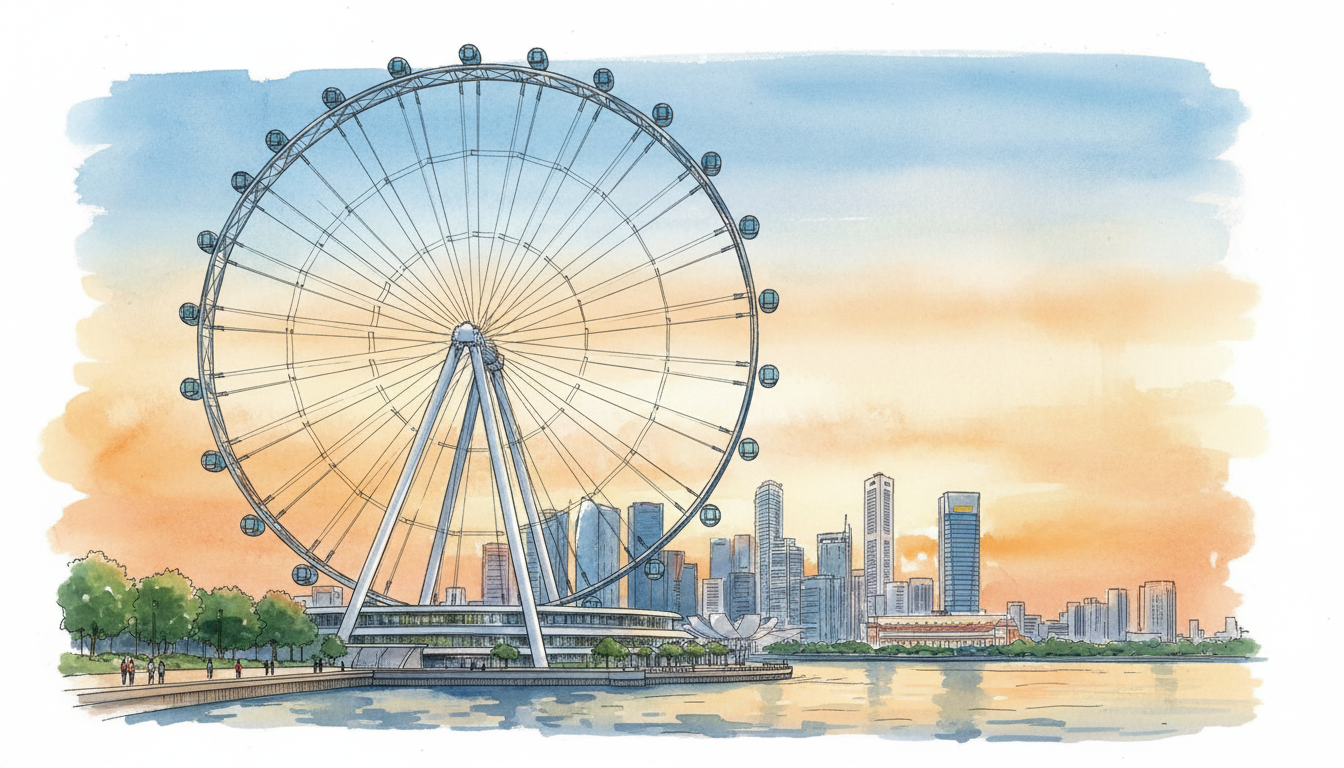
Singapore Flyer is Singapore’s 165-metre observation wheel at 30 Raffles Avenue, with a 150-metre wheel diameter and 28 passenger capsules. It officially opened on 15 April 2008. A standard ticket currently includes one approximately 30-minute rotation in a shared capsule and entry to Time Capsule, the history exhibition reimagined in 2025. This guide teaches 100 Singapore Flyer vocabulary words through short definitions, natural examples, practical visiting distinctions and the cultural meaning of its place in the skyline.
Why is Singapore Flyer part of the country’s culture? Its huge circular silhouette became a modern symbol of Singapore’s waterfront transformation and a viewing point for older national landmarks, from the Singapore River and the Civic District to newer Marina Bay developments. The operator’s official history documents the 2008 opening and a 2014 ownership change, while the standard ticket page explains today’s shared-capsule experience. Its value is not only height: the view invites people to connect geography, engineering, travel, creative presentation and everyday working life.
Find a word immediately in the 100-word finder, read height, duration and ticket facts, or try the worked geometry and source-checking exercises. Hours and admission conditions are dated operational information; an official website should be checked again for the precise day, rather than relying on yesterday’s brochure or assuming a private capsule is included.
Singapore Flyer in one minute: the essential visitor facts
- Location: 30 Raffles Avenue, Singapore 039803. Visit Singapore identifies Promenade MRT (CC4/DT15) as a convenient station.
- Size: The operator lists an overall height of 165 metres and a wheel diameter of 150 metres.
- Cabins: 28 capsules, with a stated maximum of up to 28 passengers each. These are capacity limits, not promises that every capsule contains the same number of people.
- Ordinary visit: one rotation takes about 30 minutes. The standard ticket describes a shared capsule with Time Capsule entry.
- History: formal groundbreaking in 2005, public soft launch in March 2008 and official opening on 15 April 2008.
- Hours in October 2026: the operator’s plan-your-visit page lists 10am–10pm daily, with last admission 9:30pm, subject to updated notices.
- 2026 race exception: the operator’s F1 notice says ordinary public access was restricted from 9–11 October 2026. Old special-event dates are not a recurring annual rule.
- Separate places: Marina Bay Sands, Merlion Park, Gardens by the Bay and the Esplanade may be visible, but none becomes included in a Flyer ticket merely by appearing in the view.
2008 versus 2025: the Flyer and Time Capsule are different milestones
Singapore Flyer’s official milestones describe a September 2005 groundbreaking, February 2008 corporate inaugural flights, a public soft launch in March 2008 and the official opening on 15 April 2008. In November 2014, the business was acquired by Straco Corporation through its leisure joint-venture structure. These dates describe development and ownership, not a rebuilding of the wheel every few years.
Time Capsule is a separate exhibition experience first introduced in 2020, then reimagined in 2025. It uses historical scenes, digital media and imagined characters to explain Singapore’s founding stories, maritime connections and later transformation. That is an interpretive experience, not the same thing as a primary historical archive. Current standard admission includes Time Capsule, but users should always read the precise product terms.
Why 165 metres and 150 metres are not contradictory
The operator states that the overall structure is 165 metres high and the wheel itself measures 150 metres in diameter. The diameter measures across the round wheel through its centre, while height includes its placement and supporting structure. A radius is half the diameter, so the wheel’s approximate radius is 75 metres. Confusing height with diameter leads to incorrect school geometry and inaccurate travel descriptions.
The operator lists 28 capsules, each designed to hold up to 28 passengers. Multiplying those counts yields a theoretical maximum of 784 passengers across a fully occupied wheel at one moment. That is a capacity calculation, not a claim that exactly 784 people ride every rotation. Actual occupancy, boarding and service depend on the venue’s operational decisions.
The standard ticket and the private capsule are different products
The current standard Singapore Flyer Ticket lists three components: Time Capsule entry, one rotation of approximately 30 minutes in a shared capsule, and access to the FLYER360 app. A private capsule is an entirely different bookable hospitality product with its own arrival times, prices, terms and priority boarding. Do not copy a private experience’s conditions into an ordinary ticket or promise that standard ticket holders will occupy a capsule alone.
The operator’s general terms require adults to accompany and supervise children aged 12 and below and specify boarding and safety conditions. A private reservation or optional special offer may have more restrictive late-arrival or cancellation rules. The attraction also reserves operational discretion over capsule allocation. Understanding the ticket scope is more helpful than assuming the word premium means unlimited access.
Promenade MRT, nearby buildings and a real meeting point
Singapore Tourism Board lists the attraction at 30 Raffles Avenue, with Promenade MRT (CC4/DT15) as the nearest MRT station in its visitor guide. The operator’s directions and parking information provide further travel details. A commuter should follow the current exit signage and allow time between leaving a train and reaching the correct building. A friend saying “meet at Marina Bay” is not enough for a precise rendezvous.
The Singapore Flyer is near the F1 Pit Building and other Marina Bay landmarks, but nearby is not the same as part of one venue. In October 2026 the operator published special access restrictions during the Singapore Grand Prix weekend, when the surrounding roads and event controls changed. Those dates have already passed; a later visit must be planned from the relevant current notice.
Why the skyline can become a lesson about Singapore’s history
The view can invite a useful sequence: identify a building, name its function, locate it relative to the water and then look up its history. Marina Bay Sands illustrates modern tourism architecture. The Singapore River leads toward former trade warehouses and conserved bridges. The Padang and nearby civic buildings recall another layer of public life. The Esplanade brings a performing-arts dimension; Gardens by the Bay illustrates large-scale planted urban design.
None of those places has the same operator or access rules as the Singapore Flyer. A good 100-word vocabulary article names the differences. A wide photograph taken from a moving capsule makes buildings appear close together in the frame, but their actual entrances, walkways and directions still need maps and separate plans.
FLYER360 and Time Capsule: understand digital interpretation
The standard Flyer page mentions the FLYER360 augmented-reality mobile experience, downloaded through HiFlyer on arrival to help people identify landmarks and interact with the view. Time Capsule uses immersive exhibits to tell a staged Singapore story before the ride. Both can make learning more enjoyable, but neither removes the need for careful historical sourcing.
An augmented-reality overlay can label the image on a screen; it cannot guarantee a clear view through haze or rain. An immersive legend can provide culturally meaningful material, but it should not be rewritten as a directly verified eyewitness account of ancient events. Children can learn to enjoy storytelling and still distinguish fiction, interpretation and historical evidence.
Find any of the 100 Singapore Flyer terms
- Part 1: Meet the Singapore Flyer: landmark, location and history — words 1–10
- Part 2: The engineering behind 165 metres and 28 capsules — words 11–20
- Part 3: One rotation: understand the half-hour experience — words 21–30
- Part 4: Time Capsule: Singapore’s history before the skyline — words 31–40
- Part 5: FLYER360 and the technology used to name landmarks — words 41–50
- Part 6: Views of Marina Bay: several places, not one ticket — words 51–60
- Part 7: Tickets, access and current operating information — words 61–70
- Part 8: Families, safety and accessibility during the ride — words 71–80
- Part 9: People behind the wheel: work, maintenance and tourism — words 81–90
- Part 10: Describe the Flyer accurately: numbers, photographs and identity — words 91–100
Words 1–10: 1. Singapore Flyer · 2. Observation wheel · 3. 2008 opening · 4. 15 April 2008 · 5. 2005 groundbreaking · 6. Marina Bay precinct · 7. 30 Raffles Avenue · 8. Landmark silhouette · 9. Straco Corporation · 10. 2014 acquisition
Words 11–20: 11. 165-metre height · 12. 150-metre diameter · 13. 75-metre radius · 14. Capsule · 15. Twenty-eight capsules · 16. Maximum capsule capacity · 17. Steel structure · 18. Rotational motion · 19. Suspended cabin · 20. Engineering inspection
Words 21–30: 21. Full rotation · 22. Thirty-minute ride · 23. Shared capsule · 24. Private capsule · 25. Boarding point · 26. Boarding procedure · 27. Gradual ascent · 28. Highest point · 29. Gradual descent · 30. Passenger capacity
Words 31–40: 31. Time Capsule · 32. 2020 introduction · 33. 2025 reimagining · 34. Multisensory exhibition · 35. Dawn of Singapura · 36. Sang Nila Utama · 37. Maritime Silk Road · 38. Historical interpretation · 39. Digital storytelling · 40. Exhibition narrative
Words 41–50: 41. FLYER360 · 42. Augmented reality (AR) · 43. HiFlyer · 44. Landmark identification · 45. Interactive exhibit · 46. Digital overlay · 47. Mobile compatibility · 48. Visual guide · 49. Interpretive caption · 50. Technology-dependent feature
Words 51–60: 51. Marina Bay Sands · 52. Merlion Park · 53. Esplanade – Theatres on the Bay · 54. Gardens by the Bay · 55. Singapore River · 56. Central Business District (CBD) · 57. Padang · 58. Singapore Flyer skyline view · 59. Viewing angle · 60. Visibility
Words 61–70: 61. Standard Flyer ticket · 62. Ticket entitlement · 63. Last admission · 64. Operating hours · 65. Booking confirmation · 66. Private booking · 67. Admission condition · 68. Cancellation term · 69. Maintenance closure · 70. Special-event restriction
Words 71–80: 71. Adult supervision · 72. Boarding assistance · 73. Wheelchair accessibility · 74. Weather delay · 75. Passenger briefing · 76. Comfortable standing · 77. Shared-space courtesy · 78. Motion comfort · 79. Emergency instruction · 80. Family pacing
Words 81–90: 81. Ride operator · 82. Mechanical engineer · 83. Electrical engineer · 84. Inspection schedule · 85. Maintenance team · 86. Guest relations · 87. Visitor services · 88. Tourism employment · 89. Place branding · 90. Civic waterfront
Words 91–100: 91. Observation · 92. Inference · 93. Scale comparison · 94. Diameter versus height · 95. Historical milestone · 96. Commercial accolade · 97. Photo caption · 98. Source verification · 99. Visitor interpretation · 100. Cultural landmark
The learning method: notice, explain, compare and verify
First look at the structure and name one visible feature. Explain what that term means, compare it with a closely related but different word, and check one factual claim through an official page. For example, diameter and height are different measurements. Shared capsule and private capsule describe different paid experiences. Historical exhibition does not mean a complete primary archive.
Primary students can learn shape, movement and visible landmarks. Secondary students can use wheel geometry, ticket interpretation, changes in city land use and the role of public and private businesses in tourism. No flight or ticket is required to use the guide as reading and vocabulary practice.
Part 1 — Meet the Singapore Flyer: landmark, location and history
The Singapore Flyer is a giant observation wheel in the Marina Bay area. It opened in 2008, while its height, design and ownership have separate histories. The attraction is not a roller coaster, and it is not the same building as Marina Bay Sands.
1. Singapore Flyer
Meaning: The 165-metre-high observation wheel near Marina Bay, located at 30 Raffles Avenue. Example: “We visited Singapore Flyer to look across the city.” Why it belongs in Singapore’s Flyer story: It became an internationally recognisable part of modern Singapore’s visitor skyline.
2. Observation wheel
Meaning: A rotating wheel carrying passenger cabins designed mainly for views. Example: “An observation wheel moves more gently than most thrill rides.” Why it belongs in Singapore’s Flyer story: The experience invites sightseeing rather than high-speed racing.
3. 2008 opening
Meaning: The year Singapore Flyer began public operations and held its official opening. Example: “Singapore Flyer officially opened in April 2008.” Why it belongs in Singapore’s Flyer story: The modern attraction belongs to the city’s twenty-first-century visitor history.
4. 15 April 2008
Meaning: The date of Singapore Flyer’s official opening ceremony. Example: “We checked the 15 April 2008 date in the operator’s timeline.” Why it belongs in Singapore’s Flyer story: The official opening differs from the earlier public soft launch.
5. 2005 groundbreaking
Meaning: The start of construction formally marked in September 2005. Example: “The 2005 groundbreaking preceded the 2008 opening.” Why it belongs in Singapore’s Flyer story: Big visitor attractions require years of engineering and planning before visitors arrive.
6. Marina Bay precinct
Meaning: The area around the central waterfront containing multiple distinct landmarks. Example: “The Flyer stands within the Marina Bay precinct.” Why it belongs in Singapore’s Flyer story: A recognisable skyline photograph shows a district, not one ticketed venue.
7. 30 Raffles Avenue
Meaning: The published street address of Singapore Flyer. Example: “Our route led to 30 Raffles Avenue, Singapore 039803.” Why it belongs in Singapore’s Flyer story: A full address distinguishes the Flyer from Raffles Hotel or Raffles Place.
8. Landmark silhouette
Meaning: The distinctive outline by which a building or structure can be recognised. Example: “The circular landmark silhouette stood above the waterfront.” Why it belongs in Singapore’s Flyer story: A familiar shape helps wayfinding and Singapore’s visual identity.
9. Straco Corporation
Meaning: The listed company associated with operating Singapore Flyer through its leisure business after the 2014 acquisition. Example: “Straco’s acquisition belongs to the Flyer’s corporate history.” Why it belongs in Singapore’s Flyer story: Ownership is separate from the public’s memory of the landmark.
10. 2014 acquisition
Meaning: The November 2014 change in the Flyer’s ownership under the present business structure. Example: “Our timeline placed the acquisition in 2014.” Why it belongs in Singapore’s Flyer story: A purchase date does not change the structure’s 2008 original opening.
Part 1 retrieval: Choose three terms, make an original sentence for each, then correct a likely reader misunderstanding. The best explanation may be short if it names the exact structure, number, date or ticket right.
Part 2 — The engineering behind 165 metres and 28 capsules
An observation wheel is a large engineered moving structure. The operator gives a 165-metre overall height, a 150-metre wheel diameter and 28 capsules with a stated design capacity of up to 28 people each.
11. 165-metre height
Meaning: The published overall height of Singapore Flyer above the ground. Example: “The Flyer stands 165 metres tall.” Why it belongs in Singapore’s Flyer story: Height is a dimension of the structure, not a ticket’s view guarantee.
12. 150-metre diameter
Meaning: The stated distance across the observation wheel through its centre. Example: “The wheel has a 150-metre diameter.” Why it belongs in Singapore’s Flyer story: Diameter differs from radius and from a capsule’s floor size.
13. 75-metre radius
Meaning: Half of a 150-metre diameter, representing the distance from wheel centre to rim. Example: “We used a 75-metre radius in a class geometry exercise.” Why it belongs in Singapore’s Flyer story: It follows from the published wheel diameter, not a separately measured ride height.
14. Capsule
Meaning: The enclosed passenger cabin attached to an observation wheel. Example: “Our group boarded a shared capsule.” Why it belongs in Singapore’s Flyer story: A capsule is a cabin, not a separate little train with its own route.
15. Twenty-eight capsules
Meaning: The operator’s total count of passenger capsules on the Flyer. Example: “The wheel contains twenty-eight capsules.” Why it belongs in Singapore’s Flyer story: The number describes cabin units, not twenty-eight complete revolutions.
16. Maximum capsule capacity
Meaning: The upper design occupancy of up to 28 people stated for a capsule. Example: “The listed maximum capsule capacity was 28.” Why it belongs in Singapore’s Flyer story: Actual occupancy may be lower under operator procedures and booked products.
17. Steel structure
Meaning: The large framework supporting the wheel and its loads. Example: “The steel structure was visible from below.” Why it belongs in Singapore’s Flyer story: The sightseeing experience depends on engineered support and inspection.
18. Rotational motion
Meaning: Movement around a fixed axis or centre. Example: “The capsules moved with the wheel’s rotational motion.” Why it belongs in Singapore’s Flyer story: An observation wheel moves in a circle rather than along a roller-coaster track.
19. Suspended cabin
Meaning: A passenger compartment hanging from the rotating structure while remaining generally upright. Example: “The suspended cabin remained level as the wheel turned.” Why it belongs in Singapore’s Flyer story: Its design allows people to stand or sit while enjoying views.
20. Engineering inspection
Meaning: Systematic checks of mechanical components and safety conditions. Example: “Engineering inspection happened outside the visitor experience.” Why it belongs in Singapore’s Flyer story: Operational reliability depends on workers and procedures that photographs do not show.
Part 2 retrieval: Choose three terms, make an original sentence for each, then correct a likely reader misunderstanding. The best explanation may be short if it names the exact structure, number, date or ticket right.
Part 3 — One rotation: understand the half-hour experience
The current ordinary Singapore Flyer Ticket describes a shared capsule and one approximately 30-minute rotation. That is not a promise of exclusive use, and a ticket may have other bundled components.
21. Full rotation
Meaning: One complete turn of an observation wheel back to its original angular position. Example: “Our ticket covered one full rotation.” Why it belongs in Singapore’s Flyer story: A complete turn is a movement measure, not a second visit.
22. Thirty-minute ride
Meaning: The approximate ordinary duration of one full Flyer rotation. Example: “The thirty-minute ride gave us time to look around.” Why it belongs in Singapore’s Flyer story: A typical rotation excludes time spent in queues, security and the pre-ride exhibit.
23. Shared capsule
Meaning: A passenger cabin used by multiple unrelated visitors under regular ticket conditions. Example: “We rode in a shared capsule with other families.” Why it belongs in Singapore’s Flyer story: Ordinary admission does not automatically give a private cabin.
24. Private capsule
Meaning: A separately booked cabin reserved for one party under the operator’s terms. Example: “The private capsule had different booking conditions.” Why it belongs in Singapore’s Flyer story: A premium product cannot be assumed from a standard ticket.
25. Boarding point
Meaning: The designated place where passengers enter the wheel system. Example: “We followed the signs to the boarding point.” Why it belongs in Singapore’s Flyer story: Arriving at the building is different from being in the correct boarding queue.
26. Boarding procedure
Meaning: The steps visitors follow when joining the ride. Example: “The staff explained the boarding procedure clearly.” Why it belongs in Singapore’s Flyer story: Instructions protect smooth movement and passenger safety.
27. Gradual ascent
Meaning: Slow upward movement as the wheel turns. Example: “The gradual ascent changed our view of the harbour.” Why it belongs in Singapore’s Flyer story: The experience’s pace differs from a fast amusement ride.
28. Highest point
Meaning: The position near the top of the wheel’s rotating path. Example: “We reached the highest point above the skyline.” Why it belongs in Singapore’s Flyer story: What is visible depends on weather and viewing angle, not only height.
29. Gradual descent
Meaning: Slow downward movement as the wheel completes its rotation. Example: “Our gradual descent brought the entrance level back into view.” Why it belongs in Singapore’s Flyer story: A circular journey ends near where it began rather than at another neighbourhood.
30. Passenger capacity
Meaning: The number of people a cabin or service is designed to accommodate. Example: “The maximum passenger capacity was listed in the operator’s information.” Why it belongs in Singapore’s Flyer story: A design capacity should not be mistaken for guaranteed occupancy on every trip.
Part 3 retrieval: Choose three terms, make an original sentence for each, then correct a likely reader misunderstanding. The best explanation may be short if it names the exact structure, number, date or ticket right.
Part 4 — Time Capsule: Singapore’s history before the skyline
The operator includes the Time Capsule exhibit with its current standard Flyer ticket. First introduced in 2020 and reimagined in 2025, it presents a staged story of Singapore rather than an unedited historical record.
31. Time Capsule
Meaning: A multisensory pre-ride exhibition about Singapore’s history and transformation. Example: “We visited Time Capsule before boarding the wheel.” Why it belongs in Singapore’s Flyer story: It helps visitors connect a high-level skyline with stories of the place.
32. 2020 introduction
Meaning: The year the Time Capsule experience first appeared. Example: “Time Capsule first opened in 2020.” Why it belongs in Singapore’s Flyer story: It arrived well after the observation wheel opened in 2008.
33. 2025 reimagining
Meaning: A substantial redesign of the Time Capsule experience launched in 2025. Example: “The exhibit was reimagined in 2025.” Why it belongs in Singapore’s Flyer story: Exhibition content changes over time and old photographs may not match.
34. Multisensory exhibition
Meaning: A presentation using several senses, such as sight, sound and movement. Example: “The multisensory exhibition combined narration and projections.” Why it belongs in Singapore’s Flyer story: Artistic presentation can engage visitors but should be read critically.
35. Dawn of Singapura
Meaning: A Time Capsule story segment referring to Singapore’s early naming legends. Example: “The first section was called Dawn of Singapura.” Why it belongs in Singapore’s Flyer story: It connects the exhibition with a traditional account, not scientific proof of a lion sighting.
36. Sang Nila Utama
Meaning: A prince associated with the traditional legend of naming Singapura. Example: “The story included Sang Nila Utama.” Why it belongs in Singapore’s Flyer story: A traditional naming narrative deserves respectful treatment and distinction from independently confirmed events.
37. Maritime Silk Road
Meaning: Sea routes connecting merchants and cultures across Asia and beyond. Example: “The exhibition described trade on the Maritime Silk Road.” Why it belongs in Singapore’s Flyer story: Singapore’s wider port history involved many communities and regions.
38. Historical interpretation
Meaning: An explanation of the past built by selecting and connecting evidence and themes. Example: “We considered the exhibit a historical interpretation.” Why it belongs in Singapore’s Flyer story: An immersive storyline is not a full textbook or primary archive.
39. Digital storytelling
Meaning: Using digital media to present a narrative or explanation. Example: “The exhibit used digital storytelling with projection.” Why it belongs in Singapore’s Flyer story: Technology changes how history is presented but cannot replace source checking.
40. Exhibition narrative
Meaning: The planned sequence of ideas or scenes in a display. Example: “The exhibition narrative moved from trade to modern Singapore.” Why it belongs in Singapore’s Flyer story: A narrative organises information and may omit other valid perspectives.
Part 4 retrieval: Choose three terms, make an original sentence for each, then correct a likely reader misunderstanding. The best explanation may be short if it names the exact structure, number, date or ticket right.
Part 5 — FLYER360 and the technology used to name landmarks
The operator’s ordinary ticket page includes access to its FLYER360 augmented-reality mobile experience, obtained through HiFlyer, while visitors are in the capsule. The app is a supplement to the view, not a requirement to understand the skyline.
41. FLYER360
Meaning: The mobile app offering augmented-reality content for landmarks seen from Singapore Flyer. Example: “We used FLYER360 during our rotation.” Why it belongs in Singapore’s Flyer story: Digital interpretation can help identify features beyond the window.
42. Augmented reality (AR)
Meaning: Technology overlaying digital content on a view of the real world. Example: “Augmented reality labelled buildings on the screen.” Why it belongs in Singapore’s Flyer story: An overlay is informational, not proof of unrestricted sight through haze.
43. HiFlyer
Meaning: The operator’s platform mentioned for downloading the FLYER360 experience on arrival. Example: “We followed the HiFlyer instruction at the attraction.” Why it belongs in Singapore’s Flyer story: Different digital tools have different functions and access rules.
44. Landmark identification
Meaning: Recognising and correctly naming a building or geographical feature. Example: “Landmark identification was easier with the city map.” Why it belongs in Singapore’s Flyer story: Accurate names avoid confusing the Flyer with nearby Marina Bay Sands.
45. Interactive exhibit
Meaning: A display that responds to a user’s choices or movement. Example: “We explored the interactive exhibit together.” Why it belongs in Singapore’s Flyer story: Interaction can motivate questions rather than only passive viewing.
46. Digital overlay
Meaning: A graphic or annotation shown over a live or recorded view. Example: “The digital overlay pointed toward a historic district.” Why it belongs in Singapore’s Flyer story: Overlay labels still need a reliable map and appropriate date.
47. Mobile compatibility
Meaning: Whether a device supports the necessary application and features. Example: “We checked mobile compatibility before relying on the app.” Why it belongs in Singapore’s Flyer story: A ticket feature may work differently on different devices.
48. Visual guide
Meaning: A tool or display explaining what a viewer is looking at. Example: “The visual guide identified nearby bridges.” Why it belongs in Singapore’s Flyer story: Explanation adds value to sightseeing without replacing real observations.
49. Interpretive caption
Meaning: Text explaining an image or feature with background context. Example: “Our interpretive caption identified the correct waterfront.” Why it belongs in Singapore’s Flyer story: Labels should distinguish what is directly visible from history found in sources.
50. Technology-dependent feature
Meaning: A service that relies on working devices or networks. Example: “We planned to enjoy the view even without the technology-dependent feature.” Why it belongs in Singapore’s Flyer story: A failed app need not prevent a visitor from using ordinary observation skills.
Part 5 retrieval: Choose three terms, make an original sentence for each, then correct a likely reader misunderstanding. The best explanation may be short if it names the exact structure, number, date or ticket right.
Part 6 — Views of Marina Bay: several places, not one ticket
From above, many distinct sites can appear together in a photograph. Singapore Flyer does not operate Marina Bay Sands, Merlion Park, Esplanade or Gardens by the Bay, and a wheel ticket grants no rights to those venues.
51. Marina Bay Sands
Meaning: A separate three-tower integrated resort visible around the bay. Example: “Marina Bay Sands stood across the water.” Why it belongs in Singapore’s Flyer story: Being able to see its rooftop does not grant pool or SkyPark access.
52. Merlion Park
Meaning: A public waterfront site with the lion-headed fish-bodied tourism monument. Example: “The Merlion appeared in the distance on a clear day.” Why it belongs in Singapore’s Flyer story: The Merlion is a separate historic tourism icon with its own story.
53. Esplanade – Theatres on the Bay
Meaning: A performing-arts venue known for its distinctive spiky domed roofs. Example: “We identified the Esplanade near the water.” Why it belongs in Singapore’s Flyer story: The arts centre is independent of the Flyer’s commercial operation.
54. Gardens by the Bay
Meaning: A nearby modern public-garden destination famous for its Supertrees and domes. Example: “We recognised Gardens by the Bay from above.” Why it belongs in Singapore’s Flyer story: The conservatories have separate admission even when seen from the Flyer.
55. Singapore River
Meaning: The historic urban waterway linking older commercial riverfront precincts. Example: “We traced the Singapore River toward its quays.” Why it belongs in Singapore’s Flyer story: It connects the modern view to centuries of trade and twentieth-century clean-up.
56. Central Business District (CBD)
Meaning: The concentration of finance and other commercial offices in central Singapore. Example: “The CBD towers rose beyond the bay.” Why it belongs in Singapore’s Flyer story: A skyline also represents ordinary working places rather than only tourist sights.
57. Padang
Meaning: A historic open field used for civic and sporting occasions. Example: “The Padang formed an open space among buildings.” Why it belongs in Singapore’s Flyer story: It has a different heritage and public-use story from the observation wheel.
58. Singapore Flyer skyline view
Meaning: The city scene visible through the Flyer’s passenger-capsule windows. Example: “The skyline view changed as our capsule rose.” Why it belongs in Singapore’s Flyer story: Viewing conditions differ by weather, time of day and the capsule’s position.
59. Viewing angle
Meaning: The angle from which someone sees a scene or structure. Example: “The viewing angle made a tower appear closer to another.” Why it belongs in Singapore’s Flyer story: A photograph can distort apparent proximity between distinct places.
60. Visibility
Meaning: The distance and clarity with which objects can be seen through the atmosphere. Example: “Haze reduced visibility across the skyline.” Why it belongs in Singapore’s Flyer story: A brochure image is not a guaranteed view for every visitor.
Part 6 retrieval: Choose three terms, make an original sentence for each, then correct a likely reader misunderstanding. The best explanation may be short if it names the exact structure, number, date or ticket right.
Part 7 — Tickets, access and current operating information
The operator’s October 2026 plan-your-visit page lists daily hours of 10am–10pm, with last admission at 9:30pm, subject to updates. A standard Flyer ticket includes Time Capsule and one shared rotation; special products have different policies.
61. Standard Flyer ticket
Meaning: The ordinary admission product for a shared observation-wheel rotation and its stated inclusions. Example: “We checked the standard Flyer ticket before purchasing.” Why it belongs in Singapore’s Flyer story: The present ticket includes Time Capsule, but future product terms may change.
62. Ticket entitlement
Meaning: The specific access and services that a purchased ticket allows. Example: “Our ticket entitlement covered one shared rotation.” Why it belongs in Singapore’s Flyer story: It is not a blanket pass to private cabins or neighbouring attractions.
63. Last admission
Meaning: The latest time visitors may enter a named attraction under its rules. Example: “The current last admission was listed at 9:30pm.” Why it belongs in Singapore’s Flyer story: Last admission differs from the posted 10pm closing time.
64. Operating hours
Meaning: The daily period in which a venue generally receives visitors. Example: “We checked operating hours on the official site.” Why it belongs in Singapore’s Flyer story: Ordinary schedules may change for maintenance and special events.
65. Booking confirmation
Meaning: A document or message showing a successfully arranged experience. Example: “Our booking confirmation displayed the visit details.” Why it belongs in Singapore’s Flyer story: An enquiry is not necessarily a confirmed premium reservation.
66. Private booking
Meaning: An arrangement reserving an experience or facility for a particular group. Example: “A private booking had its own arrival instructions.” Why it belongs in Singapore’s Flyer story: Premium reservations should not be confused with regular shared-capsule tickets.
67. Admission condition
Meaning: A rule setting requirements for entering or participating in an attraction. Example: “We read the admission condition before travelling.” Why it belongs in Singapore’s Flyer story: Validity may depend on date, age, arrival time or product.
68. Cancellation term
Meaning: A rule describing when a reservation may be changed or cancelled. Example: “We checked the cancellation term before paying.” Why it belongs in Singapore’s Flyer story: An operational change does not imply every refund request succeeds.
69. Maintenance closure
Meaning: Temporary unavailability needed for checking or repairing equipment. Example: “A maintenance closure changed our family plan.” Why it belongs in Singapore’s Flyer story: A landmark can be usually open without operating every day of the year.
70. Special-event restriction
Meaning: Limited access or changed operation during a defined event. Example: “The F1 weekend involved special-event restrictions.” Why it belongs in Singapore’s Flyer story: A ticket or opening schedule should be read for its specific date.
Part 7 retrieval: Choose three terms, make an original sentence for each, then correct a likely reader misunderstanding. The best explanation may be short if it names the exact structure, number, date or ticket right.
Part 8 — Families, safety and accessibility during the ride
Singapore Flyer’s terms require accompanying adults to supervise children aged 12 and below and describe other boarding conditions. A comfortable plan considers space, weather, individual needs and the correct product, not only attractive photographs.
71. Adult supervision
Meaning: An eligible adult’s responsibility for keeping a child safe during an experience. Example: “Our adult supervision continued throughout the ride.” Why it belongs in Singapore’s Flyer story: The operator requires children aged 12 and below to be accompanied and supervised.
72. Boarding assistance
Meaning: Help offered to passengers who need support entering an attraction. Example: “We asked about boarding assistance in advance.” Why it belongs in Singapore’s Flyer story: Access procedures should be checked with the operator for individual needs.
73. Wheelchair accessibility
Meaning: Arrangements enabling eligible wheelchair users to enter and use a facility. Example: “We confirmed wheelchair accessibility before booking.” Why it belongs in Singapore’s Flyer story: Different mobility equipment and boarding needs may require specific instructions.
74. Weather delay
Meaning: An interruption to an attraction caused by unsuitable weather. Example: “A weather delay moved our preferred boarding time.” Why it belongs in Singapore’s Flyer story: Safety can matter more than a fixed photograph schedule.
75. Passenger briefing
Meaning: Safety or operational information communicated before an activity. Example: “We listened to the passenger briefing.” Why it belongs in Singapore’s Flyer story: A calm ride still has procedures and rules.
76. Comfortable standing
Meaning: Being able to stand securely without interfering with other passengers. Example: “We found comfortable standing space away from the door.” Why it belongs in Singapore’s Flyer story: Passengers should follow onboard safety instructions and consider others.
77. Shared-space courtesy
Meaning: Behaviour that respects other people using the same facility. Example: “Shared-space courtesy made the capsule pleasant.” Why it belongs in Singapore’s Flyer story: A shared cabin is not one party’s private photo studio.
78. Motion comfort
Meaning: A visitor’s tolerance for movement or height-related sensations. Example: “We considered motion comfort before purchasing tickets.” Why it belongs in Singapore’s Flyer story: A gentle rotation can still trouble some people with sensitivity to heights.
79. Emergency instruction
Meaning: Guidance issued by staff for responding to an unusual or unsafe situation. Example: “We followed the emergency instruction calmly.” Why it belongs in Singapore’s Flyer story: Visitor safety requires listening to the operator rather than improvising.
80. Family pacing
Meaning: Planning enough time and rest for different ages and abilities. Example: “Family pacing left time for the exhibition before the ride.” Why it belongs in Singapore’s Flyer story: One well-chosen experience can be more enjoyable than rushing among landmarks.
Part 8 retrieval: Choose three terms, make an original sentence for each, then correct a likely reader misunderstanding. The best explanation may be short if it names the exact structure, number, date or ticket right.
Part 9 — People behind the wheel: work, maintenance and tourism
The public sees glowing cabins and city views. Running a 165-metre attraction also requires technicians, operators, cleaning teams, security and customer support. Tourism history is a story of workers as well as famous structures.
81. Ride operator
Meaning: A person who monitors or manages an attraction’s operation. Example: “The ride operator checked the boarding sequence.” Why it belongs in Singapore’s Flyer story: The visitor’s experience depends on trained staff rather than the rotating structure alone.
82. Mechanical engineer
Meaning: A professional designing, testing or maintaining mechanical systems. Example: “The mechanical engineer studied parts of the rotating assembly.” Why it belongs in Singapore’s Flyer story: Large moving attractions need continuing technical expertise.
83. Electrical engineer
Meaning: A professional responsible for systems involving electrical power and controls. Example: “The electrical engineer reviewed the control system.” Why it belongs in Singapore’s Flyer story: Lighting and movement depend on reliable electrical infrastructure.
84. Inspection schedule
Meaning: A planned sequence of checks on equipment or operating conditions. Example: “An inspection schedule supported the attraction’s upkeep.” Why it belongs in Singapore’s Flyer story: Regular inspections may affect availability without signalling a permanent closure.
85. Maintenance team
Meaning: Workers responsible for keeping structures and equipment in usable condition. Example: “The maintenance team checked the site outside public hours.” Why it belongs in Singapore’s Flyer story: Invisible labour helps sustain a familiar landmark.
86. Guest relations
Meaning: Staff who help visitors with enquiries, bookings and practical concerns. Example: “Guest relations explained the ticket terms.” Why it belongs in Singapore’s Flyer story: Clear communication is central to tourism services.
87. Visitor services
Meaning: Support offered to guests during access, navigation or an experience. Example: “Visitor services answered our accessibility question.” Why it belongs in Singapore’s Flyer story: The best operational source is the venue itself, not an outdated review.
88. Tourism employment
Meaning: Jobs supported directly or indirectly by travel and visitor activities. Example: “The Flyer contributes to tourism employment.” Why it belongs in Singapore’s Flyer story: Meaningful tourism discussion includes skilled local work, not only tourist spending.
89. Place branding
Meaning: How a city’s recognisable images shape perceptions of the destination. Example: “The circular Flyer became part of Singapore’s place branding.” Why it belongs in Singapore’s Flyer story: Marketing images do not capture every resident’s life or opinion.
90. Civic waterfront
Meaning: Shared spaces near the water used for city life and public activity. Example: “The Flyer overlooks Singapore’s civic waterfront.” Why it belongs in Singapore’s Flyer story: The view can connect leisure with work, transport and heritage.
Part 9 retrieval: Choose three terms, make an original sentence for each, then correct a likely reader misunderstanding. The best explanation may be short if it names the exact structure, number, date or ticket right.
Part 10 — Describe the Flyer accurately: numbers, photographs and identity
An image or slogan may be appealing without being precise. These vocabulary words support accountable explanations about the Flyer’s history, engineering, admission and view.
91. Observation
Meaning: Something directly noticed through the senses or an instrument. Example: “Our observation was that the wheel moved slowly.” Why it belongs in Singapore’s Flyer story: An observation should not be inflated into a claim about exact speed without data.
92. Inference
Meaning: A conclusion drawn from clues rather than seen directly. Example: “We made an inference about the capsule’s position.” Why it belongs in Singapore’s Flyer story: A photograph can suggest a viewpoint but not prove every measured fact.
93. Scale comparison
Meaning: An explanation of size by relating one measure to another. Example: “We used a scale comparison with a tall building.” Why it belongs in Singapore’s Flyer story: Comparisons are teaching aids, not precise measurements unless calculated.
94. Diameter versus height
Meaning: The distinction between width through the wheel’s centre and overall vertical extent. Example: “We compared the 150-metre diameter with the 165-metre height.” Why it belongs in Singapore’s Flyer story: The numbers describe different aspects of the same structure.
95. Historical milestone
Meaning: A documented event marking an important stage in development. Example: “The official 2008 opening was a historical milestone.” Why it belongs in Singapore’s Flyer story: Construction, public launch and ownership changes should be dated separately.
96. Commercial accolade
Meaning: A claim or award used to present a business’s prestige. Example: “We checked the date of the commercial accolade.” Why it belongs in Singapore’s Flyer story: A former tallest-wheel claim may become outdated as new structures are built.
97. Photo caption
Meaning: Text explaining what an image shows with appropriate context. Example: “The photo caption correctly named the Flyer and Marina Bay.” Why it belongs in Singapore’s Flyer story: A picture may include several independently managed landmarks.
98. Source verification
Meaning: Checking a claim against relevant, credible and current information. Example: “Source verification confirmed the opening year.” Why it belongs in Singapore’s Flyer story: Current schedules need current operator information; history needs dated records.
99. Visitor interpretation
Meaning: Explaining the cultural and practical meaning of an observed place. Example: “Our visitor interpretation connected the view to trade history.” Why it belongs in Singapore’s Flyer story: Looking out is more educational when readers know the landmarks’ distinct stories.
100. Cultural landmark
Meaning: A place widely associated with a city’s image or shared experiences. Example: “Singapore Flyer is a cultural landmark of the modern skyline.” Why it belongs in Singapore’s Flyer story: A symbol of tourism is not a complete definition of Singapore’s identity.
Part 10 retrieval: Choose three terms, make an original sentence for each, then correct a likely reader misunderstanding. The best explanation may be short if it names the exact structure, number, date or ticket right.
Worked example: wheel diameter is not the same as total height
Incorrect sentence: “Singapore Flyer is 150 metres tall because its diameter is 150 metres.” This statement confuses two distinct quantities. The operator publishes an overall height of 165 metres and a wheel diameter of 150 metres. A diameter is measured through the wheel’s centre, while the total structure height is measured vertically from the ground.
Better explanation: “The observation wheel is 150 metres across, giving a radius of approximately 75 metres. Its full installation rises to 165 metres. The wheel has 28 capsules, with each designed for up to 28 passengers.” Adding the maximum figures gives 784 possible occupants across a fully loaded wheel; that is a mathematical capacity limit, not a guarantee about the number actually present on a particular day.
Worked example: a ticket does not grant a private cabin
Visitor claim: “We bought four standard tickets, so the four of us will have our own capsule for half an hour and skip the queue.” Standard tickets currently refer to a shared capsule and one rotation. The operator separately sells private-capsule experiences with their own rules. A party should not assume exclusivity or priority boarding without the appropriate purchased product.
Corrected advice: “Our ordinary ticket covers the products described on the operator’s booking page. We will check the latest schedule, arrive in time for the required entry procedures and follow staff direction about which capsule to board.”
Worked example: a view cannot verify a building’s entire history
From the capsule a visitor might see a historic bridge, the Merlion and several business towers at once. A single image tells us something about the visible shapes and their positions from that angle. It does not verify a bridge’s construction year, grant entry to the SkyPark or establish the working conditions of every tower’s employees.
Stronger caption: “The Singapore Flyer offers a broad view over Singapore’s Marina Bay skyline, where historic civic sites, former trading waterways and modern visitor attractions meet. The exact histories and visitor access for those landmarks should be checked separately.” This conveys cultural meaning without turning a scenic image into unsupported advertising.
A short fictional visitor conversation
Visitor: “How long is one turn?” Local: “The standard rotation is around thirty minutes.” Visitor: “Will we have the capsule to ourselves?” Local: “Not on an ordinary shared-capsule ticket; a private booking is a separate product.” Visitor: “Can we see the river?” Local: “It may be visible in clear conditions. We can use the guide to identify the historic district.”
This invented exchange practises clear information rather than reporting a conversation with an actual staff member. Visitors should follow the operator’s live notices for boarding and availability.
Creative writing: a whole city in one slow rotation
“At first, the capsule’s movement was almost too slow to notice. Then the buildings began to settle into new shapes, and the paths around Marina Bay opened into a wider pattern. I could see the round roof of a theatre, the curve of the river and towers whose names I had only read on maps. My brother pointed to a distant garden, while my grandmother remembered when parts of the waterfront had looked very different. The wheel had not carried us to another city; it had simply given us another way to understand Singapore.”
This is fictional creative writing. It uses a gentle narrative to connect observation, family memory and place, but it does not claim that every named landmark is always visible or that the characters experienced a particular real ride.
Ten comprehension checks with answers
- 1. How high is Singapore Flyer overall? 165 metres.
- 2. What is the wheel’s diameter? 150 metres.
- 3. What is the corresponding approximate radius? 75 metres.
- 4. How many capsules does the operator list? Twenty-eight.
- 5. About how long is one normal rotation? Thirty minutes.
- 6. When did the Flyer officially open? 15 April 2008.
- 7. Is a standard ticket an exclusive private cabin booking? No.
- 8. What exhibition is currently included with the standard ticket? Time Capsule.
- 9. What does FLYER360 offer? Augmented-reality interpretation on a compatible mobile device.
- 10. Does seeing Marina Bay Sands from the capsule grant entry to its hotel pool? No.
Twelve frequent Singapore Flyer questions
1. Where is Singapore Flyer?
At 30 Raffles Avenue, Singapore 039803, near the Marina Bay district. Promenade MRT is a useful train access point.
2. How tall is Singapore Flyer?
The operator gives a total height of 165 metres, with a 150-metre wheel diameter.
3. How many capsules does it have?
Twenty-eight passenger capsules. The published design capacity is up to 28 people each, subject to operational conditions.
4. How long is the ride?
One ordinary rotation takes around 30 minutes. Queuing, Time Capsule entry and other visitor activities take additional time.
5. When did it open?
After a March 2008 public soft launch, Singapore Flyer officially opened on 15 April 2008.
6. Is Singapore Flyer the world’s tallest observation wheel?
Do not use an undated global tallest claim. The operator calls it one of the world’s largest observation wheels, and records have changed as other structures have opened.
7. Does the standard ticket include Time Capsule?
The operator’s current ticket page includes Time Capsule, one shared rotation and FLYER360 app access. Always read the actual product for a future visit.
8. Is Time Capsule the original 2008 attraction?
No. It was first introduced in 2020 and substantially reimagined in 2025.
9. Can we book a private capsule?
Private products are separately advertised with their own prices, availability and arrival conditions. The standard product is a shared capsule.
10. What are Singapore Flyer’s ordinary operating hours in October 2026?
Its current plan-your-visit page lists daily 10am–10pm with last admission 9:30pm, subject to date-specific closures.
11. What if I have children or mobility needs?
Children aged 12 and below require adult accompaniment and supervision under the operator’s terms. Ask for individual accessibility and boarding arrangements before the visit.
12. Is the observation wheel a good way to learn Singapore vocabulary?
Yes. Learners can identify geometry, transport, waterfront landmarks, source-backed history, ticket conditions and public-service professions.
Original sources and date-specific visitor details
- Singapore Flyer — History and Milestones: project and opening dates.
- Singapore Flyer — Through the Years: 2008 history and the 2014 ownership change.
- Singapore Flyer — Fun Facts: height, diameter and capsule capacity.
- Singapore Flyer — Standard Ticket: one rotation, Time Capsule and FLYER360 inclusion.
- Singapore Flyer — Time Capsule: introduced in 2020 and reimagined in 2025.
- Singapore Flyer — Plan Your Visit: current normal hours and operational guidance.
- Singapore Flyer — Terms and Conditions: capsule allocation, adult supervision and visitor responsibilities.
- Singapore Flyer — Getting Here: current transport and access information.
- Singapore Tourism Board — Singapore Flyer: the location and city landmarks in view.
- Singapore Flyer — Formula 1 Updates 2026: the October race-week special access restrictions.
Related Singapore vocabulary and culture guides
Start with the Top 100 Singapore Vocabulary Words | Touring and Visiting master guide. Compare the view with Day 35: Singapore River Cruise, Clarke Quay and Boat Quay Heritage, Day 20: Marina Bay Sands and SkyPark, and Day 22: Merlion and the Lion City. The Day 26 Singapore Grand Prix guide explains why the waterfront sometimes has unusual access restrictions. The Vocabulary Learning Hub supports further reading and retrieval practice.
A useful skyline is one you can explain
The Singapore Flyer offers an impressive view, but its best learning value comes from naming the details correctly. A circle has a diameter and radius; an admission ticket has a scope; a waterfront building has a separate history and operator. Use five accurate words and one official source to explain what you saw. The skyline becomes more interesting when it helps you understand the Singapore beneath it.
Follow the view to the water below: Day 35 Singapore River Cruise, Clarke Quay and Boat Quay Heritage explores the old cargo waterway and today’s waterfront, helping readers identify features seen from Singapore Flyer. Return to the Singapore Touring Vocabulary master guide for the wider series.