
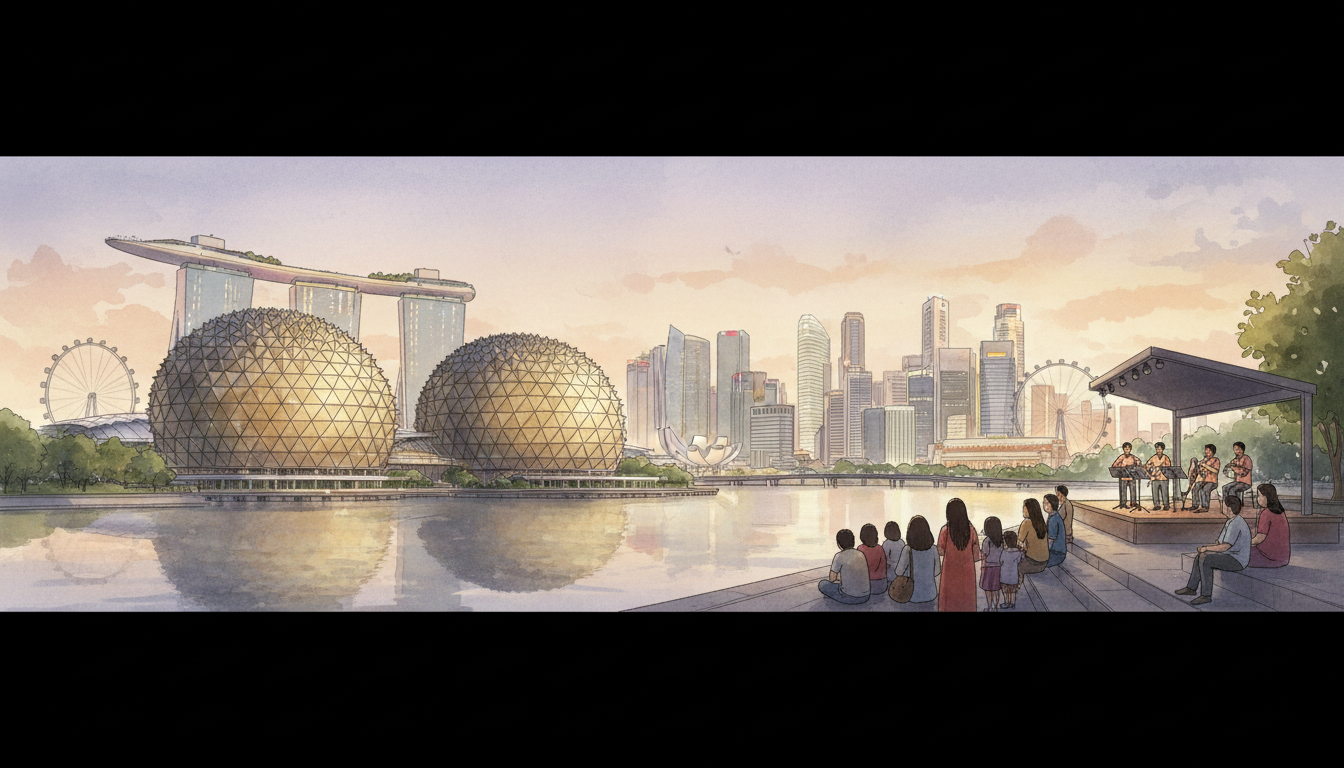
Esplanade – Theatres on the Bay is Singapore’s national performing arts centre at 1 Esplanade Drive, recognisable by its twin durian-like domes overlooking Marina Bay. It officially opened on 12 October 2002. The domes carry over 7,000 triangular aluminium sunshades that help manage tropical sunlight. Visitors can discover free public art and performances, while major theatre and concert productions may require paid tickets. This guide explains 100 Esplanade, music, theatre and Singapore arts vocabulary words through meanings, examples and why the ideas matter.
Why is Esplanade part of Singapore culture? Its role is bigger than the familiar ‘durian building’ photograph. The centre gives Singapore and regional artists spaces for music, dance, theatre and family learning, including programmes celebrating Malay, Indian and Chinese arts. The operator describes a large free-programme commitment alongside ticketed work, and its architectural history credits Singapore’s DP Architects and UK-based Michael Wilford & Partners. The building expresses public arts ambitions through design and ongoing creative work, rather than one compulsory definition of national identity.
Go directly to the 100-word finder, quick facts and visitor distinctions, worked examples or frequently asked questions. Performance schedules, fees, accessibility arrangements and recording rules belong to the specific date and event. Use the official Esplanade calendar for current programming, not an old list of shows.
Esplanade in 60 seconds: the important distinctions
- Address: 1 Esplanade Drive, Singapore 038981, near Esplanade MRT (CC3) and other central-city connections.
- Opened: 12 October 2002 after years of public and artistic planning.
- Architecture: two rounded domes with over 7,000 aluminium sunshades; the sunshades serve a tropical climate-control function.
- Purpose: a national performing arts centre presenting music, dance, theatre, visual arts and related activities.
- Operator: The Esplanade Co Ltd, a registered charity and not-for-profit arts organisation.
- Major venues: Concert Hall, Theatre, smaller studios, the Singtel Waterfront Theatre, outdoor theatre and other public spaces.
- Free or paid: a large share of the arts centre’s programming is free, but individual shows and events have their own admission terms.
- Arts and cultures: annual festivals and series include Pesta Raya, Kalaa Utsavam, Huayi and other contemporary or traditional forms.
- Important caution: free entry to a shared Concourse or outdoor area is not permission to enter a ticketed auditorium during an event.
Why its famous ‘durian spikes’ are not decoration alone
The Esplanade architecture page explains that the 1980s winning concept evolved through several designs before its twin shells became familiar to Singaporeans. The triangular metal pieces are sunshades on double-glazed dome roofs. They are intended to admit suitable daylight while cutting direct solar heat. Building form is therefore a response to weather, not a literal decision to build a model of a durian fruit. Trained workers clean the exterior cladding by hand with safe rope-access systems; a green building still requires regular labour and maintenance.
The same source describes the Y-shaped supporting columns as part of a system collecting rainwater for cleaning and landscape use. These specific measures are evidence of designed resource management. They should not be exaggerated into unsupported claims that Esplanade uses no electricity or has zero environmental impact.
2002 versus 2022: the performing-arts spaces have grown
The official institution timeline puts Esplanade’s opening on 12 October 2002, followed by a three-week Opening Festival of paid and free experiences. The venue has expanded rather than remaining exactly as first built. In 2022 the Singtel Waterfront Theatre was introduced as a flexible medium-sized performance venue. Its purpose is to help Singaporean and regional artists develop work for audiences between those of intimate studios and the largest halls. The new venue is not the same structure or date as the original Concert Hall.
A venue guide should say which space a ticket covers. A concert in the main hall, a contemporary play at the waterfront theatre, a small studio work and a free outdoor performance can have different doors, seats, sightlines, timing and audience etiquette. The correct venue name is more helpful than simply saying a show is ‘at the durian’.
Free art versus ticketed theatre: a practical visitor choice
Esplanade’s Esplanade Presents page states that approximately 70% of its programmes are free and explains a not-for-profit mission to make the arts approachable. That percentage describes the operator’s programming, not a promise that any specific production is free. A family may encounter a free performance in the Concourse or an outdoor space while another production in the Theatre is ticketed. Always check the programme’s date, listed venue, minimum age or advisory, start time, access conditions and whether tickets are required.
The official visitor and wayfinding guides identify locations including the Concert Hall, Theatre, Singtel Waterfront Theatre, Recital Studio, PIP’s PLAYbox and DBS Foundation Outdoor Theatre. They also explain accessibility measures across the premises. For a person using a wheelchair or assistance dog, venue-specific arrangements and entrances matter far more than a generic statement that the building is easy to visit.
Local arts festivals are not all the same thing
The operator presents cultural programmes with distinct identities. Pesta Raya celebrates Malay arts; Kalaa Utsavam explores Indian traditions and contemporary work; and Huayi brings a Chinese Festival of Arts. The broader calendar includes music series, vocal events and independent performance. It would be misleading to claim that one dance or one language stands for an entire community.
Attending a programme from a culture unfamiliar to you can be a good reading task: identify the performer, art form, description and origin as actually listed, then write one observation and one question. Respectful vocabulary expands a reader’s understanding instead of turning cultural difference into a costume stereotype.
Ten sections covering the complete vocabulary
- Part 1: What Esplanade is and why Singapore built it — words 1–10
- Part 2: The Durian domes: form that protects from heat — words 11–20
- Part 3: Different venues make different kinds of performances possible — words 21–30
- Part 4: The language of live music and good acoustics — words 31–40
- Part 5: Theatre, staging and the work behind the curtain — words 41–50
- Part 6: Dance and movement as ways of telling Singapore stories — words 51–60
- Part 7: Festivals: many communities, more than one style — words 61–70
- Part 8: Free programmes, paid tickets and considerate visiting — words 71–80
- Part 9: People who make the performances possible — words 81–90
- Part 10: The waterfront building as a civic learning space — words 91–100
100-word finder: jump to a definition
1–10: 1. Esplanade – Theatres on the Bay · 2. 1 Esplanade Drive · 3. 12 October 2002 · 4. National arts centre · 5. Performing arts · 6. Arts ecosystem · 7. Not-for-profit organisation · 8. The Esplanade Co Ltd · 9. Opening Festival · 10. Arts for everyone
11–20: 11. Durian nickname · 12. Twin domes · 13. Triangular sunshade · 14. Aluminium cladding · 15. Double-glazed glass · 16. Tropical solar heat · 17. DP Architects · 18. Michael Wilford & Partners · 19. Y-shaped column · 20. Rainwater reuse
21–30: 21. Concert Hall · 22. Theatre · 23. Recital Studio · 24. Theatre Studio · 25. Singtel Waterfront Theatre · 26. Annexe Studio · 27. DBS Foundation Outdoor Theatre · 28. Concourse · 29. PIP’s PLAYbox · 30. Roof Terrace
31–40: 31. Orchestra · 32. Chamber music · 33. Soloist · 34. Conductor · 35. Acoustics · 36. Reverberation · 37. Acoustic tuning · 38. Pipe organ · 39. Musical phrasing · 40. Encore
41–50: 41. Script · 42. Scene · 43. Stage manager · 44. Cue · 45. Set design · 46. Stage lighting · 47. Costume design · 48. Technical rehearsal · 49. Curtain call · 50. Backstage
51–60: 51. Choreography · 52. Contemporary dance · 53. Traditional dance · 54. Bharatanatyam · 55. Malay dance · 56. Chinese opera · 57. Movement motif · 58. Ensemble dance · 59. Improvisation · 60. Interdisciplinary work
61–70: 61. Pesta Raya · 62. Kalaa Utsavam · 63. Huayi · 64. Baybeats · 65. Voices Festival · 66. Mosaic Music Series · 67. Raga · 68. Pentas · 69. Cultural exchange · 70. Artist development
71–80: 71. Free programme · 72. Ticketed performance · 73. Event listing · 74. Seat reservation · 75. Latecomer policy · 76. Programme duration · 77. Accessible seating · 78. Assistance dog access · 79. Visitor etiquette · 80. Photo policy
81–90: 81. Artistic director · 82. Producer · 83. Dramaturg · 84. Sound engineer · 85. Lighting operator · 86. Stagehand · 87. Usher · 88. Teaching artist · 89. Community collaborator · 90. Arts volunteer
91–100: 91. Esplanade Park · 92. Marina Bay waterfront · 93. Public art · 94. Roof terrace view · 95. SG Culture Pass · 96. Performance review · 97. Interpretive claim · 98. Programme archive · 99. Cultural identity · 100. Source verification
Learn the words by finding evidence in a real event
Use the sequence notice → name → explain → verify → retrieve. Notice a feature, say its correct term, explain why it exists, check a source, then use the word again without looking. For example, an aluminium sunshade should be explained through heat and light, while a stage cue should be explained through the timing of a performance. The same strategy works for arts reviews, comprehension writing and ordinary visitor decisions.
A Primary learner can begin with ten terms about music, performers and an accessible public space. A secondary learner can compare the 2002 and 2022 venues, source official facts and write a short performance review. Parents can practise choosing a suitable event without assuming every show is free or child-friendly. The glossary is not an official school examination list; it is a structured reading resource.
Part 1 — What Esplanade is and why Singapore built it
Esplanade is an arts centre rather than a shopping centre with a stage added. Its development reflects a public conversation about making performance and creative work more visible and accessible in Singapore.
1. Esplanade – Theatres on the Bay
Meaning: Singapore’s national performing arts centre on the Marina Bay waterfront. Example: “We visited Esplanade – Theatres on the Bay to enjoy a concert.” Why it matters in Singapore: Its national role is in creating and presenting the arts, not in being a UNESCO-listed monument.
2. 1 Esplanade Drive
Meaning: The official street address of the performing arts centre. Example: “Our meeting point was the main entrance at 1 Esplanade Drive.” Why it matters in Singapore: A precise address helps visitors distinguish it from Esplanade Park and nearby attractions.
3. 12 October 2002
Meaning: The date Esplanade officially opened its doors. Example: “The venue’s opening was on 12 October 2002.” Why it matters in Singapore: A documented milestone is more useful than calling the building simply old.
4. National arts centre
Meaning: An institution with an important country-wide role in arts presentation and development. Example: “Singapore’s national arts centre hosts diverse performances.” Why it matters in Singapore: National significance does not mean every event is organised by the government.
5. Performing arts
Meaning: Creative works presented by performers, such as music, theatre and dance. Example: “Performing arts were the focus of our school outing.” Why it matters in Singapore: Live creative activity gives Singaporeans ways to share stories and perspectives.
6. Arts ecosystem
Meaning: The network of artists, teachers, technicians, venues, audiences and organisations supporting creative work. Example: “The arts ecosystem includes small independent groups.” Why it matters in Singapore: One major venue depends on many professionals and communities outside its own building.
7. Not-for-profit organisation
Meaning: An organisation that uses resources to pursue a mission rather than distribute profits to owners. Example: “Esplanade is operated by a not-for-profit organisation.” Why it matters in Singapore: Its public arts mission should not be confused with a conventional commercial mall.
8. The Esplanade Co Ltd
Meaning: The registered organisation managing Esplanade’s arts operations. Example: “The Esplanade Co Ltd publishes its programmes and reports.” Why it matters in Singapore: Naming the operator helps readers check official schedules and venue policies.
9. Opening Festival
Meaning: The programme of events held around the venue’s 2002 opening. Example: “The Opening Festival introduced audiences to the new centre.” Why it matters in Singapore: Celebrations at opening and events happening now belong to different dates.
10. Arts for everyone
Meaning: Esplanade’s approach to sharing arts experiences across different audiences. Example: “The phrase arts for everyone shaped its free events.” Why it matters in Singapore: Accessibility is a practical commitment, not proof that every auditorium seat is free.
Quick retrieval for Part 1: Choose three terms without looking, explain them in natural sentences, and identify which detail would require a current performance listing or a historic source. One careful observation is worth more than an unsupported superlative.
Part 2 — The Durian domes: form that protects from heat
The domes are often nicknamed durians, but their form evolved through architectural design rather than from a plan to imitate a fruit. Aluminium shading elements help reduce direct tropical sun entering the glass structures.
11. Durian nickname
Meaning: The familiar local comparison between Esplanade’s spiky domes and a durian fruit. Example: “My uncle called the Esplanade building the durian.” Why it matters in Singapore: A food nickname makes architecture memorable but is not the venue’s official name.
12. Twin domes
Meaning: The two rounded, prominent shell-like roof structures of the main venues. Example: “The twin domes stood out beside Marina Bay.” Why it matters in Singapore: The building’s silhouette is a recognisable part of Singapore’s modern skyline.
13. Triangular sunshade
Meaning: A three-sided external shade that helps limit sunlight on a building. Example: “We examined the triangular sunshades from the promenade.” Why it matters in Singapore: More than 7,000 of these elements give the exterior its texture and climate function.
14. Aluminium cladding
Meaning: Exterior building covering made from aluminium components. Example: “Aluminium cladding wraps the roof structure.” Why it matters in Singapore: The visible spikes are engineered sunshades, not actual thorns.
15. Double-glazed glass
Meaning: Glazing made with two separated layers of glass. Example: “The design uses double-glazed glass beneath the shades.” Why it matters in Singapore: Building materials help control solar heat and interior comfort.
16. Tropical solar heat
Meaning: Heat gained through sunlight in a warm tropical climate. Example: “The architects had to manage tropical solar heat.” Why it matters in Singapore: Singapore’s weather influenced the building’s final appearance.
17. DP Architects
Meaning: The Singapore architectural practice credited as a designer of Esplanade. Example: “DP Architects worked with an overseas design partner.” Why it matters in Singapore: Its role shows local technical and creative work behind the national landmark.
18. Michael Wilford & Partners
Meaning: The UK-based architectural practice collaborating on Esplanade’s design. Example: “The source credits Michael Wilford & Partners.” Why it matters in Singapore: A named design partnership is more accurate than inventing a single anonymous architect.
19. Y-shaped column
Meaning: A supporting column with branching upper arms resembling the letter Y. Example: “The Y-shaped columns support the domes and collect rainwater.” Why it matters in Singapore: The structure integrates architectural support and a water-management function.
20. Rainwater reuse
Meaning: Collecting and using rainwater for suitable non-drinking purposes. Example: “Esplanade reuses some rainwater for maintenance and plants.” Why it matters in Singapore: An environmental feature should be described by its actual use, not called zero-impact.
Quick retrieval for Part 2: Choose three terms without looking, explain them in natural sentences, and identify which detail would require a current performance listing or a historic source. One careful observation is worth more than an unsupported superlative.
Part 3 — Different venues make different kinds of performances possible
Esplanade includes large halls, smaller studios, an outdoor waterfront theatre and open public areas. Seeing a performance on a stage does not identify which named venue is involved or what its admission conditions are.
21. Concert Hall
Meaning: A large venue designed for music, especially performances that rely on detailed acoustics. Example: “The Concert Hall hosted an orchestral programme.” Why it matters in Singapore: Its acoustic design supports a range of music and differs from a dramatic theatre stage.
22. Theatre
Meaning: The major performance venue used for stage productions, dance and dramatic works. Example: “The family reserved Theatre seats for a play.” Why it matters in Singapore: A theatre includes stage machinery and sightlines adapted to storytelling.
23. Recital Studio
Meaning: A smaller Esplanade venue suitable for intimate performances and talks. Example: “The chamber musicians performed in Recital Studio.” Why it matters in Singapore: An intimate room creates a different audience relationship than a full concert hall.
24. Theatre Studio
Meaning: A flexible smaller room used for experimental or close-up stage works. Example: “We watched a short play in Theatre Studio.” Why it matters in Singapore: Small venues allow creative work that might not suit a vast stage.
25. Singtel Waterfront Theatre
Meaning: A medium-scale flexible Esplanade venue opened in 2022. Example: “The Singtel Waterfront Theatre hosted a contemporary work.” Why it matters in Singapore: It bridges the gap between large halls and studios for developing artists.
26. Annexe Studio
Meaning: An adaptable Esplanade space for music, events and other creative programmes. Example: “The programme listed an event in Annexe Studio.” Why it matters in Singapore: A venue name helps visitors find the right entrance and performance format.
27. DBS Foundation Outdoor Theatre
Meaning: The waterfront outdoor performance space with free programmes under normal schedules. Example: “We paused at the DBS Foundation Outdoor Theatre.” Why it matters in Singapore: Outdoor art is more approachable, but performances depend on the day’s programme.
28. Concourse
Meaning: A public circulation and event space within Esplanade. Example: “A free performance filled the Concourse with listeners.” Why it matters in Singapore: An informal public space can become a place to encounter the arts.
29. PIP’s PLAYbox
Meaning: A child-focused creative space associated with Esplanade’s family programming. Example: “Our children explored PIP’s PLAYbox.” Why it matters in Singapore: Young audiences can learn through play, with venue hours and access rules.
30. Roof Terrace
Meaning: A public elevated terrace with views of nearby city landmarks. Example: “The Roof Terrace offered a different skyline perspective.” Why it matters in Singapore: It is part of the venue’s public spaces, not automatically a concert admission route.
Quick retrieval for Part 3: Choose three terms without looking, explain them in natural sentences, and identify which detail would require a current performance listing or a historic source. One careful observation is worth more than an unsupported superlative.
Part 4 — The language of live music and good acoustics
Listeners can describe a concert more precisely when they understand the difference between a musician, the sound of the room and the way an ensemble works together. These are transferable English words, not a code only professionals can use.
31. Orchestra
Meaning: A large ensemble of instrumentalists playing different musical parts together. Example: “The orchestra tuned its instruments before the concert.” Why it matters in Singapore: A shared musical performance relies on many individuals acting in coordination.
32. Chamber music
Meaning: Music written for a small group of instrumentalists, often one player per part. Example: “We heard chamber music in a smaller room.” Why it matters in Singapore: The term describes ensemble scale rather than a specific building.
33. Soloist
Meaning: An individual performer featured alone or prominently within a work. Example: “The violin soloist stepped forward.” Why it matters in Singapore: A soloist is not necessarily the same person as the composer.
34. Conductor
Meaning: A musician who directs the timing and expression of an ensemble. Example: “The conductor guided the orchestra’s opening passage.” Why it matters in Singapore: Coordinating musical phrases requires interpretation and attentive listening.
35. Acoustics
Meaning: The physical behaviour of sound within a space. Example: “The hall’s acoustics made the soft passages audible.” Why it matters in Singapore: Hall design affects the musical experience beyond the performers’ skill.
36. Reverberation
Meaning: Sound continuing briefly after the original sound stops because of reflections. Example: “The singer noticed the hall’s reverberation.” Why it matters in Singapore: A carefully tuned room can suit different musical genres.
37. Acoustic tuning
Meaning: Adjusting a venue’s sound response for a particular performance. Example: “The hall supports acoustic tuning for varied programmes.” Why it matters in Singapore: Different instruments and audiences may need different sound conditions.
38. Pipe organ
Meaning: A keyboard instrument sounding air through pipes. Example: “The pipe organ was part of the Concert Hall design.” Why it matters in Singapore: A major musical installation has its own engineering and performance traditions.
39. Musical phrasing
Meaning: Grouping notes into expressive units, similar to phrases in speech. Example: “The violinist shaped the musical phrasing gently.” Why it matters in Singapore: Learning this term helps describe emotion without only saying beautiful.
40. Encore
Meaning: An additional performance often offered after strong audience appreciation. Example: “The band returned for an encore.” Why it matters in Singapore: An encore is optional; a ticket never guarantees one.
Quick retrieval for Part 4: Choose three terms without looking, explain them in natural sentences, and identify which detail would require a current performance listing or a historic source. One careful observation is worth more than an unsupported superlative.
Part 5 — Theatre, staging and the work behind the curtain
A play reaches the audience because writers, performers and technical crews coordinate. A stage illusion and a factual event are different things; knowing the terms helps readers appreciate the craft without confusing them.
41. Script
Meaning: The written dialogue and directions for a performance. Example: “The actors studied the script in rehearsal.” Why it matters in Singapore: A staged story begins with language that performers interpret.
42. Scene
Meaning: A division of a drama defined by time, setting or action. Example: “The final scene took place in a market.” Why it matters in Singapore: Scenes organise narrative and should not be confused with a real historical event.
43. Stage manager
Meaning: The professional coordinating rehearsal and performance operations. Example: “The stage manager called the next cue.” Why it matters in Singapore: A live show needs precise organisation behind the visible acting.
44. Cue
Meaning: A signal for an action, effect or performance change. Example: “The lighting cue followed the last line.” Why it matters in Singapore: Timing makes multiple creative elements work together.
45. Set design
Meaning: The design of scenery and objects defining the stage environment. Example: “The set design suggested an old Singapore shophouse.” Why it matters in Singapore: A stage shophouse is an artistic representation, not necessarily a preserved building.
46. Stage lighting
Meaning: Illumination designed to control focus, atmosphere and visibility. Example: “Stage lighting shifted when the mood changed.” Why it matters in Singapore: Light communicates meaning and is managed by skilled technicians.
47. Costume design
Meaning: Planning and creating clothing to convey character or setting. Example: “The costume design reflected the story’s period.” Why it matters in Singapore: Clothing onstage can be historical interpretation or deliberate fantasy.
48. Technical rehearsal
Meaning: A practice session integrating performers with sound, lights and stage equipment. Example: “Technical rehearsal revealed a timing problem.” Why it matters in Singapore: A performance’s smoothness depends on testing, not only memorising dialogue.
49. Curtain call
Meaning: The acknowledgement of performers at the end of a show. Example: “The cast returned for the curtain call.” Why it matters in Singapore: The ritual lets an audience recognise the people behind the work.
50. Backstage
Meaning: The areas and activities behind public performance spaces. Example: “The crew worked backstage during the show.” Why it matters in Singapore: Backstage work deserves credit although many audience members never see it.
Quick retrieval for Part 5: Choose three terms without looking, explain them in natural sentences, and identify which detail would require a current performance listing or a historic source. One careful observation is worth more than an unsupported superlative.
Part 6 — Dance and movement as ways of telling Singapore stories
Not all dance is one style. Singapore’s arts programme includes classical, traditional, contemporary and experimental forms, inviting audiences to describe what they see rather than relying on assumptions about ethnicity.
51. Choreography
Meaning: The design and sequence of dance movements. Example: “The choreography used repeated circular patterns.” Why it matters in Singapore: A dance can carry ideas through movement without spoken words.
52. Contemporary dance
Meaning: Dance work exploring changing techniques and themes, often beyond fixed classical forms. Example: “We attended a contemporary dance production.” Why it matters in Singapore: The genre encourages experimentation and artistic exchange.
53. Traditional dance
Meaning: A dance associated with inherited practices within a community. Example: “Traditional dance was part of a festival programme.” Why it matters in Singapore: Traditions may evolve and performers should be described respectfully.
54. Bharatanatyam
Meaning: A classical Indian dance form with codified gesture and rhythm. Example: “The dancer explained a Bharatanatyam gesture.” Why it matters in Singapore: A specific art form is more accurate than calling all Indian dance the same.
55. Malay dance
Meaning: A broad term for dance traditions associated with Malay cultures. Example: “Malay dance appeared in the festival programme.” Why it matters in Singapore: Cultural diversity includes multiple regional styles and histories.
56. Chinese opera
Meaning: A performance tradition combining singing, acting, movement and often stylised costume. Example: “The students watched a Chinese opera excerpt.” Why it matters in Singapore: A distinct performance form should not be reduced to exotic costumes.
57. Movement motif
Meaning: A short recurring pattern of bodily motion. Example: “The movement motif returned near the finale.” Why it matters in Singapore: Repetition in dance can carry meaning much like a refrain in music.
58. Ensemble dance
Meaning: A work performed by a coordinated group of dancers. Example: “Ensemble dance required precise timing.” Why it matters in Singapore: Group movement reflects practice, trust and shared attention.
59. Improvisation
Meaning: Creative decisions made in the moment within or beyond a planned structure. Example: “The performer used improvisation during a workshop.” Why it matters in Singapore: Artistic spontaneity still draws on trained technique.
60. Interdisciplinary work
Meaning: An artistic project combining more than one field or art form. Example: “The interdisciplinary work mixed dance and projections.” Why it matters in Singapore: Contemporary arts can connect movement, sound, design and digital media.
Quick retrieval for Part 6: Choose three terms without looking, explain them in natural sentences, and identify which detail would require a current performance listing or a historic source. One careful observation is worth more than an unsupported superlative.
Part 7 — Festivals: many communities, more than one style
Esplanade’s annual festivals and year-round programme series express different traditions and new experiments. A festival name is a cultural gateway, not a guarantee that a specific show is on tonight.
61. Pesta Raya
Meaning: Esplanade’s Malay Festival of Arts. Example: “Our reading route included Pesta Raya.” Why it matters in Singapore: It gives Malay artistic traditions and contemporary work a recognised platform.
62. Kalaa Utsavam
Meaning: Esplanade’s Indian Festival of Arts. Example: “Kalaa Utsavam introduced us to varied Indian performance styles.” Why it matters in Singapore: The festival embraces more than one language, region or art form.
63. Huayi
Meaning: Esplanade’s Chinese Festival of Arts. Example: “Huayi presented Chinese-language and related artistic performances.” Why it matters in Singapore: The title links language, culture and contemporary artistic voices.
64. Baybeats
Meaning: A music festival associated with alternative and independent acts. Example: “Baybeats offered a stage to emerging performers.” Why it matters in Singapore: The programme supports bands and music-making communities, not only famous international stars.
65. Voices Festival
Meaning: A festival exploring singing and vocal traditions. Example: “The Voices Festival included choral and other vocal music.” Why it matters in Singapore: Singing can connect audiences across age, culture and musical genre.
66. Mosaic Music Series
Meaning: A programme series presenting varied contemporary and international music. Example: “Mosaic Music Series showed us a new sound.” Why it matters in Singapore: A year-round series differs from a short festival with fixed dates.
67. Raga
Meaning: A programme series highlighting Indian music and related arts. Example: “We checked the Raga listing for a suitable performance.” Why it matters in Singapore: Naming a programme accurately avoids treating every Indian arts event as the same.
68. Pentas
Meaning: A Malay arts programme series in Esplanade’s calendar. Example: “Pentas offered another route into Malay performance.” Why it matters in Singapore: Year-round cultural work exists beyond a single festive season.
69. Cultural exchange
Meaning: Learning and creating through contact among different artistic communities. Example: “The concert encouraged cultural exchange among musicians.” Why it matters in Singapore: Collaboration can preserve identities while producing new art.
70. Artist development
Meaning: Activities supporting performers and creators as their skills and careers grow. Example: “Artist development is part of Esplanade’s mission.” Why it matters in Singapore: An arts centre supports future work, not only the famous show on a particular night.
Quick retrieval for Part 7: Choose three terms without looking, explain them in natural sentences, and identify which detail would require a current performance listing or a historic source. One careful observation is worth more than an unsupported superlative.
Part 8 — Free programmes, paid tickets and considerate visiting
A building with frequent free concerts can also host ticketed auditorium productions. Product and performance conditions depend on the actual programme listing, date and space.
71. Free programme
Meaning: A performance or activity offered without a normal ticket charge. Example: “We found a free programme at the Concourse.” Why it matters in Singapore: Esplanade reports that a large share of its programmes are free, but not every event.
72. Ticketed performance
Meaning: An event requiring a valid admission ticket or booking. Example: “The evening Theatre production was a ticketed performance.” Why it matters in Singapore: A public building is not a free pass into all auditoriums.
73. Event listing
Meaning: A description naming a programme, venue, date, price and applicable conditions. Example: “We checked the event listing for the exact start time.” Why it matters in Singapore: A live calendar is more useful than an old social-media screenshot.
74. Seat reservation
Meaning: An arrangement for a specific seat or permitted audience place. Example: “Our seat reservation was in the upper level.” Why it matters in Singapore: A booked seat can carry view and accessibility considerations.
75. Latecomer policy
Meaning: Rules governing when an audience member may enter after a performance begins. Example: “We read the latecomer policy before travelling.” Why it matters in Singapore: Some performances admit latecomers only at suitable breaks.
76. Programme duration
Meaning: The stated or estimated length of an event. Example: “The programme duration helped us plan the evening.” Why it matters in Singapore: It is not the full time needed for transport, queues or meals.
77. Accessible seating
Meaning: A suitable seating arrangement for visitors with mobility or other access needs. Example: “We asked about accessible seating before booking.” Why it matters in Singapore: Availability depends on venue layout and the specific event.
78. Assistance dog access
Meaning: Rules enabling eligible visitors using guide or assistance dogs to enter suitable spaces. Example: “The visitor guide explains assistance dog access.” Why it matters in Singapore: Accessibility is a service responsibility, not a photo opportunity.
79. Visitor etiquette
Meaning: Considerate behaviour that respects performers, staff and other audience members. Example: “Visitor etiquette included silencing our phones.” Why it matters in Singapore: A live performance is a shared setting where distractions affect people.
80. Photo policy
Meaning: Rules controlling photography or recordings within a venue or event. Example: “We checked the photo policy before raising a camera.” Why it matters in Singapore: Free entry to a venue does not automatically grant permission to record the show.
Quick retrieval for Part 8: Choose three terms without looking, explain them in natural sentences, and identify which detail would require a current performance listing or a historic source. One careful observation is worth more than an unsupported superlative.
Part 9 — People who make the performances possible
Esplanade is a workplace and a platform for artists. Art-making involves technical trades, planning, teaching, security and service, in addition to musicians and actors. Cultural learning should give those people their place in the story.
81. Artistic director
Meaning: A person guiding the creative direction of a programme, company or production. Example: “The artistic director explained the season’s themes.” Why it matters in Singapore: Programming involves decisions about what stories and forms receive a platform.
82. Producer
Meaning: A professional responsible for organising resources and managing the creation of a work. Example: “The producer coordinated rehearsals and partnerships.” Why it matters in Singapore: A good performance has a practical production plan behind it.
83. Dramaturg
Meaning: A specialist supporting interpretation, script research or development in theatre. Example: “The dramaturg researched the historical setting.” Why it matters in Singapore: Evidence and storytelling can meet in responsible stage development.
84. Sound engineer
Meaning: A technician controlling audio reproduction and levels. Example: “The sound engineer checked the microphone balance.” Why it matters in Singapore: Technical quality affects whether audiences can hear a performance clearly.
85. Lighting operator
Meaning: A specialist executing planned lighting changes during a performance. Example: “The lighting operator followed the stage manager’s cues.” Why it matters in Singapore: Precision backstage makes visible transitions feel effortless.
86. Stagehand
Meaning: A crew member who moves, assembles or maintains stage equipment. Example: “Stagehands prepared the scene change.” Why it matters in Singapore: Physical labour is a valuable part of the arts ecosystem.
87. Usher
Meaning: A staff member assisting guests with seating and venue information. Example: “The usher directed us to the right auditorium door.” Why it matters in Singapore: Visitor service connects accessibility and safe audience flow.
88. Teaching artist
Meaning: A practising artist who facilitates learning through creative activities. Example: “A teaching artist led the children’s workshop.” Why it matters in Singapore: The arts can educate rather than function solely as entertainment.
89. Community collaborator
Meaning: A person or group working with an arts organisation to create programmes with a community. Example: “A community collaborator brought local stories to the stage.” Why it matters in Singapore: Representation becomes richer when people contribute their own perspectives.
90. Arts volunteer
Meaning: A person offering time and skills to help with an arts activity. Example: “The arts volunteer welcomed first-time visitors.” Why it matters in Singapore: Not all cultural contribution happens under the spotlight.
Quick retrieval for Part 9: Choose three terms without looking, explain them in natural sentences, and identify which detail would require a current performance listing or a historic source. One careful observation is worth more than an unsupported superlative.
Part 10 — The waterfront building as a civic learning space
Esplanade is visible across Marina Bay but serves a different function from the Merlion and major commercial resorts. These final terms help a student link public space, architecture and art to careful reading.
91. Esplanade Park
Meaning: A historic public park near the arts centre, from which Esplanade takes its name. Example: “We distinguished Esplanade Park from the arts centre.” Why it matters in Singapore: The two places share a name but different histories and physical locations.
92. Marina Bay waterfront
Meaning: The public urban setting around Singapore’s central bay. Example: “The waterfront linked Esplanade with nearby landmarks.” Why it matters in Singapore: A cultural centre is also part of city planning and shared walking routes.
93. Public art
Meaning: Creative work displayed in places accessible to the public. Example: “We stopped at a public artwork near the building.” Why it matters in Singapore: Art can be encountered without buying a ticket to a theatre.
94. Roof terrace view
Meaning: A higher public-facing viewpoint on an accessible terrace, subject to venue rules. Example: “Our roof terrace view included part of the skyline.” Why it matters in Singapore: A view from a building does not provide entry to unrelated nearby attractions.
95. SG Culture Pass
Meaning: Singapore’s scheme providing eligible adult citizens with credits for approved cultural activities. Example: “The family checked whether a show accepted SG Culture Pass.” Why it matters in Singapore: Eligibility and listed events must be checked; it is not a universal cash voucher.
96. Performance review
Meaning: A reasoned description and evaluation of a presented work. Example: “Our performance review mentioned music and movement.” Why it matters in Singapore: A review is more convincing with observed evidence than empty praise.
97. Interpretive claim
Meaning: A statement explaining the possible meaning of an artwork. Example: “Her interpretive claim was supported by a scene from the play.” Why it matters in Singapore: Art may permit different readings; interpretation is not identical to a factual date.
98. Programme archive
Meaning: An organised record of events presented in the past. Example: “We used the programme archive for a past festival.” Why it matters in Singapore: A historical listing should not be treated as tonight’s operating schedule.
99. Cultural identity
Meaning: A sense of belonging shaped partly by shared practices, languages and artistic experiences. Example: “The performance explored cultural identity in Singapore.” Why it matters in Singapore: Art can express belonging while allowing disagreement and individual difference.
100. Source verification
Meaning: Checking facts against the right authority and publication date. Example: “Source verification corrected the programme’s venue name.” Why it matters in Singapore: A responsible arts guide separates dated programme details from stable cultural history.
Quick retrieval for Part 10: Choose three terms without looking, explain them in natural sentences, and identify which detail would require a current performance listing or a historic source. One careful observation is worth more than an unsupported superlative.
Worked example: a visitor confuses free entry with a concert ticket
Unreliable assumption: “Because Esplanade has free performances, every concert hall and theatre production is free, and I can sit anywhere.” This confuses the venue’s broad mission with a particular event’s admission and seating. A free concourse programme is different from a ticketed recital with an assigned seat.
Clearer conclusion: “Some Esplanade programmes are free, while others require booking or paid admission. I’ll check the current event listing for the venue, time, ticket status and accessibility needs before travelling.” That is the sort of plain-language distinction a visitor can use immediately.
Worked example: is the durian really covered in natural spikes?
Misleading caption: “The roof was made from durian thorns to keep the air cool.” Esplanade’s domes use manufactured triangular aluminium sunshades over glass, not actual plant material. The point is reducing solar heat gain and achieving suitable daylight.
Improved caption: “Esplanade’s twin rounded roofs have over 7,000 aluminium triangular sunshades that give them their familiar durian-like silhouette. The shading is designed for Singapore’s tropical sunlight, while the interior holds performing arts venues.” This keeps the nickname and engineering separate.
Worked example: the arts centre that evolved after opening
Wrong statement: “Every Esplanade auditorium opened in 2022.” The centre officially opened in 2002, while its later Singtel Waterfront Theatre opened in 2022. Smaller studios and earlier main performance halls were part of the original venue complex.
Corrected statement: “Esplanade – Theatres on the Bay opened in 2002 as Singapore’s national performing arts centre. It later added the Singtel Waterfront Theatre in 2022 to accommodate more works in a flexible medium-sized venue.” Historical sequence gives the reader a more accurate story than a single vague anniversary.
An imagined family conversation before a performance
Parent: “Is this performance in the Concert Hall or the Theatre?” Student: “The official event listing says Recital Studio.” Parent: “Does it need a ticket?” Student: “Yes, this one is ticketed. But there are also free public programmes on other dates.” Parent: “What should we check next?” Student: “The start time, latecomer rules and correct entrance.”
This is teaching dialogue, not a conversation recorded at Esplanade. It shows how vocabulary supports planning and considerate participation, not simply the ability to list famous Singapore buildings.
Creative writing: an evening by the two domes
“The twin domes shone beside Marina Bay, their triangular surfaces catching the light of evening. I had always heard people call them the durians, but now I understood that the metal pieces shaded a working arts centre. Inside, a violinist tuned an instrument while technicians checked the lights for another show. Downstairs, a child stopped to hear a free performance in a shared space. I realised that culture was not something locked behind a velvet curtain. It was also the opportunity to listen, create and discover a different story together.”
The paragraph is fictional composition practice. It describes a plausible scene but does not claim that a particular concert happened on a given date. The useful skill is relating a visible architectural detail, a performing-arts word and a wider social idea.
Ten quick checks and answers
- 1. What is Esplanade – Theatres on the Bay? Singapore’s national performing arts centre.
- 2. When did Esplanade open? 12 October 2002.
- 3. Why the durian nickname? Two spiky-looking domes with thousands of triangular sunshades.
- 4. Are those spikes real thorns? No, manufactured aluminium cladding.
- 5. Are all Esplanade performances free? No; check each event.
- 6. What opened later in 2022? Singtel Waterfront Theatre.
- 7. What is Pesta Raya? A Malay Festival of Arts.
- 8. What is Kalaa Utsavam? An Indian Festival of Arts.
- 9. What does a stage cue do? Signals a timed change in a production.
- 10. Is a concert hall ticket also a ticket for any other event? No, admission belongs to the named performance.
Frequently asked questions for readers and parents
1. Where is Esplanade – Theatres on the Bay?
At 1 Esplanade Drive, Singapore 038981, near the Esplanade MRT station on the Circle Line and other downtown connections.
2. Why do Singaporeans call Esplanade the durian?
The twin roofs carry thousands of triangular aluminium sunshades that resemble the texture of a durian’s skin. The design also responds to tropical sunlight.
3. When did Esplanade open?
The arts centre opened officially on 12 October 2002, after years of planning and consultation.
4. Is the building a shopping mall?
It has commercial facilities, but its principal identity is a national performing arts centre run by a not-for-profit arts organisation.
5. Can visitors enter Esplanade for free?
Public common areas and many arts programmes are free under their stated conditions. Ticketed performances and particular spaces require the relevant admission.
6. Are all events suitable for young children?
No. Different events have age guidance, content advisories and access rules. Check the official programme’s details.
7. What venues does it have?
Major spaces include the Concert Hall, Theatre, smaller studios, Singtel Waterfront Theatre, outdoor performance spaces and public concourse areas.
8. What is the Singtel Waterfront Theatre?
A flexible medium-sized venue introduced in 2022 to expand the range of works presented and produced, especially by Singapore and regional artists.
9. Does Esplanade present Indian, Malay and Chinese arts?
Yes. Named festivals and programme series include Kalaa Utsavam, Pesta Raya and Huayi, alongside diverse contemporary, cross-cultural and other genres.
10. Can a visitor take photographs during a show?
Follow the specific event’s photography and recording rules. Being in a free public area does not automatically authorise filming a performance.
11. Is Esplanade the same as Esplanade Park?
No. They are distinct nearby places. The arts centre takes its name from the historic park and waterfront setting.
12. How should a learner use these hundred words?
Choose a few terms, describe a real architectural or artistic detail, check one official source and use each word to explain rather than merely praise a performance.
Primary sources, architecture and programme checks
- Esplanade — About Us: national arts-centre mission, non-profit status and 12 October 2002 opening history.
- Esplanade — Architecture: design practices, sunshades, rainwater columns and building maintenance.
- Esplanade — Our Story: culture, programming and institutional history.
- Esplanade — Esplanade Presents: diverse festivals and programme series, including the free arts mission.
- Esplanade — What’s On: check the current event venue, date, time, price and other terms.
- Esplanade — Free Performances: browse listed free events without assuming all programmes are included.
- Esplanade — Getting Here and Around: venue access, wayfinding guides and inclusive facilities.
- Esplanade — The Next Stage: the Singtel Waterfront Theatre and its purpose.
- Esplanade — Architecture Photography Guide: the actual roofs, sunshade details and public viewpoints.
- Singapore Tourism Board — Esplanade: official visitor address, architectural description and transport context.
Continue through Singapore’s arts and landmark vocabulary
Return to the Top 100 Singapore Vocabulary Words | Touring and Visiting hub. Compare city landmarks with Day 36 Singapore Flyer and Day 20 Marina Bay Sands; follow the historic waterfront through Day 35 Singapore River Cruise and Quays. For another arts perspective, see Day 7 Museums, Art and Discovery. The Vocabulary Learning Hub offers methods for recall and written expression.
A living arts centre is more than an unusual roof
The durian-like domes may be the first thing people recognise, but the deeper cultural story is a working institution where performers, technicians, students, families and visitors share music, theatre and creative ideas. Learn a word for the building, a word for the art and a word for the people making it happen. Those three ideas can turn a famous photograph into a thoughtful explanation of Singapore.
Next Singapore vocabulary day: marine life at Sentosa
Continue this numbered touring series with Day 38: Singapore Oceanarium, Marine Life and Conservation. This separate 100-word guide explores the 22-zone Oceanarium, including sea jellies, rays, reefs, whale-fall interpretation, professional animal care and evidence-based conservation. Esplanade and Singapore Oceanarium are different venues, so plan them as separate experiences unless your own itinerary genuinely allows both.
Next in Singapore vocabulary: Day 38: Singapore Oceanarium, Marine Life and Conservation moves from theatre and performance into marine science, sharks, sea jellies and responsible conservation language at Singapore Oceanarium. Return to the Touring Singapore vocabulary hub for the wider sequence.
Performing arts versus visual art: Visit Day 40: National Gallery Singapore, Southeast Asian Art and Civic Heritage for 100 words about artworks, curators, conserved civic buildings and exhibitions. Esplanade presents stage work, whereas National Gallery Singapore is a separate visual-arts museum.
Continue from the performing arts to an Esplanade family-learning guide
For a shorter family outing built around the domes, stage production, sound and performance vocabulary, use the verified Esplanade learning guide. It complements this Day 37 word list without promising that every performance or venue is open on every visit.