
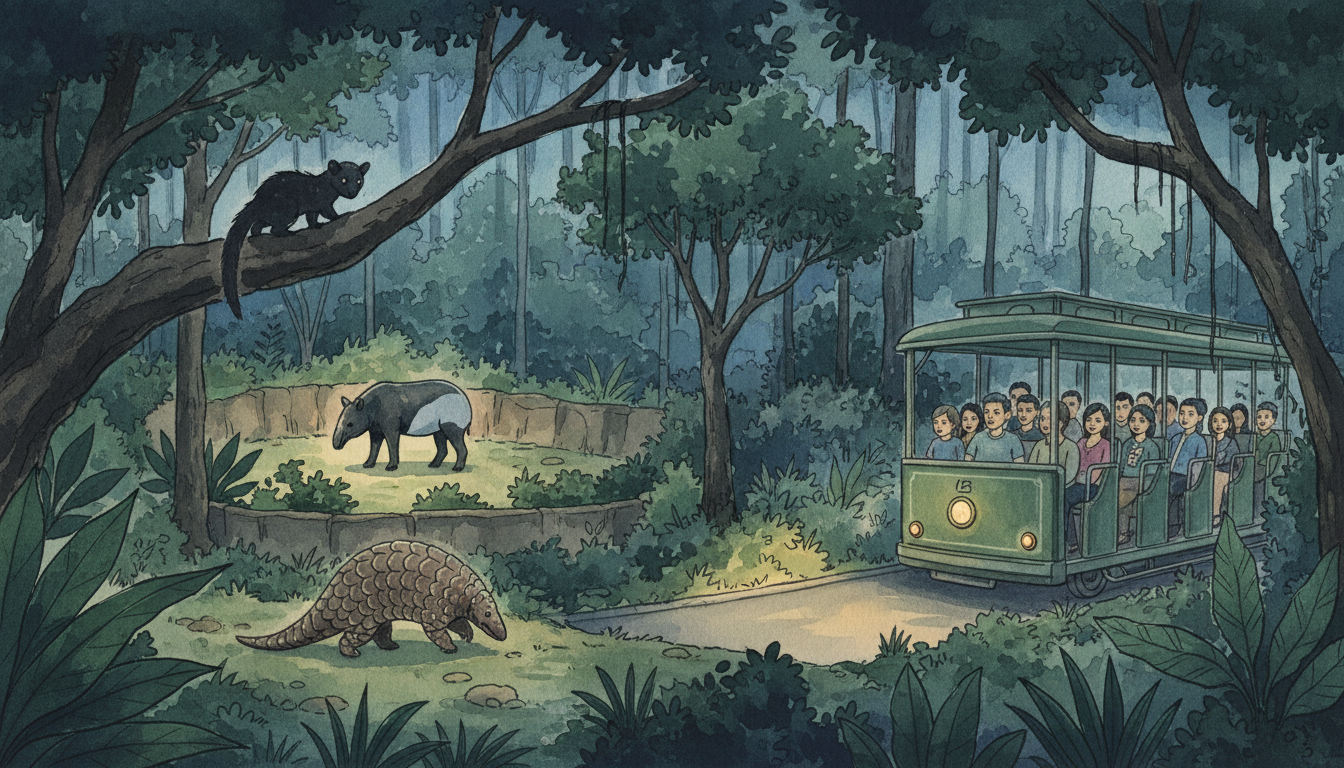
Night Safari additional practice — start with the main guide
This is a non-indexed supplementary Night Safari reading, not a second Day 39. Begin with the main Night Safari Vocabulary guide for the visitor and wildlife explanation. The numbered Day 39 in the Touring Singapore collection covers festivals, light-ups and community celebrations. This preserved page offers additional Night Safari examples without replacing either guide. Browse the full Touring Singapore index.
Night Safari in Mandai is Singapore’s world-famous after-dark wildlife park, established in 1994 and known for its Safari Adventure Tram and four walking trails. It is at 80 Mandai Lake Road, Singapore 729826. The operator currently lists daily opening from 6pm to midnight, last entry at 11:15pm, and wildlife trails and tram rides starting at 7pm. The regular tram is included in standard admission. This guide defines 100 Night Safari vocabulary words with everyday examples, biology explanations and visitor-relevant distinctions.
Why is Night Safari part of Singapore culture? It pioneered a new kind of zoological learning that lets people observe animals during their natural after-dark activity periods, combining tourism, wildlife care and conservation education. The Mandai Wildlife Reserve page identifies over 900 animals and four named trails, while its visitor rules explain why flash photography and disturbance are prohibited. The experience is about living creatures, not guaranteed performances or animals posing for photos. One important October 2026 note: the fishing-cat exhibit on Pangolin Trail is closed for refurbishment from 7 October through 31 December 2026.
Start with the 100-word finder, read hours, trails and entry facts, or go directly to the worked visitor examples. Current ticket conditions, presentation schedules, animal visibility and routes can change. Use the official Mandai announcements before booking; a permanent animal-information page is not confirmation that every exhibit is open on a particular night.
Night Safari in 60 seconds: the practical facts
- Address: 80 Mandai Lake Road, Singapore 729826; Night Safari is one separate ticketed attraction within Mandai Wildlife Reserve.
- Opening: official park information says 6pm–midnight daily, with last entry at 11:15pm. Wildlife trails and the tram begin at 7pm.
- Four walking trails: Tasmanian Devil Trail, Pangolin Trail, Leopard Trail and East Lodge Trail.
- Safari Adventure Tram: the standard tram service is included in Night Safari admission. A private guided buggy tour is a different product.
- Timed entry: single-attraction ticket holders and many members need a chosen slot. Since 1 July 2026 Destination Pass holders are exempt from an additional Night Safari slot reservation.
- Presentations: reservations for shows such as Creatures of the Night can open within the two hours before a show; time slots and programme details may change.
- 2026 closure: the fishing-cat exhibit on Pangolin Trail is closed from 7 October to 31 December for refurbishment.
- Animal etiquette: no flash, shouting, chasing, feeding or touching unless a specific operator-led programme permits an activity; children must be supervised.
- Weather: thunderstorms require care, and the operator says to move indoors during lightning.
1994: why the after-dark idea mattered
Singapore’s Night Safari opened in 1994 and is described by its operator as the world’s first nocturnal wildlife park. Its format highlights the fact that many wild mammals are most active outside ordinary daytime zoo hours. Understanding those activity patterns turns an unusual sightseeing schedule into biology: the meanings of nocturnal, crepuscular, resting, foraging and camouflage become visible.
The wider Mandai Wildlife Reserve now includes other parks, such as Singapore Zoo and Bird Paradise, and some free visitor areas. Those names refer to different experiences with their own admission arrangements. This Night Safari guide concentrates on nocturnal viewing, tram and walking trails; it does not duplicate the larger Mandai wildlife vocabulary chapter or the marine education covered by the Singapore Oceanarium chapter.
Which Night Safari trail should a first-time visitor choose?
The operator’s trails page describes Tasmanian Devil Trail as introducing Australasian species such as sugar gliders and possums, Pangolin Trail as highlighting Southeast Asian species, Leopard Trail as focusing on cats, civets and porcupines, and East Lodge Trail as comparing African and Asian habitats. The named trail themes are good learning routes, but they are not guarantees that every species on the list will be active during your visit.
A child interested in Singapore’s regional wildlife might choose Pangolin Trail, learn the difference between a pangolin and an otter, then stop before becoming overtired. An older student studying animal classification could compare marsupials along Tasmanian Devil Trail with mammals of tropical Asia. Because the fishing-cat exhibit closure runs to 31 December 2026, it would be incorrect to promise that viewing experience in an October 2026 itinerary.
The included tram is not a private animal encounter
Mandai’s admission terms include the regular tram, while its ride description explains the Safari Adventure Tram and its English animal commentary. A tram is an easy way to hear about habitats without walking every route. It is usually shared with other visitor groups, and everyone must remain seated with hands and feet inside during the ride. A separately priced Safari Adventure Tour or private buggy experience is not part of ordinary admission.
A visitor who sees an animal close to the track should not lean out or attempt to touch it. Wildlife viewing works by keeping the animals’ needs and safety boundaries central. A calm animal near the tram is not permission to approach it; photography and viewing should follow the operator’s rules.
How to book a show while protecting animal welfare
The official presentation information and announcement page explain that certain presentation seats can be reserved through the booking portal starting two hours before the chosen performance. A separate show reservation is not a substitute for park admission, and animal behaviour or welfare needs may change what is presented. A guest should check the current showtime before promising it to another person.
The 2026 Pangolin Keeper Talk page lists particular talks and mentions changes when animals require care. A talk is a learning opportunity, not a demand that a threatened species behave for cameras. A useful question for a keeper is, “How does this animal find food without daylight?” rather than “Can you wake it up?”
Four 2026 visitor details that must not be copied carelessly
- Fishing cat: the Pangolin Trail fishing-cat exhibit is closed 7 October–31 December 2026 for refurbishment. This is a specific exhibit, not closure of the entire park or every trail.
- Entry slot: Night Safari time-slot selection applies to individual admission tickets and many members; since 1 July 2026 Destination Pass holders have an explicit exception.
- Tram inclusion: the standard tram is part of Night Safari admission, but named private wildlife tours and optional animal feeding experiences are not automatically included.
- Weather and haze: operators and official advisories may recommend changes for lightning, heavy rain and air quality. Respect the current advice, particularly for children or more vulnerable visitors.
What do I learn from a pangolin without touching one?
A pangolin is a mammal with overlapping scales, not a reptile simply because its surface looks armoured. It searches for insects with specialist adaptations and faces severe threats from habitat loss and illegal wildlife trade. Learning those details lets a visitor connect the animal’s appearance with its biology and with real conservation concerns. Similar care is needed with terms such as civet, leopard cat, otter and slow loris: each names a different kind of animal with its own needs.
Understanding animal behaviour means accepting that an animal may remain hidden, asleep or still. No ticket promises a complete checklist of sightings. The visitor learns more by observing what actually occurs, reading a label and asking what evidence supports an explanation. Wildlife is not a show that can simply be restarted because a photograph did not turn out.
The 100-term Night Safari vocabulary map
- Part 1: Night Safari: the park and the after-dark experience — words 1–10
- Part 2: Biology after sunset: understanding nocturnal behaviour — words 11–20
- Part 3: The Safari Adventure Tram: a guided moving classroom — words 21–30
- Part 4: Four walking trails, four ways to see wildlife — words 31–40
- Part 5: Southeast Asian animals: names worth knowing accurately — words 41–50
- Part 6: Wildlife beyond Singapore: the wider animal world — words 51–60
- Part 7: Keeper talks, presentations and learning without forcing an encounter — words 61–70
- Part 8: Why conservation is part of Singapore’s wildlife culture — words 71–80
- Part 9: 2026 entry, ticketing and the changes you must notice — words 81–90
- Part 10: A safe, thoughtful night: how to see more by demanding less — words 91–100
Quick finder: one hundred linked terms
Words 1–10: 1. Night Safari · 2. Nocturnal wildlife park · 3. Mandai Wildlife Reserve · 4. 80 Mandai Lake Road · 5. 1994 opening · 6. Over 900 animals · 7. Six pm park opening · 8. Seven pm trail opening · 9. Midnight closing · 10. Last entry 11:15pm
Words 11–20: 11. Nocturnal · 12. Diurnal · 13. Crepuscular · 14. Circadian rhythm · 15. Adaptation · 16. Low-light vision · 17. Camouflage · 18. Territory · 19. Foraging · 20. Resting behaviour
Words 21–30: 21. Safari Adventure Tram · 22. Tram commentary · 23. Open-sided tram · 24. Tram boarding area · 25. Stay-seated rule · 26. Route commentary · 27. Shared tram · 28. Complimentary tram inclusion · 29. Private guided tour · 30. Tram route map
Words 31–40: 31. Tasmanian Devil Trail · 32. Pangolin Trail · 33. Leopard Trail · 34. East Lodge Trail · 35. Trail entrance · 36. Wildlife viewpoint · 37. Walk-through habitat · 38. Trail wayfinding · 39. Sensory-friendly map · 40. Rest point
Words 41–50: 41. Malayan tapir · 42. Sunda pangolin · 43. Common palm civet · 44. Leopard cat · 45. Sunda slow loris · 46. Asian small-clawed otter · 47. Fishing cat · 48. Malayan porcupine · 49. Asian elephant · 50. Indian rhinoceros
Words 51–60: 51. Tasmanian devil · 52. Sugar glider · 53. Brush-tailed possum · 54. Lion · 55. Leopard · 56. Marsupial · 57. Carnivore · 58. Herbivore · 59. Predator · 60. Prey
Words 61–70: 61. Creatures of the Night · 62. Animal presentation · 63. Two-hour booking window · 64. Show seat reservation · 65. Keeper talk · 66. Pangolin Keeper Talk · 67. Wildlife interpreter · 68. Conservation message · 69. Exhibit sign · 70. Animal welfare pause
Words 71–80: 71. Conservation · 72. Biodiversity · 73. Habitat loss · 74. Habitat fragmentation · 75. Illegal wildlife trade · 76. Threatened species · 77. IUCN Red List · 78. Veterinary care · 79. Environmental enrichment · 80. Responsible visitor
Words 81–90: 81. Timed entry slot · 82. Destination Pass exception · 83. Single-attraction ticket · 84. WildPass · 85. Resident rate · 86. Complimentary tram · 87. October–December 2026 closure · 88. Haze advisory · 89. Guest Relations Officer · 90. Park-specific admission
Words 91–100: 91. No-flash photography · 92. Quiet observation · 93. No feeding · 94. No touching · 95. Supervised child · 96. Rain shelter · 97. Lightning precaution · 98. Sensory comfort · 99. Animal visibility · 100. Sustainable learning habit
The learning routine: observe, explain and make room for uncertainty
Use observe → name → explain → verify → retrieve. Watch an animal quietly, use its correct common name, describe one visible behaviour and read a reliable label or official site for an ecological explanation. Then recall the information without looking. This turns a short outing into vocabulary growth while discouraging exaggerated stories about what an animal can do.
A child might select five words about sight, camouflage, quiet voices and tapirs. An older learner can compare species, the meaning of threatened status and the difference between a wild habitat and a managed enclosure. Families can read ticket scope, trail length and weather rules. These are educational vocabulary choices, not a promise that every person must complete all four trails.
Part 1 — Night Safari: the park and the after-dark experience
This visitor vocabulary is about one specific Mandai attraction. Its opening times, ticket rules and tram service are different from the daytime Singapore Zoo and neighbouring wildlife parks.
1. Night Safari
Meaning: Singapore’s wildlife attraction designed for observing mainly nocturnal animals after dark. Natural example: “We planned one evening at Night Safari.” Why it belongs in Singapore’s Night Safari story: It opened in 1994 as the world’s first nocturnal wildlife park; its evening focus is a cultural innovation in wildlife education.
2. Nocturnal wildlife park
Meaning: A managed zoological facility presenting animals whose activities are especially relevant at night. Natural example: “Night Safari is a nocturnal wildlife park.” Why it belongs in Singapore’s Night Safari story: The designation refers to viewing wildlife after dark, not to free-ranging wild animals throughout Singapore.
3. Mandai Wildlife Reserve
Meaning: The larger northern Singapore destination containing multiple wildlife attractions. Natural example: “Night Safari is part of Mandai Wildlife Reserve.” Why it belongs in Singapore’s Night Safari story: A shared destination name does not mean one ticket covers all its parks.
4. 80 Mandai Lake Road
Meaning: The official Singapore street address used for Night Safari. Natural example: “Our map showed 80 Mandai Lake Road, Singapore 729826.” Why it belongs in Singapore’s Night Safari story: A clear address separates the paid attraction from free areas elsewhere in Mandai.
5. 1994 opening
Meaning: The year Night Safari first opened as a purpose-built night wildlife park. Natural example: “Our research dated the attraction’s opening to 1994.” Why it belongs in Singapore’s Night Safari story: It reflects Singapore’s long investment in wildlife education and visitor experiences.
6. Over 900 animals
Meaning: The approximate collection scale stated on the present Night Safari homepage. Natural example: “The official page describes over 900 animals.” Why it belongs in Singapore’s Night Safari story: An operator’s current collection figure is not proof that every individual animal is visible on one visit.
7. Six pm park opening
Meaning: The officially listed general opening time for the Night Safari attraction. Natural example: “The park lists a 6pm opening.” Why it belongs in Singapore’s Night Safari story: The tram and walking trails normally start later, at 7pm; the two times should not be merged.
8. Seven pm trail opening
Meaning: The start time currently listed for the wildlife trails and tram. Natural example: “We waited for the 7pm trail opening.” Why it belongs in Singapore’s Night Safari story: The admission gate can open before the wildlife-viewing routes begin.
9. Midnight closing
Meaning: The usual end of the park’s published operating period. Natural example: “Night Safari’s listed closing time is midnight.” Why it belongs in Singapore’s Night Safari story: Closing time is different from the last entry cutoff or the last show.
10. Last entry 11:15pm
Meaning: The operator’s stated final time to enter under normal opening conditions. Natural example: “We checked the 11:15pm last entry before travelling.” Why it belongs in Singapore’s Night Safari story: A late arrival leaves limited time; a ticket does not extend park operations.
Retrieval check 1: Choose three terms and explain them without the list. Give one accurate observation and one fact that needs a named source, then correct a possible visitor misunderstanding. The quality of the explanation matters more than the number of animals seen.
Part 2 — Biology after sunset: understanding nocturnal behaviour
Seeing an animal at night does not make it nocturnal. Scientists distinguish an animal’s normal activity patterns from the hours an exhibit is open or the moment a visitor happens to notice movement.
11. Nocturnal
Meaning: Usually active mainly at night. Natural example: “Many civets have nocturnal habits.” Why it belongs in Singapore’s Night Safari story: The term is about activity rhythms, not simply seeing an animal in darkness.
12. Diurnal
Meaning: Usually active during daylight hours. Natural example: “A diurnal bird may rest at night.” Why it belongs in Singapore’s Night Safari story: Diurnal is not another word for asleep all the time after sunset.
13. Crepuscular
Meaning: Most active around dawn or dusk rather than the entire night. Natural example: “Some mammals show crepuscular activity.” Why it belongs in Singapore’s Night Safari story: Dusk observation can differ from fully nocturnal behaviour.
14. Circadian rhythm
Meaning: A roughly twenty-four-hour biological cycle regulating functions such as activity and rest. Natural example: “Light can influence an animal’s circadian rhythm.” Why it belongs in Singapore’s Night Safari story: Animal wellbeing includes respecting suitable periods of sleep and activity.
15. Adaptation
Meaning: A characteristic that can help an organism survive or reproduce in its environment. Natural example: “Large sensitive ears may be a useful adaptation.” Why it belongs in Singapore’s Night Safari story: A single visible feature should be linked to its function rather than treated as magic.
16. Low-light vision
Meaning: The ability to detect useful visual information with limited illumination. Natural example: “The keeper explained low-light vision in some mammals.” Why it belongs in Singapore’s Night Safari story: Nocturnal species do not all have identical eyesight or eye structure.
17. Camouflage
Meaning: Colour or form that makes an animal less easily noticed against its surroundings. Natural example: “The animal’s coat provided camouflage in the foliage.” Why it belongs in Singapore’s Night Safari story: A hidden animal may be behaving normally rather than deliberately disappointing visitors.
18. Territory
Meaning: An area an animal uses and may defend from members of its species. Natural example: “The exhibit label discussed territory.” Why it belongs in Singapore’s Night Safari story: The visitor enclosure is not necessarily the full size of an animal’s natural territory.
19. Foraging
Meaning: Searching for and obtaining food. Natural example: “We observed the tapir foraging quietly.” Why it belongs in Singapore’s Night Safari story: Watching a behaviour teaches more than demanding that an animal pose for a photograph.
20. Resting behaviour
Meaning: Activities such as sitting or sleeping that form a normal part of an animal’s daily pattern. Natural example: “The civet showed resting behaviour during our visit.” Why it belongs in Singapore’s Night Safari story: An inactive animal is not automatically unhealthy, and visitors should not disturb it.
Retrieval check 2: Choose three terms and explain them without the list. Give one accurate observation and one fact that needs a named source, then correct a possible visitor misunderstanding. The quality of the explanation matters more than the number of animals seen.
Part 3 — The Safari Adventure Tram: a guided moving classroom
Mandai describes a guided tram route with commentary as part of the standard Night Safari visit. A tram ticket included with park admission is different from an exclusive guided buggy tour or a reservation for a specific presentation.
21. Safari Adventure Tram
Meaning: The operator’s guided tram ride through animal habitats at Night Safari. Natural example: “We took the Safari Adventure Tram before our walk.” Why it belongs in Singapore’s Night Safari story: It offers a seated introduction to nocturnal habitats and comes with eligible standard admission.
22. Tram commentary
Meaning: A spoken explanation heard during a tram journey. Natural example: “The tram commentary identified the animals and habitats.” Why it belongs in Singapore’s Night Safari story: English narration helps visitors connect what they see with ecological information.
23. Open-sided tram
Meaning: A passenger vehicle with open viewing sides under a roof. Natural example: “The open-sided tram allowed views from several seats.” Why it belongs in Singapore’s Night Safari story: Passengers must remain seated and keep limbs inside the vehicle.
24. Tram boarding area
Meaning: The designated place where passengers wait to enter a tram. Natural example: “We followed signs to the tram boarding area.” Why it belongs in Singapore’s Night Safari story: The boarding area manages safe movement rather than permitting passengers to enter anywhere.
25. Stay-seated rule
Meaning: An instruction to remain seated while a moving ride is in operation. Natural example: “We followed the stay-seated rule throughout the tram route.” Why it belongs in Singapore’s Night Safari story: Leaning outside or standing can put people and animals at risk.
26. Route commentary
Meaning: Information that follows the changing locations on a planned tour. Natural example: “Route commentary helped us identify the habitat zones.” Why it belongs in Singapore’s Night Safari story: An audio route is not proof that every animal will appear at the same time.
27. Shared tram
Meaning: A ride vehicle accommodating several visitor parties during normal operations. Natural example: “Our family joined a shared tram with other guests.” Why it belongs in Singapore’s Night Safari story: Ordinary admission does not automatically grant an exclusive private vehicle.
28. Complimentary tram inclusion
Meaning: The provision of regular tram access with the standard attraction admission product. Natural example: “We verified the complimentary tram inclusion before buying tickets.” Why it belongs in Singapore’s Night Safari story: Included transport should not be confused with a separately priced private tour.
29. Private guided tour
Meaning: A special experience with individual guidance under its own price and arrangements. Natural example: “The private guided tour required separate booking.” Why it belongs in Singapore’s Night Safari story: A standard Night Safari ticket is not a Safari Adventure Tour booking.
30. Tram route map
Meaning: A diagram showing the vehicle’s path or boarding location. Natural example: “We checked the tram route map before choosing where to walk.” Why it belongs in Singapore’s Night Safari story: A map helps make a comfortable itinerary without inventing exact waiting times.
Retrieval check 3: Choose three terms and explain them without the list. Give one accurate observation and one fact that needs a named source, then correct a possible visitor misunderstanding. The quality of the explanation matters more than the number of animals seen.
Part 4 — Four walking trails, four ways to see wildlife
The park’s current map identifies Tasmanian Devil, Pangolin, Leopard and East Lodge trails. The names are route labels, not guarantees that the animal in the title is visible every time.
31. Tasmanian Devil Trail
Meaning: The walking trail themed around animals of Australia, New Zealand and New Guinea. Natural example: “We started with the Tasmanian Devil Trail.” Why it belongs in Singapore’s Night Safari story: Its theme broadens an Asian park’s wildlife education to the Australasian region.
32. Pangolin Trail
Meaning: The route featuring several animals native to Southeast Asia. Natural example: “We used Pangolin Trail to learn about local wildlife.” Why it belongs in Singapore’s Night Safari story: The route’s animals include Sunda pangolins and civets; the fishing-cat exhibit has a specific 2026 closure.
33. Leopard Trail
Meaning: A trail focusing on animals such as leopards, lions, civets and porcupines. Natural example: “Leopard Trail had explanatory animal signs.” Why it belongs in Singapore’s Night Safari story: The trail also has walk-through exhibits; visitors must follow their safety rules.
34. East Lodge Trail
Meaning: The walking trail exploring wildlife from African and Asian habitats. Natural example: “East Lodge Trail contrasted savannah and tropical species.” Why it belongs in Singapore’s Night Safari story: Habitat themes help visitors compare ecological settings without leaving the park.
35. Trail entrance
Meaning: The designated starting point for a signed walking route. Natural example: “We met at the trail entrance after the tram ride.” Why it belongs in Singapore’s Night Safari story: Walking routes should be accessed where signs direct, not through habitat boundaries.
36. Wildlife viewpoint
Meaning: A permitted location designed for observing animals. Natural example: “We waited quietly at a wildlife viewpoint.” Why it belongs in Singapore’s Night Safari story: A viewing spot is not an invitation to climb a barrier or touch an animal.
37. Walk-through habitat
Meaning: A managed animal area in which a visitor route passes through a controlled enclosure. Natural example: “We read the rules before entering a walk-through habitat.” Why it belongs in Singapore’s Night Safari story: Some animals may move nearby; rules protect them and the visitors.
38. Trail wayfinding
Meaning: Signs and maps that help people follow the intended walking route. Natural example: “Trail wayfinding kept our group together after dark.” Why it belongs in Singapore’s Night Safari story: Night navigation requires more care than following a brightly lit shopping corridor.
39. Sensory-friendly map
Meaning: An operator map highlighting information useful to guests with sensory needs. Natural example: “We looked for the sensory-friendly map on the official site.” Why it belongs in Singapore’s Night Safari story: Sensitivity to sounds, lights and crowds varies among visitors.
40. Rest point
Meaning: A suitable place along a route to pause without blocking others. Natural example: “We chose a rest point when the children became tired.” Why it belongs in Singapore’s Night Safari story: A comfortable family visit can cover one trail well instead of rushing through all four.
Retrieval check 4: Choose three terms and explain them without the list. Give one accurate observation and one fact that needs a named source, then correct a possible visitor misunderstanding. The quality of the explanation matters more than the number of animals seen.
Part 5 — Southeast Asian animals: names worth knowing accurately
The Night Safari is a chance to learn about species associated with Southeast Asia. Several are threatened in the wild. A specific exhibit’s availability is determined by the operator’s current notice, not by a permanent species list.
41. Malayan tapir
Meaning: A large black-and-white mammal native to parts of Southeast Asia. Natural example: “The Malayan tapir moved through its habitat.” Why it belongs in Singapore’s Night Safari story: The distinctive coat makes it recognisable, but the animal is not a close relative of the panda.
42. Sunda pangolin
Meaning: A scale-covered insect-eating mammal found in Southeast Asia. Natural example: “We read about the Sunda pangolin at its trail.” Why it belongs in Singapore’s Night Safari story: Pangolins face severe threats from habitat loss and illegal trade.
43. Common palm civet
Meaning: A small mostly nocturnal mammal found across parts of Asia. Natural example: “A common palm civet appeared in the foliage.” Why it belongs in Singapore’s Night Safari story: Civets have their own behaviour and ecology and are not domestic cats.
44. Leopard cat
Meaning: A small wild cat species present in parts of Asia. Natural example: “The leopard cat was smaller than a big cat.” Why it belongs in Singapore’s Night Safari story: Its spotted coat does not make it a young leopard.
45. Sunda slow loris
Meaning: A nocturnal primate with large eyes native to Southeast Asia. Natural example: “We looked for the Sunda slow loris in its enclosure.” Why it belongs in Singapore’s Night Safari story: Slow lorises are wild primates with specific welfare needs, not suitable novelty pets.
46. Asian small-clawed otter
Meaning: A small otter species associated with wetlands and water bodies in Asia. Natural example: “The Asian small-clawed otter used its paws to explore.” Why it belongs in Singapore’s Night Safari story: A wetland habitat supports specialised feeding and movement.
47. Fishing cat
Meaning: A wild cat associated with wetland habitats and capturing aquatic prey. Natural example: “The map listed the fishing-cat exhibit on Pangolin Trail.” Why it belongs in Singapore’s Night Safari story: The operator says its exhibit is closed 7 October to 31 December 2026; the listing is not a viewing promise.
48. Malayan porcupine
Meaning: A large rodent with long protective quills from parts of Southeast Asia. Natural example: “We learned that a Malayan porcupine is a rodent.” Why it belongs in Singapore’s Night Safari story: Quills are modified hairs, not projectiles the animal shoots at people.
49. Asian elephant
Meaning: A large Asian mammal adapted for complex social living. Natural example: “The guide discussed Asian elephant behaviour.” Why it belongs in Singapore’s Night Safari story: Captive elephants need specialist care; visibility is not guaranteed by a single route description.
50. Indian rhinoceros
Meaning: A large one-horned rhinoceros native to parts of the Indian subcontinent. Natural example: “The park lists an Indian rhinoceros feeding experience.” Why it belongs in Singapore’s Night Safari story: A named programme should be booked and followed only under the operator’s own rules.
Retrieval check 5: Choose three terms and explain them without the list. Give one accurate observation and one fact that needs a named source, then correct a possible visitor misunderstanding. The quality of the explanation matters more than the number of animals seen.
Part 6 — Wildlife beyond Singapore: the wider animal world
Night Safari’s trails include species from other regions. Accurate zoological vocabulary helps children avoid classifying every mammal as a cat, every flying mammal as a bird or every species as native to Singapore.
51. Tasmanian devil
Meaning: A carnivorous marsupial native to Tasmania. Natural example: “The Tasmanian devil inspired the name of one trail.” Why it belongs in Singapore’s Night Safari story: It comes from Australia, not from Singapore’s natural forests.
52. Sugar glider
Meaning: A small gliding marsupial native to parts of Australia and New Guinea. Natural example: “A sugar glider moved between branches.” Why it belongs in Singapore’s Night Safari story: Gliding uses membranes and is not the same as powered bird flight.
53. Brush-tailed possum
Meaning: An arboreal marsupial native to Australia. Natural example: “The brush-tailed possum climbed in its exhibit.” Why it belongs in Singapore’s Night Safari story: It is not the same animal as an American opossum.
54. Lion
Meaning: A large social predatory cat associated mainly with Africa. Natural example: “We watched a lion resting beside the viewing area.” Why it belongs in Singapore’s Night Safari story: A living lion exhibit is unrelated to the mythical Merlion sculpture.
55. Leopard
Meaning: A solitary big cat found across parts of Africa and Asia. Natural example: “The leopard’s coat blended into the habitat.” Why it belongs in Singapore’s Night Safari story: A leopard is a separate species from a leopard cat.
56. Marsupial
Meaning: A mammal group generally associated with giving birth to relatively undeveloped young, often carried in a pouch. Natural example: “The teacher explained why a possum is a marsupial.” Why it belongs in Singapore’s Night Safari story: The word is a biological classification, not a synonym for small rodent.
57. Carnivore
Meaning: An animal that eats other animals as a significant part of its diet. Natural example: “A lion is a carnivore.” Why it belongs in Singapore’s Night Safari story: Carnivore describes feeding, while a taxonomic group called Carnivora has a different scope.
58. Herbivore
Meaning: An animal whose diet consists mainly of plants. Natural example: “The tapir is primarily a herbivore.” Why it belongs in Singapore’s Night Safari story: Food categories help compare animals with different habitat needs.
59. Predator
Meaning: An organism that hunts or consumes other living organisms as prey. Natural example: “We studied how a predator uses camouflage.” Why it belongs in Singapore’s Night Safari story: Predators are part of ecosystems and should not be described as villains.
60. Prey
Meaning: An organism hunted or eaten by another animal. Natural example: “The lesson explored how prey animals detect threats.” Why it belongs in Singapore’s Night Safari story: An animal’s role may vary across ecological relationships.
Retrieval check 6: Choose three terms and explain them without the list. Give one accurate observation and one fact that needs a named source, then correct a possible visitor misunderstanding. The quality of the explanation matters more than the number of animals seen.
Part 7 — Keeper talks, presentations and learning without forcing an encounter
The park offers animal presentations and keeper-led learning under carefully managed conditions. Show seats and specific interaction experiences can have different booking rules. Respecting animals matters more than obtaining a perfect photo.
61. Creatures of the Night
Meaning: A Night Safari animal presentation with trained staff and educational content. Natural example: “We checked the schedule for Creatures of the Night.” Why it belongs in Singapore’s Night Safari story: A performance is an educational presentation, not proof that wildlife will act on demand.
62. Animal presentation
Meaning: A scheduled event where keepers explain or demonstrate animal traits and behaviour. Natural example: “The animal presentation helped us learn about adaptation.” Why it belongs in Singapore’s Night Safari story: A show may change for welfare or operational reasons.
63. Two-hour booking window
Meaning: The period before a show in which the operator opens certain seat reservations. Natural example: “The portal opened booking within two hours of the presentation.” Why it belongs in Singapore’s Night Safari story: A seat-booking window is not the same as a guaranteed performance or admission ticket.
64. Show seat reservation
Meaning: An arrangement requesting a space for a particular presentation. Natural example: “We made a show seat reservation through the official portal.” Why it belongs in Singapore’s Night Safari story: Park admission alone does not ensure a reserved seat at a popular presentation.
65. Keeper talk
Meaning: An educational explanation delivered by an animal care professional. Natural example: “The keeper talk described feeding and habitat needs.” Why it belongs in Singapore’s Night Safari story: Staff share experience informed by daily care rather than pretending the animals are performers only.
66. Pangolin Keeper Talk
Meaning: An official talk associated with the Pangolin Trail in 2026. Natural example: “We checked the time of the Pangolin Keeper Talk.” Why it belongs in Singapore’s Night Safari story: The schedule is subject to animal welfare and operational changes.
67. Wildlife interpreter
Meaning: A trained speaker helping visitors understand animals and ecological information. Natural example: “The wildlife interpreter explained the difference between civets and cats.” Why it belongs in Singapore’s Night Safari story: Interpretation improves understanding without encouraging touching.
68. Conservation message
Meaning: Information explaining threats to wildlife and actions people can take. Natural example: “The conservation message warned about illegal wildlife trade.” Why it belongs in Singapore’s Night Safari story: The learning outcome should extend beyond a souvenir photograph.
69. Exhibit sign
Meaning: A label giving information about the species or habitat in a managed area. Natural example: “The exhibit sign identified the animal’s habitat.” Why it belongs in Singapore’s Night Safari story: An accurate sign is stronger evidence than guessing from an indistinct silhouette.
70. Animal welfare pause
Meaning: A decision to stop or change an activity for the wellbeing of an animal. Natural example: “The keeper changed the session for an animal welfare pause.” Why it belongs in Singapore’s Night Safari story: A change is not necessarily a failure; the animal’s condition takes priority.
Retrieval check 7: Choose three terms and explain them without the list. Give one accurate observation and one fact that needs a named source, then correct a possible visitor misunderstanding. The quality of the explanation matters more than the number of animals seen.
Part 8 — Why conservation is part of Singapore’s wildlife culture
The park places visitor entertainment alongside conservation education and animal care. An animal in a managed habitat remains a living being with welfare needs, and a threatened species does not become safe simply because some individuals can be seen by tourists.
71. Conservation
Meaning: Work aimed at protecting species, habitats and ecological processes. Natural example: “Conservation was part of the Night Safari lesson.” Why it belongs in Singapore’s Night Safari story: A named threat should lead to understanding, not simply admiration of rare animals.
72. Biodiversity
Meaning: The variety of species, genes and ecosystems in a place. Natural example: “The exhibit discussed Southeast Asian biodiversity.” Why it belongs in Singapore’s Night Safari story: Many endangered species depend on habitats outside tourist attractions.
73. Habitat loss
Meaning: The destruction or degradation of places organisms need to live. Natural example: “Habitat loss threatens many wild mammals.” Why it belongs in Singapore’s Night Safari story: The causes include different land-use pressures, not just one individual tourist.
74. Habitat fragmentation
Meaning: The splitting of an existing habitat into smaller, disconnected pieces. Natural example: “The teacher explained habitat fragmentation with a map.” Why it belongs in Singapore’s Night Safari story: Separated populations can face challenges even if some forest remains.
75. Illegal wildlife trade
Meaning: Unlawful capture, sale or transport of wild animals or wildlife products. Natural example: “The pangolin display explained illegal wildlife trade.” Why it belongs in Singapore’s Night Safari story: Knowing the term discourages treating threatened animals as pets or decorations.
76. Threatened species
Meaning: A species considered at elevated risk of extinction according to a defined assessment. Natural example: “The guide identified several threatened species.” Why it belongs in Singapore’s Night Safari story: The exact category should be checked in a current authoritative assessment.
77. IUCN Red List
Meaning: An international system for assessing the conservation status of species. Natural example: “We checked the IUCN Red List for the pangolin.” Why it belongs in Singapore’s Night Safari story: A status is a scientific assessment with date and criteria, not a beauty contest.
78. Veterinary care
Meaning: Professional medical attention for animals. Natural example: “Veterinary care is important for animals in managed collections.” Why it belongs in Singapore’s Night Safari story: A photograph of an active animal cannot prove all its health outcomes.
79. Environmental enrichment
Meaning: Carefully designed opportunities that encourage suitable natural behaviour in managed animals. Natural example: “Enrichment encouraged the civet to explore.” Why it belongs in Singapore’s Night Safari story: Good animal care includes choices, stimulation and species-specific needs.
80. Responsible visitor
Meaning: A guest who follows safety rules and respects animals and other people. Natural example: “A responsible visitor turns off camera flash and stays quiet.” Why it belongs in Singapore’s Night Safari story: Public education depends on behaviour that does not disturb the animals.
Retrieval check 8: Choose three terms and explain them without the list. Give one accurate observation and one fact that needs a named source, then correct a possible visitor misunderstanding. The quality of the explanation matters more than the number of animals seen.
Part 9 — 2026 entry, ticketing and the changes you must notice
2026 conditions include timed-entry selection for many ticket and membership types, a Destination Pass exception and a temporarily closed fishing-cat exhibit. Readers should not assume those rules are identical to another year or attraction.
81. Timed entry slot
Meaning: A selected time period for entering an attraction under its admissions system. Natural example: “We selected a timed entry slot when booking Night Safari.” Why it belongs in Singapore’s Night Safari story: Mandai requires slots for single-attraction tickets and relevant memberships; the pass exception matters.
82. Destination Pass exception
Meaning: An operator rule allowing specified pass holders to visit without a separate Night Safari timeslot. Natural example: “We checked the Destination Pass exception before travelling.” Why it belongs in Singapore’s Night Safari story: From 1 July 2026 the operator says Destination Pass holders need no timeslot reservation.
83. Single-attraction ticket
Meaning: An admission ticket for one designated Mandai wildlife attraction. Natural example: “Our single-attraction ticket was for Night Safari only.” Why it belongs in Singapore’s Night Safari story: A Night Safari ticket does not automatically admit visitors to Singapore Zoo or Bird Paradise.
84. WildPass
Meaning: Mandai’s free membership programme offering eligible resident savings. Natural example: “The family checked whether WildPass was useful.” Why it belongs in Singapore’s Night Safari story: It is a benefit programme, not an unlimited free entry ticket.
85. Resident rate
Meaning: An admission category for people meeting published local residency rules. Natural example: “We compared the resident rate with the standard ticket.” Why it belongs in Singapore’s Night Safari story: Current rates and eligibility depend on date and documentation.
86. Complimentary tram
Meaning: The standard Night Safari tram service included with applicable park admission. Natural example: “We checked that the regular tram was complimentary.” Why it belongs in Singapore’s Night Safari story: A standard tram is different from a priced private buggy tour.
87. October–December 2026 closure
Meaning: The temporary refurbishment closure of the fishing-cat exhibit on Pangolin Trail. Natural example: “We noted the October–December 2026 closure before choosing a route.” Why it belongs in Singapore’s Night Safari story: The operator lists 7 October to 31 December 2026; it should not be presented as available now.
88. Haze advisory
Meaning: Official guidance issued when air quality may affect outdoor activity. Natural example: “We checked the haze advisory before the evening visit.” Why it belongs in Singapore’s Night Safari story: The operator directs visitors to haze.gov.sg, especially when sensitive groups may be affected.
89. Guest Relations Officer
Meaning: A visitor-services staff member who assists with practical questions or concerns. Natural example: “A Guest Relations Officer helped us find the route.” Why it belongs in Singapore’s Night Safari story: Official staff guidance is preferable to guessing about health or access needs.
90. Park-specific admission
Meaning: Entry rules applying to a named attraction rather than the entire destination. Natural example: “We read the park-specific admission conditions carefully.” Why it belongs in Singapore’s Night Safari story: Mandai includes several wildlife parks and other areas with differing tickets.
Retrieval check 9: Choose three terms and explain them without the list. Give one accurate observation and one fact that needs a named source, then correct a possible visitor misunderstanding. The quality of the explanation matters more than the number of animals seen.
Part 10 — A safe, thoughtful night: how to see more by demanding less
Night Safari operates after dark; children can be tired, the weather can change and viewing is sometimes limited. A responsible outing can consist of one tram ride and one trail rather than an exhausting attempt to see everything.
91. No-flash photography
Meaning: Using a camera without a bright flash that could disturb animals. Natural example: “We kept no-flash photography enabled throughout the trail.” Why it belongs in Singapore’s Night Safari story: Mandai expressly prohibits flash because it can startle or harm animals.
92. Quiet observation
Meaning: Watching animals without shouting or creating unnecessary disturbance. Natural example: “Quiet observation helped us notice movement in the leaves.” Why it belongs in Singapore’s Night Safari story: Silence is a practical welfare measure, not a rule against learning.
93. No feeding
Meaning: Avoiding giving any food to animals except through an authorised programme. Natural example: “We followed the no-feeding rule at the habitat.” Why it belongs in Singapore’s Night Safari story: Human snacks can harm wildlife or change their behaviour.
94. No touching
Meaning: Keeping hands away from animals and enclosures unless official staff instruct otherwise. Natural example: “We observed the no-touching rule around the exhibit.” Why it belongs in Singapore’s Night Safari story: A close encounter should never be taken as permission to handle an animal.
95. Supervised child
Meaning: A child accompanied and watched closely by a responsible adult. Natural example: “Every supervised child stayed beside the walking group.” Why it belongs in Singapore’s Night Safari story: Dark routes require attention, not freedom to run toward habitats.
96. Rain shelter
Meaning: A suitable covered place for waiting during heavy rain. Natural example: “We used rain shelter during a tropical downpour.” Why it belongs in Singapore’s Night Safari story: Bad weather can change a route, even when a park remains generally open.
97. Lightning precaution
Meaning: Actions taken to avoid danger during lightning activity. Natural example: “Our lightning precaution was to move into a safe indoor area.” Why it belongs in Singapore’s Night Safari story: Mandai directs visitors indoors when lightning occurs.
98. Sensory comfort
Meaning: The level of light, sound, crowding and activity a person can comfortably manage. Natural example: “The sensory map helped us plan for the child’s comfort.” Why it belongs in Singapore’s Night Safari story: An evening attraction is not equally comfortable for all visitors.
99. Animal visibility
Meaning: Whether an animal can actually be seen from a permitted viewpoint at a given time. Natural example: “Animal visibility varied as the animals moved.” Why it belongs in Singapore’s Night Safari story: A valid ticket provides an experience, not a guarantee of a photograph of each species.
100. Sustainable learning habit
Meaning: A small action that turns a wildlife visit into longer-term responsible curiosity. Natural example: “After Night Safari, we checked one species fact from a reliable source.” Why it belongs in Singapore’s Night Safari story: The visit’s value is in understanding and respect, not completing an animal checklist.
Retrieval check 10: Choose three terms and explain them without the list. Give one accurate observation and one fact that needs a named source, then correct a possible visitor misunderstanding. The quality of the explanation matters more than the number of animals seen.
Worked example 1: a closed exhibit is not a closed trail
Misleading claim: “Pangolin Trail is closed throughout October 2026, so nobody can visit Night Safari or see pangolins.” The operator’s notice is narrower. It states that the fishing-cat exhibit on Pangolin Trail is undergoing refurbishment from 7 October through 31 December 2026.
Accurate summary: “The fishing-cat exhibit within Pangolin Trail is temporarily closed, but the park’s other activities are separately listed and visitors should check the latest advisory for exact route availability.” This prevents one localised closure from becoming a false whole-park statement.
Worked example 2: the 6pm opening and 7pm wildlife start
Misunderstanding: “The Night Safari park is open at 6pm, so the animals, trams and four trails must all be operating from exactly six.” The operator separately lists general entry beginning at 6pm and trail/tram opening at 7pm. A useful visitor plan distinguishes arriving, eating, joining a tram and walking into an animal trail.
Better wording: “Night Safari lists opening from 6pm and normal wildlife trail and tram operations from 7pm. We will check our required entry slot and plan what to do in that gap.” A first-time visitor learns more from this simple distinction than from an overconfident itinerary full of invented minute-by-minute transfers.
Worked example 3: a flash photograph is not worth disturbing an animal
Scenario: a family sees an animal resting in a dark habitat. Someone proposes switching on flash because the phone photograph is unclear. The park prohibits flash photography because it can disturb or startle wildlife. It also prohibits taunting or pursuing animals.
Better choice: keep flash off, observe quietly, try a permitted low-light photograph if possible, or simply put the phone away and learn from the exhibit sign. Seeing an animal without getting a perfect image is not a failed visit.
An imagined conversation that treats wildlife with respect
Child: “Why is that animal not moving?” Adult: “It may be resting. We should not make noise to wake it up.” Child: “Can I use the camera flash?” Adult: “No. The park’s rule is no flash, because it can disturb the animal.” Child: “What if we cannot see a pangolin?” Adult: “We can read the information, learn one fact and continue to another suitable trail.”
This dialogue is a language-learning example, not a transcript of an actual family outing. It helps young visitors practise calm behaviour and the distinction between observation and expectation.
Creative writing: discovering the forest after dark
“The trail was quieter than the city streets we had left behind. A few leaves moved under a low light, and my sister whispered that she had seen a civet. We checked the sign rather than calling it a cat, then watched it disappear into the branches. Later, the tram carried us slowly through another habitat as the guide explained why some mammals search for food at night. I had imagined a park where every animal would be waiting for our cameras. Instead, I began to enjoy noticing what was there without trying to change it.”
The scene is fictional practice rather than a recorded sighting on a particular night. Its strength comes from using exact words, acknowledging uncertainty and showing consideration for living animals.
Ten comprehension questions with brief answers
- 1. What makes Night Safari distinctive? It presents mainly nocturnal wildlife during after-dark viewing hours.
- 2. When did the park open? 1994.
- 3. At what time do wildlife trails and the tram normally start? 7pm, later than the general 6pm opening.
- 4. Name the four trails. Tasmanian Devil, Pangolin, Leopard and East Lodge.
- 5. What is a crepuscular animal? An animal most active around dawn or dusk.
- 6. Does standard admission include the regular tram? Yes, subject to the admission product’s current terms.
- 7. Which exhibit is closed October–December 2026? The fishing-cat exhibit on Pangolin Trail.
- 8. Can visitors use flash photography? No, because it can disturb or harm animals.
- 9. Is every animal guaranteed to appear? No, the animals’ behaviour and visibility vary.
- 10. Why is illegal wildlife trade relevant? It is a serious conservation threat to animals including pangolins.
Frequently asked Night Safari questions
1. What are Night Safari’s operating hours in October 2026?
The operator lists 6pm to midnight daily, with last entry at 11:15pm. The tram and walking trails normally start at 7pm. Check its dated advisories before visiting.
2. Where is Night Safari?
At 80 Mandai Lake Road, Singapore 729826, within Mandai Wildlife Reserve, alongside other separately operated wildlife attractions.
3. When did Night Safari open?
Night Safari opened in 1994, becoming known as the world’s first nocturnal wildlife park.
4. What are the four trails?
Tasmanian Devil Trail, Pangolin Trail, Leopard Trail and East Lodge Trail, each with its own wildlife themes and route information.
5. Is the safari tram included?
The operator’s standard Night Safari admission terms include the regular tram ride. Special guided buggy tours and other add-ons are separate.
6. Does everyone need a timeslot?
Single-attraction ticket holders and many members must select a slot; the operator states that Destination Pass holders have not needed a separate Night Safari slot since 1 July 2026.
7. Can we see the fishing cat in October 2026?
The operator’s current notice says the fishing-cat exhibit on Pangolin Trail is closed from 7 October to 31 December 2026 for refurbishment. Other exhibits must be checked individually.
8. Can we take photos with flash?
No. Mandai expressly prohibits flash photography in Night Safari because it may disturb or startle animals.
9. Do animal presentations guarantee a sighting?
No. Show operations and animal participation can change for welfare, safety or venue reasons, and some presentations require seat booking.
10. What if thunderstorms occur?
Follow the operator’s advice and move into a suitable indoor location during lightning. Heavy rain may make a shorter route preferable.
11. Is a pangolin a reptile?
No. Pangolins are mammals with protective scales and specialised diets. Their biology differs from reptiles and cats.
12. How should students use a Night Safari vocabulary guide?
Choose ten terms, explain what each means, identify one observed behaviour and verify one conservation statement without disturbing the animals.
Official sources: animal welfare, tickets and changing conditions
- Mandai Wildlife Reserve — Night Safari: identity, operating hours, four trails, animals and tram.
- Mandai — Maps: official address, route map and practical orientation.
- Mandai — Treks & Trails: the current names and themes of all four walking trails.
- Mandai — Trams & Rides: regular guided-tram information.
- Mandai — Night Safari Tickets: what admission includes, local concessions and ticket products.
- Mandai — Announcements: October–December 2026 fishing-cat closure, entry-slot exception and presentation booking guidance.
- Mandai — Animal Presentations: show formats and present-day booking links.
- Mandai — Pangolin Keeper Talk 2026: keeper education and welfare-related timing changes.
- Mandai — Know Before You Go: Night Safari: no-flash rule, tram safety, food waste, lightning and guest behaviour.
- IUCN Red List of Threatened Species: verify the conservation status of a species rather than guessing.
Continue into Singapore wildlife, culture and learning
The Top 100 Singapore Vocabulary Words | Touring and Visiting hub connects the whole series. Compare the broader wildlife setting through Day 5: Mandai Wildlife Vocabulary, aquatic learning with Day 38: Singapore Oceanarium and Conservation, and storytelling rides rather than living habitats with Day 30: Universal Studios Singapore. The Vocabulary Learning Hub helps students transfer new words into explanations and writing.
A good night visit ends with more understanding, not a longer checklist
Night Safari teaches the pleasures and limits of observing living animals after dark. Understanding why a civet is different from a cat, why a pangolin needs protection or why a resting animal should not be disturbed makes a visit richer. Choose one trail, learn several precise words and carry that respect beyond the park. An accurate explanation matters more than forcing every wildlife photograph.
Another way to practise careful observation: Day 40: National Gallery Singapore, Southeast Asian Art and Civic Heritage gives 100 art, architecture and museum terms. It uses the same observe–explain–verify approach while keeping art interpretation separate from animal behaviour. Return to the Singapore Vocabulary main hub.