
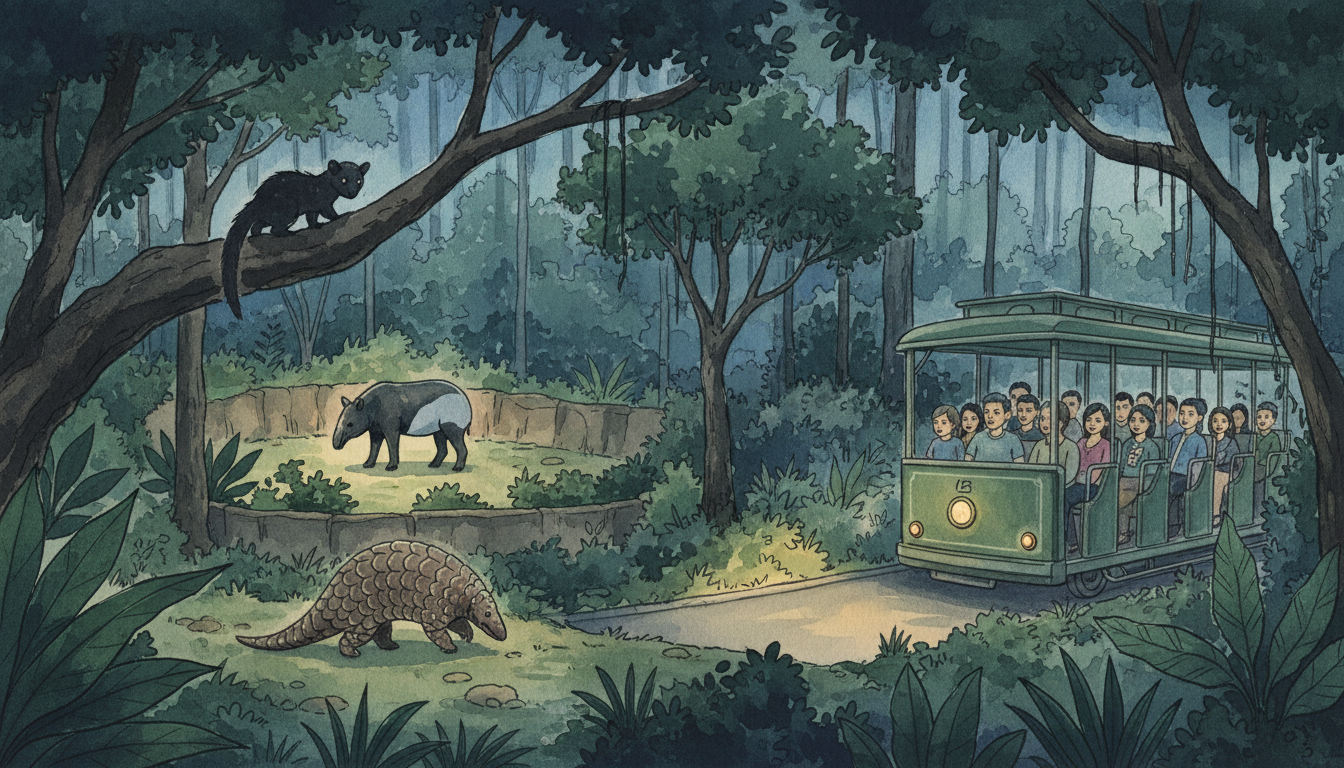
Night Safari specialist vocabulary — separate from the numbered days
This is the dedicated, unnumbered Night Safari Vocabulary reading guide. The numbered Day 38 in the Touring Singapore sequence is the Singapore Oceanarium; Day 39 covers Singapore festivals. This Night Safari article remains available for its separate 100-word look at Mandai’s trails, nocturnal animal care and visitor decisions. For the larger collection, visit the Touring Singapore hub.
Night Safari Singapore is the world’s first nocturnal wildlife park, opened on 26 May 1994 at Mandai, where visitors can observe animals after dark. In October 2026 the operator lists four walking trails—Tiger, Pangolin, Leopard and Tasmanian Devil—plus a Safari Adventure Tram included with admission. The park opens daily from 6pm to midnight, last entry 11:15pm; walking trails and trams begin at 7pm. This guide gives 100 Singapore Night Safari vocabulary words, each with a clear meaning, natural example and reason it belongs in the wildlife story.
Why is Night Safari part of Singapore culture? It changed what a wildlife attraction could be by inviting people to learn about animals most active after daylight, combining animal care, habitat design, lighting, conservation and Singapore’s habit of creating new ways to use limited land. The National Library Board confirms the 1994 opening, while the Mandai operator now describes more than 900 creatures within its managed habitats. An animal being displayed does not mean it lives freely in Singapore’s forests, and no visitor is guaranteed to see every species.
Start with the 100-word finder, check admission, hours and dated closures, follow the four walking-trail guide, or use the worked examples. This article separates stable biology from time-sensitive tickets, seasonal exhibits and presentation bookings. Actual animal sightings, shows and tram arrangements remain subject to care, weather and operator notices.
Night Safari in one minute: useful facts for visitors
- Official opening: 26 May 1994, the pioneering night-focused wildlife park adjoining Singapore Zoo.
- Location: Mandai Wildlife EAST, 80 Mandai Lake Road, Singapore 729826; it is a separate admission from Singapore Zoo and the other Mandai attractions.
- Opening: 6pm–midnight in the October 2026 operator listing; last entry at 11:15pm.
- Animal areas: walking trails and the Safari Adventure Tram operate from 7pm, with over 900 animals in the park’s managed collection.
- Four trail names: Tiger Trail, Pangolin Trail, Leopard Trail and Tasmanian Devil Trail.
- Tram: the operator’s visitor guide calls the narrated English-language tram complimentary with normal Night Safari admission.
- Creatures of the Night: an animal presentation requiring online seat booking through the operator; reservations open two hours before each show.
- Temporary closure: the Fishing Cat exhibit at Pangolin Trail is listed closed from 7 October to 31 December 2026 for refurbishment.
- Timeslots: follow the rules of the purchased product; the July 2026 notice exempts Destination Pass holders from advance Night Safari timeslot booking, unlike some other ticket types.
- Animal care: no flash photography, stay on designated paths, do not taunt wildlife and do not offer food unless specifically part of an authorised programme.
What makes a nighttime animal park different from a daytime zoo?
The National Archives’ 26 May 1994 opening speech and the National Library’s zoo history document the launch of a nocturnal wildlife attraction when most zoological parks operated mainly during the day. The original concept included low-level lighting and naturalistic animal spaces so visitors could see behaviours that might otherwise be missed in ordinary daytime visiting. It was an organisational and design innovation, not an assertion that every species in the park is awake throughout every night.
A nocturnal animal generally becomes more active after dark, while crepuscular species are more active around dawn or dusk. Different mammals rely on vision, smell, sound, camouflage and memory. The park’s storytelling offers a starting point for studying those natural behaviours, but a display may reflect managed feeding, animal choice and lighting rather than the full ecology of a wild forest.
Four distinct trails: use the current 2026 map
The operator’s Animals & Trails page identifies Tiger Trail for animals associated with Asia and Africa; Pangolin Trail for Southeast Asian mammals such as the Sunda pangolin, leopard cat and slow loris; Leopard Trail for several cats, civets and walk-through flying-mammal exhibits; and Tasmanian Devil Trail for marsupials and animals of the Australasian region. A list of species describes an exhibit collection rather than a wildlife sighting guarantee.
October 2026 notice: the Night Safari homepage specifically says the Fishing Cat exhibit in Pangolin Trail is closed 7 October–31 December 2026 for refurbishment. This is not the closure of the entire trail. A useful writer should avoid saying the animal or trail is available merely because an older brochure pictured it.
Tram or walking trails: both teach different things
The narrated Safari Adventure Tram offers a convenient route through designated animal zones, and the operator lists the first trip at 7pm and last at 11:20pm under its regular guide. It is complimentary to normal ticket holders, and the operator describes repeat rides as available. The walking trails can reveal other species and allow more time at an interpretation panel. If a family values a gentle outing, the tram may be a reasonable focus rather than a warm-up to walking every trail.
In a moving tram, visitors should remain seated, keep hands and objects inside the approved passenger space and follow staff directions. At trail junctions, use signs and the current map rather than trying to move through habitat barriers. Choosing a comfortable and ethical experience is a better goal than collecting the maximum number of animal photos.
Show seat booking, timeslots and the 2026 exception
Mandai’s presentation guidance requires online reservations for Creatures of the Night; seat bookings open two hours before each presentation. The March 2026 park map listed showtimes at 7:30pm, 8:30pm and 9:30pm, but these must be rechecked against the actual date’s operator portal. A park entry ticket and a show seat booking are separate entitlements.
For entry timeslots, the operator’s July 2026 announcement says Destination Pass holders no longer need to make an advance Night Safari timeslot booking. Single-attraction ticket holders and Friends of Mandai members are still directed to book. The general Night Safari homepage carries a broad reminder about slots, so use your specific purchase terms and the latest operator guidance. Two official snippets can have different scopes; neither should be flattened into an absolute statement that all ticket categories work identically.
Mandai’s transport directions identify the Mandai Khatib Bus from Khatib MRT, service 138 from Ang Mo Kio or Springleaf and service 927 from Choa Chu Kang. Public and shuttle timetables matter for visitors leaving after dark. The Khatib shuttle fare for external travel differs from free internal transfers between some Mandai precincts; check the current charge rather than assuming any shuttle is always free.
Safety and wildlife respect are part of learning
The Night Safari visitor guide prohibits flash photography and asks visitors not to shout, taunt or throw anything toward animals. It advises staying on designated routes and seeking appropriate shelter during lightning. These are not obstacles to enjoyment; they are part of respecting animal welfare and protecting people. Some explicitly supervised animal feeding experiences are offered through separate booking, so the correct lesson is never feed animals outside authorised activities, not that no animal feeding programme exists anywhere at Mandai.
Darkness makes accurate observation more challenging. Use modest descriptions such as ‘the animal moved into vegetation’ rather than ‘the animal was frightened’ unless there is clear evidence. A child who learns to distinguish what they saw from why they think it happened is practising science and responsible language at the same time.
Ten parts of the hundred-word Night Safari vocabulary map
- Part 1: Night Safari: what the first nocturnal wildlife park means — terms 1–10
- Part 2: The four current walking trails and their landscapes — terms 11–20
- Part 3: Asian animals and the features that make them recognisable — terms 21–30
- Part 4: Wildlife from other regions and the global conservation story — terms 31–40
- Part 5: Nocturnal adaptations: biology behind what guests see — terms 41–50
- Part 6: Safari Adventure Tram: travel through the park safely — terms 51–60
- Part 7: Creatures of the Night, keeper talks and learning activities — terms 61–70
- Part 8: Admission, timeslots and getting to Mandai — terms 71–80
- Part 9: Visitor safety and ethics after dark — terms 81–90
- Part 10: Conservation, animal care and deeper questions — terms 91–100
100-word quick finder
1–10: 1. Night Safari · 2. 26 May 1994 · 3. Nocturnal wildlife park · 4. Nocturnal · 5. Crepuscular · 6. Diurnal · 7. Twilight · 8. Mandai Wildlife Reserve · 9. Mandai Wildlife EAST · 10. Managed animal habitat
11–20: 11. Tiger Trail · 12. Pangolin Trail · 13. Leopard Trail · 14. Tasmanian Devil Trail · 15. Walking trail · 16. Trail junction · 17. Wildlife exhibit · 18. Low-light environment · 19. Exhibit refurbishment · 20. Animal sighting
21–30: 21. Malayan tapir · 22. Sunda pangolin · 23. Leopard cat · 24. Sunda slow loris · 25. Common palm civet · 26. Asian small-clawed otter · 27. Lesser mousedeer · 28. Malayan flying fox · 29. Asian elephant · 30. Indian rhinoceros
31–40: 31. Tasmanian devil · 32. Wallaby · 33. Sugar glider · 34. Morepork owl · 35. Spotted hyaena · 36. Striped hyaena · 37. Aardvark · 38. Sloth bear · 39. Fennec fox · 40. Maned wolf
41–50: 41. Night vision · 42. Tapetum lucidum · 43. Acute hearing · 44. Olfaction · 45. Echolocation · 46. Camouflage · 47. Predator · 48. Prey · 49. Herbivore · 50. Ecological niche
51–60: 51. Safari Adventure Tram · 52. Tram Station 1 · 53. Tram Station 2 · 54. Narrated commentary · 55. Thirty-minute circuit · 56. Included tram · 57. Tram queue · 58. Remain seated · 59. Inside the vehicle · 60. Tram accessibility
61–70: 61. Creatures of the Night · 62. Amphitheatre · 63. Presentation seat booking · 64. Two-hour booking window · 65. Keeper talk · 66. Wildlife interpreter · 67. Animal enrichment · 68. Presentation schedule · 69. Twilight performance · 70. Audience consideration
71–80: 71. 80 Mandai Lake Road · 72. Ticketed wildlife park · 73. Entry timeslot · 74. Single-attraction ticket · 75. Destination Pass · 76. WildPass · 77. Friends of Mandai · 78. Mandai Khatib Bus · 79. Bus 138 · 80. Bus 927
81–90: 81. No-flash photography · 82. Low-glare lighting · 83. Designated path · 84. Do not feed animals · 85. Animal disturbance · 86. Habitat barrier · 87. Lightning shelter · 88. Rain contingency · 89. Child supervision · 90. Emergency assistance
91–100: 91. Threatened species · 92. IUCN Red List · 93. Captive breeding · 94. Habitat loss · 95. Habitat fragmentation · 96. Illegal wildlife trade · 97. Genetic diversity · 98. Veterinary care · 99. Welfare assessment · 100. Evidence-based observation
Build precise vocabulary using an animal and its environment
Use observe → identify → explain → verify → recall. Begin by noticing a feature or behaviour, name it accurately, link the feature to a sensible biological idea, check a keeper panel or authoritative source, then retrieve the word later in a new sentence. For example, a tapir’s coat pattern is directly visible; whether that pattern improves camouflage in a particular habitat requires further knowledge. Both details matter, but they are different sorts of claims.
Primary learners may focus on ten animal names, trail signs and visitor safety terms. Secondary students can add conservation status, ecological niches and careful observations. Families can practise time and ticket comprehension. A good educational experience is not measured by seeing every species or purchasing every optional activity.
Part 1 — Night Safari: what the first nocturnal wildlife park means
The experience is an animal park designed for evening and night visits, not a wild safari drive through unprotected countryside. Its history and opening hours explain why it differs from the daylight Singapore Zoo.
1. Night Safari
Meaning: Singapore’s managed nocturnal wildlife attraction in the Mandai Wildlife Reserve. Example: “We booked Night Safari to learn about animals active after dark.” Singapore and wildlife connection: It was officially opened in 1994 as the first nocturnal wildlife park of its kind.
2. 26 May 1994
Meaning: The official opening date of Night Safari in Singapore. Example: “Our history worksheet identified 26 May 1994.” Singapore and wildlife connection: National Archives and National Library records support the date.
3. Nocturnal wildlife park
Meaning: A managed zoological site designed around seeing animals after dark. Example: “The nocturnal wildlife park used gentle lighting.” Singapore and wildlife connection: Its layout and operating times are planned around animal behaviour.
4. Nocturnal
Meaning: Usually active mainly during nighttime hours. Example: “The pangolin is a primarily nocturnal mammal.” Singapore and wildlife connection: The word describes an activity pattern, not whether an animal is dangerous.
5. Crepuscular
Meaning: Most active around dawn or dusk rather than fully during daylight or night. Example: “Some creatures are crepuscular rather than strictly nocturnal.” Singapore and wildlife connection: A dusk sighting does not mean every species stays awake all night.
6. Diurnal
Meaning: Active mainly during the daylight hours. Example: “We compared diurnal birds with night-active animals.” Singapore and wildlife connection: Understanding the contrast explains why Night Safari is not simply a zoo open later.
7. Twilight
Meaning: The period of fading or growing light between day and night. Example: “The sky darkened during twilight.” Singapore and wildlife connection: It helps visitors explain the transition before the animal trails open.
8. Mandai Wildlife Reserve
Meaning: The larger Singapore wildlife destination containing several separate attractions. Example: “Night Safari belongs to Mandai Wildlife Reserve.” Singapore and wildlife connection: A single ticket does not automatically grant entry to every park there.
9. Mandai Wildlife EAST
Meaning: The Mandai precinct containing Night Safari, Singapore Zoo and several other attractions. Example: “We followed the directions to Mandai Wildlife EAST.” Singapore and wildlife connection: The precinct differs from Mandai Wildlife WEST and has its own entrance and transport.
10. Managed animal habitat
Meaning: An enclosure or space maintained for animals under professional care. Example: “The trail passed a carefully managed animal habitat.” Singapore and wildlife connection: The view may resemble natural forest, but the animals are under human care.
Part 1 retrieval challenge: Explain three terms without looking and use them in new sentences. Separate something directly observable from a claim about behaviour, conservation or a dated visitor rule that should be checked. Learning to be careful is more useful than collecting dozens of animal names.
Part 2 — The four current walking trails and their landscapes
The 2026 operator map identifies Tiger, Pangolin, Leopard and Tasmanian Devil trails. Some old itineraries use different names; read the current map rather than inventing a universal route.
11. Tiger Trail
Meaning: A walking trail showing animals associated with landscapes in Asia and Africa. Example: “We looked at the Tiger Trail on the map.” Singapore and wildlife connection: The current name is a visitor-route label, not a promise of a particular sighting.
12. Pangolin Trail
Meaning: A walking trail featuring several Southeast Asian mammals. Example: “The Pangolin Trail introduced the Sunda pangolin.” Singapore and wildlife connection: It gives attention to regional biodiversity and local conservation stories.
13. Leopard Trail
Meaning: A wildlife walking route including nocturnal carnivores and walk-through exhibits. Example: “We explored part of the Leopard Trail.” Singapore and wildlife connection: Observing an animal from a trail is different from being allowed to approach it.
14. Tasmanian Devil Trail
Meaning: A path introducing marsupials and other animals associated with Australasia. Example: “Tasmanian Devil Trail was on our evening plan.” Singapore and wildlife connection: The route showcases habitats and creatures outside Singapore’s native fauna.
15. Walking trail
Meaning: A designated pedestrian route guiding guests through an attraction. Example: “We stayed on the walking trail after the tram.” Singapore and wildlife connection: Trail boundaries protect visitors and animals.
16. Trail junction
Meaning: A point where walking paths split or meet. Example: “We stopped at the trail junction to consult the map.” Singapore and wildlife connection: Clear navigation is particularly important in low light.
17. Wildlife exhibit
Meaning: A specific place designed to let visitors observe animals and learn about them. Example: “The wildlife exhibit had an explanatory panel.” Singapore and wildlife connection: An exhibit is a managed living space and may close for maintenance.
18. Low-light environment
Meaning: An area with deliberately limited illumination. Example: “Our eyes adjusted to the low-light environment.” Singapore and wildlife connection: Less light can help maintain animal-friendly conditions and requires careful steps.
19. Exhibit refurbishment
Meaning: Work to improve or maintain a display or animal facility. Example: “The Fishing Cat exhibit was under refurbishment in October 2026.” Singapore and wildlife connection: The operator lists its Pangolin Trail closure from 7 October to 31 December 2026.
20. Animal sighting
Meaning: An occasion when a visitor actually notices an animal in its habitat. Example: “We recorded one animal sighting and waited quietly.” Singapore and wildlife connection: A listed species is never a guarantee that every guest will see it.
Part 2 retrieval challenge: Explain three terms without looking and use them in new sentences. Separate something directly observable from a claim about behaviour, conservation or a dated visitor rule that should be checked. Learning to be careful is more useful than collecting dozens of animal names.
Part 3 — Asian animals and the features that make them recognisable
The park includes regional mammals with very different bodies and ecological roles. Describing a trait precisely helps a student distinguish camouflage, defence, feeding and conservation status.
21. Malayan tapir
Meaning: A large Asian forest mammal with a distinctive black-and-white coat. Example: “The Malayan tapir’s pale saddle was easy to notice.” Singapore and wildlife connection: The colour pattern can help break up its outline in forest light.
22. Sunda pangolin
Meaning: A scaled, ant-eating mammal found in Southeast Asia. Example: “We learned that the Sunda pangolin is vulnerable to illegal trade.” Singapore and wildlife connection: Its specialised body and conservation needs make it a meaningful educational species.
23. Leopard cat
Meaning: A small wild feline native to parts of Asia including Singapore. Example: “The leopard cat had a very different size from a tiger.” Singapore and wildlife connection: A wild cat is not simply a domestic pet with a spotted coat.
24. Sunda slow loris
Meaning: A small nocturnal primate native to Southeast Asia. Example: “We looked for the Sunda slow loris on the exhibit guide.” Singapore and wildlife connection: It is a venomous primate and must never be handled or treated as a pet.
25. Common palm civet
Meaning: An often nocturnal mammal using trees and diverse foods. Example: “The common palm civet moved among branches.” Singapore and wildlife connection: Its name preserves a familiar Southeast Asian wildlife association.
26. Asian small-clawed otter
Meaning: A relatively small otter species native to Asian wetlands. Example: “The Asian small-clawed otter was listed on Pangolin Trail.” Singapore and wildlife connection: Wetland and aquatic species require different habitat care from forest predators.
27. Lesser mousedeer
Meaning: A small hoofed forest mammal also called a chevrotain. Example: “The lesser mousedeer moved quietly through vegetation.” Singapore and wildlife connection: Its delicate size and specialised feeding make it distinct from common deer.
28. Malayan flying fox
Meaning: A large fruit bat associated with tropical forest ecosystems. Example: “The flying fox hung above the exhibit walkway.” Singapore and wildlife connection: Despite the name, it is a bat rather than a fox.
29. Asian elephant
Meaning: A large social herbivore found in several South and Southeast Asian regions. Example: “The Asian elephant needed a carefully managed habitat.” Singapore and wildlife connection: Its conservation concerns include loss of habitat and conflict with people.
30. Indian rhinoceros
Meaning: A large one-horned Asian rhinoceros species. Example: “We checked whether an official rhino feeding session was offered.” Singapore and wildlife connection: A managed activity has specific safety and booking rules; visitors must not feed animals independently.
Part 3 retrieval challenge: Explain three terms without looking and use them in new sentences. Separate something directly observable from a claim about behaviour, conservation or a dated visitor rule that should be checked. Learning to be careful is more useful than collecting dozens of animal names.
Part 4 — Wildlife from other regions and the global conservation story
Night Safari houses animals from different continents in a Singapore-managed zoological setting. Knowing each origin helps avoid the misleading idea that every displayed species lives naturally in Singapore’s forests.
31. Tasmanian devil
Meaning: A carnivorous marsupial native to Tasmania. Example: “We saw information about the Tasmanian devil’s strong jaws.” Singapore and wildlife connection: It is not a supernatural creature or a species native to Singapore.
32. Wallaby
Meaning: A smaller or medium-sized macropod marsupial found in Australasia. Example: “A wallaby moved through the Australian-themed trail.” Singapore and wildlife connection: Its leaping movement and body plan differ from those of deer.
33. Sugar glider
Meaning: A small nocturnal gliding possum native to parts of Australasia. Example: “The sugar glider travelled between branches.” Singapore and wildlife connection: A skin membrane allows gliding, not powered bird-like flight.
34. Morepork owl
Meaning: An owl associated with New Zealand and parts of Australasia. Example: “The morepork owl has a recognisable call.” Singapore and wildlife connection: Its common name reflects its vocal sound, not what it eats.
35. Spotted hyaena
Meaning: A large African carnivore with spotted fur and powerful jaws. Example: “The spotted hyaena was not a type of wild dog.” Singapore and wildlife connection: Hyaenas have their own family and ecological roles.
36. Striped hyaena
Meaning: A distinct hyaena species with a striped coat and scavenging habits. Example: “We compared striped and spotted hyaenas.” Singapore and wildlife connection: Two similar common names do not make the animals one species.
37. Aardvark
Meaning: An African mammal specialised in eating ants and termites. Example: “The aardvark used its strong claws to dig.” Singapore and wildlife connection: Its ecological adaptation is distinct from a pangolin’s protective scales.
38. Sloth bear
Meaning: An Asian bear adapted in part to feeding on insects. Example: “The sloth bear searched for food in its habitat.” Singapore and wildlife connection: An insect-eating adaptation does not make it a sloth.
39. Fennec fox
Meaning: A small desert fox associated with North Africa. Example: “The fennec fox’s large ears were easy to recognise.” Singapore and wildlife connection: Its body demonstrates adaptation to environments quite unlike humid Singapore.
40. Maned wolf
Meaning: A tall South American canid with long legs and reddish fur. Example: “The maned wolf looked unlike the familiar grey wolf.” Singapore and wildlife connection: Despite its name, it is neither an ordinary wolf nor a fox.
Part 4 retrieval challenge: Explain three terms without looking and use them in new sentences. Separate something directly observable from a claim about behaviour, conservation or a dated visitor rule that should be checked. Learning to be careful is more useful than collecting dozens of animal names.
Part 5 — Nocturnal adaptations: biology behind what guests see
An animal is not simply a night animal because a sign says so. Different senses and behaviours support movement, hunting, defence and communication under low light.
41. Night vision
Meaning: An animal’s ability to see effectively under relatively low light. Example: “We discussed night vision when observing a carnivore.” Singapore and wildlife connection: Different species use different eye structures and do not all see perfectly in darkness.
42. Tapetum lucidum
Meaning: A reflective layer behind the retina in the eyes of some mammals. Example: “The eye-shine lesson mentioned the tapetum lucidum.” Singapore and wildlife connection: It enhances light use in some nocturnal species but is not universal.
43. Acute hearing
Meaning: Especially sensitive ability to detect sounds. Example: “The owl relied partly on acute hearing.” Singapore and wildlife connection: Sound can help animals locate prey or threats when light is low.
44. Olfaction
Meaning: The sense of smell used to detect and interpret chemical cues. Example: “Olfaction helps mammals find food and mates.” Singapore and wildlife connection: Smell can be important when a visual view is limited.
45. Echolocation
Meaning: Finding objects by analysing echoes from emitted sounds. Example: “Some bats use echolocation to navigate and hunt.” Singapore and wildlife connection: Not every bat or nocturnal mammal uses the same echolocation method.
46. Camouflage
Meaning: Colour, shape or behaviour that makes an organism harder to detect. Example: “The animal’s camouflage blended with the exhibit plants.” Singapore and wildlife connection: A less visible animal may be well adapted rather than absent.
47. Predator
Meaning: An organism that hunts or consumes other organisms. Example: “The leopard is a predator in its food web.” Singapore and wildlife connection: Predation helps regulate ecological relationships beyond a dramatic zoo photograph.
48. Prey
Meaning: An organism consumed by a predator. Example: “A small rodent may become prey for an owl.” Singapore and wildlife connection: The term describes a relationship, not a permanent label of weakness.
49. Herbivore
Meaning: An animal that feeds mainly on plants. Example: “The tapir is a herbivore.” Singapore and wildlife connection: Different diets require carefully planned zoo feeding practices.
50. Ecological niche
Meaning: The particular resources, conditions and interactions associated with a species. Example: “We compared the ecological niches of two mammals.” Singapore and wildlife connection: A display animal has a real natural role beyond its visitor appeal.
Part 5 retrieval challenge: Explain three terms without looking and use them in new sentences. Separate something directly observable from a claim about behaviour, conservation or a dated visitor rule that should be checked. Learning to be careful is more useful than collecting dozens of animal names.
Part 6 — Safari Adventure Tram: travel through the park safely
The official operator offers a complimentary narrated tram as part of Night Safari admission. It starts at 7pm in its current programme and follows designated paths separate from many walking trails.
51. Safari Adventure Tram
Meaning: The narrated vehicle ride through several Night Safari animal areas. Example: “We rode the Safari Adventure Tram after entering.” Singapore and wildlife connection: It complements the walking trails rather than replacing every species exhibit.
52. Tram Station 1
Meaning: A designated boarding location near the park entrance. Example: “Our map showed Tram Station 1 beside the main circulation area.” Singapore and wildlife connection: An actual station label is more helpful than saying board anywhere.
53. Tram Station 2
Meaning: A second mapped stop serving other parts of Night Safari. Example: “We checked where Tram Station 2 connected with a trail.” Singapore and wildlife connection: Operators control boarding and alighting at approved stops only.
54. Narrated commentary
Meaning: Spoken information accompanying the tram experience. Example: “The narrated commentary introduced animals along the route.” Singapore and wildlife connection: English-language narration helps visitors connect sightings with conservation facts.
55. Thirty-minute circuit
Meaning: The approximate duration of a standard Safari Adventure Tram ride. Example: “Our tram journey was expected to take around half an hour.” Singapore and wildlife connection: A ride duration is not the whole time needed for tickets, queues and walking.
56. Included tram
Meaning: A transport activity available within ordinary Night Safari admission. Example: “The operator describes the tram as included.” Singapore and wildlife connection: A guided private buggy tour is a different paid experience.
57. Tram queue
Meaning: The line of visitors waiting for approved tram boarding. Example: “We joined the tram queue behind the marked sign.” Singapore and wildlife connection: Queue time changes with attendance and accessibility needs.
58. Remain seated
Meaning: A safety direction to keep one’s seat while the vehicle is moving. Example: “We remained seated throughout the ride.” Singapore and wildlife connection: Sudden standing can put guests and others at risk.
59. Inside the vehicle
Meaning: The safe passenger space rather than an exposed part of a moving tram. Example: “Children kept their arms inside the vehicle.” Singapore and wildlife connection: Wildlife observation never requires leaning out to get nearer an animal.
60. Tram accessibility
Meaning: The facilities and boarding procedures for visitors who need mobility support. Example: “We asked about tram accessibility before joining the line.” Singapore and wildlife connection: A particular vehicle may need preparation or boarding assistance.
Part 6 retrieval challenge: Explain three terms without looking and use them in new sentences. Separate something directly observable from a claim about behaviour, conservation or a dated visitor rule that should be checked. Learning to be careful is more useful than collecting dozens of animal names.
Part 7 — Creatures of the Night, keeper talks and learning activities
A wildlife presentation is a scheduled activity rather than a guaranteed chance to touch animals. In 2026 the operator requires online seat reservations for the Creatures of the Night presentation, opening two hours before each show.
61. Creatures of the Night
Meaning: Night Safari’s scheduled animal presentation at its Amphitheatre. Example: “We booked seats for Creatures of the Night.” Singapore and wildlife connection: The presentation aims to explain animal behaviours and adaptations.
62. Amphitheatre
Meaning: A purpose-built audience venue for live presentations. Example: “We found the Amphitheatre on the park map.” Singapore and wildlife connection: A performance venue has its own capacity and entry arrangements.
63. Presentation seat booking
Meaning: Reserving a place at a scheduled wildlife programme. Example: “We completed the presentation seat booking before joining the queue.” Singapore and wildlife connection: An ordinary park ticket does not automatically reserve a show seat.
64. Two-hour booking window
Meaning: The period before a presentation when Mandai opens seat reservations. Example: “We waited for the two-hour booking window.” Singapore and wildlife connection: A changing digital booking process needs checking for the chosen time.
65. Keeper talk
Meaning: A session in which an animal-care professional discusses species and their management. Example: “The keeper talk explained pangolin behaviour.” Singapore and wildlife connection: Hearing from carers offers more context than one photograph.
66. Wildlife interpreter
Meaning: A staff member translating animal facts into understandable visitor learning. Example: “The wildlife interpreter answered a family question.” Singapore and wildlife connection: Education requires clear communication and accurate scientific information.
67. Animal enrichment
Meaning: Activities or objects designed to encourage suitable behaviour in an animal’s care setting. Example: “The keeper described an animal enrichment activity.” Singapore and wildlife connection: Enrichment supports welfare rather than making animals perform on demand.
68. Presentation schedule
Meaning: The operator’s stated dates and times for shows or talks. Example: “We checked the presentation schedule in the Mandai app.” Singapore and wildlife connection: Programmes may change; a past timetable is not a current admission guarantee.
69. Twilight performance
Meaning: An evening entertainment presentation offered around the entrance courtyard. Example: “The twilight performance started before our chosen trail.” Singapore and wildlife connection: Entertainment performers and animal presentations have different purposes and timings.
70. Audience consideration
Meaning: Behaviour that allows people and animals to experience a presentation without unnecessary disturbance. Example: “The audience stayed calm during the talk.” Singapore and wildlife connection: Respect for both performers and animals matters in a shared learning event.
Part 7 retrieval challenge: Explain three terms without looking and use them in new sentences. Separate something directly observable from a claim about behaviour, conservation or a dated visitor rule that should be checked. Learning to be careful is more useful than collecting dozens of animal names.
Part 8 — Admission, timeslots and getting to Mandai
Night Safari is at Mandai Wildlife EAST, 80 Mandai Lake Road. Current ticketing and arrival procedures differ by product; the operator specifically notes a July 2026 change for Destination Pass users.
71. 80 Mandai Lake Road
Meaning: The address for Mandai Wildlife EAST and Night Safari. Example: “Our booking stated 80 Mandai Lake Road.” Singapore and wildlife connection: An exact address prevents arriving at the wrong Mandai precinct.
72. Ticketed wildlife park
Meaning: An attraction where paid or otherwise authorised entry is required. Example: “Night Safari is a ticketed wildlife park.” Singapore and wildlife connection: Entry to a free Mandai public area does not imply access to animal trails.
73. Entry timeslot
Meaning: A selected admission window used to manage visitor numbers. Example: “We confirmed our Night Safari entry timeslot.” Singapore and wildlife connection: Requirements depend on ticket type and current operating advice.
74. Single-attraction ticket
Meaning: A ticket for one specified Mandai attraction. Example: “Our single-attraction ticket was for Night Safari.” Singapore and wildlife connection: It is not automatically a Singapore Zoo or River Wonders ticket.
75. Destination Pass
Meaning: A multi-attraction ticket product offered under Mandai’s stated rules. Example: “The family checked the Destination Pass terms.” Singapore and wildlife connection: Mandai says Destination Pass holders no longer need an advance Night Safari timeslot from July 2026.
76. WildPass
Meaning: A Mandai programme providing eligible local visitors benefits and offers. Example: “We checked whether WildPass benefits applied.” Singapore and wildlife connection: Resident discounts and eligibility must be verified for the actual ticket.
77. Friends of Mandai
Meaning: A membership programme covering specified parks and privileges. Example: “We read the Friends of Mandai member-entry rules.” Singapore and wildlife connection: Membership status is not a guarantee that all reservations can be skipped.
78. Mandai Khatib Bus
Meaning: The shuttle linking Khatib MRT with the wildlife reserve under published fare rules. Example: “We planned to take the Mandai Khatib Bus.” Singapore and wildlife connection: The external Khatib journey is chargeable and differs from free internal transfers.
79. Bus 138
Meaning: A public bus serving Mandai from Ang Mo Kio or Springleaf connections. Example: “We checked bus 138 as an alternative route.” Singapore and wildlife connection: Different MRT stations lead to different bus connections.
80. Bus 927
Meaning: A public bus connecting Choa Chu Kang with the wildlife reserve area. Example: “Bus 927 was another transport option.” Singapore and wildlife connection: Real journey planning must include last services and travel after midnight.
Part 8 retrieval challenge: Explain three terms without looking and use them in new sentences. Separate something directly observable from a claim about behaviour, conservation or a dated visitor rule that should be checked. Learning to be careful is more useful than collecting dozens of animal names.
Part 9 — Visitor safety and ethics after dark
A nighttime park needs careful lighting and considerate behaviour. The operator expressly prohibits flash photography and asks guests not to shout, taunt or throw objects at animals.
81. No-flash photography
Meaning: Taking animal pictures without a bright camera flash. Example: “We switched off flash photography on our phones.” Singapore and wildlife connection: Flash can disturb or startle animals and is prohibited in Night Safari.
82. Low-glare lighting
Meaning: Illumination intended to reduce harsh bright light or dazzling effects. Example: “Low-glare lighting helped us see the path.” Singapore and wildlife connection: Thoughtful lighting seeks to balance visitor vision and animal sensitivity.
83. Designated path
Meaning: A marked area where walking guests are permitted to move. Example: “We stayed on the designated path in the dark.” Singapore and wildlife connection: Leaving a path can disturb animals or create real safety risks.
84. Do not feed animals
Meaning: A rule against giving food to wildlife outside authorised activities. Example: “We did not feed animals along the trail.” Singapore and wildlife connection: Species have managed diets; some separately supervised feeding programmes exist.
85. Animal disturbance
Meaning: Behaviour that disrupts animals’ normal activity or welfare. Example: “Shouting can cause animal disturbance.” Singapore and wildlife connection: A quiet guest is more helpful than one demanding a dramatic photograph.
86. Habitat barrier
Meaning: A physical or landscape feature separating visitor routes from animal spaces. Example: “The habitat barrier kept the group at a safe distance.” Singapore and wildlife connection: A natural-looking exhibit is still a managed zoo enclosure.
87. Lightning shelter
Meaning: A safe indoor or suitably protected place used during lightning warnings. Example: “We sought lightning shelter during the storm.” Singapore and wildlife connection: The operator advises guests to go indoors during lightning.
88. Rain contingency
Meaning: An alternate plan for wet weather that affects outdoor activities. Example: “Our rain contingency was an authorised sheltered area.” Singapore and wildlife connection: Outdoor trails and shows may be affected by tropical downpours.
89. Child supervision
Meaning: Keeping children safely accompanied and monitored in a public setting. Example: “Child supervision mattered on the dark walking trails.” Singapore and wildlife connection: Curiosity is valuable, but adults should guide safe and respectful conduct.
90. Emergency assistance
Meaning: Help provided by trained staff during an incident or urgent need. Example: “We followed the sign to emergency assistance.” Singapore and wildlife connection: Use the operator’s published contact points rather than attempting to enter animal areas.
Part 9 retrieval challenge: Explain three terms without looking and use them in new sentences. Separate something directly observable from a claim about behaviour, conservation or a dated visitor rule that should be checked. Learning to be careful is more useful than collecting dozens of animal names.
Part 10 — Conservation, animal care and deeper questions
Night Safari is part of a managed wildlife system. Learning about conservation means examining threatened species, habitats, breeding, welfare and human pressures rather than claiming that seeing an animal guarantees its future.
91. Threatened species
Meaning: A species facing a recognised risk of extinction under a conservation assessment. Example: “Some Night Safari animals belong to threatened species.” Singapore and wildlife connection: The exact category must be checked rather than inferred from a dramatic appearance.
92. IUCN Red List
Meaning: A scientific system assessing extinction risk for species around the world. Example: “We consulted the IUCN Red List for a pangolin species.” Singapore and wildlife connection: A status may change and must be attached to the exact species.
93. Captive breeding
Meaning: Breeding animals under human care within managed facilities. Example: “Captive breeding can support some conservation programmes.” Singapore and wildlife connection: Success in a zoo does not by itself ensure wild populations are secure.
94. Habitat loss
Meaning: The destruction or reduction of places animals need to live. Example: “Habitat loss threatens many forest mammals.” Singapore and wildlife connection: Conservation often depends on conditions outside the attraction.
95. Habitat fragmentation
Meaning: Dividing connected habitats into smaller isolated pieces. Example: “Roads can contribute to habitat fragmentation.” Singapore and wildlife connection: Movement between forest patches affects wildlife survival.
96. Illegal wildlife trade
Meaning: The unlawful capture, sale or transport of protected animals or products. Example: “Illegal wildlife trade threatens Sunda pangolins.” Singapore and wildlife connection: Demand for exotic pets or body parts can damage wild populations.
97. Genetic diversity
Meaning: Variation in inherited characteristics within and among populations. Example: “Breeding programmes consider genetic diversity.” Singapore and wildlife connection: A healthy population requires more than a simple count of animals.
98. Veterinary care
Meaning: Medical examination and treatment provided to animals by trained professionals. Example: “Veterinary care was part of the reserve’s work.” Singapore and wildlife connection: Animal welfare needs expertise beyond visitor attractions.
99. Welfare assessment
Meaning: A structured evaluation of an animal’s physical and behavioural wellbeing. Example: “Animal carers conduct welfare assessments.” Singapore and wildlife connection: An animal being visible does not prove every welfare outcome.
100. Evidence-based observation
Meaning: Describing an animal’s behaviour without inventing motive or diagnosis. Example: “Our evidence-based observation noted what the tapir actually did.” Singapore and wildlife connection: A quiet, verifiable account respects both animals and science.
Part 10 retrieval challenge: Explain three terms without looking and use them in new sentences. Separate something directly observable from a claim about behaviour, conservation or a dated visitor rule that should be checked. Learning to be careful is more useful than collecting dozens of animal names.
Worked example: a dated Fishing Cat closure is not a closure of everything
Incorrect notice: “The whole Pangolin Trail is closed in October 2026 because the Fishing Cat exhibit is being renovated.” The official Night Safari homepage says the Fishing Cat exhibit in Pangolin Trail is undergoing work from 7 October to 31 December 2026. It does not say the entire trail is shut.
Corrected explanation: “The Fishing Cat exhibit is temporarily closed for refurbishment during the stated 2026 period. Other Pangolin Trail experiences have separate operating status, so check the current map and official visitor notice.” This is the difference between the scope of a specific closure and an unsupported generalisation.
Worked example: ticket category and seat booking are different things
Visitor A: “I have a Destination Pass. That means I must pre-book a Night Safari entry time and my show seat is included, right?” Visitor B: “Mandai’s July 2026 guidance exempts Destination Pass holders from advance Night Safari timeslot booking. The Creatures of the Night show still has its own seat booking portal, opening two hours before each presentation. We should check both products independently.”
This fictional conversation is built from the operator’s stated distinctions. It is not a confirmation of a particular show’s remaining seats or the availability of a purchased ticket.
Worked example: the camera flash that disturbs wildlife
Unhelpful approach: “The leopard moved out of view, so I will turn on the flash and shout to make it turn around.” This conflicts with Mandai’s no-flash and respect-for-animals rules. It also encourages the student to treat an animal as a photo prop rather than a living creature.
Stronger approach: “I’ll keep the flash off, stay on the trail and observe quietly. If the animal remains hidden, I can still read its exhibit label and explain how camouflage or nocturnal behaviour might make sightings difficult.” Learning does not require forcing an animal to perform.
A flexible Night Safari family plan
- Before departure: confirm the correct Mandai Wildlife EAST entrance, ticket or member category, entry slot where required, transport home and current haze or storm advisories.
- Start gently: choose a manageable entry time and one walking trail or the narrated tram, rather than automatically committing children to four trails.
- Build a question: observe one animal’s coat, movement or feeding description, and compare what you saw with a keeper’s explanation.
- Presentations: if the group wants Creatures of the Night, use the official two-hour booking window and check seat availability separately from admission.
- Finish responsibly: let the group rest when needed, follow quiet-area and lighting rules, and avoid promising a particular animal sighting.
The plan is an educational example rather than a measured timetable. Actual trail access, tram queues, shows, dining and return transport depend on conditions on the visit date.
Creative writing: the wildlife that does not owe us a performance
“The forest grew darker as our tram left the entrance. An animal moved quietly between the trees, and the guide helped us identify the pale saddle of a Malayan tapir. My brother raised his phone, then remembered to turn off the flash. Later, on a walking trail, we waited beside a dimly lit exhibit but saw only leaves shifting in the evening air. I felt disappointed for a moment. Then I realised the animals were living their own lives, not waiting for us to photograph them. That lesson stayed with me longer than any picture.”
This is fictional composition practice, not an eyewitness account of a particular visit. It joins animal vocabulary to considerate visitor behaviour without pretending to know the feelings of the tapir or the hidden animal.
Ten quick checks and answer guidance
- 1. When did Night Safari open? Officially on 26 May 1994.
- 2. What does nocturnal mean? Usually active mainly during night hours.
- 3. Is Night Safari the same ticketed attraction as Singapore Zoo? No.
- 4. What are the four current trails? Tiger, Pangolin, Leopard and Tasmanian Devil.
- 5. What time do the tram and walking trails normally start? 7pm.
- 6. Is the general operator-listed last entry at midnight? No, 11:15pm.
- 7. Does the fishing-cat refurbishment close the whole Pangolin Trail? No, it names a specific exhibit.
- 8. Does a Night Safari ticket automatically reserve a Creatures of the Night seat? No, a separate seat booking is required.
- 9. Is flash photography allowed to improve a difficult animal picture? No.
- 10. What is the best response when an animal remains hidden? Observe respectfully and learn from its habitat information.
Frequently asked reader and parent questions
1. What is Night Safari Singapore?
A managed nocturnal wildlife park at Mandai that opened on 26 May 1994, allowing visitors to learn about animals active after dark.
2. Is Night Safari at the same place as Singapore Zoo?
Both are in Mandai Wildlife EAST at 80 Mandai Lake Road, but they are separate attractions and ordinary admission rights differ.
3. What are Night Safari’s October 2026 opening hours?
The operator lists daily opening from 6pm to midnight with last entry at 11:15pm. Walking trails and tram service begin at 7pm.
4. How many walking trails are there?
Four current named trails: Tiger, Pangolin, Leopard and Tasmanian Devil.
5. Is the tram included with admission?
Mandai’s visitor guide describes the Safari Adventure Tram as complimentary and gives regular start and final service times. Boarding is subject to actual operating conditions.
6. Do all guests need to reserve an entry timeslot?
Not under identical rules. Mandai’s July 2026 notice says Destination Pass holders no longer need an advance Night Safari timeslot, while single-attraction ticket holders and Friends of Mandai members should follow the relevant booking instructions.
7. How do you reserve Creatures of the Night seats?
Use Mandai’s official presentation portal. It opens seat bookings two hours before each scheduled presentation; having a park entry ticket is not a confirmed show seat.
8. Can I see a fishing cat in October 2026?
The operator specifically lists the Fishing Cat exhibit at Pangolin Trail as closed from 7 October to 31 December 2026. Other wildlife and trail access should be checked independently.
9. May visitors use a camera flash at night?
No. The park asks guests to turn off flash because it may disturb or startle animals.
10. Are all the animals native to Singapore?
No. Animals come from various regions. The trails include Southeast Asian mammals as well as Tasmanian devils, hyaenas and other species from different continents.
11. Is seeing an animal a guarantee of a good wildlife lesson?
No. Animals may be resting or hidden; careful observation, sign reading and responsible discussion of habitats can still be valuable.
12. How can a child use these hundred words?
Choose ten relevant animal or safety words, describe one observable detail, check an official fact and write a short paragraph separating evidence from guesses.
Official sources for wildlife facts and changing visitor rules
- Mandai Wildlife Reserve — Night Safari: hours, 2026 Fishing Cat closure, four trails and visitor overview.
- Mandai Wildlife Reserve — Night Safari Map (March 2026): paths, facilities, tram and presentation locations.
- Mandai — Night Safari Animals & Trails: the current four named trails and animal examples.
- Mandai — Night Safari Know Before You Go: tram, show reservations, respect-for-animals and no-flash rules.
- Mandai — Animal Presentations: the Creatures of the Night booking requirements and programme details.
- Mandai — Current Announcements: the July 2026 timeslot exception for Destination Pass holders.
- Mandai — Getting Here: 80 Mandai Lake Road, nearby transport and the EAST/WEST distinction.
- Mandai — Shuttle Services FAQ: Khatib bus payment and internal transfer distinctions.
- National Library Board BiblioAsia — Singapore Zoo and Night Safari History (2024): official 1994 opening context.
- National Archives of Singapore — Night Safari opening speech, 26 May 1994: primary historical record.
- SG101 — Singapore Night Safari: a Singapore-focused account of visitor innovation and conservation.
- Mandai — Conservation and Planet Care: the operator’s stated wildlife and environmental programmes.
Continue learning about Singapore’s wildlife and culture
Start at the Top 100 Singapore Vocabulary Words | Touring and Visiting master page. Day 5 Mandai Wildlife and Conservation introduces the wider reserve and its animal-learning questions, while this Day 38 guide concentrates on night animals, four trails and safe evening visiting. For a contrast with other Singapore cultural experiences, read Day 37 Esplanade Performing Arts or Day 30 Universal Studios Singapore. The Vocabulary Learning Hub supports recall and independent writing.
The most memorable sight may be the one you did not disturb
Night Safari is remarkable because it gives families a way to learn about animals whose activities may be easier to understand after dark. The best lesson is not a demand for the loudest photograph. It is noticing an adaptation, respecting a trail rule, understanding how animal carers work and learning why habitats need protection. Five accurate words and a quiet moment can carry that understanding home.