
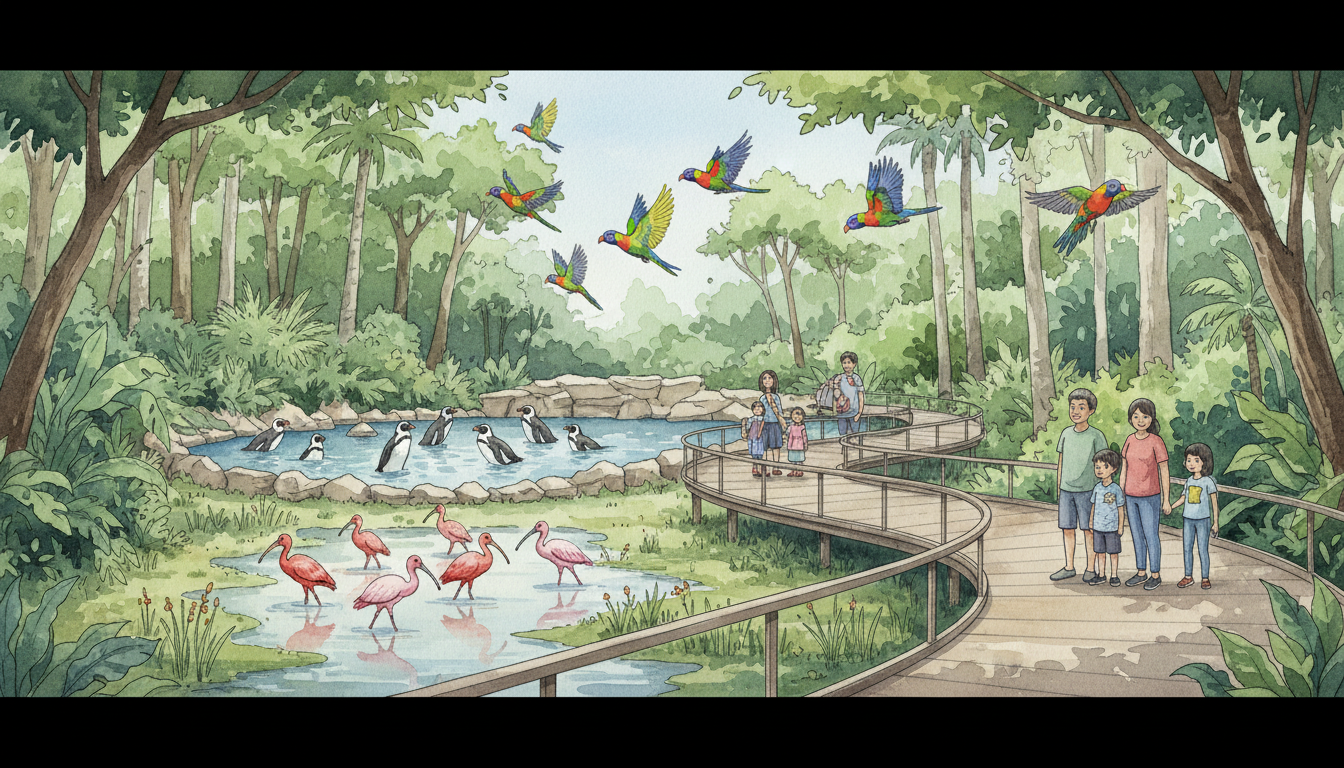
Bird Paradise companion reading in the Touring Singapore collection
This Bird Paradise guide is a standalone, additional 100-word companion, not another numbered Day 41. The main Top 100 Singapore Vocabulary Words | Day 41: Fort Canning Park, Battlebox and Singapore History is the numbered Day 41 installment. Use this companion for Mandai’s aviaries, bird biology, conservation and respectful wildlife visits, or return to the Touring Singapore Vocabulary master hub for the complete chronological directory.
Bird Paradise is Singapore’s modern 17-hectare bird park at 20 Mandai Lake Road, with more than 3,500 birds from over 400 species and eight large thematic walk-through aviaries. It began welcoming visitors on 8 May 2023 as the successor to Jurong Bird Park. The operator lists 9am–6pm daily, with last entry at 5pm. A complimentary in-park shuttle is included with admission. This guide presents 100 Bird Paradise Singapore vocabulary words, with meanings, natural sentences and cultural or scientific context.
Why is Bird Paradise important to Singapore culture? The new Mandai venue continues a bird-park tradition associated with generations of families, while adding carefully planned habitats and expanded animal-care facilities. Mandai’s 2023 announcement describes the move from Jurong and the new aviaries; its official visitor page records current park scale and hours. Bird Paradise helps people appreciate bird adaptation, world habitats, professional conservation and the work of keepers and veterinarians. An aviary is a managed environment, not a natural forest transplanted into Singapore, and animal visibility is never guaranteed.
Use the 100-word finder, the practical visitor facts, the 2023 move and history or the worked examples. Admission, showtimes, keeper-led feeding, animal welfare arrangements and maintenance closures can change. Check the official visitor guide before choosing a date.
Bird Paradise in one minute: what to know immediately
- Address: Bird Paradise, 20 Mandai Lake Road, Singapore 729825—not the same entrance or admission as Singapore Zoo or Night Safari.
- History: soft-opened on 8 May 2023 after the January 2023 closure of Jurong Bird Park.
- Current collection: the operator lists over 3,500 birds, over 400 species and eight large thematic walk-through aviaries across 17 hectares.
- Operating times: 9am–6pm daily; last entry at 5pm under ordinary conditions.
- Shuttle: a complimentary shuttle runs between entrance and Central Plaza. The operator currently lists final departures from its two stops at 5:30pm and 6pm.
- Wildlife themes: Crimson Wetlands, Heart of Africa, Wings of Asia, Lory Loft, Amazonian Jewels, Penguin Cove and other named areas offer distinct educational experiences.
- Shows: Wings of the World and Predators on Wings are presented according to the current schedule; unlike selected Night Safari and River Wonders shows, ordinary Bird Paradise presentations do not require separate seat booking.
- Visitor welfare rules: no flash, teasing, unauthorised feeding or removing feathers. Follow current staff instructions.
The difference between the old Jurong park and Bird Paradise
Jurong Bird Park closed in January 2023; the new Bird Paradise at Mandai opened to visitors on 8 May 2023. Mandai’s relocation account reports that many keepers, veterinarians, technicians and operational staff prepared birds for carefully sequenced transfers. The work included different diets, flight abilities, compatible bird groupings and health checks. The two places share a history, not the same address or original aviary layout.
A student reading a bird-park photograph should first identify whether it was taken at Jurong or Mandai. The opening year of the current attraction does not erase the older park’s many decades of work or prove an old photograph depicts the new facilities.
Bird adaptation: the living meaning behind a colourful exhibition
Look closely at a spoonbill, a hornbill and a penguin. The spoonbill searches shallow water using an unusual bill, the hornbill moves among trees with a large beak and the penguin uses modified wings to propel itself underwater. These differences turn a pleasant visit into a lesson about ecosystems and the many ways birds survive. A picture showing one pose does not establish the animal’s entire diet or wild range.
The named habitats model environments associated with different world regions. A tropical South American bird or African turaco is not native to Singapore merely because it is on display here. Read the geographic range and scientific name on a label when a factual distinction matters.
The included shuttle is not a private guided tour
The Mandai visitor guide describes an unlimited complimentary in-park shuttle between the entrance and Central Plaza, useful for guests with mobility needs or tired children. The ticket page separately lists admission products and optional add-ons. An in-park shuttle ride does not grant entry to Night Safari, a free taxi to an MRT station or exclusive access to a keeper-led tour.
The presentations FAQ explains that Bird Paradise’s ordinary animal presentations do not require booking seats through the separate presentation reservation portal. A dated show schedule still needs checking, because animal welfare, event operations and weather may lead to changes. A good plan lets guests enjoy a show without expecting identical animal performances on every visit.
Conservation is broader than a collection of rare birds
Bird Paradise and Mandai’s conservation programmes can support veterinary work, species recovery and public education. For example, the Socorro dove is a species classified as extinct in the wild. Such a label is precise and serious; it should not be applied to every dove or any bird that a visitor happens to find unfamiliar. Protecting threatened birds also requires safeguarding wild habitats and addressing threats such as illegal trade.
Animal care continues behind the scenes: managed diets, biosecurity, nest sites, veterinary checks, environmental enrichment and compatible species groups. A visually beautiful aviary is not proof that every welfare outcome is ideal; responsible evaluation needs documented practices and results. The visitor’s role is simpler: observe quietly, follow the rules and ask evidence-based questions.
Ten themes and the full vocabulary quick finder
- Part 1: The park’s identity and 2023 bird-park transition — words 1–10
- Part 2: Bird anatomy: observe features before making claims — words 11–20
- Part 3: Crimson Wetlands and the language of wetland birds — words 21–30
- Part 4: Heart of Africa and rainforest birds — words 31–40
- Part 5: Asian, Australian and Papuan bird habitats — words 41–50
- Part 6: Lory Loft, Amazonian Jewels and parrots — words 51–60
- Part 7: Penguin Cove and birds adapted for water — words 61–70
- Part 8: Bird conservation and professional animal care — words 71–80
- Part 9: Tickets, shuttle journeys and respectful viewing — words 81–90
- Part 10: Turning an outing into careful language and science — words 91–100
1–10: 1. Bird Paradise · 2. Jurong Bird Park · 3. 8 May 2023 opening · 4. 20 Mandai Lake Road · 5. Seventeen hectares · 6. Eight walk-through aviaries · 7. Avian species · 8. Three thousand five hundred birds · 9. Aviary · 10. Biome
11–20: 11. Beak · 12. Plumage · 13. Primary feather · 14. Tail feather · 15. Wing · 16. Talons · 17. Webbed feet · 18. Preening · 19. Moulting · 20. Flight adaptation
21–30: 21. Crimson Wetlands · 22. Scarlet ibis · 23. Roseate spoonbill · 24. Wading bird · 25. Wetland · 26. Flock · 27. Bill sweeping · 28. Shallow-water foraging · 29. Habitat vegetation · 30. Managed wetland
31–40: 31. Heart of Africa · 32. Great blue turaco · 33. Turaco · 34. Starling · 35. Weaverbird · 36. Forest canopy · 37. Understorey · 38. Multispecies aviary · 39. Seed dispersal · 40. Ecological niche
41–50: 41. Wings of Asia · 42. Paddy field · 43. Papuan hornbill · 44. Black-faced spoonbill · 45. Australian Outback · 46. Eucalypt woodland · 47. Mysterious Papua · 48. Cassowary · 49. Endemic species · 50. Native range
51–60: 51. Lory Loft · 52. Lory · 53. Rainbow lorikeet · 54. Nectar · 55. Brush-tipped tongue · 56. Amazonian Jewels · 57. Parrot · 58. Vocalisation · 59. Social flock · 60. Keeper-led feeding
61–70: 61. Penguin Cove · 62. Penguin · 63. Flipper · 64. Countershading · 65. Sub-Antarctic habitat · 66. Penguin colony · 67. Underwater viewing · 68. Diving adaptation · 69. Thermoregulation · 70. Life-support system
71–80: 71. Conservation breeding · 72. Threatened species · 73. IUCN Red List · 74. Extinct in the wild · 75. Avian veterinarian · 76. Avian healthcare · 77. Quarantine · 78. Biosecurity · 79. Habitat loss · 80. Illegal wildlife trade
81–90: 81. Park admission · 82. 9am opening · 83. 5pm last entry · 84. Complimentary shuttle · 85. Central Plaza · 86. Predators on Wings · 87. Wings of the World · 88. No-flash rule · 89. No-feeding rule · 90. Visitor accessibility
91–100: 91. Observation note · 92. Species comparison · 93. Behavioural inference · 94. Scientific name · 95. Geographic range · 96. Animal welfare · 97. Environmental enrichment · 98. Source attribution · 99. Wildlife ethics · 100. Conservation action
How to learn in five useful steps
Use observe → name → explain → verify → retrieve. Notice a bird’s feature or behaviour, give it the correct term, suggest how it may help the bird, check the claim against an exhibit sign or reliable source, then use the word in a new sentence without looking. This is more meaningful than memorising a list of attractions.
Children might choose ten words about feathers, beaks, feeding and quiet observation; secondary students can compare ecosystems, animal-care systems and conservation categories. Families can practise reading entry conditions and understanding optional feeding programmes. All are valid learning routes even if some animals remain out of sight.
Part 1 — The park’s identity and 2023 bird-park transition
First separate the new Mandai park from the older Jurong Bird Park. Historical dates, collection sizes and park admission describe different facts, not a promise that every bird will be visible.
1. Bird Paradise
Meaning: The current purpose-built bird park within Singapore’s Mandai Wildlife Reserve. Example: “We visited Bird Paradise at Mandai.” Singapore connection: The site continues Jurong’s bird-care legacy in a newly planned environment.
2. Jurong Bird Park
Meaning: The former Singapore bird park, which closed in January 2023. Example: “My grandparents remembered Jurong Bird Park.” Singapore connection: Its history explains why the later Mandai bird park mattered to families.
3. 8 May 2023 opening
Meaning: The day the new park first welcomed visitors during its soft opening. Example: “The first public opening was 8 May 2023.” Singapore connection: This is not the opening date of the former Jurong institution.
4. 20 Mandai Lake Road
Meaning: Bird Paradise’s published address in Singapore 729825. Example: “The map directed us to 20 Mandai Lake Road.” Singapore connection: It differs from the addresses of some nearby wildlife parks.
5. Seventeen hectares
Meaning: The approximate land area of Bird Paradise reported by its operator. Example: “The site occupies about seventeen hectares.” Singapore connection: A park’s area is not the wild roaming range of an individual species.
6. Eight walk-through aviaries
Meaning: The park’s eight large themed habitats designed for visitors to walk through. Example: “We explored two of the eight aviaries.” Singapore connection: An immersive aviary is still a managed space, not natural wilderness.
7. Avian species
Meaning: A biologically defined kind of bird. Example: “The park houses more than four hundred avian species.” Singapore connection: Counting species is different from counting individual birds.
8. Three thousand five hundred birds
Meaning: The approximate size of the park’s collection as published by the operator. Example: “The park lists more than 3,500 birds.” Singapore connection: An advertised rounded total can change as animals are transferred or hatched.
9. Aviary
Meaning: A designed enclosure in which birds are housed and cared for. Example: “We followed the permitted path through the aviary.” Singapore connection: Species welfare requires keepers, controlled conditions and suitable habitats.
10. Biome
Meaning: A broad ecological environment with characteristic climate and living communities. Example: “Each habitat draws inspiration from a different biome.” Singapore connection: A biomes exhibit models a world region inside tropical Singapore.
Part 1 practice: Choose three words, write a fresh sentence for each, and explain one distinction without reopening the glossary. Which statement was directly observed, and which would need another source?
Part 2 — Bird anatomy: observe features before making claims
These words convert a colourful sighting into scientific language. Children can notice beaks, wings and feet while older learners connect those features with feeding, protection and movement.
11. Beak
Meaning: A bird’s hard mouth structure used for feeding and other tasks. Example: “The hornbill used its beak to lift fruit.” Singapore connection: Different beak forms can relate to different feeding adaptations.
12. Plumage
Meaning: The entire covering of feathers on a bird. Example: “The ibis had vivid plumage.” Singapore connection: Feathers can help with flight, warmth, signalling and protection.
13. Primary feather
Meaning: A large feather toward the outer wing, involved in many birds’ flight. Example: “We compared the primary feathers on a diagram.” Singapore connection: Feather position matters when explaining flight control.
14. Tail feather
Meaning: A feather forming part of a bird’s tail. Example: “The bird spread its tail feathers as it landed.” Singapore connection: Tail shape can affect display, balance and flight.
15. Wing
Meaning: A modified forelimb used for flight in many bird species. Example: “The parrot unfolded one wing.” Singapore connection: Penguins also have wings, but theirs propel them underwater.
16. Talons
Meaning: Gripping claws that are especially developed in birds of prey. Example: “The raptor’s talons held the perch.” Singapore connection: The word describes real anatomy, not a synonym for every feather.
17. Webbed feet
Meaning: Feet with skin connecting some toes, often useful in water. Example: “We saw the penguin’s webbed feet.” Singapore connection: Foot shape is one adaptation to an animal’s lifestyle.
18. Preening
Meaning: The behaviour of cleaning and arranging feathers. Example: “The bird paused to preen its plumage.” Singapore connection: Feather maintenance is a normal activity, not a staged trick.
19. Moulting
Meaning: The process of replacing old feathers with new ones. Example: “A keeper explained the bird’s moulting period.” Singapore connection: Changing feathers alone does not prove an animal is unhealthy.
20. Flight adaptation
Meaning: A feature contributing to how a bird flies or controls movement. Example: “The lesson linked wing form with flight adaptation.” Singapore connection: Species differ in size, feather form and ability to fly.
Part 2 practice: Choose three words, write a fresh sentence for each, and explain one distinction without reopening the glossary. Which statement was directly observed, and which would need another source?
Part 3 — Crimson Wetlands and the language of wetland birds
Wetland birds bring beak shape, leg length and feeding behaviour into focus. The operator’s Crimson Wetlands is a constructed visitor habitat rather than an untouched natural swamp.
21. Crimson Wetlands
Meaning: A Bird Paradise habitat with brightly coloured waterbirds. Example: “We watched the wetland birds in Crimson Wetlands.” Singapore connection: Its design invites learning about shallow-water ecosystems.
22. Scarlet ibis
Meaning: A wading bird recognised for its reddish plumage. Example: “The scarlet ibis crossed a shallow pool.” Singapore connection: The species’ colour is distinctive but does not reveal its conservation category.
23. Roseate spoonbill
Meaning: A pinkish waterbird with an enlarged spoon-shaped bill. Example: “The roseate spoonbill swept its bill sideways.” Singapore connection: Its unusual feeding technique illustrates adaptation to watery habitats.
24. Wading bird
Meaning: A bird that moves and commonly feeds in shallow water. Example: “The wading bird stood on long legs.” Singapore connection: Waders use different methods of finding food in wetland habitats.
25. Wetland
Meaning: An ecosystem strongly shaped by water and its living communities. Example: “Our lesson explored wetland plants and birds.” Singapore connection: Natural wetlands beyond bird parks need protection from pollution and destruction.
26. Flock
Meaning: A group of birds moving or living near one another. Example: “A flock gathered on the opposite bank.” Singapore connection: Group behaviour varies between species and time of day.
27. Bill sweeping
Meaning: Moving the bill through water to search for food. Example: “The spoonbill used bill sweeping while foraging.” Singapore connection: Specific behaviour is better evidence than saying a bird was playing.
28. Shallow-water foraging
Meaning: Searching for food in water that is not deep. Example: “The ibis showed shallow-water foraging.” Singapore connection: Water depth and leg length influence feeding opportunities.
29. Habitat vegetation
Meaning: Plant life forming shelter, food or structure in an animal’s environment. Example: “The habitat vegetation surrounded the wetland.” Singapore connection: Plants perform ecological roles in both designed and natural settings.
30. Managed wetland
Meaning: A wetland-like area maintained deliberately for animals or visitors. Example: “This is a managed wetland within Bird Paradise.” Singapore connection: An exhibit should not be labelled a naturally occurring Singapore marsh.
Part 3 practice: Choose three words, write a fresh sentence for each, and explain one distinction without reopening the glossary. Which statement was directly observed, and which would need another source?
Part 4 — Heart of Africa and rainforest birds
Bird Paradise’s African forest-themed environment lets people observe the relationship between tree layers, group behaviour and animal care. The species are not necessarily native to Singapore.
31. Heart of Africa
Meaning: A large Bird Paradise themed habitat inspired by African forests. Example: “We explored Heart of Africa after lunch.” Singapore connection: Its diversity introduces tropical African birdlife within Mandai.
32. Great blue turaco
Meaning: A large colourful bird associated with African forest environments. Example: “The great blue turaco perched above us.” Singapore connection: A turaco is not a parrot merely because of bright feathers.
33. Turaco
Meaning: A member of a mainly African family of colourful forest birds. Example: “We learned the word turaco at the sign.” Singapore connection: Correct names help distinguish families with similar-looking plumage.
34. Starling
Meaning: A bird in a family that includes numerous social songbird species. Example: “Starlings moved among the branches.” Singapore connection: A family name covers many species with differing behaviour.
35. Weaverbird
Meaning: A bird type known in many species for woven nests. Example: “A weaverbird carried nesting material.” Singapore connection: Nest-making gives students a useful animal-behaviour example.
36. Forest canopy
Meaning: The higher leaf-and-branch layer of a forest. Example: “We watched the canopy for movement.” Singapore connection: Trees create vertical habitat layers used by different animals.
37. Understorey
Meaning: Vegetation growing below the main canopy. Example: “The understorey was darker than the canopy.” Singapore connection: Lower layers are ecologically important, not just decorative.
38. Multispecies aviary
Meaning: An aviary designed to hold more than one compatible bird species. Example: “The birds shared a multispecies aviary.” Singapore connection: Keepers must assess compatibility, feeding and animal welfare.
39. Seed dispersal
Meaning: Movement of seeds away from their parent plant, sometimes via animals. Example: “Some fruit-eating birds contribute to seed dispersal.” Singapore connection: Birds can support forest regeneration beyond simply being beautiful.
40. Ecological niche
Meaning: An organism’s role and requirements within an ecosystem. Example: “We compared two birds’ ecological niches.” Singapore connection: Different species sharing a place may use different food and space.
Part 4 practice: Choose three words, write a fresh sentence for each, and explain one distinction without reopening the glossary. Which statement was directly observed, and which would need another source?
Part 5 — Asian, Australian and Papuan bird habitats
The park uses geographically inspired environments for birds of multiple regions. Being on display in Singapore is not evidence a species originally comes from Singapore.
41. Wings of Asia
Meaning: A habitat representing selected Asian birds and landscapes. Example: “We visited Wings of Asia to see different waterbirds.” Singapore connection: Regional landscapes can connect agriculture with wildlife.
42. Paddy field
Meaning: Land used to grow rice, often with shallow managed water. Example: “The display included paddy-field imagery.” Singapore connection: Agricultural landscapes may also provide habitat for birds.
43. Papuan hornbill
Meaning: A hornbill found in New Guinea and surrounding regions. Example: “The Papuan hornbill moved between branches.” Singapore connection: Its geographic name should not be mistaken for local Singapore origin.
44. Black-faced spoonbill
Meaning: A threatened East Asian waterbird with a spoon-shaped bill. Example: “The sign identified a black-faced spoonbill.” Singapore connection: The species raises questions about protecting migration wetlands.
45. Australian Outback
Meaning: A park zone inspired by dry Australian environments. Example: “Australian Outback looked different from the forest habitat.” Singapore connection: Drier biomes support bird adaptations unlike those of moist forests.
46. Eucalypt woodland
Meaning: A woodland habitat where eucalypt trees are prominent. Example: “We read about eucalypt woodland ecology.” Singapore connection: A woodland is different from dense lowland rainforest.
47. Mysterious Papua
Meaning: A bird habitat themed around the Papua and New Guinea region. Example: “Mysterious Papua introduced unfamiliar species.” Singapore connection: The region has distinctive biodiversity outside Singapore.
48. Cassowary
Meaning: A large, strong-legged flightless bird from Australasia. Example: “The cassowary walked along the habitat.” Singapore connection: Flightlessness does not mean an animal is slow or safe to approach.
49. Endemic species
Meaning: A species naturally restricted to a defined region. Example: “The worksheet asked if the bird was endemic.” Singapore connection: The wild range must be checked, rather than inferred from the aviary.
50. Native range
Meaning: The area where a species naturally occurs. Example: “We marked the bird’s native range on a map.” Singapore connection: A managed collection gathers global species in one Singapore destination.
Part 5 practice: Choose three words, write a fresh sentence for each, and explain one distinction without reopening the glossary. Which statement was directly observed, and which would need another source?
Part 6 — Lory Loft, Amazonian Jewels and parrots
Some of the most memorable birds feed on nectar, call loudly or interact in flocks. These are normal biological behaviours and should not be encouraged through unauthorised feeding.
51. Lory Loft
Meaning: A Bird Paradise aviary associated with lories and lorikeets. Example: “We studied nectar-feeding birds at Lory Loft.” Singapore connection: The area helps explain parrot feeding adaptations.
52. Lory
Meaning: A kind of parrot often adapted for nectar feeding. Example: “The lory moved toward the flowering plant.” Singapore connection: Being a parrot does not mean every lory imitates words.
53. Rainbow lorikeet
Meaning: A colourful parrot associated with Australia. Example: “We identified a rainbow lorikeet by its colours.” Singapore connection: Colours alone can be misleading without a species label.
54. Nectar
Meaning: A sugary liquid produced by flowers and used by some animals. Example: “The lory drank nectar from a flowering plant.” Singapore connection: Feeding relationships can connect birds and plant reproduction.
55. Brush-tipped tongue
Meaning: A tongue structure that helps many lorikeets collect nectar. Example: “The keeper described a brush-tipped tongue.” Singapore connection: Some important animal adaptations are less visible than plumage.
56. Amazonian Jewels
Meaning: A Bird Paradise habitat inspired by colourful South American birds. Example: “Amazonian Jewels had small birds among dense plants.” Singapore connection: The display brings a South American theme to Singapore.
57. Parrot
Meaning: A bird belonging to a group often having strong curved beaks. Example: “The parrot manipulated food with its beak.” Singapore connection: Parrots have varied diets and cognition; no single habit fits all.
58. Vocalisation
Meaning: A sound produced by an animal for communication or another purpose. Example: “We heard bird vocalisations overhead.” Singapore connection: Animal calls carry meaning but are not necessarily human speech.
59. Social flock
Meaning: A group of birds interacting through shared behaviour. Example: “A social flock moved to another perch.” Singapore connection: Birds differ greatly in group organisation.
60. Keeper-led feeding
Meaning: A supervised animal feeding activity with the park’s permission. Example: “We considered the optional keeper-led feeding session.” Singapore connection: A paid or timed activity is not permission to offer personal food.
Part 6 practice: Choose three words, write a fresh sentence for each, and explain one distinction without reopening the glossary. Which statement was directly observed, and which would need another source?
Part 7 — Penguin Cove and birds adapted for water
Penguins provide a useful contrast with flying birds. Their habitat at Mandai requires managed water and temperature systems, even though the park is in tropical Singapore.
61. Penguin Cove
Meaning: Bird Paradise’s dedicated penguin habitat and associated visitor zone. Example: “We watched penguins at Penguin Cove.” Singapore connection: The area models a colder habitat rather than Singapore’s outdoor conditions.
62. Penguin
Meaning: A flightless seabird adapted to swimming and diving. Example: “The penguin swam rapidly underwater.” Singapore connection: It is a bird, not a fish or marine mammal.
63. Flipper
Meaning: A flattened limb used to move through water. Example: “The penguin used its flippers to swim.” Singapore connection: Its modified wings are suited to propulsion underwater.
64. Countershading
Meaning: A colour pattern with darker upper and lighter lower body surfaces. Example: “We observed the penguin’s countershading.” Singapore connection: Such a pattern can have a protective role in the wild.
65. Sub-Antarctic habitat
Meaning: An environment in southern high latitudes near the Antarctic region. Example: “Penguin Cove recreates aspects of a sub-Antarctic habitat.” Singapore connection: A controlled enclosure is not natural polar coastline.
66. Penguin colony
Meaning: A group of penguins living or breeding near one another. Example: “The penguin colony gathered by the pool.” Singapore connection: Species show differing social and reproductive behaviour.
67. Underwater viewing
Meaning: Watching aquatic movement through a window below the water surface. Example: “Underwater viewing revealed the birds’ swimming.” Singapore connection: Moving animals teach more about propulsion than a still image.
68. Diving adaptation
Meaning: A characteristic helping an animal travel or feed below water. Example: “The lesson highlighted a penguin diving adaptation.” Singapore connection: Specialisation for water helps explain why penguins do not fly.
69. Thermoregulation
Meaning: Biological processes that keep body temperature in a functional range. Example: “We discussed thermoregulation in seabirds.” Singapore connection: Temperature control is important for animals in tropical zoo settings.
70. Life-support system
Meaning: Equipment maintaining appropriate environmental conditions for animals. Example: “Penguin Cove relies on a managed life-support system.” Singapore connection: Engineers, animal carers and veterinarians support the visitor experience.
Part 7 practice: Choose three words, write a fresh sentence for each, and explain one distinction without reopening the glossary. Which statement was directly observed, and which would need another source?
Part 8 — Bird conservation and professional animal care
A bird park should not be evaluated merely by photographs. Conservation includes habitats in the wild, appropriate captive breeding and specialist veterinary care, all of which require specific evidence.
71. Conservation breeding
Meaning: Carefully managed reproduction contributing to a species’ future survival. Example: “The park reported conservation breeding work.” Singapore connection: A captive population does not by itself protect a wild habitat.
72. Threatened species
Meaning: A species at a documented level of extinction risk. Example: “The display described a threatened species.” Singapore connection: Different risk categories should not be collapsed into one label.
73. IUCN Red List
Meaning: An international source classifying species’ extinction risk. Example: “We checked the IUCN Red List entry.” Singapore connection: The assessment date and category matter when making conservation claims.
74. Extinct in the wild
Meaning: A status indicating a species survives outside its former wild populations, mainly through managed care. Example: “The Socorro dove is extinct in the wild.” Singapore connection: The term is precise and does not mean every dove species has vanished.
75. Avian veterinarian
Meaning: A veterinarian who specialises in bird health. Example: “An avian veterinarian assessed a bird’s condition.” Singapore connection: Specialist care supports a large diverse bird collection.
76. Avian healthcare
Meaning: Prevention, diagnosis and treatment of diseases or injuries in birds. Example: “The park developed avian healthcare facilities.” Singapore connection: Animal welfare involves professional work beyond public demonstrations.
77. Quarantine
Meaning: Temporary controlled separation to monitor health and manage disease risk. Example: “Newly transferred birds may undergo quarantine.” Singapore connection: The practice protects animals and collections from pathogens.
78. Biosecurity
Meaning: Measures intended to reduce biological and disease threats. Example: “Staff applied biosecurity rules during transfers.” Singapore connection: Human visitors also contribute by observing hygiene guidance.
79. Habitat loss
Meaning: Destruction or degradation of places wild species need. Example: “Habitat loss threatens some parrots and waders.” Singapore connection: An animal in an aviary still depends on conservation of wild populations.
80. Illegal wildlife trade
Meaning: Unlawful capture, movement or sale of wildlife or wildlife products. Example: “The lesson addressed illegal wildlife trade.” Singapore connection: Responsible consumer choices matter for threatened birds.
Part 8 practice: Choose three words, write a fresh sentence for each, and explain one distinction without reopening the glossary. Which statement was directly observed, and which would need another source?
Part 9 — Tickets, shuttle journeys and respectful viewing
The operator publishes different rules for park entry, internal transport and optional experiences. These visitor words are practical because they prevent both unnecessary costs and disruption to animals.
81. Park admission
Meaning: A ticket or valid entitlement allowing entry to a named attraction. Example: “Our Bird Paradise admission covered the chosen date.” Singapore connection: Other Mandai parks have their own admission terms.
82. 9am opening
Meaning: The operator’s normal daily starting time. Example: “We planned around the listed 9am opening.” Singapore connection: Shows and feeding activities may begin at different times.
83. 5pm last entry
Meaning: The latest normal time for entering before the 6pm closing. Example: “We arrived before the 5pm last entry.” Singapore connection: Entry cutoff differs from the park’s closing time.
84. Complimentary shuttle
Meaning: The in-park service linking the entrance and Central Plaza. Example: “We took the complimentary shuttle.” Singapore connection: It does not mean public transport to Mandai is free.
85. Central Plaza
Meaning: An important internal meeting and circulation point. Example: “We reunited near Central Plaza.” Singapore connection: A named location is clearer than simply meet somewhere in Bird Paradise.
86. Predators on Wings
Meaning: An operator presentation about raptors and aerial skills. Example: “We checked Predators on Wings in the official schedule.” Singapore connection: Programme timing and animal involvement can change.
87. Wings of the World
Meaning: A presentation featuring birds and their behaviour. Example: “The Wings of the World show interested the children.” Singapore connection: Shows are educational and need not run identically every day.
88. No-flash rule
Meaning: A prohibition against using camera flash around birds. Example: “We switched off flash before taking photos.” Singapore connection: Flash can startle animals and undermine respectful observation.
89. No-feeding rule
Meaning: A restriction on giving animals unapproved food. Example: “We followed the no-feeding rule on the paths.” Singapore connection: Only authorised activities allow supervised feeding.
90. Visitor accessibility
Meaning: Features and support enabling people with varied mobility or sensory needs to visit. Example: “We checked visitor accessibility in the park map.” Singapore connection: Shuttles, facilities and assisted routes should be verified for the actual family.
Part 9 practice: Choose three words, write a fresh sentence for each, and explain one distinction without reopening the glossary. Which statement was directly observed, and which would need another source?
Part 10 — Turning an outing into careful language and science
Vocabulary has value when it changes what a visitor can explain. These final terms show how to link personal observation with credible zoological information.
91. Observation note
Meaning: A written account of what someone actually saw or heard. Example: “My observation note described a bird preening.” Singapore connection: Direct observation should be separate from guesses about motivation.
92. Species comparison
Meaning: A study of similarities and differences between species. Example: “We made a species comparison of two bills.” Singapore connection: The technique builds comprehension and scientific classification.
93. Behavioural inference
Meaning: A tentative explanation of an animal’s action. Example: “My behavioural inference was that the bird was searching for food.” Singapore connection: An inference should be tested instead of announced as fact.
94. Scientific name
Meaning: The standardised formal species name used in biology. Example: “The label included a scientific name.” Singapore connection: It can reduce confusion between regional common names.
95. Geographic range
Meaning: The wild region in which a species occurs. Example: “We researched the bird’s geographic range.” Singapore connection: The location of a zoo exhibit does not redefine the species’ origins.
96. Animal welfare
Meaning: An animal’s physical and psychological wellbeing under its conditions. Example: “Our visit prioritised animal welfare.” Singapore connection: A close-up photograph is never more important than welfare.
97. Environmental enrichment
Meaning: Appropriate opportunities encouraging natural animal activity. Example: “Keepers described environmental enrichment.” Singapore connection: Enrichment is part of professional animal care, not solely amusement.
98. Source attribution
Meaning: A reference identifying where a fact or image came from. Example: “We added source attribution to the opening date.” Singapore connection: Crediting Mandai or a scientific record helps others verify information.
99. Wildlife ethics
Meaning: Principles about responsible conduct toward animals and habitats. Example: “We discussed wildlife ethics after the visit.” Singapore connection: Quiet viewing, no handling and no feeding matter beyond the park.
100. Conservation action
Meaning: An achievable activity contributing to wildlife protection. Example: “The class selected one conservation action to research.” Singapore connection: Meaningful action requires evidence about threats rather than slogans.
Part 10 practice: Choose three words, write a fresh sentence for each, and explain one distinction without reopening the glossary. Which statement was directly observed, and which would need another source?
Worked example: the address and ticket are different from Night Safari
Wrong plan: “Bird Paradise and Night Safari are both in Mandai, so the same ticket and exact street address will work for both.” The attractions operate separately. Bird Paradise’s official address is 20 Mandai Lake Road, while Night Safari is listed at 80 Mandai Lake Road. The wider reserve name does not establish shared admission.
Clear plan: “Our family is visiting Bird Paradise, so we will select Bird Paradise admission and follow the correct entrance information for 20 Mandai Lake Road. We will only buy other attraction tickets if we actually need them.”
Worked example: seeing an ibis does not make it native
Unsupported caption: “Scarlet ibises naturally live throughout Singapore because I saw them in a local bird park.” A bird in an aviary may originate from another part of the world. Its presence on display does not determine its wild geographic range.
Stronger caption: “The scarlet ibis at Bird Paradise shows vivid red plumage and wetland-related behaviour in a managed habitat. The species’ native distribution should be checked using a zoological source.”
Worked example: a free shuttle versus optional feeding
The park admission includes its internal shuttle, while named bird-feeding experiences are optional and can carry additional charges. “Complimentary shuttle” should therefore not be paraphrased as “all special experiences are free.” Read the ticket inclusions for the selected date, then check whether the activity is suitable for the participants.
A family conversation built around a real question
Child: “Why does that bird have a spoon-shaped bill?” Adult: “Let’s read its label and watch how it moves in the water.” Child: “It might use the bill to find food.” Adult: “That’s a sensible inference. Now let’s check the explanation.” Child: “Can I give it my snack?” Adult: “No, we only use authorised keeper-led feeding programmes.”
This imagined conversation illustrates careful science language and respectful behaviour. It is not a recorded interaction or a promise of seeing a particular bird on any chosen day.
Composition model: a new park with an older story
“My grandmother remembered taking my father to Jurong Bird Park. Now we stood inside the newer Bird Paradise at Mandai, following a shaded walkway beside a wetland display. A crimson-coloured bird moved slowly through the water while another disappeared into the foliage. My brother admired the colours; I wondered how the animal-care team had moved so many birds to a different home. We could not see every species, but we learnt the meaning of wading, preening and native range. The visit made the birds more interesting, not less, when they chose to remain out of sight.”
This is fictional creative writing rather than a specific sighting report. The passage makes room for both documented history and careful personal observation.
Ten quick checks and answers
- 1. Where is Bird Paradise? 20 Mandai Lake Road, Singapore 729825.
- 2. When did it first welcome visitors? 8 May 2023.
- 3. Which old park closed before it opened? Jurong Bird Park.
- 4. How many large walk-through aviaries are advertised? Eight.
- 5. What do the numbers 3,500 and 400 describe? Approximate birds and species, respectively.
- 6. Is a penguin a mammal? No, it is a flightless bird.
- 7. What is a wading bird? A bird adapted to moving or feeding in shallow water.
- 8. Does the regular admission include the in-park shuttle? Yes, subject to the operator’s terms.
- 9. Does an optional keeper-led feeding session permit all feeding? No; visitors follow only the approved activity.
- 10. Does an aviary bird’s location prove it occurs naturally in Singapore? No.
Frequently asked questions about Bird Paradise Singapore
1. Where is Bird Paradise?
Bird Paradise is at 20 Mandai Lake Road, Singapore 729825, within Mandai Wildlife Reserve.
2. Is Bird Paradise the former Jurong Bird Park?
It is the newer successor. Jurong Bird Park closed in January 2023 and many birds were transferred to purpose-built facilities at Mandai.
3. When did Bird Paradise open?
The new attraction soft-opened to the public on 8 May 2023.
4. What are the park’s operating hours?
The operator currently lists 9am to 6pm daily, with last entry at 5pm. Individual activities may follow other schedules.
5. How many birds are there?
The official Bird Paradise page describes more than 3,500 birds from over 400 avian species and eight large walk-through aviaries.
6. Is Bird Paradise’s shuttle included?
The internal shuttle between the entrance and Central Plaza is complimentary with admission and has operating-hour limits.
7. Are presentations included with admission?
Normal bird presentations are included according to the operator, but times and format may change with welfare or operational requirements.
8. Do presentations require advance seat booking?
The Mandai presentation FAQ says ordinary Bird Paradise presentations do not require the special seat booking used by selected other parks.
9. Can I feed the birds?
Only during authorised keeper-led activities. Do not bring personal food for wildlife or feed birds encountered on the path.
10. Is the penguin habitat naturally cold because Singapore is near Antarctica?
No. Penguin Cove is a specially managed habitat in a tropical city.
11. Can the family see every bird species in one outing?
No visibility guarantee exists, and a shorter focused visit can be educational without completing all areas.
12. What should students record after visiting?
A few precise observations, correctly identified species, one adaptation and a checkable conservation fact are enough for meaningful practice.
Sources for history, bird welfare and visitor conditions
- Mandai — Bird Paradise: current park numbers, opening times and aviaries.
- Mandai — 2023 Bird Paradise opening announcement: 8 May 2023 soft opening and move from Jurong.
- Mandai — Feathered Residents Take Flight: transfer planning, animal care and threatened species.
- Mandai — Bird Paradise Official Map: habitats, routes and park rules.
- Mandai — Bird Paradise Know Before You Go: shuttle, facilities and family guidance.
- Mandai — Bird Paradise Tickets: included shuttle and optional activities.
- Mandai — Animal Presentations FAQ: show seat-booking distinctions.
- Mandai — Wings of the World: bird presentation programme and schedule.
- Mandai — Primary School Learning Programmes: beak and feather education.
- IUCN Red List of Threatened Species: reliable conservation status for named species.
Continue the Singapore wildlife and vocabulary series
Return to the Top 100 Singapore Vocabulary Words | Touring and Visiting guide. For a general introduction to Mandai, read Day 5: Mandai Wildlife, or compare nocturnal viewing in Night Safari Vocabulary. The Vocabulary Learning Hub develops precise explanations and recall.
A good wildlife outing is not a bird-spotting competition
Bird Paradise connects a long-loved Singapore park history with new animal habitats and conservation education. The most useful lesson might come from just one bird: identify it correctly, describe one adaptation and ask how its wild home can be protected. Three carefully understood words often produce more lasting learning than a hundred rushed sightings.