
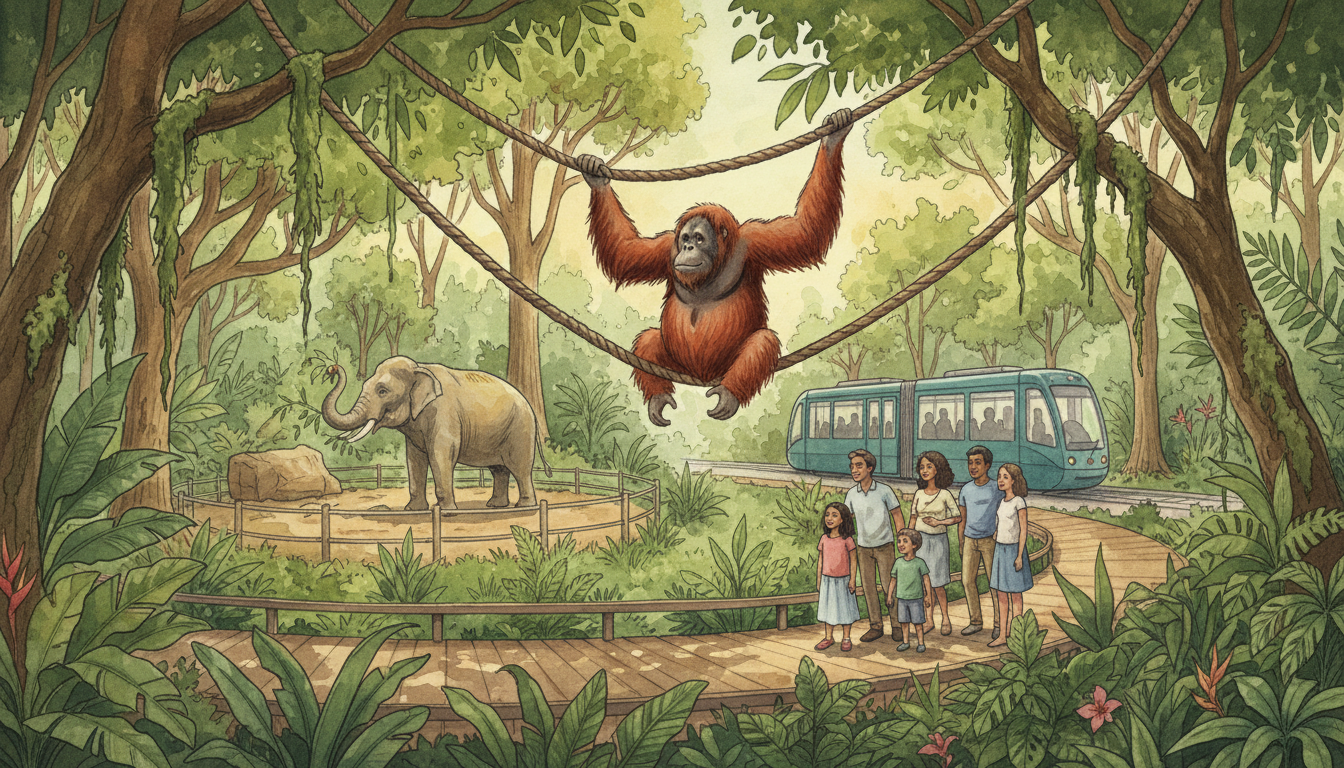
Singapore Zoo is the rainforest-themed wildlife park at 80 Mandai Lake Road, officially opened on 27 June 1973 and today housing more than 4,200 animals. It is known for open-concept managed habitats, orangutans, primate and rainforest zones and a complimentary in-park tram. Normal opening hours are 8:30am–6pm, with last admission at 5pm. This guide provides 100 Singapore Zoo vocabulary words, with easy meanings, natural sentences and why each belongs in the park’s cultural or scientific story.
Why is Singapore Zoo part of Singapore culture? Its beginnings followed a 1968 proposal for a new public zoological institution and its 1973 collection included 272 animals representing 72 species. The operator’s golden-jubilee history documents that public project, while its current visitor page describes the larger zoo of today. The park connects generations of Singaporean families to wildlife learning, veterinary care and conservation. Its open concept refers to naturalistic enclosures with suitable boundaries—it does not mean visitors can approach or feed wild animals freely.
Open the 100-word finder to locate a term, then use the historical facts or visitor information for a practical decision. A live animal park may change programmes or close specific exhibits; consult the operator’s 2026 notices rather than copying an old photograph’s claims about availability.
Singapore Zoo at a glance: essential dates and practical facts
- Address: 80 Mandai Lake Road, Singapore 729826; Singapore Zoo is a named paid attraction within the wider Mandai Wildlife Reserve.
- History: opened 27 June 1973 as Singapore Zoological Gardens, with 272 animals representing 72 species in its opening collection.
- Today: the operator advertises more than 4,200 animals across managed rainforest-inspired and themed habitats.
- Hours: 8:30am–6pm daily, with last entry at 5pm under normal conditions.
- Tram: the regular in-park zoo tram is complimentary and unlimited under eligible normal admission; separate private tours are not included.
- Zones: Fragile Forest, Orangutan Island, Wild Africa, Primate Kingdom, Reptile Kingdom, KidzWorld and others have their own habitats and programmes.
- Safety: children need supervision, visitors must follow barriers, and animals must not be fed or disturbed outside official keeper-led programmes.
- 2026 updates: the African penguin exhibit is listed as closed 31 August–30 November; Elephants of Asia has a separately announced 29 October interruption.
Ten themes to navigate the full 100-word list
- Part 1: Singapore Zoo’s roots and its current identity — words 1–10
- Part 2: Open-concept enclosures and the safety of animal habitats — words 11–20
- Part 3: Orangutans, primates and what great apes do — words 21–30
- Part 4: Wild Africa, Fragile Forest and other distinct zoo zones — words 31–40
- Part 5: Reptile Kingdom and the diversity of animal life — words 41–50
- Part 6: The keepers and professional work visitors seldom see — words 51–60
- Part 7: Zoo trams, wayfinding and comfort for families — words 61–70
- Part 8: Presentations, feeding and learning through play — words 71–80
- Part 9: Rainforest ecology, wildlife protection and real conservation — words 81–90
- Part 10: Current 2026 notices: admissions and specific closures — words 91–100
Quick finder: jump to any vocabulary definition
Words 1–10: 1. Singapore Zoo · 2. 1973 opening · 3. Singapore Zoological Gardens · 4. Ong Swee Law · 5. Goh Keng Swee · 6. Twenty-eight hectares · 7. Original 272 animals · 8. Original 72 species · 9. Over 4,200 animals · 10. 80 Mandai Lake Road
Words 11–20: 11. Open-concept zoo · 12. Landscaped moat · 13. Naturalistic habitat · 14. Habitat boundary · 15. Free-ranging orangutan · 16. Arboreal · 17. Climbing structure · 18. Habitat complexity · 19. Visitor viewpoint · 20. Animal management
Words 21–30: 21. Orangutan · 22. Orangutan Island · 23. Primate · 24. Great ape · 25. Primate Kingdom · 26. Brachiation · 27. Canopy route · 28. Tool use · 29. Fruit-rich diet · 30. Ape conservation
Words 31–40: 31. Fragile Forest · 32. Treetops Trail · 33. Wild Africa · 34. Giraffe · 35. Zebra · 36. White rhinoceros · 37. Great Rift Valley of Ethiopia · 38. Australasia · 39. KidzWorld · 40. Animal Land
Words 41–50: 41. Reptile Kingdom · 42. Tortoise Shell-ter · 43. Tortoise · 44. Carapace · 45. Crocodile · 46. Thermoregulation · 47. Ectotherm · 48. Amphibian · 49. Python · 50. Herpetology
Words 51–60: 51. Zookeeper · 52. Veterinary examination · 53. Nutrition plan · 54. Environmental enrichment · 55. Positive reinforcement · 56. Animal husbandry · 57. Keeper talk · 58. Species-specific care · 59. Behavioural monitoring · 60. Conservation breeding
Words 61–70: 61. Complimentary tram · 62. Tram station · 63. Tram commentary · 64. Accessibility map · 65. Sensory-friendly map · 66. Rest area · 67. Hydration point · 68. Rain shelter · 69. Supervised child · 70. Smoke-free park
Words 71–80: 71. Breakfast in the Wild · 72. Ah Meng Restaurant · 73. Splash Safari · 74. Into the Wild · 75. Ranger Buddies · 76. Ranger Buddies Quest · 77. Animal Friends · 78. Giraffe feeding · 79. Elephant presentation · 80. Backstage Pass
Words 81–90: 81. Rainforest canopy · 82. Understorey · 83. Food web · 84. Keystone species · 85. Pollination · 86. Habitat fragmentation · 87. Threatened species · 88. Endemic species · 89. Illegal wildlife trade · 90. Wild habitat protection
Words 91–100: 91. 8:30am opening · 92. 5pm last entry · 93. Park-specific admission · 94. WildPass · 95. Resident rate · 96. African penguin exhibit closure · 97. 29 October 2026 elephant closure · 98. Animal-welfare cancellation · 99. Live advisory · 100. Evidence-based itinerary
Part 1 — Singapore Zoo’s roots and its current identity
The opening year, original collection and present collection are different historical measures. This part explains the public institution behind the familiar animal photographs.
1. Singapore Zoo
Meaning: The long-established daytime zoo at Mandai, noted for rainforest-inspired naturalistic habitats. Example: “We visited Singapore Zoo on a family outing.” Why it matters in Singapore: It is an important local education and conservation attraction, not the same admission as Night Safari.
2. 1973 opening
Meaning: The zoo’s opening on 27 June 1973 under its earlier formal name. Example: “Our timeline began with the 1973 opening.” Why it matters in Singapore: The year places the institution within Singapore’s post-independence development.
3. Singapore Zoological Gardens
Meaning: The formal historical name used when the zoo first opened. Example: “Old documents called it Singapore Zoological Gardens.” Why it matters in Singapore: Names vary over decades; historical wording should be retained in historical captions.
4. Ong Swee Law
Meaning: The public official who helped initiate the project in 1968. Example: “The history of Singapore Zoo names Dr Ong Swee Law.” Why it matters in Singapore: Crediting named local leaders makes the public planning story more complete.
5. Goh Keng Swee
Meaning: The Singapore minister who officiated at the zoo’s opening. Example: “Goh Keng Swee attended the 1973 ceremony.” Why it matters in Singapore: An opening official is different from the park’s daily animal-care staff.
6. Twenty-eight hectares
Meaning: The approximate original area listed in the zoo’s 1973 history. Example: “The zoo’s original site was about 28 hectares.” Why it matters in Singapore: Land area differs from the roaming needs of individual animals in the wild.
7. Original 272 animals
Meaning: The number of individual animals in the opening collection. Example: “The 1973 zoo began with 272 animals.” Why it matters in Singapore: Historic figures should not be reported as the current animal population.
8. Original 72 species
Meaning: The number of distinct species in the zoo’s 1973 collection. Example: “The first zoo collection represented 72 species.” Why it matters in Singapore: Species count and individual headcount measure different aspects of biodiversity.
9. Over 4,200 animals
Meaning: The rounded current total advertised on Mandai’s Singapore Zoo page. Example: “Today’s park lists more than 4,200 animals.” Why it matters in Singapore: Collection figures change; admission cannot guarantee seeing every animal on a short visit.
10. 80 Mandai Lake Road
Meaning: The zoo’s official address in Singapore 729826. Example: “We searched for 80 Mandai Lake Road in the map.” Why it matters in Singapore: An exact location prevents confusion with Bird Paradise’s separate entrance.
Recall check, Part 1: Close the guide and choose three of these ten terms to explain. Give one factual example, one possible misconception and a source that could confirm the point. A clear distinction matters more than a long list.
Part 2 — Open-concept enclosures and the safety of animal habitats
A natural-looking exhibit is still a managed space with necessary barriers and monitoring. Visitors learn more by naming the actual features than by describing animals as freely roaming across Singapore.
11. Open-concept zoo
Meaning: A design approach using naturalistic landscapes and unobtrusive separation where appropriate. Example: “The open-concept zoo felt different from rows of cages.” Why it matters in Singapore: It still requires animal management and safety barriers; open does not mean unrestricted.
12. Landscaped moat
Meaning: A ditch or water barrier integrated into an exhibit’s surroundings. Example: “The landscaped moat separated us from the animals.” Why it matters in Singapore: Naturalistic barriers protect people and wildlife even when they are less visually prominent.
13. Naturalistic habitat
Meaning: An enclosure built to resemble selected features of a species’ wild environment. Example: “We observed the naturalistic habitat’s rocks and plants.” Why it matters in Singapore: A convincing habitat is managed, not a fragment of untouched wilderness.
14. Habitat boundary
Meaning: A physical or operational separation between public and animal areas. Example: “Our group stayed outside the habitat boundary.” Why it matters in Singapore: Ignoring boundaries for a photograph can endanger animals and visitors.
15. Free-ranging orangutan
Meaning: An orangutan using designated overhead or open habitats within a managed zoo. Example: “We searched for free-ranging orangutans above the walkway.” Why it matters in Singapore: The animals do not have unrestricted access to the city.
16. Arboreal
Meaning: Living or moving mainly in trees or tree-like structures. Example: “Orangutans are strongly arboreal animals.” Why it matters in Singapore: The term helps explain why habitat height and climbing opportunities matter.
17. Climbing structure
Meaning: A branch, rope or engineered feature enabling animals to move vertically. Example: “A climbing structure connected two platforms.” Why it matters in Singapore: Appropriate structures can support activity and choices for arboreal species.
18. Habitat complexity
Meaning: The variety of spaces, conditions and behavioural opportunities in an enclosure. Example: “Keepers considered habitat complexity when planning enrichment.” Why it matters in Singapore: Animal wellbeing cannot be judged only from a wide scenic photograph.
19. Visitor viewpoint
Meaning: A designated place from which guests may safely watch an exhibit. Example: “We stood quietly at the visitor viewpoint.” Why it matters in Singapore: A clear line of sight does not authorise crossing protective boundaries.
20. Animal management
Meaning: Professional coordination of welfare, food, health and the habitat environment. Example: “Animal management requires specialists and daily routines.” Why it matters in Singapore: The visitor experience depends on largely unseen human work.
Recall check, Part 2: Close the guide and choose three of these ten terms to explain. Give one factual example, one possible misconception and a source that could confirm the point. A clear distinction matters more than a long list.
Part 3 — Orangutans, primates and what great apes do
A precise biological term can correct a common misconception. Orangutans are great apes, not monkeys, although both are members of the primate order.
21. Orangutan
Meaning: A great ape naturally associated with forest habitats on Borneo and Sumatra. Example: “We watched an orangutan in an elevated area.” Why it matters in Singapore: Wild populations remain threatened by changes to their forest homes.
22. Orangutan Island
Meaning: A zoo habitat associated with the managed orangutan collection. Example: “We followed signs toward Orangutan Island.” Why it matters in Singapore: A branded island exhibit has welfare and safety boundaries.
23. Primate
Meaning: A member of the mammal order containing apes, monkeys and humans. Example: “Our worksheet compared three types of primate.” Why it matters in Singapore: Taxonomic terms group species by relationships, not only appearances.
24. Great ape
Meaning: A large tailless primate group including orangutans and chimpanzees. Example: “The orangutan is a great ape.” Why it matters in Singapore: This term avoids confusing orangutans with monkey species.
25. Primate Kingdom
Meaning: A Singapore Zoo zone housing a variety of primate species. Example: “We explored Primate Kingdom after lunch.” Why it matters in Singapore: The area invites comparisons of social behaviour and movement.
26. Brachiation
Meaning: Locomotion involving swinging between supports with the arms. Example: “The guide used brachiation to describe swinging movement.” Why it matters in Singapore: The term connects anatomy with a species’ use of tree space.
27. Canopy route
Meaning: A connected path among overhead branches or structures. Example: “A canopy route let the orangutan cross above us.” Why it matters in Singapore: Vertical routes are part of suitable animal habitat design.
28. Tool use
Meaning: Using an external object to perform a task or reach a goal. Example: “The teacher discussed tool use among apes.” Why it matters in Singapore: Claims of intelligence should rely on recorded behaviour, not invented intentions.
29. Fruit-rich diet
Meaning: A feeding pattern in which fruits form a substantial dietary component. Example: “We discussed how fruit features in an orangutan’s diet.” Why it matters in Singapore: Keepers design diets; guests must never replace them with snacks.
30. Ape conservation
Meaning: Efforts to protect wild apes and their natural habitats. Example: “Our class researched ape conservation after visiting.” Why it matters in Singapore: Captive animals do not remove the need to protect forest populations.
Recall check, Part 3: Close the guide and choose three of these ten terms to explain. Give one factual example, one possible misconception and a source that could confirm the point. A clear distinction matters more than a long list.
Part 4 — Wild Africa, Fragile Forest and other distinct zoo zones
The park combines exhibits inspired by different world regions. Seeing an animal in Singapore does not make its species native to Singapore.
31. Fragile Forest
Meaning: A biodome exhibit designed to introduce tropical forest biodiversity. Example: “We visited Fragile Forest to observe smaller wildlife.” Why it matters in Singapore: Its walk-through environment still operates under managed conditions.
32. Treetops Trail
Meaning: A Singapore Zoo route exploring higher forest layers and related wildlife. Example: “Treetops Trail helped us study vertical habitats.” Why it matters in Singapore: Forest life extends beyond ground-level paths and large mammals.
33. Wild Africa
Meaning: A thematic zone displaying animals associated with African landscapes. Example: “Wild Africa introduced us to giraffes and zebras.” Why it matters in Singapore: An Africa-themed area is a managed representation, not actual African savannah.
34. Giraffe
Meaning: A tall African hoofed mammal with an elongated neck. Example: “The giraffe reached for leaves on a feeding structure.” Why it matters in Singapore: Feeding behaviour is interesting, but direct feeding is limited to authorised sessions.
35. Zebra
Meaning: A striped hoofed mammal native to parts of Africa. Example: “Zebras stood together near the habitat edge.” Why it matters in Singapore: Stripe patterns and herd behaviour are useful scientific observations.
36. White rhinoceros
Meaning: A large African rhinoceros species with broad lips. Example: “We read the white rhinoceros information board.” Why it matters in Singapore: A species can be endangered even when its body is very large.
37. Great Rift Valley of Ethiopia
Meaning: A themed zoo area inspired by Ethiopia’s environment and culture. Example: “The map marked Great Rift Valley of Ethiopia.” Why it matters in Singapore: The exhibit represents another region rather than a naturally occurring Singapore landscape.
38. Australasia
Meaning: A zone introducing animals from Australia and neighbouring regions. Example: “We compared Australasia with the Wild Africa exhibit.” Why it matters in Singapore: Two different biomes can call for contrasting animal adaptations.
39. KidzWorld
Meaning: A family-friendly area combining play with wildlife education. Example: “Our younger child was interested in KidzWorld.” Why it matters in Singapore: Activities still have supervision and age-appropriate requirements.
40. Animal Land
Meaning: A KidzWorld setting for guided interactions with selected smaller animals. Example: “We checked Animal Land’s programme before joining.” Why it matters in Singapore: Not all animals may be handled or fed without staff permission.
Recall check, Part 4: Close the guide and choose three of these ten terms to explain. Give one factual example, one possible misconception and a source that could confirm the point. A clear distinction matters more than a long list.
Part 5 — Reptile Kingdom and the diversity of animal life
A zoological visit is not only about furry mammals. Reptiles, amphibians and specialised habitats provide a rich comparison with more familiar animals.
41. Reptile Kingdom
Meaning: A Singapore Zoo zone devoted to reptiles and their diversity. Example: “Reptile Kingdom was part of our route.” Why it matters in Singapore: It presents biological groups that are often misunderstood by first-time visitors.
42. Tortoise Shell-ter
Meaning: A named zoo exhibit focusing on tortoises and conservation. Example: “We explored Tortoise Shell-ter after the snake area.” Why it matters in Singapore: Its creative name accompanies serious learning about threatened reptiles.
43. Tortoise
Meaning: A mainly terrestrial shelled reptile with a protective body structure. Example: “The tortoise moved slowly beside a shelter.” Why it matters in Singapore: Its shell is part of its body, not a detachable carrying case.
44. Carapace
Meaning: The upper part of a tortoise or turtle shell. Example: “The guide showed us the carapace.” Why it matters in Singapore: An exact anatomical term improves animal descriptions.
45. Crocodile
Meaning: A large predatory reptile adapted to spending time in water and on land. Example: “A crocodile rested beside the pool.” Why it matters in Singapore: Resting does not make an animal safe to approach.
46. Thermoregulation
Meaning: Keeping body temperature within functional limits. Example: “We noticed reptile thermoregulation near a warm area.” Why it matters in Singapore: Temperature needs help explain reptile behaviour.
47. Ectotherm
Meaning: An animal relying significantly on external heat to regulate body temperature. Example: “A lizard is an ectotherm.” Why it matters in Singapore: The term is more accurate than imagining its blood is always cold.
48. Amphibian
Meaning: An animal group including frogs, toads and salamanders. Example: “We compared an amphibian with a reptile.” Why it matters in Singapore: Skin structure and life cycle can distinguish these groups.
49. Python
Meaning: A type of large non-venomous constricting snake. Example: “The label identified a python.” Why it matters in Singapore: Not every snake is venomous, and classification should come from labels.
50. Herpetology
Meaning: The scientific study of reptiles and amphibians. Example: “The class learnt the word herpetology.” Why it matters in Singapore: Specialist fields help readers find reliable biological sources.
Recall check, Part 5: Close the guide and choose three of these ten terms to explain. Give one factual example, one possible misconception and a source that could confirm the point. A clear distinction matters more than a long list.
Part 6 — The keepers and professional work visitors seldom see
The people who care for animals are central to any responsible account of Singapore Zoo. Feeding, veterinary work and enrichment require skill and time.
51. Zookeeper
Meaning: A trained professional involved in daily animal care. Example: “A zookeeper explained the animal’s routine.” Why it matters in Singapore: A zoo is a workplace, not simply a set of visitor displays.
52. Veterinary examination
Meaning: A health check conducted by a qualified animal medical professional. Example: “The animal received a veterinary examination.” Why it matters in Singapore: Medical needs may affect whether a species is available to visitors.
53. Nutrition plan
Meaning: A structured diet suitable for an animal’s health and species requirements. Example: “The keeper followed a nutrition plan.” Why it matters in Singapore: A visitor’s snack is not a valid replacement for prescribed food.
54. Environmental enrichment
Meaning: Opportunities supporting natural behaviours and stimulation. Example: “The zoo used environmental enrichment during feeding.” Why it matters in Singapore: Enrichment serves animal wellbeing, not only public amusement.
55. Positive reinforcement
Meaning: A training method that rewards a desirable behaviour. Example: “The keeper used positive reinforcement for cooperation.” Why it matters in Singapore: Humane training can assist medical checks and husbandry.
56. Animal husbandry
Meaning: The daily work involved in managing animals’ feeding, habitat and health. Example: “Animal husbandry continued after the park closed.” Why it matters in Singapore: The most important care often happens out of public sight.
57. Keeper talk
Meaning: A learning session in which animal-care staff explain a species. Example: “We listened to a keeper talk near the exhibit.” Why it matters in Singapore: Professional explanation helps connect observations to biological facts.
58. Species-specific care
Meaning: Management adjusted to the biology of each animal species. Example: “Species-specific care differed between reptiles and apes.” Why it matters in Singapore: One general method cannot provide suitable welfare for all animals.
59. Behavioural monitoring
Meaning: Systematic observation of behaviour to help assess welfare and changes. Example: “Staff used behavioural monitoring during care.” Why it matters in Singapore: A short tourist photograph cannot reveal long-term welfare conditions.
60. Conservation breeding
Meaning: Managed reproduction undertaken with conservation objectives. Example: “We researched conservation breeding at the zoo.” Why it matters in Singapore: The continued protection of wild habitats remains essential.
Recall check, Part 6: Close the guide and choose three of these ten terms to explain. Give one factual example, one possible misconception and a source that could confirm the point. A clear distinction matters more than a long list.
Part 7 — Zoo trams, wayfinding and comfort for families
A large outdoor zoo needs practical rest and navigation choices. Its included tram is not a private tour or transport between separate Mandai attractions.
61. Complimentary tram
Meaning: The in-park tram service included with eligible Singapore Zoo admission. Example: “We took the complimentary tram after lunch.” Why it matters in Singapore: Ordinary tram rides are not the same as privately guided buggies.
62. Tram station
Meaning: A designated place where visitors board or leave a tram. Example: “We met beside Tram Station 2.” Why it matters in Singapore: A numbered boarding point is a clearer meeting place than saying somewhere in the zoo.
63. Tram commentary
Meaning: Explanations about wildlife and zoo habitats during the ride. Example: “Tram commentary helped us identify animal zones.” Why it matters in Singapore: Passengers can learn without needing to walk continuously.
64. Accessibility map
Meaning: A map identifying suitable routes and facilities for different access needs. Example: “We checked the accessibility map before starting.” Why it matters in Singapore: Route choice can matter more than the shortest distance.
65. Sensory-friendly map
Meaning: A guide supporting visitors with specific sensory sensitivities. Example: “We used the sensory-friendly map to plan rests.” Why it matters in Singapore: Crowds, noise and heat affect visitors differently.
66. Rest area
Meaning: A place to sit or pause safely without blocking pathways. Example: “We stopped at a rest area near the habitat.” Why it matters in Singapore: A shorter relaxed outing is still a valid educational visit.
67. Hydration point
Meaning: A facility where drinking water can be obtained or refilled. Example: “Our family used a hydration point.” Why it matters in Singapore: Singapore’s tropical heat makes sensible breaks and hydration important.
68. Rain shelter
Meaning: A covered location used to wait during unsuitable weather. Example: “We sought rain shelter when a downpour began.” Why it matters in Singapore: A zoo can remain open even while an outdoor plan needs adjustment.
69. Supervised child
Meaning: A child monitored by an accompanying responsible adult. Example: “The supervised child stayed behind the safety line.” Why it matters in Singapore: Families need to pay attention near animals, barriers and vehicles.
70. Smoke-free park
Meaning: An attraction where smoking is prohibited except any stated designated external area. Example: “Singapore Zoo operates as a smoke-free park.” Why it matters in Singapore: Shared visitor spaces have rules that protect health and comfort.
Recall check, Part 7: Close the guide and choose three of these ten terms to explain. Give one factual example, one possible misconception and a source that could confirm the point. A clear distinction matters more than a long list.
Part 8 — Presentations, feeding and learning through play
Attraction names can sound like normal entry entitlements, but tours, special breakfast and supervised feeding have separate operational terms.
71. Breakfast in the Wild
Meaning: An optional morning dining experience associated with animal ambassadors. Example: “We considered Breakfast in the Wild for our family.” Why it matters in Singapore: A premium dining event is not included in every standard zoo ticket.
72. Ah Meng Restaurant
Meaning: A named zoo dining location associated with orangutan heritage. Example: “We found Ah Meng Restaurant on the map.” Why it matters in Singapore: The restaurant name reflects a famous zoo orangutan connection.
73. Splash Safari
Meaning: A zoo animal presentation at the Shaw Amphitheatre. Example: “We checked the Splash Safari schedule.” Why it matters in Singapore: A listed performance can change due to animal health or operations.
74. Into the Wild
Meaning: A Singapore Zoo presentation about animal abilities and behaviour. Example: “We planned around Into the Wild.” Why it matters in Singapore: The current show should be confirmed before promising exact times.
75. Ranger Buddies
Meaning: Mandai’s family-oriented animal and conservation learning concept. Example: “Our child enjoyed a Ranger Buddies activity.” Why it matters in Singapore: Play can strengthen curiosity, but should retain accurate wildlife facts.
76. Ranger Buddies Quest
Meaning: An interactive learning activity associated with KidzWorld. Example: “We joined a Ranger Buddies Quest.” Why it matters in Singapore: Children can learn through guided challenges without entering animal areas.
77. Animal Friends
Meaning: A family-focused presentation involving selected animal ambassadors. Example: “We checked the Animal Friends notice before leaving home.” Why it matters in Singapore: Animal-show schedules and cancellations are date-specific.
78. Giraffe feeding
Meaning: A designated supervised programme allowing guests to offer suitable food to giraffes. Example: “We read the giraffe-feeding terms before booking.” Why it matters in Singapore: Unauthorised food given through a fence could harm wildlife.
79. Elephant presentation
Meaning: A keeper-led programme focused on elephants and their behaviour. Example: “The elephant presentation was part of the schedule.” Why it matters in Singapore: A named session can be suspended for welfare or refurbishment.
80. Backstage Pass
Meaning: A separately sold tour offering specific behind-the-scenes learning. Example: “We looked at the Backstage Pass options.” Why it matters in Singapore: Premium tours have rules and prices beyond ordinary admission.
Recall check, Part 8: Close the guide and choose three of these ten terms to explain. Give one factual example, one possible misconception and a source that could confirm the point. A clear distinction matters more than a long list.
Part 9 — Rainforest ecology, wildlife protection and real conservation
A zoo can introduce real ecological questions, but captive habitats do not substitute for wild forests. These terms help students express why conservation is broader than exhibiting rare animals.
81. Rainforest canopy
Meaning: The uppermost tree-crown layer of a rainforest. Example: “The canopy provided shelter for forest animals.” Why it matters in Singapore: Vertical structure creates several different niches.
82. Understorey
Meaning: Vegetation below the canopy layer. Example: “We examined the understorey on the rainforest trail.” Why it matters in Singapore: Shaded plant layers support distinct animals and food sources.
83. Food web
Meaning: A network of feeding relationships among multiple organisms. Example: “The class drew a rainforest food web.” Why it matters in Singapore: Ecological systems are more complex than one straight food chain.
84. Keystone species
Meaning: A species with unusually important influence on its ecosystem relative to its abundance. Example: “The lesson discussed keystone species.” Why it matters in Singapore: Its status must be supported by evidence, not by popularity.
85. Pollination
Meaning: Transfer of pollen enabling sexual reproduction in flowering plants. Example: “Some rainforest animals support pollination.” Why it matters in Singapore: Wildlife affects plants and forest renewal in different ways.
86. Habitat fragmentation
Meaning: Breaking larger continuous habitats into smaller separated areas. Example: “Habitat fragmentation can threaten animal movements.” Why it matters in Singapore: Protecting connectivity is important beyond a zoo’s boundaries.
87. Threatened species
Meaning: A species assessed as having elevated risk of extinction. Example: “The exhibit label identified a threatened species.” Why it matters in Singapore: Categories and dates should be checked in a recognised assessment.
88. Endemic species
Meaning: A species naturally occurring only in a defined geographic area. Example: “We checked whether the animal was endemic.” Why it matters in Singapore: Being exhibited in Singapore does not make an animal native to Singapore.
89. Illegal wildlife trade
Meaning: Unlawful capture, transport or commercial sale of wild animals. Example: “The lesson discussed illegal wildlife trade.” Why it matters in Singapore: Buying protected wildlife products can harm wild populations.
90. Wild habitat protection
Meaning: Efforts to preserve or restore places needed by wild species. Example: “Our final worksheet focused on wild habitat protection.” Why it matters in Singapore: Captive breeding alone cannot preserve functioning ecosystems.
Recall check, Part 9: Close the guide and choose three of these ten terms to explain. Give one factual example, one possible misconception and a source that could confirm the point. A clear distinction matters more than a long list.
Part 10 — Current 2026 notices: admissions and specific closures
The zoo’s general daily opening hours do not confirm every programme is operating. The October 2026 situation includes two specific animal-area notices that should not be exaggerated into whole-park closure.
91. 8:30am opening
Meaning: The Singapore Zoo operator’s normal morning opening time. Example: “We arrived shortly after the 8:30am opening.” Why it matters in Singapore: It differs from the Night Safari evening timetable.
92. 5pm last entry
Meaning: The zoo’s standard entry cutoff before closing at 6pm. Example: “We checked the 5pm last entry.” Why it matters in Singapore: Last admission is not the same as the closing time.
93. Park-specific admission
Meaning: A ticket valid for one stated wildlife attraction. Example: “Our park-specific admission was for Singapore Zoo.” Why it matters in Singapore: Bird Paradise and Night Safari have separate tickets.
94. WildPass
Meaning: Mandai’s free membership programme for eligible local resident benefits. Example: “We checked WildPass rates for our visit.” Why it matters in Singapore: A discount programme is not automatic free admission to every park.
95. Resident rate
Meaning: A fare category tied to the visitor’s eligibility under current rules. Example: “We compared the resident rate with other options.” Why it matters in Singapore: Rates can change and should be checked by date.
96. African penguin exhibit closure
Meaning: The temporary closure published for upgrading between August and November 2026. Example: “We noted the African penguin exhibit closure.” Why it matters in Singapore: The zoo remains open; the notice concerns a particular exhibit.
97. 29 October 2026 elephant closure
Meaning: The operator’s announced one-day interruption of Elephants of Asia exhibits and sessions. Example: “We avoided the 29 October elephant closure when planning.” Why it matters in Singapore: A dated show interruption should not become a permanent claim.
98. Animal-welfare cancellation
Meaning: A change or cancellation made for animal wellbeing. Example: “The presentation changed after an animal-welfare cancellation.” Why it matters in Singapore: An animal does not owe visitors a performance on demand.
99. Live advisory
Meaning: A current notice reporting changes to visitor operations. Example: “We read the live advisory before setting off.” Why it matters in Singapore: Old travel writing cannot confirm real-time exhibit availability.
100. Evidence-based itinerary
Meaning: A visit plan using checkable, dated sources for route and ticket claims. Example: “We wrote an evidence-based itinerary for the class.” Why it matters in Singapore: Precise source checking protects readers from overpromises.
Recall check, Part 10: Close the guide and choose three of these ten terms to explain. Give one factual example, one possible misconception and a source that could confirm the point. A clear distinction matters more than a long list.
Why 1973 still matters to a zoo visited in 2026
According to the Mandai Golden Jubilee history, Dr Ong Swee Law initiated exploration of a zoo project in 1968, and Singapore Zoological Gardens officially opened on 27 June 1973. The park began with 272 animals belonging to 72 species and a site of approximately 28 hectares. These numbers help young readers see growth over time; they should not be substituted for the current operator’s larger collection total. The zoo was a post-independence project shaped by public planning, education and recreation ambitions, alongside the construction and operating work of many different people.
The zoo’s older pictures also need accurate captions. A 1973 photograph cannot show a later KidzWorld activity, a modern digital map or a facility opened decades later. When a learner compares eras, separate the founding year, expansion year, animal-collection counts and the date a particular image was made. That is an accessible way to practise reliable historical vocabulary.
What open concept actually means for wildlife and visitors
The official Animals and Zones directory explains that Singapore Zoo uses naturalistic habitat design across rainforest and region-inspired environments. Open concept does not imply the absence of boundaries, medical care or management. A landscaped moat, barrier or connected overhead habitat can look more like a forest than a metal enclosure while still serving an essential safety function. Visitors should never cross a planted boundary because a nearby animal appears calm or approachable.
Free-ranging orangutans in a managed zoological setting are a useful example. They can use designated spaces and overhead pathways designed to support arboreal behaviour, but they do not roam unrestricted across Mandai or into city neighbourhoods. The correct phrase for the operator’s exhibit is not “wild orangutans wandering through Singapore”. Understanding this distinction helps children connect visual impressions with scientific and operational facts.
Orangutan, monkey and great ape: a precise comparison
Orangutans are primates and great apes, but not monkeys. Their long arms, grasping hands, tree movement and complex feeding behaviour make them valuable subjects for observation, and their wild forest habitats lie outside Singapore. A visitor can notice an individual holding a branch; the broader conclusion about a species’ behaviour should be supported by zoological information. Avoid inventing what an animal feels based on a facial expression or a short video.
A useful vocabulary progression is primate → great ape → orangutan → arboreal movement → habitat requirements. Each step adds useful precision. Students can then ask why forest fragmentation and loss of connected tree cover affect wild orangutans, instead of treating the zoo enclosure as proof that global threats have disappeared.
The included tram and the paid experiences must remain distinct
The Know Before You Go guide describes Singapore Zoo’s regular tram as complimentary and unlimited with eligible park admission. It has multiple boarding stops and selected vehicles with wheelchair arrangements; visitors with specific mobility needs should confirm boarding with staff. The official tram page normally lists daytime services, which do not mean all Mandai attractions share the same tram or can be entered on one ticket.
The admission page also distinguishes normal entry from guided tours, special breakfasts and optional feeding experiences. When a family reads an advertisement for a giraffe feeding, a zoo adventure buggy or Breakfast in the Wild, it should ask: Is this included, does it require a separate reservation, is it suitable for our group, and can animal-care needs alter the experience? These are ordinary consumer-reading skills, not extra work for expert travellers only.
Two dated 2026 notices readers should check carefully
The operator’s current Singapore Zoo alerts state that the African penguin exhibit is closed for upgrading from 31 August through 30 November 2026. They also list a 29 October 2026 closure for the Elephants of Asia exhibit, with affected elephant presentation and feeding sessions. The correct description names exactly which exhibit and which date, rather than suggesting Singapore Zoo has completely closed. As always, the site should be checked again before the actual visit.
These notices are particularly useful for teaching why a ticket and a brochure cannot guarantee every activity. The animal park can remain generally open while a habitat is closed for works, a performance changes because of welfare, or a pathway is temporarily unavailable. Writing responsibly means stating a narrow, sourced fact instead of using dramatic language that misleads readers.
A realistic family study plan: fewer zones, deeper understanding
- Before leaving: select Singapore Zoo admission rather than a different park’s ticket, check the published opening and latest animal-area notices, and download or inspect the current map.
- Choose one animal theme: orangutans and primates for climbing and social behaviour, Wild Africa for comparisons of large herbivores, or Reptile Kingdom for temperature regulation and anatomy.
- Build in recovery: use a suitable shaded rest point, water refill and the included tram. A child who is tired may need one meaningful habitat rather than five quick stops.
- Respect welfare: observe quietly, keep behind boundaries and use only keeper-authorised feeding experiences.
- After the outing: name three observed facts and one question requiring a reliable source. Recalling a few words accurately is better than guessing the identities of animals that were not visible.
Worked example 1: an open habitat is still managed
Overconfident statement: “I saw the orangutans overhead, so they must be wild monkeys free to climb into any neighbourhood.” This merges a classification mistake with a misunderstanding of exhibit boundaries. Orangutans are great apes, and the zoo uses managed elevated spaces for suitable movement.
Clearer explanation: “Singapore Zoo is known for orangutans using designated elevated habitats within an open-concept zoological setting. Visitors can observe them from permitted paths, and their wild relatives depend on forest protection beyond the zoo.”
Worked example 2: a ticket does not promise every activity
Misreading: “My normal zoo ticket includes private animal feeding, a special breakfast and a behind-the-scenes tour.” The operator’s programme listings separate ordinary admission and included tram travel from optional add-ons with specific prices, times and conditions.
Practical reading: “I will confirm the ticket product, check which activities are listed as included and only book optional programmes if they suit the group. The park’s safety and animal-care rules still apply.” This avoids overpaying for something unnecessary or promising an animal interaction that cannot be guaranteed.
Worked example 3: a closure notice is not a whole-park status
Wrong headline: “Singapore Zoo is closed for all of October 2026 because the penguins are unavailable.” The current alert applies to an African penguin exhibit during a defined upgrade period. Other areas can continue under normal operating conditions.
Improved headline: “The African penguin exhibit is undergoing works during October 2026; check the zoo’s current programme and explore other suitable habitats.” It gives the reader accurate options and does not confuse a local interruption with the attraction’s general status.
Creative writing: watching a rainforest zoo rather than collecting photos
“The orangutan crossed above the visitor path, carefully placing one long arm on the next support. I had always called animals like it monkeys, but an information panel helped me learn the more precise term great ape. Later, we watched a reptile resting near a warm rock and talked about why a different body might need a different habitat. I began to notice the work that usually stays out of view: keepers preparing food, staff guiding families and technicians caring for the park. The animals were the reason I came, but the people and careful rules were part of what I learnt.”
This is fictional composition practice, not a documented account of a specific animal or keeper on a named date. It provides a model for connecting observation, vocabulary and a wider idea without exaggeration.
Ten quick questions with short answers
- 1. When did Singapore Zoo open? On 27 June 1973.
- 2. What was the original institution called? Singapore Zoological Gardens.
- 3. How many animals and species were in the opening collection? 272 animals and 72 species.
- 4. How many animals does the current operator describe? More than 4,200.
- 5. Is an orangutan a monkey? No; it is a great ape, and both are primates.
- 6. Does open concept mean no safety boundaries? No; the habitats remain professionally managed.
- 7. Is the regular zoo tram included in admission? Yes, under the operator’s terms.
- 8. Are optional feeding and special tours automatically free? No.
- 9. What exhibit is listed as closed through October 2026? The African penguin exhibit.
- 10. Why is wildlife habitat protection important? A zoo’s animal-care work alone cannot secure populations living in the wild.
Frequently asked questions about Singapore Zoo
1. Where is Singapore Zoo?
At 80 Mandai Lake Road, Singapore 729826, within the Mandai Wildlife Reserve destination.
2. When did Singapore Zoo first open?
It opened on 27 June 1973 as Singapore Zoological Gardens, with a collection of 272 animals of 72 species.
3. How many animals live in the zoo now?
Mandai currently advertises over 4,200 animals. That is a rounded collection figure, not a promise of the number visitors can see.
4. What are the published opening hours?
Daily 8:30am–6pm, with the normal last-entry cutoff at 5pm. Check dated notices before travelling.
5. Is an orangutan a monkey?
No. Orangutans are great apes, within the broader mammal order Primates.
6. What does open-concept zoo mean?
The zoo uses naturalistic exhibits and appropriately designed physical boundaries where possible. Animal welfare and safety controls remain essential.
7. Is the tram included in the Singapore Zoo ticket?
Mandai lists its regular tram service as complimentary and unlimited for eligible visitors. A private guided tour is a separate product.
8. Can children feed any animal they see?
No. Feeding is permitted only in authorised keeper-led experiences, according to their specific rules.
9. Are the African penguins on display in October 2026?
The operator currently lists that exhibit closed for upgrading from 31 August to 30 November 2026. The zoo generally remains open.
10. What is the 29 October 2026 elephant notice?
An announced closure of the Elephants of Asia exhibit for the day, affecting named elephant presentation and feeding sessions.
11. Can visitors see every animal in one day?
No guarantee exists. A species may be resting, out of view, or temporarily unavailable for welfare or operational reasons.
12. How can a family turn the visit into vocabulary practice?
Read three exhibit labels, record observed actions, define a few ecological terms and explain which statements came from signs or official sources.
Official sources and related Singapore reading
- Mandai — Singapore Zoo Golden Jubilee History: 1973 opening, original collection, development and key people.
- Mandai — Singapore Zoo: today’s animal collection and opening hours.
- Mandai — Animals and Zones: Orangutan Island, Fragile Forest, Reptile Kingdom, Wild Africa and other habitats.
- Mandai — Singapore Zoo Map and Access Guide: current routes and facilities.
- Mandai — Know Before You Go: tram, comfort, supervision and safety rules.
- Mandai — Trams and Rides: complimentary normal in-park tram.
- Mandai — Singapore Zoo Admission: current product inclusions, local eligibility and concessions.
- Mandai — Animal Land: keeper-supervised family learning and interactions.
- Mandai — October 2026 Zoo Advisories: African penguin and dated elephant-area closures.
- IUCN Red List: research the conservation status of a named species.
Continue the eduKate Singapore vocabulary ecosystem
Return to the Top 100 Singapore Vocabulary Words | Touring and Visiting master hub. Read Bird Paradise specialist vocabulary (unnumbered companion reading) for eight large bird aviaries and avian conservation, or use Day 5 Mandai Wildlife for the broader park destination. The Vocabulary Learning Hub supports retrieval and careful writing.
One clear observation can make a whole visit memorable
Singapore Zoo’s value goes beyond simply letting people see unfamiliar animals. A child who can explain the difference between a great ape and a monkey, a family that understands a feeding rule, and a student who can trace the zoo from 1973 to today have all gained useful language. Choose a few precise words and ask one further question about protecting the animals’ wild habitats.
Wild rainforest and the water catchment: a different learning setting
For wildlife and forest ecology outside a managed zoo enclosure, use Day 49: MacRitchie Reservoir, TreeTop Walk and Water Catchment. It introduces a distinct vocabulary of natural forest layers, freshwater ecology, water storage, ecological monitoring and respectful hiking. MacRitchie is a separate visitor destination and TreeTop Walk requires its own more demanding route and operating checks.