
Guide 7 · Civilisation Building
Previous guide: Governing Complex Civilisations
Advanced civilisations depend on more than impressive technology. They need people who can sustain essential services, build trustworthy knowledge, coordinate complex work and correct decisions whose consequences extend across generations. This Civilisation Building guide helps children, parents and tutors explore advanced civilisation and long-term resilience through clear questions, practical models and carefully labelled future scenarios.
Learning about advanced civilisations becomes more useful when a distant possibility is connected to an ordinary responsibility. Who will understand a vital system after its designers leave? How can a community test a powerful new tool without making everyone depend on it immediately? What evidence would justify expansion, a pause or a different path? These activities connect science, mathematics, language, institutions and human wellbeing.
This guide brings the Civilisation Building progression towards advanced systems while keeping its foundations visible. Riverbend, Hillstead and Bayhaven now consider a shared Horizon Programme: improving learning, care, knowledge and dependable services over many generations. Parents and tutors can use the reading routes, worked examples, scenario exercises and capstone to develop thoughtful ambition grounded in evidence and responsibility.
Civilisation Building series · Connected-cities foundation · Civilisation hub
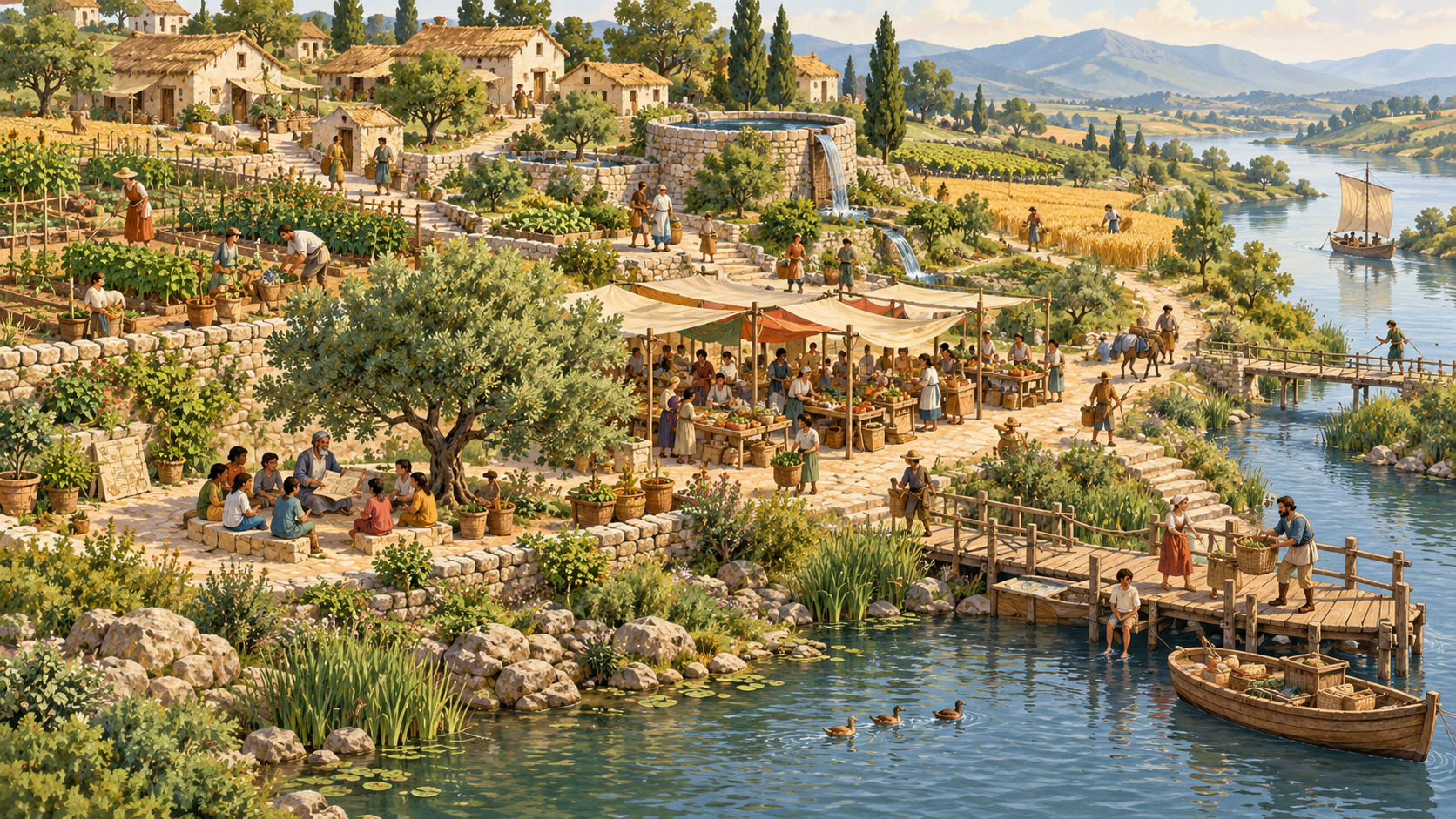
Series cover: AI-generated conceptual illustration of Riverbend, the starting community in these guides. It is not a literal depiction of every scenario, a historical reconstruction or an engineering plan.
Choose your next learning question
Follow one route, try a worked activity and return when the learner is ready for another layer.
Full chapter index · Capstone project · Wider civilisation reading
The Horizon Programme is fictional. It is not a prediction, a development proposal or a claim that every society follows one ladder. Its quantities and rates are invented for reasoning practice. Future scenarios describe conditions to examine rather than events asserted to happen. Real decisions involving technical systems, health, finance, law or environmental management require appropriate evidence, expertise and current requirements.
Advanced means greater demonstrated capability in a defined area, not greater human worth. Communities can hold different kinds of knowledge, organise life differently and choose different purposes. A civilisation may excel at one difficult task while struggling with fairness, access or continuity elsewhere. The learner should ask what is advanced, for whom and under which conditions.
Read one problem at a time. A young child can imagine how a library survives a change of caretaker. An older learner can compare long-term commitments or inspect a model's assumptions. The aim is to make complex futures discussable without turning uncertainty into fear or spectacle. A useful future begins with clearer questions about what people need and what their institutions can responsibly carry.
Full chapter index
Chapters 1–8: Define responsible ambition
- 1. Define advancement through capability and purpose
- 2. Keep a portfolio of strengths and unfinished work
- 3. Choose time horizons that fit the decision
- 4. Represent future residents without claiming to speak for them perfectly
- 5. Distinguish a future scenario from a prediction
- 6. Preserve options through reversible steps
- 7. Use modularity without losing the whole-system view
- 8. Build redundancy that protects a defined function
Chapters 9–16: Preserve capability and options
- 9. Notice how efficiency can change exposure to disruption
- 10. Understand concentration and common foundations
- 11. Make essential expertise teachable across generations
- 12. Preserve records as usable knowledge
- 13. Keep standards revisable while protecting compatibility
- 14. Treat simulations as tools for questions
- 15. Set review triggers before commitment becomes difficult to change
- 16. Distinguish uncertainty from ignorance that can be reduced
Chapters 17–24: Learn through feedback and review
- 17. Trace feedback that can amplify or reduce a problem
- 18. Set limits around consequential experiments
- 19. Allocate attention as a limited shared resource
- 20. Build trust through correction that people can see
- 21. Protect essential services while pursuing ambitious projects
- 22. Educate for transfer rather than only familiar performance
- 23. Use automated suggestions without surrendering the question
- 24. Design oversight as a real capability
Chapters 25–32: Carry obligations across generations
- 25. Track material renewal across a long horizon
- 26. Connect long-term energy ambitions to dependable service
- 27. Plan for changing communities without fixing one future population
- 28. Make maintenance obligations visible before they accumulate
- 29. Distinguish growth from consuming future capability
- 30. Recover several connected functions in a sensible sequence
- 31. Allow different futures within a shared civilisation
- 32. Build institutions that can examine their own performance
Chapters 33–40: Test and build the Horizon Programme
- 33. Connect scientific understanding with dependable engineering
- 34. Evaluate frontier projects without spectacle deciding the answer
- 35. Audit claims across the whole chain
- 36. Work through the long-horizon mathematics laboratory
- 37. Develop vocabulary for responsible ambition
- 38. Teach advanced ideas through a manageable sequence
- 39. Compare four possible futures without choosing an inevitable one
- 40. Complete the Horizon Programme capstone
CHAPTER 1 OF 40 · Define responsible ambition
1. Define advancement through capability and purpose
The Horizon Programme opens with a proposal for a spectacular tower. Some residents see it as proof that the network has become advanced. Others ask what it would enable people to do. The first learning task is to distinguish an impressive object from a demonstrated capability and then connect that capability to a purpose worth discussing.
A working definition of advancement should name the task. The network might become better at preserving knowledge, supporting accessible learning or maintaining dependable energy services. Each claim needs relevant evidence. A general statement that the whole civilisation is advanced can hide major differences between sectors and the experiences of different residents.
Purpose matters because difficulty alone does not establish value. A technically demanding project can consume resources while doing little for a pressing need. A modest improvement can transform daily life for people previously excluded. Learners should compare what a proposal makes possible, not merely how complicated or expensive it appears.
Examine the relationship and its conditions
Begin a capability card with five questions: what can be done, by whom, under which conditions, with what evidence and for whose benefit? The card should also name a limitation. This does not weaken ambition. It gives the community a clearer basis for deciding whether a new commitment is justified.
Riverbend proposes an accessible knowledge library whose materials can be used and taught across the network. The building is only one component. Cataloguing, understandable explanations, trained staff, appropriate access and continuing support all affect the capability. Counting books or floor area cannot establish the whole outcome.
For an activity, compare three fictional achievements: a large monument, a reliable learning service and a complex device with no clear user need. The learner should avoid an automatic ranking. Ask what evidence and purpose would matter in each case, then explain which additional question should be answered before resources are committed.
Apply, explain and check understanding
Advancement can also create obligations. A more specialised system may need rare parts, deeper expertise or stronger coordination. The network should include those responsibilities in its account rather than treat them as invisible background. Greater output is more meaningful when the supporting conditions can be sustained.
Older learners can distinguish capacity, capability and outcome. A facility may have room for many users, suitable people may be able to deliver a service and users may then experience a benefit. These stages are connected but different. A claim should identify which stage has actually been demonstrated.
The chapter's test is to rewrite 'Our civilisation is advanced' as a precise, evidence-based statement about one capability. Then add a purpose and a limitation. The result may sound less grand, but it gives a child a much stronger way to understand progress and ask what should happen next.
CHAPTER 2 OF 40 · Define responsible ambition
2. Keep a portfolio of strengths and unfinished work
A complex civilisation can perform well in one area and remain fragile in another. The Horizon Programme therefore begins with a portfolio rather than one overall score. It records demonstrated strengths, important gaps and conditions that support each capability. This helps learners see uneven development without reducing a community to praise or failure.
Hillstead's workshops may prepare sophisticated learning materials while Bayhaven's records remain difficult to interpret. Riverbend's teaching may be strong while some journeys remain inaccessible. These differences can coexist. A useful assessment identifies the specific task and experience rather than allowing one celebrated achievement to represent the whole network.
Create a table with capability, evidence, access, supporting dependencies and unresolved work. Use a small number of meaningful rows. More categories are not automatically better if nobody can maintain or interpret them. The purpose is to support a decision about the next useful improvement, not produce an impressive inventory of abstract words.
Examine the relationship and its conditions
Evidence should match the claim. A successful demonstration supports a narrower conclusion than sustained performance across varied conditions. A facility opening is an event; dependable use is an ongoing achievement. The portfolio can record stages of evidence without treating an early success as worthless or a permanent guarantee.
Access deserves its own column. A service may be highly capable for people who can reach it while remaining unavailable to others. Aggregate output can conceal that difference. Ask whose experience is represented and what information is missing before interpreting a strong average as universal provision.
For an exercise, give learners five fictional reports that point in different directions. One shows greater output, another a maintenance backlog and another improved training access. Ask for a balanced account naming genuine gains and unfinished work. The learner should not be required to turn the evidence into one emotional verdict about the civilisation.
Apply, explain and check understanding
Dependencies can connect rows. Improving records may support learning, maintenance and coordination at once. Expanding a workshop may increase pressure on energy or transport. The portfolio should help identify these relationships so the network does not optimise each capability in isolation and discover conflicts only after commitments are made.
Older learners can distinguish a missing capability from missing evidence. The network may not know whether a service performs suitably because it has not collected relevant information. That is different from demonstrated poor performance. Both can require action, but the next step may be investigation in one case and repair in another.
The chapter's lesson is to preserve complexity in a usable form. An advanced civilisation can celebrate its strengths while remaining honest about limits. Children who learn to read a capability portfolio can make more precise proposals than those asked only whether a place is successful, modern or behind.
CHAPTER 3 OF 40 · Define responsible ambition
3. Choose time horizons that fit the decision
Some decisions affect the next lesson; others create obligations lasting beyond the people who make them. The Horizon Programme needs several time horizons. A single planning period can hide either urgent needs or slow consequences. Learners should ask when a benefit appears, when a burden arrives and how long the supporting commitment continues.
Begin with three fictional projects. A revised instruction can improve the next classroom activity. Training a new specialist may take several model periods. A knowledge archive may need care across generations. Comparing them only by immediate output would miss much of the latter projects' purpose, while focusing only on the distant future could neglect present needs.
Draw a timeline with action, earliest useful benefit, continuing work and review points. Label estimates as estimates. A timeline is not a prediction made certain by a neat line. Its value is to expose assumptions and show which observations should prompt reconsideration before the full commitment is carried.
Examine the relationship and its conditions
Time horizons should match the question. A short trial may reveal usability but not long-term durability. A long forecast may compare scenarios without accurately predicting each year. The learner should identify what evidence can reasonably be gathered within the available period and what remains a continuing uncertainty.
For a calculation, a fictional archive requires 40 preparation tokens and six upkeep tokens each model year. Over five years, the stated commitment is 70 tokens. Over ten, it is 100, assuming the same annual amount and no other costs. The arithmetic illustrates how the chosen horizon changes the commitment described.
Now ask who will carry later work. The original designers may leave before the first major review. A long-term plan needs suitable handovers, funding arrangements, records and training. Good intentions today do not ensure that another generation will inherit the capability to continue the project appropriately.
Apply, explain and check understanding
For an activity, learners place project cards on a timeline and identify one early indicator for each. The indicator should provide useful information before a major consequence becomes difficult to change. Avoid choosing a measure merely because it is easy to count. The observation should connect to the decision's actual mechanism.
Older learners can discuss present and future interests without assuming they always conflict. Some improvements support both, while others require a trade-off. A well-maintained learning system may meet current needs and preserve future capability. The task is to trace the relationship rather than attach a virtuous label to every long-term proposal.
The chapter's test is a time-aware recommendation: this action addresses this need over this period, requires these continuing responsibilities and will be reviewed when this evidence becomes available. Such a statement helps an advanced civilisation remain ambitious while recognising that time changes both knowledge and obligation.
| Archive horizon | Stated tokens |
|---|---|
| Preparation | 40 |
| Annual upkeep | 6 |
| Five-year total | 70 |
| Ten-year total | 100 |
CHAPTER 4 OF 40 · Define responsible ambition
4. Represent future residents without claiming to speak for them perfectly
Future residents cannot attend today's meeting, yet they may inherit its consequences. The Horizon Programme needs ways to consider their interests while admitting uncertainty about their lives and preferences. A child can begin with a simple question: what useful options and understandable responsibilities will our decision leave for someone who comes later?
Use fictional future-resident cards. One asks whether the archive remains readable, another whether essential services have been maintained and another whether a major project can be revised. These roles do not predict particular people. They help the present discussion notice consequences beyond the current participants' immediate experience.
Avoid assuming future residents will want exactly what today's planners want. Preserving adaptability can be valuable when preferences and conditions change. A project may leave a useful foundation, or it may lock later people into a narrow arrangement they cannot easily understand or alter. The difference deserves attention before commitment expands.
Examine the relationship and its conditions
Rights and responsibilities also cross time. The classroom can discuss dignity, access, knowledge and environmental conditions without inventing real legal rules. Actual intergenerational decisions involve institutions, evidence and applicable requirements. The model's purpose is to develop questions rather than pretend one fictional representative resolves every ethical issue.
For an exercise, compare two archive designs. One is cheaper now but readable only through a specialised tool with no continuity plan. The other requires more current work but includes understandable documentation and an appropriate migration route. Learners should identify the actual trade-off and missing evidence instead of assuming either low cost or preservation automatically wins.
Future consideration should not erase present hardship. A community may have urgent unmet needs alongside long-term responsibilities. The discussion should make both visible. A proposal claiming to help the future should explain why its present burden is justified and whether another arrangement could support both needs more effectively.
Apply, explain and check understanding
A decision record can include a future-options question: what would later residents need to understand, continue, revise or stop this arrangement? This connects ethics with practical design. A project is easier to inherit when its purpose, assumptions, dependencies and review routes remain accessible.
Older learners can examine who speaks in the present on behalf of the future. A powerful group may use future benefits to justify burdens others carry now. The claim needs evidence and fair scrutiny. Considering future residents should broaden accountability rather than provide a slogan that makes current disagreement illegitimate.
The chapter's lesson is responsible humility across generations. An advanced civilisation cannot know every future preference, but it can preserve useful knowledge, avoid hiding obligations and create routes for later people to make informed choices. The aim is to leave capability and options rather than only a monument to today's certainty.
CHAPTER 5 OF 40 · Define responsible ambition
5. Distinguish a future scenario from a prediction
A scenario describes a set of conditions to examine. A prediction claims something about what will happen. The Horizon Programme uses scenarios to test plans without pretending that one imagined future is inevitable. This distinction lets children explore ambitious possibilities while keeping evidence and uncertainty in view.
Begin with three fictional conditions: demand grows slowly, demand grows quickly or a shared input becomes unavailable for several rounds. The network asks how the same plan performs under each. These cases need not be assigned probabilities to be useful. They reveal which decisions depend heavily on a particular assumption.
A scenario should be internally clear. State what changes and what remains the same. If learners alter every condition whenever the plan becomes difficult, they cannot see which relationship matters. Start with a focused change, then add complexity when the first explanation is stable.
Examine the relationship and its conditions
Avoid presenting a dramatic story as evidence of likelihood. A vivid scenario can be memorable without being probable. Conversely, a quiet gradual change may deserve attention even if it is less exciting to imagine. The adult should ask why the condition is relevant to the decision and what evidence would inform its plausibility.
For a model exercise, current demand is 40 service tokens per round and capacity 50. A higher-demand scenario uses 55, creating a gap of five under constant conditions. A lower-demand scenario uses 30, leaving 20 of stated headroom. These are consequences of the chosen cases, not forecasts that demand will take one of those exact values.
Now compare responses. A flexible schedule may help in several cases; a large fixed expansion may perform well only in one. The preferred choice depends on cost, purpose, consequences and uncertainty. The learner should explain robustness in relation to the scenarios tested rather than claim the plan works under every possible future.
Apply, explain and check understanding
For a writing task, ask learners to label sentences as observation, assumption, scenario, prediction or decision. Some sentences may contain more than one element and need rewriting. The exercise builds language control that becomes essential when discussing advanced technologies, environmental change or long-term institutions.
Older learners can identify missing scenarios. If every case assumes the same supplier remains available, the exercise may overlook a relevant dependency. Adding another case should answer a material question, not expand into an endless catalogue of imagined disasters. Scenario work is useful when it supports a defined decision.
The chapter's test is a clear scenario statement followed by a conditional conclusion. If these conditions occur, this arrangement would create these consequences under the model. That wording preserves imagination and discipline together, helping an advanced civilisation prepare without confusing a useful thought experiment with knowledge of the future.
CHAPTER 6 OF 40 · Define responsible ambition
6. Preserve options through reversible steps
Some decisions are easy to revise; others create long-lived commitments or effects that are difficult to undo. The Horizon Programme should consider reversibility before choosing how quickly to expand. A small test, modular design or staged commitment may preserve learning opportunities, provided it remains suitable for the task and does not hide its own burdens.
Begin with a library service proposed across all three communities. One option replaces every existing catalogue immediately. Another tests an appropriate new arrangement in a limited area while preserving a workable transition route. The second may create useful evidence, but it also requires coordination and support. Reversibility is a design feature, not a cost-free label.
Ask what can actually be reversed. A software setting may be easy to change while a training commitment, public expectation or data migration is harder. A physical object can sometimes be removed without restoring all earlier conditions. Learners should trace the consequences rather than assume that stopping an activity erases its history.
Examine the relationship and its conditions
A staged plan needs criteria. What evidence would justify continuing, revising, pausing or ending? Who decides and how are affected users supported? Without those answers, a trial can drift into permanence simply because resources and expectations accumulate around it. A small beginning is not automatically a controlled experiment.
For an activity, learners compare project cards by commitment, learning value and reversibility. They identify one appropriate early test and one consequence that the test cannot establish. A successful local demonstration may support the next step without proving performance at full scale or over many years.
Preserving options also means maintaining some underlying capability. If an old system is removed before the new one is suitably established, the nominal option to return may be unusable. Records, trained people and appropriate materials may be needed for a genuine fallback. The learner should identify those supporting commitments.
Apply, explain and check understanding
Do not treat every irreversible decision as wrong. Some necessary infrastructure or protection may require substantial commitment. The question is whether the purpose, evidence and review are proportionate to the consequence. A blanket preference for doing nothing can carry its own irreversible effects through unmet needs or deterioration.
Older learners can examine path dependence: earlier choices shape which later choices are practical. A shared format may make exchange easier while increasing the cost of switching. The concept should be explained through a concrete example, not used as a technical phrase that makes every established arrangement sound undesirable.
The chapter's lesson is to connect ambition with learning and usable choice. An advanced civilisation can make meaningful commitments while designing appropriate stages, transitions and exit routes. It becomes more capable when it understands which doors a decision opens, which it narrows and what evidence should guide the next step.
CHAPTER 7 OF 40 · Define responsible ambition
7. Use modularity without losing the whole-system view
A modular arrangement separates parts through defined interfaces so some changes can occur without redesigning everything. The Horizon Programme explores this idea through learning materials and service records. Modularity can support repair and adaptation, but the parts still depend on shared meanings and a functioning whole.
Imagine a learning kit whose cards, guide and counter set can be replaced separately under a stable specification. A damaged guide need not require replacing every component if the version remains compatible. That can reduce unnecessary work. The benefit depends on the interface actually being understood and maintained.
Now change the symbols on the cards. The old guide may no longer match. Physical separability does not guarantee functional compatibility. Learners should distinguish an object that can be detached from a part that can be changed independently without affecting the intended outcome.
Examine the relationship and its conditions
A module needs a clear responsibility boundary. Who maintains it, what does it promise to the next part and what evidence confirms its state? An interface described only by a diagram may leave important behaviour unclear. The network should test how another person interprets and uses the boundary.
For a tabletop exercise, groups create separate sections of a paper information system using a shared format. Another group combines them. Where the parts fail to fit, learners identify whether the problem lies in the format, meaning, version or assumption. The review should improve the interface rather than blame one group for not guessing another's intention.
Modularity can also create overhead. More interfaces may require more coordination, records and checking. A very small task may work better as one understandable unit. The appropriate degree of separation depends on change, complexity, consequence and the people available to carry the arrangement.
Apply, explain and check understanding
Shared failures remain possible. Several modules may rely on one unavailable specialist, common input or central record. Separating boxes on a map does not establish independent resilience. The learner should trace the supporting dependencies and identify what the modular arrangement does and does not protect.
Older learners can compare local replacement with whole-system validation. A replacement part may meet its own specification while interacting differently with the wider system. Appropriate testing should reflect the intended use and consequence. This guide's paper models illustrate the reasoning without providing technical approval for real equipment.
The chapter's lesson is purposeful separation with clear connection. An advanced civilisation benefits when parts can be understood, maintained and improved without losing sight of the outcome. Modularity supports resilience when interfaces, responsibilities and shared foundations remain visible, rather than when complexity is merely divided into more boxes.
CHAPTER 8 OF 40 · Define responsible ambition
8. Build redundancy that protects a defined function
Redundancy provides additional capacity or alternative means for a function. It can support continuity, but only if the alternative is suitable, available and relevant to the failure being considered. The Horizon Programme should ask what must continue and why a proposed backup would remain usable under the defined condition.
The network stores two copies of an archive in one room. That may help with one accidental edit if the copies remain distinct and usable. It may offer less protection if the whole room becomes inaccessible. The same pair of copies can be useful for one scenario and inadequate for another.
Now place an appropriately protected copy elsewhere. The new location changes one dependency but introduces questions about updating, access and interpretation. A copy that is outdated or unreadable by authorised people may not support the intended recovery. Redundancy is a continuing process, not merely possession of another object.
Examine the relationship and its conditions
For a fictional service, ordinary demand is 18 requests per round and the main team can complete 20. A backup team can complete eight under suitable conditions. If the main team is unavailable, the backup does not preserve unchanged full service. It may support a defined priority function while other work pauses or waits.
Ask whether the backup shares the same missing capability. Two teams may rely on one specialist for unusual decisions. Two routes may use the same unavailable crossing. Different names or locations do not automatically mean independence. Trace the specific condition that matters to the proposed protection.
For an activity, learners receive backup cards and disruption cards. They match each alternative to the function and scenario it can support, then name a limitation. The goal is not to find a universal backup. It is to develop conditional reasoning about what remains possible under changed conditions.
Apply, explain and check understanding
Redundancy uses resources that could serve other purposes. The network should compare the consequence of interruption with the cost and practicality of protection. Duplicating every task may be unnecessary or unworkable. The suitable choice depends on purpose, evidence and the time available to adapt or seek support.
Older learners can distinguish spare capacity from alternative capability. Extra seats do not replace an absent teacher, and spare containers do not replace missing knowledge. A reserve in one category cannot automatically cover a shortage in another. The functional map should identify which resource actually carries the required task.
The chapter's lesson is to design protection around the work people need. An advanced civilisation understands that redundancy can be partial, conditional and valuable without being absolute. A credible claim states which function is protected, under which scenario and with what continuing responsibilities to keep the alternative usable.
| Model function | Capacity per round |
|---|---|
| Ordinary demand | 18 requests |
| Main team | 20 requests |
| Backup team | 8 requests |
CHAPTER 9 OF 40 · Preserve capability and options
9. Notice how efficiency can change exposure to disruption
Efficiency compares useful output with a defined input. It can create real benefits, including less wasted effort or material. Yet a change that reduces one input may also alter flexibility, reserves or dependence. The Horizon Programme should examine those consequences rather than assume every efficiency gain improves every aspect of resilience.
Bayhaven proposes reducing stored spare materials because deliveries have become more dependable in the fictional record. That may release space and reduce handling. It also changes how long the network can continue if a delivery is interrupted. The decision should compare both effects under stated conditions, not turn either storage or leaner operation into a universal virtue.
Use a simple model. A service uses six material tokens per round. A reserve of 30 supports five rounds under that rate, while a reserve of eighteen supports three. The smaller stock may be suitable if the relevant risks, replenishment and consequences justify it. The arithmetic alone cannot choose the right amount.
Examine the relationship and its conditions
Efficiency should name the boundary. A workshop can save time by sending unsorted work to another team, but the network may not save time overall. A digital form can reduce one person's effort while adding work for users. Ask whose input has fallen and whether another burden has increased.
Now consider spare capacity. A timetable with every period committed may have a high apparent utilisation while leaving little room for variation or learning. Some uncommitted capacity can support recovery, training or changing demand. That does not establish a universal target; it shows why the purpose of the capacity matters.
For a discussion task, compare two fictional proposals with the same normal output. One uses fewer stored inputs but has a longer recovery route. The other uses more resources to preserve continuity for a defined essential task. Learners identify the evidence needed to judge the trade-off and avoid declaring a winner from one attractive number.
Apply, explain and check understanding
A process can sometimes improve efficiency and resilience together. Clearer instructions may reduce both errors and dependence on repeated expert rescue. Preventive maintenance may reduce resource use and interruptions. The relationship is empirical and contextual, not a rule that every useful goal must conflict with every other one.
Older learners can distinguish optimisation within a model from suitability in the wider world. A mathematically optimal result depends on objectives, constraints and assumptions. If a model omits access or recovery, its optimum does not establish those outcomes. The learner should ask what the calculation was designed to improve.
The chapter's lesson is to welcome useful gains while tracing their conditions. An advanced civilisation becomes more capable when it can explain what has become more efficient, who benefits and how the change affects important functions under stress. A smaller input number is evidence for a defined comparison, not a complete account of progress.
CHAPTER 10 OF 40 · Preserve capability and options
10. Understand concentration and common foundations
Concentration can bring people, knowledge and resources together in ways that support complex work. It can also create shared points whose interruption affects many activities. The Horizon Programme should investigate both sides. A central institution is not automatically fragile, and a distributed arrangement is not automatically independent or well coordinated.
Riverbend proposes one major knowledge centre serving all three communities. It may support specialist staff, rich collections and convenient exchange. Learners should ask how residents reach it, what happens if it becomes unavailable and which functions can remain local. The decision concerns an arrangement of services, not only a building location.
A distributed alternative may place materials in several locations while relying on one catalogue, one specialist or one supply. The appearance of decentralisation can conceal concentration underneath. Trace the dependencies that matter to the function being protected before describing the alternatives as independent.
Examine the relationship and its conditions
Concentration can also create a learning advantage. People working together may share questions and methods more easily under suitable conditions. But access, recognition and openness still matter. A centre that attracts expertise while closing pathways for others may increase one capability and narrow wider development opportunities.
For a map exercise, learners compare a central hub, several connected local centres and a hybrid. Each option receives the same fictional resource limit. They identify benefits, coordination needs and relevant failure points. No arrangement should receive unlimited staff or effortless communication simply because its diagram looks appealing.
Now introduce a scenario affecting the hub. Ask what information and capability exist elsewhere, how long adaptation takes and who decides the temporary arrangement. A plan should distinguish a partial local continuation from full unchanged service. Honest scope makes the protection more credible.
Apply, explain and check understanding
The comparison should include everyday access, not only rare disruption. A geographically central site may still be difficult for particular residents to reach. A local site may be nearby but lack suitable capability. The network needs to connect proximity with actual service and support rather than treating either as sufficient alone.
Older learners can examine governance of a concentrated resource. Who controls access, how are priorities set and what review exists? Technical efficiency does not remove questions about authority and fairness. A shared institution becomes more trustworthy when its responsibilities and decision routes are understandable to those who depend on it.
The chapter's lesson is to identify the foundations beneath the visible structure. An advanced civilisation can use concentration where it serves a purpose while protecting important access and continuity. The strongest proposal explains what is shared, what remains distributed and how the whole arrangement learns and adapts under changed conditions.
CHAPTER 11 OF 40 · Preserve capability and options
11. Make essential expertise teachable across generations
Advanced capability often depends on deep expertise. The Horizon Programme should value that expertise while creating appropriate routes for others to learn, practise and eventually improve it. A civilisation becomes vulnerable when essential methods survive only inside one person's memory or an inaccessible set of notes.
Begin with an archive specialist who can interpret older records. The task includes recognising formats, understanding context and judging uncertainty. A simple checklist may support the work without capturing all of it. Learners should distinguish documentation from demonstrated capability and recognise the practice needed to use information responsibly.
A teaching pathway can separate routine tasks, unusual cases, diagnosis and instruction. Different stages need different evidence. Time spent in a role may provide experience without proving every capability. The network should ask what a learner can perform independently under suitable conditions and where supervision remains necessary.
Examine the relationship and its conditions
Training consumes current capacity. A specialist explaining a difficult case may complete fewer immediate tasks. That commitment should be planned rather than hidden as an extra demand. Long-term continuity becomes more realistic when institutions protect time for learning and recognise teaching as work.
For an activity, one learner creates a rule for interpreting a set of fictional archive cards. They teach another learner, who applies it to a changed set containing an ambiguous case. The pair identifies where the original explanation relied on hidden assumptions. The exercise makes tacit knowledge visible without pretending every expertise can be reduced to one school task.
Access to advanced learning matters. People may face barriers of timing, language, travel, resources or prior opportunity. A pathway should identify essential preparation and offer a realistic route into it. A claim that anyone may apply does not establish that suitable learners can actually participate and continue.
Apply, explain and check understanding
Knowledge transfer should preserve the ability to question methods. A trainee who can repeat the procedure but cannot explain its purpose may struggle when conditions change. Encourage suitable questions, comparison and checking. Respect for expertise and critical inquiry can support one another when the learning environment is safe and evidence-led.
Older learners can map succession depth. How many people can perform routine work, handle unusual cases, teach and revise the method? The map should guide support rather than become a ranking of human worth. A narrow point at one level may justify a focused training commitment before the network expands another dependent service.
The chapter's lesson is to renew expertise deliberately. An advanced civilisation carries knowledge forward through people, records, practice and institutions that make learning possible. Its achievement is stronger when a new generation can understand and responsibly extend the work, rather than remain permanently dependent on the original expert's presence.
CHAPTER 12 OF 40 · Preserve capability and options
12. Preserve records as usable knowledge
An archive can contain many files while preserving little usable understanding. The Horizon Programme needs to consider format, meaning, context, access and continuing care. A record succeeds when a suitable future reader can interpret what it says, how it was produced and what it can support.
Begin with a fictional energy log stating 'output: 40'. The unit, period, method and relevant conditions are missing. The number may be accurate in someone's memory but difficult for another person to use. The first preservation task is not more copies; it is enough context to make the existing record meaningful.
Add provenance: who or which role created the record, when, for what task and through which method. Provenance does not guarantee truth, but it helps a reader assess relevance and limitations. A polished record without a usable origin can be harder to evaluate than a modest note with clear context.
Examine the relationship and its conditions
Formats change. A file may remain physically stored while the tools needed to read it become unavailable. The network should plan suitable migration, verification and access arrangements. This guide does not prescribe a technical archival standard. It teaches why preservation is continuing work involving appropriate expertise and judgement.
For a classroom exercise, ask one group to document a simple token experiment for another group to interpret later. Remove spoken explanation. The receiving group lists what it can establish and what remains unclear. The first group then revises the record, adding relevant context rather than every detail of the session indiscriminately.
Privacy and rights remain important over time. Not every record should be public or preserved indefinitely. The purpose, sensitivity and applicable requirements matter. Fictional exercises should avoid real personal details. A civilisation can preserve shared knowledge while respecting boundaries around the people represented in its records.
Apply, explain and check understanding
A correction process should retain appropriate history. If an error is discovered, future readers need to understand the amended claim and its basis. Silent replacement can erase useful context, while an unchangeable error can mislead. The arrangement should support both integrity and responsible revision.
Older learners can distinguish storage, retrieval and interpretation. A record may be stored but difficult to find; easy to find but hard to read; readable but missing context. Each barrier needs a different response. A total file count cannot establish that the knowledge system works across the entire chain.
The chapter's lesson is to preserve the relationship between marks and meaning. An advanced civilisation renews usable memory through suitable records, tools, teaching and review. It should ask what a future reader can actually understand and do, rather than celebrate only the volume of material kept.
For a broader teaching connection, explore How Education Works.
CHAPTER 13 OF 40 · Preserve capability and options
13. Keep standards revisable while protecting compatibility
Shared standards allow complex systems to cooperate, but conditions and knowledge change. The Horizon Programme needs a way to improve common arrangements without creating uncontrolled incompatibility. Stability and revision are both useful when their purposes, authority and transition work are clear.
Imagine the three communities share a record format. A new field could improve interpretation, but older tools may not recognise it. The question is not simply whether the new field is good. The network must examine how current and future records will remain understandable across the transition.
A revision proposal should name the problem, evidence, intended benefit and affected interfaces. It should distinguish essential changes from preferences. A technically elegant idea may create burdens elsewhere, while a modest change may solve a serious access difficulty. The comparison should stay connected to the shared purpose.
Examine the relationship and its conditions
Who approves the change and who implements it? These roles may differ. Users, maintainers, teachers and other affected groups can hold relevant evidence. The process should provide a realistic route for contribution rather than assume a formal invitation gives everyone equal practical influence.
For an activity, groups use a shared paper format to exchange fictional observations. One group proposes a revision halfway through. Learners decide which records use the new version, how older records are interpreted and what information must accompany a mixed collection. The task reveals the practical work hidden inside the word update.
Backward compatibility can preserve access, but it may also create continuing support burdens. A clean break may simplify one system while excluding existing users or records. Neither is automatically right. The network should compare consequences, evidence and suitable transition support in relation to the task.
Apply, explain and check understanding
The decision history matters. Future maintainers need to know why a field changed and which assumptions shaped the choice. A log saying only 'improved version' leaves the reasoning inaccessible. The history should be concise enough to use and clear enough to support later review.
Older learners can identify the difference between standardising an interface and standardising every internal method. Partners may coordinate successfully while retaining suitable local approaches. Excessive uniformity can remove useful adaptation, while insufficient shared meaning can make exchange unreliable. The boundary needs explanation.
The chapter's lesson is orderly learning through shared rules. An advanced civilisation preserves compatibility where it serves people while allowing evidence to improve the arrangement. Its standards become durable through clear scope, fair authority and workable transitions, not through a claim that the current version should never change.
CHAPTER 14 OF 40 · Preserve capability and options
14. Treat simulations as tools for questions
A simulation represents selected relationships and explores what follows under stated rules. It can help the Horizon Programme compare plans, but it does not become reality merely because it produces detailed output. Learners should ask what the model includes, what it omits and which decision its results can support.
Begin with a paper simulation of archive requests. Each round adds new requests and completes a stated number. The queue evolves according to those rules. If the model omits difficult cases, training time or access barriers, its results cannot establish those experiences. The limits arise from design, not from a general failure of modelling.
Separate inputs, rules and outputs. An input might be demand; a rule might define usable capacity; an output might be waiting work. A learner should be able to trace how a result was produced. An unexplained number from a complicated model is not automatically stronger evidence than a transparent simple calculation.
Examine the relationship and its conditions
Use a baseline and changed scenarios. If demand rises while other rules remain fixed, what changes? Then test another assumption. Changing one important feature at a time can help interpretation, while later combined scenarios may reveal interactions. The sequence should be chosen for learning rather than to produce a preferred conclusion.
For an activity, two groups build models of the same fictional service with different assumptions. They compare results and identify the source of disagreement. The aim is not to decide which group is cleverer. It is to understand how the model boundary and rules shape the answer.
Validation asks whether the representation is suitable for its intended use, using appropriate evidence. A model that fits one small case may not support a larger or different decision. The classroom can practise comparing a model's output with a supplied observation while recognising that real validation can require specialised methods and expertise.
Apply, explain and check understanding
Sensitivity matters when a small assumption change produces a large outcome difference. That does not automatically invalidate the model. It identifies an uncertainty worth examining before a consequential commitment. The network should focus investigation where it could materially change the decision.
Older learners can distinguish precision from confidence. A simulation may print many decimal places while relying on uncertain inputs. The displayed precision does not establish that the future is known that accurately. Reporting should preserve the uncertainty and purpose rather than allow a polished output to overstate the evidence.
The chapter's lesson is to keep models inspectable and claims proportionate. An advanced civilisation uses simulations to ask better questions, test plans and identify important uncertainties. It remains responsible for interpreting the result and seeking appropriate evidence beyond the model before acting on consequential real-world decisions.
CHAPTER 15 OF 40 · Preserve capability and options
15. Set review triggers before commitment becomes difficult to change
A review trigger identifies evidence or a condition that should prompt reconsideration. The Horizon Programme needs triggers because a calendar alone may not detect a material change in time. A project can remain on schedule while its assumptions, burdens or purpose shift. Review should connect observation with authority to act.
Begin with an archive expansion whose demand estimate is central to the plan. A trigger might require review when accepted requests exceed a defined model level for several periods, or when a key capability becomes unavailable. The threshold in a classroom exercise is an assumption to explain, not a universal operating recommendation.
A trigger should state what happens next. Who checks the evidence, who decides and what temporary arrangement applies? An alert without responsibility can create noise while leaving the underlying issue untouched. The network should distinguish a reason to investigate from an automatic instruction to take one predetermined action.
Examine the relationship and its conditions
Use several kinds of evidence where appropriate. A numerical threshold may detect volume, while a repeated access concern reveals a different problem. The review process should not require every important effect to fit one measure. At the same time, vague concern should lead to a focused question rather than an unlimited, directionless review.
For an exercise, learners design triggers for a fictional learning service. One addresses demand, another a version mismatch and another an access barrier. They explain why each matters and which evidence would be checked. The class then tests whether the trigger is clear enough for another group to use consistently.
Stopping or pausing needs support for affected users. A project cannot treat its exit criteria as permission to abandon people who have come to depend on it. A responsible plan considers continuity, communication and appropriate alternatives. The ability to stop safely may require preparation long before a problem appears.
Apply, explain and check understanding
Beware of thresholds that encourage concealment. If reporting a difficulty is treated as failure, people may delay the warning. The network should create conditions for honest observation and fair review. A trigger works better when participants understand it as a route to suitable action rather than a trap.
Older learners can discuss false alarms and missed signals. A sensitive trigger may prompt unnecessary checks; a narrow one may miss important change. The suitable balance depends on consequence, evidence and capacity. This is a judgement problem, not a reason to claim one perfect threshold for every service.
The chapter's lesson is to plan how learning will alter action. An advanced civilisation does more than promise to monitor a project. It makes clear which findings matter, who responds and how people remain supported when the plan must change. That connection turns review from a ritual into a usable safeguard.
CHAPTER 16 OF 40 · Preserve capability and options
16. Distinguish uncertainty from ignorance that can be reduced
Some uncertainty can be narrowed through a suitable observation or test; some remains because the future and complex systems are not fully knowable. The Horizon Programme should identify the difference. Neither confident guessing nor endless information collection serves a decision well when the important question is unclear.
Begin with a fictional delivery delay. The network does not know whether goods have left the workshop. That information may be obtainable through a suitable check. It also does not know the exact travel conditions next month. That future uncertainty may require scenarios and flexible planning rather than one more message to the workshop.
Create an uncertainty register with question, current evidence, consequence and next useful action. Keep it small enough to use. The purpose is to guide investigation and planning, not list every imaginable unknown. A question deserves attention when its answer could materially change a relevant decision or responsibility.
Examine the relationship and its conditions
A test has a cost and a scope. Checking a sample may help assess one quality issue without establishing long-term performance. A larger study may take time that itself affects current needs. Learners should compare the value of information with the decision's consequence, timing and available alternatives.
For an activity, give groups several unknowns and a limited number of investigation tokens. They choose which to examine first and explain why. A strong answer identifies the connection to action. Investigating the most interesting fact is not always the most useful next step for the current commitment.
Uncertainty language should remain precise. Unknown, estimated, disputed and variable describe different situations. A claim can be well supported within a range while one exact value remains uncertain. The network should avoid treating every incomplete detail as evidence that nothing can be known or every plausible explanation as equally likely.
Apply, explain and check understanding
Consider who holds relevant knowledge. A user may know an access barrier, a maintainer may understand an unusual fault and a teacher may identify a learning difficulty. Reducing uncertainty sometimes requires listening to the right person rather than collecting more of the same data from the easiest source.
Older learners can distinguish confidence in a method from confidence in one result. A sound process can yield a cautious conclusion, and an unsupported process can occasionally guess correctly. Review should examine how the claim was reached and whether the evidence was suitable, not only whether one outcome matched the forecast.
The chapter's lesson is purposeful inquiry with honest limits. An advanced civilisation becomes more capable when it knows which questions to investigate, which uncertainties to plan around and how to communicate both. Clear uncertainty is not a weakness to hide; it is information that helps people choose a responsible next step.
CHAPTER 17 OF 40 · Learn through feedback and review
17. Trace feedback that can amplify or reduce a problem
Feedback occurs when a result influences conditions that affect later results. In the Horizon Programme, a better service may attract more users, changing demand and future performance. A learning system may improve because feedback helps teachers revise it. The direction and consequence depend on the actual relationship, not on the word feedback alone.
Begin with a fictional library. Clearer access increases use. More use provides additional observations about confusing records, which can support improvement if someone reviews and acts on them. That is one possible beneficial loop. Without suitable capacity, the same increase in use may also create longer waits and reduce access.
Draw a small loop using plain labels. Improved access leads to more requests; more requests affect workload; workload affects service experience. Ask which links are supported by the model and which are assumptions. A circular diagram does not prove the relationship exists or establish how strong it is.
Examine the relationship and its conditions
A response can reduce a deviation. If a queue rises, suitable additional capacity or revised scheduling may reduce it under defined conditions. But delays can complicate the response. An expansion approved after demand has changed may create a different mismatch. Timing belongs inside the feedback account.
For an activity, learners update a token service across several rounds. They apply a stated response rule after a delay. Compare the result with immediate response under otherwise similar conditions. The purpose is to see how a rule and its timing shape the pattern, not to claim the classroom model predicts a real institution.
Avoid assuming every reinforcing relationship is harmful or every balancing relationship desirable. Learning and trust can accumulate through repeated good experience. An arrangement can also hold an unfair condition stable. The network should connect the feedback mechanism to purpose, evidence and affected people before judging it.
Apply, explain and check understanding
Information can change the loop. If poor performance is hidden, the institution may not respond appropriately. If a measure encourages people to avoid difficult users, apparent performance can improve while unmet need grows. The loop should include behaviour and incentives where relevant, rather than treating numbers as passive descriptions.
Older learners can distinguish a feedback explanation from a simple repeated correlation. They should state how one result changes a later input or decision. If the mechanism is missing, more observation may be needed. A technically impressive label should not replace a plain account of what happens and why.
The chapter's lesson is to see change as an ongoing relationship. An advanced civilisation develops the ability to notice when its own responses alter the system it is observing. It can then revise not only a single action but the rules, delays and information through which later actions are chosen.
CHAPTER 18 OF 40 · Learn through feedback and review
18. Set limits around consequential experiments
Experimentation can improve knowledge and capability, but the people affected should not become an invisible cost of learning. The Horizon Programme needs appropriate limits, consent where relevant, suitable expertise and review. The classroom can practise this through paper models without imitating real experiments that require professional or institutional oversight.
Begin with a proposed new teaching format. A limited classroom comparison may be suitable under adult guidance, while a change affecting sensitive information or wellbeing requires different consideration. The network should identify the consequence and relevant requirements before deciding that every new idea can be tested through the same simple process.
A test proposal should state the question, participants or affected users, method, evidence sought, foreseeable burdens and response to problems. It should also identify who has suitable authority to approve it. These elements make the learning purpose inspectable instead of relying on enthusiasm for the proposed improvement.
Examine the relationship and its conditions
The ability to stop matters. A trial should not continue merely because resources have already been committed. Define what evidence prompts review and how affected people remain supported. In the fictional model, a confusing instruction may justify pausing the activity and returning to a suitable known alternative.
For an activity, learners compare three imaginary tests: a paper layout comparison, an unreviewed change to an essential service and a model simulation with invented data. They identify different questions about suitability and authority. The exercise should avoid asking children to decide real clinical, legal or technical approvals.
Consent and participation are not identical to a lack of objection. People may not understand the proposal, may feel pressure or may lack a practical alternative. The classroom can discuss these possibilities through fictional cases while preserving appropriate adult responsibility and current requirements in real settings.
Apply, explain and check understanding
Evidence quality also has an ethical dimension. A poorly designed test can impose burdens without answering its question. A suitable method should be capable of producing useful information within its scope. The network should not treat every collection of activity as learning merely because something new occurred.
Older learners can distinguish experimental uncertainty from avoidable ambiguity. Some outcomes are unknown by definition; unclear instructions about responsibility or support need not remain unknown. A responsible design reduces what can reasonably be clarified before the test while acknowledging what the test is intended to investigate.
The chapter's lesson is bounded curiosity. An advanced civilisation creates conditions for learning that respect people, expertise and the consequences of error. It does not need to choose between refusing all innovation and exposing everyone to an uncontrolled trial. Suitable scope, review and support make responsible experimentation more credible.
CHAPTER 19 OF 40 · Learn through feedback and review
19. Allocate attention as a limited shared resource
A complex civilisation can collect more information than people can usefully examine. The Horizon Programme therefore needs to organise attention. Reports, alerts, meetings and public discussion all consume time and judgement. The aim is not to silence questions, but to make important signals easier to interpret and connect them with responsible action.
Begin with a coordinator receiving fifty fictional updates. Some concern routine completed work, some ask for a decision and one identifies a relevant access barrier. If every message has the same urgent label, the system makes prioritisation harder. More communication can create less usable understanding when purpose and routing are unclear.
Separate information for awareness, evidence for review and requests for action. A message should identify which role needs it and by when, where appropriate. A general broadcast may be useful for shared context, but it cannot replace a clear assignment when a specific decision is required.
Examine the relationship and its conditions
For an exercise, learners sort message cards into categories and identify missing information. They should not simply discard inconvenient concerns. The task is to route each item appropriately and preserve a way to revisit uncertain cases. A reporting system should support attention without making important experiences disappear outside the standard form.
Meetings need a defined job too. A discussion can share perspectives, request evidence or make an authorised decision. Confusing those purposes can leave participants believing different commitments were made. A concise record should identify what changed, who acts and what remains unresolved.
Attention should not be allocated solely by visibility or influence. A quiet maintenance issue may affect many services, while a dramatic presentation may have limited consequence. The network needs evidence about importance and a route for less powerful people to surface concerns. Public volume is not identical to public need.
Apply, explain and check understanding
Now consider reporting burden. A detailed form repeated frequently may consume the capacity needed for the service itself. The institution should ask which fields support an actual decision and simplify where they do not. Appropriate accountability can coexist with proportionate administration.
Older learners can examine the difference between transparency and comprehensibility. Publishing a large archive of data does not ensure residents can find or interpret the relevant commitment. Useful transparency may require summaries, definitions and access to the underlying evidence. The purpose is informed scrutiny, not merely a claim that information exists somewhere.
The chapter's lesson is to make attention serve understanding and responsibility. An advanced civilisation becomes more capable when signals reach suitable people in a usable form and important questions remain accessible. It should measure communication partly by the decisions and corrections it supports, rather than by the volume of messages produced.
CHAPTER 20 OF 40 · Learn through feedback and review
20. Build trust through correction that people can see
Trust supports cooperation when people cannot inspect every detail themselves. The Horizon Programme needs institutions whose claims can be examined and whose mistakes can be corrected fairly. Trust should not require residents to ignore evidence, nor should one error automatically imply that every part of an institution is worthless.
Begin with an archive count published incorrectly. The responsible team discovers the mistake and explains the corrected figure, affected conclusions and next check. That response can support confidence in the correction process. Hiding the change may protect appearances briefly while making later information harder to trust.
A correction should match the issue's scope. A typographical error differs from a method that changes a major conclusion. The network should explain what changed and why without exaggerating or minimising the consequence. Precise language helps residents understand whether their own decisions need revision.
Examine the relationship and its conditions
Independent checking can contribute where appropriate. A different suitable person or method may identify an assumption the original team missed. Independence is not established merely by adding another signature from someone relying on the same unexamined source. Learners should ask what the second check actually contributes.
For a role-play, one group publishes a fictional service report and later receives evidence of an error. They prepare a correction for users, a revised internal record and a prevention proposal. Another group evaluates whether the response makes the affected claim and next action understandable.
Fair treatment matters when errors are reported. If every admission leads to humiliation, people may hide uncertainty. If no one answers for repeated avoidable problems, correction may remain superficial. A trustworthy process can investigate responsibility while supporting honest reporting and learning from the system around the action.
Apply, explain and check understanding
Trust also depends on whether promises are realistic. An institution that repeatedly claims certainty it cannot support creates unnecessary disappointment. A clear statement of conditions and limits gives residents a better basis for planning. Caution should be meaningful and specific rather than a vague disclaimer attached to every sentence.
Older learners can distinguish confidence in one claim from confidence in an institution's process. A claim may be revised while the correction strengthens evidence that the process can learn. Conversely, a confident institution may produce an accurate claim without providing a trustworthy method. Both result and process deserve examination.
The chapter's lesson is visible, accountable learning. An advanced civilisation does not prove its maturity by declaring itself beyond error. It demonstrates the ability to find mistakes, preserve relevant history, explain consequences and improve the arrangements that produce its knowledge and decisions.
CHAPTER 21 OF 40 · Learn through feedback and review
21. Protect essential services while pursuing ambitious projects
Ambitious projects can expand capability, but they also draw on people, materials, money and attention needed elsewhere. The Horizon Programme should keep essential services visible when comparing new commitments. A proposal's importance does not create unlimited resources, and an impressive frontier should not hide deterioration in the everyday foundation.
Begin with a fictional research centre requiring 60 shared work tokens per period. Existing essential commitments use 140 out of a suitable total capacity of 180. The combined demand would be 200, leaving a gap of twenty under those assumptions. The network needs a revision before accepting the full plan.
Possible responses include suitable additional capability, changed timing, a smaller scope or postponement of another activity after fair review. Each has consequences. The plan should identify which commitment changes and who is affected rather than describe the gap as a temporary detail that dedicated people will somehow absorb.
Examine the relationship and its conditions
Essential does not mean identical in every context. The relevant functions and urgency depend on circumstances and appropriate judgement. The classroom can use a defined fictional set of priorities, while real services require suitable expertise, rights and current requirements. Learners should be able to explain the priority principle used in the model.
For an activity, allocate a fixed resource budget among maintenance, learning, care support and a new research project. Ask the group to name an opportunity cost for its preferred allocation. The purpose is not to force a single correct value judgement, but to connect preference with a feasible commitment and an account of the burden.
Some frontier projects can strengthen foundations. Research may improve a service, and training may expand suitable capacity. Those benefits need a mechanism, timescale and evidence. A promise of future improvement should not be counted as current usable support before it has been demonstrated.
Apply, explain and check understanding
The review should consider distribution. A new facility may benefit well-connected users while an existing access barrier remains unresolved elsewhere. Aggregate progress can coexist with that gap. The network should examine whether the allocation purpose and evidence justify the pattern rather than assume every new capability reaches everyone automatically.
Older learners can distinguish strategic investment from prestige. Both may be presented through ambitious language. Ask what task improves, whose need it addresses, which supporting capabilities are required and what evidence would justify continuing. The questions make the comparison more useful than simply praising or rejecting large projects.
The chapter's lesson is ambition with a visible base. An advanced civilisation can explore difficult frontiers while maintaining the services and people that make exploration possible. Its plans become more credible when the resources, trade-offs and continuing responsibilities are clear before the commitment is made.
| Shared-work commitment | Tokens per period |
|---|---|
| Existing essential work | 140 |
| New project | 60 |
| Combined demand | 200 |
| Suitable capacity | 180 |
| Gap | 20 |
CHAPTER 22 OF 40 · Learn through feedback and review
22. Educate for transfer rather than only familiar performance
Advanced systems require people who can apply knowledge when the surface details change. The Horizon Programme's learning institutions should therefore examine transfer, explanation and judgement alongside successful performance on a taught example. A familiar routine can be useful without proving that the learner understands the underlying relationship.
Begin with a child who calculates the number of complete kits from a materials table. Change the setting to archive boxes requiring several matching parts. If the learner identifies the limiting component again, the relationship may be transferring. If they rely on a memorised position in the table, a new example can reveal the gap.
Transfer is not automatic or unlimited. A similar mathematical structure may appear in tasks requiring different domain knowledge and consequences. The learner should identify what carries over and what needs fresh evidence or expertise. Recognising a pattern does not authorise someone to make real technical decisions outside their competence.
Examine the relationship and its conditions
A useful lesson sequence moves from concrete representation to explanation, varied practice and independent application. The adult checks the first uncertain step. More advanced vocabulary should follow understanding rather than conceal a missing relationship. A child who can explain plainly has a stronger base for later technical language.
For an activity, provide three tasks that share a structure and one that only looks similar. Ask learners to group them and justify the choice. The discussion should focus on relationships, units and conditions. Surface resemblance alone is not enough, and the adult should welcome a reasoned revision.
Learning institutions also need feedback across generations of teachers. A useful explanation, common misconception or effective diagnostic task should be preserved with context. The record should not become a rigid script that prevents adaptation. It should help a new educator understand the purpose and evidence behind the method.
Apply, explain and check understanding
Access to deeper learning should remain open. Some learners need more time, language support or a different representation before the same relationship becomes clear. A single performance should guide the next task, not define a permanent ceiling on a person's potential. Specific diagnosis makes support more precise and hopeful.
Older learners can practise explaining a model's limitation. Correctly applying an equation is one achievement; recognising when its assumptions fail is another. Advanced education should develop both. A student who knows where a method stops being suitable is showing control rather than reluctance to solve the problem.
The chapter's lesson is flexible capability. An advanced civilisation renews itself when people can recognise structure, learn unfamiliar details and revise their approach responsibly. Its educational achievement is more than a record of completed lessons: it is a growing ability to think clearly when the next problem does not look exactly like the last.
CHAPTER 23 OF 40 · Learn through feedback and review
23. Use automated suggestions without surrendering the question
The Horizon Programme considers a fictional tool that suggests schedules from entered data. The tool is a teaching scenario, not a description of a particular product or a claim about current artificial intelligence. Its purpose is to examine what happens when part of a decision process is automated while people remain responsible for purpose, evidence and consequences.
Begin with the question the tool is meant to support. Is it allocating work periods, comparing routes or identifying a numerical mismatch? A system can produce an answer to the wrong question very efficiently. The network should define the intended use before treating a plausible-looking output as a recommendation worth following.
Inputs matter. If the data omit training time, access requirements or an unavailable resource, the suggested schedule may be internally consistent with an unsuitable model. Automation does not supply missing context automatically. Learners should inspect what the tool was told and which relationships it assumes.
Examine the relationship and its conditions
For a paper activity, one group acts as a rule-following scheduler using only a supplied table. Another group represents users with relevant information omitted from that table. They compare the output with practical needs. The exercise shows how a narrow representation can produce a tidy result that still requires revision.
A suitable check should be independent enough to add information. Repeating the same calculation from the same mistaken input may confirm arithmetic without detecting the missing constraint. Ask what evidence could reveal a problem outside the tool's representation. Human review needs a defined task, not merely a person clicking approval.
Responsibility should remain clear. Who chooses the objective, supplies data, interprets the output and decides on action? A chain of people each assuming the tool has handled the difficult judgement can leave no meaningful review. The arrangement should identify authority and a route for affected users to challenge an unsuitable result.
Apply, explain and check understanding
Privacy and access matter too. A tool should not receive unnecessary personal information simply because it can process more data. The classroom uses invented records. Real deployments require appropriate assessment, protections and applicable requirements. The conceptual lesson is to connect information use with purpose and consequence.
Older learners can distinguish assistance from evidence. A generated suggestion may help identify an option to investigate, but its fluent presentation does not establish that its claims are correct. The network needs appropriate sources, checks and demonstrations for consequential conclusions, just as it would for a human proposal.
The chapter's lesson is purposeful automation with accountable interpretation. An advanced civilisation gains from tools when they support suitable work and remain within understood limits. It does not become more capable by making the question, assumptions and responsibility less visible behind an impressive output.
CHAPTER 24 OF 40 · Learn through feedback and review
24. Design oversight as a real capability
Oversight means examining and guiding activity through appropriate authority, evidence and response. The Horizon Programme should not assume that adding a reviewer automatically creates effective oversight. The reviewer needs relevant competence, access, time, independence where appropriate and the ability to act on findings.
Begin with a fictional approval process. A reviewer receives a large report shortly before a deadline and is expected to sign it. Formally, a person has reviewed the project. Practically, the arrangement may not support meaningful examination. A signature should not be treated as evidence of work the process made impossible.
Define the oversight question. Is the reviewer checking arithmetic, technical suitability, access, rights, financial commitments or the quality of evidence? Different questions require different capability. One person may coordinate review without personally possessing every kind of expertise. The process should identify which specialist judgement is needed.
Examine the relationship and its conditions
Access to underlying evidence matters. A summary can orient the reviewer but may not allow a disputed claim to be checked. Appropriate records, definitions and methods should be available within relevant privacy and security boundaries. Transparency to oversight does not mean exposing every sensitive detail publicly.
For an activity, learners inspect a short fictional project brief with one hidden constraint available only if they ask a relevant question. Afterwards, discuss how the process could make important information available routinely rather than rely on a reviewer guessing the right question every time. Good oversight is designed around foreseeable needs.
Independence should be considered in relation to the decision. A person reviewing their own work may contribute useful explanation but not a separate check. Another person relying entirely on the same unsupported assumption may add little. The network should ask what perspective or evidence the review actually brings.
Apply, explain and check understanding
A finding needs an action route. Can the reviewer request clarification, require revision, pause a commitment or refer the issue appropriately? If every concern is recorded but ignored, oversight becomes a documentation ritual. The authority and consequences should match the role and be understandable to participants.
Older learners can examine review burden. Excessive checks can delay useful work, while inadequate checks can miss consequential problems. The suitable arrangement depends on the task, evidence and consequences. Oversight should be proportionate and capable, not merely extensive on paper.
The chapter's lesson is that judgement requires support. An advanced civilisation treats oversight as skilled work with defined purpose and responsibility. It becomes more trustworthy when review can reveal a problem, influence a decision and explain its reasoning, rather than provide a ceremonial stamp after the important choices are already fixed.
Extend the cooperation question through How Teamwork Works.
CHAPTER 25 OF 40 · Carry obligations across generations
25. Track material renewal across a long horizon
A civilisation can increase current output while weakening the material conditions that support later work. The Horizon Programme should examine renewal, reuse, replacement and the limits of its resource model. The purpose is to connect present capability with continuing conditions, not to claim that one simple stock equation describes a real ecosystem or industrial chain.
Begin with a fictional material reserve of 100 tokens. Each period, twelve are used and seven suitable tokens return through a stated recovery process. The net reduction is five per period under constant rules. After six periods, the balance is 70. This describes the chosen accounting model, not a forecast about any actual material.
Now ask what 'return' means. A recovered token may not be suitable for the same task, may require work or may arrive after a delay. Treating every returned quantity as immediately interchangeable can overstate circularity. The learner should distinguish physical recovery, suitable quality and usable availability.
Examine the relationship and its conditions
A longer horizon can expose replacement needs hidden in a short trial. Tools wear, records need migration and facilities need renewal. These commitments should remain visible even if the initial project performs well. A plan that counts benefits across many periods but costs only at the beginning uses mismatched boundaries.
For an activity, learners draw a material journey with extraction or receipt, use, recovery, loss and suitable next use. They label unknown links rather than inventing zero losses. The exercise should reveal what evidence would be needed to judge a real claim about resource efficiency or environmental benefit.
Consider external effects. A local reuse arrangement may rely on processing elsewhere, with work and impacts beyond the network's preferred boundary. The plan should not call those effects eliminated merely because they leave the visible map. Appropriate real assessments require relevant expertise, evidence, rights and participation.
Apply, explain and check understanding
A substitute can change several conditions at once. It may reduce one input while affecting durability, handling, access or another resource. The network should compare the intended function across the full relevant chain. One appealing property does not establish that the substitute is better in every respect.
Older learners can compare a stock measure with a flow measure. A large reserve may support current use but decline steadily; a smaller stock may remain stable under suitable renewal. Neither quantity alone settles the decision. The relationship between use, timing, quality and renewal is the useful object of study.
The chapter's lesson is to keep material claims conditional and complete enough for their purpose. An advanced civilisation becomes more durable when it understands what its capabilities consume, what can return suitably and which commitments preserve the conditions for later people to continue the work.
CHAPTER 26 OF 40 · Carry obligations across generations
26. Connect long-term energy ambitions to dependable service
An ambitious energy project can promise greater capability, but the Horizon Programme should trace how that promise becomes a dependable service. Generation or supply, movement, conversion, suitable equipment, trained people and maintenance all matter. A large headline quantity does not by itself establish access or reliability at the point of use.
Use fictional energy tokens to compare two plans. Plan A provides 60 per period under its stated conditions and Plan B provides 45. The number alone cannot settle the choice. Timing, variability, support needs, environmental effects and the tasks served may differ. Learners should request the information relevant to the intended function.
Now introduce demand across three periods: 20, 50 and 30 tokens. A total supply of 100 across those periods does not establish that the peak of 50 can be met when it occurs. Storage or scheduling may help under suitable conditions, but each needs its own capacity, timing and losses represented. A total is not a timetable.
Examine the relationship and its conditions
For a paper exercise, give learners supply cards, demand cards and a simple storage rule with explicit limits. They track the balance period by period. The model uses tokens only and does not teach real electrical design. A correct classroom balance cannot certify a real energy system as adequate or safe.
Long-term support includes training, replacement, maintenance and changes in use. An equipment plan that depends on one unavailable part or specialist may carry a hidden continuity issue. The network should map those dependencies before promising an expansion in services that assumes the energy arrangement will always perform unchanged.
Ambitions should also have a purpose. More available energy may support care, learning or production, but the connection needs explanation. A high consumption figure is not automatically a measure of wellbeing or civilisational worth. The learner should ask which useful outcomes improve and whose access remains unresolved.
Apply, explain and check understanding
Compare staged commitments. A demonstration can provide evidence about one task under particular conditions. A wider deployment may require additional support and different tests. The network should not use the success of one small model as proof of performance across every place, season or consequence.
Older learners can distinguish a technical possibility from an institutional capability. Even if a method can work, the community still needs suitable resources, knowledge, governance and continuing responsibility to carry it. The gap between possibility and dependable service is a central civilisation-building question.
The chapter's lesson is to connect energy ambition with usable outcomes and support over time. An advanced civilisation can pursue greater capability while remaining precise about what has been demonstrated, what must be maintained and which uncertainties need further evidence before larger commitments are made.
CHAPTER 27 OF 40 · Carry obligations across generations
27. Plan for changing communities without fixing one future population
People's needs, household arrangements and patterns of participation can change. The Horizon Programme should not build every long-term decision around one frozen picture of the population. It can use scenarios to examine demand, access and learning while avoiding unsupported demographic predictions or assumptions about how families ought to live.
Begin with a fictional community of 120 residents. A model assigns different service patterns to several groups, using invented figures. The point is not to reduce people to categories, but to show that the same population total can create different needs depending on circumstances, timing and access.
A higher total does not make every demand rise at the same rate. Learning, travel, care and housing can respond differently. A simple proportional model may be useful as a first approximation, provided its limits are stated. The learner should identify which service relationship requires more information before a real commitment could be made.
Examine the relationship and its conditions
For an activity, keep the population total constant while changing fictional household arrangements and schedules. Ask which journeys, learning periods and support tasks change. The exercise reveals why planning from one average resident can miss important differences even when the headline count remains accurate.
Adaptability can support later needs. A room usable for several suitable purposes may preserve options, while a highly specialised space may serve one task particularly well. The comparison involves trade-offs in capability, cost and flexibility. Neither general-purpose nor specialised design should receive automatic approval without a defined purpose.
Participation should include people whose circumstances the original planner did not imagine. A service can be formally available while its timing, language or format creates a barrier. Relevant feedback helps the institution revise its picture of the community rather than asking every resident to fit the original model.
Apply, explain and check understanding
Training pathways matter across generations. A changing community needs people able to enter roles, develop expertise and teach others. The network should consider preparation and access before a shortage becomes urgent. A headcount forecast cannot replace the work of making suitable capability learnable.
Older learners can compare forecast and scenario statements. 'The population will be this number' is a prediction requiring evidence. 'If these conditions occur, this service would face this demand under our model' is a conditional analysis. The distinction makes long-term planning more honest and easier to revise.
The chapter's lesson is to plan for people through flexible, evidence-based relationships. An advanced civilisation keeps its picture of the community open to correction. It does not treat a long-range table as permission to ignore the residents whose actual lives reveal a different need.
CHAPTER 28 OF 40 · Carry obligations across generations
28. Make maintenance obligations visible before they accumulate
A complex civilisation inherits assets, records and institutions from earlier decisions. If necessary upkeep is repeatedly deferred, the visible system may continue operating while future work grows. The Horizon Programme should make those obligations understandable rather than allow current performance to hide a steadily increasing burden.
Begin with a fictional network completing eight maintenance tasks per period while ten suitable tasks enter the queue. The backlog grows by two each period under constant assumptions. A starting backlog of twelve becomes 24 after six periods. The calculation reveals a continuing mismatch, not the cause or consequence of every task.
Task counts are not all equivalent. Some require more skill, time or urgency than others. A simple queue model should state that limitation. Real prioritisation needs suitable expertise and consequence assessment. The classroom can practise asking what information is missing rather than treating every maintenance token as the same real-world responsibility.
Examine the relationship and its conditions
Deferred work can affect other capabilities. A record migration left incomplete may make later interpretation harder. A training task postponed repeatedly may preserve a single-person dependency. The network should include knowledge and institutional upkeep alongside physical assets, while recognising that each needs a suitable method of assessment.
For an activity, learners review a fictional status report showing strong current output and a growing maintenance queue. They write a balanced conclusion. The output gain may be real, but it does not establish long-term reliability. The next action should address the relevant mechanism rather than merely change the report's colour.
Budgeting should connect to the asset's continuing purpose. A project can be inexpensive to open and demanding to sustain. The network should compare appropriate lifecycle commitments and identify who carries them. A future obligation does not become optional because the original decision-maker has left.
Apply, explain and check understanding
A repair programme also needs quality and learning. Closing more tasks quickly can create an attractive count without reducing repeated faults. Ask whether the work restores the intended function and whether recurring issues suggest a deeper cause. Completion should retain a useful meaning across the system.
Older learners can distinguish preventive work from reactive work and discuss their relationship. Suitable prevention may reduce later interruptions, but claims about benefit need evidence and context. The model should not prescribe a universal maintenance interval or imply that every fault can be predicted.
The chapter's lesson is to keep the future cost of present operation visible. An advanced civilisation recognises maintenance as skilled achievement, not merely an interruption to progress. It becomes more durable when its records, budgets and institutions support the work required to preserve what people already depend on.
CHAPTER 29 OF 40 · Carry obligations across generations
29. Distinguish growth from consuming future capability
A civilisation can report greater output while drawing down reserves, exhausting people or neglecting renewal. The Horizon Programme should ask whether a gain strengthens continuing capability or depends on conditions that cannot be sustained. This is a question about mechanisms and evidence, not a reason to assume all growth is harmful.
Begin with two fictional production periods. In the first, output rises because a clearer process reduces repeated work. In the second, the same increase comes from using reserves and cancelling training. The headline result is identical, but the implications differ. Learners should trace how the gain was achieved.
Create a growth account with current benefit, supporting inputs, changed obligations and future options. The account should include relevant people and access, not only materials. An improvement that shifts unpaid work onto another group may look efficient within a narrow boundary while creating a wider burden.
Examine the relationship and its conditions
Some investments can expand both present and future capability. Suitable training, clearer records or preventive improvement may reduce current strain and support later work. The relationship needs evidence. A proposal should explain when benefits appear and what continuing support is required rather than count every hoped-for gain as already available.
For an exercise, give learners three project cards with the same stated output increase and different support conditions. They identify what additional evidence would distinguish durable improvement from a temporary drawdown. The task rewards a precise question, not a predetermined verdict that expansion is always good or always dangerous.
Distribution matters. A growing total may coincide with uneven access or concentrated benefits. The network should examine who receives the gain and who carries transition costs. A claim about overall capability does not settle whether the arrangement is fair or whether affected people have a meaningful voice.
Apply, explain and check understanding
Now consider a temporary drawdown made deliberately for a defined purpose. Using a reserve can be appropriate if the need, authority and replenishment plan are clear. The problem is not every reduction in stored resources. It is hiding the changed state or promising future protection that is no longer available.
Older learners can compare stock, flow and renewal. A high flow may depend on declining stock, while a stable stock may support useful ongoing output. The right judgement depends on purpose, timing and suitability. A single number cannot describe the whole relationship.
The chapter's lesson is to ask what carries progress forward. An advanced civilisation can pursue growth while keeping the sources and obligations of that growth inspectable. It becomes more capable when it can distinguish a genuine improvement from a temporary result whose cost has merely been moved into the future.
CHAPTER 30 OF 40 · Carry obligations across generations
30. Recover several connected functions in a sensible sequence
A disruption to an advanced network may affect several services at once. Recovery then becomes a coordination problem, not simply a list of independent repairs. The Horizon Programme needs to understand which functions support others, which people need timely help and what suitable capacity is actually available.
Begin with a fictional scenario in which access to a shared records centre is interrupted. Some teaching, maintenance and movement decisions depend on those records. Other local functions can continue. The first task is to establish current state and identify the affected dependencies rather than assume every service has stopped or every local team is independent.
A recovery sequence should follow both dependencies and consequences. Restoring one information function may enable several later tasks. Another urgent need may require a suitable temporary arrangement while that work occurs. The classroom can discuss defined priorities without simulating distressing events or giving real emergency instructions.
Examine the relationship and its conditions
For a model, Team A needs two rounds to restore a suitable index. Team B then needs three rounds to reconcile a dependent record. Team C can prepare a separate local resource in parallel for four rounds. Under independent suitable capacity, the two branches finish in five and four rounds, so the combined readiness point is five.
The calculation changes if the teams share a required specialist or if a temporary arrangement is unsuitable. Learners should identify those assumptions. A dependency diagram is useful only when its resource and readiness conditions are clear. Real recovery decisions need appropriate expertise and current guidance.
Communication should describe which functions are restored, which remain limited and what users can do. 'Back to normal' may be premature if reserves, records or staff capacity remain constrained. A clear partial status can support better decisions than an overly broad reassurance.
Apply, explain and check understanding
Recovery should include the people doing the work. Extra effort may help briefly but cannot be assumed indefinitely. Rest, suitable support and quality checks belong in the plan. A service that returns through exhaustion may remain unusually vulnerable after the visible interruption ends.
Older learners can distinguish restoration from transformation. The network may choose to improve an arrangement during recovery, but that adds scope and requires appropriate authority and evidence. Not every desirable redesign should delay essential restoration, and not every return to the earlier state should be treated as sufficient without review.
The chapter's lesson is coordinated recovery with honest scope. An advanced civilisation strengthens resilience when it can trace dependencies, protect people and rebuild supporting capability. The aim is a suitable functioning arrangement, accompanied by learning about what should change before the next demanding period.
CHAPTER 31 OF 40 · Carry obligations across generations
31. Allow different futures within a shared civilisation
A complex civilisation contains people with different priorities, beliefs and hopes. The Horizon Programme should not assume one planner's preferred future represents everyone. Shared institutions can support cooperation while leaving room for legitimate difference, provided essential rights, responsibilities and fair processes remain meaningful.
Begin with three fictional proposals for a shared space. One group wants a research workshop, another an arts and memory centre and another more accessible learning support. Each may express a real value. The discussion should clarify purposes, evidence, constraints and possible combinations rather than label one group progressive and another an obstacle.
Plurality does not remove the need to decide. Resources and time remain limited. The institution needs an accepted process, suitable representation and reasons people can examine. Those who disagree may still understand the decision and retain appropriate routes to question its evidence or implementation.
Examine the relationship and its conditions
For a role-play, learners receive different fictional resident perspectives and a common resource limit. They must summarise another view accurately before presenting their own proposal. This routine helps prevent disagreement based on a position nobody actually holds. The aim is understanding and reasoned choice, not forced enthusiasm.
Participation should be practical. Some people may face language, timing, confidence or access barriers. Several suitable contribution routes can help, while the essential information remains consistent. A public meeting alone does not establish that every affected person has a realistic voice.
Future scenarios can also be plural. The network may preserve options for different uses rather than commit every shared resource to one narrow vision. Flexibility has costs and limits, so the choice still needs explanation. The purpose is to recognise uncertainty and diversity without treating all decisions as permanently undecidable.
Apply, explain and check understanding
Be careful with claims about inevitability. A proposal presented as the only possible modern future can discourage scrutiny of its assumptions and distribution. Learners should ask what alternatives were considered and which evidence rules them out. A confident narrative is not itself proof that no other path is workable.
Older learners can distinguish disagreement about facts from disagreement about values or priorities. Evidence may settle one factual issue while leaving a genuine trade-off. Clear categories help the institution respond appropriately instead of assuming every conflict disappears with one more statistic.
The chapter's lesson is shared capability without compulsory sameness. An advanced civilisation can make collective commitments while respecting different lives and aspirations. Its strength includes the ability to explain, listen and revise through fair institutions, not merely the power to impose one spectacular vision of the future.
CHAPTER 32 OF 40 · Carry obligations across generations
32. Build institutions that can examine their own performance
Institutions shape decisions, preserve responsibilities and coordinate people over time. The Horizon Programme needs institutions that can learn about their own effects rather than only inspect others. A self-correcting institution makes its purpose, evidence and review routes understandable enough that weaknesses can be found and acted upon.
Begin with a fictional archive authority whose target is the number of requests closed. The count rises, but users report that difficult requests are being returned without useful help. The institution should examine whether its measure encourages behaviour that drifts from its purpose. A successful target can coexist with an unsuitable experience.
Review should distinguish rule, implementation and context. A fair rule may be applied inconsistently; a well-applied rule may have an unfair effect; changed conditions may make an earlier arrangement unsuitable. The appropriate repair depends on which mechanism the evidence supports. One general instruction to work harder may miss all three.
Examine the relationship and its conditions
A useful institutional review names the purpose, affected groups, evidence, limitations and possible revisions. It should identify who can approve a change and how the result will be checked. A report without an action route may preserve analysis while leaving the same problem in place.
For an activity, learners design a small service rule, observe a fictional outcome and revise the rule. Another group checks whether the revision addresses the actual mechanism. The exercise rewards explanation and evidence rather than the ability to make the original rule appear flawless.
Independent perspectives can help. Users, workers, maintainers and suitable reviewers may see different effects. Their accounts should be examined in context, not treated as automatically equivalent or dismissed because they challenge the institution's preferred summary. Appropriate plurality can improve the evidence available for judgement.
Apply, explain and check understanding
Memory matters too. The institution should preserve why earlier changes were made, including unresolved questions. Without that history, later leaders may repeat an abandoned approach without understanding its limits. A usable record supports continuity while leaving room for new evidence and changed circumstances.
Older learners can examine succession. A capable leader may improve an institution, but the process should remain workable when that person leaves. Responsibilities, training, records and fair authority help the institution carry its purpose beyond one personality. Dependence on a permanent hero is not the same as durable capability.
The chapter's lesson is organised correction. An advanced civilisation becomes more resilient when its institutions can notice drift, hear relevant evidence and revise arrangements with accountability. The ability to question the system from within is part of its competence, provided the route leads to fair examination and suitable action.
CHAPTER 33 OF 40 · Test and build the Horizon Programme
33. Connect scientific understanding with dependable engineering
Knowing that a relationship can occur is different from building a service that performs dependably in varied conditions. The Horizon Programme should connect scientific inquiry, engineering design and institutional support without treating them as interchangeable achievements. Each asks related questions and needs evidence suited to its purpose.
A fictional experiment may show that a paper mechanism works under a defined classroom condition. That observation can support a narrow claim. A service used repeatedly by many people needs further understanding of variation, materials, maintenance, access and consequence. The gap is not a criticism of science; it is the work of carrying knowledge into a dependable arrangement.
Begin with three evidence cards: an observed effect, a working prototype and sustained suitable service. Ask what each establishes and what remains unknown. Learners should avoid jumping from the first card to a universal deployment claim. They should also recognise the genuine value of each stage in a learning sequence.
Examine the relationship and its conditions
Engineering judgement considers requirements and trade-offs. A design may improve one feature while changing cost, complexity or maintainability. Real design and safety decisions require qualified people and applicable standards. The classroom uses paper models to practise asking about purpose, conditions and evidence rather than certify an actual technical system.
Institutional capability adds another layer. A suitable design still needs procurement, trained operation, records, maintenance and a route for concerns. A community may know how something could work while lacking the arrangements to keep it working. The learner should trace that chain instead of assuming the device alone carries the service.
For an activity, groups move a fictional idea through discovery, prototype, trial and service cards. At each stage they identify the next important uncertainty and suitable evidence. The sequence need not be a rigid universal pipeline. It is a way to make the changing burden of proof and support visible.
Apply, explain and check understanding
Feedback can move in both directions. Service experience may reveal a question for further scientific study, while new knowledge may justify a design revision. The network should preserve communication across roles so that a problem discovered in use is not dismissed as belonging to another department's world.
Older learners can distinguish confidence in a principle from confidence in an implementation. A sound principle can be embodied in a flawed design, and a successful local design may not reveal every underlying mechanism. The claim should specify which level has been examined. Precision helps partners ask the right next question.
The chapter's lesson is connected evidence across levels. An advanced civilisation becomes more capable when discovery, design and everyday service inform one another through suitable institutions. It does not confuse an exciting possibility with a finished responsibility, nor allow the practical work of implementation to hide the need for continuing inquiry.
CHAPTER 34 OF 40 · Test and build the Horizon Programme
34. Evaluate frontier projects without spectacle deciding the answer
A frontier project attempts something beyond the community's current demonstrated capability. It can create learning and useful outcomes, but its unfamiliarity also increases uncertainty. The Horizon Programme should evaluate such proposals through purpose, evidence, consequence and support rather than let either excitement or unease make the decision alone.
Use a fictional observatory that would help learners study patterns over many periods. The proposal includes a specialised facility, training and a shared archive. The first question is what learning or service it aims to support. A dramatic image of the completed building does not explain the capability the network would gain.
Work backwards from the intended outcome. What must people know, which inputs must be suitable, what records must remain understandable and who carries continuing responsibilities? The backwards map can identify missing foundations before commitment expands. It may also reveal that a smaller step could answer a crucial uncertainty first.
Examine the relationship and its conditions
Distinguish novelty from value. A project can be new and unhelpful, familiar and transformative, or ambitious and well justified. The learner should compare the mechanism and evidence rather than use a label such as futuristic as a complete argument. The same discipline applies to proposals for preservation and continuity.
For an exercise, give learners three frontier briefs with different purposes and support conditions. They identify one reason to explore, one unresolved question and one appropriate next step for each. The task does not require choosing a permanent winner. It develops the ability to turn a large ambition into a reviewable learning commitment.
The resource account should include opportunity cost. Suitable people and materials assigned to the frontier cannot simultaneously carry another task without a stated change. Future benefits may justify the commitment, but they should not be counted as current capacity before demonstration. The timing and uncertainty need to remain visible.
Apply, explain and check understanding
Access and distribution belong at the beginning. Who can use the capability, who carries the burden and who helps decide? A frontier can become a shared learning institution or a narrow prestige project depending on its arrangement. The technical challenge alone does not settle those questions.
Older learners can examine stopping conditions and knowledge preservation. If the project does not proceed, what useful findings remain? A responsible exploratory effort can produce valuable understanding without reaching its original ambition. Conversely, continuing solely to avoid admitting a limit can consume resources without a suitable purpose.
The chapter's lesson is disciplined exploration. An advanced civilisation can pursue difficult possibilities while maintaining clear reasons, suitable stages and fair responsibility. Its ambition becomes more credible when the proposal can explain what it seeks to learn, what would change the decision and how people remain supported along the way.
CHAPTER 35 OF 40 · Test and build the Horizon Programme
35. Audit claims across the whole chain
An audit in this learning context is a structured check of whether claims, records and commitments agree with suitable evidence. The Horizon Programme should examine the chain from purpose to outcome rather than inspect only the easiest number. A well-presented summary can contain gaps between what was requested, built, delivered and used.
Begin with a fictional report saying the knowledge network has served every community. The evidence shows materials delivered to three central locations. That supports a delivery claim, but not necessarily a claim about access, interpretation or useful learning. The audit should identify the missing links without dismissing the genuine delivery achievement.
Create a claim table with statement, supporting source, definition, scope and unresolved question. A statement may be supported, partly supported or not established by the supplied evidence. These labels concern the claim, not the moral character of its author. The next action should clarify or correct the specific gap.
Examine the relationship and its conditions
Check consistency across records. Does one table count complete sets while another counts components? Do versions match? Are estimates presented as outcomes? A discrepancy can arise from a definition or timing difference rather than deliberate deception. Investigation should consider plausible explanations and preserve the distinction between observation and intention.
For an activity, provide a short fictional project pack containing an order, inventory, status report and user account. Include one inconsistency and one missing piece of information. Learners trace the relevant claim and propose the next suitable check. The exercise rewards focused reasoning rather than suspicion of everything.
An audit should consider affected people. A technically correct total may hide uneven access or an uncounted burden. Relevant accounts can reveal questions absent from the current form. They should be investigated in context and combined with other evidence where appropriate, not treated as either automatic proof or irrelevant anecdote.
Apply, explain and check understanding
The correction route matters. Who can revise the report, inform users and address an underlying process issue? A list of findings without responsibility may produce no improvement. The audit should preserve enough history to explain what changed while avoiding unnecessary exposure of private information.
Older learners can distinguish assurance from certainty. A suitable review can increase justified confidence within a defined scope. It does not prove that every unknown issue has been eliminated. The final statement should explain what was checked and what remains outside the review rather than use an absolute promise of perfection.
The chapter's lesson is accountable connection between claims and life. An advanced civilisation becomes more trustworthy when it can inspect its own success stories, preserve genuine achievements and correct unsupported conclusions. The audit succeeds when it improves understanding and action, not merely when it produces a long list of concerns.
CHAPTER 36 OF 40 · Test and build the Horizon Programme
36. Work through the long-horizon mathematics laboratory
The laboratory uses invented tokens to practise the relationships developed in this guide. Each answer depends on stated assumptions and does not establish real technical, financial or environmental adequacy. Learners should label units, explain the result and identify one relevant limitation where the question invites a wider interpretation.
Problem one concerns archive upkeep. Preparation costs 48 tokens and annual upkeep is seven for six model years. The stated total is 90: 48 + 6 × 7. If a scheduled twelve-token renewal occurs within that horizon, the total becomes 102. A comparison omitting the renewal would describe a different commitment.
Problem two concerns reserve coverage. A suitable reserve contains 42 material tokens and use is six per round. Coverage is seven rounds under constant use and no loss. If use rises to seven, coverage becomes six rounds. The stock has not changed, but its relationship to demand has. The learner should state both the quantity and the assumption.
Examine the relationship and its conditions
Problem three concerns a queue. Twelve equivalent tasks are waiting, ten arrive before service each period and eight complete. After five periods, 22 tasks remain. If suitable capacity then rises to fourteen while arrivals remain ten, the subsequent closing queues are eighteen, fourteen, ten, six, two and zero. In the final period, the two waiting tasks plus ten new arrivals require twelve completions, leaving two unused slots. Six periods empty the total queue; the completion time of the original tasks depends on service order.
Problem four concerns parallel recovery. One branch takes two rounds followed by three; another independent branch takes four. With suitable independent resources and immediate handoffs, combined readiness is five rounds. If a shared specialist prevents overlap, the schedule must be modelled again. The first result cannot simply be reused after its resource assumption changes.
Problem five concerns growth and commitments. Current demand is 140 work tokens and suitable capacity is 180. A new project requires 60, producing combined demand of 200 and a gap of twenty. A proposal to add thirty suitable capacity would create ten of model headroom, provided the capacity is available for the required tasks and periods.
Apply, explain and check understanding
Problem six concerns renewal. A material balance begins at 100, uses twelve each period and receives seven suitable returned tokens. After six periods, the balance is 70. If returns arrive only after a delay, the intermediate balance can differ. A net calculation does not show every timing constraint within the horizon.
Problem seven concerns an inspection. Of 64 fictional records checked against a defined requirement, 56 meet it. The matching share is 87.5 per cent and eight records do not match. This describes the inspected group and requirement. It does not prove the entire archive has the same rate or that matching records answer every user question.
Problem eight concerns percentages across a change. Requests rise from 80 to 100, a 25 per cent increase. Returning from 100 to 80 is a 20 per cent decrease. The difference comes from the original value used as denominator. Learners should explain the relationship rather than memorise the two numbers as a special case.
Problem nine concerns a mixed outcome. Nine users wait two time tokens and one waits 22. Total waiting is 40 and mean waiting four. The longest experience remains 22. A report saying every user waits four would be false. The average is correct, while the interpretation needs a distribution-aware account.
For checking, reverse a result where useful and compare magnitudes before calculating. Six years of seven-token upkeep should add 42, so a total below 48 cannot be right. Then perform a separate scope check: what planning claim can this answer support, and which additional evidence would a real decision require?
| Worked question | Answer under stated assumptions |
|---|---|
| Archive: 48 + 6 × 7 | 90; 102 with a 12-token renewal |
| Reserve 42; use 6 then 7 per round | 7 then 6 rounds of coverage |
| Backlog 12; arrivals 10; completions 8; five periods | 22 tasks |
| 56 matching records out of 64 | 87.5 per cent |
| Nine waits of 2; one wait of 22 | Mean 4; longest wait 22 |
CHAPTER 37 OF 40 · Test and build the Horizon Programme
37. Develop vocabulary for responsible ambition
Advanced vocabulary should make a relationship clearer, not make an uncertain idea sound impressive. The following groups connect terms to the Horizon Programme. Learners should use them in a concrete explanation and then restate the meaning in plain language, checking that the underlying claim survives both versions.
Capability means an ability to perform a defined task under relevant conditions. Capacity concerns the amount a system can hold or handle within a stated model. Outcome concerns the result or experience the activity is intended to produce. Sentence task: explain why a larger archive room can increase physical capacity without demonstrating greater ability to answer users' questions.
Resilience concerns the ability to withstand, adapt to and recover from relevant disruption. Redundancy provides additional means or capacity for a defined function. Robustness describes performance maintained across specified changes or conditions. Sentence task: identify which scenario a backup helps address and one condition under which it would not preserve unchanged service.
Examine the relationship and its conditions
Reversibility concerns the extent to which a decision or effect can be changed or undone. Modularity separates parts through defined interfaces. Compatibility concerns their ability to work together appropriately. Sentence task: explain why a detachable guide is not functionally interchangeable if its symbols do not match the cards it must explain.
Scenario is a defined set of conditions used for examination. Forecast is an estimate about a future quantity or condition. Assumption is something treated as given in an argument or model. Sentence task: turn a confident future statement into a conditional scenario without pretending that every imagined condition is equally plausible.
Provenance records relevant origin and history. Interpretation concerns the meaning drawn from information. Traceability allows relevant history or movement to be followed through a process. Sentence task: explain how a record can remain stored while losing the context needed for a suitable future reader to use it.
Apply, explain and check understanding
Oversight is appropriate examination and guidance supported by authority and evidence. Accountability requires people or institutions to explain and answer for their responsibilities. Independence concerns a relationship to the work or decision being checked. Sentence task: explain why a second signature does not necessarily add an independent check of the original assumption.
Interdependence describes relevant reliance between activities or participants. Feedback occurs when a result affects conditions influencing later results. Path dependence concerns how earlier choices shape later options. Sentence task: describe how a successful service can attract more use and thereby change the workload it must handle.
Stewardship concerns responsible care of something entrusted or relied upon over time. Renewal restores or develops the conditions for continuing use. Opportunity cost is the value of an alternative forgone. Sentence task: compare a new frontier project with maintenance and training commitments that would otherwise use the same suitable resources.
Plurality recognises the presence of different perspectives or approaches. Legitimacy concerns an accepted or justified basis for authority within a context. Participation concerns meaningful involvement in relevant processes. Sentence task: distinguish inviting everyone to a meeting from creating a practical route for affected people to contribute and understand the decision.
For a final paragraph, choose five terms and explain a Horizon decision. Underline the mechanism, circle the evidence and mark the limitation. Then rewrite the paragraph for a younger learner. Sophisticated language is under control when it adds precision while remaining explainable, rather than substituting for the thinking the reader needs.
CHAPTER 38 OF 40 · Test and build the Horizon Programme
38. Teach advanced ideas through a manageable sequence
An advanced topic does not require an overwhelming lesson. Parents and tutors can build understanding through a concrete problem, a clear representation and a changed example. The following sequence connects the guide's long-horizon questions to skills learners can practise now, while adjusting reading and calculation demands to readiness.
Session one asks what advancement means. Use Chapters 1 and 2 to create a capability card and portfolio. The learner distinguishes an object, a service and an outcome. The adult checks whether the child can name evidence for one claim without treating a spectacular image or a large total as sufficient proof.
Session two asks how decisions travel through time. Use Chapters 3 to 6 with project cards and a timeline. The learner identifies continuing responsibilities, a future option and a review trigger. A younger child can tell the story of a library changing caretakers; an older learner can compare stated multi-period commitments.
Examine the relationship and its conditions
Session three asks what makes a backup usable. Use Chapters 7 to 10 with paper modules and dependency maps. The learner tests a defined scenario and explains which function remains supported. The adult listens for confusion between a second object and an independent suitable capability, then returns to a concrete example if needed.
Session four asks how knowledge survives. Use Chapters 11 to 14 with a handover, record and simple simulation. Another learner interprets the information without extra hints. The review identifies missing context and model assumptions. The goal is to make knowledge usable beyond the original person's memory.
Session five asks how institutions learn. Use Chapters 15 to 20 and 24. Learners draft a review trigger, communicate a correction and identify what an oversight role needs. Keep the examples fictional and age-appropriate. The task develops evidence, language and responsibility without asking children to decide real professional approvals.
Apply, explain and check understanding
Session six asks whether an ambitious proposal is ready. Use Chapters 21 and 25 to 35, selecting only the relevant sections. The learner prepares a small recommendation with purpose, support, trade-off, uncertainty and next check. The adult should assess the reasoning rather than require enthusiasm for one preferred future.
Use retrieval and transfer separately. Retrieval asks the learner to explain a term in the Horizon story. Transfer asks where the same relationship appears in a classroom, library or group project. A strong answer names the shared structure and the conditions that differ. Familiar vocabulary alone does not establish a correct transfer.
Feedback should identify the first uncertain step. A child may understand the idea but struggle with the arithmetic, or calculate accurately while overclaiming what the result proves. These findings need different support. Avoid treating one task as a permanent judgement about the whole learner's ability to understand complex systems.
The sequence succeeds when learners become more precise, curious and willing to revise. They should leave able to ask a better question, explain a relevant relationship and identify evidence that would change a decision. Those are useful foundations for advanced civilisation learning, regardless of whether the child prefers drawing, storytelling, numbers or discussion.
Continue developing precise explanations with How Vocabulary Works.
CHAPTER 39 OF 40 · Test and build the Horizon Programme
39. Compare four possible futures without choosing an inevitable one
The scenario workshop asks learners to compare four fictional futures for the same network. Each case changes selected conditions and preserves others. None is presented as a prediction. The purpose is to inspect how institutions, knowledge and supporting capability affect the consequences of a plan across different circumstances.
Future A has strong technical output and a growing training gap. Devices perform well under current specialists, but few people can diagnose unusual problems. Learners should identify both the genuine capability and the continuity concern. A suitable next step may focus on learning depth rather than adding another visible output target.
Future B has extensive records but poor interpretation access. Files are preserved, yet users cannot find relevant context or obtain suitable help. The archive is not empty, and the preservation work may be valuable. The missing link concerns retrieval and understanding. Learners propose a focused improvement and evidence that would show whether it helps.
Examine the relationship and its conditions
Future C has ambitious frontier research while essential maintenance accumulates. The new work may have a justified purpose, but the resource account needs examination. Ask whether the projects share constrained people or materials, which obligations are deferred and what consequences the evidence supports. Avoid declaring research or maintenance automatically superior in every circumstance.
Future D has several local centres with good everyday access but inconsistent standards. Exchange becomes difficult because records and materials use incompatible meanings. Learners should not respond by assuming all local variation must disappear. The useful question is which interfaces need shared definition and which methods can remain suitably different.
For each future, use the same short sequence: identify the demonstrated strength, trace the limiting mechanism, name affected people, compare responses and choose the next useful evidence. Reusing a reasoning method across distinct cases builds transfer. It is different from repeating one generic answer regardless of the problem.
Apply, explain and check understanding
Now combine two conditions. A training gap may make a standards transition harder; a maintenance backlog may affect access to records. Learners should trace a specific interaction rather than assume every problem amplifies every other one. The combination is another scenario whose usefulness depends on a clear question.
Older learners can examine the choice of cases. If every future rewards one preferred policy, the workshop may be designed to confirm a conclusion rather than test it. Ask which plausible condition could challenge the current favourite and what evidence would make it relevant. Intellectual fairness includes testing an idea where it may struggle.
The workshop should end with a conditional recommendation, not a universal civilisational ranking. A plan can be suitable under one set of conditions and require revision under another. The learner should explain what remains stable across the cases and what would trigger a changed response.
The chapter's lesson is disciplined imagination. An advanced civilisation can explore several futures without surrendering evidence or pretending to know which one will arrive. Its resilience grows when people can connect uncertainty to useful preparation and preserve the ability to learn as actual conditions unfold.
CHAPTER 40 OF 40 · Test and build the Horizon Programme
40. Complete the Horizon Programme capstone
The capstone asks learners to design one long-horizon improvement for Riverbend, Hillstead and Bayhaven. Choose a knowledge archive, an accessible learning network or another suitable fictional service. The project should be ambitious enough to involve several dependencies and small enough that the learner can explain every important commitment.
Begin with a purpose statement and capability claim. What useful task should improve, for whom and under which conditions? State the evidence available and what remains unestablished. A clear claim should distinguish a proposed future capability from something already demonstrated. The project should not use an attractive name as proof of readiness.
Create a time-aware commitment map. Include initial work, continuing support, renewal, training and review. Label the horizon and invented quantities. A future-resident role asks what later people would need to understand, continue, revise or stop the arrangement. The answer should preserve options without pretending every consequence is reversible.
Examine the relationship and its conditions
Add a dependency and continuity map. Identify one shared foundation, one relevant backup and the function it protects. Test a defined disruption using fixed current resources. The response should state what continues, what pauses and what remains unresolved. A second box on the map does not count as protection unless the learner explains its suitability and access.
Prepare a knowledge record and handover. Another learner interprets the plan without spoken hints. Record one ambiguity and revise it. Include appropriate provenance, units, versions and limitations while avoiding unnecessary personal information. The test checks usable understanding, not merely whether every field contains text.
Write an oversight and review card. Define the question, suitable reviewer capability, evidence access, authority and action route. Add a trigger for reconsideration and a plan for supporting affected users if the project pauses. A signature without a meaningful process should not be presented as proof of responsible oversight.
Apply, explain and check understanding
Compare at least two scenarios and one alternative proposal. Explain a trade-off and a condition that would change the preferred choice. The learner should not assume every imagined future is equally plausible, but should keep the conditional analysis distinct from a forecast. Relevant uncertainty should lead to a focused next check.
Build a small dashboard containing useful outcome, access, unresolved obligations and learning. Define the measures and identify one important experience outside their scope. The public explanation should preserve both gains and remaining limits where the evidence supports them. A single success score should not erase a group whose access remains poor.
Finish with a review conversation. Another person asks two specific questions, and the learner revises where justified. The portfolio contains the purpose, maps, timeline, records, calculations, oversight card, scenario comparison and reflection. Its quality lies in connected reasoning and responsibility rather than length or visual complexity.
The capstone's final question is what the next generation inherits. A strong answer includes usable knowledge, maintained foundations, fair institutions and the ability to choose with better evidence. Advanced civilisation becomes a human learning achievement when greater capability remains understandable, open to correction and connected to the people whose lives it is meant to support.
Worked capstone and review
The following worked portfolio illustrates how the capstone's parts connect. The fictional project is a shared learning archive that helps teachers and learners find suitable explanations across the three communities. Its purpose is not simply to store more files. It aims to improve retrieval, interpretation and transfer while preserving appropriate context and access. The learner begins by stating that this capability is proposed, with only a small paper demonstration completed so far.
The starting evidence includes twelve fictional user requests. Eight were answered suitably through the existing arrangement, two remained unresolved because relevant context was missing and two encountered an access difficulty. These categories are separate in the example. The report should not describe all twelve as successful because each received a response. It should also avoid claiming that the small set represents every future user. The evidence identifies questions worth addressing within its stated scope.
The proposed first stage uses 36 preparation tokens for organising a defined collection, 24 for suitable teaching and training, and 20 for access improvements. The initial stated total is 80. Continuing support requires six tokens per model year. A planned renewal in the fourth year requires an additional twelve. Over six years, the stated commitment is 128: 80 plus 36 of support plus twelve of renewal. Other real-world commitments are outside this simplified classroom account and should be acknowledged rather than silently treated as zero.
Compare an alternative with 60 initial tokens, nine annual support tokens and the same twelve-token renewal. Across six years, its stated total is 126. It is two tokens lower on these categories, but that small difference does not settle the decision. The alternatives may differ in access, training depth, interpretability or the evidence supporting their estimates. A learner should identify which requirement is essential and which uncertainty could materially change the comparison before choosing solely from the totals.
The resource schedule reveals another constraint. The same suitable specialist is assigned to the training stage and the record review during overlapping periods. The original timeline treated those tasks as independent. The learner now revises the sequence or identifies suitable additional capability. This changes elapsed time without necessarily changing every cost token. The correction shows why a resource schedule and a financial account answer different questions, both relevant to a credible commitment.
A handover test then gives the plan to another group. That group can identify the collection and total cost but cannot tell which records have been reviewed or which format version applies. The missing context affects usable interpretation. The learner adds a current-state field, review status, version and a clear next action. They do not add every private detail about the original participants. The revised record supports the task with more relevant information rather than simply more information.
The first scenario keeps demand at ten requests per round with suitable capacity for twelve. The model has two requests of headroom per round under constant equivalent-task assumptions. A second scenario raises demand to fifteen while capacity remains twelve. The queue then grows by three each round. After four rounds from an empty queue, twelve requests wait. This does not prove the second scenario will occur. It shows a consequence the plan should understand if those conditions arise.
The learner proposes a review trigger when the queue remains above six across two successive model observations. That threshold is invented for the exercise and should not be presented as a universal service standard. The trigger prompts a check of demand, task mix, access and suitable capacity. It does not automatically authorise one fixed expansion. The responsible group must examine the evidence and choose an appropriate response within its authority, communicating unresolved limitations to users.
Now consider the backup. A local copy of key records is available in each community, but all copies rely on one specialist to interpret an older format. The map reveals that physical distribution has not created independent interpretive capability. A suitable training pathway and understandable migration record may reduce that dependence over time. Until demonstrated, the plan should describe the backup as partial. It must not claim full continuity merely because three copies exist in three places.
A future-resident role asks what happens after the original project team leaves. The learner identifies the purpose statement, version history, unresolved questions, training pathway and renewal responsibility as necessary inheritance. The answer also includes a route to revise or retire the arrangement if later needs change. Preserving the project forever is not automatically the same as preserving useful capability. Future people need enough understanding and authority to make a responsible choice with their own evidence.
Extend the evidence and transfer the learning
The oversight card gives a suitable reviewer access to the fictional request sample, definitions, calculations and handover results. The reviewer checks whether the report distinguishes delivery from useful access and whether the resource schedule is feasible. A second reviewer may be needed for a different specialised question in a real setting. In the classroom, the role remains bounded. The learner should not imply that one peer review certifies legal, technical or professional adequacy beyond the model.
A later observation shows that nine of twelve new requests were answered suitably, one remained unresolved for missing context and two still encountered the same access difficulty. The suitable-answer share rose from eight of twelve to nine of twelve in these small fictional groups. That is an encouraging observation, but it does not establish a general causal effect by itself. The groups and conditions may differ. The persistent access issue also remains important even though the headline total improved.
A balanced public statement might say that the small exercise produced one more suitable answer while revealing an unchanged access barrier and a continuing specialist dependency. The next action is a focused review of that barrier and a test of the training handover. The statement does not need to call the whole programme a triumph or a failure. It preserves what the evidence supports, identifies the limitation and gives users an understandable account of the work still required.
The alternative future scenario changes the project purpose. Teachers now need fewer stored explanations but more supported opportunities to adapt them. A plan built only around file count may become unsuitable. The learner considers whether the archive can support that shift through its modular records and training network. Some preparation remains useful, while other work may need revision. This is why the original purpose, assumptions and decision history matter: they help later people distinguish a valuable foundation from a commitment that should change.
For the final reflection, the learner identifies three revisions made during the portfolio. The shared specialist changed the timeline, the handover test changed the record design and the access evidence changed the next priority. Each revision responds to a specific finding. The project therefore demonstrates learning rather than merely a polished final drawing. Its strongest feature is the connection between evidence and action, carried through quantities, roles, users and future responsibilities.
An adult can use the worked portfolio diagnostically. If a learner calculates 128 correctly but calls it the complete real cost, revisit the model boundary. If they identify the access barrier but propose no responsible next action, revisit authority and review. If they draw three copies and claim independence, revisit the shared interpretation dependency. Each finding points to a small teaching task. The child does not need to repeat the entire guide to strengthen one uncertain relationship.
The final transfer task moves the same reasoning to a classroom library, a club archive or a group learning project. Ask what must remain usable when the original organiser leaves, which measure could hide an important experience and what evidence would justify a revision. The scale is smaller, but the structure is recognisable. A learner who can carry these questions into an ordinary setting has begun to understand advanced civilisation as a set of human responsibilities, not merely a distant collection of extraordinary machines.
A final oral examination can use four short challenges. First, ask the learner to identify one claim that is supported and one that is not yet established. They should point to the relevant evidence rather than rely on the confidence of the speaker. Second, ask which responsibility continues after the opening stage. A useful answer names a role, resource and review, making the later work practical rather than describing the future only through hopes.
Third, change one assumption in the worked portfolio. The annual support commitment rises from six to eight tokens while the initial cost and renewal remain unchanged. Across six years, the revised stated total is 140: eighty plus forty-eight plus twelve. Ask the learner what the twelve-token increase means and which comparison should be revisited. The arithmetic should update the decision account without creating a claim that the entire project has suddenly become unsuitable.
Fourth, remove the original specialist from one fictional handover round. The learner should inspect which tasks remain within the receiving group's demonstrated capability and which need suitable support. They should not assume all knowledge vanished or that the written file makes every task possible. The nuanced answer distinguishes routine use, interpretation, diagnosis and authority. This is a compact test of the capability depth developed throughout the series.
The adult can then ask for a one-minute public explanation of the preferred plan. The explanation should lead with the useful outcome, identify the main evidence and trade-off, and state the next review. It should avoid both a grand promise of certainty and a list of limitations so long that no decision remains understandable. Clear communication preserves a concrete action while showing the conditions under which it is justified.
A second learner acts as a future maintainer and asks what they would inherit. They should be able to find the purpose, current version, commitments, unresolved work and route for change. If the answer depends on asking the original author indefinitely, the portfolio needs another revision. The exercise brings long-term resilience into an immediate classroom experience: can someone else continue responsibly after the person who designed the arrangement steps away?
The completed project should leave the learner with a balanced form of ambition. Difficult possibilities are worth investigating, and present institutions can improve. At the same time, greater capability requires suitable evidence, maintained foundations and people who can question and carry responsibility. The Horizon Programme ends as an open learning commitment: preserve what works, repair what the evidence shows, and leave later people enough understanding and choice to build something better.
| Six-year archive option | Stated commitment |
|---|---|
| Initial 80; support 6 yearly; renewal 12 | 128 tokens |
| Initial 60; support 9 yearly; renewal 12 | 126 tokens |
| First option with support rising to 8 yearly | 140 tokens |
Contents · Previous chapter · Continue in the civilisation hub
Continue through the civilisation learning routes
Return to the foundations: How to Build a Civilisation · From Settlement to a Reliable Town · Connected Cities and Specialised Production.
For the established wider route, use What is Civilisation?, Civilisation, Society and Culture or the Civilisation Further Reading Index.