
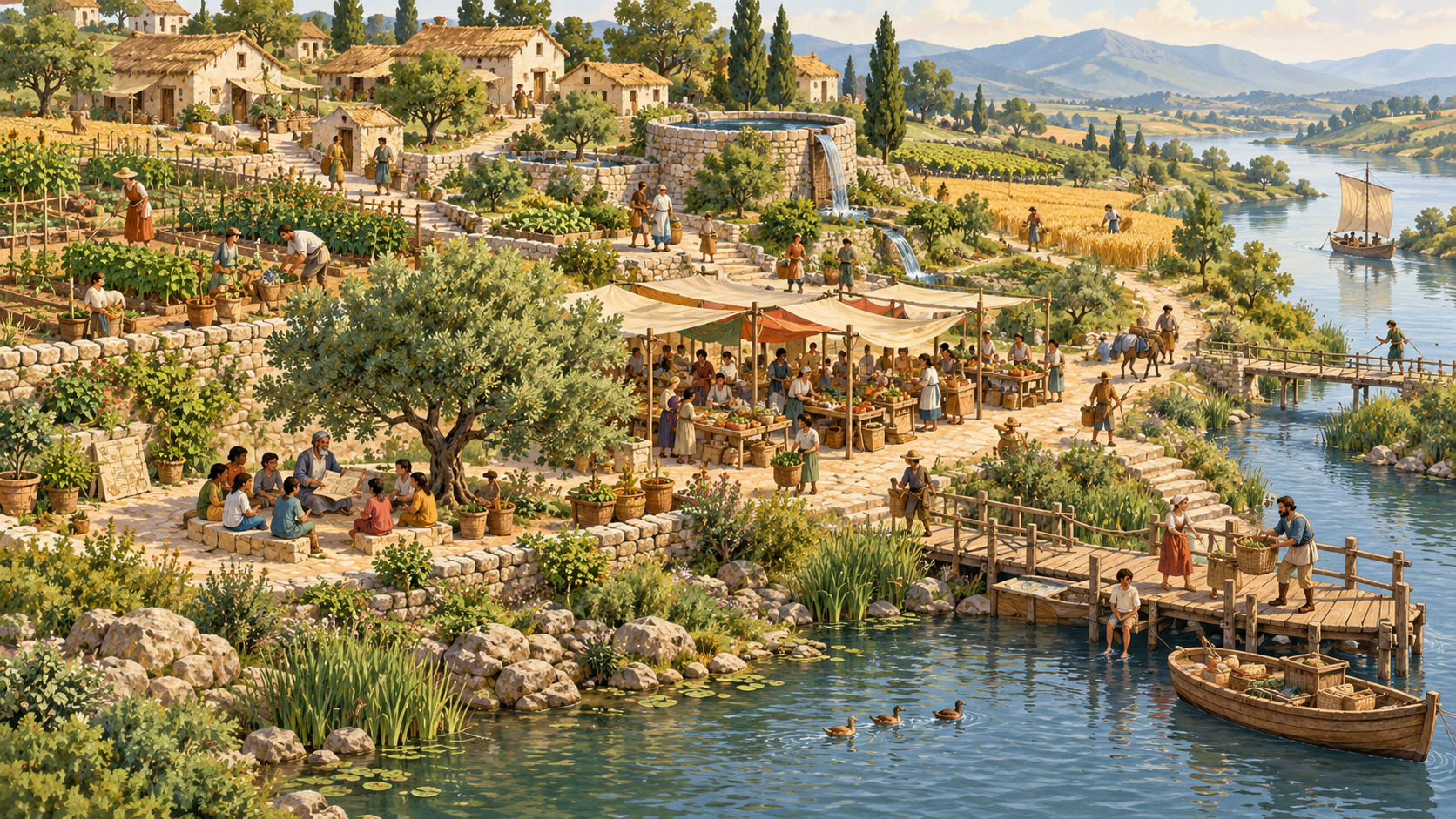
Guide 1 · Civilisation Building
Next guide: From Settlement to a Reliable Town
Civilisation Building series index
Follow the numbered progression or choose a topic that answers your learner’s current question. Each guide includes its own chapter index and parent-and-tutor activities.
Choose a published guide
- How to Build a Civilisation — current guide
- From Settlement to a Reliable Town
- Connected Cities and Specialised Production
- Scientific Thinking and Knowledge Institutions
- Reliable Infrastructure and Energy Systems
- Governing Complex Civilisations
- Advanced Civilisations and Long-Term Resilience
- Complex Technologies and Responsible Automation
- Ecological Stewardship and Resource Renewal
- Cooperation Between Civilisations
- Designing and Testing an Advanced Civilisation
- Culture, Memory and Education Across Generations
- Exploration, Maps and New Frontiers
- Communication Networks and Shared Understanding
- Standards, Measurement and Shared Systems
- Invention, Experiments and Useful Innovation
- Time, Calendars and Long-Term Coordination
- Shared Spaces and the Commons
- Homes, Neighbourhoods and Everyday Access
- Arts, Imagination and Shared Meaning
- Play, Games and Learning Together
- Food, Provisioning and Shared Meals
- Clothing, Materials and Everyday Making
- Trade, Markets and Everyday Exchange
- Movement, Journeys and Everyday Transport
Civilisation building begins with a practical question: how can people live together safely, meet their needs, learn from experience and leave the next generation with a stronger starting point? This guide to how to build a civilisation turns that question into a learning journey for children, parents and tutors. Food, water, shelter, rules, work, trade, education and care become connected parts of one understandable picture.
Learning about civilisation for children works best when a grand idea becomes a small decision. Where should a settlement stand? Who repairs its water supply? What happens when a harvest fails? How can a rule protect someone who has little power? These civilisation-building activities connect history, geography, mathematics, science, vocabulary and ethical reasoning without requiring a child to memorise a list of famous empires.
This first Civilisation Building guide is a foundation for a series progressing towards advanced civilisations. Parents and tutors can use its reading routes, worked examples, discussion questions and classroom simulations over many sessions. Our starting point is an imaginary community called Riverbend. Its people must build dependable everyday life before they can build impressive monuments, sophisticated machines or ambitious futures.
Cover image: AI-generated conceptual illustration of Riverbend, a fictional learning settlement. It is not a historical reconstruction or an engineering plan.
Find your civilisation-building route
Start with one practical question. Choose a route, try an activity and return when the learner is ready for another layer.
Riverbend is a teaching model, not a historical reconstruction, a real development proposal or a claim that every society follows the same path. Its quantities are invented for reasoning practice. Historical examples are identified separately and linked to sources. A model helps us see relationships clearly; it never replaces the diversity, uncertainty and lived experience of actual human history.
The central idea is simple: a civilisation becomes stronger when people can meet present needs, cooperate fairly, correct mistakes and pass useful knowledge forward. Bigger buildings alone do not demonstrate that strength. A reliable tap, an honest record, an accessible school and a repaired bridge can reveal more about everyday capability than a spectacular skyline.
Use the whole guide as a reference rather than a single sitting. Younger children can draw, sort and tell stories. Older children can calculate, compare sources and defend choices. Adults should adjust the reading load to the learner, revisit uncertain ideas and welcome an answer that changes after better evidence appears.
Full chapter index
Chapters 1–8: Build the foundations
- 1. Begin with people, not palaces
- 2. Choose a place by comparing trade-offs
- 3. Make water a dependable service
- 4. Build a food system across the seasons
- 5. Plan shelter, space and everyday care
- 6. Understand surplus without forgetting obligations
- 7. Share work and protect the people doing it
- 8. Create trust through visible, checkable promises
Chapters 9–16: Organise shared life
- 9. Make rules understandable and open to review
- 10. Give authority responsibility and limits
- 11. Keep records that people can interpret
- 12. Use shared measures without confusing precision with truth
- 13. Trade by understanding what each side needs
- 14. Understand money, prices and real resources
- 15. Fund shared goods and explain the budget
- 16. Build infrastructure as a continuing responsibility
Chapters 17–24: Develop capability
- 17. Care for health through environments and cooperation
- 18. Make education a way to renew capability
- 19. Develop language that makes thinking clearer
- 20. Make culture a living conversation
- 21. Learn from disagreement before it becomes damage
- 22. Protect shared resources across time
- 23. Use energy by tracing useful work and hidden dependencies
- 24. Innovate through tests that can reveal failure
Chapters 25–32: Test endurance and growth
- 25. Read history through evidence and careful comparison
- 26. Prepare for disruption before the ordinary day breaks
- 27. Treat maintenance and repair as achievements
- 28. Know when growth has outpaced the supporting systems
- 29. Connect settlements without losing sight of dependence
- 30. Measure progress through lives, capability and repair
- 31. Adapt the learning journey for different children
- 32. Use a six-session foundation sequence
Chapters 33–40: Practise and move forward
- 33. Work through the Riverbend mathematics lab
- 34. Work through the evidence and source lab
- 35. Complete a civilisation-building project
- 36. Prepare the bridge towards advanced civilisations
- 37. Diagnose understanding with ten short questions
- 38. Build a vocabulary bank through connected sentences
- 39. Test decisions with four extended scenarios
- 40. Answer the questions families most often ask
Did you know that a city can look impressive in a picture while hiding a difficult everyday life? A photograph might show a grand square and tall towers, yet tell us little about whether people can find food, travel safely or ask for help. To understand civilisation building, we have to look behind the visible objects and ask what allows ordinary days to work.
A useful working definition is an enduring, complex arrangement of people, settlements, institutions, knowledge and shared practices. Historians and archaeologists use the term in different ways. Features such as cities, specialised occupations and administrative systems are often discussed, but no short checklist can capture every society. The word should never become a label for deciding whose people matter more.
Human dignity does not depend on the size of a settlement, the presence of writing or the technology available to it. Mobile communities can hold deep ecological knowledge and sophisticated social practices. A small community is not an incomplete version of a modern metropolis. Our project studies how interdependent systems develop; it does not rank human worth.
See the people behind the system
Imagine Riverbend has a meeting place, several homes and nearby fields. Its residents begin with a question: what must be dependable tomorrow? A parent needs time to care for a baby. A grower needs access to land and tools. An older resident needs a safe path. A newcomer needs understandable information. These needs overlap without being identical.
The first planning exercise is therefore a people map. Draw residents around the edge of a sheet and their daily needs in the centre. Connect each person to food, water, shelter, care, learning and participation. Notice who has more connections to a single service. A household caring for someone with limited mobility may be especially affected by a distant water point.
Now draw a second map showing responsibilities. Who grows, carries, teaches, repairs, listens and records? Some work produces objects; other work keeps people able to live. Caring, cleaning and organising must remain visible. If the plan counts only market activity, it can appear productive while quietly exhausting the people who support everyone else.
Map needs and responsibilities
For a younger learner, ask, 'What helps someone have a good ordinary day?' Accept a picture of breakfast or a friend. Then extend the answer: who made that possible? An older learner can distinguish a need from one preferred way of meeting it. Shelter is a need; a particular house design is one possible solution constrained by place, materials and culture.
A sound first proposal might say: 'Riverbend will begin by making essential services reachable, sharing necessary work and checking whether anyone is excluded.' It is less dramatic than declaring a golden age. It is also much more useful. A civilisation begins to become understandable when the learner sees people depending on one another across time.
Try this: compare two imaginary settlements. One has a monument but unreliable meals. The other has modest buildings, dependable food and a way to challenge unfair decisions. Which daily experiences would you investigate before choosing where to live? A strong answer names evidence rather than choosing solely from appearance.
Explore the wider definition and mechanisms in What is civilisation?.
A river makes an inviting blue line on a child's map. It may support travel, growing and water collection. It may also flood, shift course or carry contamination. A good location is never simply 'near water'. It is a combination of opportunities, hazards, access and obligations that changes across seasons and over time.
Give Riverbend three possible sites. Site A stands beside the river on low ground. Site B is farther uphill, with a longer journey to the water. Site C sits near a meeting of paths, but has less nearby growing space. None wins automatically. The question is which disadvantages can be managed with the community's actual skills and resources.
Begin with observation. Where does water gather after rain? Which routes remain usable? Where are steep slopes, shade, fertile ground or fragile habitats? In a classroom, use a drawn landscape or a tray model. Do not treat a child's model as a real flood-risk assessment. The learning objective is to notice relationships before committing to a choice.
Compare places across time
Next separate the timescales. A short walk to the river helps today. A flood that damages stored food could undo months of preparation. A site that accommodates current homes may leave no room for future paths or essential services. Planning requires looking at a normal day, a difficult season and a longer future without pretending any forecast is certain.
A comparison table can include water access, hazard exposure, travel, space, environmental impact and upkeep. Younger children can use words such as easier, harder and uncertain. Older learners may assign scores, but must explain what those scores mean. A total cannot make a serious unresolved hazard disappear merely because several pleasant features receive high marks.
Ask whose journey the map represents. A steep shortcut may suit a fit adult and exclude a person using a mobility aid. A path that looks short on paper may pass through an area people cannot legally or safely use. Existing communities and land rights also matter. In real life, apparently empty land is not an invitation to take possession.
Test the location decision
Riverbend chooses Site B in our first scenario because its modelled flood exposure is lower and the community can organise water transport. That is a conditional choice, not a universal recommendation. If the water route proves impractical, or new evidence changes the hazard assessment, the decision must be revisited. Good planning records its assumptions so later learners can challenge them.
A tutor can deepen the task by changing one fact. Suppose Site B's path becomes unusable during the wet season. Does the original decision still work? Learners may propose storage, a different route or reconsidering another site. The point is to connect the response to the changed condition, not to defend a favourite answer at all costs.
Write a short location statement with three parts: 'We choose this place because… The main difficulty is… We will review the choice when…' This format develops geography and clear writing together. A thoughtful builder explains both the attraction of a site and the evidence that could make the decision change.
| Site | Possible advantage | Question to investigate |
|---|---|---|
| A: Low riverbank | Shorter water journey | Flood exposure and seasonal access |
| B: Higher ground | Lower modelled flood exposure | A dependable, accessible water route |
| C: Path junction | Convenient exchange | Space, land rights and growing conditions |
A river is a source. A water service is a chain of activities that brings suitable water to people when they need it. Collection, treatment where required, storage, distribution, inspection and repair all belong to that chain. If one link stops working, the presence of a nearby river may offer little practical reassurance.
Riverbend's children first draw a blue arrow from the river to the houses. The adult asks, 'What happens between those two places?' Suddenly the arrow becomes several jobs. Someone checks the source. Someone maintains equipment. Someone notices a leak. Someone ensures that people who cannot carry containers are served. Water planning turns into cooperation planning.
Keep health claims careful. Clear-looking water is not necessarily safe to drink. This guide does not teach treatment procedures or substitute for local public-health advice. A classroom water-filter demonstration can show how particles move through materials, but its output must not be presented as drinking water. Label the demonstration clearly and use paper tokens for the main simulation.
Trace the full water chain
Our fictional accounting problem gives Riverbend 600 water tokens each day and modelled essential demand of 500. The difference is 100 tokens before other uses. If 80 are lost in distribution, only 20 remain as headroom. Increasing collection is one possible response; reducing losses, revising allocation and improving records may also matter. These tokens are not real human water requirements.
The interesting question is why the losses occur. A damaged pipe requires repair. An inaccurate meter requires checking. An unrecorded essential user requires a fair correction to the demand estimate. Treating every discrepancy as theft would miss these possibilities and could harm trust. Good investigation begins with several plausible explanations and tests them.
Now consider access. A single central water point may be efficient to manage yet impose long queues on households at the edge. A household total does not tell us who does the carrying. Record time, distance and physical burden as well as quantity. A service can meet a volume target while remaining unfair or unreliable in daily life.
Check quantity and access
For a practical activity, place cups labelled as homes at different distances from a paper water station. Learners move counters along drawn routes. Add a closure to one path and invite a redesign. Nobody needs to race or carry heavy water. The simulation should reveal dependencies while keeping participation comfortable and accessible.
Riverbend's first water agreement names an operator, a backup, a reporting method and a review date. It also states who is responsible for checking the service. Responsibility becomes more useful when it is visible. 'Everyone will help' sounds cooperative but can leave a task unattended because each person assumes somebody else has done it.
End by asking what evidence would show improvement. Possible answers include fewer interruptions, shorter queues, reduced losses and better access for households previously overlooked. The strongest answer combines several measures. A bigger tank may help, but the goal is dependable suitable water reaching people, not simply possession of a large object.
Food planning begins before a meal appears and continues after a harvest is gathered. A community needs ways to produce or obtain food, protect it, move it, prepare it and allocate it. It also needs to learn what happens when seasons change. A large harvest is encouraging; it is not the same thing as a dependable food system.
Riverbend grows several crops in its imaginary fields and exchanges goods with nearby communities. This combination gives learners two kinds of dependence to examine. Local production depends on land, weather, labour and knowledge. Trade depends on partners, routes and agreements. Neither self-sufficiency nor trade automatically removes vulnerability. The balance depends on circumstances.
Use a seasonal calendar with four model periods rather than assuming all places share the same agricultural year. Mark when work is needed, when food becomes available and when stores are drawn down. Children often discover that the busiest period does not always coincide with the hungriest period. Timing helps explain why storage and coordination matter.
Plan through a seasonal gap
Give the model store 900 food tokens. Expected use before the next delivery is 650, and 100 are reserved as seed tokens. There are 150 tokens left for uncertainty before accounting for loss. If damp damages 80 tokens, the cushion shrinks to 70. This arithmetic introduces the difference between a gross total and food actually available for consumption.
Do not suggest that real diets are interchangeable sacks of grain. Nutrition, preferences, cultural practices, age, allergies and other needs affect food planning. Tokens simplify quantity so learners can practise reasoning. An older learner should add a limitation statement: our model tracks availability but does not adequately represent dietary quality or individual requirements.
Discuss variety carefully. Depending on one crop can expose a community to a shared failure. Growing several crops may spread some risks, yet the crops can still depend on the same water supply or storage building. Ask which risks are independent and which remain connected. Variety is useful when it changes actual exposure, not merely the number of labels on a chart.
Compare availability and access
Caring work belongs in the food system too. A harvest plan that uses every available hour for fieldwork may leave nobody to cook, care or teach. Invite learners to allocate time as well as land. A plan becomes more realistic when it acknowledges that the same people cannot complete unlimited tasks at once.
For a younger child, tell a story about a basket that must last until the next market day. Ask what happens if part is saved for planting. For an older learner, compare a high-yield option with greater uncertainty against a steadier option with lower average output. Require reasons and a backup, not a claim that one strategy always wins.
Riverbend's food plan records expected supply, essential uses, losses, reserves and a trigger for seeking help. Its residents also ask who can access the store. A full warehouse offers little security to a household excluded by price, distance or an unfair rule. Dependable food means availability and a workable route to obtaining it.
A house is an object; shelter is a condition people experience. A roof can exist without providing adequate protection, privacy or access. Civilisation building becomes clearer when children ask what a building allows people to do and what burdens its design creates. The best-looking model is not always the most workable place to live.
Riverbend begins with simple home drawings. Learners add places to rest, store belongings, prepare meals and care for someone unwell. Then they connect each home to paths, water access and shared spaces. The homes stop being isolated squares. They become part of a settlement whose layout influences how much time daily tasks require.
Space is limited in the teaching map. Larger plots give individual households more room but can lengthen paths and reduce space for fields or shared facilities. Closer homes shorten some journeys but create different concerns about noise, privacy and crowding. A useful discussion recognises the trade-off without treating any single layout as universally correct.
Connect homes to daily life
Accessibility should shape the first design. Add a resident who cannot easily use steps, a child who needs a safe route and someone who cannot read small signs. Ask what each person would need to reach everyday services. Learners should avoid assuming that inclusion is a special extra added after everybody else's plan is finished.
Care is often hidden because it happens inside homes. Make it visible by assigning time tokens to cooking, cleaning, childcare, supporting older residents and recovering from illness. If the settlement's work plan ignores these tasks, it has not eliminated them. It has simply left some residents to carry an uncounted load.
A paper exercise gives Riverbend 120 shared work tokens for a day. Fields require 40, water services 20, maintenance 15, transport 15 and care 30. All 120 are already committed. A proposal for a new 20-token project therefore requires a change: more suitable capacity, a revised schedule or postponement. Calling the new project important does not create extra hours.
Count time and care
The adult can ask whether all care can be scheduled in advance. Learners may notice unexpected needs. That observation introduces the value of flexibility and backup. A plan with every hour assigned may appear efficient while failing whenever someone needs additional support. Spare capacity can be a practical protection rather than evidence of laziness.
Do not ask children to disclose private household difficulties to complete this exercise. Fictional residents give everyone a shared situation to discuss. A learner may choose to make one home smaller or move a service, but should explain who benefits and what new difficulty might follow. The exercise develops empathy through design, not through personal exposure.
A strong settlement plan ends with a daily-life test: can a range of residents rest, eat, participate and obtain help without unreasonable obstacles? The answer must look beyond the number of buildings. Shelter succeeds when the spaces and services around people support a life they can actually manage.
CHAPTER 6 OF 40 · Build the foundations
6. Understand surplus without forgetting obligations
Surplus is what remains after relevant needs and commitments are accounted for. It can support reserves, specialist work, learning and new projects. But a pile of goods is not automatically surplus simply because it is visible. Some of it may already be needed for future consumption, replacement, planting or promises made to others.
Riverbend harvests 1,200 food tokens. Learners initially call the whole amount wealth available for spending. Then they list 700 for ordinary use, 150 for seed, 100 for expected loss and 150 for an agreed reserve. The uncommitted balance is 100. The subtraction makes a conceptual point: obligations change the meaning of a total.
Now ask who decides which commitments count. A powerful household might declare its own preferences essential while treating other residents' needs as optional. Accounting alone cannot settle a fairness dispute. The community needs transparent definitions, participation and a way to challenge an allocation. Mathematics clarifies a disagreement; it does not remove the values within it.
Separate totals from commitments
Surplus also has a timescale. A good month may be followed by a difficult season. Using every extra token immediately can leave the community exposed later. Saving everything can also impose avoidable hardship today. The task is to compare current needs, future uncertainty and the benefits of investment, with reasons that residents can examine.
Invite three proposals for the 100 uncommitted tokens. One group wants more storage, another wants a shared learning space and a third wants shorter working hours. Each proposal has a different kind of benefit. Learners should not be forced to treat only physical construction as progress. Rest, care and learning may improve capability in ways a building count misses.
An older learner can introduce opportunity cost: choosing one use means giving up another possible use. This does not mean every decision must be monetised. It means time, materials and attention cannot be used without limit. A reasoned choice names the alternative that will be delayed and explains why the selected benefit matters more in this situation.
Choose and explain an allocation
Specialisation becomes possible when people can obtain essentials while working on other tasks. A teacher, repairer or record keeper still needs food and shelter. That support can be organised through many arrangements. Avoid presenting a single compulsory historical sequence in which farming always produces surplus, surplus always creates cities and cities always produce the same institutions.
For discussion, suppose Riverbend reports a surplus while some households cannot obtain enough food. What might the report be missing? Possible answers include unequal access, uncounted needs, inaccurate records or a misleading definition of surplus. Learners should investigate before choosing one explanation. The apparent contradiction is an invitation to improve the model.
The chapter's test is to complete this sentence precisely: 'We have a surplus of this resource over this period, after accounting for these uses.' That sentence is less catchy than 'We are rich'. It is more useful for making decisions that remain sensible after the excitement of a good harvest fades.
| Food allocation | Model tokens |
|---|---|
| Harvest | 1,200 |
| Ordinary use | 700 |
| Seed | 150 |
| Expected loss | 100 |
| Agreed reserve | 150 |
| Uncommitted remainder | 100 |
CHAPTER 7 OF 40 · Build the foundations
7. Share work and protect the people doing it
Specialisation means people develop particular kinds of skill and take responsibility for different tasks. A grower learns about soil and seasons. A builder learns how materials behave. A teacher helps others acquire knowledge. The community can become more capable when people have time to practise, but each specialist also becomes dependent on work performed elsewhere.
Riverbend draws an occupation wheel. Around its edge are growing, building, caring, transporting, repairing, teaching and keeping records. Arrows show what each role needs from the others. The repairer depends on food and tools. The grower depends on maintained equipment and usable routes. No role floats above the system. Even a respected leader needs the ordinary work of many other people.
The wheel should include less visible work. Cleaning a shared space may prevent disruption. Organising a meeting may make a fair decision possible. Supporting someone who is learning a difficult task may improve the settlement's future capacity. If children only draw the most dramatic occupations, invite them to imagine what stops working when the overlooked roles disappear.
See interdependence in work
There are risks as well as gains. A community with one skilled repairer can become fragile when that person is unavailable. A role can also become a source of unfair power if its holder controls access without accountability. Specialisation needs opportunities to learn, workable backups and protections for the people who depend on the specialist's decisions.
Use a practical model. Give six learners fictional role cards and a set of task cards. Each role can complete some tasks quickly and must learn others. Remove one role for a round by declaring that its holder is away. The group then decides which services to protect, what to postpone and what knowledge should be shared before the next round.
Do not turn the exercise into praise for overwork. A system that functions only when one person never rests is poorly designed. Ask how training, simpler tools, clearer instructions or a different schedule could reduce the burden. Competence matters, but durable cooperation cannot rely on an endlessly available hero.
Protect skill and continuity
Fairness also requires looking at choice and recognition. Can a person change roles? Can someone learn a more valued skill? Are caring responsibilities considered when work is allocated? Does the community confuse low status with low importance? Children can discuss these questions without needing a single correct political arrangement for every society.
An older learner can calculate a dependency problem. If one person completes eight repairs per week and requests arrive at ten per week, the queue grows by two each week under the stated assumptions. Telling that person to work harder indefinitely is not a plan. Riverbend might train another repairer, prevent repeated faults or revise priorities while protecting essential needs.
The useful outcome is a work agreement that describes responsibilities, support, learning opportunities and limits. A civilisation becomes more capable when skilled work can be carried reliably and fairly. It becomes vulnerable when the same achievement depends on exhaustion, exclusion or knowledge that nobody else is allowed to understand.
Extend the discussion through How Teamwork Works.
CHAPTER 8 OF 40 · Build the foundations
8. Create trust through visible, checkable promises
Trust allows people to act without checking every detail from the beginning. A grower may deliver food because a neighbour has kept earlier promises. A learner may ask a question because a teacher responds respectfully. Trust can reduce friction, but it should not require people to ignore evidence or accept an uncheckable claim from someone powerful.
Riverbend's first market relies on personal familiarity. Everyone knows who usually brings baskets and who borrows tools. As the settlement grows, people exchange with others they have not met before. Personal reputation still matters, but it cannot carry every agreement. Shared measures, records and ways to resolve disputes become increasingly useful.
Start with a small promise: return a shared tool by the agreed time. The promise has several parts. The tool must be identified, the time must be understandable and both people must know what happens if an unexpected difficulty occurs. A vague promise can fail even when nobody intends harm. Clear communication is part of trust-building.
Make promises checkable
Now add a record. A simple borrowing sheet states the item, condition, borrower, due date and return. Its purpose is to reduce confusion, not to collect unnecessary personal information. Learners can use invented names and paper tools. The sheet should be available to those who need it and corrected when an error is discovered.
A record is useful only if people can question it. Suppose the sheet says a tool was not returned, but the borrower says it was left with a different caretaker. The community should investigate rather than assuming the sheet is infallible. Records preserve claims and observations; they do not transform every entry into truth.
Ask children to distinguish a mistake, a broken promise and deliberate deception. These categories may require different responses. A confusing instruction suggests clarification. A repeated failure to return an item may require a revised borrowing arrangement. A harmful deliberate act may require a fair investigation and proportionate consequences. The evidence must support the conclusion.
Investigate and correct fairly
Trust also grows when institutions respond well to correction. A caretaker who acknowledges an inaccurate entry can strengthen confidence in the process. Hiding the error may protect appearances briefly while making future records less credible. The goal is not to claim perfection. It is to show that mistakes can be found and repaired without unfair retaliation.
For an older learner, compare three systems: no records, records controlled by one unchallengeable person, and records with appropriate access and review. Each has costs and benefits. Too much paperwork can burden a small exchange; too little can make recurring disputes hard to resolve. Scale the method to the importance and frequency of the problem.
Riverbend's trust rule is therefore practical: make important promises clear, preserve necessary evidence and allow fair correction. A community does not become trustworthy merely by displaying the word on a banner. People learn whether trust is warranted through repeated experiences of how commitments, uncertainties and disagreements are handled.
CHAPTER 9 OF 40 · Organise shared life
9. Make rules understandable and open to review
Rules help people coordinate actions when their needs or preferences differ. A path-use rule can reduce collisions. A borrowing rule can keep tools available. A decision rule can tell residents how a shared project is approved. Rules become harmful when they are unclear, selectively enforced or impossible for affected people to challenge.
Riverbend encounters a queue at its busiest water point. Some residents arrive early and wait. Others leave containers overnight. A few collect for neighbours who cannot travel. A rule that simply says 'one container per person' may appear equal while disadvantaging households with different circumstances. The problem needs careful definition before a rule is chosen.
Begin by naming the purpose. Is the community trying to reduce waiting, prevent hoarding, ensure essential access or manage a temporary shortage? A rule can be evaluated only in relation to what it is supposed to achieve. If several purposes conflict, record that conflict instead of hiding it behind a slogan about fairness.
Define the purpose of a rule
A child-friendly rule has clear wording, a reason and a way to ask for help. It should identify who applies it and how exceptional situations are considered. Younger learners can draw signs; older learners can draft a short policy. Neither group should assume a longer rule is automatically better. Unnecessary complexity can make access harder.
Test the draft with fictional residents. One cannot carry a container. One works during the usual collection period. One cannot read the notice. One is new and does not know the custom. If the rule works only for the person who wrote it, revision is needed. These tests reveal obstacles that a tidy statement may conceal.
Enforcement also matters. Suppose a well-connected resident ignores the rule without consequence while a newcomer is punished for misunderstanding it. The text may be neutral but the practice is unequal. Ask learners what evidence would help distinguish an isolated mistake from a recurring pattern. Fairness requires examining implementation as well as wording.
Test how the rule works
An appeal does not mean every disappointed person gets the outcome they prefer. It means there is a reasonable way to question facts, interpretation or treatment. The reviewer should be able to consider relevant evidence and explain a decision. A process that merely repeats the original answer without examination offers little meaningful review.
Rules should have review triggers. A temporary arrangement for a shortage may become unsuitable after supply improves. A rule designed for twenty households may fail at two hundred. Riverbend records when a rule will be reconsidered and what signs would require earlier attention. Stability and adaptability can support each other when changes are explained.
End with a writing exercise: draft a rule in four sentences covering purpose, action, exception or support, and review. Then swap drafts and identify one resident whose situation remains unclear. The lesson is that rules are tools for living together. Their quality appears in the experiences they create, not only in how authoritative they sound.
CHAPTER 10 OF 40 · Organise shared life
10. Give authority responsibility and limits
Leadership can help a community make decisions, coordinate work and respond to uncertainty. It also concentrates power. Children learning about civilisation need to understand both sides: why someone may need authority to act, and why that authority should come with explanation, boundaries and ways to detect misuse.
Riverbend appoints a coordinator for repairing its shared path. The coordinator can organise a timetable and request agreed materials. That does not automatically give them authority over every household or the right to change unrelated rules. Defining the task prevents a useful role from expanding simply because nobody has asked where its limits lie.
A clear mandate answers several questions. What may this person decide? What must be discussed with others? What resources can they use? How will residents know what happened? What happens if the person cannot continue? These questions are suitable for a classroom project and offer a concrete introduction to institutional design.
Set the leadership mandate
Suppose the coordinator's family owns a workshop that could receive the repair contract. The family might do excellent work, but the relationship creates a conflict of interest. The issue is not proof of wrongdoing. It is that personal benefit could influence judgement or undermine confidence. A fair process makes the relationship visible and uses an appropriate independent decision method.
Accountability requires information people can understand. A report saying 'the project is progressing' offers less help than one stating what was completed, what remains, what was spent and which problems changed the plan. Even a short report can be specific. The purpose is to let others assess performance and ask informed questions.
Participation also needs structure. Inviting comments at a meeting may exclude people who cannot attend, speak confidently or understand the language used. Riverbend offers several ways to contribute: a spoken discussion, a written suggestion and a supported conversation. The appropriate method depends on the group, but the principle is to make influence more than a formal invitation.
Make accountability practical
For a role-play, appoint a coordinator, residents, workers and a reviewer. Give the coordinator an urgent request that exceeds the original budget. The group must decide whether to pause, seek approval or use a defined emergency provision. Avoid rewarding whichever learner speaks loudest. Assess whether the decision follows the agreed responsibility and explains its consequences.
A useful distinction is between decisive action and unchecked action. A community can authorise someone to act quickly in a defined situation while requiring a later explanation. Conversely, endless discussion without a workable decision method can leave essential tasks undone. The design challenge is to connect speed, legitimacy and review in proportion to the situation.
Riverbend finishes with a leadership card stating authority, duties, limits, reporting and replacement arrangements. It is a small document with a large lesson. A strong institution should remain workable when a particular leader leaves. Good leadership helps other people understand and carry the system instead of making the whole community dependent on one personality.
Memory is essential, but individual memory has limits. A resident may forget how much grain was delivered or which part of a bridge was repaired. Records let a community preserve information beyond one conversation or one person's lifetime. They also create new responsibilities: deciding what to record, how to check it and who should have access.
Riverbend begins with a store ledger. Each entry names a date, an item, a quantity and a reason for the movement. An incoming delivery increases the balance; an authorised use decreases it. If the units change between entries, the total becomes difficult to interpret. Consistent definitions matter as much as neat handwriting.
Use an invented example. The store opens with 240 tokens, receives 80 and issues 95. Its expected closing balance is 225. A count finds 218. The difference is seven. Learners should first state the discrepancy without claiming a cause. Possible explanations include counting error, recording error, unrecorded damage or unauthorised removal. Investigation comes after observation.
Keep quantities and claims distinct
A good entry distinguishes what someone observed from what they inferred. 'Seven tokens fewer than the expected balance' describes a comparison. 'Someone stole seven tokens' adds a claim about cause and intention. The second statement needs additional evidence. This difference is valuable in history, science, journalism and ordinary disagreement.
Records also need context. A number without a unit, date or method can be misleading. A map without a scale cannot support precise distance claims. A repair note without the location of the repair may be hard to use later. Ask learners what a future reader would need to understand an entry without asking its author.
More information is not always better. A classroom ledger does not need private health details or real household addresses. Record only what serves the task. Some records should be public; others require protection. The community must balance transparency about shared decisions with privacy for individuals. Those are related responsibilities rather than a reason to abandon either one.
Preserve usable context
A simple version system helps prevent confusion. Label a plan with its date and keep a short note of important changes. If learners use two different maps, they should be able to tell which is current. Without that information, a well-intentioned person may follow an obsolete instruction and create a problem that looks like carelessness.
For a historical connection, the Metropolitan Museum of Art's collection includes an administrative cuneiform tablet recording rations. Such objects show that surviving writing can illuminate routine administration, not only stories about rulers. Read the linked museum record and ask what it can support. One tablet cannot tell us everything about an entire society.
Riverbend's record test is practical: can another person use the information correctly, question it and update it without losing the earlier context? A record succeeds when it supports reliable understanding. A large archive that nobody can interpret may preserve marks while failing to preserve usable knowledge.
CHAPTER 12 OF 40 · Organise shared life
12. Use shared measures without confusing precision with truth
A basket is a convenient container, but two baskets may hold different amounts. If Riverbend trades 'one basket' of grain without a shared meaning, disagreement is predictable. Measurement makes comparison possible by defining quantities and procedures. It also requires judgement about suitable units, uncertainty and how much precision a decision actually needs.
Begin with a classroom activity using counters and paper containers. One group measures in cups, another in differently sized cups. Let them compare results before revealing the difference. The disagreement is not solved by declaring one group careless. Their unit definitions differ. The repair begins with a common standard or a clear conversion.
A standard should be accessible and checkable. If only one trader owns the reference weight and nobody can inspect it, measurement can become a source of unaccountable power. Riverbend keeps a shared reference and a method for checking working measures against it. The point is consistency that people can examine, not blind faith in a labelled object.
Choose units and methods
Suppose a field measures approximately 20 units by 15 units on a simplified rectangular map. Its model area is approximately 300 square units. If the boundaries are irregular, treating the rectangle as exact may overstate what is known. Older learners can discuss estimates, rounding and whether a more detailed survey would change the planning decision.
Precision describes how finely a result is expressed or how repeatable measurements are; accuracy concerns closeness to the relevant true or accepted value. A device can give consistent readings that are systematically wrong. Children do not need a technical lecture to understand this. A mislabelled ruler used carefully can still produce misleading measurements.
Ask what uncertainty matters. A rough estimate may be enough to compare two possible walking routes. A safety-critical construction decision requires qualified expertise and appropriate standards. This guide's paper models are for reasoning, not real engineering. Matching the method to the consequence is part of understanding measurement responsibly.
Interpret the result carefully
Riverbend also learns to label denominators. 'Ten failures' means something different out of twenty trials than out of ten thousand. 'Most households' should prompt a question about the total and the counting method. Percentage language becomes more meaningful when learners can identify both the part and the whole.
For practice, compare two imaginary pumps. Pump A transfers 100 model units in five rounds; Pump B transfers 84 in four rounds. Their average rates are 20 and 21 units per round. That does not settle the choice. Reliability, effort, repair needs and suitability may differ. A calculation answers a defined question, not every question about a decision.
The chapter ends with a measurement label: quantity, unit, method, date and uncertainty where relevant. Ask the learner to attach it to one Riverbend claim. Better measurement strengthens civilisation when it makes shared decisions clearer. Extra decimal places cannot compensate for the wrong question, an unsuitable method or a hidden assumption.
CHAPTER 13 OF 40 · Organise shared life
13. Trade by understanding what each side needs
Trade connects people whose resources, skills or preferences differ. Riverbend may exchange baskets for grain or obtain a tool from another settlement. An exchange can benefit both sides, but its quality depends on information, bargaining conditions, transport and what happens if the agreement fails. A market is a social arrangement as well as a place.
Begin with fictional goods cards. One household has more baskets than it needs and would like grain. Another has grain but wants repairs. A direct swap may be difficult because the two desired exchanges do not align. Learners can explore several arrangements, including a sequence of exchanges or an agreed means of payment, without assuming one solution fits every setting.
Value is not identical to effort or physical size. A small tool may be valuable because it solves a difficult problem. An item abundant in one place may be scarce elsewhere. Urgent need can change bargaining power. These observations help children understand why a trade should be assessed through circumstances rather than a rule that equal-looking piles must be fair.
Look inside an exchange
Information matters. If one trader knows a container is damaged and hides that fact, the apparent agreement rests on misleading information. If both sides understand the condition and agree on a lower price, the situation differs. Ask learners to describe what each party knows before judging the exchange. Consent is more meaningful when relevant information is available.
Transport changes the calculation. Suppose Riverbend offers 30 tokens for a delivery worth 24 at its source, while carrying and storage cost eight. The planned exchange would cost 32, exceeding the offer. Learners can renegotiate, combine deliveries, change the route or decline. A difference between buying and selling prices is not automatically profit.
Dependence grows through repeated trade. This can support cooperation, but it also exposes the settlement to interrupted routes or unreliable partners. Riverbend should know which goods are essential, how long substitutes take to obtain and what happens if deliveries stop. A backup does not require abandoning useful exchange; it requires understanding the consequences of interruption.
Account for costs and connections
Fair exchange also considers who bears hidden costs. A cheap item may involve environmental damage or unfair working conditions that the price does not reveal. Children can begin with a simple question: who else is affected by this transaction? Older learners can compare the direct agreement with effects on workers, neighbours or shared resources.
A role-play works best when nobody has to win by deceiving another child. Give traders different needs and visible information, then ask them to record a mutually understandable agreement. Include quantity, quality, timing and a response to delay. Afterwards, change one condition and examine whether the agreement still makes sense.
Riverbend's trade lesson is to look beyond the moment of swapping. A sound exchange has a workable route, clear expectations and an honest account of costs and dependencies. Civilisation becomes more connected through trade when people can make and sustain agreements across differences rather than simply moving more objects between places.
CHAPTER 14 OF 40 · Organise shared life
14. Understand money, prices and real resources
Money can make exchange easier by providing a commonly accepted means of payment and a unit for recording value. It can also help carry purchasing power over time, although that depends on circumstances. Money is useful because people and institutions accept and support its use. It does not create food, skilled workers or materials simply by being counted.
Riverbend introduces paper tokens for its classroom market. These tokens are a teaching device, not a historical claim about how all money began. The group first agrees where tokens can be used, what records are needed and how goods are priced. If the rules change without explanation, confidence in the tokens may weaken even though their physical appearance stays the same.
Suppose ten baskets are available and shoppers collectively want twenty at the stated price. Increasing the number of payment tokens does not immediately produce ten more baskets. Producers may respond over time, buyers may choose substitutes or prices may change. The result depends on the situation. A simple market model should make these possibilities visible without pretending to forecast every economy.
Connect tokens to real capacity
Prices can communicate information about supply and demand, but they do not tell the whole story about need or fairness. A person with little money may urgently need an item yet be unable to express that need through purchasing power. Essential services therefore raise questions beyond whether a transaction can occur at a market price.
Distinguish a budget from physical capacity. Riverbend may have enough tokens to approve a bridge project but lack a qualified builder or suitable materials. Alternatively, materials may be available while the agreed funding is insufficient. These are different constraints and need different responses. The phrase 'we can afford it' should invite a question about which kind of affordability is meant.
Borrowing brings future commitments into a present decision. If the settlement borrows tokens to build storage, it needs a credible repayment plan and an explanation of who carries the obligation. A project may create future benefits, but those benefits are uncertain. Children can compare repayment schedules using invented numbers without receiving personal financial advice.
Understand continuing commitments
For practice, a project costs 80 tokens now and requires 10 each model year for upkeep. A learner who records only 80 has described construction, not the full continuing commitment. After three years, the stated construction-and-upkeep total is 110, before any other costs. This simple calculation prepares learners to recognise ongoing obligations elsewhere.
A younger child can sort 'money', 'things' and 'work' cards. Older learners can trace how all three interact. The adult should avoid equating wealth with human worth or suggesting that households with fewer resources have made poor choices. Economic circumstances are shaped by many conditions beyond individual effort.
Riverbend's money rule is to keep the link to real life visible. Payment systems and budgets can support coordination, but the settlement ultimately depends on people, materials, knowledge and workable institutions. A larger number on a ledger is valuable only in relation to what it can reliably help people obtain and do.
CHAPTER 15 OF 40 · Organise shared life
15. Fund shared goods and explain the budget
Some useful services are difficult to organise through isolated household decisions. A shared path, a public meeting space or common records can benefit many people. Riverbend needs a way to decide what should be provided together, how contributions are arranged and how spending is checked. This is a budgeting problem with practical and ethical parts.
Begin by distinguishing a shared benefit from a universal preference. Several residents may enjoy a festival, but that does not automatically make every proposed expense essential. A quieter service may matter more to a smaller group with serious needs. Public decisions require reasons that can consider reach, urgency, fairness and long-term effects without reducing everything to popularity.
Give Riverbend a model budget of 200 tokens. Proposed spending includes 60 for water-service upkeep, 40 for paths, 30 for learning, 30 for care support and 40 for reserves. The total is 200. A new request for 25 tokens cannot be approved without identifying a funding source or a revised allocation under the exercise's assumptions.
Compare shared priorities
Ask learners to write the revision openly. Reducing reserves may increase exposure to interruption. Delaying a path repair may increase travel burdens. Increasing contributions may affect households differently. None of these consequences can be erased by describing the project as good. A budget is a set of choices among valued uses of limited resources.
Contribution rules also need examination. Equal token contributions may be simple but place different burdens on households with different resources. Contributions linked to income, use or another measure introduce different questions about assessment and administration. The exercise should compare arrangements rather than declare one universal formula for all communities.
Transparency means people can see relevant plans and outcomes. Riverbend publishes a short budget showing proposed amounts, actual spending and explanations for important differences. It should distinguish a forecast from a completed payment. A learner who sees an approved budget line should not assume the work has already been delivered.
Check contributions and delivery
Oversight should check both accounting and usefulness. Spending exactly the approved amount does not prove a project met its purpose. Conversely, a justified change may improve the outcome while requiring proper approval and explanation. Ask whether the service reached its intended users, whether it works and whether its continuing costs are understood.
For a discussion activity, give each learner a different fictional resident card. One relies heavily on the shared path; another has limited income; another wants a new play space. Invite each person to explain a concern, then ask the group to revise the plan. Assessment should reward listening and reasons, not the ability to secure the most tokens.
Riverbend's final budget statement says what is funded, why, who contributes, how delivery is checked and when the plan will be reviewed. Civilisation building requires this ordinary discipline. A shared project becomes more credible when the people supporting it can understand the commitment and see whether the promised service actually appears.
CHAPTER 16 OF 40 · Organise shared life
16. Build infrastructure as a continuing responsibility
Infrastructure is often described through objects: roads, pipes, bridges and buildings. Its practical value comes from the services those objects support. A bridge connects places only while it remains usable. A pipe carries water only when the surrounding system works. Construction starts a responsibility; it does not finish the story.
Riverbend proposes a bridge to shorten a route to its fields. In a paper model, the current journey takes 12 time tokens and the new route would take five. The potential saving is seven per journey. Before approving construction, learners must ask who uses the route, how often and what the bridge would require to remain dependable.
A simple benefit estimate multiplies seven saved tokens by 20 model journeys per day, giving 140 journey-time tokens saved. That calculation is useful only if its assumptions hold. If the bridge becomes inaccessible to some users or the journey count was exaggerated, the estimate changes. Label the figure as a modelled benefit rather than a measured outcome.
Follow the whole project lifecycle
Now list lifecycle tasks: planning, suitable design, construction, inspection, cleaning, repair and eventual replacement. Real bridges require qualified professionals and applicable standards. Classroom structures made from paper or blocks are reasoning activities, not engineering instructions. The conceptual lesson is that safety and reliability depend on expertise and continuing attention.
Consider what the new route changes elsewhere. More traffic may benefit a market and burden a quiet residential path. A shorter journey may encourage new settlement in an area with different risks. Infrastructure can create opportunities and reshape behaviour. Its effects are not limited to the narrow service first written in the proposal.
Riverbend assigns an owner for each continuing task. 'Owner' here means the role accountable for organising the task, not necessarily private possession. The person inspecting a route may differ from the person authorising repairs. Clear responsibilities help prevent a familiar problem: everyone values the service, yet nobody has budgeted to maintain it.
Assign continuing responsibility
A useful classroom exercise compares two project cards. Project A has lower initial cost but higher upkeep; Project B has higher initial cost and lower stated upkeep. Learners calculate totals over a specified model period and discuss uncertainty. The cheapest option today may or may not be the better long-term choice; the data must support the judgement.
Add a disruption card: the only repair material is delayed. The group can consider temporary service changes, alternative routes and communication with users. A strong plan states what will be protected and what will pause. It does not assume residents can continue using a service that has been declared unavailable.
The chapter's final question is, 'Who will keep this working after the opening celebration?' Children who can answer it are beginning to see infrastructure as a living commitment. Civilisation improves through useful construction when its institutions also make the quiet work of upkeep possible, recognised and adequately supported.
| Stage | Question |
|---|---|
| Before construction | Who benefits and what evidence supports the proposal? |
| During delivery | Who has suitable responsibility and expertise? |
| While in use | Who checks condition and provides upkeep? |
| When interrupted | How are users informed and supported? |
| At review | Does the service remain useful, accessible and supportable? |
CHAPTER 17 OF 40 · Develop capability
17. Care for health through environments and cooperation
Health connects individual experience with shared conditions. Homes, food access, water services, waste systems, air quality, working conditions and care arrangements can all matter. For this civilisation lesson, the aim is to understand coordination and prevention. It is not to diagnose illness, provide treatment instructions or assign blame to people who become unwell.
Riverbend notices that a shared space is difficult to keep clean because waste collection has no clear schedule. One response blames residents for being careless. Another asks how the system works: where are suitable collection points, who maintains them, what information is available and what happens when a collection is missed? The second approach can reveal practical obstacles.
Use a paper route map to trace waste from its point of generation to its managed destination. Include people, equipment, schedules and reporting. Do not let the arrow end vaguely 'away'. Waste does not cease to exist because it leaves the centre of the map. The activity helps children recognise consequences beyond the places they see daily.
Trace environments and access
Care access needs a similar chain. A resident must recognise a need, know where appropriate help is available and be able to reach it. The provider needs suitable training, supplies, time and support. Actual health decisions require qualified professionals and current local guidance. Riverbend's model uses fictional service cards so learners can study access without making clinical decisions.
A care plan should avoid treating people only as workers to be restored to productivity. Rest, comfort, dignity and participation matter in their own right. Ask how the settlement can support someone whose needs continue over time. A fair community must remain understandable and liveable for people with different capabilities and circumstances.
For a time-allocation exercise, give Riverbend 30 care-support tokens and requests totalling 36. Learners cannot assume all needs are equivalent or solve the problem by ignoring six tokens of requests. They must identify what information is missing, which tasks require qualified help and what additional support or revised arrangements might be needed in the fictional situation.
Protect dignity and privacy
Privacy is part of good care. Public reporting can identify service delays without exposing unnecessary details about individuals. A classroom activity should use invented cases and never invite children to reveal medical histories. The goal is to understand structures of support while respecting the people who use them.
An older learner can examine the difference between an output and an outcome. The number of appointments offered is an output. Whether people receive suitable, timely help concerns outcomes and experience. One number rarely tells the whole story. A service may appear busy while leaving particular groups unable to access it.
Riverbend's health lesson is that care depends on both trained people and workable surrounding systems. A civilisation becomes more supportive when it notices preventable obstacles, organises suitable services and listens to those affected. Success should be measured through people's experience and wellbeing, not simply the number of facilities drawn on a plan.
Education allows a community to pass knowledge forward, question inherited ideas and develop new abilities. It includes more than a school building. Teaching, practice, feedback, language, access to materials and opportunities to apply learning all shape what learners can actually do. A civilisation cannot preserve its capabilities merely by hoping children will absorb them through proximity.
Riverbend's storekeeper knows a reliable counting method. When asked to teach it, the keeper first demonstrates the complete task. Learners then practise one part, explain their reasoning and receive feedback. Finally, they work through a changed example independently. This sequence reveals whether knowledge has transferred beyond the original demonstration.
A child who copies a ledger successfully may still be unable to recognise an incorrect entry. That is a useful diagnostic finding, not a reason for embarrassment. The next lesson should target interpretation or checking rather than provide endless copying. Education becomes more effective when the adult identifies the first uncertain step in a chain.
Check whether knowledge transfers
The community also asks who can learn. A lesson scheduled during essential caring work may exclude some residents. Materials available only in one format may create barriers. Fees, language, travel and expectations can affect participation. Access means more than declaring that a lesson exists; it requires a realistic route into learning and continued support.
Use Riverbend's education plan across subjects. Mathematics helps compare quantities and rates. Science helps test explanations about materials or growth. English helps learners state a problem and justify a choice. History helps them examine change and evidence. Art and storytelling help represent experience and imagine alternatives. None needs to be reduced to a decorative extra.
Knowledge should not become a gate held by a small group that refuses to explain its methods. Expertise deserves respect, yet a durable community also needs training pathways and appropriate scrutiny. Children can learn to ask a precise question without assuming that every expert claim is wrong or that expertise removes the need for evidence.
Plan independent application
For a practical teaching task, invite a learner to write instructions for a simple paper sorting activity. Another learner follows them without additional hints. Where confusion appears, revise the instructions and try again. The adult can discuss the difference between knowing how to do something and knowing how to help someone else learn it.
Assessment should include transfer. If a learner can calculate a food reserve, can they use the same structure for a tool inventory with different numbers? If they can spot an unfair queue rule, can they identify a similar access problem in a learning schedule? Such connections show understanding that can travel across situations.
Riverbend's education promise is to make useful knowledge learnable, testable and revisable across generations. The settlement becomes more capable when new learners can eventually operate, improve and teach its systems. A lesson succeeds when the learner gains independent control, not merely when the teacher has delivered a polished explanation.
Follow the learning connection in How Education Works.
CHAPTER 19 OF 40 · Develop capability
19. Develop language that makes thinking clearer
A civilisation needs ways to explain needs, coordinate tasks, preserve stories and question decisions. Language supports all of these. A shared vocabulary can make a difficult conversation more precise, but specialised words are useful only when learners understand them. Repeating a grand term without a workable meaning can hide uncertainty rather than resolve it.
Riverbend's council uses the word 'capacity'. One resident means the size of a store, another means the number of trained workers and another means the amount of work completed per day. The word is not wrong, but its meaning changes with context. The group improves the conversation by specifying storage capacity, workforce capability or service throughput.
Begin a vocabulary ladder with concrete experience. A child sees food left after a meal, learns the idea of an amount remaining, then explores surplus after commitments. The advanced word becomes attached to a relationship the learner can explain. An adult can move between everyday language and technical vocabulary without treating either as inferior.
Attach vocabulary to meaning
Use sentence expansion to reveal reasoning. Start with 'The bridge is useful.' Add a mechanism: 'The bridge is useful because it shortens the route to the fields.' Add a condition: 'Its benefit depends on remaining accessible and maintained.' Add evidence: 'In our model, the journey falls from twelve time tokens to five.' Each addition earns its place by making the claim clearer.
Precision also includes choosing the right strength of claim. 'May reduce waiting' differs from 'will eliminate waiting'. 'The record suggests' differs from 'the record proves'. Learners should not weaken every sentence automatically, but they should match confidence to evidence. A conditional statement can be more intellectually strong than an unsupported certainty.
Listening is equally important. Ask one learner to explain another's proposal before disagreeing with it. The original speaker can correct the summary. This small routine reduces arguments in which people respond to a position nobody actually holds. It also helps adults notice whether the barrier is conceptual understanding, vocabulary or an unspoken assumption.
Make explanations accessible
For writing practice, give learners an ambiguous instruction: 'Use enough materials and finish soon.' Ask them to identify what is missing. A clearer instruction names the task, suitable materials, relevant limits and a time or review point. Real-world instructions may still require judgement, but avoidable ambiguity should not be confused with flexibility.
Language can also exclude. A notice filled with unexplained abbreviations may be accessible only to insiders. Riverbend pairs essential technical terms with plain explanations and offers suitable formats for its residents. Translation, interpretation and visual supports may be needed in real communities. The aim is shared understanding rather than a performance of sophistication.
The chapter's final task is a two-version explanation. Describe one Riverbend decision for a young child, then for an older learner, keeping the meaning consistent. If the simpler version becomes inaccurate, revise it. Strong educational language makes complexity approachable while preserving the relationships that make the idea true.
Develop the language connection with How Vocabulary Works.
Culture includes practices, meanings, values, forms of expression and ways people make sense of life together. It can appear in language, food, art, celebrations and ordinary habits. It changes as people interact and circumstances shift. A civilisation lesson should help children explore that living variety without reducing a community to a costume, a monument or one tradition.
Riverbend holds a gathering after its first successful season. Residents propose songs, stories, food and games. Some customs are familiar to many households; others are new. The planning conversation asks how people can contribute and participate without assuming every person shares the same beliefs or preferences. A community can have shared occasions while respecting differences.
Stories preserve more than dates. They can communicate what people admire, fear or hope to pass forward. They can also omit uncomfortable experiences. Invite learners to tell the story of Riverbend's bridge from several viewpoints: a builder, a traveller, a resident affected by increased traffic and someone who could not use the original route.
Listen to different accounts
The different accounts need not cancel each other. They may reveal different parts of the same event. The task is to identify what each narrator observed, what they inferred and what their position made easier or harder to see. This is a useful bridge from imaginative writing to historical source analysis.
Shared identity can support care and cooperation, yet it can also be used to exclude. Ask what happens when someone says a newcomer is 'not really one of us'. What rights, opportunities or relationships might be affected? Children can discuss belonging through fictional situations while learning to challenge unfair generalisations about real groups.
A cultural practice should not be assumed harmless merely because it is familiar, nor dismissed merely because it is unfamiliar. A thoughtful discussion considers meaning, consent, effects and the perspectives of those involved. The adult should model curiosity and respect while maintaining the importance of human dignity and protection from harm.
Represent people and change
For an art activity, design a Riverbend memory wall showing work, care, learning, disagreement and repair. Encourage a range of contributions rather than only portraits of leaders. Then ask whose experiences remain absent. The exercise makes representation concrete: what a community chooses to display can shape what future viewers believe mattered.
Older learners can compare a celebratory public account with a private diary written by a fictional resident. They should not automatically treat either as entirely true or false. Each has a purpose and limitations. A strong interpretation combines evidence, context and attention to what the source cannot establish.
Riverbend's cultural lesson is that continuity does not require freezing every practice. People can preserve meaningful traditions, revise harmful arrangements and create new expressions. A civilisation carries culture forward through participation and interpretation, not merely through storing objects behind glass or repeating one official story forever.
Compare eduKate’s related concepts in Civilisation, Society and Culture.
CHAPTER 21 OF 40 · Develop capability
21. Learn from disagreement before it becomes damage
People can disagree because they have different information, values, needs or experiences. Disagreement is not automatically a sign that a community is failing. It can reveal an overlooked problem. The challenge is to create ways of handling conflict that protect people, examine evidence and allow workable decisions without humiliation or coercion.
Riverbend's market wants a longer opening period. Nearby households want quieter evenings. Both concerns can be legitimate. If the discussion begins with 'traders are selfish' or 'residents oppose progress', the labels make understanding harder. Start by identifying the actual effects: income, noise, travel, rest, staffing and access.
Separate positions from interests. 'Keep the market open later' is a position. 'Workers need a time when they can shop' is an underlying interest. 'Close early' is another position. 'Households need predictable quiet' is an interest. Exploring the interests may reveal alternatives such as a different schedule, location or arrangement for particular goods.
Find the interests beneath positions
A fair conversation does not guarantee agreement. Some choices involve real trade-offs that cannot be removed through clever wording. Riverbend therefore needs an accepted decision method and a way to explain the outcome. Those who disagree should still be able to understand the reasons and use appropriate review routes.
Evidence can narrow a dispute. Instead of guessing how many people need later access, collect a small fictional survey in the classroom. Discuss who was asked, who was missed and whether responses measure actual behaviour or stated preference. A survey is information with limitations, not a machine that automatically produces a fair answer.
Power differences require attention. A confident speaker may dominate a meeting. A worker may fear consequences for criticising an employer. A child may agree with an adult without understanding. In a role-play, provide turn-taking and several contribution methods. The goal is not to make every conversation identical but to create a realistic opportunity to be heard.
Use evidence and a fair process
When harm occurs, the response should consider safety, responsibility, repair and prevention. A simple apology may matter but may not address the damaged service or repeated behaviour. Conversely, a punishment alone may fail to repair the underlying arrangement. Keep the examples age-appropriate and avoid asking learners to reenact frightening experiences.
For practice, write a conflict brief with four headings: what is happening, who is affected, what evidence is available and what decision is needed. Then propose two options and identify one cost of each. This structure encourages learners to reason beyond finding a person to blame.
Riverbend learns that cooperation is not the absence of disagreement. It is the ability to work through differences while protecting dignity and shared functioning. A civilisation becomes more resilient when people can surface problems early, question decisions safely and revise arrangements before a manageable tension becomes lasting damage.
A resource can be useful to many people while remaining vulnerable to overuse or neglect. Riverbend's woodland, fishing area and shared pasture introduce this problem. The central question is how people can benefit today without undermining the conditions that support tomorrow's use. Answers depend on ecology, rights, knowledge and the community's actual circumstances.
Begin with a token simulation. Place 40 woodland tokens on a sheet. In each round, the model adds six tokens if at least a stated minimum remains. Residents request ten tokens per round. Under those invented rules, extraction exceeds renewal by four each round. The model makes a relationship visible; it is not a prediction of how a real forest grows.
Ask what the model omits. Real ecosystems involve species, soil, weather, time lags and interactions that tokens do not capture. Renewal may not be constant, and damage may change future growth. A strong learner can use the simplified arithmetic while explaining why real decisions require much richer evidence and appropriate expertise.
Connect use with renewal
Rules for shared use should be connected to observation. If the resource changes, the arrangement may need revision. Monitoring must also be credible and fair. A rule applied only to less powerful users will not create confidence. Riverbend records who may use the resource, within what limits and how concerns are examined.
Knowledge may be distributed. Residents who work near a resource can notice changes that a distant planner misses. Scientific methods and local or Indigenous knowledge can each contribute in appropriate contexts, with respect for the people and rights involved. Do not treat communities as convenient sources of knowledge to extract without recognition or permission.
Time creates a fairness problem. Future residents cannot attend today's meeting, yet they may bear the consequences of current decisions. Learners can appoint a fictional 'future resident' role that asks what will remain usable in several rounds. This does not produce a perfect answer, but it forces the discussion beyond immediate gain.
Include future users
Consider substitution carefully. If woodland use falls, the community may rely more heavily on another material. That can solve one pressure while creating another elsewhere. Ask where the replacement comes from, who produces it and what new dependencies arise. A solution should be assessed across its actual consequences rather than celebrated solely within one boundary.
For a writing task, compare 'Use less' with a more specific plan. The specific plan identifies the resource, current evidence, proposed limit, support for affected users, monitoring and review. A vague instruction can express a good intention while leaving everyone uncertain about what to do next.
Riverbend's resource lesson is stewardship with feedback. People need arrangements that connect use, observation, responsibility and correction over time. A civilisation cannot maintain its capabilities indefinitely by consuming the conditions that make those capabilities possible, even when the short-term results look impressive in a production chart.
CHAPTER 23 OF 40 · Develop capability
23. Use energy by tracing useful work and hidden dependencies
Energy enables movement, heating, cooling, communication and many forms of production. For a child, the idea becomes concrete when they ask what makes a tool or service work. A machine may seem to operate at the touch of a button, but its usefulness depends on an energy source and the arrangements that deliver it.
Riverbend first uses people, animals and simple tools in its imaginary setting. Later scenarios introduce powered equipment without claiming a particular historical sequence. Each change raises questions about effort, materials, safety, upkeep and access. A new energy source can expand capability while also creating dependencies that the old arrangement did not have.
Use arrows to trace a service such as moving stored goods. Begin with the task, then identify the equipment, energy supply, operator, maintenance and spare parts. Learners often discover that the machine is only one part of a longer chain. If the operator is trained but the supply is interrupted, the service still stops.
Trace the energy dependency
A model comparison gives a manual method an output of 12 goods tokens per round and a powered method 30. The powered method also requires five maintenance tokens and a dependable energy supply. The larger output is relevant, but the choice must consider reliability, costs, working conditions and whether the settlement can support the full arrangement.
Efficiency means comparing useful output with a defined input. It does not mean that every faster process is automatically better. A process can save labour while using scarce materials, or reduce one input while increasing another. Ask learners to state what has become more efficient and what the comparison leaves out.
Reliability and diversity matter when services become highly dependent on one supply. A backup should be evaluated by whether it can perform the necessary task under the relevant conditions. Two machines connected to the same vulnerable supply may share the same failure. Counting devices is not the same as understanding independent support.
Compare useful work and reliability
Environmental effects belong in the discussion. Different energy systems have different impacts, requirements and trade-offs. This foundation guide does not rank real technologies or provide installation advice. Older learners can investigate current authoritative sources in a later project, keeping technical performance, environmental effects and social access distinct but connected.
For a safe activity, use paper cards to represent energy and work rather than building electrical or combustion equipment. Ask the group to allocate a limited number of energy tokens across essential and optional services. Change the supply for one round and examine which choices protect people and which activities can reasonably wait.
Riverbend's energy lesson is to connect power with purpose. A civilisation gains more than impressive machinery when energy supports dependable, accessible services and manageable work. The strongest proposal explains what useful task improves, what new obligations appear and how the community will respond if the supply changes.
CHAPTER 24 OF 40 · Develop capability
24. Innovate through tests that can reveal failure
Innovation means developing and applying something new in a particular context. It may be a tool, a process, a teaching method or an institutional arrangement. The word should not be reserved for spectacular inventions. A modest improvement that removes a recurring obstacle can matter greatly to the people doing the work.
Riverbend's basket makers propose a new storage design. The first prototype looks attractive and holds more tokens. Before replacing every container, the community asks whether the design works under relevant conditions. Can it be carried, cleaned, repaired and used by different residents? Does the larger capacity create a new handling difficulty?
A fair test begins with a question. 'Is the new design better?' is too broad unless better is defined. The group might compare how many model goods can be moved in a fixed period without damage. That still leaves other questions, but it provides a clear starting measure. Several tests may be needed for a consequential decision.
Define a fair test
Change one important factor at a time when the activity allows it. If learners change container size, route, load and carrier simultaneously, they cannot easily tell which change affected the result. Real-world experiments can be more complex, but the classroom principle helps children understand why comparison conditions matter.
Record disappointing results. If a prototype succeeds once and fails repeatedly, displaying only the successful trial gives a misleading impression. A failed test can teach something useful about conditions or design. The goal is not to protect the invention's reputation. It is to discover whether the proposal can perform its intended job.
A pilot limits commitment while gathering evidence. Riverbend tries the new container with one suitable task before reorganising the entire store. A pilot should have review criteria and a way to stop or revise. Calling something a pilot does not excuse ignoring harm or leaving participants without appropriate support.
Learn from the result
Innovation also raises distribution questions. A process may save time for one group while shifting work onto another. A tool may improve output but be inaccessible to some users. Ask who benefits, who bears costs and who helps decide. Technical performance and social usefulness are connected, yet they are not identical measures.
For practice, learners design a paper communication system for reporting damaged paths. They compare two formats, give each to another group and record misunderstandings. The simplest successful design may be preferable to the most elaborate. This makes innovation achievable through observation, testing and revision rather than a mysterious flash of genius.
Riverbend's innovation rule is to remain curious and checkable. New ideas deserve a fair opportunity, and existing practices deserve scrutiny too. A civilisation learns when it can test proposals, recognise limitations and adopt improvements without pretending that novelty alone proves usefulness or that an unsuccessful prototype makes its creator a failure.
CHAPTER 25 OF 40 · Test endurance and growth
25. Read history through evidence and careful comparison
History gives civilisation building depth because it shows people responding to real conditions rather than perfectly controlled classroom problems. Yet a historical example is not a ready-made recipe. Places differ, evidence is incomplete and later outcomes can make earlier choices appear more obvious than they were to people living at the time.
The Metropolitan Museum of Art's chronology of Mesopotamia describes agricultural communities, irrigation, growing settlements and developing administrative practices. It offers a useful starting point for asking how production and coordination interacted. Keep the claim modest: these features are connected within a specific historical account, not proof that every civilisation developed through one inevitable sequence.
Read that account beside the museum's cuneiform ration tablet. The tablet provides a small administrative window into a particular time and place. Its existence supports discussion of recorded allocation. It does not prove that every resident had equal access, that all records were accurate or that the whole society can be understood through one object.
Read sources in context
A second comparison comes from the museum's educational material on ancient Egypt, which connects life and agriculture with the Nile. This helps learners ask how environmental rhythms shaped work and planning. It does not mean a river alone created a civilisation. Institutions, labour, knowledge, belief, exchange and many other relationships also require investigation.
Build a source card for each example. Record who produced the modern account, what evidence it discusses, the place and period involved and one question it cannot answer. Distinguish an ancient object from a modern interpretation of that object. Both are useful, but they occupy different positions in the chain of evidence.
Then compare the historical case with Riverbend. Which relationship is similar? Perhaps both involve a need to coordinate food storage. Which conditions differ? Riverbend is deliberately simplified and has invented quantities. The historical community existed within a much larger, changing world. A comparison is strongest when it names differences as carefully as similarities.
Compare without flattening history
Avoid the 'single cause' shortcut. A settlement may change under several interacting pressures, and historians can disagree about their relative importance. A learner should be able to write 'this factor may have contributed' when the evidence warrants caution. Uncertainty is part of historical understanding rather than a gap to fill with a dramatic story.
For an activity, give learners two claims: 'A surviving ledger shows recorded food allocation' and 'A surviving ledger proves everyone was treated fairly.' Ask which is better supported and what additional evidence the second would require. This exercise develops the habit of checking the distance between an observation and a conclusion.
Riverbend's historical lesson is to learn mechanisms without flattening people into examples. Real societies contain varied experiences, achievements, conflicts and continuities. The purpose of studying them is to ask better questions about evidence and change, not to turn the past into a simple ladder with our own time automatically placed at the top.
CHAPTER 26 OF 40 · Test endurance and growth
26. Prepare for disruption before the ordinary day breaks
Disruptions reveal dependencies that ordinary routines can hide. A delayed delivery, damaged path or absent specialist may affect several services at once. Preparedness begins with understanding what must continue, what can pause and who needs additional support. It is not a promise that every difficulty can be predicted or controlled.
Riverbend runs a fictional exercise in which its main transport route closes for three rounds. Food already in the store remains available, but an expected tool delivery is delayed. A learner who reacts only to the visible road may miss the coming repair backlog. The map needs arrows showing which services depend on that route.
List essential functions in plain language. Residents need suitable food and water, shelter, care and understandable information. Different circumstances may change the immediate priorities. A classroom exercise should allow learners to ask what information is missing rather than forcing quick choices based on an incomplete card.
Identify what must continue
Now identify time. Some effects appear immediately; others arrive after stored resources are used. If a reserve lasts four rounds and the disruption is expected to last three, the settlement appears to have one round of headroom under the model. That estimate still depends on demand, losses and whether all intended users can access the reserve.
A backup should be tested against the same disruption. An alternative route that crosses the same closed section is not independent. A second copy of a record stored in the same damaged location may offer limited protection. Ask learners to trace where two apparently separate options reconnect to one shared dependency.
Communication deserves its own plan. Residents should know what is confirmed, what remains uncertain, what action is requested and when an update is expected. Reassurance without information can create confusion. Speculation presented as fact can do harm. A calm statement can acknowledge uncertainty while giving people a concrete next step.
Test backups and communication
For a safe classroom activity, use cards rather than simulate frightening emergencies. Allow a learner to opt for an observer role. The purpose is thoughtful coordination, not testing courage under distress. Adults should keep scenarios suitable for the group and avoid graphic descriptions or real-world emergency instructions.
After the exercise, review decisions. Which assumption failed? Which task had no owner? Who was left out of the communication? What would improve the plan? A review should examine the system and individual actions fairly. Blame that prevents people from reporting problems can leave the next disruption harder to manage.
Riverbend's preparedness lesson is to make uncertainty discussable and support practical continuity. Resilience is not the ability to carry on unchanged through every event. It includes adapting, seeking help, recovering services and learning which commitments or dependencies need revision before the next difficult period.
CHAPTER 27 OF 40 · Test endurance and growth
27. Treat maintenance and repair as achievements
Maintenance keeps a service in a suitable condition; repair responds when something has deteriorated or failed. Both are easy to overlook because success can look like nothing happening. The path remains usable, the records remain understandable and the equipment continues working. Civilisation depends on this quiet continuity as much as on visible expansion.
Riverbend's market gate begins to stick. Residents can still pass, so the problem seems minor. Over time it slows deliveries and creates a queue. The delay affects traders, customers and the people moving goods elsewhere. A small fault can create several costs when it sits at a busy connection.
Begin a maintenance register with the item, purpose, responsible role, inspection method, known issues and next review. Real technical inspection requires suitable competence and standards. In the classroom, the register applies to paper models or fictional assets. Its purpose is to connect an object to a continuing responsibility and a record of condition.
Notice the quiet service
Prioritisation should consider consequence as well as appearance. A scratched sign may look untidy, while a barely visible fault could interrupt an essential service. Learners can classify fictional tasks by urgency, effect on people and available alternatives. Avoid assuming the oldest or most expensive object always deserves attention first.
A repair queue introduces arithmetic. Riverbend begins with six pending tasks. Four new tasks arrive each round, while workers complete three. After one round, seven remain; after two, eight, under the stated assumptions. The growing queue signals a mismatch. The response might include prevention, training, clearer priorities or additional suitable capacity.
Do not let the model imply that speed should override quality. A rushed repair that fails again can increase the total burden. Ask what 'completed' means. Has the task been checked? Can the service be used appropriately? Have users been informed? Counting closed tickets without checking outcomes can produce a misleading impression of progress.
Prioritise and check repair
Repair also applies to institutions. An unclear rule can be revised. A mistaken record can be corrected. A damaged relationship may need acknowledgement and changed behaviour. These repairs differ from fixing equipment, yet they share a need to identify the problem, choose a suitable response and check whether the difficulty has actually been reduced.
For an activity, give learners ten fictional maintenance requests and capacity for four. Require a short reason for the order chosen and a communication plan for the remaining tasks. Then reveal new evidence about one request. The group may change its priority. That revision shows responsiveness if the new reasoning is explained.
Riverbend celebrates a month with fewer recurring faults and shorter interruptions. There is no new tower to photograph, but daily life has improved. A civilisation values maintenance when it recognises the skilled work that preserves dependable services and avoids consuming its future through preventable deterioration.
CHAPTER 28 OF 40 · Test endurance and growth
28. Know when growth has outpaced the supporting systems
Growth can mean more residents, more production, more connections or greater complexity. It can create opportunities and strain at the same time. A settlement that works for a small group may need different arrangements as demand expands. The question is not simply whether Riverbend can grow, but what must change for growth to remain workable.
Imagine the model population rises from 100 residents to 150. If each uses the same average amount of a service, demand rises by 50 per cent under that assumption. But not every demand scales in the same way. Household size, age, access and behaviour can alter the pattern. A population total is a starting point, not a complete forecast.
Queues often reveal a capacity limit. A store counter may manage ordinary arrivals but struggle when many users arrive together. Average daily demand can hide peak demand. Ask learners to draw arrivals across six time periods. Two settlements with the same daily total may have different waiting problems because their timing differs.
Find the next constraint
Coordination also becomes harder. A small group may settle decisions through informal conversation. A larger one may need clear roles, scheduled reporting and records that unfamiliar people can interpret. More procedure is useful when it solves a real coordination problem. Unnecessary procedure can create its own delays and barriers.
Growth changes land and travel. Adding homes at the edge can lengthen journeys to shared services. A central facility may become crowded even if the settlement's total space increases. Learners can compare extending one large service with adding several smaller access points. The trade-offs include staffing, upkeep, consistency and user burden.
A common error is to expand the visible part while ignoring support. More market stalls require paths, waste management, storage and suitable information. More learners require teaching capacity and materials, not only benches. Ask which supporting system becomes the next constraint after the first expansion succeeds.
Test support for a larger scale
For a model exercise, Riverbend can process 120 service requests per round and receives 110. It has ten requests of headroom. Growth to 140 requests creates a shortfall of 20 per round unless something changes. Learners can propose demand scheduling, process improvement or additional capacity, then explain which assumptions their proposal depends on.
Growth should not become an excuse to ignore those already underserved. A new district may receive attractive facilities while an older area waits for basic repairs. Compare access across groups and places. Aggregate improvement can coexist with persistent exclusion. A civilisation's progress requires attention to distribution as well as its overall totals.
Riverbend's growth test asks whether essential services, skills, institutions and care can support the proposed scale. Sometimes the wise decision is to improve the foundations before expanding further. Ambition becomes more credible when the community can explain what will carry the additional demand and how it will detect strain early.
CHAPTER 29 OF 40 · Test endurance and growth
29. Connect settlements without losing sight of dependence
A settlement becomes part of wider networks through movement, trade, communication and shared institutions. Riverbend may gain tools, ideas and support from neighbours. Connections can expand opportunity, but they also transmit disruption. Understanding a civilisation requires looking both inside a community and across the relationships that keep it functioning.
Draw Riverbend at the centre of a sheet with neighbouring communities around it. Add arrows for goods, information, people and obligations. Use different line styles rather than relying only on colour. Label what each arrow carries. A line called 'trade' is less informative than one identifying tools arriving and baskets leaving.
Now ask which connections are essential. A decorative good and a critical replacement part have different consequences if delayed. Frequency matters too. A rare delivery may still be important if there is no substitute. Learners should classify dependence by the effect of interruption, available alternatives and the time needed to adapt.
Draw the wider network
Networks can share knowledge. A neighbouring settlement's successful practice may inspire a local improvement. Yet copying without checking context can fail. A storage method suited to one climate or material may be unsuitable elsewhere. The useful question is which underlying principle transfers and which details require local testing.
Connections also involve negotiation. Who maintains a route crossing two communities? How are costs shared? What happens when one group benefits more? A durable agreement should define responsibilities and review. Goodwill matters, but an arrangement dependent on unspoken assumptions can become fragile when leadership or circumstances change.
A network map can reveal concentration. If several suppliers all depend on the same transport hub, the settlement may be less diversified than it appears. Similarly, many information sources may repeat one original claim. Counting names does not establish independent support. Trace the connections far enough to understand where they converge.
Examine shared dependencies
For a role-play, give three settlements different resources and constraints. Ask them to create an exchange agreement and a shared route plan. Then introduce a delay affecting one partner. The group must decide how to communicate, revise expectations and protect essential needs without treating one community as merely an obstacle to another's success.
Older learners can compare local resilience with network resilience. Holding a reserve locally may help Riverbend, while cooperation across several places may offer additional support. Neither approach eliminates the need for trustworthy information and workable access. A resource somewhere in the network is useful only if it can reach those who need it in time.
Riverbend's network lesson is connection with understanding. Civilisation grows through relationships that allow capabilities to travel across places, but those relationships require care and governance. A strong community knows what it contributes, what it relies on and how it will respond when a distant problem becomes part of an ordinary day at home.
CHAPTER 30 OF 40 · Test endurance and growth
30. Measure progress through lives, capability and repair
A civilisation needs ways to judge whether conditions are improving. Counting buildings or total output gives some information, but those measures can miss access, fairness, environmental strain and the ability to recover from mistakes. A useful progress dashboard connects numbers with the experiences they are meant to represent.
Riverbend begins with five questions. Can residents obtain essentials? Can they reach learning and care? Can shared services remain dependable? Can people question decisions fairly? Can the settlement maintain the resources and knowledge it needs for the future? These questions guide measurement without pretending one score can capture every value.
Choose a small set of indicators for a defined purpose. Water interruptions, travel time to a service, unresolved repair tasks and access to learning may be useful in our model. Each needs a clear definition. If the method changes, record the change so learners do not mistake a new counting rule for a real improvement.
Choose measures with a purpose
Averages deserve scrutiny. If nine households wait two time tokens and one waits 22, the average wait is four. That number is mathematically correct under the example but hides the much longer experience of one household. A useful report shows distribution or identifies the exception rather than allowing the average to stand alone.
Indicators can distort behaviour if treated as the whole goal. A service asked to reduce waiting might stop accepting difficult requests. A school asked only to raise one test score might neglect broader learning. Children can understand this through a classroom example: if the only target is the number of pages filled, someone may write large, repetitive words.
Qualitative evidence adds context. A resident's account may reveal a barrier not captured by the current form. It should be heard and investigated without assuming one account represents everyone. Numbers and experiences can inform each other. Neither should be used automatically to dismiss the other.
Read numbers alongside experience
For a review activity, give learners a dashboard showing higher output alongside longer queues and growing maintenance backlogs. Ask whether Riverbend is progressing. A strong answer can acknowledge genuine gains while identifying unresolved strain. It need not collapse the evidence into either celebration or failure.
Progress also includes correction. Discovering an inaccurate count can initially make a report look worse while improving the settlement's knowledge. A system that encourages honest reporting may reveal more problems than one that suppresses them. Learners should ask whether a change reflects reality, measurement or willingness to report.
Riverbend's progress statement combines a finding, evidence, a limitation and a next action. For example: 'Most model journeys are shorter after the route change, but one household remains poorly served, so we will test another access point.' This is a practical form of ambition: improvement that stays connected to people and remains open to evidence.
CHAPTER 31 OF 40 · Test endurance and growth
31. Adapt the learning journey for different children
The same civilisation question can support learners at different stages without giving everyone the same reading task. A young child might identify what a home needs. A developing reader might explain a trade-off in a map. An older learner might compare budgets and challenge an assumption. Readiness matters more than treating age as a rigid limit.
For an early learner, begin with a small world built from paper, blocks or drawings. Ask where people sleep, eat, learn and meet. Use short conversations and a few useful words: home, food, water, help, share, rule and repair. Let the child tell a story about a resident's day. The adult can gently connect that story to the wider settlement.
Do not expect an early learner to manage the whole system at once. If they place the school far from every home, ask how a child would travel there. That single question introduces access through experience. There is no need to turn every drawing choice into a correction. Keep curiosity and the child's ownership of the world intact.
Match the task to readiness
For a learner developing explanation skills, offer two plausible choices. A store near the river shortens unloading but may face different exposure than one on higher ground. Ask for a reason, a difficulty and a possible response. Sentence starters can support the task: 'I choose…', 'The problem is…' and 'I would check…'.
For a confident reader, add quantities, conflicting interests and uncertain evidence. Ask whether a proposed solution changes the actual constraint or moves it elsewhere. A learner who suggests more storage should explain whether the current difficulty is lack of space, access, damaged goods or inaccurate records. The same visible symptom can have different causes.
Tutors should listen for the first weak link. A child who cannot complete a budget may understand the decision but struggle with subtraction. Another may calculate accurately yet miss the distinction between a total and an available balance. These learners need different support. Diagnosis should be specific enough to guide the next small step.
Diagnose and support the next step
Use several ways to respond. A labelled drawing, spoken explanation, table or paragraph can reveal understanding. Writing fluency should not become an unnecessary barrier to discussing a systems idea. At the same time, learners benefit from gradually practising clear written claims. Support access while building the skills needed for more independent work.
A useful session ends with one retrieval question and one transfer question. Retrieval asks what the learner remembers, such as the meaning of a reserve. Transfer asks them to apply it somewhere new, such as a library's spare copies or a classroom's backup materials. The second question reveals whether the idea has moved beyond Riverbend.
The adult's goal is not to produce a miniature city planner. It is to help a child notice needs, relationships, evidence and consequences. Progress appears when the learner can explain a choice more clearly, recognise someone previously overlooked or revise a proposal after discovering a better reason.
CHAPTER 32 OF 40 · Test endurance and growth
32. Use a six-session foundation sequence
This guide is designed for repeated use. A manageable sequence lets the same fictional settlement grow in complexity as the learner's understanding develops. The following six sessions are suggestions for pacing, not a fixed programme or a promise about how quickly a child should progress. Shorten, repeat or extend them according to attention and readiness.
Session one asks, 'What makes an ordinary day possible?' Read selected parts of Chapters 1 and 5, then draw a resident's day. Connect meals, shelter, care and learning to the work of other people. The exit question is: name one necessary task that was missing from the first drawing. This makes overlooked work visible immediately.
Session two asks, 'Where should Riverbend stand?' Use Chapters 2 and 3 with a simple map. Compare two sites and trace a water-service chain. The learner should identify one benefit, one risk and one missing piece of information. The adult should welcome an uncertain answer when the evidence is incomplete rather than reward a confident guess.
Start with concrete experience
Session three asks, 'What must last until the next delivery?' Use Chapters 4 and 6. Build a store ledger with counters, reserve some for seed and introduce a loss card. Ask the learner to distinguish the starting total from the usable balance. Finish by explaining why a full store does not automatically mean every household has access.
Session four asks, 'How will we make decisions together?' Use Chapters 8, 9 and 10. Draft one rule, test it with several fictional residents and define the coordinator's limits. The exit task is to improve the rule after identifying an overlooked situation. This session connects fairness with practical design rather than treating it as a slogan.
Session five asks, 'What keeps our services working?' Use Chapters 16, 18 and 27. Choose a bridge, a learning space or a store and list its continuing responsibilities. Add a handover exercise in which one learner explains a process to another. Check whether the second learner can use the explanation without repeated rescue.
Consolidate and review
Session six asks, 'Are we ready to grow?' Use Chapters 26, 28 and 30. Increase model demand, introduce one disruption and review a small dashboard. The learner prepares a short improvement proposal with evidence and a limitation. The aim is a defensible next step, not the largest possible expansion.
Between sessions, use small retrieval prompts rather than assigning the entire article. Ask 'What is the difference between a resource and a service?' or 'What would make this rule easier to understand?' A few well-chosen questions can reveal more than asking a learner to reread many pages without a purpose.
Keep a learning record with three columns: what the child can explain independently, what still needs support and the next useful task. Avoid labelling the whole child as strong or weak at civilisation. The topic contains many different skills. A clear record helps the parent or tutor adapt the route while preserving a calm sense of progress.
CHAPTER 33 OF 40 · Practise and move forward
33. Work through the Riverbend mathematics lab
The mathematics lab brings several earlier ideas together in one fictional planning round. All numbers are invented. Tokens represent model resources and must not be interpreted as dietary, medical, engineering or financial recommendations. The purpose is to practise relationships, units, assumptions and checking within a meaningful story.
Problem one: Riverbend's store opens with 480 food tokens. A delivery adds 160, ordinary use removes 210 and damage removes 30. What is the closing balance? The calculation is 480 + 160 − 210 − 30 = 400. A strong solution labels the answer as 400 food tokens and checks that the sequence makes sense.
Problem two: the settlement must hold 90 seed tokens and 110 reserve tokens within that closing balance. How many are uncommitted under these rules? Subtract 90 and 110 from 400 to obtain 200. Do not subtract the commitments from the original opening balance. The question concerns the balance after the stated movements.
Calculate the stated balance
Problem three: a path repair uses 36 work tokens and a store repair uses 24. A team has capacity for 15 work tokens per model day. What is the minimum number of days if work can be organised freely under the simplified assumptions? Total work is 60 tokens, and 60 ÷ 15 = four days.
Now challenge the result. If the store repair must wait for a delayed material, the earliest completion may be later than four days. If the two tasks need different specialists, the aggregate capacity may hide a constraint. The arithmetic is correct for its model but does not automatically capture every scheduling condition.
Problem four: demand rises from 120 service requests to 150. The increase is 30, which is 25 per cent of 120. It is not 30 per cent simply because the increase is 30. Learners should identify the original value used as the denominator. Reverse the question: falling from 150 to 120 is a 20 per cent decrease.
Check rates and interpretation
Problem five: Route A takes eight time tokens per journey and Route B takes five. For 18 journeys, the modelled saving is three multiplied by 18, or 54 journey-time tokens. That saving says nothing by itself about construction cost, accessibility or risk. State the result precisely and keep the wider decision open.
Problem six: four households wait two, four, six and twelve time tokens. The total is 24 and the mean is six. The median is five, found from the middle two values after ordering. Ask which description helps with the decision and why the longest wait still matters even when an average is reported.
A tutor can assess three separate things: the mathematical method, the interpretation and the stated limitation. A learner may calculate correctly while making an unjustified planning claim. Another may reason well but need support with fractions or percentages. Keep those findings distinct so the next lesson repairs the actual difficulty rather than repeating everything.
| Worked question | Result under the stated assumptions |
|---|---|
| Store closing balance | 400 food tokens |
| Uncommitted balance after seed and reserve | 200 food tokens |
| Minimum combined work duration | 4 model days |
| Demand increase: 120 to 150 | 25 per cent |
| Demand decrease: 150 to 120 | 20 per cent |
| Route saving over 18 journeys | 54 journey-time tokens |
| Mean and median waits | 6 and 5 time tokens |
CHAPTER 34 OF 40 · Practise and move forward
34. Work through the evidence and source lab
Civilisation learning becomes stronger when children can ask how a claim is known. The evidence lab uses short fictional sources so learners can practise without first mastering a large historical archive. The task is to connect each conclusion to what the source actually supports and identify the information still needed.
Source A is a store ledger stating that 80 tokens arrived on Monday. Source B is a caretaker's note saying two containers were damaged during unloading. Source C is a resident's statement that queues felt longer that week. Each offers a different kind of information. None should automatically be treated as a complete account of the store's performance.
Question one: can Source A establish that the community had enough food? No. It records a delivery, but we need the opening balance, uses, losses, commitments, demand and access. The supported claim is narrower: the ledger records 80 incoming tokens on the stated date. Whether the entry is accurate may require checking against other evidence.
Distinguish sources and claims
Question two: does Source B prove the delivery was badly managed? Not by itself. It reports damage, but the cause, frequency and context remain uncertain. Learners might ask about handling conditions, container quality, instructions and earlier deliveries. A fair investigation considers several explanations before assigning responsibility.
Question three: should Source C be ignored because it is a personal account? No. It may reveal a meaningful experience and a question worth investigating. It does not establish the average waiting time for every resident. Compare the account with observations, records and experiences from others, while asking who is missing from the available evidence.
Now add Source D: a public announcement says a new counter will 'solve the queue problem'. This is a promise or forecast, not evidence of the completed outcome. After the counter opens, the settlement should measure relevant experiences. Learners should distinguish intention, action and result rather than treating them as interchangeable stages.
Write a supported conclusion
For a historical extension, open the museum tablet record. Identify the object, approximate date, material and the museum's interpretation. Ask what is directly described and which statements belong to modern explanation. A source card should preserve those distinctions. Learners need not translate an ancient script to practise careful use of an authoritative object record.
Write a four-sentence conclusion: what we think, which evidence supports it, what remains uncertain and what we would check next. Avoid both extremes of certainty and paralysis. Incomplete evidence does not make every claim equally plausible. It means the strength and scope of the conclusion should match the available support.
The lab's final challenge is to revise an overclaim. Change 'The new counter solved access for everyone' into a statement supported by a small sample showing shorter waits for most participants. A possible revision is: 'The sample suggests shorter waits for most observed users, but we need to check other times and residents before judging overall access.'
CHAPTER 35 OF 40 · Practise and move forward
35. Complete a civilisation-building project
The culminating project asks learners to design one workable version of Riverbend and explain how it will function. It should be small enough to revise. A map crowded with impressive facilities may hide shallow understanding; a modest map with clear service chains and thoughtful decisions can demonstrate much more.
Begin with a one-paragraph community brief. State the fictional population, landscape, main resources and two constraints. Keep the numbers manageable and label them as assumptions. For example, a settlement might have limited transport capacity and a seasonal delivery gap. Those conditions give later decisions a reason rather than making every feature an arbitrary decoration.
Create a map with homes, food production or access, water services, learning, care, shared space and routes. Use a key and clear labels. Include at least one resident whose access needs challenge the first design. The learner should explain a revision made because of that resident, showing inclusion through a concrete decision.
Make the project workable
Add three service chains. Each chain names the need, inputs, work, responsible role, user access and a response to interruption. A food chain might include supply, storage, allocation and delivery. A learning chain might include suitable teaching, materials, practice and feedback. The chains reveal whether the plan connects buildings to actual services.
Prepare a simple budget and one resource ledger. The figures must reconcile under the project's assumptions. If a total does not balance, the learner should investigate and correct it rather than hide the mismatch. A tutor can offer arithmetic support while preserving the learner's responsibility to explain what each category means.
Write one rule and one leadership mandate. The rule should have a purpose, understandable action, support for relevant exceptions and review. The mandate should define authority, duties, limits and reporting. These documents make the community's governance visible without requiring a child to invent a complete legal system.
Test and present a revision
Introduce a disruption card after the first design is complete. A route closes, a delivery is late or a specialist is unavailable. Ask the learner to revise the plan, identify what continues and explain what pauses. The response should use the actual resources in the model rather than invent unlimited replacements after the difficulty appears.
Finish with a short public explanation. The learner presents the main decision, evidence, trade-off and next review. Another person asks two respectful questions. The presenter may revise the proposal. This is not a contest to defend the original design regardless of evidence; revision is part of the assessed learning.
A useful project portfolio contains the brief, map, service chains, budget, rule, mandate, disruption response and reflection. The reflection should name one assumption that changed and one question still unanswered. The project succeeds when the learner can explain how people will live and how the community will learn, not simply what the finished model looks like.
CHAPTER 36 OF 40 · Practise and move forward
36. Prepare the bridge towards advanced civilisations
An advanced civilisation is not simply a larger Riverbend with taller buildings. Greater capability can involve complex knowledge, specialised production, sophisticated institutions and wider networks. It also creates demanding dependencies. Before moving forward in the series, learners should understand what must remain dependable underneath the impressive new possibilities.
Begin with a capability ladder rather than a ranking of peoples. In this teaching model, a community first meets essential needs, then stabilises services, develops learning and records, coordinates specialised work and manages wider interdependence. These are learning categories, not a universal chronology or a claim that every real society travels through fixed stages.
The next step is to connect systems more deeply. A powered water service may depend on energy, trained operators, replacement parts and communication. A research centre may depend on education, instruments, funding and institutions that allow honest criticism. More sophisticated outputs require a broader base of supporting capabilities than their visible form suggests.
Work backwards from ambition
Ask learners to choose one ambitious proposal: a large library, a regional transport network or a scientific observatory. Work backwards from the goal. What must people know? Which materials and services must be available? How will the organisation recruit, maintain, review and renew its work? The backwards map exposes missing foundations before commitment expands.
Complexity can make failure harder to understand. A local problem may appear far from its original cause. A delayed part can affect maintenance, which affects service reliability, which affects another sector. Learners should practise tracing these paths without assuming every connection is equally important. Evidence helps identify which dependency actually constrains the situation.
Advanced tools do not remove questions of fairness. Who gains access, who carries risk and who can challenge a harmful decision remain central. A technically impressive service can still exclude people or consume resources unsustainably. Capability should be evaluated through its purposes and effects, not treated as a moral achievement merely because it is difficult to build.
Check foundations before complexity
Use a readiness conversation. Can the learner distinguish a source from a service, a total from a usable balance, a forecast from an outcome and authority from unlimited power? Can they explain a trade-off, test an assumption and revise a plan? These skills provide a stronger foundation for advanced topics than memorising a large vocabulary without understanding.
The series can next explore reliable settlements, connected cities, industrial systems, scientific institutions and advanced technological societies. These are possible learning directions, not links to pages that may not yet exist. Continue through the verified civilisation library while using the questions in this guide to keep new ideas connected to everyday life.
Riverbend's final lesson is that building and learning belong together. A community becomes more capable when it protects essential needs, shares knowledge, organises fair cooperation and corrects mistakes across generations. Children who can see those relationships are ready to ask deeper questions about the civilisations people have built and the futures they may choose to create.
Choose the next established reading route from Civilisation Further Reading Index.
CHAPTER 37 OF 40 · Practise and move forward
37. Diagnose understanding with ten short questions
A diagnostic conversation helps an adult choose the next useful lesson. It should reveal reasoning rather than rank children against one another. Read the following questions aloud, allow a drawing or spoken answer and ask for explanations where appropriate. A learner may know the idea but need help expressing it in unfamiliar vocabulary.
Question one: Riverbend has a river, so why might some residents still struggle to obtain suitable water? Look for a service-chain answer: access, collection, treatment where required, storage, distribution or reliability. If the learner only repeats 'the river is far away', invite them to identify another possible obstacle. Return to Chapter 3 if the distinction remains unclear.
Question two: a store holds 100 tokens, but 30 are already committed. Is the whole 100 available for a new project? No. Under the simplified statement, 70 remain uncommitted before any other obligations are identified. If the learner subtracts correctly but calls the original total a surplus, revisit Chapter 6's definition and timescale.
Use short prompts diagnostically
Question three: why can a rule affect two residents differently? A strong answer identifies differences in need, access or circumstances and then considers the rule's purpose. 'Because people are different' is a starting observation, not yet an explanation. Use the queue examples in Chapter 9 to make the relationship concrete.
Question four: a ledger and a physical count disagree. What should Riverbend conclude first? It should identify and check the discrepancy. It should not immediately assume deliberate wrongdoing. If the learner jumps to blame, ask for two alternative explanations and the evidence that could distinguish them. Return to Chapter 11 for practice with observation and inference.
Question five: why does a new bridge need a continuing budget? Look for inspection, maintenance, repair and eventual replacement, as appropriate to the fictional model. An answer limited to 'paying the builder' misses the ongoing commitment. Chapter 16 can help the learner connect construction to a service that must remain usable.
Choose a precise revisit
Question six: does a correct average describe every resident's experience? No. Ask the learner to invent three waiting times with a mean of five but unequal individual waits. One possible set is one, four and ten. The task checks both arithmetic and interpretation; support these separately rather than treating one error as complete misunderstanding.
Question seven: why is a forecast not the same as an outcome? The forecast describes what is expected; the outcome concerns what actually happens. Ask what evidence would be needed after a project opens. Question eight: what makes a backup useful? Look for suitability, access and independence from the relevant failure, not merely a second object.
Question nine: why might more output coexist with a less dependable settlement? Possible answers include neglected maintenance, unfair access, exhausted workers or depleted resources. The learner should explain a mechanism rather than list negative words. Question ten: what evidence would make you change one Riverbend decision? A strong answer names a relevant observation and the revision it could justify.
Use three response labels: independent explanation, explanation with a prompt and needs a concrete revisit. These describe the present task, not the learner's identity. Select one or two next actions rather than assigning the whole guide again. The best diagnostic result is a clear teaching decision that makes the next session smaller, more precise and more hopeful.
| Evidence of learning | Useful adult response |
|---|---|
| Explains independently | Offer a changed situation and check transfer |
| Explains after a prompt | Return to a concrete example, then reduce support |
| Still uncertain | Find the first weak step and teach that step |
| Calculates but overclaims | Separate the numerical result from the wider conclusion |
CHAPTER 38 OF 40 · Practise and move forward
38. Build a vocabulary bank through connected sentences
Vocabulary supports civilisation learning when each word becomes useful in explanation. The following terms should be practised in sentences, diagrams and decisions rather than copied as isolated definitions. Encourage learners to connect a new term to a concrete Riverbend example, then transfer it to a different setting such as a school, library or neighbourhood.
Resource means something available for use in a particular context. A material, a source of energy or a person's time may be a resource. Service means an organised activity that meets a need. River water is a resource; a dependable water service requires a functioning chain. Sentence task: explain why possessing a resource does not guarantee access to a service.
Need describes a requirement important to living or functioning; preference describes a desired way of meeting or experiencing something. Context matters, and adults should avoid dismissing serious needs as mere preferences. Sentence task: distinguish the need for suitable shelter from a preference for one colour of roof without implying all shelter options are equally suitable.
Connect the core terms
Surplus means a remainder beyond defined uses and commitments over a stated period. Reserve means a resource intentionally held for later use or uncertainty. These words overlap in some discussions but are not interchangeable. Sentence task: explain why seed tokens, reserve tokens and uncommitted tokens should be identified separately in a food-store calculation.
Capacity means the amount a defined system can hold or handle under specified conditions. Capability concerns an ability to do something. A large learning hall has space capacity, but teaching capability also depends on suitable people, knowledge and methods. Sentence task: describe a situation in which physical capacity expands while useful capability does not yet increase.
Institution means an established arrangement of rules, roles and practices shaping behaviour. Authority means an accepted or formally assigned power to make certain decisions. Accountability means having to explain and answer for how responsibilities are carried. Sentence task: write a leadership mandate that connects authority with a defined task and a way to review its use.
Build a transferable explanation
Infrastructure refers to underlying facilities and networks supporting activities and services. Maintenance keeps something in suitable condition; repair addresses damage or failure. Reliability concerns dependable performance over relevant conditions and time. Sentence task: explain why a path can exist on a map while failing to provide reliable access.
Dependency is a relationship in which one activity or outcome relies on another condition or input. Constraint is a limit that restricts what can be done. Bottleneck is a part of a process that limits its overall flow under the conditions being considered. Sentence task: describe how adding more store space might fail to reduce a queue caused by a slow distribution counter.
Evidence is information used to support or challenge a claim. Assumption is something treated as given for a model or argument. Inference is a conclusion drawn from information. Uncertainty concerns what is not fully known or how confidently something can be stated. Sentence task: identify one assumption in the mathematics lab and explain how changing it could alter the conclusion.
Trade-off means a choice in which improving one valued aspect can involve giving up or worsening another. Opportunity cost is the value of the alternative forgone in a choice. Resilience concerns the capacity to withstand, adapt to and recover from disruption, depending on the context. Sentence task: compare spending on immediate expansion with keeping a reserve for interruption.
For a final language exercise, choose five terms and write one paragraph about a Riverbend decision. Every word must clarify a relationship. Then replace the technical vocabulary with plain explanations and check that the meaning survives. The goal is flexible control: learners should be able to understand the term, use it accurately and explain it to someone encountering it for the first time.
CHAPTER 39 OF 40 · Practise and move forward
39. Test decisions with four extended scenarios
Scenario one begins with a successful expansion. Riverbend opens a second market area, and the number of transactions rises. The council celebrates, but residents report longer journeys and the waste team reports an increasing backlog. The learner's task is to assess the expansion without treating the positive or negative evidence as the whole story.
A strong response separates the measures. More transactions suggest increased market activity under the counting method. Longer journeys indicate a possible access cost. The backlog suggests a mismatch in supporting capacity. Ask who experiences each effect, over what period and compared with which baseline. The next action might be a route review and revised waste provision, but the evidence must guide the choice.
Scenario two concerns a new storage method. A supplier promises that its containers will reduce losses. A small trial records fewer damaged goods, but it occurs during a different season from the earlier comparison. Learners should identify the confounding condition: the design may matter, yet seasonal differences could also affect the result. A fair follow-up would improve the comparison rather than declare either total success or deliberate deception.
Examine competing signals
Invite a written reply to the supplier. The reply should acknowledge the encouraging observation, state the limitation and request a clearer test or relevant additional evidence. This practises respectful scepticism. The learner is neither obliged to accept the claim because it sounds expert nor justified in rejecting it merely because certainty is unavailable.
Scenario three concerns a shared learning programme. Attendance is high, and many learners complete the worksheet. When the examples change, several cannot explain what to do. The issue may be transfer rather than attendance or effort. A strong teaching response inspects the uncertain step, uses a concrete explanation and checks independent application with a genuinely changed example.
Ask how progress should be reported. 'All learners attended' is useful but incomplete. 'Most completed the original task, while transfer remains uncertain for some' describes the evidence more precisely. The next lesson can target the gap. This scenario helps parents and tutors avoid confusing visible activity with stable understanding.
Apply a reusable reasoning sequence
Scenario four introduces two proposed backups for Riverbend's records. Plan A keeps a second copy in the same room. Plan B keeps an appropriately protected copy elsewhere with a clear update process. The learner must ask which failure is being considered. A second local copy may help with some accidental editing, but may offer less protection if the whole room becomes unavailable.
Plan B also has obligations. An outdated or inaccessible copy may be less useful than expected. Appropriate privacy and access controls still matter. The answer should therefore examine location, update frequency, usability and the relevant disruption. 'Elsewhere is always better' is too simple; the backup must work for the defined need.
For each scenario, use the same reasoning sequence: describe the observed problem, identify plausible mechanisms, request missing evidence, compare responses and specify how improvement will be checked. Reusing this sequence is productive because the situations differ. The learner practises a transferable method rather than memorising a stock answer to one story.
Finish by asking which earlier chapter offers the most useful idea for each case. There may be several defensible choices. Scenario one connects infrastructure, growth and measurement. Scenario two connects innovation and evidence. Scenario three connects education and diagnosis. Scenario four connects records and preparedness. The quality of the explanation matters more than matching one chapter number.
CHAPTER 40 OF 40 · Practise and move forward
40. Answer the questions families most often ask
Can children understand civilisation without studying every ancient society first? Yes, they can begin with concrete questions about living together, while gradually adding historical knowledge. Riverbend provides a simplified model for relationships. It should be used alongside real evidence and diverse histories, so the model does not become a substitute for understanding actual people and places.
Is this a game about becoming a powerful ruler? Its learning purpose is broader. Learners consider essential needs, cooperation, institutions, knowledge, fairness and repair. A ruler-focused story can make other people's work disappear. Give children several roles and ask how decisions affect residents with different needs, including those who have little influence over the outcome.
Must a civilisation have skyscrapers or advanced machines? Those objects are not a sufficient definition. Historical uses of the term vary, and this guide focuses on durable, complex systems of living and coordination. Impressive technology can coexist with fragile services or unfair access. Ask what people can depend on and how knowledge and responsibilities continue over time.
Choose a practical family route
Should the learner always choose the fairest option? Fairness is essential, but identifying what is fair can require careful reasoning about needs, rights, burdens and procedures. Two people may agree that fairness matters while disagreeing about a particular rule. Ask learners to state their principle, test its effects and consider whose situation their first answer may have overlooked.
What if a child proposes an unrealistic solution? Begin by asking what the proposal requires. Unlimited food, free transport or an always-available specialist can become a chance to identify hidden assumptions. Keep the tone curious. The goal is to improve the plan through constraints, not to punish imagination. Imagination becomes more powerful when it can engage with conditions.
How much of the article should we read in one session? Choose a question and a small number of relevant sections. A short session with a map, a calculation and one careful explanation may be more useful than reading many chapters passively. The six-session sequence offers one route, but the adult should adjust it to the learner's readiness and interest.
Continue with the foundations visible
Can this support English and mathematics together? Yes. Ask for a claim, a reason, a quantity and a limitation. A learner might calculate a reserve, explain its purpose and identify what the token model omits. Keep subject difficulties distinguishable so a language barrier is not mistaken for weak numerical understanding, or correct arithmetic mistaken for a complete planning argument.
Are the Riverbend numbers suitable for real planning? No. They are invented teaching quantities used to reveal relationships. Real water, food, health, construction, financial and environmental decisions require appropriate evidence, expertise and current rules. A learner's ability to identify the limits of a model is part of success rather than a reason to dismiss modelling altogether.
Why include maintenance so often? Because a service's value depends on continuing performance. Learners often notice construction first because it is visible and exciting. Returning to upkeep helps them see the people, resources and institutions that make an achievement last. The same idea applies to learning: a first successful attempt needs practice, checking and later use.
What makes the learner ready for the next guide? Look for an ability to explain a service chain, calculate a usable balance, identify a trade-off, distinguish evidence from a claim and revise a proposal. The learner need not be perfect. They need enough control to carry these ideas into a more complex setting without losing sight of people and consequences.
Where should we go next? Use the verified eduKate civilisation, teamwork, education and vocabulary links collected with this guide. Choose a route that answers the learner's current question. Continue towards advanced civilisations by increasing the complexity of the problem while keeping the foundations visible: needs, dependable services, fair cooperation, learning, evidence and repair.
Contents · Previous chapter · Continue in the civilisation hub
Choose the next useful reading step
For definitions, begin with What is Civilisation? For the relationship between shared meaning and institutions, read Civilisation, Society and Culture. For a broader established route, use the Civilisation Further Reading Index.
For teaching connections, choose How Education Works, How Teamwork Works or How Vocabulary Works. Each route extends an idea practised in Riverbend.
Continue the Civilisation Building series: From Settlement to a Reliable Town develops queues, capacity, stock, training, handovers, maintenance and recovery through worked Riverbend activities.