
Did you know? A 1.25 km heritage route in Bukit Timah combines a 1928 shopping complex, one of Singapore’s best-known hawker centres, the historic campus of Raffles College and the country’s first UNESCO World Heritage Site. It is the Learning and Leisure Trail, one of three self-guided routes published by the National Heritage Board.
Unlike a long countryside hike, this itinerary connects places where learning and everyday life still happen. You can enjoy it during 2026, and you can plan it for 2027 without claiming it is a new attraction opening next year. The key is distinguishing a public shopping centre and park from a functioning university campus with its own access rules.
Four stops on the official Learning and Leisure Trail
| Stop | Location | What to notice |
|---|---|---|
| Cluny Court | 501 Bukit Timah Road | Conserved 1928 shophouses and daily neighbourhood commerce |
| Adam Food Centre | 2 Adam Road | Hawker culture and the 1974 move to its present site |
| Former Raffles College | NUS Bukit Timah Campus, 469 Bukit Timah Road | 1928 educational architecture; an operating academic campus |
| Singapore Botanic Gardens | Near Botanic Gardens MRT and Cluny Road entrances | 1859 botanical history and a living UNESCO World Heritage Site |
NHB’s listed distance is an estimated 1.25 km self-guided route. Actual walking distances may change with station exits, road crossings, permitted entrances and any detours into the Gardens. The four stops also have different hours and entry conditions.
Stop 1: Cluny Court and its 1928 shophouses
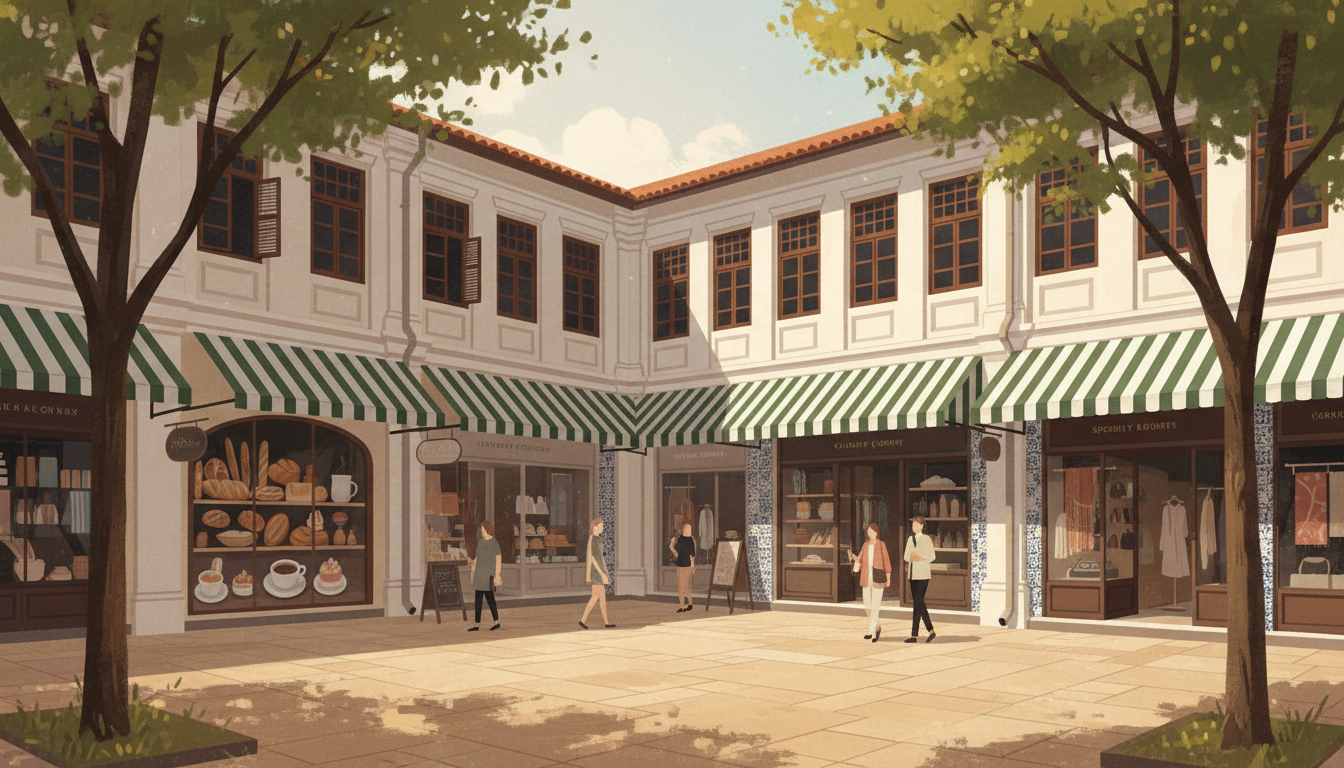
Cluny Court is a conserved group of shophouses at 501 Bukit Timah Road. Built in 1928, the façade has decorative details such as fluted columns, shallow sculptural reliefs and patterned tiles. Those details show how commercial architecture could reflect changing styles while remaining useful to ordinary shoppers.
Today the development operates with cafés, shops and services. It is therefore not a reconstruction of a 1920s street with actors in historical dress. It is a working commercial address that also preserves architectural heritage.
The contrast itself makes a learning question: how can a building change its occupants over generations while keeping enough of its exterior to communicate its past? A child might compare the old decorative stonework with a modern retail sign.
For opening hours and the building’s conservation history, see our Cluny Court’s 1928 shophouses and 2027 heritage guide. Shops have individual opening hours and are not guaranteed to remain unchanged next year.
Stop 2: Adam Food Centre and 1974 hawker history
Adam Food Centre is at 2 Adam Road. According to NHB, it grew from an earlier collection of open-air stalls near the Bukit Timah Canal before the hawkers were relocated to accommodate road works. The present facility formally opened on 28 September 1974.
The centre became especially known for dishes including nasi lemak, mutton soup and prawn noodles. NHB highlights Selera Rasa, whose nasi lemak has drawn attention from local and international visitors. But a famous hawker’s history is not a guarantee of today’s queue length, price, stall operating hours or dish availability.
The food centre’s later upgrading has its own story: NHB says it became the first hawker centre to make use of solar panels in 2002. That makes it a useful example of how a food venue can preserve social traditions while adopting different infrastructure.
This is a good place for a snack or lunch if stalls are open. Do not assume all hawkers share one timetable: a food centre may be accessible while the particular stall you want is on its rest day.
Our Adam Road Food Centre’s December 2026 maintenance and 2027 guide covers specific cleaning dates and what to check before a visit.
Stop 3: Former Raffles College, now an NUS campus
The historic college buildings stand on NUS Bukit Timah Campus at 469 Bukit Timah Road. The Raffles College complex dates to 1928, with the formal ceremonial opening taking place in 1929. Its quadrangles, covered arcades and shaded building entrances provide a different kind of heritage lesson from nearby shops.
Six important buildings within the former college ensemble were collectively gazetted as a National Monument in 2009. Buildings named for patrons such as Oei Tiong Ham, Manasseh Meyer and Eu Tong Sen help tell the story of philanthropy and education in Singapore.
But this is an operating university campus, not a museum promising unrestricted entry to every classroom or office. Visitors should follow NUS security arrangements, public walkways and any appointment requirements. A designation as a National Monument does not itself authorise an interior tour.
Learn more in our Former Raffles College at NUS Bukit Timah and 2027 heritage article, which covers the protected architecture and its educational development in detail.
Stop 4: Singapore Botanic Gardens, a living heritage landscape
Singapore Botanic Gardens was established in 1859 and recognised as a UNESCO World Heritage Site in 2015. Its significance lies not only in attractive lawns and large trees but also in a long tradition of tropical botany, plant research, conservation and public education.
The Gardens normally opens from 5am to midnight, although some specialist displays, forest trails and museums have shorter schedules. General admission is free; the National Orchid Garden is a separately ticketed attraction.
A visitor can choose a short outdoor stretch near the Bukit Timah Entrance rather than walking across the entire 82-hectare Gardens. The area close to Botanic Gardens MRT makes a convenient arrival or departure point, depending on how you order the trail.
NHB lists the Gardens as one of the four official stops despite a labelling inconsistency on one rendering of its heritage-trail page. The underlying entry describes the Gardens founded in 1859. Follow the actual map and place descriptions rather than treating a duplicated caption as a second Raffles College.
How do you do this route with parents or children?
The Heritage Board recommends a self-guided experience, so you control the pace. For a shorter outing, focus on the buildings’ exteriors and public spaces. For a fuller history afternoon, spend more time at one or two stops instead of trying to complete every possible exhibition within the suggested trail length.
- Begin at Botanic Gardens MRT: choose the appropriate entrance and identify Cluny Court at the nearby junction.
- Observe the shopping centre: find one architectural detail from the 1920s, then compare it with a current shopfront.
- At Adam Food Centre: look for differences between a heritage hawker centre’s established role and the current menu of individual stalls.
- Near NUS Bukit Timah: admire the university’s history from permitted approaches, respecting campus access restrictions.
- Inside the public Gardens: consider how historical buildings and living scientific collections are two different forms of conservation.
- Return using permitted roads or MRT: account for actual crossings, temperature and different entrance locations.
A heritage trail need not be completed in one fixed order. In busy tropical weather, an indoor meal or rest break can make the outing more comfortable. The key is not to assume the NHB route line guarantees every door is unlocked or every shortcut is legal.
What is the educational connection between these four stops?
They demonstrate how a district grows beyond one purpose. The Cluny Court buildings show commerce; Adam Food Centre reflects food, community and informal everyday gathering; Former Raffles College represents higher education; Singapore Botanic Gardens connects public recreation with botanical science.
A useful question is: if you had to choose one object or building to explain Bukit Timah to someone new, which would you choose and why? The answer might depend on family memories, interests, schools or how people use the neighbourhood today.
The trail does not require specialist history knowledge. It rewards attentive looking and a willingness to compare what was planned or built years ago with what residents continue to do today.
How is this different from Bukit Timah’s other heritage trails?
The Learning and Leisure Trail is a short route with 1.25 km listed by NHB. The Kampong Life Trail covers a different set of sites, including the former Bukit Timah Railway Station, Masjid Al-Huda, Hoon San Temple and Fuyong Estate; it is roughly 3 km.
The WWII Legacy Trail focuses on Bukit Timah Nature Reserve, Former Ford Factory, Former Beauty World and the Cheong family roads, with an approximate 3.2 km itinerary. Those tours cover different historical questions and should not be conflated into one formally marked walking route.
Our Kampong Life Trail, mosque, temple and heritage guide describes the community-history version. The WWII itinerary is another branch of this series, centred on wartime heritage rather than education and everyday leisure.
What will happen between now and the end of 2027?
The four highlighted places already exist and their heritage histories are established. During 2027, the practical updates are business and hawker hours, Garden exhibitions, museum notices, and NUS visitor access rules. There is no announced 2027 first opening for the Learning and Leisure Trail itself.
Do not let an announcement about a new café, a renovation or a temporary exhibition become an inaccurate claim that an entire 1928 shophouse group or 1859 botanic institution has only just opened.
Frequently asked questions
How long is Bukit Timah’s Learning and Leisure Trail?
NHB lists a 1.25 km self-guided route with four heritage stops. Your actual walking distance varies with the permitted approaches and any extensions.
Does the trail include Adam Food Centre?
Yes. It is one of four official stops, alongside Cluny Court, Former Raffles College and Singapore Botanic Gardens.
Can you walk into NUS classrooms as part of the trail?
No general university-classroom access is included in the NHB self-guided itinerary. Respect university security, operating areas and appointment rules.
Is the whole Singapore Botanic Gardens open until midnight?
The general grounds have 5am–midnight hours, while individual attractions and indoor galleries can have shorter hours and closures.
Will the trail first be available in 2027?
No. It is already published as a heritage walk. Check current notices for particular venues if travelling next year.
Authoritative sources and further reading
Checked 25 October 2026. References: NHB Learning and Leisure Trail’s four stops and 1.25 km route, NHB Cluny Court’s conserved architecture, NHB Adam Food Centre history, NHB Former Raffles College National Monument history and NParks Singapore Botanic Gardens visitor information.