
Did you know that a civilisation can have a full granary and still have hungry families? A town may grow more than enough of one crop, yet a damaged route can prevent delivery. A wealthy market may overflow with food while people without money cannot obtain a meal. A harvest can look abundant and still be nutritionally incomplete. The food component of civilisation is not simply farming. It is the entire set of people, places, skills, institutions and decisions that make safe, varied, appropriate food reliably accessible.
Welcome to the fourth guide in eduKate’s Components of a Civilisation series, following How to Build a Civilisation from Connected Systems, Land, Rivers and Choosing a Settlement and Water Supply, Sanitation and Public Health. The focus now shifts from how people choose a place and gain access to water to how they nourish themselves, preserve harvests, trade with neighbours and protect people when food systems are disrupted.
This is a complete teaching workbook for children, parents and tutors, not a one-sitting reading assignment. Each chapter begins with a practical question, then builds a connected explanation, a fictional test and an activity suitable for adaptation. Younger children can draw and move counters. Upper-primary learners can use fractions, multiplication, percentages, maps and short explanations. Secondary students can examine evidence, ecological limits, institutions, equity, trade and the weaknesses of attractive but incomplete statistics.
Our learning community, Tidal Reach, is entirely fictional. For continuity with earlier articles, suppose it has 240 inhabitants living in 60 illustrative households. A river, terraces, coast, small woodland and three neighbouring communities form its imaginary geography. Every stock, crop, percentage, harvest and delivery quantity assigned to it is an invented mathematical assumption, never a historical population estimate, nutritional recommendation, food-safety instruction or real agricultural yield. Do not treat a classroom simulation as a professional plan for farming, medicine, emergency provisioning or construction.
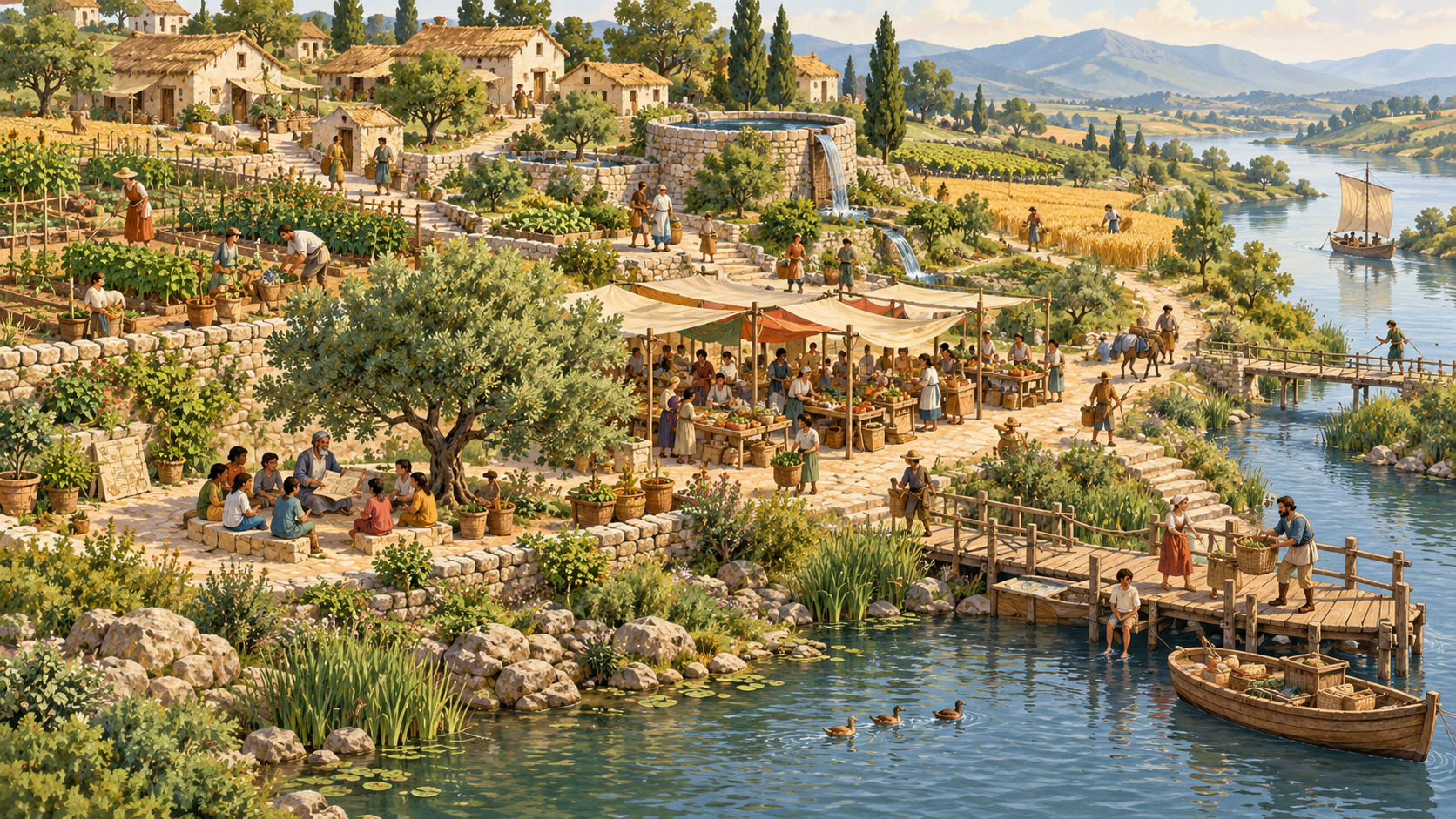
The cover illustration is existing AI-generated educational artwork from eduKate’s civilisation library. It depicts an imagined riverside settlement with fields, homes, a market and people learning together. It is a conceptual learning illustration, not a photograph, archaeological reconstruction or representation of an actual country’s agricultural practices. The illustration is described plainly for accessibility. Its purpose is to make the relationships among food, water, houses and movement visible, not to present invented scenery as evidence.
Quick answer: what food components does a civilisation need?
A dependable food system connects suitable environments and livelihoods, knowledge and labour, diverse production or acquisition, storage, preservation under appropriate controls, processing and preparation, transport, exchange, access, safe nutrition, care, information, fair rules and the ability to recover from disruption. A civilisation cannot simply count fields or sacks of grain to prove food security. It must ask whether people can obtain adequate safe and nutritious food consistently, including those with little wealth or mobility.
The World Food Programme’s food security guidance identifies four fundamental dimensions: availability, access, utilisation and stability. The FAO Committee on World Food Security’s discussion also highlights agency and sustainability. That is a useful corrective to an ancient-empire story in which bigger harvests alone automatically mean prosperity.
- Availability: is suitable food produced, imported, traded, shared or held in stock?
- Access: can people physically and economically obtain the food that is available?
- Utilisation: is food safe and nutritious, and do care, health, water and preparation conditions support its use?
- Stability: can people maintain access through seasons, price changes and interruptions?
- Agency: do affected people have meaningful voice in their food systems?
- Sustainability: can those arrangements support people and ecosystems over time without exhausting the conditions they depend on?
These dimensions are interrelated. A store can meet availability while failing access. A food item may be plentiful while an unbalanced diet falls short in utilisation. An adequate week cannot prove stability over a year. Decision-makers may hit their supply targets while excluding the people affected. Any teaching model that celebrates a single number needs this corrective lens.
Find the section you need
The classroom activity food mission · 1–8: land, production and ecological foundations · 9–16: harvest, storage, cooking and logistics · 17–24: trade, institutions and future capacity · Historical and Singapore comparisons · Scenario laboratory and worked answers · Parent and tutor lesson sequence · FAQ and vocabulary · Sources and connected eduKate reading.
The classroom activity food mission: from a harvest to a trustworthy service
Inside the fictional classroom activity learning studio, children plan Tidal Reach’s food systems. The assumption checker acts as the landscape and route scout, checking where soil, water, harvest and transport are represented and marking what is unknown. The evidence reviewer challenges evidence, access, fairness and the leap from a headline number to an unsupported claim. The lesson facilitator is the shared dependency board on which children mix food, water, trade, tools, schools, care and governance. These are teaching roles, not independent public authorities, automated experts or a claim that fictional agents can decide what real children should eat.
A useful exercise gives each student a temporary role and rotates the roles during discussion. the assumption checker student draws a map and traces pathways. the evidence reviewer student marks observations versus assumptions and asks whose voice is absent. the lesson facilitator student moves string connections when one part fails. A fourth student may be a local resident who explains a need the first three overlooked. The activity builds shared reasoning instead of giving one glamorous role all the credit.
Our method has six moves: observe a need, map the dependencies, calculate only what the assumptions support, listen to people affected, test a disruption and revise the proposal. For each component ask: What service does this provide? What does it require? Who is responsible? Who may be excluded? How does it fail? What evidence would show that a repair helped? This is not a universal historical order through which all cultures were required to progress.
Tidal Reach: an imaginary settlement whose people must be fed
Let us assume 240 residents, 60 households, fields on a middle terrace, a small coastal landing, a community market and a main storehouse. Some people grow food. Others gather, fish, raise animals, make containers, transport goods, teach skills or care for households. These roles are fluid; no child or fictional resident is confined to an occupation, and unpaid care is recognised as essential. A neighbouring settlement can supply goods through exchange. There are also ecological limits and rights that cannot be ignored merely because the town wants to expand.
Begin with three deliberately simplified quantities, all for mathematics instruction only. Suppose 240 people use an average of 0.5 kg per person per day of one imaginary grain commodity. That implies 120 kg of that grain per day. A 30-day quantity is 3,600 kg before any storage loss. If 10% of that particular stored grain is unusable by the end of the toy period, 3,600 × 0.90 = 3,240 kg remain. The calculation demonstrates inventory versus usable stock; it says absolutely nothing about the total nutrition, actual diets, real preservation conditions, safe food or appropriate human rations.
You may be tempted to solve the problem by planting more grain. The evidence reviewer asks a more interesting question: Which households can get it? The assumption checker asks whether a rainy season closes the path. The lesson facilitator shows the links to water, labour, storage, markets and maintenance. The children discover why a bigger harvest may help but does not solve the whole system. Now ask them to find one real-world source about food security and write what the source supports, and what cannot be inferred from the fictional figures.
| Word | In this model | What the number cannot establish |
|---|---|---|
| Production | How much of a named item is grown or obtained | Whether anyone can obtain it |
| Stock | How much of the named item is recorded in storage | Whether it is safe, varied or fairly distributed |
| Access | Which households can obtain appropriate food | The nutritional quality of every meal |
| Reliability | How supply and access change across imagined periods | The probability of real-world crop failure |
| Resilience | Whether the settlement has workable alternatives and repair capacity | Permanent freedom from future food problems |
Component 1: People, food needs and the limits of a population number
Before drawing fields or counting sacks, ask who the settlement is meant to support. A population total is essential for some planning questions but tells very little about individual needs. People differ in age, health, activities, household circumstances, cultures, preferences and access to resources. A town of 240 residents is not 240 identical units of food demand. Children should learn that a food system serves people rather than forcing everyone into a fictional average.
Give the classroom activity six household cards: a family with a young child, an older resident living alone, people working different hours, a newly arrived household, a resident with mobility difficulties and a carer whose responsibilities limit travel. These are invented roles to expose variety, not invitations to prescribe individual diets. Ask what makes access practical for each household. A market’s presence does not mean each can afford, reach and use its offerings.
The first failure occurs when the town plans everything from a single total weight. That number can help with arithmetic but cannot certify adequacy. Even identical food deliveries may be unsuitable for different residents. The correct extension uses qualified nutritional guidance, actual consultation and lawful public-health expertise rather than homemade dietary standards.
Parent activity: draw three daily meal journeys, from the source of food to the family table, and notice the work done by different people. Tutor activity: ask children to explain why one average cannot describe all needs. Advanced question: How might an institution measure aggregate availability while protecting privacy and recognising unequal access? Each answer should distinguish a legitimate statistic from the human experience it does not capture.
Component 2: Landscape, soil and productive space
Food begins in environments that people did not create from nothing. Soils, freshwater, coastal ecosystems, sunlight, climate and living organisms interact with skills and labour. A civilisation can alter its landscape through cultivation or fishing, but the result depends on local conditions. A field marked ‘fertile’ on paper is not proof of unlimited yield. Real production planning requires evidence, land rights, ecological assessment and specialised knowledge.
Place a terrace, riverbank and upland woodland on the Tidal Reach map. Ask which activities could be considered at each location and what further facts would be needed. The woodland may support biodiversity, food-related livelihoods, water processes and cultural uses; it must not be treated as vacant land simply because no crops are drawn there. A proposal to clear an area can change other systems that the settlement depends upon.
A council member announces that the largest flat site should produce the most food. The inference is unsupported: area alone tells us nothing about soil suitability, water, climate, land management or crop choice. A better child-led response records the question and identifies suitable sources of evidence. In the imaginary model, describe alternatives without making a real-world claim about the best land for any crop.
Parent: use a paper map to mark land that is already supporting living systems, not just visible buildings. Tutor: have students compare a production-focused map with an ecology-and-access map. Secondary extension: ask how the costs of soil damage can appear years after a high-output period. Link to the previous land and settlement guide for the geographical starting point.
Component 3: Water for food and competing essential services
Food production is connected to water, but it is not identical to drinking-water provision. Irrigation, rainfall, local ecology and crop requirements must be understood in context, while households and sanitation services have their own needs. A student who draws one abundant river and assumes it can meet every demand has skipped the actual resource question. Rights, seasonal variation, water quality, infrastructure and the environment all matter.
In Tidal Reach, draw the upstream catchment, households, farmland and downstream neighbours. Use coloured arrows to show conceptual dependence. The aim is not to size an irrigation canal or recommend real agricultural water use. It is to ask which users are affected when one source is under pressure and how a community could obtain appropriate evidence before allocating a scarce resource. No student should be encouraged to alter real waterways.
A fictional drought card reduces available water tokens. A simplistic response gives all remaining tokens to food crops, overlooking households and downstream ecosystems. Another gives all to a visible civic fountain. The classroom must distinguish the values and constraints, consult different groups and recognise when competent authorities would need to make real decisions. Efficiency is not the same as legitimacy.
Parent: use three bowls of paper water tokens to show competing uses without any actual unsafe water handling. Tutor: write a claim, counterclaim and evidence gap for two proposed allocations. Advanced: examine how agriculture and municipal water services can become interdependent, using the separate water-supply component to explain why source availability differs from dependable service.
Component 4: Seeds, varieties and knowledge across generations
Seeds and other reproductive materials carry the potential for future production, but farming success also depends on knowledge of local conditions, suitable practices, access and stewardship. People have selected, exchanged and preserved agricultural knowledge over many generations. A society’s productive capacity is therefore more than its current harvest. It includes skills and resources that allow another season of work. Diverse methods and traditions should be studied respectfully rather than placed on an imaginary ladder of human worth.
Ask children to imagine that Tidal Reach’s farmers have used one hypothetical seed type for several years. They know its strengths but have little information about changing conditions. The assumption checker marks uncertain climate and soil assumptions. The evidence reviewer asks who holds local knowledge and whose observations are missing. The goal is to evaluate whether the community understands future options, not to issue real seed-selection recommendations.
One farmer retires without having taught an apprentice how to interpret seasonal signs or store records. The community owns materials but has lost an important part of its capacity. A better plan recognises apprenticeship, documentation, observation and the permission to revise practices when evidence improves. The same principle applies to toolmakers, fishermen, traders and food safety workers.
Parent: have a child teach another person a harmless card-sorting rule and observe where instructions are incomplete. Tutor: distinguish possessing a resource from knowing how to use it competently. Advanced: discuss diversity, resilience and the rights of communities whose agricultural knowledge is used in modern systems without assuming every tradition has been fully documented.
Component 5: Farming, fishing, herding, gathering and diverse livelihoods
A civilisation does not have to follow one universal path from hunting to farming to cities. Human communities have organised livelihoods in many combinations, including crop production, fishing, herding, gathering, horticulture, exchange and seasonal movement. The correct question is how people connect knowledge, ecology, work, food and social obligations in a particular context. Agriculture may support substantial settlement, but it is not the only source of complexity or skill.
Tidal Reach has a river, a coast and fields. Give children four livelihood cards: crops, fish, gathered food and trade. Ask what each might contribute in a fictional season, what ecological constraints it faces and how the goods reach households. Do not treat each card as a complete diet. A class that recognises complementary livelihoods has progressed further than one that assumes all food comes from the largest field.
A town invests every labour token in a single imagined crop because it performed well last period. A surprise interruption affects that product. The weakness may be source concentration, a closed route or inability to reach supplies from neighbours. An alternative arrangement could involve different activities, appropriate stockpiles or trade, but each option has costs and ecological limits. Students must identify the actual cause rather than simply declare diversity a universal cure.
Parent: trace familiar foods to farms, waters, processing and shops, noting what is unknown. Tutor: compare four hypothetical supply routes by the risks they share rather than automatically calling each ‘independent’. Advanced: read eduKate’s ancient fishing and coastal communities guide and distinguish historical evidence from the modern classroom map.
Component 6: Seasons, harvest cycles and continuity
A harvest arrives at a particular time, whereas human needs continue throughout the year. This simple observation explains why food systems rely on timing, stores, trade, preservation knowledge and scheduling. An average annual yield does not imply identical monthly availability. Weather, ecology and people’s activities change, and forecasts have limits. A thoughtful settlement recognises seasonality without pretending that all shortages can be predicted.
Create twelve month cards for Tidal Reach. In the imaginary calendar, some crops arrive in months three, six and ten, while another supply is more frequent. Do not attribute these invented patterns to real plants or climates. Ask when the town needs extra storage, when routes must be checked and how food availability may differ among households. A calendar helps learners see that a yearly total contains a distribution across time.
For mathematics, suppose a hypothetical supply delivers 600 units in month three and none in month four. The two-month mean is 300 units per month. The mean is correct, but using it to assert 300 units are physically present in each month is wrong. The difference illustrates why inventories, timing and accessible reserve matter. Older students can compare a stock chart with a receipt chart and identify what neither proves about nutrition.
Parent: rearrange paper food-delivery cards and ask which periods have gaps. Tutor: connect averages, ranges and time series. Advanced: discuss uncertainty when seasonal conditions change and why institutions need repeated observation rather than relying on an unchanging calendar.
Component 7: Labour, care and the work nobody puts on a monument
Food systems depend on labour inside and outside markets. Growing, harvesting, fishing, transporting, storing, cooking, cleaning, caring for children, assisting older residents and teaching skills all require time and competence. Some tasks are paid; others are not, but their social importance cannot be inferred from price alone. A civilisation that counts only visible food producers can misunderstand how its households function.
In the classroom activity, assign ten role cards across the fictional community, including a carer, cook, seed steward, crop worker, fish trader, transport worker, potter, ledger keeper and sanitation worker. Ask how each person’s work depends on others. A family member preparing meals may be unable to visit a distant market; the market’s excellent supply figures do not solve their access problem.
A council announces it can increase harvest output by requiring every adult to work longer in the fields. It has not considered childcare, illness, rest, freedom or existing household duties. A careful student notices the missing social costs and rejects a crude equation of labour hours with welfare. Coercive systems may produce large outputs, but output numbers alone do not establish legitimate institutions or a good life.
Parent: list the different kinds of work behind one safe meal without stereotyping who performs them. Tutor: have students draw a dependency chain that includes unpaid care. Advanced: analyse how fair working conditions, apprenticeship and social support can affect long-term productive capacity.
Component 8: Tools, materials and the skill to repair them
A plough, container, net, grinding tool or cooking vessel is useful because material knowledge has been converted into a dependable function. Every tool requires resources, skills, safe use, upkeep and eventual replacement. In historical research, surviving implements provide evidence of practices, but one artifact cannot represent the full lives of the people who used it. Children should see tools as condensed knowledge rather than magic objects that make output grow automatically.
Give Tidal Reach a choice between improving a storage vessel and repairing a frequently used hand tool. Limited resource tokens force prioritisation. Pupils should name the benefits of both, who uses them and how failure would affect the wider food chain. A correct answer may depend on which bottleneck is most serious; no generic preference for ‘advanced technology’ is enough.
Imagine an inventor doubles the output of one grinding process but only one worker understands the new equipment. If that person is unavailable, the improvement becomes fragile. A repair plan may involve training, clear documentation, suitable material access and a less dependent backup. The lesson is not about building machinery; it is about institutional capacity to maintain useful techniques.
Parent: draw a familiar kitchen tool and connect it to its maker, user, maintainer and material source. Tutor: use eduKate’s ancient mills and ancient pottery articles to connect materials, processing and storage. Advanced: compare high initial productivity with repairability, training and dependence on scarce parts.
Checkpoint: the food field is only the beginning
Ask a learner to draw one food item and trace it back through a usable landscape, suitable inputs, labour, know-how and a seasonal process. Now trace it forward to harvest, storage, preparation, distribution and a particular household. A strong response includes at least one person whose work is not formally paid and one physical route that could fail. The child should be able to explain why the source of food is essential but not sufficient.
For a short oral assessment, ask three questions. First, why is a large harvest not proof that everyone has food? Second, what is a useful question to ask when a town has only one type of food supply? Third, which part of the plan makes it possible to produce food next year? Listen for access, vulnerability, knowledge and ecological continuity. If the answers consist only of ‘grow more’, revisit the system map and ask the learner to draw an omitted arrow.
Part II: From harvest to a dependable meal
A harvest is a milestone, not a complete service. Someone must gather it, record what arrived, maintain appropriate storage and food-safety arrangements, transport supplies and make them accessible to households. The functions connect, yet each has a different failure mode. The classroom activity uses imaginary counters and ledgers to explore their relationships, never real food inspection or improvised preservation.
Component 9: Harvest and the timing of supply
The time at which production arrives matters because many people need food throughout the year, while harvests occur in particular periods. A successful field season can still be followed by delivery problems if routes, suitable facilities or trained people are missing. In Tidal Reach, three groups deliver coloured harvest tokens from different imaginary sources. Learners record whether tokens have been collected, transferred, stored or released for an intended purpose. These categories must not be mistaken for one another.
Suppose two fictional fields contribute 150 and 220 units of a single grain commodity, giving 370 units. The route carries only 250 units during the selected study period, leaving 120 awaiting transfer. The arithmetic establishes the backlog under stated assumptions; it does not prove anything about real field productivity or safe storage. Increasing the harvest again would not automatically solve the transport bottleneck. Pupils should draw a route and identify the limiting step.
A town celebrates record production but cannot explain how much reached households or who was unable to collect it. The evidence reviewer asks for clear definitions and household access. The assumption checker tests the imagined river route, and the lesson facilitator shows the dependence on storage, workers and public information. Parents can move paper tokens from fields to a store; tutors can distinguish ‘produced’, ‘received’, ‘recorded’ and ‘accessed’. Advanced learners can analyse timing and capacity without pretending a large headline figure demonstrates food security.
Component 10: Handling, checks and traceability
Food handling and verification require suitable procedures, competent personnel and trustworthy records. The educational goal is not to teach children how to judge a questionable item for consumption. It is to show why a delivery’s origin, intended use, record and oversight matter. A fictional supply chain can include cards labelled received, appropriately assessed, recorded and assigned. The order describes institutional responsibility, not an actual method for certifying food safety.
A delivery of 80 imaginary units reaches the town without a complete origin record. One fictional official announces that everything is fine because the container looks good. Another assumes wrongdoing without evidence. Neither conclusion follows. The responsible response is to acknowledge the missing information, preserve records and let qualified people determine appropriate action. Students can list observations separately from interpretations and explain why accurate reporting is more useful than unsupported confidence.
Traceability also depends on trust. Workers who fear punishment for reporting a discrepancy may stop reporting. A council that publicises unproven accusations may create injustice without protecting households. Parents can use coloured cards to illustrate batch identities; tutors can require a ledger with date, quantity, source and unknowns. Older learners should ask how transparent correction and proportionate accountability help a community detect mistakes early.
Component 11: Granaries, stores and reserves
Storage allows a community to move some present supply into the future, but a building does not guarantee safe, varied or accessible food. The store’s role includes records, appropriate product management, maintenance, distribution responsibilities and fair access. It also has costs: land, materials, work and funds that cannot be spent on other needs. Historic storehouses can be architecturally striking, yet the human question remains whether people could obtain what they needed.
In the Tidal Reach exercise, a ledger begins with 4,000 kg of a single invented grain item. Assume exactly 10% becomes unavailable during the imaginary period, leaving 3,600 kg. If this same commodity is accounted for at 120 kg a day, the arithmetic gives 30 days. This is a calculation about one hypothetical commodity, not a diet, health recommendation or food-safety standard. Ask what happens if delivery routes are closed to some households: the store may remain full while access is lost.
A class may propose two smaller stores instead of one large store. That can distribute some exposure but adds operating and oversight needs. A better decision compares costs, access, common hazards and trained staff rather than declaring centralisation or decentralisation universally superior. Parents can use paper counters to distinguish stocked goods from delivered goods. Tutors should require units, dates and assumptions, and reward students who notice that a correct stock figure does not establish nutrition or fairness.
Component 12: Preservation, time and knowledge
Preservation is a way of managing time between acquisition and use. Methods differ by product, climate, technology and cultural practice; real food safety depends on applicable standards and qualified guidance. For the classroom, create three fictional food categories: requires timely delivery, depends on a professionally managed holding process, and currently unknown. Do not turn a conceptual illustration into a cooking or storage instruction.
A simplified record shows 200 imaginary units arriving and 12 units no longer available for distribution, leaving 188 accounted units. That difference teaches inventory arithmetic, not how to evaluate actual food quality. The important question is how a settlement establishes valid information, appropriate oversight and suitable arrangements for different products. If a new storage facility is opened without trained managers, it can become a source of false confidence.
Children may assume a new device solves every time-related problem. Ask what happens if energy stops, a suitable delivery route is unavailable or no one knows how to maintain the equipment. Preservation depends on people and institutions as well as tools. At home, learners can sort paper labels by different imagined deadlines. Tutors can distinguish a principle from demonstrated performance. Advanced students may consider how energy requirements, product diversity and maintenance affect long-term resilience.
Component 13: Processing, transformation and everyday tools
Much of what a community eats has been transformed from its original form. The transformation may involve many different kinds of equipment, skill, fuel, energy, time and cultural knowledge. Grain can become different kinds of prepared staple; other products pass through entirely different pathways. The geographical source and the ready-to-use form are connected by labour that a map of fields alone cannot show. A food system that produces an ingredient but lacks the ability to prepare it cannot simply count all production as completed household meals.
In Tidal Reach, children build a conceptual chain using cards labelled harvested material, craft knowledge, suitable equipment, energy, processed food, household and leftover material. Every arrow must carry a verb. The aim is to understand dependencies, not to reproduce a real processing method. Ask how a shortage of an equipment part affects people who do not use the equipment directly. Suddenly a craft worker, toolmaker and repair workshop become part of a seemingly simple food problem.
Imagine a fictional mill that previously transforms 30 counters per session and now transforms 45. Its modelled output increased by 15 counters, or 50%. The arithmetic is correct if the units and period are comparable. It does not establish that nutritious meals increased by 50%: the processed item may have different qualities, other stages may be bottlenecks and access might remain unequal. A teenager should explain what the percentage measures and what it does not.
The town adds a machine but has one trained specialist and no meaningful plan to maintain or replace its equipment. A short-term productivity gain becomes a long-term dependency. An effective response may include training successors, documentation, suitable spare materials and fair access to the finished product. The lesson is not to reject invention. It is to treat adoption as a system-wide decision.
Parent practice: ask a child to trace one familiar packaged staple backwards through at least three roles. Tutor check: distinguish a tool’s possible speed from total service output. Advanced: link to Ancient Mills Turned Grain into Flour and discuss what physical remains can and cannot reveal about labour arrangements or fair access.
Component 14: Cooking, care, culture and the actual meal
Eating is not merely the final mathematical step in a supply ledger. A meal connects ingredients, appropriate safe preparation, water, energy, care, preferences and social relationships. Families hold cultural knowledge of foods and sharing, while professional nutrition and food-safety standards address different evidence-based questions. Children should be able to explain this difference: studying a society’s culinary traditions is not the same as certifying that a particular meal meets someone’s health needs.
Give two fictional families equal quantities of the same three ingredients. One has dependable access to the water and facilities necessary for preparation; the other lacks a functional route to those services. The ingredients look equal on the inventory sheet but the usable situation is unequal. Invite learners to revise the map rather than blame the household. A child who proposes a safe, accessible public service connection has found an institutional cause.
Another household cares for a young child and an older relative. Time spent buying, preparing and serving food is a form of work even if no wage is paid. The council’s economic report counts the tonnes delivered and the money spent but leaves out domestic work. The evidence reviewer asks which important labour has vanished from the picture. The lesson facilitator connects it to transport, care, sanitation, schools and employment.
A toy calculation says each household receives three ‘meal tokens’, but the token has no nutritional definition. A student may confidently declare that the community is healthy. The correct response is to refuse a conclusion that the model does not support. To assess actual nutrition requires competent evidence and attention to individual circumstances, not a universal fictional ration.
Parent practice: discuss the roles and infrastructure behind a familiar shared meal without offering medical diet advice. Tutor check: ask for the difference between food availability and utilisation in the World Food Programme framework. Advanced: reflect on cultural diversity, dignity, family care and the limitations of food-tonnage measures.
Component 15: Routes, logistics and a journey with a weak link
Food needs a route from the source to processing, storage, market and household. The journey can cross rivers, roads, ports and administrative boundaries. Transport creates opportunity but introduces dependence: a single crossing can carry much of a settlement’s essential supply. Reliable logistics involves scheduling, suitable handling, records, maintenance, staffing and a way to communicate changes. Buying a faster cart does not help if an unrelated narrow crossing remains unusable.
For Tidal Reach, create five nodes: terrace farm, riverside landing, main store, Hill Gardens and Lower Wharf. A paper string connects each pair that has a plausible route under the invented rules. Ask children to move ten food counters to each household. Then remove the only bridge between two nodes. Where is food still present, and which destination cannot be reached? This reveals the difference between regional availability and physical household access.
Suppose the class’s imaginary cart carries eight crates per trip and 25 crates must be moved. Four trips are needed if the capacity is constant, partial loading is allowed and the vehicle can make repeated trips. Three trips carry 24 and the fourth carries one. The ceiling calculation does not certify any real vehicle’s safe load, product suitability or journey time. Ask the learner to write the assumptions beside the answer and label which ones are unknown in a real situation.
A planner proposes that all deliveries use a single road because it is shortest on average. The route looks efficient until an imagined flood closes it. A second route may preserve some service but requires land, funding and maintenance. The best classroom plan compares ordinary journey effort with ability to reach essential destinations during disruption, as well as how people without transport obtain food.
Parent practice: draw a route from a food producer to a household and add a closed-path card. Tutor check: require two alternative solutions with different trade-offs. Advanced: explain a network bottleneck, the danger of shared failure between multiple suppliers and why equitable distribution is not simply the shortest-route problem.
Component 16: Markets, exchange and the ability to obtain food
Exchange can connect households with goods they do not produce. It may take the form of selling, gifting, bartering, shared provisioning, trade agreements or public support, depending on the community. Markets can create valuable incentives and coordinate specialists, but a crowded market is not proof that everyone has enough to eat. Food security requires access, including physical and economic ability to obtain appropriate items. A civilisation has to examine both supply and exclusion.
In the imaginary Tidal Reach market, three stalls hold 100 food tokens. One household has plenty of purchase tokens, another has few, and a third cannot use the steep access route. Ask which barriers differ. Building a new stall might increase availability without solving either household’s problem. The correct response involves accurate diagnosis and fair processes, not accusing the excluded residents of poor planning.
Imagine 80 food tokens sold at the market this week, compared with 60 last week. The nominal increase in token turnover is one third, about 33.3%. That does not show whether prices rose, who bought the items, what remained unsold or whether nutritional needs were met. The institution should choose indicators that illuminate access instead of celebrating a statistic solely because it increased.
A fictional trader disagrees with a buyer about the size of a basket. The matter involves shared units, trustworthy measures, dispute processes and records, not only food. Introduce a consistent classroom measure and a fair procedure for reviewing the claim. Then ask how an unrecorded promise could undermine trade when the parties cannot meet again quickly. This links the market to governance and knowledge systems.
Parent practice: run a card market and then give one household an access constraint, inviting a new solution. Tutor check: identify how high supply can coexist with unmet needs. Advanced: compare informal sharing with organised market trade without imposing modern institutions universally on ancient societies. Read the connected Ancient Markets guide for further evidence-based discussion.
Checkpoint: four measures and an absent resident
Write four columns: production, usable recorded stock, goods that reached the market and households with practical access. Give children invented numbers for the first three and leave the fourth unknown. Can the town declare success? It can report the known figures, but it cannot establish that all households have food. Ask what evidence would reveal the missing dimension. This is the heart of the chapter: quantity, logistics, accessibility and nutrition are related, but they are not interchangeable.
In a paired explanation task, one student argues that more food must always solve shortages and the other argues that transport is the only thing that matters. Both claims are overgeneralised. A strong synthesis says the correct response depends on the type of shortage and on evidence about production, stored stocks, journeys, prices and the household circumstances. More than one problem can coexist. The student who changes their view when a new constraint appears has demonstrated learning.
Part III: People, institutions and future capacity
An efficient food system can still be fragile. To understand why, children must follow records, public rules, trade relationships, knowledge and ecological change. These final eight components help Tidal Reach respond to problems without hiding information or transferring unfair costs to households with less influence.
Component 17: Shared measurements and honest records
Measurements make plans comparable only when the unit, time, product and location are clear. Forty baskets do not necessarily outweigh thirty-six baskets when their sizes are unknown. A harvest report and a market-stock report may count different stages of the same supply chain. Reliable records let people see what changed and why. Correcting an error should leave a trace rather than quietly erasing earlier information.
Give children two delivery slips: one records forty baskets and the other thirty-six. Do not tell them how large the baskets are. Their first task is to say what is missing. Provide paper boxes of equal size, and the comparison becomes more meaningful. Explain why shared units support exchange while incomplete information can create an illusion of precision.
In a consistent invented ledger, beginning stock is 480 kg, receipts are 70 kg and outgoing quantity is 90 kg. The closing balance is 460 kg under the assumption of no other movements. If another record gives 445 kg, the discrepancy is 15 kg. That result prompts investigation, not an automatic accusation. Students should identify recording differences and missing transactions as possibilities without declaring any cause established.
Records also involve dignity. A council may need to know which neighbourhood lacks access without broadcasting personal details about particular families. Ask the class to build an aggregate access chart while keeping household identities private. A trustworthy institution publishes definitions, explains uncertainties and responds to corrections. This is part of food security because bad information can lead to bad distribution decisions.
Parent: use paper measures to compare equal and unequal containers. Tutor: insist that every important number has a unit, date and meaning. Advanced: analyse the relationship between traceable accounting, independent checks and trust, using eduKate’s ancient measurement guide for historical context.
Component 18: Rules, rights and accountable decisions
Food systems require choices about common resources, land, distribution and public support. People may disagree about those choices while still sharing obligations to fairness and wellbeing. Decision-making therefore needs clear responsibilities, evidence, opportunities for participation and ways to review mistakes. An ancient society’s administrative complexity does not prove its rules were just, and a modern public programme should not be evaluated solely by the speed of its announcements.
Give Tidal Reach a hypothetical repair budget of forty tokens. The council may improve a market route used by many traders or repair the only accessible path for a small group of households. The first option affects volume; the second involves essential access and the interests of residents who may have little influence. Students should consider temporary arrangements, cost information and affected residents before they choose.
A leader declares that everyone will be treated alike by applying one inflexible rule. Another wants to make exceptions without explaining the criteria. Discuss the difference between predictable procedures and practical fairness. Useful governance provides reasons, allows review, considers different needs and protects people who report a concern. The answer need not imitate one universal form of government; institutions have differed across history.
An impressive food council may have formal meetings but never hear from people unable to travel to its building. Participation cannot be measured only by how many meetings were held. Ask whether the town has meaningful ways to receive concerns and demonstrate that resulting corrections were made. The evidence reviewer’s role is to notice the missing voice while the lesson facilitator traces the change throughout the service network.
Parent: ask how family members can share limited time or resources while recognising varied needs. Tutor: hold a model council with rotating speakers and a record of reasons. Advanced: compare efficient coordination with legitimate decision-making, and distinguish aggregate benefits from serious burdens placed on a small group.
Component 19: Neighbours, trade and external dependencies
A food system may connect people across many places. Tidal Reach produces some of its own food and obtains other goods through exchange with imaginary neighbours. Those relationships can add variety and options while making routes, agreements, information and mutual trust more important. A large number of named suppliers does not establish that delivery is reliable.
In the classroom activity, the assumption checker traces two suppliers that depend on one river crossing. When that fictional crossing becomes unavailable, the town loses both routes. The lesson facilitator displays the shared bottleneck. Students can design an alternative connection and explain its costs. The evidence reviewer asks which households face the disruption first and whether the decision treats affected neighbours fairly.
The Singapore Food Agency’s Singapore Food Story 2 describes contemporary food resilience through diversified imports, global partnerships, stockpiling and growing local. These pillars are not a claim about ancient societies. They are an official modern example of building options through several linked mechanisms. Pupils should distinguish national policies from the imaginary town.
Parent activity: trace a familiar food’s journey through multiple places, marking unknown details honestly. Tutor task: give two suppliers a shared transport route and remove it. Advanced: distinguish dependence on a single supplier from dependence on one shared route, and assess how cooperation and public information contribute to resilience.
Component 20: Nutritious use and the meaning of a meal
Food security is not measured only by tonnes. The World Food Programme distinguishes availability, access, utilisation and stability. A large harvest of one commodity cannot establish that households have appropriate, varied meals, that food reaches everyone or that all conditions for safe preparation exist. Professional nutrition and food-safety questions require appropriate evidence, not a fictional stock ledger.
Tidal Reach records a ten per cent increase in one imaginary grain harvest. The mayor announces that every resident must now be better nourished. The evidence reviewer asks what the figure measures and what it leaves unknown. The assumption checker checks whether goods reach Hill Gardens and Lower Wharf. The lesson facilitator shows links to water, preparation facilities, care and markets. The lesson is to value a real gain in production without making an unsupported inference about human wellbeing.
Give children three situations. The market is full but a path is inaccessible. A household has ingredients but lacks appropriate preparation facilities. Today’s deliveries are sufficient but a single route faces repeated disruption. Ask which food-security dimension each situation challenges. More than one dimension may apply, and further evidence may be required. This exercise uses paper cards rather than evaluating anyone’s actual diet.
Parent: talk about the work and public services behind a family meal. Tutor: distinguish food volume, access and nutrition as different claims. Advanced: explain why a country’s aggregate supply figure cannot, on its own, describe the conditions of every household.
Component 21: Ecological stewardship and future production
Food systems depend on ecological conditions that must survive the current generation. Soil, water, climate, plants and other living organisms interact with human work. A highly productive season does not guarantee continued yields under changed conditions. A civilisation’s capacity includes protecting productive environments, learning from observation and respecting legitimate community relationships with the land.
In the fictional settlement, a council proposes expanding fields into an area used for seasonal gathering. The map labels the space empty because it has no permanent houses. Children should recognise that the map may conceal livelihoods, ecological roles and cultural meaning. The assumption checker marks land features, while the evidence reviewer asks who should be consulted. The class can propose a revised study rather than treating blank paper as consent.
A calculation shows rising harvest output for one imagined season but gives no information about soil condition or the affected households. A careful learner explains both what the number reveals and why it cannot prove sustainability. Pupils can propose indicators for future monitoring, while recognising that real agricultural or ecological assessments require local expertise and data.
Parent: add plants, waterways and habitat arrows to a simplified farm diagram. Tutor: compare short-term yield with long-term productive capacity. Advanced: analyse the links among rights, conservation, knowledge transmission and a settlement’s ability to adapt.
Component 22: Maintenance, knowledge and succession
A civilisation that can build a food system but cannot maintain it has created a temporary achievement. Stores, processing equipment, transport routes and measurement records depend on trained workers and continuing resources. Knowledge held by one expert becomes a fragile bottleneck when no one else understands the task. Apprenticeship, documentation, fair working conditions and maintenance budgets support continuity.
Assign three fictional roles: the granary record keeper, an equipment maintainer and the route coordinator. Remove one role card and ask which food services become difficult to operate. A paper model can reveal dependence without asking children to handle actual machinery. When students propose a replacement, they should identify how competence would be established and maintained rather than simply appoint the nearest person.
The classroom activity council spends its entire budget on new buildings but nothing on upkeep. The town appears advanced at its opening ceremony and becomes progressively less reliable. The problem was present in the original choice, even if its consequences appear later. Ask students to add responsibility, reporting and maintenance to every impressive component of their map.
Parent: practise teaching and checking a harmless paper craft skill. Tutor: compare construction, operation and repair as different phases of a service. Advanced: examine institutional incentives for truthful reporting of defects and the opportunity cost of neglecting routine work.
Component 23: Resilience, recovery and shared weaknesses
Resilience is not the same as keeping an enormous pile of supplies. It means understanding threats to continuing access and having workable ways to respond, adapt and restore essential functions. Multiple sources, routes, responsible records, trained people and clear communication can each help. They can also share weaknesses. A town that uses two different stores but one bridge to reach them has not created two independent transport routes.
Tidal Reach has a pair of imaginary granaries supplied through the same coastal landing. A storm card temporarily removes that landing. Neither store receives its expected next delivery. Children should trace the link underneath both suppliers. The lesson facilitator represents it as a shared dependency, the assumption checker checks whether a different route exists and the evidence reviewer asks which residents face urgent access difficulties.
One response is to commission a larger granary immediately. Another is to end all trade. Neither follows automatically from the disruption. The students must compare existing stocks, duration, alternative routes, suitable sources, fairness and maintenance. Uncertainty is not a reason to invent a definite prediction. A responsible classroom recommendation is conditional, explaining what evidence would alter the decision.
Parents can make two supply paths from string and see whether they truly avoid one common link. Tutors can ask for one short-term continuity measure and one long-term dependency reduction. Secondary students can explore how redundancy costs money and requires maintenance, yet may protect essential access during selected disruptions.
Component 24: Future food civilisation and responsible innovation
Sophisticated food systems may combine advanced production methods, wider supply networks, improved monitoring and highly specialised institutions. Their capabilities can increase while their dependencies become harder to see. A new device may save labour but need scarce parts or trained operators. A dashboard may report impressive output while omitting household experiences. The true test is whether people can understand, govern, correct and maintain the systems they depend upon.
Imagine that the future Tidal Reach dashboard reports 99 successful deliveries out of 100. A student declares the town has achieved food security. The percentage lacks a clear meaning until we know what counted as success, which destinations were included and whether access or appropriate utilisation was assessed. The child should request definitions and source information before assigning significance to the number.
The evidence reviewer asks whether the least-served neighbourhood is hidden in the result. The assumption checker checks route dependence and ecological consequences. The lesson facilitator exposes links to energy, communications, workers and governance. The technology has not become useless. The map has become more honest because it now includes the questions the dashboard could not answer on its own.
The final exercise is to design one improvement with five explicit tests: expected benefit, affected users, underlying dependencies, means of correction and a condition for revision. A pupil may propose a more accessible market, an additional responsibly managed source, a skills programme or a better record system. Encourage practical learning instead of a race to invent the most futuristic machine.
Parents can ask why a clever machine still needs responsible people. Tutors can require a diagram showing inputs, users and review mechanisms. Older students can consider long-term ecosystem protection, fair participation, information quality and the meaning of technological advancement across different historical contexts.
The full component checklist is not the same as actual food security
The twenty-four components give students an inventory of functions, not a claim that every society has always organised them in one fixed order. A coastal community may combine fishing, exchange, cultural memory and seasonal mobility differently from a farming town. A modern city may depend heavily on food production elsewhere. To understand either, ask what people require, how food moves, which relationships make it possible and what happens when those connections are strained.
The central educational achievement is the ability to transfer reasoning. Give children a new imaginary island or upland settlement, not a duplicate of Tidal Reach. Can they trace food availability, household access, nutrition-related considerations and continuity? Do they notice an unrepresented resident? Can they revise a proposal after learning that a favourite route is inaccessible? If so, the checklist has begun to become systems thinking.
Part IV: Real food civilisations and the limits of evidence
Our fictional Tidal Reach allows learners to make and test hypothetical plans. Real agricultural landscapes require a different method: reliable sources, attention to place, historical chronology and the communities who inherit and maintain them. The following examples are not stages on a single ladder of civilisation. They show how production connects with land, tools, institutions and cultural memory in particular contexts.
Make a source notebook with three columns: what the source reports; what the evidence may suggest; and what remains unknown. A remarkable photograph or surviving object never provides the whole social history of every worker, child or household. Recognising that limit makes an explanation more truthful, not less interesting.
Historical comparison 1: Ifugao rice terraces and living stewardship
The UNESCO World Heritage description of the Rice Terraces of the Philippine Cordilleras presents a landscape shaped and maintained by Ifugao communities in the mountains of northern Luzon. The inscribed terrace clusters reflect relationships among agriculture, water management, environmental knowledge, community cooperation and cultural traditions. The curved agricultural fields are visible; the skills and social obligations behind them take more work to understand.
Ask children to create three layers on one piece of paper. The first shows mountains, waterways and habitats. The second contains cultivated terraces and routes. The third identifies people and practices: farmers, land relationships, maintenance, teaching and communal decisions. Draw arrows with verbs between layers. This turns an attractive landscape into a model of how physical and social components interact.
A learner who says ‘The terraces prove that every resident was prosperous’ has moved beyond the evidence. UNESCO’s description provides insight into the historic and living cultural landscape, not full accounts of every person’s food security. Encourage the distinction between a material achievement and the different experiences people may have had within the system.
The terraces also remain a living landscape rather than a completed relic. Conservation and economic changes create ongoing decisions for communities and institutions. Ask whose voices and rights should matter when maintenance or tourism choices affect local livelihoods. The answer cannot be settled by a distant classroom’s judgement about what is beautiful.
Parent question: ‘What makes a field useful beyond its first harvest?’ Tutor task: mark direct UNESCO evidence, inference and uncertainty. Advanced: examine how land stewardship, knowledge transmission and community agency interact.
Historical comparison 2: Ban Chiang and evidence of agricultural life
The UNESCO World Heritage description of Ban Chiang Archaeological Site concerns a prehistoric settlement and burial site in northeastern Thailand. Archaeological remains include evidence associated with agriculture, ceramics and metalworking. These traces illuminate how material skills and settled life connected within a particular regional setting. They do not supply a complete account of every person’s food or economic opportunities.
Give learners three evidence cards: a pottery object, an occupation layer and a craft tool. Ask what could directly be examined and what still needs interpretation. A surviving vessel may illustrate materials and techniques but cannot reveal whether the maker was fairly paid or whether all households had similar access to food. The distinction between material evidence and social inference keeps the comparison honest.
UNESCO explains that dating interpretations have been refined as research developed. Students should welcome an evidence-based revision instead of treating a previous date as a sacred answer. This matches the classroom activity method: name the observation, test the interpretation and keep a record of what changes. A careful learner can say that some questions remain unanswered.
Parent: ask what an ancient pot reveals and what it cannot reveal. Tutor: separate excavation observations from speculation. Advanced: discuss why excavated objects cannot fully represent living traditions, care work or people who left few durable records.
Historical comparison 3: Hani rice terraces and landscape knowledge
The FAO agricultural heritage description of the Hani Rice Terraces concerns a living landscape in Yunnan, China. It connects agriculture with water management, ecological conditions, local knowledge and cultural traditions. Children should study these relationships, rather than describing the fields only as beautiful geometry.
Draw four conceptual layers: forest, water, cultivated terraces and community. Explain why the operation of one layer depends on others. A terrace wall is visible; the maintenance knowledge and relationships of people using the land may be less visible. The drawing is for learning, not a technical design or exact reconstruction.
Compare the Hani system with the Ifugao terraces while respecting their different histories. Both official descriptions can support discussion of environmental relationships and inherited knowledge. They do not justify claims that the communities followed identical timelines, had identical rules or shared every tradition.
Historical comparison 4: Bali’s subak system — irrigation, cooperation and belief
The UNESCO World Heritage Centre account of the Cultural Landscape of Bali Province describes a living rice-growing landscape associated with the subak system, including terraces, water temples, canals, weirs, communities and the management of irrigation. The historical description is valuable because the waterworks cannot be understood as isolated machines. They belong to relationships among cultivators, the environment, institutions and a cultural philosophy often described through Tri Hita Karana, which connects human, spiritual and natural worlds.
Rather than use Bali as a picturesque generic symbol of rice farming, begin with its specificity. The World Heritage property identifies five areas in the Balinese cultural landscape, extending across approximately 19,500 hectares. These are not five examples invented for a classroom competition. UNESCO describes a system shaped by a long history of cooperation, water temples and agricultural practice. The significance is both material and intangible: terraces and channels matter, but so do the practices through which people decide, maintain and transmit knowledge.
At Tidal Reach, the classroom activity children may draw two fields and one upstream water source. Their first question should not be how to copy Balinese canals. It should be, ‘What kinds of agreement and expertise would be needed if two groups depend on a shared source?’ the assumption checker traces the imaginary catchment and possible connections; the evidence reviewer asks whether the affected groups have been represented and whether the model’s claims are evidenced; the lesson facilitator illustrates how a decision affecting one field can alter the options available to another.
This is a conceptual comparison, not a plan for constructing or operating irrigation works. Actual subak practices have their own ecological, religious and institutional meanings, and should not be treated as interchangeable with a fictional council’s token game. Parents can ask what a shared resource needs besides a physical route. Tutors can ask students to distinguish three claims: UNESCO describes existing water temples and terraces; cooperation is an important documented part of the subak landscape; therefore every ancient farming civilisation used the same governance model. The first two claims can be connected to the source; the universal conclusion is not justified.
Older students can study why UNESCO warns that social and economic changes, development and tourism pressures threaten the integrity of the wider living landscape. A celebrated system remains dependent on farmers, skills, land-use decisions and continuing stewardship. A site can retain impressive visible terraces while the relationships sustaining them come under pressure. Historical value is not guaranteed merely by conserving a photograph-like view. Education must ask what community capabilities continue and whose participation is necessary.
One classroom exercise compares a capital project with institutional capacity. Team A receives thirty fictitious tokens for a new visible water feature but only two for maintenance and coordination. Team B receives fewer construction tokens but more for training, inspections, communication and shared planning. The children are not told that B automatically wins. They must explain what evidence would show the performance of each arrangement, what the token categories omit and why one feature cannot measure an entire food-producing civilisation.
For a short written response, use the stem: ‘The Bali subak landscape shows that the relationship between water and food includes ____. The UNESCO description supports this because ____. My imaginary settlement is different because ____. I would need more evidence before claiming ____.’ This format encourages accurate history, clear transfer and respect for differences in culture and scale.
Contemporary comparison 5: Singapore Food Story 2 — food resilience beyond local fields
Singapore provides a useful modern counterpoint because its food system is deliberately based on extensive overseas connections as well as local production. The Singapore Food Agency’s official Singapore Food Story 2 page describes four pillars: Diversify Imports, Global Partnerships, Stockpile and Grow Local. In this context, a small city-state’s food capability cannot be judged by how much land it has turned into local farms or how many granaries it builds. Different instruments serve different kinds of resilience.
This distinction is especially important in material written for Singapore parents and tutors in 2026. Singapore Food Story 2 was introduced in November 2025 and replaced the earlier ’30-by-30′ aspiration. That older phrase should not be presented as the current policy target. Under the refreshed local-production direction, the 2035 capability and capacity goals focus on supplying 20% of locally consumed fibre food types (such as fresh leafy and fruited vegetables, beansprouts and mushrooms) and 30% of locally consumed protein food types (such as eggs and seafood) through local farms. These categories and targets come from SFA’s Singapore Food Statistics 2025 release. They are not targets for producing 20% of all food or 30% of all nutritional needs.
SFA also reports that Singapore imports more than 90% of its food. The current strategy therefore emphasises diversity of imports and overseas arrangements while maintaining targeted local production and essential reserves. This is an instructive challenge to the assumption that every civilisation must produce everything near its capital. Trading relationships can provide variety and access, yet they also create exposure to events in other places. Resilience requires understanding the network, not praising import dependence or local self-sufficiency as automatically superior.
The four pillars work differently. Diversifying import sources can reduce reliance on one country or region; it does not guarantee independence if multiple suppliers share a port or transport route. Global partnerships can strengthen cooperation and arrangements during interruptions; they still require diplomacy and credible follow-through. Stockpiles can provide time to adjust when particular essential goods are temporarily unavailable; they require suitable storage and do not replenish themselves indefinitely. Local production can contribute a regenerative source for suitable products; it depends on land, energy, expertise, economic viability, ecology and dependable distribution.
Ask a Primary 5 learner to make four different coloured cards, one for each pillar. Do not ask which is ‘the best’. Instead give three hypothetical problems: a trading partner’s harvest is disrupted; a shipping route temporarily closes; a local farm needs new equipment and skilled workers. The child should identify which pillars may help and why, while recognizing that each requires additional information. A source-diversity strategy may matter in the first scenario, but a disruption shared by many suppliers can change the answer. This teaches network reasoning rather than slogan memorisation.
A secondary-school exercise can apply two mathematical statements without pretending to calculate national food sufficiency. Suppose a fictional country buys 100 abstract food units from three suppliers: 50, 30 and 20. The largest supplier accounts for 50%. If a policy redistributes the same total to four sources at 25 each, concentration by supplier changes. But students should then learn that all four sources could depend on one shared shipping route, making the network less diverse than the supplier count suggests. The toy arithmetic is not a measurement of Singapore’s real source concentration or its food supply vulnerability.
SFA’s published food-resilience guidance includes examples of responding to disruptions by opening alternative import options and drawing on existing relationships. For a real-world research task, ask children to read the agency’s own account of the 2022 Malaysian chicken-export restrictions or its account of the 2023 non-basmati rice-export restriction by India. Have students identify the specific food, date, response and limitations of the evidence. They should not turn a selected case into a claim that any future disruption will be simple to resolve.
Contemporary food policy also has a public-health and practical-access dimension. Imports must meet applicable food-safety regulations; storage and transport require appropriate controls; retailers need workable routes; and households need resources to obtain acceptable foods. The four strategic pillars address resilience at a broad system level, not every element of the Food and Agriculture Organization’s availability-access-utilization-stability framework. Children should draw both diagrams and identify where they overlap and where additional services are required.
The modern institution also illustrates the importance of workforce and repair. Port logistics, traders, inspectors, growers, retailers, data specialists and transport workers all contribute to food continuity. A headline announcing a new import source or agricultural technology is not the final outcome: it must connect to actual goods, stable operations, quality assurance and household access. Students should ask how claims are measured and revised over time rather than consider an official policy page the end of the inquiry.
For the classroom activity assignment, ask the assumption checker to map the fictional geographic origins of food, the evidence reviewer to distinguish what SFA actually reports from what the student assumes, and the lesson facilitator to reveal shared dependencies across supply routes. Children then design a simplified Tidal Reach ‘four options’ strategy. They must keep the imagined town distinct from real Singapore: its fields, trade routes and quantities are teaching choices rather than national statistics.
A family might end with this question: ‘When you buy a packet of rice, a vegetable or an egg, which people and systems helped it arrive?’ A good child-led answer follows the chain through ecological conditions, growers, regulators, transport, sellers, family resources and safe preparation. The lesson is appreciation and thoughtful questioning, not anxiety or speculation about immediate supply problems. For real contemporary food-safety notices or disruptions, readers should follow official Singapore Food Agency information rather than the fictional exercise.
Comparing a living agricultural landscape with a modern network without ranking human beings
Bali’s subak and Singapore Food Story 2 operate in very different contexts. One source focuses on an enduring cultural landscape of rice terraces and collective irrigation; the other documents a contemporary sovereign city’s food-resilience strategy. A table that scores one ‘ancient’ and the other ‘advanced’ would collapse essential differences in purpose, geography, institutions, culture and evidence. Instead, compare them by a small set of careful questions.
Relationship to land: how does the food system depend on a particular place or on connections among many places? Knowledge: who develops, checks and transmits expertise? Governance: which people and institutions coordinate shared resources, report problems and make corrections? Resilience: what happens when one source, route or capability is interrupted? Community: who benefits, who bears the costs and who can challenge the rules? The questions transfer; answers do not.
Ask a learner to finish three sentences: ‘The UNESCO account describes…’, ‘The SFA account describes…’, and ‘My fictional Tidal Reach model assumes…’. Each should contain a different kind of claim. A strong response is historically respectful, source-specific and willing to admit uncertainty. It does not claim a photograph of terraces proves equal welfare, or that a modern policy name proves every household experiences food access identically.
The key conclusion is that the visible field and the national supply network are both incomplete pictures of food security. Their functioning depends on people and institutions that cannot always be recognised from a single image. A civilisation grows in capability when it can identify those dependencies, protect essential access, respond to evidence and teach future generations to revise decisions.
The classroom activity quantitative studio: sixteen worked maths and reasoning labs
A civilisation becomes easier to understand when learners can measure something, but not every number is a measure of wellbeing. This independent maths studio is designed for parents and tutors who want purposeful arithmetic, percentages, fractions, time, averages and critical interpretation. Every number below belongs to a fictional classroom scenario. None is a food ration, a safe storage procedure, a crop forecast or a measurement of a real country’s food security. The most important habit is to state what the answer means, then state what it does not establish.
For each lab, children use the same four-step structure: identify the quantity and unit; choose the arithmetic; show a worked solution; write a limitations sentence. The assumption checker may help draw the landscape, the evidence reviewer checks definitions and excluded residents, and the lesson facilitator shows where the counted quantity sits in the larger food chain. Rotate these imaginary roles so pupils experience all three forms of reasoning.
Lab 01: A grain reserve with a changing loss assumption
Question: Tidal Reach has 240 residents. In one narrow, fictional accounting model, each resident is assigned 0.5 kilograms of a specific grain item daily. How many kilograms represent 30 days of that item before losses? What starting stock leaves this quantity if exactly 10% of the batch becomes unusable?
Worked mathematics: 240 × 0.5 = 120 kilograms per day. For thirty days: 120 × 30 = 3,600 kilograms. If 10% is lost, the remaining fraction is 90%, or 0.90. Required starting stock = 3,600 ÷ 0.90 = 4,000 kilograms. A batch of 4,000 would leave 3,600 under precisely these assumptions. If starting stock were only 3,600, remaining stock would be 3,240, equivalent to 27 days of this single grain item at the imagined constant rate.
Check the limits: a kilogram of grain is not a complete meal, and this exercise establishes no actual food or nutrition requirement. It excludes dietary variety, food quality, preparation, household access and different needs. A child should write ‘one invented commodity’ after the result. For an extension, change the hypothetical loss to 5% and calculate the different beginning stock while explaining why the rest of the system still matters.
Lab 02: A percentage increase followed by loss
Question: One imaginary garden produces 120 produce tokens in a baseline season. An improved fictional method increases counted output by 20%, but 15% of the new batch becomes unusable before arrival at the market. How many usable tokens arrive? Has the new method necessarily improved food security?
Worked mathematics: 20% of 120 is 24, so the new harvest is 144. The retained share after a 15% loss is 85%, giving 144 × 0.85 = 122.4 tokens. Fractions of tokens are acceptable only because tokens here represent divisible abstract quantities; if each meant an indivisible basket, the modelling rule would need revision. Relative to the original 120 before losses, this is only 2.4 more tokens, not a 20% improvement at the market.
Interpretation: comparing 122.4 post-loss tokens with 120 pre-loss tokens is not fully like-for-like. We would need the old system’s handling losses to compare net outcomes. The responsible response asks for matching definitions, labour costs, ecological effects and who can buy the goods. Children learn that combining percentages demands attention to the stage at which each percentage applies.
Lab 03: Counting trips without inventing transport safety
Question: A mock store needs 95 paper crates moved across an imaginary route. A cardboard cart represents a maximum load of 24 crate tokens per journey. What is the fewest number of journeys that can carry all the tokens if the capacity assumption is honoured?
Worked mathematics: Three full journeys move 72 crates. Twenty-three remain, so a fourth journey is required. The expression is the smallest whole number at least as large as 95 ÷ 24, or four. An answer of 3.958 journeys is a ratio, not a count of complete journeys under the model. A pupil should explain the round-up because a partial final load still needs a trip.
Why this is not a real logistics plan: no actual cart load, bridge capacity, food handling, staffing or journey duration is specified. Children can use the result to identify that adding crates may cross a threshold that requires another trip. Older learners can investigate what happens if the route itself becomes unavailable and why a better cart does not solve an inaccessible bridge.
Lab 04: A record that omits one stock movement
Question: A fictional inventory begins with 1,250 units of a labelled commodity, receives 460, distributes 380 and records 40 as unusable. What should the closing arithmetic balance be? A second sheet shows 1,330 units. Is that automatically evidence of dishonesty?
Worked mathematics: 1,250 + 460 − 380 − 40 = 1,290. The difference between 1,330 and 1,290 is 40 units. This is a discrepancy under the specified accounting convention. It could reflect missing data, a timing difference, double-counting, mistakes in units, or some other explanation. The numbers alone do not establish intent.
Audit habit: verify dates, units, transaction identifiers and the definition of ‘unusable’ before declaring a cause. A strong pupil records the original and corrected figures with an explanation rather than erasing evidence. For tutors, remove one record card and ask the class to reconstruct what information is needed. The transfer lesson is that traceable corrections support public trust.
Lab 05: An average journey that hides the remote homes
Question: Forty-five households in Tidal Reach travel 0.5 abstract route units to a distribution point; fifteen households travel 3.0 units. What is the average across the sixty households? What might that average hide?
Worked mathematics: total one-way household distance units = (45 × 0.5) + (15 × 3) = 22.5 + 45 = 67.5. Divide by 60 households: 1.125 distance units per household. The average is meaningful only under the toy assumption that all journeys are comparable and every household is included. It is not a walking-time estimate.
Interpretation: the 1.125 figure hides that a quarter of households are three abstract units away, six times the half-unit distance of others. It also says nothing about a household unable to traverse a route. Compare mean, distribution and the worst-served group. Ask whose needs would motivate relocating a point, improving access or changing service arrangements. A sophisticated answer recognises both statistical and ethical questions.
Lab 06: A population increase changes one figure, not the whole meal
Question: The model town has 240 residents and later welcomes twelve new residents. If the assumed rate for one commodity stays at 0.5 kilograms per person per day, what happens to the worksheet’s daily total and why is the answer incomplete?
Worked mathematics: the new population is 252. Earlier model demand is 240 × 0.5 = 120 kilograms. New model demand is 252 × 0.5 = 126 kilograms. The increase is six kilograms for that item under a fixed, invented rate. A 30-day arithmetic total would change from 3,600 to 3,780 kilograms before losses.
Further reasoning: the extra residents may also bring skills, languages, relationships and knowledge. Needs may vary, and the commodity is not a whole diet. A good classroom plan revisits housing, care, distribution and representation rather than describing newcomers as merely additional mouths. Tutors can assess whether the student keeps numerical scaling separate from a judgement about human worth.
Lab 07: Supplier diversity versus a shared port
Question: A fictional system purchases 100 supplier-units: 60 from seller A, 30 from B and 10 from C. Its largest supplier share is 60%. If it changes to four sellers each supplying 25, what improves in a simple concentration measure, and what could remain fragile?
Worked mathematics: the largest supplier share becomes 25%, down from 60 percentage points’ share to 25% of the total, a change of 35 percentage points. That is a change in the distribution of orders. It says nothing by itself about the independence of transport, production inputs, financial routes or the ability of firms to deliver during a disruption.
Systems test: draw all four sellers sending deliveries through one fictional port and one bridge. Removing the port interrupts every route. Students should distinguish the number of supplier names from the number of independent supply pathways. Additional routes may reduce common dependence but have costs. Do not apply the invented percentages to Singapore or any actual company.
Lab 08: Days of service recorded in a short calendar
Question: During a deliberately fictional seven-day period, a route serving Field A operates on six days, while the route serving Field B operates on four. What fractions represent the observed availability, and why are these not reliable long-term probabilities?
Worked mathematics: Field A has 6/7 of the observed days marked available, approximately 85.7%; Field B has 4/7, approximately 57.1%. The percentages summarise the seven imagined observations. They do not specify the duration or severity of interruptions and cannot alone support an annual prediction. They also do not establish the amount or quality of produce moved.
Educational extension: ask pupils to write ‘six of seven observed days’ rather than declaring a 85.7% guarantee. Then invent a second week whose pattern differs. Discuss what additional time series would be needed and why statistical honesty improves decision-making. A strong student asks what the denominator represents.
Lab 09: A price change and economic access
Question: In a harmless paper-token marketplace, one household has a fixed budget of 40 tokens for one fictional product. The product price rises from five to eight tokens per item. How many complete items could the household obtain before and after?
Worked mathematics: 40 ÷ 5 = eight items at the first price and 40 ÷ 8 = five at the later price, a reduction of three units. This illustrates changes in purchasing capacity for one specified item and budget. It does not establish nutritional adequacy, actual affordability or any family’s choices about substitution or saving.
Discuss: which people may face different effects from the same price change? Does a crowded market show that every household can buy essentials? Could policy, services or market arrangements help, and what would they cost? Parents can run the exercise with paper counters; tutors should insist on separating an objective arithmetic result from the value judgement involved in prioritising support.
Lab 10: Source production, handling and distribution are separate stages
Question: An imaginary chain begins with 100 identical abstract food units. Stage one retains 90%, stage two retains 95% of what remains, and stage three delivers 80% of the quantity reaching it. What amount is recorded at the last stage under this model?
Worked mathematics: the retained fraction is 0.90 × 0.95 × 0.80 = 0.684. The last-stage counted quantity is 68.4 abstract units. Adding 10% + 5% + 20% and subtracting 35% from 100 would be incorrect because the percentages act on different stage totals. This example teaches multiplicative changes and the importance of clearly defined denominators.
Limits: food items are not necessarily divisible, all reduction is not necessarily spoilage, and no real safety-control method or expected loss percentage has been specified. The lesson is an accounting and reasoning principle. Ask learners whether a larger initial harvest alone fixes every kind of loss or whether specific stages merit competent attention.
Lab 11: A reserve that shrinks under a new assumption
Question: An imaginary store records 420 units for a commodity used at 28 units per day under a worksheet rule. The initial days-of-stock figure is 420 ÷ 28 = 15. What changes if ten per cent is no longer usable?
Worked mathematics: 420 × 0.90 = 378 usable units under exactly the stated loss assumption. Dividing 378 by 28 gives 13.5 days. This is an abstract coverage calculation for one commodity assuming constant consumption and no further deliveries. It is not a real emergency reserve or ration recommendation.
Discussion: why does a day-based number invite overconfident conclusions? It omits household access, food diversity, changing demand, delivery timing and safe use. Tutors can ask students to alter one assumption at a time and note the revised result. A strong response concludes with what the number cannot establish, not merely the quotient.
Lab 12: A stable annual total can conceal difficult months
Question: Two fictional farms each report a total annual output of 1,200 tokens. Farm A delivers 100 every month. Farm B produces 300 in each of four months and zero in the other eight. Are their average monthly outputs equal? Are their distributions identical?
Worked mathematics: both have average monthly output of 1,200 ÷ 12 = 100. Their timing is dramatically different. Farm B would require storage, trade or some other appropriate arrangements if a community depended on continuous access. Farm A may have other risks. An equal mean does not establish equal availability in every period or safe nutritious use.
Application: children can lay twelve month cards on a board and move tokens to show the two distributions. Ask how the existence of seasonal food changes storage and logistics responsibilities. Upper-secondary pupils can identify why averages often need an accompanying description of variability, and why one year’s pattern cannot guarantee the next.
Lab 13: When an efficient route costs other people access
Question: A road upgrade reduces a fictional delivery journey from nine map units to six, saving three units per trip. Suppose the delivery team makes ten trips per period. What does the model show, and what does it not?
Worked mathematics: under the assumptions, route effort falls by thirty abstract units per period. Without specifying what a unit means, this cannot be converted into real time, fuel use or labour cost. It also excludes any land-use change, maintenance expense, environmental impact or loss of access imposed on people along the proposed alignment.
Fairness test: the shortest route might cross land with existing users or habitats. Students should not treat a numerical saving as automatic consent. Ask whose route is improved, whose options may be reduced and what evidence is required before a real decision. The best response separates measured model benefit from social and environmental review.
Lab 14: Comparing reserves and recurring repair costs
Question: A fictional council has 100 budget tokens. A new granary costs 70, while repairing an existing store and its access path costs 40. Is one option always better? What happens to the amount left for other obligations?
Worked mathematics: spending 70 leaves 30 tokens, whereas spending 40 leaves 60. The arithmetic is simple, but it does not tell us which project best serves residents. We need evidence about current storage conditions, capacity, access, likely useful life, maintenance, and who is affected. Some safety or rights considerations should not be treated as a matter of cheapest tokens alone.
Decision writing: ask each pupil to recommend an option conditionally. For example: ‘If the existing facility can be responsibly restored to appropriate service, I would investigate repair because…; however, my recommendation would change if competent evidence showed…’. Conditional sentences teach children to distinguish a proposal from certainty and to remain open to review.
Lab 15: A fairness dashboard that keeps unserved people visible
Question: A town has 60 model households, of which 54 report that they can access the market as planned. What percentage is this? Why might the percentage still conceal a serious problem?
Worked mathematics: 54 ÷ 60 × 100 = 90%. Six households remain outside the model’s stated access measure. The 90% figure may sound impressive, but it is not equal to complete access. The reasons for the six households’ difficulty could include physical routes, operating hours, cost or a flawed survey. A useful follow-up disaggregates their experiences rather than treating the six as negligible.
Teaching application: let children write a dashboard containing both ’54 of 60 served’ and ‘6 of 60 not served under the criterion’. The second line stops the average from making people disappear. Tutors can require a plan for investigation that protects dignity and avoids making assumptions about individual households.
Lab 16: A numerical improvement may fail a historical evidence test
Question: A pupil studies the Ifugao terraces, reads that communities have maintained a complex agricultural landscape, then claims that each household must have received exactly the same portion of the harvest. Is this a numerical conclusion supported by the source?
Reasoning: no. UNESCO’s heritage description supports specific claims about a living landscape, community knowledge, terraces and maintenance, but the leap to identical household distribution is not warranted by those facts alone. The arithmetic is absent not because numbers were forgotten but because appropriate household-level evidence was not provided.
Source-criticism extension: compare that claim with a fictional Tidal Reach ledger showing assigned quantities. A student may correctly calculate the ledger’s totals while recognising that an archaeological site description does not supply equivalent personal records. The same discipline applies to market statistics and modern official summaries: identify the source’s purpose before stretching it beyond the evidence.
How to mark the quantitative studio without rewarding false certainty
A practical marking scheme gives one point for identifying the exact quantity, one for appropriate arithmetic, one for correct units and computation, one for faithful interpretation, and one for recognizing at least one limitation or excluded group. A student can earn most of the marks for careful reasoning even if one arithmetic step needs correction. When a pupil gives a dazzling number without a defined denominator, the feedback should ask for a clearer model rather than reward unsupported precision.
The strongest learners can explain why identical averages might hide unequal access, why a large store may fail to deliver food, and why two different source networks may share a port. Those are generalisable skills. They prepare pupils to evaluate real public claims, not merely reproduce a worksheet’s invented figures. Teachers can revisit the same concepts with a different population or route graph months later and observe whether the explanation transfers.
Do not score real civilisations by adding the numbers from these labs. The exercises were designed to reveal how assumptions affect a decision. A civilisation’s history, dignity, culture, ecology and rights cannot be collapsed into a classroom spreadsheet without significant distortion. A responsible numerical model creates better questions for further study.
Parent and tutor programme: fourteen food-civilisation workshops
Parents and tutors can teach food systems without requiring children to read the entire guide in one sitting. This fourteen-workshop programme progresses from describing ordinary experience to tracing networks, interpreting numbers, comparing evidence and presenting a revised civilisation design. Teachers may adapt the number or length of sessions to learner readiness. The aim is to cultivate transferable reasoning, not to fill an arbitrary number of lessons.
Keep every activity safe and clearly fictional. Use coloured paper, strings, counters, toy blocks and diagrams rather than real food that could spoil or unfamiliar water. No exercise asks children to test questionable food by tasting it, operate agricultural machinery, design public infrastructure or prescribe human diets. When examining real agricultural systems, rely on appropriate expert evidence and respect the knowledge and rights of the people whose livelihoods are being discussed.
Workshop 01: Start with a meal, not a monument
Start and explore: Ask the child to describe an ordinary meal without judging it as a complete diet. Draw one ingredient and trace where it might come from: a grower or producer, transport, sale or sharing, household access and preparation. Add the care work of someone planning the meal. The opening question is, ‘How many people and services were needed before anyone could eat?’ Young learners may use pictures; older pupils can label functions and uncertainty.
What to produce, assess and extend: The learner’s product is a five-card flow map with verbs written on at least three arrows. Assess whether they can say why the market does not magically create food. Extension: ask what would change if one household had no easy route to a shop. The real-world safety boundary is that children should not use this exercise to prescribe diets or investigate unfamiliar food by tasting it.
Workshop 02: Read the land before drawing fields
Start and explore: Give each pupil an imaginary map showing a river terrace, higher ground, a coastal track and woodland. Ask what makes each location an opportunity and a constraint. A child can place paper cards representing possible activities but must label unknown questions: soil, water access, rights, existing uses and ecological effects. A map is not a certificate of suitability.
What to produce, assess and extend: The learner’s product is a revised legend and two alternative site placements, each with one benefit and one limitation. Assess whether they distinguish land physically available on a drawing from land lawfully and ecologically appropriate for development. Advanced extension: discuss why food-producing landscapes may also contain cultural memory and existing forms of livelihood.
Workshop 03: Build a catchment and food connection
Start and explore: Use blue string to represent the fictional river and short arrows from the wooded upper slopes. Connect water to crops, market journeys and downstream communities. Let the children alter a paper land-use card upstream and ask what downstream questions arise. They should identify plausible relationships without claiming a measurable effect or proposing a real canal modification.
What to produce, assess and extend: The learner’s product is an annotated catchment map with at least four ‘depends on’ arrows. Assess whether they know a political border and a catchment boundary answer different questions. Extension: compare the model with the UNESCO Balinese subak description to observe the role of cooperative water management, taking care not to equate the fictional town with Bali.
Workshop 04: Compare varied food livelihoods respectfully
Start and explore: Provide cards for cultivation, fishing, herding, gathering and exchange. Ask teams to select different combinations for fictional communities with different landscapes and explain what each depends upon. Never frame mobile or non-farming societies as incomplete civilisations. Their knowledge and institutions should be considered within their actual contexts.
What to produce, assess and extend: The learner’s product is a matrix showing source, geography, skill, transport and one potential interruption. Assess whether students can explain a benefit and limitation of at least two pathways without imposing a universal ranking. Advanced extension: compare what material evidence of these livelihoods might survive archaeologically and what oral knowledge could be missed.
Workshop 05: Follow a harvest across a calendar
Start and explore: Put twelve paper months on the table and arrange imaginary production tokens into periods. Compare a steady monthly pattern with a highly seasonal one while keeping annual totals equal. Ask how a household might experience a month with no new delivery even when the annual total is large. Introduce a store and an external exchange route as concepts, not actual provisioning instructions.
What to produce, assess and extend: The learner’s product is a bar chart and a short explanation of why average production does not imply uninterrupted access. Tutors can use the quantitative studio’s monthly-output lab and require clear denominators. Assess whether the pupil distinguishes output from storage and household service; older pupils can add uncertainty about the future season.
Workshop 06: Trace a stock figure from ledger to household
Start and explore: Begin with the invented Tidal Reach grain-item calculation: 240 residents × 0.5 kilograms equals 120 kilograms per day for one specified commodity. Do not present it as a human ration. Ask students to label the commodity, imagined population and period before calculating a thirty-day total, then contrast that total with what people actually need for safe and nutritious food.
What to produce, assess and extend: The learner’s product includes arithmetic, units, assumptions and a written limitation. A developed response correctly finds 3,600 kilograms for thirty model days while explaining that one ingredient is not a complete diet or guarantee of equitable access. Parents can stop at counting and drawing; tutors can extend to hypothetical loss without prescribing real food safety practices.
Workshop 07: Discover how a missing route changes the meaning of surplus
Start and explore: On a simple map, place a field, granary and family homes. Connect them with string, then remove a bridge. Ask which goods physically exist and which destinations remain reachable. Encourage a child to explain why the phrase ‘we grew more’ may not fix the problem of distribution.
What to produce, assess and extend: The learner’s product is a before-and-after route diagram with an explanation of one bottleneck. Assess whether they propose a proportionate next question rather than build an enormous new road without evidence. Older students may compare a central store and distributed access points, including the maintenance costs of any alternative.
Workshop 08: Run a fair paper marketplace
Start and explore: Give fictional households token budgets and sellers different goods. Let prices or schedules change according to openly stated game rules. Ask whether total market sales describe the experience of every household. Ensure the activity does not humiliate children or associate real classmates with poverty; all characters and resources are invented.
What to produce, assess and extend: The learner’s product is a small table of price, quantity affordable and excluded needs, alongside a compassionate discussion of possible fair service arrangements. Assess whether a child distinguishes economic access from physical availability. Advanced extension: ask how rules, transparent records and representation influence the market’s outcomes.
Workshop 09: Do not confuse cooking with food inventory
Start and explore: Draw food arriving at a home and ask what other services make its safe, nourishing use possible. Children may mention appropriate preparation facilities, safe water, knowledge and care. Keep the activity entirely conceptual and avoid tasting unknown foods, medical claims or do-it-yourself preservation recipes.
What to produce, assess and extend: The learner’s product is a ‘source to meal’ diagram with at least three additional dependencies beyond the shop. Assess whether they understand why a total weight of one commodity is incomplete evidence of nutritional outcomes. Older students can identify the different FAO dimensions involved and use verified health guidance if a real question arises.
Workshop 10: Protect the land while considering livelihoods
Start and explore: Let the imaginary council choose between increased agricultural output and maintaining an area of woodland used by neighbouring residents and wildlife. Provide cards showing unknown ecological effects, economic needs and existing land relationships. Students should identify claims that need appropriate investigation before anyone proposes a real development.
What to produce, assess and extend: The learner’s product is a decision record that states a benefit, a cost, a missing voice and a review condition. Assess whether the pupil can revise the original plan without embarrassment. Advanced extension: compare the living agricultural landscapes described by UNESCO with the classroom model while noting the historical communities’ distinct cultural practices.
Workshop 11: Find the same bottleneck behind different supplier names
Start and explore: Draw three suppliers that use one fictional harbour and one connecting road. Let the town claim it is protected because it has three suppliers; remove the road and reveal their shared dependency. Then add another hypothetical route and discuss maintenance and coordination costs. The exercise requires string and counters, not software.
What to produce, assess and extend: The learner’s product is a network diagram and two sentences distinguishing supplier diversity from route independence. Assess whether they can articulate a common-cause failure. Older pupils can compare the idea with Singapore Food Story 2’s separate resilience pillars while avoiding claims that national supply planning is as simple as a child’s map.
Workshop 12: Investigate an uncertain stock discrepancy
Start and explore: Give a team two fictional records that disagree. One says a shipment arrived; the other says it was entered into a store at a different time. Make the learners ask about date, unit, counting boundary and transaction identity before calculating a difference. This is a lesson in honesty, not a staged accusation of theft.
What to produce, assess and extend: The learner’s product is a reconciled ledger with a visible correction trail and a list of unresolved questions. Assess whether they describe the arithmetic result without assigning intent unsupported by evidence. The advanced skill is to understand why a trustworthy institution allows transparent correction and independent review.
Workshop 13: Let a resident challenge the council’s plan
Start and explore: Present a proposed granary with a short average journey but a route that some residents cannot use. Assign imaginary resident perspectives and have each team restate another group’s concern fairly before recommending a change. Avoid creating stereotypes; each card should describe a specific practical condition rather than a person’s assumed preferences.
What to produce, assess and extend: The learner’s product is a revised map and an explanation of who gains and who might bear a cost. Assess listening, causal clarity, evidence and respectful communication. For older students, ask whether a majority preference alone can justify denying essential access to a small group and what safeguards a responsible process would need.
Workshop 14: Present a resilient food civilisation with limits stated
Start and explore: Students return to the original Tidal Reach design and present one proposed improvement: a better distribution route, trained successors, a diversified network or a more accountable store system. Their report must identify what was observed in the model, what was assumed, what is valued and what would cause them to revise the decision. The project is not a competition for tallest buildings or most advanced technology.
What to produce, assess and extend: The learner’s product is a map, a short quantitative exercise, a decision paragraph and a revision note. Peers ask one respectful but difficult question. A strong response is willing to improve the plan and to state what would require expert assessment in real life. The capstone prepares the child for later articles on governance, technology and long-term civilisation resilience.
How to use the same material with a five-year-old and a secondary student
Early years: begin with tangible relationships. A child can point to a field, a person carrying goods, a road and a home, then explain one arrow beginning with ‘because’. Use pictures and short conversations rather than require written tests. If the child’s model overlooks something, add one changed condition and invite a different answer. Reading readiness and attention vary; a simple repeated task can be more useful than an elaborate one.
Lower primary: build named categories and small diagrams. Children can distinguish food available at a market from food reaching a family. They may count tokens and explain an accessible route. Ask them to compare two proposed arrangements and give a reason for their preference. A parent’s useful role is to invite the child to notice another person’s circumstances without delivering a lengthy lecture.
Upper primary: introduce explicit variables and denominators, including quantities, percentages, costs and travel effort. Require students to label invented assumptions. They can use the quantitative studio to practise multiplying and dividing correctly while explaining why their result does not define nutrition or fairness. Encourage the use of ‘however’, ‘unless’ and ‘therefore’ in a written response.
Secondary students: connect food availability, access, utilization and stability to evidence quality, power, ecology and global networks. A strong project includes multiple representations—map, flow diagram, calculation and explanation—plus source notes distinguishing UNESCO heritage descriptions, official contemporary policy and the fictional Tidal Reach model. Ask what would challenge the student’s preferred solution and whether the plan remains defensible from another resident’s perspective.
Assessment rubric: the six reasoning moves that matter
1. Definition. Emerging: lists a field or shop. Developing: identifies a useful function. Strong: explains the service and its intended users. Feedback: ‘What work does this place make possible, and who depends on it?’ A label alone is not evidence of understanding.
2. Connection. Emerging: draws separate buildings. Developing: adds arrows. Strong: explains how a change in one part affects another and can trace at least one hidden bottleneck. Feedback: ‘Why does the store’s full inventory not guarantee access across the broken bridge?’
3. Evidence and assumptions. Emerging: reports a model as fact. Developing: labels the imaginary figure. Strong: distinguishes observation, source, inference, value and proposal. Feedback: ‘Which sentence came from UNESCO or SFA, and which did you invent for Tidal Reach?’
4. Quantitative accuracy. Emerging: uses a number without a unit. Developing: calculates under stated assumptions. Strong: checks units, denominators, timing and what a result cannot prove. Feedback: ‘Does your percentage describe all households or only the surveyed ones?’
5. Dignity and fairness. Emerging: proposes a system for the easiest user. Developing: identifies an excluded person. Strong: revises the plan after listening, names who bears costs and considers suitable safeguards. Feedback: ‘Who still cannot use this system even if the average gets better?’
6. Transfer and repair. Emerging: repeats the original answer. Developing: suggests a change. Strong: proposes a testable improvement, named responsibility and a condition for reconsideration. Feedback: ‘What observation would tell us your repair helped, and how would another group know how to maintain it?’
These descriptions are teaching aids, not labels for children’s intelligence. A student may reason well about fairness while still needing help with percentages, or calculate fluently while struggling to identify hidden assumptions. Use the rubric to select the next explanation and then test a changed example. Improvement becomes visible through a revision record, not a simplistic fixed rank.
Twenty questions for a family meal or classroom map
Parents can select a single question rather than ask all of them. Where did this ingredient come from? How might it have reached our neighbourhood? Who worked on it but does not appear on the package? Which environmental processes supported its source? What might happen in another season? Which part of the journey depends on a road or port? Who maintains that route? What would we need to know before claiming a source is reliable? Can an abundant harvest coexist with difficult access? What changes when a family cannot afford a purchase?
Is a full store the same as complete nutrition? Who knows how to prepare food safely? How is the work of caregiving represented in the map? What does a supply total leave out? Can several suppliers share one hidden bottleneck? What is different between a historical farm landscape and a modern importing country? Whose land relationships might be invisible in a planning diagram? What would make an ordinary worker report a problem promptly? Who needs to learn the skilled work next? What evidence would cause us to change our preferred plan?
A tutor can adapt any question into a short written prompt: ‘Claim — because — evidence — however — next test’. For example: ‘The second supply route might improve reliability because the original road is a bottleneck. However, we do not know whether the alternative operates during the same disturbance. We would need to check its actual dependencies and the people using it.’ The construction invites reasoned conditional language rather than unsupported certainty.
A shareable capstone for the next generation
At the end, a child creates a portfolio containing: a food-flow map with at least twelve meaningful connections; an annotated fictional settlement layout; one worked arithmetic problem; one historical comparison with a trustworthy source; an explanation of a resident’s overlooked need; and a revision record. Younger learners can explain the work aloud with adult transcription of their own words. Older students should include source URLs and a precise statement of where model assumptions begin.
The class then appoints one learner to act as an incoming resident who has not participated in the original design. The resident asks how food reaches their household and what happens when the usual route cannot be used. Another student acts as a maintainer, asking which tools, records and skills will remain available next year. This provides a concrete test of whether the model is understandable to people other than its creator.
A capstone that looks less impressive after honest revision may be better work than a flawless-looking diagram whose weaknesses are concealed. Archive the earlier version. Ask students to explain what improved, what remains uncertain and which evidence supports the change. This is the lesson’s central civilisational skill: preserving useful capacity while staying capable of correction.
Part V: Worked food-system scenarios
These cases use fictional people, quantities and disruptions. Parents can discuss a single question, while tutors can require a diagram, an explanation and an explicit limitation. The objective is responsible reasoning, not a design for real food facilities.
Case 01: The full store across a broken crossing
A fictional river crossing closes while a granary holds 3,600 kg of one commodity. Some families cannot reach the store. The supply has not necessarily disappeared; physical access has changed. The class should map the route and consider who is affected before proposing a response. A larger granary may not solve the problem.
Family-and-tutor task: Draw a store, crossing and households with three paper cards. Remove the crossing. What remains available, and who lacks a usable route? Students should explain their conclusion without giving real emergency directions.
A complete answer should identify the observed condition, connect at least two components, explain what remains uncertain, consider an affected household and name a useful test or revision. Ask the learner to explain how the answer would change if an important assumption were different.
Case 02: A reserve after an imagined loss
An invented store starts with 4,000 kg of one grain item. Exactly 10% is removed as a hypothetical accounting loss, leaving 3,600 kg. At a fixed model use of 120 kg each day, that is 30 days of this item. The figures are not a diet or real storage plan.
Family-and-tutor task: Change the imagined loss to 5%, calculate the new balance and state the assumptions. Ask why a correct stock total cannot demonstrate safe food or equitable distribution.
A complete answer should identify the observed condition, connect at least two components, explain what remains uncertain, consider an affected household and name a useful test or revision. Ask the learner to explain how the answer would change if an important assumption were different.
Case 03: A strong harvest with a bad calendar
The community harvests an impressive total, but most production arrives early in the imaginary year. An average monthly total conceals the timing gap. A stable supply requires attention to when goods arrive, how suitable supplies are managed and whether households can get them.
Family-and-tutor task: Place the same number of food tokens across twelve month squares in two different patterns. Compare the equal totals with the different periods of availability. Ask what extra information would support a plan.
A complete answer should identify the observed condition, connect at least two components, explain what remains uncertain, consider an affected household and name a useful test or revision. Ask the learner to explain how the answer would change if an important assumption were different.
Case 04: The market is full but buying is difficult
Scenario and diagnosis: Food stalls are crowded with goods, yet a household has insufficient purchasing power and another cannot use the route to the market. The town’s food problem is about economic and physical access, not necessarily the absence of supply.
Worked learning response: Ask children to identify the two distinct barriers and name what further evidence would be needed. A solution may involve fair support and accessible routes. Merely building an additional stall could leave both households unserved.
Parents can ask the child to draw what is known before proposing a solution. Tutors should require two components, one affected household and a stated assumption. A stronger student also names an observation that would change the proposed action. The class must not treat an invented calculation as a real food-security recommendation.
Case 05: Different suppliers depend on one port
Scenario and diagnosis: Two imaginary suppliers send different goods through the same landing. When the landing is closed in the story, both delivery routes are affected. Counting two source names has not removed a common transport bottleneck.
Worked learning response: Draw both suppliers with different coloured strings meeting at the port. Remove the port and explain what fails. Invite an alternative that changes the dependency rather than merely adding another supplier using the same route.
Parents can ask the child to draw what is known before proposing a solution. Tutors should require two components, one affected household and a stated assumption. A stronger student also names an observation that would change the proposed action. The class must not treat an invented calculation as a real food-security recommendation.
Case 06: A store’s two records do not agree
Scenario and diagnosis: The ledger reports a beginning balance of 480 kg, receipts of 70 kg and distributions of 90 kg. Its computed closing balance is 460 kg, but another comparable record claims 445 kg. The 15 kg discrepancy is a question, not proof of its cause.
Worked learning response: Write both totals with units and assumptions. Ask what could explain the difference and which evidence would distinguish recording mistakes from other explanations. Require a fair procedure before making allegations.
Parents can ask the child to draw what is known before proposing a solution. Tutors should require two components, one affected household and a stated assumption. A stronger student also names an observation that would change the proposed action. The class must not treat an invented calculation as a real food-security recommendation.
Case 07: The same commodity dominates every plan
Scenario and diagnosis: Tidal Reach grows one fictional crop successfully for several seasons. The council responds by committing more land and resources to it while neglecting alternatives. A single interruption later affects both food availability and local exchange.
Worked learning response: The pupil should distinguish the short-term benefit of specialisation from dependence on one product. Propose more evidence about land suitability, other food sources and household needs before recommending a different mix.
Parents can ask the child to draw what is known before proposing a solution. Tutors should require two components, one affected household and a stated assumption. A stronger student also names an observation that would change the proposed action. The class must not treat an invented calculation as a real food-security recommendation.
In the next stage of the classroom activity, pupils explore how an ordinary food delivery depends on people beyond the market. They draw a route, identify a possible interruption, distinguish known quantities from assumptions and revise their first explanation. A good answer considers whether everyone can reach the service. Each student keeps the first map as evidence of learning and creates a corrected version with a written reason for the change.
Case 08: A school meal route closes
In the fictional classroom activity, the school’s delivery path becomes unusable even though food is still stored. The attractive headline statistic does not necessarily show the experience of every household. Ask learners to separate what the case states from guesses about what happens next.
The central question concerns the transport link rather than production. The assumption checker maps the relevant place and route, the evidence reviewer notes an unrepresented resident, and the lesson facilitator reveals other components affected. The class can investigate an appropriately organised alternate access plan, but it should also identify possible costs and unknowns.
Parents may ask a child to draw the situation and explain one arrow with the word ‘because’. Tutors can require a claim, evidence, limitation and a reason to revise the proposal. Older learners should compare two possible actions and state why the first cannot be declared universally superior.
Case 09: A dry-season resource conflict
In the fictional classroom activity, the imaginary dry-season card changes available water for farming and households. The attractive headline statistic does not necessarily show the experience of every household. Ask learners to separate what the case states from guesses about what happens next.
The central question concerns the shared catchment and competing needs. The assumption checker maps the relevant place and route, the evidence reviewer notes an unrepresented resident, and the lesson facilitator reveals other components affected. The class can investigate better evidence and inclusive allocation decisions, but it should also identify possible costs and unknowns.
Parents may ask a child to draw the situation and explain one arrow with the word ‘because’. Tutors can require a claim, evidence, limitation and a reason to revise the proposal. Older learners should compare two possible actions and state why the first cannot be declared universally superior.
Case 10: A seasonal census omission
In the fictional classroom activity, the town records only permanent residents while seasonal workers arrive. The attractive headline statistic does not necessarily show the experience of every household. Ask learners to separate what the case states from guesses about what happens next.
The central question concerns the planning population definition. The assumption checker maps the relevant place and route, the evidence reviewer notes an unrepresented resident, and the lesson facilitator reveals other components affected. The class can investigate a revised count and consultation with affected people, but it should also identify possible costs and unknowns.
Parents may ask a child to draw the situation and explain one arrow with the word ‘because’. Tutors can require a claim, evidence, limitation and a reason to revise the proposal. Older learners should compare two possible actions and state why the first cannot be declared universally superior.
Case 11: The absent repair specialist
In the fictional classroom activity, the only trained mill maintainer is unavailable during an equipment problem. The attractive headline statistic does not necessarily show the experience of every household. Ask learners to separate what the case states from guesses about what happens next.
The central question concerns specialised knowledge and succession. The assumption checker maps the relevant place and route, the evidence reviewer notes an unrepresented resident, and the lesson facilitator reveals other components affected. The class can investigate training, documentation and qualified backup roles, but it should also identify possible costs and unknowns.
Parents may ask a child to draw the situation and explain one arrow with the word ‘because’. Tutors can require a claim, evidence, limitation and a reason to revise the proposal. Older learners should compare two possible actions and state why the first cannot be declared universally superior.
Case 12: More grain than the route can carry
In the fictional classroom activity, two farms increase production while a store route has unchanged capacity. The attractive headline statistic does not necessarily show the experience of every household. Ask learners to separate what the case states from guesses about what happens next.
The central question concerns the narrow transport bottleneck. The assumption checker maps the relevant place and route, the evidence reviewer notes an unrepresented resident, and the lesson facilitator reveals other components affected. The class can investigate a comparison of scheduling, routes and storage options, but it should also identify possible costs and unknowns.
Parents may ask a child to draw the situation and explain one arrow with the word ‘because’. Tutors can require a claim, evidence, limitation and a reason to revise the proposal. Older learners should compare two possible actions and state why the first cannot be declared universally superior.
Case 13: Woodland marked as empty
The class discovers that a proposed field extension crosses land that another community uses seasonally. This is a fictional stress test, not a report about an actual community. Children should draw the initial arrangement and note which important information is missing before anyone announces a solution.
The main lesson concerns prior relationships, habitats and consent. One promising response is a consultation-led land study, subject to further evidence and practical limits. Ask which other services rely on this part of the system and whether the proposal moves a burden elsewhere.
For a family activity, the child can tell the story aloud using four paper cards: need, obstacle, affected person and possible change. Tutors may require a table separating observation, interpretation, assumption and value judgement. A stronger secondary response compares an alternative and states what evidence would make the student reconsider.
Case 14: An unexpected expense leaves stores unmaintained
The class discovers that the fictional council invests in new buildings but reduces maintenance funds. This is a fictional stress test, not a report about an actual community. Children should draw the initial arrangement and note which important information is missing before anyone announces a solution.
The main lesson concerns the difference between construction and continuing operation. One promising response is a lifecycle budget and repair responsibility, subject to further evidence and practical limits. Ask which other services rely on this part of the system and whether the proposal moves a burden elsewhere.
For a family activity, the child can tell the story aloud using four paper cards: need, obstacle, affected person and possible change. Tutors may require a table separating observation, interpretation, assumption and value judgement. A stronger secondary response compares an alternative and states what evidence would make the student reconsider.
Case 15: A crowded market hides unequal access
The class discovers that market sales increase while a group of households cannot afford or reach essential goods. This is a fictional stress test, not a report about an actual community. Children should draw the initial arrangement and note which important information is missing before anyone announces a solution.
The main lesson concerns economic and physical access rather than sales volume. One promising response is an access review shaped by affected residents, subject to further evidence and practical limits. Ask which other services rely on this part of the system and whether the proposal moves a burden elsewhere.
For a family activity, the child can tell the story aloud using four paper cards: need, obstacle, affected person and possible change. Tutors may require a table separating observation, interpretation, assumption and value judgement. A stronger secondary response compares an alternative and states what evidence would make the student reconsider.
Case 16: The same error appears in two ledgers
The class discovers that warehouse and merchant records disagree because units and dates are unclear. This is a fictional stress test, not a report about an actual community. Children should draw the initial arrangement and note which important information is missing before anyone announces a solution.
The main lesson concerns measurement definitions and record correction. One promising response is common units, traceable amendments and fair checking, subject to further evidence and practical limits. Ask which other services rely on this part of the system and whether the proposal moves a burden elsewhere.
For a family activity, the child can tell the story aloud using four paper cards: need, obstacle, affected person and possible change. Tutors may require a table separating observation, interpretation, assumption and value judgement. A stronger secondary response compares an alternative and states what evidence would make the student reconsider.
Case 17: The new machine outruns training
The class discovers that an invented processing device raises possible output while only one operator understands it. This is a fictional stress test, not a report about an actual community. Children should draw the initial arrangement and note which important information is missing before anyone announces a solution.
The main lesson concerns technology adoption and knowledge continuity. One promising response is apprenticeship, documentation and responsible oversight, subject to further evidence and practical limits. Ask which other services rely on this part of the system and whether the proposal moves a burden elsewhere.
For a family activity, the child can tell the story aloud using four paper cards: need, obstacle, affected person and possible change. Tutors may require a table separating observation, interpretation, assumption and value judgement. A stronger secondary response compares an alternative and states what evidence would make the student reconsider.
Case 18: A future dashboard celebrates a percentage
The class discovers that an automated report marks most deliveries successful but does not identify unserved neighbourhoods. This is a fictional stress test, not a report about an actual community. Children should draw the initial arrangement and note which important information is missing before anyone announces a solution.
The main lesson concerns metrics that hide outcomes and excluded people. One promising response is transparent definitions, disaggregated review and a route for appeal, subject to further evidence and practical limits. Ask which other services rely on this part of the system and whether the proposal moves a burden elsewhere.
For a family activity, the child can tell the story aloud using four paper cards: need, obstacle, affected person and possible change. Tutors may require a table separating observation, interpretation, assumption and value judgement. A stronger secondary response compares an alternative and states what evidence would make the student reconsider.
Case 19: A reserve needs an identified quantity
A fictional council announces that its store contains thirty days of grain without stating the quantity used each day. Children should ask which commodity is being counted and what daily assumption produced the claim. A large total cannot establish complete nutrition or equitable access. A good mathematical explanation identifies the units, time period and people included, then separates the calculated result from questions that the figures cannot answer. The assumption checker can trace the supply route, while the evidence reviewer asks whether residents beyond the main market were counted. The lesson facilitator connects inventory, distribution and household access. For a parent-led discussion, ask the child to rewrite the headline as a conditional statement beginning with ‘If’. Tutors can give a new numerical assumption and ask whether the conclusion changes. A more advanced response also considers what happened before the goods entered the store and after they left it. This is not an exercise in choosing an actual food quantity; it is a method for explaining how models depend on their definitions.
Frequently asked questions about food as a component of civilisation
Families often arrive at this guide with one familiar image of civilisation: farmers producing a harvest that feeds a town. That image is useful as a starting point, but the questions below broaden the conversation to ecology, access, history, mathematics, care and future resilience. Answers are designed for discussion and should not be treated as nutritional or technical instructions.
Why is a full granary not proof of food security?
A granary’s counted stock describes one element of availability. Families must also be able to obtain the contents, food must be suitable and safely usable, and access must continue under changing conditions. One type of grain does not establish nutritional adequacy. Ask what the inventory actually measures and which households are not represented. A model becomes stronger when it reports unresolved needs rather than claiming success from the biggest number.
Must a civilisation be based on grain farming?
No. Human societies have relied on combinations of cultivation, herding, fishing, gathering, exchange and mobile or settled lifeways. Such practices can contain sophisticated knowledge and institutions appropriate to local contexts. Farming supported many urban centres historically, but a single rigid sequence is not a valid moral ranking of societies. Children should study specific places and evidence rather than call unfamiliar livelihoods less advanced.
What is the difference between production and access?
Production describes goods created or harvested. Access describes people’s practical and economic ability to obtain appropriate food. A field can produce a large harvest while a broken road prevents delivery; a market can be full while some households cannot afford what it sells. Tutors can create a map with a producing area, a store, a route and several households and ask which function each arrow supports.
What are the four dimensions of food security?
The commonly used FAO framework identifies availability, access, utilization and stability. Availability concerns supply, access concerns people’s ability to obtain food, utilization considers safe, nutritious use in real living conditions, and stability considers continuity through time. The dimensions connect rather than substitute for each other. Students can write one question for each without turning a checklist into an unvalidated numerical score for real countries.
How can a child calculate reserves responsibly?
Use clearly invented quantities and label the commodity, unit and period. A classroom may multiply a hypothetical daily amount by thirty days, then alter a loss assumption. The child should explain that a mathematical coverage result for one food type is not a real ration, nutrition standard or emergency stockpile recommendation. Correct arithmetic and honest limits are both part of the assessment.
Why do farmers need more than fields and water?
Production depends on skills, labour, suitable biological resources, ecological conditions, safe and appropriate tools, timing, access rights, finance where relevant and ways to transport or use what is produced. A good diagram makes these dependencies visible instead of treating a crop icon as self-sufficient. Historic farmers also carried complex local knowledge, much of which is not captured by a photograph of a field.
What is the role of food preservation in civilisation?
Appropriate preservation and storage can help bridge gaps between production and consumption. Their success depends on competent food-safety methods, infrastructure, inspection, time and intended use. Young children should study the system conceptually rather than prepare or consume food from experimental preservation methods. An intact-looking container does not prove that its contents are safe. For real handling, follow relevant professional and official guidance.
How do markets contribute to food security?
Markets can connect producers, transport workers, wholesalers, retailers and households, allowing specialised work and exchange. But a busy market is not by itself evidence that everyone can afford or reach the food offered. Fair rules, information, safety oversight, transport and support for those unable to access essentials are additional questions. Teach children to compare the number of sales with the experiences of people not buying.
Does trading with many countries guarantee resilience?
Not necessarily. Different suppliers may share production inputs, ports, shipping routes or other vulnerable infrastructure. Genuine resilience requires understanding dependencies, alternative options and response capacity. Singapore’s current Food Story 2 illustrates a broader portfolio of import diversification, partnerships, stockpiling and targeted local production. Those are complementary strategies, not a promise that disruptions cannot occur.
Is Singapore still using ’30-by-30′ as its current food target?
No. In November 2025 Singapore introduced Singapore Food Story 2, replacing the earlier 30-by-30 aspiration with a broader resilience strategy. Under the refreshed direction, 2035 local-production capability goals focus on 20% of locally consumed fibre foods and 30% of locally consumed protein foods as defined by the Singapore Food Agency. Parents and tutors should check the agency’s current publications rather than repeat an outdated target.
Why are Ifugao and Balinese agricultural landscapes useful for children?
They help children recognise that food production is a relationship among land, water, skilled people, community institutions and knowledge across generations. UNESCO’s accounts of the Ifugao terraces and Bali’s subak system describe distinctive living landscapes. They are not interchangeable examples or templates for fictional engineering. A respectful study asks what the official source supports, whose work is visible and what questions remain unanswered.
Why shouldn’t we rank actual civilisations by output alone?
High output may coexist with unequal access, coerced labour, damaged ecosystems or uncounted harms. Ancient monuments and contemporary statistics also come from different kinds of evidence. A child’s worksheet can compare explicitly invented quantities for a defined question; it cannot establish the moral worth or complete wellbeing of a real people. More responsible questions concern capability, fairness, stewardship and the opportunities passed forward.
How can younger children participate without difficult historical reading?
Invite the child to draw a meal, a field or a route and explain one relationship aloud. Add a household whose access is different or a fictional change in season, then ask what the drawing needs to show. Pictures and stories can reveal causal understanding before the learner can write long answers. An adult may record the child’s own explanation without replacing it with an elaborate adult interpretation.
What should a tutor mark besides the mathematics?
Assess clear definitions, component connections, valid evidence, correct interpretation, attention to excluded people and an ability to revise. A student who finds 3,600 in a toy commodity calculation but claims it feeds everyone completely has a correct multiplication and an incorrect conclusion. Give feedback on both. The strongest work can transfer the concept to a changed route or different household scenario.
What is the role of the classroom activity, the assumption checker and the evidence reviewer?
The classroom activity is a fictional classroom where children construct and revise Tidal Reach. The assumption checker is the geographic-question role, the evidence reviewer is the evidence and fairness editor, and the lesson facilitator is the shared dependency board. They are teaching metaphors, not independent historical authorities or real public officials. The child supplies claims and reasons, checks sources and remains free to revise the model after criticism.
What happens next in the civilisation-building sequence?
After exploring land, water and food, learners can investigate shelter, building materials, energy, transport, measurement, governance, education and advanced interdependent technologies. The components should not be taught as a universal historical ladder. Each new part relies on earlier capacities while creating further responsibilities. Keep the original maps and revision notes so the learner can trace how a civilisation becomes more complex and more capable of repair.
Vocabulary for explaining a food civilisation
Food availability: the presence of food through production, stocks or supply. Food access: people’s physical, social and economic ability to obtain suitable food. Utilization: the safe, nutritious use of food within broader health and care circumstances. Stability: continuity of the other dimensions over time. Livelihood: the combination of activities and resources supporting people’s lives. Surplus: production above a specified immediate need or accounting baseline, not a guarantee of equitable distribution.
Harvest: collection of cultivated produce at a particular stage. Granary: a structure or facility used for storing grain. Reserve: resources retained for possible later use under managed conditions. Distribution: the movement or allocation of goods to intended users. Traceability: the ability to follow the identity and relevant history of an item through a defined system. Supply chain: the connected activities and organisations involved in making a product available.
Catchment: a land area contributing to a shared drainage system. Stewardship: responsible care of land, resources and relationships over time. Ecological limit: a condition constraining how a resource or system can be used sustainably. Specialisation: concentration of work or expertise in different roles. Apprenticeship: guided transfer of skill through explanation and practice. Institution: durable rules, roles and practices that coordinate collective tasks.
Bottleneck: a limiting link affecting wider system performance. Redundancy: extra capacity or an alternative that can sustain service when another option fails. Common-cause failure: one event or dependency affecting several supposedly separate parts. Observation: something recorded or measured. Assumption: a condition chosen for a model. Inference: a conclusion proposed from evidence. Review trigger: new information or a condition that calls for re-examining a decision.
Governance: the process through which responsibilities, rules and shared decisions are managed. Accountability: expectations and mechanisms for explanation, checking and correction. Equity: attention to differences in people’s actual needs, opportunities and burdens. Resilience: the capacity to sustain or recover important functions under disturbance. Repair: action that corrects damage or a failing practice. Intergenerational knowledge: information and skills passed to later learners who can adapt them responsibly.
Sources, internal learning routes and evidence boundaries
For the analytical definition of food security, consult the Committee on World Food Security’s Principles for Responsible Investment in Agriculture and Food Systems and the World Food Programme’s food-and-nutrition security guidance. They explain why availability, access, utilization and stability must be considered together. They do not validate Tidal Reach’s fictional numbers or tell readers how to prescribe meals.
For historical material, use UNESCO’s descriptions of the Rice Terraces of the Philippine Cordilleras, Ban Chiang Archaeological Site, Honghe Hani Rice Terraces and Bali subak cultural landscape. Each describes a different setting and evidentiary record; the articles should not be treated as interchangeable histories or proof of equal access for every resident.
For modern Singapore, read the Singapore Food Agency’s Singapore Food Story 2 and Singapore Food Statistics 2025 release. These document the refreshed four-pillar resilience strategy and current local-production capability directions. Current food-safety advice and supply-disruption information should be taken from the relevant official authorities, not from this fictional educational scenario.
Extend individual components using the wider eduKate library: Ancient Mills and Grain; Pottery, Cooking, Storage and Trade; Ancient Fishing; and Ancient Markets. Return to the series foundation when the learner needs a broader systems map.
Editorial and image provenance: the cover is previously created AI-generated conceptual teaching artwork from eduKate’s own media collection. Its fiction is disclosed, and the image is not offered as primary historical evidence. Google Search’s guidance emphasises accurate, useful content, relevant imagery, meaningful alternative descriptions and appropriate context rather than repetitive keyword stuffing. The article is an educational construction with grounded source links, not an archaeological survey or professional agriculture, nutrition or food-safety service.
The food component is complete only when people can rely on it
A civilisation does not feed people simply by growing more. It connects land and ecological care to skilled work; harvests to storage and movement; markets to fair access; food preparation to health and caregiving; records to accountable institutions; and a successful season to the ability to continue through a difficult one. A full granary is meaningful when its contents are appropriate, responsibly managed and practically accessible to the people who depend on it.
Tidal Reach began with fields, a river and 240 fictional people. We added specialists, pathways, reserves, neighbouring livelihoods, institutions, schools and the ability to investigate mistakes. Each addition increased both capability and responsibility. Children may discover that the apparent solution to one problem creates another constraint. That is precisely why the classroom activity method asks them to notice, connect, test, revise and teach.
A parent can begin with one meal. A tutor can begin with one correctly interpreted graph. A secondary student can begin with a fair challenge to an attractive but incomplete policy score. All three routes lead to the same underlying lesson: food security is a sustained relationship among people, evidence, ecological systems and dependable services, not a photograph of abundance.
The next generation inherits both what people built and the habits by which they maintained or neglected it. A stronger civilisation is one whose children can explain the system, find those being left out, test a proposed improvement and teach others to keep the service functioning. That is the skill we carry into the next component of the series.