
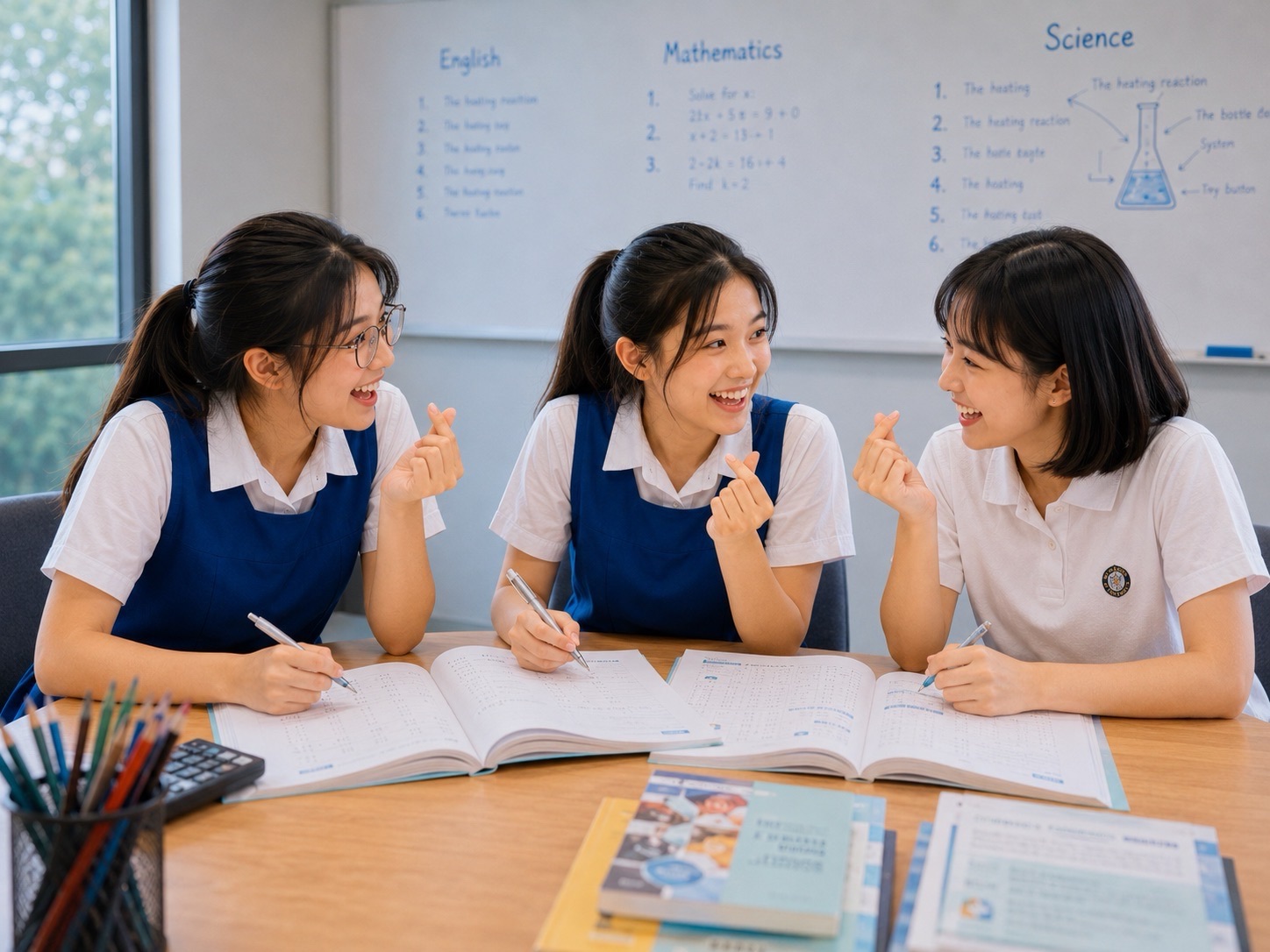
Why can a child know the word interested but write ‘I am interested on Science’? Or understand responsibility yet say ‘I am responsible of the materials’? English adjectives and verbs often form meaningful partnerships with particular prepositions. Some pairings are conventional, while others change according to the relationship the speaker wants to describe. Teaching the whole phrase—interested in, responsible for, good at, proud of—helps children communicate more naturally.
The preposition isn’t always a tiny word that can be swapped freely. ‘Angry with Maya’ can identify the person towards whom anger is directed; ‘angry about the decision’ identifies the issue. ‘Good at Mathematics’ describes ability, while ‘good for the project’ describes suitability or benefit in an appropriate context. The meaning of the adjective, the following noun and the intended relationship all matter.
In this sixty-sixth volume, parents will find a complete fictional art-club conversation, twenty high-value adjective and verb partnerships, worked contrasts, a learning record, questions for multilingual children, common errors and a family routine. The approach follows eduKateSG’s foundation-to-application method: begin with what the child means, repair the first unstable phrase and use the corrected partnership in a new sentence.
Quick answer: learn the whole meaningful word partnership
Teach the adjective or verb together with its natural following preposition and one complete context. Then ask what the preposition connects: a person, topic, skill, goal or reason. Where two pairings are natural, compare what each sentence means instead of inventing a rule that one is always wrong.
- Skill: good at reading, confident in speaking in an appropriate context.
- Interest: interested in the story, excited about the exhibition.
- Feeling: proud of progress, worried about a result.
- Responsibility: responsible for the materials.
- Similarity: similar to the other drawing, different from the model.
- Direction or relationship: listen to a speaker, depend on a condition.
- Meaning first: ask who, what or why the phrase concerns.
A complete worked lesson: the imaginary school art club
Step 1: identify the topic of interest
Imagine Maya and Tricia preparing a small fictional exhibition. Maya says, ‘I’m interested in drawing animals.’ Ask what the interest concerns. It is drawing animals. The phrase interested in introduces the topic or activity. ‘Interested on drawing’ is not the usual English construction for this meaning.
Step 2: discuss a skill
Tricia replies, ‘I’m good at drawing maps, but I’m still learning to colour animals.’ In this context, good at points to a skill. Ask what the person can do well, rather than assume a broad judgement about the child’s character.
Step 3: discuss a feeling about a result
After a practice display, Maya says ‘I’m proud of our progress.’ The object of pride is their progress. The child can point to which part of the project improved. ‘Proud of’ is more natural than ‘proud for’ for this intended relationship.
Step 4: name who is responsible
The group agrees that Ben will check the labels. ‘Ben is responsible for the labels’ names a task he has agreed to handle in the fictional scene. The expression doesn’t mean every mistake in the exhibition must be blamed on Ben. It describes an assigned role.
Step 5: separate anger about an issue from anger with a person
A label has been misplaced. Tricia says, ‘I am upset about the missing label.’ That identifies an issue. If the story states that Tricia is angry with a particular person, with can identify that person. Parents should not infer an accusation simply from the existence of a missing object.
Step 6: compare two drawings
One drawing looks like another. ‘Maya’s drawing is similar to Tricia’s drawing’ is a natural pattern. Now ask about a contrast: ‘It is different from Tricia’s in colour.’ Both sentences can be true if the pictures share a basic shape while their colours differ.
Step 7: transfer to a new context
Change the art activity into planning a class library display. Ask the child to create accurate phrases about interest in books, skill at reading diagrams, responsibility for labels and worry about a deadline. The child should choose prepositions from meaning, not copy the original nouns.
| Intended relationship | Natural phrase | What the child should explain |
|---|---|---|
| Topic | interested in animals | What interests the speaker? |
| Ability | good at drawing | Which skill? |
| Pride | proud of the work | What is the source of pride? |
| Assigned duty | responsible for the labels | Which task? |
| Concern | worried about the deadline | What is the concern? |
| Similarity | similar to the model | What is the comparison? |
| Difference | different from the model | What feature differs? |
Twenty useful adjective and verb–preposition partnerships
| Partnership | Natural example | Meaning role |
|---|---|---|
| interested in | I am interested in the book. | Topic of interest |
| good at | She is good at drawing. | Skill |
| bad at | I’m not good at remembering that rule. | Difficulty with a skill; avoid personal labels |
| proud of | We are proud of our progress. | Source of pride |
| worried about | He is worried about the result. | Source of concern |
| excited about | They are excited about the visit. | Anticipated event |
| afraid of | The character was afraid of the noise. | Object of fear |
| aware of | She is aware of the change. | Known fact or situation |
| similar to | This map is similar to mine. | Comparison |
| different from | The two designs are different from one another. | Contrast |
| responsible for | The group is responsible for its materials. | Duty |
| familiar with | I am familiar with the story. | Knowledge or experience |
| satisfied with | She is satisfied with the result. | Object of satisfaction |
| ready for | We’re ready for the activity. | Preparation |
| kind to | Please be kind to the new student. | Person receiving kindness |
| listen to | Listen to the instructions. | Source or object of listening |
| depend on | The plan depends on the weather. | Condition |
| belong to | The library book belongs to the school. | Ownership/association |
| agree with | I agree with your explanation. | Agreement with person or view |
| apologise for | I apologised for the mistake. | Reason for apology |
These are starting models, not an exhaustive dictionary of every accepted pattern. Several verbs and adjectives support alternatives with different meanings or regional nuances. Do not ask a child to reject a phrase until you have checked its complete context.
Good at and good for answer different questions
‘Maya is good at solving puzzles’ evaluates Maya’s skill. ‘This diagram is good for explaining the puzzle’ evaluates the diagram’s suitability for a purpose. A child’s statement ‘I am good for English’ may be understood differently from ‘I am good at English’. Ask whether the child is discussing ability or usefulness in a situation.
For a respectful family conversation, avoid equating difficulty with being a ‘bad student’. ‘I need practice at explaining my answers’ can be more helpful than an unsupported permanent ability label. Vocabulary should assist learning, not harden a temporary difficulty into identity.
Interested in and excited about are not interchangeable
‘I am interested in studying birds’ describes a topic or activity that attracts attention. ‘I am excited about the bird exhibition’ describes anticipation or positive feeling about an event. Someone can be interested without being particularly excited, or excited about an event without wanting to study the topic in depth.
In natural English, a preposition is commonly followed by a noun phrase or an -ing form functioning as an activity description: ‘interested in learning’, ‘good at drawing’, ‘worried about missing the bus’. This doesn’t mean every verb must be put into the -ing form regardless of grammar; the phrase determines the construction.
About often names the issue behind a feeling
A parent hears, ‘I am worried about the test.’ Ask what worries the child. The test is the topic. ‘I am worried about forgetting the formula’ names an anticipated difficulty more precisely. A useful response may include practical preparation, but the language lesson itself need not turn into a medical or emotional diagnosis.
‘Angry with a person’ and ‘angry about a decision’ identify different targets. ‘Angry at’ can also be natural in several contexts. Instead of insisting one form has a universal single meaning, ask what the speaker is angry about and towards whom, if anyone, the anger is directed.
Proud of, proud to and pride in are not one fixed construction
‘The child is proud of the picture’ names the object of pride. ‘The child is proud to present the picture’ uses a different construction to name an action the child is pleased to perform. ‘The child takes pride in careful work’ uses the noun pride with a different pattern. These expressions share an emotional theme but cannot be exchanged word-for-word.
Ask your child to compare two scenes: feeling pleased about a finished model and feeling pleased to present that model to the class. In one, the object of pride is a product; in the other, the action being performed is highlighted. The choice of words should follow the speaker’s actual meaning.
Depend on means the result is conditional
‘The outdoor activity depends on the weather’ means weather is a relevant condition affecting the activity. ‘Depend of the weather’ is not the usual standard English pattern. If the class instead depends on a parent for transport, the same preposition connects dependence to a person providing support.
A child can draw arrows from the planned event to its conditions: time, weather and materials. However, the existence of one condition does not prove that every other condition has been met. Saying a picnic depends on the weather does not guarantee it will proceed when the weather is pleasant.
Listen to, hear and pay attention to are different
‘Listen to the instructions’ asks for attentive reception of the message. ‘Hear the bell’ describes perception of a sound; hearing alone does not guarantee careful listening or understanding. ‘Pay attention to the instructions’ emphasises directed attention. The phrases relate but are not perfect synonyms.
A child who writes ‘listen the teacher’ in ordinary standard English can be given the model ‘listen to the teacher’. Ask who or what they are listening to. Then let the child use the phrase in a new context, such as listening to a reading partner.
Agree with, agree on and agree to need a meaning check
| Expression | A natural sentence | Typical focus |
|---|---|---|
| agree with someone | I agree with Tricia. | A person’s view or position |
| agree with an opinion | I agree with the explanation. | A claim or judgement |
| agree on a plan | The group agreed on the route. | Jointly settled issue |
| agree to a proposal | Maya agreed to the new plan. | Acceptance |
| agree to help | Ben agreed to help. | Commitment to perform an action |
The patterns are connected but not automatically identical. ‘They agreed with the plan’ can be natural, focusing on support for it; ‘They agreed on the plan’ can emphasise jointly settling what the plan would be. The full context determines which is useful.
Prepositions also work with noun forms
A child might learn responsible for and later read responsibility for. Or learn interested in and encounter interest in. Those are related structures, but the noun and adjective play different grammatical roles. They should be learned through complete phrases such as ‘responsibility for checking the labels’ rather than assumed from one spelling.
An older learner can keep a small word-family note: responsible for (adjective), responsibility for (noun); interested in (adjective), interest in (noun). Ask which form fits the sentence’s job.
Some prepositions are followed by an -ing activity
Compare ‘Maya is interested in learning how maps work’ with the unnatural beginner attempt ‘Maya is interested in learn’. In the intended construction, learning describes the activity after the preposition. Another natural example is ‘Tricia is good at drawing diagrams’.
The child must also know that not every occurrence of to introduces a to-infinitive. ‘I look forward to reading the book’ uses to as a preposition before the -ing form. Contrast it with ‘I plan to read the book’, where to read is a to-infinitive. Reading the full phrase matters.
A related preposition can change the speaker’s claim
| Phrase A | Phrase B | Meaning distinction |
|---|---|---|
| good at Mathematics | good for a Mathematics task | Ability versus usefulness |
| angry with a person | angry about an event | Target person versus issue |
| familiar with the process | familiar to the reader | Person’s knowledge versus recognisability to someone |
| responsible for a task | responsible to a supervisor | Duty versus accountability to an authority |
| agree with an opinion | agree on a decision | Endorsement versus settled common decision |
| talk to someone | talk about something | Conversation partner versus topic |
Some contrasts depend on context rather than forming strict logical opposites. The table helps parents ask what relation is intended. A learner should not assume that replacing one preposition always produces a sentence that is either meaningless or universally wrong.
Reading comprehension: prepositions can identify a cause or role
Read this fictional passage: ‘Maya is interested in painting, but she is worried about the presentation. She is good at creating small models. Ben is responsible for arranging the display. The group’s final decision depends on whether the room will be ready.’
| Question | Answer supported by the paragraph | Phrase clue |
|---|---|---|
| What interests Maya? | Painting | interested in |
| What worries her? | The presentation | worried about |
| Which skill is described? | Creating small models | good at |
| Who is assigned the display arrangement? | Ben | responsible for |
| What affects the final decision? | Whether the room is ready | depends on |
| Is the room already ready? | Not established | A condition, not a fact |
This passage is a useful test because the child must distinguish feeling, ability, assigned duty and a condition. If the answer changes one of these relationships, it may be a reading-comprehension mistake even when every major noun is copied correctly.
An original sentence-repair activity
First draft: ‘I am interested on maps. My friend is good for drawing. I am worried of tomorrow’s presentation, and our plan depends of the weather.’ The intended meaning is understandable, but the partnerships are not the conventional forms.
Natural revision: ‘I am interested in maps. My friend is good at drawing. I am worried about tomorrow’s presentation, and our plan depends on the weather.’ Each repair restores the relevant relationship without changing the objects and goals.
Ask the child what the sentence means before correcting it. If ‘good for drawing’ was intended to describe a pen rather than a person’s skill, that phrase could be correct: ‘This pen is good for drawing.’ Repairing the wrong meaning can create a new error.
Build a word-partnership card rather than an isolated vocabulary list
| Part of the record | Example | Why it helps |
|---|---|---|
| Whole partnership | interested in | Preserves natural form |
| Meaning | topic of interest | Connects grammar and meaning |
| Model sentence | I am interested in reading maps. | Shows use |
| Near miss | interested on maps | Highlights common substitution |
| Second use | interested in learning a new skill | Tests transfer |
| Review question | What are you interested in? | Invites independent retrieval |
One card may be enough for a younger learner. Older students can record alternative patterns such as good at versus good for. The important goal is a small number of expressions used accurately rather than a very large notebook of untested pairs.
A safe paper-card sorting activity
- Write six phrases without their prepositions, selecting ones already introduced in a story.
- Give a picture or clear fictional situation for each.
- Let your child complete the expression in a whole sentence rather than fill an arbitrary blank.
- Ask what relation the preposition names: skill, topic, person, condition or duty.
- Offer one alternative preposition and examine whether the sentence is unnatural or has another meaning.
- Give a different story with some of the same relationships.
- Listen for natural use during reading or conversation after a gap.
A child who remembers the right preposition only during a multiple-choice game may still need support. Transfer is better demonstrated by an accurate new sentence that fits a new event.
Match the difficulty to the child
A beginning reader may benefit from just two phrases: interested in and good at. A growing primary learner can compare interested in, excited about and worried about in a short paragraph. An older learner can discuss agree with, agree on and agree to, and check how the intended relationship changes. These are levels of task complexity, not fixed ages.

Multilingual children may communicate the concept correctly in their home language but select the wrong English preposition. Model the natural English phrase respectfully; do not assume a preposition error means the child fails to understand the situation.
A ten-minute family routine
- Two minutes: choose one relevant feeling, skill or duty from a current story.
- Two minutes: model the correct whole adjective- or verb-preposition phrase.
- Two minutes: discuss what the preposition relates to.
- Two minutes: compare a near miss or an alternative that changes the sense.
- Two minutes: ask the child for an independent example in a different context.
The timing is illustrative, not an evidence-tested requirement. One meaningful correction during shared reading can be enough for a short session.
Check for genuine progress
- The child uses interested in, good at and proud of in natural complete sentences.
- They distinguish skill from suitability in good at versus good for.
- They can explain whether about names the issue behind a feeling.
- They use responsible for when referring to a task and depend on for a condition.
- They do not automatically use the same preposition after every adjective.
- They understand that agree with, agree on and agree to can highlight different relationships.
- They can follow the relevant -ing form after a preposition.
- They can explain the relationship in an unfamiliar reading passage.
Common mistakes parents can avoid
- Teaching the preposition as a meaningless syllable without context.
- Marking every regional alternative wrong without checking a dictionary.
- Confusing good at a skill with good for a purpose.
- Turning worried about into a diagnosis of a child’s emotional state.
- Assuming responsible for a task implies blame for every outcome.
- Replacing a meaningful sentence with an artificially formal expression.
- Memorising a long table but never asking for new sentences.
- Overcorrecting home-language transfer instead of modelling the English phrase.
Frequently asked questions
Why is interested in more natural than interested on?
Interested in is the standard adjective–preposition partnership when the sentence names a topic or activity of interest: ‘interested in the book’, ‘interested in reading’.
Is good at the same as good for?
No. Good at commonly describes ability in a skill. Good for can describe suitability or benefit in an appropriate context.
Should a child say proud of or proud for?
‘Proud of my work’ is the familiar standard phrase for feeling pride about a result. Other forms may appear in different constructions, so check the complete intended message.
Can about and with both follow angry?
Yes. Angry about may name an issue while angry with may identify a person. Context and regional usage can affect the most natural choice.
Why does a preposition sometimes precede an -ing form?
After a preposition, an activity can often be expressed by an -ing form, as in ‘interested in learning’ and ‘good at drawing’. It is important to learn the whole grammatical pattern.
What is the difference between agree on and agree with?
Agree on often concerns a decision or plan jointly settled. Agree with can describe support for a person, claim or opinion. They overlap in some contexts but highlight different relationships.
Can children learn these phrases without grammar terminology?
Yes. Begin with meaningful situations and complete natural examples. Terms such as adjective, preposition and complement can be added when useful.
How can I check that my child understands rather than guesses?
Give a new situation that changes the skill, topic, issue or speaker, and ask for a natural phrase with an explanation of its meaning.
Research-informed grammar references
The British Council guide to adjectives and prepositions explains patterns such as interested in, good at, angry about and proud of, recommending that learners keep words together in phrases. The Cambridge Dictionary guide to prepositions describes adjective–preposition and verb–preposition patterns. These resources support the language examples; the imaginary art-club exercise is an original home lesson, not a fixed intervention.
For related eduKateSG learning, see Vol 53: Natural Make, Do, Take and Have Partnerships, Vol 63: Verb and Infinitive Patterns, and the Vocabulary in Real English Hub.
To practise tonight, ask your child what they are interested in, what skill they are working on and which task they are responsible for. The answers will show whether the phrases have become part of a real conversation.
Continue with this batch of children’s vocabulary articles: Vol 65: Regional English · Vol 67: Adjective Order · Vol 68: Precise Action Verbs · Vol 64: Punctuation · Vocabulary in Real English Hub.