
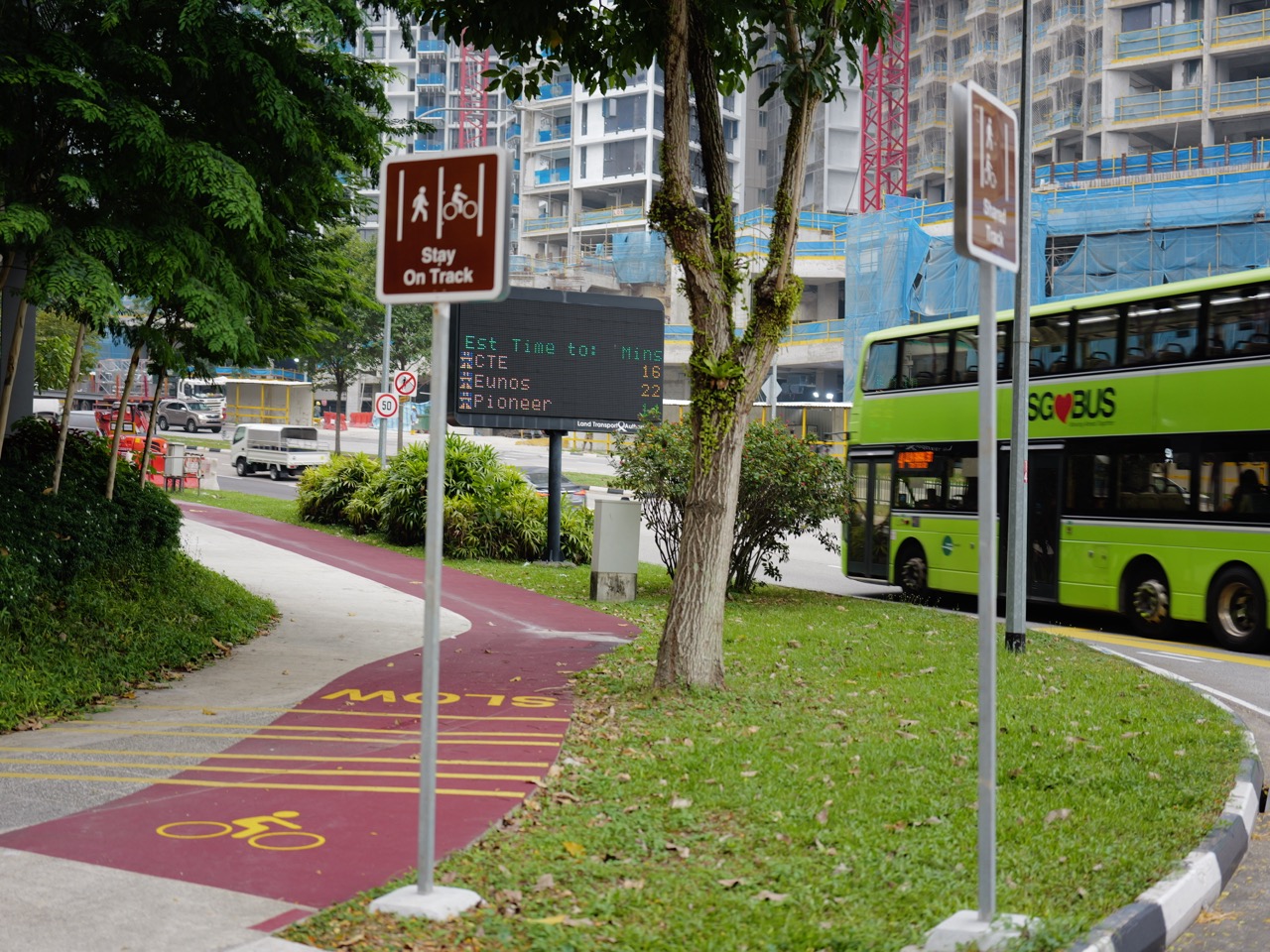
Did you know? The words shared path, pedestrians only and dismount may look like ordinary labels on a family walk to school. To a child cycling beside a bus stop, though, they are instructions about who may travel where—and whether to remain on the bicycle.
Vocabulary matters because a path label classifies the space, while words such as dismount and give way tell a person what to do immediately. Children who can turn these words into actions are better equipped to read changing street signs, explain a route to an adult and notice when a convenient shortcut is not a permitted or considerate one.
Three signs can describe three very different decisions
A shared path invites coordination, not entitlement
A shared path is a space used by pedestrians and permitted active-mobility users. The word shared does not mean everyone may travel at the same speed or expect everyone else to move aside. In Singapore, the Land Transport Authority (LTA) reminds device riders to give way to pedestrians and take particular care around people who are more vulnerable. It also asks all path users to look out for one another.
The family question is not “Can my child fit through?” but “Can my child move through without making someone else feel unsafe?” A pram, wheelchair user, elderly pedestrian and small child may all need more reaction space than a cyclist first expects.
Pedestrians-Only marks a restriction, not just a preferred lane
A Pedestrians-Only Path is not another name for a shared path. Singapore started enforcement on converted Pedestrian-Only Paths from 1 July 2025, after marking eligible footpaths adjacent to cycling paths with pedestrian logos and the words “Pedestrians-Only”. LTA says bicycles and certain other active-mobility devices cannot be ridden on those converted paths; provisions for personal mobility aids differ and are detailed in its official guidance.
That distinction is current and consequential. An older recollection that bicycles could ride on ordinary footpaths should not override a newer, specific Pedestrians-Only marking. A sign refers to the particular section of path in front of the rider. Parents and students should check the latest official rules rather than memorising blanket statements that ignore path type or device type. See LTA’s Pedestrian-Only Paths enforcement explanation of 1 July 2025.
Dismount is a verb: get off and push
Dismount means getting off the bicycle or other device. When a No Riding sign applies, LTA tells device riders to dismount and push the device, with specific exceptions for personal mobility aid users. It does not mean reducing speed slightly while staying seated. Compare the word family: mount (get onto), dismount (get off), mounted (on the device), and on foot (walking).
Imagine a child approaching a narrow covered walkway. They see a No Riding sign but say, “I am going very slowly, so it is fine.” The language check is simple: did the sign say slow down or no riding? The two phrases prescribe different actions. The child should get off and push where that sign requires it.
Give way is about who gets a safe turn
Give way means yielding space or priority to another road or path user. Stop means bring movement to a halt. Slow down means reduce speed. These are related safety actions, not synonyms. A rider may need to slow down, give way, or stop altogether depending on the situation. Never turn “give way” into “pedestrians must step aside for me.”
Consider a hypothetical shared path near a bus stop. A student wants to pass a person walking with a toddler. The rider notices a gap, but it closes whenever the toddler changes direction. The correct decision is not an ambitious overtaking manoeuvre. It is to slow down, maintain space, wait for a genuinely safe opportunity, and walk the device if the area is crowded. LTA explicitly advises riders to slow near bus stops and intersections and to walk devices in crowded areas.
A useful collocation: give way to pedestrians. The small word to identifies who receives the priority. Students should practise it in sentences: “Cyclists give way to pedestrians”; “I gave way to the person boarding the bus”; “We waited until the crossing was clear.”
One fictional route, four checkpoints
The following is a made-up teaching route, not a map or an assurance about any real school entrance. A pupil called Mei cycles with an adult from home to a community library and then walks to a school gate. Along the way they pass a dedicated cycling path, a shared connector, a converted Pedestrian-Only Path beside a cycling lane, and a short No Riding zone.
Checkpoint 1 — dedicated cycling path. Mei identifies the cyclist marking and stays on the path intended for cycling, watching for pedestrians and junctions. “Dedicated” means set aside for that purpose; it does not remove the responsibility to ride carefully.
Checkpoint 2 — shared connector. The pair meet walkers. Mei says, “This is shared, so I should give way and keep a safe distance.” She does not treat her bell as a command for other people to clear the path.
Checkpoint 3 — Pedestrians-Only Path. A straight line appears tempting, but the path has the relevant markings. Mei distinguishes the pedestrian path from its adjacent dedicated cycling path and follows the permitted cycling route. The sign is more important than her impression that the shortcut looks harmless.
Checkpoint 4 — No Riding section near the destination. Mei gets off and pushes the bicycle. She does not ride across the final few metres simply because the school gate is visible. By explaining what she did, she practises reading comprehension and decision-making in the same small task.
Learning the grammar of signs
Path signs often use imperatives—short commands such as stop, dismount, keep left or give way. Other signs are classifications, such as cycling path or pedestrians only. The first answers “What must I do?”; the second answers “What sort of space is this?” Both may appear without a complete sentence.
The word only is easy to overlook but carries important meaning. “Pedestrians” describes a group; “Pedestrians Only” adds a restriction. Similarly, advised, recommended, must and prohibited carry different strengths. A responsible reader does not convert advice into law, or law into optional advice. Local rules, signs and exceptions must be checked against official guidance.
How parents can practise without turning a walk into a test
Choose a quiet, safe place and ask the child to describe an actual sign from a stationary position. Do not ask a child to read aloud while steering. Ask three questions in this order: “Who is this sign talking to?”, “What action does it require?”, and “What might happen if we misunderstand it?” These are short enough for a younger pupil but still uncover the main meaning.
At home, draw three simple boxes labelled shared, pedestrians only, and no riding. Give the child cards labelled give way, choose permitted path, get off and push, stop before a crossing and stay alert. Some actions will fit more than one situation; explain why. This avoids the mistake of teaching a rigid one-sign–one-action slogan.
For a Secondary student, add a reasoning task: “The path is empty. Does that change the meaning of No Riding?” Ask for a claim, a reason and a reference to the posted instruction. Older students can compare two nearby path types on a route map and discuss accessibility, responsibility and the difference between safe behaviour and legal permission.
Vocabulary crosses into Mathematics, English and citizenship
In English comprehension, a single word such as only, except or unless changes the logic of a sentence. In Mathematics, route choices require spatial reasoning and trade-offs: the shortest path in metres is not necessarily the most appropriate path for the permitted mode of travel. In Social Studies and civic life, shared spaces require consideration for people with different mobility and safety needs.
This is one reason vocabulary learning should include applied examples. Memorising “dismount = get off a bike” is a start; actually recognising when to dismount is the transferable understanding.
A five-question safety check
1. What is the difference between a shared path and a Pedestrians-Only Path? 2. If a sign says No Riding, is going slowly still riding? 3. Who is being given priority in “give way to pedestrians”? 4. How does an empty path change—or not change—the sign’s meaning? 5. Where would you verify current rules if a family member remembers older guidance?
Retrieval practice: answer without looking, then check the official LTA page. Transfer practice: on a different day, identify an unfamiliar path marking from a safe standing position, describe its effect, and ask an adult to verify the rule where needed. The aim is reliable decisions, not a child reciting legal terms.
Frequently asked questions
Does shared mean cyclists always have the same priority as pedestrians?
No. LTA’s conduct guidance tells device riders to give way to pedestrians and look out for more vulnerable users. Sharing a space carries responsibilities.
If my child is already late, may they ride through a No Riding zone?
Being late does not change the sign. Where No Riding applies, the instruction for relevant device riders is to dismount and push.
Are all footpaths in Singapore Pedestrians-Only Paths?
No. LTA distinguishes converted Pedestrian-Only Paths, other footpaths and shared paths. Follow the actual markings and latest official rules for the relevant path and device.
Should a child memorise speed limits from this article?
No: the practical lesson is to read path type and act safely. Legal speed and device conditions can change and must be verified in current LTA materials; this article does not substitute for those official rules.
Where to read further
Check LTA’s current Rules & Code of Conduct and LTA’s Pedestrian-Only Paths enforcement explanation of 1 July 2025 for authoritative current requirements. Continue the vocabulary at an age-appropriate pace with Singapore children’s guide to cycling paths and shared safety, and explore why the design of crossings and bus-stop interfaces matters in how cycling paths cross bus stops and junctions. Those guides support, rather than replace, the instructions posted on the actual route.