
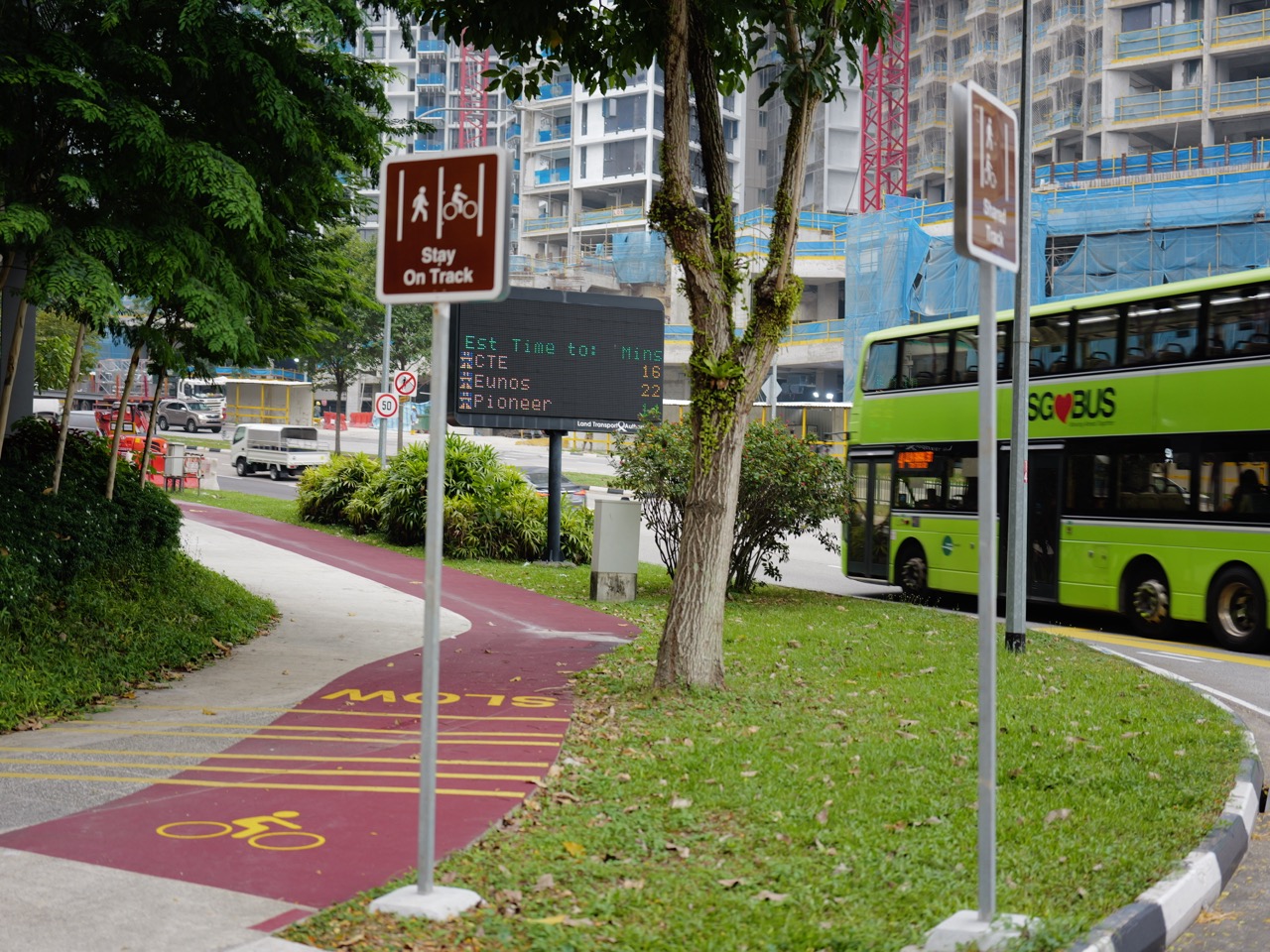
A Singapore child walks beside a marked cycle path and notices a bicycle symbol next to a pedestrian symbol. Another path has the words “Pedestrians Only.” The child may assume that both paths have identical rules or that any device with wheels is allowed everywhere. That would be a mistake. The words footpath, pedestrian-only, cycling path, shared path and mobility aid represent different spaces or devices, and the distinctions protect people with very different needs.
For a child who learns first in English, Mandarin, Malay, Tamil or another home language, understanding the purpose of the path matters before memorising legal labels. A parent can say, “This route is for walking” in the familiar language, then introduce the official English sign. Children should learn to read markings and ask how a route is intended to be used without deciding that everyone moving slowly is breaking a rule.
This forty-fourth Singapore Children Vocabulary article teaches the language of walking, cycling, scooting and sharing Singapore’s public paths, mainly for ages eight to twelve. It complements Public Transport Courtesy, which focuses on buses and trains, and OneMap, Map Legends and Safe Routes, which focuses on reading geographic information. This lesson owns a different task: distinguishing path types, identifying appropriate users, and understanding why safe movement depends on more than recognising a road or a bicycle.
Quick answer: look at the marking and identify the user
The child-friendly sequence is observe the marking → identify the path type → identify the device or user → check the actual rule → act with care and adult supervision. Some footpaths can be used by ordinary bicycles under applicable rules; designated Pedestrian-Only Paths next to cycling paths are different. A shared path may be marked with both pedestrian and cyclist symbols. A personal mobility aid such as a wheelchair is not simply an e-scooter that can be treated the same way.
Learning the vocabulary is not authorisation to ride any device. Children must never be encouraged to operate powered devices without the required age eligibility, approval, supervision or safety arrangements, nor to ride onto roads as part of a language exercise.
- Ages: roughly Primary 3–6, with symbol recognition for younger children.
- Learning result: identify at least three different path types and one important difference between devices.
- Practice method: paper path diagrams or authorised photos, with no need to ride.
- Safety: obey the actual current ground signs and responsible adult instructions, not an assumed rule based on the path’s colour alone.
Current LTA active-mobility rules in Singapore
The Land Transport Authority’s Rules and Code of Conduct explains how the Active Mobility Act regulates bicycles, power-assisted bicycles, personal mobility devices and personal mobility aids. It sets requirements for where devices may be used and how riders should behave. Underlying limits and eligibility depend on the device and path type.
LTA’s 9 March 2026 path-use comparison distinguishes conventional footpaths, cycling paths, shared paths, Pedestrian-Only Paths and roads. Ordinary bicycles may be used on some footpaths and on cycling paths subject to rules. Motorised PMDs such as e-scooters are not allowed on ordinary footpaths; they may be used on permitted cycling or shared paths when the relevant conditions are met. Power-assisted bicycles have a different set of permitted paths. The child’s lesson should not collapse all devices into “scooters.”
A major change took effect on 1 July 2025: LTA began enforcing its Pedestrian-Only Paths initiative where footpaths are adjacent to dedicated cycling paths. Bicycles and non-motorised PMDs are not normally allowed to ride on the converted Pedestrian-Only Paths. This is not a general ban on ordinary bicycles on every standalone footpath. LTA explains the marking and narrow, context-specific transitions where users may need to cross to avoid an obstacle or reach an adjoining path.
The Ministry of Transport’s current summary describes the June 2026 regulations for personal mobility aids. Their permitted travel speed on public paths is now capped at 6 km/h. Rules also address appropriate use of mobility scooters and transition arrangements for older equipment. These requirements serve users with mobility difficulties and should not become an invitation to question someone’s medical circumstances.
The LTA rules include safety requirements such as giving way to pedestrians, slowing around bus stops and intersections, not using mobile communication devices while riding, obeying traffic signals and appropriate use of lights. The correct application depends on where the person is riding and what kind of device is involved. Children should learn the principles, not replace formal training or supervision.
For exact device eligibility and penalties, adults should consult the current LTA information. The legal rules may be updated; a 2024 poster may not fully reflect 2026 path markings and mobility-aid requirements.
Twenty child-ready words for shared paths
These are original educational definitions. Some legal categories need more detailed official descriptions; the short sentences below teach the practical distinctions without giving permission to use any device.
- 1. Active mobility: travelling by human-powered or certain small mobility devices rather than only motor vehicles. “Walking and cycling are forms of active mobility.”
- 2. Pedestrian: someone moving on foot. “Pedestrians need appropriate space.”
- 3. Footpath: a path used by people walking, with particular rules for permitted devices. “Not every footpath has the same additional designation.”
- 4. Pedestrian-Only Path: a specifically marked path prioritising pedestrian use under the relevant rules. “Bicycles should use the adjacent cycling path.”
- 5. Cycling path: a path designated for cycling and appropriate active mobility uses. “The cyclist logo identifies a cycling path.”
- 6. Shared path: a path designed for permitted pedestrians and relevant devices together. “Users on a shared path need to consider one another.”
- 7. Marking: a painted or displayed sign identifying a path function or rule. “Read the marking rather than guessing.”
- 8. Bicycle: a pedal-powered cycle with rules based on where it is used. “A bicycle is not the same as an e-scooter.”
- 9. PMD: personal mobility device, a category including permitted motorised and non-motorised devices. “An e-scooter is a motorised PMD.”
- 10. PAB: power-assisted bicycle, an electrically assisted pedal cycle subject to different requirements. “A PAB is not permitted on a footpath.”
- 11. PMA: personal mobility aid for users with mobility needs, such as wheelchairs and suitable mobility scooters. “A PMA has different access rules from an e-scooter.”
- 12. Dismount: get off a bicycle or other rideable device. “A cyclist may need to dismount where riding is not allowed.”
- 13. Give way: let another person or vehicle proceed as appropriate for safety. “Riders should give way to pedestrians.”
- 14. Overtake: pass someone travelling in the same direction. “Alert others gently before overtaking.”
- 15. Intersection: a place where routes meet or cross. “Slow and watch carefully at an intersection.”
- 16. Visibility: how readily a person, object or hazard can be seen. “Lights can improve a rider’s visibility in the dark.”
- 17. Obstruction: something blocking a path or safe movement. “An obstruction can change how people use a route.”
- 18. Speed limit: the maximum permitted speed in a specified place or condition. “A speed limit differs by path and device.”
- 19. Accessibility: usability of routes by people with relevant mobility or other needs. “A clear path supports accessibility.”
- 20. Courtesy: considerate behaviour toward others. “Courtesy matters even when someone is following the legal rule.”
The key distinctions are footpath versus Pedestrian-Only Path, PMD versus PMA, maximum permitted speed versus a safe speed for the current crowd, and dismount versus continue riding. Knowing that a legal limit exists does not prove that travelling at that maximum is sensible around children or vulnerable users.
Worked case one: the cyclist symbol beside a walking symbol
A fictional family sees two paths running alongside one another. One has a walking figure and “Pedestrians Only”; the adjacent route has a cyclist icon. The child says an ordinary bicycle can use either because the surfaces look similar.
Parent: “What does the first marking say?”
Child: “Pedestrians Only.”
Parent: “What does the adjacent symbol indicate?”
Child: “A cycling path.”
Parent: “Does the surface’s colour override the posted designation?”
Child: “No. We should read the actual marking and rule.”
Parent: “What can we do as pedestrians?”
Child: “Use the intended pedestrian route and remain alert near crossings.”
The example follows LTA’s Pedestrian-Only Paths policy and its distinctions among path types. It does not suggest that children should confront cyclists or determine whether a narrow exception applies. Any concern belongs with responsible adults or authorised personnel.
A child should learn that a path’s intended use can change with updated markings, so a familiar street photograph from an earlier year is not necessarily current.
Worked case two: a standalone footpath is not automatically the same as Pedestrians Only
A pupil reads that some footpaths can be used by ordinary bicycles under rules, then assumes every pedestrian-only path must also allow riding.
Teacher: “Does LTA use identical terms for every walking path?”
Child: “No. It distinguishes ordinary footpaths and Pedestrian-Only Paths.”
Teacher: “What changed from July 2025?”
Child: “Converted footpaths beside cycling paths became Pedestrian-Only Paths for walking users.”
Teacher: “Does that ban bicycles from every conventional footpath?”
Child: “No. We need the actual path designation and rules.”
This is the most important near-match in the lesson. It prevents a child from treating one type of path as the whole category. Paper illustrations can show a standalone footpath, a shared path and a newly marked pedestrian-only path without requiring children to judge an actual moving rider.
For a real journey, parents check the current markings. Children do not need to calculate legal exceptions or argue with a stranger about path classifications.
Worked case three: PMD and PMA are not the same
A child sees a person using a mobility scooter and assumes that it must be a motorised recreational e-scooter, so it cannot enter a Pedestrian-Only Path.
Parent: “What is the device designed to do?”
Child: “It may be a mobility aid for someone who has difficulty walking.”
Parent: “Does LTA treat PMAs and e-scooters as identical categories?”
Child: “No.”
Parent: “Can you infer the person’s medical needs from looking at them?”
Child: “No. We should not question private medical information.”
Parent: “What should we do as other path users?”
Child: “Give appropriate space and use the route considerately.”
The June 2026 PMA rules clarify the category and speed requirements, but they are not grounds for children to police individual users. The device’s classification and lawful eligibility require more information than appearance. A respectful child can understand the principle without making judgments about disability.
This case connects with Accessible Communication and Different Needs, which explains why people may need different supports or formats.
Worked case four: the green light is not permission to stop looking
At a fictional crossing, a family preparing to cycle sees a green signal. The child believes no one needs to slow down or check for other traffic.
Caregiver: “What does the signal permit under applicable rules?”
Child: “Movement when it is appropriate.”
Caregiver: “Does it remove the need to look for traffic and pedestrians?”
Child: “No.”
Caregiver: “What does LTA advise riders to do before crossing a road?”
Child: “Stop and look out for traffic.”
The learning point is that signs and signals are part of a safe system but do not make other conditions disappear. Actual traffic movement follows current road and path rules, not a simplified classroom script. A child should never test the scenario in live traffic without appropriate adult supervision and safe cycling instruction.
For a harmless home exercise, draw a crossing and ask where two imaginary path users might meet. No riding is needed.
Worked case five: the speed limit does not mean a required speed
A child reads that the speed limit on some cycling and shared paths is 25 km/h and assumes everyone should travel at exactly that speed. Their parent points to a drawing showing a crowded path.
Parent: “What does a maximum mean?”
Child: “It is the upper permitted limit, not a target.”
Parent: “What else matters on a shared path?”
Child: “Other users, visibility, crowded areas and safe control.”
Parent: “What does LTA say about behaviour near pedestrians?”
Child: “Give way, slow down and be considerate.”
LTA’s guidance distinguishes permitted maximum speeds from considerate riding in real conditions. Children should not try to reach a path’s maximum as a vocabulary demonstration. If a device’s rider cannot control it safely, an adult should decide what is appropriate.
This is a transfer lesson in the word limit: in many systems a ceiling is not an instruction to use the maximum.
Worked case six: a bicycle is parked across a walkway
In a fictional HDB estate, a rental bicycle has been left across a narrow path, leaving little room for someone using a wheelchair. The child proposes lifting it into the road.
Parent: “What do we actually observe?”
Child: “The bicycle is obstructing part of the path.”
Parent: “Do we know whether moving it ourselves would be safe?”
Child: “No.”
Parent: “What can you do at your age?”
Child: “Tell you. You can use the appropriate operator or reporting channel.”
The child has learned to describe obstruction without assigning blame. Adults can follow the relevant bicycle-share operator’s parking guidance or suitable civic feedback route. Children should not push objects onto a carriageway or block another path to “solve” a problem.
An alternative is to use a pretend toy bicycle and paper walkway to practise why parking location matters for other users.
Worked case seven: reading yesterday’s path poster
A family finds a printed path-rule guide from an earlier period. It shows old mobility-aid speeds and does not mention the updated 2026 rules. The child calls the guide “a lie.”
Parent: “Was the material necessarily inaccurate when published?”
Child: “Not necessarily.”
Parent: “What could have changed?”
Child: “Regulations and path designations.”
Parent: “Where should we check now?”
Child: “LTA’s current rules and Ministry of Transport updates.”
The word current belongs in this vocabulary lesson even when it is not one of the twenty headline terms. Rules are linked to dates, and a genuine old poster may no longer describe today’s system. Use current sources rather than old forwarded screenshots for real decisions.
Five movements of considerate path use
First, notice. Look at actual markings, surrounding users and whether the route is crowded. Avoid relying on the last time a family visited. An additional pedestrian-only designation may now apply.
Second, choose. Pedestrians should use the appropriate walkway or pedestrian-only route when available. Riders must comply with their device’s permitted path types and relevant age or technical restrictions. A child should not choose a powered device independently.
Third, slow. LTA tells active mobility riders to watch their speed near pedestrians, bus stops, intersections and crowded conditions. The goal is not reaching a numerical maximum.
Fourth, communicate. Users can gently alert others before overtaking, remain courteous and give way appropriately. Shouting, intimidating someone or assuming their disability is unacceptable.
Fifth, check. A damaged route, obstructed access or confusing sign can be described to a responsible adult, who can find the correct service or authority. Children should not perform enforcement or intervene in physical disputes.
These five movements are an educational simplification, not a replacement for the full legal code or device training.
A paper-path exercise with three colours
Draw an imaginary neighbourhood with a conventional footpath, dedicated cycling path, shared path and separate pedestrian-only section. Use different patterns and symbols, not just colours, so children can understand the key even without colour vision.
Give the child four user cards: walker, ordinary cyclist, e-scooter rider and wheelchair user. Ask which categories require checking different path rules. Emphasise that an electric wheelchair is not simply another recreational PMD.
Next add a bus-stop entrance and a school crossing. Ask why slowing down and yielding may be appropriate even when a path is designated for cycling. Let the child make a first-language explanation and then form one English sentence.
Add a bicycle blocking a path. The child should describe the obstruction and say an adult should handle it rather than moving it into the road.
Finally show a mock “Pedestrians Only” marking and a conventional footpath. Ask whether the terms are identical. A learner who knows the distinction has reached the central goal.
The map and device cards are fictional. The exercise does not require children to ride, test equipment, enter traffic or challenge real path users.
Three differentiated learning pathways
Repair pathway: the learner knows “walk” and “bike” but confuses the spaces. Teach pedestrian, footpath, cycling path, marking and shared path. Use clearly labelled drawings and short descriptions.
Stabilisation pathway: the learner recognises symbols but conflates device categories. Teach PMD, PAB, PMA, Pedestrian-Only Path and dismount. Emphasise that legal permissions are specific, not guessed by appearance.
Extension pathway: the child can distinguish users and is ready for give way, overtake, intersection, speed limit and accessibility. Ask why an apparently permitted movement may still be unsafe for the conditions.
A child who understands the rule in Malay but needs the English term pedestrian-only needs language support. A fluent speaker who treats all two-wheeled devices alike needs category clarification. Correct the actual misunderstanding before introducing more technical law.
Four weeks of active-mobility vocabulary
- Week 1 — distinguish paths: pedestrian, footpath, cycling path, shared path and marking. Compare symbols on an invented ground layout.
- Week 2 — name users and devices: Pedestrian-Only Path, bicycle, PMD, PAB and PMA. Identify which claims require checking official rules.
- Week 3 — communicate safe movement: dismount, give way, overtake, intersection and visibility. Discuss courteous behaviour without live riding.
- Week 4 — handle different needs: obstruction, speed limit, accessibility, courtesy and active mobility. Explain how an ordinary resident can raise a concern without becoming an enforcer.
Revisit earlier vocabulary in a new drawing with different labels. A single family conversation beside an official infographic may be enough, and a paper activity can avoid stressful or unsafe situations outside.
A useful progress record asks what the sign actually states, which category the device belongs to, whether a legal or safety detail is missing and who should handle the real-world decision.
Frequent misconceptions to correct
“Footpath and Pedestrian-Only Path always mean the same rule.” No. LTA distinguishes them, including its July 2025 Pedestrian-Only Paths initiative.
“Bicycles are allowed everywhere pedestrians walk.” No. Permitted path types and actual designations matter.
“E-scooters may ride along any footpath.” No. Motorised PMDs have distinct restrictions and technical requirements.
“A mobility scooter is simply a recreational e-scooter.” No. PMAs support people with mobility needs and follow different rules.
“The maximum speed is the speed everyone should travel.” No. Riders must slow appropriately for conditions and vulnerable users.
“A child can move a parked bicycle into the road to clear a path.” This may create danger. Tell a responsible adult and follow appropriate handling guidance.
“A path marker from 2024 always describes 2026 rules.” No. Markings and regulations can change; verify current official information.
“A person using a PMA must explain their medical condition to children.” No. Respect privacy and the dignity of other path users.
Frequently asked questions
What is the difference between a footpath and a Pedestrian-Only Path?
Can bicycles be ridden on cycling paths?
Are e-scooters allowed on Singapore footpaths?
What is a PMA?
Did PMA speed rules change in 2026?
Should riders give way to pedestrians on shared paths?
Should a child challenge an unfamiliar rider?
Can this vocabulary be learned in a first language other than English?
Why path vocabulary needs the word conditional
A learner may read an LTA path guide, memorise “bicycles allowed” and forget the conditions attached to the statement. But road and path categories, markings, device types, eligibility and behaviour requirements all matter. The word conditional means that a statement is true or applicable only when its stated conditions are met.
For example, “a conventional bicycle may be used on certain permitted footpaths” is not the same as “a bicycle may ride on all pedestrian-only paths.” A child should learn to preserve words such as where permitted, subject to and when appropriate when explaining a rule in the family’s first language. Removing a small condition can reverse the meaning.
Worked case eight: two users read the same shared-path symbol
A fictional path has a pedestrian and cyclist symbol. The child says that because cyclists are permitted, walkers must give way to every bicycle regardless of speed.
Parent: “What does the symbol tell us?”
Child: “It indicates a shared path for permitted users.”
Parent: “Does the sign give cyclists unlimited priority?”
Child: “No. LTA’s code requires riders to be considerate and give way appropriately.”
Parent: “What might change the safe speed?”
Child: “Crowding, visibility, intersections and other people’s movements.”
The exercise helps the learner distinguish permission to use a path from permission to use it in any manner. A maximum legal speed is not a target to reach. Responsible adults handle real route and device decisions.
A small parent assessment beyond symbol recognition
Show three fictional diagrams: one standalone footpath, one cycling path beside a Pedestrian-Only Path, and one shared path. The learner names each and adds a full sentence about a cyclist’s or pedestrian’s position. Ask which detail must be verified on the actual street before travelling.
Then replace an ordinary bicycle with a PMA user. The child should no longer apply every recreational PMD rule without checking the appropriate category. This is a transfer test: the same path may involve different legal or practical considerations for different users.
A final question concerns a blocked ramp. The learner should describe the obstruction and alert an adult rather than moving heavy objects or assuming that a nearby staircase provides an accessible alternative.
The current LTA Rules and Code of Conduct is the source for actual path rules. A language exercise can strengthen understanding, but it cannot determine real legal compliance from a photograph.
Nation building through shared movement and consideration
Singapore’s walking and cycling networks let people reach schools, shops, parks and transport services using different modes of movement. The rules are not merely about devices. They reflect the needs of pedestrians, cyclists, mobility-aid users, families with children and older residents sharing limited space.
LTA’s current rules, its March 2026 path-use guide, and MOT’s updated mobility rules support the distinctions in this article. The scenarios are fictional; they do not establish whether an individual rider in an actual photo is complying with the law.
A child who says “This is a Pedestrian-Only Path, while a PMA follows different rules, and we should keep the passage safe for everyone” is developing accurate civic language. Courtesy and professional enforcement still require broader responsibility than a vocabulary lesson can provide.
Connected Singapore Children Vocabulary reading
Continue with Public Transport Courtesy for bus and train interactions, OneMap and Route Questions for geographic reading, and Void Decks and Shared Neighbourhood Facilities for other kinds of shared space.
For a child experiencing different access needs, see Accessible Communication. For an adult-managed problem report, visit Reporting Neighbourhood Problems. The Singapore Children Vocabulary hub connects all series themes.
The Vocabulary Learning Hub and Vocabulary Development provide age-by-age methods. For language policy context, consult Singapore Bilingual Education.
Start with a three-symbol drawing tonight
Draw a walker, a bicycle and a wheelchair beside three invented marked paths. Ask the child to distinguish path use from device type and explain why a pedestrian-only marking is not the same as a conventional footpath. Use the familiar first language before making a precise English statement. No live cycling, scooter operation or road test is needed.
Prepared in October 2026 using LTA and Ministry of Transport active-mobility guidance current at the time of writing. All school and street scenarios are fictional and not operational or legal determinations. Follow current ground markings, official rules and responsible adult safety guidance.