
Guide 31 · Civilisation Building · 40 in-depth learning chapters
Previous guide · Series index · What is Civilisation?
A civilisation becomes more dependable when its shared arrangements can be examined, corrected and handed on. This guide asks how to make the limits, purposes, permissions and consequences of shared resource choices understandable to every reader. The fictional Riverbend setting is used so children can practise reading evidence, choosing fairly, doing arithmetic accurately and recognising the limits of any conclusion. It is a guide for readers, parents and tutors who want a useful learning activity rather than an abstract promise that bigger or more complicated communities are always better.
In each chapter, an everyday story introduces a clear question. Children first identify the purpose and explain what the evidence says; older students inspect a separate numerical model and a changed condition. A tutor can check whether the student understood the distinction, not just whether the final number matches the sample. The examples are imaginary and independent; figures from one chapter are not carried into another unless the exercise explicitly says so.
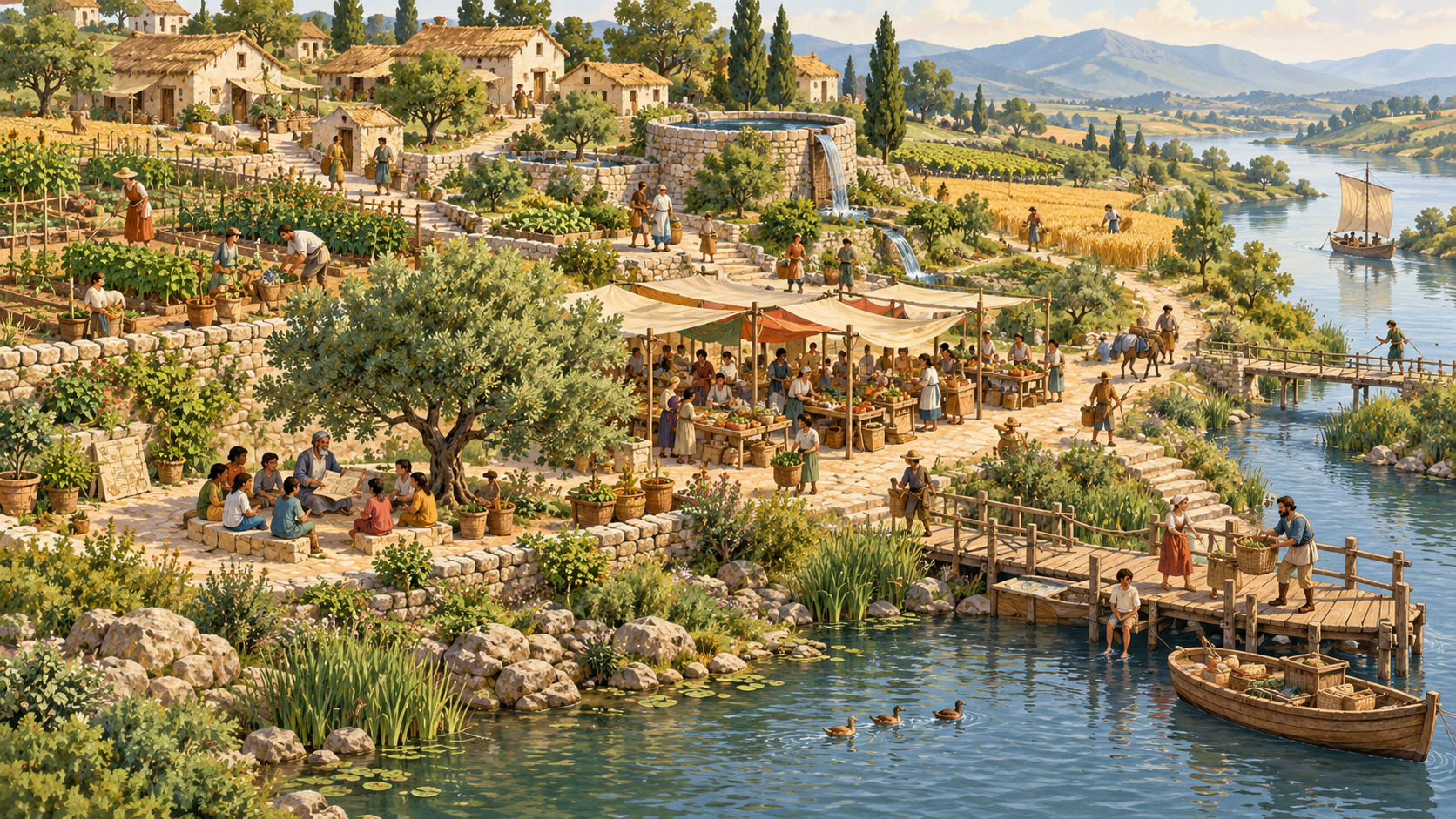
All spending, revenues and tokens are invented school-model figures, not real prices, financial advice, public-finance policy, procurement rules or investment recommendations. The established Riverbend cover is an AI-generated conceptual illustration, not a documentary image of a real place or a technical plan. A fictional role’s availability, consent, need or capability cannot be treated as a general truth about an actual person. All decisions in the guide stay within the limits of the written classroom rules.
Five guided learning routes
- Understand public purposes and available funds — chapters 1–8
- Calculate commitments and full cost — chapters 9–16
- Compare alternatives and opportunity cost — chapters 17–24
- Review evidence and changing resources — chapters 25–32
- Make a sustainable multi-period plan — chapters 33–40
Complete 40-chapter index
Open all chapter titles
- 1. Begin with the service, not the object
- 2. Make a wish list face a clear ceiling
- 3. Separate one-time and recurring cost
- 4. Who benefits from a shared facility?
- 5. Recognise displaced uses
- 6. Subtract existing commitments first
- 7. Expected income is not cash on hand
- 8. Respect restrictions on a gift
- 9. Recompute a suspicious total
- 10. A monthly cost is not an annual budget
- 11. Multiply unit cost by quantity
- 12. Keep maintenance in the projection
- 13. Avoid counting one helper twice
- 14. Compare alternatives over the same period
- 15. State priorities before ranking options
- 16. Retain uncertainty in early estimates
- 17. Match money to the proper year
- 18. Compare offers by their actual contents
- 19. An old promise survives a new proposal
- 20. Revise a budget after prices change
- 21. Understand a budget shortfall
- 22. Partial funding may deliver no usable function
- 23. Identify what a choice gives up
- 24. Consider fairness before criteria are final
- 25. Remember costs after the opening
- 26. Explain accounts in plain language
- 27. Receipts do not prove outcomes
- 28. Popularity is not approval
- 29. Conditional money has conditions
- 30. Revisit the plan if income is lower
- 31. A surplus is not the whole success measure
- 32. Do not spend reserved tokens casually
- 33. Teach a child to compare small projects
- 34. Help parents question the intended result
- 35. Audit completeness, not just addition
- 36. Examine timing risk in funding
- 37. Think in lifecycle costs
- 38. Archive the decision's reasoning
- 39. Capstone: fund three public purposes
- 40. Capstone: respond to a cost increase
Integrated project · Parent and tutor questions · Learning quality checklist
1. Begin with the service, not the object
CHAPTER 1 OF 40 · Understand public purposes and available funds · Back to index
Before a number is written, consider the ordinary person in the story. At Riverbend’s Story Hall, Ari encounters a concrete challenge: A shelf is proposed for readers but no one specifies the intended reading activity. Notice how this creates two questions. The first concerns the task itself: what should happen for the people in the scene? The second concerns evidence: what records would justify saying the intended result has happened? The chapter is about begin with the service, not the object, so it should not be reduced to a moral slogan or a correct calculation unconnected to an actual purpose.
Start by making the request legible. Ask Ari to name the roles involved, the resource or information they share, the constraint each knows, and what condition would mark the task complete. Draw a small line between the request and the supplied evidence. If there is no line, the necessary information is missing. This exercise strengthens the important distinction between noticing something, interpreting its meaning and making an authorised decision about it. It is legitimate to say the answer remains unknown when the record does not support a stronger claim.
A common misreading appears immediately: Calling purchasing a successful service. Do not simply tell the child that this is wrong. Ask why the shorter answer is attractive: it may produce a neat total, avoid a difficult conversation or assume someone else has already checked the source. Then explain how the shortcut changes the meaning of the original task. Have the student construct a counterexample in which the neat-looking answer is identical but the underlying purpose is unmet. When they can do that, they understand the failure mode rather than memorising a warning.
The intended repair is specific: Describe the benefit and conditions before costing it. This should be written as a checkable action, not as a compliment for the imagined organisers. Place a source card beside it. Which part of the correction comes directly from the stated conditions? Which part is a possible response requiring permission? Which part is still undecided? Strong work preserves all three categories, especially when the first proposal sounded plausible. A real community needs processes that can withstand those questions, although the classroom card cannot itself establish a real-world standard.
Work through a separate numerical model
This chapter’s separate paper budget starts with 75 invented tokens. Earlier promises already require 20 tokens. The Budget House considers proposal A costing 25 tokens and proposal B costing 29. These are not real costs. The character must first know what each proposal accomplishes; the numerical check only establishes whether the options can fit one stated period under the supplied spending permissions.
The uncommitted balance is 75 − 20 = 55 tokens. Both proposals together cost 25 + 29 = 54. They could fit in the one-period ceiling with 1 tokens left. Neither conclusion ranks which public purpose is more worthy. The exercise still requires checking eligibility, earlier commitments and outcomes.
| Record | Quantity | Meaning |
|---|---|---|
| Available original tokens | 75 | Entire fictional period |
| Previously committed | 20 | Cannot be spent twice |
| Uncommitted balance | 55 | Cash minus commitment |
| Proposed A | 25 | Conditional new cost |
| Proposed B | 29 | Conditional new cost |
| Revised A increase | 4 | New information |
The arithmetic matters because shared promises fail when resources are counted inconsistently. But the calculation does not answer every ethical, educational or practical question in this chapter. A parent can ask what the numbers name and what they do not name. A tutor can ask for the rule that makes the operation valid, then ask the learner to find one important outcome that the table cannot measure. The best answer distinguishes a possibility, an allocation, a reported event and a verified completion instead of using them as interchangeable labels.
A changed-condition challenge
A revised estimate adds 4 tokens to proposal A, bringing it to 29. The new combined cost is 58. That exceeds the free balance by 3 tokens. Record the changed estimate and test the alternatives afresh rather than hiding the difference or assuming new funds.
Return to A shelf is proposed for readers but no one specifies the intended reading activity. The revised scenario is not an excuse to erase the earlier record. Put the baseline beside the changed sheet; mark the newly supplied information and keep the unaffected commitments. Ask Hana to identify whether the proposed solution remains allowed. If the student wants to add a resource, change a person’s acceptance or rewrite a source, require an explicit card authorising that change. The goal is a reasoned answer that another reader can check rather than a story that always ends conveniently.
The qualitative principle remains Describe the benefit and conditions before costing it. If the new calculation produces an attractive result but the original mistake survives, the repair is incomplete. Ask the learner to describe two layers of success: first, did the written model’s stated arithmetic or sequencing work? Second, did the particular need in the scene receive a verified response? A correct first answer is necessary for a credible plan, yet it is not proof of the second. This distinction becomes more valuable as a civilisation grows complicated enough for its records to hide what people actually experience.
A short parent conversation and tutor exercise
For a younger child, begin with a sketch of the Story Hall and four labelled cards: request, evidence, suggestion and finished action. Invite Ari to put each sentence from the story under the right card. Then ask, “Which card would you want to see before you believed the ending?” A parent can follow with an invitation to draw a second ending that stays within the stated rules. Keep the question concrete. An elaborate description may sound advanced while concealing the fact that the learner has not separated a plan from its completion.
For an older learner, write a four-sentence case analysis. Sentence one identifies the actual question. Sentence two cites the decisive information rather than repeating a general value. Sentence three explains the permitted choice or calculation. Sentence four sets a limit: what would still have to be verified? Mark the four functions separately. If the student’s numbers are wrong, repair the working. If the numbers are right but the conclusion is too strong, repair the inference. If the description of the request is wrong, return to the source. Those three errors need different tutorial interventions.
Try an independent challenge without telling the learner which answer to prefer. Try telling the story from the receiver’s viewpoint without changing any of the written conditions. Then ask for a written comparison of the two versions. The comparison should mention both the unchanged baseline and the new condition. An unanswered question should appear as an open question, not be quietly dropped. Reward the student who can explain why additional evidence is required. That explanation is more transferable than correctly predicting the ending of one invented story.
A useful follow-up for a class is to exchange papers. The receiving student must reproduce the calculation, identify the source behind the decisive claim and understand the proposed correction without help from the original author. If either student needs a hidden oral explanation, the written record is not yet ready for handover. This is not about bureaucratic length; a clear short record is better than a long one that hides its assumptions. Have the class rewrite only the sentence where the misunderstanding began and compare the difference in meaning.
Finally, return to the wider learning aim: make the limits, purposes, permissions and consequences of shared resource choices understandable to every reader. That aspiration does not magically make the fictional proposal correct. Here, the concrete difficulty was A shelf is proposed for readers but no one specifies the intended reading activity. The misleading shortcut was Calling purchasing a successful service. The testable improvement was Describe the benefit and conditions before costing it. A learner who can explain those three things in ordinary language, check the small model and describe one unanswered question has moved beyond recognising a topic name. They have practised the habit of making a public claim open to scrutiny and correction.
2. Make a wish list face a clear ceiling
CHAPTER 2 OF 40 · Understand public purposes and available funds · Back to index
Children often notice the most visible object and overlook the promise behind it. At Riverbend’s River Square, Mina encounters a concrete challenge: A garden, festival and reading project compete for one token envelope. Notice how this creates two questions. The first concerns the task itself: what should happen for the people in the scene? The second concerns evidence: what records would justify saying the intended result has happened? The chapter is about make a wish list face a clear ceiling, so it should not be reduced to a moral slogan or a correct calculation unconnected to an actual purpose.
Start by making the request legible. Ask Mina to name the roles involved, the resource or information they share, the constraint each knows, and what condition would mark the task complete. Draw a small line between the request and the supplied evidence. If there is no line, the necessary information is missing. This exercise strengthens the important distinction between noticing something, interpreting its meaning and making an authorised decision about it. It is legitimate to say the answer remains unknown when the record does not support a stronger claim.
A common misreading appears immediately: Approving everything without totalling costs. Do not simply tell the child that this is wrong. Ask why the shorter answer is attractive: it may produce a neat total, avoid a difficult conversation or assume someone else has already checked the source. Then explain how the shortcut changes the meaning of the original task. Have the student construct a counterexample in which the neat-looking answer is identical but the underlying purpose is unmet. When they can do that, they understand the failure mode rather than memorising a warning.
The intended repair is specific: Calculate what combination fits. This should be written as a checkable action, not as a compliment for the imagined organisers. Place a source card beside it. Which part of the correction comes directly from the stated conditions? Which part is a possible response requiring permission? Which part is still undecided? Strong work preserves all three categories, especially when the first proposal sounded plausible. A real community needs processes that can withstand those questions, although the classroom card cannot itself establish a real-world standard.
Work through a separate numerical model
This chapter’s separate paper budget starts with 82 invented tokens. Earlier promises already require 23 tokens. The Budget House considers proposal A costing 30 tokens and proposal B costing 36. These are not real costs. The character must first know what each proposal accomplishes; the numerical check only establishes whether the options can fit one stated period under the supplied spending permissions.
The uncommitted balance is 82 − 23 = 59 tokens. Both proposals together cost 30 + 36 = 66. Together they exceed the ceiling by 7 tokens; they cannot both be authorised using this balance alone. Neither conclusion ranks which public purpose is more worthy. The exercise still requires checking eligibility, earlier commitments and outcomes.
| Record | Quantity | Meaning |
|---|---|---|
| Available original tokens | 82 | Entire fictional period |
| Previously committed | 23 | Cannot be spent twice |
| Uncommitted balance | 59 | Cash minus commitment |
| Proposed A | 30 | Conditional new cost |
| Proposed B | 36 | Conditional new cost |
| Revised A increase | 5 | New information |
The arithmetic matters because shared promises fail when resources are counted inconsistently. But the calculation does not answer every ethical, educational or practical question in this chapter. A parent can ask what the numbers name and what they do not name. A tutor can ask for the rule that makes the operation valid, then ask the learner to find one important outcome that the table cannot measure. The best answer distinguishes a possibility, an allocation, a reported event and a verified completion instead of using them as interchangeable labels.
A changed-condition challenge
A revised estimate adds 5 tokens to proposal A, bringing it to 35. The new combined cost is 71. That exceeds the free balance by 12 tokens. Record the changed estimate and test the alternatives afresh rather than hiding the difference or assuming new funds.
Return to A garden, festival and reading project compete for one token envelope. The revised scenario is not an excuse to erase the earlier record. Put the baseline beside the changed sheet; mark the newly supplied information and keep the unaffected commitments. Ask Kai to identify whether the proposed solution remains allowed. If the student wants to add a resource, change a person’s acceptance or rewrite a source, require an explicit card authorising that change. The goal is a reasoned answer that another reader can check rather than a story that always ends conveniently.
The qualitative principle remains Calculate what combination fits. If the new calculation produces an attractive result but the original mistake survives, the repair is incomplete. Ask the learner to describe two layers of success: first, did the written model’s stated arithmetic or sequencing work? Second, did the particular need in the scene receive a verified response? A correct first answer is necessary for a credible plan, yet it is not proof of the second. This distinction becomes more valuable as a civilisation grows complicated enough for its records to hide what people actually experience.
A short parent conversation and tutor exercise
For a younger child, begin with a sketch of the River Square and four labelled cards: request, evidence, suggestion and finished action. Invite Mina to put each sentence from the story under the right card. Then ask, “Which card would you want to see before you believed the ending?” A parent can follow with an invitation to draw a second ending that stays within the stated rules. Keep the question concrete. An elaborate description may sound advanced while concealing the fact that the learner has not separated a plan from its completion.
For an older learner, write a four-sentence case analysis. Sentence one identifies the actual question. Sentence two cites the decisive information rather than repeating a general value. Sentence three explains the permitted choice or calculation. Sentence four sets a limit: what would still have to be verified? Mark the four functions separately. If the student’s numbers are wrong, repair the working. If the numbers are right but the conclusion is too strong, repair the inference. If the description of the request is wrong, return to the source. Those three errors need different tutorial interventions.
Try an independent challenge without telling the learner which answer to prefer. Ask which part of the claimed result can be demonstrated with cards and which part is still a prediction. Then ask for a written comparison of the two versions. The comparison should mention both the unchanged baseline and the new condition. An unanswered question should appear as an open question, not be quietly dropped. Reward the student who can explain why additional evidence is required. That explanation is more transferable than correctly predicting the ending of one invented story.
A useful follow-up for a class is to exchange papers. The receiving student must reproduce the calculation, identify the source behind the decisive claim and understand the proposed correction without help from the original author. If either student needs a hidden oral explanation, the written record is not yet ready for handover. This is not about bureaucratic length; a clear short record is better than a long one that hides its assumptions. Have the class rewrite only the sentence where the misunderstanding began and compare the difference in meaning.
Finally, return to the wider learning aim: make the limits, purposes, permissions and consequences of shared resource choices understandable to every reader. That aspiration does not magically make the fictional proposal correct. Here, the concrete difficulty was A garden, festival and reading project compete for one token envelope. The misleading shortcut was Approving everything without totalling costs. The testable improvement was Calculate what combination fits. A learner who can explain those three things in ordinary language, check the small model and describe one unanswered question has moved beyond recognising a topic name. They have practised the habit of making a public claim open to scrutiny and correction.
Full index · Previous · Next
3. Separate one-time and recurring cost
CHAPTER 3 OF 40 · Understand public purposes and available funds · Back to index
Riverbend’s daily life creates a small but revealing puzzle. At Riverbend’s Learning Room, Leonie encounters a concrete challenge: A model table must be bought once but maintained every period. Notice how this creates two questions. The first concerns the task itself: what should happen for the people in the scene? The second concerns evidence: what records would justify saying the intended result has happened? The chapter is about separate one-time and recurring cost, so it should not be reduced to a moral slogan or a correct calculation unconnected to an actual purpose.
Start by making the request legible. Ask Leonie to name the roles involved, the resource or information they share, the constraint each knows, and what condition would mark the task complete. Draw a small line between the request and the supplied evidence. If there is no line, the necessary information is missing. This exercise strengthens the important distinction between noticing something, interpreting its meaning and making an authorised decision about it. It is legitimate to say the answer remains unknown when the record does not support a stronger claim.
A common misreading appears immediately: Counting its purchase as the total cost. Do not simply tell the child that this is wrong. Ask why the shorter answer is attractive: it may produce a neat total, avoid a difficult conversation or assume someone else has already checked the source. Then explain how the shortcut changes the meaning of the original task. Have the student construct a counterexample in which the neat-looking answer is identical but the underlying purpose is unmet. When they can do that, they understand the failure mode rather than memorising a warning.
The intended repair is specific: Budget both categories. This should be written as a checkable action, not as a compliment for the imagined organisers. Place a source card beside it. Which part of the correction comes directly from the stated conditions? Which part is a possible response requiring permission? Which part is still undecided? Strong work preserves all three categories, especially when the first proposal sounded plausible. A real community needs processes that can withstand those questions, although the classroom card cannot itself establish a real-world standard.
Work through a separate numerical model
This chapter’s separate paper budget starts with 89 invented tokens. Earlier promises already require 26 tokens. The Budget House considers proposal A costing 35 tokens and proposal B costing 43. These are not real costs. The character must first know what each proposal accomplishes; the numerical check only establishes whether the options can fit one stated period under the supplied spending permissions.
The uncommitted balance is 89 − 26 = 63 tokens. Both proposals together cost 35 + 43 = 78. Together they exceed the ceiling by 15 tokens; they cannot both be authorised using this balance alone. Neither conclusion ranks which public purpose is more worthy. The exercise still requires checking eligibility, earlier commitments and outcomes.
| Record | Quantity | Meaning |
|---|---|---|
| Available original tokens | 89 | Entire fictional period |
| Previously committed | 26 | Cannot be spent twice |
| Uncommitted balance | 63 | Cash minus commitment |
| Proposed A | 35 | Conditional new cost |
| Proposed B | 43 | Conditional new cost |
| Revised A increase | 6 | New information |
The arithmetic matters because shared promises fail when resources are counted inconsistently. But the calculation does not answer every ethical, educational or practical question in this chapter. A parent can ask what the numbers name and what they do not name. A tutor can ask for the rule that makes the operation valid, then ask the learner to find one important outcome that the table cannot measure. The best answer distinguishes a possibility, an allocation, a reported event and a verified completion instead of using them as interchangeable labels.
A changed-condition challenge
A revised estimate adds 6 tokens to proposal A, bringing it to 41. The new combined cost is 84. That exceeds the free balance by 21 tokens. Record the changed estimate and test the alternatives afresh rather than hiding the difference or assuming new funds.
Return to A model table must be bought once but maintained every period. The revised scenario is not an excuse to erase the earlier record. Put the baseline beside the changed sheet; mark the newly supplied information and keep the unaffected commitments. Ask Sofia to identify whether the proposed solution remains allowed. If the student wants to add a resource, change a person’s acceptance or rewrite a source, require an explicit card authorising that change. The goal is a reasoned answer that another reader can check rather than a story that always ends conveniently.
The qualitative principle remains Budget both categories. If the new calculation produces an attractive result but the original mistake survives, the repair is incomplete. Ask the learner to describe two layers of success: first, did the written model’s stated arithmetic or sequencing work? Second, did the particular need in the scene receive a verified response? A correct first answer is necessary for a credible plan, yet it is not proof of the second. This distinction becomes more valuable as a civilisation grows complicated enough for its records to hide what people actually experience.
A short parent conversation and tutor exercise
For a younger child, begin with a sketch of the Learning Room and four labelled cards: request, evidence, suggestion and finished action. Invite Leonie to put each sentence from the story under the right card. Then ask, “Which card would you want to see before you believed the ending?” A parent can follow with an invitation to draw a second ending that stays within the stated rules. Keep the question concrete. An elaborate description may sound advanced while concealing the fact that the learner has not separated a plan from its completion.
For an older learner, write a four-sentence case analysis. Sentence one identifies the actual question. Sentence two cites the decisive information rather than repeating a general value. Sentence three explains the permitted choice or calculation. Sentence four sets a limit: what would still have to be verified? Mark the four functions separately. If the student’s numbers are wrong, repair the working. If the numbers are right but the conclusion is too strong, repair the inference. If the description of the request is wrong, return to the source. Those three errors need different tutorial interventions.
Try an independent challenge without telling the learner which answer to prefer. Give the record to somebody who has not heard the conversation and check what they can reconstruct. Then ask for a written comparison of the two versions. The comparison should mention both the unchanged baseline and the new condition. An unanswered question should appear as an open question, not be quietly dropped. Reward the student who can explain why additional evidence is required. That explanation is more transferable than correctly predicting the ending of one invented story.
A useful follow-up for a class is to exchange papers. The receiving student must reproduce the calculation, identify the source behind the decisive claim and understand the proposed correction without help from the original author. If either student needs a hidden oral explanation, the written record is not yet ready for handover. This is not about bureaucratic length; a clear short record is better than a long one that hides its assumptions. Have the class rewrite only the sentence where the misunderstanding began and compare the difference in meaning.
Finally, return to the wider learning aim: make the limits, purposes, permissions and consequences of shared resource choices understandable to every reader. That aspiration does not magically make the fictional proposal correct. Here, the concrete difficulty was A model table must be bought once but maintained every period. The misleading shortcut was Counting its purchase as the total cost. The testable improvement was Budget both categories. A learner who can explain those three things in ordinary language, check the small model and describe one unanswered question has moved beyond recognising a topic name. They have practised the habit of making a public claim open to scrutiny and correction.
Full index · Previous · Next
4. Who benefits from a shared facility?
CHAPTER 4 OF 40 · Understand public purposes and available funds · Back to index
A fresh tabletop record is placed in front of the class. At Riverbend’s Neighbourhood Table, Jia encounters a concrete challenge: A bulletin board serves different groups unevenly. Notice how this creates two questions. The first concerns the task itself: what should happen for the people in the scene? The second concerns evidence: what records would justify saying the intended result has happened? The chapter is about who benefits from a shared facility?, so it should not be reduced to a moral slogan or a correct calculation unconnected to an actual purpose.
Start by making the request legible. Ask Jia to name the roles involved, the resource or information they share, the constraint each knows, and what condition would mark the task complete. Draw a small line between the request and the supplied evidence. If there is no line, the necessary information is missing. This exercise strengthens the important distinction between noticing something, interpreting its meaning and making an authorised decision about it. It is legitimate to say the answer remains unknown when the record does not support a stronger claim.
A common misreading appears immediately: Assuming universal benefits just because funding is shared. Do not simply tell the child that this is wrong. Ask why the shorter answer is attractive: it may produce a neat total, avoid a difficult conversation or assume someone else has already checked the source. Then explain how the shortcut changes the meaning of the original task. Have the student construct a counterexample in which the neat-looking answer is identical but the underlying purpose is unmet. When they can do that, they understand the failure mode rather than memorising a warning.
The intended repair is specific: Document the intended users and remaining barriers. This should be written as a checkable action, not as a compliment for the imagined organisers. Place a source card beside it. Which part of the correction comes directly from the stated conditions? Which part is a possible response requiring permission? Which part is still undecided? Strong work preserves all three categories, especially when the first proposal sounded plausible. A real community needs processes that can withstand those questions, although the classroom card cannot itself establish a real-world standard.
Work through a separate numerical model
This chapter’s separate paper budget starts with 96 invented tokens. Earlier promises already require 29 tokens. The Budget House considers proposal A costing 40 tokens and proposal B costing 50. These are not real costs. The character must first know what each proposal accomplishes; the numerical check only establishes whether the options can fit one stated period under the supplied spending permissions.
The uncommitted balance is 96 − 29 = 67 tokens. Both proposals together cost 40 + 50 = 90. Together they exceed the ceiling by 23 tokens; they cannot both be authorised using this balance alone. Neither conclusion ranks which public purpose is more worthy. The exercise still requires checking eligibility, earlier commitments and outcomes.
| Record | Quantity | Meaning |
|---|---|---|
| Available original tokens | 96 | Entire fictional period |
| Previously committed | 29 | Cannot be spent twice |
| Uncommitted balance | 67 | Cash minus commitment |
| Proposed A | 40 | Conditional new cost |
| Proposed B | 50 | Conditional new cost |
| Revised A increase | 7 | New information |
The arithmetic matters because shared promises fail when resources are counted inconsistently. But the calculation does not answer every ethical, educational or practical question in this chapter. A parent can ask what the numbers name and what they do not name. A tutor can ask for the rule that makes the operation valid, then ask the learner to find one important outcome that the table cannot measure. The best answer distinguishes a possibility, an allocation, a reported event and a verified completion instead of using them as interchangeable labels.
A changed-condition challenge
A revised estimate adds 7 tokens to proposal A, bringing it to 47. The new combined cost is 97. That exceeds the free balance by 30 tokens. Record the changed estimate and test the alternatives afresh rather than hiding the difference or assuming new funds.
Return to A bulletin board serves different groups unevenly. The revised scenario is not an excuse to erase the earlier record. Put the baseline beside the changed sheet; mark the newly supplied information and keep the unaffected commitments. Ask Iman to identify whether the proposed solution remains allowed. If the student wants to add a resource, change a person’s acceptance or rewrite a source, require an explicit card authorising that change. The goal is a reasoned answer that another reader can check rather than a story that always ends conveniently.
The qualitative principle remains Document the intended users and remaining barriers. If the new calculation produces an attractive result but the original mistake survives, the repair is incomplete. Ask the learner to describe two layers of success: first, did the written model’s stated arithmetic or sequencing work? Second, did the particular need in the scene receive a verified response? A correct first answer is necessary for a credible plan, yet it is not proof of the second. This distinction becomes more valuable as a civilisation grows complicated enough for its records to hide what people actually experience.
A short parent conversation and tutor exercise
For a younger child, begin with a sketch of the Neighbourhood Table and four labelled cards: request, evidence, suggestion and finished action. Invite Jia to put each sentence from the story under the right card. Then ask, “Which card would you want to see before you believed the ending?” A parent can follow with an invitation to draw a second ending that stays within the stated rules. Keep the question concrete. An elaborate description may sound advanced while concealing the fact that the learner has not separated a plan from its completion.
For an older learner, write a four-sentence case analysis. Sentence one identifies the actual question. Sentence two cites the decisive information rather than repeating a general value. Sentence three explains the permitted choice or calculation. Sentence four sets a limit: what would still have to be verified? Mark the four functions separately. If the student’s numbers are wrong, repair the working. If the numbers are right but the conclusion is too strong, repair the inference. If the description of the request is wrong, return to the source. Those three errors need different tutorial interventions.
Try an independent challenge without telling the learner which answer to prefer. Let a second child challenge the first answer using one explicit line of evidence rather than a guess. Then ask for a written comparison of the two versions. The comparison should mention both the unchanged baseline and the new condition. An unanswered question should appear as an open question, not be quietly dropped. Reward the student who can explain why additional evidence is required. That explanation is more transferable than correctly predicting the ending of one invented story.
A useful follow-up for a class is to exchange papers. The receiving student must reproduce the calculation, identify the source behind the decisive claim and understand the proposed correction without help from the original author. If either student needs a hidden oral explanation, the written record is not yet ready for handover. This is not about bureaucratic length; a clear short record is better than a long one that hides its assumptions. Have the class rewrite only the sentence where the misunderstanding began and compare the difference in meaning.
Finally, return to the wider learning aim: make the limits, purposes, permissions and consequences of shared resource choices understandable to every reader. That aspiration does not magically make the fictional proposal correct. Here, the concrete difficulty was A bulletin board serves different groups unevenly. The misleading shortcut was Assuming universal benefits just because funding is shared. The testable improvement was Document the intended users and remaining barriers. A learner who can explain those three things in ordinary language, check the small model and describe one unanswered question has moved beyond recognising a topic name. They have practised the habit of making a public claim open to scrutiny and correction.
Full index · Previous · Next
5. Recognise displaced uses
CHAPTER 5 OF 40 · Understand public purposes and available funds · Back to index
Two apparently simple statements turn out to describe different things. At Riverbend’s Garden Court, Ravi encounters a concrete challenge: A weekend festival takes the library's regular booking. Notice how this creates two questions. The first concerns the task itself: what should happen for the people in the scene? The second concerns evidence: what records would justify saying the intended result has happened? The chapter is about recognise displaced uses, so it should not be reduced to a moral slogan or a correct calculation unconnected to an actual purpose.
Start by making the request legible. Ask Ravi to name the roles involved, the resource or information they share, the constraint each knows, and what condition would mark the task complete. Draw a small line between the request and the supplied evidence. If there is no line, the necessary information is missing. This exercise strengthens the important distinction between noticing something, interpreting its meaning and making an authorised decision about it. It is legitimate to say the answer remains unknown when the record does not support a stronger claim.
A common misreading appears immediately: Counting visitors while ignoring cancelled reading time. Do not simply tell the child that this is wrong. Ask why the shorter answer is attractive: it may produce a neat total, avoid a difficult conversation or assume someone else has already checked the source. Then explain how the shortcut changes the meaning of the original task. Have the student construct a counterexample in which the neat-looking answer is identical but the underlying purpose is unmet. When they can do that, they understand the failure mode rather than memorising a warning.
The intended repair is specific: Add opportunity costs to the comparison. This should be written as a checkable action, not as a compliment for the imagined organisers. Place a source card beside it. Which part of the correction comes directly from the stated conditions? Which part is a possible response requiring permission? Which part is still undecided? Strong work preserves all three categories, especially when the first proposal sounded plausible. A real community needs processes that can withstand those questions, although the classroom card cannot itself establish a real-world standard.
Work through a separate numerical model
This chapter’s separate paper budget starts with 103 invented tokens. Earlier promises already require 32 tokens. The Budget House considers proposal A costing 45 tokens and proposal B costing 28. These are not real costs. The character must first know what each proposal accomplishes; the numerical check only establishes whether the options can fit one stated period under the supplied spending permissions.
The uncommitted balance is 103 − 32 = 71 tokens. Both proposals together cost 45 + 28 = 73. Together they exceed the ceiling by 2 tokens; they cannot both be authorised using this balance alone. Neither conclusion ranks which public purpose is more worthy. The exercise still requires checking eligibility, earlier commitments and outcomes.
| Record | Quantity | Meaning |
|---|---|---|
| Available original tokens | 103 | Entire fictional period |
| Previously committed | 32 | Cannot be spent twice |
| Uncommitted balance | 71 | Cash minus commitment |
| Proposed A | 45 | Conditional new cost |
| Proposed B | 28 | Conditional new cost |
| Revised A increase | 8 | New information |
The arithmetic matters because shared promises fail when resources are counted inconsistently. But the calculation does not answer every ethical, educational or practical question in this chapter. A parent can ask what the numbers name and what they do not name. A tutor can ask for the rule that makes the operation valid, then ask the learner to find one important outcome that the table cannot measure. The best answer distinguishes a possibility, an allocation, a reported event and a verified completion instead of using them as interchangeable labels.
A changed-condition challenge
A revised estimate adds 8 tokens to proposal A, bringing it to 53. The new combined cost is 81. That exceeds the free balance by 10 tokens. Record the changed estimate and test the alternatives afresh rather than hiding the difference or assuming new funds.
Return to A weekend festival takes the library's regular booking. The revised scenario is not an excuse to erase the earlier record. Put the baseline beside the changed sheet; mark the newly supplied information and keep the unaffected commitments. Ask Devi to identify whether the proposed solution remains allowed. If the student wants to add a resource, change a person’s acceptance or rewrite a source, require an explicit card authorising that change. The goal is a reasoned answer that another reader can check rather than a story that always ends conveniently.
The qualitative principle remains Add opportunity costs to the comparison. If the new calculation produces an attractive result but the original mistake survives, the repair is incomplete. Ask the learner to describe two layers of success: first, did the written model’s stated arithmetic or sequencing work? Second, did the particular need in the scene receive a verified response? A correct first answer is necessary for a credible plan, yet it is not proof of the second. This distinction becomes more valuable as a civilisation grows complicated enough for its records to hide what people actually experience.
A short parent conversation and tutor exercise
For a younger child, begin with a sketch of the Garden Court and four labelled cards: request, evidence, suggestion and finished action. Invite Ravi to put each sentence from the story under the right card. Then ask, “Which card would you want to see before you believed the ending?” A parent can follow with an invitation to draw a second ending that stays within the stated rules. Keep the question concrete. An elaborate description may sound advanced while concealing the fact that the learner has not separated a plan from its completion.
For an older learner, write a four-sentence case analysis. Sentence one identifies the actual question. Sentence two cites the decisive information rather than repeating a general value. Sentence three explains the permitted choice or calculation. Sentence four sets a limit: what would still have to be verified? Mark the four functions separately. If the student’s numbers are wrong, repair the working. If the numbers are right but the conclusion is too strong, repair the inference. If the description of the request is wrong, return to the source. Those three errors need different tutorial interventions.
Try an independent challenge without telling the learner which answer to prefer. Change only the named condition on the new card and leave every previous commitment intact. Then ask for a written comparison of the two versions. The comparison should mention both the unchanged baseline and the new condition. An unanswered question should appear as an open question, not be quietly dropped. Reward the student who can explain why additional evidence is required. That explanation is more transferable than correctly predicting the ending of one invented story.
A useful follow-up for a class is to exchange papers. The receiving student must reproduce the calculation, identify the source behind the decisive claim and understand the proposed correction without help from the original author. If either student needs a hidden oral explanation, the written record is not yet ready for handover. This is not about bureaucratic length; a clear short record is better than a long one that hides its assumptions. Have the class rewrite only the sentence where the misunderstanding began and compare the difference in meaning.
Finally, return to the wider learning aim: make the limits, purposes, permissions and consequences of shared resource choices understandable to every reader. That aspiration does not magically make the fictional proposal correct. Here, the concrete difficulty was A weekend festival takes the library's regular booking. The misleading shortcut was Counting visitors while ignoring cancelled reading time. The testable improvement was Add opportunity costs to the comparison. A learner who can explain those three things in ordinary language, check the small model and describe one unanswered question has moved beyond recognising a topic name. They have practised the habit of making a public claim open to scrutiny and correction.
Full index · Previous · Next
6. Subtract existing commitments first
CHAPTER 6 OF 40 · Understand public purposes and available funds · Back to index
A family reading this scene can begin with a question rather than a lecture. At Riverbend’s Library Desk, Hana encounters a concrete challenge: The Budget House owes previously approved repair tokens. Notice how this creates two questions. The first concerns the task itself: what should happen for the people in the scene? The second concerns evidence: what records would justify saying the intended result has happened? The chapter is about subtract existing commitments first, so it should not be reduced to a moral slogan or a correct calculation unconnected to an actual purpose.
Start by making the request legible. Ask Hana to name the roles involved, the resource or information they share, the constraint each knows, and what condition would mark the task complete. Draw a small line between the request and the supplied evidence. If there is no line, the necessary information is missing. This exercise strengthens the important distinction between noticing something, interpreting its meaning and making an authorised decision about it. It is legitimate to say the answer remains unknown when the record does not support a stronger claim.
A common misreading appears immediately: Treating the full starting balance as free. Do not simply tell the child that this is wrong. Ask why the shorter answer is attractive: it may produce a neat total, avoid a difficult conversation or assume someone else has already checked the source. Then explain how the shortcut changes the meaning of the original task. Have the student construct a counterexample in which the neat-looking answer is identical but the underlying purpose is unmet. When they can do that, they understand the failure mode rather than memorising a warning.
The intended repair is specific: Show the committed line separately. This should be written as a checkable action, not as a compliment for the imagined organisers. Place a source card beside it. Which part of the correction comes directly from the stated conditions? Which part is a possible response requiring permission? Which part is still undecided? Strong work preserves all three categories, especially when the first proposal sounded plausible. A real community needs processes that can withstand those questions, although the classroom card cannot itself establish a real-world standard.
Work through a separate numerical model
This chapter’s separate paper budget starts with 110 invented tokens. Earlier promises already require 35 tokens. The Budget House considers proposal A costing 22 tokens and proposal B costing 35. These are not real costs. The character must first know what each proposal accomplishes; the numerical check only establishes whether the options can fit one stated period under the supplied spending permissions.
The uncommitted balance is 110 − 35 = 75 tokens. Both proposals together cost 22 + 35 = 57. They could fit in the one-period ceiling with 18 tokens left. Neither conclusion ranks which public purpose is more worthy. The exercise still requires checking eligibility, earlier commitments and outcomes.
| Record | Quantity | Meaning |
|---|---|---|
| Available original tokens | 110 | Entire fictional period |
| Previously committed | 35 | Cannot be spent twice |
| Uncommitted balance | 75 | Cash minus commitment |
| Proposed A | 22 | Conditional new cost |
| Proposed B | 35 | Conditional new cost |
| Revised A increase | 9 | New information |
The arithmetic matters because shared promises fail when resources are counted inconsistently. But the calculation does not answer every ethical, educational or practical question in this chapter. A parent can ask what the numbers name and what they do not name. A tutor can ask for the rule that makes the operation valid, then ask the learner to find one important outcome that the table cannot measure. The best answer distinguishes a possibility, an allocation, a reported event and a verified completion instead of using them as interchangeable labels.
A changed-condition challenge
A revised estimate adds 9 tokens to proposal A, bringing it to 31. The new combined cost is 66. That still fits, with 9 tokens unallocated. Record the changed estimate and test the alternatives afresh rather than hiding the difference or assuming new funds.
Return to The Budget House owes previously approved repair tokens. The revised scenario is not an excuse to erase the earlier record. Put the baseline beside the changed sheet; mark the newly supplied information and keep the unaffected commitments. Ask Chen to identify whether the proposed solution remains allowed. If the student wants to add a resource, change a person’s acceptance or rewrite a source, require an explicit card authorising that change. The goal is a reasoned answer that another reader can check rather than a story that always ends conveniently.
The qualitative principle remains Show the committed line separately. If the new calculation produces an attractive result but the original mistake survives, the repair is incomplete. Ask the learner to describe two layers of success: first, did the written model’s stated arithmetic or sequencing work? Second, did the particular need in the scene receive a verified response? A correct first answer is necessary for a credible plan, yet it is not proof of the second. This distinction becomes more valuable as a civilisation grows complicated enough for its records to hide what people actually experience.
A short parent conversation and tutor exercise
For a younger child, begin with a sketch of the Library Desk and four labelled cards: request, evidence, suggestion and finished action. Invite Hana to put each sentence from the story under the right card. Then ask, “Which card would you want to see before you believed the ending?” A parent can follow with an invitation to draw a second ending that stays within the stated rules. Keep the question concrete. An elaborate description may sound advanced while concealing the fact that the learner has not separated a plan from its completion.
For an older learner, write a four-sentence case analysis. Sentence one identifies the actual question. Sentence two cites the decisive information rather than repeating a general value. Sentence three explains the permitted choice or calculation. Sentence four sets a limit: what would still have to be verified? Mark the four functions separately. If the student’s numbers are wrong, repair the working. If the numbers are right but the conclusion is too strong, repair the inference. If the description of the request is wrong, return to the source. Those three errors need different tutorial interventions.
Try an independent challenge without telling the learner which answer to prefer. Ask why an apparently kind or efficient shortcut might make the public record less trustworthy. Then ask for a written comparison of the two versions. The comparison should mention both the unchanged baseline and the new condition. An unanswered question should appear as an open question, not be quietly dropped. Reward the student who can explain why additional evidence is required. That explanation is more transferable than correctly predicting the ending of one invented story.
A useful follow-up for a class is to exchange papers. The receiving student must reproduce the calculation, identify the source behind the decisive claim and understand the proposed correction without help from the original author. If either student needs a hidden oral explanation, the written record is not yet ready for handover. This is not about bureaucratic length; a clear short record is better than a long one that hides its assumptions. Have the class rewrite only the sentence where the misunderstanding began and compare the difference in meaning.
Finally, return to the wider learning aim: make the limits, purposes, permissions and consequences of shared resource choices understandable to every reader. That aspiration does not magically make the fictional proposal correct. Here, the concrete difficulty was The Budget House owes previously approved repair tokens. The misleading shortcut was Treating the full starting balance as free. The testable improvement was Show the committed line separately. A learner who can explain those three things in ordinary language, check the small model and describe one unanswered question has moved beyond recognising a topic name. They have practised the habit of making a public claim open to scrutiny and correction.
Full index · Previous · Next
7. Expected income is not cash on hand
CHAPTER 7 OF 40 · Understand public purposes and available funds · Back to index
Sometimes the most valuable evidence is a condition that has not been supplied. At Riverbend’s Community Studio, Kai encounters a concrete challenge: A donation may arrive next period but has not been confirmed. Notice how this creates two questions. The first concerns the task itself: what should happen for the people in the scene? The second concerns evidence: what records would justify saying the intended result has happened? The chapter is about expected income is not cash on hand, so it should not be reduced to a moral slogan or a correct calculation unconnected to an actual purpose.
Start by making the request legible. Ask Kai to name the roles involved, the resource or information they share, the constraint each knows, and what condition would mark the task complete. Draw a small line between the request and the supplied evidence. If there is no line, the necessary information is missing. This exercise strengthens the important distinction between noticing something, interpreting its meaning and making an authorised decision about it. It is legitimate to say the answer remains unknown when the record does not support a stronger claim.
A common misreading appears immediately: Spending the promised money now. Do not simply tell the child that this is wrong. Ask why the shorter answer is attractive: it may produce a neat total, avoid a difficult conversation or assume someone else has already checked the source. Then explain how the shortcut changes the meaning of the original task. Have the student construct a counterexample in which the neat-looking answer is identical but the underlying purpose is unmet. When they can do that, they understand the failure mode rather than memorising a warning.
The intended repair is specific: Label the forecast as conditional. This should be written as a checkable action, not as a compliment for the imagined organisers. Place a source card beside it. Which part of the correction comes directly from the stated conditions? Which part is a possible response requiring permission? Which part is still undecided? Strong work preserves all three categories, especially when the first proposal sounded plausible. A real community needs processes that can withstand those questions, although the classroom card cannot itself establish a real-world standard.
Work through a separate numerical model
This chapter’s separate paper budget starts with 117 invented tokens. Earlier promises already require 38 tokens. The Budget House considers proposal A costing 27 tokens and proposal B costing 42. These are not real costs. The character must first know what each proposal accomplishes; the numerical check only establishes whether the options can fit one stated period under the supplied spending permissions.
The uncommitted balance is 117 − 38 = 79 tokens. Both proposals together cost 27 + 42 = 69. They could fit in the one-period ceiling with 10 tokens left. Neither conclusion ranks which public purpose is more worthy. The exercise still requires checking eligibility, earlier commitments and outcomes.
| Record | Quantity | Meaning |
|---|---|---|
| Available original tokens | 117 | Entire fictional period |
| Previously committed | 38 | Cannot be spent twice |
| Uncommitted balance | 79 | Cash minus commitment |
| Proposed A | 27 | Conditional new cost |
| Proposed B | 42 | Conditional new cost |
| Revised A increase | 3 | New information |
The arithmetic matters because shared promises fail when resources are counted inconsistently. But the calculation does not answer every ethical, educational or practical question in this chapter. A parent can ask what the numbers name and what they do not name. A tutor can ask for the rule that makes the operation valid, then ask the learner to find one important outcome that the table cannot measure. The best answer distinguishes a possibility, an allocation, a reported event and a verified completion instead of using them as interchangeable labels.
A changed-condition challenge
A revised estimate adds 3 tokens to proposal A, bringing it to 30. The new combined cost is 72. That still fits, with 7 tokens unallocated. Record the changed estimate and test the alternatives afresh rather than hiding the difference or assuming new funds.
Return to A donation may arrive next period but has not been confirmed. The revised scenario is not an excuse to erase the earlier record. Put the baseline beside the changed sheet; mark the newly supplied information and keep the unaffected commitments. Ask Ella to identify whether the proposed solution remains allowed. If the student wants to add a resource, change a person’s acceptance or rewrite a source, require an explicit card authorising that change. The goal is a reasoned answer that another reader can check rather than a story that always ends conveniently.
The qualitative principle remains Label the forecast as conditional. If the new calculation produces an attractive result but the original mistake survives, the repair is incomplete. Ask the learner to describe two layers of success: first, did the written model’s stated arithmetic or sequencing work? Second, did the particular need in the scene receive a verified response? A correct first answer is necessary for a credible plan, yet it is not proof of the second. This distinction becomes more valuable as a civilisation grows complicated enough for its records to hide what people actually experience.
A short parent conversation and tutor exercise
For a younger child, begin with a sketch of the Community Studio and four labelled cards: request, evidence, suggestion and finished action. Invite Kai to put each sentence from the story under the right card. Then ask, “Which card would you want to see before you believed the ending?” A parent can follow with an invitation to draw a second ending that stays within the stated rules. Keep the question concrete. An elaborate description may sound advanced while concealing the fact that the learner has not separated a plan from its completion.
For an older learner, write a four-sentence case analysis. Sentence one identifies the actual question. Sentence two cites the decisive information rather than repeating a general value. Sentence three explains the permitted choice or calculation. Sentence four sets a limit: what would still have to be verified? Mark the four functions separately. If the student’s numbers are wrong, repair the working. If the numbers are right but the conclusion is too strong, repair the inference. If the description of the request is wrong, return to the source. Those three errors need different tutorial interventions.
Try an independent challenge without telling the learner which answer to prefer. Have the learner state what would count as disconfirming evidence for the proposed conclusion. Then ask for a written comparison of the two versions. The comparison should mention both the unchanged baseline and the new condition. An unanswered question should appear as an open question, not be quietly dropped. Reward the student who can explain why additional evidence is required. That explanation is more transferable than correctly predicting the ending of one invented story.
A useful follow-up for a class is to exchange papers. The receiving student must reproduce the calculation, identify the source behind the decisive claim and understand the proposed correction without help from the original author. If either student needs a hidden oral explanation, the written record is not yet ready for handover. This is not about bureaucratic length; a clear short record is better than a long one that hides its assumptions. Have the class rewrite only the sentence where the misunderstanding began and compare the difference in meaning.
Finally, return to the wider learning aim: make the limits, purposes, permissions and consequences of shared resource choices understandable to every reader. That aspiration does not magically make the fictional proposal correct. Here, the concrete difficulty was A donation may arrive next period but has not been confirmed. The misleading shortcut was Spending the promised money now. The testable improvement was Label the forecast as conditional. A learner who can explain those three things in ordinary language, check the small model and describe one unanswered question has moved beyond recognising a topic name. They have practised the habit of making a public claim open to scrutiny and correction.
Full index · Previous · Next
8. Respect restrictions on a gift
CHAPTER 8 OF 40 · Understand public purposes and available funds · Back to index
A learner’s first confident answer may be narrower than it sounds. At Riverbend’s Map Table, Sofia encounters a concrete challenge: Tokens for reading materials are proposed for decorations. Notice how this creates two questions. The first concerns the task itself: what should happen for the people in the scene? The second concerns evidence: what records would justify saying the intended result has happened? The chapter is about respect restrictions on a gift, so it should not be reduced to a moral slogan or a correct calculation unconnected to an actual purpose.
Start by making the request legible. Ask Sofia to name the roles involved, the resource or information they share, the constraint each knows, and what condition would mark the task complete. Draw a small line between the request and the supplied evidence. If there is no line, the necessary information is missing. This exercise strengthens the important distinction between noticing something, interpreting its meaning and making an authorised decision about it. It is legitimate to say the answer remains unknown when the record does not support a stronger claim.
A common misreading appears immediately: Moving restricted money without authority. Do not simply tell the child that this is wrong. Ask why the shorter answer is attractive: it may produce a neat total, avoid a difficult conversation or assume someone else has already checked the source. Then explain how the shortcut changes the meaning of the original task. Have the student construct a counterexample in which the neat-looking answer is identical but the underlying purpose is unmet. When they can do that, they understand the failure mode rather than memorising a warning.
The intended repair is specific: Match spending to eligibility. This should be written as a checkable action, not as a compliment for the imagined organisers. Place a source card beside it. Which part of the correction comes directly from the stated conditions? Which part is a possible response requiring permission? Which part is still undecided? Strong work preserves all three categories, especially when the first proposal sounded plausible. A real community needs processes that can withstand those questions, although the classroom card cannot itself establish a real-world standard.
Work through a separate numerical model
This chapter’s separate paper budget starts with 124 invented tokens. Earlier promises already require 41 tokens. The Budget House considers proposal A costing 32 tokens and proposal B costing 49. These are not real costs. The character must first know what each proposal accomplishes; the numerical check only establishes whether the options can fit one stated period under the supplied spending permissions.
The uncommitted balance is 124 − 41 = 83 tokens. Both proposals together cost 32 + 49 = 81. They could fit in the one-period ceiling with 2 tokens left. Neither conclusion ranks which public purpose is more worthy. The exercise still requires checking eligibility, earlier commitments and outcomes.
| Record | Quantity | Meaning |
|---|---|---|
| Available original tokens | 124 | Entire fictional period |
| Previously committed | 41 | Cannot be spent twice |
| Uncommitted balance | 83 | Cash minus commitment |
| Proposed A | 32 | Conditional new cost |
| Proposed B | 49 | Conditional new cost |
| Revised A increase | 4 | New information |
The arithmetic matters because shared promises fail when resources are counted inconsistently. But the calculation does not answer every ethical, educational or practical question in this chapter. A parent can ask what the numbers name and what they do not name. A tutor can ask for the rule that makes the operation valid, then ask the learner to find one important outcome that the table cannot measure. The best answer distinguishes a possibility, an allocation, a reported event and a verified completion instead of using them as interchangeable labels.
A changed-condition challenge
A revised estimate adds 4 tokens to proposal A, bringing it to 36. The new combined cost is 85. That exceeds the free balance by 2 tokens. Record the changed estimate and test the alternatives afresh rather than hiding the difference or assuming new funds.
Return to Tokens for reading materials are proposed for decorations. The revised scenario is not an excuse to erase the earlier record. Put the baseline beside the changed sheet; mark the newly supplied information and keep the unaffected commitments. Ask Ari to identify whether the proposed solution remains allowed. If the student wants to add a resource, change a person’s acceptance or rewrite a source, require an explicit card authorising that change. The goal is a reasoned answer that another reader can check rather than a story that always ends conveniently.
The qualitative principle remains Match spending to eligibility. If the new calculation produces an attractive result but the original mistake survives, the repair is incomplete. Ask the learner to describe two layers of success: first, did the written model’s stated arithmetic or sequencing work? Second, did the particular need in the scene receive a verified response? A correct first answer is necessary for a credible plan, yet it is not proof of the second. This distinction becomes more valuable as a civilisation grows complicated enough for its records to hide what people actually experience.
A short parent conversation and tutor exercise
For a younger child, begin with a sketch of the Map Table and four labelled cards: request, evidence, suggestion and finished action. Invite Sofia to put each sentence from the story under the right card. Then ask, “Which card would you want to see before you believed the ending?” A parent can follow with an invitation to draw a second ending that stays within the stated rules. Keep the question concrete. An elaborate description may sound advanced while concealing the fact that the learner has not separated a plan from its completion.
For an older learner, write a four-sentence case analysis. Sentence one identifies the actual question. Sentence two cites the decisive information rather than repeating a general value. Sentence three explains the permitted choice or calculation. Sentence four sets a limit: what would still have to be verified? Mark the four functions separately. If the student’s numbers are wrong, repair the working. If the numbers are right but the conclusion is too strong, repair the inference. If the description of the request is wrong, return to the source. Those three errors need different tutorial interventions.
Try an independent challenge without telling the learner which answer to prefer. Separate the decision process from whether the intended experience was actually delivered. Then ask for a written comparison of the two versions. The comparison should mention both the unchanged baseline and the new condition. An unanswered question should appear as an open question, not be quietly dropped. Reward the student who can explain why additional evidence is required. That explanation is more transferable than correctly predicting the ending of one invented story.
A useful follow-up for a class is to exchange papers. The receiving student must reproduce the calculation, identify the source behind the decisive claim and understand the proposed correction without help from the original author. If either student needs a hidden oral explanation, the written record is not yet ready for handover. This is not about bureaucratic length; a clear short record is better than a long one that hides its assumptions. Have the class rewrite only the sentence where the misunderstanding began and compare the difference in meaning.
Finally, return to the wider learning aim: make the limits, purposes, permissions and consequences of shared resource choices understandable to every reader. That aspiration does not magically make the fictional proposal correct. Here, the concrete difficulty was Tokens for reading materials are proposed for decorations. The misleading shortcut was Moving restricted money without authority. The testable improvement was Match spending to eligibility. A learner who can explain those three things in ordinary language, check the small model and describe one unanswered question has moved beyond recognising a topic name. They have practised the habit of making a public claim open to scrutiny and correction.
Full index · Previous · Next
9. Recompute a suspicious total
CHAPTER 9 OF 40 · Calculate commitments and full cost · Back to index
Before a number is written, consider the ordinary person in the story. At Riverbend’s Story Hall, Iman encounters a concrete challenge: Two versions of a proposal sheet disagree on the sum. Notice how this creates two questions. The first concerns the task itself: what should happen for the people in the scene? The second concerns evidence: what records would justify saying the intended result has happened? The chapter is about recompute a suspicious total, so it should not be reduced to a moral slogan or a correct calculation unconnected to an actual purpose.
Start by making the request legible. Ask Iman to name the roles involved, the resource or information they share, the constraint each knows, and what condition would mark the task complete. Draw a small line between the request and the supplied evidence. If there is no line, the necessary information is missing. This exercise strengthens the important distinction between noticing something, interpreting its meaning and making an authorised decision about it. It is legitimate to say the answer remains unknown when the record does not support a stronger claim.
A common misreading appears immediately: Arguing priorities before checking arithmetic. Do not simply tell the child that this is wrong. Ask why the shorter answer is attractive: it may produce a neat total, avoid a difficult conversation or assume someone else has already checked the source. Then explain how the shortcut changes the meaning of the original task. Have the student construct a counterexample in which the neat-looking answer is identical but the underlying purpose is unmet. When they can do that, they understand the failure mode rather than memorising a warning.
The intended repair is specific: Reconcile each line item. This should be written as a checkable action, not as a compliment for the imagined organisers. Place a source card beside it. Which part of the correction comes directly from the stated conditions? Which part is a possible response requiring permission? Which part is still undecided? Strong work preserves all three categories, especially when the first proposal sounded plausible. A real community needs processes that can withstand those questions, although the classroom card cannot itself establish a real-world standard.
Work through a separate numerical model
This chapter’s separate paper budget starts with 131 invented tokens. Earlier promises already require 19 tokens. The Budget House considers proposal A costing 37 tokens and proposal B costing 27. These are not real costs. The character must first know what each proposal accomplishes; the numerical check only establishes whether the options can fit one stated period under the supplied spending permissions.
The uncommitted balance is 131 − 19 = 112 tokens. Both proposals together cost 37 + 27 = 64. They could fit in the one-period ceiling with 48 tokens left. Neither conclusion ranks which public purpose is more worthy. The exercise still requires checking eligibility, earlier commitments and outcomes.
| Record | Quantity | Meaning |
|---|---|---|
| Available original tokens | 131 | Entire fictional period |
| Previously committed | 19 | Cannot be spent twice |
| Uncommitted balance | 112 | Cash minus commitment |
| Proposed A | 37 | Conditional new cost |
| Proposed B | 27 | Conditional new cost |
| Revised A increase | 5 | New information |
The arithmetic matters because shared promises fail when resources are counted inconsistently. But the calculation does not answer every ethical, educational or practical question in this chapter. A parent can ask what the numbers name and what they do not name. A tutor can ask for the rule that makes the operation valid, then ask the learner to find one important outcome that the table cannot measure. The best answer distinguishes a possibility, an allocation, a reported event and a verified completion instead of using them as interchangeable labels.
A changed-condition challenge
A revised estimate adds 5 tokens to proposal A, bringing it to 42. The new combined cost is 69. That still fits, with 43 tokens unallocated. Record the changed estimate and test the alternatives afresh rather than hiding the difference or assuming new funds.
Return to Two versions of a proposal sheet disagree on the sum. The revised scenario is not an excuse to erase the earlier record. Put the baseline beside the changed sheet; mark the newly supplied information and keep the unaffected commitments. Ask Mina to identify whether the proposed solution remains allowed. If the student wants to add a resource, change a person’s acceptance or rewrite a source, require an explicit card authorising that change. The goal is a reasoned answer that another reader can check rather than a story that always ends conveniently.
The qualitative principle remains Reconcile each line item. If the new calculation produces an attractive result but the original mistake survives, the repair is incomplete. Ask the learner to describe two layers of success: first, did the written model’s stated arithmetic or sequencing work? Second, did the particular need in the scene receive a verified response? A correct first answer is necessary for a credible plan, yet it is not proof of the second. This distinction becomes more valuable as a civilisation grows complicated enough for its records to hide what people actually experience.
A short parent conversation and tutor exercise
For a younger child, begin with a sketch of the Story Hall and four labelled cards: request, evidence, suggestion and finished action. Invite Iman to put each sentence from the story under the right card. Then ask, “Which card would you want to see before you believed the ending?” A parent can follow with an invitation to draw a second ending that stays within the stated rules. Keep the question concrete. An elaborate description may sound advanced while concealing the fact that the learner has not separated a plan from its completion.
For an older learner, write a four-sentence case analysis. Sentence one identifies the actual question. Sentence two cites the decisive information rather than repeating a general value. Sentence three explains the permitted choice or calculation. Sentence four sets a limit: what would still have to be verified? Mark the four functions separately. If the student’s numbers are wrong, repair the working. If the numbers are right but the conclusion is too strong, repair the inference. If the description of the request is wrong, return to the source. Those three errors need different tutorial interventions.
Try an independent challenge without telling the learner which answer to prefer. Try telling the story from the receiver’s viewpoint without changing any of the written conditions. Then ask for a written comparison of the two versions. The comparison should mention both the unchanged baseline and the new condition. An unanswered question should appear as an open question, not be quietly dropped. Reward the student who can explain why additional evidence is required. That explanation is more transferable than correctly predicting the ending of one invented story.
A useful follow-up for a class is to exchange papers. The receiving student must reproduce the calculation, identify the source behind the decisive claim and understand the proposed correction without help from the original author. If either student needs a hidden oral explanation, the written record is not yet ready for handover. This is not about bureaucratic length; a clear short record is better than a long one that hides its assumptions. Have the class rewrite only the sentence where the misunderstanding began and compare the difference in meaning.
Finally, return to the wider learning aim: make the limits, purposes, permissions and consequences of shared resource choices understandable to every reader. That aspiration does not magically make the fictional proposal correct. Here, the concrete difficulty was Two versions of a proposal sheet disagree on the sum. The misleading shortcut was Arguing priorities before checking arithmetic. The testable improvement was Reconcile each line item. A learner who can explain those three things in ordinary language, check the small model and describe one unanswered question has moved beyond recognising a topic name. They have practised the habit of making a public claim open to scrutiny and correction.
Full index · Previous · Next
10. A monthly cost is not an annual budget
CHAPTER 10 OF 40 · Calculate commitments and full cost · Back to index
Children often notice the most visible object and overlook the promise behind it. At Riverbend’s River Square, Devi encounters a concrete challenge: A weekly activity seems affordable for one session. Notice how this creates two questions. The first concerns the task itself: what should happen for the people in the scene? The second concerns evidence: what records would justify saying the intended result has happened? The chapter is about a monthly cost is not an annual budget, so it should not be reduced to a moral slogan or a correct calculation unconnected to an actual purpose.
Start by making the request legible. Ask Devi to name the roles involved, the resource or information they share, the constraint each knows, and what condition would mark the task complete. Draw a small line between the request and the supplied evidence. If there is no line, the necessary information is missing. This exercise strengthens the important distinction between noticing something, interpreting its meaning and making an authorised decision about it. It is legitimate to say the answer remains unknown when the record does not support a stronger claim.
A common misreading appears immediately: Multiplying nothing when planning many periods. Do not simply tell the child that this is wrong. Ask why the shorter answer is attractive: it may produce a neat total, avoid a difficult conversation or assume someone else has already checked the source. Then explain how the shortcut changes the meaning of the original task. Have the student construct a counterexample in which the neat-looking answer is identical but the underlying purpose is unmet. When they can do that, they understand the failure mode rather than memorising a warning.
The intended repair is specific: State the period and repeat count. This should be written as a checkable action, not as a compliment for the imagined organisers. Place a source card beside it. Which part of the correction comes directly from the stated conditions? Which part is a possible response requiring permission? Which part is still undecided? Strong work preserves all three categories, especially when the first proposal sounded plausible. A real community needs processes that can withstand those questions, although the classroom card cannot itself establish a real-world standard.
Work through a separate numerical model
This chapter’s separate paper budget starts with 74 invented tokens. Earlier promises already require 22 tokens. The Budget House considers proposal A costing 42 tokens and proposal B costing 34. These are not real costs. The character must first know what each proposal accomplishes; the numerical check only establishes whether the options can fit one stated period under the supplied spending permissions.
The uncommitted balance is 74 − 22 = 52 tokens. Both proposals together cost 42 + 34 = 76. Together they exceed the ceiling by 24 tokens; they cannot both be authorised using this balance alone. Neither conclusion ranks which public purpose is more worthy. The exercise still requires checking eligibility, earlier commitments and outcomes.
| Record | Quantity | Meaning |
|---|---|---|
| Available original tokens | 74 | Entire fictional period |
| Previously committed | 22 | Cannot be spent twice |
| Uncommitted balance | 52 | Cash minus commitment |
| Proposed A | 42 | Conditional new cost |
| Proposed B | 34 | Conditional new cost |
| Revised A increase | 6 | New information |
The arithmetic matters because shared promises fail when resources are counted inconsistently. But the calculation does not answer every ethical, educational or practical question in this chapter. A parent can ask what the numbers name and what they do not name. A tutor can ask for the rule that makes the operation valid, then ask the learner to find one important outcome that the table cannot measure. The best answer distinguishes a possibility, an allocation, a reported event and a verified completion instead of using them as interchangeable labels.
A changed-condition challenge
A revised estimate adds 6 tokens to proposal A, bringing it to 48. The new combined cost is 82. That exceeds the free balance by 30 tokens. Record the changed estimate and test the alternatives afresh rather than hiding the difference or assuming new funds.
Return to A weekly activity seems affordable for one session. The revised scenario is not an excuse to erase the earlier record. Put the baseline beside the changed sheet; mark the newly supplied information and keep the unaffected commitments. Ask Leonie to identify whether the proposed solution remains allowed. If the student wants to add a resource, change a person’s acceptance or rewrite a source, require an explicit card authorising that change. The goal is a reasoned answer that another reader can check rather than a story that always ends conveniently.
The qualitative principle remains State the period and repeat count. If the new calculation produces an attractive result but the original mistake survives, the repair is incomplete. Ask the learner to describe two layers of success: first, did the written model’s stated arithmetic or sequencing work? Second, did the particular need in the scene receive a verified response? A correct first answer is necessary for a credible plan, yet it is not proof of the second. This distinction becomes more valuable as a civilisation grows complicated enough for its records to hide what people actually experience.
A short parent conversation and tutor exercise
For a younger child, begin with a sketch of the River Square and four labelled cards: request, evidence, suggestion and finished action. Invite Devi to put each sentence from the story under the right card. Then ask, “Which card would you want to see before you believed the ending?” A parent can follow with an invitation to draw a second ending that stays within the stated rules. Keep the question concrete. An elaborate description may sound advanced while concealing the fact that the learner has not separated a plan from its completion.
For an older learner, write a four-sentence case analysis. Sentence one identifies the actual question. Sentence two cites the decisive information rather than repeating a general value. Sentence three explains the permitted choice or calculation. Sentence four sets a limit: what would still have to be verified? Mark the four functions separately. If the student’s numbers are wrong, repair the working. If the numbers are right but the conclusion is too strong, repair the inference. If the description of the request is wrong, return to the source. Those three errors need different tutorial interventions.
Try an independent challenge without telling the learner which answer to prefer. Ask which part of the claimed result can be demonstrated with cards and which part is still a prediction. Then ask for a written comparison of the two versions. The comparison should mention both the unchanged baseline and the new condition. An unanswered question should appear as an open question, not be quietly dropped. Reward the student who can explain why additional evidence is required. That explanation is more transferable than correctly predicting the ending of one invented story.
A useful follow-up for a class is to exchange papers. The receiving student must reproduce the calculation, identify the source behind the decisive claim and understand the proposed correction without help from the original author. If either student needs a hidden oral explanation, the written record is not yet ready for handover. This is not about bureaucratic length; a clear short record is better than a long one that hides its assumptions. Have the class rewrite only the sentence where the misunderstanding began and compare the difference in meaning.
Finally, return to the wider learning aim: make the limits, purposes, permissions and consequences of shared resource choices understandable to every reader. That aspiration does not magically make the fictional proposal correct. Here, the concrete difficulty was A weekly activity seems affordable for one session. The misleading shortcut was Multiplying nothing when planning many periods. The testable improvement was State the period and repeat count. A learner who can explain those three things in ordinary language, check the small model and describe one unanswered question has moved beyond recognising a topic name. They have practised the habit of making a public claim open to scrutiny and correction.
Full index · Previous · Next
11. Multiply unit cost by quantity
CHAPTER 11 OF 40 · Calculate commitments and full cost · Back to index
Riverbend’s daily life creates a small but revealing puzzle. At Riverbend’s Learning Room, Chen encounters a concrete challenge: Seven notice boards are requested at four tokens each. Notice how this creates two questions. The first concerns the task itself: what should happen for the people in the scene? The second concerns evidence: what records would justify saying the intended result has happened? The chapter is about multiply unit cost by quantity, so it should not be reduced to a moral slogan or a correct calculation unconnected to an actual purpose.
Start by making the request legible. Ask Chen to name the roles involved, the resource or information they share, the constraint each knows, and what condition would mark the task complete. Draw a small line between the request and the supplied evidence. If there is no line, the necessary information is missing. This exercise strengthens the important distinction between noticing something, interpreting its meaning and making an authorised decision about it. It is legitimate to say the answer remains unknown when the record does not support a stronger claim.
A common misreading appears immediately: Recording the cost of one as cost of seven. Do not simply tell the child that this is wrong. Ask why the shorter answer is attractive: it may produce a neat total, avoid a difficult conversation or assume someone else has already checked the source. Then explain how the shortcut changes the meaning of the original task. Have the student construct a counterexample in which the neat-looking answer is identical but the underlying purpose is unmet. When they can do that, they understand the failure mode rather than memorising a warning.
The intended repair is specific: Use quantity and unit labels. This should be written as a checkable action, not as a compliment for the imagined organisers. Place a source card beside it. Which part of the correction comes directly from the stated conditions? Which part is a possible response requiring permission? Which part is still undecided? Strong work preserves all three categories, especially when the first proposal sounded plausible. A real community needs processes that can withstand those questions, although the classroom card cannot itself establish a real-world standard.
Work through a separate numerical model
This chapter’s separate paper budget starts with 81 invented tokens. Earlier promises already require 25 tokens. The Budget House considers proposal A costing 47 tokens and proposal B costing 41. These are not real costs. The character must first know what each proposal accomplishes; the numerical check only establishes whether the options can fit one stated period under the supplied spending permissions.
The uncommitted balance is 81 − 25 = 56 tokens. Both proposals together cost 47 + 41 = 88. Together they exceed the ceiling by 32 tokens; they cannot both be authorised using this balance alone. Neither conclusion ranks which public purpose is more worthy. The exercise still requires checking eligibility, earlier commitments and outcomes.
| Record | Quantity | Meaning |
|---|---|---|
| Available original tokens | 81 | Entire fictional period |
| Previously committed | 25 | Cannot be spent twice |
| Uncommitted balance | 56 | Cash minus commitment |
| Proposed A | 47 | Conditional new cost |
| Proposed B | 41 | Conditional new cost |
| Revised A increase | 7 | New information |
The arithmetic matters because shared promises fail when resources are counted inconsistently. But the calculation does not answer every ethical, educational or practical question in this chapter. A parent can ask what the numbers name and what they do not name. A tutor can ask for the rule that makes the operation valid, then ask the learner to find one important outcome that the table cannot measure. The best answer distinguishes a possibility, an allocation, a reported event and a verified completion instead of using them as interchangeable labels.
A changed-condition challenge
A revised estimate adds 7 tokens to proposal A, bringing it to 54. The new combined cost is 95. That exceeds the free balance by 39 tokens. Record the changed estimate and test the alternatives afresh rather than hiding the difference or assuming new funds.
Return to Seven notice boards are requested at four tokens each. The revised scenario is not an excuse to erase the earlier record. Put the baseline beside the changed sheet; mark the newly supplied information and keep the unaffected commitments. Ask Jia to identify whether the proposed solution remains allowed. If the student wants to add a resource, change a person’s acceptance or rewrite a source, require an explicit card authorising that change. The goal is a reasoned answer that another reader can check rather than a story that always ends conveniently.
The qualitative principle remains Use quantity and unit labels. If the new calculation produces an attractive result but the original mistake survives, the repair is incomplete. Ask the learner to describe two layers of success: first, did the written model’s stated arithmetic or sequencing work? Second, did the particular need in the scene receive a verified response? A correct first answer is necessary for a credible plan, yet it is not proof of the second. This distinction becomes more valuable as a civilisation grows complicated enough for its records to hide what people actually experience.
A short parent conversation and tutor exercise
For a younger child, begin with a sketch of the Learning Room and four labelled cards: request, evidence, suggestion and finished action. Invite Chen to put each sentence from the story under the right card. Then ask, “Which card would you want to see before you believed the ending?” A parent can follow with an invitation to draw a second ending that stays within the stated rules. Keep the question concrete. An elaborate description may sound advanced while concealing the fact that the learner has not separated a plan from its completion.
For an older learner, write a four-sentence case analysis. Sentence one identifies the actual question. Sentence two cites the decisive information rather than repeating a general value. Sentence three explains the permitted choice or calculation. Sentence four sets a limit: what would still have to be verified? Mark the four functions separately. If the student’s numbers are wrong, repair the working. If the numbers are right but the conclusion is too strong, repair the inference. If the description of the request is wrong, return to the source. Those three errors need different tutorial interventions.
Try an independent challenge without telling the learner which answer to prefer. Give the record to somebody who has not heard the conversation and check what they can reconstruct. Then ask for a written comparison of the two versions. The comparison should mention both the unchanged baseline and the new condition. An unanswered question should appear as an open question, not be quietly dropped. Reward the student who can explain why additional evidence is required. That explanation is more transferable than correctly predicting the ending of one invented story.
A useful follow-up for a class is to exchange papers. The receiving student must reproduce the calculation, identify the source behind the decisive claim and understand the proposed correction without help from the original author. If either student needs a hidden oral explanation, the written record is not yet ready for handover. This is not about bureaucratic length; a clear short record is better than a long one that hides its assumptions. Have the class rewrite only the sentence where the misunderstanding began and compare the difference in meaning.
Finally, return to the wider learning aim: make the limits, purposes, permissions and consequences of shared resource choices understandable to every reader. That aspiration does not magically make the fictional proposal correct. Here, the concrete difficulty was Seven notice boards are requested at four tokens each. The misleading shortcut was Recording the cost of one as cost of seven. The testable improvement was Use quantity and unit labels. A learner who can explain those three things in ordinary language, check the small model and describe one unanswered question has moved beyond recognising a topic name. They have practised the habit of making a public claim open to scrutiny and correction.
Full index · Previous · Next
12. Keep maintenance in the projection
CHAPTER 12 OF 40 · Calculate commitments and full cost · Back to index
A fresh tabletop record is placed in front of the class. At Riverbend’s Neighbourhood Table, Ella encounters a concrete challenge: A new display needs replacement labels in future weeks. Notice how this creates two questions. The first concerns the task itself: what should happen for the people in the scene? The second concerns evidence: what records would justify saying the intended result has happened? The chapter is about keep maintenance in the projection, so it should not be reduced to a moral slogan or a correct calculation unconnected to an actual purpose.
Start by making the request legible. Ask Ella to name the roles involved, the resource or information they share, the constraint each knows, and what condition would mark the task complete. Draw a small line between the request and the supplied evidence. If there is no line, the necessary information is missing. This exercise strengthens the important distinction between noticing something, interpreting its meaning and making an authorised decision about it. It is legitimate to say the answer remains unknown when the record does not support a stronger claim.
A common misreading appears immediately: Budgeting only for the opening. Do not simply tell the child that this is wrong. Ask why the shorter answer is attractive: it may produce a neat total, avoid a difficult conversation or assume someone else has already checked the source. Then explain how the shortcut changes the meaning of the original task. Have the student construct a counterexample in which the neat-looking answer is identical but the underlying purpose is unmet. When they can do that, they understand the failure mode rather than memorising a warning.
The intended repair is specific: Include upkeep over the same horizon. This should be written as a checkable action, not as a compliment for the imagined organisers. Place a source card beside it. Which part of the correction comes directly from the stated conditions? Which part is a possible response requiring permission? Which part is still undecided? Strong work preserves all three categories, especially when the first proposal sounded plausible. A real community needs processes that can withstand those questions, although the classroom card cannot itself establish a real-world standard.
Work through a separate numerical model
This chapter’s separate paper budget starts with 88 invented tokens. Earlier promises already require 28 tokens. The Budget House considers proposal A costing 24 tokens and proposal B costing 48. These are not real costs. The character must first know what each proposal accomplishes; the numerical check only establishes whether the options can fit one stated period under the supplied spending permissions.
The uncommitted balance is 88 − 28 = 60 tokens. Both proposals together cost 24 + 48 = 72. Together they exceed the ceiling by 12 tokens; they cannot both be authorised using this balance alone. Neither conclusion ranks which public purpose is more worthy. The exercise still requires checking eligibility, earlier commitments and outcomes.
| Record | Quantity | Meaning |
|---|---|---|
| Available original tokens | 88 | Entire fictional period |
| Previously committed | 28 | Cannot be spent twice |
| Uncommitted balance | 60 | Cash minus commitment |
| Proposed A | 24 | Conditional new cost |
| Proposed B | 48 | Conditional new cost |
| Revised A increase | 8 | New information |
The arithmetic matters because shared promises fail when resources are counted inconsistently. But the calculation does not answer every ethical, educational or practical question in this chapter. A parent can ask what the numbers name and what they do not name. A tutor can ask for the rule that makes the operation valid, then ask the learner to find one important outcome that the table cannot measure. The best answer distinguishes a possibility, an allocation, a reported event and a verified completion instead of using them as interchangeable labels.
A changed-condition challenge
A revised estimate adds 8 tokens to proposal A, bringing it to 32. The new combined cost is 80. That exceeds the free balance by 20 tokens. Record the changed estimate and test the alternatives afresh rather than hiding the difference or assuming new funds.
Return to A new display needs replacement labels in future weeks. The revised scenario is not an excuse to erase the earlier record. Put the baseline beside the changed sheet; mark the newly supplied information and keep the unaffected commitments. Ask Ravi to identify whether the proposed solution remains allowed. If the student wants to add a resource, change a person’s acceptance or rewrite a source, require an explicit card authorising that change. The goal is a reasoned answer that another reader can check rather than a story that always ends conveniently.
The qualitative principle remains Include upkeep over the same horizon. If the new calculation produces an attractive result but the original mistake survives, the repair is incomplete. Ask the learner to describe two layers of success: first, did the written model’s stated arithmetic or sequencing work? Second, did the particular need in the scene receive a verified response? A correct first answer is necessary for a credible plan, yet it is not proof of the second. This distinction becomes more valuable as a civilisation grows complicated enough for its records to hide what people actually experience.
A short parent conversation and tutor exercise
For a younger child, begin with a sketch of the Neighbourhood Table and four labelled cards: request, evidence, suggestion and finished action. Invite Ella to put each sentence from the story under the right card. Then ask, “Which card would you want to see before you believed the ending?” A parent can follow with an invitation to draw a second ending that stays within the stated rules. Keep the question concrete. An elaborate description may sound advanced while concealing the fact that the learner has not separated a plan from its completion.
For an older learner, write a four-sentence case analysis. Sentence one identifies the actual question. Sentence two cites the decisive information rather than repeating a general value. Sentence three explains the permitted choice or calculation. Sentence four sets a limit: what would still have to be verified? Mark the four functions separately. If the student’s numbers are wrong, repair the working. If the numbers are right but the conclusion is too strong, repair the inference. If the description of the request is wrong, return to the source. Those three errors need different tutorial interventions.
Try an independent challenge without telling the learner which answer to prefer. Let a second child challenge the first answer using one explicit line of evidence rather than a guess. Then ask for a written comparison of the two versions. The comparison should mention both the unchanged baseline and the new condition. An unanswered question should appear as an open question, not be quietly dropped. Reward the student who can explain why additional evidence is required. That explanation is more transferable than correctly predicting the ending of one invented story.
A useful follow-up for a class is to exchange papers. The receiving student must reproduce the calculation, identify the source behind the decisive claim and understand the proposed correction without help from the original author. If either student needs a hidden oral explanation, the written record is not yet ready for handover. This is not about bureaucratic length; a clear short record is better than a long one that hides its assumptions. Have the class rewrite only the sentence where the misunderstanding began and compare the difference in meaning.
Finally, return to the wider learning aim: make the limits, purposes, permissions and consequences of shared resource choices understandable to every reader. That aspiration does not magically make the fictional proposal correct. Here, the concrete difficulty was A new display needs replacement labels in future weeks. The misleading shortcut was Budgeting only for the opening. The testable improvement was Include upkeep over the same horizon. A learner who can explain those three things in ordinary language, check the small model and describe one unanswered question has moved beyond recognising a topic name. They have practised the habit of making a public claim open to scrutiny and correction.
Full index · Previous · Next
13. Avoid counting one helper twice
CHAPTER 13 OF 40 · Calculate commitments and full cost · Back to index
Two apparently simple statements turn out to describe different things. At Riverbend’s Garden Court, Ari encounters a concrete challenge: A single session helper appears in two departmental lines. Notice how this creates two questions. The first concerns the task itself: what should happen for the people in the scene? The second concerns evidence: what records would justify saying the intended result has happened? The chapter is about avoid counting one helper twice, so it should not be reduced to a moral slogan or a correct calculation unconnected to an actual purpose.
Start by making the request legible. Ask Ari to name the roles involved, the resource or information they share, the constraint each knows, and what condition would mark the task complete. Draw a small line between the request and the supplied evidence. If there is no line, the necessary information is missing. This exercise strengthens the important distinction between noticing something, interpreting its meaning and making an authorised decision about it. It is legitimate to say the answer remains unknown when the record does not support a stronger claim.
A common misreading appears immediately: Adding one commitment twice. Do not simply tell the child that this is wrong. Ask why the shorter answer is attractive: it may produce a neat total, avoid a difficult conversation or assume someone else has already checked the source. Then explain how the shortcut changes the meaning of the original task. Have the student construct a counterexample in which the neat-looking answer is identical but the underlying purpose is unmet. When they can do that, they understand the failure mode rather than memorising a warning.
The intended repair is specific: Use a unique reference across categories. This should be written as a checkable action, not as a compliment for the imagined organisers. Place a source card beside it. Which part of the correction comes directly from the stated conditions? Which part is a possible response requiring permission? Which part is still undecided? Strong work preserves all three categories, especially when the first proposal sounded plausible. A real community needs processes that can withstand those questions, although the classroom card cannot itself establish a real-world standard.
Work through a separate numerical model
This chapter’s separate paper budget starts with 95 invented tokens. Earlier promises already require 31 tokens. The Budget House considers proposal A costing 29 tokens and proposal B costing 26. These are not real costs. The character must first know what each proposal accomplishes; the numerical check only establishes whether the options can fit one stated period under the supplied spending permissions.
The uncommitted balance is 95 − 31 = 64 tokens. Both proposals together cost 29 + 26 = 55. They could fit in the one-period ceiling with 9 tokens left. Neither conclusion ranks which public purpose is more worthy. The exercise still requires checking eligibility, earlier commitments and outcomes.
| Record | Quantity | Meaning |
|---|---|---|
| Available original tokens | 95 | Entire fictional period |
| Previously committed | 31 | Cannot be spent twice |
| Uncommitted balance | 64 | Cash minus commitment |
| Proposed A | 29 | Conditional new cost |
| Proposed B | 26 | Conditional new cost |
| Revised A increase | 9 | New information |
The arithmetic matters because shared promises fail when resources are counted inconsistently. But the calculation does not answer every ethical, educational or practical question in this chapter. A parent can ask what the numbers name and what they do not name. A tutor can ask for the rule that makes the operation valid, then ask the learner to find one important outcome that the table cannot measure. The best answer distinguishes a possibility, an allocation, a reported event and a verified completion instead of using them as interchangeable labels.
A changed-condition challenge
A revised estimate adds 9 tokens to proposal A, bringing it to 38. The new combined cost is 64. That still fits, with 0 tokens unallocated. Record the changed estimate and test the alternatives afresh rather than hiding the difference or assuming new funds.
Return to A single session helper appears in two departmental lines. The revised scenario is not an excuse to erase the earlier record. Put the baseline beside the changed sheet; mark the newly supplied information and keep the unaffected commitments. Ask Hana to identify whether the proposed solution remains allowed. If the student wants to add a resource, change a person’s acceptance or rewrite a source, require an explicit card authorising that change. The goal is a reasoned answer that another reader can check rather than a story that always ends conveniently.
The qualitative principle remains Use a unique reference across categories. If the new calculation produces an attractive result but the original mistake survives, the repair is incomplete. Ask the learner to describe two layers of success: first, did the written model’s stated arithmetic or sequencing work? Second, did the particular need in the scene receive a verified response? A correct first answer is necessary for a credible plan, yet it is not proof of the second. This distinction becomes more valuable as a civilisation grows complicated enough for its records to hide what people actually experience.
A short parent conversation and tutor exercise
For a younger child, begin with a sketch of the Garden Court and four labelled cards: request, evidence, suggestion and finished action. Invite Ari to put each sentence from the story under the right card. Then ask, “Which card would you want to see before you believed the ending?” A parent can follow with an invitation to draw a second ending that stays within the stated rules. Keep the question concrete. An elaborate description may sound advanced while concealing the fact that the learner has not separated a plan from its completion.
For an older learner, write a four-sentence case analysis. Sentence one identifies the actual question. Sentence two cites the decisive information rather than repeating a general value. Sentence three explains the permitted choice or calculation. Sentence four sets a limit: what would still have to be verified? Mark the four functions separately. If the student’s numbers are wrong, repair the working. If the numbers are right but the conclusion is too strong, repair the inference. If the description of the request is wrong, return to the source. Those three errors need different tutorial interventions.
Try an independent challenge without telling the learner which answer to prefer. Change only the named condition on the new card and leave every previous commitment intact. Then ask for a written comparison of the two versions. The comparison should mention both the unchanged baseline and the new condition. An unanswered question should appear as an open question, not be quietly dropped. Reward the student who can explain why additional evidence is required. That explanation is more transferable than correctly predicting the ending of one invented story.
A useful follow-up for a class is to exchange papers. The receiving student must reproduce the calculation, identify the source behind the decisive claim and understand the proposed correction without help from the original author. If either student needs a hidden oral explanation, the written record is not yet ready for handover. This is not about bureaucratic length; a clear short record is better than a long one that hides its assumptions. Have the class rewrite only the sentence where the misunderstanding began and compare the difference in meaning.
Finally, return to the wider learning aim: make the limits, purposes, permissions and consequences of shared resource choices understandable to every reader. That aspiration does not magically make the fictional proposal correct. Here, the concrete difficulty was A single session helper appears in two departmental lines. The misleading shortcut was Adding one commitment twice. The testable improvement was Use a unique reference across categories. A learner who can explain those three things in ordinary language, check the small model and describe one unanswered question has moved beyond recognising a topic name. They have practised the habit of making a public claim open to scrutiny and correction.
Full index · Previous · Next
14. Compare alternatives over the same period
CHAPTER 14 OF 40 · Calculate commitments and full cost · Back to index
A family reading this scene can begin with a question rather than a lecture. At Riverbend’s Library Desk, Mina encounters a concrete challenge: A rented resource and a purchased one have different cost schedules. Notice how this creates two questions. The first concerns the task itself: what should happen for the people in the scene? The second concerns evidence: what records would justify saying the intended result has happened? The chapter is about compare alternatives over the same period, so it should not be reduced to a moral slogan or a correct calculation unconnected to an actual purpose.
Start by making the request legible. Ask Mina to name the roles involved, the resource or information they share, the constraint each knows, and what condition would mark the task complete. Draw a small line between the request and the supplied evidence. If there is no line, the necessary information is missing. This exercise strengthens the important distinction between noticing something, interpreting its meaning and making an authorised decision about it. It is legitimate to say the answer remains unknown when the record does not support a stronger claim.
A common misreading appears immediately: Comparing a monthly rental with a total purchase. Do not simply tell the child that this is wrong. Ask why the shorter answer is attractive: it may produce a neat total, avoid a difficult conversation or assume someone else has already checked the source. Then explain how the shortcut changes the meaning of the original task. Have the student construct a counterexample in which the neat-looking answer is identical but the underlying purpose is unmet. When they can do that, they understand the failure mode rather than memorising a warning.
The intended repair is specific: Normalise the time horizon. This should be written as a checkable action, not as a compliment for the imagined organisers. Place a source card beside it. Which part of the correction comes directly from the stated conditions? Which part is a possible response requiring permission? Which part is still undecided? Strong work preserves all three categories, especially when the first proposal sounded plausible. A real community needs processes that can withstand those questions, although the classroom card cannot itself establish a real-world standard.
Work through a separate numerical model
This chapter’s separate paper budget starts with 102 invented tokens. Earlier promises already require 34 tokens. The Budget House considers proposal A costing 34 tokens and proposal B costing 33. These are not real costs. The character must first know what each proposal accomplishes; the numerical check only establishes whether the options can fit one stated period under the supplied spending permissions.
The uncommitted balance is 102 − 34 = 68 tokens. Both proposals together cost 34 + 33 = 67. They could fit in the one-period ceiling with 1 tokens left. Neither conclusion ranks which public purpose is more worthy. The exercise still requires checking eligibility, earlier commitments and outcomes.
| Record | Quantity | Meaning |
|---|---|---|
| Available original tokens | 102 | Entire fictional period |
| Previously committed | 34 | Cannot be spent twice |
| Uncommitted balance | 68 | Cash minus commitment |
| Proposed A | 34 | Conditional new cost |
| Proposed B | 33 | Conditional new cost |
| Revised A increase | 3 | New information |
The arithmetic matters because shared promises fail when resources are counted inconsistently. But the calculation does not answer every ethical, educational or practical question in this chapter. A parent can ask what the numbers name and what they do not name. A tutor can ask for the rule that makes the operation valid, then ask the learner to find one important outcome that the table cannot measure. The best answer distinguishes a possibility, an allocation, a reported event and a verified completion instead of using them as interchangeable labels.
A changed-condition challenge
A revised estimate adds 3 tokens to proposal A, bringing it to 37. The new combined cost is 70. That exceeds the free balance by 2 tokens. Record the changed estimate and test the alternatives afresh rather than hiding the difference or assuming new funds.
Return to A rented resource and a purchased one have different cost schedules. The revised scenario is not an excuse to erase the earlier record. Put the baseline beside the changed sheet; mark the newly supplied information and keep the unaffected commitments. Ask Kai to identify whether the proposed solution remains allowed. If the student wants to add a resource, change a person’s acceptance or rewrite a source, require an explicit card authorising that change. The goal is a reasoned answer that another reader can check rather than a story that always ends conveniently.
The qualitative principle remains Normalise the time horizon. If the new calculation produces an attractive result but the original mistake survives, the repair is incomplete. Ask the learner to describe two layers of success: first, did the written model’s stated arithmetic or sequencing work? Second, did the particular need in the scene receive a verified response? A correct first answer is necessary for a credible plan, yet it is not proof of the second. This distinction becomes more valuable as a civilisation grows complicated enough for its records to hide what people actually experience.
A short parent conversation and tutor exercise
For a younger child, begin with a sketch of the Library Desk and four labelled cards: request, evidence, suggestion and finished action. Invite Mina to put each sentence from the story under the right card. Then ask, “Which card would you want to see before you believed the ending?” A parent can follow with an invitation to draw a second ending that stays within the stated rules. Keep the question concrete. An elaborate description may sound advanced while concealing the fact that the learner has not separated a plan from its completion.
For an older learner, write a four-sentence case analysis. Sentence one identifies the actual question. Sentence two cites the decisive information rather than repeating a general value. Sentence three explains the permitted choice or calculation. Sentence four sets a limit: what would still have to be verified? Mark the four functions separately. If the student’s numbers are wrong, repair the working. If the numbers are right but the conclusion is too strong, repair the inference. If the description of the request is wrong, return to the source. Those three errors need different tutorial interventions.
Try an independent challenge without telling the learner which answer to prefer. Ask why an apparently kind or efficient shortcut might make the public record less trustworthy. Then ask for a written comparison of the two versions. The comparison should mention both the unchanged baseline and the new condition. An unanswered question should appear as an open question, not be quietly dropped. Reward the student who can explain why additional evidence is required. That explanation is more transferable than correctly predicting the ending of one invented story.
A useful follow-up for a class is to exchange papers. The receiving student must reproduce the calculation, identify the source behind the decisive claim and understand the proposed correction without help from the original author. If either student needs a hidden oral explanation, the written record is not yet ready for handover. This is not about bureaucratic length; a clear short record is better than a long one that hides its assumptions. Have the class rewrite only the sentence where the misunderstanding began and compare the difference in meaning.
Finally, return to the wider learning aim: make the limits, purposes, permissions and consequences of shared resource choices understandable to every reader. That aspiration does not magically make the fictional proposal correct. Here, the concrete difficulty was A rented resource and a purchased one have different cost schedules. The misleading shortcut was Comparing a monthly rental with a total purchase. The testable improvement was Normalise the time horizon. A learner who can explain those three things in ordinary language, check the small model and describe one unanswered question has moved beyond recognising a topic name. They have practised the habit of making a public claim open to scrutiny and correction.
Full index · Previous · Next
15. State priorities before ranking options
CHAPTER 15 OF 40 · Calculate commitments and full cost · Back to index
Sometimes the most valuable evidence is a condition that has not been supplied. At Riverbend’s Community Studio, Leonie encounters a concrete challenge: A quiet space and a festival have different beneficiaries. Notice how this creates two questions. The first concerns the task itself: what should happen for the people in the scene? The second concerns evidence: what records would justify saying the intended result has happened? The chapter is about state priorities before ranking options, so it should not be reduced to a moral slogan or a correct calculation unconnected to an actual purpose.
Start by making the request legible. Ask Leonie to name the roles involved, the resource or information they share, the constraint each knows, and what condition would mark the task complete. Draw a small line between the request and the supplied evidence. If there is no line, the necessary information is missing. This exercise strengthens the important distinction between noticing something, interpreting its meaning and making an authorised decision about it. It is legitimate to say the answer remains unknown when the record does not support a stronger claim.
A common misreading appears immediately: Pretending one score proves justice. Do not simply tell the child that this is wrong. Ask why the shorter answer is attractive: it may produce a neat total, avoid a difficult conversation or assume someone else has already checked the source. Then explain how the shortcut changes the meaning of the original task. Have the student construct a counterexample in which the neat-looking answer is identical but the underlying purpose is unmet. When they can do that, they understand the failure mode rather than memorising a warning.
The intended repair is specific: Show explicit criteria and limits. This should be written as a checkable action, not as a compliment for the imagined organisers. Place a source card beside it. Which part of the correction comes directly from the stated conditions? Which part is a possible response requiring permission? Which part is still undecided? Strong work preserves all three categories, especially when the first proposal sounded plausible. A real community needs processes that can withstand those questions, although the classroom card cannot itself establish a real-world standard.
Work through a separate numerical model
This chapter’s separate paper budget starts with 109 invented tokens. Earlier promises already require 37 tokens. The Budget House considers proposal A costing 39 tokens and proposal B costing 40. These are not real costs. The character must first know what each proposal accomplishes; the numerical check only establishes whether the options can fit one stated period under the supplied spending permissions.
The uncommitted balance is 109 − 37 = 72 tokens. Both proposals together cost 39 + 40 = 79. Together they exceed the ceiling by 7 tokens; they cannot both be authorised using this balance alone. Neither conclusion ranks which public purpose is more worthy. The exercise still requires checking eligibility, earlier commitments and outcomes.
| Record | Quantity | Meaning |
|---|---|---|
| Available original tokens | 109 | Entire fictional period |
| Previously committed | 37 | Cannot be spent twice |
| Uncommitted balance | 72 | Cash minus commitment |
| Proposed A | 39 | Conditional new cost |
| Proposed B | 40 | Conditional new cost |
| Revised A increase | 4 | New information |
The arithmetic matters because shared promises fail when resources are counted inconsistently. But the calculation does not answer every ethical, educational or practical question in this chapter. A parent can ask what the numbers name and what they do not name. A tutor can ask for the rule that makes the operation valid, then ask the learner to find one important outcome that the table cannot measure. The best answer distinguishes a possibility, an allocation, a reported event and a verified completion instead of using them as interchangeable labels.
A changed-condition challenge
A revised estimate adds 4 tokens to proposal A, bringing it to 43. The new combined cost is 83. That exceeds the free balance by 11 tokens. Record the changed estimate and test the alternatives afresh rather than hiding the difference or assuming new funds.
Return to A quiet space and a festival have different beneficiaries. The revised scenario is not an excuse to erase the earlier record. Put the baseline beside the changed sheet; mark the newly supplied information and keep the unaffected commitments. Ask Sofia to identify whether the proposed solution remains allowed. If the student wants to add a resource, change a person’s acceptance or rewrite a source, require an explicit card authorising that change. The goal is a reasoned answer that another reader can check rather than a story that always ends conveniently.
The qualitative principle remains Show explicit criteria and limits. If the new calculation produces an attractive result but the original mistake survives, the repair is incomplete. Ask the learner to describe two layers of success: first, did the written model’s stated arithmetic or sequencing work? Second, did the particular need in the scene receive a verified response? A correct first answer is necessary for a credible plan, yet it is not proof of the second. This distinction becomes more valuable as a civilisation grows complicated enough for its records to hide what people actually experience.
A short parent conversation and tutor exercise
For a younger child, begin with a sketch of the Community Studio and four labelled cards: request, evidence, suggestion and finished action. Invite Leonie to put each sentence from the story under the right card. Then ask, “Which card would you want to see before you believed the ending?” A parent can follow with an invitation to draw a second ending that stays within the stated rules. Keep the question concrete. An elaborate description may sound advanced while concealing the fact that the learner has not separated a plan from its completion.
For an older learner, write a four-sentence case analysis. Sentence one identifies the actual question. Sentence two cites the decisive information rather than repeating a general value. Sentence three explains the permitted choice or calculation. Sentence four sets a limit: what would still have to be verified? Mark the four functions separately. If the student’s numbers are wrong, repair the working. If the numbers are right but the conclusion is too strong, repair the inference. If the description of the request is wrong, return to the source. Those three errors need different tutorial interventions.
Try an independent challenge without telling the learner which answer to prefer. Have the learner state what would count as disconfirming evidence for the proposed conclusion. Then ask for a written comparison of the two versions. The comparison should mention both the unchanged baseline and the new condition. An unanswered question should appear as an open question, not be quietly dropped. Reward the student who can explain why additional evidence is required. That explanation is more transferable than correctly predicting the ending of one invented story.
A useful follow-up for a class is to exchange papers. The receiving student must reproduce the calculation, identify the source behind the decisive claim and understand the proposed correction without help from the original author. If either student needs a hidden oral explanation, the written record is not yet ready for handover. This is not about bureaucratic length; a clear short record is better than a long one that hides its assumptions. Have the class rewrite only the sentence where the misunderstanding began and compare the difference in meaning.
Finally, return to the wider learning aim: make the limits, purposes, permissions and consequences of shared resource choices understandable to every reader. That aspiration does not magically make the fictional proposal correct. Here, the concrete difficulty was A quiet space and a festival have different beneficiaries. The misleading shortcut was Pretending one score proves justice. The testable improvement was Show explicit criteria and limits. A learner who can explain those three things in ordinary language, check the small model and describe one unanswered question has moved beyond recognising a topic name. They have practised the habit of making a public claim open to scrutiny and correction.
Full index · Previous · Next
16. Retain uncertainty in early estimates
CHAPTER 16 OF 40 · Calculate commitments and full cost · Back to index
A learner’s first confident answer may be narrower than it sounds. At Riverbend’s Map Table, Jia encounters a concrete challenge: A model vendor gives a range rather than a firm figure. Notice how this creates two questions. The first concerns the task itself: what should happen for the people in the scene? The second concerns evidence: what records would justify saying the intended result has happened? The chapter is about retain uncertainty in early estimates, so it should not be reduced to a moral slogan or a correct calculation unconnected to an actual purpose.
Start by making the request legible. Ask Jia to name the roles involved, the resource or information they share, the constraint each knows, and what condition would mark the task complete. Draw a small line between the request and the supplied evidence. If there is no line, the necessary information is missing. This exercise strengthens the important distinction between noticing something, interpreting its meaning and making an authorised decision about it. It is legitimate to say the answer remains unknown when the record does not support a stronger claim.
A common misreading appears immediately: Reporting an exact cost without basis. Do not simply tell the child that this is wrong. Ask why the shorter answer is attractive: it may produce a neat total, avoid a difficult conversation or assume someone else has already checked the source. Then explain how the shortcut changes the meaning of the original task. Have the student construct a counterexample in which the neat-looking answer is identical but the underlying purpose is unmet. When they can do that, they understand the failure mode rather than memorising a warning.
The intended repair is specific: Use a range and test both ends. This should be written as a checkable action, not as a compliment for the imagined organisers. Place a source card beside it. Which part of the correction comes directly from the stated conditions? Which part is a possible response requiring permission? Which part is still undecided? Strong work preserves all three categories, especially when the first proposal sounded plausible. A real community needs processes that can withstand those questions, although the classroom card cannot itself establish a real-world standard.
Work through a separate numerical model
This chapter’s separate paper budget starts with 116 invented tokens. Earlier promises already require 40 tokens. The Budget House considers proposal A costing 44 tokens and proposal B costing 47. These are not real costs. The character must first know what each proposal accomplishes; the numerical check only establishes whether the options can fit one stated period under the supplied spending permissions.
The uncommitted balance is 116 − 40 = 76 tokens. Both proposals together cost 44 + 47 = 91. Together they exceed the ceiling by 15 tokens; they cannot both be authorised using this balance alone. Neither conclusion ranks which public purpose is more worthy. The exercise still requires checking eligibility, earlier commitments and outcomes.
| Record | Quantity | Meaning |
|---|---|---|
| Available original tokens | 116 | Entire fictional period |
| Previously committed | 40 | Cannot be spent twice |
| Uncommitted balance | 76 | Cash minus commitment |
| Proposed A | 44 | Conditional new cost |
| Proposed B | 47 | Conditional new cost |
| Revised A increase | 5 | New information |
The arithmetic matters because shared promises fail when resources are counted inconsistently. But the calculation does not answer every ethical, educational or practical question in this chapter. A parent can ask what the numbers name and what they do not name. A tutor can ask for the rule that makes the operation valid, then ask the learner to find one important outcome that the table cannot measure. The best answer distinguishes a possibility, an allocation, a reported event and a verified completion instead of using them as interchangeable labels.
A changed-condition challenge
A revised estimate adds 5 tokens to proposal A, bringing it to 49. The new combined cost is 96. That exceeds the free balance by 20 tokens. Record the changed estimate and test the alternatives afresh rather than hiding the difference or assuming new funds.
Return to A model vendor gives a range rather than a firm figure. The revised scenario is not an excuse to erase the earlier record. Put the baseline beside the changed sheet; mark the newly supplied information and keep the unaffected commitments. Ask Iman to identify whether the proposed solution remains allowed. If the student wants to add a resource, change a person’s acceptance or rewrite a source, require an explicit card authorising that change. The goal is a reasoned answer that another reader can check rather than a story that always ends conveniently.
The qualitative principle remains Use a range and test both ends. If the new calculation produces an attractive result but the original mistake survives, the repair is incomplete. Ask the learner to describe two layers of success: first, did the written model’s stated arithmetic or sequencing work? Second, did the particular need in the scene receive a verified response? A correct first answer is necessary for a credible plan, yet it is not proof of the second. This distinction becomes more valuable as a civilisation grows complicated enough for its records to hide what people actually experience.
A short parent conversation and tutor exercise
For a younger child, begin with a sketch of the Map Table and four labelled cards: request, evidence, suggestion and finished action. Invite Jia to put each sentence from the story under the right card. Then ask, “Which card would you want to see before you believed the ending?” A parent can follow with an invitation to draw a second ending that stays within the stated rules. Keep the question concrete. An elaborate description may sound advanced while concealing the fact that the learner has not separated a plan from its completion.
For an older learner, write a four-sentence case analysis. Sentence one identifies the actual question. Sentence two cites the decisive information rather than repeating a general value. Sentence three explains the permitted choice or calculation. Sentence four sets a limit: what would still have to be verified? Mark the four functions separately. If the student’s numbers are wrong, repair the working. If the numbers are right but the conclusion is too strong, repair the inference. If the description of the request is wrong, return to the source. Those three errors need different tutorial interventions.
Try an independent challenge without telling the learner which answer to prefer. Separate the decision process from whether the intended experience was actually delivered. Then ask for a written comparison of the two versions. The comparison should mention both the unchanged baseline and the new condition. An unanswered question should appear as an open question, not be quietly dropped. Reward the student who can explain why additional evidence is required. That explanation is more transferable than correctly predicting the ending of one invented story.
A useful follow-up for a class is to exchange papers. The receiving student must reproduce the calculation, identify the source behind the decisive claim and understand the proposed correction without help from the original author. If either student needs a hidden oral explanation, the written record is not yet ready for handover. This is not about bureaucratic length; a clear short record is better than a long one that hides its assumptions. Have the class rewrite only the sentence where the misunderstanding began and compare the difference in meaning.
Finally, return to the wider learning aim: make the limits, purposes, permissions and consequences of shared resource choices understandable to every reader. That aspiration does not magically make the fictional proposal correct. Here, the concrete difficulty was A model vendor gives a range rather than a firm figure. The misleading shortcut was Reporting an exact cost without basis. The testable improvement was Use a range and test both ends. A learner who can explain those three things in ordinary language, check the small model and describe one unanswered question has moved beyond recognising a topic name. They have practised the habit of making a public claim open to scrutiny and correction.
Full index · Previous · Next
17. Match money to the proper year
CHAPTER 17 OF 40 · Compare alternatives and opportunity cost · Back to index
Before a number is written, consider the ordinary person in the story. At Riverbend’s Story Hall, Ravi encounters a concrete challenge: A project payable next term is entered as this term's finished cost. Notice how this creates two questions. The first concerns the task itself: what should happen for the people in the scene? The second concerns evidence: what records would justify saying the intended result has happened? The chapter is about match money to the proper year, so it should not be reduced to a moral slogan or a correct calculation unconnected to an actual purpose.
Start by making the request legible. Ask Ravi to name the roles involved, the resource or information they share, the constraint each knows, and what condition would mark the task complete. Draw a small line between the request and the supplied evidence. If there is no line, the necessary information is missing. This exercise strengthens the important distinction between noticing something, interpreting its meaning and making an authorised decision about it. It is legitimate to say the answer remains unknown when the record does not support a stronger claim.
A common misreading appears immediately: Ignoring timing of commitments. Do not simply tell the child that this is wrong. Ask why the shorter answer is attractive: it may produce a neat total, avoid a difficult conversation or assume someone else has already checked the source. Then explain how the shortcut changes the meaning of the original task. Have the student construct a counterexample in which the neat-looking answer is identical but the underlying purpose is unmet. When they can do that, they understand the failure mode rather than memorising a warning.
The intended repair is specific: Create period-specific balances. This should be written as a checkable action, not as a compliment for the imagined organisers. Place a source card beside it. Which part of the correction comes directly from the stated conditions? Which part is a possible response requiring permission? Which part is still undecided? Strong work preserves all three categories, especially when the first proposal sounded plausible. A real community needs processes that can withstand those questions, although the classroom card cannot itself establish a real-world standard.
Work through a separate numerical model
This chapter’s separate paper budget starts with 123 invented tokens. Earlier promises already require 18 tokens. The Budget House considers proposal A costing 21 tokens and proposal B costing 25. These are not real costs. The character must first know what each proposal accomplishes; the numerical check only establishes whether the options can fit one stated period under the supplied spending permissions.
The uncommitted balance is 123 − 18 = 105 tokens. Both proposals together cost 21 + 25 = 46. They could fit in the one-period ceiling with 59 tokens left. Neither conclusion ranks which public purpose is more worthy. The exercise still requires checking eligibility, earlier commitments and outcomes.
| Record | Quantity | Meaning |
|---|---|---|
| Available original tokens | 123 | Entire fictional period |
| Previously committed | 18 | Cannot be spent twice |
| Uncommitted balance | 105 | Cash minus commitment |
| Proposed A | 21 | Conditional new cost |
| Proposed B | 25 | Conditional new cost |
| Revised A increase | 6 | New information |
The arithmetic matters because shared promises fail when resources are counted inconsistently. But the calculation does not answer every ethical, educational or practical question in this chapter. A parent can ask what the numbers name and what they do not name. A tutor can ask for the rule that makes the operation valid, then ask the learner to find one important outcome that the table cannot measure. The best answer distinguishes a possibility, an allocation, a reported event and a verified completion instead of using them as interchangeable labels.
A changed-condition challenge
A revised estimate adds 6 tokens to proposal A, bringing it to 27. The new combined cost is 52. That still fits, with 53 tokens unallocated. Record the changed estimate and test the alternatives afresh rather than hiding the difference or assuming new funds.
Return to A project payable next term is entered as this term's finished cost. The revised scenario is not an excuse to erase the earlier record. Put the baseline beside the changed sheet; mark the newly supplied information and keep the unaffected commitments. Ask Devi to identify whether the proposed solution remains allowed. If the student wants to add a resource, change a person’s acceptance or rewrite a source, require an explicit card authorising that change. The goal is a reasoned answer that another reader can check rather than a story that always ends conveniently.
The qualitative principle remains Create period-specific balances. If the new calculation produces an attractive result but the original mistake survives, the repair is incomplete. Ask the learner to describe two layers of success: first, did the written model’s stated arithmetic or sequencing work? Second, did the particular need in the scene receive a verified response? A correct first answer is necessary for a credible plan, yet it is not proof of the second. This distinction becomes more valuable as a civilisation grows complicated enough for its records to hide what people actually experience.
A short parent conversation and tutor exercise
For a younger child, begin with a sketch of the Story Hall and four labelled cards: request, evidence, suggestion and finished action. Invite Ravi to put each sentence from the story under the right card. Then ask, “Which card would you want to see before you believed the ending?” A parent can follow with an invitation to draw a second ending that stays within the stated rules. Keep the question concrete. An elaborate description may sound advanced while concealing the fact that the learner has not separated a plan from its completion.
For an older learner, write a four-sentence case analysis. Sentence one identifies the actual question. Sentence two cites the decisive information rather than repeating a general value. Sentence three explains the permitted choice or calculation. Sentence four sets a limit: what would still have to be verified? Mark the four functions separately. If the student’s numbers are wrong, repair the working. If the numbers are right but the conclusion is too strong, repair the inference. If the description of the request is wrong, return to the source. Those three errors need different tutorial interventions.
Try an independent challenge without telling the learner which answer to prefer. Try telling the story from the receiver’s viewpoint without changing any of the written conditions. Then ask for a written comparison of the two versions. The comparison should mention both the unchanged baseline and the new condition. An unanswered question should appear as an open question, not be quietly dropped. Reward the student who can explain why additional evidence is required. That explanation is more transferable than correctly predicting the ending of one invented story.
A useful follow-up for a class is to exchange papers. The receiving student must reproduce the calculation, identify the source behind the decisive claim and understand the proposed correction without help from the original author. If either student needs a hidden oral explanation, the written record is not yet ready for handover. This is not about bureaucratic length; a clear short record is better than a long one that hides its assumptions. Have the class rewrite only the sentence where the misunderstanding began and compare the difference in meaning.
Finally, return to the wider learning aim: make the limits, purposes, permissions and consequences of shared resource choices understandable to every reader. That aspiration does not magically make the fictional proposal correct. Here, the concrete difficulty was A project payable next term is entered as this term's finished cost. The misleading shortcut was Ignoring timing of commitments. The testable improvement was Create period-specific balances. A learner who can explain those three things in ordinary language, check the small model and describe one unanswered question has moved beyond recognising a topic name. They have practised the habit of making a public claim open to scrutiny and correction.
Full index · Previous · Next
18. Compare offers by their actual contents
CHAPTER 18 OF 40 · Compare alternatives and opportunity cost · Back to index
Children often notice the most visible object and overlook the promise behind it. At Riverbend’s River Square, Hana encounters a concrete challenge: Two packages include different numbers of support sessions. Notice how this creates two questions. The first concerns the task itself: what should happen for the people in the scene? The second concerns evidence: what records would justify saying the intended result has happened? The chapter is about compare offers by their actual contents, so it should not be reduced to a moral slogan or a correct calculation unconnected to an actual purpose.
Start by making the request legible. Ask Hana to name the roles involved, the resource or information they share, the constraint each knows, and what condition would mark the task complete. Draw a small line between the request and the supplied evidence. If there is no line, the necessary information is missing. This exercise strengthens the important distinction between noticing something, interpreting its meaning and making an authorised decision about it. It is legitimate to say the answer remains unknown when the record does not support a stronger claim.
A common misreading appears immediately: Choosing the smallest headline figure. Do not simply tell the child that this is wrong. Ask why the shorter answer is attractive: it may produce a neat total, avoid a difficult conversation or assume someone else has already checked the source. Then explain how the shortcut changes the meaning of the original task. Have the student construct a counterexample in which the neat-looking answer is identical but the underlying purpose is unmet. When they can do that, they understand the failure mode rather than memorising a warning.
The intended repair is specific: Standardise the requirements card. This should be written as a checkable action, not as a compliment for the imagined organisers. Place a source card beside it. Which part of the correction comes directly from the stated conditions? Which part is a possible response requiring permission? Which part is still undecided? Strong work preserves all three categories, especially when the first proposal sounded plausible. A real community needs processes that can withstand those questions, although the classroom card cannot itself establish a real-world standard.
Work through a separate numerical model
This chapter’s separate paper budget starts with 130 invented tokens. Earlier promises already require 21 tokens. The Budget House considers proposal A costing 26 tokens and proposal B costing 32. These are not real costs. The character must first know what each proposal accomplishes; the numerical check only establishes whether the options can fit one stated period under the supplied spending permissions.
The uncommitted balance is 130 − 21 = 109 tokens. Both proposals together cost 26 + 32 = 58. They could fit in the one-period ceiling with 51 tokens left. Neither conclusion ranks which public purpose is more worthy. The exercise still requires checking eligibility, earlier commitments and outcomes.
| Record | Quantity | Meaning |
|---|---|---|
| Available original tokens | 130 | Entire fictional period |
| Previously committed | 21 | Cannot be spent twice |
| Uncommitted balance | 109 | Cash minus commitment |
| Proposed A | 26 | Conditional new cost |
| Proposed B | 32 | Conditional new cost |
| Revised A increase | 7 | New information |
The arithmetic matters because shared promises fail when resources are counted inconsistently. But the calculation does not answer every ethical, educational or practical question in this chapter. A parent can ask what the numbers name and what they do not name. A tutor can ask for the rule that makes the operation valid, then ask the learner to find one important outcome that the table cannot measure. The best answer distinguishes a possibility, an allocation, a reported event and a verified completion instead of using them as interchangeable labels.
A changed-condition challenge
A revised estimate adds 7 tokens to proposal A, bringing it to 33. The new combined cost is 65. That still fits, with 44 tokens unallocated. Record the changed estimate and test the alternatives afresh rather than hiding the difference or assuming new funds.
Return to Two packages include different numbers of support sessions. The revised scenario is not an excuse to erase the earlier record. Put the baseline beside the changed sheet; mark the newly supplied information and keep the unaffected commitments. Ask Chen to identify whether the proposed solution remains allowed. If the student wants to add a resource, change a person’s acceptance or rewrite a source, require an explicit card authorising that change. The goal is a reasoned answer that another reader can check rather than a story that always ends conveniently.
The qualitative principle remains Standardise the requirements card. If the new calculation produces an attractive result but the original mistake survives, the repair is incomplete. Ask the learner to describe two layers of success: first, did the written model’s stated arithmetic or sequencing work? Second, did the particular need in the scene receive a verified response? A correct first answer is necessary for a credible plan, yet it is not proof of the second. This distinction becomes more valuable as a civilisation grows complicated enough for its records to hide what people actually experience.
A short parent conversation and tutor exercise
For a younger child, begin with a sketch of the River Square and four labelled cards: request, evidence, suggestion and finished action. Invite Hana to put each sentence from the story under the right card. Then ask, “Which card would you want to see before you believed the ending?” A parent can follow with an invitation to draw a second ending that stays within the stated rules. Keep the question concrete. An elaborate description may sound advanced while concealing the fact that the learner has not separated a plan from its completion.
For an older learner, write a four-sentence case analysis. Sentence one identifies the actual question. Sentence two cites the decisive information rather than repeating a general value. Sentence three explains the permitted choice or calculation. Sentence four sets a limit: what would still have to be verified? Mark the four functions separately. If the student’s numbers are wrong, repair the working. If the numbers are right but the conclusion is too strong, repair the inference. If the description of the request is wrong, return to the source. Those three errors need different tutorial interventions.
Try an independent challenge without telling the learner which answer to prefer. Ask which part of the claimed result can be demonstrated with cards and which part is still a prediction. Then ask for a written comparison of the two versions. The comparison should mention both the unchanged baseline and the new condition. An unanswered question should appear as an open question, not be quietly dropped. Reward the student who can explain why additional evidence is required. That explanation is more transferable than correctly predicting the ending of one invented story.
A useful follow-up for a class is to exchange papers. The receiving student must reproduce the calculation, identify the source behind the decisive claim and understand the proposed correction without help from the original author. If either student needs a hidden oral explanation, the written record is not yet ready for handover. This is not about bureaucratic length; a clear short record is better than a long one that hides its assumptions. Have the class rewrite only the sentence where the misunderstanding began and compare the difference in meaning.
Finally, return to the wider learning aim: make the limits, purposes, permissions and consequences of shared resource choices understandable to every reader. That aspiration does not magically make the fictional proposal correct. Here, the concrete difficulty was Two packages include different numbers of support sessions. The misleading shortcut was Choosing the smallest headline figure. The testable improvement was Standardise the requirements card. A learner who can explain those three things in ordinary language, check the small model and describe one unanswered question has moved beyond recognising a topic name. They have practised the habit of making a public claim open to scrutiny and correction.
Full index · Previous · Next
19. An old promise survives a new proposal
CHAPTER 19 OF 40 · Compare alternatives and opportunity cost · Back to index
Riverbend’s daily life creates a small but revealing puzzle. At Riverbend’s Learning Room, Kai encounters a concrete challenge: A reading support agreement precedes a popular display idea. Notice how this creates two questions. The first concerns the task itself: what should happen for the people in the scene? The second concerns evidence: what records would justify saying the intended result has happened? The chapter is about an old promise survives a new proposal, so it should not be reduced to a moral slogan or a correct calculation unconnected to an actual purpose.
Start by making the request legible. Ask Kai to name the roles involved, the resource or information they share, the constraint each knows, and what condition would mark the task complete. Draw a small line between the request and the supplied evidence. If there is no line, the necessary information is missing. This exercise strengthens the important distinction between noticing something, interpreting its meaning and making an authorised decision about it. It is legitimate to say the answer remains unknown when the record does not support a stronger claim.
A common misreading appears immediately: Erasing approved duties for the new plan. Do not simply tell the child that this is wrong. Ask why the shorter answer is attractive: it may produce a neat total, avoid a difficult conversation or assume someone else has already checked the source. Then explain how the shortcut changes the meaning of the original task. Have the student construct a counterexample in which the neat-looking answer is identical but the underlying purpose is unmet. When they can do that, they understand the failure mode rather than memorising a warning.
The intended repair is specific: Show the earlier commitment in the ledger. This should be written as a checkable action, not as a compliment for the imagined organisers. Place a source card beside it. Which part of the correction comes directly from the stated conditions? Which part is a possible response requiring permission? Which part is still undecided? Strong work preserves all three categories, especially when the first proposal sounded plausible. A real community needs processes that can withstand those questions, although the classroom card cannot itself establish a real-world standard.
Work through a separate numerical model
This chapter’s separate paper budget starts with 73 invented tokens. Earlier promises already require 24 tokens. The Budget House considers proposal A costing 31 tokens and proposal B costing 39. These are not real costs. The character must first know what each proposal accomplishes; the numerical check only establishes whether the options can fit one stated period under the supplied spending permissions.
The uncommitted balance is 73 − 24 = 49 tokens. Both proposals together cost 31 + 39 = 70. Together they exceed the ceiling by 21 tokens; they cannot both be authorised using this balance alone. Neither conclusion ranks which public purpose is more worthy. The exercise still requires checking eligibility, earlier commitments and outcomes.
| Record | Quantity | Meaning |
|---|---|---|
| Available original tokens | 73 | Entire fictional period |
| Previously committed | 24 | Cannot be spent twice |
| Uncommitted balance | 49 | Cash minus commitment |
| Proposed A | 31 | Conditional new cost |
| Proposed B | 39 | Conditional new cost |
| Revised A increase | 8 | New information |
The arithmetic matters because shared promises fail when resources are counted inconsistently. But the calculation does not answer every ethical, educational or practical question in this chapter. A parent can ask what the numbers name and what they do not name. A tutor can ask for the rule that makes the operation valid, then ask the learner to find one important outcome that the table cannot measure. The best answer distinguishes a possibility, an allocation, a reported event and a verified completion instead of using them as interchangeable labels.
A changed-condition challenge
A revised estimate adds 8 tokens to proposal A, bringing it to 39. The new combined cost is 78. That exceeds the free balance by 29 tokens. Record the changed estimate and test the alternatives afresh rather than hiding the difference or assuming new funds.
Return to A reading support agreement precedes a popular display idea. The revised scenario is not an excuse to erase the earlier record. Put the baseline beside the changed sheet; mark the newly supplied information and keep the unaffected commitments. Ask Ella to identify whether the proposed solution remains allowed. If the student wants to add a resource, change a person’s acceptance or rewrite a source, require an explicit card authorising that change. The goal is a reasoned answer that another reader can check rather than a story that always ends conveniently.
The qualitative principle remains Show the earlier commitment in the ledger. If the new calculation produces an attractive result but the original mistake survives, the repair is incomplete. Ask the learner to describe two layers of success: first, did the written model’s stated arithmetic or sequencing work? Second, did the particular need in the scene receive a verified response? A correct first answer is necessary for a credible plan, yet it is not proof of the second. This distinction becomes more valuable as a civilisation grows complicated enough for its records to hide what people actually experience.
A short parent conversation and tutor exercise
For a younger child, begin with a sketch of the Learning Room and four labelled cards: request, evidence, suggestion and finished action. Invite Kai to put each sentence from the story under the right card. Then ask, “Which card would you want to see before you believed the ending?” A parent can follow with an invitation to draw a second ending that stays within the stated rules. Keep the question concrete. An elaborate description may sound advanced while concealing the fact that the learner has not separated a plan from its completion.
For an older learner, write a four-sentence case analysis. Sentence one identifies the actual question. Sentence two cites the decisive information rather than repeating a general value. Sentence three explains the permitted choice or calculation. Sentence four sets a limit: what would still have to be verified? Mark the four functions separately. If the student’s numbers are wrong, repair the working. If the numbers are right but the conclusion is too strong, repair the inference. If the description of the request is wrong, return to the source. Those three errors need different tutorial interventions.
Try an independent challenge without telling the learner which answer to prefer. Give the record to somebody who has not heard the conversation and check what they can reconstruct. Then ask for a written comparison of the two versions. The comparison should mention both the unchanged baseline and the new condition. An unanswered question should appear as an open question, not be quietly dropped. Reward the student who can explain why additional evidence is required. That explanation is more transferable than correctly predicting the ending of one invented story.
A useful follow-up for a class is to exchange papers. The receiving student must reproduce the calculation, identify the source behind the decisive claim and understand the proposed correction without help from the original author. If either student needs a hidden oral explanation, the written record is not yet ready for handover. This is not about bureaucratic length; a clear short record is better than a long one that hides its assumptions. Have the class rewrite only the sentence where the misunderstanding began and compare the difference in meaning.
Finally, return to the wider learning aim: make the limits, purposes, permissions and consequences of shared resource choices understandable to every reader. That aspiration does not magically make the fictional proposal correct. Here, the concrete difficulty was A reading support agreement precedes a popular display idea. The misleading shortcut was Erasing approved duties for the new plan. The testable improvement was Show the earlier commitment in the ledger. A learner who can explain those three things in ordinary language, check the small model and describe one unanswered question has moved beyond recognising a topic name. They have practised the habit of making a public claim open to scrutiny and correction.
Full index · Previous · Next
20. Revise a budget after prices change
CHAPTER 20 OF 40 · Compare alternatives and opportunity cost · Back to index
A fresh tabletop record is placed in front of the class. At Riverbend’s Neighbourhood Table, Sofia encounters a concrete challenge: A proposed map service rises in cost after the first estimate. Notice how this creates two questions. The first concerns the task itself: what should happen for the people in the scene? The second concerns evidence: what records would justify saying the intended result has happened? The chapter is about revise a budget after prices change, so it should not be reduced to a moral slogan or a correct calculation unconnected to an actual purpose.
Start by making the request legible. Ask Sofia to name the roles involved, the resource or information they share, the constraint each knows, and what condition would mark the task complete. Draw a small line between the request and the supplied evidence. If there is no line, the necessary information is missing. This exercise strengthens the important distinction between noticing something, interpreting its meaning and making an authorised decision about it. It is legitimate to say the answer remains unknown when the record does not support a stronger claim.
A common misreading appears immediately: Reusing the old total without notice. Do not simply tell the child that this is wrong. Ask why the shorter answer is attractive: it may produce a neat total, avoid a difficult conversation or assume someone else has already checked the source. Then explain how the shortcut changes the meaning of the original task. Have the student construct a counterexample in which the neat-looking answer is identical but the underlying purpose is unmet. When they can do that, they understand the failure mode rather than memorising a warning.
The intended repair is specific: Recalculate affordability and record the revision. This should be written as a checkable action, not as a compliment for the imagined organisers. Place a source card beside it. Which part of the correction comes directly from the stated conditions? Which part is a possible response requiring permission? Which part is still undecided? Strong work preserves all three categories, especially when the first proposal sounded plausible. A real community needs processes that can withstand those questions, although the classroom card cannot itself establish a real-world standard.
Work through a separate numerical model
This chapter’s separate paper budget starts with 80 invented tokens. Earlier promises already require 27 tokens. The Budget House considers proposal A costing 36 tokens and proposal B costing 46. These are not real costs. The character must first know what each proposal accomplishes; the numerical check only establishes whether the options can fit one stated period under the supplied spending permissions.
The uncommitted balance is 80 − 27 = 53 tokens. Both proposals together cost 36 + 46 = 82. Together they exceed the ceiling by 29 tokens; they cannot both be authorised using this balance alone. Neither conclusion ranks which public purpose is more worthy. The exercise still requires checking eligibility, earlier commitments and outcomes.
| Record | Quantity | Meaning |
|---|---|---|
| Available original tokens | 80 | Entire fictional period |
| Previously committed | 27 | Cannot be spent twice |
| Uncommitted balance | 53 | Cash minus commitment |
| Proposed A | 36 | Conditional new cost |
| Proposed B | 46 | Conditional new cost |
| Revised A increase | 9 | New information |
The arithmetic matters because shared promises fail when resources are counted inconsistently. But the calculation does not answer every ethical, educational or practical question in this chapter. A parent can ask what the numbers name and what they do not name. A tutor can ask for the rule that makes the operation valid, then ask the learner to find one important outcome that the table cannot measure. The best answer distinguishes a possibility, an allocation, a reported event and a verified completion instead of using them as interchangeable labels.
A changed-condition challenge
A revised estimate adds 9 tokens to proposal A, bringing it to 45. The new combined cost is 91. That exceeds the free balance by 38 tokens. Record the changed estimate and test the alternatives afresh rather than hiding the difference or assuming new funds.
Return to A proposed map service rises in cost after the first estimate. The revised scenario is not an excuse to erase the earlier record. Put the baseline beside the changed sheet; mark the newly supplied information and keep the unaffected commitments. Ask Ari to identify whether the proposed solution remains allowed. If the student wants to add a resource, change a person’s acceptance or rewrite a source, require an explicit card authorising that change. The goal is a reasoned answer that another reader can check rather than a story that always ends conveniently.
The qualitative principle remains Recalculate affordability and record the revision. If the new calculation produces an attractive result but the original mistake survives, the repair is incomplete. Ask the learner to describe two layers of success: first, did the written model’s stated arithmetic or sequencing work? Second, did the particular need in the scene receive a verified response? A correct first answer is necessary for a credible plan, yet it is not proof of the second. This distinction becomes more valuable as a civilisation grows complicated enough for its records to hide what people actually experience.
A short parent conversation and tutor exercise
For a younger child, begin with a sketch of the Neighbourhood Table and four labelled cards: request, evidence, suggestion and finished action. Invite Sofia to put each sentence from the story under the right card. Then ask, “Which card would you want to see before you believed the ending?” A parent can follow with an invitation to draw a second ending that stays within the stated rules. Keep the question concrete. An elaborate description may sound advanced while concealing the fact that the learner has not separated a plan from its completion.
For an older learner, write a four-sentence case analysis. Sentence one identifies the actual question. Sentence two cites the decisive information rather than repeating a general value. Sentence three explains the permitted choice or calculation. Sentence four sets a limit: what would still have to be verified? Mark the four functions separately. If the student’s numbers are wrong, repair the working. If the numbers are right but the conclusion is too strong, repair the inference. If the description of the request is wrong, return to the source. Those three errors need different tutorial interventions.
Try an independent challenge without telling the learner which answer to prefer. Let a second child challenge the first answer using one explicit line of evidence rather than a guess. Then ask for a written comparison of the two versions. The comparison should mention both the unchanged baseline and the new condition. An unanswered question should appear as an open question, not be quietly dropped. Reward the student who can explain why additional evidence is required. That explanation is more transferable than correctly predicting the ending of one invented story.
A useful follow-up for a class is to exchange papers. The receiving student must reproduce the calculation, identify the source behind the decisive claim and understand the proposed correction without help from the original author. If either student needs a hidden oral explanation, the written record is not yet ready for handover. This is not about bureaucratic length; a clear short record is better than a long one that hides its assumptions. Have the class rewrite only the sentence where the misunderstanding began and compare the difference in meaning.
Finally, return to the wider learning aim: make the limits, purposes, permissions and consequences of shared resource choices understandable to every reader. That aspiration does not magically make the fictional proposal correct. Here, the concrete difficulty was A proposed map service rises in cost after the first estimate. The misleading shortcut was Reusing the old total without notice. The testable improvement was Recalculate affordability and record the revision. A learner who can explain those three things in ordinary language, check the small model and describe one unanswered question has moved beyond recognising a topic name. They have practised the habit of making a public claim open to scrutiny and correction.
Full index · Previous · Next
21. Understand a budget shortfall
CHAPTER 21 OF 40 · Compare alternatives and opportunity cost · Back to index
Two apparently simple statements turn out to describe different things. At Riverbend’s Garden Court, Iman encounters a concrete challenge: The model commitments cost more than currently available. Notice how this creates two questions. The first concerns the task itself: what should happen for the people in the scene? The second concerns evidence: what records would justify saying the intended result has happened? The chapter is about understand a budget shortfall, so it should not be reduced to a moral slogan or a correct calculation unconnected to an actual purpose.
Start by making the request legible. Ask Iman to name the roles involved, the resource or information they share, the constraint each knows, and what condition would mark the task complete. Draw a small line between the request and the supplied evidence. If there is no line, the necessary information is missing. This exercise strengthens the important distinction between noticing something, interpreting its meaning and making an authorised decision about it. It is legitimate to say the answer remains unknown when the record does not support a stronger claim.
A common misreading appears immediately: Renaming the gap future savings. Do not simply tell the child that this is wrong. Ask why the shorter answer is attractive: it may produce a neat total, avoid a difficult conversation or assume someone else has already checked the source. Then explain how the shortcut changes the meaning of the original task. Have the student construct a counterexample in which the neat-looking answer is identical but the underlying purpose is unmet. When they can do that, they understand the failure mode rather than memorising a warning.
The intended repair is specific: State the difference and test allowed responses. This should be written as a checkable action, not as a compliment for the imagined organisers. Place a source card beside it. Which part of the correction comes directly from the stated conditions? Which part is a possible response requiring permission? Which part is still undecided? Strong work preserves all three categories, especially when the first proposal sounded plausible. A real community needs processes that can withstand those questions, although the classroom card cannot itself establish a real-world standard.
Work through a separate numerical model
This chapter’s separate paper budget starts with 87 invented tokens. Earlier promises already require 30 tokens. The Budget House considers proposal A costing 41 tokens and proposal B costing 24. These are not real costs. The character must first know what each proposal accomplishes; the numerical check only establishes whether the options can fit one stated period under the supplied spending permissions.
The uncommitted balance is 87 − 30 = 57 tokens. Both proposals together cost 41 + 24 = 65. Together they exceed the ceiling by 8 tokens; they cannot both be authorised using this balance alone. Neither conclusion ranks which public purpose is more worthy. The exercise still requires checking eligibility, earlier commitments and outcomes.
| Record | Quantity | Meaning |
|---|---|---|
| Available original tokens | 87 | Entire fictional period |
| Previously committed | 30 | Cannot be spent twice |
| Uncommitted balance | 57 | Cash minus commitment |
| Proposed A | 41 | Conditional new cost |
| Proposed B | 24 | Conditional new cost |
| Revised A increase | 3 | New information |
The arithmetic matters because shared promises fail when resources are counted inconsistently. But the calculation does not answer every ethical, educational or practical question in this chapter. A parent can ask what the numbers name and what they do not name. A tutor can ask for the rule that makes the operation valid, then ask the learner to find one important outcome that the table cannot measure. The best answer distinguishes a possibility, an allocation, a reported event and a verified completion instead of using them as interchangeable labels.
A changed-condition challenge
A revised estimate adds 3 tokens to proposal A, bringing it to 44. The new combined cost is 68. That exceeds the free balance by 11 tokens. Record the changed estimate and test the alternatives afresh rather than hiding the difference or assuming new funds.
Return to The model commitments cost more than currently available. The revised scenario is not an excuse to erase the earlier record. Put the baseline beside the changed sheet; mark the newly supplied information and keep the unaffected commitments. Ask Mina to identify whether the proposed solution remains allowed. If the student wants to add a resource, change a person’s acceptance or rewrite a source, require an explicit card authorising that change. The goal is a reasoned answer that another reader can check rather than a story that always ends conveniently.
The qualitative principle remains State the difference and test allowed responses. If the new calculation produces an attractive result but the original mistake survives, the repair is incomplete. Ask the learner to describe two layers of success: first, did the written model’s stated arithmetic or sequencing work? Second, did the particular need in the scene receive a verified response? A correct first answer is necessary for a credible plan, yet it is not proof of the second. This distinction becomes more valuable as a civilisation grows complicated enough for its records to hide what people actually experience.
A short parent conversation and tutor exercise
For a younger child, begin with a sketch of the Garden Court and four labelled cards: request, evidence, suggestion and finished action. Invite Iman to put each sentence from the story under the right card. Then ask, “Which card would you want to see before you believed the ending?” A parent can follow with an invitation to draw a second ending that stays within the stated rules. Keep the question concrete. An elaborate description may sound advanced while concealing the fact that the learner has not separated a plan from its completion.
For an older learner, write a four-sentence case analysis. Sentence one identifies the actual question. Sentence two cites the decisive information rather than repeating a general value. Sentence three explains the permitted choice or calculation. Sentence four sets a limit: what would still have to be verified? Mark the four functions separately. If the student’s numbers are wrong, repair the working. If the numbers are right but the conclusion is too strong, repair the inference. If the description of the request is wrong, return to the source. Those three errors need different tutorial interventions.
Try an independent challenge without telling the learner which answer to prefer. Change only the named condition on the new card and leave every previous commitment intact. Then ask for a written comparison of the two versions. The comparison should mention both the unchanged baseline and the new condition. An unanswered question should appear as an open question, not be quietly dropped. Reward the student who can explain why additional evidence is required. That explanation is more transferable than correctly predicting the ending of one invented story.
A useful follow-up for a class is to exchange papers. The receiving student must reproduce the calculation, identify the source behind the decisive claim and understand the proposed correction without help from the original author. If either student needs a hidden oral explanation, the written record is not yet ready for handover. This is not about bureaucratic length; a clear short record is better than a long one that hides its assumptions. Have the class rewrite only the sentence where the misunderstanding began and compare the difference in meaning.
Finally, return to the wider learning aim: make the limits, purposes, permissions and consequences of shared resource choices understandable to every reader. That aspiration does not magically make the fictional proposal correct. Here, the concrete difficulty was The model commitments cost more than currently available. The misleading shortcut was Renaming the gap future savings. The testable improvement was State the difference and test allowed responses. A learner who can explain those three things in ordinary language, check the small model and describe one unanswered question has moved beyond recognising a topic name. They have practised the habit of making a public claim open to scrutiny and correction.
Full index · Previous · Next
22. Partial funding may deliver no usable function
CHAPTER 22 OF 40 · Compare alternatives and opportunity cost · Back to index
A family reading this scene can begin with a question rather than a lecture. At Riverbend’s Library Desk, Devi encounters a concrete challenge: A fictional activity needs all three required elements. Notice how this creates two questions. The first concerns the task itself: what should happen for the people in the scene? The second concerns evidence: what records would justify saying the intended result has happened? The chapter is about partial funding may deliver no usable function, so it should not be reduced to a moral slogan or a correct calculation unconnected to an actual purpose.
Start by making the request legible. Ask Devi to name the roles involved, the resource or information they share, the constraint each knows, and what condition would mark the task complete. Draw a small line between the request and the supplied evidence. If there is no line, the necessary information is missing. This exercise strengthens the important distinction between noticing something, interpreting its meaning and making an authorised decision about it. It is legitimate to say the answer remains unknown when the record does not support a stronger claim.
A common misreading appears immediately: Claiming a third of a complete service. Do not simply tell the child that this is wrong. Ask why the shorter answer is attractive: it may produce a neat total, avoid a difficult conversation or assume someone else has already checked the source. Then explain how the shortcut changes the meaning of the original task. Have the student construct a counterexample in which the neat-looking answer is identical but the underlying purpose is unmet. When they can do that, they understand the failure mode rather than memorising a warning.
The intended repair is specific: Check minimum viable conditions. This should be written as a checkable action, not as a compliment for the imagined organisers. Place a source card beside it. Which part of the correction comes directly from the stated conditions? Which part is a possible response requiring permission? Which part is still undecided? Strong work preserves all three categories, especially when the first proposal sounded plausible. A real community needs processes that can withstand those questions, although the classroom card cannot itself establish a real-world standard.
Work through a separate numerical model
This chapter’s separate paper budget starts with 94 invented tokens. Earlier promises already require 33 tokens. The Budget House considers proposal A costing 46 tokens and proposal B costing 31. These are not real costs. The character must first know what each proposal accomplishes; the numerical check only establishes whether the options can fit one stated period under the supplied spending permissions.
The uncommitted balance is 94 − 33 = 61 tokens. Both proposals together cost 46 + 31 = 77. Together they exceed the ceiling by 16 tokens; they cannot both be authorised using this balance alone. Neither conclusion ranks which public purpose is more worthy. The exercise still requires checking eligibility, earlier commitments and outcomes.
| Record | Quantity | Meaning |
|---|---|---|
| Available original tokens | 94 | Entire fictional period |
| Previously committed | 33 | Cannot be spent twice |
| Uncommitted balance | 61 | Cash minus commitment |
| Proposed A | 46 | Conditional new cost |
| Proposed B | 31 | Conditional new cost |
| Revised A increase | 4 | New information |
The arithmetic matters because shared promises fail when resources are counted inconsistently. But the calculation does not answer every ethical, educational or practical question in this chapter. A parent can ask what the numbers name and what they do not name. A tutor can ask for the rule that makes the operation valid, then ask the learner to find one important outcome that the table cannot measure. The best answer distinguishes a possibility, an allocation, a reported event and a verified completion instead of using them as interchangeable labels.
A changed-condition challenge
A revised estimate adds 4 tokens to proposal A, bringing it to 50. The new combined cost is 81. That exceeds the free balance by 20 tokens. Record the changed estimate and test the alternatives afresh rather than hiding the difference or assuming new funds.
Return to A fictional activity needs all three required elements. The revised scenario is not an excuse to erase the earlier record. Put the baseline beside the changed sheet; mark the newly supplied information and keep the unaffected commitments. Ask Leonie to identify whether the proposed solution remains allowed. If the student wants to add a resource, change a person’s acceptance or rewrite a source, require an explicit card authorising that change. The goal is a reasoned answer that another reader can check rather than a story that always ends conveniently.
The qualitative principle remains Check minimum viable conditions. If the new calculation produces an attractive result but the original mistake survives, the repair is incomplete. Ask the learner to describe two layers of success: first, did the written model’s stated arithmetic or sequencing work? Second, did the particular need in the scene receive a verified response? A correct first answer is necessary for a credible plan, yet it is not proof of the second. This distinction becomes more valuable as a civilisation grows complicated enough for its records to hide what people actually experience.
A short parent conversation and tutor exercise
For a younger child, begin with a sketch of the Library Desk and four labelled cards: request, evidence, suggestion and finished action. Invite Devi to put each sentence from the story under the right card. Then ask, “Which card would you want to see before you believed the ending?” A parent can follow with an invitation to draw a second ending that stays within the stated rules. Keep the question concrete. An elaborate description may sound advanced while concealing the fact that the learner has not separated a plan from its completion.
For an older learner, write a four-sentence case analysis. Sentence one identifies the actual question. Sentence two cites the decisive information rather than repeating a general value. Sentence three explains the permitted choice or calculation. Sentence four sets a limit: what would still have to be verified? Mark the four functions separately. If the student’s numbers are wrong, repair the working. If the numbers are right but the conclusion is too strong, repair the inference. If the description of the request is wrong, return to the source. Those three errors need different tutorial interventions.
Try an independent challenge without telling the learner which answer to prefer. Ask why an apparently kind or efficient shortcut might make the public record less trustworthy. Then ask for a written comparison of the two versions. The comparison should mention both the unchanged baseline and the new condition. An unanswered question should appear as an open question, not be quietly dropped. Reward the student who can explain why additional evidence is required. That explanation is more transferable than correctly predicting the ending of one invented story.
A useful follow-up for a class is to exchange papers. The receiving student must reproduce the calculation, identify the source behind the decisive claim and understand the proposed correction without help from the original author. If either student needs a hidden oral explanation, the written record is not yet ready for handover. This is not about bureaucratic length; a clear short record is better than a long one that hides its assumptions. Have the class rewrite only the sentence where the misunderstanding began and compare the difference in meaning.
Finally, return to the wider learning aim: make the limits, purposes, permissions and consequences of shared resource choices understandable to every reader. That aspiration does not magically make the fictional proposal correct. Here, the concrete difficulty was A fictional activity needs all three required elements. The misleading shortcut was Claiming a third of a complete service. The testable improvement was Check minimum viable conditions. A learner who can explain those three things in ordinary language, check the small model and describe one unanswered question has moved beyond recognising a topic name. They have practised the habit of making a public claim open to scrutiny and correction.
Full index · Previous · Next
23. Identify what a choice gives up
CHAPTER 23 OF 40 · Compare alternatives and opportunity cost · Back to index
Sometimes the most valuable evidence is a condition that has not been supplied. At Riverbend’s Community Studio, Chen encounters a concrete challenge: Festival decorations use tokens otherwise available for tutoring resources. Notice how this creates two questions. The first concerns the task itself: what should happen for the people in the scene? The second concerns evidence: what records would justify saying the intended result has happened? The chapter is about identify what a choice gives up, so it should not be reduced to a moral slogan or a correct calculation unconnected to an actual purpose.
Start by making the request legible. Ask Chen to name the roles involved, the resource or information they share, the constraint each knows, and what condition would mark the task complete. Draw a small line between the request and the supplied evidence. If there is no line, the necessary information is missing. This exercise strengthens the important distinction between noticing something, interpreting its meaning and making an authorised decision about it. It is legitimate to say the answer remains unknown when the record does not support a stronger claim.
A common misreading appears immediately: Presenting a selection as costless. Do not simply tell the child that this is wrong. Ask why the shorter answer is attractive: it may produce a neat total, avoid a difficult conversation or assume someone else has already checked the source. Then explain how the shortcut changes the meaning of the original task. Have the student construct a counterexample in which the neat-looking answer is identical but the underlying purpose is unmet. When they can do that, they understand the failure mode rather than memorising a warning.
The intended repair is specific: Name the foregone alternative. This should be written as a checkable action, not as a compliment for the imagined organisers. Place a source card beside it. Which part of the correction comes directly from the stated conditions? Which part is a possible response requiring permission? Which part is still undecided? Strong work preserves all three categories, especially when the first proposal sounded plausible. A real community needs processes that can withstand those questions, although the classroom card cannot itself establish a real-world standard.
Work through a separate numerical model
This chapter’s separate paper budget starts with 101 invented tokens. Earlier promises already require 36 tokens. The Budget House considers proposal A costing 23 tokens and proposal B costing 38. These are not real costs. The character must first know what each proposal accomplishes; the numerical check only establishes whether the options can fit one stated period under the supplied spending permissions.
The uncommitted balance is 101 − 36 = 65 tokens. Both proposals together cost 23 + 38 = 61. They could fit in the one-period ceiling with 4 tokens left. Neither conclusion ranks which public purpose is more worthy. The exercise still requires checking eligibility, earlier commitments and outcomes.
| Record | Quantity | Meaning |
|---|---|---|
| Available original tokens | 101 | Entire fictional period |
| Previously committed | 36 | Cannot be spent twice |
| Uncommitted balance | 65 | Cash minus commitment |
| Proposed A | 23 | Conditional new cost |
| Proposed B | 38 | Conditional new cost |
| Revised A increase | 5 | New information |
The arithmetic matters because shared promises fail when resources are counted inconsistently. But the calculation does not answer every ethical, educational or practical question in this chapter. A parent can ask what the numbers name and what they do not name. A tutor can ask for the rule that makes the operation valid, then ask the learner to find one important outcome that the table cannot measure. The best answer distinguishes a possibility, an allocation, a reported event and a verified completion instead of using them as interchangeable labels.
A changed-condition challenge
A revised estimate adds 5 tokens to proposal A, bringing it to 28. The new combined cost is 66. That exceeds the free balance by 1 tokens. Record the changed estimate and test the alternatives afresh rather than hiding the difference or assuming new funds.
Return to Festival decorations use tokens otherwise available for tutoring resources. The revised scenario is not an excuse to erase the earlier record. Put the baseline beside the changed sheet; mark the newly supplied information and keep the unaffected commitments. Ask Jia to identify whether the proposed solution remains allowed. If the student wants to add a resource, change a person’s acceptance or rewrite a source, require an explicit card authorising that change. The goal is a reasoned answer that another reader can check rather than a story that always ends conveniently.
The qualitative principle remains Name the foregone alternative. If the new calculation produces an attractive result but the original mistake survives, the repair is incomplete. Ask the learner to describe two layers of success: first, did the written model’s stated arithmetic or sequencing work? Second, did the particular need in the scene receive a verified response? A correct first answer is necessary for a credible plan, yet it is not proof of the second. This distinction becomes more valuable as a civilisation grows complicated enough for its records to hide what people actually experience.
A short parent conversation and tutor exercise
For a younger child, begin with a sketch of the Community Studio and four labelled cards: request, evidence, suggestion and finished action. Invite Chen to put each sentence from the story under the right card. Then ask, “Which card would you want to see before you believed the ending?” A parent can follow with an invitation to draw a second ending that stays within the stated rules. Keep the question concrete. An elaborate description may sound advanced while concealing the fact that the learner has not separated a plan from its completion.
For an older learner, write a four-sentence case analysis. Sentence one identifies the actual question. Sentence two cites the decisive information rather than repeating a general value. Sentence three explains the permitted choice or calculation. Sentence four sets a limit: what would still have to be verified? Mark the four functions separately. If the student’s numbers are wrong, repair the working. If the numbers are right but the conclusion is too strong, repair the inference. If the description of the request is wrong, return to the source. Those three errors need different tutorial interventions.
Try an independent challenge without telling the learner which answer to prefer. Have the learner state what would count as disconfirming evidence for the proposed conclusion. Then ask for a written comparison of the two versions. The comparison should mention both the unchanged baseline and the new condition. An unanswered question should appear as an open question, not be quietly dropped. Reward the student who can explain why additional evidence is required. That explanation is more transferable than correctly predicting the ending of one invented story.
A useful follow-up for a class is to exchange papers. The receiving student must reproduce the calculation, identify the source behind the decisive claim and understand the proposed correction without help from the original author. If either student needs a hidden oral explanation, the written record is not yet ready for handover. This is not about bureaucratic length; a clear short record is better than a long one that hides its assumptions. Have the class rewrite only the sentence where the misunderstanding began and compare the difference in meaning.
Finally, return to the wider learning aim: make the limits, purposes, permissions and consequences of shared resource choices understandable to every reader. That aspiration does not magically make the fictional proposal correct. Here, the concrete difficulty was Festival decorations use tokens otherwise available for tutoring resources. The misleading shortcut was Presenting a selection as costless. The testable improvement was Name the foregone alternative. A learner who can explain those three things in ordinary language, check the small model and describe one unanswered question has moved beyond recognising a topic name. They have practised the habit of making a public claim open to scrutiny and correction.
Full index · Previous · Next
24. Consider fairness before criteria are final
CHAPTER 24 OF 40 · Compare alternatives and opportunity cost · Back to index
A learner’s first confident answer may be narrower than it sounds. At Riverbend’s Map Table, Ella encounters a concrete challenge: Two neighbourhood groups apply for one shared grant. Notice how this creates two questions. The first concerns the task itself: what should happen for the people in the scene? The second concerns evidence: what records would justify saying the intended result has happened? The chapter is about consider fairness before criteria are final, so it should not be reduced to a moral slogan or a correct calculation unconnected to an actual purpose.
Start by making the request legible. Ask Ella to name the roles involved, the resource or information they share, the constraint each knows, and what condition would mark the task complete. Draw a small line between the request and the supplied evidence. If there is no line, the necessary information is missing. This exercise strengthens the important distinction between noticing something, interpreting its meaning and making an authorised decision about it. It is legitimate to say the answer remains unknown when the record does not support a stronger claim.
A common misreading appears immediately: Writing rules after seeing the applicants. Do not simply tell the child that this is wrong. Ask why the shorter answer is attractive: it may produce a neat total, avoid a difficult conversation or assume someone else has already checked the source. Then explain how the shortcut changes the meaning of the original task. Have the student construct a counterexample in which the neat-looking answer is identical but the underlying purpose is unmet. When they can do that, they understand the failure mode rather than memorising a warning.
The intended repair is specific: Agree criteria first. This should be written as a checkable action, not as a compliment for the imagined organisers. Place a source card beside it. Which part of the correction comes directly from the stated conditions? Which part is a possible response requiring permission? Which part is still undecided? Strong work preserves all three categories, especially when the first proposal sounded plausible. A real community needs processes that can withstand those questions, although the classroom card cannot itself establish a real-world standard.
Work through a separate numerical model
This chapter’s separate paper budget starts with 108 invented tokens. Earlier promises already require 39 tokens. The Budget House considers proposal A costing 28 tokens and proposal B costing 45. These are not real costs. The character must first know what each proposal accomplishes; the numerical check only establishes whether the options can fit one stated period under the supplied spending permissions.
The uncommitted balance is 108 − 39 = 69 tokens. Both proposals together cost 28 + 45 = 73. Together they exceed the ceiling by 4 tokens; they cannot both be authorised using this balance alone. Neither conclusion ranks which public purpose is more worthy. The exercise still requires checking eligibility, earlier commitments and outcomes.
| Record | Quantity | Meaning |
|---|---|---|
| Available original tokens | 108 | Entire fictional period |
| Previously committed | 39 | Cannot be spent twice |
| Uncommitted balance | 69 | Cash minus commitment |
| Proposed A | 28 | Conditional new cost |
| Proposed B | 45 | Conditional new cost |
| Revised A increase | 6 | New information |
The arithmetic matters because shared promises fail when resources are counted inconsistently. But the calculation does not answer every ethical, educational or practical question in this chapter. A parent can ask what the numbers name and what they do not name. A tutor can ask for the rule that makes the operation valid, then ask the learner to find one important outcome that the table cannot measure. The best answer distinguishes a possibility, an allocation, a reported event and a verified completion instead of using them as interchangeable labels.
A changed-condition challenge
A revised estimate adds 6 tokens to proposal A, bringing it to 34. The new combined cost is 79. That exceeds the free balance by 10 tokens. Record the changed estimate and test the alternatives afresh rather than hiding the difference or assuming new funds.
Return to Two neighbourhood groups apply for one shared grant. The revised scenario is not an excuse to erase the earlier record. Put the baseline beside the changed sheet; mark the newly supplied information and keep the unaffected commitments. Ask Ravi to identify whether the proposed solution remains allowed. If the student wants to add a resource, change a person’s acceptance or rewrite a source, require an explicit card authorising that change. The goal is a reasoned answer that another reader can check rather than a story that always ends conveniently.
The qualitative principle remains Agree criteria first. If the new calculation produces an attractive result but the original mistake survives, the repair is incomplete. Ask the learner to describe two layers of success: first, did the written model’s stated arithmetic or sequencing work? Second, did the particular need in the scene receive a verified response? A correct first answer is necessary for a credible plan, yet it is not proof of the second. This distinction becomes more valuable as a civilisation grows complicated enough for its records to hide what people actually experience.
A short parent conversation and tutor exercise
For a younger child, begin with a sketch of the Map Table and four labelled cards: request, evidence, suggestion and finished action. Invite Ella to put each sentence from the story under the right card. Then ask, “Which card would you want to see before you believed the ending?” A parent can follow with an invitation to draw a second ending that stays within the stated rules. Keep the question concrete. An elaborate description may sound advanced while concealing the fact that the learner has not separated a plan from its completion.
For an older learner, write a four-sentence case analysis. Sentence one identifies the actual question. Sentence two cites the decisive information rather than repeating a general value. Sentence three explains the permitted choice or calculation. Sentence four sets a limit: what would still have to be verified? Mark the four functions separately. If the student’s numbers are wrong, repair the working. If the numbers are right but the conclusion is too strong, repair the inference. If the description of the request is wrong, return to the source. Those three errors need different tutorial interventions.
Try an independent challenge without telling the learner which answer to prefer. Separate the decision process from whether the intended experience was actually delivered. Then ask for a written comparison of the two versions. The comparison should mention both the unchanged baseline and the new condition. An unanswered question should appear as an open question, not be quietly dropped. Reward the student who can explain why additional evidence is required. That explanation is more transferable than correctly predicting the ending of one invented story.
A useful follow-up for a class is to exchange papers. The receiving student must reproduce the calculation, identify the source behind the decisive claim and understand the proposed correction without help from the original author. If either student needs a hidden oral explanation, the written record is not yet ready for handover. This is not about bureaucratic length; a clear short record is better than a long one that hides its assumptions. Have the class rewrite only the sentence where the misunderstanding began and compare the difference in meaning.
Finally, return to the wider learning aim: make the limits, purposes, permissions and consequences of shared resource choices understandable to every reader. That aspiration does not magically make the fictional proposal correct. Here, the concrete difficulty was Two neighbourhood groups apply for one shared grant. The misleading shortcut was Writing rules after seeing the applicants. The testable improvement was Agree criteria first. A learner who can explain those three things in ordinary language, check the small model and describe one unanswered question has moved beyond recognising a topic name. They have practised the habit of making a public claim open to scrutiny and correction.
Full index · Previous · Next
25. Remember costs after the opening
CHAPTER 25 OF 40 · Review evidence and changing resources · Back to index
Before a number is written, consider the ordinary person in the story. At Riverbend’s Story Hall, Ari encounters a concrete challenge: A new shared room needs scheduled use and upkeep. Notice how this creates two questions. The first concerns the task itself: what should happen for the people in the scene? The second concerns evidence: what records would justify saying the intended result has happened? The chapter is about remember costs after the opening, so it should not be reduced to a moral slogan or a correct calculation unconnected to an actual purpose.
Start by making the request legible. Ask Ari to name the roles involved, the resource or information they share, the constraint each knows, and what condition would mark the task complete. Draw a small line between the request and the supplied evidence. If there is no line, the necessary information is missing. This exercise strengthens the important distinction between noticing something, interpreting its meaning and making an authorised decision about it. It is legitimate to say the answer remains unknown when the record does not support a stronger claim.
A common misreading appears immediately: Treating ribbon-cutting as project completion. Do not simply tell the child that this is wrong. Ask why the shorter answer is attractive: it may produce a neat total, avoid a difficult conversation or assume someone else has already checked the source. Then explain how the shortcut changes the meaning of the original task. Have the student construct a counterexample in which the neat-looking answer is identical but the underlying purpose is unmet. When they can do that, they understand the failure mode rather than memorising a warning.
The intended repair is specific: Add the continuing obligation. This should be written as a checkable action, not as a compliment for the imagined organisers. Place a source card beside it. Which part of the correction comes directly from the stated conditions? Which part is a possible response requiring permission? Which part is still undecided? Strong work preserves all three categories, especially when the first proposal sounded plausible. A real community needs processes that can withstand those questions, although the classroom card cannot itself establish a real-world standard.
Work through a separate numerical model
This chapter’s separate paper budget starts with 115 invented tokens. Earlier promises already require 17 tokens. The Budget House considers proposal A costing 33 tokens and proposal B costing 23. These are not real costs. The character must first know what each proposal accomplishes; the numerical check only establishes whether the options can fit one stated period under the supplied spending permissions.
The uncommitted balance is 115 − 17 = 98 tokens. Both proposals together cost 33 + 23 = 56. They could fit in the one-period ceiling with 42 tokens left. Neither conclusion ranks which public purpose is more worthy. The exercise still requires checking eligibility, earlier commitments and outcomes.
| Record | Quantity | Meaning |
|---|---|---|
| Available original tokens | 115 | Entire fictional period |
| Previously committed | 17 | Cannot be spent twice |
| Uncommitted balance | 98 | Cash minus commitment |
| Proposed A | 33 | Conditional new cost |
| Proposed B | 23 | Conditional new cost |
| Revised A increase | 7 | New information |
The arithmetic matters because shared promises fail when resources are counted inconsistently. But the calculation does not answer every ethical, educational or practical question in this chapter. A parent can ask what the numbers name and what they do not name. A tutor can ask for the rule that makes the operation valid, then ask the learner to find one important outcome that the table cannot measure. The best answer distinguishes a possibility, an allocation, a reported event and a verified completion instead of using them as interchangeable labels.
A changed-condition challenge
A revised estimate adds 7 tokens to proposal A, bringing it to 40. The new combined cost is 63. That still fits, with 35 tokens unallocated. Record the changed estimate and test the alternatives afresh rather than hiding the difference or assuming new funds.
Return to A new shared room needs scheduled use and upkeep. The revised scenario is not an excuse to erase the earlier record. Put the baseline beside the changed sheet; mark the newly supplied information and keep the unaffected commitments. Ask Hana to identify whether the proposed solution remains allowed. If the student wants to add a resource, change a person’s acceptance or rewrite a source, require an explicit card authorising that change. The goal is a reasoned answer that another reader can check rather than a story that always ends conveniently.
The qualitative principle remains Add the continuing obligation. If the new calculation produces an attractive result but the original mistake survives, the repair is incomplete. Ask the learner to describe two layers of success: first, did the written model’s stated arithmetic or sequencing work? Second, did the particular need in the scene receive a verified response? A correct first answer is necessary for a credible plan, yet it is not proof of the second. This distinction becomes more valuable as a civilisation grows complicated enough for its records to hide what people actually experience.
A short parent conversation and tutor exercise
For a younger child, begin with a sketch of the Story Hall and four labelled cards: request, evidence, suggestion and finished action. Invite Ari to put each sentence from the story under the right card. Then ask, “Which card would you want to see before you believed the ending?” A parent can follow with an invitation to draw a second ending that stays within the stated rules. Keep the question concrete. An elaborate description may sound advanced while concealing the fact that the learner has not separated a plan from its completion.
For an older learner, write a four-sentence case analysis. Sentence one identifies the actual question. Sentence two cites the decisive information rather than repeating a general value. Sentence three explains the permitted choice or calculation. Sentence four sets a limit: what would still have to be verified? Mark the four functions separately. If the student’s numbers are wrong, repair the working. If the numbers are right but the conclusion is too strong, repair the inference. If the description of the request is wrong, return to the source. Those three errors need different tutorial interventions.
Try an independent challenge without telling the learner which answer to prefer. Try telling the story from the receiver’s viewpoint without changing any of the written conditions. Then ask for a written comparison of the two versions. The comparison should mention both the unchanged baseline and the new condition. An unanswered question should appear as an open question, not be quietly dropped. Reward the student who can explain why additional evidence is required. That explanation is more transferable than correctly predicting the ending of one invented story.
A useful follow-up for a class is to exchange papers. The receiving student must reproduce the calculation, identify the source behind the decisive claim and understand the proposed correction without help from the original author. If either student needs a hidden oral explanation, the written record is not yet ready for handover. This is not about bureaucratic length; a clear short record is better than a long one that hides its assumptions. Have the class rewrite only the sentence where the misunderstanding began and compare the difference in meaning.
Finally, return to the wider learning aim: make the limits, purposes, permissions and consequences of shared resource choices understandable to every reader. That aspiration does not magically make the fictional proposal correct. Here, the concrete difficulty was A new shared room needs scheduled use and upkeep. The misleading shortcut was Treating ribbon-cutting as project completion. The testable improvement was Add the continuing obligation. A learner who can explain those three things in ordinary language, check the small model and describe one unanswered question has moved beyond recognising a topic name. They have practised the habit of making a public claim open to scrutiny and correction.
Full index · Previous · Next
26. Explain accounts in plain language
CHAPTER 26 OF 40 · Review evidence and changing resources · Back to index
Children often notice the most visible object and overlook the promise behind it. At Riverbend’s River Square, Mina encounters a concrete challenge: The correct spreadsheet contains category names nobody understands. Notice how this creates two questions. The first concerns the task itself: what should happen for the people in the scene? The second concerns evidence: what records would justify saying the intended result has happened? The chapter is about explain accounts in plain language, so it should not be reduced to a moral slogan or a correct calculation unconnected to an actual purpose.
Start by making the request legible. Ask Mina to name the roles involved, the resource or information they share, the constraint each knows, and what condition would mark the task complete. Draw a small line between the request and the supplied evidence. If there is no line, the necessary information is missing. This exercise strengthens the important distinction between noticing something, interpreting its meaning and making an authorised decision about it. It is legitimate to say the answer remains unknown when the record does not support a stronger claim.
A common misreading appears immediately: Confusing disclosure with comprehension. Do not simply tell the child that this is wrong. Ask why the shorter answer is attractive: it may produce a neat total, avoid a difficult conversation or assume someone else has already checked the source. Then explain how the shortcut changes the meaning of the original task. Have the student construct a counterexample in which the neat-looking answer is identical but the underlying purpose is unmet. When they can do that, they understand the failure mode rather than memorising a warning.
The intended repair is specific: Write a reader-facing explanation. This should be written as a checkable action, not as a compliment for the imagined organisers. Place a source card beside it. Which part of the correction comes directly from the stated conditions? Which part is a possible response requiring permission? Which part is still undecided? Strong work preserves all three categories, especially when the first proposal sounded plausible. A real community needs processes that can withstand those questions, although the classroom card cannot itself establish a real-world standard.
Work through a separate numerical model
This chapter’s separate paper budget starts with 122 invented tokens. Earlier promises already require 20 tokens. The Budget House considers proposal A costing 38 tokens and proposal B costing 30. These are not real costs. The character must first know what each proposal accomplishes; the numerical check only establishes whether the options can fit one stated period under the supplied spending permissions.
The uncommitted balance is 122 − 20 = 102 tokens. Both proposals together cost 38 + 30 = 68. They could fit in the one-period ceiling with 34 tokens left. Neither conclusion ranks which public purpose is more worthy. The exercise still requires checking eligibility, earlier commitments and outcomes.
| Record | Quantity | Meaning |
|---|---|---|
| Available original tokens | 122 | Entire fictional period |
| Previously committed | 20 | Cannot be spent twice |
| Uncommitted balance | 102 | Cash minus commitment |
| Proposed A | 38 | Conditional new cost |
| Proposed B | 30 | Conditional new cost |
| Revised A increase | 8 | New information |
The arithmetic matters because shared promises fail when resources are counted inconsistently. But the calculation does not answer every ethical, educational or practical question in this chapter. A parent can ask what the numbers name and what they do not name. A tutor can ask for the rule that makes the operation valid, then ask the learner to find one important outcome that the table cannot measure. The best answer distinguishes a possibility, an allocation, a reported event and a verified completion instead of using them as interchangeable labels.
A changed-condition challenge
A revised estimate adds 8 tokens to proposal A, bringing it to 46. The new combined cost is 76. That still fits, with 26 tokens unallocated. Record the changed estimate and test the alternatives afresh rather than hiding the difference or assuming new funds.
Return to The correct spreadsheet contains category names nobody understands. The revised scenario is not an excuse to erase the earlier record. Put the baseline beside the changed sheet; mark the newly supplied information and keep the unaffected commitments. Ask Kai to identify whether the proposed solution remains allowed. If the student wants to add a resource, change a person’s acceptance or rewrite a source, require an explicit card authorising that change. The goal is a reasoned answer that another reader can check rather than a story that always ends conveniently.
The qualitative principle remains Write a reader-facing explanation. If the new calculation produces an attractive result but the original mistake survives, the repair is incomplete. Ask the learner to describe two layers of success: first, did the written model’s stated arithmetic or sequencing work? Second, did the particular need in the scene receive a verified response? A correct first answer is necessary for a credible plan, yet it is not proof of the second. This distinction becomes more valuable as a civilisation grows complicated enough for its records to hide what people actually experience.
A short parent conversation and tutor exercise
For a younger child, begin with a sketch of the River Square and four labelled cards: request, evidence, suggestion and finished action. Invite Mina to put each sentence from the story under the right card. Then ask, “Which card would you want to see before you believed the ending?” A parent can follow with an invitation to draw a second ending that stays within the stated rules. Keep the question concrete. An elaborate description may sound advanced while concealing the fact that the learner has not separated a plan from its completion.
For an older learner, write a four-sentence case analysis. Sentence one identifies the actual question. Sentence two cites the decisive information rather than repeating a general value. Sentence three explains the permitted choice or calculation. Sentence four sets a limit: what would still have to be verified? Mark the four functions separately. If the student’s numbers are wrong, repair the working. If the numbers are right but the conclusion is too strong, repair the inference. If the description of the request is wrong, return to the source. Those three errors need different tutorial interventions.
Try an independent challenge without telling the learner which answer to prefer. Ask which part of the claimed result can be demonstrated with cards and which part is still a prediction. Then ask for a written comparison of the two versions. The comparison should mention both the unchanged baseline and the new condition. An unanswered question should appear as an open question, not be quietly dropped. Reward the student who can explain why additional evidence is required. That explanation is more transferable than correctly predicting the ending of one invented story.
A useful follow-up for a class is to exchange papers. The receiving student must reproduce the calculation, identify the source behind the decisive claim and understand the proposed correction without help from the original author. If either student needs a hidden oral explanation, the written record is not yet ready for handover. This is not about bureaucratic length; a clear short record is better than a long one that hides its assumptions. Have the class rewrite only the sentence where the misunderstanding began and compare the difference in meaning.
Finally, return to the wider learning aim: make the limits, purposes, permissions and consequences of shared resource choices understandable to every reader. That aspiration does not magically make the fictional proposal correct. Here, the concrete difficulty was The correct spreadsheet contains category names nobody understands. The misleading shortcut was Confusing disclosure with comprehension. The testable improvement was Write a reader-facing explanation. A learner who can explain those three things in ordinary language, check the small model and describe one unanswered question has moved beyond recognising a topic name. They have practised the habit of making a public claim open to scrutiny and correction.
Full index · Previous · Next
27. Receipts do not prove outcomes
CHAPTER 27 OF 40 · Review evidence and changing resources · Back to index
Riverbend’s daily life creates a small but revealing puzzle. At Riverbend’s Learning Room, Leonie encounters a concrete challenge: The sign-making expense is documented but no sign has been tested. Notice how this creates two questions. The first concerns the task itself: what should happen for the people in the scene? The second concerns evidence: what records would justify saying the intended result has happened? The chapter is about receipts do not prove outcomes, so it should not be reduced to a moral slogan or a correct calculation unconnected to an actual purpose.
Start by making the request legible. Ask Leonie to name the roles involved, the resource or information they share, the constraint each knows, and what condition would mark the task complete. Draw a small line between the request and the supplied evidence. If there is no line, the necessary information is missing. This exercise strengthens the important distinction between noticing something, interpreting its meaning and making an authorised decision about it. It is legitimate to say the answer remains unknown when the record does not support a stronger claim.
A common misreading appears immediately: Reporting money spent as readers helped. Do not simply tell the child that this is wrong. Ask why the shorter answer is attractive: it may produce a neat total, avoid a difficult conversation or assume someone else has already checked the source. Then explain how the shortcut changes the meaning of the original task. Have the student construct a counterexample in which the neat-looking answer is identical but the underlying purpose is unmet. When they can do that, they understand the failure mode rather than memorising a warning.
The intended repair is specific: Measure the original purpose separately. This should be written as a checkable action, not as a compliment for the imagined organisers. Place a source card beside it. Which part of the correction comes directly from the stated conditions? Which part is a possible response requiring permission? Which part is still undecided? Strong work preserves all three categories, especially when the first proposal sounded plausible. A real community needs processes that can withstand those questions, although the classroom card cannot itself establish a real-world standard.
Work through a separate numerical model
This chapter’s separate paper budget starts with 129 invented tokens. Earlier promises already require 23 tokens. The Budget House considers proposal A costing 43 tokens and proposal B costing 37. These are not real costs. The character must first know what each proposal accomplishes; the numerical check only establishes whether the options can fit one stated period under the supplied spending permissions.
The uncommitted balance is 129 − 23 = 106 tokens. Both proposals together cost 43 + 37 = 80. They could fit in the one-period ceiling with 26 tokens left. Neither conclusion ranks which public purpose is more worthy. The exercise still requires checking eligibility, earlier commitments and outcomes.
| Record | Quantity | Meaning |
|---|---|---|
| Available original tokens | 129 | Entire fictional period |
| Previously committed | 23 | Cannot be spent twice |
| Uncommitted balance | 106 | Cash minus commitment |
| Proposed A | 43 | Conditional new cost |
| Proposed B | 37 | Conditional new cost |
| Revised A increase | 9 | New information |
The arithmetic matters because shared promises fail when resources are counted inconsistently. But the calculation does not answer every ethical, educational or practical question in this chapter. A parent can ask what the numbers name and what they do not name. A tutor can ask for the rule that makes the operation valid, then ask the learner to find one important outcome that the table cannot measure. The best answer distinguishes a possibility, an allocation, a reported event and a verified completion instead of using them as interchangeable labels.
A changed-condition challenge
A revised estimate adds 9 tokens to proposal A, bringing it to 52. The new combined cost is 89. That still fits, with 17 tokens unallocated. Record the changed estimate and test the alternatives afresh rather than hiding the difference or assuming new funds.
Return to The sign-making expense is documented but no sign has been tested. The revised scenario is not an excuse to erase the earlier record. Put the baseline beside the changed sheet; mark the newly supplied information and keep the unaffected commitments. Ask Sofia to identify whether the proposed solution remains allowed. If the student wants to add a resource, change a person’s acceptance or rewrite a source, require an explicit card authorising that change. The goal is a reasoned answer that another reader can check rather than a story that always ends conveniently.
The qualitative principle remains Measure the original purpose separately. If the new calculation produces an attractive result but the original mistake survives, the repair is incomplete. Ask the learner to describe two layers of success: first, did the written model’s stated arithmetic or sequencing work? Second, did the particular need in the scene receive a verified response? A correct first answer is necessary for a credible plan, yet it is not proof of the second. This distinction becomes more valuable as a civilisation grows complicated enough for its records to hide what people actually experience.
A short parent conversation and tutor exercise
For a younger child, begin with a sketch of the Learning Room and four labelled cards: request, evidence, suggestion and finished action. Invite Leonie to put each sentence from the story under the right card. Then ask, “Which card would you want to see before you believed the ending?” A parent can follow with an invitation to draw a second ending that stays within the stated rules. Keep the question concrete. An elaborate description may sound advanced while concealing the fact that the learner has not separated a plan from its completion.
For an older learner, write a four-sentence case analysis. Sentence one identifies the actual question. Sentence two cites the decisive information rather than repeating a general value. Sentence three explains the permitted choice or calculation. Sentence four sets a limit: what would still have to be verified? Mark the four functions separately. If the student’s numbers are wrong, repair the working. If the numbers are right but the conclusion is too strong, repair the inference. If the description of the request is wrong, return to the source. Those three errors need different tutorial interventions.
Try an independent challenge without telling the learner which answer to prefer. Give the record to somebody who has not heard the conversation and check what they can reconstruct. Then ask for a written comparison of the two versions. The comparison should mention both the unchanged baseline and the new condition. An unanswered question should appear as an open question, not be quietly dropped. Reward the student who can explain why additional evidence is required. That explanation is more transferable than correctly predicting the ending of one invented story.
A useful follow-up for a class is to exchange papers. The receiving student must reproduce the calculation, identify the source behind the decisive claim and understand the proposed correction without help from the original author. If either student needs a hidden oral explanation, the written record is not yet ready for handover. This is not about bureaucratic length; a clear short record is better than a long one that hides its assumptions. Have the class rewrite only the sentence where the misunderstanding began and compare the difference in meaning.
Finally, return to the wider learning aim: make the limits, purposes, permissions and consequences of shared resource choices understandable to every reader. That aspiration does not magically make the fictional proposal correct. Here, the concrete difficulty was The sign-making expense is documented but no sign has been tested. The misleading shortcut was Reporting money spent as readers helped. The testable improvement was Measure the original purpose separately. A learner who can explain those three things in ordinary language, check the small model and describe one unanswered question has moved beyond recognising a topic name. They have practised the habit of making a public claim open to scrutiny and correction.
Full index · Previous · Next
28. Popularity is not approval
CHAPTER 28 OF 40 · Review evidence and changing resources · Back to index
A fresh tabletop record is placed in front of the class. At Riverbend’s Neighbourhood Table, Jia encounters a concrete challenge: A room project receives applause but lacks the fictional authorisation step. Notice how this creates two questions. The first concerns the task itself: what should happen for the people in the scene? The second concerns evidence: what records would justify saying the intended result has happened? The chapter is about popularity is not approval, so it should not be reduced to a moral slogan or a correct calculation unconnected to an actual purpose.
Start by making the request legible. Ask Jia to name the roles involved, the resource or information they share, the constraint each knows, and what condition would mark the task complete. Draw a small line between the request and the supplied evidence. If there is no line, the necessary information is missing. This exercise strengthens the important distinction between noticing something, interpreting its meaning and making an authorised decision about it. It is legitimate to say the answer remains unknown when the record does not support a stronger claim.
A common misreading appears immediately: Treating a cheer as a binding purchase. Do not simply tell the child that this is wrong. Ask why the shorter answer is attractive: it may produce a neat total, avoid a difficult conversation or assume someone else has already checked the source. Then explain how the shortcut changes the meaning of the original task. Have the student construct a counterexample in which the neat-looking answer is identical but the underlying purpose is unmet. When they can do that, they understand the failure mode rather than memorising a warning.
The intended repair is specific: Record proposal versus approval. This should be written as a checkable action, not as a compliment for the imagined organisers. Place a source card beside it. Which part of the correction comes directly from the stated conditions? Which part is a possible response requiring permission? Which part is still undecided? Strong work preserves all three categories, especially when the first proposal sounded plausible. A real community needs processes that can withstand those questions, although the classroom card cannot itself establish a real-world standard.
Work through a separate numerical model
This chapter’s separate paper budget starts with 72 invented tokens. Earlier promises already require 26 tokens. The Budget House considers proposal A costing 20 tokens and proposal B costing 44. These are not real costs. The character must first know what each proposal accomplishes; the numerical check only establishes whether the options can fit one stated period under the supplied spending permissions.
The uncommitted balance is 72 − 26 = 46 tokens. Both proposals together cost 20 + 44 = 64. Together they exceed the ceiling by 18 tokens; they cannot both be authorised using this balance alone. Neither conclusion ranks which public purpose is more worthy. The exercise still requires checking eligibility, earlier commitments and outcomes.
| Record | Quantity | Meaning |
|---|---|---|
| Available original tokens | 72 | Entire fictional period |
| Previously committed | 26 | Cannot be spent twice |
| Uncommitted balance | 46 | Cash minus commitment |
| Proposed A | 20 | Conditional new cost |
| Proposed B | 44 | Conditional new cost |
| Revised A increase | 3 | New information |
The arithmetic matters because shared promises fail when resources are counted inconsistently. But the calculation does not answer every ethical, educational or practical question in this chapter. A parent can ask what the numbers name and what they do not name. A tutor can ask for the rule that makes the operation valid, then ask the learner to find one important outcome that the table cannot measure. The best answer distinguishes a possibility, an allocation, a reported event and a verified completion instead of using them as interchangeable labels.
A changed-condition challenge
A revised estimate adds 3 tokens to proposal A, bringing it to 23. The new combined cost is 67. That exceeds the free balance by 21 tokens. Record the changed estimate and test the alternatives afresh rather than hiding the difference or assuming new funds.
Return to A room project receives applause but lacks the fictional authorisation step. The revised scenario is not an excuse to erase the earlier record. Put the baseline beside the changed sheet; mark the newly supplied information and keep the unaffected commitments. Ask Iman to identify whether the proposed solution remains allowed. If the student wants to add a resource, change a person’s acceptance or rewrite a source, require an explicit card authorising that change. The goal is a reasoned answer that another reader can check rather than a story that always ends conveniently.
The qualitative principle remains Record proposal versus approval. If the new calculation produces an attractive result but the original mistake survives, the repair is incomplete. Ask the learner to describe two layers of success: first, did the written model’s stated arithmetic or sequencing work? Second, did the particular need in the scene receive a verified response? A correct first answer is necessary for a credible plan, yet it is not proof of the second. This distinction becomes more valuable as a civilisation grows complicated enough for its records to hide what people actually experience.
A short parent conversation and tutor exercise
For a younger child, begin with a sketch of the Neighbourhood Table and four labelled cards: request, evidence, suggestion and finished action. Invite Jia to put each sentence from the story under the right card. Then ask, “Which card would you want to see before you believed the ending?” A parent can follow with an invitation to draw a second ending that stays within the stated rules. Keep the question concrete. An elaborate description may sound advanced while concealing the fact that the learner has not separated a plan from its completion.
For an older learner, write a four-sentence case analysis. Sentence one identifies the actual question. Sentence two cites the decisive information rather than repeating a general value. Sentence three explains the permitted choice or calculation. Sentence four sets a limit: what would still have to be verified? Mark the four functions separately. If the student’s numbers are wrong, repair the working. If the numbers are right but the conclusion is too strong, repair the inference. If the description of the request is wrong, return to the source. Those three errors need different tutorial interventions.
Try an independent challenge without telling the learner which answer to prefer. Let a second child challenge the first answer using one explicit line of evidence rather than a guess. Then ask for a written comparison of the two versions. The comparison should mention both the unchanged baseline and the new condition. An unanswered question should appear as an open question, not be quietly dropped. Reward the student who can explain why additional evidence is required. That explanation is more transferable than correctly predicting the ending of one invented story.
A useful follow-up for a class is to exchange papers. The receiving student must reproduce the calculation, identify the source behind the decisive claim and understand the proposed correction without help from the original author. If either student needs a hidden oral explanation, the written record is not yet ready for handover. This is not about bureaucratic length; a clear short record is better than a long one that hides its assumptions. Have the class rewrite only the sentence where the misunderstanding began and compare the difference in meaning.
Finally, return to the wider learning aim: make the limits, purposes, permissions and consequences of shared resource choices understandable to every reader. That aspiration does not magically make the fictional proposal correct. Here, the concrete difficulty was A room project receives applause but lacks the fictional authorisation step. The misleading shortcut was Treating a cheer as a binding purchase. The testable improvement was Record proposal versus approval. A learner who can explain those three things in ordinary language, check the small model and describe one unanswered question has moved beyond recognising a topic name. They have practised the habit of making a public claim open to scrutiny and correction.
Full index · Previous · Next
29. Conditional money has conditions
CHAPTER 29 OF 40 · Review evidence and changing resources · Back to index
Two apparently simple statements turn out to describe different things. At Riverbend’s Garden Court, Ravi encounters a concrete challenge: A contribution exists only if a story workshop is delivered. Notice how this creates two questions. The first concerns the task itself: what should happen for the people in the scene? The second concerns evidence: what records would justify saying the intended result has happened? The chapter is about conditional money has conditions, so it should not be reduced to a moral slogan or a correct calculation unconnected to an actual purpose.
Start by making the request legible. Ask Ravi to name the roles involved, the resource or information they share, the constraint each knows, and what condition would mark the task complete. Draw a small line between the request and the supplied evidence. If there is no line, the necessary information is missing. This exercise strengthens the important distinction between noticing something, interpreting its meaning and making an authorised decision about it. It is legitimate to say the answer remains unknown when the record does not support a stronger claim.
A common misreading appears immediately: Treating an if-then promise as certain income. Do not simply tell the child that this is wrong. Ask why the shorter answer is attractive: it may produce a neat total, avoid a difficult conversation or assume someone else has already checked the source. Then explain how the shortcut changes the meaning of the original task. Have the student construct a counterexample in which the neat-looking answer is identical but the underlying purpose is unmet. When they can do that, they understand the failure mode rather than memorising a warning.
The intended repair is specific: Keep a no-grant scenario. This should be written as a checkable action, not as a compliment for the imagined organisers. Place a source card beside it. Which part of the correction comes directly from the stated conditions? Which part is a possible response requiring permission? Which part is still undecided? Strong work preserves all three categories, especially when the first proposal sounded plausible. A real community needs processes that can withstand those questions, although the classroom card cannot itself establish a real-world standard.
Work through a separate numerical model
This chapter’s separate paper budget starts with 79 invented tokens. Earlier promises already require 29 tokens. The Budget House considers proposal A costing 25 tokens and proposal B costing 22. These are not real costs. The character must first know what each proposal accomplishes; the numerical check only establishes whether the options can fit one stated period under the supplied spending permissions.
The uncommitted balance is 79 − 29 = 50 tokens. Both proposals together cost 25 + 22 = 47. They could fit in the one-period ceiling with 3 tokens left. Neither conclusion ranks which public purpose is more worthy. The exercise still requires checking eligibility, earlier commitments and outcomes.
| Record | Quantity | Meaning |
|---|---|---|
| Available original tokens | 79 | Entire fictional period |
| Previously committed | 29 | Cannot be spent twice |
| Uncommitted balance | 50 | Cash minus commitment |
| Proposed A | 25 | Conditional new cost |
| Proposed B | 22 | Conditional new cost |
| Revised A increase | 4 | New information |
The arithmetic matters because shared promises fail when resources are counted inconsistently. But the calculation does not answer every ethical, educational or practical question in this chapter. A parent can ask what the numbers name and what they do not name. A tutor can ask for the rule that makes the operation valid, then ask the learner to find one important outcome that the table cannot measure. The best answer distinguishes a possibility, an allocation, a reported event and a verified completion instead of using them as interchangeable labels.
A changed-condition challenge
A revised estimate adds 4 tokens to proposal A, bringing it to 29. The new combined cost is 51. That exceeds the free balance by 1 tokens. Record the changed estimate and test the alternatives afresh rather than hiding the difference or assuming new funds.
Return to A contribution exists only if a story workshop is delivered. The revised scenario is not an excuse to erase the earlier record. Put the baseline beside the changed sheet; mark the newly supplied information and keep the unaffected commitments. Ask Devi to identify whether the proposed solution remains allowed. If the student wants to add a resource, change a person’s acceptance or rewrite a source, require an explicit card authorising that change. The goal is a reasoned answer that another reader can check rather than a story that always ends conveniently.
The qualitative principle remains Keep a no-grant scenario. If the new calculation produces an attractive result but the original mistake survives, the repair is incomplete. Ask the learner to describe two layers of success: first, did the written model’s stated arithmetic or sequencing work? Second, did the particular need in the scene receive a verified response? A correct first answer is necessary for a credible plan, yet it is not proof of the second. This distinction becomes more valuable as a civilisation grows complicated enough for its records to hide what people actually experience.
A short parent conversation and tutor exercise
For a younger child, begin with a sketch of the Garden Court and four labelled cards: request, evidence, suggestion and finished action. Invite Ravi to put each sentence from the story under the right card. Then ask, “Which card would you want to see before you believed the ending?” A parent can follow with an invitation to draw a second ending that stays within the stated rules. Keep the question concrete. An elaborate description may sound advanced while concealing the fact that the learner has not separated a plan from its completion.
For an older learner, write a four-sentence case analysis. Sentence one identifies the actual question. Sentence two cites the decisive information rather than repeating a general value. Sentence three explains the permitted choice or calculation. Sentence four sets a limit: what would still have to be verified? Mark the four functions separately. If the student’s numbers are wrong, repair the working. If the numbers are right but the conclusion is too strong, repair the inference. If the description of the request is wrong, return to the source. Those three errors need different tutorial interventions.
Try an independent challenge without telling the learner which answer to prefer. Change only the named condition on the new card and leave every previous commitment intact. Then ask for a written comparison of the two versions. The comparison should mention both the unchanged baseline and the new condition. An unanswered question should appear as an open question, not be quietly dropped. Reward the student who can explain why additional evidence is required. That explanation is more transferable than correctly predicting the ending of one invented story.
A useful follow-up for a class is to exchange papers. The receiving student must reproduce the calculation, identify the source behind the decisive claim and understand the proposed correction without help from the original author. If either student needs a hidden oral explanation, the written record is not yet ready for handover. This is not about bureaucratic length; a clear short record is better than a long one that hides its assumptions. Have the class rewrite only the sentence where the misunderstanding began and compare the difference in meaning.
Finally, return to the wider learning aim: make the limits, purposes, permissions and consequences of shared resource choices understandable to every reader. That aspiration does not magically make the fictional proposal correct. Here, the concrete difficulty was A contribution exists only if a story workshop is delivered. The misleading shortcut was Treating an if-then promise as certain income. The testable improvement was Keep a no-grant scenario. A learner who can explain those three things in ordinary language, check the small model and describe one unanswered question has moved beyond recognising a topic name. They have practised the habit of making a public claim open to scrutiny and correction.
Full index · Previous · Next
30. Revisit the plan if income is lower
CHAPTER 30 OF 40 · Review evidence and changing resources · Back to index
A family reading this scene can begin with a question rather than a lecture. At Riverbend’s Library Desk, Hana encounters a concrete challenge: The period receives fewer tokens than estimated. Notice how this creates two questions. The first concerns the task itself: what should happen for the people in the scene? The second concerns evidence: what records would justify saying the intended result has happened? The chapter is about revisit the plan if income is lower, so it should not be reduced to a moral slogan or a correct calculation unconnected to an actual purpose.
Start by making the request legible. Ask Hana to name the roles involved, the resource or information they share, the constraint each knows, and what condition would mark the task complete. Draw a small line between the request and the supplied evidence. If there is no line, the necessary information is missing. This exercise strengthens the important distinction between noticing something, interpreting its meaning and making an authorised decision about it. It is legitimate to say the answer remains unknown when the record does not support a stronger claim.
A common misreading appears immediately: Leaving spending unchanged without a source. Do not simply tell the child that this is wrong. Ask why the shorter answer is attractive: it may produce a neat total, avoid a difficult conversation or assume someone else has already checked the source. Then explain how the shortcut changes the meaning of the original task. Have the student construct a counterexample in which the neat-looking answer is identical but the underlying purpose is unmet. When they can do that, they understand the failure mode rather than memorising a warning.
The intended repair is specific: Reconcile mandatory and revisable costs. This should be written as a checkable action, not as a compliment for the imagined organisers. Place a source card beside it. Which part of the correction comes directly from the stated conditions? Which part is a possible response requiring permission? Which part is still undecided? Strong work preserves all three categories, especially when the first proposal sounded plausible. A real community needs processes that can withstand those questions, although the classroom card cannot itself establish a real-world standard.
Work through a separate numerical model
This chapter’s separate paper budget starts with 86 invented tokens. Earlier promises already require 32 tokens. The Budget House considers proposal A costing 30 tokens and proposal B costing 29. These are not real costs. The character must first know what each proposal accomplishes; the numerical check only establishes whether the options can fit one stated period under the supplied spending permissions.
The uncommitted balance is 86 − 32 = 54 tokens. Both proposals together cost 30 + 29 = 59. Together they exceed the ceiling by 5 tokens; they cannot both be authorised using this balance alone. Neither conclusion ranks which public purpose is more worthy. The exercise still requires checking eligibility, earlier commitments and outcomes.
| Record | Quantity | Meaning |
|---|---|---|
| Available original tokens | 86 | Entire fictional period |
| Previously committed | 32 | Cannot be spent twice |
| Uncommitted balance | 54 | Cash minus commitment |
| Proposed A | 30 | Conditional new cost |
| Proposed B | 29 | Conditional new cost |
| Revised A increase | 5 | New information |
The arithmetic matters because shared promises fail when resources are counted inconsistently. But the calculation does not answer every ethical, educational or practical question in this chapter. A parent can ask what the numbers name and what they do not name. A tutor can ask for the rule that makes the operation valid, then ask the learner to find one important outcome that the table cannot measure. The best answer distinguishes a possibility, an allocation, a reported event and a verified completion instead of using them as interchangeable labels.
A changed-condition challenge
A revised estimate adds 5 tokens to proposal A, bringing it to 35. The new combined cost is 64. That exceeds the free balance by 10 tokens. Record the changed estimate and test the alternatives afresh rather than hiding the difference or assuming new funds.
Return to The period receives fewer tokens than estimated. The revised scenario is not an excuse to erase the earlier record. Put the baseline beside the changed sheet; mark the newly supplied information and keep the unaffected commitments. Ask Chen to identify whether the proposed solution remains allowed. If the student wants to add a resource, change a person’s acceptance or rewrite a source, require an explicit card authorising that change. The goal is a reasoned answer that another reader can check rather than a story that always ends conveniently.
The qualitative principle remains Reconcile mandatory and revisable costs. If the new calculation produces an attractive result but the original mistake survives, the repair is incomplete. Ask the learner to describe two layers of success: first, did the written model’s stated arithmetic or sequencing work? Second, did the particular need in the scene receive a verified response? A correct first answer is necessary for a credible plan, yet it is not proof of the second. This distinction becomes more valuable as a civilisation grows complicated enough for its records to hide what people actually experience.
A short parent conversation and tutor exercise
For a younger child, begin with a sketch of the Library Desk and four labelled cards: request, evidence, suggestion and finished action. Invite Hana to put each sentence from the story under the right card. Then ask, “Which card would you want to see before you believed the ending?” A parent can follow with an invitation to draw a second ending that stays within the stated rules. Keep the question concrete. An elaborate description may sound advanced while concealing the fact that the learner has not separated a plan from its completion.
For an older learner, write a four-sentence case analysis. Sentence one identifies the actual question. Sentence two cites the decisive information rather than repeating a general value. Sentence three explains the permitted choice or calculation. Sentence four sets a limit: what would still have to be verified? Mark the four functions separately. If the student’s numbers are wrong, repair the working. If the numbers are right but the conclusion is too strong, repair the inference. If the description of the request is wrong, return to the source. Those three errors need different tutorial interventions.
Try an independent challenge without telling the learner which answer to prefer. Ask why an apparently kind or efficient shortcut might make the public record less trustworthy. Then ask for a written comparison of the two versions. The comparison should mention both the unchanged baseline and the new condition. An unanswered question should appear as an open question, not be quietly dropped. Reward the student who can explain why additional evidence is required. That explanation is more transferable than correctly predicting the ending of one invented story.
A useful follow-up for a class is to exchange papers. The receiving student must reproduce the calculation, identify the source behind the decisive claim and understand the proposed correction without help from the original author. If either student needs a hidden oral explanation, the written record is not yet ready for handover. This is not about bureaucratic length; a clear short record is better than a long one that hides its assumptions. Have the class rewrite only the sentence where the misunderstanding began and compare the difference in meaning.
Finally, return to the wider learning aim: make the limits, purposes, permissions and consequences of shared resource choices understandable to every reader. That aspiration does not magically make the fictional proposal correct. Here, the concrete difficulty was The period receives fewer tokens than estimated. The misleading shortcut was Leaving spending unchanged without a source. The testable improvement was Reconcile mandatory and revisable costs. A learner who can explain those three things in ordinary language, check the small model and describe one unanswered question has moved beyond recognising a topic name. They have practised the habit of making a public claim open to scrutiny and correction.
Full index · Previous · Next
31. A surplus is not the whole success measure
CHAPTER 31 OF 40 · Review evidence and changing resources · Back to index
Sometimes the most valuable evidence is a condition that has not been supplied. At Riverbend’s Community Studio, Kai encounters a concrete challenge: Tokens remain unspent while promised sessions are unfinished. Notice how this creates two questions. The first concerns the task itself: what should happen for the people in the scene? The second concerns evidence: what records would justify saying the intended result has happened? The chapter is about a surplus is not the whole success measure, so it should not be reduced to a moral slogan or a correct calculation unconnected to an actual purpose.
Start by making the request legible. Ask Kai to name the roles involved, the resource or information they share, the constraint each knows, and what condition would mark the task complete. Draw a small line between the request and the supplied evidence. If there is no line, the necessary information is missing. This exercise strengthens the important distinction between noticing something, interpreting its meaning and making an authorised decision about it. It is legitimate to say the answer remains unknown when the record does not support a stronger claim.
A common misreading appears immediately: Celebrating unused money alone. Do not simply tell the child that this is wrong. Ask why the shorter answer is attractive: it may produce a neat total, avoid a difficult conversation or assume someone else has already checked the source. Then explain how the shortcut changes the meaning of the original task. Have the student construct a counterexample in which the neat-looking answer is identical but the underlying purpose is unmet. When they can do that, they understand the failure mode rather than memorising a warning.
The intended repair is specific: Report purpose and budget separately. This should be written as a checkable action, not as a compliment for the imagined organisers. Place a source card beside it. Which part of the correction comes directly from the stated conditions? Which part is a possible response requiring permission? Which part is still undecided? Strong work preserves all three categories, especially when the first proposal sounded plausible. A real community needs processes that can withstand those questions, although the classroom card cannot itself establish a real-world standard.
Work through a separate numerical model
This chapter’s separate paper budget starts with 93 invented tokens. Earlier promises already require 35 tokens. The Budget House considers proposal A costing 35 tokens and proposal B costing 36. These are not real costs. The character must first know what each proposal accomplishes; the numerical check only establishes whether the options can fit one stated period under the supplied spending permissions.
The uncommitted balance is 93 − 35 = 58 tokens. Both proposals together cost 35 + 36 = 71. Together they exceed the ceiling by 13 tokens; they cannot both be authorised using this balance alone. Neither conclusion ranks which public purpose is more worthy. The exercise still requires checking eligibility, earlier commitments and outcomes.
| Record | Quantity | Meaning |
|---|---|---|
| Available original tokens | 93 | Entire fictional period |
| Previously committed | 35 | Cannot be spent twice |
| Uncommitted balance | 58 | Cash minus commitment |
| Proposed A | 35 | Conditional new cost |
| Proposed B | 36 | Conditional new cost |
| Revised A increase | 6 | New information |
The arithmetic matters because shared promises fail when resources are counted inconsistently. But the calculation does not answer every ethical, educational or practical question in this chapter. A parent can ask what the numbers name and what they do not name. A tutor can ask for the rule that makes the operation valid, then ask the learner to find one important outcome that the table cannot measure. The best answer distinguishes a possibility, an allocation, a reported event and a verified completion instead of using them as interchangeable labels.
A changed-condition challenge
A revised estimate adds 6 tokens to proposal A, bringing it to 41. The new combined cost is 77. That exceeds the free balance by 19 tokens. Record the changed estimate and test the alternatives afresh rather than hiding the difference or assuming new funds.
Return to Tokens remain unspent while promised sessions are unfinished. The revised scenario is not an excuse to erase the earlier record. Put the baseline beside the changed sheet; mark the newly supplied information and keep the unaffected commitments. Ask Ella to identify whether the proposed solution remains allowed. If the student wants to add a resource, change a person’s acceptance or rewrite a source, require an explicit card authorising that change. The goal is a reasoned answer that another reader can check rather than a story that always ends conveniently.
The qualitative principle remains Report purpose and budget separately. If the new calculation produces an attractive result but the original mistake survives, the repair is incomplete. Ask the learner to describe two layers of success: first, did the written model’s stated arithmetic or sequencing work? Second, did the particular need in the scene receive a verified response? A correct first answer is necessary for a credible plan, yet it is not proof of the second. This distinction becomes more valuable as a civilisation grows complicated enough for its records to hide what people actually experience.
A short parent conversation and tutor exercise
For a younger child, begin with a sketch of the Community Studio and four labelled cards: request, evidence, suggestion and finished action. Invite Kai to put each sentence from the story under the right card. Then ask, “Which card would you want to see before you believed the ending?” A parent can follow with an invitation to draw a second ending that stays within the stated rules. Keep the question concrete. An elaborate description may sound advanced while concealing the fact that the learner has not separated a plan from its completion.
For an older learner, write a four-sentence case analysis. Sentence one identifies the actual question. Sentence two cites the decisive information rather than repeating a general value. Sentence three explains the permitted choice or calculation. Sentence four sets a limit: what would still have to be verified? Mark the four functions separately. If the student’s numbers are wrong, repair the working. If the numbers are right but the conclusion is too strong, repair the inference. If the description of the request is wrong, return to the source. Those three errors need different tutorial interventions.
Try an independent challenge without telling the learner which answer to prefer. Have the learner state what would count as disconfirming evidence for the proposed conclusion. Then ask for a written comparison of the two versions. The comparison should mention both the unchanged baseline and the new condition. An unanswered question should appear as an open question, not be quietly dropped. Reward the student who can explain why additional evidence is required. That explanation is more transferable than correctly predicting the ending of one invented story.
A useful follow-up for a class is to exchange papers. The receiving student must reproduce the calculation, identify the source behind the decisive claim and understand the proposed correction without help from the original author. If either student needs a hidden oral explanation, the written record is not yet ready for handover. This is not about bureaucratic length; a clear short record is better than a long one that hides its assumptions. Have the class rewrite only the sentence where the misunderstanding began and compare the difference in meaning.
Finally, return to the wider learning aim: make the limits, purposes, permissions and consequences of shared resource choices understandable to every reader. That aspiration does not magically make the fictional proposal correct. Here, the concrete difficulty was Tokens remain unspent while promised sessions are unfinished. The misleading shortcut was Celebrating unused money alone. The testable improvement was Report purpose and budget separately. A learner who can explain those three things in ordinary language, check the small model and describe one unanswered question has moved beyond recognising a topic name. They have practised the habit of making a public claim open to scrutiny and correction.
Full index · Previous · Next
32. Do not spend reserved tokens casually
CHAPTER 32 OF 40 · Review evidence and changing resources · Back to index
A learner’s first confident answer may be narrower than it sounds. At Riverbend’s Map Table, Sofia encounters a concrete challenge: An upkeep reserve is proposed for decoration. Notice how this creates two questions. The first concerns the task itself: what should happen for the people in the scene? The second concerns evidence: what records would justify saying the intended result has happened? The chapter is about do not spend reserved tokens casually, so it should not be reduced to a moral slogan or a correct calculation unconnected to an actual purpose.
Start by making the request legible. Ask Sofia to name the roles involved, the resource or information they share, the constraint each knows, and what condition would mark the task complete. Draw a small line between the request and the supplied evidence. If there is no line, the necessary information is missing. This exercise strengthens the important distinction between noticing something, interpreting its meaning and making an authorised decision about it. It is legitimate to say the answer remains unknown when the record does not support a stronger claim.
A common misreading appears immediately: Treating earmarked funds as freely available. Do not simply tell the child that this is wrong. Ask why the shorter answer is attractive: it may produce a neat total, avoid a difficult conversation or assume someone else has already checked the source. Then explain how the shortcut changes the meaning of the original task. Have the student construct a counterexample in which the neat-looking answer is identical but the underlying purpose is unmet. When they can do that, they understand the failure mode rather than memorising a warning.
The intended repair is specific: Use the stipulated authorisation rule. This should be written as a checkable action, not as a compliment for the imagined organisers. Place a source card beside it. Which part of the correction comes directly from the stated conditions? Which part is a possible response requiring permission? Which part is still undecided? Strong work preserves all three categories, especially when the first proposal sounded plausible. A real community needs processes that can withstand those questions, although the classroom card cannot itself establish a real-world standard.
Work through a separate numerical model
This chapter’s separate paper budget starts with 100 invented tokens. Earlier promises already require 38 tokens. The Budget House considers proposal A costing 40 tokens and proposal B costing 43. These are not real costs. The character must first know what each proposal accomplishes; the numerical check only establishes whether the options can fit one stated period under the supplied spending permissions.
The uncommitted balance is 100 − 38 = 62 tokens. Both proposals together cost 40 + 43 = 83. Together they exceed the ceiling by 21 tokens; they cannot both be authorised using this balance alone. Neither conclusion ranks which public purpose is more worthy. The exercise still requires checking eligibility, earlier commitments and outcomes.
| Record | Quantity | Meaning |
|---|---|---|
| Available original tokens | 100 | Entire fictional period |
| Previously committed | 38 | Cannot be spent twice |
| Uncommitted balance | 62 | Cash minus commitment |
| Proposed A | 40 | Conditional new cost |
| Proposed B | 43 | Conditional new cost |
| Revised A increase | 7 | New information |
The arithmetic matters because shared promises fail when resources are counted inconsistently. But the calculation does not answer every ethical, educational or practical question in this chapter. A parent can ask what the numbers name and what they do not name. A tutor can ask for the rule that makes the operation valid, then ask the learner to find one important outcome that the table cannot measure. The best answer distinguishes a possibility, an allocation, a reported event and a verified completion instead of using them as interchangeable labels.
A changed-condition challenge
A revised estimate adds 7 tokens to proposal A, bringing it to 47. The new combined cost is 90. That exceeds the free balance by 28 tokens. Record the changed estimate and test the alternatives afresh rather than hiding the difference or assuming new funds.
Return to An upkeep reserve is proposed for decoration. The revised scenario is not an excuse to erase the earlier record. Put the baseline beside the changed sheet; mark the newly supplied information and keep the unaffected commitments. Ask Ari to identify whether the proposed solution remains allowed. If the student wants to add a resource, change a person’s acceptance or rewrite a source, require an explicit card authorising that change. The goal is a reasoned answer that another reader can check rather than a story that always ends conveniently.
The qualitative principle remains Use the stipulated authorisation rule. If the new calculation produces an attractive result but the original mistake survives, the repair is incomplete. Ask the learner to describe two layers of success: first, did the written model’s stated arithmetic or sequencing work? Second, did the particular need in the scene receive a verified response? A correct first answer is necessary for a credible plan, yet it is not proof of the second. This distinction becomes more valuable as a civilisation grows complicated enough for its records to hide what people actually experience.
A short parent conversation and tutor exercise
For a younger child, begin with a sketch of the Map Table and four labelled cards: request, evidence, suggestion and finished action. Invite Sofia to put each sentence from the story under the right card. Then ask, “Which card would you want to see before you believed the ending?” A parent can follow with an invitation to draw a second ending that stays within the stated rules. Keep the question concrete. An elaborate description may sound advanced while concealing the fact that the learner has not separated a plan from its completion.
For an older learner, write a four-sentence case analysis. Sentence one identifies the actual question. Sentence two cites the decisive information rather than repeating a general value. Sentence three explains the permitted choice or calculation. Sentence four sets a limit: what would still have to be verified? Mark the four functions separately. If the student’s numbers are wrong, repair the working. If the numbers are right but the conclusion is too strong, repair the inference. If the description of the request is wrong, return to the source. Those three errors need different tutorial interventions.
Try an independent challenge without telling the learner which answer to prefer. Separate the decision process from whether the intended experience was actually delivered. Then ask for a written comparison of the two versions. The comparison should mention both the unchanged baseline and the new condition. An unanswered question should appear as an open question, not be quietly dropped. Reward the student who can explain why additional evidence is required. That explanation is more transferable than correctly predicting the ending of one invented story.
A useful follow-up for a class is to exchange papers. The receiving student must reproduce the calculation, identify the source behind the decisive claim and understand the proposed correction without help from the original author. If either student needs a hidden oral explanation, the written record is not yet ready for handover. This is not about bureaucratic length; a clear short record is better than a long one that hides its assumptions. Have the class rewrite only the sentence where the misunderstanding began and compare the difference in meaning.
Finally, return to the wider learning aim: make the limits, purposes, permissions and consequences of shared resource choices understandable to every reader. That aspiration does not magically make the fictional proposal correct. Here, the concrete difficulty was An upkeep reserve is proposed for decoration. The misleading shortcut was Treating earmarked funds as freely available. The testable improvement was Use the stipulated authorisation rule. A learner who can explain those three things in ordinary language, check the small model and describe one unanswered question has moved beyond recognising a topic name. They have practised the habit of making a public claim open to scrutiny and correction.
Full index · Previous · Next
33. Teach a child to compare small projects
CHAPTER 33 OF 40 · Make a sustainable multi-period plan · Back to index
Before a number is written, consider the ordinary person in the story. At Riverbend’s Story Hall, Iman encounters a concrete challenge: Three classroom ideas have different costs and purposes. Notice how this creates two questions. The first concerns the task itself: what should happen for the people in the scene? The second concerns evidence: what records would justify saying the intended result has happened? The chapter is about teach a child to compare small projects, so it should not be reduced to a moral slogan or a correct calculation unconnected to an actual purpose.
Start by making the request legible. Ask Iman to name the roles involved, the resource or information they share, the constraint each knows, and what condition would mark the task complete. Draw a small line between the request and the supplied evidence. If there is no line, the necessary information is missing. This exercise strengthens the important distinction between noticing something, interpreting its meaning and making an authorised decision about it. It is legitimate to say the answer remains unknown when the record does not support a stronger claim.
A common misreading appears immediately: Choosing the largest drawing automatically. Do not simply tell the child that this is wrong. Ask why the shorter answer is attractive: it may produce a neat total, avoid a difficult conversation or assume someone else has already checked the source. Then explain how the shortcut changes the meaning of the original task. Have the student construct a counterexample in which the neat-looking answer is identical but the underlying purpose is unmet. When they can do that, they understand the failure mode rather than memorising a warning.
The intended repair is specific: Explain benefit and what must be forgone. This should be written as a checkable action, not as a compliment for the imagined organisers. Place a source card beside it. Which part of the correction comes directly from the stated conditions? Which part is a possible response requiring permission? Which part is still undecided? Strong work preserves all three categories, especially when the first proposal sounded plausible. A real community needs processes that can withstand those questions, although the classroom card cannot itself establish a real-world standard.
Work through a separate numerical model
This chapter’s separate paper budget starts with 107 invented tokens. Earlier promises already require 41 tokens. The Budget House considers proposal A costing 45 tokens and proposal B costing 50. These are not real costs. The character must first know what each proposal accomplishes; the numerical check only establishes whether the options can fit one stated period under the supplied spending permissions.
The uncommitted balance is 107 − 41 = 66 tokens. Both proposals together cost 45 + 50 = 95. Together they exceed the ceiling by 29 tokens; they cannot both be authorised using this balance alone. Neither conclusion ranks which public purpose is more worthy. The exercise still requires checking eligibility, earlier commitments and outcomes.
| Record | Quantity | Meaning |
|---|---|---|
| Available original tokens | 107 | Entire fictional period |
| Previously committed | 41 | Cannot be spent twice |
| Uncommitted balance | 66 | Cash minus commitment |
| Proposed A | 45 | Conditional new cost |
| Proposed B | 50 | Conditional new cost |
| Revised A increase | 8 | New information |
The arithmetic matters because shared promises fail when resources are counted inconsistently. But the calculation does not answer every ethical, educational or practical question in this chapter. A parent can ask what the numbers name and what they do not name. A tutor can ask for the rule that makes the operation valid, then ask the learner to find one important outcome that the table cannot measure. The best answer distinguishes a possibility, an allocation, a reported event and a verified completion instead of using them as interchangeable labels.
A changed-condition challenge
A revised estimate adds 8 tokens to proposal A, bringing it to 53. The new combined cost is 103. That exceeds the free balance by 37 tokens. Record the changed estimate and test the alternatives afresh rather than hiding the difference or assuming new funds.
Return to Three classroom ideas have different costs and purposes. The revised scenario is not an excuse to erase the earlier record. Put the baseline beside the changed sheet; mark the newly supplied information and keep the unaffected commitments. Ask Mina to identify whether the proposed solution remains allowed. If the student wants to add a resource, change a person’s acceptance or rewrite a source, require an explicit card authorising that change. The goal is a reasoned answer that another reader can check rather than a story that always ends conveniently.
The qualitative principle remains Explain benefit and what must be forgone. If the new calculation produces an attractive result but the original mistake survives, the repair is incomplete. Ask the learner to describe two layers of success: first, did the written model’s stated arithmetic or sequencing work? Second, did the particular need in the scene receive a verified response? A correct first answer is necessary for a credible plan, yet it is not proof of the second. This distinction becomes more valuable as a civilisation grows complicated enough for its records to hide what people actually experience.
A short parent conversation and tutor exercise
For a younger child, begin with a sketch of the Story Hall and four labelled cards: request, evidence, suggestion and finished action. Invite Iman to put each sentence from the story under the right card. Then ask, “Which card would you want to see before you believed the ending?” A parent can follow with an invitation to draw a second ending that stays within the stated rules. Keep the question concrete. An elaborate description may sound advanced while concealing the fact that the learner has not separated a plan from its completion.
For an older learner, write a four-sentence case analysis. Sentence one identifies the actual question. Sentence two cites the decisive information rather than repeating a general value. Sentence three explains the permitted choice or calculation. Sentence four sets a limit: what would still have to be verified? Mark the four functions separately. If the student’s numbers are wrong, repair the working. If the numbers are right but the conclusion is too strong, repair the inference. If the description of the request is wrong, return to the source. Those three errors need different tutorial interventions.
Try an independent challenge without telling the learner which answer to prefer. Try telling the story from the receiver’s viewpoint without changing any of the written conditions. Then ask for a written comparison of the two versions. The comparison should mention both the unchanged baseline and the new condition. An unanswered question should appear as an open question, not be quietly dropped. Reward the student who can explain why additional evidence is required. That explanation is more transferable than correctly predicting the ending of one invented story.
A useful follow-up for a class is to exchange papers. The receiving student must reproduce the calculation, identify the source behind the decisive claim and understand the proposed correction without help from the original author. If either student needs a hidden oral explanation, the written record is not yet ready for handover. This is not about bureaucratic length; a clear short record is better than a long one that hides its assumptions. Have the class rewrite only the sentence where the misunderstanding began and compare the difference in meaning.
Finally, return to the wider learning aim: make the limits, purposes, permissions and consequences of shared resource choices understandable to every reader. That aspiration does not magically make the fictional proposal correct. Here, the concrete difficulty was Three classroom ideas have different costs and purposes. The misleading shortcut was Choosing the largest drawing automatically. The testable improvement was Explain benefit and what must be forgone. A learner who can explain those three things in ordinary language, check the small model and describe one unanswered question has moved beyond recognising a topic name. They have practised the habit of making a public claim open to scrutiny and correction.
Full index · Previous · Next
34. Help parents question the intended result
CHAPTER 34 OF 40 · Make a sustainable multi-period plan · Back to index
Children often notice the most visible object and overlook the promise behind it. At Riverbend’s River Square, Devi encounters a concrete challenge: Equipment is bought without testing its usefulness for an activity. Notice how this creates two questions. The first concerns the task itself: what should happen for the people in the scene? The second concerns evidence: what records would justify saying the intended result has happened? The chapter is about help parents question the intended result, so it should not be reduced to a moral slogan or a correct calculation unconnected to an actual purpose.
Start by making the request legible. Ask Devi to name the roles involved, the resource or information they share, the constraint each knows, and what condition would mark the task complete. Draw a small line between the request and the supplied evidence. If there is no line, the necessary information is missing. This exercise strengthens the important distinction between noticing something, interpreting its meaning and making an authorised decision about it. It is legitimate to say the answer remains unknown when the record does not support a stronger claim.
A common misreading appears immediately: Using price as proof of learning. Do not simply tell the child that this is wrong. Ask why the shorter answer is attractive: it may produce a neat total, avoid a difficult conversation or assume someone else has already checked the source. Then explain how the shortcut changes the meaning of the original task. Have the student construct a counterexample in which the neat-looking answer is identical but the underlying purpose is unmet. When they can do that, they understand the failure mode rather than memorising a warning.
The intended repair is specific: Ask what observable change the item enables. This should be written as a checkable action, not as a compliment for the imagined organisers. Place a source card beside it. Which part of the correction comes directly from the stated conditions? Which part is a possible response requiring permission? Which part is still undecided? Strong work preserves all three categories, especially when the first proposal sounded plausible. A real community needs processes that can withstand those questions, although the classroom card cannot itself establish a real-world standard.
Work through a separate numerical model
This chapter’s separate paper budget starts with 114 invented tokens. Earlier promises already require 19 tokens. The Budget House considers proposal A costing 22 tokens and proposal B costing 28. These are not real costs. The character must first know what each proposal accomplishes; the numerical check only establishes whether the options can fit one stated period under the supplied spending permissions.
The uncommitted balance is 114 − 19 = 95 tokens. Both proposals together cost 22 + 28 = 50. They could fit in the one-period ceiling with 45 tokens left. Neither conclusion ranks which public purpose is more worthy. The exercise still requires checking eligibility, earlier commitments and outcomes.
| Record | Quantity | Meaning |
|---|---|---|
| Available original tokens | 114 | Entire fictional period |
| Previously committed | 19 | Cannot be spent twice |
| Uncommitted balance | 95 | Cash minus commitment |
| Proposed A | 22 | Conditional new cost |
| Proposed B | 28 | Conditional new cost |
| Revised A increase | 9 | New information |
The arithmetic matters because shared promises fail when resources are counted inconsistently. But the calculation does not answer every ethical, educational or practical question in this chapter. A parent can ask what the numbers name and what they do not name. A tutor can ask for the rule that makes the operation valid, then ask the learner to find one important outcome that the table cannot measure. The best answer distinguishes a possibility, an allocation, a reported event and a verified completion instead of using them as interchangeable labels.
A changed-condition challenge
A revised estimate adds 9 tokens to proposal A, bringing it to 31. The new combined cost is 59. That still fits, with 36 tokens unallocated. Record the changed estimate and test the alternatives afresh rather than hiding the difference or assuming new funds.
Return to Equipment is bought without testing its usefulness for an activity. The revised scenario is not an excuse to erase the earlier record. Put the baseline beside the changed sheet; mark the newly supplied information and keep the unaffected commitments. Ask Leonie to identify whether the proposed solution remains allowed. If the student wants to add a resource, change a person’s acceptance or rewrite a source, require an explicit card authorising that change. The goal is a reasoned answer that another reader can check rather than a story that always ends conveniently.
The qualitative principle remains Ask what observable change the item enables. If the new calculation produces an attractive result but the original mistake survives, the repair is incomplete. Ask the learner to describe two layers of success: first, did the written model’s stated arithmetic or sequencing work? Second, did the particular need in the scene receive a verified response? A correct first answer is necessary for a credible plan, yet it is not proof of the second. This distinction becomes more valuable as a civilisation grows complicated enough for its records to hide what people actually experience.
A short parent conversation and tutor exercise
For a younger child, begin with a sketch of the River Square and four labelled cards: request, evidence, suggestion and finished action. Invite Devi to put each sentence from the story under the right card. Then ask, “Which card would you want to see before you believed the ending?” A parent can follow with an invitation to draw a second ending that stays within the stated rules. Keep the question concrete. An elaborate description may sound advanced while concealing the fact that the learner has not separated a plan from its completion.
For an older learner, write a four-sentence case analysis. Sentence one identifies the actual question. Sentence two cites the decisive information rather than repeating a general value. Sentence three explains the permitted choice or calculation. Sentence four sets a limit: what would still have to be verified? Mark the four functions separately. If the student’s numbers are wrong, repair the working. If the numbers are right but the conclusion is too strong, repair the inference. If the description of the request is wrong, return to the source. Those three errors need different tutorial interventions.
Try an independent challenge without telling the learner which answer to prefer. Ask which part of the claimed result can be demonstrated with cards and which part is still a prediction. Then ask for a written comparison of the two versions. The comparison should mention both the unchanged baseline and the new condition. An unanswered question should appear as an open question, not be quietly dropped. Reward the student who can explain why additional evidence is required. That explanation is more transferable than correctly predicting the ending of one invented story.
A useful follow-up for a class is to exchange papers. The receiving student must reproduce the calculation, identify the source behind the decisive claim and understand the proposed correction without help from the original author. If either student needs a hidden oral explanation, the written record is not yet ready for handover. This is not about bureaucratic length; a clear short record is better than a long one that hides its assumptions. Have the class rewrite only the sentence where the misunderstanding began and compare the difference in meaning.
Finally, return to the wider learning aim: make the limits, purposes, permissions and consequences of shared resource choices understandable to every reader. That aspiration does not magically make the fictional proposal correct. Here, the concrete difficulty was Equipment is bought without testing its usefulness for an activity. The misleading shortcut was Using price as proof of learning. The testable improvement was Ask what observable change the item enables. A learner who can explain those three things in ordinary language, check the small model and describe one unanswered question has moved beyond recognising a topic name. They have practised the habit of making a public claim open to scrutiny and correction.
Full index · Previous · Next
35. Audit completeness, not just addition
CHAPTER 35 OF 40 · Make a sustainable multi-period plan · Back to index
Riverbend’s daily life creates a small but revealing puzzle. At Riverbend’s Learning Room, Chen encounters a concrete challenge: A balanced sheet omits the recurring helper task. Notice how this creates two questions. The first concerns the task itself: what should happen for the people in the scene? The second concerns evidence: what records would justify saying the intended result has happened? The chapter is about audit completeness, not just addition, so it should not be reduced to a moral slogan or a correct calculation unconnected to an actual purpose.
Start by making the request legible. Ask Chen to name the roles involved, the resource or information they share, the constraint each knows, and what condition would mark the task complete. Draw a small line between the request and the supplied evidence. If there is no line, the necessary information is missing. This exercise strengthens the important distinction between noticing something, interpreting its meaning and making an authorised decision about it. It is legitimate to say the answer remains unknown when the record does not support a stronger claim.
A common misreading appears immediately: Calling totals sufficient evidence. Do not simply tell the child that this is wrong. Ask why the shorter answer is attractive: it may produce a neat total, avoid a difficult conversation or assume someone else has already checked the source. Then explain how the shortcut changes the meaning of the original task. Have the student construct a counterexample in which the neat-looking answer is identical but the underlying purpose is unmet. When they can do that, they understand the failure mode rather than memorising a warning.
The intended repair is specific: Check missing duties. This should be written as a checkable action, not as a compliment for the imagined organisers. Place a source card beside it. Which part of the correction comes directly from the stated conditions? Which part is a possible response requiring permission? Which part is still undecided? Strong work preserves all three categories, especially when the first proposal sounded plausible. A real community needs processes that can withstand those questions, although the classroom card cannot itself establish a real-world standard.
Work through a separate numerical model
This chapter’s separate paper budget starts with 121 invented tokens. Earlier promises already require 22 tokens. The Budget House considers proposal A costing 27 tokens and proposal B costing 35. These are not real costs. The character must first know what each proposal accomplishes; the numerical check only establishes whether the options can fit one stated period under the supplied spending permissions.
The uncommitted balance is 121 − 22 = 99 tokens. Both proposals together cost 27 + 35 = 62. They could fit in the one-period ceiling with 37 tokens left. Neither conclusion ranks which public purpose is more worthy. The exercise still requires checking eligibility, earlier commitments and outcomes.
| Record | Quantity | Meaning |
|---|---|---|
| Available original tokens | 121 | Entire fictional period |
| Previously committed | 22 | Cannot be spent twice |
| Uncommitted balance | 99 | Cash minus commitment |
| Proposed A | 27 | Conditional new cost |
| Proposed B | 35 | Conditional new cost |
| Revised A increase | 3 | New information |
The arithmetic matters because shared promises fail when resources are counted inconsistently. But the calculation does not answer every ethical, educational or practical question in this chapter. A parent can ask what the numbers name and what they do not name. A tutor can ask for the rule that makes the operation valid, then ask the learner to find one important outcome that the table cannot measure. The best answer distinguishes a possibility, an allocation, a reported event and a verified completion instead of using them as interchangeable labels.
A changed-condition challenge
A revised estimate adds 3 tokens to proposal A, bringing it to 30. The new combined cost is 65. That still fits, with 34 tokens unallocated. Record the changed estimate and test the alternatives afresh rather than hiding the difference or assuming new funds.
Return to A balanced sheet omits the recurring helper task. The revised scenario is not an excuse to erase the earlier record. Put the baseline beside the changed sheet; mark the newly supplied information and keep the unaffected commitments. Ask Jia to identify whether the proposed solution remains allowed. If the student wants to add a resource, change a person’s acceptance or rewrite a source, require an explicit card authorising that change. The goal is a reasoned answer that another reader can check rather than a story that always ends conveniently.
The qualitative principle remains Check missing duties. If the new calculation produces an attractive result but the original mistake survives, the repair is incomplete. Ask the learner to describe two layers of success: first, did the written model’s stated arithmetic or sequencing work? Second, did the particular need in the scene receive a verified response? A correct first answer is necessary for a credible plan, yet it is not proof of the second. This distinction becomes more valuable as a civilisation grows complicated enough for its records to hide what people actually experience.
A short parent conversation and tutor exercise
For a younger child, begin with a sketch of the Learning Room and four labelled cards: request, evidence, suggestion and finished action. Invite Chen to put each sentence from the story under the right card. Then ask, “Which card would you want to see before you believed the ending?” A parent can follow with an invitation to draw a second ending that stays within the stated rules. Keep the question concrete. An elaborate description may sound advanced while concealing the fact that the learner has not separated a plan from its completion.
For an older learner, write a four-sentence case analysis. Sentence one identifies the actual question. Sentence two cites the decisive information rather than repeating a general value. Sentence three explains the permitted choice or calculation. Sentence four sets a limit: what would still have to be verified? Mark the four functions separately. If the student’s numbers are wrong, repair the working. If the numbers are right but the conclusion is too strong, repair the inference. If the description of the request is wrong, return to the source. Those three errors need different tutorial interventions.
Try an independent challenge without telling the learner which answer to prefer. Give the record to somebody who has not heard the conversation and check what they can reconstruct. Then ask for a written comparison of the two versions. The comparison should mention both the unchanged baseline and the new condition. An unanswered question should appear as an open question, not be quietly dropped. Reward the student who can explain why additional evidence is required. That explanation is more transferable than correctly predicting the ending of one invented story.
A useful follow-up for a class is to exchange papers. The receiving student must reproduce the calculation, identify the source behind the decisive claim and understand the proposed correction without help from the original author. If either student needs a hidden oral explanation, the written record is not yet ready for handover. This is not about bureaucratic length; a clear short record is better than a long one that hides its assumptions. Have the class rewrite only the sentence where the misunderstanding began and compare the difference in meaning.
Finally, return to the wider learning aim: make the limits, purposes, permissions and consequences of shared resource choices understandable to every reader. That aspiration does not magically make the fictional proposal correct. Here, the concrete difficulty was A balanced sheet omits the recurring helper task. The misleading shortcut was Calling totals sufficient evidence. The testable improvement was Check missing duties. A learner who can explain those three things in ordinary language, check the small model and describe one unanswered question has moved beyond recognising a topic name. They have practised the habit of making a public claim open to scrutiny and correction.
Full index · Previous · Next
36. Examine timing risk in funding
CHAPTER 36 OF 40 · Make a sustainable multi-period plan · Back to index
A fresh tabletop record is placed in front of the class. At Riverbend’s Neighbourhood Table, Ella encounters a concrete challenge: A plan relies on next month's uncertain gift rather than current savings. Notice how this creates two questions. The first concerns the task itself: what should happen for the people in the scene? The second concerns evidence: what records would justify saying the intended result has happened? The chapter is about examine timing risk in funding, so it should not be reduced to a moral slogan or a correct calculation unconnected to an actual purpose.
Start by making the request legible. Ask Ella to name the roles involved, the resource or information they share, the constraint each knows, and what condition would mark the task complete. Draw a small line between the request and the supplied evidence. If there is no line, the necessary information is missing. This exercise strengthens the important distinction between noticing something, interpreting its meaning and making an authorised decision about it. It is legitimate to say the answer remains unknown when the record does not support a stronger claim.
A common misreading appears immediately: Calling equal totals equivalent. Do not simply tell the child that this is wrong. Ask why the shorter answer is attractive: it may produce a neat total, avoid a difficult conversation or assume someone else has already checked the source. Then explain how the shortcut changes the meaning of the original task. Have the student construct a counterexample in which the neat-looking answer is identical but the underlying purpose is unmet. When they can do that, they understand the failure mode rather than memorising a warning.
The intended repair is specific: Compare availability and conditions. This should be written as a checkable action, not as a compliment for the imagined organisers. Place a source card beside it. Which part of the correction comes directly from the stated conditions? Which part is a possible response requiring permission? Which part is still undecided? Strong work preserves all three categories, especially when the first proposal sounded plausible. A real community needs processes that can withstand those questions, although the classroom card cannot itself establish a real-world standard.
Work through a separate numerical model
This chapter’s separate paper budget starts with 128 invented tokens. Earlier promises already require 25 tokens. The Budget House considers proposal A costing 32 tokens and proposal B costing 42. These are not real costs. The character must first know what each proposal accomplishes; the numerical check only establishes whether the options can fit one stated period under the supplied spending permissions.
The uncommitted balance is 128 − 25 = 103 tokens. Both proposals together cost 32 + 42 = 74. They could fit in the one-period ceiling with 29 tokens left. Neither conclusion ranks which public purpose is more worthy. The exercise still requires checking eligibility, earlier commitments and outcomes.
| Record | Quantity | Meaning |
|---|---|---|
| Available original tokens | 128 | Entire fictional period |
| Previously committed | 25 | Cannot be spent twice |
| Uncommitted balance | 103 | Cash minus commitment |
| Proposed A | 32 | Conditional new cost |
| Proposed B | 42 | Conditional new cost |
| Revised A increase | 4 | New information |
The arithmetic matters because shared promises fail when resources are counted inconsistently. But the calculation does not answer every ethical, educational or practical question in this chapter. A parent can ask what the numbers name and what they do not name. A tutor can ask for the rule that makes the operation valid, then ask the learner to find one important outcome that the table cannot measure. The best answer distinguishes a possibility, an allocation, a reported event and a verified completion instead of using them as interchangeable labels.
A changed-condition challenge
A revised estimate adds 4 tokens to proposal A, bringing it to 36. The new combined cost is 78. That still fits, with 25 tokens unallocated. Record the changed estimate and test the alternatives afresh rather than hiding the difference or assuming new funds.
Return to A plan relies on next month's uncertain gift rather than current savings. The revised scenario is not an excuse to erase the earlier record. Put the baseline beside the changed sheet; mark the newly supplied information and keep the unaffected commitments. Ask Ravi to identify whether the proposed solution remains allowed. If the student wants to add a resource, change a person’s acceptance or rewrite a source, require an explicit card authorising that change. The goal is a reasoned answer that another reader can check rather than a story that always ends conveniently.
The qualitative principle remains Compare availability and conditions. If the new calculation produces an attractive result but the original mistake survives, the repair is incomplete. Ask the learner to describe two layers of success: first, did the written model’s stated arithmetic or sequencing work? Second, did the particular need in the scene receive a verified response? A correct first answer is necessary for a credible plan, yet it is not proof of the second. This distinction becomes more valuable as a civilisation grows complicated enough for its records to hide what people actually experience.
A short parent conversation and tutor exercise
For a younger child, begin with a sketch of the Neighbourhood Table and four labelled cards: request, evidence, suggestion and finished action. Invite Ella to put each sentence from the story under the right card. Then ask, “Which card would you want to see before you believed the ending?” A parent can follow with an invitation to draw a second ending that stays within the stated rules. Keep the question concrete. An elaborate description may sound advanced while concealing the fact that the learner has not separated a plan from its completion.
For an older learner, write a four-sentence case analysis. Sentence one identifies the actual question. Sentence two cites the decisive information rather than repeating a general value. Sentence three explains the permitted choice or calculation. Sentence four sets a limit: what would still have to be verified? Mark the four functions separately. If the student’s numbers are wrong, repair the working. If the numbers are right but the conclusion is too strong, repair the inference. If the description of the request is wrong, return to the source. Those three errors need different tutorial interventions.
Try an independent challenge without telling the learner which answer to prefer. Let a second child challenge the first answer using one explicit line of evidence rather than a guess. Then ask for a written comparison of the two versions. The comparison should mention both the unchanged baseline and the new condition. An unanswered question should appear as an open question, not be quietly dropped. Reward the student who can explain why additional evidence is required. That explanation is more transferable than correctly predicting the ending of one invented story.
A useful follow-up for a class is to exchange papers. The receiving student must reproduce the calculation, identify the source behind the decisive claim and understand the proposed correction without help from the original author. If either student needs a hidden oral explanation, the written record is not yet ready for handover. This is not about bureaucratic length; a clear short record is better than a long one that hides its assumptions. Have the class rewrite only the sentence where the misunderstanding began and compare the difference in meaning.
Finally, return to the wider learning aim: make the limits, purposes, permissions and consequences of shared resource choices understandable to every reader. That aspiration does not magically make the fictional proposal correct. Here, the concrete difficulty was A plan relies on next month's uncertain gift rather than current savings. The misleading shortcut was Calling equal totals equivalent. The testable improvement was Compare availability and conditions. A learner who can explain those three things in ordinary language, check the small model and describe one unanswered question has moved beyond recognising a topic name. They have practised the habit of making a public claim open to scrutiny and correction.
Full index · Previous · Next
37. Think in lifecycle costs
CHAPTER 37 OF 40 · Make a sustainable multi-period plan · Back to index
Two apparently simple statements turn out to describe different things. At Riverbend’s Garden Court, Ari encounters a concrete challenge: An easy repair is repeated each period while another costs more upfront. Notice how this creates two questions. The first concerns the task itself: what should happen for the people in the scene? The second concerns evidence: what records would justify saying the intended result has happened? The chapter is about think in lifecycle costs, so it should not be reduced to a moral slogan or a correct calculation unconnected to an actual purpose.
Start by making the request legible. Ask Ari to name the roles involved, the resource or information they share, the constraint each knows, and what condition would mark the task complete. Draw a small line between the request and the supplied evidence. If there is no line, the necessary information is missing. This exercise strengthens the important distinction between noticing something, interpreting its meaning and making an authorised decision about it. It is legitimate to say the answer remains unknown when the record does not support a stronger claim.
A common misreading appears immediately: Ranking only by the first payment. Do not simply tell the child that this is wrong. Ask why the shorter answer is attractive: it may produce a neat total, avoid a difficult conversation or assume someone else has already checked the source. Then explain how the shortcut changes the meaning of the original task. Have the student construct a counterexample in which the neat-looking answer is identical but the underlying purpose is unmet. When they can do that, they understand the failure mode rather than memorising a warning.
The intended repair is specific: Use a common multi-period horizon. This should be written as a checkable action, not as a compliment for the imagined organisers. Place a source card beside it. Which part of the correction comes directly from the stated conditions? Which part is a possible response requiring permission? Which part is still undecided? Strong work preserves all three categories, especially when the first proposal sounded plausible. A real community needs processes that can withstand those questions, although the classroom card cannot itself establish a real-world standard.
Work through a separate numerical model
This chapter’s separate paper budget starts with 71 invented tokens. Earlier promises already require 28 tokens. The Budget House considers proposal A costing 37 tokens and proposal B costing 49. These are not real costs. The character must first know what each proposal accomplishes; the numerical check only establishes whether the options can fit one stated period under the supplied spending permissions.
The uncommitted balance is 71 − 28 = 43 tokens. Both proposals together cost 37 + 49 = 86. Together they exceed the ceiling by 43 tokens; they cannot both be authorised using this balance alone. Neither conclusion ranks which public purpose is more worthy. The exercise still requires checking eligibility, earlier commitments and outcomes.
| Record | Quantity | Meaning |
|---|---|---|
| Available original tokens | 71 | Entire fictional period |
| Previously committed | 28 | Cannot be spent twice |
| Uncommitted balance | 43 | Cash minus commitment |
| Proposed A | 37 | Conditional new cost |
| Proposed B | 49 | Conditional new cost |
| Revised A increase | 5 | New information |
The arithmetic matters because shared promises fail when resources are counted inconsistently. But the calculation does not answer every ethical, educational or practical question in this chapter. A parent can ask what the numbers name and what they do not name. A tutor can ask for the rule that makes the operation valid, then ask the learner to find one important outcome that the table cannot measure. The best answer distinguishes a possibility, an allocation, a reported event and a verified completion instead of using them as interchangeable labels.
A changed-condition challenge
A revised estimate adds 5 tokens to proposal A, bringing it to 42. The new combined cost is 91. That exceeds the free balance by 48 tokens. Record the changed estimate and test the alternatives afresh rather than hiding the difference or assuming new funds.
Return to An easy repair is repeated each period while another costs more upfront. The revised scenario is not an excuse to erase the earlier record. Put the baseline beside the changed sheet; mark the newly supplied information and keep the unaffected commitments. Ask Hana to identify whether the proposed solution remains allowed. If the student wants to add a resource, change a person’s acceptance or rewrite a source, require an explicit card authorising that change. The goal is a reasoned answer that another reader can check rather than a story that always ends conveniently.
The qualitative principle remains Use a common multi-period horizon. If the new calculation produces an attractive result but the original mistake survives, the repair is incomplete. Ask the learner to describe two layers of success: first, did the written model’s stated arithmetic or sequencing work? Second, did the particular need in the scene receive a verified response? A correct first answer is necessary for a credible plan, yet it is not proof of the second. This distinction becomes more valuable as a civilisation grows complicated enough for its records to hide what people actually experience.
A short parent conversation and tutor exercise
For a younger child, begin with a sketch of the Garden Court and four labelled cards: request, evidence, suggestion and finished action. Invite Ari to put each sentence from the story under the right card. Then ask, “Which card would you want to see before you believed the ending?” A parent can follow with an invitation to draw a second ending that stays within the stated rules. Keep the question concrete. An elaborate description may sound advanced while concealing the fact that the learner has not separated a plan from its completion.
For an older learner, write a four-sentence case analysis. Sentence one identifies the actual question. Sentence two cites the decisive information rather than repeating a general value. Sentence three explains the permitted choice or calculation. Sentence four sets a limit: what would still have to be verified? Mark the four functions separately. If the student’s numbers are wrong, repair the working. If the numbers are right but the conclusion is too strong, repair the inference. If the description of the request is wrong, return to the source. Those three errors need different tutorial interventions.
Try an independent challenge without telling the learner which answer to prefer. Change only the named condition on the new card and leave every previous commitment intact. Then ask for a written comparison of the two versions. The comparison should mention both the unchanged baseline and the new condition. An unanswered question should appear as an open question, not be quietly dropped. Reward the student who can explain why additional evidence is required. That explanation is more transferable than correctly predicting the ending of one invented story.
A useful follow-up for a class is to exchange papers. The receiving student must reproduce the calculation, identify the source behind the decisive claim and understand the proposed correction without help from the original author. If either student needs a hidden oral explanation, the written record is not yet ready for handover. This is not about bureaucratic length; a clear short record is better than a long one that hides its assumptions. Have the class rewrite only the sentence where the misunderstanding began and compare the difference in meaning.
Finally, return to the wider learning aim: make the limits, purposes, permissions and consequences of shared resource choices understandable to every reader. That aspiration does not magically make the fictional proposal correct. Here, the concrete difficulty was An easy repair is repeated each period while another costs more upfront. The misleading shortcut was Ranking only by the first payment. The testable improvement was Use a common multi-period horizon. A learner who can explain those three things in ordinary language, check the small model and describe one unanswered question has moved beyond recognising a topic name. They have practised the habit of making a public claim open to scrutiny and correction.
Full index · Previous · Next
38. Archive the decision's reasoning
CHAPTER 38 OF 40 · Make a sustainable multi-period plan · Back to index
A family reading this scene can begin with a question rather than a lecture. At Riverbend’s Library Desk, Mina encounters a concrete challenge: A future group inherits a total but no record of rejected options. Notice how this creates two questions. The first concerns the task itself: what should happen for the people in the scene? The second concerns evidence: what records would justify saying the intended result has happened? The chapter is about archive the decision's reasoning, so it should not be reduced to a moral slogan or a correct calculation unconnected to an actual purpose.
Start by making the request legible. Ask Mina to name the roles involved, the resource or information they share, the constraint each knows, and what condition would mark the task complete. Draw a small line between the request and the supplied evidence. If there is no line, the necessary information is missing. This exercise strengthens the important distinction between noticing something, interpreting its meaning and making an authorised decision about it. It is legitimate to say the answer remains unknown when the record does not support a stronger claim.
A common misreading appears immediately: Assuming decisions explain themselves. Do not simply tell the child that this is wrong. Ask why the shorter answer is attractive: it may produce a neat total, avoid a difficult conversation or assume someone else has already checked the source. Then explain how the shortcut changes the meaning of the original task. Have the student construct a counterexample in which the neat-looking answer is identical but the underlying purpose is unmet. When they can do that, they understand the failure mode rather than memorising a warning.
The intended repair is specific: Save reasons and conditions. This should be written as a checkable action, not as a compliment for the imagined organisers. Place a source card beside it. Which part of the correction comes directly from the stated conditions? Which part is a possible response requiring permission? Which part is still undecided? Strong work preserves all three categories, especially when the first proposal sounded plausible. A real community needs processes that can withstand those questions, although the classroom card cannot itself establish a real-world standard.
Work through a separate numerical model
This chapter’s separate paper budget starts with 78 invented tokens. Earlier promises already require 31 tokens. The Budget House considers proposal A costing 42 tokens and proposal B costing 27. These are not real costs. The character must first know what each proposal accomplishes; the numerical check only establishes whether the options can fit one stated period under the supplied spending permissions.
The uncommitted balance is 78 − 31 = 47 tokens. Both proposals together cost 42 + 27 = 69. Together they exceed the ceiling by 22 tokens; they cannot both be authorised using this balance alone. Neither conclusion ranks which public purpose is more worthy. The exercise still requires checking eligibility, earlier commitments and outcomes.
| Record | Quantity | Meaning |
|---|---|---|
| Available original tokens | 78 | Entire fictional period |
| Previously committed | 31 | Cannot be spent twice |
| Uncommitted balance | 47 | Cash minus commitment |
| Proposed A | 42 | Conditional new cost |
| Proposed B | 27 | Conditional new cost |
| Revised A increase | 6 | New information |
The arithmetic matters because shared promises fail when resources are counted inconsistently. But the calculation does not answer every ethical, educational or practical question in this chapter. A parent can ask what the numbers name and what they do not name. A tutor can ask for the rule that makes the operation valid, then ask the learner to find one important outcome that the table cannot measure. The best answer distinguishes a possibility, an allocation, a reported event and a verified completion instead of using them as interchangeable labels.
A changed-condition challenge
A revised estimate adds 6 tokens to proposal A, bringing it to 48. The new combined cost is 75. That exceeds the free balance by 28 tokens. Record the changed estimate and test the alternatives afresh rather than hiding the difference or assuming new funds.
Return to A future group inherits a total but no record of rejected options. The revised scenario is not an excuse to erase the earlier record. Put the baseline beside the changed sheet; mark the newly supplied information and keep the unaffected commitments. Ask Kai to identify whether the proposed solution remains allowed. If the student wants to add a resource, change a person’s acceptance or rewrite a source, require an explicit card authorising that change. The goal is a reasoned answer that another reader can check rather than a story that always ends conveniently.
The qualitative principle remains Save reasons and conditions. If the new calculation produces an attractive result but the original mistake survives, the repair is incomplete. Ask the learner to describe two layers of success: first, did the written model’s stated arithmetic or sequencing work? Second, did the particular need in the scene receive a verified response? A correct first answer is necessary for a credible plan, yet it is not proof of the second. This distinction becomes more valuable as a civilisation grows complicated enough for its records to hide what people actually experience.
A short parent conversation and tutor exercise
For a younger child, begin with a sketch of the Library Desk and four labelled cards: request, evidence, suggestion and finished action. Invite Mina to put each sentence from the story under the right card. Then ask, “Which card would you want to see before you believed the ending?” A parent can follow with an invitation to draw a second ending that stays within the stated rules. Keep the question concrete. An elaborate description may sound advanced while concealing the fact that the learner has not separated a plan from its completion.
For an older learner, write a four-sentence case analysis. Sentence one identifies the actual question. Sentence two cites the decisive information rather than repeating a general value. Sentence three explains the permitted choice or calculation. Sentence four sets a limit: what would still have to be verified? Mark the four functions separately. If the student’s numbers are wrong, repair the working. If the numbers are right but the conclusion is too strong, repair the inference. If the description of the request is wrong, return to the source. Those three errors need different tutorial interventions.
Try an independent challenge without telling the learner which answer to prefer. Ask why an apparently kind or efficient shortcut might make the public record less trustworthy. Then ask for a written comparison of the two versions. The comparison should mention both the unchanged baseline and the new condition. An unanswered question should appear as an open question, not be quietly dropped. Reward the student who can explain why additional evidence is required. That explanation is more transferable than correctly predicting the ending of one invented story.
A useful follow-up for a class is to exchange papers. The receiving student must reproduce the calculation, identify the source behind the decisive claim and understand the proposed correction without help from the original author. If either student needs a hidden oral explanation, the written record is not yet ready for handover. This is not about bureaucratic length; a clear short record is better than a long one that hides its assumptions. Have the class rewrite only the sentence where the misunderstanding began and compare the difference in meaning.
Finally, return to the wider learning aim: make the limits, purposes, permissions and consequences of shared resource choices understandable to every reader. That aspiration does not magically make the fictional proposal correct. Here, the concrete difficulty was A future group inherits a total but no record of rejected options. The misleading shortcut was Assuming decisions explain themselves. The testable improvement was Save reasons and conditions. A learner who can explain those three things in ordinary language, check the small model and describe one unanswered question has moved beyond recognising a topic name. They have practised the habit of making a public claim open to scrutiny and correction.
Full index · Previous · Next
39. Capstone: fund three public purposes
CHAPTER 39 OF 40 · Make a sustainable multi-period plan · Back to index
Sometimes the most valuable evidence is a condition that has not been supplied. At Riverbend’s Community Studio, Leonie encounters a concrete challenge: The town must support public signs, weekly learning and a maintenance reserve. Notice how this creates two questions. The first concerns the task itself: what should happen for the people in the scene? The second concerns evidence: what records would justify saying the intended result has happened? The chapter is about capstone: fund three public purposes, so it should not be reduced to a moral slogan or a correct calculation unconnected to an actual purpose.
Start by making the request legible. Ask Leonie to name the roles involved, the resource or information they share, the constraint each knows, and what condition would mark the task complete. Draw a small line between the request and the supplied evidence. If there is no line, the necessary information is missing. This exercise strengthens the important distinction between noticing something, interpreting its meaning and making an authorised decision about it. It is legitimate to say the answer remains unknown when the record does not support a stronger claim.
A common misreading appears immediately: Using restricted tokens on a festival. Do not simply tell the child that this is wrong. Ask why the shorter answer is attractive: it may produce a neat total, avoid a difficult conversation or assume someone else has already checked the source. Then explain how the shortcut changes the meaning of the original task. Have the student construct a counterexample in which the neat-looking answer is identical but the underlying purpose is unmet. When they can do that, they understand the failure mode rather than memorising a warning.
The intended repair is specific: Balance eligibility, timing and obligations. This should be written as a checkable action, not as a compliment for the imagined organisers. Place a source card beside it. Which part of the correction comes directly from the stated conditions? Which part is a possible response requiring permission? Which part is still undecided? Strong work preserves all three categories, especially when the first proposal sounded plausible. A real community needs processes that can withstand those questions, although the classroom card cannot itself establish a real-world standard.
Work through a separate numerical model
This chapter’s separate paper budget starts with 85 invented tokens. Earlier promises already require 34 tokens. The Budget House considers proposal A costing 47 tokens and proposal B costing 34. These are not real costs. The character must first know what each proposal accomplishes; the numerical check only establishes whether the options can fit one stated period under the supplied spending permissions.
The uncommitted balance is 85 − 34 = 51 tokens. Both proposals together cost 47 + 34 = 81. Together they exceed the ceiling by 30 tokens; they cannot both be authorised using this balance alone. Neither conclusion ranks which public purpose is more worthy. The exercise still requires checking eligibility, earlier commitments and outcomes.
| Record | Quantity | Meaning |
|---|---|---|
| Available original tokens | 85 | Entire fictional period |
| Previously committed | 34 | Cannot be spent twice |
| Uncommitted balance | 51 | Cash minus commitment |
| Proposed A | 47 | Conditional new cost |
| Proposed B | 34 | Conditional new cost |
| Revised A increase | 7 | New information |
The arithmetic matters because shared promises fail when resources are counted inconsistently. But the calculation does not answer every ethical, educational or practical question in this chapter. A parent can ask what the numbers name and what they do not name. A tutor can ask for the rule that makes the operation valid, then ask the learner to find one important outcome that the table cannot measure. The best answer distinguishes a possibility, an allocation, a reported event and a verified completion instead of using them as interchangeable labels.
A changed-condition challenge
A revised estimate adds 7 tokens to proposal A, bringing it to 54. The new combined cost is 88. That exceeds the free balance by 37 tokens. Record the changed estimate and test the alternatives afresh rather than hiding the difference or assuming new funds.
Return to The town must support public signs, weekly learning and a maintenance reserve. The revised scenario is not an excuse to erase the earlier record. Put the baseline beside the changed sheet; mark the newly supplied information and keep the unaffected commitments. Ask Sofia to identify whether the proposed solution remains allowed. If the student wants to add a resource, change a person’s acceptance or rewrite a source, require an explicit card authorising that change. The goal is a reasoned answer that another reader can check rather than a story that always ends conveniently.
The qualitative principle remains Balance eligibility, timing and obligations. If the new calculation produces an attractive result but the original mistake survives, the repair is incomplete. Ask the learner to describe two layers of success: first, did the written model’s stated arithmetic or sequencing work? Second, did the particular need in the scene receive a verified response? A correct first answer is necessary for a credible plan, yet it is not proof of the second. This distinction becomes more valuable as a civilisation grows complicated enough for its records to hide what people actually experience.
A short parent conversation and tutor exercise
For a younger child, begin with a sketch of the Community Studio and four labelled cards: request, evidence, suggestion and finished action. Invite Leonie to put each sentence from the story under the right card. Then ask, “Which card would you want to see before you believed the ending?” A parent can follow with an invitation to draw a second ending that stays within the stated rules. Keep the question concrete. An elaborate description may sound advanced while concealing the fact that the learner has not separated a plan from its completion.
For an older learner, write a four-sentence case analysis. Sentence one identifies the actual question. Sentence two cites the decisive information rather than repeating a general value. Sentence three explains the permitted choice or calculation. Sentence four sets a limit: what would still have to be verified? Mark the four functions separately. If the student’s numbers are wrong, repair the working. If the numbers are right but the conclusion is too strong, repair the inference. If the description of the request is wrong, return to the source. Those three errors need different tutorial interventions.
Try an independent challenge without telling the learner which answer to prefer. Have the learner state what would count as disconfirming evidence for the proposed conclusion. Then ask for a written comparison of the two versions. The comparison should mention both the unchanged baseline and the new condition. An unanswered question should appear as an open question, not be quietly dropped. Reward the student who can explain why additional evidence is required. That explanation is more transferable than correctly predicting the ending of one invented story.
A useful follow-up for a class is to exchange papers. The receiving student must reproduce the calculation, identify the source behind the decisive claim and understand the proposed correction without help from the original author. If either student needs a hidden oral explanation, the written record is not yet ready for handover. This is not about bureaucratic length; a clear short record is better than a long one that hides its assumptions. Have the class rewrite only the sentence where the misunderstanding began and compare the difference in meaning.
Finally, return to the wider learning aim: make the limits, purposes, permissions and consequences of shared resource choices understandable to every reader. That aspiration does not magically make the fictional proposal correct. Here, the concrete difficulty was The town must support public signs, weekly learning and a maintenance reserve. The misleading shortcut was Using restricted tokens on a festival. The testable improvement was Balance eligibility, timing and obligations. A learner who can explain those three things in ordinary language, check the small model and describe one unanswered question has moved beyond recognising a topic name. They have practised the habit of making a public claim open to scrutiny and correction.
Full index · Previous · Next
40. Capstone: respond to a cost increase
CHAPTER 40 OF 40 · Make a sustainable multi-period plan · Back to index
A learner’s first confident answer may be narrower than it sounds. At Riverbend’s Map Table, Jia encounters a concrete challenge: One service becomes more expensive after approval. Notice how this creates two questions. The first concerns the task itself: what should happen for the people in the scene? The second concerns evidence: what records would justify saying the intended result has happened? The chapter is about capstone: respond to a cost increase, so it should not be reduced to a moral slogan or a correct calculation unconnected to an actual purpose.
Start by making the request legible. Ask Jia to name the roles involved, the resource or information they share, the constraint each knows, and what condition would mark the task complete. Draw a small line between the request and the supplied evidence. If there is no line, the necessary information is missing. This exercise strengthens the important distinction between noticing something, interpreting its meaning and making an authorised decision about it. It is legitimate to say the answer remains unknown when the record does not support a stronger claim.
A common misreading appears immediately: Hiding an overrun inside a renamed category. Do not simply tell the child that this is wrong. Ask why the shorter answer is attractive: it may produce a neat total, avoid a difficult conversation or assume someone else has already checked the source. Then explain how the shortcut changes the meaning of the original task. Have the student construct a counterexample in which the neat-looking answer is identical but the underlying purpose is unmet. When they can do that, they understand the failure mode rather than memorising a warning.
The intended repair is specific: Publish the revised choices and consequences. This should be written as a checkable action, not as a compliment for the imagined organisers. Place a source card beside it. Which part of the correction comes directly from the stated conditions? Which part is a possible response requiring permission? Which part is still undecided? Strong work preserves all three categories, especially when the first proposal sounded plausible. A real community needs processes that can withstand those questions, although the classroom card cannot itself establish a real-world standard.
Work through a separate numerical model
This chapter’s separate paper budget starts with 92 invented tokens. Earlier promises already require 37 tokens. The Budget House considers proposal A costing 24 tokens and proposal B costing 41. These are not real costs. The character must first know what each proposal accomplishes; the numerical check only establishes whether the options can fit one stated period under the supplied spending permissions.
The uncommitted balance is 92 − 37 = 55 tokens. Both proposals together cost 24 + 41 = 65. Together they exceed the ceiling by 10 tokens; they cannot both be authorised using this balance alone. Neither conclusion ranks which public purpose is more worthy. The exercise still requires checking eligibility, earlier commitments and outcomes.
| Record | Quantity | Meaning |
|---|---|---|
| Available original tokens | 92 | Entire fictional period |
| Previously committed | 37 | Cannot be spent twice |
| Uncommitted balance | 55 | Cash minus commitment |
| Proposed A | 24 | Conditional new cost |
| Proposed B | 41 | Conditional new cost |
| Revised A increase | 8 | New information |
The arithmetic matters because shared promises fail when resources are counted inconsistently. But the calculation does not answer every ethical, educational or practical question in this chapter. A parent can ask what the numbers name and what they do not name. A tutor can ask for the rule that makes the operation valid, then ask the learner to find one important outcome that the table cannot measure. The best answer distinguishes a possibility, an allocation, a reported event and a verified completion instead of using them as interchangeable labels.
A changed-condition challenge
A revised estimate adds 8 tokens to proposal A, bringing it to 32. The new combined cost is 73. That exceeds the free balance by 18 tokens. Record the changed estimate and test the alternatives afresh rather than hiding the difference or assuming new funds.
Return to One service becomes more expensive after approval. The revised scenario is not an excuse to erase the earlier record. Put the baseline beside the changed sheet; mark the newly supplied information and keep the unaffected commitments. Ask Iman to identify whether the proposed solution remains allowed. If the student wants to add a resource, change a person’s acceptance or rewrite a source, require an explicit card authorising that change. The goal is a reasoned answer that another reader can check rather than a story that always ends conveniently.
The qualitative principle remains Publish the revised choices and consequences. If the new calculation produces an attractive result but the original mistake survives, the repair is incomplete. Ask the learner to describe two layers of success: first, did the written model’s stated arithmetic or sequencing work? Second, did the particular need in the scene receive a verified response? A correct first answer is necessary for a credible plan, yet it is not proof of the second. This distinction becomes more valuable as a civilisation grows complicated enough for its records to hide what people actually experience.
A short parent conversation and tutor exercise
For a younger child, begin with a sketch of the Map Table and four labelled cards: request, evidence, suggestion and finished action. Invite Jia to put each sentence from the story under the right card. Then ask, “Which card would you want to see before you believed the ending?” A parent can follow with an invitation to draw a second ending that stays within the stated rules. Keep the question concrete. An elaborate description may sound advanced while concealing the fact that the learner has not separated a plan from its completion.
For an older learner, write a four-sentence case analysis. Sentence one identifies the actual question. Sentence two cites the decisive information rather than repeating a general value. Sentence three explains the permitted choice or calculation. Sentence four sets a limit: what would still have to be verified? Mark the four functions separately. If the student’s numbers are wrong, repair the working. If the numbers are right but the conclusion is too strong, repair the inference. If the description of the request is wrong, return to the source. Those three errors need different tutorial interventions.
Try an independent challenge without telling the learner which answer to prefer. Separate the decision process from whether the intended experience was actually delivered. Then ask for a written comparison of the two versions. The comparison should mention both the unchanged baseline and the new condition. An unanswered question should appear as an open question, not be quietly dropped. Reward the student who can explain why additional evidence is required. That explanation is more transferable than correctly predicting the ending of one invented story.
A useful follow-up for a class is to exchange papers. The receiving student must reproduce the calculation, identify the source behind the decisive claim and understand the proposed correction without help from the original author. If either student needs a hidden oral explanation, the written record is not yet ready for handover. This is not about bureaucratic length; a clear short record is better than a long one that hides its assumptions. Have the class rewrite only the sentence where the misunderstanding began and compare the difference in meaning.
Finally, return to the wider learning aim: make the limits, purposes, permissions and consequences of shared resource choices understandable to every reader. That aspiration does not magically make the fictional proposal correct. Here, the concrete difficulty was One service becomes more expensive after approval. The misleading shortcut was Hiding an overrun inside a renamed category. The testable improvement was Publish the revised choices and consequences. A learner who can explain those three things in ordinary language, check the small model and describe one unanswered question has moved beyond recognising a topic name. They have practised the habit of making a public claim open to scrutiny and correction.
The complete Riverbend project
Build an independent classroom portfolio that combines all five learning routes. Start with a fictional brief explaining how to make the limits, purposes, permissions and consequences of shared resource choices understandable to every reader. Then provide task cards, named locations, dates within the story, resource limits and an agreed definition of completion. Use at least two possible responses. Each should preserve earlier commitments, cite the relevant source and explain its trade-offs. The classroom exercise must not present any result as the performance or policy of a real institution.
Begin with a baseline state. Put six request cards on the table and separate them from two already completed tasks. Give the group a resource sheet with twenty available tokens, four previously committed and seven requests that need two tokens each. The uncommitted balance is sixteen, so the seven requests cost fourteen; if they are otherwise permitted, two tokens remain. This arithmetic does not certify completion. Mark all seven proposed allocations with a status that still requires a separate task verification.
Introduce an unexpected change: three of the available tokens are withdrawn before the allocations are authorised. The originally free sixteen becomes thirteen, which cannot cover fourteen tokens of requested work. A valid revision must adjust the proposal rather than silently spend fourteen. If each task must receive two tokens or none, at most six could receive twelve, leaving one eligible request unallocated and one token uncommitted. But any other fixed conditions on the task cards may make even six allocations invalid. In a strong project, numerical feasibility is one required check, not a licence to disregard other constraints.
Have one learner prepare a written decision or record using only the changed-condition facts. A second learner should read it without being told the first person’s intentions. Ask whether the record distinguishes the old plan from the authorised new one; whether it acknowledges the still-unmet request; whether it identifies a specific review point; and whether anyone has been promised an outcome beyond the documented capacity. The two learners should disagree politely about one inference and settle only the part their shared evidence can actually support.
A final portfolio contains the initial brief, card list, worked table, a contrasting feasible or infeasible plan, evidence register, dated revision, reviewer question and written reflection. Every claim must be reconstructable. A family can make a colourful paper model, but the educational success lies in knowing precisely what the model demonstrates and what it does not. Honest uncertainty and visible correction are part of good work, not blemishes to be hidden.
Questions for parents, tutors and older learners
1. Can a younger child use a forty-chapter guide?
Yes. One chapter can serve as one conversation and drawing exercise. The arithmetic and change card add depth for a learner who is ready.
2. Are the fictional resource numbers real standards?
No. All spending, revenues and tokens are invented school-model figures, not real prices, financial advice, public-finance policy, procurement rules or investment recommendations. The numerical exercises are teaching devices that make assumptions testable.
3. What matters more than getting the arithmetic right?
Correct arithmetic matters, but the learner must also know what was counted, whether the relevant rules permit the result and whether the intended outcome has been verified.
4. What if a learner disagrees with the guide's first option?
Invite the learner to state the alternative, cite its source, check its constraints and explain the remaining uncertainty. A properly defended correction is excellent learning.
5. How should a tutor mark the explanation?
Evaluate the comprehension of the request, use of evidence, validity of the model, scope of the conclusion and ability to respond to a changed condition.
6. Why keep a superseded draft?
It provides a visible account of how and why an assumption changed. It should be clearly labelled and not circulated as the current instruction.
7. Why are privacy and consent considered?
Civic reasoning can become careless if people's information or choices are treated as free resources. The simulation therefore requires clear boundaries even when it has no real personal data.
8. What is the connection to advanced civilisations?
Advanced societies require more than complex equipment. They need arrangements that preserve meaning, explain constraints, share knowledge and correct failure in ways others can verify.
Evidence, readability and editorial audit
- The first paragraphs establish the subject and immediately explain its value to readers.
- The guide separates supplied evidence, interpretation, proposal and completed outcome.
- Every numerical worked case has a stated rule and independently checkable arithmetic.
- All forty chapters contain unique cases and an explicit possible misconception.
- Parents and tutors have discussion prompts as well as worked exercises.
- Different cases do not borrow quantities from one another without permission.
- Privacy, consent, authority and professional safety boundaries remain explicit.
- A change card never silently erases the starting state of a scenario.
- The capstone includes both a baseline and a revised feasibility check.
- Only supportable claims are presented as established facts.
- The cover is acknowledged as an AI-generated conceptual Riverbend illustration.
- Readers can return to the series, the civilisation hub and further learning guides.
Continue through the Civilisation Building guides or explore What is Civilisation? and the How X Works learning library. The chief outcome is a method: read a request carefully, state constraints, test a claim and correct the record when evidence changes.