
Did you know that a city can have excellent laws but still fail at the moment a parent needs a birth record, a school admission answer or access to a public facility? Public administration is the often-invisible work between a policy and the person’s experience. It includes staff, forms, deadlines, handovers, budgets, records, clear explanations and safe correction. A civilisation is not made dependable by announcing a rule. Someone must be able to carry it out fairly.
undefined
This guide continues eduKate’s Components of a Civilisation learning series. It studies Tidal Reach, a wholly invented teaching settlement containing 240 fictional residents in sixty imaginary households. Its scenarios, figures, dialogues, rules and projects are classroom models, not descriptions of any real society. The intention is to make interdependent institutions understandable to students and useful for parents and tutors.
This chapter does not repeat the governance guide’s discussion of how laws are made or the public-finance guide’s explanation of how budgets are set. Instead it examines how ordinary administrative services are actually delivered, especially when several offices must coordinate and the resident cannot see their internal boundaries.
The OECD’s Government at a Glance 2025 describes human-centred public administrative services as prioritising user needs, reducing barriers and serving people across online and offline channels. The United Nations principles of effective governance group good practice under effectiveness, accountability and inclusiveness.
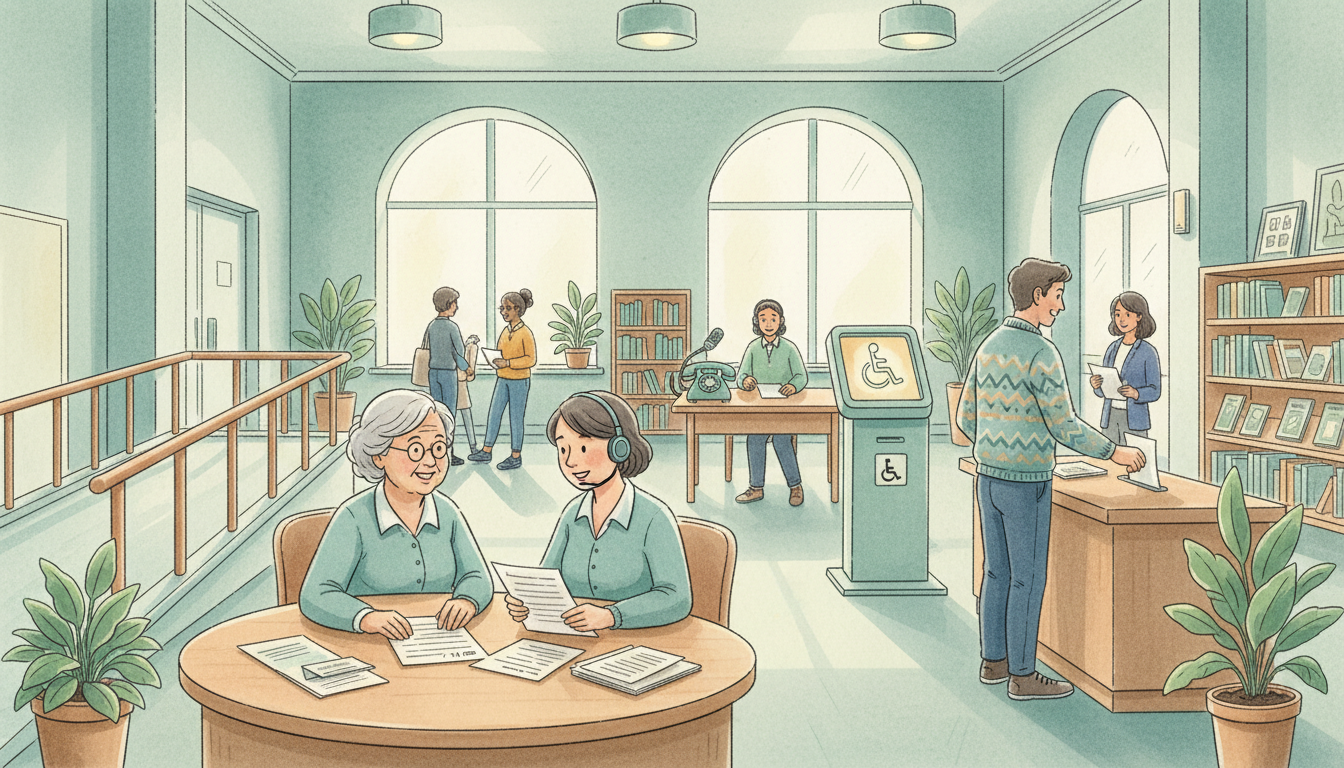
The featured image is existing original or appropriately held editorial media from eduKate’s library. Original conceptual illustration of a public-service desk offering forms, telephone help and optional digital kiosks to residents; this is not a real government office. It is illustrative, not evidence of the fictional settlement, historical reconstruction or a documented civic event. The reader should follow the sources and their stated scope rather than infer facts from the image.
The long-form chapters function as a reference, not as a demand that a child read everything in a single lesson. A Primary student can choose one topic and explain a causal chain with pictures; a Secondary learner can compare evidence and counterexamples; a parent can open a meaningful conversation; and a tutor can build a sequence of claim, test, feedback and revision.
Quick answer: why this component belongs in a civilisation
undefined A component of civilisation is not simply a building or law. It is work that can be performed, understood, maintained and questioned. It makes a collective capability possible across people and time. Its value cannot be established from one number, one attractive picture or a universal ranking of supposed human advancement.
Begin with four questions: who needs the outcome? Which people and resources make it possible? What could interrupt or unfairly limit it? What observation would make a careful person change their mind? The questions transfer across geography and history, but their answers require context. A practice that succeeds in an imaginary river settlement is not automatically safe, lawful or appropriate for a real modern community.
Reading routes: children, parents, tutors and independent learners
- Quick read: start with the direct answer, the two worked tables and the final synthesis.
- Primary pupils: select one station, draw the fictional event and explain one cause and effect in plain language.
- Secondary pupils: identify the main claim, a counterexample, a relevant measurement and a limit to the evidence.
- Parents: ask ‘what makes this everyday service work?’ and invite the child to explain without copying.
- Tutors: use one investigation as a comprehension, mathematics, science or humanities reasoning task.
- Advanced learners: follow the named institutional sources and compare their definitions with the fictional model.
The civilisation component audit: not a list of monuments
| Question | What a child should identify | Why it matters |
|---|---|---|
| Purpose | Which real human need the component addresses | Naming an object is not equivalent to delivering a benefit |
| Mechanism | People, equipment, rules and information involved | The useful result depends on a causal chain |
| Access | Who can and cannot practically participate | Aggregate success can conceal individual barriers |
| Evidence | What observation would challenge the first answer | A confident claim is not necessarily a verified one |
| Continuity | Who can respond when things change or fail | Institutional competence includes repair and succession |
The arithmetic of a fictional community
Take our entirely imaginary sixty-household town. If fifteen households use a new service during a teaching week, the observed proportion is 15 ÷ 60 = 25%. A pupil should not conclude that the other 75% oppose the service or that every household has the same needs. The denominator is households, not individuals; the time window is one teaching week; and the cause of non-use is unknown.
Suppose a second model uses four teams of six learners each, for twenty-four learners altogether. Their plan assigns eight imaginary resource tokens to setting up a service, ten to operation, four to oversight and two to contingency. The sum is twenty-four, but the allocation says nothing about real spending requirements, safe staffing or fair distribution. Its purpose is to expose that initial construction, continuing operation and corrective capacity are separate responsibilities.
Now suppose the model’s service completes thirty requests in one fictional month and forty in the next. The difference is ten and the percentage increase measured against thirty is approximately 33.3%. That is not proof that the service became more helpful. A definition may have changed, repeated requests may be counted twice, or several residents may still be unable to reach the service. Mathematics becomes valuable when pupils combine accurate calculation with accurate interpretation.
Chapter 1: Understanding the resident’s service journey
The six stations in this chapter concentrate on one part of public administration, civic services, implementation and accountability. Start by asking what the fictional people are trying to accomplish, then examine how the resources, decisions and rules interact. The sequence is a teaching journey rather than a universal history of human progress. Choose one station for a short session or combine two for a more demanding comparison.
Component 01: The first point of contact
The working mechanism: A service begins when someone can discover where to ask and what will happen next. A substantive explanation starts when someone asks what would stop working if this component were removed tomorrow. The most important loss may not be an object. People could lose reliable information, access to an opportunity or a trusted way to coordinate. Trace the consequence backwards to the work that normally prevents it. Then distinguish a mechanism supported by the fictional facts from a plausible but unverified assumption. That distinction is a foundation of clear, evidence-based writing. The functional question for the first point of contact is what happens between the original need and the result that a resident can actually use. A child’s answer becomes stronger when it identifies a dependency instead of merely celebrating the existence of a facility or rule.
Inside our fictional community: A caregiver visits three counters before learning which office handles school registration. Use a four-event timeline: the problem becomes visible, someone makes a decision, the response is delivered and the result is checked. If one transition is missing, the student should mark it with a question rather than write a happy ending. Many institutional failures arise from a gap between departments or people. Pinpointing that gap helps make the discussion practical and allows a proposed correction to address the cause. Keep the invented facts visibly separate from real sources. If the first explanation assumes every resident has the same access or preference, ask a second learner to challenge it using a plausible different condition. The aim is fair and accurate reasoning, not a claim about a real national or cultural group.
What could fail, and what would the trade-off be? Multiple official signs can still leave the service owner unclear. A credible objection addresses a causal link rather than portraying the imagined participants as villains. A different person may reasonably question the evidence, sequence, costs or legal boundary. Give the objection its strongest form before offering a reply. If the first plan must be amended, that is a sign of learning rather than embarrassment. If evidence remains insufficient, a conditional recommendation may be the most defensible outcome. The student should describe one credible alternative, a possible unintended effect and a realistic boundary requiring qualified expertise where appropriate. Identifying a risk is not proof it has already occurred; it is a reason to choose a suitable observation.
The evidence and the correct question: Trace time and number of referrals until a fictional case reaches the responsible office. Data that look identical may use different definitions. An office might count people in one period and visits in another, or a project may alter its inspection method halfway through. Compare the units, source, category and date before drawing a trend. When definitions cannot be reconciled, say so. A carefully described limit is stronger than a dramatic chart built from incompatible figures. Ask which observation would actually support the mechanism described earlier, and which observation would make the learner revise the recommendation. Numbers, anecdotes, illustrations and formal procedures have different evidentiary roles, so their limits should be made explicit.
A practical parent-and-tutor investigation: Draw a resident journey with each contact and the next clear action. Ask for five connected sentences: a clear claim, a mechanism, an example, a credible objection and a conditional conclusion. Older students may add one sourced observation or small hypothetical table. Tutors can assess whether the evidence really supports the claim. Parents can ask whether the final sentence acknowledges the most important uncertainty. Younger pupils can respond with a picture and short spoken explanation; older learners can add a table, clear conditional claim and strongest reasonable objection. Avoid asking children to perform unsafe procedures or disclose private family information.
Repair and generational transfer: Clearly distinguish this educational investigation from real professional authority. Children can reason about an imaginary plan, but they cannot thereby certify public equipment, prescribe treatment, determine a legal right or operate a regulated network. Ask them to identify where a qualified professional or legitimate public institution must take responsibility. This is part of intellectual maturity. Return to the original point about the first point of contact and connect it to at least one other civic component. End with a two-sentence decision: a plausible action given the fictional case and the most important evidence that might cause a future learner to change it.
Component 02: Service directories and ownership
The working mechanism: People need plain descriptions of which institution does which job. To make the component intelligible, follow one ordinary person from a need to an actual result. List every decision, professional skill, communication and piece of infrastructure encountered along the way. A hidden dependency often appears at a transition from one part of the town to another. Have the learner explain why that transition matters, and whether another person with different constraints would encounter the same service in the same way. The functional question for service directories and ownership is what happens between the original need and the result that a resident can actually use. A child’s answer becomes stronger when it identifies a dependency instead of merely celebrating the existence of a facility or rule.
Inside our fictional community: The school, clinic and council give conflicting answers about a shared assistance scheme. Before the council closes its discussion, ask who experiences the first consequence if the plan fails. It might be someone absent from the meeting or somebody who cannot use the proposed route. The class can then revise the plan to include a check at that point. An improved model should show which risk it reduces rather than merely add another paragraph saying that everybody matters. Keep the invented facts visibly separate from real sources. If the first explanation assumes every resident has the same access or preference, ask a second learner to challenge it using a plausible different condition. The aim is fair and accurate reasoning, not a claim about a real national or cultural group.
What could fail, and what would the trade-off be? A complex directory can conceal gaps rather than clarify them. Extend the timeline beyond the moment of public celebration. Who maintains the arrangement after the original donor, designer or organiser leaves? What happens when demand grows or a supporting technology changes? A plan can create a recurring obligation that is invisible in its opening-day cost. The learner should describe that obligation and identify a responsible way for future people to review it. The student should describe one credible alternative, a possible unintended effect and a realistic boundary requiring qualified expertise where appropriate. Identifying a risk is not proof it has already occurred; it is a reason to choose a suitable observation.
The evidence and the correct question: Ask whether a resident can locate one accountable service owner. Every indicator needs a responsible reviewer and a possible response. A metric that nobody reads cannot guide action. Specify when the data would be examined, how uncertainty would be communicated and what would trigger a legitimate reconsideration. This turns monitoring from decoration into an accountable loop. It also exposes whether the institution has enough capacity to deliver on its stated promises. Ask which observation would actually support the mechanism described earlier, and which observation would make the learner revise the recommendation. Numbers, anecdotes, illustrations and formal procedures have different evidentiary roles, so their limits should be made explicit.
A practical parent-and-tutor investigation: Write a short fictional directory with scope, address and accessible help. Organise a respectful dialogue in which one learner offers a proposal and another gives its strongest reasonable criticism. Before replying, each must repeat the other person’s concern accurately. The class then produces one revised decision and a question that better evidence could answer. This teaches listening, argument structure and the difference between criticising a mechanism and attacking a person. Younger pupils can respond with a picture and short spoken explanation; older learners can add a table, clear conditional claim and strongest reasonable objection. Avoid asking children to perform unsafe procedures or disclose private family information.
Repair and generational transfer: A repair is not complete when a report says the problem is closed. Ask what the affected person experiences afterward and what observation would confirm improvement. The system might have corrected its form without correcting the underlying service. A good feedback loop reaches the outcome rather than stopping at the paperwork. Return to the original point about service directories and ownership and connect it to at least one other civic component. End with a two-sentence decision: a plausible action given the fictional case and the most important evidence that might cause a future learner to change it.
Component 03: Eligibility explained transparently
The working mechanism: Rules need to be communicated accurately and interpreted by authorised people. Begin with the practical job rather than the name of the institution. A child should be able to say what a person needs, what has to happen and how success would be experienced. This requires attention to several different roles: the organisers who promise the service, the people who maintain its tools, those who actually use it and the people who can examine a complaint. A well-labelled diagram makes these relationships visible without pretending that every group has identical preferences. The definition remains incomplete until those human links are understandable. The functional question for eligibility explained transparently is what happens between the original need and the result that a resident can actually use. A child’s answer becomes stronger when it identifies a dependency instead of merely celebrating the existence of a facility or rule.
Inside our fictional community: An applicant misunderstands which documents a fictional programme requires. Let the fictional organisers be sincere and competent. Difficulties may still arise when resources are counted twice, a timetable is misunderstood or a maintenance responsibility is unclear. This framing teaches children to analyse systems without reflexively blaming people. The next step is to describe exactly where a reasonable plan becomes fragile, then ask which observation or procedure would detect the problem early. Keep the invented facts visibly separate from real sources. If the first explanation assumes every resident has the same access or preference, ask a second learner to challenge it using a plausible different condition. The aim is fair and accurate reasoning, not a claim about a real national or cultural group.
What could fail, and what would the trade-off be? A confusing explanation can wrongly deter eligible residents. Look for an indicator that could improve while the system’s real purpose deteriorates. More meetings might not mean more meaningful participation. A larger facility might not be accessible. A higher count of messages might not mean anyone understood them. Require a second observation that tests the intended outcome. The simplest useful measure is often better than a complicated dashboard with unclear definitions. The student should describe one credible alternative, a possible unintended effect and a realistic boundary requiring qualified expertise where appropriate. Identifying a risk is not proof it has already occurred; it is a reason to choose a suitable observation.
The evidence and the correct question: Compare stated criteria against the fictional case without making a legal entitlement claim. Distinguish the quantity of effort from the quality of the result. A town may have many postal routes, application forms, sports facilities or community meetings without knowing whether intended users benefit. Name the outcome in ordinary language and find a measure closer to it. Then identify one group or situation that the measure could still miss. That makes the evaluation more useful than a single congratulatory total. Ask which observation would actually support the mechanism described earlier, and which observation would make the learner revise the recommendation. Numbers, anecdotes, illustrations and formal procedures have different evidentiary roles, so their limits should be made explicit.
A practical parent-and-tutor investigation: Rewrite an imaginary eligibility notice in plain, qualified language. Finish with a three-part exit ticket: ‘I first believed’, ‘I now understand’ and ‘I would need to check’. Compare it with the opening diagram. A student who becomes more precise about uncertainty and causation has progressed even if the revised answer sounds less certain. This is the habit that makes independent learning possible. Younger pupils can respond with a picture and short spoken explanation; older learners can add a table, clear conditional claim and strongest reasonable objection. Avoid asking children to perform unsafe procedures or disclose private family information.
Repair and generational transfer: Extend the timeline from this term to the next generation. People and technology change; documents degrade; skills can be lost. What should remain understandable and what must be open to amendment? A successor needs more than a celebratory photograph. The learner should preserve evidence, responsibilities and the reasons that led to the original choice. Return to the original point about eligibility explained transparently and connect it to at least one other civic component. End with a two-sentence decision: a plausible action given the fictional case and the most important evidence that might cause a future learner to change it.
Component 04: Identity and record-matching
The working mechanism: Offices need reliable ways to link a request to the correct person while protecting privacy. The component is worth studying because it bridges individual experience and collective organisation. A resident encounters a benefit or obstacle at a particular time and place, whereas the responsible institution sees a workflow extending across many people. Neither perspective tells the entire story alone. Ask whose experience has been included, which background processes are missing and what the learner would need to observe to connect the two accurately. The functional question for identity and record-matching is what happens between the original need and the result that a resident can actually use. A child’s answer becomes stronger when it identifies a dependency instead of merely celebrating the existence of a facility or rule.
Inside our fictional community: Two students share a similar name and a school record is filed under the wrong case. Draw the location of the fictional event before proposing a remedy. Mark the people involved, the path information or resources must travel and the institution expected to respond. A map can reveal a missing bridge, unreadable notice or unclear handover that prose has hidden. Ask whether the same proposal would work when the route is longer or one communication channel is unavailable. Students need to state which parts of the comparison are imagined. Keep the invented facts visibly separate from real sources. If the first explanation assumes every resident has the same access or preference, ask a second learner to challenge it using a plausible different condition. The aim is fair and accurate reasoning, not a claim about a real national or cultural group.
What could fail, and what would the trade-off be? Careless matching can create exclusion or confidential disclosure. A seemingly efficient response can shift an inconvenient burden to someone else. The burden might be longer travel, a lost opportunity, extra labour, privacy exposure or a cost that appears next year. Ask learners to name the beneficiary and the person who might face a new obstacle. This is a hypothesis to investigate, not an accusation that harm certainly occurred. A fair decision makes the possible transfer visible and checks it against evidence. The student should describe one credible alternative, a possible unintended effect and a realistic boundary requiring qualified expertise where appropriate. Identifying a risk is not proof it has already occurred; it is a reason to choose a suitable observation.
The evidence and the correct question: Check the match and correction method rather than relying on a name alone. A meaningful ratio includes a numerator, denominator and time period. Ten complaints in a small community cannot be compared directly with ten complaints in a much larger one, and a lower number might reflect poorer access to reporting. Write what the count means before dividing. Then ask whether the result actually concerns the proposed policy or merely a convenient related quantity. Ask which observation would actually support the mechanism described earlier, and which observation would make the learner revise the recommendation. Numbers, anecdotes, illustrations and formal procedures have different evidentiary roles, so their limits should be made explicit.
A practical parent-and-tutor investigation: Use made-up anonymised forms to identify a duplicate without real IDs. Give the class one hundred invented paper resource units and ask them to compare a visible project with the less visible work that would maintain it. Require the learners to mention who benefits, who carries ongoing costs and what their numbers cannot establish. The exercise is arithmetic practice, not public-budget guidance. A mathematically consistent total can still support a poorly framed public decision. Younger pupils can respond with a picture and short spoken explanation; older learners can add a table, clear conditional claim and strongest reasonable objection. Avoid asking children to perform unsafe procedures or disclose private family information.
Repair and generational transfer: A durable recommendation responds to the strongest good-faith objection. Present the preferred approach, explain the credible concern and offer a revision that preserves the main purpose while addressing a real risk. If no acceptable compromise is evident, describe the missing facts and fair decision process. Serious reasoning should not be confused with forcing everyone to agree. Return to the original point about identity and record-matching and connect it to at least one other civic component. End with a two-sentence decision: a plausible action given the fictional case and the most important evidence that might cause a future learner to change it.
Component 05: Digital, telephone and in-person entry
The working mechanism: A service may need several accessible routes because residents have different circumstances. A helpful model separates the intended purpose from one particular solution. The first solution may be inexpensive, culturally familiar or attractive, but it is not automatically the only legitimate one. Students can compare alternatives while keeping the intended users and outcomes in view. They should identify which constraints arise from evidence and qualified duties, and which reflect reasonable choices that can be debated. The functional question for digital, telephone and in-person entry is what happens between the original need and the result that a resident can actually use. A child’s answer becomes stronger when it identifies a dependency instead of merely celebrating the existence of a facility or rule.
Inside our fictional community: The town introduces an online-only booking form for a public library service. Some classroom stories become misleading because they make every resident agree on what matters. Deliberately give different participants legitimate preferences about time, access, cost and meaning. Ask what evidence could settle a factual disagreement and what would instead require a fair collective choice. A student should learn that respectful disagreement is not necessarily proof that a civic institution has failed. Keep the invented facts visibly separate from real sources. If the first explanation assumes every resident has the same access or preference, ask a second learner to challenge it using a plausible different condition. The aim is fair and accurate reasoning, not a claim about a real national or cultural group.
What could fail, and what would the trade-off be? An internet connection does not guarantee a suitable device or digital confidence. A public explanation that contains no plausible failure mode is probably incomplete. Ask what could reasonably go wrong, how people would notice and whether the institution could reverse course. Do not invent catastrophes merely to make the topic dramatic. Good analysis gives an appropriately scaled alternative and specifies the conditions under which the initial plan remains useful. The student should describe one credible alternative, a possible unintended effect and a realistic boundary requiring qualified expertise where appropriate. Identifying a risk is not proof it has already occurred; it is a reason to choose a suitable observation.
The evidence and the correct question: Compare case completion across invented access channels. A good test is one under which the preferred proposal could fail. Ask students to write in advance what observation would cause them to revise the recommendation. A test that always produces a positive interpretation is little more than promotion. Identify how a qualified observer would collect the information, which assumptions remain and why a small fictional classroom sample cannot be generalised to the wider world. Ask which observation would actually support the mechanism described earlier, and which observation would make the learner revise the recommendation. Numbers, anecdotes, illustrations and formal procedures have different evidentiary roles, so their limits should be made explicit.
A practical parent-and-tutor investigation: Design a staffed fallback for a fictional digital service. Prepare four cards: a problem, a proposed response, a plausible complication and a check. Shuffle the cards and invite the learner to arrange them into a meaningful sequence. Different arrangements may be defensible if the reasoning is explicit. Change one condition and ask what the child must now revise. This is a safe way to practise planning and inference without handling real sensitive records or technical equipment. Younger pupils can respond with a picture and short spoken explanation; older learners can add a table, clear conditional claim and strongest reasonable objection. Avoid asking children to perform unsafe procedures or disclose private family information.
Repair and generational transfer: Look for steps that can be reversed if new evidence emerges. A small pilot may preserve options, whereas a major permanent project can create long-lived obligations. Do not assume reversibility is always possible or sufficient. Have learners state the conditions under which a cautious early test would be informative and the point at which authorised experts must decide. Return to the original point about digital, telephone and in-person entry and connect it to at least one other civic component. End with a two-sentence decision: a plausible action given the fictional case and the most important evidence that might cause a future learner to change it.
Component 06: Life-event service design
The working mechanism: People often experience several administrative needs together during major life changes. Think of this civic function as a continuing relationship rather than a ceremony completed once. A successful first demonstration may depend on an exceptional individual or a one-time supply of resources. The larger test is whether ordinary people can repeat the useful result when conditions change. What should be documented, taught, maintained and reviewed? A good classroom model names those requirements, while a responsible real-world decision would need context-specific professional and institutional knowledge. The functional question for life-event service design is what happens between the original need and the result that a resident can actually use. A child’s answer becomes stronger when it identifies a dependency instead of merely celebrating the existence of a facility or rule.
Inside our fictional community: A fictional family moving homes needs address, transport and school information. Give the class two versions of the fictional response. In one version the council proceeds immediately with its first assumption; in the other it checks a critical dependency or includes an overlooked resident. Keep the remaining conditions as similar as possible. Compare both the likely benefit and the cost of the extra step. A more elaborate process is not automatically better, but an unexamined shortcut can make a good intention unreliable. Keep the invented facts visibly separate from real sources. If the first explanation assumes every resident has the same access or preference, ask a second learner to challenge it using a plausible different condition. The aim is fair and accurate reasoning, not a claim about a real national or cultural group.
What could fail, and what would the trade-off be? Organising every service around agency boundaries can create repeated work. The interests of future residents often appear only after today’s choices have been made. A new facility may be useful but require costly upkeep; a digital system may be efficient but strand users after a vendor withdraws support. Compare the short-term benefit with the long-lived obligation. This helps children understand intergenerational responsibility through concrete cause and consequence rather than an abstract slogan. The student should describe one credible alternative, a possible unintended effect and a realistic boundary requiring qualified expertise where appropriate. Identifying a risk is not proof it has already occurred; it is a reason to choose a suitable observation.
The evidence and the correct question: Map all the legitimate contacts needed for one imagined life event. An invented case teaches a mechanism, not professional compliance. A child’s paper model cannot certify a public playground, a telecommunications route, a government entitlement or a protected legal right. Students should distinguish observable facts in the story from questions that would need authorised professional assessment in practice. Such boundaries prevent a vivid educational activity from creating unwarranted confidence. Ask which observation would actually support the mechanism described earlier, and which observation would make the learner revise the recommendation. Numbers, anecdotes, illustrations and formal procedures have different evidentiary roles, so their limits should be made explicit.
A practical parent-and-tutor investigation: Create a coordinated moving-house checklist without treating it as local legal advice. Present two fictional towns with similar human needs but different geography, resources or civic traditions. Ask for one common function and two relevant contextual differences. The exercise must not rank communities’ inherent worth or assume one technology makes its users superior. A nuanced comparison distinguishes what can transfer from what must be adapted. Younger pupils can respond with a picture and short spoken explanation; older learners can add a table, clear conditional claim and strongest reasonable objection. Avoid asking children to perform unsafe procedures or disclose private family information.
Repair and generational transfer: Sometimes the best next step is a qualified review or more appropriate evidence rather than immediate deployment. This is not the same as ignoring an urgent problem. Students should specify what they do not know, why it matters and which legitimate source could help. Where safety, health or rights are affected, the classroom analogy must stop short of directing real action. Return to the original point about life-event service design and connect it to at least one other civic component. End with a two-sentence decision: a plausible action given the fictional case and the most important evidence that might cause a future learner to change it.
Chapter investigation 1: bring six components into one model
The class now combines The first point of contact; Service directories and ownership; Eligibility explained transparently; Identity and record-matching; Digital, telephone and in-person entry; Life-event service design. These headings should not remain six unrelated definitions. Draw arrows showing which activities support each other, then ask whether a proposed change creates benefits in one place and costs in another. A group member who checks sources may reach a different provisional conclusion from the member who checks accessibility. Neither role should be silenced merely because the first diagram looks complete.
Divide a hypothetical resource envelope into planning, delivery, maintenance and review, using freely chosen imaginary amounts and clearly labelling the units. Ask which obligations continue after the first year and which residents would find it hard to participate. The class must identify one meaningful missing fact, one alternate design and one observation that would justify changing its initial recommendation. This is a safe paper exercise, not an actual operational plan.
For a Primary learner, five boxes can tell the story: the need, the resource, the action, the obstacle and the revised idea. For a Secondary learner, require a paragraph explaining two causal links and a counterexample, followed by a small data interpretation with an honest denominator. Tutors should mark clarity, causal accuracy, evidence and revision rather than the number of words or the confidence of the child’s voice.
Chapter 2: Case handling, processes and handover
The six stations in this chapter concentrate on one part of public administration, civic services, implementation and accountability. Start by asking what the fictional people are trying to accomplish, then examine how the resources, decisions and rules interact. The sequence is a teaching journey rather than a universal history of human progress. Choose one station for a short session or combine two for a more demanding comparison.
Component 07: Forms that gather only what is needed
The working mechanism: Applications should collect relevant information without unnecessary burden or exposure. The definition should be specific enough to generate a testable expectation. Instead of declaring that the settlement has ‘excellent services’ or ‘strong traditions’, state what people can actually do and under which conditions. That turns a slogan into a claim that might be supported or challenged. Ask who would record the outcome, what the record could miss and how people might safely report when the promise is not fulfilled. The functional question for forms that gather only what is needed is what happens between the original need and the result that a resident can actually use. A child’s answer becomes stronger when it identifies a dependency instead of merely celebrating the existence of a facility or rule.
Inside our fictional community: A short programme asks for an applicant’s unrelated private family details. Move the imagined event to a different part of Tidal Reach. A route, resource or group of people may change; the core civic function may remain. Ask what transfers and what no longer works. The lesson is not that there is one universally correct design, but that students can use mechanisms to reason across contexts while respecting the details that change. Keep the invented facts visibly separate from real sources. If the first explanation assumes every resident has the same access or preference, ask a second learner to challenge it using a plausible different condition. The aim is fair and accurate reasoning, not a claim about a real national or cultural group.
What could fail, and what would the trade-off be? Overcollection can discourage participation and create data risks. An attractive solution might depend on assumptions that are no longer valid in another place or decade. A common standard can make coordination easier, but local conditions may demand legitimate adaptations. Have the learner distinguish which parts of the purpose remain stable and which implementation details require review. A universal rule claimed without evidence deserves scrutiny even when it looks tidy. The student should describe one credible alternative, a possible unintended effect and a realistic boundary requiring qualified expertise where appropriate. Identifying a risk is not proof it has already occurred; it is a reason to choose a suitable observation.
The evidence and the correct question: Identify the legitimate purpose for every field in an invented form. End the evidence section with a boundary statement. The current observation might describe only fictional households, a short learning exercise or a limited set of real published sources. It cannot justify a confident claim about every society, every resident or all future circumstances. Name the next useful source and the kind of question it could answer. Accuracy includes knowing what has not been established. Ask which observation would actually support the mechanism described earlier, and which observation would make the learner revise the recommendation. Numbers, anecdotes, illustrations and formal procedures have different evidentiary roles, so their limits should be made explicit.
A practical parent-and-tutor investigation: Delete irrelevant fields while keeping those necessary for the fictional service. Compare two imaginary designs using a simple table. State what stays the same, what differs and what result is being judged. If many factors change together, ask the learner why the causal conclusion becomes weaker. A paper demonstration is sufficient. It should never be presented as a professional safety test or a controlled study of actual people. Younger pupils can respond with a picture and short spoken explanation; older learners can add a table, clear conditional claim and strongest reasonable objection. Avoid asking children to perform unsafe procedures or disclose private family information.
Repair and generational transfer: Return to a resident who was absent from the public meeting. Can the person discover the decision, access the intended benefit and raise a legitimate concern? A civic system may appear successful to organisers while remaining inaccessible to some users. Add one practical communication or participation improvement and state what observation would show whether it worked. Return to the original point about forms that gather only what is needed and connect it to at least one other civic component. End with a two-sentence decision: a plausible action given the fictional case and the most important evidence that might cause a future learner to change it.
Component 08: Queue design and waiting time
The working mechanism: Queue systems organise demand but can conceal differences in urgency and access needs. Do not confuse possessing a building or a policy with a functioning capability. A civilisation may own the correct equipment while lacking technicians, agreements or a way to correct mistakes. Ask the learner to identify the input, the activity, the intended outcome and the resource that could interrupt the process. Different societies can perform comparable functions through different arrangements; there is no need to rank their people’s worth or to impose a single historical development sequence. The functional question for queue design and waiting time is what happens between the original need and the result that a resident can actually use. A child’s answer becomes stronger when it identifies a dependency instead of merely celebrating the existence of a facility or rule.
Inside our fictional community: Residents line up before dawn because only one counter handles all issues. Tell the episode from the perspective of two people with different constraints. One may have reliable transport and another may depend on a shared route; one may understand the notice while another needs help. Neither fictional character represents every person with a similar background. The contrast is a tool for asking whether the service is genuinely accessible. Students should not turn an imagined case into a factual generalisation about a real population. Keep the invented facts visibly separate from real sources. If the first explanation assumes every resident has the same access or preference, ask a second learner to challenge it using a plausible different condition. The aim is fair and accurate reasoning, not a claim about a real national or cultural group.
What could fail, and what would the trade-off be? A short average wait may hide severe delays for some cases. An institution may have good intentions but weak feedback. If affected people cannot question a decision or find an authorised person to correct it, the same failure may recur. Ask where a complaint enters the process, who examines it and how the result is communicated. A complaint form alone is not the end of the repair mechanism. The learning question concerns the full cycle. The student should describe one credible alternative, a possible unintended effect and a realistic boundary requiring qualified expertise where appropriate. Identifying a risk is not proof it has already occurred; it is a reason to choose a suitable observation.
The evidence and the correct question: Compare waiting-time distribution rather than only the mean. One observation rarely proves a complicated causal story. Several conditions may change at once, a sample may be unrepresentative or a reporting system may improve. Ask which alternative explanation fits the same pattern. The learner need not solve a full statistical problem; recognising that correlation is not necessarily causation is already an important step toward responsible inference. Ask which observation would actually support the mechanism described earlier, and which observation would make the learner revise the recommendation. Numbers, anecdotes, illustrations and formal procedures have different evidentiary roles, so their limits should be made explicit.
A practical parent-and-tutor investigation: Design a humane fictional appointment and walk-in schedule. Have the child write a one-page fictional user guide for someone who missed the first lesson. It should include a plain-language purpose, a safe way to ask a question and a clear limitation. The aim is accessible educational communication, not actual legal, health or engineering advice. Another child then tests whether the explanation can be understood without additional oral clues. Younger pupils can respond with a picture and short spoken explanation; older learners can add a table, clear conditional claim and strongest reasonable objection. Avoid asking children to perform unsafe procedures or disclose private family information.
Repair and generational transfer: Connect the station to two other components through arrows labelled supplies, depends on, limits, records or verifies. Then follow the consequence of one failed link. A network of relations is more informative than a long list of impressive institutions. If a pupil cannot explain an arrow, that link should remain a research question rather than become a confident statement. Return to the original point about queue design and waiting time and connect it to at least one other civic component. End with a two-sentence decision: a plausible action given the fictional case and the most important evidence that might cause a future learner to change it.
Component 09: Case triage and urgency
The working mechanism: Not all requests have the same time sensitivity or legal obligations. An important difference exists between what the system is for and how one community chooses to organise it. The first is a functional question; the second includes history, culture, environment, resources and legal authority. Distinguish the two before comparing societies. The fictional model can help a learner recognise an important relationship without proving that all real communities use the same tools or follow the same institutional path. The functional question for case triage and urgency is what happens between the original need and the result that a resident can actually use. A child’s answer becomes stronger when it identifies a dependency instead of merely celebrating the existence of a facility or rule.
Inside our fictional community: A routine permit inquiry and an urgent safety report enter the same undifferentiated queue. Pause the story at the moment when the residents must make a decision. Ask what is actually known, what is inferred and whose experience has not been described. The person speaking most loudly may not bear the largest burden. To keep the discussion fair, assign one student to trace the physical system, another to examine access and another to look for missing evidence. Their first output should be a question worth answering, not an invented unanimous verdict. Keep the invented facts visibly separate from real sources. If the first explanation assumes every resident has the same access or preference, ask a second learner to challenge it using a plausible different condition. The aim is fair and accurate reasoning, not a claim about a real national or cultural group.
What could fail, and what would the trade-off be? First-come processing may leave a serious concern unaddressed. A backup can fail at the same time as the original arrangement when both depend on one hidden resource. Two networks may share a power supply; two services may depend on the same person or route. Draw the supposed alternatives and identify their common points. This exercise teaches systems resilience without instructing children to inspect real infrastructure or operate hazardous equipment. The student should describe one credible alternative, a possible unintended effect and a realistic boundary requiring qualified expertise where appropriate. Identifying a risk is not proof it has already occurred; it is a reason to choose a suitable observation.
The evidence and the correct question: Define a legitimate triage basis and safeguard against arbitrary decisions. Reporting more problems may reflect better detection or a worsening situation; a reduction may reflect improvement or silence. Have students design a second observation that would help distinguish those possibilities. This makes the feedback system part of the analysis. A community capable of identifying and repairing mistakes can be more trustworthy than one with suspiciously perfect-looking reports. Ask which observation would actually support the mechanism described earlier, and which observation would make the learner revise the recommendation. Numbers, anecdotes, illustrations and formal procedures have different evidentiary roles, so their limits should be made explicit.
A practical parent-and-tutor investigation: Sort paper case cards and state which decisions require qualified authorities. Use a worksheet with three columns: known from the story, assumed by us, and still worth checking. It is common for pupils to discover that their first answer relied on a missing fact. That discovery should be rewarded. Select the unknown that most affects the decision and identify a suitable professional or authoritative source for a real-world investigation. Younger pupils can respond with a picture and short spoken explanation; older learners can add a table, clear conditional claim and strongest reasonable objection. Avoid asking children to perform unsafe procedures or disclose private family information.
Repair and generational transfer: Ask which change in evidence would make the current proposal obsolete. Perhaps service demand grows, an overlooked group reports a barrier or an enabling technology is withdrawn. A responsible arrangement needs a clear signal for re-examination. Naming the signal is more useful than writing a vague promise to improve forever. Students should explain who would check the change and how the result would be communicated. Return to the original point about case triage and urgency and connect it to at least one other civic component. End with a two-sentence decision: a plausible action given the fictional case and the most important evidence that might cause a future learner to change it.
Component 10: Document completeness and guidance
The working mechanism: A resident needs understandable advice on what is missing and how to correct it. The same term may be used differently across geography and history. It is therefore worth defining the component using a clear function, a mechanism and an observable result. Where a real historical example is later introduced, the child should understand that original sources and scholarly interpretation are needed. A classroom town is a useful lens for asking questions, not evidence that a particular civilisation worked exactly that way. The functional question for document completeness and guidance is what happens between the original need and the result that a resident can actually use. A child’s answer becomes stronger when it identifies a dependency instead of merely celebrating the existence of a facility or rule.
Inside our fictional community: An application is repeatedly rejected for different unstated document requirements. Introduce one new fact halfway through the discussion. Perhaps a road closes, a participant changes their mind or an assumed measurement proves inconsistent. Do not change several details simultaneously. Ask which part of the original causal explanation needs revision. This checks transfer of understanding because a learner who merely memorised the first answer may not know how the new condition affects the outcome. Keep the invented facts visibly separate from real sources. If the first explanation assumes every resident has the same access or preference, ask a second learner to challenge it using a plausible different condition. The aim is fair and accurate reasoning, not a claim about a real national or cultural group.
What could fail, and what would the trade-off be? Repeated incomplete submissions can signal poor explanations rather than unwillingness. Opportunity cost matters whenever public space, labour or money is limited. A plan that appears free may consume staff time or create maintenance obligations. Ask what other useful activity becomes harder if the proposal is pursued. The answer should not automatically defeat the project; it should make the comparison honest. A student can use paper resource tokens without pretending those invented units establish a real budget. The student should describe one credible alternative, a possible unintended effect and a realistic boundary requiring qualified expertise where appropriate. Identifying a risk is not proof it has already occurred; it is a reason to choose a suitable observation.
The evidence and the correct question: Measure first-time completeness and clarity of response. Create a clear trail from claim to source, definition, observation, interpretation and decision. Another learner should be able to reconstruct the reasoning without trusting a speaker’s confidence. Sensitive data may need restricted access, so transparency should not be confused with publishing personal details. An appropriate public summary can be inspectable while protecting the dignity and privacy of individuals. Ask which observation would actually support the mechanism described earlier, and which observation would make the learner revise the recommendation. Numbers, anecdotes, illustrations and formal procedures have different evidentiary roles, so their limits should be made explicit.
A practical parent-and-tutor investigation: Create a hypothetical missing-information letter with a specific safe next step. Ask a child to draw three boxes labelled need, action and result. Each arrow must have a useful verb, and each box should refer to something in the fictional case. A second student may remove one supporting resource and challenge the explanation. Younger pupils can answer using pictures; Secondary learners can add a short causal paragraph. Reward an accurate revision rather than a memorised technical label. Younger pupils can respond with a picture and short spoken explanation; older learners can add a table, clear conditional claim and strongest reasonable objection. Avoid asking children to perform unsafe procedures or disclose private family information.
Repair and generational transfer: Imagine the original organiser retires and a successor inherits only the records left behind. Could the new person understand what the function is, why the arrangement was chosen and how to recognise a problem? If not, the town depends on fragile private knowledge. Write a short handover note that preserves the purpose, key assumptions and a sensible review point. Return to the original point about document completeness and guidance and connect it to at least one other civic component. End with a two-sentence decision: a plausible action given the fictional case and the most important evidence that might cause a future learner to change it.
Component 11: Case status and predictable updates
The working mechanism: People should be able to discover whether a request was received and what happens next. An explanation should give its reader a verb rather than only an impressive noun. ‘Provide’, ‘teach’, ‘deliver’, ‘listen’, ‘verify’, ‘repair’ and ‘protect’ point to actions that can be examined. A pupil can draw who performs each action and what comes next. If the arrow joining two steps cannot be explained, it is an invitation to investigate. Inventing a confident answer would hide the very uncertainty the activity is designed to reveal. The functional question for case status and predictable updates is what happens between the original need and the result that a resident can actually use. A child’s answer becomes stronger when it identifies a dependency instead of merely celebrating the existence of a facility or rule.
Inside our fictional community: A resident hears nothing for weeks after lodging a fictional service request. Read the scene twice. During the first reading, identify the practical difficulty. During the second, underline the claims about what participants know, can afford or are allowed to do. Which statements are given by the scenario, and which come from the reader’s assumptions? The exercise illustrates why a sincere, vivid story may still contain weak reasoning. A responsible conclusion distinguishes the narrative from a documented observation. Keep the invented facts visibly separate from real sources. If the first explanation assumes every resident has the same access or preference, ask a second learner to challenge it using a plausible different condition. The aim is fair and accurate reasoning, not a claim about a real national or cultural group.
What could fail, and what would the trade-off be? Silence creates uncertainty and extra unnecessary inquiries. A uniform procedure may be equal on paper and difficult to use in practice. Different people may have different working hours, transport, language, mobility or access to technology. Ask the class whether the intended result remains reachable when one of those conditions changes. The purpose is to make the design more realistic, not to assume that all members of a group have identical needs. The student should describe one credible alternative, a possible unintended effect and a realistic boundary requiring qualified expertise where appropriate. Identifying a risk is not proof it has already occurred; it is a reason to choose a suitable observation.
The evidence and the correct question: Track acknowledgement, next-step information and overdue cases. Public service providers and users can observe different parts of one experience. A provider may record technical capacity while a family reports whether the service could actually be reached. Neither single viewpoint should be treated as a complete survey. Ask how a credible evaluation could combine independent evidence, operational records and appropriately gathered experiences without exposing confidential details. Ask which observation would actually support the mechanism described earlier, and which observation would make the learner revise the recommendation. Numbers, anecdotes, illustrations and formal procedures have different evidentiary roles, so their limits should be made explicit.
A practical parent-and-tutor investigation: Write a simple four-status tracking system using invented case numbers. Invite the student to explain the station to a younger reader without quoting the lesson. Ask one friendly ‘what if?’ question that changes an important condition. If the explanation no longer works, the learner can revisit the mechanism and revise it. This is a powerful check of transferable understanding because recall alone will not answer a genuinely different case. Younger pupils can respond with a picture and short spoken explanation; older learners can add a table, clear conditional claim and strongest reasonable objection. Avoid asking children to perform unsafe procedures or disclose private family information.
Repair and generational transfer: End by naming the person or institution with legitimate responsibility when the service fails. A problem without an accountable response may continue even if every resident agrees that it matters. The learner should distinguish observing an issue, reporting it and being authorised to solve it. A child can investigate the mechanism conceptually; real professional action requires the relevant qualified people and lawful rules. Return to the original point about case status and predictable updates and connect it to at least one other civic component. End with a two-sentence decision: a plausible action given the fictional case and the most important evidence that might cause a future learner to change it.
Component 12: Handover between institutions
The working mechanism: Many services require one office to transfer information or responsibility to another. Some of the most important work is invisible in the final product. Public messages need distribution, events require caretakers, decisions require reliable records and shared spaces require suitable operations. Invite the learner to name the quiet work that a headline about achievement might omit. A city becomes more capable when those tasks can be understood and transferred rather than taken for granted. The functional question for handover between institutions is what happens between the original need and the result that a resident can actually use. A child’s answer becomes stronger when it identifies a dependency instead of merely celebrating the existence of a facility or rule.
Inside our fictional community: A school referral vanishes when a council worker changes shifts. Imagine the scene is being explained to a new pupil who missed the first discussion. Which details would they need to reconstruct the decision responsibly? State the date or time window, the issue, the alternatives, the given facts and the uncertainty that remains. If the explanation depends on someone’s private memory, the public process is harder to challenge and improve. This is why good record-keeping matters even in small fictional projects. Keep the invented facts visibly separate from real sources. If the first explanation assumes every resident has the same access or preference, ask a second learner to challenge it using a plausible different condition. The aim is fair and accurate reasoning, not a claim about a real national or cultural group.
What could fail, and what would the trade-off be? A completed task in one office does not mean the resident receives the service. Some concerns are not simply preferences to be traded against speed or cost. Safety, fundamental rights, privacy and appropriate professional authority can set legitimate constraints on a proposal. Students should recognise when a real-world decision requires current local law and qualified judgement. The classroom task is to compare options within that boundary rather than invent a rule that authorises whatever seems convenient. The student should describe one credible alternative, a possible unintended effect and a realistic boundary requiring qualified expertise where appropriate. Identifying a risk is not proof it has already occurred; it is a reason to choose a suitable observation.
The evidence and the correct question: Map the responsible owner at each handover and a receipt of transfer. Begin with the question rather than the available number. If the claim concerns access, the relevant observation is not necessarily how much equipment was purchased. If it concerns trust, the relevant evidence is not simply how many slogans were printed. Define the intended outcome, the population and the time window, then decide what would genuinely support or challenge the claim. This prevents a technically correct calculation from answering the wrong question. Ask which observation would actually support the mechanism described earlier, and which observation would make the learner revise the recommendation. Numbers, anecdotes, illustrations and formal procedures have different evidentiary roles, so their limits should be made explicit.
A practical parent-and-tutor investigation: Draw a chain-of-custody chart for imaginary documents. Write an intentionally confusing public message about the fictional case. It might omit the audience, date, unit or responsible contact. Have pupils rewrite it so someone unfamiliar with the subject could understand what is known and what should happen next. For advanced learners, add a sentence identifying information the message cannot yet provide. This combines audience awareness with systems reasoning. Younger pupils can respond with a picture and short spoken explanation; older learners can add a table, clear conditional claim and strongest reasonable objection. Avoid asking children to perform unsafe procedures or disclose private family information.
Repair and generational transfer: Compare the first and revised diagrams. Name one corrected assumption, one newly recognised user or one clarified dependency. The change should be visible, not just praised. Another pupil ought to be able to follow the improvement independently. A civilisation preserves progress when people can explain, challenge and improve inherited systems rather than relying on unexamined authority. Return to the original point about handover between institutions and connect it to at least one other civic component. End with a two-sentence decision: a plausible action given the fictional case and the most important evidence that might cause a future learner to change it.
Chapter investigation 2: bring six components into one model
The class now combines Forms that gather only what is needed; Queue design and waiting time; Case triage and urgency; Document completeness and guidance; Case status and predictable updates; Handover between institutions. These headings should not remain six unrelated definitions. Draw arrows showing which activities support each other, then ask whether a proposed change creates benefits in one place and costs in another. A group member who checks sources may reach a different provisional conclusion from the member who checks accessibility. Neither role should be silenced merely because the first diagram looks complete.
Divide a hypothetical resource envelope into planning, delivery, maintenance and review, using freely chosen imaginary amounts and clearly labelling the units. Ask which obligations continue after the first year and which residents would find it hard to participate. The class must identify one meaningful missing fact, one alternate design and one observation that would justify changing its initial recommendation. This is a safe paper exercise, not an actual operational plan.
For a Primary learner, five boxes can tell the story: the need, the resource, the action, the obstacle and the revised idea. For a Secondary learner, require a paragraph explaining two causal links and a counterexample, followed by a small data interpretation with an honest denominator. Tutors should mark clarity, causal accuracy, evidence and revision rather than the number of words or the confidence of the child’s voice.
Chapter 3: People, resources and professional public service
The six stations in this chapter concentrate on one part of public administration, civic services, implementation and accountability. Start by asking what the fictional people are trying to accomplish, then examine how the resources, decisions and rules interact. The sequence is a teaching journey rather than a universal history of human progress. Choose one station for a short session or combine two for a more demanding comparison.
Component 13: Decision records and reasons
The working mechanism: An administrative decision should be understandable and inspectable within lawful limits. A substantive explanation starts when someone asks what would stop working if this component were removed tomorrow. The most important loss may not be an object. People could lose reliable information, access to an opportunity or a trusted way to coordinate. Trace the consequence backwards to the work that normally prevents it. Then distinguish a mechanism supported by the fictional facts from a plausible but unverified assumption. That distinction is a foundation of clear, evidence-based writing. The functional question for decision records and reasons is what happens between the original need and the result that a resident can actually use. A child’s answer becomes stronger when it identifies a dependency instead of merely celebrating the existence of a facility or rule.
Inside our fictional community: A fictional application is refused with only the word ‘unsuitable’. Use a four-event timeline: the problem becomes visible, someone makes a decision, the response is delivered and the result is checked. If one transition is missing, the student should mark it with a question rather than write a happy ending. Many institutional failures arise from a gap between departments or people. Pinpointing that gap helps make the discussion practical and allows a proposed correction to address the cause. Keep the invented facts visibly separate from real sources. If the first explanation assumes every resident has the same access or preference, ask a second learner to challenge it using a plausible different condition. The aim is fair and accurate reasoning, not a claim about a real national or cultural group.
What could fail, and what would the trade-off be? An unexplained result may prevent meaningful appeal or improvement. A credible objection addresses a causal link rather than portraying the imagined participants as villains. A different person may reasonably question the evidence, sequence, costs or legal boundary. Give the objection its strongest form before offering a reply. If the first plan must be amended, that is a sign of learning rather than embarrassment. If evidence remains insufficient, a conditional recommendation may be the most defensible outcome. The student should describe one credible alternative, a possible unintended effect and a realistic boundary requiring qualified expertise where appropriate. Identifying a risk is not proof it has already occurred; it is a reason to choose a suitable observation.
The evidence and the correct question: Ask whether the record states the rule, relevant facts and review route. Data that look identical may use different definitions. An office might count people in one period and visits in another, or a project may alter its inspection method halfway through. Compare the units, source, category and date before drawing a trend. When definitions cannot be reconciled, say so. A carefully described limit is stronger than a dramatic chart built from incompatible figures. Ask which observation would actually support the mechanism described earlier, and which observation would make the learner revise the recommendation. Numbers, anecdotes, illustrations and formal procedures have different evidentiary roles, so their limits should be made explicit.
A practical parent-and-tutor investigation: Draft a respectful decision notice without inventing a real statutory rule. Ask for five connected sentences: a clear claim, a mechanism, an example, a credible objection and a conditional conclusion. Older students may add one sourced observation or small hypothetical table. Tutors can assess whether the evidence really supports the claim. Parents can ask whether the final sentence acknowledges the most important uncertainty. Younger pupils can respond with a picture and short spoken explanation; older learners can add a table, clear conditional claim and strongest reasonable objection. Avoid asking children to perform unsafe procedures or disclose private family information.
Repair and generational transfer: Clearly distinguish this educational investigation from real professional authority. Children can reason about an imaginary plan, but they cannot thereby certify public equipment, prescribe treatment, determine a legal right or operate a regulated network. Ask them to identify where a qualified professional or legitimate public institution must take responsibility. This is part of intellectual maturity. Return to the original point about decision records and reasons and connect it to at least one other civic component. End with a two-sentence decision: a plausible action given the fictional case and the most important evidence that might cause a future learner to change it.
Component 14: Error detection and correction
The working mechanism: Reliable institutions plan for mistakes rather than assume their files are perfect. To make the component intelligible, follow one ordinary person from a need to an actual result. List every decision, professional skill, communication and piece of infrastructure encountered along the way. A hidden dependency often appears at a transition from one part of the town to another. Have the learner explain why that transition matters, and whether another person with different constraints would encounter the same service in the same way. The functional question for error detection and correction is what happens between the original need and the result that a resident can actually use. A child’s answer becomes stronger when it identifies a dependency instead of merely celebrating the existence of a facility or rule.
Inside our fictional community: A clerk discovers a date entered incorrectly in an education record. Before the council closes its discussion, ask who experiences the first consequence if the plan fails. It might be someone absent from the meeting or somebody who cannot use the proposed route. The class can then revise the plan to include a check at that point. An improved model should show which risk it reduces rather than merely add another paragraph saying that everybody matters. Keep the invented facts visibly separate from real sources. If the first explanation assumes every resident has the same access or preference, ask a second learner to challenge it using a plausible different condition. The aim is fair and accurate reasoning, not a claim about a real national or cultural group.
What could fail, and what would the trade-off be? A quiet edit without an audit trail can create later disputes. Extend the timeline beyond the moment of public celebration. Who maintains the arrangement after the original donor, designer or organiser leaves? What happens when demand grows or a supporting technology changes? A plan can create a recurring obligation that is invisible in its opening-day cost. The learner should describe that obligation and identify a responsible way for future people to review it. The student should describe one credible alternative, a possible unintended effect and a realistic boundary requiring qualified expertise where appropriate. Identifying a risk is not proof it has already occurred; it is a reason to choose a suitable observation.
The evidence and the correct question: Compare detection, correction, notification and independent recheck. Every indicator needs a responsible reviewer and a possible response. A metric that nobody reads cannot guide action. Specify when the data would be examined, how uncertainty would be communicated and what would trigger a legitimate reconsideration. This turns monitoring from decoration into an accountable loop. It also exposes whether the institution has enough capacity to deliver on its stated promises. Ask which observation would actually support the mechanism described earlier, and which observation would make the learner revise the recommendation. Numbers, anecdotes, illustrations and formal procedures have different evidentiary roles, so their limits should be made explicit.
A practical parent-and-tutor investigation: Repair a fabricated record and preserve a visible change log. Organise a respectful dialogue in which one learner offers a proposal and another gives its strongest reasonable criticism. Before replying, each must repeat the other person’s concern accurately. The class then produces one revised decision and a question that better evidence could answer. This teaches listening, argument structure and the difference between criticising a mechanism and attacking a person. Younger pupils can respond with a picture and short spoken explanation; older learners can add a table, clear conditional claim and strongest reasonable objection. Avoid asking children to perform unsafe procedures or disclose private family information.
Repair and generational transfer: A repair is not complete when a report says the problem is closed. Ask what the affected person experiences afterward and what observation would confirm improvement. The system might have corrected its form without correcting the underlying service. A good feedback loop reaches the outcome rather than stopping at the paperwork. Return to the original point about error detection and correction and connect it to at least one other civic component. End with a two-sentence decision: a plausible action given the fictional case and the most important evidence that might cause a future learner to change it.
Component 15: Administrative appeals and complaints
The working mechanism: People need safe ways to question possible mistakes through legitimate procedures. Begin with the practical job rather than the name of the institution. A child should be able to say what a person needs, what has to happen and how success would be experienced. This requires attention to several different roles: the organisers who promise the service, the people who maintain its tools, those who actually use it and the people who can examine a complaint. A well-labelled diagram makes these relationships visible without pretending that every group has identical preferences. The definition remains incomplete until those human links are understandable. The functional question for administrative appeals and complaints is what happens between the original need and the result that a resident can actually use. A child’s answer becomes stronger when it identifies a dependency instead of merely celebrating the existence of a facility or rule.
Inside our fictional community: A resident is wrongly charged a fictional late fee and cannot locate an appeal contact. Let the fictional organisers be sincere and competent. Difficulties may still arise when resources are counted twice, a timetable is misunderstood or a maintenance responsibility is unclear. This framing teaches children to analyse systems without reflexively blaming people. The next step is to describe exactly where a reasonable plan becomes fragile, then ask which observation or procedure would detect the problem early. Keep the invented facts visibly separate from real sources. If the first explanation assumes every resident has the same access or preference, ask a second learner to challenge it using a plausible different condition. The aim is fair and accurate reasoning, not a claim about a real national or cultural group.
What could fail, and what would the trade-off be? A complaints box does little if no one must consider its contents. Look for an indicator that could improve while the system’s real purpose deteriorates. More meetings might not mean more meaningful participation. A larger facility might not be accessible. A higher count of messages might not mean anyone understood them. Require a second observation that tests the intended outcome. The simplest useful measure is often better than a complicated dashboard with unclear definitions. The student should describe one credible alternative, a possible unintended effect and a realistic boundary requiring qualified expertise where appropriate. Identifying a risk is not proof it has already occurred; it is a reason to choose a suitable observation.
The evidence and the correct question: Track acknowledgement, impartial review and communicated outcome. Distinguish the quantity of effort from the quality of the result. A town may have many postal routes, application forms, sports facilities or community meetings without knowing whether intended users benefit. Name the outcome in ordinary language and find a measure closer to it. Then identify one group or situation that the measure could still miss. That makes the evaluation more useful than a single congratulatory total. Ask which observation would actually support the mechanism described earlier, and which observation would make the learner revise the recommendation. Numbers, anecdotes, illustrations and formal procedures have different evidentiary roles, so their limits should be made explicit.
A practical parent-and-tutor investigation: Design a mock complaint journey with a clear accessibility check. Finish with a three-part exit ticket: ‘I first believed’, ‘I now understand’ and ‘I would need to check’. Compare it with the opening diagram. A student who becomes more precise about uncertainty and causation has progressed even if the revised answer sounds less certain. This is the habit that makes independent learning possible. Younger pupils can respond with a picture and short spoken explanation; older learners can add a table, clear conditional claim and strongest reasonable objection. Avoid asking children to perform unsafe procedures or disclose private family information.
Repair and generational transfer: Extend the timeline from this term to the next generation. People and technology change; documents degrade; skills can be lost. What should remain understandable and what must be open to amendment? A successor needs more than a celebratory photograph. The learner should preserve evidence, responsibilities and the reasons that led to the original choice. Return to the original point about administrative appeals and complaints and connect it to at least one other civic component. End with a two-sentence decision: a plausible action given the fictional case and the most important evidence that might cause a future learner to change it.
Component 16: Cross-office duplication
The working mechanism: A service becomes burdensome when residents repeatedly provide the same information without good reason. The component is worth studying because it bridges individual experience and collective organisation. A resident encounters a benefit or obstacle at a particular time and place, whereas the responsible institution sees a workflow extending across many people. Neither perspective tells the entire story alone. Ask whose experience has been included, which background processes are missing and what the learner would need to observe to connect the two accurately. The functional question for cross-office duplication is what happens between the original need and the result that a resident can actually use. A child’s answer becomes stronger when it identifies a dependency instead of merely celebrating the existence of a facility or rule.
Inside our fictional community: A family submits identical invented details to four departments. Draw the location of the fictional event before proposing a remedy. Mark the people involved, the path information or resources must travel and the institution expected to respond. A map can reveal a missing bridge, unreadable notice or unclear handover that prose has hidden. Ask whether the same proposal would work when the route is longer or one communication channel is unavailable. Students need to state which parts of the comparison are imagined. Keep the invented facts visibly separate from real sources. If the first explanation assumes every resident has the same access or preference, ask a second learner to challenge it using a plausible different condition. The aim is fair and accurate reasoning, not a claim about a real national or cultural group.
What could fail, and what would the trade-off be? Sharing everything automatically can violate privacy even when duplication is frustrating. A seemingly efficient response can shift an inconvenient burden to someone else. The burden might be longer travel, a lost opportunity, extra labour, privacy exposure or a cost that appears next year. Ask learners to name the beneficiary and the person who might face a new obstacle. This is a hypothesis to investigate, not an accusation that harm certainly occurred. A fair decision makes the possible transfer visible and checks it against evidence. The student should describe one credible alternative, a possible unintended effect and a realistic boundary requiring qualified expertise where appropriate. Identifying a risk is not proof it has already occurred; it is a reason to choose a suitable observation.
The evidence and the correct question: Distinguish appropriate reuse from unauthorised disclosure. A meaningful ratio includes a numerator, denominator and time period. Ten complaints in a small community cannot be compared directly with ten complaints in a much larger one, and a lower number might reflect poorer access to reporting. Write what the count means before dividing. Then ask whether the result actually concerns the proposed policy or merely a convenient related quantity. Ask which observation would actually support the mechanism described earlier, and which observation would make the learner revise the recommendation. Numbers, anecdotes, illustrations and formal procedures have different evidentiary roles, so their limits should be made explicit.
A practical parent-and-tutor investigation: Compare a ‘repeat forms’ journey with a lawful, consent-aware alternative. Give the class one hundred invented paper resource units and ask them to compare a visible project with the less visible work that would maintain it. Require the learners to mention who benefits, who carries ongoing costs and what their numbers cannot establish. The exercise is arithmetic practice, not public-budget guidance. A mathematically consistent total can still support a poorly framed public decision. Younger pupils can respond with a picture and short spoken explanation; older learners can add a table, clear conditional claim and strongest reasonable objection. Avoid asking children to perform unsafe procedures or disclose private family information.
Repair and generational transfer: A durable recommendation responds to the strongest good-faith objection. Present the preferred approach, explain the credible concern and offer a revision that preserves the main purpose while addressing a real risk. If no acceptable compromise is evident, describe the missing facts and fair decision process. Serious reasoning should not be confused with forcing everyone to agree. Return to the original point about cross-office duplication and connect it to at least one other civic component. End with a two-sentence decision: a plausible action given the fictional case and the most important evidence that might cause a future learner to change it.
Component 17: Trained public servants and competence
The working mechanism: Policies rely on staff who understand procedures, explain them and act within their mandate. A helpful model separates the intended purpose from one particular solution. The first solution may be inexpensive, culturally familiar or attractive, but it is not automatically the only legitimate one. Students can compare alternatives while keeping the intended users and outcomes in view. They should identify which constraints arise from evidence and qualified duties, and which reflect reasonable choices that can be debated. The functional question for trained public servants and competence is what happens between the original need and the result that a resident can actually use. A child’s answer becomes stronger when it identifies a dependency instead of merely celebrating the existence of a facility or rule.
Inside our fictional community: A newly recruited official is assigned a technical decision without training. Some classroom stories become misleading because they make every resident agree on what matters. Deliberately give different participants legitimate preferences about time, access, cost and meaning. Ask what evidence could settle a factual disagreement and what would instead require a fair collective choice. A student should learn that respectful disagreement is not necessarily proof that a civic institution has failed. Keep the invented facts visibly separate from real sources. If the first explanation assumes every resident has the same access or preference, ask a second learner to challenge it using a plausible different condition. The aim is fair and accurate reasoning, not a claim about a real national or cultural group.
What could fail, and what would the trade-off be? The public may experience inconsistent answers and inappropriate authority claims. A public explanation that contains no plausible failure mode is probably incomplete. Ask what could reasonably go wrong, how people would notice and whether the institution could reverse course. Do not invent catastrophes merely to make the topic dramatic. Good analysis gives an appropriately scaled alternative and specifies the conditions under which the initial plan remains useful. The student should describe one credible alternative, a possible unintended effect and a realistic boundary requiring qualified expertise where appropriate. Identifying a risk is not proof it has already occurred; it is a reason to choose a suitable observation.
The evidence and the correct question: Map role competence, supervision and referral to qualified personnel. A good test is one under which the preferred proposal could fail. Ask students to write in advance what observation would cause them to revise the recommendation. A test that always produces a positive interpretation is little more than promotion. Identify how a qualified observer would collect the information, which assumptions remain and why a small fictional classroom sample cannot be generalised to the wider world. Ask which observation would actually support the mechanism described earlier, and which observation would make the learner revise the recommendation. Numbers, anecdotes, illustrations and formal procedures have different evidentiary roles, so their limits should be made explicit.
A practical parent-and-tutor investigation: Create a harmless training checklist for a fictional service counter. Prepare four cards: a problem, a proposed response, a plausible complication and a check. Shuffle the cards and invite the learner to arrange them into a meaningful sequence. Different arrangements may be defensible if the reasoning is explicit. Change one condition and ask what the child must now revise. This is a safe way to practise planning and inference without handling real sensitive records or technical equipment. Younger pupils can respond with a picture and short spoken explanation; older learners can add a table, clear conditional claim and strongest reasonable objection. Avoid asking children to perform unsafe procedures or disclose private family information.
Repair and generational transfer: Look for steps that can be reversed if new evidence emerges. A small pilot may preserve options, whereas a major permanent project can create long-lived obligations. Do not assume reversibility is always possible or sufficient. Have learners state the conditions under which a cautious early test would be informative and the point at which authorised experts must decide. Return to the original point about trained public servants and competence and connect it to at least one other civic component. End with a two-sentence decision: a plausible action given the fictional case and the most important evidence that might cause a future learner to change it.
Component 18: Front-line discretion and limits
The working mechanism: Staff sometimes need judgement but should not act arbitrarily or beyond authority. Think of this civic function as a continuing relationship rather than a ceremony completed once. A successful first demonstration may depend on an exceptional individual or a one-time supply of resources. The larger test is whether ordinary people can repeat the useful result when conditions change. What should be documented, taught, maintained and reviewed? A good classroom model names those requirements, while a responsible real-world decision would need context-specific professional and institutional knowledge. The functional question for front-line discretion and limits is what happens between the original need and the result that a resident can actually use. A child’s answer becomes stronger when it identifies a dependency instead of merely celebrating the existence of a facility or rule.
Inside our fictional community: Two clerks interpret the same ambiguous imaginary service rule differently. Give the class two versions of the fictional response. In one version the council proceeds immediately with its first assumption; in the other it checks a critical dependency or includes an overlooked resident. Keep the remaining conditions as similar as possible. Compare both the likely benefit and the cost of the extra step. A more elaborate process is not automatically better, but an unexamined shortcut can make a good intention unreliable. Keep the invented facts visibly separate from real sources. If the first explanation assumes every resident has the same access or preference, ask a second learner to challenge it using a plausible different condition. The aim is fair and accurate reasoning, not a claim about a real national or cultural group.
What could fail, and what would the trade-off be? Unbounded discretion may produce unequal outcomes. The interests of future residents often appear only after today’s choices have been made. A new facility may be useful but require costly upkeep; a digital system may be efficient but strand users after a vendor withdraws support. Compare the short-term benefit with the long-lived obligation. This helps children understand intergenerational responsibility through concrete cause and consequence rather than an abstract slogan. The student should describe one credible alternative, a possible unintended effect and a realistic boundary requiring qualified expertise where appropriate. Identifying a risk is not proof it has already occurred; it is a reason to choose a suitable observation.
The evidence and the correct question: Check consistency, written guidance and an escalation route. An invented case teaches a mechanism, not professional compliance. A child’s paper model cannot certify a public playground, a telecommunications route, a government entitlement or a protected legal right. Students should distinguish observable facts in the story from questions that would need authorised professional assessment in practice. Such boundaries prevent a vivid educational activity from creating unwarranted confidence. Ask which observation would actually support the mechanism described earlier, and which observation would make the learner revise the recommendation. Numbers, anecdotes, illustrations and formal procedures have different evidentiary roles, so their limits should be made explicit.
A practical parent-and-tutor investigation: Compare two fictional case decisions and identify what guidance is missing. Present two fictional towns with similar human needs but different geography, resources or civic traditions. Ask for one common function and two relevant contextual differences. The exercise must not rank communities’ inherent worth or assume one technology makes its users superior. A nuanced comparison distinguishes what can transfer from what must be adapted. Younger pupils can respond with a picture and short spoken explanation; older learners can add a table, clear conditional claim and strongest reasonable objection. Avoid asking children to perform unsafe procedures or disclose private family information.
Repair and generational transfer: Sometimes the best next step is a qualified review or more appropriate evidence rather than immediate deployment. This is not the same as ignoring an urgent problem. Students should specify what they do not know, why it matters and which legitimate source could help. Where safety, health or rights are affected, the classroom analogy must stop short of directing real action. Return to the original point about front-line discretion and limits and connect it to at least one other civic component. End with a two-sentence decision: a plausible action given the fictional case and the most important evidence that might cause a future learner to change it.
Chapter investigation 3: bring six components into one model
The class now combines Decision records and reasons; Error detection and correction; Administrative appeals and complaints; Cross-office duplication; Trained public servants and competence; Front-line discretion and limits. These headings should not remain six unrelated definitions. Draw arrows showing which activities support each other, then ask whether a proposed change creates benefits in one place and costs in another. A group member who checks sources may reach a different provisional conclusion from the member who checks accessibility. Neither role should be silenced merely because the first diagram looks complete.
Divide a hypothetical resource envelope into planning, delivery, maintenance and review, using freely chosen imaginary amounts and clearly labelling the units. Ask which obligations continue after the first year and which residents would find it hard to participate. The class must identify one meaningful missing fact, one alternate design and one observation that would justify changing its initial recommendation. This is a safe paper exercise, not an actual operational plan.
For a Primary learner, five boxes can tell the story: the need, the resource, the action, the obstacle and the revised idea. For a Secondary learner, require a paragraph explaining two causal links and a counterexample, followed by a small data interpretation with an honest denominator. Tutors should mark clarity, causal accuracy, evidence and revision rather than the number of words or the confidence of the child’s voice.
Chapter 4: Access, rights and administrative fairness
The six stations in this chapter concentrate on one part of public administration, civic services, implementation and accountability. Start by asking what the fictional people are trying to accomplish, then examine how the resources, decisions and rules interact. The sequence is a teaching journey rather than a universal history of human progress. Choose one station for a short session or combine two for a more demanding comparison.
Component 19: Supervision and continuous feedback
The working mechanism: A service organisation needs ways to identify recurring problems without punishing honest reporting. The definition should be specific enough to generate a testable expectation. Instead of declaring that the settlement has ‘excellent services’ or ‘strong traditions’, state what people can actually do and under which conditions. That turns a slogan into a claim that might be supported or challenged. Ask who would record the outcome, what the record could miss and how people might safely report when the promise is not fulfilled. The functional question for supervision and continuous feedback is what happens between the original need and the result that a resident can actually use. A child’s answer becomes stronger when it identifies a dependency instead of merely celebrating the existence of a facility or rule.
Inside our fictional community: A clerk notices repeated confusion over a confusing form. Move the imagined event to a different part of Tidal Reach. A route, resource or group of people may change; the core civic function may remain. Ask what transfers and what no longer works. The lesson is not that there is one universally correct design, but that students can use mechanisms to reason across contexts while respecting the details that change. Keep the invented facts visibly separate from real sources. If the first explanation assumes every resident has the same access or preference, ask a second learner to challenge it using a plausible different condition. The aim is fair and accurate reasoning, not a claim about a real national or cultural group.
What could fail, and what would the trade-off be? Treating each complaint as individual failure can hide a system defect. An attractive solution might depend on assumptions that are no longer valid in another place or decade. A common standard can make coordination easier, but local conditions may demand legitimate adaptations. Have the learner distinguish which parts of the purpose remain stable and which implementation details require review. A universal rule claimed without evidence deserves scrutiny even when it looks tidy. The student should describe one credible alternative, a possible unintended effect and a realistic boundary requiring qualified expertise where appropriate. Identifying a risk is not proof it has already occurred; it is a reason to choose a suitable observation.
The evidence and the correct question: Count repeated issue types and whether guidance is revised. End the evidence section with a boundary statement. The current observation might describe only fictional households, a short learning exercise or a limited set of real published sources. It cannot justify a confident claim about every society, every resident or all future circumstances. Name the next useful source and the kind of question it could answer. Accuracy includes knowing what has not been established. Ask which observation would actually support the mechanism described earlier, and which observation would make the learner revise the recommendation. Numbers, anecdotes, illustrations and formal procedures have different evidentiary roles, so their limits should be made explicit.
A practical parent-and-tutor investigation: Build a paper feedback loop from front-line observation to amended form. Compare two imaginary designs using a simple table. State what stays the same, what differs and what result is being judged. If many factors change together, ask the learner why the causal conclusion becomes weaker. A paper demonstration is sufficient. It should never be presented as a professional safety test or a controlled study of actual people. Younger pupils can respond with a picture and short spoken explanation; older learners can add a table, clear conditional claim and strongest reasonable objection. Avoid asking children to perform unsafe procedures or disclose private family information.
Repair and generational transfer: Return to a resident who was absent from the public meeting. Can the person discover the decision, access the intended benefit and raise a legitimate concern? A civic system may appear successful to organisers while remaining inaccessible to some users. Add one practical communication or participation improvement and state what observation would show whether it worked. Return to the original point about supervision and continuous feedback and connect it to at least one other civic component. End with a two-sentence decision: a plausible action given the fictional case and the most important evidence that might cause a future learner to change it.
Component 20: Operational budgets and resources
The working mechanism: A service cannot deliver continuously without funds, trained labour and suitable materials. Do not confuse possessing a building or a policy with a functioning capability. A civilisation may own the correct equipment while lacking technicians, agreements or a way to correct mistakes. Ask the learner to identify the input, the activity, the intended outcome and the resource that could interrupt the process. Different societies can perform comparable functions through different arrangements; there is no need to rank their people’s worth or to impose a single historical development sequence. The functional question for operational budgets and resources is what happens between the original need and the result that a resident can actually use. A child’s answer becomes stronger when it identifies a dependency instead of merely celebrating the existence of a facility or rule.
Inside our fictional community: A new civic desk opens without planning for staffing or maintenance. Tell the episode from the perspective of two people with different constraints. One may have reliable transport and another may depend on a shared route; one may understand the notice while another needs help. Neither fictional character represents every person with a similar background. The contrast is a tool for asking whether the service is genuinely accessible. Students should not turn an imagined case into a factual generalisation about a real population. Keep the invented facts visibly separate from real sources. If the first explanation assumes every resident has the same access or preference, ask a second learner to challenge it using a plausible different condition. The aim is fair and accurate reasoning, not a claim about a real national or cultural group.
What could fail, and what would the trade-off be? Capital spending can create a visible counter without a functioning service. An institution may have good intentions but weak feedback. If affected people cannot question a decision or find an authorised person to correct it, the same failure may recur. Ask where a complaint enters the process, who examines it and how the result is communicated. A complaint form alone is not the end of the repair mechanism. The learning question concerns the full cycle. The student should describe one credible alternative, a possible unintended effect and a realistic boundary requiring qualified expertise where appropriate. Identifying a risk is not proof it has already occurred; it is a reason to choose a suitable observation.
The evidence and the correct question: Estimate invented setup, operations, support and revision needs separately. One observation rarely proves a complicated causal story. Several conditions may change at once, a sample may be unrepresentative or a reporting system may improve. Ask which alternative explanation fits the same pattern. The learner need not solve a full statistical problem; recognising that correlation is not necessarily causation is already an important step toward responsible inference. Ask which observation would actually support the mechanism described earlier, and which observation would make the learner revise the recommendation. Numbers, anecdotes, illustrations and formal procedures have different evidentiary roles, so their limits should be made explicit.
A practical parent-and-tutor investigation: Make a four-column hypothetical operating budget, not public finance advice. Have the child write a one-page fictional user guide for someone who missed the first lesson. It should include a plain-language purpose, a safe way to ask a question and a clear limitation. The aim is accessible educational communication, not actual legal, health or engineering advice. Another child then tests whether the explanation can be understood without additional oral clues. Younger pupils can respond with a picture and short spoken explanation; older learners can add a table, clear conditional claim and strongest reasonable objection. Avoid asking children to perform unsafe procedures or disclose private family information.
Repair and generational transfer: Connect the station to two other components through arrows labelled supplies, depends on, limits, records or verifies. Then follow the consequence of one failed link. A network of relations is more informative than a long list of impressive institutions. If a pupil cannot explain an arrow, that link should remain a research question rather than become a confident statement. Return to the original point about operational budgets and resources and connect it to at least one other civic component. End with a two-sentence decision: a plausible action given the fictional case and the most important evidence that might cause a future learner to change it.
Component 21: Procurement and supplier oversight
The working mechanism: Contracted services remain subject to responsible specification and outcome checks. An important difference exists between what the system is for and how one community chooses to organise it. The first is a functional question; the second includes history, culture, environment, resources and legal authority. Distinguish the two before comparing societies. The fictional model can help a learner recognise an important relationship without proving that all real communities use the same tools or follow the same institutional path. The functional question for procurement and supplier oversight is what happens between the original need and the result that a resident can actually use. A child’s answer becomes stronger when it identifies a dependency instead of merely celebrating the existence of a facility or rule.
Inside our fictional community: The town outsources call handling but cannot access service records after problems arise. Pause the story at the moment when the residents must make a decision. Ask what is actually known, what is inferred and whose experience has not been described. The person speaking most loudly may not bear the largest burden. To keep the discussion fair, assign one student to trace the physical system, another to examine access and another to look for missing evidence. Their first output should be a question worth answering, not an invented unanimous verdict. Keep the invented facts visibly separate from real sources. If the first explanation assumes every resident has the same access or preference, ask a second learner to challenge it using a plausible different condition. The aim is fair and accurate reasoning, not a claim about a real national or cultural group.
What could fail, and what would the trade-off be? A contract can move work without eliminating public accountability. A backup can fail at the same time as the original arrangement when both depend on one hidden resource. Two networks may share a power supply; two services may depend on the same person or route. Draw the supposed alternatives and identify their common points. This exercise teaches systems resilience without instructing children to inspect real infrastructure or operate hazardous equipment. The student should describe one credible alternative, a possible unintended effect and a realistic boundary requiring qualified expertise where appropriate. Identifying a risk is not proof it has already occurred; it is a reason to choose a suitable observation.
The evidence and the correct question: Track supplier performance, privacy duties and contingency plans. Reporting more problems may reflect better detection or a worsening situation; a reduction may reflect improvement or silence. Have students design a second observation that would help distinguish those possibilities. This makes the feedback system part of the analysis. A community capable of identifying and repairing mistakes can be more trustworthy than one with suspiciously perfect-looking reports. Ask which observation would actually support the mechanism described earlier, and which observation would make the learner revise the recommendation. Numbers, anecdotes, illustrations and formal procedures have different evidentiary roles, so their limits should be made explicit.
A practical parent-and-tutor investigation: Compare invented procurement proposals against a common service outcome. Use a worksheet with three columns: known from the story, assumed by us, and still worth checking. It is common for pupils to discover that their first answer relied on a missing fact. That discovery should be rewarded. Select the unknown that most affects the decision and identify a suitable professional or authoritative source for a real-world investigation. Younger pupils can respond with a picture and short spoken explanation; older learners can add a table, clear conditional claim and strongest reasonable objection. Avoid asking children to perform unsafe procedures or disclose private family information.
Repair and generational transfer: Ask which change in evidence would make the current proposal obsolete. Perhaps service demand grows, an overlooked group reports a barrier or an enabling technology is withdrawn. A responsible arrangement needs a clear signal for re-examination. Naming the signal is more useful than writing a vague promise to improve forever. Students should explain who would check the change and how the result would be communicated. Return to the original point about procurement and supplier oversight and connect it to at least one other civic component. End with a two-sentence decision: a plausible action given the fictional case and the most important evidence that might cause a future learner to change it.
Component 22: Records retention and auditability
The working mechanism: Administrative records must be appropriately preserved and accessible for lawful review. The same term may be used differently across geography and history. It is therefore worth defining the component using a clear function, a mechanism and an observable result. Where a real historical example is later introduced, the child should understand that original sources and scholarly interpretation are needed. A classroom town is a useful lens for asking questions, not evidence that a particular civilisation worked exactly that way. The functional question for records retention and auditability is what happens between the original need and the result that a resident can actually use. A child’s answer becomes stronger when it identifies a dependency instead of merely celebrating the existence of a facility or rule.
Inside our fictional community: An office deletes an old application before a disputed decision is resolved. Introduce one new fact halfway through the discussion. Perhaps a road closes, a participant changes their mind or an assumed measurement proves inconsistent. Do not change several details simultaneously. Ask which part of the original causal explanation needs revision. This checks transfer of understanding because a learner who merely memorised the first answer may not know how the new condition affects the outcome. Keep the invented facts visibly separate from real sources. If the first explanation assumes every resident has the same access or preference, ask a second learner to challenge it using a plausible different condition. The aim is fair and accurate reasoning, not a claim about a real national or cultural group.
What could fail, and what would the trade-off be? Losing records may undermine accountability and individual rights. Opportunity cost matters whenever public space, labour or money is limited. A plan that appears free may consume staff time or create maintenance obligations. Ask what other useful activity becomes harder if the proposal is pursued. The answer should not automatically defeat the project; it should make the comparison honest. A student can use paper resource tokens without pretending those invented units establish a real budget. The student should describe one credible alternative, a possible unintended effect and a realistic boundary requiring qualified expertise where appropriate. Identifying a risk is not proof it has already occurred; it is a reason to choose a suitable observation.
The evidence and the correct question: Ask about authorised retention and secure access rather than collecting actual records. Create a clear trail from claim to source, definition, observation, interpretation and decision. Another learner should be able to reconstruct the reasoning without trusting a speaker’s confidence. Sensitive data may need restricted access, so transparency should not be confused with publishing personal details. An appropriate public summary can be inspectable while protecting the dignity and privacy of individuals. Ask which observation would actually support the mechanism described earlier, and which observation would make the learner revise the recommendation. Numbers, anecdotes, illustrations and formal procedures have different evidentiary roles, so their limits should be made explicit.
A practical parent-and-tutor investigation: Create a fictional retention-and-review diagram with no real personal details. Ask a child to draw three boxes labelled need, action and result. Each arrow must have a useful verb, and each box should refer to something in the fictional case. A second student may remove one supporting resource and challenge the explanation. Younger pupils can answer using pictures; Secondary learners can add a short causal paragraph. Reward an accurate revision rather than a memorised technical label. Younger pupils can respond with a picture and short spoken explanation; older learners can add a table, clear conditional claim and strongest reasonable objection. Avoid asking children to perform unsafe procedures or disclose private family information.
Repair and generational transfer: Imagine the original organiser retires and a successor inherits only the records left behind. Could the new person understand what the function is, why the arrangement was chosen and how to recognise a problem? If not, the town depends on fragile private knowledge. Write a short handover note that preserves the purpose, key assumptions and a sensible review point. Return to the original point about records retention and auditability and connect it to at least one other civic component. End with a two-sentence decision: a plausible action given the fictional case and the most important evidence that might cause a future learner to change it.
Component 23: Metrics that describe service quality
The working mechanism: Useful indicators reflect actual access, responsiveness and quality, not only processing volume. An explanation should give its reader a verb rather than only an impressive noun. ‘Provide’, ‘teach’, ‘deliver’, ‘listen’, ‘verify’, ‘repair’ and ‘protect’ point to actions that can be examined. A pupil can draw who performs each action and what comes next. If the arrow joining two steps cannot be explained, it is an invitation to investigate. Inventing a confident answer would hide the very uncertainty the activity is designed to reveal. The functional question for metrics that describe service quality is what happens between the original need and the result that a resident can actually use. A child’s answer becomes stronger when it identifies a dependency instead of merely celebrating the existence of a facility or rule.
Inside our fictional community: The council celebrates twice as many processed forms while errors rise. Read the scene twice. During the first reading, identify the practical difficulty. During the second, underline the claims about what participants know, can afford or are allowed to do. Which statements are given by the scenario, and which come from the reader’s assumptions? The exercise illustrates why a sincere, vivid story may still contain weak reasoning. A responsible conclusion distinguishes the narrative from a documented observation. Keep the invented facts visibly separate from real sources. If the first explanation assumes every resident has the same access or preference, ask a second learner to challenge it using a plausible different condition. The aim is fair and accurate reasoning, not a claim about a real national or cultural group.
What could fail, and what would the trade-off be? High throughput may conceal declining service outcomes. A uniform procedure may be equal on paper and difficult to use in practice. Different people may have different working hours, transport, language, mobility or access to technology. Ask the class whether the intended result remains reachable when one of those conditions changes. The purpose is to make the design more realistic, not to assume that all members of a group have identical needs. The student should describe one credible alternative, a possible unintended effect and a realistic boundary requiring qualified expertise where appropriate. Identifying a risk is not proof it has already occurred; it is a reason to choose a suitable observation.
The evidence and the correct question: Track correction rate and successful completion alongside speed. Public service providers and users can observe different parts of one experience. A provider may record technical capacity while a family reports whether the service could actually be reached. Neither single viewpoint should be treated as a complete survey. Ask how a credible evaluation could combine independent evidence, operational records and appropriately gathered experiences without exposing confidential details. Ask which observation would actually support the mechanism described earlier, and which observation would make the learner revise the recommendation. Numbers, anecdotes, illustrations and formal procedures have different evidentiary roles, so their limits should be made explicit.
A practical parent-and-tutor investigation: Design a multi-indicator service scorecard with invented numbers. Invite the student to explain the station to a younger reader without quoting the lesson. Ask one friendly ‘what if?’ question that changes an important condition. If the explanation no longer works, the learner can revisit the mechanism and revise it. This is a powerful check of transferable understanding because recall alone will not answer a genuinely different case. Younger pupils can respond with a picture and short spoken explanation; older learners can add a table, clear conditional claim and strongest reasonable objection. Avoid asking children to perform unsafe procedures or disclose private family information.
Repair and generational transfer: End by naming the person or institution with legitimate responsibility when the service fails. A problem without an accountable response may continue even if every resident agrees that it matters. The learner should distinguish observing an issue, reporting it and being authorised to solve it. A child can investigate the mechanism conceptually; real professional action requires the relevant qualified people and lawful rules. Return to the original point about metrics that describe service quality and connect it to at least one other civic component. End with a two-sentence decision: a plausible action given the fictional case and the most important evidence that might cause a future learner to change it.
Component 24: Regional and rural service differences
The working mechanism: People outside central offices may face longer journeys or fewer accessible channels. Some of the most important work is invisible in the final product. Public messages need distribution, events require caretakers, decisions require reliable records and shared spaces require suitable operations. Invite the learner to name the quiet work that a headline about achievement might omit. A city becomes more capable when those tasks can be understood and transferred rather than taken for granted. The functional question for regional and rural service differences is what happens between the original need and the result that a resident can actually use. A child’s answer becomes stronger when it identifies a dependency instead of merely celebrating the existence of a facility or rule.
Inside our fictional community: A river-island household must take two ferries to reach a central counter. Imagine the scene is being explained to a new pupil who missed the first discussion. Which details would they need to reconstruct the decision responsibly? State the date or time window, the issue, the alternatives, the given facts and the uncertainty that remains. If the explanation depends on someone’s private memory, the public process is harder to challenge and improve. This is why good record-keeping matters even in small fictional projects. Keep the invented facts visibly separate from real sources. If the first explanation assumes every resident has the same access or preference, ask a second learner to challenge it using a plausible different condition. The aim is fair and accurate reasoning, not a claim about a real national or cultural group.
What could fail, and what would the trade-off be? Equal administrative rules can produce different practical burdens. Some concerns are not simply preferences to be traded against speed or cost. Safety, fundamental rights, privacy and appropriate professional authority can set legitimate constraints on a proposal. Students should recognise when a real-world decision requires current local law and qualified judgement. The classroom task is to compare options within that boundary rather than invent a rule that authorises whatever seems convenient. The student should describe one credible alternative, a possible unintended effect and a realistic boundary requiring qualified expertise where appropriate. Identifying a risk is not proof it has already occurred; it is a reason to choose a suitable observation.
The evidence and the correct question: Measure journey time, communication access and real service completion. Begin with the question rather than the available number. If the claim concerns access, the relevant observation is not necessarily how much equipment was purchased. If it concerns trust, the relevant evidence is not simply how many slogans were printed. Define the intended outcome, the population and the time window, then decide what would genuinely support or challenge the claim. This prevents a technically correct calculation from answering the wrong question. Ask which observation would actually support the mechanism described earlier, and which observation would make the learner revise the recommendation. Numbers, anecdotes, illustrations and formal procedures have different evidentiary roles, so their limits should be made explicit.
A practical parent-and-tutor investigation: Map two imaginary routes and propose an accessible service option. Write an intentionally confusing public message about the fictional case. It might omit the audience, date, unit or responsible contact. Have pupils rewrite it so someone unfamiliar with the subject could understand what is known and what should happen next. For advanced learners, add a sentence identifying information the message cannot yet provide. This combines audience awareness with systems reasoning. Younger pupils can respond with a picture and short spoken explanation; older learners can add a table, clear conditional claim and strongest reasonable objection. Avoid asking children to perform unsafe procedures or disclose private family information.
Repair and generational transfer: Compare the first and revised diagrams. Name one corrected assumption, one newly recognised user or one clarified dependency. The change should be visible, not just praised. Another pupil ought to be able to follow the improvement independently. A civilisation preserves progress when people can explain, challenge and improve inherited systems rather than relying on unexamined authority. Return to the original point about regional and rural service differences and connect it to at least one other civic component. End with a two-sentence decision: a plausible action given the fictional case and the most important evidence that might cause a future learner to change it.
Chapter investigation 4: bring six components into one model
The class now combines Supervision and continuous feedback; Operational budgets and resources; Procurement and supplier oversight; Records retention and auditability; Metrics that describe service quality; Regional and rural service differences. These headings should not remain six unrelated definitions. Draw arrows showing which activities support each other, then ask whether a proposed change creates benefits in one place and costs in another. A group member who checks sources may reach a different provisional conclusion from the member who checks accessibility. Neither role should be silenced merely because the first diagram looks complete.
Divide a hypothetical resource envelope into planning, delivery, maintenance and review, using freely chosen imaginary amounts and clearly labelling the units. Ask which obligations continue after the first year and which residents would find it hard to participate. The class must identify one meaningful missing fact, one alternate design and one observation that would justify changing its initial recommendation. This is a safe paper exercise, not an actual operational plan.
For a Primary learner, five boxes can tell the story: the need, the resource, the action, the obstacle and the revised idea. For a Secondary learner, require a paragraph explaining two causal links and a counterexample, followed by a small data interpretation with an honest denominator. Tutors should mark clarity, causal accuracy, evidence and revision rather than the number of words or the confidence of the child’s voice.
Chapter 5: Continuity, integrity and public confidence
The six stations in this chapter concentrate on one part of public administration, civic services, implementation and accountability. Start by asking what the fictional people are trying to accomplish, then examine how the resources, decisions and rules interact. The sequence is a teaching journey rather than a universal history of human progress. Choose one station for a short session or combine two for a more demanding comparison.
Component 25: Language, literacy and cultural care
The working mechanism: Administrative communication should be understandable without stereotyping users. A substantive explanation starts when someone asks what would stop working if this component were removed tomorrow. The most important loss may not be an object. People could lose reliable information, access to an opportunity or a trusted way to coordinate. Trace the consequence backwards to the work that normally prevents it. Then distinguish a mechanism supported by the fictional facts from a plausible but unverified assumption. That distinction is a foundation of clear, evidence-based writing. The functional question for language, literacy and cultural care is what happens between the original need and the result that a resident can actually use. A child’s answer becomes stronger when it identifies a dependency instead of merely celebrating the existence of a facility or rule.
Inside our fictional community: A resident reads a form in a less familiar language and misses a key condition. Use a four-event timeline: the problem becomes visible, someone makes a decision, the response is delivered and the result is checked. If one transition is missing, the student should mark it with a question rather than write a happy ending. Many institutional failures arise from a gap between departments or people. Pinpointing that gap helps make the discussion practical and allows a proposed correction to address the cause. Keep the invented facts visibly separate from real sources. If the first explanation assumes every resident has the same access or preference, ask a second learner to challenge it using a plausible different condition. The aim is fair and accurate reasoning, not a claim about a real national or cultural group.
What could fail, and what would the trade-off be? Shame and confusion can deter a person from seeking assistance. A credible objection addresses a causal link rather than portraying the imagined participants as villains. A different person may reasonably question the evidence, sequence, costs or legal boundary. Give the objection its strongest form before offering a reply. If the first plan must be amended, that is a sign of learning rather than embarrassment. If evidence remains insufficient, a conditional recommendation may be the most defensible outcome. The student should describe one credible alternative, a possible unintended effect and a realistic boundary requiring qualified expertise where appropriate. Identifying a risk is not proof it has already occurred; it is a reason to choose a suitable observation.
The evidence and the correct question: Use a comprehension check and appropriate interpretation pathways. Data that look identical may use different definitions. An office might count people in one period and visits in another, or a project may alter its inspection method halfway through. Compare the units, source, category and date before drawing a trend. When definitions cannot be reconciled, say so. A carefully described limit is stronger than a dramatic chart built from incompatible figures. Ask which observation would actually support the mechanism described earlier, and which observation would make the learner revise the recommendation. Numbers, anecdotes, illustrations and formal procedures have different evidentiary roles, so their limits should be made explicit.
A practical parent-and-tutor investigation: Rewrite a fictional notice to separate essential steps from technical terms. Ask for five connected sentences: a clear claim, a mechanism, an example, a credible objection and a conditional conclusion. Older students may add one sourced observation or small hypothetical table. Tutors can assess whether the evidence really supports the claim. Parents can ask whether the final sentence acknowledges the most important uncertainty. Younger pupils can respond with a picture and short spoken explanation; older learners can add a table, clear conditional claim and strongest reasonable objection. Avoid asking children to perform unsafe procedures or disclose private family information.
Repair and generational transfer: Clearly distinguish this educational investigation from real professional authority. Children can reason about an imaginary plan, but they cannot thereby certify public equipment, prescribe treatment, determine a legal right or operate a regulated network. Ask them to identify where a qualified professional or legitimate public institution must take responsibility. This is part of intellectual maturity. Return to the original point about language, literacy and cultural care and connect it to at least one other civic component. End with a two-sentence decision: a plausible action given the fictional case and the most important evidence that might cause a future learner to change it.
Component 26: Disability and universal service design
The working mechanism: Services need physical, sensory, digital and cognitive accessibility where appropriate. To make the component intelligible, follow one ordinary person from a need to an actual result. List every decision, professional skill, communication and piece of infrastructure encountered along the way. A hidden dependency often appears at a transition from one part of the town to another. Have the learner explain why that transition matters, and whether another person with different constraints would encounter the same service in the same way. The functional question for disability and universal service design is what happens between the original need and the result that a resident can actually use. A child’s answer becomes stronger when it identifies a dependency instead of merely celebrating the existence of a facility or rule.
Inside our fictional community: A public desk has a ramp but its appointment booking works only by phone. Before the council closes its discussion, ask who experiences the first consequence if the plan fails. It might be someone absent from the meeting or somebody who cannot use the proposed route. The class can then revise the plan to include a check at that point. An improved model should show which risk it reduces rather than merely add another paragraph saying that everybody matters. Keep the invented facts visibly separate from real sources. If the first explanation assumes every resident has the same access or preference, ask a second learner to challenge it using a plausible different condition. The aim is fair and accurate reasoning, not a claim about a real national or cultural group.
What could fail, and what would the trade-off be? One access feature can coexist with another barrier. Extend the timeline beyond the moment of public celebration. Who maintains the arrangement after the original donor, designer or organiser leaves? What happens when demand grows or a supporting technology changes? A plan can create a recurring obligation that is invisible in its opening-day cost. The learner should describe that obligation and identify a responsible way for future people to review it. The student should describe one credible alternative, a possible unintended effect and a realistic boundary requiring qualified expertise where appropriate. Identifying a risk is not proof it has already occurred; it is a reason to choose a suitable observation.
The evidence and the correct question: Test the entire user journey rather than counting accessibility symbols. Every indicator needs a responsible reviewer and a possible response. A metric that nobody reads cannot guide action. Specify when the data would be examined, how uncertainty would be communicated and what would trigger a legitimate reconsideration. This turns monitoring from decoration into an accountable loop. It also exposes whether the institution has enough capacity to deliver on its stated promises. Ask which observation would actually support the mechanism described earlier, and which observation would make the learner revise the recommendation. Numbers, anecdotes, illustrations and formal procedures have different evidentiary roles, so their limits should be made explicit.
A practical parent-and-tutor investigation: Draw two accessible fictional routes to the same service outcome. Organise a respectful dialogue in which one learner offers a proposal and another gives its strongest reasonable criticism. Before replying, each must repeat the other person’s concern accurately. The class then produces one revised decision and a question that better evidence could answer. This teaches listening, argument structure and the difference between criticising a mechanism and attacking a person. Younger pupils can respond with a picture and short spoken explanation; older learners can add a table, clear conditional claim and strongest reasonable objection. Avoid asking children to perform unsafe procedures or disclose private family information.
Repair and generational transfer: A repair is not complete when a report says the problem is closed. Ask what the affected person experiences afterward and what observation would confirm improvement. The system might have corrected its form without correcting the underlying service. A good feedback loop reaches the outcome rather than stopping at the paperwork. Return to the original point about disability and universal service design and connect it to at least one other civic component. End with a two-sentence decision: a plausible action given the fictional case and the most important evidence that might cause a future learner to change it.
Component 27: Data protection and confidentiality
The working mechanism: A person should not have to surrender unrelated sensitive information for ordinary service access. Begin with the practical job rather than the name of the institution. A child should be able to say what a person needs, what has to happen and how success would be experienced. This requires attention to several different roles: the organisers who promise the service, the people who maintain its tools, those who actually use it and the people who can examine a complaint. A well-labelled diagram makes these relationships visible without pretending that every group has identical preferences. The definition remains incomplete until those human links are understandable. The functional question for data protection and confidentiality is what happens between the original need and the result that a resident can actually use. A child’s answer becomes stronger when it identifies a dependency instead of merely celebrating the existence of a facility or rule.
Inside our fictional community: A clerk forwards a citizen’s complete fictional record to several offices by default. Let the fictional organisers be sincere and competent. Difficulties may still arise when resources are counted twice, a timetable is misunderstood or a maintenance responsibility is unclear. This framing teaches children to analyse systems without reflexively blaming people. The next step is to describe exactly where a reasonable plan becomes fragile, then ask which observation or procedure would detect the problem early. Keep the invented facts visibly separate from real sources. If the first explanation assumes every resident has the same access or preference, ask a second learner to challenge it using a plausible different condition. The aim is fair and accurate reasoning, not a claim about a real national or cultural group.
What could fail, and what would the trade-off be? Unnecessary disclosure can create harm even when the purpose is helpful. Look for an indicator that could improve while the system’s real purpose deteriorates. More meetings might not mean more meaningful participation. A larger facility might not be accessible. A higher count of messages might not mean anyone understood them. Require a second observation that tests the intended outcome. The simplest useful measure is often better than a complicated dashboard with unclear definitions. The student should describe one credible alternative, a possible unintended effect and a realistic boundary requiring qualified expertise where appropriate. Identifying a risk is not proof it has already occurred; it is a reason to choose a suitable observation.
The evidence and the correct question: Check purpose limitation and authorised recipients. Distinguish the quantity of effort from the quality of the result. A town may have many postal routes, application forms, sports facilities or community meetings without knowing whether intended users benefit. Name the outcome in ordinary language and find a measure closer to it. Then identify one group or situation that the measure could still miss. That makes the evaluation more useful than a single congratulatory total. Ask which observation would actually support the mechanism described earlier, and which observation would make the learner revise the recommendation. Numbers, anecdotes, illustrations and formal procedures have different evidentiary roles, so their limits should be made explicit.
A practical parent-and-tutor investigation: Redact a made-up form to share only the fields needed for a handover. Finish with a three-part exit ticket: ‘I first believed’, ‘I now understand’ and ‘I would need to check’. Compare it with the opening diagram. A student who becomes more precise about uncertainty and causation has progressed even if the revised answer sounds less certain. This is the habit that makes independent learning possible. Younger pupils can respond with a picture and short spoken explanation; older learners can add a table, clear conditional claim and strongest reasonable objection. Avoid asking children to perform unsafe procedures or disclose private family information.
Repair and generational transfer: Extend the timeline from this term to the next generation. People and technology change; documents degrade; skills can be lost. What should remain understandable and what must be open to amendment? A successor needs more than a celebratory photograph. The learner should preserve evidence, responsibilities and the reasons that led to the original choice. Return to the original point about data protection and confidentiality and connect it to at least one other civic component. End with a two-sentence decision: a plausible action given the fictional case and the most important evidence that might cause a future learner to change it.
Component 28: Integrity and conflicts of interest
The working mechanism: Public officials should have reliable safeguards against favouritism and improper influence. The component is worth studying because it bridges individual experience and collective organisation. A resident encounters a benefit or obstacle at a particular time and place, whereas the responsible institution sees a workflow extending across many people. Neither perspective tells the entire story alone. Ask whose experience has been included, which background processes are missing and what the learner would need to observe to connect the two accurately. The functional question for integrity and conflicts of interest is what happens between the original need and the result that a resident can actually use. A child’s answer becomes stronger when it identifies a dependency instead of merely celebrating the existence of a facility or rule.
Inside our fictional community: A staff member handles an application from a close relative without disclosure. Draw the location of the fictional event before proposing a remedy. Mark the people involved, the path information or resources must travel and the institution expected to respond. A map can reveal a missing bridge, unreadable notice or unclear handover that prose has hidden. Ask whether the same proposal would work when the route is longer or one communication channel is unavailable. Students need to state which parts of the comparison are imagined. Keep the invented facts visibly separate from real sources. If the first explanation assumes every resident has the same access or preference, ask a second learner to challenge it using a plausible different condition. The aim is fair and accurate reasoning, not a claim about a real national or cultural group.
What could fail, and what would the trade-off be? A technically correct decision may still have an unaddressed conflict. A seemingly efficient response can shift an inconvenient burden to someone else. The burden might be longer travel, a lost opportunity, extra labour, privacy exposure or a cost that appears next year. Ask learners to name the beneficiary and the person who might face a new obstacle. This is a hypothesis to investigate, not an accusation that harm certainly occurred. A fair decision makes the possible transfer visible and checks it against evidence. The student should describe one credible alternative, a possible unintended effect and a realistic boundary requiring qualified expertise where appropriate. Identifying a risk is not proof it has already occurred; it is a reason to choose a suitable observation.
The evidence and the correct question: Look for conflict declarations, reassignment and independent review. A meaningful ratio includes a numerator, denominator and time period. Ten complaints in a small community cannot be compared directly with ten complaints in a much larger one, and a lower number might reflect poorer access to reporting. Write what the count means before dividing. Then ask whether the result actually concerns the proposed policy or merely a convenient related quantity. Ask which observation would actually support the mechanism described earlier, and which observation would make the learner revise the recommendation. Numbers, anecdotes, illustrations and formal procedures have different evidentiary roles, so their limits should be made explicit.
A practical parent-and-tutor investigation: Propose a fictional recusal-and-review procedure. Give the class one hundred invented paper resource units and ask them to compare a visible project with the less visible work that would maintain it. Require the learners to mention who benefits, who carries ongoing costs and what their numbers cannot establish. The exercise is arithmetic practice, not public-budget guidance. A mathematically consistent total can still support a poorly framed public decision. Younger pupils can respond with a picture and short spoken explanation; older learners can add a table, clear conditional claim and strongest reasonable objection. Avoid asking children to perform unsafe procedures or disclose private family information.
Repair and generational transfer: A durable recommendation responds to the strongest good-faith objection. Present the preferred approach, explain the credible concern and offer a revision that preserves the main purpose while addressing a real risk. If no acceptable compromise is evident, describe the missing facts and fair decision process. Serious reasoning should not be confused with forcing everyone to agree. Return to the original point about integrity and conflicts of interest and connect it to at least one other civic component. End with a two-sentence decision: a plausible action given the fictional case and the most important evidence that might cause a future learner to change it.
Component 29: Transparency without exposing people
The working mechanism: People need insight into public decisions while personal information may remain protected. A helpful model separates the intended purpose from one particular solution. The first solution may be inexpensive, culturally familiar or attractive, but it is not automatically the only legitimate one. Students can compare alternatives while keeping the intended users and outcomes in view. They should identify which constraints arise from evidence and qualified duties, and which reflect reasonable choices that can be debated. The functional question for transparency without exposing people is what happens between the original need and the result that a resident can actually use. A child’s answer becomes stronger when it identifies a dependency instead of merely celebrating the existence of a facility or rule.
Inside our fictional community: The council publishes detailed applicant records to demonstrate administrative openness. Some classroom stories become misleading because they make every resident agree on what matters. Deliberately give different participants legitimate preferences about time, access, cost and meaning. Ask what evidence could settle a factual disagreement and what would instead require a fair collective choice. A student should learn that respectful disagreement is not necessarily proof that a civic institution has failed. Keep the invented facts visibly separate from real sources. If the first explanation assumes every resident has the same access or preference, ask a second learner to challenge it using a plausible different condition. The aim is fair and accurate reasoning, not a claim about a real national or cultural group.
What could fail, and what would the trade-off be? Raw disclosure can violate privacy and discourage legitimate participation. A public explanation that contains no plausible failure mode is probably incomplete. Ask what could reasonably go wrong, how people would notice and whether the institution could reverse course. Do not invent catastrophes merely to make the topic dramatic. Good analysis gives an appropriately scaled alternative and specifies the conditions under which the initial plan remains useful. The student should describe one credible alternative, a possible unintended effect and a realistic boundary requiring qualified expertise where appropriate. Identifying a risk is not proof it has already occurred; it is a reason to choose a suitable observation.
The evidence and the correct question: Compare aggregate public performance data with protected individual case files. A good test is one under which the preferred proposal could fail. Ask students to write in advance what observation would cause them to revise the recommendation. A test that always produces a positive interpretation is little more than promotion. Identify how a qualified observer would collect the information, which assumptions remain and why a small fictional classroom sample cannot be generalised to the wider world. Ask which observation would actually support the mechanism described earlier, and which observation would make the learner revise the recommendation. Numbers, anecdotes, illustrations and formal procedures have different evidentiary roles, so their limits should be made explicit.
A practical parent-and-tutor investigation: Rewrite an imagined report so it communicates outcomes without exposing residents. Prepare four cards: a problem, a proposed response, a plausible complication and a check. Shuffle the cards and invite the learner to arrange them into a meaningful sequence. Different arrangements may be defensible if the reasoning is explicit. Change one condition and ask what the child must now revise. This is a safe way to practise planning and inference without handling real sensitive records or technical equipment. Younger pupils can respond with a picture and short spoken explanation; older learners can add a table, clear conditional claim and strongest reasonable objection. Avoid asking children to perform unsafe procedures or disclose private family information.
Repair and generational transfer: Look for steps that can be reversed if new evidence emerges. A small pilot may preserve options, whereas a major permanent project can create long-lived obligations. Do not assume reversibility is always possible or sufficient. Have learners state the conditions under which a cautious early test would be informative and the point at which authorised experts must decide. Return to the original point about transparency without exposing people and connect it to at least one other civic component. End with a two-sentence decision: a plausible action given the fictional case and the most important evidence that might cause a future learner to change it.
Component 30: Emergency continuity of administration
The working mechanism: Essential records and services may need safe fallback when usual offices cannot operate. Think of this civic function as a continuing relationship rather than a ceremony completed once. A successful first demonstration may depend on an exceptional individual or a one-time supply of resources. The larger test is whether ordinary people can repeat the useful result when conditions change. What should be documented, taught, maintained and reviewed? A good classroom model names those requirements, while a responsible real-world decision would need context-specific professional and institutional knowledge. The functional question for emergency continuity of administration is what happens between the original need and the result that a resident can actually use. A child’s answer becomes stronger when it identifies a dependency instead of merely celebrating the existence of a facility or rule.
Inside our fictional community: A storm closes the civic desk on the day families need an urgent public update. Give the class two versions of the fictional response. In one version the council proceeds immediately with its first assumption; in the other it checks a critical dependency or includes an overlooked resident. Keep the remaining conditions as similar as possible. Compare both the likely benefit and the cost of the extra step. A more elaborate process is not automatically better, but an unexamined shortcut can make a good intention unreliable. Keep the invented facts visibly separate from real sources. If the first explanation assumes every resident has the same access or preference, ask a second learner to challenge it using a plausible different condition. The aim is fair and accurate reasoning, not a claim about a real national or cultural group.
What could fail, and what would the trade-off be? A single office or website can become a single point of failure. The interests of future residents often appear only after today’s choices have been made. A new facility may be useful but require costly upkeep; a digital system may be efficient but strand users after a vendor withdraws support. Compare the short-term benefit with the long-lived obligation. This helps children understand intergenerational responsibility through concrete cause and consequence rather than an abstract slogan. The student should describe one credible alternative, a possible unintended effect and a realistic boundary requiring qualified expertise where appropriate. Identifying a risk is not proof it has already occurred; it is a reason to choose a suitable observation.
The evidence and the correct question: Identify authorised alternatives and continuity responsibilities. An invented case teaches a mechanism, not professional compliance. A child’s paper model cannot certify a public playground, a telecommunications route, a government entitlement or a protected legal right. Students should distinguish observable facts in the story from questions that would need authorised professional assessment in practice. Such boundaries prevent a vivid educational activity from creating unwarranted confidence. Ask which observation would actually support the mechanism described earlier, and which observation would make the learner revise the recommendation. Numbers, anecdotes, illustrations and formal procedures have different evidentiary roles, so their limits should be made explicit.
A practical parent-and-tutor investigation: Create a tabletop continuity map without making real emergency instructions. Present two fictional towns with similar human needs but different geography, resources or civic traditions. Ask for one common function and two relevant contextual differences. The exercise must not rank communities’ inherent worth or assume one technology makes its users superior. A nuanced comparison distinguishes what can transfer from what must be adapted. Younger pupils can respond with a picture and short spoken explanation; older learners can add a table, clear conditional claim and strongest reasonable objection. Avoid asking children to perform unsafe procedures or disclose private family information.
Repair and generational transfer: Sometimes the best next step is a qualified review or more appropriate evidence rather than immediate deployment. This is not the same as ignoring an urgent problem. Students should specify what they do not know, why it matters and which legitimate source could help. Where safety, health or rights are affected, the classroom analogy must stop short of directing real action. Return to the original point about emergency continuity of administration and connect it to at least one other civic component. End with a two-sentence decision: a plausible action given the fictional case and the most important evidence that might cause a future learner to change it.
Chapter investigation 5: bring six components into one model
The class now combines Language, literacy and cultural care; Disability and universal service design; Data protection and confidentiality; Integrity and conflicts of interest; Transparency without exposing people; Emergency continuity of administration. These headings should not remain six unrelated definitions. Draw arrows showing which activities support each other, then ask whether a proposed change creates benefits in one place and costs in another. A group member who checks sources may reach a different provisional conclusion from the member who checks accessibility. Neither role should be silenced merely because the first diagram looks complete.
Divide a hypothetical resource envelope into planning, delivery, maintenance and review, using freely chosen imaginary amounts and clearly labelling the units. Ask which obligations continue after the first year and which residents would find it hard to participate. The class must identify one meaningful missing fact, one alternate design and one observation that would justify changing its initial recommendation. This is a safe paper exercise, not an actual operational plan.
For a Primary learner, five boxes can tell the story: the need, the resource, the action, the obstacle and the revised idea. For a Secondary learner, require a paragraph explaining two causal links and a counterexample, followed by a small data interpretation with an honest denominator. Tutors should mark clarity, causal accuracy, evidence and revision rather than the number of words or the confidence of the child’s voice.
Chapter 6: Learning organisations and improved citizen experiences
The six stations in this chapter concentrate on one part of public administration, civic services, implementation and accountability. Start by asking what the fictional people are trying to accomplish, then examine how the resources, decisions and rules interact. The sequence is a teaching journey rather than a universal history of human progress. Choose one station for a short session or combine two for a more demanding comparison.
Component 31: Public communication during setbacks
The working mechanism: A responsible office explains delays, uncertainty and revised service arrangements clearly. The definition should be specific enough to generate a testable expectation. Instead of declaring that the settlement has ‘excellent services’ or ‘strong traditions’, state what people can actually do and under which conditions. That turns a slogan into a claim that might be supported or challenged. Ask who would record the outcome, what the record could miss and how people might safely report when the promise is not fulfilled. The functional question for public communication during setbacks is what happens between the original need and the result that a resident can actually use. A child’s answer becomes stronger when it identifies a dependency instead of merely celebrating the existence of a facility or rule.
Inside our fictional community: An administrative system outage is described as normal even though cases are not progressing. Move the imagined event to a different part of Tidal Reach. A route, resource or group of people may change; the core civic function may remain. Ask what transfers and what no longer works. The lesson is not that there is one universally correct design, but that students can use mechanisms to reason across contexts while respecting the details that change. Keep the invented facts visibly separate from real sources. If the first explanation assumes every resident has the same access or preference, ask a second learner to challenge it using a plausible different condition. The aim is fair and accurate reasoning, not a claim about a real national or cultural group.
What could fail, and what would the trade-off be? Minimising a genuine problem can damage trust more than an honest update. An attractive solution might depend on assumptions that are no longer valid in another place or decade. A common standard can make coordination easier, but local conditions may demand legitimate adaptations. Have the learner distinguish which parts of the purpose remain stable and which implementation details require review. A universal rule claimed without evidence deserves scrutiny even when it looks tidy. The student should describe one credible alternative, a possible unintended effect and a realistic boundary requiring qualified expertise where appropriate. Identifying a risk is not proof it has already occurred; it is a reason to choose a suitable observation.
The evidence and the correct question: Check accuracy, audience reach and subsequent correction. End the evidence section with a boundary statement. The current observation might describe only fictional households, a short learning exercise or a limited set of real published sources. It cannot justify a confident claim about every society, every resident or all future circumstances. Name the next useful source and the kind of question it could answer. Accuracy includes knowing what has not been established. Ask which observation would actually support the mechanism described earlier, and which observation would make the learner revise the recommendation. Numbers, anecdotes, illustrations and formal procedures have different evidentiary roles, so their limits should be made explicit.
A practical parent-and-tutor investigation: Write a fictional status notice with what is known, unknown and next review time. Compare two imaginary designs using a simple table. State what stays the same, what differs and what result is being judged. If many factors change together, ask the learner why the causal conclusion becomes weaker. A paper demonstration is sufficient. It should never be presented as a professional safety test or a controlled study of actual people. Younger pupils can respond with a picture and short spoken explanation; older learners can add a table, clear conditional claim and strongest reasonable objection. Avoid asking children to perform unsafe procedures or disclose private family information.
Repair and generational transfer: Return to a resident who was absent from the public meeting. Can the person discover the decision, access the intended benefit and raise a legitimate concern? A civic system may appear successful to organisers while remaining inaccessible to some users. Add one practical communication or participation improvement and state what observation would show whether it worked. Return to the original point about public communication during setbacks and connect it to at least one other civic component. End with a two-sentence decision: a plausible action given the fictional case and the most important evidence that might cause a future learner to change it.
Component 32: Co-design with users
The working mechanism: People who use services can uncover practical problems planners have overlooked. Do not confuse possessing a building or a policy with a functioning capability. A civilisation may own the correct equipment while lacking technicians, agreements or a way to correct mistakes. Ask the learner to identify the input, the activity, the intended outcome and the resource that could interrupt the process. Different societies can perform comparable functions through different arrangements; there is no need to rank their people’s worth or to impose a single historical development sequence. The functional question for co-design with users is what happens between the original need and the result that a resident can actually use. A child’s answer becomes stronger when it identifies a dependency instead of merely celebrating the existence of a facility or rule.
Inside our fictional community: A redesigned form is approved without speaking to the families expected to complete it. Tell the episode from the perspective of two people with different constraints. One may have reliable transport and another may depend on a shared route; one may understand the notice while another needs help. Neither fictional character represents every person with a similar background. The contrast is a tool for asking whether the service is genuinely accessible. Students should not turn an imagined case into a factual generalisation about a real population. Keep the invented facts visibly separate from real sources. If the first explanation assumes every resident has the same access or preference, ask a second learner to challenge it using a plausible different condition. The aim is fair and accurate reasoning, not a claim about a real national or cultural group.
What could fail, and what would the trade-off be? A policy can be elegant internally and confusing externally. An institution may have good intentions but weak feedback. If affected people cannot question a decision or find an authorised person to correct it, the same failure may recur. Ask where a complaint enters the process, who examines it and how the result is communicated. A complaint form alone is not the end of the repair mechanism. The learning question concerns the full cycle. The student should describe one credible alternative, a possible unintended effect and a realistic boundary requiring qualified expertise where appropriate. Identifying a risk is not proof it has already occurred; it is a reason to choose a suitable observation.
The evidence and the correct question: Test comprehensibility and completion with fictional user cases. One observation rarely proves a complicated causal story. Several conditions may change at once, a sample may be unrepresentative or a reporting system may improve. Ask which alternative explanation fits the same pattern. The learner need not solve a full statistical problem; recognising that correlation is not necessarily causation is already an important step toward responsible inference. Ask which observation would actually support the mechanism described earlier, and which observation would make the learner revise the recommendation. Numbers, anecdotes, illustrations and formal procedures have different evidentiary roles, so their limits should be made explicit.
A practical parent-and-tutor investigation: Stage a mock usability session with different needs and careful privacy rules. Have the child write a one-page fictional user guide for someone who missed the first lesson. It should include a plain-language purpose, a safe way to ask a question and a clear limitation. The aim is accessible educational communication, not actual legal, health or engineering advice. Another child then tests whether the explanation can be understood without additional oral clues. Younger pupils can respond with a picture and short spoken explanation; older learners can add a table, clear conditional claim and strongest reasonable objection. Avoid asking children to perform unsafe procedures or disclose private family information.
Repair and generational transfer: Connect the station to two other components through arrows labelled supplies, depends on, limits, records or verifies. Then follow the consequence of one failed link. A network of relations is more informative than a long list of impressive institutions. If a pupil cannot explain an arrow, that link should remain a research question rather than become a confident statement. Return to the original point about co-design with users and connect it to at least one other civic component. End with a two-sentence decision: a plausible action given the fictional case and the most important evidence that might cause a future learner to change it.
Component 33: Simplification and the burden of proof
The working mechanism: Removing unnecessary steps may make service easier without changing legitimate safeguards. An important difference exists between what the system is for and how one community chooses to organise it. The first is a functional question; the second includes history, culture, environment, resources and legal authority. Distinguish the two before comparing societies. The fictional model can help a learner recognise an important relationship without proving that all real communities use the same tools or follow the same institutional path. The functional question for simplification and the burden of proof is what happens between the original need and the result that a resident can actually use. A child’s answer becomes stronger when it identifies a dependency instead of merely celebrating the existence of a facility or rule.
Inside our fictional community: A basic community membership requires several redundant confirmations. Pause the story at the moment when the residents must make a decision. Ask what is actually known, what is inferred and whose experience has not been described. The person speaking most loudly may not bear the largest burden. To keep the discussion fair, assign one student to trace the physical system, another to examine access and another to look for missing evidence. Their first output should be a question worth answering, not an invented unanimous verdict. Keep the invented facts visibly separate from real sources. If the first explanation assumes every resident has the same access or preference, ask a second learner to challenge it using a plausible different condition. The aim is fair and accurate reasoning, not a claim about a real national or cultural group.
What could fail, and what would the trade-off be? Extra steps may be mistaken for rigour rather than administrative cost. A backup can fail at the same time as the original arrangement when both depend on one hidden resource. Two networks may share a power supply; two services may depend on the same person or route. Draw the supposed alternatives and identify their common points. This exercise teaches systems resilience without instructing children to inspect real infrastructure or operate hazardous equipment. The student should describe one credible alternative, a possible unintended effect and a realistic boundary requiring qualified expertise where appropriate. Identifying a risk is not proof it has already occurred; it is a reason to choose a suitable observation.
The evidence and the correct question: Identify which checks protect a real purpose and which are unnecessary. Reporting more problems may reflect better detection or a worsening situation; a reduction may reflect improvement or silence. Have students design a second observation that would help distinguish those possibilities. This makes the feedback system part of the analysis. A community capable of identifying and repairing mistakes can be more trustworthy than one with suspiciously perfect-looking reports. Ask which observation would actually support the mechanism described earlier, and which observation would make the learner revise the recommendation. Numbers, anecdotes, illustrations and formal procedures have different evidentiary roles, so their limits should be made explicit.
A practical parent-and-tutor investigation: Redraw a process with fewer steps while retaining a clear appeal route. Use a worksheet with three columns: known from the story, assumed by us, and still worth checking. It is common for pupils to discover that their first answer relied on a missing fact. That discovery should be rewarded. Select the unknown that most affects the decision and identify a suitable professional or authoritative source for a real-world investigation. Younger pupils can respond with a picture and short spoken explanation; older learners can add a table, clear conditional claim and strongest reasonable objection. Avoid asking children to perform unsafe procedures or disclose private family information.
Repair and generational transfer: Ask which change in evidence would make the current proposal obsolete. Perhaps service demand grows, an overlooked group reports a barrier or an enabling technology is withdrawn. A responsible arrangement needs a clear signal for re-examination. Naming the signal is more useful than writing a vague promise to improve forever. Students should explain who would check the change and how the result would be communicated. Return to the original point about simplification and the burden of proof and connect it to at least one other civic component. End with a two-sentence decision: a plausible action given the fictional case and the most important evidence that might cause a future learner to change it.
Component 34: Digital automation and responsible oversight
The working mechanism: Automated administrative tools can improve routine work but need accountability and error correction. The same term may be used differently across geography and history. It is therefore worth defining the component using a clear function, a mechanism and an observable result. Where a real historical example is later introduced, the child should understand that original sources and scholarly interpretation are needed. A classroom town is a useful lens for asking questions, not evidence that a particular civilisation worked exactly that way. The functional question for digital automation and responsible oversight is what happens between the original need and the result that a resident can actually use. A child’s answer becomes stronger when it identifies a dependency instead of merely celebrating the existence of a facility or rule.
Inside our fictional community: A fictional eligibility system refuses an application due to a wrongly transcribed field. Introduce one new fact halfway through the discussion. Perhaps a road closes, a participant changes their mind or an assumed measurement proves inconsistent. Do not change several details simultaneously. Ask which part of the original causal explanation needs revision. This checks transfer of understanding because a learner who merely memorised the first answer may not know how the new condition affects the outcome. Keep the invented facts visibly separate from real sources. If the first explanation assumes every resident has the same access or preference, ask a second learner to challenge it using a plausible different condition. The aim is fair and accurate reasoning, not a claim about a real national or cultural group.
What could fail, and what would the trade-off be? An automated output can be wrongly treated as an unchallengeable judgement. Opportunity cost matters whenever public space, labour or money is limited. A plan that appears free may consume staff time or create maintenance obligations. Ask what other useful activity becomes harder if the proposal is pursued. The answer should not automatically defeat the project; it should make the comparison honest. A student can use paper resource tokens without pretending those invented units establish a real budget. The student should describe one credible alternative, a possible unintended effect and a realistic boundary requiring qualified expertise where appropriate. Identifying a risk is not proof it has already occurred; it is a reason to choose a suitable observation.
The evidence and the correct question: Record the responsible official and a meaningful human review option. Create a clear trail from claim to source, definition, observation, interpretation and decision. Another learner should be able to reconstruct the reasoning without trusting a speaker’s confidence. Sensitive data may need restricted access, so transparency should not be confused with publishing personal details. An appropriate public summary can be inspectable while protecting the dignity and privacy of individuals. Ask which observation would actually support the mechanism described earlier, and which observation would make the learner revise the recommendation. Numbers, anecdotes, illustrations and formal procedures have different evidentiary roles, so their limits should be made explicit.
A practical parent-and-tutor investigation: Trace a made-up rule-based decision and show how to correct the input. Ask a child to draw three boxes labelled need, action and result. Each arrow must have a useful verb, and each box should refer to something in the fictional case. A second student may remove one supporting resource and challenge the explanation. Younger pupils can answer using pictures; Secondary learners can add a short causal paragraph. Reward an accurate revision rather than a memorised technical label. Younger pupils can respond with a picture and short spoken explanation; older learners can add a table, clear conditional claim and strongest reasonable objection. Avoid asking children to perform unsafe procedures or disclose private family information.
Repair and generational transfer: Imagine the original organiser retires and a successor inherits only the records left behind. Could the new person understand what the function is, why the arrangement was chosen and how to recognise a problem? If not, the town depends on fragile private knowledge. Write a short handover note that preserves the purpose, key assumptions and a sensible review point. Return to the original point about digital automation and responsible oversight and connect it to at least one other civic component. End with a two-sentence decision: a plausible action given the fictional case and the most important evidence that might cause a future learner to change it.
Component 35: Training successors and institutional memory
The working mechanism: The next officer needs reliable processes rather than dependence on an irreplaceable person. An explanation should give its reader a verb rather than only an impressive noun. ‘Provide’, ‘teach’, ‘deliver’, ‘listen’, ‘verify’, ‘repair’ and ‘protect’ point to actions that can be examined. A pupil can draw who performs each action and what comes next. If the arrow joining two steps cannot be explained, it is an invitation to investigate. Inventing a confident answer would hide the very uncertainty the activity is designed to reveal. The functional question for training successors and institutional memory is what happens between the original need and the result that a resident can actually use. A child’s answer becomes stronger when it identifies a dependency instead of merely celebrating the existence of a facility or rule.
Inside our fictional community: An experienced clerk retires and leaves no description of unusual but legitimate cases. Read the scene twice. During the first reading, identify the practical difficulty. During the second, underline the claims about what participants know, can afford or are allowed to do. Which statements are given by the scenario, and which come from the reader’s assumptions? The exercise illustrates why a sincere, vivid story may still contain weak reasoning. A responsible conclusion distinguishes the narrative from a documented observation. Keep the invented facts visibly separate from real sources. If the first explanation assumes every resident has the same access or preference, ask a second learner to challenge it using a plausible different condition. The aim is fair and accurate reasoning, not a claim about a real national or cultural group.
What could fail, and what would the trade-off be? Tacit knowledge can disappear and lead to inconsistent service. A uniform procedure may be equal on paper and difficult to use in practice. Different people may have different working hours, transport, language, mobility or access to technology. Ask the class whether the intended result remains reachable when one of those conditions changes. The purpose is to make the design more realistic, not to assume that all members of a group have identical needs. The student should describe one credible alternative, a possible unintended effect and a realistic boundary requiring qualified expertise where appropriate. Identifying a risk is not proof it has already occurred; it is a reason to choose a suitable observation.
The evidence and the correct question: Check procedures, examples, training and authorised supervision. Public service providers and users can observe different parts of one experience. A provider may record technical capacity while a family reports whether the service could actually be reached. Neither single viewpoint should be treated as a complete survey. Ask how a credible evaluation could combine independent evidence, operational records and appropriately gathered experiences without exposing confidential details. Ask which observation would actually support the mechanism described earlier, and which observation would make the learner revise the recommendation. Numbers, anecdotes, illustrations and formal procedures have different evidentiary roles, so their limits should be made explicit.
A practical parent-and-tutor investigation: Write a short case-handling guide for the next fictional staff member. Invite the student to explain the station to a younger reader without quoting the lesson. Ask one friendly ‘what if?’ question that changes an important condition. If the explanation no longer works, the learner can revisit the mechanism and revise it. This is a powerful check of transferable understanding because recall alone will not answer a genuinely different case. Younger pupils can respond with a picture and short spoken explanation; older learners can add a table, clear conditional claim and strongest reasonable objection. Avoid asking children to perform unsafe procedures or disclose private family information.
Repair and generational transfer: End by naming the person or institution with legitimate responsibility when the service fails. A problem without an accountable response may continue even if every resident agrees that it matters. The learner should distinguish observing an issue, reporting it and being authorised to solve it. A child can investigate the mechanism conceptually; real professional action requires the relevant qualified people and lawful rules. Return to the original point about training successors and institutional memory and connect it to at least one other civic component. End with a two-sentence decision: a plausible action given the fictional case and the most important evidence that might cause a future learner to change it.
Component 36: From promise to lived public trust
The working mechanism: A civilisation’s administration is judged by understandable and fair delivery over time. Some of the most important work is invisible in the final product. Public messages need distribution, events require caretakers, decisions require reliable records and shared spaces require suitable operations. Invite the learner to name the quiet work that a headline about achievement might omit. A city becomes more capable when those tasks can be understood and transferred rather than taken for granted. The functional question for from promise to lived public trust is what happens between the original need and the result that a resident can actually use. A child’s answer becomes stronger when it identifies a dependency instead of merely celebrating the existence of a facility or rule.
Inside our fictional community: Residents see impressive reports but still cannot resolve small errors at the counter. Imagine the scene is being explained to a new pupil who missed the first discussion. Which details would they need to reconstruct the decision responsibly? State the date or time window, the issue, the alternatives, the given facts and the uncertainty that remains. If the explanation depends on someone’s private memory, the public process is harder to challenge and improve. This is why good record-keeping matters even in small fictional projects. Keep the invented facts visibly separate from real sources. If the first explanation assumes every resident has the same access or preference, ask a second learner to challenge it using a plausible different condition. The aim is fair and accurate reasoning, not a claim about a real national or cultural group.
What could fail, and what would the trade-off be? Celebratory reports may hide failing access and unresolved complaints. Some concerns are not simply preferences to be traded against speed or cost. Safety, fundamental rights, privacy and appropriate professional authority can set legitimate constraints on a proposal. Students should recognise when a real-world decision requires current local law and qualified judgement. The classroom task is to compare options within that boundary rather than invent a rule that authorises whatever seems convenient. The student should describe one credible alternative, a possible unintended effect and a realistic boundary requiring qualified expertise where appropriate. Identifying a risk is not proof it has already occurred; it is a reason to choose a suitable observation.
The evidence and the correct question: Combine completion, fairness, error repair and user understanding in an audit. Begin with the question rather than the available number. If the claim concerns access, the relevant observation is not necessarily how much equipment was purchased. If it concerns trust, the relevant evidence is not simply how many slogans were printed. Define the intended outcome, the population and the time window, then decide what would genuinely support or challenge the claim. This prevents a technically correct calculation from answering the wrong question. Ask which observation would actually support the mechanism described earlier, and which observation would make the learner revise the recommendation. Numbers, anecdotes, illustrations and formal procedures have different evidentiary roles, so their limits should be made explicit.
A practical parent-and-tutor investigation: Prepare a learner’s independent review of one invented civic service. Write an intentionally confusing public message about the fictional case. It might omit the audience, date, unit or responsible contact. Have pupils rewrite it so someone unfamiliar with the subject could understand what is known and what should happen next. For advanced learners, add a sentence identifying information the message cannot yet provide. This combines audience awareness with systems reasoning. Younger pupils can respond with a picture and short spoken explanation; older learners can add a table, clear conditional claim and strongest reasonable objection. Avoid asking children to perform unsafe procedures or disclose private family information.
Repair and generational transfer: Compare the first and revised diagrams. Name one corrected assumption, one newly recognised user or one clarified dependency. The change should be visible, not just praised. Another pupil ought to be able to follow the improvement independently. A civilisation preserves progress when people can explain, challenge and improve inherited systems rather than relying on unexamined authority. Return to the original point about from promise to lived public trust and connect it to at least one other civic component. End with a two-sentence decision: a plausible action given the fictional case and the most important evidence that might cause a future learner to change it.
Chapter investigation 6: bring six components into one model
The class now combines Public communication during setbacks; Co-design with users; Simplification and the burden of proof; Digital automation and responsible oversight; Training successors and institutional memory; From promise to lived public trust. These headings should not remain six unrelated definitions. Draw arrows showing which activities support each other, then ask whether a proposed change creates benefits in one place and costs in another. A group member who checks sources may reach a different provisional conclusion from the member who checks accessibility. Neither role should be silenced merely because the first diagram looks complete.
Divide a hypothetical resource envelope into planning, delivery, maintenance and review, using freely chosen imaginary amounts and clearly labelling the units. Ask which obligations continue after the first year and which residents would find it hard to participate. The class must identify one meaningful missing fact, one alternate design and one observation that would justify changing its initial recommendation. This is a safe paper exercise, not an actual operational plan.
For a Primary learner, five boxes can tell the story: the need, the resource, the action, the obstacle and the revised idea. For a Secondary learner, require a paragraph explaining two causal links and a counterexample, followed by a small data interpretation with an honest denominator. Tutors should mark clarity, causal accuracy, evidence and revision rather than the number of words or the confidence of the child’s voice.
How the component changes across eight different contexts
Transfer 1: From a single household to a neighbourhood
A method that works through personal familiarity may need public rules and more deliberate information sharing when many households depend on it. The learner should state what remains the same about the underlying human need and which assumption changes in the new setting. A responsible comparison avoids treating one historical culture, faith, technology or community as the single ideal for every society. It looks for a causal relationship and notes where the analogy fails.
A parent can ask for a pair of pictures and a short explanation. A tutor can request a five-sentence argument with a claim, mechanism, counterexample, missing evidence and revised conclusion. An advanced learner can add a real authoritative source while clearly distinguishing it from fictional classroom figures. Understanding transfers when a student can adapt the mechanism without pretending that every context shares the same answer.
Transfer 2: From one neighbourhood to a metropolitan network
More people and interdependent services create additional handovers and opportunities for unnoticed failure. The learner should state what remains the same about the underlying human need and which assumption changes in the new setting. A responsible comparison avoids treating one historical culture, faith, technology or community as the single ideal for every society. It looks for a causal relationship and notes where the analogy fails.
A parent can ask for a pair of pictures and a short explanation. A tutor can request a five-sentence argument with a claim, mechanism, counterexample, missing evidence and revised conclusion. An advanced learner can add a real authoritative source while clearly distinguishing it from fictional classroom figures. Understanding transfers when a student can adapt the mechanism without pretending that every context shares the same answer.
Transfer 3: From a present-day town to historical comparison
Different cultures and environments may organise similar functions in very different ways; compare mechanisms without ranking people’s humanity. The learner should state what remains the same about the underlying human need and which assumption changes in the new setting. A responsible comparison avoids treating one historical culture, faith, technology or community as the single ideal for every society. It looks for a causal relationship and notes where the analogy fails.
A parent can ask for a pair of pictures and a short explanation. A tutor can request a five-sentence argument with a claim, mechanism, counterexample, missing evidence and revised conclusion. An advanced learner can add a real authoritative source while clearly distinguishing it from fictional classroom figures. Understanding transfers when a student can adapt the mechanism without pretending that every context shares the same answer.
Transfer 4: From an average number to real users
A mathematically accurate statistic can hide barriers for a person who cannot use the standard route or process. The learner should state what remains the same about the underlying human need and which assumption changes in the new setting. A responsible comparison avoids treating one historical culture, faith, technology or community as the single ideal for every society. It looks for a causal relationship and notes where the analogy fails.
A parent can ask for a pair of pictures and a short explanation. A tutor can request a five-sentence argument with a claim, mechanism, counterexample, missing evidence and revised conclusion. An advanced learner can add a real authoritative source while clearly distinguishing it from fictional classroom figures. Understanding transfers when a student can adapt the mechanism without pretending that every context shares the same answer.
Transfer 5: From ordinary operation to disruption
Remove one supporting resource or skilled person from the imagined model and trace how it affects downstream benefits. The learner should state what remains the same about the underlying human need and which assumption changes in the new setting. A responsible comparison avoids treating one historical culture, faith, technology or community as the single ideal for every society. It looks for a causal relationship and notes where the analogy fails.
A parent can ask for a pair of pictures and a short explanation. A tutor can request a five-sentence argument with a claim, mechanism, counterexample, missing evidence and revised conclusion. An advanced learner can add a real authoritative source while clearly distinguishing it from fictional classroom figures. Understanding transfers when a student can adapt the mechanism without pretending that every context shares the same answer.
Transfer 6: From a local institution to international connection
Shared standards and clear language can help coordination across jurisdictions while keeping legal and cultural differences visible. The learner should state what remains the same about the underlying human need and which assumption changes in the new setting. A responsible comparison avoids treating one historical culture, faith, technology or community as the single ideal for every society. It looks for a causal relationship and notes where the analogy fails.
A parent can ask for a pair of pictures and a short explanation. A tutor can request a five-sentence argument with a claim, mechanism, counterexample, missing evidence and revised conclusion. An advanced learner can add a real authoritative source while clearly distinguishing it from fictional classroom figures. Understanding transfers when a student can adapt the mechanism without pretending that every context shares the same answer.
Transfer 7: From a confident idea to a critical inquiry
State the evidence that could disprove a favourite proposal and explain what would have to change. The learner should state what remains the same about the underlying human need and which assumption changes in the new setting. A responsible comparison avoids treating one historical culture, faith, technology or community as the single ideal for every society. It looks for a causal relationship and notes where the analogy fails.
A parent can ask for a pair of pictures and a short explanation. A tutor can request a five-sentence argument with a claim, mechanism, counterexample, missing evidence and revised conclusion. An advanced learner can add a real authoritative source while clearly distinguishing it from fictional classroom figures. Understanding transfers when a student can adapt the mechanism without pretending that every context shares the same answer.
Transfer 8: From today’s decision to future generations
Decisions may leave assets, obligations, records and environmental conditions after the original organisers are gone. The learner should state what remains the same about the underlying human need and which assumption changes in the new setting. A responsible comparison avoids treating one historical culture, faith, technology or community as the single ideal for every society. It looks for a causal relationship and notes where the analogy fails.
A parent can ask for a pair of pictures and a short explanation. A tutor can request a five-sentence argument with a claim, mechanism, counterexample, missing evidence and revised conclusion. An advanced learner can add a real authoritative source while clearly distinguishing it from fictional classroom figures. Understanding transfers when a student can adapt the mechanism without pretending that every context shares the same answer.
Six lesson plans that turn reading into understanding
Lesson 1: Vocabulary and conceptual distinctions
Choose six terms and ask for a plain-language meaning, a relevant example and a nearby nonexample. The pupil should explain why the distinction matters to an actual user. Start by inviting the learner’s initial explanation and assessing whether the main words are understood. Select only the station necessary for the discussion. After the activity, have the learner describe the mechanism and identify a possible weakness. The strongest work is neither the longest nor the most jargon-filled; it is the explanation that another person can inspect and meaningfully question.
Younger children can use paper models, drawings and two or three sentences. Secondary pupils can write a concise claim–evidence–reasoning paragraph that includes a meaningful counterexample. Advanced readers can ask how conditions might vary between countries or historical periods. Close with a reflection about the most important correction to the original idea and a source that would be required for a real-world decision.
Lesson 2: Systems drawing and causal reasoning
Draw a dependency map with at least two arrows labelled by verbs. Remove one upstream support and explain which downstream capability is affected. Start by inviting the learner’s initial explanation and assessing whether the main words are understood. Select only the station necessary for the discussion. After the activity, have the learner describe the mechanism and identify a possible weakness. The strongest work is neither the longest nor the most jargon-filled; it is the explanation that another person can inspect and meaningfully question.
Younger children can use paper models, drawings and two or three sentences. Secondary pupils can write a concise claim–evidence–reasoning paragraph that includes a meaningful counterexample. Advanced readers can ask how conditions might vary between countries or historical periods. Close with a reflection about the most important correction to the original idea and a source that would be required for a real-world decision.
Lesson 3: Mathematics and data interpretation
Provide a transparent fictional numerator, denominator and time window. Compute the result, then identify a reason why it may not measure the intended benefit. Start by inviting the learner’s initial explanation and assessing whether the main words are understood. Select only the station necessary for the discussion. After the activity, have the learner describe the mechanism and identify a possible weakness. The strongest work is neither the longest nor the most jargon-filled; it is the explanation that another person can inspect and meaningfully question.
Younger children can use paper models, drawings and two or three sentences. Secondary pupils can write a concise claim–evidence–reasoning paragraph that includes a meaningful counterexample. Advanced readers can ask how conditions might vary between countries or historical periods. Close with a reflection about the most important correction to the original idea and a source that would be required for a real-world decision.
Lesson 4: Source evaluation and intellectual honesty
Compare a cited institutional principle with a fictional case. Ask which is an external source, which is an illustrative assumption and what remains unknown. Start by inviting the learner’s initial explanation and assessing whether the main words are understood. Select only the station necessary for the discussion. After the activity, have the learner describe the mechanism and identify a possible weakness. The strongest work is neither the longest nor the most jargon-filled; it is the explanation that another person can inspect and meaningfully question.
Younger children can use paper models, drawings and two or three sentences. Secondary pupils can write a concise claim–evidence–reasoning paragraph that includes a meaningful counterexample. Advanced readers can ask how conditions might vary between countries or historical periods. Close with a reflection about the most important correction to the original idea and a source that would be required for a real-world decision.
Lesson 5: Fair disagreement and public reasoning
Give learners two plausible options and ask each to restate the other’s strongest objection. They should produce a corrected proposal and a way to test it. Start by inviting the learner’s initial explanation and assessing whether the main words are understood. Select only the station necessary for the discussion. After the activity, have the learner describe the mechanism and identify a possible weakness. The strongest work is neither the longest nor the most jargon-filled; it is the explanation that another person can inspect and meaningfully question.
Younger children can use paper models, drawings and two or three sentences. Secondary pupils can write a concise claim–evidence–reasoning paragraph that includes a meaningful counterexample. Advanced readers can ask how conditions might vary between countries or historical periods. Close with a reflection about the most important correction to the original idea and a source that would be required for a real-world decision.
Lesson 6: Teach-back and future handover
Ask the child to explain the system to a new pupil and write one page of guidance a successor could use to understand the purpose and check for errors. Start by inviting the learner’s initial explanation and assessing whether the main words are understood. Select only the station necessary for the discussion. After the activity, have the learner describe the mechanism and identify a possible weakness. The strongest work is neither the longest nor the most jargon-filled; it is the explanation that another person can inspect and meaningfully question.
Younger children can use paper models, drawings and two or three sentences. Secondary pupils can write a concise claim–evidence–reasoning paragraph that includes a meaningful counterexample. Advanced readers can ask how conditions might vary between countries or historical periods. Close with a reflection about the most important correction to the original idea and a source that would be required for a real-world decision.
Questions parents and tutors frequently ask
FAQ 1: What is a component of a civilisation?
It is a recurring social, material or institutional function that helps people coordinate needs, responsibilities and shared life. Apply the principle to an example from Tidal Reach, naming at least one person affected and one relevant dependency. A more advanced response also describes the best alternative explanation or the evidence that would be needed to settle the claim. This makes the question a prompt for reasoning rather than another sentence to memorise.
FAQ 2: Is one historical pathway universal?
No. Civilisations have varied environments, traditions and organisational forms; a teaching sequence is not a ranking of peoples. Apply the principle to an example from Tidal Reach, naming at least one person affected and one relevant dependency. A more advanced response also describes the best alternative explanation or the evidence that would be needed to settle the claim. This makes the question a prompt for reasoning rather than another sentence to memorise.
FAQ 3: Why use a fictional settlement?
A clearly invented case allows pupils to reason about mechanisms without claiming knowledge of undocumented historical events. Apply the principle to an example from Tidal Reach, naming at least one person affected and one relevant dependency. A more advanced response also describes the best alternative explanation or the evidence that would be needed to settle the claim. This makes the question a prompt for reasoning rather than another sentence to memorise.
FAQ 4: Do children need to read every chapter at once?
No. Select a station or problem, then return to the reference library when a related question arises. Apply the principle to an example from Tidal Reach, naming at least one person affected and one relevant dependency. A more advanced response also describes the best alternative explanation or the evidence that would be needed to settle the claim. This makes the question a prompt for reasoning rather than another sentence to memorise.
FAQ 5: How does this differ from simply memorising facts?
Learners are asked to explain causal links, test alternatives, find missing evidence and revise their first answers. Apply the principle to an example from Tidal Reach, naming at least one person affected and one relevant dependency. A more advanced response also describes the best alternative explanation or the evidence that would be needed to settle the claim. This makes the question a prompt for reasoning rather than another sentence to memorise.
FAQ 6: Why include accessibility and different perspectives?
Formal availability does not always mean a person can practically use or question a service. Apply the principle to an example from Tidal Reach, naming at least one person affected and one relevant dependency. A more advanced response also describes the best alternative explanation or the evidence that would be needed to settle the claim. This makes the question a prompt for reasoning rather than another sentence to memorise.
FAQ 7: What makes a good evidence check?
It uses clear definitions, appropriate sources, relevant outcomes and a statement of the conclusion’s limits. Apply the principle to an example from Tidal Reach, naming at least one person affected and one relevant dependency. A more advanced response also describes the best alternative explanation or the evidence that would be needed to settle the claim. This makes the question a prompt for reasoning rather than another sentence to memorise.
FAQ 8: Is a large number of activities evidence of success?
Not by itself. Activity counts can differ from actual benefit, quality, fairness or continuity. Apply the principle to an example from Tidal Reach, naming at least one person affected and one relevant dependency. A more advanced response also describes the best alternative explanation or the evidence that would be needed to settle the claim. This makes the question a prompt for reasoning rather than another sentence to memorise.
FAQ 9: Can a paper model certify a real safety or legal decision?
No. Real decisions require appropriate qualified people, local authorities and current applicable rules. Apply the principle to an example from Tidal Reach, naming at least one person affected and one relevant dependency. A more advanced response also describes the best alternative explanation or the evidence that would be needed to settle the claim. This makes the question a prompt for reasoning rather than another sentence to memorise.
FAQ 10: How should students handle disagreement?
Describe each claim fairly, separate evidence from preference and make a conditional judgement rather than a personal attack. Apply the principle to an example from Tidal Reach, naming at least one person affected and one relevant dependency. A more advanced response also describes the best alternative explanation or the evidence that would be needed to settle the claim. This makes the question a prompt for reasoning rather than another sentence to memorise.
FAQ 11: What is the role of a parent or tutor?
Select age-appropriate sections, ask useful questions and reward accurate explanations and improvements. Apply the principle to an example from Tidal Reach, naming at least one person affected and one relevant dependency. A more advanced response also describes the best alternative explanation or the evidence that would be needed to settle the claim. This makes the question a prompt for reasoning rather than another sentence to memorise.
FAQ 12: What should a learner remember at the end?
A purpose, a mechanism, a missing perspective, an evidence check and a responsible correction path. Apply the principle to an example from Tidal Reach, naming at least one person affected and one relevant dependency. A more advanced response also describes the best alternative explanation or the evidence that would be needed to settle the claim. This makes the question a prompt for reasoning rather than another sentence to memorise.
Sources, links and boundaries of evidence
These institutional resources provide factual context for the relevant technical, legal, social or civic concepts. Their scope and date matter; not one of them describes the imaginary town or validates the invented numbers. Readers should use current local authorities and qualified professionals when a question concerns operational safety, public-law rights, healthcare or other real-world decisions.
- OECD, Seamless and Accessible Public Administrative Services, Government at a Glance 2025.
- OECD, Strategies and Institutional Organisation for Public Administrative Service Delivery, 2025.
- United Nations, Principles of Effective Governance for Sustainable Development.
Continue through the civilisation systems library
- How to Build a Civilisation from Connected Systems.
- Governance, Laws, Rights and Collective Decisions.
- Education, Knowledge, Science and Learning.
- Health, Care, Families and Population.
- Money, Public Finance, Savings and Shared Investment.
- Justice, Safety, Security and Conflict Repair.
- Maintenance, Disaster Readiness, Resilience and Repair.
- Migration, Hospitality, Citizenship and Belonging.
- Strategic Planning, Foresight, Scenarios and Future Generations.
A final test: can tomorrow’s learner explain what works today?
undefined Civilisation is more than the accumulation of visible structures. It is the ability to connect work, meaning, knowledge, rights and the everyday experiences of people who may not be present when decisions are made. A credible learning process asks how a function operates, whether it is usable, and what a legitimate institution can do when the first solution fails.
Draw one final map of Tidal Reach. Include a child, a visitor, a caregiver, someone with limited access to transport or information, and a person responsible for maintaining a shared service. Follow each pathway from need to delivery, ask who might have been overlooked and preserve a written explanation for a future learner. Revise the weakest link and explain why the change matters. That is how knowledge becomes a capacity to maintain and improve civilisation.