
Did you know? A modern city is not only a network of roads and stations. It is a place where children can reach school, patients can reach care, people can reach their work and neighbours can participate in shared life. When those journeys become unreliable, inaccessible or unsafe, opportunities may remain on a map but become unavailable in daily experience. This guide begins with the practical system rather than a frightening forecast about society.
How a Civilisation Might End | When Everyday Transport Stops Connecting People to Essential Services is Part 28 of eduKate’s longform series. This article studies everyday passenger journeys and access to public services rather than the freight logistics and intercity supply chains covered in earlier parts of the civilisation series. The fictional community of Pathhaven lets parents, tutors and students investigate passenger mobility, accessible journeys and continuity of essential services with evidence, maps, careful calculation and safe original paper activities. No fictional incident or number is a real historical claim.
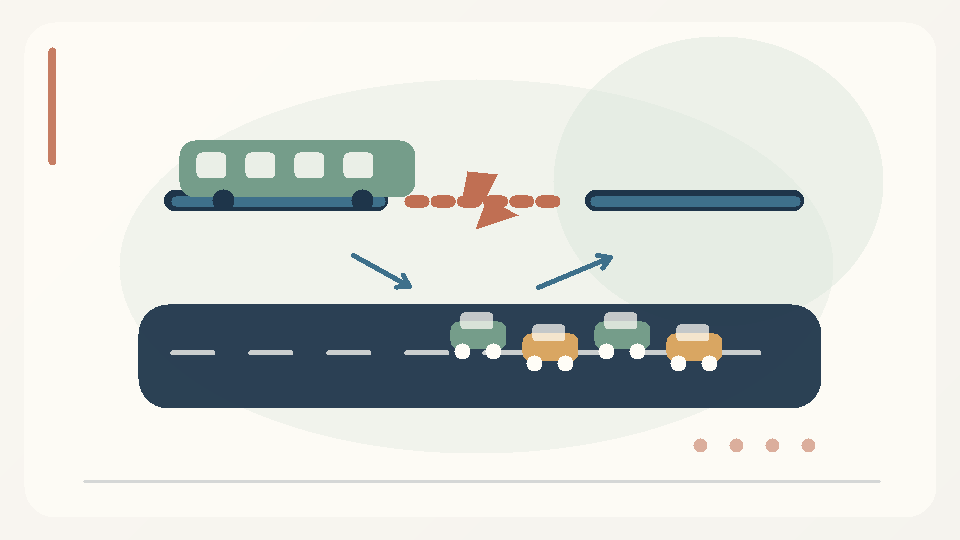
Featured image disclosure: The 2026 eduKate featured illustration depicts an imagined train, road traffic and interrupted transport connection. It is an educational concept, not a photograph of an actual MRT disruption or crash. It is conceptual editorial artwork rather than a verified photograph of a real incident.
Educational scope: This is not operational transport, road-safety or evacuation advice. Classroom locations and times are invented. For actual journeys, follow current official transport operators and authorities; do not ask children to test risky routes.
Quick answer: the mechanism of failure
A modern city is not only a network of roads and stations. It is a place where children can reach school, patients can reach care, people can reach their work and neighbours can participate in shared life. When those journeys become unreliable, inaccessible or unsafe, opportunities may remain on a map but become unavailable in daily experience. A deep civilisational vulnerability arises if people lose an important practical capability and an institution cannot preserve, restore or adapt it over time. This may happen through several dependencies becoming unreliable, a lack of qualified operators, inaccessible rules, missing information or deteriorating service. But a local difficulty is not proof that an entire civilisation has ceased to exist. Communities maintain culture, relationships, knowledge and alternative forms of organisation even while some institutions struggle.
- State the function: what important task do people need to accomplish?
- Identify the dependencies: people, infrastructure, lawful procedures, resources and data.
- Use evidence: define the population, time period, observation and limitation.
- Include users: consider whether the outcome is practical for people with different needs.
- Consider alternatives: distinguish an interrupted process from a lost capability.
- Verify repair: demand a relevant improvement rather than a reassuring headline.
Authoritative context and reporting dates
The WHO Global Status Report on Road Safety 2023 estimated 1.19 million annual road-traffic deaths worldwide for its reporting period. That global figure cannot establish the risk at any particular Singapore street. The ITF Transport Outlook 2023 evaluates alternative global passenger and freight transport scenarios to 2050. These are conditional modelled scenarios, not guaranteed future outcomes. UN SDG 11.2 calls for accessible, safe, affordable and sustainable transport for all by 2030. These facts describe published institutional research, not the fictional town of Pathhaven. Each source has its own methods and applicable jurisdictions. Students must not treat a policy target as proof of achievement or a modelled scenario as a confirmed observation.
Complete 33-chapter contents
- 1. Mobility is access rather than vehicle volume
- 2. Door-to-door journeys
- 3. Travel time versus meaningful opportunity
- 4. Safe school journeys
- 5. Travel to healthcare
- 6. Shift workers and off-peak journeys
- 7. Inclusive design and disability access
- 8. Age-friendly transport
- 9. Walking and the final connection
- 10. Crossing safety and exposure
- 11. Cycling continuity and limits
- 12. Bus routes and neighbourhood service
- 13. Rail infrastructure and trained operations
- 14. Interchanges and transfer penalties
- 15. First and last departures
- 16. Fare burdens and repeated trips
- 17. Rural access beyond metropolitan averages
- 18. Island passenger connections
- 19. Crowding at peak periods
- 20. Reliability and the variability of delay
- 21. Official information during interruptions
- 22. Road-safety statistics and their scale
- 23. Streets as social and environmental space
- 24. Land use and transport jointly shape access
- 25. Changes in demand after new capacity
- 26. Maintenance funding and renewal
- 27. Technical and frontline transport workers
- 28. Passenger needs beyond the average user
- 29. Emissions and transport choices
- 30. Disruptions and realistic backups
- 31. Public reporting that reveals access
- 32. The parent-and-tutor transport lesson
- 33. Long-term human mobility and continuity
1. Mobility is access rather than vehicle volume
The precise idea. Transport contributes to education, care, work and community life only when people can use it to reach meaningful destinations. The topic is an important part of passenger mobility, accessible journeys and continuity of essential services, but it is not a claim that a whole civilisation necessarily ends whenever this problem occurs. Societies have different resources, cultural practices, public institutions and ways of adapting. The purpose of the chapter is to identify a specific function and explain the conditions under which it is useful, weakened, redirected or repaired. A careful reader must not confuse a local interruption with the permanent loss of a population or its knowledge.
Mechanism and real-world distinctions
One visible difficulty may have several causes that require different solutions. Begin with the fictional town of Pathhaven, where a resident needs a service, a qualified provider has a defined responsibility and several resources or records enable the desired result. If an input becomes unreliable, the person may encounter a delay, extra cost, inaccessible route or confusing decision. Such a symptom tells us something useful, but it does not by itself prove the cause. A modern institution can encounter difficulty while continuing to function through another route. Conversely, a seemingly minor fault may reveal a persistent gap if it cannot be corrected or if it repeatedly excludes the same users.
Construct a five-stage causal map: intended need, available input, accountable decision, practical delivery and outcome experienced. Draw only arrows whose necessity can be explained. Suppose one stage changes while others remain stable. Does the result necessarily change, or could staff, records, maintenance or alternatives preserve it? This exercise makes assumptions visible. A system’s resilience is not merely a description of its most impressive infrastructure. It also includes trained people, clear responsibilities and an ability to recognise when ordinary users have stopped receiving the benefit.
The terms failure, disruption and transformation should be kept distinct. A temporary service interruption has a different time scale from an institution losing its capacity to operate for years. A new administrative procedure may replace an old one without erasing the public purpose it serves. And a society can experience setbacks while retaining cultural, familial and civic continuity. Describing these possibilities does not minimise serious harm; it prevents us from using a dramatic word to conceal what needs an evidence-based response. The chapter is therefore about measuring functions, not assigning a moral status to communities.
How to evaluate evidence
Compare accessible destinations and actual trip completion rather than treating road kilometres as an outcome. Source quality begins with the original publication, not a slogan or recycled screenshot. Record the issuer, observation year, location, population covered, technical definitions and potential limitations. A national or global statistic cannot automatically measure a neighbourhood. A regulatory target is a commitment, not proof of implementation. A scenario is conditional, and an official announcement is not the same as a completed practical result. If the claim involves an institution’s performance, ask whether authorised records describe actual delivery rather than only planned activity.
A rigorous investigator writes two possible explanations for the same observation. Perhaps capacity genuinely diminished; perhaps demand grew; perhaps measurement became more complete; or perhaps users shifted to an alternative process. These explanations need not be equally plausible. Ask which additional observation would help select between them. You might require dated records, a correctly sampled user survey, an independent technical assessment or verification that the intended person can now complete the task. A student should be able to say “not yet established” when the evidence cannot decide the issue.
Vehicle traffic increases do not necessarily improve the experience of households without private cars. This limitation is not an excuse to ignore a problem. It is a way to ensure the proposed correction actually targets its cause. If a city has more reported complaints, investigate whether the service worsened, the reporting route became easier or the relevant population changed. If a department collects more money, ask what obligations and outcomes were included. Similarly, a graph with an accurate numerator can still mislead when it uses an inappropriate denominator. The habit of identifying data boundaries is central to responsible learning.
Who benefits and who may be missing?
Consider a school pupil trying to complete the task. A service can appear entirely adequate in its aggregate statistics while being difficult to reach for someone with an unusual schedule, language needs, limited transport or unfamiliar paperwork. Another resident may find the service straightforward. Neither person’s experience automatically describes the whole town. A fair investigation compares the pathways available to different users without assuming what an individual’s abilities or preferences must be. This is particularly important in schools: children should never have to disclose private family finances, medical conditions or personal difficulties.
This is not operational transport, road-safety or evacuation advice. Classroom locations and times are invented. For actual journeys, follow current official transport operators and authorities; do not ask children to test risky routes. The fictional model involves no genuine public authority or private records. Real decisions concerning physical safety, taxes or other high-stakes subjects should be made with current official information and qualified professionals. Pupils can still learn a great deal from examining the logic of a system: what it needs, whom it serves, how it records errors and how a responsible group could improve it. Such learning builds compassion and analytical discipline without using people’s lives as props.
A repair that can be verified
Evaluate useful access, inclusive participation and the quality of journeys. The first step in improvement is to identify the exact issue, the authorised responsible institution and the objective that needs to be restored. A public announcement, larger budget or newly installed device may contribute to a solution but does not prove that the intended outcome has been achieved. We need an observable result: people can use a previously unavailable service, the relevant task can be completed with fewer errors, or a reviewed process reaches users whom it previously excluded. The measure must be relevant and repeatable rather than selected because it makes the project look successful.
Use four stages. Observe: record the problem’s nature and scope without guessing motives. Verify: check authoritative evidence and consider alternative explanations. Improve: adopt an appropriate response through qualified, lawful channels. Review: assess real user outcomes after a defined period and explain unresolved gaps. If new evidence shows the original diagnosis was mistaken, correct the record. If one subgroup experiences a new barrier, modify the plan. That willingness to revise is one of the most valuable characteristics of a mature institution.
Think also about the next generation of service workers. Will a different authorised person understand the decision after the original team has left? Is the evidence preserved with its date and limitations? Are duties, remaining risks and the next review clear? Institutional memory is an active capability, not merely an archive. A process that works only because one exceptional individual remembers an undocumented workaround is less dependable than one whose reasons can be examined and improved by successors. For students, writing an intelligible handover note is a practical introduction to responsible management.
Original paper-based tutorial activity
Draw two fictional towns with the same road length but different access to a school and clinic. The entire activity takes place in a fictional school library, with fictional people and clean cards. Divide pupils into observer, evidence checker, access reviewer and recorder. The observer describes what is seen in the invented system. The evidence checker asks what source and date a similar real-world claim would need. The access reviewer identifies an overlooked user without naming anyone in the class. The recorder explains how a proper professional could confirm whether an improvement worked. No student handles real legal documents, live routes, financial records or operational systems.
For younger children, retain just three questions: what went wrong, how could we know, and how might an adult improve it? Upper-primary students can propose another explanation. Secondary students should add explicit assumptions, a simple calculation, possible selection bias and a follow-up check. Advanced learners may compare policy options using several criteria and explain why no single numerical score can settle all ethical questions. The tutor should assess source quality, precise causal thinking and fairness rather than rewarding the most dramatic account of systemic failure.
Mathematics with properly stated assumptions
In this strictly invented paper example, 50 request cards reach a fictional school library. The class flags 5 as needing review. The flagged fraction is 5/50 × 100 = 10.0% to one decimal place. After 2 flagged cards have been checked and resolved, 3 remain open. These counters are not real passengers, taxpayers, accidents, tax debts or assessments of civilisation. They are school stationery used to practise percentages, subtraction and the distinction between a filed request and a verified result.
Now imagine that the desk receives twice as many cards while the proportion flagged remains similar. The raw count increases although the underlying rate does not worsen. Next, suppose some hypothetical residents could not reach the desk at all. Their absence from the denominator may make the reported performance look better than the actual experience of everyone who needed help. Finally, discuss the meaning of “resolved”: an administrative tick, a professional decision or a real benefit delivered? These are different outcomes, and sound public reporting should state which one is measured.
A test of understanding
- Explain: Transport contributes to education, care, work and community life only when people can use it to reach meaningful destinations.
- Check: Compare accessible destinations and actual trip completion rather than treating road kilometres as an outcome.
- Qualify: Vehicle traffic increases do not necessarily improve the experience of households without private cars.
- Improve: Evaluate useful access, inclusive participation and the quality of journeys.
- Apply: Draw two fictional towns with the same road length but different access to a school and clinic.
- Limit: explain why the imaginary demonstration cannot determine whether a real civilisation is failing.
A high-quality teach-back names the function, a plausible mechanism, a relevant source, an alternative explanation and a fair outcome check. It also identifies something the learner cannot conclude. Finish with a written handover: “The need was … . The process depended on … . The weakness might be … . Evidence for it would be … . One competing explanation is … . A person whose access matters is … . A qualified correction could … . The result to verify is … .” This short task makes the chapter’s learning transferable to unfamiliar cases in English, mathematics, science and social studies.
2. Door-to-door journeys
The precise idea. A trip includes reaching the boarding point, waiting, travelling, transferring and completing the final segment. The topic is an important part of passenger mobility, accessible journeys and continuity of essential services, but it is not a claim that a whole civilisation necessarily ends whenever this problem occurs. Societies have different resources, cultural practices, public institutions and ways of adapting. The purpose of the chapter is to identify a specific function and explain the conditions under which it is useful, weakened, redirected or repaired. A careful reader must not confuse a local interruption with the permanent loss of a population or its knowledge.
Mechanism and real-world distinctions
The distinction between a service existing and being practically usable is essential here. Begin with the fictional town of Pathhaven, where a resident needs a service, a qualified provider has a defined responsibility and several resources or records enable the desired result. If an input becomes unreliable, the person may encounter a delay, extra cost, inaccessible route or confusing decision. Such a symptom tells us something useful, but it does not by itself prove the cause. A modern institution can encounter difficulty while continuing to function through another route. Conversely, a seemingly minor fault may reveal a persistent gap if it cannot be corrected or if it repeatedly excludes the same users.
Construct a five-stage causal map: intended need, available input, accountable decision, practical delivery and outcome experienced. Draw only arrows whose necessity can be explained. Suppose one stage changes while others remain stable. Does the result necessarily change, or could staff, records, maintenance or alternatives preserve it? This exercise makes assumptions visible. A system’s resilience is not merely a description of its most impressive infrastructure. It also includes trained people, clear responsibilities and an ability to recognise when ordinary users have stopped receiving the benefit.
The terms failure, disruption and transformation should be kept distinct. A temporary service interruption has a different time scale from an institution losing its capacity to operate for years. A new administrative procedure may replace an old one without erasing the public purpose it serves. And a society can experience setbacks while retaining cultural, familial and civic continuity. Describing these possibilities does not minimise serious harm; it prevents us from using a dramatic word to conceal what needs an evidence-based response. The chapter is therefore about measuring functions, not assigning a moral status to communities.
How to evaluate evidence
Break a sample journey into separate legs and check access, duration and cost for each. Source quality begins with the original publication, not a slogan or recycled screenshot. Record the issuer, observation year, location, population covered, technical definitions and potential limitations. A national or global statistic cannot automatically measure a neighbourhood. A regulatory target is a commitment, not proof of implementation. A scenario is conditional, and an official announcement is not the same as a completed practical result. If the claim involves an institution’s performance, ask whether authorised records describe actual delivery rather than only planned activity.
A rigorous investigator writes two possible explanations for the same observation. Perhaps capacity genuinely diminished; perhaps demand grew; perhaps measurement became more complete; or perhaps users shifted to an alternative process. These explanations need not be equally plausible. Ask which additional observation would help select between them. You might require dated records, a correctly sampled user survey, an independent technical assessment or verification that the intended person can now complete the task. A student should be able to say “not yet established” when the evidence cannot decide the issue.
A nearby station can be practically inaccessible because the last walking connection is unsuitable. This limitation is not an excuse to ignore a problem. It is a way to ensure the proposed correction actually targets its cause. If a city has more reported complaints, investigate whether the service worsened, the reporting route became easier or the relevant population changed. If a department collects more money, ask what obligations and outcomes were included. Similarly, a graph with an accurate numerator can still mislead when it uses an inappropriate denominator. The habit of identifying data boundaries is central to responsible learning.
Who benefits and who may be missing?
Consider a caregiver trying to complete the task. A service can appear entirely adequate in its aggregate statistics while being difficult to reach for someone with an unusual schedule, language needs, limited transport or unfamiliar paperwork. Another resident may find the service straightforward. Neither person’s experience automatically describes the whole town. A fair investigation compares the pathways available to different users without assuming what an individual’s abilities or preferences must be. This is particularly important in schools: children should never have to disclose private family finances, medical conditions or personal difficulties.
This is not operational transport, road-safety or evacuation advice. Classroom locations and times are invented. For actual journeys, follow current official transport operators and authorities; do not ask children to test risky routes. The fictional model involves no genuine public authority or private records. Real decisions concerning physical safety, taxes or other high-stakes subjects should be made with current official information and qualified professionals. Pupils can still learn a great deal from examining the logic of a system: what it needs, whom it serves, how it records errors and how a responsible group could improve it. Such learning builds compassion and analytical discipline without using people’s lives as props.
A repair that can be verified
Coordinate streets, stations and destinations, not merely vehicle operations. The first step in improvement is to identify the exact issue, the authorised responsible institution and the objective that needs to be restored. A public announcement, larger budget or newly installed device may contribute to a solution but does not prove that the intended outcome has been achieved. We need an observable result: people can use a previously unavailable service, the relevant task can be completed with fewer errors, or a reviewed process reaches users whom it previously excluded. The measure must be relevant and repeatable rather than selected because it makes the project look successful.
Use four stages. Observe: record the problem’s nature and scope without guessing motives. Verify: check authoritative evidence and consider alternative explanations. Improve: adopt an appropriate response through qualified, lawful channels. Review: assess real user outcomes after a defined period and explain unresolved gaps. If new evidence shows the original diagnosis was mistaken, correct the record. If one subgroup experiences a new barrier, modify the plan. That willingness to revise is one of the most valuable characteristics of a mature institution.
Think also about the next generation of service workers. Will a different authorised person understand the decision after the original team has left? Is the evidence preserved with its date and limitations? Are duties, remaining risks and the next review clear? Institutional memory is an active capability, not merely an archive. A process that works only because one exceptional individual remembers an undocumented workaround is less dependable than one whose reasons can be examined and improved by successors. For students, writing an intelligible handover note is a practical introduction to responsible management.
Original paper-based tutorial activity
Map an invented home-to-library journey through three services. The entire activity takes place in an imaginary service centre, with fictional people and clean cards. Divide pupils into observer, evidence checker, access reviewer and recorder. The observer describes what is seen in the invented system. The evidence checker asks what source and date a similar real-world claim would need. The access reviewer identifies an overlooked user without naming anyone in the class. The recorder explains how a proper professional could confirm whether an improvement worked. No student handles real legal documents, live routes, financial records or operational systems.
For younger children, retain just three questions: what went wrong, how could we know, and how might an adult improve it? Upper-primary students can propose another explanation. Secondary students should add explicit assumptions, a simple calculation, possible selection bias and a follow-up check. Advanced learners may compare policy options using several criteria and explain why no single numerical score can settle all ethical questions. The tutor should assess source quality, precise causal thinking and fairness rather than rewarding the most dramatic account of systemic failure.
Mathematics with properly stated assumptions
In this strictly invented paper example, 57 request cards reach an imaginary service centre. The class flags 9 as needing review. The flagged fraction is 9/57 × 100 = 15.8% to one decimal place. After 5 flagged cards have been checked and resolved, 4 remain open. These counters are not real passengers, taxpayers, accidents, tax debts or assessments of civilisation. They are school stationery used to practise percentages, subtraction and the distinction between a filed request and a verified result.
Now imagine that the desk receives twice as many cards while the proportion flagged remains similar. The raw count increases although the underlying rate does not worsen. Next, suppose some hypothetical residents could not reach the desk at all. Their absence from the denominator may make the reported performance look better than the actual experience of everyone who needed help. Finally, discuss the meaning of “resolved”: an administrative tick, a professional decision or a real benefit delivered? These are different outcomes, and sound public reporting should state which one is measured.
A test of understanding
- Explain: A trip includes reaching the boarding point, waiting, travelling, transferring and completing the final segment.
- Check: Break a sample journey into separate legs and check access, duration and cost for each.
- Qualify: A nearby station can be practically inaccessible because the last walking connection is unsuitable.
- Improve: Coordinate streets, stations and destinations, not merely vehicle operations.
- Apply: Map an invented home-to-library journey through three services.
- Limit: explain why the imaginary demonstration cannot determine whether a real civilisation is failing.
A high-quality teach-back names the function, a plausible mechanism, a relevant source, an alternative explanation and a fair outcome check. It also identifies something the learner cannot conclude. Finish with a written handover: “The need was … . The process depended on … . The weakness might be … . Evidence for it would be … . One competing explanation is … . A person whose access matters is … . A qualified correction could … . The result to verify is … .” This short task makes the chapter’s learning transferable to unfamiliar cases in English, mathematics, science and social studies.
3. Travel time versus meaningful opportunity
The precise idea. Average speed, journey variability and access to desirable destinations measure different properties. The topic is an important part of passenger mobility, accessible journeys and continuity of essential services, but it is not a claim that a whole civilisation necessarily ends whenever this problem occurs. Societies have different resources, cultural practices, public institutions and ways of adapting. The purpose of the chapter is to identify a specific function and explain the conditions under which it is useful, weakened, redirected or repaired. A careful reader must not confuse a local interruption with the permanent loss of a population or its knowledge.
Mechanism and real-world distinctions
A dramatic example should not replace careful examination of the people who continue functioning. Begin with the fictional town of Pathhaven, where a resident needs a service, a qualified provider has a defined responsibility and several resources or records enable the desired result. If an input becomes unreliable, the person may encounter a delay, extra cost, inaccessible route or confusing decision. Such a symptom tells us something useful, but it does not by itself prove the cause. A modern institution can encounter difficulty while continuing to function through another route. Conversely, a seemingly minor fault may reveal a persistent gap if it cannot be corrected or if it repeatedly excludes the same users.
Construct a five-stage causal map: intended need, available input, accountable decision, practical delivery and outcome experienced. Draw only arrows whose necessity can be explained. Suppose one stage changes while others remain stable. Does the result necessarily change, or could staff, records, maintenance or alternatives preserve it? This exercise makes assumptions visible. A system’s resilience is not merely a description of its most impressive infrastructure. It also includes trained people, clear responsibilities and an ability to recognise when ordinary users have stopped receiving the benefit.
The terms failure, disruption and transformation should be kept distinct. A temporary service interruption has a different time scale from an institution losing its capacity to operate for years. A new administrative procedure may replace an old one without erasing the public purpose it serves. And a society can experience setbacks while retaining cultural, familial and civic continuity. Describing these possibilities does not minimise serious harm; it prevents us from using a dramatic word to conceal what needs an evidence-based response. The chapter is therefore about measuring functions, not assigning a moral status to communities.
How to evaluate evidence
Check the travel mode, departure period, user assumptions and the destinations included. Source quality begins with the original publication, not a slogan or recycled screenshot. Record the issuer, observation year, location, population covered, technical definitions and potential limitations. A national or global statistic cannot automatically measure a neighbourhood. A regulatory target is a commitment, not proof of implementation. A scenario is conditional, and an official announcement is not the same as a completed practical result. If the claim involves an institution’s performance, ask whether authorised records describe actual delivery rather than only planned activity.
A rigorous investigator writes two possible explanations for the same observation. Perhaps capacity genuinely diminished; perhaps demand grew; perhaps measurement became more complete; or perhaps users shifted to an alternative process. These explanations need not be equally plausible. Ask which additional observation would help select between them. You might require dated records, a correctly sampled user survey, an independent technical assessment or verification that the intended person can now complete the task. A student should be able to say “not yet established” when the evidence cannot decide the issue.
An appealing short-time travel slogan is not a promise that every service is reachable in a fixed number of minutes. This limitation is not an excuse to ignore a problem. It is a way to ensure the proposed correction actually targets its cause. If a city has more reported complaints, investigate whether the service worsened, the reporting route became easier or the relevant population changed. If a department collects more money, ask what obligations and outcomes were included. Similarly, a graph with an accurate numerator can still mislead when it uses an inappropriate denominator. The habit of identifying data boundaries is central to responsible learning.
Who benefits and who may be missing?
Consider an experienced service worker trying to complete the task. A service can appear entirely adequate in its aggregate statistics while being difficult to reach for someone with an unusual schedule, language needs, limited transport or unfamiliar paperwork. Another resident may find the service straightforward. Neither person’s experience automatically describes the whole town. A fair investigation compares the pathways available to different users without assuming what an individual’s abilities or preferences must be. This is particularly important in schools: children should never have to disclose private family finances, medical conditions or personal difficulties.
This is not operational transport, road-safety or evacuation advice. Classroom locations and times are invented. For actual journeys, follow current official transport operators and authorities; do not ask children to test risky routes. The fictional model involves no genuine public authority or private records. Real decisions concerning physical safety, taxes or other high-stakes subjects should be made with current official information and qualified professionals. Pupils can still learn a great deal from examining the logic of a system: what it needs, whom it serves, how it records errors and how a responsible group could improve it. Such learning builds compassion and analytical discipline without using people’s lives as props.
A repair that can be verified
Evaluate practical destinations and reliability rather than a single journey average. The first step in improvement is to identify the exact issue, the authorised responsible institution and the objective that needs to be restored. A public announcement, larger budget or newly installed device may contribute to a solution but does not prove that the intended outcome has been achieved. We need an observable result: people can use a previously unavailable service, the relevant task can be completed with fewer errors, or a reviewed process reaches users whom it previously excluded. The measure must be relevant and repeatable rather than selected because it makes the project look successful.
Use four stages. Observe: record the problem’s nature and scope without guessing motives. Verify: check authoritative evidence and consider alternative explanations. Improve: adopt an appropriate response through qualified, lawful channels. Review: assess real user outcomes after a defined period and explain unresolved gaps. If new evidence shows the original diagnosis was mistaken, correct the record. If one subgroup experiences a new barrier, modify the plan. That willingness to revise is one of the most valuable characteristics of a mature institution.
Think also about the next generation of service workers. Will a different authorised person understand the decision after the original team has left? Is the evidence preserved with its date and limitations? Are duties, remaining risks and the next review clear? Institutional memory is an active capability, not merely an archive. A process that works only because one exceptional individual remembers an undocumented workaround is less dependable than one whose reasons can be examined and improved by successors. For students, writing an intelligible handover note is a practical introduction to responsible management.
Original paper-based tutorial activity
Compare fictional travel times to two equally distant but differently connected clinics. The entire activity takes place in a cardboard town square, with fictional people and clean cards. Divide pupils into observer, evidence checker, access reviewer and recorder. The observer describes what is seen in the invented system. The evidence checker asks what source and date a similar real-world claim would need. The access reviewer identifies an overlooked user without naming anyone in the class. The recorder explains how a proper professional could confirm whether an improvement worked. No student handles real legal documents, live routes, financial records or operational systems.
For younger children, retain just three questions: what went wrong, how could we know, and how might an adult improve it? Upper-primary students can propose another explanation. Secondary students should add explicit assumptions, a simple calculation, possible selection bias and a follow-up check. Advanced learners may compare policy options using several criteria and explain why no single numerical score can settle all ethical questions. The tutor should assess source quality, precise causal thinking and fairness rather than rewarding the most dramatic account of systemic failure.
Mathematics with properly stated assumptions
In this strictly invented paper example, 64 request cards reach a cardboard town square. The class flags 13 as needing review. The flagged fraction is 13/64 × 100 = 20.3% to one decimal place. After 8 flagged cards have been checked and resolved, 5 remain open. These counters are not real passengers, taxpayers, accidents, tax debts or assessments of civilisation. They are school stationery used to practise percentages, subtraction and the distinction between a filed request and a verified result.
Now imagine that the desk receives twice as many cards while the proportion flagged remains similar. The raw count increases although the underlying rate does not worsen. Next, suppose some hypothetical residents could not reach the desk at all. Their absence from the denominator may make the reported performance look better than the actual experience of everyone who needed help. Finally, discuss the meaning of “resolved”: an administrative tick, a professional decision or a real benefit delivered? These are different outcomes, and sound public reporting should state which one is measured.
A test of understanding
- Explain: Average speed, journey variability and access to desirable destinations measure different properties.
- Check: Check the travel mode, departure period, user assumptions and the destinations included.
- Qualify: An appealing short-time travel slogan is not a promise that every service is reachable in a fixed number of minutes.
- Improve: Evaluate practical destinations and reliability rather than a single journey average.
- Apply: Compare fictional travel times to two equally distant but differently connected clinics.
- Limit: explain why the imaginary demonstration cannot determine whether a real civilisation is failing.
A high-quality teach-back names the function, a plausible mechanism, a relevant source, an alternative explanation and a fair outcome check. It also identifies something the learner cannot conclude. Finish with a written handover: “The need was … . The process depended on … . The weakness might be … . Evidence for it would be … . One competing explanation is … . A person whose access matters is … . A qualified correction could … . The result to verify is … .” This short task makes the chapter’s learning transferable to unfamiliar cases in English, mathematics, science and social studies.
4. Safe school journeys
The precise idea. Children depend on workable routes, appropriate supervision and predictable arrival times to participate in school. The topic is an important part of passenger mobility, accessible journeys and continuity of essential services, but it is not a claim that a whole civilisation necessarily ends whenever this problem occurs. Societies have different resources, cultural practices, public institutions and ways of adapting. The purpose of the chapter is to identify a specific function and explain the conditions under which it is useful, weakened, redirected or repaired. A careful reader must not confuse a local interruption with the permanent loss of a population or its knowledge.
Mechanism and real-world distinctions
Look for the actual chain of events before deciding which part of the system deserves attention. Begin with the fictional town of Pathhaven, where a resident needs a service, a qualified provider has a defined responsibility and several resources or records enable the desired result. If an input becomes unreliable, the person may encounter a delay, extra cost, inaccessible route or confusing decision. Such a symptom tells us something useful, but it does not by itself prove the cause. A modern institution can encounter difficulty while continuing to function through another route. Conversely, a seemingly minor fault may reveal a persistent gap if it cannot be corrected or if it repeatedly excludes the same users.
Construct a five-stage causal map: intended need, available input, accountable decision, practical delivery and outcome experienced. Draw only arrows whose necessity can be explained. Suppose one stage changes while others remain stable. Does the result necessarily change, or could staff, records, maintenance or alternatives preserve it? This exercise makes assumptions visible. A system’s resilience is not merely a description of its most impressive infrastructure. It also includes trained people, clear responsibilities and an ability to recognise when ordinary users have stopped receiving the benefit.
The terms failure, disruption and transformation should be kept distinct. A temporary service interruption has a different time scale from an institution losing its capacity to operate for years. A new administrative procedure may replace an old one without erasing the public purpose it serves. And a society can experience setbacks while retaining cultural, familial and civic continuity. Describing these possibilities does not minimise serious harm; it prevents us from using a dramatic word to conceal what needs an evidence-based response. The chapter is therefore about measuring functions, not assigning a moral status to communities.
How to evaluate evidence
Compare timetable assumptions with authorised services and actual access without asserting local conditions. Source quality begins with the original publication, not a slogan or recycled screenshot. Record the issuer, observation year, location, population covered, technical definitions and potential limitations. A national or global statistic cannot automatically measure a neighbourhood. A regulatory target is a commitment, not proof of implementation. A scenario is conditional, and an official announcement is not the same as a completed practical result. If the claim involves an institution’s performance, ask whether authorised records describe actual delivery rather than only planned activity.
A rigorous investigator writes two possible explanations for the same observation. Perhaps capacity genuinely diminished; perhaps demand grew; perhaps measurement became more complete; or perhaps users shifted to an alternative process. These explanations need not be equally plausible. Ask which additional observation would help select between them. You might require dated records, a correctly sampled user survey, an independent technical assessment or verification that the intended person can now complete the task. A student should be able to say “not yet established” when the evidence cannot decide the issue.
Educational continuity involves more than arriving at a campus; safe entry and after-school participation matter. This limitation is not an excuse to ignore a problem. It is a way to ensure the proposed correction actually targets its cause. If a city has more reported complaints, investigate whether the service worsened, the reporting route became easier or the relevant population changed. If a department collects more money, ask what obligations and outcomes were included. Similarly, a graph with an accurate numerator can still mislead when it uses an inappropriate denominator. The habit of identifying data boundaries is central to responsible learning.
Who benefits and who may be missing?
Consider an older resident trying to complete the task. A service can appear entirely adequate in its aggregate statistics while being difficult to reach for someone with an unusual schedule, language needs, limited transport or unfamiliar paperwork. Another resident may find the service straightforward. Neither person’s experience automatically describes the whole town. A fair investigation compares the pathways available to different users without assuming what an individual’s abilities or preferences must be. This is particularly important in schools: children should never have to disclose private family finances, medical conditions or personal difficulties.
This is not operational transport, road-safety or evacuation advice. Classroom locations and times are invented. For actual journeys, follow current official transport operators and authorities; do not ask children to test risky routes. The fictional model involves no genuine public authority or private records. Real decisions concerning physical safety, taxes or other high-stakes subjects should be made with current official information and qualified professionals. Pupils can still learn a great deal from examining the logic of a system: what it needs, whom it serves, how it records errors and how a responsible group could improve it. Such learning builds compassion and analytical discipline without using people’s lives as props.
A repair that can be verified
Plan age-appropriate accessible mobility with qualified authorities and families. The first step in improvement is to identify the exact issue, the authorised responsible institution and the objective that needs to be restored. A public announcement, larger budget or newly installed device may contribute to a solution but does not prove that the intended outcome has been achieved. We need an observable result: people can use a previously unavailable service, the relevant task can be completed with fewer errors, or a reviewed process reaches users whom it previously excluded. The measure must be relevant and repeatable rather than selected because it makes the project look successful.
Use four stages. Observe: record the problem’s nature and scope without guessing motives. Verify: check authoritative evidence and consider alternative explanations. Improve: adopt an appropriate response through qualified, lawful channels. Review: assess real user outcomes after a defined period and explain unresolved gaps. If new evidence shows the original diagnosis was mistaken, correct the record. If one subgroup experiences a new barrier, modify the plan. That willingness to revise is one of the most valuable characteristics of a mature institution.
Think also about the next generation of service workers. Will a different authorised person understand the decision after the original team has left? Is the evidence preserved with its date and limitations? Are duties, remaining risks and the next review clear? Institutional memory is an active capability, not merely an archive. A process that works only because one exceptional individual remembers an undocumented workaround is less dependable than one whose reasons can be examined and improved by successors. For students, writing an intelligible handover note is a practical introduction to responsible management.
Original paper-based tutorial activity
Design a fictional student day including morning travel and an after-school club. The entire activity takes place in a pretend municipal desk, with fictional people and clean cards. Divide pupils into observer, evidence checker, access reviewer and recorder. The observer describes what is seen in the invented system. The evidence checker asks what source and date a similar real-world claim would need. The access reviewer identifies an overlooked user without naming anyone in the class. The recorder explains how a proper professional could confirm whether an improvement worked. No student handles real legal documents, live routes, financial records or operational systems.
For younger children, retain just three questions: what went wrong, how could we know, and how might an adult improve it? Upper-primary students can propose another explanation. Secondary students should add explicit assumptions, a simple calculation, possible selection bias and a follow-up check. Advanced learners may compare policy options using several criteria and explain why no single numerical score can settle all ethical questions. The tutor should assess source quality, precise causal thinking and fairness rather than rewarding the most dramatic account of systemic failure.
Mathematics with properly stated assumptions
In this strictly invented paper example, 71 request cards reach a pretend municipal desk. The class flags 17 as needing review. The flagged fraction is 17/71 × 100 = 23.9% to one decimal place. After 11 flagged cards have been checked and resolved, 6 remain open. These counters are not real passengers, taxpayers, accidents, tax debts or assessments of civilisation. They are school stationery used to practise percentages, subtraction and the distinction between a filed request and a verified result.
Now imagine that the desk receives twice as many cards while the proportion flagged remains similar. The raw count increases although the underlying rate does not worsen. Next, suppose some hypothetical residents could not reach the desk at all. Their absence from the denominator may make the reported performance look better than the actual experience of everyone who needed help. Finally, discuss the meaning of “resolved”: an administrative tick, a professional decision or a real benefit delivered? These are different outcomes, and sound public reporting should state which one is measured.
A test of understanding
- Explain: Children depend on workable routes, appropriate supervision and predictable arrival times to participate in school.
- Check: Compare timetable assumptions with authorised services and actual access without asserting local conditions.
- Qualify: Educational continuity involves more than arriving at a campus; safe entry and after-school participation matter.
- Improve: Plan age-appropriate accessible mobility with qualified authorities and families.
- Apply: Design a fictional student day including morning travel and an after-school club.
- Limit: explain why the imaginary demonstration cannot determine whether a real civilisation is failing.
A high-quality teach-back names the function, a plausible mechanism, a relevant source, an alternative explanation and a fair outcome check. It also identifies something the learner cannot conclude. Finish with a written handover: “The need was … . The process depended on … . The weakness might be … . Evidence for it would be … . One competing explanation is … . A person whose access matters is … . A qualified correction could … . The result to verify is … .” This short task makes the chapter’s learning transferable to unfamiliar cases in English, mathematics, science and social studies.
5. Travel to healthcare
The precise idea. A clinic appointment is only practical when the patient can reach the service and return appropriately. The topic is an important part of passenger mobility, accessible journeys and continuity of essential services, but it is not a claim that a whole civilisation necessarily ends whenever this problem occurs. Societies have different resources, cultural practices, public institutions and ways of adapting. The purpose of the chapter is to identify a specific function and explain the conditions under which it is useful, weakened, redirected or repaired. A careful reader must not confuse a local interruption with the permanent loss of a population or its knowledge.
Mechanism and real-world distinctions
Consider a counterexample in which a suitable alternative keeps the outcome available. Begin with the fictional town of Pathhaven, where a resident needs a service, a qualified provider has a defined responsibility and several resources or records enable the desired result. If an input becomes unreliable, the person may encounter a delay, extra cost, inaccessible route or confusing decision. Such a symptom tells us something useful, but it does not by itself prove the cause. A modern institution can encounter difficulty while continuing to function through another route. Conversely, a seemingly minor fault may reveal a persistent gap if it cannot be corrected or if it repeatedly excludes the same users.
Construct a five-stage causal map: intended need, available input, accountable decision, practical delivery and outcome experienced. Draw only arrows whose necessity can be explained. Suppose one stage changes while others remain stable. Does the result necessarily change, or could staff, records, maintenance or alternatives preserve it? This exercise makes assumptions visible. A system’s resilience is not merely a description of its most impressive infrastructure. It also includes trained people, clear responsibilities and an ability to recognise when ordinary users have stopped receiving the benefit.
The terms failure, disruption and transformation should be kept distinct. A temporary service interruption has a different time scale from an institution losing its capacity to operate for years. A new administrative procedure may replace an old one without erasing the public purpose it serves. And a society can experience setbacks while retaining cultural, familial and civic continuity. Describing these possibilities does not minimise serious harm; it prevents us from using a dramatic word to conceal what needs an evidence-based response. The chapter is therefore about measuring functions, not assigning a moral status to communities.
How to evaluate evidence
Study route access, journey uncertainty and time windows without seeking personal medical records. Source quality begins with the original publication, not a slogan or recycled screenshot. Record the issuer, observation year, location, population covered, technical definitions and potential limitations. A national or global statistic cannot automatically measure a neighbourhood. A regulatory target is a commitment, not proof of implementation. A scenario is conditional, and an official announcement is not the same as a completed practical result. If the claim involves an institution’s performance, ask whether authorised records describe actual delivery rather than only planned activity.
A rigorous investigator writes two possible explanations for the same observation. Perhaps capacity genuinely diminished; perhaps demand grew; perhaps measurement became more complete; or perhaps users shifted to an alternative process. These explanations need not be equally plausible. Ask which additional observation would help select between them. You might require dated records, a correctly sampled user survey, an independent technical assessment or verification that the intended person can now complete the task. A student should be able to say “not yet established” when the evidence cannot decide the issue.
Having a healthcare facility on a map is not proof of available or accessible medical treatment. This limitation is not an excuse to ignore a problem. It is a way to ensure the proposed correction actually targets its cause. If a city has more reported complaints, investigate whether the service worsened, the reporting route became easier or the relevant population changed. If a department collects more money, ask what obligations and outcomes were included. Similarly, a graph with an accurate numerator can still mislead when it uses an inappropriate denominator. The habit of identifying data boundaries is central to responsible learning.
Who benefits and who may be missing?
Consider a community participant using an alternative format trying to complete the task. A service can appear entirely adequate in its aggregate statistics while being difficult to reach for someone with an unusual schedule, language needs, limited transport or unfamiliar paperwork. Another resident may find the service straightforward. Neither person’s experience automatically describes the whole town. A fair investigation compares the pathways available to different users without assuming what an individual’s abilities or preferences must be. This is particularly important in schools: children should never have to disclose private family finances, medical conditions or personal difficulties.
This is not operational transport, road-safety or evacuation advice. Classroom locations and times are invented. For actual journeys, follow current official transport operators and authorities; do not ask children to test risky routes. The fictional model involves no genuine public authority or private records. Real decisions concerning physical safety, taxes or other high-stakes subjects should be made with current official information and qualified professionals. Pupils can still learn a great deal from examining the logic of a system: what it needs, whom it serves, how it records errors and how a responsible group could improve it. Such learning builds compassion and analytical discipline without using people’s lives as props.
A repair that can be verified
Link transport and service planning while keeping clinical advice with professionals. The first step in improvement is to identify the exact issue, the authorised responsible institution and the objective that needs to be restored. A public announcement, larger budget or newly installed device may contribute to a solution but does not prove that the intended outcome has been achieved. We need an observable result: people can use a previously unavailable service, the relevant task can be completed with fewer errors, or a reviewed process reaches users whom it previously excluded. The measure must be relevant and repeatable rather than selected because it makes the project look successful.
Use four stages. Observe: record the problem’s nature and scope without guessing motives. Verify: check authoritative evidence and consider alternative explanations. Improve: adopt an appropriate response through qualified, lawful channels. Review: assess real user outcomes after a defined period and explain unresolved gaps. If new evidence shows the original diagnosis was mistaken, correct the record. If one subgroup experiences a new barrier, modify the plan. That willingness to revise is one of the most valuable characteristics of a mature institution.
Think also about the next generation of service workers. Will a different authorised person understand the decision after the original team has left? Is the evidence preserved with its date and limitations? Are duties, remaining risks and the next review clear? Institutional memory is an active capability, not merely an archive. A process that works only because one exceptional individual remembers an undocumented workaround is less dependable than one whose reasons can be examined and improved by successors. For students, writing an intelligible handover note is a practical introduction to responsible management.
Original paper-based tutorial activity
Connect imaginary homes, a bus stop and a model clinic. The entire activity takes place in a model neighbourhood, with fictional people and clean cards. Divide pupils into observer, evidence checker, access reviewer and recorder. The observer describes what is seen in the invented system. The evidence checker asks what source and date a similar real-world claim would need. The access reviewer identifies an overlooked user without naming anyone in the class. The recorder explains how a proper professional could confirm whether an improvement worked. No student handles real legal documents, live routes, financial records or operational systems.
For younger children, retain just three questions: what went wrong, how could we know, and how might an adult improve it? Upper-primary students can propose another explanation. Secondary students should add explicit assumptions, a simple calculation, possible selection bias and a follow-up check. Advanced learners may compare policy options using several criteria and explain why no single numerical score can settle all ethical questions. The tutor should assess source quality, precise causal thinking and fairness rather than rewarding the most dramatic account of systemic failure.
Mathematics with properly stated assumptions
In this strictly invented paper example, 78 request cards reach a model neighbourhood. The class flags 5 as needing review. The flagged fraction is 5/78 × 100 = 6.4% to one decimal place. After 4 flagged cards have been checked and resolved, 1 remain open. These counters are not real passengers, taxpayers, accidents, tax debts or assessments of civilisation. They are school stationery used to practise percentages, subtraction and the distinction between a filed request and a verified result.
Now imagine that the desk receives twice as many cards while the proportion flagged remains similar. The raw count increases although the underlying rate does not worsen. Next, suppose some hypothetical residents could not reach the desk at all. Their absence from the denominator may make the reported performance look better than the actual experience of everyone who needed help. Finally, discuss the meaning of “resolved”: an administrative tick, a professional decision or a real benefit delivered? These are different outcomes, and sound public reporting should state which one is measured.
A test of understanding
- Explain: A clinic appointment is only practical when the patient can reach the service and return appropriately.
- Check: Study route access, journey uncertainty and time windows without seeking personal medical records.
- Qualify: Having a healthcare facility on a map is not proof of available or accessible medical treatment.
- Improve: Link transport and service planning while keeping clinical advice with professionals.
- Apply: Connect imaginary homes, a bus stop and a model clinic.
- Limit: explain why the imaginary demonstration cannot determine whether a real civilisation is failing.
A high-quality teach-back names the function, a plausible mechanism, a relevant source, an alternative explanation and a fair outcome check. It also identifies something the learner cannot conclude. Finish with a written handover: “The need was … . The process depended on … . The weakness might be … . Evidence for it would be … . One competing explanation is … . A person whose access matters is … . A qualified correction could … . The result to verify is … .” This short task makes the chapter’s learning transferable to unfamiliar cases in English, mathematics, science and social studies.
6. Shift workers and off-peak journeys
The precise idea. Some occupations require travel before conventional office hours or after most services reduce frequency. The topic is an important part of passenger mobility, accessible journeys and continuity of essential services, but it is not a claim that a whole civilisation necessarily ends whenever this problem occurs. Societies have different resources, cultural practices, public institutions and ways of adapting. The purpose of the chapter is to identify a specific function and explain the conditions under which it is useful, weakened, redirected or repaired. A careful reader must not confuse a local interruption with the permanent loss of a population or its knowledge.
Mechanism and real-world distinctions
One visible difficulty may have several causes that require different solutions. Begin with the fictional town of Pathhaven, where a resident needs a service, a qualified provider has a defined responsibility and several resources or records enable the desired result. If an input becomes unreliable, the person may encounter a delay, extra cost, inaccessible route or confusing decision. Such a symptom tells us something useful, but it does not by itself prove the cause. A modern institution can encounter difficulty while continuing to function through another route. Conversely, a seemingly minor fault may reveal a persistent gap if it cannot be corrected or if it repeatedly excludes the same users.
Construct a five-stage causal map: intended need, available input, accountable decision, practical delivery and outcome experienced. Draw only arrows whose necessity can be explained. Suppose one stage changes while others remain stable. Does the result necessarily change, or could staff, records, maintenance or alternatives preserve it? This exercise makes assumptions visible. A system’s resilience is not merely a description of its most impressive infrastructure. It also includes trained people, clear responsibilities and an ability to recognise when ordinary users have stopped receiving the benefit.
The terms failure, disruption and transformation should be kept distinct. A temporary service interruption has a different time scale from an institution losing its capacity to operate for years. A new administrative procedure may replace an old one without erasing the public purpose it serves. And a society can experience setbacks while retaining cultural, familial and civic continuity. Describing these possibilities does not minimise serious harm; it prevents us from using a dramatic word to conceal what needs an evidence-based response. The chapter is therefore about measuring functions, not assigning a moral status to communities.
How to evaluate evidence
Compare actual time-of-day service windows rather than daily ridership averages. Source quality begins with the original publication, not a slogan or recycled screenshot. Record the issuer, observation year, location, population covered, technical definitions and potential limitations. A national or global statistic cannot automatically measure a neighbourhood. A regulatory target is a commitment, not proof of implementation. A scenario is conditional, and an official announcement is not the same as a completed practical result. If the claim involves an institution’s performance, ask whether authorised records describe actual delivery rather than only planned activity.
A rigorous investigator writes two possible explanations for the same observation. Perhaps capacity genuinely diminished; perhaps demand grew; perhaps measurement became more complete; or perhaps users shifted to an alternative process. These explanations need not be equally plausible. Ask which additional observation would help select between them. You might require dated records, a correctly sampled user survey, an independent technical assessment or verification that the intended person can now complete the task. A student should be able to say “not yet established” when the evidence cannot decide the issue.
A limited off-peak route does not mean its users are less important than weekday commuters. This limitation is not an excuse to ignore a problem. It is a way to ensure the proposed correction actually targets its cause. If a city has more reported complaints, investigate whether the service worsened, the reporting route became easier or the relevant population changed. If a department collects more money, ask what obligations and outcomes were included. Similarly, a graph with an accurate numerator can still mislead when it uses an inappropriate denominator. The habit of identifying data boundaries is central to responsible learning.
Who benefits and who may be missing?
Consider a new resident unfamiliar with the process trying to complete the task. A service can appear entirely adequate in its aggregate statistics while being difficult to reach for someone with an unusual schedule, language needs, limited transport or unfamiliar paperwork. Another resident may find the service straightforward. Neither person’s experience automatically describes the whole town. A fair investigation compares the pathways available to different users without assuming what an individual’s abilities or preferences must be. This is particularly important in schools: children should never have to disclose private family finances, medical conditions or personal difficulties.
This is not operational transport, road-safety or evacuation advice. Classroom locations and times are invented. For actual journeys, follow current official transport operators and authorities; do not ask children to test risky routes. The fictional model involves no genuine public authority or private records. Real decisions concerning physical safety, taxes or other high-stakes subjects should be made with current official information and qualified professionals. Pupils can still learn a great deal from examining the logic of a system: what it needs, whom it serves, how it records errors and how a responsible group could improve it. Such learning builds compassion and analytical discipline without using people’s lives as props.
A repair that can be verified
Assess real user needs and provide understandable, feasible alternatives. The first step in improvement is to identify the exact issue, the authorised responsible institution and the objective that needs to be restored. A public announcement, larger budget or newly installed device may contribute to a solution but does not prove that the intended outcome has been achieved. We need an observable result: people can use a previously unavailable service, the relevant task can be completed with fewer errors, or a reviewed process reaches users whom it previously excluded. The measure must be relevant and repeatable rather than selected because it makes the project look successful.
Use four stages. Observe: record the problem’s nature and scope without guessing motives. Verify: check authoritative evidence and consider alternative explanations. Improve: adopt an appropriate response through qualified, lawful channels. Review: assess real user outcomes after a defined period and explain unresolved gaps. If new evidence shows the original diagnosis was mistaken, correct the record. If one subgroup experiences a new barrier, modify the plan. That willingness to revise is one of the most valuable characteristics of a mature institution.
Think also about the next generation of service workers. Will a different authorised person understand the decision after the original team has left? Is the evidence preserved with its date and limitations? Are duties, remaining risks and the next review clear? Institutional memory is an active capability, not merely an archive. A process that works only because one exceptional individual remembers an undocumented workaround is less dependable than one whose reasons can be examined and improved by successors. For students, writing an intelligible handover note is a practical introduction to responsible management.
Original paper-based tutorial activity
Test a fictional cleaner’s early shift against an imaginary first-bus timetable. The entire activity takes place in a paper public archive, with fictional people and clean cards. Divide pupils into observer, evidence checker, access reviewer and recorder. The observer describes what is seen in the invented system. The evidence checker asks what source and date a similar real-world claim would need. The access reviewer identifies an overlooked user without naming anyone in the class. The recorder explains how a proper professional could confirm whether an improvement worked. No student handles real legal documents, live routes, financial records or operational systems.
For younger children, retain just three questions: what went wrong, how could we know, and how might an adult improve it? Upper-primary students can propose another explanation. Secondary students should add explicit assumptions, a simple calculation, possible selection bias and a follow-up check. Advanced learners may compare policy options using several criteria and explain why no single numerical score can settle all ethical questions. The tutor should assess source quality, precise causal thinking and fairness rather than rewarding the most dramatic account of systemic failure.
Mathematics with properly stated assumptions
In this strictly invented paper example, 85 request cards reach a paper public archive. The class flags 9 as needing review. The flagged fraction is 9/85 × 100 = 10.6% to one decimal place. After 7 flagged cards have been checked and resolved, 2 remain open. These counters are not real passengers, taxpayers, accidents, tax debts or assessments of civilisation. They are school stationery used to practise percentages, subtraction and the distinction between a filed request and a verified result.
Now imagine that the desk receives twice as many cards while the proportion flagged remains similar. The raw count increases although the underlying rate does not worsen. Next, suppose some hypothetical residents could not reach the desk at all. Their absence from the denominator may make the reported performance look better than the actual experience of everyone who needed help. Finally, discuss the meaning of “resolved”: an administrative tick, a professional decision or a real benefit delivered? These are different outcomes, and sound public reporting should state which one is measured.
A test of understanding
- Explain: Some occupations require travel before conventional office hours or after most services reduce frequency.
- Check: Compare actual time-of-day service windows rather than daily ridership averages.
- Qualify: A limited off-peak route does not mean its users are less important than weekday commuters.
- Improve: Assess real user needs and provide understandable, feasible alternatives.
- Apply: Test a fictional cleaner’s early shift against an imaginary first-bus timetable.
- Limit: explain why the imaginary demonstration cannot determine whether a real civilisation is failing.
A high-quality teach-back names the function, a plausible mechanism, a relevant source, an alternative explanation and a fair outcome check. It also identifies something the learner cannot conclude. Finish with a written handover: “The need was … . The process depended on … . The weakness might be … . Evidence for it would be … . One competing explanation is … . A person whose access matters is … . A qualified correction could … . The result to verify is … .” This short task makes the chapter’s learning transferable to unfamiliar cases in English, mathematics, science and social studies.
7. Inclusive design and disability access
The precise idea. Lifts, route continuity, clear signs and suitable assistance can affect whether a journey is usable. The topic is an important part of passenger mobility, accessible journeys and continuity of essential services, but it is not a claim that a whole civilisation necessarily ends whenever this problem occurs. Societies have different resources, cultural practices, public institutions and ways of adapting. The purpose of the chapter is to identify a specific function and explain the conditions under which it is useful, weakened, redirected or repaired. A careful reader must not confuse a local interruption with the permanent loss of a population or its knowledge.
Mechanism and real-world distinctions
The distinction between a service existing and being practically usable is essential here. Begin with the fictional town of Pathhaven, where a resident needs a service, a qualified provider has a defined responsibility and several resources or records enable the desired result. If an input becomes unreliable, the person may encounter a delay, extra cost, inaccessible route or confusing decision. Such a symptom tells us something useful, but it does not by itself prove the cause. A modern institution can encounter difficulty while continuing to function through another route. Conversely, a seemingly minor fault may reveal a persistent gap if it cannot be corrected or if it repeatedly excludes the same users.
Construct a five-stage causal map: intended need, available input, accountable decision, practical delivery and outcome experienced. Draw only arrows whose necessity can be explained. Suppose one stage changes while others remain stable. Does the result necessarily change, or could staff, records, maintenance or alternatives preserve it? This exercise makes assumptions visible. A system’s resilience is not merely a description of its most impressive infrastructure. It also includes trained people, clear responsibilities and an ability to recognise when ordinary users have stopped receiving the benefit.
The terms failure, disruption and transformation should be kept distinct. A temporary service interruption has a different time scale from an institution losing its capacity to operate for years. A new administrative procedure may replace an old one without erasing the public purpose it serves. And a society can experience setbacks while retaining cultural, familial and civic continuity. Describing these possibilities does not minimise serious harm; it prevents us from using a dramatic word to conceal what needs an evidence-based response. The chapter is therefore about measuring functions, not assigning a moral status to communities.
How to evaluate evidence
Examine practical completion and actual access barriers using qualified design standards. Source quality begins with the original publication, not a slogan or recycled screenshot. Record the issuer, observation year, location, population covered, technical definitions and potential limitations. A national or global statistic cannot automatically measure a neighbourhood. A regulatory target is a commitment, not proof of implementation. A scenario is conditional, and an official announcement is not the same as a completed practical result. If the claim involves an institution’s performance, ask whether authorised records describe actual delivery rather than only planned activity.
A rigorous investigator writes two possible explanations for the same observation. Perhaps capacity genuinely diminished; perhaps demand grew; perhaps measurement became more complete; or perhaps users shifted to an alternative process. These explanations need not be equally plausible. Ask which additional observation would help select between them. You might require dated records, a correctly sampled user survey, an independent technical assessment or verification that the intended person can now complete the task. A student should be able to say “not yet established” when the evidence cannot decide the issue.
Neither age nor disability implies an identical mobility need or preference for every person. This limitation is not an excuse to ignore a problem. It is a way to ensure the proposed correction actually targets its cause. If a city has more reported complaints, investigate whether the service worsened, the reporting route became easier or the relevant population changed. If a department collects more money, ask what obligations and outcomes were included. Similarly, a graph with an accurate numerator can still mislead when it uses an inappropriate denominator. The habit of identifying data boundaries is central to responsible learning.
Who benefits and who may be missing?
Consider a school pupil trying to complete the task. A service can appear entirely adequate in its aggregate statistics while being difficult to reach for someone with an unusual schedule, language needs, limited transport or unfamiliar paperwork. Another resident may find the service straightforward. Neither person’s experience automatically describes the whole town. A fair investigation compares the pathways available to different users without assuming what an individual’s abilities or preferences must be. This is particularly important in schools: children should never have to disclose private family finances, medical conditions or personal difficulties.
This is not operational transport, road-safety or evacuation advice. Classroom locations and times are invented. For actual journeys, follow current official transport operators and authorities; do not ask children to test risky routes. The fictional model involves no genuine public authority or private records. Real decisions concerning physical safety, taxes or other high-stakes subjects should be made with current official information and qualified professionals. Pupils can still learn a great deal from examining the logic of a system: what it needs, whom it serves, how it records errors and how a responsible group could improve it. Such learning builds compassion and analytical discipline without using people’s lives as props.
A repair that can be verified
Preserve universal-design principles and accessible alternative channels. The first step in improvement is to identify the exact issue, the authorised responsible institution and the objective that needs to be restored. A public announcement, larger budget or newly installed device may contribute to a solution but does not prove that the intended outcome has been achieved. We need an observable result: people can use a previously unavailable service, the relevant task can be completed with fewer errors, or a reviewed process reaches users whom it previously excluded. The measure must be relevant and repeatable rather than selected because it makes the project look successful.
Use four stages. Observe: record the problem’s nature and scope without guessing motives. Verify: check authoritative evidence and consider alternative explanations. Improve: adopt an appropriate response through qualified, lawful channels. Review: assess real user outcomes after a defined period and explain unresolved gaps. If new evidence shows the original diagnosis was mistaken, correct the record. If one subgroup experiences a new barrier, modify the plan. That willingness to revise is one of the most valuable characteristics of a mature institution.
Think also about the next generation of service workers. Will a different authorised person understand the decision after the original team has left? Is the evidence preserved with its date and limitations? Are duties, remaining risks and the next review clear? Institutional memory is an active capability, not merely an archive. A process that works only because one exceptional individual remembers an undocumented workaround is less dependable than one whose reasons can be examined and improved by successors. For students, writing an intelligible handover note is a practical introduction to responsible management.
Original paper-based tutorial activity
Redraw a paper station entrance to remove an invented access barrier. The entire activity takes place in a fictional school library, with fictional people and clean cards. Divide pupils into observer, evidence checker, access reviewer and recorder. The observer describes what is seen in the invented system. The evidence checker asks what source and date a similar real-world claim would need. The access reviewer identifies an overlooked user without naming anyone in the class. The recorder explains how a proper professional could confirm whether an improvement worked. No student handles real legal documents, live routes, financial records or operational systems.
For younger children, retain just three questions: what went wrong, how could we know, and how might an adult improve it? Upper-primary students can propose another explanation. Secondary students should add explicit assumptions, a simple calculation, possible selection bias and a follow-up check. Advanced learners may compare policy options using several criteria and explain why no single numerical score can settle all ethical questions. The tutor should assess source quality, precise causal thinking and fairness rather than rewarding the most dramatic account of systemic failure.
Mathematics with properly stated assumptions
In this strictly invented paper example, 52 request cards reach a fictional school library. The class flags 13 as needing review. The flagged fraction is 13/52 × 100 = 25.0% to one decimal place. After 10 flagged cards have been checked and resolved, 3 remain open. These counters are not real passengers, taxpayers, accidents, tax debts or assessments of civilisation. They are school stationery used to practise percentages, subtraction and the distinction between a filed request and a verified result.
Now imagine that the desk receives twice as many cards while the proportion flagged remains similar. The raw count increases although the underlying rate does not worsen. Next, suppose some hypothetical residents could not reach the desk at all. Their absence from the denominator may make the reported performance look better than the actual experience of everyone who needed help. Finally, discuss the meaning of “resolved”: an administrative tick, a professional decision or a real benefit delivered? These are different outcomes, and sound public reporting should state which one is measured.
A test of understanding
- Explain: Lifts, route continuity, clear signs and suitable assistance can affect whether a journey is usable.
- Check: Examine practical completion and actual access barriers using qualified design standards.
- Qualify: Neither age nor disability implies an identical mobility need or preference for every person.
- Improve: Preserve universal-design principles and accessible alternative channels.
- Apply: Redraw a paper station entrance to remove an invented access barrier.
- Limit: explain why the imaginary demonstration cannot determine whether a real civilisation is failing.
A high-quality teach-back names the function, a plausible mechanism, a relevant source, an alternative explanation and a fair outcome check. It also identifies something the learner cannot conclude. Finish with a written handover: “The need was … . The process depended on … . The weakness might be … . Evidence for it would be … . One competing explanation is … . A person whose access matters is … . A qualified correction could … . The result to verify is … .” This short task makes the chapter’s learning transferable to unfamiliar cases in English, mathematics, science and social studies.
8. Age-friendly transport
The precise idea. Different residents may need options for pace, rest, transfers and accessible information at different life stages. The topic is an important part of passenger mobility, accessible journeys and continuity of essential services, but it is not a claim that a whole civilisation necessarily ends whenever this problem occurs. Societies have different resources, cultural practices, public institutions and ways of adapting. The purpose of the chapter is to identify a specific function and explain the conditions under which it is useful, weakened, redirected or repaired. A careful reader must not confuse a local interruption with the permanent loss of a population or its knowledge.
Mechanism and real-world distinctions
A dramatic example should not replace careful examination of the people who continue functioning. Begin with the fictional town of Pathhaven, where a resident needs a service, a qualified provider has a defined responsibility and several resources or records enable the desired result. If an input becomes unreliable, the person may encounter a delay, extra cost, inaccessible route or confusing decision. Such a symptom tells us something useful, but it does not by itself prove the cause. A modern institution can encounter difficulty while continuing to function through another route. Conversely, a seemingly minor fault may reveal a persistent gap if it cannot be corrected or if it repeatedly excludes the same users.
Construct a five-stage causal map: intended need, available input, accountable decision, practical delivery and outcome experienced. Draw only arrows whose necessity can be explained. Suppose one stage changes while others remain stable. Does the result necessarily change, or could staff, records, maintenance or alternatives preserve it? This exercise makes assumptions visible. A system’s resilience is not merely a description of its most impressive infrastructure. It also includes trained people, clear responsibilities and an ability to recognise when ordinary users have stopped receiving the benefit.
The terms failure, disruption and transformation should be kept distinct. A temporary service interruption has a different time scale from an institution losing its capacity to operate for years. A new administrative procedure may replace an old one without erasing the public purpose it serves. And a society can experience setbacks while retaining cultural, familial and civic continuity. Describing these possibilities does not minimise serious harm; it prevents us from using a dramatic word to conceal what needs an evidence-based response. The chapter is therefore about measuring functions, not assigning a moral status to communities.
How to evaluate evidence
Ask users what makes a particular journey practicable rather than generalise from age. Source quality begins with the original publication, not a slogan or recycled screenshot. Record the issuer, observation year, location, population covered, technical definitions and potential limitations. A national or global statistic cannot automatically measure a neighbourhood. A regulatory target is a commitment, not proof of implementation. A scenario is conditional, and an official announcement is not the same as a completed practical result. If the claim involves an institution’s performance, ask whether authorised records describe actual delivery rather than only planned activity.
A rigorous investigator writes two possible explanations for the same observation. Perhaps capacity genuinely diminished; perhaps demand grew; perhaps measurement became more complete; or perhaps users shifted to an alternative process. These explanations need not be equally plausible. Ask which additional observation would help select between them. You might require dated records, a correctly sampled user survey, an independent technical assessment or verification that the intended person can now complete the task. A student should be able to say “not yet established” when the evidence cannot decide the issue.
An older person may be a highly capable digital traveller or prefer non-digital assistance. This limitation is not an excuse to ignore a problem. It is a way to ensure the proposed correction actually targets its cause. If a city has more reported complaints, investigate whether the service worsened, the reporting route became easier or the relevant population changed. If a department collects more money, ask what obligations and outcomes were included. Similarly, a graph with an accurate numerator can still mislead when it uses an inappropriate denominator. The habit of identifying data boundaries is central to responsible learning.
Who benefits and who may be missing?
Consider a caregiver trying to complete the task. A service can appear entirely adequate in its aggregate statistics while being difficult to reach for someone with an unusual schedule, language needs, limited transport or unfamiliar paperwork. Another resident may find the service straightforward. Neither person’s experience automatically describes the whole town. A fair investigation compares the pathways available to different users without assuming what an individual’s abilities or preferences must be. This is particularly important in schools: children should never have to disclose private family finances, medical conditions or personal difficulties.
This is not operational transport, road-safety or evacuation advice. Classroom locations and times are invented. For actual journeys, follow current official transport operators and authorities; do not ask children to test risky routes. The fictional model involves no genuine public authority or private records. Real decisions concerning physical safety, taxes or other high-stakes subjects should be made with current official information and qualified professionals. Pupils can still learn a great deal from examining the logic of a system: what it needs, whom it serves, how it records errors and how a responsible group could improve it. Such learning builds compassion and analytical discipline without using people’s lives as props.
A repair that can be verified
Make transport services adaptable and genuinely welcoming. The first step in improvement is to identify the exact issue, the authorised responsible institution and the objective that needs to be restored. A public announcement, larger budget or newly installed device may contribute to a solution but does not prove that the intended outcome has been achieved. We need an observable result: people can use a previously unavailable service, the relevant task can be completed with fewer errors, or a reviewed process reaches users whom it previously excluded. The measure must be relevant and repeatable rather than selected because it makes the project look successful.
Use four stages. Observe: record the problem’s nature and scope without guessing motives. Verify: check authoritative evidence and consider alternative explanations. Improve: adopt an appropriate response through qualified, lawful channels. Review: assess real user outcomes after a defined period and explain unresolved gaps. If new evidence shows the original diagnosis was mistaken, correct the record. If one subgroup experiences a new barrier, modify the plan. That willingness to revise is one of the most valuable characteristics of a mature institution.
Think also about the next generation of service workers. Will a different authorised person understand the decision after the original team has left? Is the evidence preserved with its date and limitations? Are duties, remaining risks and the next review clear? Institutional memory is an active capability, not merely an archive. A process that works only because one exceptional individual remembers an undocumented workaround is less dependable than one whose reasons can be examined and improved by successors. For students, writing an intelligible handover note is a practical introduction to responsible management.
Original paper-based tutorial activity
Compare two fictional routes for a community member who chooses fewer transfers. The entire activity takes place in an imaginary service centre, with fictional people and clean cards. Divide pupils into observer, evidence checker, access reviewer and recorder. The observer describes what is seen in the invented system. The evidence checker asks what source and date a similar real-world claim would need. The access reviewer identifies an overlooked user without naming anyone in the class. The recorder explains how a proper professional could confirm whether an improvement worked. No student handles real legal documents, live routes, financial records or operational systems.
For younger children, retain just three questions: what went wrong, how could we know, and how might an adult improve it? Upper-primary students can propose another explanation. Secondary students should add explicit assumptions, a simple calculation, possible selection bias and a follow-up check. Advanced learners may compare policy options using several criteria and explain why no single numerical score can settle all ethical questions. The tutor should assess source quality, precise causal thinking and fairness rather than rewarding the most dramatic account of systemic failure.
Mathematics with properly stated assumptions
In this strictly invented paper example, 59 request cards reach an imaginary service centre. The class flags 17 as needing review. The flagged fraction is 17/59 × 100 = 28.8% to one decimal place. After 3 flagged cards have been checked and resolved, 14 remain open. These counters are not real passengers, taxpayers, accidents, tax debts or assessments of civilisation. They are school stationery used to practise percentages, subtraction and the distinction between a filed request and a verified result.
Now imagine that the desk receives twice as many cards while the proportion flagged remains similar. The raw count increases although the underlying rate does not worsen. Next, suppose some hypothetical residents could not reach the desk at all. Their absence from the denominator may make the reported performance look better than the actual experience of everyone who needed help. Finally, discuss the meaning of “resolved”: an administrative tick, a professional decision or a real benefit delivered? These are different outcomes, and sound public reporting should state which one is measured.
A test of understanding
- Explain: Different residents may need options for pace, rest, transfers and accessible information at different life stages.
- Check: Ask users what makes a particular journey practicable rather than generalise from age.
- Qualify: An older person may be a highly capable digital traveller or prefer non-digital assistance.
- Improve: Make transport services adaptable and genuinely welcoming.
- Apply: Compare two fictional routes for a community member who chooses fewer transfers.
- Limit: explain why the imaginary demonstration cannot determine whether a real civilisation is failing.
A high-quality teach-back names the function, a plausible mechanism, a relevant source, an alternative explanation and a fair outcome check. It also identifies something the learner cannot conclude. Finish with a written handover: “The need was … . The process depended on … . The weakness might be … . Evidence for it would be … . One competing explanation is … . A person whose access matters is … . A qualified correction could … . The result to verify is … .” This short task makes the chapter’s learning transferable to unfamiliar cases in English, mathematics, science and social studies.
9. Walking and the final connection
The precise idea. Footpaths, crossings and destinations are necessary parts of many public-transport journeys. The topic is an important part of passenger mobility, accessible journeys and continuity of essential services, but it is not a claim that a whole civilisation necessarily ends whenever this problem occurs. Societies have different resources, cultural practices, public institutions and ways of adapting. The purpose of the chapter is to identify a specific function and explain the conditions under which it is useful, weakened, redirected or repaired. A careful reader must not confuse a local interruption with the permanent loss of a population or its knowledge.
Mechanism and real-world distinctions
Look for the actual chain of events before deciding which part of the system deserves attention. Begin with the fictional town of Pathhaven, where a resident needs a service, a qualified provider has a defined responsibility and several resources or records enable the desired result. If an input becomes unreliable, the person may encounter a delay, extra cost, inaccessible route or confusing decision. Such a symptom tells us something useful, but it does not by itself prove the cause. A modern institution can encounter difficulty while continuing to function through another route. Conversely, a seemingly minor fault may reveal a persistent gap if it cannot be corrected or if it repeatedly excludes the same users.
Construct a five-stage causal map: intended need, available input, accountable decision, practical delivery and outcome experienced. Draw only arrows whose necessity can be explained. Suppose one stage changes while others remain stable. Does the result necessarily change, or could staff, records, maintenance or alternatives preserve it? This exercise makes assumptions visible. A system’s resilience is not merely a description of its most impressive infrastructure. It also includes trained people, clear responsibilities and an ability to recognise when ordinary users have stopped receiving the benefit.
The terms failure, disruption and transformation should be kept distinct. A temporary service interruption has a different time scale from an institution losing its capacity to operate for years. A new administrative procedure may replace an old one without erasing the public purpose it serves. And a society can experience setbacks while retaining cultural, familial and civic continuity. Describing these possibilities does not minimise serious harm; it prevents us from using a dramatic word to conceal what needs an evidence-based response. The chapter is therefore about measuring functions, not assigning a moral status to communities.
How to evaluate evidence
Trace the complete pedestrian segment before classifying a station as accessible. Source quality begins with the original publication, not a slogan or recycled screenshot. Record the issuer, observation year, location, population covered, technical definitions and potential limitations. A national or global statistic cannot automatically measure a neighbourhood. A regulatory target is a commitment, not proof of implementation. A scenario is conditional, and an official announcement is not the same as a completed practical result. If the claim involves an institution’s performance, ask whether authorised records describe actual delivery rather than only planned activity.
A rigorous investigator writes two possible explanations for the same observation. Perhaps capacity genuinely diminished; perhaps demand grew; perhaps measurement became more complete; or perhaps users shifted to an alternative process. These explanations need not be equally plausible. Ask which additional observation would help select between them. You might require dated records, a correctly sampled user survey, an independent technical assessment or verification that the intended person can now complete the task. A student should be able to say “not yet established” when the evidence cannot decide the issue.
A broad-looking pathway is not proof that its crossings and surfaces are safe in real conditions. This limitation is not an excuse to ignore a problem. It is a way to ensure the proposed correction actually targets its cause. If a city has more reported complaints, investigate whether the service worsened, the reporting route became easier or the relevant population changed. If a department collects more money, ask what obligations and outcomes were included. Similarly, a graph with an accurate numerator can still mislead when it uses an inappropriate denominator. The habit of identifying data boundaries is central to responsible learning.
Who benefits and who may be missing?
Consider an experienced service worker trying to complete the task. A service can appear entirely adequate in its aggregate statistics while being difficult to reach for someone with an unusual schedule, language needs, limited transport or unfamiliar paperwork. Another resident may find the service straightforward. Neither person’s experience automatically describes the whole town. A fair investigation compares the pathways available to different users without assuming what an individual’s abilities or preferences must be. This is particularly important in schools: children should never have to disclose private family finances, medical conditions or personal difficulties.
This is not operational transport, road-safety or evacuation advice. Classroom locations and times are invented. For actual journeys, follow current official transport operators and authorities; do not ask children to test risky routes. The fictional model involves no genuine public authority or private records. Real decisions concerning physical safety, taxes or other high-stakes subjects should be made with current official information and qualified professionals. Pupils can still learn a great deal from examining the logic of a system: what it needs, whom it serves, how it records errors and how a responsible group could improve it. Such learning builds compassion and analytical discipline without using people’s lives as props.
A repair that can be verified
Support professional pedestrian design and maintained inclusive routes. The first step in improvement is to identify the exact issue, the authorised responsible institution and the objective that needs to be restored. A public announcement, larger budget or newly installed device may contribute to a solution but does not prove that the intended outcome has been achieved. We need an observable result: people can use a previously unavailable service, the relevant task can be completed with fewer errors, or a reviewed process reaches users whom it previously excluded. The measure must be relevant and repeatable rather than selected because it makes the project look successful.
Use four stages. Observe: record the problem’s nature and scope without guessing motives. Verify: check authoritative evidence and consider alternative explanations. Improve: adopt an appropriate response through qualified, lawful channels. Review: assess real user outcomes after a defined period and explain unresolved gaps. If new evidence shows the original diagnosis was mistaken, correct the record. If one subgroup experiences a new barrier, modify the plan. That willingness to revise is one of the most valuable characteristics of a mature institution.
Think also about the next generation of service workers. Will a different authorised person understand the decision after the original team has left? Is the evidence preserved with its date and limitations? Are duties, remaining risks and the next review clear? Institutional memory is an active capability, not merely an archive. A process that works only because one exceptional individual remembers an undocumented workaround is less dependable than one whose reasons can be examined and improved by successors. For students, writing an intelligible handover note is a practical introduction to responsible management.
Original paper-based tutorial activity
Draw a model neighbourhood with a missing footpath link. The entire activity takes place in a cardboard town square, with fictional people and clean cards. Divide pupils into observer, evidence checker, access reviewer and recorder. The observer describes what is seen in the invented system. The evidence checker asks what source and date a similar real-world claim would need. The access reviewer identifies an overlooked user without naming anyone in the class. The recorder explains how a proper professional could confirm whether an improvement worked. No student handles real legal documents, live routes, financial records or operational systems.
For younger children, retain just three questions: what went wrong, how could we know, and how might an adult improve it? Upper-primary students can propose another explanation. Secondary students should add explicit assumptions, a simple calculation, possible selection bias and a follow-up check. Advanced learners may compare policy options using several criteria and explain why no single numerical score can settle all ethical questions. The tutor should assess source quality, precise causal thinking and fairness rather than rewarding the most dramatic account of systemic failure.
Mathematics with properly stated assumptions
In this strictly invented paper example, 66 request cards reach a cardboard town square. The class flags 5 as needing review. The flagged fraction is 5/66 × 100 = 7.6% to one decimal place. After 4 flagged cards have been checked and resolved, 1 remain open. These counters are not real passengers, taxpayers, accidents, tax debts or assessments of civilisation. They are school stationery used to practise percentages, subtraction and the distinction between a filed request and a verified result.
Now imagine that the desk receives twice as many cards while the proportion flagged remains similar. The raw count increases although the underlying rate does not worsen. Next, suppose some hypothetical residents could not reach the desk at all. Their absence from the denominator may make the reported performance look better than the actual experience of everyone who needed help. Finally, discuss the meaning of “resolved”: an administrative tick, a professional decision or a real benefit delivered? These are different outcomes, and sound public reporting should state which one is measured.
A test of understanding
- Explain: Footpaths, crossings and destinations are necessary parts of many public-transport journeys.
- Check: Trace the complete pedestrian segment before classifying a station as accessible.
- Qualify: A broad-looking pathway is not proof that its crossings and surfaces are safe in real conditions.
- Improve: Support professional pedestrian design and maintained inclusive routes.
- Apply: Draw a model neighbourhood with a missing footpath link.
- Limit: explain why the imaginary demonstration cannot determine whether a real civilisation is failing.
A high-quality teach-back names the function, a plausible mechanism, a relevant source, an alternative explanation and a fair outcome check. It also identifies something the learner cannot conclude. Finish with a written handover: “The need was … . The process depended on … . The weakness might be … . Evidence for it would be … . One competing explanation is … . A person whose access matters is … . A qualified correction could … . The result to verify is … .” This short task makes the chapter’s learning transferable to unfamiliar cases in English, mathematics, science and social studies.
10. Crossing safety and exposure
The precise idea. Road users interact through speed, visibility, road design and travel behaviours in specific environments. The topic is an important part of passenger mobility, accessible journeys and continuity of essential services, but it is not a claim that a whole civilisation necessarily ends whenever this problem occurs. Societies have different resources, cultural practices, public institutions and ways of adapting. The purpose of the chapter is to identify a specific function and explain the conditions under which it is useful, weakened, redirected or repaired. A careful reader must not confuse a local interruption with the permanent loss of a population or its knowledge.
Mechanism and real-world distinctions
Consider a counterexample in which a suitable alternative keeps the outcome available. Begin with the fictional town of Pathhaven, where a resident needs a service, a qualified provider has a defined responsibility and several resources or records enable the desired result. If an input becomes unreliable, the person may encounter a delay, extra cost, inaccessible route or confusing decision. Such a symptom tells us something useful, but it does not by itself prove the cause. A modern institution can encounter difficulty while continuing to function through another route. Conversely, a seemingly minor fault may reveal a persistent gap if it cannot be corrected or if it repeatedly excludes the same users.
Construct a five-stage causal map: intended need, available input, accountable decision, practical delivery and outcome experienced. Draw only arrows whose necessity can be explained. Suppose one stage changes while others remain stable. Does the result necessarily change, or could staff, records, maintenance or alternatives preserve it? This exercise makes assumptions visible. A system’s resilience is not merely a description of its most impressive infrastructure. It also includes trained people, clear responsibilities and an ability to recognise when ordinary users have stopped receiving the benefit.
The terms failure, disruption and transformation should be kept distinct. A temporary service interruption has a different time scale from an institution losing its capacity to operate for years. A new administrative procedure may replace an old one without erasing the public purpose it serves. And a society can experience setbacks while retaining cultural, familial and civic continuity. Describing these possibilities does not minimise serious harm; it prevents us from using a dramatic word to conceal what needs an evidence-based response. The chapter is therefore about measuring functions, not assigning a moral status to communities.
How to evaluate evidence
Use credible road-safety reports rather than guess crash probability from an image. Source quality begins with the original publication, not a slogan or recycled screenshot. Record the issuer, observation year, location, population covered, technical definitions and potential limitations. A national or global statistic cannot automatically measure a neighbourhood. A regulatory target is a commitment, not proof of implementation. A scenario is conditional, and an official announcement is not the same as a completed practical result. If the claim involves an institution’s performance, ask whether authorised records describe actual delivery rather than only planned activity.
A rigorous investigator writes two possible explanations for the same observation. Perhaps capacity genuinely diminished; perhaps demand grew; perhaps measurement became more complete; or perhaps users shifted to an alternative process. These explanations need not be equally plausible. Ask which additional observation would help select between them. You might require dated records, a correctly sampled user survey, an independent technical assessment or verification that the intended person can now complete the task. A student should be able to say “not yet established” when the evidence cannot decide the issue.
Children should not inspect or test real hazardous crossings for a lesson. This limitation is not an excuse to ignore a problem. It is a way to ensure the proposed correction actually targets its cause. If a city has more reported complaints, investigate whether the service worsened, the reporting route became easier or the relevant population changed. If a department collects more money, ask what obligations and outcomes were included. Similarly, a graph with an accurate numerator can still mislead when it uses an inappropriate denominator. The habit of identifying data boundaries is central to responsible learning.
Who benefits and who may be missing?
Consider an older resident trying to complete the task. A service can appear entirely adequate in its aggregate statistics while being difficult to reach for someone with an unusual schedule, language needs, limited transport or unfamiliar paperwork. Another resident may find the service straightforward. Neither person’s experience automatically describes the whole town. A fair investigation compares the pathways available to different users without assuming what an individual’s abilities or preferences must be. This is particularly important in schools: children should never have to disclose private family finances, medical conditions or personal difficulties.
This is not operational transport, road-safety or evacuation advice. Classroom locations and times are invented. For actual journeys, follow current official transport operators and authorities; do not ask children to test risky routes. The fictional model involves no genuine public authority or private records. Real decisions concerning physical safety, taxes or other high-stakes subjects should be made with current official information and qualified professionals. Pupils can still learn a great deal from examining the logic of a system: what it needs, whom it serves, how it records errors and how a responsible group could improve it. Such learning builds compassion and analytical discipline without using people’s lives as props.
A repair that can be verified
Give qualified safety specialists appropriate evidence and oversight. The first step in improvement is to identify the exact issue, the authorised responsible institution and the objective that needs to be restored. A public announcement, larger budget or newly installed device may contribute to a solution but does not prove that the intended outcome has been achieved. We need an observable result: people can use a previously unavailable service, the relevant task can be completed with fewer errors, or a reviewed process reaches users whom it previously excluded. The measure must be relevant and repeatable rather than selected because it makes the project look successful.
Use four stages. Observe: record the problem’s nature and scope without guessing motives. Verify: check authoritative evidence and consider alternative explanations. Improve: adopt an appropriate response through qualified, lawful channels. Review: assess real user outcomes after a defined period and explain unresolved gaps. If new evidence shows the original diagnosis was mistaken, correct the record. If one subgroup experiences a new barrier, modify the plan. That willingness to revise is one of the most valuable characteristics of a mature institution.
Think also about the next generation of service workers. Will a different authorised person understand the decision after the original team has left? Is the evidence preserved with its date and limitations? Are duties, remaining risks and the next review clear? Institutional memory is an active capability, not merely an archive. A process that works only because one exceptional individual remembers an undocumented workaround is less dependable than one whose reasons can be examined and improved by successors. For students, writing an intelligible handover note is a practical introduction to responsible management.
Original paper-based tutorial activity
Compare two imaginary crossing diagrams on paper. The entire activity takes place in a pretend municipal desk, with fictional people and clean cards. Divide pupils into observer, evidence checker, access reviewer and recorder. The observer describes what is seen in the invented system. The evidence checker asks what source and date a similar real-world claim would need. The access reviewer identifies an overlooked user without naming anyone in the class. The recorder explains how a proper professional could confirm whether an improvement worked. No student handles real legal documents, live routes, financial records or operational systems.
For younger children, retain just three questions: what went wrong, how could we know, and how might an adult improve it? Upper-primary students can propose another explanation. Secondary students should add explicit assumptions, a simple calculation, possible selection bias and a follow-up check. Advanced learners may compare policy options using several criteria and explain why no single numerical score can settle all ethical questions. The tutor should assess source quality, precise causal thinking and fairness rather than rewarding the most dramatic account of systemic failure.
Mathematics with properly stated assumptions
In this strictly invented paper example, 73 request cards reach a pretend municipal desk. The class flags 9 as needing review. The flagged fraction is 9/73 × 100 = 12.3% to one decimal place. After 8 flagged cards have been checked and resolved, 1 remain open. These counters are not real passengers, taxpayers, accidents, tax debts or assessments of civilisation. They are school stationery used to practise percentages, subtraction and the distinction between a filed request and a verified result.
Now imagine that the desk receives twice as many cards while the proportion flagged remains similar. The raw count increases although the underlying rate does not worsen. Next, suppose some hypothetical residents could not reach the desk at all. Their absence from the denominator may make the reported performance look better than the actual experience of everyone who needed help. Finally, discuss the meaning of “resolved”: an administrative tick, a professional decision or a real benefit delivered? These are different outcomes, and sound public reporting should state which one is measured.
A test of understanding
- Explain: Road users interact through speed, visibility, road design and travel behaviours in specific environments.
- Check: Use credible road-safety reports rather than guess crash probability from an image.
- Qualify: Children should not inspect or test real hazardous crossings for a lesson.
- Improve: Give qualified safety specialists appropriate evidence and oversight.
- Apply: Compare two imaginary crossing diagrams on paper.
- Limit: explain why the imaginary demonstration cannot determine whether a real civilisation is failing.
A high-quality teach-back names the function, a plausible mechanism, a relevant source, an alternative explanation and a fair outcome check. It also identifies something the learner cannot conclude. Finish with a written handover: “The need was … . The process depended on … . The weakness might be … . Evidence for it would be … . One competing explanation is … . A person whose access matters is … . A qualified correction could … . The result to verify is … .” This short task makes the chapter’s learning transferable to unfamiliar cases in English, mathematics, science and social studies.
11. Cycling continuity and limits
The precise idea. Cycling can expand options where suitable connected routes, safe facilities and destinations exist. The topic is an important part of passenger mobility, accessible journeys and continuity of essential services, but it is not a claim that a whole civilisation necessarily ends whenever this problem occurs. Societies have different resources, cultural practices, public institutions and ways of adapting. The purpose of the chapter is to identify a specific function and explain the conditions under which it is useful, weakened, redirected or repaired. A careful reader must not confuse a local interruption with the permanent loss of a population or its knowledge.
Mechanism and real-world distinctions
One visible difficulty may have several causes that require different solutions. Begin with the fictional town of Pathhaven, where a resident needs a service, a qualified provider has a defined responsibility and several resources or records enable the desired result. If an input becomes unreliable, the person may encounter a delay, extra cost, inaccessible route or confusing decision. Such a symptom tells us something useful, but it does not by itself prove the cause. A modern institution can encounter difficulty while continuing to function through another route. Conversely, a seemingly minor fault may reveal a persistent gap if it cannot be corrected or if it repeatedly excludes the same users.
Construct a five-stage causal map: intended need, available input, accountable decision, practical delivery and outcome experienced. Draw only arrows whose necessity can be explained. Suppose one stage changes while others remain stable. Does the result necessarily change, or could staff, records, maintenance or alternatives preserve it? This exercise makes assumptions visible. A system’s resilience is not merely a description of its most impressive infrastructure. It also includes trained people, clear responsibilities and an ability to recognise when ordinary users have stopped receiving the benefit.
The terms failure, disruption and transformation should be kept distinct. A temporary service interruption has a different time scale from an institution losing its capacity to operate for years. A new administrative procedure may replace an old one without erasing the public purpose it serves. And a society can experience setbacks while retaining cultural, familial and civic continuity. Describing these possibilities does not minimise serious harm; it prevents us from using a dramatic word to conceal what needs an evidence-based response. The chapter is therefore about measuring functions, not assigning a moral status to communities.
How to evaluate evidence
Measure usable network connections and stated purpose rather than kilometres of disconnected segments. Source quality begins with the original publication, not a slogan or recycled screenshot. Record the issuer, observation year, location, population covered, technical definitions and potential limitations. A national or global statistic cannot automatically measure a neighbourhood. A regulatory target is a commitment, not proof of implementation. A scenario is conditional, and an official announcement is not the same as a completed practical result. If the claim involves an institution’s performance, ask whether authorised records describe actual delivery rather than only planned activity.
A rigorous investigator writes two possible explanations for the same observation. Perhaps capacity genuinely diminished; perhaps demand grew; perhaps measurement became more complete; or perhaps users shifted to an alternative process. These explanations need not be equally plausible. Ask which additional observation would help select between them. You might require dated records, a correctly sampled user survey, an independent technical assessment or verification that the intended person can now complete the task. A student should be able to say “not yet established” when the evidence cannot decide the issue.
Cycling is not the correct mode for every person’s abilities, schedule or circumstances. This limitation is not an excuse to ignore a problem. It is a way to ensure the proposed correction actually targets its cause. If a city has more reported complaints, investigate whether the service worsened, the reporting route became easier or the relevant population changed. If a department collects more money, ask what obligations and outcomes were included. Similarly, a graph with an accurate numerator can still mislead when it uses an inappropriate denominator. The habit of identifying data boundaries is central to responsible learning.
Who benefits and who may be missing?
Consider a community participant using an alternative format trying to complete the task. A service can appear entirely adequate in its aggregate statistics while being difficult to reach for someone with an unusual schedule, language needs, limited transport or unfamiliar paperwork. Another resident may find the service straightforward. Neither person’s experience automatically describes the whole town. A fair investigation compares the pathways available to different users without assuming what an individual’s abilities or preferences must be. This is particularly important in schools: children should never have to disclose private family finances, medical conditions or personal difficulties.
This is not operational transport, road-safety or evacuation advice. Classroom locations and times are invented. For actual journeys, follow current official transport operators and authorities; do not ask children to test risky routes. The fictional model involves no genuine public authority or private records. Real decisions concerning physical safety, taxes or other high-stakes subjects should be made with current official information and qualified professionals. Pupils can still learn a great deal from examining the logic of a system: what it needs, whom it serves, how it records errors and how a responsible group could improve it. Such learning builds compassion and analytical discipline without using people’s lives as props.
A repair that can be verified
Make appropriate routes one part of a wider inclusive mobility system. The first step in improvement is to identify the exact issue, the authorised responsible institution and the objective that needs to be restored. A public announcement, larger budget or newly installed device may contribute to a solution but does not prove that the intended outcome has been achieved. We need an observable result: people can use a previously unavailable service, the relevant task can be completed with fewer errors, or a reviewed process reaches users whom it previously excluded. The measure must be relevant and repeatable rather than selected because it makes the project look successful.
Use four stages. Observe: record the problem’s nature and scope without guessing motives. Verify: check authoritative evidence and consider alternative explanations. Improve: adopt an appropriate response through qualified, lawful channels. Review: assess real user outcomes after a defined period and explain unresolved gaps. If new evidence shows the original diagnosis was mistaken, correct the record. If one subgroup experiences a new barrier, modify the plan. That willingness to revise is one of the most valuable characteristics of a mature institution.
Think also about the next generation of service workers. Will a different authorised person understand the decision after the original team has left? Is the evidence preserved with its date and limitations? Are duties, remaining risks and the next review clear? Institutional memory is an active capability, not merely an archive. A process that works only because one exceptional individual remembers an undocumented workaround is less dependable than one whose reasons can be examined and improved by successors. For students, writing an intelligible handover note is a practical introduction to responsible management.
Original paper-based tutorial activity
Repair a fictional cycle network whose path ends before a school. The entire activity takes place in a model neighbourhood, with fictional people and clean cards. Divide pupils into observer, evidence checker, access reviewer and recorder. The observer describes what is seen in the invented system. The evidence checker asks what source and date a similar real-world claim would need. The access reviewer identifies an overlooked user without naming anyone in the class. The recorder explains how a proper professional could confirm whether an improvement worked. No student handles real legal documents, live routes, financial records or operational systems.
For younger children, retain just three questions: what went wrong, how could we know, and how might an adult improve it? Upper-primary students can propose another explanation. Secondary students should add explicit assumptions, a simple calculation, possible selection bias and a follow-up check. Advanced learners may compare policy options using several criteria and explain why no single numerical score can settle all ethical questions. The tutor should assess source quality, precise causal thinking and fairness rather than rewarding the most dramatic account of systemic failure.
Mathematics with properly stated assumptions
In this strictly invented paper example, 80 request cards reach a model neighbourhood. The class flags 13 as needing review. The flagged fraction is 13/80 × 100 = 16.3% to one decimal place. After 2 flagged cards have been checked and resolved, 11 remain open. These counters are not real passengers, taxpayers, accidents, tax debts or assessments of civilisation. They are school stationery used to practise percentages, subtraction and the distinction between a filed request and a verified result.
Now imagine that the desk receives twice as many cards while the proportion flagged remains similar. The raw count increases although the underlying rate does not worsen. Next, suppose some hypothetical residents could not reach the desk at all. Their absence from the denominator may make the reported performance look better than the actual experience of everyone who needed help. Finally, discuss the meaning of “resolved”: an administrative tick, a professional decision or a real benefit delivered? These are different outcomes, and sound public reporting should state which one is measured.
A test of understanding
- Explain: Cycling can expand options where suitable connected routes, safe facilities and destinations exist.
- Check: Measure usable network connections and stated purpose rather than kilometres of disconnected segments.
- Qualify: Cycling is not the correct mode for every person’s abilities, schedule or circumstances.
- Improve: Make appropriate routes one part of a wider inclusive mobility system.
- Apply: Repair a fictional cycle network whose path ends before a school.
- Limit: explain why the imaginary demonstration cannot determine whether a real civilisation is failing.
A high-quality teach-back names the function, a plausible mechanism, a relevant source, an alternative explanation and a fair outcome check. It also identifies something the learner cannot conclude. Finish with a written handover: “The need was … . The process depended on … . The weakness might be … . Evidence for it would be … . One competing explanation is … . A person whose access matters is … . A qualified correction could … . The result to verify is … .” This short task makes the chapter’s learning transferable to unfamiliar cases in English, mathematics, science and social studies.
12. Bus routes and neighbourhood service
The precise idea. Buses can connect places not directly served by rail but rely on workable stopping points and timings. The topic is an important part of passenger mobility, accessible journeys and continuity of essential services, but it is not a claim that a whole civilisation necessarily ends whenever this problem occurs. Societies have different resources, cultural practices, public institutions and ways of adapting. The purpose of the chapter is to identify a specific function and explain the conditions under which it is useful, weakened, redirected or repaired. A careful reader must not confuse a local interruption with the permanent loss of a population or its knowledge.
Mechanism and real-world distinctions
The distinction between a service existing and being practically usable is essential here. Begin with the fictional town of Pathhaven, where a resident needs a service, a qualified provider has a defined responsibility and several resources or records enable the desired result. If an input becomes unreliable, the person may encounter a delay, extra cost, inaccessible route or confusing decision. Such a symptom tells us something useful, but it does not by itself prove the cause. A modern institution can encounter difficulty while continuing to function through another route. Conversely, a seemingly minor fault may reveal a persistent gap if it cannot be corrected or if it repeatedly excludes the same users.
Construct a five-stage causal map: intended need, available input, accountable decision, practical delivery and outcome experienced. Draw only arrows whose necessity can be explained. Suppose one stage changes while others remain stable. Does the result necessarily change, or could staff, records, maintenance or alternatives preserve it? This exercise makes assumptions visible. A system’s resilience is not merely a description of its most impressive infrastructure. It also includes trained people, clear responsibilities and an ability to recognise when ordinary users have stopped receiving the benefit.
The terms failure, disruption and transformation should be kept distinct. A temporary service interruption has a different time scale from an institution losing its capacity to operate for years. A new administrative procedure may replace an old one without erasing the public purpose it serves. And a society can experience setbacks while retaining cultural, familial and civic continuity. Describing these possibilities does not minimise serious harm; it prevents us from using a dramatic word to conceal what needs an evidence-based response. The chapter is therefore about measuring functions, not assigning a moral status to communities.
How to evaluate evidence
Compare frequency, coverage and boarding access by time of day. Source quality begins with the original publication, not a slogan or recycled screenshot. Record the issuer, observation year, location, population covered, technical definitions and potential limitations. A national or global statistic cannot automatically measure a neighbourhood. A regulatory target is a commitment, not proof of implementation. A scenario is conditional, and an official announcement is not the same as a completed practical result. If the claim involves an institution’s performance, ask whether authorised records describe actual delivery rather than only planned activity.
A rigorous investigator writes two possible explanations for the same observation. Perhaps capacity genuinely diminished; perhaps demand grew; perhaps measurement became more complete; or perhaps users shifted to an alternative process. These explanations need not be equally plausible. Ask which additional observation would help select between them. You might require dated records, a correctly sampled user survey, an independent technical assessment or verification that the intended person can now complete the task. A student should be able to say “not yet established” when the evidence cannot decide the issue.
A route count says little about whether service arrives when a household needs it. This limitation is not an excuse to ignore a problem. It is a way to ensure the proposed correction actually targets its cause. If a city has more reported complaints, investigate whether the service worsened, the reporting route became easier or the relevant population changed. If a department collects more money, ask what obligations and outcomes were included. Similarly, a graph with an accurate numerator can still mislead when it uses an inappropriate denominator. The habit of identifying data boundaries is central to responsible learning.
Who benefits and who may be missing?
Consider a new resident unfamiliar with the process trying to complete the task. A service can appear entirely adequate in its aggregate statistics while being difficult to reach for someone with an unusual schedule, language needs, limited transport or unfamiliar paperwork. Another resident may find the service straightforward. Neither person’s experience automatically describes the whole town. A fair investigation compares the pathways available to different users without assuming what an individual’s abilities or preferences must be. This is particularly important in schools: children should never have to disclose private family finances, medical conditions or personal difficulties.
This is not operational transport, road-safety or evacuation advice. Classroom locations and times are invented. For actual journeys, follow current official transport operators and authorities; do not ask children to test risky routes. The fictional model involves no genuine public authority or private records. Real decisions concerning physical safety, taxes or other high-stakes subjects should be made with current official information and qualified professionals. Pupils can still learn a great deal from examining the logic of a system: what it needs, whom it serves, how it records errors and how a responsible group could improve it. Such learning builds compassion and analytical discipline without using people’s lives as props.
A repair that can be verified
Maintain honest service information and capacity planning. The first step in improvement is to identify the exact issue, the authorised responsible institution and the objective that needs to be restored. A public announcement, larger budget or newly installed device may contribute to a solution but does not prove that the intended outcome has been achieved. We need an observable result: people can use a previously unavailable service, the relevant task can be completed with fewer errors, or a reviewed process reaches users whom it previously excluded. The measure must be relevant and repeatable rather than selected because it makes the project look successful.
Use four stages. Observe: record the problem’s nature and scope without guessing motives. Verify: check authoritative evidence and consider alternative explanations. Improve: adopt an appropriate response through qualified, lawful channels. Review: assess real user outcomes after a defined period and explain unresolved gaps. If new evidence shows the original diagnosis was mistaken, correct the record. If one subgroup experiences a new barrier, modify the plan. That willingness to revise is one of the most valuable characteristics of a mature institution.
Think also about the next generation of service workers. Will a different authorised person understand the decision after the original team has left? Is the evidence preserved with its date and limitations? Are duties, remaining risks and the next review clear? Institutional memory is an active capability, not merely an archive. A process that works only because one exceptional individual remembers an undocumented workaround is less dependable than one whose reasons can be examined and improved by successors. For students, writing an intelligible handover note is a practical introduction to responsible management.
Original paper-based tutorial activity
Change a mock bus route to connect two imaginary housing clusters. The entire activity takes place in a paper public archive, with fictional people and clean cards. Divide pupils into observer, evidence checker, access reviewer and recorder. The observer describes what is seen in the invented system. The evidence checker asks what source and date a similar real-world claim would need. The access reviewer identifies an overlooked user without naming anyone in the class. The recorder explains how a proper professional could confirm whether an improvement worked. No student handles real legal documents, live routes, financial records or operational systems.
For younger children, retain just three questions: what went wrong, how could we know, and how might an adult improve it? Upper-primary students can propose another explanation. Secondary students should add explicit assumptions, a simple calculation, possible selection bias and a follow-up check. Advanced learners may compare policy options using several criteria and explain why no single numerical score can settle all ethical questions. The tutor should assess source quality, precise causal thinking and fairness rather than rewarding the most dramatic account of systemic failure.
Mathematics with properly stated assumptions
In this strictly invented paper example, 87 request cards reach a paper public archive. The class flags 17 as needing review. The flagged fraction is 17/87 × 100 = 19.5% to one decimal place. After 5 flagged cards have been checked and resolved, 12 remain open. These counters are not real passengers, taxpayers, accidents, tax debts or assessments of civilisation. They are school stationery used to practise percentages, subtraction and the distinction between a filed request and a verified result.
Now imagine that the desk receives twice as many cards while the proportion flagged remains similar. The raw count increases although the underlying rate does not worsen. Next, suppose some hypothetical residents could not reach the desk at all. Their absence from the denominator may make the reported performance look better than the actual experience of everyone who needed help. Finally, discuss the meaning of “resolved”: an administrative tick, a professional decision or a real benefit delivered? These are different outcomes, and sound public reporting should state which one is measured.
A test of understanding
- Explain: Buses can connect places not directly served by rail but rely on workable stopping points and timings.
- Check: Compare frequency, coverage and boarding access by time of day.
- Qualify: A route count says little about whether service arrives when a household needs it.
- Improve: Maintain honest service information and capacity planning.
- Apply: Change a mock bus route to connect two imaginary housing clusters.
- Limit: explain why the imaginary demonstration cannot determine whether a real civilisation is failing.
A high-quality teach-back names the function, a plausible mechanism, a relevant source, an alternative explanation and a fair outcome check. It also identifies something the learner cannot conclude. Finish with a written handover: “The need was … . The process depended on … . The weakness might be … . Evidence for it would be … . One competing explanation is … . A person whose access matters is … . A qualified correction could … . The result to verify is … .” This short task makes the chapter’s learning transferable to unfamiliar cases in English, mathematics, science and social studies.
13. Rail infrastructure and trained operations
The precise idea. Stations, tracks, rolling stock, energy and operational personnel contribute to reliable rail journeys. The topic is an important part of passenger mobility, accessible journeys and continuity of essential services, but it is not a claim that a whole civilisation necessarily ends whenever this problem occurs. Societies have different resources, cultural practices, public institutions and ways of adapting. The purpose of the chapter is to identify a specific function and explain the conditions under which it is useful, weakened, redirected or repaired. A careful reader must not confuse a local interruption with the permanent loss of a population or its knowledge.
Mechanism and real-world distinctions
A dramatic example should not replace careful examination of the people who continue functioning. Begin with the fictional town of Pathhaven, where a resident needs a service, a qualified provider has a defined responsibility and several resources or records enable the desired result. If an input becomes unreliable, the person may encounter a delay, extra cost, inaccessible route or confusing decision. Such a symptom tells us something useful, but it does not by itself prove the cause. A modern institution can encounter difficulty while continuing to function through another route. Conversely, a seemingly minor fault may reveal a persistent gap if it cannot be corrected or if it repeatedly excludes the same users.
Construct a five-stage causal map: intended need, available input, accountable decision, practical delivery and outcome experienced. Draw only arrows whose necessity can be explained. Suppose one stage changes while others remain stable. Does the result necessarily change, or could staff, records, maintenance or alternatives preserve it? This exercise makes assumptions visible. A system’s resilience is not merely a description of its most impressive infrastructure. It also includes trained people, clear responsibilities and an ability to recognise when ordinary users have stopped receiving the benefit.
The terms failure, disruption and transformation should be kept distinct. A temporary service interruption has a different time scale from an institution losing its capacity to operate for years. A new administrative procedure may replace an old one without erasing the public purpose it serves. And a society can experience setbacks while retaining cultural, familial and civic continuity. Describing these possibilities does not minimise serious harm; it prevents us from using a dramatic word to conceal what needs an evidence-based response. The chapter is therefore about measuring functions, not assigning a moral status to communities.
How to evaluate evidence
Separate incident duration and user outcomes from vague claims that a whole railway is collapsing. Source quality begins with the original publication, not a slogan or recycled screenshot. Record the issuer, observation year, location, population covered, technical definitions and potential limitations. A national or global statistic cannot automatically measure a neighbourhood. A regulatory target is a commitment, not proof of implementation. A scenario is conditional, and an official announcement is not the same as a completed practical result. If the claim involves an institution’s performance, ask whether authorised records describe actual delivery rather than only planned activity.
A rigorous investigator writes two possible explanations for the same observation. Perhaps capacity genuinely diminished; perhaps demand grew; perhaps measurement became more complete; or perhaps users shifted to an alternative process. These explanations need not be equally plausible. Ask which additional observation would help select between them. You might require dated records, a correctly sampled user survey, an independent technical assessment or verification that the intended person can now complete the task. A student should be able to say “not yet established” when the evidence cannot decide the issue.
A single breakdown does not establish the condition of every other line. This limitation is not an excuse to ignore a problem. It is a way to ensure the proposed correction actually targets its cause. If a city has more reported complaints, investigate whether the service worsened, the reporting route became easier or the relevant population changed. If a department collects more money, ask what obligations and outcomes were included. Similarly, a graph with an accurate numerator can still mislead when it uses an inappropriate denominator. The habit of identifying data boundaries is central to responsible learning.
Who benefits and who may be missing?
Consider a school pupil trying to complete the task. A service can appear entirely adequate in its aggregate statistics while being difficult to reach for someone with an unusual schedule, language needs, limited transport or unfamiliar paperwork. Another resident may find the service straightforward. Neither person’s experience automatically describes the whole town. A fair investigation compares the pathways available to different users without assuming what an individual’s abilities or preferences must be. This is particularly important in schools: children should never have to disclose private family finances, medical conditions or personal difficulties.
This is not operational transport, road-safety or evacuation advice. Classroom locations and times are invented. For actual journeys, follow current official transport operators and authorities; do not ask children to test risky routes. The fictional model involves no genuine public authority or private records. Real decisions concerning physical safety, taxes or other high-stakes subjects should be made with current official information and qualified professionals. Pupils can still learn a great deal from examining the logic of a system: what it needs, whom it serves, how it records errors and how a responsible group could improve it. Such learning builds compassion and analytical discipline without using people’s lives as props.
A repair that can be verified
Build qualified maintenance and planned, accessible service continuity. The first step in improvement is to identify the exact issue, the authorised responsible institution and the objective that needs to be restored. A public announcement, larger budget or newly installed device may contribute to a solution but does not prove that the intended outcome has been achieved. We need an observable result: people can use a previously unavailable service, the relevant task can be completed with fewer errors, or a reviewed process reaches users whom it previously excluded. The measure must be relevant and repeatable rather than selected because it makes the project look successful.
Use four stages. Observe: record the problem’s nature and scope without guessing motives. Verify: check authoritative evidence and consider alternative explanations. Improve: adopt an appropriate response through qualified, lawful channels. Review: assess real user outcomes after a defined period and explain unresolved gaps. If new evidence shows the original diagnosis was mistaken, correct the record. If one subgroup experiences a new barrier, modify the plan. That willingness to revise is one of the most valuable characteristics of a mature institution.
Think also about the next generation of service workers. Will a different authorised person understand the decision after the original team has left? Is the evidence preserved with its date and limitations? Are duties, remaining risks and the next review clear? Institutional memory is an active capability, not merely an archive. A process that works only because one exceptional individual remembers an undocumented workaround is less dependable than one whose reasons can be examined and improved by successors. For students, writing an intelligible handover note is a practical introduction to responsible management.
Original paper-based tutorial activity
Remove one imaginary railway link and assess different paper alternatives. The entire activity takes place in a fictional school library, with fictional people and clean cards. Divide pupils into observer, evidence checker, access reviewer and recorder. The observer describes what is seen in the invented system. The evidence checker asks what source and date a similar real-world claim would need. The access reviewer identifies an overlooked user without naming anyone in the class. The recorder explains how a proper professional could confirm whether an improvement worked. No student handles real legal documents, live routes, financial records or operational systems.
For younger children, retain just three questions: what went wrong, how could we know, and how might an adult improve it? Upper-primary students can propose another explanation. Secondary students should add explicit assumptions, a simple calculation, possible selection bias and a follow-up check. Advanced learners may compare policy options using several criteria and explain why no single numerical score can settle all ethical questions. The tutor should assess source quality, precise causal thinking and fairness rather than rewarding the most dramatic account of systemic failure.
Mathematics with properly stated assumptions
In this strictly invented paper example, 54 request cards reach a fictional school library. The class flags 5 as needing review. The flagged fraction is 5/54 × 100 = 9.3% to one decimal place. After 4 flagged cards have been checked and resolved, 1 remain open. These counters are not real passengers, taxpayers, accidents, tax debts or assessments of civilisation. They are school stationery used to practise percentages, subtraction and the distinction between a filed request and a verified result.
Now imagine that the desk receives twice as many cards while the proportion flagged remains similar. The raw count increases although the underlying rate does not worsen. Next, suppose some hypothetical residents could not reach the desk at all. Their absence from the denominator may make the reported performance look better than the actual experience of everyone who needed help. Finally, discuss the meaning of “resolved”: an administrative tick, a professional decision or a real benefit delivered? These are different outcomes, and sound public reporting should state which one is measured.
A test of understanding
- Explain: Stations, tracks, rolling stock, energy and operational personnel contribute to reliable rail journeys.
- Check: Separate incident duration and user outcomes from vague claims that a whole railway is collapsing.
- Qualify: A single breakdown does not establish the condition of every other line.
- Improve: Build qualified maintenance and planned, accessible service continuity.
- Apply: Remove one imaginary railway link and assess different paper alternatives.
- Limit: explain why the imaginary demonstration cannot determine whether a real civilisation is failing.
A high-quality teach-back names the function, a plausible mechanism, a relevant source, an alternative explanation and a fair outcome check. It also identifies something the learner cannot conclude. Finish with a written handover: “The need was … . The process depended on … . The weakness might be … . Evidence for it would be … . One competing explanation is … . A person whose access matters is … . A qualified correction could … . The result to verify is … .” This short task makes the chapter’s learning transferable to unfamiliar cases in English, mathematics, science and social studies.
14. Interchanges and transfer penalties
The precise idea. Making connections requires additional walking, waiting and sometimes fares. The topic is an important part of passenger mobility, accessible journeys and continuity of essential services, but it is not a claim that a whole civilisation necessarily ends whenever this problem occurs. Societies have different resources, cultural practices, public institutions and ways of adapting. The purpose of the chapter is to identify a specific function and explain the conditions under which it is useful, weakened, redirected or repaired. A careful reader must not confuse a local interruption with the permanent loss of a population or its knowledge.
Mechanism and real-world distinctions
Look for the actual chain of events before deciding which part of the system deserves attention. Begin with the fictional town of Pathhaven, where a resident needs a service, a qualified provider has a defined responsibility and several resources or records enable the desired result. If an input becomes unreliable, the person may encounter a delay, extra cost, inaccessible route or confusing decision. Such a symptom tells us something useful, but it does not by itself prove the cause. A modern institution can encounter difficulty while continuing to function through another route. Conversely, a seemingly minor fault may reveal a persistent gap if it cannot be corrected or if it repeatedly excludes the same users.
Construct a five-stage causal map: intended need, available input, accountable decision, practical delivery and outcome experienced. Draw only arrows whose necessity can be explained. Suppose one stage changes while others remain stable. Does the result necessarily change, or could staff, records, maintenance or alternatives preserve it? This exercise makes assumptions visible. A system’s resilience is not merely a description of its most impressive infrastructure. It also includes trained people, clear responsibilities and an ability to recognise when ordinary users have stopped receiving the benefit.
The terms failure, disruption and transformation should be kept distinct. A temporary service interruption has a different time scale from an institution losing its capacity to operate for years. A new administrative procedure may replace an old one without erasing the public purpose it serves. And a society can experience setbacks while retaining cultural, familial and civic continuity. Describing these possibilities does not minimise serious harm; it prevents us from using a dramatic word to conceal what needs an evidence-based response. The chapter is therefore about measuring functions, not assigning a moral status to communities.
How to evaluate evidence
Add every leg and waiting period rather than only time spent inside vehicles. Source quality begins with the original publication, not a slogan or recycled screenshot. Record the issuer, observation year, location, population covered, technical definitions and potential limitations. A national or global statistic cannot automatically measure a neighbourhood. A regulatory target is a commitment, not proof of implementation. A scenario is conditional, and an official announcement is not the same as a completed practical result. If the claim involves an institution’s performance, ask whether authorised records describe actual delivery rather than only planned activity.
A rigorous investigator writes two possible explanations for the same observation. Perhaps capacity genuinely diminished; perhaps demand grew; perhaps measurement became more complete; or perhaps users shifted to an alternative process. These explanations need not be equally plausible. Ask which additional observation would help select between them. You might require dated records, a correctly sampled user survey, an independent technical assessment or verification that the intended person can now complete the task. A student should be able to say “not yet established” when the evidence cannot decide the issue.
A line on a map cannot prove that the next service’s departure aligns in practice. This limitation is not an excuse to ignore a problem. It is a way to ensure the proposed correction actually targets its cause. If a city has more reported complaints, investigate whether the service worsened, the reporting route became easier or the relevant population changed. If a department collects more money, ask what obligations and outcomes were included. Similarly, a graph with an accurate numerator can still mislead when it uses an inappropriate denominator. The habit of identifying data boundaries is central to responsible learning.
Who benefits and who may be missing?
Consider a caregiver trying to complete the task. A service can appear entirely adequate in its aggregate statistics while being difficult to reach for someone with an unusual schedule, language needs, limited transport or unfamiliar paperwork. Another resident may find the service straightforward. Neither person’s experience automatically describes the whole town. A fair investigation compares the pathways available to different users without assuming what an individual’s abilities or preferences must be. This is particularly important in schools: children should never have to disclose private family finances, medical conditions or personal difficulties.
This is not operational transport, road-safety or evacuation advice. Classroom locations and times are invented. For actual journeys, follow current official transport operators and authorities; do not ask children to test risky routes. The fictional model involves no genuine public authority or private records. Real decisions concerning physical safety, taxes or other high-stakes subjects should be made with current official information and qualified professionals. Pupils can still learn a great deal from examining the logic of a system: what it needs, whom it serves, how it records errors and how a responsible group could improve it. Such learning builds compassion and analytical discipline without using people’s lives as props.
A repair that can be verified
Coordinate accessibility, route information and service schedules. The first step in improvement is to identify the exact issue, the authorised responsible institution and the objective that needs to be restored. A public announcement, larger budget or newly installed device may contribute to a solution but does not prove that the intended outcome has been achieved. We need an observable result: people can use a previously unavailable service, the relevant task can be completed with fewer errors, or a reviewed process reaches users whom it previously excluded. The measure must be relevant and repeatable rather than selected because it makes the project look successful.
Use four stages. Observe: record the problem’s nature and scope without guessing motives. Verify: check authoritative evidence and consider alternative explanations. Improve: adopt an appropriate response through qualified, lawful channels. Review: assess real user outcomes after a defined period and explain unresolved gaps. If new evidence shows the original diagnosis was mistaken, correct the record. If one subgroup experiences a new barrier, modify the plan. That willingness to revise is one of the most valuable characteristics of a mature institution.
Think also about the next generation of service workers. Will a different authorised person understand the decision after the original team has left? Is the evidence preserved with its date and limitations? Are duties, remaining risks and the next review clear? Institutional memory is an active capability, not merely an archive. A process that works only because one exceptional individual remembers an undocumented workaround is less dependable than one whose reasons can be examined and improved by successors. For students, writing an intelligible handover note is a practical introduction to responsible management.
Original paper-based tutorial activity
Calculate two fictional itineraries with different transfer waits. The entire activity takes place in an imaginary service centre, with fictional people and clean cards. Divide pupils into observer, evidence checker, access reviewer and recorder. The observer describes what is seen in the invented system. The evidence checker asks what source and date a similar real-world claim would need. The access reviewer identifies an overlooked user without naming anyone in the class. The recorder explains how a proper professional could confirm whether an improvement worked. No student handles real legal documents, live routes, financial records or operational systems.
For younger children, retain just three questions: what went wrong, how could we know, and how might an adult improve it? Upper-primary students can propose another explanation. Secondary students should add explicit assumptions, a simple calculation, possible selection bias and a follow-up check. Advanced learners may compare policy options using several criteria and explain why no single numerical score can settle all ethical questions. The tutor should assess source quality, precise causal thinking and fairness rather than rewarding the most dramatic account of systemic failure.
Mathematics with properly stated assumptions
In this strictly invented paper example, 61 request cards reach an imaginary service centre. The class flags 9 as needing review. The flagged fraction is 9/61 × 100 = 14.8% to one decimal place. After 8 flagged cards have been checked and resolved, 1 remain open. These counters are not real passengers, taxpayers, accidents, tax debts or assessments of civilisation. They are school stationery used to practise percentages, subtraction and the distinction between a filed request and a verified result.
Now imagine that the desk receives twice as many cards while the proportion flagged remains similar. The raw count increases although the underlying rate does not worsen. Next, suppose some hypothetical residents could not reach the desk at all. Their absence from the denominator may make the reported performance look better than the actual experience of everyone who needed help. Finally, discuss the meaning of “resolved”: an administrative tick, a professional decision or a real benefit delivered? These are different outcomes, and sound public reporting should state which one is measured.
A test of understanding
- Explain: Making connections requires additional walking, waiting and sometimes fares.
- Check: Add every leg and waiting period rather than only time spent inside vehicles.
- Qualify: A line on a map cannot prove that the next service’s departure aligns in practice.
- Improve: Coordinate accessibility, route information and service schedules.
- Apply: Calculate two fictional itineraries with different transfer waits.
- Limit: explain why the imaginary demonstration cannot determine whether a real civilisation is failing.
A high-quality teach-back names the function, a plausible mechanism, a relevant source, an alternative explanation and a fair outcome check. It also identifies something the learner cannot conclude. Finish with a written handover: “The need was … . The process depended on … . The weakness might be … . Evidence for it would be … . One competing explanation is … . A person whose access matters is … . A qualified correction could … . The result to verify is … .” This short task makes the chapter’s learning transferable to unfamiliar cases in English, mathematics, science and social studies.
15. First and last departures
The precise idea. Time windows determine whether a worker or learner can reach the intended activity. The topic is an important part of passenger mobility, accessible journeys and continuity of essential services, but it is not a claim that a whole civilisation necessarily ends whenever this problem occurs. Societies have different resources, cultural practices, public institutions and ways of adapting. The purpose of the chapter is to identify a specific function and explain the conditions under which it is useful, weakened, redirected or repaired. A careful reader must not confuse a local interruption with the permanent loss of a population or its knowledge.
Mechanism and real-world distinctions
Consider a counterexample in which a suitable alternative keeps the outcome available. Begin with the fictional town of Pathhaven, where a resident needs a service, a qualified provider has a defined responsibility and several resources or records enable the desired result. If an input becomes unreliable, the person may encounter a delay, extra cost, inaccessible route or confusing decision. Such a symptom tells us something useful, but it does not by itself prove the cause. A modern institution can encounter difficulty while continuing to function through another route. Conversely, a seemingly minor fault may reveal a persistent gap if it cannot be corrected or if it repeatedly excludes the same users.
Construct a five-stage causal map: intended need, available input, accountable decision, practical delivery and outcome experienced. Draw only arrows whose necessity can be explained. Suppose one stage changes while others remain stable. Does the result necessarily change, or could staff, records, maintenance or alternatives preserve it? This exercise makes assumptions visible. A system’s resilience is not merely a description of its most impressive infrastructure. It also includes trained people, clear responsibilities and an ability to recognise when ordinary users have stopped receiving the benefit.
The terms failure, disruption and transformation should be kept distinct. A temporary service interruption has a different time scale from an institution losing its capacity to operate for years. A new administrative procedure may replace an old one without erasing the public purpose it serves. And a society can experience setbacks while retaining cultural, familial and civic continuity. Describing these possibilities does not minimise serious harm; it prevents us from using a dramatic word to conceal what needs an evidence-based response. The chapter is therefore about measuring functions, not assigning a moral status to communities.
How to evaluate evidence
Compare the earliest and latest practical services with the use case rather than daily averages. Source quality begins with the original publication, not a slogan or recycled screenshot. Record the issuer, observation year, location, population covered, technical definitions and potential limitations. A national or global statistic cannot automatically measure a neighbourhood. A regulatory target is a commitment, not proof of implementation. A scenario is conditional, and an official announcement is not the same as a completed practical result. If the claim involves an institution’s performance, ask whether authorised records describe actual delivery rather than only planned activity.
A rigorous investigator writes two possible explanations for the same observation. Perhaps capacity genuinely diminished; perhaps demand grew; perhaps measurement became more complete; or perhaps users shifted to an alternative process. These explanations need not be equally plausible. Ask which additional observation would help select between them. You might require dated records, a correctly sampled user survey, an independent technical assessment or verification that the intended person can now complete the task. A student should be able to say “not yet established” when the evidence cannot decide the issue.
Not every route can serve every time window; transparent needs and constraints matter. This limitation is not an excuse to ignore a problem. It is a way to ensure the proposed correction actually targets its cause. If a city has more reported complaints, investigate whether the service worsened, the reporting route became easier or the relevant population changed. If a department collects more money, ask what obligations and outcomes were included. Similarly, a graph with an accurate numerator can still mislead when it uses an inappropriate denominator. The habit of identifying data boundaries is central to responsible learning.
Who benefits and who may be missing?
Consider an experienced service worker trying to complete the task. A service can appear entirely adequate in its aggregate statistics while being difficult to reach for someone with an unusual schedule, language needs, limited transport or unfamiliar paperwork. Another resident may find the service straightforward. Neither person’s experience automatically describes the whole town. A fair investigation compares the pathways available to different users without assuming what an individual’s abilities or preferences must be. This is particularly important in schools: children should never have to disclose private family finances, medical conditions or personal difficulties.
This is not operational transport, road-safety or evacuation advice. Classroom locations and times are invented. For actual journeys, follow current official transport operators and authorities; do not ask children to test risky routes. The fictional model involves no genuine public authority or private records. Real decisions concerning physical safety, taxes or other high-stakes subjects should be made with current official information and qualified professionals. Pupils can still learn a great deal from examining the logic of a system: what it needs, whom it serves, how it records errors and how a responsible group could improve it. Such learning builds compassion and analytical discipline without using people’s lives as props.
A repair that can be verified
Review inclusive scheduling and support suitable alternatives. The first step in improvement is to identify the exact issue, the authorised responsible institution and the objective that needs to be restored. A public announcement, larger budget or newly installed device may contribute to a solution but does not prove that the intended outcome has been achieved. We need an observable result: people can use a previously unavailable service, the relevant task can be completed with fewer errors, or a reviewed process reaches users whom it previously excluded. The measure must be relevant and repeatable rather than selected because it makes the project look successful.
Use four stages. Observe: record the problem’s nature and scope without guessing motives. Verify: check authoritative evidence and consider alternative explanations. Improve: adopt an appropriate response through qualified, lawful channels. Review: assess real user outcomes after a defined period and explain unresolved gaps. If new evidence shows the original diagnosis was mistaken, correct the record. If one subgroup experiences a new barrier, modify the plan. That willingness to revise is one of the most valuable characteristics of a mature institution.
Think also about the next generation of service workers. Will a different authorised person understand the decision after the original team has left? Is the evidence preserved with its date and limitations? Are duties, remaining risks and the next review clear? Institutional memory is an active capability, not merely an archive. A process that works only because one exceptional individual remembers an undocumented workaround is less dependable than one whose reasons can be examined and improved by successors. For students, writing an intelligible handover note is a practical introduction to responsible management.
Original paper-based tutorial activity
Match invented school and work schedules to fictional first and last trips. The entire activity takes place in a cardboard town square, with fictional people and clean cards. Divide pupils into observer, evidence checker, access reviewer and recorder. The observer describes what is seen in the invented system. The evidence checker asks what source and date a similar real-world claim would need. The access reviewer identifies an overlooked user without naming anyone in the class. The recorder explains how a proper professional could confirm whether an improvement worked. No student handles real legal documents, live routes, financial records or operational systems.
For younger children, retain just three questions: what went wrong, how could we know, and how might an adult improve it? Upper-primary students can propose another explanation. Secondary students should add explicit assumptions, a simple calculation, possible selection bias and a follow-up check. Advanced learners may compare policy options using several criteria and explain why no single numerical score can settle all ethical questions. The tutor should assess source quality, precise causal thinking and fairness rather than rewarding the most dramatic account of systemic failure.
Mathematics with properly stated assumptions
In this strictly invented paper example, 68 request cards reach a cardboard town square. The class flags 13 as needing review. The flagged fraction is 13/68 × 100 = 19.1% to one decimal place. After 4 flagged cards have been checked and resolved, 9 remain open. These counters are not real passengers, taxpayers, accidents, tax debts or assessments of civilisation. They are school stationery used to practise percentages, subtraction and the distinction between a filed request and a verified result.
Now imagine that the desk receives twice as many cards while the proportion flagged remains similar. The raw count increases although the underlying rate does not worsen. Next, suppose some hypothetical residents could not reach the desk at all. Their absence from the denominator may make the reported performance look better than the actual experience of everyone who needed help. Finally, discuss the meaning of “resolved”: an administrative tick, a professional decision or a real benefit delivered? These are different outcomes, and sound public reporting should state which one is measured.
A test of understanding
- Explain: Time windows determine whether a worker or learner can reach the intended activity.
- Check: Compare the earliest and latest practical services with the use case rather than daily averages.
- Qualify: Not every route can serve every time window; transparent needs and constraints matter.
- Improve: Review inclusive scheduling and support suitable alternatives.
- Apply: Match invented school and work schedules to fictional first and last trips.
- Limit: explain why the imaginary demonstration cannot determine whether a real civilisation is failing.
A high-quality teach-back names the function, a plausible mechanism, a relevant source, an alternative explanation and a fair outcome check. It also identifies something the learner cannot conclude. Finish with a written handover: “The need was … . The process depended on … . The weakness might be … . Evidence for it would be … . One competing explanation is … . A person whose access matters is … . A qualified correction could … . The result to verify is … .” This short task makes the chapter’s learning transferable to unfamiliar cases in English, mathematics, science and social studies.
16. Fare burdens and repeated trips
The precise idea. Travel costs can accumulate through repeated journeys and affect opportunity choices. The topic is an important part of passenger mobility, accessible journeys and continuity of essential services, but it is not a claim that a whole civilisation necessarily ends whenever this problem occurs. Societies have different resources, cultural practices, public institutions and ways of adapting. The purpose of the chapter is to identify a specific function and explain the conditions under which it is useful, weakened, redirected or repaired. A careful reader must not confuse a local interruption with the permanent loss of a population or its knowledge.
Mechanism and real-world distinctions
One visible difficulty may have several causes that require different solutions. Begin with the fictional town of Pathhaven, where a resident needs a service, a qualified provider has a defined responsibility and several resources or records enable the desired result. If an input becomes unreliable, the person may encounter a delay, extra cost, inaccessible route or confusing decision. Such a symptom tells us something useful, but it does not by itself prove the cause. A modern institution can encounter difficulty while continuing to function through another route. Conversely, a seemingly minor fault may reveal a persistent gap if it cannot be corrected or if it repeatedly excludes the same users.
Construct a five-stage causal map: intended need, available input, accountable decision, practical delivery and outcome experienced. Draw only arrows whose necessity can be explained. Suppose one stage changes while others remain stable. Does the result necessarily change, or could staff, records, maintenance or alternatives preserve it? This exercise makes assumptions visible. A system’s resilience is not merely a description of its most impressive infrastructure. It also includes trained people, clear responsibilities and an ability to recognise when ordinary users have stopped receiving the benefit.
The terms failure, disruption and transformation should be kept distinct. A temporary service interruption has a different time scale from an institution losing its capacity to operate for years. A new administrative procedure may replace an old one without erasing the public purpose it serves. And a society can experience setbacks while retaining cultural, familial and civic continuity. Describing these possibilities does not minimise serious harm; it prevents us from using a dramatic word to conceal what needs an evidence-based response. The chapter is therefore about measuring functions, not assigning a moral status to communities.
How to evaluate evidence
Distinguish single fare, eligibility, trip count and total assumed cost. Source quality begins with the original publication, not a slogan or recycled screenshot. Record the issuer, observation year, location, population covered, technical definitions and potential limitations. A national or global statistic cannot automatically measure a neighbourhood. A regulatory target is a commitment, not proof of implementation. A scenario is conditional, and an official announcement is not the same as a completed practical result. If the claim involves an institution’s performance, ask whether authorised records describe actual delivery rather than only planned activity.
A rigorous investigator writes two possible explanations for the same observation. Perhaps capacity genuinely diminished; perhaps demand grew; perhaps measurement became more complete; or perhaps users shifted to an alternative process. These explanations need not be equally plausible. Ask which additional observation would help select between them. You might require dated records, a correctly sampled user survey, an independent technical assessment or verification that the intended person can now complete the task. A student should be able to say “not yet established” when the evidence cannot decide the issue.
Imaginary token amounts are not real fare or concession advice. This limitation is not an excuse to ignore a problem. It is a way to ensure the proposed correction actually targets its cause. If a city has more reported complaints, investigate whether the service worsened, the reporting route became easier or the relevant population changed. If a department collects more money, ask what obligations and outcomes were included. Similarly, a graph with an accurate numerator can still mislead when it uses an inappropriate denominator. The habit of identifying data boundaries is central to responsible learning.
Who benefits and who may be missing?
Consider an older resident trying to complete the task. A service can appear entirely adequate in its aggregate statistics while being difficult to reach for someone with an unusual schedule, language needs, limited transport or unfamiliar paperwork. Another resident may find the service straightforward. Neither person’s experience automatically describes the whole town. A fair investigation compares the pathways available to different users without assuming what an individual’s abilities or preferences must be. This is particularly important in schools: children should never have to disclose private family finances, medical conditions or personal difficulties.
This is not operational transport, road-safety or evacuation advice. Classroom locations and times are invented. For actual journeys, follow current official transport operators and authorities; do not ask children to test risky routes. The fictional model involves no genuine public authority or private records. Real decisions concerning physical safety, taxes or other high-stakes subjects should be made with current official information and qualified professionals. Pupils can still learn a great deal from examining the logic of a system: what it needs, whom it serves, how it records errors and how a responsible group could improve it. Such learning builds compassion and analytical discipline without using people’s lives as props.
A repair that can be verified
Make price information clear and assess fair practical access. The first step in improvement is to identify the exact issue, the authorised responsible institution and the objective that needs to be restored. A public announcement, larger budget or newly installed device may contribute to a solution but does not prove that the intended outcome has been achieved. We need an observable result: people can use a previously unavailable service, the relevant task can be completed with fewer errors, or a reviewed process reaches users whom it previously excluded. The measure must be relevant and repeatable rather than selected because it makes the project look successful.
Use four stages. Observe: record the problem’s nature and scope without guessing motives. Verify: check authoritative evidence and consider alternative explanations. Improve: adopt an appropriate response through qualified, lawful channels. Review: assess real user outcomes after a defined period and explain unresolved gaps. If new evidence shows the original diagnosis was mistaken, correct the record. If one subgroup experiences a new barrier, modify the plan. That willingness to revise is one of the most valuable characteristics of a mature institution.
Think also about the next generation of service workers. Will a different authorised person understand the decision after the original team has left? Is the evidence preserved with its date and limitations? Are duties, remaining risks and the next review clear? Institutional memory is an active capability, not merely an archive. A process that works only because one exceptional individual remembers an undocumented workaround is less dependable than one whose reasons can be examined and improved by successors. For students, writing an intelligible handover note is a practical introduction to responsible management.
Original paper-based tutorial activity
Calculate weekly fictional transport-token budgets for three commuters. The entire activity takes place in a pretend municipal desk, with fictional people and clean cards. Divide pupils into observer, evidence checker, access reviewer and recorder. The observer describes what is seen in the invented system. The evidence checker asks what source and date a similar real-world claim would need. The access reviewer identifies an overlooked user without naming anyone in the class. The recorder explains how a proper professional could confirm whether an improvement worked. No student handles real legal documents, live routes, financial records or operational systems.
For younger children, retain just three questions: what went wrong, how could we know, and how might an adult improve it? Upper-primary students can propose another explanation. Secondary students should add explicit assumptions, a simple calculation, possible selection bias and a follow-up check. Advanced learners may compare policy options using several criteria and explain why no single numerical score can settle all ethical questions. The tutor should assess source quality, precise causal thinking and fairness rather than rewarding the most dramatic account of systemic failure.
Mathematics with properly stated assumptions
In this strictly invented paper example, 75 request cards reach a pretend municipal desk. The class flags 17 as needing review. The flagged fraction is 17/75 × 100 = 22.7% to one decimal place. After 7 flagged cards have been checked and resolved, 10 remain open. These counters are not real passengers, taxpayers, accidents, tax debts or assessments of civilisation. They are school stationery used to practise percentages, subtraction and the distinction between a filed request and a verified result.
Now imagine that the desk receives twice as many cards while the proportion flagged remains similar. The raw count increases although the underlying rate does not worsen. Next, suppose some hypothetical residents could not reach the desk at all. Their absence from the denominator may make the reported performance look better than the actual experience of everyone who needed help. Finally, discuss the meaning of “resolved”: an administrative tick, a professional decision or a real benefit delivered? These are different outcomes, and sound public reporting should state which one is measured.
A test of understanding
- Explain: Travel costs can accumulate through repeated journeys and affect opportunity choices.
- Check: Distinguish single fare, eligibility, trip count and total assumed cost.
- Qualify: Imaginary token amounts are not real fare or concession advice.
- Improve: Make price information clear and assess fair practical access.
- Apply: Calculate weekly fictional transport-token budgets for three commuters.
- Limit: explain why the imaginary demonstration cannot determine whether a real civilisation is failing.
A high-quality teach-back names the function, a plausible mechanism, a relevant source, an alternative explanation and a fair outcome check. It also identifies something the learner cannot conclude. Finish with a written handover: “The need was … . The process depended on … . The weakness might be … . Evidence for it would be … . One competing explanation is … . A person whose access matters is … . A qualified correction could … . The result to verify is … .” This short task makes the chapter’s learning transferable to unfamiliar cases in English, mathematics, science and social studies.
17. Rural access beyond metropolitan averages
The precise idea. Dispersed settlements face different distances, modes and service delivery constraints than dense cities. The topic is an important part of passenger mobility, accessible journeys and continuity of essential services, but it is not a claim that a whole civilisation necessarily ends whenever this problem occurs. Societies have different resources, cultural practices, public institutions and ways of adapting. The purpose of the chapter is to identify a specific function and explain the conditions under which it is useful, weakened, redirected or repaired. A careful reader must not confuse a local interruption with the permanent loss of a population or its knowledge.
Mechanism and real-world distinctions
The distinction between a service existing and being practically usable is essential here. Begin with the fictional town of Pathhaven, where a resident needs a service, a qualified provider has a defined responsibility and several resources or records enable the desired result. If an input becomes unreliable, the person may encounter a delay, extra cost, inaccessible route or confusing decision. Such a symptom tells us something useful, but it does not by itself prove the cause. A modern institution can encounter difficulty while continuing to function through another route. Conversely, a seemingly minor fault may reveal a persistent gap if it cannot be corrected or if it repeatedly excludes the same users.
Construct a five-stage causal map: intended need, available input, accountable decision, practical delivery and outcome experienced. Draw only arrows whose necessity can be explained. Suppose one stage changes while others remain stable. Does the result necessarily change, or could staff, records, maintenance or alternatives preserve it? This exercise makes assumptions visible. A system’s resilience is not merely a description of its most impressive infrastructure. It also includes trained people, clear responsibilities and an ability to recognise when ordinary users have stopped receiving the benefit.
The terms failure, disruption and transformation should be kept distinct. A temporary service interruption has a different time scale from an institution losing its capacity to operate for years. A new administrative procedure may replace an old one without erasing the public purpose it serves. And a society can experience setbacks while retaining cultural, familial and civic continuity. Describing these possibilities does not minimise serious harm; it prevents us from using a dramatic word to conceal what needs an evidence-based response. The chapter is therefore about measuring functions, not assigning a moral status to communities.
How to evaluate evidence
Use geography and actual destinations before comparing service quality across regions. Source quality begins with the original publication, not a slogan or recycled screenshot. Record the issuer, observation year, location, population covered, technical definitions and potential limitations. A national or global statistic cannot automatically measure a neighbourhood. A regulatory target is a commitment, not proof of implementation. A scenario is conditional, and an official announcement is not the same as a completed practical result. If the claim involves an institution’s performance, ask whether authorised records describe actual delivery rather than only planned activity.
A rigorous investigator writes two possible explanations for the same observation. Perhaps capacity genuinely diminished; perhaps demand grew; perhaps measurement became more complete; or perhaps users shifted to an alternative process. These explanations need not be equally plausible. Ask which additional observation would help select between them. You might require dated records, a correctly sampled user survey, an independent technical assessment or verification that the intended person can now complete the task. A student should be able to say “not yet established” when the evidence cannot decide the issue.
Low population density does not imply residents have no right to useful mobility. This limitation is not an excuse to ignore a problem. It is a way to ensure the proposed correction actually targets its cause. If a city has more reported complaints, investigate whether the service worsened, the reporting route became easier or the relevant population changed. If a department collects more money, ask what obligations and outcomes were included. Similarly, a graph with an accurate numerator can still mislead when it uses an inappropriate denominator. The habit of identifying data boundaries is central to responsible learning.
Who benefits and who may be missing?
Consider a community participant using an alternative format trying to complete the task. A service can appear entirely adequate in its aggregate statistics while being difficult to reach for someone with an unusual schedule, language needs, limited transport or unfamiliar paperwork. Another resident may find the service straightforward. Neither person’s experience automatically describes the whole town. A fair investigation compares the pathways available to different users without assuming what an individual’s abilities or preferences must be. This is particularly important in schools: children should never have to disclose private family finances, medical conditions or personal difficulties.
This is not operational transport, road-safety or evacuation advice. Classroom locations and times are invented. For actual journeys, follow current official transport operators and authorities; do not ask children to test risky routes. The fictional model involves no genuine public authority or private records. Real decisions concerning physical safety, taxes or other high-stakes subjects should be made with current official information and qualified professionals. Pupils can still learn a great deal from examining the logic of a system: what it needs, whom it serves, how it records errors and how a responsible group could improve it. Such learning builds compassion and analytical discipline without using people’s lives as props.
A repair that can be verified
Join rural services and accessible transport suited to local conditions. The first step in improvement is to identify the exact issue, the authorised responsible institution and the objective that needs to be restored. A public announcement, larger budget or newly installed device may contribute to a solution but does not prove that the intended outcome has been achieved. We need an observable result: people can use a previously unavailable service, the relevant task can be completed with fewer errors, or a reviewed process reaches users whom it previously excluded. The measure must be relevant and repeatable rather than selected because it makes the project look successful.
Use four stages. Observe: record the problem’s nature and scope without guessing motives. Verify: check authoritative evidence and consider alternative explanations. Improve: adopt an appropriate response through qualified, lawful channels. Review: assess real user outcomes after a defined period and explain unresolved gaps. If new evidence shows the original diagnosis was mistaken, correct the record. If one subgroup experiences a new barrier, modify the plan. That willingness to revise is one of the most valuable characteristics of a mature institution.
Think also about the next generation of service workers. Will a different authorised person understand the decision after the original team has left? Is the evidence preserved with its date and limitations? Are duties, remaining risks and the next review clear? Institutional memory is an active capability, not merely an archive. A process that works only because one exceptional individual remembers an undocumented workaround is less dependable than one whose reasons can be examined and improved by successors. For students, writing an intelligible handover note is a practical introduction to responsible management.
Original paper-based tutorial activity
Route an imaginary village bus to a library, school and clinic. The entire activity takes place in a model neighbourhood, with fictional people and clean cards. Divide pupils into observer, evidence checker, access reviewer and recorder. The observer describes what is seen in the invented system. The evidence checker asks what source and date a similar real-world claim would need. The access reviewer identifies an overlooked user without naming anyone in the class. The recorder explains how a proper professional could confirm whether an improvement worked. No student handles real legal documents, live routes, financial records or operational systems.
For younger children, retain just three questions: what went wrong, how could we know, and how might an adult improve it? Upper-primary students can propose another explanation. Secondary students should add explicit assumptions, a simple calculation, possible selection bias and a follow-up check. Advanced learners may compare policy options using several criteria and explain why no single numerical score can settle all ethical questions. The tutor should assess source quality, precise causal thinking and fairness rather than rewarding the most dramatic account of systemic failure.
Mathematics with properly stated assumptions
In this strictly invented paper example, 82 request cards reach a model neighbourhood. The class flags 5 as needing review. The flagged fraction is 5/82 × 100 = 6.1% to one decimal place. After 4 flagged cards have been checked and resolved, 1 remain open. These counters are not real passengers, taxpayers, accidents, tax debts or assessments of civilisation. They are school stationery used to practise percentages, subtraction and the distinction between a filed request and a verified result.
Now imagine that the desk receives twice as many cards while the proportion flagged remains similar. The raw count increases although the underlying rate does not worsen. Next, suppose some hypothetical residents could not reach the desk at all. Their absence from the denominator may make the reported performance look better than the actual experience of everyone who needed help. Finally, discuss the meaning of “resolved”: an administrative tick, a professional decision or a real benefit delivered? These are different outcomes, and sound public reporting should state which one is measured.
A test of understanding
- Explain: Dispersed settlements face different distances, modes and service delivery constraints than dense cities.
- Check: Use geography and actual destinations before comparing service quality across regions.
- Qualify: Low population density does not imply residents have no right to useful mobility.
- Improve: Join rural services and accessible transport suited to local conditions.
- Apply: Route an imaginary village bus to a library, school and clinic.
- Limit: explain why the imaginary demonstration cannot determine whether a real civilisation is failing.
A high-quality teach-back names the function, a plausible mechanism, a relevant source, an alternative explanation and a fair outcome check. It also identifies something the learner cannot conclude. Finish with a written handover: “The need was … . The process depended on … . The weakness might be … . Evidence for it would be … . One competing explanation is … . A person whose access matters is … . A qualified correction could … . The result to verify is … .” This short task makes the chapter’s learning transferable to unfamiliar cases in English, mathematics, science and social studies.
18. Island passenger connections
The precise idea. Ferries and other water services may provide ordinary access to mainland schools, work or care. The topic is an important part of passenger mobility, accessible journeys and continuity of essential services, but it is not a claim that a whole civilisation necessarily ends whenever this problem occurs. Societies have different resources, cultural practices, public institutions and ways of adapting. The purpose of the chapter is to identify a specific function and explain the conditions under which it is useful, weakened, redirected or repaired. A careful reader must not confuse a local interruption with the permanent loss of a population or its knowledge.
Mechanism and real-world distinctions
A dramatic example should not replace careful examination of the people who continue functioning. Begin with the fictional town of Pathhaven, where a resident needs a service, a qualified provider has a defined responsibility and several resources or records enable the desired result. If an input becomes unreliable, the person may encounter a delay, extra cost, inaccessible route or confusing decision. Such a symptom tells us something useful, but it does not by itself prove the cause. A modern institution can encounter difficulty while continuing to function through another route. Conversely, a seemingly minor fault may reveal a persistent gap if it cannot be corrected or if it repeatedly excludes the same users.
Construct a five-stage causal map: intended need, available input, accountable decision, practical delivery and outcome experienced. Draw only arrows whose necessity can be explained. Suppose one stage changes while others remain stable. Does the result necessarily change, or could staff, records, maintenance or alternatives preserve it? This exercise makes assumptions visible. A system’s resilience is not merely a description of its most impressive infrastructure. It also includes trained people, clear responsibilities and an ability to recognise when ordinary users have stopped receiving the benefit.
The terms failure, disruption and transformation should be kept distinct. A temporary service interruption has a different time scale from an institution losing its capacity to operate for years. A new administrative procedure may replace an old one without erasing the public purpose it serves. And a society can experience setbacks while retaining cultural, familial and civic continuity. Describing these possibilities does not minimise serious harm; it prevents us from using a dramatic word to conceal what needs an evidence-based response. The chapter is therefore about measuring functions, not assigning a moral status to communities.
How to evaluate evidence
Compare route availability, season, travel timing and professional service restrictions. Source quality begins with the original publication, not a slogan or recycled screenshot. Record the issuer, observation year, location, population covered, technical definitions and potential limitations. A national or global statistic cannot automatically measure a neighbourhood. A regulatory target is a commitment, not proof of implementation. A scenario is conditional, and an official announcement is not the same as a completed practical result. If the claim involves an institution’s performance, ask whether authorised records describe actual delivery rather than only planned activity.
A rigorous investigator writes two possible explanations for the same observation. Perhaps capacity genuinely diminished; perhaps demand grew; perhaps measurement became more complete; or perhaps users shifted to an alternative process. These explanations need not be equally plausible. Ask which additional observation would help select between them. You might require dated records, a correctly sampled user survey, an independent technical assessment or verification that the intended person can now complete the task. A student should be able to say “not yet established” when the evidence cannot decide the issue.
A temporary cancelled crossing does not prove an entire island has ceased to function. This limitation is not an excuse to ignore a problem. It is a way to ensure the proposed correction actually targets its cause. If a city has more reported complaints, investigate whether the service worsened, the reporting route became easier or the relevant population changed. If a department collects more money, ask what obligations and outcomes were included. Similarly, a graph with an accurate numerator can still mislead when it uses an inappropriate denominator. The habit of identifying data boundaries is central to responsible learning.
Who benefits and who may be missing?
Consider a new resident unfamiliar with the process trying to complete the task. A service can appear entirely adequate in its aggregate statistics while being difficult to reach for someone with an unusual schedule, language needs, limited transport or unfamiliar paperwork. Another resident may find the service straightforward. Neither person’s experience automatically describes the whole town. A fair investigation compares the pathways available to different users without assuming what an individual’s abilities or preferences must be. This is particularly important in schools: children should never have to disclose private family finances, medical conditions or personal difficulties.
This is not operational transport, road-safety or evacuation advice. Classroom locations and times are invented. For actual journeys, follow current official transport operators and authorities; do not ask children to test risky routes. The fictional model involves no genuine public authority or private records. Real decisions concerning physical safety, taxes or other high-stakes subjects should be made with current official information and qualified professionals. Pupils can still learn a great deal from examining the logic of a system: what it needs, whom it serves, how it records errors and how a responsible group could improve it. Such learning builds compassion and analytical discipline without using people’s lives as props.
A repair that can be verified
Maintain qualified, lawful alternatives and service coordination. The first step in improvement is to identify the exact issue, the authorised responsible institution and the objective that needs to be restored. A public announcement, larger budget or newly installed device may contribute to a solution but does not prove that the intended outcome has been achieved. We need an observable result: people can use a previously unavailable service, the relevant task can be completed with fewer errors, or a reviewed process reaches users whom it previously excluded. The measure must be relevant and repeatable rather than selected because it makes the project look successful.
Use four stages. Observe: record the problem’s nature and scope without guessing motives. Verify: check authoritative evidence and consider alternative explanations. Improve: adopt an appropriate response through qualified, lawful channels. Review: assess real user outcomes after a defined period and explain unresolved gaps. If new evidence shows the original diagnosis was mistaken, correct the record. If one subgroup experiences a new barrier, modify the plan. That willingness to revise is one of the most valuable characteristics of a mature institution.
Think also about the next generation of service workers. Will a different authorised person understand the decision after the original team has left? Is the evidence preserved with its date and limitations? Are duties, remaining risks and the next review clear? Institutional memory is an active capability, not merely an archive. A process that works only because one exceptional individual remembers an undocumented workaround is less dependable than one whose reasons can be examined and improved by successors. For students, writing an intelligible handover note is a practical introduction to responsible management.
Original paper-based tutorial activity
Connect three imaginary islands using invented paper timetables. The entire activity takes place in a paper public archive, with fictional people and clean cards. Divide pupils into observer, evidence checker, access reviewer and recorder. The observer describes what is seen in the invented system. The evidence checker asks what source and date a similar real-world claim would need. The access reviewer identifies an overlooked user without naming anyone in the class. The recorder explains how a proper professional could confirm whether an improvement worked. No student handles real legal documents, live routes, financial records or operational systems.
For younger children, retain just three questions: what went wrong, how could we know, and how might an adult improve it? Upper-primary students can propose another explanation. Secondary students should add explicit assumptions, a simple calculation, possible selection bias and a follow-up check. Advanced learners may compare policy options using several criteria and explain why no single numerical score can settle all ethical questions. The tutor should assess source quality, precise causal thinking and fairness rather than rewarding the most dramatic account of systemic failure.
Mathematics with properly stated assumptions
In this strictly invented paper example, 89 request cards reach a paper public archive. The class flags 9 as needing review. The flagged fraction is 9/89 × 100 = 10.1% to one decimal place. After 3 flagged cards have been checked and resolved, 6 remain open. These counters are not real passengers, taxpayers, accidents, tax debts or assessments of civilisation. They are school stationery used to practise percentages, subtraction and the distinction between a filed request and a verified result.
Now imagine that the desk receives twice as many cards while the proportion flagged remains similar. The raw count increases although the underlying rate does not worsen. Next, suppose some hypothetical residents could not reach the desk at all. Their absence from the denominator may make the reported performance look better than the actual experience of everyone who needed help. Finally, discuss the meaning of “resolved”: an administrative tick, a professional decision or a real benefit delivered? These are different outcomes, and sound public reporting should state which one is measured.
A test of understanding
- Explain: Ferries and other water services may provide ordinary access to mainland schools, work or care.
- Check: Compare route availability, season, travel timing and professional service restrictions.
- Qualify: A temporary cancelled crossing does not prove an entire island has ceased to function.
- Improve: Maintain qualified, lawful alternatives and service coordination.
- Apply: Connect three imaginary islands using invented paper timetables.
- Limit: explain why the imaginary demonstration cannot determine whether a real civilisation is failing.
A high-quality teach-back names the function, a plausible mechanism, a relevant source, an alternative explanation and a fair outcome check. It also identifies something the learner cannot conclude. Finish with a written handover: “The need was … . The process depended on … . The weakness might be … . Evidence for it would be … . One competing explanation is … . A person whose access matters is … . A qualified correction could … . The result to verify is … .” This short task makes the chapter’s learning transferable to unfamiliar cases in English, mathematics, science and social studies.
19. Crowding at peak periods
The precise idea. Available passenger space varies across times and services, even when a system’s daily total looks acceptable. The topic is an important part of passenger mobility, accessible journeys and continuity of essential services, but it is not a claim that a whole civilisation necessarily ends whenever this problem occurs. Societies have different resources, cultural practices, public institutions and ways of adapting. The purpose of the chapter is to identify a specific function and explain the conditions under which it is useful, weakened, redirected or repaired. A careful reader must not confuse a local interruption with the permanent loss of a population or its knowledge.
Mechanism and real-world distinctions
Look for the actual chain of events before deciding which part of the system deserves attention. Begin with the fictional town of Pathhaven, where a resident needs a service, a qualified provider has a defined responsibility and several resources or records enable the desired result. If an input becomes unreliable, the person may encounter a delay, extra cost, inaccessible route or confusing decision. Such a symptom tells us something useful, but it does not by itself prove the cause. A modern institution can encounter difficulty while continuing to function through another route. Conversely, a seemingly minor fault may reveal a persistent gap if it cannot be corrected or if it repeatedly excludes the same users.
Construct a five-stage causal map: intended need, available input, accountable decision, practical delivery and outcome experienced. Draw only arrows whose necessity can be explained. Suppose one stage changes while others remain stable. Does the result necessarily change, or could staff, records, maintenance or alternatives preserve it? This exercise makes assumptions visible. A system’s resilience is not merely a description of its most impressive infrastructure. It also includes trained people, clear responsibilities and an ability to recognise when ordinary users have stopped receiving the benefit.
The terms failure, disruption and transformation should be kept distinct. A temporary service interruption has a different time scale from an institution losing its capacity to operate for years. A new administrative procedure may replace an old one without erasing the public purpose it serves. And a society can experience setbacks while retaining cultural, familial and civic continuity. Describing these possibilities does not minimise serious harm; it prevents us from using a dramatic word to conceal what needs an evidence-based response. The chapter is therefore about measuring functions, not assigning a moral status to communities.
How to evaluate evidence
Compare time-specific demand and capacity rather than one all-day average. Source quality begins with the original publication, not a slogan or recycled screenshot. Record the issuer, observation year, location, population covered, technical definitions and potential limitations. A national or global statistic cannot automatically measure a neighbourhood. A regulatory target is a commitment, not proof of implementation. A scenario is conditional, and an official announcement is not the same as a completed practical result. If the claim involves an institution’s performance, ask whether authorised records describe actual delivery rather than only planned activity.
A rigorous investigator writes two possible explanations for the same observation. Perhaps capacity genuinely diminished; perhaps demand grew; perhaps measurement became more complete; or perhaps users shifted to an alternative process. These explanations need not be equally plausible. Ask which additional observation would help select between them. You might require dated records, a correctly sampled user survey, an independent technical assessment or verification that the intended person can now complete the task. A student should be able to say “not yet established” when the evidence cannot decide the issue.
Higher ridership may indicate success, pressure or both depending on the context. This limitation is not an excuse to ignore a problem. It is a way to ensure the proposed correction actually targets its cause. If a city has more reported complaints, investigate whether the service worsened, the reporting route became easier or the relevant population changed. If a department collects more money, ask what obligations and outcomes were included. Similarly, a graph with an accurate numerator can still mislead when it uses an inappropriate denominator. The habit of identifying data boundaries is central to responsible learning.
Who benefits and who may be missing?
Consider a school pupil trying to complete the task. A service can appear entirely adequate in its aggregate statistics while being difficult to reach for someone with an unusual schedule, language needs, limited transport or unfamiliar paperwork. Another resident may find the service straightforward. Neither person’s experience automatically describes the whole town. A fair investigation compares the pathways available to different users without assuming what an individual’s abilities or preferences must be. This is particularly important in schools: children should never have to disclose private family finances, medical conditions or personal difficulties.
This is not operational transport, road-safety or evacuation advice. Classroom locations and times are invented. For actual journeys, follow current official transport operators and authorities; do not ask children to test risky routes. The fictional model involves no genuine public authority or private records. Real decisions concerning physical safety, taxes or other high-stakes subjects should be made with current official information and qualified professionals. Pupils can still learn a great deal from examining the logic of a system: what it needs, whom it serves, how it records errors and how a responsible group could improve it. Such learning builds compassion and analytical discipline without using people’s lives as props.
A repair that can be verified
Evaluate passenger experience and inclusive access through actual evidence. The first step in improvement is to identify the exact issue, the authorised responsible institution and the objective that needs to be restored. A public announcement, larger budget or newly installed device may contribute to a solution but does not prove that the intended outcome has been achieved. We need an observable result: people can use a previously unavailable service, the relevant task can be completed with fewer errors, or a reviewed process reaches users whom it previously excluded. The measure must be relevant and repeatable rather than selected because it makes the project look successful.
Use four stages. Observe: record the problem’s nature and scope without guessing motives. Verify: check authoritative evidence and consider alternative explanations. Improve: adopt an appropriate response through qualified, lawful channels. Review: assess real user outcomes after a defined period and explain unresolved gaps. If new evidence shows the original diagnosis was mistaken, correct the record. If one subgroup experiences a new barrier, modify the plan. That willingness to revise is one of the most valuable characteristics of a mature institution.
Think also about the next generation of service workers. Will a different authorised person understand the decision after the original team has left? Is the evidence preserved with its date and limitations? Are duties, remaining risks and the next review clear? Institutional memory is an active capability, not merely an archive. A process that works only because one exceptional individual remembers an undocumented workaround is less dependable than one whose reasons can be examined and improved by successors. For students, writing an intelligible handover note is a practical introduction to responsible management.
Original paper-based tutorial activity
Distribute invented passenger cards among three peak-hour vehicles. The entire activity takes place in a fictional school library, with fictional people and clean cards. Divide pupils into observer, evidence checker, access reviewer and recorder. The observer describes what is seen in the invented system. The evidence checker asks what source and date a similar real-world claim would need. The access reviewer identifies an overlooked user without naming anyone in the class. The recorder explains how a proper professional could confirm whether an improvement worked. No student handles real legal documents, live routes, financial records or operational systems.
For younger children, retain just three questions: what went wrong, how could we know, and how might an adult improve it? Upper-primary students can propose another explanation. Secondary students should add explicit assumptions, a simple calculation, possible selection bias and a follow-up check. Advanced learners may compare policy options using several criteria and explain why no single numerical score can settle all ethical questions. The tutor should assess source quality, precise causal thinking and fairness rather than rewarding the most dramatic account of systemic failure.
Mathematics with properly stated assumptions
In this strictly invented paper example, 56 request cards reach a fictional school library. The class flags 13 as needing review. The flagged fraction is 13/56 × 100 = 23.2% to one decimal place. After 6 flagged cards have been checked and resolved, 7 remain open. These counters are not real passengers, taxpayers, accidents, tax debts or assessments of civilisation. They are school stationery used to practise percentages, subtraction and the distinction between a filed request and a verified result.
Now imagine that the desk receives twice as many cards while the proportion flagged remains similar. The raw count increases although the underlying rate does not worsen. Next, suppose some hypothetical residents could not reach the desk at all. Their absence from the denominator may make the reported performance look better than the actual experience of everyone who needed help. Finally, discuss the meaning of “resolved”: an administrative tick, a professional decision or a real benefit delivered? These are different outcomes, and sound public reporting should state which one is measured.
A test of understanding
- Explain: Available passenger space varies across times and services, even when a system’s daily total looks acceptable.
- Check: Compare time-specific demand and capacity rather than one all-day average.
- Qualify: Higher ridership may indicate success, pressure or both depending on the context.
- Improve: Evaluate passenger experience and inclusive access through actual evidence.
- Apply: Distribute invented passenger cards among three peak-hour vehicles.
- Limit: explain why the imaginary demonstration cannot determine whether a real civilisation is failing.
A high-quality teach-back names the function, a plausible mechanism, a relevant source, an alternative explanation and a fair outcome check. It also identifies something the learner cannot conclude. Finish with a written handover: “The need was … . The process depended on … . The weakness might be … . Evidence for it would be … . One competing explanation is … . A person whose access matters is … . A qualified correction could … . The result to verify is … .” This short task makes the chapter’s learning transferable to unfamiliar cases in English, mathematics, science and social studies.
20. Reliability and the variability of delay
The precise idea. A predictable journey and a faster but unreliable journey can provide different practical value. The topic is an important part of passenger mobility, accessible journeys and continuity of essential services, but it is not a claim that a whole civilisation necessarily ends whenever this problem occurs. Societies have different resources, cultural practices, public institutions and ways of adapting. The purpose of the chapter is to identify a specific function and explain the conditions under which it is useful, weakened, redirected or repaired. A careful reader must not confuse a local interruption with the permanent loss of a population or its knowledge.
Mechanism and real-world distinctions
Consider a counterexample in which a suitable alternative keeps the outcome available. Begin with the fictional town of Pathhaven, where a resident needs a service, a qualified provider has a defined responsibility and several resources or records enable the desired result. If an input becomes unreliable, the person may encounter a delay, extra cost, inaccessible route or confusing decision. Such a symptom tells us something useful, but it does not by itself prove the cause. A modern institution can encounter difficulty while continuing to function through another route. Conversely, a seemingly minor fault may reveal a persistent gap if it cannot be corrected or if it repeatedly excludes the same users.
Construct a five-stage causal map: intended need, available input, accountable decision, practical delivery and outcome experienced. Draw only arrows whose necessity can be explained. Suppose one stage changes while others remain stable. Does the result necessarily change, or could staff, records, maintenance or alternatives preserve it? This exercise makes assumptions visible. A system’s resilience is not merely a description of its most impressive infrastructure. It also includes trained people, clear responsibilities and an ability to recognise when ordinary users have stopped receiving the benefit.
The terms failure, disruption and transformation should be kept distinct. A temporary service interruption has a different time scale from an institution losing its capacity to operate for years. A new administrative procedure may replace an old one without erasing the public purpose it serves. And a society can experience setbacks while retaining cultural, familial and civic continuity. Describing these possibilities does not minimise serious harm; it prevents us from using a dramatic word to conceal what needs an evidence-based response. The chapter is therefore about measuring functions, not assigning a moral status to communities.
How to evaluate evidence
Compare frequency and spread of journey times, not the mean alone. Source quality begins with the original publication, not a slogan or recycled screenshot. Record the issuer, observation year, location, population covered, technical definitions and potential limitations. A national or global statistic cannot automatically measure a neighbourhood. A regulatory target is a commitment, not proof of implementation. A scenario is conditional, and an official announcement is not the same as a completed practical result. If the claim involves an institution’s performance, ask whether authorised records describe actual delivery rather than only planned activity.
A rigorous investigator writes two possible explanations for the same observation. Perhaps capacity genuinely diminished; perhaps demand grew; perhaps measurement became more complete; or perhaps users shifted to an alternative process. These explanations need not be equally plausible. Ask which additional observation would help select between them. You might require dated records, a correctly sampled user survey, an independent technical assessment or verification that the intended person can now complete the task. A student should be able to say “not yet established” when the evidence cannot decide the issue.
One unusual late trip does not establish a persistent service failure. This limitation is not an excuse to ignore a problem. It is a way to ensure the proposed correction actually targets its cause. If a city has more reported complaints, investigate whether the service worsened, the reporting route became easier or the relevant population changed. If a department collects more money, ask what obligations and outcomes were included. Similarly, a graph with an accurate numerator can still mislead when it uses an inappropriate denominator. The habit of identifying data boundaries is central to responsible learning.
Who benefits and who may be missing?
Consider a caregiver trying to complete the task. A service can appear entirely adequate in its aggregate statistics while being difficult to reach for someone with an unusual schedule, language needs, limited transport or unfamiliar paperwork. Another resident may find the service straightforward. Neither person’s experience automatically describes the whole town. A fair investigation compares the pathways available to different users without assuming what an individual’s abilities or preferences must be. This is particularly important in schools: children should never have to disclose private family finances, medical conditions or personal difficulties.
This is not operational transport, road-safety or evacuation advice. Classroom locations and times are invented. For actual journeys, follow current official transport operators and authorities; do not ask children to test risky routes. The fictional model involves no genuine public authority or private records. Real decisions concerning physical safety, taxes or other high-stakes subjects should be made with current official information and qualified professionals. Pupils can still learn a great deal from examining the logic of a system: what it needs, whom it serves, how it records errors and how a responsible group could improve it. Such learning builds compassion and analytical discipline without using people’s lives as props.
A repair that can be verified
Track meaningful reliability and review recurring causes professionally. The first step in improvement is to identify the exact issue, the authorised responsible institution and the objective that needs to be restored. A public announcement, larger budget or newly installed device may contribute to a solution but does not prove that the intended outcome has been achieved. We need an observable result: people can use a previously unavailable service, the relevant task can be completed with fewer errors, or a reviewed process reaches users whom it previously excluded. The measure must be relevant and repeatable rather than selected because it makes the project look successful.
Use four stages. Observe: record the problem’s nature and scope without guessing motives. Verify: check authoritative evidence and consider alternative explanations. Improve: adopt an appropriate response through qualified, lawful channels. Review: assess real user outcomes after a defined period and explain unresolved gaps. If new evidence shows the original diagnosis was mistaken, correct the record. If one subgroup experiences a new barrier, modify the plan. That willingness to revise is one of the most valuable characteristics of a mature institution.
Think also about the next generation of service workers. Will a different authorised person understand the decision after the original team has left? Is the evidence preserved with its date and limitations? Are duties, remaining risks and the next review clear? Institutional memory is an active capability, not merely an archive. A process that works only because one exceptional individual remembers an undocumented workaround is less dependable than one whose reasons can be examined and improved by successors. For students, writing an intelligible handover note is a practical introduction to responsible management.
Original paper-based tutorial activity
Compare two mock journeys with the same average and different delays. The entire activity takes place in an imaginary service centre, with fictional people and clean cards. Divide pupils into observer, evidence checker, access reviewer and recorder. The observer describes what is seen in the invented system. The evidence checker asks what source and date a similar real-world claim would need. The access reviewer identifies an overlooked user without naming anyone in the class. The recorder explains how a proper professional could confirm whether an improvement worked. No student handles real legal documents, live routes, financial records or operational systems.
For younger children, retain just three questions: what went wrong, how could we know, and how might an adult improve it? Upper-primary students can propose another explanation. Secondary students should add explicit assumptions, a simple calculation, possible selection bias and a follow-up check. Advanced learners may compare policy options using several criteria and explain why no single numerical score can settle all ethical questions. The tutor should assess source quality, precise causal thinking and fairness rather than rewarding the most dramatic account of systemic failure.
Mathematics with properly stated assumptions
In this strictly invented paper example, 63 request cards reach an imaginary service centre. The class flags 17 as needing review. The flagged fraction is 17/63 × 100 = 27.0% to one decimal place. After 9 flagged cards have been checked and resolved, 8 remain open. These counters are not real passengers, taxpayers, accidents, tax debts or assessments of civilisation. They are school stationery used to practise percentages, subtraction and the distinction between a filed request and a verified result.
Now imagine that the desk receives twice as many cards while the proportion flagged remains similar. The raw count increases although the underlying rate does not worsen. Next, suppose some hypothetical residents could not reach the desk at all. Their absence from the denominator may make the reported performance look better than the actual experience of everyone who needed help. Finally, discuss the meaning of “resolved”: an administrative tick, a professional decision or a real benefit delivered? These are different outcomes, and sound public reporting should state which one is measured.
A test of understanding
- Explain: A predictable journey and a faster but unreliable journey can provide different practical value.
- Check: Compare frequency and spread of journey times, not the mean alone.
- Qualify: One unusual late trip does not establish a persistent service failure.
- Improve: Track meaningful reliability and review recurring causes professionally.
- Apply: Compare two mock journeys with the same average and different delays.
- Limit: explain why the imaginary demonstration cannot determine whether a real civilisation is failing.
A high-quality teach-back names the function, a plausible mechanism, a relevant source, an alternative explanation and a fair outcome check. It also identifies something the learner cannot conclude. Finish with a written handover: “The need was … . The process depended on … . The weakness might be … . Evidence for it would be … . One competing explanation is … . A person whose access matters is … . A qualified correction could … . The result to verify is … .” This short task makes the chapter’s learning transferable to unfamiliar cases in English, mathematics, science and social studies.
21. Official information during interruptions
The precise idea. Passengers need accurate, dated explanations of what service is affected and where to find updates. The topic is an important part of passenger mobility, accessible journeys and continuity of essential services, but it is not a claim that a whole civilisation necessarily ends whenever this problem occurs. Societies have different resources, cultural practices, public institutions and ways of adapting. The purpose of the chapter is to identify a specific function and explain the conditions under which it is useful, weakened, redirected or repaired. A careful reader must not confuse a local interruption with the permanent loss of a population or its knowledge.
Mechanism and real-world distinctions
One visible difficulty may have several causes that require different solutions. Begin with the fictional town of Pathhaven, where a resident needs a service, a qualified provider has a defined responsibility and several resources or records enable the desired result. If an input becomes unreliable, the person may encounter a delay, extra cost, inaccessible route or confusing decision. Such a symptom tells us something useful, but it does not by itself prove the cause. A modern institution can encounter difficulty while continuing to function through another route. Conversely, a seemingly minor fault may reveal a persistent gap if it cannot be corrected or if it repeatedly excludes the same users.
Construct a five-stage causal map: intended need, available input, accountable decision, practical delivery and outcome experienced. Draw only arrows whose necessity can be explained. Suppose one stage changes while others remain stable. Does the result necessarily change, or could staff, records, maintenance or alternatives preserve it? This exercise makes assumptions visible. A system’s resilience is not merely a description of its most impressive infrastructure. It also includes trained people, clear responsibilities and an ability to recognise when ordinary users have stopped receiving the benefit.
The terms failure, disruption and transformation should be kept distinct. A temporary service interruption has a different time scale from an institution losing its capacity to operate for years. A new administrative procedure may replace an old one without erasing the public purpose it serves. And a society can experience setbacks while retaining cultural, familial and civic continuity. Describing these possibilities does not minimise serious harm; it prevents us from using a dramatic word to conceal what needs an evidence-based response. The chapter is therefore about measuring functions, not assigning a moral status to communities.
How to evaluate evidence
Check official issuer, time, affected area and the latest confirmed status. Source quality begins with the original publication, not a slogan or recycled screenshot. Record the issuer, observation year, location, population covered, technical definitions and potential limitations. A national or global statistic cannot automatically measure a neighbourhood. A regulatory target is a commitment, not proof of implementation. A scenario is conditional, and an official announcement is not the same as a completed practical result. If the claim involves an institution’s performance, ask whether authorised records describe actual delivery rather than only planned activity.
A rigorous investigator writes two possible explanations for the same observation. Perhaps capacity genuinely diminished; perhaps demand grew; perhaps measurement became more complete; or perhaps users shifted to an alternative process. These explanations need not be equally plausible. Ask which additional observation would help select between them. You might require dated records, a correctly sampled user survey, an independent technical assessment or verification that the intended person can now complete the task. A student should be able to say “not yet established” when the evidence cannot decide the issue.
An old screenshot is not proof of a current transport emergency. This limitation is not an excuse to ignore a problem. It is a way to ensure the proposed correction actually targets its cause. If a city has more reported complaints, investigate whether the service worsened, the reporting route became easier or the relevant population changed. If a department collects more money, ask what obligations and outcomes were included. Similarly, a graph with an accurate numerator can still mislead when it uses an inappropriate denominator. The habit of identifying data boundaries is central to responsible learning.
Who benefits and who may be missing?
Consider an experienced service worker trying to complete the task. A service can appear entirely adequate in its aggregate statistics while being difficult to reach for someone with an unusual schedule, language needs, limited transport or unfamiliar paperwork. Another resident may find the service straightforward. Neither person’s experience automatically describes the whole town. A fair investigation compares the pathways available to different users without assuming what an individual’s abilities or preferences must be. This is particularly important in schools: children should never have to disclose private family finances, medical conditions or personal difficulties.
This is not operational transport, road-safety or evacuation advice. Classroom locations and times are invented. For actual journeys, follow current official transport operators and authorities; do not ask children to test risky routes. The fictional model involves no genuine public authority or private records. Real decisions concerning physical safety, taxes or other high-stakes subjects should be made with current official information and qualified professionals. Pupils can still learn a great deal from examining the logic of a system: what it needs, whom it serves, how it records errors and how a responsible group could improve it. Such learning builds compassion and analytical discipline without using people’s lives as props.
A repair that can be verified
Maintain understandable and accessible real-time official communications. The first step in improvement is to identify the exact issue, the authorised responsible institution and the objective that needs to be restored. A public announcement, larger budget or newly installed device may contribute to a solution but does not prove that the intended outcome has been achieved. We need an observable result: people can use a previously unavailable service, the relevant task can be completed with fewer errors, or a reviewed process reaches users whom it previously excluded. The measure must be relevant and repeatable rather than selected because it makes the project look successful.
Use four stages. Observe: record the problem’s nature and scope without guessing motives. Verify: check authoritative evidence and consider alternative explanations. Improve: adopt an appropriate response through qualified, lawful channels. Review: assess real user outcomes after a defined period and explain unresolved gaps. If new evidence shows the original diagnosis was mistaken, correct the record. If one subgroup experiences a new barrier, modify the plan. That willingness to revise is one of the most valuable characteristics of a mature institution.
Think also about the next generation of service workers. Will a different authorised person understand the decision after the original team has left? Is the evidence preserved with its date and limitations? Are duties, remaining risks and the next review clear? Institutional memory is an active capability, not merely an archive. A process that works only because one exceptional individual remembers an undocumented workaround is less dependable than one whose reasons can be examined and improved by successors. For students, writing an intelligible handover note is a practical introduction to responsible management.
Original paper-based tutorial activity
Rewrite a fictional service notice with source, scope and time. The entire activity takes place in a cardboard town square, with fictional people and clean cards. Divide pupils into observer, evidence checker, access reviewer and recorder. The observer describes what is seen in the invented system. The evidence checker asks what source and date a similar real-world claim would need. The access reviewer identifies an overlooked user without naming anyone in the class. The recorder explains how a proper professional could confirm whether an improvement worked. No student handles real legal documents, live routes, financial records or operational systems.
For younger children, retain just three questions: what went wrong, how could we know, and how might an adult improve it? Upper-primary students can propose another explanation. Secondary students should add explicit assumptions, a simple calculation, possible selection bias and a follow-up check. Advanced learners may compare policy options using several criteria and explain why no single numerical score can settle all ethical questions. The tutor should assess source quality, precise causal thinking and fairness rather than rewarding the most dramatic account of systemic failure.
Mathematics with properly stated assumptions
In this strictly invented paper example, 70 request cards reach a cardboard town square. The class flags 5 as needing review. The flagged fraction is 5/70 × 100 = 7.1% to one decimal place. After 2 flagged cards have been checked and resolved, 3 remain open. These counters are not real passengers, taxpayers, accidents, tax debts or assessments of civilisation. They are school stationery used to practise percentages, subtraction and the distinction between a filed request and a verified result.
Now imagine that the desk receives twice as many cards while the proportion flagged remains similar. The raw count increases although the underlying rate does not worsen. Next, suppose some hypothetical residents could not reach the desk at all. Their absence from the denominator may make the reported performance look better than the actual experience of everyone who needed help. Finally, discuss the meaning of “resolved”: an administrative tick, a professional decision or a real benefit delivered? These are different outcomes, and sound public reporting should state which one is measured.
A test of understanding
- Explain: Passengers need accurate, dated explanations of what service is affected and where to find updates.
- Check: Check official issuer, time, affected area and the latest confirmed status.
- Qualify: An old screenshot is not proof of a current transport emergency.
- Improve: Maintain understandable and accessible real-time official communications.
- Apply: Rewrite a fictional service notice with source, scope and time.
- Limit: explain why the imaginary demonstration cannot determine whether a real civilisation is failing.
A high-quality teach-back names the function, a plausible mechanism, a relevant source, an alternative explanation and a fair outcome check. It also identifies something the learner cannot conclude. Finish with a written handover: “The need was … . The process depended on … . The weakness might be … . Evidence for it would be … . One competing explanation is … . A person whose access matters is … . A qualified correction could … . The result to verify is … .” This short task makes the chapter’s learning transferable to unfamiliar cases in English, mathematics, science and social studies.
22. Road-safety statistics and their scale
The precise idea. WHO’s global road-safety findings document a substantial public-health concern with diverse national conditions. The topic is an important part of passenger mobility, accessible journeys and continuity of essential services, but it is not a claim that a whole civilisation necessarily ends whenever this problem occurs. Societies have different resources, cultural practices, public institutions and ways of adapting. The purpose of the chapter is to identify a specific function and explain the conditions under which it is useful, weakened, redirected or repaired. A careful reader must not confuse a local interruption with the permanent loss of a population or its knowledge.
Mechanism and real-world distinctions
The distinction between a service existing and being practically usable is essential here. Begin with the fictional town of Pathhaven, where a resident needs a service, a qualified provider has a defined responsibility and several resources or records enable the desired result. If an input becomes unreliable, the person may encounter a delay, extra cost, inaccessible route or confusing decision. Such a symptom tells us something useful, but it does not by itself prove the cause. A modern institution can encounter difficulty while continuing to function through another route. Conversely, a seemingly minor fault may reveal a persistent gap if it cannot be corrected or if it repeatedly excludes the same users.
Construct a five-stage causal map: intended need, available input, accountable decision, practical delivery and outcome experienced. Draw only arrows whose necessity can be explained. Suppose one stage changes while others remain stable. Does the result necessarily change, or could staff, records, maintenance or alternatives preserve it? This exercise makes assumptions visible. A system’s resilience is not merely a description of its most impressive infrastructure. It also includes trained people, clear responsibilities and an ability to recognise when ordinary users have stopped receiving the benefit.
The terms failure, disruption and transformation should be kept distinct. A temporary service interruption has a different time scale from an institution losing its capacity to operate for years. A new administrative procedure may replace an old one without erasing the public purpose it serves. And a society can experience setbacks while retaining cultural, familial and civic continuity. Describing these possibilities does not minimise serious harm; it prevents us from using a dramatic word to conceal what needs an evidence-based response. The chapter is therefore about measuring functions, not assigning a moral status to communities.
How to evaluate evidence
Read the specific report’s measurement years, country coverage and methods. Source quality begins with the original publication, not a slogan or recycled screenshot. Record the issuer, observation year, location, population covered, technical definitions and potential limitations. A national or global statistic cannot automatically measure a neighbourhood. A regulatory target is a commitment, not proof of implementation. A scenario is conditional, and an official announcement is not the same as a completed practical result. If the claim involves an institution’s performance, ask whether authorised records describe actual delivery rather than only planned activity.
A rigorous investigator writes two possible explanations for the same observation. Perhaps capacity genuinely diminished; perhaps demand grew; perhaps measurement became more complete; or perhaps users shifted to an alternative process. These explanations need not be equally plausible. Ask which additional observation would help select between them. You might require dated records, a correctly sampled user survey, an independent technical assessment or verification that the intended person can now complete the task. A student should be able to say “not yet established” when the evidence cannot decide the issue.
A worldwide estimate cannot certify the safety or danger of one Singapore junction. This limitation is not an excuse to ignore a problem. It is a way to ensure the proposed correction actually targets its cause. If a city has more reported complaints, investigate whether the service worsened, the reporting route became easier or the relevant population changed. If a department collects more money, ask what obligations and outcomes were included. Similarly, a graph with an accurate numerator can still mislead when it uses an inappropriate denominator. The habit of identifying data boundaries is central to responsible learning.
Who benefits and who may be missing?
Consider an older resident trying to complete the task. A service can appear entirely adequate in its aggregate statistics while being difficult to reach for someone with an unusual schedule, language needs, limited transport or unfamiliar paperwork. Another resident may find the service straightforward. Neither person’s experience automatically describes the whole town. A fair investigation compares the pathways available to different users without assuming what an individual’s abilities or preferences must be. This is particularly important in schools: children should never have to disclose private family finances, medical conditions or personal difficulties.
This is not operational transport, road-safety or evacuation advice. Classroom locations and times are invented. For actual journeys, follow current official transport operators and authorities; do not ask children to test risky routes. The fictional model involves no genuine public authority or private records. Real decisions concerning physical safety, taxes or other high-stakes subjects should be made with current official information and qualified professionals. Pupils can still learn a great deal from examining the logic of a system: what it needs, whom it serves, how it records errors and how a responsible group could improve it. Such learning builds compassion and analytical discipline without using people’s lives as props.
A repair that can be verified
Support professional, evidence-based prevention and equitable road design. The first step in improvement is to identify the exact issue, the authorised responsible institution and the objective that needs to be restored. A public announcement, larger budget or newly installed device may contribute to a solution but does not prove that the intended outcome has been achieved. We need an observable result: people can use a previously unavailable service, the relevant task can be completed with fewer errors, or a reviewed process reaches users whom it previously excluded. The measure must be relevant and repeatable rather than selected because it makes the project look successful.
Use four stages. Observe: record the problem’s nature and scope without guessing motives. Verify: check authoritative evidence and consider alternative explanations. Improve: adopt an appropriate response through qualified, lawful channels. Review: assess real user outcomes after a defined period and explain unresolved gaps. If new evidence shows the original diagnosis was mistaken, correct the record. If one subgroup experiences a new barrier, modify the plan. That willingness to revise is one of the most valuable characteristics of a mature institution.
Think also about the next generation of service workers. Will a different authorised person understand the decision after the original team has left? Is the evidence preserved with its date and limitations? Are duties, remaining risks and the next review clear? Institutional memory is an active capability, not merely an archive. A process that works only because one exceptional individual remembers an undocumented workaround is less dependable than one whose reasons can be examined and improved by successors. For students, writing an intelligible handover note is a practical introduction to responsible management.
Original paper-based tutorial activity
Create a paper source card distinguishing global and local evidence. The entire activity takes place in a pretend municipal desk, with fictional people and clean cards. Divide pupils into observer, evidence checker, access reviewer and recorder. The observer describes what is seen in the invented system. The evidence checker asks what source and date a similar real-world claim would need. The access reviewer identifies an overlooked user without naming anyone in the class. The recorder explains how a proper professional could confirm whether an improvement worked. No student handles real legal documents, live routes, financial records or operational systems.
For younger children, retain just three questions: what went wrong, how could we know, and how might an adult improve it? Upper-primary students can propose another explanation. Secondary students should add explicit assumptions, a simple calculation, possible selection bias and a follow-up check. Advanced learners may compare policy options using several criteria and explain why no single numerical score can settle all ethical questions. The tutor should assess source quality, precise causal thinking and fairness rather than rewarding the most dramatic account of systemic failure.
Mathematics with properly stated assumptions
In this strictly invented paper example, 77 request cards reach a pretend municipal desk. The class flags 9 as needing review. The flagged fraction is 9/77 × 100 = 11.7% to one decimal place. After 5 flagged cards have been checked and resolved, 4 remain open. These counters are not real passengers, taxpayers, accidents, tax debts or assessments of civilisation. They are school stationery used to practise percentages, subtraction and the distinction between a filed request and a verified result.
Now imagine that the desk receives twice as many cards while the proportion flagged remains similar. The raw count increases although the underlying rate does not worsen. Next, suppose some hypothetical residents could not reach the desk at all. Their absence from the denominator may make the reported performance look better than the actual experience of everyone who needed help. Finally, discuss the meaning of “resolved”: an administrative tick, a professional decision or a real benefit delivered? These are different outcomes, and sound public reporting should state which one is measured.
A test of understanding
- Explain: WHO’s global road-safety findings document a substantial public-health concern with diverse national conditions.
- Check: Read the specific report’s measurement years, country coverage and methods.
- Qualify: A worldwide estimate cannot certify the safety or danger of one Singapore junction.
- Improve: Support professional, evidence-based prevention and equitable road design.
- Apply: Create a paper source card distinguishing global and local evidence.
- Limit: explain why the imaginary demonstration cannot determine whether a real civilisation is failing.
A high-quality teach-back names the function, a plausible mechanism, a relevant source, an alternative explanation and a fair outcome check. It also identifies something the learner cannot conclude. Finish with a written handover: “The need was … . The process depended on … . The weakness might be … . Evidence for it would be … . One competing explanation is … . A person whose access matters is … . A qualified correction could … . The result to verify is … .” This short task makes the chapter’s learning transferable to unfamiliar cases in English, mathematics, science and social studies.
23. Streets as social and environmental space
The precise idea. Street design affects pedestrian access, social activity, shade and the public environment. The topic is an important part of passenger mobility, accessible journeys and continuity of essential services, but it is not a claim that a whole civilisation necessarily ends whenever this problem occurs. Societies have different resources, cultural practices, public institutions and ways of adapting. The purpose of the chapter is to identify a specific function and explain the conditions under which it is useful, weakened, redirected or repaired. A careful reader must not confuse a local interruption with the permanent loss of a population or its knowledge.
Mechanism and real-world distinctions
A dramatic example should not replace careful examination of the people who continue functioning. Begin with the fictional town of Pathhaven, where a resident needs a service, a qualified provider has a defined responsibility and several resources or records enable the desired result. If an input becomes unreliable, the person may encounter a delay, extra cost, inaccessible route or confusing decision. Such a symptom tells us something useful, but it does not by itself prove the cause. A modern institution can encounter difficulty while continuing to function through another route. Conversely, a seemingly minor fault may reveal a persistent gap if it cannot be corrected or if it repeatedly excludes the same users.
Construct a five-stage causal map: intended need, available input, accountable decision, practical delivery and outcome experienced. Draw only arrows whose necessity can be explained. Suppose one stage changes while others remain stable. Does the result necessarily change, or could staff, records, maintenance or alternatives preserve it? This exercise makes assumptions visible. A system’s resilience is not merely a description of its most impressive infrastructure. It also includes trained people, clear responsibilities and an ability to recognise when ordinary users have stopped receiving the benefit.
The terms failure, disruption and transformation should be kept distinct. A temporary service interruption has a different time scale from an institution losing its capacity to operate for years. A new administrative procedure may replace an old one without erasing the public purpose it serves. And a society can experience setbacks while retaining cultural, familial and civic continuity. Describing these possibilities does not minimise serious harm; it prevents us from using a dramatic word to conceal what needs an evidence-based response. The chapter is therefore about measuring functions, not assigning a moral status to communities.
How to evaluate evidence
Examine practical pathways and measured conditions rather than assume appearance predicts comfort. Source quality begins with the original publication, not a slogan or recycled screenshot. Record the issuer, observation year, location, population covered, technical definitions and potential limitations. A national or global statistic cannot automatically measure a neighbourhood. A regulatory target is a commitment, not proof of implementation. A scenario is conditional, and an official announcement is not the same as a completed practical result. If the claim involves an institution’s performance, ask whether authorised records describe actual delivery rather than only planned activity.
A rigorous investigator writes two possible explanations for the same observation. Perhaps capacity genuinely diminished; perhaps demand grew; perhaps measurement became more complete; or perhaps users shifted to an alternative process. These explanations need not be equally plausible. Ask which additional observation would help select between them. You might require dated records, a correctly sampled user survey, an independent technical assessment or verification that the intended person can now complete the task. A student should be able to say “not yet established” when the evidence cannot decide the issue.
A tree count alone does not establish safe temperature or a usable footpath. This limitation is not an excuse to ignore a problem. It is a way to ensure the proposed correction actually targets its cause. If a city has more reported complaints, investigate whether the service worsened, the reporting route became easier or the relevant population changed. If a department collects more money, ask what obligations and outcomes were included. Similarly, a graph with an accurate numerator can still mislead when it uses an inappropriate denominator. The habit of identifying data boundaries is central to responsible learning.
Who benefits and who may be missing?
Consider a community participant using an alternative format trying to complete the task. A service can appear entirely adequate in its aggregate statistics while being difficult to reach for someone with an unusual schedule, language needs, limited transport or unfamiliar paperwork. Another resident may find the service straightforward. Neither person’s experience automatically describes the whole town. A fair investigation compares the pathways available to different users without assuming what an individual’s abilities or preferences must be. This is particularly important in schools: children should never have to disclose private family finances, medical conditions or personal difficulties.
This is not operational transport, road-safety or evacuation advice. Classroom locations and times are invented. For actual journeys, follow current official transport operators and authorities; do not ask children to test risky routes. The fictional model involves no genuine public authority or private records. Real decisions concerning physical safety, taxes or other high-stakes subjects should be made with current official information and qualified professionals. Pupils can still learn a great deal from examining the logic of a system: what it needs, whom it serves, how it records errors and how a responsible group could improve it. Such learning builds compassion and analytical discipline without using people’s lives as props.
A repair that can be verified
Include urban planning and ecological specialists in long-term service design. The first step in improvement is to identify the exact issue, the authorised responsible institution and the objective that needs to be restored. A public announcement, larger budget or newly installed device may contribute to a solution but does not prove that the intended outcome has been achieved. We need an observable result: people can use a previously unavailable service, the relevant task can be completed with fewer errors, or a reviewed process reaches users whom it previously excluded. The measure must be relevant and repeatable rather than selected because it makes the project look successful.
Use four stages. Observe: record the problem’s nature and scope without guessing motives. Verify: check authoritative evidence and consider alternative explanations. Improve: adopt an appropriate response through qualified, lawful channels. Review: assess real user outcomes after a defined period and explain unresolved gaps. If new evidence shows the original diagnosis was mistaken, correct the record. If one subgroup experiences a new barrier, modify the plan. That willingness to revise is one of the most valuable characteristics of a mature institution.
Think also about the next generation of service workers. Will a different authorised person understand the decision after the original team has left? Is the evidence preserved with its date and limitations? Are duties, remaining risks and the next review clear? Institutional memory is an active capability, not merely an archive. A process that works only because one exceptional individual remembers an undocumented workaround is less dependable than one whose reasons can be examined and improved by successors. For students, writing an intelligible handover note is a practical introduction to responsible management.
Original paper-based tutorial activity
Add imaginary shade, crossing and waiting areas to a model town. The entire activity takes place in a model neighbourhood, with fictional people and clean cards. Divide pupils into observer, evidence checker, access reviewer and recorder. The observer describes what is seen in the invented system. The evidence checker asks what source and date a similar real-world claim would need. The access reviewer identifies an overlooked user without naming anyone in the class. The recorder explains how a proper professional could confirm whether an improvement worked. No student handles real legal documents, live routes, financial records or operational systems.
For younger children, retain just three questions: what went wrong, how could we know, and how might an adult improve it? Upper-primary students can propose another explanation. Secondary students should add explicit assumptions, a simple calculation, possible selection bias and a follow-up check. Advanced learners may compare policy options using several criteria and explain why no single numerical score can settle all ethical questions. The tutor should assess source quality, precise causal thinking and fairness rather than rewarding the most dramatic account of systemic failure.
Mathematics with properly stated assumptions
In this strictly invented paper example, 84 request cards reach a model neighbourhood. The class flags 13 as needing review. The flagged fraction is 13/84 × 100 = 15.5% to one decimal place. After 8 flagged cards have been checked and resolved, 5 remain open. These counters are not real passengers, taxpayers, accidents, tax debts or assessments of civilisation. They are school stationery used to practise percentages, subtraction and the distinction between a filed request and a verified result.
Now imagine that the desk receives twice as many cards while the proportion flagged remains similar. The raw count increases although the underlying rate does not worsen. Next, suppose some hypothetical residents could not reach the desk at all. Their absence from the denominator may make the reported performance look better than the actual experience of everyone who needed help. Finally, discuss the meaning of “resolved”: an administrative tick, a professional decision or a real benefit delivered? These are different outcomes, and sound public reporting should state which one is measured.
A test of understanding
- Explain: Street design affects pedestrian access, social activity, shade and the public environment.
- Check: Examine practical pathways and measured conditions rather than assume appearance predicts comfort.
- Qualify: A tree count alone does not establish safe temperature or a usable footpath.
- Improve: Include urban planning and ecological specialists in long-term service design.
- Apply: Add imaginary shade, crossing and waiting areas to a model town.
- Limit: explain why the imaginary demonstration cannot determine whether a real civilisation is failing.
A high-quality teach-back names the function, a plausible mechanism, a relevant source, an alternative explanation and a fair outcome check. It also identifies something the learner cannot conclude. Finish with a written handover: “The need was … . The process depended on … . The weakness might be … . Evidence for it would be … . One competing explanation is … . A person whose access matters is … . A qualified correction could … . The result to verify is … .” This short task makes the chapter’s learning transferable to unfamiliar cases in English, mathematics, science and social studies.
24. Land use and transport jointly shape access
The precise idea. The placement of jobs, schools and homes affects the need to travel, not only vehicle speeds. The topic is an important part of passenger mobility, accessible journeys and continuity of essential services, but it is not a claim that a whole civilisation necessarily ends whenever this problem occurs. Societies have different resources, cultural practices, public institutions and ways of adapting. The purpose of the chapter is to identify a specific function and explain the conditions under which it is useful, weakened, redirected or repaired. A careful reader must not confuse a local interruption with the permanent loss of a population or its knowledge.
Mechanism and real-world distinctions
Look for the actual chain of events before deciding which part of the system deserves attention. Begin with the fictional town of Pathhaven, where a resident needs a service, a qualified provider has a defined responsibility and several resources or records enable the desired result. If an input becomes unreliable, the person may encounter a delay, extra cost, inaccessible route or confusing decision. Such a symptom tells us something useful, but it does not by itself prove the cause. A modern institution can encounter difficulty while continuing to function through another route. Conversely, a seemingly minor fault may reveal a persistent gap if it cannot be corrected or if it repeatedly excludes the same users.
Construct a five-stage causal map: intended need, available input, accountable decision, practical delivery and outcome experienced. Draw only arrows whose necessity can be explained. Suppose one stage changes while others remain stable. Does the result necessarily change, or could staff, records, maintenance or alternatives preserve it? This exercise makes assumptions visible. A system’s resilience is not merely a description of its most impressive infrastructure. It also includes trained people, clear responsibilities and an ability to recognise when ordinary users have stopped receiving the benefit.
The terms failure, disruption and transformation should be kept distinct. A temporary service interruption has a different time scale from an institution losing its capacity to operate for years. A new administrative procedure may replace an old one without erasing the public purpose it serves. And a society can experience setbacks while retaining cultural, familial and civic continuity. Describing these possibilities does not minimise serious harm; it prevents us from using a dramatic word to conceal what needs an evidence-based response. The chapter is therefore about measuring functions, not assigning a moral status to communities.
How to evaluate evidence
Study origin-destination patterns and opportunities together. Source quality begins with the original publication, not a slogan or recycled screenshot. Record the issuer, observation year, location, population covered, technical definitions and potential limitations. A national or global statistic cannot automatically measure a neighbourhood. A regulatory target is a commitment, not proof of implementation. A scenario is conditional, and an official announcement is not the same as a completed practical result. If the claim involves an institution’s performance, ask whether authorised records describe actual delivery rather than only planned activity.
A rigorous investigator writes two possible explanations for the same observation. Perhaps capacity genuinely diminished; perhaps demand grew; perhaps measurement became more complete; or perhaps users shifted to an alternative process. These explanations need not be equally plausible. Ask which additional observation would help select between them. You might require dated records, a correctly sampled user survey, an independent technical assessment or verification that the intended person can now complete the task. A student should be able to say “not yet established” when the evidence cannot decide the issue.
Building more road capacity may not reduce every household’s access burden. This limitation is not an excuse to ignore a problem. It is a way to ensure the proposed correction actually targets its cause. If a city has more reported complaints, investigate whether the service worsened, the reporting route became easier or the relevant population changed. If a department collects more money, ask what obligations and outcomes were included. Similarly, a graph with an accurate numerator can still mislead when it uses an inappropriate denominator. The habit of identifying data boundaries is central to responsible learning.
Who benefits and who may be missing?
Consider a new resident unfamiliar with the process trying to complete the task. A service can appear entirely adequate in its aggregate statistics while being difficult to reach for someone with an unusual schedule, language needs, limited transport or unfamiliar paperwork. Another resident may find the service straightforward. Neither person’s experience automatically describes the whole town. A fair investigation compares the pathways available to different users without assuming what an individual’s abilities or preferences must be. This is particularly important in schools: children should never have to disclose private family finances, medical conditions or personal difficulties.
This is not operational transport, road-safety or evacuation advice. Classroom locations and times are invented. For actual journeys, follow current official transport operators and authorities; do not ask children to test risky routes. The fictional model involves no genuine public authority or private records. Real decisions concerning physical safety, taxes or other high-stakes subjects should be made with current official information and qualified professionals. Pupils can still learn a great deal from examining the logic of a system: what it needs, whom it serves, how it records errors and how a responsible group could improve it. Such learning builds compassion and analytical discipline without using people’s lives as props.
A repair that can be verified
Coordinate public services, housing and transport choices responsibly. The first step in improvement is to identify the exact issue, the authorised responsible institution and the objective that needs to be restored. A public announcement, larger budget or newly installed device may contribute to a solution but does not prove that the intended outcome has been achieved. We need an observable result: people can use a previously unavailable service, the relevant task can be completed with fewer errors, or a reviewed process reaches users whom it previously excluded. The measure must be relevant and repeatable rather than selected because it makes the project look successful.
Use four stages. Observe: record the problem’s nature and scope without guessing motives. Verify: check authoritative evidence and consider alternative explanations. Improve: adopt an appropriate response through qualified, lawful channels. Review: assess real user outcomes after a defined period and explain unresolved gaps. If new evidence shows the original diagnosis was mistaken, correct the record. If one subgroup experiences a new barrier, modify the plan. That willingness to revise is one of the most valuable characteristics of a mature institution.
Think also about the next generation of service workers. Will a different authorised person understand the decision after the original team has left? Is the evidence preserved with its date and limitations? Are duties, remaining risks and the next review clear? Institutional memory is an active capability, not merely an archive. A process that works only because one exceptional individual remembers an undocumented workaround is less dependable than one whose reasons can be examined and improved by successors. For students, writing an intelligible handover note is a practical introduction to responsible management.
Original paper-based tutorial activity
Move an imaginary clinic on a paper map and compare travel requirements. The entire activity takes place in a paper public archive, with fictional people and clean cards. Divide pupils into observer, evidence checker, access reviewer and recorder. The observer describes what is seen in the invented system. The evidence checker asks what source and date a similar real-world claim would need. The access reviewer identifies an overlooked user without naming anyone in the class. The recorder explains how a proper professional could confirm whether an improvement worked. No student handles real legal documents, live routes, financial records or operational systems.
For younger children, retain just three questions: what went wrong, how could we know, and how might an adult improve it? Upper-primary students can propose another explanation. Secondary students should add explicit assumptions, a simple calculation, possible selection bias and a follow-up check. Advanced learners may compare policy options using several criteria and explain why no single numerical score can settle all ethical questions. The tutor should assess source quality, precise causal thinking and fairness rather than rewarding the most dramatic account of systemic failure.
Mathematics with properly stated assumptions
In this strictly invented paper example, 51 request cards reach a paper public archive. The class flags 17 as needing review. The flagged fraction is 17/51 × 100 = 33.3% to one decimal place. After 11 flagged cards have been checked and resolved, 6 remain open. These counters are not real passengers, taxpayers, accidents, tax debts or assessments of civilisation. They are school stationery used to practise percentages, subtraction and the distinction between a filed request and a verified result.
Now imagine that the desk receives twice as many cards while the proportion flagged remains similar. The raw count increases although the underlying rate does not worsen. Next, suppose some hypothetical residents could not reach the desk at all. Their absence from the denominator may make the reported performance look better than the actual experience of everyone who needed help. Finally, discuss the meaning of “resolved”: an administrative tick, a professional decision or a real benefit delivered? These are different outcomes, and sound public reporting should state which one is measured.
A test of understanding
- Explain: The placement of jobs, schools and homes affects the need to travel, not only vehicle speeds.
- Check: Study origin-destination patterns and opportunities together.
- Qualify: Building more road capacity may not reduce every household’s access burden.
- Improve: Coordinate public services, housing and transport choices responsibly.
- Apply: Move an imaginary clinic on a paper map and compare travel requirements.
- Limit: explain why the imaginary demonstration cannot determine whether a real civilisation is failing.
A high-quality teach-back names the function, a plausible mechanism, a relevant source, an alternative explanation and a fair outcome check. It also identifies something the learner cannot conclude. Finish with a written handover: “The need was … . The process depended on … . The weakness might be … . Evidence for it would be … . One competing explanation is … . A person whose access matters is … . A qualified correction could … . The result to verify is … .” This short task makes the chapter’s learning transferable to unfamiliar cases in English, mathematics, science and social studies.
25. Changes in demand after new capacity
The precise idea. Transport demand may shift when capacity, costs or choices change. The topic is an important part of passenger mobility, accessible journeys and continuity of essential services, but it is not a claim that a whole civilisation necessarily ends whenever this problem occurs. Societies have different resources, cultural practices, public institutions and ways of adapting. The purpose of the chapter is to identify a specific function and explain the conditions under which it is useful, weakened, redirected or repaired. A careful reader must not confuse a local interruption with the permanent loss of a population or its knowledge.
Mechanism and real-world distinctions
Consider a counterexample in which a suitable alternative keeps the outcome available. Begin with the fictional town of Pathhaven, where a resident needs a service, a qualified provider has a defined responsibility and several resources or records enable the desired result. If an input becomes unreliable, the person may encounter a delay, extra cost, inaccessible route or confusing decision. Such a symptom tells us something useful, but it does not by itself prove the cause. A modern institution can encounter difficulty while continuing to function through another route. Conversely, a seemingly minor fault may reveal a persistent gap if it cannot be corrected or if it repeatedly excludes the same users.
Construct a five-stage causal map: intended need, available input, accountable decision, practical delivery and outcome experienced. Draw only arrows whose necessity can be explained. Suppose one stage changes while others remain stable. Does the result necessarily change, or could staff, records, maintenance or alternatives preserve it? This exercise makes assumptions visible. A system’s resilience is not merely a description of its most impressive infrastructure. It also includes trained people, clear responsibilities and an ability to recognise when ordinary users have stopped receiving the benefit.
The terms failure, disruption and transformation should be kept distinct. A temporary service interruption has a different time scale from an institution losing its capacity to operate for years. A new administrative procedure may replace an old one without erasing the public purpose it serves. And a society can experience setbacks while retaining cultural, familial and civic continuity. Describing these possibilities does not minimise serious harm; it prevents us from using a dramatic word to conceal what needs an evidence-based response. The chapter is therefore about measuring functions, not assigning a moral status to communities.
How to evaluate evidence
Compare before-and-after observations with a reasonable time horizon and alternatives. Source quality begins with the original publication, not a slogan or recycled screenshot. Record the issuer, observation year, location, population covered, technical definitions and potential limitations. A national or global statistic cannot automatically measure a neighbourhood. A regulatory target is a commitment, not proof of implementation. A scenario is conditional, and an official announcement is not the same as a completed practical result. If the claim involves an institution’s performance, ask whether authorised records describe actual delivery rather than only planned activity.
A rigorous investigator writes two possible explanations for the same observation. Perhaps capacity genuinely diminished; perhaps demand grew; perhaps measurement became more complete; or perhaps users shifted to an alternative process. These explanations need not be equally plausible. Ask which additional observation would help select between them. You might require dated records, a correctly sampled user survey, an independent technical assessment or verification that the intended person can now complete the task. A student should be able to say “not yet established” when the evidence cannot decide the issue.
It is too strong to claim all new roads produce identical congestion effects. This limitation is not an excuse to ignore a problem. It is a way to ensure the proposed correction actually targets its cause. If a city has more reported complaints, investigate whether the service worsened, the reporting route became easier or the relevant population changed. If a department collects more money, ask what obligations and outcomes were included. Similarly, a graph with an accurate numerator can still mislead when it uses an inappropriate denominator. The habit of identifying data boundaries is central to responsible learning.
Who benefits and who may be missing?
Consider a school pupil trying to complete the task. A service can appear entirely adequate in its aggregate statistics while being difficult to reach for someone with an unusual schedule, language needs, limited transport or unfamiliar paperwork. Another resident may find the service straightforward. Neither person’s experience automatically describes the whole town. A fair investigation compares the pathways available to different users without assuming what an individual’s abilities or preferences must be. This is particularly important in schools: children should never have to disclose private family finances, medical conditions or personal difficulties.
This is not operational transport, road-safety or evacuation advice. Classroom locations and times are invented. For actual journeys, follow current official transport operators and authorities; do not ask children to test risky routes. The fictional model involves no genuine public authority or private records. Real decisions concerning physical safety, taxes or other high-stakes subjects should be made with current official information and qualified professionals. Pupils can still learn a great deal from examining the logic of a system: what it needs, whom it serves, how it records errors and how a responsible group could improve it. Such learning builds compassion and analytical discipline without using people’s lives as props.
A repair that can be verified
Evaluate multiple outcomes including safety and equitable accessibility. The first step in improvement is to identify the exact issue, the authorised responsible institution and the objective that needs to be restored. A public announcement, larger budget or newly installed device may contribute to a solution but does not prove that the intended outcome has been achieved. We need an observable result: people can use a previously unavailable service, the relevant task can be completed with fewer errors, or a reviewed process reaches users whom it previously excluded. The measure must be relevant and repeatable rather than selected because it makes the project look successful.
Use four stages. Observe: record the problem’s nature and scope without guessing motives. Verify: check authoritative evidence and consider alternative explanations. Improve: adopt an appropriate response through qualified, lawful channels. Review: assess real user outcomes after a defined period and explain unresolved gaps. If new evidence shows the original diagnosis was mistaken, correct the record. If one subgroup experiences a new barrier, modify the plan. That willingness to revise is one of the most valuable characteristics of a mature institution.
Think also about the next generation of service workers. Will a different authorised person understand the decision after the original team has left? Is the evidence preserved with its date and limitations? Are duties, remaining risks and the next review clear? Institutional memory is an active capability, not merely an archive. A process that works only because one exceptional individual remembers an undocumented workaround is less dependable than one whose reasons can be examined and improved by successors. For students, writing an intelligible handover note is a practical introduction to responsible management.
Original paper-based tutorial activity
Model fixed versus responsive demand using paper cards. The entire activity takes place in a fictional school library, with fictional people and clean cards. Divide pupils into observer, evidence checker, access reviewer and recorder. The observer describes what is seen in the invented system. The evidence checker asks what source and date a similar real-world claim would need. The access reviewer identifies an overlooked user without naming anyone in the class. The recorder explains how a proper professional could confirm whether an improvement worked. No student handles real legal documents, live routes, financial records or operational systems.
For younger children, retain just three questions: what went wrong, how could we know, and how might an adult improve it? Upper-primary students can propose another explanation. Secondary students should add explicit assumptions, a simple calculation, possible selection bias and a follow-up check. Advanced learners may compare policy options using several criteria and explain why no single numerical score can settle all ethical questions. The tutor should assess source quality, precise causal thinking and fairness rather than rewarding the most dramatic account of systemic failure.
Mathematics with properly stated assumptions
In this strictly invented paper example, 58 request cards reach a fictional school library. The class flags 5 as needing review. The flagged fraction is 5/58 × 100 = 8.6% to one decimal place. After 4 flagged cards have been checked and resolved, 1 remain open. These counters are not real passengers, taxpayers, accidents, tax debts or assessments of civilisation. They are school stationery used to practise percentages, subtraction and the distinction between a filed request and a verified result.
Now imagine that the desk receives twice as many cards while the proportion flagged remains similar. The raw count increases although the underlying rate does not worsen. Next, suppose some hypothetical residents could not reach the desk at all. Their absence from the denominator may make the reported performance look better than the actual experience of everyone who needed help. Finally, discuss the meaning of “resolved”: an administrative tick, a professional decision or a real benefit delivered? These are different outcomes, and sound public reporting should state which one is measured.
A test of understanding
- Explain: Transport demand may shift when capacity, costs or choices change.
- Check: Compare before-and-after observations with a reasonable time horizon and alternatives.
- Qualify: It is too strong to claim all new roads produce identical congestion effects.
- Improve: Evaluate multiple outcomes including safety and equitable accessibility.
- Apply: Model fixed versus responsive demand using paper cards.
- Limit: explain why the imaginary demonstration cannot determine whether a real civilisation is failing.
A high-quality teach-back names the function, a plausible mechanism, a relevant source, an alternative explanation and a fair outcome check. It also identifies something the learner cannot conclude. Finish with a written handover: “The need was … . The process depended on … . The weakness might be … . Evidence for it would be … . One competing explanation is … . A person whose access matters is … . A qualified correction could … . The result to verify is … .” This short task makes the chapter’s learning transferable to unfamiliar cases in English, mathematics, science and social studies.
26. Maintenance funding and renewal
The precise idea. Transport networks need professional inspection, repair and consistent operational funding. The topic is an important part of passenger mobility, accessible journeys and continuity of essential services, but it is not a claim that a whole civilisation necessarily ends whenever this problem occurs. Societies have different resources, cultural practices, public institutions and ways of adapting. The purpose of the chapter is to identify a specific function and explain the conditions under which it is useful, weakened, redirected or repaired. A careful reader must not confuse a local interruption with the permanent loss of a population or its knowledge.
Mechanism and real-world distinctions
One visible difficulty may have several causes that require different solutions. Begin with the fictional town of Pathhaven, where a resident needs a service, a qualified provider has a defined responsibility and several resources or records enable the desired result. If an input becomes unreliable, the person may encounter a delay, extra cost, inaccessible route or confusing decision. Such a symptom tells us something useful, but it does not by itself prove the cause. A modern institution can encounter difficulty while continuing to function through another route. Conversely, a seemingly minor fault may reveal a persistent gap if it cannot be corrected or if it repeatedly excludes the same users.
Construct a five-stage causal map: intended need, available input, accountable decision, practical delivery and outcome experienced. Draw only arrows whose necessity can be explained. Suppose one stage changes while others remain stable. Does the result necessarily change, or could staff, records, maintenance or alternatives preserve it? This exercise makes assumptions visible. A system’s resilience is not merely a description of its most impressive infrastructure. It also includes trained people, clear responsibilities and an ability to recognise when ordinary users have stopped receiving the benefit.
The terms failure, disruption and transformation should be kept distinct. A temporary service interruption has a different time scale from an institution losing its capacity to operate for years. A new administrative procedure may replace an old one without erasing the public purpose it serves. And a society can experience setbacks while retaining cultural, familial and civic continuity. Describing these possibilities does not minimise serious harm; it prevents us from using a dramatic word to conceal what needs an evidence-based response. The chapter is therefore about measuring functions, not assigning a moral status to communities.
How to evaluate evidence
Opening new infrastructure while deferring essential upkeep can create future fragility. Source quality begins with the original publication, not a slogan or recycled screenshot. Record the issuer, observation year, location, population covered, technical definitions and potential limitations. A national or global statistic cannot automatically measure a neighbourhood. A regulatory target is a commitment, not proof of implementation. A scenario is conditional, and an official announcement is not the same as a completed practical result. If the claim involves an institution’s performance, ask whether authorised records describe actual delivery rather than only planned activity.
A rigorous investigator writes two possible explanations for the same observation. Perhaps capacity genuinely diminished; perhaps demand grew; perhaps measurement became more complete; or perhaps users shifted to an alternative process. These explanations need not be equally plausible. Ask which additional observation would help select between them. You might require dated records, a correctly sampled user survey, an independent technical assessment or verification that the intended person can now complete the task. A student should be able to say “not yet established” when the evidence cannot decide the issue.
Separate promised construction from observed reliability and condition. This limitation is not an excuse to ignore a problem. It is a way to ensure the proposed correction actually targets its cause. If a city has more reported complaints, investigate whether the service worsened, the reporting route became easier or the relevant population changed. If a department collects more money, ask what obligations and outcomes were included. Similarly, a graph with an accurate numerator can still mislead when it uses an inappropriate denominator. The habit of identifying data boundaries is central to responsible learning.
Who benefits and who may be missing?
Consider a caregiver trying to complete the task. A service can appear entirely adequate in its aggregate statistics while being difficult to reach for someone with an unusual schedule, language needs, limited transport or unfamiliar paperwork. Another resident may find the service straightforward. Neither person’s experience automatically describes the whole town. A fair investigation compares the pathways available to different users without assuming what an individual’s abilities or preferences must be. This is particularly important in schools: children should never have to disclose private family finances, medical conditions or personal difficulties.
This is not operational transport, road-safety or evacuation advice. Classroom locations and times are invented. For actual journeys, follow current official transport operators and authorities; do not ask children to test risky routes. The fictional model involves no genuine public authority or private records. Real decisions concerning physical safety, taxes or other high-stakes subjects should be made with current official information and qualified professionals. Pupils can still learn a great deal from examining the logic of a system: what it needs, whom it serves, how it records errors and how a responsible group could improve it. Such learning builds compassion and analytical discipline without using people’s lives as props.
A repair that can be verified
A toy infrastructure model does not authorize real inspections. The first step in improvement is to identify the exact issue, the authorised responsible institution and the objective that needs to be restored. A public announcement, larger budget or newly installed device may contribute to a solution but does not prove that the intended outcome has been achieved. We need an observable result: people can use a previously unavailable service, the relevant task can be completed with fewer errors, or a reviewed process reaches users whom it previously excluded. The measure must be relevant and repeatable rather than selected because it makes the project look successful.
Use four stages. Observe: record the problem’s nature and scope without guessing motives. Verify: check authoritative evidence and consider alternative explanations. Improve: adopt an appropriate response through qualified, lawful channels. Review: assess real user outcomes after a defined period and explain unresolved gaps. If new evidence shows the original diagnosis was mistaken, correct the record. If one subgroup experiences a new barrier, modify the plan. That willingness to revise is one of the most valuable characteristics of a mature institution.
Think also about the next generation of service workers. Will a different authorised person understand the decision after the original team has left? Is the evidence preserved with its date and limitations? Are duties, remaining risks and the next review clear? Institutional memory is an active capability, not merely an archive. A process that works only because one exceptional individual remembers an undocumented workaround is less dependable than one whose reasons can be examined and improved by successors. For students, writing an intelligible handover note is a practical introduction to responsible management.
Original paper-based tutorial activity
Protect qualified maintenance and predictable service funding.; Split fictional budget tokens between new stations and upkeep. The entire activity takes place in an imaginary service centre, with fictional people and clean cards. Divide pupils into observer, evidence checker, access reviewer and recorder. The observer describes what is seen in the invented system. The evidence checker asks what source and date a similar real-world claim would need. The access reviewer identifies an overlooked user without naming anyone in the class. The recorder explains how a proper professional could confirm whether an improvement worked. No student handles real legal documents, live routes, financial records or operational systems.
For younger children, retain just three questions: what went wrong, how could we know, and how might an adult improve it? Upper-primary students can propose another explanation. Secondary students should add explicit assumptions, a simple calculation, possible selection bias and a follow-up check. Advanced learners may compare policy options using several criteria and explain why no single numerical score can settle all ethical questions. The tutor should assess source quality, precise causal thinking and fairness rather than rewarding the most dramatic account of systemic failure.
Mathematics with properly stated assumptions
In this strictly invented paper example, 65 request cards reach an imaginary service centre. The class flags 9 as needing review. The flagged fraction is 9/65 × 100 = 13.8% to one decimal place. After 7 flagged cards have been checked and resolved, 2 remain open. These counters are not real passengers, taxpayers, accidents, tax debts or assessments of civilisation. They are school stationery used to practise percentages, subtraction and the distinction between a filed request and a verified result.
Now imagine that the desk receives twice as many cards while the proportion flagged remains similar. The raw count increases although the underlying rate does not worsen. Next, suppose some hypothetical residents could not reach the desk at all. Their absence from the denominator may make the reported performance look better than the actual experience of everyone who needed help. Finally, discuss the meaning of “resolved”: an administrative tick, a professional decision or a real benefit delivered? These are different outcomes, and sound public reporting should state which one is measured.
A test of understanding
- Explain: Transport networks need professional inspection, repair and consistent operational funding.
- Check: Opening new infrastructure while deferring essential upkeep can create future fragility.
- Qualify: Separate promised construction from observed reliability and condition.
- Improve: A toy infrastructure model does not authorize real inspections.
- Apply: Protect qualified maintenance and predictable service funding.; Split fictional budget tokens between new stations and upkeep.
- Limit: explain why the imaginary demonstration cannot determine whether a real civilisation is failing.
A high-quality teach-back names the function, a plausible mechanism, a relevant source, an alternative explanation and a fair outcome check. It also identifies something the learner cannot conclude. Finish with a written handover: “The need was … . The process depended on … . The weakness might be … . Evidence for it would be … . One competing explanation is … . A person whose access matters is … . A qualified correction could … . The result to verify is … .” This short task makes the chapter’s learning transferable to unfamiliar cases in English, mathematics, science and social studies.
27. Technical and frontline transport workers
The precise idea. Operators, drivers, maintainers, planners and information teams sustain passenger access. The topic is an important part of passenger mobility, accessible journeys and continuity of essential services, but it is not a claim that a whole civilisation necessarily ends whenever this problem occurs. Societies have different resources, cultural practices, public institutions and ways of adapting. The purpose of the chapter is to identify a specific function and explain the conditions under which it is useful, weakened, redirected or repaired. A careful reader must not confuse a local interruption with the permanent loss of a population or its knowledge.
Mechanism and real-world distinctions
The distinction between a service existing and being practically usable is essential here. Begin with the fictional town of Pathhaven, where a resident needs a service, a qualified provider has a defined responsibility and several resources or records enable the desired result. If an input becomes unreliable, the person may encounter a delay, extra cost, inaccessible route or confusing decision. Such a symptom tells us something useful, but it does not by itself prove the cause. A modern institution can encounter difficulty while continuing to function through another route. Conversely, a seemingly minor fault may reveal a persistent gap if it cannot be corrected or if it repeatedly excludes the same users.
Construct a five-stage causal map: intended need, available input, accountable decision, practical delivery and outcome experienced. Draw only arrows whose necessity can be explained. Suppose one stage changes while others remain stable. Does the result necessarily change, or could staff, records, maintenance or alternatives preserve it? This exercise makes assumptions visible. A system’s resilience is not merely a description of its most impressive infrastructure. It also includes trained people, clear responsibilities and an ability to recognise when ordinary users have stopped receiving the benefit.
The terms failure, disruption and transformation should be kept distinct. A temporary service interruption has a different time scale from an institution losing its capacity to operate for years. A new administrative procedure may replace an old one without erasing the public purpose it serves. And a society can experience setbacks while retaining cultural, familial and civic continuity. Describing these possibilities does not minimise serious harm; it prevents us from using a dramatic word to conceal what needs an evidence-based response. The chapter is therefore about measuring functions, not assigning a moral status to communities.
How to evaluate evidence
Turnover and weak training can reduce capacity even when vehicles are available. Source quality begins with the original publication, not a slogan or recycled screenshot. Record the issuer, observation year, location, population covered, technical definitions and potential limitations. A national or global statistic cannot automatically measure a neighbourhood. A regulatory target is a commitment, not proof of implementation. A scenario is conditional, and an official announcement is not the same as a completed practical result. If the claim involves an institution’s performance, ask whether authorised records describe actual delivery rather than only planned activity.
A rigorous investigator writes two possible explanations for the same observation. Perhaps capacity genuinely diminished; perhaps demand grew; perhaps measurement became more complete; or perhaps users shifted to an alternative process. These explanations need not be equally plausible. Ask which additional observation would help select between them. You might require dated records, a correctly sampled user survey, an independent technical assessment or verification that the intended person can now complete the task. A student should be able to say “not yet established” when the evidence cannot decide the issue.
Check professional qualifications, staffing and continuity records. This limitation is not an excuse to ignore a problem. It is a way to ensure the proposed correction actually targets its cause. If a city has more reported complaints, investigate whether the service worsened, the reporting route became easier or the relevant population changed. If a department collects more money, ask what obligations and outcomes were included. Similarly, a graph with an accurate numerator can still mislead when it uses an inappropriate denominator. The habit of identifying data boundaries is central to responsible learning.
Who benefits and who may be missing?
Consider an experienced service worker trying to complete the task. A service can appear entirely adequate in its aggregate statistics while being difficult to reach for someone with an unusual schedule, language needs, limited transport or unfamiliar paperwork. Another resident may find the service straightforward. Neither person’s experience automatically describes the whole town. A fair investigation compares the pathways available to different users without assuming what an individual’s abilities or preferences must be. This is particularly important in schools: children should never have to disclose private family finances, medical conditions or personal difficulties.
This is not operational transport, road-safety or evacuation advice. Classroom locations and times are invented. For actual journeys, follow current official transport operators and authorities; do not ask children to test risky routes. The fictional model involves no genuine public authority or private records. Real decisions concerning physical safety, taxes or other high-stakes subjects should be made with current official information and qualified professionals. Pupils can still learn a great deal from examining the logic of a system: what it needs, whom it serves, how it records errors and how a responsible group could improve it. Such learning builds compassion and analytical discipline without using people’s lives as props.
A repair that can be verified
Workers should not be treated as anonymous replaceable components. The first step in improvement is to identify the exact issue, the authorised responsible institution and the objective that needs to be restored. A public announcement, larger budget or newly installed device may contribute to a solution but does not prove that the intended outcome has been achieved. We need an observable result: people can use a previously unavailable service, the relevant task can be completed with fewer errors, or a reviewed process reaches users whom it previously excluded. The measure must be relevant and repeatable rather than selected because it makes the project look successful.
Use four stages. Observe: record the problem’s nature and scope without guessing motives. Verify: check authoritative evidence and consider alternative explanations. Improve: adopt an appropriate response through qualified, lawful channels. Review: assess real user outcomes after a defined period and explain unresolved gaps. If new evidence shows the original diagnosis was mistaken, correct the record. If one subgroup experiences a new barrier, modify the plan. That willingness to revise is one of the most valuable characteristics of a mature institution.
Think also about the next generation of service workers. Will a different authorised person understand the decision after the original team has left? Is the evidence preserved with its date and limitations? Are duties, remaining risks and the next review clear? Institutional memory is an active capability, not merely an archive. A process that works only because one exceptional individual remembers an undocumented workaround is less dependable than one whose reasons can be examined and improved by successors. For students, writing an intelligible handover note is a practical introduction to responsible management.
Original paper-based tutorial activity
Support fair employment and reliable skills transfer.; Prepare a pretend depot handover checklist. The entire activity takes place in a cardboard town square, with fictional people and clean cards. Divide pupils into observer, evidence checker, access reviewer and recorder. The observer describes what is seen in the invented system. The evidence checker asks what source and date a similar real-world claim would need. The access reviewer identifies an overlooked user without naming anyone in the class. The recorder explains how a proper professional could confirm whether an improvement worked. No student handles real legal documents, live routes, financial records or operational systems.
For younger children, retain just three questions: what went wrong, how could we know, and how might an adult improve it? Upper-primary students can propose another explanation. Secondary students should add explicit assumptions, a simple calculation, possible selection bias and a follow-up check. Advanced learners may compare policy options using several criteria and explain why no single numerical score can settle all ethical questions. The tutor should assess source quality, precise causal thinking and fairness rather than rewarding the most dramatic account of systemic failure.
Mathematics with properly stated assumptions
In this strictly invented paper example, 72 request cards reach a cardboard town square. The class flags 13 as needing review. The flagged fraction is 13/72 × 100 = 18.1% to one decimal place. After 10 flagged cards have been checked and resolved, 3 remain open. These counters are not real passengers, taxpayers, accidents, tax debts or assessments of civilisation. They are school stationery used to practise percentages, subtraction and the distinction between a filed request and a verified result.
Now imagine that the desk receives twice as many cards while the proportion flagged remains similar. The raw count increases although the underlying rate does not worsen. Next, suppose some hypothetical residents could not reach the desk at all. Their absence from the denominator may make the reported performance look better than the actual experience of everyone who needed help. Finally, discuss the meaning of “resolved”: an administrative tick, a professional decision or a real benefit delivered? These are different outcomes, and sound public reporting should state which one is measured.
A test of understanding
- Explain: Operators, drivers, maintainers, planners and information teams sustain passenger access.
- Check: Turnover and weak training can reduce capacity even when vehicles are available.
- Qualify: Check professional qualifications, staffing and continuity records.
- Improve: Workers should not be treated as anonymous replaceable components.
- Apply: Support fair employment and reliable skills transfer.; Prepare a pretend depot handover checklist.
- Limit: explain why the imaginary demonstration cannot determine whether a real civilisation is failing.
A high-quality teach-back names the function, a plausible mechanism, a relevant source, an alternative explanation and a fair outcome check. It also identifies something the learner cannot conclude. Finish with a written handover: “The need was … . The process depended on … . The weakness might be … . Evidence for it would be … . One competing explanation is … . A person whose access matters is … . A qualified correction could … . The result to verify is … .” This short task makes the chapter’s learning transferable to unfamiliar cases in English, mathematics, science and social studies.
28. Passenger needs beyond the average user
The precise idea. Families, shift workers, older people and other users can need different connections and formats. The topic is an important part of passenger mobility, accessible journeys and continuity of essential services, but it is not a claim that a whole civilisation necessarily ends whenever this problem occurs. Societies have different resources, cultural practices, public institutions and ways of adapting. The purpose of the chapter is to identify a specific function and explain the conditions under which it is useful, weakened, redirected or repaired. A careful reader must not confuse a local interruption with the permanent loss of a population or its knowledge.
Mechanism and real-world distinctions
A dramatic example should not replace careful examination of the people who continue functioning. Begin with the fictional town of Pathhaven, where a resident needs a service, a qualified provider has a defined responsibility and several resources or records enable the desired result. If an input becomes unreliable, the person may encounter a delay, extra cost, inaccessible route or confusing decision. Such a symptom tells us something useful, but it does not by itself prove the cause. A modern institution can encounter difficulty while continuing to function through another route. Conversely, a seemingly minor fault may reveal a persistent gap if it cannot be corrected or if it repeatedly excludes the same users.
Construct a five-stage causal map: intended need, available input, accountable decision, practical delivery and outcome experienced. Draw only arrows whose necessity can be explained. Suppose one stage changes while others remain stable. Does the result necessarily change, or could staff, records, maintenance or alternatives preserve it? This exercise makes assumptions visible. A system’s resilience is not merely a description of its most impressive infrastructure. It also includes trained people, clear responsibilities and an ability to recognise when ordinary users have stopped receiving the benefit.
The terms failure, disruption and transformation should be kept distinct. A temporary service interruption has a different time scale from an institution losing its capacity to operate for years. A new administrative procedure may replace an old one without erasing the public purpose it serves. And a society can experience setbacks while retaining cultural, familial and civic continuity. Describing these possibilities does not minimise serious harm; it prevents us from using a dramatic word to conceal what needs an evidence-based response. The chapter is therefore about measuring functions, not assigning a moral status to communities.
How to evaluate evidence
Compare actual access, not assumptions about demographic identities. Source quality begins with the original publication, not a slogan or recycled screenshot. Record the issuer, observation year, location, population covered, technical definitions and potential limitations. A national or global statistic cannot automatically measure a neighbourhood. A regulatory target is a commitment, not proof of implementation. A scenario is conditional, and an official announcement is not the same as a completed practical result. If the claim involves an institution’s performance, ask whether authorised records describe actual delivery rather than only planned activity.
A rigorous investigator writes two possible explanations for the same observation. Perhaps capacity genuinely diminished; perhaps demand grew; perhaps measurement became more complete; or perhaps users shifted to an alternative process. These explanations need not be equally plausible. Ask which additional observation would help select between them. You might require dated records, a correctly sampled user survey, an independent technical assessment or verification that the intended person can now complete the task. A student should be able to say “not yet established” when the evidence cannot decide the issue.
A comfortable median journey can conceal a serious minority barrier. This limitation is not an excuse to ignore a problem. It is a way to ensure the proposed correction actually targets its cause. If a city has more reported complaints, investigate whether the service worsened, the reporting route became easier or the relevant population changed. If a department collects more money, ask what obligations and outcomes were included. Similarly, a graph with an accurate numerator can still mislead when it uses an inappropriate denominator. The habit of identifying data boundaries is central to responsible learning.
Who benefits and who may be missing?
Consider an older resident trying to complete the task. A service can appear entirely adequate in its aggregate statistics while being difficult to reach for someone with an unusual schedule, language needs, limited transport or unfamiliar paperwork. Another resident may find the service straightforward. Neither person’s experience automatically describes the whole town. A fair investigation compares the pathways available to different users without assuming what an individual’s abilities or preferences must be. This is particularly important in schools: children should never have to disclose private family finances, medical conditions or personal difficulties.
This is not operational transport, road-safety or evacuation advice. Classroom locations and times are invented. For actual journeys, follow current official transport operators and authorities; do not ask children to test risky routes. The fictional model involves no genuine public authority or private records. Real decisions concerning physical safety, taxes or other high-stakes subjects should be made with current official information and qualified professionals. Pupils can still learn a great deal from examining the logic of a system: what it needs, whom it serves, how it records errors and how a responsible group could improve it. Such learning builds compassion and analytical discipline without using people’s lives as props.
A repair that can be verified
Include diverse people in meaningful service consultation. The first step in improvement is to identify the exact issue, the authorised responsible institution and the objective that needs to be restored. A public announcement, larger budget or newly installed device may contribute to a solution but does not prove that the intended outcome has been achieved. We need an observable result: people can use a previously unavailable service, the relevant task can be completed with fewer errors, or a reviewed process reaches users whom it previously excluded. The measure must be relevant and repeatable rather than selected because it makes the project look successful.
Use four stages. Observe: record the problem’s nature and scope without guessing motives. Verify: check authoritative evidence and consider alternative explanations. Improve: adopt an appropriate response through qualified, lawful channels. Review: assess real user outcomes after a defined period and explain unresolved gaps. If new evidence shows the original diagnosis was mistaken, correct the record. If one subgroup experiences a new barrier, modify the plan. That willingness to revise is one of the most valuable characteristics of a mature institution.
Think also about the next generation of service workers. Will a different authorised person understand the decision after the original team has left? Is the evidence preserved with its date and limitations? Are duties, remaining risks and the next review clear? Institutional memory is an active capability, not merely an archive. A process that works only because one exceptional individual remembers an undocumented workaround is less dependable than one whose reasons can be examined and improved by successors. For students, writing an intelligible handover note is a practical introduction to responsible management.
Original paper-based tutorial activity
Audit a fictional route from three different user perspectives. The entire activity takes place in a pretend municipal desk, with fictional people and clean cards. Divide pupils into observer, evidence checker, access reviewer and recorder. The observer describes what is seen in the invented system. The evidence checker asks what source and date a similar real-world claim would need. The access reviewer identifies an overlooked user without naming anyone in the class. The recorder explains how a proper professional could confirm whether an improvement worked. No student handles real legal documents, live routes, financial records or operational systems.
For younger children, retain just three questions: what went wrong, how could we know, and how might an adult improve it? Upper-primary students can propose another explanation. Secondary students should add explicit assumptions, a simple calculation, possible selection bias and a follow-up check. Advanced learners may compare policy options using several criteria and explain why no single numerical score can settle all ethical questions. The tutor should assess source quality, precise causal thinking and fairness rather than rewarding the most dramatic account of systemic failure.
Mathematics with properly stated assumptions
In this strictly invented paper example, 79 request cards reach a pretend municipal desk. The class flags 17 as needing review. The flagged fraction is 17/79 × 100 = 21.5% to one decimal place. After 3 flagged cards have been checked and resolved, 14 remain open. These counters are not real passengers, taxpayers, accidents, tax debts or assessments of civilisation. They are school stationery used to practise percentages, subtraction and the distinction between a filed request and a verified result.
Now imagine that the desk receives twice as many cards while the proportion flagged remains similar. The raw count increases although the underlying rate does not worsen. Next, suppose some hypothetical residents could not reach the desk at all. Their absence from the denominator may make the reported performance look better than the actual experience of everyone who needed help. Finally, discuss the meaning of “resolved”: an administrative tick, a professional decision or a real benefit delivered? These are different outcomes, and sound public reporting should state which one is measured.
A test of understanding
- Explain: Families, shift workers, older people and other users can need different connections and formats.
- Check: Compare actual access, not assumptions about demographic identities.
- Qualify: A comfortable median journey can conceal a serious minority barrier.
- Improve: Include diverse people in meaningful service consultation.
- Apply: Audit a fictional route from three different user perspectives.
- Limit: explain why the imaginary demonstration cannot determine whether a real civilisation is failing.
A high-quality teach-back names the function, a plausible mechanism, a relevant source, an alternative explanation and a fair outcome check. It also identifies something the learner cannot conclude. Finish with a written handover: “The need was … . The process depended on … . The weakness might be … . Evidence for it would be … . One competing explanation is … . A person whose access matters is … . A qualified correction could … . The result to verify is … .” This short task makes the chapter’s learning transferable to unfamiliar cases in English, mathematics, science and social studies.
29. Emissions and transport choices
The precise idea. Passenger transport has environmental effects that must be considered alongside safe access. The topic is an important part of passenger mobility, accessible journeys and continuity of essential services, but it is not a claim that a whole civilisation necessarily ends whenever this problem occurs. Societies have different resources, cultural practices, public institutions and ways of adapting. The purpose of the chapter is to identify a specific function and explain the conditions under which it is useful, weakened, redirected or repaired. A careful reader must not confuse a local interruption with the permanent loss of a population or its knowledge.
Mechanism and real-world distinctions
Look for the actual chain of events before deciding which part of the system deserves attention. Begin with the fictional town of Pathhaven, where a resident needs a service, a qualified provider has a defined responsibility and several resources or records enable the desired result. If an input becomes unreliable, the person may encounter a delay, extra cost, inaccessible route or confusing decision. Such a symptom tells us something useful, but it does not by itself prove the cause. A modern institution can encounter difficulty while continuing to function through another route. Conversely, a seemingly minor fault may reveal a persistent gap if it cannot be corrected or if it repeatedly excludes the same users.
Construct a five-stage causal map: intended need, available input, accountable decision, practical delivery and outcome experienced. Draw only arrows whose necessity can be explained. Suppose one stage changes while others remain stable. Does the result necessarily change, or could staff, records, maintenance or alternatives preserve it? This exercise makes assumptions visible. A system’s resilience is not merely a description of its most impressive infrastructure. It also includes trained people, clear responsibilities and an ability to recognise when ordinary users have stopped receiving the benefit.
The terms failure, disruption and transformation should be kept distinct. A temporary service interruption has a different time scale from an institution losing its capacity to operate for years. A new administrative procedure may replace an old one without erasing the public purpose it serves. And a society can experience setbacks while retaining cultural, familial and civic continuity. Describing these possibilities does not minimise serious harm; it prevents us from using a dramatic word to conceal what needs an evidence-based response. The chapter is therefore about measuring functions, not assigning a moral status to communities.
How to evaluate evidence
Use the ITF scenarios within their actual geographic and policy assumptions. Source quality begins with the original publication, not a slogan or recycled screenshot. Record the issuer, observation year, location, population covered, technical definitions and potential limitations. A national or global statistic cannot automatically measure a neighbourhood. A regulatory target is a commitment, not proof of implementation. A scenario is conditional, and an official announcement is not the same as a completed practical result. If the claim involves an institution’s performance, ask whether authorised records describe actual delivery rather than only planned activity.
A rigorous investigator writes two possible explanations for the same observation. Perhaps capacity genuinely diminished; perhaps demand grew; perhaps measurement became more complete; or perhaps users shifted to an alternative process. These explanations need not be equally plausible. Ask which additional observation would help select between them. You might require dated records, a correctly sampled user survey, an independent technical assessment or verification that the intended person can now complete the task. A student should be able to say “not yet established” when the evidence cannot decide the issue.
Low emissions are not proof of affordability or accessibility for everyone. This limitation is not an excuse to ignore a problem. It is a way to ensure the proposed correction actually targets its cause. If a city has more reported complaints, investigate whether the service worsened, the reporting route became easier or the relevant population changed. If a department collects more money, ask what obligations and outcomes were included. Similarly, a graph with an accurate numerator can still mislead when it uses an inappropriate denominator. The habit of identifying data boundaries is central to responsible learning.
Who benefits and who may be missing?
Consider a community participant using an alternative format trying to complete the task. A service can appear entirely adequate in its aggregate statistics while being difficult to reach for someone with an unusual schedule, language needs, limited transport or unfamiliar paperwork. Another resident may find the service straightforward. Neither person’s experience automatically describes the whole town. A fair investigation compares the pathways available to different users without assuming what an individual’s abilities or preferences must be. This is particularly important in schools: children should never have to disclose private family finances, medical conditions or personal difficulties.
This is not operational transport, road-safety or evacuation advice. Classroom locations and times are invented. For actual journeys, follow current official transport operators and authorities; do not ask children to test risky routes. The fictional model involves no genuine public authority or private records. Real decisions concerning physical safety, taxes or other high-stakes subjects should be made with current official information and qualified professionals. Pupils can still learn a great deal from examining the logic of a system: what it needs, whom it serves, how it records errors and how a responsible group could improve it. Such learning builds compassion and analytical discipline without using people’s lives as props.
A repair that can be verified
Examine mobility, climate and public wellbeing together. The first step in improvement is to identify the exact issue, the authorised responsible institution and the objective that needs to be restored. A public announcement, larger budget or newly installed device may contribute to a solution but does not prove that the intended outcome has been achieved. We need an observable result: people can use a previously unavailable service, the relevant task can be completed with fewer errors, or a reviewed process reaches users whom it previously excluded. The measure must be relevant and repeatable rather than selected because it makes the project look successful.
Use four stages. Observe: record the problem’s nature and scope without guessing motives. Verify: check authoritative evidence and consider alternative explanations. Improve: adopt an appropriate response through qualified, lawful channels. Review: assess real user outcomes after a defined period and explain unresolved gaps. If new evidence shows the original diagnosis was mistaken, correct the record. If one subgroup experiences a new barrier, modify the plan. That willingness to revise is one of the most valuable characteristics of a mature institution.
Think also about the next generation of service workers. Will a different authorised person understand the decision after the original team has left? Is the evidence preserved with its date and limitations? Are duties, remaining risks and the next review clear? Institutional memory is an active capability, not merely an archive. A process that works only because one exceptional individual remembers an undocumented workaround is less dependable than one whose reasons can be examined and improved by successors. For students, writing an intelligible handover note is a practical introduction to responsible management.
Original paper-based tutorial activity
Score two imaginary transport plans across emissions and access. The entire activity takes place in a model neighbourhood, with fictional people and clean cards. Divide pupils into observer, evidence checker, access reviewer and recorder. The observer describes what is seen in the invented system. The evidence checker asks what source and date a similar real-world claim would need. The access reviewer identifies an overlooked user without naming anyone in the class. The recorder explains how a proper professional could confirm whether an improvement worked. No student handles real legal documents, live routes, financial records or operational systems.
For younger children, retain just three questions: what went wrong, how could we know, and how might an adult improve it? Upper-primary students can propose another explanation. Secondary students should add explicit assumptions, a simple calculation, possible selection bias and a follow-up check. Advanced learners may compare policy options using several criteria and explain why no single numerical score can settle all ethical questions. The tutor should assess source quality, precise causal thinking and fairness rather than rewarding the most dramatic account of systemic failure.
Mathematics with properly stated assumptions
In this strictly invented paper example, 86 request cards reach a model neighbourhood. The class flags 5 as needing review. The flagged fraction is 5/86 × 100 = 5.8% to one decimal place. After 4 flagged cards have been checked and resolved, 1 remain open. These counters are not real passengers, taxpayers, accidents, tax debts or assessments of civilisation. They are school stationery used to practise percentages, subtraction and the distinction between a filed request and a verified result.
Now imagine that the desk receives twice as many cards while the proportion flagged remains similar. The raw count increases although the underlying rate does not worsen. Next, suppose some hypothetical residents could not reach the desk at all. Their absence from the denominator may make the reported performance look better than the actual experience of everyone who needed help. Finally, discuss the meaning of “resolved”: an administrative tick, a professional decision or a real benefit delivered? These are different outcomes, and sound public reporting should state which one is measured.
A test of understanding
- Explain: Passenger transport has environmental effects that must be considered alongside safe access.
- Check: Use the ITF scenarios within their actual geographic and policy assumptions.
- Qualify: Low emissions are not proof of affordability or accessibility for everyone.
- Improve: Examine mobility, climate and public wellbeing together.
- Apply: Score two imaginary transport plans across emissions and access.
- Limit: explain why the imaginary demonstration cannot determine whether a real civilisation is failing.
A high-quality teach-back names the function, a plausible mechanism, a relevant source, an alternative explanation and a fair outcome check. It also identifies something the learner cannot conclude. Finish with a written handover: “The need was … . The process depended on … . The weakness might be … . Evidence for it would be … . One competing explanation is … . A person whose access matters is … . A qualified correction could … . The result to verify is … .” This short task makes the chapter’s learning transferable to unfamiliar cases in English, mathematics, science and social studies.
30. Disruptions and realistic backups
The precise idea. Service interruptions can affect several connections when alternatives share common dependencies. The topic is an important part of passenger mobility, accessible journeys and continuity of essential services, but it is not a claim that a whole civilisation necessarily ends whenever this problem occurs. Societies have different resources, cultural practices, public institutions and ways of adapting. The purpose of the chapter is to identify a specific function and explain the conditions under which it is useful, weakened, redirected or repaired. A careful reader must not confuse a local interruption with the permanent loss of a population or its knowledge.
Mechanism and real-world distinctions
Consider a counterexample in which a suitable alternative keeps the outcome available. Begin with the fictional town of Pathhaven, where a resident needs a service, a qualified provider has a defined responsibility and several resources or records enable the desired result. If an input becomes unreliable, the person may encounter a delay, extra cost, inaccessible route or confusing decision. Such a symptom tells us something useful, but it does not by itself prove the cause. A modern institution can encounter difficulty while continuing to function through another route. Conversely, a seemingly minor fault may reveal a persistent gap if it cannot be corrected or if it repeatedly excludes the same users.
Construct a five-stage causal map: intended need, available input, accountable decision, practical delivery and outcome experienced. Draw only arrows whose necessity can be explained. Suppose one stage changes while others remain stable. Does the result necessarily change, or could staff, records, maintenance or alternatives preserve it? This exercise makes assumptions visible. A system’s resilience is not merely a description of its most impressive infrastructure. It also includes trained people, clear responsibilities and an ability to recognise when ordinary users have stopped receiving the benefit.
The terms failure, disruption and transformation should be kept distinct. A temporary service interruption has a different time scale from an institution losing its capacity to operate for years. A new administrative procedure may replace an old one without erasing the public purpose it serves. And a society can experience setbacks while retaining cultural, familial and civic continuity. Describing these possibilities does not minimise serious harm; it prevents us from using a dramatic word to conceal what needs an evidence-based response. The chapter is therefore about measuring functions, not assigning a moral status to communities.
How to evaluate evidence
Identify actual authoritative statements before making real safety or travel claims. Source quality begins with the original publication, not a slogan or recycled screenshot. Record the issuer, observation year, location, population covered, technical definitions and potential limitations. A national or global statistic cannot automatically measure a neighbourhood. A regulatory target is a commitment, not proof of implementation. A scenario is conditional, and an official announcement is not the same as a completed practical result. If the claim involves an institution’s performance, ask whether authorised records describe actual delivery rather than only planned activity.
A rigorous investigator writes two possible explanations for the same observation. Perhaps capacity genuinely diminished; perhaps demand grew; perhaps measurement became more complete; or perhaps users shifted to an alternative process. These explanations need not be equally plausible. Ask which additional observation would help select between them. You might require dated records, a correctly sampled user survey, an independent technical assessment or verification that the intended person can now complete the task. A student should be able to say “not yet established” when the evidence cannot decide the issue.
A paper fallback line cannot be certified as a real emergency route. This limitation is not an excuse to ignore a problem. It is a way to ensure the proposed correction actually targets its cause. If a city has more reported complaints, investigate whether the service worsened, the reporting route became easier or the relevant population changed. If a department collects more money, ask what obligations and outcomes were included. Similarly, a graph with an accurate numerator can still mislead when it uses an inappropriate denominator. The habit of identifying data boundaries is central to responsible learning.
Who benefits and who may be missing?
Consider a new resident unfamiliar with the process trying to complete the task. A service can appear entirely adequate in its aggregate statistics while being difficult to reach for someone with an unusual schedule, language needs, limited transport or unfamiliar paperwork. Another resident may find the service straightforward. Neither person’s experience automatically describes the whole town. A fair investigation compares the pathways available to different users without assuming what an individual’s abilities or preferences must be. This is particularly important in schools: children should never have to disclose private family finances, medical conditions or personal difficulties.
This is not operational transport, road-safety or evacuation advice. Classroom locations and times are invented. For actual journeys, follow current official transport operators and authorities; do not ask children to test risky routes. The fictional model involves no genuine public authority or private records. Real decisions concerning physical safety, taxes or other high-stakes subjects should be made with current official information and qualified professionals. Pupils can still learn a great deal from examining the logic of a system: what it needs, whom it serves, how it records errors and how a responsible group could improve it. Such learning builds compassion and analytical discipline without using people’s lives as props.
A repair that can be verified
Keep qualified service continuity and transparent public information. The first step in improvement is to identify the exact issue, the authorised responsible institution and the objective that needs to be restored. A public announcement, larger budget or newly installed device may contribute to a solution but does not prove that the intended outcome has been achieved. We need an observable result: people can use a previously unavailable service, the relevant task can be completed with fewer errors, or a reviewed process reaches users whom it previously excluded. The measure must be relevant and repeatable rather than selected because it makes the project look successful.
Use four stages. Observe: record the problem’s nature and scope without guessing motives. Verify: check authoritative evidence and consider alternative explanations. Improve: adopt an appropriate response through qualified, lawful channels. Review: assess real user outcomes after a defined period and explain unresolved gaps. If new evidence shows the original diagnosis was mistaken, correct the record. If one subgroup experiences a new barrier, modify the plan. That willingness to revise is one of the most valuable characteristics of a mature institution.
Think also about the next generation of service workers. Will a different authorised person understand the decision after the original team has left? Is the evidence preserved with its date and limitations? Are duties, remaining risks and the next review clear? Institutional memory is an active capability, not merely an archive. A process that works only because one exceptional individual remembers an undocumented workaround is less dependable than one whose reasons can be examined and improved by successors. For students, writing an intelligible handover note is a practical introduction to responsible management.
Original paper-based tutorial activity
Draw a fictional outage scenario with two possible service alternatives. The entire activity takes place in a paper public archive, with fictional people and clean cards. Divide pupils into observer, evidence checker, access reviewer and recorder. The observer describes what is seen in the invented system. The evidence checker asks what source and date a similar real-world claim would need. The access reviewer identifies an overlooked user without naming anyone in the class. The recorder explains how a proper professional could confirm whether an improvement worked. No student handles real legal documents, live routes, financial records or operational systems.
For younger children, retain just three questions: what went wrong, how could we know, and how might an adult improve it? Upper-primary students can propose another explanation. Secondary students should add explicit assumptions, a simple calculation, possible selection bias and a follow-up check. Advanced learners may compare policy options using several criteria and explain why no single numerical score can settle all ethical questions. The tutor should assess source quality, precise causal thinking and fairness rather than rewarding the most dramatic account of systemic failure.
Mathematics with properly stated assumptions
In this strictly invented paper example, 53 request cards reach a paper public archive. The class flags 9 as needing review. The flagged fraction is 9/53 × 100 = 17.0% to one decimal place. After 8 flagged cards have been checked and resolved, 1 remain open. These counters are not real passengers, taxpayers, accidents, tax debts or assessments of civilisation. They are school stationery used to practise percentages, subtraction and the distinction between a filed request and a verified result.
Now imagine that the desk receives twice as many cards while the proportion flagged remains similar. The raw count increases although the underlying rate does not worsen. Next, suppose some hypothetical residents could not reach the desk at all. Their absence from the denominator may make the reported performance look better than the actual experience of everyone who needed help. Finally, discuss the meaning of “resolved”: an administrative tick, a professional decision or a real benefit delivered? These are different outcomes, and sound public reporting should state which one is measured.
A test of understanding
- Explain: Service interruptions can affect several connections when alternatives share common dependencies.
- Check: Identify actual authoritative statements before making real safety or travel claims.
- Qualify: A paper fallback line cannot be certified as a real emergency route.
- Improve: Keep qualified service continuity and transparent public information.
- Apply: Draw a fictional outage scenario with two possible service alternatives.
- Limit: explain why the imaginary demonstration cannot determine whether a real civilisation is failing.
A high-quality teach-back names the function, a plausible mechanism, a relevant source, an alternative explanation and a fair outcome check. It also identifies something the learner cannot conclude. Finish with a written handover: “The need was … . The process depended on … . The weakness might be … . Evidence for it would be … . One competing explanation is … . A person whose access matters is … . A qualified correction could … . The result to verify is … .” This short task makes the chapter’s learning transferable to unfamiliar cases in English, mathematics, science and social studies.
31. Public reporting that reveals access
The precise idea. Ridership, service frequency, safety, affordability and travel-time reliability illuminate different dimensions. The topic is an important part of passenger mobility, accessible journeys and continuity of essential services, but it is not a claim that a whole civilisation necessarily ends whenever this problem occurs. Societies have different resources, cultural practices, public institutions and ways of adapting. The purpose of the chapter is to identify a specific function and explain the conditions under which it is useful, weakened, redirected or repaired. A careful reader must not confuse a local interruption with the permanent loss of a population or its knowledge.
Mechanism and real-world distinctions
One visible difficulty may have several causes that require different solutions. Begin with the fictional town of Pathhaven, where a resident needs a service, a qualified provider has a defined responsibility and several resources or records enable the desired result. If an input becomes unreliable, the person may encounter a delay, extra cost, inaccessible route or confusing decision. Such a symptom tells us something useful, but it does not by itself prove the cause. A modern institution can encounter difficulty while continuing to function through another route. Conversely, a seemingly minor fault may reveal a persistent gap if it cannot be corrected or if it repeatedly excludes the same users.
Construct a five-stage causal map: intended need, available input, accountable decision, practical delivery and outcome experienced. Draw only arrows whose necessity can be explained. Suppose one stage changes while others remain stable. Does the result necessarily change, or could staff, records, maintenance or alternatives preserve it? This exercise makes assumptions visible. A system’s resilience is not merely a description of its most impressive infrastructure. It also includes trained people, clear responsibilities and an ability to recognise when ordinary users have stopped receiving the benefit.
The terms failure, disruption and transformation should be kept distinct. A temporary service interruption has a different time scale from an institution losing its capacity to operate for years. A new administrative procedure may replace an old one without erasing the public purpose it serves. And a society can experience setbacks while retaining cultural, familial and civic continuity. Describing these possibilities does not minimise serious harm; it prevents us from using a dramatic word to conceal what needs an evidence-based response. The chapter is therefore about measuring functions, not assigning a moral status to communities.
How to evaluate evidence
Preserve consistent units and include people missing from official survey channels. Source quality begins with the original publication, not a slogan or recycled screenshot. Record the issuer, observation year, location, population covered, technical definitions and potential limitations. A national or global statistic cannot automatically measure a neighbourhood. A regulatory target is a commitment, not proof of implementation. A scenario is conditional, and an official announcement is not the same as a completed practical result. If the claim involves an institution’s performance, ask whether authorised records describe actual delivery rather than only planned activity.
A rigorous investigator writes two possible explanations for the same observation. Perhaps capacity genuinely diminished; perhaps demand grew; perhaps measurement became more complete; or perhaps users shifted to an alternative process. These explanations need not be equally plausible. Ask which additional observation would help select between them. You might require dated records, a correctly sampled user survey, an independent technical assessment or verification that the intended person can now complete the task. A student should be able to say “not yet established” when the evidence cannot decide the issue.
A single positive indicator cannot prove a transport system works for every user. This limitation is not an excuse to ignore a problem. It is a way to ensure the proposed correction actually targets its cause. If a city has more reported complaints, investigate whether the service worsened, the reporting route became easier or the relevant population changed. If a department collects more money, ask what obligations and outcomes were included. Similarly, a graph with an accurate numerator can still mislead when it uses an inappropriate denominator. The habit of identifying data boundaries is central to responsible learning.
Who benefits and who may be missing?
Consider a school pupil trying to complete the task. A service can appear entirely adequate in its aggregate statistics while being difficult to reach for someone with an unusual schedule, language needs, limited transport or unfamiliar paperwork. Another resident may find the service straightforward. Neither person’s experience automatically describes the whole town. A fair investigation compares the pathways available to different users without assuming what an individual’s abilities or preferences must be. This is particularly important in schools: children should never have to disclose private family finances, medical conditions or personal difficulties.
This is not operational transport, road-safety or evacuation advice. Classroom locations and times are invented. For actual journeys, follow current official transport operators and authorities; do not ask children to test risky routes. The fictional model involves no genuine public authority or private records. Real decisions concerning physical safety, taxes or other high-stakes subjects should be made with current official information and qualified professionals. Pupils can still learn a great deal from examining the logic of a system: what it needs, whom it serves, how it records errors and how a responsible group could improve it. Such learning builds compassion and analytical discipline without using people’s lives as props.
A repair that can be verified
Use multiple measures and independent review to guide improvement. The first step in improvement is to identify the exact issue, the authorised responsible institution and the objective that needs to be restored. A public announcement, larger budget or newly installed device may contribute to a solution but does not prove that the intended outcome has been achieved. We need an observable result: people can use a previously unavailable service, the relevant task can be completed with fewer errors, or a reviewed process reaches users whom it previously excluded. The measure must be relevant and repeatable rather than selected because it makes the project look successful.
Use four stages. Observe: record the problem’s nature and scope without guessing motives. Verify: check authoritative evidence and consider alternative explanations. Improve: adopt an appropriate response through qualified, lawful channels. Review: assess real user outcomes after a defined period and explain unresolved gaps. If new evidence shows the original diagnosis was mistaken, correct the record. If one subgroup experiences a new barrier, modify the plan. That willingness to revise is one of the most valuable characteristics of a mature institution.
Think also about the next generation of service workers. Will a different authorised person understand the decision after the original team has left? Is the evidence preserved with its date and limitations? Are duties, remaining risks and the next review clear? Institutional memory is an active capability, not merely an archive. A process that works only because one exceptional individual remembers an undocumented workaround is less dependable than one whose reasons can be examined and improved by successors. For students, writing an intelligible handover note is a practical introduction to responsible management.
Original paper-based tutorial activity
Audit a fictional dashboard with a hidden accessibility gap. The entire activity takes place in a fictional school library, with fictional people and clean cards. Divide pupils into observer, evidence checker, access reviewer and recorder. The observer describes what is seen in the invented system. The evidence checker asks what source and date a similar real-world claim would need. The access reviewer identifies an overlooked user without naming anyone in the class. The recorder explains how a proper professional could confirm whether an improvement worked. No student handles real legal documents, live routes, financial records or operational systems.
For younger children, retain just three questions: what went wrong, how could we know, and how might an adult improve it? Upper-primary students can propose another explanation. Secondary students should add explicit assumptions, a simple calculation, possible selection bias and a follow-up check. Advanced learners may compare policy options using several criteria and explain why no single numerical score can settle all ethical questions. The tutor should assess source quality, precise causal thinking and fairness rather than rewarding the most dramatic account of systemic failure.
Mathematics with properly stated assumptions
In this strictly invented paper example, 60 request cards reach a fictional school library. The class flags 13 as needing review. The flagged fraction is 13/60 × 100 = 21.7% to one decimal place. After 2 flagged cards have been checked and resolved, 11 remain open. These counters are not real passengers, taxpayers, accidents, tax debts or assessments of civilisation. They are school stationery used to practise percentages, subtraction and the distinction between a filed request and a verified result.
Now imagine that the desk receives twice as many cards while the proportion flagged remains similar. The raw count increases although the underlying rate does not worsen. Next, suppose some hypothetical residents could not reach the desk at all. Their absence from the denominator may make the reported performance look better than the actual experience of everyone who needed help. Finally, discuss the meaning of “resolved”: an administrative tick, a professional decision or a real benefit delivered? These are different outcomes, and sound public reporting should state which one is measured.
A test of understanding
- Explain: Ridership, service frequency, safety, affordability and travel-time reliability illuminate different dimensions.
- Check: Preserve consistent units and include people missing from official survey channels.
- Qualify: A single positive indicator cannot prove a transport system works for every user.
- Improve: Use multiple measures and independent review to guide improvement.
- Apply: Audit a fictional dashboard with a hidden accessibility gap.
- Limit: explain why the imaginary demonstration cannot determine whether a real civilisation is failing.
A high-quality teach-back names the function, a plausible mechanism, a relevant source, an alternative explanation and a fair outcome check. It also identifies something the learner cannot conclude. Finish with a written handover: “The need was … . The process depended on … . The weakness might be … . Evidence for it would be … . One competing explanation is … . A person whose access matters is … . A qualified correction could … . The result to verify is … .” This short task makes the chapter’s learning transferable to unfamiliar cases in English, mathematics, science and social studies.
32. The parent-and-tutor transport lesson
The precise idea. Students can study movement through maps, percentages and fictional schedules without confronting real hazards. The topic is an important part of passenger mobility, accessible journeys and continuity of essential services, but it is not a claim that a whole civilisation necessarily ends whenever this problem occurs. Societies have different resources, cultural practices, public institutions and ways of adapting. The purpose of the chapter is to identify a specific function and explain the conditions under which it is useful, weakened, redirected or repaired. A careful reader must not confuse a local interruption with the permanent loss of a population or its knowledge.
Mechanism and real-world distinctions
The distinction between a service existing and being practically usable is essential here. Begin with the fictional town of Pathhaven, where a resident needs a service, a qualified provider has a defined responsibility and several resources or records enable the desired result. If an input becomes unreliable, the person may encounter a delay, extra cost, inaccessible route or confusing decision. Such a symptom tells us something useful, but it does not by itself prove the cause. A modern institution can encounter difficulty while continuing to function through another route. Conversely, a seemingly minor fault may reveal a persistent gap if it cannot be corrected or if it repeatedly excludes the same users.
Construct a five-stage causal map: intended need, available input, accountable decision, practical delivery and outcome experienced. Draw only arrows whose necessity can be explained. Suppose one stage changes while others remain stable. Does the result necessarily change, or could staff, records, maintenance or alternatives preserve it? This exercise makes assumptions visible. A system’s resilience is not merely a description of its most impressive infrastructure. It also includes trained people, clear responsibilities and an ability to recognise when ordinary users have stopped receiving the benefit.
The terms failure, disruption and transformation should be kept distinct. A temporary service interruption has a different time scale from an institution losing its capacity to operate for years. A new administrative procedure may replace an old one without erasing the public purpose it serves. And a society can experience setbacks while retaining cultural, familial and civic continuity. Describing these possibilities does not minimise serious harm; it prevents us from using a dramatic word to conceal what needs an evidence-based response. The chapter is therefore about measuring functions, not assigning a moral status to communities.
How to evaluate evidence
Check that all times and paths are clearly invented. Source quality begins with the original publication, not a slogan or recycled screenshot. Record the issuer, observation year, location, population covered, technical definitions and potential limitations. A national or global statistic cannot automatically measure a neighbourhood. A regulatory target is a commitment, not proof of implementation. A scenario is conditional, and an official announcement is not the same as a completed practical result. If the claim involves an institution’s performance, ask whether authorised records describe actual delivery rather than only planned activity.
A rigorous investigator writes two possible explanations for the same observation. Perhaps capacity genuinely diminished; perhaps demand grew; perhaps measurement became more complete; or perhaps users shifted to an alternative process. These explanations need not be equally plausible. Ask which additional observation would help select between them. You might require dated records, a correctly sampled user survey, an independent technical assessment or verification that the intended person can now complete the task. A student should be able to say “not yet established” when the evidence cannot decide the issue.
A classroom diagram should never be presented as official route guidance. This limitation is not an excuse to ignore a problem. It is a way to ensure the proposed correction actually targets its cause. If a city has more reported complaints, investigate whether the service worsened, the reporting route became easier or the relevant population changed. If a department collects more money, ask what obligations and outcomes were included. Similarly, a graph with an accurate numerator can still mislead when it uses an inappropriate denominator. The habit of identifying data boundaries is central to responsible learning.
Who benefits and who may be missing?
Consider a caregiver trying to complete the task. A service can appear entirely adequate in its aggregate statistics while being difficult to reach for someone with an unusual schedule, language needs, limited transport or unfamiliar paperwork. Another resident may find the service straightforward. Neither person’s experience automatically describes the whole town. A fair investigation compares the pathways available to different users without assuming what an individual’s abilities or preferences must be. This is particularly important in schools: children should never have to disclose private family finances, medical conditions or personal difficulties.
This is not operational transport, road-safety or evacuation advice. Classroom locations and times are invented. For actual journeys, follow current official transport operators and authorities; do not ask children to test risky routes. The fictional model involves no genuine public authority or private records. Real decisions concerning physical safety, taxes or other high-stakes subjects should be made with current official information and qualified professionals. Pupils can still learn a great deal from examining the logic of a system: what it needs, whom it serves, how it records errors and how a responsible group could improve it. Such learning builds compassion and analytical discipline without using people’s lives as props.
A repair that can be verified
Teach careful planning and responsible source checking. The first step in improvement is to identify the exact issue, the authorised responsible institution and the objective that needs to be restored. A public announcement, larger budget or newly installed device may contribute to a solution but does not prove that the intended outcome has been achieved. We need an observable result: people can use a previously unavailable service, the relevant task can be completed with fewer errors, or a reviewed process reaches users whom it previously excluded. The measure must be relevant and repeatable rather than selected because it makes the project look successful.
Use four stages. Observe: record the problem’s nature and scope without guessing motives. Verify: check authoritative evidence and consider alternative explanations. Improve: adopt an appropriate response through qualified, lawful channels. Review: assess real user outcomes after a defined period and explain unresolved gaps. If new evidence shows the original diagnosis was mistaken, correct the record. If one subgroup experiences a new barrier, modify the plan. That willingness to revise is one of the most valuable characteristics of a mature institution.
Think also about the next generation of service workers. Will a different authorised person understand the decision after the original team has left? Is the evidence preserved with its date and limitations? Are duties, remaining risks and the next review clear? Institutional memory is an active capability, not merely an archive. A process that works only because one exceptional individual remembers an undocumented workaround is less dependable than one whose reasons can be examined and improved by successors. For students, writing an intelligible handover note is a practical introduction to responsible management.
Original paper-based tutorial activity
Design a paper journey to an imaginary community centre. The entire activity takes place in an imaginary service centre, with fictional people and clean cards. Divide pupils into observer, evidence checker, access reviewer and recorder. The observer describes what is seen in the invented system. The evidence checker asks what source and date a similar real-world claim would need. The access reviewer identifies an overlooked user without naming anyone in the class. The recorder explains how a proper professional could confirm whether an improvement worked. No student handles real legal documents, live routes, financial records or operational systems.
For younger children, retain just three questions: what went wrong, how could we know, and how might an adult improve it? Upper-primary students can propose another explanation. Secondary students should add explicit assumptions, a simple calculation, possible selection bias and a follow-up check. Advanced learners may compare policy options using several criteria and explain why no single numerical score can settle all ethical questions. The tutor should assess source quality, precise causal thinking and fairness rather than rewarding the most dramatic account of systemic failure.
Mathematics with properly stated assumptions
In this strictly invented paper example, 67 request cards reach an imaginary service centre. The class flags 17 as needing review. The flagged fraction is 17/67 × 100 = 25.4% to one decimal place. After 5 flagged cards have been checked and resolved, 12 remain open. These counters are not real passengers, taxpayers, accidents, tax debts or assessments of civilisation. They are school stationery used to practise percentages, subtraction and the distinction between a filed request and a verified result.
Now imagine that the desk receives twice as many cards while the proportion flagged remains similar. The raw count increases although the underlying rate does not worsen. Next, suppose some hypothetical residents could not reach the desk at all. Their absence from the denominator may make the reported performance look better than the actual experience of everyone who needed help. Finally, discuss the meaning of “resolved”: an administrative tick, a professional decision or a real benefit delivered? These are different outcomes, and sound public reporting should state which one is measured.
A test of understanding
- Explain: Students can study movement through maps, percentages and fictional schedules without confronting real hazards.
- Check: Check that all times and paths are clearly invented.
- Qualify: A classroom diagram should never be presented as official route guidance.
- Improve: Teach careful planning and responsible source checking.
- Apply: Design a paper journey to an imaginary community centre.
- Limit: explain why the imaginary demonstration cannot determine whether a real civilisation is failing.
A high-quality teach-back names the function, a plausible mechanism, a relevant source, an alternative explanation and a fair outcome check. It also identifies something the learner cannot conclude. Finish with a written handover: “The need was … . The process depended on … . The weakness might be … . Evidence for it would be … . One competing explanation is … . A person whose access matters is … . A qualified correction could … . The result to verify is … .” This short task makes the chapter’s learning transferable to unfamiliar cases in English, mathematics, science and social studies.
33. Long-term human mobility and continuity
The precise idea. Resilient transport maintains meaningful access for people through maintenance, adaptation and fair institutions. The topic is an important part of passenger mobility, accessible journeys and continuity of essential services, but it is not a claim that a whole civilisation necessarily ends whenever this problem occurs. Societies have different resources, cultural practices, public institutions and ways of adapting. The purpose of the chapter is to identify a specific function and explain the conditions under which it is useful, weakened, redirected or repaired. A careful reader must not confuse a local interruption with the permanent loss of a population or its knowledge.
Mechanism and real-world distinctions
A dramatic example should not replace careful examination of the people who continue functioning. Begin with the fictional town of Pathhaven, where a resident needs a service, a qualified provider has a defined responsibility and several resources or records enable the desired result. If an input becomes unreliable, the person may encounter a delay, extra cost, inaccessible route or confusing decision. Such a symptom tells us something useful, but it does not by itself prove the cause. A modern institution can encounter difficulty while continuing to function through another route. Conversely, a seemingly minor fault may reveal a persistent gap if it cannot be corrected or if it repeatedly excludes the same users.
Construct a five-stage causal map: intended need, available input, accountable decision, practical delivery and outcome experienced. Draw only arrows whose necessity can be explained. Suppose one stage changes while others remain stable. Does the result necessarily change, or could staff, records, maintenance or alternatives preserve it? This exercise makes assumptions visible. A system’s resilience is not merely a description of its most impressive infrastructure. It also includes trained people, clear responsibilities and an ability to recognise when ordinary users have stopped receiving the benefit.
The terms failure, disruption and transformation should be kept distinct. A temporary service interruption has a different time scale from an institution losing its capacity to operate for years. A new administrative procedure may replace an old one without erasing the public purpose it serves. And a society can experience setbacks while retaining cultural, familial and civic continuity. Describing these possibilities does not minimise serious harm; it prevents us from using a dramatic word to conceal what needs an evidence-based response. The chapter is therefore about measuring functions, not assigning a moral status to communities.
How to evaluate evidence
Compare repeated practical outcomes instead of counting infrastructure announcements. Source quality begins with the original publication, not a slogan or recycled screenshot. Record the issuer, observation year, location, population covered, technical definitions and potential limitations. A national or global statistic cannot automatically measure a neighbourhood. A regulatory target is a commitment, not proof of implementation. A scenario is conditional, and an official announcement is not the same as a completed practical result. If the claim involves an institution’s performance, ask whether authorised records describe actual delivery rather than only planned activity.
A rigorous investigator writes two possible explanations for the same observation. Perhaps capacity genuinely diminished; perhaps demand grew; perhaps measurement became more complete; or perhaps users shifted to an alternative process. These explanations need not be equally plausible. Ask which additional observation would help select between them. You might require dated records, a correctly sampled user survey, an independent technical assessment or verification that the intended person can now complete the task. A student should be able to say “not yet established” when the evidence cannot decide the issue.
Technical complexity alone does not demonstrate equitable access or resilience. This limitation is not an excuse to ignore a problem. It is a way to ensure the proposed correction actually targets its cause. If a city has more reported complaints, investigate whether the service worsened, the reporting route became easier or the relevant population changed. If a department collects more money, ask what obligations and outcomes were included. Similarly, a graph with an accurate numerator can still mislead when it uses an inappropriate denominator. The habit of identifying data boundaries is central to responsible learning.
Who benefits and who may be missing?
Consider an experienced service worker trying to complete the task. A service can appear entirely adequate in its aggregate statistics while being difficult to reach for someone with an unusual schedule, language needs, limited transport or unfamiliar paperwork. Another resident may find the service straightforward. Neither person’s experience automatically describes the whole town. A fair investigation compares the pathways available to different users without assuming what an individual’s abilities or preferences must be. This is particularly important in schools: children should never have to disclose private family finances, medical conditions or personal difficulties.
This is not operational transport, road-safety or evacuation advice. Classroom locations and times are invented. For actual journeys, follow current official transport operators and authorities; do not ask children to test risky routes. The fictional model involves no genuine public authority or private records. Real decisions concerning physical safety, taxes or other high-stakes subjects should be made with current official information and qualified professionals. Pupils can still learn a great deal from examining the logic of a system: what it needs, whom it serves, how it records errors and how a responsible group could improve it. Such learning builds compassion and analytical discipline without using people’s lives as props.
A repair that can be verified
Treat connected, safe, accountable mobility as a public capability. The first step in improvement is to identify the exact issue, the authorised responsible institution and the objective that needs to be restored. A public announcement, larger budget or newly installed device may contribute to a solution but does not prove that the intended outcome has been achieved. We need an observable result: people can use a previously unavailable service, the relevant task can be completed with fewer errors, or a reviewed process reaches users whom it previously excluded. The measure must be relevant and repeatable rather than selected because it makes the project look successful.
Use four stages. Observe: record the problem’s nature and scope without guessing motives. Verify: check authoritative evidence and consider alternative explanations. Improve: adopt an appropriate response through qualified, lawful channels. Review: assess real user outcomes after a defined period and explain unresolved gaps. If new evidence shows the original diagnosis was mistaken, correct the record. If one subgroup experiences a new barrier, modify the plan. That willingness to revise is one of the most valuable characteristics of a mature institution.
Think also about the next generation of service workers. Will a different authorised person understand the decision after the original team has left? Is the evidence preserved with its date and limitations? Are duties, remaining risks and the next review clear? Institutional memory is an active capability, not merely an archive. A process that works only because one exceptional individual remembers an undocumented workaround is less dependable than one whose reasons can be examined and improved by successors. For students, writing an intelligible handover note is a practical introduction to responsible management.
Original paper-based tutorial activity
Hand a fictional transport plan to another class for an access audit. The entire activity takes place in a cardboard town square, with fictional people and clean cards. Divide pupils into observer, evidence checker, access reviewer and recorder. The observer describes what is seen in the invented system. The evidence checker asks what source and date a similar real-world claim would need. The access reviewer identifies an overlooked user without naming anyone in the class. The recorder explains how a proper professional could confirm whether an improvement worked. No student handles real legal documents, live routes, financial records or operational systems.
For younger children, retain just three questions: what went wrong, how could we know, and how might an adult improve it? Upper-primary students can propose another explanation. Secondary students should add explicit assumptions, a simple calculation, possible selection bias and a follow-up check. Advanced learners may compare policy options using several criteria and explain why no single numerical score can settle all ethical questions. The tutor should assess source quality, precise causal thinking and fairness rather than rewarding the most dramatic account of systemic failure.
Mathematics with properly stated assumptions
In this strictly invented paper example, 74 request cards reach a cardboard town square. The class flags 5 as needing review. The flagged fraction is 5/74 × 100 = 6.8% to one decimal place. After 4 flagged cards have been checked and resolved, 1 remain open. These counters are not real passengers, taxpayers, accidents, tax debts or assessments of civilisation. They are school stationery used to practise percentages, subtraction and the distinction between a filed request and a verified result.
Now imagine that the desk receives twice as many cards while the proportion flagged remains similar. The raw count increases although the underlying rate does not worsen. Next, suppose some hypothetical residents could not reach the desk at all. Their absence from the denominator may make the reported performance look better than the actual experience of everyone who needed help. Finally, discuss the meaning of “resolved”: an administrative tick, a professional decision or a real benefit delivered? These are different outcomes, and sound public reporting should state which one is measured.
A test of understanding
- Explain: Resilient transport maintains meaningful access for people through maintenance, adaptation and fair institutions.
- Check: Compare repeated practical outcomes instead of counting infrastructure announcements.
- Qualify: Technical complexity alone does not demonstrate equitable access or resilience.
- Improve: Treat connected, safe, accountable mobility as a public capability.
- Apply: Hand a fictional transport plan to another class for an access audit.
- Limit: explain why the imaginary demonstration cannot determine whether a real civilisation is failing.
A high-quality teach-back names the function, a plausible mechanism, a relevant source, an alternative explanation and a fair outcome check. It also identifies something the learner cannot conclude. Finish with a written handover: “The need was … . The process depended on … . The weakness might be … . Evidence for it would be … . One competing explanation is … . A person whose access matters is … . A qualified correction could … . The result to verify is … .” This short task makes the chapter’s learning transferable to unfamiliar cases in English, mathematics, science and social studies.
A structured 90-minute parent and tutor lesson
Opening 15 minutes. Explain the idea of passenger mobility, accessible journeys and continuity of essential services without beginning with an apocalyptic claim. Ask learners what people actually need from the system, which institutions are responsible and whether those tasks can continue if one part changes. Emphasise the difference between a temporarily interrupted service and the disappearance of the society that developed it. The fictional town permits clear discussion without placing real people’s circumstances under scrutiny.
Next 20 minutes. Create the paper dependency map from a selected chapter. One pupil explains the observed effect, another proposes the cause and a third identifies what evidence could challenge it. Ask the group to find an alternative pathway that might preserve the service, then redraw any causal arrow that was asserted without support. This exercise supports first-principles reasoning and careful written explanation.
Next 20 minutes. Read a dated original-source passage and identify its country or population, observation year and method. Compare the published claim to an overconfident fictional summary; rewrite the summary without changing the source’s meaning. Learners should also identify something the source does not establish, which may include local conditions, individual needs, causal explanation or future outcomes. That is a practical introduction to research integrity.
Next 20 minutes. Work through a chapter’s invented paper request ledger. Calculate percentages and unresolved counts with a visible denominator. Compare two reporting periods and ask whether an apparent change reflects demand, reporting definitions or underlying quality. Then discuss the difference between a case marked closed and a person who can actually use a service. The mathematics reinforces careful, fair thinking about public systems.
Final 15 minutes. Learners write a one-page handover identifying the specific problem, first evidence, a counterexample, a qualified responsible actor, likely user barriers, a corrective action and an outcome check. Another group reviews the handover and marks anything that is not supported by the given information. This demonstrates the ability to explain a system to someone else instead of merely memorising technical vocabulary.
Glossary for careful readers
- Civilisation: societies, institutions, knowledge, cultures, material systems and relationships; boundaries are debated.
- Disruption: interference with an activity, described by scope and duration.
- Decline: a longer-term deterioration requiring suitable evidence over time.
- Continuity: useful functions or cultural practices that people retain or renew.
- Transformation: a new arrangement that may preserve some capabilities while changing others.
- Dependency: something a function requires in order to work.
- Alternative pathway: a way to obtain the outcome despite one unavailable route.
- Capability: the practical ability to provide or use a result.
- Access: real usability, not merely formal existence.
- Indicator: a defined measurement illuminating one part of a system.
- Denominator: the reference total for a fraction or rate.
- Source context: the origin, date, scope and method of a claim.
- Uncertainty: limits of what the available evidence establishes.
- Accountability: responsibility, explanation and review of decisions.
- Recovery: a meaningful verified restoration or improvement of a service.
- Handover: a record allowing a successor to understand and continue a task.
Frequently asked questions
Does the series predict the collapse of a country?
No. It explores mechanisms, evidence and corrective capacities, not a forecast of any named society.
Does a broken transport connection or tax record imply every service has failed?
No. It is necessary to identify the affected function, duration, alternatives and actual user consequences.
Are the numerical examples from public datasets?
No. They are invented stationery counts for arithmetic and evidence-literacy practice.
Why consider accessibility?
A service may formally exist while some people cannot use it because of timing, cost, language, mobility or other barriers.
How should parents teach this to younger children?
Choose one short chapter and three fictional paper cards, avoiding private details or frightening scenarios.
Can a learner infer real road safety or individual tax obligations from this article?
No. Actual transport and tax matters require applicable official information and qualified advice.
Why cite primary sources?
The original observation period, definition and limitations help prevent an exaggerated retelling.
How can a student show mastery?
Explain one causal mechanism, check the source, test an alternative and propose a fair, measurable improvement.
Primary sources and references
These sources provide authoritative contextual information on passenger mobility, accessible journeys and continuity of essential services. They do not endorse eduKate, evaluate the fictional Pathhaven model or make claims about particular readers. Interpret every year, unit, law and forecast within its reported scope. The feature image is disclosed above as existing original conceptual editorial artwork.
- WHO, Global Status Report on Road Safety 2023
- WHO, road safety report methodology and overview
- International Transport Forum, ITF Transport Outlook 2023
- UN Sustainable Development Goal 11, sustainable cities and communities
- UN-Habitat, World Cities Report 2026
- Google Search Central, people-first helpful content
Related civilisation guides
- Civilisation | Building the Foundations Before They Fail
- When Connected Cities Lose Their Supply Networks
- When Money, Credit and Payment Systems Break Down
- When Institutions Cannot Detect, Correct and Learn from Failure
- When Justice, Rights and Equal Protection Erode
The point of studying possible failure is to understand how worthwhile functions can be maintained for people. The best educational explanation identifies the specific dependency, respects the evidence, notices excluded users and supports a process that can be corrected. Those habits help societies build long-term resilience without confusing difficulties with an inevitable ending.