
Guide 19 · Civilisation Building
Previous guide: Shared Spaces and the Commons · Full series index
Homes connect people with everyday activities, relationships and services. A neighbourhood becomes understandable when a learner follows those connections: who can reach a learning room, which path is available, when a collection desk opens and what happens when an ordinary arrangement changes. This guide explores those questions through the fictional Riverbend Neighbourhood Desk.
Parents and tutors can use the forty chapters across many short sessions. Children work with paper maps, household role cards, service windows and invented resources. They compare different daily journeys, examine whose experience is missing from a report and revise a small plan without losing the people it is meant to support. Younger learners can trace and sort; older learners can calculate, compare evidence and defend a conditional choice.
The Neighbourhood Desk is a classroom model. Locations, households, path conditions and quantities are supplied for reasoning practice. They do not establish real property rights, route safety, building suitability or professional planning requirements. Each numerical scenario supplies its own assumptions; do not combine inventories or time windows across chapters unless the task explicitly connects them.
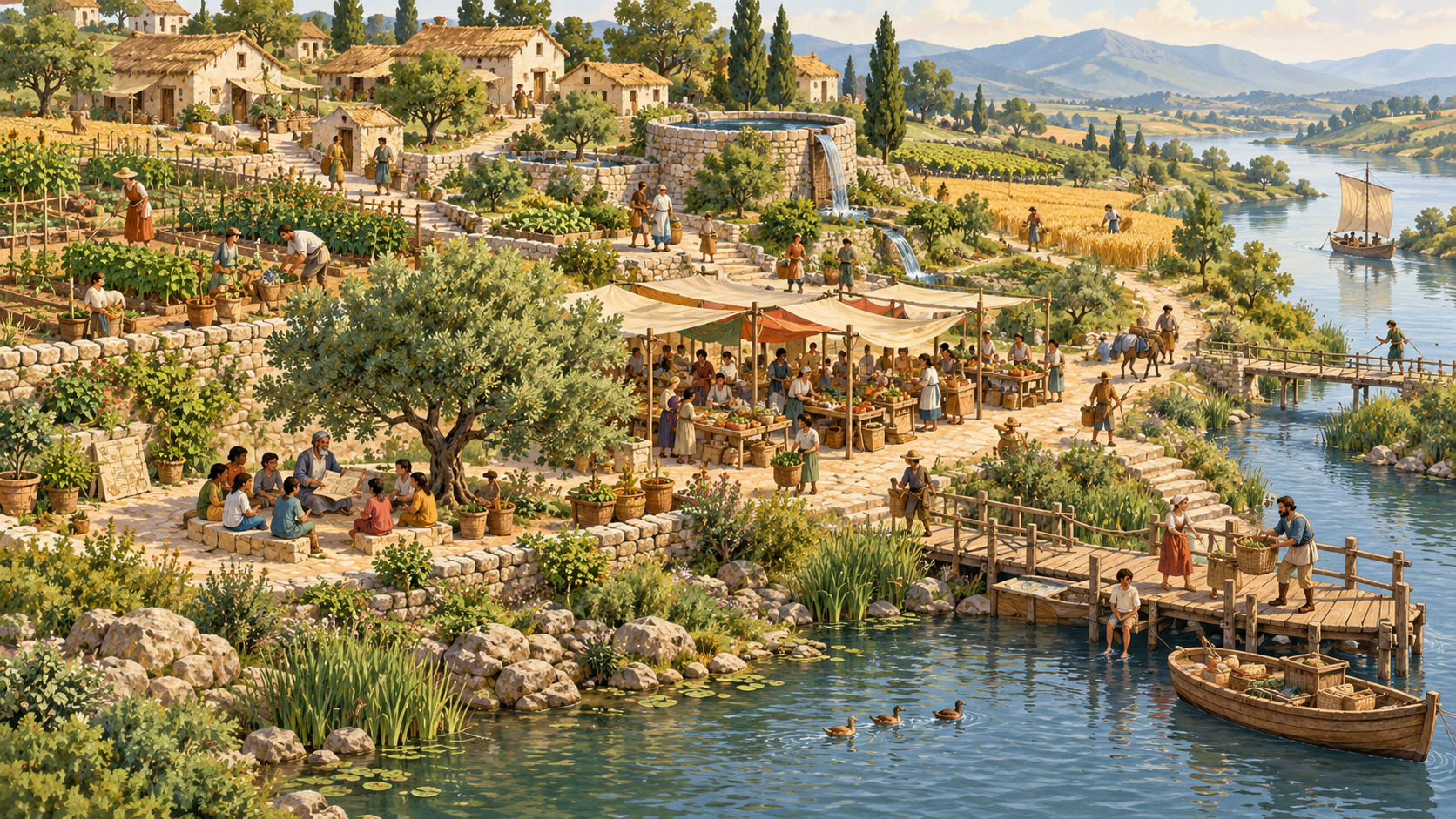
Series cover: AI-generated conceptual illustration of Riverbend, the starting community in these guides. It is not a literal depiction of every scenario, a historical reconstruction or an engineering plan.
Choose your next learning question
Follow a route into the expanded chapters, or choose a specific activity from the index.
Full chapter index
Chapters 1–8: Understand everyday life
- 1. Begin with the ordinary day that a home supports
- 2. Describe household circumstances without turning them into stereotypes
- 3. Count buildings, homes and households as different units
- 4. Define a neighbourhood through the question being asked
- 5. Describe what a local service actually provides
- 6. Name the purpose of a journey before counting trips
- 7. Make map symbols carry the information the question needs
- 8. Separate direct separation from a permitted model route
Chapters 9–16: Connect people with places
- 9. Connect a daily journey to opening periods and dependencies
- 10. Preserve missing evidence instead of inventing an empty neighbourhood
- 11. Test whether a provision is usable for the supplied cases
- 12. Treat information access as part of the neighbourhood arrangement
- 13. Follow a small change through the whole daily task
- 14. Leave a neighbourhood account another learner can use
- 15. Trace the whole path from a home card to a useful activity
- 16. Read the network rather than judging each line alone
Chapters 17–24: Make provision usable
- 17. Choose a service location through the tasks it serves
- 18. Match a route with a service window
- 19. Include the work that makes the destination useful
- 20. Preserve meaning across the formats used on the route
- 21. Fit quiet and active purposes into the neighbourhood plan
- 22. Match each access promise with the right resource category
- 23. Change the neighbourhood in stages with clear current routes
- 24. Keep access intelligible while maintenance work continues
Chapters 25–32: Review change and belonging
- 25. Provide a temporary route with its own conditions
- 26. Overlap work only when its prerequisites and resources allow it
- 27. Hand over the present neighbourhood arrangement
- 28. Check an everyday journey across all the connected accounts
- 29. Hear the neighbourhood through the journeys people describe
- 30. Include newcomers and temporary residents in the model
- 31. Maintain belonging when a location or routine changes
- 32. Test improvements by the activity they make possible
Chapters 33–40: Practise and hand over
- 33. Separate a represented experience from a neighbourhood-wide claim
- 34. Make neighbourhood explanations usable at the point of decision
- 35. Work through routes, periods and support as separate mathematical accounts
- 36. Diagnose why an everyday activity still cannot be completed
- 37. Teach neighbourhood voice and practical improvement in two sessions
- 38. Teach evidence, diagnosis and handover in two further sessions
- 39. Plan a neighbourhood activity from a complete paper brief
- 40. Revise the capstone when the return window changes
CHAPTER 1 OF 40 · Understand everyday life
1. Begin with the ordinary day that a home supports
Riverbend's Neighbourhood Desk begins with a drawing of six attractive houses. A child adds doors, windows and a bright square between them, then announces that the neighbourhood is complete. The tutor asks what happens during an ordinary fictional day. Where does a household find information, join a lesson, borrow a story card or return a shared resource? The buildings provide a starting picture, but the everyday relationships around them give the project its useful question.
All homes, households, service places and journeys in this guide belong to an invented tabletop model. Children work with paper maps, character cards and supplied records. They do not investigate actual neighbours, assess real homes or receive construction, housing-law or health advice. A paper line represents a relationship defined by the activity. It is not a statement that a real route, building or service is suitable for any particular person.
Give each learner a home-anchor card with three daily tasks. One fictional household needs to obtain an instruction sheet, attend a model learning period and return a borrowed token. Another wants a quiet activity and a usable route to the story exchange. The home is the place from which the card's day is organised, not a measure of the household's worth. Different cards can show different arrangements without ranking them as better families.
A useful opening map connects the anchor to tasks through labelled lines. The labels describe purposes, such as collect a current notice, rather than simply saying go out. Ask the child what information must be supplied before the journey can be evaluated. A location is useful, but the task may also depend on a period, a permitted path, a suitable format or another person's availability. The map should make those questions visible instead of filling them with assumptions.
Explore the example
For a worked first scenario, three fictional households each have two required task visits during one model day. That gives six task visits, not necessarily six different destinations. If two households use the same learning room and all three use the story desk, the destination count may be smaller. Supply the actual visit list before counting unique places. Repeated use is a relationship the model can show, rather than an error to remove from the arithmetic.
Parents can ask a younger child to arrange a day strip beginning and ending at a paper home. An older learner can inspect whether every supplied task has a usable connection. Keep the character circumstances invented. The aim is to help children consider varied daily lives without asking them to reveal private family routines, possessions or difficulties as evidence for a classroom plan.
Now narrow the project's purpose. The child might investigate whether the supplied households can obtain learning materials during their available periods. That is more manageable than designing the perfect neighbourhood. It allows a small model to produce a meaningful result while admitting that other aspects of life remain outside the exercise. An exclusion should name what is not examined rather than pretend it is unimportant.
The Neighbourhood Desk stores the daily-task cards beside the drawing. Later chapters will add household counts, service capacity, routes and evidence checks. Those additions remain connected to people doing things, rather than to a collection of buildings admired from above. Riverbend's learners begin by treating home as an anchor in a network of everyday activities, with a model clear enough for another child to ask whose task has not yet been made possible.
CHAPTER 2 OF 40 · Understand everyday life
2. Describe household circumstances without turning them into stereotypes
The Neighbourhood Desk receives four fictional household cards. One has a learner available only during model period two. Another includes a character who needs the supplied picture instructions. A third shares a borrowing task between two people, and a fourth wants to use a service independently. These cards help examine a design's assumptions. They do not define real categories of households or establish that everyone with a similar circumstance wants the same arrangement.
Begin by separating the person, task and condition. A character is more than a scheduling constraint. The card can describe an interest, a contribution and an ordinary preference alongside the condition relevant to the exercise. A learner who enjoys map puzzles may need a different notice format; a household that can use only one period may also help prepare story cards. This avoids presenting some characters only as problems for the planner to solve.
Use an invented case-selection activity. Supply eight cards and ask children to choose four that test different aspects of a proposed service. They should explain what each selected card adds. Choosing only the easiest cases could hide barriers. Choosing only the most difficult could give an incomplete picture of what already works. A small set cannot establish universal provision, so the selection note should identify important circumstances it does not represent.
For a worked availability set, six household cards request one collection visit each. Three can use either period one or two, two can use only period one and one only period two. If a desk offers three suitable collection places in each period, the requests can fit: assign the two period-one-only requests and one flexible request to period one, then the period-two-only request and the other two flexible requests to period two. Each period uses three places.
Explore the example
Now change one flexible card to period-one-only. There are three fixed period-one requests, one fixed period-two request and two flexible. Assign all three fixed requests to period one and the remaining three to period two. The plan still fits, but period one's flexibility has disappeared. If one more of the remaining flexible cards becomes period-one-only, four fixed requests compete for three period-one places while the total stays at six. The class can explain how a balanced total may conceal a mismatch in the distribution of needs.
Parents can enact the allocation with two mats and cards that visibly state permitted periods. The child explains each placement. Do not solve a conflict by moving a fixed card to another period without an explicit revision supplied by the scenario. That shortcut changes the household's circumstance instead of improving the proposed service. It can produce a neat timetable while leaving the original question unanswered.
Older learners can distinguish a stated preference from a requirement. A character might prefer period one but accept period two; another cannot use period two under the model. The plan should preserve that difference without dismissing preferences as meaningless. A feasible allocation can still impose different inconveniences, which may matter to a later comparison. Record both the fit and any unmet preference when the task asks for them.
End with a case explanation that names which circumstances were supplied, which choices the household actually accepts and which claims remain outside the small model. The Neighbourhood Desk now has a practical way to consider varied daily lives. Inclusion begins with attention to specific relationships, rather than guessing what an imagined type of household should want or treating a limited set of character cards as a complete account of Riverbend.
CHAPTER 3 OF 40 · Understand everyday life
3. Count buildings, homes and households as different units
A map contains ten building symbols. A learner writes ten households, then multiplies by a guessed household size to estimate service demand. The Neighbourhood Desk pauses the calculation. A building symbol does not necessarily represent one home or one household, and the exercise has supplied no universal conversion. Children now define their counting units before using a map to make claims about the people and activities it represents.
For this model, a building is one labelled structure on the paper map. A home unit is a supplied place used as a household anchor. A household is a fictional grouping defined by its case card. These definitions serve the classroom exercise and make no claim about real housing classifications. The relationships between the three must come from the dataset, rather than from the appearance of a rectangle or the familiarity of a word.
A worked inventory has four building cards. Building A contains three home units, B contains two, C contains one and D contains four. That gives ten home units across four buildings. The supplied record says that eight home units each anchor one household, one anchors two households and one is unassigned in this scenario. There are ten households: eight plus two, with none assigned to the last unit. Equal totals of ten homes and ten households happen here, but they arise through different distributions.
Ask children to reconstruct the inventory physically. Place small home counters inside four building outlines, then place household cards beside the supplied home anchors. The unassigned home remains visible. A home with two household cards does not turn into two building symbols, and an unassigned home does not establish why it is unassigned. The class has a stock description, not evidence about real vacancy, ownership or suitability.
Explore the example
Now count task requests. Six of the ten households request one learning collection, two request two collections and two request none during the stated model day. The total is ten collection requests: six plus four. Eight households request at least one collection. Ten requests and eight requesting households answer different questions. The average is one request per household across all ten, but it does not describe every household's day.
Parents can offer three misleading captions for correction: four buildings means four households, ten requests means ten different requesters and an average of one means each household made one request. The child rewrites them using the actual records. Younger learners can point to repeated household identifiers on request cards; older learners can write a unit beside every total and denominator.
A map intended only to locate buildings may not need all these counts on its face. It should nevertheless avoid a title implying that it represents every household's access if it supplies only building locations. A linked table can carry the household relationships where appropriate. The table helps only if the map identifies how to retrieve it and which model period its counts describe.
The chapter ends with a compact count statement naming buildings, home units, households, requesters and requests separately. Riverbend's learners can now use totals without letting a coincidental equality erase differences in meaning. A neighbourhood becomes more understandable when its representation can show how daily life is distributed across places, rather than treating each drawn building as an identical packet of residents and needs.
CHAPTER 4 OF 40 · Understand everyday life
4. Define a neighbourhood through the question being asked
The Neighbourhood Desk draws a border around six buildings and calls everything inside local. A fictional household just outside the border uses the same story desk as those inside, while an inside household uses a different learning room. The boundary may be useful for one purpose and incomplete for another. Learners now examine neighbourhood as a model scope chosen for a question, rather than assume the edge of a drawing captures every relevant daily relationship.
Start with two possible questions. One concerns where the supplied buildings stand, and another concerns which households rely on a particular collection desk. A compact geographic boundary may serve the first. The second may require following service connections beyond that border. Children can draw an inner area for the first question and a connected set of household cards for the second, explaining why the representations differ.
A practical exercise supplies twelve fictional households. Eight anchors lie inside the drawn area and four outside. Six inside households and three outside households use Desk M during the model day. Nine households use M altogether. Six out of eight, or 75%, of the inside households use it, while three out of four, also 75%, of the outside households do. The equal percentages do not mean the groups have the same number of users; their denominators differ.
If the planning question concerns all supplied demand at M, counting only inside users would omit three of nine, or one third. If the question concerns inside households' activities, the six is appropriate when clearly labelled. A boundary is not wrong simply because it excludes something. It becomes misleading when the report's claim extends beyond the evidence preserved within that boundary.
Explore the example
Parents can use strings connecting home cards to service desks. Ask the learner to place a loop around one geographical cluster, then trace strings crossing it. Each crossing suggests a relationship worth considering for a service question. The child should not keep expanding the boundary indefinitely. A manageable model can record an external dependency without trying to describe every possible part of the fictional civilisation.
Now introduce time. A household may use Desk M in the morning model period and Desk N in the later period. A neighbourhood service map that shows only the first period should say so. The same household can belong to more than one useful service network across its day. Children need not choose one permanent label that supposedly captures every relationship the household has.
Older learners can compare two proposals using consistent scope. Proposal A includes the collection desk and material preparation; Proposal B lists only the desk's visible session. A lower work total for B may reflect an omitted task rather than an actual saving. Ask which relationship must be added or excluded consistently before comparison. This is a tabletop accounting question, not an assessment of real municipal boundaries or services.
End with a boundary note naming the represented households, places, periods and external connections relevant to the question. Another group should be able to explain why the boundary was drawn and what it does not establish. Riverbend's neighbourhoods become useful objects of inquiry when their borders help organise evidence while leaving everyday relationships visible enough to question, rather than allowing the line around a map to decide whose needs count.
| Paper record | Question |
|---|---|
| Household card | Which activity does this role need to reach? |
| Service card | What useful provision is offered? |
| Journey card | Which connections and conditions matter? |
CHAPTER 5 OF 40 · Understand everyday life
5. Describe what a local service actually provides
A child places a large symbol labelled learning near every paper home and declares the neighbourhood well served. The Neighbourhood Desk asks what happens at that symbol. Does it distribute current instruction cards, offer a lesson, answer questions or hold materials for a later activity? These provisions are related but different. A local service needs a defined task, period, capacity and relevant condition before its position on a map can support a useful access claim.
Use service cards rather than vague building names. Desk P provides six collection places during period one. Room Q provides four supported explanation places during period two. Notice Point R displays a supplied current-version schedule but does not distribute packs. The cards show functions and limits. Children can connect each household task to the appropriate provision without assuming that every site with learning in its title can meet every learning-related request.
For a worked dataset, eight households request one current pack each. Desk P holds ten current packs but offers six collection places in the available period. Under the model's one-place-per-collection rule, only six collections fit during that period. Stock exceeds requests, yet session capacity remains limiting. The two unmet collections are not solved by counting the ten packs again. A suitable additional period or an explicitly supported alternative method would be needed.
Now supply an extra period with two collection places, and state that the two remaining household cards can use it. All eight requests can then be served, using eight packs and leaving two. The full arrangement has ten packs, eight collection places across two periods and eight completed model collections if the supplied outcome record confirms them. Preparing the places is not itself evidence that every collection occurred.
Explore the example
Parents can place pack counters in one tray and collection-place counters on period mats. The learner must pair one of each with a request. This reveals two distinct resource constraints. Ask what changes if the extra period exists but the two households cannot use it. The aggregate total still fits, while usable access does not. The child's explanation should refer to the supplied household cards, not blame the households for a plan that fails their stated conditions.
A service description can also identify a route for questions. A notice tells a character where to collect, while another role explains an unclear instruction. If the project provides no answer role, the child should record that limitation rather than invent help. The label information available does not establish that a particular reader can understand or use the information under every circumstance.
Older learners can examine a minimum provision and an aspiration. We hope everyone can obtain a suitable pack expresses a direction. We supply these two periods and will check these eight requests describes a concrete commitment. A service plan can preserve the aspiration while testing the narrower arrangement honestly. It should not report universal access from eight invented cases.
Finish with a service specification another group can read: task, unit, model period, capacity, stock if relevant, request rule and unresolved condition. The Neighbourhood Desk now has something more informative than a symbol near a home. Children can trace whether a supplied everyday task connects with an actual provision, keeping availability, suitability and observed use separate enough for the next question to identify what still needs improvement.
CHAPTER 6 OF 40 · Understand everyday life
6. Name the purpose of a journey before counting trips
Riverbend's household cards show several journeys between paper stations. A learner counts every line on the map as one trip and compares households by their totals. The Neighbourhood Desk asks what counts as a trip and what each movement is for. A chain of tasks, a return to the home anchor and an optional visit can produce different counts under different conventions. Learners need a definition suited to the question before interpreting fewer as automatically better.
For this chapter, one journey leg means movement from one named station to the next along a permitted model connection. A home-to-desk-to-home sequence contains two legs. One task visit means arriving at a place to undertake a named activity. The same sequence contains one collection visit if collecting is the only task. These conventions are invented for the exercise and should remain attached to its records.
A worked day card has Home to Notice Point, Notice Point to Collection Desk, Collection Desk to Story Room and Story Room to Home. It contains four legs and three task visits, provided each non-home stop serves a supplied task. A second card goes Home to Collection Desk to Home, then Home to Story Room to Home. It also has four legs but only two task visits. Equal movement counts do not establish equal purposes or total distance.
Now supply lengths for the first chain: twenty, thirty, forty and fifty model distance units. The total is 140. The second day's four legs are sixty, sixty, thirty and thirty, totalling 180. The chain has forty fewer distance units in these supplied routes, but it may include a notice visit the second day did not require. The class should not conclude that chaining caused a forty-unit saving for identical tasks until it aligns the task lists and conditions.
Explore the example
For an aligned comparison, supply two required destinations with Home-to-A distance forty, Home-to-B thirty and A-to-B twenty under the permitted route values. Separate out-and-back visits total eighty plus sixty, or 140. The chain Home to A to B to Home totals forty plus twenty plus thirty, or ninety. It uses fifty fewer model distance units. The supplied connections are usable in the stated directions, with no timing restriction in this simplified comparison. That last assumption matters when later chapters add schedules.
Parents can ask a child to place task tokens at each stop and trace the movement with string. If the child combines visits, ask whether both tasks can actually occur during the same model period. A convenient line on a map does not keep a service open or change a character's availability. The arithmetic can establish a conditional distance difference without establishing a feasible daily plan.
Older learners can distinguish an unwanted extra journey from a valued activity. A fictional character may enjoy a supplied optional story visit. Its added leg is not automatically a burden the planner should eliminate. The project should ask which purpose is being evaluated: reducing required collection distance, preserving choice or comparing complete days. A single count cannot settle all three.
End with a journey record containing purpose, stops, leg convention, distances and relevant period. Another learner should be able to reproduce both the movement count and its meaning. Riverbend's daily journeys become easier to discuss when children can explain what each line is for, rather than treating every additional trip as failure or every short sequence as evidence that the household's tasks have been met.
CHAPTER 7 OF 40 · Understand everyday life
7. Make map symbols carry the information the question needs
The Neighbourhood Desk uses the same circle for a home anchor, a collection desk and a proposed story room. The maker remembers which is which, but a newcomer cannot. A map symbol is a reading agreement, not an explanation that travels automatically with its shape. Learners now build a key that helps another child distinguish location, function and status without requiring private hints from the author.
Begin with four categories: home anchor, operating service, proposed service and information point. Give each a distinct mark and a plain label in the key. The category does not carry every detail. An operating-service mark establishes the supplied status, not its opening period, capacity or suitability for a particular task. Those facts can appear beside the symbol or in a linked card, as long as the reader can find them.
A practical decoding task provides twelve labelled places. A child draws the marks according to the key, and a partner reconstructs the categories. If nine are decoded as intended, two are confused with proposals and one cannot be decoded, intended decoding is nine out of twelve, or 75%. The percentage describes this exercise, not every future reader. Inspecting the three difficulties can reveal a missing key entry, a copied mark that lost its distinction or wording that needs explanation.
Parents can test a copy that preserves shapes but removes colours. If the original key relies only on a subtle colour difference, the copy may no longer support the same distinctions. A child can add words or line patterns and explain which problem the change addresses. The lesson does not announce universal accessibility from one copied-sheet check. It demonstrates a specific failure mode and a bounded revision.
Explore the example
Now distinguish symbol size from quantity. A large home circle might mean the main case being studied, rather than more residents. If area does not encode household count, the key should prevent readers from assuming it does. Conversely, if a separate chart uses one small counter per household, that counting relationship should be explicit. Children should not measure a decorative roof and infer capacity the dataset never supplied.
For older learners, introduce two map layers. The first locates service points; the second marks their model periods. A service identifier links the layers. Desk P at the same coordinate on both sheets does not become two desks. One linked row can show P available in period one and unavailable in period two. Ask the learner to trace a household's task through both sheets and name any missing connection.
A map should also identify its represented period and purpose. A proposal symbol from an older plan should not silently become an operating-service mark on a new copy. If the dataset supplies no opening confirmation, the correct state remains proposed or unresolved. A neat revision cannot substitute for evidence that the model arrangement changed.
Finish with a newcomer test asking for one home anchor, one current service and one proposal. Record questions before answering them. The Neighbourhood Desk can improve its map by observing where the key fails its reader. Riverbend's learners now have a representation that carries shared conventions openly, making it easier to use the drawing for daily-life questions while preserving the limits of what any particular mark actually establishes.
CHAPTER 8 OF 40 · Understand everyday life
8. Separate direct separation from a permitted model route
The Neighbourhood Desk places a home anchor at grid point (1,1) and a collection desk at (5,4). A child draws a diagonal and calls it the route. The supplied game permits movement only along listed horizontal and vertical connections. The diagonal can represent direct separation between points without establishing a usable connection. Learners now keep geometry, route permission and task suitability as distinct parts of a paper access question.
The coordinate convention gives horizontal position first and vertical second. The two points differ by four grid units horizontally and three vertically. A listed path goes four units across and then three up, giving seven grid units. With twenty model distance units per grid unit, its length is 140 model distance units. An alternative three-up-then-four-across route also has length seven if all its required segments are listed as permitted.
For learners ready for the mathematical relationship, the activity supplies the right-triangle calculation: four squared plus three squared equals twenty-five, giving a direct separation of five grid units. That is 100 model distance units under the same scale. Younger children can compare prepared five-unit and seven-unit strips without deriving the diagonal formula. The supplied direct separation does not authorise movement along it under the game's route rule.
The permitted seven-unit route is two units longer than the five-unit direct separation. Relative to the direct separation, that is 40% longer. Relative to the permitted route, the two-unit difference is about 28.6% of its length. The denominator belongs in the explanation. A report should not switch between these percentages as though they were competing answers to an identical question.
Explore the example
Now remove one required segment from the across-then-up route during model period two. The endpoints remain at the same coordinates, so direct separation does not change. The candidate route's availability changes. If the up-then-across segments remain permitted, that option may still connect the points under the supplied rules. The class should inspect the route list rather than infer availability from a continuous-looking line drawn before the change.
For a separate route-list exercise with different endpoints and no supplied coordinate relationship, parents can offer three candidate routes with lengths ninety, 110 and 120 model units. The ninety-unit candidate includes an unconfirmed connection. The 110-unit and 120-unit candidates are confirmed for the period. Among these confirmed candidates, 110 is the shorter by ten units. It is not necessarily the shortest imaginable route in an unexamined network. A child can write the bounded conclusion while preserving the unconfirmed candidate as a question for another source card.
Older learners can distinguish distance from time. The exercise supplies no speed rule, waiting interval or service schedule in this chapter. A route of 110 distance units therefore has no established duration merely because its distance is known. If a later activity assigns one time unit per ten distance units, that creates a new model relationship which must be stated before calculating eleven time units. It is not a claim about real walking or travelling.
End with a route caption naming endpoints, model period, permitted segments, length unit and unresolved conditions. The Neighbourhood Desk can now use distance without allowing it to settle every aspect of access. Riverbend's learners have a precise way to say a place is close in one geometric sense while its permitted task journey remains longer, unavailable or not yet established under the paper rules.
CHAPTER 9 OF 40 · Connect people with places
9. Connect a daily journey to opening periods and dependencies
A paper route reaches the story desk, but the household counter arrives after the desk's supplied closing boundary. The map connection remains valid while the daily task fails under the schedule. The Neighbourhood Desk now combines location with timing. Children will work entirely with numbered model marks and supplied movement intervals, rather than estimate real travel or apply the exercise to an actual neighbourhood journey.
Use a fresh day card. A household begins at its home anchor at mark zero. Movement to Collection Desk A takes two intervals. Collecting the pack takes one, and movement from A to Story Desk B takes three. B accepts arrivals from mark five through mark seven inclusive, and the story task takes one interval. The counter reaches A at two, finishes collection at three and reaches B at six. Its arrival falls within the supplied acceptance window.
After the one-interval story task, it is at mark seven. A permitted return connection to home takes two intervals, so the complete chain ends at nine. The sequence includes seven movement intervals and two task intervals, totalling nine. These are invented time quantities. The distance of any connection remains unknown unless a separate record supplies it; the class should not treat time intervals as distance units.
Now introduce a one-interval waiting requirement before collection at A. The counter arrives at two, waits until three, collects until four and reaches B at seven. Arrival at seven is accepted under the inclusive window, and the story task finishes at eight before the return ends at ten. The plan still meets the arrival condition, though its full duration increases by one. If the condition instead required completion at B by seven, this revised plan would not meet it. The meaning of the window matters.
Explore the example
Parents can use task and movement strips of different shapes. The child places them in order and identifies when a predecessor supplies what the next task needs. In this scenario B requires the collected pack, so the character cannot simply visit B first to fit the window unless the model supplies a revised dependency. A schedule can be improved through a changed order only when that order preserves the relevant task relationships.
For a separate option, a current pack is explicitly available at the home anchor before mark zero. The collection visit is no longer required for this day's task. If the supplied home-to-B movement takes five intervals, the counter can arrive at five, complete the story task at six and return through the two-interval connection by eight. This option has different starting resources. The class should not compare its shorter day with the original while hiding the pre-positioned pack and any preparation work needed to supply it.
Older learners can write a latest-start calculation. Under the original two-plus-one-plus-three chain, B arrival occurs six intervals after leaving home. To arrive by seven, the latest departure is mark one. Under the added-wait chain, arrival takes seven, so the latest departure is zero. These results depend on unchanged opening conditions and no other delays in the model. They should be reported as conditional boundaries, not real travel promises.
The day record ends with departure, arrival, task completion and return as separate events. Another learner can trace each from the supplied intervals. Riverbend's everyday access questions become more informative when the class connects routes with openings and dependencies, recognising that a drawn connection is only one part of a household's usable day.
CHAPTER 10 OF 40 · Connect people with places
10. Preserve missing evidence instead of inventing an empty neighbourhood
The Neighbourhood Desk's map contains a blank corner. One child describes it as a place where nobody lives; another allocates it to a new paper service. The supplied source cards simply do not describe the corner. Missing representation does not establish absence, availability or permission. Learners now examine which conclusions a limited record can support, while leaving room to ask for more information within the fictional model.
Begin with three label cards: outside this map's purpose, checked and not present under the supplied method, and not established. A building-location map may deliberately omit informal activity stations. A defined model check might establish that no current collection desk appears among the supplied places. An unexamined corner has neither finding. The same white space should not be made to carry all three meanings without explanation.
A worked record set concerns sixteen fictional households invited to identify their preferred collection period. Twelve response cards are supplied: seven prefer period one, three prefer period two and two state no preference. Four have no response record. Seven out of twelve, about 58.3%, of the responding cards prefer period one. Seven out of sixteen, or 43.75%, of all invited households have a recorded period-one preference. The denominators answer different questions.
If none of the four missing responses preferred period one, the full-group count would remain seven. If all four did, it would become eleven out of sixteen, or 68.75%. These are hypothetical limits under the supplied possibilities, not observed preferences. The class should not distribute the missing four according to the known cards unless it explicitly introduces a modelling assumption and keeps that scenario separate from the record.
Explore the example
Parents can put four household cards inside closed envelopes. Ask the child which statements remain true whatever the eventual answers. Seven recorded preferences for period one remains true. Most of all sixteen prefer period one is not established, because seven is less than half and eleven is more than half. A majority among responding cards does not automatically become a majority among every invited household.
Missingness also concerns event details. A visit ledger gives arrival at mark five but no departure. It cannot establish visit duration. A map gives a service name but no opening record. It cannot establish operation in the current model period. Learners can add specific questions beside the missing fields, rather than fill them with the value that makes the plan easiest to complete.
Older children can prioritise one additional source. If the decision concerns which collection period to offer, recovering response records may matter more than adding decorative building details. If the question concerns a permitted connection, a route-condition card may be more useful than more preference cards. The next piece of evidence should be chosen because it could change a relevant conclusion, not because a larger folder looks more authoritative.
Finish with an evidence-boundary note on the map and response table. It names what was supplied, what was deliberately omitted and what remains unresolved. The Neighbourhood Desk has not failed by preserving an information gap. It has made the gap usable, allowing another learner to identify which question requires a source rather than inheriting an attractive drawing whose empty spaces have silently become false facts about the fictional residents.
CHAPTER 11 OF 40 · Connect people with places
11. Test whether a provision is usable for the supplied cases
The Neighbourhood Desk adds a new information point beside a paper home cluster. The organiser expects access to improve because the symbol is closer. One fictional card cannot interpret the point's only instruction, while another can read it but cannot attend the listed collection period. The location may contribute something useful, yet practical use depends on a sequence of relationships. Children now test specific cases without claiming to represent every possible household.
Prepare six invented case cards. Two need the supplied picture instruction, two use the plain-text instruction and two can use either. All require the same current pack, but their available periods differ according to separate labels. Avoid treating format and timing as automatically linked. A character who uses pictures need not have the same schedule as another picture user. The class should inspect the actual combinations supplied on each card.
For a worked format check, a point provides only plain-text instructions. Four of the six cards can use that form: the two text users and the two flexible users. Two cannot use the supplied instructions as specified. Adding a suitable picture version explicitly provided by the exercise makes the instructions usable for all six on this measure. It does not establish that all six can complete the whole collection journey.
Now add timing. The desk offers three places in period one and three in period two. Four cards require period one, one requires period two and one is flexible. Even with both instruction forms available, four fixed period-one requests exceed three places by one. The flexible card can use period two with the one fixed there, leaving an unused place in period two. The improved information provision has not resolved the scheduling mismatch.
Explore the example
Parents can use a two-stage test. First, the child pairs each case with a suitable information card. Second, the child places it in a permitted period. A counter may pass stage one and remain unresolved at stage two. This prevents all-or-nothing reporting. The picture version can be a genuine improvement even though one request still lacks a suitable collection place.
The adult can supply an alternative for the remaining card: a model delivery of the current pack to its home anchor, with appropriate information and a stated work cost of two tokens. If the project has those tokens explicitly available and the character accepts the alternative, that route may serve the sixth request. The report should distinguish five desk collections from one home-anchor provision. Calling all six desk users would erase how the alternative actually works.
Older learners can inspect a claim of universal accessibility. Six successful supplied cases demonstrate something about six defined journeys under stated conditions. They do not establish suitability for every real person or every future model case. The class can name an unrepresented circumstance and propose a further fictional test without inventing a person's experience. Inclusion remains a continuing inquiry, rather than a badge awarded once a short checklist has been completed.
End with a case table showing information fit, period fit, confirmed alternative and unresolved condition. Another group checks one row against its source cards. Riverbend's learners can now describe an improvement with enough precision to retain both its value and its limits. Everyday access becomes more understandable when the class sees which part of the journey works and which part still needs a genuine provision rather than a reassuring label.
CHAPTER 12 OF 40 · Connect people with places
12. Treat information access as part of the neighbourhood arrangement
A fictional collection desk has spare packs, suitable periods and a permitted paper route. Several household cards never request it because the supplied notice did not reach them. The Neighbourhood Desk now examines information as part of access. A service can be available under its model conditions while some intended users lack the information needed to identify it, request it or distinguish its current version.
Draw an information journey with four stages: encounter a notice, identify the relevant task, recover the current arrangement and know how to ask a question. The stages should not be treated as automatic consequences of the first. A character may see a notice without understanding which period applies. Another may understand it but hold an earlier version. The class can inspect each relationship through supplied message and response cards.
A worked reach set contains twenty unique household identifiers. Eleven encounter a paper board notice and nine encounter a direct card. Five encounter both. Unique reach through these two channels is eleven plus nine minus five, or fifteen. Six encounter only the board, four only the direct card and five both. Five households have no recorded encounter through either supplied channel. The ledger does not establish what happened through unrecorded conversations.
Now supply a current-arrangement check for twelve of the fifteen reached households. Nine identify the applicable period, two choose the earlier period and one cannot choose. Nine out of twelve, or 75%, meet the check criterion among those checked. Nine out of twenty, or 45%, have a recorded successful check across the full group. The three reached but unchecked households and five without recorded reach have no check result in this dataset.
Explore the example
Parents can place small information markers beside household cards instead of merging them with collection counters. Receiving a notice is not the same event as collecting a pack. A learner should be able to say which households have confirmed information, which have an observed misunderstanding and which remain unknown. The class can then choose a next action directed at the actual gap rather than send another generic message to everyone by habit.
A bounded correction example supplies a change notice for the two cards selecting the earlier period. The model provides the new text and a read-back task. Preparing and issuing the correction does not itself prove the characters understand it. The result belongs in a later record. This distinction helps children connect clear communication with evidence rather than treat a message sent as a completed access outcome.
Older learners can inspect information locations. A notice inside the collection desk may be useful after arrival but fail to help a household decide whether to make the journey. A map could point to the notice yet omit the question route. The child can propose another supplied display point or a linked instruction card, stating which stage it is intended to support. A longer notice is not automatically the answer to a missing opportunity to encounter it.
Finish with an information-access caption identifying audience, channels, model version, check results and unresolved group. The Neighbourhood Desk now has a reason to place communication alongside maps and capacity. Riverbend's everyday systems become more usable when people can recover the relevant arrangement before committing to a journey, and when the records preserve the difference between information that exists somewhere and information that these supplied households can actually use.
| Unit | What a count can describe |
|---|---|
| Visits | Recorded occasions of participation |
| Households | Distinct supplied household identifiers |
| Journeys | Trips with a defined origin, purpose and destination |
| Demonstrations | Observed performance under stated support conditions |
Extend this learning question through How Education Works.
CHAPTER 13 OF 40 · Connect people with places
13. Follow a small change through the whole daily task
The Neighbourhood Desk proposes moving a paper collection point closer to four home anchors. The new map looks convenient, but the supplied change also shortens its opening period and moves the question desk farther away. Children now trace a change through the whole task instead of judging it through one improved number. The activity remains a comparison of invented routes and periods, not advice about actual service locations.
Use a fresh four-household dataset with one collection request each. Original permitted out-and-back distances are eighty, 100, 120 and 100 model units, totalling 400. The proposed point gives sixty, eighty, ninety and seventy, totalling 300. The reduction is 100 units, or 25% relative to the original total. Average collection distance falls from 100 to seventy-five model units per request in this supplied set.
Now add a stated instruction issue. Two households require a visit to a separate question desk before collecting at the proposed point. Each additional permitted detour adds forty model distance units beyond its already counted route. Total model distance becomes 300 plus eighty, or 380. The reduction against 400 is now twenty, or 5%. The revised comparison counts an additional task relationship; it does not show that the original 300 was arithmetically wrong for collection-only distance.
Parents can place a question token on the two affected cards and add the detour strip visibly. Ask the child to name which boundary each total uses. A proposal can still have value after the broader account reduces its apparent saving. Equally, the remaining distance reduction does not settle whether the new arrangement meets timing and format conditions. The class should preserve separate findings rather than collapse them into one overall score.
Explore the example
The supplied original point offers four suitable collection places during the required period. The proposed point offers three. All four household cards require that period under this scenario. One request therefore remains unmet unless another provision is supplied. A nearer symbol does not create the missing place. The child can propose a suitable extra period, an alternative provision or a revised allocation, but it should not silently alter the household's fixed requirement.
For a bounded alternative, the exercise supplies a current instruction sheet at the home anchors of the two question-desk users. They no longer need the stated detours, restoring the proposed collection-distance total to 300. Preparing the two sheets uses three work tokens each, or six. If the project has five uncommitted tokens, this preparation exceeds the allowance by one. Distance and work are separate units; the 100-unit route saving cannot be subtracted from a one-token work gap.
Older learners can write a conditional recommendation naming the specific unresolved issue. The proposed point reduces supplied collection distances but needs a confirmed solution for the fourth request and the instruction-sheet work if that version is chosen. Another valid recommendation may retain the original arrangement while investigating those conditions. A completed classroom project need not adopt its first redesign to count as useful learning.
End with a change note that identifies the original arrangement, proposed arrangement, included tasks and evidence still needed. Riverbend's learners have practised following a local improvement into the relationships around it. A neighbourhood plan becomes more credible when it can explain both the benefit it demonstrates and the burden or unmet condition that an attractive map alone made easy to overlook.
CHAPTER 14 OF 40 · Connect people with places
14. Leave a neighbourhood account another learner can use
The Neighbourhood Desk's first team prepares a handover folder. It contains home-anchor cards, household circumstances, service specifications, maps, journey records and an information check. The folder should not present these as one giant inventory with permanent quantities. Each scenario has its own identifiers, purpose and model period. A successor needs to know which records belong together before combining their numbers or making a new promise.
Begin with a fresh handover brief concerning eight fictional households and one current-pack collection task per household. Five can use either of two periods, two require period one and one requires period two. The desk offers four places in each period and holds ten current packs. Assign the two fixed period-one requests and two flexible to period one, then the fixed period-two request and the other three flexible to period two. Eight collections fit under the supplied conditions, using eight packs and leaving two.
This is a plan, not an observed outcome. The packet should state what evidence would confirm completion. A collection ledger may record pack issue, while a separate task check may examine whether the supplied instructions became usable. The successor should not mark both complete because the allocation fits. Stock, scheduled places, issued packs and demonstrated understanding remain different quantities linked through events the model must actually supply.
The handover team has sixteen work tokens. Checking household-task links uses four, checking service periods three, tracing permitted routes four and testing the information reference three. The total is fourteen, leaving two. An additional display improvement costs three, exceeding the remaining allowance by one. A child can keep it as a later proposal without deleting an essential check and still claiming the same complete handover.
Explore the example
Now the scenario supplies an efficient combined check: service periods and the information reference can be reviewed together for five tokens instead of six, with both required outputs preserved under an explicit review card. The revised base becomes thirteen. The three-token display improvement then brings the plan to sixteen exactly. The saving depends on that supplied suitability condition. Simply renaming two tasks a combined task would not establish reduced work.
Parents can run a newcomer test with four questions. Which household card fixes a collection period? Which map marks a proposed rather than current service? Which journey total includes a question-desk detour? Which information group has no recorded check result? The child should locate the relevant scenario rather than borrow a convenient answer from another chapter's dataset. Questions from the newcomer reveal missing links that the maker's familiarity may conceal.
Older learners can write a short statement of supported provision and unresolved limits. It can say that this eight-household plan fits its supplied stock and periods, while actual collection outcomes have not yet been supplied and other household circumstances remain untested. A modest conclusion can still be useful. The point is to give the successor a clear starting position, rather than persuade them that every ordinary-life need has been solved by the folder.
The closing note invites revision through evidence: identify the task, name the scenario, inspect the condition and record the accepted change. Riverbend's opening neighbourhood enquiry has connected homes with the everyday systems around them. Children can now examine buildings, households, services, journeys and information as related but distinct parts of daily access. Their handover succeeds when another learner can continue the work, including seeing whose task remains unresolved and which next question would make the model more useful.
CHAPTER 15 OF 40 · Connect people with places
15. Trace the whole path from a home card to a useful activity
Riverbend's Neighbourhood Desk begins with a paper home card, a reading corner and a line between them. A learner announces that the home has access because the line exists. Another asks whether the line reaches the reading entrance, whether the activity is open during the role's available period and whether its instruction format can be used. Children investigate access as a complete relationship between a fictional starting point and a useful activity. They are not mapping their actual homes or evaluating real buildings.
The tutor supplies a tabletop path model. Home A connects to Junction M by a path costing three movement tokens. M connects to the Reading Desk by a path costing four. Under the rule that costs add along a route, the journey requires seven tokens. These are invented movement costs. They are neither real distances nor a prediction of anyone's travel time. The learner should keep the unit attached when comparing routes or explaining what the number means.
Add a second route from Home A to Garden Mark at a cost of two tokens, then from Garden Mark to the Reading Desk at six. This alternative costs eight. The first route has a smaller token cost by one. That comparison supports a narrow statement about the model's assigned costs. It does not establish that the first route is preferable for every role, because other supplied conditions may differ. A path with the lower number might have a format or availability condition that a particular role cannot use.
Give one fictional role a card allowing only paths marked with a continuous blue border. The A–M link has that mark, but M–Reading does not. The seven-token route is therefore not supported for that role under the present rule. The eight-token route has the mark on both links and can be used. The border is a classroom convention, not a substitute for investigating real accessibility. The class should explain the supplied relationship without assigning a real-world meaning to the colour.
Explore the example
A parent can ask the child to place a finger at the home card and trace every step to the activity. At each link, the learner names the required token cost and checks any role condition. Reaching the destination symbol is not the end of the inquiry. The destination card must also describe an available activity, an entry instruction and a place for questions. A complete trace can reveal a broken relationship that a neat map alone conceals.
Ask for two reports. One describes the lowest-cost route under the cost-only question. The other describes the route available to the specified role. Both can be correct while naming different paths. This teaches children to state the comparison question before labelling a route shortest, easiest or best. In this model, lowest assigned token cost is a precise description; broad adjectives may claim more than the supplied evidence supports.
Finish with a route note containing starting card, destination, links used, total movement cost and conditions. Another learner should be able to reconstruct the same journey from the note. The Neighbourhood Desk is learning to see everyday access through connected steps, preserving the difference between a line drawn near a home and an activity that a particular fictional resident can actually reach and use under stated conditions.
Introduce a route card whose final link reaches a service sign but not the entrance identified by the activity instructions. Ask the learner which relationship is missing. A destination name written nearby does not supply the omitted connection. The class can mark the gap and request a defined link, preserving the difference between recognising the right place and establishing a complete supported route into its activity.
CHAPTER 16 OF 40 · Connect people with places
16. Read the network rather than judging each line alone
A neighbourhood map is a network of connected places. An individual path may look useful while connecting to a junction with no onward route for the desired task. Riverbend's paper map now includes a Home Cluster, a Central Mark, an Activity Desk and a Return Station. Children examine complete routes and the relationships between them. No paper line establishes the existence or suitability of an actual road, path or public service.
The supplied links are Home Cluster to Central Mark at four movement tokens, Central Mark to Activity Desk at three, and Activity Desk to Return Station at two. A separate Home Cluster to Return Station link costs five. The role's task is to visit the Activity Desk before depositing a response at the Return Station. Taking the first three links costs nine tokens. Going directly to the Return Station for five would not complete the required task, because it omits the activity visit.
Now supply a link from Return Station to Activity Desk costing six. A route from Home Cluster to Return Station, then Activity Desk, then back to Return Station costs five plus six plus two, or thirteen, provided the model explicitly permits those directions. The nine-token route remains less costly for the stated sequence. Merely choosing the cheapest first link does not guarantee the lowest complete journey. Children should evaluate the whole task rather than optimise the first visible step in isolation.
Direction matters when the model makes it matter. Draw arrows on the links and state which can be used both ways. A link labelled Activity Desk to Return Station does not automatically establish a return link at the same cost. If the class wants a two-way rule, the tutor can supply it explicitly. This is a lesson about interpreting a representation, not a claim that real paths generally operate in one direction.
Explore the example
A tutor can provide two maps that look almost identical but differ in one arrow. Ask the learner to trace the same task on both. If one journey becomes unsupported, name the missing direction rather than assume that the map must contain whatever connection would make the task convenient. The child can propose an additional link, but it remains a proposal until the exercise provides its cost and conditions.
The network can also have a shared point. Several routes may pass through Central Mark even though their starting homes differ. That fact might make the mark useful for a fictional information card. It does not prove that everyone passes there, that the mark has unlimited capacity or that a new service belongs there. The class can count the supplied routes and ask which additional information would be needed for a location decision.
For a parent activity, give children string links and place cards, then remove one link. Ask which particular task routes change and which remain available. A network change should be traced through actual connections rather than described as affecting the whole neighbourhood equally. The resulting record can name a retained route, a higher-cost alternative and an unresolved journey, helping learners reason about a neighbourhood as an arrangement of relationships rather than a collection of independent attractive locations.
CHAPTER 17 OF 40 · Make provision usable
17. Choose a service location through the tasks it serves
Riverbend's Neighbourhood Desk wants to place a fictional story-card exchange at one of two paper locations. One lies close to several home cards, while the other lies beside an activity already attended by prepared roles. Children compare locations using the supplied tasks and units. They do not recommend where to place a real service or claim that an invented map establishes what actual residents need.
Three home clusters contain four, three and two fictional role cards. The tutor assigns movement costs from each cluster to Site A of two, five and seven tokens per one-way journey. If every role makes one such journey, the total is four times two plus three times five plus two times seven, or thirty-seven movement tokens. Site B costs four, three and five per role, giving sixteen plus nine plus ten, or thirty-five. B has the smaller supplied aggregate by two tokens.
The total does not mean every role benefits from B. The four roles in the first cluster face four tokens each instead of two, an increase of two each. The other clusters face lower costs. A parent can ask the learner to write the change for each cluster before discussing the aggregate. An average or total can help compare a model while hiding the distribution that matters to a particular role.
The class may calculate mean one-way cost: thirty-seven divided by nine is approximately 4.11 tokens at A, while thirty-five divided by nine is approximately 3.89 at B. These are averages across the supplied nine roles, not a claim that any particular person takes that exact journey. The two-token difference in totals becomes approximately 0.22 per role when rounded to two decimal places. The rounding should not create a more confident judgement than the invented inputs warrant.
Explore the example
Now introduce a combined-task condition. The three roles in the second cluster already visit Site A for the supplied craft activity and can exchange story cards during that same stop without another movement cost. Under this changed task definition, their additional movement cost for the exchange at A becomes zero. The incremental exchange total at A is then eight plus zero plus fourteen, or twenty-two. This figure answers a different question from the original thirty-seven-token standalone journey total.
Do not compare twenty-two at A with thirty-five at B without stating whether B's figure also represents additional movement for the same planned activity pattern. The tutor can supply that the other journeys remain unchanged and that no combined stop is available at B. Under those explicit conditions, the incremental comparison is meaningful. Children should preserve the condition beside the calculation, so a later reader does not mistake a changed boundary for an arithmetic correction.
For a tutor exercise, ask the child to prepare a location recommendation with one aggregate result, one role-specific consequence and one limitation. Different recommendations may be reasonable if they make priorities clear. The location decision is not settled by whichever site wins a single number. A useful account connects movement, timing, activity combinations and who benefits, giving the fictional neighbourhood a reviewable reason for the placement rather than a claim that closeness alone determines everyday access.
Location comparisons should also identify how many visits are assumed. If every role makes two unchanged standalone journeys, both original totals double to seventy-four and seventy. The difference becomes four rather than two. This is a changed quantity of use, not evidence that the second location has become better for each role. The distribution and any combined-stop assumptions still need their own explanation.
A role can have a valid paper route and still reach an activity outside its available period. Riverbend's Neighbourhood Desk adds a clock to the map. Movement time in this chapter is explicitly supplied in model minutes, unlike the movement-token costs in earlier cases. Children should not convert between those units unless the tutor provides a rule. The scenario is a tabletop timing exercise, not a journey plan for an actual child.
The fictional Reading Booth is available from model minute ten until minute thirty. A complete activity takes eight continuous minutes and must finish by the closing boundary at minute thirty, with completion exactly at thirty permitted. A role leaving Home B at minute twelve takes six minutes to arrive, reaching the booth at eighteen. The activity can run from eighteen to twenty-six and fits the window. The role's entire outward journey and activity take fourteen elapsed minutes, ending at twenty-six.
The latest activity start under these conditions is minute twenty-two, because eight minutes then end at thirty. With a six-minute outward journey, the latest departure is sixteen, assuming no additional entry task or gap. A departure at seventeen leads to arrival at twenty-three and completion at thirty-one, missing the close by one. The class should name the required result at the boundary: completed activity, not arrival alone.
Now add a two-minute entry explanation before the activity. The complete booth sequence becomes ten minutes. Latest arrival is twenty and latest departure fourteen. A role still leaving at sixteen arrives at twenty-two and finishes at thirty-two, missing the close by two. The activity's own eight-minute duration has not changed. The supporting explanation has changed what must fit inside the service window.
Explore the example
A parent can use three paper strips for movement, explanation and activity. Place them against a fixed closing mark and work backwards. Then introduce the role's available departure interval, supplied as thirteen through fifteen. Under the revised ten-minute booth sequence, departures at thirteen or fourteen fit, while fifteen does not. A broad statement that the role is free before closing is insufficient; its available start needs to connect with every required interval.
Different windows may support different tasks. A return station open until thirty-four could receive a response after the booth activity, but only if the journey from booth to station and the deposit duration fit. If that link takes three minutes and deposit one, an activity ending at thirty can complete the return by thirty-four. The margin is zero under these assumptions. An extra two-minute step would require a changed plan rather than being absorbed by an unnamed gap.
For a diagnostic, give the learner a schedule that records departure, arrival and activity start but omits the end. Ask what claim cannot yet be checked. The opening window alone does not establish completion. A useful access record includes the full required sequence and any relevant return task, allowing another organiser to inspect whether the promised activity is genuinely usable within the role's supplied periods.
A visit record can show a feasible calculation without establishing an appointment. If the paper model requires a confirmed activity place, the organiser must identify that confirmation separately. An open window means the service permits activity during that interval; it does not automatically promise every requester a simultaneous place. The child can add a place-status field without inventing a queue or assuming an unstated service order.
CHAPTER 19 OF 40 · Make provision usable
19. Include the work that makes the destination useful
A paper neighbourhood service can look convenient because the activity table is close to a home cluster. The display omits the fictional work of preparing story packets, checking the current guide and answering recorded questions. Riverbend's learners examine that supporting work. The aim is not to burden every small activity with elaborate administration. It is to make the tasks necessary for the defined service visible enough to provide them.
The story-packet station offers ten prepared packets per round. Preparing each takes two work tokens and checking each takes one. The packet work therefore totals thirty tokens. Updating the shared instruction card takes four more, and reviewing the question slips takes six, giving forty for the complete stated round. A budget of thirty-six is short by four. Counting only preparation would report twenty and omit half of the defined work.
The class can examine a smaller eight-packet round. Preparation and checking then cost eight times three, or twenty-four. With the same four-token instruction update and six-token question review, the total is thirty-four, fitting the thirty-six-token allocation and leaving two. This works only if eight packets meet the supplied activity brief. If ten distinct fictional roles require simultaneous packets, eight is a reduced service with two unmet requirements, not a complete solution to the original promise.
Ask which tasks repeat with each packet and which are shared across the round. The instruction update and the supplied question review are fixed at their stated costs in this model. They should not be charged ten times simply because ten packets are prepared. Equally, they should not disappear from the comparison because they are shared. A parent can place one update card above all packets and individual preparation-and-check cards beneath each to show the difference.
Explore the example
Now supply an unchanged second round that can reuse the current instruction without another update, as the tutor explicitly allows. Ten packets still require thirty tokens and the defined question review six, so that round costs thirty-six. The two-round total after a forty-token first round is seventy-six. A new two-round proposal with only seventy-two allocated remains short by four overall, despite the second round fitting its own thirty-six-token allowance.
For a tutor exercise, give a child a destination card showing only a cheerful packet table and ask them to draw the work that happens before and after use. Then provide the actual task costs and have them revise the service claim. The final drawing should not imply that every task happens at the table or at the same time. Supporting work can occur elsewhere in the paper model while still belonging to the service's defined account.
The neighbourhood record should name who provides each necessary output and where the next role finds it. A checked packet and a current instruction are different outputs. A fictional organiser can have enough paper stock yet lack a complete support arrangement. Everyday access becomes more dependable when proximity to a destination is connected with a service that has actually been prepared and can respond to the questions its users leave behind.
CHAPTER 20 OF 40 · Make provision usable
20. Preserve meaning across the formats used on the route
The Neighbourhood Desk places an instruction at each paper junction leading to a puzzle room. Some prepared roles use a short written card, others a picture sequence and another group a supplied spoken script represented on paper. Children examine whether the route remains understandable across formats. The activity uses fictional roles; it does not ask children to diagnose one another or assume that a format has the same effect for every person.
The common message has three parts: identify the destination, select the correct next junction and find the question route if the instruction is unclear. The written example contains all three. A proposed picture sequence clearly identifies the destination and junction but has no question symbol. It may support the movement step while omitting the stated help route. The class should describe that difference instead of declaring the two examples equivalent because both contain attractive destination pictures.
An invented pack has twenty fictional role cards. Eleven can use the written route without additional support, six can use the complete picture sequence, and three need the supplied introduction script. The categories are distinct in the exercise. Eleven out of twenty is fifty-five per cent; seventeen out of twenty, after providing the picture route, is eighty-five per cent. Adding the supported script route covers all twenty stated cases, provided its timing and delivery conditions are also met.
The preparation tasks cost four work tokens for the written card, six for the picture sequence and five for the script. Total preparation is fifteen. Checking each route against the three common message parts costs two tokens per format, adding six and bringing the complete defined work to twenty-one. With twenty available, the plan is short by one. The class can request a defined additional allowance or revise scope, but should not treat checking as completed merely because the draft format exists.
Explore the example
A parent can hand different prepared format cards to two learners and ask them to trace the same fictional role's next action. They should point to the evidence for each choice. If the written version says Junction Cedar while the picture points to Junction Oak, there is a conflict to resolve. The disagreement does not establish that one general format is inferior. It identifies a mismatch between particular versions used in this route.
Version information belongs in the format set. Updating the written card alone may leave the picture sequence pointing to an earlier entrance. Ask learners to identify every representation of the changed instruction and mark which has been revised and checked. A single current reference can guide the work, while separate format records show its present state. The support should preserve useful differences in presentation without allowing contradictory directions to hide behind the word adaptation.
The final format map identifies which prepared roles can use which route, where the script is available and what remains unresolved. It should not turn twenty supplied cases into a universal claim about access. Children gain a practical understanding of inclusion when they connect meaning, presentation, timing and support in a specific journey, rather than counting formats as if their presence alone guaranteed that every fictional resident could complete the activity.
Ask the learner to keep the source message separate from a particular presentation. The source identifies the current destination, next junction and question route. Each format must be compared with that source after a change. This helps the workshop locate whether a disagreement comes from the shared instruction itself or from the way one version represents it, leading to a more specific and useful next task.
| Condition | Check |
|---|---|
| Route | Are all required links permitted in the paper scenario? |
| Time window | Can the supplied journey meet the required interval? |
| Resources | Are the relevant materials and roles available? |
| Information | Can the intended user interpret the arrangement? |
CHAPTER 21 OF 40 · Make provision usable
21. Fit quiet and active purposes into the neighbourhood plan
Riverbend's paper neighbourhood includes a drawing porch, a story-performance space and a small puzzle corner. The tutor supplies activity conditions that may compete. The drawing porch needs an uninterrupted explanation at the beginning, while the story group needs a spoken rehearsal in the adjacent model space. These are explicit classroom rules, not general claims about how real people experience sound. Children examine compatibility in a bounded activity plan.
The drawing session takes eighteen model minutes, including a four-minute opening explanation. The rehearsal takes twelve. The supplied rule permits drawing and rehearsal to overlap after the drawing explanation, but not during it. If drawing begins at minute zero, rehearsal can begin at four and finish at sixteen. Drawing finishes at eighteen. The two activities therefore fit into eighteen elapsed minutes under the given arrangement, while total activity work across one role for each is thirty role-minutes.
A learner suggests starting rehearsal at zero and moving the drawing explanation to its final four minutes. That changes the drawing task's prerequisite: the supplied exercise requires the explanation before drawing. The proposal is unsupported unless the tutor provides a different activity design. Children should identify the condition being changed rather than treat every conflict as solvable by moving a coloured strip to any empty space.
Now add a shared display table needed by both groups during their final three minutes. In the earlier overlapping arrangement, rehearsal needs it from thirteen to sixteen and drawing from fifteen to eighteen. Those claims overlap from fifteen to sixteen for one minute. The overall eighteen-minute finish no longer establishes a feasible resource plan. The class must account for the table constraint alongside the activity-compatibility condition.
Explore the example
One proposed revised schedule starts drawing at zero, finishes it at eighteen, and starts rehearsal at seven so it ends at nineteen. Rehearsal's final table use is from sixteen to nineteen, still overlapping drawing's fifteen-to-eighteen use. Merely moving the start a little later does not remove the conflict. A supplied feasible alternative begins rehearsal at nine, ending at twenty-one and using the table from eighteen to twenty-one. The table handoff at eighteen is allowed by the model, so the revised complete arrangement finishes at twenty-one.
For a parent activity, give the child a condition card, two activity strips and a separate token for the display table. Ask them to find the conflict before offering a fix. The token can occupy only one defined table-use interval at a time. This makes clear why compatible activities in neighbouring zones may still need coordination through a shared component.
A neighbourhood plan can support differing purposes by arranging times, places and supporting resources in appropriate relationships. It need not pretend that every use can occur simultaneously, nor that every difference requires permanent separation. Ask learners to present a valid plan and explain the benefit and limitation of their choice. The strongest explanation names the precise overlap rule and the table condition, giving another group enough information to check the plan without relying on a vague promise that everyone will be considerate.
CHAPTER 22 OF 40 · Make provision usable
22. Match each access promise with the right resource category
The Neighbourhood Desk receives a request for a paper activity visit. The request needs a route, a place during a particular period, a current activity set and two blank response slips. These requirements belong to different categories. Children should not add route tokens, place-minutes, reusable cards and blank slips into a single supply figure. A large total across unlike units cannot establish that the complete visit is supported.
The fictional craft stop has six reusable sets. Each visiting group needs one set and two blank slips. Twenty-six slips are available. By set count, six groups can participate simultaneously. By slip count, thirteen groups can complete one visit each. Those are different boundaries. If sets return ready between visits, they may serve more than six groups over time, but the schedule and return preparation must support that repeated use.
For two rounds of six groups each, twelve group visits use twenty-four response slips, leaving two. The reusable stock requirement remains six sets if every set returns ready before the next round. It is not twelve merely because twelve visits occur. Conversely, the slip requirement does not remain twelve if the slips are used and cannot become blank again under the model's rules. Reuse assumptions should be stated separately for each component.
Now add a twenty-minute window per round. Introduction takes five minutes, activity eleven and return organisation four. These tasks total twenty, leaving no unassigned time in the round. The existence of two spare slips does not create two spare minutes. If the next round begins immediately, the stated return organisation must have left the sets in the required ready state by the boundary; otherwise another supported preparation interval is needed.
Explore the example
The stewardship account contains thirty work tokens. Preparing the six reusable sets costs two each, or twelve. Checking returns after each round costs six, for twelve across two rounds. Preparing the common instruction costs four. The full stated work is twenty-eight, leaving two. Adding a five-token illustration task would exceed the account by three. The illustration might be useful, but its purpose does not make the extra work funded.
For a tutor activity, provide four account sheets: component stock, consumables, calendar and work. Ask the child to check the same two-round proposal against each. A plan that passes three sheets but fails one remains incomplete under the supplied requirements. Another learner can challenge a claim by naming the particular account, rather than saying generally that the neighbourhood lacks resources.
The final service statement says which activity, how many groups, which periods and which supporting conditions are covered. It also identifies any stock already assigned to another commitment. Six sets physically present may not mean six freely assignable sets if two are reserved for a different simultaneous visit. Children learn to make everyday access claims from matching requirements and units, so the paper neighbourhood's promises remain connected with what the model can actually provide.
A role can have a ready set assigned in advance without possessing it yet. Mark the assignment on the stock sheet and keep the physical location in a separate column. This prevents a future promise from being mistaken for a completed handover. It also makes clear why the same set cannot support two overlapping promises merely because it is still visibly sitting in the preparation tray.
CHAPTER 23 OF 40 · Make provision usable
23. Change the neighbourhood in stages with clear current routes
Riverbend proposes moving its fictional book-swap desk from Square A to Square B. The map change looks simple, but role cards still carry the old directions and some packets remain at A. Children plan a staged change that identifies what is active at each point. The exercise does not involve relocating a real service. Its purpose is to show how a modest alteration can affect several connected instructions and responsibilities.
The present service has twelve direction cards, eight activity packets and two display maps. Updating each direction card costs one work token, moving each packet costs two and revising each map costs three. The total change work is twelve plus sixteen plus six, or thirty-four tokens. A check of the complete new route costs another four, bringing the complete defined transition to thirty-eight. A thirty-five-token allocation is short by three.
The tutor supplies a first stage that moves four packets, updates six direction cards and revises one display map. Those alterations cost eight plus six plus three, or seventeen. Checking the limited first-stage route costs three, for twenty. The stage fits the budget, but half the materials remain under the older arrangement. The class must say which fictional roles use B and which continue using A; otherwise a partial move can produce two incompatible instructions for the same visit.
Suppose the six updated direction cards are assigned to a named group of six roles, while the remaining six roles retain the old route. This is coherent only if the service at each location can meet its group's supplied requirements. Four packets at each location may be sufficient if packets are shared under an explicit rule, but a one-packet-per-role simultaneous activity would require six at each. The class should inspect that condition rather than assume equal halves of the stock automatically serve equal halves of the people.
Explore the example
For a parent exercise, ask the learner to draw two current-state maps for the transition period. Each map names the roles it serves and the materials present. Mark the future complete arrangement as a proposal until the remaining work is done and checked. A clear distinction between current and future maps prevents the attractive finished drawing from replacing the actual state in the organiser's report.
A staged change can preserve an earlier route temporarily, but doing so may require additional support. If the tutor adds a four-token task to maintain the old desk during the stage, the first stage now costs twenty-four. The original complete-transition estimate of thirty-eight did not include this temporary arrangement. Do not add or omit costs silently; identify which scenario each total represents and what service it maintains during the change.
At the handoff between stages, count what has actually moved and which directions have actually been checked. A plan for six updated cards is not evidence that all six were completed. Children can preserve a small change ledger with old location, present location, current instruction and unresolved work. A neighbourhood remains understandable during change when people receive directions for the arrangement that exists now, alongside a truthful account of the later arrangement the group is still working to establish.
CHAPTER 24 OF 40 · Make provision usable
24. Keep access intelligible while maintenance work continues
The fictional story-card kiosk needs a revised guide and replacement activity cards. Riverbend's Neighbourhood Desk wants to maintain an understandable activity while that preparation happens. Children distinguish continuing the full service, offering a smaller temporary activity and pausing a use that is not presently supported. These are choices within the paper model, not advice about real maintenance or public facilities.
The kiosk normally offers six different activity cards. Four remain current and two require replacement. The guide refers to all six. A learner proposes leaving the guide unchanged while quietly removing the two old cards. The physical stock may look tidier, but the guide would still direct users to unavailable activities. The relationship between instruction and materials needs attention, even when the class decides that a four-card temporary activity is an acceptable reduced scope.
Preparing two replacement cards costs three work tokens each. Revising the guide costs five and checking the complete six-card activity costs four, giving fifteen in total. With twelve tokens available, the full maintenance plan is short by three. A temporary four-card guide costs three to prepare and two to check, according to the tutor's separate supplied task. That five-token option maintains a smaller activity, leaving seven tokens for other stated work within the present budget.
If the class spends those seven on the six-token replacement-card task, one token remains. It still lacks the five-token full guide revision and four-token complete check needed for the original six-card service. The two new cards may be prepared while the temporary four-card activity continues, but the full service is not yet restored. Reporting the prepared replacements as complete restoration would omit the instruction and checking requirements.
Explore the example
A tutor can use three labelled areas: current temporary use, preparation work and proposed restored use. Learners move paper cards only when the relevant condition is satisfied. The temporary guide belongs in the first area, new unintegrated cards in the second, and the complete future description in the third. This activity makes continuity compatible with honesty about reduced scope.
Ask what the fictional visitor needs to know. The temporary notice should identify the four activities currently supported, the route for a question and the fact that the six-card arrangement is not yet the active one. It need not promise a completion time that the present work account cannot support. If the class has an agreed later review point, it can state that point as the time for updated information rather than as a guaranteed restoration deadline.
The maintenance record should preserve what remains useful instead of treating the kiosk as either wholly functioning or wholly unavailable. At the same time, it should avoid calling every partial activity equivalent to the original promise. A carefully described temporary arrangement can sustain meaningful access while work continues. Children learn to connect continuity with current instructions, supported materials and a clear boundary around what the neighbourhood is presently able to offer.
Give one learner the temporary notice and another the restored-service sketch. Ask which document should guide a visitor now and what evidence would change that answer. The restored sketch can support planning while remaining outside active instructions. A clear status mark allows imagination about the future to coexist with an accurate account of present access, without making the visitor responsible for guessing the organiser's intention.
Extend this learning question through How Teamwork Works.
CHAPTER 25 OF 40 · Review change and belonging
25. Provide a temporary route with its own conditions
A change card closes one paper link on Riverbend's route to the activity room. The original journey uses Home C to Cedar Mark at three movement tokens and Cedar Mark to the room at four, totaling seven. The Neighbourhood Desk proposes a temporary route through Oak Mark. Children must check the alternative rather than assume that drawing a detour arrow makes access continuous.
The supplied temporary links cost five tokens from Home C to Oak and three from Oak to the room, giving eight. The additional cost is one movement token compared with the original seven. That statement concerns the model's cost unit. It does not establish one extra minute or a particular real distance. If a timing question is added, the tutor must provide model travel durations separately or an explicit conversion rule.
One fictional role has a maximum movement allowance of eight tokens for the outward journey, so the temporary route meets that supplied limit exactly. Another has an allowance of seven, so the route exceeds its allowance by one. The existence of an alternative for the first role does not establish access for the second. A parent can place role counters at the same starting card and ask why their supported routes differ under the scenario's conditions.
Now examine the return. The model supplies a room-to-Oak link of four tokens and Oak-to-Home C of five, making nine for that direction. A complete outward-and-return temporary journey costs seventeen, not sixteen. The reverse journey's costs are separately defined. If the role's seventeen-token allowance covers the whole journey, it fits exactly; an allowance of sixteen is short by one. The class should not silently assume symmetry because the lines appear similar on the page.
Explore the example
Temporary instructions also need a status and an end condition. The closure card applies during model periods two and three. The detour notice should name those periods, rather than say use Oak from now on. The earlier Cedar route may be retained in the reference record but should not appear as an active option during the supplied closure. When the closure period ends, the class still needs whatever confirmation of reopening the exercise requires before changing the current map.
For a tutor activity, hand one learner the old route card and another the temporary notice. Ask each to explain the journey a fictional visitor would attempt. If the two records give conflicting active directions, identify the inconsistency and revise the document set. The goal is to make the present route intelligible, not to blame the visitor for following a card that the organisers left in use.
The final temporary-access report distinguishes supported roles, unresolved roles, outward cost, complete-journey cost and applicable periods. A change in one link can have unequal consequences across the supplied neighbourhood. Children can propose another supported activity or a revised arrangement for the unresolved role, but they should keep that need visible until the model supplies a usable alternative. Continuity is established through a complete, condition-matched route rather than through the word detour alone.
CHAPTER 26 OF 40 · Review change and belonging
26. Overlap work only when its prerequisites and resources allow it
Riverbend's Neighbourhood Desk has to prepare a paper route pack before a fictional welcome activity. One task updates the map, another writes the activity description and a final check compares them. The class asks which work can occur together. Parallel tasks can reduce elapsed time, but only when the model supplies the independence, roles and resources needed. A pair of task strips drawn beside one another does not create those conditions.
The map task takes twelve model minutes, the activity description eight and the combined check five after both are finished. With one preparer working sequentially, the complete sequence takes twenty-five elapsed minutes. With two independent preparers and separate materials, both first tasks can start at zero, finish by twelve and be checked by seventeen. Total task work remains twenty-five worker-minutes if one worker conducts the final check. The reduced elapsed time is not a reduction of the defined work.
Now reveal that the activity description needs the new destination name chosen during the map task. The tutor states that the name is decided after the first four minutes of map preparation. The description can start at minute four and takes eight, ending at twelve alongside the completed map. The final check still ends at seventeen, under the stated staffing and material conditions. Some dependency does not necessarily prevent all overlap; its timing needs to be described.
Change the name-decision point to minute seven while keeping other durations fixed. The description then runs from seven to fifteen, so checking ends at twenty. The map still ends at twelve. The complete finish depends on the later branch, not on adding both branch lengths or retaining the previous seventeen-minute finish. A parent can move the name token along the map strip to show how one information handoff changes the resulting arrangement.
Explore the example
Suppose both preparation tasks require the same single reference folder throughout their work. Under a rule that only one preparer can use that folder at a time, the previous parallel arrangements are unsupported. The class can ask whether a checked copy may be provided or whether the tasks can be divided into parts with narrower reference needs. Until such a condition is supplied, it should preserve the resource conflict instead of assuming that a second person automatically makes the work independent.
For a practical activity, give children three task cards, two role tokens and one optional resource token. Ask them to produce a valid timeline under each stated scenario. They should explain the point at which the second task becomes ready and identify which resources are occupied. The exercise rewards a correct conditional account, even if the answer is that the present information does not support the desired overlap.
An appropriate parallel plan names the result required before checking, the information shared during preparation and the arrangement of people and materials. Another group should be able to see why one scenario finishes at seventeen, another at twenty and the sequential scenario at twenty-five. These differences help children understand how neighbourhood support work can be coordinated efficiently without turning an attractive early finish into a claim that prerequisites or shared resources no longer matter.
The combined check needs an observable output, such as a route pack whose destination name agrees across map and activity description. Finishing two drafting tasks does not establish that agreement. A tutor can supply one deliberate mismatch and ask the child to identify it during the five-minute represented check. The activity distinguishes preparation of components from confirmation that their shared information fits.
CHAPTER 27 OF 40 · Review change and belonging
27. Hand over the present neighbourhood arrangement
A new fictional team receives Riverbend's paper neighbourhood map. The previous team has introduced a temporary route, revised two service windows and prepared some replacement activity cards. A map without a state record cannot explain which version is active. Children assemble a handover that lets the next group continue the work without guessing whether a colourful plan shows the present arrangement or a proposed future one.
The handover begins with the next promised activity. Eight fictional roles need current route packs before model period four. The stock contains ten packs in three distinct states: six ready, three awaiting a map replacement and one awaiting both a map and an activity card. The count totals ten. Four maps and one activity card are required to prepare all packs, but only two additional ready packs are needed to meet the immediate eight-role commitment.
The tutor supplies map replacement at two work tokens per pack, activity-card replacement at three and final checking at one per altered pack. Each of the map-only packs therefore requires three tokens to become ready. The pack needing both requires six. With six tokens allocated before period four, the team can prepare two map-only packs, bringing ready stock from six to eight. Two other incomplete packs remain: one map-only and one needing both components.
The complete work to prepare all four incomplete packs is three times three plus six, or fifteen tokens. Completing the minimum six-token immediate task leaves nine tokens of work under those supplied definitions. The handover should report both the immediate commitment and the remaining stock preparation. Meeting the next event does not erase the continuing work, while restoring all ten before serving eight may be unnecessary if resources are constrained and the task allows the smaller ready set.
Explore the example
Materials must also be present. If only one current replacement map is available, two map-only packs cannot be prepared as stated even though six work tokens have been assigned. The next group needs either another accepted map or a changed supported plan. A tutor can ask the child to check component stock after calculating effort, reinforcing that the work account and materials account answer different parts of the handover question.
For a parent exercise, ask a learner to prepare four short sheets: current map and windows, ready-stock state, next commitment and unresolved changes. Another learner receives only those sheets and names the first appropriate action. Questions reveal which information was stored privately in the departing organiser's memory. A concise link to the current reference may solve the problem more effectively than adding a long narrative of every earlier lesson.
Preserve the reason for the temporary route and its applicable periods. A later team should not retain it forever merely because it inherited the card, nor remove it without checking the supplied reopening condition. The handover supports thoughtful continuation when it carries both present facts and the conditions for changing them. A neighbourhood arrangement remains shared across organisers through that intelligible connection between map, service, materials, promise and unfinished work.
CHAPTER 28 OF 40 · Review change and belonging
28. Check an everyday journey across all the connected accounts
The Neighbourhood Desk's final workshop case follows a fictional role from its home card to a story activity and back with a response. The class combines route, timing, format, materials and supporting work. Every part of the journey is invented for the tabletop exercise. The point is to test whether the accounts describe the same usable arrangement, rather than to produce a realistic travel plan or recommendations for actual housing and neighbourhood design.
The outward route takes five model minutes, the entry explanation three, the activity nine, the return route six and depositing the response two. The complete sequence takes twenty-five elapsed minutes. If the role leaves at model minute ten, arrival is fifteen, explanation ends at eighteen, activity ends at twenty-seven, return ends at thirty-three and deposit at thirty-five. The activity station closes at twenty-eight and the return station at thirty-six, so both relevant task ends fit with one minute of margin each under these assumptions.
The role's available period ends at thirty-four. Although both stations' windows fit, the complete journey ends at thirty-five and exceeds the role's period by one. The class should preserve that result instead of declaring access established from destination opening times alone. If departure at nine is allowed, the entire sequence shifts one minute earlier and ends at thirty-four. The tutor explicitly supplies that earlier departure as available for the revised scenario.
The activity needs one reusable story set and two blank response slips. Four sets and ten slips are ready. They can support four simultaneous roles by set count, while slips could support five. The set stock limits that particular simultaneous activity. After four roles use two slips each, two slips remain. Reusable sets can support a later round only if the model's stated return and readiness conditions are met; their presence alone does not establish those conditions.
Explore the example
The support plan assigns eight work tokens to preparing four sets, four to checking them, three to maintaining the common instruction and five to reviewing responses. The complete defined round costs twenty. With twenty-two allocated, two remain. A proposed three-token extra illustration would exceed the support budget by one. It might help a prepared role, but the class needs an actual revised plan to provide it. Spare minutes at a station and spare work tokens are not interchangeable resources.
For a tutor exercise, give learners separate records and ask each to identify one condition required for the journey. One checks route direction, another time windows, another format and another materials. They then explain whether their conclusions refer to the same role, version and activity. A mismatch between records is itself useful evidence. For example, a current timing sheet paired with an older picture route does not establish a coherent complete journey.
The final access statement names what is supported, under which conditions, and what remains open. It might say that the revised departure supports this prepared role's complete activity and return within the supplied windows, provided the current format and ready set are available. Another role may require a different arrangement. Children have built a practical method for examining everyday access: follow the complete task, keep the units clear and preserve unresolved relationships until the paper model actually supplies a way to meet them.
Let another learner challenge the final statement by changing one supplied condition, such as the role's departure window or the version of the available set. The class should identify which conclusion must be revisited and which calculations remain valid. This prevents the complete account from becoming a memorised answer. Its usefulness lies in the relationships learners can inspect and revise when the fictional situation changes.
| Record | Include |
|---|---|
| Map version | The sheet and conventions being used |
| Service state | Location, time window and stated provision |
| Open condition | An unresolved issue and the next responsible check |
CHAPTER 29 OF 40 · Review change and belonging
29. Hear the neighbourhood through the journeys people describe
Riverbend’s Neighbourhood Desk displays a beautiful paper map, but the fictional people using it tell different stories. One role reaches the learning room easily. Another must pass the message board after its explanation session has ended. A third can reach the meeting square but cannot find where to leave a question. Children examine neighbourhood voice through these prepared journeys. The exercise concerns paper homes, named destinations and invented periods. It does not ask learners to reveal their addresses, describe actual housing conditions or assess the suitability of a real route. Its purpose is to connect what a place looks like with what the supplied roles can actually do there.
Give learners five journey cards rather than five opinions about whether the neighbourhood is good. Each card starts at a fictional home symbol, names a destination and identifies one necessary action. The action might be collecting a story pack, reading a notice or returning a response card. Ask learners to trace the route and point to the exact place where the action becomes easy, unclear or impossible under the supplied conditions. A broad comment such as “the square is friendly” may express something meaningful, but a specific journey lets another learner examine which feature supports participation and which feature needs a closer look.
The tutor supplies twenty-four fictional response slips. Ten describe access to the learning room, six the message board, five the shared square and three the return shelf. These topic counts total twenty-four. They do not show how many distinct people live in Riverbend, how important each destination is or how often a problem occurs. A role might submit more than one slip unless the exercise says otherwise. For this first pack, the tutor states that every slip comes from a different role, so there are twenty-four represented voices. Children should write that condition beside the count. In a later pack, the relation between slips and roles may change.
Now reveal that the three return-shelf roles all describe the same missing direction mark, while the ten learning-room slips include eight satisfactory journeys and two unclear ones. The most frequently mentioned destination is not necessarily the destination with the greatest recorded difficulty. Among the supplied slips, the learning-room difficulty share is two out of ten, or 20%. The return-shelf difficulty share is three out of three, or 100%, within a much smaller represented group. Neither percentage establishes the neighbourhood-wide experience. They identify questions worth investigating in these particular journey records, with both numerator and denominator visible.
Explore the example
Invite learners to turn one slip into a route question. “The return shelf is confusing” can become “At the junction beside the square, which supplied sign identifies the shelf?” Place the route card beside the map and inspect the junction. The tutor may provide a missing sign, two conflicting names or a destination label that is present but hidden by another card. Each diagnosis suggests a different paper change. Adding decorative colour to the square may not address any of them. Children practise listening in a way that preserves the speaker’s practical concern rather than translating every comment into the planner’s favourite improvement.
A conversation record should also show who has not yet been represented. The supplied role set contains thirty roles, while twenty-four submitted slips. Six have no recorded contribution. Do not label those six content, indifferent or opposed. Their absence is a limit of the evidence. The group can prepare an additional route for response, using invented messages and no real contact details. Ask which six roles need it and whether its timing fits their role cards. Hearing more voices requires a usable way to contribute, not merely a sentence saying that everyone was welcome to speak.
Conclude with a neighbourhood journey wall containing the map, selected route questions and an absence marker for the six unrepresented roles. A learner should be able to explain one supported observation and one question that remains open. Vocabulary such as journey, voice, representation, destination and evidence becomes useful when attached to those records. The wall should preserve different experiences without forcing them into one neighbourhood score. A civilisation’s everyday access becomes easier to understand when the people using a place can show what happens along a journey and when their descriptions remain available for another person to examine.
CHAPTER 30 OF 40 · Review change and belonging
30. Include newcomers and temporary residents in the model
Riverbend’s tabletop neighbourhood contains established households, newcomers and residents whose home cards say they will stay for only two classroom rounds. Some cards describe a rented paper room, meaning simply that the role uses the room during the supplied activity without controlling its future arrangement. These labels are fictional circumstances, not statements about actual tenancy or legal rights. Children ask whether the Neighbourhood Desk listens only to the roles most familiar with its meeting habits. A person’s length of stay can affect what they know, but it does not make their present route to a shared activity disappear.
Prepare three role groups: twelve established residents, eight newcomers and four temporary residents. Twenty-four roles are present in total. The notice for a neighbourhood discussion uses an abbreviation known to all twelve established roles, three newcomers and none of the temporary roles. Fifteen can interpret the notice as supplied, leaving nine unable to identify the meeting purpose. Fifteen out of twenty-four is 62.5%. The familiar group’s complete understanding does not establish a universally clear invitation. Ask children to rewrite the abbreviation and add a small destination sketch. The tutor supplies that this revised notice is interpretable by all twenty-four prepared roles.
Clarity is only one part of participation. The discussion occurs in period four, while the four temporary roles have access to the response station only during periods one and two. A clear invitation does not create an overlapping opportunity. Give the group an alternative: a paper response tray is available in period two, and a listener reads those prepared responses at the period-four discussion. Children should trace the contribution from the temporary role to the meeting record. The route needs an assigned listener and a way to preserve the intended meaning. A tray full of cards nobody reads does not supply an effective voice merely because it exists.
The support budget contains fourteen effort counters. Rewriting the invitation costs three, preparing the period-two response tray costs two, reading four temporary-role responses costs one each and recording the discussion costs three. Total work is twelve, leaving two. A proposal to prepare a separate six-counter display would bring the whole plan to eighteen, exceeding the budget by four. Learners should identify which task would be displaced rather than let the display quietly absorb the listener’s work. The temporary roles might then appear to have been consulted while their contributions never enter the discussion. Inclusion can fail through an omitted supporting task, not only through an explicit refusal.
Explore the example
Give the newcomers a different contribution. They identify that the map calls the same building Story Room on one sheet and Learning House on another. Established roles have learned the equivalence through repeated use. Their familiarity has hidden the mismatch. Ask children to mark both names and decide whether to choose one shared label or show an explicit connection. A newcomer’s question can reveal knowledge stored only in habit. The class should not require newcomers to first acquire all the habits before they can point out a practical ambiguity. Nor should it assume that every unfamiliar observation proves an established arrangement is wrong; the map and task still need to be checked.
Continuity matters for short stays as well. A temporary role will leave after round two but has already prepared a story card for a round-three exhibition. The contribution should have a clear status and a named recipient. Its maker’s departure does not automatically cancel the card or transfer every future decision to that maker. The group can preserve the supplied permission and purpose in the fictional record and identify who handles a later question. No actual personal stories are needed. A prepared sample allows children to explore contribution across a change of residence without assigning real classmates a label or making assumptions about their homes.
For a role-play, ask an established role to explain the response route to a newcomer using only the written materials. Another learner checks whether the period-two contribution appears accurately in the period-four record. Swap roles so that familiarity does not become permanent authority in the lesson. Useful terms include newcomer, temporary stay, interpretation, response route and continuity. The outcome should be a participation arrangement that works for the supplied circumstances, with any limitation stated plainly. A neighbourhood can learn from people arriving and leaving when its shared activity remains understandable beyond the memories of those who have been there longest.
CHAPTER 31 OF 40 · Review change and belonging
31. Maintain belonging when a location or routine changes
In Riverbend’s classroom model, the story exchange moves from a paper corner beside the square to a new table near the learning room. The new location has room for the whole display, but several role cards identify the old corner as the familiar meeting point. Children investigate continuity of belonging through changes in routes, names and routines. Belonging in this exercise is explored through supplied actions: finding the group, understanding the invitation and making a contribution. It is not measured as a complete human feeling, and no child is asked to prove that a real place makes them feel included.
Place the old and new locations on a map with three fictional home symbols. From Home A, the old route takes four model minutes and the new route six. From Home B, both take five. From Home C, the old route takes seven and the new route four. The move adds two minutes for A, changes nothing for B and saves three for C. The combined one-way time for one role from each home falls from sixteen to fifteen model minutes. That one-minute total reduction does not mean every role benefits. Ask learners to keep the individual changes visible instead of using the combined total to silence the role with a longer journey.
The tutor supplies a start window: the story exchange introduction lasts from model minute ten to sixteen, and a role must arrive by minute ten to hear it in full. All three home roles can leave at minute four. On the old routes, A arrives at eight, B at nine and C at eleven, so C misses the start. On the new routes, A arrives at ten, B at nine and C at eight, so all three arrive by ten. The move improves this particular access condition despite A’s longer journey. This is a richer judgement than either total time or individual time alone. It links routes to the actual task window.
A location change also needs an explanation at the old corner. The supplied role pack contains eighteen intended participants. Twelve receive the new-location notice directly. Six rely on the old meeting point. A direction card placed there can guide those six if it appears before their journey and uses the same name as the new display. The class should not count the card as six confirmed arrivals without supplied arrival evidence. It provides a route. Whether that route was used and understood is a separate question. Give learners a prepared follow-up pack rather than asking them to invent a favourable outcome.
Explore the example
The follow-up pack shows five of the six old-corner roles reach the new table and one stops because the direction says Learning House while the display says Story Room. The inconsistency is familiar from the newcomer exercise, but the present record gives a new specific consequence. A revision could connect the names or select a consistent name, followed by a fresh prepared interpretation check. Children should preserve the five successful journeys and the one unresolved journey without treating the latter as evidence that the person resists change. Its card describes a label problem, and the response should address that problem.
Ask learners what should travel with the activity besides its furniture. The supplied list includes a question-return envelope, a contribution record and the introduction card. A roomier table that loses the question route may weaken the shared activity. A parent or tutor can offer a box of move cards, some necessary and some decorative. Learners select what must be present for the defined task and explain what can wait. This creates a practical continuity inventory: functions and information, not only objects. It also helps them see that moving an activity can change access even when every physical piece has been transported.
End with a before-and-after route record and a short continuity note. It should name who gains, who travels longer, which start requirement is met and what explanation remains unclear. The terms continuity, transition, arrival and contribution should refer to evidence in that note. Different learners may recommend the move or a revised introduction time. Their recommendation is defensible when its assumptions and trade-offs are explicit. The lesson is not that a familiar arrangement must remain forever. It is that a changed neighbourhood activity can preserve its connections deliberately, rather than assuming a new location carries all its old meanings automatically.
CHAPTER 32 OF 40 · Review change and belonging
32. Test improvements by the activity they make possible
The Neighbourhood Desk has enough classroom effort for either a decorative entrance arch or a clearer route-and-return arrangement. The arch looks impressive on the paper map. The route arrangement is less noticeable: consistent destination names, a direction at one junction and a labelled response envelope. Children compare display changes with changes that support a supplied everyday task. This is not a rule against beauty or celebration. Attractive places can matter to participants, and a display may itself be a legitimate activity. The question is whether the proposed improvement does what its makers claim, with evidence matched to that claim.
The fictional brief asks a role to leave Home B, find the story exchange and return a question card to the Neighbourhood Desk. The baseline pack contains ten prepared journey outcomes. Six complete all three actions, two reach the exchange but cannot find the return point and two stop at the conflicting destination names. Full completion is six of ten, or 60%. The counts describe this prepared pack only. They do not measure real navigation ability or predict what every visitor would do. Ask learners to locate each recorded stopping point on the map before choosing an improvement.
The arch costs seven effort counters. A consistent-name revision costs three, a junction direction costs two and a return-envelope label costs two. The three functional changes together also cost seven. Equal preparation totals make the choice easy to compare in one respect, but they do not show equivalent effects. The tutor supplies a post-change pack for each option. With the arch alone, six of ten complete the task. With the route-and-return arrangement, nine of ten complete it. The observed difference is three completed journeys, or thirty percentage points. It applies to the stated designs and supplied outcomes, not to every decorative or functional change someone could imagine.
Inspect the remaining incomplete journey in the nine-of-ten pack. Its role reaches the exchange after the introduction closes. A clearer map cannot change the supplied departure time or session window. The group has improved the route while leaving a timing issue. Ask learners to recommend a next question rather than announce complete access. They might examine an alternative introduction period, an available written explanation or a different activity sequence, but each requires supplied information. Adding more signs simply because signs helped earlier would repeat a remedy without checking whether the new difficulty has the same cause.
Explore the example
For an additional comparison, the tutor provides an arch with a visible destination name and direction arrow. It costs nine counters and receives nine completed outcomes in another supplied ten-card pack. This design combines display and route information. Children should avoid forcing it into a category where every attractive object is ineffective. The relevant distinction is between an unsupported improvement claim and a change whose task contribution can be examined. If the total budget is eight, the nine-counter version does not fit. The class can preserve it as a later proposal while selecting the seven-counter arrangement that meets the present capacity.
Invite learners to write two honest captions for the arch-only display. One can celebrate appearance: “This model adds a welcoming entrance feature chosen for the exhibition.” The other should avoid an unsupported access claim such as “Everyone can now find the story exchange.” A truthful caption can value a decorative purpose without borrowing evidence from another task. The same discipline applies to the route arrangement: nine of ten supplied completions does not establish that all roles have a route. Children learn to give each improvement an accurate purpose, rather than inflate its description until it appears to solve every neighbourhood need.
Create an improvement card with a photograph substitute drawn on paper, a purpose sentence, preparation cost and observed result. Ask another learner to challenge one claim using the supplied journey pack. The maker revises the card where the challenge is justified. Vocabulary includes baseline, outcome, purpose, completion and percentage point. The activity succeeds when children can appreciate an attractive design while still asking what it enables, and can praise a practical change while still identifying the person or condition it leaves outside the current solution. Everyday access requires that connection between a visible proposal and an achievable action.
CHAPTER 33 OF 40 · Practise and hand over
33. Separate a represented experience from a neighbourhood-wide claim
Riverbend’s map team receives a report saying that most residents can reach the learning room comfortably within the model. The report is based on a set of returned journey cards. Children inspect what the cards actually establish and which roles may be absent. This exercise uses fictional responses and invented travel minutes on a paper map. The word comfortably appears only as a role’s supplied description, not a measurement of actual physical capability. A careful reader can preserve a useful observation while narrowing a claim that has reached beyond its evidence. Accuracy does not require throwing away every imperfect record.
The neighbourhood role set contains forty identifiers. Twenty-five return a journey card. Of those, twenty report reaching the learning room before the start window and five do not. Twenty out of twenty-five is 80% of returned cards. Twenty out of forty is 50% of the complete role set. The first percentage describes the returned pack; the second describes the share of all roles confirmed to arrive on time. Neither establishes the arrival result for the fifteen without a returned card. Ask children to write the denominator in words. A percentage becomes easier to interpret when its population is stated beside it.
Arithmetic bounds make the missing information visible. If none of the fifteen unreported roles arrived on time, the total confirmed-and-possible on-time count would remain twenty of forty, or 50%. If all fifteen did, the count would be thirty-five of forty, or 87.5%. These are extreme totals consistent with the supplied returned-card results. They are not probabilities, predictions or equally likely outcomes. The class should avoid choosing the midpoint and describing it as the true neighbourhood result. The missing cards require information; neat arithmetic cannot substitute for their contents.
The tutor supplies a reason for part of the gap. Eight of the fifteen unreported roles use the period-two response station, while the collection notice mentions only period four. Their absence may reflect the response arrangement rather than their journey outcome. This is an explanation to examine, not proof that all eight arrived on time or all eight were excluded from the activity. Learners can prepare a period-two return route and ask for the missing journey information through fictional cards. The new collection should use the same task definition if its results are to be combined with the earlier pack.
Explore the example
Add a source check. Two returned cards carry different identifiers but copy the same narrative from one demonstration. They are two records, yet they are not two independent observations of completed journeys. The tutor states that one describes the demonstration and the other quotes it. A report counting twenty on-time returned records may remain accurate as a record count, while the evidence for twenty distinct completed journeys needs review. Children should not silently delete a card or assume fraud. They should mark the relation, clarify what event it describes and revise the relevant claim. Record independence depends on provenance, not merely different handwriting or headings.
A practical activity gives learners a mixed evidence envelope: a route sketch, a role’s report, a copied example and a direct prepared arrival record. Ask what question each can answer. The sketch may show a connection but not an actual arrival. The report may describe an experience but leave its timing uncertain. The example can clarify an instruction without proving another journey occurred. The arrival record identifies a supplied event under the model’s conditions. These distinctions help children choose a useful follow-up, rather than accumulate more pages that repeat the same unresolved statement in different forms.
End with a revised report of three short paragraphs: observations, limits and next enquiry. It might retain the returned-card percentage while replacing “most residents” with “twenty of twenty-five returned cards report an on-time arrival.” It should identify the fifteen unreported roles and the copied demonstration record as separate issues. Terms such as sample, denominator, provenance and bound can support the explanation, but the practical goal is clear language that another reader can challenge. A neighbourhood’s voice becomes more trustworthy when its report names who was heard and how the evidence was produced, alongside what those records appear to show.
CHAPTER 34 OF 40 · Practise and hand over
34. Make neighbourhood explanations usable at the point of decision
A map can contain every destination name and still leave a fictional role uncertain at the moment a choice must be made. Riverbend’s Neighbourhood Desk therefore studies explanations at decision points: the junction before the square, the door label at the learning room and the return instruction after the story activity. Children use paper roles with supplied knowledge. They do not test real routes, diagnose language needs or assume that one format serves every person. The exercise asks where information is needed, what it must connect and how a learner can recognise that the intended action follows from the explanation.
Prepare a three-part instruction: follow the dotted path, find the Story Room and leave the question card in the return envelope. The map labels the building Learning House. The dotted path appears as a dashed line in the legend. The envelope says Replies. Established roles may know these equivalences, but a supplied newcomer does not. Ask learners to identify all three connections. A complete explanation must connect dotted with dashed, Story Room with Learning House and question return with Replies. Correcting only the building name leaves two other assumptions. This diagnosis helps the class look beyond the most visible word mismatch.
One revision uses identical labels throughout. Another preserves the local names but adds explicit pairs such as “Story Room, shown as Learning House on this map.” Both can be tested in the model. Children should compare the actual task rather than declare that uniform wording always wins. A local name may carry useful meaning for a supplied activity, while a shared label supports exchange. The important requirement is that the receiving role can identify the connection without private explanation. A card can be concise and still contain the one sentence needed at the point where a decision becomes unclear.
The tutor supplies twelve prepared interpretation cards for the original set. Seven identify all three connections, three identify the building but miss the return envelope and two cannot identify the route style. The categories total twelve. Full interpretation is seven out of twelve, approximately 58.3%. A revised set receives ten full interpretations, one unresolved return and one unresolved route style. Its full share is approximately 83.3%. The difference is three cards out of twelve, or twenty-five percentage points. Report that difference without claiming that the revision improved every possible reader’s understanding by the same amount.
Explore the example
Costs matter when several explanations must be maintained. Revising the map legend costs two effort counters, revising the building labels costs three and revising the return instruction costs two, totaling seven. Preparing a second-format explanation costs four and checking both formats costs two each. The full stated arrangement costs fifteen. A twelve-counter support budget falls short by three. If the second format is required by a prepared role, omitting it changes whose route is supported. Learners should identify the resulting gap rather than celebrate the seven-counter core revision as though it provides the complete service. The map can be improved while still requiring additional support.
For an exercise, ask learners to place short information cards on a route drawing only where they are needed. A long introduction at Home A may be forgotten by the junction. A return instruction printed only on the reverse of an unopened pack may be unavailable at the required moment. The tutor supplies when each card is visible, so children can check this concretely. Ask a different learner to use the arrangement with a prepared task and point to the evidence supporting each choice. Any oral rescue from the maker should be recorded as assistance, even when it is friendly and quick.
The final explanation map includes the route, decision points, wording connections and supported formats. It can also show one unresolved role instead of covering the gap with a general welcome slogan. A parent or tutor should praise the precise diagnosis: finding that a response envelope has a different name is an analytical contribution, not a minor detail. Vocabulary such as legend, equivalence, decision point and assistance helps describe the work. Everyday access improves when the information a person needs is available where the next action depends on it, and when the maker can show which prepared roles can use that information independently.
CHAPTER 35 OF 40 · Practise and hand over
35. Work through routes, periods and support as separate mathematical accounts
This mathematical laboratory uses a fresh paper neighbourhood so that children practise combining accounts without confusing their units. Three homes connect to a learning room through a square. The tutor supplies direct route times: Home A to the square is three model minutes, Home B to the square five and Home C to the square two. The square to the learning room takes four. Routes are undirected in this model, meaning the same stated time applies in either direction. There are no unstated shortcuts, waiting periods or real distances. Children should not infer actual walking speed, accessibility or route suitability from the invented numbers.
The home-to-learning-room totals are seven minutes for A, nine for B and six for C. If all roles leave at model minute eight, they arrive at fifteen, seventeen and fourteen. A shared introduction begins at sixteen and requires arrival by sixteen for full participation. A and C meet that condition, while B arrives one minute late. The total one-way route time is twenty-two model minutes for one role from each home. That total is not an elapsed group journey: the three may travel simultaneously in the fictional timeline. Nor does it identify which role misses the start without the individual calculations.
The tutor supplies an alternative B route directly to the learning room taking seven model minutes. With departure at eight, B arrives at fifteen and now meets the introduction condition. The individual saving is two minutes, and the combined route total falls from twenty-two to twenty. The relative reduction in B’s journey is two ninths, approximately 22.2%, while the reduction in the combined total is two twenty-seconds, approximately 9.1%. Both are valid calculations with different denominators. Learners should label them, rather than select the larger percentage to make the whole neighbourhood change appear larger than the supplied figures establish.
Now calculate access periods. The learning room offers three activity periods, each lasting twelve model minutes. A task needs eight minutes of use and four of preparation or reset, totaling twelve. Three such activities fill thirty-six minutes. If an additional three-minute introduction must occur within each period, the requirement becomes fifteen per period and forty-five across all three. The thirty-six-minute supply is short by nine overall and three in every period. Averaging or moving numbers between the periods cannot make all three unchanged activities fit. The tutor may supply a separate introduction before the periods, but it must be a real additional interval in the paper model.
Explore the example
Keep support effort in another account. Preparing the route map costs four effort counters, making three destination labels costs two each and preparing the introduction costs five. Total support is fifteen counters. A further check costs three, making eighteen. With twenty supplied counters, two remain. A proposed six-counter decorative panel would raise the plan to twenty-four and exceed capacity by four. These counters are neither minutes nor card stock. The two remaining counters do not create two extra minutes in the fully occupied activity periods. A child who keeps these accounts separate understands why a resource surplus cannot automatically repair a different kind of shortfall.
For a stock calculation, each activity uses one guide and two blank response slips. Three simultaneous prepared packs require three guides and six slips. If the same accepted guides return between sequential activities, three successive uses of one pack require only one guide under that supplied reuse condition, while still consuming six slips. The physical arrangement changes the guide requirement. The tutor should specify whether packs must be prepared and held at the same time before learners choose one or three. Do not turn a condition-dependent answer into a universal rule about how many guides an activity needs.
Ask learners to prepare a four-line result sheet: routes, period fit, support effort and materials. A worked answer lists A seven, B seven by the new route and C six; notes that the original twelve-minute periods cannot include an additional three-minute introduction; records eighteen support counters committed and two remaining; and states the material requirement under the chosen simultaneous or sequential condition. The sheet should include one unresolved assumption. Vocabulary such as sum, overlap, denominator, recurring requirement and reuse belongs beside these examples. The laboratory succeeds when children can explain why every correct number needs a unit, a task and a condition.
CHAPTER 36 OF 40 · Practise and hand over
36. Diagnose why an everyday activity still cannot be completed
The Neighbourhood Desk receives a fictional complaint that the revised map has not solved access to the story exchange. A rushed response adds another sign. The tutor instead supplies a diagnosis pack with several different stopping points. Children investigate the relationship between an observed difficulty and a proposed remedy. The exercise remains a paper model with prepared outcomes. It does not ask children to interpret actual behaviour, assign medical explanations or assess a real home’s needs. Its practical lesson is that similar final outcomes can arise from different conditions, so a single familiar improvement may leave the main problem untouched.
There are sixteen prepared journey cards. Six complete the supplied task. Three stop at an unclear destination name, two arrive after the introduction closes, two reach the activity but cannot find the response return, one lacks the required prepared guide and two have no recorded final outcome. The categories total sixteen. Ten do not have a confirmed completed task, but those ten are not ten confirmed failures: two are unresolved. Confirmed non-completions number eight. The completion share is six out of sixteen, or 37.5%, for the complete pack, while outcomes remain unknown for two. The category labels should survive any summary percentage.
Match each observed stopping point to a proposed action. A consistent-name card addresses the three label cases. A later introduction or supplied alternative explanation might address the two timing cases. A visible response-return instruction addresses the two return cases. A current guide addresses the one materials case. The two unknown cases need information before a task-specific remedy can be selected. Ask learners to place action cards beside evidence cards and explain the link. They should not claim that the proposed actions have already worked. A diagnosis identifies a plausible response to examine; a later prepared trial provides evidence about its effect.
The tutor supplies effort costs: three counters for the name revision, four for the alternative explanation, two for the return instruction, two for preparing and checking the missing guide, and one each to clarify the two unknown records. The full enquiry-and-change plan costs thirteen. A ten-counter allowance is short by three. Learners can choose a bounded first stage and state which cases it addresses. For example, name revision, return instruction, guide and both record clarifications cost nine, leaving one, while the two timing cases remain without a proposed supported adjustment. This is a feasible stage, not a complete solution to the pack.
Explore the example
A second-stage result pack shows that the three label cases and the two return cases now complete their tasks, while the guide case still cannot start because its guide was prepared for another activity version. The intended preparation did not provide the required condition. Ask children to narrow the success claim and identify the version mismatch. Do not mark the plan entirely useless because one task remained incomplete, and do not count the guide case as solved because two effort counters were spent. Expenditure is evidence that work was assigned or represented; it does not establish the intended outcome by itself.
Give a parent or tutor the role of a reviewer who asks “What else would need to be true?” after each proposal. A clearer route still needs an open destination. An open destination still needs a usable task explanation. A completed activity still needs a return route if that is part of the brief. Children can build a chain of necessary conditions using paper links. A break at any link may prevent full completion. They should identify the particular break described by the record, rather than accumulate every imaginable obstacle or issue unsupported warnings about situations outside the model.
The diagnosis board ends with four columns: observation, proposed response, supplied result and unresolved question. These columns stop a plan from quietly turning into a result as it moves through the folder. A learner can contribute by identifying one inaccurate status change or one response that does not match its evidence. Words such as diagnosis, condition, version and confirmation now refer to visible examples. Neighbourhood improvement becomes more credible when the group can explain both what changed and why a journey still stops. That explanation directs the next useful task without reducing an incomplete journey to a judgement about the person making it.
| Prompt | Evidence of reasoning |
|---|---|
| Trace a journey | The learner names the purpose and required links |
| Check a figure | Units, assumptions and a reproducible calculation |
| Compare experience | A relevant difference between supplied roles |
| Revise a proposal | A supported change and an honest limitation |
CHAPTER 37 OF 40 · Practise and hand over
37. Teach neighbourhood voice and practical improvement in two sessions
The first two teaching sessions use Riverbend’s paper map to connect listening with a testable activity. A parent or tutor prepares home symbols, destination cards, invented route times, role descriptions and effort counters. Tell learners that the map represents a fictional classroom neighbourhood and cannot establish the suitability of an actual route or home. Children can speak for prepared roles without sharing personal addresses or experiences. The goal is a reasoned account of what a role needs to do, what the supplied arrangement permits and which part of an improvement claim can be examined with the available evidence.
Session one begins with the journey wall. Give each learner a role that needs to collect a story pack, attend an explanation or return a question. Ask for a traced journey before asking for an overall opinion of the neighbourhood. The teacher listens for a concrete destination and action. “This role needs to return a question, but the map does not identify the envelope” is a useful observation. A general welcome slogan might express an aspiration, while the missing return point identifies a practical question. Keep both kinds of statement visible, with labels that show what each contributes to the enquiry.
Use the twenty-four response slips: ten learning-room accounts, six message-board accounts, five square accounts and three return-shelf accounts. The supplied pack has one slip per role. Reveal the two unclear learning-room journeys and the three unclear shelf journeys. Learners compare two out of ten with three out of three while naming the different represented groups. The class should resist turning the smaller group’s 100% into a claim about every resident. It should also resist ignoring those three because their destination has fewer mentions. A specific shared difficulty can deserve attention even when it comes from a small number of supplied records.
Continue with the twenty-four-role newcomer exercise. Twelve established roles, eight newcomers and four temporary roles do not share the same knowledge or response periods. Fifteen interpret the original invitation and nine cannot. Rewriting the abbreviation addresses that wording gap, but the period-four discussion still misses the temporary roles whose response access ends in period two. Ask children to trace the earlier response tray through its listener into the later meeting record. The supported arrangement costs twelve counters out of fourteen. The teacher can inspect whether learners keep the listener’s four-counter task when a more visible display is proposed.
Explore the example
Session two compares a location change and an improvement claim. Use the old route times of four, five and seven and new times of six, five and four from the three supplied homes. The combined one-way total changes from sixteen to fifteen, while Home A’s route grows by two. With departure at four and arrival required by ten, the new routes admit all three roles on time. Ask learners to explain both facts together. The move has an individual burden and a particular timing benefit. Neither should be erased to create an uncomplicated story that the new location is either entirely better or entirely worse.
Finish the second session with the arch and route-and-return alternatives. Both cost seven effort counters in the basic comparison. The supplied ten-journey results remain six full completions with the arch alone and rise to nine with the functional revision. Ask children to label the thirty-percentage-point difference and inspect the remaining timing case. A learner who says that another sign will not solve a closed introduction has identified a relevant boundary. The combined nine-counter arch-and-direction version can remain a proposal when only eight counters are available. Preserving it as a proposal acknowledges an attractive possibility without claiming that the current budget supports it.
Keep one original and one revised claim from these sessions in the folder. A revision might replace “the new place helps everyone” with a statement about the three supplied arrivals and Home A’s longer route. Another might separate an appearance purpose from an access result. Children can use drawings, counters, dictated sentences or written comparisons. Before the next session, ask them to name one role whose contribution or outcome remains unresolved. That question makes continuity between lessons practical: the next enquiry starts from a visible gap in the record, rather than a new decorative map that forgets who the earlier discussion had not yet reached.
CHAPTER 38 OF 40 · Practise and hand over
38. Teach evidence, diagnosis and handover in two further sessions
The third teaching session asks whether the neighbourhood report deserves the confidence its wording suggests. Prepare the forty-role set and twenty-five returned journey cards. Twenty report on-time arrival and five do not; fifteen have no returned card. Children calculate 80% among returned cards and 50% confirmed among the full role set. Ask what remains possible for the unreported fifteen. The extreme totals are twenty of forty and thirty-five of forty, or 50% and 87.5%. These bounds describe missing information, not likelihood. The teacher should invite learners to explain why choosing a middle number cannot recover the absent records.
Next reveal the copied demonstration account. A prepared card quoting another example is a record of that quotation, not automatically an independent journey. Learners can label it, identify its source and ask what event the original report counted. This is a careful evidence task rather than an accusation exercise. Keep the record count, distinct-role count and distinct-event question separate. A child may identify a problem without knowing the final corrected total because clarification is still needed. Recognising that limitation is a valid result. Do not supply an invented successful journey simply to return the report to its earlier percentage.
Use the decision-point explanation set as a small practical trial. Give the dotted-versus-dashed route, the Story Room-versus-Learning House names and the Replies envelope. Learners identify all three connections and revise the information where it is used. The supplied full-interpretation counts rise from seven of twelve to ten of twelve, a difference of twenty-five percentage points. A fifteen-counter complete format arrangement does not fit a twelve-counter budget. Ask learners to report the three-counter gap with the role affected if the second format is omitted. The evidence can show improved interpretation and an unsupported service promise at the same time.
Session four uses the sixteen-card diagnosis pack. Six complete, three stop at names, two at timing, two at return, one at a missing guide and two remain unknown. Eight are confirmed non-completions and two have unknown outcomes. Learners match proposed responses to causes instead of placing every case under the heading confusing map. The full plan costs thirteen counters. With ten available, the nine-counter first stage addresses names, return, the guide and clarification of unknown records, leaving the timing adjustment unfunded. Ask the group to name that boundary without describing the stage as a complete remedy.
Explore the example
The teacher then reveals the guide-version mismatch. The supplied second-stage pack confirms the label and return improvements but leaves the guide case incomplete. Children should update the result column while retaining the proposal and expenditure record. A guide was prepared, but it was not the guide required by that activity. This example makes a subtle distinction visible: task completion, resource use and intended result are related records with different meanings. Invite learners to write a corrected progress sentence. A precise sentence may acknowledge five newly completed journeys while recording the remaining guide problem, rather than claim either total success or total failure.
Conclude with a handover exercise. One learner assembles the map, current task version, supported route information and unresolved-role list. Another, who has not watched the making process, identifies the next action for a prepared role. The original maker remains silent during the first reading. Questions show whether a name, time window or status was carried only in private memory. Improve the handover where the evidence supports a clarification. If a decision has not been made, label it as open rather than disguise it as a vague instruction to finish the map. A future desk keeper needs to know the difference.
The four-session folder now contains voices, routes, costs, outcomes and unresolved questions. Before the capstone, ask each learner to select one item they would preserve for an incoming fictional newcomer and explain its practical purpose. The longest report is not necessarily the most useful item. A short current name key may support an immediate journey, while a result sheet supports a claim about what was observed. Vocabulary such as provenance, diagnosis, time window and handover can be reviewed through these choices. The next chapters supply a complete fresh brief, allowing children to combine the skills without assuming that quantities or permissions from earlier examples carry forward automatically.
Extend this learning question through How Vocabulary Works.
CHAPTER 39 OF 40 · Practise and hand over
39. Plan a neighbourhood activity from a complete paper brief
This capstone supplies every quantity needed for one fictional Riverbend activity. Draw four named locations: Home A, Home B, Square and Learning Room, plus a fifth location called Neighbourhood Desk. The only route links initially available are Home A to Square at three model minutes, Home B to Square at five, Square to Learning Room at four and Learning Room to Neighbourhood Desk at three. Every link can be travelled in either direction with the same supplied time. There are no other links, shortcuts, waiting requirements or actual distances. The model represents routes on paper and gives no information about real walking conditions or engineering.
Six fictional participant roles attend: three start at Home A and three at Home B. All can leave at model minute four, use every supplied route and interpret the initial route labels. The routes have enough model capacity for all six at once; nobody waits for another traveller. Home A to Learning Room takes seven minutes, giving arrival at eleven. Home B takes nine, giving arrival at thirteen. The Learning Room offers a shared introduction from twelve to sixteen. Full use of that introduction requires arrival by twelve. Home A roles can wait until twelve and attend fully. Home B roles arrive after the introduction begins and need another supplied explanation route.
The brief provides a written explanation at the Learning Room from twelve to twenty. Any role may use it independently for two model minutes, and enough copies exist for all six simultaneously. A role must complete either the full shared introduction or the written explanation before the activity. The activity lasts six minutes and is available from twelve to twenty-four, with enough places for all six. A role must then travel three minutes to the Neighbourhood Desk and return its response card during the Desk window from twenty-two to twenty-eight. Returning the card is represented as an instantaneous handoff within the window, including either boundary; no additional service time is required.
One worked schedule gives the Home A roles the shared introduction from twelve to sixteen, the activity from sixteen to twenty-two and the route to the Desk from twenty-two to twenty-five. Their handoff at twenty-five fits the Desk window. Home B roles use the written explanation from thirteen to fifteen, the activity from fifteen to twenty-one and the route from twenty-one to twenty-four. Their handoff at twenty-four also fits. Neither group changes its departure time or route duration. The schedules show why a late arrival for one explanation need not prevent participation when an actual supported alternative is supplied. They do not assume that arriving midway through the shared introduction counts as full attendance.
Explore the example
Prepare materials for one activity per role. Each needs one reusable guide and two consumable response slips, one for the task and one for the returned response. Stock contains eight accepted current guides and fourteen blank slips. Six packs use six guides and twelve slips, leaving two guides and two blank slips unassigned. The blank-slip remainder could support one additional two-slip pack if another appropriate guide and all route, place and support conditions also fitted. It does not by itself authorise an additional participant. The written explanation copies are a separately supplied resource and are not taken from these eight activity guides.
The support budget is twenty-six effort counters. Preparing the route map costs four, preparing three destination signs costs two each, delivering the shared introduction costs five, preparing the written explanation costs four, checking the complete arrangement costs three and recording the outcome costs two. Total support is twenty-four, leaving two. These task costs cover the six-role brief as stated. They are separate from model travel minutes and paper stock. A proposed five-counter decorative entrance would raise the support total to twenty-nine and exceed capacity by three. Learners can preserve it as a proposal while funding the complete access arrangement, rather than dropping the written explanation that Home B roles need.
The capstone output is a map with all four route links, two role schedules, a six-pack stock account and a twenty-four-counter support plan. Ask a reviewer to trace one Home B role from departure through response return without adding an unstated shortcut or explanation. The reviewer should also identify the two uncommitted effort counters and the unassigned material remainders. These are three separate remainders with different units. A successful plan makes the complete task possible for the supplied roles while preserving accurate limits. It does not claim that the map or activity serves other locations, departure periods, role needs or quantities that the brief has not provided.
CHAPTER 40 OF 40 · Practise and hand over
40. Revise the capstone when the return window changes
Continue from the complete six-role plan in the previous chapter. The fictional Desk now closes at model minute twenty-four instead of twenty-eight; it still opens at twenty-two, and a handoff exactly at twenty-four is accepted. All initial route times, departure times and activity requirements remain unchanged unless a later paragraph explicitly supplies a new option. The base support plan still commits twenty-four effort counters out of twenty-six. The class must examine which journeys remain feasible rather than rewrite every schedule or declare that the whole neighbourhood activity has failed. A changed window affects a particular part of the task.
The three Home B roles arrive at the Desk at twenty-four under their written-explanation schedule, so they meet the new boundary exactly. The three Home A roles following the shared introduction arrive at twenty-five, missing it by one minute. Their activity itself still ends within the Learning Room window. The difficulty is the subsequent return. Children should mark that location on the journey chain. A report saying that Home A cannot attend the activity would be too broad, while a report saying that all six still complete the original task would ignore the return requirement. Precise diagnosis preserves what remains possible and identifies what needs revision.
The tutor supplies two possible responses. A response envelope at the Learning Room costs one effort counter to prepare and two for a later collection, totaling three. It would provide an accepted alternative return route for all six, but the remaining support capacity is only two. The complete plan would cost twenty-seven and exceed the twenty-six-counter budget by one. The second response is a new paper-map link from Learning Room to Desk taking two model minutes. It costs two effort counters to prepare and check its direction card. This is an invented connection allowed by the tabletop brief, not a proposal for a real path or construction task.
Using the new two-minute link, the Home A group leaves the activity at twenty-two and reaches the Desk at twenty-four, meeting the new closing boundary. Home B leaves at twenty-one and reaches it at twenty-three. The support total becomes twenty-six, exactly using the allowance. The map must show that the new link replaces the three-minute return journey for these schedules; the original three-minute link can remain on the model with its distinct label. A traveller cannot silently combine half of one link with another to invent a shorter time. The revised schedule follows the supplied two-minute link as a complete connection.
Explore the example
There is also a zero-additional-support schedule alternative already available in the original brief. Home A roles arrive at eleven, wait until the written explanation opens at twelve, use it from twelve to fourteen, complete the activity from fourteen to twenty and travel the original three-minute link to arrive at the Desk at twenty-three. This fits the revised window while keeping support at twenty-four. The written copies and simultaneous capacity were supplied for all six, so this alternative needs no invented extra resource. Learners can compare it with the new-link option. They should explain what changes: Home A no longer uses the shared introduction, although both explanation routes meet the capstone’s stated task condition.
After choosing a feasible revised plan, inspect a fresh outcome pack. Six role records are supplied: four confirm completing the full activity and return, one confirms the activity but has no return record and one has no final outcome. Four of six, or two thirds, are confirmed full completions. Five of six, approximately 83.3%, are confirmed activity completions. These are different results. The role lacking a return record is not automatically a confirmed missed return, and the wholly unresolved role is not a confirmed non-attendee. The Desk should seek clarification through prepared evidence cards before describing the two unconfirmed full journeys as failures.
The final portfolio preserves the original window, the revised window, one chosen schedule and the alternative not chosen. Include the stock account showing six guides and twelve slips assigned, the support total appropriate to the chosen option and the outcome report with its unresolved categories. A reviewer checks the exact twenty-four boundary, the two-minute explanation requirement and the distinction between guides, slips, counters and minutes. Ask each learner to state one condition under which the selected plan would need another review. The capstone is complete when a new learner can reconstruct both the journey and its reasons, including what the evidence has not yet established. That is how an everyday neighbourhood plan becomes understandable beyond its makers: its places, periods, support and voices remain connected through records that can be used and questioned.
Continue through the civilisation learning routes
Choose another Civilisation Building guide · What is Civilisation? · Civilisation, Society and Culture