
Did you know? A city may look prosperous while its discarded materials reveal a more complicated story about land, water, workers and shared services. The question is not whether a civilisation produces rubbish, but whether it prevents unnecessary waste, manages unavoidable material safely and can detect and repair environmental harm. This parent-and-tutor guide begins with the useful explanation, then develops the historical, scientific, practical and ethical questions chapter by chapter.
How a Civilisation Might End | When Waste and Pollution Overwhelm Environmental Protection is Part 24 of eduKate’s longform civilisational continuity series. This guide follows materials after use, including collection, sorting, actual treatment, residual waste and pollutant pathways. The earlier eduKate resource-extraction article concentrates on how materials are taken from nature; this is about how a society manages their impacts and responsibilities when they become unwanted. The fictitious community of Bayhaven Commons gives students a safe way to explore causes and corrections using stationery. It is not a real town and none of its statistics or events is documentary evidence.
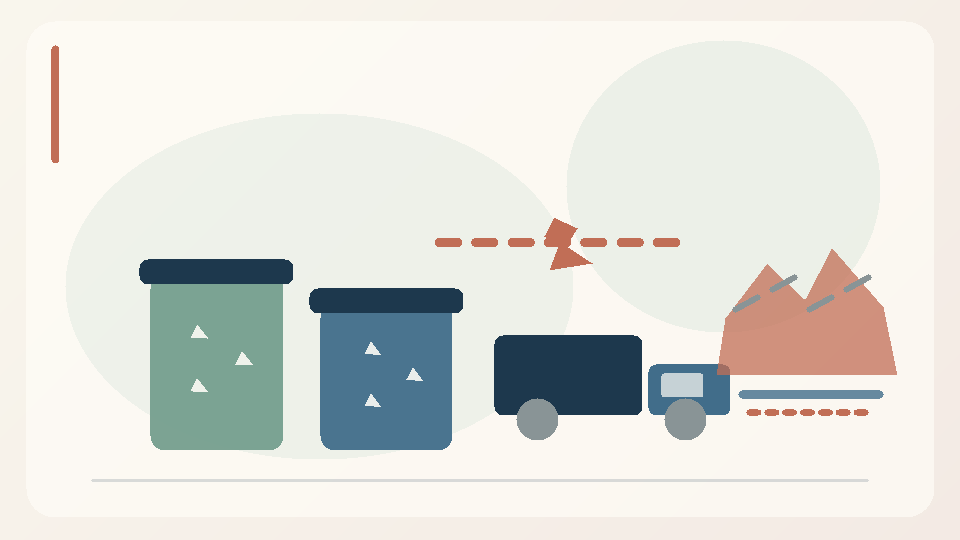
Featured image disclosure: The featured existing eduKate 2026 editorial illustration shows fictional waste bins, a collection vehicle and environmental runoff concerns; it is not a documentary image of a real contaminated community. It is conceptual editorial artwork, not a verifiable photograph of a crisis.
Scope and safety: Never handle unknown waste, conduct chemical tests, enter disposal or industrial sites, diagnose pollution from pictures, or improvise emergency or safety procedures. All activities are paper-only. For real concerns, consult competent local environmental and public-health authorities.
The clear answer: how could this harm a civilisation?
A city may look prosperous while its discarded materials reveal a more complicated story about land, water, workers and shared services. The question is not whether a civilisation produces rubbish, but whether it prevents unnecessary waste, manages unavoidable material safely and can detect and repair environmental harm. A serious weakness becomes important when it prevents people or institutions from performing essential functions for long enough that maintaining normal life becomes difficult. The precise nature and degree of disruption matter. A small service interruption is not a total collapse, and the transformation of an institution is not automatically the end of the people, practices or knowledge associated with it. Understanding what failed, what continued and what could be restored is more useful than making dramatic predictions.
- Function: identify the service, form of evidence or resource that matters.
- Dependency: name the people, authorised procedures, data and equipment needed.
- Observation: distinguish real measurements from conditional forecasts.
- Access: ask whether the intended users can make practical use of the service.
- Correction: propose a legitimate response and a measurable follow-up.
- Limit: acknowledge uncertainty and evidence that does not support a wider claim.
Verified background and scope of the research
UNEP’s Global Waste Management Outlook 2024 presents a business-as-usual scenario in which annual municipal solid waste generation could grow from approximately 2.1 billion tonnes in 2023 to 3.8 billion tonnes by 2050. The estimate is a global scenario, not a guaranteed future event or a local prediction. UNEP’s Global Framework on Chemicals, adopted in 2023, sets five objectives and 28 targets. These are a governance framework, not proof that all countries have attained its goals. A global report, published guideline or professional standard should always be interpreted within its intended boundaries. A suggested future trend is not an observed outcome and a stated target is not proof that all institutions have reached it. This guide provides the original links and distinguishes classroom invention from sourced facts.
Complete 32-chapter index
- 1. Waste is a system rather than a single heap
- 2. What counts as municipal solid waste
- 3. Reading the UNEP 2024 baseline and projection
- 4. Why prevention comes before recycling
- 5. Reuse repair and materials kept in service
- 6. Food discards and organic material
- 7. Packaging that cannot be separated
- 8. Household collection reliability
- 9. Waste transfer and transport bottlenecks
- 10. Sorting contamination and rejected loads
- 11. What a recycling rate really represents
- 12. Landfills and environmental safeguards
- 13. Incineration and controlled treatment
- 14. Unseen connections between waste and water
- 15. Air emissions and uncertain attribution
- 16. Special wastes and hazardous categories
- 17. The Basel Convention and national implementation
- 18. Electronic waste and battery safety
- 19. The workers who sustain sanitation and waste
- 20. Environmental justice between neighbourhoods
- 21. Community reporting and case closure
- 22. Chemicals across their product lifecycle
- 23. Plastic leakage into coastal systems
- 24. The unsettled status of plastic negotiations
- 25. Producer responsibility and incentives
- 26. Monitoring tonnes without hiding risk
- 27. Financing routine disposal services
- 28. Illegal dumping allegations and fair evidence
- 29. Storm debris and disruption recovery
- 30. Environmental education without unsafe handling
- 31. The circular economy versus a recycling slogan
- 32. Long-term restoration and public memory
1. Waste is a system rather than a single heap
In one sentence. Materials become waste through decisions about design, consumption, collection and further use The key question is whether the system can still perform a useful function for people, not merely whether something looks impressive, clean, scientific or modern. This distinction matters when examining this guide follows materials after use, including collection, sorting, actual treatment, residual waste and pollutant pathways. the earlier edukate resource-extraction article concentrates on how materials are taken from nature; this is about how a society manages their impacts and responsibilities when they become unwanted. A civilisational claim should name the scale of failure, time period, people affected and evidence of enduring changes. It should also ask whether the same community has meaningful ways to preserve knowledge, maintain essential services and correct problems.
How the problem develops
Start with the smallest plausible problem and resist making it represent an entire civilisation. In the entirely fictional Bayhaven Commons classroom scenario, an ordinary service depends on several arrangements. Somebody needs a result; another person is legitimately responsible; a resource, record or tool enables an action; and a way of checking the result is necessary. If one arrangement becomes unreliable, an outward symptom may appear in a different part of the system. The observer notices a delay or mismatch, yet the cause may have begun earlier and elsewhere. Tracing the actual dependency is more informative than assuming every subsequent problem was caused by the first one.
Return to the specific mechanism: Materials become waste through decisions about design, consumption, collection and further use Imagine a sequence of five cards labelled need, input, responsible worker, process and checked outcome. Put them in order and explain each connection. Then turn over one card to signify a hypothetical interruption. Which connections require that card? Which connections have possible alternatives? Does the problem concern a single service, a whole neighbourhood, a professional field or several institutions? The correct scope must be established rather than expanded for dramatic effect. A small process change may produce no user harm if an alternative is available, but a repeated uncorrected fault may matter greatly.
A second distinction concerns temporary interruption, persistent underperformance and permanent loss. A service that is unavailable for an afternoon is not equivalent to an organisation losing qualified staff, reliable records and the ability to repair the process for years. Conversely, substantial disruption does not erase the people who previously relied on that service or guarantee that their culture and learning have disappeared. Some adapt by moving, changing methods or working together in different arrangements. Treating change as possible continuity is not optimism without evidence; it is a reminder to investigate what survives.
Evidence and alternative explanations
Distinguish a missed collection from prolonged unsafe management before claiming widespread breakdown An adequate record names the author or institution, observation date, location, population or item measured, units, method and relevant limitations. If the result is a forecast, preserve the assumptions instead of presenting it as an event that has already occurred. If it is an official rule, confirm the applicable jurisdiction, effective version and whether real-world implementation has been evaluated. If it is a research interpretation, ask how it differs from the original observation. These checks prevent the article from claiming far more than its sources establish.
Consider three possible accounts. First, a genuine service failure may have occurred. Second, the method of counting or reporting may have changed, making a previously hidden problem newly visible. Third, the function may have moved to a different lawful or technically appropriate channel, leaving an outdated public notice behind. These accounts lead to different responses. A serious investigation asks which additional observation would discriminate among them. It may be a dated completion record, a professionally reviewed measurement, a revised data definition or confirmation that a user can now complete the intended task.
A careful reader should also look for the boundary of any source used. An international assessment might explain general trends without describing a specific estate or household. A concept illustration can support understanding without proving that an incident occurred. A chart can be mathematically correct but use the wrong denominator for the proposed claim. An independent reviewer might reach a narrower conclusion from the same data. It is more responsible to preserve those limitations than to fill them with plausible-sounding details. Good evidence allows a claim to be tested, not merely repeated.
Who is affected, and whose experience is missing?
Imagine a learner trying to understand a report using the relevant service. A government dashboard may show a good aggregate result while the person encounters a language barrier, an inaccessible route, unclear instructions or a delayed response. A professional operator may know of a constraint that the dashboard does not show, and another user may experience a perfectly functioning service. These accounts can coexist. The role of analysis is to locate the actual condition and compare experiences ethically, not to decide in advance that one story represents everyone.
In teaching, never use real pupils’ family hardships or sensitive identities as evidence. The invented town has no real citizens, addresses or private records. Students should discuss barriers without diagnosing a person’s health, assigning blame based on age or income, or assuming a group’s intelligence or motivation. Never handle unknown waste, conduct chemical tests, enter disposal or industrial sites, diagnose pollution from pictures, or improvise emergency or safety procedures. All activities are paper-only. For real concerns, consult competent local environmental and public-health authorities. An ethical improvement is one that protects users, workers and the rights of people who may disagree with the first proposed solution.
How responsible repair would be checked
Identify a professional service pathway with accountable monitoring Begin with an exact description of what needs improvement and identify a legitimate responsible institution or qualified specialist. A policy announcement, a newly purchased tool or a large published budget may be useful input, but it is not proof of an outcome. The test is whether the person who needs a service can actually use it at the relevant time, with appropriate safety, fairness and reliability. If a new process helps only the easiest cases, the remaining barriers must be identified rather than omitted from the report.
Use four checkpoints: observe, verify, improve and recheck. Observation defines the current condition, including time and boundary. Verification establishes the strongest available explanation and important alternatives. Improvement should be proportional, lawful and undertaken by authorised people. Rechecking requires meaningful evidence that the intended capability has been restored or strengthened. A correction should not simply close a file; it should leave a reproducible record of what changed, why and with what results. This makes the lesson about institutional learning rather than a one-time fix.
Finally consider continuity. Could a different qualified person understand the proposed repair next year? Would the next class be able to reconstruct the analysis from the stored evidence? If the answer depends on a single expert’s undocumented knowledge or an inaccessible file, the community remains vulnerable. Preserve the date, assumptions, affected users, method, reason for the decision and next review. These are ordinary habits that help a complex society manage change without requiring perfection or constant certainty.
Safe practice for parents and tutors
Arrange cards for a home, public bin, collection team and treatment site Use only paper cards and pencils at an imaginary school library. One learner is the observer, another the source checker, a third the fairness reviewer, and a fourth the recorder. The observer states the fictional fact and avoids guessing why it occurred. The checker asks what source would establish the real-world claim. The fairness reviewer asks whether another user may encounter a different barrier. The recorder writes a short, understandable handover. Nothing in this exercise authorises an environmental test, a scientific study with human subjects or any professional intervention.
A young pupil can use three cards marked problem, evidence and next step. An upper-primary pupil can compare two possible causes. A secondary learner can add a clear unit, a denominator, a competing hypothesis and a critique of the source. An advanced learner can propose a before-and-after evaluation with limitations and an appropriate professional role. Reward the ability to revise an answer in light of evidence. A confident learner who explains why the model cannot prove a sweeping claim has understood the topic better than one who merely repeats a prediction of societal collapse.
Worked mathematics: counts are not outcomes
Everything in this example is invented classroom stationery. Suppose the school library receives 45 request cards and 4 require a second review. The rate is 4 ÷ 45 × 100 = 8.9% to one decimal place. If a fictional qualified reviewer resolves 2 of the flagged cards, 2 are still open. This does not estimate actual pollution, scientific misconduct, risk, health, law or the future of any civilisation. The exercise teaches the difference between numerator, denominator and a later verified outcome.
Now suppose the total number of recorded requests doubles. A larger number of flagged records need not indicate a worsening process if the share remains similar. Alternatively, an apparently good completion rate may be misleading if people who cannot access the reporting channel are missing from the denominator. A further question is what “resolved” means: was a file marked closed, was the professional check completed, or did the intended person actually receive a safe, reliable service? Those are distinct concepts. Ask the learner to write the unit and period beside every calculated value.
Deep-learning check
- Mechanism: Materials become waste through decisions about design, consumption, collection and further use
- Evidence: Distinguish a missed collection from prolonged unsafe management before claiming widespread breakdown
- Practical model: Arrange cards for a home, public bin, collection team and treatment site
- Repair: Identify a professional service pathway with accountable monitoring
- Limit: Give one reason the fictional exercise cannot certify the condition of a real public or research system.
Finish by asking students to complete this record without looking at the chapter: “The specific function is … . The risk is … . An observation that supports the concern would be … . A competing explanation is … . A person the model may overlook is … . A fair action would be … . I would know it helped if … . What remains uncertain is … .” This short written handover makes complex knowledge transferable. The final achievement is not dramatic certainty but the ability to inquire, communicate responsibly and help the next learner reason from evidence.
2. What counts as municipal solid waste
In one sentence. Households, shops and public places produce different material streams under defined reporting boundaries The key question is whether the system can still perform a useful function for people, not merely whether something looks impressive, clean, scientific or modern. This distinction matters when examining this guide follows materials after use, including collection, sorting, actual treatment, residual waste and pollutant pathways. the earlier edukate resource-extraction article concentrates on how materials are taken from nature; this is about how a society manages their impacts and responsibilities when they become unwanted. A civilisational claim should name the scale of failure, time period, people affected and evidence of enduring changes. It should also ask whether the same community has meaningful ways to preserve knowledge, maintain essential services and correct problems.
How the problem develops
An appealing headline is not the same thing as an identified causal process. In the entirely fictional Bayhaven Commons classroom scenario, an ordinary service depends on several arrangements. Somebody needs a result; another person is legitimately responsible; a resource, record or tool enables an action; and a way of checking the result is necessary. If one arrangement becomes unreliable, an outward symptom may appear in a different part of the system. The observer notices a delay or mismatch, yet the cause may have begun earlier and elsewhere. Tracing the actual dependency is more informative than assuming every subsequent problem was caused by the first one.
Return to the specific mechanism: Households, shops and public places produce different material streams under defined reporting boundaries Imagine a sequence of five cards labelled need, input, responsible worker, process and checked outcome. Put them in order and explain each connection. Then turn over one card to signify a hypothetical interruption. Which connections require that card? Which connections have possible alternatives? Does the problem concern a single service, a whole neighbourhood, a professional field or several institutions? The correct scope must be established rather than expanded for dramatic effect. A small process change may produce no user harm if an alternative is available, but a repeated uncorrected fault may matter greatly.
A second distinction concerns temporary interruption, persistent underperformance and permanent loss. A service that is unavailable for an afternoon is not equivalent to an organisation losing qualified staff, reliable records and the ability to repair the process for years. Conversely, substantial disruption does not erase the people who previously relied on that service or guarantee that their culture and learning have disappeared. Some adapt by moving, changing methods or working together in different arrangements. Treating change as possible continuity is not optimism without evidence; it is a reminder to investigate what survives.
Evidence and alternative explanations
Read precisely which streams are included in a national or global report An adequate record names the author or institution, observation date, location, population or item measured, units, method and relevant limitations. If the result is a forecast, preserve the assumptions instead of presenting it as an event that has already occurred. If it is an official rule, confirm the applicable jurisdiction, effective version and whether real-world implementation has been evaluated. If it is a research interpretation, ask how it differs from the original observation. These checks prevent the article from claiming far more than its sources establish.
Consider three possible accounts. First, a genuine service failure may have occurred. Second, the method of counting or reporting may have changed, making a previously hidden problem newly visible. Third, the function may have moved to a different lawful or technically appropriate channel, leaving an outdated public notice behind. These accounts lead to different responses. A serious investigation asks which additional observation would discriminate among them. It may be a dated completion record, a professionally reviewed measurement, a revised data definition or confirmation that a user can now complete the intended task.
A careful reader should also look for the boundary of any source used. An international assessment might explain general trends without describing a specific estate or household. A concept illustration can support understanding without proving that an incident occurred. A chart can be mathematically correct but use the wrong denominator for the proposed claim. An independent reviewer might reach a narrower conclusion from the same data. It is more responsible to preserve those limitations than to fill them with plausible-sounding details. Good evidence allows a claim to be tested, not merely repeated.
Who is affected, and whose experience is missing?
Imagine a worker responsible for safe service using the relevant service. A government dashboard may show a good aggregate result while the person encounters a language barrier, an inaccessible route, unclear instructions or a delayed response. A professional operator may know of a constraint that the dashboard does not show, and another user may experience a perfectly functioning service. These accounts can coexist. The role of analysis is to locate the actual condition and compare experiences ethically, not to decide in advance that one story represents everyone.
In teaching, never use real pupils’ family hardships or sensitive identities as evidence. The invented town has no real citizens, addresses or private records. Students should discuss barriers without diagnosing a person’s health, assigning blame based on age or income, or assuming a group’s intelligence or motivation. Never handle unknown waste, conduct chemical tests, enter disposal or industrial sites, diagnose pollution from pictures, or improvise emergency or safety procedures. All activities are paper-only. For real concerns, consult competent local environmental and public-health authorities. An ethical improvement is one that protects users, workers and the rights of people who may disagree with the first proposed solution.
How responsible repair would be checked
Use transparent classification and avoid mixing incompatible totals Begin with an exact description of what needs improvement and identify a legitimate responsible institution or qualified specialist. A policy announcement, a newly purchased tool or a large published budget may be useful input, but it is not proof of an outcome. The test is whether the person who needs a service can actually use it at the relevant time, with appropriate safety, fairness and reliability. If a new process helps only the easiest cases, the remaining barriers must be identified rather than omitted from the report.
Use four checkpoints: observe, verify, improve and recheck. Observation defines the current condition, including time and boundary. Verification establishes the strongest available explanation and important alternatives. Improvement should be proportional, lawful and undertaken by authorised people. Rechecking requires meaningful evidence that the intended capability has been restored or strengthened. A correction should not simply close a file; it should leave a reproducible record of what changed, why and with what results. This makes the lesson about institutional learning rather than a one-time fix.
Finally consider continuity. Could a different qualified person understand the proposed repair next year? Would the next class be able to reconstruct the analysis from the stored evidence? If the answer depends on a single expert’s undocumented knowledge or an inaccessible file, the community remains vulnerable. Preserve the date, assumptions, affected users, method, reason for the decision and next review. These are ordinary habits that help a complex society manage change without requiring perfection or constant certainty.
Safe practice for parents and tutors
Sort imaginary paper materials into household, commercial and specialised categories Use only paper cards and pencils at an imaginary paper model village. One learner is the observer, another the source checker, a third the fairness reviewer, and a fourth the recorder. The observer states the fictional fact and avoids guessing why it occurred. The checker asks what source would establish the real-world claim. The fairness reviewer asks whether another user may encounter a different barrier. The recorder writes a short, understandable handover. Nothing in this exercise authorises an environmental test, a scientific study with human subjects or any professional intervention.
A young pupil can use three cards marked problem, evidence and next step. An upper-primary pupil can compare two possible causes. A secondary learner can add a clear unit, a denominator, a competing hypothesis and a critique of the source. An advanced learner can propose a before-and-after evaluation with limitations and an appropriate professional role. Reward the ability to revise an answer in light of evidence. A confident learner who explains why the model cannot prove a sweeping claim has understood the topic better than one who merely repeats a prediction of societal collapse.
Worked mathematics: counts are not outcomes
Everything in this example is invented classroom stationery. Suppose the paper model village receives 52 request cards and 9 require a second review. The rate is 9 ÷ 52 × 100 = 17.3% to one decimal place. If a fictional qualified reviewer resolves 5 of the flagged cards, 4 are still open. This does not estimate actual pollution, scientific misconduct, risk, health, law or the future of any civilisation. The exercise teaches the difference between numerator, denominator and a later verified outcome.
Now suppose the total number of recorded requests doubles. A larger number of flagged records need not indicate a worsening process if the share remains similar. Alternatively, an apparently good completion rate may be misleading if people who cannot access the reporting channel are missing from the denominator. A further question is what “resolved” means: was a file marked closed, was the professional check completed, or did the intended person actually receive a safe, reliable service? Those are distinct concepts. Ask the learner to write the unit and period beside every calculated value.
Deep-learning check
- Mechanism: Households, shops and public places produce different material streams under defined reporting boundaries
- Evidence: Read precisely which streams are included in a national or global report
- Practical model: Sort imaginary paper materials into household, commercial and specialised categories
- Repair: Use transparent classification and avoid mixing incompatible totals
- Limit: Give one reason the fictional exercise cannot certify the condition of a real public or research system.
Finish by asking students to complete this record without looking at the chapter: “The specific function is … . The risk is … . An observation that supports the concern would be … . A competing explanation is … . A person the model may overlook is … . A fair action would be … . I would know it helped if … . What remains uncertain is … .” This short written handover makes complex knowledge transferable. The final achievement is not dramatic certainty but the ability to inquire, communicate responsibly and help the next learner reason from evidence.
3. Reading the UNEP 2024 baseline and projection
In one sentence. The 2050 global projection assumes a possible development pathway rather than observing the future The key question is whether the system can still perform a useful function for people, not merely whether something looks impressive, clean, scientific or modern. This distinction matters when examining this guide follows materials after use, including collection, sorting, actual treatment, residual waste and pollutant pathways. the earlier edukate resource-extraction article concentrates on how materials are taken from nature; this is about how a society manages their impacts and responsibilities when they become unwanted. A civilisational claim should name the scale of failure, time period, people affected and evidence of enduring changes. It should also ask whether the same community has meaningful ways to preserve knowledge, maintain essential services and correct problems.
How the problem develops
Work backwards from the outcome someone needed, not the dramatic event that first attracted attention. In the entirely fictional Bayhaven Commons classroom scenario, an ordinary service depends on several arrangements. Somebody needs a result; another person is legitimately responsible; a resource, record or tool enables an action; and a way of checking the result is necessary. If one arrangement becomes unreliable, an outward symptom may appear in a different part of the system. The observer notices a delay or mismatch, yet the cause may have begun earlier and elsewhere. Tracing the actual dependency is more informative than assuming every subsequent problem was caused by the first one.
Return to the specific mechanism: The 2050 global projection assumes a possible development pathway rather than observing the future Imagine a sequence of five cards labelled need, input, responsible worker, process and checked outcome. Put them in order and explain each connection. Then turn over one card to signify a hypothetical interruption. Which connections require that card? Which connections have possible alternatives? Does the problem concern a single service, a whole neighbourhood, a professional field or several institutions? The correct scope must be established rather than expanded for dramatic effect. A small process change may produce no user harm if an alternative is available, but a repeated uncorrected fault may matter greatly.
A second distinction concerns temporary interruption, persistent underperformance and permanent loss. A service that is unavailable for an afternoon is not equivalent to an organisation losing qualified staff, reliable records and the ability to repair the process for years. Conversely, substantial disruption does not erase the people who previously relied on that service or guarantee that their culture and learning have disappeared. Some adapt by moving, changing methods or working together in different arrangements. Treating change as possible continuity is not optimism without evidence; it is a reminder to investigate what survives.
Evidence and alternative explanations
Preserve the baseline year, units, global scope and scenario assumptions An adequate record names the author or institution, observation date, location, population or item measured, units, method and relevant limitations. If the result is a forecast, preserve the assumptions instead of presenting it as an event that has already occurred. If it is an official rule, confirm the applicable jurisdiction, effective version and whether real-world implementation has been evaluated. If it is a research interpretation, ask how it differs from the original observation. These checks prevent the article from claiming far more than its sources establish.
Consider three possible accounts. First, a genuine service failure may have occurred. Second, the method of counting or reporting may have changed, making a previously hidden problem newly visible. Third, the function may have moved to a different lawful or technically appropriate channel, leaving an outdated public notice behind. These accounts lead to different responses. A serious investigation asks which additional observation would discriminate among them. It may be a dated completion record, a professionally reviewed measurement, a revised data definition or confirmation that a user can now complete the intended task.
A careful reader should also look for the boundary of any source used. An international assessment might explain general trends without describing a specific estate or household. A concept illustration can support understanding without proving that an incident occurred. A chart can be mathematically correct but use the wrong denominator for the proposed claim. An independent reviewer might reach a narrower conclusion from the same data. It is more responsible to preserve those limitations than to fill them with plausible-sounding details. Good evidence allows a claim to be tested, not merely repeated.
Who is affected, and whose experience is missing?
Imagine a parent needing accessible information using the relevant service. A government dashboard may show a good aggregate result while the person encounters a language barrier, an inaccessible route, unclear instructions or a delayed response. A professional operator may know of a constraint that the dashboard does not show, and another user may experience a perfectly functioning service. These accounts can coexist. The role of analysis is to locate the actual condition and compare experiences ethically, not to decide in advance that one story represents everyone.
In teaching, never use real pupils’ family hardships or sensitive identities as evidence. The invented town has no real citizens, addresses or private records. Students should discuss barriers without diagnosing a person’s health, assigning blame based on age or income, or assuming a group’s intelligence or motivation. Never handle unknown waste, conduct chemical tests, enter disposal or industrial sites, diagnose pollution from pictures, or improvise emergency or safety procedures. All activities are paper-only. For real concerns, consult competent local environmental and public-health authorities. An ethical improvement is one that protects users, workers and the rights of people who may disagree with the first proposed solution.
How responsible repair would be checked
Revisit assumptions and measure actual waste outcomes over time Begin with an exact description of what needs improvement and identify a legitimate responsible institution or qualified specialist. A policy announcement, a newly purchased tool or a large published budget may be useful input, but it is not proof of an outcome. The test is whether the person who needs a service can actually use it at the relevant time, with appropriate safety, fairness and reliability. If a new process helps only the easiest cases, the remaining barriers must be identified rather than omitted from the report.
Use four checkpoints: observe, verify, improve and recheck. Observation defines the current condition, including time and boundary. Verification establishes the strongest available explanation and important alternatives. Improvement should be proportional, lawful and undertaken by authorised people. Rechecking requires meaningful evidence that the intended capability has been restored or strengthened. A correction should not simply close a file; it should leave a reproducible record of what changed, why and with what results. This makes the lesson about institutional learning rather than a one-time fix.
Finally consider continuity. Could a different qualified person understand the proposed repair next year? Would the next class be able to reconstruct the analysis from the stored evidence? If the answer depends on a single expert’s undocumented knowledge or an inaccessible file, the community remains vulnerable. Preserve the date, assumptions, affected users, method, reason for the decision and next review. These are ordinary habits that help a complex society manage change without requiring perfection or constant certainty.
Safe practice for parents and tutors
Sketch two fictional trajectories with different prevention policies Use only paper cards and pencils at an imaginary imaginary community service desk. One learner is the observer, another the source checker, a third the fairness reviewer, and a fourth the recorder. The observer states the fictional fact and avoids guessing why it occurred. The checker asks what source would establish the real-world claim. The fairness reviewer asks whether another user may encounter a different barrier. The recorder writes a short, understandable handover. Nothing in this exercise authorises an environmental test, a scientific study with human subjects or any professional intervention.
A young pupil can use three cards marked problem, evidence and next step. An upper-primary pupil can compare two possible causes. A secondary learner can add a clear unit, a denominator, a competing hypothesis and a critique of the source. An advanced learner can propose a before-and-after evaluation with limitations and an appropriate professional role. Reward the ability to revise an answer in light of evidence. A confident learner who explains why the model cannot prove a sweeping claim has understood the topic better than one who merely repeats a prediction of societal collapse.
Worked mathematics: counts are not outcomes
Everything in this example is invented classroom stationery. Suppose the imaginary community service desk receives 59 request cards and 14 require a second review. The rate is 14 ÷ 59 × 100 = 23.7% to one decimal place. If a fictional qualified reviewer resolves 8 of the flagged cards, 6 are still open. This does not estimate actual pollution, scientific misconduct, risk, health, law or the future of any civilisation. The exercise teaches the difference between numerator, denominator and a later verified outcome.
Now suppose the total number of recorded requests doubles. A larger number of flagged records need not indicate a worsening process if the share remains similar. Alternatively, an apparently good completion rate may be misleading if people who cannot access the reporting channel are missing from the denominator. A further question is what “resolved” means: was a file marked closed, was the professional check completed, or did the intended person actually receive a safe, reliable service? Those are distinct concepts. Ask the learner to write the unit and period beside every calculated value.
Deep-learning check
- Mechanism: The 2050 global projection assumes a possible development pathway rather than observing the future
- Evidence: Preserve the baseline year, units, global scope and scenario assumptions
- Practical model: Sketch two fictional trajectories with different prevention policies
- Repair: Revisit assumptions and measure actual waste outcomes over time
- Limit: Give one reason the fictional exercise cannot certify the condition of a real public or research system.
Finish by asking students to complete this record without looking at the chapter: “The specific function is … . The risk is … . An observation that supports the concern would be … . A competing explanation is … . A person the model may overlook is … . A fair action would be … . I would know it helped if … . What remains uncertain is … .” This short written handover makes complex knowledge transferable. The final achievement is not dramatic certainty but the ability to inquire, communicate responsibly and help the next learner reason from evidence.
4. Why prevention comes before recycling
In one sentence. Avoiding unnecessary production can prevent later treatment demands The key question is whether the system can still perform a useful function for people, not merely whether something looks impressive, clean, scientific or modern. This distinction matters when examining this guide follows materials after use, including collection, sorting, actual treatment, residual waste and pollutant pathways. the earlier edukate resource-extraction article concentrates on how materials are taken from nature; this is about how a society manages their impacts and responsibilities when they become unwanted. A civilisational claim should name the scale of failure, time period, people affected and evidence of enduring changes. It should also ask whether the same community has meaningful ways to preserve knowledge, maintain essential services and correct problems.
How the problem develops
Compare a limited breakdown with a situation in which the community retains several effective alternatives. In the entirely fictional Bayhaven Commons classroom scenario, an ordinary service depends on several arrangements. Somebody needs a result; another person is legitimately responsible; a resource, record or tool enables an action; and a way of checking the result is necessary. If one arrangement becomes unreliable, an outward symptom may appear in a different part of the system. The observer notices a delay or mismatch, yet the cause may have begun earlier and elsewhere. Tracing the actual dependency is more informative than assuming every subsequent problem was caused by the first one.
Return to the specific mechanism: Avoiding unnecessary production can prevent later treatment demands Imagine a sequence of five cards labelled need, input, responsible worker, process and checked outcome. Put them in order and explain each connection. Then turn over one card to signify a hypothetical interruption. Which connections require that card? Which connections have possible alternatives? Does the problem concern a single service, a whole neighbourhood, a professional field or several institutions? The correct scope must be established rather than expanded for dramatic effect. A small process change may produce no user harm if an alternative is available, but a repeated uncorrected fault may matter greatly.
A second distinction concerns temporary interruption, persistent underperformance and permanent loss. A service that is unavailable for an afternoon is not equivalent to an organisation losing qualified staff, reliable records and the ability to repair the process for years. Conversely, substantial disruption does not erase the people who previously relied on that service or guarantee that their culture and learning have disappeared. Some adapt by moving, changing methods or working together in different arrangements. Treating change as possible continuity is not optimism without evidence; it is a reminder to investigate what survives.
Evidence and alternative explanations
Count total material inputs rather than only the amount advertised as recyclable An adequate record names the author or institution, observation date, location, population or item measured, units, method and relevant limitations. If the result is a forecast, preserve the assumptions instead of presenting it as an event that has already occurred. If it is an official rule, confirm the applicable jurisdiction, effective version and whether real-world implementation has been evaluated. If it is a research interpretation, ask how it differs from the original observation. These checks prevent the article from claiming far more than its sources establish.
Consider three possible accounts. First, a genuine service failure may have occurred. Second, the method of counting or reporting may have changed, making a previously hidden problem newly visible. Third, the function may have moved to a different lawful or technically appropriate channel, leaving an outdated public notice behind. These accounts lead to different responses. A serious investigation asks which additional observation would discriminate among them. It may be a dated completion record, a professionally reviewed measurement, a revised data definition or confirmation that a user can now complete the intended task.
A careful reader should also look for the boundary of any source used. An international assessment might explain general trends without describing a specific estate or household. A concept illustration can support understanding without proving that an incident occurred. A chart can be mathematically correct but use the wrong denominator for the proposed claim. An independent reviewer might reach a narrower conclusion from the same data. It is more responsible to preserve those limitations than to fill them with plausible-sounding details. Good evidence allows a claim to be tested, not merely repeated.
Who is affected, and whose experience is missing?
Imagine an older resident using the relevant service. A government dashboard may show a good aggregate result while the person encounters a language barrier, an inaccessible route, unclear instructions or a delayed response. A professional operator may know of a constraint that the dashboard does not show, and another user may experience a perfectly functioning service. These accounts can coexist. The role of analysis is to locate the actual condition and compare experiences ethically, not to decide in advance that one story represents everyone.
In teaching, never use real pupils’ family hardships or sensitive identities as evidence. The invented town has no real citizens, addresses or private records. Students should discuss barriers without diagnosing a person’s health, assigning blame based on age or income, or assuming a group’s intelligence or motivation. Never handle unknown waste, conduct chemical tests, enter disposal or industrial sites, diagnose pollution from pictures, or improvise emergency or safety procedures. All activities are paper-only. For real concerns, consult competent local environmental and public-health authorities. An ethical improvement is one that protects users, workers and the rights of people who may disagree with the first proposed solution.
How responsible repair would be checked
Support durable design and responsible procurement Begin with an exact description of what needs improvement and identify a legitimate responsible institution or qualified specialist. A policy announcement, a newly purchased tool or a large published budget may be useful input, but it is not proof of an outcome. The test is whether the person who needs a service can actually use it at the relevant time, with appropriate safety, fairness and reliability. If a new process helps only the easiest cases, the remaining barriers must be identified rather than omitted from the report.
Use four checkpoints: observe, verify, improve and recheck. Observation defines the current condition, including time and boundary. Verification establishes the strongest available explanation and important alternatives. Improvement should be proportional, lawful and undertaken by authorised people. Rechecking requires meaningful evidence that the intended capability has been restored or strengthened. A correction should not simply close a file; it should leave a reproducible record of what changed, why and with what results. This makes the lesson about institutional learning rather than a one-time fix.
Finally consider continuity. Could a different qualified person understand the proposed repair next year? Would the next class be able to reconstruct the analysis from the stored evidence? If the answer depends on a single expert’s undocumented knowledge or an inaccessible file, the community remains vulnerable. Preserve the date, assumptions, affected users, method, reason for the decision and next review. These are ordinary habits that help a complex society manage change without requiring perfection or constant certainty.
Safe practice for parents and tutors
Redesign an imaginary school supply kit to eliminate needless packaging Use only paper cards and pencils at an imaginary pretend council office. One learner is the observer, another the source checker, a third the fairness reviewer, and a fourth the recorder. The observer states the fictional fact and avoids guessing why it occurred. The checker asks what source would establish the real-world claim. The fairness reviewer asks whether another user may encounter a different barrier. The recorder writes a short, understandable handover. Nothing in this exercise authorises an environmental test, a scientific study with human subjects or any professional intervention.
A young pupil can use three cards marked problem, evidence and next step. An upper-primary pupil can compare two possible causes. A secondary learner can add a clear unit, a denominator, a competing hypothesis and a critique of the source. An advanced learner can propose a before-and-after evaluation with limitations and an appropriate professional role. Reward the ability to revise an answer in light of evidence. A confident learner who explains why the model cannot prove a sweeping claim has understood the topic better than one who merely repeats a prediction of societal collapse.
Worked mathematics: counts are not outcomes
Everything in this example is invented classroom stationery. Suppose the pretend council office receives 66 request cards and 4 require a second review. The rate is 4 ÷ 66 × 100 = 6.1% to one decimal place. If a fictional qualified reviewer resolves 3 of the flagged cards, 1 are still open. This does not estimate actual pollution, scientific misconduct, risk, health, law or the future of any civilisation. The exercise teaches the difference between numerator, denominator and a later verified outcome.
Now suppose the total number of recorded requests doubles. A larger number of flagged records need not indicate a worsening process if the share remains similar. Alternatively, an apparently good completion rate may be misleading if people who cannot access the reporting channel are missing from the denominator. A further question is what “resolved” means: was a file marked closed, was the professional check completed, or did the intended person actually receive a safe, reliable service? Those are distinct concepts. Ask the learner to write the unit and period beside every calculated value.
Deep-learning check
- Mechanism: Avoiding unnecessary production can prevent later treatment demands
- Evidence: Count total material inputs rather than only the amount advertised as recyclable
- Practical model: Redesign an imaginary school supply kit to eliminate needless packaging
- Repair: Support durable design and responsible procurement
- Limit: Give one reason the fictional exercise cannot certify the condition of a real public or research system.
Finish by asking students to complete this record without looking at the chapter: “The specific function is … . The risk is … . An observation that supports the concern would be … . A competing explanation is … . A person the model may overlook is … . A fair action would be … . I would know it helped if … . What remains uncertain is … .” This short written handover makes complex knowledge transferable. The final achievement is not dramatic certainty but the ability to inquire, communicate responsibly and help the next learner reason from evidence.
5. Reuse repair and materials kept in service
In one sentence. Keeping safe products useful can reduce premature replacement The key question is whether the system can still perform a useful function for people, not merely whether something looks impressive, clean, scientific or modern. This distinction matters when examining this guide follows materials after use, including collection, sorting, actual treatment, residual waste and pollutant pathways. the earlier edukate resource-extraction article concentrates on how materials are taken from nature; this is about how a society manages their impacts and responsibilities when they become unwanted. A civilisational claim should name the scale of failure, time period, people affected and evidence of enduring changes. It should also ask whether the same community has meaningful ways to preserve knowledge, maintain essential services and correct problems.
How the problem develops
A useful way to test understanding is to change one condition and observe whether the original explanation still holds. In the entirely fictional Bayhaven Commons classroom scenario, an ordinary service depends on several arrangements. Somebody needs a result; another person is legitimately responsible; a resource, record or tool enables an action; and a way of checking the result is necessary. If one arrangement becomes unreliable, an outward symptom may appear in a different part of the system. The observer notices a delay or mismatch, yet the cause may have begun earlier and elsewhere. Tracing the actual dependency is more informative than assuming every subsequent problem was caused by the first one.
Return to the specific mechanism: Keeping safe products useful can reduce premature replacement Imagine a sequence of five cards labelled need, input, responsible worker, process and checked outcome. Put them in order and explain each connection. Then turn over one card to signify a hypothetical interruption. Which connections require that card? Which connections have possible alternatives? Does the problem concern a single service, a whole neighbourhood, a professional field or several institutions? The correct scope must be established rather than expanded for dramatic effect. A small process change may produce no user harm if an alternative is available, but a repeated uncorrected fault may matter greatly.
A second distinction concerns temporary interruption, persistent underperformance and permanent loss. A service that is unavailable for an afternoon is not equivalent to an organisation losing qualified staff, reliable records and the ability to repair the process for years. Conversely, substantial disruption does not erase the people who previously relied on that service or guarantee that their culture and learning have disappeared. Some adapt by moving, changing methods or working together in different arrangements. Treating change as possible continuity is not optimism without evidence; it is a reminder to investigate what survives.
Evidence and alternative explanations
Check lifetime performance and safety rather than assume every repair is suitable An adequate record names the author or institution, observation date, location, population or item measured, units, method and relevant limitations. If the result is a forecast, preserve the assumptions instead of presenting it as an event that has already occurred. If it is an official rule, confirm the applicable jurisdiction, effective version and whether real-world implementation has been evaluated. If it is a research interpretation, ask how it differs from the original observation. These checks prevent the article from claiming far more than its sources establish.
Consider three possible accounts. First, a genuine service failure may have occurred. Second, the method of counting or reporting may have changed, making a previously hidden problem newly visible. Third, the function may have moved to a different lawful or technically appropriate channel, leaving an outdated public notice behind. These accounts lead to different responses. A serious investigation asks which additional observation would discriminate among them. It may be a dated completion record, a professionally reviewed measurement, a revised data definition or confirmation that a user can now complete the intended task.
A careful reader should also look for the boundary of any source used. An international assessment might explain general trends without describing a specific estate or household. A concept illustration can support understanding without proving that an incident occurred. A chart can be mathematically correct but use the wrong denominator for the proposed claim. An independent reviewer might reach a narrower conclusion from the same data. It is more responsible to preserve those limitations than to fill them with plausible-sounding details. Good evidence allows a claim to be tested, not merely repeated.
Who is affected, and whose experience is missing?
Imagine a resident who uses an alternative format using the relevant service. A government dashboard may show a good aggregate result while the person encounters a language barrier, an inaccessible route, unclear instructions or a delayed response. A professional operator may know of a constraint that the dashboard does not show, and another user may experience a perfectly functioning service. These accounts can coexist. The role of analysis is to locate the actual condition and compare experiences ethically, not to decide in advance that one story represents everyone.
In teaching, never use real pupils’ family hardships or sensitive identities as evidence. The invented town has no real citizens, addresses or private records. Students should discuss barriers without diagnosing a person’s health, assigning blame based on age or income, or assuming a group’s intelligence or motivation. Never handle unknown waste, conduct chemical tests, enter disposal or industrial sites, diagnose pollution from pictures, or improvise emergency or safety procedures. All activities are paper-only. For real concerns, consult competent local environmental and public-health authorities. An ethical improvement is one that protects users, workers and the rights of people who may disagree with the first proposed solution.
How responsible repair would be checked
Encourage competent repair and long-life design Begin with an exact description of what needs improvement and identify a legitimate responsible institution or qualified specialist. A policy announcement, a newly purchased tool or a large published budget may be useful input, but it is not proof of an outcome. The test is whether the person who needs a service can actually use it at the relevant time, with appropriate safety, fairness and reliability. If a new process helps only the easiest cases, the remaining barriers must be identified rather than omitted from the report.
Use four checkpoints: observe, verify, improve and recheck. Observation defines the current condition, including time and boundary. Verification establishes the strongest available explanation and important alternatives. Improvement should be proportional, lawful and undertaken by authorised people. Rechecking requires meaningful evidence that the intended capability has been restored or strengthened. A correction should not simply close a file; it should leave a reproducible record of what changed, why and with what results. This makes the lesson about institutional learning rather than a one-time fix.
Finally consider continuity. Could a different qualified person understand the proposed repair next year? Would the next class be able to reconstruct the analysis from the stored evidence? If the answer depends on a single expert’s undocumented knowledge or an inaccessible file, the community remains vulnerable. Preserve the date, assumptions, affected users, method, reason for the decision and next review. These are ordinary habits that help a complex society manage change without requiring perfection or constant certainty.
Safe practice for parents and tutors
Compare fictional furniture replacement schedules over several years Use only paper cards and pencils at an imaginary classroom information board. One learner is the observer, another the source checker, a third the fairness reviewer, and a fourth the recorder. The observer states the fictional fact and avoids guessing why it occurred. The checker asks what source would establish the real-world claim. The fairness reviewer asks whether another user may encounter a different barrier. The recorder writes a short, understandable handover. Nothing in this exercise authorises an environmental test, a scientific study with human subjects or any professional intervention.
A young pupil can use three cards marked problem, evidence and next step. An upper-primary pupil can compare two possible causes. A secondary learner can add a clear unit, a denominator, a competing hypothesis and a critique of the source. An advanced learner can propose a before-and-after evaluation with limitations and an appropriate professional role. Reward the ability to revise an answer in light of evidence. A confident learner who explains why the model cannot prove a sweeping claim has understood the topic better than one who merely repeats a prediction of societal collapse.
Worked mathematics: counts are not outcomes
Everything in this example is invented classroom stationery. Suppose the classroom information board receives 73 request cards and 9 require a second review. The rate is 9 ÷ 73 × 100 = 12.3% to one decimal place. If a fictional qualified reviewer resolves 3 of the flagged cards, 6 are still open. This does not estimate actual pollution, scientific misconduct, risk, health, law or the future of any civilisation. The exercise teaches the difference between numerator, denominator and a later verified outcome.
Now suppose the total number of recorded requests doubles. A larger number of flagged records need not indicate a worsening process if the share remains similar. Alternatively, an apparently good completion rate may be misleading if people who cannot access the reporting channel are missing from the denominator. A further question is what “resolved” means: was a file marked closed, was the professional check completed, or did the intended person actually receive a safe, reliable service? Those are distinct concepts. Ask the learner to write the unit and period beside every calculated value.
Deep-learning check
- Mechanism: Keeping safe products useful can reduce premature replacement
- Evidence: Check lifetime performance and safety rather than assume every repair is suitable
- Practical model: Compare fictional furniture replacement schedules over several years
- Repair: Encourage competent repair and long-life design
- Limit: Give one reason the fictional exercise cannot certify the condition of a real public or research system.
Finish by asking students to complete this record without looking at the chapter: “The specific function is … . The risk is … . An observation that supports the concern would be … . A competing explanation is … . A person the model may overlook is … . A fair action would be … . I would know it helped if … . What remains uncertain is … .” This short written handover makes complex knowledge transferable. The final achievement is not dramatic certainty but the ability to inquire, communicate responsibly and help the next learner reason from evidence.
6. Food discards and organic material
In one sentence. Unused food and organic waste form a distinct stream with particular handling needs The key question is whether the system can still perform a useful function for people, not merely whether something looks impressive, clean, scientific or modern. This distinction matters when examining this guide follows materials after use, including collection, sorting, actual treatment, residual waste and pollutant pathways. the earlier edukate resource-extraction article concentrates on how materials are taken from nature; this is about how a society manages their impacts and responsibilities when they become unwanted. A civilisational claim should name the scale of failure, time period, people affected and evidence of enduring changes. It should also ask whether the same community has meaningful ways to preserve knowledge, maintain essential services and correct problems.
How the problem develops
Start with the smallest plausible problem and resist making it represent an entire civilisation. In the entirely fictional Bayhaven Commons classroom scenario, an ordinary service depends on several arrangements. Somebody needs a result; another person is legitimately responsible; a resource, record or tool enables an action; and a way of checking the result is necessary. If one arrangement becomes unreliable, an outward symptom may appear in a different part of the system. The observer notices a delay or mismatch, yet the cause may have begun earlier and elsewhere. Tracing the actual dependency is more informative than assuming every subsequent problem was caused by the first one.
Return to the specific mechanism: Unused food and organic waste form a distinct stream with particular handling needs Imagine a sequence of five cards labelled need, input, responsible worker, process and checked outcome. Put them in order and explain each connection. Then turn over one card to signify a hypothetical interruption. Which connections require that card? Which connections have possible alternatives? Does the problem concern a single service, a whole neighbourhood, a professional field or several institutions? The correct scope must be established rather than expanded for dramatic effect. A small process change may produce no user harm if an alternative is available, but a repeated uncorrected fault may matter greatly.
A second distinction concerns temporary interruption, persistent underperformance and permanent loss. A service that is unavailable for an afternoon is not equivalent to an organisation losing qualified staff, reliable records and the ability to repair the process for years. Conversely, substantial disruption does not erase the people who previously relied on that service or guarantee that their culture and learning have disappeared. Some adapt by moving, changing methods or working together in different arrangements. Treating change as possible continuity is not optimism without evidence; it is a reminder to investigate what survives.
Evidence and alternative explanations
Separate prevention, collected organic waste and actual treatment An adequate record names the author or institution, observation date, location, population or item measured, units, method and relevant limitations. If the result is a forecast, preserve the assumptions instead of presenting it as an event that has already occurred. If it is an official rule, confirm the applicable jurisdiction, effective version and whether real-world implementation has been evaluated. If it is a research interpretation, ask how it differs from the original observation. These checks prevent the article from claiming far more than its sources establish.
Consider three possible accounts. First, a genuine service failure may have occurred. Second, the method of counting or reporting may have changed, making a previously hidden problem newly visible. Third, the function may have moved to a different lawful or technically appropriate channel, leaving an outdated public notice behind. These accounts lead to different responses. A serious investigation asks which additional observation would discriminate among them. It may be a dated completion record, a professionally reviewed measurement, a revised data definition or confirmation that a user can now complete the intended task.
A careful reader should also look for the boundary of any source used. An international assessment might explain general trends without describing a specific estate or household. A concept illustration can support understanding without proving that an incident occurred. A chart can be mathematically correct but use the wrong denominator for the proposed claim. An independent reviewer might reach a narrower conclusion from the same data. It is more responsible to preserve those limitations than to fill them with plausible-sounding details. Good evidence allows a claim to be tested, not merely repeated.
Who is affected, and whose experience is missing?
Imagine a newcomer asking an unfamiliar question using the relevant service. A government dashboard may show a good aggregate result while the person encounters a language barrier, an inaccessible route, unclear instructions or a delayed response. A professional operator may know of a constraint that the dashboard does not show, and another user may experience a perfectly functioning service. These accounts can coexist. The role of analysis is to locate the actual condition and compare experiences ethically, not to decide in advance that one story represents everyone.
In teaching, never use real pupils’ family hardships or sensitive identities as evidence. The invented town has no real citizens, addresses or private records. Students should discuss barriers without diagnosing a person’s health, assigning blame based on age or income, or assuming a group’s intelligence or motivation. Never handle unknown waste, conduct chemical tests, enter disposal or industrial sites, diagnose pollution from pictures, or improvise emergency or safety procedures. All activities are paper-only. For real concerns, consult competent local environmental and public-health authorities. An ethical improvement is one that protects users, workers and the rights of people who may disagree with the first proposed solution.
How responsible repair would be checked
Reduce avoidable waste and provide appropriate professional collection Begin with an exact description of what needs improvement and identify a legitimate responsible institution or qualified specialist. A policy announcement, a newly purchased tool or a large published budget may be useful input, but it is not proof of an outcome. The test is whether the person who needs a service can actually use it at the relevant time, with appropriate safety, fairness and reliability. If a new process helps only the easiest cases, the remaining barriers must be identified rather than omitted from the report.
Use four checkpoints: observe, verify, improve and recheck. Observation defines the current condition, including time and boundary. Verification establishes the strongest available explanation and important alternatives. Improvement should be proportional, lawful and undertaken by authorised people. Rechecking requires meaningful evidence that the intended capability has been restored or strengthened. A correction should not simply close a file; it should leave a reproducible record of what changed, why and with what results. This makes the lesson about institutional learning rather than a one-time fix.
Finally consider continuity. Could a different qualified person understand the proposed repair next year? Would the next class be able to reconstruct the analysis from the stored evidence? If the answer depends on a single expert’s undocumented knowledge or an inaccessible file, the community remains vulnerable. Preserve the date, assumptions, affected users, method, reason for the decision and next review. These are ordinary habits that help a complex society manage change without requiring perfection or constant certainty.
Safe practice for parents and tutors
Write an imaginary meal plan showing discarded portions Use only paper cards and pencils at an imaginary model neighbourhood workshop. One learner is the observer, another the source checker, a third the fairness reviewer, and a fourth the recorder. The observer states the fictional fact and avoids guessing why it occurred. The checker asks what source would establish the real-world claim. The fairness reviewer asks whether another user may encounter a different barrier. The recorder writes a short, understandable handover. Nothing in this exercise authorises an environmental test, a scientific study with human subjects or any professional intervention.
A young pupil can use three cards marked problem, evidence and next step. An upper-primary pupil can compare two possible causes. A secondary learner can add a clear unit, a denominator, a competing hypothesis and a critique of the source. An advanced learner can propose a before-and-after evaluation with limitations and an appropriate professional role. Reward the ability to revise an answer in light of evidence. A confident learner who explains why the model cannot prove a sweeping claim has understood the topic better than one who merely repeats a prediction of societal collapse.
Worked mathematics: counts are not outcomes
Everything in this example is invented classroom stationery. Suppose the model neighbourhood workshop receives 80 request cards and 14 require a second review. The rate is 14 ÷ 80 × 100 = 17.5% to one decimal place. If a fictional qualified reviewer resolves 6 of the flagged cards, 8 are still open. This does not estimate actual pollution, scientific misconduct, risk, health, law or the future of any civilisation. The exercise teaches the difference between numerator, denominator and a later verified outcome.
Now suppose the total number of recorded requests doubles. A larger number of flagged records need not indicate a worsening process if the share remains similar. Alternatively, an apparently good completion rate may be misleading if people who cannot access the reporting channel are missing from the denominator. A further question is what “resolved” means: was a file marked closed, was the professional check completed, or did the intended person actually receive a safe, reliable service? Those are distinct concepts. Ask the learner to write the unit and period beside every calculated value.
Deep-learning check
- Mechanism: Unused food and organic waste form a distinct stream with particular handling needs
- Evidence: Separate prevention, collected organic waste and actual treatment
- Practical model: Write an imaginary meal plan showing discarded portions
- Repair: Reduce avoidable waste and provide appropriate professional collection
- Limit: Give one reason the fictional exercise cannot certify the condition of a real public or research system.
Finish by asking students to complete this record without looking at the chapter: “The specific function is … . The risk is … . An observation that supports the concern would be … . A competing explanation is … . A person the model may overlook is … . A fair action would be … . I would know it helped if … . What remains uncertain is … .” This short written handover makes complex knowledge transferable. The final achievement is not dramatic certainty but the ability to inquire, communicate responsibly and help the next learner reason from evidence.
7. Packaging that cannot be separated
In one sentence. Complex mixtures and bonded materials may limit the value of a recycling label The key question is whether the system can still perform a useful function for people, not merely whether something looks impressive, clean, scientific or modern. This distinction matters when examining this guide follows materials after use, including collection, sorting, actual treatment, residual waste and pollutant pathways. the earlier edukate resource-extraction article concentrates on how materials are taken from nature; this is about how a society manages their impacts and responsibilities when they become unwanted. A civilisational claim should name the scale of failure, time period, people affected and evidence of enduring changes. It should also ask whether the same community has meaningful ways to preserve knowledge, maintain essential services and correct problems.
How the problem develops
An appealing headline is not the same thing as an identified causal process. In the entirely fictional Bayhaven Commons classroom scenario, an ordinary service depends on several arrangements. Somebody needs a result; another person is legitimately responsible; a resource, record or tool enables an action; and a way of checking the result is necessary. If one arrangement becomes unreliable, an outward symptom may appear in a different part of the system. The observer notices a delay or mismatch, yet the cause may have begun earlier and elsewhere. Tracing the actual dependency is more informative than assuming every subsequent problem was caused by the first one.
Return to the specific mechanism: Complex mixtures and bonded materials may limit the value of a recycling label Imagine a sequence of five cards labelled need, input, responsible worker, process and checked outcome. Put them in order and explain each connection. Then turn over one card to signify a hypothetical interruption. Which connections require that card? Which connections have possible alternatives? Does the problem concern a single service, a whole neighbourhood, a professional field or several institutions? The correct scope must be established rather than expanded for dramatic effect. A small process change may produce no user harm if an alternative is available, but a repeated uncorrected fault may matter greatly.
A second distinction concerns temporary interruption, persistent underperformance and permanent loss. A service that is unavailable for an afternoon is not equivalent to an organisation losing qualified staff, reliable records and the ability to repair the process for years. Conversely, substantial disruption does not erase the people who previously relied on that service or guarantee that their culture and learning have disappeared. Some adapt by moving, changing methods or working together in different arrangements. Treating change as possible continuity is not optimism without evidence; it is a reminder to investigate what survives.
Evidence and alternative explanations
Check technical composition and locally available processing An adequate record names the author or institution, observation date, location, population or item measured, units, method and relevant limitations. If the result is a forecast, preserve the assumptions instead of presenting it as an event that has already occurred. If it is an official rule, confirm the applicable jurisdiction, effective version and whether real-world implementation has been evaluated. If it is a research interpretation, ask how it differs from the original observation. These checks prevent the article from claiming far more than its sources establish.
Consider three possible accounts. First, a genuine service failure may have occurred. Second, the method of counting or reporting may have changed, making a previously hidden problem newly visible. Third, the function may have moved to a different lawful or technically appropriate channel, leaving an outdated public notice behind. These accounts lead to different responses. A serious investigation asks which additional observation would discriminate among them. It may be a dated completion record, a professionally reviewed measurement, a revised data definition or confirmation that a user can now complete the intended task.
A careful reader should also look for the boundary of any source used. An international assessment might explain general trends without describing a specific estate or household. A concept illustration can support understanding without proving that an incident occurred. A chart can be mathematically correct but use the wrong denominator for the proposed claim. An independent reviewer might reach a narrower conclusion from the same data. It is more responsible to preserve those limitations than to fill them with plausible-sounding details. Good evidence allows a claim to be tested, not merely repeated.
Who is affected, and whose experience is missing?
Imagine a learner trying to understand a report using the relevant service. A government dashboard may show a good aggregate result while the person encounters a language barrier, an inaccessible route, unclear instructions or a delayed response. A professional operator may know of a constraint that the dashboard does not show, and another user may experience a perfectly functioning service. These accounts can coexist. The role of analysis is to locate the actual condition and compare experiences ethically, not to decide in advance that one story represents everyone.
In teaching, never use real pupils’ family hardships or sensitive identities as evidence. The invented town has no real citizens, addresses or private records. Students should discuss barriers without diagnosing a person’s health, assigning blame based on age or income, or assuming a group’s intelligence or motivation. Never handle unknown waste, conduct chemical tests, enter disposal or industrial sites, diagnose pollution from pictures, or improvise emergency or safety procedures. All activities are paper-only. For real concerns, consult competent local environmental and public-health authorities. An ethical improvement is one that protects users, workers and the rights of people who may disagree with the first proposed solution.
How responsible repair would be checked
Improve design and honest public information Begin with an exact description of what needs improvement and identify a legitimate responsible institution or qualified specialist. A policy announcement, a newly purchased tool or a large published budget may be useful input, but it is not proof of an outcome. The test is whether the person who needs a service can actually use it at the relevant time, with appropriate safety, fairness and reliability. If a new process helps only the easiest cases, the remaining barriers must be identified rather than omitted from the report.
Use four checkpoints: observe, verify, improve and recheck. Observation defines the current condition, including time and boundary. Verification establishes the strongest available explanation and important alternatives. Improvement should be proportional, lawful and undertaken by authorised people. Rechecking requires meaningful evidence that the intended capability has been restored or strengthened. A correction should not simply close a file; it should leave a reproducible record of what changed, why and with what results. This makes the lesson about institutional learning rather than a one-time fix.
Finally consider continuity. Could a different qualified person understand the proposed repair next year? Would the next class be able to reconstruct the analysis from the stored evidence? If the answer depends on a single expert’s undocumented knowledge or an inaccessible file, the community remains vulnerable. Preserve the date, assumptions, affected users, method, reason for the decision and next review. These are ordinary habits that help a complex society manage change without requiring perfection or constant certainty.
Safe practice for parents and tutors
Compare two pretend packages with removable and inseparable components Use only paper cards and pencils at an imaginary school library. One learner is the observer, another the source checker, a third the fairness reviewer, and a fourth the recorder. The observer states the fictional fact and avoids guessing why it occurred. The checker asks what source would establish the real-world claim. The fairness reviewer asks whether another user may encounter a different barrier. The recorder writes a short, understandable handover. Nothing in this exercise authorises an environmental test, a scientific study with human subjects or any professional intervention.
A young pupil can use three cards marked problem, evidence and next step. An upper-primary pupil can compare two possible causes. A secondary learner can add a clear unit, a denominator, a competing hypothesis and a critique of the source. An advanced learner can propose a before-and-after evaluation with limitations and an appropriate professional role. Reward the ability to revise an answer in light of evidence. A confident learner who explains why the model cannot prove a sweeping claim has understood the topic better than one who merely repeats a prediction of societal collapse.
Worked mathematics: counts are not outcomes
Everything in this example is invented classroom stationery. Suppose the school library receives 87 request cards and 4 require a second review. The rate is 4 ÷ 87 × 100 = 4.6% to one decimal place. If a fictional qualified reviewer resolves 3 of the flagged cards, 1 are still open. This does not estimate actual pollution, scientific misconduct, risk, health, law or the future of any civilisation. The exercise teaches the difference between numerator, denominator and a later verified outcome.
Now suppose the total number of recorded requests doubles. A larger number of flagged records need not indicate a worsening process if the share remains similar. Alternatively, an apparently good completion rate may be misleading if people who cannot access the reporting channel are missing from the denominator. A further question is what “resolved” means: was a file marked closed, was the professional check completed, or did the intended person actually receive a safe, reliable service? Those are distinct concepts. Ask the learner to write the unit and period beside every calculated value.
Deep-learning check
- Mechanism: Complex mixtures and bonded materials may limit the value of a recycling label
- Evidence: Check technical composition and locally available processing
- Practical model: Compare two pretend packages with removable and inseparable components
- Repair: Improve design and honest public information
- Limit: Give one reason the fictional exercise cannot certify the condition of a real public or research system.
Finish by asking students to complete this record without looking at the chapter: “The specific function is … . The risk is … . An observation that supports the concern would be … . A competing explanation is … . A person the model may overlook is … . A fair action would be … . I would know it helped if … . What remains uncertain is … .” This short written handover makes complex knowledge transferable. The final achievement is not dramatic certainty but the ability to inquire, communicate responsibly and help the next learner reason from evidence.
8. Household collection reliability
In one sentence. Capacity, schedules and clear access determine whether materials reach an authorised route The key question is whether the system can still perform a useful function for people, not merely whether something looks impressive, clean, scientific or modern. This distinction matters when examining this guide follows materials after use, including collection, sorting, actual treatment, residual waste and pollutant pathways. the earlier edukate resource-extraction article concentrates on how materials are taken from nature; this is about how a society manages their impacts and responsibilities when they become unwanted. A civilisational claim should name the scale of failure, time period, people affected and evidence of enduring changes. It should also ask whether the same community has meaningful ways to preserve knowledge, maintain essential services and correct problems.
How the problem develops
Work backwards from the outcome someone needed, not the dramatic event that first attracted attention. In the entirely fictional Bayhaven Commons classroom scenario, an ordinary service depends on several arrangements. Somebody needs a result; another person is legitimately responsible; a resource, record or tool enables an action; and a way of checking the result is necessary. If one arrangement becomes unreliable, an outward symptom may appear in a different part of the system. The observer notices a delay or mismatch, yet the cause may have begun earlier and elsewhere. Tracing the actual dependency is more informative than assuming every subsequent problem was caused by the first one.
Return to the specific mechanism: Capacity, schedules and clear access determine whether materials reach an authorised route Imagine a sequence of five cards labelled need, input, responsible worker, process and checked outcome. Put them in order and explain each connection. Then turn over one card to signify a hypothetical interruption. Which connections require that card? Which connections have possible alternatives? Does the problem concern a single service, a whole neighbourhood, a professional field or several institutions? The correct scope must be established rather than expanded for dramatic effect. A small process change may produce no user harm if an alternative is available, but a repeated uncorrected fault may matter greatly.
A second distinction concerns temporary interruption, persistent underperformance and permanent loss. A service that is unavailable for an afternoon is not equivalent to an organisation losing qualified staff, reliable records and the ability to repair the process for years. Conversely, substantial disruption does not erase the people who previously relied on that service or guarantee that their culture and learning have disappeared. Some adapt by moving, changing methods or working together in different arrangements. Treating change as possible continuity is not optimism without evidence; it is a reminder to investigate what survives.
Evidence and alternative explanations
Use recorded collections and follow-ups rather than blame residents from an image An adequate record names the author or institution, observation date, location, population or item measured, units, method and relevant limitations. If the result is a forecast, preserve the assumptions instead of presenting it as an event that has already occurred. If it is an official rule, confirm the applicable jurisdiction, effective version and whether real-world implementation has been evaluated. If it is a research interpretation, ask how it differs from the original observation. These checks prevent the article from claiming far more than its sources establish.
Consider three possible accounts. First, a genuine service failure may have occurred. Second, the method of counting or reporting may have changed, making a previously hidden problem newly visible. Third, the function may have moved to a different lawful or technically appropriate channel, leaving an outdated public notice behind. These accounts lead to different responses. A serious investigation asks which additional observation would discriminate among them. It may be a dated completion record, a professionally reviewed measurement, a revised data definition or confirmation that a user can now complete the intended task.
A careful reader should also look for the boundary of any source used. An international assessment might explain general trends without describing a specific estate or household. A concept illustration can support understanding without proving that an incident occurred. A chart can be mathematically correct but use the wrong denominator for the proposed claim. An independent reviewer might reach a narrower conclusion from the same data. It is more responsible to preserve those limitations than to fill them with plausible-sounding details. Good evidence allows a claim to be tested, not merely repeated.
Who is affected, and whose experience is missing?
Imagine a worker responsible for safe service using the relevant service. A government dashboard may show a good aggregate result while the person encounters a language barrier, an inaccessible route, unclear instructions or a delayed response. A professional operator may know of a constraint that the dashboard does not show, and another user may experience a perfectly functioning service. These accounts can coexist. The role of analysis is to locate the actual condition and compare experiences ethically, not to decide in advance that one story represents everyone.
In teaching, never use real pupils’ family hardships or sensitive identities as evidence. The invented town has no real citizens, addresses or private records. Students should discuss barriers without diagnosing a person’s health, assigning blame based on age or income, or assuming a group’s intelligence or motivation. Never handle unknown waste, conduct chemical tests, enter disposal or industrial sites, diagnose pollution from pictures, or improvise emergency or safety procedures. All activities are paper-only. For real concerns, consult competent local environmental and public-health authorities. An ethical improvement is one that protects users, workers and the rights of people who may disagree with the first proposed solution.
How responsible repair would be checked
Restore service and communicate a verified resolution Begin with an exact description of what needs improvement and identify a legitimate responsible institution or qualified specialist. A policy announcement, a newly purchased tool or a large published budget may be useful input, but it is not proof of an outcome. The test is whether the person who needs a service can actually use it at the relevant time, with appropriate safety, fairness and reliability. If a new process helps only the easiest cases, the remaining barriers must be identified rather than omitted from the report.
Use four checkpoints: observe, verify, improve and recheck. Observation defines the current condition, including time and boundary. Verification establishes the strongest available explanation and important alternatives. Improvement should be proportional, lawful and undertaken by authorised people. Rechecking requires meaningful evidence that the intended capability has been restored or strengthened. A correction should not simply close a file; it should leave a reproducible record of what changed, why and with what results. This makes the lesson about institutional learning rather than a one-time fix.
Finally consider continuity. Could a different qualified person understand the proposed repair next year? Would the next class be able to reconstruct the analysis from the stored evidence? If the answer depends on a single expert’s undocumented knowledge or an inaccessible file, the community remains vulnerable. Preserve the date, assumptions, affected users, method, reason for the decision and next review. These are ordinary habits that help a complex society manage change without requiring perfection or constant certainty.
Safe practice for parents and tutors
Draft a fictional weekly collection timetable with a missed route Use only paper cards and pencils at an imaginary paper model village. One learner is the observer, another the source checker, a third the fairness reviewer, and a fourth the recorder. The observer states the fictional fact and avoids guessing why it occurred. The checker asks what source would establish the real-world claim. The fairness reviewer asks whether another user may encounter a different barrier. The recorder writes a short, understandable handover. Nothing in this exercise authorises an environmental test, a scientific study with human subjects or any professional intervention.
A young pupil can use three cards marked problem, evidence and next step. An upper-primary pupil can compare two possible causes. A secondary learner can add a clear unit, a denominator, a competing hypothesis and a critique of the source. An advanced learner can propose a before-and-after evaluation with limitations and an appropriate professional role. Reward the ability to revise an answer in light of evidence. A confident learner who explains why the model cannot prove a sweeping claim has understood the topic better than one who merely repeats a prediction of societal collapse.
Worked mathematics: counts are not outcomes
Everything in this example is invented classroom stationery. Suppose the paper model village receives 48 request cards and 9 require a second review. The rate is 9 ÷ 48 × 100 = 18.8% to one decimal place. If a fictional qualified reviewer resolves 8 of the flagged cards, 1 are still open. This does not estimate actual pollution, scientific misconduct, risk, health, law or the future of any civilisation. The exercise teaches the difference between numerator, denominator and a later verified outcome.
Now suppose the total number of recorded requests doubles. A larger number of flagged records need not indicate a worsening process if the share remains similar. Alternatively, an apparently good completion rate may be misleading if people who cannot access the reporting channel are missing from the denominator. A further question is what “resolved” means: was a file marked closed, was the professional check completed, or did the intended person actually receive a safe, reliable service? Those are distinct concepts. Ask the learner to write the unit and period beside every calculated value.
Deep-learning check
- Mechanism: Capacity, schedules and clear access determine whether materials reach an authorised route
- Evidence: Use recorded collections and follow-ups rather than blame residents from an image
- Practical model: Draft a fictional weekly collection timetable with a missed route
- Repair: Restore service and communicate a verified resolution
- Limit: Give one reason the fictional exercise cannot certify the condition of a real public or research system.
Finish by asking students to complete this record without looking at the chapter: “The specific function is … . The risk is … . An observation that supports the concern would be … . A competing explanation is … . A person the model may overlook is … . A fair action would be … . I would know it helped if … . What remains uncertain is … .” This short written handover makes complex knowledge transferable. The final achievement is not dramatic certainty but the ability to inquire, communicate responsibly and help the next learner reason from evidence.
9. Waste transfer and transport bottlenecks
In one sentence. Collected material may need intermediate stations and accurately managed routes The key question is whether the system can still perform a useful function for people, not merely whether something looks impressive, clean, scientific or modern. This distinction matters when examining this guide follows materials after use, including collection, sorting, actual treatment, residual waste and pollutant pathways. the earlier edukate resource-extraction article concentrates on how materials are taken from nature; this is about how a society manages their impacts and responsibilities when they become unwanted. A civilisational claim should name the scale of failure, time period, people affected and evidence of enduring changes. It should also ask whether the same community has meaningful ways to preserve knowledge, maintain essential services and correct problems.
How the problem develops
Compare a limited breakdown with a situation in which the community retains several effective alternatives. In the entirely fictional Bayhaven Commons classroom scenario, an ordinary service depends on several arrangements. Somebody needs a result; another person is legitimately responsible; a resource, record or tool enables an action; and a way of checking the result is necessary. If one arrangement becomes unreliable, an outward symptom may appear in a different part of the system. The observer notices a delay or mismatch, yet the cause may have begun earlier and elsewhere. Tracing the actual dependency is more informative than assuming every subsequent problem was caused by the first one.
Return to the specific mechanism: Collected material may need intermediate stations and accurately managed routes Imagine a sequence of five cards labelled need, input, responsible worker, process and checked outcome. Put them in order and explain each connection. Then turn over one card to signify a hypothetical interruption. Which connections require that card? Which connections have possible alternatives? Does the problem concern a single service, a whole neighbourhood, a professional field or several institutions? The correct scope must be established rather than expanded for dramatic effect. A small process change may produce no user harm if an alternative is available, but a repeated uncorrected fault may matter greatly.
A second distinction concerns temporary interruption, persistent underperformance and permanent loss. A service that is unavailable for an afternoon is not equivalent to an organisation losing qualified staff, reliable records and the ability to repair the process for years. Conversely, substantial disruption does not erase the people who previously relied on that service or guarantee that their culture and learning have disappeared. Some adapt by moving, changing methods or working together in different arrangements. Treating change as possible continuity is not optimism without evidence; it is a reminder to investigate what survives.
Evidence and alternative explanations
Track recorded transfers and final destinations rather than only pickup counts An adequate record names the author or institution, observation date, location, population or item measured, units, method and relevant limitations. If the result is a forecast, preserve the assumptions instead of presenting it as an event that has already occurred. If it is an official rule, confirm the applicable jurisdiction, effective version and whether real-world implementation has been evaluated. If it is a research interpretation, ask how it differs from the original observation. These checks prevent the article from claiming far more than its sources establish.
Consider three possible accounts. First, a genuine service failure may have occurred. Second, the method of counting or reporting may have changed, making a previously hidden problem newly visible. Third, the function may have moved to a different lawful or technically appropriate channel, leaving an outdated public notice behind. These accounts lead to different responses. A serious investigation asks which additional observation would discriminate among them. It may be a dated completion record, a professionally reviewed measurement, a revised data definition or confirmation that a user can now complete the intended task.
A careful reader should also look for the boundary of any source used. An international assessment might explain general trends without describing a specific estate or household. A concept illustration can support understanding without proving that an incident occurred. A chart can be mathematically correct but use the wrong denominator for the proposed claim. An independent reviewer might reach a narrower conclusion from the same data. It is more responsible to preserve those limitations than to fill them with plausible-sounding details. Good evidence allows a claim to be tested, not merely repeated.
Who is affected, and whose experience is missing?
Imagine a parent needing accessible information using the relevant service. A government dashboard may show a good aggregate result while the person encounters a language barrier, an inaccessible route, unclear instructions or a delayed response. A professional operator may know of a constraint that the dashboard does not show, and another user may experience a perfectly functioning service. These accounts can coexist. The role of analysis is to locate the actual condition and compare experiences ethically, not to decide in advance that one story represents everyone.
In teaching, never use real pupils’ family hardships or sensitive identities as evidence. The invented town has no real citizens, addresses or private records. Students should discuss barriers without diagnosing a person’s health, assigning blame based on age or income, or assuming a group’s intelligence or motivation. Never handle unknown waste, conduct chemical tests, enter disposal or industrial sites, diagnose pollution from pictures, or improvise emergency or safety procedures. All activities are paper-only. For real concerns, consult competent local environmental and public-health authorities. An ethical improvement is one that protects users, workers and the rights of people who may disagree with the first proposed solution.
How responsible repair would be checked
Maintain professional logistics and auditable weights Begin with an exact description of what needs improvement and identify a legitimate responsible institution or qualified specialist. A policy announcement, a newly purchased tool or a large published budget may be useful input, but it is not proof of an outcome. The test is whether the person who needs a service can actually use it at the relevant time, with appropriate safety, fairness and reliability. If a new process helps only the easiest cases, the remaining barriers must be identified rather than omitted from the report.
Use four checkpoints: observe, verify, improve and recheck. Observation defines the current condition, including time and boundary. Verification establishes the strongest available explanation and important alternatives. Improvement should be proportional, lawful and undertaken by authorised people. Rechecking requires meaningful evidence that the intended capability has been restored or strengthened. A correction should not simply close a file; it should leave a reproducible record of what changed, why and with what results. This makes the lesson about institutional learning rather than a one-time fix.
Finally consider continuity. Could a different qualified person understand the proposed repair next year? Would the next class be able to reconstruct the analysis from the stored evidence? If the answer depends on a single expert’s undocumented knowledge or an inaccessible file, the community remains vulnerable. Preserve the date, assumptions, affected users, method, reason for the decision and next review. These are ordinary habits that help a complex society manage change without requiring perfection or constant certainty.
Safe practice for parents and tutors
Route paper trucks through an imagined transfer centre Use only paper cards and pencils at an imaginary imaginary community service desk. One learner is the observer, another the source checker, a third the fairness reviewer, and a fourth the recorder. The observer states the fictional fact and avoids guessing why it occurred. The checker asks what source would establish the real-world claim. The fairness reviewer asks whether another user may encounter a different barrier. The recorder writes a short, understandable handover. Nothing in this exercise authorises an environmental test, a scientific study with human subjects or any professional intervention.
A young pupil can use three cards marked problem, evidence and next step. An upper-primary pupil can compare two possible causes. A secondary learner can add a clear unit, a denominator, a competing hypothesis and a critique of the source. An advanced learner can propose a before-and-after evaluation with limitations and an appropriate professional role. Reward the ability to revise an answer in light of evidence. A confident learner who explains why the model cannot prove a sweeping claim has understood the topic better than one who merely repeats a prediction of societal collapse.
Worked mathematics: counts are not outcomes
Everything in this example is invented classroom stationery. Suppose the imaginary community service desk receives 55 request cards and 14 require a second review. The rate is 14 ÷ 55 × 100 = 25.5% to one decimal place. If a fictional qualified reviewer resolves 4 of the flagged cards, 10 are still open. This does not estimate actual pollution, scientific misconduct, risk, health, law or the future of any civilisation. The exercise teaches the difference between numerator, denominator and a later verified outcome.
Now suppose the total number of recorded requests doubles. A larger number of flagged records need not indicate a worsening process if the share remains similar. Alternatively, an apparently good completion rate may be misleading if people who cannot access the reporting channel are missing from the denominator. A further question is what “resolved” means: was a file marked closed, was the professional check completed, or did the intended person actually receive a safe, reliable service? Those are distinct concepts. Ask the learner to write the unit and period beside every calculated value.
Deep-learning check
- Mechanism: Collected material may need intermediate stations and accurately managed routes
- Evidence: Track recorded transfers and final destinations rather than only pickup counts
- Practical model: Route paper trucks through an imagined transfer centre
- Repair: Maintain professional logistics and auditable weights
- Limit: Give one reason the fictional exercise cannot certify the condition of a real public or research system.
Finish by asking students to complete this record without looking at the chapter: “The specific function is … . The risk is … . An observation that supports the concern would be … . A competing explanation is … . A person the model may overlook is … . A fair action would be … . I would know it helped if … . What remains uncertain is … .” This short written handover makes complex knowledge transferable. The final achievement is not dramatic certainty but the ability to inquire, communicate responsibly and help the next learner reason from evidence.
10. Sorting contamination and rejected loads
In one sentence. A mixed or unsuitable input may leave less material available for recovery The key question is whether the system can still perform a useful function for people, not merely whether something looks impressive, clean, scientific or modern. This distinction matters when examining this guide follows materials after use, including collection, sorting, actual treatment, residual waste and pollutant pathways. the earlier edukate resource-extraction article concentrates on how materials are taken from nature; this is about how a society manages their impacts and responsibilities when they become unwanted. A civilisational claim should name the scale of failure, time period, people affected and evidence of enduring changes. It should also ask whether the same community has meaningful ways to preserve knowledge, maintain essential services and correct problems.
How the problem develops
A useful way to test understanding is to change one condition and observe whether the original explanation still holds. In the entirely fictional Bayhaven Commons classroom scenario, an ordinary service depends on several arrangements. Somebody needs a result; another person is legitimately responsible; a resource, record or tool enables an action; and a way of checking the result is necessary. If one arrangement becomes unreliable, an outward symptom may appear in a different part of the system. The observer notices a delay or mismatch, yet the cause may have begun earlier and elsewhere. Tracing the actual dependency is more informative than assuming every subsequent problem was caused by the first one.
Return to the specific mechanism: A mixed or unsuitable input may leave less material available for recovery Imagine a sequence of five cards labelled need, input, responsible worker, process and checked outcome. Put them in order and explain each connection. Then turn over one card to signify a hypothetical interruption. Which connections require that card? Which connections have possible alternatives? Does the problem concern a single service, a whole neighbourhood, a professional field or several institutions? The correct scope must be established rather than expanded for dramatic effect. A small process change may produce no user harm if an alternative is available, but a repeated uncorrected fault may matter greatly.
A second distinction concerns temporary interruption, persistent underperformance and permanent loss. A service that is unavailable for an afternoon is not equivalent to an organisation losing qualified staff, reliable records and the ability to repair the process for years. Conversely, substantial disruption does not erase the people who previously relied on that service or guarantee that their culture and learning have disappeared. Some adapt by moving, changing methods or working together in different arrangements. Treating change as possible continuity is not optimism without evidence; it is a reminder to investigate what survives.
Evidence and alternative explanations
Compare collected, accepted and recovered amounts with one denominator An adequate record names the author or institution, observation date, location, population or item measured, units, method and relevant limitations. If the result is a forecast, preserve the assumptions instead of presenting it as an event that has already occurred. If it is an official rule, confirm the applicable jurisdiction, effective version and whether real-world implementation has been evaluated. If it is a research interpretation, ask how it differs from the original observation. These checks prevent the article from claiming far more than its sources establish.
Consider three possible accounts. First, a genuine service failure may have occurred. Second, the method of counting or reporting may have changed, making a previously hidden problem newly visible. Third, the function may have moved to a different lawful or technically appropriate channel, leaving an outdated public notice behind. These accounts lead to different responses. A serious investigation asks which additional observation would discriminate among them. It may be a dated completion record, a professionally reviewed measurement, a revised data definition or confirmation that a user can now complete the intended task.
A careful reader should also look for the boundary of any source used. An international assessment might explain general trends without describing a specific estate or household. A concept illustration can support understanding without proving that an incident occurred. A chart can be mathematically correct but use the wrong denominator for the proposed claim. An independent reviewer might reach a narrower conclusion from the same data. It is more responsible to preserve those limitations than to fill them with plausible-sounding details. Good evidence allows a claim to be tested, not merely repeated.
Who is affected, and whose experience is missing?
Imagine an older resident using the relevant service. A government dashboard may show a good aggregate result while the person encounters a language barrier, an inaccessible route, unclear instructions or a delayed response. A professional operator may know of a constraint that the dashboard does not show, and another user may experience a perfectly functioning service. These accounts can coexist. The role of analysis is to locate the actual condition and compare experiences ethically, not to decide in advance that one story represents everyone.
In teaching, never use real pupils’ family hardships or sensitive identities as evidence. The invented town has no real citizens, addresses or private records. Students should discuss barriers without diagnosing a person’s health, assigning blame based on age or income, or assuming a group’s intelligence or motivation. Never handle unknown waste, conduct chemical tests, enter disposal or industrial sites, diagnose pollution from pictures, or improvise emergency or safety procedures. All activities are paper-only. For real concerns, consult competent local environmental and public-health authorities. An ethical improvement is one that protects users, workers and the rights of people who may disagree with the first proposed solution.
How responsible repair would be checked
Give clear sorting information and transparent recovery reporting Begin with an exact description of what needs improvement and identify a legitimate responsible institution or qualified specialist. A policy announcement, a newly purchased tool or a large published budget may be useful input, but it is not proof of an outcome. The test is whether the person who needs a service can actually use it at the relevant time, with appropriate safety, fairness and reliability. If a new process helps only the easiest cases, the remaining barriers must be identified rather than omitted from the report.
Use four checkpoints: observe, verify, improve and recheck. Observation defines the current condition, including time and boundary. Verification establishes the strongest available explanation and important alternatives. Improvement should be proportional, lawful and undertaken by authorised people. Rechecking requires meaningful evidence that the intended capability has been restored or strengthened. A correction should not simply close a file; it should leave a reproducible record of what changed, why and with what results. This makes the lesson about institutional learning rather than a one-time fix.
Finally consider continuity. Could a different qualified person understand the proposed repair next year? Would the next class be able to reconstruct the analysis from the stored evidence? If the answer depends on a single expert’s undocumented knowledge or an inaccessible file, the community remains vulnerable. Preserve the date, assumptions, affected users, method, reason for the decision and next review. These are ordinary habits that help a complex society manage change without requiring perfection or constant certainty.
Safe practice for parents and tutors
Use coloured cards that are accepted or rejected under toy rules Use only paper cards and pencils at an imaginary pretend council office. One learner is the observer, another the source checker, a third the fairness reviewer, and a fourth the recorder. The observer states the fictional fact and avoids guessing why it occurred. The checker asks what source would establish the real-world claim. The fairness reviewer asks whether another user may encounter a different barrier. The recorder writes a short, understandable handover. Nothing in this exercise authorises an environmental test, a scientific study with human subjects or any professional intervention.
A young pupil can use three cards marked problem, evidence and next step. An upper-primary pupil can compare two possible causes. A secondary learner can add a clear unit, a denominator, a competing hypothesis and a critique of the source. An advanced learner can propose a before-and-after evaluation with limitations and an appropriate professional role. Reward the ability to revise an answer in light of evidence. A confident learner who explains why the model cannot prove a sweeping claim has understood the topic better than one who merely repeats a prediction of societal collapse.
Worked mathematics: counts are not outcomes
Everything in this example is invented classroom stationery. Suppose the pretend council office receives 62 request cards and 4 require a second review. The rate is 4 ÷ 62 × 100 = 6.5% to one decimal place. If a fictional qualified reviewer resolves 3 of the flagged cards, 1 are still open. This does not estimate actual pollution, scientific misconduct, risk, health, law or the future of any civilisation. The exercise teaches the difference between numerator, denominator and a later verified outcome.
Now suppose the total number of recorded requests doubles. A larger number of flagged records need not indicate a worsening process if the share remains similar. Alternatively, an apparently good completion rate may be misleading if people who cannot access the reporting channel are missing from the denominator. A further question is what “resolved” means: was a file marked closed, was the professional check completed, or did the intended person actually receive a safe, reliable service? Those are distinct concepts. Ask the learner to write the unit and period beside every calculated value.
Deep-learning check
- Mechanism: A mixed or unsuitable input may leave less material available for recovery
- Evidence: Compare collected, accepted and recovered amounts with one denominator
- Practical model: Use coloured cards that are accepted or rejected under toy rules
- Repair: Give clear sorting information and transparent recovery reporting
- Limit: Give one reason the fictional exercise cannot certify the condition of a real public or research system.
Finish by asking students to complete this record without looking at the chapter: “The specific function is … . The risk is … . An observation that supports the concern would be … . A competing explanation is … . A person the model may overlook is … . A fair action would be … . I would know it helped if … . What remains uncertain is … .” This short written handover makes complex knowledge transferable. The final achievement is not dramatic certainty but the ability to inquire, communicate responsibly and help the next learner reason from evidence.
11. What a recycling rate really represents
In one sentence. Collection, processing and useful final output are different possible numerators The key question is whether the system can still perform a useful function for people, not merely whether something looks impressive, clean, scientific or modern. This distinction matters when examining this guide follows materials after use, including collection, sorting, actual treatment, residual waste and pollutant pathways. the earlier edukate resource-extraction article concentrates on how materials are taken from nature; this is about how a society manages their impacts and responsibilities when they become unwanted. A civilisational claim should name the scale of failure, time period, people affected and evidence of enduring changes. It should also ask whether the same community has meaningful ways to preserve knowledge, maintain essential services and correct problems.
How the problem develops
Start with the smallest plausible problem and resist making it represent an entire civilisation. In the entirely fictional Bayhaven Commons classroom scenario, an ordinary service depends on several arrangements. Somebody needs a result; another person is legitimately responsible; a resource, record or tool enables an action; and a way of checking the result is necessary. If one arrangement becomes unreliable, an outward symptom may appear in a different part of the system. The observer notices a delay or mismatch, yet the cause may have begun earlier and elsewhere. Tracing the actual dependency is more informative than assuming every subsequent problem was caused by the first one.
Return to the specific mechanism: Collection, processing and useful final output are different possible numerators Imagine a sequence of five cards labelled need, input, responsible worker, process and checked outcome. Put them in order and explain each connection. Then turn over one card to signify a hypothetical interruption. Which connections require that card? Which connections have possible alternatives? Does the problem concern a single service, a whole neighbourhood, a professional field or several institutions? The correct scope must be established rather than expanded for dramatic effect. A small process change may produce no user harm if an alternative is available, but a repeated uncorrected fault may matter greatly.
A second distinction concerns temporary interruption, persistent underperformance and permanent loss. A service that is unavailable for an afternoon is not equivalent to an organisation losing qualified staff, reliable records and the ability to repair the process for years. Conversely, substantial disruption does not erase the people who previously relied on that service or guarantee that their culture and learning have disappeared. Some adapt by moving, changing methods or working together in different arrangements. Treating change as possible continuity is not optimism without evidence; it is a reminder to investigate what survives.
Evidence and alternative explanations
Examine the exact definition behind two reported percentages An adequate record names the author or institution, observation date, location, population or item measured, units, method and relevant limitations. If the result is a forecast, preserve the assumptions instead of presenting it as an event that has already occurred. If it is an official rule, confirm the applicable jurisdiction, effective version and whether real-world implementation has been evaluated. If it is a research interpretation, ask how it differs from the original observation. These checks prevent the article from claiming far more than its sources establish.
Consider three possible accounts. First, a genuine service failure may have occurred. Second, the method of counting or reporting may have changed, making a previously hidden problem newly visible. Third, the function may have moved to a different lawful or technically appropriate channel, leaving an outdated public notice behind. These accounts lead to different responses. A serious investigation asks which additional observation would discriminate among them. It may be a dated completion record, a professionally reviewed measurement, a revised data definition or confirmation that a user can now complete the intended task.
A careful reader should also look for the boundary of any source used. An international assessment might explain general trends without describing a specific estate or household. A concept illustration can support understanding without proving that an incident occurred. A chart can be mathematically correct but use the wrong denominator for the proposed claim. An independent reviewer might reach a narrower conclusion from the same data. It is more responsible to preserve those limitations than to fill them with plausible-sounding details. Good evidence allows a claim to be tested, not merely repeated.
Who is affected, and whose experience is missing?
Imagine a resident who uses an alternative format using the relevant service. A government dashboard may show a good aggregate result while the person encounters a language barrier, an inaccessible route, unclear instructions or a delayed response. A professional operator may know of a constraint that the dashboard does not show, and another user may experience a perfectly functioning service. These accounts can coexist. The role of analysis is to locate the actual condition and compare experiences ethically, not to decide in advance that one story represents everyone.
In teaching, never use real pupils’ family hardships or sensitive identities as evidence. The invented town has no real citizens, addresses or private records. Students should discuss barriers without diagnosing a person’s health, assigning blame based on age or income, or assuming a group’s intelligence or motivation. Never handle unknown waste, conduct chemical tests, enter disposal or industrial sites, diagnose pollution from pictures, or improvise emergency or safety procedures. All activities are paper-only. For real concerns, consult competent local environmental and public-health authorities. An ethical improvement is one that protects users, workers and the rights of people who may disagree with the first proposed solution.
How responsible repair would be checked
Publish comparable definitions and credible audits Begin with an exact description of what needs improvement and identify a legitimate responsible institution or qualified specialist. A policy announcement, a newly purchased tool or a large published budget may be useful input, but it is not proof of an outcome. The test is whether the person who needs a service can actually use it at the relevant time, with appropriate safety, fairness and reliability. If a new process helps only the easiest cases, the remaining barriers must be identified rather than omitted from the report.
Use four checkpoints: observe, verify, improve and recheck. Observation defines the current condition, including time and boundary. Verification establishes the strongest available explanation and important alternatives. Improvement should be proportional, lawful and undertaken by authorised people. Rechecking requires meaningful evidence that the intended capability has been restored or strengthened. A correction should not simply close a file; it should leave a reproducible record of what changed, why and with what results. This makes the lesson about institutional learning rather than a one-time fix.
Finally consider continuity. Could a different qualified person understand the proposed repair next year? Would the next class be able to reconstruct the analysis from the stored evidence? If the answer depends on a single expert’s undocumented knowledge or an inaccessible file, the community remains vulnerable. Preserve the date, assumptions, affected users, method, reason for the decision and next review. These are ordinary habits that help a complex society manage change without requiring perfection or constant certainty.
Safe practice for parents and tutors
Reconcile forty pretend collected cards with actual output Use only paper cards and pencils at an imaginary classroom information board. One learner is the observer, another the source checker, a third the fairness reviewer, and a fourth the recorder. The observer states the fictional fact and avoids guessing why it occurred. The checker asks what source would establish the real-world claim. The fairness reviewer asks whether another user may encounter a different barrier. The recorder writes a short, understandable handover. Nothing in this exercise authorises an environmental test, a scientific study with human subjects or any professional intervention.
A young pupil can use three cards marked problem, evidence and next step. An upper-primary pupil can compare two possible causes. A secondary learner can add a clear unit, a denominator, a competing hypothesis and a critique of the source. An advanced learner can propose a before-and-after evaluation with limitations and an appropriate professional role. Reward the ability to revise an answer in light of evidence. A confident learner who explains why the model cannot prove a sweeping claim has understood the topic better than one who merely repeats a prediction of societal collapse.
Worked mathematics: counts are not outcomes
Everything in this example is invented classroom stationery. Suppose the classroom information board receives 69 request cards and 9 require a second review. The rate is 9 ÷ 69 × 100 = 13.0% to one decimal place. If a fictional qualified reviewer resolves 8 of the flagged cards, 1 are still open. This does not estimate actual pollution, scientific misconduct, risk, health, law or the future of any civilisation. The exercise teaches the difference between numerator, denominator and a later verified outcome.
Now suppose the total number of recorded requests doubles. A larger number of flagged records need not indicate a worsening process if the share remains similar. Alternatively, an apparently good completion rate may be misleading if people who cannot access the reporting channel are missing from the denominator. A further question is what “resolved” means: was a file marked closed, was the professional check completed, or did the intended person actually receive a safe, reliable service? Those are distinct concepts. Ask the learner to write the unit and period beside every calculated value.
Deep-learning check
- Mechanism: Collection, processing and useful final output are different possible numerators
- Evidence: Examine the exact definition behind two reported percentages
- Practical model: Reconcile forty pretend collected cards with actual output
- Repair: Publish comparable definitions and credible audits
- Limit: Give one reason the fictional exercise cannot certify the condition of a real public or research system.
Finish by asking students to complete this record without looking at the chapter: “The specific function is … . The risk is … . An observation that supports the concern would be … . A competing explanation is … . A person the model may overlook is … . A fair action would be … . I would know it helped if … . What remains uncertain is … .” This short written handover makes complex knowledge transferable. The final achievement is not dramatic certainty but the ability to inquire, communicate responsibly and help the next learner reason from evidence.
12. Landfills and environmental safeguards
In one sentence. Disposal facilities require design, ongoing controls and post-closure management The key question is whether the system can still perform a useful function for people, not merely whether something looks impressive, clean, scientific or modern. This distinction matters when examining this guide follows materials after use, including collection, sorting, actual treatment, residual waste and pollutant pathways. the earlier edukate resource-extraction article concentrates on how materials are taken from nature; this is about how a society manages their impacts and responsibilities when they become unwanted. A civilisational claim should name the scale of failure, time period, people affected and evidence of enduring changes. It should also ask whether the same community has meaningful ways to preserve knowledge, maintain essential services and correct problems.
How the problem develops
An appealing headline is not the same thing as an identified causal process. In the entirely fictional Bayhaven Commons classroom scenario, an ordinary service depends on several arrangements. Somebody needs a result; another person is legitimately responsible; a resource, record or tool enables an action; and a way of checking the result is necessary. If one arrangement becomes unreliable, an outward symptom may appear in a different part of the system. The observer notices a delay or mismatch, yet the cause may have begun earlier and elsewhere. Tracing the actual dependency is more informative than assuming every subsequent problem was caused by the first one.
Return to the specific mechanism: Disposal facilities require design, ongoing controls and post-closure management Imagine a sequence of five cards labelled need, input, responsible worker, process and checked outcome. Put them in order and explain each connection. Then turn over one card to signify a hypothetical interruption. Which connections require that card? Which connections have possible alternatives? Does the problem concern a single service, a whole neighbourhood, a professional field or several institutions? The correct scope must be established rather than expanded for dramatic effect. A small process change may produce no user harm if an alternative is available, but a repeated uncorrected fault may matter greatly.
A second distinction concerns temporary interruption, persistent underperformance and permanent loss. A service that is unavailable for an afternoon is not equivalent to an organisation losing qualified staff, reliable records and the ability to repair the process for years. Conversely, substantial disruption does not erase the people who previously relied on that service or guarantee that their culture and learning have disappeared. Some adapt by moving, changing methods or working together in different arrangements. Treating change as possible continuity is not optimism without evidence; it is a reminder to investigate what survives.
Evidence and alternative explanations
Do not infer groundwater quality or permit compliance from aerial appearance An adequate record names the author or institution, observation date, location, population or item measured, units, method and relevant limitations. If the result is a forecast, preserve the assumptions instead of presenting it as an event that has already occurred. If it is an official rule, confirm the applicable jurisdiction, effective version and whether real-world implementation has been evaluated. If it is a research interpretation, ask how it differs from the original observation. These checks prevent the article from claiming far more than its sources establish.
Consider three possible accounts. First, a genuine service failure may have occurred. Second, the method of counting or reporting may have changed, making a previously hidden problem newly visible. Third, the function may have moved to a different lawful or technically appropriate channel, leaving an outdated public notice behind. These accounts lead to different responses. A serious investigation asks which additional observation would discriminate among them. It may be a dated completion record, a professionally reviewed measurement, a revised data definition or confirmation that a user can now complete the intended task.
A careful reader should also look for the boundary of any source used. An international assessment might explain general trends without describing a specific estate or household. A concept illustration can support understanding without proving that an incident occurred. A chart can be mathematically correct but use the wrong denominator for the proposed claim. An independent reviewer might reach a narrower conclusion from the same data. It is more responsible to preserve those limitations than to fill them with plausible-sounding details. Good evidence allows a claim to be tested, not merely repeated.
Who is affected, and whose experience is missing?
Imagine a newcomer asking an unfamiliar question using the relevant service. A government dashboard may show a good aggregate result while the person encounters a language barrier, an inaccessible route, unclear instructions or a delayed response. A professional operator may know of a constraint that the dashboard does not show, and another user may experience a perfectly functioning service. These accounts can coexist. The role of analysis is to locate the actual condition and compare experiences ethically, not to decide in advance that one story represents everyone.
In teaching, never use real pupils’ family hardships or sensitive identities as evidence. The invented town has no real citizens, addresses or private records. Students should discuss barriers without diagnosing a person’s health, assigning blame based on age or income, or assuming a group’s intelligence or motivation. Never handle unknown waste, conduct chemical tests, enter disposal or industrial sites, diagnose pollution from pictures, or improvise emergency or safety procedures. All activities are paper-only. For real concerns, consult competent local environmental and public-health authorities. An ethical improvement is one that protects users, workers and the rights of people who may disagree with the first proposed solution.
How responsible repair would be checked
Depend on authorised engineering and environmental checks Begin with an exact description of what needs improvement and identify a legitimate responsible institution or qualified specialist. A policy announcement, a newly purchased tool or a large published budget may be useful input, but it is not proof of an outcome. The test is whether the person who needs a service can actually use it at the relevant time, with appropriate safety, fairness and reliability. If a new process helps only the easiest cases, the remaining barriers must be identified rather than omitted from the report.
Use four checkpoints: observe, verify, improve and recheck. Observation defines the current condition, including time and boundary. Verification establishes the strongest available explanation and important alternatives. Improvement should be proportional, lawful and undertaken by authorised people. Rechecking requires meaningful evidence that the intended capability has been restored or strengthened. A correction should not simply close a file; it should leave a reproducible record of what changed, why and with what results. This makes the lesson about institutional learning rather than a one-time fix.
Finally consider continuity. Could a different qualified person understand the proposed repair next year? Would the next class be able to reconstruct the analysis from the stored evidence? If the answer depends on a single expert’s undocumented knowledge or an inaccessible file, the community remains vulnerable. Preserve the date, assumptions, affected users, method, reason for the decision and next review. These are ordinary habits that help a complex society manage change without requiring perfection or constant certainty.
Safe practice for parents and tutors
Compare imaginary site plans with and without monitoring Use only paper cards and pencils at an imaginary model neighbourhood workshop. One learner is the observer, another the source checker, a third the fairness reviewer, and a fourth the recorder. The observer states the fictional fact and avoids guessing why it occurred. The checker asks what source would establish the real-world claim. The fairness reviewer asks whether another user may encounter a different barrier. The recorder writes a short, understandable handover. Nothing in this exercise authorises an environmental test, a scientific study with human subjects or any professional intervention.
A young pupil can use three cards marked problem, evidence and next step. An upper-primary pupil can compare two possible causes. A secondary learner can add a clear unit, a denominator, a competing hypothesis and a critique of the source. An advanced learner can propose a before-and-after evaluation with limitations and an appropriate professional role. Reward the ability to revise an answer in light of evidence. A confident learner who explains why the model cannot prove a sweeping claim has understood the topic better than one who merely repeats a prediction of societal collapse.
Worked mathematics: counts are not outcomes
Everything in this example is invented classroom stationery. Suppose the model neighbourhood workshop receives 76 request cards and 14 require a second review. The rate is 14 ÷ 76 × 100 = 18.4% to one decimal place. If a fictional qualified reviewer resolves 2 of the flagged cards, 12 are still open. This does not estimate actual pollution, scientific misconduct, risk, health, law or the future of any civilisation. The exercise teaches the difference between numerator, denominator and a later verified outcome.
Now suppose the total number of recorded requests doubles. A larger number of flagged records need not indicate a worsening process if the share remains similar. Alternatively, an apparently good completion rate may be misleading if people who cannot access the reporting channel are missing from the denominator. A further question is what “resolved” means: was a file marked closed, was the professional check completed, or did the intended person actually receive a safe, reliable service? Those are distinct concepts. Ask the learner to write the unit and period beside every calculated value.
Deep-learning check
- Mechanism: Disposal facilities require design, ongoing controls and post-closure management
- Evidence: Do not infer groundwater quality or permit compliance from aerial appearance
- Practical model: Compare imaginary site plans with and without monitoring
- Repair: Depend on authorised engineering and environmental checks
- Limit: Give one reason the fictional exercise cannot certify the condition of a real public or research system.
Finish by asking students to complete this record without looking at the chapter: “The specific function is … . The risk is … . An observation that supports the concern would be … . A competing explanation is … . A person the model may overlook is … . A fair action would be … . I would know it helped if … . What remains uncertain is … .” This short written handover makes complex knowledge transferable. The final achievement is not dramatic certainty but the ability to inquire, communicate responsibly and help the next learner reason from evidence.
13. Incineration and controlled treatment
In one sentence. Thermal treatment can reduce some waste volumes while producing residues and requiring emissions controls The key question is whether the system can still perform a useful function for people, not merely whether something looks impressive, clean, scientific or modern. This distinction matters when examining this guide follows materials after use, including collection, sorting, actual treatment, residual waste and pollutant pathways. the earlier edukate resource-extraction article concentrates on how materials are taken from nature; this is about how a society manages their impacts and responsibilities when they become unwanted. A civilisational claim should name the scale of failure, time period, people affected and evidence of enduring changes. It should also ask whether the same community has meaningful ways to preserve knowledge, maintain essential services and correct problems.
How the problem develops
Work backwards from the outcome someone needed, not the dramatic event that first attracted attention. In the entirely fictional Bayhaven Commons classroom scenario, an ordinary service depends on several arrangements. Somebody needs a result; another person is legitimately responsible; a resource, record or tool enables an action; and a way of checking the result is necessary. If one arrangement becomes unreliable, an outward symptom may appear in a different part of the system. The observer notices a delay or mismatch, yet the cause may have begun earlier and elsewhere. Tracing the actual dependency is more informative than assuming every subsequent problem was caused by the first one.
Return to the specific mechanism: Thermal treatment can reduce some waste volumes while producing residues and requiring emissions controls Imagine a sequence of five cards labelled need, input, responsible worker, process and checked outcome. Put them in order and explain each connection. Then turn over one card to signify a hypothetical interruption. Which connections require that card? Which connections have possible alternatives? Does the problem concern a single service, a whole neighbourhood, a professional field or several institutions? The correct scope must be established rather than expanded for dramatic effect. A small process change may produce no user harm if an alternative is available, but a repeated uncorrected fault may matter greatly.
A second distinction concerns temporary interruption, persistent underperformance and permanent loss. A service that is unavailable for an afternoon is not equivalent to an organisation losing qualified staff, reliable records and the ability to repair the process for years. Conversely, substantial disruption does not erase the people who previously relied on that service or guarantee that their culture and learning have disappeared. Some adapt by moving, changing methods or working together in different arrangements. Treating change as possible continuity is not optimism without evidence; it is a reminder to investigate what survives.
Evidence and alternative explanations
Read actual plant monitoring and regulatory context instead of absolute claims An adequate record names the author or institution, observation date, location, population or item measured, units, method and relevant limitations. If the result is a forecast, preserve the assumptions instead of presenting it as an event that has already occurred. If it is an official rule, confirm the applicable jurisdiction, effective version and whether real-world implementation has been evaluated. If it is a research interpretation, ask how it differs from the original observation. These checks prevent the article from claiming far more than its sources establish.
Consider three possible accounts. First, a genuine service failure may have occurred. Second, the method of counting or reporting may have changed, making a previously hidden problem newly visible. Third, the function may have moved to a different lawful or technically appropriate channel, leaving an outdated public notice behind. These accounts lead to different responses. A serious investigation asks which additional observation would discriminate among them. It may be a dated completion record, a professionally reviewed measurement, a revised data definition or confirmation that a user can now complete the intended task.
A careful reader should also look for the boundary of any source used. An international assessment might explain general trends without describing a specific estate or household. A concept illustration can support understanding without proving that an incident occurred. A chart can be mathematically correct but use the wrong denominator for the proposed claim. An independent reviewer might reach a narrower conclusion from the same data. It is more responsible to preserve those limitations than to fill them with plausible-sounding details. Good evidence allows a claim to be tested, not merely repeated.
Who is affected, and whose experience is missing?
Imagine a learner trying to understand a report using the relevant service. A government dashboard may show a good aggregate result while the person encounters a language barrier, an inaccessible route, unclear instructions or a delayed response. A professional operator may know of a constraint that the dashboard does not show, and another user may experience a perfectly functioning service. These accounts can coexist. The role of analysis is to locate the actual condition and compare experiences ethically, not to decide in advance that one story represents everyone.
In teaching, never use real pupils’ family hardships or sensitive identities as evidence. The invented town has no real citizens, addresses or private records. Students should discuss barriers without diagnosing a person’s health, assigning blame based on age or income, or assuming a group’s intelligence or motivation. Never handle unknown waste, conduct chemical tests, enter disposal or industrial sites, diagnose pollution from pictures, or improvise emergency or safety procedures. All activities are paper-only. For real concerns, consult competent local environmental and public-health authorities. An ethical improvement is one that protects users, workers and the rights of people who may disagree with the first proposed solution.
How responsible repair would be checked
Use qualified treatment, verified emissions control and transparent reporting Begin with an exact description of what needs improvement and identify a legitimate responsible institution or qualified specialist. A policy announcement, a newly purchased tool or a large published budget may be useful input, but it is not proof of an outcome. The test is whether the person who needs a service can actually use it at the relevant time, with appropriate safety, fairness and reliability. If a new process helps only the easiest cases, the remaining barriers must be identified rather than omitted from the report.
Use four checkpoints: observe, verify, improve and recheck. Observation defines the current condition, including time and boundary. Verification establishes the strongest available explanation and important alternatives. Improvement should be proportional, lawful and undertaken by authorised people. Rechecking requires meaningful evidence that the intended capability has been restored or strengthened. A correction should not simply close a file; it should leave a reproducible record of what changed, why and with what results. This makes the lesson about institutional learning rather than a one-time fix.
Finally consider continuity. Could a different qualified person understand the proposed repair next year? Would the next class be able to reconstruct the analysis from the stored evidence? If the answer depends on a single expert’s undocumented knowledge or an inaccessible file, the community remains vulnerable. Preserve the date, assumptions, affected users, method, reason for the decision and next review. These are ordinary habits that help a complex society manage change without requiring perfection or constant certainty.
Safe practice for parents and tutors
Balance invented incoming material with outputs and residues Use only paper cards and pencils at an imaginary school library. One learner is the observer, another the source checker, a third the fairness reviewer, and a fourth the recorder. The observer states the fictional fact and avoids guessing why it occurred. The checker asks what source would establish the real-world claim. The fairness reviewer asks whether another user may encounter a different barrier. The recorder writes a short, understandable handover. Nothing in this exercise authorises an environmental test, a scientific study with human subjects or any professional intervention.
A young pupil can use three cards marked problem, evidence and next step. An upper-primary pupil can compare two possible causes. A secondary learner can add a clear unit, a denominator, a competing hypothesis and a critique of the source. An advanced learner can propose a before-and-after evaluation with limitations and an appropriate professional role. Reward the ability to revise an answer in light of evidence. A confident learner who explains why the model cannot prove a sweeping claim has understood the topic better than one who merely repeats a prediction of societal collapse.
Worked mathematics: counts are not outcomes
Everything in this example is invented classroom stationery. Suppose the school library receives 83 request cards and 4 require a second review. The rate is 4 ÷ 83 × 100 = 4.8% to one decimal place. If a fictional qualified reviewer resolves 3 of the flagged cards, 1 are still open. This does not estimate actual pollution, scientific misconduct, risk, health, law or the future of any civilisation. The exercise teaches the difference between numerator, denominator and a later verified outcome.
Now suppose the total number of recorded requests doubles. A larger number of flagged records need not indicate a worsening process if the share remains similar. Alternatively, an apparently good completion rate may be misleading if people who cannot access the reporting channel are missing from the denominator. A further question is what “resolved” means: was a file marked closed, was the professional check completed, or did the intended person actually receive a safe, reliable service? Those are distinct concepts. Ask the learner to write the unit and period beside every calculated value.
Deep-learning check
- Mechanism: Thermal treatment can reduce some waste volumes while producing residues and requiring emissions controls
- Evidence: Read actual plant monitoring and regulatory context instead of absolute claims
- Practical model: Balance invented incoming material with outputs and residues
- Repair: Use qualified treatment, verified emissions control and transparent reporting
- Limit: Give one reason the fictional exercise cannot certify the condition of a real public or research system.
Finish by asking students to complete this record without looking at the chapter: “The specific function is … . The risk is … . An observation that supports the concern would be … . A competing explanation is … . A person the model may overlook is … . A fair action would be … . I would know it helped if … . What remains uncertain is … .” This short written handover makes complex knowledge transferable. The final achievement is not dramatic certainty but the ability to inquire, communicate responsibly and help the next learner reason from evidence.
14. Unseen connections between waste and water
In one sentence. Pollutant pathways depend on material, site, transport, concentration and contact The key question is whether the system can still perform a useful function for people, not merely whether something looks impressive, clean, scientific or modern. This distinction matters when examining this guide follows materials after use, including collection, sorting, actual treatment, residual waste and pollutant pathways. the earlier edukate resource-extraction article concentrates on how materials are taken from nature; this is about how a society manages their impacts and responsibilities when they become unwanted. A civilisational claim should name the scale of failure, time period, people affected and evidence of enduring changes. It should also ask whether the same community has meaningful ways to preserve knowledge, maintain essential services and correct problems.
How the problem develops
Compare a limited breakdown with a situation in which the community retains several effective alternatives. In the entirely fictional Bayhaven Commons classroom scenario, an ordinary service depends on several arrangements. Somebody needs a result; another person is legitimately responsible; a resource, record or tool enables an action; and a way of checking the result is necessary. If one arrangement becomes unreliable, an outward symptom may appear in a different part of the system. The observer notices a delay or mismatch, yet the cause may have begun earlier and elsewhere. Tracing the actual dependency is more informative than assuming every subsequent problem was caused by the first one.
Return to the specific mechanism: Pollutant pathways depend on material, site, transport, concentration and contact Imagine a sequence of five cards labelled need, input, responsible worker, process and checked outcome. Put them in order and explain each connection. Then turn over one card to signify a hypothetical interruption. Which connections require that card? Which connections have possible alternatives? Does the problem concern a single service, a whole neighbourhood, a professional field or several institutions? The correct scope must be established rather than expanded for dramatic effect. A small process change may produce no user harm if an alternative is available, but a repeated uncorrected fault may matter greatly.
A second distinction concerns temporary interruption, persistent underperformance and permanent loss. A service that is unavailable for an afternoon is not equivalent to an organisation losing qualified staff, reliable records and the ability to repair the process for years. Conversely, substantial disruption does not erase the people who previously relied on that service or guarantee that their culture and learning have disappeared. Some adapt by moving, changing methods or working together in different arrangements. Treating change as possible continuity is not optimism without evidence; it is a reminder to investigate what survives.
Evidence and alternative explanations
Identify what measurement would actually establish exposure An adequate record names the author or institution, observation date, location, population or item measured, units, method and relevant limitations. If the result is a forecast, preserve the assumptions instead of presenting it as an event that has already occurred. If it is an official rule, confirm the applicable jurisdiction, effective version and whether real-world implementation has been evaluated. If it is a research interpretation, ask how it differs from the original observation. These checks prevent the article from claiming far more than its sources establish.
Consider three possible accounts. First, a genuine service failure may have occurred. Second, the method of counting or reporting may have changed, making a previously hidden problem newly visible. Third, the function may have moved to a different lawful or technically appropriate channel, leaving an outdated public notice behind. These accounts lead to different responses. A serious investigation asks which additional observation would discriminate among them. It may be a dated completion record, a professionally reviewed measurement, a revised data definition or confirmation that a user can now complete the intended task.
A careful reader should also look for the boundary of any source used. An international assessment might explain general trends without describing a specific estate or household. A concept illustration can support understanding without proving that an incident occurred. A chart can be mathematically correct but use the wrong denominator for the proposed claim. An independent reviewer might reach a narrower conclusion from the same data. It is more responsible to preserve those limitations than to fill them with plausible-sounding details. Good evidence allows a claim to be tested, not merely repeated.
Who is affected, and whose experience is missing?
Imagine a worker responsible for safe service using the relevant service. A government dashboard may show a good aggregate result while the person encounters a language barrier, an inaccessible route, unclear instructions or a delayed response. A professional operator may know of a constraint that the dashboard does not show, and another user may experience a perfectly functioning service. These accounts can coexist. The role of analysis is to locate the actual condition and compare experiences ethically, not to decide in advance that one story represents everyone.
In teaching, never use real pupils’ family hardships or sensitive identities as evidence. The invented town has no real citizens, addresses or private records. Students should discuss barriers without diagnosing a person’s health, assigning blame based on age or income, or assuming a group’s intelligence or motivation. Never handle unknown waste, conduct chemical tests, enter disposal or industrial sites, diagnose pollution from pictures, or improvise emergency or safety procedures. All activities are paper-only. For real concerns, consult competent local environmental and public-health authorities. An ethical improvement is one that protects users, workers and the rights of people who may disagree with the first proposed solution.
How responsible repair would be checked
Support competent environmental sampling and public communication Begin with an exact description of what needs improvement and identify a legitimate responsible institution or qualified specialist. A policy announcement, a newly purchased tool or a large published budget may be useful input, but it is not proof of an outcome. The test is whether the person who needs a service can actually use it at the relevant time, with appropriate safety, fairness and reliability. If a new process helps only the easiest cases, the remaining barriers must be identified rather than omitted from the report.
Use four checkpoints: observe, verify, improve and recheck. Observation defines the current condition, including time and boundary. Verification establishes the strongest available explanation and important alternatives. Improvement should be proportional, lawful and undertaken by authorised people. Rechecking requires meaningful evidence that the intended capability has been restored or strengthened. A correction should not simply close a file; it should leave a reproducible record of what changed, why and with what results. This makes the lesson about institutional learning rather than a one-time fix.
Finally consider continuity. Could a different qualified person understand the proposed repair next year? Would the next class be able to reconstruct the analysis from the stored evidence? If the answer depends on a single expert’s undocumented knowledge or an inaccessible file, the community remains vulnerable. Preserve the date, assumptions, affected users, method, reason for the decision and next review. These are ordinary habits that help a complex society manage change without requiring perfection or constant certainty.
Safe practice for parents and tutors
Trace coloured arrows on a fictional watershed map Use only paper cards and pencils at an imaginary paper model village. One learner is the observer, another the source checker, a third the fairness reviewer, and a fourth the recorder. The observer states the fictional fact and avoids guessing why it occurred. The checker asks what source would establish the real-world claim. The fairness reviewer asks whether another user may encounter a different barrier. The recorder writes a short, understandable handover. Nothing in this exercise authorises an environmental test, a scientific study with human subjects or any professional intervention.
A young pupil can use three cards marked problem, evidence and next step. An upper-primary pupil can compare two possible causes. A secondary learner can add a clear unit, a denominator, a competing hypothesis and a critique of the source. An advanced learner can propose a before-and-after evaluation with limitations and an appropriate professional role. Reward the ability to revise an answer in light of evidence. A confident learner who explains why the model cannot prove a sweeping claim has understood the topic better than one who merely repeats a prediction of societal collapse.
Worked mathematics: counts are not outcomes
Everything in this example is invented classroom stationery. Suppose the paper model village receives 90 request cards and 9 require a second review. The rate is 9 ÷ 90 × 100 = 10.0% to one decimal place. If a fictional qualified reviewer resolves 8 of the flagged cards, 1 are still open. This does not estimate actual pollution, scientific misconduct, risk, health, law or the future of any civilisation. The exercise teaches the difference between numerator, denominator and a later verified outcome.
Now suppose the total number of recorded requests doubles. A larger number of flagged records need not indicate a worsening process if the share remains similar. Alternatively, an apparently good completion rate may be misleading if people who cannot access the reporting channel are missing from the denominator. A further question is what “resolved” means: was a file marked closed, was the professional check completed, or did the intended person actually receive a safe, reliable service? Those are distinct concepts. Ask the learner to write the unit and period beside every calculated value.
Deep-learning check
- Mechanism: Pollutant pathways depend on material, site, transport, concentration and contact
- Evidence: Identify what measurement would actually establish exposure
- Practical model: Trace coloured arrows on a fictional watershed map
- Repair: Support competent environmental sampling and public communication
- Limit: Give one reason the fictional exercise cannot certify the condition of a real public or research system.
Finish by asking students to complete this record without looking at the chapter: “The specific function is … . The risk is … . An observation that supports the concern would be … . A competing explanation is … . A person the model may overlook is … . A fair action would be … . I would know it helped if … . What remains uncertain is … .” This short written handover makes complex knowledge transferable. The final achievement is not dramatic certainty but the ability to inquire, communicate responsibly and help the next learner reason from evidence.
15. Air emissions and uncertain attribution
In one sentence. A detected pollutant must be interpreted using units, location and appropriate methods The key question is whether the system can still perform a useful function for people, not merely whether something looks impressive, clean, scientific or modern. This distinction matters when examining this guide follows materials after use, including collection, sorting, actual treatment, residual waste and pollutant pathways. the earlier edukate resource-extraction article concentrates on how materials are taken from nature; this is about how a society manages their impacts and responsibilities when they become unwanted. A civilisational claim should name the scale of failure, time period, people affected and evidence of enduring changes. It should also ask whether the same community has meaningful ways to preserve knowledge, maintain essential services and correct problems.
How the problem develops
A useful way to test understanding is to change one condition and observe whether the original explanation still holds. In the entirely fictional Bayhaven Commons classroom scenario, an ordinary service depends on several arrangements. Somebody needs a result; another person is legitimately responsible; a resource, record or tool enables an action; and a way of checking the result is necessary. If one arrangement becomes unreliable, an outward symptom may appear in a different part of the system. The observer notices a delay or mismatch, yet the cause may have begun earlier and elsewhere. Tracing the actual dependency is more informative than assuming every subsequent problem was caused by the first one.
Return to the specific mechanism: A detected pollutant must be interpreted using units, location and appropriate methods Imagine a sequence of five cards labelled need, input, responsible worker, process and checked outcome. Put them in order and explain each connection. Then turn over one card to signify a hypothetical interruption. Which connections require that card? Which connections have possible alternatives? Does the problem concern a single service, a whole neighbourhood, a professional field or several institutions? The correct scope must be established rather than expanded for dramatic effect. A small process change may produce no user harm if an alternative is available, but a repeated uncorrected fault may matter greatly.
A second distinction concerns temporary interruption, persistent underperformance and permanent loss. A service that is unavailable for an afternoon is not equivalent to an organisation losing qualified staff, reliable records and the ability to repair the process for years. Conversely, substantial disruption does not erase the people who previously relied on that service or guarantee that their culture and learning have disappeared. Some adapt by moving, changing methods or working together in different arrangements. Treating change as possible continuity is not optimism without evidence; it is a reminder to investigate what survives.
Evidence and alternative explanations
Distinguish reported emissions from individual health diagnoses An adequate record names the author or institution, observation date, location, population or item measured, units, method and relevant limitations. If the result is a forecast, preserve the assumptions instead of presenting it as an event that has already occurred. If it is an official rule, confirm the applicable jurisdiction, effective version and whether real-world implementation has been evaluated. If it is a research interpretation, ask how it differs from the original observation. These checks prevent the article from claiming far more than its sources establish.
Consider three possible accounts. First, a genuine service failure may have occurred. Second, the method of counting or reporting may have changed, making a previously hidden problem newly visible. Third, the function may have moved to a different lawful or technically appropriate channel, leaving an outdated public notice behind. These accounts lead to different responses. A serious investigation asks which additional observation would discriminate among them. It may be a dated completion record, a professionally reviewed measurement, a revised data definition or confirmation that a user can now complete the intended task.
A careful reader should also look for the boundary of any source used. An international assessment might explain general trends without describing a specific estate or household. A concept illustration can support understanding without proving that an incident occurred. A chart can be mathematically correct but use the wrong denominator for the proposed claim. An independent reviewer might reach a narrower conclusion from the same data. It is more responsible to preserve those limitations than to fill them with plausible-sounding details. Good evidence allows a claim to be tested, not merely repeated.
Who is affected, and whose experience is missing?
Imagine a parent needing accessible information using the relevant service. A government dashboard may show a good aggregate result while the person encounters a language barrier, an inaccessible route, unclear instructions or a delayed response. A professional operator may know of a constraint that the dashboard does not show, and another user may experience a perfectly functioning service. These accounts can coexist. The role of analysis is to locate the actual condition and compare experiences ethically, not to decide in advance that one story represents everyone.
In teaching, never use real pupils’ family hardships or sensitive identities as evidence. The invented town has no real citizens, addresses or private records. Students should discuss barriers without diagnosing a person’s health, assigning blame based on age or income, or assuming a group’s intelligence or motivation. Never handle unknown waste, conduct chemical tests, enter disposal or industrial sites, diagnose pollution from pictures, or improvise emergency or safety procedures. All activities are paper-only. For real concerns, consult competent local environmental and public-health authorities. An ethical improvement is one that protects users, workers and the rights of people who may disagree with the first proposed solution.
How responsible repair would be checked
Maintain sound authorised measurement and qualified assessment Begin with an exact description of what needs improvement and identify a legitimate responsible institution or qualified specialist. A policy announcement, a newly purchased tool or a large published budget may be useful input, but it is not proof of an outcome. The test is whether the person who needs a service can actually use it at the relevant time, with appropriate safety, fairness and reliability. If a new process helps only the easiest cases, the remaining barriers must be identified rather than omitted from the report.
Use four checkpoints: observe, verify, improve and recheck. Observation defines the current condition, including time and boundary. Verification establishes the strongest available explanation and important alternatives. Improvement should be proportional, lawful and undertaken by authorised people. Rechecking requires meaningful evidence that the intended capability has been restored or strengthened. A correction should not simply close a file; it should leave a reproducible record of what changed, why and with what results. This makes the lesson about institutional learning rather than a one-time fix.
Finally consider continuity. Could a different qualified person understand the proposed repair next year? Would the next class be able to reconstruct the analysis from the stored evidence? If the answer depends on a single expert’s undocumented knowledge or an inaccessible file, the community remains vulnerable. Preserve the date, assumptions, affected users, method, reason for the decision and next review. These are ordinary habits that help a complex society manage change without requiring perfection or constant certainty.
Safe practice for parents and tutors
Compare two fictional monitoring sheets with missing units Use only paper cards and pencils at an imaginary imaginary community service desk. One learner is the observer, another the source checker, a third the fairness reviewer, and a fourth the recorder. The observer states the fictional fact and avoids guessing why it occurred. The checker asks what source would establish the real-world claim. The fairness reviewer asks whether another user may encounter a different barrier. The recorder writes a short, understandable handover. Nothing in this exercise authorises an environmental test, a scientific study with human subjects or any professional intervention.
A young pupil can use three cards marked problem, evidence and next step. An upper-primary pupil can compare two possible causes. A secondary learner can add a clear unit, a denominator, a competing hypothesis and a critique of the source. An advanced learner can propose a before-and-after evaluation with limitations and an appropriate professional role. Reward the ability to revise an answer in light of evidence. A confident learner who explains why the model cannot prove a sweeping claim has understood the topic better than one who merely repeats a prediction of societal collapse.
Worked mathematics: counts are not outcomes
Everything in this example is invented classroom stationery. Suppose the imaginary community service desk receives 51 request cards and 14 require a second review. The rate is 14 ÷ 51 × 100 = 27.5% to one decimal place. If a fictional qualified reviewer resolves 11 of the flagged cards, 3 are still open. This does not estimate actual pollution, scientific misconduct, risk, health, law or the future of any civilisation. The exercise teaches the difference between numerator, denominator and a later verified outcome.
Now suppose the total number of recorded requests doubles. A larger number of flagged records need not indicate a worsening process if the share remains similar. Alternatively, an apparently good completion rate may be misleading if people who cannot access the reporting channel are missing from the denominator. A further question is what “resolved” means: was a file marked closed, was the professional check completed, or did the intended person actually receive a safe, reliable service? Those are distinct concepts. Ask the learner to write the unit and period beside every calculated value.
Deep-learning check
- Mechanism: A detected pollutant must be interpreted using units, location and appropriate methods
- Evidence: Distinguish reported emissions from individual health diagnoses
- Practical model: Compare two fictional monitoring sheets with missing units
- Repair: Maintain sound authorised measurement and qualified assessment
- Limit: Give one reason the fictional exercise cannot certify the condition of a real public or research system.
Finish by asking students to complete this record without looking at the chapter: “The specific function is … . The risk is … . An observation that supports the concern would be … . A competing explanation is … . A person the model may overlook is … . A fair action would be … . I would know it helped if … . What remains uncertain is … .” This short written handover makes complex knowledge transferable. The final achievement is not dramatic certainty but the ability to inquire, communicate responsibly and help the next learner reason from evidence.
16. Special wastes and hazardous categories
In one sentence. Some streams need specialised legal classification and handling The key question is whether the system can still perform a useful function for people, not merely whether something looks impressive, clean, scientific or modern. This distinction matters when examining this guide follows materials after use, including collection, sorting, actual treatment, residual waste and pollutant pathways. the earlier edukate resource-extraction article concentrates on how materials are taken from nature; this is about how a society manages their impacts and responsibilities when they become unwanted. A civilisational claim should name the scale of failure, time period, people affected and evidence of enduring changes. It should also ask whether the same community has meaningful ways to preserve knowledge, maintain essential services and correct problems.
How the problem develops
Start with the smallest plausible problem and resist making it represent an entire civilisation. In the entirely fictional Bayhaven Commons classroom scenario, an ordinary service depends on several arrangements. Somebody needs a result; another person is legitimately responsible; a resource, record or tool enables an action; and a way of checking the result is necessary. If one arrangement becomes unreliable, an outward symptom may appear in a different part of the system. The observer notices a delay or mismatch, yet the cause may have begun earlier and elsewhere. Tracing the actual dependency is more informative than assuming every subsequent problem was caused by the first one.
Return to the specific mechanism: Some streams need specialised legal classification and handling Imagine a sequence of five cards labelled need, input, responsible worker, process and checked outcome. Put them in order and explain each connection. Then turn over one card to signify a hypothetical interruption. Which connections require that card? Which connections have possible alternatives? Does the problem concern a single service, a whole neighbourhood, a professional field or several institutions? The correct scope must be established rather than expanded for dramatic effect. A small process change may produce no user harm if an alternative is available, but a repeated uncorrected fault may matter greatly.
A second distinction concerns temporary interruption, persistent underperformance and permanent loss. A service that is unavailable for an afternoon is not equivalent to an organisation losing qualified staff, reliable records and the ability to repair the process for years. Conversely, substantial disruption does not erase the people who previously relied on that service or guarantee that their culture and learning have disappeared. Some adapt by moving, changing methods or working together in different arrangements. Treating change as possible continuity is not optimism without evidence; it is a reminder to investigate what survives.
Evidence and alternative explanations
A suspicious appearance or odour cannot safely identify chemical properties An adequate record names the author or institution, observation date, location, population or item measured, units, method and relevant limitations. If the result is a forecast, preserve the assumptions instead of presenting it as an event that has already occurred. If it is an official rule, confirm the applicable jurisdiction, effective version and whether real-world implementation has been evaluated. If it is a research interpretation, ask how it differs from the original observation. These checks prevent the article from claiming far more than its sources establish.
Consider three possible accounts. First, a genuine service failure may have occurred. Second, the method of counting or reporting may have changed, making a previously hidden problem newly visible. Third, the function may have moved to a different lawful or technically appropriate channel, leaving an outdated public notice behind. These accounts lead to different responses. A serious investigation asks which additional observation would discriminate among them. It may be a dated completion record, a professionally reviewed measurement, a revised data definition or confirmation that a user can now complete the intended task.
A careful reader should also look for the boundary of any source used. An international assessment might explain general trends without describing a specific estate or household. A concept illustration can support understanding without proving that an incident occurred. A chart can be mathematically correct but use the wrong denominator for the proposed claim. An independent reviewer might reach a narrower conclusion from the same data. It is more responsible to preserve those limitations than to fill them with plausible-sounding details. Good evidence allows a claim to be tested, not merely repeated.
Who is affected, and whose experience is missing?
Imagine an older resident using the relevant service. A government dashboard may show a good aggregate result while the person encounters a language barrier, an inaccessible route, unclear instructions or a delayed response. A professional operator may know of a constraint that the dashboard does not show, and another user may experience a perfectly functioning service. These accounts can coexist. The role of analysis is to locate the actual condition and compare experiences ethically, not to decide in advance that one story represents everyone.
In teaching, never use real pupils’ family hardships or sensitive identities as evidence. The invented town has no real citizens, addresses or private records. Students should discuss barriers without diagnosing a person’s health, assigning blame based on age or income, or assuming a group’s intelligence or motivation. Never handle unknown waste, conduct chemical tests, enter disposal or industrial sites, diagnose pollution from pictures, or improvise emergency or safety procedures. All activities are paper-only. For real concerns, consult competent local environmental and public-health authorities. An ethical improvement is one that protects users, workers and the rights of people who may disagree with the first proposed solution.
How responsible repair would be checked
Refer uncertain materials to trained licensed services Begin with an exact description of what needs improvement and identify a legitimate responsible institution or qualified specialist. A policy announcement, a newly purchased tool or a large published budget may be useful input, but it is not proof of an outcome. The test is whether the person who needs a service can actually use it at the relevant time, with appropriate safety, fairness and reliability. If a new process helps only the easiest cases, the remaining barriers must be identified rather than omitted from the report.
Use four checkpoints: observe, verify, improve and recheck. Observation defines the current condition, including time and boundary. Verification establishes the strongest available explanation and important alternatives. Improvement should be proportional, lawful and undertaken by authorised people. Rechecking requires meaningful evidence that the intended capability has been restored or strengthened. A correction should not simply close a file; it should leave a reproducible record of what changed, why and with what results. This makes the lesson about institutional learning rather than a one-time fix.
Finally consider continuity. Could a different qualified person understand the proposed repair next year? Would the next class be able to reconstruct the analysis from the stored evidence? If the answer depends on a single expert’s undocumented knowledge or an inaccessible file, the community remains vulnerable. Preserve the date, assumptions, affected users, method, reason for the decision and next review. These are ordinary habits that help a complex society manage change without requiring perfection or constant certainty.
Safe practice for parents and tutors
Sort printed hazard-category names without touching real objects Use only paper cards and pencils at an imaginary pretend council office. One learner is the observer, another the source checker, a third the fairness reviewer, and a fourth the recorder. The observer states the fictional fact and avoids guessing why it occurred. The checker asks what source would establish the real-world claim. The fairness reviewer asks whether another user may encounter a different barrier. The recorder writes a short, understandable handover. Nothing in this exercise authorises an environmental test, a scientific study with human subjects or any professional intervention.
A young pupil can use three cards marked problem, evidence and next step. An upper-primary pupil can compare two possible causes. A secondary learner can add a clear unit, a denominator, a competing hypothesis and a critique of the source. An advanced learner can propose a before-and-after evaluation with limitations and an appropriate professional role. Reward the ability to revise an answer in light of evidence. A confident learner who explains why the model cannot prove a sweeping claim has understood the topic better than one who merely repeats a prediction of societal collapse.
Worked mathematics: counts are not outcomes
Everything in this example is invented classroom stationery. Suppose the pretend council office receives 58 request cards and 4 require a second review. The rate is 4 ÷ 58 × 100 = 6.9% to one decimal place. If a fictional qualified reviewer resolves 3 of the flagged cards, 1 are still open. This does not estimate actual pollution, scientific misconduct, risk, health, law or the future of any civilisation. The exercise teaches the difference between numerator, denominator and a later verified outcome.
Now suppose the total number of recorded requests doubles. A larger number of flagged records need not indicate a worsening process if the share remains similar. Alternatively, an apparently good completion rate may be misleading if people who cannot access the reporting channel are missing from the denominator. A further question is what “resolved” means: was a file marked closed, was the professional check completed, or did the intended person actually receive a safe, reliable service? Those are distinct concepts. Ask the learner to write the unit and period beside every calculated value.
Deep-learning check
- Mechanism: Some streams need specialised legal classification and handling
- Evidence: A suspicious appearance or odour cannot safely identify chemical properties
- Practical model: Sort printed hazard-category names without touching real objects
- Repair: Refer uncertain materials to trained licensed services
- Limit: Give one reason the fictional exercise cannot certify the condition of a real public or research system.
Finish by asking students to complete this record without looking at the chapter: “The specific function is … . The risk is … . An observation that supports the concern would be … . A competing explanation is … . A person the model may overlook is … . A fair action would be … . I would know it helped if … . What remains uncertain is … .” This short written handover makes complex knowledge transferable. The final achievement is not dramatic certainty but the ability to inquire, communicate responsibly and help the next learner reason from evidence.
17. The Basel Convention and national implementation
In one sentence. Transboundary movements of defined wastes can engage international and domestic rules The key question is whether the system can still perform a useful function for people, not merely whether something looks impressive, clean, scientific or modern. This distinction matters when examining this guide follows materials after use, including collection, sorting, actual treatment, residual waste and pollutant pathways. the earlier edukate resource-extraction article concentrates on how materials are taken from nature; this is about how a society manages their impacts and responsibilities when they become unwanted. A civilisational claim should name the scale of failure, time period, people affected and evidence of enduring changes. It should also ask whether the same community has meaningful ways to preserve knowledge, maintain essential services and correct problems.
How the problem develops
An appealing headline is not the same thing as an identified causal process. In the entirely fictional Bayhaven Commons classroom scenario, an ordinary service depends on several arrangements. Somebody needs a result; another person is legitimately responsible; a resource, record or tool enables an action; and a way of checking the result is necessary. If one arrangement becomes unreliable, an outward symptom may appear in a different part of the system. The observer notices a delay or mismatch, yet the cause may have begun earlier and elsewhere. Tracing the actual dependency is more informative than assuming every subsequent problem was caused by the first one.
Return to the specific mechanism: Transboundary movements of defined wastes can engage international and domestic rules Imagine a sequence of five cards labelled need, input, responsible worker, process and checked outcome. Put them in order and explain each connection. Then turn over one card to signify a hypothetical interruption. Which connections require that card? Which connections have possible alternatives? Does the problem concern a single service, a whole neighbourhood, a professional field or several institutions? The correct scope must be established rather than expanded for dramatic effect. A small process change may produce no user harm if an alternative is available, but a repeated uncorrected fault may matter greatly.
A second distinction concerns temporary interruption, persistent underperformance and permanent loss. A service that is unavailable for an afternoon is not equivalent to an organisation losing qualified staff, reliable records and the ability to repair the process for years. Conversely, substantial disruption does not erase the people who previously relied on that service or guarantee that their culture and learning have disappeared. Some adapt by moving, changing methods or working together in different arrangements. Treating change as possible continuity is not optimism without evidence; it is a reminder to investigate what survives.
Evidence and alternative explanations
Check actual treaty scope, competent authority and current local law An adequate record names the author or institution, observation date, location, population or item measured, units, method and relevant limitations. If the result is a forecast, preserve the assumptions instead of presenting it as an event that has already occurred. If it is an official rule, confirm the applicable jurisdiction, effective version and whether real-world implementation has been evaluated. If it is a research interpretation, ask how it differs from the original observation. These checks prevent the article from claiming far more than its sources establish.
Consider three possible accounts. First, a genuine service failure may have occurred. Second, the method of counting or reporting may have changed, making a previously hidden problem newly visible. Third, the function may have moved to a different lawful or technically appropriate channel, leaving an outdated public notice behind. These accounts lead to different responses. A serious investigation asks which additional observation would discriminate among them. It may be a dated completion record, a professionally reviewed measurement, a revised data definition or confirmation that a user can now complete the intended task.
A careful reader should also look for the boundary of any source used. An international assessment might explain general trends without describing a specific estate or household. A concept illustration can support understanding without proving that an incident occurred. A chart can be mathematically correct but use the wrong denominator for the proposed claim. An independent reviewer might reach a narrower conclusion from the same data. It is more responsible to preserve those limitations than to fill them with plausible-sounding details. Good evidence allows a claim to be tested, not merely repeated.
Who is affected, and whose experience is missing?
Imagine a resident who uses an alternative format using the relevant service. A government dashboard may show a good aggregate result while the person encounters a language barrier, an inaccessible route, unclear instructions or a delayed response. A professional operator may know of a constraint that the dashboard does not show, and another user may experience a perfectly functioning service. These accounts can coexist. The role of analysis is to locate the actual condition and compare experiences ethically, not to decide in advance that one story represents everyone.
In teaching, never use real pupils’ family hardships or sensitive identities as evidence. The invented town has no real citizens, addresses or private records. Students should discuss barriers without diagnosing a person’s health, assigning blame based on age or income, or assuming a group’s intelligence or motivation. Never handle unknown waste, conduct chemical tests, enter disposal or industrial sites, diagnose pollution from pictures, or improvise emergency or safety procedures. All activities are paper-only. For real concerns, consult competent local environmental and public-health authorities. An ethical improvement is one that protects users, workers and the rights of people who may disagree with the first proposed solution.
How responsible repair would be checked
Preserve lawful authorisation and environmental protections Begin with an exact description of what needs improvement and identify a legitimate responsible institution or qualified specialist. A policy announcement, a newly purchased tool or a large published budget may be useful input, but it is not proof of an outcome. The test is whether the person who needs a service can actually use it at the relevant time, with appropriate safety, fairness and reliability. If a new process helps only the easiest cases, the remaining barriers must be identified rather than omitted from the report.
Use four checkpoints: observe, verify, improve and recheck. Observation defines the current condition, including time and boundary. Verification establishes the strongest available explanation and important alternatives. Improvement should be proportional, lawful and undertaken by authorised people. Rechecking requires meaningful evidence that the intended capability has been restored or strengthened. A correction should not simply close a file; it should leave a reproducible record of what changed, why and with what results. This makes the lesson about institutional learning rather than a one-time fix.
Finally consider continuity. Could a different qualified person understand the proposed repair next year? Would the next class be able to reconstruct the analysis from the stored evidence? If the answer depends on a single expert’s undocumented knowledge or an inaccessible file, the community remains vulnerable. Preserve the date, assumptions, affected users, method, reason for the decision and next review. These are ordinary habits that help a complex society manage change without requiring perfection or constant certainty.
Safe practice for parents and tutors
Route harmless mock documents through an imagined border Use only paper cards and pencils at an imaginary classroom information board. One learner is the observer, another the source checker, a third the fairness reviewer, and a fourth the recorder. The observer states the fictional fact and avoids guessing why it occurred. The checker asks what source would establish the real-world claim. The fairness reviewer asks whether another user may encounter a different barrier. The recorder writes a short, understandable handover. Nothing in this exercise authorises an environmental test, a scientific study with human subjects or any professional intervention.
A young pupil can use three cards marked problem, evidence and next step. An upper-primary pupil can compare two possible causes. A secondary learner can add a clear unit, a denominator, a competing hypothesis and a critique of the source. An advanced learner can propose a before-and-after evaluation with limitations and an appropriate professional role. Reward the ability to revise an answer in light of evidence. A confident learner who explains why the model cannot prove a sweeping claim has understood the topic better than one who merely repeats a prediction of societal collapse.
Worked mathematics: counts are not outcomes
Everything in this example is invented classroom stationery. Suppose the classroom information board receives 65 request cards and 9 require a second review. The rate is 9 ÷ 65 × 100 = 13.8% to one decimal place. If a fictional qualified reviewer resolves 6 of the flagged cards, 3 are still open. This does not estimate actual pollution, scientific misconduct, risk, health, law or the future of any civilisation. The exercise teaches the difference between numerator, denominator and a later verified outcome.
Now suppose the total number of recorded requests doubles. A larger number of flagged records need not indicate a worsening process if the share remains similar. Alternatively, an apparently good completion rate may be misleading if people who cannot access the reporting channel are missing from the denominator. A further question is what “resolved” means: was a file marked closed, was the professional check completed, or did the intended person actually receive a safe, reliable service? Those are distinct concepts. Ask the learner to write the unit and period beside every calculated value.
Deep-learning check
- Mechanism: Transboundary movements of defined wastes can engage international and domestic rules
- Evidence: Check actual treaty scope, competent authority and current local law
- Practical model: Route harmless mock documents through an imagined border
- Repair: Preserve lawful authorisation and environmental protections
- Limit: Give one reason the fictional exercise cannot certify the condition of a real public or research system.
Finish by asking students to complete this record without looking at the chapter: “The specific function is … . The risk is … . An observation that supports the concern would be … . A competing explanation is … . A person the model may overlook is … . A fair action would be … . I would know it helped if … . What remains uncertain is … .” This short written handover makes complex knowledge transferable. The final achievement is not dramatic certainty but the ability to inquire, communicate responsibly and help the next learner reason from evidence.
18. Electronic waste and battery safety
In one sentence. Devices may include useful materials alongside components requiring specialised processing The key question is whether the system can still perform a useful function for people, not merely whether something looks impressive, clean, scientific or modern. This distinction matters when examining this guide follows materials after use, including collection, sorting, actual treatment, residual waste and pollutant pathways. the earlier edukate resource-extraction article concentrates on how materials are taken from nature; this is about how a society manages their impacts and responsibilities when they become unwanted. A civilisational claim should name the scale of failure, time period, people affected and evidence of enduring changes. It should also ask whether the same community has meaningful ways to preserve knowledge, maintain essential services and correct problems.
How the problem develops
Work backwards from the outcome someone needed, not the dramatic event that first attracted attention. In the entirely fictional Bayhaven Commons classroom scenario, an ordinary service depends on several arrangements. Somebody needs a result; another person is legitimately responsible; a resource, record or tool enables an action; and a way of checking the result is necessary. If one arrangement becomes unreliable, an outward symptom may appear in a different part of the system. The observer notices a delay or mismatch, yet the cause may have begun earlier and elsewhere. Tracing the actual dependency is more informative than assuming every subsequent problem was caused by the first one.
Return to the specific mechanism: Devices may include useful materials alongside components requiring specialised processing Imagine a sequence of five cards labelled need, input, responsible worker, process and checked outcome. Put them in order and explain each connection. Then turn over one card to signify a hypothetical interruption. Which connections require that card? Which connections have possible alternatives? Does the problem concern a single service, a whole neighbourhood, a professional field or several institutions? The correct scope must be established rather than expanded for dramatic effect. A small process change may produce no user harm if an alternative is available, but a repeated uncorrected fault may matter greatly.
A second distinction concerns temporary interruption, persistent underperformance and permanent loss. A service that is unavailable for an afternoon is not equivalent to an organisation losing qualified staff, reliable records and the ability to repair the process for years. Conversely, substantial disruption does not erase the people who previously relied on that service or guarantee that their culture and learning have disappeared. Some adapt by moving, changing methods or working together in different arrangements. Treating change as possible continuity is not optimism without evidence; it is a reminder to investigate what survives.
Evidence and alternative explanations
A recycling symbol does not justify opening or dismantling electrical goods An adequate record names the author or institution, observation date, location, population or item measured, units, method and relevant limitations. If the result is a forecast, preserve the assumptions instead of presenting it as an event that has already occurred. If it is an official rule, confirm the applicable jurisdiction, effective version and whether real-world implementation has been evaluated. If it is a research interpretation, ask how it differs from the original observation. These checks prevent the article from claiming far more than its sources establish.
Consider three possible accounts. First, a genuine service failure may have occurred. Second, the method of counting or reporting may have changed, making a previously hidden problem newly visible. Third, the function may have moved to a different lawful or technically appropriate channel, leaving an outdated public notice behind. These accounts lead to different responses. A serious investigation asks which additional observation would discriminate among them. It may be a dated completion record, a professionally reviewed measurement, a revised data definition or confirmation that a user can now complete the intended task.
A careful reader should also look for the boundary of any source used. An international assessment might explain general trends without describing a specific estate or household. A concept illustration can support understanding without proving that an incident occurred. A chart can be mathematically correct but use the wrong denominator for the proposed claim. An independent reviewer might reach a narrower conclusion from the same data. It is more responsible to preserve those limitations than to fill them with plausible-sounding details. Good evidence allows a claim to be tested, not merely repeated.
Who is affected, and whose experience is missing?
Imagine a newcomer asking an unfamiliar question using the relevant service. A government dashboard may show a good aggregate result while the person encounters a language barrier, an inaccessible route, unclear instructions or a delayed response. A professional operator may know of a constraint that the dashboard does not show, and another user may experience a perfectly functioning service. These accounts can coexist. The role of analysis is to locate the actual condition and compare experiences ethically, not to decide in advance that one story represents everyone.
In teaching, never use real pupils’ family hardships or sensitive identities as evidence. The invented town has no real citizens, addresses or private records. Students should discuss barriers without diagnosing a person’s health, assigning blame based on age or income, or assuming a group’s intelligence or motivation. Never handle unknown waste, conduct chemical tests, enter disposal or industrial sites, diagnose pollution from pictures, or improvise emergency or safety procedures. All activities are paper-only. For real concerns, consult competent local environmental and public-health authorities. An ethical improvement is one that protects users, workers and the rights of people who may disagree with the first proposed solution.
How responsible repair would be checked
Promote safe collection and professional recovery Begin with an exact description of what needs improvement and identify a legitimate responsible institution or qualified specialist. A policy announcement, a newly purchased tool or a large published budget may be useful input, but it is not proof of an outcome. The test is whether the person who needs a service can actually use it at the relevant time, with appropriate safety, fairness and reliability. If a new process helps only the easiest cases, the remaining barriers must be identified rather than omitted from the report.
Use four checkpoints: observe, verify, improve and recheck. Observation defines the current condition, including time and boundary. Verification establishes the strongest available explanation and important alternatives. Improvement should be proportional, lawful and undertaken by authorised people. Rechecking requires meaningful evidence that the intended capability has been restored or strengthened. A correction should not simply close a file; it should leave a reproducible record of what changed, why and with what results. This makes the lesson about institutional learning rather than a one-time fix.
Finally consider continuity. Could a different qualified person understand the proposed repair next year? Would the next class be able to reconstruct the analysis from the stored evidence? If the answer depends on a single expert’s undocumented knowledge or an inaccessible file, the community remains vulnerable. Preserve the date, assumptions, affected users, method, reason for the decision and next review. These are ordinary habits that help a complex society manage change without requiring perfection or constant certainty.
Safe practice for parents and tutors
Plan a fictional device’s authorised retirement on paper Use only paper cards and pencils at an imaginary model neighbourhood workshop. One learner is the observer, another the source checker, a third the fairness reviewer, and a fourth the recorder. The observer states the fictional fact and avoids guessing why it occurred. The checker asks what source would establish the real-world claim. The fairness reviewer asks whether another user may encounter a different barrier. The recorder writes a short, understandable handover. Nothing in this exercise authorises an environmental test, a scientific study with human subjects or any professional intervention.
A young pupil can use three cards marked problem, evidence and next step. An upper-primary pupil can compare two possible causes. A secondary learner can add a clear unit, a denominator, a competing hypothesis and a critique of the source. An advanced learner can propose a before-and-after evaluation with limitations and an appropriate professional role. Reward the ability to revise an answer in light of evidence. A confident learner who explains why the model cannot prove a sweeping claim has understood the topic better than one who merely repeats a prediction of societal collapse.
Worked mathematics: counts are not outcomes
Everything in this example is invented classroom stationery. Suppose the model neighbourhood workshop receives 72 request cards and 14 require a second review. The rate is 14 ÷ 72 × 100 = 19.4% to one decimal place. If a fictional qualified reviewer resolves 9 of the flagged cards, 5 are still open. This does not estimate actual pollution, scientific misconduct, risk, health, law or the future of any civilisation. The exercise teaches the difference between numerator, denominator and a later verified outcome.
Now suppose the total number of recorded requests doubles. A larger number of flagged records need not indicate a worsening process if the share remains similar. Alternatively, an apparently good completion rate may be misleading if people who cannot access the reporting channel are missing from the denominator. A further question is what “resolved” means: was a file marked closed, was the professional check completed, or did the intended person actually receive a safe, reliable service? Those are distinct concepts. Ask the learner to write the unit and period beside every calculated value.
Deep-learning check
- Mechanism: Devices may include useful materials alongside components requiring specialised processing
- Evidence: A recycling symbol does not justify opening or dismantling electrical goods
- Practical model: Plan a fictional device’s authorised retirement on paper
- Repair: Promote safe collection and professional recovery
- Limit: Give one reason the fictional exercise cannot certify the condition of a real public or research system.
Finish by asking students to complete this record without looking at the chapter: “The specific function is … . The risk is … . An observation that supports the concern would be … . A competing explanation is … . A person the model may overlook is … . A fair action would be … . I would know it helped if … . What remains uncertain is … .” This short written handover makes complex knowledge transferable. The final achievement is not dramatic certainty but the ability to inquire, communicate responsibly and help the next learner reason from evidence.
19. The workers who sustain sanitation and waste
In one sentence. Labour, training and safe working conditions make treatment systems possible The key question is whether the system can still perform a useful function for people, not merely whether something looks impressive, clean, scientific or modern. This distinction matters when examining this guide follows materials after use, including collection, sorting, actual treatment, residual waste and pollutant pathways. the earlier edukate resource-extraction article concentrates on how materials are taken from nature; this is about how a society manages their impacts and responsibilities when they become unwanted. A civilisational claim should name the scale of failure, time period, people affected and evidence of enduring changes. It should also ask whether the same community has meaningful ways to preserve knowledge, maintain essential services and correct problems.
How the problem develops
Compare a limited breakdown with a situation in which the community retains several effective alternatives. In the entirely fictional Bayhaven Commons classroom scenario, an ordinary service depends on several arrangements. Somebody needs a result; another person is legitimately responsible; a resource, record or tool enables an action; and a way of checking the result is necessary. If one arrangement becomes unreliable, an outward symptom may appear in a different part of the system. The observer notices a delay or mismatch, yet the cause may have begun earlier and elsewhere. Tracing the actual dependency is more informative than assuming every subsequent problem was caused by the first one.
Return to the specific mechanism: Labour, training and safe working conditions make treatment systems possible Imagine a sequence of five cards labelled need, input, responsible worker, process and checked outcome. Put them in order and explain each connection. Then turn over one card to signify a hypothetical interruption. Which connections require that card? Which connections have possible alternatives? Does the problem concern a single service, a whole neighbourhood, a professional field or several institutions? The correct scope must be established rather than expanded for dramatic effect. A small process change may produce no user harm if an alternative is available, but a repeated uncorrected fault may matter greatly.
A second distinction concerns temporary interruption, persistent underperformance and permanent loss. A service that is unavailable for an afternoon is not equivalent to an organisation losing qualified staff, reliable records and the ability to repair the process for years. Conversely, substantial disruption does not erase the people who previously relied on that service or guarantee that their culture and learning have disappeared. Some adapt by moving, changing methods or working together in different arrangements. Treating change as possible continuity is not optimism without evidence; it is a reminder to investigate what survives.
Evidence and alternative explanations
Count staffing continuity and real service quality, not only equipment An adequate record names the author or institution, observation date, location, population or item measured, units, method and relevant limitations. If the result is a forecast, preserve the assumptions instead of presenting it as an event that has already occurred. If it is an official rule, confirm the applicable jurisdiction, effective version and whether real-world implementation has been evaluated. If it is a research interpretation, ask how it differs from the original observation. These checks prevent the article from claiming far more than its sources establish.
Consider three possible accounts. First, a genuine service failure may have occurred. Second, the method of counting or reporting may have changed, making a previously hidden problem newly visible. Third, the function may have moved to a different lawful or technically appropriate channel, leaving an outdated public notice behind. These accounts lead to different responses. A serious investigation asks which additional observation would discriminate among them. It may be a dated completion record, a professionally reviewed measurement, a revised data definition or confirmation that a user can now complete the intended task.
A careful reader should also look for the boundary of any source used. An international assessment might explain general trends without describing a specific estate or household. A concept illustration can support understanding without proving that an incident occurred. A chart can be mathematically correct but use the wrong denominator for the proposed claim. An independent reviewer might reach a narrower conclusion from the same data. It is more responsible to preserve those limitations than to fill them with plausible-sounding details. Good evidence allows a claim to be tested, not merely repeated.
Who is affected, and whose experience is missing?
Imagine a learner trying to understand a report using the relevant service. A government dashboard may show a good aggregate result while the person encounters a language barrier, an inaccessible route, unclear instructions or a delayed response. A professional operator may know of a constraint that the dashboard does not show, and another user may experience a perfectly functioning service. These accounts can coexist. The role of analysis is to locate the actual condition and compare experiences ethically, not to decide in advance that one story represents everyone.
In teaching, never use real pupils’ family hardships or sensitive identities as evidence. The invented town has no real citizens, addresses or private records. Students should discuss barriers without diagnosing a person’s health, assigning blame based on age or income, or assuming a group’s intelligence or motivation. Never handle unknown waste, conduct chemical tests, enter disposal or industrial sites, diagnose pollution from pictures, or improvise emergency or safety procedures. All activities are paper-only. For real concerns, consult competent local environmental and public-health authorities. An ethical improvement is one that protects users, workers and the rights of people who may disagree with the first proposed solution.
How responsible repair would be checked
Protect worker dignity and competent oversight Begin with an exact description of what needs improvement and identify a legitimate responsible institution or qualified specialist. A policy announcement, a newly purchased tool or a large published budget may be useful input, but it is not proof of an outcome. The test is whether the person who needs a service can actually use it at the relevant time, with appropriate safety, fairness and reliability. If a new process helps only the easiest cases, the remaining barriers must be identified rather than omitted from the report.
Use four checkpoints: observe, verify, improve and recheck. Observation defines the current condition, including time and boundary. Verification establishes the strongest available explanation and important alternatives. Improvement should be proportional, lawful and undertaken by authorised people. Rechecking requires meaningful evidence that the intended capability has been restored or strengthened. A correction should not simply close a file; it should leave a reproducible record of what changed, why and with what results. This makes the lesson about institutional learning rather than a one-time fix.
Finally consider continuity. Could a different qualified person understand the proposed repair next year? Would the next class be able to reconstruct the analysis from the stored evidence? If the answer depends on a single expert’s undocumented knowledge or an inaccessible file, the community remains vulnerable. Preserve the date, assumptions, affected users, method, reason for the decision and next review. These are ordinary habits that help a complex society manage change without requiring perfection or constant certainty.
Safe practice for parents and tutors
Design a pretend team handover with clear duties Use only paper cards and pencils at an imaginary school library. One learner is the observer, another the source checker, a third the fairness reviewer, and a fourth the recorder. The observer states the fictional fact and avoids guessing why it occurred. The checker asks what source would establish the real-world claim. The fairness reviewer asks whether another user may encounter a different barrier. The recorder writes a short, understandable handover. Nothing in this exercise authorises an environmental test, a scientific study with human subjects or any professional intervention.
A young pupil can use three cards marked problem, evidence and next step. An upper-primary pupil can compare two possible causes. A secondary learner can add a clear unit, a denominator, a competing hypothesis and a critique of the source. An advanced learner can propose a before-and-after evaluation with limitations and an appropriate professional role. Reward the ability to revise an answer in light of evidence. A confident learner who explains why the model cannot prove a sweeping claim has understood the topic better than one who merely repeats a prediction of societal collapse.
Worked mathematics: counts are not outcomes
Everything in this example is invented classroom stationery. Suppose the school library receives 79 request cards and 4 require a second review. The rate is 4 ÷ 79 × 100 = 5.1% to one decimal place. If a fictional qualified reviewer resolves 3 of the flagged cards, 1 are still open. This does not estimate actual pollution, scientific misconduct, risk, health, law or the future of any civilisation. The exercise teaches the difference between numerator, denominator and a later verified outcome.
Now suppose the total number of recorded requests doubles. A larger number of flagged records need not indicate a worsening process if the share remains similar. Alternatively, an apparently good completion rate may be misleading if people who cannot access the reporting channel are missing from the denominator. A further question is what “resolved” means: was a file marked closed, was the professional check completed, or did the intended person actually receive a safe, reliable service? Those are distinct concepts. Ask the learner to write the unit and period beside every calculated value.
Deep-learning check
- Mechanism: Labour, training and safe working conditions make treatment systems possible
- Evidence: Count staffing continuity and real service quality, not only equipment
- Practical model: Design a pretend team handover with clear duties
- Repair: Protect worker dignity and competent oversight
- Limit: Give one reason the fictional exercise cannot certify the condition of a real public or research system.
Finish by asking students to complete this record without looking at the chapter: “The specific function is … . The risk is … . An observation that supports the concern would be … . A competing explanation is … . A person the model may overlook is … . A fair action would be … . I would know it helped if … . What remains uncertain is … .” This short written handover makes complex knowledge transferable. The final achievement is not dramatic certainty but the ability to inquire, communicate responsibly and help the next learner reason from evidence.
20. Environmental justice between neighbourhoods
In one sentence. Collection quality and proximity to facilities may affect communities differently The key question is whether the system can still perform a useful function for people, not merely whether something looks impressive, clean, scientific or modern. This distinction matters when examining this guide follows materials after use, including collection, sorting, actual treatment, residual waste and pollutant pathways. the earlier edukate resource-extraction article concentrates on how materials are taken from nature; this is about how a society manages their impacts and responsibilities when they become unwanted. A civilisational claim should name the scale of failure, time period, people affected and evidence of enduring changes. It should also ask whether the same community has meaningful ways to preserve knowledge, maintain essential services and correct problems.
How the problem develops
A useful way to test understanding is to change one condition and observe whether the original explanation still holds. In the entirely fictional Bayhaven Commons classroom scenario, an ordinary service depends on several arrangements. Somebody needs a result; another person is legitimately responsible; a resource, record or tool enables an action; and a way of checking the result is necessary. If one arrangement becomes unreliable, an outward symptom may appear in a different part of the system. The observer notices a delay or mismatch, yet the cause may have begun earlier and elsewhere. Tracing the actual dependency is more informative than assuming every subsequent problem was caused by the first one.
Return to the specific mechanism: Collection quality and proximity to facilities may affect communities differently Imagine a sequence of five cards labelled need, input, responsible worker, process and checked outcome. Put them in order and explain each connection. Then turn over one card to signify a hypothetical interruption. Which connections require that card? Which connections have possible alternatives? Does the problem concern a single service, a whole neighbourhood, a professional field or several institutions? The correct scope must be established rather than expanded for dramatic effect. A small process change may produce no user harm if an alternative is available, but a repeated uncorrected fault may matter greatly.
A second distinction concerns temporary interruption, persistent underperformance and permanent loss. A service that is unavailable for an afternoon is not equivalent to an organisation losing qualified staff, reliable records and the ability to repair the process for years. Conversely, substantial disruption does not erase the people who previously relied on that service or guarantee that their culture and learning have disappeared. Some adapt by moving, changing methods or working together in different arrangements. Treating change as possible continuity is not optimism without evidence; it is a reminder to investigate what survives.
Evidence and alternative explanations
Compare geographic and demographic coverage without stereotyping residents An adequate record names the author or institution, observation date, location, population or item measured, units, method and relevant limitations. If the result is a forecast, preserve the assumptions instead of presenting it as an event that has already occurred. If it is an official rule, confirm the applicable jurisdiction, effective version and whether real-world implementation has been evaluated. If it is a research interpretation, ask how it differs from the original observation. These checks prevent the article from claiming far more than its sources establish.
Consider three possible accounts. First, a genuine service failure may have occurred. Second, the method of counting or reporting may have changed, making a previously hidden problem newly visible. Third, the function may have moved to a different lawful or technically appropriate channel, leaving an outdated public notice behind. These accounts lead to different responses. A serious investigation asks which additional observation would discriminate among them. It may be a dated completion record, a professionally reviewed measurement, a revised data definition or confirmation that a user can now complete the intended task.
A careful reader should also look for the boundary of any source used. An international assessment might explain general trends without describing a specific estate or household. A concept illustration can support understanding without proving that an incident occurred. A chart can be mathematically correct but use the wrong denominator for the proposed claim. An independent reviewer might reach a narrower conclusion from the same data. It is more responsible to preserve those limitations than to fill them with plausible-sounding details. Good evidence allows a claim to be tested, not merely repeated.
Who is affected, and whose experience is missing?
Imagine a worker responsible for safe service using the relevant service. A government dashboard may show a good aggregate result while the person encounters a language barrier, an inaccessible route, unclear instructions or a delayed response. A professional operator may know of a constraint that the dashboard does not show, and another user may experience a perfectly functioning service. These accounts can coexist. The role of analysis is to locate the actual condition and compare experiences ethically, not to decide in advance that one story represents everyone.
In teaching, never use real pupils’ family hardships or sensitive identities as evidence. The invented town has no real citizens, addresses or private records. Students should discuss barriers without diagnosing a person’s health, assigning blame based on age or income, or assuming a group’s intelligence or motivation. Never handle unknown waste, conduct chemical tests, enter disposal or industrial sites, diagnose pollution from pictures, or improvise emergency or safety procedures. All activities are paper-only. For real concerns, consult competent local environmental and public-health authorities. An ethical improvement is one that protects users, workers and the rights of people who may disagree with the first proposed solution.
How responsible repair would be checked
Invite fair consultation and independent monitoring Begin with an exact description of what needs improvement and identify a legitimate responsible institution or qualified specialist. A policy announcement, a newly purchased tool or a large published budget may be useful input, but it is not proof of an outcome. The test is whether the person who needs a service can actually use it at the relevant time, with appropriate safety, fairness and reliability. If a new process helps only the easiest cases, the remaining barriers must be identified rather than omitted from the report.
Use four checkpoints: observe, verify, improve and recheck. Observation defines the current condition, including time and boundary. Verification establishes the strongest available explanation and important alternatives. Improvement should be proportional, lawful and undertaken by authorised people. Rechecking requires meaningful evidence that the intended capability has been restored or strengthened. A correction should not simply close a file; it should leave a reproducible record of what changed, why and with what results. This makes the lesson about institutional learning rather than a one-time fix.
Finally consider continuity. Could a different qualified person understand the proposed repair next year? Would the next class be able to reconstruct the analysis from the stored evidence? If the answer depends on a single expert’s undocumented knowledge or an inaccessible file, the community remains vulnerable. Preserve the date, assumptions, affected users, method, reason for the decision and next review. These are ordinary habits that help a complex society manage change without requiring perfection or constant certainty.
Safe practice for parents and tutors
Draw two paper districts with different service-access maps Use only paper cards and pencils at an imaginary paper model village. One learner is the observer, another the source checker, a third the fairness reviewer, and a fourth the recorder. The observer states the fictional fact and avoids guessing why it occurred. The checker asks what source would establish the real-world claim. The fairness reviewer asks whether another user may encounter a different barrier. The recorder writes a short, understandable handover. Nothing in this exercise authorises an environmental test, a scientific study with human subjects or any professional intervention.
A young pupil can use three cards marked problem, evidence and next step. An upper-primary pupil can compare two possible causes. A secondary learner can add a clear unit, a denominator, a competing hypothesis and a critique of the source. An advanced learner can propose a before-and-after evaluation with limitations and an appropriate professional role. Reward the ability to revise an answer in light of evidence. A confident learner who explains why the model cannot prove a sweeping claim has understood the topic better than one who merely repeats a prediction of societal collapse.
Worked mathematics: counts are not outcomes
Everything in this example is invented classroom stationery. Suppose the paper model village receives 86 request cards and 9 require a second review. The rate is 9 ÷ 86 × 100 = 10.5% to one decimal place. If a fictional qualified reviewer resolves 4 of the flagged cards, 5 are still open. This does not estimate actual pollution, scientific misconduct, risk, health, law or the future of any civilisation. The exercise teaches the difference between numerator, denominator and a later verified outcome.
Now suppose the total number of recorded requests doubles. A larger number of flagged records need not indicate a worsening process if the share remains similar. Alternatively, an apparently good completion rate may be misleading if people who cannot access the reporting channel are missing from the denominator. A further question is what “resolved” means: was a file marked closed, was the professional check completed, or did the intended person actually receive a safe, reliable service? Those are distinct concepts. Ask the learner to write the unit and period beside every calculated value.
Deep-learning check
- Mechanism: Collection quality and proximity to facilities may affect communities differently
- Evidence: Compare geographic and demographic coverage without stereotyping residents
- Practical model: Draw two paper districts with different service-access maps
- Repair: Invite fair consultation and independent monitoring
- Limit: Give one reason the fictional exercise cannot certify the condition of a real public or research system.
Finish by asking students to complete this record without looking at the chapter: “The specific function is … . The risk is … . An observation that supports the concern would be … . A competing explanation is … . A person the model may overlook is … . A fair action would be … . I would know it helped if … . What remains uncertain is … .” This short written handover makes complex knowledge transferable. The final achievement is not dramatic certainty but the ability to inquire, communicate responsibly and help the next learner reason from evidence.
21. Community reporting and case closure
In one sentence. A complaint passes through receipt, assignment, inspection, action and follow-up The key question is whether the system can still perform a useful function for people, not merely whether something looks impressive, clean, scientific or modern. This distinction matters when examining this guide follows materials after use, including collection, sorting, actual treatment, residual waste and pollutant pathways. the earlier edukate resource-extraction article concentrates on how materials are taken from nature; this is about how a society manages their impacts and responsibilities when they become unwanted. A civilisational claim should name the scale of failure, time period, people affected and evidence of enduring changes. It should also ask whether the same community has meaningful ways to preserve knowledge, maintain essential services and correct problems.
How the problem develops
Start with the smallest plausible problem and resist making it represent an entire civilisation. In the entirely fictional Bayhaven Commons classroom scenario, an ordinary service depends on several arrangements. Somebody needs a result; another person is legitimately responsible; a resource, record or tool enables an action; and a way of checking the result is necessary. If one arrangement becomes unreliable, an outward symptom may appear in a different part of the system. The observer notices a delay or mismatch, yet the cause may have begun earlier and elsewhere. Tracing the actual dependency is more informative than assuming every subsequent problem was caused by the first one.
Return to the specific mechanism: A complaint passes through receipt, assignment, inspection, action and follow-up Imagine a sequence of five cards labelled need, input, responsible worker, process and checked outcome. Put them in order and explain each connection. Then turn over one card to signify a hypothetical interruption. Which connections require that card? Which connections have possible alternatives? Does the problem concern a single service, a whole neighbourhood, a professional field or several institutions? The correct scope must be established rather than expanded for dramatic effect. A small process change may produce no user harm if an alternative is available, but a repeated uncorrected fault may matter greatly.
A second distinction concerns temporary interruption, persistent underperformance and permanent loss. A service that is unavailable for an afternoon is not equivalent to an organisation losing qualified staff, reliable records and the ability to repair the process for years. Conversely, substantial disruption does not erase the people who previously relied on that service or guarantee that their culture and learning have disappeared. Some adapt by moving, changing methods or working together in different arrangements. Treating change as possible continuity is not optimism without evidence; it is a reminder to investigate what survives.
Evidence and alternative explanations
Distinguish submitted reports from verified resolved outcomes An adequate record names the author or institution, observation date, location, population or item measured, units, method and relevant limitations. If the result is a forecast, preserve the assumptions instead of presenting it as an event that has already occurred. If it is an official rule, confirm the applicable jurisdiction, effective version and whether real-world implementation has been evaluated. If it is a research interpretation, ask how it differs from the original observation. These checks prevent the article from claiming far more than its sources establish.
Consider three possible accounts. First, a genuine service failure may have occurred. Second, the method of counting or reporting may have changed, making a previously hidden problem newly visible. Third, the function may have moved to a different lawful or technically appropriate channel, leaving an outdated public notice behind. These accounts lead to different responses. A serious investigation asks which additional observation would discriminate among them. It may be a dated completion record, a professionally reviewed measurement, a revised data definition or confirmation that a user can now complete the intended task.
A careful reader should also look for the boundary of any source used. An international assessment might explain general trends without describing a specific estate or household. A concept illustration can support understanding without proving that an incident occurred. A chart can be mathematically correct but use the wrong denominator for the proposed claim. An independent reviewer might reach a narrower conclusion from the same data. It is more responsible to preserve those limitations than to fill them with plausible-sounding details. Good evidence allows a claim to be tested, not merely repeated.
Who is affected, and whose experience is missing?
Imagine a parent needing accessible information using the relevant service. A government dashboard may show a good aggregate result while the person encounters a language barrier, an inaccessible route, unclear instructions or a delayed response. A professional operator may know of a constraint that the dashboard does not show, and another user may experience a perfectly functioning service. These accounts can coexist. The role of analysis is to locate the actual condition and compare experiences ethically, not to decide in advance that one story represents everyone.
In teaching, never use real pupils’ family hardships or sensitive identities as evidence. The invented town has no real citizens, addresses or private records. Students should discuss barriers without diagnosing a person’s health, assigning blame based on age or income, or assuming a group’s intelligence or motivation. Never handle unknown waste, conduct chemical tests, enter disposal or industrial sites, diagnose pollution from pictures, or improvise emergency or safety procedures. All activities are paper-only. For real concerns, consult competent local environmental and public-health authorities. An ethical improvement is one that protects users, workers and the rights of people who may disagree with the first proposed solution.
How responsible repair would be checked
Maintain accessible reporting and accountable feedback Begin with an exact description of what needs improvement and identify a legitimate responsible institution or qualified specialist. A policy announcement, a newly purchased tool or a large published budget may be useful input, but it is not proof of an outcome. The test is whether the person who needs a service can actually use it at the relevant time, with appropriate safety, fairness and reliability. If a new process helps only the easiest cases, the remaining barriers must be identified rather than omitted from the report.
Use four checkpoints: observe, verify, improve and recheck. Observation defines the current condition, including time and boundary. Verification establishes the strongest available explanation and important alternatives. Improvement should be proportional, lawful and undertaken by authorised people. Rechecking requires meaningful evidence that the intended capability has been restored or strengthened. A correction should not simply close a file; it should leave a reproducible record of what changed, why and with what results. This makes the lesson about institutional learning rather than a one-time fix.
Finally consider continuity. Could a different qualified person understand the proposed repair next year? Would the next class be able to reconstruct the analysis from the stored evidence? If the answer depends on a single expert’s undocumented knowledge or an inaccessible file, the community remains vulnerable. Preserve the date, assumptions, affected users, method, reason for the decision and next review. These are ordinary habits that help a complex society manage change without requiring perfection or constant certainty.
Safe practice for parents and tutors
Route a pretend overflowing-bin report through four stages Use only paper cards and pencils at an imaginary imaginary community service desk. One learner is the observer, another the source checker, a third the fairness reviewer, and a fourth the recorder. The observer states the fictional fact and avoids guessing why it occurred. The checker asks what source would establish the real-world claim. The fairness reviewer asks whether another user may encounter a different barrier. The recorder writes a short, understandable handover. Nothing in this exercise authorises an environmental test, a scientific study with human subjects or any professional intervention.
A young pupil can use three cards marked problem, evidence and next step. An upper-primary pupil can compare two possible causes. A secondary learner can add a clear unit, a denominator, a competing hypothesis and a critique of the source. An advanced learner can propose a before-and-after evaluation with limitations and an appropriate professional role. Reward the ability to revise an answer in light of evidence. A confident learner who explains why the model cannot prove a sweeping claim has understood the topic better than one who merely repeats a prediction of societal collapse.
Worked mathematics: counts are not outcomes
Everything in this example is invented classroom stationery. Suppose the imaginary community service desk receives 47 request cards and 14 require a second review. The rate is 14 ÷ 47 × 100 = 29.8% to one decimal place. If a fictional qualified reviewer resolves 7 of the flagged cards, 7 are still open. This does not estimate actual pollution, scientific misconduct, risk, health, law or the future of any civilisation. The exercise teaches the difference between numerator, denominator and a later verified outcome.
Now suppose the total number of recorded requests doubles. A larger number of flagged records need not indicate a worsening process if the share remains similar. Alternatively, an apparently good completion rate may be misleading if people who cannot access the reporting channel are missing from the denominator. A further question is what “resolved” means: was a file marked closed, was the professional check completed, or did the intended person actually receive a safe, reliable service? Those are distinct concepts. Ask the learner to write the unit and period beside every calculated value.
Deep-learning check
- Mechanism: A complaint passes through receipt, assignment, inspection, action and follow-up
- Evidence: Distinguish submitted reports from verified resolved outcomes
- Practical model: Route a pretend overflowing-bin report through four stages
- Repair: Maintain accessible reporting and accountable feedback
- Limit: Give one reason the fictional exercise cannot certify the condition of a real public or research system.
Finish by asking students to complete this record without looking at the chapter: “The specific function is … . The risk is … . An observation that supports the concern would be … . A competing explanation is … . A person the model may overlook is … . A fair action would be … . I would know it helped if … . What remains uncertain is … .” This short written handover makes complex knowledge transferable. The final achievement is not dramatic certainty but the ability to inquire, communicate responsibly and help the next learner reason from evidence.
22. Chemicals across their product lifecycle
In one sentence. Potential environmental harms can arise during manufacture, use and disposal The key question is whether the system can still perform a useful function for people, not merely whether something looks impressive, clean, scientific or modern. This distinction matters when examining this guide follows materials after use, including collection, sorting, actual treatment, residual waste and pollutant pathways. the earlier edukate resource-extraction article concentrates on how materials are taken from nature; this is about how a society manages their impacts and responsibilities when they become unwanted. A civilisational claim should name the scale of failure, time period, people affected and evidence of enduring changes. It should also ask whether the same community has meaningful ways to preserve knowledge, maintain essential services and correct problems.
How the problem develops
An appealing headline is not the same thing as an identified causal process. In the entirely fictional Bayhaven Commons classroom scenario, an ordinary service depends on several arrangements. Somebody needs a result; another person is legitimately responsible; a resource, record or tool enables an action; and a way of checking the result is necessary. If one arrangement becomes unreliable, an outward symptom may appear in a different part of the system. The observer notices a delay or mismatch, yet the cause may have begun earlier and elsewhere. Tracing the actual dependency is more informative than assuming every subsequent problem was caused by the first one.
Return to the specific mechanism: Potential environmental harms can arise during manufacture, use and disposal Imagine a sequence of five cards labelled need, input, responsible worker, process and checked outcome. Put them in order and explain each connection. Then turn over one card to signify a hypothetical interruption. Which connections require that card? Which connections have possible alternatives? Does the problem concern a single service, a whole neighbourhood, a professional field or several institutions? The correct scope must be established rather than expanded for dramatic effect. A small process change may produce no user harm if an alternative is available, but a repeated uncorrected fault may matter greatly.
A second distinction concerns temporary interruption, persistent underperformance and permanent loss. A service that is unavailable for an afternoon is not equivalent to an organisation losing qualified staff, reliable records and the ability to repair the process for years. Conversely, substantial disruption does not erase the people who previously relied on that service or guarantee that their culture and learning have disappeared. Some adapt by moving, changing methods or working together in different arrangements. Treating change as possible continuity is not optimism without evidence; it is a reminder to investigate what survives.
Evidence and alternative explanations
Read the UNEP 2023 governance framework as targets not completed outcomes An adequate record names the author or institution, observation date, location, population or item measured, units, method and relevant limitations. If the result is a forecast, preserve the assumptions instead of presenting it as an event that has already occurred. If it is an official rule, confirm the applicable jurisdiction, effective version and whether real-world implementation has been evaluated. If it is a research interpretation, ask how it differs from the original observation. These checks prevent the article from claiming far more than its sources establish.
Consider three possible accounts. First, a genuine service failure may have occurred. Second, the method of counting or reporting may have changed, making a previously hidden problem newly visible. Third, the function may have moved to a different lawful or technically appropriate channel, leaving an outdated public notice behind. These accounts lead to different responses. A serious investigation asks which additional observation would discriminate among them. It may be a dated completion record, a professionally reviewed measurement, a revised data definition or confirmation that a user can now complete the intended task.
A careful reader should also look for the boundary of any source used. An international assessment might explain general trends without describing a specific estate or household. A concept illustration can support understanding without proving that an incident occurred. A chart can be mathematically correct but use the wrong denominator for the proposed claim. An independent reviewer might reach a narrower conclusion from the same data. It is more responsible to preserve those limitations than to fill them with plausible-sounding details. Good evidence allows a claim to be tested, not merely repeated.
Who is affected, and whose experience is missing?
Imagine an older resident using the relevant service. A government dashboard may show a good aggregate result while the person encounters a language barrier, an inaccessible route, unclear instructions or a delayed response. A professional operator may know of a constraint that the dashboard does not show, and another user may experience a perfectly functioning service. These accounts can coexist. The role of analysis is to locate the actual condition and compare experiences ethically, not to decide in advance that one story represents everyone.
In teaching, never use real pupils’ family hardships or sensitive identities as evidence. The invented town has no real citizens, addresses or private records. Students should discuss barriers without diagnosing a person’s health, assigning blame based on age or income, or assuming a group’s intelligence or motivation. Never handle unknown waste, conduct chemical tests, enter disposal or industrial sites, diagnose pollution from pictures, or improvise emergency or safety procedures. All activities are paper-only. For real concerns, consult competent local environmental and public-health authorities. An ethical improvement is one that protects users, workers and the rights of people who may disagree with the first proposed solution.
How responsible repair would be checked
Apply sound professional chemical governance upstream Begin with an exact description of what needs improvement and identify a legitimate responsible institution or qualified specialist. A policy announcement, a newly purchased tool or a large published budget may be useful input, but it is not proof of an outcome. The test is whether the person who needs a service can actually use it at the relevant time, with appropriate safety, fairness and reliability. If a new process helps only the easiest cases, the remaining barriers must be identified rather than omitted from the report.
Use four checkpoints: observe, verify, improve and recheck. Observation defines the current condition, including time and boundary. Verification establishes the strongest available explanation and important alternatives. Improvement should be proportional, lawful and undertaken by authorised people. Rechecking requires meaningful evidence that the intended capability has been restored or strengthened. A correction should not simply close a file; it should leave a reproducible record of what changed, why and with what results. This makes the lesson about institutional learning rather than a one-time fix.
Finally consider continuity. Could a different qualified person understand the proposed repair next year? Would the next class be able to reconstruct the analysis from the stored evidence? If the answer depends on a single expert’s undocumented knowledge or an inaccessible file, the community remains vulnerable. Preserve the date, assumptions, affected users, method, reason for the decision and next review. These are ordinary habits that help a complex society manage change without requiring perfection or constant certainty.
Safe practice for parents and tutors
Trace a fictional consumer item through five conceptual stages Use only paper cards and pencils at an imaginary pretend council office. One learner is the observer, another the source checker, a third the fairness reviewer, and a fourth the recorder. The observer states the fictional fact and avoids guessing why it occurred. The checker asks what source would establish the real-world claim. The fairness reviewer asks whether another user may encounter a different barrier. The recorder writes a short, understandable handover. Nothing in this exercise authorises an environmental test, a scientific study with human subjects or any professional intervention.
A young pupil can use three cards marked problem, evidence and next step. An upper-primary pupil can compare two possible causes. A secondary learner can add a clear unit, a denominator, a competing hypothesis and a critique of the source. An advanced learner can propose a before-and-after evaluation with limitations and an appropriate professional role. Reward the ability to revise an answer in light of evidence. A confident learner who explains why the model cannot prove a sweeping claim has understood the topic better than one who merely repeats a prediction of societal collapse.
Worked mathematics: counts are not outcomes
Everything in this example is invented classroom stationery. Suppose the pretend council office receives 54 request cards and 4 require a second review. The rate is 4 ÷ 54 × 100 = 7.4% to one decimal place. If a fictional qualified reviewer resolves 3 of the flagged cards, 1 are still open. This does not estimate actual pollution, scientific misconduct, risk, health, law or the future of any civilisation. The exercise teaches the difference between numerator, denominator and a later verified outcome.
Now suppose the total number of recorded requests doubles. A larger number of flagged records need not indicate a worsening process if the share remains similar. Alternatively, an apparently good completion rate may be misleading if people who cannot access the reporting channel are missing from the denominator. A further question is what “resolved” means: was a file marked closed, was the professional check completed, or did the intended person actually receive a safe, reliable service? Those are distinct concepts. Ask the learner to write the unit and period beside every calculated value.
Deep-learning check
- Mechanism: Potential environmental harms can arise during manufacture, use and disposal
- Evidence: Read the UNEP 2023 governance framework as targets not completed outcomes
- Practical model: Trace a fictional consumer item through five conceptual stages
- Repair: Apply sound professional chemical governance upstream
- Limit: Give one reason the fictional exercise cannot certify the condition of a real public or research system.
Finish by asking students to complete this record without looking at the chapter: “The specific function is … . The risk is … . An observation that supports the concern would be … . A competing explanation is … . A person the model may overlook is … . A fair action would be … . I would know it helped if … . What remains uncertain is … .” This short written handover makes complex knowledge transferable. The final achievement is not dramatic certainty but the ability to inquire, communicate responsibly and help the next learner reason from evidence.
23. Plastic leakage into coastal systems
In one sentence. Some misplaced materials can move between streets, waterways and marine environments The key question is whether the system can still perform a useful function for people, not merely whether something looks impressive, clean, scientific or modern. This distinction matters when examining this guide follows materials after use, including collection, sorting, actual treatment, residual waste and pollutant pathways. the earlier edukate resource-extraction article concentrates on how materials are taken from nature; this is about how a society manages their impacts and responsibilities when they become unwanted. A civilisational claim should name the scale of failure, time period, people affected and evidence of enduring changes. It should also ask whether the same community has meaningful ways to preserve knowledge, maintain essential services and correct problems.
How the problem develops
Work backwards from the outcome someone needed, not the dramatic event that first attracted attention. In the entirely fictional Bayhaven Commons classroom scenario, an ordinary service depends on several arrangements. Somebody needs a result; another person is legitimately responsible; a resource, record or tool enables an action; and a way of checking the result is necessary. If one arrangement becomes unreliable, an outward symptom may appear in a different part of the system. The observer notices a delay or mismatch, yet the cause may have begun earlier and elsewhere. Tracing the actual dependency is more informative than assuming every subsequent problem was caused by the first one.
Return to the specific mechanism: Some misplaced materials can move between streets, waterways and marine environments Imagine a sequence of five cards labelled need, input, responsible worker, process and checked outcome. Put them in order and explain each connection. Then turn over one card to signify a hypothetical interruption. Which connections require that card? Which connections have possible alternatives? Does the problem concern a single service, a whole neighbourhood, a professional field or several institutions? The correct scope must be established rather than expanded for dramatic effect. A small process change may produce no user harm if an alternative is available, but a repeated uncorrected fault may matter greatly.
A second distinction concerns temporary interruption, persistent underperformance and permanent loss. A service that is unavailable for an afternoon is not equivalent to an organisation losing qualified staff, reliable records and the ability to repair the process for years. Conversely, substantial disruption does not erase the people who previously relied on that service or guarantee that their culture and learning have disappeared. Some adapt by moving, changing methods or working together in different arrangements. Treating change as possible continuity is not optimism without evidence; it is a reminder to investigate what survives.
Evidence and alternative explanations
Separate measured leakage from visible beach-cleanup counts An adequate record names the author or institution, observation date, location, population or item measured, units, method and relevant limitations. If the result is a forecast, preserve the assumptions instead of presenting it as an event that has already occurred. If it is an official rule, confirm the applicable jurisdiction, effective version and whether real-world implementation has been evaluated. If it is a research interpretation, ask how it differs from the original observation. These checks prevent the article from claiming far more than its sources establish.
Consider three possible accounts. First, a genuine service failure may have occurred. Second, the method of counting or reporting may have changed, making a previously hidden problem newly visible. Third, the function may have moved to a different lawful or technically appropriate channel, leaving an outdated public notice behind. These accounts lead to different responses. A serious investigation asks which additional observation would discriminate among them. It may be a dated completion record, a professionally reviewed measurement, a revised data definition or confirmation that a user can now complete the intended task.
A careful reader should also look for the boundary of any source used. An international assessment might explain general trends without describing a specific estate or household. A concept illustration can support understanding without proving that an incident occurred. A chart can be mathematically correct but use the wrong denominator for the proposed claim. An independent reviewer might reach a narrower conclusion from the same data. It is more responsible to preserve those limitations than to fill them with plausible-sounding details. Good evidence allows a claim to be tested, not merely repeated.
Who is affected, and whose experience is missing?
Imagine a resident who uses an alternative format using the relevant service. A government dashboard may show a good aggregate result while the person encounters a language barrier, an inaccessible route, unclear instructions or a delayed response. A professional operator may know of a constraint that the dashboard does not show, and another user may experience a perfectly functioning service. These accounts can coexist. The role of analysis is to locate the actual condition and compare experiences ethically, not to decide in advance that one story represents everyone.
In teaching, never use real pupils’ family hardships or sensitive identities as evidence. The invented town has no real citizens, addresses or private records. Students should discuss barriers without diagnosing a person’s health, assigning blame based on age or income, or assuming a group’s intelligence or motivation. Never handle unknown waste, conduct chemical tests, enter disposal or industrial sites, diagnose pollution from pictures, or improvise emergency or safety procedures. All activities are paper-only. For real concerns, consult competent local environmental and public-health authorities. An ethical improvement is one that protects users, workers and the rights of people who may disagree with the first proposed solution.
How responsible repair would be checked
Combine prevention and credible environmental monitoring Begin with an exact description of what needs improvement and identify a legitimate responsible institution or qualified specialist. A policy announcement, a newly purchased tool or a large published budget may be useful input, but it is not proof of an outcome. The test is whether the person who needs a service can actually use it at the relevant time, with appropriate safety, fairness and reliability. If a new process helps only the easiest cases, the remaining barriers must be identified rather than omitted from the report.
Use four checkpoints: observe, verify, improve and recheck. Observation defines the current condition, including time and boundary. Verification establishes the strongest available explanation and important alternatives. Improvement should be proportional, lawful and undertaken by authorised people. Rechecking requires meaningful evidence that the intended capability has been restored or strengthened. A correction should not simply close a file; it should leave a reproducible record of what changed, why and with what results. This makes the lesson about institutional learning rather than a one-time fix.
Finally consider continuity. Could a different qualified person understand the proposed repair next year? Would the next class be able to reconstruct the analysis from the stored evidence? If the answer depends on a single expert’s undocumented knowledge or an inaccessible file, the community remains vulnerable. Preserve the date, assumptions, affected users, method, reason for the decision and next review. These are ordinary habits that help a complex society manage change without requiring perfection or constant certainty.
Safe practice for parents and tutors
Draw a paper coastal watershed with removable litter cards Use only paper cards and pencils at an imaginary classroom information board. One learner is the observer, another the source checker, a third the fairness reviewer, and a fourth the recorder. The observer states the fictional fact and avoids guessing why it occurred. The checker asks what source would establish the real-world claim. The fairness reviewer asks whether another user may encounter a different barrier. The recorder writes a short, understandable handover. Nothing in this exercise authorises an environmental test, a scientific study with human subjects or any professional intervention.
A young pupil can use three cards marked problem, evidence and next step. An upper-primary pupil can compare two possible causes. A secondary learner can add a clear unit, a denominator, a competing hypothesis and a critique of the source. An advanced learner can propose a before-and-after evaluation with limitations and an appropriate professional role. Reward the ability to revise an answer in light of evidence. A confident learner who explains why the model cannot prove a sweeping claim has understood the topic better than one who merely repeats a prediction of societal collapse.
Worked mathematics: counts are not outcomes
Everything in this example is invented classroom stationery. Suppose the classroom information board receives 61 request cards and 9 require a second review. The rate is 9 ÷ 61 × 100 = 14.8% to one decimal place. If a fictional qualified reviewer resolves 2 of the flagged cards, 7 are still open. This does not estimate actual pollution, scientific misconduct, risk, health, law or the future of any civilisation. The exercise teaches the difference between numerator, denominator and a later verified outcome.
Now suppose the total number of recorded requests doubles. A larger number of flagged records need not indicate a worsening process if the share remains similar. Alternatively, an apparently good completion rate may be misleading if people who cannot access the reporting channel are missing from the denominator. A further question is what “resolved” means: was a file marked closed, was the professional check completed, or did the intended person actually receive a safe, reliable service? Those are distinct concepts. Ask the learner to write the unit and period beside every calculated value.
Deep-learning check
- Mechanism: Some misplaced materials can move between streets, waterways and marine environments
- Evidence: Separate measured leakage from visible beach-cleanup counts
- Practical model: Draw a paper coastal watershed with removable litter cards
- Repair: Combine prevention and credible environmental monitoring
- Limit: Give one reason the fictional exercise cannot certify the condition of a real public or research system.
Finish by asking students to complete this record without looking at the chapter: “The specific function is … . The risk is … . An observation that supports the concern would be … . A competing explanation is … . A person the model may overlook is … . A fair action would be … . I would know it helped if … . What remains uncertain is … .” This short written handover makes complex knowledge transferable. The final achievement is not dramatic certainty but the ability to inquire, communicate responsibly and help the next learner reason from evidence.
24. The unsettled status of plastic negotiations
In one sentence. International negotiations can continue without a completed binding instrument The key question is whether the system can still perform a useful function for people, not merely whether something looks impressive, clean, scientific or modern. This distinction matters when examining this guide follows materials after use, including collection, sorting, actual treatment, residual waste and pollutant pathways. the earlier edukate resource-extraction article concentrates on how materials are taken from nature; this is about how a society manages their impacts and responsibilities when they become unwanted. A civilisational claim should name the scale of failure, time period, people affected and evidence of enduring changes. It should also ask whether the same community has meaningful ways to preserve knowledge, maintain essential services and correct problems.
How the problem develops
Compare a limited breakdown with a situation in which the community retains several effective alternatives. In the entirely fictional Bayhaven Commons classroom scenario, an ordinary service depends on several arrangements. Somebody needs a result; another person is legitimately responsible; a resource, record or tool enables an action; and a way of checking the result is necessary. If one arrangement becomes unreliable, an outward symptom may appear in a different part of the system. The observer notices a delay or mismatch, yet the cause may have begun earlier and elsewhere. Tracing the actual dependency is more informative than assuming every subsequent problem was caused by the first one.
Return to the specific mechanism: International negotiations can continue without a completed binding instrument Imagine a sequence of five cards labelled need, input, responsible worker, process and checked outcome. Put them in order and explain each connection. Then turn over one card to signify a hypothetical interruption. Which connections require that card? Which connections have possible alternatives? Does the problem concern a single service, a whole neighbourhood, a professional field or several institutions? The correct scope must be established rather than expanded for dramatic effect. A small process change may produce no user harm if an alternative is available, but a repeated uncorrected fault may matter greatly.
A second distinction concerns temporary interruption, persistent underperformance and permanent loss. A service that is unavailable for an afternoon is not equivalent to an organisation losing qualified staff, reliable records and the ability to repair the process for years. Conversely, substantial disruption does not erase the people who previously relied on that service or guarantee that their culture and learning have disappeared. Some adapt by moving, changing methods or working together in different arrangements. Treating change as possible continuity is not optimism without evidence; it is a reminder to investigate what survives.
Evidence and alternative explanations
Verify the latest UNEP process chronology and avoid inventing treaty obligations An adequate record names the author or institution, observation date, location, population or item measured, units, method and relevant limitations. If the result is a forecast, preserve the assumptions instead of presenting it as an event that has already occurred. If it is an official rule, confirm the applicable jurisdiction, effective version and whether real-world implementation has been evaluated. If it is a research interpretation, ask how it differs from the original observation. These checks prevent the article from claiming far more than its sources establish.
Consider three possible accounts. First, a genuine service failure may have occurred. Second, the method of counting or reporting may have changed, making a previously hidden problem newly visible. Third, the function may have moved to a different lawful or technically appropriate channel, leaving an outdated public notice behind. These accounts lead to different responses. A serious investigation asks which additional observation would discriminate among them. It may be a dated completion record, a professionally reviewed measurement, a revised data definition or confirmation that a user can now complete the intended task.
A careful reader should also look for the boundary of any source used. An international assessment might explain general trends without describing a specific estate or household. A concept illustration can support understanding without proving that an incident occurred. A chart can be mathematically correct but use the wrong denominator for the proposed claim. An independent reviewer might reach a narrower conclusion from the same data. It is more responsible to preserve those limitations than to fill them with plausible-sounding details. Good evidence allows a claim to be tested, not merely repeated.
Who is affected, and whose experience is missing?
Imagine a newcomer asking an unfamiliar question using the relevant service. A government dashboard may show a good aggregate result while the person encounters a language barrier, an inaccessible route, unclear instructions or a delayed response. A professional operator may know of a constraint that the dashboard does not show, and another user may experience a perfectly functioning service. These accounts can coexist. The role of analysis is to locate the actual condition and compare experiences ethically, not to decide in advance that one story represents everyone.
In teaching, never use real pupils’ family hardships or sensitive identities as evidence. The invented town has no real citizens, addresses or private records. Students should discuss barriers without diagnosing a person’s health, assigning blame based on age or income, or assuming a group’s intelligence or motivation. Never handle unknown waste, conduct chemical tests, enter disposal or industrial sites, diagnose pollution from pictures, or improvise emergency or safety procedures. All activities are paper-only. For real concerns, consult competent local environmental and public-health authorities. An ethical improvement is one that protects users, workers and the rights of people who may disagree with the first proposed solution.
How responsible repair would be checked
Discuss lawful cooperation while respecting actual treaty status Begin with an exact description of what needs improvement and identify a legitimate responsible institution or qualified specialist. A policy announcement, a newly purchased tool or a large published budget may be useful input, but it is not proof of an outcome. The test is whether the person who needs a service can actually use it at the relevant time, with appropriate safety, fairness and reliability. If a new process helps only the easiest cases, the remaining barriers must be identified rather than omitted from the report.
Use four checkpoints: observe, verify, improve and recheck. Observation defines the current condition, including time and boundary. Verification establishes the strongest available explanation and important alternatives. Improvement should be proportional, lawful and undertaken by authorised people. Rechecking requires meaningful evidence that the intended capability has been restored or strengthened. A correction should not simply close a file; it should leave a reproducible record of what changed, why and with what results. This makes the lesson about institutional learning rather than a one-time fix.
Finally consider continuity. Could a different qualified person understand the proposed repair next year? Would the next class be able to reconstruct the analysis from the stored evidence? If the answer depends on a single expert’s undocumented knowledge or an inaccessible file, the community remains vulnerable. Preserve the date, assumptions, affected users, method, reason for the decision and next review. These are ordinary habits that help a complex society manage change without requiring perfection or constant certainty.
Safe practice for parents and tutors
Sort imaginary treaty proposal, negotiation and ratification cards Use only paper cards and pencils at an imaginary model neighbourhood workshop. One learner is the observer, another the source checker, a third the fairness reviewer, and a fourth the recorder. The observer states the fictional fact and avoids guessing why it occurred. The checker asks what source would establish the real-world claim. The fairness reviewer asks whether another user may encounter a different barrier. The recorder writes a short, understandable handover. Nothing in this exercise authorises an environmental test, a scientific study with human subjects or any professional intervention.
A young pupil can use three cards marked problem, evidence and next step. An upper-primary pupil can compare two possible causes. A secondary learner can add a clear unit, a denominator, a competing hypothesis and a critique of the source. An advanced learner can propose a before-and-after evaluation with limitations and an appropriate professional role. Reward the ability to revise an answer in light of evidence. A confident learner who explains why the model cannot prove a sweeping claim has understood the topic better than one who merely repeats a prediction of societal collapse.
Worked mathematics: counts are not outcomes
Everything in this example is invented classroom stationery. Suppose the model neighbourhood workshop receives 68 request cards and 14 require a second review. The rate is 14 ÷ 68 × 100 = 20.6% to one decimal place. If a fictional qualified reviewer resolves 5 of the flagged cards, 9 are still open. This does not estimate actual pollution, scientific misconduct, risk, health, law or the future of any civilisation. The exercise teaches the difference between numerator, denominator and a later verified outcome.
Now suppose the total number of recorded requests doubles. A larger number of flagged records need not indicate a worsening process if the share remains similar. Alternatively, an apparently good completion rate may be misleading if people who cannot access the reporting channel are missing from the denominator. A further question is what “resolved” means: was a file marked closed, was the professional check completed, or did the intended person actually receive a safe, reliable service? Those are distinct concepts. Ask the learner to write the unit and period beside every calculated value.
Deep-learning check
- Mechanism: International negotiations can continue without a completed binding instrument
- Evidence: Verify the latest UNEP process chronology and avoid inventing treaty obligations
- Practical model: Sort imaginary treaty proposal, negotiation and ratification cards
- Repair: Discuss lawful cooperation while respecting actual treaty status
- Limit: Give one reason the fictional exercise cannot certify the condition of a real public or research system.
Finish by asking students to complete this record without looking at the chapter: “The specific function is … . The risk is … . An observation that supports the concern would be … . A competing explanation is … . A person the model may overlook is … . A fair action would be … . I would know it helped if … . What remains uncertain is … .” This short written handover makes complex knowledge transferable. The final achievement is not dramatic certainty but the ability to inquire, communicate responsibly and help the next learner reason from evidence.
25. Producer responsibility and incentives
In one sentence. Product suppliers influence packaging design, repairability and disposal systems The key question is whether the system can still perform a useful function for people, not merely whether something looks impressive, clean, scientific or modern. This distinction matters when examining this guide follows materials after use, including collection, sorting, actual treatment, residual waste and pollutant pathways. the earlier edukate resource-extraction article concentrates on how materials are taken from nature; this is about how a society manages their impacts and responsibilities when they become unwanted. A civilisational claim should name the scale of failure, time period, people affected and evidence of enduring changes. It should also ask whether the same community has meaningful ways to preserve knowledge, maintain essential services and correct problems.
How the problem develops
A useful way to test understanding is to change one condition and observe whether the original explanation still holds. In the entirely fictional Bayhaven Commons classroom scenario, an ordinary service depends on several arrangements. Somebody needs a result; another person is legitimately responsible; a resource, record or tool enables an action; and a way of checking the result is necessary. If one arrangement becomes unreliable, an outward symptom may appear in a different part of the system. The observer notices a delay or mismatch, yet the cause may have begun earlier and elsewhere. Tracing the actual dependency is more informative than assuming every subsequent problem was caused by the first one.
Return to the specific mechanism: Product suppliers influence packaging design, repairability and disposal systems Imagine a sequence of five cards labelled need, input, responsible worker, process and checked outcome. Put them in order and explain each connection. Then turn over one card to signify a hypothetical interruption. Which connections require that card? Which connections have possible alternatives? Does the problem concern a single service, a whole neighbourhood, a professional field or several institutions? The correct scope must be established rather than expanded for dramatic effect. A small process change may produce no user harm if an alternative is available, but a repeated uncorrected fault may matter greatly.
A second distinction concerns temporary interruption, persistent underperformance and permanent loss. A service that is unavailable for an afternoon is not equivalent to an organisation losing qualified staff, reliable records and the ability to repair the process for years. Conversely, substantial disruption does not erase the people who previously relied on that service or guarantee that their culture and learning have disappeared. Some adapt by moving, changing methods or working together in different arrangements. Treating change as possible continuity is not optimism without evidence; it is a reminder to investigate what survives.
Evidence and alternative explanations
Separate producer obligations by jurisdiction and reporting period An adequate record names the author or institution, observation date, location, population or item measured, units, method and relevant limitations. If the result is a forecast, preserve the assumptions instead of presenting it as an event that has already occurred. If it is an official rule, confirm the applicable jurisdiction, effective version and whether real-world implementation has been evaluated. If it is a research interpretation, ask how it differs from the original observation. These checks prevent the article from claiming far more than its sources establish.
Consider three possible accounts. First, a genuine service failure may have occurred. Second, the method of counting or reporting may have changed, making a previously hidden problem newly visible. Third, the function may have moved to a different lawful or technically appropriate channel, leaving an outdated public notice behind. These accounts lead to different responses. A serious investigation asks which additional observation would discriminate among them. It may be a dated completion record, a professionally reviewed measurement, a revised data definition or confirmation that a user can now complete the intended task.
A careful reader should also look for the boundary of any source used. An international assessment might explain general trends without describing a specific estate or household. A concept illustration can support understanding without proving that an incident occurred. A chart can be mathematically correct but use the wrong denominator for the proposed claim. An independent reviewer might reach a narrower conclusion from the same data. It is more responsible to preserve those limitations than to fill them with plausible-sounding details. Good evidence allows a claim to be tested, not merely repeated.
Who is affected, and whose experience is missing?
Imagine a learner trying to understand a report using the relevant service. A government dashboard may show a good aggregate result while the person encounters a language barrier, an inaccessible route, unclear instructions or a delayed response. A professional operator may know of a constraint that the dashboard does not show, and another user may experience a perfectly functioning service. These accounts can coexist. The role of analysis is to locate the actual condition and compare experiences ethically, not to decide in advance that one story represents everyone.
In teaching, never use real pupils’ family hardships or sensitive identities as evidence. The invented town has no real citizens, addresses or private records. Students should discuss barriers without diagnosing a person’s health, assigning blame based on age or income, or assuming a group’s intelligence or motivation. Never handle unknown waste, conduct chemical tests, enter disposal or industrial sites, diagnose pollution from pictures, or improvise emergency or safety procedures. All activities are paper-only. For real concerns, consult competent local environmental and public-health authorities. An ethical improvement is one that protects users, workers and the rights of people who may disagree with the first proposed solution.
How responsible repair would be checked
Improve appropriate upstream accountability Begin with an exact description of what needs improvement and identify a legitimate responsible institution or qualified specialist. A policy announcement, a newly purchased tool or a large published budget may be useful input, but it is not proof of an outcome. The test is whether the person who needs a service can actually use it at the relevant time, with appropriate safety, fairness and reliability. If a new process helps only the easiest cases, the remaining barriers must be identified rather than omitted from the report.
Use four checkpoints: observe, verify, improve and recheck. Observation defines the current condition, including time and boundary. Verification establishes the strongest available explanation and important alternatives. Improvement should be proportional, lawful and undertaken by authorised people. Rechecking requires meaningful evidence that the intended capability has been restored or strengthened. A correction should not simply close a file; it should leave a reproducible record of what changed, why and with what results. This makes the lesson about institutional learning rather than a one-time fix.
Finally consider continuity. Could a different qualified person understand the proposed repair next year? Would the next class be able to reconstruct the analysis from the stored evidence? If the answer depends on a single expert’s undocumented knowledge or an inaccessible file, the community remains vulnerable. Preserve the date, assumptions, affected users, method, reason for the decision and next review. These are ordinary habits that help a complex society manage change without requiring perfection or constant certainty.
Safe practice for parents and tutors
Give an imagined manufacturer three redesign choices Use only paper cards and pencils at an imaginary school library. One learner is the observer, another the source checker, a third the fairness reviewer, and a fourth the recorder. The observer states the fictional fact and avoids guessing why it occurred. The checker asks what source would establish the real-world claim. The fairness reviewer asks whether another user may encounter a different barrier. The recorder writes a short, understandable handover. Nothing in this exercise authorises an environmental test, a scientific study with human subjects or any professional intervention.
A young pupil can use three cards marked problem, evidence and next step. An upper-primary pupil can compare two possible causes. A secondary learner can add a clear unit, a denominator, a competing hypothesis and a critique of the source. An advanced learner can propose a before-and-after evaluation with limitations and an appropriate professional role. Reward the ability to revise an answer in light of evidence. A confident learner who explains why the model cannot prove a sweeping claim has understood the topic better than one who merely repeats a prediction of societal collapse.
Worked mathematics: counts are not outcomes
Everything in this example is invented classroom stationery. Suppose the school library receives 75 request cards and 4 require a second review. The rate is 4 ÷ 75 × 100 = 5.3% to one decimal place. If a fictional qualified reviewer resolves 3 of the flagged cards, 1 are still open. This does not estimate actual pollution, scientific misconduct, risk, health, law or the future of any civilisation. The exercise teaches the difference between numerator, denominator and a later verified outcome.
Now suppose the total number of recorded requests doubles. A larger number of flagged records need not indicate a worsening process if the share remains similar. Alternatively, an apparently good completion rate may be misleading if people who cannot access the reporting channel are missing from the denominator. A further question is what “resolved” means: was a file marked closed, was the professional check completed, or did the intended person actually receive a safe, reliable service? Those are distinct concepts. Ask the learner to write the unit and period beside every calculated value.
Deep-learning check
- Mechanism: Product suppliers influence packaging design, repairability and disposal systems
- Evidence: Separate producer obligations by jurisdiction and reporting period
- Practical model: Give an imagined manufacturer three redesign choices
- Repair: Improve appropriate upstream accountability
- Limit: Give one reason the fictional exercise cannot certify the condition of a real public or research system.
Finish by asking students to complete this record without looking at the chapter: “The specific function is … . The risk is … . An observation that supports the concern would be … . A competing explanation is … . A person the model may overlook is … . A fair action would be … . I would know it helped if … . What remains uncertain is … .” This short written handover makes complex knowledge transferable. The final achievement is not dramatic certainty but the ability to inquire, communicate responsibly and help the next learner reason from evidence.
26. Monitoring tonnes without hiding risk
In one sentence. Waste mass, volume, toxicity and effective treatment are different indicators The key question is whether the system can still perform a useful function for people, not merely whether something looks impressive, clean, scientific or modern. This distinction matters when examining this guide follows materials after use, including collection, sorting, actual treatment, residual waste and pollutant pathways. the earlier edukate resource-extraction article concentrates on how materials are taken from nature; this is about how a society manages their impacts and responsibilities when they become unwanted. A civilisational claim should name the scale of failure, time period, people affected and evidence of enduring changes. It should also ask whether the same community has meaningful ways to preserve knowledge, maintain essential services and correct problems.
How the problem develops
Start with the smallest plausible problem and resist making it represent an entire civilisation. In the entirely fictional Bayhaven Commons classroom scenario, an ordinary service depends on several arrangements. Somebody needs a result; another person is legitimately responsible; a resource, record or tool enables an action; and a way of checking the result is necessary. If one arrangement becomes unreliable, an outward symptom may appear in a different part of the system. The observer notices a delay or mismatch, yet the cause may have begun earlier and elsewhere. Tracing the actual dependency is more informative than assuming every subsequent problem was caused by the first one.
Return to the specific mechanism: Waste mass, volume, toxicity and effective treatment are different indicators Imagine a sequence of five cards labelled need, input, responsible worker, process and checked outcome. Put them in order and explain each connection. Then turn over one card to signify a hypothetical interruption. Which connections require that card? Which connections have possible alternatives? Does the problem concern a single service, a whole neighbourhood, a professional field or several institutions? The correct scope must be established rather than expanded for dramatic effect. A small process change may produce no user harm if an alternative is available, but a repeated uncorrected fault may matter greatly.
A second distinction concerns temporary interruption, persistent underperformance and permanent loss. A service that is unavailable for an afternoon is not equivalent to an organisation losing qualified staff, reliable records and the ability to repair the process for years. Conversely, substantial disruption does not erase the people who previously relied on that service or guarantee that their culture and learning have disappeared. Some adapt by moving, changing methods or working together in different arrangements. Treating change as possible continuity is not optimism without evidence; it is a reminder to investigate what survives.
Evidence and alternative explanations
Never equate identical weights with identical hazard An adequate record names the author or institution, observation date, location, population or item measured, units, method and relevant limitations. If the result is a forecast, preserve the assumptions instead of presenting it as an event that has already occurred. If it is an official rule, confirm the applicable jurisdiction, effective version and whether real-world implementation has been evaluated. If it is a research interpretation, ask how it differs from the original observation. These checks prevent the article from claiming far more than its sources establish.
Consider three possible accounts. First, a genuine service failure may have occurred. Second, the method of counting or reporting may have changed, making a previously hidden problem newly visible. Third, the function may have moved to a different lawful or technically appropriate channel, leaving an outdated public notice behind. These accounts lead to different responses. A serious investigation asks which additional observation would discriminate among them. It may be a dated completion record, a professionally reviewed measurement, a revised data definition or confirmation that a user can now complete the intended task.
A careful reader should also look for the boundary of any source used. An international assessment might explain general trends without describing a specific estate or household. A concept illustration can support understanding without proving that an incident occurred. A chart can be mathematically correct but use the wrong denominator for the proposed claim. An independent reviewer might reach a narrower conclusion from the same data. It is more responsible to preserve those limitations than to fill them with plausible-sounding details. Good evidence allows a claim to be tested, not merely repeated.
Who is affected, and whose experience is missing?
Imagine a worker responsible for safe service using the relevant service. A government dashboard may show a good aggregate result while the person encounters a language barrier, an inaccessible route, unclear instructions or a delayed response. A professional operator may know of a constraint that the dashboard does not show, and another user may experience a perfectly functioning service. These accounts can coexist. The role of analysis is to locate the actual condition and compare experiences ethically, not to decide in advance that one story represents everyone.
In teaching, never use real pupils’ family hardships or sensitive identities as evidence. The invented town has no real citizens, addresses or private records. Students should discuss barriers without diagnosing a person’s health, assigning blame based on age or income, or assuming a group’s intelligence or motivation. Never handle unknown waste, conduct chemical tests, enter disposal or industrial sites, diagnose pollution from pictures, or improvise emergency or safety procedures. All activities are paper-only. For real concerns, consult competent local environmental and public-health authorities. An ethical improvement is one that protects users, workers and the rights of people who may disagree with the first proposed solution.
How responsible repair would be checked
Report multiple meaningful measures rather than one flattering headline Begin with an exact description of what needs improvement and identify a legitimate responsible institution or qualified specialist. A policy announcement, a newly purchased tool or a large published budget may be useful input, but it is not proof of an outcome. The test is whether the person who needs a service can actually use it at the relevant time, with appropriate safety, fairness and reliability. If a new process helps only the easiest cases, the remaining barriers must be identified rather than omitted from the report.
Use four checkpoints: observe, verify, improve and recheck. Observation defines the current condition, including time and boundary. Verification establishes the strongest available explanation and important alternatives. Improvement should be proportional, lawful and undertaken by authorised people. Rechecking requires meaningful evidence that the intended capability has been restored or strengthened. A correction should not simply close a file; it should leave a reproducible record of what changed, why and with what results. This makes the lesson about institutional learning rather than a one-time fix.
Finally consider continuity. Could a different qualified person understand the proposed repair next year? Would the next class be able to reconstruct the analysis from the stored evidence? If the answer depends on a single expert’s undocumented knowledge or an inaccessible file, the community remains vulnerable. Preserve the date, assumptions, affected users, method, reason for the decision and next review. These are ordinary habits that help a complex society manage change without requiring perfection or constant certainty.
Safe practice for parents and tutors
Compare toy equal-weight cards carrying different fictional classifications Use only paper cards and pencils at an imaginary paper model village. One learner is the observer, another the source checker, a third the fairness reviewer, and a fourth the recorder. The observer states the fictional fact and avoids guessing why it occurred. The checker asks what source would establish the real-world claim. The fairness reviewer asks whether another user may encounter a different barrier. The recorder writes a short, understandable handover. Nothing in this exercise authorises an environmental test, a scientific study with human subjects or any professional intervention.
A young pupil can use three cards marked problem, evidence and next step. An upper-primary pupil can compare two possible causes. A secondary learner can add a clear unit, a denominator, a competing hypothesis and a critique of the source. An advanced learner can propose a before-and-after evaluation with limitations and an appropriate professional role. Reward the ability to revise an answer in light of evidence. A confident learner who explains why the model cannot prove a sweeping claim has understood the topic better than one who merely repeats a prediction of societal collapse.
Worked mathematics: counts are not outcomes
Everything in this example is invented classroom stationery. Suppose the paper model village receives 82 request cards and 9 require a second review. The rate is 9 ÷ 82 × 100 = 11.0% to one decimal place. If a fictional qualified reviewer resolves 8 of the flagged cards, 1 are still open. This does not estimate actual pollution, scientific misconduct, risk, health, law or the future of any civilisation. The exercise teaches the difference between numerator, denominator and a later verified outcome.
Now suppose the total number of recorded requests doubles. A larger number of flagged records need not indicate a worsening process if the share remains similar. Alternatively, an apparently good completion rate may be misleading if people who cannot access the reporting channel are missing from the denominator. A further question is what “resolved” means: was a file marked closed, was the professional check completed, or did the intended person actually receive a safe, reliable service? Those are distinct concepts. Ask the learner to write the unit and period beside every calculated value.
Deep-learning check
- Mechanism: Waste mass, volume, toxicity and effective treatment are different indicators
- Evidence: Never equate identical weights with identical hazard
- Practical model: Compare toy equal-weight cards carrying different fictional classifications
- Repair: Report multiple meaningful measures rather than one flattering headline
- Limit: Give one reason the fictional exercise cannot certify the condition of a real public or research system.
Finish by asking students to complete this record without looking at the chapter: “The specific function is … . The risk is … . An observation that supports the concern would be … . A competing explanation is … . A person the model may overlook is … . A fair action would be … . I would know it helped if … . What remains uncertain is … .” This short written handover makes complex knowledge transferable. The final achievement is not dramatic certainty but the ability to inquire, communicate responsibly and help the next learner reason from evidence.
27. Financing routine disposal services
In one sentence. Facilities need long-term funding for people, equipment, safety and maintenance The key question is whether the system can still perform a useful function for people, not merely whether something looks impressive, clean, scientific or modern. This distinction matters when examining this guide follows materials after use, including collection, sorting, actual treatment, residual waste and pollutant pathways. the earlier edukate resource-extraction article concentrates on how materials are taken from nature; this is about how a society manages their impacts and responsibilities when they become unwanted. A civilisational claim should name the scale of failure, time period, people affected and evidence of enduring changes. It should also ask whether the same community has meaningful ways to preserve knowledge, maintain essential services and correct problems.
How the problem develops
An appealing headline is not the same thing as an identified causal process. In the entirely fictional Bayhaven Commons classroom scenario, an ordinary service depends on several arrangements. Somebody needs a result; another person is legitimately responsible; a resource, record or tool enables an action; and a way of checking the result is necessary. If one arrangement becomes unreliable, an outward symptom may appear in a different part of the system. The observer notices a delay or mismatch, yet the cause may have begun earlier and elsewhere. Tracing the actual dependency is more informative than assuming every subsequent problem was caused by the first one.
Return to the specific mechanism: Facilities need long-term funding for people, equipment, safety and maintenance Imagine a sequence of five cards labelled need, input, responsible worker, process and checked outcome. Put them in order and explain each connection. Then turn over one card to signify a hypothetical interruption. Which connections require that card? Which connections have possible alternatives? Does the problem concern a single service, a whole neighbourhood, a professional field or several institutions? The correct scope must be established rather than expanded for dramatic effect. A small process change may produce no user harm if an alternative is available, but a repeated uncorrected fault may matter greatly.
A second distinction concerns temporary interruption, persistent underperformance and permanent loss. A service that is unavailable for an afternoon is not equivalent to an organisation losing qualified staff, reliable records and the ability to repair the process for years. Conversely, substantial disruption does not erase the people who previously relied on that service or guarantee that their culture and learning have disappeared. Some adapt by moving, changing methods or working together in different arrangements. Treating change as possible continuity is not optimism without evidence; it is a reminder to investigate what survives.
Evidence and alternative explanations
Distinguish announced capital budgets from operational delivery An adequate record names the author or institution, observation date, location, population or item measured, units, method and relevant limitations. If the result is a forecast, preserve the assumptions instead of presenting it as an event that has already occurred. If it is an official rule, confirm the applicable jurisdiction, effective version and whether real-world implementation has been evaluated. If it is a research interpretation, ask how it differs from the original observation. These checks prevent the article from claiming far more than its sources establish.
Consider three possible accounts. First, a genuine service failure may have occurred. Second, the method of counting or reporting may have changed, making a previously hidden problem newly visible. Third, the function may have moved to a different lawful or technically appropriate channel, leaving an outdated public notice behind. These accounts lead to different responses. A serious investigation asks which additional observation would discriminate among them. It may be a dated completion record, a professionally reviewed measurement, a revised data definition or confirmation that a user can now complete the intended task.
A careful reader should also look for the boundary of any source used. An international assessment might explain general trends without describing a specific estate or household. A concept illustration can support understanding without proving that an incident occurred. A chart can be mathematically correct but use the wrong denominator for the proposed claim. An independent reviewer might reach a narrower conclusion from the same data. It is more responsible to preserve those limitations than to fill them with plausible-sounding details. Good evidence allows a claim to be tested, not merely repeated.
Who is affected, and whose experience is missing?
Imagine a parent needing accessible information using the relevant service. A government dashboard may show a good aggregate result while the person encounters a language barrier, an inaccessible route, unclear instructions or a delayed response. A professional operator may know of a constraint that the dashboard does not show, and another user may experience a perfectly functioning service. These accounts can coexist. The role of analysis is to locate the actual condition and compare experiences ethically, not to decide in advance that one story represents everyone.
In teaching, never use real pupils’ family hardships or sensitive identities as evidence. The invented town has no real citizens, addresses or private records. Students should discuss barriers without diagnosing a person’s health, assigning blame based on age or income, or assuming a group’s intelligence or motivation. Never handle unknown waste, conduct chemical tests, enter disposal or industrial sites, diagnose pollution from pictures, or improvise emergency or safety procedures. All activities are paper-only. For real concerns, consult competent local environmental and public-health authorities. An ethical improvement is one that protects users, workers and the rights of people who may disagree with the first proposed solution.
How responsible repair would be checked
Build sustainable accountable municipal financing Begin with an exact description of what needs improvement and identify a legitimate responsible institution or qualified specialist. A policy announcement, a newly purchased tool or a large published budget may be useful input, but it is not proof of an outcome. The test is whether the person who needs a service can actually use it at the relevant time, with appropriate safety, fairness and reliability. If a new process helps only the easiest cases, the remaining barriers must be identified rather than omitted from the report.
Use four checkpoints: observe, verify, improve and recheck. Observation defines the current condition, including time and boundary. Verification establishes the strongest available explanation and important alternatives. Improvement should be proportional, lawful and undertaken by authorised people. Rechecking requires meaningful evidence that the intended capability has been restored or strengthened. A correction should not simply close a file; it should leave a reproducible record of what changed, why and with what results. This makes the lesson about institutional learning rather than a one-time fix.
Finally consider continuity. Could a different qualified person understand the proposed repair next year? Would the next class be able to reconstruct the analysis from the stored evidence? If the answer depends on a single expert’s undocumented knowledge or an inaccessible file, the community remains vulnerable. Preserve the date, assumptions, affected users, method, reason for the decision and next review. These are ordinary habits that help a complex society manage change without requiring perfection or constant certainty.
Safe practice for parents and tutors
Allocate imaginary council tokens to fleet, staffing and treatment Use only paper cards and pencils at an imaginary imaginary community service desk. One learner is the observer, another the source checker, a third the fairness reviewer, and a fourth the recorder. The observer states the fictional fact and avoids guessing why it occurred. The checker asks what source would establish the real-world claim. The fairness reviewer asks whether another user may encounter a different barrier. The recorder writes a short, understandable handover. Nothing in this exercise authorises an environmental test, a scientific study with human subjects or any professional intervention.
A young pupil can use three cards marked problem, evidence and next step. An upper-primary pupil can compare two possible causes. A secondary learner can add a clear unit, a denominator, a competing hypothesis and a critique of the source. An advanced learner can propose a before-and-after evaluation with limitations and an appropriate professional role. Reward the ability to revise an answer in light of evidence. A confident learner who explains why the model cannot prove a sweeping claim has understood the topic better than one who merely repeats a prediction of societal collapse.
Worked mathematics: counts are not outcomes
Everything in this example is invented classroom stationery. Suppose the imaginary community service desk receives 89 request cards and 14 require a second review. The rate is 14 ÷ 89 × 100 = 15.7% to one decimal place. If a fictional qualified reviewer resolves 3 of the flagged cards, 11 are still open. This does not estimate actual pollution, scientific misconduct, risk, health, law or the future of any civilisation. The exercise teaches the difference between numerator, denominator and a later verified outcome.
Now suppose the total number of recorded requests doubles. A larger number of flagged records need not indicate a worsening process if the share remains similar. Alternatively, an apparently good completion rate may be misleading if people who cannot access the reporting channel are missing from the denominator. A further question is what “resolved” means: was a file marked closed, was the professional check completed, or did the intended person actually receive a safe, reliable service? Those are distinct concepts. Ask the learner to write the unit and period beside every calculated value.
Deep-learning check
- Mechanism: Facilities need long-term funding for people, equipment, safety and maintenance
- Evidence: Distinguish announced capital budgets from operational delivery
- Practical model: Allocate imaginary council tokens to fleet, staffing and treatment
- Repair: Build sustainable accountable municipal financing
- Limit: Give one reason the fictional exercise cannot certify the condition of a real public or research system.
Finish by asking students to complete this record without looking at the chapter: “The specific function is … . The risk is … . An observation that supports the concern would be … . A competing explanation is … . A person the model may overlook is … . A fair action would be … . I would know it helped if … . What remains uncertain is … .” This short written handover makes complex knowledge transferable. The final achievement is not dramatic certainty but the ability to inquire, communicate responsibly and help the next learner reason from evidence.
28. Illegal dumping allegations and fair evidence
In one sentence. An environmental offence requires evidence and the applicable legal standard The key question is whether the system can still perform a useful function for people, not merely whether something looks impressive, clean, scientific or modern. This distinction matters when examining this guide follows materials after use, including collection, sorting, actual treatment, residual waste and pollutant pathways. the earlier edukate resource-extraction article concentrates on how materials are taken from nature; this is about how a society manages their impacts and responsibilities when they become unwanted. A civilisational claim should name the scale of failure, time period, people affected and evidence of enduring changes. It should also ask whether the same community has meaningful ways to preserve knowledge, maintain essential services and correct problems.
How the problem develops
Work backwards from the outcome someone needed, not the dramatic event that first attracted attention. In the entirely fictional Bayhaven Commons classroom scenario, an ordinary service depends on several arrangements. Somebody needs a result; another person is legitimately responsible; a resource, record or tool enables an action; and a way of checking the result is necessary. If one arrangement becomes unreliable, an outward symptom may appear in a different part of the system. The observer notices a delay or mismatch, yet the cause may have begun earlier and elsewhere. Tracing the actual dependency is more informative than assuming every subsequent problem was caused by the first one.
Return to the specific mechanism: An environmental offence requires evidence and the applicable legal standard Imagine a sequence of five cards labelled need, input, responsible worker, process and checked outcome. Put them in order and explain each connection. Then turn over one card to signify a hypothetical interruption. Which connections require that card? Which connections have possible alternatives? Does the problem concern a single service, a whole neighbourhood, a professional field or several institutions? The correct scope must be established rather than expanded for dramatic effect. A small process change may produce no user harm if an alternative is available, but a repeated uncorrected fault may matter greatly.
A second distinction concerns temporary interruption, persistent underperformance and permanent loss. A service that is unavailable for an afternoon is not equivalent to an organisation losing qualified staff, reliable records and the ability to repair the process for years. Conversely, substantial disruption does not erase the people who previously relied on that service or guarantee that their culture and learning have disappeared. Some adapt by moving, changing methods or working together in different arrangements. Treating change as possible continuity is not optimism without evidence; it is a reminder to investigate what survives.
Evidence and alternative explanations
Avoid naming a suspected offender from an ambiguous photo An adequate record names the author or institution, observation date, location, population or item measured, units, method and relevant limitations. If the result is a forecast, preserve the assumptions instead of presenting it as an event that has already occurred. If it is an official rule, confirm the applicable jurisdiction, effective version and whether real-world implementation has been evaluated. If it is a research interpretation, ask how it differs from the original observation. These checks prevent the article from claiming far more than its sources establish.
Consider three possible accounts. First, a genuine service failure may have occurred. Second, the method of counting or reporting may have changed, making a previously hidden problem newly visible. Third, the function may have moved to a different lawful or technically appropriate channel, leaving an outdated public notice behind. These accounts lead to different responses. A serious investigation asks which additional observation would discriminate among them. It may be a dated completion record, a professionally reviewed measurement, a revised data definition or confirmation that a user can now complete the intended task.
A careful reader should also look for the boundary of any source used. An international assessment might explain general trends without describing a specific estate or household. A concept illustration can support understanding without proving that an incident occurred. A chart can be mathematically correct but use the wrong denominator for the proposed claim. An independent reviewer might reach a narrower conclusion from the same data. It is more responsible to preserve those limitations than to fill them with plausible-sounding details. Good evidence allows a claim to be tested, not merely repeated.
Who is affected, and whose experience is missing?
Imagine an older resident using the relevant service. A government dashboard may show a good aggregate result while the person encounters a language barrier, an inaccessible route, unclear instructions or a delayed response. A professional operator may know of a constraint that the dashboard does not show, and another user may experience a perfectly functioning service. These accounts can coexist. The role of analysis is to locate the actual condition and compare experiences ethically, not to decide in advance that one story represents everyone.
In teaching, never use real pupils’ family hardships or sensitive identities as evidence. The invented town has no real citizens, addresses or private records. Students should discuss barriers without diagnosing a person’s health, assigning blame based on age or income, or assuming a group’s intelligence or motivation. Never handle unknown waste, conduct chemical tests, enter disposal or industrial sites, diagnose pollution from pictures, or improvise emergency or safety procedures. All activities are paper-only. For real concerns, consult competent local environmental and public-health authorities. An ethical improvement is one that protects users, workers and the rights of people who may disagree with the first proposed solution.
How responsible repair would be checked
Use authorised enforcement and fair process Begin with an exact description of what needs improvement and identify a legitimate responsible institution or qualified specialist. A policy announcement, a newly purchased tool or a large published budget may be useful input, but it is not proof of an outcome. The test is whether the person who needs a service can actually use it at the relevant time, with appropriate safety, fairness and reliability. If a new process helps only the easiest cases, the remaining barriers must be identified rather than omitted from the report.
Use four checkpoints: observe, verify, improve and recheck. Observation defines the current condition, including time and boundary. Verification establishes the strongest available explanation and important alternatives. Improvement should be proportional, lawful and undertaken by authorised people. Rechecking requires meaningful evidence that the intended capability has been restored or strengthened. A correction should not simply close a file; it should leave a reproducible record of what changed, why and with what results. This makes the lesson about institutional learning rather than a one-time fix.
Finally consider continuity. Could a different qualified person understand the proposed repair next year? Would the next class be able to reconstruct the analysis from the stored evidence? If the answer depends on a single expert’s undocumented knowledge or an inaccessible file, the community remains vulnerable. Preserve the date, assumptions, affected users, method, reason for the decision and next review. These are ordinary habits that help a complex society manage change without requiring perfection or constant certainty.
Safe practice for parents and tutors
Review fictional incident notes with missing time and location Use only paper cards and pencils at an imaginary pretend council office. One learner is the observer, another the source checker, a third the fairness reviewer, and a fourth the recorder. The observer states the fictional fact and avoids guessing why it occurred. The checker asks what source would establish the real-world claim. The fairness reviewer asks whether another user may encounter a different barrier. The recorder writes a short, understandable handover. Nothing in this exercise authorises an environmental test, a scientific study with human subjects or any professional intervention.
A young pupil can use three cards marked problem, evidence and next step. An upper-primary pupil can compare two possible causes. A secondary learner can add a clear unit, a denominator, a competing hypothesis and a critique of the source. An advanced learner can propose a before-and-after evaluation with limitations and an appropriate professional role. Reward the ability to revise an answer in light of evidence. A confident learner who explains why the model cannot prove a sweeping claim has understood the topic better than one who merely repeats a prediction of societal collapse.
Worked mathematics: counts are not outcomes
Everything in this example is invented classroom stationery. Suppose the pretend council office receives 50 request cards and 4 require a second review. The rate is 4 ÷ 50 × 100 = 8.0% to one decimal place. If a fictional qualified reviewer resolves 3 of the flagged cards, 1 are still open. This does not estimate actual pollution, scientific misconduct, risk, health, law or the future of any civilisation. The exercise teaches the difference between numerator, denominator and a later verified outcome.
Now suppose the total number of recorded requests doubles. A larger number of flagged records need not indicate a worsening process if the share remains similar. Alternatively, an apparently good completion rate may be misleading if people who cannot access the reporting channel are missing from the denominator. A further question is what “resolved” means: was a file marked closed, was the professional check completed, or did the intended person actually receive a safe, reliable service? Those are distinct concepts. Ask the learner to write the unit and period beside every calculated value.
Deep-learning check
- Mechanism: An environmental offence requires evidence and the applicable legal standard
- Evidence: Avoid naming a suspected offender from an ambiguous photo
- Practical model: Review fictional incident notes with missing time and location
- Repair: Use authorised enforcement and fair process
- Limit: Give one reason the fictional exercise cannot certify the condition of a real public or research system.
Finish by asking students to complete this record without looking at the chapter: “The specific function is … . The risk is … . An observation that supports the concern would be … . A competing explanation is … . A person the model may overlook is … . A fair action would be … . I would know it helped if … . What remains uncertain is … .” This short written handover makes complex knowledge transferable. The final achievement is not dramatic certainty but the ability to inquire, communicate responsibly and help the next learner reason from evidence.
29. Storm debris and disruption recovery
In one sentence. Severe events can temporarily overwhelm normal collection and storage capacity The key question is whether the system can still perform a useful function for people, not merely whether something looks impressive, clean, scientific or modern. This distinction matters when examining this guide follows materials after use, including collection, sorting, actual treatment, residual waste and pollutant pathways. the earlier edukate resource-extraction article concentrates on how materials are taken from nature; this is about how a society manages their impacts and responsibilities when they become unwanted. A civilisational claim should name the scale of failure, time period, people affected and evidence of enduring changes. It should also ask whether the same community has meaningful ways to preserve knowledge, maintain essential services and correct problems.
How the problem develops
Compare a limited breakdown with a situation in which the community retains several effective alternatives. In the entirely fictional Bayhaven Commons classroom scenario, an ordinary service depends on several arrangements. Somebody needs a result; another person is legitimately responsible; a resource, record or tool enables an action; and a way of checking the result is necessary. If one arrangement becomes unreliable, an outward symptom may appear in a different part of the system. The observer notices a delay or mismatch, yet the cause may have begun earlier and elsewhere. Tracing the actual dependency is more informative than assuming every subsequent problem was caused by the first one.
Return to the specific mechanism: Severe events can temporarily overwhelm normal collection and storage capacity Imagine a sequence of five cards labelled need, input, responsible worker, process and checked outcome. Put them in order and explain each connection. Then turn over one card to signify a hypothetical interruption. Which connections require that card? Which connections have possible alternatives? Does the problem concern a single service, a whole neighbourhood, a professional field or several institutions? The correct scope must be established rather than expanded for dramatic effect. A small process change may produce no user harm if an alternative is available, but a repeated uncorrected fault may matter greatly.
A second distinction concerns temporary interruption, persistent underperformance and permanent loss. A service that is unavailable for an afternoon is not equivalent to an organisation losing qualified staff, reliable records and the ability to repair the process for years. Conversely, substantial disruption does not erase the people who previously relied on that service or guarantee that their culture and learning have disappeared. Some adapt by moving, changing methods or working together in different arrangements. Treating change as possible continuity is not optimism without evidence; it is a reminder to investigate what survives.
Evidence and alternative explanations
Separate restoration of pickup routes from final safe processing of backlog An adequate record names the author or institution, observation date, location, population or item measured, units, method and relevant limitations. If the result is a forecast, preserve the assumptions instead of presenting it as an event that has already occurred. If it is an official rule, confirm the applicable jurisdiction, effective version and whether real-world implementation has been evaluated. If it is a research interpretation, ask how it differs from the original observation. These checks prevent the article from claiming far more than its sources establish.
Consider three possible accounts. First, a genuine service failure may have occurred. Second, the method of counting or reporting may have changed, making a previously hidden problem newly visible. Third, the function may have moved to a different lawful or technically appropriate channel, leaving an outdated public notice behind. These accounts lead to different responses. A serious investigation asks which additional observation would discriminate among them. It may be a dated completion record, a professionally reviewed measurement, a revised data definition or confirmation that a user can now complete the intended task.
A careful reader should also look for the boundary of any source used. An international assessment might explain general trends without describing a specific estate or household. A concept illustration can support understanding without proving that an incident occurred. A chart can be mathematically correct but use the wrong denominator for the proposed claim. An independent reviewer might reach a narrower conclusion from the same data. It is more responsible to preserve those limitations than to fill them with plausible-sounding details. Good evidence allows a claim to be tested, not merely repeated.
Who is affected, and whose experience is missing?
Imagine a resident who uses an alternative format using the relevant service. A government dashboard may show a good aggregate result while the person encounters a language barrier, an inaccessible route, unclear instructions or a delayed response. A professional operator may know of a constraint that the dashboard does not show, and another user may experience a perfectly functioning service. These accounts can coexist. The role of analysis is to locate the actual condition and compare experiences ethically, not to decide in advance that one story represents everyone.
In teaching, never use real pupils’ family hardships or sensitive identities as evidence. The invented town has no real citizens, addresses or private records. Students should discuss barriers without diagnosing a person’s health, assigning blame based on age or income, or assuming a group’s intelligence or motivation. Never handle unknown waste, conduct chemical tests, enter disposal or industrial sites, diagnose pollution from pictures, or improvise emergency or safety procedures. All activities are paper-only. For real concerns, consult competent local environmental and public-health authorities. An ethical improvement is one that protects users, workers and the rights of people who may disagree with the first proposed solution.
How responsible repair would be checked
Plan professional contingency capacity and monitor completion Begin with an exact description of what needs improvement and identify a legitimate responsible institution or qualified specialist. A policy announcement, a newly purchased tool or a large published budget may be useful input, but it is not proof of an outcome. The test is whether the person who needs a service can actually use it at the relevant time, with appropriate safety, fairness and reliability. If a new process helps only the easiest cases, the remaining barriers must be identified rather than omitted from the report.
Use four checkpoints: observe, verify, improve and recheck. Observation defines the current condition, including time and boundary. Verification establishes the strongest available explanation and important alternatives. Improvement should be proportional, lawful and undertaken by authorised people. Rechecking requires meaningful evidence that the intended capability has been restored or strengthened. A correction should not simply close a file; it should leave a reproducible record of what changed, why and with what results. This makes the lesson about institutional learning rather than a one-time fix.
Finally consider continuity. Could a different qualified person understand the proposed repair next year? Would the next class be able to reconstruct the analysis from the stored evidence? If the answer depends on a single expert’s undocumented knowledge or an inaccessible file, the community remains vulnerable. Preserve the date, assumptions, affected users, method, reason for the decision and next review. These are ordinary habits that help a complex society manage change without requiring perfection or constant certainty.
Safe practice for parents and tutors
Create an imagined recovery calendar with several stages Use only paper cards and pencils at an imaginary classroom information board. One learner is the observer, another the source checker, a third the fairness reviewer, and a fourth the recorder. The observer states the fictional fact and avoids guessing why it occurred. The checker asks what source would establish the real-world claim. The fairness reviewer asks whether another user may encounter a different barrier. The recorder writes a short, understandable handover. Nothing in this exercise authorises an environmental test, a scientific study with human subjects or any professional intervention.
A young pupil can use three cards marked problem, evidence and next step. An upper-primary pupil can compare two possible causes. A secondary learner can add a clear unit, a denominator, a competing hypothesis and a critique of the source. An advanced learner can propose a before-and-after evaluation with limitations and an appropriate professional role. Reward the ability to revise an answer in light of evidence. A confident learner who explains why the model cannot prove a sweeping claim has understood the topic better than one who merely repeats a prediction of societal collapse.
Worked mathematics: counts are not outcomes
Everything in this example is invented classroom stationery. Suppose the classroom information board receives 57 request cards and 9 require a second review. The rate is 9 ÷ 57 × 100 = 15.8% to one decimal place. If a fictional qualified reviewer resolves 8 of the flagged cards, 1 are still open. This does not estimate actual pollution, scientific misconduct, risk, health, law or the future of any civilisation. The exercise teaches the difference between numerator, denominator and a later verified outcome.
Now suppose the total number of recorded requests doubles. A larger number of flagged records need not indicate a worsening process if the share remains similar. Alternatively, an apparently good completion rate may be misleading if people who cannot access the reporting channel are missing from the denominator. A further question is what “resolved” means: was a file marked closed, was the professional check completed, or did the intended person actually receive a safe, reliable service? Those are distinct concepts. Ask the learner to write the unit and period beside every calculated value.
Deep-learning check
- Mechanism: Severe events can temporarily overwhelm normal collection and storage capacity
- Evidence: Separate restoration of pickup routes from final safe processing of backlog
- Practical model: Create an imagined recovery calendar with several stages
- Repair: Plan professional contingency capacity and monitor completion
- Limit: Give one reason the fictional exercise cannot certify the condition of a real public or research system.
Finish by asking students to complete this record without looking at the chapter: “The specific function is … . The risk is … . An observation that supports the concern would be … . A competing explanation is … . A person the model may overlook is … . A fair action would be … . I would know it helped if … . What remains uncertain is … .” This short written handover makes complex knowledge transferable. The final achievement is not dramatic certainty but the ability to inquire, communicate responsibly and help the next learner reason from evidence.
30. Environmental education without unsafe handling
In one sentence. Children can learn classifications and percentages with clean classroom paper The key question is whether the system can still perform a useful function for people, not merely whether something looks impressive, clean, scientific or modern. This distinction matters when examining this guide follows materials after use, including collection, sorting, actual treatment, residual waste and pollutant pathways. the earlier edukate resource-extraction article concentrates on how materials are taken from nature; this is about how a society manages their impacts and responsibilities when they become unwanted. A civilisational claim should name the scale of failure, time period, people affected and evidence of enduring changes. It should also ask whether the same community has meaningful ways to preserve knowledge, maintain essential services and correct problems.
How the problem develops
A useful way to test understanding is to change one condition and observe whether the original explanation still holds. In the entirely fictional Bayhaven Commons classroom scenario, an ordinary service depends on several arrangements. Somebody needs a result; another person is legitimately responsible; a resource, record or tool enables an action; and a way of checking the result is necessary. If one arrangement becomes unreliable, an outward symptom may appear in a different part of the system. The observer notices a delay or mismatch, yet the cause may have begun earlier and elsewhere. Tracing the actual dependency is more informative than assuming every subsequent problem was caused by the first one.
Return to the specific mechanism: Children can learn classifications and percentages with clean classroom paper Imagine a sequence of five cards labelled need, input, responsible worker, process and checked outcome. Put them in order and explain each connection. Then turn over one card to signify a hypothetical interruption. Which connections require that card? Which connections have possible alternatives? Does the problem concern a single service, a whole neighbourhood, a professional field or several institutions? The correct scope must be established rather than expanded for dramatic effect. A small process change may produce no user harm if an alternative is available, but a repeated uncorrected fault may matter greatly.
A second distinction concerns temporary interruption, persistent underperformance and permanent loss. A service that is unavailable for an afternoon is not equivalent to an organisation losing qualified staff, reliable records and the ability to repair the process for years. Conversely, substantial disruption does not erase the people who previously relied on that service or guarantee that their culture and learning have disappeared. Some adapt by moving, changing methods or working together in different arrangements. Treating change as possible continuity is not optimism without evidence; it is a reminder to investigate what survives.
Evidence and alternative explanations
Do not ask learners to collect unknown street litter or contaminated items An adequate record names the author or institution, observation date, location, population or item measured, units, method and relevant limitations. If the result is a forecast, preserve the assumptions instead of presenting it as an event that has already occurred. If it is an official rule, confirm the applicable jurisdiction, effective version and whether real-world implementation has been evaluated. If it is a research interpretation, ask how it differs from the original observation. These checks prevent the article from claiming far more than its sources establish.
Consider three possible accounts. First, a genuine service failure may have occurred. Second, the method of counting or reporting may have changed, making a previously hidden problem newly visible. Third, the function may have moved to a different lawful or technically appropriate channel, leaving an outdated public notice behind. These accounts lead to different responses. A serious investigation asks which additional observation would discriminate among them. It may be a dated completion record, a professionally reviewed measurement, a revised data definition or confirmation that a user can now complete the intended task.
A careful reader should also look for the boundary of any source used. An international assessment might explain general trends without describing a specific estate or household. A concept illustration can support understanding without proving that an incident occurred. A chart can be mathematically correct but use the wrong denominator for the proposed claim. An independent reviewer might reach a narrower conclusion from the same data. It is more responsible to preserve those limitations than to fill them with plausible-sounding details. Good evidence allows a claim to be tested, not merely repeated.
Who is affected, and whose experience is missing?
Imagine a newcomer asking an unfamiliar question using the relevant service. A government dashboard may show a good aggregate result while the person encounters a language barrier, an inaccessible route, unclear instructions or a delayed response. A professional operator may know of a constraint that the dashboard does not show, and another user may experience a perfectly functioning service. These accounts can coexist. The role of analysis is to locate the actual condition and compare experiences ethically, not to decide in advance that one story represents everyone.
In teaching, never use real pupils’ family hardships or sensitive identities as evidence. The invented town has no real citizens, addresses or private records. Students should discuss barriers without diagnosing a person’s health, assigning blame based on age or income, or assuming a group’s intelligence or motivation. Never handle unknown waste, conduct chemical tests, enter disposal or industrial sites, diagnose pollution from pictures, or improvise emergency or safety procedures. All activities are paper-only. For real concerns, consult competent local environmental and public-health authorities. An ethical improvement is one that protects users, workers and the rights of people who may disagree with the first proposed solution.
How responsible repair would be checked
Teach accurate units, safe behaviour and considerate citizenship Begin with an exact description of what needs improvement and identify a legitimate responsible institution or qualified specialist. A policy announcement, a newly purchased tool or a large published budget may be useful input, but it is not proof of an outcome. The test is whether the person who needs a service can actually use it at the relevant time, with appropriate safety, fairness and reliability. If a new process helps only the easiest cases, the remaining barriers must be identified rather than omitted from the report.
Use four checkpoints: observe, verify, improve and recheck. Observation defines the current condition, including time and boundary. Verification establishes the strongest available explanation and important alternatives. Improvement should be proportional, lawful and undertaken by authorised people. Rechecking requires meaningful evidence that the intended capability has been restored or strengthened. A correction should not simply close a file; it should leave a reproducible record of what changed, why and with what results. This makes the lesson about institutional learning rather than a one-time fix.
Finally consider continuity. Could a different qualified person understand the proposed repair next year? Would the next class be able to reconstruct the analysis from the stored evidence? If the answer depends on a single expert’s undocumented knowledge or an inaccessible file, the community remains vulnerable. Preserve the date, assumptions, affected users, method, reason for the decision and next review. These are ordinary habits that help a complex society manage change without requiring perfection or constant certainty.
Safe practice for parents and tutors
Conduct a stationery-only exercise on waste prevention Use only paper cards and pencils at an imaginary model neighbourhood workshop. One learner is the observer, another the source checker, a third the fairness reviewer, and a fourth the recorder. The observer states the fictional fact and avoids guessing why it occurred. The checker asks what source would establish the real-world claim. The fairness reviewer asks whether another user may encounter a different barrier. The recorder writes a short, understandable handover. Nothing in this exercise authorises an environmental test, a scientific study with human subjects or any professional intervention.
A young pupil can use three cards marked problem, evidence and next step. An upper-primary pupil can compare two possible causes. A secondary learner can add a clear unit, a denominator, a competing hypothesis and a critique of the source. An advanced learner can propose a before-and-after evaluation with limitations and an appropriate professional role. Reward the ability to revise an answer in light of evidence. A confident learner who explains why the model cannot prove a sweeping claim has understood the topic better than one who merely repeats a prediction of societal collapse.
Worked mathematics: counts are not outcomes
Everything in this example is invented classroom stationery. Suppose the model neighbourhood workshop receives 64 request cards and 14 require a second review. The rate is 14 ÷ 64 × 100 = 21.9% to one decimal place. If a fictional qualified reviewer resolves 12 of the flagged cards, 2 are still open. This does not estimate actual pollution, scientific misconduct, risk, health, law or the future of any civilisation. The exercise teaches the difference between numerator, denominator and a later verified outcome.
Now suppose the total number of recorded requests doubles. A larger number of flagged records need not indicate a worsening process if the share remains similar. Alternatively, an apparently good completion rate may be misleading if people who cannot access the reporting channel are missing from the denominator. A further question is what “resolved” means: was a file marked closed, was the professional check completed, or did the intended person actually receive a safe, reliable service? Those are distinct concepts. Ask the learner to write the unit and period beside every calculated value.
Deep-learning check
- Mechanism: Children can learn classifications and percentages with clean classroom paper
- Evidence: Do not ask learners to collect unknown street litter or contaminated items
- Practical model: Conduct a stationery-only exercise on waste prevention
- Repair: Teach accurate units, safe behaviour and considerate citizenship
- Limit: Give one reason the fictional exercise cannot certify the condition of a real public or research system.
Finish by asking students to complete this record without looking at the chapter: “The specific function is … . The risk is … . An observation that supports the concern would be … . A competing explanation is … . A person the model may overlook is … . A fair action would be … . I would know it helped if … . What remains uncertain is … .” This short written handover makes complex knowledge transferable. The final achievement is not dramatic certainty but the ability to inquire, communicate responsibly and help the next learner reason from evidence.
31. The circular economy versus a recycling slogan
In one sentence. Redesigning demand, product life and final treatment can require changes across the economy The key question is whether the system can still perform a useful function for people, not merely whether something looks impressive, clean, scientific or modern. This distinction matters when examining this guide follows materials after use, including collection, sorting, actual treatment, residual waste and pollutant pathways. the earlier edukate resource-extraction article concentrates on how materials are taken from nature; this is about how a society manages their impacts and responsibilities when they become unwanted. A civilisational claim should name the scale of failure, time period, people affected and evidence of enduring changes. It should also ask whether the same community has meaningful ways to preserve knowledge, maintain essential services and correct problems.
How the problem develops
Start with the smallest plausible problem and resist making it represent an entire civilisation. In the entirely fictional Bayhaven Commons classroom scenario, an ordinary service depends on several arrangements. Somebody needs a result; another person is legitimately responsible; a resource, record or tool enables an action; and a way of checking the result is necessary. If one arrangement becomes unreliable, an outward symptom may appear in a different part of the system. The observer notices a delay or mismatch, yet the cause may have begun earlier and elsewhere. Tracing the actual dependency is more informative than assuming every subsequent problem was caused by the first one.
Return to the specific mechanism: Redesigning demand, product life and final treatment can require changes across the economy Imagine a sequence of five cards labelled need, input, responsible worker, process and checked outcome. Put them in order and explain each connection. Then turn over one card to signify a hypothetical interruption. Which connections require that card? Which connections have possible alternatives? Does the problem concern a single service, a whole neighbourhood, a professional field or several institutions? The correct scope must be established rather than expanded for dramatic effect. A small process change may produce no user harm if an alternative is available, but a repeated uncorrected fault may matter greatly.
A second distinction concerns temporary interruption, persistent underperformance and permanent loss. A service that is unavailable for an afternoon is not equivalent to an organisation losing qualified staff, reliable records and the ability to repair the process for years. Conversely, substantial disruption does not erase the people who previously relied on that service or guarantee that their culture and learning have disappeared. Some adapt by moving, changing methods or working together in different arrangements. Treating change as possible continuity is not optimism without evidence; it is a reminder to investigate what survives.
Evidence and alternative explanations
Higher recycling rates can coexist with increased total waste An adequate record names the author or institution, observation date, location, population or item measured, units, method and relevant limitations. If the result is a forecast, preserve the assumptions instead of presenting it as an event that has already occurred. If it is an official rule, confirm the applicable jurisdiction, effective version and whether real-world implementation has been evaluated. If it is a research interpretation, ask how it differs from the original observation. These checks prevent the article from claiming far more than its sources establish.
Consider three possible accounts. First, a genuine service failure may have occurred. Second, the method of counting or reporting may have changed, making a previously hidden problem newly visible. Third, the function may have moved to a different lawful or technically appropriate channel, leaving an outdated public notice behind. These accounts lead to different responses. A serious investigation asks which additional observation would discriminate among them. It may be a dated completion record, a professionally reviewed measurement, a revised data definition or confirmation that a user can now complete the intended task.
A careful reader should also look for the boundary of any source used. An international assessment might explain general trends without describing a specific estate or household. A concept illustration can support understanding without proving that an incident occurred. A chart can be mathematically correct but use the wrong denominator for the proposed claim. An independent reviewer might reach a narrower conclusion from the same data. It is more responsible to preserve those limitations than to fill them with plausible-sounding details. Good evidence allows a claim to be tested, not merely repeated.
Who is affected, and whose experience is missing?
Imagine a learner trying to understand a report using the relevant service. A government dashboard may show a good aggregate result while the person encounters a language barrier, an inaccessible route, unclear instructions or a delayed response. A professional operator may know of a constraint that the dashboard does not show, and another user may experience a perfectly functioning service. These accounts can coexist. The role of analysis is to locate the actual condition and compare experiences ethically, not to decide in advance that one story represents everyone.
In teaching, never use real pupils’ family hardships or sensitive identities as evidence. The invented town has no real citizens, addresses or private records. Students should discuss barriers without diagnosing a person’s health, assigning blame based on age or income, or assuming a group’s intelligence or motivation. Never handle unknown waste, conduct chemical tests, enter disposal or industrial sites, diagnose pollution from pictures, or improvise emergency or safety procedures. All activities are paper-only. For real concerns, consult competent local environmental and public-health authorities. An ethical improvement is one that protects users, workers and the rights of people who may disagree with the first proposed solution.
How responsible repair would be checked
Combine prevention, safe treatment, fair access and evidence-based evaluation Begin with an exact description of what needs improvement and identify a legitimate responsible institution or qualified specialist. A policy announcement, a newly purchased tool or a large published budget may be useful input, but it is not proof of an outcome. The test is whether the person who needs a service can actually use it at the relevant time, with appropriate safety, fairness and reliability. If a new process helps only the easiest cases, the remaining barriers must be identified rather than omitted from the report.
Use four checkpoints: observe, verify, improve and recheck. Observation defines the current condition, including time and boundary. Verification establishes the strongest available explanation and important alternatives. Improvement should be proportional, lawful and undertaken by authorised people. Rechecking requires meaningful evidence that the intended capability has been restored or strengthened. A correction should not simply close a file; it should leave a reproducible record of what changed, why and with what results. This makes the lesson about institutional learning rather than a one-time fix.
Finally consider continuity. Could a different qualified person understand the proposed repair next year? Would the next class be able to reconstruct the analysis from the stored evidence? If the answer depends on a single expert’s undocumented knowledge or an inaccessible file, the community remains vulnerable. Preserve the date, assumptions, affected users, method, reason for the decision and next review. These are ordinary habits that help a complex society manage change without requiring perfection or constant certainty.
Safe practice for parents and tutors
Compare invented districts with differing absolute waste totals Use only paper cards and pencils at an imaginary school library. One learner is the observer, another the source checker, a third the fairness reviewer, and a fourth the recorder. The observer states the fictional fact and avoids guessing why it occurred. The checker asks what source would establish the real-world claim. The fairness reviewer asks whether another user may encounter a different barrier. The recorder writes a short, understandable handover. Nothing in this exercise authorises an environmental test, a scientific study with human subjects or any professional intervention.
A young pupil can use three cards marked problem, evidence and next step. An upper-primary pupil can compare two possible causes. A secondary learner can add a clear unit, a denominator, a competing hypothesis and a critique of the source. An advanced learner can propose a before-and-after evaluation with limitations and an appropriate professional role. Reward the ability to revise an answer in light of evidence. A confident learner who explains why the model cannot prove a sweeping claim has understood the topic better than one who merely repeats a prediction of societal collapse.
Worked mathematics: counts are not outcomes
Everything in this example is invented classroom stationery. Suppose the school library receives 71 request cards and 4 require a second review. The rate is 4 ÷ 71 × 100 = 5.6% to one decimal place. If a fictional qualified reviewer resolves 3 of the flagged cards, 1 are still open. This does not estimate actual pollution, scientific misconduct, risk, health, law or the future of any civilisation. The exercise teaches the difference between numerator, denominator and a later verified outcome.
Now suppose the total number of recorded requests doubles. A larger number of flagged records need not indicate a worsening process if the share remains similar. Alternatively, an apparently good completion rate may be misleading if people who cannot access the reporting channel are missing from the denominator. A further question is what “resolved” means: was a file marked closed, was the professional check completed, or did the intended person actually receive a safe, reliable service? Those are distinct concepts. Ask the learner to write the unit and period beside every calculated value.
Deep-learning check
- Mechanism: Redesigning demand, product life and final treatment can require changes across the economy
- Evidence: Higher recycling rates can coexist with increased total waste
- Practical model: Compare invented districts with differing absolute waste totals
- Repair: Combine prevention, safe treatment, fair access and evidence-based evaluation
- Limit: Give one reason the fictional exercise cannot certify the condition of a real public or research system.
Finish by asking students to complete this record without looking at the chapter: “The specific function is … . The risk is … . An observation that supports the concern would be … . A competing explanation is … . A person the model may overlook is … . A fair action would be … . I would know it helped if … . What remains uncertain is … .” This short written handover makes complex knowledge transferable. The final achievement is not dramatic certainty but the ability to inquire, communicate responsibly and help the next learner reason from evidence.
32. Long-term restoration and public memory
In one sentence. Environmental repair needs verified outcomes and retained records after leadership changes The key question is whether the system can still perform a useful function for people, not merely whether something looks impressive, clean, scientific or modern. This distinction matters when examining this guide follows materials after use, including collection, sorting, actual treatment, residual waste and pollutant pathways. the earlier edukate resource-extraction article concentrates on how materials are taken from nature; this is about how a society manages their impacts and responsibilities when they become unwanted. A civilisational claim should name the scale of failure, time period, people affected and evidence of enduring changes. It should also ask whether the same community has meaningful ways to preserve knowledge, maintain essential services and correct problems.
How the problem develops
An appealing headline is not the same thing as an identified causal process. In the entirely fictional Bayhaven Commons classroom scenario, an ordinary service depends on several arrangements. Somebody needs a result; another person is legitimately responsible; a resource, record or tool enables an action; and a way of checking the result is necessary. If one arrangement becomes unreliable, an outward symptom may appear in a different part of the system. The observer notices a delay or mismatch, yet the cause may have begun earlier and elsewhere. Tracing the actual dependency is more informative than assuming every subsequent problem was caused by the first one.
Return to the specific mechanism: Environmental repair needs verified outcomes and retained records after leadership changes Imagine a sequence of five cards labelled need, input, responsible worker, process and checked outcome. Put them in order and explain each connection. Then turn over one card to signify a hypothetical interruption. Which connections require that card? Which connections have possible alternatives? Does the problem concern a single service, a whole neighbourhood, a professional field or several institutions? The correct scope must be established rather than expanded for dramatic effect. A small process change may produce no user harm if an alternative is available, but a repeated uncorrected fault may matter greatly.
A second distinction concerns temporary interruption, persistent underperformance and permanent loss. A service that is unavailable for an afternoon is not equivalent to an organisation losing qualified staff, reliable records and the ability to repair the process for years. Conversely, substantial disruption does not erase the people who previously relied on that service or guarantee that their culture and learning have disappeared. Some adapt by moving, changing methods or working together in different arrangements. Treating change as possible continuity is not optimism without evidence; it is a reminder to investigate what survives.
Evidence and alternative explanations
A newly landscaped site is not proof of ecological recovery An adequate record names the author or institution, observation date, location, population or item measured, units, method and relevant limitations. If the result is a forecast, preserve the assumptions instead of presenting it as an event that has already occurred. If it is an official rule, confirm the applicable jurisdiction, effective version and whether real-world implementation has been evaluated. If it is a research interpretation, ask how it differs from the original observation. These checks prevent the article from claiming far more than its sources establish.
Consider three possible accounts. First, a genuine service failure may have occurred. Second, the method of counting or reporting may have changed, making a previously hidden problem newly visible. Third, the function may have moved to a different lawful or technically appropriate channel, leaving an outdated public notice behind. These accounts lead to different responses. A serious investigation asks which additional observation would discriminate among them. It may be a dated completion record, a professionally reviewed measurement, a revised data definition or confirmation that a user can now complete the intended task.
A careful reader should also look for the boundary of any source used. An international assessment might explain general trends without describing a specific estate or household. A concept illustration can support understanding without proving that an incident occurred. A chart can be mathematically correct but use the wrong denominator for the proposed claim. An independent reviewer might reach a narrower conclusion from the same data. It is more responsible to preserve those limitations than to fill them with plausible-sounding details. Good evidence allows a claim to be tested, not merely repeated.
Who is affected, and whose experience is missing?
Imagine a worker responsible for safe service using the relevant service. A government dashboard may show a good aggregate result while the person encounters a language barrier, an inaccessible route, unclear instructions or a delayed response. A professional operator may know of a constraint that the dashboard does not show, and another user may experience a perfectly functioning service. These accounts can coexist. The role of analysis is to locate the actual condition and compare experiences ethically, not to decide in advance that one story represents everyone.
In teaching, never use real pupils’ family hardships or sensitive identities as evidence. The invented town has no real citizens, addresses or private records. Students should discuss barriers without diagnosing a person’s health, assigning blame based on age or income, or assuming a group’s intelligence or motivation. Never handle unknown waste, conduct chemical tests, enter disposal or industrial sites, diagnose pollution from pictures, or improvise emergency or safety procedures. All activities are paper-only. For real concerns, consult competent local environmental and public-health authorities. An ethical improvement is one that protects users, workers and the rights of people who may disagree with the first proposed solution.
How responsible repair would be checked
Preserve professional stewardship and independent review Begin with an exact description of what needs improvement and identify a legitimate responsible institution or qualified specialist. A policy announcement, a newly purchased tool or a large published budget may be useful input, but it is not proof of an outcome. The test is whether the person who needs a service can actually use it at the relevant time, with appropriate safety, fairness and reliability. If a new process helps only the easiest cases, the remaining barriers must be identified rather than omitted from the report.
Use four checkpoints: observe, verify, improve and recheck. Observation defines the current condition, including time and boundary. Verification establishes the strongest available explanation and important alternatives. Improvement should be proportional, lawful and undertaken by authorised people. Rechecking requires meaningful evidence that the intended capability has been restored or strengthened. A correction should not simply close a file; it should leave a reproducible record of what changed, why and with what results. This makes the lesson about institutional learning rather than a one-time fix.
Finally consider continuity. Could a different qualified person understand the proposed repair next year? Would the next class be able to reconstruct the analysis from the stored evidence? If the answer depends on a single expert’s undocumented knowledge or an inaccessible file, the community remains vulnerable. Preserve the date, assumptions, affected users, method, reason for the decision and next review. These are ordinary habits that help a complex society manage change without requiring perfection or constant certainty.
Safe practice for parents and tutors
Create a fictional ten-year monitoring handover Use only paper cards and pencils at an imaginary paper model village. One learner is the observer, another the source checker, a third the fairness reviewer, and a fourth the recorder. The observer states the fictional fact and avoids guessing why it occurred. The checker asks what source would establish the real-world claim. The fairness reviewer asks whether another user may encounter a different barrier. The recorder writes a short, understandable handover. Nothing in this exercise authorises an environmental test, a scientific study with human subjects or any professional intervention.
A young pupil can use three cards marked problem, evidence and next step. An upper-primary pupil can compare two possible causes. A secondary learner can add a clear unit, a denominator, a competing hypothesis and a critique of the source. An advanced learner can propose a before-and-after evaluation with limitations and an appropriate professional role. Reward the ability to revise an answer in light of evidence. A confident learner who explains why the model cannot prove a sweeping claim has understood the topic better than one who merely repeats a prediction of societal collapse.
Worked mathematics: counts are not outcomes
Everything in this example is invented classroom stationery. Suppose the paper model village receives 78 request cards and 9 require a second review. The rate is 9 ÷ 78 × 100 = 11.5% to one decimal place. If a fictional qualified reviewer resolves 7 of the flagged cards, 2 are still open. This does not estimate actual pollution, scientific misconduct, risk, health, law or the future of any civilisation. The exercise teaches the difference between numerator, denominator and a later verified outcome.
Now suppose the total number of recorded requests doubles. A larger number of flagged records need not indicate a worsening process if the share remains similar. Alternatively, an apparently good completion rate may be misleading if people who cannot access the reporting channel are missing from the denominator. A further question is what “resolved” means: was a file marked closed, was the professional check completed, or did the intended person actually receive a safe, reliable service? Those are distinct concepts. Ask the learner to write the unit and period beside every calculated value.
Deep-learning check
- Mechanism: Environmental repair needs verified outcomes and retained records after leadership changes
- Evidence: A newly landscaped site is not proof of ecological recovery
- Practical model: Create a fictional ten-year monitoring handover
- Repair: Preserve professional stewardship and independent review
- Limit: Give one reason the fictional exercise cannot certify the condition of a real public or research system.
Finish by asking students to complete this record without looking at the chapter: “The specific function is … . The risk is … . An observation that supports the concern would be … . A competing explanation is … . A person the model may overlook is … . A fair action would be … . I would know it helped if … . What remains uncertain is … .” This short written handover makes complex knowledge transferable. The final achievement is not dramatic certainty but the ability to inquire, communicate responsibly and help the next learner reason from evidence.
Parent and tutor teaching sequence
First 15 minutes: Introduce This guide follows materials after use, including collection, sorting, actual treatment, residual waste and pollutant pathways. The earlier eduKate resource-extraction article concentrates on how materials are taken from nature; this is about how a society manages their impacts and responsibilities when they become unwanted. Ask learners to separate a local service problem from a claim about a whole civilisation. Give examples of social practices, knowledge and essential services that might continue even when a particular institution is interrupted. Avoid fear-based framing and unsupported assumptions about individuals.
Next 20 minutes: Use a paper-card dependency chain from one chapter. Have one pupil define the task, another the resources and people needed, and a third the actual result. Ask a fourth to challenge one causal arrow. Mark uncertain links explicitly and invite an alternate explanation. An effective model teaches children to distinguish actual dependencies from dramatic storytelling.
Next 20 minutes: Open an authoritative source and note its author, date, purpose, population or jurisdiction and main definition. Ask pupils to identify one claim the source supports and one conclusion that would go beyond its scope. Where appropriate, compare the source with a newer statement and preserve the difference between reporting years and publication years.
Next 20 minutes: Carry out the invented percentage example. Require a clear denominator, unit and rounding rule. Test whether higher raw counts always mean greater risk. Then discuss the difference between a report being received and an outcome being independently verified. No actual human, laboratory, environmental or financial information is involved.
Final 15 minutes: Pupils write a one-page handover naming the issue, the strongest available evidence, an alternative hypothesis, the users potentially affected, the appropriate professional responsibility and what later observation would show improvement. This is a useful transfer exercise in English, Mathematics, Science, History and Social Studies because it requires clear reasoning rather than memorised certainty.
Reference glossary for careful readers
- Civilisation: a broad, debated term for interlocking societies, institutions, cultures, knowledge and material systems.
- Disruption: an interruption whose location, extent and duration should be specified.
- Decline: a sustained deterioration that requires appropriate comparative evidence.
- Continuity: functions and practices that people keep available despite changes.
- Transformation: a change of arrangement that need not be total disappearance.
- Dependency: a needed input, person, record, process or connection.
- Buffer: a resource or alternative that reduces the harm caused by disruption.
- Evidence: observations and records checked for relevance, method and source.
- Inference: a conclusion drawn from evidence and subject to revision.
- Forecast: a possible future under stated assumptions, not a confirmed future event.
- Indicator: a defined measure of one aspect of a wider situation.
- Access: a person’s real ability to use something that exists.
- Accountability: identified responsibilities and fair mechanisms for correction.
- Recovery: verifiable restoration or improvement of a useful function.
- Research integrity: responsible evidence practices, transparency and appropriate ethical conduct.
- Stewardship: long-term care for shared resources and institutions.
- Handover: transferring clear reasons, records and responsibility to successors.
Questions parents and tutors ask
Does the article forecast the end of any real country or civilisation?
No. It explains specific mechanisms, evidence requirements and possible forms of adaptation or repair.
Can the imaginary town be used as a real safety assessment?
No. Its tasks and quantities are invented and cannot establish the condition of any actual place or professional system.
Why are dates and units important?
Different periods and definitions can produce misleading comparisons, even when arithmetic is correct.
What if two sources disagree?
Check original reports, methods, observation periods, geographic coverage and later corrections rather than inventing certainty.
Why include ethical and accessibility questions?
A system can appear successful on average while failing people who cannot reach or use it.
Can Primary-school children do the exercises?
Yes. Choose an age-appropriate paper model and focus on one claim, one source and one responsible improvement.
Should tutors use real students’ personal stories?
No. Use fictional, consent-safe examples; avoid exposing private family or medical information.
What is the main educational outcome?
A learner can explain a mechanism, challenge assumptions, check figures and propose a fair verifiable correction.
Primary sources and further reading
The sources below support selected dated background claims and definitions. They do not evaluate the fictional Bayhaven Commons scenario or endorse the invented teaching calculations. Read their dates, legal status and methods before reusing them. The feature illustration is original editorial art with the disclosure at the start.
- UNEP, Global Waste Management Outlook 2024
- UNEP, Global Framework on Chemicals
- UNEP, Global Chemicals Outlook II
- Basel Convention, official treaty history
- Singapore NEA, hazardous-waste transboundary framework
- UNEP, current international plastic-pollution negotiations
- UN Sustainable Development Goal 12
- UNDRR, Sendai Framework for Disaster Risk Reduction
- Google Search Central, people-first content guidance
- Google Search Central, AI content transparency guidance
Related civilisation reading
- Civilisation Foundations
- When Communication, Records and Shared Knowledge Fail
- When Institutions Cannot Detect, Correct and Learn from Failure
- When Resource Extraction Outpaces Repair and Restoration
A civilisation’s ability to endure is visible not merely in its monuments, publications, technologies or public promises. It also depends on ordinary services that work, people who retain valuable knowledge, institutions able to correct mistakes and fair access for the next generation. Understanding the actual mechanism of a failure gives us a better chance of protecting what matters.