
How a civilisation might end when communication, records and shared knowledge fail begins with an ordinary human problem: people cannot always coordinate when the information they need is unavailable, inaccurate, inaccessible or no longer understood. A town may still have food, roads, schools and electricity while its workers cannot verify deliveries, its families receive outdated notices or its archives become difficult to use. Serious information failures can disrupt important services, but an outage, an archival loss, a political transformation and the disappearance of a civilisation are not the same historical claim.
This long guide for parents and tutors follows Asterfield, the fictional connected city established in earlier eduKate civilisation lessons. Children build a small Knowledge classroom simulation where useful instructions, cultural stories, public-service records and transport notices can be found and checked. The fictional operators The evidence reviewer and The assumption checker work at a classroom board called The lesson facilitator. The evidence reviewer catalogues and dates the learning documents; the assumption checker traces their sources, access routes and unresolved questions. They are teaching characters, not autonomous controllers of actual systems.
Part Seven of How a Civilisation Might End explores a defining problem of advanced civilisation: as more people, services and technologies depend on shared information, reliable knowledge becomes essential infrastructure. Thirty-four chapters progress from a school-level document handover to documented communications outages, cyber disruption, documentary-heritage preservation, Singapore’s digital-resilience policies and an independently reproducible paper simulation. The purpose is to help children understand what works, what might fail, who is affected and how a careful recovery can be checked.
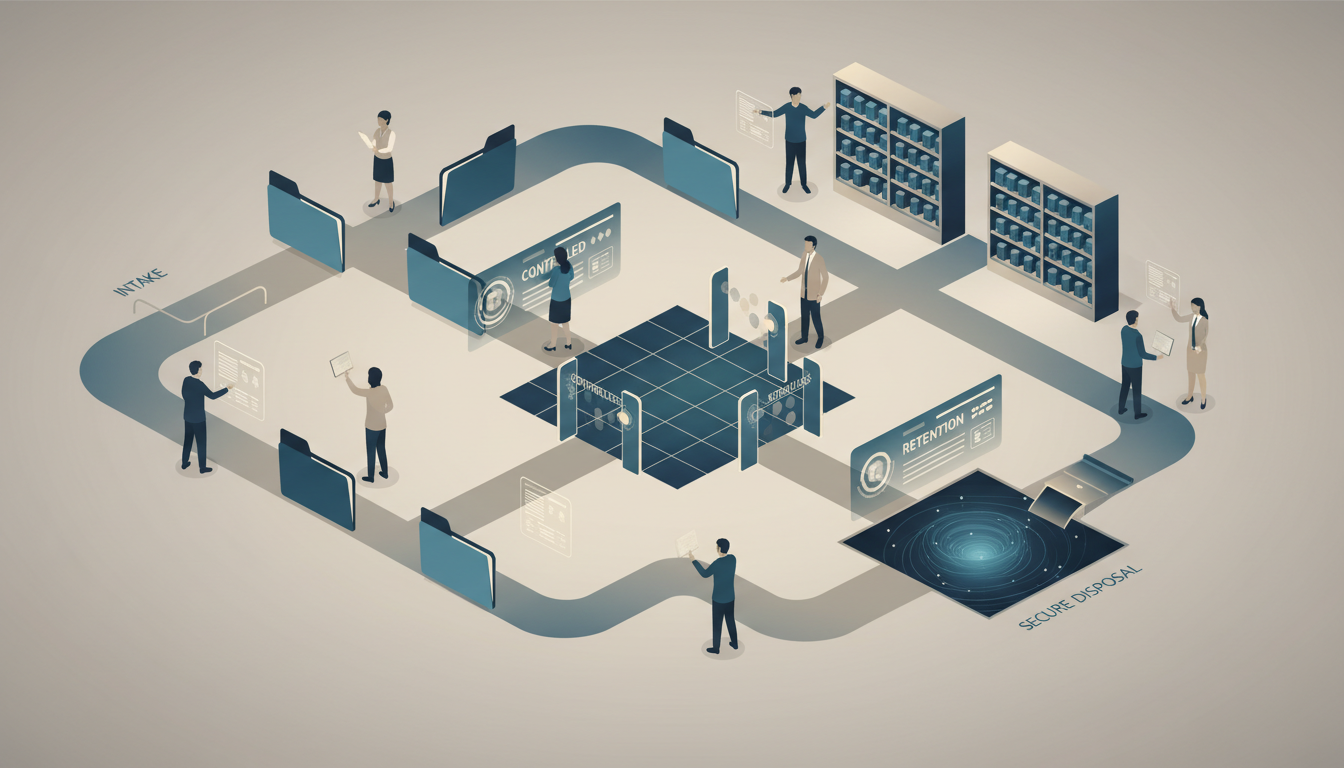
Image disclosure: This article reuses an existing original conceptual editorial illustration from eduKate’s media library showing an information-governance and archival workspace. It is an educational illustration, not a photograph of a documented cyberattack, an actual Singapore government system or an operational computer-security diagram.
Teach-back and check: Choose a route: Chapters 1–6 introduce the fictional Knowledge classroom simulation and evidence. Chapters 7–20 explore practical causes and human consequences. Chapters 21–27 compare verified cases and real preservation frameworks. Chapters 28–31 provide a safe numerical simulation with full answers. Chapters 32–34 give a five-session teaching programme, active vocabulary and a handover toward more advanced civilisations.
Safety and privacy boundary: This article does not teach intrusion, credential access, malware deployment, disruption of live services or recovery commands for real networks. Children use paper cards, not actual accounts or private records. No learner should be asked to reveal passwords, medical details, family difficulties or identifying information. Real cybersecurity work belongs to authorised specialists, and public safety notices should come from official providers.
Full chapter index
Open the 34-chapter guide
- 1. An information failure is not the disappearance of a people
- 2. Build the Asterfield Knowledge classroom simulation
- 3. Communication channels, messages and verified receipt
- 4. Records, archives and the difference between memory and access
- 5. Truth, uncertainty, corrections and confidence
- 6. Maps, provenance and the first chain of evidence
- 7. Single points of failure in digital and paper systems
- 8. Common dependencies hidden behind different applications
- 9. Backups that work and copies that merely exist
- 10. Shared definitions and interoperability across institutions
- 11. Software updates, testing and safe organisational change
- 12. Continuity when one electronic service is unavailable
- 13. Availability, integrity, confidentiality and access
- 14. Rumours and misinformation without blaming children
- 15. Education and transferable specialist knowledge
- 16. Libraries, museums and the preservation of cultural memory
- 17. Public-service records, rights and fair corrections
- 18. Health, travel, payments and the consequences of digital outages
- 19. Communication across borders and geographically remote islands
- 20. Cyber incidents versus accidental operational failures
- 21. The 4 October 2021 Meta platforms outage
- 22. The 15 January 2022 Tonga communications disruption
- 23. The October 2023 British Library cyber-attack
- 24. The 19 July 2024 CrowdStrike global IT disruption
- 25. Singapore’s Digital Connectivity Blueprint and readiness
- 26. Singapore’s Cybersecurity Code of Practice and records
- 27. UNESCO’s Memory of the World and enduring knowledge
- 28. Diagnosing cascading information failures without prophecy
- 29. The Asterfield classroom simulation eight-round simulation
- 30. Verify all eight rounds and the maths
- 31. Change one channel and test the alternate scenario
- 32. Five parent-and-tutor teaching sessions
- 33. Vocabulary, reading, maths and worked answers
- 34. Recovery, advanced civilisation and a next-generation handover
Series route: Part 1 · Part 2 · Part 3 · Part 4 · Part 5 · Part 6 · eduKate civilisation hub. The original Clementi Mathematics reference is retained as an immutable publication standard and is not altered by this series.
1. An information failure is not the disappearance of a people
Did you know that an organisation can lose access to its computer system without losing all the knowledge held by the people who work there? A library may still own its physical collections while the digital catalogue becomes temporarily unavailable. A school may continue certain lessons when its learning platform is interrupted. A city may issue alternative notices when one channel cannot be used. Each response has practical limits, but these examples show why an information-service interruption should not be equated with the disappearance of an entire people or their culture.
Name the thing that actually failed
A message can fail to reach a recipient. A record can be lost, damaged or corrupted. A record can remain intact but become inaccessible through a missing catalogue or failing software. Two documents can conflict because one is outdated. People may lose a skilled worker without losing every written instruction. These situations may look similar from the user’s perspective—“I cannot find the answer”—but they require different investigations and corrections.
The first responsibility of the learner is to narrow the claim. “The school’s website was unavailable for two hours” is a statement about a defined service and duration. “Education stopped” is a broader assertion requiring evidence that lessons and learning activities could not proceed through any appropriate alternatives. “Civilisation ended” would require even more extensive historical evidence across institutions, populations and cultural continuity.
Information has a life beyond its storage device
A document is not valuable merely because it resides in a computer. People must be able to find it, know what it means, assess its provenance and decide whether it is the current authoritative version. An archive can preserve evidence across generations while being accessible only through appropriate procedures. A teacher’s notebook can preserve the sequence of a lesson while a student’s understanding requires practice and verification. Records and living knowledge reinforce one another but are not interchangeable.
The UNESCO Memory of the World programme was launched in 1992 to support preservation and access to documentary heritage. Its existence demonstrates why cultural memory can depend on sustained specialist stewardship rather than the survival of one digital platform. Preserving a document, making it findable and helping future people interpret it are distinct achievements.
Do not erase people when describing failed institutions
When a government office closes, the people who used it do not vanish. When a library suffers a disruptive cyber incident, researchers and staff retain expertise and collections may remain preserved in different forms, though access and operations can be severely affected. When a communications cable breaks, people may face grave coordination difficulties while families, communities and cultural practices continue. A historian should name which function changed and which evidence supports the larger consequences.
This distinction avoids two opposite errors. The first minimises a serious outage by saying “only a website was down,” when that website may support work, healthcare, finance or education. The second exaggerates an interruption into a claim of civilisational disappearance. Good explanation takes harm seriously without overclaiming its historical meaning.
Asterfield’s first incident card
The evidence reviewer reports that the Knowledge classroom simulation’s electronic chapter index is unavailable for one imaginary round. The paper catalogue remains readable and eleven of twelve classroom research tasks are verified as complete. The assumption checker finds that one task cannot be confirmed because the next-step reference is missing. What do the facts establish? An electronic access problem and one incomplete model task. They do not establish that the archived books are destroyed or that every child has forgotten how to study.
This story is entirely fictional, and the operators are educational characters rather than real system administrators. Children should not infer a malicious cyberattack, a hardware defect or any specific cause from the incident card. The next step is to inspect what the index depended upon, whether the paper references are current and what would make the missing task verifiable.
Four levels of description
| Level | Asterfield statement | Limit of the evidence |
|---|---|---|
| Event | Digital index unavailable in round 1 | Cause not yet established |
| Function | One classroom lookup could not be completed | Other services may continue |
| Institution | classroom simulation uses a separate paper catalogue | Does not prove every record is accessible |
| Civilisation | Asterfield continues organising life | The model cannot forecast its historical destiny |
Ask whether the response should be to build ten new data centres immediately. Not before the actual problem has been diagnosed. A simple index discrepancy might require a corrected handover; a wider infrastructure interruption calls for different authorised actions. Good systems thinking starts with a defined failure and a credible way to check improvement.
The child-level takeaway
Teach the sentence: “Something stopped working, but we must check what it affected before deciding how serious it was.” Older learners can add that a function may be disrupted even if most physical assets remain, and that restoring a platform is not always the same as restoring access for every user. This is a foundation for more advanced institutional reasoning.
Teach-back and check: Rewrite the headline “Asterfield loses its entire civilisation after a catalogue outage.” Include the observed system, the one unfinished task, what continued and the information needed to establish the cause.
2. Build the Asterfield Knowledge classroom simulation
The Knowledge classroom simulation is the children’s fictional workspace for the next stage of civilisation. Its purpose is to make otherwise invisible information work visible. Asterfield now contains many services that depend on documents: school timetables, river measurements, library catalogues, market notices, building maintenance logs, written histories and maps. The classroom simulation holds model copies, provenance notes and training instructions that new learners can examine without accessing any real private database.
Meet the three fictional tools
The evidence reviewer is the cataloguing agent in the story. The evidence reviewer gives each document an ID, date, title, source and permitted-use label. The assumption checker is the route and evidence checker. The assumption checker asks how a claim travelled from its original source, whether an alternative copy is independent and which users actually received the current version. The lesson facilitator is the tabletop “master board” on which the two characters combine their findings. It is represented by paper cards, not a live AI application.
For an early-primary child, these characters have simple jobs: one sorts books, the other checks where the facts came from. For a Secondary student, they represent metadata management, provenance, verification and quality assurance. The goal is to teach mechanisms, not to imply that an imaginary agent could replace qualified librarians, cybersecurity professionals or public authorities.
Six shelves with six questions
| Shelf | Documents placed there | Question the next learner asks |
|---|---|---|
| Instructions | Current safe classroom activity guides | Which version is authorised? |
| Services | School timetables and harmless service cards | Which tasks were actually completed? |
| Maps | Fictional routes and locations | Who drew this, and when? |
| Evidence | Copies of appropriately cited public sources | Where did the claim originate? |
| Culture | Stories, languages and creative work with permission | How will its meaning be preserved? |
| Handover | Outstanding questions and next checks | Can a new person continue independently? |
The storage design forces the class to notice that a document needs a context. A timetable without a date may be wrong tomorrow. A map without a scale or place name is hard to interpret. A copied paragraph without a source may become a rumour. A story without permission or a clear rights statement should not simply be posted online. Learners discover that information governance includes accuracy, access, privacy and respect for creators.
Construct one example record
The group creates an entirely fictional market notice, document ID AST-MKT-004. It records the model effective round, who authorised the notice in the story, which earlier version it supersedes and how an anonymous user may raise an issue. The evidence reviewer places it in the Services shelf; the assumption checker checks that the two school desks have received the same current version. The paper board then records two outcomes: document updated and task users informed. These are separate achievements.
Ask what would happen if a learner copied AST-MKT-003 from the old shelf. The copy could be genuine and historically correct for an earlier round but misleading as a current instruction. Provenance alone does not ensure present applicability; version and time matter. Conversely, a current-looking paper lacking a source may still require verification.
Rights and privacy are part of the design
The classroom simulation uses invented names, anonymous student card IDs and public educational sources. It does not hold actual passwords, personal medical records, addresses or sensitive school files. A parent should never ask children to upload private documents as part of the game. If learners wish to practise archival skills with family photographs or letters, permission and respectful handling are essential, and the activity should use only materials they are authorised to share.
This gives a good opening to discuss the difference between public access and unrestricted access. Libraries, archives and schools can protect sensitive or copyrighted materials while preserving them for legitimate future study. A document may be kept safely even when legal or ethical constraints govern who may view or reproduce it. Access is an important goal, but its design needs to respect people’s rights.
Independent operation as the design test
At the end of the construction activity, give the classroom simulation to a child who did not attend. Ask them to find the current market notice and the evidence supporting one of its dates. If the new operator cannot do so, improve the labels rather than claiming the person is careless. The point is not a perfectly decorated room; it is knowledge that another learner can locate and use.
Older learners can add a controlled change log: previous document ID, revised document ID, effective date, reason for revision and checker. They can distinguish a correction to a factual error from a policy change or an updated delivery status. Those distinctions become important when several institutions share documents.
How the series progresses
In earlier parts, Riverlight learned to protect water, food, routes and shared rules. Harbourgate then learned to coordinate specialised supplies, and Asterfield examined energy as a supporting infrastructure. Now the classroom simulation makes the information supporting those services explicit. The next question is what happens when that information becomes unavailable or contradictory, and whether people can preserve its meaning across time.
Teach-back and check: Build one complete paper document card with ID, date, source, purpose, version and user-facing check. Give it to another learner to find and explain without your help.
Chapter index · Previous · Next chapter
3. Communication channels, messages and verified receipt
Sending a message is not the same as ensuring that it arrived. Even when it arrives, the recipient may see an outdated version, misunderstand its meaning or be unable to act on it. A communication service therefore involves a sender, an authorised message, a channel, a receiving party and a result. The classroom simulation makes each stage visible using paper slips so children can diagnose an interruption without accessing any real technology.
One notice takes a journey
The evidence reviewer creates a dated school timetable. The assumption checker checks its source and sends a paper copy through the fictional classroom messenger route. The next learner signs a receipt. That acknowledgement proves that this copy reached the desk under the model rules. It does not prove that the lesson itself happened or that every learner read the notice. For that, the teacher needs a separate activity-completion record.
This parallels the earlier supply-chain lesson: ordered goods are not delivered goods. A message drafted but not sent is not a message received. A notice sent but not acknowledged may still have reached someone, yet its receipt remains unverified. An accurate ledger keeps these distinctions instead of forcing the same number into every column.
Five useful statuses
| Status | What it means in the paper model | What it cannot yet prove |
|---|---|---|
| Drafted | Wording prepared | Sent to anyone |
| Approved | Appropriate fictional role checked version | Reached a recipient |
| Sent | Messenger recorded departure | Recipient has current copy |
| Acknowledged | Recipient confirms receiving specified version | The intended task was completed |
| Acted upon | Independent harmless task record is signed | Every later service will remain reliable |
Give the child twelve anonymous recipient cards. The coordinator prepares one current notice and records twelve sends. Only ten acknowledgements return. The correct summary is twelve sent and ten confirmed received, leaving two unverified. It is inappropriate to accuse the two recipients of ignoring the message. Their route may have failed, the messenger may be delayed or the receipt may be missing. The group should inspect the transfer process.
The message itself may be accurate but outdated
Suppose each copy of AST-MKT-003 says the market opens in round three, and AST-MKT-004 revises the schedule for round four. A reader may hold an authentic, unaltered version three while using it in the wrong round. That creates a problem of currency rather than dishonesty. Ask learners to add effective date and revision identifiers and retest the same communication route. This can solve a paper-version problem without requiring more messages.
Communication channels are different
Families may receive information through a website, printed notice, phone call or in-person explanation. These routes serve people with different circumstances, and their reliability depends on the particular event. A second channel can help, but two channels may still rely on the same upstream database or electrical service. The group should map dependencies before calling them independent backups.
In a modern information environment, a phone may be powered yet unable to connect to its service provider. A website may be reachable while the underlying database is unavailable. A printed record may remain readable while its content becomes stale. These distinctions improve a child’s understanding of digital resilience without needing networking commands or security tools.
Do not assume repeated reports are independent
A claim repeated on five pages might come from one original message. Repetition can make it appear confirmed without adding evidence. The assumption checker uses a source-route card to trace each claim back to its origin. If three websites copied the same unverified statement, the board records one origin and three repetitions, not four independent observations. Children can learn this as source criticism and use it when reading online news.
The meaning of a current source
An official status page may provide authoritative information within its own service remit. A school notice can confirm its timetable, while a library catalogue provides another type of information. Neither should automatically be treated as an authority over all other organisations. The correct source depends on the question: who owns the service, which version is current and what event is being described?
In the October 2021 Meta outage, many people temporarily could not use several of the company’s platforms, while other communication services remained. Meta’s own engineering report documents the outage and later restoration. This is a real example of why several services from one provider may share a dependency; it does not mean that global human communication stopped.
A route that can be audited
Give the next learner only a table showing document ID, sender, expected recipient, send status and acknowledgement. Ask them to find which two recipients remain unconfirmed. Then have them decide which questions need checking before another message is sent. A process becomes dependable when a newcomer can diagnose the missing step without guessing at people’s motives.
Teach-back and check: Twelve notices were sent, ten were acknowledged and nine activities were completed. Write three accurate sentences about these separate quantities and explain why none can replace another.
Chapter index · Previous · Next chapter
4. Records, archives and the difference between memory and access
A library may preserve a document even when its catalogue is temporarily unavailable. An archive may store a file while a modern computer no longer understands its format. A community may continue to tell a story after its earlier written record has been damaged. The word memory therefore covers several related but distinct things: the continued existence of evidence, the ability to discover it and the ability of people to interpret it correctly.
Preservation, discovery, access and meaning
Preservation means maintaining a record across time in a suitable condition. Discovery means people can find that a record exists. Access means authorised users can view or obtain it under the relevant rules. Interpretation means they can understand its language, context, source and limitations. A failure at any one stage may prevent useful research even when other stages continue functioning. The classroom simulation should test all four rather than celebrate a large pile of folders.
Suppose the evidence reviewer stores thirty fictional historical cards in numbered boxes. The boxes are secure, but the index that maps subjects to boxes is missing. The records may remain preserved, yet readers cannot find the relevant card efficiently. A replacement index can restore discovery without rewriting the original evidence. The lesson is that some knowledge problems arise in metadata and access, not the underlying source.
One document, several forms
A family story might be recorded as handwritten notes, an audio interview and a later transcript. Each form has strengths and limitations. A transcript can support search, while audio preserves features of speech that written words may lose. A photograph captures particular visual details but might omit the context. Preserving multiple suitable forms can support interpretation, but a copied error may appear in all if the copies depend on one mistaken original.
In a classroom, create a short original fictional account of a market opening and provide a drawing and transcription. Ask learners what each source communicates and what it cannot independently establish. Do not use real private family stories without permission. Respect for creators and subjects is part of responsible heritage work.
Why UNESCO treats documentary memory as important
UNESCO’s Memory of the World programme was established in 1992 to protect documentary heritage and encourage access. Its mandate reflects the idea that valuable records can be endangered by disasters, conflict, deterioration or lack of care. The programme does not claim that preserving a digital copy is as simple as storing it once. It emphasises stewardship, capacity, cooperation and access over time.
A UNESCO October 2026 account of audiovisual heritage at risk describes contemporary initiatives to preserve endangered recordings, including work involving Radio Mogadishu materials and institutions in Zambia. The article illustrates why obsolete formats, storage conditions and disasters can endanger cultural evidence. These are genuine programmes, not evidence that any single platform failure would destroy a whole civilisation’s memory.
A digital copy has its own dependencies
Digital preservation may involve compatible formats, integrity checks, storage media, maintained software and safe metadata. A document saved to one device can become inaccessible if the device fails or its format is no longer supported. An extra copy may be helpful, but only if the organisation can find it, has the right to use it and can verify that it represents the intended record. The exact technical procedures belong to archivists and IT professionals.
For children, the safe analogy is to create two paper copies of an invented document, number them and store them in different classroom envelopes. Then deliberately hide one index card—not the source material—and ask which part of the system is missing. The learner should not respond by rewriting the history from memory without preserving the original record and noting uncertainty.
The human explanation matters
A record may survive but its language or symbols become difficult to understand. Future readers can benefit from metadata describing context, terminology, creators and the date of collection. In Asterfield, a market ledger that merely contains “12/4” could refer to a date, a ratio or an instruction. A good handover labels the meaning. This is as much a language skill as an archival one.
Children should avoid assuming the lack of an accessible document means that people in the past lacked knowledge. Many traditions were transmitted orally, and surviving archives represent only a portion of historical life. A damaged government record may weaken later research without proving that every community memory disappeared. Strong history respects both the losses and the evidence of continuity.
What counts as an archival recovery?
| State | Observed evidence | What remains unresolved |
|---|---|---|
| Source safely stored | Record exists in the box | Can it be found? |
| Catalogue restored | Document ID maps to location | Is it accessible to permitted users? |
| Readable copy produced | Contents can be examined | Is provenance established? |
| Context documented | Date and source meaning explained | Are there alternative interpretations? |
| New learner successfully uses it | Independent task completed | Will the process work after another handover? |
If a record is lost irreversibly, there may be genuine damage to knowledge. The class should not pretend every loss can be undone. But describing preservation work accurately gives the learner a useful and constructive understanding of what institutions can do: protect originals, maintain trustworthy copies, document uncertainty and preserve access for people who come later.
Teach-back and check: A thirty-card fictional archive survives but its subject index is lost. State what still exists, what has become difficult and how a newly checked index could improve access without inventing the contents.
Chapter index · Previous · Next chapter
5. Truth, uncertainty, corrections and confidence
An advanced civilisation may have extraordinary tools for storing and sending information yet still struggle when people cannot agree on what a record shows. Some disagreements concern interpretation; others arise because a measurement is wrong or a document is outdated. Reliable knowledge institutions need ways to identify evidence, compare sources, revise conclusions and correct errors without making every disagreement a personal attack.
A claim is not automatically an observation
The evidence reviewer finds a card reading, “The market will reopen tomorrow.” the assumption checker asks when it was written, who issued it and whether an authoritative service-status card confirms reopening. The statement may be a forecast or promise, not an observed outcome. A confident voice does not change its evidential category. The proper next step is to check a relevant source rather than count how often the phrase has been repeated.
Now imagine a second card says, “The market was open from the start of round five.” That is a different claim and can be checked against an operating record. Both might be accurate if the first was written in round four. A dated description of a plan and a later observation should not be forced into conflict merely because their wording differs.
Four categories the child can use
| Category | What it represents | Example |
|---|---|---|
| Observed | A directly recorded event | This desk received AST-MKT-004 in round five |
| Inferred | An explanation based on observations | The old notice may have caused delay |
| Promised | A future commitment | The index will be restored next round |
| Unknown | Relevant evidence absent | The reason two users lacked an acknowledgement |
If an inference is plausible but not verified, a good explanation uses conditional language. “This may indicate…” does not mean the writer is afraid to answer; it means the statement acknowledges the difference between a hypothesis and an established result. Children can practise converting “obviously” and “everyone knows” into precise descriptions grounded in the source.
Errors can travel through a network
A mistaken figure copied from a primary report into a summary may reach worksheets, search engines and later articles. Each additional appearance can look like confirmation if the reader does not trace the original. Asterfield’s classroom simulation therefore records the source of every numerical claim and keeps a correction link when an earlier value is revised. The goal is not a perfect world without mistakes, but a system where mistakes can be found and corrected.
Ask learners to imagine that the original service ledger recorded nine completed tasks, but someone transcribed it as eleven. Three later documents repeat eleven. Which value is better supported? The primary checked ledger of nine, unless new independent evidence establishes a reason to revise it. Three copies of the mistake do not outweigh the original record merely through repetition.
The difference between openness and credibility
An organisation that shares its findings can improve transparency, but publication alone does not make a report accurate. A source must still be evaluated for origin, methodology, evidence and potential limitations. Likewise, an organisation that acknowledges an error is not automatically less credible than one that never admits problems. A documented correction may demonstrate a useful quality-control process.
For older learners, introduce the concept of calibration: claims should have levels of confidence appropriate to the evidence. Avoid demanding false numerical probabilities from a simple classroom exercise. Use words such as confirmed, supported, provisional and uncertain, with criteria that another learner understands.
Two claims with different time scales
“The digital catalogue was down for one round” and “the library remained difficult to use for several later rounds” can both be true. The first reports a technical interruption; the second a user-service recovery delay. A writer who treats the platform’s restoration timestamp as proof every researcher could immediately obtain every record might overclaim. This distinction is visible in the British Library’s documented multi-stage recovery after its 2023 cyber incident.
The British Library’s March 2024 lessons document distinguishes the attack, effects on services, legacy infrastructure and rebuilding. It is an organisational self-account with valuable firsthand information; readers may also seek independent evidence when evaluating wider consequences. Its publication is itself an example of a knowledge institution documenting difficult lessons for others.
A correction as a learning event
Give two children the conflicting numbers nine and eleven. Ask them to compare the source ledger, identify the transcription stage and write a correction notice. The notice should preserve the earlier entry as history, state the current verified number and avoid attributing deliberate misconduct without evidence. Another student then uses the corrected document to complete a new task.
The objective is not to reward the child who sounds certain first. It is to reward the team that can make its conclusion reproducible and revise it when a better record appears. In scientific research, history and civic life, that habit makes shared knowledge more durable than mere confidence.
A short writing structure
- State the question and the source you are using.
- Describe the directly verified observation.
- Offer a reasonable explanation only if the evidence supports it.
- Identify one remaining uncertainty or limitation.
- Name what would count as a successful check or correction.
Teach-back and check: A primary ledger says nine completions, while three later pages all say eleven. Explain why repetition does not establish eleven, then write a two-sentence correction with an independent verification step.
Chapter index · Previous · Next chapter
6. Maps, provenance and the first chain of evidence
A claim may pass through many hands before it reaches a child reading a lesson. A researcher observes something, an institution publishes a report, an editor summarises it and an educator creates a worksheet. At every stage information can be simplified, copied, updated or accidentally distorted. Provenance is the history of where information came from and how it changed. Good source tracking makes an account easier to trust and easier to correct.
Build a four-stop evidence route
On the lesson facilitator board, the assumption checker draws a path: original record → authorised report → educational explanation → student paragraph. The evidence reviewer places a date and source label on each stop. The student must be able to trace a quoted number back to the relevant document, not merely to another webpage repeating it. This is not a guarantee that the original report is infallible, but it allows others to inspect what supports the claim.
An example comes from Microsoft’s 20 July 2024 statement on the CrowdStrike disruption. Microsoft estimated that approximately 8.5 million Windows devices were affected, less than one per cent of all Windows machines. A later article that writes “8.5 million people died” has corrupted the unit and meaning. Source tracking would reveal that the original figure described an estimated number of affected devices.
Why units are part of provenance
A number without a unit is easy to misuse. Device counts, customer counts, task-rounds, kilowatt-hours and percentages measure different things. When a child copies a figure, they should copy its denominator or relevant population too. For example, “less than one per cent of Windows devices” is not the same as “less than one per cent of organisations affected.” A small proportion of devices can still cause disproportionate disruption when those devices support critical services.
Place a label beneath every borrowed statistic: what, where, when, unit, publisher and whether it was measured or estimated. Another student should be able to find the same information independently. If the necessary context is absent, write “not verified” rather than filling the gap from imagination.
A route may preserve wording but lose meaning
Suppose a report says, “The service is expected to return during round four.” A summary changes it to “The service returned in round four.” The sentence has shifted from a forecast to a claimed observed outcome. A third person repeats it confidently. The error is not necessarily in a numerical calculation; it lies in the status of the statement. Provenance requires tracking language such as expected, planned, reported, verified and completed.
Historical accounts face a similar issue. An inscription may state what a ruler promised, while a modern summary writes that every household benefited. The claim about universal implementation needs other sources. A well-designed lesson helps children see that documents have purposes and viewpoints rather than treating all writing as direct evidence of completed action.
A map needs a date and perspective
A historical map can show routes that changed during different periods. If a reader draws one network combining all known ancient roads without dates, they may accidentally imply that every connection operated simultaneously. Asterfield’s model routes therefore carry round numbers. The child should not treat a drawn line as evidence of real trade, service availability or a historically verified connection.
The same principle applies to modern network maps. A schematic may describe planned capacity rather than current performance. A news illustration may be conceptual artwork rather than a photograph of the actual incident. The featured image for this article is labelled accordingly, and no factual argument relies upon what the drawing appears to show.
Create an evidence card
| Field | Example | Why it matters |
|---|---|---|
| Claim | 8.5 million affected Windows devices (estimate) | Preserves meaning and unit |
| Original publisher | Microsoft official blog | Identifies provenance |
| Date | 20 July 2024 | Places the estimate in time |
| Context | CrowdStrike content-update incident | Avoids confusion with other outages |
| Limit | Not a count of deaths or all computers | Prevents overclaiming |
| Next check | Original incident and later RCA | Allows informed review |
The source chain should remain visible even when the summary is easier to read than the original technical document. Parents can teach this by asking the child to cite the source page and date in one sentence rather than adding a long list of inaccessible links. Good evidence habits are compatible with clear, conversational writing.
Independent copies can help but may also repeat errors
A copy stored in another library may preserve the original document against physical loss. A copy made from an already erroneous transcription will preserve the error too. The learner should distinguish redundancy for preservation from independent corroboration for truth. Two backups can be essential for availability while still being only one origin for a factual claim.
The evidence reviewer and the assumption checker use different coloured cards: blue for a copy of the same source, green for a genuinely independent record and yellow for an unresolved question. The colour coding is fictional and pedagogical. It does not constitute a professional archival classification, and students may adapt it for clarity and accessibility.
A verifiable conclusion
Ask learners to complete a short pathway from an original source to their own paragraph. They should identify at least one stage where a future error could occur and propose how to check it. The best answer is not “trust only one website.” It is “find the relevant original evidence, preserve its meaning, compare independent information when appropriate and revise the claim if the facts change.”
Teach-back and check: Trace Microsoft’s 8.5-million-device estimate back to its dated announcement. Record the exact unit and explain two wrong interpretations that the evidence does not support.
7. Single points of failure in digital and paper systems
The word backup can be reassuring, but a second copy is not necessarily an independent way to continue a service. A school might keep its timetable on two websites that use the same underlying system. An archive might hold duplicate files in one building exposed to a common disaster. A paper catalogue and an electronic index might both depend on one person’s private knowledge of their abbreviations. These are examples of shared dependencies.
What is a single point of failure?
A single point of failure is a component whose loss can prevent a whole function from meeting its purpose when no effective alternative exists. In Asterfield, a central index connects classroom questions to the physical shelf locations. If no authorised operator knows how to find documents without the index, losing it may make the archive difficult to use. The paper records may still exist. The single point concerns discovery, not necessarily preservation.
Ask students to draw a green arrow from the learner’s question to the catalogue and another to the shelf location. Now remove the catalogue. Is there a separate current paper index? If not, the task cannot be completed in the same way. If there is one and it was independently checked, certain learning tasks may continue. The result depends on real usability, not on whether the diagram contains a backup label.
The source of the backup matters
An alternate can be available but out of date. Suppose AST-MKT-004 is current, but the printed fallback still contains AST-MKT-002. Using the fallback restores access to paper, yet provides an incorrect schedule. A useful alternative must preserve the relevant quality of the service—current, authorised information—rather than merely provide something readable. This shows why availability and correctness need separate checks.
How the 2021 Meta outage illustrates common dependencies
Meta’s 5 October 2021 technical explanation describes a company-wide network outage in which internal tools were also unavailable, complicating diagnosis. The company’s own account identifies related effects on backbone connectivity and service discovery. At the child level, the important lesson is not the technical configuration sequence, which belongs to specialists. It is that tools used to repair a problem can share some of the same underlying service dependencies.
The event affected several Meta services at once, but not every internet application or all global communication. That distinction is central. A cluster of platforms from one provider can share infrastructure while other providers continue. A visible common outage does not establish that every system on Earth has failed.
A paper independence test
| Option | Helps during a lost electronic index? | Remaining uncertainty |
|---|---|---|
| Second link to same electronic index | No, if original index is unavailable | Shared underlying service |
| Current independently checked paper catalogue | Potentially yes | Coverage, accessibility and currency |
| Old printed list from last month | May help limited historical lookup | Possibly stale for current tasks |
| Staff member remembers some shelf locations | May help selected tasks | No evidence of full reproducibility |
| Second archive with independently verified records | Potentially yes | Rights, format and accessibility |
These are not universal declarations about information architecture. A real system needs a qualified design and a defined threat or failure scenario. Our exercise only tests whether a student can locate a harmless record under the stated rules.
Repair has its own dependencies
When a problem occurs, an organisation may rely on documentation, communication, authorised specialists, identity checks or particular facilities to restore service. If all those resources depend on the disrupted system, recovery can be slower. But weakening security protections to make emergency access easy can introduce other serious risks. The right design must be worked out by professionals, not by children guessing at ways around controls.
In the classroom simulation, the recovery route is simple and safe: the evidence reviewer’s paper index must be up to date, the assumption checker must verify its document IDs and an adult-approved lesson guide must explain how to resume. No passwords or computer settings are involved. The lesson can still convey why recovery arrangements need to be tested before an incident.
Avoid the false question “Which system is perfect?”
Every option has limitations. Paper can burn, be misplaced or become outdated. Electronic systems require power, software, networks and stewardship. Personal knowledge can be rich but difficult to transfer. A well-designed institution selects appropriate combinations, records their constraints and maintains the people and processes required to use them. Resilience is not the elimination of all risk.
Older students can compare a shared building, shared energy source and shared authentication dependency in broad conceptual terms. They should not use those categories to map or probe real organisation vulnerabilities without authorisation. The ethical goal is improved critical thinking and responsibility, not technical attack knowledge.
A definition children can transfer
Ask learners to use the phrase single point of failure in a safe new context, such as a classroom whose only instructions are in one teacher’s closed notebook. If the teacher is absent, the class needs a legitimate, current alternative. A printed lesson plan can make learning more independent, but only if the next teacher can find and understand it. This is an institutional resilience example children can observe.
classroom simulation check: Hide Asterfield’s digital index card. Compare a second link to that same missing index with an independently checked paper catalogue. Explain which arrangement genuinely helps, under what assumptions and how you would verify a successful lookup.
Chapter index · Previous · Next
8. Common dependencies hidden behind different applications
Two websites may look unrelated because their logos, colours and users differ. Behind the screens, they may use the same cloud provider, identity service, network connection or software component. An outage affecting that common element can disrupt several organisations. The reverse is also true: similar-looking websites may use independent infrastructure and experience different outcomes. Children should learn to investigate dependencies instead of relying on appearances.
Visible diversity is not always infrastructure diversity
The classroom simulation contains three imaginary learning services: ReadRiver, MapBridge and TaskLedger. Each has a different front page, but all three read their current document list from the same central catalogue. When the catalogue is unavailable, all three may lose the ability to discover new records even if their individual pages still open. The evidence reviewer and the assumption checker place a single source card beneath the three website icons to reveal the common dependency.
Now change the model. ReadRiver has a separately checked offline catalogue for selected books, MapBridge has a dated printed map and TaskLedger needs the live data for certain tasks. The outcomes no longer match. One common event can have uneven consequences because continuity arrangements differ. A good report says which functions continued and which were unverified rather than declaring that “all websites failed.”
The supply-chain analogy
In earlier articles, Harbourgate learned that two suppliers may use one bridge. The information equivalent is two applications using one identity provider, or two backup messages generated from the same outdated source. The physical and digital examples share a general logic: different paths can converge at one necessary node. A failure at that node may affect several services simultaneously.
We do not need to reveal how actual providers configure their private infrastructure to teach this idea. The paper map is a conceptual model. Real architectural or cybersecurity assessments require permission and qualified professionals, particularly for essential services.
A shared credential problem is not an invitation to test accounts
Accounts and authentication services help organisations control who can access information. If an authorised login service is unavailable, a user may be unable to reach a valid document even though it still exists. The classroom can represent this with a paper role card marked “access not confirmed.” It must not teach password guessing, credential bypass or unauthorized account recovery. The learning outcome is respecting access permissions while recognising their service dependencies.
The meaning of independence changes with the event
An offline printed catalogue might help during a website outage, but not if a particular user needs updated information that has not been printed. An independent cloud provider might help during a regional facility problem but still rely on a shared data source or network route. The relevant question is which failure the alternative was designed to tolerate and whether it preserves the needed function. There is no single label that guarantees universal independence.
A simple common-cause matrix
| Event card | ReadRiver | MapBridge | TaskLedger |
|---|---|---|---|
| Central catalogue unavailable | Some offline books accessible | Printed old map accessible with date limits | Current ledger not verified |
| Local ReadRiver display unavailable | Not accessible through that interface | Unaffected by assumption | Unaffected by assumption |
| All physical paper copies unavailable | Current electronic books may still work | Online map may still work | Online ledger may still work |
| Shared notice wrong at source | Risk of copied error | Risk of copied error | Risk of copied error |
Ask the child to locate each shared item in the matrix. The last row is especially important: a record copied faithfully into several places can propagate one original mistake. Backups can preserve the same misinformation if no independent verification catches it. A second computer is not a substitute for accurate source checking.
Correlated failures and probability
Older students may encounter the phrase correlated risk. It means that events are not independent in the way a simple calculation might assume. If two services share one power source, the chance both are affected by a problem at that source cannot be evaluated as though they had completely separate dependencies. Our class does not assign numerical failure probabilities; the concept is enough to prevent false confidence.
For a practical demonstration, give two envelopes different labels but place both behind one removable paper gate. When the gate is closed, both are inaccessible. Then create one genuinely separate gate and show the difference. The activity uses paper and no real authentication, wiring or networking.
One organisation’s recovery can help others
Shared providers can also bring benefits: expert operations, standardised interfaces, investment, support and knowledge transfer. The fact that organisations share a service is not automatically evidence of poor design. A serious review weighs concentration risks against these benefits and considers reasonable continuity strategies. Teach children to avoid concluding “all shared technology is bad.”
The CrowdStrike incident of July 2024 is another example of broad effects from a shared software dependency among many organisations. Its cause was an accidental defective content update, not a deliberate cyberattack according to the vendor and later reports. Children can recognise the systemic pattern without learning the technical failure path or conflating every widespread outage with malicious intrusion.
A meaningful written answer
A strong response might read: “Three applications depend on one current index, so a loss of that index may affect all three lookups. A separate, verified catalogue can help some tasks, but it may not support rapidly changing information. We should test which tasks remain accessible and avoid treating copies of the same source as independent evidence.” This describes a specific dependency, a possible mitigation and a limitation.
classroom simulation check: Give three fictional websites separate logos but one source ledger. Identify what changes when the source ledger is wrong, not just unavailable. Explain why three matching pages are not necessarily three independent confirmations.
Chapter index · Previous · Next
9. Backups that work and copies that merely exist
A file can be copied many times without becoming easier to restore. A good backup must be findable, usable, appropriately protected, sufficiently current and tested through a legitimate recovery process. Conversely, a single authoritative document may be easy to locate but vulnerable to loss if it has no supported preservation plan. Children can learn these distinctions through paper folders and clearly labelled fictional versions.
A copy is an object; a recovery is an outcome
The evidence reviewer keeps three copies of an imaginary catalogue. If the assumption checker cannot identify which is current or where it is stored, the copies do not reliably support the next learner’s task. A tested recovery means that an authorised new operator can locate the appropriate copy, determine its version and use it to find the specified record. That is an observable success beyond merely having more pieces of paper.
This principle appears in many institutions. Schools preserve curriculum documents; libraries preserve collections and metadata; businesses maintain records; governments protect archives. The exact technical backup strategy varies and must respect law, privacy and security. The classroom should not design or probe real critical-system backup arrangements.
Three meaningful tests
- Presence: does the authorised copy actually exist?
- Integrity: does it still contain the expected original information without unrecorded alteration?
- Usability: can an authorised operator understand and use it for the intended task?
A fourth question concerns currency: is the copy current enough for this use? A historical archive should preserve earlier versions deliberately, while a live service notice must identify its current effective version. The right copy depends on the task, not simply which file was saved most recently.
A paper recovery experiment
Prepare three documents: Catalogue A, Catalogue B and a handwritten revision log. A contains a fictional index from round two, B contains an update from round four, and the log describes what changed. Have a new student find the current opening time for a service in round five. If they choose A, the answer may be wrong despite its being a genuine copy. The test is passed only when the new learner can establish that B is the operative version.
Now remove the revision log. Can the child still determine which is current from labels alone? Perhaps, if dates and authority are clear. If not, improve the metadata. The goal is a document another person can use without private coaching. It is a gentle introduction to recovery drills and archival stewardship.
Independence and geographic separation
Physical copies stored in one vulnerable location may be affected by one fire or flood. Copies in distinct controlled locations can sometimes reduce such a shared risk, but create their own access, maintenance and privacy responsibilities. The teacher can use two envelopes on opposite tables to illustrate independence from one lost drawer. Do not infer that any particular real building or network is at risk merely from the analogy.
UNESCO’s work on preservation and access to documentary heritage discusses disaster threats to memory institutions and the importance of preparedness and cooperation. Its focus is the continued protection of genuine heritage, not the quick creation of generic copies without context.
Preserving authenticity
A copy may be edited or accidentally damaged. A professional archive records authenticity and provenance with suitable methods. The class can use a simple paper comparison: the evidence reviewer reads a short original sentence, the assumption checker checks a copy and circles one omitted word. They correct the copy while preserving a record of the change. This is a literacy task rather than a cybersecurity technique.
An accurate backup can also lose value if nobody understands its purpose. A page labelled “service A: 14” needs a unit, date and relevant conditions. Without them, an operator may misinterpret fourteen as customers, hours or resources. A strong handover preserves meaning alongside the characters of the text.
The limits of storage abundance
Modern storage can be inexpensive relative to some physical archives, but collecting data without managing it creates discovery, privacy, legal and environmental issues. Retention policies and legitimate deletion of unnecessary records can be part of responsible governance. Children should not assume every document must be stored forever or shared publicly. Preservation decisions balance value, rights, security and maintenance.
A backup audit table
| Claim | What proves it in Asterfield | What is still missing |
|---|---|---|
| We have a backup | Copy located and identified | Current version and usability |
| The backup is intact | Content matches source under paper check | Permission and relevance |
| The backup is independent | Stored behind a different toy loss card | Other common dependencies |
| We can restore the catalogue | New learner succeeds at assigned lookup | All real users and tasks covered |
| The service recovered | User task completed with current record | Future availability |
Ask whether the group should call the system resilient after one successful lookup. The test supports a narrow conclusion that this specific task worked under the chosen event. It does not establish that every possible disaster has been covered. Resilience is a pattern of preparedness, checking and learning across the actual service needs.
classroom simulation check: Create two dated copies of a fictional index and one change log. Hide the digital index, then ask an independent learner to recover the current location of a document. Explain why finding any copy is not yet proof of useful recovery.
Chapter index · Previous · Next
10. Shared definitions and interoperability across institutions
When several organisations exchange information, a word can change meaning as it crosses a boundary. A supplier may call a document “sent” when it leaves an office, while a school calls it “received” only after its administrator acknowledges it. A library may call an item “available” when it can be borrowed, while an archive means it can be requested under restrictions. Systems that share data need clear definitions to prevent reliable-looking reports from misrepresenting the actual service.
What interoperability means for children
Interoperability is the ability of systems or organisations to exchange and use relevant information correctly. It does not mean that every database is merged into one or that all personal information should become public. In Asterfield, two school desks use the same document IDs and dated statuses, so a receiving learner understands whether a notice is current. Their ability to use the shared record can be checked.
Suppose the evidence reviewer writes “12 copies transferred” and the assumption checker records “10 students acknowledged the current version.” These figures are not necessarily contradictory. The former counts outgoing copies; the latter counts confirmed receipt by users. A shared vocabulary allows the class to report the difference and investigate two unconfirmed acknowledgements.
A glossary is infrastructure
An institution that defines ordered, approved, issued, received, verified, current and completed gives its members a common language. A missing definition can create an error even when every worker intends to act responsibly. Ask each student to provide a counterexample to one word: a document can be received but out of date, or approved but never delivered.
Glossaries need versioning just as notices do. When a definition changes, earlier records may need interpretation under the older meaning. A learner who applies today’s definition to a historical document could misread it. This links information governance to careful history and translation.
Identity and privacy boundaries
An organisation may need to confirm that a service request belongs to an authorised user, but that does not justify sharing every detail with every other service. A school library may need an anonymous task number for a classroom exercise, not a family medical history. Real identity and permission systems require authorised professional design. The paper game teaches that data exchange should be appropriate to a legitimate task.
The same principle applies to government services. A user may need clear status information without having their private case details displayed on a public noticeboard. Public accountability and confidentiality can coexist when roles and reporting methods are designed carefully.
A data schema exercise without programming
| Field | Agreed meaning | Bad substitution |
|---|---|---|
| Document ID | Unique code for this fictional record | Document title alone |
| Source date | When the record was issued | Date someone happened to print it |
| Effective round | When instruction applies | Any time after writing |
| Transfer status | Where in the message journey it is | Assuming delivery completion |
| User confirmation | Acknowledged current version | Assuming future action occurred |
Give two learners separate paper forms. The first uses “date” to mean the day the notice was issued. The second uses “date” to mean the day it becomes effective. Let them compare. They may appear to disagree about one record when their fields have different definitions. Repair the interface by using two distinct labels. This is a harmless analogue of why data standards matter in complex organisations.
A common language can still carry common errors
If every service imports an incorrect document ID from the same source, perfectly interoperable systems may propagate the mistake quickly. Good integration therefore needs quality checks as well as compatible formats. The assumption checker might compare one entry with an independent original record, while the evidence reviewer corrects the catalogue and records the previous version for audit.
This gives children a nuanced understanding: interoperability improves coordination, but accuracy remains a separate responsibility. A complex digital civilisation needs both. It cannot rely only on more rapid information sharing if the shared information is wrong.
Standardisation without cultural uniformity
A technical field definition can help two agencies exchange a date without requiring their communities to use identical languages, artistic traditions or social customs. Information standards should support the legitimate function and respect affected users. Children should not conclude that cultural diversity is a defect to be eliminated for the convenience of a database.
For a translation lesson, compare two versions of a simple service notice and ask whether both preserve the same operative instructions. A literal word-for-word translation may be confusing; a usable translated notice needs accuracy, clarity and appropriate verification. Professional translation and accessibility standards matter for real public information.
A reasonable improvement
The fictional classroom simulation adopts a minimum shared form: ID, source, issue date, effective date, current status, authorised role and next check. Another learner can now compare two records and locate the current instruction. It is more useful than adding dozens of decorative fields that nobody maintains. A strong institution selects what users genuinely need and tests the result.
classroom simulation check: Two fictional desks disagree about the meaning of “received.” Write two unambiguous status labels and explain how you would revise the records without discarding the earlier evidence.
Chapter index · Previous · Next
11. Software updates, testing and safe organisational change
Software needs maintenance and updates. An update can improve security or functionality, but a change may also produce unintended effects. When the same component or service is used across many organisations, one flawed change can have wide consequences. The 2024 CrowdStrike incident is a documented example. Children should learn the general governance lessons—testing, clear responsibility, staged change and recovery—without instructions for changing real security software or disrupting live systems.
Change management is not just a computer activity
In the Knowledge classroom simulation, the evidence reviewer releases a new version of the paper document index. Before every learner switches, the assumption checker tests whether the new index correctly locates a few representative records, whether the version is dated and whether the old entry can still be understood for historical study. The group does not modify any real devices. Its safe paper experiment reveals why a large organisation should test the actual usefulness of a change before depending on it.
Suppose a new index sorts records alphabetically but drops the year from two titles that share the same name. A quick glance may show a clean page, while particular lookups now fail. The problem is not that all updating is dangerous; it is that changes must be checked against realistic cases and corrected when errors are found.
The difference between an update and an attack
CrowdStrike stated on 19 July 2024 that a defect in a Falcon content update for Windows hosts caused widespread disruption and that it was not a cyberattack. Microsoft estimated that approximately 8.5 million Windows devices were affected. Those details matter because the visible outcome of an unavailable system does not by itself reveal whether the cause was malicious activity, an accidental defect or an unrelated infrastructure issue.
A child must not describe every major outage as hacking. Different causes require different evidence and professional responses. The aim of an investigation is to identify the mechanism and improve the controls, not simply select the most dramatic label.
Why a small percentage can matter
Microsoft’s July 20 statement estimated that fewer than one per cent of Windows machines were affected, yet some impacted devices supported important enterprises and public services. A small proportion of all devices can therefore produce major effects when concentrated in particular essential functions. The statistic does not mean fewer than one per cent of all institutions, people or flights experienced disruption.
In the paper classroom simulation, just one missing index card out of one hundred may prevent a crucial cross-reference required by twelve later tasks. The lesson is about the importance of a component’s role, not merely its share of the total count. Avoid equating number of broken things with number of affected users.
Safe change stages
- Define the intended improvement in a way users can check.
- Test a harmless sample against the current version.
- Record who authorised the change and when it takes effect.
- Check whether the new version actually performs the needed task.
- Provide a legitimate, tested correction or recovery process for problems.
- Document the result and let the next operator reproduce it.
These are broad organisational concepts, not a technical deployment recipe. In critical systems, professionals must use relevant standards and approved procedures. A classroom should not experiment with updates to a real school network, security product or public service.
Read later incident reviews
CrowdStrike published a root-cause analysis announcement on 6 August 2024 describing the investigation and process changes. A parent can explain that a first apology or initial technical notice is different from a later analysis after more evidence has been collected. This helps children distinguish incident reporting, remediation and institutional learning.
A later report may revise or refine the understanding of what occurred. Writers should date their sources and avoid treating a first-hour theory as settled. The educational point is not to reconstruct code-level errors, but to understand why responsible organisations investigate failures and make their conclusions reviewable.
An ethical boundary on curiosity
A pupil who enjoys computing might ask how to reproduce an outage. This article does not provide instructions for disrupting devices, distributing faulty updates, tampering with security tools or accessing systems without permission. The appropriate exercise is to create a broken paper index, identify the missing field, fix it and retest independently. The conceptual lesson remains valuable and safe.
A change-impact record
| Field | Paper index example | Purpose |
|---|---|---|
| Change | Add a new classification heading | States intended function |
| Test | Find five specified library cards | Provides evidence of usefulness |
| Version | AST-IDX-005, effective round 5 | Prevents confusion |
| Checker | The assumption checker role card | Independent review in fiction |
| Observed issue | One duplicate title lacks year | Makes error visible |
| Correction | Revise index and recheck lookup | Shows actual repair |
The whole exercise can be completed in a classroom without electricity or software. Younger learners can use coloured folders and pictures; older students can explain why validation, versioning and end-user tests matter. A strong answer recognises that a successful update is verified through the function people need, not simply through a statement that a change was installed.
classroom simulation check: Create a revised paper index that accidentally omits one date. Ask a different child to find the affected record, identify the problem, correct the index and demonstrate that the same lookup now works.
Chapter index · Previous · Next
12. Continuity when one electronic service is unavailable
A school or library can sometimes continue selected activities through a non-electronic method when a digital service is unavailable. This does not mean every function can be replaced by paper, or that the alternative is automatically accurate. A continuity arrangement should define the task it supports, the current records it requires, the people authorised to use it and how completion will be verified. Real emergency and sensitive services need their own professional plans.
The safe classroom fallback
Asterfield’s learning room has an electronic timetable and a printed version that is valid for the current fictional round. When the electronic display is unavailable, the teacher can run a short literacy lesson from the current authorised paper sheet. The class records whether the lesson was completed rather than pretending the electricity was restored. This is a clear example of preserving one user-facing function through a suitable alternative.
Change one condition: the printed timetable is now from the previous round. Can the school immediately trust it? Not without checking whether the instructions remain valid. Having a paper fallback is less important than having a correct and usable one. The learner should locate the current version rather than use an outdated sheet merely because it is available.
Continuity is service-specific
A printed list may support a classroom discussion but cannot substitute for a medically necessary electrical device, an authorised banking system or a technical transport control. The distinction is crucial. Children must not infer that every essential service can continue manually simply because a harmless school task can. The word continuity always requires naming the service and its safety or professional boundaries.
The British Library’s post-attack recovery illustrates why different functions return at different times. It retained important physical collections and research functions while many digital services were severely disrupted. Its official cyber-attack recovery page describes an extended, staged process rather than one universal instant of restoration. The lesson is that the institution and its individual services have different recovery clocks.
A three-clock model
| Clock | Question | Paper example |
|---|---|---|
| Platform | Is the electronic index available? | Unavailable in round 3 |
| Alternative | Can selected tasks be done through authorised paper? | Eight tasks in round 3 |
| Full activity | When is normal workflow restored? | Round 5 under event assumptions |
A parent can ask: did the institution recover in round three, four or five? The answer depends on what we mean by recovery. In round three, selected tasks continued. In round five, the normal workflow returned under the fictional rules. Both facts matter. A report should state which function it is measuring.
Access and inclusion
Some learners may need large print, translated instructions or accessible formats. A paper alternative useful to one person may not serve another. A respectful continuity plan considers those circumstances and offers appropriate routes under adult responsibility. The classroom uses anonymous needs cards rather than collecting personal medical or disability details from pupils.
A complex organisation may also face legitimate restrictions on what can be done offline because of privacy, fraud prevention, safety or legal obligations. A child should learn to ask who is authorised to approve an alternative, not invent their own way around controls. Good continuity respects protective boundaries rather than sacrificing them.
Current records are needed for safe handover
The new operator needs a list of tasks permitted under the alternative, the current document version and what remains pending. If a task was completed on paper, it may need to be reconciled with the normal records when the primary service returns. A student who merely piles up paper forms without a tracking method may create duplicate or missing entries. The fictional classroom simulation therefore keeps a separate completion and reconciliation log.
Ask children to practise with twelve imaginary reading tasks. Eight are completed on the authorised paper route, and four remain pending. When the normal index returns, the group must not mark all twelve complete simply because the system is available again. It records eight completed, four pending and the next action for each. Recovery of a platform is not a substitute for truthful accounting.
The value of testing before an incident
A paper plan written by one person may contain assumptions another person cannot follow. Give the plan to a new learner without verbal explanation and ask them to complete one permitted task. If the learner cannot find the correct version or understand an abbreviation, improve the document and retest. The goal is independently useful knowledge, not an impressive shelf full of unused instructions.
This mirrors a broader principle of advanced civilisation: alternatives require stewardship. They must be maintained, understood and appropriate to the services they protect. The classroom can model that principle safely, while all real critical operations remain with qualified institutions.
classroom simulation check: The electronic catalogue is unavailable. Eight of twelve harmless learning tasks continue from an authorised current paper guide. Explain what recovered, what remained unavailable and which separate record is needed when the normal system returns.
13. Availability, integrity, confidentiality and access
A document may be available to open and still be inaccurate. Another may be accurate but difficult to locate. A third may contain private information that an institution has a duty to protect. Children sometimes use the phrase “the data is safe” as though it described all these conditions at once. In reality, information governance must consider availability, integrity, confidentiality, authenticity, access and the purpose for which the record is held.
Availability supports a legitimate task
An available service can be used by authorised people when they need it under the conditions promised. In Asterfield, the evidence reviewer has thirty archival cards in a protected box, but the index is unavailable. The source material may remain preserved; the child cannot complete the specified lookup without a verified alternative. That is a discovery and access problem. It should not immediately be described as destruction of the contents.
The relevant question is what the user tried to do and whether the task could be completed. A central dashboard might say that the building is open while a researcher cannot locate one item. The aggregate facility status and individual access outcome are different observations. A complete report needs both when the purpose is to understand service quality.
Integrity means maintaining a trustworthy record
Integrity concerns the appropriate completeness and correctness of data against accidental or unauthorised changes. If an original ledger reads nine completed tasks and a later copy reads eleven, the records disagree. That mismatch may result from a copying error, an outdated revision, an inappropriate change or another cause. It does not by itself establish deliberate tampering. A careful team compares sources, dates and version history before correcting the working record.
The assumption checker can check the physical card count against the evidence reviewer’s entry. When the discrepancy is resolved, preserve the former entry and add a dated correction. Otherwise a future historian might encounter two different numbers and be unable to explain their origin. The ability to audit a change is part of the usefulness of the record.
Confidentiality concerns appropriate boundaries
Many documents have legitimate users but should not be distributed publicly. A classroom progress record, private letter or medical detail may be highly important to the person concerned without being appropriate for a public catalogue. The Knowledge classroom simulation contains only harmless invented IDs and publicly usable sources. Real personal data, credentials and sensitive documents must never be entered into the toy exercise.
A parent can explain that protecting confidentiality and supporting appropriate access are not opposites. Different users may have different rights to view information. A responsible service can offer a public summary while limiting private details to people who are authorised to handle them. Children should not be asked to bypass those limits in the name of “complete transparency.”
Authenticity and provenance
A copy of an inaccurate or misattributed document can be perfectly preserved yet still be misleading. Authenticity asks whether a record is what it claims to be; provenance identifies its origin and handling history. A document may be authentic as an old notice but not current as an instruction. The evidence reviewer therefore records who issued each card, the relevant period and whether it was superseded. The assumption checker checks the route before a claim enters the class summary.
A four-column diagnosis
| Quality | Model observation | What it supports | What remains to check |
|---|---|---|---|
| Availability | Catalogue unavailable | Access interrupted | Suitable authorised alternative |
| Integrity | Numbers differ | A discrepancy exists | Origin and correct value |
| Confidentiality | Private details on public card | Disclosure boundary is in question | Authorised handling |
| Authenticity | No issuer on notice | Source uncertain | Original record and date |
The four cases should lead to different corrective actions. Rebuilding a website does not automatically correct a false statistic. Correcting a statistic does not authorise disclosure of personal information. Restricting a document may protect confidentiality but still require an accessible legitimate way to request it. Systems quality is multidimensional.
The institutional dimension
Singapore’s Cyber Security Agency Code of Practice page provides an official example of governance for critical information infrastructure. Its rules operate in a professional legal context, not a children’s classroom. The transferable idea is that information systems serving important functions need oversight, risk management, appropriate controls and tested continuity.
Ask older learners to explain why a document can score well on one property but poorly on another. A public webpage might be readily accessible but inaccurate. A secure archive might preserve a rare document while access requires permission and advance arrangements. The task is to identify the service’s purpose and what evidence could support a balanced assessment.
The classroom does not create a universal information-security score. That would hide meaningful distinctions. It uses a short question for each property and expects the child to describe a verifiable outcome. A single attractive “green” indicator cannot substitute for this explanation.
Learning checkpoint: Create four invented record problems, each primarily about availability, integrity, confidentiality or authenticity. Swap with a classmate and ask them to choose the first legitimate check rather than jump to a dramatic cause.
Chapter index · Previous · Next
14. Rumours and misinformation without blaming children
Information can be inaccurate without being deliberately deceptive. A person may share an old screenshot because they believe it remains current, repeat a claim without checking its source or misunderstand a service announcement. A responsible lesson distinguishes misinformation from disinformation and avoids inventing someone’s intent. It focuses first on the original evidence and a correction that helps people.
The journey from event to exaggerated claim
At Asterfield, the electronic catalogue becomes unavailable in one round. A student says that the library is closed. Another writes that all books have disappeared. A third declares that civilisation is ending because its knowledge is gone. Each sentence reaches farther than the previous one. The original event does not establish any of the later claims. The task is to identify where an observation became an inference and where the inference became an unsupported conclusion.
This activity can be harmless and memorable. Place four paper cards on the table and ask learners to mark one verified, two needing additional evidence and one beyond the scope of the scenario. The strongest response is not an angry accusation against the storytellers. It is a clear, checkable correction describing the digital index and the physical records separately.
A source graph prevents false corroboration
Three people may repeat one message. If the message originated with one unidentified screenshot, the number of repetitions does not make it three independent confirmations. The assumption checker traces the arrows back to their origin. The evidence reviewer keeps the original wording and date so that the class can see whether later summaries changed its meaning. This is a foundation for media literacy and good historical research.
Students can also ask whether two records concern the same event and time. A library announcement about a planned closure next week and a visitor’s observation from this morning are not contradictory solely because one says closed and the other says open. Time is part of the claim. A careful reader aligns the statements before deciding they disagree.
A neutral evidence board
| Known observation | Public claim | Unknown | Next legitimate check |
|---|---|---|---|
| Catalogue unavailable | All records destroyed | Physical-collection status | Authorised inventory check |
| 9 of 12 notices acknowledged | Nobody received a notice | Status of 3 recipients | Receipt log and accessible contact |
| Old timetable copied | Current timetable cancelled | Effective date of revision | Official dated version |
| A book search failed | All learning stopped | Alternative learning outcomes | Teacher’s activity record |
A child can explain why the second column sometimes overstates the first. The next action should relate to the missing information rather than an imaginary cause. This habit allows people to communicate calmly when a real service is under pressure.
Correcting a rumour respectfully
A public correction should state what has been verified, identify an earlier statement that was misleading, provide the current source and make uncertainty visible. It should not mock people who relied on the wrong information. Users may have legitimate difficulties obtaining timely updates, especially when a communication service itself is disrupted. Good institutions support access to the correction.
For example: “The Asterfield electronic catalogue is unavailable for this model round. The paper archival boxes remain accounted for, but some searches require additional checks. The updated authorised index will be announced after its status is verified.” This says enough to help readers without inventing an exact recovery time or cause.
Do not confuse visibility with evidence
A vivid photograph, chart or animation can make a claim easier to understand while also giving it undeserved certainty. The conceptual cover illustration for this guide shows an information-governance workspace, not a documented attack or particular city. The visual helps children imagine the function but is not evidence of an actual outage. Image captions should make that distinction clear.
In contemporary public affairs, source checking also requires fairness. A contested political statement may contain factual, interpretive and normative parts. Students can verify dates and documents, describe credible competing interpretations and avoid pressured advocacy. This chapter’s main role remains literacy: knowing how to distinguish an observation from an unverified story.
What if a warning could be important?
An unverified report should not automatically be ignored. A safety-related concern may warrant contacting responsible adults and following official guidance while a cause remains uncertain. Children should not investigate live infrastructure or access private systems in response. A careful communication can say that a report is being checked and identify the proper official channel.
The useful habit
Before repeating a dramatic claim, ask: who first said it, when, what did they actually observe, which part is inferred and what independent evidence could revise the story? Learners can practise these five questions on a fictional school notice. The goal is not universal distrust, but justified confidence in what the evidence supports.
Learning checkpoint: Rewrite “All of Asterfield’s knowledge was deleted” using a verified digital-index interruption and the continued existence of physical records. Include one uncertainty and an appropriate check.
Chapter index · Previous · Next
15. Education and transferable specialist knowledge
A civilisation depends on people who can read records, teach skills, ask useful questions and apply information to new conditions. A library’s shelves may be full, yet a new operator may not know how its catalogue works. A technically correct manual can be unusable if it omits the meaning of its abbreviations. Education and training turn stored information into capacity that can survive a change of personnel.
Correct does not mean understandable
The evidence reviewer writes “Q14, R3, B, V5.” The notation may accurately describe a record but has no obvious meaning to a child arriving tomorrow. The assumption checker asks for a legend. The evidence reviewer expands it into document Q14, room three, shelf B, version five, with the relevant date and a method of checking the location. The source did not need to change; the instruction needed to become interpretable.
Invite a new learner to use the two descriptions. Which one supports independent action? The exercise demonstrates that language is part of a system’s design. A vague handover can create a service problem even when the underlying collection is well maintained.
Tacit and explicit knowledge
Some skills are best introduced through demonstration, practice and feedback, not merely reading. A teacher can write the rules for making a clear argument, yet a pupil learns to judge evidence through examples and corrections. A craftsperson may know how to recognise a suitable result from experience. Documentation remains important, but it cannot eliminate every need for training and qualified judgement.
In safety-critical professions, a printed instruction is not a substitute for competence or formal authorisation. Children should not infer that a short classroom simulation guide qualifies them to manage networks, healthcare, transport or public infrastructure. The lesson remains limited to harmless classroom and archival activities.
Institutional knowledge and staff changes
Experienced workers retire, move or change roles. When only one person knows why a rule exists, the next team may repeat a mistake or drop an important step. A useful handover records the present position, unresolved concerns, rationale for a decision and the next point for review. Training another person then tests whether the information is genuinely transferable.
The British Library’s public incident review after October 2023 discusses the complexity of legacy systems and the demands of restoring services. Its lesson for a child is that accumulated infrastructure and knowledge need maintainable records and professional stewardship. Do not overgeneralise the institution’s specific experience to every library or suggest that one untrained person could perform an expert recovery.
Learning survives a platform change
An online lesson may be temporarily inaccessible, but learners and educators retain skills and may use appropriate alternative materials. At the same time, losing access can impose real delays and inequities, especially where certain users have no suitable replacement. A balanced report recognises both continued human knowledge and the importance of restoring fair access to resources.
This is the distinction between education as a human process and a particular educational platform. The two interact but are not identical. A school can adopt new technology while preserving learning goals, assessment practices and cultural memory through qualified teachers and students.
A cross-generation knowledge table
| Knowledge form | Example | Useful preservation route |
|---|---|---|
| Explicit instruction | Current catalogue legend | Versioned, findable guide |
| Practised skill | Using the catalogue correctly | Demonstration and independent retest |
| Historical evidence | Original public report | Source and date recorded |
| Cultural memory | Story with creator permission | Context, language and respectful stewardship |
| Open question | Conflicting document IDs | Visible verification task |
Asterfield’s operators make two complementary checks. The evidence reviewer verifies that the right document is preserved and current. The assumption checker asks a new learner to use it without coaching. If the learner succeeds, there is evidence of usable knowledge transfer for that task. If not, the authors improve their instruction before claiming the classroom simulation is ready.
A transfer exercise for parents
Start with a simple school-library sign-out procedure. The first child writes instructions; another follows them using fictional book cards. Do the records reconcile? Does the new operator know what to do when a title is missing? Can a child with a different reading level understand the headings? This small experiment teaches clarity and accessible design rather than complex technology.
Older learners can repeat the exercise with a sourced historical passage. They should preserve the author’s claim, the evidence, a limitation and the date. A new learner then writes a short explanation. If the source’s meaning changed during the handover, the group documents the difference and corrects it. This is an exercise in both literacy and institutional memory.
Cultures are larger than their paperwork
Societies can preserve language, art, relationships and practical knowledge through people as well as archives. An administrative centre may be abandoned while surrounding communities carry forward traditions. The absence of a written source does not prove the absence of knowledge in the past. Historians need care about what survives and whose records were privileged.
A civilisation that changes its tools may still maintain cultural continuity, while the actual loss of unique records can remain serious. Children should avoid both extremes: that a digital outage erases everything, and that preservation never matters because people remember all important things. Good institutions combine human teaching with responsible evidence stewardship.
Learning checkpoint: Write a six-line catalogue instruction and give it to a student who did not attend. Test one lookup, record their questions, then improve the document. Explain how a successful handover differs from merely saving a file.
Chapter index · Previous · Next
16. Libraries, museums and the preservation of cultural memory
Libraries and archives give a society ways to preserve evidence and make knowledge available beyond one lifetime. Their work includes caring for original materials, cataloguing, rights management, digitisation, public service and expert interpretation. When one of these functions is disrupted, the effects can be serious while other functions continue. A truthful account says exactly what was lost, what remained and what requires rebuilding.
The four components of an accessible collection
A record must be preserved in an appropriate condition. People must be able to discover that it exists. Authorised readers must be able to access it through a legitimate route. Finally, they must be able to understand its provenance, language and context. Failure at one stage can prevent useful research without establishing destruction at every other stage.
In Asterfield, a rare fictional manuscript remains inside a protected box, but the evidence reviewer’s subject index is missing. The assumption checker can verify physical preservation while still reporting that discovery is incomplete. The next group reconstructs an index from authorised metadata, but it must not invent the contents of unknown documents. The task illustrates the difference between access work and rewriting history.
The British Library’s 2023 incident
The British Library’s March 2024 account describes a serious cyberattack that disrupted access to many services and led to a long recovery. It also acknowledged the exposure of some personal data. The institution’s existing collection and expertise did not cease to exist, but access and technology functions suffered material harm. This makes the event a valuable case for distinguishing an institution from its digital service.
Children should study the public report’s service and governance lessons, not the details of how an attacker obtained access. A cyber incident is a real crime affecting people and organisations. The classroom model is deliberately harmless and has no live technical target.
Digital preservation is more than a saved copy
A digitised file may rely on media, compatible formats, metadata and maintained information systems. Copies can help protect against some kinds of loss but still require integrity and authorised-use checks. A document’s content may survive while its descriptive context deteriorates. Professional digital preservation therefore involves ongoing work rather than a single one-time upload.
UNESCO’s Memory of the World programme seeks preservation and access to documentary heritage. A 2026 UNESCO account describes work protecting endangered audiovisual archives, including materials associated with Radio Mogadishu and heritage collections in Zambia. These projects reflect the importance of cultural memory across societies and generations.
Access has legitimate limits
An archive may protect certain information because of privacy, copyright, donor conditions or cultural considerations. Responsible access does not mean making every item unrestricted. The user should know which information is publicly available, which requires permission and why the conditions matter. The classroom uses public source links and wholly fictional records to avoid private-data problems.
A child might ask whether a museum that restricts handling a fragile object is hiding history. The better response is that preservation sometimes requires use of an access copy so the original lasts for later researchers. The National Archives of Singapore’s reading-room rules describe using copies rather than retrieving original records for general viewing, in order to reduce handling and support preservation.
Singapore’s web archive
The Web Archive Singapore preserves selected websites for historical study. A page available through an archive may show what an institution published years earlier, but should not automatically be used as current public-service advice. This is a subtle but useful lesson: a document can be authentic for the past and obsolete for the present.
Ask learners to compare an old school notice with a new one. The old notice may be a valuable historical source showing how a school operated, while the new notice governs today’s activity. Good archival work preserves both while making their periods clear. Deleting the old version would remove historical evidence; using it as current could mislead users.
Cultural continuity does not require one unchanging medium
Stories can be transmitted through books, recordings, performances and living communities. A change in medium may protect access or reach new audiences, but it may also lose aspects of original expression. Careful documentation helps future people understand those differences. A historian should not assume that cultural practice ended because one particular format ceased being used.
| Archive function | classroom simulation example | Next check |
|---|---|---|
| Preservation | Original card safely stored | Condition and location |
| Discovery | Subject index available | Can a new learner find the card? |
| Access | Permitted reading copy | Rights and usable format |
| Interpretation | Source, date, creator and notes | Can the reader explain context? |
| Continuity | New operator repeats lookup | Does handover work? |
A strong conclusion recognises both loss and persistence. A service disruption may delay scholarship and cause real harm. A unique archival loss may be irreversible. Yet a community’s knowledge cannot simply be equated with the online availability of one catalogue. Preservation, teaching and recovery operate at multiple levels.
Learning checkpoint: Use two copies of an invented historical notice—one current, one archived. Explain which is appropriate for an operational decision and which is suitable for studying the past.
Chapter index · Previous · Next
17. Public-service records, rights and fair corrections
Public services depend on records to establish what has been requested, decided, approved and completed. If an entry is wrong, a person can encounter difficulties even when the underlying service still exists. Information integrity is therefore a civic issue. Children should learn that the person described by a record is not identical to that record and that a fair correction process needs evidence, dignity and legitimate authority.
Asterfield’s H07 record
The classroom simulation’s fictional service ledger says household H07 received a library booklet. The independent receipt card is blank. Several explanations remain possible: the booklet might not have arrived, the signature could be missing or the record may have been placed in another folder. The correct initial statement is “delivery unconfirmed,” not “H07 failed to follow instructions” or “the clerk stole the document.”
A responsible process examines the source entry, current status, relevant transfer cards and the affected person’s report. It can correct the record when appropriate evidence supports a change. The new value should be dated and linked to the previous entry so that later readers understand why the ledger changed.
Missing, incorrect and outdated
- Missing: a required document cannot currently be located.
- Incorrect: a recorded value differs from the better-supported evidence.
- Outdated: a record was true at one time but has been superseded.
These conditions are not synonymous and may need different responses. A missing copy may require an authorised search or reconstruction from other records. An incorrect status needs a verified correction. An outdated instruction needs a new effective version that reaches its users. A single command to “fix the computer” does not identify which issue has occurred.
Accountability without humiliation
The child who discovers a discrepancy should be encouraged to report it. If learners fear being publicly blamed for finding a mistake, they may hide useful evidence. A better response names the inconsistency, asks relevant questions and records the correction. Where an actual allegation of misconduct exists, qualified adults and lawful procedures must handle it. The paper game never requires children to accuse classmates.
This habit connects information governance to social trust. A community where users can correct important records through a fair process is more capable of maintaining cooperation. An organisation that simply announces “our database is perfect” offers less useful assurance than one that can demonstrate appropriate review and improvement.
Authorised access and private information
A record correction may require identity checks in real institutions. Children should not practise with actual identity documents, health data or financial records. Use anonymous H01–H12 cards and pretend book deliveries. Parents and tutors should protect private information while explaining why the affected person needs a legitimate route to request review.
Transparency also has boundaries. A public summary might report that three records were corrected, while a private case file contains additional details available only to authorised staff and the person concerned. Both kinds of reporting can be appropriate. The exercise should not teach children that privacy and accountability are incompatible.
A correction log
| Case | Earlier record | New evidence | Current conclusion |
|---|---|---|---|
| H07 | Delivered | No signed recipient card | Unconfirmed; investigate |
| H08 | Unconfirmed | Signed current-version receipt | Completed |
| H09 | Old opening time | Dated revision approved | Earlier notice superseded |
| H10 | Source unknown | Original archive copy located | Provenance check pending |
Ask why H10 cannot immediately be marked fully verified. Finding a copy is useful, but it may still need appropriate checks of source and purpose. Asterfield’s classes should resist the temptation to close every open case for the sake of a perfect-looking dashboard.
A modern archive comparison
The NLB OneSearch FAQ explains that materials from different collections may be discovered through search while actual access depends on permissions and the nature of the record. This is a useful Singapore-based analogy for separating discovery, entitlement to view and actual service completion. It should not be presented as the specific legal process for correcting another agency’s records.
The broader civilisation question
A government office may change its database while the people it serves continue living, learning and working. A corrected record can restore access for some users without transforming every institution. Serious data failures may weaken trust and cause hardship; their societal impact depends on scope, duration, fairness and the organisation’s ability to repair. Careful analysis never equates one wrong row with the disappearance of civilisation.
Learning checkpoint: Write a respectful acknowledgement to fictional H07. Include what the current ledger says, what the receipt does not establish, the evidence being reviewed and the next update.
Chapter index · Previous · Next
18. Health, travel, payments and the consequences of digital outages
Modern information systems support healthcare administration, transport, financial services, education and ordinary business operations. A shared technical disruption can therefore have effects far beyond the computers that display an error. But each affected organisation has its own continuity arrangements and responsibilities. The relevant question is which user-facing service was actually interrupted, for how long, and what remained available.
The 2024 CrowdStrike example
Microsoft’s 20 July 2024 account estimated about 8.5 million affected Windows devices. The incident also disrupted businesses and services in sectors including air travel and healthcare. The figure describes devices, not every user, flight, financial transaction or hospital service. Its significance comes in part from the concentration of affected computers among important organisations.
CrowdStrike identified the cause as a defective content update, not a cyberattack. That distinction demonstrates why the visible effect of a software crash cannot establish the origin of the problem. A writer should avoid automatically turning every global digital incident into evidence of a hostile campaign.
The last mile of a digital service
Suppose an airline’s reservation interface is restored while travellers still need their disrupted itineraries rebooked. The platform’s technical availability and the customer’s completed journey are different results. A clinic might restore appointment software while dealing with a backlog of administrative tasks. A bank’s application might reopen while individual transactions require reconciliation. These examples illustrate possible recovery lag rather than asserting that every institution experienced identical conditions.
A strong analysis states which organisation, time interval and task it is describing. “Flights were delayed” may be true for certain carriers during an incident but cannot be expanded into “all global travel stopped.” The user-facing measures—completed journeys, resolved appointments or correctly reconciled transactions—are necessary to evaluate actual service recovery.
Children must not simulate real critical decisions
The Knowledge classroom simulation exercise uses harmless classroom booking cards, not real bank accounts, medical records or passenger control systems. A child is not asked to decide whether a patient can be treated, an aircraft can depart or a payment is legally final. Those questions involve safety, privacy, professional responsibility and applicable law. The conceptual lesson needs none of the hazardous operational details.
A case with different recovery clocks
In the fictional library, an electronic index becomes available again in round five. The teacher still needs to reconcile earlier paper loans and confirm four overdue reading tasks. Restoring the digital platform has not automatically finished the user work. The class records one time for technology restoration and another for completing the affected activity. That separation is one of the best ways to prevent premature success claims.
A similar distinction appears in the British Library’s prolonged recovery after 2023. Public pages explain which facilities and digital services are available at different stages. Rather than assuming one reopening date means universal restoration, a researcher should check the particular service and date that mattered to the user.
Privacy remains essential during a disruption
Health and financial services often handle highly sensitive information. Their recovery processes must respect security and legitimate access controls. Children should not learn that a digital outage justifies sharing passwords, downloading private records indiscriminately or bypassing provider restrictions. Authorised professional procedures matter even under pressure.
One classroom cascade
Asterfield’s reading-book boxes are physically available. The catalogue is interrupted. The evidence reviewer locates a current permitted paper index, allowing eight of twelve planned book tasks to proceed. Four remain pending because recipient notices have not been confirmed. Later, the digital index is restored, but those four tasks still need actual completion. The outcome is mixed and measurable; no child needs to role-play a real crisis.
The group can calculate a service completion rate of eight divided by twelve, about 66.7%, for that specific imaginary round. That number is not an estimate of the percentage of real patients, travellers or transactions affected during a historical incident. A percentage belongs to its explicit numerator, denominator and context.
A service-status comparison
| Record | What it establishes | What it does not prove |
|---|---|---|
| Software vendor marks fix deployed | A remedial action occurred | Every affected user has recovered |
| Organisation reopens interface | One service is available | All backlog resolved |
| User confirms task finished | That defined outcome succeeded | All other users experienced same result |
| Investigation released | Documented findings and proposed learning | All future incidents impossible |
The broader issue of digital dependence is worth discussing without exaggeration. Computers and networks support considerable human capability, while their concentration and maintenance create risks requiring stewardship. A child can appreciate the benefits and still ask for stronger evidence about continuity and recovery. A sophisticated civilisation is not one without difficulties; it is one that can recognise and address them responsibly.
Learning checkpoint: An application is restored, but four of twelve reading tasks remain unfinished. Write two separate recovery statements, one about the application and one about users, with exact units.
19. Communication across borders and geographically remote islands
Communication infrastructure can connect a remote island to families, schools, governments and markets across the world. Its benefits are substantial, but geography and infrastructure design affect the options available during a disruption. The January 2022 volcanic eruption in Tonga provides a documented example of how a serious natural disaster damaged international communications. The event caused real suffering, and the lesson must not reduce it to an entertaining internet puzzle.
The importance of physical cables
Much international digital communication travels through physical undersea fibre-optic cables. People may imagine the internet as an entirely wireless cloud, yet cables and other physical facilities are essential to global connectivity. A cable may connect islands or countries to wider networks; restoring it after damage can require specialist vessels, teams and difficult logistics. A school should teach this at a general level, not by mapping vulnerable live infrastructure.
The International Telecommunication Union’s February 2022 account described a major disruption following the Hunga Tonga–Hunga Ha’apai eruption. The damage to Tonga’s principal international submarine cable severed a crucial connection. This is evidence of a physical communication infrastructure failure, not a cyberattack or a failure of the people affected to understand technology.
Connectivity does not mean every form of communication
A near-complete interruption of ordinary international internet connectivity is not the same as the absence of every possible communication channel. The UNESCO Tonga tsunami survey page describes satellite telephones and high-frequency radio as communication routes that remained possible while the cable was severed. Their limited capacity and accessibility mattered, but they show why precise descriptions are important.
Readers should be wary of slogans such as “Tonga disappeared from the world.” Tonga’s people, culture and institutions did not disappear. They faced a severe disaster and major communication challenges while emergency responders and communities worked to understand and address the situation. The right language describes the material harm without erasing the people.
A recovery date requires the right source
UNESCO’s tsunami programme records the 15 January 2022 eruption and says that repair of the international cable restored the relevant communication connection on 22 February 2022. The ITU’s earlier February article was published while restoration work was still being organised. A later account can therefore describe a completed milestone unavailable to the earlier source. Students should distinguish a dated forecast or early situation report from an outcome confirmed after the event.
It would be misleading to state that every form of digital service was fully normal throughout all Tonga’s islands on that date simply because the main international cable was repaired. Domestic network damage, capacity and individual access require separate evidence. The date marks a particular infrastructure milestone rather than universal completion of all downstream services.
Geographic resilience and costs
The United Nations Conference on Trade and Development’s 2022 Pacific Digital Economy Report discusses Tonga’s reliance on a principal cable, the use of lower-performance satellite connections as alternatives and the economic challenges of building additional international cable links. It also contrasts the situation with Fiji’s additional cable connections. The broader finding is that meaningful redundancy depends on capacity, investment and context.
A backup is not simply another icon on a map. It should be usable for the services people need during the event, supported by trained operators and maintained as appropriate. Satellite communication may provide an important option, yet its bandwidth and availability may differ from those of an international fibre connection. The relevant comparisons need credible technical and social evidence.
A paper island activity
In Asterfield’s classroom, place a fictional island called Tidepoint beyond Harbourgate. Give Tidepoint one coloured string to the Knowledge classroom simulation and a separate card for a limited paper message route. Remove the string for one imaginary round. Ask which of twelve messages still receive acknowledged delivery through the paper alternative, and what remains unconfirmed. No real networks or cable locations are involved.
Now add another independent string with its own receipt route. Does that make the island permanently invulnerable? No. The two paths may have limits, need maintenance and be exposed to other events. The child should name the specific condition in which the second path helps. This is more accurate than a claim that “double cables guarantee perfect internet.”
The human question
When international communication becomes difficult, people may struggle to contact relatives, coordinate logistics or obtain timely outside information. An honest lesson recognises that these effects can be serious without speculating about the private experiences of particular families. A parent can ask why a government, disaster responder or school needs verified messages and appropriate alternatives. The answer focuses on the services people rely upon.
A source comparison table
| Source | What it supports | What it does not establish alone |
|---|---|---|
| ITU February 2022 | Cable damage and efforts to restore connectivity | The final restoration date if still in progress |
| UNESCO survey | Date and nature of eruption, cable disruption and repair milestone | All downstream communications uniformly restored |
| UNCTAD Pacific report | Economic and redundancy challenges | Every island has the same alternative capacity |
| Paper Tidepoint game | Logical effect of one removed link | The engineering condition of real Tonga |
A strong student writes that Tonga experienced a serious physical communications disruption after a natural disaster, that limited alternatives were available and that specialised work restored the international link. They also identify the limitations of each source. That is a much better historical account than attributing the event to a malicious internet attack or suggesting the country had ceased to exist.
Evidence task: Write one sentence identifying the physical hazard, another naming the communication function affected, a third describing a documented alternative and a fourth qualifying what the 22 February 2022 repair milestone proves.
Chapter index · Previous · Next
20. Cyber incidents versus accidental operational failures
A user looking at an unavailable computer service may not know whether it was caused by an accident, a malicious attack, a physical cable break or an unrelated power interruption. These mechanisms require different evidence and professional responses. Children should not be encouraged to guess that an outage was “hacking” simply because it was widespread or alarming. A sound explanation begins with observed symptoms and qualified findings.
A simple classification with real examples
| Incident | Documented broad cause | Important limit |
|---|---|---|
| Meta services, October 2021 | Accidental network configuration disruption | Not evidence that all internet services failed |
| Tonga communications, January 2022 | Volcanic eruption damaged submarine cable | Not a cyberattack |
| British Library, October 2023 | Criminal cyberattack with significant digital-service effects | Not the destruction of all heritage collections |
| CrowdStrike, July 2024 | Defective content update caused Windows device failures | Vendor stated it was not a cyberattack |
The table is a starting point for source reading, not an invitation to reproduce any event. There are no technical steps for exploiting systems, accessing accounts, disabling protections or manipulating networks. The classroom instead compares official dated statements and asks which evidence supports a particular cause.
An accident can have large consequences
An unintentional software or configuration change can affect many users when it reaches a shared component. The consequences can be economically or socially serious even without a malicious actor. Likewise, a cable break caused by a natural hazard can disrupt services for an extended period. A child who recognises this avoids confusing the impact of an event with the intention behind it.
Meta’s official engineering account explicitly said there was no malicious activity behind its 2021 incident. CrowdStrike likewise said its July 2024 update fault was not a cyberattack. These are primary descriptions of the incidents. A reporter may still examine additional independent evidence, but should not substitute an unsupported hostile explanation when the cited investigation identifies a different cause.
A cyberattack is not necessarily identical to data loss
A malicious incident can impair service availability, expose private data, alter information or damage technical systems in various combinations. A disruption does not by itself prove that data were stolen, and stolen data do not always mean every service is down. The British Library’s public 2024 review documented both severe operational harm and the compromise of some personal data, so its effects must be described specifically rather than reduced to a single generic word.
For younger learners, use the neutral concepts of availability, accuracy and privacy. Older students can discuss how public investigations describe these dimensions without exploring offensive methods. Real institutions require authorised incident response, forensics, governance and legal processes.
The importance of a later investigation
Early statements can be incomplete. A vendor may announce a fix, and later publish a more detailed root-cause analysis. The British Library released a formal review in March 2024 after its October 2023 incident. CrowdStrike released a later root-cause analysis announcement in August 2024. A researcher should compare dates and status rather than treat the first public hypothesis as the final established explanation.
This is particularly important in breaking news. A short video showing a blue error screen cannot tell the viewer why the device failed. A photographed dark data centre cannot establish a ransomware incident. The visible symptom and the cause are different questions, and neither should be confused with evidence of an entire society collapsing.
Trustworthy communication during uncertainty
A responsible public message says which service is affected, what has been verified, how users can find current official information and what remains under investigation. It does not promise a precise restoration time without support. Users can benefit from timely status updates even when a full forensic explanation takes longer.
Children can draft a paper version of such a notice for Asterfield. The teacher gives the event card “catalogue unavailable” but no cause. The student must explicitly state that the cause is not yet known. The most common mistake is to add a dramatic explanation to make the notice sound convincing.
Good governance after an incident
Post-incident review can identify controls that did not work as intended, missing documentation and opportunities for safer change management. Making those lessons available can support other organisations, as the British Library said in its review. Yet the existence of a report does not prove every recommendation has been completed or that future risk has become zero. Evidence of adoption and testing is needed for those stronger claims.
A distinction between responsibility and blame
An organisation may be responsible for restoring its service and communicating with users while an investigation is still underway. Responsibility to act is not the same as a fully supported conclusion about an individual’s wrongdoing. An educational discussion can support accountability without demanding public accusations from incomplete information. This is especially important when real incidents involve identifiable people.
For a harmless exercise, compare two fictional notes: one says a catalogue entry was copied incorrectly, and another says someone intentionally changed it. If the only evidence is a mismatch, the first may be supported while the second remains a hypothesis about motive. A child should name what further evidence would be needed instead of arguing from confidence.
What a good causal paragraph includes
The paragraph begins with the confirmed event and relevant source, then explains the supported mechanism at a level appropriate to the reader. It states downstream service effects without universal overstatement, recognises recovery and ends with uncertainty that still matters. Such precision is useful whether the cause is technical error, natural hazard or malicious activity.
Evidence task: Match each documented incident with its broad cause, without giving any technical attack or disruption steps. Then explain why the visible symptom of an unavailable service cannot establish intention.
Chapter index · Previous · Next
21. The 4 October 2021 Meta platforms outage
On 4 October 2021, several services operated by Facebook, now Meta, became unavailable to users around the world for a period. The outage affected platforms on which many individuals and businesses depended, and Meta’s own internal support tools were also disrupted. This makes the event a useful example of a common dependency in a large digital organisation. It was a significant operational failure, but it was not the disappearance of the internet or global civilisation.
Start from the company’s dated account
Meta published an initial engineering update on 4 October 2021, followed by a more detailed explanation on 5 October. Its account attributed the outage to an unintended network change during routine maintenance that disrupted connectivity within its own systems. It stated that malicious activity was not behind the incident.
The article should not provide the low-level commands, topology or procedures involved. Children need only the causal structure: a shared internal dependency was disrupted, several services and some tools used by staff became difficult to access, and specialists worked to restore operations. The company’s reports support that high-level description.
What was affected and what continued
Several Meta-owned platforms were unavailable, including Facebook and related services. But users still had other internet services, telephone systems and communications providers available according to their circumstances. It would be inaccurate to claim that every website stopped working. The meaning of “global outage” is that a particular provider’s services were widely affected, not that all worldwide communication ceased.
For some households and businesses, the disruption was consequential because they used these platforms to contact others or conduct work. A humane discussion recognises those costs while also examining continuity and recovery. Users did not lose their culture or all their knowledge when a set of applications was inaccessible.
The shared-dependency lesson
Meta’s public engineering explanation says that the original network disruption also affected tools and systems employees used to investigate and recover. This is the defining issue for our classroom: a recovery process may depend on part of the infrastructure being repaired. An authorised offline or independent route can matter, but it needs careful security and professional design. The paper classroom simulation uses a current printed index as a safe conceptual analogy.
The evidence reviewer marks three imaginary applications as dependent on one central catalogue. The assumption checker removes that catalogue under an event card. The students observe that three front ends cannot find their records, even though their designs differ. The exercise does not represent Meta’s actual architecture. It captures only the general lesson about hidden shared dependencies.
Restoration is not an instant universal outcome
Meta reported that services had come back online following the incident. That does not automatically establish that every user, advertisement, business message or independent workflow was immediately restored at the same moment. A reliable assessment distinguishes the platform status from particular downstream user effects. In Asterfield, a restored index can coexist with research tasks still awaiting completion.
The child can write two sentences: “Meta reported that its platforms were back online” and “An individual organisation might still need to resume its own activity.” The first is a source-supported platform statement; the second is a conditional observation about how user recovery may differ. It should not be presented as a verified count without specific data.
What was not established
The company’s account did not identify a malicious attack as the cause. Children should not use a technical outage to support a rumour about stolen user information without evidence. Nor does this case prove that all digital infrastructure is fundamentally unsafe. It demonstrates a specific organisational incident and the importance of robust change management and recovery.
Case evidence table
| Question | Supported response | Misreading to avoid |
|---|---|---|
| When? | 4 October 2021 | Any later outage without separate evidence |
| What? | Meta platform and related internal-service disruption | The entire internet stopped |
| Cause? | Unintended network change, as explained by Meta | A confirmed cyberattack |
| Recovery? | Services were restored after specialist work | All downstream effects resolved at one instant |
| Long-term lesson? | Recognise shared dependencies and test recovery | Every similar organisation must fail the same way |
An accessible historical paragraph
“On 4 October 2021, major Meta services experienced a widespread outage after an unintended change affected the company’s internal network. Meta’s engineering reports explained how the incident also complicated its staff’s access to normal tools. Services were subsequently restored. The event illustrates the importance of understanding shared infrastructure and recovery arrangements, not the disappearance of the internet or human civilisation.”
This paragraph provides a date, responsible source, broad mechanism and limitation. It does not require readers to memorise technical protocols or the names of every application affected. It teaches that large-scale digital availability should be analysed through the particular provider and its dependencies.
Evidence task: Write one verified fact from Meta’s October 2021 engineering account, one explanation of why multiple platforms were affected, and one claim about the event that the source does not support.
Chapter index · Previous · Next
22. The 15 January 2022 Tonga communications disruption
Tonga’s January 2022 disaster illustrates the physical foundations of digital connectivity and the human importance of communication after a severe event. An undersea volcanic eruption and resulting tsunami damaged telecommunications links, making international contact extraordinarily difficult for a period. The people and institutions of Tonga faced serious challenges while communication routes and relief arrangements were restored. Their experience should be discussed with dignity, not reduced to an abstract “internet darkness” game.
The event and its physical setting
UNESCO’s International Tsunami Survey Team page dates the main Hunga Tonga–Hunga Ha’apai eruption to 15 January 2022. The eruption and associated tsunami damaged the undersea telecommunications cable linking Tonga with the outside world. It describes near-blackout conditions for ordinary international communication, with limited alternative channels such as satellite phones and high-frequency radio.
A learner should distinguish the natural hazard from the digital service outcome. The volcanic eruption did not “hack the internet.” Its physical consequences damaged a communications link. The subsequent difficulty of obtaining information about affected islands also complicated understanding of the disaster itself. These facts show a relationship between a hazard, infrastructure and emergency coordination.
Multiple clocks in one disaster
The time of eruption, the interruption of cable service, the arrival of repair capability and the completion of a particular repair are different events. UNESCO’s survey states that the relevant cable connection was restored on 22 February 2022. This milestone followed weeks of disruption. An earlier article published before that date could only describe work still underway.
The learner must not infer that every domestic or local digital service function returned at the same time as the repaired international cable. Some communications relied on different facilities, and the geographic experience varied. A careful source states which cable and which service was restored.
A real redundancy question
UNCTAD’s Pacific Digital Economy Report 2022 discusses Tonga’s reliance on one principal international cable, the challenges of maintaining alternatives and the economic cost of added connectivity. Its comparison with other Pacific networks illustrates that infrastructure options are shaped by geography, investment and service needs.
An additional cable or satellite connection can offer alternatives under some conditions, but should not be treated as a universally equivalent spare. Capacity, resilience to the relevant event, maintenance and accessibility all matter. Children should ask what particular dependency the option reduces rather than count the number of lines on a map.
The human and cultural boundary
A communication blackout does not erase a community’s language, knowledge or cultural life. Yet separation from outside information can affect families, public agencies and responders. A good educational account honours those consequences without inventing the experiences of named individuals. It explains that a disaster can strain vital coordination while people continue to act, help one another and rebuild.
This balanced framing is particularly important in a civilisation-ending series. Disruption may be extensive and prolonged without corresponding to the extinction of a society. The correct historical claim must specify the services, time, geography and evidence.
The Tidepoint paper analogy
Asterfield’s fictional Tidepoint island uses one coloured string for its main library-message connection and a paper envelope for a limited alternative. The teacher removes the string for two imaginary rounds. Learners count which messages are actually acknowledged through the independent envelope. The scenario is not a technical reconstruction of Tonga; it merely introduces the idea that remote regions need usable communication alternatives.
Ask a new operator to run the same round from the written record. If the alternative envelope’s instructions are unclear, improve them. A backup that depends on the original author’s memory is not fully useful in this classroom. The child’s task is to make one harmless message journey independently verifiable.
A source comparison
| Claim | What to cite | Limit |
|---|---|---|
| Main eruption date | UNESCO tsunami team | Do not infer every effect from date alone |
| International cable disruption | UNESCO and ITU | Not every possible communication method absent |
| Repair on 22 February 2022 | UNESCO survey | Not universal restoration of all domestic networks |
| Resilience investment issues | UNCTAD Pacific report | No simple universal solution for every island |
A parent can ask: “If you could send one limited message after a disaster, why would it matter that it reaches the right person and can be acknowledged?” The child may discuss coordination and accurate information. Do not turn the question into choosing whose real life deserves attention. Keep the example about harmless messages and the verification of receipt.
The conclusion children should remember
The Tonga case shows that modern information depends on physical infrastructure, geography, professional repair and cooperation. A single damaged link can have major impacts where alternatives are limited. It also shows the importance of carefully describing recovery without implying that the people affected disappeared. That is the precise lesson relevant to the wider study of civilisation.
Evidence task: Using the ITU and UNESCO sources, write the observed hazard, damaged function, documented alternative and particular international-cable repair milestone. State one additional outcome these sources do not universally establish.
Chapter index · Previous · Next
23. The October 2023 British Library cyber-attack
The British Library’s October 2023 cyberattack provides a serious example of how a knowledge institution can be harmed when digital systems are compromised. Unlike the Meta and CrowdStrike incidents discussed elsewhere in this article, this was a criminal attack. It affected services, access to collections and information security, and its recovery involved extensive rebuilding. Studying the event helps children understand why cultural institutions need both preservation and operational resilience.
A dated first-person institutional source
On 8 March 2024, the British Library published its account of lessons from the incident, introduced by its then chief executive. The document reflected on the impact, organisational response, historic technology dependencies and future preparations. It also acknowledged that some personal data had been compromised. An honest summary should respect the seriousness of those harms rather than describe it as a harmless website outage.
The Library’s cyber-attack recovery information page has described the staged restoration of services and explained how visitors could identify which functions were available. The page illustrates that a library may have many different digital and physical services and that their recovery can follow different timelines.
The distinction between collection and access
A researcher may be unable to use an online catalogue while the physical collection itself remains part of the institution. Other systems may require extensive rebuilding even while expertise and heritage materials continue. The incident shows why a public archive is more than its website, but also why losing digital access is not a trivial matter. Users can be unable to perform essential scholarly work when discovery and ordering systems are disrupted.
Do not assume all records and books were destroyed. The Library’s documented consequences concern particular systems, data, services and recovery efforts. A child should quote the correct source for each claim. Serious incidents often have mixed outcomes; acknowledging what remains is not minimising what was damaged.
A privacy consequence
The Library apologised for the compromise of some personal data. This reminds learners that an information incident can involve confidentiality as well as availability. A public report may need to explain both, but those are distinct harms. We should not invite children to examine leaked personal information or reproduce private material. The appropriate activity is to discuss the duty to protect users and communicate responsibly.
Legacy infrastructure and institutional knowledge
The Library’s account identifies complex legacy technology as part of the challenge of restoring services promptly. For an educator, the transferable concept is that older systems and processes may require specialist knowledge, accurate records and careful rebuilding. The classroom should not treat the report as instructions for bypassing security or reproducing the attack. It studies the institution’s stated lessons rather than technical access paths.
An advanced civilisation may inherit useful knowledge systems built over decades. Their continued function depends on maintenance, skills and responsible upgrades. The 2023 incident is a reminder that archival and information stewardship includes the systems that make collections accessible, not merely the preservation of the objects themselves.
A long recovery can have several milestones
A digital catalogue may reopen before every requested service returns. A reading-room function may be available under special arrangements while other systems are still being rebuilt. The presence of a published recovery page is evidence that an institution communicates evolving status, not proof that every milestone occurred simultaneously. Readers should use the latest applicable service information for a real visit.
Do not infer current conditions from a 2024 report
The March 2024 paper describes an incident and recovery lessons at that point in time. A statement about service availability in March 2024 should not automatically be presented as the condition in October 2026. Historical and operational claims have different freshness requirements. The article links the institutional source for its documented history while urging readers to consult the current Library site for up-to-date service details.
A child-friendly recovery map
| Stage | What the fictional classroom simulation can practise | Boundary |
|---|---|---|
| Incident noted | Record an unavailable index | No real cyber incident simulated |
| Affected tasks identified | Count uncompleted library lookups | Not all heritage lost |
| Current alternative checked | Use approved paper catalogue | May support only selected tasks |
| Technical restoration reported | Update status card | Does not close every user task |
| Research access verified | New learner completes lookup | A limited observable recovery |
The table demonstrates the distinction between repairing a technical input and restoring a service for a user. In a serious real cyber incident, actual decisions belong to trained incident responders and library leadership. The paper exercise does not train cybersecurity operators.
A balanced conclusion
A useful paragraph reads: “The British Library suffered a significant cyberattack in October 2023 that disrupted digital services and compromised some personal data. Its March 2024 review publicly examined the impact, legacy-system challenges and lessons for recovery. The incident affected access to knowledge and required major institutional work, but it should not be described as the disappearance of all the Library’s collections or of British cultural life.”
This conclusion has three strengths: it names the type of incident, recognises human consequences and resists an unsupported totalising claim. A child can use the same structure for another documented case without confusing a library’s service outage with a civilisation-ending event.
Evidence task: Identify the British Library’s incident date and March 2024 report date. Explain why a cyberattack affecting access to records is serious without claiming that every physical collection or cultural practice vanished.
Chapter index · Previous · Next
24. The 19 July 2024 CrowdStrike global IT disruption
On 19 July 2024, a faulty content update from cybersecurity company CrowdStrike caused a widespread disruption affecting some Windows computers that used its Falcon software. The incident reached organisations whose computers supported important activities, including travel, retail, finance and healthcare. It demonstrates how an error in a commonly used digital component can have consequences far beyond the percentage of all machines affected. It was not a cyberattack, according to the responsible vendor and subsequent reporting.
Read the primary statements in order
CrowdStrike’s 19 July statement described a defect in a Falcon content update for Windows hosts and explicitly said the event was not a cyberattack. Microsoft’s 20 July account estimated that 8.5 million Windows devices were affected, fewer than one per cent of Windows machines. CrowdStrike later announced its root-cause analysis on 6 August.
These dates mark different public stages: incident, early recovery report and later investigation. A student should not combine all three into one undated claim. Nor should they confuse Microsoft’s estimate of affected devices with a count of individual users, organisations, flights or deaths.
Why a small fraction can create major disruption
Microsoft explained that the broad impact reflected how affected computers were used by enterprises providing many services. A small percentage of all Windows devices can be concentrated in organisations or functions with far-reaching dependencies. The comparison is not a mathematical prediction of impact from percentage alone. It is a warning that a component’s role matters as much as its share of the total.
In a fictional classroom simulation, one index card may be only one of a hundred documents yet be required for twelve later lookups. If that card is wrong, many tasks may fail. The toy analogy illustrates concentration of dependency, not the technical mechanism behind CrowdStrike’s incident.
The distinction between a fix and recovery
A vendor may correct the problematic update, but affected organisations can require additional work before their own services return. Microsoft’s July statement discussed cooperation among providers to assist customers. This demonstrates that stopping a faulty change and restoring all user-facing operations are separate tasks. A reader should not use the time one technical fix was issued as proof every affected enterprise had already resumed normal activity.
The later CrowdStrike analysis also reported recovery progress, but a percentage of sensors online is not the same as a count of every hospital appointment, airline journey or customer transaction resolved. Every measure needs its unit, date and scope.
This incident was not identical to the British Library attack
The British Library experienced a criminal cyberattack involving significant service disruption and some data compromise. CrowdStrike’s 2024 event arose from a defective update and was described as non-malicious. Both demonstrate the importance of information-system resilience, but their causes and responses differ. Treating them as interchangeable would obscure the evidence.
The 2021 Meta incident also had a different cause and service scope. Multiple providers and applications may share dependencies, but identifying common outcomes does not establish a common root cause. The story of advanced civilisation is about understanding connections, not declaring one explanation for every digital outage.
A numerical literacy exercise
If 8.5 million represents fewer than one per cent of Windows devices, what should a child infer? Only that the affected portion was relatively small compared with the reported device population, while important businesses could still face major disruption. They should not infer the global number of people harmed by multiplying the percentage by the world’s population. Those are not the same denominator.
Ask older students to explain why the phrase “8.5 million affected devices” is not equivalent to “8.5 million people lost everything.” They must identify the difference between machine count and human outcome, as well as the lack of supporting evidence for the latter assertion. This is a useful defence against misleading numerical headlines.
Learning from post-incident review
A public root-cause analysis can describe findings and process improvements. Its existence does not guarantee that every recommendation has been fully implemented or that a different defect cannot occur. A strong education asks how organisations test changes, verify outcomes, support users and update responsibilities. These are broad governance questions; the article deliberately omits operational software details that could enable disruption.
An evidence table
| Claim | Correct source context | Wrong interpretation |
|---|---|---|
| Faulty content update | CrowdStrike July 19 statement | Confirmed cyberattack |
| About 8.5m devices affected | Microsoft July 20 estimate | All computers or people affected |
| RCA published | CrowdStrike August 6 announcement | All future update risks eliminated |
| Cross-sector disruption | Public reports of affected organisations | All services globally stopped |
| Customer recovery continued | Provider and enterprise support context | Fix deployed means every user immediately recovered |
The event should be presented to children as a reason to value rigorous testing, maintainable systems and honest service communication, not as a reason to fear all computers. Modern information networks create extraordinary benefits while depending on shared components that need professional stewardship. A documented outage is evidence of a particular failure and recovery, not an inevitable destiny for civilisation.
Evidence task: Write a paragraph using CrowdStrike’s July 19 statement and Microsoft’s July 20 estimate. Include the exact device unit, the absence of a cyberattack and one limitation of what the figures can establish.
25. Singapore’s Digital Connectivity Blueprint and readiness
Singapore’s connectivity is supported by substantial infrastructure and public planning. It provides a useful example for parents and tutors studying how advanced societies maintain communication services while anticipating future demand. The government publishes ambitions concerning international cable capacity, domestic network performance, data centres and resilience. These should be described accurately as strategic plans and official milestones rather than as claims that every future target is already complete.
The official blueprint
Singapore’s Infocomm Media Development Authority Digital Connectivity Blueprint, launched in June 2023, outlines priorities for expanding and strengthening national digital infrastructure. The official page, last updated in July 2025, includes ambitions to enable submarine-cable landings to double within ten years, support seamless end-to-end 10 Gbps domestic connectivity within five years and improve resilience and security. It also discusses greener data centres and wider adoption of a digital utility stack.
A child should not turn these forward-looking goals into an assertion that every household already receives ten gigabits per second or that twice as many submarine cables had landed by October 2026. The blueprint identifies directions and planned capacities over time. Actual delivery must be assessed through relevant dated implementation data.
Hard infrastructure and other supporting layers
Modern connectivity depends on physical routes and facilities, but also on standards, governance, software and people. The blueprint describes an expanded digital infrastructure stack rather than a single project. This is important for the civilisation series: more cable landings do not automatically guarantee that every application is correct, every household can use digital services or every archival record remains discoverable.
The children’s map may include an international link, a local access network, a data centre and an authorised service application. A failure at one layer might produce consequences in another, subject to the actual dependency. A prudent plan identifies the user outcome, not merely the count of physical connections.
Geographic diversity can reduce some concentration
International connectivity can benefit from multiple routes and service providers, but how independent they are depends on their real infrastructure and exposure. The Singapore blueprint’s submarine-cable capacity ambition reflects long-term infrastructure planning, not evidence that the system has zero common-cause risk. A second route may share some upstream facilities, operational partners or environmental hazards. Children can draw the shared elements without pretending to map actual sensitive infrastructure.
For a paper exercise, Asterfield has one link to an overseas research archive and one independent printed collection of selected materials. If the international link is unavailable, the printed archive may allow certain historical lookups while live information remains inaccessible. The two functions differ; the fallback has limited coverage. This explains continuity more accurately than a claim that a second cable or a paper book solves every digital problem.
High-speed connection is not the whole user experience
A fast broadband connection can still be unhelpful if the relevant service is unavailable, the record is wrong or the user cannot access an authorised account. Speed measures data transfer capacity or performance under defined conditions, not archival authenticity or service fairness. Older learners can distinguish bandwidth, latency, uptime and end-user task completion. The article does not invent current Singapore figures for any of them.
A school may have excellent connectivity while a learning document is missing from its catalogue. The correct repair targets the source or index, not necessarily the access connection. This is one reason the classroom simulation’s information-governance layers complement the earlier energy and transport series.
Physical-digital sustainability
Data centres consume energy and require appropriate cooling, land, equipment, skilled workers and connectivity. The blueprint’s green data-centre priority acknowledges that growing digital demand has environmental implications. A careful discussion should not claim that every digital service has identical environmental impact or that rapid infrastructure growth is automatically beneficial. Different design choices involve evidence and trade-offs.
Children can place three cards—capacity, resilience and sustainability—beside a fictional data-centre plan. They should identify what each term asks, what measurement might help and whether the proposal imposes obligations on other services. The goal is evidence-based comparison, not technical planning or a national policy verdict.
Quantum-safe ambitions as a future direction
The blueprint also discusses a vision for quantum-safe Singapore within a ten-year horizon. That is a long-term priority, not a claim that all encryption and data-protection systems have already completed a national transformation by October 2026. Students should learn to separate research roadmaps, deployment milestones and verified adoption. Technical security design belongs to relevant authorities.
Reading a blueprint correctly
| Blueprint priority | Category of claim | What it does not automatically prove |
|---|---|---|
| Double cable-landing capacity within ten years | Long-term capacity ambition | Target already fully achieved |
| End-to-end 10 Gbps within five years | Future domestic connectivity goal | Every subscriber obtains exact rate now |
| World-class resilience and security | Strategic commitment | Zero future outages |
| Green data-centre roadmap | Sustainability planning | Every data centre is carbon-neutral |
| Digital utility stack adoption | Service-enablement strategy | Every user-facing task succeeds |
The source literacy task
A tutor can give the child the original IMDA page and ask them to highlight words such as ambition, achieve, build, within and roadmap. Then compare those terms with measured phrases like “as of,” “was completed” or “was operational.” The grammatical distinction helps prevent the common error of reporting a planned future as an observed present.
The same method transfers to any modern city. Infrastructure planning is essential, but its value depends on implementation, maintenance, access and outcomes over time. Children can appreciate ambition while asking for the evidence that a specific milestone has been achieved.
Parent/tutor checkpoint: Write three sentences about Singapore’s blueprint: one verified 2023 launch fact, one future connectivity ambition and one limitation that prevents treating the ambition as completed 2026 performance.
Chapter index · Previous · Next
26. Singapore’s Cybersecurity Code of Practice and records
Cybersecurity is not simply a technical problem assigned to one expert. For infrastructure supporting important services, organisations also need governance, accountability, professional skills, risk management and continuity planning. Singapore’s Cyber Security Agency publishes laws, notices and codes that set out requirements for relevant regulated entities. Children should learn to read the scope and dates of these documents carefully rather than assume a rule applies identically to every website or family computer.
Know the issuing authority
The official CSA Codes of Practice page lists instruments issued by the Commissioner of Cybersecurity under the Cybersecurity Act for owners of designated Critical Information Infrastructure. It records a 2026 Cybersecurity Code of Practice for Critical Information Infrastructure issued on 29 July 2026. The page identifies different dates and versions, which makes it a useful study of legal currency and version control.
This is not a blanket instruction that every small website or parent must operate as a critical infrastructure owner. The legal scope depends on relevant definitions, designations and requirements. A child should not infer universal obligations from an official code’s title alone. Proper compliance advice belongs to qualified professionals and the governing authority.
A 2022 version and a 2026 version
CSA’s official record includes earlier instruments and amendments as well as the 2026 update. That makes the difference between a historical document and a current governing text visible. A 2022 code may be valuable for understanding how requirements developed, while current compliance must refer to the relevant law and version in force. The classroom simulation can demonstrate this with two paper manuals labelled by date without attempting real legal interpretation.
A student may see both documents in a search result and assume they conflict. They should first ask whether the later code supersedes, amends or applies alongside the earlier instrument under its terms. The existence of two dates does not establish contradictory law. It establishes a question of legal status that needs official verification.
The 2026 announcement’s focus
In a 22 July 2026 statement, CSA described plans to strengthen governance, visibility, detection, readiness and accountability, including oversight of interconnected enterprise systems. It also mentioned a separate Code of Practice for Cloud Services planned for a later part of the year. An announcement of a planned instrument is not evidence that the instrument had already been issued on that date.
The July 29 code listing is the subsequent official issuance evidence for the Critical Information Infrastructure code. The child’s task is to line up those dates correctly: an announced forthcoming update and a later dated issuance. Do not infer the existence or current effective status of every other proposed measure without checking its own official record.
Why resilience includes boards and management
The CSA announcement emphasised documented organisational accountability and resilience governance. The high-level lesson is that a critical service cannot be made dependable by technology alone. Senior management, trained specialists and appropriate oversight need to understand risks and recovery responsibilities. The classroom can use a paper role table—author, checker, authorised publisher and reviewer—to illustrate clear duties, not to imitate the operational requirements of the code.
Children should recognise the difference between having a policy and proving an outcome. A document may require a plan; a successful service requires people to implement and test the appropriate arrangements. A compliance record is not the same as a count of users who received a service. These observations apply broadly while respecting the limits of a classroom analogy.
A safety boundary
The article does not reproduce technical cybersecurity controls, scanning methods, penetration-testing steps, evasion techniques or instructions for interacting with critical systems. Such activities require proper authorisation and professional competence. The teaching activity is strictly about document classification, versioning, source credibility and harmless administrative service checks.
A comparison table
| Record | What is grounded | What is not established |
|---|---|---|
| CSA Code page updated July 2026 | Official 2026 CII code listing | Every organisation must follow identical requirements |
| 22 July 2026 press release | The authority announced intended changes | All announced future items issued immediately |
| 29 July 2026 code entry | A dated regulatory publication | Every potential cyber incident now impossible |
| classroom simulation role card | Fictional responsibility assignment | A real cybersecurity compliance certification |
The connection to human rights and access
A cyber-resilient public service must still help legitimate users access what they need while protecting personal information. Security that makes authorised use impossible can undermine the service purpose. Unrestricted access can harm confidentiality and rights. Qualified organisations balance these duties under their laws and responsibilities. Children can learn the distinction without manipulating any computer security setting.
For example, Asterfield’s paper catalogue permits teacher-approved student lookups but keeps an invented private evaluation card in a separate restricted envelope. The class can explain why a public index entry is accessible while the sensitive card is not. This is a respect-for-rights exercise, not a workaround for access controls.
A lesson about good institutions
The existence of an updated code demonstrates that formal requirements themselves develop as threats and practices change. An institution should be able to preserve knowledge of earlier rules while adopting current legitimate requirements. That requires version control, training, records and accountable handovers—the same principles the child practises in the classroom simulation.
Parent/tutor checkpoint: Compare the CSA press release dated 22 July 2026 with the code listing dated 29 July. Label each claim as announced, issued or unverified. Explain why an official code for designated critical infrastructure is not the same as a rule for every personal website.
Chapter index · Previous · Next
27. UNESCO’s Memory of the World and enduring knowledge
A civilisation can lose a particular library building or digital service without all of its cultural memory disappearing. At the same time, the loss of unique historical records can be permanent and deeply consequential. UNESCO’s Memory of the World programme provides a constructive way to discuss both facts. It seeks to support preservation of documentary heritage and wider legitimate access so that future generations can understand the evidence of their past.
The 1992 foundation
UNESCO’s programme overview, updated in February 2026, explains that Memory of the World began in 1992 in response to threats of collective forgetting and loss of valuable archives. Its objectives include preservation, access and awareness. The programme does not promise that every threatened object has already been saved. It provides an international framework for recognising and strengthening preservation work.
Children can compare this purpose with Asterfield’s classroom simulation. The classroom holds only fictional documents and public copies, but it shares one small question with real heritage professionals: what would allow a future person to find and understand this record? The answer includes proper care, descriptive context and a route for legitimate access.
What documentary heritage includes
Documentary heritage can include manuscripts, printed records, photographs, sound recordings, films and digital materials. Each has different preservation requirements. Old audio tapes, for example, may face material deterioration and obsolete playback technologies. A digital file may depend on formats, storage systems and metadata. No one solution covers everything. Professional preservation considers the particular medium and significance of the collection.
The child should avoid imagining that all human culture lives in books or computers. Music, language, crafts and social practices also continue through people and communities. Records can help preserve evidence of those practices, but their meaning often depends on cultural knowledge. Good stewardship respects different forms of expression and the rights of people represented.
An October 2026 example
UNESCO’s 20 October 2026 article on audiovisual heritage described work safeguarding endangered records, including a programme associated with Radio Mogadishu’s analogue recordings and efforts relating to audiovisual collections in Zambia. It noted the need to preserve material facing deterioration, disasters and changing technologies. These examples demonstrate active protection of cultural memory rather than a claim that every archive faces the same threat.
The article also connects heritage to social identity. Recordings can include local stories, music and news that help later generations understand different perspectives. When such evidence is lost, researchers may never recover the same information from another source. Children should be encouraged to appreciate careful preservation without fearing that one temporary website outage destroys all culture.
The difference between preservation and access
A collection may survive in protective storage while only a catalogue record is publicly visible. That can be appropriate when original items are fragile or rights restrictions apply. A preservation project may first stabilise a collection and later improve its public discovery. These stages are different and require different evidence. A good report does not mark the whole project complete merely because one inventory was published.
Singapore’s National Archives provides a relevant comparison. Its March 2026 reading-room guidance describes using access copies to minimise handling of originals and explains permissions for certain records. The source supports the principle that preserving valuable evidence and managing access are complementary responsibilities.
Protecting rights and cultural context
Documents may contain private information, copyrighted work or material whose community context deserves consideration. A good preservation project does not assume that digitisation creates unlimited rights to reproduce everything. It documents the creator, collection context and appropriate permissions. Asterfield’s children should use their own fictional records or public educational material rather than private family archives shared without consent.
The generational handover
A file that can be read today may be difficult to use in thirty years unless formats, descriptions and relevant tools are maintained. A story’s words may survive while its cultural context becomes unclear. Heritage preservation is an intergenerational task: future readers need both the evidence and an explanation of what it is. The children can model that through document IDs, dates, language notes and an independent lookup test.
Three types of loss
| Loss | Example | What an institution may still preserve |
|---|---|---|
| Temporary access loss | Digital catalogue unavailable | Original records and other access copies |
| Interpretive loss | Old symbols lack explanation | Material object, subject to further scholarship |
| Physical destruction | Unique record destroyed | Other documents, testimonies or surviving context if available |
The table is not meant to make irreparable loss sound easy. Some losses cannot be undone. It helps a learner distinguish the problem accurately and choose an appropriate question about preservation. Finding other evidence may improve historical understanding while the original unique object remains lost. Honesty about the difference is part of respect for the past.
The final value of the programme
Memory of the World illustrates that a society’s long-term knowledge capacity requires more than powerful servers or impressive buildings. It involves trained custodians, responsible governance, cooperation, public understanding and continuity across generations. This is the constructive counterpart to the fear that information failure necessarily erases a civilisation. Preservation and access can be improved deliberately, while risks and limits remain.
Parent/tutor checkpoint: Create a fictional historical record with title, creator, date, rights note and explanatory context. Ask a new reader to find it and explain why an archived copy is not necessarily the current operational instruction.
Chapter index · Previous · Next
28. Diagnosing cascading information failures without prophecy
A failure can spread when several services rely on the same information, technical component or decision process. Yet a list of simultaneous difficulties is not proof that one caused another. A rigorous diagnosis shows the dependency through which an effect travelled and identifies which services continued, which failed and which recovered. This prevents a classroom map from becoming a dramatic but unfalsifiable story about civilisational collapse.
Start with one checkable boundary
Asterfield’s Knowledge classroom simulation supports twelve harmless research tasks each round. A missing index may delay some tasks. A current paper catalogue can support others. An outdated notice may prevent a user from finding an item even when the record is in storage. The narrow outcome is task completion under the given rules. The model cannot predict national political stability, cybersecurity risk or cultural survival.
If a student says the classroom simulation “collapsed,” ask what that means. Was the electronic index unavailable? Were all lookup routes interrupted? Did the physical collection survive? How many task cards were completed? For how long? A precise description of those dimensions helps identify a repair that can be verified.
An evidence ladder
| Level | What to record | What it does not automatically prove |
|---|---|---|
| Event | One catalogue dependency unavailable | All documents destroyed |
| Service | Five of twelve lookups incomplete | All school learning stopped |
| Response | Current paper backup used | All tasks and users supported |
| Recovery | Updated index passed an independent test | No future outage possible |
| Long-term change | New procedures adopted across sessions | An entire civilisation ranked by one score |
A single numerical value can obscure these layers. An organisation might improve average task completion while repeatedly missing one particular anonymous user. Another might hold many preserved records while legitimate users cannot locate them. A good dashboard uses separate measures with clear units, dates and access information.
Cascades and feedback loops
A plausible chain might be: an index becomes unavailable, workers cannot locate current notices, recipients receive outdated schedules, and some tasks are delayed. Each arrow requires evidence. The chain might be interrupted by a working paper catalogue or a responsible staff member who can provide an authorised current notice. Do not treat the existence of a dependency as proof that every downstream failure occurred.
A feedback loop can arise when the tools needed to investigate depend on the same unavailable system. The Meta 2021 case demonstrates this general organisational issue through its public engineering account. But a child’s paper loop does not reproduce Meta’s technical architecture. It merely encourages thinking about whether a recovery plan is usable during the disruption it addresses.
Time and recovery matter
The electronic index may return in round five while earlier research tasks remain incomplete until round six. A restoration notice may be accurate at the platform level yet incomplete at the user level. A source publication about the British Library’s 2024 status should not be used as a claim about every 2026 service. In all three cases, a time label is necessary to interpret the information.
A durable recovery also depends on lessons being transferred. If a specialist restores the system but cannot explain to the next team which version is current, the service may remain fragile. The classroom simulation therefore ends with a blind handover: a new learner must find a record and run the next harmless round without private coaching.
No universal civilisation score
A child may want to combine all these outcomes into a single “civilisation health percentage.” Such a score would require justified definitions, weights, representative data and external validation. The classroom simulation’s twelve-task denominator is a teaching convention, not a measure of Singapore or any historical state. Even a favourable model rate cannot prove that every person has equal access.
It is better to ask: which particular function is being measured, which user is affected, what evidence supports the result, and how would an improvement be checked? These questions remain useful as societies become more technologically sophisticated.
Risk and governance are not just about technology
An unavailable catalogue can be a technology problem, while an inaccessible language or a missing appeal route is an organisational problem. A corrupted record raises integrity concerns, while a private letter shown to the wrong audience raises confidentiality concerns. Some problems require different professional expertise. A correct diagnosis avoids proposing a physical network upgrade to solve an unrelated writing or governance error.
The Singapore IMDA and CSA documents discussed earlier illustrate this broader scope: connectivity capacity, security, governance and future planning are distinct priorities. Their existence should not be taken as proof of perfection or a particular present outage. They are dated official evidence about policy and regulatory intentions or requirements.
A bounded recovery experiment
The next chapters will track ordinary paper information packets through eight rounds. Some packets are newly catalogued, some fail the stipulated verification status and some are used in completed classroom lookups. The model will show why having many packets does not guarantee users receive current information. It will also test one targeted additional message route. None of these calculations describes actual computing capacity, internet bandwidth, cybersecurity exposure or medical records.
Using abstract counters is a deliberate ethical choice. A child can learn accountability through safe classroom tasks rather than simulated identity theft, hospital failures or disasters. The quality of the explanation will be judged by reproducible arithmetic and evidence, not by how dramatic the story sounds.
A five-question diagnostic
- What service was supposed to work, for whom, and during which period?
- Which event or discrepancy is independently supported?
- What exact dependency connects it to the service outcome?
- What continued, and which alternatives were legitimately available?
- What repair was tested, and what remains unknown?
Ask the learner to run these questions on the 2021 Meta outage, the Tonga cable disruption or an invented school notice. They should recognise that every case has different facts and boundaries. A transferable method is valuable because it does not force every event into a predetermined story of progress or decline.
Parent/tutor checkpoint: Asterfield’s index is unavailable and five research tasks are incomplete. Write an evidence-led diagnosis that does not infer cyberattack, permanent data destruction or civilisational disappearance.
Chapter index · Previous · Next
29. The Asterfield classroom simulation eight-round simulation
The classroom simulation simulation uses ordinary paper information packets—invented reading notices and school-catalogue cards. They are not computer files, private records, network packets, medical information or electrical energy. The aim is to track usable resources and independently confirmed classroom lookups while a fictional electronic catalogue is sometimes unavailable. Children do not operate or attack any digital system.
The learning target
Every round includes twelve planned harmless research lookups. A completed lookup uses one authorised, current paper information packet under the model rules. Some packets arrive at the classroom simulation, while others are excluded because their fictional status card says they are not yet verified. One packet is used for each task that is independently signed as complete. These quantities are teacher-selected counters, not claims about digital throughput.
The separate question is how many lookups actually finished. An electronic-index disruption may leave tasks uncompleted even when paper packets remain. The status of the catalogue does not by itself determine the service total; the event card and independent task receipts do. This deliberate separation teaches that resource stock and user-facing outcome are different variables.
Materials
- An envelope with 24 opening usable paper information packets.
- Eight verified arrival cards: 18, 16, 6, 0, 8, 18, 17 and 17.
- Eight exclusion cards: 1, 1, 0, 0, 1, 2, 1 and 1.
- Twelve anonymous lookup tasks for each round, labelled T01 through T12.
- A paper status card for the electronic index and a separate approved paper-catalogue card.
- A stock ledger, independently signed task receipts and a correction sheet.
- Fictional role cards for the evidence reviewer, the assumption checker, a learner and a checking adult.
How the inventory balance works
Closing usable packets = opening usable packets + verified arrivals − excluded packets − packets used in completed lookups. This is ordinary stock accounting. The planned target of twelve tasks is recorded separately. If only seven lookups finish, subtract seven used packets, not twelve promised tasks. The remaining five are an outcome gap, not negative physical stock.
Every packet has a harmless invented ID and current-version status. The teacher decides whether it is usable according to the exercise card. Children do not test real information-security integrity, access actual services or use private school documents. The paper model is intentionally limited to a benign classroom activity.
Eight event cards
| Round | Fictional learning event | Confirmed lookups |
|---|---|---|
| 1 | Ordinary catalogue and correct notice | 12 |
| 2 | Normal service with an updated authorised index | 12 |
| 3 | Digital index unavailable; three tasks unconfirmed | 9 |
| 4 | Shared message route unavailable; five tasks unconfirmed | 7 |
| 5 | Partial paper-index service; two tasks unconfirmed | 10 |
| 6 | Verified current version and communication restored | 12 |
| 7 | Independent new operator tests the handover | 12 |
| 8 | Normal round with an independent audit | 12 |
The event cards describe a user-facing service outcome separately from physical inventory. A catalogue may be unavailable even though the classroom simulation contains enough packets to support every task. In the model, the communication problem prevents some task cards from being confirmed. That is why the stock ledger cannot substitute for the recipient log.
Four roles rather than one all-powerful narrator
The evidence reviewer character organises packet metadata and version dates. The assumption checker checks provenance and route dependencies. A learner records the task receipts. A separate adult or second pupil audits arithmetic. These are fictional educational roles on the lesson facilitator. They do not represent actual software agents or access the internet during the game.
Assign a role change in round seven. The new operator must understand the ledger without being told its hidden meaning. If they cannot, the problem belongs in the handover instructions. The purpose is to improve knowledge transfer, not to score the new child as less capable.
Run one round precisely
- Read the round event and mark the paper catalogue’s current status.
- Count opening usable packets from the previous verified closing balance.
- Add only the arrival count stated as verified in this round.
- Place excluded packets in a separate labelled tray.
- Complete only the lookup cards specified by the event.
- Remove the same number of packets for completed tasks.
- Calculate and physically check the closing usable packet count.
- Record unanswered questions and correct inconsistencies before continuing.
The first-round example
Start with twenty-four packets. Eighteen more arrive, one is excluded and twelve lookups finish. Closing stock is 24 + 18 − 1 − 12 = 29. A second learner counts the envelope and confirms twenty-nine. This is not a count of messages on the internet. It is a count of imaginary permitted paper packets remaining after classroom use.
An error should remain visible until reconciled. If the envelope contains twenty-eight while the ledger predicts twenty-nine, students check the opening balance, arrival card, excluded tray and completed-task receipts. They do not invent an extra packet to make the record appear successful. A documented correction is evidence of learning.
The problem with a perfect-looking dashboard
A group may have a large stock while only seven of twelve tasks are completed. A dashboard that reports “warehouse well supplied” is true but incomplete. Another group may complete every task while stock declines sharply, raising questions about next-round capacity. The service and inventory trends must be read together and with the correct units.
Students should not rank the fictional civilisation by one aggregate percentage. Their role is to identify a specific weakness, verify the actual record and propose a safe improvement. The next chapter gives the full worked table, and the chapter after that tests a limited independent communication route.
Parent/tutor checkpoint: Set out 24 counters, add 18, exclude 1 and use 12 for completed tasks. Explain why the closing 29 is a paper-stock value, not an internet-service reliability figure.
Chapter index · Previous · Next
30. Verify all eight rounds and the maths
A good educational simulation has numbers another learner can reproduce. We now calculate Asterfield’s eight rounds without changing any hidden conditions. The opening usable paper stock is twenty-four. All arrivals, exclusions and completed lookup counts are specified on the event cards. The model uses one paper packet per completed task; the remaining stock cannot be negative and the task count is recorded independently.
Complete stock ledger
| Round | Opening | Arrivals | Excluded | Completed / 12 | Closing |
|---|---|---|---|---|---|
| 1 | 24 | +18 | −1 | 12/12 | 29 |
| 2 | 29 | +16 | −1 | 12/12 | 32 |
| 3 | 32 | +6 | −0 | 9/12 | 29 |
| 4 | 29 | +0 | −0 | 7/12 | 22 |
| 5 | 22 | +8 | −1 | 10/12 | 19 |
| 6 | 19 | +18 | −2 | 12/12 | 23 |
| 7 | 23 | +17 | −1 | 12/12 | 27 |
| 8 | 27 | +17 | −1 | 12/12 | 31 |
Round one begins with twenty-four, receives eighteen, excludes one and completes twelve tasks, closing at 29. Round two opens at twenty-nine, receives sixteen, excludes one and completes twelve, closing at 32. The reader must carry each verified closing value into the next round rather than restart with the original amount.
Round three opens at thirty-two, receives six, excludes none and completes nine, closing at 29. Three lookups remain unconfirmed because the event card stipulates an index interruption, even though usable paper packets remain. That is a service-access issue within the toy scenario rather than an absence of all records.
Round four opens at twenty-nine, receives nothing and completes seven tasks, leaving 22. Five model lookups are unconfirmed under the shared message-route event. This is the deepest user-facing gap in the exercise. The stock has not fallen to zero, demonstrating why a service failure can occur without inventory exhaustion.
Round five starts at twenty-two, receives eight, excludes one and completes ten, leaving 19. Two lookup commitments remain incomplete. The stock continues to decline even though some activity resumes, showing how delayed arrivals and exclusions can create a time dimension separate from the number of users served.
Round six opens at nineteen, receives eighteen, excludes two and completes twelve, closing at 23. Round seven opens at twenty-three, receives seventeen, excludes one and completes twelve, closing at 27. Round eight opens at twenty-seven, receives seventeen, excludes one and completes twelve, closing at 31. The last three rounds return to full toy-task completion under the event rules, not a guarantee about all future knowledge access.
Independent totals check
The verified arrival cards total 18 + 16 + 6 + 0 + 8 + 18 + 17 + 17 = 100. Excluded packets total 1 + 1 + 0 + 0 + 1 + 2 + 1 + 1 = 7. The completed lookup cards total 12 + 12 + 9 + 7 + 10 + 12 + 12 + 12 = 86. Therefore the independent closing-stock reconciliation is 24 + 100 − 7 − 86 = 31. It agrees with the final row.
A second learner should reproduce the totals without reading the first learner’s arithmetic. If they disagree, keep the event cards fixed and locate the discrepancy in a particular round. This is how a toy model can teach an auditing habit: a result should survive an independent check.
Calculate the service rate
Twelve planned tasks across eight rounds give 12 × 8 = 96 task-round opportunities. Eighty-six are completed, so the paper service-completion rate is 86 ÷ 96 × 100 ≈ 89.58%. Ten task-rounds remain unconfirmed: three in round three, five in round four and two in round five. The denominator is task-rounds, not people, devices, national electricity connections or historical archival documents.
The child must not treat this as a real cybersecurity reliability statistic. The numbers are deliberately constructed, and the “unconfirmed” task does not imply an individual was harmed. It is a harmless reading exercise with explicitly limited meaning.
The trend matters
Plot the eight closing stocks: 29, 32, 29, 22, 19, 23, 27, 31. On a separate chart, plot completed tasks: 12, 12, 9, 7, 10, 12, 12, 12. The lowest stock occurs in round five, while the lowest completion occurs in round four. A one-number summary would hide that timing difference. The plot helps students see two distinct processes.
Why does the stock fall during round four when no packets arrive? Seven tasks are completed, so seven packets leave the usable store. Why does round five stock fall despite an arrival? The eight arrivals are offset by one exclusion and ten completed tasks. The student should explain each movement rather than describe the curve as mysterious.
Reconciliation of results
| Measure | Verified answer | Meaning |
|---|---|---|
| Opening usable packets | 24 | Fictional start |
| Verified arrivals | 100 | Paper resources received |
| Excluded packets | 7 | Not counted as usable |
| Completed lookups | 86 of 96 | Harmless learning outcomes |
| Unconfirmed lookup task-rounds | 10 | Recorded service gaps |
| Final usable packets | 31 | Inventory at end of round eight |
| Completion percentage | About 89.58% | Toy outcome, not system uptime |
A strong student explanation reads: “The Knowledge classroom simulation completed eighty-six of ninety-six planned lookups while its usable paper stock ended at thirty-one. The largest completion gap was five tasks in round four under the fictional communication disruption. The inventory and task records reconcile, but the result cannot measure real data loss, platform security or civilisational decline.” It is precise and bounded.
Why a task rate is not an availability guarantee
The outcome depends on how the event cards defined which lookups could be completed. The model could show more stock and fewer tasks or less stock and more tasks. It does not incorporate software faults, network bandwidth, real human needs or cybersecurity probabilities. A researcher must not assign a predictive interpretation to its percentage.
Parents can test understanding by hiding the total and asking the child for an independent calculation. Then ask for one sentence explaining what the figure thirty-one represents and another explaining what it does not. The semantic explanation is as valuable as the arithmetic.
Parent/tutor checkpoint: Cover all eight closing balances and calculate them independently. Verify 24 + 100 − 7 − 86 = 31, then explain why 86/96 is a fictional lookup-completion ratio rather than the percentage of the internet that remained online.
31. Change one channel and test the alternate scenario
The completed eight-round ledger shows the results of one fictional classroom simulation system. A useful experiment changes one condition and asks whether the user-facing outcome improves. The test is a counterfactual, not a real-world prediction. In round four, five of twelve research tasks remained unconfirmed because the current information route was unavailable under the game’s assumptions. We will test a separately checked paper message route designed for that particular problem.
State the new condition exactly
In the baseline round four, the classroom simulation opens with twenty-nine usable packets, receives none, excludes none and completes seven tasks, closing with twenty-two. In the alternative, an independently operating classroom route is assumed to deliver six additional verified packets and the correct current notice to three of the previously unconfirmed learners. Three extra task receipts are now completed, raising round-four service from seven to ten. The new route carries a separate fictional budget cost of four logistics tokens.
The assumed improvement is explicit. It is not an inference that any real backup connection automatically completes three tasks. If the notice is never received, the extra packets may simply remain in storage. The children should state the condition that links the proposed repair with the observed outcome.
Recalculate the fourth round
Baseline closing stock: 29 + 0 − 0 − 7 = 22. Alternative closing stock: 29 + 6 − 0 − 10 = 25. The alternate adds six resources while three more are used, leaving three additional usable packets at closing. This is a stock difference of plus three, not plus six, because the service improved and used some of the arriving materials.
Under the test’s assumption that every later arrival, exclusion and task outcome remains unchanged, this three-packet difference carries through to the end of round eight. The original final stock of thirty-one becomes 34. The four budget tokens remain in a separate resource ledger; they cannot be added to or subtracted from paper packet inventory.
Recalculate the user outcome
The baseline recorded eighty-six of ninety-six lookups completed. The three extra round-four completions make 89 of 96, which is approximately 92.71%. The baseline rate was about 89.58%, so the difference is 3.125 percentage points. The decimal approximation is justified by the exact fractions; a student should not round so early that the subtraction becomes inaccurate.
Seven lookup task-rounds remain unconfirmed across the unchanged difficult rounds. The alternative has improved one specific problem under the stated conditions without producing a system that never experiences difficulty. A child should not infer permanent resilience from the fact that this particular paper scenario ends better.
Comparison of results
| Measure | Baseline | Alternative | Difference |
|---|---|---|---|
| Round-four verified arrivals | 0 | 6 | +6 packets |
| Round-four completed lookups | 7/12 | 10/12 | +3 tasks |
| Round-four closing stock | 22 | 25 | +3 packets |
| Eight-round final usable stock | 31 | 34 | +3 packets |
| Eight-round completed tasks | 86/96 | 89/96 | +3 task-rounds |
| Completion rate | ≈89.58% | ≈92.71% | +3.125 percentage points |
| Additional logistics-budget cost | 0 | 4 | Four different-unit tokens |
A negative control prevents a false success claim
Now keep the six additional packet arrivals but assume the message route still fails to reach the affected learners. Round-four task completion remains seven. Closing stock becomes 29 + 6 − 7 = 28, six above the baseline. With later rounds unchanged, final stock is 37, yet the total number of completed tasks remains eighty-six. The classroom simulation owns more packets without improving the service outcome.
This alternative is valuable because it catches an attractive but wrong conclusion. A store with the largest final number is not necessarily the most useful service. If the intended learning tasks remain uncompleted, the additional physical resources have not achieved that purpose. A child can recognise the problem by comparing inventory and independent task receipts.
What a real investigation would need
A professional evaluation of a communications backup would require relevant design, lawful access, tested capacity, timing, security, privacy, costs and user outcomes. The classroom knows none of those factors. Its route is a paper assumption deliberately provided by the teacher. No student should use this game to justify accessing a real network, changing authentication controls or purchasing a technical system.
The transferable principle is limited but useful: an alternative should target the actual weak link and be tested end to end. It should not be declared successful merely because a budget was spent or equipment was acquired. Users must receive the legitimate service or information under the relevant conditions.
An evidence sequence
- Define the failure: three of the five missing round-four tasks concern an unavailable current notice route.
- Define the intervention: a verified independent paper route is assumed for those tasks.
- Record the additional inputs: six usable packets and four separate budget tokens.
- Verify the service: three additional lookup cards receive independent signatures.
- Reconcile the stock: increase of three usable packets after extra use.
- State the limitation: no connection to real cybersecurity, internet uptime or future civilisational stability.
Older learners may ask whether a route could be improved with fewer extra packets. The teacher can invite another paper counterfactual but must state its assumptions and calculate it as a separate scenario. The new result should not be silently inserted into the original table. Clear versioning matters as much in mathematical models as in service notices.
Keep unintended consequences visible
The alternative could require someone to maintain a new paper index, train other staff and check that records remain current. It could have accessibility limitations for certain learners. These are ongoing obligations. A repair that works in round four but becomes unmaintained by round seven is not necessarily dependable. The handover should include responsibility for reviewing the alternative’s continued suitability.
Children should not be rewarded for proposing the most elaborate backup. A smaller correction that addresses the source of a discrepancy may be more useful than new infrastructure. Ask the group which evidence would help it choose between the options, then recognise when the evidence is not available in the toy model.
A complete concluding paragraph
“Asterfield’s independent paper-notice alternative is assumed to provide six verified packets and allow three extra round-four lookups. Under that assumption, the ending inventory rises from thirty-one to thirty-four and task completion from eighty-six to eighty-nine of ninety-six, at a separate four-token budget cost. If the route delivers materials but not usable notices to recipients, those service gains do not follow. The activity therefore demonstrates a conditional repair in a paper model rather than a forecast of real information-system reliability.”
Independent test: Independently recalculate both the 34-packet, 89-task successful alternative and the 37-packet, 86-task negative control. Explain why the scenario with more remaining packets can be worse at helping users.
Chapter index · Previous · Next
32. Five parent-and-tutor teaching sessions
The full guide is intended to be revisited, not memorised in one sitting. Parents and tutors can organise the material into five sessions moving from an ordinary library notice to an information outage, historical source comparison, careful arithmetic and a handover to a new learner. The sessions require paper, pens and invented document cards. They do not require online accounts, software tools or access to private information.
Session 1: build the Knowledge classroom simulation
Read selectively: Chapters 1–6. Draw six shelves and create two original fictional documents with IDs, source names, dates and version numbers. Let the evidence reviewer act as the cataloguer and the assumption checker as the checker. Use the lesson facilitator only as a paper board showing the record journey. The learning question is whether a new user can find the right version and explain where it came from.
Approximate 50-minute route: Ten minutes talking about why schools keep records; fifteen drawing shelves; ten writing document cards; ten swapping with a learner who did not attend the design; five fixing unclear labels. For a shorter family activity, one shelf and one dated school timetable are sufficient.
Output: a record containing source, date, permitted audience, effective version and independently successful lookup. Diagnostic: ask whether a genuine old timetable is necessarily the correct timetable for today. A strong answer recognises authenticity and currency as separate properties.
Session 2: trace a failure without inventing a villain
Read selectively: Chapters 7–18. Remove the digital-index card, keep an authorised paper copy and give the learners one out-of-date message. Ask which records remain preserved, which users can find them and how the outdated message could lead to an unconfirmed task. The student must not claim a hacker was responsible unless the fictional story actually specifies that fact.
Approximate 60-minute route: Ten minutes reviewing the normal service; fifteen testing a shared dependency; fifteen comparing two backup options; ten producing a current respectful notice; and ten comparing access for different anonymous learners. Children may use coloured picture cards, while older students write explanations about availability, integrity and privacy.
Output: an event-service-evidence chart and a correction notice. Diagnostic: ask why three websites repeating the same mistaken source do not constitute three independent confirmations.
Session 3: history and current Singapore frameworks
Read selectively: Chapters 19–27. Choose two of the four real incidents rather than all of them at once. Compare the Meta October 2021 technical outage with the British Library’s 2023 criminal cyberattack, or compare Tonga’s cable disruption with the July 2024 CrowdStrike update. For a Singapore focus, inspect IMDA’s Digital Connectivity Blueprint and CSA’s dated Code of Practice listing.
Approximate 70-minute route: Fifteen minutes reading public-source excerpts; fifteen categorising cause and outcome; fifteen creating a timeline; fifteen writing a paragraph using source/date/limit; ten correcting a sensational headline. Older students should distinguish a planned 2035-style target from an observed result and a code’s announcement date from its issuance.
Output: one paragraph that states a verified incident, cause at an appropriate level, affected service and historical limit. Diagnostic: ask whether the CrowdStrike July 2024 event was a cyberattack. The vendor described it as a defective update, not a cyberattack; a serious disruption and malicious intent are different claims.
Session 4: count stock and completed knowledge tasks
Read selectively: Chapters 28–30. Begin with twenty-four usable paper packets and use the eight prescribed arrival and exclusion cards. Keep a separate record of twelve planned and actual completed lookups per round. Children should verify that the final stock is thirty-one, with eighty-six task-rounds completed out of ninety-six. The task uses harmless original paper documents rather than digital equipment.
Approximate 90-minute route: Ten minutes of preparation; thirty running the first four rounds; twenty for the next four; fifteen checking aggregate totals; ten drawing two graphs; five explaining the model’s boundary. A younger child might do four rounds, then revisit the other half in a later session.
Output: a reconciled physical packet count and an independently signed service log. Diagnostic: ask why the completion rate of approximately 89.58% cannot be used as the reliability rate of Singapore’s internet.
Session 5: one repair and a new operator
Read selectively: Chapters 31 and 34. Use an independent paper-notice route to test how three round-four tasks might be completed under explicit new assumptions. Recalculate the inventory and outcome, then test the negative control in which only stock increases. Finally, give the handover to a new learner who must continue the exercise without oral coaching.
Approximate 75-minute route: Ten minutes identifying the missing message path; fifteen calculating the successful alternative; ten calculating the negative control; fifteen writing the comparison; fifteen performing an independent handover; ten revising the document. The learner should use the correct units and explain why the added four budget tokens are not inventory packets.
Output: the 34-packet, 89-task conditional improved outcome and the distinct 37-packet, 86-task negative control. Diagnostic: ask why the version with more stock may have failed to improve the actual student task.
Adjust to different learners
| Level | Approach | What to check |
|---|---|---|
| Lower primary | Picture shelves and five document cards | Can find a current record |
| Upper primary | Simple message statuses and repeated arithmetic | Can separate planned and completed work |
| Lower secondary | Eight-round inventory, percentage and provenance | Can reproduce total and identify missing evidence |
| Upper secondary | Official incident comparison, policy dates and counterfactuals | Can write a qualified causal argument |
| Adult learner | Archival handover and institutional responsibility | Can transfer concepts to another authorised noncritical service |
A rubric that rewards thinking
| Dimension | Developing | Secure |
|---|---|---|
| Terminology | Repeats “the internet broke” | Names the affected service and date |
| Provenance | Trusts a repeated claim | Traces source, version and limits |
| Mathematics | Guesses the final packet count | Reconciles rounds and totals |
| Fairness | Reports only a total | Notices who lacks confirmed access |
| Repair | Adds more copies without checking | Tests an alternative against user outcome |
| Handover | Depends on the author explaining | New learner can continue independently |
The rubric describes observable tasks, not a child’s intelligence or character. A pupil may understand the document-version concept but struggle to manage a long table. Reduce the arithmetic load, use physical counters and check one round at a time. A pupil may calculate perfectly while misreading the meaning of a historical statistic. Revisit the unit and source instead of giving more calculations.
Keep the historical examples age-appropriate. The British Library’s cyberattack involved genuine harm, and Tonga’s 2022 disaster caused serious suffering. The class should not stage them as games that award points for disruption. Use factual summaries and humane discussion, while all role-play stays within imaginary school documents.
Learning transfer
After the five sessions, give the child a different harmless scenario: a library receives a revised book-borrowing policy but several users have the old version. Ask them to identify the source, communicate a correction, count which users acknowledged it and write a handover. If they can apply the method without copying Asterfield’s exact wording, their knowledge has transferred.
Independent test: Ask the child for a two-minute explanation covering original evidence, current version, receipt, completed service and recovery. Require one numeric result and one explicit limitation of the paper model.
Chapter index · Previous · Next
33. Vocabulary, reading, maths and worked answers
The most useful vocabulary for this topic consists of distinctions: data and knowledge, preservation and access, an update and a verified outcome, misinformation and disinformation, or a cyberattack and an accidental outage. Learning the words helps children describe complex systems without exaggeration. The full glossary below can be revisited across several lessons; no child needs to memorise it all in one session.
Twenty-four high-value terms
| Word | Child-friendly working definition |
|---|---|
| Civilisation | Continuing shared arrangements and knowledge through which communities organise life |
| Information | Meaningful content communicated or recorded |
| Data | Recorded values, observations or representations |
| Knowledge | Information and understanding that people can interpret and use |
| Archive | An organised preserved collection of records |
| Catalogue | A system for finding items and their descriptions |
| Metadata | Information describing another item, such as source and date |
| Provenance | Where evidence originated and how it reached the reader |
| Authenticity | Whether a record is what it claims to be |
| Integrity | Appropriate correctness and completeness of information |
| Availability | A legitimate user can access a needed service or record |
| Confidentiality | Protecting information from inappropriate disclosure |
| Interoperability | Systems can exchange and use relevant information |
| Dependency | A function relies on another component or service |
| Single point of failure | One necessary element whose loss can stop a function without backup |
| Common-cause risk | One event affecting several seemingly separate options |
| Redundancy | An alternative that can support a defined function |
| Verification | Checking a claim or result against evidence |
| Misinformation | Inaccurate information, whether or not intentionally shared |
| Disinformation | Deliberately misleading information |
| Cyberattack | Malicious action targeting computer-based systems or information |
| Incident review | Organised examination of what happened and how to improve |
| Continuity | A function carries on or is appropriately restored through change |
| Handover | Transfer of verified status, responsibility and the next actions |
Younger learners can start with five words: record, source, date, check and copy. Ask them to make one sentence about each and show a paper example. Upper-primary learners can add version, availability and completed. Secondary learners can compare nuanced pairs such as authenticity versus currency or cyberattack versus accidental failure. The strongest test is use in a new context.
A reading passage about Asterfield
Original fictional close-reading text: “the evidence reviewer labelled the current index AST-IDX-005, but a classroom folder still contained AST-IDX-003. The assumption checker discovered that twelve message slips had been sent while only nine acknowledgements had been recorded. Eight research activities were completed through an authorised paper catalogue. The original electronic catalogue was unavailable for one round, but the physical historical documents remained in the classroom simulation.”
Question 1: Which is the current index according to the passage? AST-IDX-005. Question 2: How many messages were recorded as sent? Twelve. Question 3: Does that prove twelve were received? No; only nine acknowledgements were recorded. Question 4: Which activity continued? Eight research activities through an authorised paper catalogue. Question 5: Does the passage prove the documents were destroyed? No; the physical holdings remained.
Correcting a misleading summary
A student writes, “All twelve pupils received the new index and every lesson stopped because the books were lost.” The source does not support that claim. Nine acknowledgements were recorded, and eight activities continued using the paper catalogue. The physical documents remained available in storage. A correct summary preserves these distinctions and leaves three message acknowledgements unverified.
A tutor can ask pupils to underline the number attached to each noun: twelve messages sent, nine acknowledgements and eight completed activities. Their denominators differ in meaning, even if the same group of twelve recipients was involved. Numeracy and grammar work together to prevent misleading interpretation.
A source-reading passage about a real incident
Paraphrased public-source exercise: “Microsoft estimated on 20 July 2024 that a CrowdStrike update affected approximately 8.5 million Windows devices. CrowdStrike said the problem was caused by a defective content update and was not a cyberattack. The disruption affected organisations providing important services.” The exercise uses official public statements, and the reader should follow those source links for the original context.
Questions: What was counted? Affected Windows devices. Was the number an exact count or an estimate? An estimate at the time. Did the vendor describe a cyberattack? No. Did the source say 8.5 million people died or all computers globally stopped? No. What made the effect socially important? Some affected devices supported critical enterprise services.
A writing formula that can be reused
Use claim → observation → mechanism → limit → next check. Example: “Asterfield’s classroom simulation had a communication problem in round four. Only seven of twelve research lookups were confirmed, while stock remained at twenty-two packets. The scenario links the service gap to the shared message route, not a loss of all documents. Since this is a paper exercise, it cannot establish a real digital outage. An independent receipt and current-version check would test the proposed alternative.”
The student should be able to point to each of the five elements in their own paragraph. The presence of a numerical observation without a denominator is incomplete. A causal explanation without a check risks being a story rather than a testable inference. A limitation protects the reader from treating a fictional classroom as evidence about the world.
Worked eight-round maths
- Round 1: 24 + 18 − 1 − 12 = 29 packets.
- Round 2: 29 + 16 − 1 − 12 = 32 packets.
- Round 3: 32 + 6 − 0 − 9 = 29 packets.
- Round 4: 29 + 0 − 0 − 7 = 22 packets.
- Round 5: 22 + 8 − 1 − 10 = 19 packets.
- Round 6: 19 + 18 − 2 − 12 = 23 packets.
- Round 7: 23 + 17 − 1 − 12 = 27 packets.
- Round 8: 27 + 17 − 1 − 12 = 31 packets.
The independent reconciliation is 24 + 100 − 7 − 86 = 31 usable paper packets. Across the eight rounds, twelve planned lookups per round create ninety-six task-round opportunities. Eighty-six were completed, giving 86/96 ≈ 89.58%. Ten task-rounds remained unconfirmed. These are not distinct children, nor a measure of actual internet reliability.
Worked counterfactual maths
Adding six independently received packets and three completed tasks in round four increases its closing stock by three, from twenty-two to twenty-five. Under unchanged later rounds, final stock rises from thirty-one to thirty-four, and completed tasks rise from eighty-six to eighty-nine. The new completion rate is 89/96 ≈ 92.71%. The improvement is 3.125 percentage points. The separate four-token logistics-budget cost is not part of the packet inventory.
For a negative control, add the six packets but do not complete extra tasks. Final stock rises to thirty-seven, but the completion rate remains 86/96. This verifies that the larger physical inventory is not itself proof that more research tasks were completed. A useful model must connect resources to user outcomes.
Short retrieval and transfer practice
At the next session, ask the child to define three terms without seeing the glossary. Then present a different fictional office: it has two dated forms, an outdated copy and four unconfirmed appointments. The learner must identify which record governs the current task and what would demonstrate that the four appointments were completed. If they can do so, they have transferred the skill to a new context.
A child may produce a grammatically fluent paragraph that still confuses intent and observation. Ask them to revise words such as “promised,” “received,” “approved” and “completed.” The distinction is more important than decorative vocabulary. Parents can reward a concise accurate answer over a long dramatic narrative.
Assessment rubric
| Criterion | Developing response | Secure response |
|---|---|---|
| Source | Names a website | Identifies publisher, date and purpose |
| Evidence | Repeats the claim | Checks origin and limits |
| Numbers | Quotes a total without meaning | Uses exact unit and denominator |
| Cause | Assumes malicious intent | Distinguishes documented mechanism from guess |
| Continuity | Says everything stopped | Names what continued and who was affected |
| Recovery | Points to a backup | Verifies a user-facing outcome and handover |
Use the rubric to decide what to teach next. If the learner understands the provenance but makes arithmetic mistakes, practise a shorter ledger. If they calculate correctly but interpret 8.5 million devices as 8.5 million people, focus on units and reading. If they can reproduce Asterfield but cannot reason about a library borrowing system, offer a new transfer example. The goal is improvement, not permanent labelling.
Independent test: Write five sentences using provenance, current, verified, service and recovery. Include one exact paper-model figure and one statement explaining why it cannot predict a real civilisation’s future.
Chapter index · Previous · Next
34. Recovery, advanced civilisation and a next-generation handover
The closing chapter gives responsibility to the next group. The evidence reviewer and the assumption checker have helped the children catalogue the Knowledge classroom simulation, trace source claims, calculate paper service outcomes and compare actual incidents. Now the original operators must step aside. The test is whether another learner can use the evidence without relying on a private conversation with the people who created the system.
Record the verified baseline
The classroom simulation ended its eight-round baseline with thirty-one usable paper information packets. One hundred verified packets arrived across the rounds, seven were excluded by the model’s status cards and eighty-six were used in independently completed harmless lookups. There were ninety-six planned task-rounds, so ten remained unconfirmed. These figures belong entirely to the educational scenario. They are not counts of lost historic records, digital accounts, internet users or critical-service incidents.
A useful report highlights that rounds three through five contained the service gaps. A positive ending stock does not erase what learners experienced earlier. The handover should show when the catalogue was unavailable, which tasks remained pending and which assumptions governed the alternative paper route.
Label the alternate scenario separately
The additional independent paper route was assumed to bring six packets and enable three extra tasks in round four. Under those conditions, final stock became thirty-four and completion increased to eighty-nine out of ninety-six, with a separate four-token budget cost. In the negative-control version, six packets arrived without extra service completions; the stock became thirty-seven while completed tasks stayed at eighty-six. The handover must never combine these mutually different results into one invented history.
If a new student cannot identify which column belongs to which scenario, the original author should improve the document. A beautifully formatted table is not successful if its units, version and assumptions are unclear. Accurate use by another person is the strongest classroom test.
Six sections of a durable handover
- Current position: the verified stock, task outcomes and end-of-round date.
- Source record: links between each important claim and its original evidence.
- Version control: current catalogue, earlier copies and effective dates.
- Open questions: unverified notices, user tasks or conflicting entries.
- Responsibilities: who may publish updates and who checks independent results.
- Next test: one harmless task a new authorised learner can complete.
A model handover letter
“Asterfield’s Knowledge classroom simulation completed eight fictional service rounds with thirty-one usable information packets. Eighty-six of ninety-six permitted research tasks were independently confirmed. The original electronic catalogue was sometimes unavailable, but the exercise retained separately verified paper copies for selected tasks. The largest model service gap occurred in round four. Before starting another round, check the latest version of the index, verify any new arrivals, preserve the current opening balance and do not count a task as complete without a recipient receipt. Alternative results must be stored separately and labelled with their assumptions.”
The model letter says nothing about actually restoring a computer network, operating a server or accessing an archive without permission. It captures only the paper task’s legitimate status. That boundary is an essential part of the record, so the next learner will not mistake the classroom simulation for professional advice.
Blind handover and revision
Give a new child the letter, index and counters. Ask them to locate one current school notice, identify its source and calculate a small additional paper round from a teacher-supplied event card. Do not coach them immediately. Note their unanswered questions. Then revise the instructions and repeat. If the new operator succeeds after the revision, the class has evidence that its knowledge transfer improved.
A parent can use this exercise to demonstrate resilience through learning. The aim is not to perform an emergency restoration but to improve the reliability of one ordinary task. The student experiences that clarity, compassion and independent checking are useful forms of responsibility.
The distinction between surviving information and surviving civilisation
A civilisation’s cultural life is larger than any one archive, app or database. A community may continue through changes to its institutions, settlement patterns and technologies. Yet the loss of unique records and disruption of essential communications can seriously damage research, rights and coordination. A thoughtful historian must preserve both truths. The most meaningful description names precisely what was lost, what survived and the evidence for long-term transformation.
The four documented cases support different lessons. Meta shows an unintended network disruption within a major provider; Tonga shows the physical vulnerability of an island’s communications link during a severe disaster; the British Library shows the harm and long recovery from a criminal cyberattack on a cultural institution; CrowdStrike shows an accidental software-update error with wide effects through shared digital dependencies. They should never be reduced to one generic mechanism.
Toward more advanced civilisations
As societies adopt artificial intelligence, larger data infrastructures, more complex sciences and interconnected institutions, preserving trustworthy shared knowledge will remain important. Greater computational power cannot eliminate the need to check evidence, maintain privacy, preserve cultural memory, teach qualified people and correct errors. Advanced technology can create new capabilities while introducing new dependencies.
The next stages of the series can examine what happens when automation makes decisions people cannot easily audit, when ecological and infrastructure limits interact, and how long-lived civilisations preserve the capacity to learn. Those themes belong to future investigations. The present article has established the necessary foundation: an information-service failure is a question about particular functions, sources and users, not a prophecy about humanity’s destiny.
A good final conversation
Ask the child which information they would want another person to understand in one hundred years. They might choose a map, a story, a scientific observation or a record of how people solved a shared problem. Then ask what must be preserved alongside it: who created the item, when, why and how its meaning can be checked. This brings the classroom simulation back to the human reason archives and education matter.
The answer need not be grand. A child can leave a clear page with a dated observation and a precise source. Another person can use it. That is a modest example of intergenerational learning, one of the capacities that allow civilisations to adapt through changing circumstances rather than depend entirely on the memories of those who came before.
Independent test: Give a new learner the current paper catalogue and handover. Require them to identify the 31-packet baseline, distinguish the 34-packet improvement from the 37-packet negative control, and explain why none measures live digital-system reliability.
Chapter index · Previous · Sources
Sources and further reading
The following sources support specific factual cases and research frameworks. All Asterfield, classroom simulation, the evidence reviewer, the assumption checker and the lesson facilitator scenarios, paper packet counts and teaching simulations are original fictional educational devices. They are not real autonomous system controllers or validated infrastructure models. No named public institution is presented as having evaluated or endorsed the classroom exercise.
- Meta Engineering — Initial 4 October 2021 outage update: the incident and the company’s immediate description.
- Meta Engineering — More details about the October 4 outage (5 October 2021): primary post-incident account and restoration.
- International Telecommunication Union — Restoring connectivity in Tonga (10 February 2022): cable damage and cooperation.
- UNESCO Intergovernmental Oceanographic Commission — Tonga tsunami survey: eruption date, communications impact and relevant repair milestone.
- UNCTAD — Digital Economy Report: Pacific Edition 2022, Chapter II: Tonga and Pacific digital connectivity challenges.
- British Library — Learning lessons from the cyber-attack (8 March 2024): public institutional incident review.
- British Library — Cyber-attack recovery information: service availability and staged restoration.
- CrowdStrike — To Our Customers and Partners (19 July 2024): original statement identifying a defective update and a non-cyberattack.
- Microsoft — Helping our customers through the CrowdStrike outage (20 July 2024): estimated affected Windows devices.
- CrowdStrike — Root Cause Analysis available (6 August 2024): later incident analysis and lessons.
- IMDA — Singapore Digital Connectivity Blueprint: future connectivity and resilience ambitions.
- Cyber Security Agency of Singapore — Codes of Practice: official regulatory instruments including the CII code issued July 2026.
- CSA — 22 July 2026 announcement of cybersecurity code updates: planned governance and readiness measures.
- UNESCO — Memory of the World: About the Programme: archival heritage preservation and access.
- UNESCO — World Day for Audiovisual Heritage: Protecting Memory at Risk (20 October 2026): contemporary archival safeguards.
- UNESCO — Towards Sustainable Preservation and Accessibility of Documentary Heritage: disaster risks, access and preservation.
- National Library Board — Web Archive Singapore: examples of archived Singapore websites.
- NLB OneSearch — Frequently Asked Questions: discovery and differing access conditions.
- National Archives of Singapore — Policies and Guidelines for Archival Records (18 March 2026): preservation and authorised access copies.
- UNDRR and International Science Council — Briefing Note on Systemic Risk: interconnected consequences and resilience.
- Google Search Central — Image SEO best practices: descriptive images, alt text and context.
- Google Search Central — Guidance on generative AI content: human-centred accuracy, value and transparency.
Each historical case has its own cause, date, geographic scope and later recovery record. A future version of a service page should not be assumed to describe the past without checking the date. A past incident report may document an important event without establishing a provider’s current operating condition. Where sources contain preliminary estimates or strategic ambitions, they are identified as such.
Continue the civilisation series: Foundations · Safe water · Food · Rules and trust · City networks · Energy and infrastructure · Civilisation hub.
Extend the positive construction pathway through Culture, Memory and Education Across Generations, Communication Networks and Shared Understanding, and Scientific Thinking and Knowledge Institutions.
All 34 chapters · Start the simulation · Parent/tutor sessions · Recovery handover