
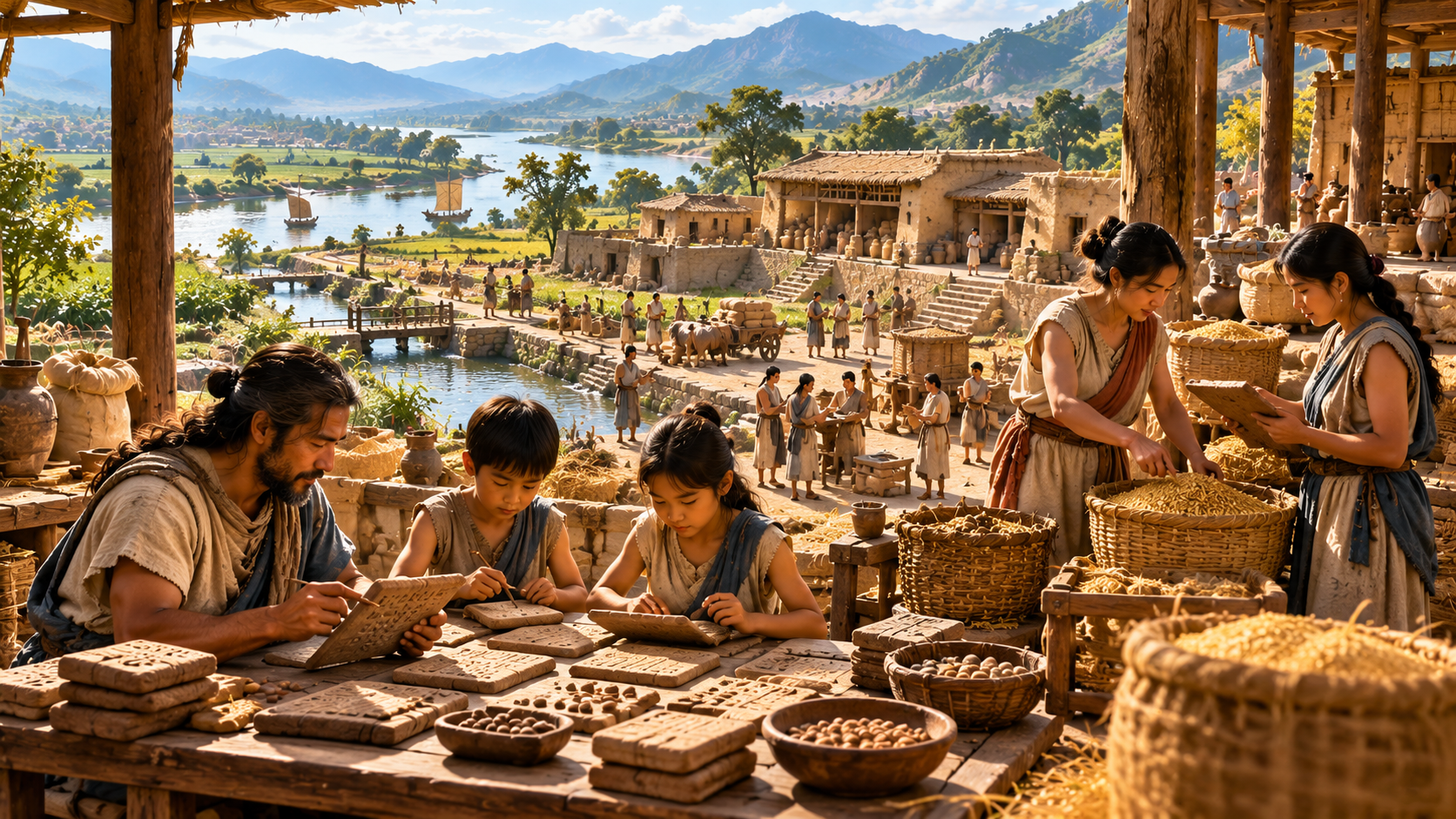
Did you know a society can possess an enormous library while failing to pass on the knowledge needed to maintain its water supply? Knowledge is not merely information stored somewhere. It has to be learned, tested, corrected, transmitted and used. This guide traces those responsibilities across the civilisation stages, beginning with oral and practical knowledge rather than assuming that intelligence starts with writing. Parents and tutors can use every section as a short evidence-led lesson.
The short answer is that a civilisation stage describes a demonstrated, repeatable capability of a defined system during a defined period. In this teaching Atlas, Foundation 0 concerns adaptive human worlds; Stages 1–4 examine increasingly complex settlement, administration, industrial institutions and planetary connections. Stage 5 is a proposed regenerative threshold. Stages 6, 7 and 8 describe hypothetical future human capabilities beyond Earth. These are educational coordinates rather than a universal archaeological law, a compulsory sequence or a judgement of human worth.
Use this guide by choosing one everyday system, reading its nine stage comparisons, and then testing the evidence. Real communities contain a mixture of capabilities. A society may have advanced telecommunications and weak access to basic services; a person may hold remarkable ecological knowledge without having formal schooling. We therefore distinguish capability stage from lifecycle condition and habitat independence. A mature technical network may be declining, while a small community may be adapting successfully. The word ‘stage’ cannot replace those observations.

Quick answer: how to read the stage framework responsibly
There is no scientifically accepted single universal ladder requiring every civilisation to pass through exactly these nine positions. This is a clearly defined model for examining linked functions, observing transitions and asking what the evidence actually supports. Students should write what, where, when, for whom, how reliably and according to which source before naming a stage. The model describes operating capacity, never the worth, intelligence, rights or moral superiority of the people concerned.
One person can learn the overview in minutes: Foundation 0 is adaptable human practice; Stage 1 is continued settlement and surplus; Stage 2 is durable coordination and records; Stage 3 is sustained production and mass institutions; Stage 4 is consequential global interconnection; Stage 5 is a proposed ability to repair damage and verify outcomes; Stage 6 is a continuing human extension into another world; Stage 7 is substantial local autonomy away from Earth; Stage 8 is a resilient distribution of inhabited centres between worlds. The last three positions are not present-day human achievements.
A tutor can use the chapters as evidence laboratories. Read the operating question, invent a small, safe paper model, write the likely weakness, choose a measurement, and invite a child to challenge the conclusion. The same function looks different in a mobile community, a permanent settlement, an industrial district or a globally connected service. The examples deliberately use imagined learning worlds and are not descriptions of real cultures unless a cited external source is explicitly named.
A real-world evidence checkpoint before the classroom models
UNESCO’s Memory of the World Programme explains why preserving and making documentary heritage accessible matters. UNESCO’s account of the Silk Roads shows that cultures exchanged ideas and knowledge as well as goods. Singapore’s National Library Board provides search and archive services; access and rights restrictions should be read carefully. None of those observations licenses a ranking of peoples by the presence of a particular medium.
When using an official source, quote only what its evidence supports. Archaeology can demonstrate building layouts or artefacts but usually cannot settle all social meanings. Current official engineering descriptions can document components, standards and plans but do not establish that every resident has equal access. NASA exploration plans describe objectives and architecture, not fully autonomous human communities on other worlds. Similarly, attractive photographs, AI illustrations and promotional claims are not independent evidence of sustained restoration.
The 12 working systems and their nine-stage comparisons
Each of the following twelve chapters uses the same disciplined investigation. The prompts vary in function because a food system, a library and a transport network require different proof. The structure repeats intentionally for lesson planning: identify the capability, model a failure, examine evidence, then ask a testable question. Every paper simulation is fictional and intentionally uses no dangerous experiments, live personal information or real emergency instructions.
1. Oral knowledge and demonstration: the operating question
The purpose of oral knowledge and demonstration is to pass useful know-how through narration, watching, questioning and guided practice. The most revealing classroom problem is not the impressive object but the failure that might stop an ordinary day from working: a skilled caretaker cannot attend the next lesson. A first repair would be to let learners demonstrate the method in their own words and check its result. A mature explanation must show direct observation of practice, interviews and context-appropriate evidence and consider the danger of written documents being treated as the only legitimate knowledge. Progress means the function is more reliably delivered to real people, with costs and limitations visible. It does not mean a group has become superior to other groups.
A parent or tutor can investigate this chapter without expensive equipment. The starter activity is to teach a practical paper skill by demonstration and compare it with a vague verbal description. Do not begin by telling children which stage they should admire. Begin by asking, “Whether the learner can independently apply the knowledge?” Then agree what would count as an observation, what would be only a guess, and whether successful independent demonstrations is a meaningful quantity for the situation. Where official standards are relevant, consult qualified published guidance rather than turning a classroom simulation into a health, legal or engineering instruction.
Oral knowledge and demonstration at Foundation 0: Adaptive Human Worlds
What changes? At Foundation 0: Adaptive Human Worlds, people adapt through ecological knowledge, relationships, skilled practice and the intergenerational transmission of know-how, without needing to become a city. The specific oral knowledge and demonstration question asks whether people can pass useful know-how through narration, watching, questioning and guided practice. A capability may be carried in memory, observation, custom and practical demonstration rather than in a permanent office. The core distinction is between a task performed once and a service that survives ordinary variation, changing personnel and a foreseeable interruption. How can we know that a capability is maintained rather than merely imagined?
Imagine the learning scene. Picture a mobile learning community examining its changing seasonal environment. The group notices that a skilled caretaker cannot attend the next lesson. Participants suggest they should let learners demonstrate the method in their own words and check its result. To make the plan usable, they must name a responsible person, a second person who can take over, a method for checking the result and an accessible way to report a problem. The challenge is passing accurate knowledge to the next person without assuming that a monumental building or written archive is required. Because this is a fictional model, it is not evidence about any named population.
Evidence, alternative and boundary. A careful researcher would look for direct observation of practice, interviews and context-appropriate evidence. Archaeological remains reveal only some activities; missing written documents do not prove missing intelligence, governance or care. The first tempting but weak inference is written documents being treated as the only legitimate knowledge. Instead of promoting a single image, object, speech or successful trial into a society-wide judgement, compare several sources and note where they disagree. The present interpretation is: human knowledge before a compulsory urban path. Do not describe mobile or Indigenous societies as unfinished versions of urban societies.
Parent-and-tutor task. Ask learners to teach a practical paper skill by demonstration and compare it with a vague verbal description. Ask learners to record how a knowledgeable adult could transfer the method with demonstration, explanation and supervised practice. The class then identifies a suitable measurement such as successful independent demonstrations, explains how it might be collected without invading anyone’s privacy, and predicts what would happen if the first plan failed. Close with the question: Whether the learner can independently apply the knowledge? Encourage a second student to propose counterevidence and explain the limit of the conclusion.
Oral knowledge and demonstration at Stage 1: Settlement and Surplus
What changes? At Stage 1: Settlement and Surplus, a community maintains enduring settlements and arrangements for provisioning, storing and sharing resources across more than one immediate need. The specific oral knowledge and demonstration question asks whether people can pass useful know-how through narration, watching, questioning and guided practice. A useful sign is repeated provision and coordination over seasons, not a single unusually large harvest. The core distinction is between a task performed once and a service that survives ordinary variation, changing personnel and a foreseeable interruption. Where does responsibility move when a community adds durable infrastructure?
Imagine the learning scene. Picture an imagined neighbourhood with households, gardens, store rooms and a shared water point. The group notices that a skilled caretaker cannot attend the next lesson. Participants suggest they should let learners demonstrate the method in their own words and check its result. To make the plan usable, they must name a responsible person, a second person who can take over, a method for checking the result and an accessible way to report a problem. Storage without equitable distribution, maintenance or succession can produce new fragility instead of dependable surplus. Because this is a fictional model, it is not evidence about any named population.
Evidence, alternative and boundary. A careful researcher would look for direct observation of practice, interviews and context-appropriate evidence. A large house or container is suggestive but does not itself establish sustained storage capacity or a complete food system. The first tempting but weak inference is written documents being treated as the only legitimate knowledge. Instead of promoting a single image, object, speech or successful trial into a society-wide judgement, compare several sources and note where they disagree. The present interpretation is: historically investigable kinds of capability. Do not turn a settlement into an inevitable first rung for every culture or assume agriculture was universally preferable.
Parent-and-tutor task. Ask learners to teach a practical paper skill by demonstration and compare it with a vague verbal description. Have students draw two seasons, show stock in and stock out, and mark who checks for loss and unfair exclusion. The class then identifies a suitable measurement such as successful independent demonstrations, explains how it might be collected without invading anyone’s privacy, and predicts what would happen if the first plan failed. Close with the question: Whether the learner can independently apply the knowledge? Encourage a second student to propose counterevidence and explain the limit of the conclusion.
Oral knowledge and demonstration at Stage 2: Administrative and Recorded Systems
What changes? At Stage 2: Administrative and Recorded Systems, responsibilities, resource decisions and shared services become coordinated through repeatable records, accounts or other durable information practices. The specific oral knowledge and demonstration question asks whether people can pass useful know-how through narration, watching, questioning and guided practice. The threshold is a reliable handover and an auditable outcome, not a particular script or the title of a ruler. The core distinction is between a task performed once and a service that survives ordinary variation, changing personnel and a foreseeable interruption. What new work does administration create in addition to the benefits it promises?
Imagine the learning scene. Picture a fictional town passing supplies and responsibilities between two different teams. The group notices that a skilled caretaker cannot attend the next lesson. Participants suggest they should let learners demonstrate the method in their own words and check its result. To make the plan usable, they must name a responsible person, a second person who can take over, a method for checking the result and an accessible way to report a problem. An elegant ledger can still conceal a false count, a missing family or a rule nobody can challenge. Because this is a fictional model, it is not evidence about any named population.
Evidence, alternative and boundary. A careful researcher would look for direct observation of practice, interviews and context-appropriate evidence. Findings need context for what records represent, whose voices are missing and whether procedures actually changed practice. The first tempting but weak inference is written documents being treated as the only legitimate knowledge. Instead of promoting a single image, object, speech or successful trial into a society-wide judgement, compare several sources and note where they disagree. The present interpretation is: historically investigable kinds of capability. Do not treat the presence of writing as proof that everyone was literate or that administration was fair.
Parent-and-tutor task. Ask learners to teach a practical paper skill by demonstration and compare it with a vague verbal description. Let one team write a handover record and another try to perform the task without further explanation. The class then identifies a suitable measurement such as successful independent demonstrations, explains how it might be collected without invading anyone’s privacy, and predicts what would happen if the first plan failed. Close with the question: Whether the learner can independently apply the knowledge? Encourage a second student to propose counterevidence and explain the limit of the conclusion.
Oral knowledge and demonstration at Stage 3: Industrial and Mass Institutions
What changes? At Stage 3: Industrial and Mass Institutions, energy, skilled labour, repeated production and wider institutions support sustained services for many communities. The specific oral knowledge and demonstration question asks whether people can pass useful know-how through narration, watching, questioning and guided practice. The measure is working capacity at scale, including safety and quality control, not one impressive machine. The core distinction is between a task performed once and a service that survives ordinary variation, changing personnel and a foreseeable interruption. Which safety and maintenance tasks are hidden behind increased production?
Imagine the learning scene. Picture a hypothetical industrial district with a workshop, school, clinic, transport route and trained maintenance team. The group notices that a skilled caretaker cannot attend the next lesson. Participants suggest they should let learners demonstrate the method in their own words and check its result. To make the plan usable, they must name a responsible person, a second person who can take over, a method for checking the result and an accessible way to report a problem. An increase in output can hide unsafe work, pollution, fragile imports or costs transferred to other communities. Because this is a fictional model, it is not evidence about any named population.
Evidence, alternative and boundary. A careful researcher would look for direct observation of practice, interviews and context-appropriate evidence. An industrial artefact establishes technological possibility, not safe widespread service or equal access. The first tempting but weak inference is written documents being treated as the only legitimate knowledge. Instead of promoting a single image, object, speech or successful trial into a society-wide judgement, compare several sources and note where they disagree. The present interpretation is: historically investigable kinds of capability. Do not equate industrial capacity with moral advancement, environmental success or citizens’ wellbeing.
Parent-and-tutor task. Ask learners to teach a practical paper skill by demonstration and compare it with a vague verbal description. Compare output, worker safety, maintenance time and environmental consequences instead of rewarding speed alone. The class then identifies a suitable measurement such as successful independent demonstrations, explains how it might be collected without invading anyone’s privacy, and predicts what would happen if the first plan failed. Close with the question: Whether the learner can independently apply the knowledge? Encourage a second student to propose counterevidence and explain the limit of the conclusion.
Oral knowledge and demonstration at Stage 4: Planetary Network Civilisation
What changes? At Stage 4: Planetary Network Civilisation, large networks connect production, information, goods and institutions across the planet with consequential interdependence. The specific oral knowledge and demonstration question asks whether people can pass useful know-how through narration, watching, questioning and guided practice. The relevant proof concerns dependable network effects and dependencies that remain visible across borders. The core distinction is between a task performed once and a service that survives ordinary variation, changing personnel and a foreseeable interruption. What makes a connection useful for people who cannot easily pay or travel?
Imagine the learning scene. Picture fictional suppliers, families and public services connected across several regions and time zones. The group notices that a skilled caretaker cannot attend the next lesson. Participants suggest they should let learners demonstrate the method in their own words and check its result. To make the plan usable, they must name a responsible person, a second person who can take over, a method for checking the result and an accessible way to report a problem. Global connection can move risks as rapidly as benefits, while people without affordable access may be left out. Because this is a fictional model, it is not evidence about any named population.
Evidence, alternative and boundary. A careful researcher would look for direct observation of practice, interviews and context-appropriate evidence. A cable, ship or satellite demonstrates a component; check the functioning network, reach, reliability and exclusions. The first tempting but weak inference is written documents being treated as the only legitimate knowledge. Instead of promoting a single image, object, speech or successful trial into a society-wide judgement, compare several sources and note where they disagree. The present interpretation is: historically investigable kinds of capability. Do not mistake a single country’s technological achievement for universal planetary access.
Parent-and-tutor task. Ask learners to teach a practical paper skill by demonstration and compare it with a vague verbal description. Map an international dependency and simulate a delayed shipment or service outage without making crisis sensational. The class then identifies a suitable measurement such as successful independent demonstrations, explains how it might be collected without invading anyone’s privacy, and predicts what would happen if the first plan failed. Close with the question: Whether the learner can independently apply the knowledge? Encourage a second student to propose counterevidence and explain the limit of the conclusion.
Oral knowledge and demonstration at Stage 5: Regenerative and Self-Correcting Civilisation
What changes? At Stage 5: Regenerative and Self-Correcting Civilisation, the proposed capability is to detect system harm, restore damaged conditions and verify that improvements persist. The specific oral knowledge and demonstration question asks whether people can pass useful know-how through narration, watching, questioning and guided practice. This is a proposed teaching threshold; a public target or an attractive green building does not demonstrate a society-wide stable achievement. The core distinction is between a task performed once and a service that survives ordinary variation, changing personnel and a foreseeable interruption. Does a repair produce lasting improvement or only a convincing photograph?
Imagine the learning scene. Picture an imagined regional monitoring group comparing a restoration project before, during and years after intervention. The group notices that a skilled caretaker cannot attend the next lesson. Participants suggest they should let learners demonstrate the method in their own words and check its result. To make the plan usable, they must name a responsible person, a second person who can take over, a method for checking the result and an accessible way to report a problem. A project may improve its headline indicator while transferring damage downstream or excluding affected residents. Because this is a fictional model, it is not evidence about any named population.
Evidence, alternative and boundary. A careful researcher would look for direct observation of practice, interviews and context-appropriate evidence. Require measured outcomes, time horizons, comparison methods and independent scrutiny; avoid saying humanity has universally achieved this stage. The first tempting but weak inference is written documents being treated as the only legitimate knowledge. Instead of promoting a single image, object, speech or successful trial into a society-wide judgement, compare several sources and note where they disagree. The present interpretation is: a proposed, not universally demonstrated threshold. Do not claim that a city is regenerative merely because it has solar panels, greenery or recycling publicity.
Parent-and-tutor task. Ask learners to teach a practical paper skill by demonstration and compare it with a vague verbal description. Students specify a baseline, a repair action, a later observation and a condition that would reverse their conclusion. The class then identifies a suitable measurement such as successful independent demonstrations, explains how it might be collected without invading anyone’s privacy, and predicts what would happen if the first plan failed. Close with the question: Whether the learner can independently apply the knowledge? Encourage a second student to propose counterevidence and explain the limit of the conclusion.
Oral knowledge and demonstration at Stage 6: Multi-World Extension
What changes? At Stage 6: Multi-World Extension, the hypothetical threshold concerns continuing human operations in an additional celestial environment that may remain deeply dependent on Earth. The specific oral knowledge and demonstration question asks whether people can pass useful know-how through narration, watching, questioning and guided practice. Distinguish a real robotic experiment or temporary mission from demonstrated continuing inhabited operations. The core distinction is between a task performed once and a service that survives ordinary variation, changing personnel and a foreseeable interruption. What remains dependent on Earth despite the impressive mission imagery?
Imagine the learning scene. Picture a fictional research outpost beyond Earth whose schedule includes crew health, resupply and repair. The group notices that a skilled caretaker cannot attend the next lesson. Participants suggest they should let learners demonstrate the method in their own words and check its result. To make the plan usable, they must name a responsible person, a second person who can take over, a method for checking the result and an accessible way to report a problem. Radiation, life support, remoteness, logistics, safety and unplanned repair make a second habitat far harder than a visual concept. Because this is a fictional model, it is not evidence about any named population.
Evidence, alternative and boundary. A careful researcher would look for direct observation of practice, interviews and context-appropriate evidence. As of October 2026, the human settlement stage described here has not been demonstrated; NASA architecture documents are plans and capabilities, not proof of an autonomous city. The first tempting but weak inference is written documents being treated as the only legitimate knowledge. Instead of promoting a single image, object, speech or successful trial into a society-wide judgement, compare several sources and note where they disagree. The present interpretation is: a hypothetical future human threshold. Do not present AI art of moon or Mars settlements as documentary photography.
Parent-and-tutor task. Ask learners to teach a practical paper skill by demonstration and compare it with a vague verbal description. Have students mark which essential supplies still come from Earth and what failure would require evacuation. The class then identifies a suitable measurement such as successful independent demonstrations, explains how it might be collected without invading anyone’s privacy, and predicts what would happen if the first plan failed. Close with the question: Whether the learner can independently apply the knowledge? Encourage a second student to propose counterevidence and explain the limit of the conclusion.
Oral knowledge and demonstration at Stage 7: Autonomous Multi-World Civilisation
What changes? At Stage 7: Autonomous Multi-World Civilisation, the hypothetical threshold demands substantial local ability to keep essential inhabited systems working away from Earth. The specific oral knowledge and demonstration question asks whether people can pass useful know-how through narration, watching, questioning and guided practice. Local autonomy means durable provisioning, trained people, replacement parts, governance and health services, not a one-off resource-extraction demonstration. The core distinction is between a task performed once and a service that survives ordinary variation, changing personnel and a foreseeable interruption. Can the community restore functions after external support has stopped?
Imagine the learning scene. Picture an imaginary off-Earth settlement evaluating what happens when deliveries and communications from Earth stop. The group notices that a skilled caretaker cannot attend the next lesson. Participants suggest they should let learners demonstrate the method in their own words and check its result. To make the plan usable, they must name a responsible person, a second person who can take over, a method for checking the result and an accessible way to report a problem. A habitat can recycle one resource yet remain wholly dependent on imported medicines, specialised chips or life-support components. Because this is a fictional model, it is not evidence about any named population.
Evidence, alternative and boundary. A careful researcher would look for direct observation of practice, interviews and context-appropriate evidence. No present human community has demonstrated this broad off-Earth autonomy; capability claims must specify the systems and period actually tested. The first tempting but weak inference is written documents being treated as the only legitimate knowledge. Instead of promoting a single image, object, speech or successful trial into a society-wide judgement, compare several sources and note where they disagree. The present interpretation is: a hypothetical future human threshold. Do not infer self-sufficiency from a successful single experiment, prospectus or simulation.
Parent-and-tutor task. Ask learners to teach a practical paper skill by demonstration and compare it with a vague verbal description. Create a dependency register and mark which functions can be maintained without external shipments for the agreed period. The class then identifies a suitable measurement such as successful independent demonstrations, explains how it might be collected without invading anyone’s privacy, and predicts what would happen if the first plan failed. Close with the question: Whether the learner can independently apply the knowledge? Encourage a second student to propose counterevidence and explain the limit of the conclusion.
Oral knowledge and demonstration at Stage 8: Distributed Interplanetary Civilisation
What changes? At Stage 8: Distributed Interplanetary Civilisation, the speculative threshold examines several substantially capable inhabited centres maintaining cooperation through delays and separated risks. The specific oral knowledge and demonstration question asks whether people can pass useful know-how through narration, watching, questioning and guided practice. A network must survive local outages and preserve rights, trustworthy information and essential services without a single point of command. The core distinction is between a task performed once and a service that survives ordinary variation, changing personnel and a foreseeable interruption. How can separate centres cooperate without pretending communication is instantaneous?
Imagine the learning scene. Picture three imaginary inhabited worlds exchanging delayed messages and shared scientific records. The group notices that a skilled caretaker cannot attend the next lesson. Participants suggest they should let learners demonstrate the method in their own words and check its result. To make the plan usable, they must name a responsible person, a second person who can take over, a method for checking the result and an accessible way to report a problem. Travel time, communication latency, institutional disagreement and shared resource constraints could defeat naive centralised management. Because this is a fictional model, it is not evidence about any named population.
Evidence, alternative and boundary. A careful researcher would look for direct observation of practice, interviews and context-appropriate evidence. This is a hypothetical capability test, not a statement that interplanetary human communities currently exist. The first tempting but weak inference is written documents being treated as the only legitimate knowledge. Instead of promoting a single image, object, speech or successful trial into a society-wide judgement, compare several sources and note where they disagree. The present interpretation is: a hypothetical future human threshold. Do not confuse probes, satellite networks or fictional scenery with a distributed human civilisation.
Parent-and-tutor task. Ask learners to teach a practical paper skill by demonstration and compare it with a vague verbal description. Use delayed-message cards to separate local decisions from decisions that require consent across several centres. The class then identifies a suitable measurement such as successful independent demonstrations, explains how it might be collected without invading anyone’s privacy, and predicts what would happen if the first plan failed. Close with the question: Whether the learner can independently apply the knowledge? Encourage a second student to propose counterevidence and explain the limit of the conclusion.
A short worked diagnostic: Oral knowledge and demonstration
Use an explicitly invented oral knowledge and demonstration exercise to practise arithmetic, not to make a historical claim. Suppose a service plans 40 units of successful independent demonstrations, logs 35 completed units and identifies 2 further units disrupted before completion. The documented shortfall is 5; the disrupted items should not be subtracted twice if they are already absent from the completed total. The simple completion rate is 35/40, approximately 87.5%. The calculation is useful only if the intended unit and counting period are clear. Ask learners which households, locations or periods the total conceals, and which source could verify the entries.
2. Counting, measurement and comparison: the operating question
The purpose of counting, measurement and comparison is to distinguish quantities and units so a decision can be checked by someone else. The most revealing classroom problem is not the impressive object but the failure that might stop an ordinary day from working: two teams report the same stock using different units. A first repair would be to agree on units, repeat the measurements and note uncertainty. A mature explanation must show marked tools, count records and independently repeatable measurements and consider the danger of numerical neatness replacing accurate meaning. Progress means the function is more reliably delivered to real people, with costs and limitations visible. It does not mean a group has become superior to other groups.
A parent or tutor can investigate this chapter without expensive equipment. The starter activity is to give groups measuring cards with incompatible units and ask them to reconcile responsibly. Do not begin by telling children which stage they should admire. Begin by asking, “Whether the calculation answers the stated question?” Then agree what would count as an observation, what would be only a guess, and whether correctly reconciled quantities is a meaningful quantity for the situation. Where official standards are relevant, consult qualified published guidance rather than turning a classroom simulation into a health, legal or engineering instruction.
Counting, measurement and comparison at Foundation 0: Adaptive Human Worlds
What changes? At Foundation 0: Adaptive Human Worlds, people adapt through ecological knowledge, relationships, skilled practice and the intergenerational transmission of know-how, without needing to become a city. The specific counting, measurement and comparison question asks whether people can distinguish quantities and units so a decision can be checked by someone else. A capability may be carried in memory, observation, custom and practical demonstration rather than in a permanent office. The core distinction is between a task performed once and a service that survives ordinary variation, changing personnel and a foreseeable interruption. How can we know that a capability is maintained rather than merely imagined?
Imagine the learning scene. Picture a mobile learning community examining its changing seasonal environment. The group notices that two teams report the same stock using different units. Participants suggest they should agree on units, repeat the measurements and note uncertainty. To make the plan usable, they must name a responsible person, a second person who can take over, a method for checking the result and an accessible way to report a problem. The challenge is passing accurate knowledge to the next person without assuming that a monumental building or written archive is required. Because this is a fictional model, it is not evidence about any named population.
Evidence, alternative and boundary. A careful researcher would look for marked tools, count records and independently repeatable measurements. Archaeological remains reveal only some activities; missing written documents do not prove missing intelligence, governance or care. The first tempting but weak inference is numerical neatness replacing accurate meaning. Instead of promoting a single image, object, speech or successful trial into a society-wide judgement, compare several sources and note where they disagree. The present interpretation is: human knowledge before a compulsory urban path. Do not describe mobile or Indigenous societies as unfinished versions of urban societies.
Parent-and-tutor task. Ask learners to give groups measuring cards with incompatible units and ask them to reconcile responsibly. Ask learners to record how a knowledgeable adult could transfer the method with demonstration, explanation and supervised practice. The class then identifies a suitable measurement such as correctly reconciled quantities, explains how it might be collected without invading anyone’s privacy, and predicts what would happen if the first plan failed. Close with the question: Whether the calculation answers the stated question? Encourage a second student to propose counterevidence and explain the limit of the conclusion.
Counting, measurement and comparison at Stage 1: Settlement and Surplus
What changes? At Stage 1: Settlement and Surplus, a community maintains enduring settlements and arrangements for provisioning, storing and sharing resources across more than one immediate need. The specific counting, measurement and comparison question asks whether people can distinguish quantities and units so a decision can be checked by someone else. A useful sign is repeated provision and coordination over seasons, not a single unusually large harvest. The core distinction is between a task performed once and a service that survives ordinary variation, changing personnel and a foreseeable interruption. Where does responsibility move when a community adds durable infrastructure?
Imagine the learning scene. Picture an imagined neighbourhood with households, gardens, store rooms and a shared water point. The group notices that two teams report the same stock using different units. Participants suggest they should agree on units, repeat the measurements and note uncertainty. To make the plan usable, they must name a responsible person, a second person who can take over, a method for checking the result and an accessible way to report a problem. Storage without equitable distribution, maintenance or succession can produce new fragility instead of dependable surplus. Because this is a fictional model, it is not evidence about any named population.
Evidence, alternative and boundary. A careful researcher would look for marked tools, count records and independently repeatable measurements. A large house or container is suggestive but does not itself establish sustained storage capacity or a complete food system. The first tempting but weak inference is numerical neatness replacing accurate meaning. Instead of promoting a single image, object, speech or successful trial into a society-wide judgement, compare several sources and note where they disagree. The present interpretation is: historically investigable kinds of capability. Do not turn a settlement into an inevitable first rung for every culture or assume agriculture was universally preferable.
Parent-and-tutor task. Ask learners to give groups measuring cards with incompatible units and ask them to reconcile responsibly. Have students draw two seasons, show stock in and stock out, and mark who checks for loss and unfair exclusion. The class then identifies a suitable measurement such as correctly reconciled quantities, explains how it might be collected without invading anyone’s privacy, and predicts what would happen if the first plan failed. Close with the question: Whether the calculation answers the stated question? Encourage a second student to propose counterevidence and explain the limit of the conclusion.
Counting, measurement and comparison at Stage 2: Administrative and Recorded Systems
What changes? At Stage 2: Administrative and Recorded Systems, responsibilities, resource decisions and shared services become coordinated through repeatable records, accounts or other durable information practices. The specific counting, measurement and comparison question asks whether people can distinguish quantities and units so a decision can be checked by someone else. The threshold is a reliable handover and an auditable outcome, not a particular script or the title of a ruler. The core distinction is between a task performed once and a service that survives ordinary variation, changing personnel and a foreseeable interruption. What new work does administration create in addition to the benefits it promises?
Imagine the learning scene. Picture a fictional town passing supplies and responsibilities between two different teams. The group notices that two teams report the same stock using different units. Participants suggest they should agree on units, repeat the measurements and note uncertainty. To make the plan usable, they must name a responsible person, a second person who can take over, a method for checking the result and an accessible way to report a problem. An elegant ledger can still conceal a false count, a missing family or a rule nobody can challenge. Because this is a fictional model, it is not evidence about any named population.
Evidence, alternative and boundary. A careful researcher would look for marked tools, count records and independently repeatable measurements. Findings need context for what records represent, whose voices are missing and whether procedures actually changed practice. The first tempting but weak inference is numerical neatness replacing accurate meaning. Instead of promoting a single image, object, speech or successful trial into a society-wide judgement, compare several sources and note where they disagree. The present interpretation is: historically investigable kinds of capability. Do not treat the presence of writing as proof that everyone was literate or that administration was fair.
Parent-and-tutor task. Ask learners to give groups measuring cards with incompatible units and ask them to reconcile responsibly. Let one team write a handover record and another try to perform the task without further explanation. The class then identifies a suitable measurement such as correctly reconciled quantities, explains how it might be collected without invading anyone’s privacy, and predicts what would happen if the first plan failed. Close with the question: Whether the calculation answers the stated question? Encourage a second student to propose counterevidence and explain the limit of the conclusion.
Counting, measurement and comparison at Stage 3: Industrial and Mass Institutions
What changes? At Stage 3: Industrial and Mass Institutions, energy, skilled labour, repeated production and wider institutions support sustained services for many communities. The specific counting, measurement and comparison question asks whether people can distinguish quantities and units so a decision can be checked by someone else. The measure is working capacity at scale, including safety and quality control, not one impressive machine. The core distinction is between a task performed once and a service that survives ordinary variation, changing personnel and a foreseeable interruption. Which safety and maintenance tasks are hidden behind increased production?
Imagine the learning scene. Picture a hypothetical industrial district with a workshop, school, clinic, transport route and trained maintenance team. The group notices that two teams report the same stock using different units. Participants suggest they should agree on units, repeat the measurements and note uncertainty. To make the plan usable, they must name a responsible person, a second person who can take over, a method for checking the result and an accessible way to report a problem. An increase in output can hide unsafe work, pollution, fragile imports or costs transferred to other communities. Because this is a fictional model, it is not evidence about any named population.
Evidence, alternative and boundary. A careful researcher would look for marked tools, count records and independently repeatable measurements. An industrial artefact establishes technological possibility, not safe widespread service or equal access. The first tempting but weak inference is numerical neatness replacing accurate meaning. Instead of promoting a single image, object, speech or successful trial into a society-wide judgement, compare several sources and note where they disagree. The present interpretation is: historically investigable kinds of capability. Do not equate industrial capacity with moral advancement, environmental success or citizens’ wellbeing.
Parent-and-tutor task. Ask learners to give groups measuring cards with incompatible units and ask them to reconcile responsibly. Compare output, worker safety, maintenance time and environmental consequences instead of rewarding speed alone. The class then identifies a suitable measurement such as correctly reconciled quantities, explains how it might be collected without invading anyone’s privacy, and predicts what would happen if the first plan failed. Close with the question: Whether the calculation answers the stated question? Encourage a second student to propose counterevidence and explain the limit of the conclusion.
Counting, measurement and comparison at Stage 4: Planetary Network Civilisation
What changes? At Stage 4: Planetary Network Civilisation, large networks connect production, information, goods and institutions across the planet with consequential interdependence. The specific counting, measurement and comparison question asks whether people can distinguish quantities and units so a decision can be checked by someone else. The relevant proof concerns dependable network effects and dependencies that remain visible across borders. The core distinction is between a task performed once and a service that survives ordinary variation, changing personnel and a foreseeable interruption. What makes a connection useful for people who cannot easily pay or travel?
Imagine the learning scene. Picture fictional suppliers, families and public services connected across several regions and time zones. The group notices that two teams report the same stock using different units. Participants suggest they should agree on units, repeat the measurements and note uncertainty. To make the plan usable, they must name a responsible person, a second person who can take over, a method for checking the result and an accessible way to report a problem. Global connection can move risks as rapidly as benefits, while people without affordable access may be left out. Because this is a fictional model, it is not evidence about any named population.
Evidence, alternative and boundary. A careful researcher would look for marked tools, count records and independently repeatable measurements. A cable, ship or satellite demonstrates a component; check the functioning network, reach, reliability and exclusions. The first tempting but weak inference is numerical neatness replacing accurate meaning. Instead of promoting a single image, object, speech or successful trial into a society-wide judgement, compare several sources and note where they disagree. The present interpretation is: historically investigable kinds of capability. Do not mistake a single country’s technological achievement for universal planetary access.
Parent-and-tutor task. Ask learners to give groups measuring cards with incompatible units and ask them to reconcile responsibly. Map an international dependency and simulate a delayed shipment or service outage without making crisis sensational. The class then identifies a suitable measurement such as correctly reconciled quantities, explains how it might be collected without invading anyone’s privacy, and predicts what would happen if the first plan failed. Close with the question: Whether the calculation answers the stated question? Encourage a second student to propose counterevidence and explain the limit of the conclusion.
Counting, measurement and comparison at Stage 5: Regenerative and Self-Correcting Civilisation
What changes? At Stage 5: Regenerative and Self-Correcting Civilisation, the proposed capability is to detect system harm, restore damaged conditions and verify that improvements persist. The specific counting, measurement and comparison question asks whether people can distinguish quantities and units so a decision can be checked by someone else. This is a proposed teaching threshold; a public target or an attractive green building does not demonstrate a society-wide stable achievement. The core distinction is between a task performed once and a service that survives ordinary variation, changing personnel and a foreseeable interruption. Does a repair produce lasting improvement or only a convincing photograph?
Imagine the learning scene. Picture an imagined regional monitoring group comparing a restoration project before, during and years after intervention. The group notices that two teams report the same stock using different units. Participants suggest they should agree on units, repeat the measurements and note uncertainty. To make the plan usable, they must name a responsible person, a second person who can take over, a method for checking the result and an accessible way to report a problem. A project may improve its headline indicator while transferring damage downstream or excluding affected residents. Because this is a fictional model, it is not evidence about any named population.
Evidence, alternative and boundary. A careful researcher would look for marked tools, count records and independently repeatable measurements. Require measured outcomes, time horizons, comparison methods and independent scrutiny; avoid saying humanity has universally achieved this stage. The first tempting but weak inference is numerical neatness replacing accurate meaning. Instead of promoting a single image, object, speech or successful trial into a society-wide judgement, compare several sources and note where they disagree. The present interpretation is: a proposed, not universally demonstrated threshold. Do not claim that a city is regenerative merely because it has solar panels, greenery or recycling publicity.
Parent-and-tutor task. Ask learners to give groups measuring cards with incompatible units and ask them to reconcile responsibly. Students specify a baseline, a repair action, a later observation and a condition that would reverse their conclusion. The class then identifies a suitable measurement such as correctly reconciled quantities, explains how it might be collected without invading anyone’s privacy, and predicts what would happen if the first plan failed. Close with the question: Whether the calculation answers the stated question? Encourage a second student to propose counterevidence and explain the limit of the conclusion.
Counting, measurement and comparison at Stage 6: Multi-World Extension
What changes? At Stage 6: Multi-World Extension, the hypothetical threshold concerns continuing human operations in an additional celestial environment that may remain deeply dependent on Earth. The specific counting, measurement and comparison question asks whether people can distinguish quantities and units so a decision can be checked by someone else. Distinguish a real robotic experiment or temporary mission from demonstrated continuing inhabited operations. The core distinction is between a task performed once and a service that survives ordinary variation, changing personnel and a foreseeable interruption. What remains dependent on Earth despite the impressive mission imagery?
Imagine the learning scene. Picture a fictional research outpost beyond Earth whose schedule includes crew health, resupply and repair. The group notices that two teams report the same stock using different units. Participants suggest they should agree on units, repeat the measurements and note uncertainty. To make the plan usable, they must name a responsible person, a second person who can take over, a method for checking the result and an accessible way to report a problem. Radiation, life support, remoteness, logistics, safety and unplanned repair make a second habitat far harder than a visual concept. Because this is a fictional model, it is not evidence about any named population.
Evidence, alternative and boundary. A careful researcher would look for marked tools, count records and independently repeatable measurements. As of October 2026, the human settlement stage described here has not been demonstrated; NASA architecture documents are plans and capabilities, not proof of an autonomous city. The first tempting but weak inference is numerical neatness replacing accurate meaning. Instead of promoting a single image, object, speech or successful trial into a society-wide judgement, compare several sources and note where they disagree. The present interpretation is: a hypothetical future human threshold. Do not present AI art of moon or Mars settlements as documentary photography.
Parent-and-tutor task. Ask learners to give groups measuring cards with incompatible units and ask them to reconcile responsibly. Have students mark which essential supplies still come from Earth and what failure would require evacuation. The class then identifies a suitable measurement such as correctly reconciled quantities, explains how it might be collected without invading anyone’s privacy, and predicts what would happen if the first plan failed. Close with the question: Whether the calculation answers the stated question? Encourage a second student to propose counterevidence and explain the limit of the conclusion.
Counting, measurement and comparison at Stage 7: Autonomous Multi-World Civilisation
What changes? At Stage 7: Autonomous Multi-World Civilisation, the hypothetical threshold demands substantial local ability to keep essential inhabited systems working away from Earth. The specific counting, measurement and comparison question asks whether people can distinguish quantities and units so a decision can be checked by someone else. Local autonomy means durable provisioning, trained people, replacement parts, governance and health services, not a one-off resource-extraction demonstration. The core distinction is between a task performed once and a service that survives ordinary variation, changing personnel and a foreseeable interruption. Can the community restore functions after external support has stopped?
Imagine the learning scene. Picture an imaginary off-Earth settlement evaluating what happens when deliveries and communications from Earth stop. The group notices that two teams report the same stock using different units. Participants suggest they should agree on units, repeat the measurements and note uncertainty. To make the plan usable, they must name a responsible person, a second person who can take over, a method for checking the result and an accessible way to report a problem. A habitat can recycle one resource yet remain wholly dependent on imported medicines, specialised chips or life-support components. Because this is a fictional model, it is not evidence about any named population.
Evidence, alternative and boundary. A careful researcher would look for marked tools, count records and independently repeatable measurements. No present human community has demonstrated this broad off-Earth autonomy; capability claims must specify the systems and period actually tested. The first tempting but weak inference is numerical neatness replacing accurate meaning. Instead of promoting a single image, object, speech or successful trial into a society-wide judgement, compare several sources and note where they disagree. The present interpretation is: a hypothetical future human threshold. Do not infer self-sufficiency from a successful single experiment, prospectus or simulation.
Parent-and-tutor task. Ask learners to give groups measuring cards with incompatible units and ask them to reconcile responsibly. Create a dependency register and mark which functions can be maintained without external shipments for the agreed period. The class then identifies a suitable measurement such as correctly reconciled quantities, explains how it might be collected without invading anyone’s privacy, and predicts what would happen if the first plan failed. Close with the question: Whether the calculation answers the stated question? Encourage a second student to propose counterevidence and explain the limit of the conclusion.
Counting, measurement and comparison at Stage 8: Distributed Interplanetary Civilisation
What changes? At Stage 8: Distributed Interplanetary Civilisation, the speculative threshold examines several substantially capable inhabited centres maintaining cooperation through delays and separated risks. The specific counting, measurement and comparison question asks whether people can distinguish quantities and units so a decision can be checked by someone else. A network must survive local outages and preserve rights, trustworthy information and essential services without a single point of command. The core distinction is between a task performed once and a service that survives ordinary variation, changing personnel and a foreseeable interruption. How can separate centres cooperate without pretending communication is instantaneous?
Imagine the learning scene. Picture three imaginary inhabited worlds exchanging delayed messages and shared scientific records. The group notices that two teams report the same stock using different units. Participants suggest they should agree on units, repeat the measurements and note uncertainty. To make the plan usable, they must name a responsible person, a second person who can take over, a method for checking the result and an accessible way to report a problem. Travel time, communication latency, institutional disagreement and shared resource constraints could defeat naive centralised management. Because this is a fictional model, it is not evidence about any named population.
Evidence, alternative and boundary. A careful researcher would look for marked tools, count records and independently repeatable measurements. This is a hypothetical capability test, not a statement that interplanetary human communities currently exist. The first tempting but weak inference is numerical neatness replacing accurate meaning. Instead of promoting a single image, object, speech or successful trial into a society-wide judgement, compare several sources and note where they disagree. The present interpretation is: a hypothetical future human threshold. Do not confuse probes, satellite networks or fictional scenery with a distributed human civilisation.
Parent-and-tutor task. Ask learners to give groups measuring cards with incompatible units and ask them to reconcile responsibly. Use delayed-message cards to separate local decisions from decisions that require consent across several centres. The class then identifies a suitable measurement such as correctly reconciled quantities, explains how it might be collected without invading anyone’s privacy, and predicts what would happen if the first plan failed. Close with the question: Whether the calculation answers the stated question? Encourage a second student to propose counterevidence and explain the limit of the conclusion.
A short worked diagnostic: Counting, measurement and comparison
Use an explicitly invented counting, measurement and comparison exercise to practise arithmetic, not to make a historical claim. Suppose a service plans 43 units of correctly reconciled quantities, logs 37 completed units and identifies 3 further units disrupted before completion. The documented shortfall is 6; the disrupted items should not be subtracted twice if they are already absent from the completed total. The simple completion rate is 37/43, approximately 86.0%. The calculation is useful only if the intended unit and counting period are clear. Ask learners which households, locations or periods the total conceals, and which source could verify the entries.
3. Writing systems and symbols: the operating question
The purpose of writing systems and symbols is to preserve selected meaning beyond the person who first communicated it. The most revealing classroom problem is not the impressive object but the failure that might stop an ordinary day from working: a message contains symbols that a new reader interprets differently. A first repair would be to write a key, record context and check interpretation with the original sender. A mature explanation must show documents, scripts, archaeological context and translation scholarship and consider the danger of decorative markings being described as authenticated writing. Progress means the function is more reliably delivered to real people, with costs and limitations visible. It does not mean a group has become superior to other groups.
A parent or tutor can investigate this chapter without expensive equipment. The starter activity is to invent a small symbol system and measure its performance after a handover. Do not begin by telling children which stage they should admire. Begin by asking, “What the marks allow us to infer and what remains unknown?” Then agree what would count as an observation, what would be only a guess, and whether messages accurately decoded is a meaningful quantity for the situation. Where official standards are relevant, consult qualified published guidance rather than turning a classroom simulation into a health, legal or engineering instruction.
Writing systems and symbols at Foundation 0: Adaptive Human Worlds
What changes? At Foundation 0: Adaptive Human Worlds, people adapt through ecological knowledge, relationships, skilled practice and the intergenerational transmission of know-how, without needing to become a city. The specific writing systems and symbols question asks whether people can preserve selected meaning beyond the person who first communicated it. A capability may be carried in memory, observation, custom and practical demonstration rather than in a permanent office. The core distinction is between a task performed once and a service that survives ordinary variation, changing personnel and a foreseeable interruption. How can we know that a capability is maintained rather than merely imagined?
Imagine the learning scene. Picture a mobile learning community examining its changing seasonal environment. The group notices that a message contains symbols that a new reader interprets differently. Participants suggest they should write a key, record context and check interpretation with the original sender. To make the plan usable, they must name a responsible person, a second person who can take over, a method for checking the result and an accessible way to report a problem. The challenge is passing accurate knowledge to the next person without assuming that a monumental building or written archive is required. Because this is a fictional model, it is not evidence about any named population.
Evidence, alternative and boundary. A careful researcher would look for documents, scripts, archaeological context and translation scholarship. Archaeological remains reveal only some activities; missing written documents do not prove missing intelligence, governance or care. The first tempting but weak inference is decorative markings being described as authenticated writing. Instead of promoting a single image, object, speech or successful trial into a society-wide judgement, compare several sources and note where they disagree. The present interpretation is: human knowledge before a compulsory urban path. Do not describe mobile or Indigenous societies as unfinished versions of urban societies.
Parent-and-tutor task. Ask learners to invent a small symbol system and measure its performance after a handover. Ask learners to record how a knowledgeable adult could transfer the method with demonstration, explanation and supervised practice. The class then identifies a suitable measurement such as messages accurately decoded, explains how it might be collected without invading anyone’s privacy, and predicts what would happen if the first plan failed. Close with the question: What the marks allow us to infer and what remains unknown? Encourage a second student to propose counterevidence and explain the limit of the conclusion.
Writing systems and symbols at Stage 1: Settlement and Surplus
What changes? At Stage 1: Settlement and Surplus, a community maintains enduring settlements and arrangements for provisioning, storing and sharing resources across more than one immediate need. The specific writing systems and symbols question asks whether people can preserve selected meaning beyond the person who first communicated it. A useful sign is repeated provision and coordination over seasons, not a single unusually large harvest. The core distinction is between a task performed once and a service that survives ordinary variation, changing personnel and a foreseeable interruption. Where does responsibility move when a community adds durable infrastructure?
Imagine the learning scene. Picture an imagined neighbourhood with households, gardens, store rooms and a shared water point. The group notices that a message contains symbols that a new reader interprets differently. Participants suggest they should write a key, record context and check interpretation with the original sender. To make the plan usable, they must name a responsible person, a second person who can take over, a method for checking the result and an accessible way to report a problem. Storage without equitable distribution, maintenance or succession can produce new fragility instead of dependable surplus. Because this is a fictional model, it is not evidence about any named population.
Evidence, alternative and boundary. A careful researcher would look for documents, scripts, archaeological context and translation scholarship. A large house or container is suggestive but does not itself establish sustained storage capacity or a complete food system. The first tempting but weak inference is decorative markings being described as authenticated writing. Instead of promoting a single image, object, speech or successful trial into a society-wide judgement, compare several sources and note where they disagree. The present interpretation is: historically investigable kinds of capability. Do not turn a settlement into an inevitable first rung for every culture or assume agriculture was universally preferable.
Parent-and-tutor task. Ask learners to invent a small symbol system and measure its performance after a handover. Have students draw two seasons, show stock in and stock out, and mark who checks for loss and unfair exclusion. The class then identifies a suitable measurement such as messages accurately decoded, explains how it might be collected without invading anyone’s privacy, and predicts what would happen if the first plan failed. Close with the question: What the marks allow us to infer and what remains unknown? Encourage a second student to propose counterevidence and explain the limit of the conclusion.
Writing systems and symbols at Stage 2: Administrative and Recorded Systems
What changes? At Stage 2: Administrative and Recorded Systems, responsibilities, resource decisions and shared services become coordinated through repeatable records, accounts or other durable information practices. The specific writing systems and symbols question asks whether people can preserve selected meaning beyond the person who first communicated it. The threshold is a reliable handover and an auditable outcome, not a particular script or the title of a ruler. The core distinction is between a task performed once and a service that survives ordinary variation, changing personnel and a foreseeable interruption. What new work does administration create in addition to the benefits it promises?
Imagine the learning scene. Picture a fictional town passing supplies and responsibilities between two different teams. The group notices that a message contains symbols that a new reader interprets differently. Participants suggest they should write a key, record context and check interpretation with the original sender. To make the plan usable, they must name a responsible person, a second person who can take over, a method for checking the result and an accessible way to report a problem. An elegant ledger can still conceal a false count, a missing family or a rule nobody can challenge. Because this is a fictional model, it is not evidence about any named population.
Evidence, alternative and boundary. A careful researcher would look for documents, scripts, archaeological context and translation scholarship. Findings need context for what records represent, whose voices are missing and whether procedures actually changed practice. The first tempting but weak inference is decorative markings being described as authenticated writing. Instead of promoting a single image, object, speech or successful trial into a society-wide judgement, compare several sources and note where they disagree. The present interpretation is: historically investigable kinds of capability. Do not treat the presence of writing as proof that everyone was literate or that administration was fair.
Parent-and-tutor task. Ask learners to invent a small symbol system and measure its performance after a handover. Let one team write a handover record and another try to perform the task without further explanation. The class then identifies a suitable measurement such as messages accurately decoded, explains how it might be collected without invading anyone’s privacy, and predicts what would happen if the first plan failed. Close with the question: What the marks allow us to infer and what remains unknown? Encourage a second student to propose counterevidence and explain the limit of the conclusion.
Writing systems and symbols at Stage 3: Industrial and Mass Institutions
What changes? At Stage 3: Industrial and Mass Institutions, energy, skilled labour, repeated production and wider institutions support sustained services for many communities. The specific writing systems and symbols question asks whether people can preserve selected meaning beyond the person who first communicated it. The measure is working capacity at scale, including safety and quality control, not one impressive machine. The core distinction is between a task performed once and a service that survives ordinary variation, changing personnel and a foreseeable interruption. Which safety and maintenance tasks are hidden behind increased production?
Imagine the learning scene. Picture a hypothetical industrial district with a workshop, school, clinic, transport route and trained maintenance team. The group notices that a message contains symbols that a new reader interprets differently. Participants suggest they should write a key, record context and check interpretation with the original sender. To make the plan usable, they must name a responsible person, a second person who can take over, a method for checking the result and an accessible way to report a problem. An increase in output can hide unsafe work, pollution, fragile imports or costs transferred to other communities. Because this is a fictional model, it is not evidence about any named population.
Evidence, alternative and boundary. A careful researcher would look for documents, scripts, archaeological context and translation scholarship. An industrial artefact establishes technological possibility, not safe widespread service or equal access. The first tempting but weak inference is decorative markings being described as authenticated writing. Instead of promoting a single image, object, speech or successful trial into a society-wide judgement, compare several sources and note where they disagree. The present interpretation is: historically investigable kinds of capability. Do not equate industrial capacity with moral advancement, environmental success or citizens’ wellbeing.
Parent-and-tutor task. Ask learners to invent a small symbol system and measure its performance after a handover. Compare output, worker safety, maintenance time and environmental consequences instead of rewarding speed alone. The class then identifies a suitable measurement such as messages accurately decoded, explains how it might be collected without invading anyone’s privacy, and predicts what would happen if the first plan failed. Close with the question: What the marks allow us to infer and what remains unknown? Encourage a second student to propose counterevidence and explain the limit of the conclusion.
Writing systems and symbols at Stage 4: Planetary Network Civilisation
What changes? At Stage 4: Planetary Network Civilisation, large networks connect production, information, goods and institutions across the planet with consequential interdependence. The specific writing systems and symbols question asks whether people can preserve selected meaning beyond the person who first communicated it. The relevant proof concerns dependable network effects and dependencies that remain visible across borders. The core distinction is between a task performed once and a service that survives ordinary variation, changing personnel and a foreseeable interruption. What makes a connection useful for people who cannot easily pay or travel?
Imagine the learning scene. Picture fictional suppliers, families and public services connected across several regions and time zones. The group notices that a message contains symbols that a new reader interprets differently. Participants suggest they should write a key, record context and check interpretation with the original sender. To make the plan usable, they must name a responsible person, a second person who can take over, a method for checking the result and an accessible way to report a problem. Global connection can move risks as rapidly as benefits, while people without affordable access may be left out. Because this is a fictional model, it is not evidence about any named population.
Evidence, alternative and boundary. A careful researcher would look for documents, scripts, archaeological context and translation scholarship. A cable, ship or satellite demonstrates a component; check the functioning network, reach, reliability and exclusions. The first tempting but weak inference is decorative markings being described as authenticated writing. Instead of promoting a single image, object, speech or successful trial into a society-wide judgement, compare several sources and note where they disagree. The present interpretation is: historically investigable kinds of capability. Do not mistake a single country’s technological achievement for universal planetary access.
Parent-and-tutor task. Ask learners to invent a small symbol system and measure its performance after a handover. Map an international dependency and simulate a delayed shipment or service outage without making crisis sensational. The class then identifies a suitable measurement such as messages accurately decoded, explains how it might be collected without invading anyone’s privacy, and predicts what would happen if the first plan failed. Close with the question: What the marks allow us to infer and what remains unknown? Encourage a second student to propose counterevidence and explain the limit of the conclusion.
Writing systems and symbols at Stage 5: Regenerative and Self-Correcting Civilisation
What changes? At Stage 5: Regenerative and Self-Correcting Civilisation, the proposed capability is to detect system harm, restore damaged conditions and verify that improvements persist. The specific writing systems and symbols question asks whether people can preserve selected meaning beyond the person who first communicated it. This is a proposed teaching threshold; a public target or an attractive green building does not demonstrate a society-wide stable achievement. The core distinction is between a task performed once and a service that survives ordinary variation, changing personnel and a foreseeable interruption. Does a repair produce lasting improvement or only a convincing photograph?
Imagine the learning scene. Picture an imagined regional monitoring group comparing a restoration project before, during and years after intervention. The group notices that a message contains symbols that a new reader interprets differently. Participants suggest they should write a key, record context and check interpretation with the original sender. To make the plan usable, they must name a responsible person, a second person who can take over, a method for checking the result and an accessible way to report a problem. A project may improve its headline indicator while transferring damage downstream or excluding affected residents. Because this is a fictional model, it is not evidence about any named population.
Evidence, alternative and boundary. A careful researcher would look for documents, scripts, archaeological context and translation scholarship. Require measured outcomes, time horizons, comparison methods and independent scrutiny; avoid saying humanity has universally achieved this stage. The first tempting but weak inference is decorative markings being described as authenticated writing. Instead of promoting a single image, object, speech or successful trial into a society-wide judgement, compare several sources and note where they disagree. The present interpretation is: a proposed, not universally demonstrated threshold. Do not claim that a city is regenerative merely because it has solar panels, greenery or recycling publicity.
Parent-and-tutor task. Ask learners to invent a small symbol system and measure its performance after a handover. Students specify a baseline, a repair action, a later observation and a condition that would reverse their conclusion. The class then identifies a suitable measurement such as messages accurately decoded, explains how it might be collected without invading anyone’s privacy, and predicts what would happen if the first plan failed. Close with the question: What the marks allow us to infer and what remains unknown? Encourage a second student to propose counterevidence and explain the limit of the conclusion.
Writing systems and symbols at Stage 6: Multi-World Extension
What changes? At Stage 6: Multi-World Extension, the hypothetical threshold concerns continuing human operations in an additional celestial environment that may remain deeply dependent on Earth. The specific writing systems and symbols question asks whether people can preserve selected meaning beyond the person who first communicated it. Distinguish a real robotic experiment or temporary mission from demonstrated continuing inhabited operations. The core distinction is between a task performed once and a service that survives ordinary variation, changing personnel and a foreseeable interruption. What remains dependent on Earth despite the impressive mission imagery?
Imagine the learning scene. Picture a fictional research outpost beyond Earth whose schedule includes crew health, resupply and repair. The group notices that a message contains symbols that a new reader interprets differently. Participants suggest they should write a key, record context and check interpretation with the original sender. To make the plan usable, they must name a responsible person, a second person who can take over, a method for checking the result and an accessible way to report a problem. Radiation, life support, remoteness, logistics, safety and unplanned repair make a second habitat far harder than a visual concept. Because this is a fictional model, it is not evidence about any named population.
Evidence, alternative and boundary. A careful researcher would look for documents, scripts, archaeological context and translation scholarship. As of October 2026, the human settlement stage described here has not been demonstrated; NASA architecture documents are plans and capabilities, not proof of an autonomous city. The first tempting but weak inference is decorative markings being described as authenticated writing. Instead of promoting a single image, object, speech or successful trial into a society-wide judgement, compare several sources and note where they disagree. The present interpretation is: a hypothetical future human threshold. Do not present AI art of moon or Mars settlements as documentary photography.
Parent-and-tutor task. Ask learners to invent a small symbol system and measure its performance after a handover. Have students mark which essential supplies still come from Earth and what failure would require evacuation. The class then identifies a suitable measurement such as messages accurately decoded, explains how it might be collected without invading anyone’s privacy, and predicts what would happen if the first plan failed. Close with the question: What the marks allow us to infer and what remains unknown? Encourage a second student to propose counterevidence and explain the limit of the conclusion.
Writing systems and symbols at Stage 7: Autonomous Multi-World Civilisation
What changes? At Stage 7: Autonomous Multi-World Civilisation, the hypothetical threshold demands substantial local ability to keep essential inhabited systems working away from Earth. The specific writing systems and symbols question asks whether people can preserve selected meaning beyond the person who first communicated it. Local autonomy means durable provisioning, trained people, replacement parts, governance and health services, not a one-off resource-extraction demonstration. The core distinction is between a task performed once and a service that survives ordinary variation, changing personnel and a foreseeable interruption. Can the community restore functions after external support has stopped?
Imagine the learning scene. Picture an imaginary off-Earth settlement evaluating what happens when deliveries and communications from Earth stop. The group notices that a message contains symbols that a new reader interprets differently. Participants suggest they should write a key, record context and check interpretation with the original sender. To make the plan usable, they must name a responsible person, a second person who can take over, a method for checking the result and an accessible way to report a problem. A habitat can recycle one resource yet remain wholly dependent on imported medicines, specialised chips or life-support components. Because this is a fictional model, it is not evidence about any named population.
Evidence, alternative and boundary. A careful researcher would look for documents, scripts, archaeological context and translation scholarship. No present human community has demonstrated this broad off-Earth autonomy; capability claims must specify the systems and period actually tested. The first tempting but weak inference is decorative markings being described as authenticated writing. Instead of promoting a single image, object, speech or successful trial into a society-wide judgement, compare several sources and note where they disagree. The present interpretation is: a hypothetical future human threshold. Do not infer self-sufficiency from a successful single experiment, prospectus or simulation.
Parent-and-tutor task. Ask learners to invent a small symbol system and measure its performance after a handover. Create a dependency register and mark which functions can be maintained without external shipments for the agreed period. The class then identifies a suitable measurement such as messages accurately decoded, explains how it might be collected without invading anyone’s privacy, and predicts what would happen if the first plan failed. Close with the question: What the marks allow us to infer and what remains unknown? Encourage a second student to propose counterevidence and explain the limit of the conclusion.
Writing systems and symbols at Stage 8: Distributed Interplanetary Civilisation
What changes? At Stage 8: Distributed Interplanetary Civilisation, the speculative threshold examines several substantially capable inhabited centres maintaining cooperation through delays and separated risks. The specific writing systems and symbols question asks whether people can preserve selected meaning beyond the person who first communicated it. A network must survive local outages and preserve rights, trustworthy information and essential services without a single point of command. The core distinction is between a task performed once and a service that survives ordinary variation, changing personnel and a foreseeable interruption. How can separate centres cooperate without pretending communication is instantaneous?
Imagine the learning scene. Picture three imaginary inhabited worlds exchanging delayed messages and shared scientific records. The group notices that a message contains symbols that a new reader interprets differently. Participants suggest they should write a key, record context and check interpretation with the original sender. To make the plan usable, they must name a responsible person, a second person who can take over, a method for checking the result and an accessible way to report a problem. Travel time, communication latency, institutional disagreement and shared resource constraints could defeat naive centralised management. Because this is a fictional model, it is not evidence about any named population.
Evidence, alternative and boundary. A careful researcher would look for documents, scripts, archaeological context and translation scholarship. This is a hypothetical capability test, not a statement that interplanetary human communities currently exist. The first tempting but weak inference is decorative markings being described as authenticated writing. Instead of promoting a single image, object, speech or successful trial into a society-wide judgement, compare several sources and note where they disagree. The present interpretation is: a hypothetical future human threshold. Do not confuse probes, satellite networks or fictional scenery with a distributed human civilisation.
Parent-and-tutor task. Ask learners to invent a small symbol system and measure its performance after a handover. Use delayed-message cards to separate local decisions from decisions that require consent across several centres. The class then identifies a suitable measurement such as messages accurately decoded, explains how it might be collected without invading anyone’s privacy, and predicts what would happen if the first plan failed. Close with the question: What the marks allow us to infer and what remains unknown? Encourage a second student to propose counterevidence and explain the limit of the conclusion.
A short worked diagnostic: Writing systems and symbols
Use an explicitly invented writing systems and symbols exercise to practise arithmetic, not to make a historical claim. Suppose a service plans 46 units of messages accurately decoded, logs 39 completed units and identifies 4 further units disrupted before completion. The documented shortfall is 7; the disrupted items should not be subtracted twice if they are already absent from the completed total. The simple completion rate is 39/46, approximately 84.8%. The calculation is useful only if the intended unit and counting period are clear. Ask learners which households, locations or periods the total conceals, and which source could verify the entries.
4. Archives and provenance: the operating question
The purpose of archives and provenance is to keep records findable, authentic and understandable across time and custody changes. The most revealing classroom problem is not the impressive object but the failure that might stop an ordinary day from working: a beautifully labelled document loses its date and source. A first repair would be to attach provenance, version and access conditions to each record. A mature explanation must show catalogue information, custody history and preservation practice and consider the danger of a genuine document being used to support a false historical claim. Progress means the function is more reliably delivered to real people, with costs and limitations visible. It does not mean a group has become superior to other groups.
A parent or tutor can investigate this chapter without expensive equipment. The starter activity is to sort a mock archive by source, date, purpose and uncertainty. Do not begin by telling children which stage they should admire. Begin by asking, “Which missing provenance field changes confidence most?” Then agree what would count as an observation, what would be only a guess, and whether records with usable provenance is a meaningful quantity for the situation. Where official standards are relevant, consult qualified published guidance rather than turning a classroom simulation into a health, legal or engineering instruction.
Archives and provenance at Foundation 0: Adaptive Human Worlds
What changes? At Foundation 0: Adaptive Human Worlds, people adapt through ecological knowledge, relationships, skilled practice and the intergenerational transmission of know-how, without needing to become a city. The specific archives and provenance question asks whether people can keep records findable, authentic and understandable across time and custody changes. A capability may be carried in memory, observation, custom and practical demonstration rather than in a permanent office. The core distinction is between a task performed once and a service that survives ordinary variation, changing personnel and a foreseeable interruption. How can we know that a capability is maintained rather than merely imagined?
Imagine the learning scene. Picture a mobile learning community examining its changing seasonal environment. The group notices that a beautifully labelled document loses its date and source. Participants suggest they should attach provenance, version and access conditions to each record. To make the plan usable, they must name a responsible person, a second person who can take over, a method for checking the result and an accessible way to report a problem. The challenge is passing accurate knowledge to the next person without assuming that a monumental building or written archive is required. Because this is a fictional model, it is not evidence about any named population.
Evidence, alternative and boundary. A careful researcher would look for catalogue information, custody history and preservation practice. Archaeological remains reveal only some activities; missing written documents do not prove missing intelligence, governance or care. The first tempting but weak inference is a genuine document being used to support a false historical claim. Instead of promoting a single image, object, speech or successful trial into a society-wide judgement, compare several sources and note where they disagree. The present interpretation is: human knowledge before a compulsory urban path. Do not describe mobile or Indigenous societies as unfinished versions of urban societies.
Parent-and-tutor task. Ask learners to sort a mock archive by source, date, purpose and uncertainty. Ask learners to record how a knowledgeable adult could transfer the method with demonstration, explanation and supervised practice. The class then identifies a suitable measurement such as records with usable provenance, explains how it might be collected without invading anyone’s privacy, and predicts what would happen if the first plan failed. Close with the question: Which missing provenance field changes confidence most? Encourage a second student to propose counterevidence and explain the limit of the conclusion.
Archives and provenance at Stage 1: Settlement and Surplus
What changes? At Stage 1: Settlement and Surplus, a community maintains enduring settlements and arrangements for provisioning, storing and sharing resources across more than one immediate need. The specific archives and provenance question asks whether people can keep records findable, authentic and understandable across time and custody changes. A useful sign is repeated provision and coordination over seasons, not a single unusually large harvest. The core distinction is between a task performed once and a service that survives ordinary variation, changing personnel and a foreseeable interruption. Where does responsibility move when a community adds durable infrastructure?
Imagine the learning scene. Picture an imagined neighbourhood with households, gardens, store rooms and a shared water point. The group notices that a beautifully labelled document loses its date and source. Participants suggest they should attach provenance, version and access conditions to each record. To make the plan usable, they must name a responsible person, a second person who can take over, a method for checking the result and an accessible way to report a problem. Storage without equitable distribution, maintenance or succession can produce new fragility instead of dependable surplus. Because this is a fictional model, it is not evidence about any named population.
Evidence, alternative and boundary. A careful researcher would look for catalogue information, custody history and preservation practice. A large house or container is suggestive but does not itself establish sustained storage capacity or a complete food system. The first tempting but weak inference is a genuine document being used to support a false historical claim. Instead of promoting a single image, object, speech or successful trial into a society-wide judgement, compare several sources and note where they disagree. The present interpretation is: historically investigable kinds of capability. Do not turn a settlement into an inevitable first rung for every culture or assume agriculture was universally preferable.
Parent-and-tutor task. Ask learners to sort a mock archive by source, date, purpose and uncertainty. Have students draw two seasons, show stock in and stock out, and mark who checks for loss and unfair exclusion. The class then identifies a suitable measurement such as records with usable provenance, explains how it might be collected without invading anyone’s privacy, and predicts what would happen if the first plan failed. Close with the question: Which missing provenance field changes confidence most? Encourage a second student to propose counterevidence and explain the limit of the conclusion.
Archives and provenance at Stage 2: Administrative and Recorded Systems
What changes? At Stage 2: Administrative and Recorded Systems, responsibilities, resource decisions and shared services become coordinated through repeatable records, accounts or other durable information practices. The specific archives and provenance question asks whether people can keep records findable, authentic and understandable across time and custody changes. The threshold is a reliable handover and an auditable outcome, not a particular script or the title of a ruler. The core distinction is between a task performed once and a service that survives ordinary variation, changing personnel and a foreseeable interruption. What new work does administration create in addition to the benefits it promises?
Imagine the learning scene. Picture a fictional town passing supplies and responsibilities between two different teams. The group notices that a beautifully labelled document loses its date and source. Participants suggest they should attach provenance, version and access conditions to each record. To make the plan usable, they must name a responsible person, a second person who can take over, a method for checking the result and an accessible way to report a problem. An elegant ledger can still conceal a false count, a missing family or a rule nobody can challenge. Because this is a fictional model, it is not evidence about any named population.
Evidence, alternative and boundary. A careful researcher would look for catalogue information, custody history and preservation practice. Findings need context for what records represent, whose voices are missing and whether procedures actually changed practice. The first tempting but weak inference is a genuine document being used to support a false historical claim. Instead of promoting a single image, object, speech or successful trial into a society-wide judgement, compare several sources and note where they disagree. The present interpretation is: historically investigable kinds of capability. Do not treat the presence of writing as proof that everyone was literate or that administration was fair.
Parent-and-tutor task. Ask learners to sort a mock archive by source, date, purpose and uncertainty. Let one team write a handover record and another try to perform the task without further explanation. The class then identifies a suitable measurement such as records with usable provenance, explains how it might be collected without invading anyone’s privacy, and predicts what would happen if the first plan failed. Close with the question: Which missing provenance field changes confidence most? Encourage a second student to propose counterevidence and explain the limit of the conclusion.
Archives and provenance at Stage 3: Industrial and Mass Institutions
What changes? At Stage 3: Industrial and Mass Institutions, energy, skilled labour, repeated production and wider institutions support sustained services for many communities. The specific archives and provenance question asks whether people can keep records findable, authentic and understandable across time and custody changes. The measure is working capacity at scale, including safety and quality control, not one impressive machine. The core distinction is between a task performed once and a service that survives ordinary variation, changing personnel and a foreseeable interruption. Which safety and maintenance tasks are hidden behind increased production?
Imagine the learning scene. Picture a hypothetical industrial district with a workshop, school, clinic, transport route and trained maintenance team. The group notices that a beautifully labelled document loses its date and source. Participants suggest they should attach provenance, version and access conditions to each record. To make the plan usable, they must name a responsible person, a second person who can take over, a method for checking the result and an accessible way to report a problem. An increase in output can hide unsafe work, pollution, fragile imports or costs transferred to other communities. Because this is a fictional model, it is not evidence about any named population.
Evidence, alternative and boundary. A careful researcher would look for catalogue information, custody history and preservation practice. An industrial artefact establishes technological possibility, not safe widespread service or equal access. The first tempting but weak inference is a genuine document being used to support a false historical claim. Instead of promoting a single image, object, speech or successful trial into a society-wide judgement, compare several sources and note where they disagree. The present interpretation is: historically investigable kinds of capability. Do not equate industrial capacity with moral advancement, environmental success or citizens’ wellbeing.
Parent-and-tutor task. Ask learners to sort a mock archive by source, date, purpose and uncertainty. Compare output, worker safety, maintenance time and environmental consequences instead of rewarding speed alone. The class then identifies a suitable measurement such as records with usable provenance, explains how it might be collected without invading anyone’s privacy, and predicts what would happen if the first plan failed. Close with the question: Which missing provenance field changes confidence most? Encourage a second student to propose counterevidence and explain the limit of the conclusion.
Archives and provenance at Stage 4: Planetary Network Civilisation
What changes? At Stage 4: Planetary Network Civilisation, large networks connect production, information, goods and institutions across the planet with consequential interdependence. The specific archives and provenance question asks whether people can keep records findable, authentic and understandable across time and custody changes. The relevant proof concerns dependable network effects and dependencies that remain visible across borders. The core distinction is between a task performed once and a service that survives ordinary variation, changing personnel and a foreseeable interruption. What makes a connection useful for people who cannot easily pay or travel?
Imagine the learning scene. Picture fictional suppliers, families and public services connected across several regions and time zones. The group notices that a beautifully labelled document loses its date and source. Participants suggest they should attach provenance, version and access conditions to each record. To make the plan usable, they must name a responsible person, a second person who can take over, a method for checking the result and an accessible way to report a problem. Global connection can move risks as rapidly as benefits, while people without affordable access may be left out. Because this is a fictional model, it is not evidence about any named population.
Evidence, alternative and boundary. A careful researcher would look for catalogue information, custody history and preservation practice. A cable, ship or satellite demonstrates a component; check the functioning network, reach, reliability and exclusions. The first tempting but weak inference is a genuine document being used to support a false historical claim. Instead of promoting a single image, object, speech or successful trial into a society-wide judgement, compare several sources and note where they disagree. The present interpretation is: historically investigable kinds of capability. Do not mistake a single country’s technological achievement for universal planetary access.
Parent-and-tutor task. Ask learners to sort a mock archive by source, date, purpose and uncertainty. Map an international dependency and simulate a delayed shipment or service outage without making crisis sensational. The class then identifies a suitable measurement such as records with usable provenance, explains how it might be collected without invading anyone’s privacy, and predicts what would happen if the first plan failed. Close with the question: Which missing provenance field changes confidence most? Encourage a second student to propose counterevidence and explain the limit of the conclusion.
Archives and provenance at Stage 5: Regenerative and Self-Correcting Civilisation
What changes? At Stage 5: Regenerative and Self-Correcting Civilisation, the proposed capability is to detect system harm, restore damaged conditions and verify that improvements persist. The specific archives and provenance question asks whether people can keep records findable, authentic and understandable across time and custody changes. This is a proposed teaching threshold; a public target or an attractive green building does not demonstrate a society-wide stable achievement. The core distinction is between a task performed once and a service that survives ordinary variation, changing personnel and a foreseeable interruption. Does a repair produce lasting improvement or only a convincing photograph?
Imagine the learning scene. Picture an imagined regional monitoring group comparing a restoration project before, during and years after intervention. The group notices that a beautifully labelled document loses its date and source. Participants suggest they should attach provenance, version and access conditions to each record. To make the plan usable, they must name a responsible person, a second person who can take over, a method for checking the result and an accessible way to report a problem. A project may improve its headline indicator while transferring damage downstream or excluding affected residents. Because this is a fictional model, it is not evidence about any named population.
Evidence, alternative and boundary. A careful researcher would look for catalogue information, custody history and preservation practice. Require measured outcomes, time horizons, comparison methods and independent scrutiny; avoid saying humanity has universally achieved this stage. The first tempting but weak inference is a genuine document being used to support a false historical claim. Instead of promoting a single image, object, speech or successful trial into a society-wide judgement, compare several sources and note where they disagree. The present interpretation is: a proposed, not universally demonstrated threshold. Do not claim that a city is regenerative merely because it has solar panels, greenery or recycling publicity.
Parent-and-tutor task. Ask learners to sort a mock archive by source, date, purpose and uncertainty. Students specify a baseline, a repair action, a later observation and a condition that would reverse their conclusion. The class then identifies a suitable measurement such as records with usable provenance, explains how it might be collected without invading anyone’s privacy, and predicts what would happen if the first plan failed. Close with the question: Which missing provenance field changes confidence most? Encourage a second student to propose counterevidence and explain the limit of the conclusion.
Archives and provenance at Stage 6: Multi-World Extension
What changes? At Stage 6: Multi-World Extension, the hypothetical threshold concerns continuing human operations in an additional celestial environment that may remain deeply dependent on Earth. The specific archives and provenance question asks whether people can keep records findable, authentic and understandable across time and custody changes. Distinguish a real robotic experiment or temporary mission from demonstrated continuing inhabited operations. The core distinction is between a task performed once and a service that survives ordinary variation, changing personnel and a foreseeable interruption. What remains dependent on Earth despite the impressive mission imagery?
Imagine the learning scene. Picture a fictional research outpost beyond Earth whose schedule includes crew health, resupply and repair. The group notices that a beautifully labelled document loses its date and source. Participants suggest they should attach provenance, version and access conditions to each record. To make the plan usable, they must name a responsible person, a second person who can take over, a method for checking the result and an accessible way to report a problem. Radiation, life support, remoteness, logistics, safety and unplanned repair make a second habitat far harder than a visual concept. Because this is a fictional model, it is not evidence about any named population.
Evidence, alternative and boundary. A careful researcher would look for catalogue information, custody history and preservation practice. As of October 2026, the human settlement stage described here has not been demonstrated; NASA architecture documents are plans and capabilities, not proof of an autonomous city. The first tempting but weak inference is a genuine document being used to support a false historical claim. Instead of promoting a single image, object, speech or successful trial into a society-wide judgement, compare several sources and note where they disagree. The present interpretation is: a hypothetical future human threshold. Do not present AI art of moon or Mars settlements as documentary photography.
Parent-and-tutor task. Ask learners to sort a mock archive by source, date, purpose and uncertainty. Have students mark which essential supplies still come from Earth and what failure would require evacuation. The class then identifies a suitable measurement such as records with usable provenance, explains how it might be collected without invading anyone’s privacy, and predicts what would happen if the first plan failed. Close with the question: Which missing provenance field changes confidence most? Encourage a second student to propose counterevidence and explain the limit of the conclusion.
Archives and provenance at Stage 7: Autonomous Multi-World Civilisation
What changes? At Stage 7: Autonomous Multi-World Civilisation, the hypothetical threshold demands substantial local ability to keep essential inhabited systems working away from Earth. The specific archives and provenance question asks whether people can keep records findable, authentic and understandable across time and custody changes. Local autonomy means durable provisioning, trained people, replacement parts, governance and health services, not a one-off resource-extraction demonstration. The core distinction is between a task performed once and a service that survives ordinary variation, changing personnel and a foreseeable interruption. Can the community restore functions after external support has stopped?
Imagine the learning scene. Picture an imaginary off-Earth settlement evaluating what happens when deliveries and communications from Earth stop. The group notices that a beautifully labelled document loses its date and source. Participants suggest they should attach provenance, version and access conditions to each record. To make the plan usable, they must name a responsible person, a second person who can take over, a method for checking the result and an accessible way to report a problem. A habitat can recycle one resource yet remain wholly dependent on imported medicines, specialised chips or life-support components. Because this is a fictional model, it is not evidence about any named population.
Evidence, alternative and boundary. A careful researcher would look for catalogue information, custody history and preservation practice. No present human community has demonstrated this broad off-Earth autonomy; capability claims must specify the systems and period actually tested. The first tempting but weak inference is a genuine document being used to support a false historical claim. Instead of promoting a single image, object, speech or successful trial into a society-wide judgement, compare several sources and note where they disagree. The present interpretation is: a hypothetical future human threshold. Do not infer self-sufficiency from a successful single experiment, prospectus or simulation.
Parent-and-tutor task. Ask learners to sort a mock archive by source, date, purpose and uncertainty. Create a dependency register and mark which functions can be maintained without external shipments for the agreed period. The class then identifies a suitable measurement such as records with usable provenance, explains how it might be collected without invading anyone’s privacy, and predicts what would happen if the first plan failed. Close with the question: Which missing provenance field changes confidence most? Encourage a second student to propose counterevidence and explain the limit of the conclusion.
Archives and provenance at Stage 8: Distributed Interplanetary Civilisation
What changes? At Stage 8: Distributed Interplanetary Civilisation, the speculative threshold examines several substantially capable inhabited centres maintaining cooperation through delays and separated risks. The specific archives and provenance question asks whether people can keep records findable, authentic and understandable across time and custody changes. A network must survive local outages and preserve rights, trustworthy information and essential services without a single point of command. The core distinction is between a task performed once and a service that survives ordinary variation, changing personnel and a foreseeable interruption. How can separate centres cooperate without pretending communication is instantaneous?
Imagine the learning scene. Picture three imaginary inhabited worlds exchanging delayed messages and shared scientific records. The group notices that a beautifully labelled document loses its date and source. Participants suggest they should attach provenance, version and access conditions to each record. To make the plan usable, they must name a responsible person, a second person who can take over, a method for checking the result and an accessible way to report a problem. Travel time, communication latency, institutional disagreement and shared resource constraints could defeat naive centralised management. Because this is a fictional model, it is not evidence about any named population.
Evidence, alternative and boundary. A careful researcher would look for catalogue information, custody history and preservation practice. This is a hypothetical capability test, not a statement that interplanetary human communities currently exist. The first tempting but weak inference is a genuine document being used to support a false historical claim. Instead of promoting a single image, object, speech or successful trial into a society-wide judgement, compare several sources and note where they disagree. The present interpretation is: a hypothetical future human threshold. Do not confuse probes, satellite networks or fictional scenery with a distributed human civilisation.
Parent-and-tutor task. Ask learners to sort a mock archive by source, date, purpose and uncertainty. Use delayed-message cards to separate local decisions from decisions that require consent across several centres. The class then identifies a suitable measurement such as records with usable provenance, explains how it might be collected without invading anyone’s privacy, and predicts what would happen if the first plan failed. Close with the question: Which missing provenance field changes confidence most? Encourage a second student to propose counterevidence and explain the limit of the conclusion.
A short worked diagnostic: Archives and provenance
Use an explicitly invented archives and provenance exercise to practise arithmetic, not to make a historical claim. Suppose a service plans 49 units of records with usable provenance, logs 41 completed units and identifies 2 further units disrupted before completion. The documented shortfall is 8; the disrupted items should not be subtracted twice if they are already absent from the completed total. The simple completion rate is 41/49, approximately 83.7%. The calculation is useful only if the intended unit and counting period are clear. Ask learners which households, locations or periods the total conceals, and which source could verify the entries.
5. Education and apprenticeship: the operating question
The purpose of education and apprenticeship is to enable new generations to practise skills safely rather than merely repeat facts. The most revealing classroom problem is not the impressive object but the failure that might stop an ordinary day from working: students memorise the names of tools but cannot explain their uses. A first repair would be to combine explanation, supervised practice, feedback and staged independence. A mature explanation must show learning observations, student work and transparent assessment criteria and consider the danger of attendance totals being mistaken for learning outcomes. Progress means the function is more reliably delivered to real people, with costs and limitations visible. It does not mean a group has become superior to other groups.
A parent or tutor can investigate this chapter without expensive equipment. The starter activity is to teach and retest a skill after a delay using a different example. Do not begin by telling children which stage they should admire. Begin by asking, “Whether a lesson transfers beyond the original worksheet?” Then agree what would count as an observation, what would be only a guess, and whether independent skill retention is a meaningful quantity for the situation. Where official standards are relevant, consult qualified published guidance rather than turning a classroom simulation into a health, legal or engineering instruction.
Education and apprenticeship at Foundation 0: Adaptive Human Worlds
What changes? At Foundation 0: Adaptive Human Worlds, people adapt through ecological knowledge, relationships, skilled practice and the intergenerational transmission of know-how, without needing to become a city. The specific education and apprenticeship question asks whether people can enable new generations to practise skills safely rather than merely repeat facts. A capability may be carried in memory, observation, custom and practical demonstration rather than in a permanent office. The core distinction is between a task performed once and a service that survives ordinary variation, changing personnel and a foreseeable interruption. How can we know that a capability is maintained rather than merely imagined?
Imagine the learning scene. Picture a mobile learning community examining its changing seasonal environment. The group notices that students memorise the names of tools but cannot explain their uses. Participants suggest they should combine explanation, supervised practice, feedback and staged independence. To make the plan usable, they must name a responsible person, a second person who can take over, a method for checking the result and an accessible way to report a problem. The challenge is passing accurate knowledge to the next person without assuming that a monumental building or written archive is required. Because this is a fictional model, it is not evidence about any named population.
Evidence, alternative and boundary. A careful researcher would look for learning observations, student work and transparent assessment criteria. Archaeological remains reveal only some activities; missing written documents do not prove missing intelligence, governance or care. The first tempting but weak inference is attendance totals being mistaken for learning outcomes. Instead of promoting a single image, object, speech or successful trial into a society-wide judgement, compare several sources and note where they disagree. The present interpretation is: human knowledge before a compulsory urban path. Do not describe mobile or Indigenous societies as unfinished versions of urban societies.
Parent-and-tutor task. Ask learners to teach and retest a skill after a delay using a different example. Ask learners to record how a knowledgeable adult could transfer the method with demonstration, explanation and supervised practice. The class then identifies a suitable measurement such as independent skill retention, explains how it might be collected without invading anyone’s privacy, and predicts what would happen if the first plan failed. Close with the question: Whether a lesson transfers beyond the original worksheet? Encourage a second student to propose counterevidence and explain the limit of the conclusion.
Education and apprenticeship at Stage 1: Settlement and Surplus
What changes? At Stage 1: Settlement and Surplus, a community maintains enduring settlements and arrangements for provisioning, storing and sharing resources across more than one immediate need. The specific education and apprenticeship question asks whether people can enable new generations to practise skills safely rather than merely repeat facts. A useful sign is repeated provision and coordination over seasons, not a single unusually large harvest. The core distinction is between a task performed once and a service that survives ordinary variation, changing personnel and a foreseeable interruption. Where does responsibility move when a community adds durable infrastructure?
Imagine the learning scene. Picture an imagined neighbourhood with households, gardens, store rooms and a shared water point. The group notices that students memorise the names of tools but cannot explain their uses. Participants suggest they should combine explanation, supervised practice, feedback and staged independence. To make the plan usable, they must name a responsible person, a second person who can take over, a method for checking the result and an accessible way to report a problem. Storage without equitable distribution, maintenance or succession can produce new fragility instead of dependable surplus. Because this is a fictional model, it is not evidence about any named population.
Evidence, alternative and boundary. A careful researcher would look for learning observations, student work and transparent assessment criteria. A large house or container is suggestive but does not itself establish sustained storage capacity or a complete food system. The first tempting but weak inference is attendance totals being mistaken for learning outcomes. Instead of promoting a single image, object, speech or successful trial into a society-wide judgement, compare several sources and note where they disagree. The present interpretation is: historically investigable kinds of capability. Do not turn a settlement into an inevitable first rung for every culture or assume agriculture was universally preferable.
Parent-and-tutor task. Ask learners to teach and retest a skill after a delay using a different example. Have students draw two seasons, show stock in and stock out, and mark who checks for loss and unfair exclusion. The class then identifies a suitable measurement such as independent skill retention, explains how it might be collected without invading anyone’s privacy, and predicts what would happen if the first plan failed. Close with the question: Whether a lesson transfers beyond the original worksheet? Encourage a second student to propose counterevidence and explain the limit of the conclusion.
Education and apprenticeship at Stage 2: Administrative and Recorded Systems
What changes? At Stage 2: Administrative and Recorded Systems, responsibilities, resource decisions and shared services become coordinated through repeatable records, accounts or other durable information practices. The specific education and apprenticeship question asks whether people can enable new generations to practise skills safely rather than merely repeat facts. The threshold is a reliable handover and an auditable outcome, not a particular script or the title of a ruler. The core distinction is between a task performed once and a service that survives ordinary variation, changing personnel and a foreseeable interruption. What new work does administration create in addition to the benefits it promises?
Imagine the learning scene. Picture a fictional town passing supplies and responsibilities between two different teams. The group notices that students memorise the names of tools but cannot explain their uses. Participants suggest they should combine explanation, supervised practice, feedback and staged independence. To make the plan usable, they must name a responsible person, a second person who can take over, a method for checking the result and an accessible way to report a problem. An elegant ledger can still conceal a false count, a missing family or a rule nobody can challenge. Because this is a fictional model, it is not evidence about any named population.
Evidence, alternative and boundary. A careful researcher would look for learning observations, student work and transparent assessment criteria. Findings need context for what records represent, whose voices are missing and whether procedures actually changed practice. The first tempting but weak inference is attendance totals being mistaken for learning outcomes. Instead of promoting a single image, object, speech or successful trial into a society-wide judgement, compare several sources and note where they disagree. The present interpretation is: historically investigable kinds of capability. Do not treat the presence of writing as proof that everyone was literate or that administration was fair.
Parent-and-tutor task. Ask learners to teach and retest a skill after a delay using a different example. Let one team write a handover record and another try to perform the task without further explanation. The class then identifies a suitable measurement such as independent skill retention, explains how it might be collected without invading anyone’s privacy, and predicts what would happen if the first plan failed. Close with the question: Whether a lesson transfers beyond the original worksheet? Encourage a second student to propose counterevidence and explain the limit of the conclusion.
Education and apprenticeship at Stage 3: Industrial and Mass Institutions
What changes? At Stage 3: Industrial and Mass Institutions, energy, skilled labour, repeated production and wider institutions support sustained services for many communities. The specific education and apprenticeship question asks whether people can enable new generations to practise skills safely rather than merely repeat facts. The measure is working capacity at scale, including safety and quality control, not one impressive machine. The core distinction is between a task performed once and a service that survives ordinary variation, changing personnel and a foreseeable interruption. Which safety and maintenance tasks are hidden behind increased production?
Imagine the learning scene. Picture a hypothetical industrial district with a workshop, school, clinic, transport route and trained maintenance team. The group notices that students memorise the names of tools but cannot explain their uses. Participants suggest they should combine explanation, supervised practice, feedback and staged independence. To make the plan usable, they must name a responsible person, a second person who can take over, a method for checking the result and an accessible way to report a problem. An increase in output can hide unsafe work, pollution, fragile imports or costs transferred to other communities. Because this is a fictional model, it is not evidence about any named population.
Evidence, alternative and boundary. A careful researcher would look for learning observations, student work and transparent assessment criteria. An industrial artefact establishes technological possibility, not safe widespread service or equal access. The first tempting but weak inference is attendance totals being mistaken for learning outcomes. Instead of promoting a single image, object, speech or successful trial into a society-wide judgement, compare several sources and note where they disagree. The present interpretation is: historically investigable kinds of capability. Do not equate industrial capacity with moral advancement, environmental success or citizens’ wellbeing.
Parent-and-tutor task. Ask learners to teach and retest a skill after a delay using a different example. Compare output, worker safety, maintenance time and environmental consequences instead of rewarding speed alone. The class then identifies a suitable measurement such as independent skill retention, explains how it might be collected without invading anyone’s privacy, and predicts what would happen if the first plan failed. Close with the question: Whether a lesson transfers beyond the original worksheet? Encourage a second student to propose counterevidence and explain the limit of the conclusion.
Education and apprenticeship at Stage 4: Planetary Network Civilisation
What changes? At Stage 4: Planetary Network Civilisation, large networks connect production, information, goods and institutions across the planet with consequential interdependence. The specific education and apprenticeship question asks whether people can enable new generations to practise skills safely rather than merely repeat facts. The relevant proof concerns dependable network effects and dependencies that remain visible across borders. The core distinction is between a task performed once and a service that survives ordinary variation, changing personnel and a foreseeable interruption. What makes a connection useful for people who cannot easily pay or travel?
Imagine the learning scene. Picture fictional suppliers, families and public services connected across several regions and time zones. The group notices that students memorise the names of tools but cannot explain their uses. Participants suggest they should combine explanation, supervised practice, feedback and staged independence. To make the plan usable, they must name a responsible person, a second person who can take over, a method for checking the result and an accessible way to report a problem. Global connection can move risks as rapidly as benefits, while people without affordable access may be left out. Because this is a fictional model, it is not evidence about any named population.
Evidence, alternative and boundary. A careful researcher would look for learning observations, student work and transparent assessment criteria. A cable, ship or satellite demonstrates a component; check the functioning network, reach, reliability and exclusions. The first tempting but weak inference is attendance totals being mistaken for learning outcomes. Instead of promoting a single image, object, speech or successful trial into a society-wide judgement, compare several sources and note where they disagree. The present interpretation is: historically investigable kinds of capability. Do not mistake a single country’s technological achievement for universal planetary access.
Parent-and-tutor task. Ask learners to teach and retest a skill after a delay using a different example. Map an international dependency and simulate a delayed shipment or service outage without making crisis sensational. The class then identifies a suitable measurement such as independent skill retention, explains how it might be collected without invading anyone’s privacy, and predicts what would happen if the first plan failed. Close with the question: Whether a lesson transfers beyond the original worksheet? Encourage a second student to propose counterevidence and explain the limit of the conclusion.
Education and apprenticeship at Stage 5: Regenerative and Self-Correcting Civilisation
What changes? At Stage 5: Regenerative and Self-Correcting Civilisation, the proposed capability is to detect system harm, restore damaged conditions and verify that improvements persist. The specific education and apprenticeship question asks whether people can enable new generations to practise skills safely rather than merely repeat facts. This is a proposed teaching threshold; a public target or an attractive green building does not demonstrate a society-wide stable achievement. The core distinction is between a task performed once and a service that survives ordinary variation, changing personnel and a foreseeable interruption. Does a repair produce lasting improvement or only a convincing photograph?
Imagine the learning scene. Picture an imagined regional monitoring group comparing a restoration project before, during and years after intervention. The group notices that students memorise the names of tools but cannot explain their uses. Participants suggest they should combine explanation, supervised practice, feedback and staged independence. To make the plan usable, they must name a responsible person, a second person who can take over, a method for checking the result and an accessible way to report a problem. A project may improve its headline indicator while transferring damage downstream or excluding affected residents. Because this is a fictional model, it is not evidence about any named population.
Evidence, alternative and boundary. A careful researcher would look for learning observations, student work and transparent assessment criteria. Require measured outcomes, time horizons, comparison methods and independent scrutiny; avoid saying humanity has universally achieved this stage. The first tempting but weak inference is attendance totals being mistaken for learning outcomes. Instead of promoting a single image, object, speech or successful trial into a society-wide judgement, compare several sources and note where they disagree. The present interpretation is: a proposed, not universally demonstrated threshold. Do not claim that a city is regenerative merely because it has solar panels, greenery or recycling publicity.
Parent-and-tutor task. Ask learners to teach and retest a skill after a delay using a different example. Students specify a baseline, a repair action, a later observation and a condition that would reverse their conclusion. The class then identifies a suitable measurement such as independent skill retention, explains how it might be collected without invading anyone’s privacy, and predicts what would happen if the first plan failed. Close with the question: Whether a lesson transfers beyond the original worksheet? Encourage a second student to propose counterevidence and explain the limit of the conclusion.
Education and apprenticeship at Stage 6: Multi-World Extension
What changes? At Stage 6: Multi-World Extension, the hypothetical threshold concerns continuing human operations in an additional celestial environment that may remain deeply dependent on Earth. The specific education and apprenticeship question asks whether people can enable new generations to practise skills safely rather than merely repeat facts. Distinguish a real robotic experiment or temporary mission from demonstrated continuing inhabited operations. The core distinction is between a task performed once and a service that survives ordinary variation, changing personnel and a foreseeable interruption. What remains dependent on Earth despite the impressive mission imagery?
Imagine the learning scene. Picture a fictional research outpost beyond Earth whose schedule includes crew health, resupply and repair. The group notices that students memorise the names of tools but cannot explain their uses. Participants suggest they should combine explanation, supervised practice, feedback and staged independence. To make the plan usable, they must name a responsible person, a second person who can take over, a method for checking the result and an accessible way to report a problem. Radiation, life support, remoteness, logistics, safety and unplanned repair make a second habitat far harder than a visual concept. Because this is a fictional model, it is not evidence about any named population.
Evidence, alternative and boundary. A careful researcher would look for learning observations, student work and transparent assessment criteria. As of October 2026, the human settlement stage described here has not been demonstrated; NASA architecture documents are plans and capabilities, not proof of an autonomous city. The first tempting but weak inference is attendance totals being mistaken for learning outcomes. Instead of promoting a single image, object, speech or successful trial into a society-wide judgement, compare several sources and note where they disagree. The present interpretation is: a hypothetical future human threshold. Do not present AI art of moon or Mars settlements as documentary photography.
Parent-and-tutor task. Ask learners to teach and retest a skill after a delay using a different example. Have students mark which essential supplies still come from Earth and what failure would require evacuation. The class then identifies a suitable measurement such as independent skill retention, explains how it might be collected without invading anyone’s privacy, and predicts what would happen if the first plan failed. Close with the question: Whether a lesson transfers beyond the original worksheet? Encourage a second student to propose counterevidence and explain the limit of the conclusion.
Education and apprenticeship at Stage 7: Autonomous Multi-World Civilisation
What changes? At Stage 7: Autonomous Multi-World Civilisation, the hypothetical threshold demands substantial local ability to keep essential inhabited systems working away from Earth. The specific education and apprenticeship question asks whether people can enable new generations to practise skills safely rather than merely repeat facts. Local autonomy means durable provisioning, trained people, replacement parts, governance and health services, not a one-off resource-extraction demonstration. The core distinction is between a task performed once and a service that survives ordinary variation, changing personnel and a foreseeable interruption. Can the community restore functions after external support has stopped?
Imagine the learning scene. Picture an imaginary off-Earth settlement evaluating what happens when deliveries and communications from Earth stop. The group notices that students memorise the names of tools but cannot explain their uses. Participants suggest they should combine explanation, supervised practice, feedback and staged independence. To make the plan usable, they must name a responsible person, a second person who can take over, a method for checking the result and an accessible way to report a problem. A habitat can recycle one resource yet remain wholly dependent on imported medicines, specialised chips or life-support components. Because this is a fictional model, it is not evidence about any named population.
Evidence, alternative and boundary. A careful researcher would look for learning observations, student work and transparent assessment criteria. No present human community has demonstrated this broad off-Earth autonomy; capability claims must specify the systems and period actually tested. The first tempting but weak inference is attendance totals being mistaken for learning outcomes. Instead of promoting a single image, object, speech or successful trial into a society-wide judgement, compare several sources and note where they disagree. The present interpretation is: a hypothetical future human threshold. Do not infer self-sufficiency from a successful single experiment, prospectus or simulation.
Parent-and-tutor task. Ask learners to teach and retest a skill after a delay using a different example. Create a dependency register and mark which functions can be maintained without external shipments for the agreed period. The class then identifies a suitable measurement such as independent skill retention, explains how it might be collected without invading anyone’s privacy, and predicts what would happen if the first plan failed. Close with the question: Whether a lesson transfers beyond the original worksheet? Encourage a second student to propose counterevidence and explain the limit of the conclusion.
Education and apprenticeship at Stage 8: Distributed Interplanetary Civilisation
What changes? At Stage 8: Distributed Interplanetary Civilisation, the speculative threshold examines several substantially capable inhabited centres maintaining cooperation through delays and separated risks. The specific education and apprenticeship question asks whether people can enable new generations to practise skills safely rather than merely repeat facts. A network must survive local outages and preserve rights, trustworthy information and essential services without a single point of command. The core distinction is between a task performed once and a service that survives ordinary variation, changing personnel and a foreseeable interruption. How can separate centres cooperate without pretending communication is instantaneous?
Imagine the learning scene. Picture three imaginary inhabited worlds exchanging delayed messages and shared scientific records. The group notices that students memorise the names of tools but cannot explain their uses. Participants suggest they should combine explanation, supervised practice, feedback and staged independence. To make the plan usable, they must name a responsible person, a second person who can take over, a method for checking the result and an accessible way to report a problem. Travel time, communication latency, institutional disagreement and shared resource constraints could defeat naive centralised management. Because this is a fictional model, it is not evidence about any named population.
Evidence, alternative and boundary. A careful researcher would look for learning observations, student work and transparent assessment criteria. This is a hypothetical capability test, not a statement that interplanetary human communities currently exist. The first tempting but weak inference is attendance totals being mistaken for learning outcomes. Instead of promoting a single image, object, speech or successful trial into a society-wide judgement, compare several sources and note where they disagree. The present interpretation is: a hypothetical future human threshold. Do not confuse probes, satellite networks or fictional scenery with a distributed human civilisation.
Parent-and-tutor task. Ask learners to teach and retest a skill after a delay using a different example. Use delayed-message cards to separate local decisions from decisions that require consent across several centres. The class then identifies a suitable measurement such as independent skill retention, explains how it might be collected without invading anyone’s privacy, and predicts what would happen if the first plan failed. Close with the question: Whether a lesson transfers beyond the original worksheet? Encourage a second student to propose counterevidence and explain the limit of the conclusion.
A short worked diagnostic: Education and apprenticeship
Use an explicitly invented education and apprenticeship exercise to practise arithmetic, not to make a historical claim. Suppose a service plans 52 units of independent skill retention, logs 47 completed units and identifies 3 further units disrupted before completion. The documented shortfall is 5; the disrupted items should not be subtracted twice if they are already absent from the completed total. The simple completion rate is 47/52, approximately 90.4%. The calculation is useful only if the intended unit and counting period are clear. Ask learners which households, locations or periods the total conceals, and which source could verify the entries.
6. Libraries and public learning: the operating question
The purpose of libraries and public learning is to make dependable knowledge accessible to different readers with varied abilities. The most revealing classroom problem is not the impressive object but the failure that might stop an ordinary day from working: a public catalogue is difficult for one group to use. A first repair would be to improve search routes, accessibility and contextual guidance. A mature explanation must show catalogue records, visitor feedback and verified access conditions and consider the danger of number of documents hiding unequal access. Progress means the function is more reliably delivered to real people, with costs and limitations visible. It does not mean a group has become superior to other groups.
A parent or tutor can investigate this chapter without expensive equipment. The starter activity is to compare two fictional library catalogues for relevance and access. Do not begin by telling children which stage they should admire. Begin by asking, “How the institution helps a first-time reader?” Then agree what would count as an observation, what would be only a guess, and whether readers reaching suitable sources is a meaningful quantity for the situation. Where official standards are relevant, consult qualified published guidance rather than turning a classroom simulation into a health, legal or engineering instruction.
Libraries and public learning at Foundation 0: Adaptive Human Worlds
What changes? At Foundation 0: Adaptive Human Worlds, people adapt through ecological knowledge, relationships, skilled practice and the intergenerational transmission of know-how, without needing to become a city. The specific libraries and public learning question asks whether people can make dependable knowledge accessible to different readers with varied abilities. A capability may be carried in memory, observation, custom and practical demonstration rather than in a permanent office. The core distinction is between a task performed once and a service that survives ordinary variation, changing personnel and a foreseeable interruption. How can we know that a capability is maintained rather than merely imagined?
Imagine the learning scene. Picture a mobile learning community examining its changing seasonal environment. The group notices that a public catalogue is difficult for one group to use. Participants suggest they should improve search routes, accessibility and contextual guidance. To make the plan usable, they must name a responsible person, a second person who can take over, a method for checking the result and an accessible way to report a problem. The challenge is passing accurate knowledge to the next person without assuming that a monumental building or written archive is required. Because this is a fictional model, it is not evidence about any named population.
Evidence, alternative and boundary. A careful researcher would look for catalogue records, visitor feedback and verified access conditions. Archaeological remains reveal only some activities; missing written documents do not prove missing intelligence, governance or care. The first tempting but weak inference is number of documents hiding unequal access. Instead of promoting a single image, object, speech or successful trial into a society-wide judgement, compare several sources and note where they disagree. The present interpretation is: human knowledge before a compulsory urban path. Do not describe mobile or Indigenous societies as unfinished versions of urban societies.
Parent-and-tutor task. Ask learners to compare two fictional library catalogues for relevance and access. Ask learners to record how a knowledgeable adult could transfer the method with demonstration, explanation and supervised practice. The class then identifies a suitable measurement such as readers reaching suitable sources, explains how it might be collected without invading anyone’s privacy, and predicts what would happen if the first plan failed. Close with the question: How the institution helps a first-time reader? Encourage a second student to propose counterevidence and explain the limit of the conclusion.
Libraries and public learning at Stage 1: Settlement and Surplus
What changes? At Stage 1: Settlement and Surplus, a community maintains enduring settlements and arrangements for provisioning, storing and sharing resources across more than one immediate need. The specific libraries and public learning question asks whether people can make dependable knowledge accessible to different readers with varied abilities. A useful sign is repeated provision and coordination over seasons, not a single unusually large harvest. The core distinction is between a task performed once and a service that survives ordinary variation, changing personnel and a foreseeable interruption. Where does responsibility move when a community adds durable infrastructure?
Imagine the learning scene. Picture an imagined neighbourhood with households, gardens, store rooms and a shared water point. The group notices that a public catalogue is difficult for one group to use. Participants suggest they should improve search routes, accessibility and contextual guidance. To make the plan usable, they must name a responsible person, a second person who can take over, a method for checking the result and an accessible way to report a problem. Storage without equitable distribution, maintenance or succession can produce new fragility instead of dependable surplus. Because this is a fictional model, it is not evidence about any named population.
Evidence, alternative and boundary. A careful researcher would look for catalogue records, visitor feedback and verified access conditions. A large house or container is suggestive but does not itself establish sustained storage capacity or a complete food system. The first tempting but weak inference is number of documents hiding unequal access. Instead of promoting a single image, object, speech or successful trial into a society-wide judgement, compare several sources and note where they disagree. The present interpretation is: historically investigable kinds of capability. Do not turn a settlement into an inevitable first rung for every culture or assume agriculture was universally preferable.
Parent-and-tutor task. Ask learners to compare two fictional library catalogues for relevance and access. Have students draw two seasons, show stock in and stock out, and mark who checks for loss and unfair exclusion. The class then identifies a suitable measurement such as readers reaching suitable sources, explains how it might be collected without invading anyone’s privacy, and predicts what would happen if the first plan failed. Close with the question: How the institution helps a first-time reader? Encourage a second student to propose counterevidence and explain the limit of the conclusion.
Libraries and public learning at Stage 2: Administrative and Recorded Systems
What changes? At Stage 2: Administrative and Recorded Systems, responsibilities, resource decisions and shared services become coordinated through repeatable records, accounts or other durable information practices. The specific libraries and public learning question asks whether people can make dependable knowledge accessible to different readers with varied abilities. The threshold is a reliable handover and an auditable outcome, not a particular script or the title of a ruler. The core distinction is between a task performed once and a service that survives ordinary variation, changing personnel and a foreseeable interruption. What new work does administration create in addition to the benefits it promises?
Imagine the learning scene. Picture a fictional town passing supplies and responsibilities between two different teams. The group notices that a public catalogue is difficult for one group to use. Participants suggest they should improve search routes, accessibility and contextual guidance. To make the plan usable, they must name a responsible person, a second person who can take over, a method for checking the result and an accessible way to report a problem. An elegant ledger can still conceal a false count, a missing family or a rule nobody can challenge. Because this is a fictional model, it is not evidence about any named population.
Evidence, alternative and boundary. A careful researcher would look for catalogue records, visitor feedback and verified access conditions. Findings need context for what records represent, whose voices are missing and whether procedures actually changed practice. The first tempting but weak inference is number of documents hiding unequal access. Instead of promoting a single image, object, speech or successful trial into a society-wide judgement, compare several sources and note where they disagree. The present interpretation is: historically investigable kinds of capability. Do not treat the presence of writing as proof that everyone was literate or that administration was fair.
Parent-and-tutor task. Ask learners to compare two fictional library catalogues for relevance and access. Let one team write a handover record and another try to perform the task without further explanation. The class then identifies a suitable measurement such as readers reaching suitable sources, explains how it might be collected without invading anyone’s privacy, and predicts what would happen if the first plan failed. Close with the question: How the institution helps a first-time reader? Encourage a second student to propose counterevidence and explain the limit of the conclusion.
Libraries and public learning at Stage 3: Industrial and Mass Institutions
What changes? At Stage 3: Industrial and Mass Institutions, energy, skilled labour, repeated production and wider institutions support sustained services for many communities. The specific libraries and public learning question asks whether people can make dependable knowledge accessible to different readers with varied abilities. The measure is working capacity at scale, including safety and quality control, not one impressive machine. The core distinction is between a task performed once and a service that survives ordinary variation, changing personnel and a foreseeable interruption. Which safety and maintenance tasks are hidden behind increased production?
Imagine the learning scene. Picture a hypothetical industrial district with a workshop, school, clinic, transport route and trained maintenance team. The group notices that a public catalogue is difficult for one group to use. Participants suggest they should improve search routes, accessibility and contextual guidance. To make the plan usable, they must name a responsible person, a second person who can take over, a method for checking the result and an accessible way to report a problem. An increase in output can hide unsafe work, pollution, fragile imports or costs transferred to other communities. Because this is a fictional model, it is not evidence about any named population.
Evidence, alternative and boundary. A careful researcher would look for catalogue records, visitor feedback and verified access conditions. An industrial artefact establishes technological possibility, not safe widespread service or equal access. The first tempting but weak inference is number of documents hiding unequal access. Instead of promoting a single image, object, speech or successful trial into a society-wide judgement, compare several sources and note where they disagree. The present interpretation is: historically investigable kinds of capability. Do not equate industrial capacity with moral advancement, environmental success or citizens’ wellbeing.
Parent-and-tutor task. Ask learners to compare two fictional library catalogues for relevance and access. Compare output, worker safety, maintenance time and environmental consequences instead of rewarding speed alone. The class then identifies a suitable measurement such as readers reaching suitable sources, explains how it might be collected without invading anyone’s privacy, and predicts what would happen if the first plan failed. Close with the question: How the institution helps a first-time reader? Encourage a second student to propose counterevidence and explain the limit of the conclusion.
Libraries and public learning at Stage 4: Planetary Network Civilisation
What changes? At Stage 4: Planetary Network Civilisation, large networks connect production, information, goods and institutions across the planet with consequential interdependence. The specific libraries and public learning question asks whether people can make dependable knowledge accessible to different readers with varied abilities. The relevant proof concerns dependable network effects and dependencies that remain visible across borders. The core distinction is between a task performed once and a service that survives ordinary variation, changing personnel and a foreseeable interruption. What makes a connection useful for people who cannot easily pay or travel?
Imagine the learning scene. Picture fictional suppliers, families and public services connected across several regions and time zones. The group notices that a public catalogue is difficult for one group to use. Participants suggest they should improve search routes, accessibility and contextual guidance. To make the plan usable, they must name a responsible person, a second person who can take over, a method for checking the result and an accessible way to report a problem. Global connection can move risks as rapidly as benefits, while people without affordable access may be left out. Because this is a fictional model, it is not evidence about any named population.
Evidence, alternative and boundary. A careful researcher would look for catalogue records, visitor feedback and verified access conditions. A cable, ship or satellite demonstrates a component; check the functioning network, reach, reliability and exclusions. The first tempting but weak inference is number of documents hiding unequal access. Instead of promoting a single image, object, speech or successful trial into a society-wide judgement, compare several sources and note where they disagree. The present interpretation is: historically investigable kinds of capability. Do not mistake a single country’s technological achievement for universal planetary access.
Parent-and-tutor task. Ask learners to compare two fictional library catalogues for relevance and access. Map an international dependency and simulate a delayed shipment or service outage without making crisis sensational. The class then identifies a suitable measurement such as readers reaching suitable sources, explains how it might be collected without invading anyone’s privacy, and predicts what would happen if the first plan failed. Close with the question: How the institution helps a first-time reader? Encourage a second student to propose counterevidence and explain the limit of the conclusion.
Libraries and public learning at Stage 5: Regenerative and Self-Correcting Civilisation
What changes? At Stage 5: Regenerative and Self-Correcting Civilisation, the proposed capability is to detect system harm, restore damaged conditions and verify that improvements persist. The specific libraries and public learning question asks whether people can make dependable knowledge accessible to different readers with varied abilities. This is a proposed teaching threshold; a public target or an attractive green building does not demonstrate a society-wide stable achievement. The core distinction is between a task performed once and a service that survives ordinary variation, changing personnel and a foreseeable interruption. Does a repair produce lasting improvement or only a convincing photograph?
Imagine the learning scene. Picture an imagined regional monitoring group comparing a restoration project before, during and years after intervention. The group notices that a public catalogue is difficult for one group to use. Participants suggest they should improve search routes, accessibility and contextual guidance. To make the plan usable, they must name a responsible person, a second person who can take over, a method for checking the result and an accessible way to report a problem. A project may improve its headline indicator while transferring damage downstream or excluding affected residents. Because this is a fictional model, it is not evidence about any named population.
Evidence, alternative and boundary. A careful researcher would look for catalogue records, visitor feedback and verified access conditions. Require measured outcomes, time horizons, comparison methods and independent scrutiny; avoid saying humanity has universally achieved this stage. The first tempting but weak inference is number of documents hiding unequal access. Instead of promoting a single image, object, speech or successful trial into a society-wide judgement, compare several sources and note where they disagree. The present interpretation is: a proposed, not universally demonstrated threshold. Do not claim that a city is regenerative merely because it has solar panels, greenery or recycling publicity.
Parent-and-tutor task. Ask learners to compare two fictional library catalogues for relevance and access. Students specify a baseline, a repair action, a later observation and a condition that would reverse their conclusion. The class then identifies a suitable measurement such as readers reaching suitable sources, explains how it might be collected without invading anyone’s privacy, and predicts what would happen if the first plan failed. Close with the question: How the institution helps a first-time reader? Encourage a second student to propose counterevidence and explain the limit of the conclusion.
Libraries and public learning at Stage 6: Multi-World Extension
What changes? At Stage 6: Multi-World Extension, the hypothetical threshold concerns continuing human operations in an additional celestial environment that may remain deeply dependent on Earth. The specific libraries and public learning question asks whether people can make dependable knowledge accessible to different readers with varied abilities. Distinguish a real robotic experiment or temporary mission from demonstrated continuing inhabited operations. The core distinction is between a task performed once and a service that survives ordinary variation, changing personnel and a foreseeable interruption. What remains dependent on Earth despite the impressive mission imagery?
Imagine the learning scene. Picture a fictional research outpost beyond Earth whose schedule includes crew health, resupply and repair. The group notices that a public catalogue is difficult for one group to use. Participants suggest they should improve search routes, accessibility and contextual guidance. To make the plan usable, they must name a responsible person, a second person who can take over, a method for checking the result and an accessible way to report a problem. Radiation, life support, remoteness, logistics, safety and unplanned repair make a second habitat far harder than a visual concept. Because this is a fictional model, it is not evidence about any named population.
Evidence, alternative and boundary. A careful researcher would look for catalogue records, visitor feedback and verified access conditions. As of October 2026, the human settlement stage described here has not been demonstrated; NASA architecture documents are plans and capabilities, not proof of an autonomous city. The first tempting but weak inference is number of documents hiding unequal access. Instead of promoting a single image, object, speech or successful trial into a society-wide judgement, compare several sources and note where they disagree. The present interpretation is: a hypothetical future human threshold. Do not present AI art of moon or Mars settlements as documentary photography.
Parent-and-tutor task. Ask learners to compare two fictional library catalogues for relevance and access. Have students mark which essential supplies still come from Earth and what failure would require evacuation. The class then identifies a suitable measurement such as readers reaching suitable sources, explains how it might be collected without invading anyone’s privacy, and predicts what would happen if the first plan failed. Close with the question: How the institution helps a first-time reader? Encourage a second student to propose counterevidence and explain the limit of the conclusion.
Libraries and public learning at Stage 7: Autonomous Multi-World Civilisation
What changes? At Stage 7: Autonomous Multi-World Civilisation, the hypothetical threshold demands substantial local ability to keep essential inhabited systems working away from Earth. The specific libraries and public learning question asks whether people can make dependable knowledge accessible to different readers with varied abilities. Local autonomy means durable provisioning, trained people, replacement parts, governance and health services, not a one-off resource-extraction demonstration. The core distinction is between a task performed once and a service that survives ordinary variation, changing personnel and a foreseeable interruption. Can the community restore functions after external support has stopped?
Imagine the learning scene. Picture an imaginary off-Earth settlement evaluating what happens when deliveries and communications from Earth stop. The group notices that a public catalogue is difficult for one group to use. Participants suggest they should improve search routes, accessibility and contextual guidance. To make the plan usable, they must name a responsible person, a second person who can take over, a method for checking the result and an accessible way to report a problem. A habitat can recycle one resource yet remain wholly dependent on imported medicines, specialised chips or life-support components. Because this is a fictional model, it is not evidence about any named population.
Evidence, alternative and boundary. A careful researcher would look for catalogue records, visitor feedback and verified access conditions. No present human community has demonstrated this broad off-Earth autonomy; capability claims must specify the systems and period actually tested. The first tempting but weak inference is number of documents hiding unequal access. Instead of promoting a single image, object, speech or successful trial into a society-wide judgement, compare several sources and note where they disagree. The present interpretation is: a hypothetical future human threshold. Do not infer self-sufficiency from a successful single experiment, prospectus or simulation.
Parent-and-tutor task. Ask learners to compare two fictional library catalogues for relevance and access. Create a dependency register and mark which functions can be maintained without external shipments for the agreed period. The class then identifies a suitable measurement such as readers reaching suitable sources, explains how it might be collected without invading anyone’s privacy, and predicts what would happen if the first plan failed. Close with the question: How the institution helps a first-time reader? Encourage a second student to propose counterevidence and explain the limit of the conclusion.
Libraries and public learning at Stage 8: Distributed Interplanetary Civilisation
What changes? At Stage 8: Distributed Interplanetary Civilisation, the speculative threshold examines several substantially capable inhabited centres maintaining cooperation through delays and separated risks. The specific libraries and public learning question asks whether people can make dependable knowledge accessible to different readers with varied abilities. A network must survive local outages and preserve rights, trustworthy information and essential services without a single point of command. The core distinction is between a task performed once and a service that survives ordinary variation, changing personnel and a foreseeable interruption. How can separate centres cooperate without pretending communication is instantaneous?
Imagine the learning scene. Picture three imaginary inhabited worlds exchanging delayed messages and shared scientific records. The group notices that a public catalogue is difficult for one group to use. Participants suggest they should improve search routes, accessibility and contextual guidance. To make the plan usable, they must name a responsible person, a second person who can take over, a method for checking the result and an accessible way to report a problem. Travel time, communication latency, institutional disagreement and shared resource constraints could defeat naive centralised management. Because this is a fictional model, it is not evidence about any named population.
Evidence, alternative and boundary. A careful researcher would look for catalogue records, visitor feedback and verified access conditions. This is a hypothetical capability test, not a statement that interplanetary human communities currently exist. The first tempting but weak inference is number of documents hiding unequal access. Instead of promoting a single image, object, speech or successful trial into a society-wide judgement, compare several sources and note where they disagree. The present interpretation is: a hypothetical future human threshold. Do not confuse probes, satellite networks or fictional scenery with a distributed human civilisation.
Parent-and-tutor task. Ask learners to compare two fictional library catalogues for relevance and access. Use delayed-message cards to separate local decisions from decisions that require consent across several centres. The class then identifies a suitable measurement such as readers reaching suitable sources, explains how it might be collected without invading anyone’s privacy, and predicts what would happen if the first plan failed. Close with the question: How the institution helps a first-time reader? Encourage a second student to propose counterevidence and explain the limit of the conclusion.
A short worked diagnostic: Libraries and public learning
Use an explicitly invented libraries and public learning exercise to practise arithmetic, not to make a historical claim. Suppose a service plans 55 units of readers reaching suitable sources, logs 49 completed units and identifies 4 further units disrupted before completion. The documented shortfall is 6; the disrupted items should not be subtracted twice if they are already absent from the completed total. The simple completion rate is 49/55, approximately 89.1%. The calculation is useful only if the intended unit and counting period are clear. Ask learners which households, locations or periods the total conceals, and which source could verify the entries.
7. Languages and translation: the operating question
The purpose of languages and translation is to move meaning between communities while protecting context and nuance. The most revealing classroom problem is not the impressive object but the failure that might stop an ordinary day from working: a translated instruction changes the intended unit of measurement. A first repair would be to use glossaries, qualified review and comparison with the source. A mature explanation must show source text, translations, reviewer notes and contextual interpretation and consider the danger of literal wording being mistaken for equivalent meaning. Progress means the function is more reliably delivered to real people, with costs and limitations visible. It does not mean a group has become superior to other groups.
A parent or tutor can investigate this chapter without expensive equipment. The starter activity is to translate a simple invented instruction between two classroom symbol systems. Do not begin by telling children which stage they should admire. Begin by asking, “Which meaning remains uncertain after translation?” Then agree what would count as an observation, what would be only a guess, and whether accurate meaning transfers is a meaningful quantity for the situation. Where official standards are relevant, consult qualified published guidance rather than turning a classroom simulation into a health, legal or engineering instruction.
Languages and translation at Foundation 0: Adaptive Human Worlds
What changes? At Foundation 0: Adaptive Human Worlds, people adapt through ecological knowledge, relationships, skilled practice and the intergenerational transmission of know-how, without needing to become a city. The specific languages and translation question asks whether people can move meaning between communities while protecting context and nuance. A capability may be carried in memory, observation, custom and practical demonstration rather than in a permanent office. The core distinction is between a task performed once and a service that survives ordinary variation, changing personnel and a foreseeable interruption. How can we know that a capability is maintained rather than merely imagined?
Imagine the learning scene. Picture a mobile learning community examining its changing seasonal environment. The group notices that a translated instruction changes the intended unit of measurement. Participants suggest they should use glossaries, qualified review and comparison with the source. To make the plan usable, they must name a responsible person, a second person who can take over, a method for checking the result and an accessible way to report a problem. The challenge is passing accurate knowledge to the next person without assuming that a monumental building or written archive is required. Because this is a fictional model, it is not evidence about any named population.
Evidence, alternative and boundary. A careful researcher would look for source text, translations, reviewer notes and contextual interpretation. Archaeological remains reveal only some activities; missing written documents do not prove missing intelligence, governance or care. The first tempting but weak inference is literal wording being mistaken for equivalent meaning. Instead of promoting a single image, object, speech or successful trial into a society-wide judgement, compare several sources and note where they disagree. The present interpretation is: human knowledge before a compulsory urban path. Do not describe mobile or Indigenous societies as unfinished versions of urban societies.
Parent-and-tutor task. Ask learners to translate a simple invented instruction between two classroom symbol systems. Ask learners to record how a knowledgeable adult could transfer the method with demonstration, explanation and supervised practice. The class then identifies a suitable measurement such as accurate meaning transfers, explains how it might be collected without invading anyone’s privacy, and predicts what would happen if the first plan failed. Close with the question: Which meaning remains uncertain after translation? Encourage a second student to propose counterevidence and explain the limit of the conclusion.
Languages and translation at Stage 1: Settlement and Surplus
What changes? At Stage 1: Settlement and Surplus, a community maintains enduring settlements and arrangements for provisioning, storing and sharing resources across more than one immediate need. The specific languages and translation question asks whether people can move meaning between communities while protecting context and nuance. A useful sign is repeated provision and coordination over seasons, not a single unusually large harvest. The core distinction is between a task performed once and a service that survives ordinary variation, changing personnel and a foreseeable interruption. Where does responsibility move when a community adds durable infrastructure?
Imagine the learning scene. Picture an imagined neighbourhood with households, gardens, store rooms and a shared water point. The group notices that a translated instruction changes the intended unit of measurement. Participants suggest they should use glossaries, qualified review and comparison with the source. To make the plan usable, they must name a responsible person, a second person who can take over, a method for checking the result and an accessible way to report a problem. Storage without equitable distribution, maintenance or succession can produce new fragility instead of dependable surplus. Because this is a fictional model, it is not evidence about any named population.
Evidence, alternative and boundary. A careful researcher would look for source text, translations, reviewer notes and contextual interpretation. A large house or container is suggestive but does not itself establish sustained storage capacity or a complete food system. The first tempting but weak inference is literal wording being mistaken for equivalent meaning. Instead of promoting a single image, object, speech or successful trial into a society-wide judgement, compare several sources and note where they disagree. The present interpretation is: historically investigable kinds of capability. Do not turn a settlement into an inevitable first rung for every culture or assume agriculture was universally preferable.
Parent-and-tutor task. Ask learners to translate a simple invented instruction between two classroom symbol systems. Have students draw two seasons, show stock in and stock out, and mark who checks for loss and unfair exclusion. The class then identifies a suitable measurement such as accurate meaning transfers, explains how it might be collected without invading anyone’s privacy, and predicts what would happen if the first plan failed. Close with the question: Which meaning remains uncertain after translation? Encourage a second student to propose counterevidence and explain the limit of the conclusion.
Languages and translation at Stage 2: Administrative and Recorded Systems
What changes? At Stage 2: Administrative and Recorded Systems, responsibilities, resource decisions and shared services become coordinated through repeatable records, accounts or other durable information practices. The specific languages and translation question asks whether people can move meaning between communities while protecting context and nuance. The threshold is a reliable handover and an auditable outcome, not a particular script or the title of a ruler. The core distinction is between a task performed once and a service that survives ordinary variation, changing personnel and a foreseeable interruption. What new work does administration create in addition to the benefits it promises?
Imagine the learning scene. Picture a fictional town passing supplies and responsibilities between two different teams. The group notices that a translated instruction changes the intended unit of measurement. Participants suggest they should use glossaries, qualified review and comparison with the source. To make the plan usable, they must name a responsible person, a second person who can take over, a method for checking the result and an accessible way to report a problem. An elegant ledger can still conceal a false count, a missing family or a rule nobody can challenge. Because this is a fictional model, it is not evidence about any named population.
Evidence, alternative and boundary. A careful researcher would look for source text, translations, reviewer notes and contextual interpretation. Findings need context for what records represent, whose voices are missing and whether procedures actually changed practice. The first tempting but weak inference is literal wording being mistaken for equivalent meaning. Instead of promoting a single image, object, speech or successful trial into a society-wide judgement, compare several sources and note where they disagree. The present interpretation is: historically investigable kinds of capability. Do not treat the presence of writing as proof that everyone was literate or that administration was fair.
Parent-and-tutor task. Ask learners to translate a simple invented instruction between two classroom symbol systems. Let one team write a handover record and another try to perform the task without further explanation. The class then identifies a suitable measurement such as accurate meaning transfers, explains how it might be collected without invading anyone’s privacy, and predicts what would happen if the first plan failed. Close with the question: Which meaning remains uncertain after translation? Encourage a second student to propose counterevidence and explain the limit of the conclusion.
Languages and translation at Stage 3: Industrial and Mass Institutions
What changes? At Stage 3: Industrial and Mass Institutions, energy, skilled labour, repeated production and wider institutions support sustained services for many communities. The specific languages and translation question asks whether people can move meaning between communities while protecting context and nuance. The measure is working capacity at scale, including safety and quality control, not one impressive machine. The core distinction is between a task performed once and a service that survives ordinary variation, changing personnel and a foreseeable interruption. Which safety and maintenance tasks are hidden behind increased production?
Imagine the learning scene. Picture a hypothetical industrial district with a workshop, school, clinic, transport route and trained maintenance team. The group notices that a translated instruction changes the intended unit of measurement. Participants suggest they should use glossaries, qualified review and comparison with the source. To make the plan usable, they must name a responsible person, a second person who can take over, a method for checking the result and an accessible way to report a problem. An increase in output can hide unsafe work, pollution, fragile imports or costs transferred to other communities. Because this is a fictional model, it is not evidence about any named population.
Evidence, alternative and boundary. A careful researcher would look for source text, translations, reviewer notes and contextual interpretation. An industrial artefact establishes technological possibility, not safe widespread service or equal access. The first tempting but weak inference is literal wording being mistaken for equivalent meaning. Instead of promoting a single image, object, speech or successful trial into a society-wide judgement, compare several sources and note where they disagree. The present interpretation is: historically investigable kinds of capability. Do not equate industrial capacity with moral advancement, environmental success or citizens’ wellbeing.
Parent-and-tutor task. Ask learners to translate a simple invented instruction between two classroom symbol systems. Compare output, worker safety, maintenance time and environmental consequences instead of rewarding speed alone. The class then identifies a suitable measurement such as accurate meaning transfers, explains how it might be collected without invading anyone’s privacy, and predicts what would happen if the first plan failed. Close with the question: Which meaning remains uncertain after translation? Encourage a second student to propose counterevidence and explain the limit of the conclusion.
Languages and translation at Stage 4: Planetary Network Civilisation
What changes? At Stage 4: Planetary Network Civilisation, large networks connect production, information, goods and institutions across the planet with consequential interdependence. The specific languages and translation question asks whether people can move meaning between communities while protecting context and nuance. The relevant proof concerns dependable network effects and dependencies that remain visible across borders. The core distinction is between a task performed once and a service that survives ordinary variation, changing personnel and a foreseeable interruption. What makes a connection useful for people who cannot easily pay or travel?
Imagine the learning scene. Picture fictional suppliers, families and public services connected across several regions and time zones. The group notices that a translated instruction changes the intended unit of measurement. Participants suggest they should use glossaries, qualified review and comparison with the source. To make the plan usable, they must name a responsible person, a second person who can take over, a method for checking the result and an accessible way to report a problem. Global connection can move risks as rapidly as benefits, while people without affordable access may be left out. Because this is a fictional model, it is not evidence about any named population.
Evidence, alternative and boundary. A careful researcher would look for source text, translations, reviewer notes and contextual interpretation. A cable, ship or satellite demonstrates a component; check the functioning network, reach, reliability and exclusions. The first tempting but weak inference is literal wording being mistaken for equivalent meaning. Instead of promoting a single image, object, speech or successful trial into a society-wide judgement, compare several sources and note where they disagree. The present interpretation is: historically investigable kinds of capability. Do not mistake a single country’s technological achievement for universal planetary access.
Parent-and-tutor task. Ask learners to translate a simple invented instruction between two classroom symbol systems. Map an international dependency and simulate a delayed shipment or service outage without making crisis sensational. The class then identifies a suitable measurement such as accurate meaning transfers, explains how it might be collected without invading anyone’s privacy, and predicts what would happen if the first plan failed. Close with the question: Which meaning remains uncertain after translation? Encourage a second student to propose counterevidence and explain the limit of the conclusion.
Languages and translation at Stage 5: Regenerative and Self-Correcting Civilisation
What changes? At Stage 5: Regenerative and Self-Correcting Civilisation, the proposed capability is to detect system harm, restore damaged conditions and verify that improvements persist. The specific languages and translation question asks whether people can move meaning between communities while protecting context and nuance. This is a proposed teaching threshold; a public target or an attractive green building does not demonstrate a society-wide stable achievement. The core distinction is between a task performed once and a service that survives ordinary variation, changing personnel and a foreseeable interruption. Does a repair produce lasting improvement or only a convincing photograph?
Imagine the learning scene. Picture an imagined regional monitoring group comparing a restoration project before, during and years after intervention. The group notices that a translated instruction changes the intended unit of measurement. Participants suggest they should use glossaries, qualified review and comparison with the source. To make the plan usable, they must name a responsible person, a second person who can take over, a method for checking the result and an accessible way to report a problem. A project may improve its headline indicator while transferring damage downstream or excluding affected residents. Because this is a fictional model, it is not evidence about any named population.
Evidence, alternative and boundary. A careful researcher would look for source text, translations, reviewer notes and contextual interpretation. Require measured outcomes, time horizons, comparison methods and independent scrutiny; avoid saying humanity has universally achieved this stage. The first tempting but weak inference is literal wording being mistaken for equivalent meaning. Instead of promoting a single image, object, speech or successful trial into a society-wide judgement, compare several sources and note where they disagree. The present interpretation is: a proposed, not universally demonstrated threshold. Do not claim that a city is regenerative merely because it has solar panels, greenery or recycling publicity.
Parent-and-tutor task. Ask learners to translate a simple invented instruction between two classroom symbol systems. Students specify a baseline, a repair action, a later observation and a condition that would reverse their conclusion. The class then identifies a suitable measurement such as accurate meaning transfers, explains how it might be collected without invading anyone’s privacy, and predicts what would happen if the first plan failed. Close with the question: Which meaning remains uncertain after translation? Encourage a second student to propose counterevidence and explain the limit of the conclusion.
Languages and translation at Stage 6: Multi-World Extension
What changes? At Stage 6: Multi-World Extension, the hypothetical threshold concerns continuing human operations in an additional celestial environment that may remain deeply dependent on Earth. The specific languages and translation question asks whether people can move meaning between communities while protecting context and nuance. Distinguish a real robotic experiment or temporary mission from demonstrated continuing inhabited operations. The core distinction is between a task performed once and a service that survives ordinary variation, changing personnel and a foreseeable interruption. What remains dependent on Earth despite the impressive mission imagery?
Imagine the learning scene. Picture a fictional research outpost beyond Earth whose schedule includes crew health, resupply and repair. The group notices that a translated instruction changes the intended unit of measurement. Participants suggest they should use glossaries, qualified review and comparison with the source. To make the plan usable, they must name a responsible person, a second person who can take over, a method for checking the result and an accessible way to report a problem. Radiation, life support, remoteness, logistics, safety and unplanned repair make a second habitat far harder than a visual concept. Because this is a fictional model, it is not evidence about any named population.
Evidence, alternative and boundary. A careful researcher would look for source text, translations, reviewer notes and contextual interpretation. As of October 2026, the human settlement stage described here has not been demonstrated; NASA architecture documents are plans and capabilities, not proof of an autonomous city. The first tempting but weak inference is literal wording being mistaken for equivalent meaning. Instead of promoting a single image, object, speech or successful trial into a society-wide judgement, compare several sources and note where they disagree. The present interpretation is: a hypothetical future human threshold. Do not present AI art of moon or Mars settlements as documentary photography.
Parent-and-tutor task. Ask learners to translate a simple invented instruction between two classroom symbol systems. Have students mark which essential supplies still come from Earth and what failure would require evacuation. The class then identifies a suitable measurement such as accurate meaning transfers, explains how it might be collected without invading anyone’s privacy, and predicts what would happen if the first plan failed. Close with the question: Which meaning remains uncertain after translation? Encourage a second student to propose counterevidence and explain the limit of the conclusion.
Languages and translation at Stage 7: Autonomous Multi-World Civilisation
What changes? At Stage 7: Autonomous Multi-World Civilisation, the hypothetical threshold demands substantial local ability to keep essential inhabited systems working away from Earth. The specific languages and translation question asks whether people can move meaning between communities while protecting context and nuance. Local autonomy means durable provisioning, trained people, replacement parts, governance and health services, not a one-off resource-extraction demonstration. The core distinction is between a task performed once and a service that survives ordinary variation, changing personnel and a foreseeable interruption. Can the community restore functions after external support has stopped?
Imagine the learning scene. Picture an imaginary off-Earth settlement evaluating what happens when deliveries and communications from Earth stop. The group notices that a translated instruction changes the intended unit of measurement. Participants suggest they should use glossaries, qualified review and comparison with the source. To make the plan usable, they must name a responsible person, a second person who can take over, a method for checking the result and an accessible way to report a problem. A habitat can recycle one resource yet remain wholly dependent on imported medicines, specialised chips or life-support components. Because this is a fictional model, it is not evidence about any named population.
Evidence, alternative and boundary. A careful researcher would look for source text, translations, reviewer notes and contextual interpretation. No present human community has demonstrated this broad off-Earth autonomy; capability claims must specify the systems and period actually tested. The first tempting but weak inference is literal wording being mistaken for equivalent meaning. Instead of promoting a single image, object, speech or successful trial into a society-wide judgement, compare several sources and note where they disagree. The present interpretation is: a hypothetical future human threshold. Do not infer self-sufficiency from a successful single experiment, prospectus or simulation.
Parent-and-tutor task. Ask learners to translate a simple invented instruction between two classroom symbol systems. Create a dependency register and mark which functions can be maintained without external shipments for the agreed period. The class then identifies a suitable measurement such as accurate meaning transfers, explains how it might be collected without invading anyone’s privacy, and predicts what would happen if the first plan failed. Close with the question: Which meaning remains uncertain after translation? Encourage a second student to propose counterevidence and explain the limit of the conclusion.
Languages and translation at Stage 8: Distributed Interplanetary Civilisation
What changes? At Stage 8: Distributed Interplanetary Civilisation, the speculative threshold examines several substantially capable inhabited centres maintaining cooperation through delays and separated risks. The specific languages and translation question asks whether people can move meaning between communities while protecting context and nuance. A network must survive local outages and preserve rights, trustworthy information and essential services without a single point of command. The core distinction is between a task performed once and a service that survives ordinary variation, changing personnel and a foreseeable interruption. How can separate centres cooperate without pretending communication is instantaneous?
Imagine the learning scene. Picture three imaginary inhabited worlds exchanging delayed messages and shared scientific records. The group notices that a translated instruction changes the intended unit of measurement. Participants suggest they should use glossaries, qualified review and comparison with the source. To make the plan usable, they must name a responsible person, a second person who can take over, a method for checking the result and an accessible way to report a problem. Travel time, communication latency, institutional disagreement and shared resource constraints could defeat naive centralised management. Because this is a fictional model, it is not evidence about any named population.
Evidence, alternative and boundary. A careful researcher would look for source text, translations, reviewer notes and contextual interpretation. This is a hypothetical capability test, not a statement that interplanetary human communities currently exist. The first tempting but weak inference is literal wording being mistaken for equivalent meaning. Instead of promoting a single image, object, speech or successful trial into a society-wide judgement, compare several sources and note where they disagree. The present interpretation is: a hypothetical future human threshold. Do not confuse probes, satellite networks or fictional scenery with a distributed human civilisation.
Parent-and-tutor task. Ask learners to translate a simple invented instruction between two classroom symbol systems. Use delayed-message cards to separate local decisions from decisions that require consent across several centres. The class then identifies a suitable measurement such as accurate meaning transfers, explains how it might be collected without invading anyone’s privacy, and predicts what would happen if the first plan failed. Close with the question: Which meaning remains uncertain after translation? Encourage a second student to propose counterevidence and explain the limit of the conclusion.
A short worked diagnostic: Languages and translation
Use an explicitly invented languages and translation exercise to practise arithmetic, not to make a historical claim. Suppose a service plans 58 units of accurate meaning transfers, logs 51 completed units and identifies 2 further units disrupted before completion. The documented shortfall is 7; the disrupted items should not be subtracted twice if they are already absent from the completed total. The simple completion rate is 51/58, approximately 87.9%. The calculation is useful only if the intended unit and counting period are clear. Ask learners which households, locations or periods the total conceals, and which source could verify the entries.
8. Scientific testing and revision: the operating question
The purpose of scientific testing and revision is to separate observation from explanation and improve claims through repeatable enquiry. The most revealing classroom problem is not the impressive object but the failure that might stop an ordinary day from working: a dramatic demonstration works once but fails on repetition. A first repair would be to test alternatives, record conditions and revise the model openly. A mature explanation must show methods, raw observations, independent checks and documented limitations and consider the danger of confidence being reported without a proper comparison. Progress means the function is more reliably delivered to real people, with costs and limitations visible. It does not mean a group has become superior to other groups.
A parent or tutor can investigate this chapter without expensive equipment. The starter activity is to run two safe paper experiments with an intentionally hidden variable. Do not begin by telling children which stage they should admire. Begin by asking, “Which observation could disprove the initial claim?” Then agree what would count as an observation, what would be only a guess, and whether reproducible investigation results is a meaningful quantity for the situation. Where official standards are relevant, consult qualified published guidance rather than turning a classroom simulation into a health, legal or engineering instruction.
Scientific testing and revision at Foundation 0: Adaptive Human Worlds
What changes? At Foundation 0: Adaptive Human Worlds, people adapt through ecological knowledge, relationships, skilled practice and the intergenerational transmission of know-how, without needing to become a city. The specific scientific testing and revision question asks whether people can separate observation from explanation and improve claims through repeatable enquiry. A capability may be carried in memory, observation, custom and practical demonstration rather than in a permanent office. The core distinction is between a task performed once and a service that survives ordinary variation, changing personnel and a foreseeable interruption. How can we know that a capability is maintained rather than merely imagined?
Imagine the learning scene. Picture a mobile learning community examining its changing seasonal environment. The group notices that a dramatic demonstration works once but fails on repetition. Participants suggest they should test alternatives, record conditions and revise the model openly. To make the plan usable, they must name a responsible person, a second person who can take over, a method for checking the result and an accessible way to report a problem. The challenge is passing accurate knowledge to the next person without assuming that a monumental building or written archive is required. Because this is a fictional model, it is not evidence about any named population.
Evidence, alternative and boundary. A careful researcher would look for methods, raw observations, independent checks and documented limitations. Archaeological remains reveal only some activities; missing written documents do not prove missing intelligence, governance or care. The first tempting but weak inference is confidence being reported without a proper comparison. Instead of promoting a single image, object, speech or successful trial into a society-wide judgement, compare several sources and note where they disagree. The present interpretation is: human knowledge before a compulsory urban path. Do not describe mobile or Indigenous societies as unfinished versions of urban societies.
Parent-and-tutor task. Ask learners to run two safe paper experiments with an intentionally hidden variable. Ask learners to record how a knowledgeable adult could transfer the method with demonstration, explanation and supervised practice. The class then identifies a suitable measurement such as reproducible investigation results, explains how it might be collected without invading anyone’s privacy, and predicts what would happen if the first plan failed. Close with the question: Which observation could disprove the initial claim? Encourage a second student to propose counterevidence and explain the limit of the conclusion.
Scientific testing and revision at Stage 1: Settlement and Surplus
What changes? At Stage 1: Settlement and Surplus, a community maintains enduring settlements and arrangements for provisioning, storing and sharing resources across more than one immediate need. The specific scientific testing and revision question asks whether people can separate observation from explanation and improve claims through repeatable enquiry. A useful sign is repeated provision and coordination over seasons, not a single unusually large harvest. The core distinction is between a task performed once and a service that survives ordinary variation, changing personnel and a foreseeable interruption. Where does responsibility move when a community adds durable infrastructure?
Imagine the learning scene. Picture an imagined neighbourhood with households, gardens, store rooms and a shared water point. The group notices that a dramatic demonstration works once but fails on repetition. Participants suggest they should test alternatives, record conditions and revise the model openly. To make the plan usable, they must name a responsible person, a second person who can take over, a method for checking the result and an accessible way to report a problem. Storage without equitable distribution, maintenance or succession can produce new fragility instead of dependable surplus. Because this is a fictional model, it is not evidence about any named population.
Evidence, alternative and boundary. A careful researcher would look for methods, raw observations, independent checks and documented limitations. A large house or container is suggestive but does not itself establish sustained storage capacity or a complete food system. The first tempting but weak inference is confidence being reported without a proper comparison. Instead of promoting a single image, object, speech or successful trial into a society-wide judgement, compare several sources and note where they disagree. The present interpretation is: historically investigable kinds of capability. Do not turn a settlement into an inevitable first rung for every culture or assume agriculture was universally preferable.
Parent-and-tutor task. Ask learners to run two safe paper experiments with an intentionally hidden variable. Have students draw two seasons, show stock in and stock out, and mark who checks for loss and unfair exclusion. The class then identifies a suitable measurement such as reproducible investigation results, explains how it might be collected without invading anyone’s privacy, and predicts what would happen if the first plan failed. Close with the question: Which observation could disprove the initial claim? Encourage a second student to propose counterevidence and explain the limit of the conclusion.
Scientific testing and revision at Stage 2: Administrative and Recorded Systems
What changes? At Stage 2: Administrative and Recorded Systems, responsibilities, resource decisions and shared services become coordinated through repeatable records, accounts or other durable information practices. The specific scientific testing and revision question asks whether people can separate observation from explanation and improve claims through repeatable enquiry. The threshold is a reliable handover and an auditable outcome, not a particular script or the title of a ruler. The core distinction is between a task performed once and a service that survives ordinary variation, changing personnel and a foreseeable interruption. What new work does administration create in addition to the benefits it promises?
Imagine the learning scene. Picture a fictional town passing supplies and responsibilities between two different teams. The group notices that a dramatic demonstration works once but fails on repetition. Participants suggest they should test alternatives, record conditions and revise the model openly. To make the plan usable, they must name a responsible person, a second person who can take over, a method for checking the result and an accessible way to report a problem. An elegant ledger can still conceal a false count, a missing family or a rule nobody can challenge. Because this is a fictional model, it is not evidence about any named population.
Evidence, alternative and boundary. A careful researcher would look for methods, raw observations, independent checks and documented limitations. Findings need context for what records represent, whose voices are missing and whether procedures actually changed practice. The first tempting but weak inference is confidence being reported without a proper comparison. Instead of promoting a single image, object, speech or successful trial into a society-wide judgement, compare several sources and note where they disagree. The present interpretation is: historically investigable kinds of capability. Do not treat the presence of writing as proof that everyone was literate or that administration was fair.
Parent-and-tutor task. Ask learners to run two safe paper experiments with an intentionally hidden variable. Let one team write a handover record and another try to perform the task without further explanation. The class then identifies a suitable measurement such as reproducible investigation results, explains how it might be collected without invading anyone’s privacy, and predicts what would happen if the first plan failed. Close with the question: Which observation could disprove the initial claim? Encourage a second student to propose counterevidence and explain the limit of the conclusion.
Scientific testing and revision at Stage 3: Industrial and Mass Institutions
What changes? At Stage 3: Industrial and Mass Institutions, energy, skilled labour, repeated production and wider institutions support sustained services for many communities. The specific scientific testing and revision question asks whether people can separate observation from explanation and improve claims through repeatable enquiry. The measure is working capacity at scale, including safety and quality control, not one impressive machine. The core distinction is between a task performed once and a service that survives ordinary variation, changing personnel and a foreseeable interruption. Which safety and maintenance tasks are hidden behind increased production?
Imagine the learning scene. Picture a hypothetical industrial district with a workshop, school, clinic, transport route and trained maintenance team. The group notices that a dramatic demonstration works once but fails on repetition. Participants suggest they should test alternatives, record conditions and revise the model openly. To make the plan usable, they must name a responsible person, a second person who can take over, a method for checking the result and an accessible way to report a problem. An increase in output can hide unsafe work, pollution, fragile imports or costs transferred to other communities. Because this is a fictional model, it is not evidence about any named population.
Evidence, alternative and boundary. A careful researcher would look for methods, raw observations, independent checks and documented limitations. An industrial artefact establishes technological possibility, not safe widespread service or equal access. The first tempting but weak inference is confidence being reported without a proper comparison. Instead of promoting a single image, object, speech or successful trial into a society-wide judgement, compare several sources and note where they disagree. The present interpretation is: historically investigable kinds of capability. Do not equate industrial capacity with moral advancement, environmental success or citizens’ wellbeing.
Parent-and-tutor task. Ask learners to run two safe paper experiments with an intentionally hidden variable. Compare output, worker safety, maintenance time and environmental consequences instead of rewarding speed alone. The class then identifies a suitable measurement such as reproducible investigation results, explains how it might be collected without invading anyone’s privacy, and predicts what would happen if the first plan failed. Close with the question: Which observation could disprove the initial claim? Encourage a second student to propose counterevidence and explain the limit of the conclusion.
Scientific testing and revision at Stage 4: Planetary Network Civilisation
What changes? At Stage 4: Planetary Network Civilisation, large networks connect production, information, goods and institutions across the planet with consequential interdependence. The specific scientific testing and revision question asks whether people can separate observation from explanation and improve claims through repeatable enquiry. The relevant proof concerns dependable network effects and dependencies that remain visible across borders. The core distinction is between a task performed once and a service that survives ordinary variation, changing personnel and a foreseeable interruption. What makes a connection useful for people who cannot easily pay or travel?
Imagine the learning scene. Picture fictional suppliers, families and public services connected across several regions and time zones. The group notices that a dramatic demonstration works once but fails on repetition. Participants suggest they should test alternatives, record conditions and revise the model openly. To make the plan usable, they must name a responsible person, a second person who can take over, a method for checking the result and an accessible way to report a problem. Global connection can move risks as rapidly as benefits, while people without affordable access may be left out. Because this is a fictional model, it is not evidence about any named population.
Evidence, alternative and boundary. A careful researcher would look for methods, raw observations, independent checks and documented limitations. A cable, ship or satellite demonstrates a component; check the functioning network, reach, reliability and exclusions. The first tempting but weak inference is confidence being reported without a proper comparison. Instead of promoting a single image, object, speech or successful trial into a society-wide judgement, compare several sources and note where they disagree. The present interpretation is: historically investigable kinds of capability. Do not mistake a single country’s technological achievement for universal planetary access.
Parent-and-tutor task. Ask learners to run two safe paper experiments with an intentionally hidden variable. Map an international dependency and simulate a delayed shipment or service outage without making crisis sensational. The class then identifies a suitable measurement such as reproducible investigation results, explains how it might be collected without invading anyone’s privacy, and predicts what would happen if the first plan failed. Close with the question: Which observation could disprove the initial claim? Encourage a second student to propose counterevidence and explain the limit of the conclusion.
Scientific testing and revision at Stage 5: Regenerative and Self-Correcting Civilisation
What changes? At Stage 5: Regenerative and Self-Correcting Civilisation, the proposed capability is to detect system harm, restore damaged conditions and verify that improvements persist. The specific scientific testing and revision question asks whether people can separate observation from explanation and improve claims through repeatable enquiry. This is a proposed teaching threshold; a public target or an attractive green building does not demonstrate a society-wide stable achievement. The core distinction is between a task performed once and a service that survives ordinary variation, changing personnel and a foreseeable interruption. Does a repair produce lasting improvement or only a convincing photograph?
Imagine the learning scene. Picture an imagined regional monitoring group comparing a restoration project before, during and years after intervention. The group notices that a dramatic demonstration works once but fails on repetition. Participants suggest they should test alternatives, record conditions and revise the model openly. To make the plan usable, they must name a responsible person, a second person who can take over, a method for checking the result and an accessible way to report a problem. A project may improve its headline indicator while transferring damage downstream or excluding affected residents. Because this is a fictional model, it is not evidence about any named population.
Evidence, alternative and boundary. A careful researcher would look for methods, raw observations, independent checks and documented limitations. Require measured outcomes, time horizons, comparison methods and independent scrutiny; avoid saying humanity has universally achieved this stage. The first tempting but weak inference is confidence being reported without a proper comparison. Instead of promoting a single image, object, speech or successful trial into a society-wide judgement, compare several sources and note where they disagree. The present interpretation is: a proposed, not universally demonstrated threshold. Do not claim that a city is regenerative merely because it has solar panels, greenery or recycling publicity.
Parent-and-tutor task. Ask learners to run two safe paper experiments with an intentionally hidden variable. Students specify a baseline, a repair action, a later observation and a condition that would reverse their conclusion. The class then identifies a suitable measurement such as reproducible investigation results, explains how it might be collected without invading anyone’s privacy, and predicts what would happen if the first plan failed. Close with the question: Which observation could disprove the initial claim? Encourage a second student to propose counterevidence and explain the limit of the conclusion.
Scientific testing and revision at Stage 6: Multi-World Extension
What changes? At Stage 6: Multi-World Extension, the hypothetical threshold concerns continuing human operations in an additional celestial environment that may remain deeply dependent on Earth. The specific scientific testing and revision question asks whether people can separate observation from explanation and improve claims through repeatable enquiry. Distinguish a real robotic experiment or temporary mission from demonstrated continuing inhabited operations. The core distinction is between a task performed once and a service that survives ordinary variation, changing personnel and a foreseeable interruption. What remains dependent on Earth despite the impressive mission imagery?
Imagine the learning scene. Picture a fictional research outpost beyond Earth whose schedule includes crew health, resupply and repair. The group notices that a dramatic demonstration works once but fails on repetition. Participants suggest they should test alternatives, record conditions and revise the model openly. To make the plan usable, they must name a responsible person, a second person who can take over, a method for checking the result and an accessible way to report a problem. Radiation, life support, remoteness, logistics, safety and unplanned repair make a second habitat far harder than a visual concept. Because this is a fictional model, it is not evidence about any named population.
Evidence, alternative and boundary. A careful researcher would look for methods, raw observations, independent checks and documented limitations. As of October 2026, the human settlement stage described here has not been demonstrated; NASA architecture documents are plans and capabilities, not proof of an autonomous city. The first tempting but weak inference is confidence being reported without a proper comparison. Instead of promoting a single image, object, speech or successful trial into a society-wide judgement, compare several sources and note where they disagree. The present interpretation is: a hypothetical future human threshold. Do not present AI art of moon or Mars settlements as documentary photography.
Parent-and-tutor task. Ask learners to run two safe paper experiments with an intentionally hidden variable. Have students mark which essential supplies still come from Earth and what failure would require evacuation. The class then identifies a suitable measurement such as reproducible investigation results, explains how it might be collected without invading anyone’s privacy, and predicts what would happen if the first plan failed. Close with the question: Which observation could disprove the initial claim? Encourage a second student to propose counterevidence and explain the limit of the conclusion.
Scientific testing and revision at Stage 7: Autonomous Multi-World Civilisation
What changes? At Stage 7: Autonomous Multi-World Civilisation, the hypothetical threshold demands substantial local ability to keep essential inhabited systems working away from Earth. The specific scientific testing and revision question asks whether people can separate observation from explanation and improve claims through repeatable enquiry. Local autonomy means durable provisioning, trained people, replacement parts, governance and health services, not a one-off resource-extraction demonstration. The core distinction is between a task performed once and a service that survives ordinary variation, changing personnel and a foreseeable interruption. Can the community restore functions after external support has stopped?
Imagine the learning scene. Picture an imaginary off-Earth settlement evaluating what happens when deliveries and communications from Earth stop. The group notices that a dramatic demonstration works once but fails on repetition. Participants suggest they should test alternatives, record conditions and revise the model openly. To make the plan usable, they must name a responsible person, a second person who can take over, a method for checking the result and an accessible way to report a problem. A habitat can recycle one resource yet remain wholly dependent on imported medicines, specialised chips or life-support components. Because this is a fictional model, it is not evidence about any named population.
Evidence, alternative and boundary. A careful researcher would look for methods, raw observations, independent checks and documented limitations. No present human community has demonstrated this broad off-Earth autonomy; capability claims must specify the systems and period actually tested. The first tempting but weak inference is confidence being reported without a proper comparison. Instead of promoting a single image, object, speech or successful trial into a society-wide judgement, compare several sources and note where they disagree. The present interpretation is: a hypothetical future human threshold. Do not infer self-sufficiency from a successful single experiment, prospectus or simulation.
Parent-and-tutor task. Ask learners to run two safe paper experiments with an intentionally hidden variable. Create a dependency register and mark which functions can be maintained without external shipments for the agreed period. The class then identifies a suitable measurement such as reproducible investigation results, explains how it might be collected without invading anyone’s privacy, and predicts what would happen if the first plan failed. Close with the question: Which observation could disprove the initial claim? Encourage a second student to propose counterevidence and explain the limit of the conclusion.
Scientific testing and revision at Stage 8: Distributed Interplanetary Civilisation
What changes? At Stage 8: Distributed Interplanetary Civilisation, the speculative threshold examines several substantially capable inhabited centres maintaining cooperation through delays and separated risks. The specific scientific testing and revision question asks whether people can separate observation from explanation and improve claims through repeatable enquiry. A network must survive local outages and preserve rights, trustworthy information and essential services without a single point of command. The core distinction is between a task performed once and a service that survives ordinary variation, changing personnel and a foreseeable interruption. How can separate centres cooperate without pretending communication is instantaneous?
Imagine the learning scene. Picture three imaginary inhabited worlds exchanging delayed messages and shared scientific records. The group notices that a dramatic demonstration works once but fails on repetition. Participants suggest they should test alternatives, record conditions and revise the model openly. To make the plan usable, they must name a responsible person, a second person who can take over, a method for checking the result and an accessible way to report a problem. Travel time, communication latency, institutional disagreement and shared resource constraints could defeat naive centralised management. Because this is a fictional model, it is not evidence about any named population.
Evidence, alternative and boundary. A careful researcher would look for methods, raw observations, independent checks and documented limitations. This is a hypothetical capability test, not a statement that interplanetary human communities currently exist. The first tempting but weak inference is confidence being reported without a proper comparison. Instead of promoting a single image, object, speech or successful trial into a society-wide judgement, compare several sources and note where they disagree. The present interpretation is: a hypothetical future human threshold. Do not confuse probes, satellite networks or fictional scenery with a distributed human civilisation.
Parent-and-tutor task. Ask learners to run two safe paper experiments with an intentionally hidden variable. Use delayed-message cards to separate local decisions from decisions that require consent across several centres. The class then identifies a suitable measurement such as reproducible investigation results, explains how it might be collected without invading anyone’s privacy, and predicts what would happen if the first plan failed. Close with the question: Which observation could disprove the initial claim? Encourage a second student to propose counterevidence and explain the limit of the conclusion.
A short worked diagnostic: Scientific testing and revision
Use an explicitly invented scientific testing and revision exercise to practise arithmetic, not to make a historical claim. Suppose a service plans 61 units of reproducible investigation results, logs 53 completed units and identifies 3 further units disrupted before completion. The documented shortfall is 8; the disrupted items should not be subtracted twice if they are already absent from the completed total. The simple completion rate is 53/61, approximately 86.9%. The calculation is useful only if the intended unit and counting period are clear. Ask learners which households, locations or periods the total conceals, and which source could verify the entries.
9. Information access and censorship: the operating question
The purpose of information access and censorship is to ask who can obtain, challenge and share information relevant to wellbeing. The most revealing classroom problem is not the impressive object but the failure that might stop an ordinary day from working: a public decision is made using data some affected people cannot see. A first repair would be to identify privacy-respecting disclosure routes and meaningful opportunities to ask questions. A mature explanation must show published criteria, access rules and recorded responses to queries and consider the danger of visibility of a website being mistaken for meaningful access. Progress means the function is more reliably delivered to real people, with costs and limitations visible. It does not mean a group has become superior to other groups.
A parent or tutor can investigate this chapter without expensive equipment. The starter activity is to compare a fictional open notice with a notice that omits its decision rule. Do not begin by telling children which stage they should admire. Begin by asking, “Whether an excluded group can seek clarification?” Then agree what would count as an observation, what would be only a guess, and whether accessible decision explanations is a meaningful quantity for the situation. Where official standards are relevant, consult qualified published guidance rather than turning a classroom simulation into a health, legal or engineering instruction.
Information access and censorship at Foundation 0: Adaptive Human Worlds
What changes? At Foundation 0: Adaptive Human Worlds, people adapt through ecological knowledge, relationships, skilled practice and the intergenerational transmission of know-how, without needing to become a city. The specific information access and censorship question asks whether people can ask who can obtain, challenge and share information relevant to wellbeing. A capability may be carried in memory, observation, custom and practical demonstration rather than in a permanent office. The core distinction is between a task performed once and a service that survives ordinary variation, changing personnel and a foreseeable interruption. How can we know that a capability is maintained rather than merely imagined?
Imagine the learning scene. Picture a mobile learning community examining its changing seasonal environment. The group notices that a public decision is made using data some affected people cannot see. Participants suggest they should identify privacy-respecting disclosure routes and meaningful opportunities to ask questions. To make the plan usable, they must name a responsible person, a second person who can take over, a method for checking the result and an accessible way to report a problem. The challenge is passing accurate knowledge to the next person without assuming that a monumental building or written archive is required. Because this is a fictional model, it is not evidence about any named population.
Evidence, alternative and boundary. A careful researcher would look for published criteria, access rules and recorded responses to queries. Archaeological remains reveal only some activities; missing written documents do not prove missing intelligence, governance or care. The first tempting but weak inference is visibility of a website being mistaken for meaningful access. Instead of promoting a single image, object, speech or successful trial into a society-wide judgement, compare several sources and note where they disagree. The present interpretation is: human knowledge before a compulsory urban path. Do not describe mobile or Indigenous societies as unfinished versions of urban societies.
Parent-and-tutor task. Ask learners to compare a fictional open notice with a notice that omits its decision rule. Ask learners to record how a knowledgeable adult could transfer the method with demonstration, explanation and supervised practice. The class then identifies a suitable measurement such as accessible decision explanations, explains how it might be collected without invading anyone’s privacy, and predicts what would happen if the first plan failed. Close with the question: Whether an excluded group can seek clarification? Encourage a second student to propose counterevidence and explain the limit of the conclusion.
Information access and censorship at Stage 1: Settlement and Surplus
What changes? At Stage 1: Settlement and Surplus, a community maintains enduring settlements and arrangements for provisioning, storing and sharing resources across more than one immediate need. The specific information access and censorship question asks whether people can ask who can obtain, challenge and share information relevant to wellbeing. A useful sign is repeated provision and coordination over seasons, not a single unusually large harvest. The core distinction is between a task performed once and a service that survives ordinary variation, changing personnel and a foreseeable interruption. Where does responsibility move when a community adds durable infrastructure?
Imagine the learning scene. Picture an imagined neighbourhood with households, gardens, store rooms and a shared water point. The group notices that a public decision is made using data some affected people cannot see. Participants suggest they should identify privacy-respecting disclosure routes and meaningful opportunities to ask questions. To make the plan usable, they must name a responsible person, a second person who can take over, a method for checking the result and an accessible way to report a problem. Storage without equitable distribution, maintenance or succession can produce new fragility instead of dependable surplus. Because this is a fictional model, it is not evidence about any named population.
Evidence, alternative and boundary. A careful researcher would look for published criteria, access rules and recorded responses to queries. A large house or container is suggestive but does not itself establish sustained storage capacity or a complete food system. The first tempting but weak inference is visibility of a website being mistaken for meaningful access. Instead of promoting a single image, object, speech or successful trial into a society-wide judgement, compare several sources and note where they disagree. The present interpretation is: historically investigable kinds of capability. Do not turn a settlement into an inevitable first rung for every culture or assume agriculture was universally preferable.
Parent-and-tutor task. Ask learners to compare a fictional open notice with a notice that omits its decision rule. Have students draw two seasons, show stock in and stock out, and mark who checks for loss and unfair exclusion. The class then identifies a suitable measurement such as accessible decision explanations, explains how it might be collected without invading anyone’s privacy, and predicts what would happen if the first plan failed. Close with the question: Whether an excluded group can seek clarification? Encourage a second student to propose counterevidence and explain the limit of the conclusion.
Information access and censorship at Stage 2: Administrative and Recorded Systems
What changes? At Stage 2: Administrative and Recorded Systems, responsibilities, resource decisions and shared services become coordinated through repeatable records, accounts or other durable information practices. The specific information access and censorship question asks whether people can ask who can obtain, challenge and share information relevant to wellbeing. The threshold is a reliable handover and an auditable outcome, not a particular script or the title of a ruler. The core distinction is between a task performed once and a service that survives ordinary variation, changing personnel and a foreseeable interruption. What new work does administration create in addition to the benefits it promises?
Imagine the learning scene. Picture a fictional town passing supplies and responsibilities between two different teams. The group notices that a public decision is made using data some affected people cannot see. Participants suggest they should identify privacy-respecting disclosure routes and meaningful opportunities to ask questions. To make the plan usable, they must name a responsible person, a second person who can take over, a method for checking the result and an accessible way to report a problem. An elegant ledger can still conceal a false count, a missing family or a rule nobody can challenge. Because this is a fictional model, it is not evidence about any named population.
Evidence, alternative and boundary. A careful researcher would look for published criteria, access rules and recorded responses to queries. Findings need context for what records represent, whose voices are missing and whether procedures actually changed practice. The first tempting but weak inference is visibility of a website being mistaken for meaningful access. Instead of promoting a single image, object, speech or successful trial into a society-wide judgement, compare several sources and note where they disagree. The present interpretation is: historically investigable kinds of capability. Do not treat the presence of writing as proof that everyone was literate or that administration was fair.
Parent-and-tutor task. Ask learners to compare a fictional open notice with a notice that omits its decision rule. Let one team write a handover record and another try to perform the task without further explanation. The class then identifies a suitable measurement such as accessible decision explanations, explains how it might be collected without invading anyone’s privacy, and predicts what would happen if the first plan failed. Close with the question: Whether an excluded group can seek clarification? Encourage a second student to propose counterevidence and explain the limit of the conclusion.
Information access and censorship at Stage 3: Industrial and Mass Institutions
What changes? At Stage 3: Industrial and Mass Institutions, energy, skilled labour, repeated production and wider institutions support sustained services for many communities. The specific information access and censorship question asks whether people can ask who can obtain, challenge and share information relevant to wellbeing. The measure is working capacity at scale, including safety and quality control, not one impressive machine. The core distinction is between a task performed once and a service that survives ordinary variation, changing personnel and a foreseeable interruption. Which safety and maintenance tasks are hidden behind increased production?
Imagine the learning scene. Picture a hypothetical industrial district with a workshop, school, clinic, transport route and trained maintenance team. The group notices that a public decision is made using data some affected people cannot see. Participants suggest they should identify privacy-respecting disclosure routes and meaningful opportunities to ask questions. To make the plan usable, they must name a responsible person, a second person who can take over, a method for checking the result and an accessible way to report a problem. An increase in output can hide unsafe work, pollution, fragile imports or costs transferred to other communities. Because this is a fictional model, it is not evidence about any named population.
Evidence, alternative and boundary. A careful researcher would look for published criteria, access rules and recorded responses to queries. An industrial artefact establishes technological possibility, not safe widespread service or equal access. The first tempting but weak inference is visibility of a website being mistaken for meaningful access. Instead of promoting a single image, object, speech or successful trial into a society-wide judgement, compare several sources and note where they disagree. The present interpretation is: historically investigable kinds of capability. Do not equate industrial capacity with moral advancement, environmental success or citizens’ wellbeing.
Parent-and-tutor task. Ask learners to compare a fictional open notice with a notice that omits its decision rule. Compare output, worker safety, maintenance time and environmental consequences instead of rewarding speed alone. The class then identifies a suitable measurement such as accessible decision explanations, explains how it might be collected without invading anyone’s privacy, and predicts what would happen if the first plan failed. Close with the question: Whether an excluded group can seek clarification? Encourage a second student to propose counterevidence and explain the limit of the conclusion.
Information access and censorship at Stage 4: Planetary Network Civilisation
What changes? At Stage 4: Planetary Network Civilisation, large networks connect production, information, goods and institutions across the planet with consequential interdependence. The specific information access and censorship question asks whether people can ask who can obtain, challenge and share information relevant to wellbeing. The relevant proof concerns dependable network effects and dependencies that remain visible across borders. The core distinction is between a task performed once and a service that survives ordinary variation, changing personnel and a foreseeable interruption. What makes a connection useful for people who cannot easily pay or travel?
Imagine the learning scene. Picture fictional suppliers, families and public services connected across several regions and time zones. The group notices that a public decision is made using data some affected people cannot see. Participants suggest they should identify privacy-respecting disclosure routes and meaningful opportunities to ask questions. To make the plan usable, they must name a responsible person, a second person who can take over, a method for checking the result and an accessible way to report a problem. Global connection can move risks as rapidly as benefits, while people without affordable access may be left out. Because this is a fictional model, it is not evidence about any named population.
Evidence, alternative and boundary. A careful researcher would look for published criteria, access rules and recorded responses to queries. A cable, ship or satellite demonstrates a component; check the functioning network, reach, reliability and exclusions. The first tempting but weak inference is visibility of a website being mistaken for meaningful access. Instead of promoting a single image, object, speech or successful trial into a society-wide judgement, compare several sources and note where they disagree. The present interpretation is: historically investigable kinds of capability. Do not mistake a single country’s technological achievement for universal planetary access.
Parent-and-tutor task. Ask learners to compare a fictional open notice with a notice that omits its decision rule. Map an international dependency and simulate a delayed shipment or service outage without making crisis sensational. The class then identifies a suitable measurement such as accessible decision explanations, explains how it might be collected without invading anyone’s privacy, and predicts what would happen if the first plan failed. Close with the question: Whether an excluded group can seek clarification? Encourage a second student to propose counterevidence and explain the limit of the conclusion.
Information access and censorship at Stage 5: Regenerative and Self-Correcting Civilisation
What changes? At Stage 5: Regenerative and Self-Correcting Civilisation, the proposed capability is to detect system harm, restore damaged conditions and verify that improvements persist. The specific information access and censorship question asks whether people can ask who can obtain, challenge and share information relevant to wellbeing. This is a proposed teaching threshold; a public target or an attractive green building does not demonstrate a society-wide stable achievement. The core distinction is between a task performed once and a service that survives ordinary variation, changing personnel and a foreseeable interruption. Does a repair produce lasting improvement or only a convincing photograph?
Imagine the learning scene. Picture an imagined regional monitoring group comparing a restoration project before, during and years after intervention. The group notices that a public decision is made using data some affected people cannot see. Participants suggest they should identify privacy-respecting disclosure routes and meaningful opportunities to ask questions. To make the plan usable, they must name a responsible person, a second person who can take over, a method for checking the result and an accessible way to report a problem. A project may improve its headline indicator while transferring damage downstream or excluding affected residents. Because this is a fictional model, it is not evidence about any named population.
Evidence, alternative and boundary. A careful researcher would look for published criteria, access rules and recorded responses to queries. Require measured outcomes, time horizons, comparison methods and independent scrutiny; avoid saying humanity has universally achieved this stage. The first tempting but weak inference is visibility of a website being mistaken for meaningful access. Instead of promoting a single image, object, speech or successful trial into a society-wide judgement, compare several sources and note where they disagree. The present interpretation is: a proposed, not universally demonstrated threshold. Do not claim that a city is regenerative merely because it has solar panels, greenery or recycling publicity.
Parent-and-tutor task. Ask learners to compare a fictional open notice with a notice that omits its decision rule. Students specify a baseline, a repair action, a later observation and a condition that would reverse their conclusion. The class then identifies a suitable measurement such as accessible decision explanations, explains how it might be collected without invading anyone’s privacy, and predicts what would happen if the first plan failed. Close with the question: Whether an excluded group can seek clarification? Encourage a second student to propose counterevidence and explain the limit of the conclusion.
Information access and censorship at Stage 6: Multi-World Extension
What changes? At Stage 6: Multi-World Extension, the hypothetical threshold concerns continuing human operations in an additional celestial environment that may remain deeply dependent on Earth. The specific information access and censorship question asks whether people can ask who can obtain, challenge and share information relevant to wellbeing. Distinguish a real robotic experiment or temporary mission from demonstrated continuing inhabited operations. The core distinction is between a task performed once and a service that survives ordinary variation, changing personnel and a foreseeable interruption. What remains dependent on Earth despite the impressive mission imagery?
Imagine the learning scene. Picture a fictional research outpost beyond Earth whose schedule includes crew health, resupply and repair. The group notices that a public decision is made using data some affected people cannot see. Participants suggest they should identify privacy-respecting disclosure routes and meaningful opportunities to ask questions. To make the plan usable, they must name a responsible person, a second person who can take over, a method for checking the result and an accessible way to report a problem. Radiation, life support, remoteness, logistics, safety and unplanned repair make a second habitat far harder than a visual concept. Because this is a fictional model, it is not evidence about any named population.
Evidence, alternative and boundary. A careful researcher would look for published criteria, access rules and recorded responses to queries. As of October 2026, the human settlement stage described here has not been demonstrated; NASA architecture documents are plans and capabilities, not proof of an autonomous city. The first tempting but weak inference is visibility of a website being mistaken for meaningful access. Instead of promoting a single image, object, speech or successful trial into a society-wide judgement, compare several sources and note where they disagree. The present interpretation is: a hypothetical future human threshold. Do not present AI art of moon or Mars settlements as documentary photography.
Parent-and-tutor task. Ask learners to compare a fictional open notice with a notice that omits its decision rule. Have students mark which essential supplies still come from Earth and what failure would require evacuation. The class then identifies a suitable measurement such as accessible decision explanations, explains how it might be collected without invading anyone’s privacy, and predicts what would happen if the first plan failed. Close with the question: Whether an excluded group can seek clarification? Encourage a second student to propose counterevidence and explain the limit of the conclusion.
Information access and censorship at Stage 7: Autonomous Multi-World Civilisation
What changes? At Stage 7: Autonomous Multi-World Civilisation, the hypothetical threshold demands substantial local ability to keep essential inhabited systems working away from Earth. The specific information access and censorship question asks whether people can ask who can obtain, challenge and share information relevant to wellbeing. Local autonomy means durable provisioning, trained people, replacement parts, governance and health services, not a one-off resource-extraction demonstration. The core distinction is between a task performed once and a service that survives ordinary variation, changing personnel and a foreseeable interruption. Can the community restore functions after external support has stopped?
Imagine the learning scene. Picture an imaginary off-Earth settlement evaluating what happens when deliveries and communications from Earth stop. The group notices that a public decision is made using data some affected people cannot see. Participants suggest they should identify privacy-respecting disclosure routes and meaningful opportunities to ask questions. To make the plan usable, they must name a responsible person, a second person who can take over, a method for checking the result and an accessible way to report a problem. A habitat can recycle one resource yet remain wholly dependent on imported medicines, specialised chips or life-support components. Because this is a fictional model, it is not evidence about any named population.
Evidence, alternative and boundary. A careful researcher would look for published criteria, access rules and recorded responses to queries. No present human community has demonstrated this broad off-Earth autonomy; capability claims must specify the systems and period actually tested. The first tempting but weak inference is visibility of a website being mistaken for meaningful access. Instead of promoting a single image, object, speech or successful trial into a society-wide judgement, compare several sources and note where they disagree. The present interpretation is: a hypothetical future human threshold. Do not infer self-sufficiency from a successful single experiment, prospectus or simulation.
Parent-and-tutor task. Ask learners to compare a fictional open notice with a notice that omits its decision rule. Create a dependency register and mark which functions can be maintained without external shipments for the agreed period. The class then identifies a suitable measurement such as accessible decision explanations, explains how it might be collected without invading anyone’s privacy, and predicts what would happen if the first plan failed. Close with the question: Whether an excluded group can seek clarification? Encourage a second student to propose counterevidence and explain the limit of the conclusion.
Information access and censorship at Stage 8: Distributed Interplanetary Civilisation
What changes? At Stage 8: Distributed Interplanetary Civilisation, the speculative threshold examines several substantially capable inhabited centres maintaining cooperation through delays and separated risks. The specific information access and censorship question asks whether people can ask who can obtain, challenge and share information relevant to wellbeing. A network must survive local outages and preserve rights, trustworthy information and essential services without a single point of command. The core distinction is between a task performed once and a service that survives ordinary variation, changing personnel and a foreseeable interruption. How can separate centres cooperate without pretending communication is instantaneous?
Imagine the learning scene. Picture three imaginary inhabited worlds exchanging delayed messages and shared scientific records. The group notices that a public decision is made using data some affected people cannot see. Participants suggest they should identify privacy-respecting disclosure routes and meaningful opportunities to ask questions. To make the plan usable, they must name a responsible person, a second person who can take over, a method for checking the result and an accessible way to report a problem. Travel time, communication latency, institutional disagreement and shared resource constraints could defeat naive centralised management. Because this is a fictional model, it is not evidence about any named population.
Evidence, alternative and boundary. A careful researcher would look for published criteria, access rules and recorded responses to queries. This is a hypothetical capability test, not a statement that interplanetary human communities currently exist. The first tempting but weak inference is visibility of a website being mistaken for meaningful access. Instead of promoting a single image, object, speech or successful trial into a society-wide judgement, compare several sources and note where they disagree. The present interpretation is: a hypothetical future human threshold. Do not confuse probes, satellite networks or fictional scenery with a distributed human civilisation.
Parent-and-tutor task. Ask learners to compare a fictional open notice with a notice that omits its decision rule. Use delayed-message cards to separate local decisions from decisions that require consent across several centres. The class then identifies a suitable measurement such as accessible decision explanations, explains how it might be collected without invading anyone’s privacy, and predicts what would happen if the first plan failed. Close with the question: Whether an excluded group can seek clarification? Encourage a second student to propose counterevidence and explain the limit of the conclusion.
A short worked diagnostic: Information access and censorship
Use an explicitly invented information access and censorship exercise to practise arithmetic, not to make a historical claim. Suppose a service plans 64 units of accessible decision explanations, logs 59 completed units and identifies 4 further units disrupted before completion. The documented shortfall is 5; the disrupted items should not be subtracted twice if they are already absent from the completed total. The simple completion rate is 59/64, approximately 92.2%. The calculation is useful only if the intended unit and counting period are clear. Ask learners which households, locations or periods the total conceals, and which source could verify the entries.
10. Privacy, consent and care: the operating question
The purpose of privacy, consent and care is to protect people from harmful disclosure while preserving necessary accountability. The most revealing classroom problem is not the impressive object but the failure that might stop an ordinary day from working: a student file exposes personal details unrelated to the task. A first repair would be to collect only necessary information and explain who may use it. A mature explanation must show documented purpose, safeguards and authorised access logs and consider the danger of more data automatically being treated as better knowledge. Progress means the function is more reliably delivered to real people, with costs and limitations visible. It does not mean a group has become superior to other groups.
A parent or tutor can investigate this chapter without expensive equipment. The starter activity is to edit a fictional record to retain required facts and remove irrelevant personal data. Do not begin by telling children which stage they should admire. Begin by asking, “Which facts are essential for a justified decision?” Then agree what would count as an observation, what would be only a guess, and whether appropriately limited data use is a meaningful quantity for the situation. Where official standards are relevant, consult qualified published guidance rather than turning a classroom simulation into a health, legal or engineering instruction.
Privacy, consent and care at Foundation 0: Adaptive Human Worlds
What changes? At Foundation 0: Adaptive Human Worlds, people adapt through ecological knowledge, relationships, skilled practice and the intergenerational transmission of know-how, without needing to become a city. The specific privacy, consent and care question asks whether people can protect people from harmful disclosure while preserving necessary accountability. A capability may be carried in memory, observation, custom and practical demonstration rather than in a permanent office. The core distinction is between a task performed once and a service that survives ordinary variation, changing personnel and a foreseeable interruption. How can we know that a capability is maintained rather than merely imagined?
Imagine the learning scene. Picture a mobile learning community examining its changing seasonal environment. The group notices that a student file exposes personal details unrelated to the task. Participants suggest they should collect only necessary information and explain who may use it. To make the plan usable, they must name a responsible person, a second person who can take over, a method for checking the result and an accessible way to report a problem. The challenge is passing accurate knowledge to the next person without assuming that a monumental building or written archive is required. Because this is a fictional model, it is not evidence about any named population.
Evidence, alternative and boundary. A careful researcher would look for documented purpose, safeguards and authorised access logs. Archaeological remains reveal only some activities; missing written documents do not prove missing intelligence, governance or care. The first tempting but weak inference is more data automatically being treated as better knowledge. Instead of promoting a single image, object, speech or successful trial into a society-wide judgement, compare several sources and note where they disagree. The present interpretation is: human knowledge before a compulsory urban path. Do not describe mobile or Indigenous societies as unfinished versions of urban societies.
Parent-and-tutor task. Ask learners to edit a fictional record to retain required facts and remove irrelevant personal data. Ask learners to record how a knowledgeable adult could transfer the method with demonstration, explanation and supervised practice. The class then identifies a suitable measurement such as appropriately limited data use, explains how it might be collected without invading anyone’s privacy, and predicts what would happen if the first plan failed. Close with the question: Which facts are essential for a justified decision? Encourage a second student to propose counterevidence and explain the limit of the conclusion.
Privacy, consent and care at Stage 1: Settlement and Surplus
What changes? At Stage 1: Settlement and Surplus, a community maintains enduring settlements and arrangements for provisioning, storing and sharing resources across more than one immediate need. The specific privacy, consent and care question asks whether people can protect people from harmful disclosure while preserving necessary accountability. A useful sign is repeated provision and coordination over seasons, not a single unusually large harvest. The core distinction is between a task performed once and a service that survives ordinary variation, changing personnel and a foreseeable interruption. Where does responsibility move when a community adds durable infrastructure?
Imagine the learning scene. Picture an imagined neighbourhood with households, gardens, store rooms and a shared water point. The group notices that a student file exposes personal details unrelated to the task. Participants suggest they should collect only necessary information and explain who may use it. To make the plan usable, they must name a responsible person, a second person who can take over, a method for checking the result and an accessible way to report a problem. Storage without equitable distribution, maintenance or succession can produce new fragility instead of dependable surplus. Because this is a fictional model, it is not evidence about any named population.
Evidence, alternative and boundary. A careful researcher would look for documented purpose, safeguards and authorised access logs. A large house or container is suggestive but does not itself establish sustained storage capacity or a complete food system. The first tempting but weak inference is more data automatically being treated as better knowledge. Instead of promoting a single image, object, speech or successful trial into a society-wide judgement, compare several sources and note where they disagree. The present interpretation is: historically investigable kinds of capability. Do not turn a settlement into an inevitable first rung for every culture or assume agriculture was universally preferable.
Parent-and-tutor task. Ask learners to edit a fictional record to retain required facts and remove irrelevant personal data. Have students draw two seasons, show stock in and stock out, and mark who checks for loss and unfair exclusion. The class then identifies a suitable measurement such as appropriately limited data use, explains how it might be collected without invading anyone’s privacy, and predicts what would happen if the first plan failed. Close with the question: Which facts are essential for a justified decision? Encourage a second student to propose counterevidence and explain the limit of the conclusion.
Privacy, consent and care at Stage 2: Administrative and Recorded Systems
What changes? At Stage 2: Administrative and Recorded Systems, responsibilities, resource decisions and shared services become coordinated through repeatable records, accounts or other durable information practices. The specific privacy, consent and care question asks whether people can protect people from harmful disclosure while preserving necessary accountability. The threshold is a reliable handover and an auditable outcome, not a particular script or the title of a ruler. The core distinction is between a task performed once and a service that survives ordinary variation, changing personnel and a foreseeable interruption. What new work does administration create in addition to the benefits it promises?
Imagine the learning scene. Picture a fictional town passing supplies and responsibilities between two different teams. The group notices that a student file exposes personal details unrelated to the task. Participants suggest they should collect only necessary information and explain who may use it. To make the plan usable, they must name a responsible person, a second person who can take over, a method for checking the result and an accessible way to report a problem. An elegant ledger can still conceal a false count, a missing family or a rule nobody can challenge. Because this is a fictional model, it is not evidence about any named population.
Evidence, alternative and boundary. A careful researcher would look for documented purpose, safeguards and authorised access logs. Findings need context for what records represent, whose voices are missing and whether procedures actually changed practice. The first tempting but weak inference is more data automatically being treated as better knowledge. Instead of promoting a single image, object, speech or successful trial into a society-wide judgement, compare several sources and note where they disagree. The present interpretation is: historically investigable kinds of capability. Do not treat the presence of writing as proof that everyone was literate or that administration was fair.
Parent-and-tutor task. Ask learners to edit a fictional record to retain required facts and remove irrelevant personal data. Let one team write a handover record and another try to perform the task without further explanation. The class then identifies a suitable measurement such as appropriately limited data use, explains how it might be collected without invading anyone’s privacy, and predicts what would happen if the first plan failed. Close with the question: Which facts are essential for a justified decision? Encourage a second student to propose counterevidence and explain the limit of the conclusion.
Privacy, consent and care at Stage 3: Industrial and Mass Institutions
What changes? At Stage 3: Industrial and Mass Institutions, energy, skilled labour, repeated production and wider institutions support sustained services for many communities. The specific privacy, consent and care question asks whether people can protect people from harmful disclosure while preserving necessary accountability. The measure is working capacity at scale, including safety and quality control, not one impressive machine. The core distinction is between a task performed once and a service that survives ordinary variation, changing personnel and a foreseeable interruption. Which safety and maintenance tasks are hidden behind increased production?
Imagine the learning scene. Picture a hypothetical industrial district with a workshop, school, clinic, transport route and trained maintenance team. The group notices that a student file exposes personal details unrelated to the task. Participants suggest they should collect only necessary information and explain who may use it. To make the plan usable, they must name a responsible person, a second person who can take over, a method for checking the result and an accessible way to report a problem. An increase in output can hide unsafe work, pollution, fragile imports or costs transferred to other communities. Because this is a fictional model, it is not evidence about any named population.
Evidence, alternative and boundary. A careful researcher would look for documented purpose, safeguards and authorised access logs. An industrial artefact establishes technological possibility, not safe widespread service or equal access. The first tempting but weak inference is more data automatically being treated as better knowledge. Instead of promoting a single image, object, speech or successful trial into a society-wide judgement, compare several sources and note where they disagree. The present interpretation is: historically investigable kinds of capability. Do not equate industrial capacity with moral advancement, environmental success or citizens’ wellbeing.
Parent-and-tutor task. Ask learners to edit a fictional record to retain required facts and remove irrelevant personal data. Compare output, worker safety, maintenance time and environmental consequences instead of rewarding speed alone. The class then identifies a suitable measurement such as appropriately limited data use, explains how it might be collected without invading anyone’s privacy, and predicts what would happen if the first plan failed. Close with the question: Which facts are essential for a justified decision? Encourage a second student to propose counterevidence and explain the limit of the conclusion.
Privacy, consent and care at Stage 4: Planetary Network Civilisation
What changes? At Stage 4: Planetary Network Civilisation, large networks connect production, information, goods and institutions across the planet with consequential interdependence. The specific privacy, consent and care question asks whether people can protect people from harmful disclosure while preserving necessary accountability. The relevant proof concerns dependable network effects and dependencies that remain visible across borders. The core distinction is between a task performed once and a service that survives ordinary variation, changing personnel and a foreseeable interruption. What makes a connection useful for people who cannot easily pay or travel?
Imagine the learning scene. Picture fictional suppliers, families and public services connected across several regions and time zones. The group notices that a student file exposes personal details unrelated to the task. Participants suggest they should collect only necessary information and explain who may use it. To make the plan usable, they must name a responsible person, a second person who can take over, a method for checking the result and an accessible way to report a problem. Global connection can move risks as rapidly as benefits, while people without affordable access may be left out. Because this is a fictional model, it is not evidence about any named population.
Evidence, alternative and boundary. A careful researcher would look for documented purpose, safeguards and authorised access logs. A cable, ship or satellite demonstrates a component; check the functioning network, reach, reliability and exclusions. The first tempting but weak inference is more data automatically being treated as better knowledge. Instead of promoting a single image, object, speech or successful trial into a society-wide judgement, compare several sources and note where they disagree. The present interpretation is: historically investigable kinds of capability. Do not mistake a single country’s technological achievement for universal planetary access.
Parent-and-tutor task. Ask learners to edit a fictional record to retain required facts and remove irrelevant personal data. Map an international dependency and simulate a delayed shipment or service outage without making crisis sensational. The class then identifies a suitable measurement such as appropriately limited data use, explains how it might be collected without invading anyone’s privacy, and predicts what would happen if the first plan failed. Close with the question: Which facts are essential for a justified decision? Encourage a second student to propose counterevidence and explain the limit of the conclusion.
Privacy, consent and care at Stage 5: Regenerative and Self-Correcting Civilisation
What changes? At Stage 5: Regenerative and Self-Correcting Civilisation, the proposed capability is to detect system harm, restore damaged conditions and verify that improvements persist. The specific privacy, consent and care question asks whether people can protect people from harmful disclosure while preserving necessary accountability. This is a proposed teaching threshold; a public target or an attractive green building does not demonstrate a society-wide stable achievement. The core distinction is between a task performed once and a service that survives ordinary variation, changing personnel and a foreseeable interruption. Does a repair produce lasting improvement or only a convincing photograph?
Imagine the learning scene. Picture an imagined regional monitoring group comparing a restoration project before, during and years after intervention. The group notices that a student file exposes personal details unrelated to the task. Participants suggest they should collect only necessary information and explain who may use it. To make the plan usable, they must name a responsible person, a second person who can take over, a method for checking the result and an accessible way to report a problem. A project may improve its headline indicator while transferring damage downstream or excluding affected residents. Because this is a fictional model, it is not evidence about any named population.
Evidence, alternative and boundary. A careful researcher would look for documented purpose, safeguards and authorised access logs. Require measured outcomes, time horizons, comparison methods and independent scrutiny; avoid saying humanity has universally achieved this stage. The first tempting but weak inference is more data automatically being treated as better knowledge. Instead of promoting a single image, object, speech or successful trial into a society-wide judgement, compare several sources and note where they disagree. The present interpretation is: a proposed, not universally demonstrated threshold. Do not claim that a city is regenerative merely because it has solar panels, greenery or recycling publicity.
Parent-and-tutor task. Ask learners to edit a fictional record to retain required facts and remove irrelevant personal data. Students specify a baseline, a repair action, a later observation and a condition that would reverse their conclusion. The class then identifies a suitable measurement such as appropriately limited data use, explains how it might be collected without invading anyone’s privacy, and predicts what would happen if the first plan failed. Close with the question: Which facts are essential for a justified decision? Encourage a second student to propose counterevidence and explain the limit of the conclusion.
Privacy, consent and care at Stage 6: Multi-World Extension
What changes? At Stage 6: Multi-World Extension, the hypothetical threshold concerns continuing human operations in an additional celestial environment that may remain deeply dependent on Earth. The specific privacy, consent and care question asks whether people can protect people from harmful disclosure while preserving necessary accountability. Distinguish a real robotic experiment or temporary mission from demonstrated continuing inhabited operations. The core distinction is between a task performed once and a service that survives ordinary variation, changing personnel and a foreseeable interruption. What remains dependent on Earth despite the impressive mission imagery?
Imagine the learning scene. Picture a fictional research outpost beyond Earth whose schedule includes crew health, resupply and repair. The group notices that a student file exposes personal details unrelated to the task. Participants suggest they should collect only necessary information and explain who may use it. To make the plan usable, they must name a responsible person, a second person who can take over, a method for checking the result and an accessible way to report a problem. Radiation, life support, remoteness, logistics, safety and unplanned repair make a second habitat far harder than a visual concept. Because this is a fictional model, it is not evidence about any named population.
Evidence, alternative and boundary. A careful researcher would look for documented purpose, safeguards and authorised access logs. As of October 2026, the human settlement stage described here has not been demonstrated; NASA architecture documents are plans and capabilities, not proof of an autonomous city. The first tempting but weak inference is more data automatically being treated as better knowledge. Instead of promoting a single image, object, speech or successful trial into a society-wide judgement, compare several sources and note where they disagree. The present interpretation is: a hypothetical future human threshold. Do not present AI art of moon or Mars settlements as documentary photography.
Parent-and-tutor task. Ask learners to edit a fictional record to retain required facts and remove irrelevant personal data. Have students mark which essential supplies still come from Earth and what failure would require evacuation. The class then identifies a suitable measurement such as appropriately limited data use, explains how it might be collected without invading anyone’s privacy, and predicts what would happen if the first plan failed. Close with the question: Which facts are essential for a justified decision? Encourage a second student to propose counterevidence and explain the limit of the conclusion.
Privacy, consent and care at Stage 7: Autonomous Multi-World Civilisation
What changes? At Stage 7: Autonomous Multi-World Civilisation, the hypothetical threshold demands substantial local ability to keep essential inhabited systems working away from Earth. The specific privacy, consent and care question asks whether people can protect people from harmful disclosure while preserving necessary accountability. Local autonomy means durable provisioning, trained people, replacement parts, governance and health services, not a one-off resource-extraction demonstration. The core distinction is between a task performed once and a service that survives ordinary variation, changing personnel and a foreseeable interruption. Can the community restore functions after external support has stopped?
Imagine the learning scene. Picture an imaginary off-Earth settlement evaluating what happens when deliveries and communications from Earth stop. The group notices that a student file exposes personal details unrelated to the task. Participants suggest they should collect only necessary information and explain who may use it. To make the plan usable, they must name a responsible person, a second person who can take over, a method for checking the result and an accessible way to report a problem. A habitat can recycle one resource yet remain wholly dependent on imported medicines, specialised chips or life-support components. Because this is a fictional model, it is not evidence about any named population.
Evidence, alternative and boundary. A careful researcher would look for documented purpose, safeguards and authorised access logs. No present human community has demonstrated this broad off-Earth autonomy; capability claims must specify the systems and period actually tested. The first tempting but weak inference is more data automatically being treated as better knowledge. Instead of promoting a single image, object, speech or successful trial into a society-wide judgement, compare several sources and note where they disagree. The present interpretation is: a hypothetical future human threshold. Do not infer self-sufficiency from a successful single experiment, prospectus or simulation.
Parent-and-tutor task. Ask learners to edit a fictional record to retain required facts and remove irrelevant personal data. Create a dependency register and mark which functions can be maintained without external shipments for the agreed period. The class then identifies a suitable measurement such as appropriately limited data use, explains how it might be collected without invading anyone’s privacy, and predicts what would happen if the first plan failed. Close with the question: Which facts are essential for a justified decision? Encourage a second student to propose counterevidence and explain the limit of the conclusion.
Privacy, consent and care at Stage 8: Distributed Interplanetary Civilisation
What changes? At Stage 8: Distributed Interplanetary Civilisation, the speculative threshold examines several substantially capable inhabited centres maintaining cooperation through delays and separated risks. The specific privacy, consent and care question asks whether people can protect people from harmful disclosure while preserving necessary accountability. A network must survive local outages and preserve rights, trustworthy information and essential services without a single point of command. The core distinction is between a task performed once and a service that survives ordinary variation, changing personnel and a foreseeable interruption. How can separate centres cooperate without pretending communication is instantaneous?
Imagine the learning scene. Picture three imaginary inhabited worlds exchanging delayed messages and shared scientific records. The group notices that a student file exposes personal details unrelated to the task. Participants suggest they should collect only necessary information and explain who may use it. To make the plan usable, they must name a responsible person, a second person who can take over, a method for checking the result and an accessible way to report a problem. Travel time, communication latency, institutional disagreement and shared resource constraints could defeat naive centralised management. Because this is a fictional model, it is not evidence about any named population.
Evidence, alternative and boundary. A careful researcher would look for documented purpose, safeguards and authorised access logs. This is a hypothetical capability test, not a statement that interplanetary human communities currently exist. The first tempting but weak inference is more data automatically being treated as better knowledge. Instead of promoting a single image, object, speech or successful trial into a society-wide judgement, compare several sources and note where they disagree. The present interpretation is: a hypothetical future human threshold. Do not confuse probes, satellite networks or fictional scenery with a distributed human civilisation.
Parent-and-tutor task. Ask learners to edit a fictional record to retain required facts and remove irrelevant personal data. Use delayed-message cards to separate local decisions from decisions that require consent across several centres. The class then identifies a suitable measurement such as appropriately limited data use, explains how it might be collected without invading anyone’s privacy, and predicts what would happen if the first plan failed. Close with the question: Which facts are essential for a justified decision? Encourage a second student to propose counterevidence and explain the limit of the conclusion.
A short worked diagnostic: Privacy, consent and care
Use an explicitly invented privacy, consent and care exercise to practise arithmetic, not to make a historical claim. Suppose a service plans 67 units of appropriately limited data use, logs 61 completed units and identifies 2 further units disrupted before completion. The documented shortfall is 6; the disrupted items should not be subtracted twice if they are already absent from the completed total. The simple completion rate is 61/67, approximately 91.0%. The calculation is useful only if the intended unit and counting period are clear. Ask learners which households, locations or periods the total conceals, and which source could verify the entries.
11. Errors, corrections and peer challenge: the operating question
The purpose of errors, corrections and peer challenge is to notice mistakes before they spread into linked decisions. The most revealing classroom problem is not the impressive object but the failure that might stop an ordinary day from working: one incorrect number is repeatedly copied into later reports. A first repair would be to retain change history, test the source and invite respectful challenge. A mature explanation must show version records, independent calculations and visible corrections and consider the danger of a corrected headline disguising the original failure mechanism. Progress means the function is more reliably delivered to real people, with costs and limitations visible. It does not mean a group has become superior to other groups.
A parent or tutor can investigate this chapter without expensive equipment. The starter activity is to let each group audit a deliberately inconsistent classroom ledger. Do not begin by telling children which stage they should admire. Begin by asking, “Whether the repair prevents the same error next time?” Then agree what would count as an observation, what would be only a guess, and whether errors discovered and resolved is a meaningful quantity for the situation. Where official standards are relevant, consult qualified published guidance rather than turning a classroom simulation into a health, legal or engineering instruction.
Errors, corrections and peer challenge at Foundation 0: Adaptive Human Worlds
What changes? At Foundation 0: Adaptive Human Worlds, people adapt through ecological knowledge, relationships, skilled practice and the intergenerational transmission of know-how, without needing to become a city. The specific errors, corrections and peer challenge question asks whether people can notice mistakes before they spread into linked decisions. A capability may be carried in memory, observation, custom and practical demonstration rather than in a permanent office. The core distinction is between a task performed once and a service that survives ordinary variation, changing personnel and a foreseeable interruption. How can we know that a capability is maintained rather than merely imagined?
Imagine the learning scene. Picture a mobile learning community examining its changing seasonal environment. The group notices that one incorrect number is repeatedly copied into later reports. Participants suggest they should retain change history, test the source and invite respectful challenge. To make the plan usable, they must name a responsible person, a second person who can take over, a method for checking the result and an accessible way to report a problem. The challenge is passing accurate knowledge to the next person without assuming that a monumental building or written archive is required. Because this is a fictional model, it is not evidence about any named population.
Evidence, alternative and boundary. A careful researcher would look for version records, independent calculations and visible corrections. Archaeological remains reveal only some activities; missing written documents do not prove missing intelligence, governance or care. The first tempting but weak inference is a corrected headline disguising the original failure mechanism. Instead of promoting a single image, object, speech or successful trial into a society-wide judgement, compare several sources and note where they disagree. The present interpretation is: human knowledge before a compulsory urban path. Do not describe mobile or Indigenous societies as unfinished versions of urban societies.
Parent-and-tutor task. Ask learners to let each group audit a deliberately inconsistent classroom ledger. Ask learners to record how a knowledgeable adult could transfer the method with demonstration, explanation and supervised practice. The class then identifies a suitable measurement such as errors discovered and resolved, explains how it might be collected without invading anyone’s privacy, and predicts what would happen if the first plan failed. Close with the question: Whether the repair prevents the same error next time? Encourage a second student to propose counterevidence and explain the limit of the conclusion.
Errors, corrections and peer challenge at Stage 1: Settlement and Surplus
What changes? At Stage 1: Settlement and Surplus, a community maintains enduring settlements and arrangements for provisioning, storing and sharing resources across more than one immediate need. The specific errors, corrections and peer challenge question asks whether people can notice mistakes before they spread into linked decisions. A useful sign is repeated provision and coordination over seasons, not a single unusually large harvest. The core distinction is between a task performed once and a service that survives ordinary variation, changing personnel and a foreseeable interruption. Where does responsibility move when a community adds durable infrastructure?
Imagine the learning scene. Picture an imagined neighbourhood with households, gardens, store rooms and a shared water point. The group notices that one incorrect number is repeatedly copied into later reports. Participants suggest they should retain change history, test the source and invite respectful challenge. To make the plan usable, they must name a responsible person, a second person who can take over, a method for checking the result and an accessible way to report a problem. Storage without equitable distribution, maintenance or succession can produce new fragility instead of dependable surplus. Because this is a fictional model, it is not evidence about any named population.
Evidence, alternative and boundary. A careful researcher would look for version records, independent calculations and visible corrections. A large house or container is suggestive but does not itself establish sustained storage capacity or a complete food system. The first tempting but weak inference is a corrected headline disguising the original failure mechanism. Instead of promoting a single image, object, speech or successful trial into a society-wide judgement, compare several sources and note where they disagree. The present interpretation is: historically investigable kinds of capability. Do not turn a settlement into an inevitable first rung for every culture or assume agriculture was universally preferable.
Parent-and-tutor task. Ask learners to let each group audit a deliberately inconsistent classroom ledger. Have students draw two seasons, show stock in and stock out, and mark who checks for loss and unfair exclusion. The class then identifies a suitable measurement such as errors discovered and resolved, explains how it might be collected without invading anyone’s privacy, and predicts what would happen if the first plan failed. Close with the question: Whether the repair prevents the same error next time? Encourage a second student to propose counterevidence and explain the limit of the conclusion.
Errors, corrections and peer challenge at Stage 2: Administrative and Recorded Systems
What changes? At Stage 2: Administrative and Recorded Systems, responsibilities, resource decisions and shared services become coordinated through repeatable records, accounts or other durable information practices. The specific errors, corrections and peer challenge question asks whether people can notice mistakes before they spread into linked decisions. The threshold is a reliable handover and an auditable outcome, not a particular script or the title of a ruler. The core distinction is between a task performed once and a service that survives ordinary variation, changing personnel and a foreseeable interruption. What new work does administration create in addition to the benefits it promises?
Imagine the learning scene. Picture a fictional town passing supplies and responsibilities between two different teams. The group notices that one incorrect number is repeatedly copied into later reports. Participants suggest they should retain change history, test the source and invite respectful challenge. To make the plan usable, they must name a responsible person, a second person who can take over, a method for checking the result and an accessible way to report a problem. An elegant ledger can still conceal a false count, a missing family or a rule nobody can challenge. Because this is a fictional model, it is not evidence about any named population.
Evidence, alternative and boundary. A careful researcher would look for version records, independent calculations and visible corrections. Findings need context for what records represent, whose voices are missing and whether procedures actually changed practice. The first tempting but weak inference is a corrected headline disguising the original failure mechanism. Instead of promoting a single image, object, speech or successful trial into a society-wide judgement, compare several sources and note where they disagree. The present interpretation is: historically investigable kinds of capability. Do not treat the presence of writing as proof that everyone was literate or that administration was fair.
Parent-and-tutor task. Ask learners to let each group audit a deliberately inconsistent classroom ledger. Let one team write a handover record and another try to perform the task without further explanation. The class then identifies a suitable measurement such as errors discovered and resolved, explains how it might be collected without invading anyone’s privacy, and predicts what would happen if the first plan failed. Close with the question: Whether the repair prevents the same error next time? Encourage a second student to propose counterevidence and explain the limit of the conclusion.
Errors, corrections and peer challenge at Stage 3: Industrial and Mass Institutions
What changes? At Stage 3: Industrial and Mass Institutions, energy, skilled labour, repeated production and wider institutions support sustained services for many communities. The specific errors, corrections and peer challenge question asks whether people can notice mistakes before they spread into linked decisions. The measure is working capacity at scale, including safety and quality control, not one impressive machine. The core distinction is between a task performed once and a service that survives ordinary variation, changing personnel and a foreseeable interruption. Which safety and maintenance tasks are hidden behind increased production?
Imagine the learning scene. Picture a hypothetical industrial district with a workshop, school, clinic, transport route and trained maintenance team. The group notices that one incorrect number is repeatedly copied into later reports. Participants suggest they should retain change history, test the source and invite respectful challenge. To make the plan usable, they must name a responsible person, a second person who can take over, a method for checking the result and an accessible way to report a problem. An increase in output can hide unsafe work, pollution, fragile imports or costs transferred to other communities. Because this is a fictional model, it is not evidence about any named population.
Evidence, alternative and boundary. A careful researcher would look for version records, independent calculations and visible corrections. An industrial artefact establishes technological possibility, not safe widespread service or equal access. The first tempting but weak inference is a corrected headline disguising the original failure mechanism. Instead of promoting a single image, object, speech or successful trial into a society-wide judgement, compare several sources and note where they disagree. The present interpretation is: historically investigable kinds of capability. Do not equate industrial capacity with moral advancement, environmental success or citizens’ wellbeing.
Parent-and-tutor task. Ask learners to let each group audit a deliberately inconsistent classroom ledger. Compare output, worker safety, maintenance time and environmental consequences instead of rewarding speed alone. The class then identifies a suitable measurement such as errors discovered and resolved, explains how it might be collected without invading anyone’s privacy, and predicts what would happen if the first plan failed. Close with the question: Whether the repair prevents the same error next time? Encourage a second student to propose counterevidence and explain the limit of the conclusion.
Errors, corrections and peer challenge at Stage 4: Planetary Network Civilisation
What changes? At Stage 4: Planetary Network Civilisation, large networks connect production, information, goods and institutions across the planet with consequential interdependence. The specific errors, corrections and peer challenge question asks whether people can notice mistakes before they spread into linked decisions. The relevant proof concerns dependable network effects and dependencies that remain visible across borders. The core distinction is between a task performed once and a service that survives ordinary variation, changing personnel and a foreseeable interruption. What makes a connection useful for people who cannot easily pay or travel?
Imagine the learning scene. Picture fictional suppliers, families and public services connected across several regions and time zones. The group notices that one incorrect number is repeatedly copied into later reports. Participants suggest they should retain change history, test the source and invite respectful challenge. To make the plan usable, they must name a responsible person, a second person who can take over, a method for checking the result and an accessible way to report a problem. Global connection can move risks as rapidly as benefits, while people without affordable access may be left out. Because this is a fictional model, it is not evidence about any named population.
Evidence, alternative and boundary. A careful researcher would look for version records, independent calculations and visible corrections. A cable, ship or satellite demonstrates a component; check the functioning network, reach, reliability and exclusions. The first tempting but weak inference is a corrected headline disguising the original failure mechanism. Instead of promoting a single image, object, speech or successful trial into a society-wide judgement, compare several sources and note where they disagree. The present interpretation is: historically investigable kinds of capability. Do not mistake a single country’s technological achievement for universal planetary access.
Parent-and-tutor task. Ask learners to let each group audit a deliberately inconsistent classroom ledger. Map an international dependency and simulate a delayed shipment or service outage without making crisis sensational. The class then identifies a suitable measurement such as errors discovered and resolved, explains how it might be collected without invading anyone’s privacy, and predicts what would happen if the first plan failed. Close with the question: Whether the repair prevents the same error next time? Encourage a second student to propose counterevidence and explain the limit of the conclusion.
Errors, corrections and peer challenge at Stage 5: Regenerative and Self-Correcting Civilisation
What changes? At Stage 5: Regenerative and Self-Correcting Civilisation, the proposed capability is to detect system harm, restore damaged conditions and verify that improvements persist. The specific errors, corrections and peer challenge question asks whether people can notice mistakes before they spread into linked decisions. This is a proposed teaching threshold; a public target or an attractive green building does not demonstrate a society-wide stable achievement. The core distinction is between a task performed once and a service that survives ordinary variation, changing personnel and a foreseeable interruption. Does a repair produce lasting improvement or only a convincing photograph?
Imagine the learning scene. Picture an imagined regional monitoring group comparing a restoration project before, during and years after intervention. The group notices that one incorrect number is repeatedly copied into later reports. Participants suggest they should retain change history, test the source and invite respectful challenge. To make the plan usable, they must name a responsible person, a second person who can take over, a method for checking the result and an accessible way to report a problem. A project may improve its headline indicator while transferring damage downstream or excluding affected residents. Because this is a fictional model, it is not evidence about any named population.
Evidence, alternative and boundary. A careful researcher would look for version records, independent calculations and visible corrections. Require measured outcomes, time horizons, comparison methods and independent scrutiny; avoid saying humanity has universally achieved this stage. The first tempting but weak inference is a corrected headline disguising the original failure mechanism. Instead of promoting a single image, object, speech or successful trial into a society-wide judgement, compare several sources and note where they disagree. The present interpretation is: a proposed, not universally demonstrated threshold. Do not claim that a city is regenerative merely because it has solar panels, greenery or recycling publicity.
Parent-and-tutor task. Ask learners to let each group audit a deliberately inconsistent classroom ledger. Students specify a baseline, a repair action, a later observation and a condition that would reverse their conclusion. The class then identifies a suitable measurement such as errors discovered and resolved, explains how it might be collected without invading anyone’s privacy, and predicts what would happen if the first plan failed. Close with the question: Whether the repair prevents the same error next time? Encourage a second student to propose counterevidence and explain the limit of the conclusion.
Errors, corrections and peer challenge at Stage 6: Multi-World Extension
What changes? At Stage 6: Multi-World Extension, the hypothetical threshold concerns continuing human operations in an additional celestial environment that may remain deeply dependent on Earth. The specific errors, corrections and peer challenge question asks whether people can notice mistakes before they spread into linked decisions. Distinguish a real robotic experiment or temporary mission from demonstrated continuing inhabited operations. The core distinction is between a task performed once and a service that survives ordinary variation, changing personnel and a foreseeable interruption. What remains dependent on Earth despite the impressive mission imagery?
Imagine the learning scene. Picture a fictional research outpost beyond Earth whose schedule includes crew health, resupply and repair. The group notices that one incorrect number is repeatedly copied into later reports. Participants suggest they should retain change history, test the source and invite respectful challenge. To make the plan usable, they must name a responsible person, a second person who can take over, a method for checking the result and an accessible way to report a problem. Radiation, life support, remoteness, logistics, safety and unplanned repair make a second habitat far harder than a visual concept. Because this is a fictional model, it is not evidence about any named population.
Evidence, alternative and boundary. A careful researcher would look for version records, independent calculations and visible corrections. As of October 2026, the human settlement stage described here has not been demonstrated; NASA architecture documents are plans and capabilities, not proof of an autonomous city. The first tempting but weak inference is a corrected headline disguising the original failure mechanism. Instead of promoting a single image, object, speech or successful trial into a society-wide judgement, compare several sources and note where they disagree. The present interpretation is: a hypothetical future human threshold. Do not present AI art of moon or Mars settlements as documentary photography.
Parent-and-tutor task. Ask learners to let each group audit a deliberately inconsistent classroom ledger. Have students mark which essential supplies still come from Earth and what failure would require evacuation. The class then identifies a suitable measurement such as errors discovered and resolved, explains how it might be collected without invading anyone’s privacy, and predicts what would happen if the first plan failed. Close with the question: Whether the repair prevents the same error next time? Encourage a second student to propose counterevidence and explain the limit of the conclusion.
Errors, corrections and peer challenge at Stage 7: Autonomous Multi-World Civilisation
What changes? At Stage 7: Autonomous Multi-World Civilisation, the hypothetical threshold demands substantial local ability to keep essential inhabited systems working away from Earth. The specific errors, corrections and peer challenge question asks whether people can notice mistakes before they spread into linked decisions. Local autonomy means durable provisioning, trained people, replacement parts, governance and health services, not a one-off resource-extraction demonstration. The core distinction is between a task performed once and a service that survives ordinary variation, changing personnel and a foreseeable interruption. Can the community restore functions after external support has stopped?
Imagine the learning scene. Picture an imaginary off-Earth settlement evaluating what happens when deliveries and communications from Earth stop. The group notices that one incorrect number is repeatedly copied into later reports. Participants suggest they should retain change history, test the source and invite respectful challenge. To make the plan usable, they must name a responsible person, a second person who can take over, a method for checking the result and an accessible way to report a problem. A habitat can recycle one resource yet remain wholly dependent on imported medicines, specialised chips or life-support components. Because this is a fictional model, it is not evidence about any named population.
Evidence, alternative and boundary. A careful researcher would look for version records, independent calculations and visible corrections. No present human community has demonstrated this broad off-Earth autonomy; capability claims must specify the systems and period actually tested. The first tempting but weak inference is a corrected headline disguising the original failure mechanism. Instead of promoting a single image, object, speech or successful trial into a society-wide judgement, compare several sources and note where they disagree. The present interpretation is: a hypothetical future human threshold. Do not infer self-sufficiency from a successful single experiment, prospectus or simulation.
Parent-and-tutor task. Ask learners to let each group audit a deliberately inconsistent classroom ledger. Create a dependency register and mark which functions can be maintained without external shipments for the agreed period. The class then identifies a suitable measurement such as errors discovered and resolved, explains how it might be collected without invading anyone’s privacy, and predicts what would happen if the first plan failed. Close with the question: Whether the repair prevents the same error next time? Encourage a second student to propose counterevidence and explain the limit of the conclusion.
Errors, corrections and peer challenge at Stage 8: Distributed Interplanetary Civilisation
What changes? At Stage 8: Distributed Interplanetary Civilisation, the speculative threshold examines several substantially capable inhabited centres maintaining cooperation through delays and separated risks. The specific errors, corrections and peer challenge question asks whether people can notice mistakes before they spread into linked decisions. A network must survive local outages and preserve rights, trustworthy information and essential services without a single point of command. The core distinction is between a task performed once and a service that survives ordinary variation, changing personnel and a foreseeable interruption. How can separate centres cooperate without pretending communication is instantaneous?
Imagine the learning scene. Picture three imaginary inhabited worlds exchanging delayed messages and shared scientific records. The group notices that one incorrect number is repeatedly copied into later reports. Participants suggest they should retain change history, test the source and invite respectful challenge. To make the plan usable, they must name a responsible person, a second person who can take over, a method for checking the result and an accessible way to report a problem. Travel time, communication latency, institutional disagreement and shared resource constraints could defeat naive centralised management. Because this is a fictional model, it is not evidence about any named population.
Evidence, alternative and boundary. A careful researcher would look for version records, independent calculations and visible corrections. This is a hypothetical capability test, not a statement that interplanetary human communities currently exist. The first tempting but weak inference is a corrected headline disguising the original failure mechanism. Instead of promoting a single image, object, speech or successful trial into a society-wide judgement, compare several sources and note where they disagree. The present interpretation is: a hypothetical future human threshold. Do not confuse probes, satellite networks or fictional scenery with a distributed human civilisation.
Parent-and-tutor task. Ask learners to let each group audit a deliberately inconsistent classroom ledger. Use delayed-message cards to separate local decisions from decisions that require consent across several centres. The class then identifies a suitable measurement such as errors discovered and resolved, explains how it might be collected without invading anyone’s privacy, and predicts what would happen if the first plan failed. Close with the question: Whether the repair prevents the same error next time? Encourage a second student to propose counterevidence and explain the limit of the conclusion.
A short worked diagnostic: Errors, corrections and peer challenge
Use an explicitly invented errors, corrections and peer challenge exercise to practise arithmetic, not to make a historical claim. Suppose a service plans 70 units of errors discovered and resolved, logs 63 completed units and identifies 3 further units disrupted before completion. The documented shortfall is 7; the disrupted items should not be subtracted twice if they are already absent from the completed total. The simple completion rate is 63/70, approximately 90.0%. The calculation is useful only if the intended unit and counting period are clear. Ask learners which households, locations or periods the total conceals, and which source could verify the entries.
12. Knowledge succession and continuity: the operating question
The purpose of knowledge succession and continuity is to keep essential skills available when experts, tools or institutions change. The most revealing classroom problem is not the impressive object but the failure that might stop an ordinary day from working: the sole expert leaves without an explanation or practice record. A first repair would be to plan handovers, cross-train learners and test recovery from missing instructions. A mature explanation must show handover demonstrations, retrievable guidance and independent retraining trials and consider the danger of a large archive masking dependence on one irreplaceable person. Progress means the function is more reliably delivered to real people, with costs and limitations visible. It does not mean a group has become superior to other groups.
A parent or tutor can investigate this chapter without expensive equipment. The starter activity is to ask a second team to complete an unfamiliar task using only the first team’s materials. Do not begin by telling children which stage they should admire. Begin by asking, “Which step requires unavailable tacit knowledge?” Then agree what would count as an observation, what would be only a guess, and whether successful knowledge handovers is a meaningful quantity for the situation. Where official standards are relevant, consult qualified published guidance rather than turning a classroom simulation into a health, legal or engineering instruction.
Knowledge succession and continuity at Foundation 0: Adaptive Human Worlds
What changes? At Foundation 0: Adaptive Human Worlds, people adapt through ecological knowledge, relationships, skilled practice and the intergenerational transmission of know-how, without needing to become a city. The specific knowledge succession and continuity question asks whether people can keep essential skills available when experts, tools or institutions change. A capability may be carried in memory, observation, custom and practical demonstration rather than in a permanent office. The core distinction is between a task performed once and a service that survives ordinary variation, changing personnel and a foreseeable interruption. How can we know that a capability is maintained rather than merely imagined?
Imagine the learning scene. Picture a mobile learning community examining its changing seasonal environment. The group notices that the sole expert leaves without an explanation or practice record. Participants suggest they should plan handovers, cross-train learners and test recovery from missing instructions. To make the plan usable, they must name a responsible person, a second person who can take over, a method for checking the result and an accessible way to report a problem. The challenge is passing accurate knowledge to the next person without assuming that a monumental building or written archive is required. Because this is a fictional model, it is not evidence about any named population.
Evidence, alternative and boundary. A careful researcher would look for handover demonstrations, retrievable guidance and independent retraining trials. Archaeological remains reveal only some activities; missing written documents do not prove missing intelligence, governance or care. The first tempting but weak inference is a large archive masking dependence on one irreplaceable person. Instead of promoting a single image, object, speech or successful trial into a society-wide judgement, compare several sources and note where they disagree. The present interpretation is: human knowledge before a compulsory urban path. Do not describe mobile or Indigenous societies as unfinished versions of urban societies.
Parent-and-tutor task. Ask learners to ask a second team to complete an unfamiliar task using only the first team’s materials. Ask learners to record how a knowledgeable adult could transfer the method with demonstration, explanation and supervised practice. The class then identifies a suitable measurement such as successful knowledge handovers, explains how it might be collected without invading anyone’s privacy, and predicts what would happen if the first plan failed. Close with the question: Which step requires unavailable tacit knowledge? Encourage a second student to propose counterevidence and explain the limit of the conclusion.
Knowledge succession and continuity at Stage 1: Settlement and Surplus
What changes? At Stage 1: Settlement and Surplus, a community maintains enduring settlements and arrangements for provisioning, storing and sharing resources across more than one immediate need. The specific knowledge succession and continuity question asks whether people can keep essential skills available when experts, tools or institutions change. A useful sign is repeated provision and coordination over seasons, not a single unusually large harvest. The core distinction is between a task performed once and a service that survives ordinary variation, changing personnel and a foreseeable interruption. Where does responsibility move when a community adds durable infrastructure?
Imagine the learning scene. Picture an imagined neighbourhood with households, gardens, store rooms and a shared water point. The group notices that the sole expert leaves without an explanation or practice record. Participants suggest they should plan handovers, cross-train learners and test recovery from missing instructions. To make the plan usable, they must name a responsible person, a second person who can take over, a method for checking the result and an accessible way to report a problem. Storage without equitable distribution, maintenance or succession can produce new fragility instead of dependable surplus. Because this is a fictional model, it is not evidence about any named population.
Evidence, alternative and boundary. A careful researcher would look for handover demonstrations, retrievable guidance and independent retraining trials. A large house or container is suggestive but does not itself establish sustained storage capacity or a complete food system. The first tempting but weak inference is a large archive masking dependence on one irreplaceable person. Instead of promoting a single image, object, speech or successful trial into a society-wide judgement, compare several sources and note where they disagree. The present interpretation is: historically investigable kinds of capability. Do not turn a settlement into an inevitable first rung for every culture or assume agriculture was universally preferable.
Parent-and-tutor task. Ask learners to ask a second team to complete an unfamiliar task using only the first team’s materials. Have students draw two seasons, show stock in and stock out, and mark who checks for loss and unfair exclusion. The class then identifies a suitable measurement such as successful knowledge handovers, explains how it might be collected without invading anyone’s privacy, and predicts what would happen if the first plan failed. Close with the question: Which step requires unavailable tacit knowledge? Encourage a second student to propose counterevidence and explain the limit of the conclusion.
Knowledge succession and continuity at Stage 2: Administrative and Recorded Systems
What changes? At Stage 2: Administrative and Recorded Systems, responsibilities, resource decisions and shared services become coordinated through repeatable records, accounts or other durable information practices. The specific knowledge succession and continuity question asks whether people can keep essential skills available when experts, tools or institutions change. The threshold is a reliable handover and an auditable outcome, not a particular script or the title of a ruler. The core distinction is between a task performed once and a service that survives ordinary variation, changing personnel and a foreseeable interruption. What new work does administration create in addition to the benefits it promises?
Imagine the learning scene. Picture a fictional town passing supplies and responsibilities between two different teams. The group notices that the sole expert leaves without an explanation or practice record. Participants suggest they should plan handovers, cross-train learners and test recovery from missing instructions. To make the plan usable, they must name a responsible person, a second person who can take over, a method for checking the result and an accessible way to report a problem. An elegant ledger can still conceal a false count, a missing family or a rule nobody can challenge. Because this is a fictional model, it is not evidence about any named population.
Evidence, alternative and boundary. A careful researcher would look for handover demonstrations, retrievable guidance and independent retraining trials. Findings need context for what records represent, whose voices are missing and whether procedures actually changed practice. The first tempting but weak inference is a large archive masking dependence on one irreplaceable person. Instead of promoting a single image, object, speech or successful trial into a society-wide judgement, compare several sources and note where they disagree. The present interpretation is: historically investigable kinds of capability. Do not treat the presence of writing as proof that everyone was literate or that administration was fair.
Parent-and-tutor task. Ask learners to ask a second team to complete an unfamiliar task using only the first team’s materials. Let one team write a handover record and another try to perform the task without further explanation. The class then identifies a suitable measurement such as successful knowledge handovers, explains how it might be collected without invading anyone’s privacy, and predicts what would happen if the first plan failed. Close with the question: Which step requires unavailable tacit knowledge? Encourage a second student to propose counterevidence and explain the limit of the conclusion.
Knowledge succession and continuity at Stage 3: Industrial and Mass Institutions
What changes? At Stage 3: Industrial and Mass Institutions, energy, skilled labour, repeated production and wider institutions support sustained services for many communities. The specific knowledge succession and continuity question asks whether people can keep essential skills available when experts, tools or institutions change. The measure is working capacity at scale, including safety and quality control, not one impressive machine. The core distinction is between a task performed once and a service that survives ordinary variation, changing personnel and a foreseeable interruption. Which safety and maintenance tasks are hidden behind increased production?
Imagine the learning scene. Picture a hypothetical industrial district with a workshop, school, clinic, transport route and trained maintenance team. The group notices that the sole expert leaves without an explanation or practice record. Participants suggest they should plan handovers, cross-train learners and test recovery from missing instructions. To make the plan usable, they must name a responsible person, a second person who can take over, a method for checking the result and an accessible way to report a problem. An increase in output can hide unsafe work, pollution, fragile imports or costs transferred to other communities. Because this is a fictional model, it is not evidence about any named population.
Evidence, alternative and boundary. A careful researcher would look for handover demonstrations, retrievable guidance and independent retraining trials. An industrial artefact establishes technological possibility, not safe widespread service or equal access. The first tempting but weak inference is a large archive masking dependence on one irreplaceable person. Instead of promoting a single image, object, speech or successful trial into a society-wide judgement, compare several sources and note where they disagree. The present interpretation is: historically investigable kinds of capability. Do not equate industrial capacity with moral advancement, environmental success or citizens’ wellbeing.
Parent-and-tutor task. Ask learners to ask a second team to complete an unfamiliar task using only the first team’s materials. Compare output, worker safety, maintenance time and environmental consequences instead of rewarding speed alone. The class then identifies a suitable measurement such as successful knowledge handovers, explains how it might be collected without invading anyone’s privacy, and predicts what would happen if the first plan failed. Close with the question: Which step requires unavailable tacit knowledge? Encourage a second student to propose counterevidence and explain the limit of the conclusion.
Knowledge succession and continuity at Stage 4: Planetary Network Civilisation
What changes? At Stage 4: Planetary Network Civilisation, large networks connect production, information, goods and institutions across the planet with consequential interdependence. The specific knowledge succession and continuity question asks whether people can keep essential skills available when experts, tools or institutions change. The relevant proof concerns dependable network effects and dependencies that remain visible across borders. The core distinction is between a task performed once and a service that survives ordinary variation, changing personnel and a foreseeable interruption. What makes a connection useful for people who cannot easily pay or travel?
Imagine the learning scene. Picture fictional suppliers, families and public services connected across several regions and time zones. The group notices that the sole expert leaves without an explanation or practice record. Participants suggest they should plan handovers, cross-train learners and test recovery from missing instructions. To make the plan usable, they must name a responsible person, a second person who can take over, a method for checking the result and an accessible way to report a problem. Global connection can move risks as rapidly as benefits, while people without affordable access may be left out. Because this is a fictional model, it is not evidence about any named population.
Evidence, alternative and boundary. A careful researcher would look for handover demonstrations, retrievable guidance and independent retraining trials. A cable, ship or satellite demonstrates a component; check the functioning network, reach, reliability and exclusions. The first tempting but weak inference is a large archive masking dependence on one irreplaceable person. Instead of promoting a single image, object, speech or successful trial into a society-wide judgement, compare several sources and note where they disagree. The present interpretation is: historically investigable kinds of capability. Do not mistake a single country’s technological achievement for universal planetary access.
Parent-and-tutor task. Ask learners to ask a second team to complete an unfamiliar task using only the first team’s materials. Map an international dependency and simulate a delayed shipment or service outage without making crisis sensational. The class then identifies a suitable measurement such as successful knowledge handovers, explains how it might be collected without invading anyone’s privacy, and predicts what would happen if the first plan failed. Close with the question: Which step requires unavailable tacit knowledge? Encourage a second student to propose counterevidence and explain the limit of the conclusion.
Knowledge succession and continuity at Stage 5: Regenerative and Self-Correcting Civilisation
What changes? At Stage 5: Regenerative and Self-Correcting Civilisation, the proposed capability is to detect system harm, restore damaged conditions and verify that improvements persist. The specific knowledge succession and continuity question asks whether people can keep essential skills available when experts, tools or institutions change. This is a proposed teaching threshold; a public target or an attractive green building does not demonstrate a society-wide stable achievement. The core distinction is between a task performed once and a service that survives ordinary variation, changing personnel and a foreseeable interruption. Does a repair produce lasting improvement or only a convincing photograph?
Imagine the learning scene. Picture an imagined regional monitoring group comparing a restoration project before, during and years after intervention. The group notices that the sole expert leaves without an explanation or practice record. Participants suggest they should plan handovers, cross-train learners and test recovery from missing instructions. To make the plan usable, they must name a responsible person, a second person who can take over, a method for checking the result and an accessible way to report a problem. A project may improve its headline indicator while transferring damage downstream or excluding affected residents. Because this is a fictional model, it is not evidence about any named population.
Evidence, alternative and boundary. A careful researcher would look for handover demonstrations, retrievable guidance and independent retraining trials. Require measured outcomes, time horizons, comparison methods and independent scrutiny; avoid saying humanity has universally achieved this stage. The first tempting but weak inference is a large archive masking dependence on one irreplaceable person. Instead of promoting a single image, object, speech or successful trial into a society-wide judgement, compare several sources and note where they disagree. The present interpretation is: a proposed, not universally demonstrated threshold. Do not claim that a city is regenerative merely because it has solar panels, greenery or recycling publicity.
Parent-and-tutor task. Ask learners to ask a second team to complete an unfamiliar task using only the first team’s materials. Students specify a baseline, a repair action, a later observation and a condition that would reverse their conclusion. The class then identifies a suitable measurement such as successful knowledge handovers, explains how it might be collected without invading anyone’s privacy, and predicts what would happen if the first plan failed. Close with the question: Which step requires unavailable tacit knowledge? Encourage a second student to propose counterevidence and explain the limit of the conclusion.
Knowledge succession and continuity at Stage 6: Multi-World Extension
What changes? At Stage 6: Multi-World Extension, the hypothetical threshold concerns continuing human operations in an additional celestial environment that may remain deeply dependent on Earth. The specific knowledge succession and continuity question asks whether people can keep essential skills available when experts, tools or institutions change. Distinguish a real robotic experiment or temporary mission from demonstrated continuing inhabited operations. The core distinction is between a task performed once and a service that survives ordinary variation, changing personnel and a foreseeable interruption. What remains dependent on Earth despite the impressive mission imagery?
Imagine the learning scene. Picture a fictional research outpost beyond Earth whose schedule includes crew health, resupply and repair. The group notices that the sole expert leaves without an explanation or practice record. Participants suggest they should plan handovers, cross-train learners and test recovery from missing instructions. To make the plan usable, they must name a responsible person, a second person who can take over, a method for checking the result and an accessible way to report a problem. Radiation, life support, remoteness, logistics, safety and unplanned repair make a second habitat far harder than a visual concept. Because this is a fictional model, it is not evidence about any named population.
Evidence, alternative and boundary. A careful researcher would look for handover demonstrations, retrievable guidance and independent retraining trials. As of October 2026, the human settlement stage described here has not been demonstrated; NASA architecture documents are plans and capabilities, not proof of an autonomous city. The first tempting but weak inference is a large archive masking dependence on one irreplaceable person. Instead of promoting a single image, object, speech or successful trial into a society-wide judgement, compare several sources and note where they disagree. The present interpretation is: a hypothetical future human threshold. Do not present AI art of moon or Mars settlements as documentary photography.
Parent-and-tutor task. Ask learners to ask a second team to complete an unfamiliar task using only the first team’s materials. Have students mark which essential supplies still come from Earth and what failure would require evacuation. The class then identifies a suitable measurement such as successful knowledge handovers, explains how it might be collected without invading anyone’s privacy, and predicts what would happen if the first plan failed. Close with the question: Which step requires unavailable tacit knowledge? Encourage a second student to propose counterevidence and explain the limit of the conclusion.
Knowledge succession and continuity at Stage 7: Autonomous Multi-World Civilisation
What changes? At Stage 7: Autonomous Multi-World Civilisation, the hypothetical threshold demands substantial local ability to keep essential inhabited systems working away from Earth. The specific knowledge succession and continuity question asks whether people can keep essential skills available when experts, tools or institutions change. Local autonomy means durable provisioning, trained people, replacement parts, governance and health services, not a one-off resource-extraction demonstration. The core distinction is between a task performed once and a service that survives ordinary variation, changing personnel and a foreseeable interruption. Can the community restore functions after external support has stopped?
Imagine the learning scene. Picture an imaginary off-Earth settlement evaluating what happens when deliveries and communications from Earth stop. The group notices that the sole expert leaves without an explanation or practice record. Participants suggest they should plan handovers, cross-train learners and test recovery from missing instructions. To make the plan usable, they must name a responsible person, a second person who can take over, a method for checking the result and an accessible way to report a problem. A habitat can recycle one resource yet remain wholly dependent on imported medicines, specialised chips or life-support components. Because this is a fictional model, it is not evidence about any named population.
Evidence, alternative and boundary. A careful researcher would look for handover demonstrations, retrievable guidance and independent retraining trials. No present human community has demonstrated this broad off-Earth autonomy; capability claims must specify the systems and period actually tested. The first tempting but weak inference is a large archive masking dependence on one irreplaceable person. Instead of promoting a single image, object, speech or successful trial into a society-wide judgement, compare several sources and note where they disagree. The present interpretation is: a hypothetical future human threshold. Do not infer self-sufficiency from a successful single experiment, prospectus or simulation.
Parent-and-tutor task. Ask learners to ask a second team to complete an unfamiliar task using only the first team’s materials. Create a dependency register and mark which functions can be maintained without external shipments for the agreed period. The class then identifies a suitable measurement such as successful knowledge handovers, explains how it might be collected without invading anyone’s privacy, and predicts what would happen if the first plan failed. Close with the question: Which step requires unavailable tacit knowledge? Encourage a second student to propose counterevidence and explain the limit of the conclusion.
Knowledge succession and continuity at Stage 8: Distributed Interplanetary Civilisation
What changes? At Stage 8: Distributed Interplanetary Civilisation, the speculative threshold examines several substantially capable inhabited centres maintaining cooperation through delays and separated risks. The specific knowledge succession and continuity question asks whether people can keep essential skills available when experts, tools or institutions change. A network must survive local outages and preserve rights, trustworthy information and essential services without a single point of command. The core distinction is between a task performed once and a service that survives ordinary variation, changing personnel and a foreseeable interruption. How can separate centres cooperate without pretending communication is instantaneous?
Imagine the learning scene. Picture three imaginary inhabited worlds exchanging delayed messages and shared scientific records. The group notices that the sole expert leaves without an explanation or practice record. Participants suggest they should plan handovers, cross-train learners and test recovery from missing instructions. To make the plan usable, they must name a responsible person, a second person who can take over, a method for checking the result and an accessible way to report a problem. Travel time, communication latency, institutional disagreement and shared resource constraints could defeat naive centralised management. Because this is a fictional model, it is not evidence about any named population.
Evidence, alternative and boundary. A careful researcher would look for handover demonstrations, retrievable guidance and independent retraining trials. This is a hypothetical capability test, not a statement that interplanetary human communities currently exist. The first tempting but weak inference is a large archive masking dependence on one irreplaceable person. Instead of promoting a single image, object, speech or successful trial into a society-wide judgement, compare several sources and note where they disagree. The present interpretation is: a hypothetical future human threshold. Do not confuse probes, satellite networks or fictional scenery with a distributed human civilisation.
Parent-and-tutor task. Ask learners to ask a second team to complete an unfamiliar task using only the first team’s materials. Use delayed-message cards to separate local decisions from decisions that require consent across several centres. The class then identifies a suitable measurement such as successful knowledge handovers, explains how it might be collected without invading anyone’s privacy, and predicts what would happen if the first plan failed. Close with the question: Which step requires unavailable tacit knowledge? Encourage a second student to propose counterevidence and explain the limit of the conclusion.
A short worked diagnostic: Knowledge succession and continuity
Use an explicitly invented knowledge succession and continuity exercise to practise arithmetic, not to make a historical claim. Suppose a service plans 73 units of successful knowledge handovers, logs 65 completed units and identifies 4 further units disrupted before completion. The documented shortfall is 8; the disrupted items should not be subtracted twice if they are already absent from the completed total. The simple completion rate is 65/73, approximately 89.0%. The calculation is useful only if the intended unit and counting period are clear. Ask learners which households, locations or periods the total conceals, and which source could verify the entries.
Comparing the stages without turning people into rankings
Place three columns on a sheet: capability delivered, current operating condition, and dependence on outside conditions. An early settlement can have strong ecological and reciprocal-care skills while remaining dependent on seasonal rain; an industrial nation can have sophisticated infrastructure alongside polluted waterways; a globally connected city can be innovative but exposed to imported supplies. None of these observations should become a slogan about more or less human worth. A label that conceals uncertainty is less educational than a careful account of how the system works.
Ask five evidence questions after any proposed stage classification. What is the scope of the claim: a household, town, network or planet? What proof establishes ongoing function rather than a single event? Who receives the service and who is excluded? What happens when one component, institution or expert fails? What observation would force a revision? Learners should be allowed to choose the honest answer ‘not enough evidence’. That is a successful scientific and historical habit.
Nine-stage transfer studio: one fair case across nine contexts
Studio 1: Foundation 0: Adaptive Human Worlds
Two groups must work together on a new paper-only case. Group A examines oral knowledge and demonstration; Group B examines counting, measurement and comparison. Their shared setting is a mobile learning community examining its changing seasonal environment. Group A must find evidence of direct observation of practice, interviews and context-appropriate evidence. Group B must test marked tools, count records and independently repeatable measurements. Both must agree who is responsible for a handover and how a third group can independently check a claim. Archaeological remains reveal only some activities; missing written documents do not prove missing intelligence, governance or care. Do not let anyone give the answer by appealing to a technology label alone.
To finish, each group produces four small artefacts: a route or process diagram, a one-paragraph evidence statement, a counterexample, and a revision after feedback. The facilitator should ask whose wellbeing is affected, what happens when a responsible worker is absent and how the outcome could be measured. Ask learners to record how a knowledgeable adult could transfer the method with demonstration, explanation and supervised practice. Their final paragraph must distinguish observed facts, imaginary assumptions and unresolved questions. A grade is earned by the quality of reasoning and respectful cooperation, not by declaring a higher civilisation stage.
Studio 2: Stage 1: Settlement and Surplus
Two groups must work together on a new paper-only case. Group A examines writing systems and symbols; Group B examines archives and provenance. Their shared setting is an imagined neighbourhood with households, gardens, store rooms and a shared water point. Group A must find evidence of documents, scripts, archaeological context and translation scholarship. Group B must test catalogue information, custody history and preservation practice. Both must agree who is responsible for a handover and how a third group can independently check a claim. A large house or container is suggestive but does not itself establish sustained storage capacity or a complete food system. Do not let anyone give the answer by appealing to a technology label alone.
To finish, each group produces four small artefacts: a route or process diagram, a one-paragraph evidence statement, a counterexample, and a revision after feedback. The facilitator should ask whose wellbeing is affected, what happens when a responsible worker is absent and how the outcome could be measured. Have students draw two seasons, show stock in and stock out, and mark who checks for loss and unfair exclusion. Their final paragraph must distinguish observed facts, imaginary assumptions and unresolved questions. A grade is earned by the quality of reasoning and respectful cooperation, not by declaring a higher civilisation stage.
Studio 3: Stage 2: Administrative and Recorded Systems
Two groups must work together on a new paper-only case. Group A examines education and apprenticeship; Group B examines libraries and public learning. Their shared setting is a fictional town passing supplies and responsibilities between two different teams. Group A must find evidence of learning observations, student work and transparent assessment criteria. Group B must test catalogue records, visitor feedback and verified access conditions. Both must agree who is responsible for a handover and how a third group can independently check a claim. Findings need context for what records represent, whose voices are missing and whether procedures actually changed practice. Do not let anyone give the answer by appealing to a technology label alone.
To finish, each group produces four small artefacts: a route or process diagram, a one-paragraph evidence statement, a counterexample, and a revision after feedback. The facilitator should ask whose wellbeing is affected, what happens when a responsible worker is absent and how the outcome could be measured. Let one team write a handover record and another try to perform the task without further explanation. Their final paragraph must distinguish observed facts, imaginary assumptions and unresolved questions. A grade is earned by the quality of reasoning and respectful cooperation, not by declaring a higher civilisation stage.
Studio 4: Stage 3: Industrial and Mass Institutions
Two groups must work together on a new paper-only case. Group A examines languages and translation; Group B examines scientific testing and revision. Their shared setting is a hypothetical industrial district with a workshop, school, clinic, transport route and trained maintenance team. Group A must find evidence of source text, translations, reviewer notes and contextual interpretation. Group B must test methods, raw observations, independent checks and documented limitations. Both must agree who is responsible for a handover and how a third group can independently check a claim. An industrial artefact establishes technological possibility, not safe widespread service or equal access. Do not let anyone give the answer by appealing to a technology label alone.
To finish, each group produces four small artefacts: a route or process diagram, a one-paragraph evidence statement, a counterexample, and a revision after feedback. The facilitator should ask whose wellbeing is affected, what happens when a responsible worker is absent and how the outcome could be measured. Compare output, worker safety, maintenance time and environmental consequences instead of rewarding speed alone. Their final paragraph must distinguish observed facts, imaginary assumptions and unresolved questions. A grade is earned by the quality of reasoning and respectful cooperation, not by declaring a higher civilisation stage.
Studio 5: Stage 4: Planetary Network Civilisation
Two groups must work together on a new paper-only case. Group A examines information access and censorship; Group B examines privacy, consent and care. Their shared setting is fictional suppliers, families and public services connected across several regions and time zones. Group A must find evidence of published criteria, access rules and recorded responses to queries. Group B must test documented purpose, safeguards and authorised access logs. Both must agree who is responsible for a handover and how a third group can independently check a claim. A cable, ship or satellite demonstrates a component; check the functioning network, reach, reliability and exclusions. Do not let anyone give the answer by appealing to a technology label alone.
To finish, each group produces four small artefacts: a route or process diagram, a one-paragraph evidence statement, a counterexample, and a revision after feedback. The facilitator should ask whose wellbeing is affected, what happens when a responsible worker is absent and how the outcome could be measured. Map an international dependency and simulate a delayed shipment or service outage without making crisis sensational. Their final paragraph must distinguish observed facts, imaginary assumptions and unresolved questions. A grade is earned by the quality of reasoning and respectful cooperation, not by declaring a higher civilisation stage.
Studio 6: Stage 5: Regenerative and Self-Correcting Civilisation
Two groups must work together on a new paper-only case. Group A examines errors, corrections and peer challenge; Group B examines knowledge succession and continuity. Their shared setting is an imagined regional monitoring group comparing a restoration project before, during and years after intervention. Group A must find evidence of version records, independent calculations and visible corrections. Group B must test handover demonstrations, retrievable guidance and independent retraining trials. Both must agree who is responsible for a handover and how a third group can independently check a claim. Require measured outcomes, time horizons, comparison methods and independent scrutiny; avoid saying humanity has universally achieved this stage. Do not let anyone give the answer by appealing to a technology label alone.
To finish, each group produces four small artefacts: a route or process diagram, a one-paragraph evidence statement, a counterexample, and a revision after feedback. The facilitator should ask whose wellbeing is affected, what happens when a responsible worker is absent and how the outcome could be measured. Students specify a baseline, a repair action, a later observation and a condition that would reverse their conclusion. Their final paragraph must distinguish observed facts, imaginary assumptions and unresolved questions. A grade is earned by the quality of reasoning and respectful cooperation, not by declaring a higher civilisation stage.
Studio 7: Stage 6: Multi-World Extension
Two groups must work together on a new paper-only case. Group A examines oral knowledge and demonstration; Group B examines counting, measurement and comparison. Their shared setting is a fictional research outpost beyond Earth whose schedule includes crew health, resupply and repair. Group A must find evidence of direct observation of practice, interviews and context-appropriate evidence. Group B must test marked tools, count records and independently repeatable measurements. Both must agree who is responsible for a handover and how a third group can independently check a claim. As of October 2026, the human settlement stage described here has not been demonstrated; NASA architecture documents are plans and capabilities, not proof of an autonomous city. Do not let anyone give the answer by appealing to a technology label alone.
To finish, each group produces four small artefacts: a route or process diagram, a one-paragraph evidence statement, a counterexample, and a revision after feedback. The facilitator should ask whose wellbeing is affected, what happens when a responsible worker is absent and how the outcome could be measured. Have students mark which essential supplies still come from Earth and what failure would require evacuation. Their final paragraph must distinguish observed facts, imaginary assumptions and unresolved questions. A grade is earned by the quality of reasoning and respectful cooperation, not by declaring a higher civilisation stage.
Studio 8: Stage 7: Autonomous Multi-World Civilisation
Two groups must work together on a new paper-only case. Group A examines writing systems and symbols; Group B examines archives and provenance. Their shared setting is an imaginary off-Earth settlement evaluating what happens when deliveries and communications from Earth stop. Group A must find evidence of documents, scripts, archaeological context and translation scholarship. Group B must test catalogue information, custody history and preservation practice. Both must agree who is responsible for a handover and how a third group can independently check a claim. No present human community has demonstrated this broad off-Earth autonomy; capability claims must specify the systems and period actually tested. Do not let anyone give the answer by appealing to a technology label alone.
To finish, each group produces four small artefacts: a route or process diagram, a one-paragraph evidence statement, a counterexample, and a revision after feedback. The facilitator should ask whose wellbeing is affected, what happens when a responsible worker is absent and how the outcome could be measured. Create a dependency register and mark which functions can be maintained without external shipments for the agreed period. Their final paragraph must distinguish observed facts, imaginary assumptions and unresolved questions. A grade is earned by the quality of reasoning and respectful cooperation, not by declaring a higher civilisation stage.
Studio 9: Stage 8: Distributed Interplanetary Civilisation
Two groups must work together on a new paper-only case. Group A examines education and apprenticeship; Group B examines libraries and public learning. Their shared setting is three imaginary inhabited worlds exchanging delayed messages and shared scientific records. Group A must find evidence of learning observations, student work and transparent assessment criteria. Group B must test catalogue records, visitor feedback and verified access conditions. Both must agree who is responsible for a handover and how a third group can independently check a claim. This is a hypothetical capability test, not a statement that interplanetary human communities currently exist. Do not let anyone give the answer by appealing to a technology label alone.
To finish, each group produces four small artefacts: a route or process diagram, a one-paragraph evidence statement, a counterexample, and a revision after feedback. The facilitator should ask whose wellbeing is affected, what happens when a responsible worker is absent and how the outcome could be measured. Use delayed-message cards to separate local decisions from decisions that require consent across several centres. Their final paragraph must distinguish observed facts, imaginary assumptions and unresolved questions. A grade is earned by the quality of reasoning and respectful cooperation, not by declaring a higher civilisation stage.
A teaching rubric for parents, students and tutors
Beginning: the learner can identify the object, place or action but cannot yet explain what the system delivers. Developing: the learner can describe a function and one supporting source, while still confusing planned capacity with observed performance. Secure: the learner can connect a function to evidence, beneficiaries and an operational weakness. Advanced: the learner can compare interpretations, identify exclusions and dependencies, revise a stage claim and explain the limits of the model without ranking people’s dignity.
An assessment may be oral, drawn or written. For younger children, ask for a story about a missing resource and two helpful responses. For older children, ask for a source comparison with date, place, units and an alternative explanation. For tutors, require clear feedback: identify the precise unsupported leap, model a stronger claim and let the learner independently rework it. Avoid using a fictional space system as proof of something that has occurred in history.
What to read next in the connected Civilisation Atlas
- Civilisation Atlas and stage overview
- Foundation 0 — Adaptive Human Worlds
- Stage 1 — Settlement and Surplus
- Stage 2 — Administrative and Recorded
- Stage 3 — Industrial and Mass Institutions
- Stage 4 — Planetary Network
- Stage 5 — Regenerative and Self-Correcting
- Stage 6 — Multi-World Extension
- Stage 7 — Autonomous Multi-World
- Stage 8 — Distributed Interplanetary
- Three axes: capability, lifecycle and habitat independence
- Transitions, branches and skipped stages
- Evidence Atlas and Confidence
Primary and institutional source notes
These sources support particular factual statements and teaching boundaries, not a claim that the eduKate stage framework is an official UNESCO, WHO, UN, ILO, ITU or NASA classification. Check the edition and date when quoting statistics or standards, and consult the primary source directly for details. External documents may be revised after publication.
- UNESCO — Memory of the World Programme
- UNESCO — Silk Roads and cultural exchange
- UNESCO — Recommendation on Open Science
- Singapore National Library Board — OneSearch
- UNESCO — Neolithic Site of Çatalhöyük
- NASA — Architecture for human exploration
Final question: what can this civilisation actually keep doing?
The value of investigating knowledge, education and records through every stage is that the stage label becomes an invitation to examine operations rather than an empty badge. Can people obtain the service, learn how it works, notice a failure, challenge a bad decision, protect vulnerable residents, repair a broken component and verify the outcome? Can that capability be maintained when staff, weather, tools, markets or environments change? These questions can be taught through simple paper activities while preserving the complexity of real history.
Foundation 0 and Stages 1–4 are not a ranking of historical peoples; Stage 5 remains a proposed threshold and Stages 6–8 are hypothetical human futures. The right classification may be mixed, uncertain or impossible to establish with the available evidence. That is not a disappointing conclusion. It is the honest starting point for another investigation.