
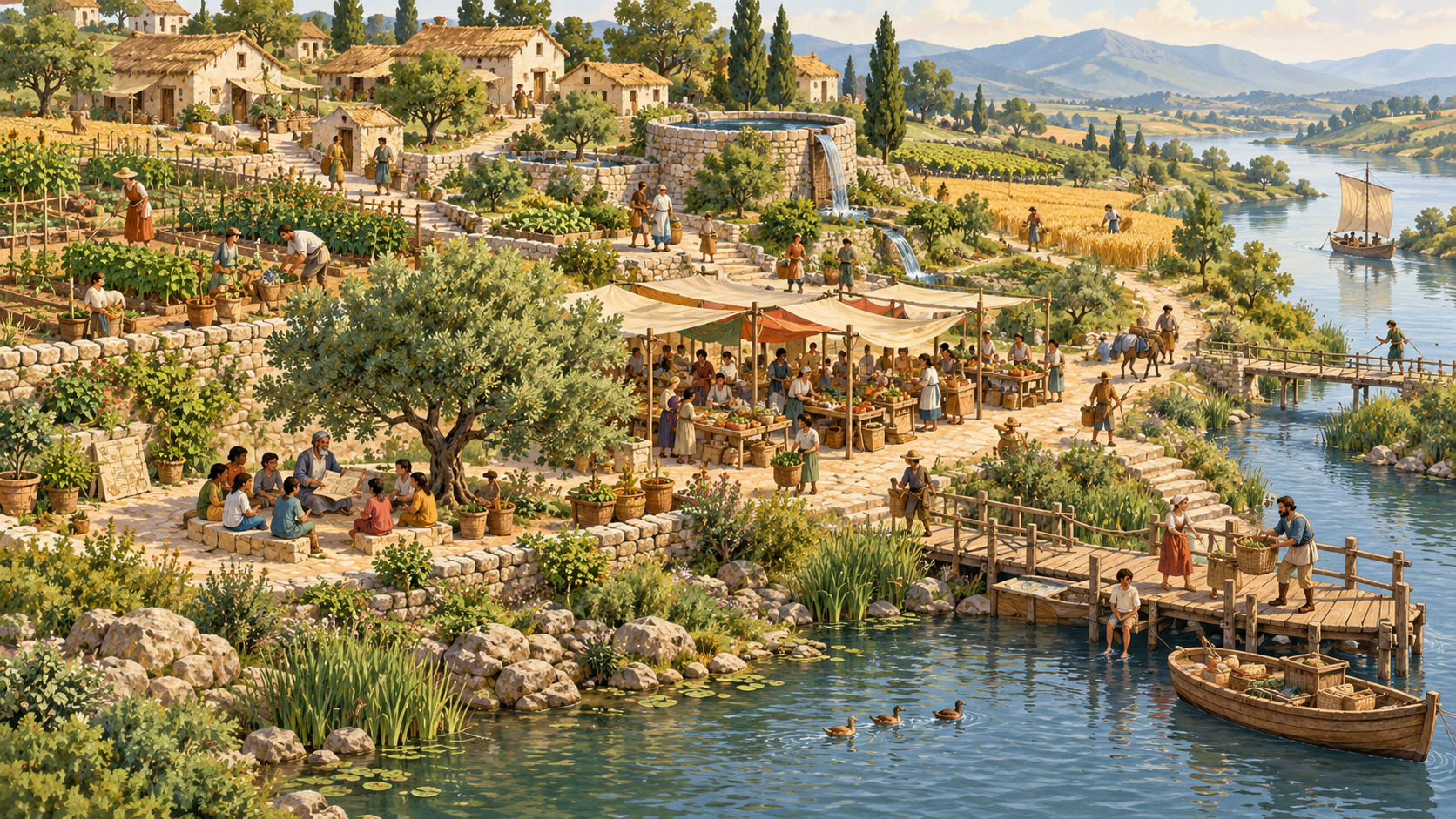
Stages of a civilisation are easier to understand when we ask what a community can reliably do: provide for people, coordinate work, preserve knowledge, maintain shared services and correct mistakes. This first guide in the Stages of a Civilisation series helps parents and tutors explore how to build a civilisation through a classroom model, then explain what evidence would justify describing its capabilities. The aim is to give children a useful way to investigate a society, rather than a label to memorise.
How many stages of a civilisation are there? There is no single count that answers every historical, social and technological question. In eduKate’s working Civilisation Atlas, the capability map contains eight numbered stages plus Foundation 0. Counting the foundation gives nine positions on that particular map. Stage 5 expresses a proposed regenerative and self-correcting threshold; Stages 6–8 are modelled future possibilities. This is an educational framework, not an official international classification or a claim that all societies follow one inevitable path.
How do we know what stage a civilisation is in? We define the community and period, examine how its essential systems work, ask who benefits, check what happens when demands change, and record what remains uncertain. A settlement can have excellent knowledge and unreliable distribution; a network can be technically sophisticated while some people lack dependable services. Through worked examples, a fictional community called Riverside, practical teaching conversations and a family project, this article connects the stage map to observations that children can explain and revisit.
The stage names follow the existing Civilisation Atlas Control Tower. The evidence approach connects to What Stage Is a Civilisation In? and the wider Civilisation Atlas. This guide supplies a teaching progression through those ideas. It begins with building the foundations and leaves a clear route towards the later stages.
Cover: AI-generated conceptual illustration from eduKate’s Civilisation Building series. It depicts a fictional settlement and is used for orientation, not as historical evidence or a reconstruction of the Riverside exercises.
Find your next civilisation question
Choose one route for this reading session. Every teaching chapter stays open; the contents groups can be expanded when you need them.
Full chapter index · Worked evidence case · Tutor workshop · Civilisation hub
Chapter index
Open the group closest to your question. Use the chapter links to move through the guide at a comfortable pace.
Build the foundations · Chapters 1–6
- How many stages are there, and what does the number mean?
- How to build a civilisation: begin with a shared promise
- Foundation 0: the human abilities beneath every later stage
- Stage 1: settlement, surplus and the problem of tomorrow
- Stage 2: records, administration and responsibilities that survive a handover
- Stage 3: production and institutions that work at scale
Explore later stages · Chapters 7–12
Judge from evidence · Chapters 13–18
- How to diagnose a civilisation’s stage from evidence
- Twelve dimensions that make a civilisation visible
- Riverside: a complete worked example with invented evidence
- Stress tests, maintenance and the ability to continue
- Capability stages, lifecycle conditions, phases and energy scales
- What would make an advanced civilisation advanced?
Run a lesson or family project · Chapters 19–21
Answer, explain and continue · Chapters 22–24
CHAPTER 1 OF 24 · Build the foundations
1. How many stages are there, and what does the number mean?
Imagine that a child points to a photograph of a city and asks, “Which stage is this civilisation in?” The photograph shows tall buildings, a bridge, a railway and a river. It offers clues about construction and transport. It tells us much less about whether the bridge is maintained, whether everyone can reach a school, how disputes are handled, or whether future generations will inherit functioning systems.
Before choosing a number, we need to decide what the number would describe. Otherwise, the answer merely gives an impressive name to a first impression.
In this series, a capability stage describes a pattern of organised abilities. The important word is organised. One clever person may solve a problem once. A community has a stronger capability when people can repeat the solution, explain it, maintain it and pass the responsibility to someone else. A tool, a building or a discovery can contribute to that capability, but none is sufficient on its own.
The working map used in this series
The following names come from eduKate’s existing Atlas. The explanatory questions are teaching prompts for this guide. They help a learner investigate the meaning of each position without treating it as a universal historical examination grade.
| Position | Existing Atlas name | A useful question for a child |
|---|---|---|
| Foundation 0 | Adaptive Human Worlds | How do people cooperate, learn, remember and respond to their surroundings? |
| Stage 1 | Settlement and Surplus Civilisation | Can a settled community provide for its people and manage supplies beyond immediate use? |
| Stage 2 | Administrative and Recorded Civilisation | Can responsibilities, claims and shared knowledge remain understandable as coordination becomes more complex? |
| Stage 3 | Industrial and Mass-Institution Civilisation | Can production and large shared institutions deliver dependable services across many people and places? |
| Stage 4 | Planetary Network Civilisation | Can connected systems coordinate across the planet while recognising their dependencies and unequal reach? |
| Stage 5 | Regenerative and Self-Correcting Civilisation | Can the community reliably renew its human, institutional and environmental foundations while correcting harmful patterns? |
| Stage 6 | Multi-World Extension Civilisation | In a hypothetical future, could human communities operate beyond Earth while acknowledging continuing dependence on it? |
| Stage 7 | Autonomous Multi-World Civilisation | In that future model, could more than one world sustain specified essential capabilities through prolonged interruptions and successive generations? |
| Stage 8 | Distributed Interplanetary Civilisation | Could a hypothetical network of worlds cooperate without making its continuity depend on a single indispensable centre? |
There are eight numbered capability stages in this map. Foundation 0 is included to make the human abilities beneath later institutions visible. A reader who counts every row finds nine positions. Both statements can be correct when the counting rule is stated. Confusion begins when someone says “there are nine stages” without explaining that the ninth position is the foundation, or says “there are eight stages” as though every field of scholarship uses this scheme.
The Control Tower supplies the larger model. For the root meaning of the subject, use What Is Civilisation?. The present article uses these established routes and turns their distinctions into lessons that parents and tutors can practise.
What the map does not settle
A numbered model does not decide the value of a person, a language, a community or a culture. Nor does it demonstrate that every society must become more centralised, more industrial, more digitally connected or more geographically expansive. People can choose different arrangements. A community can borrow a capability from a neighbour, retain older practices for good reasons, or deliberately reduce a dependency that makes its life fragile.
The map also contains different kinds of proposition. Some labels describe broad capabilities that can be examined through historical and present evidence. Stage 5 introduces an aspirational standard whose fulfilment would require careful demonstration. Stages 6–8 extend the model into possible futures. Putting these positions in one table does not turn a future possibility into an observed fact.
For a younger learner, the tutor can say: “The table helps us ask questions. It does not tell us that the future has already happened.” For an older learner, ask which claims are descriptions, which are proposed evaluation criteria, and which are hypotheses. That distinction is part of the learning, not a footnote to skip.
A stage label needs a boundary
Suppose a child studies a settlement with an organised storehouse and clear written records. Those observations might support discussion of Stage 1 and Stage 2 capabilities. They do not establish that every household receives adequate supplies, that the records are accurate, or that the entire surrounding region operates in the same way.
Now suppose the settlement receives supplies from a distant industrial centre. Its access to manufactured goods does not prove that it can reproduce the industrial system locally. The child should distinguish what the community does for itself, what it does through exchange, and what it cannot presently do. Dependence is not automatically a flaw; unrecognised dependence makes the description less useful.
A careful sentence might read: “In this fictional settlement, shared storage and recorded allocation are established, while maintenance depends on a neighbouring workshop.” That sentence offers more information than “It is Stage 2.” A stage name can follow the explanation as a summary. It should not replace the explanation.
The first teaching question
Ask the child to finish this sentence: “I would need to know whether…” Encourage three different completions. One might concern food, another decision-making, another knowledge. The exercise shifts attention from visible objects to the systems that make those objects useful.
If the learner answers only “I would need to know how old the buildings are,” acknowledge that age can help establish a chronology, then ask what a recently repaired old building might still do well. If the answer is only “I would need to know how rich the city is,” ask whether a total amount shows how resources reach different people. We are not dismissing dates or wealth. We are showing why neither answers every question.
The learning target for this first chapter is modest and precise: a child can state the count used by this series, explain that it belongs to a particular model, and identify evidence they would need before applying a stage label. That is a stronger beginning than memorising a ladder and assuming the world must fit it.
CHAPTER 2 OF 24 · Build the foundations
2. How to build a civilisation: begin with a shared promise
Put a large sheet of paper on the table. Draw a river, some higher ground, an open area and several possible routes. Add cards representing people, homes, food supplies, tools and places for learning. This is Riverside, an invented community used throughout the guide. It is a teaching model, not a reconstruction of a historical settlement or a recommendation for organising an actual town.
The first task is not to choose a flag, a ruler or the tallest building. Ask what people must be able to depend on when they live together. A child may suggest food, water, shelter, friends, safety or rules. Invite an explanation for each. A useful answer connects a need to a repeated responsibility: who will notice when supplies run low, who can ask for help, and who will do the work tomorrow?
Tokens stand for resources in this activity. Nobody is deprived of real food, water, rest or care. The point is to reason about access and responsibility through a model while keeping the learning experience welcoming.
Choose the promise before choosing the objects
Write one sentence at the top of the paper: “People in Riverside should be able to obtain essential help and supplies through arrangements they understand.” The class may revise the wording. What matters is that the promise is specific enough to examine and wide enough to include people with different needs.
A promise such as “Riverside will be the greatest civilisation” cannot guide a useful check. A promise such as “Each household knows where its agreed supplies come from and how to report a missed delivery” points towards evidence. The children can design a route, assign responsibility, record deliveries and check whether someone has been missed.
Ask whose experience is absent from the first design. A household at the far edge of the map may face a longer journey. Someone looking after a younger child may not be able to wait in a long queue. A person with a different language may need a clearer explanation of the process. These are ordinary design questions. They help children see that a service must be usable by its intended recipients.
Turn needs into functions
A building is an object. A function is what an arrangement achieves. A storehouse may protect supplies, but storing items also requires an agreed way to count them, notice deterioration, allocate access and replenish what is used. Drawing a rectangle labelled “store” solves only a small part of the task.
Invite the learner to create a function card with four lines: the need; the repeated job; the people responsible; and the evidence that the job happened. For example, a learning-space card might say that new members need to understand the community’s routines, experienced members explain one routine at a time, and a newcomer demonstrates the routine independently before being expected to manage it.
The same process works for maintaining paths, resolving a disagreement or keeping a shared tool in good condition. Different functions require different evidence. A completed repair can be inspected. A fair hearing needs evidence that the people affected could explain their concerns and receive a reasoned response. A lesson requires more than an attendance mark if the intended result is usable understanding.
Connect the functions
Riverside’s learning space needs time and materials. Its storehouse needs reliable paths. Its paths need maintenance. Maintenance requires tools, and tools require both skill and a replacement plan. As the children connect the cards, the community begins to look less like a collection of buildings and more like a network of responsibilities.
Do not ask for every possible connection at once. Begin with one service and trace two or three dependencies. A younger child can place a coloured line between the store and the path. An older child can explain how a delayed delivery changes the workload at the store, which may delay record-keeping, which may make the next delivery harder to plan.
Then reverse the question: what does this function support? A well-kept path may help people reach supplies, attend lessons and visit someone who needs help. This gives a concrete meaning to shared infrastructure. Its value lies partly in the other activities it makes possible.
Make responsibility transferable
Ask one group to operate a simple distribution round. Another group watches, asks questions and then takes over. The original group may explain the task but cannot quietly do it for the newcomers. This reveals whether the knowledge belongs only to particular people or has become easier to share.
An unsuccessful handover is useful information. Perhaps the record does not distinguish supplies received from supplies promised. Perhaps two people assumed the other person would count the remaining stock. Perhaps the explanation used a term that newcomers understood differently. The repair is to improve the arrangement and try again.
The purpose is not to prove that people are interchangeable. Individuals bring different strengths and experience. The question is whether essential work can continue when a person is absent, needs rest or leaves the role. A capable system respects its members enough to prepare successors and avoid making constant personal sacrifice its normal operating method.
Write a small founding agreement
Keep Riverside’s first agreement short. It should say what the group is trying to provide, how work is shared, how decisions can be questioned, how records are checked and when the arrangement will be reviewed. A younger class can draw these commitments. An older class can write a paragraph explaining why each one matters.
Include a route for correcting the agreement itself. Children often assume that a rule becomes fair because everyone voted for it once. Ask what should happen when the group discovers an unintended problem. A decision can be made sincerely and still need revision. The agreement becomes stronger when it explains how new evidence can change a practice.
Imagine that everyone originally agreed to collect supplies at one time. After a trial round, the class notices that the same households are repeatedly late because their other responsibilities overlap. The repair might be a second collection window or a delivery arrangement. The learning lies in connecting the change to the evidence, rather than defending the original rule simply because it came first.
Decide what counts as a successful first build
For this classroom exercise, the first milestone is a small group of functions that work together and can be explained. A beautiful map alone is insufficient. The children should show how a person obtains a necessary service, how someone checks that the service actually arrived, and how the community responds when the arrangement fails.
These are teaching criteria selected for the activity. They are not archaeological definitions of when civilisation began. They make an abstract subject manageable while preserving its central questions about cooperation, continuity and shared capability.
At the end, ask each learner to explain one change they would make and one feature they would preserve. Improvement does not require treating everything inherited as a mistake. A working path, a clear explanation or a trusted routine may deserve protection while another part is revised. This is the first step towards understanding why building a civilisation also involves maintaining what already helps people live together.
For a longer construction sequence, continue with Civilisation Building: How to Build a Civilisation. That companion series uses its own fictional communities, beginning with Riverbend. Riverside is a separate evidence-learning model for this Stages guide. Return here to explain what observations would justify a capability claim.
For deeper discussion of these connections, continue into How Civilisation Works and the teaching guide to systems thinking.
CHAPTER 3 OF 24 · Build the foundations
3. Foundation 0: the human abilities beneath every later stage
Foundation 0 is called Adaptive Human Worlds in the Atlas. The name directs attention to people responding to their surroundings through observation, cooperation, memory, communication and learned skill. The zero is a position in an explanatory map. It does not mean that people at this foundation have no culture, intelligence, knowledge, dignity or history.
For a parent or tutor, this is an essential starting point. If the first picture a child sees is a small mobile group and the last is a shining city, the child may quietly infer that the people in the first picture are less capable in every way. The illustrations have then taught a false total ranking. We can avoid that by asking what each community knows, what problems it solves, what responsibilities it maintains and what evidence supports our interpretation.
Adaptation is an active capability
In a fictional map exercise, give Riverside several possible places to obtain supplies. One is nearby but becomes unavailable during a particular season in the story. Another takes longer to reach but is dependable during that period. A third is convenient but shared with another community. The class must plan with these conditions, not simply choose the closest point.
A learner who changes the route after reading the seasonal card has demonstrated useful adaptation. A learner who records why the route changed helps someone else understand the decision later. A learner who asks the neighbouring community about access has recognised a social dependency. These are different capabilities working together before any impressive building appears on the map.
The fictional conditions should remain explicit. The activity is not evidence that a real historical group used the same route or faced the same constraint. It helps children practise a way of thinking that they can later apply, cautiously, to actual sources.
Knowledge can be carried in different forms
Give one group a short instruction to remember and explain orally. Give another group a diagram. Give a third a written note. Ask each group to teach the instruction to a newcomer. Then compare what helped, what became ambiguous and what needed checking.
Do not design the exercise so that writing always wins. A diagram may communicate the shape of a route quickly. A spoken explanation allows immediate questions. A written record can preserve a precise detail for later review. In many practical tasks, combining forms is more useful than declaring one form universally superior.
The relevant questions are whether the meaning remains available, whether the learner can use it, and whether mistakes can be noticed. A very detailed document that nobody can interpret is a weak teaching tool. A clear explanation remembered by only one person has a different vulnerability. The class should be able to name both without dismissing either form of knowledge.
This prepares children for Stage 2 later. Recorded administration expands certain possibilities, but its appearance should not erase the value of prior knowledge systems. We are examining changes in the means and scale of coordination, not granting humanity to people only when they produce a particular kind of record.
Cooperation includes disagreement
Riverside has two reasonable routes to the shared supply area. One is shorter. The other passes a place where people can collect useful materials. The groups prefer different routes because they are trying to achieve different things. This is a good moment to introduce disagreement without turning either side into a villain.
Ask each group to state its purpose, show the information it used and identify a cost of its preferred route. Perhaps the class chooses one route on one day and the other on another day. Perhaps it decides that a person travelling with a heavy load should use the shorter option. The important learning is that reasons can be compared and arrangements can accommodate different circumstances.
A rule such as “The loudest person chooses” may produce a quick answer. It does not show that the relevant needs have been understood. A rule such as “Everyone must agree before anything happens” may protect voice but can create other difficulties. Let children notice that the design of a decision process affects what the group can accomplish.
Care belongs in the foundation
When a child builds a fictional community, productive work is often easy to see. Someone makes a tool, gathers a resource or constructs a shelter. Care work may disappear unless the adult asks about it. Who helps someone who is learning? Who notices when another person needs support? Who makes it possible for a caregiver to rest?
Include care as an ordinary part of the model’s responsibilities. This is not a bonus awarded after the “real” work is complete. If essential needs depend on someone giving unlimited time without help, the arrangement has a weakness that the children should be able to identify.
The aim is not to make learners responsible for adult problems. It is to make their model more complete. A capable community includes people with different levels of independence and changing needs. A design that works only when every member can perform the same task at the same speed has ignored that variation.
A foundation demonstration
Ask the learners to prepare a small welcome pack for a newcomer to fictional Riverside. It may contain a map, an explanation of one shared routine, a way to ask a question and a note about what to do when information is uncertain. Younger learners can draw and explain it. Older learners can test it with someone who has not seen the model.
Observe the newcomer rather than judging only the neatness of the pack. Can they find the necessary information? Do they understand whom to ask? Can they identify a statement that might change with the season? Can they explain the purpose of a rule instead of merely reciting it?
If the pack fails, the group revises the explanation. That is already a lesson in learning and repair. The same underlying pattern will reappear in record systems, institutions, networks and hypothetical future settlements.
Foundation 0 therefore remains relevant throughout the series. Later technologies do not remove the need for observation, trust, explanation and care. They create new circumstances in which these human abilities must continue to work. The learner’s final sentence for this chapter might be: “Before we ask how large the system is, we should ask how people learn to live and act together.”
CHAPTER 4 OF 24 · Build the foundations
4. Stage 1: settlement, surplus and the problem of tomorrow
Stage 1 in the working Atlas is Settlement and Surplus Civilisation. For this lesson, focus on two connected questions: what becomes possible when people organise a continuing settlement, and what must they manage when some resources are kept for later use?
The model does not say that every human community must settle permanently, nor that all settlements emerge in the same way. It offers a category for investigating a particular combination of capabilities. Children can examine settled provision and surplus management while recognising that movement, exchange and flexible residence may remain important parts of a community’s life.
Surplus means more than a large pile
Place twelve supply tokens on the table and tell the group that eight are allocated to the current round. Four remain. In the exercise, those four are a possible surplus relative to that stated allocation. They are not automatically spare resources with no other purpose. Some may be needed for the next round, for replacement, for a reserve or to meet a need the first count missed.
Change the requirement to thirteen tokens. The same pile is now insufficient. This makes a simple point visible: surplus depends on demand, time and commitments. Counting what exists without considering what it must support can give a misleading impression of abundance.
For older learners, separate opening stock, new supply, use and loss. They do not need an elaborate spreadsheet at this stage. A clear sentence is enough: “We began with twelve, received five, used eight and lost one, so eight remain.” Ask the child to check the result with tokens and explain what the remaining eight are intended to do.
Storage introduces responsibilities
A store makes it possible to separate the time when a resource arrives from the time when it is used. It also creates questions. Who knows what is inside? Who can obtain it? How will the group notice a discrepancy? What happens if the storekeeper is absent? What prevents the supplies from being counted twice or promised to two groups?
Give the class a storehouse card with no instructions. Let them propose what needs to be added. Their first suggestion may be a lock. Ask what a lock solves and what it leaves unresolved. It may control entry in the fictional design, but it does not tell people how allocation works or prove that the count is correct.
The learning opportunity is to move from one visible safeguard to a complete routine. A useful routine might include receiving, counting, recording, allocating, checking and reviewing. These functions can be represented with paper cards; no real storage or food-safety experiment is needed.
Provision must reach people
Draw three household groups at different distances from the store. Give every group the same nominal collection opportunity. Then introduce a fictional condition: one route takes twice as long, and one household is already carrying a necessary care responsibility at collection time. Ask whether “the same rule for everyone” produces the same practical access.
Children may propose a second collection period, a shared delivery rota or a closer collection point. Ask them to trace the new responsibilities created by each option. A delivery rota needs people, time and a way to confirm arrival. A second point needs an accurate transfer record. A longer collection period may need additional staffing.
This does not make fair access impossible. It makes access a design problem that deserves attention. The group learns to connect a good intention with the work required to carry it out.
Specialisation grows a web of dependence
Once some supplies can be relied on, fictional Riverside can allocate more time to particular kinds of work. One group improves tools. Another teaches a routine. Another maintains a route. The community gains focused skill, but each group now depends on other functions remaining available.
Ask what happens if everyone chooses the same interesting specialist task. The model may produce many decorative objects and neglect the supply round. This is not a reason to discourage curiosity. It is an invitation to discuss coordination, timing and the less visible work that makes specialised activity possible.
An older learner can compare two arrangements. In one, every household keeps some capability to perform a basic task. In the other, a specialist group performs it for everyone. The specialist arrangement may improve quality or efficiency, but it also needs backup, fair access and reliable exchange. Neither arrangement should be declared best before the conditions are considered.
A settlement must plan for continuity
Ask the class to describe a normal day in Riverside, then a day when one person is away and a delivery arrives late. Do not add a dramatic disaster. A modest change is enough to reveal whether the routine has room to adjust.
Perhaps the group discovers that the only person who knows the store count is absent. The immediate task is to reconstruct the count from the available evidence. The longer-term task is to improve the record and train another person. These are different responses: one restores the present activity; the other reduces the chance of the same interruption becoming a crisis again.
Children should also notice the cost of maintaining a reserve. Supplies kept for later cannot all be used now. Time spent training a second person is time not spent on another activity. The classroom question is how the group explains those choices, reviews them and changes them when conditions change.
What evidence would support a Stage 1 capability?
Within this educational model, useful evidence would show more than houses and a store. It would show a recurring arrangement for provision, a way to manage resources over time, intelligible responsibilities and some ability to continue when ordinary conditions vary. The interpretation should state its scope: a particular settlement, a particular period and the functions actually observed.
For a historical case, the available evidence may be incomplete. Material remains can support some interpretations while leaving others uncertain. An apparent storage area does not, by itself, reveal every household’s access or the fairness of the system. That is why the wider guide includes a chapter on reading evidence and a route into How We Know About Civilisations.
Finish the lesson with a question about tomorrow: “If the people who designed Riverside’s first supply routine left us their model, what would we need to understand before using it?” A strong answer names responsibilities, quantities, assumptions, access and a way to correct mistakes. The child is beginning to see settlement as an ongoing arrangement between people, rather than a finished picture of buildings.
The companion guide From Settlement to a Reliable Town extends the practical building question. Use it to investigate how ordinary services become dependable, then return to the distinction between possessing a facility and maintaining a usable capability.
CHAPTER 5 OF 24 · Build the foundations
5. Stage 2: records, administration and responsibilities that survive a handover
Stage 2 is Administrative and Recorded Civilisation in the Atlas. Its central teaching question is how a community coordinates responsibilities when the work becomes too extensive to depend on everyone remembering every agreement personally. Records can preserve claims, quantities, instructions and decisions. Administration can connect those records to roles and procedures. Both require people who understand how to use and question them.
Begin with a small Riverside misunderstanding. One group says that ten tokens were promised. Another says ten were delivered. A third says ten were requested but never approved. All three statements contain the same number. Their meanings are different. A useful record must preserve that difference.
A record is a claim that can be checked
Give the class a note reading “Tuesday: ten.” Ask what it means. Ten items? Ten people? Ten requested? Ten remaining? The note has preserved a mark but lost much of the information required to act on it.
Now give a clearer version: “Tuesday, round two: ten repair tokens received by the workshop from the shared store; counted by two members.” Ask which questions this version answers and which remain open. It tells us what the entry claims happened. We still need a way to connect the entry to the items and to correct it if the count was mistaken.
A child can learn the difference between a record and proof without becoming cynical about every record. Records are valuable because they make claims more stable and inspectable. Their usefulness improves when they include enough context, when people can compare them with other evidence, and when corrections leave an understandable trail.
The Metropolitan Museum’s account of the origins of writing connects early Mesopotamian records with accounting and organised work, while describing uncertainty in the development of writing. It offers a concrete historical route into this question. It does not imply that writing is the only way people preserve knowledge, or that every civilisation developed records through the same sequence.
Administration connects a request to an outcome
Draw four boxes: request, decision, delivery and review. Place a fictional request for path-repair materials in the first box. The class must explain how it moves through the other three. Who considers the request? What information is needed? Who communicates the decision? Who checks whether the materials arrived and whether the repair worked?
Many learners initially place a person in charge of everything. This can simplify the diagram, but ask what happens when that person receives several requests at once. The group may decide to share roles, use a queue, define a small set of decision rules or keep a common record. Each choice changes the demands placed on the system.
Do not reward complexity for its own sake. A form with twenty questions may collect information that nobody uses. A procedure requiring six signatures may delay a straightforward repair. The educational aim is proportionate coordination: enough structure to make responsibilities clear, with a reason for each step.
A fair correction route is part of the capability
Suppose Riverside’s record says a household received its supplies, but the household reports that they never arrived. Ask the children to design the next step. Simply insisting that “the record says so” makes the record impossible to challenge. Erasing the entry immediately may destroy information needed to understand what happened.
A better classroom response is to record the disagreement, compare the relevant evidence, provide a timely way to address the missing service and explain the final correction. The procedure should be understandable to the person raising the concern. It should also help the community learn whether the problem was an isolated mistake or a repeated weakness in the delivery process.
This example introduces accountability in a concrete way. A person or institution can be asked to explain a decision, show the evidence used and participate in correcting an error. Accountability is more useful when it supports dependable work than when it consists only of finding someone to blame after every mistake.
Shared measures make exchange intelligible
Give two groups paper strips labelled “one unit.” Make the strips different lengths. Let one group request five units of material from the other. The disagreement becomes visible before anyone has behaved dishonestly: the groups are using the same word for different quantities.
The class can agree a reference unit and record what it means. Then ask how a newcomer would discover that definition. A standard that exists only in the memory of the original participants has limited reach. A clearly explained reference can support coordination beyond those participants, provided people can access it and check their use of it.
Older learners can extend the exercise to dates, categories or the meaning of “completed.” One team may mark a task complete when it has been assigned; another may mean the work has been checked. Clarifying the definition can repair a disagreement that initially looked like carelessness or poor effort.
Institutions need more than names
Riverside may create a council, an archive or a learning office. These names do not yet establish reliable institutions. Ask what each role is authorised to do, what limits apply, how members learn their responsibilities, and how the role continues when its current holder leaves.
A small role card can answer these questions. It might state the purpose of the role, the decisions it can make, the evidence it must keep, the people it must consult and the route for reviewing its work. The card should remain short enough to use. If the learners cannot explain it, the design probably needs simplifying.
Then conduct a handover. A new group receives the role card and a few example records. Can it complete a routine request without hidden help? Can it identify an unusual request that needs discussion? Can it explain what it is uncertain about? These are stronger signs of institutional continuity than a confident title at the top of a page.
Evidence and power belong in the same conversation
Records can help people obtain a service, preserve an agreement and challenge a mistake. They can also exclude people when the categories are poorly designed or the correction route is inaccessible. Ask who appears in Riverside’s records and who might be missing. Does the system assume everyone has the same household arrangement? Does it record only the people who can attend a meeting at a particular time?
The classroom response is to inspect and revise the design. We do not need to infer malicious intent to discover an unfair effect. A useful institution should be able to learn from the people whose experience its original categories failed to describe.
By the end of this chapter, the learner should be able to explain why Stage 2 capabilities involve usable memory, clear responsibilities and correctable procedures. A pile of documents alone does not establish them. The evidence lies in what the records enable people to coordinate, how accurately they represent the work, and whether another person can understand and improve the arrangement.
CHAPTER 6 OF 24 · Build the foundations
6. Stage 3: production and institutions that work at scale
Stage 3 is Industrial and Mass-Institution Civilisation in the Atlas. This chapter asks what changes when production and shared services must work for many people across many locations. Scale can create useful possibilities: specialised equipment, shared expertise, common standards and coordinated provision. It also creates demands for maintenance, training, quality checks, distribution and oversight.
The word industrial should not make the whole chapter about factories. In this model, production systems and large institutions belong in the same conversation because both must turn specialised work into repeatable outcomes. A school system, a transport service and a manufacturing network have different purposes, but each needs more than a successful demonstration on one carefully prepared day.
From one good object to dependable production
Give Riverside a design for a paper component used in the classroom model. One group makes a beautiful example. Another makes several usable examples using a method that someone else can follow. Ask which kind of evidence each result provides.
The first may demonstrate skill, creativity and potential. The second begins to show repeatability. Neither result alone tells us whether production can continue with a new team, whether materials will remain available or whether users find the component suitable. The class can define a few observable requirements and test them without assuming that a larger output is always better.
For example, a paper route marker should be readable from the agreed distance, distinguishable from other markers and easy to replace. Producing fifty unreadable markers would increase the count while failing the purpose. Producing ten useful markers may be the better result if ten are what the model requires.
Quality needs a definition
Ask the children what “good quality” means for three different functions: a marker, a lesson and a request process. The answers should differ. A marker needs legibility and durability in the classroom activity. A lesson should help the learner understand and use an idea. A request process should make the next step clear and provide a timely, reasoned outcome.
This prevents a common mistake in assessing institutions: counting the easiest visible output because the intended outcome is harder to examine. Ten worksheets do not automatically show learning. A hundred completed forms do not automatically show that requests were resolved. The indicator must remain connected to the function.
An older learner can design a pair of indicators: one describing activity and another describing the result. For a fictional learning service, attendance is an activity measure; successful independent explanation of the taught idea is one possible outcome measure. Both can be useful, but neither should silently stand for everything that matters in education.
Maintenance changes the meaning of ownership
Riverside’s new workshop contains a shared device represented by a card. The device improves the speed of one task, but the card specifies that it requires a regular inspection and replacement material. Ask the class to decide who maintains it, where the replacement comes from and what work continues if it is temporarily unavailable.
A child may say, “We own it, so we have that capability.” Ask them to revise the statement after the replacement supply is removed from the model. Ownership may remain, but usable capability has changed. A machine that cannot be operated, maintained or supported is a different kind of resource from one embedded in a dependable service.
The same reasoning applies to buildings and institutions. A school building needs teaching, learning materials, maintenance and ways to support learners. A transport route needs operating arrangements as well as a line on a map. The point is to describe the system that delivers the benefit, rather than stop at the asset that can be photographed.
Scale requires clear handovers
When one team makes every component, informal coordination may be enough for the classroom task. When several teams divide the work, the connection between them becomes important. The first team must know what the second needs; the second must understand what has actually been supplied; someone must notice whether the final result meets the agreed purpose.
Let the groups exchange partially completed work. Give them a short handover sheet stating what is finished, what remains, which assumptions were used and where a problem was found. Observe whether the next team can continue without repeating all the earlier work or guessing what a mark means.
This is a practical introduction to interfaces between specialised roles. The technical word is optional. The relationship is the important part: one group’s output becomes another group’s starting point. A small misunderstanding at the connection can travel through the whole process.
Broad access is an additional question
An institution can be capable of delivering a service at scale while distributing access unevenly. Riverside might have a well-run central learning space that distant households find hard to reach. Describing the teaching capability does not settle the access question. Describing the access problem does not require denying every strength of the teaching system.
Encourage a two-part statement: “The learning service can teach this routine reliably to the groups that attend; the present timetable and location leave some intended learners out.” The sentence preserves both findings and points towards a practical next investigation.
Children often feel pressure to call a whole system either successful or unsuccessful. Learning to describe a mixed result is valuable. It helps them avoid treating a single positive statistic as complete proof, or a single problem as evidence that nothing works.
Compare expansion with consolidation
Offer Riverside a choice. It can open a second workshop immediately, or spend one round training more people and improving the existing maintenance routine. There is no predetermined answer until the class considers the demand, the available people, the current reliability and the cost of delay.
Ask each group to propose what evidence would change its mind. Supporters of expansion might want proof that the present team can train a successor and that materials are available for both sites. Supporters of consolidation might reconsider if a second location removes a serious access problem and can be supported without exhausting the first team.
This discussion prepares learners for Stage 4. Connecting more systems can increase reach, but a connection also carries dependencies. A later stage does not eliminate the earlier work of provision, records, production and institutional continuity. It adds relationships that must be understood and maintained.
Explore Connected Cities and Specialised Production when learners are ready to follow relationships between communities. Keep asking which capability is local and which depends on a wider network.
The chapter’s final task is to write a short capability statement about Riverside’s workshop or learning service. It should name the purpose, the scale observed, the evidence of reliable delivery, one dependency and one unresolved question. That statement becomes a useful bridge from building a single functioning arrangement to understanding networks of arrangements across a wider world.
Begin with something that arrives at breakfast
A child looking at a bowl, a spoon and a piece of fruit is already looking at a useful civilisation question. Which parts of this breakfast came from nearby? Which depended on people, materials or decisions farther away? Who would know if an important connection stopped working?
The answer is not simply that everything is connected. That sentence is too large to help. We need to identify a particular connection and explain its job. A grower produces food. A carrier moves it. Someone checks a requirement. A shop orders stock. A household decides what to buy. A message about demand may travel back through the same network, changing what happens next.
In the eduKate Atlas, Stage 4 is called Planetary Network Civilisation. The name directs attention to capabilities organised through connections across the planet. It does not mean that every person receives the same services, that every place has identical infrastructure, or that worldwide connection is automatically dependable. The Civilisation Atlas Control Tower preserves this distinction between a capability category and the condition of the systems beneath it.
Riverside discovers that its boundary was too small
Return to the fictional community of Riverside. Its residents have built food stores, recorded deliveries and organised repairs. The children initially draw a neat boundary around the houses, school, workshop and water facilities. Everything important appears to fit inside the picture.
Then someone asks where the workshop obtains replacement tools. Another child asks who prepares the school’s reference books. A third notices that the town sells goods outside the boundary to pay for some of its purchases. The picture must grow.
This does not make Riverside a failed community. It means the first picture omitted relationships that matter. A system boundary is chosen for a question; it is not a wall around reality. If the question concerns the school’s daily timetable, the original map may be useful. If it concerns whether the school can continue after a long supply interruption, a wider map becomes necessary.
Ask the learner to add one outside dependency and explain the consequence of losing it. Then ask whether there is an alternative. The purpose is to follow a relationship carefully, rather than draw so many arrows that no one can read the page.
Connection is different from useful access
Imagine that every Riverside classroom receives a device that can reach a distant learning collection. A visitor counts the devices and announces that education has been transformed. The children should be allowed to ask a less dramatic question: what can learners actually do with them?
Perhaps the connection works only occasionally. Perhaps the material assumes vocabulary that the children have not learned. Perhaps a student cannot use the available interface. Perhaps the teacher has no time to select a suitable resource. The devices are real, but the educational result remains uncertain.
Now imagine a smaller classroom with fewer devices, carefully chosen material and a teacher who checks whether pupils can explain an idea afterwards. We should not immediately declare the second classroom superior in every respect. We can make a narrower comparison: its particular learning arrangement may turn available resources into usable understanding more consistently.
This is an important Stage 4 habit. Ask where a service arrives, who can use it and what happens after arrival. A connection on a map is evidence of a connection. It is not, by itself, proof of inclusion, comprehension, reliability or benefit.
A network can share both help and difficulty
Suppose Riverside receives supplies through two apparently separate shops. The town feels secure because there are two sellers. Further investigation shows that both shops obtain their stock from the same storehouse and use the same bridge. The alternatives are less independent than they first appeared.
The child can test the reasoning without learning specialist terminology. Cover the shared storehouse on the drawing. Which routes still work? Cover the bridge. Can either shop receive a delivery? The exercise reveals a common dependency that counting shops concealed.
Now change the story. A neighbouring town offers a different route, but using it takes longer and costs more. Keeping that option available may be sensible, yet it is not free. Someone must maintain the relationship, preserve the route and decide when its extra cost is justified.
The lesson is a trade-off, not a rule that every service must always have a duplicate. Network design involves choices about convenience, cost, reliability and the consequences of interruption. Families can discuss those choices through fictional examples without pretending that a simple classroom diagram is an engineering assessment.
Information must travel with enough meaning
Riverside sends a message requesting “twenty containers”. The supplier has several container sizes. Both sides can read the words, yet they may understand different quantities. Faster communication will not repair the missing definition.
The children can improve the message by stating the intended size, purpose and delivery point. They can also ask the receiver to confirm the request in their own words. This makes a useful connection to language learning: accurate communication requires shared meanings as well as a channel through which words can travel.
The same principle applies to a graph, a warning or a school resource. What does the number measure? When was it recorded? Which place does it describe? What should the receiver do with it? A message becomes more useful when its essential context survives the journey.
What would count as progress here?
Riverside has not progressed merely because its network becomes larger. A larger network might open opportunities while introducing dependencies that residents do not understand. A more defensible claim identifies the new capability and the evidence for it.
For example: the town can now obtain a particular learning resource from several places, check its relevance and help more pupils use it independently. Or: residents can identify a delivery interruption, communicate it promptly and use an agreed alternative before the interruption becomes a wider shortage.
Neither claim proves that all of Riverside is flourishing. Each identifies a particular capability and explains why it matters.
CHAPTER 8 OF 24 · Explore later stages
8. Stage 5: Regenerative and Self-Correcting Civilisation
A proposed threshold, not a certificate
The Atlas calls Stage 5 Regenerative and Self-Correcting Civilisation. In this series, it is a proposed capability threshold for discussion. It is not a certificate that we can award to an entire society after noticing one successful environmental project or one institution that corrects an error.
The useful question is demanding but understandable: can people keep renewing the conditions their shared life depends on, recognise harmful consequences and make corrections that continue to work? This includes material systems, learning, institutions and the living environment. It also includes asking who benefits from a correction and who carries its costs.
For children, begin with an ordinary contrast. A group can build something that works today. A more demanding task is to keep it usable, train the next group to care for it and change the design when experience reveals a problem. The second task does not erase the first. It adds responsibilities that a successful opening day cannot settle.
Riverside learns to welcome the awkward report
In our fictional Riverside, the library introduces a new borrowing system. The first report celebrates a rise in the number of recorded loans. The children are pleased. More books appear to be reaching readers.
One pupil then notices that younger children are struggling to find suitable books. Another says that returns are recorded incorrectly when the library is busy. A volunteer reports spending extra time repairing the records. These observations make the success story less tidy.
A self-correcting response begins by making the reports usable. Which books are difficult to find? When do errors occur? What extra work is being done, by whom, and how often? The questions investigate the mechanism rather than asking whether the person raising the concern is cheerful enough about the new system.
Riverside then tries a limited change and checks the result. Perhaps clearer shelf labels help younger readers. Perhaps a different return arrangement reduces mistakes. If the change fails, the town learns something about the original explanation. Reporting a problem, selecting a response and observing the consequence are separate achievements.
A suggestion box is not yet a correction system
It is easy to add a place where people can leave comments. It is harder to show what happens after a comment arrives. Who reads it? How is an urgent matter recognised? What happens when two reports conflict? How does the original reporter learn whether anything changed?
Ask children to follow one fictional concern through the whole process. A note enters the box. Someone checks what it describes. A responsible person decides on a response. The response is carried out. Later evidence shows whether the problem improved. If the chain stops at collection, the town has gathered comments without necessarily improving the service.
The class can also discuss a concern that should not be displayed publicly. A good process may need to protect personal information while still allowing the underlying problem to be addressed. Openness is not a demand to reveal every person’s private experience to everyone.
Renewal includes people who know how to continue
Riverside’s repair workshop appears well equipped. Its shelves contain materials, and its noticeboard records completed jobs. Yet one experienced resident is the only person who understands several important routines. The town has a capability, but its continuity is uncertain.
The response is not simply to ask that resident to work harder. Riverside needs time for teaching, opportunities for another person to practise and a way to check whether the routine can be performed without constant rescue. A written record can help, but a record that nobody understands is an incomplete inheritance.
The guide to regeneration in civilisation offers a useful connection here: replacing a role involves developing people who can carry its work forward. Our fictional example adds a classroom question. What would the next person need to know, and how would we discover a gap before the original worker leaves?
Give children a harmless task such as organising a lending shelf. One group creates instructions; another tries to use them. The second group’s questions reveal what the first group assumed everybody already knew. That discovery is part of learning, not evidence that the newcomers are incapable.
Repair can reveal a cost that the first report missed
Imagine that Riverside improves a public garden by asking a small group of volunteers to do much more work. The garden becomes attractive, and the town records a successful renewal. But the volunteers are exhausted, and nobody has planned how their work will continue.
The improvement is visible. Its arrangement may still be fragile. A fuller account includes time, effort, skills and the people who carry the burden. Otherwise, the town can appear to have solved a problem by moving it somewhere less visible.
Children can ask a fair question without becoming cynical: what made the result possible? If extra work was temporary and openly agreed, that is different from assuming that the same people will absorb an expanding task indefinitely. The difference matters to both fairness and continuity.
Likewise, a plan described as environmentally helpful still needs a clear account of what changes, over which period and with which consequences. Do not make children prove a complicated ecological claim from a picture of trees. Teach them to ask what was measured and what remains outside the evidence.
Progress means preserving the ability to revise
Riverside eventually keeps a small public record of selected improvement projects. Each entry states the problem, the proposed change, the person responsible for following up and the evidence that would justify continuing, revising or stopping the trial.
This record does not guarantee wise decisions. It makes decisions easier to inspect. A later group can distinguish an unsuccessful idea from an idea that was never properly attempted. It can also recognise when a successful trial depended on conditions that have since changed.
A child may ask whether a truly advanced civilisation would stop making mistakes. The answer in this teaching model is no. The proposed threshold concerns how mistakes and consequences are handled. It asks whether people can discover a problem, take responsibility, make a proportionate correction and preserve what they learned for others.
Continue into Scientific Thinking and Knowledge Institutions to investigate how communities organise questions, evidence and learning. Bring back an example of a claim that becomes stronger because someone can challenge and check it.
CHAPTER 9 OF 24 · Explore later stages
9. Stage 6: Multi-World Extension Civilisation
Enter a clearly hypothetical part of the map
Stage 6, Multi-World Extension Civilisation, belongs to the Atlas’s proposed future possibilities. The examples in this chapter are imaginary design discussions. They are not reports that a self-sustaining off-world civilisation exists, and they are not instructions for constructing a space settlement.
For a child, the central distinction is between reaching a place and sustaining shared life there. A visit can demonstrate travel. A scientific station can support a defined programme. A continuing community raises additional questions about care, learning, maintenance, authority, belonging and succession.
Those are different claims. Evidence for one does not automatically establish the others. This chapter helps learners practise that distinction before spectacular pictures or exciting language make it disappear.
Riverside imagines a distant branch
Suppose the fictional people of Riverside consider a future community called Harbourlight on another world. Keep the setting deliberately unspecified. We do not assume a particular atmosphere, transport technology or engineering solution. Our concern is how to describe what Harbourlight would depend on.
At first, the children list objects: homes, a school, a clinic, a workshop and a communications room. Now ask them to replace each object with a continuing job. Homes require care and upkeep. Learning requires teachers or other dependable arrangements. A clinic involves trained people, supplies and appropriate oversight. A workshop requires materials, knowledge and a way to check work.
The change in wording matters. A picture can show a building in a moment. A continuing job requires a story about time. Who performs it today? Who can perform it later? What resources does it consume? What happens when its usual arrangement becomes unavailable?
These questions do not solve the design. They make its unfinished parts visible enough to discuss honestly.
Dependence should be described, not hidden
Imagine that Harbourlight receives regular supplies, specialist advice and replacement equipment from Riverside. That dependence is not automatically shameful or irrational. Communities often cooperate because different places have different resources and capabilities.
The important task is to state the relationship accurately. “Harbourlight can continue its present activities with regular support from Riverside” is different from “Harbourlight can continue indefinitely on its own”. The first may describe a valuable achievement. The second would require much stronger evidence.
Have children write a dependency sentence with three parts: what the community needs, where it normally obtains it and what uncertainty remains. For example, a fictional lesson might say that Harbourlight’s advanced learning programme depends on tutors outside the settlement, while the availability of replacement tutors has not been demonstrated.
A mission and a community have different questions
A limited mission can have a defined purpose and endpoint. Participants may accept an arrangement because its duration and obligations are clear. A community expected to continue across generations requires a wider conversation.
Who can join? Who can leave? How are disagreements heard? What does a child inherit without having chosen the original project? Who decides which traditions, languages or learning opportunities are supported? How are people treated when they cannot perform the role originally expected of them?
These are not decorative questions added after the machinery is designed. They shape the kind of shared life being proposed. Children should encounter them alongside questions about supply and maintenance, so that civilisation does not become a story in which people merely occupy impressive structures.
The tutor can invite several reasonable answers without selecting a political blueprint. The educational goal is to notice whose choices and experiences a plan has included. A drawing that contains a school should also prompt a question about the learners who will use it.
Knowledge must remain understandable at the destination
Suppose Harbourlight receives a large archive from Riverside. The files are intact, and the delivery is celebrated. Then a learner asks whether anybody at Harbourlight can explain the material, apply it correctly or recognise when an instruction no longer fits the local circumstances.
The archive is valuable, but successful copying is only one part of knowledge transfer. The recipients need an appropriate way to interpret and use what arrives. They also need to know which parts are uncertain, outdated or dependent on missing background knowledge.
This is a gentle way to connect a futuristic scenario to the child’s own experience. Having a complete set of notes does not mean being able to solve a fresh problem. Having watched a demonstration does not mean being able to repeat the task safely and accurately. In both cases, a usable return provides stronger evidence than possession alone.
Harbourlight therefore needs a learning arrangement, not merely a larger collection. Who teaches the newcomers? How can questions travel back? What happens when the original explanation is misunderstood? The answers remain hypothetical, but the reasoning is useful now.
What Stage 6 would and would not mean
Within this educational framework, meaningful extension beyond one world would be a new operating reach. It would not prove independence, universal wellbeing, complete resilience or the wisdom of every decision made along the way.
Children can finish the discussion with two separate paragraphs. The first states the capability their imaginary plan attempts to establish. The second states what it still relies on and what has not been demonstrated. That pair of paragraphs is more informative than calling Harbourlight “advanced” and stopping there.
CHAPTER 10 OF 24 · Explore later stages
10. Stage 7: Autonomous Multi-World Civilisation
Ask “autonomous in what respect?”
Stage 7, Autonomous Multi-World Civilisation, is another hypothetical capability in this series. The word autonomous needs careful handling. It should not become a magic label meaning that a community has no relationships, no needs and no possibility of failure.
Begin with three questions: which function, over what period and under what assumed conditions? Harbourlight might manage one teaching programme locally while still relying on outside support for another essential function. It might continue through a short interruption without demonstrating continuity through a much longer one.
Those distinctions do not belittle an achievement. They identify it. A learner who states them has understood more than a learner who confidently calls the whole community independent.
An object can last longer than the capability to use it
Imagine that Harbourlight receives a durable machine together with instructions. For several years, one skilled resident operates it successfully. The machine’s presence becomes a familiar part of the community’s claim to autonomy.
Then that resident changes roles. The machine is still there, but the community discovers that nobody else can interpret some of its behaviour. The missing capability was not visible in the original inventory.
We do not need to specify the machine or teach its operation. The scenario concerns a general difference between owning an asset and reproducing the competence associated with it. Children can understand the same distinction through a musical instrument, a library catalogue or an unfamiliar game whose only experienced player has left.
For a continuing community, role turnover is expected. The question is whether learning arrangements, records and supervised practice make an orderly handover possible. Depending indefinitely on one exceptional person is different from sustaining a capability through changing people.
A map of autonomy should have more than one row
Give Harbourlight a simple descriptive profile. One row concerns food arrangements, another learning, another care, another maintenance and another decision-making. For each, ask what is handled locally, what comes from elsewhere and what remains untested.
The rows may differ. That is the point. Do not average them into a single score that hides an essential dependency. A strong cultural programme cannot substitute arithmetically for an absent critical service. Equally, an external relationship in one domain does not erase every local achievement in another.
An older learner can add the assumed duration beside each claim. “Locally managed under ordinary conditions” is not the same as “able to continue through the specified interruption”. A younger learner can use ordinary phrases: can do here, needs help from elsewhere, and not yet known.
Independence is not isolation
Suppose Harbourlight could maintain a particular capability locally but chooses to share knowledge with Riverside. The relationship may improve both communities. Independence in one function does not require refusing cooperation.
Conversely, a community may appear isolated because communication has failed. That tells us little about whether it can sustain itself. Isolation describes a relationship or situation; autonomy describes a capability under specified conditions. Confusing them can turn a serious difficulty into a misleading badge of achievement.
This distinction is useful for children who equate independence with never asking for help. A person can learn to complete a task independently while still benefiting from advice and collaboration. At community scale the details are more complicated, but the language lesson remains valuable: receiving help does not automatically mean having no capability of one’s own.
The public Civilisation Atlas provides an onward route for considering institutions, dependencies and action together. In our fictional example, the next question is whether cooperation is understood, dependable and chosen through legitimate arrangements.
Who gets to define the community’s needs?
A design team may describe Harbourlight as autonomous because several measurable services work. Residents might still ask about education choices, cultural life, fair treatment and the ability to challenge decisions. Their questions are part of the proposed civilisation, not distractions from it.
Consider a child born in Harbourlight after the original planners have left. The child did not choose the founding agreement. How will the community explain its rules? How can those rules be reviewed? What happens when later generations need something the founders did not anticipate?
A tutor does not need to settle every ethical question. The task is to show that a continuing society contains people whose circumstances change. Institutions must do more than preserve the intentions of their first designers. They need appropriate ways to hear new concerns and make accountable decisions.
This is also why autonomy cannot be established by equipment alone. A community may reproduce material routines while struggling to maintain legitimate cooperation. A responsible profile preserves both observations rather than letting one erase the other.
A stronger claim requires a stronger return
At the end of the Harbourlight discussion, ask what evidence would change the group’s view. If the children say the settlement is autonomous in learning, what would they need to observe when teachers change, unfamiliar questions arise or a resource becomes unavailable?
They might look for new teachers being prepared, learners using knowledge without continuous outside prompting and records that can be understood by successors. These are proposed evidence categories, not a claim that a short classroom exercise could establish generational autonomy.
A useful conclusion can therefore contain both ambition and restraint. Harbourlight is being designed to sustain specified functions through local people and institutions. Several arrangements remain dependent on outside support or have not been demonstrated over the required period.
CHAPTER 11 OF 24 · Explore later stages
11. Stage 8: Distributed Interplanetary Civilisation
More than several impressive settlements
Stage 8, Distributed Interplanetary Civilisation, is presented here as a future educational possibility. It is not a prediction, timetable or claim about civilisation’s inevitable destination. The question is what changes when several enduring communities must cooperate across worlds while retaining enough local capability to continue through difficulty.
A picture with many settlements does not answer that question. We need relationships: how communities exchange information, negotiate shared arrangements, preserve knowledge, respect legitimate differences and respond when a connection fails.
Our fictional map now contains Riverside, Harbourlight and a third imagined community, Meadowreach. None represents a real population or a proposed colonisation programme. They allow children to explore a larger system without assigning real peoples a rank.
Shared standards can help without making everyone identical
Suppose the three communities exchange learning materials. Each uses a different way of describing the level of a course. A message saying that a learner has completed “Level Three” therefore travels without a stable meaning.
One response is to impose an identical name on every programme. That may conceal differences rather than resolve them. Another response is to describe what learners can actually do, what the assessment covered and what prerequisites are assumed. The communities can then compare the relevant capabilities while retaining locally meaningful names.
This is a child-readable example of why shared standards matter. They make particular exchanges more dependable. They do not require every culture, language or institution to become the same.
Ask learners to design a small translation note for the fictional course. What must remain equivalent for the exchange to work? What can differ without causing a misunderstanding? The exercise develops precision while leaving room for diversity. It also demonstrates that a shared label is weaker evidence than a clearly described capability.
A distributed system still contains responsibilities
The children may assume that distributing activity automatically removes the danger of concentrated power. It does not settle the question by itself. Several communities might still depend on one organisation for an essential service, one archive for knowledge or one authority for permission.
Draw the specific relationships and ask who can make which decisions. Who can refuse a request? Who can inspect a shared rule? What happens if a powerful participant changes the arrangement? Where can a smaller community raise a concern?
These questions concern the design of cooperation. A large map can contain a narrow decision structure. A smaller network can contain carefully negotiated responsibilities. Neither size nor geographical separation alone tells us whether authority is accountable.
Common knowledge needs a history of changes
Imagine that Meadowreach improves a learning resource and sends the new version to Harbourlight. Riverside still holds an older version. Soon all three communities refer to “the guide”, although their copies no longer contain the same advice.
The difficulty is not solved by producing more copies. The communities need to know which version they are using, what changed and why. They also need to distinguish a correction from a local adaptation that may not suit every setting.
Children can explore this with a harmless shared recipe for a paper construction or instructions for a board game. One group revises a step. Another records the reason. A third tries the revision and reports what happened. The exercise concerns communication and traceability, not the engineering of a planetary network.
A useful archive therefore includes a route back to the reasoning. Who made the change? What problem did it address? Which conditions were tested? What remains uncertain? Preserving these answers helps later readers avoid confusing confidence, popularity and evidence.
Cooperation includes the ability to disagree
Riverside proposes a shared project. Harbourlight agrees, while Meadowreach believes the proposal would consume resources needed for local priorities. A weak story treats disagreement as proof that the network has failed. A stronger story asks whether the communities can disagree without losing every other useful relationship.
They might revise the project, narrow its scope, postpone it or allow different levels of participation. Each option has consequences that should be described. A shared civilisation would not remove differences in circumstances, priorities or interpretation.
This is a useful moment to distinguish coordination from unquestioning obedience. A plan can be coordinated because participants understand their responsibilities and have agreed on an appropriate decision process. The absence of visible disagreement does not, on its own, establish that such agreement exists.
Children can write two accounts of the same fictional meeting: one from the proposing community and one from the hesitant community. They should preserve the facts while showing why the same decision may look different from different positions.
Continuity must survive more than one kind of interruption
Imagine a temporary loss of communication between Harbourlight and the other communities. The immediate question is which local activities can continue. A later question concerns how the communities reconnect without assuming that nothing changed during the separation.
Each may have made decisions, revised records or learned something important. Reconnection requires comparison, explanation and appropriate correction. Simply restoring a channel does not automatically reconcile what happened while the channel was unavailable.
The Stage 8 discussion therefore ends with a demanding possibility: multiple communities that can continue locally and cooperate meaningfully, while preserving routes for learning, disagreement and repair. More worlds would increase the scale of the question. They would not remove the need for ordinary people to understand, maintain and improve the systems they inherit.
The companion guide to Governing Complex Civilisations extends the question of shared decisions. Use it to examine responsibility and accountability without assuming that a larger system must have only one centre of authority.
CHAPTER 12 OF 24 · Explore later stages
12. How a Civilisation Moves Between Stages
A transition is a claim about a changing capability
Having explored the later stages, return to the first building question. What would justify saying that a new capability has become established? An impressive demonstration can open the question. A transition claim requires us to examine what now works, who can use it, what supports it and whether it can continue.
The following eight cases are invented for teaching. Their places and events do not describe real societies. Each case illustrates a different mistake that can occur when a promising observation becomes a sweeping stage label. They are contrasts to discuss, not a new sequence of eight stages.
Case 1: The full storehouse and the empty households
Riverside’s new storehouse contains more grain than the old one. The inventory is accurate, and the building protects the stored material. Some families nevertheless cannot obtain what they need because the distribution arrangement excludes them.
The case supports a claim about storage capacity. It does not establish dependable access for the whole community. Ask what additional evidence would connect the stored resource to household experience. The lesson is that accumulation, distribution and use are distinct questions. A larger stock can matter greatly while leaving a serious problem unresolved.
Case 2: The detailed ledger that nobody can challenge
In the fictional town of Stonebridge, officials keep detailed records of contributions and entitlements. The records make administration more organised. When a resident identifies an error, however, no review procedure exists.
The ledger demonstrates a recording capability. It does not prove accuracy, fairness or correction. Children can ask how an error would be discovered and who could authorise a change. Written information may preserve a mistake as efficiently as it preserves a valid entry. The transition worth examining includes how records are used and contested, not merely whether they exist.
Case 3: The workshop that cannot replace its expert
Willowbank has a productive workshop led by an exceptionally skilled craftsperson. Visitors admire its output. Apprentices observe, but they are rarely allowed to practise the difficult judgments that make the work successful.
The town has demonstrated present production. It has not yet demonstrated a dependable handover. Ask what the apprentices would need to attempt, explain and check before a transition claim could include continuity. This is not criticism of expertise. It is recognition that a community benefits when expertise can be renewed rather than merely admired from a distance.
Case 4: The connected school with uneven learning
Riverside connects its school to a broad learning network. Older pupils use the resources effectively, while younger pupils cannot understand the instructions and a learner with access needs cannot use the interface.
The school has gained a connection, and some pupils have gained a useful opportunity. The evidence does not support saying that all learners now receive the same capability. Ask which barriers concern language, design, teaching or availability. A mixed account can recognise progress while identifying the next work. It is more informative than declaring the whole school transformed or dismissing the improvement entirely.
Case 5: The repair project that quietly consumes its helpers
Meadowfield reduces a backlog of community repairs through exceptional volunteer effort. The backlog falls, but the volunteers cannot sustain the workload, and no successor arrangement has been discussed.
The immediate improvement is real within the fictional case. Durable renewal remains uncertain. Ask who performed the work, what support they received and how the community would continue under ordinary conditions. A transition cannot be inferred simply by extending an extraordinary effort indefinitely on paper. The people who made an improvement possible belong inside the account of its sustainability.
Case 6: The distant outpost with dependable deliveries
Harbourlight completes a defined period of activity with regular support from Riverside. Its residents learn valuable lessons and improve several routines. A visitor describes the achievement as proof of complete independence.
The visitor has added a claim that the evidence does not establish. The case demonstrates supported activity under the stated arrangement. It leaves open what could continue if support changed. Children should practise praising the demonstrated achievement precisely. Accuracy does not require diminishing it; it requires distinguishing extension, persistence and autonomy.
Case 7: Local capability with chosen cooperation
Harbourlight can run a particular learning programme locally. It still exchanges materials and questions with Riverside because both communities find the relationship helpful. An observer concludes that Harbourlight cannot be autonomous because it continues to cooperate.
This inference also goes beyond the evidence. Chosen collaboration is not identical to an indispensable dependency. Ask what would happen to the specified programme if the exchange paused, while keeping the assumed period and conditions explicit. The answer may remain uncertain. The important improvement is that the learner has identified the question rather than deciding it from the existence of a relationship.
Case 8: Several communities sharing one hidden weakness
Riverside, Harbourlight and Meadowreach maintain separate local institutions, but all rely on one shared archive that no other group can interpret or restore. Their map looks distributed. A critical knowledge arrangement remains concentrated.
The case demonstrates geographical spread and some local capability. It does not establish that the wider system can preserve its shared knowledge through the specified disruption. Ask which dependency crosses all three places. Multiple locations can provide useful alternatives, but their independence must be examined through relationships, not assumed from distance alone.
Compare the claims before comparing the labels
| Observation in the fictional cases | Narrow claim it can support | Additional question before a broader claim |
|---|---|---|
| More stored grain | Greater recorded storage | Does usable food reach households reliably? |
| More detailed records | Expanded recording capacity | Can errors be detected and corrected? |
| Successful expert production | Present specialist capability | Can successors carry the work forward? |
| A school network connection | A new communication route | Which learners can use it successfully? |
| A reduced repair backlog | Completed work during the period | Can the arrangement continue without exhausting its helpers? |
| A supported distant outpost | Activity under stated support | Which functions remain dependent? |
| Ongoing knowledge exchange | A cooperative relationship | Is the exchange essential to the specified function? |
| Several separate settlements | Distributed locations | Do they share a critical weakness? |
The table keeps the observation, interpretation and unanswered question close together. This is also the purpose of the ecosystem guide How to Build a Civilisation Profile from Evidence. A useful profile makes its reasoning inspectable and leaves missing information visible.
Return to the next achievable capability
For Riverside’s builders, the practical next step is rarely “become an advanced civilisation”. That goal is too broad to tell anyone what to do tomorrow. A useful next step might be making a distribution rule clearer, preparing a successor, checking a maintenance record or helping an excluded learner use a resource.
Each improvement can strengthen a capability without settling the entire community’s stage. Each can also reveal a new dependency. Progress therefore involves returning to the evidence, not merely moving a token forward on a board.
Parents and tutors can finish this part by asking children to choose one claim they would now phrase more carefully. Let them explain what the old sentence concealed and what the new sentence makes visible. The aim is a learner who can recognise a promising change, describe its limits and identify the next question with confidence.
That learner is ready to investigate a civilisation’s stage through evidence rather than appearance. The following assessment work can now give that habit a more systematic form.
CHAPTER 13 OF 24 · Judge from evidence
13. How to diagnose a civilisation’s stage from evidence
A stage judgement begins with a question about capability: what can this society reliably do together? It becomes useful when we can explain the evidence behind the answer. Saying that a place looks modern, owns impressive machines or has a famous ruler tells us surprisingly little about the ordinary work that keeps its people alive and its institutions functioning.
For parents and tutors, the aim is to help a child replace a quick impression with an accountable explanation. An accountable explanation identifies the society being examined, states when the evidence applies, names the capability under discussion and acknowledges what remains unknown. It should be possible for another learner to follow the reasoning and reach agreement, disagreement or a sensible request for more information.
Decide what you are examining
Begin by drawing a boundary around the case. Are we discussing a neighbourhood, a city, a country, a trading network or humanity as a whole? These are different units. A neighbourhood can have reliable electricity because a much larger network supplies it. A city can maintain excellent food distribution while depending on distant farms. Neither arrangement is automatically a weakness, but the relationship belongs in the explanation.
Add a time boundary. A description of a city before a flood, during a flood and five years afterwards may produce three different profiles. Even the same year can contain a successful harvest followed by months of difficult distribution. Record the period in ordinary language: “This profile describes the fictional settlement during the seven rounds we observed.” That sentence prevents the conclusion from pretending to cover more than the evidence.
A useful starting card has four spaces: place or system; period; people included; question being investigated. The card gives children a reason to ask, “Which people?” and “When?” before choosing a label.
Separate existence, access and reliability
Consider a school building. Its existence establishes that a building has been constructed. It does not establish that lessons happen regularly, that children can reach it, that materials are understandable or that someone can replace an absent teacher. The capability being investigated is the transmission of knowledge. A building may support that capability, but it is not the whole capability.
Use three linked questions. Does the system exist? Can the people who need it actually use it? Does it continue working with reasonable reliability? Children can apply these questions to a fictional grain store, a library catalogue, a bus route or an agreed way to resolve disputes. They begin to see why an impressive photograph is a starting point for investigation rather than a complete answer.
Coverage matters as well. If a classroom service works for nine children and repeatedly excludes the tenth, saying “the service works” hides a significant qualification. The right conclusion might be, “The procedure usually works for most participants, but access remains incomplete.” That wording recognises the achievement and identifies the repair without pretending that either cancels the other.
Look for evidence of continuity
A civilisation depends on people, yet its essential activities should not require the same person to remember everything forever. Ask what happens when the usual organiser is absent. Can someone else find the instructions, identify the current situation and carry out the next task? Can that person explain why the procedure exists and recognise when it no longer fits?
In a learning activity, this can be tested gently. One pair writes the distribution procedure; another pair follows it using counters. The first pair watches without answering questions for a short, agreed interval. When confusion appears, record the missing instruction. The purpose is to improve the procedure, not to embarrass either pair. A successful handover is evidence that knowledge has become shareable.
Do not confuse a written procedure with a tested procedure. A beautiful instruction sheet can still omit the location of the counters or fail to explain what to do when the total is wrong. The strongest evidence combines a record, an observed attempt and a correction. That sequence shows how a community can move from individual competence towards continuing collective capability.
Distinguish observation, inference and uncertainty
Give children three sentence stems. “We observed…” introduces something the evidence directly shows. “This suggests…” introduces an interpretation. “We still need to know…” identifies a gap. For example: “We observed that every delivery was entered in the ledger. This suggests an established recording routine. We still need to know whether the entries match what arrived.” Each sentence performs a different job.
The difference matters when studying history. A surviving storehouse can support an argument about storage, but its walls alone may not reveal who controlled the contents or whether distribution was fair. A written rule can reveal an official expectation without proving that everyone followed it. Missing evidence also needs care: an absent document may reflect loss or preservation conditions rather than an absence of organisation.
Keep the confidence judgement simple. “Well supported,” “partly supported” and “uncertain” are useful descriptions when accompanied by reasons. Do not assign a precise percentage to confidence merely because a percentage looks scientific. A child who explains why a conclusion remains uncertain is demonstrating judgement, not failing to finish the task.
Write a profile before choosing a stage
The eduKate civilisation diagnostic guide provides a useful route into questions about functioning, continuity and repair. Use the stage framework as an organising lens after collecting a profile. If evidence points in different directions, preserve the differences instead of forcing them into one tidy number.
A reasonable conclusion might read: “The settlement has dependable records and regular distribution meetings. Its maintenance knowledge remains concentrated in one person, and its outer households receive less reliable service. The evidence supports administrative capability, with unresolved weaknesses in continuity and access.” This says much more than “Stage Two” on its own. It also points directly towards the next learning task.
CHAPTER 14 OF 24 · Judge from evidence
14. Twelve dimensions that make a civilisation visible
A civilisation profile becomes easier to use when its questions remain consistent. The twelve dimensions below follow the diagnostic concerns already developed in eduKate’s ecosystem. They overlap deliberately: the same event can affect trust, basic services and human outcomes. The dimensions are prompts for investigation, not independent quantities that must be added into an overall score.
The guide to building a civilisation profile from evidence can accompany this chapter. For a first lesson, choose three dimensions. Across a longer project, revisit all twelve. Give children time to notice connections before completing the whole worksheet.
1. Survival and basic services
Ask whether people can obtain the essentials required by the model community: food, water, shelter and basic care. Look beyond the total supply to the route between supply and household. Who collects it? When is it available? What happens to someone who cannot join the usual queue? Evidence might include distribution records, access arrangements and repeated observations. In historical work, specify what the surviving evidence can and cannot establish.
2. Coordination
Ask how people make their efforts fit together. A food store, a transport team and a household register may each work well separately while failing to share the information needed for a delivery. Look for schedules, agreed signals, clear responsibilities and a way to notice mismatches. A useful child’s question is, “How does the next person know that it is their turn?” Coordination becomes visible at the joins between tasks.
3. Institutions and role continuity
Ask whether important responsibilities continue when individuals change. An institution might be a council, school, maintenance team or dependable rule for allocating a shared resource. Look for defined responsibilities, replacement arrangements and limits on authority. Do people know how a decision can be challenged? A title on a badge is weak evidence; an understandable process that another person can carry on is stronger evidence.
4. Knowledge transmission
Ask how knowledge moves between people and generations. Include demonstration, oral explanation, practice, diagrams, written records and other forms that fit the case. The key question is whether useful understanding remains available and can be checked. Can a learner explain the purpose of a procedure, not merely repeat its words? Evidence might include successful teaching, retrievable records and learners correcting a mistake using what they have understood.
5. Infrastructure and maintenance
Ask which shared structures support everyday activity and how they are kept usable. A bridge, store, communication system or waste arrangement brings responsibilities after construction. Who inspects it? Who records a defect? Are materials and skills available for repair? Children can compare a model with many impressive structures against one with fewer structures and a workable maintenance routine. The comparison should examine functions, costs and dependencies rather than appearance.
6. Repair and learning
Ask what happens after something goes wrong. Can people identify the failure without automatically blaming the nearest individual? Does a correction change the procedure or simply require someone to work harder next time? Evidence includes a clear account of the problem, an agreed change and an opportunity to see whether the change helps. Repair becomes learning when the community retains an improved way of working.
7. Resilience and alternatives
Ask whether essential functions have workable alternatives. A second supplier may help, but only if it can actually deliver when needed. Spare materials may help, but only if someone knows where they are and how to use them. The classroom question is, “Which part can continue if one ordinary link becomes unavailable?” Describe the particular disruption considered; no small exercise proves resilience against every possible event.
8. Trust and legitimacy
Ask why people accept decisions and whether the process deserves their confidence. Trust is not simply obedience or the absence of complaints. Participants may remain quiet because they cannot speak safely or believe they will be ignored. Look for understandable reasons, consistent rules, honest reporting and a usable way to question authority. In the activity, ask whether children can explain both the decision and how to request its review.
9. Contact with evidence
Ask whether the community notices reality accurately and allows inconvenient information to change a plan. Compare the ledger with the counters. Check a claim against a source. Invite someone to report an unexpected result without punishment. A civilisation that records only success makes its own problems harder to see. Evidence of this dimension includes corrected records, acknowledged uncertainty and decisions that change when better information arrives.
10. External dependencies
Ask what comes from outside the boundary you drew. Food, energy, tools, information and specialist help may all depend on wider networks. Record the source, importance and available alternatives. Dependence can support cooperation and specialisation, so it should not automatically be treated as a defect. The concern is an essential dependence that has been overlooked, misunderstood or concentrated without a workable response to interruption.
11. Human outcomes
Ask what life is like for the people within the system. Are the stated benefits reaching them? Who is tired, excluded, waiting or carrying extra burdens? For modern development, UNDP’s Human Development Index centres people and capabilities rather than economic growth alone. In a classroom profile, pair totals with information about distribution and lived experience. Keep the invented classroom measures clearly separate from official indicators.
12. Inheritance by future generations
Ask what the next group receives. Will they inherit usable resources, understandable records, repairable structures and room to make their own decisions? Or will they inherit depleted stocks, unrecorded obligations and equipment nobody can maintain? In a short activity, “the next generation” can be another group taking over the model. Their questions often reveal responsibilities that the original builders assumed someone else would handle.
Use the dashboard to choose the next question
Create one row for each dimension and five columns: current claim; evidence; people affected; uncertainty; next check. Avoid adding a weighted total. A low result in access to essentials cannot become acceptable because the community has excellent decorative architecture. The dashboard should preserve that difference rather than make it disappear through arithmetic.
After reviewing the rows, choose one repair with a clear purpose. Perhaps the most useful next step is a better handover, a fairer collection arrangement or an independent stock check. Ask the child to explain why that repair matters and which other dimensions it could improve. This turns the profile into a working learning tool while keeping the evidence open to revision.
CHAPTER 15 OF 24 · Judge from evidence
15. Riverside: a complete worked example with invented evidence
Riverside is a fictional settlement used only for learning. Every person, quantity, delivery and rule in this chapter is invented. Food tokens represent the activity’s agreed unit of demand; they are not calories, meals or nutritional advice. The exercise uses paper, counters and discussion. It does not involve collecting, treating, tasting or experimenting with real water or food supplies.
The question is precise: how well does Riverside coordinate its food system over one seven-day observation period, and what does the evidence allow us to say about its capabilities? We are examining one essential service in one settlement. These records cannot establish the stage of a real country.
Establish the population and the rule
Riverside contains forty households, each with four residents. Its total population is therefore forty multiplied by four, or 160 residents. For this model, each resident is allocated one food token per day. Daily demand is 160 tokens. Weekly demand is seven multiplied by 160, or 1,120 tokens. Each household should receive twenty-eight tokens across the week.
The equal household size makes the arithmetic easy to inspect. Real households differ, and an equal household allocation would not automatically meet different needs. Tell children that we deliberately simplified the population so they can isolate the distribution problem. Later, they can redesign the model with differing household sizes or agreed additional needs and explain how the allocation rule must change.
Riverside begins the week with 2,400 tokens in its central store. Dividing 2,400 by daily demand of 160 gives fifteen days of supply, assuming no deliveries, no losses and unchanged demand. This is a stock-cover calculation under stated assumptions. It is not a prediction that the settlement will remain safe for exactly fifteen days regardless of what happens.
Read the delivery record
The agreed delivery schedule is 160 tokens each day. Actual deliveries are 160 on Monday, 160 on Tuesday, eighty on Wednesday, 160 on Thursday, zero on Friday, 240 on Saturday and 320 on Sunday. Adding the seven amounts gives 1,120 tokens, exactly the scheduled weekly total.
| Day | Scheduled tokens | Actual tokens received | Tokens counted within that day’s target |
|---|---|---|---|
| Monday | 160 | 160 | 160 |
| Tuesday | 160 | 160 | 160 |
| Wednesday | 160 | 80 | 80 |
| Thursday | 160 | 160 | 160 |
| Friday | 160 | 0 | 0 |
| Saturday | 160 | 240 | 160 |
| Sunday | 160 | 320 | 160 |
| Week total | 1,120 | 1,120 | 880 |
A quick reader might conclude that the supplier performed perfectly. The timing tells a different story. The daily target was met or exceeded on five of seven days: Monday, Tuesday, Thursday, Saturday and Sunday. On this clearly defined measure, the proportion of days meeting the scheduled amount is five divided by seven, approximately 71.4 per cent. Wednesday was partial; Friday was missed.
Another measure asks how much of each day’s scheduled quantity arrived within that day. Cap each day’s contribution at 160 so that a late excess cannot erase an earlier shortfall. The counted amounts are 160, 160, eighty, 160, zero, 160 and 160. Their total is 880. Dividing 880 by 1,120 gives approximately 78.6 per cent of scheduled volume arriving within its scheduled day.
These measures answer different questions. The weekly total answers whether the eventual quantity arrived. The daily measure answers how often the daily target was met. The capped-volume measure answers how much scheduled supply arrived on time. A good explanation names the measure instead of announcing an unexplained “reliability score.”
Reconcile the store ledger
During the week, the store records 1,120 tokens received, 1,120 issued to households and eighty lost through a fictional storage problem. The closing balance should therefore be opening stock plus receipts, minus issues, minus losses: 2,400 plus 1,120, minus 1,120, minus eighty, which equals 2,320 tokens.
| Ledger entry | Change or balance in model tokens |
|---|---|
| Opening stock | 2,400 |
| Receipts | +1,120 |
| Issues to households | −1,120 |
| Recorded storage loss | −80 |
| Closing stock | 2,320 |
Children should check the physical counters against that balance. If the counters total 2,280 instead, there is a discrepancy of forty. Do not immediately decide that someone stole them. An entry may be duplicated, an issue may be unrecorded or a counting error may have occurred. The first task is to locate the disagreement between records and observation, then investigate possible explanations fairly.
Using the reconciled balance of 2,320, closing stock cover is 2,320 divided by 160, or 14.5 days. The settlement received enough tokens to match the week’s planned issues, yet its reserve still fell by eighty because of losses. This is why receipts alone do not establish whether a system is maintaining its resources.
The class has agreed to identify 1,120 tokens as a protected reserve, equivalent to seven model days of demand. The amount above that reserve is 2,320 minus 1,120, or 1,200 tokens. At 160 tokens per day, that is 7.5 days above the protected reserve. The seven-day reserve is a rule chosen for this exercise, not a universal emergency-planning recommendation.
Find the unfairness hidden in the average
The household issue records reveal a second problem. Twenty-four households near the store each received thirty-two tokens. Sixteen households farther away each received twenty-two. The first group received 768 tokens; the second received 352. Together, they received 1,120 tokens. The total matches the planned weekly requirement exactly.
Nevertheless, the agreed allocation was twenty-eight tokens per household. Each nearby household received four more than the rule allowed, creating a combined excess of ninety-six tokens. Each outer household received six fewer, creating a combined shortfall of ninety-six. The arithmetic balances while the distribution fails. An adequate average has hidden an important difference in experience.
Sixteen of forty households received less than the agreed amount, so forty per cent of households were below target. Because all households have the same size, forty per cent of residents were affected too. That second statement would require a separate calculation if household sizes differed. Children should state the assumption rather than carry it into a more complicated case unnoticed.
Ask how this happened before proposing a repair. The fictional record says that collection opened while outer households were still travelling, and the distribution team issued extra tokens to early arrivals. Nobody checked the household allocation rule against the queue procedure. This is evidence of a coordination and access problem, with consequences for fairness and trust. It does not establish that every participant intended to behave unfairly.
Choose a repair and calculate its implications
One proposed repair allocates each household its twenty-eight tokens before collection begins and provides a second collection window. The total remains forty multiplied by twenty-eight, or 1,120. The change concerns access and procedure, not additional supply. A substitute organiser should test whether the instructions explain uncollected allocations and prevent a second issue to the same household.
A separate repair addresses the eighty-token storage loss. Suppose an inspection and container change prevent that same loss next week, while opening stock, receipts and household issues otherwise follow the model. Starting from 2,320, adding 1,120 and issuing 1,120 would leave 2,320. Without the improvement, another eighty-token loss would leave 2,240, equivalent to fourteen days of demand. Preventing a loss stabilises the stock; it does not automatically restore the original fifteen-day level.
To return from 2,320 to the original 2,400 while still meeting all agreed household issues, Riverside would need eighty additional net tokens. “Net” means after any new losses or extra issues. Children can suggest a modest additional delivery, but should record its source and consequences. Removing tokens from households below target would improve the store balance by making the human-outcome problem worse.
Write the evidence-based judgement
Riverside has a population register, an agreed allocation, a delivery schedule and a stock ledger. These support a claim that administrative and recorded capabilities are present. The evidence also reveals uneven access, losses and unreliable delivery timing. The profile should contain both. It should not promote Riverside to a higher capability stage merely because the total supply looks sufficient.
A strong pupil response might read: “Riverside can coordinate and record a substantial shared food service, but its distribution procedure does not yet fulfil its own rule for all households. The next priorities are fair access, storage repair and clearer information about late deliveries. We need another observation period and a handover test before claiming those weaknesses have been resolved.” That is a judgement another learner can check.
Chapter 15 uses forty households and per-person daily tokens. Chapter 19 deliberately resets to twelve households and per-household classroom rounds. Keep the two exercises and their units separate.
CHAPTER 16 OF 24 · Judge from evidence
16. Stress tests, maintenance and the ability to continue
A calm week cannot reveal every weakness in a system. A classroom stress test changes one condition and asks what still works. It is a planned reasoning activity with fictional materials and modest consequences. It is not a real emergency drill, a survival challenge or an instruction to deprive children of anything they need. Participants can pause, discuss and revise the model at any point.
UNDRR’s definition of resilience includes the capacity to respond to hazards, adapt and recover while preserving or restoring essential functions. For our learning purposes, that directs attention towards what continues and what can be repaired. It does not mean that every system must remain unchanged or that a community should simply endure an avoidable failure.
Change one assumption at a time
Begin with one modest disruption: the usual recorder is absent, a delivery arrives one round late, or a bridge card becomes unavailable. Keep the other conditions visible. If the teacher changes five conditions at once, children may struggle to identify why the result changed. A single alteration makes the connection between cause, response and outcome easier to inspect.
State the test before running it. “We are checking whether another pair can use the stock record without help from its authors.” The success condition might be that the pair reconstructs the correct balance and identifies the next scheduled issue. It need not complete the task instantly. Record where it hesitates and what explanation would make the handover easier.
Test Riverside’s reserve without confusing the measures
Return to Riverside’s closing balance of 2,320 tokens. Suppose the class models three days without deliveries, during which the usual demand remains 160 tokens per day. The three-day issue is 480 tokens. Add a separate fictional loss of forty tokens. The remaining stock is 2,320 minus 480 minus forty, which equals 1,800 tokens.
At the same demand, 1,800 tokens represent 11.25 days of total stock cover. The amount above the class’s protected reserve of 1,120 is 680 tokens, equivalent to 4.25 days. Both statements are correct but refer to different quantities. A learner who says “we have four days left” should be asked, “Four days until what?” That question exposes an ambiguous conclusion.
The calculation does not prove that the system is satisfactory. Check who receives the issues, whether the records remain accurate and whether the response depends on one exhausted organiser. A reserve can absorb a delivery interruption while an unfair collection procedure continues harming the same households. Financial or physical buffers cannot substitute for examining the way a service reaches people.
Make maintenance part of the design
When children build a model, they naturally want to add the next feature. Give existing features a maintenance question before introducing another. A bridge needs an inspection routine. A catalogue needs updating. A store needs a way to recognise losses. A council needs an accessible record of decisions. These tasks make the cost of continuing visible alongside the excitement of construction.
Use a maintenance ledger with three entries: what needs attention, who will notice and what resources the response requires. A task without an owner may be repeatedly postponed. An owner without time or materials may be unable to act. An instruction without a way to report completion may leave everyone assuming the work has happened. The ledger makes these gaps discussable.
Compare alternatives by their consequences
Suppose Riverside can spend a fictional eighty-token project budget on a decorative gate, clearer store labels or an alternative delivery arrangement. Do not assume the most serious-sounding option is automatically best. Ask what problem each option addresses, what evidence supports it and what continuing responsibilities it creates. The alternative route may require another team; labels may help only if the original confusion concerned identification.
A good decision includes an opportunity cost: choosing one use means postponing another. Children can disagree about priorities while using the same evidence. One group may choose clearer records because mistakes already occur. Another may prefer an alternative route because a single dependence seems particularly fragile. Ask each group what new evidence would change its decision. That question encourages flexibility rather than attachment to a favourite answer.
Practise recovery and handover
A useful test does not stop at the moment of failure. Let the group restore the service, update the record and explain the change to another pair. Recovery may involve returning to the old arrangement, but it may also involve adopting a simpler one that fits current conditions better. Record what changed and who remains affected.
End with four brief reflections: what failed, what continued, what we changed and what we still cannot claim. Keep a successful repair in the next version of the model so that learning accumulates. Repeating the same avoidable failure without carrying forward a correction creates activity, but it does not demonstrate that the community has learned how to continue more reliably.
CHAPTER 17 OF 24 · Judge from evidence
17. Capability stages, lifecycle conditions, phases and energy scales
The word “stage” can refer to several different questions. Confusion begins when an answer to one question is presented as an answer to all of them. A society’s technological and organisational capabilities, its current condition, its recent direction of change and its energy use are related topics. They are not interchangeable labels.
The numbered progression used in this series is eduKate’s working model of capabilities. Foundation 0 is followed by eight numbered stages, with later stages extending into explicitly hypothetical futures. This teaching structure provides neither a universal timetable nor a single uniform condition across every domain.
A runtime phase asks how a specified system operates under its present demands; a lifecycle description considers its condition or direction across a longer period. Neither assigns its capability stage. The terms can overlap in ordinary conversation, so this guide keeps the question, system and time period visible instead of adding another numbered ladder.
Capability asks what the system can do
A capability statement identifies an activity that can be organised with some continuity: recording obligations, maintaining large institutions, coordinating across a planetary network or supporting a future settlement beyond Earth. Evidence should show that the activity works at the scale claimed. A prototype or announcement can indicate an emerging possibility without establishing a dependable society-wide capability.
Consider a fictional city with excellent digital coordination but weak repair arrangements. Its network capability may be substantial. Its capacity to maintain that network during disruption may be much weaker. Calling it simply “advanced” conceals the distinction. The profile should show the strong capability and the unresolved dependence together, so that the next question remains visible.
Condition asks how the system is functioning now
A lifecycle description concerns the system’s present condition and direction. In a scoped discussion, words such as Takeoff, Climb, Cruise and Descent can help children describe movement: establishing an activity, improving it, sustaining it or losing reliability. These are interpretive shorthand. They are not natural laws that force every society through the same four-part life.
A well-established institution can be improving its teaching while its building deteriorates. A transport network can recover from disruption while public trust remains weak. Different parts of the same civilisation may therefore occupy different conditions. Always attach the description to a function and a period: “The record system improved over these three rounds” is more useful than “The whole civilisation is climbing.”
Repair and relaunch are possibilities, not promises
Drift can describe a growing gap between a stated purpose and actual practice. Repair can describe deliberate correction. Relaunch can describe a renewed attempt after changes. Collapse can describe a severe loss of a specified form of organisation. These words require evidence and boundaries. They should not become dramatic labels attached to every disappointing result.
In Riverside, unequal distribution could be described as drift from the agreed allocation rule. Changing the collection procedure is an attempted repair. A second week of equitable distribution would provide evidence that the repair helped. One successful week would not establish permanent success, but neither should the possibility of future failure erase the observed improvement. Good analysis can recognise a gain without making an unlimited promise.
A failed central institution also does not logically mean that every family, skill, language or cultural practice disappears. When studying a historical disruption, ask which structures changed and which forms of life continued. This question prevents the word “collapse” from turning a complicated transformation into a story in which an entire people simply vanishes.
A cycle is a pattern that needs demonstration
A cycle suggests recurrence. To argue that something cycles, show repeated observations and explain why the apparent recurrence is meaningful. A single rise followed by a fall is not enough to establish a universal cycle. Neither is a carefully selected sequence that ignores cases which do not fit. Children can practise this distinction with their own project records before applying it to historical claims.
For example, if a fictional store repeatedly expands, loses track of stock and simplifies its procedures, that pattern deserves investigation. Perhaps the problem concerns training or information rather than an unavoidable destiny. Changing the procedure might change the pattern. The useful question is what produces the recurrence and which choices remain available.
Kardashev asks a different question
Kardashev’s original paper proposed three energy-based categories in a discussion of extraterrestrial civilisations and detectable communications. Later versions and extensions use different conventions, so an explanation should name the version. The classification concerns energy capability. It does not establish how fairly a society governs, how well its children live or whether its decisions are wise.
For this series, keep energy-scale discussion alongside the capability model rather than merging their numbers. “Stage Three” in our teaching framework is not “Type III” on the Kardashev scale. Matching the numerals would join two different systems without justification. A learner should be able to explain what each classification measures before attempting any comparison between them.
Put the labels into a complete sentence
Instead of asking for a single grand label, invite a sentence with four parts: the capability observed; its current condition; the evidence; the limitation. For example: “Riverside has an established recording capability, currently improving after a distribution repair, supported by two checked ledgers, although long-term continuity remains untested.” The structure keeps the explanation useful even when the stage label remains provisional.
CHAPTER 18 OF 24 · Judge from evidence
18. What would make an advanced civilisation advanced?
The phrase “advanced civilisation” invites images of impressive machines, enormous buildings and distant planets. Those images can inspire curiosity. They do not settle the question. For this series, an advanced civilisation should be examined through capabilities that work, benefits that reach people, decisions that remain accountable and knowledge that can be carried forward without repeatedly destroying the conditions that support it.
That is an educational definition for this project, not a declaration that all scholars use the same standard. It deliberately asks children to connect power with responsibility. The more a system can change, the more carefully its participants must understand consequences, notice mistakes and preserve room for correction. Capability becomes more meaningful when we ask how it is used and who lives with the results.
Turn an aspiration into an observable claim
“Everyone can learn” is a valuable aspiration, but it requires an explanation of access, teaching, materials and support. “The system can repair itself” requires evidence about how faults are detected, who authorises changes and whether the repair creates new problems elsewhere. “Resources are renewed” requires a boundary, a timescale and a way to compare use with renewal. Good intentions become testable through these details.
Children can practise by selecting one ambitious statement and writing its evidence requirements. For “knowledge survives a handover,” they might require accessible records, a demonstration by new participants and a process for correcting unclear instructions. They should also name what would count against the claim. If only the original authors can explain the system, the handover has not yet been demonstrated.
Treat self-correction as work
A self-correcting system needs more than a promise to listen. Someone must notice the error, communicate it, investigate it and have enough authority or support to change the relevant practice. The result then needs checking. Each step can fail. A report may be ignored, a correction may address the wrong cause or a new procedure may be too difficult to sustain.
In the model civilisation, assign the task of finding a problem to someone who did not design the procedure. Let the designers respond by asking questions and testing a change. Rotate the roles. This teaches that criticism can contribute to a shared project and that ownership of an idea does not make its author the only person able to judge it.
Ask what is renewed and what is merely moved
A society may improve its own visible surroundings by moving damage beyond its chosen boundary. In a fictional exercise, one group might keep its store tidy by transferring broken containers to another group without agreement. Its local picture improves while the wider problem remains. The relevant question is whether the overall burden has been reduced, repaired or simply transferred.
Apply the same reasoning across time. A plan that works for this round but leaves the next group without materials has borrowed from its successor. That may sometimes be a conscious tradeoff within the model, but it should be recorded and justified. “Future generations” become easier for children to understand when another team actually inherits the instructions, stock and unfinished responsibilities.
Keep future possibilities separate from achieved facts
The later stages in this series explore Multi-World Extension, Autonomous Multi-World and Distributed Interplanetary possibilities. They are hypotheses and design questions about futures, not confirmed descriptions of existing civilisations. A story can imagine them in detail while remaining honest about that status. The imaginative task becomes stronger when readers know which assumptions make the story possible.
Ask what would have to be demonstrated. Could a distant settlement maintain essential systems without constant rescue? Could it preserve knowledge, govern disagreements and manage dependencies across long communication delays? Could different settlements cooperate while retaining workable local decisions? These questions provide a serious framework for imagination without pretending to know the answers or promising that a particular future must arrive.
Separate intelligence, wealth and energy from moral worth
An intelligence score measures performance on particular tasks under particular conditions. Wealth describes command over resources within an economic setting. Energy use describes a physical quantity. None logically establishes that a person deserves more dignity, that a community is morally superior or that its decisions are just. Treating any one of them as a complete measure changes the question without admitting it.
A technically brilliant solution can distribute its benefits unfairly. A wealthy institution can neglect maintenance. A modestly equipped community can show careful teaching, mutual responsibility and effective repair. Expertise, resources and energy matter, but their purposes and consequences require separate examination.
Give the child a useful final responsibility
At the end of this part of the project, ask the child to prepare a handover for the next group of civilisation builders. It should explain what works, who still experiences difficulties, which claims are uncertain and what the next group should check first. Include the records required to continue. Leave space for the successors to disagree and improve the design.
The resulting civilisation does not need to look finished. A thoughtful handover can be a more convincing sign of progress than another impressive structure. It shows that the builders understand their achievement as something other people must live with, maintain and develop. That responsibility gives the journey towards advanced civilisations a practical starting point in the way children learn to build together today.
CHAPTER 19 OF 24 · Run a lesson or family project
19. A 60-minute tutor workshop: build Riverside, then explain it
The purpose of this workshop is to make reasoning visible. By the end, each learner should be able to describe one shared need, explain how two services depend on each other, and support a modest claim about Riverside with something the group actually recorded. A beautiful model is welcome, but the explanation matters more than the finish.
This workshop uses a simplified twelve-household version of Riverside, separate from Chapter 15’s forty-household dataset. Here, each household receives one counter per classroom round; the counters do not use the earlier per-person daily unit. Its quantities and rules are invented for teaching, not estimates of what a real community needs. Keep this fresh model run clearly labelled.
Prepare a large sheet of paper, coloured pencils, reusable building pieces, twelve household cards, twenty-four food counters, a blue water marker, six work tokens and blank record cards. Coins or expensive equipment are unnecessary. Give every learner access to the materials. In a three-person group, begin with a planner, a recorder and a resident representative, then rotate those responsibilities.
Minutes 0–6: begin with an ordinary day
Ask, “What needs to happen for someone in Riverside to have an ordinary, manageable morning?” Let each child contribute before arranging buildings. A learner might mention breakfast; another may mention finding a family member or reaching a meeting place. Write the ideas without immediately sorting them into the tutor’s preferred categories.
Then ask, “Which of these requires someone else’s work?” This turns a familiar experience into a question about cooperation. If a child says that a household can do everything alone, invite a concrete explanation: “Who makes the container, finds the food and repairs the shelter?” The aim is to trace a relationship, not catch anyone out.
Minutes 6–13: agree what the model will show
Explain the twelve household cards and ask the group to place them. Each household requires one food counter per round in this simplified exercise. Twenty-four counters therefore cover two rounds if everyone receives one. Ask a learner to demonstrate this by distributing counters, while another explains the calculation aloud.
Introduce the water marker as the location of a shared service. It does not represent drinkable water or a treatment process. Children draw routes between the service and the homes. The resident representative chooses one household and describes its journey. “The route exists” is a weaker claim than “this household can use the route”. That distinction will return throughout the session.
Minutes 13–21: choose a first arrangement
Give the group six work tokens. They may spend them on a storage space, a meeting area, clearer routes, a teaching place, additional shelter or a repair space. Agree simple costs before choosing. The costs are classroom constraints; their purpose is to make decisions discussable.
A child may say, “Build the biggest store because then we are advanced.” Ask, “What will the store allow people to do tomorrow?” If the answer is merely that it looks impressive, return to the household cards. A more useful explanation might be, “We can keep the second round’s food together and appoint someone to record what is taken.” Now a building has an operating purpose.
Minutes 21–29: make the first record
Ask the recorder to design a record another person could use. Avoid prescribing the final table too early. A child may invent ticks, drawings or names. Have a different learner attempt to distribute the next round using that record alone. Where does the reader hesitate?
Possible dialogue is deliberately ordinary: “I thought this tick meant food was collected.” “I meant food was still needed.” Ask the group to agree a key. The improvement comes from making meaning shareable. Photograph or copy the first and revised records so the learner can later explain why the change mattered.
Minutes 29–37: hear a resident’s experience
Choose one household card and add a practical circumstance: its resident is carrying a large basket, looking after a younger family member, or returning after the meeting has ended. These are invitations to think about access, not labels for the child holding the card.
Ask, “Can this person understand the arrangement and take part?” The group might move a meeting, widen a route on the drawing or create an agreed collection procedure. Require an explanation of who benefits and who must do extra work. Kind intentions become useful when the arrangement can actually operate. The tutor can ask a quiet learner to point to the relevant place rather than deliver a speech.
Minutes 37–45: rotate responsibility
Exchange the planner, recorder and resident roles. Give the new recorder two minutes to explain the existing system. The original recorder may answer questions, but should let the new person attempt the task first. Notice whether knowledge resides only in someone’s memory or can be passed on.
Then ask the group to make one improvement that helps the next person understand Riverside. It could be a clearer symbol, a shorter instruction or a visible place for unanswered questions. Do not require an extra building. In this lesson, a better handover can be a more meaningful improvement than another tower.
Minutes 45–53: make a supported stage claim
Return to the article’s working model. Ask, “Which capability can you show in Riverside today?” Children might identify an arrangement for settlement and surplus, or a simple record supporting administration. They should name the evidence and its limits. A classroom record demonstrates an idea; it does not establish that the model reproduces a historical state.
Use the sentence frame, “Our model shows ___ because ___. We have not yet shown ___.” A learner who writes, “We showed recorded distribution because another person could use our key,” has made a stronger claim than one who simply selects the highest available stage number.
Minutes 53–60: finish with individual thinking
Give each learner a separate exit card: “One decision I changed”, “The evidence that changed it”, and “One question still open”. Accept a short spoken answer or annotated sketch when that reveals the learner’s thinking more clearly. Keep individual explanations alongside the shared model so the most confident speaker does not become the only visible learner.
For additional challenge, ask whether Riverside’s record could be accurate yet unfair. A child might notice that everyone follows the same rule but some households cannot reach the meeting. For a gentler entry, offer two labelled record designs and ask which would be easier for a newcomer to use. Both routes address the same intellectual task: connect an arrangement, a person’s experience and a reasoned judgement.
Chapter 15 uses forty households and per-person daily tokens. Chapter 19 deliberately resets to twelve households and per-household classroom rounds. Keep the two exercises and their units separate.
CHAPTER 20 OF 24 · Run a lesson or family project
20. A four-week family project with eight purposeful sessions
This project continues the simplified twelve-household workshop version of Riverside from Chapter 19, with its own record of quantities and classroom rounds. It gives that version of Riverside time to acquire a history. Plan two manageable sessions each week, with a gap for noticing something in everyday life. Twenty to thirty minutes can be enough for a session if the discussion remains focused. These timings are suggested arrangements, not expectations about a child’s development or attention.
Keep one folder and reuse the same base map. At the beginning of each session, ask the child to explain the last decision. A family member can join later without needing a complete lecture if the folder contains a short record of what the group agreed. Let the project remain small enough to finish and interesting enough to revisit.
Week 1, session 1: draw a place people could use
Begin with the household cards and a blank map. Invite the child to choose three shared needs and show where each is met. Ask for a route through one ordinary day: leaving home, obtaining something necessary, meeting someone and returning. Follow the route with a finger while the child narrates it.
When a difficulty appears, ask the child to mark it rather than erase the whole map. Keep the first version. Between sessions, notice a real sign, crossing, covered path or meeting place during an ordinary journey. Ask what it helps people do. Avoid photographing strangers or turning a family outing into an inspection of everyone else’s behaviour.
Week 1, session 2: discover what the map leaves out
Return to the marked difficulty. Suppose the map has a food store but no agreed way to collect food. Invite two family members to act as residents with different questions. One asks where to go; another asks what happens if the storekeeper is away. The child writes or draws a short procedure.
Try it exactly as written. If the procedure fails, the adult should describe the point of confusion without ridiculing the author. “I reached the store, but I could not tell whether this mark meant open” gives the child something to repair. The transfer task is to explain a familiar household routine to someone who has not performed it before.
Week 2, session 3: make a record worth keeping
Use a small number of counters to represent objects entering and leaving a shared store. The child chooses the headings or symbols for a record. After several exchanges, cover the counters and ask what the record allows the family to know. Uncover them and compare.
If the totals differ, trace one event at a time. An omitted entry is a useful discovery because it shows why a record needs a routine for updating it. Keep the mistaken version beside the correction. For transfer, the child can organise a collection of books or craft supplies and create a record that someone else can interpret. No personal or financial information is needed.
Week 2, session 4: turn knowledge into a handover
Ask the child to teach one Riverside responsibility to another person. The learner may use a picture sequence, demonstration, spoken explanation or short written instruction. The new person then attempts the task while the original designer observes quietly.
Discuss the places where the instruction assumed too much. “Put it in the usual place” may be clear inside a family and confusing to a newcomer. Rewrite that step with a location or a labelled drawing. The transfer task is similarly modest: teach a game rule, explain how to borrow a book from the family shelf, or show how to return shared materials ready for the next user.
Week 3, session 5: listen to two reasonable requests
Introduce two fictional residents who want different uses for the same space. One proposes a quiet learning area; another proposes a place for repairing tools. Give both characters a reasonable explanation. The aim is to prevent the exercise from becoming a contest between a sensible person and a deliberately foolish one.
Ask the child to describe each request fairly before proposing a decision. Could times be shared? Would separate spaces create extra work? Which information is missing? Record the decision and a date for reviewing it. Between sessions, practise describing two views in a story or family game without deciding immediately which speaker is right.
Week 3, session 6: follow one object through the settlement
Choose a basket, tool or notebook in Riverside. Trace how it is made, used, repaired and eventually replaced or repurposed. Draw the people and materials involved. The purpose is to see a chain of responsibilities that a finished object can hide.
Ask, “Which part of this chain did our first map leave out?” The child may discover training, storage, transport or waste. Add one missing responsibility without making the project unmanageably elaborate. As a transfer task, examine a familiar object at home and list questions about its history. Clearly separate what the family knows from what would need research; guesses should remain labelled guesses.
Week 4, session 7: invite a fresh reader
Show the folder to someone who has not helped build Riverside. Ask that person to describe the settlement from the records. Where the reader understands, identify what made the explanation clear. Where they misunderstand, ask which sign, sentence or missing detail caused the problem.
Let the child choose two revisions. Avoid rewriting everything in an adult voice. A useful portfolio should show the learner’s choices and growth. The transfer task is to improve one explanation for a real audience: a game instruction, a labelled model or a short account of a school project. The child should be able to explain the revision’s purpose.
Week 4, session 8: tell Riverside’s story honestly
Arrange the first map, later map, original record and revised instruction in order. Ask the child to tell the story of one improvement: what the group noticed, what it changed, and what remains uncertain. Then ask for a capability claim using the framework, with the supporting evidence beside it.
End by choosing a future question rather than declaring Riverside complete. Perhaps the child wants to investigate how settlements exchange goods, how machines change work or how communities correct decisions. The project has succeeded when the child can explain an arrangement more carefully, including its limits. The family can now carry that habit into reading, writing, mathematics and discussions about the wider world.
CHAPTER 21 OF 24 · Run a lesson or family project
21. Read historical evidence without ranking people
When children encounter an impressive ruin, a modern skyline or a dramatic illustration, they often reach for a quick label. The adult’s useful contribution is to slow the judgement just enough to ask, “What can this source actually show us?” That question helps a learner respect both the people being studied and the limits of the evidence.
The stage labels in this article organise a working model of capabilities. They do not measure the intelligence, dignity or cultural worth of the people associated with a place. A community may possess detailed environmental knowledge, artistic traditions and sophisticated cooperation that a short description of its buildings scarcely captures.
Separate observation, interpretation and uncertainty
Create three columns on paper. In the first, write what is directly visible or stated by an identified source. In the second, write an interpretation. In the third, write what remains uncertain. For a photograph of a large structure, a child might observe shaped stone blocks, infer coordinated construction, and ask who participated or how decisions were made.
The interpretation may be sensible, but it should remain identifiable as an interpretation. A single photograph cannot answer every question about food, authority, household life or education. Encourage children to use phrases such as “suggests”, “the source describes”, and “we would need further evidence”. These are tools for precision, not apologies for thinking.
Göbekli Tepe: keep the question open
UNESCO describes Göbekli Tepe in present-day Türkiye as containing monumental structures erected by hunter-gatherer groups during the Pre-Pottery Neolithic period. Its account places the monuments between about 9600 and 8200 BCE and discusses probable social and ritual uses. It also notes evidence of non-monumental structures that appear to have been domestic buildings. These details can be checked in the UNESCO World Heritage description of Göbekli Tepe.
For a lesson, ask, “Which easy assumption does this evidence make us reconsider?” One answer is that substantial organised construction cannot simply be treated as proof of a familiar farming-city sequence. Do not turn that insight into another sweeping claim about every early society. The educational gain is learning to revise an assumption when a specific source complicates it.
Çatalhöyük: buildings raise questions about daily life
The UNESCO description of the Neolithic Site of Çatalhöyük discusses a long-lived settlement with houses grouped closely together and access through roofs. It identifies occupation layers, paintings and other remains as evidence for changing social organisation and cultural practices. These are specific features of this place, rather than a universal plan for how settlements must develop.
Ask children how a roof-access arrangement might change their imagined daily journey. What additional information would they need before describing how every household lived? The exercise connects an observable arrangement with a question. It does not require the child to assign the site a confident stage number or invent conversations between its inhabitants.
Read a photograph as a selected view
A photograph has an author, date, position and frame. Ask whether it shows an excavation, a reconstruction, a modern visitor shelter or an artist’s model. Read the caption before relying on appearance. An image may be authentic while showing only a small part of a larger place.
Try a simple demonstration with Riverside. Photograph the store while leaving the homes outside the frame, then photograph the same model from above. The two pictures support different observations. Ask the child to write a caption that tells a viewer what each picture includes. This makes selection understandable without suggesting that every photograph is deceptive.
Use AI illustrations to imagine, then return to evidence
A generated scene can help a child picture a hypothetical settlement, but visible detail alone does not make it a historical record. Label the scene’s role and keep factual claims in accompanying text. An invented costume, tool or building may look convincing. Ask which details come from a cited source and which were created to complete the picture.
The caption should tell readers whether they are viewing a photograph, a reconstruction or a generated conceptual image. Keep the factual source beside the historical claim. A polished illustration cannot supply evidence for a historical detail that the source does not establish. Keep exact stage labels and quantities in the written explanation so they can be checked independently of the picture.
A map also needs a question
Before reading a map, inspect its title, date, key and scale. Ask what its symbols represent and what they leave out. A map of trade routes does not automatically show who benefited from trade. A map of political boundaries does not describe every language, family or cultural practice within them.
Have children add a short note to their Riverside map: “This map shows shared places and routes; it does not show every resident’s experience.” That sentence prepares them to use more complicated maps with care. The central habit is transferable: identify the source, identify the claim, and leave room for evidence that might change the explanation.
CHAPTER 22 OF 24 · Answer, explain and continue
22. Questions parents ask about civilisation stages
These questions are useful when a child begins to treat a model as a set of answers to memorise. Return to them during discussion, especially when a confident claim goes beyond the available evidence. A thoughtful answer can be brief and still acknowledge the model’s purpose and limits.
1. How many stages should my child learn?
For this series, learn eight numbered capability stages and Foundation 0 as the eduKate working model. The number is part of this teaching framework, rather than a scientifically universal count. A child should also understand what each label is trying to distinguish. If the learner remembers a number but cannot describe the capability or evidence, spend time with a concrete example before adding more terminology. Later chapters can deepen the model without pretending that every society follows one compulsory route.
2. Does Foundation 0 mean that people have no civilisation?
Foundation 0, Adaptive Human Worlds, names a foundation within this particular model. The zero does not mean that people lack knowledge, cooperation, meaning or worth. Explain that numbering helps the series organise its questions. It does not place a value on human beings. A child who says, “Those people had nothing,” can be invited to identify what people would need to know about their surroundings, materials and relationships to sustain their lives. Avoid replacing a dismissive assumption with an equally unsupported romantic picture.
3. Must every society pass through each stage in order?
Use the stages to ask about capabilities and dependencies, while keeping actual histories open to evidence. Different features can develop unevenly, arrive through exchange, change direction or coexist. The framework should never become a script into which every place is squeezed. In Riverside, children may invent a record before constructing a formal store because their particular game creates that need. The teaching question is what the record enables and requires. The order in a classroom model is not evidence of a universal historical sequence.
4. Can one place show several stages at once?
Yes, a useful description can identify a mixture of capabilities. A place might use digital communication while relying on older arrangements for another service. The learner should state the scale of the claim: a household, institution, city, network or whole society. “This service uses a connected information system” is more precise than “everything here is Stage 4”. Ask what evidence would justify expanding the claim. This keeps a visible success in one domain from becoming an unsupported judgement about every domain.
5. Is a higher stage always a better place to live?
A capability label does not settle questions about wellbeing, fairness or freedom. Ask separately what people can do, who can access the benefits, who carries the costs, and whether problems can be corrected. A technically elaborate arrangement may still leave important needs unmet. Children can explore this distinction in a fictional model without being asked to rank real populations. Stage 5 is explicitly a proposed aspiration towards regenerative and self-correcting arrangements; its label should invite demanding questions about practice, rather than congratulate a system automatically.
6. Are Takeoff, Climb, Cruise and Descent the same stages?
They are a separate lifecycle shorthand used to discuss conditions or direction. The capability stages ask what a system can organise. Lifecycle language asks how it is moving or functioning over a period. Conditions may overlap across services and places. Help the child keep two different sentences: “This arrangement can do ___” and “Recently, this part has been ___.” Calling a system Cruise does not assign it a capability number, and calling it a numbered stage does not tell us whether every service is improving.
7. Does this tell us a civilisation’s Kardashev type?
No. The capability model in this series and the Kardashev energy classification answer different questions. Do not convert one number into the other or use energy access as a complete judgement of social quality. A learner may be interested in both frameworks, provided the headings remain clear. Ask, “What is being measured or described here?” before comparing the labels. This simple question prevents a confident-looking chart from combining unlike categories and producing an answer that the evidence cannot support.
8. Should children memorise dates before using the model?
Dates help place historical evidence in sequence, but the first Riverside activity can begin with relationships children can explain. When real cases enter the discussion, include reliable dates and source information so events are not accidentally merged. There is no need to fill every session with chronology drills. Ask the child to distinguish “before”, “after”, “during” and “we do not know from this source”. A timeline becomes useful when it helps answer a question, such as whether two developments occurred together or far apart.
9. What if my child gives an answer I disagree with?
Ask for the evidence and reasoning before supplying a replacement answer. The child may have noticed a legitimate feature that the adult missed, or may be drawing a conclusion too quickly. Say, “Show me the part that led you there.” Then examine whether the source supports the whole claim. If it does not, help narrow the wording. Revision should feel like the normal work of a careful thinker. An adult can model the same habit by openly changing an interpretation after noticing a detail.
10. How do I stop the activity becoming competitive?
Give success criteria that reward explanation, listening and revision. Avoid awarding the group points simply for choosing a higher stage or building more structures. Ask each learner to identify an improvement proposed by someone else and explain why it helped. Rotate roles so one confident speaker does not always control the plan. If competition is enjoyable, compare two explanations of the same fictional problem and discuss their strengths. Keep the focus on the quality of the work, rather than declaring one child or imagined community superior.
11. Are the future stages predictions?
Stages 6, 7 and 8 are hypothetical extensions within the model: Multi-World Extension, Autonomous Multi-World and Distributed Interplanetary. They offer questions for future thinking, rather than dates or promises about what humanity will accomplish. A child can discuss what a distant community would need to sustain itself while marking assumptions clearly. Encourage the learner to separate an imaginative proposal from a demonstrated capability. The richer the imagined future becomes, the more useful it is to ask what evidence would eventually confirm a particular claim.
12. What should I do if the subject feels too large?
Choose one ordinary service and follow it carefully. Ask who uses it, who maintains it, how people learn their responsibilities and where questions are recorded. One well-explained relationship can support more learning than a hurried tour of every stage. Stop with a question the child can carry into the next session. Parents do not need to become historians, engineers and economists at once. Your role is to help the learner notice, explain, check and revise with increasing care, using sources when factual questions arise.
CHAPTER 23 OF 24 · Answer, explain and continue
23. Twenty-five useful words children can put to work
Vocabulary becomes useful when a child can use it to explain a decision. Introduce a few terms during an activity, return to them in another example, and ask for an explanation in ordinary language. A memorised definition is only a beginning.
These words can support discussion, short paragraphs and labelled diagrams. The examples invite children to think; they do not need to reproduce the wording exactly.
People, places and work
- Community. A community connects people through shared life, place, activity or relationships. Ask, “Who belongs to Riverside, and who else helps it function?” A delivery visitor may matter without living there.
- Settlement. A settlement is a place where people live. A child might explain, “Our drawing shows homes and shared places.” Ask what another reader needs to understand everyday movement within it.
- Resource. A resource helps people meet a need or accomplish a task. Riverside uses materials, time and knowledge. Invite a precise sentence: “We need this material to repair the container.”
- Surplus. A surplus remains beyond a stated requirement. Twelve households receiving one counter each from sixteen leave four. Ask whether those four are already required for another round. Specify the period.
- Specialisation. Specialisation means concentrating on particular work or knowledge. “Mina practises making containers” is one example. Ask who learns alongside her so the settlement retains that skill when responsibilities change.
Arrangements that help people coordinate
- Coordination. Coordination arranges different actions so they work together. Riverside’s store opens when supplies and a distributor are available. Ask which actions need to match, and how residents learn the arrangement.
- Institution. Here, an institution is an enduring arrangement of roles, rules or practices organising shared activity. A meeting procedure continues under a different leader. Ask what remains when the people change.
- Infrastructure. Infrastructure includes facilities and systems supporting activity. Riverside’s route supports several tasks. Ask the child to trace two activities that depend on it and explain the route’s supporting function.
- Maintenance. Maintenance keeps something usable. A route needs checking; a record needs updating. Ask when the work happens and who recognises the need. “We will be careful” does not identify an action.
- Handover. A handover passes responsibility and necessary information to another person. Give the child an unfamiliar record. Where do they begin? Their questions reveal what the original explanation needs to include.
Evidence and explanation
- Evidence. Evidence supports or questions a claim. A child might show how another learner used a revised record successfully. Ask how that event supports the explanation and what remains untested.
- Source. A source is where information comes from: an identified document, object, interview or image. Ask the child to name it. “Online” usually leaves another reader unable to check the information.
- Observation. An observation describes something noticed or recorded. “Three routes are marked on our map” stays close to what can be checked. Ask for an observation before discussing what it means.
- Inference. An inference draws a conclusion from evidence and reasoning. “These routes may help residents reach the store” adds interpretation. Ask what assumptions connect the visible lines with that possible benefit.
- Uncertainty. Uncertainty identifies something unresolved or supported within limits. “We know the store’s location, but not its opening times” turns an incomplete answer into a useful next question for the planner.
Comparing systems carefully
- Capability. A capability is an ability under specified conditions. Can another learner distribute Riverside’s counters using the record? Name the task and conditions before claiming the model has demonstrated a capability.
- Indicator. An indicator informs a larger question. A successful handover may suggest that particular instructions are understandable. Ask what it reveals; one handover cannot describe every responsibility throughout the settlement.
- Dependency. A dependency exists when an activity relies on another condition, service or input. Distribution depends on supplies and readable records. Invite the child to complete, “This works because ___ is available.”
- Access. Access means being able to reach or use something. Can every household understand the collection procedure? The question distinguishes a service’s presence from residents’ ability to benefit from it.
- Trade-off. A trade-off involves gaining a benefit while accepting a cost or giving up another opportunity. Riverside’s storage uses tokens unavailable for other choices. Ask who experiences each benefit and cost.
Learning and changing over time
- Feedback. Feedback provides information about what happened that can guide a response. A newcomer misunderstands a sign. Ask how its designer responds, so collecting comments becomes connected to an actual decision.
- Adaptation. Adaptation adjusts to circumstances. Riverside changes a meeting time after listening to residents. Ask which circumstance prompted the change and why the new arrangement is expected to help those affected.
- Resilience. Here, resilience concerns continuing essential functions, responding and recovering in difficult conditions. Keep explanations specific: “A second person can perform this task.” Ask what the arrangement enables to continue.
- Regeneration. In this guide, regeneration renews the people, skills, institutions and environmental or material systems that support continuing capability. Ask what is replenished, who can take over and what evidence shows the renewal.
- Accountability. Accountability makes responsibilities and decisions open to explanation and examination, with a response when things go wrong. Ask who answers residents’ questions and what residents can do with the answer.
Turn the words into a paragraph
Invite the child to explain a decision with three terms: “Our record improved the handover because the new recorder understood the symbols. We used feedback to change the key. Uncertainty remains about missing entries.”
Then ask for the same explanation without specialist words. If both versions make sense, vocabulary is supporting understanding. If the ordinary explanation disappears, return to the model and rebuild meaning before polishing the writing.
CHAPTER 24 OF 24 · Answer, explain and continue
24. Build a learner evidence portfolio and choose the next route
A portfolio should make the learner’s reasoning easy to follow. It does not need to preserve every worksheet or reward the longest answer. Select a small set of items that show a question, an attempt, a piece of evidence and a considered revision. The folder becomes useful when a child can reopen it and explain why an item matters.
Start with a cover note containing the project’s question and date. Under it, state that Riverside is fictional and that its quantities and rules are teaching choices. That short note protects the distinction between modelling and researching. It also helps a later reader understand why the folder contains invented household cards beside references to real historical sources.
Five items that reveal learning
First, keep an initial map with the learner’s explanation of how one household uses it. A short annotation is enough. Record the child’s own words if the child prefers to speak. An adult may help with transcription while leaving the reasoning recognisably the learner’s.
Second, keep a decision record. It should identify the question, the alternatives considered, the choice and a reason. Include one cost or unanswered question. This is more informative than a caption announcing that the group made a sensible choice.
Third, keep evidence of a handover. Show the instruction or record, describe what the next person attempted, and identify where the explanation worked or became unclear. If nothing needed changing, ask what evidence supports that judgement rather than manufacturing a mistake for the folder.
Fourth, include a source note about a real example. Record the source title, link or publication details, the claim being examined and a limit on what the source shows. The aim is a traceable relationship between a source and a sentence, rather than a decorative bibliography.
Fifth, include a revision note. Ask the child to complete, “I first thought ___; after noticing ___, I changed ___.” The revision might narrow a claim rather than reverse it. Learning often appears when the explanation becomes more exact.
A rubric for the work, without a score for the child
Use the following descriptors to discuss a particular piece of work. They are classroom guidance, not a standardised developmental scale. A learner may show different levels of independence across criteria and across sessions.
| Criterion | Beginning explanation | Developing explanation | Secure explanation within this task |
|---|---|---|---|
| Describe the arrangement | Names a building or activity | Explains what it helps people do | Connects its purpose, users and operating conditions |
| Use evidence | Gives an unsupported conclusion | Selects relevant evidence with prompting | Explains how the evidence supports a bounded claim |
| Trace relationships | Lists separate features | Identifies a connection between two features | Explains a dependency and what information remains missing |
| Consider people | Describes the planner’s intention | Notices another resident’s experience | Uses different experiences to refine the arrangement |
| Revise thinking | Changes work without explaining why | Identifies a reason for a change | Connects a revision to evidence and acknowledges its limits |
| Communicate clearly | Uses labels without enough explanation | Gives an understandable account with support | Creates an account another reader can follow and question |
Choose one criterion for feedback after a session. If every conversation becomes an assessment of everything, the project can lose its curiosity. A useful comment might be, “Your map clearly shows where people go. Next, explain who keeps that route usable.” The feedback identifies a concrete next action while recognising what the current work already communicates.
Invite the child to choose one portfolio item they would explain to a visitor. Ask why it represents their learning. Their choice may differ from the adult’s preferred piece. Listening to the explanation can reveal a moment of understanding that polished presentation would otherwise hide.
Choose reading by the question that remains
If the child can name features but struggles to connect them, return to the discussion of components and dependencies. If the child can explain a model but overstates what a picture proves, revisit historical evidence and source notes. If the child understands the arrangement but cannot describe it clearly, use the vocabulary examples to build a short explanation.
For a family interested in practical learning, continue with one shared service and its maintenance. For a learner interested in history, choose one well-sourced place and compare questions rather than ranking populations. For a learner attracted to future worlds, write assumptions explicitly and ask what would have to be demonstrated. The reading route should respond to the learner’s next question.
How the series will move towards advanced civilisations
The planned progression begins with Foundation 0, Adaptive Human Worlds, and then examines Settlement and Surplus; Administrative and Recorded; Industrial and Mass-Institution; and Planetary Network capabilities. Each step should add a clearer account of what people can organise, what that capability depends on and what evidence would support a claim about it.
The proposed Stage 5, Regenerative and Self-Correcting, asks whether systems can renew essential foundations and respond meaningfully to evidence of failure. The hypothetical future stages ask further questions about Multi-World Extension, Autonomous Multi-World and Distributed Interplanetary arrangements. These remain differentiated teaching categories and future possibilities, rather than a universal historical timetable.
Keep the portfolio open as the questions become larger. The child’s early record of a food counter, a misunderstood sign or a revised meeting rule can still matter. It provides a concrete example of a demanding habit: describing what a system does, checking whom it serves, and explaining what would justify changing the judgement.
For a wider companion discussion, read Advanced Civilisations and Long-Term Resilience. Bring one question back to this series: which capability has been demonstrated, over what period, and what would still need to be renewed?
Sources and further reading
This guide adapts eduKate’s Civilisation Atlas as a teaching framework. Its eight numbered stages and Foundation 0 are not an official historical classification. Riverside and its classroom quantities are invented. Linked primary sources support the particular examples or concepts discussed beside them; they do not endorse the complete eduKate model. Stage 5 is a proposed regenerative and self-correcting threshold. Stages 6–8 are hypothetical future extensions.
Use the source that matches the question. The Atlas explains the framework; the diagnostic and evidence-profile guides explain how to make a bounded judgement; archaeological sources support particular historical observations. A model, an interpretation and an observed fact should remain distinguishable in the learner’s notes.
| Question | Reading route |
|---|---|
| What does civilisation mean? | What Is Civilisation? |
| Where do the capability stage names come from? | Civilisation Atlas Control Tower |
| How should a mixed capability profile be assessed? | What Stage Is a Civilisation In? |
| How can evidence be recorded and compared? | How to Build a Civilisation Profile from Evidence |
| How do cooperation, repair and continuity connect? | How Civilisation Works |
| How can a family extend the construction activity? | Civilisation Building: How to Build a Civilisation |
Primary sources used for specific claims
The Metropolitan Museum of Art’s The Origins of Writing supports the short discussion of early Mesopotamian records. UNESCO’s descriptions of Göbekli Tepe and the Neolithic Site of Çatalhöyük support the two historical examples in Chapter 21. Each place should be studied on its own evidence, without forcing it into a universal sequence.
UNDP’s Human Development Index provides the people-centred development reference in Chapter 14. UNDRR’s definition of resilience informs the discussion of preserving and restoring essential functions. Kardashev’s 1964 paper is the primary source for the energy-classification distinction. None supplies a validated score for Riverside or a moral ranking of communities.
Where to begin next
For the next teaching session, return to Foundation 0 and Stage 1 in Chapters 3–4, or run the simplified workshop in Chapter 19. The next instalment of this Stages series is planned to examine settlement and surplus in greater depth: what evidence shows a foundation becoming a dependable shared capability? Later instalments can then follow administration, industrial institutions, planetary networks, regeneration and the carefully labelled advanced-civilisation possibilities.
If the learner already understands the foundation, continue through the Civilisation Atlas or the companion Advanced Civilisations and Long-Term Resilience guide. Keep the same question beside every new label: what can this community reliably do, for whom, under what conditions, and how do we know?