
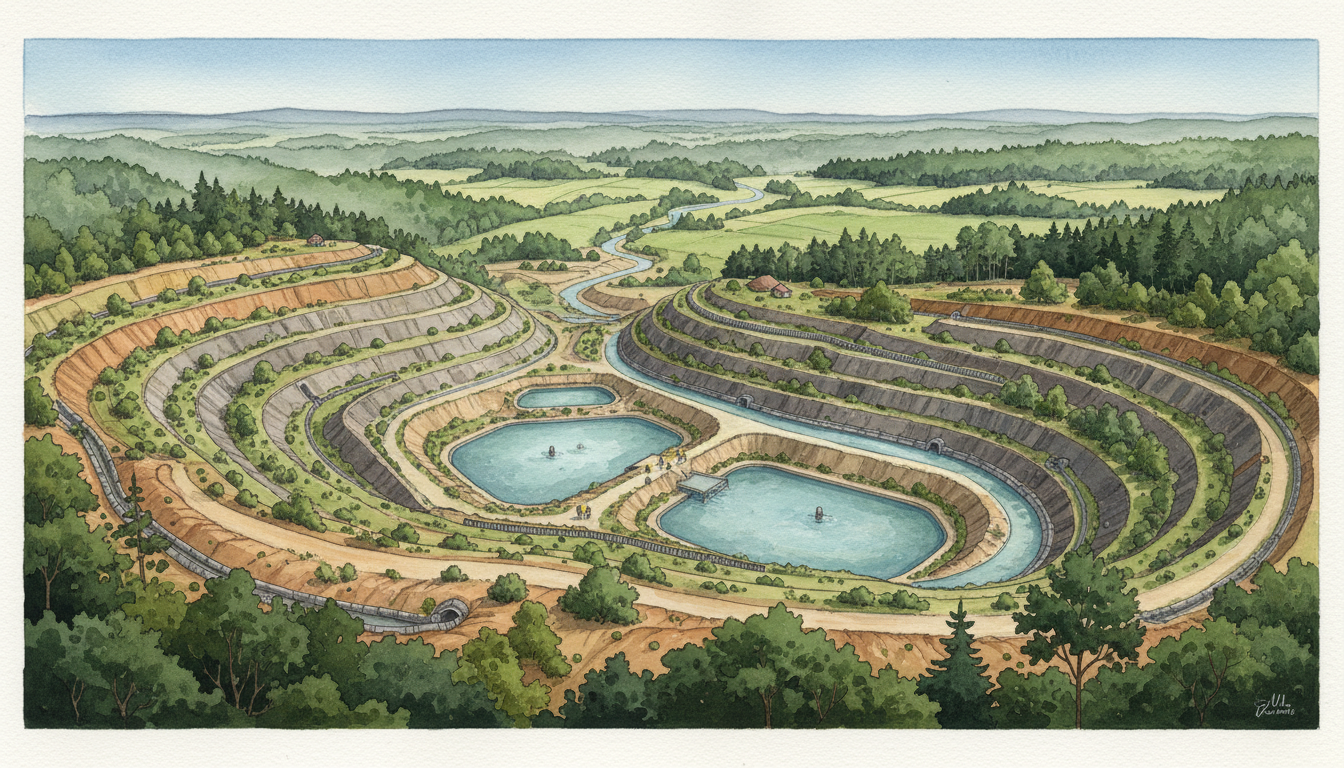
A civilisation can build remarkable structures and still struggle to account for where the materials came from, whose work extracted them, how much energy was used and what remains after the product is discarded. Materials, mining and circular production are therefore not only technical topics. They connect geology, labour, ecosystems, product design, procurement, maintenance and public accountability. This guide explores those connections across the stages of civilisation without ranking real societies by the quantity of metal or plastic they use.
UNEP’s Global Resources Outlook 2024 documents a long-run increase in resource extraction and models a possible 60% additional rise by 2060 relative to 2020 without major changes; this is a scenario, not a prediction that must come true. UNEP’s Global Waste Management Outlook 2024 projects municipal solid waste could grow from 2.1 billion tonnes in 2023 to 3.8 billion tonnes by 2050 under its baseline assumptions. The OECD’s minerals due-diligence guidance addresses human rights, conflict and responsible sourcing. A recycling emblem does not establish that a product avoided environmental damage across its entire lifecycle.
The eduKate Civilisation Atlas is a teaching framework of Foundation 0 and eight numbered capability stages, not a single official archaeological chronology or a scale of human worth. Foundation 0 recognises flexible human adaptation. Stages 1–4 investigate settlement, administration, industry and global interconnection. Stage 5 proposes a regenerative and self-correcting threshold, while Stages 6–8 describe hypothetical inhabited worlds beyond Earth. A society may be highly capable in one function and fragile in another. All judgements must name the system, date, group affected and actual evidence.

A short method for parents, tutors and students
Read the next chapters as independent mechanisms before comparing them across historical and hypothetical settings. A source establishes a particular result in a particular area and period; it rarely justifies a claim about every person in a civilisation. Students should keep four columns in a notebook: the proposed function, the observation, a plausible alternative explanation and the evidence missing. This turns factual reading into transferable historical, geographic, scientific and quantitative reasoning rather than a stage-ranking exercise.
Source ledger: dated findings and their boundaries
UNEP, Global Resources Outlook 2024
UNEP’s International Resource Panel documents resource-use pressures and scenario modelling, including a potential 60% increase in extraction by 2060 from 2020 under continuation assumptions. The named source is UNEP, Global Resources Outlook 2024. Explain precisely which claim the source supports, including any measurement period or status as policy rather than achieved outcome. These organisations do not endorse the eduKate educational stage model; their research or agreements have separate defined purposes.
UNEP, Global Waste Management Outlook 2024
The report assesses municipal waste and models alternative future waste management and circular-economy scenarios. Projected 2050 values are not contemporary measured totals. The named source is UNEP, Global Waste Management Outlook 2024. Explain precisely which claim the source supports, including any measurement period or status as policy rather than achieved outcome. These organisations do not endorse the eduKate educational stage model; their research or agreements have separate defined purposes.
OECD, Due Diligence Guidance for Responsible Minerals, Third Edition 2016
The OECD provides risk-based responsible-mineral-sourcing guidance intended to prevent contribution to serious human-rights abuses and conflict. The named source is OECD, Due Diligence Guidance for Responsible Minerals, Third Edition 2016. Explain precisely which claim the source supports, including any measurement period or status as policy rather than achieved outcome. These organisations do not endorse the eduKate educational stage model; their research or agreements have separate defined purposes.
OECD, Minerals Due Diligence Monitoring and Evaluation Framework 2021
The monitoring framework describes how to evaluate whether due-diligence efforts result in improved outcomes rather than mere documentation. The named source is OECD, Minerals Due Diligence Monitoring and Evaluation Framework 2021. Explain precisely which claim the source supports, including any measurement period or status as policy rather than achieved outcome. These organisations do not endorse the eduKate educational stage model; their research or agreements have separate defined purposes.
Convention on Biological Diversity, Kunming-Montreal 2030 Targets
The framework addresses biodiversity-inclusive spatial planning, restoration, sustainable use and equitable governance; targets are ambitions rather than present global achievement. The named source is Convention on Biological Diversity, Kunming-Montreal 2030 Targets. Explain precisely which claim the source supports, including any measurement period or status as policy rather than achieved outcome. These organisations do not endorse the eduKate educational stage model; their research or agreements have separate defined purposes.
UNEP, Global Resources Outlook 2024 Summary for Policymakers
The policy summary calls attention to consumption inequality, ecological costs and a just transition in resource use. The named source is UNEP, Global Resources Outlook 2024 Summary for Policymakers. Explain precisely which claim the source supports, including any measurement period or status as policy rather than achieved outcome. These organisations do not endorse the eduKate educational stage model; their research or agreements have separate defined purposes.
Nine positions for investigating an operating capacity
Foundation 0 — adaptive human worlds. Picture a small, adaptable human community that learns through observation, practical teaching and relationships across a landscape. The core ability is knowledge and cooperation that remain usable without a permanent city or written administration. An honest stress test asks what happens when the person who usually knows a route or practice is unavailable. Sources suitable for examining that claim include careful interpretation of contextual material evidence and knowledge held in living practice. Important qualification: No society is less intelligent because it does not possess the institutions of a modern city; this is a pedagogical comparison, not a racial or cultural scale.
Stage 1 — settlement and surplus. Picture an imagined settled community with recurring provisioning and shared stores over changing seasons. The core ability is a reliable local function that reaches intended people beyond one unusually successful event. An honest stress test asks what happens when the expected season changes and one delivery or access route fails. Sources suitable for examining that claim include records or contextual evidence for sustained provision, storage, maintenance and access. Important qualification: A substantial store or permanent structure cannot by itself prove fair access or complete civilisational progress.
Stage 2 — administration and records. Picture a fictional town where designated stewards document allocations, decisions and responsibilities. The core ability is traceable decisions and trustworthy handovers that survive changes in personnel. An honest stress test asks what happens when two credible records disagree about what reached a resident. Sources suitable for examining that claim include the provenance and limits of documents plus a way to reconcile recorded claims against outcomes. Important qualification: Surviving archives are selective and can privilege the viewpoints of powerful institutions.
Stage 3 — industry and mass institutions. Picture a larger district with specialists, production, laboratories, maintained transport and public services. The core ability is repeated large-scale service with trained staff, safe procedures and repair capacity. An honest stress test asks what happens when a headline improvement conceals pollution, unsafe work or a backlog of repairs. Sources suitable for examining that claim include operational quality, service access, safety and environmental performance—not just production. Important qualification: Industrial output is not an automatic measure of dignity, ecological health or fair governance.
Stage 4 — planetary networks. Picture a globally connected set of regions dependent on cross-border cargo, communication and institutional standards. The core ability is reliable connections and responses to failures that cross national boundaries. An honest stress test asks what happens when an upstream disruption becomes a downstream failure for people far from the origin. Sources suitable for examining that claim include network dependencies, access gaps, standards, independent verification and historical context. Important qualification: Planetary interconnection does not mean every community receives equivalent benefits.
Stage 5 — regenerative and self-correcting capacity. Picture a hypothetical region proposing to monitor damage, correct its causes and verify lasting improvement. The core ability is a proposed feedback system that learns from harm and avoids shifting costs onto others. An honest stress test asks what happens when an apparently successful repair improves one indicator but damages an unmeasured system. Sources suitable for examining that claim include an honest baseline, affected users, a defined counterfactual, longer-term results and outside scrutiny. Important qualification: This is a proposed teaching threshold, not an international classification or evidence of universal achievement.
Stage 6 — multi-world extension. Picture a fictional inhabited outpost away from Earth with continuing dependence on Earth-supplied parts and expertise. The core ability is sustained human activity outside Earth with every major dependency stated rather than hidden. An honest stress test asks what happens when a delivery or skilled response expected from Earth does not arrive. Sources suitable for examining that claim include separate verified mission components from plans, prototypes and imagined continuing settlements. Important qualification: Robot missions, concept art and planned bases are not proof of a second-world human civilisation.
Stage 7 — autonomous multi-world community. Picture an imagined off-Earth community attempting to maintain essential functions without frequent Earth support. The core ability is broad local continuity of industry, education, healthcare, energy and repairs. An honest stress test asks what happens when one irreplaceable import exposes the limits of apparent self-sufficiency. Sources suitable for examining that claim include whole-system dependency audits over meaningful periods, not single recycling demonstrations. Important qualification: No inhabited off-Earth human society has demonstrated the broad autonomy proposed here.
Stage 8 — distributed interplanetary civilisation. Picture multiple fictional inhabited centres separated by long communications and transport delays. The core ability is independent local decisions plus accountable cooperation across centres with delayed messages. An honest stress test asks what happens when a decision made with old information reaches a world whose situation has changed. Sources suitable for examining that claim include a defined hypothetical system and demonstrated component science without inventing actual human settlements. Important qualification: Deep-space communications experiments are not evidence that distributed interplanetary human communities presently exist.
Sixteen subject-specific mechanisms investigated across the nine positions
Every chapter below begins with a real, distinct problem in the subject. It then asks how the problem might be recognised under nine different operating circumstances. The detailed comparisons are expressly hypothetical classroom scenes, not evidence that a particular historic society was affected by the invented event. Their purpose is to connect a defined service to evidence, repair, fairness, hidden dependencies and the limits of classification.
1. Stone, clay, fibre and locally adapted material knowledge: what must work and why
The operating purpose is to show how material skill responds to climate, craft traditions, repair needs and local ecology. It is not solved merely by the existence of a structure, a new technology or an ambitious plan. Consider the invented case: a class assumes pottery or woven fibre is intellectually inferior to modern composites. Start with the service actually received and the people doing the work, then identify the failure mechanism. The observable outcome might be products useful and maintainable for their defined tasks, but a meaningful statement needs a unit, an applicable time and the right geographic boundary. It also needs an explanation of how the task changes when a different person takes responsibility.
The most useful records would include contextual archaeology, community knowledge and evidence of actual material performance. Pay special attention to makers and communities whose techniques are poorly preserved in archives, because these may be excluded from whichever number looks best in a headline. A common reasoning error is a material’s age determines its quality. An alternative hypothesis is one traditional design may be better adapted to a local purpose. Instead of deciding between them by confidence, ask what observation each predicts and what data would discriminate between their claims. The starting lesson is to match fictional material cards with moisture, strength and portability needs; its deeper learning goal is to separate useful performance from claims about the maker’s human worth. This is a harmless paper investigation, not field instruction for dangerous work or a real emergency.
Stone, clay, fibre and locally adapted material knowledge — Foundation 0 — adaptive human worlds
Mechanism and stage boundary. Imagine a small, adaptable human community that learns through observation, practical teaching and relationships across a landscape. Here the group wants to show how material skill responds to climate, craft traditions, repair needs and local ecology, and the specific threshold concerns knowledge and cooperation that remain usable without a permanent city or written administration. The lesson begins when a class assumes pottery or woven fibre is intellectually inferior to modern composites. The first task is to identify the chain connecting skilled observation, a resource, a rule or technique, and the person who receives the outcome. What would remain functional if the person who usually knows a route or practice is unavailable? A merely attractive result is not sufficient; the claim should specify the period and the people included. No society is less intelligent because it does not possess the institutions of a modern city; this is a pedagogical comparison, not a racial or cultural scale. Never treat this fictional stage comparison as an actual reconstruction of a historical population or evidence that an off-Earth human settlement exists.
Evidence, rival explanations and fair outcomes. For this mechanism seek contextual archaeology, community knowledge and evidence of actual material performance. A tentative quantitative check might use products useful and maintainable for their defined tasks, but the class must ask about makers and communities whose techniques are poorly preserved in archives. One interpretation is that the system failed because its recognised component is missing. A rival is that one traditional design may be better adapted to a local purpose. A reader could be misled by a material’s age determines its quality. careful interpretation of contextual material evidence and knowledge held in living practice can help reveal whether the relevant stage capacity is genuinely demonstrated, but absence or incompleteness of data must remain visible. Students should distinguish the reliability of an observation from the credibility of the story built around it, and describe what would change their conclusion.
Teaching activity and an independent review. Ask learners to match fictional material cards with moisture, strength and portability needs. Next, introduce a small fictional disruption: the person who usually knows a route or practice is unavailable. One group keeps the process running, a second audits the record, and a third asks whether makers and communities whose techniques are poorly preserved in archives have been considered. Have the first group explain how it would separate useful performance from claims about the maker’s human worth. The second group should be able to reproduce the decision without hidden assumptions, and the third should be able to state an honest limitation. A complete answer need not declare a high stage; it can conclude that the available evidence is too narrow for a society-wide claim.
Stone, clay, fibre and locally adapted material knowledge — Stage 1 — settlement and surplus
Mechanism and stage boundary. Imagine an imagined settled community with recurring provisioning and shared stores over changing seasons. Here the group wants to show how material skill responds to climate, craft traditions, repair needs and local ecology, and the specific threshold concerns a reliable local function that reaches intended people beyond one unusually successful event. The lesson begins when a class assumes pottery or woven fibre is intellectually inferior to modern composites. The first task is to identify the chain connecting skilled observation, a resource, a rule or technique, and the person who receives the outcome. What would remain functional if the expected season changes and one delivery or access route fails? A merely attractive result is not sufficient; the claim should specify the period and the people included. A substantial store or permanent structure cannot by itself prove fair access or complete civilisational progress. Never treat this fictional stage comparison as an actual reconstruction of a historical population or evidence that an off-Earth human settlement exists.
Evidence, rival explanations and fair outcomes. For this mechanism seek contextual archaeology, community knowledge and evidence of actual material performance. A tentative quantitative check might use products useful and maintainable for their defined tasks, but the class must ask about makers and communities whose techniques are poorly preserved in archives. One interpretation is that the system failed because its recognised component is missing. A rival is that one traditional design may be better adapted to a local purpose. A reader could be misled by a material’s age determines its quality. records or contextual evidence for sustained provision, storage, maintenance and access can help reveal whether the relevant stage capacity is genuinely demonstrated, but absence or incompleteness of data must remain visible. Students should distinguish the reliability of an observation from the credibility of the story built around it, and describe what would change their conclusion.
Teaching activity and an independent review. Ask learners to match fictional material cards with moisture, strength and portability needs. Next, introduce a small fictional disruption: the expected season changes and one delivery or access route fails. One group keeps the process running, a second audits the record, and a third asks whether makers and communities whose techniques are poorly preserved in archives have been considered. Have the first group explain how it would separate useful performance from claims about the maker’s human worth. The second group should be able to reproduce the decision without hidden assumptions, and the third should be able to state an honest limitation. A complete answer need not declare a high stage; it can conclude that the available evidence is too narrow for a society-wide claim.
Stone, clay, fibre and locally adapted material knowledge — Stage 2 — administration and records
Mechanism and stage boundary. Imagine a fictional town where designated stewards document allocations, decisions and responsibilities. Here the group wants to show how material skill responds to climate, craft traditions, repair needs and local ecology, and the specific threshold concerns traceable decisions and trustworthy handovers that survive changes in personnel. The lesson begins when a class assumes pottery or woven fibre is intellectually inferior to modern composites. The first task is to identify the chain connecting skilled observation, a resource, a rule or technique, and the person who receives the outcome. What would remain functional if two credible records disagree about what reached a resident? A merely attractive result is not sufficient; the claim should specify the period and the people included. Surviving archives are selective and can privilege the viewpoints of powerful institutions. Never treat this fictional stage comparison as an actual reconstruction of a historical population or evidence that an off-Earth human settlement exists.
Evidence, rival explanations and fair outcomes. For this mechanism seek contextual archaeology, community knowledge and evidence of actual material performance. A tentative quantitative check might use products useful and maintainable for their defined tasks, but the class must ask about makers and communities whose techniques are poorly preserved in archives. One interpretation is that the system failed because its recognised component is missing. A rival is that one traditional design may be better adapted to a local purpose. A reader could be misled by a material’s age determines its quality. the provenance and limits of documents plus a way to reconcile recorded claims against outcomes can help reveal whether the relevant stage capacity is genuinely demonstrated, but absence or incompleteness of data must remain visible. Students should distinguish the reliability of an observation from the credibility of the story built around it, and describe what would change their conclusion.
Teaching activity and an independent review. Ask learners to match fictional material cards with moisture, strength and portability needs. Next, introduce a small fictional disruption: two credible records disagree about what reached a resident. One group keeps the process running, a second audits the record, and a third asks whether makers and communities whose techniques are poorly preserved in archives have been considered. Have the first group explain how it would separate useful performance from claims about the maker’s human worth. The second group should be able to reproduce the decision without hidden assumptions, and the third should be able to state an honest limitation. A complete answer need not declare a high stage; it can conclude that the available evidence is too narrow for a society-wide claim.
Stone, clay, fibre and locally adapted material knowledge — Stage 3 — industry and mass institutions
Mechanism and stage boundary. Imagine a larger district with specialists, production, laboratories, maintained transport and public services. Here the group wants to show how material skill responds to climate, craft traditions, repair needs and local ecology, and the specific threshold concerns repeated large-scale service with trained staff, safe procedures and repair capacity. The lesson begins when a class assumes pottery or woven fibre is intellectually inferior to modern composites. The first task is to identify the chain connecting skilled observation, a resource, a rule or technique, and the person who receives the outcome. What would remain functional if a headline improvement conceals pollution, unsafe work or a backlog of repairs? A merely attractive result is not sufficient; the claim should specify the period and the people included. Industrial output is not an automatic measure of dignity, ecological health or fair governance. Never treat this fictional stage comparison as an actual reconstruction of a historical population or evidence that an off-Earth human settlement exists.
Evidence, rival explanations and fair outcomes. For this mechanism seek contextual archaeology, community knowledge and evidence of actual material performance. A tentative quantitative check might use products useful and maintainable for their defined tasks, but the class must ask about makers and communities whose techniques are poorly preserved in archives. One interpretation is that the system failed because its recognised component is missing. A rival is that one traditional design may be better adapted to a local purpose. A reader could be misled by a material’s age determines its quality. operational quality, service access, safety and environmental performance—not just production can help reveal whether the relevant stage capacity is genuinely demonstrated, but absence or incompleteness of data must remain visible. Students should distinguish the reliability of an observation from the credibility of the story built around it, and describe what would change their conclusion.
Teaching activity and an independent review. Ask learners to match fictional material cards with moisture, strength and portability needs. Next, introduce a small fictional disruption: a headline improvement conceals pollution, unsafe work or a backlog of repairs. One group keeps the process running, a second audits the record, and a third asks whether makers and communities whose techniques are poorly preserved in archives have been considered. Have the first group explain how it would separate useful performance from claims about the maker’s human worth. The second group should be able to reproduce the decision without hidden assumptions, and the third should be able to state an honest limitation. A complete answer need not declare a high stage; it can conclude that the available evidence is too narrow for a society-wide claim.
Stone, clay, fibre and locally adapted material knowledge — Stage 4 — planetary networks
Mechanism and stage boundary. Imagine a globally connected set of regions dependent on cross-border cargo, communication and institutional standards. Here the group wants to show how material skill responds to climate, craft traditions, repair needs and local ecology, and the specific threshold concerns reliable connections and responses to failures that cross national boundaries. The lesson begins when a class assumes pottery or woven fibre is intellectually inferior to modern composites. The first task is to identify the chain connecting skilled observation, a resource, a rule or technique, and the person who receives the outcome. What would remain functional if an upstream disruption becomes a downstream failure for people far from the origin? A merely attractive result is not sufficient; the claim should specify the period and the people included. Planetary interconnection does not mean every community receives equivalent benefits. Never treat this fictional stage comparison as an actual reconstruction of a historical population or evidence that an off-Earth human settlement exists.
Evidence, rival explanations and fair outcomes. For this mechanism seek contextual archaeology, community knowledge and evidence of actual material performance. A tentative quantitative check might use products useful and maintainable for their defined tasks, but the class must ask about makers and communities whose techniques are poorly preserved in archives. One interpretation is that the system failed because its recognised component is missing. A rival is that one traditional design may be better adapted to a local purpose. A reader could be misled by a material’s age determines its quality. network dependencies, access gaps, standards, independent verification and historical context can help reveal whether the relevant stage capacity is genuinely demonstrated, but absence or incompleteness of data must remain visible. Students should distinguish the reliability of an observation from the credibility of the story built around it, and describe what would change their conclusion.
Teaching activity and an independent review. Ask learners to match fictional material cards with moisture, strength and portability needs. Next, introduce a small fictional disruption: an upstream disruption becomes a downstream failure for people far from the origin. One group keeps the process running, a second audits the record, and a third asks whether makers and communities whose techniques are poorly preserved in archives have been considered. Have the first group explain how it would separate useful performance from claims about the maker’s human worth. The second group should be able to reproduce the decision without hidden assumptions, and the third should be able to state an honest limitation. A complete answer need not declare a high stage; it can conclude that the available evidence is too narrow for a society-wide claim.
Stone, clay, fibre and locally adapted material knowledge — Stage 5 — regenerative and self-correcting capacity
Mechanism and stage boundary. Imagine a hypothetical region proposing to monitor damage, correct its causes and verify lasting improvement. Here the group wants to show how material skill responds to climate, craft traditions, repair needs and local ecology, and the specific threshold concerns a proposed feedback system that learns from harm and avoids shifting costs onto others. The lesson begins when a class assumes pottery or woven fibre is intellectually inferior to modern composites. The first task is to identify the chain connecting skilled observation, a resource, a rule or technique, and the person who receives the outcome. What would remain functional if an apparently successful repair improves one indicator but damages an unmeasured system? A merely attractive result is not sufficient; the claim should specify the period and the people included. This is a proposed teaching threshold, not an international classification or evidence of universal achievement. Never treat this fictional stage comparison as an actual reconstruction of a historical population or evidence that an off-Earth human settlement exists.
Evidence, rival explanations and fair outcomes. For this mechanism seek contextual archaeology, community knowledge and evidence of actual material performance. A tentative quantitative check might use products useful and maintainable for their defined tasks, but the class must ask about makers and communities whose techniques are poorly preserved in archives. One interpretation is that the system failed because its recognised component is missing. A rival is that one traditional design may be better adapted to a local purpose. A reader could be misled by a material’s age determines its quality. an honest baseline, affected users, a defined counterfactual, longer-term results and outside scrutiny can help reveal whether the relevant stage capacity is genuinely demonstrated, but absence or incompleteness of data must remain visible. Students should distinguish the reliability of an observation from the credibility of the story built around it, and describe what would change their conclusion.
Teaching activity and an independent review. Ask learners to match fictional material cards with moisture, strength and portability needs. Next, introduce a small fictional disruption: an apparently successful repair improves one indicator but damages an unmeasured system. One group keeps the process running, a second audits the record, and a third asks whether makers and communities whose techniques are poorly preserved in archives have been considered. Have the first group explain how it would separate useful performance from claims about the maker’s human worth. The second group should be able to reproduce the decision without hidden assumptions, and the third should be able to state an honest limitation. A complete answer need not declare a high stage; it can conclude that the available evidence is too narrow for a society-wide claim.
Stone, clay, fibre and locally adapted material knowledge — Stage 6 — multi-world extension
Mechanism and stage boundary. Imagine a fictional inhabited outpost away from Earth with continuing dependence on Earth-supplied parts and expertise. Here the group wants to show how material skill responds to climate, craft traditions, repair needs and local ecology, and the specific threshold concerns sustained human activity outside Earth with every major dependency stated rather than hidden. The lesson begins when a class assumes pottery or woven fibre is intellectually inferior to modern composites. The first task is to identify the chain connecting skilled observation, a resource, a rule or technique, and the person who receives the outcome. What would remain functional if a delivery or skilled response expected from Earth does not arrive? A merely attractive result is not sufficient; the claim should specify the period and the people included. Robot missions, concept art and planned bases are not proof of a second-world human civilisation. Never treat this fictional stage comparison as an actual reconstruction of a historical population or evidence that an off-Earth human settlement exists.
Evidence, rival explanations and fair outcomes. For this mechanism seek contextual archaeology, community knowledge and evidence of actual material performance. A tentative quantitative check might use products useful and maintainable for their defined tasks, but the class must ask about makers and communities whose techniques are poorly preserved in archives. One interpretation is that the system failed because its recognised component is missing. A rival is that one traditional design may be better adapted to a local purpose. A reader could be misled by a material’s age determines its quality. separate verified mission components from plans, prototypes and imagined continuing settlements can help reveal whether the relevant stage capacity is genuinely demonstrated, but absence or incompleteness of data must remain visible. Students should distinguish the reliability of an observation from the credibility of the story built around it, and describe what would change their conclusion.
Teaching activity and an independent review. Ask learners to match fictional material cards with moisture, strength and portability needs. Next, introduce a small fictional disruption: a delivery or skilled response expected from Earth does not arrive. One group keeps the process running, a second audits the record, and a third asks whether makers and communities whose techniques are poorly preserved in archives have been considered. Have the first group explain how it would separate useful performance from claims about the maker’s human worth. The second group should be able to reproduce the decision without hidden assumptions, and the third should be able to state an honest limitation. A complete answer need not declare a high stage; it can conclude that the available evidence is too narrow for a society-wide claim.
Stone, clay, fibre and locally adapted material knowledge — Stage 7 — autonomous multi-world community
Mechanism and stage boundary. Imagine an imagined off-Earth community attempting to maintain essential functions without frequent Earth support. Here the group wants to show how material skill responds to climate, craft traditions, repair needs and local ecology, and the specific threshold concerns broad local continuity of industry, education, healthcare, energy and repairs. The lesson begins when a class assumes pottery or woven fibre is intellectually inferior to modern composites. The first task is to identify the chain connecting skilled observation, a resource, a rule or technique, and the person who receives the outcome. What would remain functional if one irreplaceable import exposes the limits of apparent self-sufficiency? A merely attractive result is not sufficient; the claim should specify the period and the people included. No inhabited off-Earth human society has demonstrated the broad autonomy proposed here. Never treat this fictional stage comparison as an actual reconstruction of a historical population or evidence that an off-Earth human settlement exists.
Evidence, rival explanations and fair outcomes. For this mechanism seek contextual archaeology, community knowledge and evidence of actual material performance. A tentative quantitative check might use products useful and maintainable for their defined tasks, but the class must ask about makers and communities whose techniques are poorly preserved in archives. One interpretation is that the system failed because its recognised component is missing. A rival is that one traditional design may be better adapted to a local purpose. A reader could be misled by a material’s age determines its quality. whole-system dependency audits over meaningful periods, not single recycling demonstrations can help reveal whether the relevant stage capacity is genuinely demonstrated, but absence or incompleteness of data must remain visible. Students should distinguish the reliability of an observation from the credibility of the story built around it, and describe what would change their conclusion.
Teaching activity and an independent review. Ask learners to match fictional material cards with moisture, strength and portability needs. Next, introduce a small fictional disruption: one irreplaceable import exposes the limits of apparent self-sufficiency. One group keeps the process running, a second audits the record, and a third asks whether makers and communities whose techniques are poorly preserved in archives have been considered. Have the first group explain how it would separate useful performance from claims about the maker’s human worth. The second group should be able to reproduce the decision without hidden assumptions, and the third should be able to state an honest limitation. A complete answer need not declare a high stage; it can conclude that the available evidence is too narrow for a society-wide claim.
Stone, clay, fibre and locally adapted material knowledge — Stage 8 — distributed interplanetary civilisation
Mechanism and stage boundary. Imagine multiple fictional inhabited centres separated by long communications and transport delays. Here the group wants to show how material skill responds to climate, craft traditions, repair needs and local ecology, and the specific threshold concerns independent local decisions plus accountable cooperation across centres with delayed messages. The lesson begins when a class assumes pottery or woven fibre is intellectually inferior to modern composites. The first task is to identify the chain connecting skilled observation, a resource, a rule or technique, and the person who receives the outcome. What would remain functional if a decision made with old information reaches a world whose situation has changed? A merely attractive result is not sufficient; the claim should specify the period and the people included. Deep-space communications experiments are not evidence that distributed interplanetary human communities presently exist. Never treat this fictional stage comparison as an actual reconstruction of a historical population or evidence that an off-Earth human settlement exists.
Evidence, rival explanations and fair outcomes. For this mechanism seek contextual archaeology, community knowledge and evidence of actual material performance. A tentative quantitative check might use products useful and maintainable for their defined tasks, but the class must ask about makers and communities whose techniques are poorly preserved in archives. One interpretation is that the system failed because its recognised component is missing. A rival is that one traditional design may be better adapted to a local purpose. A reader could be misled by a material’s age determines its quality. a defined hypothetical system and demonstrated component science without inventing actual human settlements can help reveal whether the relevant stage capacity is genuinely demonstrated, but absence or incompleteness of data must remain visible. Students should distinguish the reliability of an observation from the credibility of the story built around it, and describe what would change their conclusion.
Teaching activity and an independent review. Ask learners to match fictional material cards with moisture, strength and portability needs. Next, introduce a small fictional disruption: a decision made with old information reaches a world whose situation has changed. One group keeps the process running, a second audits the record, and a third asks whether makers and communities whose techniques are poorly preserved in archives have been considered. Have the first group explain how it would separate useful performance from claims about the maker’s human worth. The second group should be able to reproduce the decision without hidden assumptions, and the third should be able to state an honest limitation. A complete answer need not declare a high stage; it can conclude that the available evidence is too narrow for a society-wide claim.
Worked arithmetic and evidence check for stone, clay, fibre and locally adapted material knowledge
Use a fictional classroom register of 70 expected units of products useful and maintainable for their defined tasks. There are 63 independently confirmed units, leaving a difference of 7. Another 2 reports have not been checked and are not additional confirmed successes. The confirmed rate is 63/70, approximately 90.0%. This arithmetic states a narrow, fictional fact; it does not prove environmental sustainability, equal access or historical progress. If makers and communities whose techniques are poorly preserved in archives did not appear in the original denominator, a favourable percentage may be meaningless for them.
The learner should now test whether one traditional design may be better adapted to a local purpose offers a better explanation than a material’s age determines its quality. What second observation would decide? What comparison period is necessary? Could the method itself have changed? Ask the class to write a cautious revised statement including the source, unit, date, population and unresolved limitation. A properly qualified account is more valuable than a spectacular but unsupported one. As with any statistical exercise, a high value cannot establish legitimacy, safety or the actual meaning of a benefit without context.
2. Geology, ore bodies and the difference between resource and reserve: what must work and why
The operating purpose is to understand why finding minerals in rock is not the same as having economically and responsibly usable material. It is not solved merely by the existence of a structure, a new technology or an ambitious plan. Consider the invented case: an announcement treats all detected mineralisation as a proven mineable reserve. Start with the service actually received and the people doing the work, then identify the failure mechanism. The observable outcome might be quantities classified with their technical confidence and constraints, but a meaningful statement needs a unit, an applicable time and the right geographic boundary. It also needs an explanation of how the task changes when a different person takes responsibility.
The most useful records would include credible resource and reserve definitions, sampling context and reporting assumptions. Pay special attention to communities exposed to extraction plans based on premature claims, because these may be excluded from whichever number looks best in a headline. A common reasoning error is a discovered mineral means a mine can operate immediately. An alternative hypothesis is economic, environmental and permitting conditions may prevent extraction. Instead of deciding between them by confidence, ask what observation each predicts and what data would discriminate between their claims. The starting lesson is to compare fictional deposit maps with uncertainty bands and access limits; its deeper learning goal is to distinguish a geological observation from a feasible extraction project. This is a harmless paper investigation, not field instruction for dangerous work or a real emergency.
Geology, ore bodies and the difference between resource and reserve — Foundation 0 — adaptive human worlds
Mechanism and stage boundary. Imagine a small, adaptable human community that learns through observation, practical teaching and relationships across a landscape. Here the group wants to understand why finding minerals in rock is not the same as having economically and responsibly usable material, and the specific threshold concerns knowledge and cooperation that remain usable without a permanent city or written administration. The lesson begins when an announcement treats all detected mineralisation as a proven mineable reserve. The first task is to identify the chain connecting skilled observation, a resource, a rule or technique, and the person who receives the outcome. What would remain functional if the person who usually knows a route or practice is unavailable? A merely attractive result is not sufficient; the claim should specify the period and the people included. No society is less intelligent because it does not possess the institutions of a modern city; this is a pedagogical comparison, not a racial or cultural scale. Never treat this fictional stage comparison as an actual reconstruction of a historical population or evidence that an off-Earth human settlement exists.
Evidence, rival explanations and fair outcomes. For this mechanism seek credible resource and reserve definitions, sampling context and reporting assumptions. A tentative quantitative check might use quantities classified with their technical confidence and constraints, but the class must ask about communities exposed to extraction plans based on premature claims. One interpretation is that the system failed because its recognised component is missing. A rival is that economic, environmental and permitting conditions may prevent extraction. A reader could be misled by a discovered mineral means a mine can operate immediately. careful interpretation of contextual material evidence and knowledge held in living practice can help reveal whether the relevant stage capacity is genuinely demonstrated, but absence or incompleteness of data must remain visible. Students should distinguish the reliability of an observation from the credibility of the story built around it, and describe what would change their conclusion.
Teaching activity and an independent review. Ask learners to compare fictional deposit maps with uncertainty bands and access limits. Next, introduce a small fictional disruption: the person who usually knows a route or practice is unavailable. One group keeps the process running, a second audits the record, and a third asks whether communities exposed to extraction plans based on premature claims have been considered. Have the first group explain how it would distinguish a geological observation from a feasible extraction project. The second group should be able to reproduce the decision without hidden assumptions, and the third should be able to state an honest limitation. A complete answer need not declare a high stage; it can conclude that the available evidence is too narrow for a society-wide claim.
Geology, ore bodies and the difference between resource and reserve — Stage 1 — settlement and surplus
Mechanism and stage boundary. Imagine an imagined settled community with recurring provisioning and shared stores over changing seasons. Here the group wants to understand why finding minerals in rock is not the same as having economically and responsibly usable material, and the specific threshold concerns a reliable local function that reaches intended people beyond one unusually successful event. The lesson begins when an announcement treats all detected mineralisation as a proven mineable reserve. The first task is to identify the chain connecting skilled observation, a resource, a rule or technique, and the person who receives the outcome. What would remain functional if the expected season changes and one delivery or access route fails? A merely attractive result is not sufficient; the claim should specify the period and the people included. A substantial store or permanent structure cannot by itself prove fair access or complete civilisational progress. Never treat this fictional stage comparison as an actual reconstruction of a historical population or evidence that an off-Earth human settlement exists.
Evidence, rival explanations and fair outcomes. For this mechanism seek credible resource and reserve definitions, sampling context and reporting assumptions. A tentative quantitative check might use quantities classified with their technical confidence and constraints, but the class must ask about communities exposed to extraction plans based on premature claims. One interpretation is that the system failed because its recognised component is missing. A rival is that economic, environmental and permitting conditions may prevent extraction. A reader could be misled by a discovered mineral means a mine can operate immediately. records or contextual evidence for sustained provision, storage, maintenance and access can help reveal whether the relevant stage capacity is genuinely demonstrated, but absence or incompleteness of data must remain visible. Students should distinguish the reliability of an observation from the credibility of the story built around it, and describe what would change their conclusion.
Teaching activity and an independent review. Ask learners to compare fictional deposit maps with uncertainty bands and access limits. Next, introduce a small fictional disruption: the expected season changes and one delivery or access route fails. One group keeps the process running, a second audits the record, and a third asks whether communities exposed to extraction plans based on premature claims have been considered. Have the first group explain how it would distinguish a geological observation from a feasible extraction project. The second group should be able to reproduce the decision without hidden assumptions, and the third should be able to state an honest limitation. A complete answer need not declare a high stage; it can conclude that the available evidence is too narrow for a society-wide claim.
Geology, ore bodies and the difference between resource and reserve — Stage 2 — administration and records
Mechanism and stage boundary. Imagine a fictional town where designated stewards document allocations, decisions and responsibilities. Here the group wants to understand why finding minerals in rock is not the same as having economically and responsibly usable material, and the specific threshold concerns traceable decisions and trustworthy handovers that survive changes in personnel. The lesson begins when an announcement treats all detected mineralisation as a proven mineable reserve. The first task is to identify the chain connecting skilled observation, a resource, a rule or technique, and the person who receives the outcome. What would remain functional if two credible records disagree about what reached a resident? A merely attractive result is not sufficient; the claim should specify the period and the people included. Surviving archives are selective and can privilege the viewpoints of powerful institutions. Never treat this fictional stage comparison as an actual reconstruction of a historical population or evidence that an off-Earth human settlement exists.
Evidence, rival explanations and fair outcomes. For this mechanism seek credible resource and reserve definitions, sampling context and reporting assumptions. A tentative quantitative check might use quantities classified with their technical confidence and constraints, but the class must ask about communities exposed to extraction plans based on premature claims. One interpretation is that the system failed because its recognised component is missing. A rival is that economic, environmental and permitting conditions may prevent extraction. A reader could be misled by a discovered mineral means a mine can operate immediately. the provenance and limits of documents plus a way to reconcile recorded claims against outcomes can help reveal whether the relevant stage capacity is genuinely demonstrated, but absence or incompleteness of data must remain visible. Students should distinguish the reliability of an observation from the credibility of the story built around it, and describe what would change their conclusion.
Teaching activity and an independent review. Ask learners to compare fictional deposit maps with uncertainty bands and access limits. Next, introduce a small fictional disruption: two credible records disagree about what reached a resident. One group keeps the process running, a second audits the record, and a third asks whether communities exposed to extraction plans based on premature claims have been considered. Have the first group explain how it would distinguish a geological observation from a feasible extraction project. The second group should be able to reproduce the decision without hidden assumptions, and the third should be able to state an honest limitation. A complete answer need not declare a high stage; it can conclude that the available evidence is too narrow for a society-wide claim.
Geology, ore bodies and the difference between resource and reserve — Stage 3 — industry and mass institutions
Mechanism and stage boundary. Imagine a larger district with specialists, production, laboratories, maintained transport and public services. Here the group wants to understand why finding minerals in rock is not the same as having economically and responsibly usable material, and the specific threshold concerns repeated large-scale service with trained staff, safe procedures and repair capacity. The lesson begins when an announcement treats all detected mineralisation as a proven mineable reserve. The first task is to identify the chain connecting skilled observation, a resource, a rule or technique, and the person who receives the outcome. What would remain functional if a headline improvement conceals pollution, unsafe work or a backlog of repairs? A merely attractive result is not sufficient; the claim should specify the period and the people included. Industrial output is not an automatic measure of dignity, ecological health or fair governance. Never treat this fictional stage comparison as an actual reconstruction of a historical population or evidence that an off-Earth human settlement exists.
Evidence, rival explanations and fair outcomes. For this mechanism seek credible resource and reserve definitions, sampling context and reporting assumptions. A tentative quantitative check might use quantities classified with their technical confidence and constraints, but the class must ask about communities exposed to extraction plans based on premature claims. One interpretation is that the system failed because its recognised component is missing. A rival is that economic, environmental and permitting conditions may prevent extraction. A reader could be misled by a discovered mineral means a mine can operate immediately. operational quality, service access, safety and environmental performance—not just production can help reveal whether the relevant stage capacity is genuinely demonstrated, but absence or incompleteness of data must remain visible. Students should distinguish the reliability of an observation from the credibility of the story built around it, and describe what would change their conclusion.
Teaching activity and an independent review. Ask learners to compare fictional deposit maps with uncertainty bands and access limits. Next, introduce a small fictional disruption: a headline improvement conceals pollution, unsafe work or a backlog of repairs. One group keeps the process running, a second audits the record, and a third asks whether communities exposed to extraction plans based on premature claims have been considered. Have the first group explain how it would distinguish a geological observation from a feasible extraction project. The second group should be able to reproduce the decision without hidden assumptions, and the third should be able to state an honest limitation. A complete answer need not declare a high stage; it can conclude that the available evidence is too narrow for a society-wide claim.
Geology, ore bodies and the difference between resource and reserve — Stage 4 — planetary networks
Mechanism and stage boundary. Imagine a globally connected set of regions dependent on cross-border cargo, communication and institutional standards. Here the group wants to understand why finding minerals in rock is not the same as having economically and responsibly usable material, and the specific threshold concerns reliable connections and responses to failures that cross national boundaries. The lesson begins when an announcement treats all detected mineralisation as a proven mineable reserve. The first task is to identify the chain connecting skilled observation, a resource, a rule or technique, and the person who receives the outcome. What would remain functional if an upstream disruption becomes a downstream failure for people far from the origin? A merely attractive result is not sufficient; the claim should specify the period and the people included. Planetary interconnection does not mean every community receives equivalent benefits. Never treat this fictional stage comparison as an actual reconstruction of a historical population or evidence that an off-Earth human settlement exists.
Evidence, rival explanations and fair outcomes. For this mechanism seek credible resource and reserve definitions, sampling context and reporting assumptions. A tentative quantitative check might use quantities classified with their technical confidence and constraints, but the class must ask about communities exposed to extraction plans based on premature claims. One interpretation is that the system failed because its recognised component is missing. A rival is that economic, environmental and permitting conditions may prevent extraction. A reader could be misled by a discovered mineral means a mine can operate immediately. network dependencies, access gaps, standards, independent verification and historical context can help reveal whether the relevant stage capacity is genuinely demonstrated, but absence or incompleteness of data must remain visible. Students should distinguish the reliability of an observation from the credibility of the story built around it, and describe what would change their conclusion.
Teaching activity and an independent review. Ask learners to compare fictional deposit maps with uncertainty bands and access limits. Next, introduce a small fictional disruption: an upstream disruption becomes a downstream failure for people far from the origin. One group keeps the process running, a second audits the record, and a third asks whether communities exposed to extraction plans based on premature claims have been considered. Have the first group explain how it would distinguish a geological observation from a feasible extraction project. The second group should be able to reproduce the decision without hidden assumptions, and the third should be able to state an honest limitation. A complete answer need not declare a high stage; it can conclude that the available evidence is too narrow for a society-wide claim.
Geology, ore bodies and the difference between resource and reserve — Stage 5 — regenerative and self-correcting capacity
Mechanism and stage boundary. Imagine a hypothetical region proposing to monitor damage, correct its causes and verify lasting improvement. Here the group wants to understand why finding minerals in rock is not the same as having economically and responsibly usable material, and the specific threshold concerns a proposed feedback system that learns from harm and avoids shifting costs onto others. The lesson begins when an announcement treats all detected mineralisation as a proven mineable reserve. The first task is to identify the chain connecting skilled observation, a resource, a rule or technique, and the person who receives the outcome. What would remain functional if an apparently successful repair improves one indicator but damages an unmeasured system? A merely attractive result is not sufficient; the claim should specify the period and the people included. This is a proposed teaching threshold, not an international classification or evidence of universal achievement. Never treat this fictional stage comparison as an actual reconstruction of a historical population or evidence that an off-Earth human settlement exists.
Evidence, rival explanations and fair outcomes. For this mechanism seek credible resource and reserve definitions, sampling context and reporting assumptions. A tentative quantitative check might use quantities classified with their technical confidence and constraints, but the class must ask about communities exposed to extraction plans based on premature claims. One interpretation is that the system failed because its recognised component is missing. A rival is that economic, environmental and permitting conditions may prevent extraction. A reader could be misled by a discovered mineral means a mine can operate immediately. an honest baseline, affected users, a defined counterfactual, longer-term results and outside scrutiny can help reveal whether the relevant stage capacity is genuinely demonstrated, but absence or incompleteness of data must remain visible. Students should distinguish the reliability of an observation from the credibility of the story built around it, and describe what would change their conclusion.
Teaching activity and an independent review. Ask learners to compare fictional deposit maps with uncertainty bands and access limits. Next, introduce a small fictional disruption: an apparently successful repair improves one indicator but damages an unmeasured system. One group keeps the process running, a second audits the record, and a third asks whether communities exposed to extraction plans based on premature claims have been considered. Have the first group explain how it would distinguish a geological observation from a feasible extraction project. The second group should be able to reproduce the decision without hidden assumptions, and the third should be able to state an honest limitation. A complete answer need not declare a high stage; it can conclude that the available evidence is too narrow for a society-wide claim.
Geology, ore bodies and the difference between resource and reserve — Stage 6 — multi-world extension
Mechanism and stage boundary. Imagine a fictional inhabited outpost away from Earth with continuing dependence on Earth-supplied parts and expertise. Here the group wants to understand why finding minerals in rock is not the same as having economically and responsibly usable material, and the specific threshold concerns sustained human activity outside Earth with every major dependency stated rather than hidden. The lesson begins when an announcement treats all detected mineralisation as a proven mineable reserve. The first task is to identify the chain connecting skilled observation, a resource, a rule or technique, and the person who receives the outcome. What would remain functional if a delivery or skilled response expected from Earth does not arrive? A merely attractive result is not sufficient; the claim should specify the period and the people included. Robot missions, concept art and planned bases are not proof of a second-world human civilisation. Never treat this fictional stage comparison as an actual reconstruction of a historical population or evidence that an off-Earth human settlement exists.
Evidence, rival explanations and fair outcomes. For this mechanism seek credible resource and reserve definitions, sampling context and reporting assumptions. A tentative quantitative check might use quantities classified with their technical confidence and constraints, but the class must ask about communities exposed to extraction plans based on premature claims. One interpretation is that the system failed because its recognised component is missing. A rival is that economic, environmental and permitting conditions may prevent extraction. A reader could be misled by a discovered mineral means a mine can operate immediately. separate verified mission components from plans, prototypes and imagined continuing settlements can help reveal whether the relevant stage capacity is genuinely demonstrated, but absence or incompleteness of data must remain visible. Students should distinguish the reliability of an observation from the credibility of the story built around it, and describe what would change their conclusion.
Teaching activity and an independent review. Ask learners to compare fictional deposit maps with uncertainty bands and access limits. Next, introduce a small fictional disruption: a delivery or skilled response expected from Earth does not arrive. One group keeps the process running, a second audits the record, and a third asks whether communities exposed to extraction plans based on premature claims have been considered. Have the first group explain how it would distinguish a geological observation from a feasible extraction project. The second group should be able to reproduce the decision without hidden assumptions, and the third should be able to state an honest limitation. A complete answer need not declare a high stage; it can conclude that the available evidence is too narrow for a society-wide claim.
Geology, ore bodies and the difference between resource and reserve — Stage 7 — autonomous multi-world community
Mechanism and stage boundary. Imagine an imagined off-Earth community attempting to maintain essential functions without frequent Earth support. Here the group wants to understand why finding minerals in rock is not the same as having economically and responsibly usable material, and the specific threshold concerns broad local continuity of industry, education, healthcare, energy and repairs. The lesson begins when an announcement treats all detected mineralisation as a proven mineable reserve. The first task is to identify the chain connecting skilled observation, a resource, a rule or technique, and the person who receives the outcome. What would remain functional if one irreplaceable import exposes the limits of apparent self-sufficiency? A merely attractive result is not sufficient; the claim should specify the period and the people included. No inhabited off-Earth human society has demonstrated the broad autonomy proposed here. Never treat this fictional stage comparison as an actual reconstruction of a historical population or evidence that an off-Earth human settlement exists.
Evidence, rival explanations and fair outcomes. For this mechanism seek credible resource and reserve definitions, sampling context and reporting assumptions. A tentative quantitative check might use quantities classified with their technical confidence and constraints, but the class must ask about communities exposed to extraction plans based on premature claims. One interpretation is that the system failed because its recognised component is missing. A rival is that economic, environmental and permitting conditions may prevent extraction. A reader could be misled by a discovered mineral means a mine can operate immediately. whole-system dependency audits over meaningful periods, not single recycling demonstrations can help reveal whether the relevant stage capacity is genuinely demonstrated, but absence or incompleteness of data must remain visible. Students should distinguish the reliability of an observation from the credibility of the story built around it, and describe what would change their conclusion.
Teaching activity and an independent review. Ask learners to compare fictional deposit maps with uncertainty bands and access limits. Next, introduce a small fictional disruption: one irreplaceable import exposes the limits of apparent self-sufficiency. One group keeps the process running, a second audits the record, and a third asks whether communities exposed to extraction plans based on premature claims have been considered. Have the first group explain how it would distinguish a geological observation from a feasible extraction project. The second group should be able to reproduce the decision without hidden assumptions, and the third should be able to state an honest limitation. A complete answer need not declare a high stage; it can conclude that the available evidence is too narrow for a society-wide claim.
Geology, ore bodies and the difference between resource and reserve — Stage 8 — distributed interplanetary civilisation
Mechanism and stage boundary. Imagine multiple fictional inhabited centres separated by long communications and transport delays. Here the group wants to understand why finding minerals in rock is not the same as having economically and responsibly usable material, and the specific threshold concerns independent local decisions plus accountable cooperation across centres with delayed messages. The lesson begins when an announcement treats all detected mineralisation as a proven mineable reserve. The first task is to identify the chain connecting skilled observation, a resource, a rule or technique, and the person who receives the outcome. What would remain functional if a decision made with old information reaches a world whose situation has changed? A merely attractive result is not sufficient; the claim should specify the period and the people included. Deep-space communications experiments are not evidence that distributed interplanetary human communities presently exist. Never treat this fictional stage comparison as an actual reconstruction of a historical population or evidence that an off-Earth human settlement exists.
Evidence, rival explanations and fair outcomes. For this mechanism seek credible resource and reserve definitions, sampling context and reporting assumptions. A tentative quantitative check might use quantities classified with their technical confidence and constraints, but the class must ask about communities exposed to extraction plans based on premature claims. One interpretation is that the system failed because its recognised component is missing. A rival is that economic, environmental and permitting conditions may prevent extraction. A reader could be misled by a discovered mineral means a mine can operate immediately. a defined hypothetical system and demonstrated component science without inventing actual human settlements can help reveal whether the relevant stage capacity is genuinely demonstrated, but absence or incompleteness of data must remain visible. Students should distinguish the reliability of an observation from the credibility of the story built around it, and describe what would change their conclusion.
Teaching activity and an independent review. Ask learners to compare fictional deposit maps with uncertainty bands and access limits. Next, introduce a small fictional disruption: a decision made with old information reaches a world whose situation has changed. One group keeps the process running, a second audits the record, and a third asks whether communities exposed to extraction plans based on premature claims have been considered. Have the first group explain how it would distinguish a geological observation from a feasible extraction project. The second group should be able to reproduce the decision without hidden assumptions, and the third should be able to state an honest limitation. A complete answer need not declare a high stage; it can conclude that the available evidence is too narrow for a society-wide claim.
Worked arithmetic and evidence check for geology, ore bodies and the difference between resource and reserve
Use a fictional classroom register of 76 expected units of quantities classified with their technical confidence and constraints. There are 66 independently confirmed units, leaving a difference of 10. Another 3 reports have not been checked and are not additional confirmed successes. The confirmed rate is 66/76, approximately 86.8%. This arithmetic states a narrow, fictional fact; it does not prove environmental sustainability, equal access or historical progress. If communities exposed to extraction plans based on premature claims did not appear in the original denominator, a favourable percentage may be meaningless for them.
The learner should now test whether economic, environmental and permitting conditions may prevent extraction offers a better explanation than a discovered mineral means a mine can operate immediately. What second observation would decide? What comparison period is necessary? Could the method itself have changed? Ask the class to write a cautious revised statement including the source, unit, date, population and unresolved limitation. A properly qualified account is more valuable than a spectacular but unsupported one. As with any statistical exercise, a high value cannot establish legitimacy, safety or the actual meaning of a benefit without context.
3. Mining methods, land disturbance and responsible planning: what must work and why
The operating purpose is to identify how different extraction methods affect landscape, water and surrounding uses. It is not solved merely by the existence of a structure, a new technology or an ambitious plan. Consider the invented case: a mine promises high output without documenting the land and water systems it would alter. Start with the service actually received and the people doing the work, then identify the failure mechanism. The observable outcome might be usable production with acknowledged and managed adverse impacts, but a meaningful statement needs a unit, an applicable time and the right geographic boundary. It also needs an explanation of how the task changes when a different person takes responsibility.
The most useful records would include credible environmental impact assessments and site-specific monitoring plans. Pay special attention to neighbouring farms and residents outside the mining permit boundary, because these may be excluded from whichever number looks best in a headline. A common reasoning error is a permitted project is automatically harmless. An alternative hypothesis is the largest effects may be outside the visible excavation. Instead of deciding between them by confidence, ask what observation each predicts and what data would discriminate between their claims. The starting lesson is to make a paper land-use diagram with extraction and water flow connections; its deeper learning goal is to trace extraction impacts beyond the pit itself. This is a harmless paper investigation, not field instruction for dangerous work or a real emergency.
Mining methods, land disturbance and responsible planning — Foundation 0 — adaptive human worlds
Mechanism and stage boundary. Imagine a small, adaptable human community that learns through observation, practical teaching and relationships across a landscape. Here the group wants to identify how different extraction methods affect landscape, water and surrounding uses, and the specific threshold concerns knowledge and cooperation that remain usable without a permanent city or written administration. The lesson begins when a mine promises high output without documenting the land and water systems it would alter. The first task is to identify the chain connecting skilled observation, a resource, a rule or technique, and the person who receives the outcome. What would remain functional if the person who usually knows a route or practice is unavailable? A merely attractive result is not sufficient; the claim should specify the period and the people included. No society is less intelligent because it does not possess the institutions of a modern city; this is a pedagogical comparison, not a racial or cultural scale. Never treat this fictional stage comparison as an actual reconstruction of a historical population or evidence that an off-Earth human settlement exists.
Evidence, rival explanations and fair outcomes. For this mechanism seek credible environmental impact assessments and site-specific monitoring plans. A tentative quantitative check might use usable production with acknowledged and managed adverse impacts, but the class must ask about neighbouring farms and residents outside the mining permit boundary. One interpretation is that the system failed because its recognised component is missing. A rival is that the largest effects may be outside the visible excavation. A reader could be misled by a permitted project is automatically harmless. careful interpretation of contextual material evidence and knowledge held in living practice can help reveal whether the relevant stage capacity is genuinely demonstrated, but absence or incompleteness of data must remain visible. Students should distinguish the reliability of an observation from the credibility of the story built around it, and describe what would change their conclusion.
Teaching activity and an independent review. Ask learners to make a paper land-use diagram with extraction and water flow connections. Next, introduce a small fictional disruption: the person who usually knows a route or practice is unavailable. One group keeps the process running, a second audits the record, and a third asks whether neighbouring farms and residents outside the mining permit boundary have been considered. Have the first group explain how it would trace extraction impacts beyond the pit itself. The second group should be able to reproduce the decision without hidden assumptions, and the third should be able to state an honest limitation. A complete answer need not declare a high stage; it can conclude that the available evidence is too narrow for a society-wide claim.
Mining methods, land disturbance and responsible planning — Stage 1 — settlement and surplus
Mechanism and stage boundary. Imagine an imagined settled community with recurring provisioning and shared stores over changing seasons. Here the group wants to identify how different extraction methods affect landscape, water and surrounding uses, and the specific threshold concerns a reliable local function that reaches intended people beyond one unusually successful event. The lesson begins when a mine promises high output without documenting the land and water systems it would alter. The first task is to identify the chain connecting skilled observation, a resource, a rule or technique, and the person who receives the outcome. What would remain functional if the expected season changes and one delivery or access route fails? A merely attractive result is not sufficient; the claim should specify the period and the people included. A substantial store or permanent structure cannot by itself prove fair access or complete civilisational progress. Never treat this fictional stage comparison as an actual reconstruction of a historical population or evidence that an off-Earth human settlement exists.
Evidence, rival explanations and fair outcomes. For this mechanism seek credible environmental impact assessments and site-specific monitoring plans. A tentative quantitative check might use usable production with acknowledged and managed adverse impacts, but the class must ask about neighbouring farms and residents outside the mining permit boundary. One interpretation is that the system failed because its recognised component is missing. A rival is that the largest effects may be outside the visible excavation. A reader could be misled by a permitted project is automatically harmless. records or contextual evidence for sustained provision, storage, maintenance and access can help reveal whether the relevant stage capacity is genuinely demonstrated, but absence or incompleteness of data must remain visible. Students should distinguish the reliability of an observation from the credibility of the story built around it, and describe what would change their conclusion.
Teaching activity and an independent review. Ask learners to make a paper land-use diagram with extraction and water flow connections. Next, introduce a small fictional disruption: the expected season changes and one delivery or access route fails. One group keeps the process running, a second audits the record, and a third asks whether neighbouring farms and residents outside the mining permit boundary have been considered. Have the first group explain how it would trace extraction impacts beyond the pit itself. The second group should be able to reproduce the decision without hidden assumptions, and the third should be able to state an honest limitation. A complete answer need not declare a high stage; it can conclude that the available evidence is too narrow for a society-wide claim.
Mining methods, land disturbance and responsible planning — Stage 2 — administration and records
Mechanism and stage boundary. Imagine a fictional town where designated stewards document allocations, decisions and responsibilities. Here the group wants to identify how different extraction methods affect landscape, water and surrounding uses, and the specific threshold concerns traceable decisions and trustworthy handovers that survive changes in personnel. The lesson begins when a mine promises high output without documenting the land and water systems it would alter. The first task is to identify the chain connecting skilled observation, a resource, a rule or technique, and the person who receives the outcome. What would remain functional if two credible records disagree about what reached a resident? A merely attractive result is not sufficient; the claim should specify the period and the people included. Surviving archives are selective and can privilege the viewpoints of powerful institutions. Never treat this fictional stage comparison as an actual reconstruction of a historical population or evidence that an off-Earth human settlement exists.
Evidence, rival explanations and fair outcomes. For this mechanism seek credible environmental impact assessments and site-specific monitoring plans. A tentative quantitative check might use usable production with acknowledged and managed adverse impacts, but the class must ask about neighbouring farms and residents outside the mining permit boundary. One interpretation is that the system failed because its recognised component is missing. A rival is that the largest effects may be outside the visible excavation. A reader could be misled by a permitted project is automatically harmless. the provenance and limits of documents plus a way to reconcile recorded claims against outcomes can help reveal whether the relevant stage capacity is genuinely demonstrated, but absence or incompleteness of data must remain visible. Students should distinguish the reliability of an observation from the credibility of the story built around it, and describe what would change their conclusion.
Teaching activity and an independent review. Ask learners to make a paper land-use diagram with extraction and water flow connections. Next, introduce a small fictional disruption: two credible records disagree about what reached a resident. One group keeps the process running, a second audits the record, and a third asks whether neighbouring farms and residents outside the mining permit boundary have been considered. Have the first group explain how it would trace extraction impacts beyond the pit itself. The second group should be able to reproduce the decision without hidden assumptions, and the third should be able to state an honest limitation. A complete answer need not declare a high stage; it can conclude that the available evidence is too narrow for a society-wide claim.
Mining methods, land disturbance and responsible planning — Stage 3 — industry and mass institutions
Mechanism and stage boundary. Imagine a larger district with specialists, production, laboratories, maintained transport and public services. Here the group wants to identify how different extraction methods affect landscape, water and surrounding uses, and the specific threshold concerns repeated large-scale service with trained staff, safe procedures and repair capacity. The lesson begins when a mine promises high output without documenting the land and water systems it would alter. The first task is to identify the chain connecting skilled observation, a resource, a rule or technique, and the person who receives the outcome. What would remain functional if a headline improvement conceals pollution, unsafe work or a backlog of repairs? A merely attractive result is not sufficient; the claim should specify the period and the people included. Industrial output is not an automatic measure of dignity, ecological health or fair governance. Never treat this fictional stage comparison as an actual reconstruction of a historical population or evidence that an off-Earth human settlement exists.
Evidence, rival explanations and fair outcomes. For this mechanism seek credible environmental impact assessments and site-specific monitoring plans. A tentative quantitative check might use usable production with acknowledged and managed adverse impacts, but the class must ask about neighbouring farms and residents outside the mining permit boundary. One interpretation is that the system failed because its recognised component is missing. A rival is that the largest effects may be outside the visible excavation. A reader could be misled by a permitted project is automatically harmless. operational quality, service access, safety and environmental performance—not just production can help reveal whether the relevant stage capacity is genuinely demonstrated, but absence or incompleteness of data must remain visible. Students should distinguish the reliability of an observation from the credibility of the story built around it, and describe what would change their conclusion.
Teaching activity and an independent review. Ask learners to make a paper land-use diagram with extraction and water flow connections. Next, introduce a small fictional disruption: a headline improvement conceals pollution, unsafe work or a backlog of repairs. One group keeps the process running, a second audits the record, and a third asks whether neighbouring farms and residents outside the mining permit boundary have been considered. Have the first group explain how it would trace extraction impacts beyond the pit itself. The second group should be able to reproduce the decision without hidden assumptions, and the third should be able to state an honest limitation. A complete answer need not declare a high stage; it can conclude that the available evidence is too narrow for a society-wide claim.
Mining methods, land disturbance and responsible planning — Stage 4 — planetary networks
Mechanism and stage boundary. Imagine a globally connected set of regions dependent on cross-border cargo, communication and institutional standards. Here the group wants to identify how different extraction methods affect landscape, water and surrounding uses, and the specific threshold concerns reliable connections and responses to failures that cross national boundaries. The lesson begins when a mine promises high output without documenting the land and water systems it would alter. The first task is to identify the chain connecting skilled observation, a resource, a rule or technique, and the person who receives the outcome. What would remain functional if an upstream disruption becomes a downstream failure for people far from the origin? A merely attractive result is not sufficient; the claim should specify the period and the people included. Planetary interconnection does not mean every community receives equivalent benefits. Never treat this fictional stage comparison as an actual reconstruction of a historical population or evidence that an off-Earth human settlement exists.
Evidence, rival explanations and fair outcomes. For this mechanism seek credible environmental impact assessments and site-specific monitoring plans. A tentative quantitative check might use usable production with acknowledged and managed adverse impacts, but the class must ask about neighbouring farms and residents outside the mining permit boundary. One interpretation is that the system failed because its recognised component is missing. A rival is that the largest effects may be outside the visible excavation. A reader could be misled by a permitted project is automatically harmless. network dependencies, access gaps, standards, independent verification and historical context can help reveal whether the relevant stage capacity is genuinely demonstrated, but absence or incompleteness of data must remain visible. Students should distinguish the reliability of an observation from the credibility of the story built around it, and describe what would change their conclusion.
Teaching activity and an independent review. Ask learners to make a paper land-use diagram with extraction and water flow connections. Next, introduce a small fictional disruption: an upstream disruption becomes a downstream failure for people far from the origin. One group keeps the process running, a second audits the record, and a third asks whether neighbouring farms and residents outside the mining permit boundary have been considered. Have the first group explain how it would trace extraction impacts beyond the pit itself. The second group should be able to reproduce the decision without hidden assumptions, and the third should be able to state an honest limitation. A complete answer need not declare a high stage; it can conclude that the available evidence is too narrow for a society-wide claim.
Mining methods, land disturbance and responsible planning — Stage 5 — regenerative and self-correcting capacity
Mechanism and stage boundary. Imagine a hypothetical region proposing to monitor damage, correct its causes and verify lasting improvement. Here the group wants to identify how different extraction methods affect landscape, water and surrounding uses, and the specific threshold concerns a proposed feedback system that learns from harm and avoids shifting costs onto others. The lesson begins when a mine promises high output without documenting the land and water systems it would alter. The first task is to identify the chain connecting skilled observation, a resource, a rule or technique, and the person who receives the outcome. What would remain functional if an apparently successful repair improves one indicator but damages an unmeasured system? A merely attractive result is not sufficient; the claim should specify the period and the people included. This is a proposed teaching threshold, not an international classification or evidence of universal achievement. Never treat this fictional stage comparison as an actual reconstruction of a historical population or evidence that an off-Earth human settlement exists.
Evidence, rival explanations and fair outcomes. For this mechanism seek credible environmental impact assessments and site-specific monitoring plans. A tentative quantitative check might use usable production with acknowledged and managed adverse impacts, but the class must ask about neighbouring farms and residents outside the mining permit boundary. One interpretation is that the system failed because its recognised component is missing. A rival is that the largest effects may be outside the visible excavation. A reader could be misled by a permitted project is automatically harmless. an honest baseline, affected users, a defined counterfactual, longer-term results and outside scrutiny can help reveal whether the relevant stage capacity is genuinely demonstrated, but absence or incompleteness of data must remain visible. Students should distinguish the reliability of an observation from the credibility of the story built around it, and describe what would change their conclusion.
Teaching activity and an independent review. Ask learners to make a paper land-use diagram with extraction and water flow connections. Next, introduce a small fictional disruption: an apparently successful repair improves one indicator but damages an unmeasured system. One group keeps the process running, a second audits the record, and a third asks whether neighbouring farms and residents outside the mining permit boundary have been considered. Have the first group explain how it would trace extraction impacts beyond the pit itself. The second group should be able to reproduce the decision without hidden assumptions, and the third should be able to state an honest limitation. A complete answer need not declare a high stage; it can conclude that the available evidence is too narrow for a society-wide claim.
Mining methods, land disturbance and responsible planning — Stage 6 — multi-world extension
Mechanism and stage boundary. Imagine a fictional inhabited outpost away from Earth with continuing dependence on Earth-supplied parts and expertise. Here the group wants to identify how different extraction methods affect landscape, water and surrounding uses, and the specific threshold concerns sustained human activity outside Earth with every major dependency stated rather than hidden. The lesson begins when a mine promises high output without documenting the land and water systems it would alter. The first task is to identify the chain connecting skilled observation, a resource, a rule or technique, and the person who receives the outcome. What would remain functional if a delivery or skilled response expected from Earth does not arrive? A merely attractive result is not sufficient; the claim should specify the period and the people included. Robot missions, concept art and planned bases are not proof of a second-world human civilisation. Never treat this fictional stage comparison as an actual reconstruction of a historical population or evidence that an off-Earth human settlement exists.
Evidence, rival explanations and fair outcomes. For this mechanism seek credible environmental impact assessments and site-specific monitoring plans. A tentative quantitative check might use usable production with acknowledged and managed adverse impacts, but the class must ask about neighbouring farms and residents outside the mining permit boundary. One interpretation is that the system failed because its recognised component is missing. A rival is that the largest effects may be outside the visible excavation. A reader could be misled by a permitted project is automatically harmless. separate verified mission components from plans, prototypes and imagined continuing settlements can help reveal whether the relevant stage capacity is genuinely demonstrated, but absence or incompleteness of data must remain visible. Students should distinguish the reliability of an observation from the credibility of the story built around it, and describe what would change their conclusion.
Teaching activity and an independent review. Ask learners to make a paper land-use diagram with extraction and water flow connections. Next, introduce a small fictional disruption: a delivery or skilled response expected from Earth does not arrive. One group keeps the process running, a second audits the record, and a third asks whether neighbouring farms and residents outside the mining permit boundary have been considered. Have the first group explain how it would trace extraction impacts beyond the pit itself. The second group should be able to reproduce the decision without hidden assumptions, and the third should be able to state an honest limitation. A complete answer need not declare a high stage; it can conclude that the available evidence is too narrow for a society-wide claim.
Mining methods, land disturbance and responsible planning — Stage 7 — autonomous multi-world community
Mechanism and stage boundary. Imagine an imagined off-Earth community attempting to maintain essential functions without frequent Earth support. Here the group wants to identify how different extraction methods affect landscape, water and surrounding uses, and the specific threshold concerns broad local continuity of industry, education, healthcare, energy and repairs. The lesson begins when a mine promises high output without documenting the land and water systems it would alter. The first task is to identify the chain connecting skilled observation, a resource, a rule or technique, and the person who receives the outcome. What would remain functional if one irreplaceable import exposes the limits of apparent self-sufficiency? A merely attractive result is not sufficient; the claim should specify the period and the people included. No inhabited off-Earth human society has demonstrated the broad autonomy proposed here. Never treat this fictional stage comparison as an actual reconstruction of a historical population or evidence that an off-Earth human settlement exists.
Evidence, rival explanations and fair outcomes. For this mechanism seek credible environmental impact assessments and site-specific monitoring plans. A tentative quantitative check might use usable production with acknowledged and managed adverse impacts, but the class must ask about neighbouring farms and residents outside the mining permit boundary. One interpretation is that the system failed because its recognised component is missing. A rival is that the largest effects may be outside the visible excavation. A reader could be misled by a permitted project is automatically harmless. whole-system dependency audits over meaningful periods, not single recycling demonstrations can help reveal whether the relevant stage capacity is genuinely demonstrated, but absence or incompleteness of data must remain visible. Students should distinguish the reliability of an observation from the credibility of the story built around it, and describe what would change their conclusion.
Teaching activity and an independent review. Ask learners to make a paper land-use diagram with extraction and water flow connections. Next, introduce a small fictional disruption: one irreplaceable import exposes the limits of apparent self-sufficiency. One group keeps the process running, a second audits the record, and a third asks whether neighbouring farms and residents outside the mining permit boundary have been considered. Have the first group explain how it would trace extraction impacts beyond the pit itself. The second group should be able to reproduce the decision without hidden assumptions, and the third should be able to state an honest limitation. A complete answer need not declare a high stage; it can conclude that the available evidence is too narrow for a society-wide claim.
Mining methods, land disturbance and responsible planning — Stage 8 — distributed interplanetary civilisation
Mechanism and stage boundary. Imagine multiple fictional inhabited centres separated by long communications and transport delays. Here the group wants to identify how different extraction methods affect landscape, water and surrounding uses, and the specific threshold concerns independent local decisions plus accountable cooperation across centres with delayed messages. The lesson begins when a mine promises high output without documenting the land and water systems it would alter. The first task is to identify the chain connecting skilled observation, a resource, a rule or technique, and the person who receives the outcome. What would remain functional if a decision made with old information reaches a world whose situation has changed? A merely attractive result is not sufficient; the claim should specify the period and the people included. Deep-space communications experiments are not evidence that distributed interplanetary human communities presently exist. Never treat this fictional stage comparison as an actual reconstruction of a historical population or evidence that an off-Earth human settlement exists.
Evidence, rival explanations and fair outcomes. For this mechanism seek credible environmental impact assessments and site-specific monitoring plans. A tentative quantitative check might use usable production with acknowledged and managed adverse impacts, but the class must ask about neighbouring farms and residents outside the mining permit boundary. One interpretation is that the system failed because its recognised component is missing. A rival is that the largest effects may be outside the visible excavation. A reader could be misled by a permitted project is automatically harmless. a defined hypothetical system and demonstrated component science without inventing actual human settlements can help reveal whether the relevant stage capacity is genuinely demonstrated, but absence or incompleteness of data must remain visible. Students should distinguish the reliability of an observation from the credibility of the story built around it, and describe what would change their conclusion.
Teaching activity and an independent review. Ask learners to make a paper land-use diagram with extraction and water flow connections. Next, introduce a small fictional disruption: a decision made with old information reaches a world whose situation has changed. One group keeps the process running, a second audits the record, and a third asks whether neighbouring farms and residents outside the mining permit boundary have been considered. Have the first group explain how it would trace extraction impacts beyond the pit itself. The second group should be able to reproduce the decision without hidden assumptions, and the third should be able to state an honest limitation. A complete answer need not declare a high stage; it can conclude that the available evidence is too narrow for a society-wide claim.
Worked arithmetic and evidence check for mining methods, land disturbance and responsible planning
Use a fictional classroom register of 82 expected units of usable production with acknowledged and managed adverse impacts. There are 69 independently confirmed units, leaving a difference of 13. Another 4 reports have not been checked and are not additional confirmed successes. The confirmed rate is 69/82, approximately 84.1%. This arithmetic states a narrow, fictional fact; it does not prove environmental sustainability, equal access or historical progress. If neighbouring farms and residents outside the mining permit boundary did not appear in the original denominator, a favourable percentage may be meaningless for them.
The learner should now test whether the largest effects may be outside the visible excavation offers a better explanation than a permitted project is automatically harmless. What second observation would decide? What comparison period is necessary? Could the method itself have changed? Ask the class to write a cautious revised statement including the source, unit, date, population and unresolved limitation. A properly qualified account is more valuable than a spectacular but unsupported one. As with any statistical exercise, a high value cannot establish legitimacy, safety or the actual meaning of a benefit without context.
4. Worker safety, expertise and occupational dignity: what must work and why
The operating purpose is to explain why mining productivity cannot be separated from worker protection and competent practice. It is not solved merely by the existence of a structure, a new technology or an ambitious plan. Consider the invented case: a mine meets a production target while an untrained team is assigned hazardous tasks. Start with the service actually received and the people doing the work, then identify the failure mechanism. The observable outcome might be legitimate output without unacceptable worker harm, but a meaningful statement needs a unit, an applicable time and the right geographic boundary. It also needs an explanation of how the task changes when a different person takes responsibility.
The most useful records would include relevant labour protections, safety inspection evidence and worker participation. Pay special attention to contract workers and people with weak bargaining power, because these may be excluded from whichever number looks best in a headline. A common reasoning error is high tonnes per worker proves a successful mine. An alternative hypothesis is unsafe work can inflate short-run output while increasing harm. Instead of deciding between them by confidence, ask what observation each predicts and what data would discriminate between their claims. The starting lesson is to audit a fictional project charter for trained roles, safeguards and a stop-work authority; its deeper learning goal is to include people and rights within the productivity definition. This is a harmless paper investigation, not field instruction for dangerous work or a real emergency.
Worker safety, expertise and occupational dignity — Foundation 0 — adaptive human worlds
Mechanism and stage boundary. Imagine a small, adaptable human community that learns through observation, practical teaching and relationships across a landscape. Here the group wants to explain why mining productivity cannot be separated from worker protection and competent practice, and the specific threshold concerns knowledge and cooperation that remain usable without a permanent city or written administration. The lesson begins when a mine meets a production target while an untrained team is assigned hazardous tasks. The first task is to identify the chain connecting skilled observation, a resource, a rule or technique, and the person who receives the outcome. What would remain functional if the person who usually knows a route or practice is unavailable? A merely attractive result is not sufficient; the claim should specify the period and the people included. No society is less intelligent because it does not possess the institutions of a modern city; this is a pedagogical comparison, not a racial or cultural scale. Never treat this fictional stage comparison as an actual reconstruction of a historical population or evidence that an off-Earth human settlement exists.
Evidence, rival explanations and fair outcomes. For this mechanism seek relevant labour protections, safety inspection evidence and worker participation. A tentative quantitative check might use legitimate output without unacceptable worker harm, but the class must ask about contract workers and people with weak bargaining power. One interpretation is that the system failed because its recognised component is missing. A rival is that unsafe work can inflate short-run output while increasing harm. A reader could be misled by high tonnes per worker proves a successful mine. careful interpretation of contextual material evidence and knowledge held in living practice can help reveal whether the relevant stage capacity is genuinely demonstrated, but absence or incompleteness of data must remain visible. Students should distinguish the reliability of an observation from the credibility of the story built around it, and describe what would change their conclusion.
Teaching activity and an independent review. Ask learners to audit a fictional project charter for trained roles, safeguards and a stop-work authority. Next, introduce a small fictional disruption: the person who usually knows a route or practice is unavailable. One group keeps the process running, a second audits the record, and a third asks whether contract workers and people with weak bargaining power have been considered. Have the first group explain how it would include people and rights within the productivity definition. The second group should be able to reproduce the decision without hidden assumptions, and the third should be able to state an honest limitation. A complete answer need not declare a high stage; it can conclude that the available evidence is too narrow for a society-wide claim.
Worker safety, expertise and occupational dignity — Stage 1 — settlement and surplus
Mechanism and stage boundary. Imagine an imagined settled community with recurring provisioning and shared stores over changing seasons. Here the group wants to explain why mining productivity cannot be separated from worker protection and competent practice, and the specific threshold concerns a reliable local function that reaches intended people beyond one unusually successful event. The lesson begins when a mine meets a production target while an untrained team is assigned hazardous tasks. The first task is to identify the chain connecting skilled observation, a resource, a rule or technique, and the person who receives the outcome. What would remain functional if the expected season changes and one delivery or access route fails? A merely attractive result is not sufficient; the claim should specify the period and the people included. A substantial store or permanent structure cannot by itself prove fair access or complete civilisational progress. Never treat this fictional stage comparison as an actual reconstruction of a historical population or evidence that an off-Earth human settlement exists.
Evidence, rival explanations and fair outcomes. For this mechanism seek relevant labour protections, safety inspection evidence and worker participation. A tentative quantitative check might use legitimate output without unacceptable worker harm, but the class must ask about contract workers and people with weak bargaining power. One interpretation is that the system failed because its recognised component is missing. A rival is that unsafe work can inflate short-run output while increasing harm. A reader could be misled by high tonnes per worker proves a successful mine. records or contextual evidence for sustained provision, storage, maintenance and access can help reveal whether the relevant stage capacity is genuinely demonstrated, but absence or incompleteness of data must remain visible. Students should distinguish the reliability of an observation from the credibility of the story built around it, and describe what would change their conclusion.
Teaching activity and an independent review. Ask learners to audit a fictional project charter for trained roles, safeguards and a stop-work authority. Next, introduce a small fictional disruption: the expected season changes and one delivery or access route fails. One group keeps the process running, a second audits the record, and a third asks whether contract workers and people with weak bargaining power have been considered. Have the first group explain how it would include people and rights within the productivity definition. The second group should be able to reproduce the decision without hidden assumptions, and the third should be able to state an honest limitation. A complete answer need not declare a high stage; it can conclude that the available evidence is too narrow for a society-wide claim.
Worker safety, expertise and occupational dignity — Stage 2 — administration and records
Mechanism and stage boundary. Imagine a fictional town where designated stewards document allocations, decisions and responsibilities. Here the group wants to explain why mining productivity cannot be separated from worker protection and competent practice, and the specific threshold concerns traceable decisions and trustworthy handovers that survive changes in personnel. The lesson begins when a mine meets a production target while an untrained team is assigned hazardous tasks. The first task is to identify the chain connecting skilled observation, a resource, a rule or technique, and the person who receives the outcome. What would remain functional if two credible records disagree about what reached a resident? A merely attractive result is not sufficient; the claim should specify the period and the people included. Surviving archives are selective and can privilege the viewpoints of powerful institutions. Never treat this fictional stage comparison as an actual reconstruction of a historical population or evidence that an off-Earth human settlement exists.
Evidence, rival explanations and fair outcomes. For this mechanism seek relevant labour protections, safety inspection evidence and worker participation. A tentative quantitative check might use legitimate output without unacceptable worker harm, but the class must ask about contract workers and people with weak bargaining power. One interpretation is that the system failed because its recognised component is missing. A rival is that unsafe work can inflate short-run output while increasing harm. A reader could be misled by high tonnes per worker proves a successful mine. the provenance and limits of documents plus a way to reconcile recorded claims against outcomes can help reveal whether the relevant stage capacity is genuinely demonstrated, but absence or incompleteness of data must remain visible. Students should distinguish the reliability of an observation from the credibility of the story built around it, and describe what would change their conclusion.
Teaching activity and an independent review. Ask learners to audit a fictional project charter for trained roles, safeguards and a stop-work authority. Next, introduce a small fictional disruption: two credible records disagree about what reached a resident. One group keeps the process running, a second audits the record, and a third asks whether contract workers and people with weak bargaining power have been considered. Have the first group explain how it would include people and rights within the productivity definition. The second group should be able to reproduce the decision without hidden assumptions, and the third should be able to state an honest limitation. A complete answer need not declare a high stage; it can conclude that the available evidence is too narrow for a society-wide claim.
Worker safety, expertise and occupational dignity — Stage 3 — industry and mass institutions
Mechanism and stage boundary. Imagine a larger district with specialists, production, laboratories, maintained transport and public services. Here the group wants to explain why mining productivity cannot be separated from worker protection and competent practice, and the specific threshold concerns repeated large-scale service with trained staff, safe procedures and repair capacity. The lesson begins when a mine meets a production target while an untrained team is assigned hazardous tasks. The first task is to identify the chain connecting skilled observation, a resource, a rule or technique, and the person who receives the outcome. What would remain functional if a headline improvement conceals pollution, unsafe work or a backlog of repairs? A merely attractive result is not sufficient; the claim should specify the period and the people included. Industrial output is not an automatic measure of dignity, ecological health or fair governance. Never treat this fictional stage comparison as an actual reconstruction of a historical population or evidence that an off-Earth human settlement exists.
Evidence, rival explanations and fair outcomes. For this mechanism seek relevant labour protections, safety inspection evidence and worker participation. A tentative quantitative check might use legitimate output without unacceptable worker harm, but the class must ask about contract workers and people with weak bargaining power. One interpretation is that the system failed because its recognised component is missing. A rival is that unsafe work can inflate short-run output while increasing harm. A reader could be misled by high tonnes per worker proves a successful mine. operational quality, service access, safety and environmental performance—not just production can help reveal whether the relevant stage capacity is genuinely demonstrated, but absence or incompleteness of data must remain visible. Students should distinguish the reliability of an observation from the credibility of the story built around it, and describe what would change their conclusion.
Teaching activity and an independent review. Ask learners to audit a fictional project charter for trained roles, safeguards and a stop-work authority. Next, introduce a small fictional disruption: a headline improvement conceals pollution, unsafe work or a backlog of repairs. One group keeps the process running, a second audits the record, and a third asks whether contract workers and people with weak bargaining power have been considered. Have the first group explain how it would include people and rights within the productivity definition. The second group should be able to reproduce the decision without hidden assumptions, and the third should be able to state an honest limitation. A complete answer need not declare a high stage; it can conclude that the available evidence is too narrow for a society-wide claim.
Worker safety, expertise and occupational dignity — Stage 4 — planetary networks
Mechanism and stage boundary. Imagine a globally connected set of regions dependent on cross-border cargo, communication and institutional standards. Here the group wants to explain why mining productivity cannot be separated from worker protection and competent practice, and the specific threshold concerns reliable connections and responses to failures that cross national boundaries. The lesson begins when a mine meets a production target while an untrained team is assigned hazardous tasks. The first task is to identify the chain connecting skilled observation, a resource, a rule or technique, and the person who receives the outcome. What would remain functional if an upstream disruption becomes a downstream failure for people far from the origin? A merely attractive result is not sufficient; the claim should specify the period and the people included. Planetary interconnection does not mean every community receives equivalent benefits. Never treat this fictional stage comparison as an actual reconstruction of a historical population or evidence that an off-Earth human settlement exists.
Evidence, rival explanations and fair outcomes. For this mechanism seek relevant labour protections, safety inspection evidence and worker participation. A tentative quantitative check might use legitimate output without unacceptable worker harm, but the class must ask about contract workers and people with weak bargaining power. One interpretation is that the system failed because its recognised component is missing. A rival is that unsafe work can inflate short-run output while increasing harm. A reader could be misled by high tonnes per worker proves a successful mine. network dependencies, access gaps, standards, independent verification and historical context can help reveal whether the relevant stage capacity is genuinely demonstrated, but absence or incompleteness of data must remain visible. Students should distinguish the reliability of an observation from the credibility of the story built around it, and describe what would change their conclusion.
Teaching activity and an independent review. Ask learners to audit a fictional project charter for trained roles, safeguards and a stop-work authority. Next, introduce a small fictional disruption: an upstream disruption becomes a downstream failure for people far from the origin. One group keeps the process running, a second audits the record, and a third asks whether contract workers and people with weak bargaining power have been considered. Have the first group explain how it would include people and rights within the productivity definition. The second group should be able to reproduce the decision without hidden assumptions, and the third should be able to state an honest limitation. A complete answer need not declare a high stage; it can conclude that the available evidence is too narrow for a society-wide claim.
Worker safety, expertise and occupational dignity — Stage 5 — regenerative and self-correcting capacity
Mechanism and stage boundary. Imagine a hypothetical region proposing to monitor damage, correct its causes and verify lasting improvement. Here the group wants to explain why mining productivity cannot be separated from worker protection and competent practice, and the specific threshold concerns a proposed feedback system that learns from harm and avoids shifting costs onto others. The lesson begins when a mine meets a production target while an untrained team is assigned hazardous tasks. The first task is to identify the chain connecting skilled observation, a resource, a rule or technique, and the person who receives the outcome. What would remain functional if an apparently successful repair improves one indicator but damages an unmeasured system? A merely attractive result is not sufficient; the claim should specify the period and the people included. This is a proposed teaching threshold, not an international classification or evidence of universal achievement. Never treat this fictional stage comparison as an actual reconstruction of a historical population or evidence that an off-Earth human settlement exists.
Evidence, rival explanations and fair outcomes. For this mechanism seek relevant labour protections, safety inspection evidence and worker participation. A tentative quantitative check might use legitimate output without unacceptable worker harm, but the class must ask about contract workers and people with weak bargaining power. One interpretation is that the system failed because its recognised component is missing. A rival is that unsafe work can inflate short-run output while increasing harm. A reader could be misled by high tonnes per worker proves a successful mine. an honest baseline, affected users, a defined counterfactual, longer-term results and outside scrutiny can help reveal whether the relevant stage capacity is genuinely demonstrated, but absence or incompleteness of data must remain visible. Students should distinguish the reliability of an observation from the credibility of the story built around it, and describe what would change their conclusion.
Teaching activity and an independent review. Ask learners to audit a fictional project charter for trained roles, safeguards and a stop-work authority. Next, introduce a small fictional disruption: an apparently successful repair improves one indicator but damages an unmeasured system. One group keeps the process running, a second audits the record, and a third asks whether contract workers and people with weak bargaining power have been considered. Have the first group explain how it would include people and rights within the productivity definition. The second group should be able to reproduce the decision without hidden assumptions, and the third should be able to state an honest limitation. A complete answer need not declare a high stage; it can conclude that the available evidence is too narrow for a society-wide claim.
Worker safety, expertise and occupational dignity — Stage 6 — multi-world extension
Mechanism and stage boundary. Imagine a fictional inhabited outpost away from Earth with continuing dependence on Earth-supplied parts and expertise. Here the group wants to explain why mining productivity cannot be separated from worker protection and competent practice, and the specific threshold concerns sustained human activity outside Earth with every major dependency stated rather than hidden. The lesson begins when a mine meets a production target while an untrained team is assigned hazardous tasks. The first task is to identify the chain connecting skilled observation, a resource, a rule or technique, and the person who receives the outcome. What would remain functional if a delivery or skilled response expected from Earth does not arrive? A merely attractive result is not sufficient; the claim should specify the period and the people included. Robot missions, concept art and planned bases are not proof of a second-world human civilisation. Never treat this fictional stage comparison as an actual reconstruction of a historical population or evidence that an off-Earth human settlement exists.
Evidence, rival explanations and fair outcomes. For this mechanism seek relevant labour protections, safety inspection evidence and worker participation. A tentative quantitative check might use legitimate output without unacceptable worker harm, but the class must ask about contract workers and people with weak bargaining power. One interpretation is that the system failed because its recognised component is missing. A rival is that unsafe work can inflate short-run output while increasing harm. A reader could be misled by high tonnes per worker proves a successful mine. separate verified mission components from plans, prototypes and imagined continuing settlements can help reveal whether the relevant stage capacity is genuinely demonstrated, but absence or incompleteness of data must remain visible. Students should distinguish the reliability of an observation from the credibility of the story built around it, and describe what would change their conclusion.
Teaching activity and an independent review. Ask learners to audit a fictional project charter for trained roles, safeguards and a stop-work authority. Next, introduce a small fictional disruption: a delivery or skilled response expected from Earth does not arrive. One group keeps the process running, a second audits the record, and a third asks whether contract workers and people with weak bargaining power have been considered. Have the first group explain how it would include people and rights within the productivity definition. The second group should be able to reproduce the decision without hidden assumptions, and the third should be able to state an honest limitation. A complete answer need not declare a high stage; it can conclude that the available evidence is too narrow for a society-wide claim.
Worker safety, expertise and occupational dignity — Stage 7 — autonomous multi-world community
Mechanism and stage boundary. Imagine an imagined off-Earth community attempting to maintain essential functions without frequent Earth support. Here the group wants to explain why mining productivity cannot be separated from worker protection and competent practice, and the specific threshold concerns broad local continuity of industry, education, healthcare, energy and repairs. The lesson begins when a mine meets a production target while an untrained team is assigned hazardous tasks. The first task is to identify the chain connecting skilled observation, a resource, a rule or technique, and the person who receives the outcome. What would remain functional if one irreplaceable import exposes the limits of apparent self-sufficiency? A merely attractive result is not sufficient; the claim should specify the period and the people included. No inhabited off-Earth human society has demonstrated the broad autonomy proposed here. Never treat this fictional stage comparison as an actual reconstruction of a historical population or evidence that an off-Earth human settlement exists.
Evidence, rival explanations and fair outcomes. For this mechanism seek relevant labour protections, safety inspection evidence and worker participation. A tentative quantitative check might use legitimate output without unacceptable worker harm, but the class must ask about contract workers and people with weak bargaining power. One interpretation is that the system failed because its recognised component is missing. A rival is that unsafe work can inflate short-run output while increasing harm. A reader could be misled by high tonnes per worker proves a successful mine. whole-system dependency audits over meaningful periods, not single recycling demonstrations can help reveal whether the relevant stage capacity is genuinely demonstrated, but absence or incompleteness of data must remain visible. Students should distinguish the reliability of an observation from the credibility of the story built around it, and describe what would change their conclusion.
Teaching activity and an independent review. Ask learners to audit a fictional project charter for trained roles, safeguards and a stop-work authority. Next, introduce a small fictional disruption: one irreplaceable import exposes the limits of apparent self-sufficiency. One group keeps the process running, a second audits the record, and a third asks whether contract workers and people with weak bargaining power have been considered. Have the first group explain how it would include people and rights within the productivity definition. The second group should be able to reproduce the decision without hidden assumptions, and the third should be able to state an honest limitation. A complete answer need not declare a high stage; it can conclude that the available evidence is too narrow for a society-wide claim.
Worker safety, expertise and occupational dignity — Stage 8 — distributed interplanetary civilisation
Mechanism and stage boundary. Imagine multiple fictional inhabited centres separated by long communications and transport delays. Here the group wants to explain why mining productivity cannot be separated from worker protection and competent practice, and the specific threshold concerns independent local decisions plus accountable cooperation across centres with delayed messages. The lesson begins when a mine meets a production target while an untrained team is assigned hazardous tasks. The first task is to identify the chain connecting skilled observation, a resource, a rule or technique, and the person who receives the outcome. What would remain functional if a decision made with old information reaches a world whose situation has changed? A merely attractive result is not sufficient; the claim should specify the period and the people included. Deep-space communications experiments are not evidence that distributed interplanetary human communities presently exist. Never treat this fictional stage comparison as an actual reconstruction of a historical population or evidence that an off-Earth human settlement exists.
Evidence, rival explanations and fair outcomes. For this mechanism seek relevant labour protections, safety inspection evidence and worker participation. A tentative quantitative check might use legitimate output without unacceptable worker harm, but the class must ask about contract workers and people with weak bargaining power. One interpretation is that the system failed because its recognised component is missing. A rival is that unsafe work can inflate short-run output while increasing harm. A reader could be misled by high tonnes per worker proves a successful mine. a defined hypothetical system and demonstrated component science without inventing actual human settlements can help reveal whether the relevant stage capacity is genuinely demonstrated, but absence or incompleteness of data must remain visible. Students should distinguish the reliability of an observation from the credibility of the story built around it, and describe what would change their conclusion.
Teaching activity and an independent review. Ask learners to audit a fictional project charter for trained roles, safeguards and a stop-work authority. Next, introduce a small fictional disruption: a decision made with old information reaches a world whose situation has changed. One group keeps the process running, a second audits the record, and a third asks whether contract workers and people with weak bargaining power have been considered. Have the first group explain how it would include people and rights within the productivity definition. The second group should be able to reproduce the decision without hidden assumptions, and the third should be able to state an honest limitation. A complete answer need not declare a high stage; it can conclude that the available evidence is too narrow for a society-wide claim.
Worked arithmetic and evidence check for worker safety, expertise and occupational dignity
Use a fictional classroom register of 88 expected units of legitimate output without unacceptable worker harm. There are 72 independently confirmed units, leaving a difference of 16. Another 2 reports have not been checked and are not additional confirmed successes. The confirmed rate is 72/88, approximately 81.8%. This arithmetic states a narrow, fictional fact; it does not prove environmental sustainability, equal access or historical progress. If contract workers and people with weak bargaining power did not appear in the original denominator, a favourable percentage may be meaningless for them.
The learner should now test whether unsafe work can inflate short-run output while increasing harm offers a better explanation than high tonnes per worker proves a successful mine. What second observation would decide? What comparison period is necessary? Could the method itself have changed? Ask the class to write a cautious revised statement including the source, unit, date, population and unresolved limitation. A properly qualified account is more valuable than a spectacular but unsupported one. As with any statistical exercise, a high value cannot establish legitimacy, safety or the actual meaning of a benefit without context.
5. Ore processing, separation and energy intensity: what must work and why
The operating purpose is to distinguish extracted rock mass from the amount of refined usable material. It is not solved merely by the existence of a structure, a new technology or an ambitious plan. Consider the invented case: a company presents 1,000 tonnes of extracted ore as 1,000 tonnes of finished metal. Start with the service actually received and the people doing the work, then identify the failure mechanism. The observable outcome might be usable product with honestly stated material and energy inputs, but a meaningful statement needs a unit, an applicable time and the right geographic boundary. It also needs an explanation of how the task changes when a different person takes responsibility.
The most useful records would include material balance, grade assumptions, process records and energy use. Pay special attention to communities exposed to processing impacts, because these may be excluded from whichever number looks best in a headline. A common reasoning error is ore tonnes and refined metal tonnes are interchangeable. An alternative hypothesis is processing losses and grades determine actual output. Instead of deciding between them by confidence, ask what observation each predicts and what data would discriminate between their claims. The starting lesson is to calculate a fictional 2% ore-grade recovery with a separately stated processing yield; its deeper learning goal is to write units through every step of a mass balance. This is a harmless paper investigation, not field instruction for dangerous work or a real emergency.
Ore processing, separation and energy intensity — Foundation 0 — adaptive human worlds
Mechanism and stage boundary. Imagine a small, adaptable human community that learns through observation, practical teaching and relationships across a landscape. Here the group wants to distinguish extracted rock mass from the amount of refined usable material, and the specific threshold concerns knowledge and cooperation that remain usable without a permanent city or written administration. The lesson begins when a company presents 1,000 tonnes of extracted ore as 1,000 tonnes of finished metal. The first task is to identify the chain connecting skilled observation, a resource, a rule or technique, and the person who receives the outcome. What would remain functional if the person who usually knows a route or practice is unavailable? A merely attractive result is not sufficient; the claim should specify the period and the people included. No society is less intelligent because it does not possess the institutions of a modern city; this is a pedagogical comparison, not a racial or cultural scale. Never treat this fictional stage comparison as an actual reconstruction of a historical population or evidence that an off-Earth human settlement exists.
Evidence, rival explanations and fair outcomes. For this mechanism seek material balance, grade assumptions, process records and energy use. A tentative quantitative check might use usable product with honestly stated material and energy inputs, but the class must ask about communities exposed to processing impacts. One interpretation is that the system failed because its recognised component is missing. A rival is that processing losses and grades determine actual output. A reader could be misled by ore tonnes and refined metal tonnes are interchangeable. careful interpretation of contextual material evidence and knowledge held in living practice can help reveal whether the relevant stage capacity is genuinely demonstrated, but absence or incompleteness of data must remain visible. Students should distinguish the reliability of an observation from the credibility of the story built around it, and describe what would change their conclusion.
Teaching activity and an independent review. Ask learners to calculate a fictional 2% ore-grade recovery with a separately stated processing yield. Next, introduce a small fictional disruption: the person who usually knows a route or practice is unavailable. One group keeps the process running, a second audits the record, and a third asks whether communities exposed to processing impacts have been considered. Have the first group explain how it would write units through every step of a mass balance. The second group should be able to reproduce the decision without hidden assumptions, and the third should be able to state an honest limitation. A complete answer need not declare a high stage; it can conclude that the available evidence is too narrow for a society-wide claim.
Ore processing, separation and energy intensity — Stage 1 — settlement and surplus
Mechanism and stage boundary. Imagine an imagined settled community with recurring provisioning and shared stores over changing seasons. Here the group wants to distinguish extracted rock mass from the amount of refined usable material, and the specific threshold concerns a reliable local function that reaches intended people beyond one unusually successful event. The lesson begins when a company presents 1,000 tonnes of extracted ore as 1,000 tonnes of finished metal. The first task is to identify the chain connecting skilled observation, a resource, a rule or technique, and the person who receives the outcome. What would remain functional if the expected season changes and one delivery or access route fails? A merely attractive result is not sufficient; the claim should specify the period and the people included. A substantial store or permanent structure cannot by itself prove fair access or complete civilisational progress. Never treat this fictional stage comparison as an actual reconstruction of a historical population or evidence that an off-Earth human settlement exists.
Evidence, rival explanations and fair outcomes. For this mechanism seek material balance, grade assumptions, process records and energy use. A tentative quantitative check might use usable product with honestly stated material and energy inputs, but the class must ask about communities exposed to processing impacts. One interpretation is that the system failed because its recognised component is missing. A rival is that processing losses and grades determine actual output. A reader could be misled by ore tonnes and refined metal tonnes are interchangeable. records or contextual evidence for sustained provision, storage, maintenance and access can help reveal whether the relevant stage capacity is genuinely demonstrated, but absence or incompleteness of data must remain visible. Students should distinguish the reliability of an observation from the credibility of the story built around it, and describe what would change their conclusion.
Teaching activity and an independent review. Ask learners to calculate a fictional 2% ore-grade recovery with a separately stated processing yield. Next, introduce a small fictional disruption: the expected season changes and one delivery or access route fails. One group keeps the process running, a second audits the record, and a third asks whether communities exposed to processing impacts have been considered. Have the first group explain how it would write units through every step of a mass balance. The second group should be able to reproduce the decision without hidden assumptions, and the third should be able to state an honest limitation. A complete answer need not declare a high stage; it can conclude that the available evidence is too narrow for a society-wide claim.
Ore processing, separation and energy intensity — Stage 2 — administration and records
Mechanism and stage boundary. Imagine a fictional town where designated stewards document allocations, decisions and responsibilities. Here the group wants to distinguish extracted rock mass from the amount of refined usable material, and the specific threshold concerns traceable decisions and trustworthy handovers that survive changes in personnel. The lesson begins when a company presents 1,000 tonnes of extracted ore as 1,000 tonnes of finished metal. The first task is to identify the chain connecting skilled observation, a resource, a rule or technique, and the person who receives the outcome. What would remain functional if two credible records disagree about what reached a resident? A merely attractive result is not sufficient; the claim should specify the period and the people included. Surviving archives are selective and can privilege the viewpoints of powerful institutions. Never treat this fictional stage comparison as an actual reconstruction of a historical population or evidence that an off-Earth human settlement exists.
Evidence, rival explanations and fair outcomes. For this mechanism seek material balance, grade assumptions, process records and energy use. A tentative quantitative check might use usable product with honestly stated material and energy inputs, but the class must ask about communities exposed to processing impacts. One interpretation is that the system failed because its recognised component is missing. A rival is that processing losses and grades determine actual output. A reader could be misled by ore tonnes and refined metal tonnes are interchangeable. the provenance and limits of documents plus a way to reconcile recorded claims against outcomes can help reveal whether the relevant stage capacity is genuinely demonstrated, but absence or incompleteness of data must remain visible. Students should distinguish the reliability of an observation from the credibility of the story built around it, and describe what would change their conclusion.
Teaching activity and an independent review. Ask learners to calculate a fictional 2% ore-grade recovery with a separately stated processing yield. Next, introduce a small fictional disruption: two credible records disagree about what reached a resident. One group keeps the process running, a second audits the record, and a third asks whether communities exposed to processing impacts have been considered. Have the first group explain how it would write units through every step of a mass balance. The second group should be able to reproduce the decision without hidden assumptions, and the third should be able to state an honest limitation. A complete answer need not declare a high stage; it can conclude that the available evidence is too narrow for a society-wide claim.
Ore processing, separation and energy intensity — Stage 3 — industry and mass institutions
Mechanism and stage boundary. Imagine a larger district with specialists, production, laboratories, maintained transport and public services. Here the group wants to distinguish extracted rock mass from the amount of refined usable material, and the specific threshold concerns repeated large-scale service with trained staff, safe procedures and repair capacity. The lesson begins when a company presents 1,000 tonnes of extracted ore as 1,000 tonnes of finished metal. The first task is to identify the chain connecting skilled observation, a resource, a rule or technique, and the person who receives the outcome. What would remain functional if a headline improvement conceals pollution, unsafe work or a backlog of repairs? A merely attractive result is not sufficient; the claim should specify the period and the people included. Industrial output is not an automatic measure of dignity, ecological health or fair governance. Never treat this fictional stage comparison as an actual reconstruction of a historical population or evidence that an off-Earth human settlement exists.
Evidence, rival explanations and fair outcomes. For this mechanism seek material balance, grade assumptions, process records and energy use. A tentative quantitative check might use usable product with honestly stated material and energy inputs, but the class must ask about communities exposed to processing impacts. One interpretation is that the system failed because its recognised component is missing. A rival is that processing losses and grades determine actual output. A reader could be misled by ore tonnes and refined metal tonnes are interchangeable. operational quality, service access, safety and environmental performance—not just production can help reveal whether the relevant stage capacity is genuinely demonstrated, but absence or incompleteness of data must remain visible. Students should distinguish the reliability of an observation from the credibility of the story built around it, and describe what would change their conclusion.
Teaching activity and an independent review. Ask learners to calculate a fictional 2% ore-grade recovery with a separately stated processing yield. Next, introduce a small fictional disruption: a headline improvement conceals pollution, unsafe work or a backlog of repairs. One group keeps the process running, a second audits the record, and a third asks whether communities exposed to processing impacts have been considered. Have the first group explain how it would write units through every step of a mass balance. The second group should be able to reproduce the decision without hidden assumptions, and the third should be able to state an honest limitation. A complete answer need not declare a high stage; it can conclude that the available evidence is too narrow for a society-wide claim.
Ore processing, separation and energy intensity — Stage 4 — planetary networks
Mechanism and stage boundary. Imagine a globally connected set of regions dependent on cross-border cargo, communication and institutional standards. Here the group wants to distinguish extracted rock mass from the amount of refined usable material, and the specific threshold concerns reliable connections and responses to failures that cross national boundaries. The lesson begins when a company presents 1,000 tonnes of extracted ore as 1,000 tonnes of finished metal. The first task is to identify the chain connecting skilled observation, a resource, a rule or technique, and the person who receives the outcome. What would remain functional if an upstream disruption becomes a downstream failure for people far from the origin? A merely attractive result is not sufficient; the claim should specify the period and the people included. Planetary interconnection does not mean every community receives equivalent benefits. Never treat this fictional stage comparison as an actual reconstruction of a historical population or evidence that an off-Earth human settlement exists.
Evidence, rival explanations and fair outcomes. For this mechanism seek material balance, grade assumptions, process records and energy use. A tentative quantitative check might use usable product with honestly stated material and energy inputs, but the class must ask about communities exposed to processing impacts. One interpretation is that the system failed because its recognised component is missing. A rival is that processing losses and grades determine actual output. A reader could be misled by ore tonnes and refined metal tonnes are interchangeable. network dependencies, access gaps, standards, independent verification and historical context can help reveal whether the relevant stage capacity is genuinely demonstrated, but absence or incompleteness of data must remain visible. Students should distinguish the reliability of an observation from the credibility of the story built around it, and describe what would change their conclusion.
Teaching activity and an independent review. Ask learners to calculate a fictional 2% ore-grade recovery with a separately stated processing yield. Next, introduce a small fictional disruption: an upstream disruption becomes a downstream failure for people far from the origin. One group keeps the process running, a second audits the record, and a third asks whether communities exposed to processing impacts have been considered. Have the first group explain how it would write units through every step of a mass balance. The second group should be able to reproduce the decision without hidden assumptions, and the third should be able to state an honest limitation. A complete answer need not declare a high stage; it can conclude that the available evidence is too narrow for a society-wide claim.
Ore processing, separation and energy intensity — Stage 5 — regenerative and self-correcting capacity
Mechanism and stage boundary. Imagine a hypothetical region proposing to monitor damage, correct its causes and verify lasting improvement. Here the group wants to distinguish extracted rock mass from the amount of refined usable material, and the specific threshold concerns a proposed feedback system that learns from harm and avoids shifting costs onto others. The lesson begins when a company presents 1,000 tonnes of extracted ore as 1,000 tonnes of finished metal. The first task is to identify the chain connecting skilled observation, a resource, a rule or technique, and the person who receives the outcome. What would remain functional if an apparently successful repair improves one indicator but damages an unmeasured system? A merely attractive result is not sufficient; the claim should specify the period and the people included. This is a proposed teaching threshold, not an international classification or evidence of universal achievement. Never treat this fictional stage comparison as an actual reconstruction of a historical population or evidence that an off-Earth human settlement exists.
Evidence, rival explanations and fair outcomes. For this mechanism seek material balance, grade assumptions, process records and energy use. A tentative quantitative check might use usable product with honestly stated material and energy inputs, but the class must ask about communities exposed to processing impacts. One interpretation is that the system failed because its recognised component is missing. A rival is that processing losses and grades determine actual output. A reader could be misled by ore tonnes and refined metal tonnes are interchangeable. an honest baseline, affected users, a defined counterfactual, longer-term results and outside scrutiny can help reveal whether the relevant stage capacity is genuinely demonstrated, but absence or incompleteness of data must remain visible. Students should distinguish the reliability of an observation from the credibility of the story built around it, and describe what would change their conclusion.
Teaching activity and an independent review. Ask learners to calculate a fictional 2% ore-grade recovery with a separately stated processing yield. Next, introduce a small fictional disruption: an apparently successful repair improves one indicator but damages an unmeasured system. One group keeps the process running, a second audits the record, and a third asks whether communities exposed to processing impacts have been considered. Have the first group explain how it would write units through every step of a mass balance. The second group should be able to reproduce the decision without hidden assumptions, and the third should be able to state an honest limitation. A complete answer need not declare a high stage; it can conclude that the available evidence is too narrow for a society-wide claim.
Ore processing, separation and energy intensity — Stage 6 — multi-world extension
Mechanism and stage boundary. Imagine a fictional inhabited outpost away from Earth with continuing dependence on Earth-supplied parts and expertise. Here the group wants to distinguish extracted rock mass from the amount of refined usable material, and the specific threshold concerns sustained human activity outside Earth with every major dependency stated rather than hidden. The lesson begins when a company presents 1,000 tonnes of extracted ore as 1,000 tonnes of finished metal. The first task is to identify the chain connecting skilled observation, a resource, a rule or technique, and the person who receives the outcome. What would remain functional if a delivery or skilled response expected from Earth does not arrive? A merely attractive result is not sufficient; the claim should specify the period and the people included. Robot missions, concept art and planned bases are not proof of a second-world human civilisation. Never treat this fictional stage comparison as an actual reconstruction of a historical population or evidence that an off-Earth human settlement exists.
Evidence, rival explanations and fair outcomes. For this mechanism seek material balance, grade assumptions, process records and energy use. A tentative quantitative check might use usable product with honestly stated material and energy inputs, but the class must ask about communities exposed to processing impacts. One interpretation is that the system failed because its recognised component is missing. A rival is that processing losses and grades determine actual output. A reader could be misled by ore tonnes and refined metal tonnes are interchangeable. separate verified mission components from plans, prototypes and imagined continuing settlements can help reveal whether the relevant stage capacity is genuinely demonstrated, but absence or incompleteness of data must remain visible. Students should distinguish the reliability of an observation from the credibility of the story built around it, and describe what would change their conclusion.
Teaching activity and an independent review. Ask learners to calculate a fictional 2% ore-grade recovery with a separately stated processing yield. Next, introduce a small fictional disruption: a delivery or skilled response expected from Earth does not arrive. One group keeps the process running, a second audits the record, and a third asks whether communities exposed to processing impacts have been considered. Have the first group explain how it would write units through every step of a mass balance. The second group should be able to reproduce the decision without hidden assumptions, and the third should be able to state an honest limitation. A complete answer need not declare a high stage; it can conclude that the available evidence is too narrow for a society-wide claim.
Ore processing, separation and energy intensity — Stage 7 — autonomous multi-world community
Mechanism and stage boundary. Imagine an imagined off-Earth community attempting to maintain essential functions without frequent Earth support. Here the group wants to distinguish extracted rock mass from the amount of refined usable material, and the specific threshold concerns broad local continuity of industry, education, healthcare, energy and repairs. The lesson begins when a company presents 1,000 tonnes of extracted ore as 1,000 tonnes of finished metal. The first task is to identify the chain connecting skilled observation, a resource, a rule or technique, and the person who receives the outcome. What would remain functional if one irreplaceable import exposes the limits of apparent self-sufficiency? A merely attractive result is not sufficient; the claim should specify the period and the people included. No inhabited off-Earth human society has demonstrated the broad autonomy proposed here. Never treat this fictional stage comparison as an actual reconstruction of a historical population or evidence that an off-Earth human settlement exists.
Evidence, rival explanations and fair outcomes. For this mechanism seek material balance, grade assumptions, process records and energy use. A tentative quantitative check might use usable product with honestly stated material and energy inputs, but the class must ask about communities exposed to processing impacts. One interpretation is that the system failed because its recognised component is missing. A rival is that processing losses and grades determine actual output. A reader could be misled by ore tonnes and refined metal tonnes are interchangeable. whole-system dependency audits over meaningful periods, not single recycling demonstrations can help reveal whether the relevant stage capacity is genuinely demonstrated, but absence or incompleteness of data must remain visible. Students should distinguish the reliability of an observation from the credibility of the story built around it, and describe what would change their conclusion.
Teaching activity and an independent review. Ask learners to calculate a fictional 2% ore-grade recovery with a separately stated processing yield. Next, introduce a small fictional disruption: one irreplaceable import exposes the limits of apparent self-sufficiency. One group keeps the process running, a second audits the record, and a third asks whether communities exposed to processing impacts have been considered. Have the first group explain how it would write units through every step of a mass balance. The second group should be able to reproduce the decision without hidden assumptions, and the third should be able to state an honest limitation. A complete answer need not declare a high stage; it can conclude that the available evidence is too narrow for a society-wide claim.
Ore processing, separation and energy intensity — Stage 8 — distributed interplanetary civilisation
Mechanism and stage boundary. Imagine multiple fictional inhabited centres separated by long communications and transport delays. Here the group wants to distinguish extracted rock mass from the amount of refined usable material, and the specific threshold concerns independent local decisions plus accountable cooperation across centres with delayed messages. The lesson begins when a company presents 1,000 tonnes of extracted ore as 1,000 tonnes of finished metal. The first task is to identify the chain connecting skilled observation, a resource, a rule or technique, and the person who receives the outcome. What would remain functional if a decision made with old information reaches a world whose situation has changed? A merely attractive result is not sufficient; the claim should specify the period and the people included. Deep-space communications experiments are not evidence that distributed interplanetary human communities presently exist. Never treat this fictional stage comparison as an actual reconstruction of a historical population or evidence that an off-Earth human settlement exists.
Evidence, rival explanations and fair outcomes. For this mechanism seek material balance, grade assumptions, process records and energy use. A tentative quantitative check might use usable product with honestly stated material and energy inputs, but the class must ask about communities exposed to processing impacts. One interpretation is that the system failed because its recognised component is missing. A rival is that processing losses and grades determine actual output. A reader could be misled by ore tonnes and refined metal tonnes are interchangeable. a defined hypothetical system and demonstrated component science without inventing actual human settlements can help reveal whether the relevant stage capacity is genuinely demonstrated, but absence or incompleteness of data must remain visible. Students should distinguish the reliability of an observation from the credibility of the story built around it, and describe what would change their conclusion.
Teaching activity and an independent review. Ask learners to calculate a fictional 2% ore-grade recovery with a separately stated processing yield. Next, introduce a small fictional disruption: a decision made with old information reaches a world whose situation has changed. One group keeps the process running, a second audits the record, and a third asks whether communities exposed to processing impacts have been considered. Have the first group explain how it would write units through every step of a mass balance. The second group should be able to reproduce the decision without hidden assumptions, and the third should be able to state an honest limitation. A complete answer need not declare a high stage; it can conclude that the available evidence is too narrow for a society-wide claim.
Worked arithmetic and evidence check for ore processing, separation and energy intensity
Use a fictional classroom register of 94 expected units of usable product with honestly stated material and energy inputs. There are 87 independently confirmed units, leaving a difference of 7. Another 3 reports have not been checked and are not additional confirmed successes. The confirmed rate is 87/94, approximately 92.6%. This arithmetic states a narrow, fictional fact; it does not prove environmental sustainability, equal access or historical progress. If communities exposed to processing impacts did not appear in the original denominator, a favourable percentage may be meaningless for them.
The learner should now test whether processing losses and grades determine actual output offers a better explanation than ore tonnes and refined metal tonnes are interchangeable. What second observation would decide? What comparison period is necessary? Could the method itself have changed? Ask the class to write a cautious revised statement including the source, unit, date, population and unresolved limitation. A properly qualified account is more valuable than a spectacular but unsupported one. As with any statistical exercise, a high value cannot establish legitimacy, safety or the actual meaning of a benefit without context.
6. Tailings, water and long-term containment: what must work and why
The operating purpose is to recognise that leftover material and water remain management responsibilities after metal is sold. It is not solved merely by the existence of a structure, a new technology or an ambitious plan. Consider the invented case: a processing plant accounts for product but not its tailings and wastewater. Start with the service actually received and the people doing the work, then identify the failure mechanism. The observable outcome might be waste safely managed through a realistic lifecycle, but a meaningful statement needs a unit, an applicable time and the right geographic boundary. It also needs an explanation of how the task changes when a different person takes responsibility.
The most useful records would include independent long-run environmental monitoring and qualified infrastructure oversight. Pay special attention to downstream households, rivers and future residents, because these may be excluded from whichever number looks best in a headline. A common reasoning error is material discarded from a factory ceases to affect people. An alternative hypothesis is transport and long-lived storage may transfer the risk. Instead of deciding between them by confidence, ask what observation each predicts and what data would discriminate between their claims. The starting lesson is to draw a fictional process diagram with explicit waste and water outputs; its deeper learning goal is to ask who checks waste arrangements after closure. This is a harmless paper investigation, not field instruction for dangerous work or a real emergency.
Tailings, water and long-term containment — Foundation 0 — adaptive human worlds
Mechanism and stage boundary. Imagine a small, adaptable human community that learns through observation, practical teaching and relationships across a landscape. Here the group wants to recognise that leftover material and water remain management responsibilities after metal is sold, and the specific threshold concerns knowledge and cooperation that remain usable without a permanent city or written administration. The lesson begins when a processing plant accounts for product but not its tailings and wastewater. The first task is to identify the chain connecting skilled observation, a resource, a rule or technique, and the person who receives the outcome. What would remain functional if the person who usually knows a route or practice is unavailable? A merely attractive result is not sufficient; the claim should specify the period and the people included. No society is less intelligent because it does not possess the institutions of a modern city; this is a pedagogical comparison, not a racial or cultural scale. Never treat this fictional stage comparison as an actual reconstruction of a historical population or evidence that an off-Earth human settlement exists.
Evidence, rival explanations and fair outcomes. For this mechanism seek independent long-run environmental monitoring and qualified infrastructure oversight. A tentative quantitative check might use waste safely managed through a realistic lifecycle, but the class must ask about downstream households, rivers and future residents. One interpretation is that the system failed because its recognised component is missing. A rival is that transport and long-lived storage may transfer the risk. A reader could be misled by material discarded from a factory ceases to affect people. careful interpretation of contextual material evidence and knowledge held in living practice can help reveal whether the relevant stage capacity is genuinely demonstrated, but absence or incompleteness of data must remain visible. Students should distinguish the reliability of an observation from the credibility of the story built around it, and describe what would change their conclusion.
Teaching activity and an independent review. Ask learners to draw a fictional process diagram with explicit waste and water outputs. Next, introduce a small fictional disruption: the person who usually knows a route or practice is unavailable. One group keeps the process running, a second audits the record, and a third asks whether downstream households, rivers and future residents have been considered. Have the first group explain how it would ask who checks waste arrangements after closure. The second group should be able to reproduce the decision without hidden assumptions, and the third should be able to state an honest limitation. A complete answer need not declare a high stage; it can conclude that the available evidence is too narrow for a society-wide claim.
Tailings, water and long-term containment — Stage 1 — settlement and surplus
Mechanism and stage boundary. Imagine an imagined settled community with recurring provisioning and shared stores over changing seasons. Here the group wants to recognise that leftover material and water remain management responsibilities after metal is sold, and the specific threshold concerns a reliable local function that reaches intended people beyond one unusually successful event. The lesson begins when a processing plant accounts for product but not its tailings and wastewater. The first task is to identify the chain connecting skilled observation, a resource, a rule or technique, and the person who receives the outcome. What would remain functional if the expected season changes and one delivery or access route fails? A merely attractive result is not sufficient; the claim should specify the period and the people included. A substantial store or permanent structure cannot by itself prove fair access or complete civilisational progress. Never treat this fictional stage comparison as an actual reconstruction of a historical population or evidence that an off-Earth human settlement exists.
Evidence, rival explanations and fair outcomes. For this mechanism seek independent long-run environmental monitoring and qualified infrastructure oversight. A tentative quantitative check might use waste safely managed through a realistic lifecycle, but the class must ask about downstream households, rivers and future residents. One interpretation is that the system failed because its recognised component is missing. A rival is that transport and long-lived storage may transfer the risk. A reader could be misled by material discarded from a factory ceases to affect people. records or contextual evidence for sustained provision, storage, maintenance and access can help reveal whether the relevant stage capacity is genuinely demonstrated, but absence or incompleteness of data must remain visible. Students should distinguish the reliability of an observation from the credibility of the story built around it, and describe what would change their conclusion.
Teaching activity and an independent review. Ask learners to draw a fictional process diagram with explicit waste and water outputs. Next, introduce a small fictional disruption: the expected season changes and one delivery or access route fails. One group keeps the process running, a second audits the record, and a third asks whether downstream households, rivers and future residents have been considered. Have the first group explain how it would ask who checks waste arrangements after closure. The second group should be able to reproduce the decision without hidden assumptions, and the third should be able to state an honest limitation. A complete answer need not declare a high stage; it can conclude that the available evidence is too narrow for a society-wide claim.
Tailings, water and long-term containment — Stage 2 — administration and records
Mechanism and stage boundary. Imagine a fictional town where designated stewards document allocations, decisions and responsibilities. Here the group wants to recognise that leftover material and water remain management responsibilities after metal is sold, and the specific threshold concerns traceable decisions and trustworthy handovers that survive changes in personnel. The lesson begins when a processing plant accounts for product but not its tailings and wastewater. The first task is to identify the chain connecting skilled observation, a resource, a rule or technique, and the person who receives the outcome. What would remain functional if two credible records disagree about what reached a resident? A merely attractive result is not sufficient; the claim should specify the period and the people included. Surviving archives are selective and can privilege the viewpoints of powerful institutions. Never treat this fictional stage comparison as an actual reconstruction of a historical population or evidence that an off-Earth human settlement exists.
Evidence, rival explanations and fair outcomes. For this mechanism seek independent long-run environmental monitoring and qualified infrastructure oversight. A tentative quantitative check might use waste safely managed through a realistic lifecycle, but the class must ask about downstream households, rivers and future residents. One interpretation is that the system failed because its recognised component is missing. A rival is that transport and long-lived storage may transfer the risk. A reader could be misled by material discarded from a factory ceases to affect people. the provenance and limits of documents plus a way to reconcile recorded claims against outcomes can help reveal whether the relevant stage capacity is genuinely demonstrated, but absence or incompleteness of data must remain visible. Students should distinguish the reliability of an observation from the credibility of the story built around it, and describe what would change their conclusion.
Teaching activity and an independent review. Ask learners to draw a fictional process diagram with explicit waste and water outputs. Next, introduce a small fictional disruption: two credible records disagree about what reached a resident. One group keeps the process running, a second audits the record, and a third asks whether downstream households, rivers and future residents have been considered. Have the first group explain how it would ask who checks waste arrangements after closure. The second group should be able to reproduce the decision without hidden assumptions, and the third should be able to state an honest limitation. A complete answer need not declare a high stage; it can conclude that the available evidence is too narrow for a society-wide claim.
Tailings, water and long-term containment — Stage 3 — industry and mass institutions
Mechanism and stage boundary. Imagine a larger district with specialists, production, laboratories, maintained transport and public services. Here the group wants to recognise that leftover material and water remain management responsibilities after metal is sold, and the specific threshold concerns repeated large-scale service with trained staff, safe procedures and repair capacity. The lesson begins when a processing plant accounts for product but not its tailings and wastewater. The first task is to identify the chain connecting skilled observation, a resource, a rule or technique, and the person who receives the outcome. What would remain functional if a headline improvement conceals pollution, unsafe work or a backlog of repairs? A merely attractive result is not sufficient; the claim should specify the period and the people included. Industrial output is not an automatic measure of dignity, ecological health or fair governance. Never treat this fictional stage comparison as an actual reconstruction of a historical population or evidence that an off-Earth human settlement exists.
Evidence, rival explanations and fair outcomes. For this mechanism seek independent long-run environmental monitoring and qualified infrastructure oversight. A tentative quantitative check might use waste safely managed through a realistic lifecycle, but the class must ask about downstream households, rivers and future residents. One interpretation is that the system failed because its recognised component is missing. A rival is that transport and long-lived storage may transfer the risk. A reader could be misled by material discarded from a factory ceases to affect people. operational quality, service access, safety and environmental performance—not just production can help reveal whether the relevant stage capacity is genuinely demonstrated, but absence or incompleteness of data must remain visible. Students should distinguish the reliability of an observation from the credibility of the story built around it, and describe what would change their conclusion.
Teaching activity and an independent review. Ask learners to draw a fictional process diagram with explicit waste and water outputs. Next, introduce a small fictional disruption: a headline improvement conceals pollution, unsafe work or a backlog of repairs. One group keeps the process running, a second audits the record, and a third asks whether downstream households, rivers and future residents have been considered. Have the first group explain how it would ask who checks waste arrangements after closure. The second group should be able to reproduce the decision without hidden assumptions, and the third should be able to state an honest limitation. A complete answer need not declare a high stage; it can conclude that the available evidence is too narrow for a society-wide claim.
Tailings, water and long-term containment — Stage 4 — planetary networks
Mechanism and stage boundary. Imagine a globally connected set of regions dependent on cross-border cargo, communication and institutional standards. Here the group wants to recognise that leftover material and water remain management responsibilities after metal is sold, and the specific threshold concerns reliable connections and responses to failures that cross national boundaries. The lesson begins when a processing plant accounts for product but not its tailings and wastewater. The first task is to identify the chain connecting skilled observation, a resource, a rule or technique, and the person who receives the outcome. What would remain functional if an upstream disruption becomes a downstream failure for people far from the origin? A merely attractive result is not sufficient; the claim should specify the period and the people included. Planetary interconnection does not mean every community receives equivalent benefits. Never treat this fictional stage comparison as an actual reconstruction of a historical population or evidence that an off-Earth human settlement exists.
Evidence, rival explanations and fair outcomes. For this mechanism seek independent long-run environmental monitoring and qualified infrastructure oversight. A tentative quantitative check might use waste safely managed through a realistic lifecycle, but the class must ask about downstream households, rivers and future residents. One interpretation is that the system failed because its recognised component is missing. A rival is that transport and long-lived storage may transfer the risk. A reader could be misled by material discarded from a factory ceases to affect people. network dependencies, access gaps, standards, independent verification and historical context can help reveal whether the relevant stage capacity is genuinely demonstrated, but absence or incompleteness of data must remain visible. Students should distinguish the reliability of an observation from the credibility of the story built around it, and describe what would change their conclusion.
Teaching activity and an independent review. Ask learners to draw a fictional process diagram with explicit waste and water outputs. Next, introduce a small fictional disruption: an upstream disruption becomes a downstream failure for people far from the origin. One group keeps the process running, a second audits the record, and a third asks whether downstream households, rivers and future residents have been considered. Have the first group explain how it would ask who checks waste arrangements after closure. The second group should be able to reproduce the decision without hidden assumptions, and the third should be able to state an honest limitation. A complete answer need not declare a high stage; it can conclude that the available evidence is too narrow for a society-wide claim.
Tailings, water and long-term containment — Stage 5 — regenerative and self-correcting capacity
Mechanism and stage boundary. Imagine a hypothetical region proposing to monitor damage, correct its causes and verify lasting improvement. Here the group wants to recognise that leftover material and water remain management responsibilities after metal is sold, and the specific threshold concerns a proposed feedback system that learns from harm and avoids shifting costs onto others. The lesson begins when a processing plant accounts for product but not its tailings and wastewater. The first task is to identify the chain connecting skilled observation, a resource, a rule or technique, and the person who receives the outcome. What would remain functional if an apparently successful repair improves one indicator but damages an unmeasured system? A merely attractive result is not sufficient; the claim should specify the period and the people included. This is a proposed teaching threshold, not an international classification or evidence of universal achievement. Never treat this fictional stage comparison as an actual reconstruction of a historical population or evidence that an off-Earth human settlement exists.
Evidence, rival explanations and fair outcomes. For this mechanism seek independent long-run environmental monitoring and qualified infrastructure oversight. A tentative quantitative check might use waste safely managed through a realistic lifecycle, but the class must ask about downstream households, rivers and future residents. One interpretation is that the system failed because its recognised component is missing. A rival is that transport and long-lived storage may transfer the risk. A reader could be misled by material discarded from a factory ceases to affect people. an honest baseline, affected users, a defined counterfactual, longer-term results and outside scrutiny can help reveal whether the relevant stage capacity is genuinely demonstrated, but absence or incompleteness of data must remain visible. Students should distinguish the reliability of an observation from the credibility of the story built around it, and describe what would change their conclusion.
Teaching activity and an independent review. Ask learners to draw a fictional process diagram with explicit waste and water outputs. Next, introduce a small fictional disruption: an apparently successful repair improves one indicator but damages an unmeasured system. One group keeps the process running, a second audits the record, and a third asks whether downstream households, rivers and future residents have been considered. Have the first group explain how it would ask who checks waste arrangements after closure. The second group should be able to reproduce the decision without hidden assumptions, and the third should be able to state an honest limitation. A complete answer need not declare a high stage; it can conclude that the available evidence is too narrow for a society-wide claim.
Tailings, water and long-term containment — Stage 6 — multi-world extension
Mechanism and stage boundary. Imagine a fictional inhabited outpost away from Earth with continuing dependence on Earth-supplied parts and expertise. Here the group wants to recognise that leftover material and water remain management responsibilities after metal is sold, and the specific threshold concerns sustained human activity outside Earth with every major dependency stated rather than hidden. The lesson begins when a processing plant accounts for product but not its tailings and wastewater. The first task is to identify the chain connecting skilled observation, a resource, a rule or technique, and the person who receives the outcome. What would remain functional if a delivery or skilled response expected from Earth does not arrive? A merely attractive result is not sufficient; the claim should specify the period and the people included. Robot missions, concept art and planned bases are not proof of a second-world human civilisation. Never treat this fictional stage comparison as an actual reconstruction of a historical population or evidence that an off-Earth human settlement exists.
Evidence, rival explanations and fair outcomes. For this mechanism seek independent long-run environmental monitoring and qualified infrastructure oversight. A tentative quantitative check might use waste safely managed through a realistic lifecycle, but the class must ask about downstream households, rivers and future residents. One interpretation is that the system failed because its recognised component is missing. A rival is that transport and long-lived storage may transfer the risk. A reader could be misled by material discarded from a factory ceases to affect people. separate verified mission components from plans, prototypes and imagined continuing settlements can help reveal whether the relevant stage capacity is genuinely demonstrated, but absence or incompleteness of data must remain visible. Students should distinguish the reliability of an observation from the credibility of the story built around it, and describe what would change their conclusion.
Teaching activity and an independent review. Ask learners to draw a fictional process diagram with explicit waste and water outputs. Next, introduce a small fictional disruption: a delivery or skilled response expected from Earth does not arrive. One group keeps the process running, a second audits the record, and a third asks whether downstream households, rivers and future residents have been considered. Have the first group explain how it would ask who checks waste arrangements after closure. The second group should be able to reproduce the decision without hidden assumptions, and the third should be able to state an honest limitation. A complete answer need not declare a high stage; it can conclude that the available evidence is too narrow for a society-wide claim.
Tailings, water and long-term containment — Stage 7 — autonomous multi-world community
Mechanism and stage boundary. Imagine an imagined off-Earth community attempting to maintain essential functions without frequent Earth support. Here the group wants to recognise that leftover material and water remain management responsibilities after metal is sold, and the specific threshold concerns broad local continuity of industry, education, healthcare, energy and repairs. The lesson begins when a processing plant accounts for product but not its tailings and wastewater. The first task is to identify the chain connecting skilled observation, a resource, a rule or technique, and the person who receives the outcome. What would remain functional if one irreplaceable import exposes the limits of apparent self-sufficiency? A merely attractive result is not sufficient; the claim should specify the period and the people included. No inhabited off-Earth human society has demonstrated the broad autonomy proposed here. Never treat this fictional stage comparison as an actual reconstruction of a historical population or evidence that an off-Earth human settlement exists.
Evidence, rival explanations and fair outcomes. For this mechanism seek independent long-run environmental monitoring and qualified infrastructure oversight. A tentative quantitative check might use waste safely managed through a realistic lifecycle, but the class must ask about downstream households, rivers and future residents. One interpretation is that the system failed because its recognised component is missing. A rival is that transport and long-lived storage may transfer the risk. A reader could be misled by material discarded from a factory ceases to affect people. whole-system dependency audits over meaningful periods, not single recycling demonstrations can help reveal whether the relevant stage capacity is genuinely demonstrated, but absence or incompleteness of data must remain visible. Students should distinguish the reliability of an observation from the credibility of the story built around it, and describe what would change their conclusion.
Teaching activity and an independent review. Ask learners to draw a fictional process diagram with explicit waste and water outputs. Next, introduce a small fictional disruption: one irreplaceable import exposes the limits of apparent self-sufficiency. One group keeps the process running, a second audits the record, and a third asks whether downstream households, rivers and future residents have been considered. Have the first group explain how it would ask who checks waste arrangements after closure. The second group should be able to reproduce the decision without hidden assumptions, and the third should be able to state an honest limitation. A complete answer need not declare a high stage; it can conclude that the available evidence is too narrow for a society-wide claim.
Tailings, water and long-term containment — Stage 8 — distributed interplanetary civilisation
Mechanism and stage boundary. Imagine multiple fictional inhabited centres separated by long communications and transport delays. Here the group wants to recognise that leftover material and water remain management responsibilities after metal is sold, and the specific threshold concerns independent local decisions plus accountable cooperation across centres with delayed messages. The lesson begins when a processing plant accounts for product but not its tailings and wastewater. The first task is to identify the chain connecting skilled observation, a resource, a rule or technique, and the person who receives the outcome. What would remain functional if a decision made with old information reaches a world whose situation has changed? A merely attractive result is not sufficient; the claim should specify the period and the people included. Deep-space communications experiments are not evidence that distributed interplanetary human communities presently exist. Never treat this fictional stage comparison as an actual reconstruction of a historical population or evidence that an off-Earth human settlement exists.
Evidence, rival explanations and fair outcomes. For this mechanism seek independent long-run environmental monitoring and qualified infrastructure oversight. A tentative quantitative check might use waste safely managed through a realistic lifecycle, but the class must ask about downstream households, rivers and future residents. One interpretation is that the system failed because its recognised component is missing. A rival is that transport and long-lived storage may transfer the risk. A reader could be misled by material discarded from a factory ceases to affect people. a defined hypothetical system and demonstrated component science without inventing actual human settlements can help reveal whether the relevant stage capacity is genuinely demonstrated, but absence or incompleteness of data must remain visible. Students should distinguish the reliability of an observation from the credibility of the story built around it, and describe what would change their conclusion.
Teaching activity and an independent review. Ask learners to draw a fictional process diagram with explicit waste and water outputs. Next, introduce a small fictional disruption: a decision made with old information reaches a world whose situation has changed. One group keeps the process running, a second audits the record, and a third asks whether downstream households, rivers and future residents have been considered. Have the first group explain how it would ask who checks waste arrangements after closure. The second group should be able to reproduce the decision without hidden assumptions, and the third should be able to state an honest limitation. A complete answer need not declare a high stage; it can conclude that the available evidence is too narrow for a society-wide claim.
Worked arithmetic and evidence check for tailings, water and long-term containment
Use a fictional classroom register of 100 expected units of waste safely managed through a realistic lifecycle. There are 90 independently confirmed units, leaving a difference of 10. Another 4 reports have not been checked and are not additional confirmed successes. The confirmed rate is 90/100, approximately 90.0%. This arithmetic states a narrow, fictional fact; it does not prove environmental sustainability, equal access or historical progress. If downstream households, rivers and future residents did not appear in the original denominator, a favourable percentage may be meaningless for them.
The learner should now test whether transport and long-lived storage may transfer the risk offers a better explanation than material discarded from a factory ceases to affect people. What second observation would decide? What comparison period is necessary? Could the method itself have changed? Ask the class to write a cautious revised statement including the source, unit, date, population and unresolved limitation. A properly qualified account is more valuable than a spectacular but unsupported one. As with any statistical exercise, a high value cannot establish legitimacy, safety or the actual meaning of a benefit without context.
7. Metallurgy, alloys and material properties: what must work and why
The operating purpose is to explain how composition, processing and testing affect practical strength and corrosion. It is not solved merely by the existence of a structure, a new technology or an ambitious plan. Consider the invented case: two identical-looking metal components behave differently in a wet environment. Start with the service actually received and the people doing the work, then identify the failure mechanism. The observable outcome might be components performing reliably in their intended conditions, but a meaningful statement needs a unit, an applicable time and the right geographic boundary. It also needs an explanation of how the task changes when a different person takes responsibility.
The most useful records would include material specifications, lab tests and maintenance records. Pay special attention to workers and users affected by unseen material failure, because these may be excluded from whichever number looks best in a headline. A common reasoning error is appearance alone proves equivalent engineering performance. An alternative hypothesis is heat treatment or composition may explain a difference. Instead of deciding between them by confidence, ask what observation each predicts and what data would discriminate between their claims. The starting lesson is to compare invented material property tables against a clearly stated function; its deeper learning goal is to use data to choose a material rather than prestige or appearance. This is a harmless paper investigation, not field instruction for dangerous work or a real emergency.
Metallurgy, alloys and material properties — Foundation 0 — adaptive human worlds
Mechanism and stage boundary. Imagine a small, adaptable human community that learns through observation, practical teaching and relationships across a landscape. Here the group wants to explain how composition, processing and testing affect practical strength and corrosion, and the specific threshold concerns knowledge and cooperation that remain usable without a permanent city or written administration. The lesson begins when two identical-looking metal components behave differently in a wet environment. The first task is to identify the chain connecting skilled observation, a resource, a rule or technique, and the person who receives the outcome. What would remain functional if the person who usually knows a route or practice is unavailable? A merely attractive result is not sufficient; the claim should specify the period and the people included. No society is less intelligent because it does not possess the institutions of a modern city; this is a pedagogical comparison, not a racial or cultural scale. Never treat this fictional stage comparison as an actual reconstruction of a historical population or evidence that an off-Earth human settlement exists.
Evidence, rival explanations and fair outcomes. For this mechanism seek material specifications, lab tests and maintenance records. A tentative quantitative check might use components performing reliably in their intended conditions, but the class must ask about workers and users affected by unseen material failure. One interpretation is that the system failed because its recognised component is missing. A rival is that heat treatment or composition may explain a difference. A reader could be misled by appearance alone proves equivalent engineering performance. careful interpretation of contextual material evidence and knowledge held in living practice can help reveal whether the relevant stage capacity is genuinely demonstrated, but absence or incompleteness of data must remain visible. Students should distinguish the reliability of an observation from the credibility of the story built around it, and describe what would change their conclusion.
Teaching activity and an independent review. Ask learners to compare invented material property tables against a clearly stated function. Next, introduce a small fictional disruption: the person who usually knows a route or practice is unavailable. One group keeps the process running, a second audits the record, and a third asks whether workers and users affected by unseen material failure have been considered. Have the first group explain how it would use data to choose a material rather than prestige or appearance. The second group should be able to reproduce the decision without hidden assumptions, and the third should be able to state an honest limitation. A complete answer need not declare a high stage; it can conclude that the available evidence is too narrow for a society-wide claim.
Metallurgy, alloys and material properties — Stage 1 — settlement and surplus
Mechanism and stage boundary. Imagine an imagined settled community with recurring provisioning and shared stores over changing seasons. Here the group wants to explain how composition, processing and testing affect practical strength and corrosion, and the specific threshold concerns a reliable local function that reaches intended people beyond one unusually successful event. The lesson begins when two identical-looking metal components behave differently in a wet environment. The first task is to identify the chain connecting skilled observation, a resource, a rule or technique, and the person who receives the outcome. What would remain functional if the expected season changes and one delivery or access route fails? A merely attractive result is not sufficient; the claim should specify the period and the people included. A substantial store or permanent structure cannot by itself prove fair access or complete civilisational progress. Never treat this fictional stage comparison as an actual reconstruction of a historical population or evidence that an off-Earth human settlement exists.
Evidence, rival explanations and fair outcomes. For this mechanism seek material specifications, lab tests and maintenance records. A tentative quantitative check might use components performing reliably in their intended conditions, but the class must ask about workers and users affected by unseen material failure. One interpretation is that the system failed because its recognised component is missing. A rival is that heat treatment or composition may explain a difference. A reader could be misled by appearance alone proves equivalent engineering performance. records or contextual evidence for sustained provision, storage, maintenance and access can help reveal whether the relevant stage capacity is genuinely demonstrated, but absence or incompleteness of data must remain visible. Students should distinguish the reliability of an observation from the credibility of the story built around it, and describe what would change their conclusion.
Teaching activity and an independent review. Ask learners to compare invented material property tables against a clearly stated function. Next, introduce a small fictional disruption: the expected season changes and one delivery or access route fails. One group keeps the process running, a second audits the record, and a third asks whether workers and users affected by unseen material failure have been considered. Have the first group explain how it would use data to choose a material rather than prestige or appearance. The second group should be able to reproduce the decision without hidden assumptions, and the third should be able to state an honest limitation. A complete answer need not declare a high stage; it can conclude that the available evidence is too narrow for a society-wide claim.
Metallurgy, alloys and material properties — Stage 2 — administration and records
Mechanism and stage boundary. Imagine a fictional town where designated stewards document allocations, decisions and responsibilities. Here the group wants to explain how composition, processing and testing affect practical strength and corrosion, and the specific threshold concerns traceable decisions and trustworthy handovers that survive changes in personnel. The lesson begins when two identical-looking metal components behave differently in a wet environment. The first task is to identify the chain connecting skilled observation, a resource, a rule or technique, and the person who receives the outcome. What would remain functional if two credible records disagree about what reached a resident? A merely attractive result is not sufficient; the claim should specify the period and the people included. Surviving archives are selective and can privilege the viewpoints of powerful institutions. Never treat this fictional stage comparison as an actual reconstruction of a historical population or evidence that an off-Earth human settlement exists.
Evidence, rival explanations and fair outcomes. For this mechanism seek material specifications, lab tests and maintenance records. A tentative quantitative check might use components performing reliably in their intended conditions, but the class must ask about workers and users affected by unseen material failure. One interpretation is that the system failed because its recognised component is missing. A rival is that heat treatment or composition may explain a difference. A reader could be misled by appearance alone proves equivalent engineering performance. the provenance and limits of documents plus a way to reconcile recorded claims against outcomes can help reveal whether the relevant stage capacity is genuinely demonstrated, but absence or incompleteness of data must remain visible. Students should distinguish the reliability of an observation from the credibility of the story built around it, and describe what would change their conclusion.
Teaching activity and an independent review. Ask learners to compare invented material property tables against a clearly stated function. Next, introduce a small fictional disruption: two credible records disagree about what reached a resident. One group keeps the process running, a second audits the record, and a third asks whether workers and users affected by unseen material failure have been considered. Have the first group explain how it would use data to choose a material rather than prestige or appearance. The second group should be able to reproduce the decision without hidden assumptions, and the third should be able to state an honest limitation. A complete answer need not declare a high stage; it can conclude that the available evidence is too narrow for a society-wide claim.
Metallurgy, alloys and material properties — Stage 3 — industry and mass institutions
Mechanism and stage boundary. Imagine a larger district with specialists, production, laboratories, maintained transport and public services. Here the group wants to explain how composition, processing and testing affect practical strength and corrosion, and the specific threshold concerns repeated large-scale service with trained staff, safe procedures and repair capacity. The lesson begins when two identical-looking metal components behave differently in a wet environment. The first task is to identify the chain connecting skilled observation, a resource, a rule or technique, and the person who receives the outcome. What would remain functional if a headline improvement conceals pollution, unsafe work or a backlog of repairs? A merely attractive result is not sufficient; the claim should specify the period and the people included. Industrial output is not an automatic measure of dignity, ecological health or fair governance. Never treat this fictional stage comparison as an actual reconstruction of a historical population or evidence that an off-Earth human settlement exists.
Evidence, rival explanations and fair outcomes. For this mechanism seek material specifications, lab tests and maintenance records. A tentative quantitative check might use components performing reliably in their intended conditions, but the class must ask about workers and users affected by unseen material failure. One interpretation is that the system failed because its recognised component is missing. A rival is that heat treatment or composition may explain a difference. A reader could be misled by appearance alone proves equivalent engineering performance. operational quality, service access, safety and environmental performance—not just production can help reveal whether the relevant stage capacity is genuinely demonstrated, but absence or incompleteness of data must remain visible. Students should distinguish the reliability of an observation from the credibility of the story built around it, and describe what would change their conclusion.
Teaching activity and an independent review. Ask learners to compare invented material property tables against a clearly stated function. Next, introduce a small fictional disruption: a headline improvement conceals pollution, unsafe work or a backlog of repairs. One group keeps the process running, a second audits the record, and a third asks whether workers and users affected by unseen material failure have been considered. Have the first group explain how it would use data to choose a material rather than prestige or appearance. The second group should be able to reproduce the decision without hidden assumptions, and the third should be able to state an honest limitation. A complete answer need not declare a high stage; it can conclude that the available evidence is too narrow for a society-wide claim.
Metallurgy, alloys and material properties — Stage 4 — planetary networks
Mechanism and stage boundary. Imagine a globally connected set of regions dependent on cross-border cargo, communication and institutional standards. Here the group wants to explain how composition, processing and testing affect practical strength and corrosion, and the specific threshold concerns reliable connections and responses to failures that cross national boundaries. The lesson begins when two identical-looking metal components behave differently in a wet environment. The first task is to identify the chain connecting skilled observation, a resource, a rule or technique, and the person who receives the outcome. What would remain functional if an upstream disruption becomes a downstream failure for people far from the origin? A merely attractive result is not sufficient; the claim should specify the period and the people included. Planetary interconnection does not mean every community receives equivalent benefits. Never treat this fictional stage comparison as an actual reconstruction of a historical population or evidence that an off-Earth human settlement exists.
Evidence, rival explanations and fair outcomes. For this mechanism seek material specifications, lab tests and maintenance records. A tentative quantitative check might use components performing reliably in their intended conditions, but the class must ask about workers and users affected by unseen material failure. One interpretation is that the system failed because its recognised component is missing. A rival is that heat treatment or composition may explain a difference. A reader could be misled by appearance alone proves equivalent engineering performance. network dependencies, access gaps, standards, independent verification and historical context can help reveal whether the relevant stage capacity is genuinely demonstrated, but absence or incompleteness of data must remain visible. Students should distinguish the reliability of an observation from the credibility of the story built around it, and describe what would change their conclusion.
Teaching activity and an independent review. Ask learners to compare invented material property tables against a clearly stated function. Next, introduce a small fictional disruption: an upstream disruption becomes a downstream failure for people far from the origin. One group keeps the process running, a second audits the record, and a third asks whether workers and users affected by unseen material failure have been considered. Have the first group explain how it would use data to choose a material rather than prestige or appearance. The second group should be able to reproduce the decision without hidden assumptions, and the third should be able to state an honest limitation. A complete answer need not declare a high stage; it can conclude that the available evidence is too narrow for a society-wide claim.
Metallurgy, alloys and material properties — Stage 5 — regenerative and self-correcting capacity
Mechanism and stage boundary. Imagine a hypothetical region proposing to monitor damage, correct its causes and verify lasting improvement. Here the group wants to explain how composition, processing and testing affect practical strength and corrosion, and the specific threshold concerns a proposed feedback system that learns from harm and avoids shifting costs onto others. The lesson begins when two identical-looking metal components behave differently in a wet environment. The first task is to identify the chain connecting skilled observation, a resource, a rule or technique, and the person who receives the outcome. What would remain functional if an apparently successful repair improves one indicator but damages an unmeasured system? A merely attractive result is not sufficient; the claim should specify the period and the people included. This is a proposed teaching threshold, not an international classification or evidence of universal achievement. Never treat this fictional stage comparison as an actual reconstruction of a historical population or evidence that an off-Earth human settlement exists.
Evidence, rival explanations and fair outcomes. For this mechanism seek material specifications, lab tests and maintenance records. A tentative quantitative check might use components performing reliably in their intended conditions, but the class must ask about workers and users affected by unseen material failure. One interpretation is that the system failed because its recognised component is missing. A rival is that heat treatment or composition may explain a difference. A reader could be misled by appearance alone proves equivalent engineering performance. an honest baseline, affected users, a defined counterfactual, longer-term results and outside scrutiny can help reveal whether the relevant stage capacity is genuinely demonstrated, but absence or incompleteness of data must remain visible. Students should distinguish the reliability of an observation from the credibility of the story built around it, and describe what would change their conclusion.
Teaching activity and an independent review. Ask learners to compare invented material property tables against a clearly stated function. Next, introduce a small fictional disruption: an apparently successful repair improves one indicator but damages an unmeasured system. One group keeps the process running, a second audits the record, and a third asks whether workers and users affected by unseen material failure have been considered. Have the first group explain how it would use data to choose a material rather than prestige or appearance. The second group should be able to reproduce the decision without hidden assumptions, and the third should be able to state an honest limitation. A complete answer need not declare a high stage; it can conclude that the available evidence is too narrow for a society-wide claim.
Metallurgy, alloys and material properties — Stage 6 — multi-world extension
Mechanism and stage boundary. Imagine a fictional inhabited outpost away from Earth with continuing dependence on Earth-supplied parts and expertise. Here the group wants to explain how composition, processing and testing affect practical strength and corrosion, and the specific threshold concerns sustained human activity outside Earth with every major dependency stated rather than hidden. The lesson begins when two identical-looking metal components behave differently in a wet environment. The first task is to identify the chain connecting skilled observation, a resource, a rule or technique, and the person who receives the outcome. What would remain functional if a delivery or skilled response expected from Earth does not arrive? A merely attractive result is not sufficient; the claim should specify the period and the people included. Robot missions, concept art and planned bases are not proof of a second-world human civilisation. Never treat this fictional stage comparison as an actual reconstruction of a historical population or evidence that an off-Earth human settlement exists.
Evidence, rival explanations and fair outcomes. For this mechanism seek material specifications, lab tests and maintenance records. A tentative quantitative check might use components performing reliably in their intended conditions, but the class must ask about workers and users affected by unseen material failure. One interpretation is that the system failed because its recognised component is missing. A rival is that heat treatment or composition may explain a difference. A reader could be misled by appearance alone proves equivalent engineering performance. separate verified mission components from plans, prototypes and imagined continuing settlements can help reveal whether the relevant stage capacity is genuinely demonstrated, but absence or incompleteness of data must remain visible. Students should distinguish the reliability of an observation from the credibility of the story built around it, and describe what would change their conclusion.
Teaching activity and an independent review. Ask learners to compare invented material property tables against a clearly stated function. Next, introduce a small fictional disruption: a delivery or skilled response expected from Earth does not arrive. One group keeps the process running, a second audits the record, and a third asks whether workers and users affected by unseen material failure have been considered. Have the first group explain how it would use data to choose a material rather than prestige or appearance. The second group should be able to reproduce the decision without hidden assumptions, and the third should be able to state an honest limitation. A complete answer need not declare a high stage; it can conclude that the available evidence is too narrow for a society-wide claim.
Metallurgy, alloys and material properties — Stage 7 — autonomous multi-world community
Mechanism and stage boundary. Imagine an imagined off-Earth community attempting to maintain essential functions without frequent Earth support. Here the group wants to explain how composition, processing and testing affect practical strength and corrosion, and the specific threshold concerns broad local continuity of industry, education, healthcare, energy and repairs. The lesson begins when two identical-looking metal components behave differently in a wet environment. The first task is to identify the chain connecting skilled observation, a resource, a rule or technique, and the person who receives the outcome. What would remain functional if one irreplaceable import exposes the limits of apparent self-sufficiency? A merely attractive result is not sufficient; the claim should specify the period and the people included. No inhabited off-Earth human society has demonstrated the broad autonomy proposed here. Never treat this fictional stage comparison as an actual reconstruction of a historical population or evidence that an off-Earth human settlement exists.
Evidence, rival explanations and fair outcomes. For this mechanism seek material specifications, lab tests and maintenance records. A tentative quantitative check might use components performing reliably in their intended conditions, but the class must ask about workers and users affected by unseen material failure. One interpretation is that the system failed because its recognised component is missing. A rival is that heat treatment or composition may explain a difference. A reader could be misled by appearance alone proves equivalent engineering performance. whole-system dependency audits over meaningful periods, not single recycling demonstrations can help reveal whether the relevant stage capacity is genuinely demonstrated, but absence or incompleteness of data must remain visible. Students should distinguish the reliability of an observation from the credibility of the story built around it, and describe what would change their conclusion.
Teaching activity and an independent review. Ask learners to compare invented material property tables against a clearly stated function. Next, introduce a small fictional disruption: one irreplaceable import exposes the limits of apparent self-sufficiency. One group keeps the process running, a second audits the record, and a third asks whether workers and users affected by unseen material failure have been considered. Have the first group explain how it would use data to choose a material rather than prestige or appearance. The second group should be able to reproduce the decision without hidden assumptions, and the third should be able to state an honest limitation. A complete answer need not declare a high stage; it can conclude that the available evidence is too narrow for a society-wide claim.
Metallurgy, alloys and material properties — Stage 8 — distributed interplanetary civilisation
Mechanism and stage boundary. Imagine multiple fictional inhabited centres separated by long communications and transport delays. Here the group wants to explain how composition, processing and testing affect practical strength and corrosion, and the specific threshold concerns independent local decisions plus accountable cooperation across centres with delayed messages. The lesson begins when two identical-looking metal components behave differently in a wet environment. The first task is to identify the chain connecting skilled observation, a resource, a rule or technique, and the person who receives the outcome. What would remain functional if a decision made with old information reaches a world whose situation has changed? A merely attractive result is not sufficient; the claim should specify the period and the people included. Deep-space communications experiments are not evidence that distributed interplanetary human communities presently exist. Never treat this fictional stage comparison as an actual reconstruction of a historical population or evidence that an off-Earth human settlement exists.
Evidence, rival explanations and fair outcomes. For this mechanism seek material specifications, lab tests and maintenance records. A tentative quantitative check might use components performing reliably in their intended conditions, but the class must ask about workers and users affected by unseen material failure. One interpretation is that the system failed because its recognised component is missing. A rival is that heat treatment or composition may explain a difference. A reader could be misled by appearance alone proves equivalent engineering performance. a defined hypothetical system and demonstrated component science without inventing actual human settlements can help reveal whether the relevant stage capacity is genuinely demonstrated, but absence or incompleteness of data must remain visible. Students should distinguish the reliability of an observation from the credibility of the story built around it, and describe what would change their conclusion.
Teaching activity and an independent review. Ask learners to compare invented material property tables against a clearly stated function. Next, introduce a small fictional disruption: a decision made with old information reaches a world whose situation has changed. One group keeps the process running, a second audits the record, and a third asks whether workers and users affected by unseen material failure have been considered. Have the first group explain how it would use data to choose a material rather than prestige or appearance. The second group should be able to reproduce the decision without hidden assumptions, and the third should be able to state an honest limitation. A complete answer need not declare a high stage; it can conclude that the available evidence is too narrow for a society-wide claim.
Worked arithmetic and evidence check for metallurgy, alloys and material properties
Use a fictional classroom register of 106 expected units of components performing reliably in their intended conditions. There are 93 independently confirmed units, leaving a difference of 13. Another 2 reports have not been checked and are not additional confirmed successes. The confirmed rate is 93/106, approximately 87.7%. This arithmetic states a narrow, fictional fact; it does not prove environmental sustainability, equal access or historical progress. If workers and users affected by unseen material failure did not appear in the original denominator, a favourable percentage may be meaningless for them.
The learner should now test whether heat treatment or composition may explain a difference offers a better explanation than appearance alone proves equivalent engineering performance. What second observation would decide? What comparison period is necessary? Could the method itself have changed? Ask the class to write a cautious revised statement including the source, unit, date, population and unresolved limitation. A properly qualified account is more valuable than a spectacular but unsupported one. As with any statistical exercise, a high value cannot establish legitimacy, safety or the actual meaning of a benefit without context.
8. Construction materials and embodied impacts: what must work and why
The operating purpose is to study the resource, transport and energy consequences of building choices. It is not solved merely by the existence of a structure, a new technology or an ambitious plan. Consider the invented case: a cheaper concrete design requires frequent replacement but the initial price looks favourable. Start with the service actually received and the people doing the work, then identify the failure mechanism. The observable outcome might be service delivered per material input over a defined lifetime, but a meaningful statement needs a unit, an applicable time and the right geographic boundary. It also needs an explanation of how the task changes when a different person takes responsibility.
The most useful records would include credible material lifecycle data and building maintenance evidence. Pay special attention to future residents who bear repair costs, because these may be excluded from whichever number looks best in a headline. A common reasoning error is the lowest purchase price is the lowest long-run resource burden. An alternative hypothesis is maintenance life and transport can reverse the comparison. Instead of deciding between them by confidence, ask what observation each predicts and what data would discriminate between their claims. The starting lesson is to compare two fictional building components over a 20-year service scenario; its deeper learning goal is to state whether the calculation counts manufacture, use and end of life. This is a harmless paper investigation, not field instruction for dangerous work or a real emergency.
Construction materials and embodied impacts — Foundation 0 — adaptive human worlds
Mechanism and stage boundary. Imagine a small, adaptable human community that learns through observation, practical teaching and relationships across a landscape. Here the group wants to study the resource, transport and energy consequences of building choices, and the specific threshold concerns knowledge and cooperation that remain usable without a permanent city or written administration. The lesson begins when a cheaper concrete design requires frequent replacement but the initial price looks favourable. The first task is to identify the chain connecting skilled observation, a resource, a rule or technique, and the person who receives the outcome. What would remain functional if the person who usually knows a route or practice is unavailable? A merely attractive result is not sufficient; the claim should specify the period and the people included. No society is less intelligent because it does not possess the institutions of a modern city; this is a pedagogical comparison, not a racial or cultural scale. Never treat this fictional stage comparison as an actual reconstruction of a historical population or evidence that an off-Earth human settlement exists.
Evidence, rival explanations and fair outcomes. For this mechanism seek credible material lifecycle data and building maintenance evidence. A tentative quantitative check might use service delivered per material input over a defined lifetime, but the class must ask about future residents who bear repair costs. One interpretation is that the system failed because its recognised component is missing. A rival is that maintenance life and transport can reverse the comparison. A reader could be misled by the lowest purchase price is the lowest long-run resource burden. careful interpretation of contextual material evidence and knowledge held in living practice can help reveal whether the relevant stage capacity is genuinely demonstrated, but absence or incompleteness of data must remain visible. Students should distinguish the reliability of an observation from the credibility of the story built around it, and describe what would change their conclusion.
Teaching activity and an independent review. Ask learners to compare two fictional building components over a 20-year service scenario. Next, introduce a small fictional disruption: the person who usually knows a route or practice is unavailable. One group keeps the process running, a second audits the record, and a third asks whether future residents who bear repair costs have been considered. Have the first group explain how it would state whether the calculation counts manufacture, use and end of life. The second group should be able to reproduce the decision without hidden assumptions, and the third should be able to state an honest limitation. A complete answer need not declare a high stage; it can conclude that the available evidence is too narrow for a society-wide claim.
Construction materials and embodied impacts — Stage 1 — settlement and surplus
Mechanism and stage boundary. Imagine an imagined settled community with recurring provisioning and shared stores over changing seasons. Here the group wants to study the resource, transport and energy consequences of building choices, and the specific threshold concerns a reliable local function that reaches intended people beyond one unusually successful event. The lesson begins when a cheaper concrete design requires frequent replacement but the initial price looks favourable. The first task is to identify the chain connecting skilled observation, a resource, a rule or technique, and the person who receives the outcome. What would remain functional if the expected season changes and one delivery or access route fails? A merely attractive result is not sufficient; the claim should specify the period and the people included. A substantial store or permanent structure cannot by itself prove fair access or complete civilisational progress. Never treat this fictional stage comparison as an actual reconstruction of a historical population or evidence that an off-Earth human settlement exists.
Evidence, rival explanations and fair outcomes. For this mechanism seek credible material lifecycle data and building maintenance evidence. A tentative quantitative check might use service delivered per material input over a defined lifetime, but the class must ask about future residents who bear repair costs. One interpretation is that the system failed because its recognised component is missing. A rival is that maintenance life and transport can reverse the comparison. A reader could be misled by the lowest purchase price is the lowest long-run resource burden. records or contextual evidence for sustained provision, storage, maintenance and access can help reveal whether the relevant stage capacity is genuinely demonstrated, but absence or incompleteness of data must remain visible. Students should distinguish the reliability of an observation from the credibility of the story built around it, and describe what would change their conclusion.
Teaching activity and an independent review. Ask learners to compare two fictional building components over a 20-year service scenario. Next, introduce a small fictional disruption: the expected season changes and one delivery or access route fails. One group keeps the process running, a second audits the record, and a third asks whether future residents who bear repair costs have been considered. Have the first group explain how it would state whether the calculation counts manufacture, use and end of life. The second group should be able to reproduce the decision without hidden assumptions, and the third should be able to state an honest limitation. A complete answer need not declare a high stage; it can conclude that the available evidence is too narrow for a society-wide claim.
Construction materials and embodied impacts — Stage 2 — administration and records
Mechanism and stage boundary. Imagine a fictional town where designated stewards document allocations, decisions and responsibilities. Here the group wants to study the resource, transport and energy consequences of building choices, and the specific threshold concerns traceable decisions and trustworthy handovers that survive changes in personnel. The lesson begins when a cheaper concrete design requires frequent replacement but the initial price looks favourable. The first task is to identify the chain connecting skilled observation, a resource, a rule or technique, and the person who receives the outcome. What would remain functional if two credible records disagree about what reached a resident? A merely attractive result is not sufficient; the claim should specify the period and the people included. Surviving archives are selective and can privilege the viewpoints of powerful institutions. Never treat this fictional stage comparison as an actual reconstruction of a historical population or evidence that an off-Earth human settlement exists.
Evidence, rival explanations and fair outcomes. For this mechanism seek credible material lifecycle data and building maintenance evidence. A tentative quantitative check might use service delivered per material input over a defined lifetime, but the class must ask about future residents who bear repair costs. One interpretation is that the system failed because its recognised component is missing. A rival is that maintenance life and transport can reverse the comparison. A reader could be misled by the lowest purchase price is the lowest long-run resource burden. the provenance and limits of documents plus a way to reconcile recorded claims against outcomes can help reveal whether the relevant stage capacity is genuinely demonstrated, but absence or incompleteness of data must remain visible. Students should distinguish the reliability of an observation from the credibility of the story built around it, and describe what would change their conclusion.
Teaching activity and an independent review. Ask learners to compare two fictional building components over a 20-year service scenario. Next, introduce a small fictional disruption: two credible records disagree about what reached a resident. One group keeps the process running, a second audits the record, and a third asks whether future residents who bear repair costs have been considered. Have the first group explain how it would state whether the calculation counts manufacture, use and end of life. The second group should be able to reproduce the decision without hidden assumptions, and the third should be able to state an honest limitation. A complete answer need not declare a high stage; it can conclude that the available evidence is too narrow for a society-wide claim.
Construction materials and embodied impacts — Stage 3 — industry and mass institutions
Mechanism and stage boundary. Imagine a larger district with specialists, production, laboratories, maintained transport and public services. Here the group wants to study the resource, transport and energy consequences of building choices, and the specific threshold concerns repeated large-scale service with trained staff, safe procedures and repair capacity. The lesson begins when a cheaper concrete design requires frequent replacement but the initial price looks favourable. The first task is to identify the chain connecting skilled observation, a resource, a rule or technique, and the person who receives the outcome. What would remain functional if a headline improvement conceals pollution, unsafe work or a backlog of repairs? A merely attractive result is not sufficient; the claim should specify the period and the people included. Industrial output is not an automatic measure of dignity, ecological health or fair governance. Never treat this fictional stage comparison as an actual reconstruction of a historical population or evidence that an off-Earth human settlement exists.
Evidence, rival explanations and fair outcomes. For this mechanism seek credible material lifecycle data and building maintenance evidence. A tentative quantitative check might use service delivered per material input over a defined lifetime, but the class must ask about future residents who bear repair costs. One interpretation is that the system failed because its recognised component is missing. A rival is that maintenance life and transport can reverse the comparison. A reader could be misled by the lowest purchase price is the lowest long-run resource burden. operational quality, service access, safety and environmental performance—not just production can help reveal whether the relevant stage capacity is genuinely demonstrated, but absence or incompleteness of data must remain visible. Students should distinguish the reliability of an observation from the credibility of the story built around it, and describe what would change their conclusion.
Teaching activity and an independent review. Ask learners to compare two fictional building components over a 20-year service scenario. Next, introduce a small fictional disruption: a headline improvement conceals pollution, unsafe work or a backlog of repairs. One group keeps the process running, a second audits the record, and a third asks whether future residents who bear repair costs have been considered. Have the first group explain how it would state whether the calculation counts manufacture, use and end of life. The second group should be able to reproduce the decision without hidden assumptions, and the third should be able to state an honest limitation. A complete answer need not declare a high stage; it can conclude that the available evidence is too narrow for a society-wide claim.
Construction materials and embodied impacts — Stage 4 — planetary networks
Mechanism and stage boundary. Imagine a globally connected set of regions dependent on cross-border cargo, communication and institutional standards. Here the group wants to study the resource, transport and energy consequences of building choices, and the specific threshold concerns reliable connections and responses to failures that cross national boundaries. The lesson begins when a cheaper concrete design requires frequent replacement but the initial price looks favourable. The first task is to identify the chain connecting skilled observation, a resource, a rule or technique, and the person who receives the outcome. What would remain functional if an upstream disruption becomes a downstream failure for people far from the origin? A merely attractive result is not sufficient; the claim should specify the period and the people included. Planetary interconnection does not mean every community receives equivalent benefits. Never treat this fictional stage comparison as an actual reconstruction of a historical population or evidence that an off-Earth human settlement exists.
Evidence, rival explanations and fair outcomes. For this mechanism seek credible material lifecycle data and building maintenance evidence. A tentative quantitative check might use service delivered per material input over a defined lifetime, but the class must ask about future residents who bear repair costs. One interpretation is that the system failed because its recognised component is missing. A rival is that maintenance life and transport can reverse the comparison. A reader could be misled by the lowest purchase price is the lowest long-run resource burden. network dependencies, access gaps, standards, independent verification and historical context can help reveal whether the relevant stage capacity is genuinely demonstrated, but absence or incompleteness of data must remain visible. Students should distinguish the reliability of an observation from the credibility of the story built around it, and describe what would change their conclusion.
Teaching activity and an independent review. Ask learners to compare two fictional building components over a 20-year service scenario. Next, introduce a small fictional disruption: an upstream disruption becomes a downstream failure for people far from the origin. One group keeps the process running, a second audits the record, and a third asks whether future residents who bear repair costs have been considered. Have the first group explain how it would state whether the calculation counts manufacture, use and end of life. The second group should be able to reproduce the decision without hidden assumptions, and the third should be able to state an honest limitation. A complete answer need not declare a high stage; it can conclude that the available evidence is too narrow for a society-wide claim.
Construction materials and embodied impacts — Stage 5 — regenerative and self-correcting capacity
Mechanism and stage boundary. Imagine a hypothetical region proposing to monitor damage, correct its causes and verify lasting improvement. Here the group wants to study the resource, transport and energy consequences of building choices, and the specific threshold concerns a proposed feedback system that learns from harm and avoids shifting costs onto others. The lesson begins when a cheaper concrete design requires frequent replacement but the initial price looks favourable. The first task is to identify the chain connecting skilled observation, a resource, a rule or technique, and the person who receives the outcome. What would remain functional if an apparently successful repair improves one indicator but damages an unmeasured system? A merely attractive result is not sufficient; the claim should specify the period and the people included. This is a proposed teaching threshold, not an international classification or evidence of universal achievement. Never treat this fictional stage comparison as an actual reconstruction of a historical population or evidence that an off-Earth human settlement exists.
Evidence, rival explanations and fair outcomes. For this mechanism seek credible material lifecycle data and building maintenance evidence. A tentative quantitative check might use service delivered per material input over a defined lifetime, but the class must ask about future residents who bear repair costs. One interpretation is that the system failed because its recognised component is missing. A rival is that maintenance life and transport can reverse the comparison. A reader could be misled by the lowest purchase price is the lowest long-run resource burden. an honest baseline, affected users, a defined counterfactual, longer-term results and outside scrutiny can help reveal whether the relevant stage capacity is genuinely demonstrated, but absence or incompleteness of data must remain visible. Students should distinguish the reliability of an observation from the credibility of the story built around it, and describe what would change their conclusion.
Teaching activity and an independent review. Ask learners to compare two fictional building components over a 20-year service scenario. Next, introduce a small fictional disruption: an apparently successful repair improves one indicator but damages an unmeasured system. One group keeps the process running, a second audits the record, and a third asks whether future residents who bear repair costs have been considered. Have the first group explain how it would state whether the calculation counts manufacture, use and end of life. The second group should be able to reproduce the decision without hidden assumptions, and the third should be able to state an honest limitation. A complete answer need not declare a high stage; it can conclude that the available evidence is too narrow for a society-wide claim.
Construction materials and embodied impacts — Stage 6 — multi-world extension
Mechanism and stage boundary. Imagine a fictional inhabited outpost away from Earth with continuing dependence on Earth-supplied parts and expertise. Here the group wants to study the resource, transport and energy consequences of building choices, and the specific threshold concerns sustained human activity outside Earth with every major dependency stated rather than hidden. The lesson begins when a cheaper concrete design requires frequent replacement but the initial price looks favourable. The first task is to identify the chain connecting skilled observation, a resource, a rule or technique, and the person who receives the outcome. What would remain functional if a delivery or skilled response expected from Earth does not arrive? A merely attractive result is not sufficient; the claim should specify the period and the people included. Robot missions, concept art and planned bases are not proof of a second-world human civilisation. Never treat this fictional stage comparison as an actual reconstruction of a historical population or evidence that an off-Earth human settlement exists.
Evidence, rival explanations and fair outcomes. For this mechanism seek credible material lifecycle data and building maintenance evidence. A tentative quantitative check might use service delivered per material input over a defined lifetime, but the class must ask about future residents who bear repair costs. One interpretation is that the system failed because its recognised component is missing. A rival is that maintenance life and transport can reverse the comparison. A reader could be misled by the lowest purchase price is the lowest long-run resource burden. separate verified mission components from plans, prototypes and imagined continuing settlements can help reveal whether the relevant stage capacity is genuinely demonstrated, but absence or incompleteness of data must remain visible. Students should distinguish the reliability of an observation from the credibility of the story built around it, and describe what would change their conclusion.
Teaching activity and an independent review. Ask learners to compare two fictional building components over a 20-year service scenario. Next, introduce a small fictional disruption: a delivery or skilled response expected from Earth does not arrive. One group keeps the process running, a second audits the record, and a third asks whether future residents who bear repair costs have been considered. Have the first group explain how it would state whether the calculation counts manufacture, use and end of life. The second group should be able to reproduce the decision without hidden assumptions, and the third should be able to state an honest limitation. A complete answer need not declare a high stage; it can conclude that the available evidence is too narrow for a society-wide claim.
Construction materials and embodied impacts — Stage 7 — autonomous multi-world community
Mechanism and stage boundary. Imagine an imagined off-Earth community attempting to maintain essential functions without frequent Earth support. Here the group wants to study the resource, transport and energy consequences of building choices, and the specific threshold concerns broad local continuity of industry, education, healthcare, energy and repairs. The lesson begins when a cheaper concrete design requires frequent replacement but the initial price looks favourable. The first task is to identify the chain connecting skilled observation, a resource, a rule or technique, and the person who receives the outcome. What would remain functional if one irreplaceable import exposes the limits of apparent self-sufficiency? A merely attractive result is not sufficient; the claim should specify the period and the people included. No inhabited off-Earth human society has demonstrated the broad autonomy proposed here. Never treat this fictional stage comparison as an actual reconstruction of a historical population or evidence that an off-Earth human settlement exists.
Evidence, rival explanations and fair outcomes. For this mechanism seek credible material lifecycle data and building maintenance evidence. A tentative quantitative check might use service delivered per material input over a defined lifetime, but the class must ask about future residents who bear repair costs. One interpretation is that the system failed because its recognised component is missing. A rival is that maintenance life and transport can reverse the comparison. A reader could be misled by the lowest purchase price is the lowest long-run resource burden. whole-system dependency audits over meaningful periods, not single recycling demonstrations can help reveal whether the relevant stage capacity is genuinely demonstrated, but absence or incompleteness of data must remain visible. Students should distinguish the reliability of an observation from the credibility of the story built around it, and describe what would change their conclusion.
Teaching activity and an independent review. Ask learners to compare two fictional building components over a 20-year service scenario. Next, introduce a small fictional disruption: one irreplaceable import exposes the limits of apparent self-sufficiency. One group keeps the process running, a second audits the record, and a third asks whether future residents who bear repair costs have been considered. Have the first group explain how it would state whether the calculation counts manufacture, use and end of life. The second group should be able to reproduce the decision without hidden assumptions, and the third should be able to state an honest limitation. A complete answer need not declare a high stage; it can conclude that the available evidence is too narrow for a society-wide claim.
Construction materials and embodied impacts — Stage 8 — distributed interplanetary civilisation
Mechanism and stage boundary. Imagine multiple fictional inhabited centres separated by long communications and transport delays. Here the group wants to study the resource, transport and energy consequences of building choices, and the specific threshold concerns independent local decisions plus accountable cooperation across centres with delayed messages. The lesson begins when a cheaper concrete design requires frequent replacement but the initial price looks favourable. The first task is to identify the chain connecting skilled observation, a resource, a rule or technique, and the person who receives the outcome. What would remain functional if a decision made with old information reaches a world whose situation has changed? A merely attractive result is not sufficient; the claim should specify the period and the people included. Deep-space communications experiments are not evidence that distributed interplanetary human communities presently exist. Never treat this fictional stage comparison as an actual reconstruction of a historical population or evidence that an off-Earth human settlement exists.
Evidence, rival explanations and fair outcomes. For this mechanism seek credible material lifecycle data and building maintenance evidence. A tentative quantitative check might use service delivered per material input over a defined lifetime, but the class must ask about future residents who bear repair costs. One interpretation is that the system failed because its recognised component is missing. A rival is that maintenance life and transport can reverse the comparison. A reader could be misled by the lowest purchase price is the lowest long-run resource burden. a defined hypothetical system and demonstrated component science without inventing actual human settlements can help reveal whether the relevant stage capacity is genuinely demonstrated, but absence or incompleteness of data must remain visible. Students should distinguish the reliability of an observation from the credibility of the story built around it, and describe what would change their conclusion.
Teaching activity and an independent review. Ask learners to compare two fictional building components over a 20-year service scenario. Next, introduce a small fictional disruption: a decision made with old information reaches a world whose situation has changed. One group keeps the process running, a second audits the record, and a third asks whether future residents who bear repair costs have been considered. Have the first group explain how it would state whether the calculation counts manufacture, use and end of life. The second group should be able to reproduce the decision without hidden assumptions, and the third should be able to state an honest limitation. A complete answer need not declare a high stage; it can conclude that the available evidence is too narrow for a society-wide claim.
Worked arithmetic and evidence check for construction materials and embodied impacts
Use a fictional classroom register of 112 expected units of service delivered per material input over a defined lifetime. There are 96 independently confirmed units, leaving a difference of 16. Another 3 reports have not been checked and are not additional confirmed successes. The confirmed rate is 96/112, approximately 85.7%. This arithmetic states a narrow, fictional fact; it does not prove environmental sustainability, equal access or historical progress. If future residents who bear repair costs did not appear in the original denominator, a favourable percentage may be meaningless for them.
The learner should now test whether maintenance life and transport can reverse the comparison offers a better explanation than the lowest purchase price is the lowest long-run resource burden. What second observation would decide? What comparison period is necessary? Could the method itself have changed? Ask the class to write a cautious revised statement including the source, unit, date, population and unresolved limitation. A properly qualified account is more valuable than a spectacular but unsupported one. As with any statistical exercise, a high value cannot establish legitimacy, safety or the actual meaning of a benefit without context.
9. Industrial supply chains and material provenance: what must work and why
The operating purpose is to trace products through extraction, refining, assembly and final use. It is not solved merely by the existence of a structure, a new technology or an ambitious plan. Consider the invented case: a device maker cannot identify which suppliers provided one specialised material. Start with the service actually received and the people doing the work, then identify the failure mechanism. The observable outcome might be relevant materials traceable to responsible verified practices, but a meaningful statement needs a unit, an applicable time and the right geographic boundary. It also needs an explanation of how the task changes when a different person takes responsibility.
The most useful records would include supplier mapping, credible provenance evidence and independent audits. Pay special attention to communities at mining and refining locations absent from final product stories, because these may be excluded from whichever number looks best in a headline. A common reasoning error is a final brand’s promise proves every upstream condition. An alternative hypothesis is subcontracting may conceal material origin and worker treatment. Instead of deciding between them by confidence, ask what observation each predicts and what data would discriminate between their claims. The starting lesson is to build a paper chain of four fictional suppliers and remove one provenance document; its deeper learning goal is to follow responsibility across intermediaries rather than only the retail label. This is a harmless paper investigation, not field instruction for dangerous work or a real emergency.
Industrial supply chains and material provenance — Foundation 0 — adaptive human worlds
Mechanism and stage boundary. Imagine a small, adaptable human community that learns through observation, practical teaching and relationships across a landscape. Here the group wants to trace products through extraction, refining, assembly and final use, and the specific threshold concerns knowledge and cooperation that remain usable without a permanent city or written administration. The lesson begins when a device maker cannot identify which suppliers provided one specialised material. The first task is to identify the chain connecting skilled observation, a resource, a rule or technique, and the person who receives the outcome. What would remain functional if the person who usually knows a route or practice is unavailable? A merely attractive result is not sufficient; the claim should specify the period and the people included. No society is less intelligent because it does not possess the institutions of a modern city; this is a pedagogical comparison, not a racial or cultural scale. Never treat this fictional stage comparison as an actual reconstruction of a historical population or evidence that an off-Earth human settlement exists.
Evidence, rival explanations and fair outcomes. For this mechanism seek supplier mapping, credible provenance evidence and independent audits. A tentative quantitative check might use relevant materials traceable to responsible verified practices, but the class must ask about communities at mining and refining locations absent from final product stories. One interpretation is that the system failed because its recognised component is missing. A rival is that subcontracting may conceal material origin and worker treatment. A reader could be misled by a final brand’s promise proves every upstream condition. careful interpretation of contextual material evidence and knowledge held in living practice can help reveal whether the relevant stage capacity is genuinely demonstrated, but absence or incompleteness of data must remain visible. Students should distinguish the reliability of an observation from the credibility of the story built around it, and describe what would change their conclusion.
Teaching activity and an independent review. Ask learners to build a paper chain of four fictional suppliers and remove one provenance document. Next, introduce a small fictional disruption: the person who usually knows a route or practice is unavailable. One group keeps the process running, a second audits the record, and a third asks whether communities at mining and refining locations absent from final product stories have been considered. Have the first group explain how it would follow responsibility across intermediaries rather than only the retail label. The second group should be able to reproduce the decision without hidden assumptions, and the third should be able to state an honest limitation. A complete answer need not declare a high stage; it can conclude that the available evidence is too narrow for a society-wide claim.
Industrial supply chains and material provenance — Stage 1 — settlement and surplus
Mechanism and stage boundary. Imagine an imagined settled community with recurring provisioning and shared stores over changing seasons. Here the group wants to trace products through extraction, refining, assembly and final use, and the specific threshold concerns a reliable local function that reaches intended people beyond one unusually successful event. The lesson begins when a device maker cannot identify which suppliers provided one specialised material. The first task is to identify the chain connecting skilled observation, a resource, a rule or technique, and the person who receives the outcome. What would remain functional if the expected season changes and one delivery or access route fails? A merely attractive result is not sufficient; the claim should specify the period and the people included. A substantial store or permanent structure cannot by itself prove fair access or complete civilisational progress. Never treat this fictional stage comparison as an actual reconstruction of a historical population or evidence that an off-Earth human settlement exists.
Evidence, rival explanations and fair outcomes. For this mechanism seek supplier mapping, credible provenance evidence and independent audits. A tentative quantitative check might use relevant materials traceable to responsible verified practices, but the class must ask about communities at mining and refining locations absent from final product stories. One interpretation is that the system failed because its recognised component is missing. A rival is that subcontracting may conceal material origin and worker treatment. A reader could be misled by a final brand’s promise proves every upstream condition. records or contextual evidence for sustained provision, storage, maintenance and access can help reveal whether the relevant stage capacity is genuinely demonstrated, but absence or incompleteness of data must remain visible. Students should distinguish the reliability of an observation from the credibility of the story built around it, and describe what would change their conclusion.
Teaching activity and an independent review. Ask learners to build a paper chain of four fictional suppliers and remove one provenance document. Next, introduce a small fictional disruption: the expected season changes and one delivery or access route fails. One group keeps the process running, a second audits the record, and a third asks whether communities at mining and refining locations absent from final product stories have been considered. Have the first group explain how it would follow responsibility across intermediaries rather than only the retail label. The second group should be able to reproduce the decision without hidden assumptions, and the third should be able to state an honest limitation. A complete answer need not declare a high stage; it can conclude that the available evidence is too narrow for a society-wide claim.
Industrial supply chains and material provenance — Stage 2 — administration and records
Mechanism and stage boundary. Imagine a fictional town where designated stewards document allocations, decisions and responsibilities. Here the group wants to trace products through extraction, refining, assembly and final use, and the specific threshold concerns traceable decisions and trustworthy handovers that survive changes in personnel. The lesson begins when a device maker cannot identify which suppliers provided one specialised material. The first task is to identify the chain connecting skilled observation, a resource, a rule or technique, and the person who receives the outcome. What would remain functional if two credible records disagree about what reached a resident? A merely attractive result is not sufficient; the claim should specify the period and the people included. Surviving archives are selective and can privilege the viewpoints of powerful institutions. Never treat this fictional stage comparison as an actual reconstruction of a historical population or evidence that an off-Earth human settlement exists.
Evidence, rival explanations and fair outcomes. For this mechanism seek supplier mapping, credible provenance evidence and independent audits. A tentative quantitative check might use relevant materials traceable to responsible verified practices, but the class must ask about communities at mining and refining locations absent from final product stories. One interpretation is that the system failed because its recognised component is missing. A rival is that subcontracting may conceal material origin and worker treatment. A reader could be misled by a final brand’s promise proves every upstream condition. the provenance and limits of documents plus a way to reconcile recorded claims against outcomes can help reveal whether the relevant stage capacity is genuinely demonstrated, but absence or incompleteness of data must remain visible. Students should distinguish the reliability of an observation from the credibility of the story built around it, and describe what would change their conclusion.
Teaching activity and an independent review. Ask learners to build a paper chain of four fictional suppliers and remove one provenance document. Next, introduce a small fictional disruption: two credible records disagree about what reached a resident. One group keeps the process running, a second audits the record, and a third asks whether communities at mining and refining locations absent from final product stories have been considered. Have the first group explain how it would follow responsibility across intermediaries rather than only the retail label. The second group should be able to reproduce the decision without hidden assumptions, and the third should be able to state an honest limitation. A complete answer need not declare a high stage; it can conclude that the available evidence is too narrow for a society-wide claim.
Industrial supply chains and material provenance — Stage 3 — industry and mass institutions
Mechanism and stage boundary. Imagine a larger district with specialists, production, laboratories, maintained transport and public services. Here the group wants to trace products through extraction, refining, assembly and final use, and the specific threshold concerns repeated large-scale service with trained staff, safe procedures and repair capacity. The lesson begins when a device maker cannot identify which suppliers provided one specialised material. The first task is to identify the chain connecting skilled observation, a resource, a rule or technique, and the person who receives the outcome. What would remain functional if a headline improvement conceals pollution, unsafe work or a backlog of repairs? A merely attractive result is not sufficient; the claim should specify the period and the people included. Industrial output is not an automatic measure of dignity, ecological health or fair governance. Never treat this fictional stage comparison as an actual reconstruction of a historical population or evidence that an off-Earth human settlement exists.
Evidence, rival explanations and fair outcomes. For this mechanism seek supplier mapping, credible provenance evidence and independent audits. A tentative quantitative check might use relevant materials traceable to responsible verified practices, but the class must ask about communities at mining and refining locations absent from final product stories. One interpretation is that the system failed because its recognised component is missing. A rival is that subcontracting may conceal material origin and worker treatment. A reader could be misled by a final brand’s promise proves every upstream condition. operational quality, service access, safety and environmental performance—not just production can help reveal whether the relevant stage capacity is genuinely demonstrated, but absence or incompleteness of data must remain visible. Students should distinguish the reliability of an observation from the credibility of the story built around it, and describe what would change their conclusion.
Teaching activity and an independent review. Ask learners to build a paper chain of four fictional suppliers and remove one provenance document. Next, introduce a small fictional disruption: a headline improvement conceals pollution, unsafe work or a backlog of repairs. One group keeps the process running, a second audits the record, and a third asks whether communities at mining and refining locations absent from final product stories have been considered. Have the first group explain how it would follow responsibility across intermediaries rather than only the retail label. The second group should be able to reproduce the decision without hidden assumptions, and the third should be able to state an honest limitation. A complete answer need not declare a high stage; it can conclude that the available evidence is too narrow for a society-wide claim.
Industrial supply chains and material provenance — Stage 4 — planetary networks
Mechanism and stage boundary. Imagine a globally connected set of regions dependent on cross-border cargo, communication and institutional standards. Here the group wants to trace products through extraction, refining, assembly and final use, and the specific threshold concerns reliable connections and responses to failures that cross national boundaries. The lesson begins when a device maker cannot identify which suppliers provided one specialised material. The first task is to identify the chain connecting skilled observation, a resource, a rule or technique, and the person who receives the outcome. What would remain functional if an upstream disruption becomes a downstream failure for people far from the origin? A merely attractive result is not sufficient; the claim should specify the period and the people included. Planetary interconnection does not mean every community receives equivalent benefits. Never treat this fictional stage comparison as an actual reconstruction of a historical population or evidence that an off-Earth human settlement exists.
Evidence, rival explanations and fair outcomes. For this mechanism seek supplier mapping, credible provenance evidence and independent audits. A tentative quantitative check might use relevant materials traceable to responsible verified practices, but the class must ask about communities at mining and refining locations absent from final product stories. One interpretation is that the system failed because its recognised component is missing. A rival is that subcontracting may conceal material origin and worker treatment. A reader could be misled by a final brand’s promise proves every upstream condition. network dependencies, access gaps, standards, independent verification and historical context can help reveal whether the relevant stage capacity is genuinely demonstrated, but absence or incompleteness of data must remain visible. Students should distinguish the reliability of an observation from the credibility of the story built around it, and describe what would change their conclusion.
Teaching activity and an independent review. Ask learners to build a paper chain of four fictional suppliers and remove one provenance document. Next, introduce a small fictional disruption: an upstream disruption becomes a downstream failure for people far from the origin. One group keeps the process running, a second audits the record, and a third asks whether communities at mining and refining locations absent from final product stories have been considered. Have the first group explain how it would follow responsibility across intermediaries rather than only the retail label. The second group should be able to reproduce the decision without hidden assumptions, and the third should be able to state an honest limitation. A complete answer need not declare a high stage; it can conclude that the available evidence is too narrow for a society-wide claim.
Industrial supply chains and material provenance — Stage 5 — regenerative and self-correcting capacity
Mechanism and stage boundary. Imagine a hypothetical region proposing to monitor damage, correct its causes and verify lasting improvement. Here the group wants to trace products through extraction, refining, assembly and final use, and the specific threshold concerns a proposed feedback system that learns from harm and avoids shifting costs onto others. The lesson begins when a device maker cannot identify which suppliers provided one specialised material. The first task is to identify the chain connecting skilled observation, a resource, a rule or technique, and the person who receives the outcome. What would remain functional if an apparently successful repair improves one indicator but damages an unmeasured system? A merely attractive result is not sufficient; the claim should specify the period and the people included. This is a proposed teaching threshold, not an international classification or evidence of universal achievement. Never treat this fictional stage comparison as an actual reconstruction of a historical population or evidence that an off-Earth human settlement exists.
Evidence, rival explanations and fair outcomes. For this mechanism seek supplier mapping, credible provenance evidence and independent audits. A tentative quantitative check might use relevant materials traceable to responsible verified practices, but the class must ask about communities at mining and refining locations absent from final product stories. One interpretation is that the system failed because its recognised component is missing. A rival is that subcontracting may conceal material origin and worker treatment. A reader could be misled by a final brand’s promise proves every upstream condition. an honest baseline, affected users, a defined counterfactual, longer-term results and outside scrutiny can help reveal whether the relevant stage capacity is genuinely demonstrated, but absence or incompleteness of data must remain visible. Students should distinguish the reliability of an observation from the credibility of the story built around it, and describe what would change their conclusion.
Teaching activity and an independent review. Ask learners to build a paper chain of four fictional suppliers and remove one provenance document. Next, introduce a small fictional disruption: an apparently successful repair improves one indicator but damages an unmeasured system. One group keeps the process running, a second audits the record, and a third asks whether communities at mining and refining locations absent from final product stories have been considered. Have the first group explain how it would follow responsibility across intermediaries rather than only the retail label. The second group should be able to reproduce the decision without hidden assumptions, and the third should be able to state an honest limitation. A complete answer need not declare a high stage; it can conclude that the available evidence is too narrow for a society-wide claim.
Industrial supply chains and material provenance — Stage 6 — multi-world extension
Mechanism and stage boundary. Imagine a fictional inhabited outpost away from Earth with continuing dependence on Earth-supplied parts and expertise. Here the group wants to trace products through extraction, refining, assembly and final use, and the specific threshold concerns sustained human activity outside Earth with every major dependency stated rather than hidden. The lesson begins when a device maker cannot identify which suppliers provided one specialised material. The first task is to identify the chain connecting skilled observation, a resource, a rule or technique, and the person who receives the outcome. What would remain functional if a delivery or skilled response expected from Earth does not arrive? A merely attractive result is not sufficient; the claim should specify the period and the people included. Robot missions, concept art and planned bases are not proof of a second-world human civilisation. Never treat this fictional stage comparison as an actual reconstruction of a historical population or evidence that an off-Earth human settlement exists.
Evidence, rival explanations and fair outcomes. For this mechanism seek supplier mapping, credible provenance evidence and independent audits. A tentative quantitative check might use relevant materials traceable to responsible verified practices, but the class must ask about communities at mining and refining locations absent from final product stories. One interpretation is that the system failed because its recognised component is missing. A rival is that subcontracting may conceal material origin and worker treatment. A reader could be misled by a final brand’s promise proves every upstream condition. separate verified mission components from plans, prototypes and imagined continuing settlements can help reveal whether the relevant stage capacity is genuinely demonstrated, but absence or incompleteness of data must remain visible. Students should distinguish the reliability of an observation from the credibility of the story built around it, and describe what would change their conclusion.
Teaching activity and an independent review. Ask learners to build a paper chain of four fictional suppliers and remove one provenance document. Next, introduce a small fictional disruption: a delivery or skilled response expected from Earth does not arrive. One group keeps the process running, a second audits the record, and a third asks whether communities at mining and refining locations absent from final product stories have been considered. Have the first group explain how it would follow responsibility across intermediaries rather than only the retail label. The second group should be able to reproduce the decision without hidden assumptions, and the third should be able to state an honest limitation. A complete answer need not declare a high stage; it can conclude that the available evidence is too narrow for a society-wide claim.
Industrial supply chains and material provenance — Stage 7 — autonomous multi-world community
Mechanism and stage boundary. Imagine an imagined off-Earth community attempting to maintain essential functions without frequent Earth support. Here the group wants to trace products through extraction, refining, assembly and final use, and the specific threshold concerns broad local continuity of industry, education, healthcare, energy and repairs. The lesson begins when a device maker cannot identify which suppliers provided one specialised material. The first task is to identify the chain connecting skilled observation, a resource, a rule or technique, and the person who receives the outcome. What would remain functional if one irreplaceable import exposes the limits of apparent self-sufficiency? A merely attractive result is not sufficient; the claim should specify the period and the people included. No inhabited off-Earth human society has demonstrated the broad autonomy proposed here. Never treat this fictional stage comparison as an actual reconstruction of a historical population or evidence that an off-Earth human settlement exists.
Evidence, rival explanations and fair outcomes. For this mechanism seek supplier mapping, credible provenance evidence and independent audits. A tentative quantitative check might use relevant materials traceable to responsible verified practices, but the class must ask about communities at mining and refining locations absent from final product stories. One interpretation is that the system failed because its recognised component is missing. A rival is that subcontracting may conceal material origin and worker treatment. A reader could be misled by a final brand’s promise proves every upstream condition. whole-system dependency audits over meaningful periods, not single recycling demonstrations can help reveal whether the relevant stage capacity is genuinely demonstrated, but absence or incompleteness of data must remain visible. Students should distinguish the reliability of an observation from the credibility of the story built around it, and describe what would change their conclusion.
Teaching activity and an independent review. Ask learners to build a paper chain of four fictional suppliers and remove one provenance document. Next, introduce a small fictional disruption: one irreplaceable import exposes the limits of apparent self-sufficiency. One group keeps the process running, a second audits the record, and a third asks whether communities at mining and refining locations absent from final product stories have been considered. Have the first group explain how it would follow responsibility across intermediaries rather than only the retail label. The second group should be able to reproduce the decision without hidden assumptions, and the third should be able to state an honest limitation. A complete answer need not declare a high stage; it can conclude that the available evidence is too narrow for a society-wide claim.
Industrial supply chains and material provenance — Stage 8 — distributed interplanetary civilisation
Mechanism and stage boundary. Imagine multiple fictional inhabited centres separated by long communications and transport delays. Here the group wants to trace products through extraction, refining, assembly and final use, and the specific threshold concerns independent local decisions plus accountable cooperation across centres with delayed messages. The lesson begins when a device maker cannot identify which suppliers provided one specialised material. The first task is to identify the chain connecting skilled observation, a resource, a rule or technique, and the person who receives the outcome. What would remain functional if a decision made with old information reaches a world whose situation has changed? A merely attractive result is not sufficient; the claim should specify the period and the people included. Deep-space communications experiments are not evidence that distributed interplanetary human communities presently exist. Never treat this fictional stage comparison as an actual reconstruction of a historical population or evidence that an off-Earth human settlement exists.
Evidence, rival explanations and fair outcomes. For this mechanism seek supplier mapping, credible provenance evidence and independent audits. A tentative quantitative check might use relevant materials traceable to responsible verified practices, but the class must ask about communities at mining and refining locations absent from final product stories. One interpretation is that the system failed because its recognised component is missing. A rival is that subcontracting may conceal material origin and worker treatment. A reader could be misled by a final brand’s promise proves every upstream condition. a defined hypothetical system and demonstrated component science without inventing actual human settlements can help reveal whether the relevant stage capacity is genuinely demonstrated, but absence or incompleteness of data must remain visible. Students should distinguish the reliability of an observation from the credibility of the story built around it, and describe what would change their conclusion.
Teaching activity and an independent review. Ask learners to build a paper chain of four fictional suppliers and remove one provenance document. Next, introduce a small fictional disruption: a decision made with old information reaches a world whose situation has changed. One group keeps the process running, a second audits the record, and a third asks whether communities at mining and refining locations absent from final product stories have been considered. Have the first group explain how it would follow responsibility across intermediaries rather than only the retail label. The second group should be able to reproduce the decision without hidden assumptions, and the third should be able to state an honest limitation. A complete answer need not declare a high stage; it can conclude that the available evidence is too narrow for a society-wide claim.
Worked arithmetic and evidence check for industrial supply chains and material provenance
Use a fictional classroom register of 118 expected units of relevant materials traceable to responsible verified practices. There are 111 independently confirmed units, leaving a difference of 7. Another 4 reports have not been checked and are not additional confirmed successes. The confirmed rate is 111/118, approximately 94.1%. This arithmetic states a narrow, fictional fact; it does not prove environmental sustainability, equal access or historical progress. If communities at mining and refining locations absent from final product stories did not appear in the original denominator, a favourable percentage may be meaningless for them.
The learner should now test whether subcontracting may conceal material origin and worker treatment offers a better explanation than a final brand’s promise proves every upstream condition. What second observation would decide? What comparison period is necessary? Could the method itself have changed? Ask the class to write a cautious revised statement including the source, unit, date, population and unresolved limitation. A properly qualified account is more valuable than a spectacular but unsupported one. As with any statistical exercise, a high value cannot establish legitimacy, safety or the actual meaning of a benefit without context.
10. OECD due diligence and human rights: what must work and why
The operating purpose is to distinguish a published responsible-sourcing policy from genuine risk assessment and remedy. It is not solved merely by the existence of a structure, a new technology or an ambitious plan. Consider the invented case: a supplier signs a code but serious complaints have no route to investigation. Start with the service actually received and the people doing the work, then identify the failure mechanism. The observable outcome might be risk reports investigated and legitimate problems addressed, but a meaningful statement needs a unit, an applicable time and the right geographic boundary. It also needs an explanation of how the task changes when a different person takes responsibility.
The most useful records would include OECD mineral due diligence steps and documented outcomes. Pay special attention to workers and communities without safe grievance mechanisms, because these may be excluded from whichever number looks best in a headline. A common reasoning error is a signed pledge guarantees that harm is absent. An alternative hypothesis is credible evidence may contradict self-reported compliance. Instead of deciding between them by confidence, ask what observation each predicts and what data would discriminate between their claims. The starting lesson is to make a fictional supplier risk register with independent review and corrective action; its deeper learning goal is to measure remediation and participation, not the volume of paperwork. This is a harmless paper investigation, not field instruction for dangerous work or a real emergency.
OECD due diligence and human rights — Foundation 0 — adaptive human worlds
Mechanism and stage boundary. Imagine a small, adaptable human community that learns through observation, practical teaching and relationships across a landscape. Here the group wants to distinguish a published responsible-sourcing policy from genuine risk assessment and remedy, and the specific threshold concerns knowledge and cooperation that remain usable without a permanent city or written administration. The lesson begins when a supplier signs a code but serious complaints have no route to investigation. The first task is to identify the chain connecting skilled observation, a resource, a rule or technique, and the person who receives the outcome. What would remain functional if the person who usually knows a route or practice is unavailable? A merely attractive result is not sufficient; the claim should specify the period and the people included. No society is less intelligent because it does not possess the institutions of a modern city; this is a pedagogical comparison, not a racial or cultural scale. Never treat this fictional stage comparison as an actual reconstruction of a historical population or evidence that an off-Earth human settlement exists.
Evidence, rival explanations and fair outcomes. For this mechanism seek OECD mineral due diligence steps and documented outcomes. A tentative quantitative check might use risk reports investigated and legitimate problems addressed, but the class must ask about workers and communities without safe grievance mechanisms. One interpretation is that the system failed because its recognised component is missing. A rival is that credible evidence may contradict self-reported compliance. A reader could be misled by a signed pledge guarantees that harm is absent. careful interpretation of contextual material evidence and knowledge held in living practice can help reveal whether the relevant stage capacity is genuinely demonstrated, but absence or incompleteness of data must remain visible. Students should distinguish the reliability of an observation from the credibility of the story built around it, and describe what would change their conclusion.
Teaching activity and an independent review. Ask learners to make a fictional supplier risk register with independent review and corrective action. Next, introduce a small fictional disruption: the person who usually knows a route or practice is unavailable. One group keeps the process running, a second audits the record, and a third asks whether workers and communities without safe grievance mechanisms have been considered. Have the first group explain how it would measure remediation and participation, not the volume of paperwork. The second group should be able to reproduce the decision without hidden assumptions, and the third should be able to state an honest limitation. A complete answer need not declare a high stage; it can conclude that the available evidence is too narrow for a society-wide claim.
OECD due diligence and human rights — Stage 1 — settlement and surplus
Mechanism and stage boundary. Imagine an imagined settled community with recurring provisioning and shared stores over changing seasons. Here the group wants to distinguish a published responsible-sourcing policy from genuine risk assessment and remedy, and the specific threshold concerns a reliable local function that reaches intended people beyond one unusually successful event. The lesson begins when a supplier signs a code but serious complaints have no route to investigation. The first task is to identify the chain connecting skilled observation, a resource, a rule or technique, and the person who receives the outcome. What would remain functional if the expected season changes and one delivery or access route fails? A merely attractive result is not sufficient; the claim should specify the period and the people included. A substantial store or permanent structure cannot by itself prove fair access or complete civilisational progress. Never treat this fictional stage comparison as an actual reconstruction of a historical population or evidence that an off-Earth human settlement exists.
Evidence, rival explanations and fair outcomes. For this mechanism seek OECD mineral due diligence steps and documented outcomes. A tentative quantitative check might use risk reports investigated and legitimate problems addressed, but the class must ask about workers and communities without safe grievance mechanisms. One interpretation is that the system failed because its recognised component is missing. A rival is that credible evidence may contradict self-reported compliance. A reader could be misled by a signed pledge guarantees that harm is absent. records or contextual evidence for sustained provision, storage, maintenance and access can help reveal whether the relevant stage capacity is genuinely demonstrated, but absence or incompleteness of data must remain visible. Students should distinguish the reliability of an observation from the credibility of the story built around it, and describe what would change their conclusion.
Teaching activity and an independent review. Ask learners to make a fictional supplier risk register with independent review and corrective action. Next, introduce a small fictional disruption: the expected season changes and one delivery or access route fails. One group keeps the process running, a second audits the record, and a third asks whether workers and communities without safe grievance mechanisms have been considered. Have the first group explain how it would measure remediation and participation, not the volume of paperwork. The second group should be able to reproduce the decision without hidden assumptions, and the third should be able to state an honest limitation. A complete answer need not declare a high stage; it can conclude that the available evidence is too narrow for a society-wide claim.
OECD due diligence and human rights — Stage 2 — administration and records
Mechanism and stage boundary. Imagine a fictional town where designated stewards document allocations, decisions and responsibilities. Here the group wants to distinguish a published responsible-sourcing policy from genuine risk assessment and remedy, and the specific threshold concerns traceable decisions and trustworthy handovers that survive changes in personnel. The lesson begins when a supplier signs a code but serious complaints have no route to investigation. The first task is to identify the chain connecting skilled observation, a resource, a rule or technique, and the person who receives the outcome. What would remain functional if two credible records disagree about what reached a resident? A merely attractive result is not sufficient; the claim should specify the period and the people included. Surviving archives are selective and can privilege the viewpoints of powerful institutions. Never treat this fictional stage comparison as an actual reconstruction of a historical population or evidence that an off-Earth human settlement exists.
Evidence, rival explanations and fair outcomes. For this mechanism seek OECD mineral due diligence steps and documented outcomes. A tentative quantitative check might use risk reports investigated and legitimate problems addressed, but the class must ask about workers and communities without safe grievance mechanisms. One interpretation is that the system failed because its recognised component is missing. A rival is that credible evidence may contradict self-reported compliance. A reader could be misled by a signed pledge guarantees that harm is absent. the provenance and limits of documents plus a way to reconcile recorded claims against outcomes can help reveal whether the relevant stage capacity is genuinely demonstrated, but absence or incompleteness of data must remain visible. Students should distinguish the reliability of an observation from the credibility of the story built around it, and describe what would change their conclusion.
Teaching activity and an independent review. Ask learners to make a fictional supplier risk register with independent review and corrective action. Next, introduce a small fictional disruption: two credible records disagree about what reached a resident. One group keeps the process running, a second audits the record, and a third asks whether workers and communities without safe grievance mechanisms have been considered. Have the first group explain how it would measure remediation and participation, not the volume of paperwork. The second group should be able to reproduce the decision without hidden assumptions, and the third should be able to state an honest limitation. A complete answer need not declare a high stage; it can conclude that the available evidence is too narrow for a society-wide claim.
OECD due diligence and human rights — Stage 3 — industry and mass institutions
Mechanism and stage boundary. Imagine a larger district with specialists, production, laboratories, maintained transport and public services. Here the group wants to distinguish a published responsible-sourcing policy from genuine risk assessment and remedy, and the specific threshold concerns repeated large-scale service with trained staff, safe procedures and repair capacity. The lesson begins when a supplier signs a code but serious complaints have no route to investigation. The first task is to identify the chain connecting skilled observation, a resource, a rule or technique, and the person who receives the outcome. What would remain functional if a headline improvement conceals pollution, unsafe work or a backlog of repairs? A merely attractive result is not sufficient; the claim should specify the period and the people included. Industrial output is not an automatic measure of dignity, ecological health or fair governance. Never treat this fictional stage comparison as an actual reconstruction of a historical population or evidence that an off-Earth human settlement exists.
Evidence, rival explanations and fair outcomes. For this mechanism seek OECD mineral due diligence steps and documented outcomes. A tentative quantitative check might use risk reports investigated and legitimate problems addressed, but the class must ask about workers and communities without safe grievance mechanisms. One interpretation is that the system failed because its recognised component is missing. A rival is that credible evidence may contradict self-reported compliance. A reader could be misled by a signed pledge guarantees that harm is absent. operational quality, service access, safety and environmental performance—not just production can help reveal whether the relevant stage capacity is genuinely demonstrated, but absence or incompleteness of data must remain visible. Students should distinguish the reliability of an observation from the credibility of the story built around it, and describe what would change their conclusion.
Teaching activity and an independent review. Ask learners to make a fictional supplier risk register with independent review and corrective action. Next, introduce a small fictional disruption: a headline improvement conceals pollution, unsafe work or a backlog of repairs. One group keeps the process running, a second audits the record, and a third asks whether workers and communities without safe grievance mechanisms have been considered. Have the first group explain how it would measure remediation and participation, not the volume of paperwork. The second group should be able to reproduce the decision without hidden assumptions, and the third should be able to state an honest limitation. A complete answer need not declare a high stage; it can conclude that the available evidence is too narrow for a society-wide claim.
OECD due diligence and human rights — Stage 4 — planetary networks
Mechanism and stage boundary. Imagine a globally connected set of regions dependent on cross-border cargo, communication and institutional standards. Here the group wants to distinguish a published responsible-sourcing policy from genuine risk assessment and remedy, and the specific threshold concerns reliable connections and responses to failures that cross national boundaries. The lesson begins when a supplier signs a code but serious complaints have no route to investigation. The first task is to identify the chain connecting skilled observation, a resource, a rule or technique, and the person who receives the outcome. What would remain functional if an upstream disruption becomes a downstream failure for people far from the origin? A merely attractive result is not sufficient; the claim should specify the period and the people included. Planetary interconnection does not mean every community receives equivalent benefits. Never treat this fictional stage comparison as an actual reconstruction of a historical population or evidence that an off-Earth human settlement exists.
Evidence, rival explanations and fair outcomes. For this mechanism seek OECD mineral due diligence steps and documented outcomes. A tentative quantitative check might use risk reports investigated and legitimate problems addressed, but the class must ask about workers and communities without safe grievance mechanisms. One interpretation is that the system failed because its recognised component is missing. A rival is that credible evidence may contradict self-reported compliance. A reader could be misled by a signed pledge guarantees that harm is absent. network dependencies, access gaps, standards, independent verification and historical context can help reveal whether the relevant stage capacity is genuinely demonstrated, but absence or incompleteness of data must remain visible. Students should distinguish the reliability of an observation from the credibility of the story built around it, and describe what would change their conclusion.
Teaching activity and an independent review. Ask learners to make a fictional supplier risk register with independent review and corrective action. Next, introduce a small fictional disruption: an upstream disruption becomes a downstream failure for people far from the origin. One group keeps the process running, a second audits the record, and a third asks whether workers and communities without safe grievance mechanisms have been considered. Have the first group explain how it would measure remediation and participation, not the volume of paperwork. The second group should be able to reproduce the decision without hidden assumptions, and the third should be able to state an honest limitation. A complete answer need not declare a high stage; it can conclude that the available evidence is too narrow for a society-wide claim.
OECD due diligence and human rights — Stage 5 — regenerative and self-correcting capacity
Mechanism and stage boundary. Imagine a hypothetical region proposing to monitor damage, correct its causes and verify lasting improvement. Here the group wants to distinguish a published responsible-sourcing policy from genuine risk assessment and remedy, and the specific threshold concerns a proposed feedback system that learns from harm and avoids shifting costs onto others. The lesson begins when a supplier signs a code but serious complaints have no route to investigation. The first task is to identify the chain connecting skilled observation, a resource, a rule or technique, and the person who receives the outcome. What would remain functional if an apparently successful repair improves one indicator but damages an unmeasured system? A merely attractive result is not sufficient; the claim should specify the period and the people included. This is a proposed teaching threshold, not an international classification or evidence of universal achievement. Never treat this fictional stage comparison as an actual reconstruction of a historical population or evidence that an off-Earth human settlement exists.
Evidence, rival explanations and fair outcomes. For this mechanism seek OECD mineral due diligence steps and documented outcomes. A tentative quantitative check might use risk reports investigated and legitimate problems addressed, but the class must ask about workers and communities without safe grievance mechanisms. One interpretation is that the system failed because its recognised component is missing. A rival is that credible evidence may contradict self-reported compliance. A reader could be misled by a signed pledge guarantees that harm is absent. an honest baseline, affected users, a defined counterfactual, longer-term results and outside scrutiny can help reveal whether the relevant stage capacity is genuinely demonstrated, but absence or incompleteness of data must remain visible. Students should distinguish the reliability of an observation from the credibility of the story built around it, and describe what would change their conclusion.
Teaching activity and an independent review. Ask learners to make a fictional supplier risk register with independent review and corrective action. Next, introduce a small fictional disruption: an apparently successful repair improves one indicator but damages an unmeasured system. One group keeps the process running, a second audits the record, and a third asks whether workers and communities without safe grievance mechanisms have been considered. Have the first group explain how it would measure remediation and participation, not the volume of paperwork. The second group should be able to reproduce the decision without hidden assumptions, and the third should be able to state an honest limitation. A complete answer need not declare a high stage; it can conclude that the available evidence is too narrow for a society-wide claim.
OECD due diligence and human rights — Stage 6 — multi-world extension
Mechanism and stage boundary. Imagine a fictional inhabited outpost away from Earth with continuing dependence on Earth-supplied parts and expertise. Here the group wants to distinguish a published responsible-sourcing policy from genuine risk assessment and remedy, and the specific threshold concerns sustained human activity outside Earth with every major dependency stated rather than hidden. The lesson begins when a supplier signs a code but serious complaints have no route to investigation. The first task is to identify the chain connecting skilled observation, a resource, a rule or technique, and the person who receives the outcome. What would remain functional if a delivery or skilled response expected from Earth does not arrive? A merely attractive result is not sufficient; the claim should specify the period and the people included. Robot missions, concept art and planned bases are not proof of a second-world human civilisation. Never treat this fictional stage comparison as an actual reconstruction of a historical population or evidence that an off-Earth human settlement exists.
Evidence, rival explanations and fair outcomes. For this mechanism seek OECD mineral due diligence steps and documented outcomes. A tentative quantitative check might use risk reports investigated and legitimate problems addressed, but the class must ask about workers and communities without safe grievance mechanisms. One interpretation is that the system failed because its recognised component is missing. A rival is that credible evidence may contradict self-reported compliance. A reader could be misled by a signed pledge guarantees that harm is absent. separate verified mission components from plans, prototypes and imagined continuing settlements can help reveal whether the relevant stage capacity is genuinely demonstrated, but absence or incompleteness of data must remain visible. Students should distinguish the reliability of an observation from the credibility of the story built around it, and describe what would change their conclusion.
Teaching activity and an independent review. Ask learners to make a fictional supplier risk register with independent review and corrective action. Next, introduce a small fictional disruption: a delivery or skilled response expected from Earth does not arrive. One group keeps the process running, a second audits the record, and a third asks whether workers and communities without safe grievance mechanisms have been considered. Have the first group explain how it would measure remediation and participation, not the volume of paperwork. The second group should be able to reproduce the decision without hidden assumptions, and the third should be able to state an honest limitation. A complete answer need not declare a high stage; it can conclude that the available evidence is too narrow for a society-wide claim.
OECD due diligence and human rights — Stage 7 — autonomous multi-world community
Mechanism and stage boundary. Imagine an imagined off-Earth community attempting to maintain essential functions without frequent Earth support. Here the group wants to distinguish a published responsible-sourcing policy from genuine risk assessment and remedy, and the specific threshold concerns broad local continuity of industry, education, healthcare, energy and repairs. The lesson begins when a supplier signs a code but serious complaints have no route to investigation. The first task is to identify the chain connecting skilled observation, a resource, a rule or technique, and the person who receives the outcome. What would remain functional if one irreplaceable import exposes the limits of apparent self-sufficiency? A merely attractive result is not sufficient; the claim should specify the period and the people included. No inhabited off-Earth human society has demonstrated the broad autonomy proposed here. Never treat this fictional stage comparison as an actual reconstruction of a historical population or evidence that an off-Earth human settlement exists.
Evidence, rival explanations and fair outcomes. For this mechanism seek OECD mineral due diligence steps and documented outcomes. A tentative quantitative check might use risk reports investigated and legitimate problems addressed, but the class must ask about workers and communities without safe grievance mechanisms. One interpretation is that the system failed because its recognised component is missing. A rival is that credible evidence may contradict self-reported compliance. A reader could be misled by a signed pledge guarantees that harm is absent. whole-system dependency audits over meaningful periods, not single recycling demonstrations can help reveal whether the relevant stage capacity is genuinely demonstrated, but absence or incompleteness of data must remain visible. Students should distinguish the reliability of an observation from the credibility of the story built around it, and describe what would change their conclusion.
Teaching activity and an independent review. Ask learners to make a fictional supplier risk register with independent review and corrective action. Next, introduce a small fictional disruption: one irreplaceable import exposes the limits of apparent self-sufficiency. One group keeps the process running, a second audits the record, and a third asks whether workers and communities without safe grievance mechanisms have been considered. Have the first group explain how it would measure remediation and participation, not the volume of paperwork. The second group should be able to reproduce the decision without hidden assumptions, and the third should be able to state an honest limitation. A complete answer need not declare a high stage; it can conclude that the available evidence is too narrow for a society-wide claim.
OECD due diligence and human rights — Stage 8 — distributed interplanetary civilisation
Mechanism and stage boundary. Imagine multiple fictional inhabited centres separated by long communications and transport delays. Here the group wants to distinguish a published responsible-sourcing policy from genuine risk assessment and remedy, and the specific threshold concerns independent local decisions plus accountable cooperation across centres with delayed messages. The lesson begins when a supplier signs a code but serious complaints have no route to investigation. The first task is to identify the chain connecting skilled observation, a resource, a rule or technique, and the person who receives the outcome. What would remain functional if a decision made with old information reaches a world whose situation has changed? A merely attractive result is not sufficient; the claim should specify the period and the people included. Deep-space communications experiments are not evidence that distributed interplanetary human communities presently exist. Never treat this fictional stage comparison as an actual reconstruction of a historical population or evidence that an off-Earth human settlement exists.
Evidence, rival explanations and fair outcomes. For this mechanism seek OECD mineral due diligence steps and documented outcomes. A tentative quantitative check might use risk reports investigated and legitimate problems addressed, but the class must ask about workers and communities without safe grievance mechanisms. One interpretation is that the system failed because its recognised component is missing. A rival is that credible evidence may contradict self-reported compliance. A reader could be misled by a signed pledge guarantees that harm is absent. a defined hypothetical system and demonstrated component science without inventing actual human settlements can help reveal whether the relevant stage capacity is genuinely demonstrated, but absence or incompleteness of data must remain visible. Students should distinguish the reliability of an observation from the credibility of the story built around it, and describe what would change their conclusion.
Teaching activity and an independent review. Ask learners to make a fictional supplier risk register with independent review and corrective action. Next, introduce a small fictional disruption: a decision made with old information reaches a world whose situation has changed. One group keeps the process running, a second audits the record, and a third asks whether workers and communities without safe grievance mechanisms have been considered. Have the first group explain how it would measure remediation and participation, not the volume of paperwork. The second group should be able to reproduce the decision without hidden assumptions, and the third should be able to state an honest limitation. A complete answer need not declare a high stage; it can conclude that the available evidence is too narrow for a society-wide claim.
Worked arithmetic and evidence check for oecd due diligence and human rights
Use a fictional classroom register of 124 expected units of risk reports investigated and legitimate problems addressed. There are 114 independently confirmed units, leaving a difference of 10. Another 2 reports have not been checked and are not additional confirmed successes. The confirmed rate is 114/124, approximately 91.9%. This arithmetic states a narrow, fictional fact; it does not prove environmental sustainability, equal access or historical progress. If workers and communities without safe grievance mechanisms did not appear in the original denominator, a favourable percentage may be meaningless for them.
The learner should now test whether credible evidence may contradict self-reported compliance offers a better explanation than a signed pledge guarantees that harm is absent. What second observation would decide? What comparison period is necessary? Could the method itself have changed? Ask the class to write a cautious revised statement including the source, unit, date, population and unresolved limitation. A properly qualified account is more valuable than a spectacular but unsupported one. As with any statistical exercise, a high value cannot establish legitimacy, safety or the actual meaning of a benefit without context.
11. Critical inputs, substitution and repair autonomy: what must work and why
The operating purpose is to recognise how one small component can determine the reliability of a large system. It is not solved merely by the existence of a structure, a new technology or an ambitious plan. Consider the invented case: a water pump becomes unusable because an imported controller has no compatible replacement. Start with the service actually received and the people doing the work, then identify the failure mechanism. The observable outcome might be essential services surviving foreseeable part shortages, but a meaningful statement needs a unit, an applicable time and the right geographic boundary. It also needs an explanation of how the task changes when a different person takes responsibility.
The most useful records would include parts lists, supply constraints, technical requirements and maintenance tests. Pay special attention to small communities lacking access to global spare-parts markets, because these may be excluded from whichever number looks best in a headline. A common reasoning error is a large stock of raw material ensures every machine can be repaired. An alternative hypothesis is knowledge and specialised tooling may be as limiting as material quantity. Instead of deciding between them by confidence, ask what observation each predicts and what data would discriminate between their claims. The starting lesson is to remove one component card from an imagined machine and identify legitimate alternatives; its deeper learning goal is to analyse dependency at component level rather than mass alone. This is a harmless paper investigation, not field instruction for dangerous work or a real emergency.
Critical inputs, substitution and repair autonomy — Foundation 0 — adaptive human worlds
Mechanism and stage boundary. Imagine a small, adaptable human community that learns through observation, practical teaching and relationships across a landscape. Here the group wants to recognise how one small component can determine the reliability of a large system, and the specific threshold concerns knowledge and cooperation that remain usable without a permanent city or written administration. The lesson begins when a water pump becomes unusable because an imported controller has no compatible replacement. The first task is to identify the chain connecting skilled observation, a resource, a rule or technique, and the person who receives the outcome. What would remain functional if the person who usually knows a route or practice is unavailable? A merely attractive result is not sufficient; the claim should specify the period and the people included. No society is less intelligent because it does not possess the institutions of a modern city; this is a pedagogical comparison, not a racial or cultural scale. Never treat this fictional stage comparison as an actual reconstruction of a historical population or evidence that an off-Earth human settlement exists.
Evidence, rival explanations and fair outcomes. For this mechanism seek parts lists, supply constraints, technical requirements and maintenance tests. A tentative quantitative check might use essential services surviving foreseeable part shortages, but the class must ask about small communities lacking access to global spare-parts markets. One interpretation is that the system failed because its recognised component is missing. A rival is that knowledge and specialised tooling may be as limiting as material quantity. A reader could be misled by a large stock of raw material ensures every machine can be repaired. careful interpretation of contextual material evidence and knowledge held in living practice can help reveal whether the relevant stage capacity is genuinely demonstrated, but absence or incompleteness of data must remain visible. Students should distinguish the reliability of an observation from the credibility of the story built around it, and describe what would change their conclusion.
Teaching activity and an independent review. Ask learners to remove one component card from an imagined machine and identify legitimate alternatives. Next, introduce a small fictional disruption: the person who usually knows a route or practice is unavailable. One group keeps the process running, a second audits the record, and a third asks whether small communities lacking access to global spare-parts markets have been considered. Have the first group explain how it would analyse dependency at component level rather than mass alone. The second group should be able to reproduce the decision without hidden assumptions, and the third should be able to state an honest limitation. A complete answer need not declare a high stage; it can conclude that the available evidence is too narrow for a society-wide claim.
Critical inputs, substitution and repair autonomy — Stage 1 — settlement and surplus
Mechanism and stage boundary. Imagine an imagined settled community with recurring provisioning and shared stores over changing seasons. Here the group wants to recognise how one small component can determine the reliability of a large system, and the specific threshold concerns a reliable local function that reaches intended people beyond one unusually successful event. The lesson begins when a water pump becomes unusable because an imported controller has no compatible replacement. The first task is to identify the chain connecting skilled observation, a resource, a rule or technique, and the person who receives the outcome. What would remain functional if the expected season changes and one delivery or access route fails? A merely attractive result is not sufficient; the claim should specify the period and the people included. A substantial store or permanent structure cannot by itself prove fair access or complete civilisational progress. Never treat this fictional stage comparison as an actual reconstruction of a historical population or evidence that an off-Earth human settlement exists.
Evidence, rival explanations and fair outcomes. For this mechanism seek parts lists, supply constraints, technical requirements and maintenance tests. A tentative quantitative check might use essential services surviving foreseeable part shortages, but the class must ask about small communities lacking access to global spare-parts markets. One interpretation is that the system failed because its recognised component is missing. A rival is that knowledge and specialised tooling may be as limiting as material quantity. A reader could be misled by a large stock of raw material ensures every machine can be repaired. records or contextual evidence for sustained provision, storage, maintenance and access can help reveal whether the relevant stage capacity is genuinely demonstrated, but absence or incompleteness of data must remain visible. Students should distinguish the reliability of an observation from the credibility of the story built around it, and describe what would change their conclusion.
Teaching activity and an independent review. Ask learners to remove one component card from an imagined machine and identify legitimate alternatives. Next, introduce a small fictional disruption: the expected season changes and one delivery or access route fails. One group keeps the process running, a second audits the record, and a third asks whether small communities lacking access to global spare-parts markets have been considered. Have the first group explain how it would analyse dependency at component level rather than mass alone. The second group should be able to reproduce the decision without hidden assumptions, and the third should be able to state an honest limitation. A complete answer need not declare a high stage; it can conclude that the available evidence is too narrow for a society-wide claim.
Critical inputs, substitution and repair autonomy — Stage 2 — administration and records
Mechanism and stage boundary. Imagine a fictional town where designated stewards document allocations, decisions and responsibilities. Here the group wants to recognise how one small component can determine the reliability of a large system, and the specific threshold concerns traceable decisions and trustworthy handovers that survive changes in personnel. The lesson begins when a water pump becomes unusable because an imported controller has no compatible replacement. The first task is to identify the chain connecting skilled observation, a resource, a rule or technique, and the person who receives the outcome. What would remain functional if two credible records disagree about what reached a resident? A merely attractive result is not sufficient; the claim should specify the period and the people included. Surviving archives are selective and can privilege the viewpoints of powerful institutions. Never treat this fictional stage comparison as an actual reconstruction of a historical population or evidence that an off-Earth human settlement exists.
Evidence, rival explanations and fair outcomes. For this mechanism seek parts lists, supply constraints, technical requirements and maintenance tests. A tentative quantitative check might use essential services surviving foreseeable part shortages, but the class must ask about small communities lacking access to global spare-parts markets. One interpretation is that the system failed because its recognised component is missing. A rival is that knowledge and specialised tooling may be as limiting as material quantity. A reader could be misled by a large stock of raw material ensures every machine can be repaired. the provenance and limits of documents plus a way to reconcile recorded claims against outcomes can help reveal whether the relevant stage capacity is genuinely demonstrated, but absence or incompleteness of data must remain visible. Students should distinguish the reliability of an observation from the credibility of the story built around it, and describe what would change their conclusion.
Teaching activity and an independent review. Ask learners to remove one component card from an imagined machine and identify legitimate alternatives. Next, introduce a small fictional disruption: two credible records disagree about what reached a resident. One group keeps the process running, a second audits the record, and a third asks whether small communities lacking access to global spare-parts markets have been considered. Have the first group explain how it would analyse dependency at component level rather than mass alone. The second group should be able to reproduce the decision without hidden assumptions, and the third should be able to state an honest limitation. A complete answer need not declare a high stage; it can conclude that the available evidence is too narrow for a society-wide claim.
Critical inputs, substitution and repair autonomy — Stage 3 — industry and mass institutions
Mechanism and stage boundary. Imagine a larger district with specialists, production, laboratories, maintained transport and public services. Here the group wants to recognise how one small component can determine the reliability of a large system, and the specific threshold concerns repeated large-scale service with trained staff, safe procedures and repair capacity. The lesson begins when a water pump becomes unusable because an imported controller has no compatible replacement. The first task is to identify the chain connecting skilled observation, a resource, a rule or technique, and the person who receives the outcome. What would remain functional if a headline improvement conceals pollution, unsafe work or a backlog of repairs? A merely attractive result is not sufficient; the claim should specify the period and the people included. Industrial output is not an automatic measure of dignity, ecological health or fair governance. Never treat this fictional stage comparison as an actual reconstruction of a historical population or evidence that an off-Earth human settlement exists.
Evidence, rival explanations and fair outcomes. For this mechanism seek parts lists, supply constraints, technical requirements and maintenance tests. A tentative quantitative check might use essential services surviving foreseeable part shortages, but the class must ask about small communities lacking access to global spare-parts markets. One interpretation is that the system failed because its recognised component is missing. A rival is that knowledge and specialised tooling may be as limiting as material quantity. A reader could be misled by a large stock of raw material ensures every machine can be repaired. operational quality, service access, safety and environmental performance—not just production can help reveal whether the relevant stage capacity is genuinely demonstrated, but absence or incompleteness of data must remain visible. Students should distinguish the reliability of an observation from the credibility of the story built around it, and describe what would change their conclusion.
Teaching activity and an independent review. Ask learners to remove one component card from an imagined machine and identify legitimate alternatives. Next, introduce a small fictional disruption: a headline improvement conceals pollution, unsafe work or a backlog of repairs. One group keeps the process running, a second audits the record, and a third asks whether small communities lacking access to global spare-parts markets have been considered. Have the first group explain how it would analyse dependency at component level rather than mass alone. The second group should be able to reproduce the decision without hidden assumptions, and the third should be able to state an honest limitation. A complete answer need not declare a high stage; it can conclude that the available evidence is too narrow for a society-wide claim.
Critical inputs, substitution and repair autonomy — Stage 4 — planetary networks
Mechanism and stage boundary. Imagine a globally connected set of regions dependent on cross-border cargo, communication and institutional standards. Here the group wants to recognise how one small component can determine the reliability of a large system, and the specific threshold concerns reliable connections and responses to failures that cross national boundaries. The lesson begins when a water pump becomes unusable because an imported controller has no compatible replacement. The first task is to identify the chain connecting skilled observation, a resource, a rule or technique, and the person who receives the outcome. What would remain functional if an upstream disruption becomes a downstream failure for people far from the origin? A merely attractive result is not sufficient; the claim should specify the period and the people included. Planetary interconnection does not mean every community receives equivalent benefits. Never treat this fictional stage comparison as an actual reconstruction of a historical population or evidence that an off-Earth human settlement exists.
Evidence, rival explanations and fair outcomes. For this mechanism seek parts lists, supply constraints, technical requirements and maintenance tests. A tentative quantitative check might use essential services surviving foreseeable part shortages, but the class must ask about small communities lacking access to global spare-parts markets. One interpretation is that the system failed because its recognised component is missing. A rival is that knowledge and specialised tooling may be as limiting as material quantity. A reader could be misled by a large stock of raw material ensures every machine can be repaired. network dependencies, access gaps, standards, independent verification and historical context can help reveal whether the relevant stage capacity is genuinely demonstrated, but absence or incompleteness of data must remain visible. Students should distinguish the reliability of an observation from the credibility of the story built around it, and describe what would change their conclusion.
Teaching activity and an independent review. Ask learners to remove one component card from an imagined machine and identify legitimate alternatives. Next, introduce a small fictional disruption: an upstream disruption becomes a downstream failure for people far from the origin. One group keeps the process running, a second audits the record, and a third asks whether small communities lacking access to global spare-parts markets have been considered. Have the first group explain how it would analyse dependency at component level rather than mass alone. The second group should be able to reproduce the decision without hidden assumptions, and the third should be able to state an honest limitation. A complete answer need not declare a high stage; it can conclude that the available evidence is too narrow for a society-wide claim.
Critical inputs, substitution and repair autonomy — Stage 5 — regenerative and self-correcting capacity
Mechanism and stage boundary. Imagine a hypothetical region proposing to monitor damage, correct its causes and verify lasting improvement. Here the group wants to recognise how one small component can determine the reliability of a large system, and the specific threshold concerns a proposed feedback system that learns from harm and avoids shifting costs onto others. The lesson begins when a water pump becomes unusable because an imported controller has no compatible replacement. The first task is to identify the chain connecting skilled observation, a resource, a rule or technique, and the person who receives the outcome. What would remain functional if an apparently successful repair improves one indicator but damages an unmeasured system? A merely attractive result is not sufficient; the claim should specify the period and the people included. This is a proposed teaching threshold, not an international classification or evidence of universal achievement. Never treat this fictional stage comparison as an actual reconstruction of a historical population or evidence that an off-Earth human settlement exists.
Evidence, rival explanations and fair outcomes. For this mechanism seek parts lists, supply constraints, technical requirements and maintenance tests. A tentative quantitative check might use essential services surviving foreseeable part shortages, but the class must ask about small communities lacking access to global spare-parts markets. One interpretation is that the system failed because its recognised component is missing. A rival is that knowledge and specialised tooling may be as limiting as material quantity. A reader could be misled by a large stock of raw material ensures every machine can be repaired. an honest baseline, affected users, a defined counterfactual, longer-term results and outside scrutiny can help reveal whether the relevant stage capacity is genuinely demonstrated, but absence or incompleteness of data must remain visible. Students should distinguish the reliability of an observation from the credibility of the story built around it, and describe what would change their conclusion.
Teaching activity and an independent review. Ask learners to remove one component card from an imagined machine and identify legitimate alternatives. Next, introduce a small fictional disruption: an apparently successful repair improves one indicator but damages an unmeasured system. One group keeps the process running, a second audits the record, and a third asks whether small communities lacking access to global spare-parts markets have been considered. Have the first group explain how it would analyse dependency at component level rather than mass alone. The second group should be able to reproduce the decision without hidden assumptions, and the third should be able to state an honest limitation. A complete answer need not declare a high stage; it can conclude that the available evidence is too narrow for a society-wide claim.
Critical inputs, substitution and repair autonomy — Stage 6 — multi-world extension
Mechanism and stage boundary. Imagine a fictional inhabited outpost away from Earth with continuing dependence on Earth-supplied parts and expertise. Here the group wants to recognise how one small component can determine the reliability of a large system, and the specific threshold concerns sustained human activity outside Earth with every major dependency stated rather than hidden. The lesson begins when a water pump becomes unusable because an imported controller has no compatible replacement. The first task is to identify the chain connecting skilled observation, a resource, a rule or technique, and the person who receives the outcome. What would remain functional if a delivery or skilled response expected from Earth does not arrive? A merely attractive result is not sufficient; the claim should specify the period and the people included. Robot missions, concept art and planned bases are not proof of a second-world human civilisation. Never treat this fictional stage comparison as an actual reconstruction of a historical population or evidence that an off-Earth human settlement exists.
Evidence, rival explanations and fair outcomes. For this mechanism seek parts lists, supply constraints, technical requirements and maintenance tests. A tentative quantitative check might use essential services surviving foreseeable part shortages, but the class must ask about small communities lacking access to global spare-parts markets. One interpretation is that the system failed because its recognised component is missing. A rival is that knowledge and specialised tooling may be as limiting as material quantity. A reader could be misled by a large stock of raw material ensures every machine can be repaired. separate verified mission components from plans, prototypes and imagined continuing settlements can help reveal whether the relevant stage capacity is genuinely demonstrated, but absence or incompleteness of data must remain visible. Students should distinguish the reliability of an observation from the credibility of the story built around it, and describe what would change their conclusion.
Teaching activity and an independent review. Ask learners to remove one component card from an imagined machine and identify legitimate alternatives. Next, introduce a small fictional disruption: a delivery or skilled response expected from Earth does not arrive. One group keeps the process running, a second audits the record, and a third asks whether small communities lacking access to global spare-parts markets have been considered. Have the first group explain how it would analyse dependency at component level rather than mass alone. The second group should be able to reproduce the decision without hidden assumptions, and the third should be able to state an honest limitation. A complete answer need not declare a high stage; it can conclude that the available evidence is too narrow for a society-wide claim.
Critical inputs, substitution and repair autonomy — Stage 7 — autonomous multi-world community
Mechanism and stage boundary. Imagine an imagined off-Earth community attempting to maintain essential functions without frequent Earth support. Here the group wants to recognise how one small component can determine the reliability of a large system, and the specific threshold concerns broad local continuity of industry, education, healthcare, energy and repairs. The lesson begins when a water pump becomes unusable because an imported controller has no compatible replacement. The first task is to identify the chain connecting skilled observation, a resource, a rule or technique, and the person who receives the outcome. What would remain functional if one irreplaceable import exposes the limits of apparent self-sufficiency? A merely attractive result is not sufficient; the claim should specify the period and the people included. No inhabited off-Earth human society has demonstrated the broad autonomy proposed here. Never treat this fictional stage comparison as an actual reconstruction of a historical population or evidence that an off-Earth human settlement exists.
Evidence, rival explanations and fair outcomes. For this mechanism seek parts lists, supply constraints, technical requirements and maintenance tests. A tentative quantitative check might use essential services surviving foreseeable part shortages, but the class must ask about small communities lacking access to global spare-parts markets. One interpretation is that the system failed because its recognised component is missing. A rival is that knowledge and specialised tooling may be as limiting as material quantity. A reader could be misled by a large stock of raw material ensures every machine can be repaired. whole-system dependency audits over meaningful periods, not single recycling demonstrations can help reveal whether the relevant stage capacity is genuinely demonstrated, but absence or incompleteness of data must remain visible. Students should distinguish the reliability of an observation from the credibility of the story built around it, and describe what would change their conclusion.
Teaching activity and an independent review. Ask learners to remove one component card from an imagined machine and identify legitimate alternatives. Next, introduce a small fictional disruption: one irreplaceable import exposes the limits of apparent self-sufficiency. One group keeps the process running, a second audits the record, and a third asks whether small communities lacking access to global spare-parts markets have been considered. Have the first group explain how it would analyse dependency at component level rather than mass alone. The second group should be able to reproduce the decision without hidden assumptions, and the third should be able to state an honest limitation. A complete answer need not declare a high stage; it can conclude that the available evidence is too narrow for a society-wide claim.
Critical inputs, substitution and repair autonomy — Stage 8 — distributed interplanetary civilisation
Mechanism and stage boundary. Imagine multiple fictional inhabited centres separated by long communications and transport delays. Here the group wants to recognise how one small component can determine the reliability of a large system, and the specific threshold concerns independent local decisions plus accountable cooperation across centres with delayed messages. The lesson begins when a water pump becomes unusable because an imported controller has no compatible replacement. The first task is to identify the chain connecting skilled observation, a resource, a rule or technique, and the person who receives the outcome. What would remain functional if a decision made with old information reaches a world whose situation has changed? A merely attractive result is not sufficient; the claim should specify the period and the people included. Deep-space communications experiments are not evidence that distributed interplanetary human communities presently exist. Never treat this fictional stage comparison as an actual reconstruction of a historical population or evidence that an off-Earth human settlement exists.
Evidence, rival explanations and fair outcomes. For this mechanism seek parts lists, supply constraints, technical requirements and maintenance tests. A tentative quantitative check might use essential services surviving foreseeable part shortages, but the class must ask about small communities lacking access to global spare-parts markets. One interpretation is that the system failed because its recognised component is missing. A rival is that knowledge and specialised tooling may be as limiting as material quantity. A reader could be misled by a large stock of raw material ensures every machine can be repaired. a defined hypothetical system and demonstrated component science without inventing actual human settlements can help reveal whether the relevant stage capacity is genuinely demonstrated, but absence or incompleteness of data must remain visible. Students should distinguish the reliability of an observation from the credibility of the story built around it, and describe what would change their conclusion.
Teaching activity and an independent review. Ask learners to remove one component card from an imagined machine and identify legitimate alternatives. Next, introduce a small fictional disruption: a decision made with old information reaches a world whose situation has changed. One group keeps the process running, a second audits the record, and a third asks whether small communities lacking access to global spare-parts markets have been considered. Have the first group explain how it would analyse dependency at component level rather than mass alone. The second group should be able to reproduce the decision without hidden assumptions, and the third should be able to state an honest limitation. A complete answer need not declare a high stage; it can conclude that the available evidence is too narrow for a society-wide claim.
Worked arithmetic and evidence check for critical inputs, substitution and repair autonomy
Use a fictional classroom register of 130 expected units of essential services surviving foreseeable part shortages. There are 117 independently confirmed units, leaving a difference of 13. Another 3 reports have not been checked and are not additional confirmed successes. The confirmed rate is 117/130, approximately 90.0%. This arithmetic states a narrow, fictional fact; it does not prove environmental sustainability, equal access or historical progress. If small communities lacking access to global spare-parts markets did not appear in the original denominator, a favourable percentage may be meaningless for them.
The learner should now test whether knowledge and specialised tooling may be as limiting as material quantity offers a better explanation than a large stock of raw material ensures every machine can be repaired. What second observation would decide? What comparison period is necessary? Could the method itself have changed? Ask the class to write a cautious revised statement including the source, unit, date, population and unresolved limitation. A properly qualified account is more valuable than a spectacular but unsupported one. As with any statistical exercise, a high value cannot establish legitimacy, safety or the actual meaning of a benefit without context.
12. Design life, durability and maintenance: what must work and why
The operating purpose is to evaluate products by continued useful service rather than first-day novelty. It is not solved merely by the existence of a structure, a new technology or an ambitious plan. Consider the invented case: a device works perfectly on launch but cannot be opened for safe repair. Start with the service actually received and the people doing the work, then identify the failure mechanism. The observable outcome might be years of useful service under stated conditions, but a meaningful statement needs a unit, an applicable time and the right geographic boundary. It also needs an explanation of how the task changes when a different person takes responsibility.
The most useful records would include design documentation, repair records and independent functional testing. Pay special attention to users unable to afford frequent replacement, because these may be excluded from whichever number looks best in a headline. A common reasoning error is every new product is a net resource improvement. An alternative hypothesis is a durable product may reduce repeated manufacturing needs. Instead of deciding between them by confidence, ask what observation each predicts and what data would discriminate between their claims. The starting lesson is to compare fictional maintenance and purchase schedules over ten years; its deeper learning goal is to make repairability a measurable design condition. This is a harmless paper investigation, not field instruction for dangerous work or a real emergency.
Design life, durability and maintenance — Foundation 0 — adaptive human worlds
Mechanism and stage boundary. Imagine a small, adaptable human community that learns through observation, practical teaching and relationships across a landscape. Here the group wants to evaluate products by continued useful service rather than first-day novelty, and the specific threshold concerns knowledge and cooperation that remain usable without a permanent city or written administration. The lesson begins when a device works perfectly on launch but cannot be opened for safe repair. The first task is to identify the chain connecting skilled observation, a resource, a rule or technique, and the person who receives the outcome. What would remain functional if the person who usually knows a route or practice is unavailable? A merely attractive result is not sufficient; the claim should specify the period and the people included. No society is less intelligent because it does not possess the institutions of a modern city; this is a pedagogical comparison, not a racial or cultural scale. Never treat this fictional stage comparison as an actual reconstruction of a historical population or evidence that an off-Earth human settlement exists.
Evidence, rival explanations and fair outcomes. For this mechanism seek design documentation, repair records and independent functional testing. A tentative quantitative check might use years of useful service under stated conditions, but the class must ask about users unable to afford frequent replacement. One interpretation is that the system failed because its recognised component is missing. A rival is that a durable product may reduce repeated manufacturing needs. A reader could be misled by every new product is a net resource improvement. careful interpretation of contextual material evidence and knowledge held in living practice can help reveal whether the relevant stage capacity is genuinely demonstrated, but absence or incompleteness of data must remain visible. Students should distinguish the reliability of an observation from the credibility of the story built around it, and describe what would change their conclusion.
Teaching activity and an independent review. Ask learners to compare fictional maintenance and purchase schedules over ten years. Next, introduce a small fictional disruption: the person who usually knows a route or practice is unavailable. One group keeps the process running, a second audits the record, and a third asks whether users unable to afford frequent replacement have been considered. Have the first group explain how it would make repairability a measurable design condition. The second group should be able to reproduce the decision without hidden assumptions, and the third should be able to state an honest limitation. A complete answer need not declare a high stage; it can conclude that the available evidence is too narrow for a society-wide claim.
Design life, durability and maintenance — Stage 1 — settlement and surplus
Mechanism and stage boundary. Imagine an imagined settled community with recurring provisioning and shared stores over changing seasons. Here the group wants to evaluate products by continued useful service rather than first-day novelty, and the specific threshold concerns a reliable local function that reaches intended people beyond one unusually successful event. The lesson begins when a device works perfectly on launch but cannot be opened for safe repair. The first task is to identify the chain connecting skilled observation, a resource, a rule or technique, and the person who receives the outcome. What would remain functional if the expected season changes and one delivery or access route fails? A merely attractive result is not sufficient; the claim should specify the period and the people included. A substantial store or permanent structure cannot by itself prove fair access or complete civilisational progress. Never treat this fictional stage comparison as an actual reconstruction of a historical population or evidence that an off-Earth human settlement exists.
Evidence, rival explanations and fair outcomes. For this mechanism seek design documentation, repair records and independent functional testing. A tentative quantitative check might use years of useful service under stated conditions, but the class must ask about users unable to afford frequent replacement. One interpretation is that the system failed because its recognised component is missing. A rival is that a durable product may reduce repeated manufacturing needs. A reader could be misled by every new product is a net resource improvement. records or contextual evidence for sustained provision, storage, maintenance and access can help reveal whether the relevant stage capacity is genuinely demonstrated, but absence or incompleteness of data must remain visible. Students should distinguish the reliability of an observation from the credibility of the story built around it, and describe what would change their conclusion.
Teaching activity and an independent review. Ask learners to compare fictional maintenance and purchase schedules over ten years. Next, introduce a small fictional disruption: the expected season changes and one delivery or access route fails. One group keeps the process running, a second audits the record, and a third asks whether users unable to afford frequent replacement have been considered. Have the first group explain how it would make repairability a measurable design condition. The second group should be able to reproduce the decision without hidden assumptions, and the third should be able to state an honest limitation. A complete answer need not declare a high stage; it can conclude that the available evidence is too narrow for a society-wide claim.
Design life, durability and maintenance — Stage 2 — administration and records
Mechanism and stage boundary. Imagine a fictional town where designated stewards document allocations, decisions and responsibilities. Here the group wants to evaluate products by continued useful service rather than first-day novelty, and the specific threshold concerns traceable decisions and trustworthy handovers that survive changes in personnel. The lesson begins when a device works perfectly on launch but cannot be opened for safe repair. The first task is to identify the chain connecting skilled observation, a resource, a rule or technique, and the person who receives the outcome. What would remain functional if two credible records disagree about what reached a resident? A merely attractive result is not sufficient; the claim should specify the period and the people included. Surviving archives are selective and can privilege the viewpoints of powerful institutions. Never treat this fictional stage comparison as an actual reconstruction of a historical population or evidence that an off-Earth human settlement exists.
Evidence, rival explanations and fair outcomes. For this mechanism seek design documentation, repair records and independent functional testing. A tentative quantitative check might use years of useful service under stated conditions, but the class must ask about users unable to afford frequent replacement. One interpretation is that the system failed because its recognised component is missing. A rival is that a durable product may reduce repeated manufacturing needs. A reader could be misled by every new product is a net resource improvement. the provenance and limits of documents plus a way to reconcile recorded claims against outcomes can help reveal whether the relevant stage capacity is genuinely demonstrated, but absence or incompleteness of data must remain visible. Students should distinguish the reliability of an observation from the credibility of the story built around it, and describe what would change their conclusion.
Teaching activity and an independent review. Ask learners to compare fictional maintenance and purchase schedules over ten years. Next, introduce a small fictional disruption: two credible records disagree about what reached a resident. One group keeps the process running, a second audits the record, and a third asks whether users unable to afford frequent replacement have been considered. Have the first group explain how it would make repairability a measurable design condition. The second group should be able to reproduce the decision without hidden assumptions, and the third should be able to state an honest limitation. A complete answer need not declare a high stage; it can conclude that the available evidence is too narrow for a society-wide claim.
Design life, durability and maintenance — Stage 3 — industry and mass institutions
Mechanism and stage boundary. Imagine a larger district with specialists, production, laboratories, maintained transport and public services. Here the group wants to evaluate products by continued useful service rather than first-day novelty, and the specific threshold concerns repeated large-scale service with trained staff, safe procedures and repair capacity. The lesson begins when a device works perfectly on launch but cannot be opened for safe repair. The first task is to identify the chain connecting skilled observation, a resource, a rule or technique, and the person who receives the outcome. What would remain functional if a headline improvement conceals pollution, unsafe work or a backlog of repairs? A merely attractive result is not sufficient; the claim should specify the period and the people included. Industrial output is not an automatic measure of dignity, ecological health or fair governance. Never treat this fictional stage comparison as an actual reconstruction of a historical population or evidence that an off-Earth human settlement exists.
Evidence, rival explanations and fair outcomes. For this mechanism seek design documentation, repair records and independent functional testing. A tentative quantitative check might use years of useful service under stated conditions, but the class must ask about users unable to afford frequent replacement. One interpretation is that the system failed because its recognised component is missing. A rival is that a durable product may reduce repeated manufacturing needs. A reader could be misled by every new product is a net resource improvement. operational quality, service access, safety and environmental performance—not just production can help reveal whether the relevant stage capacity is genuinely demonstrated, but absence or incompleteness of data must remain visible. Students should distinguish the reliability of an observation from the credibility of the story built around it, and describe what would change their conclusion.
Teaching activity and an independent review. Ask learners to compare fictional maintenance and purchase schedules over ten years. Next, introduce a small fictional disruption: a headline improvement conceals pollution, unsafe work or a backlog of repairs. One group keeps the process running, a second audits the record, and a third asks whether users unable to afford frequent replacement have been considered. Have the first group explain how it would make repairability a measurable design condition. The second group should be able to reproduce the decision without hidden assumptions, and the third should be able to state an honest limitation. A complete answer need not declare a high stage; it can conclude that the available evidence is too narrow for a society-wide claim.
Design life, durability and maintenance — Stage 4 — planetary networks
Mechanism and stage boundary. Imagine a globally connected set of regions dependent on cross-border cargo, communication and institutional standards. Here the group wants to evaluate products by continued useful service rather than first-day novelty, and the specific threshold concerns reliable connections and responses to failures that cross national boundaries. The lesson begins when a device works perfectly on launch but cannot be opened for safe repair. The first task is to identify the chain connecting skilled observation, a resource, a rule or technique, and the person who receives the outcome. What would remain functional if an upstream disruption becomes a downstream failure for people far from the origin? A merely attractive result is not sufficient; the claim should specify the period and the people included. Planetary interconnection does not mean every community receives equivalent benefits. Never treat this fictional stage comparison as an actual reconstruction of a historical population or evidence that an off-Earth human settlement exists.
Evidence, rival explanations and fair outcomes. For this mechanism seek design documentation, repair records and independent functional testing. A tentative quantitative check might use years of useful service under stated conditions, but the class must ask about users unable to afford frequent replacement. One interpretation is that the system failed because its recognised component is missing. A rival is that a durable product may reduce repeated manufacturing needs. A reader could be misled by every new product is a net resource improvement. network dependencies, access gaps, standards, independent verification and historical context can help reveal whether the relevant stage capacity is genuinely demonstrated, but absence or incompleteness of data must remain visible. Students should distinguish the reliability of an observation from the credibility of the story built around it, and describe what would change their conclusion.
Teaching activity and an independent review. Ask learners to compare fictional maintenance and purchase schedules over ten years. Next, introduce a small fictional disruption: an upstream disruption becomes a downstream failure for people far from the origin. One group keeps the process running, a second audits the record, and a third asks whether users unable to afford frequent replacement have been considered. Have the first group explain how it would make repairability a measurable design condition. The second group should be able to reproduce the decision without hidden assumptions, and the third should be able to state an honest limitation. A complete answer need not declare a high stage; it can conclude that the available evidence is too narrow for a society-wide claim.
Design life, durability and maintenance — Stage 5 — regenerative and self-correcting capacity
Mechanism and stage boundary. Imagine a hypothetical region proposing to monitor damage, correct its causes and verify lasting improvement. Here the group wants to evaluate products by continued useful service rather than first-day novelty, and the specific threshold concerns a proposed feedback system that learns from harm and avoids shifting costs onto others. The lesson begins when a device works perfectly on launch but cannot be opened for safe repair. The first task is to identify the chain connecting skilled observation, a resource, a rule or technique, and the person who receives the outcome. What would remain functional if an apparently successful repair improves one indicator but damages an unmeasured system? A merely attractive result is not sufficient; the claim should specify the period and the people included. This is a proposed teaching threshold, not an international classification or evidence of universal achievement. Never treat this fictional stage comparison as an actual reconstruction of a historical population or evidence that an off-Earth human settlement exists.
Evidence, rival explanations and fair outcomes. For this mechanism seek design documentation, repair records and independent functional testing. A tentative quantitative check might use years of useful service under stated conditions, but the class must ask about users unable to afford frequent replacement. One interpretation is that the system failed because its recognised component is missing. A rival is that a durable product may reduce repeated manufacturing needs. A reader could be misled by every new product is a net resource improvement. an honest baseline, affected users, a defined counterfactual, longer-term results and outside scrutiny can help reveal whether the relevant stage capacity is genuinely demonstrated, but absence or incompleteness of data must remain visible. Students should distinguish the reliability of an observation from the credibility of the story built around it, and describe what would change their conclusion.
Teaching activity and an independent review. Ask learners to compare fictional maintenance and purchase schedules over ten years. Next, introduce a small fictional disruption: an apparently successful repair improves one indicator but damages an unmeasured system. One group keeps the process running, a second audits the record, and a third asks whether users unable to afford frequent replacement have been considered. Have the first group explain how it would make repairability a measurable design condition. The second group should be able to reproduce the decision without hidden assumptions, and the third should be able to state an honest limitation. A complete answer need not declare a high stage; it can conclude that the available evidence is too narrow for a society-wide claim.
Design life, durability and maintenance — Stage 6 — multi-world extension
Mechanism and stage boundary. Imagine a fictional inhabited outpost away from Earth with continuing dependence on Earth-supplied parts and expertise. Here the group wants to evaluate products by continued useful service rather than first-day novelty, and the specific threshold concerns sustained human activity outside Earth with every major dependency stated rather than hidden. The lesson begins when a device works perfectly on launch but cannot be opened for safe repair. The first task is to identify the chain connecting skilled observation, a resource, a rule or technique, and the person who receives the outcome. What would remain functional if a delivery or skilled response expected from Earth does not arrive? A merely attractive result is not sufficient; the claim should specify the period and the people included. Robot missions, concept art and planned bases are not proof of a second-world human civilisation. Never treat this fictional stage comparison as an actual reconstruction of a historical population or evidence that an off-Earth human settlement exists.
Evidence, rival explanations and fair outcomes. For this mechanism seek design documentation, repair records and independent functional testing. A tentative quantitative check might use years of useful service under stated conditions, but the class must ask about users unable to afford frequent replacement. One interpretation is that the system failed because its recognised component is missing. A rival is that a durable product may reduce repeated manufacturing needs. A reader could be misled by every new product is a net resource improvement. separate verified mission components from plans, prototypes and imagined continuing settlements can help reveal whether the relevant stage capacity is genuinely demonstrated, but absence or incompleteness of data must remain visible. Students should distinguish the reliability of an observation from the credibility of the story built around it, and describe what would change their conclusion.
Teaching activity and an independent review. Ask learners to compare fictional maintenance and purchase schedules over ten years. Next, introduce a small fictional disruption: a delivery or skilled response expected from Earth does not arrive. One group keeps the process running, a second audits the record, and a third asks whether users unable to afford frequent replacement have been considered. Have the first group explain how it would make repairability a measurable design condition. The second group should be able to reproduce the decision without hidden assumptions, and the third should be able to state an honest limitation. A complete answer need not declare a high stage; it can conclude that the available evidence is too narrow for a society-wide claim.
Design life, durability and maintenance — Stage 7 — autonomous multi-world community
Mechanism and stage boundary. Imagine an imagined off-Earth community attempting to maintain essential functions without frequent Earth support. Here the group wants to evaluate products by continued useful service rather than first-day novelty, and the specific threshold concerns broad local continuity of industry, education, healthcare, energy and repairs. The lesson begins when a device works perfectly on launch but cannot be opened for safe repair. The first task is to identify the chain connecting skilled observation, a resource, a rule or technique, and the person who receives the outcome. What would remain functional if one irreplaceable import exposes the limits of apparent self-sufficiency? A merely attractive result is not sufficient; the claim should specify the period and the people included. No inhabited off-Earth human society has demonstrated the broad autonomy proposed here. Never treat this fictional stage comparison as an actual reconstruction of a historical population or evidence that an off-Earth human settlement exists.
Evidence, rival explanations and fair outcomes. For this mechanism seek design documentation, repair records and independent functional testing. A tentative quantitative check might use years of useful service under stated conditions, but the class must ask about users unable to afford frequent replacement. One interpretation is that the system failed because its recognised component is missing. A rival is that a durable product may reduce repeated manufacturing needs. A reader could be misled by every new product is a net resource improvement. whole-system dependency audits over meaningful periods, not single recycling demonstrations can help reveal whether the relevant stage capacity is genuinely demonstrated, but absence or incompleteness of data must remain visible. Students should distinguish the reliability of an observation from the credibility of the story built around it, and describe what would change their conclusion.
Teaching activity and an independent review. Ask learners to compare fictional maintenance and purchase schedules over ten years. Next, introduce a small fictional disruption: one irreplaceable import exposes the limits of apparent self-sufficiency. One group keeps the process running, a second audits the record, and a third asks whether users unable to afford frequent replacement have been considered. Have the first group explain how it would make repairability a measurable design condition. The second group should be able to reproduce the decision without hidden assumptions, and the third should be able to state an honest limitation. A complete answer need not declare a high stage; it can conclude that the available evidence is too narrow for a society-wide claim.
Design life, durability and maintenance — Stage 8 — distributed interplanetary civilisation
Mechanism and stage boundary. Imagine multiple fictional inhabited centres separated by long communications and transport delays. Here the group wants to evaluate products by continued useful service rather than first-day novelty, and the specific threshold concerns independent local decisions plus accountable cooperation across centres with delayed messages. The lesson begins when a device works perfectly on launch but cannot be opened for safe repair. The first task is to identify the chain connecting skilled observation, a resource, a rule or technique, and the person who receives the outcome. What would remain functional if a decision made with old information reaches a world whose situation has changed? A merely attractive result is not sufficient; the claim should specify the period and the people included. Deep-space communications experiments are not evidence that distributed interplanetary human communities presently exist. Never treat this fictional stage comparison as an actual reconstruction of a historical population or evidence that an off-Earth human settlement exists.
Evidence, rival explanations and fair outcomes. For this mechanism seek design documentation, repair records and independent functional testing. A tentative quantitative check might use years of useful service under stated conditions, but the class must ask about users unable to afford frequent replacement. One interpretation is that the system failed because its recognised component is missing. A rival is that a durable product may reduce repeated manufacturing needs. A reader could be misled by every new product is a net resource improvement. a defined hypothetical system and demonstrated component science without inventing actual human settlements can help reveal whether the relevant stage capacity is genuinely demonstrated, but absence or incompleteness of data must remain visible. Students should distinguish the reliability of an observation from the credibility of the story built around it, and describe what would change their conclusion.
Teaching activity and an independent review. Ask learners to compare fictional maintenance and purchase schedules over ten years. Next, introduce a small fictional disruption: a decision made with old information reaches a world whose situation has changed. One group keeps the process running, a second audits the record, and a third asks whether users unable to afford frequent replacement have been considered. Have the first group explain how it would make repairability a measurable design condition. The second group should be able to reproduce the decision without hidden assumptions, and the third should be able to state an honest limitation. A complete answer need not declare a high stage; it can conclude that the available evidence is too narrow for a society-wide claim.
Worked arithmetic and evidence check for design life, durability and maintenance
Use a fictional classroom register of 136 expected units of years of useful service under stated conditions. There are 120 independently confirmed units, leaving a difference of 16. Another 4 reports have not been checked and are not additional confirmed successes. The confirmed rate is 120/136, approximately 88.2%. This arithmetic states a narrow, fictional fact; it does not prove environmental sustainability, equal access or historical progress. If users unable to afford frequent replacement did not appear in the original denominator, a favourable percentage may be meaningless for them.
The learner should now test whether a durable product may reduce repeated manufacturing needs offers a better explanation than every new product is a net resource improvement. What second observation would decide? What comparison period is necessary? Could the method itself have changed? Ask the class to write a cautious revised statement including the source, unit, date, population and unresolved limitation. A properly qualified account is more valuable than a spectacular but unsupported one. As with any statistical exercise, a high value cannot establish legitimacy, safety or the actual meaning of a benefit without context.
13. Reuse, refurbishment and secondary markets: what must work and why
The operating purpose is to understand when extending product life preserves function without hiding safety limitations. It is not solved merely by the existence of a structure, a new technology or an ambitious plan. Consider the invented case: a refurbished product is resold without disclosing missing components or testing. Start with the service actually received and the people doing the work, then identify the failure mechanism. The observable outcome might be reused items genuinely delivering safe intended service, but a meaningful statement needs a unit, an applicable time and the right geographic boundary. It also needs an explanation of how the task changes when a different person takes responsibility.
The most useful records would include inspection records, transparent condition statements and appropriate safety checks. Pay special attention to families buying lower-cost secondhand goods, because these may be excluded from whichever number looks best in a headline. A common reasoning error is reuse is always safer or always worse than buying new. An alternative hypothesis is condition and intended purpose determine whether reuse is appropriate. Instead of deciding between them by confidence, ask what observation each predicts and what data would discriminate between their claims. The starting lesson is to sort fictional products into reusable, repairable and unsafe for reuse categories; its deeper learning goal is to avoid asking children to dismantle actual electrical devices. This is a harmless paper investigation, not field instruction for dangerous work or a real emergency.
Reuse, refurbishment and secondary markets — Foundation 0 — adaptive human worlds
Mechanism and stage boundary. Imagine a small, adaptable human community that learns through observation, practical teaching and relationships across a landscape. Here the group wants to understand when extending product life preserves function without hiding safety limitations, and the specific threshold concerns knowledge and cooperation that remain usable without a permanent city or written administration. The lesson begins when a refurbished product is resold without disclosing missing components or testing. The first task is to identify the chain connecting skilled observation, a resource, a rule or technique, and the person who receives the outcome. What would remain functional if the person who usually knows a route or practice is unavailable? A merely attractive result is not sufficient; the claim should specify the period and the people included. No society is less intelligent because it does not possess the institutions of a modern city; this is a pedagogical comparison, not a racial or cultural scale. Never treat this fictional stage comparison as an actual reconstruction of a historical population or evidence that an off-Earth human settlement exists.
Evidence, rival explanations and fair outcomes. For this mechanism seek inspection records, transparent condition statements and appropriate safety checks. A tentative quantitative check might use reused items genuinely delivering safe intended service, but the class must ask about families buying lower-cost secondhand goods. One interpretation is that the system failed because its recognised component is missing. A rival is that condition and intended purpose determine whether reuse is appropriate. A reader could be misled by reuse is always safer or always worse than buying new. careful interpretation of contextual material evidence and knowledge held in living practice can help reveal whether the relevant stage capacity is genuinely demonstrated, but absence or incompleteness of data must remain visible. Students should distinguish the reliability of an observation from the credibility of the story built around it, and describe what would change their conclusion.
Teaching activity and an independent review. Ask learners to sort fictional products into reusable, repairable and unsafe for reuse categories. Next, introduce a small fictional disruption: the person who usually knows a route or practice is unavailable. One group keeps the process running, a second audits the record, and a third asks whether families buying lower-cost secondhand goods have been considered. Have the first group explain how it would avoid asking children to dismantle actual electrical devices. The second group should be able to reproduce the decision without hidden assumptions, and the third should be able to state an honest limitation. A complete answer need not declare a high stage; it can conclude that the available evidence is too narrow for a society-wide claim.
Reuse, refurbishment and secondary markets — Stage 1 — settlement and surplus
Mechanism and stage boundary. Imagine an imagined settled community with recurring provisioning and shared stores over changing seasons. Here the group wants to understand when extending product life preserves function without hiding safety limitations, and the specific threshold concerns a reliable local function that reaches intended people beyond one unusually successful event. The lesson begins when a refurbished product is resold without disclosing missing components or testing. The first task is to identify the chain connecting skilled observation, a resource, a rule or technique, and the person who receives the outcome. What would remain functional if the expected season changes and one delivery or access route fails? A merely attractive result is not sufficient; the claim should specify the period and the people included. A substantial store or permanent structure cannot by itself prove fair access or complete civilisational progress. Never treat this fictional stage comparison as an actual reconstruction of a historical population or evidence that an off-Earth human settlement exists.
Evidence, rival explanations and fair outcomes. For this mechanism seek inspection records, transparent condition statements and appropriate safety checks. A tentative quantitative check might use reused items genuinely delivering safe intended service, but the class must ask about families buying lower-cost secondhand goods. One interpretation is that the system failed because its recognised component is missing. A rival is that condition and intended purpose determine whether reuse is appropriate. A reader could be misled by reuse is always safer or always worse than buying new. records or contextual evidence for sustained provision, storage, maintenance and access can help reveal whether the relevant stage capacity is genuinely demonstrated, but absence or incompleteness of data must remain visible. Students should distinguish the reliability of an observation from the credibility of the story built around it, and describe what would change their conclusion.
Teaching activity and an independent review. Ask learners to sort fictional products into reusable, repairable and unsafe for reuse categories. Next, introduce a small fictional disruption: the expected season changes and one delivery or access route fails. One group keeps the process running, a second audits the record, and a third asks whether families buying lower-cost secondhand goods have been considered. Have the first group explain how it would avoid asking children to dismantle actual electrical devices. The second group should be able to reproduce the decision without hidden assumptions, and the third should be able to state an honest limitation. A complete answer need not declare a high stage; it can conclude that the available evidence is too narrow for a society-wide claim.
Reuse, refurbishment and secondary markets — Stage 2 — administration and records
Mechanism and stage boundary. Imagine a fictional town where designated stewards document allocations, decisions and responsibilities. Here the group wants to understand when extending product life preserves function without hiding safety limitations, and the specific threshold concerns traceable decisions and trustworthy handovers that survive changes in personnel. The lesson begins when a refurbished product is resold without disclosing missing components or testing. The first task is to identify the chain connecting skilled observation, a resource, a rule or technique, and the person who receives the outcome. What would remain functional if two credible records disagree about what reached a resident? A merely attractive result is not sufficient; the claim should specify the period and the people included. Surviving archives are selective and can privilege the viewpoints of powerful institutions. Never treat this fictional stage comparison as an actual reconstruction of a historical population or evidence that an off-Earth human settlement exists.
Evidence, rival explanations and fair outcomes. For this mechanism seek inspection records, transparent condition statements and appropriate safety checks. A tentative quantitative check might use reused items genuinely delivering safe intended service, but the class must ask about families buying lower-cost secondhand goods. One interpretation is that the system failed because its recognised component is missing. A rival is that condition and intended purpose determine whether reuse is appropriate. A reader could be misled by reuse is always safer or always worse than buying new. the provenance and limits of documents plus a way to reconcile recorded claims against outcomes can help reveal whether the relevant stage capacity is genuinely demonstrated, but absence or incompleteness of data must remain visible. Students should distinguish the reliability of an observation from the credibility of the story built around it, and describe what would change their conclusion.
Teaching activity and an independent review. Ask learners to sort fictional products into reusable, repairable and unsafe for reuse categories. Next, introduce a small fictional disruption: two credible records disagree about what reached a resident. One group keeps the process running, a second audits the record, and a third asks whether families buying lower-cost secondhand goods have been considered. Have the first group explain how it would avoid asking children to dismantle actual electrical devices. The second group should be able to reproduce the decision without hidden assumptions, and the third should be able to state an honest limitation. A complete answer need not declare a high stage; it can conclude that the available evidence is too narrow for a society-wide claim.
Reuse, refurbishment and secondary markets — Stage 3 — industry and mass institutions
Mechanism and stage boundary. Imagine a larger district with specialists, production, laboratories, maintained transport and public services. Here the group wants to understand when extending product life preserves function without hiding safety limitations, and the specific threshold concerns repeated large-scale service with trained staff, safe procedures and repair capacity. The lesson begins when a refurbished product is resold without disclosing missing components or testing. The first task is to identify the chain connecting skilled observation, a resource, a rule or technique, and the person who receives the outcome. What would remain functional if a headline improvement conceals pollution, unsafe work or a backlog of repairs? A merely attractive result is not sufficient; the claim should specify the period and the people included. Industrial output is not an automatic measure of dignity, ecological health or fair governance. Never treat this fictional stage comparison as an actual reconstruction of a historical population or evidence that an off-Earth human settlement exists.
Evidence, rival explanations and fair outcomes. For this mechanism seek inspection records, transparent condition statements and appropriate safety checks. A tentative quantitative check might use reused items genuinely delivering safe intended service, but the class must ask about families buying lower-cost secondhand goods. One interpretation is that the system failed because its recognised component is missing. A rival is that condition and intended purpose determine whether reuse is appropriate. A reader could be misled by reuse is always safer or always worse than buying new. operational quality, service access, safety and environmental performance—not just production can help reveal whether the relevant stage capacity is genuinely demonstrated, but absence or incompleteness of data must remain visible. Students should distinguish the reliability of an observation from the credibility of the story built around it, and describe what would change their conclusion.
Teaching activity and an independent review. Ask learners to sort fictional products into reusable, repairable and unsafe for reuse categories. Next, introduce a small fictional disruption: a headline improvement conceals pollution, unsafe work or a backlog of repairs. One group keeps the process running, a second audits the record, and a third asks whether families buying lower-cost secondhand goods have been considered. Have the first group explain how it would avoid asking children to dismantle actual electrical devices. The second group should be able to reproduce the decision without hidden assumptions, and the third should be able to state an honest limitation. A complete answer need not declare a high stage; it can conclude that the available evidence is too narrow for a society-wide claim.
Reuse, refurbishment and secondary markets — Stage 4 — planetary networks
Mechanism and stage boundary. Imagine a globally connected set of regions dependent on cross-border cargo, communication and institutional standards. Here the group wants to understand when extending product life preserves function without hiding safety limitations, and the specific threshold concerns reliable connections and responses to failures that cross national boundaries. The lesson begins when a refurbished product is resold without disclosing missing components or testing. The first task is to identify the chain connecting skilled observation, a resource, a rule or technique, and the person who receives the outcome. What would remain functional if an upstream disruption becomes a downstream failure for people far from the origin? A merely attractive result is not sufficient; the claim should specify the period and the people included. Planetary interconnection does not mean every community receives equivalent benefits. Never treat this fictional stage comparison as an actual reconstruction of a historical population or evidence that an off-Earth human settlement exists.
Evidence, rival explanations and fair outcomes. For this mechanism seek inspection records, transparent condition statements and appropriate safety checks. A tentative quantitative check might use reused items genuinely delivering safe intended service, but the class must ask about families buying lower-cost secondhand goods. One interpretation is that the system failed because its recognised component is missing. A rival is that condition and intended purpose determine whether reuse is appropriate. A reader could be misled by reuse is always safer or always worse than buying new. network dependencies, access gaps, standards, independent verification and historical context can help reveal whether the relevant stage capacity is genuinely demonstrated, but absence or incompleteness of data must remain visible. Students should distinguish the reliability of an observation from the credibility of the story built around it, and describe what would change their conclusion.
Teaching activity and an independent review. Ask learners to sort fictional products into reusable, repairable and unsafe for reuse categories. Next, introduce a small fictional disruption: an upstream disruption becomes a downstream failure for people far from the origin. One group keeps the process running, a second audits the record, and a third asks whether families buying lower-cost secondhand goods have been considered. Have the first group explain how it would avoid asking children to dismantle actual electrical devices. The second group should be able to reproduce the decision without hidden assumptions, and the third should be able to state an honest limitation. A complete answer need not declare a high stage; it can conclude that the available evidence is too narrow for a society-wide claim.
Reuse, refurbishment and secondary markets — Stage 5 — regenerative and self-correcting capacity
Mechanism and stage boundary. Imagine a hypothetical region proposing to monitor damage, correct its causes and verify lasting improvement. Here the group wants to understand when extending product life preserves function without hiding safety limitations, and the specific threshold concerns a proposed feedback system that learns from harm and avoids shifting costs onto others. The lesson begins when a refurbished product is resold without disclosing missing components or testing. The first task is to identify the chain connecting skilled observation, a resource, a rule or technique, and the person who receives the outcome. What would remain functional if an apparently successful repair improves one indicator but damages an unmeasured system? A merely attractive result is not sufficient; the claim should specify the period and the people included. This is a proposed teaching threshold, not an international classification or evidence of universal achievement. Never treat this fictional stage comparison as an actual reconstruction of a historical population or evidence that an off-Earth human settlement exists.
Evidence, rival explanations and fair outcomes. For this mechanism seek inspection records, transparent condition statements and appropriate safety checks. A tentative quantitative check might use reused items genuinely delivering safe intended service, but the class must ask about families buying lower-cost secondhand goods. One interpretation is that the system failed because its recognised component is missing. A rival is that condition and intended purpose determine whether reuse is appropriate. A reader could be misled by reuse is always safer or always worse than buying new. an honest baseline, affected users, a defined counterfactual, longer-term results and outside scrutiny can help reveal whether the relevant stage capacity is genuinely demonstrated, but absence or incompleteness of data must remain visible. Students should distinguish the reliability of an observation from the credibility of the story built around it, and describe what would change their conclusion.
Teaching activity and an independent review. Ask learners to sort fictional products into reusable, repairable and unsafe for reuse categories. Next, introduce a small fictional disruption: an apparently successful repair improves one indicator but damages an unmeasured system. One group keeps the process running, a second audits the record, and a third asks whether families buying lower-cost secondhand goods have been considered. Have the first group explain how it would avoid asking children to dismantle actual electrical devices. The second group should be able to reproduce the decision without hidden assumptions, and the third should be able to state an honest limitation. A complete answer need not declare a high stage; it can conclude that the available evidence is too narrow for a society-wide claim.
Reuse, refurbishment and secondary markets — Stage 6 — multi-world extension
Mechanism and stage boundary. Imagine a fictional inhabited outpost away from Earth with continuing dependence on Earth-supplied parts and expertise. Here the group wants to understand when extending product life preserves function without hiding safety limitations, and the specific threshold concerns sustained human activity outside Earth with every major dependency stated rather than hidden. The lesson begins when a refurbished product is resold without disclosing missing components or testing. The first task is to identify the chain connecting skilled observation, a resource, a rule or technique, and the person who receives the outcome. What would remain functional if a delivery or skilled response expected from Earth does not arrive? A merely attractive result is not sufficient; the claim should specify the period and the people included. Robot missions, concept art and planned bases are not proof of a second-world human civilisation. Never treat this fictional stage comparison as an actual reconstruction of a historical population or evidence that an off-Earth human settlement exists.
Evidence, rival explanations and fair outcomes. For this mechanism seek inspection records, transparent condition statements and appropriate safety checks. A tentative quantitative check might use reused items genuinely delivering safe intended service, but the class must ask about families buying lower-cost secondhand goods. One interpretation is that the system failed because its recognised component is missing. A rival is that condition and intended purpose determine whether reuse is appropriate. A reader could be misled by reuse is always safer or always worse than buying new. separate verified mission components from plans, prototypes and imagined continuing settlements can help reveal whether the relevant stage capacity is genuinely demonstrated, but absence or incompleteness of data must remain visible. Students should distinguish the reliability of an observation from the credibility of the story built around it, and describe what would change their conclusion.
Teaching activity and an independent review. Ask learners to sort fictional products into reusable, repairable and unsafe for reuse categories. Next, introduce a small fictional disruption: a delivery or skilled response expected from Earth does not arrive. One group keeps the process running, a second audits the record, and a third asks whether families buying lower-cost secondhand goods have been considered. Have the first group explain how it would avoid asking children to dismantle actual electrical devices. The second group should be able to reproduce the decision without hidden assumptions, and the third should be able to state an honest limitation. A complete answer need not declare a high stage; it can conclude that the available evidence is too narrow for a society-wide claim.
Reuse, refurbishment and secondary markets — Stage 7 — autonomous multi-world community
Mechanism and stage boundary. Imagine an imagined off-Earth community attempting to maintain essential functions without frequent Earth support. Here the group wants to understand when extending product life preserves function without hiding safety limitations, and the specific threshold concerns broad local continuity of industry, education, healthcare, energy and repairs. The lesson begins when a refurbished product is resold without disclosing missing components or testing. The first task is to identify the chain connecting skilled observation, a resource, a rule or technique, and the person who receives the outcome. What would remain functional if one irreplaceable import exposes the limits of apparent self-sufficiency? A merely attractive result is not sufficient; the claim should specify the period and the people included. No inhabited off-Earth human society has demonstrated the broad autonomy proposed here. Never treat this fictional stage comparison as an actual reconstruction of a historical population or evidence that an off-Earth human settlement exists.
Evidence, rival explanations and fair outcomes. For this mechanism seek inspection records, transparent condition statements and appropriate safety checks. A tentative quantitative check might use reused items genuinely delivering safe intended service, but the class must ask about families buying lower-cost secondhand goods. One interpretation is that the system failed because its recognised component is missing. A rival is that condition and intended purpose determine whether reuse is appropriate. A reader could be misled by reuse is always safer or always worse than buying new. whole-system dependency audits over meaningful periods, not single recycling demonstrations can help reveal whether the relevant stage capacity is genuinely demonstrated, but absence or incompleteness of data must remain visible. Students should distinguish the reliability of an observation from the credibility of the story built around it, and describe what would change their conclusion.
Teaching activity and an independent review. Ask learners to sort fictional products into reusable, repairable and unsafe for reuse categories. Next, introduce a small fictional disruption: one irreplaceable import exposes the limits of apparent self-sufficiency. One group keeps the process running, a second audits the record, and a third asks whether families buying lower-cost secondhand goods have been considered. Have the first group explain how it would avoid asking children to dismantle actual electrical devices. The second group should be able to reproduce the decision without hidden assumptions, and the third should be able to state an honest limitation. A complete answer need not declare a high stage; it can conclude that the available evidence is too narrow for a society-wide claim.
Reuse, refurbishment and secondary markets — Stage 8 — distributed interplanetary civilisation
Mechanism and stage boundary. Imagine multiple fictional inhabited centres separated by long communications and transport delays. Here the group wants to understand when extending product life preserves function without hiding safety limitations, and the specific threshold concerns independent local decisions plus accountable cooperation across centres with delayed messages. The lesson begins when a refurbished product is resold without disclosing missing components or testing. The first task is to identify the chain connecting skilled observation, a resource, a rule or technique, and the person who receives the outcome. What would remain functional if a decision made with old information reaches a world whose situation has changed? A merely attractive result is not sufficient; the claim should specify the period and the people included. Deep-space communications experiments are not evidence that distributed interplanetary human communities presently exist. Never treat this fictional stage comparison as an actual reconstruction of a historical population or evidence that an off-Earth human settlement exists.
Evidence, rival explanations and fair outcomes. For this mechanism seek inspection records, transparent condition statements and appropriate safety checks. A tentative quantitative check might use reused items genuinely delivering safe intended service, but the class must ask about families buying lower-cost secondhand goods. One interpretation is that the system failed because its recognised component is missing. A rival is that condition and intended purpose determine whether reuse is appropriate. A reader could be misled by reuse is always safer or always worse than buying new. a defined hypothetical system and demonstrated component science without inventing actual human settlements can help reveal whether the relevant stage capacity is genuinely demonstrated, but absence or incompleteness of data must remain visible. Students should distinguish the reliability of an observation from the credibility of the story built around it, and describe what would change their conclusion.
Teaching activity and an independent review. Ask learners to sort fictional products into reusable, repairable and unsafe for reuse categories. Next, introduce a small fictional disruption: a decision made with old information reaches a world whose situation has changed. One group keeps the process running, a second audits the record, and a third asks whether families buying lower-cost secondhand goods have been considered. Have the first group explain how it would avoid asking children to dismantle actual electrical devices. The second group should be able to reproduce the decision without hidden assumptions, and the third should be able to state an honest limitation. A complete answer need not declare a high stage; it can conclude that the available evidence is too narrow for a society-wide claim.
Worked arithmetic and evidence check for reuse, refurbishment and secondary markets
Use a fictional classroom register of 142 expected units of reused items genuinely delivering safe intended service. There are 135 independently confirmed units, leaving a difference of 7. Another 2 reports have not been checked and are not additional confirmed successes. The confirmed rate is 135/142, approximately 95.1%. This arithmetic states a narrow, fictional fact; it does not prove environmental sustainability, equal access or historical progress. If families buying lower-cost secondhand goods did not appear in the original denominator, a favourable percentage may be meaningless for them.
The learner should now test whether condition and intended purpose determine whether reuse is appropriate offers a better explanation than reuse is always safer or always worse than buying new. What second observation would decide? What comparison period is necessary? Could the method itself have changed? Ask the class to write a cautious revised statement including the source, unit, date, population and unresolved limitation. A properly qualified account is more valuable than a spectacular but unsupported one. As with any statistical exercise, a high value cannot establish legitimacy, safety or the actual meaning of a benefit without context.
14. Recycling yield, contamination and quality: what must work and why
The operating purpose is to distinguish collected recyclable waste from new product-grade material. It is not solved merely by the existence of a structure, a new technology or an ambitious plan. Consider the invented case: a town reports 800 kilograms collected but only part becomes a usable secondary feedstock. Start with the service actually received and the people doing the work, then identify the failure mechanism. The observable outcome might be qualified recovered material replacing defined virgin input, but a meaningful statement needs a unit, an applicable time and the right geographic boundary. It also needs an explanation of how the task changes when a different person takes responsibility.
The most useful records would include weighed incoming streams, process-yield data and verified receiving records. Pay special attention to waste workers and recipients of contaminated outputs, because these may be excluded from whichever number looks best in a headline. A common reasoning error is recycling-bin weight equals virgin material displaced. An alternative hypothesis is losses and product specifications can sharply change net benefit. Instead of deciding between them by confidence, ask what observation each predicts and what data would discriminate between their claims. The starting lesson is to calculate recovered output from a fictional collection, contamination and yield table; its deeper learning goal is to track material mass through collection, sorting, processing and sale. This is a harmless paper investigation, not field instruction for dangerous work or a real emergency.
Recycling yield, contamination and quality — Foundation 0 — adaptive human worlds
Mechanism and stage boundary. Imagine a small, adaptable human community that learns through observation, practical teaching and relationships across a landscape. Here the group wants to distinguish collected recyclable waste from new product-grade material, and the specific threshold concerns knowledge and cooperation that remain usable without a permanent city or written administration. The lesson begins when a town reports 800 kilograms collected but only part becomes a usable secondary feedstock. The first task is to identify the chain connecting skilled observation, a resource, a rule or technique, and the person who receives the outcome. What would remain functional if the person who usually knows a route or practice is unavailable? A merely attractive result is not sufficient; the claim should specify the period and the people included. No society is less intelligent because it does not possess the institutions of a modern city; this is a pedagogical comparison, not a racial or cultural scale. Never treat this fictional stage comparison as an actual reconstruction of a historical population or evidence that an off-Earth human settlement exists.
Evidence, rival explanations and fair outcomes. For this mechanism seek weighed incoming streams, process-yield data and verified receiving records. A tentative quantitative check might use qualified recovered material replacing defined virgin input, but the class must ask about waste workers and recipients of contaminated outputs. One interpretation is that the system failed because its recognised component is missing. A rival is that losses and product specifications can sharply change net benefit. A reader could be misled by recycling-bin weight equals virgin material displaced. careful interpretation of contextual material evidence and knowledge held in living practice can help reveal whether the relevant stage capacity is genuinely demonstrated, but absence or incompleteness of data must remain visible. Students should distinguish the reliability of an observation from the credibility of the story built around it, and describe what would change their conclusion.
Teaching activity and an independent review. Ask learners to calculate recovered output from a fictional collection, contamination and yield table. Next, introduce a small fictional disruption: the person who usually knows a route or practice is unavailable. One group keeps the process running, a second audits the record, and a third asks whether waste workers and recipients of contaminated outputs have been considered. Have the first group explain how it would track material mass through collection, sorting, processing and sale. The second group should be able to reproduce the decision without hidden assumptions, and the third should be able to state an honest limitation. A complete answer need not declare a high stage; it can conclude that the available evidence is too narrow for a society-wide claim.
Recycling yield, contamination and quality — Stage 1 — settlement and surplus
Mechanism and stage boundary. Imagine an imagined settled community with recurring provisioning and shared stores over changing seasons. Here the group wants to distinguish collected recyclable waste from new product-grade material, and the specific threshold concerns a reliable local function that reaches intended people beyond one unusually successful event. The lesson begins when a town reports 800 kilograms collected but only part becomes a usable secondary feedstock. The first task is to identify the chain connecting skilled observation, a resource, a rule or technique, and the person who receives the outcome. What would remain functional if the expected season changes and one delivery or access route fails? A merely attractive result is not sufficient; the claim should specify the period and the people included. A substantial store or permanent structure cannot by itself prove fair access or complete civilisational progress. Never treat this fictional stage comparison as an actual reconstruction of a historical population or evidence that an off-Earth human settlement exists.
Evidence, rival explanations and fair outcomes. For this mechanism seek weighed incoming streams, process-yield data and verified receiving records. A tentative quantitative check might use qualified recovered material replacing defined virgin input, but the class must ask about waste workers and recipients of contaminated outputs. One interpretation is that the system failed because its recognised component is missing. A rival is that losses and product specifications can sharply change net benefit. A reader could be misled by recycling-bin weight equals virgin material displaced. records or contextual evidence for sustained provision, storage, maintenance and access can help reveal whether the relevant stage capacity is genuinely demonstrated, but absence or incompleteness of data must remain visible. Students should distinguish the reliability of an observation from the credibility of the story built around it, and describe what would change their conclusion.
Teaching activity and an independent review. Ask learners to calculate recovered output from a fictional collection, contamination and yield table. Next, introduce a small fictional disruption: the expected season changes and one delivery or access route fails. One group keeps the process running, a second audits the record, and a third asks whether waste workers and recipients of contaminated outputs have been considered. Have the first group explain how it would track material mass through collection, sorting, processing and sale. The second group should be able to reproduce the decision without hidden assumptions, and the third should be able to state an honest limitation. A complete answer need not declare a high stage; it can conclude that the available evidence is too narrow for a society-wide claim.
Recycling yield, contamination and quality — Stage 2 — administration and records
Mechanism and stage boundary. Imagine a fictional town where designated stewards document allocations, decisions and responsibilities. Here the group wants to distinguish collected recyclable waste from new product-grade material, and the specific threshold concerns traceable decisions and trustworthy handovers that survive changes in personnel. The lesson begins when a town reports 800 kilograms collected but only part becomes a usable secondary feedstock. The first task is to identify the chain connecting skilled observation, a resource, a rule or technique, and the person who receives the outcome. What would remain functional if two credible records disagree about what reached a resident? A merely attractive result is not sufficient; the claim should specify the period and the people included. Surviving archives are selective and can privilege the viewpoints of powerful institutions. Never treat this fictional stage comparison as an actual reconstruction of a historical population or evidence that an off-Earth human settlement exists.
Evidence, rival explanations and fair outcomes. For this mechanism seek weighed incoming streams, process-yield data and verified receiving records. A tentative quantitative check might use qualified recovered material replacing defined virgin input, but the class must ask about waste workers and recipients of contaminated outputs. One interpretation is that the system failed because its recognised component is missing. A rival is that losses and product specifications can sharply change net benefit. A reader could be misled by recycling-bin weight equals virgin material displaced. the provenance and limits of documents plus a way to reconcile recorded claims against outcomes can help reveal whether the relevant stage capacity is genuinely demonstrated, but absence or incompleteness of data must remain visible. Students should distinguish the reliability of an observation from the credibility of the story built around it, and describe what would change their conclusion.
Teaching activity and an independent review. Ask learners to calculate recovered output from a fictional collection, contamination and yield table. Next, introduce a small fictional disruption: two credible records disagree about what reached a resident. One group keeps the process running, a second audits the record, and a third asks whether waste workers and recipients of contaminated outputs have been considered. Have the first group explain how it would track material mass through collection, sorting, processing and sale. The second group should be able to reproduce the decision without hidden assumptions, and the third should be able to state an honest limitation. A complete answer need not declare a high stage; it can conclude that the available evidence is too narrow for a society-wide claim.
Recycling yield, contamination and quality — Stage 3 — industry and mass institutions
Mechanism and stage boundary. Imagine a larger district with specialists, production, laboratories, maintained transport and public services. Here the group wants to distinguish collected recyclable waste from new product-grade material, and the specific threshold concerns repeated large-scale service with trained staff, safe procedures and repair capacity. The lesson begins when a town reports 800 kilograms collected but only part becomes a usable secondary feedstock. The first task is to identify the chain connecting skilled observation, a resource, a rule or technique, and the person who receives the outcome. What would remain functional if a headline improvement conceals pollution, unsafe work or a backlog of repairs? A merely attractive result is not sufficient; the claim should specify the period and the people included. Industrial output is not an automatic measure of dignity, ecological health or fair governance. Never treat this fictional stage comparison as an actual reconstruction of a historical population or evidence that an off-Earth human settlement exists.
Evidence, rival explanations and fair outcomes. For this mechanism seek weighed incoming streams, process-yield data and verified receiving records. A tentative quantitative check might use qualified recovered material replacing defined virgin input, but the class must ask about waste workers and recipients of contaminated outputs. One interpretation is that the system failed because its recognised component is missing. A rival is that losses and product specifications can sharply change net benefit. A reader could be misled by recycling-bin weight equals virgin material displaced. operational quality, service access, safety and environmental performance—not just production can help reveal whether the relevant stage capacity is genuinely demonstrated, but absence or incompleteness of data must remain visible. Students should distinguish the reliability of an observation from the credibility of the story built around it, and describe what would change their conclusion.
Teaching activity and an independent review. Ask learners to calculate recovered output from a fictional collection, contamination and yield table. Next, introduce a small fictional disruption: a headline improvement conceals pollution, unsafe work or a backlog of repairs. One group keeps the process running, a second audits the record, and a third asks whether waste workers and recipients of contaminated outputs have been considered. Have the first group explain how it would track material mass through collection, sorting, processing and sale. The second group should be able to reproduce the decision without hidden assumptions, and the third should be able to state an honest limitation. A complete answer need not declare a high stage; it can conclude that the available evidence is too narrow for a society-wide claim.
Recycling yield, contamination and quality — Stage 4 — planetary networks
Mechanism and stage boundary. Imagine a globally connected set of regions dependent on cross-border cargo, communication and institutional standards. Here the group wants to distinguish collected recyclable waste from new product-grade material, and the specific threshold concerns reliable connections and responses to failures that cross national boundaries. The lesson begins when a town reports 800 kilograms collected but only part becomes a usable secondary feedstock. The first task is to identify the chain connecting skilled observation, a resource, a rule or technique, and the person who receives the outcome. What would remain functional if an upstream disruption becomes a downstream failure for people far from the origin? A merely attractive result is not sufficient; the claim should specify the period and the people included. Planetary interconnection does not mean every community receives equivalent benefits. Never treat this fictional stage comparison as an actual reconstruction of a historical population or evidence that an off-Earth human settlement exists.
Evidence, rival explanations and fair outcomes. For this mechanism seek weighed incoming streams, process-yield data and verified receiving records. A tentative quantitative check might use qualified recovered material replacing defined virgin input, but the class must ask about waste workers and recipients of contaminated outputs. One interpretation is that the system failed because its recognised component is missing. A rival is that losses and product specifications can sharply change net benefit. A reader could be misled by recycling-bin weight equals virgin material displaced. network dependencies, access gaps, standards, independent verification and historical context can help reveal whether the relevant stage capacity is genuinely demonstrated, but absence or incompleteness of data must remain visible. Students should distinguish the reliability of an observation from the credibility of the story built around it, and describe what would change their conclusion.
Teaching activity and an independent review. Ask learners to calculate recovered output from a fictional collection, contamination and yield table. Next, introduce a small fictional disruption: an upstream disruption becomes a downstream failure for people far from the origin. One group keeps the process running, a second audits the record, and a third asks whether waste workers and recipients of contaminated outputs have been considered. Have the first group explain how it would track material mass through collection, sorting, processing and sale. The second group should be able to reproduce the decision without hidden assumptions, and the third should be able to state an honest limitation. A complete answer need not declare a high stage; it can conclude that the available evidence is too narrow for a society-wide claim.
Recycling yield, contamination and quality — Stage 5 — regenerative and self-correcting capacity
Mechanism and stage boundary. Imagine a hypothetical region proposing to monitor damage, correct its causes and verify lasting improvement. Here the group wants to distinguish collected recyclable waste from new product-grade material, and the specific threshold concerns a proposed feedback system that learns from harm and avoids shifting costs onto others. The lesson begins when a town reports 800 kilograms collected but only part becomes a usable secondary feedstock. The first task is to identify the chain connecting skilled observation, a resource, a rule or technique, and the person who receives the outcome. What would remain functional if an apparently successful repair improves one indicator but damages an unmeasured system? A merely attractive result is not sufficient; the claim should specify the period and the people included. This is a proposed teaching threshold, not an international classification or evidence of universal achievement. Never treat this fictional stage comparison as an actual reconstruction of a historical population or evidence that an off-Earth human settlement exists.
Evidence, rival explanations and fair outcomes. For this mechanism seek weighed incoming streams, process-yield data and verified receiving records. A tentative quantitative check might use qualified recovered material replacing defined virgin input, but the class must ask about waste workers and recipients of contaminated outputs. One interpretation is that the system failed because its recognised component is missing. A rival is that losses and product specifications can sharply change net benefit. A reader could be misled by recycling-bin weight equals virgin material displaced. an honest baseline, affected users, a defined counterfactual, longer-term results and outside scrutiny can help reveal whether the relevant stage capacity is genuinely demonstrated, but absence or incompleteness of data must remain visible. Students should distinguish the reliability of an observation from the credibility of the story built around it, and describe what would change their conclusion.
Teaching activity and an independent review. Ask learners to calculate recovered output from a fictional collection, contamination and yield table. Next, introduce a small fictional disruption: an apparently successful repair improves one indicator but damages an unmeasured system. One group keeps the process running, a second audits the record, and a third asks whether waste workers and recipients of contaminated outputs have been considered. Have the first group explain how it would track material mass through collection, sorting, processing and sale. The second group should be able to reproduce the decision without hidden assumptions, and the third should be able to state an honest limitation. A complete answer need not declare a high stage; it can conclude that the available evidence is too narrow for a society-wide claim.
Recycling yield, contamination and quality — Stage 6 — multi-world extension
Mechanism and stage boundary. Imagine a fictional inhabited outpost away from Earth with continuing dependence on Earth-supplied parts and expertise. Here the group wants to distinguish collected recyclable waste from new product-grade material, and the specific threshold concerns sustained human activity outside Earth with every major dependency stated rather than hidden. The lesson begins when a town reports 800 kilograms collected but only part becomes a usable secondary feedstock. The first task is to identify the chain connecting skilled observation, a resource, a rule or technique, and the person who receives the outcome. What would remain functional if a delivery or skilled response expected from Earth does not arrive? A merely attractive result is not sufficient; the claim should specify the period and the people included. Robot missions, concept art and planned bases are not proof of a second-world human civilisation. Never treat this fictional stage comparison as an actual reconstruction of a historical population or evidence that an off-Earth human settlement exists.
Evidence, rival explanations and fair outcomes. For this mechanism seek weighed incoming streams, process-yield data and verified receiving records. A tentative quantitative check might use qualified recovered material replacing defined virgin input, but the class must ask about waste workers and recipients of contaminated outputs. One interpretation is that the system failed because its recognised component is missing. A rival is that losses and product specifications can sharply change net benefit. A reader could be misled by recycling-bin weight equals virgin material displaced. separate verified mission components from plans, prototypes and imagined continuing settlements can help reveal whether the relevant stage capacity is genuinely demonstrated, but absence or incompleteness of data must remain visible. Students should distinguish the reliability of an observation from the credibility of the story built around it, and describe what would change their conclusion.
Teaching activity and an independent review. Ask learners to calculate recovered output from a fictional collection, contamination and yield table. Next, introduce a small fictional disruption: a delivery or skilled response expected from Earth does not arrive. One group keeps the process running, a second audits the record, and a third asks whether waste workers and recipients of contaminated outputs have been considered. Have the first group explain how it would track material mass through collection, sorting, processing and sale. The second group should be able to reproduce the decision without hidden assumptions, and the third should be able to state an honest limitation. A complete answer need not declare a high stage; it can conclude that the available evidence is too narrow for a society-wide claim.
Recycling yield, contamination and quality — Stage 7 — autonomous multi-world community
Mechanism and stage boundary. Imagine an imagined off-Earth community attempting to maintain essential functions without frequent Earth support. Here the group wants to distinguish collected recyclable waste from new product-grade material, and the specific threshold concerns broad local continuity of industry, education, healthcare, energy and repairs. The lesson begins when a town reports 800 kilograms collected but only part becomes a usable secondary feedstock. The first task is to identify the chain connecting skilled observation, a resource, a rule or technique, and the person who receives the outcome. What would remain functional if one irreplaceable import exposes the limits of apparent self-sufficiency? A merely attractive result is not sufficient; the claim should specify the period and the people included. No inhabited off-Earth human society has demonstrated the broad autonomy proposed here. Never treat this fictional stage comparison as an actual reconstruction of a historical population or evidence that an off-Earth human settlement exists.
Evidence, rival explanations and fair outcomes. For this mechanism seek weighed incoming streams, process-yield data and verified receiving records. A tentative quantitative check might use qualified recovered material replacing defined virgin input, but the class must ask about waste workers and recipients of contaminated outputs. One interpretation is that the system failed because its recognised component is missing. A rival is that losses and product specifications can sharply change net benefit. A reader could be misled by recycling-bin weight equals virgin material displaced. whole-system dependency audits over meaningful periods, not single recycling demonstrations can help reveal whether the relevant stage capacity is genuinely demonstrated, but absence or incompleteness of data must remain visible. Students should distinguish the reliability of an observation from the credibility of the story built around it, and describe what would change their conclusion.
Teaching activity and an independent review. Ask learners to calculate recovered output from a fictional collection, contamination and yield table. Next, introduce a small fictional disruption: one irreplaceable import exposes the limits of apparent self-sufficiency. One group keeps the process running, a second audits the record, and a third asks whether waste workers and recipients of contaminated outputs have been considered. Have the first group explain how it would track material mass through collection, sorting, processing and sale. The second group should be able to reproduce the decision without hidden assumptions, and the third should be able to state an honest limitation. A complete answer need not declare a high stage; it can conclude that the available evidence is too narrow for a society-wide claim.
Recycling yield, contamination and quality — Stage 8 — distributed interplanetary civilisation
Mechanism and stage boundary. Imagine multiple fictional inhabited centres separated by long communications and transport delays. Here the group wants to distinguish collected recyclable waste from new product-grade material, and the specific threshold concerns independent local decisions plus accountable cooperation across centres with delayed messages. The lesson begins when a town reports 800 kilograms collected but only part becomes a usable secondary feedstock. The first task is to identify the chain connecting skilled observation, a resource, a rule or technique, and the person who receives the outcome. What would remain functional if a decision made with old information reaches a world whose situation has changed? A merely attractive result is not sufficient; the claim should specify the period and the people included. Deep-space communications experiments are not evidence that distributed interplanetary human communities presently exist. Never treat this fictional stage comparison as an actual reconstruction of a historical population or evidence that an off-Earth human settlement exists.
Evidence, rival explanations and fair outcomes. For this mechanism seek weighed incoming streams, process-yield data and verified receiving records. A tentative quantitative check might use qualified recovered material replacing defined virgin input, but the class must ask about waste workers and recipients of contaminated outputs. One interpretation is that the system failed because its recognised component is missing. A rival is that losses and product specifications can sharply change net benefit. A reader could be misled by recycling-bin weight equals virgin material displaced. a defined hypothetical system and demonstrated component science without inventing actual human settlements can help reveal whether the relevant stage capacity is genuinely demonstrated, but absence or incompleteness of data must remain visible. Students should distinguish the reliability of an observation from the credibility of the story built around it, and describe what would change their conclusion.
Teaching activity and an independent review. Ask learners to calculate recovered output from a fictional collection, contamination and yield table. Next, introduce a small fictional disruption: a decision made with old information reaches a world whose situation has changed. One group keeps the process running, a second audits the record, and a third asks whether waste workers and recipients of contaminated outputs have been considered. Have the first group explain how it would track material mass through collection, sorting, processing and sale. The second group should be able to reproduce the decision without hidden assumptions, and the third should be able to state an honest limitation. A complete answer need not declare a high stage; it can conclude that the available evidence is too narrow for a society-wide claim.
Worked arithmetic and evidence check for recycling yield, contamination and quality
Use a fictional classroom register of 148 expected units of qualified recovered material replacing defined virgin input. There are 138 independently confirmed units, leaving a difference of 10. Another 3 reports have not been checked and are not additional confirmed successes. The confirmed rate is 138/148, approximately 93.2%. This arithmetic states a narrow, fictional fact; it does not prove environmental sustainability, equal access or historical progress. If waste workers and recipients of contaminated outputs did not appear in the original denominator, a favourable percentage may be meaningless for them.
The learner should now test whether losses and product specifications can sharply change net benefit offers a better explanation than recycling-bin weight equals virgin material displaced. What second observation would decide? What comparison period is necessary? Could the method itself have changed? Ask the class to write a cautious revised statement including the source, unit, date, population and unresolved limitation. A properly qualified account is more valuable than a spectacular but unsupported one. As with any statistical exercise, a high value cannot establish legitimacy, safety or the actual meaning of a benefit without context.
15. Lifecycle analysis, rebound and unequal impacts: what must work and why
The operating purpose is to test whether an apparent local saving holds across production, use and disposal. It is not solved merely by the existence of a structure, a new technology or an ambitious plan. Consider the invented case: an efficient gadget uses less energy but encourages far more use and total purchases. Start with the service actually received and the people doing the work, then identify the failure mechanism. The observable outcome might be verified total resources and harm per delivered service, but a meaningful statement needs a unit, an applicable time and the right geographic boundary. It also needs an explanation of how the task changes when a different person takes responsibility.
The most useful records would include transparent system boundaries, baseline and measured lifecycle outcomes. Pay special attention to communities bearing pollution outside the consuming region, because these may be excluded from whichever number looks best in a headline. A common reasoning error is lower resource use per item guarantees lower total extraction. An alternative hypothesis is higher total demand can offset a per-unit efficiency gain. Instead of deciding between them by confidence, ask what observation each predicts and what data would discriminate between their claims. The starting lesson is to compare two invented full-lifecycle diagrams with an extra use-demand scenario; its deeper learning goal is to separate relative efficiency from absolute environmental outcome. This is a harmless paper investigation, not field instruction for dangerous work or a real emergency.
Lifecycle analysis, rebound and unequal impacts — Foundation 0 — adaptive human worlds
Mechanism and stage boundary. Imagine a small, adaptable human community that learns through observation, practical teaching and relationships across a landscape. Here the group wants to test whether an apparent local saving holds across production, use and disposal, and the specific threshold concerns knowledge and cooperation that remain usable without a permanent city or written administration. The lesson begins when an efficient gadget uses less energy but encourages far more use and total purchases. The first task is to identify the chain connecting skilled observation, a resource, a rule or technique, and the person who receives the outcome. What would remain functional if the person who usually knows a route or practice is unavailable? A merely attractive result is not sufficient; the claim should specify the period and the people included. No society is less intelligent because it does not possess the institutions of a modern city; this is a pedagogical comparison, not a racial or cultural scale. Never treat this fictional stage comparison as an actual reconstruction of a historical population or evidence that an off-Earth human settlement exists.
Evidence, rival explanations and fair outcomes. For this mechanism seek transparent system boundaries, baseline and measured lifecycle outcomes. A tentative quantitative check might use verified total resources and harm per delivered service, but the class must ask about communities bearing pollution outside the consuming region. One interpretation is that the system failed because its recognised component is missing. A rival is that higher total demand can offset a per-unit efficiency gain. A reader could be misled by lower resource use per item guarantees lower total extraction. careful interpretation of contextual material evidence and knowledge held in living practice can help reveal whether the relevant stage capacity is genuinely demonstrated, but absence or incompleteness of data must remain visible. Students should distinguish the reliability of an observation from the credibility of the story built around it, and describe what would change their conclusion.
Teaching activity and an independent review. Ask learners to compare two invented full-lifecycle diagrams with an extra use-demand scenario. Next, introduce a small fictional disruption: the person who usually knows a route or practice is unavailable. One group keeps the process running, a second audits the record, and a third asks whether communities bearing pollution outside the consuming region have been considered. Have the first group explain how it would separate relative efficiency from absolute environmental outcome. The second group should be able to reproduce the decision without hidden assumptions, and the third should be able to state an honest limitation. A complete answer need not declare a high stage; it can conclude that the available evidence is too narrow for a society-wide claim.
Lifecycle analysis, rebound and unequal impacts — Stage 1 — settlement and surplus
Mechanism and stage boundary. Imagine an imagined settled community with recurring provisioning and shared stores over changing seasons. Here the group wants to test whether an apparent local saving holds across production, use and disposal, and the specific threshold concerns a reliable local function that reaches intended people beyond one unusually successful event. The lesson begins when an efficient gadget uses less energy but encourages far more use and total purchases. The first task is to identify the chain connecting skilled observation, a resource, a rule or technique, and the person who receives the outcome. What would remain functional if the expected season changes and one delivery or access route fails? A merely attractive result is not sufficient; the claim should specify the period and the people included. A substantial store or permanent structure cannot by itself prove fair access or complete civilisational progress. Never treat this fictional stage comparison as an actual reconstruction of a historical population or evidence that an off-Earth human settlement exists.
Evidence, rival explanations and fair outcomes. For this mechanism seek transparent system boundaries, baseline and measured lifecycle outcomes. A tentative quantitative check might use verified total resources and harm per delivered service, but the class must ask about communities bearing pollution outside the consuming region. One interpretation is that the system failed because its recognised component is missing. A rival is that higher total demand can offset a per-unit efficiency gain. A reader could be misled by lower resource use per item guarantees lower total extraction. records or contextual evidence for sustained provision, storage, maintenance and access can help reveal whether the relevant stage capacity is genuinely demonstrated, but absence or incompleteness of data must remain visible. Students should distinguish the reliability of an observation from the credibility of the story built around it, and describe what would change their conclusion.
Teaching activity and an independent review. Ask learners to compare two invented full-lifecycle diagrams with an extra use-demand scenario. Next, introduce a small fictional disruption: the expected season changes and one delivery or access route fails. One group keeps the process running, a second audits the record, and a third asks whether communities bearing pollution outside the consuming region have been considered. Have the first group explain how it would separate relative efficiency from absolute environmental outcome. The second group should be able to reproduce the decision without hidden assumptions, and the third should be able to state an honest limitation. A complete answer need not declare a high stage; it can conclude that the available evidence is too narrow for a society-wide claim.
Lifecycle analysis, rebound and unequal impacts — Stage 2 — administration and records
Mechanism and stage boundary. Imagine a fictional town where designated stewards document allocations, decisions and responsibilities. Here the group wants to test whether an apparent local saving holds across production, use and disposal, and the specific threshold concerns traceable decisions and trustworthy handovers that survive changes in personnel. The lesson begins when an efficient gadget uses less energy but encourages far more use and total purchases. The first task is to identify the chain connecting skilled observation, a resource, a rule or technique, and the person who receives the outcome. What would remain functional if two credible records disagree about what reached a resident? A merely attractive result is not sufficient; the claim should specify the period and the people included. Surviving archives are selective and can privilege the viewpoints of powerful institutions. Never treat this fictional stage comparison as an actual reconstruction of a historical population or evidence that an off-Earth human settlement exists.
Evidence, rival explanations and fair outcomes. For this mechanism seek transparent system boundaries, baseline and measured lifecycle outcomes. A tentative quantitative check might use verified total resources and harm per delivered service, but the class must ask about communities bearing pollution outside the consuming region. One interpretation is that the system failed because its recognised component is missing. A rival is that higher total demand can offset a per-unit efficiency gain. A reader could be misled by lower resource use per item guarantees lower total extraction. the provenance and limits of documents plus a way to reconcile recorded claims against outcomes can help reveal whether the relevant stage capacity is genuinely demonstrated, but absence or incompleteness of data must remain visible. Students should distinguish the reliability of an observation from the credibility of the story built around it, and describe what would change their conclusion.
Teaching activity and an independent review. Ask learners to compare two invented full-lifecycle diagrams with an extra use-demand scenario. Next, introduce a small fictional disruption: two credible records disagree about what reached a resident. One group keeps the process running, a second audits the record, and a third asks whether communities bearing pollution outside the consuming region have been considered. Have the first group explain how it would separate relative efficiency from absolute environmental outcome. The second group should be able to reproduce the decision without hidden assumptions, and the third should be able to state an honest limitation. A complete answer need not declare a high stage; it can conclude that the available evidence is too narrow for a society-wide claim.
Lifecycle analysis, rebound and unequal impacts — Stage 3 — industry and mass institutions
Mechanism and stage boundary. Imagine a larger district with specialists, production, laboratories, maintained transport and public services. Here the group wants to test whether an apparent local saving holds across production, use and disposal, and the specific threshold concerns repeated large-scale service with trained staff, safe procedures and repair capacity. The lesson begins when an efficient gadget uses less energy but encourages far more use and total purchases. The first task is to identify the chain connecting skilled observation, a resource, a rule or technique, and the person who receives the outcome. What would remain functional if a headline improvement conceals pollution, unsafe work or a backlog of repairs? A merely attractive result is not sufficient; the claim should specify the period and the people included. Industrial output is not an automatic measure of dignity, ecological health or fair governance. Never treat this fictional stage comparison as an actual reconstruction of a historical population or evidence that an off-Earth human settlement exists.
Evidence, rival explanations and fair outcomes. For this mechanism seek transparent system boundaries, baseline and measured lifecycle outcomes. A tentative quantitative check might use verified total resources and harm per delivered service, but the class must ask about communities bearing pollution outside the consuming region. One interpretation is that the system failed because its recognised component is missing. A rival is that higher total demand can offset a per-unit efficiency gain. A reader could be misled by lower resource use per item guarantees lower total extraction. operational quality, service access, safety and environmental performance—not just production can help reveal whether the relevant stage capacity is genuinely demonstrated, but absence or incompleteness of data must remain visible. Students should distinguish the reliability of an observation from the credibility of the story built around it, and describe what would change their conclusion.
Teaching activity and an independent review. Ask learners to compare two invented full-lifecycle diagrams with an extra use-demand scenario. Next, introduce a small fictional disruption: a headline improvement conceals pollution, unsafe work or a backlog of repairs. One group keeps the process running, a second audits the record, and a third asks whether communities bearing pollution outside the consuming region have been considered. Have the first group explain how it would separate relative efficiency from absolute environmental outcome. The second group should be able to reproduce the decision without hidden assumptions, and the third should be able to state an honest limitation. A complete answer need not declare a high stage; it can conclude that the available evidence is too narrow for a society-wide claim.
Lifecycle analysis, rebound and unequal impacts — Stage 4 — planetary networks
Mechanism and stage boundary. Imagine a globally connected set of regions dependent on cross-border cargo, communication and institutional standards. Here the group wants to test whether an apparent local saving holds across production, use and disposal, and the specific threshold concerns reliable connections and responses to failures that cross national boundaries. The lesson begins when an efficient gadget uses less energy but encourages far more use and total purchases. The first task is to identify the chain connecting skilled observation, a resource, a rule or technique, and the person who receives the outcome. What would remain functional if an upstream disruption becomes a downstream failure for people far from the origin? A merely attractive result is not sufficient; the claim should specify the period and the people included. Planetary interconnection does not mean every community receives equivalent benefits. Never treat this fictional stage comparison as an actual reconstruction of a historical population or evidence that an off-Earth human settlement exists.
Evidence, rival explanations and fair outcomes. For this mechanism seek transparent system boundaries, baseline and measured lifecycle outcomes. A tentative quantitative check might use verified total resources and harm per delivered service, but the class must ask about communities bearing pollution outside the consuming region. One interpretation is that the system failed because its recognised component is missing. A rival is that higher total demand can offset a per-unit efficiency gain. A reader could be misled by lower resource use per item guarantees lower total extraction. network dependencies, access gaps, standards, independent verification and historical context can help reveal whether the relevant stage capacity is genuinely demonstrated, but absence or incompleteness of data must remain visible. Students should distinguish the reliability of an observation from the credibility of the story built around it, and describe what would change their conclusion.
Teaching activity and an independent review. Ask learners to compare two invented full-lifecycle diagrams with an extra use-demand scenario. Next, introduce a small fictional disruption: an upstream disruption becomes a downstream failure for people far from the origin. One group keeps the process running, a second audits the record, and a third asks whether communities bearing pollution outside the consuming region have been considered. Have the first group explain how it would separate relative efficiency from absolute environmental outcome. The second group should be able to reproduce the decision without hidden assumptions, and the third should be able to state an honest limitation. A complete answer need not declare a high stage; it can conclude that the available evidence is too narrow for a society-wide claim.
Lifecycle analysis, rebound and unequal impacts — Stage 5 — regenerative and self-correcting capacity
Mechanism and stage boundary. Imagine a hypothetical region proposing to monitor damage, correct its causes and verify lasting improvement. Here the group wants to test whether an apparent local saving holds across production, use and disposal, and the specific threshold concerns a proposed feedback system that learns from harm and avoids shifting costs onto others. The lesson begins when an efficient gadget uses less energy but encourages far more use and total purchases. The first task is to identify the chain connecting skilled observation, a resource, a rule or technique, and the person who receives the outcome. What would remain functional if an apparently successful repair improves one indicator but damages an unmeasured system? A merely attractive result is not sufficient; the claim should specify the period and the people included. This is a proposed teaching threshold, not an international classification or evidence of universal achievement. Never treat this fictional stage comparison as an actual reconstruction of a historical population or evidence that an off-Earth human settlement exists.
Evidence, rival explanations and fair outcomes. For this mechanism seek transparent system boundaries, baseline and measured lifecycle outcomes. A tentative quantitative check might use verified total resources and harm per delivered service, but the class must ask about communities bearing pollution outside the consuming region. One interpretation is that the system failed because its recognised component is missing. A rival is that higher total demand can offset a per-unit efficiency gain. A reader could be misled by lower resource use per item guarantees lower total extraction. an honest baseline, affected users, a defined counterfactual, longer-term results and outside scrutiny can help reveal whether the relevant stage capacity is genuinely demonstrated, but absence or incompleteness of data must remain visible. Students should distinguish the reliability of an observation from the credibility of the story built around it, and describe what would change their conclusion.
Teaching activity and an independent review. Ask learners to compare two invented full-lifecycle diagrams with an extra use-demand scenario. Next, introduce a small fictional disruption: an apparently successful repair improves one indicator but damages an unmeasured system. One group keeps the process running, a second audits the record, and a third asks whether communities bearing pollution outside the consuming region have been considered. Have the first group explain how it would separate relative efficiency from absolute environmental outcome. The second group should be able to reproduce the decision without hidden assumptions, and the third should be able to state an honest limitation. A complete answer need not declare a high stage; it can conclude that the available evidence is too narrow for a society-wide claim.
Lifecycle analysis, rebound and unequal impacts — Stage 6 — multi-world extension
Mechanism and stage boundary. Imagine a fictional inhabited outpost away from Earth with continuing dependence on Earth-supplied parts and expertise. Here the group wants to test whether an apparent local saving holds across production, use and disposal, and the specific threshold concerns sustained human activity outside Earth with every major dependency stated rather than hidden. The lesson begins when an efficient gadget uses less energy but encourages far more use and total purchases. The first task is to identify the chain connecting skilled observation, a resource, a rule or technique, and the person who receives the outcome. What would remain functional if a delivery or skilled response expected from Earth does not arrive? A merely attractive result is not sufficient; the claim should specify the period and the people included. Robot missions, concept art and planned bases are not proof of a second-world human civilisation. Never treat this fictional stage comparison as an actual reconstruction of a historical population or evidence that an off-Earth human settlement exists.
Evidence, rival explanations and fair outcomes. For this mechanism seek transparent system boundaries, baseline and measured lifecycle outcomes. A tentative quantitative check might use verified total resources and harm per delivered service, but the class must ask about communities bearing pollution outside the consuming region. One interpretation is that the system failed because its recognised component is missing. A rival is that higher total demand can offset a per-unit efficiency gain. A reader could be misled by lower resource use per item guarantees lower total extraction. separate verified mission components from plans, prototypes and imagined continuing settlements can help reveal whether the relevant stage capacity is genuinely demonstrated, but absence or incompleteness of data must remain visible. Students should distinguish the reliability of an observation from the credibility of the story built around it, and describe what would change their conclusion.
Teaching activity and an independent review. Ask learners to compare two invented full-lifecycle diagrams with an extra use-demand scenario. Next, introduce a small fictional disruption: a delivery or skilled response expected from Earth does not arrive. One group keeps the process running, a second audits the record, and a third asks whether communities bearing pollution outside the consuming region have been considered. Have the first group explain how it would separate relative efficiency from absolute environmental outcome. The second group should be able to reproduce the decision without hidden assumptions, and the third should be able to state an honest limitation. A complete answer need not declare a high stage; it can conclude that the available evidence is too narrow for a society-wide claim.
Lifecycle analysis, rebound and unequal impacts — Stage 7 — autonomous multi-world community
Mechanism and stage boundary. Imagine an imagined off-Earth community attempting to maintain essential functions without frequent Earth support. Here the group wants to test whether an apparent local saving holds across production, use and disposal, and the specific threshold concerns broad local continuity of industry, education, healthcare, energy and repairs. The lesson begins when an efficient gadget uses less energy but encourages far more use and total purchases. The first task is to identify the chain connecting skilled observation, a resource, a rule or technique, and the person who receives the outcome. What would remain functional if one irreplaceable import exposes the limits of apparent self-sufficiency? A merely attractive result is not sufficient; the claim should specify the period and the people included. No inhabited off-Earth human society has demonstrated the broad autonomy proposed here. Never treat this fictional stage comparison as an actual reconstruction of a historical population or evidence that an off-Earth human settlement exists.
Evidence, rival explanations and fair outcomes. For this mechanism seek transparent system boundaries, baseline and measured lifecycle outcomes. A tentative quantitative check might use verified total resources and harm per delivered service, but the class must ask about communities bearing pollution outside the consuming region. One interpretation is that the system failed because its recognised component is missing. A rival is that higher total demand can offset a per-unit efficiency gain. A reader could be misled by lower resource use per item guarantees lower total extraction. whole-system dependency audits over meaningful periods, not single recycling demonstrations can help reveal whether the relevant stage capacity is genuinely demonstrated, but absence or incompleteness of data must remain visible. Students should distinguish the reliability of an observation from the credibility of the story built around it, and describe what would change their conclusion.
Teaching activity and an independent review. Ask learners to compare two invented full-lifecycle diagrams with an extra use-demand scenario. Next, introduce a small fictional disruption: one irreplaceable import exposes the limits of apparent self-sufficiency. One group keeps the process running, a second audits the record, and a third asks whether communities bearing pollution outside the consuming region have been considered. Have the first group explain how it would separate relative efficiency from absolute environmental outcome. The second group should be able to reproduce the decision without hidden assumptions, and the third should be able to state an honest limitation. A complete answer need not declare a high stage; it can conclude that the available evidence is too narrow for a society-wide claim.
Lifecycle analysis, rebound and unequal impacts — Stage 8 — distributed interplanetary civilisation
Mechanism and stage boundary. Imagine multiple fictional inhabited centres separated by long communications and transport delays. Here the group wants to test whether an apparent local saving holds across production, use and disposal, and the specific threshold concerns independent local decisions plus accountable cooperation across centres with delayed messages. The lesson begins when an efficient gadget uses less energy but encourages far more use and total purchases. The first task is to identify the chain connecting skilled observation, a resource, a rule or technique, and the person who receives the outcome. What would remain functional if a decision made with old information reaches a world whose situation has changed? A merely attractive result is not sufficient; the claim should specify the period and the people included. Deep-space communications experiments are not evidence that distributed interplanetary human communities presently exist. Never treat this fictional stage comparison as an actual reconstruction of a historical population or evidence that an off-Earth human settlement exists.
Evidence, rival explanations and fair outcomes. For this mechanism seek transparent system boundaries, baseline and measured lifecycle outcomes. A tentative quantitative check might use verified total resources and harm per delivered service, but the class must ask about communities bearing pollution outside the consuming region. One interpretation is that the system failed because its recognised component is missing. A rival is that higher total demand can offset a per-unit efficiency gain. A reader could be misled by lower resource use per item guarantees lower total extraction. a defined hypothetical system and demonstrated component science without inventing actual human settlements can help reveal whether the relevant stage capacity is genuinely demonstrated, but absence or incompleteness of data must remain visible. Students should distinguish the reliability of an observation from the credibility of the story built around it, and describe what would change their conclusion.
Teaching activity and an independent review. Ask learners to compare two invented full-lifecycle diagrams with an extra use-demand scenario. Next, introduce a small fictional disruption: a decision made with old information reaches a world whose situation has changed. One group keeps the process running, a second audits the record, and a third asks whether communities bearing pollution outside the consuming region have been considered. Have the first group explain how it would separate relative efficiency from absolute environmental outcome. The second group should be able to reproduce the decision without hidden assumptions, and the third should be able to state an honest limitation. A complete answer need not declare a high stage; it can conclude that the available evidence is too narrow for a society-wide claim.
Worked arithmetic and evidence check for lifecycle analysis, rebound and unequal impacts
Use a fictional classroom register of 154 expected units of verified total resources and harm per delivered service. There are 141 independently confirmed units, leaving a difference of 13. Another 4 reports have not been checked and are not additional confirmed successes. The confirmed rate is 141/154, approximately 91.6%. This arithmetic states a narrow, fictional fact; it does not prove environmental sustainability, equal access or historical progress. If communities bearing pollution outside the consuming region did not appear in the original denominator, a favourable percentage may be meaningless for them.
The learner should now test whether higher total demand can offset a per-unit efficiency gain offers a better explanation than lower resource use per item guarantees lower total extraction. What second observation would decide? What comparison period is necessary? Could the method itself have changed? Ask the class to write a cautious revised statement including the source, unit, date, population and unresolved limitation. A properly qualified account is more valuable than a spectacular but unsupported one. As with any statistical exercise, a high value cannot establish legitimacy, safety or the actual meaning of a benefit without context.
16. Site remediation, restoration and monitoring: what must work and why
The operating purpose is to evaluate whether a former extraction site improves ecologically and socially beyond a photo opportunity. It is not solved merely by the existence of a structure, a new technology or an ambitious plan. Consider the invented case: a mine is planted with greenery but groundwater indicators remain uncertain. Start with the service actually received and the people doing the work, then identify the failure mechanism. The observable outcome might be sustained recovery of defined functions without transferred harm, but a meaningful statement needs a unit, an applicable time and the right geographic boundary. It also needs an explanation of how the task changes when a different person takes responsibility.
The most useful records would include baseline ecological and water measurements with independent longer-term review. Pay special attention to nearby inhabitants, biodiversity and future site users, because these may be excluded from whichever number looks best in a headline. A common reasoning error is planting trees proves that site rehabilitation is complete. An alternative hypothesis is soil and water conditions may remain limiting after landscaping. Instead of deciding between them by confidence, ask what observation each predicts and what data would discriminate between their claims. The starting lesson is to design an invented before-and-after monitoring sheet including an unfavourable indicator; its deeper learning goal is to report progress against original harms rather than a single visible metric. This is a harmless paper investigation, not field instruction for dangerous work or a real emergency.
Site remediation, restoration and monitoring — Foundation 0 — adaptive human worlds
Mechanism and stage boundary. Imagine a small, adaptable human community that learns through observation, practical teaching and relationships across a landscape. Here the group wants to evaluate whether a former extraction site improves ecologically and socially beyond a photo opportunity, and the specific threshold concerns knowledge and cooperation that remain usable without a permanent city or written administration. The lesson begins when a mine is planted with greenery but groundwater indicators remain uncertain. The first task is to identify the chain connecting skilled observation, a resource, a rule or technique, and the person who receives the outcome. What would remain functional if the person who usually knows a route or practice is unavailable? A merely attractive result is not sufficient; the claim should specify the period and the people included. No society is less intelligent because it does not possess the institutions of a modern city; this is a pedagogical comparison, not a racial or cultural scale. Never treat this fictional stage comparison as an actual reconstruction of a historical population or evidence that an off-Earth human settlement exists.
Evidence, rival explanations and fair outcomes. For this mechanism seek baseline ecological and water measurements with independent longer-term review. A tentative quantitative check might use sustained recovery of defined functions without transferred harm, but the class must ask about nearby inhabitants, biodiversity and future site users. One interpretation is that the system failed because its recognised component is missing. A rival is that soil and water conditions may remain limiting after landscaping. A reader could be misled by planting trees proves that site rehabilitation is complete. careful interpretation of contextual material evidence and knowledge held in living practice can help reveal whether the relevant stage capacity is genuinely demonstrated, but absence or incompleteness of data must remain visible. Students should distinguish the reliability of an observation from the credibility of the story built around it, and describe what would change their conclusion.
Teaching activity and an independent review. Ask learners to design an invented before-and-after monitoring sheet including an unfavourable indicator. Next, introduce a small fictional disruption: the person who usually knows a route or practice is unavailable. One group keeps the process running, a second audits the record, and a third asks whether nearby inhabitants, biodiversity and future site users have been considered. Have the first group explain how it would report progress against original harms rather than a single visible metric. The second group should be able to reproduce the decision without hidden assumptions, and the third should be able to state an honest limitation. A complete answer need not declare a high stage; it can conclude that the available evidence is too narrow for a society-wide claim.
Site remediation, restoration and monitoring — Stage 1 — settlement and surplus
Mechanism and stage boundary. Imagine an imagined settled community with recurring provisioning and shared stores over changing seasons. Here the group wants to evaluate whether a former extraction site improves ecologically and socially beyond a photo opportunity, and the specific threshold concerns a reliable local function that reaches intended people beyond one unusually successful event. The lesson begins when a mine is planted with greenery but groundwater indicators remain uncertain. The first task is to identify the chain connecting skilled observation, a resource, a rule or technique, and the person who receives the outcome. What would remain functional if the expected season changes and one delivery or access route fails? A merely attractive result is not sufficient; the claim should specify the period and the people included. A substantial store or permanent structure cannot by itself prove fair access or complete civilisational progress. Never treat this fictional stage comparison as an actual reconstruction of a historical population or evidence that an off-Earth human settlement exists.
Evidence, rival explanations and fair outcomes. For this mechanism seek baseline ecological and water measurements with independent longer-term review. A tentative quantitative check might use sustained recovery of defined functions without transferred harm, but the class must ask about nearby inhabitants, biodiversity and future site users. One interpretation is that the system failed because its recognised component is missing. A rival is that soil and water conditions may remain limiting after landscaping. A reader could be misled by planting trees proves that site rehabilitation is complete. records or contextual evidence for sustained provision, storage, maintenance and access can help reveal whether the relevant stage capacity is genuinely demonstrated, but absence or incompleteness of data must remain visible. Students should distinguish the reliability of an observation from the credibility of the story built around it, and describe what would change their conclusion.
Teaching activity and an independent review. Ask learners to design an invented before-and-after monitoring sheet including an unfavourable indicator. Next, introduce a small fictional disruption: the expected season changes and one delivery or access route fails. One group keeps the process running, a second audits the record, and a third asks whether nearby inhabitants, biodiversity and future site users have been considered. Have the first group explain how it would report progress against original harms rather than a single visible metric. The second group should be able to reproduce the decision without hidden assumptions, and the third should be able to state an honest limitation. A complete answer need not declare a high stage; it can conclude that the available evidence is too narrow for a society-wide claim.
Site remediation, restoration and monitoring — Stage 2 — administration and records
Mechanism and stage boundary. Imagine a fictional town where designated stewards document allocations, decisions and responsibilities. Here the group wants to evaluate whether a former extraction site improves ecologically and socially beyond a photo opportunity, and the specific threshold concerns traceable decisions and trustworthy handovers that survive changes in personnel. The lesson begins when a mine is planted with greenery but groundwater indicators remain uncertain. The first task is to identify the chain connecting skilled observation, a resource, a rule or technique, and the person who receives the outcome. What would remain functional if two credible records disagree about what reached a resident? A merely attractive result is not sufficient; the claim should specify the period and the people included. Surviving archives are selective and can privilege the viewpoints of powerful institutions. Never treat this fictional stage comparison as an actual reconstruction of a historical population or evidence that an off-Earth human settlement exists.
Evidence, rival explanations and fair outcomes. For this mechanism seek baseline ecological and water measurements with independent longer-term review. A tentative quantitative check might use sustained recovery of defined functions without transferred harm, but the class must ask about nearby inhabitants, biodiversity and future site users. One interpretation is that the system failed because its recognised component is missing. A rival is that soil and water conditions may remain limiting after landscaping. A reader could be misled by planting trees proves that site rehabilitation is complete. the provenance and limits of documents plus a way to reconcile recorded claims against outcomes can help reveal whether the relevant stage capacity is genuinely demonstrated, but absence or incompleteness of data must remain visible. Students should distinguish the reliability of an observation from the credibility of the story built around it, and describe what would change their conclusion.
Teaching activity and an independent review. Ask learners to design an invented before-and-after monitoring sheet including an unfavourable indicator. Next, introduce a small fictional disruption: two credible records disagree about what reached a resident. One group keeps the process running, a second audits the record, and a third asks whether nearby inhabitants, biodiversity and future site users have been considered. Have the first group explain how it would report progress against original harms rather than a single visible metric. The second group should be able to reproduce the decision without hidden assumptions, and the third should be able to state an honest limitation. A complete answer need not declare a high stage; it can conclude that the available evidence is too narrow for a society-wide claim.
Site remediation, restoration and monitoring — Stage 3 — industry and mass institutions
Mechanism and stage boundary. Imagine a larger district with specialists, production, laboratories, maintained transport and public services. Here the group wants to evaluate whether a former extraction site improves ecologically and socially beyond a photo opportunity, and the specific threshold concerns repeated large-scale service with trained staff, safe procedures and repair capacity. The lesson begins when a mine is planted with greenery but groundwater indicators remain uncertain. The first task is to identify the chain connecting skilled observation, a resource, a rule or technique, and the person who receives the outcome. What would remain functional if a headline improvement conceals pollution, unsafe work or a backlog of repairs? A merely attractive result is not sufficient; the claim should specify the period and the people included. Industrial output is not an automatic measure of dignity, ecological health or fair governance. Never treat this fictional stage comparison as an actual reconstruction of a historical population or evidence that an off-Earth human settlement exists.
Evidence, rival explanations and fair outcomes. For this mechanism seek baseline ecological and water measurements with independent longer-term review. A tentative quantitative check might use sustained recovery of defined functions without transferred harm, but the class must ask about nearby inhabitants, biodiversity and future site users. One interpretation is that the system failed because its recognised component is missing. A rival is that soil and water conditions may remain limiting after landscaping. A reader could be misled by planting trees proves that site rehabilitation is complete. operational quality, service access, safety and environmental performance—not just production can help reveal whether the relevant stage capacity is genuinely demonstrated, but absence or incompleteness of data must remain visible. Students should distinguish the reliability of an observation from the credibility of the story built around it, and describe what would change their conclusion.
Teaching activity and an independent review. Ask learners to design an invented before-and-after monitoring sheet including an unfavourable indicator. Next, introduce a small fictional disruption: a headline improvement conceals pollution, unsafe work or a backlog of repairs. One group keeps the process running, a second audits the record, and a third asks whether nearby inhabitants, biodiversity and future site users have been considered. Have the first group explain how it would report progress against original harms rather than a single visible metric. The second group should be able to reproduce the decision without hidden assumptions, and the third should be able to state an honest limitation. A complete answer need not declare a high stage; it can conclude that the available evidence is too narrow for a society-wide claim.
Site remediation, restoration and monitoring — Stage 4 — planetary networks
Mechanism and stage boundary. Imagine a globally connected set of regions dependent on cross-border cargo, communication and institutional standards. Here the group wants to evaluate whether a former extraction site improves ecologically and socially beyond a photo opportunity, and the specific threshold concerns reliable connections and responses to failures that cross national boundaries. The lesson begins when a mine is planted with greenery but groundwater indicators remain uncertain. The first task is to identify the chain connecting skilled observation, a resource, a rule or technique, and the person who receives the outcome. What would remain functional if an upstream disruption becomes a downstream failure for people far from the origin? A merely attractive result is not sufficient; the claim should specify the period and the people included. Planetary interconnection does not mean every community receives equivalent benefits. Never treat this fictional stage comparison as an actual reconstruction of a historical population or evidence that an off-Earth human settlement exists.
Evidence, rival explanations and fair outcomes. For this mechanism seek baseline ecological and water measurements with independent longer-term review. A tentative quantitative check might use sustained recovery of defined functions without transferred harm, but the class must ask about nearby inhabitants, biodiversity and future site users. One interpretation is that the system failed because its recognised component is missing. A rival is that soil and water conditions may remain limiting after landscaping. A reader could be misled by planting trees proves that site rehabilitation is complete. network dependencies, access gaps, standards, independent verification and historical context can help reveal whether the relevant stage capacity is genuinely demonstrated, but absence or incompleteness of data must remain visible. Students should distinguish the reliability of an observation from the credibility of the story built around it, and describe what would change their conclusion.
Teaching activity and an independent review. Ask learners to design an invented before-and-after monitoring sheet including an unfavourable indicator. Next, introduce a small fictional disruption: an upstream disruption becomes a downstream failure for people far from the origin. One group keeps the process running, a second audits the record, and a third asks whether nearby inhabitants, biodiversity and future site users have been considered. Have the first group explain how it would report progress against original harms rather than a single visible metric. The second group should be able to reproduce the decision without hidden assumptions, and the third should be able to state an honest limitation. A complete answer need not declare a high stage; it can conclude that the available evidence is too narrow for a society-wide claim.
Site remediation, restoration and monitoring — Stage 5 — regenerative and self-correcting capacity
Mechanism and stage boundary. Imagine a hypothetical region proposing to monitor damage, correct its causes and verify lasting improvement. Here the group wants to evaluate whether a former extraction site improves ecologically and socially beyond a photo opportunity, and the specific threshold concerns a proposed feedback system that learns from harm and avoids shifting costs onto others. The lesson begins when a mine is planted with greenery but groundwater indicators remain uncertain. The first task is to identify the chain connecting skilled observation, a resource, a rule or technique, and the person who receives the outcome. What would remain functional if an apparently successful repair improves one indicator but damages an unmeasured system? A merely attractive result is not sufficient; the claim should specify the period and the people included. This is a proposed teaching threshold, not an international classification or evidence of universal achievement. Never treat this fictional stage comparison as an actual reconstruction of a historical population or evidence that an off-Earth human settlement exists.
Evidence, rival explanations and fair outcomes. For this mechanism seek baseline ecological and water measurements with independent longer-term review. A tentative quantitative check might use sustained recovery of defined functions without transferred harm, but the class must ask about nearby inhabitants, biodiversity and future site users. One interpretation is that the system failed because its recognised component is missing. A rival is that soil and water conditions may remain limiting after landscaping. A reader could be misled by planting trees proves that site rehabilitation is complete. an honest baseline, affected users, a defined counterfactual, longer-term results and outside scrutiny can help reveal whether the relevant stage capacity is genuinely demonstrated, but absence or incompleteness of data must remain visible. Students should distinguish the reliability of an observation from the credibility of the story built around it, and describe what would change their conclusion.
Teaching activity and an independent review. Ask learners to design an invented before-and-after monitoring sheet including an unfavourable indicator. Next, introduce a small fictional disruption: an apparently successful repair improves one indicator but damages an unmeasured system. One group keeps the process running, a second audits the record, and a third asks whether nearby inhabitants, biodiversity and future site users have been considered. Have the first group explain how it would report progress against original harms rather than a single visible metric. The second group should be able to reproduce the decision without hidden assumptions, and the third should be able to state an honest limitation. A complete answer need not declare a high stage; it can conclude that the available evidence is too narrow for a society-wide claim.
Site remediation, restoration and monitoring — Stage 6 — multi-world extension
Mechanism and stage boundary. Imagine a fictional inhabited outpost away from Earth with continuing dependence on Earth-supplied parts and expertise. Here the group wants to evaluate whether a former extraction site improves ecologically and socially beyond a photo opportunity, and the specific threshold concerns sustained human activity outside Earth with every major dependency stated rather than hidden. The lesson begins when a mine is planted with greenery but groundwater indicators remain uncertain. The first task is to identify the chain connecting skilled observation, a resource, a rule or technique, and the person who receives the outcome. What would remain functional if a delivery or skilled response expected from Earth does not arrive? A merely attractive result is not sufficient; the claim should specify the period and the people included. Robot missions, concept art and planned bases are not proof of a second-world human civilisation. Never treat this fictional stage comparison as an actual reconstruction of a historical population or evidence that an off-Earth human settlement exists.
Evidence, rival explanations and fair outcomes. For this mechanism seek baseline ecological and water measurements with independent longer-term review. A tentative quantitative check might use sustained recovery of defined functions without transferred harm, but the class must ask about nearby inhabitants, biodiversity and future site users. One interpretation is that the system failed because its recognised component is missing. A rival is that soil and water conditions may remain limiting after landscaping. A reader could be misled by planting trees proves that site rehabilitation is complete. separate verified mission components from plans, prototypes and imagined continuing settlements can help reveal whether the relevant stage capacity is genuinely demonstrated, but absence or incompleteness of data must remain visible. Students should distinguish the reliability of an observation from the credibility of the story built around it, and describe what would change their conclusion.
Teaching activity and an independent review. Ask learners to design an invented before-and-after monitoring sheet including an unfavourable indicator. Next, introduce a small fictional disruption: a delivery or skilled response expected from Earth does not arrive. One group keeps the process running, a second audits the record, and a third asks whether nearby inhabitants, biodiversity and future site users have been considered. Have the first group explain how it would report progress against original harms rather than a single visible metric. The second group should be able to reproduce the decision without hidden assumptions, and the third should be able to state an honest limitation. A complete answer need not declare a high stage; it can conclude that the available evidence is too narrow for a society-wide claim.
Site remediation, restoration and monitoring — Stage 7 — autonomous multi-world community
Mechanism and stage boundary. Imagine an imagined off-Earth community attempting to maintain essential functions without frequent Earth support. Here the group wants to evaluate whether a former extraction site improves ecologically and socially beyond a photo opportunity, and the specific threshold concerns broad local continuity of industry, education, healthcare, energy and repairs. The lesson begins when a mine is planted with greenery but groundwater indicators remain uncertain. The first task is to identify the chain connecting skilled observation, a resource, a rule or technique, and the person who receives the outcome. What would remain functional if one irreplaceable import exposes the limits of apparent self-sufficiency? A merely attractive result is not sufficient; the claim should specify the period and the people included. No inhabited off-Earth human society has demonstrated the broad autonomy proposed here. Never treat this fictional stage comparison as an actual reconstruction of a historical population or evidence that an off-Earth human settlement exists.
Evidence, rival explanations and fair outcomes. For this mechanism seek baseline ecological and water measurements with independent longer-term review. A tentative quantitative check might use sustained recovery of defined functions without transferred harm, but the class must ask about nearby inhabitants, biodiversity and future site users. One interpretation is that the system failed because its recognised component is missing. A rival is that soil and water conditions may remain limiting after landscaping. A reader could be misled by planting trees proves that site rehabilitation is complete. whole-system dependency audits over meaningful periods, not single recycling demonstrations can help reveal whether the relevant stage capacity is genuinely demonstrated, but absence or incompleteness of data must remain visible. Students should distinguish the reliability of an observation from the credibility of the story built around it, and describe what would change their conclusion.
Teaching activity and an independent review. Ask learners to design an invented before-and-after monitoring sheet including an unfavourable indicator. Next, introduce a small fictional disruption: one irreplaceable import exposes the limits of apparent self-sufficiency. One group keeps the process running, a second audits the record, and a third asks whether nearby inhabitants, biodiversity and future site users have been considered. Have the first group explain how it would report progress against original harms rather than a single visible metric. The second group should be able to reproduce the decision without hidden assumptions, and the third should be able to state an honest limitation. A complete answer need not declare a high stage; it can conclude that the available evidence is too narrow for a society-wide claim.
Site remediation, restoration and monitoring — Stage 8 — distributed interplanetary civilisation
Mechanism and stage boundary. Imagine multiple fictional inhabited centres separated by long communications and transport delays. Here the group wants to evaluate whether a former extraction site improves ecologically and socially beyond a photo opportunity, and the specific threshold concerns independent local decisions plus accountable cooperation across centres with delayed messages. The lesson begins when a mine is planted with greenery but groundwater indicators remain uncertain. The first task is to identify the chain connecting skilled observation, a resource, a rule or technique, and the person who receives the outcome. What would remain functional if a decision made with old information reaches a world whose situation has changed? A merely attractive result is not sufficient; the claim should specify the period and the people included. Deep-space communications experiments are not evidence that distributed interplanetary human communities presently exist. Never treat this fictional stage comparison as an actual reconstruction of a historical population or evidence that an off-Earth human settlement exists.
Evidence, rival explanations and fair outcomes. For this mechanism seek baseline ecological and water measurements with independent longer-term review. A tentative quantitative check might use sustained recovery of defined functions without transferred harm, but the class must ask about nearby inhabitants, biodiversity and future site users. One interpretation is that the system failed because its recognised component is missing. A rival is that soil and water conditions may remain limiting after landscaping. A reader could be misled by planting trees proves that site rehabilitation is complete. a defined hypothetical system and demonstrated component science without inventing actual human settlements can help reveal whether the relevant stage capacity is genuinely demonstrated, but absence or incompleteness of data must remain visible. Students should distinguish the reliability of an observation from the credibility of the story built around it, and describe what would change their conclusion.
Teaching activity and an independent review. Ask learners to design an invented before-and-after monitoring sheet including an unfavourable indicator. Next, introduce a small fictional disruption: a decision made with old information reaches a world whose situation has changed. One group keeps the process running, a second audits the record, and a third asks whether nearby inhabitants, biodiversity and future site users have been considered. Have the first group explain how it would report progress against original harms rather than a single visible metric. The second group should be able to reproduce the decision without hidden assumptions, and the third should be able to state an honest limitation. A complete answer need not declare a high stage; it can conclude that the available evidence is too narrow for a society-wide claim.
Worked arithmetic and evidence check for site remediation, restoration and monitoring
Use a fictional classroom register of 160 expected units of sustained recovery of defined functions without transferred harm. There are 144 independently confirmed units, leaving a difference of 16. Another 2 reports have not been checked and are not additional confirmed successes. The confirmed rate is 144/160, approximately 90.0%. This arithmetic states a narrow, fictional fact; it does not prove environmental sustainability, equal access or historical progress. If nearby inhabitants, biodiversity and future site users did not appear in the original denominator, a favourable percentage may be meaningless for them.
The learner should now test whether soil and water conditions may remain limiting after landscaping offers a better explanation than planting trees proves that site rehabilitation is complete. What second observation would decide? What comparison period is necessary? Could the method itself have changed? Ask the class to write a cautious revised statement including the source, unit, date, population and unresolved limitation. A properly qualified account is more valuable than a spectacular but unsupported one. As with any statistical exercise, a high value cannot establish legitimacy, safety or the actual meaning of a benefit without context.
Nine connected practical studios
Studio 1: Foundation 0 — adaptive human worlds
Imagine a small, adaptable human community that learns through observation, practical teaching and relationships across a landscape. Teams investigate stone, clay, fibre and locally adapted material knowledge and geology, ore bodies and the difference between resource and reserve together, drawing two intersecting chains of dependence. The initial plan seems to work until the person who usually knows a route or practice is unavailable. One team records the affected service and the evidence; another constructs a counterexample using economic, environmental and permitting conditions may prevent extraction; the third looks for makers and communities whose techniques are poorly preserved in archives. The result must show what is known, what is imagined and which practical function remains unverified. As a reminder, No society is less intelligent because it does not possess the institutions of a modern city; this is a pedagogical comparison, not a racial or cultural scale.
Each student creates four small outputs: an annotated flow diagram, a source-scope note, a checkable fictional quantity and a one-paragraph correction after peer review. Rather than award points for announcing a greater civilisation stage, assess whether the learner defined the intended beneficiaries and could reproduce a result after another group examined the assumptions. The teacher should ask who maintains the system when experts or supplies change, and which outcomes could be measured again after the planned intervention.
Studio 2: Stage 1 — settlement and surplus
Imagine an imagined settled community with recurring provisioning and shared stores over changing seasons. Teams investigate mining methods, land disturbance and responsible planning and worker safety, expertise and occupational dignity together, drawing two intersecting chains of dependence. The initial plan seems to work until the expected season changes and one delivery or access route fails. One team records the affected service and the evidence; another constructs a counterexample using unsafe work can inflate short-run output while increasing harm; the third looks for neighbouring farms and residents outside the mining permit boundary. The result must show what is known, what is imagined and which practical function remains unverified. As a reminder, A substantial store or permanent structure cannot by itself prove fair access or complete civilisational progress.
Each student creates four small outputs: an annotated flow diagram, a source-scope note, a checkable fictional quantity and a one-paragraph correction after peer review. Rather than award points for announcing a greater civilisation stage, assess whether the learner defined the intended beneficiaries and could reproduce a result after another group examined the assumptions. The teacher should ask who maintains the system when experts or supplies change, and which outcomes could be measured again after the planned intervention.
Studio 3: Stage 2 — administration and records
Imagine a fictional town where designated stewards document allocations, decisions and responsibilities. Teams investigate ore processing, separation and energy intensity and tailings, water and long-term containment together, drawing two intersecting chains of dependence. The initial plan seems to work until two credible records disagree about what reached a resident. One team records the affected service and the evidence; another constructs a counterexample using transport and long-lived storage may transfer the risk; the third looks for communities exposed to processing impacts. The result must show what is known, what is imagined and which practical function remains unverified. As a reminder, Surviving archives are selective and can privilege the viewpoints of powerful institutions.
Each student creates four small outputs: an annotated flow diagram, a source-scope note, a checkable fictional quantity and a one-paragraph correction after peer review. Rather than award points for announcing a greater civilisation stage, assess whether the learner defined the intended beneficiaries and could reproduce a result after another group examined the assumptions. The teacher should ask who maintains the system when experts or supplies change, and which outcomes could be measured again after the planned intervention.
Studio 4: Stage 3 — industry and mass institutions
Imagine a larger district with specialists, production, laboratories, maintained transport and public services. Teams investigate metallurgy, alloys and material properties and construction materials and embodied impacts together, drawing two intersecting chains of dependence. The initial plan seems to work until a headline improvement conceals pollution, unsafe work or a backlog of repairs. One team records the affected service and the evidence; another constructs a counterexample using maintenance life and transport can reverse the comparison; the third looks for workers and users affected by unseen material failure. The result must show what is known, what is imagined and which practical function remains unverified. As a reminder, Industrial output is not an automatic measure of dignity, ecological health or fair governance.
Each student creates four small outputs: an annotated flow diagram, a source-scope note, a checkable fictional quantity and a one-paragraph correction after peer review. Rather than award points for announcing a greater civilisation stage, assess whether the learner defined the intended beneficiaries and could reproduce a result after another group examined the assumptions. The teacher should ask who maintains the system when experts or supplies change, and which outcomes could be measured again after the planned intervention.
Studio 5: Stage 4 — planetary networks
Imagine a globally connected set of regions dependent on cross-border cargo, communication and institutional standards. Teams investigate industrial supply chains and material provenance and oecd due diligence and human rights together, drawing two intersecting chains of dependence. The initial plan seems to work until an upstream disruption becomes a downstream failure for people far from the origin. One team records the affected service and the evidence; another constructs a counterexample using credible evidence may contradict self-reported compliance; the third looks for communities at mining and refining locations absent from final product stories. The result must show what is known, what is imagined and which practical function remains unverified. As a reminder, Planetary interconnection does not mean every community receives equivalent benefits.
Each student creates four small outputs: an annotated flow diagram, a source-scope note, a checkable fictional quantity and a one-paragraph correction after peer review. Rather than award points for announcing a greater civilisation stage, assess whether the learner defined the intended beneficiaries and could reproduce a result after another group examined the assumptions. The teacher should ask who maintains the system when experts or supplies change, and which outcomes could be measured again after the planned intervention.
Studio 6: Stage 5 — regenerative and self-correcting capacity
Imagine a hypothetical region proposing to monitor damage, correct its causes and verify lasting improvement. Teams investigate critical inputs, substitution and repair autonomy and design life, durability and maintenance together, drawing two intersecting chains of dependence. The initial plan seems to work until an apparently successful repair improves one indicator but damages an unmeasured system. One team records the affected service and the evidence; another constructs a counterexample using a durable product may reduce repeated manufacturing needs; the third looks for small communities lacking access to global spare-parts markets. The result must show what is known, what is imagined and which practical function remains unverified. As a reminder, This is a proposed teaching threshold, not an international classification or evidence of universal achievement.
Each student creates four small outputs: an annotated flow diagram, a source-scope note, a checkable fictional quantity and a one-paragraph correction after peer review. Rather than award points for announcing a greater civilisation stage, assess whether the learner defined the intended beneficiaries and could reproduce a result after another group examined the assumptions. The teacher should ask who maintains the system when experts or supplies change, and which outcomes could be measured again after the planned intervention.
Studio 7: Stage 6 — multi-world extension
Imagine a fictional inhabited outpost away from Earth with continuing dependence on Earth-supplied parts and expertise. Teams investigate reuse, refurbishment and secondary markets and recycling yield, contamination and quality together, drawing two intersecting chains of dependence. The initial plan seems to work until a delivery or skilled response expected from Earth does not arrive. One team records the affected service and the evidence; another constructs a counterexample using losses and product specifications can sharply change net benefit; the third looks for families buying lower-cost secondhand goods. The result must show what is known, what is imagined and which practical function remains unverified. As a reminder, Robot missions, concept art and planned bases are not proof of a second-world human civilisation.
Each student creates four small outputs: an annotated flow diagram, a source-scope note, a checkable fictional quantity and a one-paragraph correction after peer review. Rather than award points for announcing a greater civilisation stage, assess whether the learner defined the intended beneficiaries and could reproduce a result after another group examined the assumptions. The teacher should ask who maintains the system when experts or supplies change, and which outcomes could be measured again after the planned intervention.
Studio 8: Stage 7 — autonomous multi-world community
Imagine an imagined off-Earth community attempting to maintain essential functions without frequent Earth support. Teams investigate lifecycle analysis, rebound and unequal impacts and site remediation, restoration and monitoring together, drawing two intersecting chains of dependence. The initial plan seems to work until one irreplaceable import exposes the limits of apparent self-sufficiency. One team records the affected service and the evidence; another constructs a counterexample using soil and water conditions may remain limiting after landscaping; the third looks for communities bearing pollution outside the consuming region. The result must show what is known, what is imagined and which practical function remains unverified. As a reminder, No inhabited off-Earth human society has demonstrated the broad autonomy proposed here.
Each student creates four small outputs: an annotated flow diagram, a source-scope note, a checkable fictional quantity and a one-paragraph correction after peer review. Rather than award points for announcing a greater civilisation stage, assess whether the learner defined the intended beneficiaries and could reproduce a result after another group examined the assumptions. The teacher should ask who maintains the system when experts or supplies change, and which outcomes could be measured again after the planned intervention.
Studio 9: Stage 8 — distributed interplanetary civilisation
Imagine multiple fictional inhabited centres separated by long communications and transport delays. Teams investigate stone, clay, fibre and locally adapted material knowledge and geology, ore bodies and the difference between resource and reserve together, drawing two intersecting chains of dependence. The initial plan seems to work until a decision made with old information reaches a world whose situation has changed. One team records the affected service and the evidence; another constructs a counterexample using economic, environmental and permitting conditions may prevent extraction; the third looks for makers and communities whose techniques are poorly preserved in archives. The result must show what is known, what is imagined and which practical function remains unverified. As a reminder, Deep-space communications experiments are not evidence that distributed interplanetary human communities presently exist.
Each student creates four small outputs: an annotated flow diagram, a source-scope note, a checkable fictional quantity and a one-paragraph correction after peer review. Rather than award points for announcing a greater civilisation stage, assess whether the learner defined the intended beneficiaries and could reproduce a result after another group examined the assumptions. The teacher should ask who maintains the system when experts or supplies change, and which outcomes could be measured again after the planned intervention.
A usable assessment rubric
Beginning: names an object but not its service. Developing: identifies a plausible function and some evidence but may confuse a plan with an outcome. Secure: defines the group, place and period; checks a relevant quantity and notes a realistic interruption. Advanced: compares explanations, notices excluded people and environmental impacts, tests what would reverse the claim and documents a fair correction. The advanced answer often has more qualifications, not more grandiose claims.
Questions parents and students often ask
Is this an official classification of every civilisation?
No. It is an explicit educational framework, not a single universal evolutionary ladder or a measure of human intelligence and rights.
Why does the same subject recur at several stages?
The operating need may be similar but the evidence, scale, responsibilities, dependencies and people affected change.
Can a successful technology still be socially harmful?
Yes. A product or service can work as designed while imposing costs on workers, communities or ecosystems outside the original measurement.
Does a large number prove long-run sustainability?
No. It is important to define the indicator, timescale, source coverage and ecological or social trade-offs.
Can one imaginary classroom scenario describe a real historical community?
No. A fiction teaches how to reason but is not archaeological evidence or a verified historical narrative.
Has humanity already reached the off-Earth stages?
No. The proposed Stages 6–8 are hypothetical inhabited human capabilities, not current accomplished settlements.
What is the best conclusion when sources are incomplete?
State what the available evidence establishes, identify uncertainty and specify a proportionate next observation.
Continue the connected Civilisation Atlas
- Civilisation Atlas master guide
- Evidence Atlas and Confidence
- Capability, Lifecycle and Habitat Independence
- Climate, Ecology and Adaptation Through Every Stage
- Trade, Markets and Working Life Through Every Stage
- Risk, Reserves and the Design of Resilience
Institutional sources
- UNEP, Global Resources Outlook 2024
- UNEP, Global Waste Management Outlook 2024
- OECD, Due Diligence Guidance for Responsible Minerals, Third Edition 2016
- OECD, Minerals Due Diligence Monitoring and Evaluation Framework 2021
- Convention on Biological Diversity, Kunming-Montreal 2030 Targets
- UNEP, Global Resources Outlook 2024 Summary for Policymakers
Sources are identified for their specific dated scientific, economic or legal claims. Official classifications and reporting methods can change. The eduKate stage model is an educational crosswalk, not a classification adopted by FAO, UNEP, OECD, IMO, the UN or the Convention on Biological Diversity. All class settlements, calculated datasets, invented resources and future inhabited worlds in this article are fiction.
Conclusion: what can a community maintain, repair and explain?
To understand materials, mining and circular production, look beyond the immediate result. Ask whether people can keep the service functioning, detect harm, learn how materials and information are passed on, include those with fewer resources, and check the outcome after an intervention. A careful account can be mixed or uncertain. That is not a deficiency in historical or scientific learning; it is often a sign that the researcher understands the limits of the available evidence.