
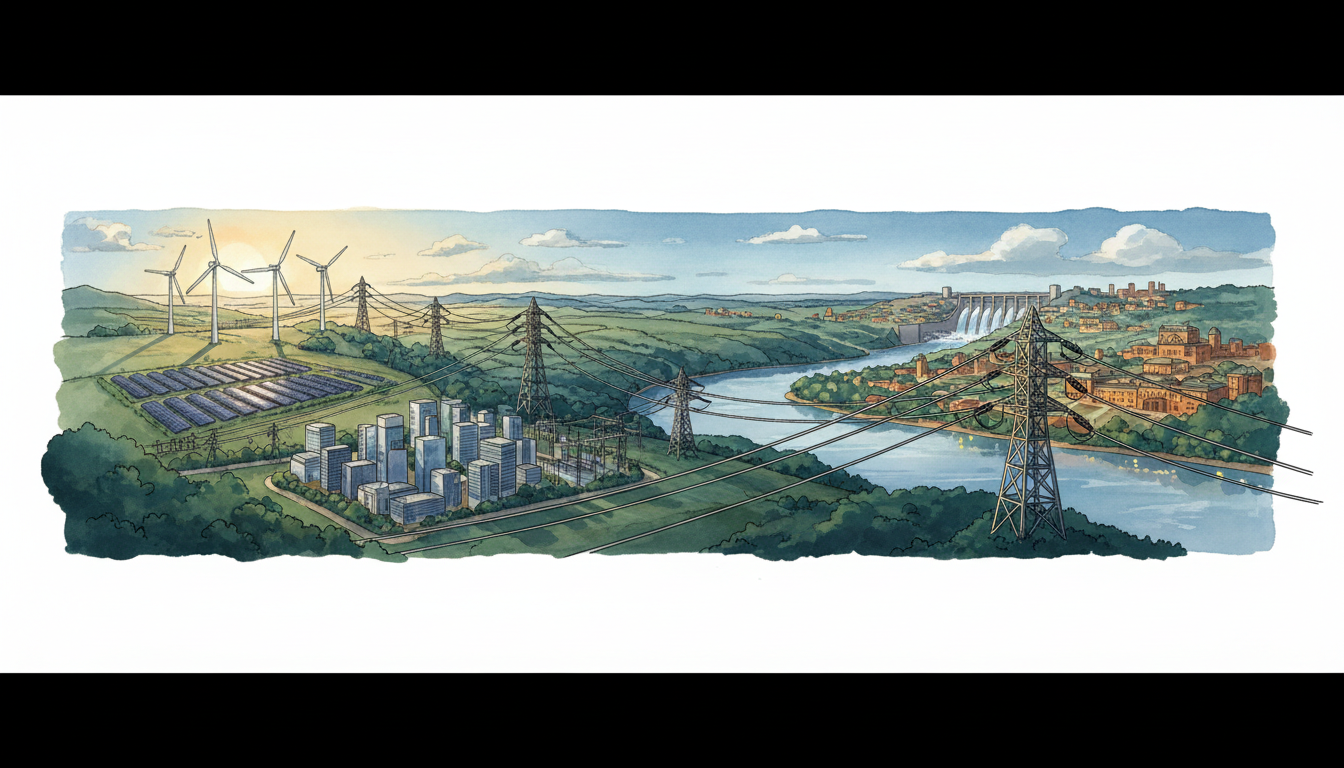
Quick answer: An electrified civilisation uses generation, transmission, distribution, storage, professional system operation and public institutions to provide electricity to homes, schools, care, transport and industry. Electricity is not simply a collection of power plants. The network must balance supply and demand, protect people, maintain equipment and support affordable, dependable access while energy sources evolve. This guide explains the mechanisms through safe paper models, worked mathematics and evidence from energy institutions.
Did you know? A city can produce enough electricity in a day and still suffer a shortage at a particular moment or bottleneck. A battery’s megawatt rating is different from its megawatt-hour capacity. The quality of an electric civilisation therefore depends on the relationships among power, energy, time, geography, equipment and people—not simply on a count of power stations.
This new Types of a Civilisation field guide considers electrified public services. It complements Industrial and Mechanised Systems and Resilient and Disaster-Adaptive Systems, without repeating their broader classifications.
Our fictional classroom community is Gridhaven. It contains invented diagrams, service counts and user scenarios. The guide does not give live utility status, electrical installation instructions, grid operating procedures or engineering advice. High-voltage equipment and electricity systems must be handled by authorised professionals; children use only read-only public explanations and paper activities.
Five reading paths
- Parents: read the quick answer, Missions 01, 04, 07, 13 and the final question.
- Primary readers: separate electricity from energy and show system dependencies using coloured cards.
- Secondary learners: practise watts, kilowatts, kilowatt-hours, peaks, duration and carefully bounded percentages.
- Tutors: pair two missions weekly with a changing assumption and a documented correction.
- Research readers: use 2026 IEA and World Bank sources, checking publication dates and distinguishing forecasts from observations.
Six capacities of a reliable electrified society
- Physical power systems: generation, lines, substations and professional operators
- Balance and flexibility: match changing output and demand safely under relevant rules
- Access: service must be usable and affordable, not merely announced
- Reliability and safety: documented interruptions, qualified maintenance and accountable communication
- Environmental responsibility: lifecycle impacts and context-specific choices
- Succession: transferable knowledge, correctable evidence and skilled institutions
Nine institutional source files: where the facts come from
Case 1: IEA — Electricity 2026, published 6 February 2026
The IEA discusses electricity systems, prices, reliability, demand and the role of grids and flexibility in managing a changing supply mix.
Read the originating institution’s material. A global IEA forecast is not an observed local grid load; a World Bank indicator of electricity access cannot demonstrate service reliability or household affordability; an eduKateSG concept article is background, not a utility report.
Source audit: identify the date, the geographical scope and the difference between current measurement and future projection. A child should not turn an unqualified global percentage into a claim about a Singapore district, nor cite a diagram as evidence that a particular substation is operating correctly.
Case 2: IEA — Electricity Mid-Year Update 2026
The 2026 update identifies accelerating electricity demand and current forecasts; future years remain conditional projections rather than measured outcomes.
Read the originating institution’s material. A global IEA forecast is not an observed local grid load; a World Bank indicator of electricity access cannot demonstrate service reliability or household affordability; an eduKateSG concept article is background, not a utility report.
Source audit: identify the date, the geographical scope and the difference between current measurement and future projection. A child should not turn an unqualified global percentage into a claim about a Singapore district, nor cite a diagram as evidence that a particular substation is operating correctly.
Case 3: IEA — Electricity Grids and Secure Energy Transitions (2023)
The IEA explains that grids connect electricity production to consumers and that investment, planning, permitting and operation affect energy transitions.
Read the originating institution’s material. A global IEA forecast is not an observed local grid load; a World Bank indicator of electricity access cannot demonstrate service reliability or household affordability; an eduKateSG concept article is background, not a utility report.
Source audit: identify the date, the geographical scope and the difference between current measurement and future projection. A child should not turn an unqualified global percentage into a claim about a Singapore district, nor cite a diagram as evidence that a particular substation is operating correctly.
Case 4: IEA — World Energy Investment 2025
The report discusses grid investment, supply chains, equipment bottlenecks and system security; a global figure cannot specify the budget for a local feeder.
Read the originating institution’s material. A global IEA forecast is not an observed local grid load; a World Bank indicator of electricity access cannot demonstrate service reliability or household affordability; an eduKateSG concept article is background, not a utility report.
Source audit: identify the date, the geographical scope and the difference between current measurement and future projection. A child should not turn an unqualified global percentage into a claim about a Singapore district, nor cite a diagram as evidence that a particular substation is operating correctly.
Case 5: World Bank — 2026 Tracking SDG7 electricity access
The June 2026 release reported about 655 million people still without electricity access, with major regional disparities; the access definition and data reference year require care.
Read the originating institution’s material. A global IEA forecast is not an observed local grid load; a World Bank indicator of electricity access cannot demonstrate service reliability or household affordability; an eduKateSG concept article is background, not a utility report.
Source audit: identify the date, the geographical scope and the difference between current measurement and future projection. A child should not turn an unqualified global percentage into a claim about a Singapore district, nor cite a diagram as evidence that a particular substation is operating correctly.
Case 6: World Bank — 2025 Tracking SDG7 report
The earlier report estimated over 666 million without electricity; publication years and measurement vintages explain why such figures cannot be treated as simultaneous current counts.
Read the originating institution’s material. A global IEA forecast is not an observed local grid load; a World Bank indicator of electricity access cannot demonstrate service reliability or household affordability; an eduKateSG concept article is background, not a utility report.
Source audit: identify the date, the geographical scope and the difference between current measurement and future projection. A child should not turn an unqualified global percentage into a claim about a Singapore district, nor cite a diagram as evidence that a particular substation is operating correctly.
Case 7: eduKateSG — Industrial and Mechanised Systems
This companion studies industrial production broadly, whereas the present chapter focuses on power grids and essential electric services.
Read the originating institution’s material. A global IEA forecast is not an observed local grid load; a World Bank indicator of electricity access cannot demonstrate service reliability or household affordability; an eduKateSG concept article is background, not a utility report.
Source audit: identify the date, the geographical scope and the difference between current measurement and future projection. A child should not turn an unqualified global percentage into a claim about a Singapore district, nor cite a diagram as evidence that a particular substation is operating correctly.
Case 8: eduKateSG — Resilient and Disaster-Adaptive Systems
This companion gives a general resilience lens; a grid has distinct technical, economic and institutional dependencies.
Read the originating institution’s material. A global IEA forecast is not an observed local grid load; a World Bank indicator of electricity access cannot demonstrate service reliability or household affordability; an eduKateSG concept article is background, not a utility report.
Source audit: identify the date, the geographical scope and the difference between current measurement and future projection. A child should not turn an unqualified global percentage into a claim about a Singapore district, nor cite a diagram as evidence that a particular substation is operating correctly.
Case 9: eduKateSG — Why Power Grids Fail
The companion failure analysis should not be mistaken for a prediction of collapse or evidence about a particular utility’s current condition.
Read the originating institution’s material. A global IEA forecast is not an observed local grid load; a World Bank indicator of electricity access cannot demonstrate service reliability or household affordability; an eduKateSG concept article is background, not a utility report.
Source audit: identify the date, the geographical scope and the difference between current measurement and future projection. A child should not turn an unqualified global percentage into a claim about a Singapore district, nor cite a diagram as evidence that a particular substation is operating correctly.
Sixteen Gridhaven missions and their learning outcomes
- 01. Electricity, energy and power are different quantities
- 02. Generation, transmission, distribution and service delivery
- 03. Balance supply, demand and system frequency conceptually
- 04. Peak demand, capacity and a hidden bottleneck
- 05. Transformers, substations and professional safety
- 06. Reliability: interruption frequency versus duration
- 07. Access to electricity is not one uniform experience
- 08. Electricity bills and fair cost communication
- 09. Solar and wind variability and system flexibility
- 10. Storage capacity, duration and distinct services
- 11. Public transport, buildings and industrial electrification
- 12. Data centres, emerging load and infrastructure planning
- 13. Outages, cascading failures and accountable restoration
- 14. Interconnected grids, imports and cross-border cooperation
- 15. Lifecycle, emissions and responsible transition decisions
- 16. The grid knowledge and maintenance successors inherit
Mission 01 — Electricity, energy and power are different quantities
Gridhaven’s opening challenge: In fictional Gridhaven, a student reads a label showing 1,000 watts on a device and tells the class the town uses exactly 1,000 kilowatt-hours every day.
The physical mechanism in plain English
Power is a rate of transferring or using energy. Energy consumption depends on power and operating time, usually expressed in watt-hours or kilowatt-hours for everyday electricity calculations. Electricity is one carrier of energy, not all energy used in civilisation.
Every lesson begins with a question about an essential service rather than a fascination with equipment. Which household, school or workplace needs electricity for a legitimate purpose? What measurable quantity would help explain the problem? The pupil’s first job is to identify the variable and unit before proposing a technical solution.
The particular learning question is: In fictional Gridhaven, a student reads a label showing 1,000 watts on a device and tells the class the town uses exactly 1,000 kilowatt-hours every day. Pupils should not jump immediately to a drawing of a power plant. First they should say which energy quantity, public service or system obligation is involved, and what evidence would have to exist to test the resulting claim.
Map the professional system and its dependencies
Draw three layers separately: the physical electric network, the people and institutions operating it, and the residents or businesses receiving a service. A public diagram may show conductors and buildings without identifying maintenance, law or accessible information. Systems literacy asks what those invisible relationships contribute.
Distinguish typical demand from peak demand and local congestion from aggregate system supply. A period with abundant total energy can still include a problematic moment or corridor. A grid study requires professional methods; paper exercises only reveal why the distinction matters.
Apply that structure to this mechanism: Power is a rate of transferring or using energy. Energy consumption depends on power and operating time, usually expressed in watt-hours or kilowatt-hours for everyday electricity calculations. Electricity is one carrier of energy, not all energy used in civilisation. Label the point of generation, service interface, physical limit or monitoring question as relevant. Then add the responsible organisation and an appropriate source date. The class does not attempt to operate or engineer a grid.
Mathematics and interpretation
A device rated 500 watts running for two hours uses 1,000 watt-hours, or 1 kWh, if its power remains constant. The formula does not prove real usage without time and operating conditions.
Physical quantities have dimensions. Power is a rate, energy accumulates over time, and capacity can refer to very different constraints depending on context. A single number labelled MW should not be silently rewritten as MWh or treated as a duration. The tutor should ask for a unit analysis before arithmetic.
Now change one assumption in the fictional model and recalculate. State whether the new result concerns power, total electricity, capacity, price, access or documentation. If it is an illustrative estimate, label it that way. An accurate number within a paper model cannot certify a real installation or guarantee a service outcome.
Rainbolt challenges the first answer
Rainbolt cuts operating time to half an hour, changing energy while the device’s rated power remains the same.
Rainbolt introduces an unexpected shift in demand, a supply interruption or a misleading figure. The group must alter the written conclusion rather than invent a technical fix. Where real physical safety is implicated, the right response is to identify the professional authority and refrain from operational instruction.
The learner should keep the original statement beside the updated one. A changed forecast, load or measurement often alters which conclusion can be justified. The correction must name what became uncertain and who would be qualified to check the real situation, without inventing an equipment setting or maintenance procedure.
Wintour’s fairness, service and environmental test
Wintour asks whether households understand bills and whether published comparisons hide usage assumptions.
An access indicator cannot answer every social question. A resident may have a connection yet face costs, service-quality problems, accessibility barriers or poor public communication. Understanding those differences makes the discussion more humane and more useful to families.
Wintour asks who pays, who benefits, who can obtain an accurate explanation and who bears risk when services fail. Public utilities involve households, workers, regulators, industrial users, ecosystems and future generations with legitimate but sometimes competing concerns.
A reliable grid is a social institution as well as a physical one. It should be discussed with attention to safety, affordability, the needs of those who cannot absorb an outage and the environmental effects of different choices. The classroom can identify questions without pretending to decide them for a utility.
Safe home and tutor task
Use a paper power-and-time table; no real electrical devices need be handled.
Context matters in comparing technologies. A solar panel, a gas-fired generator, a battery and a transmission cable do different things and cannot be judged by one indicator. Students should explain the functional purpose and evidence boundary rather than declare an unconditional winner.
Children should not enter electrical rooms, handle wiring, build improvised batteries, modify circuits or practise actual blackout response from this guide. Good educational work can be done with paper cards, simple charts and accessible institutional summaries under supervision.
Build a correction log: initial claim, assumed units, source, revised data, person affected, new conclusion and unresolved professional check. This record demonstrates that system knowledge belongs to the group, not only the strongest speaker.
Four applied study cards
Read the model without mistaking it for a plan
Return to the issue: In fictional Gridhaven, a student reads a label showing 1,000 watts on a device and tells the class the town uses exactly 1,000 kilowatt-hours every day. Name the exact part that is documented, the part that is assumed, and what a licensed or authorised expert would need to verify before a physical decision.
The concept of electricity, energy and power are different quantities is based on Power is a rate of transferring or using energy. Energy consumption depends on power and operating time, usually expressed in watt-hours or kilowatt-hours for everyday electricity calculations. Electricity is one carrier of energy, not all energy used in civilisation. A strong answer explains what the number describes and which missing physical, geographic, regulatory or human factor could change the outcome. The student’s expertise lies in asking a testable question, not declaring a fictional grid safe.
Tutorial assessment: one child maps the service, a second checks units and arithmetic, and a third explains the concern of a resident or worker. Each learner must fairly restate another’s point before the group writes a concise correction. The final record includes a dated source or a clearly fictional assumption.
Calculate with the correct unit
Work through the conditional values: A device rated 500 watts running for two hours uses 1,000 watt-hours, or 1 kWh, if its power remains constant. The formula does not prove real usage without time and operating conditions. Rewrite the result with an explicit denominator or conversion and explain why it does not establish a real system’s safety, cost or reliability.
The concept of electricity, energy and power are different quantities is based on Power is a rate of transferring or using energy. Energy consumption depends on power and operating time, usually expressed in watt-hours or kilowatt-hours for everyday electricity calculations. Electricity is one carrier of energy, not all energy used in civilisation. A strong answer explains what the number describes and which missing physical, geographic, regulatory or human factor could change the outcome. The student’s expertise lies in asking a testable question, not declaring a fictional grid safe.
Tutorial assessment: one child maps the service, a second checks units and arithmetic, and a third explains the concern of a resident or worker. Each learner must fairly restate another’s point before the group writes a concise correction. The final record includes a dated source or a clearly fictional assumption.
Identify the failed dependency
Rainbolt adds this information: Rainbolt cuts operating time to half an hour, changing energy while the device’s rated power remains the same. Point to the first violated assumption and prepare a public correction that acknowledges uncertainty rather than offering electrical operating instructions.
The concept of electricity, energy and power are different quantities is based on Power is a rate of transferring or using energy. Energy consumption depends on power and operating time, usually expressed in watt-hours or kilowatt-hours for everyday electricity calculations. Electricity is one carrier of energy, not all energy used in civilisation. A strong answer explains what the number describes and which missing physical, geographic, regulatory or human factor could change the outcome. The student’s expertise lies in asking a testable question, not declaring a fictional grid safe.
Tutorial assessment: one child maps the service, a second checks units and arithmetic, and a third explains the concern of a resident or worker. Each learner must fairly restate another’s point before the group writes a concise correction. The final record includes a dated source or a clearly fictional assumption.
Examine service distribution
Wintour raises wintour asks whether households understand bills and whether published comparisons hide usage assumptions. Who may be excluded by the first model, and which current institutional source would help clarify the impact?
The concept of electricity, energy and power are different quantities is based on Power is a rate of transferring or using energy. Energy consumption depends on power and operating time, usually expressed in watt-hours or kilowatt-hours for everyday electricity calculations. Electricity is one carrier of energy, not all energy used in civilisation. A strong answer explains what the number describes and which missing physical, geographic, regulatory or human factor could change the outcome. The student’s expertise lies in asking a testable question, not declaring a fictional grid safe.
Tutorial assessment: one child maps the service, a second checks units and arithmetic, and a third explains the concern of a resident or worker. Each learner must fairly restate another’s point before the group writes a concise correction. The final record includes a dated source or a clearly fictional assumption.
Transfer check: A newcomer should be able to explain electricity, energy and power are different quantities, reproduce the arithmetic and distinguish what the original team knew from what would require a professional energy-system study.
Mission 02 — Generation, transmission, distribution and service delivery
Gridhaven’s opening challenge: Gridhaven’s poster shows a solar field and a school linked by one decorative line with no substations, operators or protective arrangements.
The physical mechanism in plain English
Generation produces electricity from an energy source; transmission moves bulk power across networks; distribution delivers it through local infrastructure to consumers. Each has operators, maintenance, law and safety constraints.
Every lesson begins with a question about an essential service rather than a fascination with equipment. Which household, school or workplace needs electricity for a legitimate purpose? What measurable quantity would help explain the problem? The pupil’s first job is to identify the variable and unit before proposing a technical solution.
The particular learning question is: Gridhaven’s poster shows a solar field and a school linked by one decorative line with no substations, operators or protective arrangements. Pupils should not jump immediately to a drawing of a power plant. First they should say which energy quantity, public service or system obligation is involved, and what evidence would have to exist to test the resulting claim.
Map the professional system and its dependencies
Draw three layers separately: the physical electric network, the people and institutions operating it, and the residents or businesses receiving a service. A public diagram may show conductors and buildings without identifying maintenance, law or accessible information. Systems literacy asks what those invisible relationships contribute.
Distinguish typical demand from peak demand and local congestion from aggregate system supply. A period with abundant total energy can still include a problematic moment or corridor. A grid study requires professional methods; paper exercises only reveal why the distinction matters.
Apply that structure to this mechanism: Generation produces electricity from an energy source; transmission moves bulk power across networks; distribution delivers it through local infrastructure to consumers. Each has operators, maintenance, law and safety constraints. Label the point of generation, service interface, physical limit or monitoring question as relevant. Then add the responsible organisation and an appropriate source date. The class does not attempt to operate or engineer a grid.
Mathematics and interpretation
A simplified generator sends 100 fictional energy units into a model and delivers 94 after assumed losses. The modelled delivered share is 94%, not a real grid efficiency.
Physical quantities have dimensions. Power is a rate, energy accumulates over time, and capacity can refer to very different constraints depending on context. A single number labelled MW should not be silently rewritten as MWh or treated as a duration. The tutor should ask for a unit analysis before arithmetic.
Now change one assumption in the fictional model and recalculate. State whether the new result concerns power, total electricity, capacity, price, access or documentation. If it is an illustrative estimate, label it that way. An accurate number within a paper model cannot certify a real installation or guarantee a service outcome.
Rainbolt challenges the first answer
Rainbolt discovers a local distribution interruption even though generation remains available.
Rainbolt introduces an unexpected shift in demand, a supply interruption or a misleading figure. The group must alter the written conclusion rather than invent a technical fix. Where real physical safety is implicated, the right response is to identify the professional authority and refrain from operational instruction.
The learner should keep the original statement beside the updated one. A changed forecast, load or measurement often alters which conclusion can be justified. The correction must name what became uncertain and who would be qualified to check the real situation, without inventing an equipment setting or maintenance procedure.
Wintour’s fairness, service and environmental test
Wintour examines who is left without access and why safe service requires more than having nearby generation.
An access indicator cannot answer every social question. A resident may have a connection yet face costs, service-quality problems, accessibility barriers or poor public communication. Understanding those differences makes the discussion more humane and more useful to families.
Wintour asks who pays, who benefits, who can obtain an accurate explanation and who bears risk when services fail. Public utilities involve households, workers, regulators, industrial users, ecosystems and future generations with legitimate but sometimes competing concerns.
A reliable grid is a social institution as well as a physical one. It should be discussed with attention to safety, affordability, the needs of those who cannot absorb an outage and the environmental effects of different choices. The classroom can identify questions without pretending to decide them for a utility.
Safe home and tutor task
Draw three separate institutional layers and a customer handoff, using only paper.
Context matters in comparing technologies. A solar panel, a gas-fired generator, a battery and a transmission cable do different things and cannot be judged by one indicator. Students should explain the functional purpose and evidence boundary rather than declare an unconditional winner.
Children should not enter electrical rooms, handle wiring, build improvised batteries, modify circuits or practise actual blackout response from this guide. Good educational work can be done with paper cards, simple charts and accessible institutional summaries under supervision.
Build a correction log: initial claim, assumed units, source, revised data, person affected, new conclusion and unresolved professional check. This record demonstrates that system knowledge belongs to the group, not only the strongest speaker.
Four applied study cards
Read the model without mistaking it for a plan
Return to the issue: Gridhaven’s poster shows a solar field and a school linked by one decorative line with no substations, operators or protective arrangements. Name the exact part that is documented, the part that is assumed, and what a licensed or authorised expert would need to verify before a physical decision.
The concept of generation, transmission, distribution and service delivery is based on Generation produces electricity from an energy source; transmission moves bulk power across networks; distribution delivers it through local infrastructure to consumers. Each has operators, maintenance, law and safety constraints. A strong answer explains what the number describes and which missing physical, geographic, regulatory or human factor could change the outcome. The student’s expertise lies in asking a testable question, not declaring a fictional grid safe.
Tutorial assessment: one child maps the service, a second checks units and arithmetic, and a third explains the concern of a resident or worker. Each learner must fairly restate another’s point before the group writes a concise correction. The final record includes a dated source or a clearly fictional assumption.
Calculate with the correct unit
Work through the conditional values: A simplified generator sends 100 fictional energy units into a model and delivers 94 after assumed losses. The modelled delivered share is 94%, not a real grid efficiency. Rewrite the result with an explicit denominator or conversion and explain why it does not establish a real system’s safety, cost or reliability.
The concept of generation, transmission, distribution and service delivery is based on Generation produces electricity from an energy source; transmission moves bulk power across networks; distribution delivers it through local infrastructure to consumers. Each has operators, maintenance, law and safety constraints. A strong answer explains what the number describes and which missing physical, geographic, regulatory or human factor could change the outcome. The student’s expertise lies in asking a testable question, not declaring a fictional grid safe.
Tutorial assessment: one child maps the service, a second checks units and arithmetic, and a third explains the concern of a resident or worker. Each learner must fairly restate another’s point before the group writes a concise correction. The final record includes a dated source or a clearly fictional assumption.
Identify the failed dependency
Rainbolt adds this information: Rainbolt discovers a local distribution interruption even though generation remains available. Point to the first violated assumption and prepare a public correction that acknowledges uncertainty rather than offering electrical operating instructions.
The concept of generation, transmission, distribution and service delivery is based on Generation produces electricity from an energy source; transmission moves bulk power across networks; distribution delivers it through local infrastructure to consumers. Each has operators, maintenance, law and safety constraints. A strong answer explains what the number describes and which missing physical, geographic, regulatory or human factor could change the outcome. The student’s expertise lies in asking a testable question, not declaring a fictional grid safe.
Tutorial assessment: one child maps the service, a second checks units and arithmetic, and a third explains the concern of a resident or worker. Each learner must fairly restate another’s point before the group writes a concise correction. The final record includes a dated source or a clearly fictional assumption.
Examine service distribution
Wintour raises wintour examines who is left without access and why safe service requires more than having nearby generation. Who may be excluded by the first model, and which current institutional source would help clarify the impact?
The concept of generation, transmission, distribution and service delivery is based on Generation produces electricity from an energy source; transmission moves bulk power across networks; distribution delivers it through local infrastructure to consumers. Each has operators, maintenance, law and safety constraints. A strong answer explains what the number describes and which missing physical, geographic, regulatory or human factor could change the outcome. The student’s expertise lies in asking a testable question, not declaring a fictional grid safe.
Tutorial assessment: one child maps the service, a second checks units and arithmetic, and a third explains the concern of a resident or worker. Each learner must fairly restate another’s point before the group writes a concise correction. The final record includes a dated source or a clearly fictional assumption.
Transfer check: A newcomer should be able to explain generation, transmission, distribution and service delivery, reproduce the arithmetic and distinguish what the original team knew from what would require a professional energy-system study.
Mission 03 — Balance supply, demand and system frequency conceptually
Gridhaven’s opening challenge: A fictional island has an impressive total electricity supply for the day but experiences a problem when many services switch on at once.
The physical mechanism in plain English
Electricity systems require continuous operational balancing and sufficient flexibility to manage demand and supply under changing conditions. Professional system operators use technical tools and standards; pupils can understand the logic without learning to operate them.
Every lesson begins with a question about an essential service rather than a fascination with equipment. Which household, school or workplace needs electricity for a legitimate purpose? What measurable quantity would help explain the problem? The pupil’s first job is to identify the variable and unit before proposing a technical solution.
The particular learning question is: A fictional island has an impressive total electricity supply for the day but experiences a problem when many services switch on at once. Pupils should not jump immediately to a drawing of a power plant. First they should say which energy quantity, public service or system obligation is involved, and what evidence would have to exist to test the resulting claim.
Map the professional system and its dependencies
Draw three layers separately: the physical electric network, the people and institutions operating it, and the residents or businesses receiving a service. A public diagram may show conductors and buildings without identifying maintenance, law or accessible information. Systems literacy asks what those invisible relationships contribute.
Distinguish typical demand from peak demand and local congestion from aggregate system supply. A period with abundant total energy can still include a problematic moment or corridor. A grid study requires professional methods; paper exercises only reveal why the distinction matters.
Apply that structure to this mechanism: Electricity systems require continuous operational balancing and sufficient flexibility to manage demand and supply under changing conditions. Professional system operators use technical tools and standards; pupils can understand the logic without learning to operate them. Label the point of generation, service interface, physical limit or monitoring question as relevant. Then add the responsible organisation and an appropriate source date. The class does not attempt to operate or engineer a grid.
Mathematics and interpretation
Four hypothetical demands of 10, 15, 20 and 15 power units add to 60 units at one moment. This instantaneous total is different from annual energy consumption.
Physical quantities have dimensions. Power is a rate, energy accumulates over time, and capacity can refer to very different constraints depending on context. A single number labelled MW should not be silently rewritten as MWh or treated as a duration. The tutor should ask for a unit analysis before arithmetic.
Now change one assumption in the fictional model and recalculate. State whether the new result concerns power, total electricity, capacity, price, access or documentation. If it is an illustrative estimate, label it that way. An accurate number within a paper model cannot certify a real installation or guarantee a service outcome.
Rainbolt challenges the first answer
Rainbolt shifts two loads into the same hour and produces a larger peak without changing their total daily energy.
Rainbolt introduces an unexpected shift in demand, a supply interruption or a misleading figure. The group must alter the written conclusion rather than invent a technical fix. Where real physical safety is implicated, the right response is to identify the professional authority and refrain from operational instruction.
The learner should keep the original statement beside the updated one. A changed forecast, load or measurement often alters which conclusion can be justified. The correction must name what became uncertain and who would be qualified to check the real situation, without inventing an equipment setting or maintenance procedure.
Wintour’s fairness, service and environmental test
Wintour asks why critical care, schools and lower-income residents need dependable power.
An access indicator cannot answer every social question. A resident may have a connection yet face costs, service-quality problems, accessibility barriers or poor public communication. Understanding those differences makes the discussion more humane and more useful to families.
Wintour asks who pays, who benefits, who can obtain an accurate explanation and who bears risk when services fail. Public utilities involve households, workers, regulators, industrial users, ecosystems and future generations with legitimate but sometimes competing concerns.
A reliable grid is a social institution as well as a physical one. It should be discussed with attention to safety, affordability, the needs of those who cannot absorb an outage and the environmental effects of different choices. The classroom can identify questions without pretending to decide them for a utility.
Safe home and tutor task
Arrange paper load cards on an hourly timeline; never modify electrical circuits.
Context matters in comparing technologies. A solar panel, a gas-fired generator, a battery and a transmission cable do different things and cannot be judged by one indicator. Students should explain the functional purpose and evidence boundary rather than declare an unconditional winner.
Children should not enter electrical rooms, handle wiring, build improvised batteries, modify circuits or practise actual blackout response from this guide. Good educational work can be done with paper cards, simple charts and accessible institutional summaries under supervision.
Build a correction log: initial claim, assumed units, source, revised data, person affected, new conclusion and unresolved professional check. This record demonstrates that system knowledge belongs to the group, not only the strongest speaker.
Four applied study cards
Read the model without mistaking it for a plan
Return to the issue: A fictional island has an impressive total electricity supply for the day but experiences a problem when many services switch on at once. Name the exact part that is documented, the part that is assumed, and what a licensed or authorised expert would need to verify before a physical decision.
The concept of balance supply, demand and system frequency conceptually is based on Electricity systems require continuous operational balancing and sufficient flexibility to manage demand and supply under changing conditions. Professional system operators use technical tools and standards; pupils can understand the logic without learning to operate them. A strong answer explains what the number describes and which missing physical, geographic, regulatory or human factor could change the outcome. The student’s expertise lies in asking a testable question, not declaring a fictional grid safe.
Tutorial assessment: one child maps the service, a second checks units and arithmetic, and a third explains the concern of a resident or worker. Each learner must fairly restate another’s point before the group writes a concise correction. The final record includes a dated source or a clearly fictional assumption.
Calculate with the correct unit
Work through the conditional values: Four hypothetical demands of 10, 15, 20 and 15 power units add to 60 units at one moment. This instantaneous total is different from annual energy consumption. Rewrite the result with an explicit denominator or conversion and explain why it does not establish a real system’s safety, cost or reliability.
The concept of balance supply, demand and system frequency conceptually is based on Electricity systems require continuous operational balancing and sufficient flexibility to manage demand and supply under changing conditions. Professional system operators use technical tools and standards; pupils can understand the logic without learning to operate them. A strong answer explains what the number describes and which missing physical, geographic, regulatory or human factor could change the outcome. The student’s expertise lies in asking a testable question, not declaring a fictional grid safe.
Tutorial assessment: one child maps the service, a second checks units and arithmetic, and a third explains the concern of a resident or worker. Each learner must fairly restate another’s point before the group writes a concise correction. The final record includes a dated source or a clearly fictional assumption.
Identify the failed dependency
Rainbolt adds this information: Rainbolt shifts two loads into the same hour and produces a larger peak without changing their total daily energy. Point to the first violated assumption and prepare a public correction that acknowledges uncertainty rather than offering electrical operating instructions.
The concept of balance supply, demand and system frequency conceptually is based on Electricity systems require continuous operational balancing and sufficient flexibility to manage demand and supply under changing conditions. Professional system operators use technical tools and standards; pupils can understand the logic without learning to operate them. A strong answer explains what the number describes and which missing physical, geographic, regulatory or human factor could change the outcome. The student’s expertise lies in asking a testable question, not declaring a fictional grid safe.
Tutorial assessment: one child maps the service, a second checks units and arithmetic, and a third explains the concern of a resident or worker. Each learner must fairly restate another’s point before the group writes a concise correction. The final record includes a dated source or a clearly fictional assumption.
Examine service distribution
Wintour raises wintour asks why critical care, schools and lower-income residents need dependable power. Who may be excluded by the first model, and which current institutional source would help clarify the impact?
The concept of balance supply, demand and system frequency conceptually is based on Electricity systems require continuous operational balancing and sufficient flexibility to manage demand and supply under changing conditions. Professional system operators use technical tools and standards; pupils can understand the logic without learning to operate them. A strong answer explains what the number describes and which missing physical, geographic, regulatory or human factor could change the outcome. The student’s expertise lies in asking a testable question, not declaring a fictional grid safe.
Tutorial assessment: one child maps the service, a second checks units and arithmetic, and a third explains the concern of a resident or worker. Each learner must fairly restate another’s point before the group writes a concise correction. The final record includes a dated source or a clearly fictional assumption.
Transfer check: A newcomer should be able to explain balance supply, demand and system frequency conceptually, reproduce the arithmetic and distinguish what the original team knew from what would require a professional energy-system study.
Mission 04 — Peak demand, capacity and a hidden bottleneck
Gridhaven’s opening challenge: Gridhaven claims that because yearly electricity is sufficient there cannot be congestion on a particular corridor.
The physical mechanism in plain English
Peak demand is the highest load under a stated period; capacity describes a system constraint. Average energy over a month cannot identify the maximum load at one congested time or location.
Every lesson begins with a question about an essential service rather than a fascination with equipment. Which household, school or workplace needs electricity for a legitimate purpose? What measurable quantity would help explain the problem? The pupil’s first job is to identify the variable and unit before proposing a technical solution.
The particular learning question is: Gridhaven claims that because yearly electricity is sufficient there cannot be congestion on a particular corridor. Pupils should not jump immediately to a drawing of a power plant. First they should say which energy quantity, public service or system obligation is involved, and what evidence would have to exist to test the resulting claim.
Map the professional system and its dependencies
Draw three layers separately: the physical electric network, the people and institutions operating it, and the residents or businesses receiving a service. A public diagram may show conductors and buildings without identifying maintenance, law or accessible information. Systems literacy asks what those invisible relationships contribute.
Distinguish typical demand from peak demand and local congestion from aggregate system supply. A period with abundant total energy can still include a problematic moment or corridor. A grid study requires professional methods; paper exercises only reveal why the distinction matters.
Apply that structure to this mechanism: Peak demand is the highest load under a stated period; capacity describes a system constraint. Average energy over a month cannot identify the maximum load at one congested time or location. Label the point of generation, service interface, physical limit or monitoring question as relevant. Then add the responsible organisation and an appropriate source date. The class does not attempt to operate or engineer a grid.
Mathematics and interpretation
A hypothetical network serves 50 MW for two hours and 20 MW for ten hours. Total energy is 300 MWh over those 12 hours, while peak power is 50 MW.
Physical quantities have dimensions. Power is a rate, energy accumulates over time, and capacity can refer to very different constraints depending on context. A single number labelled MW should not be silently rewritten as MWh or treated as a duration. The tutor should ask for a unit analysis before arithmetic.
Now change one assumption in the fictional model and recalculate. State whether the new result concerns power, total electricity, capacity, price, access or documentation. If it is an illustrative estimate, label it that way. An accurate number within a paper model cannot certify a real installation or guarantee a service outcome.
Rainbolt challenges the first answer
Rainbolt moves a large customer into the peak period and violates the simplified corridor capacity.
Rainbolt introduces an unexpected shift in demand, a supply interruption or a misleading figure. The group must alter the written conclusion rather than invent a technical fix. Where real physical safety is implicated, the right response is to identify the professional authority and refrain from operational instruction.
The learner should keep the original statement beside the updated one. A changed forecast, load or measurement often alters which conclusion can be justified. The correction must name what became uncertain and who would be qualified to check the real situation, without inventing an equipment setting or maintenance procedure.
Wintour’s fairness, service and environmental test
Wintour asks whose connection or service might be delayed when capacity is allocated poorly.
An access indicator cannot answer every social question. A resident may have a connection yet face costs, service-quality problems, accessibility barriers or poor public communication. Understanding those differences makes the discussion more humane and more useful to families.
Wintour asks who pays, who benefits, who can obtain an accurate explanation and who bears risk when services fail. Public utilities involve households, workers, regulators, industrial users, ecosystems and future generations with legitimate but sometimes competing concerns.
A reliable grid is a social institution as well as a physical one. It should be discussed with attention to safety, affordability, the needs of those who cannot absorb an outage and the environmental effects of different choices. The classroom can identify questions without pretending to decide them for a utility.
Safe home and tutor task
Create a load-profile graph on paper and compare peak with total area.
Context matters in comparing technologies. A solar panel, a gas-fired generator, a battery and a transmission cable do different things and cannot be judged by one indicator. Students should explain the functional purpose and evidence boundary rather than declare an unconditional winner.
Children should not enter electrical rooms, handle wiring, build improvised batteries, modify circuits or practise actual blackout response from this guide. Good educational work can be done with paper cards, simple charts and accessible institutional summaries under supervision.
Build a correction log: initial claim, assumed units, source, revised data, person affected, new conclusion and unresolved professional check. This record demonstrates that system knowledge belongs to the group, not only the strongest speaker.
Four applied study cards
Read the model without mistaking it for a plan
Return to the issue: Gridhaven claims that because yearly electricity is sufficient there cannot be congestion on a particular corridor. Name the exact part that is documented, the part that is assumed, and what a licensed or authorised expert would need to verify before a physical decision.
The concept of peak demand, capacity and a hidden bottleneck is based on Peak demand is the highest load under a stated period; capacity describes a system constraint. Average energy over a month cannot identify the maximum load at one congested time or location. A strong answer explains what the number describes and which missing physical, geographic, regulatory or human factor could change the outcome. The student’s expertise lies in asking a testable question, not declaring a fictional grid safe.
Tutorial assessment: one child maps the service, a second checks units and arithmetic, and a third explains the concern of a resident or worker. Each learner must fairly restate another’s point before the group writes a concise correction. The final record includes a dated source or a clearly fictional assumption.
Calculate with the correct unit
Work through the conditional values: A hypothetical network serves 50 MW for two hours and 20 MW for ten hours. Total energy is 300 MWh over those 12 hours, while peak power is 50 MW. Rewrite the result with an explicit denominator or conversion and explain why it does not establish a real system’s safety, cost or reliability.
The concept of peak demand, capacity and a hidden bottleneck is based on Peak demand is the highest load under a stated period; capacity describes a system constraint. Average energy over a month cannot identify the maximum load at one congested time or location. A strong answer explains what the number describes and which missing physical, geographic, regulatory or human factor could change the outcome. The student’s expertise lies in asking a testable question, not declaring a fictional grid safe.
Tutorial assessment: one child maps the service, a second checks units and arithmetic, and a third explains the concern of a resident or worker. Each learner must fairly restate another’s point before the group writes a concise correction. The final record includes a dated source or a clearly fictional assumption.
Identify the failed dependency
Rainbolt adds this information: Rainbolt moves a large customer into the peak period and violates the simplified corridor capacity. Point to the first violated assumption and prepare a public correction that acknowledges uncertainty rather than offering electrical operating instructions.
The concept of peak demand, capacity and a hidden bottleneck is based on Peak demand is the highest load under a stated period; capacity describes a system constraint. Average energy over a month cannot identify the maximum load at one congested time or location. A strong answer explains what the number describes and which missing physical, geographic, regulatory or human factor could change the outcome. The student’s expertise lies in asking a testable question, not declaring a fictional grid safe.
Tutorial assessment: one child maps the service, a second checks units and arithmetic, and a third explains the concern of a resident or worker. Each learner must fairly restate another’s point before the group writes a concise correction. The final record includes a dated source or a clearly fictional assumption.
Examine service distribution
Wintour raises wintour asks whose connection or service might be delayed when capacity is allocated poorly. Who may be excluded by the first model, and which current institutional source would help clarify the impact?
The concept of peak demand, capacity and a hidden bottleneck is based on Peak demand is the highest load under a stated period; capacity describes a system constraint. Average energy over a month cannot identify the maximum load at one congested time or location. A strong answer explains what the number describes and which missing physical, geographic, regulatory or human factor could change the outcome. The student’s expertise lies in asking a testable question, not declaring a fictional grid safe.
Tutorial assessment: one child maps the service, a second checks units and arithmetic, and a third explains the concern of a resident or worker. Each learner must fairly restate another’s point before the group writes a concise correction. The final record includes a dated source or a clearly fictional assumption.
Transfer check: A newcomer should be able to explain peak demand, capacity and a hidden bottleneck, reproduce the arithmetic and distinguish what the original team knew from what would require a professional energy-system study.
Mission 05 — Transformers, substations and professional safety
Gridhaven’s opening challenge: An educational drawing shows identical wires directly joining generation and household appliances with no appropriate network interfaces.
The physical mechanism in plain English
Real grid systems use substations, transformers, switching, protection, monitoring and operating rules. High-voltage infrastructure is dangerous and only authorised trained professionals may design or work on it.
Every lesson begins with a question about an essential service rather than a fascination with equipment. Which household, school or workplace needs electricity for a legitimate purpose? What measurable quantity would help explain the problem? The pupil’s first job is to identify the variable and unit before proposing a technical solution.
The particular learning question is: An educational drawing shows identical wires directly joining generation and household appliances with no appropriate network interfaces. Pupils should not jump immediately to a drawing of a power plant. First they should say which energy quantity, public service or system obligation is involved, and what evidence would have to exist to test the resulting claim.
Map the professional system and its dependencies
Draw three layers separately: the physical electric network, the people and institutions operating it, and the residents or businesses receiving a service. A public diagram may show conductors and buildings without identifying maintenance, law or accessible information. Systems literacy asks what those invisible relationships contribute.
Distinguish typical demand from peak demand and local congestion from aggregate system supply. A period with abundant total energy can still include a problematic moment or corridor. A grid study requires professional methods; paper exercises only reveal why the distinction matters.
Apply that structure to this mechanism: Real grid systems use substations, transformers, switching, protection, monitoring and operating rules. High-voltage infrastructure is dangerous and only authorised trained professionals may design or work on it. Label the point of generation, service interface, physical limit or monitoring question as relevant. Then add the responsible organisation and an appropriate source date. The class does not attempt to operate or engineer a grid.
Mathematics and interpretation
A classroom schematic has six infrastructure stages and only four labelled. Four-sixths documentation is about 66.7%, not proof of electrical safety.
Physical quantities have dimensions. Power is a rate, energy accumulates over time, and capacity can refer to very different constraints depending on context. A single number labelled MW should not be silently rewritten as MWh or treated as a duration. The tutor should ask for a unit analysis before arithmetic.
Now change one assumption in the fictional model and recalculate. State whether the new result concerns power, total electricity, capacity, price, access or documentation. If it is an illustrative estimate, label it that way. An accurate number within a paper model cannot certify a real installation or guarantee a service outcome.
Rainbolt challenges the first answer
Rainbolt reveals the diagram omitted a required professional review step.
Rainbolt introduces an unexpected shift in demand, a supply interruption or a misleading figure. The group must alter the written conclusion rather than invent a technical fix. Where real physical safety is implicated, the right response is to identify the professional authority and refrain from operational instruction.
The learner should keep the original statement beside the updated one. A changed forecast, load or measurement often alters which conclusion can be justified. The correction must name what became uncertain and who would be qualified to check the real situation, without inventing an equipment setting or maintenance procedure.
Wintour’s fairness, service and environmental test
Wintour asks about public safety, maintenance teams and accurate emergency communications.
An access indicator cannot answer every social question. A resident may have a connection yet face costs, service-quality problems, accessibility barriers or poor public communication. Understanding those differences makes the discussion more humane and more useful to families.
Wintour asks who pays, who benefits, who can obtain an accurate explanation and who bears risk when services fail. Public utilities involve households, workers, regulators, industrial users, ecosystems and future generations with legitimate but sometimes competing concerns.
A reliable grid is a social institution as well as a physical one. It should be discussed with attention to safety, affordability, the needs of those who cannot absorb an outage and the environmental effects of different choices. The classroom can identify questions without pretending to decide them for a utility.
Safe home and tutor task
Label an existing public block diagram with institutional roles; no wiring, transformers or switching demonstrations.
Context matters in comparing technologies. A solar panel, a gas-fired generator, a battery and a transmission cable do different things and cannot be judged by one indicator. Students should explain the functional purpose and evidence boundary rather than declare an unconditional winner.
Children should not enter electrical rooms, handle wiring, build improvised batteries, modify circuits or practise actual blackout response from this guide. Good educational work can be done with paper cards, simple charts and accessible institutional summaries under supervision.
Build a correction log: initial claim, assumed units, source, revised data, person affected, new conclusion and unresolved professional check. This record demonstrates that system knowledge belongs to the group, not only the strongest speaker.
Four applied study cards
Read the model without mistaking it for a plan
Return to the issue: An educational drawing shows identical wires directly joining generation and household appliances with no appropriate network interfaces. Name the exact part that is documented, the part that is assumed, and what a licensed or authorised expert would need to verify before a physical decision.
The concept of transformers, substations and professional safety is based on Real grid systems use substations, transformers, switching, protection, monitoring and operating rules. High-voltage infrastructure is dangerous and only authorised trained professionals may design or work on it. A strong answer explains what the number describes and which missing physical, geographic, regulatory or human factor could change the outcome. The student’s expertise lies in asking a testable question, not declaring a fictional grid safe.
Tutorial assessment: one child maps the service, a second checks units and arithmetic, and a third explains the concern of a resident or worker. Each learner must fairly restate another’s point before the group writes a concise correction. The final record includes a dated source or a clearly fictional assumption.
Calculate with the correct unit
Work through the conditional values: A classroom schematic has six infrastructure stages and only four labelled. Four-sixths documentation is about 66.7%, not proof of electrical safety. Rewrite the result with an explicit denominator or conversion and explain why it does not establish a real system’s safety, cost or reliability.
The concept of transformers, substations and professional safety is based on Real grid systems use substations, transformers, switching, protection, monitoring and operating rules. High-voltage infrastructure is dangerous and only authorised trained professionals may design or work on it. A strong answer explains what the number describes and which missing physical, geographic, regulatory or human factor could change the outcome. The student’s expertise lies in asking a testable question, not declaring a fictional grid safe.
Tutorial assessment: one child maps the service, a second checks units and arithmetic, and a third explains the concern of a resident or worker. Each learner must fairly restate another’s point before the group writes a concise correction. The final record includes a dated source or a clearly fictional assumption.
Identify the failed dependency
Rainbolt adds this information: Rainbolt reveals the diagram omitted a required professional review step. Point to the first violated assumption and prepare a public correction that acknowledges uncertainty rather than offering electrical operating instructions.
The concept of transformers, substations and professional safety is based on Real grid systems use substations, transformers, switching, protection, monitoring and operating rules. High-voltage infrastructure is dangerous and only authorised trained professionals may design or work on it. A strong answer explains what the number describes and which missing physical, geographic, regulatory or human factor could change the outcome. The student’s expertise lies in asking a testable question, not declaring a fictional grid safe.
Tutorial assessment: one child maps the service, a second checks units and arithmetic, and a third explains the concern of a resident or worker. Each learner must fairly restate another’s point before the group writes a concise correction. The final record includes a dated source or a clearly fictional assumption.
Examine service distribution
Wintour raises wintour asks about public safety, maintenance teams and accurate emergency communications. Who may be excluded by the first model, and which current institutional source would help clarify the impact?
The concept of transformers, substations and professional safety is based on Real grid systems use substations, transformers, switching, protection, monitoring and operating rules. High-voltage infrastructure is dangerous and only authorised trained professionals may design or work on it. A strong answer explains what the number describes and which missing physical, geographic, regulatory or human factor could change the outcome. The student’s expertise lies in asking a testable question, not declaring a fictional grid safe.
Tutorial assessment: one child maps the service, a second checks units and arithmetic, and a third explains the concern of a resident or worker. Each learner must fairly restate another’s point before the group writes a concise correction. The final record includes a dated source or a clearly fictional assumption.
Transfer check: A newcomer should be able to explain transformers, substations and professional safety, reproduce the arithmetic and distinguish what the original team knew from what would require a professional energy-system study.
Mission 06 — Reliability: interruption frequency versus duration
Gridhaven’s opening challenge: A town advertises a low number of interruptions but hides that one outage lasted far longer than the others.
The physical mechanism in plain English
Reliability measurements may distinguish interruption frequency and duration across customers and periods. SAIFI and SAIDI are examples of indicators that need their precise denominators, coverage rules and local reporting context.
Every lesson begins with a question about an essential service rather than a fascination with equipment. Which household, school or workplace needs electricity for a legitimate purpose? What measurable quantity would help explain the problem? The pupil’s first job is to identify the variable and unit before proposing a technical solution.
The particular learning question is: A town advertises a low number of interruptions but hides that one outage lasted far longer than the others. Pupils should not jump immediately to a drawing of a power plant. First they should say which energy quantity, public service or system obligation is involved, and what evidence would have to exist to test the resulting claim.
Map the professional system and its dependencies
Draw three layers separately: the physical electric network, the people and institutions operating it, and the residents or businesses receiving a service. A public diagram may show conductors and buildings without identifying maintenance, law or accessible information. Systems literacy asks what those invisible relationships contribute.
Distinguish typical demand from peak demand and local congestion from aggregate system supply. A period with abundant total energy can still include a problematic moment or corridor. A grid study requires professional methods; paper exercises only reveal why the distinction matters.
Apply that structure to this mechanism: Reliability measurements may distinguish interruption frequency and duration across customers and periods. SAIFI and SAIDI are examples of indicators that need their precise denominators, coverage rules and local reporting context. Label the point of generation, service interface, physical limit or monitoring question as relevant. Then add the responsible organisation and an appropriate source date. The class does not attempt to operate or engineer a grid.
Mathematics and interpretation
A fictional group of ten customers experiences two interruptions in total, giving 0.2 interruptions per customer under a simple frequency tally; no utility-grade SAIFI inference follows without definitions.
Physical quantities have dimensions. Power is a rate, energy accumulates over time, and capacity can refer to very different constraints depending on context. A single number labelled MW should not be silently rewritten as MWh or treated as a duration. The tutor should ask for a unit analysis before arithmetic.
Now change one assumption in the fictional model and recalculate. State whether the new result concerns power, total electricity, capacity, price, access or documentation. If it is an illustrative estimate, label it that way. An accurate number within a paper model cannot certify a real installation or guarantee a service outcome.
Rainbolt challenges the first answer
Rainbolt reveals one interruption affected essential care for a long time despite a small frequency count.
Rainbolt introduces an unexpected shift in demand, a supply interruption or a misleading figure. The group must alter the written conclusion rather than invent a technical fix. Where real physical safety is implicated, the right response is to identify the professional authority and refrain from operational instruction.
The learner should keep the original statement beside the updated one. A changed forecast, load or measurement often alters which conclusion can be justified. The correction must name what became uncertain and who would be qualified to check the real situation, without inventing an equipment setting or maintenance procedure.
Wintour’s fairness, service and environmental test
Wintour asks whether averages conceal specific communities’ repeated disruption.
An access indicator cannot answer every social question. A resident may have a connection yet face costs, service-quality problems, accessibility barriers or poor public communication. Understanding those differences makes the discussion more humane and more useful to families.
Wintour asks who pays, who benefits, who can obtain an accurate explanation and who bears risk when services fail. Public utilities involve households, workers, regulators, industrial users, ecosystems and future generations with legitimate but sometimes competing concerns.
A reliable grid is a social institution as well as a physical one. It should be discussed with attention to safety, affordability, the needs of those who cannot absorb an outage and the environmental effects of different choices. The classroom can identify questions without pretending to decide them for a utility.
Safe home and tutor task
Use hypothetical outage-duration cards and compare two measures without offering live outage claims.
Context matters in comparing technologies. A solar panel, a gas-fired generator, a battery and a transmission cable do different things and cannot be judged by one indicator. Students should explain the functional purpose and evidence boundary rather than declare an unconditional winner.
Children should not enter electrical rooms, handle wiring, build improvised batteries, modify circuits or practise actual blackout response from this guide. Good educational work can be done with paper cards, simple charts and accessible institutional summaries under supervision.
Build a correction log: initial claim, assumed units, source, revised data, person affected, new conclusion and unresolved professional check. This record demonstrates that system knowledge belongs to the group, not only the strongest speaker.
Four applied study cards
Read the model without mistaking it for a plan
Return to the issue: A town advertises a low number of interruptions but hides that one outage lasted far longer than the others. Name the exact part that is documented, the part that is assumed, and what a licensed or authorised expert would need to verify before a physical decision.
The concept of reliability: interruption frequency versus duration is based on Reliability measurements may distinguish interruption frequency and duration across customers and periods. SAIFI and SAIDI are examples of indicators that need their precise denominators, coverage rules and local reporting context. A strong answer explains what the number describes and which missing physical, geographic, regulatory or human factor could change the outcome. The student’s expertise lies in asking a testable question, not declaring a fictional grid safe.
Tutorial assessment: one child maps the service, a second checks units and arithmetic, and a third explains the concern of a resident or worker. Each learner must fairly restate another’s point before the group writes a concise correction. The final record includes a dated source or a clearly fictional assumption.
Calculate with the correct unit
Work through the conditional values: A fictional group of ten customers experiences two interruptions in total, giving 0.2 interruptions per customer under a simple frequency tally; no utility-grade SAIFI inference follows without definitions. Rewrite the result with an explicit denominator or conversion and explain why it does not establish a real system’s safety, cost or reliability.
The concept of reliability: interruption frequency versus duration is based on Reliability measurements may distinguish interruption frequency and duration across customers and periods. SAIFI and SAIDI are examples of indicators that need their precise denominators, coverage rules and local reporting context. A strong answer explains what the number describes and which missing physical, geographic, regulatory or human factor could change the outcome. The student’s expertise lies in asking a testable question, not declaring a fictional grid safe.
Tutorial assessment: one child maps the service, a second checks units and arithmetic, and a third explains the concern of a resident or worker. Each learner must fairly restate another’s point before the group writes a concise correction. The final record includes a dated source or a clearly fictional assumption.
Identify the failed dependency
Rainbolt adds this information: Rainbolt reveals one interruption affected essential care for a long time despite a small frequency count. Point to the first violated assumption and prepare a public correction that acknowledges uncertainty rather than offering electrical operating instructions.
The concept of reliability: interruption frequency versus duration is based on Reliability measurements may distinguish interruption frequency and duration across customers and periods. SAIFI and SAIDI are examples of indicators that need their precise denominators, coverage rules and local reporting context. A strong answer explains what the number describes and which missing physical, geographic, regulatory or human factor could change the outcome. The student’s expertise lies in asking a testable question, not declaring a fictional grid safe.
Tutorial assessment: one child maps the service, a second checks units and arithmetic, and a third explains the concern of a resident or worker. Each learner must fairly restate another’s point before the group writes a concise correction. The final record includes a dated source or a clearly fictional assumption.
Examine service distribution
Wintour raises wintour asks whether averages conceal specific communities’ repeated disruption. Who may be excluded by the first model, and which current institutional source would help clarify the impact?
The concept of reliability: interruption frequency versus duration is based on Reliability measurements may distinguish interruption frequency and duration across customers and periods. SAIFI and SAIDI are examples of indicators that need their precise denominators, coverage rules and local reporting context. A strong answer explains what the number describes and which missing physical, geographic, regulatory or human factor could change the outcome. The student’s expertise lies in asking a testable question, not declaring a fictional grid safe.
Tutorial assessment: one child maps the service, a second checks units and arithmetic, and a third explains the concern of a resident or worker. Each learner must fairly restate another’s point before the group writes a concise correction. The final record includes a dated source or a clearly fictional assumption.
Transfer check: A newcomer should be able to explain reliability: interruption frequency versus duration, reproduce the arithmetic and distinguish what the original team knew from what would require a professional energy-system study.
Mission 07 — Access to electricity is not one uniform experience
Gridhaven’s opening challenge: The town boasts that a new electricity line passes through every district, but some households remain unable to connect or afford usable power.
The physical mechanism in plain English
Global electricity-access indicators measure particular aspects of service. Reliability, affordability, capacity, payment and safety may differ even where nominal access exists. The World Bank reported about 655 million people still without access in its 2026 update.
Every lesson begins with a question about an essential service rather than a fascination with equipment. Which household, school or workplace needs electricity for a legitimate purpose? What measurable quantity would help explain the problem? The pupil’s first job is to identify the variable and unit before proposing a technical solution.
The particular learning question is: The town boasts that a new electricity line passes through every district, but some households remain unable to connect or afford usable power. Pupils should not jump immediately to a drawing of a power plant. First they should say which energy quantity, public service or system obligation is involved, and what evidence would have to exist to test the resulting claim.
Map the professional system and its dependencies
Draw three layers separately: the physical electric network, the people and institutions operating it, and the residents or businesses receiving a service. A public diagram may show conductors and buildings without identifying maintenance, law or accessible information. Systems literacy asks what those invisible relationships contribute.
Distinguish typical demand from peak demand and local congestion from aggregate system supply. A period with abundant total energy can still include a problematic moment or corridor. A grid study requires professional methods; paper exercises only reveal why the distinction matters.
Apply that structure to this mechanism: Global electricity-access indicators measure particular aspects of service. Reliability, affordability, capacity, payment and safety may differ even where nominal access exists. The World Bank reported about 655 million people still without access in its 2026 update. Label the point of generation, service interface, physical limit or monitoring question as relevant. Then add the responsible organisation and an appropriate source date. The class does not attempt to operate or engineer a grid.
Mathematics and interpretation
In a fictional sample of 100 households, 80 have a physical connection, 70 can afford regular use and 60 have adequate reliability. These are three distinct indicators, not the actual world situation.
Physical quantities have dimensions. Power is a rate, energy accumulates over time, and capacity can refer to very different constraints depending on context. A single number labelled MW should not be silently rewritten as MWh or treated as a duration. The tutor should ask for a unit analysis before arithmetic.
Now change one assumption in the fictional model and recalculate. State whether the new result concerns power, total electricity, capacity, price, access or documentation. If it is an illustrative estimate, label it that way. An accurate number within a paper model cannot certify a real installation or guarantee a service outcome.
Rainbolt challenges the first answer
Rainbolt shows that the connected households are mostly in one area while remote homes remain unserved.
Rainbolt introduces an unexpected shift in demand, a supply interruption or a misleading figure. The group must alter the written conclusion rather than invent a technical fix. Where real physical safety is implicated, the right response is to identify the professional authority and refrain from operational instruction.
The learner should keep the original statement beside the updated one. A changed forecast, load or measurement often alters which conclusion can be justified. The correction must name what became uncertain and who would be qualified to check the real situation, without inventing an equipment setting or maintenance procedure.
Wintour’s fairness, service and environmental test
Wintour asks about rural access, disability needs, income and clear public information.
An access indicator cannot answer every social question. A resident may have a connection yet face costs, service-quality problems, accessibility barriers or poor public communication. Understanding those differences makes the discussion more humane and more useful to families.
Wintour asks who pays, who benefits, who can obtain an accurate explanation and who bears risk when services fail. Public utilities involve households, workers, regulators, industrial users, ecosystems and future generations with legitimate but sometimes competing concerns.
A reliable grid is a social institution as well as a physical one. It should be discussed with attention to safety, affordability, the needs of those who cannot absorb an outage and the environmental effects of different choices. The classroom can identify questions without pretending to decide them for a utility.
Safe home and tutor task
Make an access matrix with connection, affordability and reliability in separate columns.
Context matters in comparing technologies. A solar panel, a gas-fired generator, a battery and a transmission cable do different things and cannot be judged by one indicator. Students should explain the functional purpose and evidence boundary rather than declare an unconditional winner.
Children should not enter electrical rooms, handle wiring, build improvised batteries, modify circuits or practise actual blackout response from this guide. Good educational work can be done with paper cards, simple charts and accessible institutional summaries under supervision.
Build a correction log: initial claim, assumed units, source, revised data, person affected, new conclusion and unresolved professional check. This record demonstrates that system knowledge belongs to the group, not only the strongest speaker.
Four applied study cards
Read the model without mistaking it for a plan
Return to the issue: The town boasts that a new electricity line passes through every district, but some households remain unable to connect or afford usable power. Name the exact part that is documented, the part that is assumed, and what a licensed or authorised expert would need to verify before a physical decision.
The concept of access to electricity is not one uniform experience is based on Global electricity-access indicators measure particular aspects of service. Reliability, affordability, capacity, payment and safety may differ even where nominal access exists. The World Bank reported about 655 million people still without access in its 2026 update. A strong answer explains what the number describes and which missing physical, geographic, regulatory or human factor could change the outcome. The student’s expertise lies in asking a testable question, not declaring a fictional grid safe.
Tutorial assessment: one child maps the service, a second checks units and arithmetic, and a third explains the concern of a resident or worker. Each learner must fairly restate another’s point before the group writes a concise correction. The final record includes a dated source or a clearly fictional assumption.
Calculate with the correct unit
Work through the conditional values: In a fictional sample of 100 households, 80 have a physical connection, 70 can afford regular use and 60 have adequate reliability. These are three distinct indicators, not the actual world situation. Rewrite the result with an explicit denominator or conversion and explain why it does not establish a real system’s safety, cost or reliability.
The concept of access to electricity is not one uniform experience is based on Global electricity-access indicators measure particular aspects of service. Reliability, affordability, capacity, payment and safety may differ even where nominal access exists. The World Bank reported about 655 million people still without access in its 2026 update. A strong answer explains what the number describes and which missing physical, geographic, regulatory or human factor could change the outcome. The student’s expertise lies in asking a testable question, not declaring a fictional grid safe.
Tutorial assessment: one child maps the service, a second checks units and arithmetic, and a third explains the concern of a resident or worker. Each learner must fairly restate another’s point before the group writes a concise correction. The final record includes a dated source or a clearly fictional assumption.
Identify the failed dependency
Rainbolt adds this information: Rainbolt shows that the connected households are mostly in one area while remote homes remain unserved. Point to the first violated assumption and prepare a public correction that acknowledges uncertainty rather than offering electrical operating instructions.
The concept of access to electricity is not one uniform experience is based on Global electricity-access indicators measure particular aspects of service. Reliability, affordability, capacity, payment and safety may differ even where nominal access exists. The World Bank reported about 655 million people still without access in its 2026 update. A strong answer explains what the number describes and which missing physical, geographic, regulatory or human factor could change the outcome. The student’s expertise lies in asking a testable question, not declaring a fictional grid safe.
Tutorial assessment: one child maps the service, a second checks units and arithmetic, and a third explains the concern of a resident or worker. Each learner must fairly restate another’s point before the group writes a concise correction. The final record includes a dated source or a clearly fictional assumption.
Examine service distribution
Wintour raises wintour asks about rural access, disability needs, income and clear public information. Who may be excluded by the first model, and which current institutional source would help clarify the impact?
The concept of access to electricity is not one uniform experience is based on Global electricity-access indicators measure particular aspects of service. Reliability, affordability, capacity, payment and safety may differ even where nominal access exists. The World Bank reported about 655 million people still without access in its 2026 update. A strong answer explains what the number describes and which missing physical, geographic, regulatory or human factor could change the outcome. The student’s expertise lies in asking a testable question, not declaring a fictional grid safe.
Tutorial assessment: one child maps the service, a second checks units and arithmetic, and a third explains the concern of a resident or worker. Each learner must fairly restate another’s point before the group writes a concise correction. The final record includes a dated source or a clearly fictional assumption.
Transfer check: A newcomer should be able to explain access to electricity is not one uniform experience, reproduce the arithmetic and distinguish what the original team knew from what would require a professional energy-system study.
Mission 08 — Electricity bills and fair cost communication
Gridhaven’s opening challenge: Gridhaven’s residents compare two bills with similar totals but different rates, taxes and fixed charges.
The physical mechanism in plain English
Bills can include energy charges, network charges, levies, taxes and other elements depending on place and provider. Consumers need accurate terminology, relevant units and usable explanations.
Every lesson begins with a question about an essential service rather than a fascination with equipment. Which household, school or workplace needs electricity for a legitimate purpose? What measurable quantity would help explain the problem? The pupil’s first job is to identify the variable and unit before proposing a technical solution.
The particular learning question is: Gridhaven’s residents compare two bills with similar totals but different rates, taxes and fixed charges. Pupils should not jump immediately to a drawing of a power plant. First they should say which energy quantity, public service or system obligation is involved, and what evidence would have to exist to test the resulting claim.
Map the professional system and its dependencies
Draw three layers separately: the physical electric network, the people and institutions operating it, and the residents or businesses receiving a service. A public diagram may show conductors and buildings without identifying maintenance, law or accessible information. Systems literacy asks what those invisible relationships contribute.
Distinguish typical demand from peak demand and local congestion from aggregate system supply. A period with abundant total energy can still include a problematic moment or corridor. A grid study requires professional methods; paper exercises only reveal why the distinction matters.
Apply that structure to this mechanism: Bills can include energy charges, network charges, levies, taxes and other elements depending on place and provider. Consumers need accurate terminology, relevant units and usable explanations. Label the point of generation, service interface, physical limit or monitoring question as relevant. Then add the responsible organisation and an appropriate source date. The class does not attempt to operate or engineer a grid.
Mathematics and interpretation
At a fictional price of 0.20 currency units per kWh, 120 kWh costs 24 units before fixed charges and taxes. A 5-unit fixed charge makes the hypothetical total 29.
Physical quantities have dimensions. Power is a rate, energy accumulates over time, and capacity can refer to very different constraints depending on context. A single number labelled MW should not be silently rewritten as MWh or treated as a duration. The tutor should ask for a unit analysis before arithmetic.
Now change one assumption in the fictional model and recalculate. State whether the new result concerns power, total electricity, capacity, price, access or documentation. If it is an illustrative estimate, label it that way. An accurate number within a paper model cannot certify a real installation or guarantee a service outcome.
Rainbolt challenges the first answer
Rainbolt changes the fixed charge while the per-kWh price stays unchanged.
Rainbolt introduces an unexpected shift in demand, a supply interruption or a misleading figure. The group must alter the written conclusion rather than invent a technical fix. Where real physical safety is implicated, the right response is to identify the professional authority and refrain from operational instruction.
The learner should keep the original statement beside the updated one. A changed forecast, load or measurement often alters which conclusion can be justified. The correction must name what became uncertain and who would be qualified to check the real situation, without inventing an equipment setting or maintenance procedure.
Wintour’s fairness, service and environmental test
Wintour checks families with limited incomes, small businesses and people who need assisted explanations.
An access indicator cannot answer every social question. A resident may have a connection yet face costs, service-quality problems, accessibility barriers or poor public communication. Understanding those differences makes the discussion more humane and more useful to families.
Wintour asks who pays, who benefits, who can obtain an accurate explanation and who bears risk when services fail. Public utilities involve households, workers, regulators, industrial users, ecosystems and future generations with legitimate but sometimes competing concerns.
A reliable grid is a social institution as well as a physical one. It should be discussed with attention to safety, affordability, the needs of those who cannot absorb an outage and the environmental effects of different choices. The classroom can identify questions without pretending to decide them for a utility.
Safe home and tutor task
Use pretend bill cards; no collection of real household bills or recommendation of tariffs.
Context matters in comparing technologies. A solar panel, a gas-fired generator, a battery and a transmission cable do different things and cannot be judged by one indicator. Students should explain the functional purpose and evidence boundary rather than declare an unconditional winner.
Children should not enter electrical rooms, handle wiring, build improvised batteries, modify circuits or practise actual blackout response from this guide. Good educational work can be done with paper cards, simple charts and accessible institutional summaries under supervision.
Build a correction log: initial claim, assumed units, source, revised data, person affected, new conclusion and unresolved professional check. This record demonstrates that system knowledge belongs to the group, not only the strongest speaker.
Four applied study cards
Read the model without mistaking it for a plan
Return to the issue: Gridhaven’s residents compare two bills with similar totals but different rates, taxes and fixed charges. Name the exact part that is documented, the part that is assumed, and what a licensed or authorised expert would need to verify before a physical decision.
The concept of electricity bills and fair cost communication is based on Bills can include energy charges, network charges, levies, taxes and other elements depending on place and provider. Consumers need accurate terminology, relevant units and usable explanations. A strong answer explains what the number describes and which missing physical, geographic, regulatory or human factor could change the outcome. The student’s expertise lies in asking a testable question, not declaring a fictional grid safe.
Tutorial assessment: one child maps the service, a second checks units and arithmetic, and a third explains the concern of a resident or worker. Each learner must fairly restate another’s point before the group writes a concise correction. The final record includes a dated source or a clearly fictional assumption.
Calculate with the correct unit
Work through the conditional values: At a fictional price of 0.20 currency units per kWh, 120 kWh costs 24 units before fixed charges and taxes. A 5-unit fixed charge makes the hypothetical total 29. Rewrite the result with an explicit denominator or conversion and explain why it does not establish a real system’s safety, cost or reliability.
The concept of electricity bills and fair cost communication is based on Bills can include energy charges, network charges, levies, taxes and other elements depending on place and provider. Consumers need accurate terminology, relevant units and usable explanations. A strong answer explains what the number describes and which missing physical, geographic, regulatory or human factor could change the outcome. The student’s expertise lies in asking a testable question, not declaring a fictional grid safe.
Tutorial assessment: one child maps the service, a second checks units and arithmetic, and a third explains the concern of a resident or worker. Each learner must fairly restate another’s point before the group writes a concise correction. The final record includes a dated source or a clearly fictional assumption.
Identify the failed dependency
Rainbolt adds this information: Rainbolt changes the fixed charge while the per-kWh price stays unchanged. Point to the first violated assumption and prepare a public correction that acknowledges uncertainty rather than offering electrical operating instructions.
The concept of electricity bills and fair cost communication is based on Bills can include energy charges, network charges, levies, taxes and other elements depending on place and provider. Consumers need accurate terminology, relevant units and usable explanations. A strong answer explains what the number describes and which missing physical, geographic, regulatory or human factor could change the outcome. The student’s expertise lies in asking a testable question, not declaring a fictional grid safe.
Tutorial assessment: one child maps the service, a second checks units and arithmetic, and a third explains the concern of a resident or worker. Each learner must fairly restate another’s point before the group writes a concise correction. The final record includes a dated source or a clearly fictional assumption.
Examine service distribution
Wintour raises wintour checks families with limited incomes, small businesses and people who need assisted explanations. Who may be excluded by the first model, and which current institutional source would help clarify the impact?
The concept of electricity bills and fair cost communication is based on Bills can include energy charges, network charges, levies, taxes and other elements depending on place and provider. Consumers need accurate terminology, relevant units and usable explanations. A strong answer explains what the number describes and which missing physical, geographic, regulatory or human factor could change the outcome. The student’s expertise lies in asking a testable question, not declaring a fictional grid safe.
Tutorial assessment: one child maps the service, a second checks units and arithmetic, and a third explains the concern of a resident or worker. Each learner must fairly restate another’s point before the group writes a concise correction. The final record includes a dated source or a clearly fictional assumption.
Transfer check: A newcomer should be able to explain electricity bills and fair cost communication, reproduce the arithmetic and distinguish what the original team knew from what would require a professional energy-system study.
Mission 09 — Solar and wind variability and system flexibility
Gridhaven’s opening challenge: A picture of a sunny wind farm is taken to mean that its output is identical day and night.
The physical mechanism in plain English
Variable renewable generation changes with weather and time. Grids combine generation, storage, demand response, networks and operational flexibility according to actual system circumstances. Neither ‘always unreliable’ nor ‘always enough’ is an accurate blanket claim.
Every lesson begins with a question about an essential service rather than a fascination with equipment. Which household, school or workplace needs electricity for a legitimate purpose? What measurable quantity would help explain the problem? The pupil’s first job is to identify the variable and unit before proposing a technical solution.
The particular learning question is: A picture of a sunny wind farm is taken to mean that its output is identical day and night. Pupils should not jump immediately to a drawing of a power plant. First they should say which energy quantity, public service or system obligation is involved, and what evidence would have to exist to test the resulting claim.
Map the professional system and its dependencies
Draw three layers separately: the physical electric network, the people and institutions operating it, and the residents or businesses receiving a service. A public diagram may show conductors and buildings without identifying maintenance, law or accessible information. Systems literacy asks what those invisible relationships contribute.
Distinguish typical demand from peak demand and local congestion from aggregate system supply. A period with abundant total energy can still include a problematic moment or corridor. A grid study requires professional methods; paper exercises only reveal why the distinction matters.
Apply that structure to this mechanism: Variable renewable generation changes with weather and time. Grids combine generation, storage, demand response, networks and operational flexibility according to actual system circumstances. Neither ‘always unreliable’ nor ‘always enough’ is an accurate blanket claim. Label the point of generation, service interface, physical limit or monitoring question as relevant. Then add the responsible organisation and an appropriate source date. The class does not attempt to operate or engineer a grid.
Mathematics and interpretation
A paper solar array produces 40 abstract units in one hour and 10 in another, a 30-unit difference. The values are fictional and no physical forecast follows.
Physical quantities have dimensions. Power is a rate, energy accumulates over time, and capacity can refer to very different constraints depending on context. A single number labelled MW should not be silently rewritten as MWh or treated as a duration. The tutor should ask for a unit analysis before arithmetic.
Now change one assumption in the fictional model and recalculate. State whether the new result concerns power, total electricity, capacity, price, access or documentation. If it is an illustrative estimate, label it that way. An accurate number within a paper model cannot certify a real installation or guarantee a service outcome.
Rainbolt challenges the first answer
Rainbolt introduces cloud cover at the same time as a higher cooling demand.
Rainbolt introduces an unexpected shift in demand, a supply interruption or a misleading figure. The group must alter the written conclusion rather than invent a technical fix. Where real physical safety is implicated, the right response is to identify the professional authority and refrain from operational instruction.
The learner should keep the original statement beside the updated one. A changed forecast, load or measurement often alters which conclusion can be justified. The correction must name what became uncertain and who would be qualified to check the real situation, without inventing an equipment setting or maintenance procedure.
Wintour’s fairness, service and environmental test
Wintour considers affordability, public trust, maintenance workers and the evidence needed for fair energy planning.
An access indicator cannot answer every social question. A resident may have a connection yet face costs, service-quality problems, accessibility barriers or poor public communication. Understanding those differences makes the discussion more humane and more useful to families.
Wintour asks who pays, who benefits, who can obtain an accurate explanation and who bears risk when services fail. Public utilities involve households, workers, regulators, industrial users, ecosystems and future generations with legitimate but sometimes competing concerns.
A reliable grid is a social institution as well as a physical one. It should be discussed with attention to safety, affordability, the needs of those who cannot absorb an outage and the environmental effects of different choices. The classroom can identify questions without pretending to decide them for a utility.
Safe home and tutor task
Compare two fictional hourly profiles and explain why reliable supplies require system-level thinking.
Context matters in comparing technologies. A solar panel, a gas-fired generator, a battery and a transmission cable do different things and cannot be judged by one indicator. Students should explain the functional purpose and evidence boundary rather than declare an unconditional winner.
Children should not enter electrical rooms, handle wiring, build improvised batteries, modify circuits or practise actual blackout response from this guide. Good educational work can be done with paper cards, simple charts and accessible institutional summaries under supervision.
Build a correction log: initial claim, assumed units, source, revised data, person affected, new conclusion and unresolved professional check. This record demonstrates that system knowledge belongs to the group, not only the strongest speaker.
Four applied study cards
Read the model without mistaking it for a plan
Return to the issue: A picture of a sunny wind farm is taken to mean that its output is identical day and night. Name the exact part that is documented, the part that is assumed, and what a licensed or authorised expert would need to verify before a physical decision.
The concept of solar and wind variability and system flexibility is based on Variable renewable generation changes with weather and time. Grids combine generation, storage, demand response, networks and operational flexibility according to actual system circumstances. Neither ‘always unreliable’ nor ‘always enough’ is an accurate blanket claim. A strong answer explains what the number describes and which missing physical, geographic, regulatory or human factor could change the outcome. The student’s expertise lies in asking a testable question, not declaring a fictional grid safe.
Tutorial assessment: one child maps the service, a second checks units and arithmetic, and a third explains the concern of a resident or worker. Each learner must fairly restate another’s point before the group writes a concise correction. The final record includes a dated source or a clearly fictional assumption.
Calculate with the correct unit
Work through the conditional values: A paper solar array produces 40 abstract units in one hour and 10 in another, a 30-unit difference. The values are fictional and no physical forecast follows. Rewrite the result with an explicit denominator or conversion and explain why it does not establish a real system’s safety, cost or reliability.
The concept of solar and wind variability and system flexibility is based on Variable renewable generation changes with weather and time. Grids combine generation, storage, demand response, networks and operational flexibility according to actual system circumstances. Neither ‘always unreliable’ nor ‘always enough’ is an accurate blanket claim. A strong answer explains what the number describes and which missing physical, geographic, regulatory or human factor could change the outcome. The student’s expertise lies in asking a testable question, not declaring a fictional grid safe.
Tutorial assessment: one child maps the service, a second checks units and arithmetic, and a third explains the concern of a resident or worker. Each learner must fairly restate another’s point before the group writes a concise correction. The final record includes a dated source or a clearly fictional assumption.
Identify the failed dependency
Rainbolt adds this information: Rainbolt introduces cloud cover at the same time as a higher cooling demand. Point to the first violated assumption and prepare a public correction that acknowledges uncertainty rather than offering electrical operating instructions.
The concept of solar and wind variability and system flexibility is based on Variable renewable generation changes with weather and time. Grids combine generation, storage, demand response, networks and operational flexibility according to actual system circumstances. Neither ‘always unreliable’ nor ‘always enough’ is an accurate blanket claim. A strong answer explains what the number describes and which missing physical, geographic, regulatory or human factor could change the outcome. The student’s expertise lies in asking a testable question, not declaring a fictional grid safe.
Tutorial assessment: one child maps the service, a second checks units and arithmetic, and a third explains the concern of a resident or worker. Each learner must fairly restate another’s point before the group writes a concise correction. The final record includes a dated source or a clearly fictional assumption.
Examine service distribution
Wintour raises wintour considers affordability, public trust, maintenance workers and the evidence needed for fair energy planning. Who may be excluded by the first model, and which current institutional source would help clarify the impact?
The concept of solar and wind variability and system flexibility is based on Variable renewable generation changes with weather and time. Grids combine generation, storage, demand response, networks and operational flexibility according to actual system circumstances. Neither ‘always unreliable’ nor ‘always enough’ is an accurate blanket claim. A strong answer explains what the number describes and which missing physical, geographic, regulatory or human factor could change the outcome. The student’s expertise lies in asking a testable question, not declaring a fictional grid safe.
Tutorial assessment: one child maps the service, a second checks units and arithmetic, and a third explains the concern of a resident or worker. Each learner must fairly restate another’s point before the group writes a concise correction. The final record includes a dated source or a clearly fictional assumption.
Transfer check: A newcomer should be able to explain solar and wind variability and system flexibility, reproduce the arithmetic and distinguish what the original team knew from what would require a professional energy-system study.
Mission 10 — Storage capacity, duration and distinct services
Gridhaven’s opening challenge: A fictional energy storage advertisement says ‘100 megawatts’ and concludes it can power a town indefinitely.
The physical mechanism in plain English
Storage power capacity and energy capacity are different: a device’s discharge power rate does not determine duration without the stored energy available. Actual performance also depends on efficiency and operating constraints.
Every lesson begins with a question about an essential service rather than a fascination with equipment. Which household, school or workplace needs electricity for a legitimate purpose? What measurable quantity would help explain the problem? The pupil’s first job is to identify the variable and unit before proposing a technical solution.
The particular learning question is: A fictional energy storage advertisement says ‘100 megawatts’ and concludes it can power a town indefinitely. Pupils should not jump immediately to a drawing of a power plant. First they should say which energy quantity, public service or system obligation is involved, and what evidence would have to exist to test the resulting claim.
Map the professional system and its dependencies
Draw three layers separately: the physical electric network, the people and institutions operating it, and the residents or businesses receiving a service. A public diagram may show conductors and buildings without identifying maintenance, law or accessible information. Systems literacy asks what those invisible relationships contribute.
Distinguish typical demand from peak demand and local congestion from aggregate system supply. A period with abundant total energy can still include a problematic moment or corridor. A grid study requires professional methods; paper exercises only reveal why the distinction matters.
Apply that structure to this mechanism: Storage power capacity and energy capacity are different: a device’s discharge power rate does not determine duration without the stored energy available. Actual performance also depends on efficiency and operating constraints. Label the point of generation, service interface, physical limit or monitoring question as relevant. Then add the responsible organisation and an appropriate source date. The class does not attempt to operate or engineer a grid.
Mathematics and interpretation
A hypothetical store holding 200 MWh and discharging 50 MW could last four hours at that constant idealised rate, before losses or operating limits. It cannot last indefinitely.
Physical quantities have dimensions. Power is a rate, energy accumulates over time, and capacity can refer to very different constraints depending on context. A single number labelled MW should not be silently rewritten as MWh or treated as a duration. The tutor should ask for a unit analysis before arithmetic.
Now change one assumption in the fictional model and recalculate. State whether the new result concerns power, total electricity, capacity, price, access or documentation. If it is an illustrative estimate, label it that way. An accurate number within a paper model cannot certify a real installation or guarantee a service outcome.
Rainbolt challenges the first answer
Rainbolt reduces usable stored energy and requires a new duration calculation.
Rainbolt introduces an unexpected shift in demand, a supply interruption or a misleading figure. The group must alter the written conclusion rather than invent a technical fix. Where real physical safety is implicated, the right response is to identify the professional authority and refrain from operational instruction.
The learner should keep the original statement beside the updated one. A changed forecast, load or measurement often alters which conclusion can be justified. The correction must name what became uncertain and who would be qualified to check the real situation, without inventing an equipment setting or maintenance procedure.
Wintour’s fairness, service and environmental test
Wintour asks who receives backup support and whether marketing describes real duration accurately.
An access indicator cannot answer every social question. A resident may have a connection yet face costs, service-quality problems, accessibility barriers or poor public communication. Understanding those differences makes the discussion more humane and more useful to families.
Wintour asks who pays, who benefits, who can obtain an accurate explanation and who bears risk when services fail. Public utilities involve households, workers, regulators, industrial users, ecosystems and future generations with legitimate but sometimes competing concerns.
A reliable grid is a social institution as well as a physical one. It should be discussed with attention to safety, affordability, the needs of those who cannot absorb an outage and the environmental effects of different choices. The classroom can identify questions without pretending to decide them for a utility.
Safe home and tutor task
Make rectangular blocks representing MW, MWh and hours; do not handle batteries or power electronics.
Context matters in comparing technologies. A solar panel, a gas-fired generator, a battery and a transmission cable do different things and cannot be judged by one indicator. Students should explain the functional purpose and evidence boundary rather than declare an unconditional winner.
Children should not enter electrical rooms, handle wiring, build improvised batteries, modify circuits or practise actual blackout response from this guide. Good educational work can be done with paper cards, simple charts and accessible institutional summaries under supervision.
Build a correction log: initial claim, assumed units, source, revised data, person affected, new conclusion and unresolved professional check. This record demonstrates that system knowledge belongs to the group, not only the strongest speaker.
Four applied study cards
Read the model without mistaking it for a plan
Return to the issue: A fictional energy storage advertisement says ‘100 megawatts’ and concludes it can power a town indefinitely. Name the exact part that is documented, the part that is assumed, and what a licensed or authorised expert would need to verify before a physical decision.
The concept of storage capacity, duration and distinct services is based on Storage power capacity and energy capacity are different: a device’s discharge power rate does not determine duration without the stored energy available. Actual performance also depends on efficiency and operating constraints. A strong answer explains what the number describes and which missing physical, geographic, regulatory or human factor could change the outcome. The student’s expertise lies in asking a testable question, not declaring a fictional grid safe.
Tutorial assessment: one child maps the service, a second checks units and arithmetic, and a third explains the concern of a resident or worker. Each learner must fairly restate another’s point before the group writes a concise correction. The final record includes a dated source or a clearly fictional assumption.
Calculate with the correct unit
Work through the conditional values: A hypothetical store holding 200 MWh and discharging 50 MW could last four hours at that constant idealised rate, before losses or operating limits. It cannot last indefinitely. Rewrite the result with an explicit denominator or conversion and explain why it does not establish a real system’s safety, cost or reliability.
The concept of storage capacity, duration and distinct services is based on Storage power capacity and energy capacity are different: a device’s discharge power rate does not determine duration without the stored energy available. Actual performance also depends on efficiency and operating constraints. A strong answer explains what the number describes and which missing physical, geographic, regulatory or human factor could change the outcome. The student’s expertise lies in asking a testable question, not declaring a fictional grid safe.
Tutorial assessment: one child maps the service, a second checks units and arithmetic, and a third explains the concern of a resident or worker. Each learner must fairly restate another’s point before the group writes a concise correction. The final record includes a dated source or a clearly fictional assumption.
Identify the failed dependency
Rainbolt adds this information: Rainbolt reduces usable stored energy and requires a new duration calculation. Point to the first violated assumption and prepare a public correction that acknowledges uncertainty rather than offering electrical operating instructions.
The concept of storage capacity, duration and distinct services is based on Storage power capacity and energy capacity are different: a device’s discharge power rate does not determine duration without the stored energy available. Actual performance also depends on efficiency and operating constraints. A strong answer explains what the number describes and which missing physical, geographic, regulatory or human factor could change the outcome. The student’s expertise lies in asking a testable question, not declaring a fictional grid safe.
Tutorial assessment: one child maps the service, a second checks units and arithmetic, and a third explains the concern of a resident or worker. Each learner must fairly restate another’s point before the group writes a concise correction. The final record includes a dated source or a clearly fictional assumption.
Examine service distribution
Wintour raises wintour asks who receives backup support and whether marketing describes real duration accurately. Who may be excluded by the first model, and which current institutional source would help clarify the impact?
The concept of storage capacity, duration and distinct services is based on Storage power capacity and energy capacity are different: a device’s discharge power rate does not determine duration without the stored energy available. Actual performance also depends on efficiency and operating constraints. A strong answer explains what the number describes and which missing physical, geographic, regulatory or human factor could change the outcome. The student’s expertise lies in asking a testable question, not declaring a fictional grid safe.
Tutorial assessment: one child maps the service, a second checks units and arithmetic, and a third explains the concern of a resident or worker. Each learner must fairly restate another’s point before the group writes a concise correction. The final record includes a dated source or a clearly fictional assumption.
Transfer check: A newcomer should be able to explain storage capacity, duration and distinct services, reproduce the arithmetic and distinguish what the original team knew from what would require a professional energy-system study.
Mission 11 — Public transport, buildings and industrial electrification
Gridhaven’s opening challenge: Gridhaven promotes electric buses and heat pumps but counts only the vehicles and devices, not the network, service and maintenance.
The physical mechanism in plain English
Electrification can shift energy needs toward electricity across transport, buildings and industry. The benefit depends on efficient technology, generation context, charging access, grid capacity and overall system operation.
Every lesson begins with a question about an essential service rather than a fascination with equipment. Which household, school or workplace needs electricity for a legitimate purpose? What measurable quantity would help explain the problem? The pupil’s first job is to identify the variable and unit before proposing a technical solution.
The particular learning question is: Gridhaven promotes electric buses and heat pumps but counts only the vehicles and devices, not the network, service and maintenance. Pupils should not jump immediately to a drawing of a power plant. First they should say which energy quantity, public service or system obligation is involved, and what evidence would have to exist to test the resulting claim.
Map the professional system and its dependencies
Draw three layers separately: the physical electric network, the people and institutions operating it, and the residents or businesses receiving a service. A public diagram may show conductors and buildings without identifying maintenance, law or accessible information. Systems literacy asks what those invisible relationships contribute.
Distinguish typical demand from peak demand and local congestion from aggregate system supply. A period with abundant total energy can still include a problematic moment or corridor. A grid study requires professional methods; paper exercises only reveal why the distinction matters.
Apply that structure to this mechanism: Electrification can shift energy needs toward electricity across transport, buildings and industry. The benefit depends on efficient technology, generation context, charging access, grid capacity and overall system operation. Label the point of generation, service interface, physical limit or monitoring question as relevant. Then add the responsible organisation and an appropriate source date. The class does not attempt to operate or engineer a grid.
Mathematics and interpretation
A fictional bus depot adds four charging loads of 20 kW each. If simultaneous, the simplified added peak is 80 kW; actual charging profiles and electrical design need professional analysis.
Physical quantities have dimensions. Power is a rate, energy accumulates over time, and capacity can refer to very different constraints depending on context. A single number labelled MW should not be silently rewritten as MWh or treated as a duration. The tutor should ask for a unit analysis before arithmetic.
Now change one assumption in the fictional model and recalculate. State whether the new result concerns power, total electricity, capacity, price, access or documentation. If it is an illustrative estimate, label it that way. An accurate number within a paper model cannot certify a real installation or guarantee a service outcome.
Rainbolt challenges the first answer
Rainbolt shifts the charging schedule and changes the peak without changing the number of buses.
Rainbolt introduces an unexpected shift in demand, a supply interruption or a misleading figure. The group must alter the written conclusion rather than invent a technical fix. Where real physical safety is implicated, the right response is to identify the professional authority and refrain from operational instruction.
The learner should keep the original statement beside the updated one. A changed forecast, load or measurement often alters which conclusion can be justified. The correction must name what became uncertain and who would be qualified to check the real situation, without inventing an equipment setting or maintenance procedure.
Wintour’s fairness, service and environmental test
Wintour includes passengers, operators, disabled users and workers maintaining infrastructure.
An access indicator cannot answer every social question. A resident may have a connection yet face costs, service-quality problems, accessibility barriers or poor public communication. Understanding those differences makes the discussion more humane and more useful to families.
Wintour asks who pays, who benefits, who can obtain an accurate explanation and who bears risk when services fail. Public utilities involve households, workers, regulators, industrial users, ecosystems and future generations with legitimate but sometimes competing concerns.
A reliable grid is a social institution as well as a physical one. It should be discussed with attention to safety, affordability, the needs of those who cannot absorb an outage and the environmental effects of different choices. The classroom can identify questions without pretending to decide them for a utility.
Safe home and tutor task
Use timetable cards and conditional load arithmetic rather than charging or wiring instructions.
Context matters in comparing technologies. A solar panel, a gas-fired generator, a battery and a transmission cable do different things and cannot be judged by one indicator. Students should explain the functional purpose and evidence boundary rather than declare an unconditional winner.
Children should not enter electrical rooms, handle wiring, build improvised batteries, modify circuits or practise actual blackout response from this guide. Good educational work can be done with paper cards, simple charts and accessible institutional summaries under supervision.
Build a correction log: initial claim, assumed units, source, revised data, person affected, new conclusion and unresolved professional check. This record demonstrates that system knowledge belongs to the group, not only the strongest speaker.
Four applied study cards
Read the model without mistaking it for a plan
Return to the issue: Gridhaven promotes electric buses and heat pumps but counts only the vehicles and devices, not the network, service and maintenance. Name the exact part that is documented, the part that is assumed, and what a licensed or authorised expert would need to verify before a physical decision.
The concept of public transport, buildings and industrial electrification is based on Electrification can shift energy needs toward electricity across transport, buildings and industry. The benefit depends on efficient technology, generation context, charging access, grid capacity and overall system operation. A strong answer explains what the number describes and which missing physical, geographic, regulatory or human factor could change the outcome. The student’s expertise lies in asking a testable question, not declaring a fictional grid safe.
Tutorial assessment: one child maps the service, a second checks units and arithmetic, and a third explains the concern of a resident or worker. Each learner must fairly restate another’s point before the group writes a concise correction. The final record includes a dated source or a clearly fictional assumption.
Calculate with the correct unit
Work through the conditional values: A fictional bus depot adds four charging loads of 20 kW each. If simultaneous, the simplified added peak is 80 kW; actual charging profiles and electrical design need professional analysis. Rewrite the result with an explicit denominator or conversion and explain why it does not establish a real system’s safety, cost or reliability.
The concept of public transport, buildings and industrial electrification is based on Electrification can shift energy needs toward electricity across transport, buildings and industry. The benefit depends on efficient technology, generation context, charging access, grid capacity and overall system operation. A strong answer explains what the number describes and which missing physical, geographic, regulatory or human factor could change the outcome. The student’s expertise lies in asking a testable question, not declaring a fictional grid safe.
Tutorial assessment: one child maps the service, a second checks units and arithmetic, and a third explains the concern of a resident or worker. Each learner must fairly restate another’s point before the group writes a concise correction. The final record includes a dated source or a clearly fictional assumption.
Identify the failed dependency
Rainbolt adds this information: Rainbolt shifts the charging schedule and changes the peak without changing the number of buses. Point to the first violated assumption and prepare a public correction that acknowledges uncertainty rather than offering electrical operating instructions.
The concept of public transport, buildings and industrial electrification is based on Electrification can shift energy needs toward electricity across transport, buildings and industry. The benefit depends on efficient technology, generation context, charging access, grid capacity and overall system operation. A strong answer explains what the number describes and which missing physical, geographic, regulatory or human factor could change the outcome. The student’s expertise lies in asking a testable question, not declaring a fictional grid safe.
Tutorial assessment: one child maps the service, a second checks units and arithmetic, and a third explains the concern of a resident or worker. Each learner must fairly restate another’s point before the group writes a concise correction. The final record includes a dated source or a clearly fictional assumption.
Examine service distribution
Wintour raises wintour includes passengers, operators, disabled users and workers maintaining infrastructure. Who may be excluded by the first model, and which current institutional source would help clarify the impact?
The concept of public transport, buildings and industrial electrification is based on Electrification can shift energy needs toward electricity across transport, buildings and industry. The benefit depends on efficient technology, generation context, charging access, grid capacity and overall system operation. A strong answer explains what the number describes and which missing physical, geographic, regulatory or human factor could change the outcome. The student’s expertise lies in asking a testable question, not declaring a fictional grid safe.
Tutorial assessment: one child maps the service, a second checks units and arithmetic, and a third explains the concern of a resident or worker. Each learner must fairly restate another’s point before the group writes a concise correction. The final record includes a dated source or a clearly fictional assumption.
Transfer check: A newcomer should be able to explain public transport, buildings and industrial electrification, reproduce the arithmetic and distinguish what the original team knew from what would require a professional energy-system study.
Mission 12 — Data centres, emerging load and infrastructure planning
Gridhaven’s opening challenge: A new fictional computing campus is announced as an economic success before planners ask how it affects electricity supply, grid connections and local services.
The physical mechanism in plain English
Large, concentrated electricity consumers can influence system planning and investment. The IEA’s Electricity 2026 discusses growing data-centre, industrial and transport demand as part of a changing grid. Specific local effects require detailed studies.
Every lesson begins with a question about an essential service rather than a fascination with equipment. Which household, school or workplace needs electricity for a legitimate purpose? What measurable quantity would help explain the problem? The pupil’s first job is to identify the variable and unit before proposing a technical solution.
The particular learning question is: A new fictional computing campus is announced as an economic success before planners ask how it affects electricity supply, grid connections and local services. Pupils should not jump immediately to a drawing of a power plant. First they should say which energy quantity, public service or system obligation is involved, and what evidence would have to exist to test the resulting claim.
Map the professional system and its dependencies
Draw three layers separately: the physical electric network, the people and institutions operating it, and the residents or businesses receiving a service. A public diagram may show conductors and buildings without identifying maintenance, law or accessible information. Systems literacy asks what those invisible relationships contribute.
Distinguish typical demand from peak demand and local congestion from aggregate system supply. A period with abundant total energy can still include a problematic moment or corridor. A grid study requires professional methods; paper exercises only reveal why the distinction matters.
Apply that structure to this mechanism: Large, concentrated electricity consumers can influence system planning and investment. The IEA’s Electricity 2026 discusses growing data-centre, industrial and transport demand as part of a changing grid. Specific local effects require detailed studies. Label the point of generation, service interface, physical limit or monitoring question as relevant. Then add the responsible organisation and an appropriate source date. The class does not attempt to operate or engineer a grid.
Mathematics and interpretation
If a hypothetical facility draws 2 MW steadily for 10 hours, its electricity use is 20 MWh, ignoring variation. That does not represent actual data-centre consumption.
Physical quantities have dimensions. Power is a rate, energy accumulates over time, and capacity can refer to very different constraints depending on context. A single number labelled MW should not be silently rewritten as MWh or treated as a duration. The tutor should ask for a unit analysis before arithmetic.
Now change one assumption in the fictional model and recalculate. State whether the new result concerns power, total electricity, capacity, price, access or documentation. If it is an illustrative estimate, label it that way. An accurate number within a paper model cannot certify a real installation or guarantee a service outcome.
Rainbolt challenges the first answer
Rainbolt adds several facilities on the same constrained line.
Rainbolt introduces an unexpected shift in demand, a supply interruption or a misleading figure. The group must alter the written conclusion rather than invent a technical fix. Where real physical safety is implicated, the right response is to identify the professional authority and refrain from operational instruction.
The learner should keep the original statement beside the updated one. A changed forecast, load or measurement often alters which conclusion can be justified. The correction must name what became uncertain and who would be qualified to check the real situation, without inventing an equipment setting or maintenance procedure.
Wintour’s fairness, service and environmental test
Wintour asks about public affordability, investment tradeoffs, jobs, cooling water and disclosure of demand assumptions.
An access indicator cannot answer every social question. A resident may have a connection yet face costs, service-quality problems, accessibility barriers or poor public communication. Understanding those differences makes the discussion more humane and more useful to families.
Wintour asks who pays, who benefits, who can obtain an accurate explanation and who bears risk when services fail. Public utilities involve households, workers, regulators, industrial users, ecosystems and future generations with legitimate but sometimes competing concerns.
A reliable grid is a social institution as well as a physical one. It should be discussed with attention to safety, affordability, the needs of those who cannot absorb an outage and the environmental effects of different choices. The classroom can identify questions without pretending to decide them for a utility.
Safe home and tutor task
Draw a public-service dependency map with a ‘qualified grid study required’ marker.
Context matters in comparing technologies. A solar panel, a gas-fired generator, a battery and a transmission cable do different things and cannot be judged by one indicator. Students should explain the functional purpose and evidence boundary rather than declare an unconditional winner.
Children should not enter electrical rooms, handle wiring, build improvised batteries, modify circuits or practise actual blackout response from this guide. Good educational work can be done with paper cards, simple charts and accessible institutional summaries under supervision.
Build a correction log: initial claim, assumed units, source, revised data, person affected, new conclusion and unresolved professional check. This record demonstrates that system knowledge belongs to the group, not only the strongest speaker.
Four applied study cards
Read the model without mistaking it for a plan
Return to the issue: A new fictional computing campus is announced as an economic success before planners ask how it affects electricity supply, grid connections and local services. Name the exact part that is documented, the part that is assumed, and what a licensed or authorised expert would need to verify before a physical decision.
The concept of data centres, emerging load and infrastructure planning is based on Large, concentrated electricity consumers can influence system planning and investment. The IEA’s Electricity 2026 discusses growing data-centre, industrial and transport demand as part of a changing grid. Specific local effects require detailed studies. A strong answer explains what the number describes and which missing physical, geographic, regulatory or human factor could change the outcome. The student’s expertise lies in asking a testable question, not declaring a fictional grid safe.
Tutorial assessment: one child maps the service, a second checks units and arithmetic, and a third explains the concern of a resident or worker. Each learner must fairly restate another’s point before the group writes a concise correction. The final record includes a dated source or a clearly fictional assumption.
Calculate with the correct unit
Work through the conditional values: If a hypothetical facility draws 2 MW steadily for 10 hours, its electricity use is 20 MWh, ignoring variation. That does not represent actual data-centre consumption. Rewrite the result with an explicit denominator or conversion and explain why it does not establish a real system’s safety, cost or reliability.
The concept of data centres, emerging load and infrastructure planning is based on Large, concentrated electricity consumers can influence system planning and investment. The IEA’s Electricity 2026 discusses growing data-centre, industrial and transport demand as part of a changing grid. Specific local effects require detailed studies. A strong answer explains what the number describes and which missing physical, geographic, regulatory or human factor could change the outcome. The student’s expertise lies in asking a testable question, not declaring a fictional grid safe.
Tutorial assessment: one child maps the service, a second checks units and arithmetic, and a third explains the concern of a resident or worker. Each learner must fairly restate another’s point before the group writes a concise correction. The final record includes a dated source or a clearly fictional assumption.
Identify the failed dependency
Rainbolt adds this information: Rainbolt adds several facilities on the same constrained line. Point to the first violated assumption and prepare a public correction that acknowledges uncertainty rather than offering electrical operating instructions.
The concept of data centres, emerging load and infrastructure planning is based on Large, concentrated electricity consumers can influence system planning and investment. The IEA’s Electricity 2026 discusses growing data-centre, industrial and transport demand as part of a changing grid. Specific local effects require detailed studies. A strong answer explains what the number describes and which missing physical, geographic, regulatory or human factor could change the outcome. The student’s expertise lies in asking a testable question, not declaring a fictional grid safe.
Tutorial assessment: one child maps the service, a second checks units and arithmetic, and a third explains the concern of a resident or worker. Each learner must fairly restate another’s point before the group writes a concise correction. The final record includes a dated source or a clearly fictional assumption.
Examine service distribution
Wintour raises wintour asks about public affordability, investment tradeoffs, jobs, cooling water and disclosure of demand assumptions. Who may be excluded by the first model, and which current institutional source would help clarify the impact?
The concept of data centres, emerging load and infrastructure planning is based on Large, concentrated electricity consumers can influence system planning and investment. The IEA’s Electricity 2026 discusses growing data-centre, industrial and transport demand as part of a changing grid. Specific local effects require detailed studies. A strong answer explains what the number describes and which missing physical, geographic, regulatory or human factor could change the outcome. The student’s expertise lies in asking a testable question, not declaring a fictional grid safe.
Tutorial assessment: one child maps the service, a second checks units and arithmetic, and a third explains the concern of a resident or worker. Each learner must fairly restate another’s point before the group writes a concise correction. The final record includes a dated source or a clearly fictional assumption.
Transfer check: A newcomer should be able to explain data centres, emerging load and infrastructure planning, reproduce the arithmetic and distinguish what the original team knew from what would require a professional energy-system study.
Mission 13 — Outages, cascading failures and accountable restoration
Gridhaven’s opening challenge: Gridhaven loses electricity in one district, and the media immediately claims every hospital and water plant has ceased operating.
The physical mechanism in plain English
Electricity outages can affect dependent transport, communications, water and care, but impacts depend on actual backups, duration, location and professional continuity plans. A single fault does not guarantee total social collapse.
Every lesson begins with a question about an essential service rather than a fascination with equipment. Which household, school or workplace needs electricity for a legitimate purpose? What measurable quantity would help explain the problem? The pupil’s first job is to identify the variable and unit before proposing a technical solution.
The particular learning question is: Gridhaven loses electricity in one district, and the media immediately claims every hospital and water plant has ceased operating. Pupils should not jump immediately to a drawing of a power plant. First they should say which energy quantity, public service or system obligation is involved, and what evidence would have to exist to test the resulting claim.
Map the professional system and its dependencies
Draw three layers separately: the physical electric network, the people and institutions operating it, and the residents or businesses receiving a service. A public diagram may show conductors and buildings without identifying maintenance, law or accessible information. Systems literacy asks what those invisible relationships contribute.
Distinguish typical demand from peak demand and local congestion from aggregate system supply. A period with abundant total energy can still include a problematic moment or corridor. A grid study requires professional methods; paper exercises only reveal why the distinction matters.
Apply that structure to this mechanism: Electricity outages can affect dependent transport, communications, water and care, but impacts depend on actual backups, duration, location and professional continuity plans. A single fault does not guarantee total social collapse. Label the point of generation, service interface, physical limit or monitoring question as relevant. Then add the responsible organisation and an appropriate source date. The class does not attempt to operate or engineer a grid.
Mathematics and interpretation
Five of twenty fictional service nodes lose power: 25% of the drawn nodes, not 25% of people affected or all services unavailable.
Physical quantities have dimensions. Power is a rate, energy accumulates over time, and capacity can refer to very different constraints depending on context. A single number labelled MW should not be silently rewritten as MWh or treated as a duration. The tutor should ask for a unit analysis before arithmetic.
Now change one assumption in the fictional model and recalculate. State whether the new result concerns power, total electricity, capacity, price, access or documentation. If it is an illustrative estimate, label it that way. An accurate number within a paper model cannot certify a real installation or guarantee a service outcome.
Rainbolt challenges the first answer
Rainbolt identifies a shared connection that changes two previously assumed independent backup routes.
Rainbolt introduces an unexpected shift in demand, a supply interruption or a misleading figure. The group must alter the written conclusion rather than invent a technical fix. Where real physical safety is implicated, the right response is to identify the professional authority and refrain from operational instruction.
The learner should keep the original statement beside the updated one. A changed forecast, load or measurement often alters which conclusion can be justified. The correction must name what became uncertain and who would be qualified to check the real situation, without inventing an equipment setting or maintenance procedure.
Wintour’s fairness, service and environmental test
Wintour asks about residents needing critical services and the reliability of official public notices.
An access indicator cannot answer every social question. A resident may have a connection yet face costs, service-quality problems, accessibility barriers or poor public communication. Understanding those differences makes the discussion more humane and more useful to families.
Wintour asks who pays, who benefits, who can obtain an accurate explanation and who bears risk when services fail. Public utilities involve households, workers, regulators, industrial users, ecosystems and future generations with legitimate but sometimes competing concerns.
A reliable grid is a social institution as well as a physical one. It should be discussed with attention to safety, affordability, the needs of those who cannot absorb an outage and the environmental effects of different choices. The classroom can identify questions without pretending to decide them for a utility.
Safe home and tutor task
Use paper dependency arrows; real outage response belongs to utilities and emergency authorities.
Context matters in comparing technologies. A solar panel, a gas-fired generator, a battery and a transmission cable do different things and cannot be judged by one indicator. Students should explain the functional purpose and evidence boundary rather than declare an unconditional winner.
Children should not enter electrical rooms, handle wiring, build improvised batteries, modify circuits or practise actual blackout response from this guide. Good educational work can be done with paper cards, simple charts and accessible institutional summaries under supervision.
Build a correction log: initial claim, assumed units, source, revised data, person affected, new conclusion and unresolved professional check. This record demonstrates that system knowledge belongs to the group, not only the strongest speaker.
Four applied study cards
Read the model without mistaking it for a plan
Return to the issue: Gridhaven loses electricity in one district, and the media immediately claims every hospital and water plant has ceased operating. Name the exact part that is documented, the part that is assumed, and what a licensed or authorised expert would need to verify before a physical decision.
The concept of outages, cascading failures and accountable restoration is based on Electricity outages can affect dependent transport, communications, water and care, but impacts depend on actual backups, duration, location and professional continuity plans. A single fault does not guarantee total social collapse. A strong answer explains what the number describes and which missing physical, geographic, regulatory or human factor could change the outcome. The student’s expertise lies in asking a testable question, not declaring a fictional grid safe.
Tutorial assessment: one child maps the service, a second checks units and arithmetic, and a third explains the concern of a resident or worker. Each learner must fairly restate another’s point before the group writes a concise correction. The final record includes a dated source or a clearly fictional assumption.
Calculate with the correct unit
Work through the conditional values: Five of twenty fictional service nodes lose power: 25% of the drawn nodes, not 25% of people affected or all services unavailable. Rewrite the result with an explicit denominator or conversion and explain why it does not establish a real system’s safety, cost or reliability.
The concept of outages, cascading failures and accountable restoration is based on Electricity outages can affect dependent transport, communications, water and care, but impacts depend on actual backups, duration, location and professional continuity plans. A single fault does not guarantee total social collapse. A strong answer explains what the number describes and which missing physical, geographic, regulatory or human factor could change the outcome. The student’s expertise lies in asking a testable question, not declaring a fictional grid safe.
Tutorial assessment: one child maps the service, a second checks units and arithmetic, and a third explains the concern of a resident or worker. Each learner must fairly restate another’s point before the group writes a concise correction. The final record includes a dated source or a clearly fictional assumption.
Identify the failed dependency
Rainbolt adds this information: Rainbolt identifies a shared connection that changes two previously assumed independent backup routes. Point to the first violated assumption and prepare a public correction that acknowledges uncertainty rather than offering electrical operating instructions.
The concept of outages, cascading failures and accountable restoration is based on Electricity outages can affect dependent transport, communications, water and care, but impacts depend on actual backups, duration, location and professional continuity plans. A single fault does not guarantee total social collapse. A strong answer explains what the number describes and which missing physical, geographic, regulatory or human factor could change the outcome. The student’s expertise lies in asking a testable question, not declaring a fictional grid safe.
Tutorial assessment: one child maps the service, a second checks units and arithmetic, and a third explains the concern of a resident or worker. Each learner must fairly restate another’s point before the group writes a concise correction. The final record includes a dated source or a clearly fictional assumption.
Examine service distribution
Wintour raises wintour asks about residents needing critical services and the reliability of official public notices. Who may be excluded by the first model, and which current institutional source would help clarify the impact?
The concept of outages, cascading failures and accountable restoration is based on Electricity outages can affect dependent transport, communications, water and care, but impacts depend on actual backups, duration, location and professional continuity plans. A single fault does not guarantee total social collapse. A strong answer explains what the number describes and which missing physical, geographic, regulatory or human factor could change the outcome. The student’s expertise lies in asking a testable question, not declaring a fictional grid safe.
Tutorial assessment: one child maps the service, a second checks units and arithmetic, and a third explains the concern of a resident or worker. Each learner must fairly restate another’s point before the group writes a concise correction. The final record includes a dated source or a clearly fictional assumption.
Transfer check: A newcomer should be able to explain outages, cascading failures and accountable restoration, reproduce the arithmetic and distinguish what the original team knew from what would require a professional energy-system study.
Mission 14 — Interconnected grids, imports and cross-border cooperation
Gridhaven’s opening challenge: A fictional energy exporter says a power cable makes neighbouring countries a single political state.
The physical mechanism in plain English
Cross-border electricity trade can connect physical markets and security arrangements while states and regulators retain distinct roles. Contracts, operational standards, grid compatibility and contingencies are specialised matters.
Every lesson begins with a question about an essential service rather than a fascination with equipment. Which household, school or workplace needs electricity for a legitimate purpose? What measurable quantity would help explain the problem? The pupil’s first job is to identify the variable and unit before proposing a technical solution.
The particular learning question is: A fictional energy exporter says a power cable makes neighbouring countries a single political state. Pupils should not jump immediately to a drawing of a power plant. First they should say which energy quantity, public service or system obligation is involved, and what evidence would have to exist to test the resulting claim.
Map the professional system and its dependencies
Draw three layers separately: the physical electric network, the people and institutions operating it, and the residents or businesses receiving a service. A public diagram may show conductors and buildings without identifying maintenance, law or accessible information. Systems literacy asks what those invisible relationships contribute.
Distinguish typical demand from peak demand and local congestion from aggregate system supply. A period with abundant total energy can still include a problematic moment or corridor. A grid study requires professional methods; paper exercises only reveal why the distinction matters.
Apply that structure to this mechanism: Cross-border electricity trade can connect physical markets and security arrangements while states and regulators retain distinct roles. Contracts, operational standards, grid compatibility and contingencies are specialised matters. Label the point of generation, service interface, physical limit or monitoring question as relevant. Then add the responsible organisation and an appropriate source date. The class does not attempt to operate or engineer a grid.
Mathematics and interpretation
A toy region imports 30 energy units and generates 70 locally, so imports supply 30% of that hypothetical energy total. The share is not an independence or security score.
Physical quantities have dimensions. Power is a rate, energy accumulates over time, and capacity can refer to very different constraints depending on context. A single number labelled MW should not be silently rewritten as MWh or treated as a duration. The tutor should ask for a unit analysis before arithmetic.
Now change one assumption in the fictional model and recalculate. State whether the new result concerns power, total electricity, capacity, price, access or documentation. If it is an illustrative estimate, label it that way. An accurate number within a paper model cannot certify a real installation or guarantee a service outcome.
Rainbolt challenges the first answer
Rainbolt interrupts the import link and asks what alternative sources the model actually shows.
Rainbolt introduces an unexpected shift in demand, a supply interruption or a misleading figure. The group must alter the written conclusion rather than invent a technical fix. Where real physical safety is implicated, the right response is to identify the professional authority and refrain from operational instruction.
The learner should keep the original statement beside the updated one. A changed forecast, load or measurement often alters which conclusion can be justified. The correction must name what became uncertain and who would be qualified to check the real situation, without inventing an equipment setting or maintenance procedure.
Wintour’s fairness, service and environmental test
Wintour considers sovereignty, local access, public accountability and the burden of infrastructure on communities.
An access indicator cannot answer every social question. A resident may have a connection yet face costs, service-quality problems, accessibility barriers or poor public communication. Understanding those differences makes the discussion more humane and more useful to families.
Wintour asks who pays, who benefits, who can obtain an accurate explanation and who bears risk when services fail. Public utilities involve households, workers, regulators, industrial users, ecosystems and future generations with legitimate but sometimes competing concerns.
A reliable grid is a social institution as well as a physical one. It should be discussed with attention to safety, affordability, the needs of those who cannot absorb an outage and the environmental effects of different choices. The classroom can identify questions without pretending to decide them for a utility.
Safe home and tutor task
Use coloured arrows between fictional countries to separate electrical, commercial and legal links.
Context matters in comparing technologies. A solar panel, a gas-fired generator, a battery and a transmission cable do different things and cannot be judged by one indicator. Students should explain the functional purpose and evidence boundary rather than declare an unconditional winner.
Children should not enter electrical rooms, handle wiring, build improvised batteries, modify circuits or practise actual blackout response from this guide. Good educational work can be done with paper cards, simple charts and accessible institutional summaries under supervision.
Build a correction log: initial claim, assumed units, source, revised data, person affected, new conclusion and unresolved professional check. This record demonstrates that system knowledge belongs to the group, not only the strongest speaker.
Four applied study cards
Read the model without mistaking it for a plan
Return to the issue: A fictional energy exporter says a power cable makes neighbouring countries a single political state. Name the exact part that is documented, the part that is assumed, and what a licensed or authorised expert would need to verify before a physical decision.
The concept of interconnected grids, imports and cross-border cooperation is based on Cross-border electricity trade can connect physical markets and security arrangements while states and regulators retain distinct roles. Contracts, operational standards, grid compatibility and contingencies are specialised matters. A strong answer explains what the number describes and which missing physical, geographic, regulatory or human factor could change the outcome. The student’s expertise lies in asking a testable question, not declaring a fictional grid safe.
Tutorial assessment: one child maps the service, a second checks units and arithmetic, and a third explains the concern of a resident or worker. Each learner must fairly restate another’s point before the group writes a concise correction. The final record includes a dated source or a clearly fictional assumption.
Calculate with the correct unit
Work through the conditional values: A toy region imports 30 energy units and generates 70 locally, so imports supply 30% of that hypothetical energy total. The share is not an independence or security score. Rewrite the result with an explicit denominator or conversion and explain why it does not establish a real system’s safety, cost or reliability.
The concept of interconnected grids, imports and cross-border cooperation is based on Cross-border electricity trade can connect physical markets and security arrangements while states and regulators retain distinct roles. Contracts, operational standards, grid compatibility and contingencies are specialised matters. A strong answer explains what the number describes and which missing physical, geographic, regulatory or human factor could change the outcome. The student’s expertise lies in asking a testable question, not declaring a fictional grid safe.
Tutorial assessment: one child maps the service, a second checks units and arithmetic, and a third explains the concern of a resident or worker. Each learner must fairly restate another’s point before the group writes a concise correction. The final record includes a dated source or a clearly fictional assumption.
Identify the failed dependency
Rainbolt adds this information: Rainbolt interrupts the import link and asks what alternative sources the model actually shows. Point to the first violated assumption and prepare a public correction that acknowledges uncertainty rather than offering electrical operating instructions.
The concept of interconnected grids, imports and cross-border cooperation is based on Cross-border electricity trade can connect physical markets and security arrangements while states and regulators retain distinct roles. Contracts, operational standards, grid compatibility and contingencies are specialised matters. A strong answer explains what the number describes and which missing physical, geographic, regulatory or human factor could change the outcome. The student’s expertise lies in asking a testable question, not declaring a fictional grid safe.
Tutorial assessment: one child maps the service, a second checks units and arithmetic, and a third explains the concern of a resident or worker. Each learner must fairly restate another’s point before the group writes a concise correction. The final record includes a dated source or a clearly fictional assumption.
Examine service distribution
Wintour raises wintour considers sovereignty, local access, public accountability and the burden of infrastructure on communities. Who may be excluded by the first model, and which current institutional source would help clarify the impact?
The concept of interconnected grids, imports and cross-border cooperation is based on Cross-border electricity trade can connect physical markets and security arrangements while states and regulators retain distinct roles. Contracts, operational standards, grid compatibility and contingencies are specialised matters. A strong answer explains what the number describes and which missing physical, geographic, regulatory or human factor could change the outcome. The student’s expertise lies in asking a testable question, not declaring a fictional grid safe.
Tutorial assessment: one child maps the service, a second checks units and arithmetic, and a third explains the concern of a resident or worker. Each learner must fairly restate another’s point before the group writes a concise correction. The final record includes a dated source or a clearly fictional assumption.
Transfer check: A newcomer should be able to explain interconnected grids, imports and cross-border cooperation, reproduce the arithmetic and distinguish what the original team knew from what would require a professional energy-system study.
Mission 15 — Lifecycle, emissions and responsible transition decisions
Gridhaven’s opening challenge: Gridhaven replaces every working device with a new one labelled green without considering manufacturing, transport, maintenance or actual use.
The physical mechanism in plain English
Environmental assessments depend on lifecycle boundaries, electricity source, land, materials, labour and end-of-life outcomes. Lower operating energy can be valuable without automatically proving that replacing everything now is best.
Every lesson begins with a question about an essential service rather than a fascination with equipment. Which household, school or workplace needs electricity for a legitimate purpose? What measurable quantity would help explain the problem? The pupil’s first job is to identify the variable and unit before proposing a technical solution.
The particular learning question is: Gridhaven replaces every working device with a new one labelled green without considering manufacturing, transport, maintenance or actual use. Pupils should not jump immediately to a drawing of a power plant. First they should say which energy quantity, public service or system obligation is involved, and what evidence would have to exist to test the resulting claim.
Map the professional system and its dependencies
Draw three layers separately: the physical electric network, the people and institutions operating it, and the residents or businesses receiving a service. A public diagram may show conductors and buildings without identifying maintenance, law or accessible information. Systems literacy asks what those invisible relationships contribute.
Distinguish typical demand from peak demand and local congestion from aggregate system supply. A period with abundant total energy can still include a problematic moment or corridor. A grid study requires professional methods; paper exercises only reveal why the distinction matters.
Apply that structure to this mechanism: Environmental assessments depend on lifecycle boundaries, electricity source, land, materials, labour and end-of-life outcomes. Lower operating energy can be valuable without automatically proving that replacing everything now is best. Label the point of generation, service interface, physical limit or monitoring question as relevant. Then add the responsible organisation and an appropriate source date. The class does not attempt to operate or engineer a grid.
Mathematics and interpretation
Ten model lamps draw 12 W each for four hours per day: annual electricity is 175.2 kWh. At 8 W, otherwise identical lamps use 116.8 kWh, a difference of 58.4 kWh, without manufacturing impacts.
Physical quantities have dimensions. Power is a rate, energy accumulates over time, and capacity can refer to very different constraints depending on context. A single number labelled MW should not be silently rewritten as MWh or treated as a duration. The tutor should ask for a unit analysis before arithmetic.
Now change one assumption in the fictional model and recalculate. State whether the new result concerns power, total electricity, capacity, price, access or documentation. If it is an illustrative estimate, label it that way. An accurate number within a paper model cannot certify a real installation or guarantee a service outcome.
Rainbolt challenges the first answer
Rainbolt reveals replacement costs and disposal impacts omitted from the first claim.
Rainbolt introduces an unexpected shift in demand, a supply interruption or a misleading figure. The group must alter the written conclusion rather than invent a technical fix. Where real physical safety is implicated, the right response is to identify the professional authority and refrain from operational instruction.
The learner should keep the original statement beside the updated one. A changed forecast, load or measurement often alters which conclusion can be justified. The correction must name what became uncertain and who would be qualified to check the real situation, without inventing an equipment setting or maintenance procedure.
Wintour’s fairness, service and environmental test
Wintour asks about household affordability, workers, ecological effects and long-term repairability.
An access indicator cannot answer every social question. A resident may have a connection yet face costs, service-quality problems, accessibility barriers or poor public communication. Understanding those differences makes the discussion more humane and more useful to families.
Wintour asks who pays, who benefits, who can obtain an accurate explanation and who bears risk when services fail. Public utilities involve households, workers, regulators, industrial users, ecosystems and future generations with legitimate but sometimes competing concerns.
A reliable grid is a social institution as well as a physical one. It should be discussed with attention to safety, affordability, the needs of those who cannot absorb an outage and the environmental effects of different choices. The classroom can identify questions without pretending to decide them for a utility.
Safe home and tutor task
Compare fictional lifecycle diagrams with clearly unknown quantities.
Context matters in comparing technologies. A solar panel, a gas-fired generator, a battery and a transmission cable do different things and cannot be judged by one indicator. Students should explain the functional purpose and evidence boundary rather than declare an unconditional winner.
Children should not enter electrical rooms, handle wiring, build improvised batteries, modify circuits or practise actual blackout response from this guide. Good educational work can be done with paper cards, simple charts and accessible institutional summaries under supervision.
Build a correction log: initial claim, assumed units, source, revised data, person affected, new conclusion and unresolved professional check. This record demonstrates that system knowledge belongs to the group, not only the strongest speaker.
Four applied study cards
Read the model without mistaking it for a plan
Return to the issue: Gridhaven replaces every working device with a new one labelled green without considering manufacturing, transport, maintenance or actual use. Name the exact part that is documented, the part that is assumed, and what a licensed or authorised expert would need to verify before a physical decision.
The concept of lifecycle, emissions and responsible transition decisions is based on Environmental assessments depend on lifecycle boundaries, electricity source, land, materials, labour and end-of-life outcomes. Lower operating energy can be valuable without automatically proving that replacing everything now is best. A strong answer explains what the number describes and which missing physical, geographic, regulatory or human factor could change the outcome. The student’s expertise lies in asking a testable question, not declaring a fictional grid safe.
Tutorial assessment: one child maps the service, a second checks units and arithmetic, and a third explains the concern of a resident or worker. Each learner must fairly restate another’s point before the group writes a concise correction. The final record includes a dated source or a clearly fictional assumption.
Calculate with the correct unit
Work through the conditional values: Ten model lamps draw 12 W each for four hours per day: annual electricity is 175.2 kWh. At 8 W, otherwise identical lamps use 116.8 kWh, a difference of 58.4 kWh, without manufacturing impacts. Rewrite the result with an explicit denominator or conversion and explain why it does not establish a real system’s safety, cost or reliability.
The concept of lifecycle, emissions and responsible transition decisions is based on Environmental assessments depend on lifecycle boundaries, electricity source, land, materials, labour and end-of-life outcomes. Lower operating energy can be valuable without automatically proving that replacing everything now is best. A strong answer explains what the number describes and which missing physical, geographic, regulatory or human factor could change the outcome. The student’s expertise lies in asking a testable question, not declaring a fictional grid safe.
Tutorial assessment: one child maps the service, a second checks units and arithmetic, and a third explains the concern of a resident or worker. Each learner must fairly restate another’s point before the group writes a concise correction. The final record includes a dated source or a clearly fictional assumption.
Identify the failed dependency
Rainbolt adds this information: Rainbolt reveals replacement costs and disposal impacts omitted from the first claim. Point to the first violated assumption and prepare a public correction that acknowledges uncertainty rather than offering electrical operating instructions.
The concept of lifecycle, emissions and responsible transition decisions is based on Environmental assessments depend on lifecycle boundaries, electricity source, land, materials, labour and end-of-life outcomes. Lower operating energy can be valuable without automatically proving that replacing everything now is best. A strong answer explains what the number describes and which missing physical, geographic, regulatory or human factor could change the outcome. The student’s expertise lies in asking a testable question, not declaring a fictional grid safe.
Tutorial assessment: one child maps the service, a second checks units and arithmetic, and a third explains the concern of a resident or worker. Each learner must fairly restate another’s point before the group writes a concise correction. The final record includes a dated source or a clearly fictional assumption.
Examine service distribution
Wintour raises wintour asks about household affordability, workers, ecological effects and long-term repairability. Who may be excluded by the first model, and which current institutional source would help clarify the impact?
The concept of lifecycle, emissions and responsible transition decisions is based on Environmental assessments depend on lifecycle boundaries, electricity source, land, materials, labour and end-of-life outcomes. Lower operating energy can be valuable without automatically proving that replacing everything now is best. A strong answer explains what the number describes and which missing physical, geographic, regulatory or human factor could change the outcome. The student’s expertise lies in asking a testable question, not declaring a fictional grid safe.
Tutorial assessment: one child maps the service, a second checks units and arithmetic, and a third explains the concern of a resident or worker. Each learner must fairly restate another’s point before the group writes a concise correction. The final record includes a dated source or a clearly fictional assumption.
Transfer check: A newcomer should be able to explain lifecycle, emissions and responsible transition decisions, reproduce the arithmetic and distinguish what the original team knew from what would require a professional energy-system study.
Mission 16 — The grid knowledge and maintenance successors inherit
Gridhaven’s opening challenge: Gridhaven’s first engineers retire, leaving an impressive map but no record of repairs, source dates or people authorised to review the network.
The physical mechanism in plain English
Grid civilisation requires dependable technical expertise, accountable institutions, publicly intelligible notices and a professional handover. New staff must be able to challenge stale records and preserve critical safety knowledge.
Every lesson begins with a question about an essential service rather than a fascination with equipment. Which household, school or workplace needs electricity for a legitimate purpose? What measurable quantity would help explain the problem? The pupil’s first job is to identify the variable and unit before proposing a technical solution.
The particular learning question is: Gridhaven’s first engineers retire, leaving an impressive map but no record of repairs, source dates or people authorised to review the network. Pupils should not jump immediately to a drawing of a power plant. First they should say which energy quantity, public service or system obligation is involved, and what evidence would have to exist to test the resulting claim.
Map the professional system and its dependencies
Draw three layers separately: the physical electric network, the people and institutions operating it, and the residents or businesses receiving a service. A public diagram may show conductors and buildings without identifying maintenance, law or accessible information. Systems literacy asks what those invisible relationships contribute.
Distinguish typical demand from peak demand and local congestion from aggregate system supply. A period with abundant total energy can still include a problematic moment or corridor. A grid study requires professional methods; paper exercises only reveal why the distinction matters.
Apply that structure to this mechanism: Grid civilisation requires dependable technical expertise, accountable institutions, publicly intelligible notices and a professional handover. New staff must be able to challenge stale records and preserve critical safety knowledge. Label the point of generation, service interface, physical limit or monitoring question as relevant. Then add the responsible organisation and an appropriate source date. The class does not attempt to operate or engineer a grid.
Mathematics and interpretation
Fourteen of twenty imaginary documentation folders have a version, review date and owner: 70% documentation, not a score of real grid safety.
Physical quantities have dimensions. Power is a rate, energy accumulates over time, and capacity can refer to very different constraints depending on context. A single number labelled MW should not be silently rewritten as MWh or treated as a duration. The tutor should ask for a unit analysis before arithmetic.
Now change one assumption in the fictional model and recalculate. State whether the new result concerns power, total electricity, capacity, price, access or documentation. If it is an illustrative estimate, label it that way. An accurate number within a paper model cannot certify a real installation or guarantee a service outcome.
Rainbolt challenges the first answer
Rainbolt discovers one ‘completed maintenance’ record refers only to a planned task.
Rainbolt introduces an unexpected shift in demand, a supply interruption or a misleading figure. The group must alter the written conclusion rather than invent a technical fix. Where real physical safety is implicated, the right response is to identify the professional authority and refrain from operational instruction.
The learner should keep the original statement beside the updated one. A changed forecast, load or measurement often alters which conclusion can be justified. The correction must name what became uncertain and who would be qualified to check the real situation, without inventing an equipment setting or maintenance procedure.
Wintour’s fairness, service and environmental test
Wintour considers reliable services, workers’ safety, fair communication and the needs of future residents.
An access indicator cannot answer every social question. A resident may have a connection yet face costs, service-quality problems, accessibility barriers or poor public communication. Understanding those differences makes the discussion more humane and more useful to families.
Wintour asks who pays, who benefits, who can obtain an accurate explanation and who bears risk when services fail. Public utilities involve households, workers, regulators, industrial users, ecosystems and future generations with legitimate but sometimes competing concerns.
A reliable grid is a social institution as well as a physical one. It should be discussed with attention to safety, affordability, the needs of those who cannot absorb an outage and the environmental effects of different choices. The classroom can identify questions without pretending to decide them for a utility.
Safe home and tutor task
Have a second pupil interpret paper records without coaching and note where the archive fails.
Context matters in comparing technologies. A solar panel, a gas-fired generator, a battery and a transmission cable do different things and cannot be judged by one indicator. Students should explain the functional purpose and evidence boundary rather than declare an unconditional winner.
Children should not enter electrical rooms, handle wiring, build improvised batteries, modify circuits or practise actual blackout response from this guide. Good educational work can be done with paper cards, simple charts and accessible institutional summaries under supervision.
Build a correction log: initial claim, assumed units, source, revised data, person affected, new conclusion and unresolved professional check. This record demonstrates that system knowledge belongs to the group, not only the strongest speaker.
Four applied study cards
Read the model without mistaking it for a plan
Return to the issue: Gridhaven’s first engineers retire, leaving an impressive map but no record of repairs, source dates or people authorised to review the network. Name the exact part that is documented, the part that is assumed, and what a licensed or authorised expert would need to verify before a physical decision.
The concept of the grid knowledge and maintenance successors inherit is based on Grid civilisation requires dependable technical expertise, accountable institutions, publicly intelligible notices and a professional handover. New staff must be able to challenge stale records and preserve critical safety knowledge. A strong answer explains what the number describes and which missing physical, geographic, regulatory or human factor could change the outcome. The student’s expertise lies in asking a testable question, not declaring a fictional grid safe.
Tutorial assessment: one child maps the service, a second checks units and arithmetic, and a third explains the concern of a resident or worker. Each learner must fairly restate another’s point before the group writes a concise correction. The final record includes a dated source or a clearly fictional assumption.
Calculate with the correct unit
Work through the conditional values: Fourteen of twenty imaginary documentation folders have a version, review date and owner: 70% documentation, not a score of real grid safety. Rewrite the result with an explicit denominator or conversion and explain why it does not establish a real system’s safety, cost or reliability.
The concept of the grid knowledge and maintenance successors inherit is based on Grid civilisation requires dependable technical expertise, accountable institutions, publicly intelligible notices and a professional handover. New staff must be able to challenge stale records and preserve critical safety knowledge. A strong answer explains what the number describes and which missing physical, geographic, regulatory or human factor could change the outcome. The student’s expertise lies in asking a testable question, not declaring a fictional grid safe.
Tutorial assessment: one child maps the service, a second checks units and arithmetic, and a third explains the concern of a resident or worker. Each learner must fairly restate another’s point before the group writes a concise correction. The final record includes a dated source or a clearly fictional assumption.
Identify the failed dependency
Rainbolt adds this information: Rainbolt discovers one ‘completed maintenance’ record refers only to a planned task. Point to the first violated assumption and prepare a public correction that acknowledges uncertainty rather than offering electrical operating instructions.
The concept of the grid knowledge and maintenance successors inherit is based on Grid civilisation requires dependable technical expertise, accountable institutions, publicly intelligible notices and a professional handover. New staff must be able to challenge stale records and preserve critical safety knowledge. A strong answer explains what the number describes and which missing physical, geographic, regulatory or human factor could change the outcome. The student’s expertise lies in asking a testable question, not declaring a fictional grid safe.
Tutorial assessment: one child maps the service, a second checks units and arithmetic, and a third explains the concern of a resident or worker. Each learner must fairly restate another’s point before the group writes a concise correction. The final record includes a dated source or a clearly fictional assumption.
Examine service distribution
Wintour raises wintour considers reliable services, workers’ safety, fair communication and the needs of future residents. Who may be excluded by the first model, and which current institutional source would help clarify the impact?
The concept of the grid knowledge and maintenance successors inherit is based on Grid civilisation requires dependable technical expertise, accountable institutions, publicly intelligible notices and a professional handover. New staff must be able to challenge stale records and preserve critical safety knowledge. A strong answer explains what the number describes and which missing physical, geographic, regulatory or human factor could change the outcome. The student’s expertise lies in asking a testable question, not declaring a fictional grid safe.
Tutorial assessment: one child maps the service, a second checks units and arithmetic, and a third explains the concern of a resident or worker. Each learner must fairly restate another’s point before the group writes a concise correction. The final record includes a dated source or a clearly fictional assumption.
Transfer check: A newcomer should be able to explain the grid knowledge and maintenance successors inherit, reproduce the arithmetic and distinguish what the original team knew from what would require a professional energy-system study.
Eight-week electricity-system learning course
Pairing two missions per week turns the field guide into a progression from basic physics to institutions and human consequences. The learning tasks are deliberately nontechnical and safe: maps, numbers, source interpretation and corrected public explanations.
Week 1: Electricity, energy and power are different quantities and Generation, transmission, distribution and service delivery
The first lesson asks students to describe electricity, energy and power are different quantities. The second links it with generation, transmission, distribution and service delivery and checks whether the first claim left out a critical time, place or institution. Students should write a simple physical quantity before interpreting it.
In ten minutes draw an input-to-service map. Use another ten for a paper arithmetic example and its unit. Add an IEA or World Bank source card identifying publication year. Then have Rainbolt change one condition and Wintour ask who is affected by the decision.
Three roles rotate: one student explains the network, another checks units and evidence, and a third reviews fairness and environmental limits. If the class claims to know the settings of a real utility, stop and mark that operational question as outside the educational model.
Home discussion: ask how a school’s lights, cooling, water or communication depend on electricity, then what could go wrong with a diagram that forgets the workers and service rules. Do not open electrical panels or test live equipment. The next lesson reviews the previous source and corrected statement.
Week 2: Balance supply, demand and system frequency conceptually and Peak demand, capacity and a hidden bottleneck
The first lesson asks students to describe balance supply, demand and system frequency conceptually. The second links it with peak demand, capacity and a hidden bottleneck and checks whether the first claim left out a critical time, place or institution. Students should write a simple physical quantity before interpreting it.
In ten minutes draw an input-to-service map. Use another ten for a paper arithmetic example and its unit. Add an IEA or World Bank source card identifying publication year. Then have Rainbolt change one condition and Wintour ask who is affected by the decision.
Three roles rotate: one student explains the network, another checks units and evidence, and a third reviews fairness and environmental limits. If the class claims to know the settings of a real utility, stop and mark that operational question as outside the educational model.
Home discussion: ask how a school’s lights, cooling, water or communication depend on electricity, then what could go wrong with a diagram that forgets the workers and service rules. Do not open electrical panels or test live equipment. The next lesson reviews the previous source and corrected statement.
Week 3: Transformers, substations and professional safety and Reliability: interruption frequency versus duration
The first lesson asks students to describe transformers, substations and professional safety. The second links it with reliability: interruption frequency versus duration and checks whether the first claim left out a critical time, place or institution. Students should write a simple physical quantity before interpreting it.
In ten minutes draw an input-to-service map. Use another ten for a paper arithmetic example and its unit. Add an IEA or World Bank source card identifying publication year. Then have Rainbolt change one condition and Wintour ask who is affected by the decision.
Three roles rotate: one student explains the network, another checks units and evidence, and a third reviews fairness and environmental limits. If the class claims to know the settings of a real utility, stop and mark that operational question as outside the educational model.
Home discussion: ask how a school’s lights, cooling, water or communication depend on electricity, then what could go wrong with a diagram that forgets the workers and service rules. Do not open electrical panels or test live equipment. The next lesson reviews the previous source and corrected statement.
Week 4: Access to electricity is not one uniform experience and Electricity bills and fair cost communication
The first lesson asks students to describe access to electricity is not one uniform experience. The second links it with electricity bills and fair cost communication and checks whether the first claim left out a critical time, place or institution. Students should write a simple physical quantity before interpreting it.
In ten minutes draw an input-to-service map. Use another ten for a paper arithmetic example and its unit. Add an IEA or World Bank source card identifying publication year. Then have Rainbolt change one condition and Wintour ask who is affected by the decision.
Three roles rotate: one student explains the network, another checks units and evidence, and a third reviews fairness and environmental limits. If the class claims to know the settings of a real utility, stop and mark that operational question as outside the educational model.
Home discussion: ask how a school’s lights, cooling, water or communication depend on electricity, then what could go wrong with a diagram that forgets the workers and service rules. Do not open electrical panels or test live equipment. The next lesson reviews the previous source and corrected statement.
Week 5: Solar and wind variability and system flexibility and Storage capacity, duration and distinct services
The first lesson asks students to describe solar and wind variability and system flexibility. The second links it with storage capacity, duration and distinct services and checks whether the first claim left out a critical time, place or institution. Students should write a simple physical quantity before interpreting it.
In ten minutes draw an input-to-service map. Use another ten for a paper arithmetic example and its unit. Add an IEA or World Bank source card identifying publication year. Then have Rainbolt change one condition and Wintour ask who is affected by the decision.
Three roles rotate: one student explains the network, another checks units and evidence, and a third reviews fairness and environmental limits. If the class claims to know the settings of a real utility, stop and mark that operational question as outside the educational model.
Home discussion: ask how a school’s lights, cooling, water or communication depend on electricity, then what could go wrong with a diagram that forgets the workers and service rules. Do not open electrical panels or test live equipment. The next lesson reviews the previous source and corrected statement.
Week 6: Public transport, buildings and industrial electrification and Data centres, emerging load and infrastructure planning
The first lesson asks students to describe public transport, buildings and industrial electrification. The second links it with data centres, emerging load and infrastructure planning and checks whether the first claim left out a critical time, place or institution. Students should write a simple physical quantity before interpreting it.
In ten minutes draw an input-to-service map. Use another ten for a paper arithmetic example and its unit. Add an IEA or World Bank source card identifying publication year. Then have Rainbolt change one condition and Wintour ask who is affected by the decision.
Three roles rotate: one student explains the network, another checks units and evidence, and a third reviews fairness and environmental limits. If the class claims to know the settings of a real utility, stop and mark that operational question as outside the educational model.
Home discussion: ask how a school’s lights, cooling, water or communication depend on electricity, then what could go wrong with a diagram that forgets the workers and service rules. Do not open electrical panels or test live equipment. The next lesson reviews the previous source and corrected statement.
Week 7: Outages, cascading failures and accountable restoration and Interconnected grids, imports and cross-border cooperation
The first lesson asks students to describe outages, cascading failures and accountable restoration. The second links it with interconnected grids, imports and cross-border cooperation and checks whether the first claim left out a critical time, place or institution. Students should write a simple physical quantity before interpreting it.
In ten minutes draw an input-to-service map. Use another ten for a paper arithmetic example and its unit. Add an IEA or World Bank source card identifying publication year. Then have Rainbolt change one condition and Wintour ask who is affected by the decision.
Three roles rotate: one student explains the network, another checks units and evidence, and a third reviews fairness and environmental limits. If the class claims to know the settings of a real utility, stop and mark that operational question as outside the educational model.
Home discussion: ask how a school’s lights, cooling, water or communication depend on electricity, then what could go wrong with a diagram that forgets the workers and service rules. Do not open electrical panels or test live equipment. The next lesson reviews the previous source and corrected statement.
Week 8: Lifecycle, emissions and responsible transition decisions and The grid knowledge and maintenance successors inherit
The first lesson asks students to describe lifecycle, emissions and responsible transition decisions. The second links it with the grid knowledge and maintenance successors inherit and checks whether the first claim left out a critical time, place or institution. Students should write a simple physical quantity before interpreting it.
In ten minutes draw an input-to-service map. Use another ten for a paper arithmetic example and its unit. Add an IEA or World Bank source card identifying publication year. Then have Rainbolt change one condition and Wintour ask who is affected by the decision.
Three roles rotate: one student explains the network, another checks units and evidence, and a third reviews fairness and environmental limits. If the class claims to know the settings of a real utility, stop and mark that operational question as outside the educational model.
Home discussion: ask how a school’s lights, cooling, water or communication depend on electricity, then what could go wrong with a diagram that forgets the workers and service rules. Do not open electrical panels or test live equipment. The next lesson reviews the previous source and corrected statement.
Twenty parent questions, answered with appropriate limits
What is the difference between energy and power?
Power measures the rate of energy transfer; energy accumulates over time. kW and kWh are therefore different units.
Tutor exercise: ask the learner to state which concept is physical, which is institutional and which involves a person’s experience. Where numbers appear, require a labelled denominator and a warning about the limits of the toy model. A reader who can explain these distinctions has understood more than one who memorises a definition.
Does a generator guarantee electricity at my house?
No. Generation, transmission, distribution, operational conditions and local service arrangements all matter.
Tutor exercise: ask the learner to state which concept is physical, which is institutional and which involves a person’s experience. Where numbers appear, require a labelled denominator and a warning about the limits of the toy model. A reader who can explain these distinctions has understood more than one who memorises a definition.
Why is peak demand important?
A network can face congestion or constraints at particular times even if total daily energy is sufficient.
Tutor exercise: ask the learner to state which concept is physical, which is institutional and which involves a person’s experience. Where numbers appear, require a labelled denominator and a warning about the limits of the toy model. A reader who can explain these distinctions has understood more than one who memorises a definition.
Is an electric grid the same as a power station?
No. A grid combines infrastructure and institutions to move and manage electricity from sources to users.
Tutor exercise: ask the learner to state which concept is physical, which is institutional and which involves a person’s experience. Where numbers appear, require a labelled denominator and a warning about the limits of the toy model. A reader who can explain these distinctions has understood more than one who memorises a definition.
Why are substations dangerous?
They are specialised electrical facilities with hazardous conditions, operated and maintained by authorised professionals.
Tutor exercise: ask the learner to state which concept is physical, which is institutional and which involves a person’s experience. Where numbers appear, require a labelled denominator and a warning about the limits of the toy model. A reader who can explain these distinctions has understood more than one who memorises a definition.
What is SAIFI?
A system average interruption frequency indicator under defined calculation conventions, not an individual household’s full experience.
Tutor exercise: ask the learner to state which concept is physical, which is institutional and which involves a person’s experience. Where numbers appear, require a labelled denominator and a warning about the limits of the toy model. A reader who can explain these distinctions has understood more than one who memorises a definition.
What is SAIDI?
A system average interruption duration indicator under defined conventions; compare scope and period carefully.
Tutor exercise: ask the learner to state which concept is physical, which is institutional and which involves a person’s experience. Where numbers appear, require a labelled denominator and a warning about the limits of the toy model. A reader who can explain these distinctions has understood more than one who memorises a definition.
Does a connection imply electricity is affordable?
No. Physical access, affordability, reliability and service quality are different dimensions.
Tutor exercise: ask the learner to state which concept is physical, which is institutional and which involves a person’s experience. Where numbers appear, require a labelled denominator and a warning about the limits of the toy model. A reader who can explain these distinctions has understood more than one who memorises a definition.
How do storage MW and MWh differ?
MW describes power, while MWh describes energy. Duration depends on both and other operating assumptions.
Tutor exercise: ask the learner to state which concept is physical, which is institutional and which involves a person’s experience. Where numbers appear, require a labelled denominator and a warning about the limits of the toy model. A reader who can explain these distinctions has understood more than one who memorises a definition.
Can solar generation be useful if output changes?
Yes, in suitably designed systems with planning, flexibility and complementary resources; performance depends on context.
Tutor exercise: ask the learner to state which concept is physical, which is institutional and which involves a person’s experience. Where numbers appear, require a labelled denominator and a warning about the limits of the toy model. A reader who can explain these distinctions has understood more than one who memorises a definition.
Does more renewable generation automatically solve grid congestion?
No. Network capacity, connections, timing, flexibility and operators remain essential.
Tutor exercise: ask the learner to state which concept is physical, which is institutional and which involves a person’s experience. Where numbers appear, require a labelled denominator and a warning about the limits of the toy model. A reader who can explain these distinctions has understood more than one who memorises a definition.
Are electricity demand forecasts guaranteed?
No. The IEA’s future-year figures are forecasts subject to economic, weather, technological and policy assumptions.
Tutor exercise: ask the learner to state which concept is physical, which is institutional and which involves a person’s experience. Where numbers appear, require a labelled denominator and a warning about the limits of the toy model. A reader who can explain these distinctions has understood more than one who memorises a definition.
How many people lacked electricity in the latest cited 2026 World Bank report?
About 655 million according to the World Bank’s June 2026 release; the statistic uses reporting data from earlier years and is not a live headcount.
Tutor exercise: ask the learner to state which concept is physical, which is institutional and which involves a person’s experience. Where numbers appear, require a labelled denominator and a warning about the limits of the toy model. A reader who can explain these distinctions has understood more than one who memorises a definition.
Why does an electric bus affect grid planning?
Charging load has a time, location and power requirement; actual effects depend on the depot and grid’s operating conditions.
Tutor exercise: ask the learner to state which concept is physical, which is institutional and which involves a person’s experience. Where numbers appear, require a labelled denominator and a warning about the limits of the toy model. A reader who can explain these distinctions has understood more than one who memorises a definition.
Do data centres change electricity demand?
They can be large concentrated consumers; their effects vary by region and are analysed in IEA Electricity 2026.
Tutor exercise: ask the learner to state which concept is physical, which is institutional and which involves a person’s experience. Where numbers appear, require a labelled denominator and a warning about the limits of the toy model. A reader who can explain these distinctions has understood more than one who memorises a definition.
Can a classroom predict a blackout?
No. Paper flow models explain dependencies but cannot forecast a real network or replace official utilities.
Tutor exercise: ask the learner to state which concept is physical, which is institutional and which involves a person’s experience. Where numbers appear, require a labelled denominator and a warning about the limits of the toy model. A reader who can explain these distinctions has understood more than one who memorises a definition.
Is cross-border electricity trade the same as political union?
No. Physical interconnection and market contracts coexist with distinct legal and governmental authorities.
Tutor exercise: ask the learner to state which concept is physical, which is institutional and which involves a person’s experience. Where numbers appear, require a labelled denominator and a warning about the limits of the toy model. A reader who can explain these distinctions has understood more than one who memorises a definition.
Does a lower-power lamp always mean replace every lamp immediately?
Not automatically. Full lifecycle costs, maintenance, manufacturing and service requirements must be evaluated.
Tutor exercise: ask the learner to state which concept is physical, which is institutional and which involves a person’s experience. Where numbers appear, require a labelled denominator and a warning about the limits of the toy model. A reader who can explain these distinctions has understood more than one who memorises a definition.
Can children help by manipulating home electrical equipment?
No. All practical lessons here use paper, observation of published diagrams and qualified adult-led learning.
Tutor exercise: ask the learner to state which concept is physical, which is institutional and which involves a person’s experience. Where numbers appear, require a labelled denominator and a warning about the limits of the toy model. A reader who can explain these distinctions has understood more than one who memorises a definition.
What makes an electrified civilisation durable?
Trained people, dependable infrastructure, clear accountability, inclusive service, honest evidence and the ability to maintain and repair systems over time.
Tutor exercise: ask the learner to state which concept is physical, which is institutional and which involves a person’s experience. Where numbers appear, require a labelled denominator and a warning about the limits of the toy model. A reader who can explain these distinctions has understood more than one who memorises a definition.
Twenty useful electricity terms
Electricity
Energy transferred by electric charge and fields under relevant conditions.
The student should use ‘Electricity’ in one source-grounded sentence and then write a misleading version to correct. The purpose is a precise explanation of a physical or social mechanism, not a licence to touch electrical equipment. For Secondary students, include the relevant unit where one exists.
Power
Rate of energy transfer, commonly expressed in watts.
The student should use ‘Power’ in one source-grounded sentence and then write a misleading version to correct. The purpose is a precise explanation of a physical or social mechanism, not a licence to touch electrical equipment. For Secondary students, include the relevant unit where one exists.
Energy
Capacity transferred or used in a defined process, expressed in joules or kilowatt-hours.
The student should use ‘Energy’ in one source-grounded sentence and then write a misleading version to correct. The purpose is a precise explanation of a physical or social mechanism, not a licence to touch electrical equipment. For Secondary students, include the relevant unit where one exists.
Kilowatt-hour
Energy associated with one kilowatt delivered or used for one hour.
The student should use ‘Kilowatt-hour’ in one source-grounded sentence and then write a misleading version to correct. The purpose is a precise explanation of a physical or social mechanism, not a licence to touch electrical equipment. For Secondary students, include the relevant unit where one exists.
Generation
Production of electricity from a primary energy source or conversion process.
The student should use ‘Generation’ in one source-grounded sentence and then write a misleading version to correct. The purpose is a precise explanation of a physical or social mechanism, not a licence to touch electrical equipment. For Secondary students, include the relevant unit where one exists.
Transmission
Bulk movement of electricity through suitable higher-voltage networks.
The student should use ‘Transmission’ in one source-grounded sentence and then write a misleading version to correct. The purpose is a precise explanation of a physical or social mechanism, not a licence to touch electrical equipment. For Secondary students, include the relevant unit where one exists.
Distribution
Delivery to local customers through managed infrastructure.
The student should use ‘Distribution’ in one source-grounded sentence and then write a misleading version to correct. The purpose is a precise explanation of a physical or social mechanism, not a licence to touch electrical equipment. For Secondary students, include the relevant unit where one exists.
Substation
Professional facility for switching, protection, voltage transformation or related functions.
The student should use ‘Substation’ in one source-grounded sentence and then write a misleading version to correct. The purpose is a precise explanation of a physical or social mechanism, not a licence to touch electrical equipment. For Secondary students, include the relevant unit where one exists.
Transformer
Electrical device used for voltage transformation in applicable AC systems.
The student should use ‘Transformer’ in one source-grounded sentence and then write a misleading version to correct. The purpose is a precise explanation of a physical or social mechanism, not a licence to touch electrical equipment. For Secondary students, include the relevant unit where one exists.
Peak demand
Maximum measured load within a specified period.
The student should use ‘Peak demand’ in one source-grounded sentence and then write a misleading version to correct. The purpose is a precise explanation of a physical or social mechanism, not a licence to touch electrical equipment. For Secondary students, include the relevant unit where one exists.
Capacity
Defined maximum available throughput or output under specified conditions.
The student should use ‘Capacity’ in one source-grounded sentence and then write a misleading version to correct. The purpose is a precise explanation of a physical or social mechanism, not a licence to touch electrical equipment. For Secondary students, include the relevant unit where one exists.
Grid flexibility
Capability to accommodate changes in generation or use through suitable resources and arrangements.
The student should use ‘Grid flexibility’ in one source-grounded sentence and then write a misleading version to correct. The purpose is a precise explanation of a physical or social mechanism, not a licence to touch electrical equipment. For Secondary students, include the relevant unit where one exists.
Curtailment
Reduction of generation or use under specified operating or market conditions.
The student should use ‘Curtailment’ in one source-grounded sentence and then write a misleading version to correct. The purpose is a precise explanation of a physical or social mechanism, not a licence to touch electrical equipment. For Secondary students, include the relevant unit where one exists.
SAIDI
System Average Interruption Duration Index, with customer and event definitions.
The student should use ‘SAIDI’ in one source-grounded sentence and then write a misleading version to correct. The purpose is a precise explanation of a physical or social mechanism, not a licence to touch electrical equipment. For Secondary students, include the relevant unit where one exists.
SAIFI
System Average Interruption Frequency Index under stated conditions.
The student should use ‘SAIFI’ in one source-grounded sentence and then write a misleading version to correct. The purpose is a precise explanation of a physical or social mechanism, not a licence to touch electrical equipment. For Secondary students, include the relevant unit where one exists.
Demand response
Changes in electricity consumption patterns in response to system or market signals.
The student should use ‘Demand response’ in one source-grounded sentence and then write a misleading version to correct. The purpose is a precise explanation of a physical or social mechanism, not a licence to touch electrical equipment. For Secondary students, include the relevant unit where one exists.
Stored energy
Energy available from a storage system under defined operating limits.
The student should use ‘Stored energy’ in one source-grounded sentence and then write a misleading version to correct. The purpose is a precise explanation of a physical or social mechanism, not a licence to touch electrical equipment. For Secondary students, include the relevant unit where one exists.
Electrification
Use of electricity to supply functions previously served by other energy carriers or arrangements.
The student should use ‘Electrification’ in one source-grounded sentence and then write a misleading version to correct. The purpose is a precise explanation of a physical or social mechanism, not a licence to touch electrical equipment. For Secondary students, include the relevant unit where one exists.
Grid resilience
Ability to prepare for, withstand, respond to or recover from disruptions under defined terms.
The student should use ‘Grid resilience’ in one source-grounded sentence and then write a misleading version to correct. The purpose is a precise explanation of a physical or social mechanism, not a licence to touch electrical equipment. For Secondary students, include the relevant unit where one exists.
Provenance
Origin, date and method of an energy statistic, chart or public claim.
The student should use ‘Provenance’ in one source-grounded sentence and then write a misleading version to correct. The purpose is a precise explanation of a physical or social mechanism, not a licence to touch electrical equipment. For Secondary students, include the relevant unit where one exists.
Featured art, responsible evidence and the final question
The featured image is pre-existing eduKateSG conceptual editorial artwork of electricity transmission lines linking illustrated solar, wind and hydropower landscapes. It does not depict a real interconnected grid, an engineering plan, a specific cross-border project or a verified energy mix. It is an aid to systems thinking, not proof of performance.
The IEA and World Bank links are evidence routes with publication dates and changing indicators. All Gridhaven load curves, electricity quantities, bills, interruptions and budget values are invented. They must not be republished as utility data, tariff advice, technical instructions or actual service availability.
Final Gridhaven question: If the original designers leave tomorrow, can future residents still obtain safe electricity, understand why service failed, find the qualified people responsible and teach the next generation the difference between a watt, a kilowatt-hour and a public promise? Durable electrification joins physical infrastructure to accountable human institutions.