
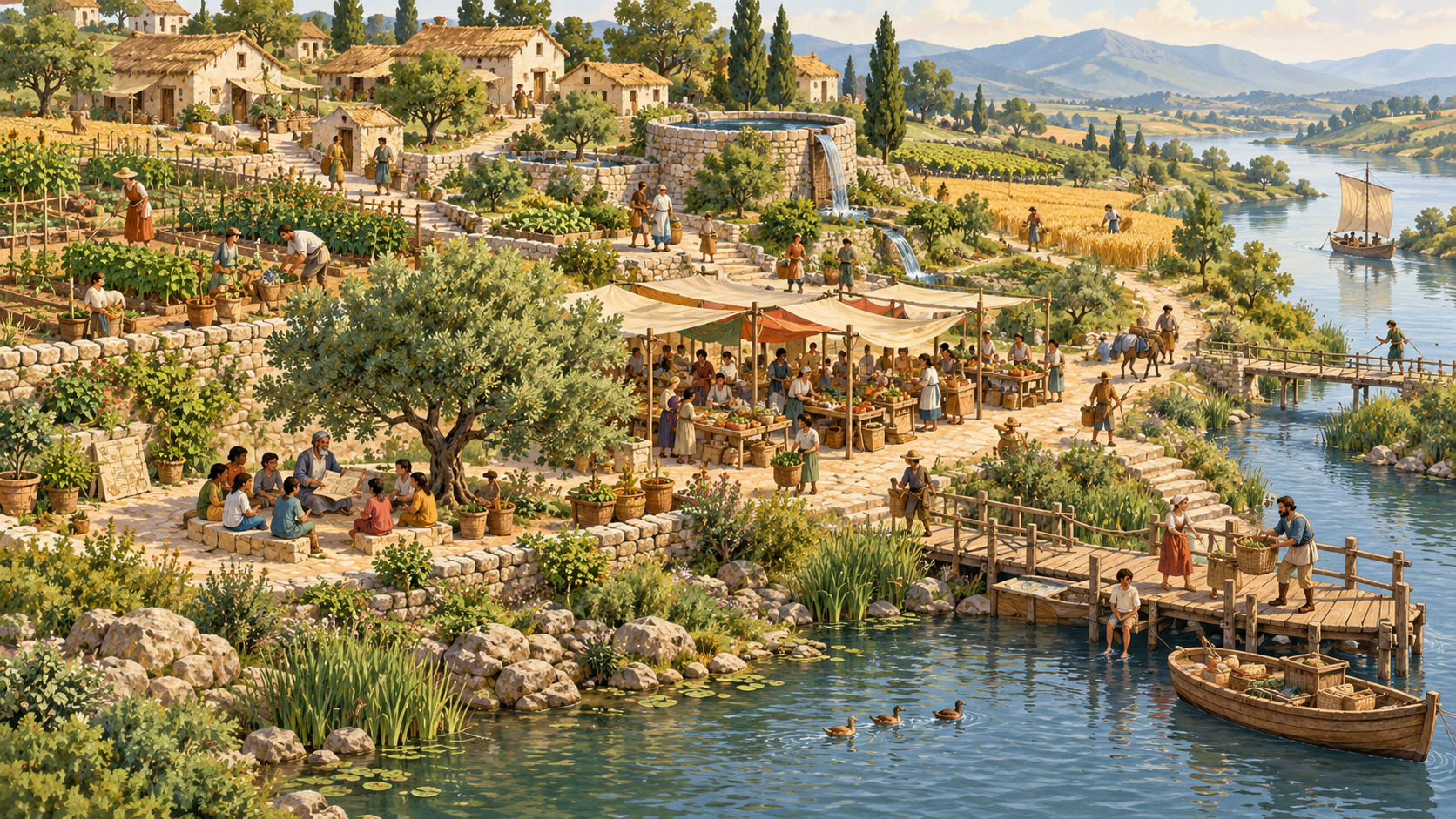
Quick answer: The main types of civilisation are ways people organise survival, knowledge, work, power and exchange in different environments. River-valley, maritime, oasis, pastoral, highland, forest, city-state, trade-network, industrial, digital and regenerative systems are useful comparison lenses, not a ranking from ‘primitive’ to ‘advanced’. To build a civilisation in a classroom simulation, start with safe water, dependable food, shelter, fair rules, learning and repair; then test which design works under change.
Did you know? A river town, an island harbour and a city with high-speed data networks can all solve the same human problem in surprisingly different ways: how do thousands of people cooperate with strangers, share limited resources, settle disputes, teach children and leave useful systems for the next generation? This guide invites families to answer that question by building, testing and improving fictional communities.
This is the first practical field guide in the Types of a Civilisation learning series. The story follows the evidence reviewer and the assumption checker, two fictional learning guides, working at the lesson facilitator in the classroom activity with a group of children. They do not command historical peoples. They help students compare evidence, select designs, explain trade-offs and correct mistakes in a tabletop civilisation-building simulation.
A note on language: historians and archaeologists debate where ‘civilisation’ begins, and the label has sometimes been used unfairly to rank communities. In this guide, type means a useful, revisable model of a settlement or system. A mobile pastoral community is not a lesser human society than a city. A place may combine several types simultaneously. Advanced means better ability to protect life, share knowledge and repair harm, not superior people.
Choose a reading route
- Five-minute parent route: read the six foundation decisions, use the comparison map, then try the quick questions.
- Primary-school route: begin with the classroom activity story, choose one environment and draw the first five buildings and services.
- Secondary-school route: calculate food and water buffers, compare type-specific risks and justify a policy under uncertainty.
- Tutor route: follow the lesson sequence and assessment rubric; adapt questions by age instead of assigning the entire long guide at once.
- Deep reading route: explore each type in the atlas, complete the missions, inspect your evidence and revisit the advanced design gate.
How to build a civilisation: start with six decisions
Imagine 60 families arriving on the edge of a river in a completely fictional world. The landscape is beautiful, but beauty does not guarantee safety. It can flood. Rainfall may change. The community must choose where to live, how to share work and how to keep children healthy while the first crops are growing. The evidence reviewer places six cards on the lesson facilitator mixing desk. Each card represents a system that must work before the town becomes impressive.
Decision 1 — Keep life safe before building prestige
Water, food, sanitation and shelter are the first constraints. Mark the reliable water source, test whether it is safe, protect it from waste and floods, and arrange a second source or storage plan. Set aside food for bad weather. Locate shelters away from obvious hazards. Ask who is overlooked: infants, people with disabilities, elderly residents and visitors. A settlement that stores grain but fails to keep drinking water safe has not solved its foundation.
Decision 2 — Make duties visible and fair
A civilisation depends on many kinds of work: growing food, repairing tools, caring for patients, teaching, cooking, handling waste, settling disagreements and keeping records. The evidence reviewer asks the children to draw a rota. The assumption checker checks whether the rota relies on unpaid or unsafe work from one group. Children can help with age-appropriate activities in the simulation, but every imagined community needs adults responsible for safety, specialist decisions and safeguarding.
Decision 3 — Give disagreements a nonviolent repair route
Write a few rules in language everyone can understand. People must be able to question a decision, report harm, appeal an unfair ruling and see where shared resources went. Community legitimacy is not automatic because a leader speaks confidently. It grows when rules apply consistently and institutions are willing to admit error. The children’s first constitution in the classroom activity is deliberately short: protect people, share evidence, hear affected voices, and make repair possible.
Decision 4 — Preserve memory, not only objects
A civilisation must teach people who were not present when a system was built. Draw a map, label clean-water points, explain how the seed store works, record warnings and preserve more than one person’s knowledge. Spoken traditions, apprenticeship, craft knowledge, drawings and writing all transfer understanding. Writing is important in many historical civilisations, but lack of writing does not mean people lack complex knowledge or social organisation.
Decision 5 — Trade with care and maintain spare capacity
One village may make excellent pottery; another may have timber; a port may connect both. Trade can widen choices, but dependence on one route creates a vulnerability. Ask which supplies are essential, how long they last, how trust is earned and what happens if a route is interrupted. Keep a buffer, repair local skills and avoid solving scarcity through coercion or exploitation. Good coordination builds alternatives.
Decision 6 — Build a correction loop
The final card looks less glamorous than a palace. It reads: observe, compare, repair, verify, teach. Inspect crops and water quality; listen to residents; publish clear records; correct what fails; repeat. Civilisation is not a one-day construction project. It is a continuous promise to maintain systems that other people depend on. The strongest classroom design is the one that can explain what it would change after a mistake.
A quick worked example: why buffers change the answer
The classroom activity children invent the town of Riverbend. Its 120 residents need, for this exercise only, 2 units of staple food per person each day. The current store holds 1,200 units. What does the number mean? Daily need = 120 × 2 = 240 units. The food store covers 1,200 ÷ 240 = 5 days if there are no deliveries and no losses. The children discover that ‘we have a thousand units’ sounds reassuring but ‘we have five days’ changes the planning conversation.
If the town wants a ten-day emergency buffer, its notional target is 2,400 units. The gap is 1,200 units. Students should not assume they can simply take more from farmers or cut children’s meals. They can test better storage, additional crops, agreed trade, lower waste, reserves and mutual aid. The numbers are classroom assumptions, not real nutrition or emergency-management standards. The teaching point is to show the formula, state assumptions and ask what might change.
The assumption checker then reveals that the river floods every rainy season. A bigger store on low ground might produce a bigger loss. The evidence reviewer’s answer is not another multiplication. It is a question: which location, drainage plan and inspection routine keep those food units usable? A civilisation lesson becomes better when mathematics, geography, science, ethics and public communication enter the same decision.
What the word ‘type’ really means
A type is an analytical lens. We might group places by their ecology (river, coast, dryland or mountain), their production systems (farming, fishing, herding, craft, industry or information), their political organisation (city-state, federation or empire), their networks (market corridors, sea routes or digital connections), or their response to constraints (regenerative, resilient and hybrid designs). These axes overlap. They do not form a single ladder.
For instance, a coastal city may be maritime, industrial, democratic, digital and climate-adaptive at the same time. A highland community may be connected to global networks while preserving local farming techniques. Historical people did not necessarily describe themselves using our modern labels, so use the labels as prompts for investigation, not as permanent badges for real cultures.
For the background definition use What Is Civilisation?. For an existing classification index see Types of Civilisations, and for a crucial warning against ranking see Why Types Are Not Levels. This new page takes a different job: it turns the comparison into a guided, assessable build-and-repair journey for children, parents and tutors.
the lesson facilitator: how the classroom activity learning game works
The evidence reviewer is the reading-route guide. She asks who benefits, who is missing, what language a younger student needs and where a learner should look next. The assumption checker is the ground-check guide. He examines maps, assumptions, shocks and repair plans. the lesson facilitator is their fictional ‘mixing desk’: five sliders labelled Life, Knowledge, Trust, Systems and Repair. A child moves a slider only after providing evidence. The classroom activity is a classroom imagination space, not a claim about real software or an autonomous publishing agent.
Children become cartographers, water stewards, storytellers, mediators, inspectors and budget keepers in rotating roles. No one remains the king or leader for the whole activity. Each round, they identify a local problem, draft two options, name the trade-off, run a safe tabletop test and write one sentence explaining why the design changed. The aim is responsibility and evidence, not empire-building or conquest.
A good answer in this game follows the same five steps: notice a need → choose an option → predict a result → test the result → correct the design. A younger child might draw this as five arrows. An older child might build a spreadsheet, estimate demand, compare scenarios and discuss uncertainty. Both are doing a genuine form of systems thinking.
The type atlas: choose an environment, then test the system
The following chapters are not a timeline from bad to good. They are eighteen different design lenses that can coexist, merge, disappear or return. In each chapter, begin with a simple picture of daily life, identify the dependency, observe a failure, repair it, and practise one family or tutor activity.
- 01. River-valley and floodplain civilisation
- 02. Maritime and port civilisation
- 03. Dryland and oasis civilisation
- 04. Mobile and pastoral networks
- 05. Highland and terraced communities
- 06. Forest and agroforestry communities
- 07. Island and archipelago networks
- 08. City-state and civic city systems
- 09. Agrarian surplus and rural networks
- 10. Large territorial and imperial systems
- 11. Merchant and overland trade networks
- 12. Industrial and mechanised systems
- 13. Modern metropolitan and service systems
- 14. Digital and information networks
- 15. Knowledge-centred and scientific institutions
- 16. Regenerative and circular systems
- 17. Disaster-resilient and adaptive systems
- 18. Hybrid advanced and speculative civilisations
Illustration note: the featured image reused for this article is an existing AI-generated conceptual picture of a fictional riverside learning settlement. It has an accessibility description and provenance metadata; it must not be presented as a historical photograph or as evidence of any real archaeological place.
01 — River-valley and floodplain civilisation
classroom activity field note 1: At first light, Riverbend’s children watch grain carts cross a raised road while a flood marker stands beside the river. The fields look fertile, but yesterday the water level rose unexpectedly.
What makes this a useful type?
Reliable water and fertile sediment can support dense farming, storage, craft specialisation and long-distance movement. Yet the same river can carry floods, water-borne hazards and disputes over access. The defining feature is not a famous monument: it is the coordination of people with seasonal water and productive land. A river system may include villages, towns and cities. It can be governed locally or by a large state. A river setting describes an ecological dependency, not a single political system or a guaranteed march toward an empire.
Notice that a type is a question about how a community works, not a verdict about the worth of its people. If the map shows one striking feature, look for the less visible work beneath it. Ask who supplies the labour, who remembers the techniques, who can question a rule and what happens when a supply line fails. A beautiful model without those answers is scenery, not a tested civilisation.
Build this civilisation in sensible layers
Begin with a diagram before adding monuments. Map high ground, seasonal flood levels, drinking-water points, protected fields and a safe path to higher shelter. Do not imagine that every household has the same needs. Invite students to separate essentials, choices and luxuries. Essentials must remain available in an interruption; choices can change with circumstance; luxuries come after safety and basic fairness.
- Everyday work: organise farmers, boat workers, cleaners, water inspectors, health carers, teachers and keepers of flood records.
- Shared rule: agree who may change irrigation channels and how upstream and downstream neighbours will resolve complaints.
- Knowledge that must survive: keep flood marks, planting diaries and oral accounts of unusual seasons; update the record after each wet season.
- Maintenance: name a responsible team, a visible inspection interval, a way to report problems and an alternative if the usual system fails.
At the lesson facilitator, the children are not rewarded for making the map look crowded. They must draw lines between services. Connect households to water and waste systems; connect work to training; connect rules to fair enforcement; connect economic activity to ecological limits. If one line passes through a single fragile point, circle it in red as a classroom warning, then search for a workable second route. This is the difference between building an object and designing a reliable system.
A small number can reveal a large dependency
A storage shed holds 900 food units. If 150 residents use 3 each day, it lasts 900 ÷ 450 = 2 days, before spoilage. Estimate what a seven-day buffer would require and name the assumptions. A learner who merely writes the answer earns less understanding than one who explains the units, checks the arithmetic and names a reasonable limitation. Always ask whether the number is a classroom assumption, a historical estimate or a measured observation. These three kinds of number carry different degrees of confidence.
Parents can make this a ten-minute Mathematics conversation. First write down what is known and unknown. Then draw a bar, table or diagram; perform the calculation; reread the situation and ask what a sensible decision would be. When a policy affects people, the quantity is important but not sufficient. Two options can produce the same total while distributing burdens very differently.
The classroom activity test: introduce an interruption
A sudden flood cuts the footbridge and contaminates an uncovered drinking-water container. The grain store has not flooded, but health risks are now rising. the lesson facilitator pauses and asks for two plans. One plan is to build the largest wall immediately, or first move clean-water storage to protected ground and build an inspected pedestrian crossing. The team must predict what happens to food, health, movement, learning, livelihoods and trust under each possibility. Children are encouraged to disagree with reasons, not to compete over who sounds most certain.
The evidence reviewer asks whose water was affected; the assumption checker measures elevation, tests access routes on the drawing and checks whether the chosen fix introduces a new risk downstream. A successful round does not mean every risk disappears. It means the group can describe remaining uncertainty and can say which observation would make them change their minds. A teacher can ask one pupil to defend the first option, another to defend the second and a third to check who has not been heard. Rotate those roles in the next chapter to prevent the loudest speaker from monopolising the simulation.
Fairness, ecology and the right to question
Residents living farthest from the centre need equal access to warnings. A flood map is unjust if only literate households can understand it. A civilisation should not call itself successful just because a wealthy district stays comfortable. Ask who receives warnings, whose work is rewarded and which forms of knowledge count as evidence. A safe decision has a named appeal route, a realistic budget and a way of checking unexpected consequences.
We also need to remember that historical communities were more complex than a classroom card. Different families, languages, occupations and beliefs existed within the same region. The ethical task is not to mimic an imagined old ruler. It is to identify patterns of cooperation and harm while recognising that real people had agency, skill and disagreements of their own.
Failure, repair and the next season
Mark wells as usable or unsafe, create alternative distribution points, clear waste, inspect bridges and arrange a transparent shared maintenance rota. Put the repair into a dated log. Include the first warning, the responsible group, the decision, the people affected and the check that confirms the work. If a remedy is promised but no one can tell whether it happened, the plan remains incomplete.
A reliable settlement learns from the interruption without pretending the future is predictable. It records what almost failed as well as what actually failed. It treats maintenance, succession, teaching and honesty as forms of technology. When a child asks, ‘Can we build something bigger now?’, the assumption checker answers with a more useful question: ‘Can the old system still work if the person who designed it is absent?’
Family activity and tutor extension
At home: Build a clay or paper river with a raised granary, then gently change the ‘flood’ line and explain what needs moving. Ask the child to tell the story from the perspective of a resident, a maintainer and someone arriving for the first time. Where does each person look for help? The parent listens for reasons and invites the child to improve one part of the drawing rather than correcting every detail at once.
In tutoring: Ask students to compare a water-quality risk with a flood risk, calculate the buffer and write one policy that protects people downstream. For stronger learners, ask for an alternative explanation of the same evidence and a short note on what could change the conclusion. For learners who need more support, provide a labelled diagram and allow an oral explanation before moving to written evaluation.
What history can and cannot tell us
River-linked agricultural settlements offer useful comparisons, but ancient communities managed water through many different technologies and political arrangements. Students should distinguish an actual historical case from our fictional classroom activity challenge. Comparison helps us think; it does not prove that history followed one inevitable route. This field guide is not a substitute for archaeological evidence, dated primary sources and research specific to an individual society.
Key idea to carry forward: This type teaches the difference between abundance and reliability: fertile land helps, but safe storage, public warning and repair keep a society functioning. Continue with From Settlement to a Reliable Town, or choose another type and see how the same basic human need is solved differently.
02 — Maritime and port civilisation
classroom activity field note 2: At Lantern Harbour, boats arrive with timber and dried food while local fishers mend nets. A shipping delay means the market’s shelves look emptier than yesterday.
What makes this a useful type?
A coast or sheltered port creates routes for exchange, navigation, fishing and movement of knowledge. The city may become skilled at warehousing, contracts, signals, repairs and multilingual communication. Ships connect distant people but do not remove weather, piracy in some historical periods, unequal bargaining or supply-chain vulnerability. Maritime is a network orientation, not a statement that the community has no farms. Ports often depend on inland growers and land transport; even an island trading centre needs food safety, housing, sanitation and fair access to services.
Notice that a type is a question about how a community works, not a verdict about the worth of its people. If the map shows one striking feature, look for the less visible work beneath it. Ask who supplies the labour, who remembers the techniques, who can question a rule and what happens when a supply line fails. A beautiful model without those answers is scenery, not a tested civilisation.
Build this civilisation in sensible layers
Begin with a diagram before adding monuments. Plot the safe harbour, drinking-water reserve, sheltered unloading area, emergency access and land routes linking the port to homes. Do not imagine that every household has the same needs. Invite students to separate essentials, choices and luxuries. Essentials must remain available in an interruption; choices can change with circumstance; luxuries come after safety and basic fairness.
- Everyday work: organise fishers, pilots, ship repairers, customs workers, porters, translators, merchants, health workers and tide observers.
- Shared rule: set simple, inspectable weights and honest records of what has arrived, what is owed and who may inspect unsafe cargo.
- Knowledge that must survive: maintain navigational knowledge, tide observations, disaster warnings and craft apprenticeships across generations.
- Maintenance: name a responsible team, a visible inspection interval, a way to report problems and an alternative if the usual system fails.
At the lesson facilitator, the children are not rewarded for making the map look crowded. They must draw lines between services. Connect households to water and waste systems; connect work to training; connect rules to fair enforcement; connect economic activity to ecological limits. If one line passes through a single fragile point, circle it in red as a classroom warning, then search for a workable second route. This is the difference between building an object and designing a reliable system.
A small number can reveal a large dependency
Three boats each carry 40 supply crates. One is delayed. Only 80 arrive rather than 120, a shortfall of 40 crates or one-third of the planned delivery. A learner who merely writes the answer earns less understanding than one who explains the units, checks the arithmetic and names a reasonable limitation. Always ask whether the number is a classroom assumption, a historical estimate or a measured observation. These three kinds of number carry different degrees of confidence.
Parents can make this a ten-minute Mathematics conversation. First write down what is known and unknown. Then draw a bar, table or diagram; perform the calculation; reread the situation and ask what a sensible decision would be. When a policy affects people, the quantity is important but not sufficient. Two options can produce the same total while distributing burdens very differently.
The classroom activity test: introduce an interruption
A storm closes the harbour while one trader proposes selling the remaining drinking water at a price many families cannot afford. the lesson facilitator pauses and asks for two plans. One plan is to allow any price because stocks are scarce, or introduce a time-limited, transparent emergency allocation with appeal and replenishment plans. The team must predict what happens to food, health, movement, learning, livelihoods and trust under each possibility. Children are encouraged to disagree with reasons, not to compete over who sounds most certain.
The evidence reviewer asks whose voices were absent from the emergency meeting; the assumption checker checks weather thresholds, port capacity and whether supplies can arrive by road. A successful round does not mean every risk disappears. It means the group can describe remaining uncertainty and can say which observation would make them change their minds. A teacher can ask one pupil to defend the first option, another to defend the second and a third to check who has not been heard. Rotate those roles in the next chapter to prevent the loudest speaker from monopolising the simulation.
Fairness, ecology and the right to question
Sea routes can enrich some households and bypass others. Port success should be examined beside dockworker safety, affordable essentials and the surrounding ecology. A civilisation should not call itself successful just because a wealthy district stays comfortable. Ask who receives warnings, whose work is rewarded and which forms of knowledge count as evidence. A safe decision has a named appeal route, a realistic budget and a way of checking unexpected consequences.
We also need to remember that historical communities were more complex than a classroom card. Different families, languages, occupations and beliefs existed within the same region. The ethical task is not to mimic an imagined old ruler. It is to identify patterns of cooperation and harm while recognising that real people had agency, skill and disagreements of their own.
Failure, repair and the next season
Protect the water store, inspect vessels, establish trusted cargo records, use alternative routes and maintain a reserve for disrupted arrivals. Put the repair into a dated log. Include the first warning, the responsible group, the decision, the people affected and the check that confirms the work. If a remedy is promised but no one can tell whether it happened, the plan remains incomplete.
A reliable settlement learns from the interruption without pretending the future is predictable. It records what almost failed as well as what actually failed. It treats maintenance, succession, teaching and honesty as forms of technology. When a child asks, ‘Can we build something bigger now?’, the assumption checker answers with a more useful question: ‘Can the old system still work if the person who designed it is absent?’
Family activity and tutor extension
At home: Create three paper islands and two boats; try removing one route and see which island needs a backup supply. Ask the child to tell the story from the perspective of a resident, a maintainer and someone arriving for the first time. Where does each person look for help? The parent listens for reasons and invites the child to improve one part of the drawing rather than correcting every detail at once.
In tutoring: Invite students to calculate the shortfall, compare two allocation rules and defend a policy with fairness and transparency. For stronger learners, ask for an alternative explanation of the same evidence and a short note on what could change the conclusion. For learners who need more support, provide a labelled diagram and allow an oral explanation before moving to written evaluation.
What history can and cannot tell us
Historical maritime societies around the Indian Ocean, Mediterranean and other seas show that exchange carries language and ideas as well as goods, though their histories are diverse. Students should distinguish an actual historical case from our fictional classroom activity challenge. Comparison helps us think; it does not prove that history followed one inevitable route. This field guide is not a substitute for archaeological evidence, dated primary sources and research specific to an individual society.
Key idea to carry forward: The port lesson is interdependence: international connection expands possibilities, while local reserves and honest records make connection safer. Continue with How Ancient Ships Connected Distant Coasts, or choose another type and see how the same basic human need is solved differently.
03 — Dryland and oasis civilisation
classroom activity field note 3: Under a clear dryland sky, the classroom activity team reaches a settlement where one spring feeds gardens, small workshops and visiting caravans. The nearest alternative water point lies far away.
What makes this a useful type?
Scarce and variable water shapes choices about housing, shade, irrigation, storage, grazing, trade and seasonal movement. A dryland centre can become a place of inventive water management and cultural exchange. Its strength lies in how people cooperate with real limits, not in a stereotype of endless desert. Drylands include very different landscapes and communities. Some are urban, some agricultural, some pastoral and some highly connected. An oasis is not automatically isolated or technologically simple.
Notice that a type is a question about how a community works, not a verdict about the worth of its people. If the map shows one striking feature, look for the less visible work beneath it. Ask who supplies the labour, who remembers the techniques, who can question a rule and what happens when a supply line fails. A beautiful model without those answers is scenery, not a tested civilisation.
Build this civilisation in sensible layers
Begin with a diagram before adding monuments. Protect spring recharge, locate low-evaporation storage, plan shade and public water points, and distinguish drinking supplies from irrigation. Do not imagine that every household has the same needs. Invite students to separate essentials, choices and luxuries. Essentials must remain available in an interruption; choices can change with circumstance; luxuries come after safety and basic fairness.
- Everyday work: organise water stewards, gardeners, builders, veterinarians, traders, health carers, teachers and people skilled in seasonal observation.
- Shared rule: publish a water-sharing schedule with emergency protections, reliable maintenance duties and a way to challenge unfair allocation.
- Knowledge that must survive: teach families when different wells are reliable, how gardens are cultivated and which drought warnings elders have observed.
- Maintenance: name a responsible team, a visible inspection interval, a way to report problems and an alternative if the usual system fails.
At the lesson facilitator, the children are not rewarded for making the map look crowded. They must draw lines between services. Connect households to water and waste systems; connect work to training; connect rules to fair enforcement; connect economic activity to ecological limits. If one line passes through a single fragile point, circle it in red as a classroom warning, then search for a workable second route. This is the difference between building an object and designing a reliable system.
A small number can reveal a large dependency
The fictional spring supplies 600 water tokens daily. Homes use 340 and essential services use 170. Only 90 remain for gardens or reserves; a dry spell may reduce the 600. A learner who merely writes the answer earns less understanding than one who explains the units, checks the arithmetic and names a reasonable limitation. Always ask whether the number is a classroom assumption, a historical estimate or a measured observation. These three kinds of number carry different degrees of confidence.
Parents can make this a ten-minute Mathematics conversation. First write down what is known and unknown. Then draw a bar, table or diagram; perform the calculation; reread the situation and ask what a sensible decision would be. When a policy affects people, the quantity is important but not sufficient. Two options can produce the same total while distributing burdens very differently.
The classroom activity test: introduce an interruption
A hotter season lowers the spring flow. A wealthy household requests exclusive access to maintain ornamental gardens while clinic users queue. the lesson facilitator pauses and asks for two plans. One plan is to continue last season’s schedule unchanged, or prioritise safe drinking water and essential health needs while openly revising garden allocations. The team must predict what happens to food, health, movement, learning, livelihoods and trust under each possibility. Children are encouraged to disagree with reasons, not to compete over who sounds most certain.
The evidence reviewer hears from children, traders and households with limited mobility; the assumption checker tracks flow measurements and checks whether the plan conserves water without hiding health costs. A successful round does not mean every risk disappears. It means the group can describe remaining uncertainty and can say which observation would make them change their minds. A teacher can ask one pupil to defend the first option, another to defend the second and a third to check who has not been heard. Rotate those roles in the next chapter to prevent the loudest speaker from monopolising the simulation.
Fairness, ecology and the right to question
A drought plan that only counts property owners will miss workers and visiting families. Rules should account for human needs rather than bargaining power alone. A civilisation should not call itself successful just because a wealthy district stays comfortable. Ask who receives warnings, whose work is rewarded and which forms of knowledge count as evidence. A safe decision has a named appeal route, a realistic budget and a way of checking unexpected consequences.
We also need to remember that historical communities were more complex than a classroom card. Different families, languages, occupations and beliefs existed within the same region. The ethical task is not to mimic an imagined old ruler. It is to identify patterns of cooperation and harm while recognising that real people had agency, skill and disagreements of their own.
Failure, repair and the next season
Inspect leaks, reduce preventable evaporation, negotiate shared schedules, monitor the spring and protect access for essential services. Put the repair into a dated log. Include the first warning, the responsible group, the decision, the people affected and the check that confirms the work. If a remedy is promised but no one can tell whether it happened, the plan remains incomplete.
A reliable settlement learns from the interruption without pretending the future is predictable. It records what almost failed as well as what actually failed. It treats maintenance, succession, teaching and honesty as forms of technology. When a child asks, ‘Can we build something bigger now?’, the assumption checker answers with a more useful question: ‘Can the old system still work if the person who designed it is absent?’
Family activity and tutor extension
At home: Use a measuring cup to represent a day’s fictional water, then allocate it among households, school, clinic and gardens. Ask the child to tell the story from the perspective of a resident, a maintainer and someone arriving for the first time. Where does each person look for help? The parent listens for reasons and invites the child to improve one part of the drawing rather than correcting every detail at once.
In tutoring: Have learners calculate the available 90 tokens, model a twenty per cent flow reduction and debate which commitments must be protected first. For stronger learners, ask for an alternative explanation of the same evidence and a short note on what could change the conclusion. For learners who need more support, provide a labelled diagram and allow an oral explanation before moving to written evaluation.
What history can and cannot tell us
Across dryland histories, different communities have developed ingenious water capture, wells, underground channels, terrace gardens and trade institutions. Students should distinguish an actual historical case from our fictional classroom activity challenge. Comparison helps us think; it does not prove that history followed one inevitable route. This field guide is not a substitute for archaeological evidence, dated primary sources and research specific to an individual society.
Key idea to carry forward: Scarcity is not a reason to abandon fairness. It is a reason to make assumptions, measurements and rights visible. Continue with The Civilisation Runtime: Resources and Physical Limits, or choose another type and see how the same basic human need is solved differently.
04 — Mobile and pastoral networks
classroom activity field note 4: A fictional group travels between grasslands with animals, seasonal shelters and carefully remembered water points. One child asks why their community must build stone walls to count as organised.
What makes this a useful type?
Movement can be a sophisticated response to rainfall, pasture and animal welfare. Coordination depends on route knowledge, kinship and social ties, trade, veterinary care, negotiation and resource stewardship. Mobility is not the absence of civilisation; permanent buildings are not the only way to preserve capability. ‘Pastoral’ describes an important livelihood pattern rather than an automatic political category. Mobile communities often trade with farmers and cities and may have complex governance and cultural institutions.
Notice that a type is a question about how a community works, not a verdict about the worth of its people. If the map shows one striking feature, look for the less visible work beneath it. Ask who supplies the labour, who remembers the techniques, who can question a rule and what happens when a supply line fails. A beautiful model without those answers is scenery, not a tested civilisation.
Build this civilisation in sensible layers
Begin with a diagram before adding monuments. Map seasonal pasture, water points, emergency shelters, animal care locations and agreements about access to shared land. Do not imagine that every household has the same needs. Invite students to separate essentials, choices and luxuries. Essentials must remain available in an interruption; choices can change with circumstance; luxuries come after safety and basic fairness.
- Everyday work: organise herders, navigators, craftspeople, healers, educators, elders, negotiators and record-keepers of animal health.
- Shared rule: agree how herds avoid damaging recovering pasture and how conflicts with neighbouring communities can be mediated peacefully.
- Knowledge that must survive: transfer weather signs, oral history, ecological knowledge and practical skills through stories, apprenticeship and shared observation.
- Maintenance: name a responsible team, a visible inspection interval, a way to report problems and an alternative if the usual system fails.
At the lesson facilitator, the children are not rewarded for making the map look crowded. They must draw lines between services. Connect households to water and waste systems; connect work to training; connect rules to fair enforcement; connect economic activity to ecological limits. If one line passes through a single fragile point, circle it in red as a classroom warning, then search for a workable second route. This is the difference between building an object and designing a reliable system.
A small number can reveal a large dependency
A herd needs 12 pasture tokens each day in the game. One grassland can provide 72 tokens before a recovery period; that is six days of use, not permanent unlimited supply. A learner who merely writes the answer earns less understanding than one who explains the units, checks the arithmetic and names a reasonable limitation. Always ask whether the number is a classroom assumption, a historical estimate or a measured observation. These three kinds of number carry different degrees of confidence.
Parents can make this a ten-minute Mathematics conversation. First write down what is known and unknown. Then draw a bar, table or diagram; perform the calculation; reread the situation and ask what a sensible decision would be. When a policy affects people, the quantity is important but not sufficient. Two options can produce the same total while distributing burdens very differently.
The classroom activity test: introduce an interruption
A dry season makes a usual route difficult, and a map drawn by visiting outsiders omits a known water point and a protected grazing area. the lesson facilitator pauses and asks for two plans. One plan is to force everyone along the printed map, or revise the route with local expertise and check the new environmental risks. The team must predict what happens to food, health, movement, learning, livelihoods and trust under each possibility. Children are encouraged to disagree with reasons, not to compete over who sounds most certain.
The evidence reviewer asks the children to listen to people who know the route; the assumption checker verifies distances, rest periods, animal conditions and water availability. A successful round does not mean every risk disappears. It means the group can describe remaining uncertainty and can say which observation would make them change their minds. A teacher can ask one pupil to defend the first option, another to defend the second and a third to check who has not been heard. Rotate those roles in the next chapter to prevent the loudest speaker from monopolising the simulation.
Fairness, ecology and the right to question
People who move are not less entitled to safety, education or representation. The design must make it possible for children to learn and for vulnerable people to receive care while mobile. A civilisation should not call itself successful just because a wealthy district stays comfortable. Ask who receives warnings, whose work is rewarded and which forms of knowledge count as evidence. A safe decision has a named appeal route, a realistic budget and a way of checking unexpected consequences.
We also need to remember that historical communities were more complex than a classroom card. Different families, languages, occupations and beliefs existed within the same region. The ethical task is not to mimic an imagined old ruler. It is to identify patterns of cooperation and harm while recognising that real people had agency, skill and disagreements of their own.
Failure, repair and the next season
Revise the journey, reduce pressure on damaged pasture, negotiate safe corridors and keep multiple teaching and communication methods. Put the repair into a dated log. Include the first warning, the responsible group, the decision, the people affected and the check that confirms the work. If a remedy is promised but no one can tell whether it happened, the plan remains incomplete.
A reliable settlement learns from the interruption without pretending the future is predictable. It records what almost failed as well as what actually failed. It treats maintenance, succession, teaching and honesty as forms of technology. When a child asks, ‘Can we build something bigger now?’, the assumption checker answers with a more useful question: ‘Can the old system still work if the person who designed it is absent?’
Family activity and tutor extension
At home: Make a seasonal calendar for three imaginary grazing zones and choose the route that leaves time for recovery. Ask the child to tell the story from the perspective of a resident, a maintainer and someone arriving for the first time. Where does each person look for help? The parent listens for reasons and invites the child to improve one part of the drawing rather than correcting every detail at once.
In tutoring: Compare a stationary ‘use everything now’ model with a rotating-use model and ask how proof of ecological improvement would be collected. For stronger learners, ask for an alternative explanation of the same evidence and a short note on what could change the conclusion. For learners who need more support, provide a labelled diagram and allow an oral explanation before moving to written evaluation.
What history can and cannot tell us
Pastoral cultures across Africa, Eurasia and elsewhere are extremely diverse; many developed intricate ecological knowledge and far-reaching trade relationships. Students should distinguish an actual historical case from our fictional classroom activity challenge. Comparison helps us think; it does not prove that history followed one inevitable route. This field guide is not a substitute for archaeological evidence, dated primary sources and research specific to an individual society.
Key idea to carry forward: This type corrects a common misconception: adaptation to place can be highly advanced even when it does not produce towers or large cities. Continue with Why Types Are Not Levels, or choose another type and see how the same basic human need is solved differently.
05 — Highland and terraced communities
classroom activity field note 5: High on a slope, families maintain stone-edged terraces and narrow footpaths while clouds hide the valley. The children’s paper model looks safe until the assumption checker removes one retaining wall.
What makes this a useful type?
Steep terrain demands careful soil management, stable paths, water transport and community maintenance. Terracing can create productive landscapes where flat fields are scarce, but slope stability, erosion and changing rain patterns require attention. A highland type describes topography and adaptation, not a single ethnic culture or a fixed development stage. Highland cities, villages, trading groups and modern industries can coexist.
Notice that a type is a question about how a community works, not a verdict about the worth of its people. If the map shows one striking feature, look for the less visible work beneath it. Ask who supplies the labour, who remembers the techniques, who can question a rule and what happens when a supply line fails. A beautiful model without those answers is scenery, not a tested civilisation.
Build this civilisation in sensible layers
Begin with a diagram before adding monuments. Survey the slope, map drainage, protect water sources, check paths and identify terraces needing reinforcement before expanding fields. Do not imagine that every household has the same needs. Invite students to separate essentials, choices and luxuries. Essentials must remain available in an interruption; choices can change with circumstance; luxuries come after safety and basic fairness.
- Everyday work: organise farmers, stonemasons, path inspectors, gardeners, weather observers, carers, tutors and coordinators of shared repairs.
- Shared rule: clarify responsibility for a wall that protects more than one field and create a collective reporting process for cracks and erosion.
- Knowledge that must survive: teach contour knowledge, crop diversity, tool maintenance and the warning signs of slope movement.
- Maintenance: name a responsible team, a visible inspection interval, a way to report problems and an alternative if the usual system fails.
At the lesson facilitator, the children are not rewarded for making the map look crowded. They must draw lines between services. Connect households to water and waste systems; connect work to training; connect rules to fair enforcement; connect economic activity to ecological limits. If one line passes through a single fragile point, circle it in red as a classroom warning, then search for a workable second route. This is the difference between building an object and designing a reliable system.
A small number can reveal a large dependency
Five terraces produce 18 baskets each in the exercise, or 90 baskets total. If a landslide removes two terraces, the model loses 36 baskets, forty per cent of output. A learner who merely writes the answer earns less understanding than one who explains the units, checks the arithmetic and names a reasonable limitation. Always ask whether the number is a classroom assumption, a historical estimate or a measured observation. These three kinds of number carry different degrees of confidence.
Parents can make this a ten-minute Mathematics conversation. First write down what is known and unknown. Then draw a bar, table or diagram; perform the calculation; reread the situation and ask what a sensible decision would be. When a policy affects people, the quantity is important but not sufficient. Two options can produce the same total while distributing burdens very differently.
The classroom activity test: introduce an interruption
After strong rain, one retaining wall cracks. A market organiser wants to leave it until the harvest celebration is finished. the lesson facilitator pauses and asks for two plans. One plan is to decorate the marketplace first, or close the affected route and have qualified imaginary inspectors prioritise slope safety. The team must predict what happens to food, health, movement, learning, livelihoods and trust under each possibility. Children are encouraged to disagree with reasons, not to compete over who sounds most certain.
The evidence reviewer checks which households rely on the path; the assumption checker tracks cracks, runoff, changing soil and the possible consequences of a collapse. A successful round does not mean every risk disappears. It means the group can describe remaining uncertainty and can say which observation would make them change their minds. A teacher can ask one pupil to defend the first option, another to defend the second and a third to check who has not been heard. Rotate those roles in the next chapter to prevent the loudest speaker from monopolising the simulation.
Fairness, ecology and the right to question
Some paths are unusable for residents with limited mobility. A good plan includes accessible routes and safe evacuation rather than assuming everyone climbs equally well. A civilisation should not call itself successful just because a wealthy district stays comfortable. Ask who receives warnings, whose work is rewarded and which forms of knowledge count as evidence. A safe decision has a named appeal route, a realistic budget and a way of checking unexpected consequences.
We also need to remember that historical communities were more complex than a classroom card. Different families, languages, occupations and beliefs existed within the same region. The ethical task is not to mimic an imagined old ruler. It is to identify patterns of cooperation and harm while recognising that real people had agency, skill and disagreements of their own.
Failure, repair and the next season
Reduce erosion, restore drainage, inspect walls, diversify paths and keep emergency access open while repairs occur. Put the repair into a dated log. Include the first warning, the responsible group, the decision, the people affected and the check that confirms the work. If a remedy is promised but no one can tell whether it happened, the plan remains incomplete.
A reliable settlement learns from the interruption without pretending the future is predictable. It records what almost failed as well as what actually failed. It treats maintenance, succession, teaching and honesty as forms of technology. When a child asks, ‘Can we build something bigger now?’, the assumption checker answers with a more useful question: ‘Can the old system still work if the person who designed it is absent?’
Family activity and tutor extension
At home: Layer cardboard strips into terraces, sprinkle a little paper ‘rain’ and see where drainage needs to go. Ask the child to tell the story from the perspective of a resident, a maintainer and someone arriving for the first time. Where does each person look for help? The parent listens for reasons and invites the child to improve one part of the drawing rather than correcting every detail at once.
In tutoring: Ask for the 40 per cent lost-yield calculation and a risk map showing the households affected by wall failure. For stronger learners, ask for an alternative explanation of the same evidence and a short note on what could change the conclusion. For learners who need more support, provide a labelled diagram and allow an oral explanation before moving to written evaluation.
What history can and cannot tell us
Terraced agriculture has been practised in many mountain regions with distinct local knowledge; a lesson should study specific places rather than treating all highlands alike. Students should distinguish an actual historical case from our fictional classroom activity challenge. Comparison helps us think; it does not prove that history followed one inevitable route. This field guide is not a substitute for archaeological evidence, dated primary sources and research specific to an individual society.
Key idea to carry forward: The highland lesson is that infrastructure includes the land under our feet, not only roads, wires and buildings. Continue with Why Geography Does Not Decide a Civilisation’s Fate, or choose another type and see how the same basic human need is solved differently.
06 — Forest and agroforestry communities
classroom activity field note 6: The team enters a settlement where fruit trees, root crops, medicinal plants and homes share a carefully managed woodland. The children initially see ‘unused’ space until a local guide names its functions.
What makes this a useful type?
Forested landscapes can support complex food, material, ecological and cultural relationships. Agroforestry mixes trees with crops or animals, while protected forests can store water, provide habitat and moderate conditions. These systems depend on detailed local knowledge and limits to extraction. Not every forest community is agricultural, and not every woodland has the same ecology. Forested settlements may trade widely, build towns or maintain mobile livelihoods; avoid treating them as a single timeless culture.
Notice that a type is a question about how a community works, not a verdict about the worth of its people. If the map shows one striking feature, look for the less visible work beneath it. Ask who supplies the labour, who remembers the techniques, who can question a rule and what happens when a supply line fails. A beautiful model without those answers is scenery, not a tested civilisation.
Build this civilisation in sensible layers
Begin with a diagram before adding monuments. Identify drinking-water sources, protected species, sustainable harvesting zones, footpaths, gardens, fire safety plans and places for learning. Do not imagine that every household has the same needs. Invite students to separate essentials, choices and luxuries. Essentials must remain available in an interruption; choices can change with circumstance; luxuries come after safety and basic fairness.
- Everyday work: organise forest stewards, cultivators, harvesters, carpenters, health carers, teachers, scientists and monitors of regeneration.
- Shared rule: agree where collection is permitted, how damaged areas recover, who can speak for shared resources and how outside buyers are held accountable.
- Knowledge that must survive: document useful plants responsibly without exposing sensitive knowledge; protect community control over cultural and ecological information.
- Maintenance: name a responsible team, a visible inspection interval, a way to report problems and an alternative if the usual system fails.
At the lesson facilitator, the children are not rewarded for making the map look crowded. They must draw lines between services. Connect households to water and waste systems; connect work to training; connect rules to fair enforcement; connect economic activity to ecological limits. If one line passes through a single fragile point, circle it in red as a classroom warning, then search for a workable second route. This is the difference between building an object and designing a reliable system.
A small number can reveal a large dependency
The imaginary woodland has four zones. One may be harvested lightly each season while three rest; if students take from all four continuously, there is no planned recovery cycle. A learner who merely writes the answer earns less understanding than one who explains the units, checks the arithmetic and names a reasonable limitation. Always ask whether the number is a classroom assumption, a historical estimate or a measured observation. These three kinds of number carry different degrees of confidence.
Parents can make this a ten-minute Mathematics conversation. First write down what is known and unknown. Then draw a bar, table or diagram; perform the calculation; reread the situation and ask what a sensible decision would be. When a policy affects people, the quantity is important but not sufficient. Two options can produce the same total while distributing burdens very differently.
The classroom activity test: introduce an interruption
A buyer offers a high price for timber from a forest area that also protects the spring and hosts important community knowledge. the lesson facilitator pauses and asks for two plans. One plan is to sell the maximum volume immediately, or calculate long-term water, habitat and livelihood costs before negotiating any sustainable use. The team must predict what happens to food, health, movement, learning, livelihoods and trust under each possibility. Children are encouraged to disagree with reasons, not to compete over who sounds most certain.
The evidence reviewer asks who owns the knowledge and who must consent; the assumption checker checks maps, seasonal recovery and whether promised replanting is verifiable. A successful round does not mean every risk disappears. It means the group can describe remaining uncertainty and can say which observation would make them change their minds. A teacher can ask one pupil to defend the first option, another to defend the second and a third to check who has not been heard. Rotate those roles in the next chapter to prevent the loudest speaker from monopolising the simulation.
Fairness, ecology and the right to question
Residents may understand different parts of a forest through lived experience, craft, science and oral tradition. Respectful decisions include those affected, not only outside investors. A civilisation should not call itself successful just because a wealthy district stays comfortable. Ask who receives warnings, whose work is rewarded and which forms of knowledge count as evidence. A safe decision has a named appeal route, a realistic budget and a way of checking unexpected consequences.
We also need to remember that historical communities were more complex than a classroom card. Different families, languages, occupations and beliefs existed within the same region. The ethical task is not to mimic an imagined old ruler. It is to identify patterns of cooperation and harm while recognising that real people had agency, skill and disagreements of their own.
Failure, repair and the next season
Protect the spring catchment, monitor regrowth, diversify income options and revise extraction limits when evidence changes. Put the repair into a dated log. Include the first warning, the responsible group, the decision, the people affected and the check that confirms the work. If a remedy is promised but no one can tell whether it happened, the plan remains incomplete.
A reliable settlement learns from the interruption without pretending the future is predictable. It records what almost failed as well as what actually failed. It treats maintenance, succession, teaching and honesty as forms of technology. When a child asks, ‘Can we build something bigger now?’, the assumption checker answers with a more useful question: ‘Can the old system still work if the person who designed it is absent?’
Family activity and tutor extension
At home: Draw a food forest and label the jobs done by different plants: food, shade, soil protection, habitat and water retention. Ask the child to tell the story from the perspective of a resident, a maintainer and someone arriving for the first time. Where does each person look for help? The parent listens for reasons and invites the child to improve one part of the drawing rather than correcting every detail at once.
In tutoring: Have students compare a one-time timber sale with recurring crop and water benefits, noting why a simple price tag misses ecological costs. For stronger learners, ask for an alternative explanation of the same evidence and a short note on what could change the conclusion. For learners who need more support, provide a labelled diagram and allow an oral explanation before moving to written evaluation.
What history can and cannot tell us
Many communities have practised forms of forest management and agroforestry for generations. A careful history lesson credits specific peoples and does not publish sacred or private knowledge. Students should distinguish an actual historical case from our fictional classroom activity challenge. Comparison helps us think; it does not prove that history followed one inevitable route. This field guide is not a substitute for archaeological evidence, dated primary sources and research specific to an individual society.
Key idea to carry forward: This type teaches a subtle idea: some of a civilisation’s most important infrastructure is living, and its maintenance may be a form of care rather than construction. Continue with Ecological Stewardship and Resource Renewal, or choose another type and see how the same basic human need is solved differently.
07 — Island and archipelago networks
A scene from the classroom activity: The children of the classroom activity land on a group of three fictional islands. One has fertile soil, one a safe harbour and one a sheltered place for fish nurseries. The distance between them matters as much as any building.
An archipelago can depend on sea mobility, weather knowledge, ecological protection and agreements across islands. Connectivity brings opportunity, but a storm can interrupt travel at precisely the moment medical care or fresh water is needed. Island communities can be strongly urban or rural, historically rooted and technologically sophisticated. This is one way of describing a system. No one should treat the label as an identity test for real people. Several of these patterns can exist inside the same country, and a community can change how it organises life without losing the value of its culture.
The first blueprint is a set of responsibilities
The children get a large sheet of paper, not a list of prestigious monuments. They are asked to show how a person obtains food, clean water, care, learning and a fair hearing. Every arrow in the sketch requires an explanation of who maintains it. A building without a functioning service is only a shape on a map.
- Map local freshwater, emergency landing sites and sheltered public buildings before deciding where to place a festival hall.
- Design boat services as essential public connections, not merely sightseeing routes.
- Protect fishing nurseries and reefs where relevant, and write a transparent rule for seasonal harvest.
- Create a way to transfer school lessons, health information and warnings when the usual ferry is not running.
the lesson facilitator adds a fifth line to the blueprint: where is the backup? A society can enjoy ordinary success while one bridge, one data system, one well or one influential official becomes an invisible single point of failure. The children mark anything on which everybody depends, then ask whether a repair team could reach it, whether instructions survive the absence of an expert and whether an alternative exists for an interruption.
Ordinary life is the real test
Follow one invented household through a day. A parent needs to work; a child needs to learn; a neighbour needs medicine; another person needs an accessible route to the marketplace. Notice that not every family has the same time, money or physical ability. The point of the exercise is to test whether the design helps people live ordinary lives, not just whether the centre looks prosperous.
Now change perspective. A maintenance worker knows the hidden connections beneath the attractive surface. A teacher knows what the next generation has actually learned. A child notices whether an instruction is understandable. A visiting trader knows which agreements outsiders can trust. A good plan treats these forms of knowledge as complementary evidence, and the meeting chair must leave enough time for quiet participants to contribute.
The Mathematics and reasoning laboratory
Each boat carries twelve passengers and the clinic is on Island A. If thirty patients need non-emergency travel and every crossing is full, at least three crossings are needed. Ask whether departures, return journeys, weather and care urgency change the calculation. Ask a younger student to say the calculation aloud before writing it. Ask an older student to identify what the simplified calculation leaves out, then explain whether that omission might change the decision.
Never confuse a classroom token with a fact about a real population. If a learner wants to study an actual case, identify its place and historical period, seek a trustworthy source for each quantity and make uncertainties visible. This disciplined habit is a bridge from arithmetic to research literacy. It is also a guard against attractive but unsupported claims about ancient or modern societies.
The lesson facilitator challenge: the plan meets a shock
The only ferry cannot operate for two days. One island has a nurse but not the medicine needed by a patient, and another has medicine but no safe landing in strong wind.
The first group wants to send a boat regardless of weather. The second wants to wait without arranging support. The third asks for qualified emergency procedures, a local backup and stronger pre-positioning for the future. Encourage at least two plausible proposals, identify one non-negotiable safety boundary and ask which part of the plan can be measured. The best submission explains not only what will be done but also what evidence would trigger a change of course.
The assumption checker’s field log has four columns: observed problem, explanation offered, evidence for or against it, and action to test. The evidence reviewer’s reader log has four questions: who is affected, who was consulted, what does a younger child need explained, and where may an appeal be made? Taken together, the logs keep the simulation from turning into a contest in confident storytelling. Decisions become inspectable and revisable.
Power, fairness and environmental consequences
People without boats, younger children and older residents often feel isolation most acutely. An equitable network needs accessible information and a safe means of reaching help.
Discuss whether the proposed solution fixes the problem or moves its cost somewhere less visible. More buildings may create more waste; faster trade may create dependence; a bigger council may neglect distant residents; a more efficient process may exclude those without access to the required technology. The purpose is not to declare every improvement dangerous. It is to learn to see benefits and burdens at the same time.
Invite students to write one right that must be protected and one duty of the decision makers. Rights without a complaint route may be ignored; duties without oversight may be forgotten. A practical design therefore needs understandable information, accessible services and a way to notice if a decision harms a minority of residents.
How historians might investigate this type
Archipelagic communities across the Pacific, Southeast Asia and elsewhere developed rich navigational knowledge and social networks. Their histories are not reducible to a simplistic claim of isolation. A classroom model may teach a mechanism, but it should not impersonate a historical reconstruction. Ask what evidence we actually have, which groups produced it, whose experiences are missing and whether another interpretation might also fit the material.
When reading historical accounts, look for dates, locations, material remains, recorded voices and the limits of the source. A broad story about civilisation becomes more reliable when each sweeping claim can be translated into a question about a particular place at a particular time. That practice also prevents ‘technology’ from becoming a substitute for understanding politics, culture or ecology.
Parent and tutor tasks
At home: Make paper islands, mark safe and unsafe routes, and test how many services remain connected when one sea lane closes. Invite the child to explain the decision in three sentences: ‘We noticed…’, ‘We chose…’, and ‘We will check…’. Young learners can draw instead of writing a long explanation.
With a tutor: Ask a learner to distinguish ‘distance on a map’ from ‘time and reliability of access’ without inventing real travel times. This is a cross-curricular route through geography of distance and currents; Mathematics of capacity; Science of marine ecology; language of warnings and respectful community consultation. Reward careful assumptions, empathy and corrections more than the complexity of the drawing. Have each learner revise a first draft after a peer asks a fair question.
Repair and progression
Build redundancy through local skills, safe storage, realistic warning protocols and regular checks of transport arrangements. The final design must include a public, understandable record of what improved and what remains untested. If one part of the fix depends on a volunteer who may leave next year, train a second person and preserve the procedure. Civilisation lasts through people who have not yet arrived; planning for them is part of the work.
Lesson: An island network is advanced when it can remain humane and connected without assuming that every ship will always sail. Compare this chapter with Ancient Ships and Distant Coasts. Then make a small synthesis: identify one idea that transfers to a completely different civilisation type and one idea that must be adapted to the new environment.
08 — City-state and civic city systems
A scene from the classroom activity: A self-governing walled city appears on the lesson facilitator screen. Its square is busy and its council debates what the shared budget can afford. Beyond the walls are farmers and neighbours whose labour still feeds the city.
A city-state concentrates political decisions, trade, law and public infrastructure in an urban centre. It may have independent institutions, but city-states have varied greatly in who counted as a citizen and who was excluded. The governance question is inseparable from the ethical question of whose interests the decision makers represented. This is one way of describing a system. No one should treat the label as an identity test for real people. Several of these patterns can exist inside the same country, and a community can change how it organises life without losing the value of its culture.
The first blueprint is a set of responsibilities
The children get a large sheet of paper, not a list of prestigious monuments. They are asked to show how a person obtains food, clean water, care, learning and a fair hearing. Every arrow in the sketch requires an explanation of who maintains it. A building without a functioning service is only a shape on a map.
- Draw public water, sanitation, housing and market access; check that dense settlement does not produce unsafe crowding.
- Specify how decisions are recorded, challenged and explained rather than treating the council chamber as a decoration.
- Map the fields, workshops and trading partners beyond the city that supply daily necessities.
- Fund maintainers, educators and health carers before inventing a monumental project.
the lesson facilitator adds a fifth line to the blueprint: where is the backup? A society can enjoy ordinary success while one bridge, one data system, one well or one influential official becomes an invisible single point of failure. The children mark anything on which everybody depends, then ask whether a repair team could reach it, whether instructions survive the absence of an expert and whether an alternative exists for an interruption.
Ordinary life is the real test
Follow one invented household through a day. A parent needs to work; a child needs to learn; a neighbour needs medicine; another person needs an accessible route to the marketplace. Notice that not every family has the same time, money or physical ability. The point of the exercise is to test whether the design helps people live ordinary lives, not just whether the centre looks prosperous.
Now change perspective. A maintenance worker knows the hidden connections beneath the attractive surface. A teacher knows what the next generation has actually learned. A child notices whether an instruction is understandable. A visiting trader knows which agreements outsiders can trust. A good plan treats these forms of knowledge as complementary evidence, and the meeting chair must leave enough time for quiet participants to contribute.
The Mathematics and reasoning laboratory
The fictional civic budget is 100 tokens. Water maintenance requires 35, waste services 25, health and learning 25. Only 15 remain for other choices. Ask students to create two balanced budgets and explain the trade-offs. Ask a younger student to say the calculation aloud before writing it. Ask an older student to identify what the simplified calculation leaves out, then explain whether that omission might change the decision.
Never confuse a classroom token with a fact about a real population. If a learner wants to study an actual case, identify its place and historical period, seek a trustworthy source for each quantity and make uncertainties visible. This disciplined habit is a bridge from arithmetic to research literacy. It is also a guard against attractive but unsupported claims about ancient or modern societies.
The lesson facilitator challenge: the plan meets a shock
A charismatic official proposes spending all remaining public money on a grand gate while maintenance reports warn that drains are blocked.
Should the council reward the visible project or invest in services most residents rarely notice until they fail? Have the children draft a public explanation that includes uncertainty, fairness and accountability. Encourage at least two plausible proposals, identify one non-negotiable safety boundary and ask which part of the plan can be measured. The best submission explains not only what will be done but also what evidence would trigger a change of course.
The assumption checker’s field log has four columns: observed problem, explanation offered, evidence for or against it, and action to test. The evidence reviewer’s reader log has four questions: who is affected, who was consulted, what does a younger child need explained, and where may an appeal be made? Taken together, the logs keep the simulation from turning into a contest in confident storytelling. Decisions become inspectable and revisable.
Power, fairness and environmental consequences
Some historical cities restricted political membership sharply. A modern teaching simulation should not normalise slavery, exclusion or coerced labour as acceptable civic design.
Discuss whether the proposed solution fixes the problem or moves its cost somewhere less visible. More buildings may create more waste; faster trade may create dependence; a bigger council may neglect distant residents; a more efficient process may exclude those without access to the required technology. The purpose is not to declare every improvement dangerous. It is to learn to see benefits and burdens at the same time.
Invite students to write one right that must be protected and one duty of the decision makers. Rights without a complaint route may be ignored; duties without oversight may be forgotten. A practical design therefore needs understandable information, accessible services and a way to notice if a decision harms a minority of residents.
How historians might investigate this type
Ancient Mediterranean and other city-state traditions offer contrasting cases of urban governance; they should be studied in context, not blended into one generic model. A classroom model may teach a mechanism, but it should not impersonate a historical reconstruction. Ask what evidence we actually have, which groups produced it, whose experiences are missing and whether another interpretation might also fit the material.
When reading historical accounts, look for dates, locations, material remains, recorded voices and the limits of the source. A broad story about civilisation becomes more reliable when each sweeping claim can be translated into a question about a particular place at a particular time. That practice also prevents ‘technology’ from becoming a substitute for understanding politics, culture or ecology.
Parent and tutor tasks
At home: Hold a short family council with a pretend budget, ensure everyone speaks, and invite someone to appeal a decision respectfully. Invite the child to explain the decision in three sentences: ‘We noticed…’, ‘We chose…’, and ‘We will check…’. Young learners can draw instead of writing a long explanation.
With a tutor: Give two different stakeholder testimonies and ask pupils how evidence should change the allocation rather than rewarding the most confident speaker. This is a cross-curricular route through civics and deliberation; budget arithmetic; evidence in historical sources; persuasive writing that distinguishes preference from proof. Reward careful assumptions, empathy and corrections more than the complexity of the drawing. Have each learner revise a first draft after a peer asks a fair question.
Repair and progression
Create public accounts, regular inspections, appeal channels and opportunities for residents to replace failed policies peacefully. The final design must include a public, understandable record of what improved and what remains untested. If one part of the fix depends on a volunteer who may leave next year, train a second person and preserve the procedure. Civilisation lasts through people who have not yet arrived; planning for them is part of the work.
Lesson: A city is not made civilised by having walls. Its institutions must protect people and remain answerable when the walls cannot help. Compare this chapter with Governing Complex Civilisations. Then make a small synthesis: identify one idea that transfers to a completely different civilisation type and one idea that must be adapted to the new environment.
09 — Agrarian surplus and rural networks
A scene from the classroom activity: At Grainfield, children see barns, fields, a workshop and several small villages sharing a milling place. Most people are not in a single city, yet their routines sustain one another.
Agrarian describes systems in which agriculture and its supporting social relationships are central. Stable surpluses may make specialised work easier, but yields, land rights, distribution, seasons, soil care and storage are continuous challenges. A thriving rural network need not look like a dense urban capital. This is one way of describing a system. No one should treat the label as an identity test for real people. Several of these patterns can exist inside the same country, and a community can change how it organises life without losing the value of its culture.
The first blueprint is a set of responsibilities
The children get a large sheet of paper, not a list of prestigious monuments. They are asked to show how a person obtains food, clean water, care, learning and a fair hearing. Every arrow in the sketch requires an explanation of who maintains it. A building without a functioning service is only a shape on a map.
- Mark farms, soil, irrigation or rain-fed areas, storage, paths and places for exchanging goods.
- Record how seeds, tools and farming knowledge are conserved rather than assuming each harvest will repeat automatically.
- Keep a transparent system for sharing risk when a crop fails in one village but succeeds in another.
- Design links to teachers, clinics, repair workers and markets so rural residents do not disappear from the civilisation map.
the lesson facilitator adds a fifth line to the blueprint: where is the backup? A society can enjoy ordinary success while one bridge, one data system, one well or one influential official becomes an invisible single point of failure. The children mark anything on which everybody depends, then ask whether a repair team could reach it, whether instructions survive the absence of an expert and whether an alternative exists for an interruption.
Ordinary life is the real test
Follow one invented household through a day. A parent needs to work; a child needs to learn; a neighbour needs medicine; another person needs an accessible route to the marketplace. Notice that not every family has the same time, money or physical ability. The point of the exercise is to test whether the design helps people live ordinary lives, not just whether the centre looks prosperous.
Now change perspective. A maintenance worker knows the hidden connections beneath the attractive surface. A teacher knows what the next generation has actually learned. A child notices whether an instruction is understandable. A visiting trader knows which agreements outsiders can trust. A good plan treats these forms of knowledge as complementary evidence, and the meeting chair must leave enough time for quiet participants to contribute.
The Mathematics and reasoning laboratory
Four farms harvest 80 baskets each in a classroom year, making 320. If 10 per cent is lost during storage, the usable amount is 288. Can better storage prevent losses without increasing land use? State whether the assumed loss rate is measured or invented. Ask a younger student to say the calculation aloud before writing it. Ask an older student to identify what the simplified calculation leaves out, then explain whether that omission might change the decision.
Never confuse a classroom token with a fact about a real population. If a learner wants to study an actual case, identify its place and historical period, seek a trustworthy source for each quantity and make uncertainties visible. This disciplined habit is a bridge from arithmetic to research literacy. It is also a guard against attractive but unsupported claims about ancient or modern societies.
The lesson facilitator challenge: the plan meets a shock
A pest affects one staple crop across several farms. The children realise that concentrating on one crop made the system simpler but less flexible.
One team proposes expanding the same crop next year. Another proposes a mixture of crops, improved observation, fair labour and backup trade. Compare the promises and risks without pretending a single design fits every climate. Encourage at least two plausible proposals, identify one non-negotiable safety boundary and ask which part of the plan can be measured. The best submission explains not only what will be done but also what evidence would trigger a change of course.
The assumption checker’s field log has four columns: observed problem, explanation offered, evidence for or against it, and action to test. The evidence reviewer’s reader log has four questions: who is affected, who was consulted, what does a younger child need explained, and where may an appeal be made? Taken together, the logs keep the simulation from turning into a contest in confident storytelling. Decisions become inspectable and revisable.
Power, fairness and environmental consequences
Do landowners, tenant farmers, labourers, women and children experience the benefits of the surplus equally? Ask about access to food, learning and protections, not simply the total harvest.
Discuss whether the proposed solution fixes the problem or moves its cost somewhere less visible. More buildings may create more waste; faster trade may create dependence; a bigger council may neglect distant residents; a more efficient process may exclude those without access to the required technology. The purpose is not to declare every improvement dangerous. It is to learn to see benefits and burdens at the same time.
Invite students to write one right that must be protected and one duty of the decision makers. Rights without a complaint route may be ignored; duties without oversight may be forgotten. A practical design therefore needs understandable information, accessible services and a way to notice if a decision harms a minority of residents.
How historians might investigate this type
Agricultural societies have organised land and labour in many ways across continents. Surplus can enable learning and specialisation, but it can also concentrate wealth and power. A classroom model may teach a mechanism, but it should not impersonate a historical reconstruction. Ask what evidence we actually have, which groups produced it, whose experiences are missing and whether another interpretation might also fit the material.
When reading historical accounts, look for dates, locations, material remains, recorded voices and the limits of the source. A broad story about civilisation becomes more reliable when each sweeping claim can be translated into a question about a particular place at a particular time. That practice also prevents ‘technology’ from becoming a substitute for understanding politics, culture or ecology.
Parent and tutor tasks
At home: Use beans as crop tokens, remove ten per cent as a storage loss and let children propose a low-waste alternative. Invite the child to explain the decision in three sentences: ‘We noticed…’, ‘We chose…’, and ‘We will check…’. Young learners can draw instead of writing a long explanation.
With a tutor: Ask learners to compare the fictional 320-basket harvest with the 288 usable baskets and explain why a successful harvest can still leave people hungry. This is a cross-curricular route through plant science; percentages and ratios; the geography of soils; historical evidence; ethical writing on rights and work. Reward careful assumptions, empathy and corrections more than the complexity of the drawing. Have each learner revise a first draft after a peer asks a fair question.
Repair and progression
Improve preservation, conserve soils, diversify risks and establish transparent support when one village has a poor harvest. The final design must include a public, understandable record of what improved and what remains untested. If one part of the fix depends on a volunteer who may leave next year, train a second person and preserve the procedure. Civilisation lasts through people who have not yet arrived; planning for them is part of the work.
Lesson: An agrarian system becomes dependable through maintenance and fair distribution, not merely by producing enough grain in an average season. Compare this chapter with Food Preservation and Trade. Then make a small synthesis: identify one idea that transfers to a completely different civilisation type and one idea that must be adapted to the new environment.
10 — Large territorial and imperial systems
A scene from the classroom activity: The classroom activity map zooms outward to a large territory with many cities, languages and administrative centres. The children notice that an order sent from the capital may arrive late or distort local realities.
Imperial describes a political structure of power extending over multiple territories or peoples. Its history includes roads, administration and legal frameworks, but also conquest, extraction, inequality, suppression and resistance. It is a type for critical analysis, not a destination children should aspire to achieve. This is one way of describing a system. No one should treat the label as an identity test for real people. Several of these patterns can exist inside the same country, and a community can change how it organises life without losing the value of its culture.
The first blueprint is a set of responsibilities
The children get a large sheet of paper, not a list of prestigious monuments. They are asked to show how a person obtains food, clean water, care, learning and a fair hearing. Every arrow in the sketch requires an explanation of who maintains it. A building without a functioning service is only a shape on a map.
- Identify the different communities whose lives are shaped by remote decisions; do not merge them into one anonymous population.
- Compare local knowledge with central coordination and ask when uniform rules harm people in different conditions.
- Map the tax and transport system and show where records can be audited for fairness.
- Include voices of subject populations, displaced people and communities resisting coercion as sources of evidence.
the lesson facilitator adds a fifth line to the blueprint: where is the backup? A society can enjoy ordinary success while one bridge, one data system, one well or one influential official becomes an invisible single point of failure. The children mark anything on which everybody depends, then ask whether a repair team could reach it, whether instructions survive the absence of an expert and whether an alternative exists for an interruption.
Ordinary life is the real test
Follow one invented household through a day. A parent needs to work; a child needs to learn; a neighbour needs medicine; another person needs an accessible route to the marketplace. Notice that not every family has the same time, money or physical ability. The point of the exercise is to test whether the design helps people live ordinary lives, not just whether the centre looks prosperous.
Now change perspective. A maintenance worker knows the hidden connections beneath the attractive surface. A teacher knows what the next generation has actually learned. A child notices whether an instruction is understandable. A visiting trader knows which agreements outsiders can trust. A good plan treats these forms of knowledge as complementary evidence, and the meeting chair must leave enough time for quiet participants to contribute.
The Mathematics and reasoning laboratory
A central warehouse receives 500 tokens. Three regions need 120, 180 and 160 tokens respectively, a total of 460, leaving 40 for reserve. Ask how travel losses or a fourth region change the plan; a neat spreadsheet is not proof of justice. Ask a younger student to say the calculation aloud before writing it. Ask an older student to identify what the simplified calculation leaves out, then explain whether that omission might change the decision.
Never confuse a classroom token with a fact about a real population. If a learner wants to study an actual case, identify its place and historical period, seek a trustworthy source for each quantity and make uncertainties visible. This disciplined habit is a bridge from arithmetic to research literacy. It is also a guard against attractive but unsupported claims about ancient or modern societies.
The lesson facilitator challenge: the plan meets a shock
A capital official measures success by the amount of grain collected, while local communities report that the collection leaves insufficient seed for planting.
The evidence reviewer asks what the collection figure hides. The assumption checker questions the data from distant officials. The children must compare an extractive policy with a consent-based, accountable arrangement and explain why governance quality cannot be measured solely by revenue. Encourage at least two plausible proposals, identify one non-negotiable safety boundary and ask which part of the plan can be measured. The best submission explains not only what will be done but also what evidence would trigger a change of course.
The assumption checker’s field log has four columns: observed problem, explanation offered, evidence for or against it, and action to test. The evidence reviewer’s reader log has four questions: who is affected, who was consulted, what does a younger child need explained, and where may an appeal be made? Taken together, the logs keep the simulation from turning into a contest in confident storytelling. Decisions become inspectable and revisable.
Power, fairness and environmental consequences
A classroom simulation must explicitly reject violence, forced assimilation and coerced labour as desirable tools of development. Analyse how power works and who bears its costs.
Discuss whether the proposed solution fixes the problem or moves its cost somewhere less visible. More buildings may create more waste; faster trade may create dependence; a bigger council may neglect distant residents; a more efficient process may exclude those without access to the required technology. The purpose is not to declare every improvement dangerous. It is to learn to see benefits and burdens at the same time.
Invite students to write one right that must be protected and one duty of the decision makers. Rights without a complaint route may be ignored; duties without oversight may be forgotten. A practical design therefore needs understandable information, accessible services and a way to notice if a decision harms a minority of residents.
How historians might investigate this type
The Roman Empire, various Chinese imperial dynasties and many other large states offer distinct histories; they should not be flattened into a single story of efficiency or inevitable collapse. A classroom model may teach a mechanism, but it should not impersonate a historical reconstruction. Ask what evidence we actually have, which groups produced it, whose experiences are missing and whether another interpretation might also fit the material.
When reading historical accounts, look for dates, locations, material remains, recorded voices and the limits of the source. A broad story about civilisation becomes more reliable when each sweeping claim can be translated into a question about a particular place at a particular time. That practice also prevents ‘technology’ from becoming a substitute for understanding politics, culture or ecology.
Parent and tutor tasks
At home: Draw a map with three distinct regions and make the child explain why one central rule might need local adaptation. Invite the child to explain the decision in three sentences: ‘We noticed…’, ‘We chose…’, and ‘We will check…’. Young learners can draw instead of writing a long explanation.
With a tutor: Compare the total collection with local reports; ask which additional data would be needed to judge whether residents are secure. This is a cross-curricular route through historical source criticism; statistics and missing data; map scale; civics; ethical reasoning about authority and rights. Reward careful assumptions, empathy and corrections more than the complexity of the drawing. Have each learner revise a first draft after a peer asks a fair question.
Repair and progression
Decentralise appropriate decisions, protect rights, enable real feedback, audit resource transfers and preserve space for peaceful dissent. The final design must include a public, understandable record of what improved and what remains untested. If one part of the fix depends on a volunteer who may leave next year, train a second person and preserve the procedure. Civilisation lasts through people who have not yet arrived; planning for them is part of the work.
Lesson: Bigger control is not the same thing as a stronger civilisation. The key question is whether coordination preserves life and accountability across distance. Compare this chapter with Taxes and Public Resources. Then make a small synthesis: identify one idea that transfers to a completely different civilisation type and one idea that must be adapted to the new environment.
11 — Merchant and overland trade networks
A scene from the classroom activity: A caravan reaches Crossroads Market carrying cloth, ceramics and dried fruit. The children cannot read every label, and a broken bridge has shifted prices in a distant town.
Trade-network systems depend on reliable exchange, shared standards, conflict resolution, credit, transport and the movement of information. Economic networks can connect places without creating one central state. Their stability relies on honest measurement and trust, as well as roads, routes and agreements. This is one way of describing a system. No one should treat the label as an identity test for real people. Several of these patterns can exist inside the same country, and a community can change how it organises life without losing the value of its culture.
The first blueprint is a set of responsibilities
The children get a large sheet of paper, not a list of prestigious monuments. They are asked to show how a person obtains food, clean water, care, learning and a fair hearing. Every arrow in the sketch requires an explanation of who maintains it. A building without a functioning service is only a shape on a map.
- Place safe markets, lodging, storage, route signs and fair points of inspection on a map.
- Agree on understandable weights, units and records so buyers can compare goods.
- Provide a way to settle disputes without resorting to intimidation or exclusion.
- Design alternatives for essential goods that rely too heavily on one distant corridor.
the lesson facilitator adds a fifth line to the blueprint: where is the backup? A society can enjoy ordinary success while one bridge, one data system, one well or one influential official becomes an invisible single point of failure. The children mark anything on which everybody depends, then ask whether a repair team could reach it, whether instructions survive the absence of an expert and whether an alternative exists for an interruption.
Ordinary life is the real test
Follow one invented household through a day. A parent needs to work; a child needs to learn; a neighbour needs medicine; another person needs an accessible route to the marketplace. Notice that not every family has the same time, money or physical ability. The point of the exercise is to test whether the design helps people live ordinary lives, not just whether the centre looks prosperous.
Now change perspective. A maintenance worker knows the hidden connections beneath the attractive surface. A teacher knows what the next generation has actually learned. A child notices whether an instruction is understandable. A visiting trader knows which agreements outsiders can trust. A good plan treats these forms of knowledge as complementary evidence, and the meeting chair must leave enough time for quiet participants to contribute.
The Mathematics and reasoning laboratory
A trader carries 50 bundles, of which 8 are spoiled on the road. The usable share is 42 out of 50, or 84 per cent. If safer storage reduces spoilage to 3, explain who benefits and who bears the cost of improving the container. Ask a younger student to say the calculation aloud before writing it. Ask an older student to identify what the simplified calculation leaves out, then explain whether that omission might change the decision.
Never confuse a classroom token with a fact about a real population. If a learner wants to study an actual case, identify its place and historical period, seek a trustworthy source for each quantity and make uncertainties visible. This disciplined habit is a bridge from arithmetic to research literacy. It is also a guard against attractive but unsupported claims about ancient or modern societies.
The lesson facilitator challenge: the plan meets a shock
A bridge closes after heavy rain. An opportunistic broker spreads a false rumour about food shortages to raise prices and gain influence.
The evidence reviewer asks traders and shoppers to separate evidence from rumour. The assumption checker checks inventories and routes. The children propose a truthful public notice and backup distribution before changing prices or accepting alarming claims. Encourage at least two plausible proposals, identify one non-negotiable safety boundary and ask which part of the plan can be measured. The best submission explains not only what will be done but also what evidence would trigger a change of course.
The assumption checker’s field log has four columns: observed problem, explanation offered, evidence for or against it, and action to test. The evidence reviewer’s reader log has four questions: who is affected, who was consulted, what does a younger child need explained, and where may an appeal be made? Taken together, the logs keep the simulation from turning into a contest in confident storytelling. Decisions become inspectable and revisable.
Power, fairness and environmental consequences
Trade can share wealth but can also exploit workers and obscure the origin of goods. Ask who transports a product, whether the transaction is voluntary and what claims buyers can verify.
Discuss whether the proposed solution fixes the problem or moves its cost somewhere less visible. More buildings may create more waste; faster trade may create dependence; a bigger council may neglect distant residents; a more efficient process may exclude those without access to the required technology. The purpose is not to declare every improvement dangerous. It is to learn to see benefits and burdens at the same time.
Invite students to write one right that must be protected and one duty of the decision makers. Rights without a complaint route may be ignored; duties without oversight may be forgotten. A practical design therefore needs understandable information, accessible services and a way to notice if a decision harms a minority of residents.
How historians might investigate this type
Silk Road networks were many routes connecting diverse communities rather than one road with a single owner. Trade in the Indian Ocean and overland corridors changed over centuries. A classroom model may teach a mechanism, but it should not impersonate a historical reconstruction. Ask what evidence we actually have, which groups produced it, whose experiences are missing and whether another interpretation might also fit the material.
When reading historical accounts, look for dates, locations, material remains, recorded voices and the limits of the source. A broad story about civilisation becomes more reliable when each sweeping claim can be translated into a question about a particular place at a particular time. That practice also prevents ‘technology’ from becoming a substitute for understanding politics, culture or ecology.
Parent and tutor tasks
At home: Set up a tiny pretend market with honest labels and different paths between buyers and sellers; block one route and redesign the exchange. Invite the child to explain the decision in three sentences: ‘We noticed…’, ‘We chose…’, and ‘We will check…’. Young learners can draw instead of writing a long explanation.
With a tutor: Compare 84 per cent usable goods with 94 per cent after safer storage and distinguish profit from public resilience. This is a cross-curricular route through percentages, currencies as models, information literacy, primary-source reading, geography of connected regions. Reward careful assumptions, empathy and corrections more than the complexity of the drawing. Have each learner revise a first draft after a peer asks a fair question.
Repair and progression
Strengthen bridges and records, diversify suppliers, create credible information channels and make honest quality standards inspectable. The final design must include a public, understandable record of what improved and what remains untested. If one part of the fix depends on a volunteer who may leave next year, train a second person and preserve the procedure. Civilisation lasts through people who have not yet arrived; planning for them is part of the work.
Lesson: A trade civilisation is not simply a rich market. It is a network that lets strangers exchange necessities without losing trust when conditions change. Compare this chapter with How Ancient Markets Worked. Then make a small synthesis: identify one idea that transfers to a completely different civilisation type and one idea that must be adapted to the new environment.
12 — Industrial and mechanised systems
A scene from the classroom activity: At the classroom activity’s factory model, one switch starts a row of machines. Production rises, but the assumption checker asks where the electricity comes from and the evidence reviewer notices the smoke beside a housing block.
Industrial systems transform production through machinery, energy, transport, standardisation, specialised labour and large-scale organisation. These capabilities can increase material availability and support medicine or infrastructure, but they introduce occupational risks, pollution, energy dependence and sometimes deep inequality. This is one way of describing a system. No one should treat the label as an identity test for real people. Several of these patterns can exist inside the same country, and a community can change how it organises life without losing the value of its culture.
The first blueprint is a set of responsibilities
The children get a large sheet of paper, not a list of prestigious monuments. They are asked to show how a person obtains food, clean water, care, learning and a fair hearing. Every arrow in the sketch requires an explanation of who maintains it. A building without a functioning service is only a shape on a map.
- Locate clean water, safe workplaces, transport, electricity and waste treatment before drawing a large factory.
- Set rules for worker safety, rest, training, maintenance and independent hazard reporting.
- Trace raw materials and energy through production to waste and reuse.
- Fund public health, education and environmental monitoring as essential parts of productivity.
the lesson facilitator adds a fifth line to the blueprint: where is the backup? A society can enjoy ordinary success while one bridge, one data system, one well or one influential official becomes an invisible single point of failure. The children mark anything on which everybody depends, then ask whether a repair team could reach it, whether instructions survive the absence of an expert and whether an alternative exists for an interruption.
Ordinary life is the real test
Follow one invented household through a day. A parent needs to work; a child needs to learn; a neighbour needs medicine; another person needs an accessible route to the marketplace. Notice that not every family has the same time, money or physical ability. The point of the exercise is to test whether the design helps people live ordinary lives, not just whether the centre looks prosperous.
Now change perspective. A maintenance worker knows the hidden connections beneath the attractive surface. A teacher knows what the next generation has actually learned. A child notices whether an instruction is understandable. A visiting trader knows which agreements outsiders can trust. A good plan treats these forms of knowledge as complementary evidence, and the meeting chair must leave enough time for quiet participants to contribute.
The Mathematics and reasoning laboratory
A machine makes 30 usable parts per hour for 5 hours: 150 parts. If a fault stops it for two hours, output falls to 90. Compare spending on preventive maintenance with a claim that stopping for inspection is ‘wasted time’. Ask a younger student to say the calculation aloud before writing it. Ask an older student to identify what the simplified calculation leaves out, then explain whether that omission might change the decision.
Never confuse a classroom token with a fact about a real population. If a learner wants to study an actual case, identify its place and historical period, seek a trustworthy source for each quantity and make uncertainties visible. This disciplined habit is a bridge from arithmetic to research literacy. It is also a guard against attractive but unsupported claims about ancient or modern societies.
The lesson facilitator challenge: the plan meets a shock
Demand for a product rises rapidly, and the factory manager proposes bypassing a safety inspection to recover lost output.
Have the children analyse the false choice between speed and safety. The evidence reviewer asks who would be injured if the decision is wrong; the assumption checker records fault rates, maintenance and the consequences of prolonged shutdowns. The team must justify the safest practical plan with evidence. Encourage at least two plausible proposals, identify one non-negotiable safety boundary and ask which part of the plan can be measured. The best submission explains not only what will be done but also what evidence would trigger a change of course.
The assumption checker’s field log has four columns: observed problem, explanation offered, evidence for or against it, and action to test. The evidence reviewer’s reader log has four questions: who is affected, who was consulted, what does a younger child need explained, and where may an appeal be made? Taken together, the logs keep the simulation from turning into a contest in confident storytelling. Decisions become inspectable and revisable.
Power, fairness and environmental consequences
The benefits of industrial output are real, but health costs must not be shifted to workers or poorer neighbourhoods. No society should treat preventable injury as a necessary price of progress.
Discuss whether the proposed solution fixes the problem or moves its cost somewhere less visible. More buildings may create more waste; faster trade may create dependence; a bigger council may neglect distant residents; a more efficient process may exclude those without access to the required technology. The purpose is not to declare every improvement dangerous. It is to learn to see benefits and burdens at the same time.
Invite students to write one right that must be protected and one duty of the decision makers. Rights without a complaint route may be ignored; duties without oversight may be forgotten. A practical design therefore needs understandable information, accessible services and a way to notice if a decision harms a minority of residents.
How historians might investigate this type
Industrialisation occurred at different times and through different political and social arrangements. Its effects included productivity gains and major struggles over working conditions, labour rights and pollution. A classroom model may teach a mechanism, but it should not impersonate a historical reconstruction. Ask what evidence we actually have, which groups produced it, whose experiences are missing and whether another interpretation might also fit the material.
When reading historical accounts, look for dates, locations, material remains, recorded voices and the limits of the source. A broad story about civilisation becomes more reliable when each sweeping claim can be translated into a question about a particular place at a particular time. That practice also prevents ‘technology’ from becoming a substitute for understanding politics, culture or ecology.
Parent and tutor tasks
At home: Draw a factory as linked boxes from materials to output, then trace where waste and safety checks belong. Invite the child to explain the decision in three sentences: ‘We noticed…’, ‘We chose…’, and ‘We will check…’. Young learners can draw instead of writing a long explanation.
With a tutor: Use the 150-versus-90-part example to discuss throughput, downtime and why efficiency alone cannot rank social outcomes. This is a cross-curricular route through rates and proportional reasoning; physical science and energy; design and technology; evidence-based persuasive writing; social history. Reward careful assumptions, empathy and corrections more than the complexity of the drawing. Have each learner revise a first draft after a peer asks a fair question.
Repair and progression
Inspect machinery, improve ventilation, diversify energy, publish incident lessons, retrain staff and design for less waste. The final design must include a public, understandable record of what improved and what remains untested. If one part of the fix depends on a volunteer who may leave next year, train a second person and preserve the procedure. Civilisation lasts through people who have not yet arrived; planning for them is part of the work.
Lesson: Industrial capability is an achievement only when safety, fair work and ecological costs are counted alongside production. Compare this chapter with Reliable Infrastructure and Energy Systems. Then make a small synthesis: identify one idea that transfers to a completely different civilisation type and one idea that must be adapted to the new environment.
13 — Modern metropolitan and service systems
Did you know? The classroom activity board fills with apartment buildings, schools, clinics, stations, parks, drains, delivery routes and a hospital. The children discover that the most important connections are almost impossible to see in one picture.
Identify the operating pattern
A metropolitan civilisation concentrates people and services across a large urban region. Its daily reliability depends on land-use planning, energy and water systems, accessible transport, public health, housing and countless workers maintaining the quiet infrastructure behind an ordinary morning.
In this chapter, look beyond the obvious infrastructure. The hidden operating requirements include wastewater pipes, water-quality testing, food logistics, traffic management, disabled access and maintenance funds. The question is not whether a particular map resembles a familiar nation. The question is how the parts coordinate, who maintains them and what remains reliable if a condition changes. A society can mix this type with many other types; the label is a practical doorway, not a verdict.
Build with connections instead of landmarks
A group of children cannot solve a civilisation by drawing a palace in the centre and leaving the margins blank. The first reliable map begins with homes, essential services, safe routes and a process for hearing concerns. The next map shows where the food, water, energy, materials, information and skills actually come from. Finally, draw arrows back from the system to the people responsible for inspection, feedback and repair.
The evidence reviewer runs the ‘reader test’. Could a child new to the settlement understand where to obtain help? Would a parent recognise whom to approach if an essential service failed? Would a visitor know the basic rules without guessing? Clarity is a practical public good. Complicated systems can exist, but their everyday instructions should be usable.
The assumption checker runs the ‘ground test’. The team has to name actual constraints rather than make a wish list. Land is limited, people need rest, repair takes time and every new technology introduces its own dependencies. A map should distinguish what is demonstrated, what is assumed and what is simply imagined. If the children cannot tell those apart, it is too early to claim their design is secure.
One decision, several legitimate perspectives
Should a city reserve scarce land for a luxury tower, a public park with flood storage, or affordable housing near services? The right analysis begins by identifying the people affected and the constraints, not a fashionable answer.
Invite four roles into the classroom conversation: a service user, a maintenance worker, a future resident and a sceptical inspector. Give each person a minute to explain what matters from that viewpoint, using evidence where available. The group can disagree and still improve its plan. What matters is that the final choice has a written reason, an explicit trade-off and a way to reconsider it after new information arrives.
Students may be tempted to say, ‘We will invent a perfect machine,’ or ‘Everyone will agree.’ Neither removes the need to explain costs, limits and institutions. Replace that shortcut with a design rule: every new feature needs an owner, a maintenance plan, a fair-access plan and a test. The aim is to cultivate competent optimism rather than magical thinking.
A worked model for Mathematics
A bus route carries 35 pupils per vehicle. A school needs to move 120 pupils in a simulated evacuation. Four vehicles can carry 140, but timing, accessibility, adult supervision and safe routes still matter.
Use the calculation as a starting point. Ask which unit is being counted, what the result includes and what it excludes. Compare a correct computation with a correct decision; they are not always identical. A capacity figure may be mathematically sufficient yet inaccessible to some people. An average can look good while a small but vulnerable group remains unserved.
For younger students, a drawing with labels may communicate the model better than algebra. For older students, represent the relationships as a table or graph, explain the assumptions and run a second scenario. This is a reliable path from Primary-school arithmetic to Secondary-school modelling and critical data literacy. The student must be able to defend the interpretation, not just the operation.
Shock round: the classroom activity reveals a weak link
After intense rainfall, several roads flood; a clinic’s staff cannot arrive and an estate has a blocked drain. The visible event is local, yet the effects travel through healthcare, childcare and food deliveries.
The first response should protect people and identify what is actually known. Inspect drainage, map alternative services, communicate trusted updates, preserve accessible routes and make emergency plans understandable to residents. The second response should make a public record of the problem, the action and any remaining uncertainty. The third should investigate why the weakness was not noticed earlier. A dramatic rescue without a repair plan may make an exciting story, but it is not a satisfactory civilisation design.
The evidence reviewer asks which households might misunderstand the instructions and who will help them. The assumption checker asks whether the data comes from a trustworthy observation or from a repeated rumour. The lesson facilitator then lowers a slider if the team has only made a promise without evidence. The children can move it back up by proposing an inspection, a trial, a clearer message or a revised allocation.
Guardrails: fairness, safety and ecology
No city should count only average commute or property values. Compare outcomes for wheelchair users, shift workers, elderly people, low-income households and children living far from services.
Whenever a proposal appears efficient, ask what has been counted. Did the design consider carers, children, disabled residents and people without expensive devices? What happens to the local ecosystem? Who bears the risk while someone else enjoys the benefit? Good engineering needs a humane specification, and a good social policy needs measurements that can detect harm.
In the classroom activity, no one wins by silencing a critical voice. The person who finds a flaw may be helping the community more than the person who proposed the first idea. This turns classroom disagreement into a habit of repair. It also teaches students why rights, accountable institutions and clear communication are practical components of civilisation rather than ornamental ideals.
Historical evidence and future imagination
Today’s metropolises differ enormously in wealth, design, governance and ecology. Avoid presenting a single skyline as the definition of modern civilisation.
A teacher can ask learners to classify each statement on a worksheet as a documented fact, a plausible explanation, a teaching simplification or a future speculation. These labels are not insults. They allow students to preserve the difference between what we know, what we infer and what we hope. Encourage accurate citation and correction without making learners afraid to ask ambitious questions.
Family activity, tutor prompt and exit ticket
Family activity: Draw your imagined route from home to school and label each public system that helps it work. Let the child choose one detail to improve after you raise an unexpected but fair question. Praise the revision and ask what new evidence helped.
Tutor prompt: Ask pupils to distinguish a private convenience from a public necessity and draft a fair budget explanation using the evacuation example. The most useful exit ticket contains three sentences: ‘I noticed the dependency…’, ‘I tested this change…’, and ‘I am still uncertain about…’.
For learners who find the subject abstract, make a small paper model and take turns being the builder, the user and the inspector. For confident learners, ask for a written comparison with one other type and a counterexample that would challenge their first conclusion. Keep the tone exploratory rather than treating the fictional game as a contest to dominate other groups.
Carry this lesson into the next design
Density creates opportunities for shared services, but coordination, inclusion and resilience decide whether a city is liveable. Follow Civilisation: A Living Runtime for a connected eduKate route. Then ask what this lesson would look like in a river village, an island port or a growing city. Cross-type transfer is the moment when knowledge becomes useful rather than merely remembered.
14 — Digital and information networks
Did you know? The lesson facilitator receives messages from every island and neighbourhood on the map. Then the children’s screen loses connection. The assumption checker asks a deceptively simple question: which essential services still function without the network?
Identify the operating pattern
A digital civilisation uses computing, communication networks, databases, software and automated systems to coordinate activity. Its invisible foundations remain physical: electricity, semiconductors, cables, skills, buildings, upkeep and people who can correct errors. A connected screen is not proof of accurate information or fair access.
In this chapter, look beyond the obvious infrastructure. The hidden operating requirements include power supply, cybersecurity governance, human review, offline records, accessible interfaces and digital literacy. The question is not whether a particular map resembles a familiar nation. The question is how the parts coordinate, who maintains them and what remains reliable if a condition changes. A society can mix this type with many other types; the label is a practical doorway, not a verdict.
Build with connections instead of landmarks
A group of children cannot solve a civilisation by drawing a palace in the centre and leaving the margins blank. The first reliable map begins with homes, essential services, safe routes and a process for hearing concerns. The next map shows where the food, water, energy, materials, information and skills actually come from. Finally, draw arrows back from the system to the people responsible for inspection, feedback and repair.
The evidence reviewer runs the ‘reader test’. Could a child new to the settlement understand where to obtain help? Would a parent recognise whom to approach if an essential service failed? Would a visitor know the basic rules without guessing? Clarity is a practical public good. Complicated systems can exist, but their everyday instructions should be usable.
The assumption checker runs the ‘ground test’. The team has to name actual constraints rather than make a wish list. Land is limited, people need rest, repair takes time and every new technology introduces its own dependencies. A map should distinguish what is demonstrated, what is assumed and what is simply imagined. If the children cannot tell those apart, it is too early to claim their design is secure.
One decision, several legitimate perspectives
Should the fictional town move its school, water records and emergency contacts to one online platform? The children must design privacy protections and offline continuity before answering.
Invite four roles into the classroom conversation: a service user, a maintenance worker, a future resident and a sceptical inspector. Give each person a minute to explain what matters from that viewpoint, using evidence where available. The group can disagree and still improve its plan. What matters is that the final choice has a written reason, an explicit trade-off and a way to reconsider it after new information arrives.
Students may be tempted to say, ‘We will invent a perfect machine,’ or ‘Everyone will agree.’ Neither removes the need to explain costs, limits and institutions. Replace that shortcut with a design rule: every new feature needs an owner, a maintenance plan, a fair-access plan and a test. The aim is to cultivate competent optimism rather than magical thinking.
A worked model for Mathematics
A notice reaches 80 of 100 households through an app. That is 80 per cent coverage, but the missing 20 may include those most in need of an alternative channel.
Use the calculation as a starting point. Ask which unit is being counted, what the result includes and what it excludes. Compare a correct computation with a correct decision; they are not always identical. A capacity figure may be mathematically sufficient yet inaccessible to some people. An average can look good while a small but vulnerable group remains unserved.
For younger students, a drawing with labels may communicate the model better than algebra. For older students, represent the relationships as a table or graph, explain the assumptions and run a second scenario. This is a reliable path from Primary-school arithmetic to Secondary-school modelling and critical data literacy. The student must be able to defend the interpretation, not just the operation.
Shock round: the classroom activity reveals a weak link
A service outage prevents the school from finding attendance records and the clinic from opening its normal appointment system. Some families never had reliable internet access to begin with.
The first response should protect people and identify what is actually known. Maintain tested offline procedures, clear paper or local backups where appropriate, accountable data access, privacy policies and public instructions that work across channels. The second response should make a public record of the problem, the action and any remaining uncertainty. The third should investigate why the weakness was not noticed earlier. A dramatic rescue without a repair plan may make an exciting story, but it is not a satisfactory civilisation design.
The evidence reviewer asks which households might misunderstand the instructions and who will help them. The assumption checker asks whether the data comes from a trustworthy observation or from a repeated rumour. The lesson facilitator then lowers a slider if the team has only made a promise without evidence. The children can move it back up by proposing an inspection, a trial, a clearer message or a revised allocation.
Guardrails: fairness, safety and ecology
Digital systems can exclude people without devices, connectivity or suitable language support. A society should never assume that automation is neutral or that speed excuses secrecy, discrimination or preventable privacy harms.
Whenever a proposal appears efficient, ask what has been counted. Did the design consider carers, children, disabled residents and people without expensive devices? What happens to the local ecosystem? Who bears the risk while someone else enjoys the benefit? Good engineering needs a humane specification, and a good social policy needs measurements that can detect harm.
In the classroom activity, no one wins by silencing a critical voice. The person who finds a flaw may be helping the community more than the person who proposed the first idea. This turns classroom disagreement into a habit of repair. It also teaches students why rights, accountable institutions and clear communication are practical components of civilisation rather than ornamental ideals.
Historical evidence and future imagination
Information networks are a contemporary layer on older human communication systems; they do not erase the continuing importance of face-to-face trust, libraries and physical infrastructure.
A teacher can ask learners to classify each statement on a worksheet as a documented fact, a plausible explanation, a teaching simplification or a future speculation. These labels are not insults. They allow students to preserve the difference between what we know, what we infer and what we hope. Encourage accurate citation and correction without making learners afraid to ask ambitious questions.
Family activity, tutor prompt and exit ticket
Family activity: Invent a school day without Wi-Fi, then show which learning activities continue using books, discussion, writing and accessible support. Let the child choose one detail to improve after you raise an unexpected but fair question. Praise the revision and ask what new evidence helped.
Tutor prompt: Compare app-only warnings with app, phone, paper and community notice arrangements. Ask learners what each channel can and cannot guarantee. The most useful exit ticket contains three sentences: ‘I noticed the dependency…’, ‘I tested this change…’, and ‘I am still uncertain about…’.
For learners who find the subject abstract, make a small paper model and take turns being the builder, the user and the inspector. For confident learners, ask for a written comparison with one other type and a counterexample that would challenge their first conclusion. Keep the tone exploratory rather than treating the fictional game as a contest to dominate other groups.
Carry this lesson into the next design
A network is advanced when it remains correctable, secure, inclusive and usable when devices or services fail. Follow Complex Technologies and Responsible Automation for a connected eduKate route. Then ask what this lesson would look like in a river village, an island port or a growing city. Cross-type transfer is the moment when knowledge becomes useful rather than merely remembered.
15 — Knowledge-centred and scientific institutions
Did you know? The classroom activity children enter a library beside a workshop, clinic and observation garden. One group is convinced a new seed grows twice as fast; another asks whether anyone measured the result fairly.
Identify the operating pattern
A knowledge-centred system invests in schools, libraries, public records, apprenticeship, science, engineering and the institutions that make claims inspectable. It does not require every person to hold an advanced degree. The central capability is the dependable transfer, criticism and improvement of knowledge.
In this chapter, look beyond the obvious infrastructure. The hidden operating requirements include teacher training, open questioning, research ethics, reproducible methods, accurate translation and independent evaluation. The question is not whether a particular map resembles a familiar nation. The question is how the parts coordinate, who maintains them and what remains reliable if a condition changes. A society can mix this type with many other types; the label is a practical doorway, not a verdict.
Build with connections instead of landmarks
A group of children cannot solve a civilisation by drawing a palace in the centre and leaving the margins blank. The first reliable map begins with homes, essential services, safe routes and a process for hearing concerns. The next map shows where the food, water, energy, materials, information and skills actually come from. Finally, draw arrows back from the system to the people responsible for inspection, feedback and repair.
The evidence reviewer runs the ‘reader test’. Could a child new to the settlement understand where to obtain help? Would a parent recognise whom to approach if an essential service failed? Would a visitor know the basic rules without guessing? Clarity is a practical public good. Complicated systems can exist, but their everyday instructions should be usable.
The assumption checker runs the ‘ground test’. The team has to name actual constraints rather than make a wish list. Land is limited, people need rest, repair takes time and every new technology introduces its own dependencies. A map should distinguish what is demonstrated, what is assumed and what is simply imagined. If the children cannot tell those apart, it is too early to claim their design is secure.
One decision, several legitimate perspectives
Should the council spend its entire research fund on a fashionable gadget or reserve resources for teachers, laboratory safety, libraries and community problems whose answers can be checked?
Invite four roles into the classroom conversation: a service user, a maintenance worker, a future resident and a sceptical inspector. Give each person a minute to explain what matters from that viewpoint, using evidence where available. The group can disagree and still improve its plan. What matters is that the final choice has a written reason, an explicit trade-off and a way to reconsider it after new information arrives.
Students may be tempted to say, ‘We will invent a perfect machine,’ or ‘Everyone will agree.’ Neither removes the need to explain costs, limits and institutions. Replace that shortcut with a design rule: every new feature needs an owner, a maintenance plan, a fair-access plan and a test. The aim is to cultivate competent optimism rather than magical thinking.
A worked model for Mathematics
Two test gardens contain 20 plants each. Garden A has 14 healthy plants and B has 16; the difference is two, but students must examine conditions before claiming the treatment caused it.
Use the calculation as a starting point. Ask which unit is being counted, what the result includes and what it excludes. Compare a correct computation with a correct decision; they are not always identical. A capacity figure may be mathematically sufficient yet inaccessible to some people. An average can look good while a small but vulnerable group remains unserved.
For younger students, a drawing with labels may communicate the model better than algebra. For older students, represent the relationships as a table or graph, explain the assumptions and run a second scenario. This is a reliable path from Primary-school arithmetic to Secondary-school modelling and critical data literacy. The student must be able to defend the interpretation, not just the operation.
Shock round: the classroom activity reveals a weak link
A popular demonstration seems to prove a new crop technique, but the students discover that the trial beds received different amounts of water and sunlight.
The first response should protect people and identify what is actually known. Repeat observations fairly, share methods, correct public claims, protect research participants, train future teachers and preserve the evidence that led to decisions. The second response should make a public record of the problem, the action and any remaining uncertainty. The third should investigate why the weakness was not noticed earlier. A dramatic rescue without a repair plan may make an exciting story, but it is not a satisfactory civilisation design.
The evidence reviewer asks which households might misunderstand the instructions and who will help them. The assumption checker asks whether the data comes from a trustworthy observation or from a repeated rumour. The lesson facilitator then lowers a slider if the team has only made a promise without evidence. The children can move it back up by proposing an inspection, a trial, a clearer message or a revised allocation.
Guardrails: fairness, safety and ecology
Evidence can be misused if only powerful people decide which questions deserve study. A healthy learning society protects dissent, consent, equal educational opportunity and the ability to challenge a respected expert.
Whenever a proposal appears efficient, ask what has been counted. Did the design consider carers, children, disabled residents and people without expensive devices? What happens to the local ecosystem? Who bears the risk while someone else enjoys the benefit? Good engineering needs a humane specification, and a good social policy needs measurements that can detect harm.
In the classroom activity, no one wins by silencing a critical voice. The person who finds a flaw may be helping the community more than the person who proposed the first idea. This turns classroom disagreement into a habit of repair. It also teaches students why rights, accountable institutions and clear communication are practical components of civilisation rather than ornamental ideals.
Historical evidence and future imagination
Scientific knowledge developed in many cultures and eras through observation, craft, philosophy, mathematics and organised investigation; credit should follow evidence rather than a single-civilisation myth.
A teacher can ask learners to classify each statement on a worksheet as a documented fact, a plausible explanation, a teaching simplification or a future speculation. These labels are not insults. They allow students to preserve the difference between what we know, what we infer and what we hope. Encourage accurate citation and correction without making learners afraid to ask ambitious questions.
Family activity, tutor prompt and exit ticket
Family activity: Run a safe mini-experiment comparing two paper bridge shapes using the same materials, then record what changed and what stayed constant. Let the child choose one detail to improve after you raise an unexpected but fair question. Praise the revision and ask what new evidence helped.
Tutor prompt: Have students separate an observation from an inference, calculate simple proportions and revise a conclusion when a confounding variable is revealed. The most useful exit ticket contains three sentences: ‘I noticed the dependency…’, ‘I tested this change…’, and ‘I am still uncertain about…’.
For learners who find the subject abstract, make a small paper model and take turns being the builder, the user and the inspector. For confident learners, ask for a written comparison with one other type and a counterexample that would challenge their first conclusion. Keep the tone exploratory rather than treating the fictional game as a contest to dominate other groups.
Carry this lesson into the next design
The strongest knowledge system is not the one that never makes mistakes but the one that can find, acknowledge and correct them. Follow Scientific Thinking and Knowledge Institutions for a connected eduKate route. Then ask what this lesson would look like in a river village, an island port or a growing city. Cross-type transfer is the moment when knowledge becomes useful rather than merely remembered.
16 — Regenerative and circular systems
Did you know? A bright model city wins the children’s first vote because its buildings sparkle. The evidence reviewer turns the model around and reveals piles of broken devices and untreated waste hidden behind the scenery.
Identify the operating pattern
Regenerative and circular approaches aim to reduce unnecessary resource extraction and keep materials, ecosystems and infrastructure useful for longer. They use repair, reuse, thoughtful design, recovery, ecosystem care and honest accounting. These are ambitions and practices, not a guarantee of environmental perfection.
In this chapter, look beyond the obvious infrastructure. The hidden operating requirements include supply-chain footprints, maintenance workshops, repair rights, soil health, waste collection and ecological monitoring. The question is not whether a particular map resembles a familiar nation. The question is how the parts coordinate, who maintains them and what remains reliable if a condition changes. A society can mix this type with many other types; the label is a practical doorway, not a verdict.
Build with connections instead of landmarks
A group of children cannot solve a civilisation by drawing a palace in the centre and leaving the margins blank. The first reliable map begins with homes, essential services, safe routes and a process for hearing concerns. The next map shows where the food, water, energy, materials, information and skills actually come from. Finally, draw arrows back from the system to the people responsible for inspection, feedback and repair.
The evidence reviewer runs the ‘reader test’. Could a child new to the settlement understand where to obtain help? Would a parent recognise whom to approach if an essential service failed? Would a visitor know the basic rules without guessing? Clarity is a practical public good. Complicated systems can exist, but their everyday instructions should be usable.
The assumption checker runs the ‘ground test’. The team has to name actual constraints rather than make a wish list. Land is limited, people need rest, repair takes time and every new technology introduces its own dependencies. A map should distinguish what is demonstrated, what is assumed and what is simply imagined. If the children cannot tell those apart, it is too early to claim their design is secure.
One decision, several legitimate perspectives
Which is better for the fictional classroom: buying a new object every term, or maintaining and sharing a durable object with a record of repairs? Compare total use, not the marketing language.
Invite four roles into the classroom conversation: a service user, a maintenance worker, a future resident and a sceptical inspector. Give each person a minute to explain what matters from that viewpoint, using evidence where available. The group can disagree and still improve its plan. What matters is that the final choice has a written reason, an explicit trade-off and a way to reconsider it after new information arrives.
Students may be tempted to say, ‘We will invent a perfect machine,’ or ‘Everyone will agree.’ Neither removes the need to explain costs, limits and institutions. Replace that shortcut with a design rule: every new feature needs an owner, a maintenance plan, a fair-access plan and a test. The aim is to cultivate competent optimism rather than magical thinking.
A worked model for Mathematics
A school uses 100 material tokens. If 35 are repaired or reused, 25 responsibly recovered and 40 discarded, the recovered fraction is 60 per cent; this still says nothing about upstream extraction without more information.
Use the calculation as a starting point. Ask which unit is being counted, what the result includes and what it excludes. Compare a correct computation with a correct decision; they are not always identical. A capacity figure may be mathematically sufficient yet inaccessible to some people. An average can look good while a small but vulnerable group remains unserved.
For younger students, a drawing with labels may communicate the model better than algebra. For older students, represent the relationships as a table or graph, explain the assumptions and run a second scenario. This is a reliable path from Primary-school arithmetic to Secondary-school modelling and critical data literacy. The student must be able to defend the interpretation, not just the operation.
Shock round: the classroom activity reveals a weak link
A town labels itself ‘zero waste’ while waste has merely been shipped away to a place with weak environmental safeguards. The classroom activity children must decide whether the label is supported.
The first response should protect people and identify what is actually known. Audit flows from source to disposal, reduce avoidable consumption, design durable tools, track repairs and commission independent checks of public environmental claims. The second response should make a public record of the problem, the action and any remaining uncertainty. The third should investigate why the weakness was not noticed earlier. A dramatic rescue without a repair plan may make an exciting story, but it is not a satisfactory civilisation design.
The evidence reviewer asks which households might misunderstand the instructions and who will help them. The assumption checker asks whether the data comes from a trustworthy observation or from a repeated rumour. The lesson facilitator then lowers a slider if the team has only made a promise without evidence. The children can move it back up by proposing an inspection, a trial, a clearer message or a revised allocation.
Guardrails: fairness, safety and ecology
Environmental benefits should not be bought through unsafe labour or by exporting pollution to less powerful communities. Include who owns the materials, who performs the recovery and who is exposed to hazards.
Whenever a proposal appears efficient, ask what has been counted. Did the design consider carers, children, disabled residents and people without expensive devices? What happens to the local ecosystem? Who bears the risk while someone else enjoys the benefit? Good engineering needs a humane specification, and a good social policy needs measurements that can detect harm.
In the classroom activity, no one wins by silencing a critical voice. The person who finds a flaw may be helping the community more than the person who proposed the first idea. This turns classroom disagreement into a habit of repair. It also teaches students why rights, accountable institutions and clear communication are practical components of civilisation rather than ornamental ideals.
Historical evidence and future imagination
Reuse, repair and stewardship have long histories; contemporary sustainability frameworks should not erase traditional knowledge or present old practices as newly invented.
A teacher can ask learners to classify each statement on a worksheet as a documented fact, a plausible explanation, a teaching simplification or a future speculation. These labels are not insults. They allow students to preserve the difference between what we know, what we infer and what we hope. Encourage accurate citation and correction without making learners afraid to ask ambitious questions.
Family activity, tutor prompt and exit ticket
Family activity: Make a household repair-and-reuse map for ordinary non-hazardous items, then choose one genuinely useful change. Let the child choose one detail to improve after you raise an unexpected but fair question. Praise the revision and ask what new evidence helped.
Tutor prompt: Ask students to test the ‘zero waste’ claim, separate what the numbers show from what they do not show, and propose a verification method. The most useful exit ticket contains three sentences: ‘I noticed the dependency…’, ‘I tested this change…’, and ‘I am still uncertain about…’.
For learners who find the subject abstract, make a small paper model and take turns being the builder, the user and the inspector. For confident learners, ask for a written comparison with one other type and a counterexample that would challenge their first conclusion. Keep the tone exploratory rather than treating the fictional game as a contest to dominate other groups.
Carry this lesson into the next design
A civilisation that consumes fewer resources can still provide a rich human life when it protects health, dignity, knowledge and ecological renewal. Follow Ecological Stewardship and Resource Renewal for a connected eduKate route. Then ask what this lesson would look like in a river village, an island port or a growing city. Cross-type transfer is the moment when knowledge becomes useful rather than merely remembered.
17 — Disaster-resilient and adaptive systems
Did you know? The assumption checker adds a new dial to the classroom activity: ‘surprise’. A storm, equipment fault and misinformation spike arrive in the same fictional week. The children want to add more walls, but the real puzzle is how the whole network keeps learning.
Identify the operating pattern
Resilience describes a capability that can exist in many types rather than a single historical era. It includes prevention, preparedness, response, recovery, adaptation and public trust. A resilient settlement accepts that hazards and surprises may occur and prepares alternatives without turning everyday life into permanent fear.
In this chapter, look beyond the obvious infrastructure. The hidden operating requirements include early warning, trusted communication, routine drills, emergency supply rotation, mutual aid and after-action learning. The question is not whether a particular map resembles a familiar nation. The question is how the parts coordinate, who maintains them and what remains reliable if a condition changes. A society can mix this type with many other types; the label is a practical doorway, not a verdict.
Build with connections instead of landmarks
A group of children cannot solve a civilisation by drawing a palace in the centre and leaving the margins blank. The first reliable map begins with homes, essential services, safe routes and a process for hearing concerns. The next map shows where the food, water, energy, materials, information and skills actually come from. Finally, draw arrows back from the system to the people responsible for inspection, feedback and repair.
The evidence reviewer runs the ‘reader test’. Could a child new to the settlement understand where to obtain help? Would a parent recognise whom to approach if an essential service failed? Would a visitor know the basic rules without guessing? Clarity is a practical public good. Complicated systems can exist, but their everyday instructions should be usable.
The assumption checker runs the ‘ground test’. The team has to name actual constraints rather than make a wish list. Land is limited, people need rest, repair takes time and every new technology introduces its own dependencies. A map should distinguish what is demonstrated, what is assumed and what is simply imagined. If the children cannot tell those apart, it is too early to claim their design is secure.
One decision, several legitimate perspectives
Should all resources go to a visible barrier against one hazard, or should the community combine targeted protection with health capacity, information, accessible shelters and repair teams?
Invite four roles into the classroom conversation: a service user, a maintenance worker, a future resident and a sceptical inspector. Give each person a minute to explain what matters from that viewpoint, using evidence where available. The group can disagree and still improve its plan. What matters is that the final choice has a written reason, an explicit trade-off and a way to reconsider it after new information arrives.
Students may be tempted to say, ‘We will invent a perfect machine,’ or ‘Everyone will agree.’ Neither removes the need to explain costs, limits and institutions. Replace that shortcut with a design rule: every new feature needs an owner, a maintenance plan, a fair-access plan and a test. The aim is to cultivate competent optimism rather than magical thinking.
A worked model for Mathematics
Three shelters in a simulation can safely serve 45, 35 and 50 people, a nominal total of 130. If 150 people need help, capacity alone shows a shortfall of 20 before accessibility and staffing are assessed.
Use the calculation as a starting point. Ask which unit is being counted, what the result includes and what it excludes. Compare a correct computation with a correct decision; they are not always identical. A capacity figure may be mathematically sufficient yet inaccessible to some people. An average can look good while a small but vulnerable group remains unserved.
For younger students, a drawing with labels may communicate the model better than algebra. For older students, represent the relationships as a table or graph, explain the assumptions and run a second scenario. This is a reliable path from Primary-school arithmetic to Secondary-school modelling and critical data literacy. The student must be able to defend the interpretation, not just the operation.
Shock round: the classroom activity reveals a weak link
A severe storm disrupts electricity and transport while a misleading message spreads online. Some households receive the warning late, and the backup generator has not been inspected.
The first response should protect people and identify what is actually known. Check warnings and backups regularly, include accessible transport, build honest mutual aid, identify training gaps and publish improvements after every drill. The second response should make a public record of the problem, the action and any remaining uncertainty. The third should investigate why the weakness was not noticed earlier. A dramatic rescue without a repair plan may make an exciting story, but it is not a satisfactory civilisation design.
The evidence reviewer asks which households might misunderstand the instructions and who will help them. The assumption checker asks whether the data comes from a trustworthy observation or from a repeated rumour. The lesson facilitator then lowers a slider if the team has only made a promise without evidence. The children can move it back up by proposing an inspection, a trial, a clearer message or a revised allocation.
Guardrails: fairness, safety and ecology
Preparedness must protect the least mobile residents and avoid blaming those who lack private resources. Community resilience includes rights, trust and practical support rather than expecting everyone to solve emergencies alone.
Whenever a proposal appears efficient, ask what has been counted. Did the design consider carers, children, disabled residents and people without expensive devices? What happens to the local ecosystem? Who bears the risk while someone else enjoys the benefit? Good engineering needs a humane specification, and a good social policy needs measurements that can detect harm.
In the classroom activity, no one wins by silencing a critical voice. The person who finds a flaw may be helping the community more than the person who proposed the first idea. This turns classroom disagreement into a habit of repair. It also teaches students why rights, accountable institutions and clear communication are practical components of civilisation rather than ornamental ideals.
Historical evidence and future imagination
Different communities have coped with hazards in diverse ways; one disaster story should never become a simplistic judgment of a culture’s worth.
A teacher can ask learners to classify each statement on a worksheet as a documented fact, a plausible explanation, a teaching simplification or a future speculation. These labels are not insults. They allow students to preserve the difference between what we know, what we infer and what we hope. Encourage accurate citation and correction without making learners afraid to ask ambitious questions.
Family activity, tutor prompt and exit ticket
Family activity: Draw two safe ways to contact family members in a fictional school disruption, and discuss which instructions must come from responsible adults or local authorities. Let the child choose one detail to improve after you raise an unexpected but fair question. Praise the revision and ask what new evidence helped.
Tutor prompt: Have students calculate the twenty-person shelter shortfall and write a plan that names unknowns, non-negotiable safety boundaries and communications steps. The most useful exit ticket contains three sentences: ‘I noticed the dependency…’, ‘I tested this change…’, and ‘I am still uncertain about…’.
For learners who find the subject abstract, make a small paper model and take turns being the builder, the user and the inspector. For confident learners, ask for a written comparison with one other type and a counterexample that would challenge their first conclusion. Keep the tone exploratory rather than treating the fictional game as a contest to dominate other groups.
Carry this lesson into the next design
Resilience is the ability to keep essential functions, learn from shock and recover fairly, not a guarantee that nothing will ever break. Follow Advanced Civilisations and Long-Term Resilience for a connected eduKate route. Then ask what this lesson would look like in a river village, an island port or a growing city. Cross-type transfer is the moment when knowledge becomes useful rather than merely remembered.
18 — Hybrid advanced and speculative civilisations
Did you know? The final the lesson facilitator setting mixes a coastal city, rural food network, clean-energy system, public research library, repair economy and digital communication. The evidence reviewer asks whether adding space travel would make it a better civilisation. The assumption checker points to the still-unfixed water pipe.
Identify the operating pattern
An advanced civilisation, in this teaching frame, combines capabilities while protecting the systems that keep everyday life safe. Future possibilities may include radically better materials, automation, closed-loop habitats or settlement beyond Earth. These are speculative designs, not predictions, and none excuses neglect of people or ecosystems now.
In this chapter, look beyond the obvious infrastructure. The hidden operating requirements include independent oversight, fallback control, long-term knowledge preservation, ecological boundaries, succession plans and accountability for powerful technology. The question is not whether a particular map resembles a familiar nation. The question is how the parts coordinate, who maintains them and what remains reliable if a condition changes. A society can mix this type with many other types; the label is a practical doorway, not a verdict.
Build with connections instead of landmarks
A group of children cannot solve a civilisation by drawing a palace in the centre and leaving the margins blank. The first reliable map begins with homes, essential services, safe routes and a process for hearing concerns. The next map shows where the food, water, energy, materials, information and skills actually come from. Finally, draw arrows back from the system to the people responsible for inspection, feedback and repair.
The evidence reviewer runs the ‘reader test’. Could a child new to the settlement understand where to obtain help? Would a parent recognise whom to approach if an essential service failed? Would a visitor know the basic rules without guessing? Clarity is a practical public good. Complicated systems can exist, but their everyday instructions should be usable.
The assumption checker runs the ‘ground test’. The team has to name actual constraints rather than make a wish list. Land is limited, people need rest, repair takes time and every new technology introduces its own dependencies. A map should distinguish what is demonstrated, what is assumed and what is simply imagined. If the children cannot tell those apart, it is too early to claim their design is secure.
One decision, several legitimate perspectives
The children can spend ten pretend research credits on an elegant orbital project or on measured improvements to water reliability, resilient schools and careful research. Is the question either-or, or can a responsible design sequence recognise both horizons?
Invite four roles into the classroom conversation: a service user, a maintenance worker, a future resident and a sceptical inspector. Give each person a minute to explain what matters from that viewpoint, using evidence where available. The group can disagree and still improve its plan. What matters is that the final choice has a written reason, an explicit trade-off and a way to reconsider it after new information arrives.
Students may be tempted to say, ‘We will invent a perfect machine,’ or ‘Everyone will agree.’ Neither removes the need to explain costs, limits and institutions. Replace that shortcut with a design rule: every new feature needs an owner, a maintenance plan, a fair-access plan and a test. The aim is to cultivate competent optimism rather than magical thinking.
A worked model for Mathematics
Five the lesson facilitator sliders are each scored 0–4 for evidence, not appearance. A design scoring 4,4,4,4,0 in life, knowledge, trust, systems and repair has a total of 16, but its repair weakness cannot be hidden by the total.
Use the calculation as a starting point. Ask which unit is being counted, what the result includes and what it excludes. Compare a correct computation with a correct decision; they are not always identical. A capacity figure may be mathematically sufficient yet inaccessible to some people. An average can look good while a small but vulnerable group remains unserved.
For younger students, a drawing with labels may communicate the model better than algebra. For older students, represent the relationships as a table or graph, explain the assumptions and run a second scenario. This is a reliable path from Primary-school arithmetic to Secondary-school modelling and critical data literacy. The student must be able to defend the interpretation, not just the operation.
Shock round: the classroom activity reveals a weak link
A highly automated town performs well in the model until an unseen software error affects water scheduling. The human team no longer understands the fallback procedure, and the system’s excellent average score conceals a serious weakness.
The first response should protect people and identify what is actually known. Rebuild human understanding, document interfaces and backup procedures, keep oversight independent, test failures safely and repair neglected physical systems before expanding claims. The second response should make a public record of the problem, the action and any remaining uncertainty. The third should investigate why the weakness was not noticed earlier. A dramatic rescue without a repair plan may make an exciting story, but it is not a satisfactory civilisation design.
The evidence reviewer asks which households might misunderstand the instructions and who will help them. The assumption checker asks whether the data comes from a trustworthy observation or from a repeated rumour. The lesson facilitator then lowers a slider if the team has only made a promise without evidence. The children can move it back up by proposing an inspection, a trial, a clearer message or a revised allocation.
Guardrails: fairness, safety and ecology
Do not call people ‘advanced’ or ‘backward’ because they use particular devices. The test is whether the society respects human dignity, shares opportunity, treats knowledge honestly and remains able to correct injustice and failure.
Whenever a proposal appears efficient, ask what has been counted. Did the design consider carers, children, disabled residents and people without expensive devices? What happens to the local ecosystem? Who bears the risk while someone else enjoys the benefit? Good engineering needs a humane specification, and a good social policy needs measurements that can detect harm.
In the classroom activity, no one wins by silencing a critical voice. The person who finds a flaw may be helping the community more than the person who proposed the first idea. This turns classroom disagreement into a habit of repair. It also teaches students why rights, accountable institutions and clear communication are practical components of civilisation rather than ornamental ideals.
Historical evidence and future imagination
Speculative futures do not belong in the same evidentiary category as documented past civilisations. Label inventions, forecasts and imaginative scenarios clearly.
A teacher can ask learners to classify each statement on a worksheet as a documented fact, a plausible explanation, a teaching simplification or a future speculation. These labels are not insults. They allow students to preserve the difference between what we know, what we infer and what we hope. Encourage accurate citation and correction without making learners afraid to ask ambitious questions.
Family activity, tutor prompt and exit ticket
Family activity: Ask the child to design a future classroom and show what still happens when the power is out and a student needs human support. Let the child choose one detail to improve after you raise an unexpected but fair question. Praise the revision and ask what new evidence helped.
Tutor prompt: Use the five-slider example to explain why a single headline score can mislead. Ask for both a total score and a minimum-function threshold. The most useful exit ticket contains three sentences: ‘I noticed the dependency…’, ‘I tested this change…’, and ‘I am still uncertain about…’.
For learners who find the subject abstract, make a small paper model and take turns being the builder, the user and the inspector. For confident learners, ask for a written comparison with one other type and a counterexample that would challenge their first conclusion. Keep the tone exploratory rather than treating the fictional game as a contest to dominate other groups.
Carry this lesson into the next design
Advanced civilisation is not a gadget catalogue. It is human capability with safety, understanding, repair and responsibility strong enough to support greater power. Follow Designing and Testing an Advanced Civilisation for a connected eduKate route. Then ask what this lesson would look like in a river village, an island port or a growing city. Cross-type transfer is the moment when knowledge becomes useful rather than merely remembered.
A six-week family and tutor teaching plan
The complete article is a reference library, not an instruction to make young children read every word in one sitting. Use one or two chapters each week. Each session should produce a drawing or map, a number with units, a spoken explanation, and one revision after a challenge. The map is the child’s record of growth. The words become meaningful because they refer to something the student has actually tried to design.
| Week | classroom activity task |
|---|---|
| Week 1 — Survive and locate | Choose a fictional river, coastline or highland. Map reliable water, food, shelter and safe paths. Teach the difference between a resource that exists and a service people can access. End with a one-minute explanation of a backup plan. |
| Week 2 — Work and rules | Assign rotating classroom roles, create an understandable shared rule and practise a peaceful appeal. Ask whether the duties are fair and whether everyone can understand the instructions. Use a budget of 100 tokens to force choices. |
| Week 3 — Networks and trade | Connect three settlements with roads or sea routes. Remove one bridge or harbour from the map. Calculate the resulting shortfall and propose one backup. Name who loses access first and why that matters. |
| Week 4 — Knowledge and memory | Invent a field manual for future children. Include a map, a glossary, a safety check and an honest uncertainty. Swap manuals with another learner. Can they continue the work without spoken help from the original designer? |
| Week 5 — Shock and repair | Introduce weather, illness or machinery failure only as safe paper scenarios. Write a calm warning, decide who must respond, identify a way to verify the fix and explain why the first design missed the risk. |
| Week 6 — Compare and teach | Choose two civilisation types and one common need. Explain how the solutions differ, which evidence is missing and how an advanced hybrid might combine strengths without hiding costs. End with a short presentation to a parent or tutor. |
A helpful rhythm is ten minutes of explanation, fifteen minutes of cooperative design, ten minutes of calculation or source checking, ten minutes of testing and five minutes of revision. Adjust this for the child’s age, attention and confidence. A learner who can accurately explain one dependency has achieved more than a learner who decorates a huge map without understanding how its systems work.
Assess the civilisation without ranking people
A classroom rubric should measure the quality of the design process, not the supposed superiority of historical cultures. Score each skill 0–4: 0 means not shown, 1 means an idea is named without workable explanation, 2 means a plan is described, 3 means evidence supports a test and revision, and 4 means the child can also explain limitations and transfer the idea to a new context.
| Dimension | Look for | A stronger answer |
|---|---|---|
| Life | Water, food, health, safe access | Explains how essential services keep working during interruption |
| Knowledge | Teaching, records, evidence | Another learner can repeat or inspect the method |
| Trust | Fair rules, voice, accountability | Names appeal routes and shows who bears costs |
| Systems | Connected services and resources | Shows dependencies, limits and a realistic backup |
| Repair | Inspection, correction, learning | Records a failure, verifies a fix and preserves the lesson |
Do not rely on the total score alone. A design with a very low Life or Repair score needs attention even if a different dimension is excellent. A tutor should read the child’s explanations before assigning any score. Revisions are evidence of learning, not marks of failure.
Questions children can answer after the first build
- What is the difference between a civilisation type and a stage of development?
- Why is the same river both a resource and a risk?
- Can a mobile society preserve complex knowledge without large permanent cities?
- Why does a successful port still depend on people inland?
- What does a fair rule need beyond a confident leader?
- Why can a food store containing many units still be inadequate?
- What happens when a society has only one bridge, supplier or data system?
- Why should we not judge a society solely by the height of its buildings?
- What is the difference between an invented classroom quantity and a historical fact?
- How can someone who notices a failure improve a civilisation rather than undermine it?
- How can technology expand possibility while also creating a new dependency?
- What would you change if a younger child could not understand your emergency message?
Sample short answers for parents: types are different patterns, not a ladder; resources become useful through safe and fair access; knowledge can travel orally, through apprenticeship, drawings and texts; a big total needs to be divided by daily demand to become a meaningful buffer; independent backups reduce single-point failure; and the most promising design is the one that protects people and can be corrected when evidence changes.
A short glossary for families
| Term | Reader-friendly meaning |
|---|---|
| Agrarian | Centred on farming and the work that supports it |
| Maritime | Connected to the sea, shipping and coastal exchange |
| Pastoral | Related to caring for herds and grazing livelihoods |
| Surplus | Resources remaining after immediate needs, losses or commitments |
| Buffer | A reserve of time, supply or capacity used when conditions change |
| Infrastructure | The physical and organisational systems that support daily life |
| Governance | How shared decisions are made, explained, reviewed and corrected |
| Resilience | The capacity to prepare, adapt, keep essential services and recover |
| Regeneration | Maintaining or restoring living systems and resources over time |
| Trade-off | The benefit sacrificed or risk accepted when one choice is made |
| Evidence | Information that supports or challenges a claim and can be checked |
| Repair loop | Notice a problem, act, verify the result and teach the lesson |
Progression: from first settlement to advanced civilisations
This series begins with the questions parents and tutors can make concrete: what does the community need, how does the environment change the design, who does the work, and can the system be repaired? Subsequent learning routes can go deeper into coastal coordination, cities, science, industry, governance, digital systems, regenerative design and long-term resilience. The order is a teaching sequence, not a history of supposedly superior peoples.
Continue now through the existing Civilisation Building: How to Build a Civilisation, Connected Cities and Specialised Production, and Advanced Civilisations and Long-Term Resilience. For a different task, use Types of Civilisations as the short classification index.
Further reading and transparent image note
- What Is Civilisation? A First-Principles Definition — a root definition, not this classroom build activity.
- Why Types Are Not Levels — why classifications must never rank human worth.
- Civilisation: A Quick Guide — the systems behind an ordinary day.
- Civilisation: The Beginner’s Guide — accessible first ideas.
- Culture, Memory and Education Across Generations — how teaching carries knowledge forward.
- Google Search Central: Image SEO Best Practices — image accessibility, relevant surrounding text and meaningful captions.
Image transparency: this article uses an existing eduKate learning illustration showing the fictional settlement of Riverbend. The media library identifies it as an AI-generated conceptual illustration and includes metadata that records its artificial source. It is not a historical photograph, an archaeological reconstruction or engineering advice. All classroom activity maps, challenges, numbers, scores and characters are teaching constructions unless a passage explicitly identifies separate historical evidence.
Final question: If you had to leave your civilisation to children fifty years from now, would they inherit only buildings, or also the knowledge, rights, resources, trustworthy records and repair skills needed to care for one another? That is where a civilisation-building lesson becomes a lesson about the future.
Published Types of a Civilisation — connected reading map
This is the direct reading directory for the published Types of a Civilisation lessons. Each linked field guide contains child-friendly explanations, the WintourV1.0 and Rainbolt Warehouse learning scenarios, numerical examples, source-labelled historical or contemporary case studies, a tutor sequence and repair questions. The sequence is a curriculum, not a ranking of peoples or a claim that all societies passed through the same stages.
Parents can choose one environment that interests their child and use one mission per session. Tutors can compare two types while preserving the distinction between the common human need and its place-specific solution. For longer projects, return to this map and follow the progression from everyday infrastructure to institutional knowledge and resilient advanced services.
Land, water, ecology and mobile livelihoods
- River-Valley and Agricultural Networks — Start with reliable water, settlement and food dependencies
- Dryland and Oasis Networks — Study scarce water, common rules and life in arid settings
- Mobile and Pastoral Networks — See why seasonal movement requires sophisticated skills and services
- Highland and Terraced Communities — Trace terrain, forests, fields, heritage and the labour of repair
- Forest and Agroforestry Communities — Understand managed trees, ecological limits and rights
Coastal systems, cities and political networks
- Maritime and Port Networks — Trace coastal settlements, harbours, cargo and fair exchange
- Island and Archipelago Networks — Learn how separated communities coordinate safe essential access
- City-State and Civic Systems — Explore public institutions, rights and the city’s hinterland
- Large Territorial and Imperial Systems — Investigate administrative scale, diverse peoples and coercion critically
Rural production, markets and modern systems
- Agrarian Surplus and Rural Networks — Separate harvest from usable surplus, labour and equitable access
- Merchant and Overland Trade Networks — Compare caravan corridors and transparent trading relationships
- Industrial and Mechanised Systems — Study energy, machinery, labour safety, quality and continuity
- Modern Metropolitan and Service Systems — Bring transport, housing, public care, data and governance together
Reality check: a single place may combine several types simultaneously. Singapore, for example, can be studied through city-state institutions, port networks, industrial and digital capabilities and metropolitan public services. A child should not call one entire people more advanced merely because the guide discusses modern technology later in the sequence.