
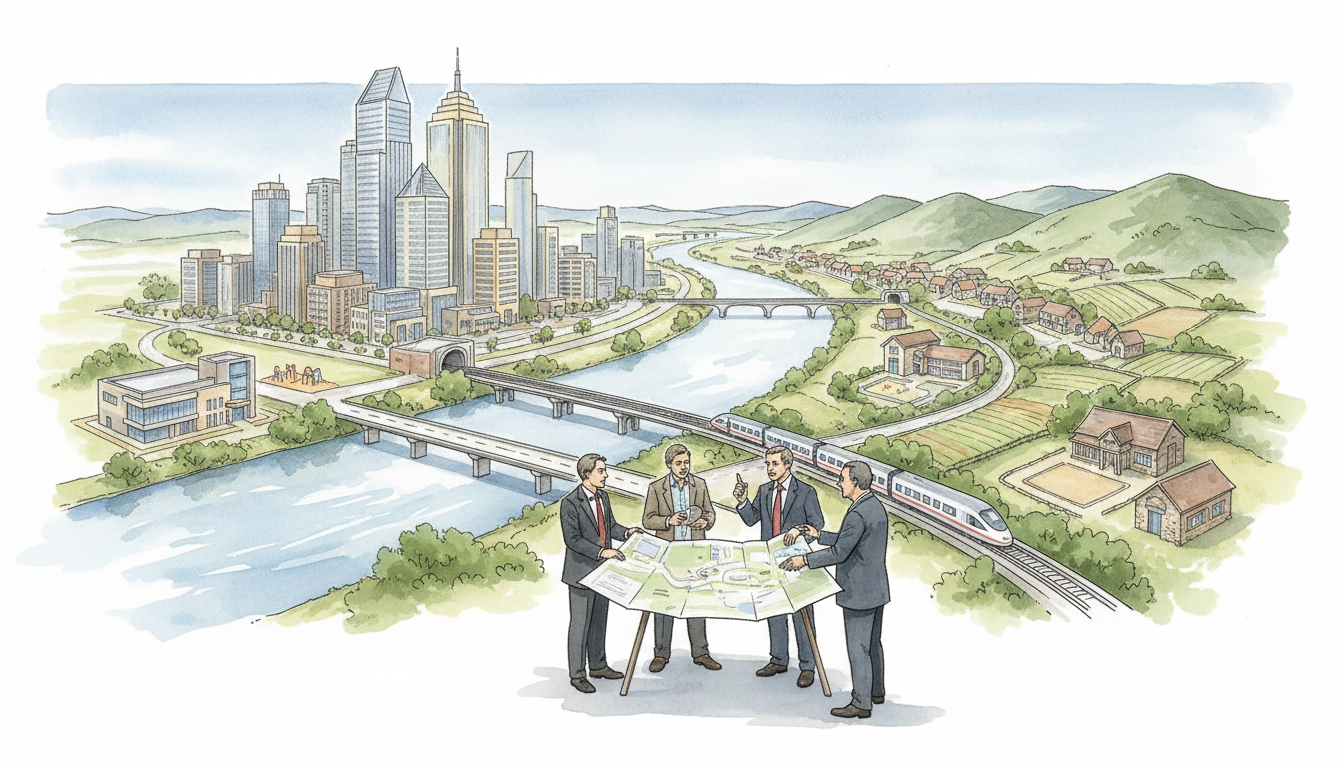
Quick answer: A federated and multi-level governance civilisation coordinates responsibilities among national, regional and local institutions while maintaining understandable authority, financing, public services and accountability. Federalism, decentralisation, regional administration and inter-municipal cooperation are different arrangements, and unitary states can also operate many levels of administration. The practical question is which level is authorised to do what, which boundary matches a real service, and how residents can obtain a fair explanation when institutions overlap.
Did you know? Two towns can be legally distinct yet depend on the same water system, transport corridor and specialist workforce. A regional government may exist within a federal constitution or a unitary state; the same word ‘region’ therefore does not answer who makes law or who can spend public money. A civilisation’s administrative skill lies in coordinating real needs without losing public accountability.
Layerhaven is a fictional model of national, regional and local institutions. Its authorities, budgets, voting procedures and service outcomes are imaginary. The article continues Types of a Civilisation and complements Constitutional and Rule-of-Law Institutions without presenting any one federal or unitary arrangement as intrinsically superior.
This is general comparative civic education, not a legal opinion, a proposal to reform any actual state or political advocacy. Country-specific constitutional law, elections, public finance and local-government mandates must be checked through applicable official sources. Every classroom decision is nonbinding.
Five reading routes
- Parents: start with the quick answer, Missions 01, 04, 05, 08 and the final succession question.
- Primary students: sort government roles and draw separate public-service and legal-authority arrows.
- Secondary students: analyse fictional cost-sharing, representation and data counts without confusing proportions with fairness.
- Tutors: teach sixteen missions with rotating evidence, arithmetic and public-interest roles.
- Research readers: compare the OECD’s 2019 decentralisation handbook and 2026 inter-municipal research, plus relevant treaty sources.
Six pillars of multi-level governance capability
- Clear powers: citizens can identify which institution may lawfully make a decision.
- Appropriate scale: services are organised around the people and territory they actually serve.
- Fair finance: delegated tasks have transparent and sustainable funding arrangements.
- Shared knowledge: agencies use comparable definitions, records and coordinated processes.
- Meaningful accountability: residents and participating places can obtain reasons and correction.
- Durability: lawful mandates and cooperative skills persist after the original officials leave.
Nine official case files for comparing governments
Source 1: OECD — Making Decentralisation Work: A Handbook for Policy-Makers (2019)
The OECD examines decentralisation designs in federal and unitary countries, emphasizing clarity of responsibilities, fiscal arrangements, policy coordination and accountability rather than declaring decentralisation universally beneficial.
Read the originating publication or treaty text. Its jurisdiction and time matter. OECD reports compare countries under a research framework; the European Charter binds parties under its legal terms; UN goals express international development objectives. None automatically determines the legal powers of imaginary Layerhaven.
Reader task: write a statement supported by this particular source, then note what still requires the actual country’s constitutional and administrative law. Distinguish a recommended cooperation model from one demonstrably working in a named place. The class should not borrow international authority to justify invented local rules.
Source 2: OECD — How to Make Inter-Municipal Co-operation Work (June 2026)
The OECD’s 2026 report documents varied ways municipalities share services, capacity and infrastructure, and why legal, institutional and fiscal design must be suitable to the service.
Read the originating publication or treaty text. Its jurisdiction and time matter. OECD reports compare countries under a research framework; the European Charter binds parties under its legal terms; UN goals express international development objectives. None automatically determines the legal powers of imaginary Layerhaven.
Reader task: write a statement supported by this particular source, then note what still requires the actual country’s constitutional and administrative law. Distinguish a recommended cooperation model from one demonstrably working in a named place. The class should not borrow international authority to justify invented local rules.
Source 3: OECD — Inter-Municipal Co-operation, Policy Frameworks (2026)
The report identifies legal clarity, institutional fitness and fair financing as three linked pillars and stresses balance of representation, trust, transparency and meaningful data.
Read the originating publication or treaty text. Its jurisdiction and time matter. OECD reports compare countries under a research framework; the European Charter binds parties under its legal terms; UN goals express international development objectives. None automatically determines the legal powers of imaginary Layerhaven.
Reader task: write a statement supported by this particular source, then note what still requires the actual country’s constitutional and administrative law. Distinguish a recommended cooperation model from one demonstrably working in a named place. The class should not borrow international authority to justify invented local rules.
Source 4: Council of Europe — European Charter of Local Self-Government
Opened in 1985, the treaty establishes principles for local self-government among participating states; it does not apply as identical binding law to every country worldwide.
Read the originating publication or treaty text. Its jurisdiction and time matter. OECD reports compare countries under a research framework; the European Charter binds parties under its legal terms; UN goals express international development objectives. None automatically determines the legal powers of imaginary Layerhaven.
Reader task: write a statement supported by this particular source, then note what still requires the actual country’s constitutional and administrative law. Distinguish a recommended cooperation model from one demonstrably working in a named place. The class should not borrow international authority to justify invented local rules.
Source 5: Council of Europe Treaty Office — European Charter No. 122
The Treaty Office documents the official treaty text, ratification and legal history, all of which require jurisdiction-specific interpretation.
Read the originating publication or treaty text. Its jurisdiction and time matter. OECD reports compare countries under a research framework; the European Charter binds parties under its legal terms; UN goals express international development objectives. None automatically determines the legal powers of imaginary Layerhaven.
Reader task: write a statement supported by this particular source, then note what still requires the actual country’s constitutional and administrative law. Distinguish a recommended cooperation model from one demonstrably working in a named place. The class should not borrow international authority to justify invented local rules.
Source 6: OECD — Government at a Glance 2025: Citizen Participation and Deliberation
The OECD distinguishes representative decision-making from complementary consultation and deliberation; the evidence concerns specified cases and methods, not an automatic guarantee of consensus.
Read the originating publication or treaty text. Its jurisdiction and time matter. OECD reports compare countries under a research framework; the European Charter binds parties under its legal terms; UN goals express international development objectives. None automatically determines the legal powers of imaginary Layerhaven.
Reader task: write a statement supported by this particular source, then note what still requires the actual country’s constitutional and administrative law. Distinguish a recommended cooperation model from one demonstrably working in a named place. The class should not borrow international authority to justify invented local rules.
Source 7: United Nations Sustainable Development Goal 11.3
SDG 11.3 describes inclusive and sustainable urbanisation and participatory human-settlement planning, with targets that should not be treated as already attained.
Read the originating publication or treaty text. Its jurisdiction and time matter. OECD reports compare countries under a research framework; the European Charter binds parties under its legal terms; UN goals express international development objectives. None automatically determines the legal powers of imaginary Layerhaven.
Reader task: write a statement supported by this particular source, then note what still requires the actual country’s constitutional and administrative law. Distinguish a recommended cooperation model from one demonstrably working in a named place. The class should not borrow international authority to justify invented local rules.
Source 8: eduKateSG — Constitutional and Rule-of-Law Institutions
This complementary article concerns lawful, reviewable exercise of public power; the present one concerns allocation of responsibilities and cooperation among government levels.
Read the originating publication or treaty text. Its jurisdiction and time matter. OECD reports compare countries under a research framework; the European Charter binds parties under its legal terms; UN goals express international development objectives. None automatically determines the legal powers of imaginary Layerhaven.
Reader task: write a statement supported by this particular source, then note what still requires the actual country’s constitutional and administrative law. Distinguish a recommended cooperation model from one demonstrably working in a named place. The class should not borrow international authority to justify invented local rules.
Source 9: eduKateSG — Planetary Interdependence and Global Cooperation
This complementary type explores cross-border worldwide relations; a multi-level polity has particular legal arrangements within or across its own defined jurisdictions.
Read the originating publication or treaty text. Its jurisdiction and time matter. OECD reports compare countries under a research framework; the European Charter binds parties under its legal terms; UN goals express international development objectives. None automatically determines the legal powers of imaginary Layerhaven.
Reader task: write a statement supported by this particular source, then note what still requires the actual country’s constitutional and administrative law. Distinguish a recommended cooperation model from one demonstrably working in a named place. The class should not borrow international authority to justify invented local rules.
Index of the sixteen Layerhaven missions
- 01 — Federal, unitary, regional and local are different categories
- 02 — The legal assignment of public responsibilities
- 03 — National standards and locally adapted service delivery
- 04 — Functional regions versus political borders
- 05 — Inter-municipal agreements and shared services
- 06 — Representation when large and small places cooperate
- 07 — Municipal finance, budget competence and capacity
- 08 — Equalisation, redistribution and unequal regional resources
- 09 — Urban-rural cooperation and geographic spillovers
- 10 — Shared procurement, specialist staff and economies of scale
- 11 — Land-use coordination, transport and housing
- 12 — Water, waste and environmental governance across borders
- 13 — Public participation, deliberation and representative authority
- 14 — Public records, data interoperability and accountability
- 15 — Disaster coordination and emergency authority
- 16 — Institutional succession and cooperative learning
Mission 01 — Federal, unitary, regional and local are different categories
The Layerhaven question: In Layerhaven, a public-poster designer labels the town’s district office a state government, its county council a federation and its national ministry a municipality.
Who is authorised to do what?
A federal arrangement constitutionally distributes powers between levels in a particular way; a unitary state can decentralise or devolve some responsibilities; a regional office may administer central authority; a municipality may possess its own defined powers. Labels cannot be exchanged without legal context.
The first lesson is a source-of-power test. A mayor, regional agency, state government, local council, public contractor and shared service body may perform different functions. Ask where the authority comes from, whether it is delegated or original under that legal order, and what the institution can actually decide.
In this case, in layerhaven, a public-poster designer labels the town’s district office a state government, its county council a federation and its national ministry a municipality. The teacher should ask whether the dispute concerns lawful competence, service delivery, finance, data or democratic representation. A system may coordinate well in one function and poorly in another; the category ‘federal’ alone does not determine performance.
The service and its functional geography
Function and geography must not be confused. A political border identifies a jurisdiction; a watershed, commuting area, hospital catchment or supply chain identifies a functional relationship. A service may need cooperation across boundaries while leaving the boundary itself intact.
Good decentralisation is not simply transferring tasks downward. Capacity, funding, staff, knowledge, oversight and lawful responsibility must accompany the assignment. The OECD warns that design and implementation shape outcomes; the same institutional label can mask very different real arrangements.
Apply this mechanism to the public service: A federal arrangement constitutionally distributes powers between levels in a particular way; a unitary state can decentralise or devolve some responsibilities; a regional office may administer central authority; a municipality may possess its own defined powers. Labels cannot be exchanged without legal context. Draw distinct arrows for legal authority, service operation, financing and the movement of people or materials. A fictional agreement must not be presented as an official power in a real jurisdiction.
The source, the law and the research claim
One government level may set a rule and another deliver the service, but the public still needs a comprehensible route for questions and complaints. An impressive organisational chart is not enough if residents are repeatedly redirected with no answer. Record the decision owner and the service owner separately.
Local voice and broad standards need not be treated as automatic enemies. One arrangement may protect basic standards while allowing contextual delivery; another may require stronger central coordination for safety or fairness. Discuss their relevant advantages and drawbacks without advocating for a real political faction.
Compare a principle from the OECD handbook with the actual authority a town would require to implement it. Identify which parts are general comparative guidance and which depend on national legislation. A student should not treat one country’s municipal rules as worldwide norms.
A conditional calculation, not a verdict on fairness
Of twelve fictional government cards, four refer to municipal offices, three regional, two national and three undefined. One-third municipal does not establish the constitutional nature of any country.
Mathematical evidence should be precise. A budget saved through joint procurement is conditional on quality, timing and coordination costs; a survey turnout figure is not proof of legitimacy; identical grants to different-sized communities do not necessarily deliver equal services per resident.
Change one invented number while preserving the denominator and units. Ask if the revised result still means a savings, coverage or documentation measure under the stated assumptions. It may not show an adequate service, legitimate representation or fair treatment. Correctly understanding the arithmetic is a beginning, not an institutional audit.
The altered assumption and a clear correction
Rainbolt reveals that a regional office only implements delegated instructions rather than exercising autonomous law-making power.
Rainbolt changes the original situation: an agreement expires, a contractor leaves, a service area shifts, a rule is amended or a previously ignored group raises an issue. Keep the original plan and mark the condition that now fails. A good correction identifies which legitimate authority must reassess the case.
The first diagram remains visible beside the revision. Pupils circle which office, contract, budget or functional boundary was affected, and explain the extra evidence needed before a real authority could act. They should not invent a law, contract or binding council decision to repair the classroom story.
Whose voice or service was hidden?
Wintour asks that citizens be told which institution can actually make and review each decision.
Wintour asks how smaller places, vulnerable residents, workers and ecosystems are represented. One large centre may exert greater influence without being the only community affected. Fair representation and effective delivery are related questions that require transparent arrangements and context.
Subnational cooperation can reduce duplication but also create new bureaucracy and weak public accountability if responsibilities are vague. The learner should ask what function is shared, which powers remain local, which costs must be paid and what happens if the arrangement fails.
Respectful civic reasoning can weigh local autonomy, consistent standards, financial sustainability and residents’ access without requiring all stakeholders to agree. The useful result is a transparent record of positions and lawful responsibility, not a declaration that one type of state is inherently virtuous.
Safe family activity and small-group tutorial
Sort the fictional entities by source of authority, function, elected or appointed role, and appeal path.
Children can work through fictitious budgets, administrative maps and public notices. They should not attempt real municipal legal interpretations, election procedures, procurement actions or emergency operations. Source evaluation and careful reasoning are sufficient for the educational purpose.
Divide a three-person tutorial into public-authority mapper, fiscal or numerical reviewer and resident-rights advocate. After one interruption, rotate roles. Each learner should describe the strongest contrary concern accurately before proposing a source-grounded change.
An institution that survives leadership changes needs a durable file: current legal source, relevant institutions, shared-service agreement, funding, data definition, review date, legitimate complaint process and correction record. A successor should not be expected to rely on a retired leader’s private knowledge.
Four source-and-decision cards
Identify the source of competence
The public claim is: In Layerhaven, a public-poster designer labels the town’s district office a state government, its county council a federation and its national ministry a municipality. Name the institution that purportedly acts, the likely kind of authorising document and the difference between legal authority and administrative convenience. Do not cite one country’s law as a rule for Layerhaven.
A model response should begin with the institutional mechanism: A federal arrangement constitutionally distributes powers between levels in a particular way; a unitary state can decentralise or devolve some responsibilities; a regional office may administer central authority; a municipality may possess its own defined powers. Labels cannot be exchanged without legal context. Then identify a potentially valid benefit of cooperation, a meaningful risk and the limits of the toy calculation. A named source and an explicit legal boundary are more useful than a confident invented rule.
Tutor assessment: one student explains the assignment of power, another checks evidence and maths, and the third represents the citizen seeking a usable service. After rotating the roles, all write the corrected public explanation. The instructor rewards accurate comparison of perspectives rather than partisan certainty.
Check the fiscal or numerical result
The worksheet says: Of twelve fictional government cards, four refer to municipal offices, three regional, two national and three undefined. One-third municipal does not establish the constitutional nature of any country. Show the numerator or units, change an input and explain why the amount alone cannot certify a just or effective service.
A model response should begin with the institutional mechanism: A federal arrangement constitutionally distributes powers between levels in a particular way; a unitary state can decentralise or devolve some responsibilities; a regional office may administer central authority; a municipality may possess its own defined powers. Labels cannot be exchanged without legal context. Then identify a potentially valid benefit of cooperation, a meaningful risk and the limits of the toy calculation. A named source and an explicit legal boundary are more useful than a confident invented rule.
Tutor assessment: one student explains the assignment of power, another checks evidence and maths, and the third represents the citizen seeking a usable service. After rotating the roles, all write the corrected public explanation. The instructor rewards accurate comparison of perspectives rather than partisan certainty.
Find the handoff that no longer works
Rainbolt reveals: Rainbolt reveals that a regional office only implements delegated instructions rather than exercising autonomous law-making power. Draw the original and revised handoff, identify its source and state which authority would need qualified advice in a real case.
A model response should begin with the institutional mechanism: A federal arrangement constitutionally distributes powers between levels in a particular way; a unitary state can decentralise or devolve some responsibilities; a regional office may administer central authority; a municipality may possess its own defined powers. Labels cannot be exchanged without legal context. Then identify a potentially valid benefit of cooperation, a meaningful risk and the limits of the toy calculation. A named source and an explicit legal boundary are more useful than a confident invented rule.
Tutor assessment: one student explains the assignment of power, another checks evidence and maths, and the third represents the citizen seeking a usable service. After rotating the roles, all write the corrected public explanation. The instructor rewards accurate comparison of perspectives rather than partisan certainty.
Hear the overlooked place or person
Wintour asks: Wintour asks that citizens be told which institution can actually make and review each decision. Write the strongest concern for both a larger and smaller participating community, and identify what evidence would help a balanced response.
A model response should begin with the institutional mechanism: A federal arrangement constitutionally distributes powers between levels in a particular way; a unitary state can decentralise or devolve some responsibilities; a regional office may administer central authority; a municipality may possess its own defined powers. Labels cannot be exchanged without legal context. Then identify a potentially valid benefit of cooperation, a meaningful risk and the limits of the toy calculation. A named source and an explicit legal boundary are more useful than a confident invented rule.
Tutor assessment: one student explains the assignment of power, another checks evidence and maths, and the third represents the citizen seeking a usable service. After rotating the roles, all write the corrected public explanation. The instructor rewards accurate comparison of perspectives rather than partisan certainty.
Transfer: Federal, unitary, regional and local are different categories becomes civic knowledge when a future learner can identify the competent office, the service’s functional area, the legal uncertainty and the reason the original plan was revised.
Mission 02 — The legal assignment of public responsibilities
The Layerhaven question: Layerhaven opens a new park and then three different departments each claim someone else is responsible for keeping it safe.
Who is authorised to do what?
Legitimate public responsibilities arise from laws, constitutions, administrative instruments and contractual arrangements that differ by jurisdiction. An institution’s name does not establish the powers it may exercise or transfer.
The first lesson is a source-of-power test. A mayor, regional agency, state government, local council, public contractor and shared service body may perform different functions. Ask where the authority comes from, whether it is delegated or original under that legal order, and what the institution can actually decide.
In this case, layerhaven opens a new park and then three different departments each claim someone else is responsible for keeping it safe. The teacher should ask whether the dispute concerns lawful competence, service delivery, finance, data or democratic representation. A system may coordinate well in one function and poorly in another; the category ‘federal’ alone does not determine performance.
The service and its functional geography
Function and geography must not be confused. A political border identifies a jurisdiction; a watershed, commuting area, hospital catchment or supply chain identifies a functional relationship. A service may need cooperation across boundaries while leaving the boundary itself intact.
Good decentralisation is not simply transferring tasks downward. Capacity, funding, staff, knowledge, oversight and lawful responsibility must accompany the assignment. The OECD warns that design and implementation shape outcomes; the same institutional label can mask very different real arrangements.
Apply this mechanism to the public service: Legitimate public responsibilities arise from laws, constitutions, administrative instruments and contractual arrangements that differ by jurisdiction. An institution’s name does not establish the powers it may exercise or transfer. Draw distinct arrows for legal authority, service operation, financing and the movement of people or materials. A fictional agreement must not be presented as an official power in a real jurisdiction.
The source, the law and the research claim
One government level may set a rule and another deliver the service, but the public still needs a comprehensible route for questions and complaints. An impressive organisational chart is not enough if residents are repeatedly redirected with no answer. Record the decision owner and the service owner separately.
Local voice and broad standards need not be treated as automatic enemies. One arrangement may protect basic standards while allowing contextual delivery; another may require stronger central coordination for safety or fairness. Discuss their relevant advantages and drawbacks without advocating for a real political faction.
Compare a principle from the OECD handbook with the actual authority a town would require to implement it. Identify which parts are general comparative guidance and which depend on national legislation. A student should not treat one country’s municipal rules as worldwide norms.
A conditional calculation, not a verdict on fairness
Eight of ten invented service obligations have a named authorised owner, giving 80% paper assignment coverage, not legal compliance.
Mathematical evidence should be precise. A budget saved through joint procurement is conditional on quality, timing and coordination costs; a survey turnout figure is not proof of legitimacy; identical grants to different-sized communities do not necessarily deliver equal services per resident.
Change one invented number while preserving the denominator and units. Ask if the revised result still means a savings, coverage or documentation measure under the stated assumptions. It may not show an adequate service, legitimate representation or fair treatment. Correctly understanding the arithmetic is a beginning, not an institutional audit.
The altered assumption and a clear correction
Rainbolt finds the park maintenance agreement expired last month.
Rainbolt changes the original situation: an agreement expires, a contractor leaves, a service area shifts, a rule is amended or a previously ignored group raises an issue. Keep the original plan and mark the condition that now fails. A good correction identifies which legitimate authority must reassess the case.
The first diagram remains visible beside the revision. Pupils circle which office, contract, budget or functional boundary was affected, and explain the extra evidence needed before a real authority could act. They should not invent a law, contract or binding council decision to repair the classroom story.
Whose voice or service was hidden?
Wintour asks how families can report an unsafe condition without being passed indefinitely between offices.
Wintour asks how smaller places, vulnerable residents, workers and ecosystems are represented. One large centre may exert greater influence without being the only community affected. Fair representation and effective delivery are related questions that require transparent arrangements and context.
Subnational cooperation can reduce duplication but also create new bureaucracy and weak public accountability if responsibilities are vague. The learner should ask what function is shared, which powers remain local, which costs must be paid and what happens if the arrangement fails.
Respectful civic reasoning can weigh local autonomy, consistent standards, financial sustainability and residents’ access without requiring all stakeholders to agree. The useful result is a transparent record of positions and lawful responsibility, not a declaration that one type of state is inherently virtuous.
Safe family activity and small-group tutorial
Create a paper responsibility matrix with authority, service, funding and correction columns.
Children can work through fictitious budgets, administrative maps and public notices. They should not attempt real municipal legal interpretations, election procedures, procurement actions or emergency operations. Source evaluation and careful reasoning are sufficient for the educational purpose.
Divide a three-person tutorial into public-authority mapper, fiscal or numerical reviewer and resident-rights advocate. After one interruption, rotate roles. Each learner should describe the strongest contrary concern accurately before proposing a source-grounded change.
An institution that survives leadership changes needs a durable file: current legal source, relevant institutions, shared-service agreement, funding, data definition, review date, legitimate complaint process and correction record. A successor should not be expected to rely on a retired leader’s private knowledge.
Four source-and-decision cards
Identify the source of competence
The public claim is: Layerhaven opens a new park and then three different departments each claim someone else is responsible for keeping it safe. Name the institution that purportedly acts, the likely kind of authorising document and the difference between legal authority and administrative convenience. Do not cite one country’s law as a rule for Layerhaven.
A model response should begin with the institutional mechanism: Legitimate public responsibilities arise from laws, constitutions, administrative instruments and contractual arrangements that differ by jurisdiction. An institution’s name does not establish the powers it may exercise or transfer. Then identify a potentially valid benefit of cooperation, a meaningful risk and the limits of the toy calculation. A named source and an explicit legal boundary are more useful than a confident invented rule.
Tutor assessment: one student explains the assignment of power, another checks evidence and maths, and the third represents the citizen seeking a usable service. After rotating the roles, all write the corrected public explanation. The instructor rewards accurate comparison of perspectives rather than partisan certainty.
Check the fiscal or numerical result
The worksheet says: Eight of ten invented service obligations have a named authorised owner, giving 80% paper assignment coverage, not legal compliance. Show the numerator or units, change an input and explain why the amount alone cannot certify a just or effective service.
A model response should begin with the institutional mechanism: Legitimate public responsibilities arise from laws, constitutions, administrative instruments and contractual arrangements that differ by jurisdiction. An institution’s name does not establish the powers it may exercise or transfer. Then identify a potentially valid benefit of cooperation, a meaningful risk and the limits of the toy calculation. A named source and an explicit legal boundary are more useful than a confident invented rule.
Tutor assessment: one student explains the assignment of power, another checks evidence and maths, and the third represents the citizen seeking a usable service. After rotating the roles, all write the corrected public explanation. The instructor rewards accurate comparison of perspectives rather than partisan certainty.
Find the handoff that no longer works
Rainbolt reveals: Rainbolt finds the park maintenance agreement expired last month. Draw the original and revised handoff, identify its source and state which authority would need qualified advice in a real case.
A model response should begin with the institutional mechanism: Legitimate public responsibilities arise from laws, constitutions, administrative instruments and contractual arrangements that differ by jurisdiction. An institution’s name does not establish the powers it may exercise or transfer. Then identify a potentially valid benefit of cooperation, a meaningful risk and the limits of the toy calculation. A named source and an explicit legal boundary are more useful than a confident invented rule.
Tutor assessment: one student explains the assignment of power, another checks evidence and maths, and the third represents the citizen seeking a usable service. After rotating the roles, all write the corrected public explanation. The instructor rewards accurate comparison of perspectives rather than partisan certainty.
Hear the overlooked place or person
Wintour asks: Wintour asks how families can report an unsafe condition without being passed indefinitely between offices. Write the strongest concern for both a larger and smaller participating community, and identify what evidence would help a balanced response.
A model response should begin with the institutional mechanism: Legitimate public responsibilities arise from laws, constitutions, administrative instruments and contractual arrangements that differ by jurisdiction. An institution’s name does not establish the powers it may exercise or transfer. Then identify a potentially valid benefit of cooperation, a meaningful risk and the limits of the toy calculation. A named source and an explicit legal boundary are more useful than a confident invented rule.
Tutor assessment: one student explains the assignment of power, another checks evidence and maths, and the third represents the citizen seeking a usable service. After rotating the roles, all write the corrected public explanation. The instructor rewards accurate comparison of perspectives rather than partisan certainty.
Transfer: The legal assignment of public responsibilities becomes civic knowledge when a future learner can identify the competent office, the service’s functional area, the legal uncertainty and the reason the original plan was revised.
Mission 03 — National standards and locally adapted service delivery
The Layerhaven question: One district adopts a school-service procedure designed for a dense city even though its rural residents face very different travel conditions.
Who is authorised to do what?
Common service goals can coexist with locally adapted implementation under legitimate authority. National minimum standards and subnational delivery arrangements must be analysed separately rather than assumed to conflict by definition.
The first lesson is a source-of-power test. A mayor, regional agency, state government, local council, public contractor and shared service body may perform different functions. Ask where the authority comes from, whether it is delegated or original under that legal order, and what the institution can actually decide.
In this case, one district adopts a school-service procedure designed for a dense city even though its rural residents face very different travel conditions. The teacher should ask whether the dispute concerns lawful competence, service delivery, finance, data or democratic representation. A system may coordinate well in one function and poorly in another; the category ‘federal’ alone does not determine performance.
The service and its functional geography
Function and geography must not be confused. A political border identifies a jurisdiction; a watershed, commuting area, hospital catchment or supply chain identifies a functional relationship. A service may need cooperation across boundaries while leaving the boundary itself intact.
Good decentralisation is not simply transferring tasks downward. Capacity, funding, staff, knowledge, oversight and lawful responsibility must accompany the assignment. The OECD warns that design and implementation shape outcomes; the same institutional label can mask very different real arrangements.
Apply this mechanism to the public service: Common service goals can coexist with locally adapted implementation under legitimate authority. National minimum standards and subnational delivery arrangements must be analysed separately rather than assumed to conflict by definition. Draw distinct arrows for legal authority, service operation, financing and the movement of people or materials. A fictional agreement must not be presented as an official power in a real jurisdiction.
The source, the law and the research claim
One government level may set a rule and another deliver the service, but the public still needs a comprehensible route for questions and complaints. An impressive organisational chart is not enough if residents are repeatedly redirected with no answer. Record the decision owner and the service owner separately.
Local voice and broad standards need not be treated as automatic enemies. One arrangement may protect basic standards while allowing contextual delivery; another may require stronger central coordination for safety or fairness. Discuss their relevant advantages and drawbacks without advocating for a real political faction.
Compare a principle from the OECD handbook with the actual authority a town would require to implement it. Identify which parts are general comparative guidance and which depend on national legislation. A student should not treat one country’s municipal rules as worldwide norms.
A conditional calculation, not a verdict on fairness
A fictional region has six service centres, four meeting a stated paper access requirement. The ratio 4/6 is not a national compliance statistic.
Mathematical evidence should be precise. A budget saved through joint procurement is conditional on quality, timing and coordination costs; a survey turnout figure is not proof of legitimacy; identical grants to different-sized communities do not necessarily deliver equal services per resident.
Change one invented number while preserving the denominator and units. Ask if the revised result still means a savings, coverage or documentation measure under the stated assumptions. It may not show an adequate service, legitimate representation or fair treatment. Correctly understanding the arithmetic is a beginning, not an institutional audit.
The altered assumption and a clear correction
Rainbolt introduces an inaccessible road to one of the supposedly qualifying centres.
Rainbolt changes the original situation: an agreement expires, a contractor leaves, a service area shifts, a rule is amended or a previously ignored group raises an issue. Keep the original plan and mark the condition that now fails. A good correction identifies which legitimate authority must reassess the case.
The first diagram remains visible beside the revision. Pupils circle which office, contract, budget or functional boundary was affected, and explain the extra evidence needed before a real authority could act. They should not invent a law, contract or binding council decision to repair the classroom story.
Whose voice or service was hidden?
Wintour asks whether consistent rights and locally specific needs can both be addressed.
Wintour asks how smaller places, vulnerable residents, workers and ecosystems are represented. One large centre may exert greater influence without being the only community affected. Fair representation and effective delivery are related questions that require transparent arrangements and context.
Subnational cooperation can reduce duplication but also create new bureaucracy and weak public accountability if responsibilities are vague. The learner should ask what function is shared, which powers remain local, which costs must be paid and what happens if the arrangement fails.
Respectful civic reasoning can weigh local autonomy, consistent standards, financial sustainability and residents’ access without requiring all stakeholders to agree. The useful result is a transparent record of positions and lawful responsibility, not a declaration that one type of state is inherently virtuous.
Safe family activity and small-group tutorial
Compare an invented standard with two different community maps, keeping the professional review question explicit.
Children can work through fictitious budgets, administrative maps and public notices. They should not attempt real municipal legal interpretations, election procedures, procurement actions or emergency operations. Source evaluation and careful reasoning are sufficient for the educational purpose.
Divide a three-person tutorial into public-authority mapper, fiscal or numerical reviewer and resident-rights advocate. After one interruption, rotate roles. Each learner should describe the strongest contrary concern accurately before proposing a source-grounded change.
An institution that survives leadership changes needs a durable file: current legal source, relevant institutions, shared-service agreement, funding, data definition, review date, legitimate complaint process and correction record. A successor should not be expected to rely on a retired leader’s private knowledge.
Four source-and-decision cards
Identify the source of competence
The public claim is: One district adopts a school-service procedure designed for a dense city even though its rural residents face very different travel conditions. Name the institution that purportedly acts, the likely kind of authorising document and the difference between legal authority and administrative convenience. Do not cite one country’s law as a rule for Layerhaven.
A model response should begin with the institutional mechanism: Common service goals can coexist with locally adapted implementation under legitimate authority. National minimum standards and subnational delivery arrangements must be analysed separately rather than assumed to conflict by definition. Then identify a potentially valid benefit of cooperation, a meaningful risk and the limits of the toy calculation. A named source and an explicit legal boundary are more useful than a confident invented rule.
Tutor assessment: one student explains the assignment of power, another checks evidence and maths, and the third represents the citizen seeking a usable service. After rotating the roles, all write the corrected public explanation. The instructor rewards accurate comparison of perspectives rather than partisan certainty.
Check the fiscal or numerical result
The worksheet says: A fictional region has six service centres, four meeting a stated paper access requirement. The ratio 4/6 is not a national compliance statistic. Show the numerator or units, change an input and explain why the amount alone cannot certify a just or effective service.
A model response should begin with the institutional mechanism: Common service goals can coexist with locally adapted implementation under legitimate authority. National minimum standards and subnational delivery arrangements must be analysed separately rather than assumed to conflict by definition. Then identify a potentially valid benefit of cooperation, a meaningful risk and the limits of the toy calculation. A named source and an explicit legal boundary are more useful than a confident invented rule.
Tutor assessment: one student explains the assignment of power, another checks evidence and maths, and the third represents the citizen seeking a usable service. After rotating the roles, all write the corrected public explanation. The instructor rewards accurate comparison of perspectives rather than partisan certainty.
Find the handoff that no longer works
Rainbolt reveals: Rainbolt introduces an inaccessible road to one of the supposedly qualifying centres. Draw the original and revised handoff, identify its source and state which authority would need qualified advice in a real case.
A model response should begin with the institutional mechanism: Common service goals can coexist with locally adapted implementation under legitimate authority. National minimum standards and subnational delivery arrangements must be analysed separately rather than assumed to conflict by definition. Then identify a potentially valid benefit of cooperation, a meaningful risk and the limits of the toy calculation. A named source and an explicit legal boundary are more useful than a confident invented rule.
Tutor assessment: one student explains the assignment of power, another checks evidence and maths, and the third represents the citizen seeking a usable service. After rotating the roles, all write the corrected public explanation. The instructor rewards accurate comparison of perspectives rather than partisan certainty.
Hear the overlooked place or person
Wintour asks: Wintour asks whether consistent rights and locally specific needs can both be addressed. Write the strongest concern for both a larger and smaller participating community, and identify what evidence would help a balanced response.
A model response should begin with the institutional mechanism: Common service goals can coexist with locally adapted implementation under legitimate authority. National minimum standards and subnational delivery arrangements must be analysed separately rather than assumed to conflict by definition. Then identify a potentially valid benefit of cooperation, a meaningful risk and the limits of the toy calculation. A named source and an explicit legal boundary are more useful than a confident invented rule.
Tutor assessment: one student explains the assignment of power, another checks evidence and maths, and the third represents the citizen seeking a usable service. After rotating the roles, all write the corrected public explanation. The instructor rewards accurate comparison of perspectives rather than partisan certainty.
Transfer: National standards and locally adapted service delivery becomes civic knowledge when a future learner can identify the competent office, the service’s functional area, the legal uncertainty and the reason the original plan was revised.
Mission 04 — Functional regions versus political borders
The Layerhaven question: Two neighbouring municipalities share a continuous urban area, but the official transport map stops at the administrative line.
Who is authorised to do what?
A functional region can describe common commuting, employment or service patterns that do not match a legal boundary. Cooperative arrangements may coordinate across jurisdictions while retaining distinct legal powers.
The first lesson is a source-of-power test. A mayor, regional agency, state government, local council, public contractor and shared service body may perform different functions. Ask where the authority comes from, whether it is delegated or original under that legal order, and what the institution can actually decide.
In this case, two neighbouring municipalities share a continuous urban area, but the official transport map stops at the administrative line. The teacher should ask whether the dispute concerns lawful competence, service delivery, finance, data or democratic representation. A system may coordinate well in one function and poorly in another; the category ‘federal’ alone does not determine performance.
The service and its functional geography
Function and geography must not be confused. A political border identifies a jurisdiction; a watershed, commuting area, hospital catchment or supply chain identifies a functional relationship. A service may need cooperation across boundaries while leaving the boundary itself intact.
Good decentralisation is not simply transferring tasks downward. Capacity, funding, staff, knowledge, oversight and lawful responsibility must accompany the assignment. The OECD warns that design and implementation shape outcomes; the same institutional label can mask very different real arrangements.
Apply this mechanism to the public service: A functional region can describe common commuting, employment or service patterns that do not match a legal boundary. Cooperative arrangements may coordinate across jurisdictions while retaining distinct legal powers. Draw distinct arrows for legal authority, service operation, financing and the movement of people or materials. A fictional agreement must not be presented as an official power in a real jurisdiction.
The source, the law and the research claim
One government level may set a rule and another deliver the service, but the public still needs a comprehensible route for questions and complaints. An impressive organisational chart is not enough if residents are repeatedly redirected with no answer. Record the decision owner and the service owner separately.
Local voice and broad standards need not be treated as automatic enemies. One arrangement may protect basic standards while allowing contextual delivery; another may require stronger central coordination for safety or fairness. Discuss their relevant advantages and drawbacks without advocating for a real political faction.
Compare a principle from the OECD handbook with the actual authority a town would require to implement it. Identify which parts are general comparative guidance and which depend on national legislation. A student should not treat one country’s municipal rules as worldwide norms.
A conditional calculation, not a verdict on fairness
A hypothetical region has 100 commuting trips, 35 crossing the municipal line; 35% of the invented trips cross the border, not a real commuting statistic.
Mathematical evidence should be precise. A budget saved through joint procurement is conditional on quality, timing and coordination costs; a survey turnout figure is not proof of legitimacy; identical grants to different-sized communities do not necessarily deliver equal services per resident.
Change one invented number while preserving the denominator and units. Ask if the revised result still means a savings, coverage or documentation measure under the stated assumptions. It may not show an adequate service, legitimate representation or fair treatment. Correctly understanding the arithmetic is a beginning, not an institutional audit.
The altered assumption and a clear correction
Rainbolt changes a bus interchange on one side, altering the functional network without changing the boundary.
Rainbolt changes the original situation: an agreement expires, a contractor leaves, a service area shifts, a rule is amended or a previously ignored group raises an issue. Keep the original plan and mark the condition that now fails. A good correction identifies which legitimate authority must reassess the case.
The first diagram remains visible beside the revision. Pupils circle which office, contract, budget or functional boundary was affected, and explain the extra evidence needed before a real authority could act. They should not invent a law, contract or binding council decision to repair the classroom story.
Whose voice or service was hidden?
Wintour considers residents who depend on services across the line but have limited representation in their management.
Wintour asks how smaller places, vulnerable residents, workers and ecosystems are represented. One large centre may exert greater influence without being the only community affected. Fair representation and effective delivery are related questions that require transparent arrangements and context.
Subnational cooperation can reduce duplication but also create new bureaucracy and weak public accountability if responsibilities are vague. The learner should ask what function is shared, which powers remain local, which costs must be paid and what happens if the arrangement fails.
Respectful civic reasoning can weigh local autonomy, consistent standards, financial sustainability and residents’ access without requiring all stakeholders to agree. The useful result is a transparent record of positions and lawful responsibility, not a declaration that one type of state is inherently virtuous.
Safe family activity and small-group tutorial
Use a paper metro-region map with separate legal and travel arrows.
Children can work through fictitious budgets, administrative maps and public notices. They should not attempt real municipal legal interpretations, election procedures, procurement actions or emergency operations. Source evaluation and careful reasoning are sufficient for the educational purpose.
Divide a three-person tutorial into public-authority mapper, fiscal or numerical reviewer and resident-rights advocate. After one interruption, rotate roles. Each learner should describe the strongest contrary concern accurately before proposing a source-grounded change.
An institution that survives leadership changes needs a durable file: current legal source, relevant institutions, shared-service agreement, funding, data definition, review date, legitimate complaint process and correction record. A successor should not be expected to rely on a retired leader’s private knowledge.
Four source-and-decision cards
Identify the source of competence
The public claim is: Two neighbouring municipalities share a continuous urban area, but the official transport map stops at the administrative line. Name the institution that purportedly acts, the likely kind of authorising document and the difference between legal authority and administrative convenience. Do not cite one country’s law as a rule for Layerhaven.
A model response should begin with the institutional mechanism: A functional region can describe common commuting, employment or service patterns that do not match a legal boundary. Cooperative arrangements may coordinate across jurisdictions while retaining distinct legal powers. Then identify a potentially valid benefit of cooperation, a meaningful risk and the limits of the toy calculation. A named source and an explicit legal boundary are more useful than a confident invented rule.
Tutor assessment: one student explains the assignment of power, another checks evidence and maths, and the third represents the citizen seeking a usable service. After rotating the roles, all write the corrected public explanation. The instructor rewards accurate comparison of perspectives rather than partisan certainty.
Check the fiscal or numerical result
The worksheet says: A hypothetical region has 100 commuting trips, 35 crossing the municipal line; 35% of the invented trips cross the border, not a real commuting statistic. Show the numerator or units, change an input and explain why the amount alone cannot certify a just or effective service.
A model response should begin with the institutional mechanism: A functional region can describe common commuting, employment or service patterns that do not match a legal boundary. Cooperative arrangements may coordinate across jurisdictions while retaining distinct legal powers. Then identify a potentially valid benefit of cooperation, a meaningful risk and the limits of the toy calculation. A named source and an explicit legal boundary are more useful than a confident invented rule.
Tutor assessment: one student explains the assignment of power, another checks evidence and maths, and the third represents the citizen seeking a usable service. After rotating the roles, all write the corrected public explanation. The instructor rewards accurate comparison of perspectives rather than partisan certainty.
Find the handoff that no longer works
Rainbolt reveals: Rainbolt changes a bus interchange on one side, altering the functional network without changing the boundary. Draw the original and revised handoff, identify its source and state which authority would need qualified advice in a real case.
A model response should begin with the institutional mechanism: A functional region can describe common commuting, employment or service patterns that do not match a legal boundary. Cooperative arrangements may coordinate across jurisdictions while retaining distinct legal powers. Then identify a potentially valid benefit of cooperation, a meaningful risk and the limits of the toy calculation. A named source and an explicit legal boundary are more useful than a confident invented rule.
Tutor assessment: one student explains the assignment of power, another checks evidence and maths, and the third represents the citizen seeking a usable service. After rotating the roles, all write the corrected public explanation. The instructor rewards accurate comparison of perspectives rather than partisan certainty.
Hear the overlooked place or person
Wintour asks: Wintour considers residents who depend on services across the line but have limited representation in their management. Write the strongest concern for both a larger and smaller participating community, and identify what evidence would help a balanced response.
A model response should begin with the institutional mechanism: A functional region can describe common commuting, employment or service patterns that do not match a legal boundary. Cooperative arrangements may coordinate across jurisdictions while retaining distinct legal powers. Then identify a potentially valid benefit of cooperation, a meaningful risk and the limits of the toy calculation. A named source and an explicit legal boundary are more useful than a confident invented rule.
Tutor assessment: one student explains the assignment of power, another checks evidence and maths, and the third represents the citizen seeking a usable service. After rotating the roles, all write the corrected public explanation. The instructor rewards accurate comparison of perspectives rather than partisan certainty.
Transfer: Functional regions versus political borders becomes civic knowledge when a future learner can identify the competent office, the service’s functional area, the legal uncertainty and the reason the original plan was revised.
Mission 05 — Inter-municipal agreements and shared services
The Layerhaven question: Two villages each want a specialist public-health laboratory but neither has enough demand or funding for the full service on its own.
Who is authorised to do what?
Municipal cooperation can take contractual, joint-entity, association or other forms depending on law and need. The 2026 OECD report notes that collaboration can share capacity while creating accountability or coordination challenges if poorly designed.
The first lesson is a source-of-power test. A mayor, regional agency, state government, local council, public contractor and shared service body may perform different functions. Ask where the authority comes from, whether it is delegated or original under that legal order, and what the institution can actually decide.
In this case, two villages each want a specialist public-health laboratory but neither has enough demand or funding for the full service on its own. The teacher should ask whether the dispute concerns lawful competence, service delivery, finance, data or democratic representation. A system may coordinate well in one function and poorly in another; the category ‘federal’ alone does not determine performance.
The service and its functional geography
Function and geography must not be confused. A political border identifies a jurisdiction; a watershed, commuting area, hospital catchment or supply chain identifies a functional relationship. A service may need cooperation across boundaries while leaving the boundary itself intact.
Good decentralisation is not simply transferring tasks downward. Capacity, funding, staff, knowledge, oversight and lawful responsibility must accompany the assignment. The OECD warns that design and implementation shape outcomes; the same institutional label can mask very different real arrangements.
Apply this mechanism to the public service: Municipal cooperation can take contractual, joint-entity, association or other forms depending on law and need. The 2026 OECD report notes that collaboration can share capacity while creating accountability or coordination challenges if poorly designed. Draw distinct arrows for legal authority, service operation, financing and the movement of people or materials. A fictional agreement must not be presented as an official power in a real jurisdiction.
The source, the law and the research claim
One government level may set a rule and another deliver the service, but the public still needs a comprehensible route for questions and complaints. An impressive organisational chart is not enough if residents are repeatedly redirected with no answer. Record the decision owner and the service owner separately.
Local voice and broad standards need not be treated as automatic enemies. One arrangement may protect basic standards while allowing contextual delivery; another may require stronger central coordination for safety or fairness. Discuss their relevant advantages and drawbacks without advocating for a real political faction.
Compare a principle from the OECD handbook with the actual authority a town would require to implement it. Identify which parts are general comparative guidance and which depend on national legislation. A student should not treat one country’s municipal rules as worldwide norms.
A conditional calculation, not a verdict on fairness
Two fictional councils each spend 60 units on a service; a proposed joint service costs 90 plus 20 coordination units, totalling 110 instead of 120, a 10-unit model saving before other effects.
Mathematical evidence should be precise. A budget saved through joint procurement is conditional on quality, timing and coordination costs; a survey turnout figure is not proof of legitimacy; identical grants to different-sized communities do not necessarily deliver equal services per resident.
Change one invented number while preserving the denominator and units. Ask if the revised result still means a savings, coverage or documentation measure under the stated assumptions. It may not show an adequate service, legitimate representation or fair treatment. Correctly understanding the arithmetic is a beginning, not an institutional audit.
The altered assumption and a clear correction
Rainbolt adds a 15-unit hidden coordination cost and the numerical saving disappears.
Rainbolt changes the original situation: an agreement expires, a contractor leaves, a service area shifts, a rule is amended or a previously ignored group raises an issue. Keep the original plan and mark the condition that now fails. A good correction identifies which legitimate authority must reassess the case.
The first diagram remains visible beside the revision. Pupils circle which office, contract, budget or functional boundary was affected, and explain the extra evidence needed before a real authority could act. They should not invent a law, contract or binding council decision to repair the classroom story.
Whose voice or service was hidden?
Wintour asks whether smaller villages retain a meaningful say and whether service quality is maintained.
Wintour asks how smaller places, vulnerable residents, workers and ecosystems are represented. One large centre may exert greater influence without being the only community affected. Fair representation and effective delivery are related questions that require transparent arrangements and context.
Subnational cooperation can reduce duplication but also create new bureaucracy and weak public accountability if responsibilities are vague. The learner should ask what function is shared, which powers remain local, which costs must be paid and what happens if the arrangement fails.
Respectful civic reasoning can weigh local autonomy, consistent standards, financial sustainability and residents’ access without requiring all stakeholders to agree. The useful result is a transparent record of positions and lawful responsibility, not a declaration that one type of state is inherently virtuous.
Safe family activity and small-group tutorial
Draft a fictional agreement outline identifying owners, beneficiaries, review, duration and dispute process.
Children can work through fictitious budgets, administrative maps and public notices. They should not attempt real municipal legal interpretations, election procedures, procurement actions or emergency operations. Source evaluation and careful reasoning are sufficient for the educational purpose.
Divide a three-person tutorial into public-authority mapper, fiscal or numerical reviewer and resident-rights advocate. After one interruption, rotate roles. Each learner should describe the strongest contrary concern accurately before proposing a source-grounded change.
An institution that survives leadership changes needs a durable file: current legal source, relevant institutions, shared-service agreement, funding, data definition, review date, legitimate complaint process and correction record. A successor should not be expected to rely on a retired leader’s private knowledge.
Four source-and-decision cards
Identify the source of competence
The public claim is: Two villages each want a specialist public-health laboratory but neither has enough demand or funding for the full service on its own. Name the institution that purportedly acts, the likely kind of authorising document and the difference between legal authority and administrative convenience. Do not cite one country’s law as a rule for Layerhaven.
A model response should begin with the institutional mechanism: Municipal cooperation can take contractual, joint-entity, association or other forms depending on law and need. The 2026 OECD report notes that collaboration can share capacity while creating accountability or coordination challenges if poorly designed. Then identify a potentially valid benefit of cooperation, a meaningful risk and the limits of the toy calculation. A named source and an explicit legal boundary are more useful than a confident invented rule.
Tutor assessment: one student explains the assignment of power, another checks evidence and maths, and the third represents the citizen seeking a usable service. After rotating the roles, all write the corrected public explanation. The instructor rewards accurate comparison of perspectives rather than partisan certainty.
Check the fiscal or numerical result
The worksheet says: Two fictional councils each spend 60 units on a service; a proposed joint service costs 90 plus 20 coordination units, totalling 110 instead of 120, a 10-unit model saving before other effects. Show the numerator or units, change an input and explain why the amount alone cannot certify a just or effective service.
A model response should begin with the institutional mechanism: Municipal cooperation can take contractual, joint-entity, association or other forms depending on law and need. The 2026 OECD report notes that collaboration can share capacity while creating accountability or coordination challenges if poorly designed. Then identify a potentially valid benefit of cooperation, a meaningful risk and the limits of the toy calculation. A named source and an explicit legal boundary are more useful than a confident invented rule.
Tutor assessment: one student explains the assignment of power, another checks evidence and maths, and the third represents the citizen seeking a usable service. After rotating the roles, all write the corrected public explanation. The instructor rewards accurate comparison of perspectives rather than partisan certainty.
Find the handoff that no longer works
Rainbolt reveals: Rainbolt adds a 15-unit hidden coordination cost and the numerical saving disappears. Draw the original and revised handoff, identify its source and state which authority would need qualified advice in a real case.
A model response should begin with the institutional mechanism: Municipal cooperation can take contractual, joint-entity, association or other forms depending on law and need. The 2026 OECD report notes that collaboration can share capacity while creating accountability or coordination challenges if poorly designed. Then identify a potentially valid benefit of cooperation, a meaningful risk and the limits of the toy calculation. A named source and an explicit legal boundary are more useful than a confident invented rule.
Tutor assessment: one student explains the assignment of power, another checks evidence and maths, and the third represents the citizen seeking a usable service. After rotating the roles, all write the corrected public explanation. The instructor rewards accurate comparison of perspectives rather than partisan certainty.
Hear the overlooked place or person
Wintour asks: Wintour asks whether smaller villages retain a meaningful say and whether service quality is maintained. Write the strongest concern for both a larger and smaller participating community, and identify what evidence would help a balanced response.
A model response should begin with the institutional mechanism: Municipal cooperation can take contractual, joint-entity, association or other forms depending on law and need. The 2026 OECD report notes that collaboration can share capacity while creating accountability or coordination challenges if poorly designed. Then identify a potentially valid benefit of cooperation, a meaningful risk and the limits of the toy calculation. A named source and an explicit legal boundary are more useful than a confident invented rule.
Tutor assessment: one student explains the assignment of power, another checks evidence and maths, and the third represents the citizen seeking a usable service. After rotating the roles, all write the corrected public explanation. The instructor rewards accurate comparison of perspectives rather than partisan certainty.
Transfer: Inter-municipal agreements and shared services becomes civic knowledge when a future learner can identify the competent office, the service’s functional area, the legal uncertainty and the reason the original plan was revised.
Mission 06 — Representation when large and small places cooperate
The Layerhaven question: Layerhaven’s joint regional board gives a large city every vote because it has the largest population, leaving smaller towns with no formal influence.
Who is authorised to do what?
Cooperation structures must consider fair representation and function; weighted votes, joint committees and other methods have different advantages and risks. Neither one-person-one-vote nor identical municipality votes automatically settles every public service decision.
The first lesson is a source-of-power test. A mayor, regional agency, state government, local council, public contractor and shared service body may perform different functions. Ask where the authority comes from, whether it is delegated or original under that legal order, and what the institution can actually decide.
In this case, layerhaven’s joint regional board gives a large city every vote because it has the largest population, leaving smaller towns with no formal influence. The teacher should ask whether the dispute concerns lawful competence, service delivery, finance, data or democratic representation. A system may coordinate well in one function and poorly in another; the category ‘federal’ alone does not determine performance.
The service and its functional geography
Function and geography must not be confused. A political border identifies a jurisdiction; a watershed, commuting area, hospital catchment or supply chain identifies a functional relationship. A service may need cooperation across boundaries while leaving the boundary itself intact.
Good decentralisation is not simply transferring tasks downward. Capacity, funding, staff, knowledge, oversight and lawful responsibility must accompany the assignment. The OECD warns that design and implementation shape outcomes; the same institutional label can mask very different real arrangements.
Apply this mechanism to the public service: Cooperation structures must consider fair representation and function; weighted votes, joint committees and other methods have different advantages and risks. Neither one-person-one-vote nor identical municipality votes automatically settles every public service decision. Draw distinct arrows for legal authority, service operation, financing and the movement of people or materials. A fictional agreement must not be presented as an official power in a real jurisdiction.
The source, the law and the research claim
One government level may set a rule and another deliver the service, but the public still needs a comprehensible route for questions and complaints. An impressive organisational chart is not enough if residents are repeatedly redirected with no answer. Record the decision owner and the service owner separately.
Local voice and broad standards need not be treated as automatic enemies. One arrangement may protect basic standards while allowing contextual delivery; another may require stronger central coordination for safety or fairness. Discuss their relevant advantages and drawbacks without advocating for a real political faction.
Compare a principle from the OECD handbook with the actual authority a town would require to implement it. Identify which parts are general comparative guidance and which depend on national legislation. A student should not treat one country’s municipal rules as worldwide norms.
A conditional calculation, not a verdict on fairness
A paper board has 12 seats and four towns receive three each. That is equal seats per town, not equal seats per resident or proven fairness.
Mathematical evidence should be precise. A budget saved through joint procurement is conditional on quality, timing and coordination costs; a survey turnout figure is not proof of legitimacy; identical grants to different-sized communities do not necessarily deliver equal services per resident.
Change one invented number while preserving the denominator and units. Ask if the revised result still means a savings, coverage or documentation measure under the stated assumptions. It may not show an adequate service, legitimate representation or fair treatment. Correctly understanding the arithmetic is a beginning, not an institutional audit.
The altered assumption and a clear correction
Rainbolt introduces a new town with very different population and service needs.
Rainbolt changes the original situation: an agreement expires, a contractor leaves, a service area shifts, a rule is amended or a previously ignored group raises an issue. Keep the original plan and mark the condition that now fails. A good correction identifies which legitimate authority must reassess the case.
The first diagram remains visible beside the revision. Pupils circle which office, contract, budget or functional boundary was affected, and explain the extra evidence needed before a real authority could act. They should not invent a law, contract or binding council decision to repair the classroom story.
Whose voice or service was hidden?
Wintour asks how minorities, smaller communities and affected residents can be heard legitimately.
Wintour asks how smaller places, vulnerable residents, workers and ecosystems are represented. One large centre may exert greater influence without being the only community affected. Fair representation and effective delivery are related questions that require transparent arrangements and context.
Subnational cooperation can reduce duplication but also create new bureaucracy and weak public accountability if responsibilities are vague. The learner should ask what function is shared, which powers remain local, which costs must be paid and what happens if the arrangement fails.
Respectful civic reasoning can weigh local autonomy, consistent standards, financial sustainability and residents’ access without requiring all stakeholders to agree. The useful result is a transparent record of positions and lawful responsibility, not a declaration that one type of state is inherently virtuous.
Safe family activity and small-group tutorial
Run a mock board discussion with clearly invented representation rules and a written minority concern.
Children can work through fictitious budgets, administrative maps and public notices. They should not attempt real municipal legal interpretations, election procedures, procurement actions or emergency operations. Source evaluation and careful reasoning are sufficient for the educational purpose.
Divide a three-person tutorial into public-authority mapper, fiscal or numerical reviewer and resident-rights advocate. After one interruption, rotate roles. Each learner should describe the strongest contrary concern accurately before proposing a source-grounded change.
An institution that survives leadership changes needs a durable file: current legal source, relevant institutions, shared-service agreement, funding, data definition, review date, legitimate complaint process and correction record. A successor should not be expected to rely on a retired leader’s private knowledge.
Four source-and-decision cards
Identify the source of competence
The public claim is: Layerhaven’s joint regional board gives a large city every vote because it has the largest population, leaving smaller towns with no formal influence. Name the institution that purportedly acts, the likely kind of authorising document and the difference between legal authority and administrative convenience. Do not cite one country’s law as a rule for Layerhaven.
A model response should begin with the institutional mechanism: Cooperation structures must consider fair representation and function; weighted votes, joint committees and other methods have different advantages and risks. Neither one-person-one-vote nor identical municipality votes automatically settles every public service decision. Then identify a potentially valid benefit of cooperation, a meaningful risk and the limits of the toy calculation. A named source and an explicit legal boundary are more useful than a confident invented rule.
Tutor assessment: one student explains the assignment of power, another checks evidence and maths, and the third represents the citizen seeking a usable service. After rotating the roles, all write the corrected public explanation. The instructor rewards accurate comparison of perspectives rather than partisan certainty.
Check the fiscal or numerical result
The worksheet says: A paper board has 12 seats and four towns receive three each. That is equal seats per town, not equal seats per resident or proven fairness. Show the numerator or units, change an input and explain why the amount alone cannot certify a just or effective service.
A model response should begin with the institutional mechanism: Cooperation structures must consider fair representation and function; weighted votes, joint committees and other methods have different advantages and risks. Neither one-person-one-vote nor identical municipality votes automatically settles every public service decision. Then identify a potentially valid benefit of cooperation, a meaningful risk and the limits of the toy calculation. A named source and an explicit legal boundary are more useful than a confident invented rule.
Tutor assessment: one student explains the assignment of power, another checks evidence and maths, and the third represents the citizen seeking a usable service. After rotating the roles, all write the corrected public explanation. The instructor rewards accurate comparison of perspectives rather than partisan certainty.
Find the handoff that no longer works
Rainbolt reveals: Rainbolt introduces a new town with very different population and service needs. Draw the original and revised handoff, identify its source and state which authority would need qualified advice in a real case.
A model response should begin with the institutional mechanism: Cooperation structures must consider fair representation and function; weighted votes, joint committees and other methods have different advantages and risks. Neither one-person-one-vote nor identical municipality votes automatically settles every public service decision. Then identify a potentially valid benefit of cooperation, a meaningful risk and the limits of the toy calculation. A named source and an explicit legal boundary are more useful than a confident invented rule.
Tutor assessment: one student explains the assignment of power, another checks evidence and maths, and the third represents the citizen seeking a usable service. After rotating the roles, all write the corrected public explanation. The instructor rewards accurate comparison of perspectives rather than partisan certainty.
Hear the overlooked place or person
Wintour asks: Wintour asks how minorities, smaller communities and affected residents can be heard legitimately. Write the strongest concern for both a larger and smaller participating community, and identify what evidence would help a balanced response.
A model response should begin with the institutional mechanism: Cooperation structures must consider fair representation and function; weighted votes, joint committees and other methods have different advantages and risks. Neither one-person-one-vote nor identical municipality votes automatically settles every public service decision. Then identify a potentially valid benefit of cooperation, a meaningful risk and the limits of the toy calculation. A named source and an explicit legal boundary are more useful than a confident invented rule.
Tutor assessment: one student explains the assignment of power, another checks evidence and maths, and the third represents the citizen seeking a usable service. After rotating the roles, all write the corrected public explanation. The instructor rewards accurate comparison of perspectives rather than partisan certainty.
Transfer: Representation when large and small places cooperate becomes civic knowledge when a future learner can identify the competent office, the service’s functional area, the legal uncertainty and the reason the original plan was revised.
Mission 07 — Municipal finance, budget competence and capacity
The Layerhaven question: A village accepts responsibility for a new service but receives no qualified staff, usable revenue or explanation of who pays for maintenance.
Who is authorised to do what?
Decentralised tasks require appropriate finance, administration, staffing, data and legal powers. A transfer of responsibility on paper may fail without capacity and clear accountability. Actual revenue arrangements vary widely.
The first lesson is a source-of-power test. A mayor, regional agency, state government, local council, public contractor and shared service body may perform different functions. Ask where the authority comes from, whether it is delegated or original under that legal order, and what the institution can actually decide.
In this case, a village accepts responsibility for a new service but receives no qualified staff, usable revenue or explanation of who pays for maintenance. The teacher should ask whether the dispute concerns lawful competence, service delivery, finance, data or democratic representation. A system may coordinate well in one function and poorly in another; the category ‘federal’ alone does not determine performance.
The service and its functional geography
Function and geography must not be confused. A political border identifies a jurisdiction; a watershed, commuting area, hospital catchment or supply chain identifies a functional relationship. A service may need cooperation across boundaries while leaving the boundary itself intact.
Good decentralisation is not simply transferring tasks downward. Capacity, funding, staff, knowledge, oversight and lawful responsibility must accompany the assignment. The OECD warns that design and implementation shape outcomes; the same institutional label can mask very different real arrangements.
Apply this mechanism to the public service: Decentralised tasks require appropriate finance, administration, staffing, data and legal powers. A transfer of responsibility on paper may fail without capacity and clear accountability. Actual revenue arrangements vary widely. Draw distinct arrows for legal authority, service operation, financing and the movement of people or materials. A fictional agreement must not be presented as an official power in a real jurisdiction.
The source, the law and the research claim
One government level may set a rule and another deliver the service, but the public still needs a comprehensible route for questions and complaints. An impressive organisational chart is not enough if residents are repeatedly redirected with no answer. Record the decision owner and the service owner separately.
Local voice and broad standards need not be treated as automatic enemies. One arrangement may protect basic standards while allowing contextual delivery; another may require stronger central coordination for safety or fairness. Discuss their relevant advantages and drawbacks without advocating for a real political faction.
Compare a principle from the OECD handbook with the actual authority a town would require to implement it. Identify which parts are general comparative guidance and which depend on national legislation. A student should not treat one country’s municipal rules as worldwide norms.
A conditional calculation, not a verdict on fairness
A fictional 100-unit budget devotes 35 to workers, 30 to service materials and 35 to infrastructure. The shares add to 100 but cannot prove adequacy.
Mathematical evidence should be precise. A budget saved through joint procurement is conditional on quality, timing and coordination costs; a survey turnout figure is not proof of legitimacy; identical grants to different-sized communities do not necessarily deliver equal services per resident.
Change one invented number while preserving the denominator and units. Ask if the revised result still means a savings, coverage or documentation measure under the stated assumptions. It may not show an adequate service, legitimate representation or fair treatment. Correctly understanding the arithmetic is a beginning, not an institutional audit.
The altered assumption and a clear correction
Rainbolt reveals that a capital project will require long-term maintenance not in the budget.
Rainbolt changes the original situation: an agreement expires, a contractor leaves, a service area shifts, a rule is amended or a previously ignored group raises an issue. Keep the original plan and mark the condition that now fails. A good correction identifies which legitimate authority must reassess the case.
The first diagram remains visible beside the revision. Pupils circle which office, contract, budget or functional boundary was affected, and explain the extra evidence needed before a real authority could act. They should not invent a law, contract or binding council decision to repair the classroom story.
Whose voice or service was hidden?
Wintour asks whether rural and poorer areas can deliver essential services at acceptable standards.
Wintour asks how smaller places, vulnerable residents, workers and ecosystems are represented. One large centre may exert greater influence without being the only community affected. Fair representation and effective delivery are related questions that require transparent arrangements and context.
Subnational cooperation can reduce duplication but also create new bureaucracy and weak public accountability if responsibilities are vague. The learner should ask what function is shared, which powers remain local, which costs must be paid and what happens if the arrangement fails.
Respectful civic reasoning can weigh local autonomy, consistent standards, financial sustainability and residents’ access without requiring all stakeholders to agree. The useful result is a transparent record of positions and lawful responsibility, not a declaration that one type of state is inherently virtuous.
Safe family activity and small-group tutorial
Use paper budgets and mark funding, operating duties and future obligations separately.
Children can work through fictitious budgets, administrative maps and public notices. They should not attempt real municipal legal interpretations, election procedures, procurement actions or emergency operations. Source evaluation and careful reasoning are sufficient for the educational purpose.
Divide a three-person tutorial into public-authority mapper, fiscal or numerical reviewer and resident-rights advocate. After one interruption, rotate roles. Each learner should describe the strongest contrary concern accurately before proposing a source-grounded change.
An institution that survives leadership changes needs a durable file: current legal source, relevant institutions, shared-service agreement, funding, data definition, review date, legitimate complaint process and correction record. A successor should not be expected to rely on a retired leader’s private knowledge.
Four source-and-decision cards
Identify the source of competence
The public claim is: A village accepts responsibility for a new service but receives no qualified staff, usable revenue or explanation of who pays for maintenance. Name the institution that purportedly acts, the likely kind of authorising document and the difference between legal authority and administrative convenience. Do not cite one country’s law as a rule for Layerhaven.
A model response should begin with the institutional mechanism: Decentralised tasks require appropriate finance, administration, staffing, data and legal powers. A transfer of responsibility on paper may fail without capacity and clear accountability. Actual revenue arrangements vary widely. Then identify a potentially valid benefit of cooperation, a meaningful risk and the limits of the toy calculation. A named source and an explicit legal boundary are more useful than a confident invented rule.
Tutor assessment: one student explains the assignment of power, another checks evidence and maths, and the third represents the citizen seeking a usable service. After rotating the roles, all write the corrected public explanation. The instructor rewards accurate comparison of perspectives rather than partisan certainty.
Check the fiscal or numerical result
The worksheet says: A fictional 100-unit budget devotes 35 to workers, 30 to service materials and 35 to infrastructure. The shares add to 100 but cannot prove adequacy. Show the numerator or units, change an input and explain why the amount alone cannot certify a just or effective service.
A model response should begin with the institutional mechanism: Decentralised tasks require appropriate finance, administration, staffing, data and legal powers. A transfer of responsibility on paper may fail without capacity and clear accountability. Actual revenue arrangements vary widely. Then identify a potentially valid benefit of cooperation, a meaningful risk and the limits of the toy calculation. A named source and an explicit legal boundary are more useful than a confident invented rule.
Tutor assessment: one student explains the assignment of power, another checks evidence and maths, and the third represents the citizen seeking a usable service. After rotating the roles, all write the corrected public explanation. The instructor rewards accurate comparison of perspectives rather than partisan certainty.
Find the handoff that no longer works
Rainbolt reveals: Rainbolt reveals that a capital project will require long-term maintenance not in the budget. Draw the original and revised handoff, identify its source and state which authority would need qualified advice in a real case.
A model response should begin with the institutional mechanism: Decentralised tasks require appropriate finance, administration, staffing, data and legal powers. A transfer of responsibility on paper may fail without capacity and clear accountability. Actual revenue arrangements vary widely. Then identify a potentially valid benefit of cooperation, a meaningful risk and the limits of the toy calculation. A named source and an explicit legal boundary are more useful than a confident invented rule.
Tutor assessment: one student explains the assignment of power, another checks evidence and maths, and the third represents the citizen seeking a usable service. After rotating the roles, all write the corrected public explanation. The instructor rewards accurate comparison of perspectives rather than partisan certainty.
Hear the overlooked place or person
Wintour asks: Wintour asks whether rural and poorer areas can deliver essential services at acceptable standards. Write the strongest concern for both a larger and smaller participating community, and identify what evidence would help a balanced response.
A model response should begin with the institutional mechanism: Decentralised tasks require appropriate finance, administration, staffing, data and legal powers. A transfer of responsibility on paper may fail without capacity and clear accountability. Actual revenue arrangements vary widely. Then identify a potentially valid benefit of cooperation, a meaningful risk and the limits of the toy calculation. A named source and an explicit legal boundary are more useful than a confident invented rule.
Tutor assessment: one student explains the assignment of power, another checks evidence and maths, and the third represents the citizen seeking a usable service. After rotating the roles, all write the corrected public explanation. The instructor rewards accurate comparison of perspectives rather than partisan certainty.
Transfer: Municipal finance, budget competence and capacity becomes civic knowledge when a future learner can identify the competent office, the service’s functional area, the legal uncertainty and the reason the original plan was revised.
Mission 08 — Equalisation, redistribution and unequal regional resources
The Layerhaven question: A wealthy city and a small rural region face similar legal service obligations but very different local fiscal capacity.
Who is authorised to do what?
Some systems use transfers or equalisation to address differing tax bases, spending needs and service standards. Such policies raise technical and political questions and cannot be described by one universal formula.
The first lesson is a source-of-power test. A mayor, regional agency, state government, local council, public contractor and shared service body may perform different functions. Ask where the authority comes from, whether it is delegated or original under that legal order, and what the institution can actually decide.
In this case, a wealthy city and a small rural region face similar legal service obligations but very different local fiscal capacity. The teacher should ask whether the dispute concerns lawful competence, service delivery, finance, data or democratic representation. A system may coordinate well in one function and poorly in another; the category ‘federal’ alone does not determine performance.
The service and its functional geography
Function and geography must not be confused. A political border identifies a jurisdiction; a watershed, commuting area, hospital catchment or supply chain identifies a functional relationship. A service may need cooperation across boundaries while leaving the boundary itself intact.
Good decentralisation is not simply transferring tasks downward. Capacity, funding, staff, knowledge, oversight and lawful responsibility must accompany the assignment. The OECD warns that design and implementation shape outcomes; the same institutional label can mask very different real arrangements.
Apply this mechanism to the public service: Some systems use transfers or equalisation to address differing tax bases, spending needs and service standards. Such policies raise technical and political questions and cannot be described by one universal formula. Draw distinct arrows for legal authority, service operation, financing and the movement of people or materials. A fictional agreement must not be presented as an official power in a real jurisdiction.
The source, the law and the research claim
One government level may set a rule and another deliver the service, but the public still needs a comprehensible route for questions and complaints. An impressive organisational chart is not enough if residents are repeatedly redirected with no answer. Record the decision owner and the service owner separately.
Local voice and broad standards need not be treated as automatic enemies. One arrangement may protect basic standards while allowing contextual delivery; another may require stronger central coordination for safety or fairness. Discuss their relevant advantages and drawbacks without advocating for a real political faction.
Compare a principle from the OECD handbook with the actual authority a town would require to implement it. Identify which parts are general comparative guidance and which depend on national legislation. A student should not treat one country’s municipal rules as worldwide norms.
A conditional calculation, not a verdict on fairness
Under an invented model, region A raises 80 units locally and region B raises 20; a hypothetical 30-unit transfer leaves 50 and 50 after transfer, ignoring all other fiscal rules.
Mathematical evidence should be precise. A budget saved through joint procurement is conditional on quality, timing and coordination costs; a survey turnout figure is not proof of legitimacy; identical grants to different-sized communities do not necessarily deliver equal services per resident.
Change one invented number while preserving the denominator and units. Ask if the revised result still means a savings, coverage or documentation measure under the stated assumptions. It may not show an adequate service, legitimate representation or fair treatment. Correctly understanding the arithmetic is a beginning, not an institutional audit.
The altered assumption and a clear correction
Rainbolt shows that the two regions have different populations and service costs, altering the interpretation.
Rainbolt changes the original situation: an agreement expires, a contractor leaves, a service area shifts, a rule is amended or a previously ignored group raises an issue. Keep the original plan and mark the condition that now fails. A good correction identifies which legitimate authority must reassess the case.
The first diagram remains visible beside the revision. Pupils circle which office, contract, budget or functional boundary was affected, and explain the extra evidence needed before a real authority could act. They should not invent a law, contract or binding council decision to repair the classroom story.
Whose voice or service was hidden?
Wintour asks who is entitled to essential services and how transparency protects both contributors and recipients.
Wintour asks how smaller places, vulnerable residents, workers and ecosystems are represented. One large centre may exert greater influence without being the only community affected. Fair representation and effective delivery are related questions that require transparent arrangements and context.
Subnational cooperation can reduce duplication but also create new bureaucracy and weak public accountability if responsibilities are vague. The learner should ask what function is shared, which powers remain local, which costs must be paid and what happens if the arrangement fails.
Respectful civic reasoning can weigh local autonomy, consistent standards, financial sustainability and residents’ access without requiring all stakeholders to agree. The useful result is a transparent record of positions and lawful responsibility, not a declaration that one type of state is inherently virtuous.
Safe family activity and small-group tutorial
Draw a two-region paper budget and distinguish equal totals from equitable per-person provision.
Children can work through fictitious budgets, administrative maps and public notices. They should not attempt real municipal legal interpretations, election procedures, procurement actions or emergency operations. Source evaluation and careful reasoning are sufficient for the educational purpose.
Divide a three-person tutorial into public-authority mapper, fiscal or numerical reviewer and resident-rights advocate. After one interruption, rotate roles. Each learner should describe the strongest contrary concern accurately before proposing a source-grounded change.
An institution that survives leadership changes needs a durable file: current legal source, relevant institutions, shared-service agreement, funding, data definition, review date, legitimate complaint process and correction record. A successor should not be expected to rely on a retired leader’s private knowledge.
Four source-and-decision cards
Identify the source of competence
The public claim is: A wealthy city and a small rural region face similar legal service obligations but very different local fiscal capacity. Name the institution that purportedly acts, the likely kind of authorising document and the difference between legal authority and administrative convenience. Do not cite one country’s law as a rule for Layerhaven.
A model response should begin with the institutional mechanism: Some systems use transfers or equalisation to address differing tax bases, spending needs and service standards. Such policies raise technical and political questions and cannot be described by one universal formula. Then identify a potentially valid benefit of cooperation, a meaningful risk and the limits of the toy calculation. A named source and an explicit legal boundary are more useful than a confident invented rule.
Tutor assessment: one student explains the assignment of power, another checks evidence and maths, and the third represents the citizen seeking a usable service. After rotating the roles, all write the corrected public explanation. The instructor rewards accurate comparison of perspectives rather than partisan certainty.
Check the fiscal or numerical result
The worksheet says: Under an invented model, region A raises 80 units locally and region B raises 20; a hypothetical 30-unit transfer leaves 50 and 50 after transfer, ignoring all other fiscal rules. Show the numerator or units, change an input and explain why the amount alone cannot certify a just or effective service.
A model response should begin with the institutional mechanism: Some systems use transfers or equalisation to address differing tax bases, spending needs and service standards. Such policies raise technical and political questions and cannot be described by one universal formula. Then identify a potentially valid benefit of cooperation, a meaningful risk and the limits of the toy calculation. A named source and an explicit legal boundary are more useful than a confident invented rule.
Tutor assessment: one student explains the assignment of power, another checks evidence and maths, and the third represents the citizen seeking a usable service. After rotating the roles, all write the corrected public explanation. The instructor rewards accurate comparison of perspectives rather than partisan certainty.
Find the handoff that no longer works
Rainbolt reveals: Rainbolt shows that the two regions have different populations and service costs, altering the interpretation. Draw the original and revised handoff, identify its source and state which authority would need qualified advice in a real case.
A model response should begin with the institutional mechanism: Some systems use transfers or equalisation to address differing tax bases, spending needs and service standards. Such policies raise technical and political questions and cannot be described by one universal formula. Then identify a potentially valid benefit of cooperation, a meaningful risk and the limits of the toy calculation. A named source and an explicit legal boundary are more useful than a confident invented rule.
Tutor assessment: one student explains the assignment of power, another checks evidence and maths, and the third represents the citizen seeking a usable service. After rotating the roles, all write the corrected public explanation. The instructor rewards accurate comparison of perspectives rather than partisan certainty.
Hear the overlooked place or person
Wintour asks: Wintour asks who is entitled to essential services and how transparency protects both contributors and recipients. Write the strongest concern for both a larger and smaller participating community, and identify what evidence would help a balanced response.
A model response should begin with the institutional mechanism: Some systems use transfers or equalisation to address differing tax bases, spending needs and service standards. Such policies raise technical and political questions and cannot be described by one universal formula. Then identify a potentially valid benefit of cooperation, a meaningful risk and the limits of the toy calculation. A named source and an explicit legal boundary are more useful than a confident invented rule.
Tutor assessment: one student explains the assignment of power, another checks evidence and maths, and the third represents the citizen seeking a usable service. After rotating the roles, all write the corrected public explanation. The instructor rewards accurate comparison of perspectives rather than partisan certainty.
Transfer: Equalisation, redistribution and unequal regional resources becomes civic knowledge when a future learner can identify the competent office, the service’s functional area, the legal uncertainty and the reason the original plan was revised.
Mission 09 — Urban-rural cooperation and geographic spillovers
The Layerhaven question: Layerhaven’s city receives agricultural products and rural water resources, but its urban budget excludes any relationship to its hinterland.
Who is authorised to do what?
Cities and rural regions may share labour, transport, water, waste and ecological systems. Some functions benefit from joint planning across borders, subject to law, environment and stakeholder rights.
The first lesson is a source-of-power test. A mayor, regional agency, state government, local council, public contractor and shared service body may perform different functions. Ask where the authority comes from, whether it is delegated or original under that legal order, and what the institution can actually decide.
In this case, layerhaven’s city receives agricultural products and rural water resources, but its urban budget excludes any relationship to its hinterland. The teacher should ask whether the dispute concerns lawful competence, service delivery, finance, data or democratic representation. A system may coordinate well in one function and poorly in another; the category ‘federal’ alone does not determine performance.
The service and its functional geography
Function and geography must not be confused. A political border identifies a jurisdiction; a watershed, commuting area, hospital catchment or supply chain identifies a functional relationship. A service may need cooperation across boundaries while leaving the boundary itself intact.
Good decentralisation is not simply transferring tasks downward. Capacity, funding, staff, knowledge, oversight and lawful responsibility must accompany the assignment. The OECD warns that design and implementation shape outcomes; the same institutional label can mask very different real arrangements.
Apply this mechanism to the public service: Cities and rural regions may share labour, transport, water, waste and ecological systems. Some functions benefit from joint planning across borders, subject to law, environment and stakeholder rights. Draw distinct arrows for legal authority, service operation, financing and the movement of people or materials. A fictional agreement must not be presented as an official power in a real jurisdiction.
The source, the law and the research claim
One government level may set a rule and another deliver the service, but the public still needs a comprehensible route for questions and complaints. An impressive organisational chart is not enough if residents are repeatedly redirected with no answer. Record the decision owner and the service owner separately.
Local voice and broad standards need not be treated as automatic enemies. One arrangement may protect basic standards while allowing contextual delivery; another may require stronger central coordination for safety or fairness. Discuss their relevant advantages and drawbacks without advocating for a real political faction.
Compare a principle from the OECD handbook with the actual authority a town would require to implement it. Identify which parts are general comparative guidance and which depend on national legislation. A student should not treat one country’s municipal rules as worldwide norms.
A conditional calculation, not a verdict on fairness
Of ten invented service relationships, six cross the city-rural boundary. A 60% link share does not measure the monetary or ecological importance of each link.
Mathematical evidence should be precise. A budget saved through joint procurement is conditional on quality, timing and coordination costs; a survey turnout figure is not proof of legitimacy; identical grants to different-sized communities do not necessarily deliver equal services per resident.
Change one invented number while preserving the denominator and units. Ask if the revised result still means a savings, coverage or documentation measure under the stated assumptions. It may not show an adequate service, legitimate representation or fair treatment. Correctly understanding the arithmetic is a beginning, not an institutional audit.
The altered assumption and a clear correction
Rainbolt changes an upstream watershed condition that affects both communities.
Rainbolt changes the original situation: an agreement expires, a contractor leaves, a service area shifts, a rule is amended or a previously ignored group raises an issue. Keep the original plan and mark the condition that now fails. A good correction identifies which legitimate authority must reassess the case.
The first diagram remains visible beside the revision. Pupils circle which office, contract, budget or functional boundary was affected, and explain the extra evidence needed before a real authority could act. They should not invent a law, contract or binding council decision to repair the classroom story.
Whose voice or service was hidden?
Wintour asks that rural residents be represented as partners, not merely service providers to a larger city.
Wintour asks how smaller places, vulnerable residents, workers and ecosystems are represented. One large centre may exert greater influence without being the only community affected. Fair representation and effective delivery are related questions that require transparent arrangements and context.
Subnational cooperation can reduce duplication but also create new bureaucracy and weak public accountability if responsibilities are vague. The learner should ask what function is shared, which powers remain local, which costs must be paid and what happens if the arrangement fails.
Respectful civic reasoning can weigh local autonomy, consistent standards, financial sustainability and residents’ access without requiring all stakeholders to agree. The useful result is a transparent record of positions and lawful responsibility, not a declaration that one type of state is inherently virtuous.
Safe family activity and small-group tutorial
Map public-service and resource arrows between a hypothetical city and adjacent villages.
Children can work through fictitious budgets, administrative maps and public notices. They should not attempt real municipal legal interpretations, election procedures, procurement actions or emergency operations. Source evaluation and careful reasoning are sufficient for the educational purpose.
Divide a three-person tutorial into public-authority mapper, fiscal or numerical reviewer and resident-rights advocate. After one interruption, rotate roles. Each learner should describe the strongest contrary concern accurately before proposing a source-grounded change.
An institution that survives leadership changes needs a durable file: current legal source, relevant institutions, shared-service agreement, funding, data definition, review date, legitimate complaint process and correction record. A successor should not be expected to rely on a retired leader’s private knowledge.
Four source-and-decision cards
Identify the source of competence
The public claim is: Layerhaven’s city receives agricultural products and rural water resources, but its urban budget excludes any relationship to its hinterland. Name the institution that purportedly acts, the likely kind of authorising document and the difference between legal authority and administrative convenience. Do not cite one country’s law as a rule for Layerhaven.
A model response should begin with the institutional mechanism: Cities and rural regions may share labour, transport, water, waste and ecological systems. Some functions benefit from joint planning across borders, subject to law, environment and stakeholder rights. Then identify a potentially valid benefit of cooperation, a meaningful risk and the limits of the toy calculation. A named source and an explicit legal boundary are more useful than a confident invented rule.
Tutor assessment: one student explains the assignment of power, another checks evidence and maths, and the third represents the citizen seeking a usable service. After rotating the roles, all write the corrected public explanation. The instructor rewards accurate comparison of perspectives rather than partisan certainty.
Check the fiscal or numerical result
The worksheet says: Of ten invented service relationships, six cross the city-rural boundary. A 60% link share does not measure the monetary or ecological importance of each link. Show the numerator or units, change an input and explain why the amount alone cannot certify a just or effective service.
A model response should begin with the institutional mechanism: Cities and rural regions may share labour, transport, water, waste and ecological systems. Some functions benefit from joint planning across borders, subject to law, environment and stakeholder rights. Then identify a potentially valid benefit of cooperation, a meaningful risk and the limits of the toy calculation. A named source and an explicit legal boundary are more useful than a confident invented rule.
Tutor assessment: one student explains the assignment of power, another checks evidence and maths, and the third represents the citizen seeking a usable service. After rotating the roles, all write the corrected public explanation. The instructor rewards accurate comparison of perspectives rather than partisan certainty.
Find the handoff that no longer works
Rainbolt reveals: Rainbolt changes an upstream watershed condition that affects both communities. Draw the original and revised handoff, identify its source and state which authority would need qualified advice in a real case.
A model response should begin with the institutional mechanism: Cities and rural regions may share labour, transport, water, waste and ecological systems. Some functions benefit from joint planning across borders, subject to law, environment and stakeholder rights. Then identify a potentially valid benefit of cooperation, a meaningful risk and the limits of the toy calculation. A named source and an explicit legal boundary are more useful than a confident invented rule.
Tutor assessment: one student explains the assignment of power, another checks evidence and maths, and the third represents the citizen seeking a usable service. After rotating the roles, all write the corrected public explanation. The instructor rewards accurate comparison of perspectives rather than partisan certainty.
Hear the overlooked place or person
Wintour asks: Wintour asks that rural residents be represented as partners, not merely service providers to a larger city. Write the strongest concern for both a larger and smaller participating community, and identify what evidence would help a balanced response.
A model response should begin with the institutional mechanism: Cities and rural regions may share labour, transport, water, waste and ecological systems. Some functions benefit from joint planning across borders, subject to law, environment and stakeholder rights. Then identify a potentially valid benefit of cooperation, a meaningful risk and the limits of the toy calculation. A named source and an explicit legal boundary are more useful than a confident invented rule.
Tutor assessment: one student explains the assignment of power, another checks evidence and maths, and the third represents the citizen seeking a usable service. After rotating the roles, all write the corrected public explanation. The instructor rewards accurate comparison of perspectives rather than partisan certainty.
Transfer: Urban-rural cooperation and geographic spillovers becomes civic knowledge when a future learner can identify the competent office, the service’s functional area, the legal uncertainty and the reason the original plan was revised.
Mission 10 — Shared procurement, specialist staff and economies of scale
The Layerhaven question: Three towns combine purchase orders and declare savings before counting administrative time, access and quality.
Who is authorised to do what?
Joint procurement and shared specialist capacity can improve certain services where legal, governance and contract design are suitable. Scale can also introduce coordination costs, inflexibility or weak accountability.
The first lesson is a source-of-power test. A mayor, regional agency, state government, local council, public contractor and shared service body may perform different functions. Ask where the authority comes from, whether it is delegated or original under that legal order, and what the institution can actually decide.
In this case, three towns combine purchase orders and declare savings before counting administrative time, access and quality. The teacher should ask whether the dispute concerns lawful competence, service delivery, finance, data or democratic representation. A system may coordinate well in one function and poorly in another; the category ‘federal’ alone does not determine performance.
The service and its functional geography
Function and geography must not be confused. A political border identifies a jurisdiction; a watershed, commuting area, hospital catchment or supply chain identifies a functional relationship. A service may need cooperation across boundaries while leaving the boundary itself intact.
Good decentralisation is not simply transferring tasks downward. Capacity, funding, staff, knowledge, oversight and lawful responsibility must accompany the assignment. The OECD warns that design and implementation shape outcomes; the same institutional label can mask very different real arrangements.
Apply this mechanism to the public service: Joint procurement and shared specialist capacity can improve certain services where legal, governance and contract design are suitable. Scale can also introduce coordination costs, inflexibility or weak accountability. Draw distinct arrows for legal authority, service operation, financing and the movement of people or materials. A fictional agreement must not be presented as an official power in a real jurisdiction.
The source, the law and the research claim
One government level may set a rule and another deliver the service, but the public still needs a comprehensible route for questions and complaints. An impressive organisational chart is not enough if residents are repeatedly redirected with no answer. Record the decision owner and the service owner separately.
Local voice and broad standards need not be treated as automatic enemies. One arrangement may protect basic standards while allowing contextual delivery; another may require stronger central coordination for safety or fairness. Discuss their relevant advantages and drawbacks without advocating for a real political faction.
Compare a principle from the OECD handbook with the actual authority a town would require to implement it. Identify which parts are general comparative guidance and which depend on national legislation. A student should not treat one country’s municipal rules as worldwide norms.
A conditional calculation, not a verdict on fairness
Three councils buy 20 items each at five units: 300. A fictional joint quote totals 270 plus 20 coordination costs, a net saving of 10 units under the assumed scope.
Mathematical evidence should be precise. A budget saved through joint procurement is conditional on quality, timing and coordination costs; a survey turnout figure is not proof of legitimacy; identical grants to different-sized communities do not necessarily deliver equal services per resident.
Change one invented number while preserving the denominator and units. Ask if the revised result still means a savings, coverage or documentation measure under the stated assumptions. It may not show an adequate service, legitimate representation or fair treatment. Correctly understanding the arithmetic is a beginning, not an institutional audit.
The altered assumption and a clear correction
Rainbolt adds a warranty condition not equivalent across the two offers.
Rainbolt changes the original situation: an agreement expires, a contractor leaves, a service area shifts, a rule is amended or a previously ignored group raises an issue. Keep the original plan and mark the condition that now fails. A good correction identifies which legitimate authority must reassess the case.
The first diagram remains visible beside the revision. Pupils circle which office, contract, budget or functional boundary was affected, and explain the extra evidence needed before a real authority could act. They should not invent a law, contract or binding council decision to repair the classroom story.
Whose voice or service was hidden?
Wintour asks whether small suppliers can participate and whether service quality or public accountability suffers.
Wintour asks how smaller places, vulnerable residents, workers and ecosystems are represented. One large centre may exert greater influence without being the only community affected. Fair representation and effective delivery are related questions that require transparent arrangements and context.
Subnational cooperation can reduce duplication but also create new bureaucracy and weak public accountability if responsibilities are vague. The learner should ask what function is shared, which powers remain local, which costs must be paid and what happens if the arrangement fails.
Respectful civic reasoning can weigh local autonomy, consistent standards, financial sustainability and residents’ access without requiring all stakeholders to agree. The useful result is a transparent record of positions and lawful responsibility, not a declaration that one type of state is inherently virtuous.
Safe family activity and small-group tutorial
Prepare an invented procurement comparison with visible assumptions and non-price criteria.
Children can work through fictitious budgets, administrative maps and public notices. They should not attempt real municipal legal interpretations, election procedures, procurement actions or emergency operations. Source evaluation and careful reasoning are sufficient for the educational purpose.
Divide a three-person tutorial into public-authority mapper, fiscal or numerical reviewer and resident-rights advocate. After one interruption, rotate roles. Each learner should describe the strongest contrary concern accurately before proposing a source-grounded change.
An institution that survives leadership changes needs a durable file: current legal source, relevant institutions, shared-service agreement, funding, data definition, review date, legitimate complaint process and correction record. A successor should not be expected to rely on a retired leader’s private knowledge.
Four source-and-decision cards
Identify the source of competence
The public claim is: Three towns combine purchase orders and declare savings before counting administrative time, access and quality. Name the institution that purportedly acts, the likely kind of authorising document and the difference between legal authority and administrative convenience. Do not cite one country’s law as a rule for Layerhaven.
A model response should begin with the institutional mechanism: Joint procurement and shared specialist capacity can improve certain services where legal, governance and contract design are suitable. Scale can also introduce coordination costs, inflexibility or weak accountability. Then identify a potentially valid benefit of cooperation, a meaningful risk and the limits of the toy calculation. A named source and an explicit legal boundary are more useful than a confident invented rule.
Tutor assessment: one student explains the assignment of power, another checks evidence and maths, and the third represents the citizen seeking a usable service. After rotating the roles, all write the corrected public explanation. The instructor rewards accurate comparison of perspectives rather than partisan certainty.
Check the fiscal or numerical result
The worksheet says: Three councils buy 20 items each at five units: 300. A fictional joint quote totals 270 plus 20 coordination costs, a net saving of 10 units under the assumed scope. Show the numerator or units, change an input and explain why the amount alone cannot certify a just or effective service.
A model response should begin with the institutional mechanism: Joint procurement and shared specialist capacity can improve certain services where legal, governance and contract design are suitable. Scale can also introduce coordination costs, inflexibility or weak accountability. Then identify a potentially valid benefit of cooperation, a meaningful risk and the limits of the toy calculation. A named source and an explicit legal boundary are more useful than a confident invented rule.
Tutor assessment: one student explains the assignment of power, another checks evidence and maths, and the third represents the citizen seeking a usable service. After rotating the roles, all write the corrected public explanation. The instructor rewards accurate comparison of perspectives rather than partisan certainty.
Find the handoff that no longer works
Rainbolt reveals: Rainbolt adds a warranty condition not equivalent across the two offers. Draw the original and revised handoff, identify its source and state which authority would need qualified advice in a real case.
A model response should begin with the institutional mechanism: Joint procurement and shared specialist capacity can improve certain services where legal, governance and contract design are suitable. Scale can also introduce coordination costs, inflexibility or weak accountability. Then identify a potentially valid benefit of cooperation, a meaningful risk and the limits of the toy calculation. A named source and an explicit legal boundary are more useful than a confident invented rule.
Tutor assessment: one student explains the assignment of power, another checks evidence and maths, and the third represents the citizen seeking a usable service. After rotating the roles, all write the corrected public explanation. The instructor rewards accurate comparison of perspectives rather than partisan certainty.
Hear the overlooked place or person
Wintour asks: Wintour asks whether small suppliers can participate and whether service quality or public accountability suffers. Write the strongest concern for both a larger and smaller participating community, and identify what evidence would help a balanced response.
A model response should begin with the institutional mechanism: Joint procurement and shared specialist capacity can improve certain services where legal, governance and contract design are suitable. Scale can also introduce coordination costs, inflexibility or weak accountability. Then identify a potentially valid benefit of cooperation, a meaningful risk and the limits of the toy calculation. A named source and an explicit legal boundary are more useful than a confident invented rule.
Tutor assessment: one student explains the assignment of power, another checks evidence and maths, and the third represents the citizen seeking a usable service. After rotating the roles, all write the corrected public explanation. The instructor rewards accurate comparison of perspectives rather than partisan certainty.
Transfer: Shared procurement, specialist staff and economies of scale becomes civic knowledge when a future learner can identify the competent office, the service’s functional area, the legal uncertainty and the reason the original plan was revised.
Mission 11 — Land-use coordination, transport and housing
The Layerhaven question: Each town approves a housing area at its own border without considering the nearby council’s school capacity and bus routes.
Who is authorised to do what?
Spatial plans, transport and housing markets often cross jurisdictional boundaries. Multi-level governance can align planning, funding and service obligations when law and local needs permit.
The first lesson is a source-of-power test. A mayor, regional agency, state government, local council, public contractor and shared service body may perform different functions. Ask where the authority comes from, whether it is delegated or original under that legal order, and what the institution can actually decide.
In this case, each town approves a housing area at its own border without considering the nearby council’s school capacity and bus routes. The teacher should ask whether the dispute concerns lawful competence, service delivery, finance, data or democratic representation. A system may coordinate well in one function and poorly in another; the category ‘federal’ alone does not determine performance.
The service and its functional geography
Function and geography must not be confused. A political border identifies a jurisdiction; a watershed, commuting area, hospital catchment or supply chain identifies a functional relationship. A service may need cooperation across boundaries while leaving the boundary itself intact.
Good decentralisation is not simply transferring tasks downward. Capacity, funding, staff, knowledge, oversight and lawful responsibility must accompany the assignment. The OECD warns that design and implementation shape outcomes; the same institutional label can mask very different real arrangements.
Apply this mechanism to the public service: Spatial plans, transport and housing markets often cross jurisdictional boundaries. Multi-level governance can align planning, funding and service obligations when law and local needs permit. Draw distinct arrows for legal authority, service operation, financing and the movement of people or materials. A fictional agreement must not be presented as an official power in a real jurisdiction.
The source, the law and the research claim
One government level may set a rule and another deliver the service, but the public still needs a comprehensible route for questions and complaints. An impressive organisational chart is not enough if residents are repeatedly redirected with no answer. Record the decision owner and the service owner separately.
Local voice and broad standards need not be treated as automatic enemies. One arrangement may protect basic standards while allowing contextual delivery; another may require stronger central coordination for safety or fairness. Discuss their relevant advantages and drawbacks without advocating for a real political faction.
Compare a principle from the OECD handbook with the actual authority a town would require to implement it. Identify which parts are general comparative guidance and which depend on national legislation. A student should not treat one country’s municipal rules as worldwide norms.
A conditional calculation, not a verdict on fairness
A fictitious housing plan introduces 100 homes, with 40 within the existing bus catchment and 60 outside; the count does not prove the new service is sufficient.
Mathematical evidence should be precise. A budget saved through joint procurement is conditional on quality, timing and coordination costs; a survey turnout figure is not proof of legitimacy; identical grants to different-sized communities do not necessarily deliver equal services per resident.
Change one invented number while preserving the denominator and units. Ask if the revised result still means a savings, coverage or documentation measure under the stated assumptions. It may not show an adequate service, legitimate representation or fair treatment. Correctly understanding the arithmetic is a beginning, not an institutional audit.
The altered assumption and a clear correction
Rainbolt moves the regional clinic and changes the needed access route.
Rainbolt changes the original situation: an agreement expires, a contractor leaves, a service area shifts, a rule is amended or a previously ignored group raises an issue. Keep the original plan and mark the condition that now fails. A good correction identifies which legitimate authority must reassess the case.
The first diagram remains visible beside the revision. Pupils circle which office, contract, budget or functional boundary was affected, and explain the extra evidence needed before a real authority could act. They should not invent a law, contract or binding council decision to repair the classroom story.
Whose voice or service was hidden?
Wintour asks about housing affordability, displacement, children and workers who travel across the boundary.
Wintour asks how smaller places, vulnerable residents, workers and ecosystems are represented. One large centre may exert greater influence without being the only community affected. Fair representation and effective delivery are related questions that require transparent arrangements and context.
Subnational cooperation can reduce duplication but also create new bureaucracy and weak public accountability if responsibilities are vague. The learner should ask what function is shared, which powers remain local, which costs must be paid and what happens if the arrangement fails.
Respectful civic reasoning can weigh local autonomy, consistent standards, financial sustainability and residents’ access without requiring all stakeholders to agree. The useful result is a transparent record of positions and lawful responsibility, not a declaration that one type of state is inherently virtuous.
Safe family activity and small-group tutorial
Use paper zoning and public-transport cards, not actual planning submissions.
Children can work through fictitious budgets, administrative maps and public notices. They should not attempt real municipal legal interpretations, election procedures, procurement actions or emergency operations. Source evaluation and careful reasoning are sufficient for the educational purpose.
Divide a three-person tutorial into public-authority mapper, fiscal or numerical reviewer and resident-rights advocate. After one interruption, rotate roles. Each learner should describe the strongest contrary concern accurately before proposing a source-grounded change.
An institution that survives leadership changes needs a durable file: current legal source, relevant institutions, shared-service agreement, funding, data definition, review date, legitimate complaint process and correction record. A successor should not be expected to rely on a retired leader’s private knowledge.
Four source-and-decision cards
Identify the source of competence
The public claim is: Each town approves a housing area at its own border without considering the nearby council’s school capacity and bus routes. Name the institution that purportedly acts, the likely kind of authorising document and the difference between legal authority and administrative convenience. Do not cite one country’s law as a rule for Layerhaven.
A model response should begin with the institutional mechanism: Spatial plans, transport and housing markets often cross jurisdictional boundaries. Multi-level governance can align planning, funding and service obligations when law and local needs permit. Then identify a potentially valid benefit of cooperation, a meaningful risk and the limits of the toy calculation. A named source and an explicit legal boundary are more useful than a confident invented rule.
Tutor assessment: one student explains the assignment of power, another checks evidence and maths, and the third represents the citizen seeking a usable service. After rotating the roles, all write the corrected public explanation. The instructor rewards accurate comparison of perspectives rather than partisan certainty.
Check the fiscal or numerical result
The worksheet says: A fictitious housing plan introduces 100 homes, with 40 within the existing bus catchment and 60 outside; the count does not prove the new service is sufficient. Show the numerator or units, change an input and explain why the amount alone cannot certify a just or effective service.
A model response should begin with the institutional mechanism: Spatial plans, transport and housing markets often cross jurisdictional boundaries. Multi-level governance can align planning, funding and service obligations when law and local needs permit. Then identify a potentially valid benefit of cooperation, a meaningful risk and the limits of the toy calculation. A named source and an explicit legal boundary are more useful than a confident invented rule.
Tutor assessment: one student explains the assignment of power, another checks evidence and maths, and the third represents the citizen seeking a usable service. After rotating the roles, all write the corrected public explanation. The instructor rewards accurate comparison of perspectives rather than partisan certainty.
Find the handoff that no longer works
Rainbolt reveals: Rainbolt moves the regional clinic and changes the needed access route. Draw the original and revised handoff, identify its source and state which authority would need qualified advice in a real case.
A model response should begin with the institutional mechanism: Spatial plans, transport and housing markets often cross jurisdictional boundaries. Multi-level governance can align planning, funding and service obligations when law and local needs permit. Then identify a potentially valid benefit of cooperation, a meaningful risk and the limits of the toy calculation. A named source and an explicit legal boundary are more useful than a confident invented rule.
Tutor assessment: one student explains the assignment of power, another checks evidence and maths, and the third represents the citizen seeking a usable service. After rotating the roles, all write the corrected public explanation. The instructor rewards accurate comparison of perspectives rather than partisan certainty.
Hear the overlooked place or person
Wintour asks: Wintour asks about housing affordability, displacement, children and workers who travel across the boundary. Write the strongest concern for both a larger and smaller participating community, and identify what evidence would help a balanced response.
A model response should begin with the institutional mechanism: Spatial plans, transport and housing markets often cross jurisdictional boundaries. Multi-level governance can align planning, funding and service obligations when law and local needs permit. Then identify a potentially valid benefit of cooperation, a meaningful risk and the limits of the toy calculation. A named source and an explicit legal boundary are more useful than a confident invented rule.
Tutor assessment: one student explains the assignment of power, another checks evidence and maths, and the third represents the citizen seeking a usable service. After rotating the roles, all write the corrected public explanation. The instructor rewards accurate comparison of perspectives rather than partisan certainty.
Transfer: Land-use coordination, transport and housing becomes civic knowledge when a future learner can identify the competent office, the service’s functional area, the legal uncertainty and the reason the original plan was revised.
Mission 12 — Water, waste and environmental governance across borders
The Layerhaven question: Two municipalities use one river but publish separate pollution and drainage diagrams that stop exactly at the boundary.
Who is authorised to do what?
Physical systems often cross legal districts. Cooperative water and waste arrangements require scientific evidence, lawful powers, appropriate finance and fair participation. A shared river is not a guarantee that municipalities can exchange every responsibility freely.
The first lesson is a source-of-power test. A mayor, regional agency, state government, local council, public contractor and shared service body may perform different functions. Ask where the authority comes from, whether it is delegated or original under that legal order, and what the institution can actually decide.
In this case, two municipalities use one river but publish separate pollution and drainage diagrams that stop exactly at the boundary. The teacher should ask whether the dispute concerns lawful competence, service delivery, finance, data or democratic representation. A system may coordinate well in one function and poorly in another; the category ‘federal’ alone does not determine performance.
The service and its functional geography
Function and geography must not be confused. A political border identifies a jurisdiction; a watershed, commuting area, hospital catchment or supply chain identifies a functional relationship. A service may need cooperation across boundaries while leaving the boundary itself intact.
Good decentralisation is not simply transferring tasks downward. Capacity, funding, staff, knowledge, oversight and lawful responsibility must accompany the assignment. The OECD warns that design and implementation shape outcomes; the same institutional label can mask very different real arrangements.
Apply this mechanism to the public service: Physical systems often cross legal districts. Cooperative water and waste arrangements require scientific evidence, lawful powers, appropriate finance and fair participation. A shared river is not a guarantee that municipalities can exchange every responsibility freely. Draw distinct arrows for legal authority, service operation, financing and the movement of people or materials. A fictional agreement must not be presented as an official power in a real jurisdiction.
The source, the law and the research claim
One government level may set a rule and another deliver the service, but the public still needs a comprehensible route for questions and complaints. An impressive organisational chart is not enough if residents are repeatedly redirected with no answer. Record the decision owner and the service owner separately.
Local voice and broad standards need not be treated as automatic enemies. One arrangement may protect basic standards while allowing contextual delivery; another may require stronger central coordination for safety or fairness. Discuss their relevant advantages and drawbacks without advocating for a real political faction.
Compare a principle from the OECD handbook with the actual authority a town would require to implement it. Identify which parts are general comparative guidance and which depend on national legislation. A student should not treat one country’s municipal rules as worldwide norms.
A conditional calculation, not a verdict on fairness
One invented river collects 30 model units from town A and 20 from town B, totalling 50 units before any unmodelled physical or quality factors.
Mathematical evidence should be precise. A budget saved through joint procurement is conditional on quality, timing and coordination costs; a survey turnout figure is not proof of legitimacy; identical grants to different-sized communities do not necessarily deliver equal services per resident.
Change one invented number while preserving the denominator and units. Ask if the revised result still means a savings, coverage or documentation measure under the stated assumptions. It may not show an adequate service, legitimate representation or fair treatment. Correctly understanding the arithmetic is a beginning, not an institutional audit.
The altered assumption and a clear correction
Rainbolt reveals the downstream town faces a different water-quality concern from the upstream authority.
Rainbolt changes the original situation: an agreement expires, a contractor leaves, a service area shifts, a rule is amended or a previously ignored group raises an issue. Keep the original plan and mark the condition that now fails. A good correction identifies which legitimate authority must reassess the case.
The first diagram remains visible beside the revision. Pupils circle which office, contract, budget or functional boundary was affected, and explain the extra evidence needed before a real authority could act. They should not invent a law, contract or binding council decision to repair the classroom story.
Whose voice or service was hidden?
Wintour asks about ecology, downstream users and the capacity of smaller municipalities.
Wintour asks how smaller places, vulnerable residents, workers and ecosystems are represented. One large centre may exert greater influence without being the only community affected. Fair representation and effective delivery are related questions that require transparent arrangements and context.
Subnational cooperation can reduce duplication but also create new bureaucracy and weak public accountability if responsibilities are vague. The learner should ask what function is shared, which powers remain local, which costs must be paid and what happens if the arrangement fails.
Respectful civic reasoning can weigh local autonomy, consistent standards, financial sustainability and residents’ access without requiring all stakeholders to agree. The useful result is a transparent record of positions and lawful responsibility, not a declaration that one type of state is inherently virtuous.
Safe family activity and small-group tutorial
Draw separate watershed and legal authority maps with unknowns explicitly marked.
Children can work through fictitious budgets, administrative maps and public notices. They should not attempt real municipal legal interpretations, election procedures, procurement actions or emergency operations. Source evaluation and careful reasoning are sufficient for the educational purpose.
Divide a three-person tutorial into public-authority mapper, fiscal or numerical reviewer and resident-rights advocate. After one interruption, rotate roles. Each learner should describe the strongest contrary concern accurately before proposing a source-grounded change.
An institution that survives leadership changes needs a durable file: current legal source, relevant institutions, shared-service agreement, funding, data definition, review date, legitimate complaint process and correction record. A successor should not be expected to rely on a retired leader’s private knowledge.
Four source-and-decision cards
Identify the source of competence
The public claim is: Two municipalities use one river but publish separate pollution and drainage diagrams that stop exactly at the boundary. Name the institution that purportedly acts, the likely kind of authorising document and the difference between legal authority and administrative convenience. Do not cite one country’s law as a rule for Layerhaven.
A model response should begin with the institutional mechanism: Physical systems often cross legal districts. Cooperative water and waste arrangements require scientific evidence, lawful powers, appropriate finance and fair participation. A shared river is not a guarantee that municipalities can exchange every responsibility freely. Then identify a potentially valid benefit of cooperation, a meaningful risk and the limits of the toy calculation. A named source and an explicit legal boundary are more useful than a confident invented rule.
Tutor assessment: one student explains the assignment of power, another checks evidence and maths, and the third represents the citizen seeking a usable service. After rotating the roles, all write the corrected public explanation. The instructor rewards accurate comparison of perspectives rather than partisan certainty.
Check the fiscal or numerical result
The worksheet says: One invented river collects 30 model units from town A and 20 from town B, totalling 50 units before any unmodelled physical or quality factors. Show the numerator or units, change an input and explain why the amount alone cannot certify a just or effective service.
A model response should begin with the institutional mechanism: Physical systems often cross legal districts. Cooperative water and waste arrangements require scientific evidence, lawful powers, appropriate finance and fair participation. A shared river is not a guarantee that municipalities can exchange every responsibility freely. Then identify a potentially valid benefit of cooperation, a meaningful risk and the limits of the toy calculation. A named source and an explicit legal boundary are more useful than a confident invented rule.
Tutor assessment: one student explains the assignment of power, another checks evidence and maths, and the third represents the citizen seeking a usable service. After rotating the roles, all write the corrected public explanation. The instructor rewards accurate comparison of perspectives rather than partisan certainty.
Find the handoff that no longer works
Rainbolt reveals: Rainbolt reveals the downstream town faces a different water-quality concern from the upstream authority. Draw the original and revised handoff, identify its source and state which authority would need qualified advice in a real case.
A model response should begin with the institutional mechanism: Physical systems often cross legal districts. Cooperative water and waste arrangements require scientific evidence, lawful powers, appropriate finance and fair participation. A shared river is not a guarantee that municipalities can exchange every responsibility freely. Then identify a potentially valid benefit of cooperation, a meaningful risk and the limits of the toy calculation. A named source and an explicit legal boundary are more useful than a confident invented rule.
Tutor assessment: one student explains the assignment of power, another checks evidence and maths, and the third represents the citizen seeking a usable service. After rotating the roles, all write the corrected public explanation. The instructor rewards accurate comparison of perspectives rather than partisan certainty.
Hear the overlooked place or person
Wintour asks: Wintour asks about ecology, downstream users and the capacity of smaller municipalities. Write the strongest concern for both a larger and smaller participating community, and identify what evidence would help a balanced response.
A model response should begin with the institutional mechanism: Physical systems often cross legal districts. Cooperative water and waste arrangements require scientific evidence, lawful powers, appropriate finance and fair participation. A shared river is not a guarantee that municipalities can exchange every responsibility freely. Then identify a potentially valid benefit of cooperation, a meaningful risk and the limits of the toy calculation. A named source and an explicit legal boundary are more useful than a confident invented rule.
Tutor assessment: one student explains the assignment of power, another checks evidence and maths, and the third represents the citizen seeking a usable service. After rotating the roles, all write the corrected public explanation. The instructor rewards accurate comparison of perspectives rather than partisan certainty.
Transfer: Water, waste and environmental governance across borders becomes civic knowledge when a future learner can identify the competent office, the service’s functional area, the legal uncertainty and the reason the original plan was revised.
Mission 13 — Public participation, deliberation and representative authority
The Layerhaven question: A regional council commissions a citizens’ assembly and then claims its recommendations automatically replace every lawful elected decision.
Who is authorised to do what?
Deliberative processes can inform public institutions and complement representative governance. Their legitimacy depends on careful selection, credible information, clear mandate, transparent response and appropriate legal context. The OECD’s 2025 review documents varied cases.
The first lesson is a source-of-power test. A mayor, regional agency, state government, local council, public contractor and shared service body may perform different functions. Ask where the authority comes from, whether it is delegated or original under that legal order, and what the institution can actually decide.
In this case, a regional council commissions a citizens’ assembly and then claims its recommendations automatically replace every lawful elected decision. The teacher should ask whether the dispute concerns lawful competence, service delivery, finance, data or democratic representation. A system may coordinate well in one function and poorly in another; the category ‘federal’ alone does not determine performance.
The service and its functional geography
Function and geography must not be confused. A political border identifies a jurisdiction; a watershed, commuting area, hospital catchment or supply chain identifies a functional relationship. A service may need cooperation across boundaries while leaving the boundary itself intact.
Good decentralisation is not simply transferring tasks downward. Capacity, funding, staff, knowledge, oversight and lawful responsibility must accompany the assignment. The OECD warns that design and implementation shape outcomes; the same institutional label can mask very different real arrangements.
Apply this mechanism to the public service: Deliberative processes can inform public institutions and complement representative governance. Their legitimacy depends on careful selection, credible information, clear mandate, transparent response and appropriate legal context. The OECD’s 2025 review documents varied cases. Draw distinct arrows for legal authority, service operation, financing and the movement of people or materials. A fictional agreement must not be presented as an official power in a real jurisdiction.
The source, the law and the research claim
One government level may set a rule and another deliver the service, but the public still needs a comprehensible route for questions and complaints. An impressive organisational chart is not enough if residents are repeatedly redirected with no answer. Record the decision owner and the service owner separately.
Local voice and broad standards need not be treated as automatic enemies. One arrangement may protect basic standards while allowing contextual delivery; another may require stronger central coordination for safety or fairness. Discuss their relevant advantages and drawbacks without advocating for a real political faction.
Compare a principle from the OECD handbook with the actual authority a town would require to implement it. Identify which parts are general comparative guidance and which depend on national legislation. A student should not treat one country’s municipal rules as worldwide norms.
A conditional calculation, not a verdict on fairness
A fictional panel invites 50 residents and 30 participate, giving 60% of invitees; the number does not establish representativeness or public consent.
Mathematical evidence should be precise. A budget saved through joint procurement is conditional on quality, timing and coordination costs; a survey turnout figure is not proof of legitimacy; identical grants to different-sized communities do not necessarily deliver equal services per resident.
Change one invented number while preserving the denominator and units. Ask if the revised result still means a savings, coverage or documentation measure under the stated assumptions. It may not show an adequate service, legitimate representation or fair treatment. Correctly understanding the arithmetic is a beginning, not an institutional audit.
The altered assumption and a clear correction
Rainbolt discovers one group could not access the venue and had no alternative format.
Rainbolt changes the original situation: an agreement expires, a contractor leaves, a service area shifts, a rule is amended or a previously ignored group raises an issue. Keep the original plan and mark the condition that now fails. A good correction identifies which legitimate authority must reassess the case.
The first diagram remains visible beside the revision. Pupils circle which office, contract, budget or functional boundary was affected, and explain the extra evidence needed before a real authority could act. They should not invent a law, contract or binding council decision to repair the classroom story.
Whose voice or service was hidden?
Wintour asks how residents can understand the process and whether recommendations are answered with reasons.
Wintour asks how smaller places, vulnerable residents, workers and ecosystems are represented. One large centre may exert greater influence without being the only community affected. Fair representation and effective delivery are related questions that require transparent arrangements and context.
Subnational cooperation can reduce duplication but also create new bureaucracy and weak public accountability if responsibilities are vague. The learner should ask what function is shared, which powers remain local, which costs must be paid and what happens if the arrangement fails.
Respectful civic reasoning can weigh local autonomy, consistent standards, financial sustainability and residents’ access without requiring all stakeholders to agree. The useful result is a transparent record of positions and lawful responsibility, not a declaration that one type of state is inherently virtuous.
Safe family activity and small-group tutorial
Role-play a nonbinding civic recommendation, recording a minority viewpoint and proper decision-owner.
Children can work through fictitious budgets, administrative maps and public notices. They should not attempt real municipal legal interpretations, election procedures, procurement actions or emergency operations. Source evaluation and careful reasoning are sufficient for the educational purpose.
Divide a three-person tutorial into public-authority mapper, fiscal or numerical reviewer and resident-rights advocate. After one interruption, rotate roles. Each learner should describe the strongest contrary concern accurately before proposing a source-grounded change.
An institution that survives leadership changes needs a durable file: current legal source, relevant institutions, shared-service agreement, funding, data definition, review date, legitimate complaint process and correction record. A successor should not be expected to rely on a retired leader’s private knowledge.
Four source-and-decision cards
Identify the source of competence
The public claim is: A regional council commissions a citizens’ assembly and then claims its recommendations automatically replace every lawful elected decision. Name the institution that purportedly acts, the likely kind of authorising document and the difference between legal authority and administrative convenience. Do not cite one country’s law as a rule for Layerhaven.
A model response should begin with the institutional mechanism: Deliberative processes can inform public institutions and complement representative governance. Their legitimacy depends on careful selection, credible information, clear mandate, transparent response and appropriate legal context. The OECD’s 2025 review documents varied cases. Then identify a potentially valid benefit of cooperation, a meaningful risk and the limits of the toy calculation. A named source and an explicit legal boundary are more useful than a confident invented rule.
Tutor assessment: one student explains the assignment of power, another checks evidence and maths, and the third represents the citizen seeking a usable service. After rotating the roles, all write the corrected public explanation. The instructor rewards accurate comparison of perspectives rather than partisan certainty.
Check the fiscal or numerical result
The worksheet says: A fictional panel invites 50 residents and 30 participate, giving 60% of invitees; the number does not establish representativeness or public consent. Show the numerator or units, change an input and explain why the amount alone cannot certify a just or effective service.
A model response should begin with the institutional mechanism: Deliberative processes can inform public institutions and complement representative governance. Their legitimacy depends on careful selection, credible information, clear mandate, transparent response and appropriate legal context. The OECD’s 2025 review documents varied cases. Then identify a potentially valid benefit of cooperation, a meaningful risk and the limits of the toy calculation. A named source and an explicit legal boundary are more useful than a confident invented rule.
Tutor assessment: one student explains the assignment of power, another checks evidence and maths, and the third represents the citizen seeking a usable service. After rotating the roles, all write the corrected public explanation. The instructor rewards accurate comparison of perspectives rather than partisan certainty.
Find the handoff that no longer works
Rainbolt reveals: Rainbolt discovers one group could not access the venue and had no alternative format. Draw the original and revised handoff, identify its source and state which authority would need qualified advice in a real case.
A model response should begin with the institutional mechanism: Deliberative processes can inform public institutions and complement representative governance. Their legitimacy depends on careful selection, credible information, clear mandate, transparent response and appropriate legal context. The OECD’s 2025 review documents varied cases. Then identify a potentially valid benefit of cooperation, a meaningful risk and the limits of the toy calculation. A named source and an explicit legal boundary are more useful than a confident invented rule.
Tutor assessment: one student explains the assignment of power, another checks evidence and maths, and the third represents the citizen seeking a usable service. After rotating the roles, all write the corrected public explanation. The instructor rewards accurate comparison of perspectives rather than partisan certainty.
Hear the overlooked place or person
Wintour asks: Wintour asks how residents can understand the process and whether recommendations are answered with reasons. Write the strongest concern for both a larger and smaller participating community, and identify what evidence would help a balanced response.
A model response should begin with the institutional mechanism: Deliberative processes can inform public institutions and complement representative governance. Their legitimacy depends on careful selection, credible information, clear mandate, transparent response and appropriate legal context. The OECD’s 2025 review documents varied cases. Then identify a potentially valid benefit of cooperation, a meaningful risk and the limits of the toy calculation. A named source and an explicit legal boundary are more useful than a confident invented rule.
Tutor assessment: one student explains the assignment of power, another checks evidence and maths, and the third represents the citizen seeking a usable service. After rotating the roles, all write the corrected public explanation. The instructor rewards accurate comparison of perspectives rather than partisan certainty.
Transfer: Public participation, deliberation and representative authority becomes civic knowledge when a future learner can identify the competent office, the service’s functional area, the legal uncertainty and the reason the original plan was revised.
Mission 14 — Public records, data interoperability and accountability
The Layerhaven question: Three councils share an online portal but a resident’s correction request disappears because the data have no agreed owner.
Who is authorised to do what?
Cooperation requires agreed information standards, responsible custodians and lawful access. Publishing a dashboard is not enough when data definitions differ or a citizen cannot find who is accountable for an error.
The first lesson is a source-of-power test. A mayor, regional agency, state government, local council, public contractor and shared service body may perform different functions. Ask where the authority comes from, whether it is delegated or original under that legal order, and what the institution can actually decide.
In this case, three councils share an online portal but a resident’s correction request disappears because the data have no agreed owner. The teacher should ask whether the dispute concerns lawful competence, service delivery, finance, data or democratic representation. A system may coordinate well in one function and poorly in another; the category ‘federal’ alone does not determine performance.
The service and its functional geography
Function and geography must not be confused. A political border identifies a jurisdiction; a watershed, commuting area, hospital catchment or supply chain identifies a functional relationship. A service may need cooperation across boundaries while leaving the boundary itself intact.
Good decentralisation is not simply transferring tasks downward. Capacity, funding, staff, knowledge, oversight and lawful responsibility must accompany the assignment. The OECD warns that design and implementation shape outcomes; the same institutional label can mask very different real arrangements.
Apply this mechanism to the public service: Cooperation requires agreed information standards, responsible custodians and lawful access. Publishing a dashboard is not enough when data definitions differ or a citizen cannot find who is accountable for an error. Draw distinct arrows for legal authority, service operation, financing and the movement of people or materials. A fictional agreement must not be presented as an official power in a real jurisdiction.
The source, the law and the research claim
One government level may set a rule and another deliver the service, but the public still needs a comprehensible route for questions and complaints. An impressive organisational chart is not enough if residents are repeatedly redirected with no answer. Record the decision owner and the service owner separately.
Local voice and broad standards need not be treated as automatic enemies. One arrangement may protect basic standards while allowing contextual delivery; another may require stronger central coordination for safety or fairness. Discuss their relevant advantages and drawbacks without advocating for a real political faction.
Compare a principle from the OECD handbook with the actual authority a town would require to implement it. Identify which parts are general comparative guidance and which depend on national legislation. A student should not treat one country’s municipal rules as worldwide norms.
A conditional calculation, not a verdict on fairness
Twelve of sixteen fictional service records have matching dates and definitions, a 75% metadata rate rather than proof of reliability.
Mathematical evidence should be precise. A budget saved through joint procurement is conditional on quality, timing and coordination costs; a survey turnout figure is not proof of legitimacy; identical grants to different-sized communities do not necessarily deliver equal services per resident.
Change one invented number while preserving the denominator and units. Ask if the revised result still means a savings, coverage or documentation measure under the stated assumptions. It may not show an adequate service, legitimate representation or fair treatment. Correctly understanding the arithmetic is a beginning, not an institutional audit.
The altered assumption and a clear correction
Rainbolt finds the regional total double-counted residents using two municipalities’ services.
Rainbolt changes the original situation: an agreement expires, a contractor leaves, a service area shifts, a rule is amended or a previously ignored group raises an issue. Keep the original plan and mark the condition that now fails. A good correction identifies which legitimate authority must reassess the case.
The first diagram remains visible beside the revision. Pupils circle which office, contract, budget or functional boundary was affected, and explain the extra evidence needed before a real authority could act. They should not invent a law, contract or binding council decision to repair the classroom story.
Whose voice or service was hidden?
Wintour prioritises privacy, accessible explanations and a clear route for corrected public data.
Wintour asks how smaller places, vulnerable residents, workers and ecosystems are represented. One large centre may exert greater influence without being the only community affected. Fair representation and effective delivery are related questions that require transparent arrangements and context.
Subnational cooperation can reduce duplication but also create new bureaucracy and weak public accountability if responsibilities are vague. The learner should ask what function is shared, which powers remain local, which costs must be paid and what happens if the arrangement fails.
Respectful civic reasoning can weigh local autonomy, consistent standards, financial sustainability and residents’ access without requiring all stakeholders to agree. The useful result is a transparent record of positions and lawful responsibility, not a declaration that one type of state is inherently virtuous.
Safe family activity and small-group tutorial
Create an imaginary data dictionary with identifiers, owners, definitions and revisions.
Children can work through fictitious budgets, administrative maps and public notices. They should not attempt real municipal legal interpretations, election procedures, procurement actions or emergency operations. Source evaluation and careful reasoning are sufficient for the educational purpose.
Divide a three-person tutorial into public-authority mapper, fiscal or numerical reviewer and resident-rights advocate. After one interruption, rotate roles. Each learner should describe the strongest contrary concern accurately before proposing a source-grounded change.
An institution that survives leadership changes needs a durable file: current legal source, relevant institutions, shared-service agreement, funding, data definition, review date, legitimate complaint process and correction record. A successor should not be expected to rely on a retired leader’s private knowledge.
Four source-and-decision cards
Identify the source of competence
The public claim is: Three councils share an online portal but a resident’s correction request disappears because the data have no agreed owner. Name the institution that purportedly acts, the likely kind of authorising document and the difference between legal authority and administrative convenience. Do not cite one country’s law as a rule for Layerhaven.
A model response should begin with the institutional mechanism: Cooperation requires agreed information standards, responsible custodians and lawful access. Publishing a dashboard is not enough when data definitions differ or a citizen cannot find who is accountable for an error. Then identify a potentially valid benefit of cooperation, a meaningful risk and the limits of the toy calculation. A named source and an explicit legal boundary are more useful than a confident invented rule.
Tutor assessment: one student explains the assignment of power, another checks evidence and maths, and the third represents the citizen seeking a usable service. After rotating the roles, all write the corrected public explanation. The instructor rewards accurate comparison of perspectives rather than partisan certainty.
Check the fiscal or numerical result
The worksheet says: Twelve of sixteen fictional service records have matching dates and definitions, a 75% metadata rate rather than proof of reliability. Show the numerator or units, change an input and explain why the amount alone cannot certify a just or effective service.
A model response should begin with the institutional mechanism: Cooperation requires agreed information standards, responsible custodians and lawful access. Publishing a dashboard is not enough when data definitions differ or a citizen cannot find who is accountable for an error. Then identify a potentially valid benefit of cooperation, a meaningful risk and the limits of the toy calculation. A named source and an explicit legal boundary are more useful than a confident invented rule.
Tutor assessment: one student explains the assignment of power, another checks evidence and maths, and the third represents the citizen seeking a usable service. After rotating the roles, all write the corrected public explanation. The instructor rewards accurate comparison of perspectives rather than partisan certainty.
Find the handoff that no longer works
Rainbolt reveals: Rainbolt finds the regional total double-counted residents using two municipalities’ services. Draw the original and revised handoff, identify its source and state which authority would need qualified advice in a real case.
A model response should begin with the institutional mechanism: Cooperation requires agreed information standards, responsible custodians and lawful access. Publishing a dashboard is not enough when data definitions differ or a citizen cannot find who is accountable for an error. Then identify a potentially valid benefit of cooperation, a meaningful risk and the limits of the toy calculation. A named source and an explicit legal boundary are more useful than a confident invented rule.
Tutor assessment: one student explains the assignment of power, another checks evidence and maths, and the third represents the citizen seeking a usable service. After rotating the roles, all write the corrected public explanation. The instructor rewards accurate comparison of perspectives rather than partisan certainty.
Hear the overlooked place or person
Wintour asks: Wintour prioritises privacy, accessible explanations and a clear route for corrected public data. Write the strongest concern for both a larger and smaller participating community, and identify what evidence would help a balanced response.
A model response should begin with the institutional mechanism: Cooperation requires agreed information standards, responsible custodians and lawful access. Publishing a dashboard is not enough when data definitions differ or a citizen cannot find who is accountable for an error. Then identify a potentially valid benefit of cooperation, a meaningful risk and the limits of the toy calculation. A named source and an explicit legal boundary are more useful than a confident invented rule.
Tutor assessment: one student explains the assignment of power, another checks evidence and maths, and the third represents the citizen seeking a usable service. After rotating the roles, all write the corrected public explanation. The instructor rewards accurate comparison of perspectives rather than partisan certainty.
Transfer: Public records, data interoperability and accountability becomes civic knowledge when a future learner can identify the competent office, the service’s functional area, the legal uncertainty and the reason the original plan was revised.
Mission 15 — Disaster coordination and emergency authority
The Layerhaven question: Layerhaven suffers a fictional regional storm, and each municipality assumes a different government level is responsible for official warnings.
Who is authorised to do what?
Hazards may cross jurisdictions, but emergency powers, service duties, professional operations and communication channels must be identified within the applicable law. Cooperation should clarify rather than obscure accountability.
The first lesson is a source-of-power test. A mayor, regional agency, state government, local council, public contractor and shared service body may perform different functions. Ask where the authority comes from, whether it is delegated or original under that legal order, and what the institution can actually decide.
In this case, layerhaven suffers a fictional regional storm, and each municipality assumes a different government level is responsible for official warnings. The teacher should ask whether the dispute concerns lawful competence, service delivery, finance, data or democratic representation. A system may coordinate well in one function and poorly in another; the category ‘federal’ alone does not determine performance.
The service and its functional geography
Function and geography must not be confused. A political border identifies a jurisdiction; a watershed, commuting area, hospital catchment or supply chain identifies a functional relationship. A service may need cooperation across boundaries while leaving the boundary itself intact.
Good decentralisation is not simply transferring tasks downward. Capacity, funding, staff, knowledge, oversight and lawful responsibility must accompany the assignment. The OECD warns that design and implementation shape outcomes; the same institutional label can mask very different real arrangements.
Apply this mechanism to the public service: Hazards may cross jurisdictions, but emergency powers, service duties, professional operations and communication channels must be identified within the applicable law. Cooperation should clarify rather than obscure accountability. Draw distinct arrows for legal authority, service operation, financing and the movement of people or materials. A fictional agreement must not be presented as an official power in a real jurisdiction.
The source, the law and the research claim
One government level may set a rule and another deliver the service, but the public still needs a comprehensible route for questions and complaints. An impressive organisational chart is not enough if residents are repeatedly redirected with no answer. Record the decision owner and the service owner separately.
Local voice and broad standards need not be treated as automatic enemies. One arrangement may protect basic standards while allowing contextual delivery; another may require stronger central coordination for safety or fairness. Discuss their relevant advantages and drawbacks without advocating for a real political faction.
Compare a principle from the OECD handbook with the actual authority a town would require to implement it. Identify which parts are general comparative guidance and which depend on national legislation. A student should not treat one country’s municipal rules as worldwide norms.
A conditional calculation, not a verdict on fairness
A toy regional exercise logs 18 notices, 15 with a named issuer and date. That is 83.3% record completeness, not public-safety readiness.
Mathematical evidence should be precise. A budget saved through joint procurement is conditional on quality, timing and coordination costs; a survey turnout figure is not proof of legitimacy; identical grants to different-sized communities do not necessarily deliver equal services per resident.
Change one invented number while preserving the denominator and units. Ask if the revised result still means a savings, coverage or documentation measure under the stated assumptions. It may not show an adequate service, legitimate representation or fair treatment. Correctly understanding the arithmetic is a beginning, not an institutional audit.
The altered assumption and a clear correction
Rainbolt reveals a shared contractor cannot perform a promised service during the storm.
Rainbolt changes the original situation: an agreement expires, a contractor leaves, a service area shifts, a rule is amended or a previously ignored group raises an issue. Keep the original plan and mark the condition that now fails. A good correction identifies which legitimate authority must reassess the case.
The first diagram remains visible beside the revision. Pupils circle which office, contract, budget or functional boundary was affected, and explain the extra evidence needed before a real authority could act. They should not invent a law, contract or binding council decision to repair the classroom story.
Whose voice or service was hidden?
Wintour asks that communities can access credible instructions without treating the classroom as a real emergency authority.
Wintour asks how smaller places, vulnerable residents, workers and ecosystems are represented. One large centre may exert greater influence without being the only community affected. Fair representation and effective delivery are related questions that require transparent arrangements and context.
Subnational cooperation can reduce duplication but also create new bureaucracy and weak public accountability if responsibilities are vague. The learner should ask what function is shared, which powers remain local, which costs must be paid and what happens if the arrangement fails.
Respectful civic reasoning can weigh local autonomy, consistent standards, financial sustainability and residents’ access without requiring all stakeholders to agree. The useful result is a transparent record of positions and lawful responsibility, not a declaration that one type of state is inherently virtuous.
Safe family activity and small-group tutorial
Map hypothetical contact and responsibility lines; no real evacuation or response planning.
Children can work through fictitious budgets, administrative maps and public notices. They should not attempt real municipal legal interpretations, election procedures, procurement actions or emergency operations. Source evaluation and careful reasoning are sufficient for the educational purpose.
Divide a three-person tutorial into public-authority mapper, fiscal or numerical reviewer and resident-rights advocate. After one interruption, rotate roles. Each learner should describe the strongest contrary concern accurately before proposing a source-grounded change.
An institution that survives leadership changes needs a durable file: current legal source, relevant institutions, shared-service agreement, funding, data definition, review date, legitimate complaint process and correction record. A successor should not be expected to rely on a retired leader’s private knowledge.
Four source-and-decision cards
Identify the source of competence
The public claim is: Layerhaven suffers a fictional regional storm, and each municipality assumes a different government level is responsible for official warnings. Name the institution that purportedly acts, the likely kind of authorising document and the difference between legal authority and administrative convenience. Do not cite one country’s law as a rule for Layerhaven.
A model response should begin with the institutional mechanism: Hazards may cross jurisdictions, but emergency powers, service duties, professional operations and communication channels must be identified within the applicable law. Cooperation should clarify rather than obscure accountability. Then identify a potentially valid benefit of cooperation, a meaningful risk and the limits of the toy calculation. A named source and an explicit legal boundary are more useful than a confident invented rule.
Tutor assessment: one student explains the assignment of power, another checks evidence and maths, and the third represents the citizen seeking a usable service. After rotating the roles, all write the corrected public explanation. The instructor rewards accurate comparison of perspectives rather than partisan certainty.
Check the fiscal or numerical result
The worksheet says: A toy regional exercise logs 18 notices, 15 with a named issuer and date. That is 83.3% record completeness, not public-safety readiness. Show the numerator or units, change an input and explain why the amount alone cannot certify a just or effective service.
A model response should begin with the institutional mechanism: Hazards may cross jurisdictions, but emergency powers, service duties, professional operations and communication channels must be identified within the applicable law. Cooperation should clarify rather than obscure accountability. Then identify a potentially valid benefit of cooperation, a meaningful risk and the limits of the toy calculation. A named source and an explicit legal boundary are more useful than a confident invented rule.
Tutor assessment: one student explains the assignment of power, another checks evidence and maths, and the third represents the citizen seeking a usable service. After rotating the roles, all write the corrected public explanation. The instructor rewards accurate comparison of perspectives rather than partisan certainty.
Find the handoff that no longer works
Rainbolt reveals: Rainbolt reveals a shared contractor cannot perform a promised service during the storm. Draw the original and revised handoff, identify its source and state which authority would need qualified advice in a real case.
A model response should begin with the institutional mechanism: Hazards may cross jurisdictions, but emergency powers, service duties, professional operations and communication channels must be identified within the applicable law. Cooperation should clarify rather than obscure accountability. Then identify a potentially valid benefit of cooperation, a meaningful risk and the limits of the toy calculation. A named source and an explicit legal boundary are more useful than a confident invented rule.
Tutor assessment: one student explains the assignment of power, another checks evidence and maths, and the third represents the citizen seeking a usable service. After rotating the roles, all write the corrected public explanation. The instructor rewards accurate comparison of perspectives rather than partisan certainty.
Hear the overlooked place or person
Wintour asks: Wintour asks that communities can access credible instructions without treating the classroom as a real emergency authority. Write the strongest concern for both a larger and smaller participating community, and identify what evidence would help a balanced response.
A model response should begin with the institutional mechanism: Hazards may cross jurisdictions, but emergency powers, service duties, professional operations and communication channels must be identified within the applicable law. Cooperation should clarify rather than obscure accountability. Then identify a potentially valid benefit of cooperation, a meaningful risk and the limits of the toy calculation. A named source and an explicit legal boundary are more useful than a confident invented rule.
Tutor assessment: one student explains the assignment of power, another checks evidence and maths, and the third represents the citizen seeking a usable service. After rotating the roles, all write the corrected public explanation. The instructor rewards accurate comparison of perspectives rather than partisan certainty.
Transfer: Disaster coordination and emergency authority becomes civic knowledge when a future learner can identify the competent office, the service’s functional area, the legal uncertainty and the reason the original plan was revised.
Mission 16 — Institutional succession and cooperative learning
The Layerhaven question: Founding municipal leaders retire and their successors inherit an impressive joint-services logo but no valid contracts or review dates.
Who is authorised to do what?
Durable multi-level governance relies on documented mandates, finance, elected or otherwise lawful accountability, qualified staff and regular evaluation. Local autonomy and joint service delivery require continued public understanding after leadership changes.
The first lesson is a source-of-power test. A mayor, regional agency, state government, local council, public contractor and shared service body may perform different functions. Ask where the authority comes from, whether it is delegated or original under that legal order, and what the institution can actually decide.
In this case, founding municipal leaders retire and their successors inherit an impressive joint-services logo but no valid contracts or review dates. The teacher should ask whether the dispute concerns lawful competence, service delivery, finance, data or democratic representation. A system may coordinate well in one function and poorly in another; the category ‘federal’ alone does not determine performance.
The service and its functional geography
Function and geography must not be confused. A political border identifies a jurisdiction; a watershed, commuting area, hospital catchment or supply chain identifies a functional relationship. A service may need cooperation across boundaries while leaving the boundary itself intact.
Good decentralisation is not simply transferring tasks downward. Capacity, funding, staff, knowledge, oversight and lawful responsibility must accompany the assignment. The OECD warns that design and implementation shape outcomes; the same institutional label can mask very different real arrangements.
Apply this mechanism to the public service: Durable multi-level governance relies on documented mandates, finance, elected or otherwise lawful accountability, qualified staff and regular evaluation. Local autonomy and joint service delivery require continued public understanding after leadership changes. Draw distinct arrows for legal authority, service operation, financing and the movement of people or materials. A fictional agreement must not be presented as an official power in a real jurisdiction.
The source, the law and the research claim
One government level may set a rule and another deliver the service, but the public still needs a comprehensible route for questions and complaints. An impressive organisational chart is not enough if residents are repeatedly redirected with no answer. Record the decision owner and the service owner separately.
Local voice and broad standards need not be treated as automatic enemies. One arrangement may protect basic standards while allowing contextual delivery; another may require stronger central coordination for safety or fairness. Discuss their relevant advantages and drawbacks without advocating for a real political faction.
Compare a principle from the OECD handbook with the actual authority a town would require to implement it. Identify which parts are general comparative guidance and which depend on national legislation. A student should not treat one country’s municipal rules as worldwide norms.
A conditional calculation, not a verdict on fairness
Of twenty fictional files, sixteen contain authorisation, cost, date and review owner: 80% paper completeness, not legal compliance.
Mathematical evidence should be precise. A budget saved through joint procurement is conditional on quality, timing and coordination costs; a survey turnout figure is not proof of legitimacy; identical grants to different-sized communities do not necessarily deliver equal services per resident.
Change one invented number while preserving the denominator and units. Ask if the revised result still means a savings, coverage or documentation measure under the stated assumptions. It may not show an adequate service, legitimate representation or fair treatment. Correctly understanding the arithmetic is a beginning, not an institutional audit.
The altered assumption and a clear correction
Rainbolt finds the joint agreement expired while the service’s webpage still calls it current.
Rainbolt changes the original situation: an agreement expires, a contractor leaves, a service area shifts, a rule is amended or a previously ignored group raises an issue. Keep the original plan and mark the condition that now fails. A good correction identifies which legitimate authority must reassess the case.
The first diagram remains visible beside the revision. Pupils circle which office, contract, budget or functional boundary was affected, and explain the extra evidence needed before a real authority could act. They should not invent a law, contract or binding council decision to repair the classroom story.
Whose voice or service was hidden?
Wintour asks whether every participating town and resident knows who can correct the record.
Wintour asks how smaller places, vulnerable residents, workers and ecosystems are represented. One large centre may exert greater influence without being the only community affected. Fair representation and effective delivery are related questions that require transparent arrangements and context.
Subnational cooperation can reduce duplication but also create new bureaucracy and weak public accountability if responsibilities are vague. The learner should ask what function is shared, which powers remain local, which costs must be paid and what happens if the arrangement fails.
Respectful civic reasoning can weigh local autonomy, consistent standards, financial sustainability and residents’ access without requiring all stakeholders to agree. The useful result is a transparent record of positions and lawful responsibility, not a declaration that one type of state is inherently virtuous.
Safe family activity and small-group tutorial
Give a different pupil the fictional contract index and ask them to find its current status without help.
Children can work through fictitious budgets, administrative maps and public notices. They should not attempt real municipal legal interpretations, election procedures, procurement actions or emergency operations. Source evaluation and careful reasoning are sufficient for the educational purpose.
Divide a three-person tutorial into public-authority mapper, fiscal or numerical reviewer and resident-rights advocate. After one interruption, rotate roles. Each learner should describe the strongest contrary concern accurately before proposing a source-grounded change.
An institution that survives leadership changes needs a durable file: current legal source, relevant institutions, shared-service agreement, funding, data definition, review date, legitimate complaint process and correction record. A successor should not be expected to rely on a retired leader’s private knowledge.
Four source-and-decision cards
Identify the source of competence
The public claim is: Founding municipal leaders retire and their successors inherit an impressive joint-services logo but no valid contracts or review dates. Name the institution that purportedly acts, the likely kind of authorising document and the difference between legal authority and administrative convenience. Do not cite one country’s law as a rule for Layerhaven.
A model response should begin with the institutional mechanism: Durable multi-level governance relies on documented mandates, finance, elected or otherwise lawful accountability, qualified staff and regular evaluation. Local autonomy and joint service delivery require continued public understanding after leadership changes. Then identify a potentially valid benefit of cooperation, a meaningful risk and the limits of the toy calculation. A named source and an explicit legal boundary are more useful than a confident invented rule.
Tutor assessment: one student explains the assignment of power, another checks evidence and maths, and the third represents the citizen seeking a usable service. After rotating the roles, all write the corrected public explanation. The instructor rewards accurate comparison of perspectives rather than partisan certainty.
Check the fiscal or numerical result
The worksheet says: Of twenty fictional files, sixteen contain authorisation, cost, date and review owner: 80% paper completeness, not legal compliance. Show the numerator or units, change an input and explain why the amount alone cannot certify a just or effective service.
A model response should begin with the institutional mechanism: Durable multi-level governance relies on documented mandates, finance, elected or otherwise lawful accountability, qualified staff and regular evaluation. Local autonomy and joint service delivery require continued public understanding after leadership changes. Then identify a potentially valid benefit of cooperation, a meaningful risk and the limits of the toy calculation. A named source and an explicit legal boundary are more useful than a confident invented rule.
Tutor assessment: one student explains the assignment of power, another checks evidence and maths, and the third represents the citizen seeking a usable service. After rotating the roles, all write the corrected public explanation. The instructor rewards accurate comparison of perspectives rather than partisan certainty.
Find the handoff that no longer works
Rainbolt reveals: Rainbolt finds the joint agreement expired while the service’s webpage still calls it current. Draw the original and revised handoff, identify its source and state which authority would need qualified advice in a real case.
A model response should begin with the institutional mechanism: Durable multi-level governance relies on documented mandates, finance, elected or otherwise lawful accountability, qualified staff and regular evaluation. Local autonomy and joint service delivery require continued public understanding after leadership changes. Then identify a potentially valid benefit of cooperation, a meaningful risk and the limits of the toy calculation. A named source and an explicit legal boundary are more useful than a confident invented rule.
Tutor assessment: one student explains the assignment of power, another checks evidence and maths, and the third represents the citizen seeking a usable service. After rotating the roles, all write the corrected public explanation. The instructor rewards accurate comparison of perspectives rather than partisan certainty.
Hear the overlooked place or person
Wintour asks: Wintour asks whether every participating town and resident knows who can correct the record. Write the strongest concern for both a larger and smaller participating community, and identify what evidence would help a balanced response.
A model response should begin with the institutional mechanism: Durable multi-level governance relies on documented mandates, finance, elected or otherwise lawful accountability, qualified staff and regular evaluation. Local autonomy and joint service delivery require continued public understanding after leadership changes. Then identify a potentially valid benefit of cooperation, a meaningful risk and the limits of the toy calculation. A named source and an explicit legal boundary are more useful than a confident invented rule.
Tutor assessment: one student explains the assignment of power, another checks evidence and maths, and the third represents the citizen seeking a usable service. After rotating the roles, all write the corrected public explanation. The instructor rewards accurate comparison of perspectives rather than partisan certainty.
Transfer: Institutional succession and cooperative learning becomes civic knowledge when a future learner can identify the competent office, the service’s functional area, the legal uncertainty and the reason the original plan was revised.
Eight-week course across government levels
The course intentionally uses neutral imaginary jurisdictions and no real election campaign or legal application. Each week pairs two missions and asks children to distinguish a government’s name from its lawful function and actual service output.
Week 1: Federal, unitary, regional and local are different categories and The legal assignment of public responsibilities
Start with federal, unitary, regional and local are different categories, then compare it with the legal assignment of public responsibilities. Draw a paper map showing municipal, regional and national responsibilities separately from functional service areas. A child’s first answer should say which arrows are legal and which are physical or financial.
The next stage is an invented budget, ratio or coverage count. The learner writes its denominator before doing arithmetic. Introduce Rainbolt’s interruption and ask whether the legal, institutional or fiscal part of the model must be changed. If the proper answer requires actual law, stop at that boundary.
Wintour asks whether residents in large and small places can understand the decision and reach the responsible office. Three rotating roles should help pupils develop fair listening and source-based explanation. At home, parents can practise identifying the issuer and date of a hypothetical public notice without providing real personal or legal records.
Week 2: National standards and locally adapted service delivery and Functional regions versus political borders
Start with national standards and locally adapted service delivery, then compare it with functional regions versus political borders. Draw a paper map showing municipal, regional and national responsibilities separately from functional service areas. A child’s first answer should say which arrows are legal and which are physical or financial.
The next stage is an invented budget, ratio or coverage count. The learner writes its denominator before doing arithmetic. Introduce Rainbolt’s interruption and ask whether the legal, institutional or fiscal part of the model must be changed. If the proper answer requires actual law, stop at that boundary.
Wintour asks whether residents in large and small places can understand the decision and reach the responsible office. Three rotating roles should help pupils develop fair listening and source-based explanation. At home, parents can practise identifying the issuer and date of a hypothetical public notice without providing real personal or legal records.
Week 3: Inter-municipal agreements and shared services and Representation when large and small places cooperate
Start with inter-municipal agreements and shared services, then compare it with representation when large and small places cooperate. Draw a paper map showing municipal, regional and national responsibilities separately from functional service areas. A child’s first answer should say which arrows are legal and which are physical or financial.
The next stage is an invented budget, ratio or coverage count. The learner writes its denominator before doing arithmetic. Introduce Rainbolt’s interruption and ask whether the legal, institutional or fiscal part of the model must be changed. If the proper answer requires actual law, stop at that boundary.
Wintour asks whether residents in large and small places can understand the decision and reach the responsible office. Three rotating roles should help pupils develop fair listening and source-based explanation. At home, parents can practise identifying the issuer and date of a hypothetical public notice without providing real personal or legal records.
Week 4: Municipal finance, budget competence and capacity and Equalisation, redistribution and unequal regional resources
Start with municipal finance, budget competence and capacity, then compare it with equalisation, redistribution and unequal regional resources. Draw a paper map showing municipal, regional and national responsibilities separately from functional service areas. A child’s first answer should say which arrows are legal and which are physical or financial.
The next stage is an invented budget, ratio or coverage count. The learner writes its denominator before doing arithmetic. Introduce Rainbolt’s interruption and ask whether the legal, institutional or fiscal part of the model must be changed. If the proper answer requires actual law, stop at that boundary.
Wintour asks whether residents in large and small places can understand the decision and reach the responsible office. Three rotating roles should help pupils develop fair listening and source-based explanation. At home, parents can practise identifying the issuer and date of a hypothetical public notice without providing real personal or legal records.
Week 5: Urban-rural cooperation and geographic spillovers and Shared procurement, specialist staff and economies of scale
Start with urban-rural cooperation and geographic spillovers, then compare it with shared procurement, specialist staff and economies of scale. Draw a paper map showing municipal, regional and national responsibilities separately from functional service areas. A child’s first answer should say which arrows are legal and which are physical or financial.
The next stage is an invented budget, ratio or coverage count. The learner writes its denominator before doing arithmetic. Introduce Rainbolt’s interruption and ask whether the legal, institutional or fiscal part of the model must be changed. If the proper answer requires actual law, stop at that boundary.
Wintour asks whether residents in large and small places can understand the decision and reach the responsible office. Three rotating roles should help pupils develop fair listening and source-based explanation. At home, parents can practise identifying the issuer and date of a hypothetical public notice without providing real personal or legal records.
Week 6: Land-use coordination, transport and housing and Water, waste and environmental governance across borders
Start with land-use coordination, transport and housing, then compare it with water, waste and environmental governance across borders. Draw a paper map showing municipal, regional and national responsibilities separately from functional service areas. A child’s first answer should say which arrows are legal and which are physical or financial.
The next stage is an invented budget, ratio or coverage count. The learner writes its denominator before doing arithmetic. Introduce Rainbolt’s interruption and ask whether the legal, institutional or fiscal part of the model must be changed. If the proper answer requires actual law, stop at that boundary.
Wintour asks whether residents in large and small places can understand the decision and reach the responsible office. Three rotating roles should help pupils develop fair listening and source-based explanation. At home, parents can practise identifying the issuer and date of a hypothetical public notice without providing real personal or legal records.
Week 7: Public participation, deliberation and representative authority and Public records, data interoperability and accountability
Start with public participation, deliberation and representative authority, then compare it with public records, data interoperability and accountability. Draw a paper map showing municipal, regional and national responsibilities separately from functional service areas. A child’s first answer should say which arrows are legal and which are physical or financial.
The next stage is an invented budget, ratio or coverage count. The learner writes its denominator before doing arithmetic. Introduce Rainbolt’s interruption and ask whether the legal, institutional or fiscal part of the model must be changed. If the proper answer requires actual law, stop at that boundary.
Wintour asks whether residents in large and small places can understand the decision and reach the responsible office. Three rotating roles should help pupils develop fair listening and source-based explanation. At home, parents can practise identifying the issuer and date of a hypothetical public notice without providing real personal or legal records.
Week 8: Disaster coordination and emergency authority and Institutional succession and cooperative learning
Start with disaster coordination and emergency authority, then compare it with institutional succession and cooperative learning. Draw a paper map showing municipal, regional and national responsibilities separately from functional service areas. A child’s first answer should say which arrows are legal and which are physical or financial.
The next stage is an invented budget, ratio or coverage count. The learner writes its denominator before doing arithmetic. Introduce Rainbolt’s interruption and ask whether the legal, institutional or fiscal part of the model must be changed. If the proper answer requires actual law, stop at that boundary.
Wintour asks whether residents in large and small places can understand the decision and reach the responsible office. Three rotating roles should help pupils develop fair listening and source-based explanation. At home, parents can practise identifying the issuer and date of a hypothetical public notice without providing real personal or legal records.
Twenty questions about federal and multi-level civilisations
Is federalism the same as decentralisation?
No. Federalism is a particular constitutional distribution of powers; decentralisation can also occur within unitary states.
Tutor follow-up: create a wholly fictitious two-town scenario and ask which level of authority would need to be consulted. The pupil should check a relevant source, show the financial or population denominator if one is given, and finish with a limitation about jurisdiction and context.
Can a unitary state have local authorities?
Yes. Legal powers and autonomy vary; ‘unitary’ does not mean every public service is delivered directly by one national office.
Tutor follow-up: create a wholly fictitious two-town scenario and ask which level of authority would need to be consulted. The pupil should check a relevant source, show the financial or population denominator if one is given, and finish with a limitation about jurisdiction and context.
Does a region necessarily have legislative sovereignty?
No. Some regions are autonomous political units, others administrative territories or functional areas.
Tutor follow-up: create a wholly fictitious two-town scenario and ask which level of authority would need to be consulted. The pupil should check a relevant source, show the financial or population denominator if one is given, and finish with a limitation about jurisdiction and context.
What is a municipality?
A local-government entity under a particular legal system; its duties and name vary.
Tutor follow-up: create a wholly fictitious two-town scenario and ask which level of authority would need to be consulted. The pupil should check a relevant source, show the financial or population denominator if one is given, and finish with a limitation about jurisdiction and context.
What is inter-municipal cooperation?
Arrangements through which two or more municipalities jointly perform or coordinate functions under their applicable rules.
Tutor follow-up: create a wholly fictitious two-town scenario and ask which level of authority would need to be consulted. The pupil should check a relevant source, show the financial or population denominator if one is given, and finish with a limitation about jurisdiction and context.
Why do towns share specialist services?
Potential reasons include economies of scale, scarce expertise, common catchments and shared infrastructure, balanced against coordination costs.
Tutor follow-up: create a wholly fictitious two-town scenario and ask which level of authority would need to be consulted. The pupil should check a relevant source, show the financial or population denominator if one is given, and finish with a limitation about jurisdiction and context.
Does cooperation always save money?
No. New governance, staffing, contracts and coordination can offset expected efficiencies.
Tutor follow-up: create a wholly fictitious two-town scenario and ask which level of authority would need to be consulted. The pupil should check a relevant source, show the financial or population denominator if one is given, and finish with a limitation about jurisdiction and context.
What are functional regions?
Areas described by real relationships such as commuting or service catchments, which may cross government boundaries.
Tutor follow-up: create a wholly fictitious two-town scenario and ask which level of authority would need to be consulted. The pupil should check a relevant source, show the financial or population denominator if one is given, and finish with a limitation about jurisdiction and context.
Do public services always match political borders?
No. Rivers, transport networks, markets and healthcare journeys can connect several jurisdictions.
Tutor follow-up: create a wholly fictitious two-town scenario and ask which level of authority would need to be consulted. The pupil should check a relevant source, show the financial or population denominator if one is given, and finish with a limitation about jurisdiction and context.
What does fiscal decentralisation mean?
Assignment of revenue and expenditure responsibilities across levels, under specific constitutional and statutory arrangements.
Tutor follow-up: create a wholly fictitious two-town scenario and ask which level of authority would need to be consulted. The pupil should check a relevant source, show the financial or population denominator if one is given, and finish with a limitation about jurisdiction and context.
Why are equalisation mechanisms discussed?
They may address differences in fiscal capacity or service needs among regions, with context-specific designs and debates.
Tutor follow-up: create a wholly fictitious two-town scenario and ask which level of authority would need to be consulted. The pupil should check a relevant source, show the financial or population denominator if one is given, and finish with a limitation about jurisdiction and context.
Is an identical amount per council automatically fair?
Not necessarily. Population, geography, costs and differing needs can make a simple equal amount unsuitable.
Tutor follow-up: create a wholly fictitious two-town scenario and ask which level of authority would need to be consulted. The pupil should check a relevant source, show the financial or population denominator if one is given, and finish with a limitation about jurisdiction and context.
Does one large city’s vote determine every regional decision?
The legal and institutional representation rules vary; balanced governance and accountability require context.
Tutor follow-up: create a wholly fictitious two-town scenario and ask which level of authority would need to be consulted. The pupil should check a relevant source, show the financial or population denominator if one is given, and finish with a limitation about jurisdiction and context.
Can citizens’ assemblies replace elected bodies?
Not automatically. They may provide advice or have a defined formal role under applicable law; mandate and accountability matter.
Tutor follow-up: create a wholly fictitious two-town scenario and ask which level of authority would need to be consulted. The pupil should check a relevant source, show the financial or population denominator if one is given, and finish with a limitation about jurisdiction and context.
Does public participation equal universal consent?
No. Who participated, how information was provided and how recommendations were handled are separate questions.
Tutor follow-up: create a wholly fictitious two-town scenario and ask which level of authority would need to be consulted. The pupil should check a relevant source, show the financial or population denominator if one is given, and finish with a limitation about jurisdiction and context.
Can a shared online dashboard prove good governance?
No. Data definitions, privacy, accountability and effective remedies still need evaluation.
Tutor follow-up: create a wholly fictitious two-town scenario and ask which level of authority would need to be consulted. The pupil should check a relevant source, show the financial or population denominator if one is given, and finish with a limitation about jurisdiction and context.
What is the European Charter of Local Self-Government?
A Council of Europe treaty establishing standards for participating states, not a universal constitution for all countries.
Tutor follow-up: create a wholly fictitious two-town scenario and ask which level of authority would need to be consulted. The pupil should check a relevant source, show the financial or population denominator if one is given, and finish with a limitation about jurisdiction and context.
What did the OECD publish in June 2026?
How to Make Inter-Municipal Co-operation Work, examining legal, institutional and fiscal conditions for useful shared services.
Tutor follow-up: create a wholly fictitious two-town scenario and ask which level of authority would need to be consulted. The pupil should check a relevant source, show the financial or population denominator if one is given, and finish with a limitation about jurisdiction and context.
How should an emergency be coordinated across councils?
By the authorities and professional responders under applicable law; paper exercises cannot supply real instructions.
Tutor follow-up: create a wholly fictitious two-town scenario and ask which level of authority would need to be consulted. The pupil should check a relevant source, show the financial or population denominator if one is given, and finish with a limitation about jurisdiction and context.
What is the long-term institutional test?
Can residents and successors find the correct authority, budget, records and review process when leaders or boundaries change?
Tutor follow-up: create a wholly fictitious two-town scenario and ask which level of authority would need to be consulted. The pupil should check a relevant source, show the financial or population denominator if one is given, and finish with a limitation about jurisdiction and context.
Twenty concepts to read carefully
Federalism
Particular constitutional allocation of authority between levels of government.
Have students use ‘Federalism’ in a precise fictional public-service sentence and rewrite a misleading version. The source of authority must be identified where relevant. A lesson is successful when children see why similar labels do not mean identical governments.
Unitary state
State whose constitutional structure locates ultimate authority in a central order, with varying forms of subnational government.
Have students use ‘Unitary state’ in a precise fictional public-service sentence and rewrite a misleading version. The source of authority must be identified where relevant. A lesson is successful when children see why similar labels do not mean identical governments.
Decentralisation
Transfer or distribution of responsibilities and powers to subnational institutions under a specific system.
Have students use ‘Decentralisation’ in a precise fictional public-service sentence and rewrite a misleading version. The source of authority must be identified where relevant. A lesson is successful when children see why similar labels do not mean identical governments.
Devolution
Particular delegation or allocation of governmental powers, varying by legal context.
Have students use ‘Devolution’ in a precise fictional public-service sentence and rewrite a misleading version. The source of authority must be identified where relevant. A lesson is successful when children see why similar labels do not mean identical governments.
Deconcentration
Distribution of central administrative functions geographically without necessarily providing local autonomy.
Have students use ‘Deconcentration’ in a precise fictional public-service sentence and rewrite a misleading version. The source of authority must be identified where relevant. A lesson is successful when children see why similar labels do not mean identical governments.
Municipality
Local government jurisdiction with powers defined by law.
Have students use ‘Municipality’ in a precise fictional public-service sentence and rewrite a misleading version. The source of authority must be identified where relevant. A lesson is successful when children see why similar labels do not mean identical governments.
Region
Geographic, administrative or political unit requiring contextual definition.
Have students use ‘Region’ in a precise fictional public-service sentence and rewrite a misleading version. The source of authority must be identified where relevant. A lesson is successful when children see why similar labels do not mean identical governments.
Functional urban area
Area described by urban economic or commuting relationships rather than only political borders.
Have students use ‘Functional urban area’ in a precise fictional public-service sentence and rewrite a misleading version. The source of authority must be identified where relevant. A lesson is successful when children see why similar labels do not mean identical governments.
Competence
Legally defined public power or responsibility.
Have students use ‘Competence’ in a precise fictional public-service sentence and rewrite a misleading version. The source of authority must be identified where relevant. A lesson is successful when children see why similar labels do not mean identical governments.
Delegation
Authorised assignment of specified tasks under relevant law.
Have students use ‘Delegation’ in a precise fictional public-service sentence and rewrite a misleading version. The source of authority must be identified where relevant. A lesson is successful when children see why similar labels do not mean identical governments.
Fiscal transfer
Movement of public financial resources between government levels or entities.
Have students use ‘Fiscal transfer’ in a precise fictional public-service sentence and rewrite a misleading version. The source of authority must be identified where relevant. A lesson is successful when children see why similar labels do not mean identical governments.
Equalisation
Financial arrangement addressing differences in fiscal capacity or expenditure needs under a defined design.
Have students use ‘Equalisation’ in a precise fictional public-service sentence and rewrite a misleading version. The source of authority must be identified where relevant. A lesson is successful when children see why similar labels do not mean identical governments.
Inter-municipal cooperation
Coordination or joint service provision by two or more municipal entities.
Have students use ‘Inter-municipal cooperation’ in a precise fictional public-service sentence and rewrite a misleading version. The source of authority must be identified where relevant. A lesson is successful when children see why similar labels do not mean identical governments.
Economies of scale
Potential efficiency associated with changing the scale of provision, under stated assumptions.
Have students use ‘Economies of scale’ in a precise fictional public-service sentence and rewrite a misleading version. The source of authority must be identified where relevant. A lesson is successful when children see why similar labels do not mean identical governments.
Public accountability
Identifiable responsibility, reasons and mechanisms for scrutiny or correction.
Have students use ‘Public accountability’ in a precise fictional public-service sentence and rewrite a misleading version. The source of authority must be identified where relevant. A lesson is successful when children see why similar labels do not mean identical governments.
Deliberative process
Structured informed discussion to consider options, often involving diverse participants.
Have students use ‘Deliberative process’ in a precise fictional public-service sentence and rewrite a misleading version. The source of authority must be identified where relevant. A lesson is successful when children see why similar labels do not mean identical governments.
Mandate
Authority and purpose assigned to an institution, officer or process.
Have students use ‘Mandate’ in a precise fictional public-service sentence and rewrite a misleading version. The source of authority must be identified where relevant. A lesson is successful when children see why similar labels do not mean identical governments.
Service catchment
Area or population served under a stated functional definition.
Have students use ‘Service catchment’ in a precise fictional public-service sentence and rewrite a misleading version. The source of authority must be identified where relevant. A lesson is successful when children see why similar labels do not mean identical governments.
Administrative capacity
People, resources, procedures and knowledge enabling institutions to carry out tasks.
Have students use ‘Administrative capacity’ in a precise fictional public-service sentence and rewrite a misleading version. The source of authority must be identified where relevant. A lesson is successful when children see why similar labels do not mean identical governments.
Institutional succession
Continuity of powers, records and competence across changes in leadership.
Have students use ‘Institutional succession’ in a precise fictional public-service sentence and rewrite a misleading version. The source of authority must be identified where relevant. A lesson is successful when children see why similar labels do not mean identical governments.
Image, source record and final civic challenge
The featured media is an existing eduKateSG conceptual illustration comparing a prosperous city and a smaller rural community connected by roads and publicly funded schools, clinics and transport. It is not a documentary photograph of one nation’s fiscal equalisation mechanism or a map of actual municipal finances. Its purpose is to make differences in regional circumstances visible.
All Layerhaven mandates, voting rules, budgets and service examples are invented. OECD and Council of Europe sources describe particular findings or legal contexts. This page neither proposes a real territorial reform nor evaluates any actual constitution or office, and it should not be used as legal advice.
Final Layerhaven question: When a mayor, regional officer and national minister change, can residents still identify who is lawfully responsible for their school, water, transport or public record? If several communities share a service, can they find the contract, costs, decision owner and appeal route? That capacity for transparent continuity is a defining strength of multi-level civilisation.