
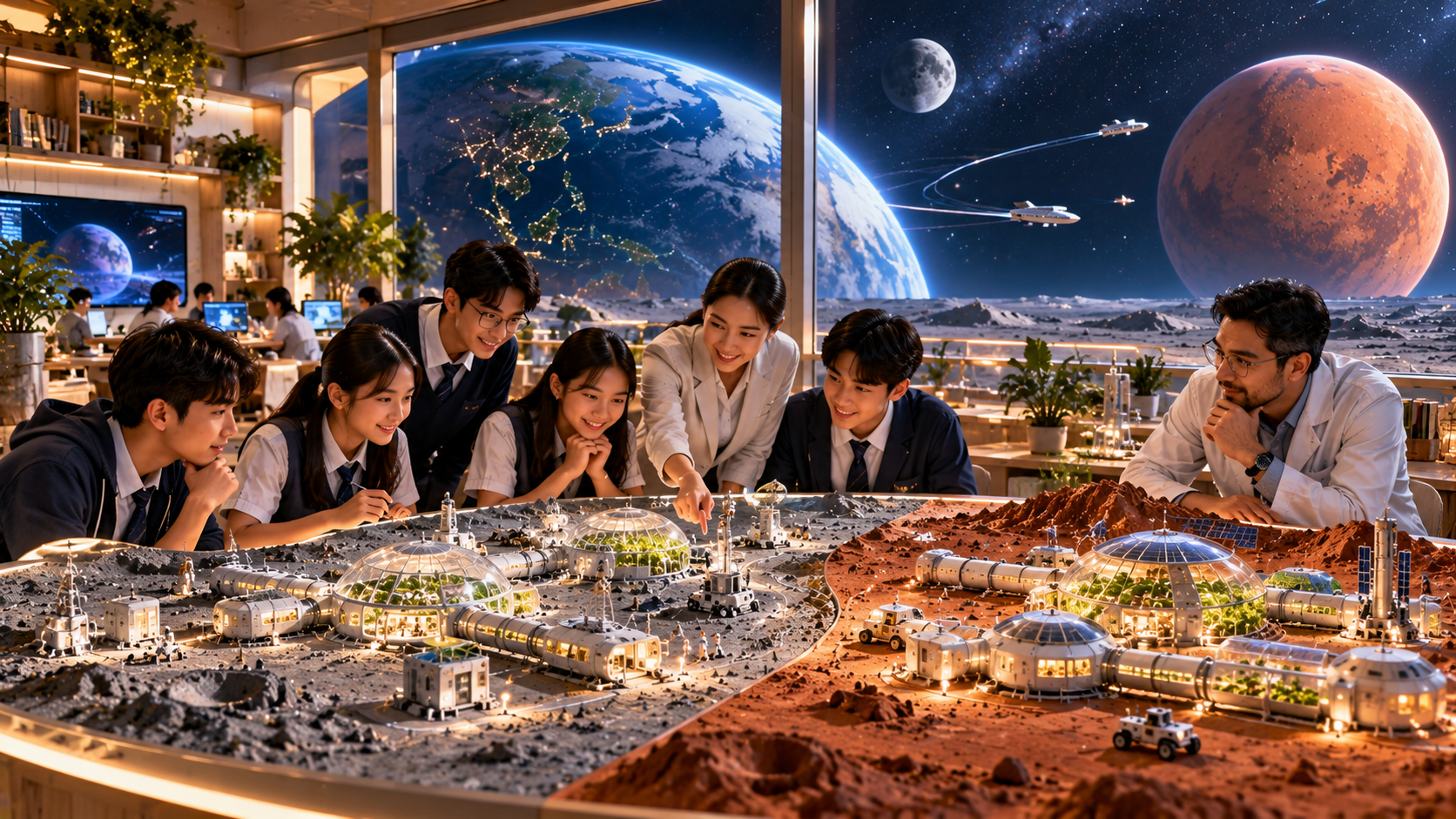
Quick answer: An orbital or spacefaring civilisation is a way of organising human capabilities that uses space-based systems for communication, observation, science, transport or carefully planned exploration beyond Earth. Today’s satellites, spacecraft and research stations are real; independently self-sustaining human settlements on the Moon, Mars or elsewhere remain hypothetical. That distinction matters. Students can study the mechanisms and governance of space activity without treating speculative off-world cities as current facts, legal territories or guaranteed destinations.
Did you know? Communication satellites, planetary science spacecraft and the International Space Station are evidence of extraordinary present-day capabilities, but none establishes that human beings already maintain an economically, biologically and technologically self-sustaining civilisation beyond Earth. The spacefaring type of civilisation covers how space technology changes networks and how future exploration may develop. It must not turn possibilities into history.
Our fictional teaching city, Starbridge, is a library and tabletop design space. Wintour asks about people, fairness, culture, peaceful cooperation and law. Rainbolt asks what a spacecraft or settlement model cannot yet prove and changes a dependency after the learners announce a solution. Both are pedagogical characters; no actual NASA or ESA mission is being represented by them.
This guide follows Types of a Civilisation | How to Build a Civilisation and complements Stages of a Civilisation | Stage 7: Autonomous Multi-World Civilisation. A type identifies a pattern of capability or organisation; a stage in that different conceptual framework proposes a condition of development. Spacefaring networks do not imply that the fictional Stage 7 has been reached.
Five routes through this guide
- Busy family: quick answer, Missions 01, 04, 07, 12 and the last question.
- Primary learner: distinguish pictures from evidence and build safe paper models of interconnected services.
- Secondary learner: work through units, rates, ratios, source quality and calculated communication delays.
- Tutor: use a three-learner evidence circle for every mission, with an illustrator, calculator and reviewer.
- Advanced reader: consult NASA and UNOOSA material and keep historical, current, proposed and hypothetical capabilities in distinct columns.
The six principles of an evidence-respecting spacefaring society
- Reality before spectacle: specify whether a spacecraft, concept or settlement has actually been demonstrated.
- People and health: protect wellbeing, worker competence and the limits of human evidence.
- System dependencies: consider energy, air, water, food, materials, transport, data and maintenance together.
- Reliable science: record sources, uncertainty, changes, contamination controls and reproducibility.
- Peaceful, lawful cooperation: examine international obligations and the interests of others using space.
- Continuity through learning: preserve technical and institutional knowledge so successors can detect and repair mistakes.
A physics diagram is not an engineering specification; a photograph of an astronaut does not demonstrate indefinite autonomy; and a future plan is not an observed event. Students can learn enormously from all three provided the caption and the surrounding explanation state what kind of evidence each provides.
This is not a guide for building rockets, hazardous equipment, spacecraft life support or human medical procedures. No activity here authorises propulsion experiments, electrical alterations, amateur water purification, biological sampling or operational flight decisions. All practical exercises use paper, conventional school mathematics and public documents.
Primary-source atlas: six documents and the claims they support
Institutional reading 01: NASA, Moon to Mars Architecture — strategy and objectives
NASA sets out a systems-engineering approach to science, exploration, international collaboration, safety and maintainability; architecture and plans are not proof of a completed settlement. Open the official or originating source. Students should find its publication context and check its date. An evolving architecture or research programme does not guarantee a named future mission will occur on a particular schedule or that a speculative system already exists.
Tutor check: write one statement the source supports, one it does not support and one question requiring an additional record or qualified specialist. The purpose of an official link is to make scientific and legal claims inspectable, not to lend borrowed credibility to invented Starbridge quantities.
Institutional reading 02: NASA, Environmental Control and Life Support Systems
Life-support engineering has interdependent systems for atmosphere, water recovery, oxygen and waste management; it is professional, safety-critical work. Open the official or originating source. Students should find its publication context and check its date. An evolving architecture or research programme does not guarantee a named future mission will occur on a particular schedule or that a speculative system already exists.
Tutor check: write one statement the source supports, one it does not support and one question requiring an additional record or qualified specialist. The purpose of an official link is to make scientific and legal claims inspectable, not to lend borrowed credibility to invented Starbridge quantities.
Institutional reading 03: NASA, five hazards of human spaceflight
Radiation, isolation, distance, altered gravity and hostile or closed environments are distinct but interacting hazards of human spaceflight. Open the official or originating source. Students should find its publication context and check its date. An evolving architecture or research programme does not guarantee a named future mission will occur on a particular schedule or that a speculative system already exists.
Tutor check: write one statement the source supports, one it does not support and one question requiring an additional record or qualified specialist. The purpose of an official link is to make scientific and legal claims inspectable, not to lend borrowed credibility to invented Starbridge quantities.
Institutional reading 04: NASA, Moon to Mars Architecture — official architecture overview
Exploration systems are evolving designs, not a record that fully autonomous multi-world civilisation already exists. Open the official or originating source. Students should find its publication context and check its date. An evolving architecture or research programme does not guarantee a named future mission will occur on a particular schedule or that a speculative system already exists.
Tutor check: write one statement the source supports, one it does not support and one question requiring an additional record or qualified specialist. The purpose of an official link is to make scientific and legal claims inspectable, not to lend borrowed credibility to invented Starbridge quantities.
Institutional reading 05: UNOOSA, United Nations treaties and principles on space activities
International space law requires careful treatment of exploration, state responsibility, cooperation and the non-appropriation principle. Open the official or originating source. Students should find its publication context and check its date. An evolving architecture or research programme does not guarantee a named future mission will occur on a particular schedule or that a speculative system already exists.
Tutor check: write one statement the source supports, one it does not support and one question requiring an additional record or qualified specialist. The purpose of an official link is to make scientific and legal claims inspectable, not to lend borrowed credibility to invented Starbridge quantities.
Institutional reading 06: NASA, history and text of the Outer Space Treaty
The treaty includes freedom of exploration, national non-appropriation, responsibility, due regard and avoidance of harmful contamination, among other provisions. Open the official or originating source. Students should find its publication context and check its date. An evolving architecture or research programme does not guarantee a named future mission will occur on a particular schedule or that a speculative system already exists.
Tutor check: write one statement the source supports, one it does not support and one question requiring an additional record or qualified specialist. The purpose of an official link is to make scientific and legal claims inspectable, not to lend borrowed credibility to invented Starbridge quantities.
Index to sixteen Starbridge missions
- 01 — Distinguish space services, exploration and settlements
- 02 — Understand distances, signals and communication delay
- 03 — Read orbital mechanics without designing vehicles
- 04 — Recognise life-support as a safety-critical coupled system
- 05 — Understand water recovery, hygiene and limits of closure
- 06 — Plan food, nutrition and reliable supply logistics
- 07 — Study radiation, gravity and human health honestly
- 08 — Map energy and thermal-management dependencies
- 09 — Understand materials, spares and practical maintenance
- 10 — Use robotics and autonomy under delayed supervision
- 11 — Protect science integrity and planetary environments
- 12 — Understand international space law and human rights
- 13 — Reduce orbital debris and protect shared space services
- 14 — Protect teamwork, rest, conflict resolution and human factors
- 15 — Separate outposts, networks and autonomous habitation
- 16 — Leave truthful records and skills for future generations
Mission 01 — Distinguish space services, exploration and settlements
Starbridge problem: Starbridge’s school receives a photograph of Earth from space, a station diagram and a fictional town with domes on Mars. Students sort these into observed artefacts, conceptual plans and imaginary scenarios.
What exists, what is proposed and why it matters
Earth-orbiting satellites already support many terrestrial activities; a crewed orbital station is not the same as a permanent community; a proposed lunar base is not evidence of self-sustaining population growth beyond Earth.
Ask which category of statement the child is making: a definition, a physical principle, a documented past operation, a current institutional objective or a hypothetical idea. Confusing these categories is the central error in many space stories. A future goal becomes educationally useful when it is labelled as a goal and analysed as a set of unmet requirements.
In the context of distinguish space services, exploration and settlements, the class begins from this deliberately bounded case: Starbridge’s school receives a photograph of Earth from space, a station diagram and a fictional town with domes on Mars. Students sort these into observed artefacts, conceptual plans and imaginary scenarios. Students should identify which details are fictional and which general background ideas can be compared with the official science or legal sources. The goal is an explanatory model a new learner can test, not an assertion that a futuristic settlement already functions.
Draw the real physical and institutional dependencies
Draw every dependency with a clear arrow. The class should be able to say whether an arrow means physical material, power, a message, trained labour, legal authorisation or evidence. Invented lines connecting domes may look exciting while hiding who repairs equipment and what happens when Earth is unavailable. A serious model exposes those limits.
Ask whether the system works for people, not merely whether a diagram ‘has’ all the components. A habitat might contain water tanks but lack validated quality control; a crew might have communication equipment without timely expert support; a settlement might have elegant buildings without clear responsibility or succession.
Ask Rainbolt to identify one unknown. Here the key mechanism is Earth-orbiting satellites already support many terrestrial activities; a crewed orbital station is not the same as a permanent community; a proposed lunar base is not evidence of self-sustaining population growth beyond Earth. Record what a real specialist would need to confirm before turning that mechanism into an operational claim. Do not confuse an attractive concept model with a validated design.
Evidence, chronology and the research boundary
Make the evidence source travel with the claim. A NASA high-level system description establishes the nature of a research area; it does not prove an original classroom design could support a crew. The learner records the institution, publication or update date, relevant passage, assumption and uncertainty. This practice protects scientific reasoning from accidental exaggeration.
Make uncertainty visible rather than hiding it in a picture. The learner may know that a category of research exists but lack evidence for a particular outcome. A careful ‘not demonstrated’ can be the best answer; it invites the next question and protects the next generation from confusing imagination with achievement.
Write down one fact that has been demonstrated in real space research and one associated requirement that a conceptual settlement has not shown it can satisfy. The difference need not diminish the achievement; it helps learners respect research progress while avoiding promotional overstatement.
Mathematics laboratory: numbers with conditions
Of 12 fictional cards, seven describe existing categories of operations and five are speculative. The fraction 7/12 classifies the cards, not the share of real missions in the world.
Mark the physical unit and period for every calculation. A quantity in litres per day is not interchangeable with a reservoir volume; a signal’s theoretical travel time is not the same as end-to-end latency; and the percentage of checklist items ticked does not measure the magnitude of unaddressed danger.
Separate what is numerically possible under toy assumptions from what is operationally safe. A percentage, average or simple ratio may help students understand resource flows without capturing complex biology, reliability, orbital dynamics or safety margins. Scientific humility is not a weakness in an ambitious subject; it is how serious investigations remain trustworthy.
Have a second learner alter one assumption in the original calculation and explain the changed answer. Which inputs are supplied purely for teaching, which physical constants are approximated and which unmodelled dependencies could dominate in a real setting? An accurate arithmetic result does not convert a toy model into an aerospace qualification.
Rainbolt adds an unexpected condition
Rainbolt asks whether a rendering is documentary proof. The class revises the caption to show what is conceptual and what has independent evidence.
Change the original conditions before accepting the answer. In reality, space operations involve uncertain environments, resource limitations, equipment wear, communication delays and human factors. Rainbolt’s fictional change is a reasoning test, not an accurate simulation of a specific mission failure.
The group cannot always restore the original conclusion. Sometimes the proper response is to flag the concept as requiring additional experiments, qualified analysis or a more modest claim. The teacher should praise a precise boundary of uncertainty and a documented correction instead of awarding points for a dramatic but unverified fix.
Wintour asks about people, law and shared obligations
Wintour asks whose scientific work, labour and resources make space services possible, and whose needs on Earth benefit or bear costs.
Do not make the Moon or Mars a blank canvas that the classroom can own. A drawing of a flag is not a legal entitlement, and treaty law, national supervision and the interests of other states matter. Students should use official text for legal understanding and avoid simplistic declarations about sovereignty or resource ownership.
Students must respect the distinction between legal principles and concrete interpretation. They can identify treaty issues, consent, scientific integrity, potential harms and questions of inclusion, but should not invent a governing constitution for real extraterrestrial settlements or claim to issue authorisations.
Family activity and the three-student tutorial
Compare source labels and teach children to separate a real programme from an artist’s imagined scene.
Invite three learners to assume different roles: the physical-systems mapper, the evidence-and-mathematics checker and the people-and-governance reviewer. Rotate after a correction. A student who notices an overlooked human need contributes as much to the lesson as one who solves the calculation quickly.
Keep activities demonstrably safe. Use labelled paper tokens, printed fictional logs, publicly available NASA explanatory pages and supervised classroom discussions. No rocket chemicals, radiation sources, pressurised systems, flight control, hazardous samples or unsupervised environmental interventions are part of the workbook.
Give the archive to someone who did not attend the lesson. If the new reader cannot identify what is fact, hypothesis, calculation, official source and invented story, improve the record. A civilisation that outlasts its founders must teach procedures for judging evidence, not merely pass down enthusiastic conclusions.
Four inspection cards: questions with model reasoning
Fact versus future
Read this sentence in the Starbridge booklet: Earth-orbiting satellites already support many terrestrial activities; a crewed orbital station is not the same as a permanent community; a proposed lunar base is not evidence of self-sustaining population growth beyond Earth. Label any general fact, current research capability, design proposal or speculative claim separately. Rewrite the sentence so a younger reader will not mistake a possible future for a completed operation.
A strong model response begins by stating the claim in plain language. It identifies what the classroom can calculate or compare, what only a qualified research or operational institution could establish, and whether the source is official, secondary or invented. It should finish with a correction sentence that preserves what is known without creating a new unsupported claim.
Tutor extension for distinguish space services, exploration and settlements: let the three learners each inspect a different weakness—measurement, dependency and human consequence. Invite them to explain another person’s concern accurately before challenging it. The final record includes a dated source or clearly fictional model, a labelled calculation, a safety or legitimacy boundary and one possible next research question.
Check the numerical headline
The worksheet announces: Of 12 fictional cards, seven describe existing categories of operations and five are speculative. The fraction 7/12 classifies the cards, not the share of real missions in the world. Identify the functional unit, calculation and hidden assumptions. Explain at least two outcomes this arithmetic could not verify and how a scientist or trained operator would seek additional evidence.
A strong model response begins by stating the claim in plain language. It identifies what the classroom can calculate or compare, what only a qualified research or operational institution could establish, and whether the source is official, secondary or invented. It should finish with a correction sentence that preserves what is known without creating a new unsupported claim.
Tutor extension for distinguish space services, exploration and settlements: let the three learners each inspect a different weakness—measurement, dependency and human consequence. Invite them to explain another person’s concern accurately before challenging it. The final record includes a dated source or clearly fictional model, a labelled calculation, a safety or legitimacy boundary and one possible next research question.
Find the shared dependency
Rainbolt says: Rainbolt asks whether a rendering is documentary proof. The class revises the caption to show what is conceptual and what has independent evidence. Draw an input-to-service map and mark which parts become uncertain. The correction must describe the lost condition; it must not manufacture a precise hazard assessment or equipment instruction.
A strong model response begins by stating the claim in plain language. It identifies what the classroom can calculate or compare, what only a qualified research or operational institution could establish, and whether the source is official, secondary or invented. It should finish with a correction sentence that preserves what is known without creating a new unsupported claim.
Tutor extension for distinguish space services, exploration and settlements: let the three learners each inspect a different weakness—measurement, dependency and human consequence. Invite them to explain another person’s concern accurately before challenging it. The final record includes a dated source or clearly fictional model, a labelled calculation, a safety or legitimacy boundary and one possible next research question.
The human and law review
Wintour asks: Wintour asks whose scientific work, labour and resources make space services possible, and whose needs on Earth benefit or bear costs. Write a paragraph naming a legitimate stakeholder, an appropriate source of authority and one question that remains unresolved by the fictional model.
A strong model response begins by stating the claim in plain language. It identifies what the classroom can calculate or compare, what only a qualified research or operational institution could establish, and whether the source is official, secondary or invented. It should finish with a correction sentence that preserves what is known without creating a new unsupported claim.
Tutor extension for distinguish space services, exploration and settlements: let the three learners each inspect a different weakness—measurement, dependency and human consequence. Invite them to explain another person’s concern accurately before challenging it. The final record includes a dated source or clearly fictional model, a labelled calculation, a safety or legitimacy boundary and one possible next research question.
Transfer: Distinguish space services, exploration and settlements should leave the learner able to explain what is demonstrated, what remains hypothetical, whose expertise is required and which evidence the next class must preserve.
Mission 02 — Understand distances, signals and communication delay
Starbridge problem: A fictional probe sends a message over a modelled distance of 300,000 kilometres in vacuum. Students compare a one-way signal with a request-and-response exchange.
What exists, what is proposed and why it matters
Signals travel at finite speed, with light in vacuum covering about 300,000 kilometres per second. Communication timing, alignment and network availability matter even before mission decisions are considered.
Ask which category of statement the child is making: a definition, a physical principle, a documented past operation, a current institutional objective or a hypothetical idea. Confusing these categories is the central error in many space stories. A future goal becomes educationally useful when it is labelled as a goal and analysed as a set of unmet requirements.
In the context of understand distances, signals and communication delay, the class begins from this deliberately bounded case: A fictional probe sends a message over a modelled distance of 300,000 kilometres in vacuum. Students compare a one-way signal with a request-and-response exchange. Students should identify which details are fictional and which general background ideas can be compared with the official science or legal sources. The goal is an explanatory model a new learner can test, not an assertion that a futuristic settlement already functions.
Draw the real physical and institutional dependencies
Draw every dependency with a clear arrow. The class should be able to say whether an arrow means physical material, power, a message, trained labour, legal authorisation or evidence. Invented lines connecting domes may look exciting while hiding who repairs equipment and what happens when Earth is unavailable. A serious model exposes those limits.
Ask whether the system works for people, not merely whether a diagram ‘has’ all the components. A habitat might contain water tanks but lack validated quality control; a crew might have communication equipment without timely expert support; a settlement might have elegant buildings without clear responsibility or succession.
Ask Rainbolt to identify one unknown. Here the key mechanism is Signals travel at finite speed, with light in vacuum covering about 300,000 kilometres per second. Communication timing, alignment and network availability matter even before mission decisions are considered. Record what a real specialist would need to confirm before turning that mechanism into an operational claim. Do not confuse an attractive concept model with a validated design.
Evidence, chronology and the research boundary
Make the evidence source travel with the claim. A NASA high-level system description establishes the nature of a research area; it does not prove an original classroom design could support a crew. The learner records the institution, publication or update date, relevant passage, assumption and uncertainty. This practice protects scientific reasoning from accidental exaggeration.
Make uncertainty visible rather than hiding it in a picture. The learner may know that a category of research exists but lack evidence for a particular outcome. A careful ‘not demonstrated’ can be the best answer; it invites the next question and protects the next generation from confusing imagination with achievement.
Write down one fact that has been demonstrated in real space research and one associated requirement that a conceptual settlement has not shown it can satisfy. The difference need not diminish the achievement; it helps learners respect research progress while avoiding promotional overstatement.
Mathematics laboratory: numbers with conditions
At 300,000 kilometres per second, a 300,000-kilometre one-way trip takes about one second in the simplified model; an immediate round trip takes at least about two seconds, ignoring processing.
Mark the physical unit and period for every calculation. A quantity in litres per day is not interchangeable with a reservoir volume; a signal’s theoretical travel time is not the same as end-to-end latency; and the percentage of checklist items ticked does not measure the magnitude of unaddressed danger.
Separate what is numerically possible under toy assumptions from what is operationally safe. A percentage, average or simple ratio may help students understand resource flows without capturing complex biology, reliability, orbital dynamics or safety margins. Scientific humility is not a weakness in an ambitious subject; it is how serious investigations remain trustworthy.
Have a second learner alter one assumption in the original calculation and explain the changed answer. Which inputs are supplied purely for teaching, which physical constants are approximated and which unmodelled dependencies could dominate in a real setting? An accurate arithmetic result does not convert a toy model into an aerospace qualification.
Rainbolt adds an unexpected condition
Rainbolt introduces a communication blackout interval and asks why distance alone does not guarantee service availability.
Change the original conditions before accepting the answer. In reality, space operations involve uncertain environments, resource limitations, equipment wear, communication delays and human factors. Rainbolt’s fictional change is a reasoning test, not an accurate simulation of a specific mission failure.
The group cannot always restore the original conclusion. Sometimes the proper response is to flag the concept as requiring additional experiments, qualified analysis or a more modest claim. The teacher should praise a precise boundary of uncertainty and a documented correction instead of awarding points for a dramatic but unverified fix.
Wintour asks about people, law and shared obligations
Wintour asks how delayed messages affect autonomy, privacy, access to emergency professional support and accountable decisions.
Do not make the Moon or Mars a blank canvas that the classroom can own. A drawing of a flag is not a legal entitlement, and treaty law, national supervision and the interests of other states matter. Students should use official text for legal understanding and avoid simplistic declarations about sovereignty or resource ownership.
Students must respect the distinction between legal principles and concrete interpretation. They can identify treaty issues, consent, scientific integrity, potential harms and questions of inclusion, but should not invent a governing constitution for real extraterrestrial settlements or claim to issue authorisations.
Family activity and the three-student tutorial
Use a stopwatch-free paper timing strip and distinguish a calculated physical lower bound from an actual communication schedule.
Invite three learners to assume different roles: the physical-systems mapper, the evidence-and-mathematics checker and the people-and-governance reviewer. Rotate after a correction. A student who notices an overlooked human need contributes as much to the lesson as one who solves the calculation quickly.
Keep activities demonstrably safe. Use labelled paper tokens, printed fictional logs, publicly available NASA explanatory pages and supervised classroom discussions. No rocket chemicals, radiation sources, pressurised systems, flight control, hazardous samples or unsupervised environmental interventions are part of the workbook.
Give the archive to someone who did not attend the lesson. If the new reader cannot identify what is fact, hypothesis, calculation, official source and invented story, improve the record. A civilisation that outlasts its founders must teach procedures for judging evidence, not merely pass down enthusiastic conclusions.
Four inspection cards: questions with model reasoning
Fact versus future
Read this sentence in the Starbridge booklet: Signals travel at finite speed, with light in vacuum covering about 300,000 kilometres per second. Communication timing, alignment and network availability matter even before mission decisions are considered. Label any general fact, current research capability, design proposal or speculative claim separately. Rewrite the sentence so a younger reader will not mistake a possible future for a completed operation.
A strong model response begins by stating the claim in plain language. It identifies what the classroom can calculate or compare, what only a qualified research or operational institution could establish, and whether the source is official, secondary or invented. It should finish with a correction sentence that preserves what is known without creating a new unsupported claim.
Tutor extension for understand distances, signals and communication delay: let the three learners each inspect a different weakness—measurement, dependency and human consequence. Invite them to explain another person’s concern accurately before challenging it. The final record includes a dated source or clearly fictional model, a labelled calculation, a safety or legitimacy boundary and one possible next research question.
Check the numerical headline
The worksheet announces: At 300,000 kilometres per second, a 300,000-kilometre one-way trip takes about one second in the simplified model; an immediate round trip takes at least about two seconds, ignoring processing. Identify the functional unit, calculation and hidden assumptions. Explain at least two outcomes this arithmetic could not verify and how a scientist or trained operator would seek additional evidence.
A strong model response begins by stating the claim in plain language. It identifies what the classroom can calculate or compare, what only a qualified research or operational institution could establish, and whether the source is official, secondary or invented. It should finish with a correction sentence that preserves what is known without creating a new unsupported claim.
Tutor extension for understand distances, signals and communication delay: let the three learners each inspect a different weakness—measurement, dependency and human consequence. Invite them to explain another person’s concern accurately before challenging it. The final record includes a dated source or clearly fictional model, a labelled calculation, a safety or legitimacy boundary and one possible next research question.
Find the shared dependency
Rainbolt says: Rainbolt introduces a communication blackout interval and asks why distance alone does not guarantee service availability. Draw an input-to-service map and mark which parts become uncertain. The correction must describe the lost condition; it must not manufacture a precise hazard assessment or equipment instruction.
A strong model response begins by stating the claim in plain language. It identifies what the classroom can calculate or compare, what only a qualified research or operational institution could establish, and whether the source is official, secondary or invented. It should finish with a correction sentence that preserves what is known without creating a new unsupported claim.
Tutor extension for understand distances, signals and communication delay: let the three learners each inspect a different weakness—measurement, dependency and human consequence. Invite them to explain another person’s concern accurately before challenging it. The final record includes a dated source or clearly fictional model, a labelled calculation, a safety or legitimacy boundary and one possible next research question.
The human and law review
Wintour asks: Wintour asks how delayed messages affect autonomy, privacy, access to emergency professional support and accountable decisions. Write a paragraph naming a legitimate stakeholder, an appropriate source of authority and one question that remains unresolved by the fictional model.
A strong model response begins by stating the claim in plain language. It identifies what the classroom can calculate or compare, what only a qualified research or operational institution could establish, and whether the source is official, secondary or invented. It should finish with a correction sentence that preserves what is known without creating a new unsupported claim.
Tutor extension for understand distances, signals and communication delay: let the three learners each inspect a different weakness—measurement, dependency and human consequence. Invite them to explain another person’s concern accurately before challenging it. The final record includes a dated source or clearly fictional model, a labelled calculation, a safety or legitimacy boundary and one possible next research question.
Transfer: Understand distances, signals and communication delay should leave the learner able to explain what is demonstrated, what remains hypothetical, whose expertise is required and which evidence the next class must preserve.
Mission 03 — Read orbital mechanics without designing vehicles
Starbridge problem: The class sees a model Earth and several marked paths. They distinguish a circular-looking teaching sketch from a real trajectory requiring measurement and forces.
What exists, what is proposed and why it matters
Orbit is sustained motion under gravity, not a spacecraft standing still on an invisible shelf. Stable operation requires professional navigation, control, situational awareness and physical laws.
Ask which category of statement the child is making: a definition, a physical principle, a documented past operation, a current institutional objective or a hypothetical idea. Confusing these categories is the central error in many space stories. A future goal becomes educationally useful when it is labelled as a goal and analysed as a set of unmet requirements.
In the context of read orbital mechanics without designing vehicles, the class begins from this deliberately bounded case: The class sees a model Earth and several marked paths. They distinguish a circular-looking teaching sketch from a real trajectory requiring measurement and forces. Students should identify which details are fictional and which general background ideas can be compared with the official science or legal sources. The goal is an explanatory model a new learner can test, not an assertion that a futuristic settlement already functions.
Draw the real physical and institutional dependencies
Draw every dependency with a clear arrow. The class should be able to say whether an arrow means physical material, power, a message, trained labour, legal authorisation or evidence. Invented lines connecting domes may look exciting while hiding who repairs equipment and what happens when Earth is unavailable. A serious model exposes those limits.
Ask whether the system works for people, not merely whether a diagram ‘has’ all the components. A habitat might contain water tanks but lack validated quality control; a crew might have communication equipment without timely expert support; a settlement might have elegant buildings without clear responsibility or succession.
Ask Rainbolt to identify one unknown. Here the key mechanism is Orbit is sustained motion under gravity, not a spacecraft standing still on an invisible shelf. Stable operation requires professional navigation, control, situational awareness and physical laws. Record what a real specialist would need to confirm before turning that mechanism into an operational claim. Do not confuse an attractive concept model with a validated design.
Evidence, chronology and the research boundary
Make the evidence source travel with the claim. A NASA high-level system description establishes the nature of a research area; it does not prove an original classroom design could support a crew. The learner records the institution, publication or update date, relevant passage, assumption and uncertainty. This practice protects scientific reasoning from accidental exaggeration.
Make uncertainty visible rather than hiding it in a picture. The learner may know that a category of research exists but lack evidence for a particular outcome. A careful ‘not demonstrated’ can be the best answer; it invites the next question and protects the next generation from confusing imagination with achievement.
Write down one fact that has been demonstrated in real space research and one associated requirement that a conceptual settlement has not shown it can satisfy. The difference need not diminish the achievement; it helps learners respect research progress while avoiding promotional overstatement.
Mathematics laboratory: numbers with conditions
A 90-minute fictional orbital period corresponds to 16 periods in 24 hours, assuming a constant period; the arithmetic is not a flight prediction or an actual station ephemeris.
Mark the physical unit and period for every calculation. A quantity in litres per day is not interchangeable with a reservoir volume; a signal’s theoretical travel time is not the same as end-to-end latency; and the percentage of checklist items ticked does not measure the magnitude of unaddressed danger.
Separate what is numerically possible under toy assumptions from what is operationally safe. A percentage, average or simple ratio may help students understand resource flows without capturing complex biology, reliability, orbital dynamics or safety margins. Scientific humility is not a weakness in an ambitious subject; it is how serious investigations remain trustworthy.
Have a second learner alter one assumption in the original calculation and explain the changed answer. Which inputs are supplied purely for teaching, which physical constants are approximated and which unmodelled dependencies could dominate in a real setting? An accurate arithmetic result does not convert a toy model into an aerospace qualification.
Rainbolt adds an unexpected condition
Rainbolt changes the assumed period, showing why students must not treat a diagram as a validated spacecraft plan.
Change the original conditions before accepting the answer. In reality, space operations involve uncertain environments, resource limitations, equipment wear, communication delays and human factors. Rainbolt’s fictional change is a reasoning test, not an accurate simulation of a specific mission failure.
The group cannot always restore the original conclusion. Sometimes the proper response is to flag the concept as requiring additional experiments, qualified analysis or a more modest claim. The teacher should praise a precise boundary of uncertainty and a documented correction instead of awarding points for a dramatic but unverified fix.
Wintour asks about people, law and shared obligations
Wintour asks about international responsibilities and the risks placed on others by poorly governed space operations.
Do not make the Moon or Mars a blank canvas that the classroom can own. A drawing of a flag is not a legal entitlement, and treaty law, national supervision and the interests of other states matter. Students should use official text for legal understanding and avoid simplistic declarations about sovereignty or resource ownership.
Students must respect the distinction between legal principles and concrete interpretation. They can identify treaty issues, consent, scientific integrity, potential harms and questions of inclusion, but should not invent a governing constitution for real extraterrestrial settlements or claim to issue authorisations.
Family activity and the three-student tutorial
Use strings and printed diagrams to label terms; do not construct propulsion, launch or flight-control devices.
Invite three learners to assume different roles: the physical-systems mapper, the evidence-and-mathematics checker and the people-and-governance reviewer. Rotate after a correction. A student who notices an overlooked human need contributes as much to the lesson as one who solves the calculation quickly.
Keep activities demonstrably safe. Use labelled paper tokens, printed fictional logs, publicly available NASA explanatory pages and supervised classroom discussions. No rocket chemicals, radiation sources, pressurised systems, flight control, hazardous samples or unsupervised environmental interventions are part of the workbook.
Give the archive to someone who did not attend the lesson. If the new reader cannot identify what is fact, hypothesis, calculation, official source and invented story, improve the record. A civilisation that outlasts its founders must teach procedures for judging evidence, not merely pass down enthusiastic conclusions.
Four inspection cards: questions with model reasoning
Fact versus future
Read this sentence in the Starbridge booklet: Orbit is sustained motion under gravity, not a spacecraft standing still on an invisible shelf. Stable operation requires professional navigation, control, situational awareness and physical laws. Label any general fact, current research capability, design proposal or speculative claim separately. Rewrite the sentence so a younger reader will not mistake a possible future for a completed operation.
A strong model response begins by stating the claim in plain language. It identifies what the classroom can calculate or compare, what only a qualified research or operational institution could establish, and whether the source is official, secondary or invented. It should finish with a correction sentence that preserves what is known without creating a new unsupported claim.
Tutor extension for read orbital mechanics without designing vehicles: let the three learners each inspect a different weakness—measurement, dependency and human consequence. Invite them to explain another person’s concern accurately before challenging it. The final record includes a dated source or clearly fictional model, a labelled calculation, a safety or legitimacy boundary and one possible next research question.
Check the numerical headline
The worksheet announces: A 90-minute fictional orbital period corresponds to 16 periods in 24 hours, assuming a constant period; the arithmetic is not a flight prediction or an actual station ephemeris. Identify the functional unit, calculation and hidden assumptions. Explain at least two outcomes this arithmetic could not verify and how a scientist or trained operator would seek additional evidence.
A strong model response begins by stating the claim in plain language. It identifies what the classroom can calculate or compare, what only a qualified research or operational institution could establish, and whether the source is official, secondary or invented. It should finish with a correction sentence that preserves what is known without creating a new unsupported claim.
Tutor extension for read orbital mechanics without designing vehicles: let the three learners each inspect a different weakness—measurement, dependency and human consequence. Invite them to explain another person’s concern accurately before challenging it. The final record includes a dated source or clearly fictional model, a labelled calculation, a safety or legitimacy boundary and one possible next research question.
Find the shared dependency
Rainbolt says: Rainbolt changes the assumed period, showing why students must not treat a diagram as a validated spacecraft plan. Draw an input-to-service map and mark which parts become uncertain. The correction must describe the lost condition; it must not manufacture a precise hazard assessment or equipment instruction.
A strong model response begins by stating the claim in plain language. It identifies what the classroom can calculate or compare, what only a qualified research or operational institution could establish, and whether the source is official, secondary or invented. It should finish with a correction sentence that preserves what is known without creating a new unsupported claim.
Tutor extension for read orbital mechanics without designing vehicles: let the three learners each inspect a different weakness—measurement, dependency and human consequence. Invite them to explain another person’s concern accurately before challenging it. The final record includes a dated source or clearly fictional model, a labelled calculation, a safety or legitimacy boundary and one possible next research question.
The human and law review
Wintour asks: Wintour asks about international responsibilities and the risks placed on others by poorly governed space operations. Write a paragraph naming a legitimate stakeholder, an appropriate source of authority and one question that remains unresolved by the fictional model.
A strong model response begins by stating the claim in plain language. It identifies what the classroom can calculate or compare, what only a qualified research or operational institution could establish, and whether the source is official, secondary or invented. It should finish with a correction sentence that preserves what is known without creating a new unsupported claim.
Tutor extension for read orbital mechanics without designing vehicles: let the three learners each inspect a different weakness—measurement, dependency and human consequence. Invite them to explain another person’s concern accurately before challenging it. The final record includes a dated source or clearly fictional model, a labelled calculation, a safety or legitimacy boundary and one possible next research question.
Transfer: Read orbital mechanics without designing vehicles should leave the learner able to explain what is demonstrated, what remains hypothetical, whose expertise is required and which evidence the next class must preserve.
Mission 04 — Recognise life-support as a safety-critical coupled system
Starbridge problem: Starbridge draws an abstract inhabited laboratory with air, water, power, instruments and trained operators. Students mark the controls without specifying how to engineer them.
What exists, what is proposed and why it matters
Life support manages breathable atmosphere, contaminants, pressure, ventilation, water supply, waste and emergency conditions. These are engineering, monitoring and human-health systems, not a classroom recipe.
Ask which category of statement the child is making: a definition, a physical principle, a documented past operation, a current institutional objective or a hypothetical idea. Confusing these categories is the central error in many space stories. A future goal becomes educationally useful when it is labelled as a goal and analysed as a set of unmet requirements.
In the context of recognise life-support as a safety-critical coupled system, the class begins from this deliberately bounded case: Starbridge draws an abstract inhabited laboratory with air, water, power, instruments and trained operators. Students mark the controls without specifying how to engineer them. Students should identify which details are fictional and which general background ideas can be compared with the official science or legal sources. The goal is an explanatory model a new learner can test, not an assertion that a futuristic settlement already functions.
Draw the real physical and institutional dependencies
Draw every dependency with a clear arrow. The class should be able to say whether an arrow means physical material, power, a message, trained labour, legal authorisation or evidence. Invented lines connecting domes may look exciting while hiding who repairs equipment and what happens when Earth is unavailable. A serious model exposes those limits.
Ask whether the system works for people, not merely whether a diagram ‘has’ all the components. A habitat might contain water tanks but lack validated quality control; a crew might have communication equipment without timely expert support; a settlement might have elegant buildings without clear responsibility or succession.
Ask Rainbolt to identify one unknown. Here the key mechanism is Life support manages breathable atmosphere, contaminants, pressure, ventilation, water supply, waste and emergency conditions. These are engineering, monitoring and human-health systems, not a classroom recipe. Record what a real specialist would need to confirm before turning that mechanism into an operational claim. Do not confuse an attractive concept model with a validated design.
Evidence, chronology and the research boundary
Make the evidence source travel with the claim. A NASA high-level system description establishes the nature of a research area; it does not prove an original classroom design could support a crew. The learner records the institution, publication or update date, relevant passage, assumption and uncertainty. This practice protects scientific reasoning from accidental exaggeration.
Make uncertainty visible rather than hiding it in a picture. The learner may know that a category of research exists but lack evidence for a particular outcome. A careful ‘not demonstrated’ can be the best answer; it invites the next question and protects the next generation from confusing imagination with achievement.
Write down one fact that has been demonstrated in real space research and one associated requirement that a conceptual settlement has not shown it can satisfy. The difference need not diminish the achievement; it helps learners respect research progress while avoiding promotional overstatement.
Mathematics laboratory: numbers with conditions
Four fictional occupants each require three abstract service units a day in a teaching budget: 12 units per day, 84 over seven days; these are not physiological requirements.
Mark the physical unit and period for every calculation. A quantity in litres per day is not interchangeable with a reservoir volume; a signal’s theoretical travel time is not the same as end-to-end latency; and the percentage of checklist items ticked does not measure the magnitude of unaddressed danger.
Separate what is numerically possible under toy assumptions from what is operationally safe. A percentage, average or simple ratio may help students understand resource flows without capturing complex biology, reliability, orbital dynamics or safety margins. Scientific humility is not a weakness in an ambitious subject; it is how serious investigations remain trustworthy.
Have a second learner alter one assumption in the original calculation and explain the changed answer. Which inputs are supplied purely for teaching, which physical constants are approximated and which unmodelled dependencies could dominate in a real setting? An accurate arithmetic result does not convert a toy model into an aerospace qualification.
Rainbolt adds an unexpected condition
Rainbolt removes a monitoring channel, and the class discovers that a nominally supplied resource can still be unsafe without validated measurements.
Change the original conditions before accepting the answer. In reality, space operations involve uncertain environments, resource limitations, equipment wear, communication delays and human factors. Rainbolt’s fictional change is a reasoning test, not an accurate simulation of a specific mission failure.
The group cannot always restore the original conclusion. Sometimes the proper response is to flag the concept as requiring additional experiments, qualified analysis or a more modest claim. The teacher should praise a precise boundary of uncertainty and a documented correction instead of awarding points for a dramatic but unverified fix.
Wintour asks about people, law and shared obligations
Wintour stresses workers’ expertise, medical safety, emergency planning and the obligation not to make unsupported life-support claims.
Do not make the Moon or Mars a blank canvas that the classroom can own. A drawing of a flag is not a legal entitlement, and treaty law, national supervision and the interests of other states matter. Students should use official text for legal understanding and avoid simplistic declarations about sovereignty or resource ownership.
Students must respect the distinction between legal principles and concrete interpretation. They can identify treaty issues, consent, scientific integrity, potential harms and questions of inclusion, but should not invent a governing constitution for real extraterrestrial settlements or claim to issue authorisations.
Family activity and the three-student tutorial
Create a paper dependency chart using NASA’s public high-level ECLSS explanation as a reference.
Invite three learners to assume different roles: the physical-systems mapper, the evidence-and-mathematics checker and the people-and-governance reviewer. Rotate after a correction. A student who notices an overlooked human need contributes as much to the lesson as one who solves the calculation quickly.
Keep activities demonstrably safe. Use labelled paper tokens, printed fictional logs, publicly available NASA explanatory pages and supervised classroom discussions. No rocket chemicals, radiation sources, pressurised systems, flight control, hazardous samples or unsupervised environmental interventions are part of the workbook.
Give the archive to someone who did not attend the lesson. If the new reader cannot identify what is fact, hypothesis, calculation, official source and invented story, improve the record. A civilisation that outlasts its founders must teach procedures for judging evidence, not merely pass down enthusiastic conclusions.
Four inspection cards: questions with model reasoning
Fact versus future
Read this sentence in the Starbridge booklet: Life support manages breathable atmosphere, contaminants, pressure, ventilation, water supply, waste and emergency conditions. These are engineering, monitoring and human-health systems, not a classroom recipe. Label any general fact, current research capability, design proposal or speculative claim separately. Rewrite the sentence so a younger reader will not mistake a possible future for a completed operation.
A strong model response begins by stating the claim in plain language. It identifies what the classroom can calculate or compare, what only a qualified research or operational institution could establish, and whether the source is official, secondary or invented. It should finish with a correction sentence that preserves what is known without creating a new unsupported claim.
Tutor extension for recognise life-support as a safety-critical coupled system: let the three learners each inspect a different weakness—measurement, dependency and human consequence. Invite them to explain another person’s concern accurately before challenging it. The final record includes a dated source or clearly fictional model, a labelled calculation, a safety or legitimacy boundary and one possible next research question.
Check the numerical headline
The worksheet announces: Four fictional occupants each require three abstract service units a day in a teaching budget: 12 units per day, 84 over seven days; these are not physiological requirements. Identify the functional unit, calculation and hidden assumptions. Explain at least two outcomes this arithmetic could not verify and how a scientist or trained operator would seek additional evidence.
A strong model response begins by stating the claim in plain language. It identifies what the classroom can calculate or compare, what only a qualified research or operational institution could establish, and whether the source is official, secondary or invented. It should finish with a correction sentence that preserves what is known without creating a new unsupported claim.
Tutor extension for recognise life-support as a safety-critical coupled system: let the three learners each inspect a different weakness—measurement, dependency and human consequence. Invite them to explain another person’s concern accurately before challenging it. The final record includes a dated source or clearly fictional model, a labelled calculation, a safety or legitimacy boundary and one possible next research question.
Find the shared dependency
Rainbolt says: Rainbolt removes a monitoring channel, and the class discovers that a nominally supplied resource can still be unsafe without validated measurements. Draw an input-to-service map and mark which parts become uncertain. The correction must describe the lost condition; it must not manufacture a precise hazard assessment or equipment instruction.
A strong model response begins by stating the claim in plain language. It identifies what the classroom can calculate or compare, what only a qualified research or operational institution could establish, and whether the source is official, secondary or invented. It should finish with a correction sentence that preserves what is known without creating a new unsupported claim.
Tutor extension for recognise life-support as a safety-critical coupled system: let the three learners each inspect a different weakness—measurement, dependency and human consequence. Invite them to explain another person’s concern accurately before challenging it. The final record includes a dated source or clearly fictional model, a labelled calculation, a safety or legitimacy boundary and one possible next research question.
The human and law review
Wintour asks: Wintour stresses workers’ expertise, medical safety, emergency planning and the obligation not to make unsupported life-support claims. Write a paragraph naming a legitimate stakeholder, an appropriate source of authority and one question that remains unresolved by the fictional model.
A strong model response begins by stating the claim in plain language. It identifies what the classroom can calculate or compare, what only a qualified research or operational institution could establish, and whether the source is official, secondary or invented. It should finish with a correction sentence that preserves what is known without creating a new unsupported claim.
Tutor extension for recognise life-support as a safety-critical coupled system: let the three learners each inspect a different weakness—measurement, dependency and human consequence. Invite them to explain another person’s concern accurately before challenging it. The final record includes a dated source or clearly fictional model, a labelled calculation, a safety or legitimacy boundary and one possible next research question.
Transfer: Recognise life-support as a safety-critical coupled system should leave the learner able to explain what is demonstrated, what remains hypothetical, whose expertise is required and which evidence the next class must preserve.
Mission 05 — Understand water recovery, hygiene and limits of closure
Starbridge problem: A fictional station processes 100 paper units of wastewater and records 90 units returned to a modelled service flow, with 10 units treated as losses.
What exists, what is proposed and why it matters
Water recovery is a professional treatment and monitoring system that may help reduce resupply needs. Recycling percentage alone does not demonstrate microbiological safety, energy efficiency or indefinite independence.
Ask which category of statement the child is making: a definition, a physical principle, a documented past operation, a current institutional objective or a hypothetical idea. Confusing these categories is the central error in many space stories. A future goal becomes educationally useful when it is labelled as a goal and analysed as a set of unmet requirements.
In the context of understand water recovery, hygiene and limits of closure, the class begins from this deliberately bounded case: A fictional station processes 100 paper units of wastewater and records 90 units returned to a modelled service flow, with 10 units treated as losses. Students should identify which details are fictional and which general background ideas can be compared with the official science or legal sources. The goal is an explanatory model a new learner can test, not an assertion that a futuristic settlement already functions.
Draw the real physical and institutional dependencies
Draw every dependency with a clear arrow. The class should be able to say whether an arrow means physical material, power, a message, trained labour, legal authorisation or evidence. Invented lines connecting domes may look exciting while hiding who repairs equipment and what happens when Earth is unavailable. A serious model exposes those limits.
Ask whether the system works for people, not merely whether a diagram ‘has’ all the components. A habitat might contain water tanks but lack validated quality control; a crew might have communication equipment without timely expert support; a settlement might have elegant buildings without clear responsibility or succession.
Ask Rainbolt to identify one unknown. Here the key mechanism is Water recovery is a professional treatment and monitoring system that may help reduce resupply needs. Recycling percentage alone does not demonstrate microbiological safety, energy efficiency or indefinite independence. Record what a real specialist would need to confirm before turning that mechanism into an operational claim. Do not confuse an attractive concept model with a validated design.
Evidence, chronology and the research boundary
Make the evidence source travel with the claim. A NASA high-level system description establishes the nature of a research area; it does not prove an original classroom design could support a crew. The learner records the institution, publication or update date, relevant passage, assumption and uncertainty. This practice protects scientific reasoning from accidental exaggeration.
Make uncertainty visible rather than hiding it in a picture. The learner may know that a category of research exists but lack evidence for a particular outcome. A careful ‘not demonstrated’ can be the best answer; it invites the next question and protects the next generation from confusing imagination with achievement.
Write down one fact that has been demonstrated in real space research and one associated requirement that a conceptual settlement has not shown it can satisfy. The difference need not diminish the achievement; it helps learners respect research progress while avoiding promotional overstatement.
Mathematics laboratory: numbers with conditions
Recovery is 90/100 = 90% under these invented conditions; a real habitat would require qualified engineering and stringent purity standards.
Mark the physical unit and period for every calculation. A quantity in litres per day is not interchangeable with a reservoir volume; a signal’s theoretical travel time is not the same as end-to-end latency; and the percentage of checklist items ticked does not measure the magnitude of unaddressed danger.
Separate what is numerically possible under toy assumptions from what is operationally safe. A percentage, average or simple ratio may help students understand resource flows without capturing complex biology, reliability, orbital dynamics or safety margins. Scientific humility is not a weakness in an ambitious subject; it is how serious investigations remain trustworthy.
Have a second learner alter one assumption in the original calculation and explain the changed answer. Which inputs are supplied purely for teaching, which physical constants are approximated and which unmodelled dependencies could dominate in a real setting? An accurate arithmetic result does not convert a toy model into an aerospace qualification.
Rainbolt adds an unexpected condition
Rainbolt changes component maintenance and reveals that recovery can fall while quality still requires independent checking.
Change the original conditions before accepting the answer. In reality, space operations involve uncertain environments, resource limitations, equipment wear, communication delays and human factors. Rainbolt’s fictional change is a reasoning test, not an accurate simulation of a specific mission failure.
The group cannot always restore the original conclusion. Sometimes the proper response is to flag the concept as requiring additional experiments, qualified analysis or a more modest claim. The teacher should praise a precise boundary of uncertainty and a documented correction instead of awarding points for a dramatic but unverified fix.
Wintour asks about people, law and shared obligations
Wintour asks who performs maintenance, whether failures are reported transparently and why safe drinking water cannot be inferred from a classroom ratio.
Do not make the Moon or Mars a blank canvas that the classroom can own. A drawing of a flag is not a legal entitlement, and treaty law, national supervision and the interests of other states matter. Students should use official text for legal understanding and avoid simplistic declarations about sovereignty or resource ownership.
Students must respect the distinction between legal principles and concrete interpretation. They can identify treaty issues, consent, scientific integrity, potential harms and questions of inclusion, but should not invent a governing constitution for real extraterrestrial settlements or claim to issue authorisations.
Family activity and the three-student tutorial
Use blue counters and a quality-control flag; never produce or drink homemade reclaimed water.
Invite three learners to assume different roles: the physical-systems mapper, the evidence-and-mathematics checker and the people-and-governance reviewer. Rotate after a correction. A student who notices an overlooked human need contributes as much to the lesson as one who solves the calculation quickly.
Keep activities demonstrably safe. Use labelled paper tokens, printed fictional logs, publicly available NASA explanatory pages and supervised classroom discussions. No rocket chemicals, radiation sources, pressurised systems, flight control, hazardous samples or unsupervised environmental interventions are part of the workbook.
Give the archive to someone who did not attend the lesson. If the new reader cannot identify what is fact, hypothesis, calculation, official source and invented story, improve the record. A civilisation that outlasts its founders must teach procedures for judging evidence, not merely pass down enthusiastic conclusions.
Four inspection cards: questions with model reasoning
Fact versus future
Read this sentence in the Starbridge booklet: Water recovery is a professional treatment and monitoring system that may help reduce resupply needs. Recycling percentage alone does not demonstrate microbiological safety, energy efficiency or indefinite independence. Label any general fact, current research capability, design proposal or speculative claim separately. Rewrite the sentence so a younger reader will not mistake a possible future for a completed operation.
A strong model response begins by stating the claim in plain language. It identifies what the classroom can calculate or compare, what only a qualified research or operational institution could establish, and whether the source is official, secondary or invented. It should finish with a correction sentence that preserves what is known without creating a new unsupported claim.
Tutor extension for understand water recovery, hygiene and limits of closure: let the three learners each inspect a different weakness—measurement, dependency and human consequence. Invite them to explain another person’s concern accurately before challenging it. The final record includes a dated source or clearly fictional model, a labelled calculation, a safety or legitimacy boundary and one possible next research question.
Check the numerical headline
The worksheet announces: Recovery is 90/100 = 90% under these invented conditions; a real habitat would require qualified engineering and stringent purity standards. Identify the functional unit, calculation and hidden assumptions. Explain at least two outcomes this arithmetic could not verify and how a scientist or trained operator would seek additional evidence.
A strong model response begins by stating the claim in plain language. It identifies what the classroom can calculate or compare, what only a qualified research or operational institution could establish, and whether the source is official, secondary or invented. It should finish with a correction sentence that preserves what is known without creating a new unsupported claim.
Tutor extension for understand water recovery, hygiene and limits of closure: let the three learners each inspect a different weakness—measurement, dependency and human consequence. Invite them to explain another person’s concern accurately before challenging it. The final record includes a dated source or clearly fictional model, a labelled calculation, a safety or legitimacy boundary and one possible next research question.
Find the shared dependency
Rainbolt says: Rainbolt changes component maintenance and reveals that recovery can fall while quality still requires independent checking. Draw an input-to-service map and mark which parts become uncertain. The correction must describe the lost condition; it must not manufacture a precise hazard assessment or equipment instruction.
A strong model response begins by stating the claim in plain language. It identifies what the classroom can calculate or compare, what only a qualified research or operational institution could establish, and whether the source is official, secondary or invented. It should finish with a correction sentence that preserves what is known without creating a new unsupported claim.
Tutor extension for understand water recovery, hygiene and limits of closure: let the three learners each inspect a different weakness—measurement, dependency and human consequence. Invite them to explain another person’s concern accurately before challenging it. The final record includes a dated source or clearly fictional model, a labelled calculation, a safety or legitimacy boundary and one possible next research question.
The human and law review
Wintour asks: Wintour asks who performs maintenance, whether failures are reported transparently and why safe drinking water cannot be inferred from a classroom ratio. Write a paragraph naming a legitimate stakeholder, an appropriate source of authority and one question that remains unresolved by the fictional model.
A strong model response begins by stating the claim in plain language. It identifies what the classroom can calculate or compare, what only a qualified research or operational institution could establish, and whether the source is official, secondary or invented. It should finish with a correction sentence that preserves what is known without creating a new unsupported claim.
Tutor extension for understand water recovery, hygiene and limits of closure: let the three learners each inspect a different weakness—measurement, dependency and human consequence. Invite them to explain another person’s concern accurately before challenging it. The final record includes a dated source or clearly fictional model, a labelled calculation, a safety or legitimacy boundary and one possible next research question.
Transfer: Understand water recovery, hygiene and limits of closure should leave the learner able to explain what is demonstrated, what remains hypothetical, whose expertise is required and which evidence the next class must preserve.
Mission 06 — Plan food, nutrition and reliable supply logistics
Starbridge problem: Starbridge’s tabletop habitat includes packaged food, a delivery schedule and a conceptual plant-growth experiment without any promise of edible output.
What exists, what is proposed and why it matters
Crew nutrition, food storage, shelf life, storage conditions and biological research involve specialist assessment. A greenhouse rendering does not make a settlement food-independent.
Ask which category of statement the child is making: a definition, a physical principle, a documented past operation, a current institutional objective or a hypothetical idea. Confusing these categories is the central error in many space stories. A future goal becomes educationally useful when it is labelled as a goal and analysed as a set of unmet requirements.
In the context of plan food, nutrition and reliable supply logistics, the class begins from this deliberately bounded case: Starbridge’s tabletop habitat includes packaged food, a delivery schedule and a conceptual plant-growth experiment without any promise of edible output. Students should identify which details are fictional and which general background ideas can be compared with the official science or legal sources. The goal is an explanatory model a new learner can test, not an assertion that a futuristic settlement already functions.
Draw the real physical and institutional dependencies
Draw every dependency with a clear arrow. The class should be able to say whether an arrow means physical material, power, a message, trained labour, legal authorisation or evidence. Invented lines connecting domes may look exciting while hiding who repairs equipment and what happens when Earth is unavailable. A serious model exposes those limits.
Ask whether the system works for people, not merely whether a diagram ‘has’ all the components. A habitat might contain water tanks but lack validated quality control; a crew might have communication equipment without timely expert support; a settlement might have elegant buildings without clear responsibility or succession.
Ask Rainbolt to identify one unknown. Here the key mechanism is Crew nutrition, food storage, shelf life, storage conditions and biological research involve specialist assessment. A greenhouse rendering does not make a settlement food-independent. Record what a real specialist would need to confirm before turning that mechanism into an operational claim. Do not confuse an attractive concept model with a validated design.
Evidence, chronology and the research boundary
Make the evidence source travel with the claim. A NASA high-level system description establishes the nature of a research area; it does not prove an original classroom design could support a crew. The learner records the institution, publication or update date, relevant passage, assumption and uncertainty. This practice protects scientific reasoning from accidental exaggeration.
Make uncertainty visible rather than hiding it in a picture. The learner may know that a category of research exists but lack evidence for a particular outcome. A careful ‘not demonstrated’ can be the best answer; it invites the next question and protects the next generation from confusing imagination with achievement.
Write down one fact that has been demonstrated in real space research and one associated requirement that a conceptual settlement has not shown it can satisfy. The difference need not diminish the achievement; it helps learners respect research progress while avoiding promotional overstatement.
Mathematics laboratory: numbers with conditions
Four fictional crew members allocated two meal packets daily for seven days would need 56 packets under that invented model; it says nothing about nutritional sufficiency.
Mark the physical unit and period for every calculation. A quantity in litres per day is not interchangeable with a reservoir volume; a signal’s theoretical travel time is not the same as end-to-end latency; and the percentage of checklist items ticked does not measure the magnitude of unaddressed danger.
Separate what is numerically possible under toy assumptions from what is operationally safe. A percentage, average or simple ratio may help students understand resource flows without capturing complex biology, reliability, orbital dynamics or safety margins. Scientific humility is not a weakness in an ambitious subject; it is how serious investigations remain trustworthy.
Have a second learner alter one assumption in the original calculation and explain the changed answer. Which inputs are supplied purely for teaching, which physical constants are approximated and which unmodelled dependencies could dominate in a real setting? An accurate arithmetic result does not convert a toy model into an aerospace qualification.
Rainbolt adds an unexpected condition
Rainbolt cancels one hypothetical shipment, exposing hidden dependencies on Earth-based logistics and storage conditions.
Change the original conditions before accepting the answer. In reality, space operations involve uncertain environments, resource limitations, equipment wear, communication delays and human factors. Rainbolt’s fictional change is a reasoning test, not an accurate simulation of a specific mission failure.
The group cannot always restore the original conclusion. Sometimes the proper response is to flag the concept as requiring additional experiments, qualified analysis or a more modest claim. The teacher should praise a precise boundary of uncertainty and a documented correction instead of awarding points for a dramatic but unverified fix.
Wintour asks about people, law and shared obligations
Wintour asks about dietary needs, equitable access, the work of cooks and technicians, and who decides under shortage.
Do not make the Moon or Mars a blank canvas that the classroom can own. A drawing of a flag is not a legal entitlement, and treaty law, national supervision and the interests of other states matter. Students should use official text for legal understanding and avoid simplistic declarations about sovereignty or resource ownership.
Students must respect the distinction between legal principles and concrete interpretation. They can identify treaty issues, consent, scientific integrity, potential harms and questions of inclusion, but should not invent a governing constitution for real extraterrestrial settlements or claim to issue authorisations.
Family activity and the three-student tutorial
Use paper food tokens to practise inventory and careful conditional language, not nutrition prescriptions.
Invite three learners to assume different roles: the physical-systems mapper, the evidence-and-mathematics checker and the people-and-governance reviewer. Rotate after a correction. A student who notices an overlooked human need contributes as much to the lesson as one who solves the calculation quickly.
Keep activities demonstrably safe. Use labelled paper tokens, printed fictional logs, publicly available NASA explanatory pages and supervised classroom discussions. No rocket chemicals, radiation sources, pressurised systems, flight control, hazardous samples or unsupervised environmental interventions are part of the workbook.
Give the archive to someone who did not attend the lesson. If the new reader cannot identify what is fact, hypothesis, calculation, official source and invented story, improve the record. A civilisation that outlasts its founders must teach procedures for judging evidence, not merely pass down enthusiastic conclusions.
Four inspection cards: questions with model reasoning
Fact versus future
Read this sentence in the Starbridge booklet: Crew nutrition, food storage, shelf life, storage conditions and biological research involve specialist assessment. A greenhouse rendering does not make a settlement food-independent. Label any general fact, current research capability, design proposal or speculative claim separately. Rewrite the sentence so a younger reader will not mistake a possible future for a completed operation.
A strong model response begins by stating the claim in plain language. It identifies what the classroom can calculate or compare, what only a qualified research or operational institution could establish, and whether the source is official, secondary or invented. It should finish with a correction sentence that preserves what is known without creating a new unsupported claim.
Tutor extension for plan food, nutrition and reliable supply logistics: let the three learners each inspect a different weakness—measurement, dependency and human consequence. Invite them to explain another person’s concern accurately before challenging it. The final record includes a dated source or clearly fictional model, a labelled calculation, a safety or legitimacy boundary and one possible next research question.
Check the numerical headline
The worksheet announces: Four fictional crew members allocated two meal packets daily for seven days would need 56 packets under that invented model; it says nothing about nutritional sufficiency. Identify the functional unit, calculation and hidden assumptions. Explain at least two outcomes this arithmetic could not verify and how a scientist or trained operator would seek additional evidence.
A strong model response begins by stating the claim in plain language. It identifies what the classroom can calculate or compare, what only a qualified research or operational institution could establish, and whether the source is official, secondary or invented. It should finish with a correction sentence that preserves what is known without creating a new unsupported claim.
Tutor extension for plan food, nutrition and reliable supply logistics: let the three learners each inspect a different weakness—measurement, dependency and human consequence. Invite them to explain another person’s concern accurately before challenging it. The final record includes a dated source or clearly fictional model, a labelled calculation, a safety or legitimacy boundary and one possible next research question.
Find the shared dependency
Rainbolt says: Rainbolt cancels one hypothetical shipment, exposing hidden dependencies on Earth-based logistics and storage conditions. Draw an input-to-service map and mark which parts become uncertain. The correction must describe the lost condition; it must not manufacture a precise hazard assessment or equipment instruction.
A strong model response begins by stating the claim in plain language. It identifies what the classroom can calculate or compare, what only a qualified research or operational institution could establish, and whether the source is official, secondary or invented. It should finish with a correction sentence that preserves what is known without creating a new unsupported claim.
Tutor extension for plan food, nutrition and reliable supply logistics: let the three learners each inspect a different weakness—measurement, dependency and human consequence. Invite them to explain another person’s concern accurately before challenging it. The final record includes a dated source or clearly fictional model, a labelled calculation, a safety or legitimacy boundary and one possible next research question.
The human and law review
Wintour asks: Wintour asks about dietary needs, equitable access, the work of cooks and technicians, and who decides under shortage. Write a paragraph naming a legitimate stakeholder, an appropriate source of authority and one question that remains unresolved by the fictional model.
A strong model response begins by stating the claim in plain language. It identifies what the classroom can calculate or compare, what only a qualified research or operational institution could establish, and whether the source is official, secondary or invented. It should finish with a correction sentence that preserves what is known without creating a new unsupported claim.
Tutor extension for plan food, nutrition and reliable supply logistics: let the three learners each inspect a different weakness—measurement, dependency and human consequence. Invite them to explain another person’s concern accurately before challenging it. The final record includes a dated source or clearly fictional model, a labelled calculation, a safety or legitimacy boundary and one possible next research question.
Transfer: Plan food, nutrition and reliable supply logistics should leave the learner able to explain what is demonstrated, what remains hypothetical, whose expertise is required and which evidence the next class must preserve.
Mission 07 — Study radiation, gravity and human health honestly
Starbridge problem: Learners compare Earth, orbital and lunar study contexts using official high-level hazard categories, not a supposed guaranteed safe dome design.
What exists, what is proposed and why it matters
NASA’s research distinguishes radiation exposure, altered gravity, isolation, distance and closed environments. These interacting risks require medical research and engineering; a cartoon habitat cannot establish health protection.
Ask which category of statement the child is making: a definition, a physical principle, a documented past operation, a current institutional objective or a hypothetical idea. Confusing these categories is the central error in many space stories. A future goal becomes educationally useful when it is labelled as a goal and analysed as a set of unmet requirements.
In the context of study radiation, gravity and human health honestly, the class begins from this deliberately bounded case: Learners compare Earth, orbital and lunar study contexts using official high-level hazard categories, not a supposed guaranteed safe dome design. Students should identify which details are fictional and which general background ideas can be compared with the official science or legal sources. The goal is an explanatory model a new learner can test, not an assertion that a futuristic settlement already functions.
Draw the real physical and institutional dependencies
Draw every dependency with a clear arrow. The class should be able to say whether an arrow means physical material, power, a message, trained labour, legal authorisation or evidence. Invented lines connecting domes may look exciting while hiding who repairs equipment and what happens when Earth is unavailable. A serious model exposes those limits.
Ask whether the system works for people, not merely whether a diagram ‘has’ all the components. A habitat might contain water tanks but lack validated quality control; a crew might have communication equipment without timely expert support; a settlement might have elegant buildings without clear responsibility or succession.
Ask Rainbolt to identify one unknown. Here the key mechanism is NASA’s research distinguishes radiation exposure, altered gravity, isolation, distance and closed environments. These interacting risks require medical research and engineering; a cartoon habitat cannot establish health protection. Record what a real specialist would need to confirm before turning that mechanism into an operational claim. Do not confuse an attractive concept model with a validated design.
Evidence, chronology and the research boundary
Make the evidence source travel with the claim. A NASA high-level system description establishes the nature of a research area; it does not prove an original classroom design could support a crew. The learner records the institution, publication or update date, relevant passage, assumption and uncertainty. This practice protects scientific reasoning from accidental exaggeration.
Make uncertainty visible rather than hiding it in a picture. The learner may know that a category of research exists but lack evidence for a particular outcome. A careful ‘not demonstrated’ can be the best answer; it invites the next question and protects the next generation from confusing imagination with achievement.
Write down one fact that has been demonstrated in real space research and one associated requirement that a conceptual settlement has not shown it can satisfy. The difference need not diminish the achievement; it helps learners respect research progress while avoiding promotional overstatement.
Mathematics laboratory: numbers with conditions
A fictional hazard checklist contains five categories and records three addressed in a concept sketch; 3/5 describes paperwork coverage, not medical risk reduction.
Mark the physical unit and period for every calculation. A quantity in litres per day is not interchangeable with a reservoir volume; a signal’s theoretical travel time is not the same as end-to-end latency; and the percentage of checklist items ticked does not measure the magnitude of unaddressed danger.
Separate what is numerically possible under toy assumptions from what is operationally safe. A percentage, average or simple ratio may help students understand resource flows without capturing complex biology, reliability, orbital dynamics or safety margins. Scientific humility is not a weakness in an ambitious subject; it is how serious investigations remain trustworthy.
Have a second learner alter one assumption in the original calculation and explain the changed answer. Which inputs are supplied purely for teaching, which physical constants are approximated and which unmodelled dependencies could dominate in a real setting? An accurate arithmetic result does not convert a toy model into an aerospace qualification.
Rainbolt adds an unexpected condition
Rainbolt introduces an unmeasured radiation pathway. The group rejects any claim that protective architecture has been validated.
Change the original conditions before accepting the answer. In reality, space operations involve uncertain environments, resource limitations, equipment wear, communication delays and human factors. Rainbolt’s fictional change is a reasoning test, not an accurate simulation of a specific mission failure.
The group cannot always restore the original conclusion. Sometimes the proper response is to flag the concept as requiring additional experiments, qualified analysis or a more modest claim. The teacher should praise a precise boundary of uncertainty and a documented correction instead of awarding points for a dramatic but unverified fix.
Wintour asks about people, law and shared obligations
Wintour protects crew wellbeing, consent, privacy, equitable participation and trustworthy professional care.
Do not make the Moon or Mars a blank canvas that the classroom can own. A drawing of a flag is not a legal entitlement, and treaty law, national supervision and the interests of other states matter. Students should use official text for legal understanding and avoid simplistic declarations about sovereignty or resource ownership.
Students must respect the distinction between legal principles and concrete interpretation. They can identify treaty issues, consent, scientific integrity, potential harms and questions of inclusion, but should not invent a governing constitution for real extraterrestrial settlements or claim to issue authorisations.
Family activity and the three-student tutorial
Make source cards with NASA hazard names and write what is still unknown in a hypothetical settlement.
Invite three learners to assume different roles: the physical-systems mapper, the evidence-and-mathematics checker and the people-and-governance reviewer. Rotate after a correction. A student who notices an overlooked human need contributes as much to the lesson as one who solves the calculation quickly.
Keep activities demonstrably safe. Use labelled paper tokens, printed fictional logs, publicly available NASA explanatory pages and supervised classroom discussions. No rocket chemicals, radiation sources, pressurised systems, flight control, hazardous samples or unsupervised environmental interventions are part of the workbook.
Give the archive to someone who did not attend the lesson. If the new reader cannot identify what is fact, hypothesis, calculation, official source and invented story, improve the record. A civilisation that outlasts its founders must teach procedures for judging evidence, not merely pass down enthusiastic conclusions.
Four inspection cards: questions with model reasoning
Fact versus future
Read this sentence in the Starbridge booklet: NASA’s research distinguishes radiation exposure, altered gravity, isolation, distance and closed environments. These interacting risks require medical research and engineering; a cartoon habitat cannot establish health protection. Label any general fact, current research capability, design proposal or speculative claim separately. Rewrite the sentence so a younger reader will not mistake a possible future for a completed operation.
A strong model response begins by stating the claim in plain language. It identifies what the classroom can calculate or compare, what only a qualified research or operational institution could establish, and whether the source is official, secondary or invented. It should finish with a correction sentence that preserves what is known without creating a new unsupported claim.
Tutor extension for study radiation, gravity and human health honestly: let the three learners each inspect a different weakness—measurement, dependency and human consequence. Invite them to explain another person’s concern accurately before challenging it. The final record includes a dated source or clearly fictional model, a labelled calculation, a safety or legitimacy boundary and one possible next research question.
Check the numerical headline
The worksheet announces: A fictional hazard checklist contains five categories and records three addressed in a concept sketch; 3/5 describes paperwork coverage, not medical risk reduction. Identify the functional unit, calculation and hidden assumptions. Explain at least two outcomes this arithmetic could not verify and how a scientist or trained operator would seek additional evidence.
A strong model response begins by stating the claim in plain language. It identifies what the classroom can calculate or compare, what only a qualified research or operational institution could establish, and whether the source is official, secondary or invented. It should finish with a correction sentence that preserves what is known without creating a new unsupported claim.
Tutor extension for study radiation, gravity and human health honestly: let the three learners each inspect a different weakness—measurement, dependency and human consequence. Invite them to explain another person’s concern accurately before challenging it. The final record includes a dated source or clearly fictional model, a labelled calculation, a safety or legitimacy boundary and one possible next research question.
Find the shared dependency
Rainbolt says: Rainbolt introduces an unmeasured radiation pathway. The group rejects any claim that protective architecture has been validated. Draw an input-to-service map and mark which parts become uncertain. The correction must describe the lost condition; it must not manufacture a precise hazard assessment or equipment instruction.
A strong model response begins by stating the claim in plain language. It identifies what the classroom can calculate or compare, what only a qualified research or operational institution could establish, and whether the source is official, secondary or invented. It should finish with a correction sentence that preserves what is known without creating a new unsupported claim.
Tutor extension for study radiation, gravity and human health honestly: let the three learners each inspect a different weakness—measurement, dependency and human consequence. Invite them to explain another person’s concern accurately before challenging it. The final record includes a dated source or clearly fictional model, a labelled calculation, a safety or legitimacy boundary and one possible next research question.
The human and law review
Wintour asks: Wintour protects crew wellbeing, consent, privacy, equitable participation and trustworthy professional care. Write a paragraph naming a legitimate stakeholder, an appropriate source of authority and one question that remains unresolved by the fictional model.
A strong model response begins by stating the claim in plain language. It identifies what the classroom can calculate or compare, what only a qualified research or operational institution could establish, and whether the source is official, secondary or invented. It should finish with a correction sentence that preserves what is known without creating a new unsupported claim.
Tutor extension for study radiation, gravity and human health honestly: let the three learners each inspect a different weakness—measurement, dependency and human consequence. Invite them to explain another person’s concern accurately before challenging it. The final record includes a dated source or clearly fictional model, a labelled calculation, a safety or legitimacy boundary and one possible next research question.
Transfer: Study radiation, gravity and human health honestly should leave the learner able to explain what is demonstrated, what remains hypothetical, whose expertise is required and which evidence the next class must preserve.
Mission 08 — Map energy and thermal-management dependencies
Starbridge problem: A space laboratory model has four named loads but one shared energy source. Students map dependencies and back-up questions without designing real electrical equipment.
What exists, what is proposed and why it matters
Electricity and thermal control support communications, instruments, pumps and habitable conditions. Operating conditions change with location, sunlight, equipment demand and professional control systems.
Ask which category of statement the child is making: a definition, a physical principle, a documented past operation, a current institutional objective or a hypothetical idea. Confusing these categories is the central error in many space stories. A future goal becomes educationally useful when it is labelled as a goal and analysed as a set of unmet requirements.
In the context of map energy and thermal-management dependencies, the class begins from this deliberately bounded case: A space laboratory model has four named loads but one shared energy source. Students map dependencies and back-up questions without designing real electrical equipment. Students should identify which details are fictional and which general background ideas can be compared with the official science or legal sources. The goal is an explanatory model a new learner can test, not an assertion that a futuristic settlement already functions.
Draw the real physical and institutional dependencies
Draw every dependency with a clear arrow. The class should be able to say whether an arrow means physical material, power, a message, trained labour, legal authorisation or evidence. Invented lines connecting domes may look exciting while hiding who repairs equipment and what happens when Earth is unavailable. A serious model exposes those limits.
Ask whether the system works for people, not merely whether a diagram ‘has’ all the components. A habitat might contain water tanks but lack validated quality control; a crew might have communication equipment without timely expert support; a settlement might have elegant buildings without clear responsibility or succession.
Ask Rainbolt to identify one unknown. Here the key mechanism is Electricity and thermal control support communications, instruments, pumps and habitable conditions. Operating conditions change with location, sunlight, equipment demand and professional control systems. Record what a real specialist would need to confirm before turning that mechanism into an operational claim. Do not confuse an attractive concept model with a validated design.
Evidence, chronology and the research boundary
Make the evidence source travel with the claim. A NASA high-level system description establishes the nature of a research area; it does not prove an original classroom design could support a crew. The learner records the institution, publication or update date, relevant passage, assumption and uncertainty. This practice protects scientific reasoning from accidental exaggeration.
Make uncertainty visible rather than hiding it in a picture. The learner may know that a category of research exists but lack evidence for a particular outcome. A careful ‘not demonstrated’ can be the best answer; it invites the next question and protects the next generation from confusing imagination with achievement.
Write down one fact that has been demonstrated in real space research and one associated requirement that a conceptual settlement has not shown it can satisfy. The difference need not diminish the achievement; it helps learners respect research progress while avoiding promotional overstatement.
Mathematics laboratory: numbers with conditions
An imaginary device drawing 200 watts constantly for 24 hours uses 4.8 kilowatt-hours, assuming constant power. This is not a design requirement for space hardware.
Mark the physical unit and period for every calculation. A quantity in litres per day is not interchangeable with a reservoir volume; a signal’s theoretical travel time is not the same as end-to-end latency; and the percentage of checklist items ticked does not measure the magnitude of unaddressed danger.
Separate what is numerically possible under toy assumptions from what is operationally safe. A percentage, average or simple ratio may help students understand resource flows without capturing complex biology, reliability, orbital dynamics or safety margins. Scientific humility is not a weakness in an ambitious subject; it is how serious investigations remain trustworthy.
Have a second learner alter one assumption in the original calculation and explain the changed answer. Which inputs are supplied purely for teaching, which physical constants are approximated and which unmodelled dependencies could dominate in a real setting? An accurate arithmetic result does not convert a toy model into an aerospace qualification.
Rainbolt adds an unexpected condition
Rainbolt removes the shared source for a time, revealing a common-cause vulnerability in the fictional architecture.
Change the original conditions before accepting the answer. In reality, space operations involve uncertain environments, resource limitations, equipment wear, communication delays and human factors. Rainbolt’s fictional change is a reasoning test, not an accurate simulation of a specific mission failure.
The group cannot always restore the original conclusion. Sometimes the proper response is to flag the concept as requiring additional experiments, qualified analysis or a more modest claim. The teacher should praise a precise boundary of uncertainty and a documented correction instead of awarding points for a dramatic but unverified fix.
Wintour asks about people, law and shared obligations
Wintour asks about maintenance labour, environmental effects of supply chains and the safety of those whose services are prioritised.
Do not make the Moon or Mars a blank canvas that the classroom can own. A drawing of a flag is not a legal entitlement, and treaty law, national supervision and the interests of other states matter. Students should use official text for legal understanding and avoid simplistic declarations about sovereignty or resource ownership.
Students must respect the distinction between legal principles and concrete interpretation. They can identify treaty issues, consent, scientific integrity, potential harms and questions of inclusion, but should not invent a governing constitution for real extraterrestrial settlements or claim to issue authorisations.
Family activity and the three-student tutorial
Build a graph of abstract input-to-service links; do not assemble power packs or power hardware.
Invite three learners to assume different roles: the physical-systems mapper, the evidence-and-mathematics checker and the people-and-governance reviewer. Rotate after a correction. A student who notices an overlooked human need contributes as much to the lesson as one who solves the calculation quickly.
Keep activities demonstrably safe. Use labelled paper tokens, printed fictional logs, publicly available NASA explanatory pages and supervised classroom discussions. No rocket chemicals, radiation sources, pressurised systems, flight control, hazardous samples or unsupervised environmental interventions are part of the workbook.
Give the archive to someone who did not attend the lesson. If the new reader cannot identify what is fact, hypothesis, calculation, official source and invented story, improve the record. A civilisation that outlasts its founders must teach procedures for judging evidence, not merely pass down enthusiastic conclusions.
Four inspection cards: questions with model reasoning
Fact versus future
Read this sentence in the Starbridge booklet: Electricity and thermal control support communications, instruments, pumps and habitable conditions. Operating conditions change with location, sunlight, equipment demand and professional control systems. Label any general fact, current research capability, design proposal or speculative claim separately. Rewrite the sentence so a younger reader will not mistake a possible future for a completed operation.
A strong model response begins by stating the claim in plain language. It identifies what the classroom can calculate or compare, what only a qualified research or operational institution could establish, and whether the source is official, secondary or invented. It should finish with a correction sentence that preserves what is known without creating a new unsupported claim.
Tutor extension for map energy and thermal-management dependencies: let the three learners each inspect a different weakness—measurement, dependency and human consequence. Invite them to explain another person’s concern accurately before challenging it. The final record includes a dated source or clearly fictional model, a labelled calculation, a safety or legitimacy boundary and one possible next research question.
Check the numerical headline
The worksheet announces: An imaginary device drawing 200 watts constantly for 24 hours uses 4.8 kilowatt-hours, assuming constant power. This is not a design requirement for space hardware. Identify the functional unit, calculation and hidden assumptions. Explain at least two outcomes this arithmetic could not verify and how a scientist or trained operator would seek additional evidence.
A strong model response begins by stating the claim in plain language. It identifies what the classroom can calculate or compare, what only a qualified research or operational institution could establish, and whether the source is official, secondary or invented. It should finish with a correction sentence that preserves what is known without creating a new unsupported claim.
Tutor extension for map energy and thermal-management dependencies: let the three learners each inspect a different weakness—measurement, dependency and human consequence. Invite them to explain another person’s concern accurately before challenging it. The final record includes a dated source or clearly fictional model, a labelled calculation, a safety or legitimacy boundary and one possible next research question.
Find the shared dependency
Rainbolt says: Rainbolt removes the shared source for a time, revealing a common-cause vulnerability in the fictional architecture. Draw an input-to-service map and mark which parts become uncertain. The correction must describe the lost condition; it must not manufacture a precise hazard assessment or equipment instruction.
A strong model response begins by stating the claim in plain language. It identifies what the classroom can calculate or compare, what only a qualified research or operational institution could establish, and whether the source is official, secondary or invented. It should finish with a correction sentence that preserves what is known without creating a new unsupported claim.
Tutor extension for map energy and thermal-management dependencies: let the three learners each inspect a different weakness—measurement, dependency and human consequence. Invite them to explain another person’s concern accurately before challenging it. The final record includes a dated source or clearly fictional model, a labelled calculation, a safety or legitimacy boundary and one possible next research question.
The human and law review
Wintour asks: Wintour asks about maintenance labour, environmental effects of supply chains and the safety of those whose services are prioritised. Write a paragraph naming a legitimate stakeholder, an appropriate source of authority and one question that remains unresolved by the fictional model.
A strong model response begins by stating the claim in plain language. It identifies what the classroom can calculate or compare, what only a qualified research or operational institution could establish, and whether the source is official, secondary or invented. It should finish with a correction sentence that preserves what is known without creating a new unsupported claim.
Tutor extension for map energy and thermal-management dependencies: let the three learners each inspect a different weakness—measurement, dependency and human consequence. Invite them to explain another person’s concern accurately before challenging it. The final record includes a dated source or clearly fictional model, a labelled calculation, a safety or legitimacy boundary and one possible next research question.
Transfer: Map energy and thermal-management dependencies should leave the learner able to explain what is demonstrated, what remains hypothetical, whose expertise is required and which evidence the next class must preserve.
Mission 09 — Understand materials, spares and practical maintenance
Starbridge problem: Starbridge’s fictional store includes filters, instruments and replacement components with dated inventory records and assigned custodians.
What exists, what is proposed and why it matters
Space infrastructure depends on parts, inspection, trained technicians, inventories and repair procedures. Long resupply distances raise operational challenges, and ‘self-sufficient’ claims require much more than a stockpile.
Ask which category of statement the child is making: a definition, a physical principle, a documented past operation, a current institutional objective or a hypothetical idea. Confusing these categories is the central error in many space stories. A future goal becomes educationally useful when it is labelled as a goal and analysed as a set of unmet requirements.
In the context of understand materials, spares and practical maintenance, the class begins from this deliberately bounded case: Starbridge’s fictional store includes filters, instruments and replacement components with dated inventory records and assigned custodians. Students should identify which details are fictional and which general background ideas can be compared with the official science or legal sources. The goal is an explanatory model a new learner can test, not an assertion that a futuristic settlement already functions.
Draw the real physical and institutional dependencies
Draw every dependency with a clear arrow. The class should be able to say whether an arrow means physical material, power, a message, trained labour, legal authorisation or evidence. Invented lines connecting domes may look exciting while hiding who repairs equipment and what happens when Earth is unavailable. A serious model exposes those limits.
Ask whether the system works for people, not merely whether a diagram ‘has’ all the components. A habitat might contain water tanks but lack validated quality control; a crew might have communication equipment without timely expert support; a settlement might have elegant buildings without clear responsibility or succession.
Ask Rainbolt to identify one unknown. Here the key mechanism is Space infrastructure depends on parts, inspection, trained technicians, inventories and repair procedures. Long resupply distances raise operational challenges, and ‘self-sufficient’ claims require much more than a stockpile. Record what a real specialist would need to confirm before turning that mechanism into an operational claim. Do not confuse an attractive concept model with a validated design.
Evidence, chronology and the research boundary
Make the evidence source travel with the claim. A NASA high-level system description establishes the nature of a research area; it does not prove an original classroom design could support a crew. The learner records the institution, publication or update date, relevant passage, assumption and uncertainty. This practice protects scientific reasoning from accidental exaggeration.
Make uncertainty visible rather than hiding it in a picture. The learner may know that a category of research exists but lack evidence for a particular outcome. A careful ‘not demonstrated’ can be the best answer; it invites the next question and protects the next generation from confusing imagination with achievement.
Write down one fact that has been demonstrated in real space research and one associated requirement that a conceptual settlement has not shown it can satisfy. The difference need not diminish the achievement; it helps learners respect research progress while avoiding promotional overstatement.
Mathematics laboratory: numbers with conditions
A model store begins with 100 harmless paper parts; four are allocated, leaving 96. Count alone does not establish compatibility, condition, shelf life or availability of specialist work.
Mark the physical unit and period for every calculation. A quantity in litres per day is not interchangeable with a reservoir volume; a signal’s theoretical travel time is not the same as end-to-end latency; and the percentage of checklist items ticked does not measure the magnitude of unaddressed danger.
Separate what is numerically possible under toy assumptions from what is operationally safe. A percentage, average or simple ratio may help students understand resource flows without capturing complex biology, reliability, orbital dynamics or safety margins. Scientific humility is not a weakness in an ambitious subject; it is how serious investigations remain trustworthy.
Have a second learner alter one assumption in the original calculation and explain the changed answer. Which inputs are supplied purely for teaching, which physical constants are approximated and which unmodelled dependencies could dominate in a real setting? An accurate arithmetic result does not convert a toy model into an aerospace qualification.
Rainbolt adds an unexpected condition
Rainbolt discovers that the spare fits an older revision of a component; the inventory is corrected before an imagined repair is considered complete.
Change the original conditions before accepting the answer. In reality, space operations involve uncertain environments, resource limitations, equipment wear, communication delays and human factors. Rainbolt’s fictional change is a reasoning test, not an accurate simulation of a specific mission failure.
The group cannot always restore the original conclusion. Sometimes the proper response is to flag the concept as requiring additional experiments, qualified analysis or a more modest claim. The teacher should praise a precise boundary of uncertainty and a documented correction instead of awarding points for a dramatic but unverified fix.
Wintour asks about people, law and shared obligations
Wintour asks who bears work risks and how new technicians learn to maintain systems without depending on a single founder.
Do not make the Moon or Mars a blank canvas that the classroom can own. A drawing of a flag is not a legal entitlement, and treaty law, national supervision and the interests of other states matter. Students should use official text for legal understanding and avoid simplistic declarations about sovereignty or resource ownership.
Students must respect the distinction between legal principles and concrete interpretation. They can identify treaty issues, consent, scientific integrity, potential harms and questions of inclusion, but should not invent a governing constitution for real extraterrestrial settlements or claim to issue authorisations.
Family activity and the three-student tutorial
Use paper labels for part number, version, purpose, inspection date and source; avoid actual technical repair instruction.
Invite three learners to assume different roles: the physical-systems mapper, the evidence-and-mathematics checker and the people-and-governance reviewer. Rotate after a correction. A student who notices an overlooked human need contributes as much to the lesson as one who solves the calculation quickly.
Keep activities demonstrably safe. Use labelled paper tokens, printed fictional logs, publicly available NASA explanatory pages and supervised classroom discussions. No rocket chemicals, radiation sources, pressurised systems, flight control, hazardous samples or unsupervised environmental interventions are part of the workbook.
Give the archive to someone who did not attend the lesson. If the new reader cannot identify what is fact, hypothesis, calculation, official source and invented story, improve the record. A civilisation that outlasts its founders must teach procedures for judging evidence, not merely pass down enthusiastic conclusions.
Four inspection cards: questions with model reasoning
Fact versus future
Read this sentence in the Starbridge booklet: Space infrastructure depends on parts, inspection, trained technicians, inventories and repair procedures. Long resupply distances raise operational challenges, and ‘self-sufficient’ claims require much more than a stockpile. Label any general fact, current research capability, design proposal or speculative claim separately. Rewrite the sentence so a younger reader will not mistake a possible future for a completed operation.
A strong model response begins by stating the claim in plain language. It identifies what the classroom can calculate or compare, what only a qualified research or operational institution could establish, and whether the source is official, secondary or invented. It should finish with a correction sentence that preserves what is known without creating a new unsupported claim.
Tutor extension for understand materials, spares and practical maintenance: let the three learners each inspect a different weakness—measurement, dependency and human consequence. Invite them to explain another person’s concern accurately before challenging it. The final record includes a dated source or clearly fictional model, a labelled calculation, a safety or legitimacy boundary and one possible next research question.
Check the numerical headline
The worksheet announces: A model store begins with 100 harmless paper parts; four are allocated, leaving 96. Count alone does not establish compatibility, condition, shelf life or availability of specialist work. Identify the functional unit, calculation and hidden assumptions. Explain at least two outcomes this arithmetic could not verify and how a scientist or trained operator would seek additional evidence.
A strong model response begins by stating the claim in plain language. It identifies what the classroom can calculate or compare, what only a qualified research or operational institution could establish, and whether the source is official, secondary or invented. It should finish with a correction sentence that preserves what is known without creating a new unsupported claim.
Tutor extension for understand materials, spares and practical maintenance: let the three learners each inspect a different weakness—measurement, dependency and human consequence. Invite them to explain another person’s concern accurately before challenging it. The final record includes a dated source or clearly fictional model, a labelled calculation, a safety or legitimacy boundary and one possible next research question.
Find the shared dependency
Rainbolt says: Rainbolt discovers that the spare fits an older revision of a component; the inventory is corrected before an imagined repair is considered complete. Draw an input-to-service map and mark which parts become uncertain. The correction must describe the lost condition; it must not manufacture a precise hazard assessment or equipment instruction.
A strong model response begins by stating the claim in plain language. It identifies what the classroom can calculate or compare, what only a qualified research or operational institution could establish, and whether the source is official, secondary or invented. It should finish with a correction sentence that preserves what is known without creating a new unsupported claim.
Tutor extension for understand materials, spares and practical maintenance: let the three learners each inspect a different weakness—measurement, dependency and human consequence. Invite them to explain another person’s concern accurately before challenging it. The final record includes a dated source or clearly fictional model, a labelled calculation, a safety or legitimacy boundary and one possible next research question.
The human and law review
Wintour asks: Wintour asks who bears work risks and how new technicians learn to maintain systems without depending on a single founder. Write a paragraph naming a legitimate stakeholder, an appropriate source of authority and one question that remains unresolved by the fictional model.
A strong model response begins by stating the claim in plain language. It identifies what the classroom can calculate or compare, what only a qualified research or operational institution could establish, and whether the source is official, secondary or invented. It should finish with a correction sentence that preserves what is known without creating a new unsupported claim.
Tutor extension for understand materials, spares and practical maintenance: let the three learners each inspect a different weakness—measurement, dependency and human consequence. Invite them to explain another person’s concern accurately before challenging it. The final record includes a dated source or clearly fictional model, a labelled calculation, a safety or legitimacy boundary and one possible next research question.
Transfer: Understand materials, spares and practical maintenance should leave the learner able to explain what is demonstrated, what remains hypothetical, whose expertise is required and which evidence the next class must preserve.
Mission 10 — Use robotics and autonomy under delayed supervision
Starbridge problem: A fictional surveying robot sends a map from a distant research site. The class considers what decisions it should not make without human review.
What exists, what is proposed and why it matters
Autonomous operations and robotics may reduce dependence on immediate remote decisions but require boundaries, testing, cybersecurity, human oversight and ways to correct wrong behaviour.
Ask which category of statement the child is making: a definition, a physical principle, a documented past operation, a current institutional objective or a hypothetical idea. Confusing these categories is the central error in many space stories. A future goal becomes educationally useful when it is labelled as a goal and analysed as a set of unmet requirements.
In the context of use robotics and autonomy under delayed supervision, the class begins from this deliberately bounded case: A fictional surveying robot sends a map from a distant research site. The class considers what decisions it should not make without human review. Students should identify which details are fictional and which general background ideas can be compared with the official science or legal sources. The goal is an explanatory model a new learner can test, not an assertion that a futuristic settlement already functions.
Draw the real physical and institutional dependencies
Draw every dependency with a clear arrow. The class should be able to say whether an arrow means physical material, power, a message, trained labour, legal authorisation or evidence. Invented lines connecting domes may look exciting while hiding who repairs equipment and what happens when Earth is unavailable. A serious model exposes those limits.
Ask whether the system works for people, not merely whether a diagram ‘has’ all the components. A habitat might contain water tanks but lack validated quality control; a crew might have communication equipment without timely expert support; a settlement might have elegant buildings without clear responsibility or succession.
Ask Rainbolt to identify one unknown. Here the key mechanism is Autonomous operations and robotics may reduce dependence on immediate remote decisions but require boundaries, testing, cybersecurity, human oversight and ways to correct wrong behaviour. Record what a real specialist would need to confirm before turning that mechanism into an operational claim. Do not confuse an attractive concept model with a validated design.
Evidence, chronology and the research boundary
Make the evidence source travel with the claim. A NASA high-level system description establishes the nature of a research area; it does not prove an original classroom design could support a crew. The learner records the institution, publication or update date, relevant passage, assumption and uncertainty. This practice protects scientific reasoning from accidental exaggeration.
Make uncertainty visible rather than hiding it in a picture. The learner may know that a category of research exists but lack evidence for a particular outcome. A careful ‘not demonstrated’ can be the best answer; it invites the next question and protects the next generation from confusing imagination with achievement.
Write down one fact that has been demonstrated in real space research and one associated requirement that a conceptual settlement has not shown it can satisfy. The difference need not diminish the achievement; it helps learners respect research progress while avoiding promotional overstatement.
Mathematics laboratory: numbers with conditions
An invented message takes four minutes each way; a request and reply cannot arrive faster than eight minutes, ignoring processing and availability.
Mark the physical unit and period for every calculation. A quantity in litres per day is not interchangeable with a reservoir volume; a signal’s theoretical travel time is not the same as end-to-end latency; and the percentage of checklist items ticked does not measure the magnitude of unaddressed danger.
Separate what is numerically possible under toy assumptions from what is operationally safe. A percentage, average or simple ratio may help students understand resource flows without capturing complex biology, reliability, orbital dynamics or safety margins. Scientific humility is not a weakness in an ambitious subject; it is how serious investigations remain trustworthy.
Have a second learner alter one assumption in the original calculation and explain the changed answer. Which inputs are supplied purely for teaching, which physical constants are approximated and which unmodelled dependencies could dominate in a real setting? An accurate arithmetic result does not convert a toy model into an aerospace qualification.
Rainbolt adds an unexpected condition
Rainbolt changes an environmental reading; the class questions whether a robot should continue under uncertain data.
Change the original conditions before accepting the answer. In reality, space operations involve uncertain environments, resource limitations, equipment wear, communication delays and human factors. Rainbolt’s fictional change is a reasoning test, not an accurate simulation of a specific mission failure.
The group cannot always restore the original conclusion. Sometimes the proper response is to flag the concept as requiring additional experiments, qualified analysis or a more modest claim. The teacher should praise a precise boundary of uncertainty and a documented correction instead of awarding points for a dramatic but unverified fix.
Wintour asks about people, law and shared obligations
Wintour asks who authorises actions, who is accountable if they harm something and whether automatic choices protect legitimate human interests.
Do not make the Moon or Mars a blank canvas that the classroom can own. A drawing of a flag is not a legal entitlement, and treaty law, national supervision and the interests of other states matter. Students should use official text for legal understanding and avoid simplistic declarations about sovereignty or resource ownership.
Students must respect the distinction between legal principles and concrete interpretation. They can identify treaty issues, consent, scientific integrity, potential harms and questions of inclusion, but should not invent a governing constitution for real extraterrestrial settlements or claim to issue authorisations.
Family activity and the three-student tutorial
Create a flowchart with ‘ask a person’, ‘record uncertainty’ and ‘stop for expert review’ decisions, not runnable robotics code.
Invite three learners to assume different roles: the physical-systems mapper, the evidence-and-mathematics checker and the people-and-governance reviewer. Rotate after a correction. A student who notices an overlooked human need contributes as much to the lesson as one who solves the calculation quickly.
Keep activities demonstrably safe. Use labelled paper tokens, printed fictional logs, publicly available NASA explanatory pages and supervised classroom discussions. No rocket chemicals, radiation sources, pressurised systems, flight control, hazardous samples or unsupervised environmental interventions are part of the workbook.
Give the archive to someone who did not attend the lesson. If the new reader cannot identify what is fact, hypothesis, calculation, official source and invented story, improve the record. A civilisation that outlasts its founders must teach procedures for judging evidence, not merely pass down enthusiastic conclusions.
Four inspection cards: questions with model reasoning
Fact versus future
Read this sentence in the Starbridge booklet: Autonomous operations and robotics may reduce dependence on immediate remote decisions but require boundaries, testing, cybersecurity, human oversight and ways to correct wrong behaviour. Label any general fact, current research capability, design proposal or speculative claim separately. Rewrite the sentence so a younger reader will not mistake a possible future for a completed operation.
A strong model response begins by stating the claim in plain language. It identifies what the classroom can calculate or compare, what only a qualified research or operational institution could establish, and whether the source is official, secondary or invented. It should finish with a correction sentence that preserves what is known without creating a new unsupported claim.
Tutor extension for use robotics and autonomy under delayed supervision: let the three learners each inspect a different weakness—measurement, dependency and human consequence. Invite them to explain another person’s concern accurately before challenging it. The final record includes a dated source or clearly fictional model, a labelled calculation, a safety or legitimacy boundary and one possible next research question.
Check the numerical headline
The worksheet announces: An invented message takes four minutes each way; a request and reply cannot arrive faster than eight minutes, ignoring processing and availability. Identify the functional unit, calculation and hidden assumptions. Explain at least two outcomes this arithmetic could not verify and how a scientist or trained operator would seek additional evidence.
A strong model response begins by stating the claim in plain language. It identifies what the classroom can calculate or compare, what only a qualified research or operational institution could establish, and whether the source is official, secondary or invented. It should finish with a correction sentence that preserves what is known without creating a new unsupported claim.
Tutor extension for use robotics and autonomy under delayed supervision: let the three learners each inspect a different weakness—measurement, dependency and human consequence. Invite them to explain another person’s concern accurately before challenging it. The final record includes a dated source or clearly fictional model, a labelled calculation, a safety or legitimacy boundary and one possible next research question.
Find the shared dependency
Rainbolt says: Rainbolt changes an environmental reading; the class questions whether a robot should continue under uncertain data. Draw an input-to-service map and mark which parts become uncertain. The correction must describe the lost condition; it must not manufacture a precise hazard assessment or equipment instruction.
A strong model response begins by stating the claim in plain language. It identifies what the classroom can calculate or compare, what only a qualified research or operational institution could establish, and whether the source is official, secondary or invented. It should finish with a correction sentence that preserves what is known without creating a new unsupported claim.
Tutor extension for use robotics and autonomy under delayed supervision: let the three learners each inspect a different weakness—measurement, dependency and human consequence. Invite them to explain another person’s concern accurately before challenging it. The final record includes a dated source or clearly fictional model, a labelled calculation, a safety or legitimacy boundary and one possible next research question.
The human and law review
Wintour asks: Wintour asks who authorises actions, who is accountable if they harm something and whether automatic choices protect legitimate human interests. Write a paragraph naming a legitimate stakeholder, an appropriate source of authority and one question that remains unresolved by the fictional model.
A strong model response begins by stating the claim in plain language. It identifies what the classroom can calculate or compare, what only a qualified research or operational institution could establish, and whether the source is official, secondary or invented. It should finish with a correction sentence that preserves what is known without creating a new unsupported claim.
Tutor extension for use robotics and autonomy under delayed supervision: let the three learners each inspect a different weakness—measurement, dependency and human consequence. Invite them to explain another person’s concern accurately before challenging it. The final record includes a dated source or clearly fictional model, a labelled calculation, a safety or legitimacy boundary and one possible next research question.
Transfer: Use robotics and autonomy under delayed supervision should leave the learner able to explain what is demonstrated, what remains hypothetical, whose expertise is required and which evidence the next class must preserve.
Mission 11 — Protect science integrity and planetary environments
Starbridge problem: Starbridge labels samples as observed, simulated or unknown and connects each result to its source, method and date.
What exists, what is proposed and why it matters
Scientific missions require reliable records, careful uncertainty statements and rules to avoid harmful contamination. Planetary protection is a field of professional governance, not a classroom sterilisation activity.
Ask which category of statement the child is making: a definition, a physical principle, a documented past operation, a current institutional objective or a hypothetical idea. Confusing these categories is the central error in many space stories. A future goal becomes educationally useful when it is labelled as a goal and analysed as a set of unmet requirements.
In the context of protect science integrity and planetary environments, the class begins from this deliberately bounded case: Starbridge labels samples as observed, simulated or unknown and connects each result to its source, method and date. Students should identify which details are fictional and which general background ideas can be compared with the official science or legal sources. The goal is an explanatory model a new learner can test, not an assertion that a futuristic settlement already functions.
Draw the real physical and institutional dependencies
Draw every dependency with a clear arrow. The class should be able to say whether an arrow means physical material, power, a message, trained labour, legal authorisation or evidence. Invented lines connecting domes may look exciting while hiding who repairs equipment and what happens when Earth is unavailable. A serious model exposes those limits.
Ask whether the system works for people, not merely whether a diagram ‘has’ all the components. A habitat might contain water tanks but lack validated quality control; a crew might have communication equipment without timely expert support; a settlement might have elegant buildings without clear responsibility or succession.
Ask Rainbolt to identify one unknown. Here the key mechanism is Scientific missions require reliable records, careful uncertainty statements and rules to avoid harmful contamination. Planetary protection is a field of professional governance, not a classroom sterilisation activity. Record what a real specialist would need to confirm before turning that mechanism into an operational claim. Do not confuse an attractive concept model with a validated design.
Evidence, chronology and the research boundary
Make the evidence source travel with the claim. A NASA high-level system description establishes the nature of a research area; it does not prove an original classroom design could support a crew. The learner records the institution, publication or update date, relevant passage, assumption and uncertainty. This practice protects scientific reasoning from accidental exaggeration.
Make uncertainty visible rather than hiding it in a picture. The learner may know that a category of research exists but lack evidence for a particular outcome. A careful ‘not demonstrated’ can be the best answer; it invites the next question and protects the next generation from confusing imagination with achievement.
Write down one fact that has been demonstrated in real space research and one associated requirement that a conceptual settlement has not shown it can satisfy. The difference need not diminish the achievement; it helps learners respect research progress while avoiding promotional overstatement.
Mathematics laboratory: numbers with conditions
Twelve fictional readings include two missing entries. Ten usable readings is 83.3% coverage, but the missingness may bias any average.
Mark the physical unit and period for every calculation. A quantity in litres per day is not interchangeable with a reservoir volume; a signal’s theoretical travel time is not the same as end-to-end latency; and the percentage of checklist items ticked does not measure the magnitude of unaddressed danger.
Separate what is numerically possible under toy assumptions from what is operationally safe. A percentage, average or simple ratio may help students understand resource flows without capturing complex biology, reliability, orbital dynamics or safety margins. Scientific humility is not a weakness in an ambitious subject; it is how serious investigations remain trustworthy.
Have a second learner alter one assumption in the original calculation and explain the changed answer. Which inputs are supplied purely for teaching, which physical constants are approximated and which unmodelled dependencies could dominate in a real setting? An accurate arithmetic result does not convert a toy model into an aerospace qualification.
Rainbolt adds an unexpected condition
Rainbolt reveals that an illustration was taken for real instrument data; the archive is corrected.
Change the original conditions before accepting the answer. In reality, space operations involve uncertain environments, resource limitations, equipment wear, communication delays and human factors. Rainbolt’s fictional change is a reasoning test, not an accurate simulation of a specific mission failure.
The group cannot always restore the original conclusion. Sometimes the proper response is to flag the concept as requiring additional experiments, qualified analysis or a more modest claim. The teacher should praise a precise boundary of uncertainty and a documented correction instead of awarding points for a dramatic but unverified fix.
Wintour asks about people, law and shared obligations
Wintour asks who can inspect results, whether published material is accurate and how international cooperation protects scientific purpose.
Do not make the Moon or Mars a blank canvas that the classroom can own. A drawing of a flag is not a legal entitlement, and treaty law, national supervision and the interests of other states matter. Students should use official text for legal understanding and avoid simplistic declarations about sovereignty or resource ownership.
Students must respect the distinction between legal principles and concrete interpretation. They can identify treaty issues, consent, scientific integrity, potential harms and questions of inclusion, but should not invent a governing constitution for real extraterrestrial settlements or claim to issue authorisations.
Family activity and the three-student tutorial
Use paper sample labels, source audits and comparisons of official programme descriptions; never handle hazardous samples.
Invite three learners to assume different roles: the physical-systems mapper, the evidence-and-mathematics checker and the people-and-governance reviewer. Rotate after a correction. A student who notices an overlooked human need contributes as much to the lesson as one who solves the calculation quickly.
Keep activities demonstrably safe. Use labelled paper tokens, printed fictional logs, publicly available NASA explanatory pages and supervised classroom discussions. No rocket chemicals, radiation sources, pressurised systems, flight control, hazardous samples or unsupervised environmental interventions are part of the workbook.
Give the archive to someone who did not attend the lesson. If the new reader cannot identify what is fact, hypothesis, calculation, official source and invented story, improve the record. A civilisation that outlasts its founders must teach procedures for judging evidence, not merely pass down enthusiastic conclusions.
Four inspection cards: questions with model reasoning
Fact versus future
Read this sentence in the Starbridge booklet: Scientific missions require reliable records, careful uncertainty statements and rules to avoid harmful contamination. Planetary protection is a field of professional governance, not a classroom sterilisation activity. Label any general fact, current research capability, design proposal or speculative claim separately. Rewrite the sentence so a younger reader will not mistake a possible future for a completed operation.
A strong model response begins by stating the claim in plain language. It identifies what the classroom can calculate or compare, what only a qualified research or operational institution could establish, and whether the source is official, secondary or invented. It should finish with a correction sentence that preserves what is known without creating a new unsupported claim.
Tutor extension for protect science integrity and planetary environments: let the three learners each inspect a different weakness—measurement, dependency and human consequence. Invite them to explain another person’s concern accurately before challenging it. The final record includes a dated source or clearly fictional model, a labelled calculation, a safety or legitimacy boundary and one possible next research question.
Check the numerical headline
The worksheet announces: Twelve fictional readings include two missing entries. Ten usable readings is 83.3% coverage, but the missingness may bias any average. Identify the functional unit, calculation and hidden assumptions. Explain at least two outcomes this arithmetic could not verify and how a scientist or trained operator would seek additional evidence.
A strong model response begins by stating the claim in plain language. It identifies what the classroom can calculate or compare, what only a qualified research or operational institution could establish, and whether the source is official, secondary or invented. It should finish with a correction sentence that preserves what is known without creating a new unsupported claim.
Tutor extension for protect science integrity and planetary environments: let the three learners each inspect a different weakness—measurement, dependency and human consequence. Invite them to explain another person’s concern accurately before challenging it. The final record includes a dated source or clearly fictional model, a labelled calculation, a safety or legitimacy boundary and one possible next research question.
Find the shared dependency
Rainbolt says: Rainbolt reveals that an illustration was taken for real instrument data; the archive is corrected. Draw an input-to-service map and mark which parts become uncertain. The correction must describe the lost condition; it must not manufacture a precise hazard assessment or equipment instruction.
A strong model response begins by stating the claim in plain language. It identifies what the classroom can calculate or compare, what only a qualified research or operational institution could establish, and whether the source is official, secondary or invented. It should finish with a correction sentence that preserves what is known without creating a new unsupported claim.
Tutor extension for protect science integrity and planetary environments: let the three learners each inspect a different weakness—measurement, dependency and human consequence. Invite them to explain another person’s concern accurately before challenging it. The final record includes a dated source or clearly fictional model, a labelled calculation, a safety or legitimacy boundary and one possible next research question.
The human and law review
Wintour asks: Wintour asks who can inspect results, whether published material is accurate and how international cooperation protects scientific purpose. Write a paragraph naming a legitimate stakeholder, an appropriate source of authority and one question that remains unresolved by the fictional model.
A strong model response begins by stating the claim in plain language. It identifies what the classroom can calculate or compare, what only a qualified research or operational institution could establish, and whether the source is official, secondary or invented. It should finish with a correction sentence that preserves what is known without creating a new unsupported claim.
Tutor extension for protect science integrity and planetary environments: let the three learners each inspect a different weakness—measurement, dependency and human consequence. Invite them to explain another person’s concern accurately before challenging it. The final record includes a dated source or clearly fictional model, a labelled calculation, a safety or legitimacy boundary and one possible next research question.
Transfer: Protect science integrity and planetary environments should leave the learner able to explain what is demonstrated, what remains hypothetical, whose expertise is required and which evidence the next class must preserve.
Mission 12 — Understand international space law and human rights
Starbridge problem: A fictional school declares it owns the Moon after drawing a flag. Students compare the claim with authoritative treaty text and distinguish national sovereignty from other complicated questions.
What exists, what is proposed and why it matters
Space activity occurs within international legal frameworks; the Outer Space Treaty includes national non-appropriation and due-regard duties, but students should avoid pretending this settles every hypothetical property or governance dispute.
Ask which category of statement the child is making: a definition, a physical principle, a documented past operation, a current institutional objective or a hypothetical idea. Confusing these categories is the central error in many space stories. A future goal becomes educationally useful when it is labelled as a goal and analysed as a set of unmet requirements.
In the context of understand international space law and human rights, the class begins from this deliberately bounded case: A fictional school declares it owns the Moon after drawing a flag. Students compare the claim with authoritative treaty text and distinguish national sovereignty from other complicated questions. Students should identify which details are fictional and which general background ideas can be compared with the official science or legal sources. The goal is an explanatory model a new learner can test, not an assertion that a futuristic settlement already functions.
Draw the real physical and institutional dependencies
Draw every dependency with a clear arrow. The class should be able to say whether an arrow means physical material, power, a message, trained labour, legal authorisation or evidence. Invented lines connecting domes may look exciting while hiding who repairs equipment and what happens when Earth is unavailable. A serious model exposes those limits.
Ask whether the system works for people, not merely whether a diagram ‘has’ all the components. A habitat might contain water tanks but lack validated quality control; a crew might have communication equipment without timely expert support; a settlement might have elegant buildings without clear responsibility or succession.
Ask Rainbolt to identify one unknown. Here the key mechanism is Space activity occurs within international legal frameworks; the Outer Space Treaty includes national non-appropriation and due-regard duties, but students should avoid pretending this settles every hypothetical property or governance dispute. Record what a real specialist would need to confirm before turning that mechanism into an operational claim. Do not confuse an attractive concept model with a validated design.
Evidence, chronology and the research boundary
Make the evidence source travel with the claim. A NASA high-level system description establishes the nature of a research area; it does not prove an original classroom design could support a crew. The learner records the institution, publication or update date, relevant passage, assumption and uncertainty. This practice protects scientific reasoning from accidental exaggeration.
Make uncertainty visible rather than hiding it in a picture. The learner may know that a category of research exists but lack evidence for a particular outcome. A careful ‘not demonstrated’ can be the best answer; it invites the next question and protects the next generation from confusing imagination with achievement.
Write down one fact that has been demonstrated in real space research and one associated requirement that a conceptual settlement has not shown it can satisfy. The difference need not diminish the achievement; it helps learners respect research progress while avoiding promotional overstatement.
Mathematics laboratory: numbers with conditions
If six of ten classroom claims need legal qualification, 60% of those claims require review; the ratio is not a measurement of international compliance.
Mark the physical unit and period for every calculation. A quantity in litres per day is not interchangeable with a reservoir volume; a signal’s theoretical travel time is not the same as end-to-end latency; and the percentage of checklist items ticked does not measure the magnitude of unaddressed danger.
Separate what is numerically possible under toy assumptions from what is operationally safe. A percentage, average or simple ratio may help students understand resource flows without capturing complex biology, reliability, orbital dynamics or safety margins. Scientific humility is not a weakness in an ambitious subject; it is how serious investigations remain trustworthy.
Have a second learner alter one assumption in the original calculation and explain the changed answer. Which inputs are supplied purely for teaching, which physical constants are approximated and which unmodelled dependencies could dominate in a real setting? An accurate arithmetic result does not convert a toy model into an aerospace qualification.
Rainbolt adds an unexpected condition
Rainbolt changes the claimant from a pupil to a company and asks which treaty provisions or national authorisation obligations become relevant.
Change the original conditions before accepting the answer. In reality, space operations involve uncertain environments, resource limitations, equipment wear, communication delays and human factors. Rainbolt’s fictional change is a reasoning test, not an accurate simulation of a specific mission failure.
The group cannot always restore the original conclusion. Sometimes the proper response is to flag the concept as requiring additional experiments, qualified analysis or a more modest claim. The teacher should praise a precise boundary of uncertainty and a documented correction instead of awarding points for a dramatic but unverified fix.
Wintour asks about people, law and shared obligations
Wintour asks whether cooperation benefits people broadly and how law, worker dignity and peaceful exploration matter.
Do not make the Moon or Mars a blank canvas that the classroom can own. A drawing of a flag is not a legal entitlement, and treaty law, national supervision and the interests of other states matter. Students should use official text for legal understanding and avoid simplistic declarations about sovereignty or resource ownership.
Students must respect the distinction between legal principles and concrete interpretation. They can identify treaty issues, consent, scientific integrity, potential harms and questions of inclusion, but should not invent a governing constitution for real extraterrestrial settlements or claim to issue authorisations.
Family activity and the three-student tutorial
Write a careful treaty summary in simple English; refer real legal questions to trained professionals and current official sources.
Invite three learners to assume different roles: the physical-systems mapper, the evidence-and-mathematics checker and the people-and-governance reviewer. Rotate after a correction. A student who notices an overlooked human need contributes as much to the lesson as one who solves the calculation quickly.
Keep activities demonstrably safe. Use labelled paper tokens, printed fictional logs, publicly available NASA explanatory pages and supervised classroom discussions. No rocket chemicals, radiation sources, pressurised systems, flight control, hazardous samples or unsupervised environmental interventions are part of the workbook.
Give the archive to someone who did not attend the lesson. If the new reader cannot identify what is fact, hypothesis, calculation, official source and invented story, improve the record. A civilisation that outlasts its founders must teach procedures for judging evidence, not merely pass down enthusiastic conclusions.
Four inspection cards: questions with model reasoning
Fact versus future
Read this sentence in the Starbridge booklet: Space activity occurs within international legal frameworks; the Outer Space Treaty includes national non-appropriation and due-regard duties, but students should avoid pretending this settles every hypothetical property or governance dispute. Label any general fact, current research capability, design proposal or speculative claim separately. Rewrite the sentence so a younger reader will not mistake a possible future for a completed operation.
A strong model response begins by stating the claim in plain language. It identifies what the classroom can calculate or compare, what only a qualified research or operational institution could establish, and whether the source is official, secondary or invented. It should finish with a correction sentence that preserves what is known without creating a new unsupported claim.
Tutor extension for understand international space law and human rights: let the three learners each inspect a different weakness—measurement, dependency and human consequence. Invite them to explain another person’s concern accurately before challenging it. The final record includes a dated source or clearly fictional model, a labelled calculation, a safety or legitimacy boundary and one possible next research question.
Check the numerical headline
The worksheet announces: If six of ten classroom claims need legal qualification, 60% of those claims require review; the ratio is not a measurement of international compliance. Identify the functional unit, calculation and hidden assumptions. Explain at least two outcomes this arithmetic could not verify and how a scientist or trained operator would seek additional evidence.
A strong model response begins by stating the claim in plain language. It identifies what the classroom can calculate or compare, what only a qualified research or operational institution could establish, and whether the source is official, secondary or invented. It should finish with a correction sentence that preserves what is known without creating a new unsupported claim.
Tutor extension for understand international space law and human rights: let the three learners each inspect a different weakness—measurement, dependency and human consequence. Invite them to explain another person’s concern accurately before challenging it. The final record includes a dated source or clearly fictional model, a labelled calculation, a safety or legitimacy boundary and one possible next research question.
Find the shared dependency
Rainbolt says: Rainbolt changes the claimant from a pupil to a company and asks which treaty provisions or national authorisation obligations become relevant. Draw an input-to-service map and mark which parts become uncertain. The correction must describe the lost condition; it must not manufacture a precise hazard assessment or equipment instruction.
A strong model response begins by stating the claim in plain language. It identifies what the classroom can calculate or compare, what only a qualified research or operational institution could establish, and whether the source is official, secondary or invented. It should finish with a correction sentence that preserves what is known without creating a new unsupported claim.
Tutor extension for understand international space law and human rights: let the three learners each inspect a different weakness—measurement, dependency and human consequence. Invite them to explain another person’s concern accurately before challenging it. The final record includes a dated source or clearly fictional model, a labelled calculation, a safety or legitimacy boundary and one possible next research question.
The human and law review
Wintour asks: Wintour asks whether cooperation benefits people broadly and how law, worker dignity and peaceful exploration matter. Write a paragraph naming a legitimate stakeholder, an appropriate source of authority and one question that remains unresolved by the fictional model.
A strong model response begins by stating the claim in plain language. It identifies what the classroom can calculate or compare, what only a qualified research or operational institution could establish, and whether the source is official, secondary or invented. It should finish with a correction sentence that preserves what is known without creating a new unsupported claim.
Tutor extension for understand international space law and human rights: let the three learners each inspect a different weakness—measurement, dependency and human consequence. Invite them to explain another person’s concern accurately before challenging it. The final record includes a dated source or clearly fictional model, a labelled calculation, a safety or legitimacy boundary and one possible next research question.
Transfer: Understand international space law and human rights should leave the learner able to explain what is demonstrated, what remains hypothetical, whose expertise is required and which evidence the next class must preserve.
Mission 13 — Reduce orbital debris and protect shared space services
Starbridge problem: Starbridge’s classroom orbit diagram includes working satellites, tracked debris symbols and a collision-warning record; counts do not equal a precise conjunction risk.
What exists, what is proposed and why it matters
Satellites and debris occupy orbital environments in which poorly controlled objects can threaten other activities. Monitoring, responsible design, authorisation and international coordination matter.
Ask which category of statement the child is making: a definition, a physical principle, a documented past operation, a current institutional objective or a hypothetical idea. Confusing these categories is the central error in many space stories. A future goal becomes educationally useful when it is labelled as a goal and analysed as a set of unmet requirements.
In the context of reduce orbital debris and protect shared space services, the class begins from this deliberately bounded case: Starbridge’s classroom orbit diagram includes working satellites, tracked debris symbols and a collision-warning record; counts do not equal a precise conjunction risk. Students should identify which details are fictional and which general background ideas can be compared with the official science or legal sources. The goal is an explanatory model a new learner can test, not an assertion that a futuristic settlement already functions.
Draw the real physical and institutional dependencies
Draw every dependency with a clear arrow. The class should be able to say whether an arrow means physical material, power, a message, trained labour, legal authorisation or evidence. Invented lines connecting domes may look exciting while hiding who repairs equipment and what happens when Earth is unavailable. A serious model exposes those limits.
Ask whether the system works for people, not merely whether a diagram ‘has’ all the components. A habitat might contain water tanks but lack validated quality control; a crew might have communication equipment without timely expert support; a settlement might have elegant buildings without clear responsibility or succession.
Ask Rainbolt to identify one unknown. Here the key mechanism is Satellites and debris occupy orbital environments in which poorly controlled objects can threaten other activities. Monitoring, responsible design, authorisation and international coordination matter. Record what a real specialist would need to confirm before turning that mechanism into an operational claim. Do not confuse an attractive concept model with a validated design.
Evidence, chronology and the research boundary
Make the evidence source travel with the claim. A NASA high-level system description establishes the nature of a research area; it does not prove an original classroom design could support a crew. The learner records the institution, publication or update date, relevant passage, assumption and uncertainty. This practice protects scientific reasoning from accidental exaggeration.
Make uncertainty visible rather than hiding it in a picture. The learner may know that a category of research exists but lack evidence for a particular outcome. A careful ‘not demonstrated’ can be the best answer; it invites the next question and protects the next generation from confusing imagination with achievement.
Write down one fact that has been demonstrated in real space research and one associated requirement that a conceptual settlement has not shown it can satisfy. The difference need not diminish the achievement; it helps learners respect research progress while avoiding promotional overstatement.
Mathematics laboratory: numbers with conditions
If 20 of 200 illustrated objects are marked as active, 10% of that drawing’s objects are active; the picture is not a catalogue of real orbital objects.
Mark the physical unit and period for every calculation. A quantity in litres per day is not interchangeable with a reservoir volume; a signal’s theoretical travel time is not the same as end-to-end latency; and the percentage of checklist items ticked does not measure the magnitude of unaddressed danger.
Separate what is numerically possible under toy assumptions from what is operationally safe. A percentage, average or simple ratio may help students understand resource flows without capturing complex biology, reliability, orbital dynamics or safety margins. Scientific humility is not a weakness in an ambitious subject; it is how serious investigations remain trustworthy.
Have a second learner alter one assumption in the original calculation and explain the changed answer. Which inputs are supplied purely for teaching, which physical constants are approximated and which unmodelled dependencies could dominate in a real setting? An accurate arithmetic result does not convert a toy model into an aerospace qualification.
Rainbolt adds an unexpected condition
Rainbolt discovers unobserved objects beyond the drawing and prompts an uncertainty label rather than an invented exact total.
Change the original conditions before accepting the answer. In reality, space operations involve uncertain environments, resource limitations, equipment wear, communication delays and human factors. Rainbolt’s fictional change is a reasoning test, not an accurate simulation of a specific mission failure.
The group cannot always restore the original conclusion. Sometimes the proper response is to flag the concept as requiring additional experiments, qualified analysis or a more modest claim. The teacher should praise a precise boundary of uncertainty and a documented correction instead of awarding points for a dramatic but unverified fix.
Wintour asks about people, law and shared obligations
Wintour asks about shared access, environmental responsibility, scientific uses and who may bear the consequences of irresponsible operations.
Do not make the Moon or Mars a blank canvas that the classroom can own. A drawing of a flag is not a legal entitlement, and treaty law, national supervision and the interests of other states matter. Students should use official text for legal understanding and avoid simplistic declarations about sovereignty or resource ownership.
Students must respect the distinction between legal principles and concrete interpretation. They can identify treaty issues, consent, scientific integrity, potential harms and questions of inclusion, but should not invent a governing constitution for real extraterrestrial settlements or claim to issue authorisations.
Family activity and the three-student tutorial
Use printed symbols to discuss shared orbital domains; no vehicle control or debris-interception instructions.
Invite three learners to assume different roles: the physical-systems mapper, the evidence-and-mathematics checker and the people-and-governance reviewer. Rotate after a correction. A student who notices an overlooked human need contributes as much to the lesson as one who solves the calculation quickly.
Keep activities demonstrably safe. Use labelled paper tokens, printed fictional logs, publicly available NASA explanatory pages and supervised classroom discussions. No rocket chemicals, radiation sources, pressurised systems, flight control, hazardous samples or unsupervised environmental interventions are part of the workbook.
Give the archive to someone who did not attend the lesson. If the new reader cannot identify what is fact, hypothesis, calculation, official source and invented story, improve the record. A civilisation that outlasts its founders must teach procedures for judging evidence, not merely pass down enthusiastic conclusions.
Four inspection cards: questions with model reasoning
Fact versus future
Read this sentence in the Starbridge booklet: Satellites and debris occupy orbital environments in which poorly controlled objects can threaten other activities. Monitoring, responsible design, authorisation and international coordination matter. Label any general fact, current research capability, design proposal or speculative claim separately. Rewrite the sentence so a younger reader will not mistake a possible future for a completed operation.
A strong model response begins by stating the claim in plain language. It identifies what the classroom can calculate or compare, what only a qualified research or operational institution could establish, and whether the source is official, secondary or invented. It should finish with a correction sentence that preserves what is known without creating a new unsupported claim.
Tutor extension for reduce orbital debris and protect shared space services: let the three learners each inspect a different weakness—measurement, dependency and human consequence. Invite them to explain another person’s concern accurately before challenging it. The final record includes a dated source or clearly fictional model, a labelled calculation, a safety or legitimacy boundary and one possible next research question.
Check the numerical headline
The worksheet announces: If 20 of 200 illustrated objects are marked as active, 10% of that drawing’s objects are active; the picture is not a catalogue of real orbital objects. Identify the functional unit, calculation and hidden assumptions. Explain at least two outcomes this arithmetic could not verify and how a scientist or trained operator would seek additional evidence.
A strong model response begins by stating the claim in plain language. It identifies what the classroom can calculate or compare, what only a qualified research or operational institution could establish, and whether the source is official, secondary or invented. It should finish with a correction sentence that preserves what is known without creating a new unsupported claim.
Tutor extension for reduce orbital debris and protect shared space services: let the three learners each inspect a different weakness—measurement, dependency and human consequence. Invite them to explain another person’s concern accurately before challenging it. The final record includes a dated source or clearly fictional model, a labelled calculation, a safety or legitimacy boundary and one possible next research question.
Find the shared dependency
Rainbolt says: Rainbolt discovers unobserved objects beyond the drawing and prompts an uncertainty label rather than an invented exact total. Draw an input-to-service map and mark which parts become uncertain. The correction must describe the lost condition; it must not manufacture a precise hazard assessment or equipment instruction.
A strong model response begins by stating the claim in plain language. It identifies what the classroom can calculate or compare, what only a qualified research or operational institution could establish, and whether the source is official, secondary or invented. It should finish with a correction sentence that preserves what is known without creating a new unsupported claim.
Tutor extension for reduce orbital debris and protect shared space services: let the three learners each inspect a different weakness—measurement, dependency and human consequence. Invite them to explain another person’s concern accurately before challenging it. The final record includes a dated source or clearly fictional model, a labelled calculation, a safety or legitimacy boundary and one possible next research question.
The human and law review
Wintour asks: Wintour asks about shared access, environmental responsibility, scientific uses and who may bear the consequences of irresponsible operations. Write a paragraph naming a legitimate stakeholder, an appropriate source of authority and one question that remains unresolved by the fictional model.
A strong model response begins by stating the claim in plain language. It identifies what the classroom can calculate or compare, what only a qualified research or operational institution could establish, and whether the source is official, secondary or invented. It should finish with a correction sentence that preserves what is known without creating a new unsupported claim.
Tutor extension for reduce orbital debris and protect shared space services: let the three learners each inspect a different weakness—measurement, dependency and human consequence. Invite them to explain another person’s concern accurately before challenging it. The final record includes a dated source or clearly fictional model, a labelled calculation, a safety or legitimacy boundary and one possible next research question.
Transfer: Reduce orbital debris and protect shared space services should leave the learner able to explain what is demonstrated, what remains hypothetical, whose expertise is required and which evidence the next class must preserve.
Mission 14 — Protect teamwork, rest, conflict resolution and human factors
Starbridge problem: In the fictional learning habitat, three crew members disagree about a rota while communication with Earth is delayed. Students practice listening and nonbinding decision logs.
What exists, what is proposed and why it matters
Isolation, confinement and mission duration create human factors challenges. Crew selection, professional health support, communication and legitimate rules are part of real research.
Ask which category of statement the child is making: a definition, a physical principle, a documented past operation, a current institutional objective or a hypothetical idea. Confusing these categories is the central error in many space stories. A future goal becomes educationally useful when it is labelled as a goal and analysed as a set of unmet requirements.
In the context of protect teamwork, rest, conflict resolution and human factors, the class begins from this deliberately bounded case: In the fictional learning habitat, three crew members disagree about a rota while communication with Earth is delayed. Students practice listening and nonbinding decision logs. Students should identify which details are fictional and which general background ideas can be compared with the official science or legal sources. The goal is an explanatory model a new learner can test, not an assertion that a futuristic settlement already functions.
Draw the real physical and institutional dependencies
Draw every dependency with a clear arrow. The class should be able to say whether an arrow means physical material, power, a message, trained labour, legal authorisation or evidence. Invented lines connecting domes may look exciting while hiding who repairs equipment and what happens when Earth is unavailable. A serious model exposes those limits.
Ask whether the system works for people, not merely whether a diagram ‘has’ all the components. A habitat might contain water tanks but lack validated quality control; a crew might have communication equipment without timely expert support; a settlement might have elegant buildings without clear responsibility or succession.
Ask Rainbolt to identify one unknown. Here the key mechanism is Isolation, confinement and mission duration create human factors challenges. Crew selection, professional health support, communication and legitimate rules are part of real research. Record what a real specialist would need to confirm before turning that mechanism into an operational claim. Do not confuse an attractive concept model with a validated design.
Evidence, chronology and the research boundary
Make the evidence source travel with the claim. A NASA high-level system description establishes the nature of a research area; it does not prove an original classroom design could support a crew. The learner records the institution, publication or update date, relevant passage, assumption and uncertainty. This practice protects scientific reasoning from accidental exaggeration.
Make uncertainty visible rather than hiding it in a picture. The learner may know that a category of research exists but lack evidence for a particular outcome. A careful ‘not demonstrated’ can be the best answer; it invites the next question and protects the next generation from confusing imagination with achievement.
Write down one fact that has been demonstrated in real space research and one associated requirement that a conceptual settlement has not shown it can satisfy. The difference need not diminish the achievement; it helps learners respect research progress while avoiding promotional overstatement.
Mathematics laboratory: numbers with conditions
A timetable of 24 hours has eight fictional hours allocated to rest, eight to scheduled activity and eight to other activities; the allocation is a teaching partition, not astronaut medical advice.
Mark the physical unit and period for every calculation. A quantity in litres per day is not interchangeable with a reservoir volume; a signal’s theoretical travel time is not the same as end-to-end latency; and the percentage of checklist items ticked does not measure the magnitude of unaddressed danger.
Separate what is numerically possible under toy assumptions from what is operationally safe. A percentage, average or simple ratio may help students understand resource flows without capturing complex biology, reliability, orbital dynamics or safety margins. Scientific humility is not a weakness in an ambitious subject; it is how serious investigations remain trustworthy.
Have a second learner alter one assumption in the original calculation and explain the changed answer. Which inputs are supplied purely for teaching, which physical constants are approximated and which unmodelled dependencies could dominate in a real setting? An accurate arithmetic result does not convert a toy model into an aerospace qualification.
Rainbolt adds an unexpected condition
Rainbolt removes one team member from a duty and the group revises plans rather than blaming a person for systemic fragility.
Change the original conditions before accepting the answer. In reality, space operations involve uncertain environments, resource limitations, equipment wear, communication delays and human factors. Rainbolt’s fictional change is a reasoning test, not an accurate simulation of a specific mission failure.
The group cannot always restore the original conclusion. Sometimes the proper response is to flag the concept as requiring additional experiments, qualified analysis or a more modest claim. The teacher should praise a precise boundary of uncertainty and a documented correction instead of awarding points for a dramatic but unverified fix.
Wintour asks about people, law and shared obligations
Wintour protects privacy, wellbeing, inclusion and access to qualified health support without making amateur mental-health diagnoses.
Do not make the Moon or Mars a blank canvas that the classroom can own. A drawing of a flag is not a legal entitlement, and treaty law, national supervision and the interests of other states matter. Students should use official text for legal understanding and avoid simplistic declarations about sovereignty or resource ownership.
Students must respect the distinction between legal principles and concrete interpretation. They can identify treaty issues, consent, scientific integrity, potential harms and questions of inclusion, but should not invent a governing constitution for real extraterrestrial settlements or claim to issue authorisations.
Family activity and the three-student tutorial
Role-play a civil disagreement with a mediator, a dated record and a corrected plan using paper cards.
Invite three learners to assume different roles: the physical-systems mapper, the evidence-and-mathematics checker and the people-and-governance reviewer. Rotate after a correction. A student who notices an overlooked human need contributes as much to the lesson as one who solves the calculation quickly.
Keep activities demonstrably safe. Use labelled paper tokens, printed fictional logs, publicly available NASA explanatory pages and supervised classroom discussions. No rocket chemicals, radiation sources, pressurised systems, flight control, hazardous samples or unsupervised environmental interventions are part of the workbook.
Give the archive to someone who did not attend the lesson. If the new reader cannot identify what is fact, hypothesis, calculation, official source and invented story, improve the record. A civilisation that outlasts its founders must teach procedures for judging evidence, not merely pass down enthusiastic conclusions.
Four inspection cards: questions with model reasoning
Fact versus future
Read this sentence in the Starbridge booklet: Isolation, confinement and mission duration create human factors challenges. Crew selection, professional health support, communication and legitimate rules are part of real research. Label any general fact, current research capability, design proposal or speculative claim separately. Rewrite the sentence so a younger reader will not mistake a possible future for a completed operation.
A strong model response begins by stating the claim in plain language. It identifies what the classroom can calculate or compare, what only a qualified research or operational institution could establish, and whether the source is official, secondary or invented. It should finish with a correction sentence that preserves what is known without creating a new unsupported claim.
Tutor extension for protect teamwork, rest, conflict resolution and human factors: let the three learners each inspect a different weakness—measurement, dependency and human consequence. Invite them to explain another person’s concern accurately before challenging it. The final record includes a dated source or clearly fictional model, a labelled calculation, a safety or legitimacy boundary and one possible next research question.
Check the numerical headline
The worksheet announces: A timetable of 24 hours has eight fictional hours allocated to rest, eight to scheduled activity and eight to other activities; the allocation is a teaching partition, not astronaut medical advice. Identify the functional unit, calculation and hidden assumptions. Explain at least two outcomes this arithmetic could not verify and how a scientist or trained operator would seek additional evidence.
A strong model response begins by stating the claim in plain language. It identifies what the classroom can calculate or compare, what only a qualified research or operational institution could establish, and whether the source is official, secondary or invented. It should finish with a correction sentence that preserves what is known without creating a new unsupported claim.
Tutor extension for protect teamwork, rest, conflict resolution and human factors: let the three learners each inspect a different weakness—measurement, dependency and human consequence. Invite them to explain another person’s concern accurately before challenging it. The final record includes a dated source or clearly fictional model, a labelled calculation, a safety or legitimacy boundary and one possible next research question.
Find the shared dependency
Rainbolt says: Rainbolt removes one team member from a duty and the group revises plans rather than blaming a person for systemic fragility. Draw an input-to-service map and mark which parts become uncertain. The correction must describe the lost condition; it must not manufacture a precise hazard assessment or equipment instruction.
A strong model response begins by stating the claim in plain language. It identifies what the classroom can calculate or compare, what only a qualified research or operational institution could establish, and whether the source is official, secondary or invented. It should finish with a correction sentence that preserves what is known without creating a new unsupported claim.
Tutor extension for protect teamwork, rest, conflict resolution and human factors: let the three learners each inspect a different weakness—measurement, dependency and human consequence. Invite them to explain another person’s concern accurately before challenging it. The final record includes a dated source or clearly fictional model, a labelled calculation, a safety or legitimacy boundary and one possible next research question.
The human and law review
Wintour asks: Wintour protects privacy, wellbeing, inclusion and access to qualified health support without making amateur mental-health diagnoses. Write a paragraph naming a legitimate stakeholder, an appropriate source of authority and one question that remains unresolved by the fictional model.
A strong model response begins by stating the claim in plain language. It identifies what the classroom can calculate or compare, what only a qualified research or operational institution could establish, and whether the source is official, secondary or invented. It should finish with a correction sentence that preserves what is known without creating a new unsupported claim.
Tutor extension for protect teamwork, rest, conflict resolution and human factors: let the three learners each inspect a different weakness—measurement, dependency and human consequence. Invite them to explain another person’s concern accurately before challenging it. The final record includes a dated source or clearly fictional model, a labelled calculation, a safety or legitimacy boundary and one possible next research question.
Transfer: Protect teamwork, rest, conflict resolution and human factors should leave the learner able to explain what is demonstrated, what remains hypothetical, whose expertise is required and which evidence the next class must preserve.
Mission 15 — Separate outposts, networks and autonomous habitation
Starbridge problem: Starbridge compares a research outpost, a fictional network of settlements and a truly independent civilisation scenario. Students identify unresolved supply, health, repair and governance dependencies.
What exists, what is proposed and why it matters
An outpost supported by frequent Earth resupply is not equivalent to a habitat able to sustain essential services and reproduce advanced capabilities independently. Autonomy is a demanding multidimensional condition, not a dome count.
Ask which category of statement the child is making: a definition, a physical principle, a documented past operation, a current institutional objective or a hypothetical idea. Confusing these categories is the central error in many space stories. A future goal becomes educationally useful when it is labelled as a goal and analysed as a set of unmet requirements.
In the context of separate outposts, networks and autonomous habitation, the class begins from this deliberately bounded case: Starbridge compares a research outpost, a fictional network of settlements and a truly independent civilisation scenario. Students identify unresolved supply, health, repair and governance dependencies. Students should identify which details are fictional and which general background ideas can be compared with the official science or legal sources. The goal is an explanatory model a new learner can test, not an assertion that a futuristic settlement already functions.
Draw the real physical and institutional dependencies
Draw every dependency with a clear arrow. The class should be able to say whether an arrow means physical material, power, a message, trained labour, legal authorisation or evidence. Invented lines connecting domes may look exciting while hiding who repairs equipment and what happens when Earth is unavailable. A serious model exposes those limits.
Ask whether the system works for people, not merely whether a diagram ‘has’ all the components. A habitat might contain water tanks but lack validated quality control; a crew might have communication equipment without timely expert support; a settlement might have elegant buildings without clear responsibility or succession.
Ask Rainbolt to identify one unknown. Here the key mechanism is An outpost supported by frequent Earth resupply is not equivalent to a habitat able to sustain essential services and reproduce advanced capabilities independently. Autonomy is a demanding multidimensional condition, not a dome count. Record what a real specialist would need to confirm before turning that mechanism into an operational claim. Do not confuse an attractive concept model with a validated design.
Evidence, chronology and the research boundary
Make the evidence source travel with the claim. A NASA high-level system description establishes the nature of a research area; it does not prove an original classroom design could support a crew. The learner records the institution, publication or update date, relevant passage, assumption and uncertainty. This practice protects scientific reasoning from accidental exaggeration.
Make uncertainty visible rather than hiding it in a picture. The learner may know that a category of research exists but lack evidence for a particular outcome. A careful ‘not demonstrated’ can be the best answer; it invites the next question and protects the next generation from confusing imagination with achievement.
Write down one fact that has been demonstrated in real space research and one associated requirement that a conceptual settlement has not shown it can satisfy. The difference need not diminish the achievement; it helps learners respect research progress while avoiding promotional overstatement.
Mathematics laboratory: numbers with conditions
If a model settlement imports five of eight critical classes of input, 62.5% of those classes are imported, but each class has unequal importance and the result is no autonomy score.
Mark the physical unit and period for every calculation. A quantity in litres per day is not interchangeable with a reservoir volume; a signal’s theoretical travel time is not the same as end-to-end latency; and the percentage of checklist items ticked does not measure the magnitude of unaddressed danger.
Separate what is numerically possible under toy assumptions from what is operationally safe. A percentage, average or simple ratio may help students understand resource flows without capturing complex biology, reliability, orbital dynamics or safety margins. Scientific humility is not a weakness in an ambitious subject; it is how serious investigations remain trustworthy.
Have a second learner alter one assumption in the original calculation and explain the changed answer. Which inputs are supplied purely for teaching, which physical constants are approximated and which unmodelled dependencies could dominate in a real setting? An accurate arithmetic result does not convert a toy model into an aerospace qualification.
Rainbolt adds an unexpected condition
Rainbolt removes Earth resupply from the imaginary plan. The students mark the gaps instead of falsely declaring success.
Change the original conditions before accepting the answer. In reality, space operations involve uncertain environments, resource limitations, equipment wear, communication delays and human factors. Rainbolt’s fictional change is a reasoning test, not an accurate simulation of a specific mission failure.
The group cannot always restore the original conclusion. Sometimes the proper response is to flag the concept as requiring additional experiments, qualified analysis or a more modest claim. The teacher should praise a precise boundary of uncertainty and a documented correction instead of awarding points for a dramatic but unverified fix.
Wintour asks about people, law and shared obligations
Wintour asks whether a long-term settlement would be governed fairly, support families and preserve the rights of people affected on Earth and off-world.
Do not make the Moon or Mars a blank canvas that the classroom can own. A drawing of a flag is not a legal entitlement, and treaty law, national supervision and the interests of other states matter. Students should use official text for legal understanding and avoid simplistic declarations about sovereignty or resource ownership.
Students must respect the distinction between legal principles and concrete interpretation. They can identify treaty issues, consent, scientific integrity, potential harms and questions of inclusion, but should not invent a governing constitution for real extraterrestrial settlements or claim to issue authorisations.
Family activity and the three-student tutorial
Read the companion Stage 7 article as a capability hypothesis; label all future habitability claims as unverified.
Invite three learners to assume different roles: the physical-systems mapper, the evidence-and-mathematics checker and the people-and-governance reviewer. Rotate after a correction. A student who notices an overlooked human need contributes as much to the lesson as one who solves the calculation quickly.
Keep activities demonstrably safe. Use labelled paper tokens, printed fictional logs, publicly available NASA explanatory pages and supervised classroom discussions. No rocket chemicals, radiation sources, pressurised systems, flight control, hazardous samples or unsupervised environmental interventions are part of the workbook.
Give the archive to someone who did not attend the lesson. If the new reader cannot identify what is fact, hypothesis, calculation, official source and invented story, improve the record. A civilisation that outlasts its founders must teach procedures for judging evidence, not merely pass down enthusiastic conclusions.
Four inspection cards: questions with model reasoning
Fact versus future
Read this sentence in the Starbridge booklet: An outpost supported by frequent Earth resupply is not equivalent to a habitat able to sustain essential services and reproduce advanced capabilities independently. Autonomy is a demanding multidimensional condition, not a dome count. Label any general fact, current research capability, design proposal or speculative claim separately. Rewrite the sentence so a younger reader will not mistake a possible future for a completed operation.
A strong model response begins by stating the claim in plain language. It identifies what the classroom can calculate or compare, what only a qualified research or operational institution could establish, and whether the source is official, secondary or invented. It should finish with a correction sentence that preserves what is known without creating a new unsupported claim.
Tutor extension for separate outposts, networks and autonomous habitation: let the three learners each inspect a different weakness—measurement, dependency and human consequence. Invite them to explain another person’s concern accurately before challenging it. The final record includes a dated source or clearly fictional model, a labelled calculation, a safety or legitimacy boundary and one possible next research question.
Check the numerical headline
The worksheet announces: If a model settlement imports five of eight critical classes of input, 62.5% of those classes are imported, but each class has unequal importance and the result is no autonomy score. Identify the functional unit, calculation and hidden assumptions. Explain at least two outcomes this arithmetic could not verify and how a scientist or trained operator would seek additional evidence.
A strong model response begins by stating the claim in plain language. It identifies what the classroom can calculate or compare, what only a qualified research or operational institution could establish, and whether the source is official, secondary or invented. It should finish with a correction sentence that preserves what is known without creating a new unsupported claim.
Tutor extension for separate outposts, networks and autonomous habitation: let the three learners each inspect a different weakness—measurement, dependency and human consequence. Invite them to explain another person’s concern accurately before challenging it. The final record includes a dated source or clearly fictional model, a labelled calculation, a safety or legitimacy boundary and one possible next research question.
Find the shared dependency
Rainbolt says: Rainbolt removes Earth resupply from the imaginary plan. The students mark the gaps instead of falsely declaring success. Draw an input-to-service map and mark which parts become uncertain. The correction must describe the lost condition; it must not manufacture a precise hazard assessment or equipment instruction.
A strong model response begins by stating the claim in plain language. It identifies what the classroom can calculate or compare, what only a qualified research or operational institution could establish, and whether the source is official, secondary or invented. It should finish with a correction sentence that preserves what is known without creating a new unsupported claim.
Tutor extension for separate outposts, networks and autonomous habitation: let the three learners each inspect a different weakness—measurement, dependency and human consequence. Invite them to explain another person’s concern accurately before challenging it. The final record includes a dated source or clearly fictional model, a labelled calculation, a safety or legitimacy boundary and one possible next research question.
The human and law review
Wintour asks: Wintour asks whether a long-term settlement would be governed fairly, support families and preserve the rights of people affected on Earth and off-world. Write a paragraph naming a legitimate stakeholder, an appropriate source of authority and one question that remains unresolved by the fictional model.
A strong model response begins by stating the claim in plain language. It identifies what the classroom can calculate or compare, what only a qualified research or operational institution could establish, and whether the source is official, secondary or invented. It should finish with a correction sentence that preserves what is known without creating a new unsupported claim.
Tutor extension for separate outposts, networks and autonomous habitation: let the three learners each inspect a different weakness—measurement, dependency and human consequence. Invite them to explain another person’s concern accurately before challenging it. The final record includes a dated source or clearly fictional model, a labelled calculation, a safety or legitimacy boundary and one possible next research question.
Transfer: Separate outposts, networks and autonomous habitation should leave the learner able to explain what is demonstrated, what remains hypothetical, whose expertise is required and which evidence the next class must preserve.
Mission 16 — Leave truthful records and skills for future generations
Starbridge problem: New students receive a fictional Starbridge archive with engineering sketches, research records, error logs, consent notes and an illustration. They must identify what is factual and what was imagined.
What exists, what is proposed and why it matters
A spacefaring institution becomes durable when successors can understand evidence, preserve safety-critical professional knowledge, update systems and question inherited assumptions. Space does not make education or governance optional.
Ask which category of statement the child is making: a definition, a physical principle, a documented past operation, a current institutional objective or a hypothetical idea. Confusing these categories is the central error in many space stories. A future goal becomes educationally useful when it is labelled as a goal and analysed as a set of unmet requirements.
In the context of leave truthful records and skills for future generations, the class begins from this deliberately bounded case: New students receive a fictional Starbridge archive with engineering sketches, research records, error logs, consent notes and an illustration. They must identify what is factual and what was imagined. Students should identify which details are fictional and which general background ideas can be compared with the official science or legal sources. The goal is an explanatory model a new learner can test, not an assertion that a futuristic settlement already functions.
Draw the real physical and institutional dependencies
Draw every dependency with a clear arrow. The class should be able to say whether an arrow means physical material, power, a message, trained labour, legal authorisation or evidence. Invented lines connecting domes may look exciting while hiding who repairs equipment and what happens when Earth is unavailable. A serious model exposes those limits.
Ask whether the system works for people, not merely whether a diagram ‘has’ all the components. A habitat might contain water tanks but lack validated quality control; a crew might have communication equipment without timely expert support; a settlement might have elegant buildings without clear responsibility or succession.
Ask Rainbolt to identify one unknown. Here the key mechanism is A spacefaring institution becomes durable when successors can understand evidence, preserve safety-critical professional knowledge, update systems and question inherited assumptions. Space does not make education or governance optional. Record what a real specialist would need to confirm before turning that mechanism into an operational claim. Do not confuse an attractive concept model with a validated design.
Evidence, chronology and the research boundary
Make the evidence source travel with the claim. A NASA high-level system description establishes the nature of a research area; it does not prove an original classroom design could support a crew. The learner records the institution, publication or update date, relevant passage, assumption and uncertainty. This practice protects scientific reasoning from accidental exaggeration.
Make uncertainty visible rather than hiding it in a picture. The learner may know that a category of research exists but lack evidence for a particular outcome. A careful ‘not demonstrated’ can be the best answer; it invites the next question and protects the next generation from confusing imagination with achievement.
Write down one fact that has been demonstrated in real space research and one associated requirement that a conceptual settlement has not shown it can satisfy. The difference need not diminish the achievement; it helps learners respect research progress while avoiding promotional overstatement.
Mathematics laboratory: numbers with conditions
Of 16 mission folders, 12 contain a verifiable source and date; 75% coverage exposes four follow-up needs, not an assurance that remaining material is true.
Mark the physical unit and period for every calculation. A quantity in litres per day is not interchangeable with a reservoir volume; a signal’s theoretical travel time is not the same as end-to-end latency; and the percentage of checklist items ticked does not measure the magnitude of unaddressed danger.
Separate what is numerically possible under toy assumptions from what is operationally safe. A percentage, average or simple ratio may help students understand resource flows without capturing complex biology, reliability, orbital dynamics or safety margins. Scientific humility is not a weakness in an ambitious subject; it is how serious investigations remain trustworthy.
Have a second learner alter one assumption in the original calculation and explain the changed answer. Which inputs are supplied purely for teaching, which physical constants are approximated and which unmodelled dependencies could dominate in a real setting? An accurate arithmetic result does not convert a toy model into an aerospace qualification.
Rainbolt adds an unexpected condition
Rainbolt swaps a source date and hides an important correction; the new class discovers why versioned records are essential.
Change the original conditions before accepting the answer. In reality, space operations involve uncertain environments, resource limitations, equipment wear, communication delays and human factors. Rainbolt’s fictional change is a reasoning test, not an accurate simulation of a specific mission failure.
The group cannot always restore the original conclusion. Sometimes the proper response is to flag the concept as requiring additional experiments, qualified analysis or a more modest claim. The teacher should praise a precise boundary of uncertainty and a documented correction instead of awarding points for a dramatic but unverified fix.
Wintour asks about people, law and shared obligations
Wintour asks who may revise the archive, how sensitive records are protected and whether younger learners can inherit understandable instructions.
Do not make the Moon or Mars a blank canvas that the classroom can own. A drawing of a flag is not a legal entitlement, and treaty law, national supervision and the interests of other states matter. Students should use official text for legal understanding and avoid simplistic declarations about sovereignty or resource ownership.
Students must respect the distinction between legal principles and concrete interpretation. They can identify treaty issues, consent, scientific integrity, potential harms and questions of inclusion, but should not invent a governing constitution for real extraterrestrial settlements or claim to issue authorisations.
Family activity and the three-student tutorial
Ask an unfamiliar student to reconstruct the purpose, evidence and limits of a case; revise the archive based on their questions.
Invite three learners to assume different roles: the physical-systems mapper, the evidence-and-mathematics checker and the people-and-governance reviewer. Rotate after a correction. A student who notices an overlooked human need contributes as much to the lesson as one who solves the calculation quickly.
Keep activities demonstrably safe. Use labelled paper tokens, printed fictional logs, publicly available NASA explanatory pages and supervised classroom discussions. No rocket chemicals, radiation sources, pressurised systems, flight control, hazardous samples or unsupervised environmental interventions are part of the workbook.
Give the archive to someone who did not attend the lesson. If the new reader cannot identify what is fact, hypothesis, calculation, official source and invented story, improve the record. A civilisation that outlasts its founders must teach procedures for judging evidence, not merely pass down enthusiastic conclusions.
Four inspection cards: questions with model reasoning
Fact versus future
Read this sentence in the Starbridge booklet: A spacefaring institution becomes durable when successors can understand evidence, preserve safety-critical professional knowledge, update systems and question inherited assumptions. Space does not make education or governance optional. Label any general fact, current research capability, design proposal or speculative claim separately. Rewrite the sentence so a younger reader will not mistake a possible future for a completed operation.
A strong model response begins by stating the claim in plain language. It identifies what the classroom can calculate or compare, what only a qualified research or operational institution could establish, and whether the source is official, secondary or invented. It should finish with a correction sentence that preserves what is known without creating a new unsupported claim.
Tutor extension for leave truthful records and skills for future generations: let the three learners each inspect a different weakness—measurement, dependency and human consequence. Invite them to explain another person’s concern accurately before challenging it. The final record includes a dated source or clearly fictional model, a labelled calculation, a safety or legitimacy boundary and one possible next research question.
Check the numerical headline
The worksheet announces: Of 16 mission folders, 12 contain a verifiable source and date; 75% coverage exposes four follow-up needs, not an assurance that remaining material is true. Identify the functional unit, calculation and hidden assumptions. Explain at least two outcomes this arithmetic could not verify and how a scientist or trained operator would seek additional evidence.
A strong model response begins by stating the claim in plain language. It identifies what the classroom can calculate or compare, what only a qualified research or operational institution could establish, and whether the source is official, secondary or invented. It should finish with a correction sentence that preserves what is known without creating a new unsupported claim.
Tutor extension for leave truthful records and skills for future generations: let the three learners each inspect a different weakness—measurement, dependency and human consequence. Invite them to explain another person’s concern accurately before challenging it. The final record includes a dated source or clearly fictional model, a labelled calculation, a safety or legitimacy boundary and one possible next research question.
Find the shared dependency
Rainbolt says: Rainbolt swaps a source date and hides an important correction; the new class discovers why versioned records are essential. Draw an input-to-service map and mark which parts become uncertain. The correction must describe the lost condition; it must not manufacture a precise hazard assessment or equipment instruction.
A strong model response begins by stating the claim in plain language. It identifies what the classroom can calculate or compare, what only a qualified research or operational institution could establish, and whether the source is official, secondary or invented. It should finish with a correction sentence that preserves what is known without creating a new unsupported claim.
Tutor extension for leave truthful records and skills for future generations: let the three learners each inspect a different weakness—measurement, dependency and human consequence. Invite them to explain another person’s concern accurately before challenging it. The final record includes a dated source or clearly fictional model, a labelled calculation, a safety or legitimacy boundary and one possible next research question.
The human and law review
Wintour asks: Wintour asks who may revise the archive, how sensitive records are protected and whether younger learners can inherit understandable instructions. Write a paragraph naming a legitimate stakeholder, an appropriate source of authority and one question that remains unresolved by the fictional model.
A strong model response begins by stating the claim in plain language. It identifies what the classroom can calculate or compare, what only a qualified research or operational institution could establish, and whether the source is official, secondary or invented. It should finish with a correction sentence that preserves what is known without creating a new unsupported claim.
Tutor extension for leave truthful records and skills for future generations: let the three learners each inspect a different weakness—measurement, dependency and human consequence. Invite them to explain another person’s concern accurately before challenging it. The final record includes a dated source or clearly fictional model, a labelled calculation, a safety or legitimacy boundary and one possible next research question.
Transfer: Leave truthful records and skills for future generations should leave the learner able to explain what is demonstrated, what remains hypothetical, whose expertise is required and which evidence the next class must preserve.
An eight-week course: from satellite services to truthful inheritance
Week 1: Distinguish space services, exploration and settlements + Understand distances, signals and communication delay
Begin with a paper scenario about distinguish space services, exploration and settlements. One learner reads the official background, another creates a small labelled calculation and a third inspects the boundary between real demonstrations and imagined conditions. Introduce understand distances, signals and communication delay after the first discussion so the students must update rather than merely repeat their initial model.
The central teaching question is not whether humans should definitely construct an off-world civilisation, but what measurable systems, knowledge and legitimate institutions the idea would require. For younger pupils, make a three-column sort of known, proposed and unknown. For older pupils, add physical units, evidence source quality and an ethical or legal uncertainty.
Have Rainbolt replace one assumption, such as an available communication route or a promised resupply. The student who drew the original model marks the affected arrows. Wintour asks whose needs are most serious, what human or institutional expertise would be necessary and what misleading claim must now be corrected.
Assess four deliverables: a clear short explanation, a number interpreted with its limitations, a trustworthy source card and an accurate correction. Homework is a conversation with a parent about a real technology now used on Earth, not an experiment in propulsion, life support or hazardous materials.
Week 2: Read orbital mechanics without designing vehicles + Recognise life-support as a safety-critical coupled system
Begin with a paper scenario about read orbital mechanics without designing vehicles. One learner reads the official background, another creates a small labelled calculation and a third inspects the boundary between real demonstrations and imagined conditions. Introduce recognise life-support as a safety-critical coupled system after the first discussion so the students must update rather than merely repeat their initial model.
The central teaching question is not whether humans should definitely construct an off-world civilisation, but what measurable systems, knowledge and legitimate institutions the idea would require. For younger pupils, make a three-column sort of known, proposed and unknown. For older pupils, add physical units, evidence source quality and an ethical or legal uncertainty.
Have Rainbolt replace one assumption, such as an available communication route or a promised resupply. The student who drew the original model marks the affected arrows. Wintour asks whose needs are most serious, what human or institutional expertise would be necessary and what misleading claim must now be corrected.
Assess four deliverables: a clear short explanation, a number interpreted with its limitations, a trustworthy source card and an accurate correction. Homework is a conversation with a parent about a real technology now used on Earth, not an experiment in propulsion, life support or hazardous materials.
Week 3: Understand water recovery, hygiene and limits of closure + Plan food, nutrition and reliable supply logistics
Begin with a paper scenario about understand water recovery, hygiene and limits of closure. One learner reads the official background, another creates a small labelled calculation and a third inspects the boundary between real demonstrations and imagined conditions. Introduce plan food, nutrition and reliable supply logistics after the first discussion so the students must update rather than merely repeat their initial model.
The central teaching question is not whether humans should definitely construct an off-world civilisation, but what measurable systems, knowledge and legitimate institutions the idea would require. For younger pupils, make a three-column sort of known, proposed and unknown. For older pupils, add physical units, evidence source quality and an ethical or legal uncertainty.
Have Rainbolt replace one assumption, such as an available communication route or a promised resupply. The student who drew the original model marks the affected arrows. Wintour asks whose needs are most serious, what human or institutional expertise would be necessary and what misleading claim must now be corrected.
Assess four deliverables: a clear short explanation, a number interpreted with its limitations, a trustworthy source card and an accurate correction. Homework is a conversation with a parent about a real technology now used on Earth, not an experiment in propulsion, life support or hazardous materials.
Week 4: Study radiation, gravity and human health honestly + Map energy and thermal-management dependencies
Begin with a paper scenario about study radiation, gravity and human health honestly. One learner reads the official background, another creates a small labelled calculation and a third inspects the boundary between real demonstrations and imagined conditions. Introduce map energy and thermal-management dependencies after the first discussion so the students must update rather than merely repeat their initial model.
The central teaching question is not whether humans should definitely construct an off-world civilisation, but what measurable systems, knowledge and legitimate institutions the idea would require. For younger pupils, make a three-column sort of known, proposed and unknown. For older pupils, add physical units, evidence source quality and an ethical or legal uncertainty.
Have Rainbolt replace one assumption, such as an available communication route or a promised resupply. The student who drew the original model marks the affected arrows. Wintour asks whose needs are most serious, what human or institutional expertise would be necessary and what misleading claim must now be corrected.
Assess four deliverables: a clear short explanation, a number interpreted with its limitations, a trustworthy source card and an accurate correction. Homework is a conversation with a parent about a real technology now used on Earth, not an experiment in propulsion, life support or hazardous materials.
Week 5: Understand materials, spares and practical maintenance + Use robotics and autonomy under delayed supervision
Begin with a paper scenario about understand materials, spares and practical maintenance. One learner reads the official background, another creates a small labelled calculation and a third inspects the boundary between real demonstrations and imagined conditions. Introduce use robotics and autonomy under delayed supervision after the first discussion so the students must update rather than merely repeat their initial model.
The central teaching question is not whether humans should definitely construct an off-world civilisation, but what measurable systems, knowledge and legitimate institutions the idea would require. For younger pupils, make a three-column sort of known, proposed and unknown. For older pupils, add physical units, evidence source quality and an ethical or legal uncertainty.
Have Rainbolt replace one assumption, such as an available communication route or a promised resupply. The student who drew the original model marks the affected arrows. Wintour asks whose needs are most serious, what human or institutional expertise would be necessary and what misleading claim must now be corrected.
Assess four deliverables: a clear short explanation, a number interpreted with its limitations, a trustworthy source card and an accurate correction. Homework is a conversation with a parent about a real technology now used on Earth, not an experiment in propulsion, life support or hazardous materials.
Week 6: Protect science integrity and planetary environments + Understand international space law and human rights
Begin with a paper scenario about protect science integrity and planetary environments. One learner reads the official background, another creates a small labelled calculation and a third inspects the boundary between real demonstrations and imagined conditions. Introduce understand international space law and human rights after the first discussion so the students must update rather than merely repeat their initial model.
The central teaching question is not whether humans should definitely construct an off-world civilisation, but what measurable systems, knowledge and legitimate institutions the idea would require. For younger pupils, make a three-column sort of known, proposed and unknown. For older pupils, add physical units, evidence source quality and an ethical or legal uncertainty.
Have Rainbolt replace one assumption, such as an available communication route or a promised resupply. The student who drew the original model marks the affected arrows. Wintour asks whose needs are most serious, what human or institutional expertise would be necessary and what misleading claim must now be corrected.
Assess four deliverables: a clear short explanation, a number interpreted with its limitations, a trustworthy source card and an accurate correction. Homework is a conversation with a parent about a real technology now used on Earth, not an experiment in propulsion, life support or hazardous materials.
Week 7: Reduce orbital debris and protect shared space services + Protect teamwork, rest, conflict resolution and human factors
Begin with a paper scenario about reduce orbital debris and protect shared space services. One learner reads the official background, another creates a small labelled calculation and a third inspects the boundary between real demonstrations and imagined conditions. Introduce protect teamwork, rest, conflict resolution and human factors after the first discussion so the students must update rather than merely repeat their initial model.
The central teaching question is not whether humans should definitely construct an off-world civilisation, but what measurable systems, knowledge and legitimate institutions the idea would require. For younger pupils, make a three-column sort of known, proposed and unknown. For older pupils, add physical units, evidence source quality and an ethical or legal uncertainty.
Have Rainbolt replace one assumption, such as an available communication route or a promised resupply. The student who drew the original model marks the affected arrows. Wintour asks whose needs are most serious, what human or institutional expertise would be necessary and what misleading claim must now be corrected.
Assess four deliverables: a clear short explanation, a number interpreted with its limitations, a trustworthy source card and an accurate correction. Homework is a conversation with a parent about a real technology now used on Earth, not an experiment in propulsion, life support or hazardous materials.
Week 8: Separate outposts, networks and autonomous habitation + Leave truthful records and skills for future generations
Begin with a paper scenario about separate outposts, networks and autonomous habitation. One learner reads the official background, another creates a small labelled calculation and a third inspects the boundary between real demonstrations and imagined conditions. Introduce leave truthful records and skills for future generations after the first discussion so the students must update rather than merely repeat their initial model.
The central teaching question is not whether humans should definitely construct an off-world civilisation, but what measurable systems, knowledge and legitimate institutions the idea would require. For younger pupils, make a three-column sort of known, proposed and unknown. For older pupils, add physical units, evidence source quality and an ethical or legal uncertainty.
Have Rainbolt replace one assumption, such as an available communication route or a promised resupply. The student who drew the original model marks the affected arrows. Wintour asks whose needs are most serious, what human or institutional expertise would be necessary and what misleading claim must now be corrected.
Assess four deliverables: a clear short explanation, a number interpreted with its limitations, a trustworthy source card and an accurate correction. Homework is a conversation with a parent about a real technology now used on Earth, not an experiment in propulsion, life support or hazardous materials.
Sixteen reader questions that guard against science fiction being sold as fact
Is there a self-sufficient civilisation on Mars now?
No independently self-sustaining human settlement on Mars has been established. Scientific missions and plans for future exploration should not be described as operational off-world civilisations.
Challenge for a parent or tutor: ask the student for a second example and a sentence beginning ‘We would still need to know …’. If the student gives an overconfident answer, introduce a plausible missing dependency, then ask for a narrower conclusion that the available evidence can support. Strong scientific writing stays clear even when uncertainty remains.
Does an astronaut living in an orbiting station make a new civilisation?
An inhabited research station represents remarkable operational capability but depends on an extensive Earth-based network. A civilisation category concerns broader services, governance and continuity rather than a head count.
Challenge for a parent or tutor: ask the student for a second example and a sentence beginning ‘We would still need to know …’. If the student gives an overconfident answer, introduce a plausible missing dependency, then ask for a narrower conclusion that the available evidence can support. Strong scientific writing stays clear even when uncertainty remains.
Why do orbiting satellites matter to people on Earth?
Different satellites and supporting terrestrial systems can contribute to communications, navigation, observation and science. Those services depend on ground stations, operators and international arrangements, not just the hardware in orbit.
Challenge for a parent or tutor: ask the student for a second example and a sentence beginning ‘We would still need to know …’. If the student gives an overconfident answer, introduce a plausible missing dependency, then ask for a narrower conclusion that the available evidence can support. Strong scientific writing stays clear even when uncertainty remains.
Why isn’t a pretty Mars city picture enough?
Concept art can help readers imagine questions and relationships, but cannot demonstrate an actual site, a viable design, human safety or proof of completion. Its caption must say what it is.
Challenge for a parent or tutor: ask the student for a second example and a sentence beginning ‘We would still need to know …’. If the student gives an overconfident answer, introduce a plausible missing dependency, then ask for a narrower conclusion that the available evidence can support. Strong scientific writing stays clear even when uncertainty remains.
Can students build a safe life-support system?
This is a paper and public-source learning programme. Real life-support systems are safety-critical and require qualified engineering, clinical oversight and approved testing. Classroom recycling ratios do not establish drinking-water or air safety.
Challenge for a parent or tutor: ask the student for a second example and a sentence beginning ‘We would still need to know …’. If the student gives an overconfident answer, introduce a plausible missing dependency, then ask for a narrower conclusion that the available evidence can support. Strong scientific writing stays clear even when uncertainty remains.
Why do NASA’s five hazard categories matter?
They prompt separate attention to radiation, isolation, distance, altered gravity and closed environments while recognising interactions. A habitat sketch cannot resolve these human research problems.
Challenge for a parent or tutor: ask the student for a second example and a sentence beginning ‘We would still need to know …’. If the student gives an overconfident answer, introduce a plausible missing dependency, then ask for a narrower conclusion that the available evidence can support. Strong scientific writing stays clear even when uncertainty remains.
Are astronomical distances just a maths problem?
Basic signal-speed calculations are useful, but operational communication also depends on trajectories, geometry, infrastructure, processing and interruptions. Arithmetic gives a bound under assumptions, not a guaranteed connection.
Challenge for a parent or tutor: ask the student for a second example and a sentence beginning ‘We would still need to know …’. If the student gives an overconfident answer, introduce a plausible missing dependency, then ask for a narrower conclusion that the available evidence can support. Strong scientific writing stays clear even when uncertainty remains.
Does space law allow a nation to own the Moon?
The Outer Space Treaty contains a national non-appropriation principle for the Moon and other celestial bodies. Broader questions about activities and rights demand careful source-specific legal analysis; a school flag confers no territorial sovereignty.
Challenge for a parent or tutor: ask the student for a second example and a sentence beginning ‘We would still need to know …’. If the student gives an overconfident answer, introduce a plausible missing dependency, then ask for a narrower conclusion that the available evidence can support. Strong scientific writing stays clear even when uncertainty remains.
Do robots remove the need for human responsibility?
No. An automated system still requires design accountability, testing, boundaries, governance and procedures for errors. Remote control delay can make the allocation of responsibility more important, not less.
Challenge for a parent or tutor: ask the student for a second example and a sentence beginning ‘We would still need to know …’. If the student gives an overconfident answer, introduce a plausible missing dependency, then ask for a narrower conclusion that the available evidence can support. Strong scientific writing stays clear even when uncertainty remains.
Are space settlements inevitable?
No. Their feasibility, benefits, costs, ethics and future trajectories are uncertain. The article explores requirements and possible institutions without treating a preferred scenario as destiny.
Challenge for a parent or tutor: ask the student for a second example and a sentence beginning ‘We would still need to know …’. If the student gives an overconfident answer, introduce a plausible missing dependency, then ask for a narrower conclusion that the available evidence can support. Strong scientific writing stays clear even when uncertainty remains.
What is the difference between a spacefaring type and a civilisation stage?
A type describes participation in an activity or arrangement, which can overlap with other types. A stage is an analytical model proposing a particular degree of capability. Using satellites does not imply complete off-world autonomy.
Challenge for a parent or tutor: ask the student for a second example and a sentence beginning ‘We would still need to know …’. If the student gives an overconfident answer, introduce a plausible missing dependency, then ask for a narrower conclusion that the available evidence can support. Strong scientific writing stays clear even when uncertainty remains.
Does ‘closed loop’ mean fully self-sustaining?
No. A subsystem may recycle a high share of one input while still needing energy, spare parts, maintenance and outside materials. Whole-system independence requires substantially more evidence.
Challenge for a parent or tutor: ask the student for a second example and a sentence beginning ‘We would still need to know …’. If the student gives an overconfident answer, introduce a plausible missing dependency, then ask for a narrower conclusion that the available evidence can support. Strong scientific writing stays clear even when uncertainty remains.
Why discuss rights and fairness in a technical space article?
Because space systems involve people, workers, public resources, international interests and potential environmental consequences. Technical success is not a sufficient description of good governance.
Challenge for a parent or tutor: ask the student for a second example and a sentence beginning ‘We would still need to know …’. If the student gives an overconfident answer, introduce a plausible missing dependency, then ask for a narrower conclusion that the available evidence can support. Strong scientific writing stays clear even when uncertainty remains.
How can teachers avoid false accuracy?
Label fictional numbers, use real sources for demonstrated facts, specify units and ask what the model leaves out. Do not use a numerical ratio to claim medical, legal or engineering validation.
Challenge for a parent or tutor: ask the student for a second example and a sentence beginning ‘We would still need to know …’. If the student gives an overconfident answer, introduce a plausible missing dependency, then ask for a narrower conclusion that the available evidence can support. Strong scientific writing stays clear even when uncertainty remains.
Can the same country be industrial, digital and spacefaring?
Yes. These are overlapping descriptive lenses, not mutually exclusive cultural identities or a ranking of peoples. A society may operate all three forms of capability while remaining dependent on wider global networks.
Challenge for a parent or tutor: ask the student for a second example and a sentence beginning ‘We would still need to know …’. If the student gives an overconfident answer, introduce a plausible missing dependency, then ask for a narrower conclusion that the available evidence can support. Strong scientific writing stays clear even when uncertainty remains.
What is the most important inheritance for future learners?
The ability to check evidence, preserve methods and ethical limits, recognise unknowns, maintain real expertise and revise unjustified claims. A reliable archive is more durable than a perfect-looking illustration.
Challenge for a parent or tutor: ask the student for a second example and a sentence beginning ‘We would still need to know …’. If the student gives an overconfident answer, introduce a plausible missing dependency, then ask for a narrower conclusion that the available evidence can support. Strong scientific writing stays clear even when uncertainty remains.
Glossary for a responsible future-facing article
Orbit
Motion around a body under gravity and relevant forces, not a static shelf in space.
In Starbridge, ask a learner to use this word in one realistic sentence and one deliberately fictional design question. The tutor should listen for the distinction between what has been established and what is only being proposed. Add a dated primary-source reference when the student makes a real-world factual claim.
Payload
Equipment or cargo carried for a particular mission purpose.
In Starbridge, ask a learner to use this word in one realistic sentence and one deliberately fictional design question. The tutor should listen for the distinction between what has been established and what is only being proposed. Add a dated primary-source reference when the student makes a real-world factual claim.
Ground segment
Earth-based infrastructure and operations supporting spacecraft services.
In Starbridge, ask a learner to use this word in one realistic sentence and one deliberately fictional design question. The tutor should listen for the distinction between what has been established and what is only being proposed. Add a dated primary-source reference when the student makes a real-world factual claim.
Habitat
An environment designed or used to support human occupation under specific conditions.
In Starbridge, ask a learner to use this word in one realistic sentence and one deliberately fictional design question. The tutor should listen for the distinction between what has been established and what is only being proposed. Add a dated primary-source reference when the student makes a real-world factual claim.
Life support
Professionally designed systems supporting essential human environmental needs.
In Starbridge, ask a learner to use this word in one realistic sentence and one deliberately fictional design question. The tutor should listen for the distinction between what has been established and what is only being proposed. Add a dated primary-source reference when the student makes a real-world factual claim.
Closed-loop process
A process that recovers or recirculates particular inputs; not necessarily fully self-sufficient.
In Starbridge, ask a learner to use this word in one realistic sentence and one deliberately fictional design question. The tutor should listen for the distinction between what has been established and what is only being proposed. Add a dated primary-source reference when the student makes a real-world factual claim.
Teleoperation
Control of a remote device, potentially affected by signal delay and availability.
In Starbridge, ask a learner to use this word in one realistic sentence and one deliberately fictional design question. The tutor should listen for the distinction between what has been established and what is only being proposed. Add a dated primary-source reference when the student makes a real-world factual claim.
Autonomy
Capability to complete defined functions without particular outside inputs; the scope must be stated.
In Starbridge, ask a learner to use this word in one realistic sentence and one deliberately fictional design question. The tutor should listen for the distinction between what has been established and what is only being proposed. Add a dated primary-source reference when the student makes a real-world factual claim.
Redundancy
Alternative capability that may maintain a function when a component fails.
In Starbridge, ask a learner to use this word in one realistic sentence and one deliberately fictional design question. The tutor should listen for the distinction between what has been established and what is only being proposed. Add a dated primary-source reference when the student makes a real-world factual claim.
Planetary protection
Professional practices and governance addressing harmful contamination in space exploration.
In Starbridge, ask a learner to use this word in one realistic sentence and one deliberately fictional design question. The tutor should listen for the distinction between what has been established and what is only being proposed. Add a dated primary-source reference when the student makes a real-world factual claim.
Orbital debris
Human-made objects in orbit that no longer serve an intended function and may present hazards.
In Starbridge, ask a learner to use this word in one realistic sentence and one deliberately fictional design question. The tutor should listen for the distinction between what has been established and what is only being proposed. Add a dated primary-source reference when the student makes a real-world factual claim.
Flight heritage
Evidence associated with prior operation or testing, not a guarantee of safety for every new context.
In Starbridge, ask a learner to use this word in one realistic sentence and one deliberately fictional design question. The tutor should listen for the distinction between what has been established and what is only being proposed. Add a dated primary-source reference when the student makes a real-world factual claim.
Signal latency
Time elapsed in communication, including propagation and sometimes other system delays.
In Starbridge, ask a learner to use this word in one realistic sentence and one deliberately fictional design question. The tutor should listen for the distinction between what has been established and what is only being proposed. Add a dated primary-source reference when the student makes a real-world factual claim.
Non-appropriation
A treaty principle relevant to national claims of sovereignty over outer space and celestial bodies.
In Starbridge, ask a learner to use this word in one realistic sentence and one deliberately fictional design question. The tutor should listen for the distinction between what has been established and what is only being proposed. Add a dated primary-source reference when the student makes a real-world factual claim.
Mission architecture
A system-level plan linking objectives, capabilities and elements, subject to evolution and review.
In Starbridge, ask a learner to use this word in one realistic sentence and one deliberately fictional design question. The tutor should listen for the distinction between what has been established and what is only being proposed. Add a dated primary-source reference when the student makes a real-world factual claim.
Evidence provenance
The identifiable origin, context and integrity of information used for a claim.
In Starbridge, ask a learner to use this word in one realistic sentence and one deliberately fictional design question. The tutor should listen for the distinction between what has been established and what is only being proposed. Add a dated primary-source reference when the student makes a real-world factual claim.
Source discipline, image disclosure and the final civilisation question
The featured media is a pre-existing eduKateSG AI-generated conceptual illustration of learners studying tabletop Moon and Mars community models. It is not a photograph of a real off-world town, spacecraft interior or functioning autonomous habitat. Distances, scales and the imagined domes in the composition are artistic and must not be used as evidence for engineering, astronomy or future schedules.
All Starbridge people, school committees, resource budgets, checklists and fictional scenarios are teaching devices. NASA and UNOOSA sources should be rechecked for updates, current programme status and exact legal wording before any professional use. This page is educational, not medical, legal, engineering or operational advice.
Final Starbridge question: If the current designers and astronauts were absent from the story tomorrow, could future learners still distinguish real achievement from aspiration, read the evidence, protect people, understand international responsibilities and correct a failed model? A responsible spacefaring civilisation starts by preserving that human capacity on Earth.