
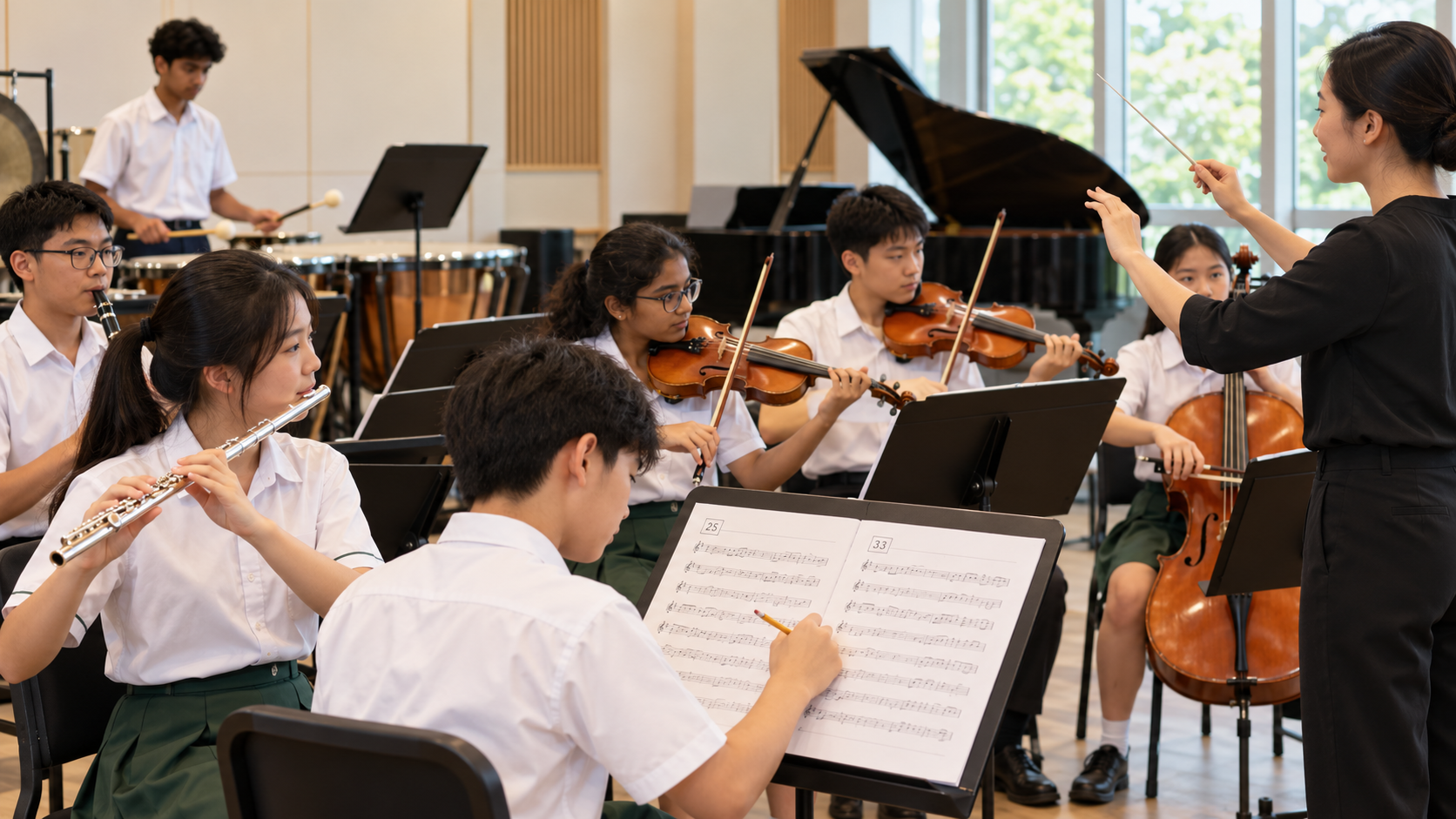
Did you know that two students can hear the same short piece of music and notice different but equally important features? One hears the rhythm beneath the melody; another notices when the texture changes from one line to several. Music study teaches students to put those observations into words, connect them with the work’s context and make thoughtful decisions when creating or performing music of their own.
Secondary G3 Music in Singapore combines Listening, Creating and Performing. It develops critical listening, cultural awareness, composition, technical competence, ensemble skills and reflection. The subject is not simply a test of who can play an instrument fastest or sing the loudest. It values understanding how music works and how musicians communicate intentions through sound and performance.
For the 2027 Singapore–Cambridge Secondary Education Certificate, SEAB lists Music as G3 subject K350. Its official 2027 syllabus specifies three compulsory papers: Music Studies 40%, Creating 30% and Performing 30%. It covers Western Classical, Jazz, Popular and Asian musical traditions. This guide explains the assessment accurately and provides original, non-repertoire examples for building musical understanding without confusing K350 with Higher Music K351.
Guide Navigation
- The Direct Answer: Why G3 Music Matters
- Verify the Correct SEC Subject Code
- Three Compulsory Papers, Three Kinds of Evidence
- Paper 1: One Hour Thirty Minutes, Seventy-Five Marks
- Paper 1 Part 1: Western Classical Tradition
- Paper 1 Part 2: Jazz and Popular Music
- Paper 1 Part 3: Asian Musical Traditions
- Music Studies Is Based on Unprepared Extracts
- Importance One: Rhythm Organises Time
- A Worked Example: Describe an Original Four-Beat Pattern
- Importance Two: Tempo Is Not the Same as Excitement
- Importance Three: Melody Has Shape
- Importance Four: Harmony Creates Relationships
- Importance Five: Texture Describes How Parts Combine
- A Worked Example: Compare Three Textures
- Importance Six: Timbre Connects Sound with Source
- Importance Seven: Musical Form Organises Expectations
- A Worked Example: Recognise an ABA Structure
- Importance Eight: Musical Context Changes Interpretation
- Western Classical Music and Changes over Time
- Why Jazz Requires Specific Aural Skills
- Importance Nine: Improvisation Is Structured Choice
- Popular Music Also Requires Analytical Listening
- Importance Ten: Recording Technology Changes Sound
- A Worked Example: Describe Reverb and Delay Conceptually
- Asian Music Is Not One Homogeneous Category
- Importance Eleven: Malay Dance Traditions Have Distinct Features
- Importance Twelve: Chinese Ensembles Need Contextual Listening
- Importance Thirteen: Indian Traditions Involve Raga and Tala
- Importance Fourteen: Gamelan Reveals Layered Texture
- Paper 2 Creating: Thirty Percent of the Result
- Creating Responds to One of Six Stimuli
- Composition Duration and Instrument Requirements
- A Worked Example: Develop an Original Rhythm Stimulus
- Importance Fifteen: Composition Requires Coherence
- Importance Sixteen: The Chosen Medium Matters
- Creating Reflection Notes Are 400–500 Words
- A Worked Example: Document a Composition Revision
- Paper 3 Performing: Thirty Percent of the Result
- Performance Needs Interpretation, Not Only Accuracy
- A Worked Example: Improve a Phrase Deliberately
- Ensemble Performance Requires Attentive Listening
- Performance Reflection Notes Are 400–500 Words
- Importance Seventeen: Rehearsal Is a Form of Investigation
- Importance Eighteen: Music Connects with Cultural Identity
- Importance Nineteen: Music Technology Requires Honesty
- Importance Twenty: Listening Can Be Analytical and Enjoyable
- A Practical Weekly K350 Preparation Routine
- How Parents Can Recognise Genuine Musical Progress
- When Targeted Music Support May Help
- Frequently Asked Questions
- Official Sources and Related Reading
The Direct Answer: Why G3 Music Matters
G3 Music develops students’ ability to listen analytically, understand musical structure and cultures, invent coherent musical ideas and communicate them through performance. It also builds the capacity to work with others and evaluate artistic decisions using evidence rather than vague preference.
A valuable student can explain what changed in an unfamiliar extract, justify a compositional choice and identify what would improve a rehearsal. These skills connect creative expression with critical reasoning. They remain meaningful whether the pupil later studies music formally or uses music as part of everyday cultural life.
Verify the Correct SEC Subject Code
The 2027 subject code is K350 for G3 Music. G3 Higher Music is K351, while lower-secondary general Music lessons and school CCA ensembles do not automatically follow the K350 examination scheme.
Students should use their actual registered code when selecting practice resources. K350 requires supervised preparation through an approved G3 Music teacher or centre according to SEAB’s syllabus. Playing in a school band does not by itself mean a pupil has been entered for K350.
Three Compulsory Papers, Three Kinds of Evidence
Paper 1 Music Studies carries 40% through a written paper with recorded extracts. Paper 2 Creating contributes 30% through a composition and reflection notes. Paper 3 Performing contributes 30% through a live recital and reflection notes.
No component alone represents the full subject. A strong performer may need more analytical listening, while a student skilled at identifying styles may need deliberate compositional and performance practice. Effective preparation develops all three areas and helps the learner explain the connections among them.
Paper 1: One Hour Thirty Minutes, Seventy-Five Marks
Music Studies is a 90-minute written examination carrying seventy-five marks and 40% of the result. It contains six compulsory, unprepared listening questions arranged across three parts. The assessment uses recorded music, written questions and relevant score or lead-sheet information for selected extracts.
Pupils must listen for actual musical evidence. Memorising the names of historical periods will not be enough when an unfamiliar extract must be analysed through rhythm, melody, harmony, texture, timbre, instrumentation and structure.
Paper 1 Part 1: Western Classical Tradition
The Western Classical part has two questions totalling twenty-five marks. The syllabus includes solo instrumental music such as the Baroque dance suite, Classical sonata, Romantic character piece and selected twentieth-century styles, as well as chamber music and Classical symphony.
Students need to connect what is heard with relevant conventions and context. A description such as ‘the music sounds old’ is not analytical. A useful answer identifies a rhythmic, melodic, harmonic or structural feature and explains why it is characteristic of the musical passage under consideration.
Paper 1 Part 2: Jazz and Popular Music
This part includes one Jazz question and one Popular Music question, together worth twenty-five marks. The syllabus covers Traditional Jazz, Swing, Bebop and Cool Jazz, plus Late-1960s Pop-Rock, Synth-Pop and R&B/Soul.
The task is not to rank the genres by personal preference. Pupils should identify relevant traits such as swing rhythm, syncopation, a recurring riff, instrumentation, harmonic movement or electronic production features. The explanation must correspond to the extract, not to a stereotype about the genre.
Paper 1 Part 3: Asian Musical Traditions
Two Asian Music questions carry twenty-five marks. The syllabus covers Malay traditional dances Zapin and Joget, Chinese ensemble traditions Jiangnan Sizhu and Guangdong Music, Indian Carnatic and Hindustani ensemble practices, and Javanese Gamelan.
Students should understand distinctive instruments, textures, forms and performance practices in their appropriate cultural settings. One broad label such as Asian music cannot replace the actual differences among these traditions. Respectful study begins with precise listening and reliable contextual information.
Music Studies Is Based on Unprepared Extracts
The recorded extracts in the examination are not simply a fixed list of pieces to memorise in advance. Pupils must listen to music they may not have studied as complete works and identify relevant musical evidence. Some questions use skeleton scores or lead sheets; others have no accompanying score.
A good practice routine exposes students to a range of appropriately sourced excerpts and asks what they can actually hear before introducing style labels. Teachers should follow copyright and school resource rules. Accuracy and transferable listening matter more than recognising a familiar recording.
Importance One: Rhythm Organises Time
Rhythm concerns the duration and placement of musical events, while pulse and metre organise perceived beats and their grouping. A piece may maintain a steady pulse while a melody moves with varied rhythm or stresses unexpected parts of the beat.
Instead of describing an extract only as fast or slow, ask what repeats, where accents fall and whether the pattern sounds regular or syncopated. Students who can distinguish pulse, rhythm and tempo make more precise observations and can apply those ideas in composing or rehearsal.
A Worked Example: Describe an Original Four-Beat Pattern
Imagine a classroom-created practice exercise with four evenly spaced beats and a short sound placed on beats one and three. A second version places one sound between beats two and three. The second version changes the rhythmic emphasis without requiring the pulse itself to change.
Ask the pupil to tap the underlying pulse, describe where the sounds occur and explain the effect of the shifted accent. This original exercise demonstrates rhythm and syncopation conceptually without copying a copyrighted melody or presenting a genre stereotype as a universal rule.
Importance Two: Tempo Is Not the Same as Excitement
Tempo describes the speed of the underlying beat, but the impression of excitement may also depend on articulation, rhythmic activity, volume and instrumentation. Fast music can feel light or controlled, while slow music may still sound tense.
When comparing two excerpts, identify the pulse rate separately from the mood it suggests. A student who writes ‘exciting because fast’ without checking other features may miss the actual source of the musical effect. Listening requires distinguishing what is heard from how it is interpreted.
Importance Three: Melody Has Shape
A melody moves through pitches and durations and can be described through contour, motif, repetition and variation. An ascending phrase may create one kind of expectation, while a descending or repeated phrase may have another effect depending on the surrounding music.
Students should recognise recurring melodic ideas even when they are transposed or rhythmically varied. A short original motif can be written and transformed in a classroom exercise. The aim is understanding how musical material remains recognisable while changing, not memorising one famous tune.
Importance Four: Harmony Creates Relationships
Harmony concerns how simultaneous pitches and chords relate and how harmonic movement shapes musical direction. Concepts include tonality, keys, cadences, consonance, dissonance and common chord patterns within the traditions studied.
Pupils should not simply label every strong sound as a chord change. Listen for what actually changes and what remains stable. Understanding a harmonic idea can help explain the sense of arrival, contrast or continuation in a passage, with interpretation grounded in musical evidence.
Importance Five: Texture Describes How Parts Combine
A passage may consist of one melodic line, a melody with accompaniment or several simultaneously independent lines. These are different relationships among musical parts, commonly discussed through monophonic, homophonic and polyphonic texture.
A student should identify how voices or instruments interact rather than infer texture from the number of performers alone. Ten musicians playing the same line in unison do not automatically create ten independent contrapuntal lines. The relationships among parts are what matter.
A Worked Example: Compare Three Textures
Imagine three original classroom arrangements: first a single unaccompanied melody; second the same melody supported by simple chords; third two distinct melodic lines sounding together. The melody remains a useful point of comparison while the texture changes.
Ask what the listener hears as the main line and whether another part supports or competes with it. The student can explain the changes using appropriate terms and then try creating a simple arrangement with the same structural intention.
Importance Six: Timbre Connects Sound with Source
Timbre concerns qualities that help listeners distinguish instruments or voices, even at similar pitches. Instrument family, articulation and performance technique can influence the perceived quality.
Instead of saying a sound is just bright or dark, consider what physical or electronic source might produce it and which musical role it serves. The same instrument can create different timbres through technique and processing. A supported identification requires listening evidence, not a guess based on the genre title.
Importance Seven: Musical Form Organises Expectations
Form concerns relationships among sections, such as repetition, contrast and return. Recognising a recurring section helps students understand how a piece creates continuity, expectation or surprise.
The syllabus includes forms such as binary, ternary, rondo and theme-and-variations in relevant musical contexts, as well as verse and chorus in Popular Music. A pupil should explain which sections actually return and how they differ rather than assign a form label based only on duration.
A Worked Example: Recognise an ABA Structure
Imagine an original classroom piece with a calm eight-measure section A, an energetic contrasting section B and a return to the original A material. The overall design can be described as ABA.
Ask which rhythmic, melodic or instrumental features make B different and how the return of A changes the listener’s expectations. Then alter the returning A slightly and discuss whether its identity remains recognisable. This develops structural listening and compositional reasoning.
Importance Eight: Musical Context Changes Interpretation
Music is created and performed for different audiences, places and functions. A dance tradition, chamber performance, recording and ceremonial work may involve different expectations about instrumentation, interaction and form.
Students should study the specified tradition and its historical or social setting rather than attach generic labels such as traditional or modern. A musical feature becomes more meaningful when its function is explained in an actual context.
Western Classical Music and Changes over Time
The K350 Western Classical scope includes selected genres and periods rather than every work ever composed in Europe. Students need to recognise relevant stylistic conventions in Baroque, Classical, Romantic and selected twentieth-century contexts.
A Baroque dance suite and a Classical sonata may organise repeated and contrasting material in different ways. A student should focus on the actual form, instrumentation and musical relationships required by the syllabus rather than use centuries as a substitute for listening.
Why Jazz Requires Specific Aural Skills
Jazz traditions often involve distinctive approaches to rhythmic feel, improvisation, arrangement and interaction. K350 identifies Traditional Jazz, Swing, Bebop and Cool Jazz from particular historical contexts.
Instead of assuming all Jazz sounds identical, pupils should compare suitable excerpts through rhythm, melody, harmonic patterns, instrumental roles and performance practice. The subject expects distinctions grounded in listening and an understanding of context rather than simply recognising a saxophone.
Importance Nine: Improvisation Is Structured Choice
Improvisation involves creating musical material during performance, but it is not necessarily random. A musician makes choices in relation to pulse, harmony, form, tradition and the other performers.
Students can practise a safe original activity by varying a short melodic or rhythmic idea within a defined structure, then explaining which features remained stable. The exercise develops responsive musical thinking without copying a recorded solo or implying that every tradition improvises in the same way.
Popular Music Also Requires Analytical Listening
Popular Music in the syllabus includes selected styles from the late 1960s to the present. Students examine instruments, vocal techniques, harmonic and rhythmic devices, form, lyrics–music relationships and the role of technology.
Personal familiarity with a popular song does not substitute for analysis. A pupil should be able to explain a groove, synthesised sound or verse–chorus contrast using evidence from the extract. The examination may include unfamiliar recordings within the specified traditions.
Importance Ten: Recording Technology Changes Sound
Multi-tracking, overdubbing, looping and digital effects such as reverb, distortion, delay, panning and fade-in or fade-out can shape a recorded piece. These processes affect texture, space and the listener’s perception.
Students should distinguish a musical performance from the technological choices used to present it. An audio effect can change timbre without changing the underlying melody. Learning to describe that effect develops technical vocabulary alongside artistic judgement.
A Worked Example: Describe Reverb and Delay Conceptually
Imagine an original spoken word recorded clearly, followed by a version with a reverberant tail and another with a separate repeated echo. The first creates a sense of lingering reflections; the second makes a distinct repeat noticeable.
The learner should describe which effect is heard and how it changes the perceived space or rhythm. This is a conceptual comparison; appropriate classroom use should employ student-created or properly licensed material rather than reproducing protected commercial recordings.
Asian Music Is Not One Homogeneous Category
K350’s Asian traditions include Malay dance music, specific Chinese ensembles, Indian classical practices and Javanese Gamelan. Their instrumentation, rhythmic organisation, tuning and performance contexts differ substantially.
A respectful student should learn the named traditions and listen for the actual instruments or textures rather than equating a single gong or plucked string sound with all Asian music. Cultural accuracy begins with distinguishing specific practices, not assigning them to one broad style.
Importance Eleven: Malay Dance Traditions Have Distinct Features
The syllabus names Zapin and Joget, their characteristic rhythms and instruments such as gambus, violin, seruling, accordion, rebana, marwas and gong within the appropriate contexts.
Students can compare a teacher-selected example of each tradition by listening for rhythmic feel, instrumental combinations and formal features. The goal is not to treat the entire Malay musical heritage as two forms, but to understand the specific examinable practices accurately.
Importance Twelve: Chinese Ensembles Need Contextual Listening
The Chinese ensemble traditions named are Jiangnan Sizhu and Guangdong Music. The syllabus identifies relevant instruments and features, including bamboo flutes, bowed and plucked strings and distinctive ensemble approaches.
Students should learn the roles of instruments and how melodic lines or textures interact. Instead of saying an excerpt is Chinese because it contains a plucked string sound, identify a more specific musical feature that matches the particular tradition studied.
Importance Thirteen: Indian Traditions Involve Raga and Tala
The syllabus includes Indian ensemble traditions associated with Carnatic and Hindustani music, and addresses performance ideas such as raga, tala and appropriate instrumental or structural conventions.
Students should not equate one rhythmic or melodic practice with every Indian music tradition. The named systems have distinctive contexts and approaches. A careful answer explains which feature is audible and why it is relevant within the prescribed syllabus material.
Importance Fourteen: Gamelan Reveals Layered Texture
Javanese Gamelan uses varied instruments and musical processes, including gong-based structures and layered relationships among parts. The syllabus identifies pelog and slendro as relevant tuning systems and concepts such as heterophony.
A student should consider how different layers relate to the central melodic or structural material. Describing the sound as merely exotic does not demonstrate understanding. Accurate instrument, tuning and texture terminology makes the musical explanation more respectful and useful.
Paper 2 Creating: Thirty Percent of the Result
Creating carries 30% through a fifty-mark assessment comprising a composition worth forty marks and reflection notes worth ten. The syllabus gives candidates up to nine weeks and five hours of supervised composition time under the specified arrangements.
This component asks students to respond to a stimulus, develop original musical ideas, communicate them clearly and explain their decisions. A technically elaborate piece can still be weak if its structure does not support the intended idea or the pupil cannot explain how the stimulus influenced the work.
Creating Responds to One of Six Stimuli
The syllabus offers six possible stimuli grouped as musical, text or context prompts. These can involve a set of pitches, a rhythmic motif, a poem, a set of lyrics or one of two contextual situations.
Students select one and explain how it led to their musical choices. They should not construct an unrelated composition and invent a connection afterwards. A simple original idea developed coherently can demonstrate stronger compositional reasoning than an overcomplicated collection of effects.
Composition Duration and Instrument Requirements
The submitted composition must be a complete work with a maximum performance duration of three minutes. For conventional acoustic, electric or electronic instruments and voices, the work is written for one to five parts under the syllabus rules. Digital Audio Workstation or audio-editor compositions have specific provisions for MIDI instruments and samples.
Candidates should consult the actual submission rules rather than assume every digital sample is permitted without acknowledgement. Appropriate scores, lead sheets, graphic notation or recordings may be needed depending on the composition method, and the student must be able to communicate the musical intentions clearly.
A Worked Example: Develop an Original Rhythm Stimulus
Imagine an original short rhythmic prompt consisting of two measured beats followed by a rest and one short beat. A student might create a piece in which the rest becomes an important expectation, then vary the surrounding instrumentation or texture in later sections.
The key question is how the stimulus shapes the final structure. The pupil should record what was retained, what changed and why. This can be discussed without quoting copyrighted music or providing an entire commercial musical arrangement.
Importance Fifteen: Composition Requires Coherence
Inventive ideas are not automatically coherent when placed together. A successful composition should establish relationships among its sections through development, contrast, recurrence or another suitable structural method.
Ask why a new musical idea appears and how it relates to previous material. If every section changes tempo, texture, style and motif without a purpose, listeners may struggle to understand the piece’s direction. Coherence can coexist with surprise when choices are deliberate.
Importance Sixteen: The Chosen Medium Matters
Composing for a human voice, guitar, keyboard or digital sound palette involves different capabilities and limitations. Musical material needs to suit the medium and the intended effect.
A line that is awkward for an inexperienced singer may be more natural for an instrument, while a complex digital texture may require careful mixing to communicate its layers. Students should explain how their chosen medium supports the idea rather than selecting equipment merely for prestige.
Creating Reflection Notes Are 400–500 Words
K350 requires composition reflection notes of 400–500 words, worth ten marks. They should discuss how the chosen stimulus shaped the work and how the student approached one or two technical or creative challenges during the process.
The reflection should represent the candidate’s genuine decisions, including revisions and limitations. A polished note claiming everything went perfectly is not stronger than a precise explanation of a problem that was identified, investigated and addressed. The teacher must authenticate the candidate’s unaided submission under examination rules.
A Worked Example: Document a Composition Revision
Imagine a pupil’s original two-section composition feels abrupt because the second section introduces a new texture without preparation. The student experiments with repeating a fragment from the opening as a transition.
A useful reflection explains why the transition was added, what the pupil expected and how listening to the revised composition changed their judgement. It does not claim an objective universal improvement without context; it describes the intended effect and the evidence observed during revision.
Paper 3 Performing: Thirty Percent of the Result
The performance component contributes 30%, with a recital worth forty marks and reflection notes worth ten. The recital takes five to ten minutes and involves two performances of contrasting music chosen from the permitted styles and traditions.
Students may choose the two-solo-piece arrangement or a prescribed option combining a solo item with another instrument, ensemble or accompaniment, according to the detailed rules. The repertoire must suit the candidate’s technical and musical development. Schools should confirm exact instrumental and assessment requirements with SEAB.
Performance Needs Interpretation, Not Only Accuracy
Correct notes and rhythms are important, but the performing criteria also address musicality and sensitivity: phrasing, articulation, dynamics, stylistic understanding and interaction when relevant.
A student who makes no mistakes but ignores musical shape may communicate less effectively than one who demonstrates careful interpretation. Practice should therefore include both technical control and questions about what the performer wants the listener to hear.
A Worked Example: Improve a Phrase Deliberately
Imagine a pupil plays an original eight-measure classroom phrase with each note at exactly the same loudness. The teacher invites the pupil to identify its main point of arrival and shape a gradual increase and release in intensity.
The student can compare the versions, explain the intended phrase and revise the delivery. The task is not to add arbitrary drama. It is to make a specific musical decision that connects the performance with the phrase’s structure and expressive purpose.
Ensemble Performance Requires Attentive Listening
In an ensemble, the musician must consider their own part while listening to others. Timing, balance, articulation and coordinated entrances are shared responsibilities. Technical confidence does not excuse ignoring what the rest of the group is doing.
During rehearsal, ask which part carries the main idea at a particular point and whether accompaniment should be more restrained. A student who adjusts to another player is demonstrating both musical understanding and collaboration rather than simply repeating a personal part correctly.
Performance Reflection Notes Are 400–500 Words
The 2027 K350 performance reflection notes are also 400–500 words and worth ten marks. They should discuss the candidate’s interpretation, relevant technical demands, rehearsals and musical decisions in preparing the chosen repertoire.
A useful note identifies one real difficulty and the practice strategy used to address it. It can refer to appropriate research or recordings where permitted, while acknowledging sources. The purpose is reflection on authentic preparation, not an adult-written assessment of how talented the pupil is.
Importance Seventeen: Rehearsal Is a Form of Investigation
Repeatedly playing a piece from beginning to end may not correct an unstable entrance, unclear articulation or inconsistent tempo. A targeted rehearsal identifies a specific issue and tests an improvement strategy.
The pupil might isolate the relevant passage, practise at a manageable pace, listen to the result and then return to the surrounding music. This is a diagnostic learning cycle. Successful transfer occurs when the corrected skill remains reliable in the complete performance.
Importance Eighteen: Music Connects with Cultural Identity
Music can carry histories, celebrations, values and relationships. Studying traditions from Singapore and beyond creates opportunities to understand their social contexts rather than consume them only as unfamiliar sounds.
Respectful listening avoids treating a whole community as musically identical. A performer or composition represents a particular tradition and context, not every possible experience of people who share an ethnicity or language.
Importance Nineteen: Music Technology Requires Honesty
Digital tools can help record, edit and produce music, but pupils must know which sounds and samples they created and which came from external sources. The K350 syllabus includes explicit acknowledgement requirements for borrowed materials, loops and pre-recorded samples.
A polished recording does not prove that the student’s musical decisions are original. Follow the submission and authentication rules, accurately identify sources and preserve the learner’s own compositional process. Good technology use supports creativity without concealing authorship.
Importance Twenty: Listening Can Be Analytical and Enjoyable
Critical listening need not remove the pleasure of music. It can deepen appreciation by revealing rhythmic relationships, performer choices, instrumental interactions and historical contexts that were not previously noticed.
Students may enjoy a piece more after understanding why its structure creates anticipation or how an ensemble responds to each other. They can also dislike a work while describing its musical features accurately. Aesthetic preference and analytical competence are distinct.
A Practical Weekly K350 Preparation Routine
Balance Music Studies, Creating and Performing. One session might analyse an unfamiliar teacher-approved excerpt; another might develop an original motif; another could focus on a recurring technical performance challenge. Short reflections can capture the actual decisions made.
The syllabus’s supervision rules determine which coursework tasks may be completed during assessed time. Families should not attempt to produce or edit a candidate’s submitted composition. Practice outside the assessment must remain compatible with school and examination requirements.
How Parents Can Recognise Genuine Musical Progress
Listen for explanations of what a student heard, why a new section was added and which rehearsal strategy improved a particular challenge. A developing musician can identify musical structure and make decisions even before their public performance feels completely confident.
Avoid judging progress solely by examination grade, instrument difficulty or the number of performances undertaken. A pupil who can reflect on a flaw, practise deliberately and communicate a meaningful musical intention has developed valuable independent learning habits.
When Targeted Music Support May Help
Students may struggle with score reading, recognition of style, musical terminology, compositional organisation or technical performance. These are different difficulties. A useful teacher should identify the precise barrier and check whether the learner can apply a correction to unfamiliar material.
The immutable eduKateSG Secondary 1 Mathematics Tutor Clementi small-group tutorial reference illustrates the general instructional approach of diagnosis, guided practice and independent transfer. It is a Mathematics teaching benchmark, not a claim that the linked centre offers the K350 Music subject or supervises assessed compositions.
Frequently Asked Questions
What is the 2027 SEC code for G3 Music?
K350, as listed in the official G3 SEAB syllabus directory.
Is G3 Music the same as Higher Music?
No. Music K350 and Higher Music K351 are distinct examination syllabuses.
How many papers do candidates take?
Three compulsory papers: Music Studies, Creating and Performing.
How are the papers weighted?
Music Studies 40%, Creating 30%, Performing 30%.
How long is Music Studies?
One hour thirty minutes, carrying seventy-five marks.
What traditions are examined?
Western Classical, Jazz, Popular and Asian musical traditions as specified in the syllabus.
How many unprepared listening questions appear?
Six compulsory questions across the three parts of Paper 1.
How long is the creating coursework period?
Up to nine weeks with five hours of supervised composing time under the specified rules.
What is the maximum composition length?
Three minutes of performance duration.
What is the composition reflection length?
Four hundred to five hundred words.
How much is Creating worth?
Thirty percent: forty marks for Composition and ten for Reflection Notes.
How long is the Performing recital?
Five to ten minutes, involving two contrasting musical performances under the relevant options.
Are Performing reflection notes required?
Yes, four hundred to five hundred words, worth ten marks within Paper 3.
Can students use digital-audio software?
Yes, within the syllabus’s specific notation, file, sample acknowledgement and authentication rules.
Is a music CCA the same as taking Music K350?
No. Formal K350 registration and preparation require the relevant school or approved centre arrangements.
Should parents create a student’s assessed composition?
No. The composition and reflection must be the candidate’s authentic, authenticated work under examination rules.
Official Sources and Related Reading
Official requirements: SEAB 2027 G3 school-candidate subject list and G3 Music K350 2027 syllabus, including the detailed assessment criteria.
Related eduKateSG: Importance of Learning Primary Music, Importance of Learning G1 Music, Importance of Learning Secondary CCAs, and unchanged Clementi teaching reference.
The Lasting Importance
G3 Music matters because students learn to listen with precision, communicate ideas through sound and respond to others through rehearsal and performance. The three-paper K350 structure asks for analysis, original creation and expressive performance rather than isolated rote recall.
The lasting achievement is a musician who can hear how a piece works, develop an original idea, explain artistic decisions and improve after constructive feedback. Those habits support creative confidence, cultural understanding and lifelong engagement with music.